We are starting a new series today on America’s National Parks and Monuments which we will be running in addition to posts on our travels this summer in Greece, Scotland, and Ireland. First up, is Arches National Park in Utah.
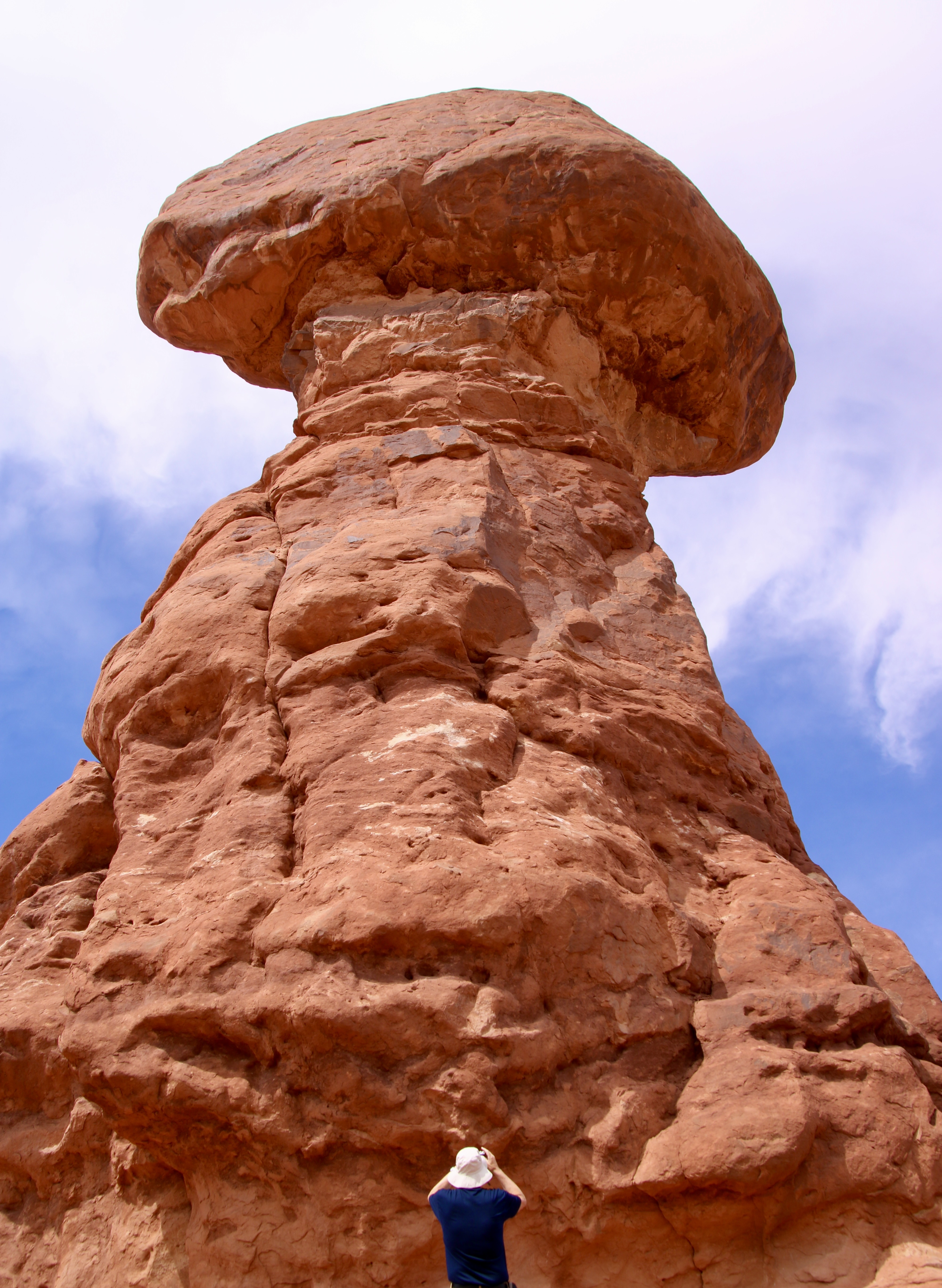
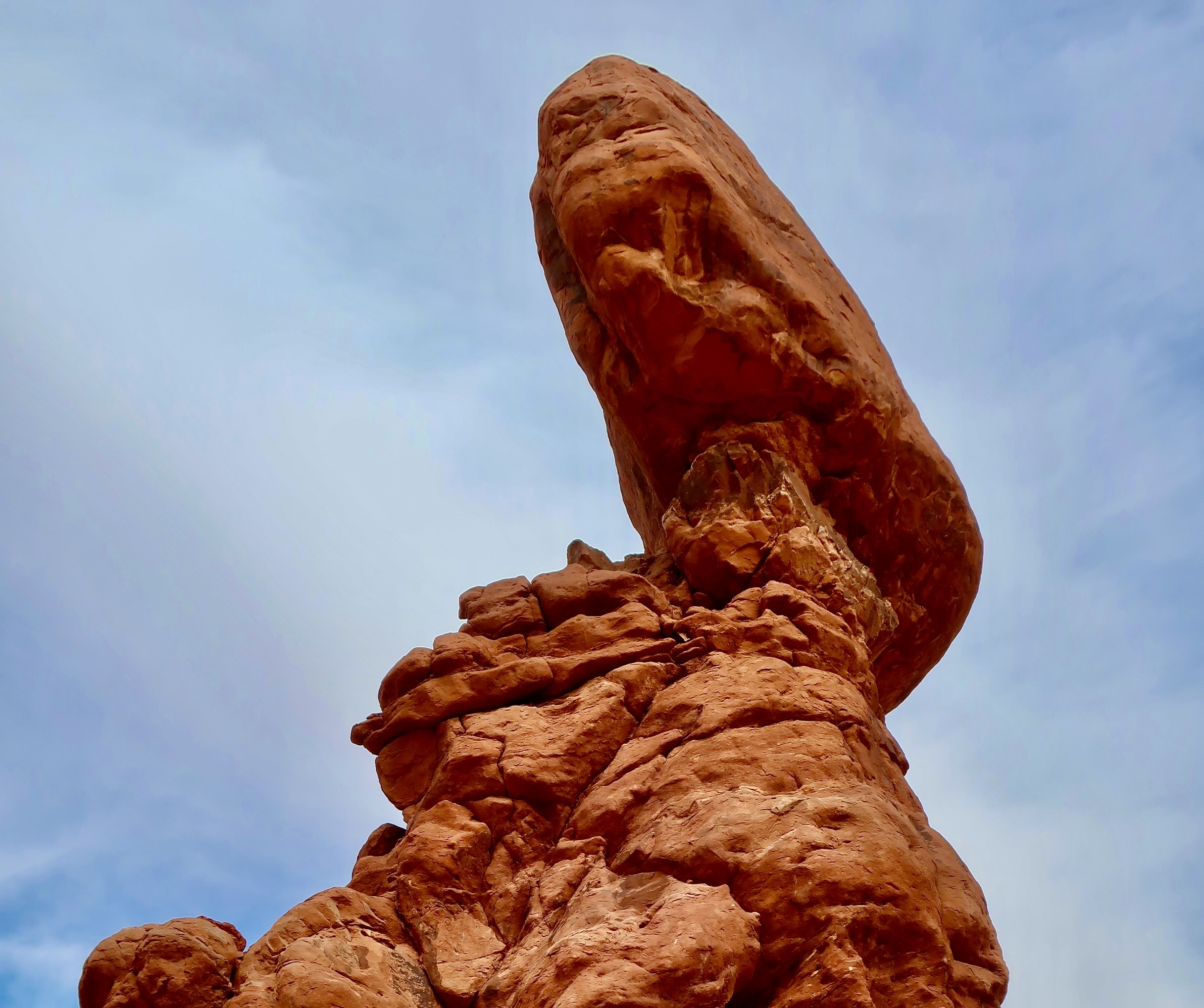
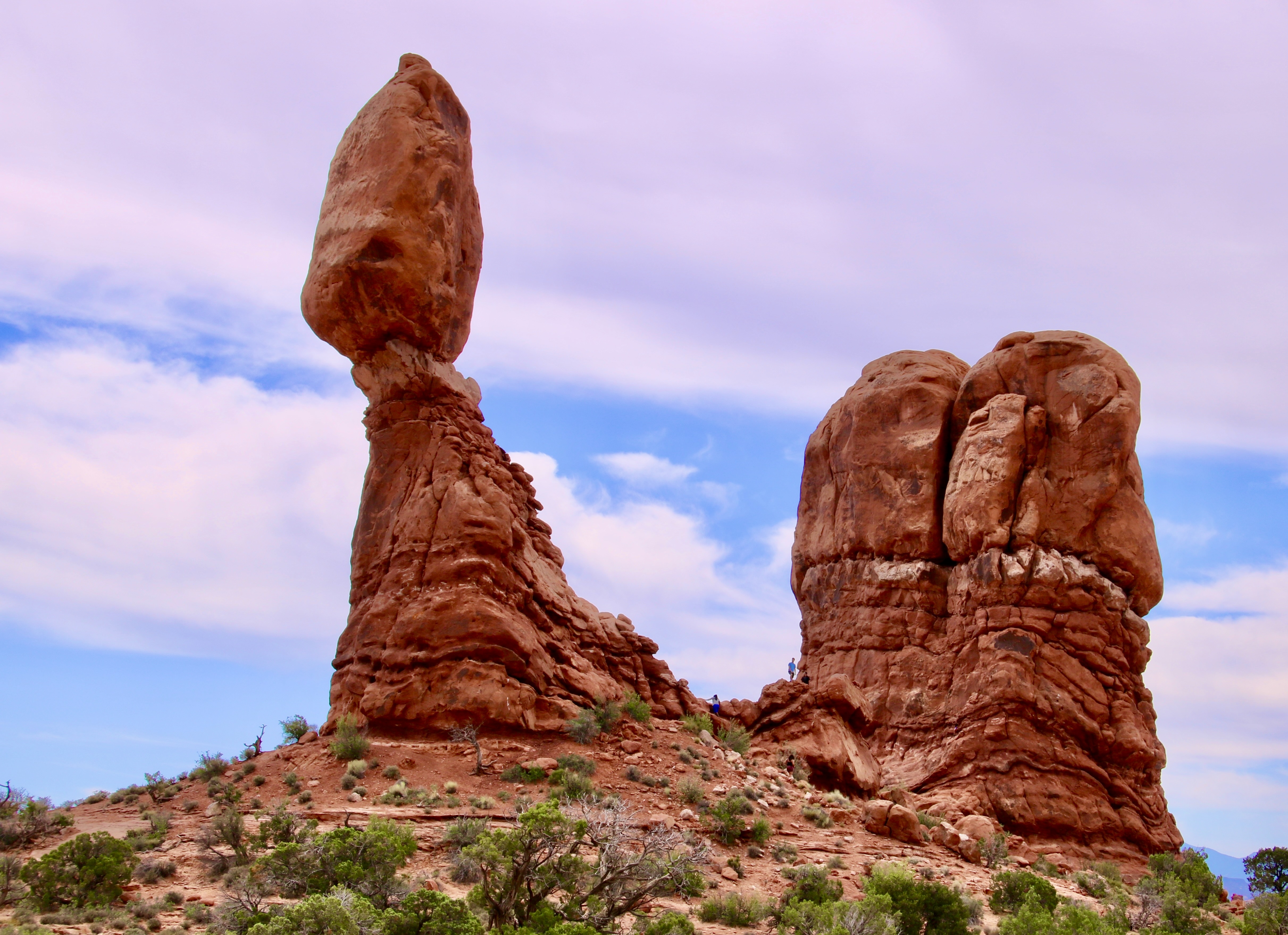
There is more than arches to Arches National Park. Balanced Rock is a prime example. It is one of the main attractions in the park. Here, Peggy caught a photo of me shooting straight up from the bottom. Her photo provides perspective on the size of the giant.
Peggy and I have always been drawn to the great natural beauty of our country and the world’s wild areas. In 1999/2000 we both took sabbaticals from our work with a primary goal of exploring the majority of America’s national parks. We ended up visiting 52 from Alaska to Florida. (Our trip also including enjoying the spectacular national parks in the Canadian Rockies.)
Our love for National Parks has continued up to today. Over the past 15 years we have returned to visit and photograph 42 national parks and 20 national monuments— many of which we feel deserve national park status.The parks we will be featuring in this series are all included in this time frame. Most of these parks we have visited at least twice and some, like the Grand Canyon, Redwoods, Death Valley, and Pt. Reyes National Seashore, several times.
We were disappointed that national parks weren’t more of a focus during the 250th Anniversary Celebration. Instead, the Trump Administration pulled tens of millions of dollars in National Park Service funds—primarily from visitor entrance fees—to finance projects in Washington, D.C. and activities like the massive fireworks display, mixed martial arts event called UFC Freedom 250, and the The Freedom 250 Grand Prix. This isn’t meant to criticize the events per se, which were enjoyed by thousands of people, but merely to note that the funds should not have been taken out of much needed national park funds. Sadly, this reflects a number of actions that the Administration has carried out in relation to national parks and monuments.
I will be discussing some of these issues in this series, but my primary purpose will be to celebrate their beauty, wildlife, history and diversity for our 250th Anniversary. The bottom line: Wouldn’t it be wonderful if Americans and people from throughout the world could be celebrating the parks and monuments that exist today— plus any more that will hopefully be added— for the nation’s 500th Anniversary.
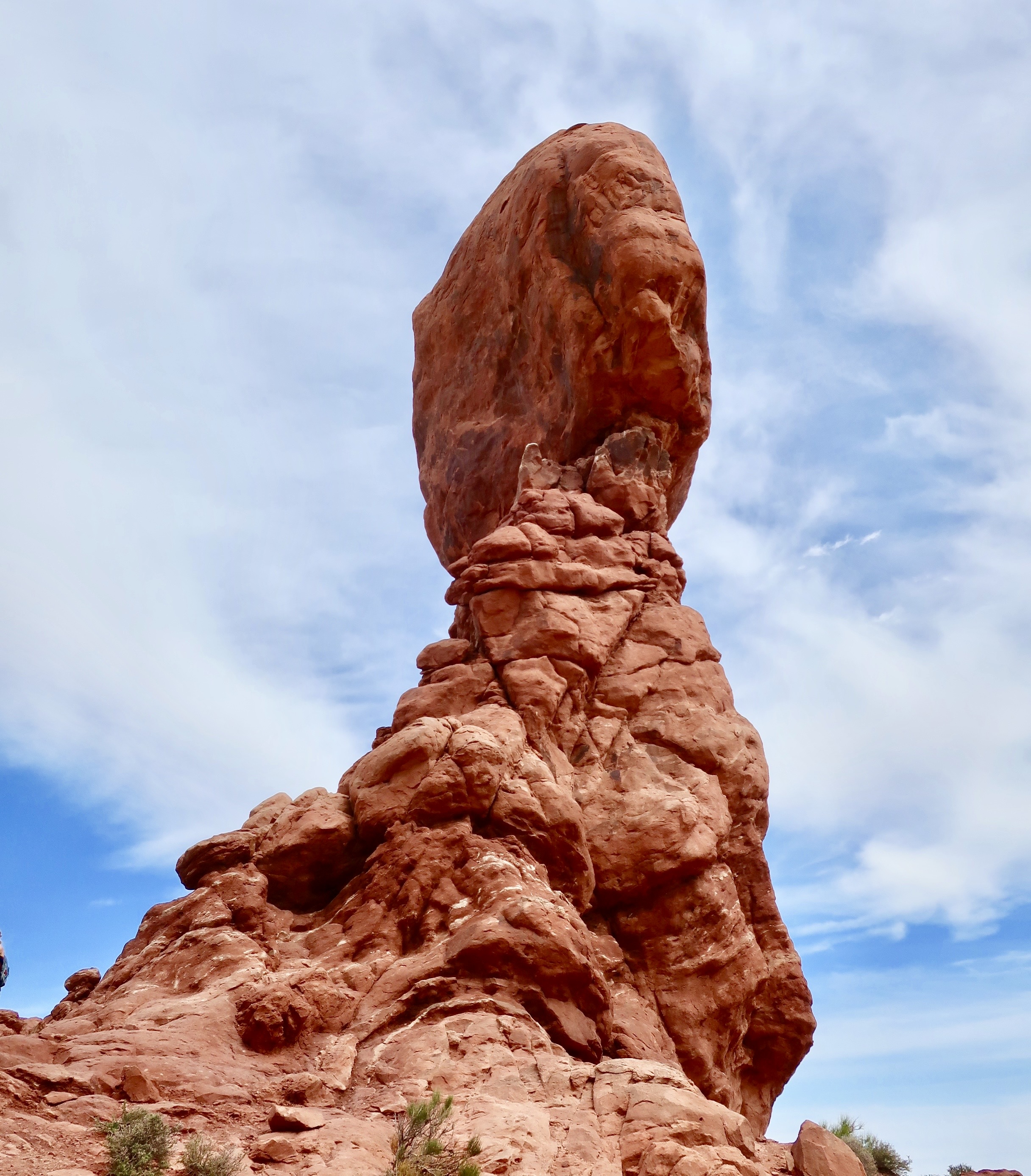
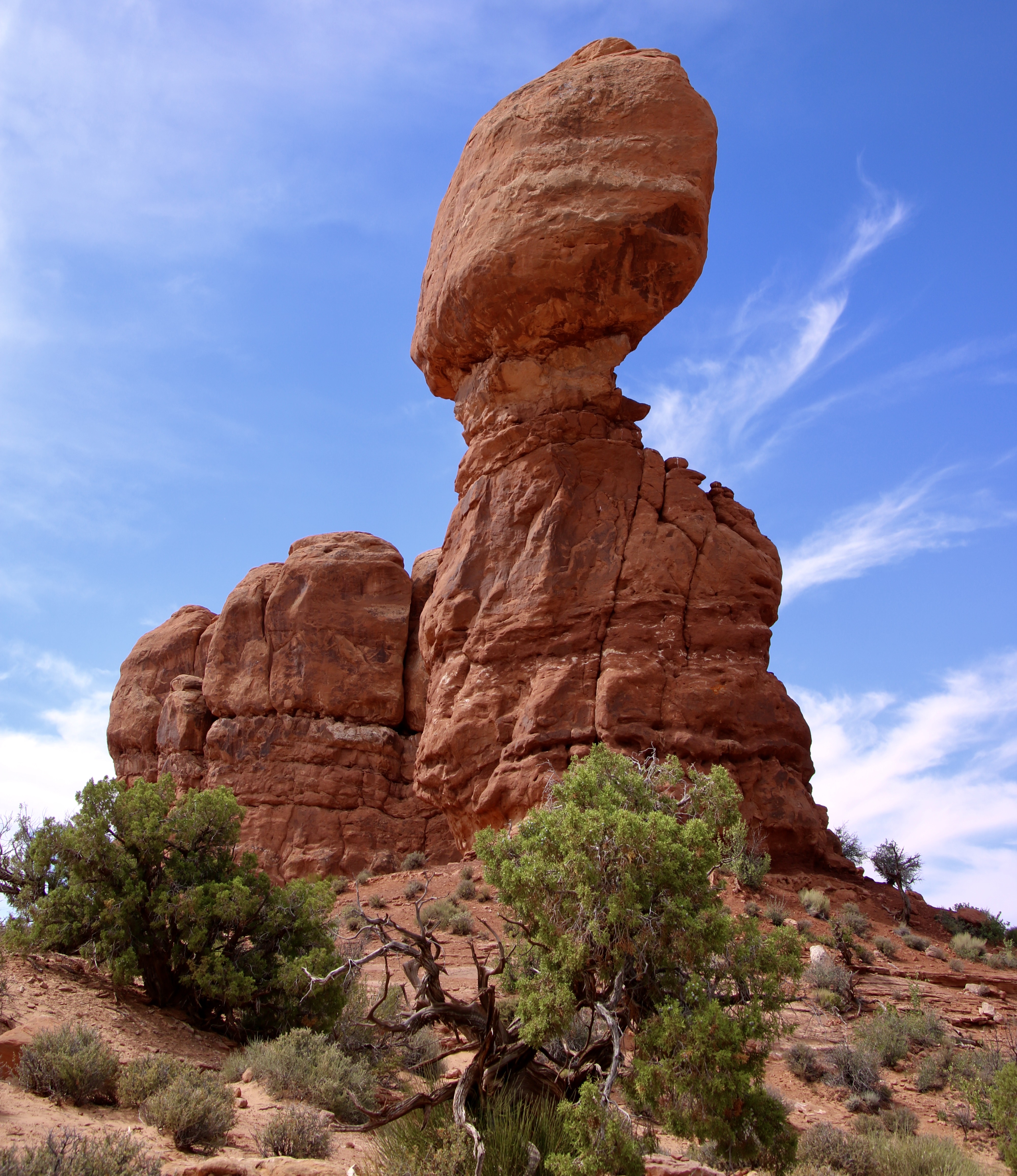
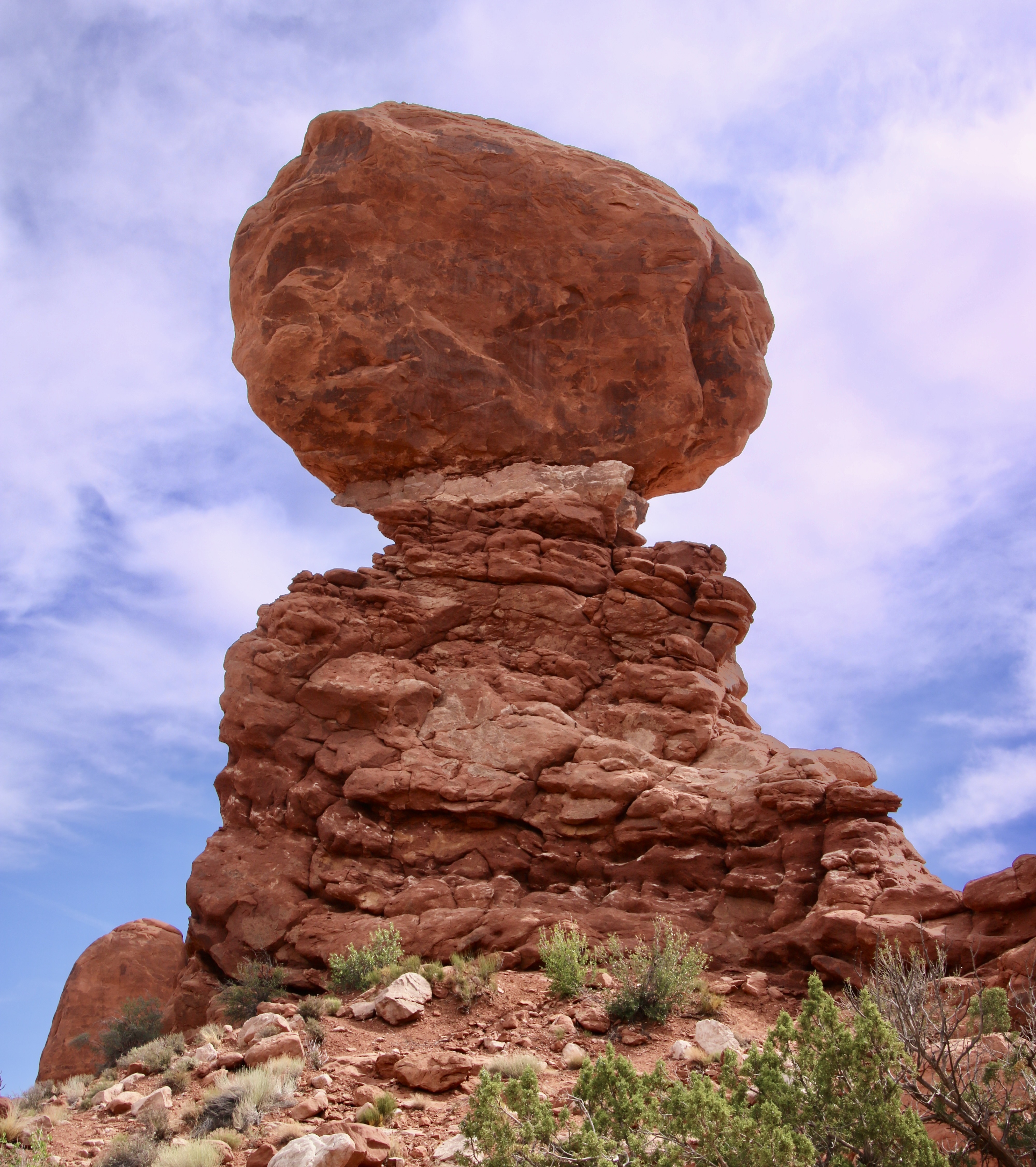
My objective in photographing the monument from bottom up was to work my way around the monument capturing views like this. One of our goals in this series is to show the beauty of the national parks from different, as well as the same, perspectives that are usually seen.This is a more traditional photo of the rock and its beauty. The total height of the monument is 128 feet (39 meters). The boulder on top is 55 feet (17 meters) and weighs 3500 tons. One wouldn’t want to be under it when this perilously perched peak comes tumbling down tomorrow— or a thousand years from now, a mere drop in a bucket when considering geological time.
The first deposits that Arches NP were created from date back over 300 million years, when sea salt from ancient oceans was laid down. Since then vast deserts, materials eroded from surrounding mountains, shallow seas, lakes and rivers have all played a part. Buried under thousands of feet of rock, geological forces would eventually bring these deposits to the surface, cracking them along the way and leading to the fractures, which, aided by erosion, created the fins, arches, and pinnacles seen today. A process that is continuing.
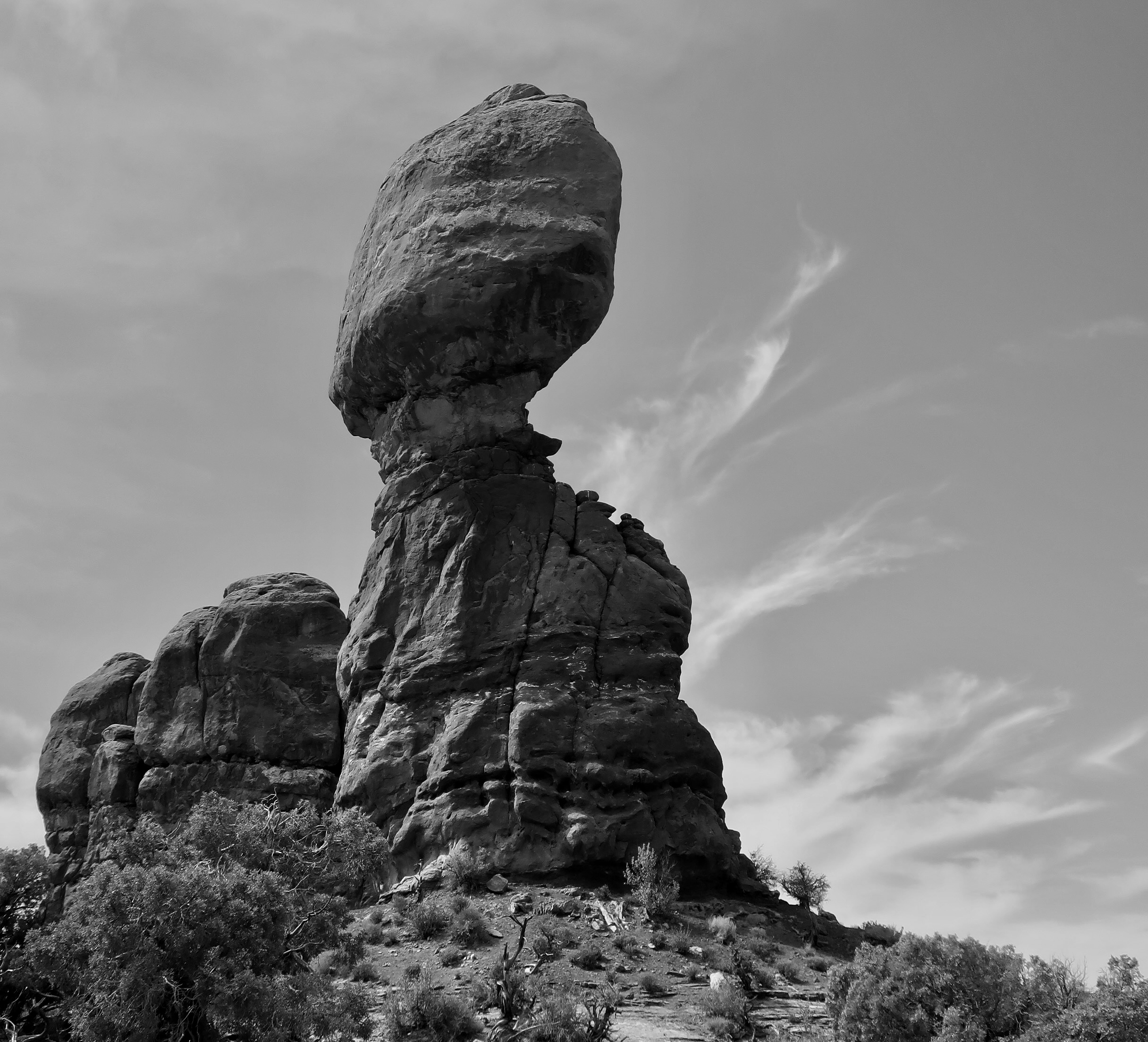
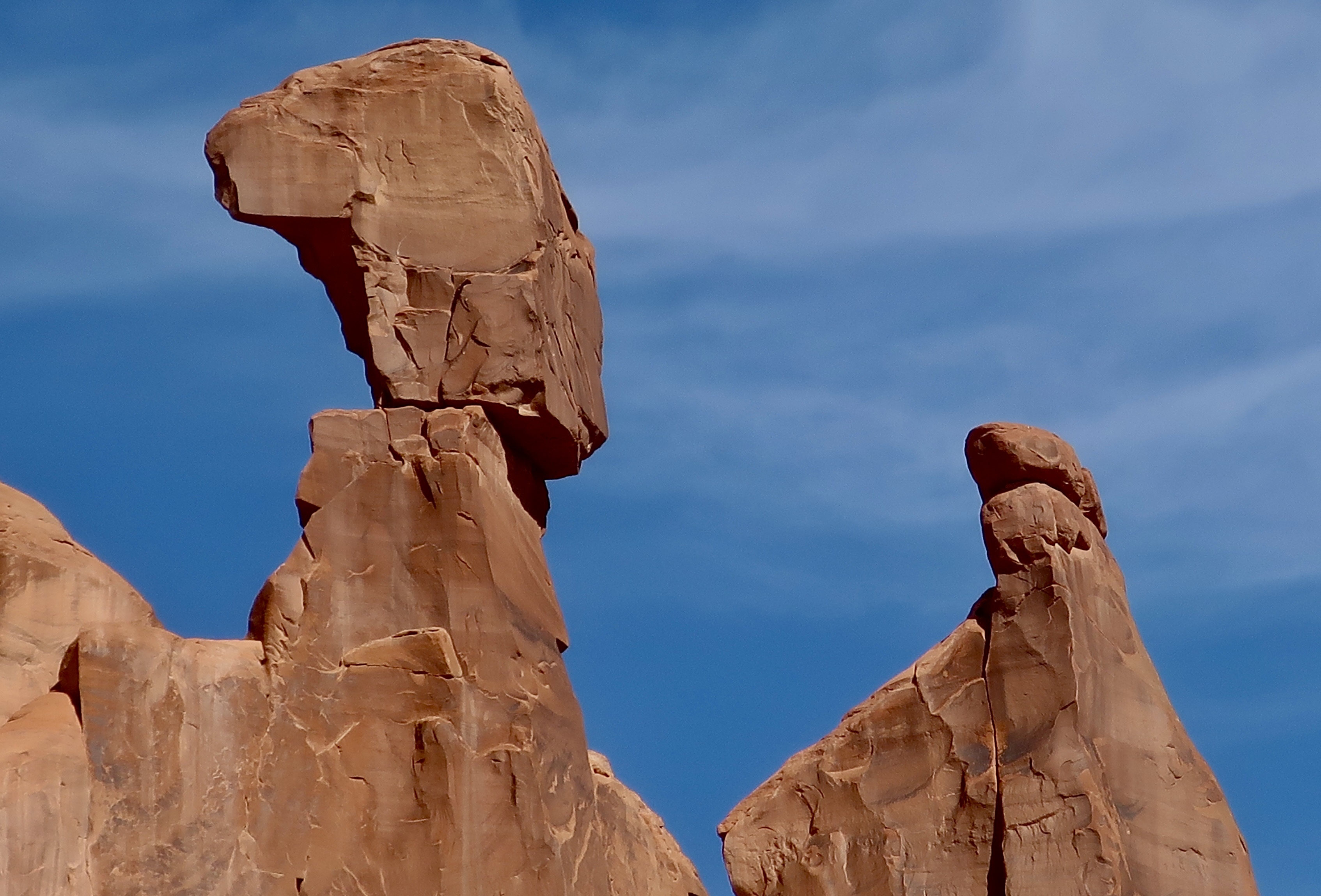
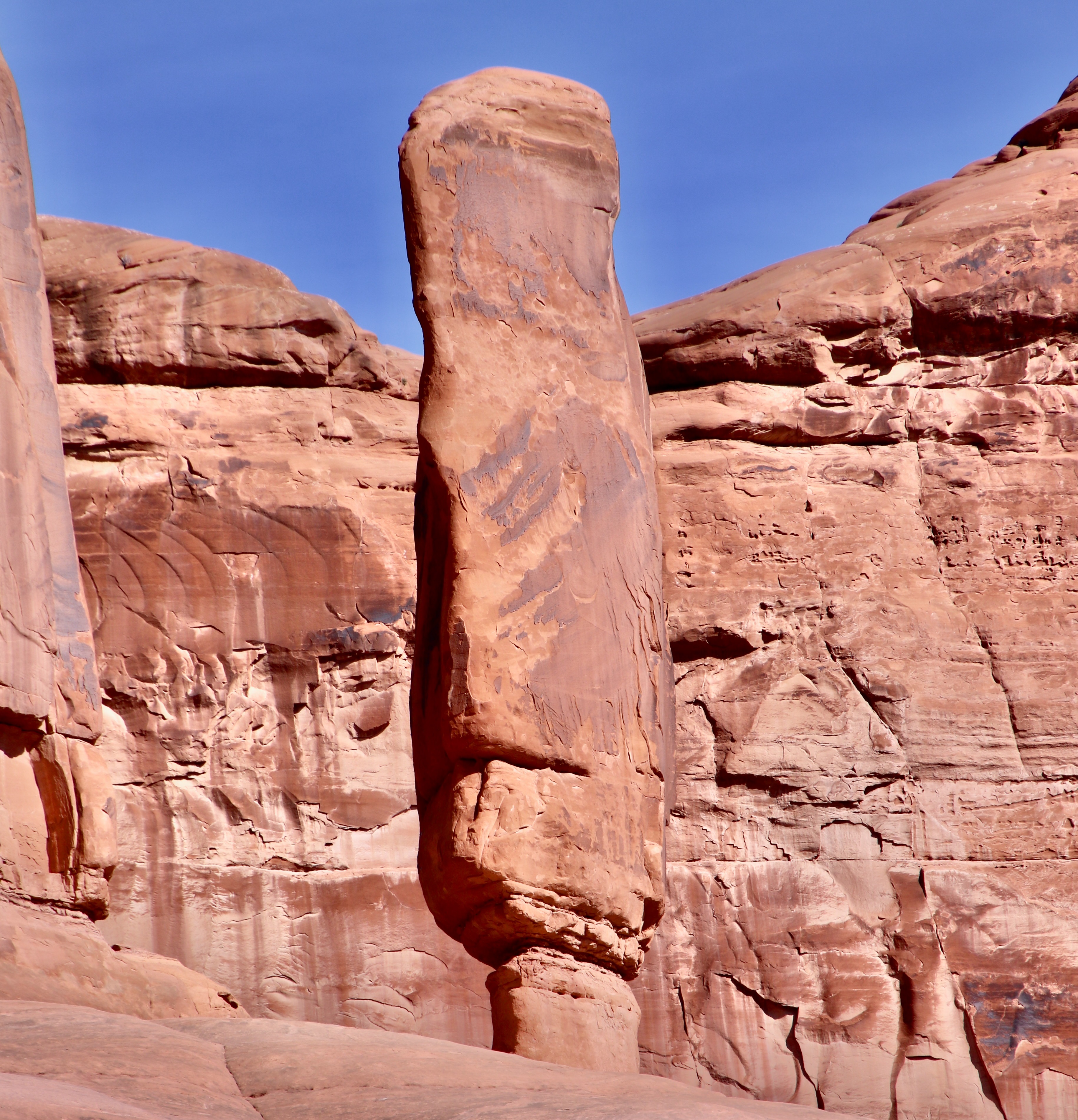
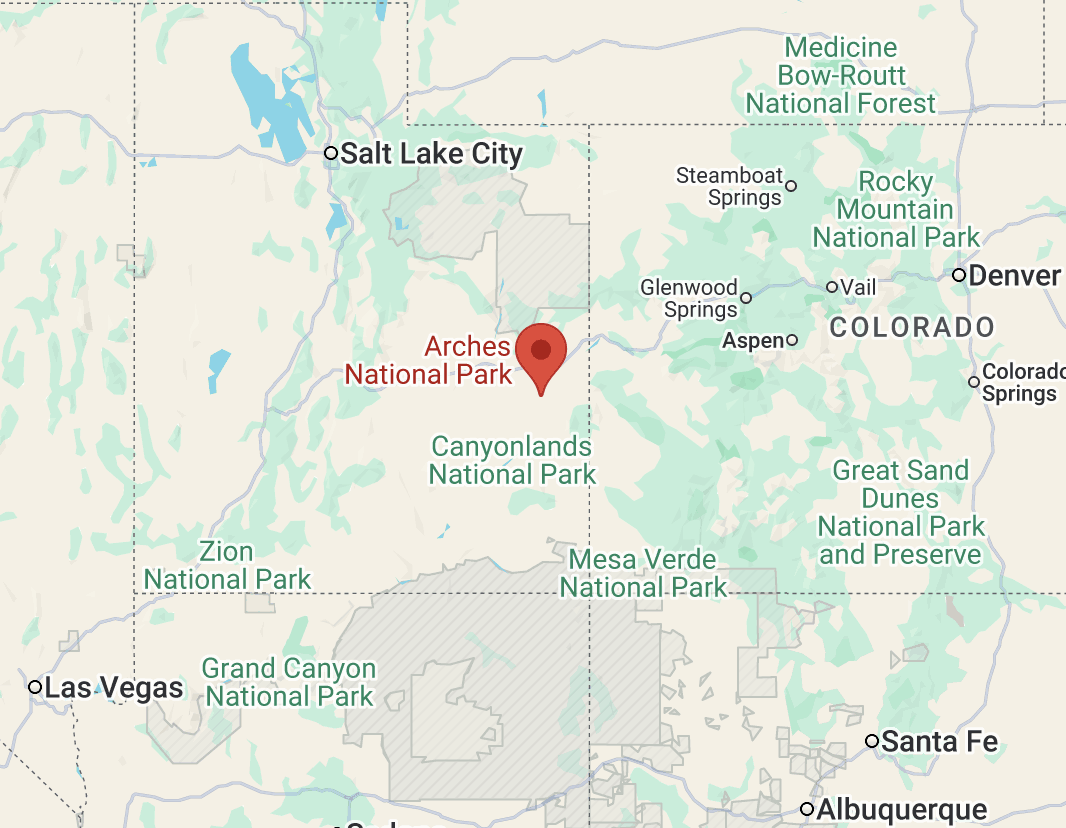
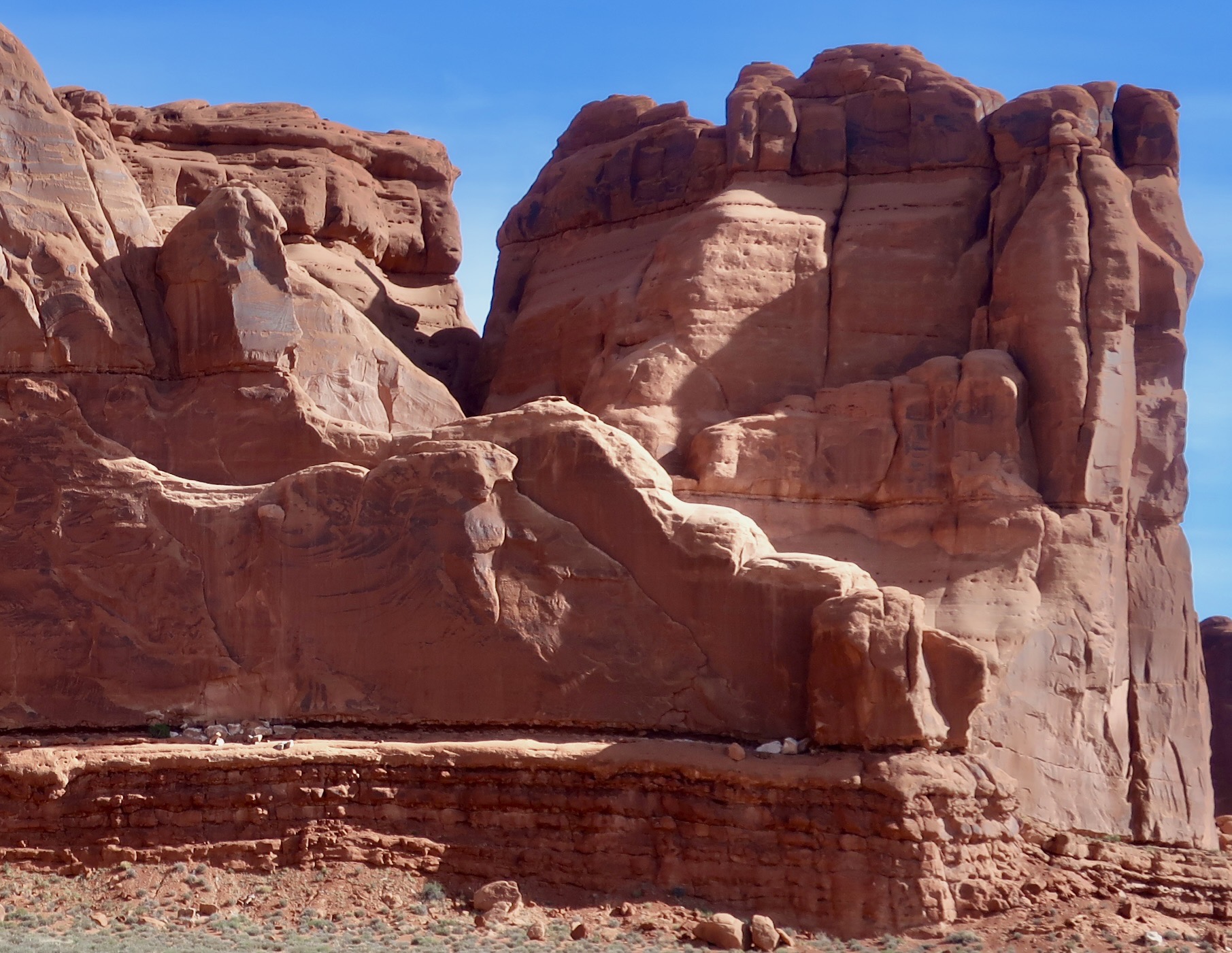
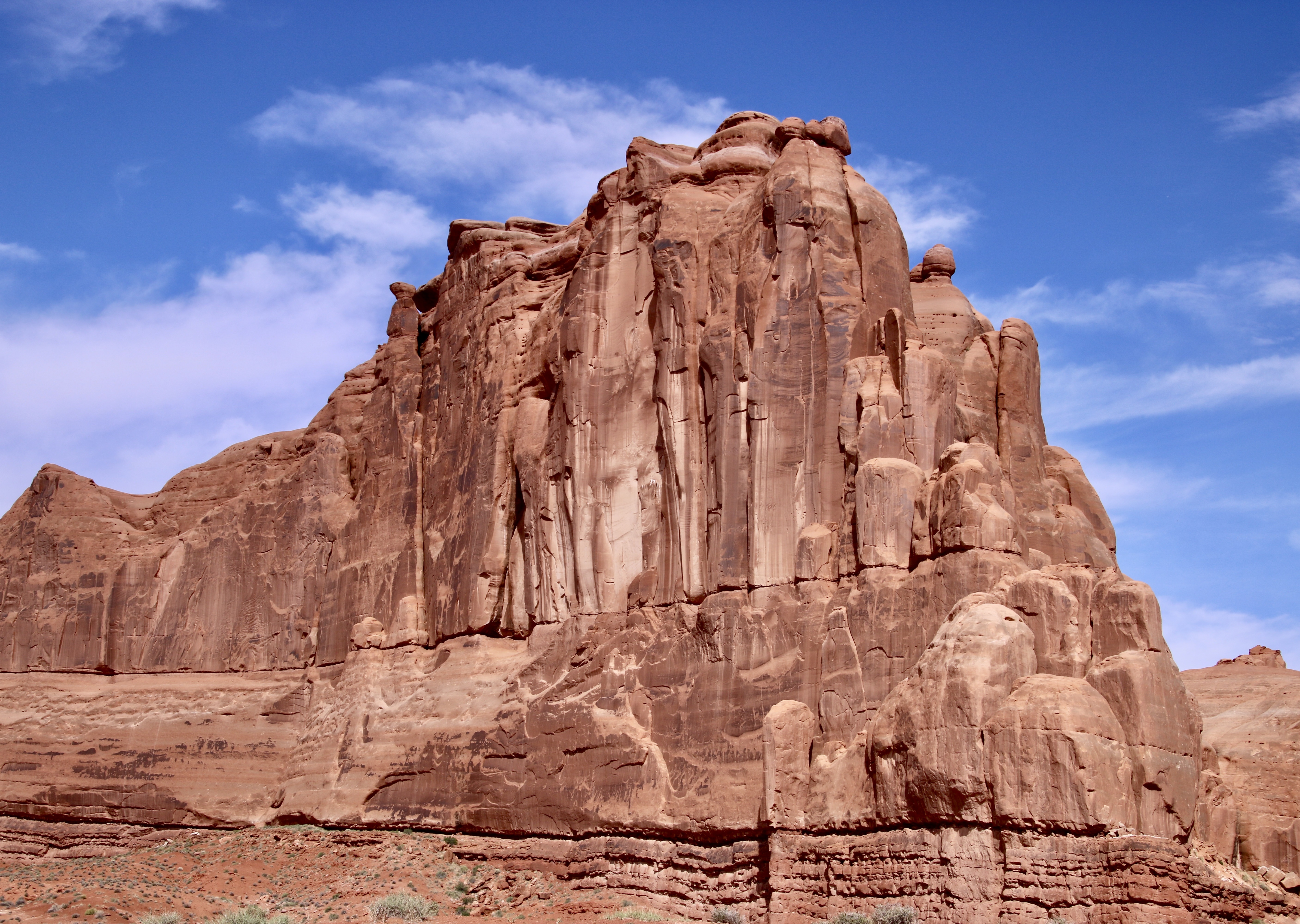
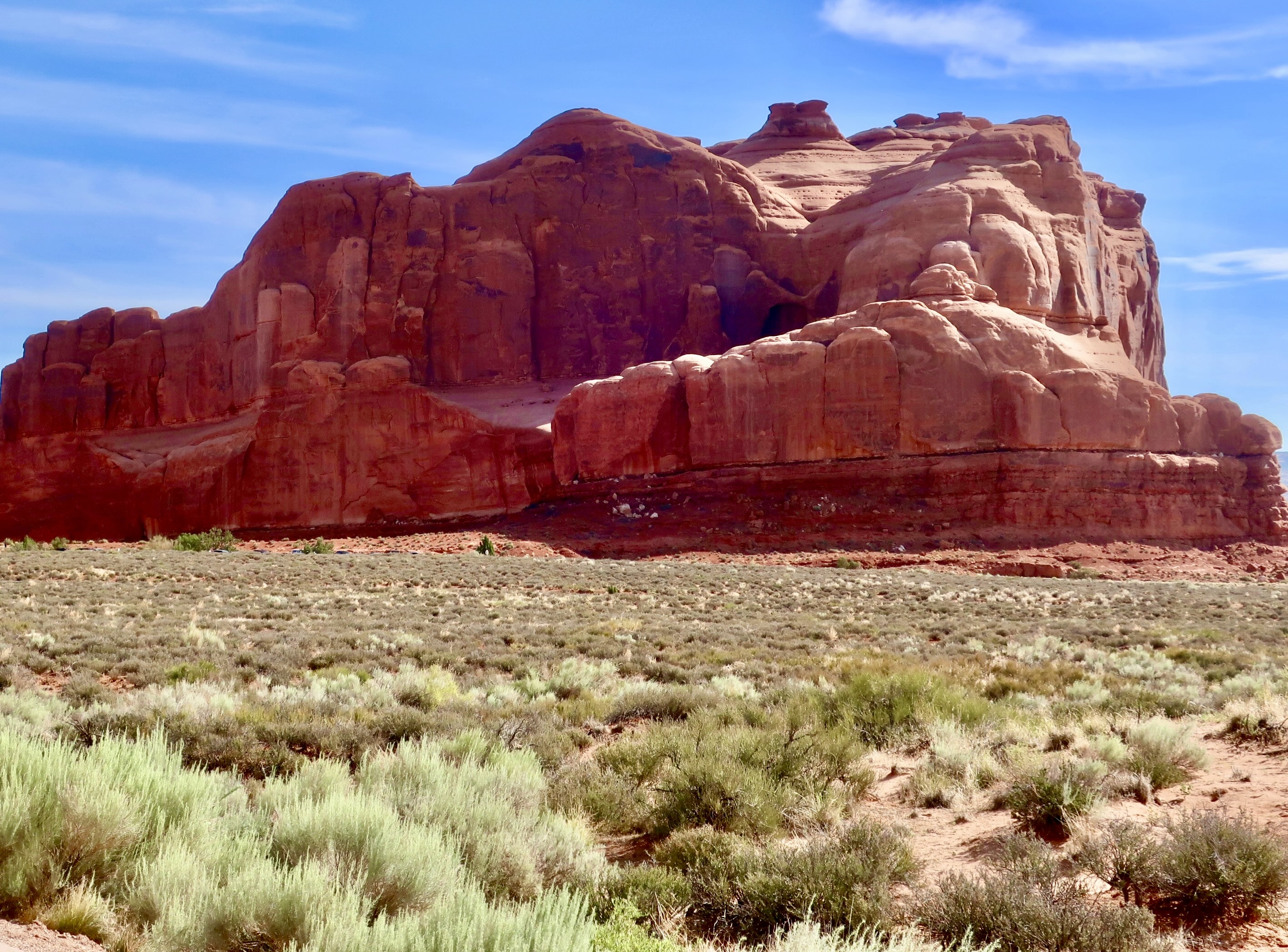
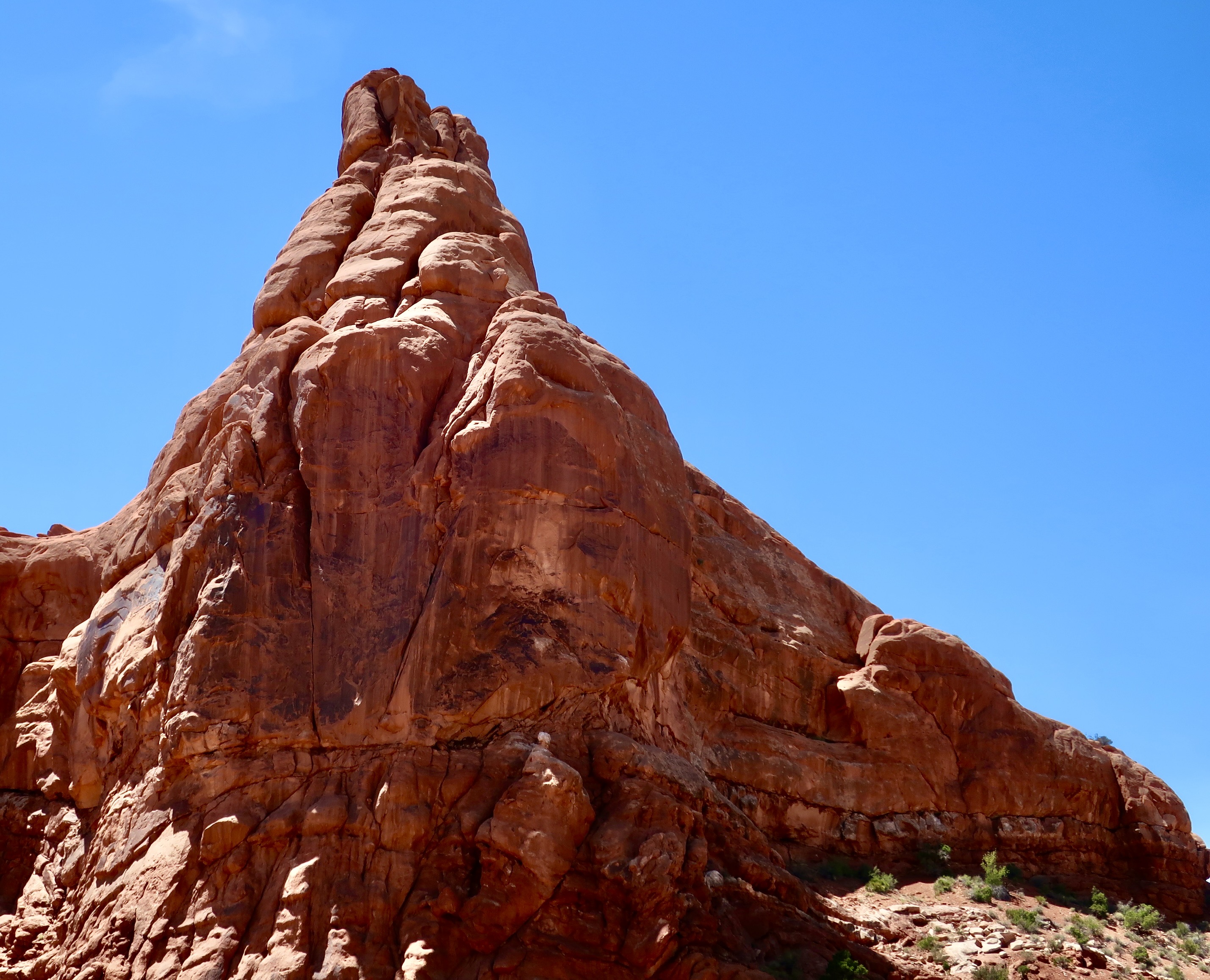
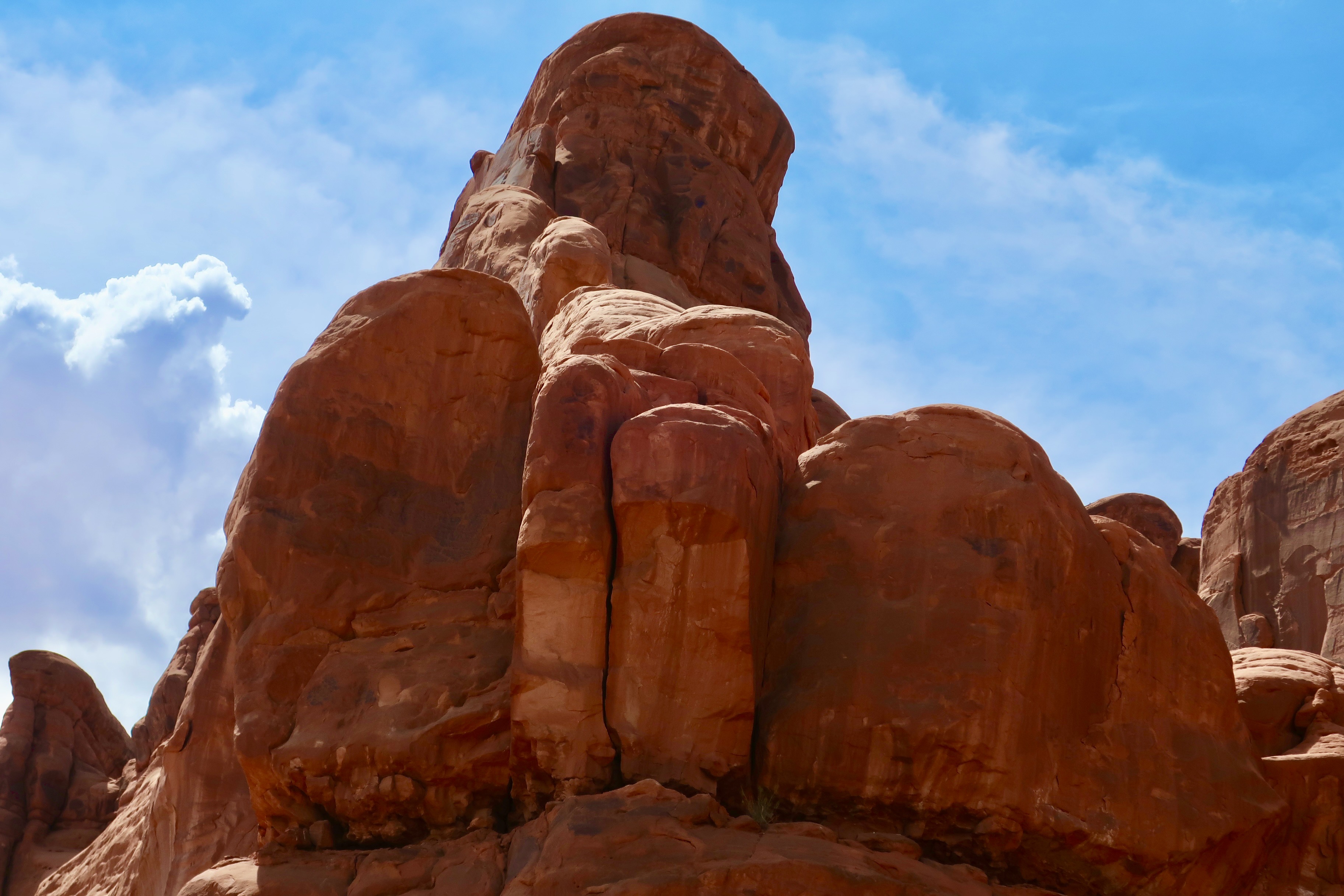
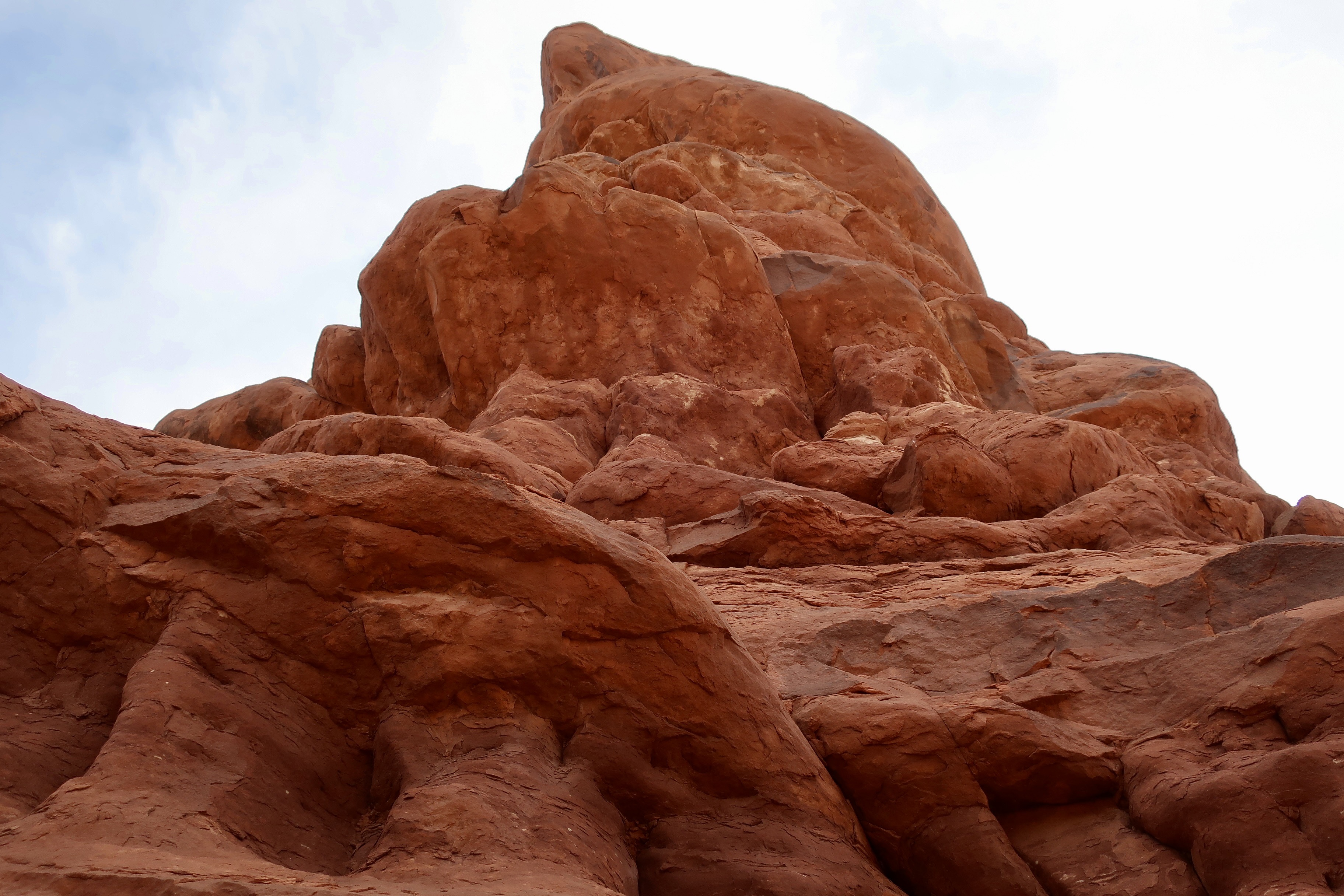
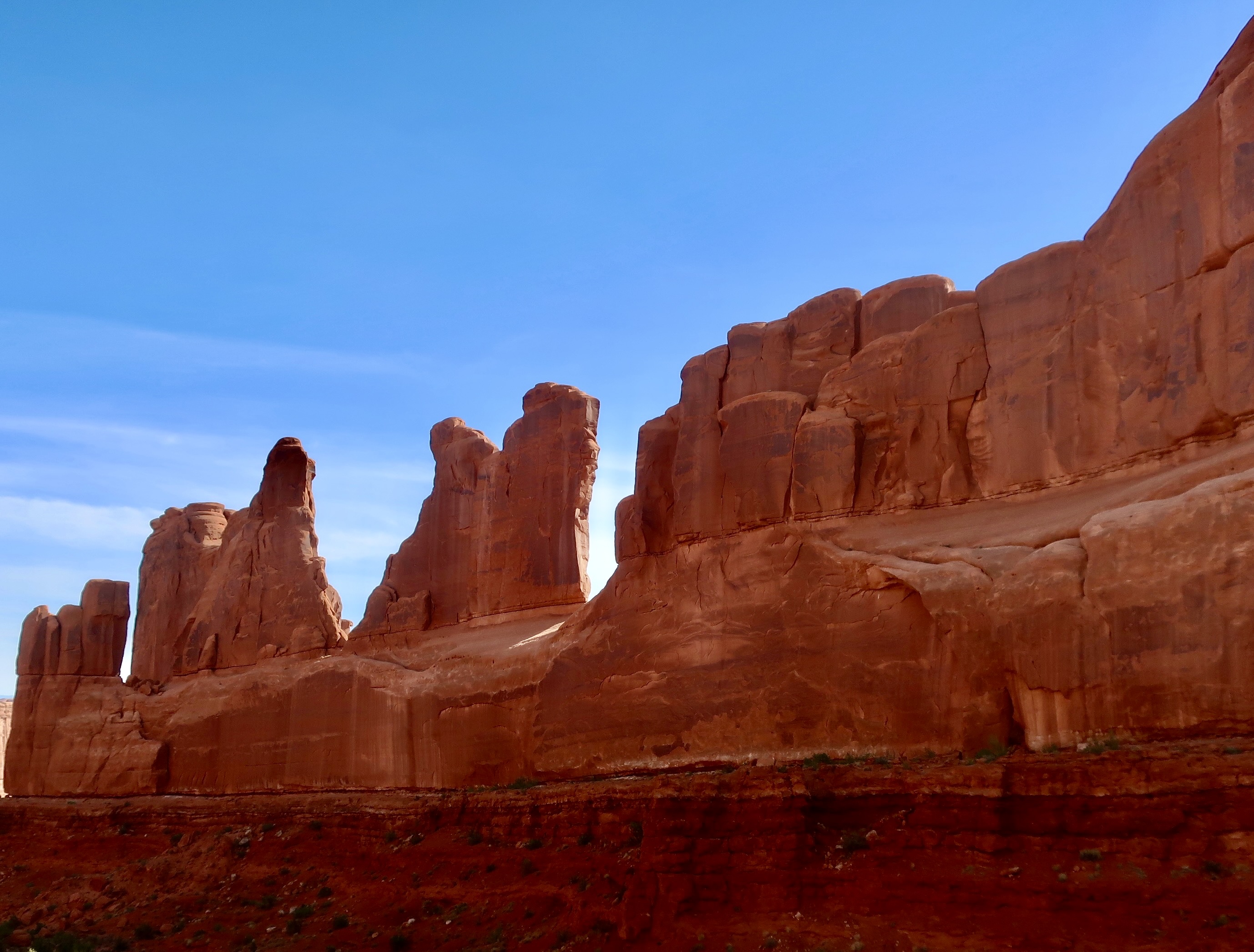
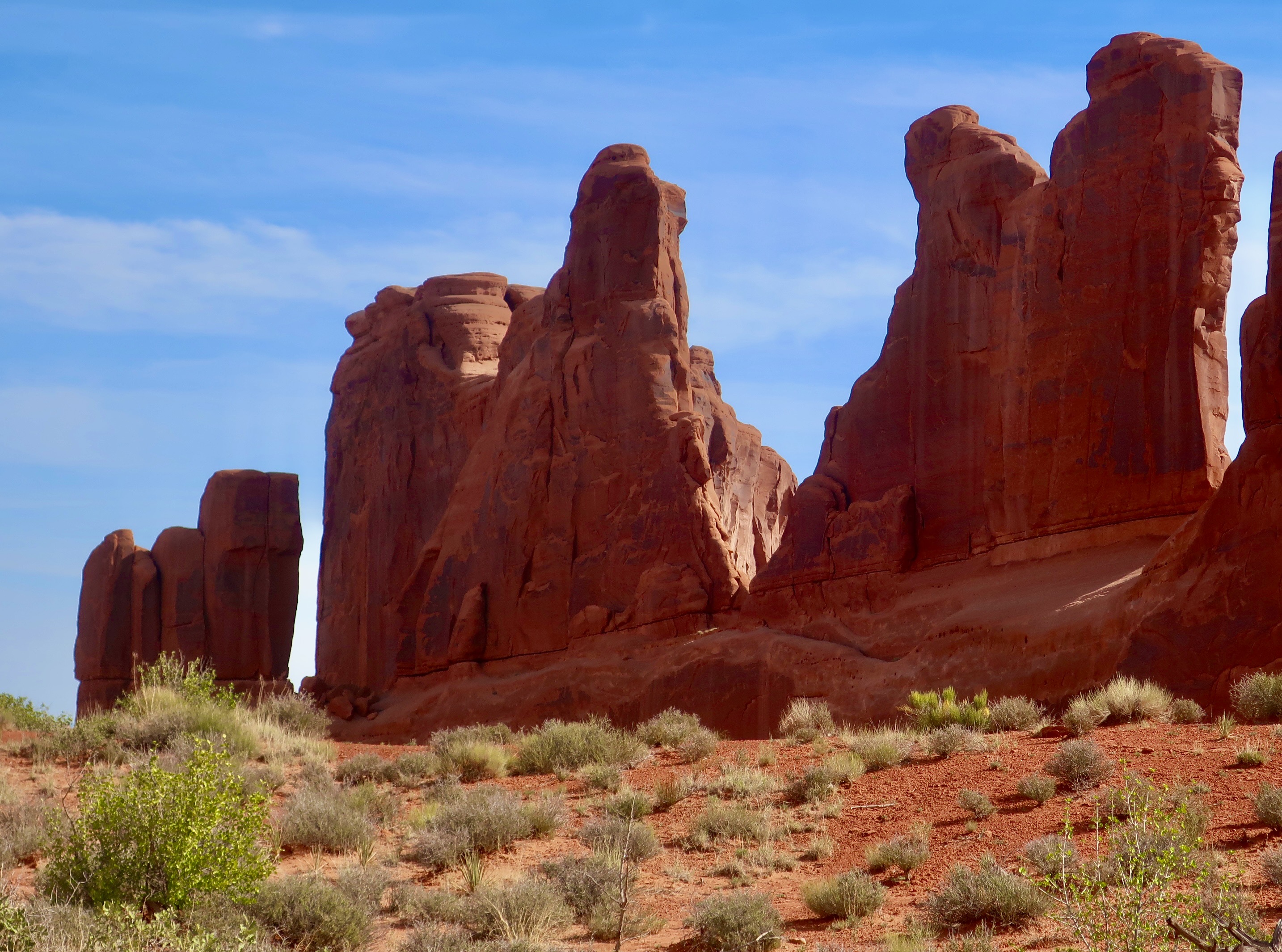
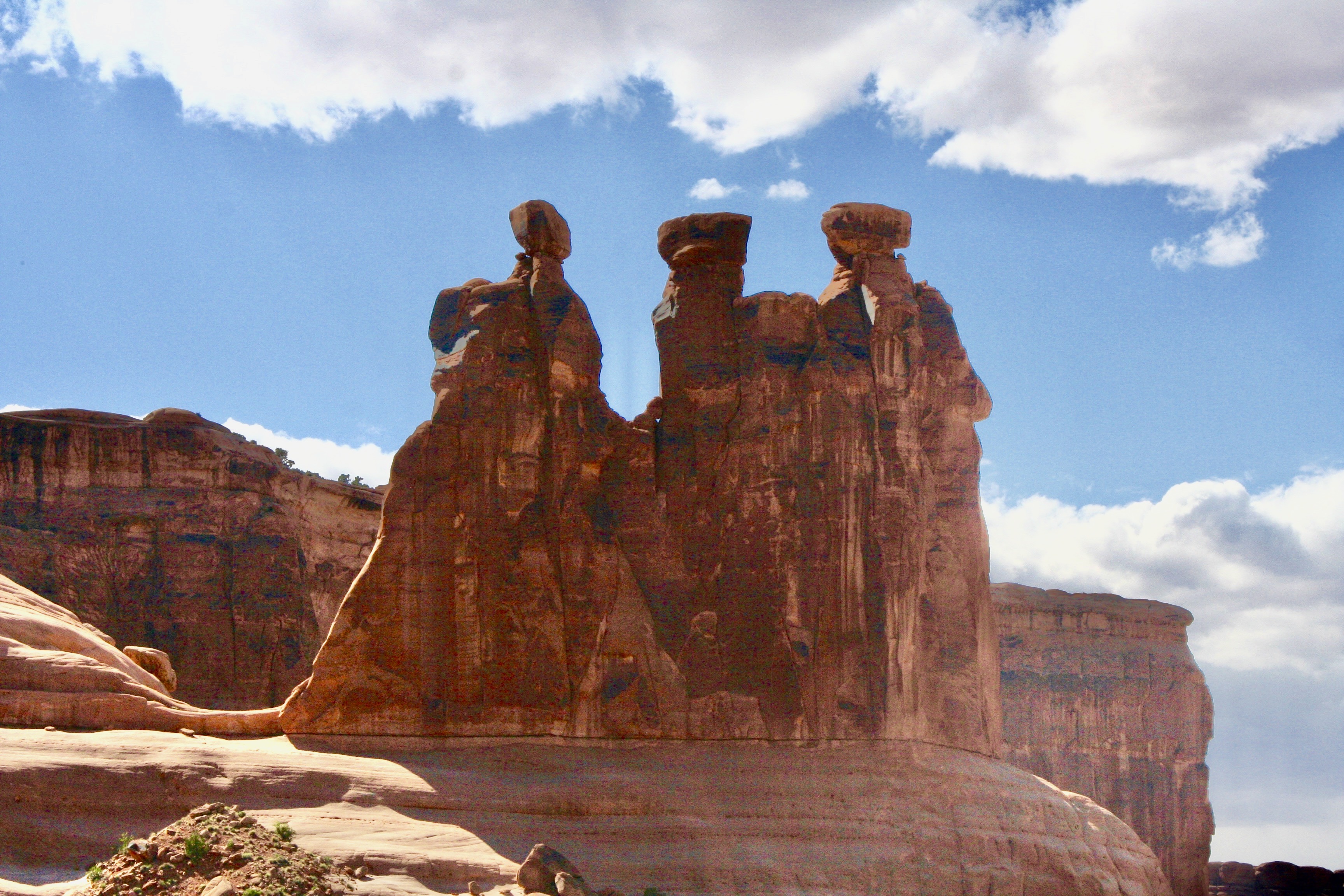
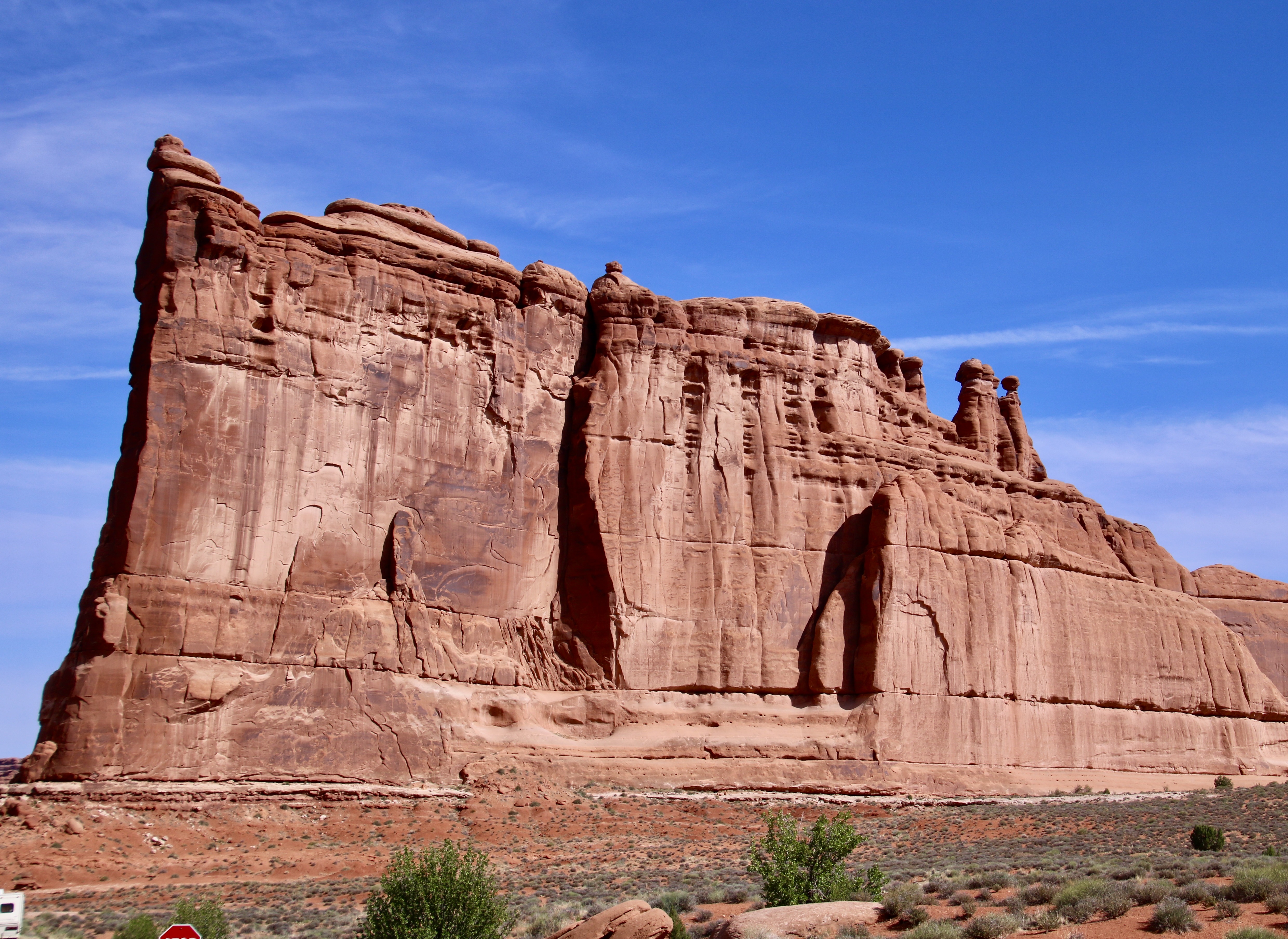
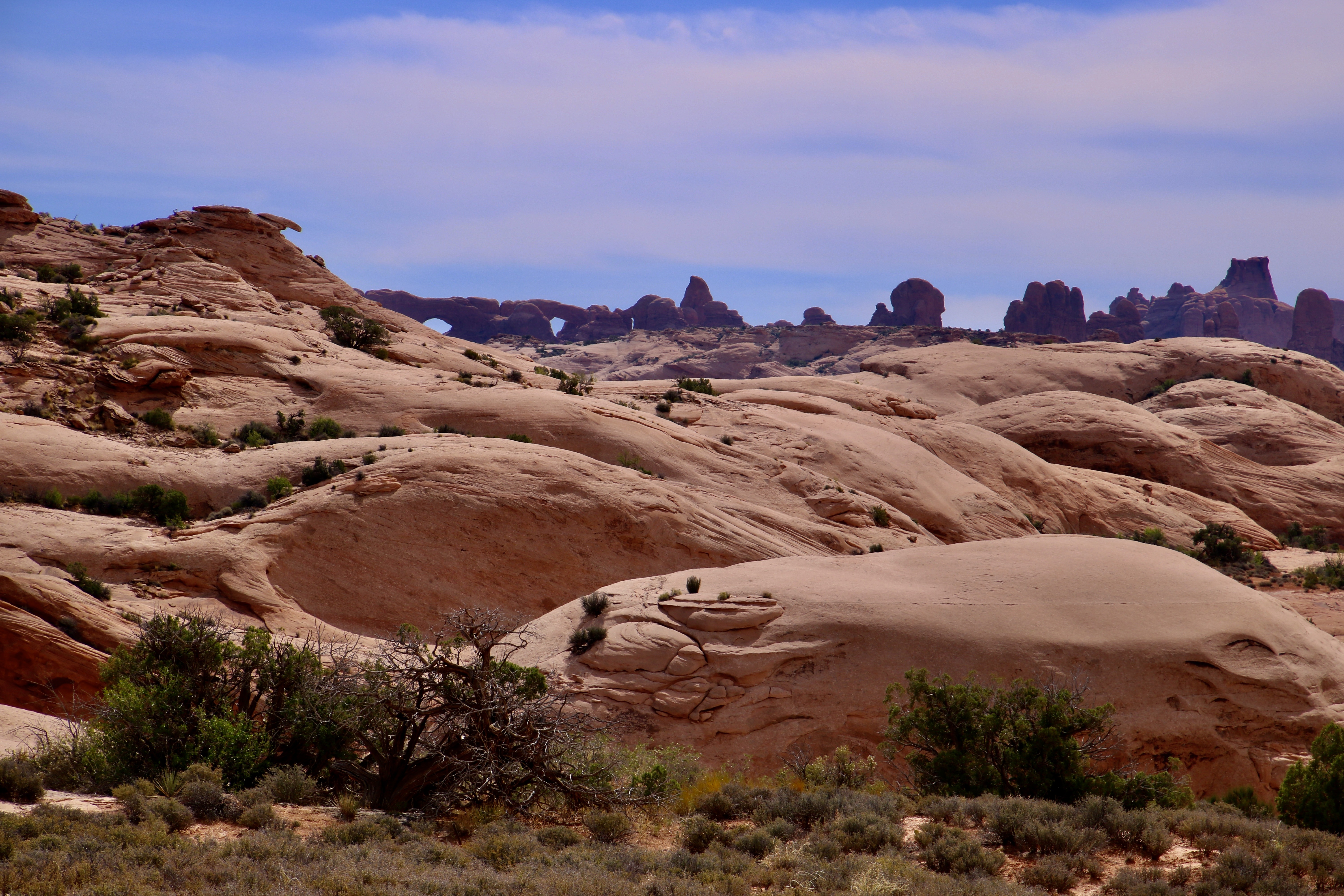
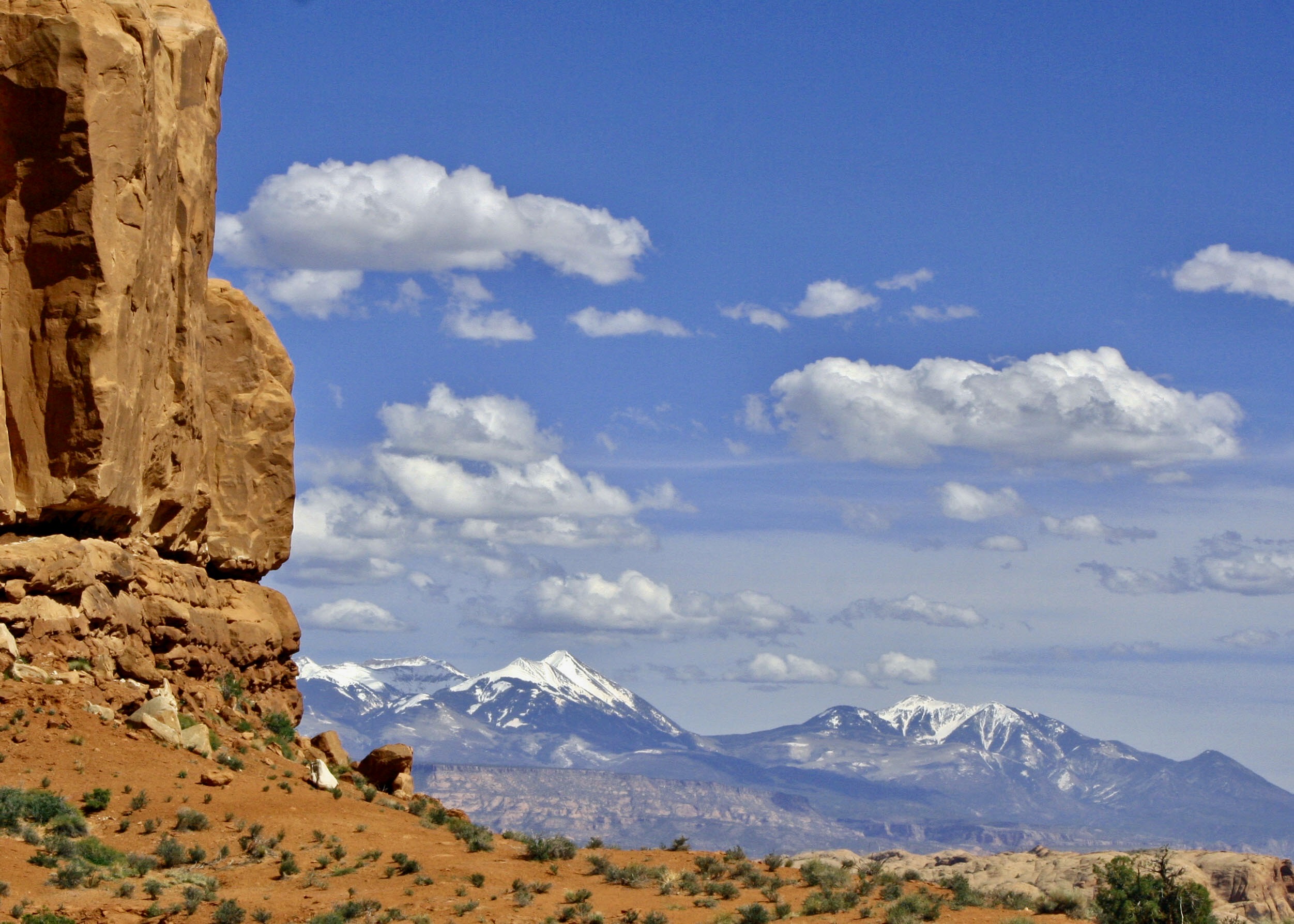
A similar photo to the one above rendered in black and white. We will be including black and white photos throughout this series. All of the photos are taken by either Peggy or me unless otherwise noted.Peggy and I often amuse ourselves by seeing animals, faces or other imagined creations in rock forms. Balanced rock makes a great dinosaur. We aren’t alone in this tendency. Many of the monuments in Arches have been given names depending on what someone thought they looked like.We found the opposite end of the boulder even more interesting. Scary? Work your way up on the left side from the chin, to the open mouth (with teeth), to the nose and eyes (mainly hidden by prominent cheek bones). We took this photo from behind a small hill next to the monument.Other balanced rocks can be seen throughout the park.Another example. Note the size of the pedestal compared to the rock.A last photo of the Balanced Rock.The location of Arches National Park in central eastern Utah as shown on a Google map. A number of other national parks and monuments are within a 1-2 days driving range.Massive rock structures appear as soon as you drive into the park.They range in size from large…To extra large.And come in a variety of shapes. From peaked…To rounded.The beginning of arches can be seen on the left here. And, if you look closely on the very top. Think of looking up someone’s nostrils.Named monuments are also found a few minutes from the entrance. One of the first is Park Avenue. A half-mile canyon is hemmed in by towering red rocks that reminded early explorers of New York City’s famed street. A close up of the sky scrapers. Some imagination may be required.Meet the Three Gossips busily chatting away.Following the religious theme, this is the Tower of Babel. Arches even has sand dunes— fossilized sand dunes. The eyes staring at you from the horizon are known as The Windows. We will be visiting them later.The La Salle Mountains provide a beautiful backdrop to Arches. I’ll close today’s post here. We have two more coming on Arches. The next post will look at the areas known as the Fiery Furnace and the Devil’s Garden, a gruesome twosome, if you will. We will wrap up Arches with the Garden of Eden and a look at several of the arches that give Arches NP its name. My next post on the Scottish Highlands will be to feature its natural beauty.
22 thoughts on “Celebrate America’s 250th Anniversary with 25 Beautiful National Parks… Starting with Arches (Part 1)”
Celebrating America’s 250th anniversary with a series on our National Parks is a wonderful idea. Arches is a great way to start the series. Your images of the monuments are incredible. I love the different views of the balanced rock.
It’s a great place to start, Curt. The Utah parks including the Navajo’s Monument Valley entered through Utah are our favorite parks – although there are others in close contention.
We are excited about it, Peggy. Each one we will feature also gives us an opportunity to revisit it through our photos. Yes they should have been included in the 250th Anniversary celebration. Unfortunately, the present administration sees them more as an opportunity for private exploitation.
Thanks for the amazing feature on National Parks Curt and I couldn’t agree more that funds should NOT be taken from them under any circumstances.
These rock formations are truly unreal and it blows me away they are still standing with the asymmetry of a lot of them. I see prehistoric faces in some of these and I’d be afraid I might get eaten or one would fall on me. I keep saying we’re going to go but alas life seems to keep me home at present. I tried to book Yosemite for Nov. but it’s sold out and then I thought why would I want to freeze my arse off and there is the chance of snow. Back on the next year list! xx
I love that each park is so unique, as well as beautiful, Cindy. It is so important that we protect them. I think I will add a sentence to each post: Never forget, these parks belong to you, your children, grandchildren and future generations, but they will only continue to exist as long as we protect them.”
Peggy and I were talking about Yosemite the other day. I have been there many times in the past and done several backpack trips there. But we have only visited once in the past 15 years and didn’t make it to the Valley floor then. It’s time for us to go again. It’s on my wish list for this coming summer.
I love that you continue to make this such an important part of your journey, Curt!
They are gifts and thank you for always looking out for them and us!!!
I hope to get to more this next year!! 💓
“I hope to get to more this next year!!” You will never regret it if you do Cindy.
Canyonlands would probably be up there! And Saguaro. And Bryce Canyon. And Rocky Mountains! And Yellowstone! And Yosemite! (Oh Lord let’s just say I love them all hahaha) 🙂 🙂 🙂
Us too! 😳
A great way to celebrate America’s 250th anniversary, Curt! We haven’t seen the Arches yet, hopefully in a couple of years!
Thanks, Christie. National parks are indeed worth celebrating. And protecting. We are excited about the series. On a personal note, it lets us celebrate their beauty again. Another thing to note about Arches when you visit: It is within an easy days driving distance of several other gorgeous national parks and monuments.
100% in agreement, Curt, we should absolutely be celebrating our parks this year and every year. What a great idea for a post series, I’m looking forward to all of them. That year you took to visit so many of them sounds amazing!
The Sabbatical was one of the highlights of our life, Diana. We’d recommend a year off to anyone. And the goal of national parks made it all the more special.
Thanks on the series. I’m really excited to be doing it. 24 more to go. Grin.


Celebrating America’s 250th anniversary with a series on our National Parks is a wonderful idea. Arches is a great way to start the series. Your images of the monuments are incredible. I love the different views of the balanced rock.
Thanks, Beth. It’s going to be fun to do.
It’s a great place to start, Curt. The Utah parks including the Navajo’s Monument Valley entered through Utah are our favorite parks – although there are others in close contention.
The Navajo Monument is special, Ray. And familiar! So many Westerns filmed there over the years.
Delighted that you are going to showcase the national parks. They should have been an important feature in the 250th anniversary.
We are excited about it, Peggy. Each one we will feature also gives us an opportunity to revisit it through our photos. Yes they should have been included in the 250th Anniversary celebration. Unfortunately, the present administration sees them more as an opportunity for private exploitation.
Thanks for the amazing feature on National Parks Curt and I couldn’t agree more that funds should NOT be taken from them under any circumstances.
These rock formations are truly unreal and it blows me away they are still standing with the asymmetry of a lot of them. I see prehistoric faces in some of these and I’d be afraid I might get eaten or one would fall on me. I keep saying we’re going to go but alas life seems to keep me home at present. I tried to book Yosemite for Nov. but it’s sold out and then I thought why would I want to freeze my arse off and there is the chance of snow. Back on the next year list! xx
I love that each park is so unique, as well as beautiful, Cindy. It is so important that we protect them. I think I will add a sentence to each post: Never forget, these parks belong to you, your children, grandchildren and future generations, but they will only continue to exist as long as we protect them.”
Peggy and I were talking about Yosemite the other day. I have been there many times in the past and done several backpack trips there. But we have only visited once in the past 15 years and didn’t make it to the Valley floor then. It’s time for us to go again. It’s on my wish list for this coming summer.
I love that you continue to make this such an important part of your journey, Curt!
They are gifts and thank you for always looking out for them and us!!!
I hope to get to more this next year!! 💓
“I hope to get to more this next year!!” You will never regret it if you do Cindy.
That’s one of my favorite National Parks!
For a good reason, M.B. What are your other favorites?
Canyonlands would probably be up there! And Saguaro. And Bryce Canyon. And Rocky Mountains! And Yellowstone! And Yosemite! (Oh Lord let’s just say I love them all hahaha) 🙂 🙂 🙂
Us too! 😳
A great way to celebrate America’s 250th anniversary, Curt! We haven’t seen the Arches yet, hopefully in a couple of years!
Christie
Thanks, Christie. National parks are indeed worth celebrating. And protecting. We are excited about the series. On a personal note, it lets us celebrate their beauty again. Another thing to note about Arches when you visit: It is within an easy days driving distance of several other gorgeous national parks and monuments.
100% in agreement, Curt, we should absolutely be celebrating our parks this year and every year. What a great idea for a post series, I’m looking forward to all of them. That year you took to visit so many of them sounds amazing!
The Sabbatical was one of the highlights of our life, Diana. We’d recommend a year off to anyone. And the goal of national parks made it all the more special.
Thanks on the series. I’m really excited to be doing it. 24 more to go. Grin.
Congratulations! Long working victory and prosperity
Thanks!
Another Beaut. Thanks Curt.
Thanks, Brian.