Today, Peggy, our grandson Cody, and I are continuing the series on the CIE bus tour we did of the Scottish Highlands. All photos are taken by either Peggy, Cody or me unless otherwise noted.
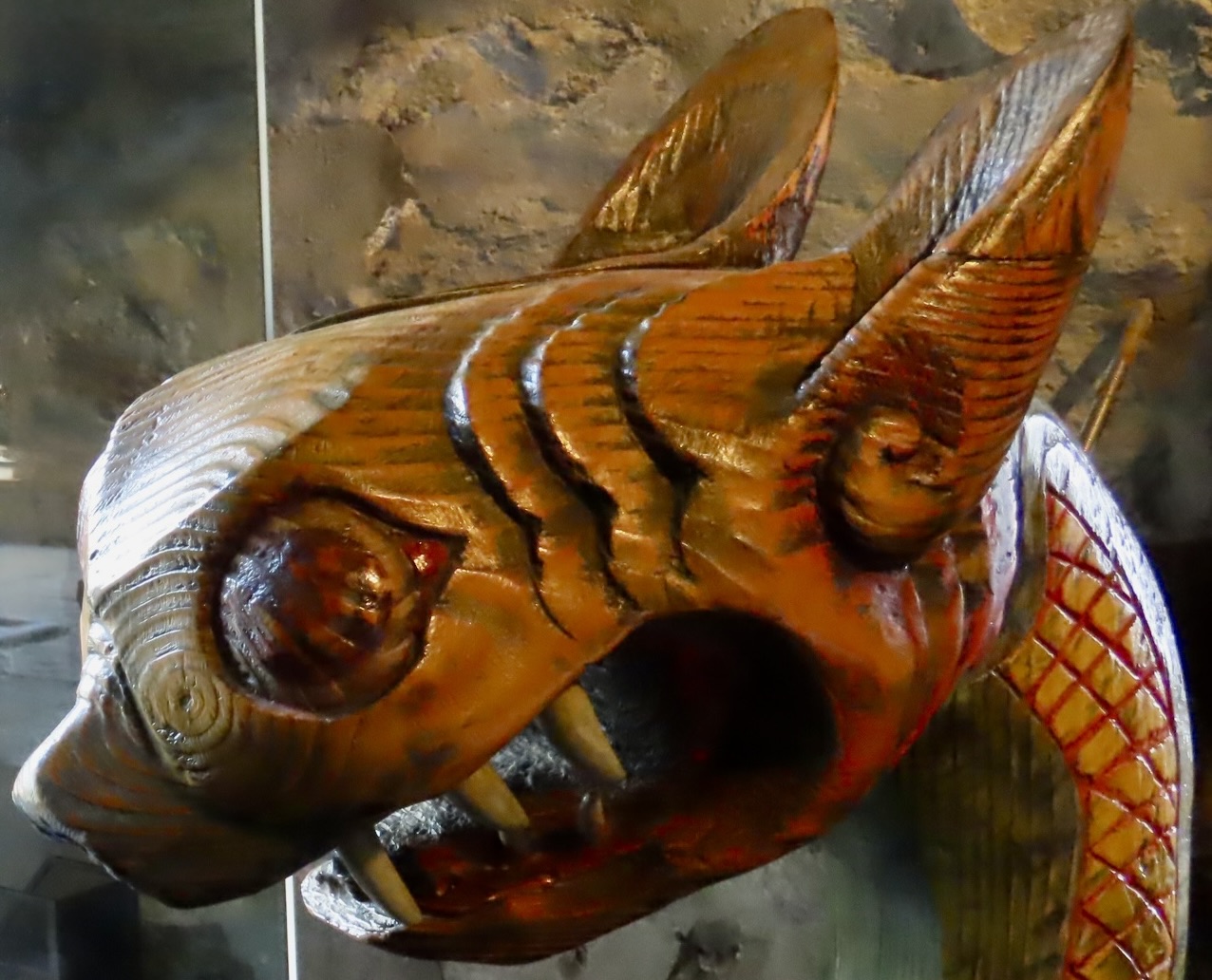
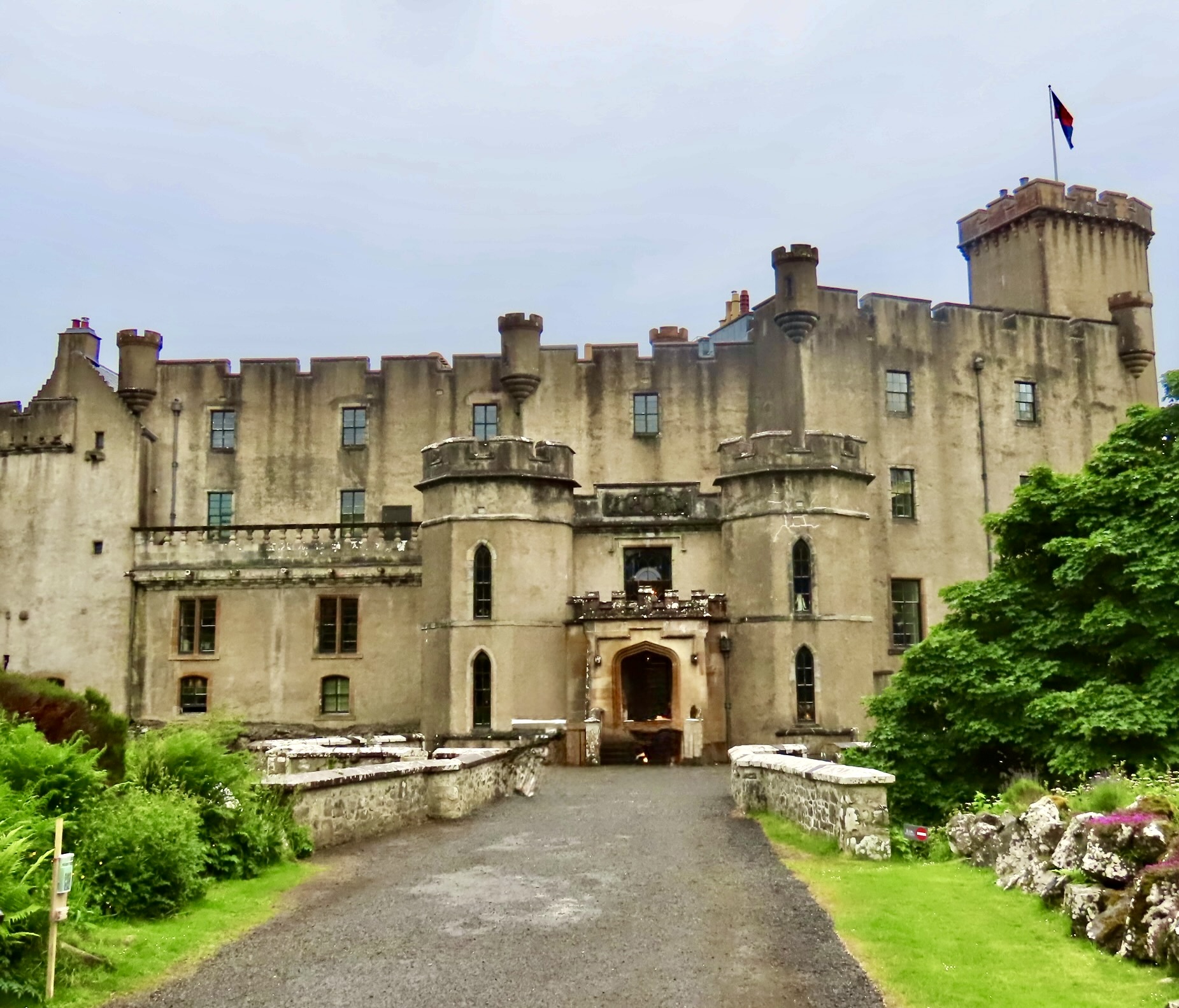
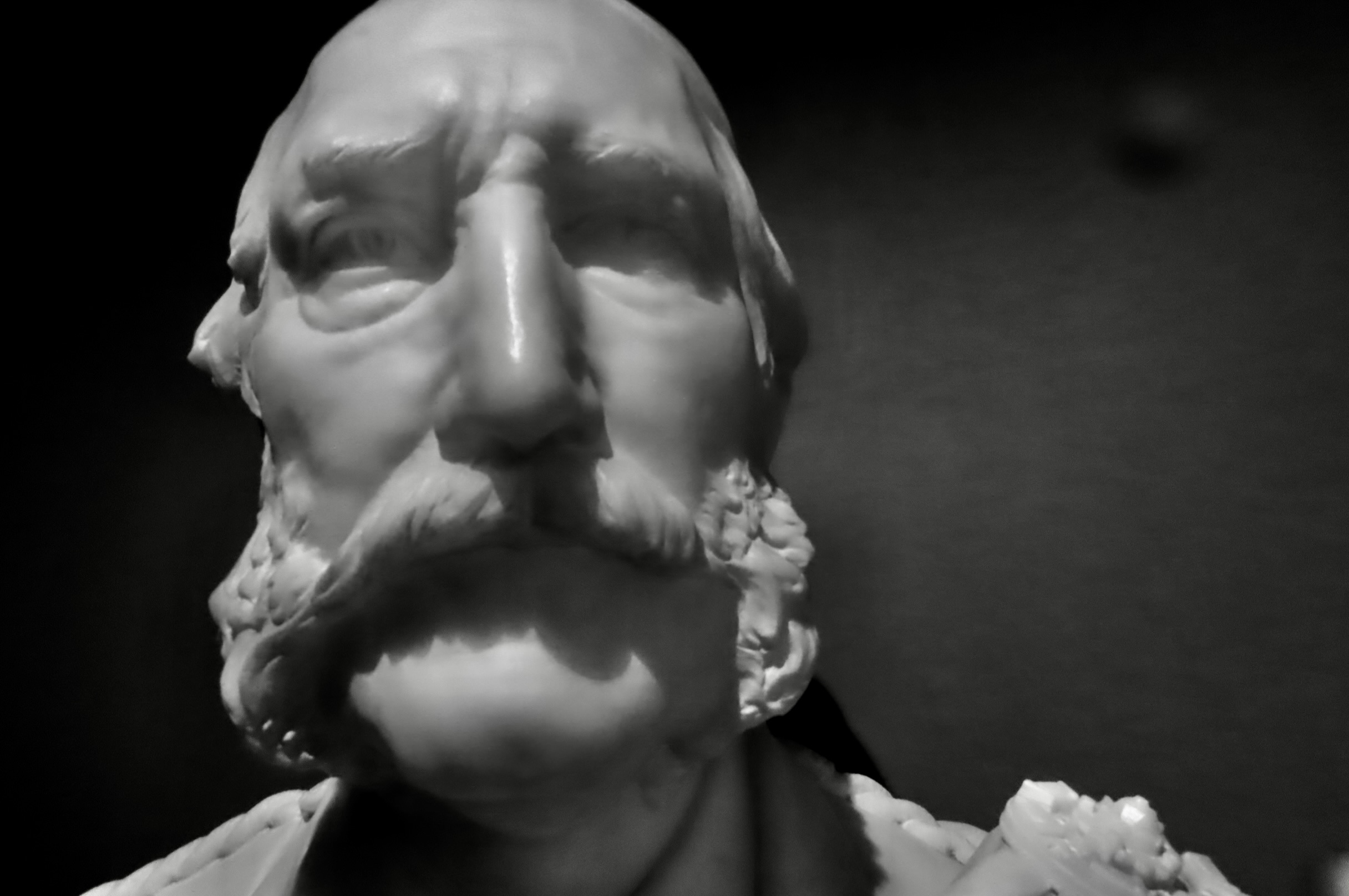
Clouds and lack of sun combined for a few minutes to give Eilean Donan Castle a look that the director of a horror flick might find appealing: Dark, brooding, and threatening.It’s likely that the namesake for the Eilean Dolan Castle was the Irish Bishop Doland who came to Scotland around 580 CE and may have established a small monastic cell there. I thought that this statue of him looked scary enough the fit in with the photo above. Imagine: You knock on the castle’s door and he answers. Possibly a vampire was lurking in the area. Or a Viking.The castle was actually built during the 13th Century CE to discourage Viking raids. A replica of a figurehead from a Viking ship is kept on display at the castle as a reminder.A Google map shows the location of the castle. Its position at the head of Loch Alsh and Loch Long would have provided valuable protection for areas behind it that the Vikings might have otherwise ravaged.This view out from the Castle, including a small boat on the Loch, shows why Vikings would have had a difficult time slipping by.While the Castle succeeded in its efforts at discouraging Vikings, it wasn’t so lucky in its support for the Jacobite rebellion. It was occupied in 1719 by Spanish soldiers who were allies of the Jacobites in their efforts to restore the exiled Stuarts to the English throne. They were thwarted by the power of the British Navy. Three warships spent three days bombarding the castle until its surrendered. The British then used 16 barrels of gunpowder stored by the Jacobites to blow the castle apart.The castle remained in ruins for nearly 200 years until 1912, when Major John MacRae-Gilstrap undertook the challenge of rebuilding it. This historical photo of Eilean Donan on the Castle’s website shows what it looked like as a ruin.The massive rebuilding project took nearly 20 years. The result is what we see today. For some reason, the normal tour of the living quarters was not open the day we visited. Consequently, we spent most of our time admiring the Castle from the outside.A view from the parking lot.I borrowed this excellent diagram from the Great Castles Website, which is dedicated to protecting castles. We started our exploration from crossing the bridge (1) to the castle.This was our view after crossing the bridge. The walkway to the left took us to the entry door. The right took us around the outside of the castle.The castle’s portcullis (15), is the historical entry to the castle. It would have featured a heavy, spiked gate that could be dropped quickly to keep out invaders. I wonder if they ever used it on tourists? Grin. Actually, we entered from a much smaller door in the building on the left and explored the ground floor, which displayed the historical information shown above.The Keep as viewed from the inner courtyard (10). What appears to be stone steps lead up into the Keep. If so, I think I would pass. One thing for sure, an invader would have a tough time making it to the top.A gateway from the courtyard provided the view out to the loch that I used above.View looking north from Eilean Donan Castle showing the surrounding countryside.Following the pathway (3) to the right provided different perspectives on the Keep.A final view. I think that the building to the right was the west guard tower (9). Now, on to the Island of Sky and the Dunvegan Castle.If you are searching for a castle with the ‘original’ look of a Scottish castle during Medieval times, you need look no further than Dunvegan. It’s a bit of fake news, however. The unified battlements that run along the top of the castle were added by Norman MacLeod (the 25th Chief of Clan MacLeod) during the 1840s. This Baronialisation, as it is known, was quite popular in Scotland during the Nineteenth Century. Prior to MacLeod’s remodleing effort, the castle had consisted of several different buildings with the first being built during the 1300s.Another view of the remodeled castle.The location of Dunvegan Castle as shown on a Google map. Eilean Donan is nearby off to the right. Both castles saw their initial start in the 1300s: Eilean Donan to discourage Viking invaders and Dunvegan Castle by the descendants of Viking invaders.A marble bust of Norman MacLeod, chief of the Clan MacLeod during the middle of the 19th Century, was located just inside the castle doors. A bust of his sister, Emily Sarah MacLeod, was also located there. Both were instrumental in using the family’s personal fortune to feed, employ, and care for his clan’s 8,000 tenants on Skye during Scotland’s potato famine. They deserve great credit for their efforts.We were also greeted with this bull’s head when we entered the castle. There’s a story, naturally. The words up on top say “Hold Fast.” It is the motto of the MacLeod Clan. It, along with the bull, makes up the MacLeod crest. According to the legend, Malcolm MacLeod, the 3rd Chief of the clan, was returning from an affair with the wife of a rival clan chief when a wild bull attacked him in the woods. His clan members, too far away to help, yelled “Hold Fast, MacLeod!” He did, wrestling the bull to the ground by the horns and stabbing it with his dirk. Thus the motto and the crest. As we wandered through the castles we came across a bouquet of peacock feathers…And a bouquet of flowers. As we had discovered in each castle we visited, portraits of various family members were on prominent display.I found this portrait of Joan MacLeod at Dunvegan particularly well done. She was one of the first women to graduate from Oxford University.This lion wasn’t bad either.Looking up a blocked stairway we spotted the fake rat sneaking up on a real key. The red eye means he is one bad rat! I think.Farther up the stairs was a scary looking maid delivering food. Or was she a ghost?A couple of historical artifacts were of particular interest. One was this tattered Fairy Flag. Legends claimed it was a gift from the fairies to an infant chieftain, or as a reward for defeating an evil spirit, or as a gift to a chief from a departing fairy-lover. Powers ranged from protecting various clan members, to curing a cattle plague, to bringing herring into the sea loch at Dunvegan. It was versatile to say the least. I don’t have a clue what the red line relates to.A cannon on the ramparts pointed out toward the Dunevan Loch, which is the direction invaders by sea would have attacked. These were mainly rival clans, which, if having affairs with rival clan chiefs’ wives like Malcom MacLeod did was common, isn’t surprising. Next, on to the Earl’s Castle, or Palace, as he apparently preferred.There is something about ancient ruins that attract me, and most people, I think. They speak of another time, a different world. The Earl’s Palace was built by Robert Stewart, the first Earl of Orkney starting in 1569. Robert was the illegitimate son King James V and his mistress Euphemia Elphinstone, which sounds like a great name for a mistress to me— picturing a stoned, euphoric elf. Admittedly, I have a strange mind. Euphemia actually derives from Greek and means well-spoken. Elphinstone refers to a farm/region and is a Scottish Clan name. This Google map shows the location of Earl’s Palace on Orkney.The occupation of the palace was short-lived— ending with the overthrow of the Stuart Earls in 1615. Gun holes at ground level in the walls surrounding the palace indicate that the Earls were expecting trouble. By 1700, the roof had caved in. An inside photo of the palace’s ruins.A photo of Peggy inside the castle. Various signs were posted around the palace explaining what the various rooms were used for.Outside, I found this cocky fellow wandering around the yard and wondered if he might be the reincarnation of the Earl.If so, maybe this was the Countess.This quonset hut facing the palace also caught my attention. I was drawn to the old red doors. Several bloggers I follow frequently feature doors. I wondered what the signs said. No Parking. Isn’t it a great door? But what was the smaller sign about?Who needs a guard dog when you have a ferocious rabbit?Not just any rabbits were protecting the property. These were highly trained rabbits. Our grandson, Cody, caught a photo of the rabbits a few miles away ( I used it in an earlier post).They were absolutely ferocious, wouldn’t you say. Or do they have something else on their minds… This is a good place to end this post!
Our next post on the Scottish Highlands will feature its great scenery and quaint towns. Before that I am going to start a new series featuring the beauty of America’s national parks in celebration of the nations 250th Anniversary. First up will be Arches National Park.
Or clean! But then they had servants to do that. Can you imagine the heating bills, Peggy. There is a reason as to why so many of them have been turned into tourist attractions to help meet modern maintenance costs.
They’re impressive in their way, but I’m glad I don’t have to live in one. I’ll take the thatched cottage, if you please! The stacked stone construction is interesting and appealing, though. It reminds me of the stone buildings in Kansas built from rocks pulled from fields.
Your choice is ours, Linda. We have no desire to live in nay castles, be they Scottish or their American equivalents. 1500 sure feet has been max for us. All the way down to the van we visited you with and lived in for three years! The castles are interesting, however!
Peggy and I have admired ancient stone structures in the Southwest as much as anywhere else in the world. They all share a similarity.
The image of Eilean Donan Castle from the parking lot is absolutely beautiful, as is the one looking back, and showing the lovely countryside. I loved that you spotted the rat, and I loved the Fairy Flag – what a curious artifact on display. So cool. I thought the first two castles seemed remote, but the third! The Earl’s Palace is way the heck out there! I am so glad you had the chance to explore these places on the edges of maps. It is lovely to see a photo of Peggy too! Hugs to both of you from us. I, too, love doors and have featured them, and was quite intrigued to know what the small sign said. When I saw it up close, I burst out laughing. Those are great rabbit signs.
I figured the readers of the post would get a kick out of the rabbits, Crystal. We sure did. And Cody’s photo of the two lovebird rabbits was perfect for the signs.
The Fairy Flag was prominently displayed. I thought that it fit in well with the medieval mentality. (Heck, it fits in with ours, too. Doesn’t it Ms. Dragon Lady. Grin.)
All of our three visits to Europe this past summer, to Greece, Scotland, and Ireland were special. Each of them took us to both urban centers and more remote areas. Lots of history, lots of beauty, and, in several instances, very few tourists.
It was home to the various Scottish tribes. And they were always fighting each other over the land. The Vikings fit right in. As to why, I guess the easy out is people are people, or let me modify that to people are animals. Grin.
One of my frequent thoughts is how are we going to survive the very frightening things we have to face in modern times with the mentality of a caveman.








Curt, I enjoyed seeing these three Scottish castles. During our travels in Scotland the only one of these we visited was the Eilean Donan.
They went along well with our riverboat trip up the Rhine, Beth. An interesting step back in time!
Interesting castle. You’re right. Castles attract a lot of people. Maybe because of fairy tales and tales of knights in shining armor.
They take people back into history, George, in a way few other places do. With a bit of escapism (knights and fairies) thrown in.
Your tour covered a lot of places not usually found in most tours of Scotland. It was very interesting to read about.
CIE Tours did a good job, Ray. And the guide was an encyclopedia of information.
Totally impressive but I’m glad I don’t have to heat and furnish one of these
Or clean! But then they had servants to do that. Can you imagine the heating bills, Peggy. There is a reason as to why so many of them have been turned into tourist attractions to help meet modern maintenance costs.
They’re impressive in their way, but I’m glad I don’t have to live in one. I’ll take the thatched cottage, if you please! The stacked stone construction is interesting and appealing, though. It reminds me of the stone buildings in Kansas built from rocks pulled from fields.
Your choice is ours, Linda. We have no desire to live in nay castles, be they Scottish or their American equivalents. 1500 sure feet has been max for us. All the way down to the van we visited you with and lived in for three years! The castles are interesting, however!
Peggy and I have admired ancient stone structures in the Southwest as much as anywhere else in the world. They all share a similarity.
The image of Eilean Donan Castle from the parking lot is absolutely beautiful, as is the one looking back, and showing the lovely countryside. I loved that you spotted the rat, and I loved the Fairy Flag – what a curious artifact on display. So cool. I thought the first two castles seemed remote, but the third! The Earl’s Palace is way the heck out there! I am so glad you had the chance to explore these places on the edges of maps. It is lovely to see a photo of Peggy too! Hugs to both of you from us. I, too, love doors and have featured them, and was quite intrigued to know what the small sign said. When I saw it up close, I burst out laughing. Those are great rabbit signs.
I figured the readers of the post would get a kick out of the rabbits, Crystal. We sure did. And Cody’s photo of the two lovebird rabbits was perfect for the signs.
The Fairy Flag was prominently displayed. I thought that it fit in well with the medieval mentality. (Heck, it fits in with ours, too. Doesn’t it Ms. Dragon Lady. Grin.)
All of our three visits to Europe this past summer, to Greece, Scotland, and Ireland were special. Each of them took us to both urban centers and more remote areas. Lots of history, lots of beauty, and, in several instances, very few tourists.
What a wonderful trip, Curt. (Love the trained rabbits…)
You did go very high “up North”. To think Vikings and Scots and etc. would fight for such a… “desolated” land is beyond me…
Oxford started giving degrees to women in 1923. Crazy…
Thx for the trip.
Brian
It was home to the various Scottish tribes. And they were always fighting each other over the land. The Vikings fit right in. As to why, I guess the easy out is people are people, or let me modify that to people are animals. Grin.
One of my frequent thoughts is how are we going to survive the very frightening things we have to face in modern times with the mentality of a caveman.
And when did Oxford start? A long, long time ago…
As always, I enjoy your comments, Brian.
Thank you Curt. Likewise.
(And I too wonder how we can survive a world run by a caveman…)
One maybe, but sadly (tragically) there are a lot of them out there. Many of them are Trump’s best- buds.
There are a lot of cavemen running around…