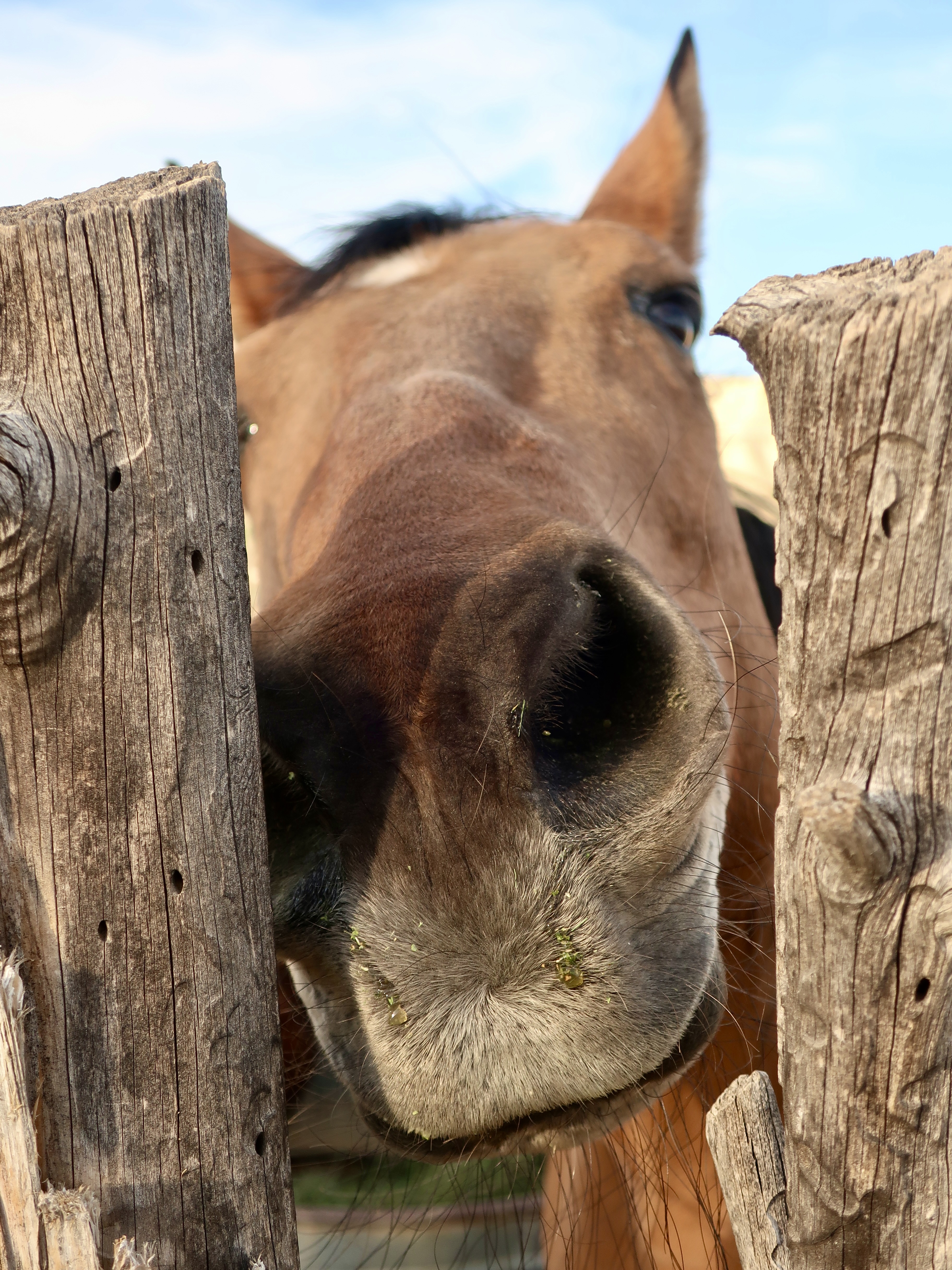
Today, our focus series features ungulates. In case you don’t know what an ungulate is, like I didn’t, the short answer is that they are animals with hooves who walk or run on their toes. Did that help? They are divided into two categories: Odd toed ungulates (Perissodactyl) such as horses with one toe, and even toed ungulates (Artiodactyla) such as cows with two toes. The credit for having hooves goes to evolution. Horses, for example, started out with multiple toes just like us. They had 4 on the front and 3 on the back. Eventually, over millions of years, their claws/toenails expanded, grew together, and covered their toes. The evolutionary advantage being they could run a lot faster across grasslands and escape animals that wanted to eat them. A hoof is composed of keratin, the same fibrous protein that forms our toe and finger nails. It acts as a hard, protective casing that covers the toes and allows for weight-bearing, shock absorption, and traction— just like a good pair of running shoe works for our feet. But enough on the details. Let’s get to the fun part!
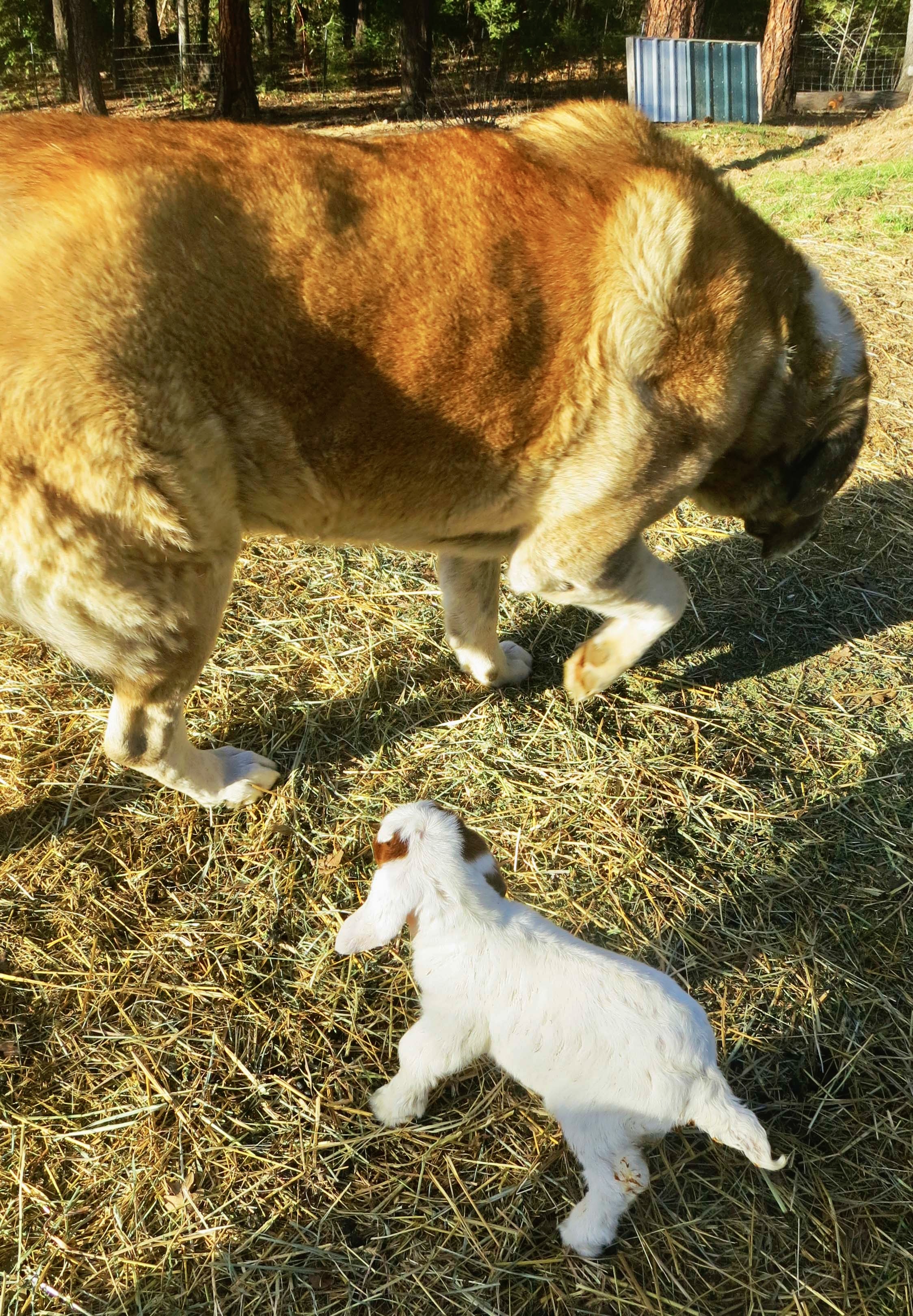
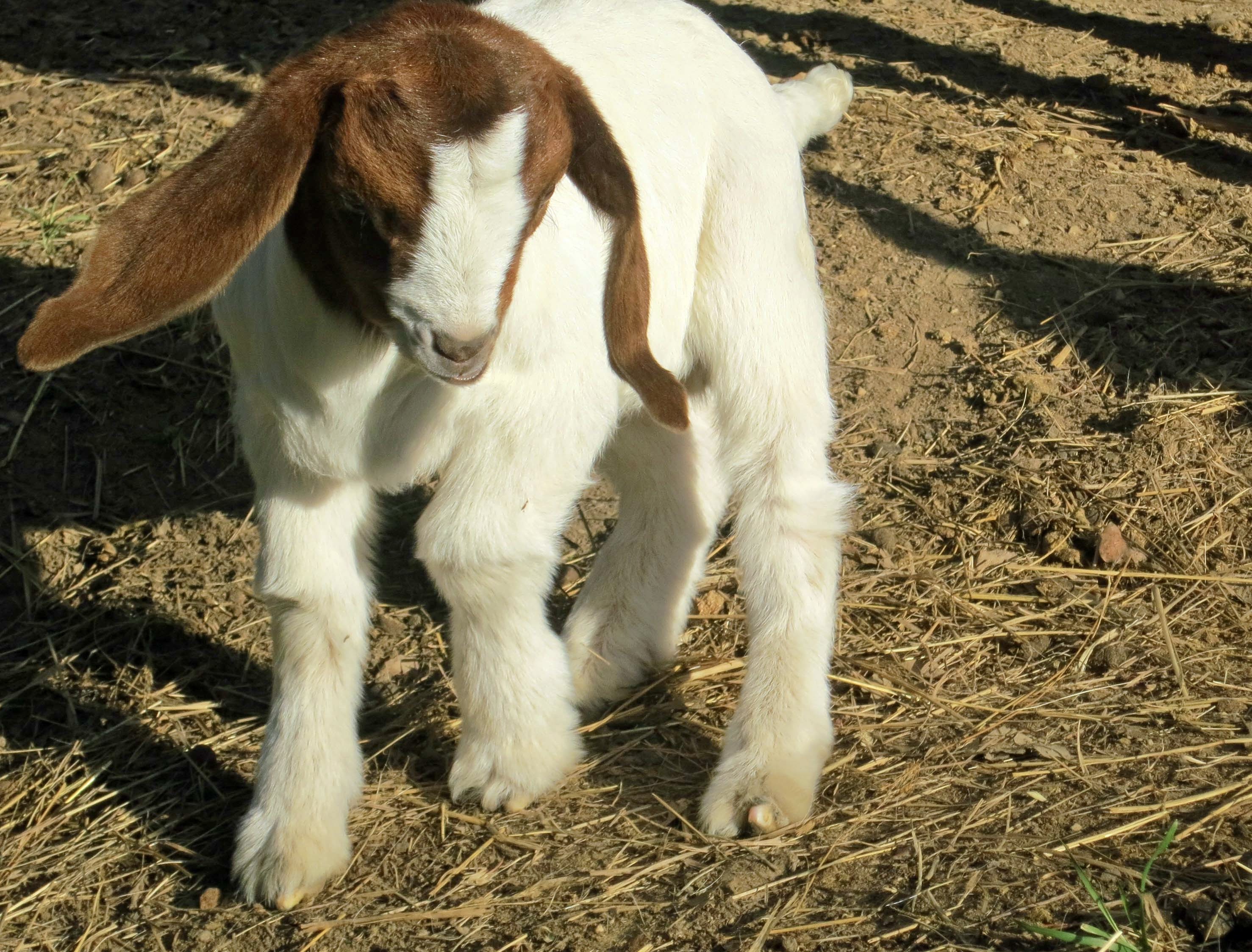
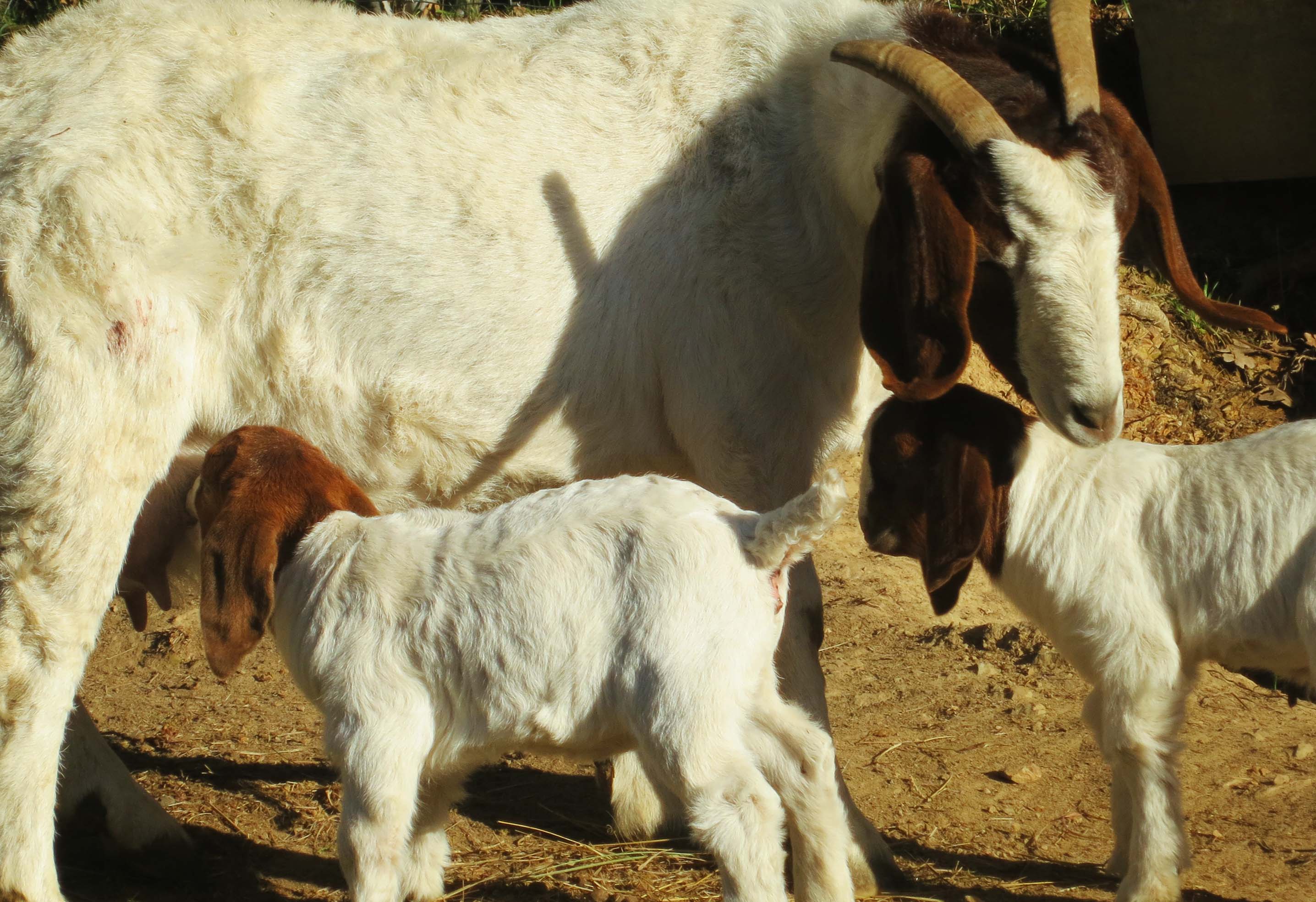
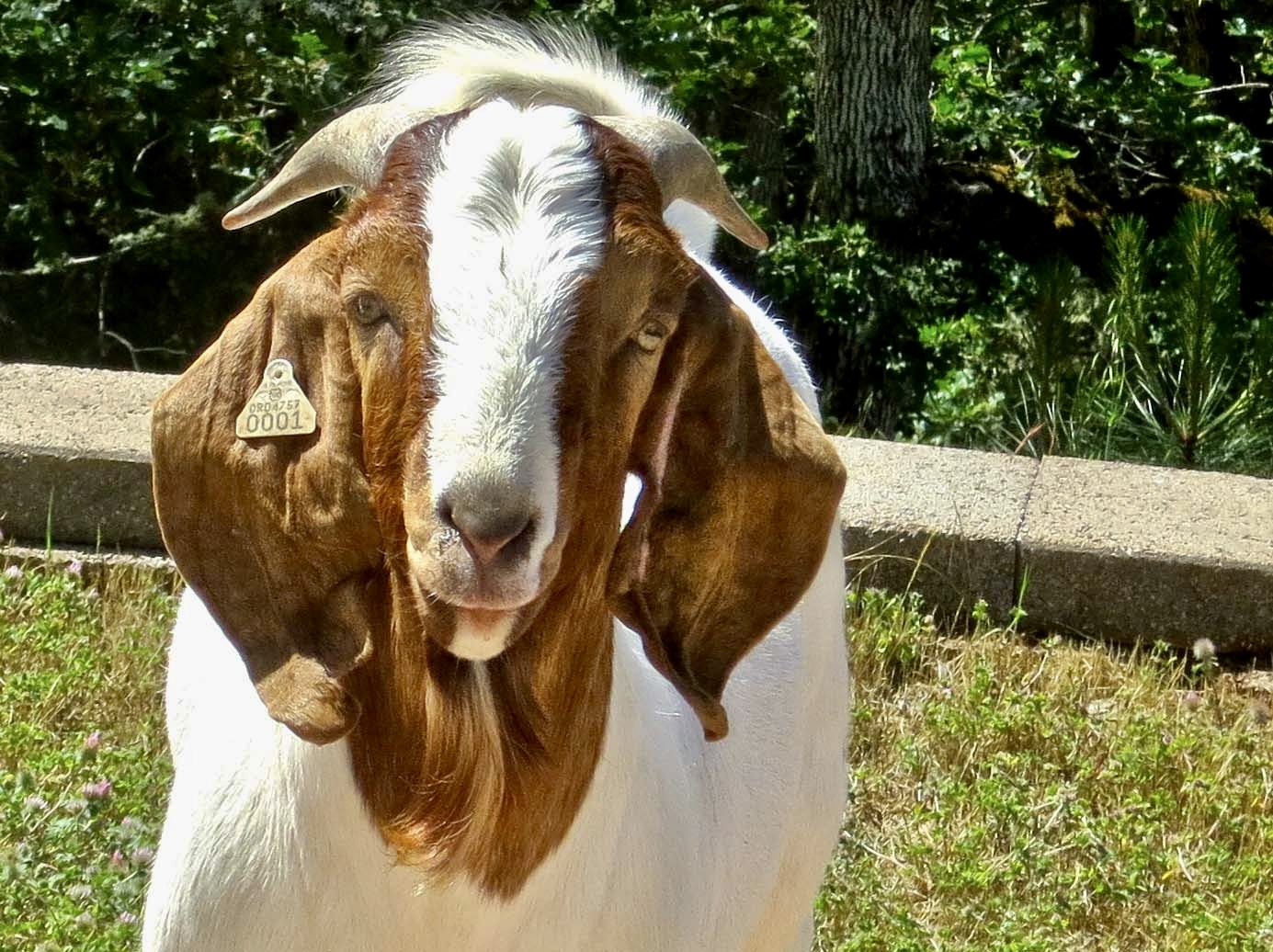
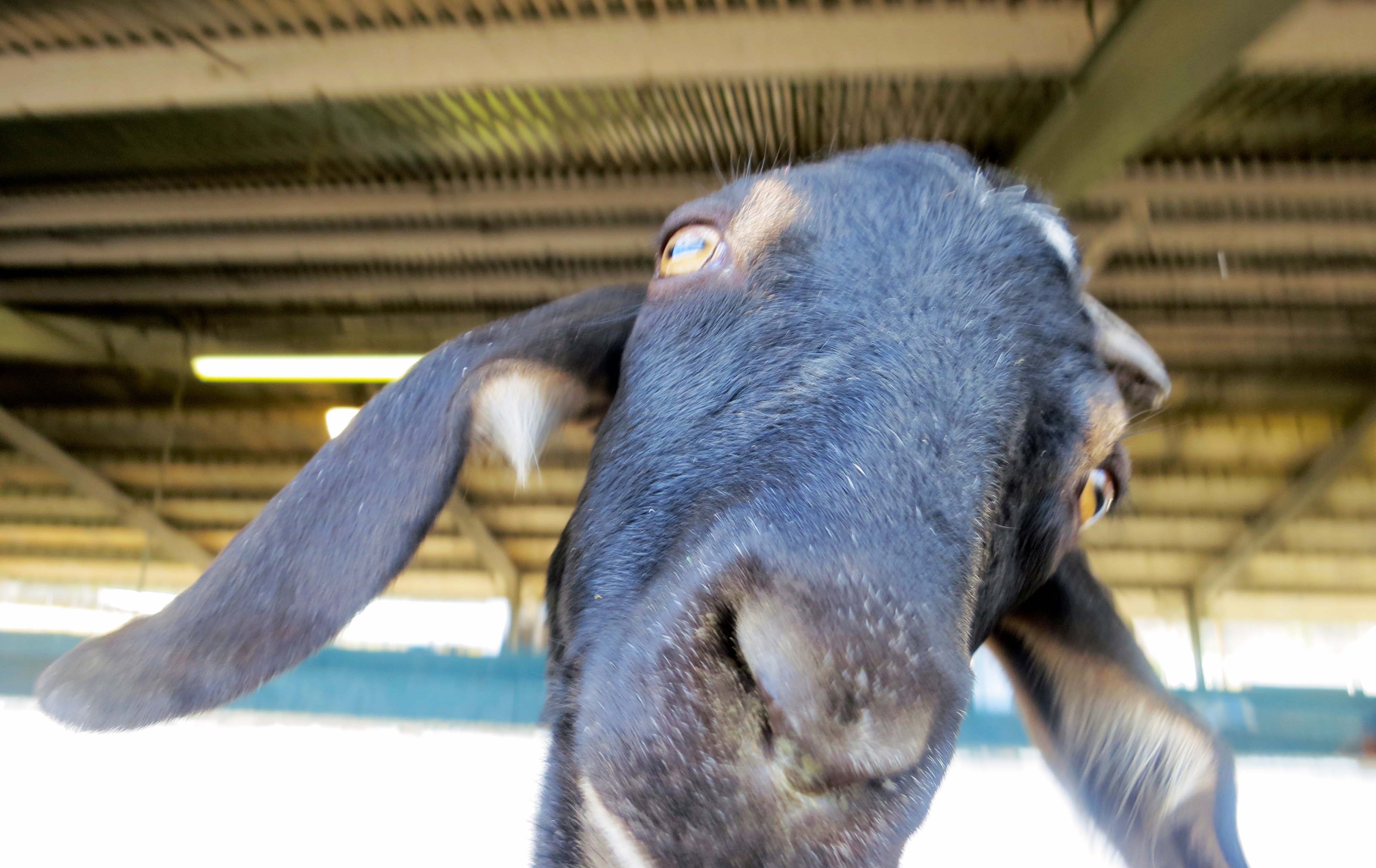
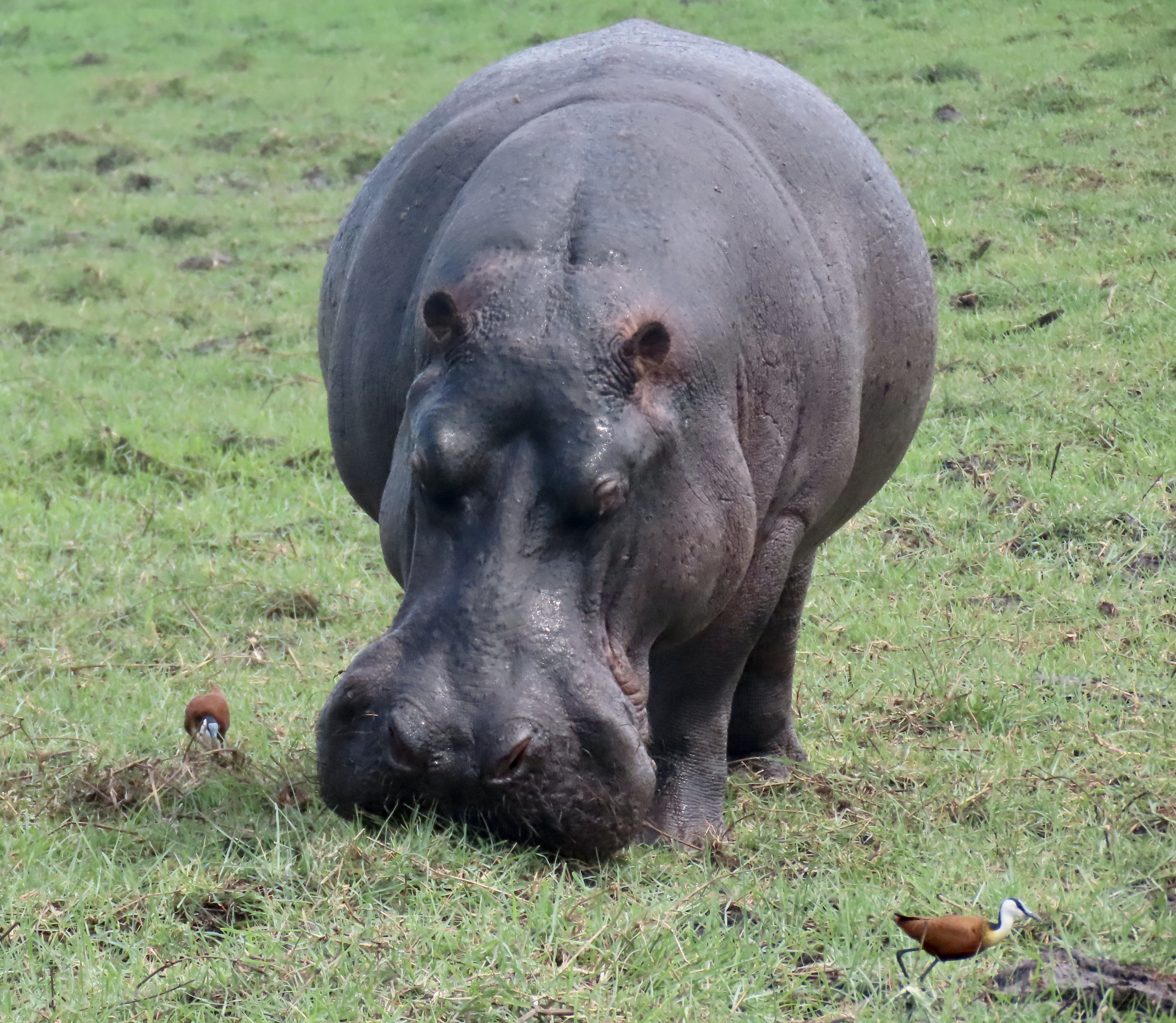
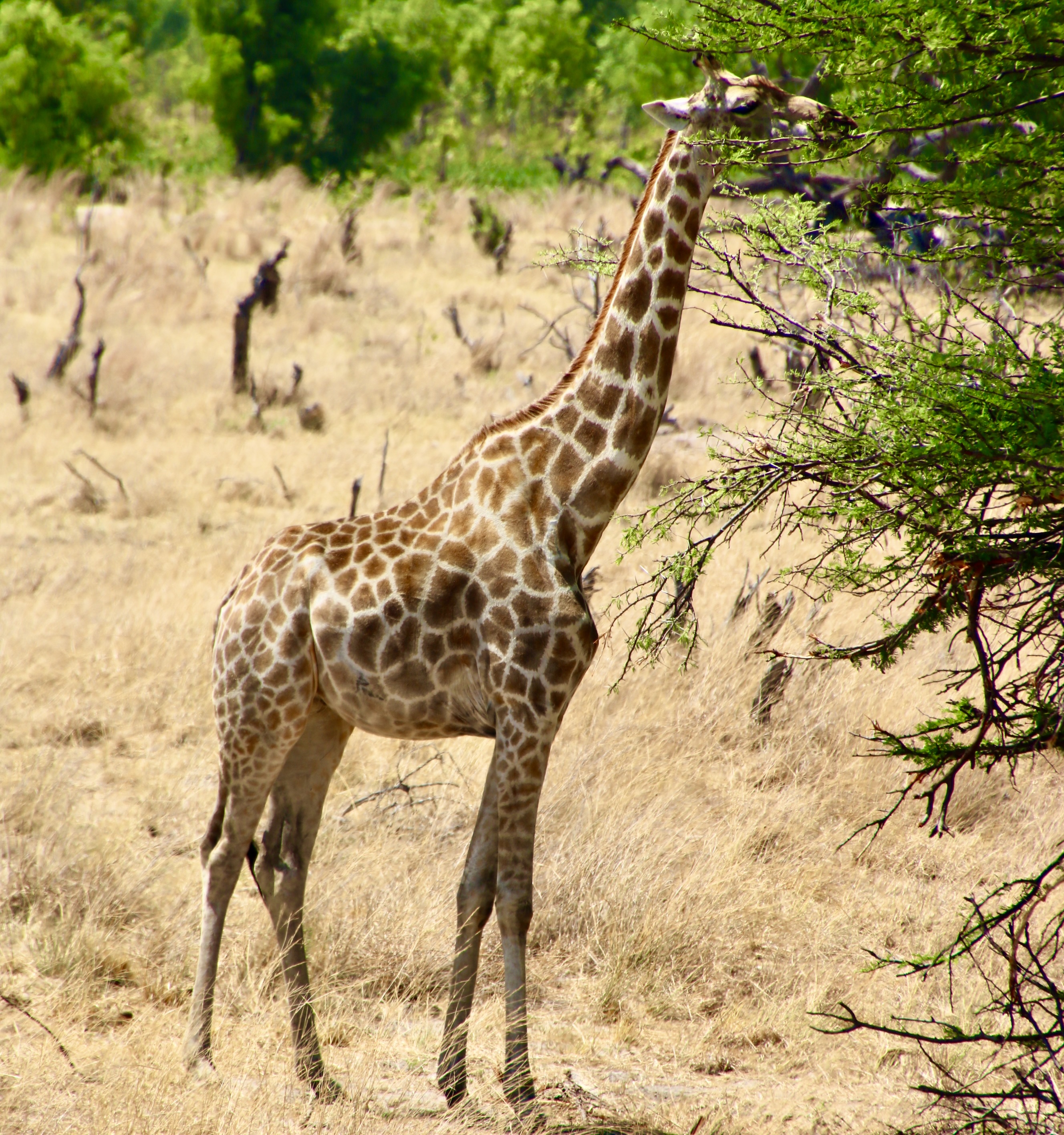
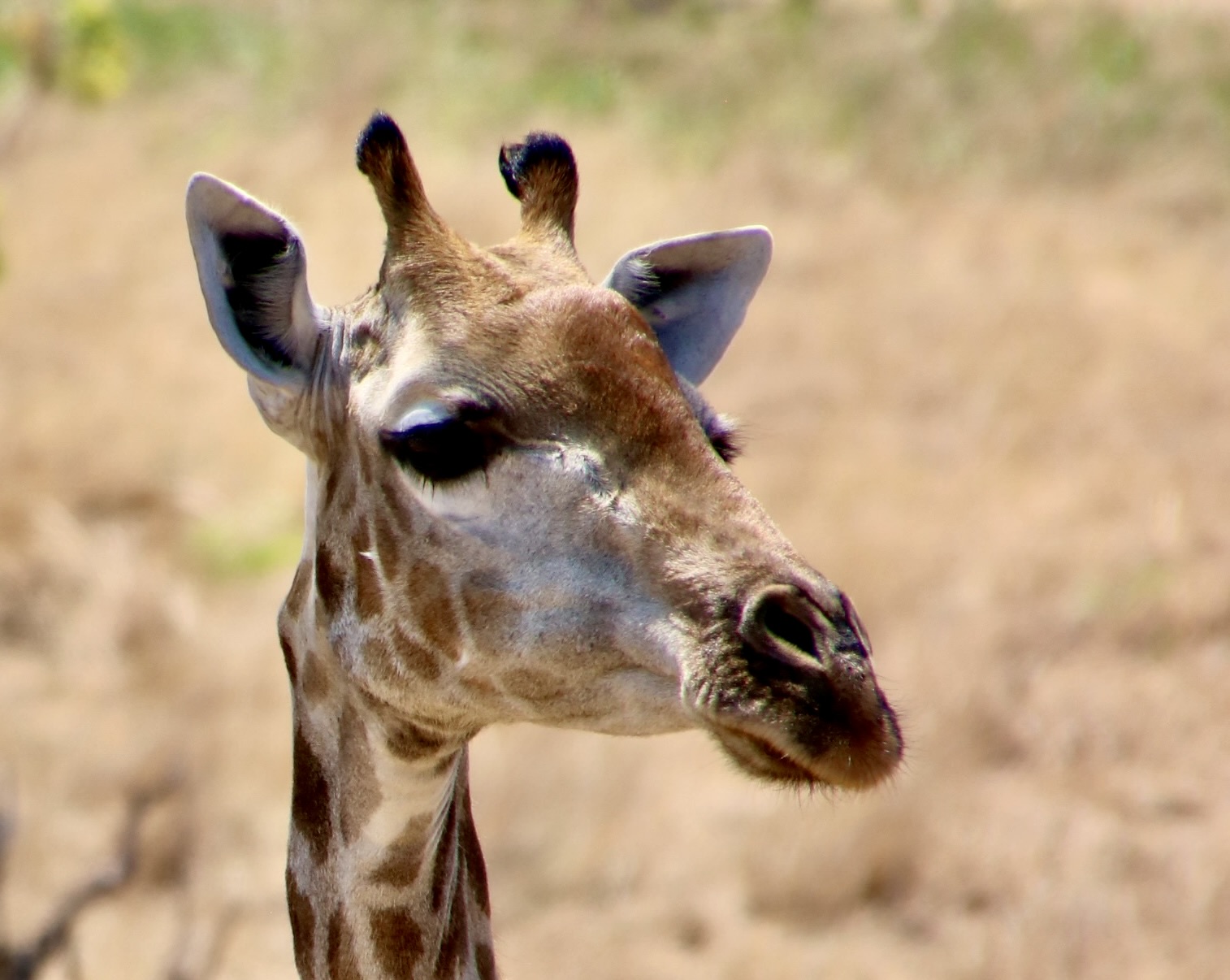
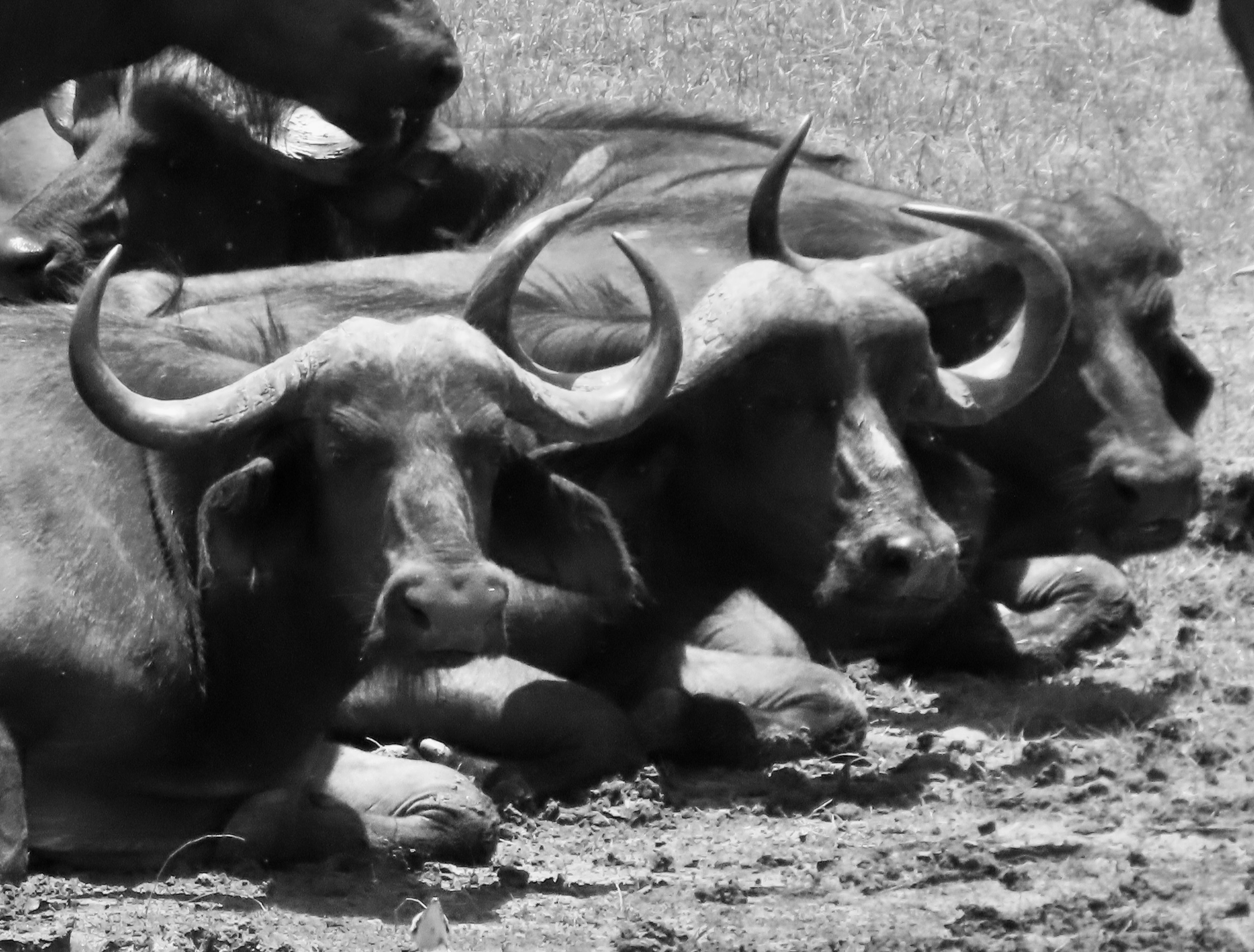
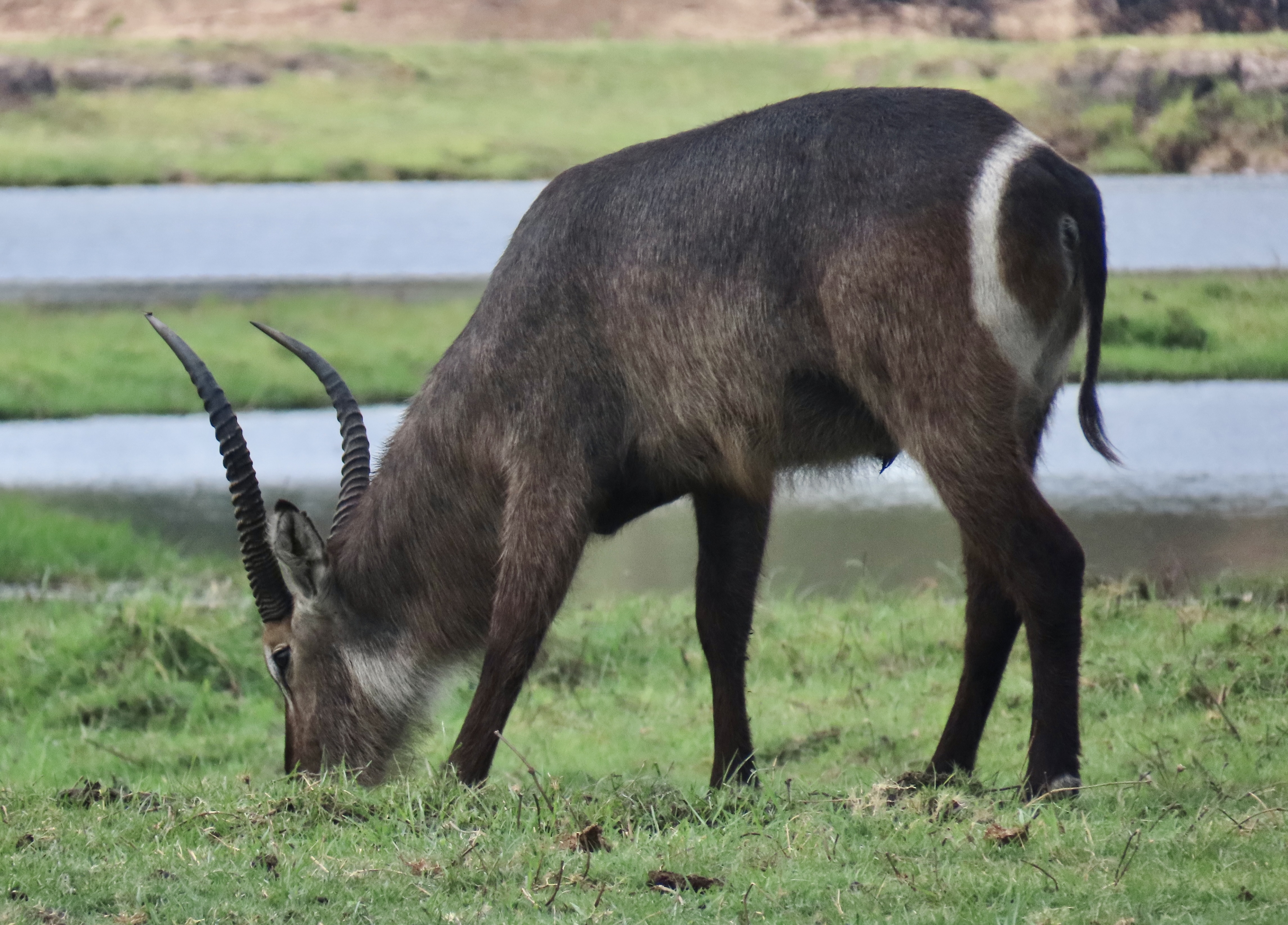
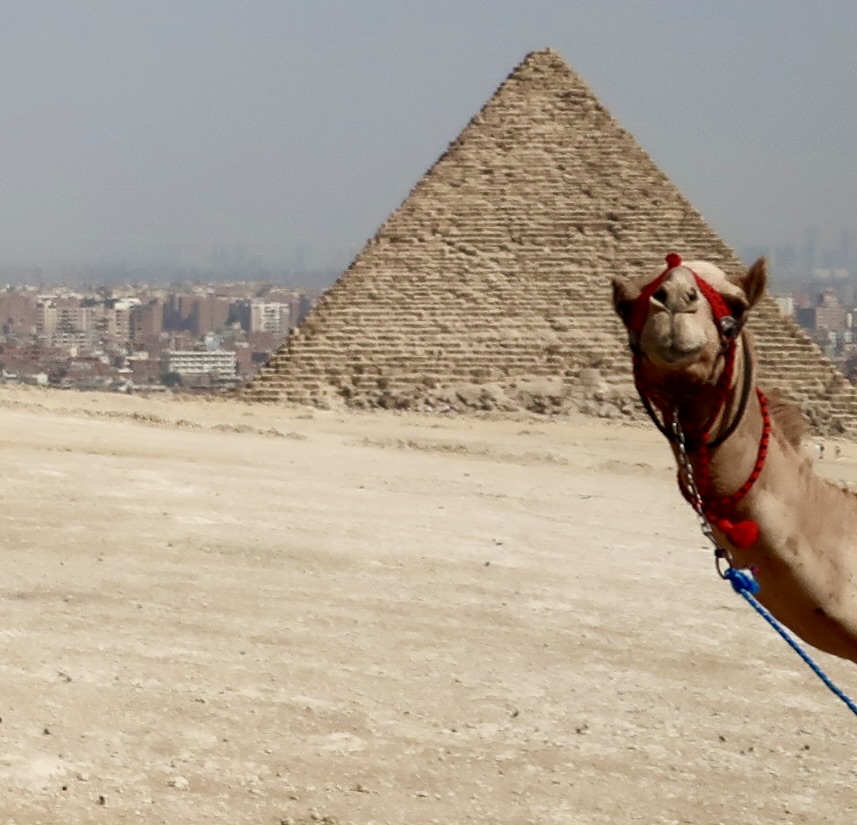
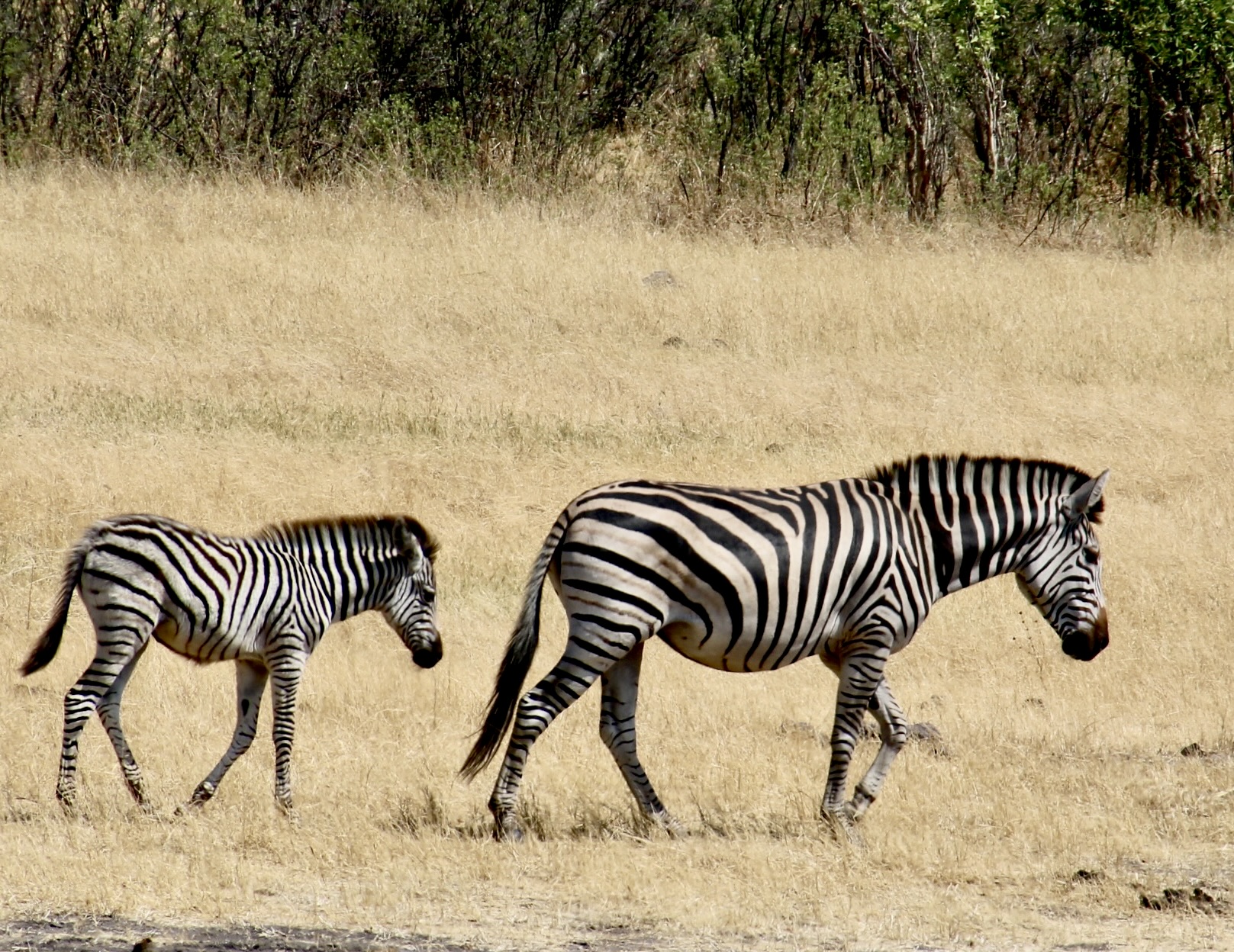
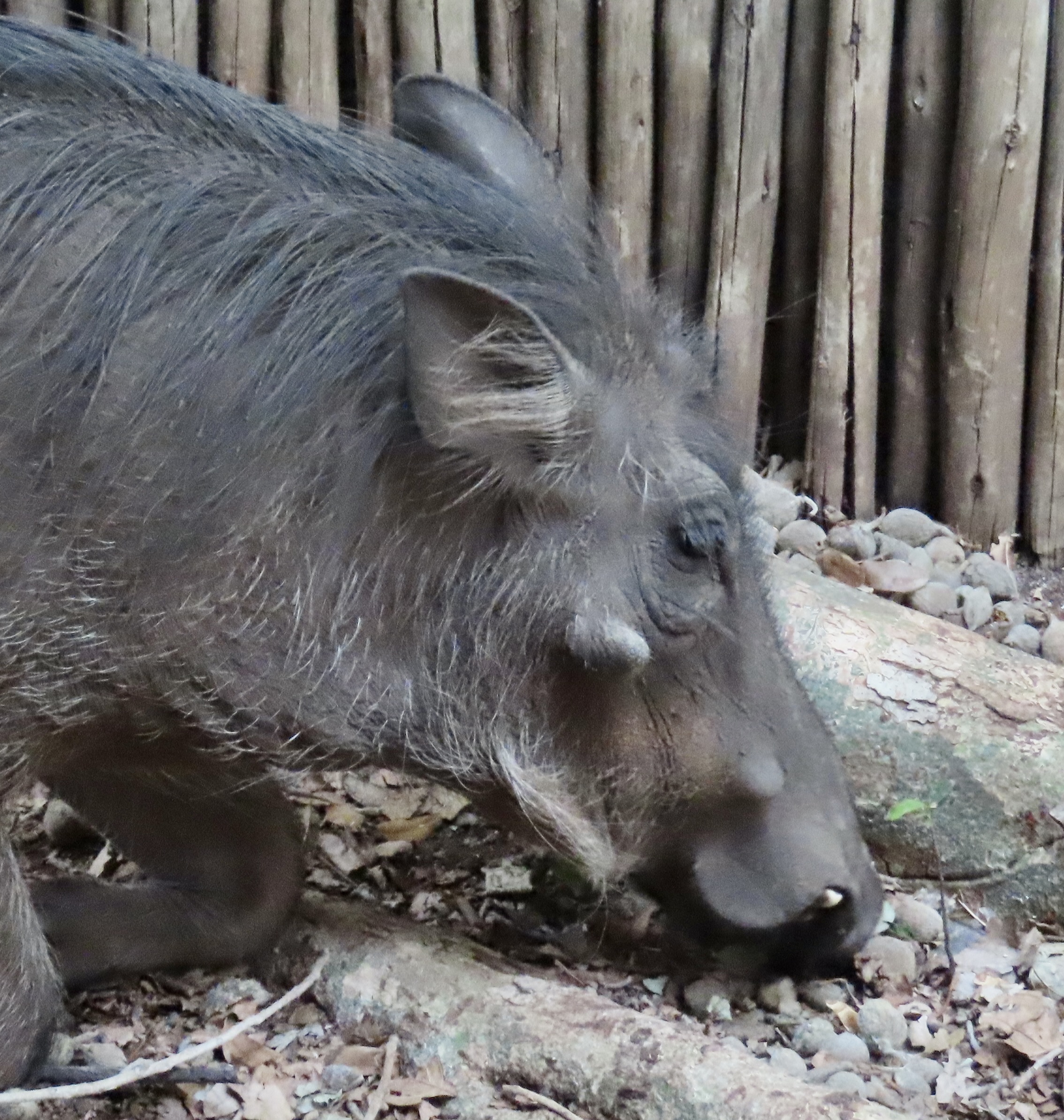
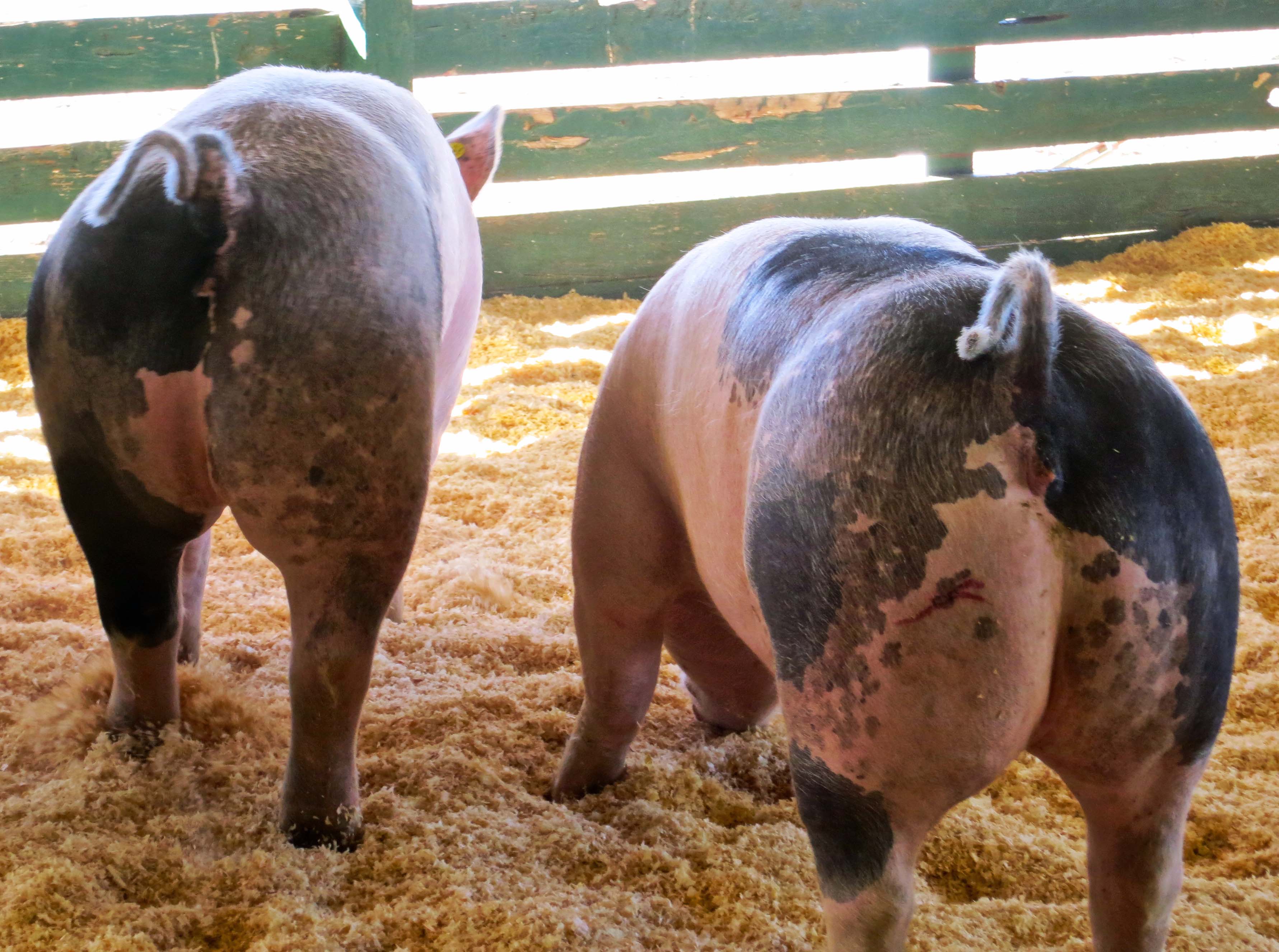
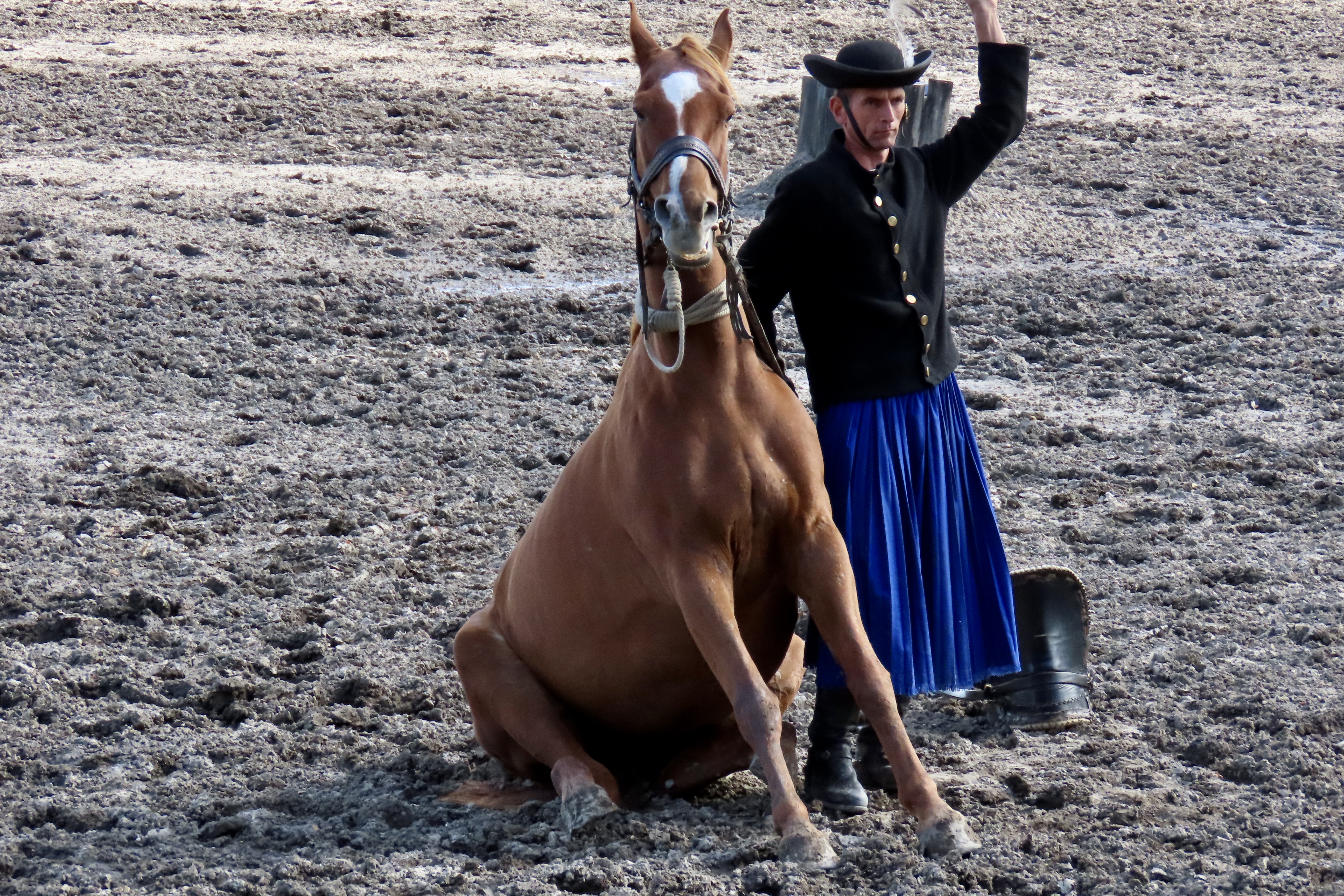
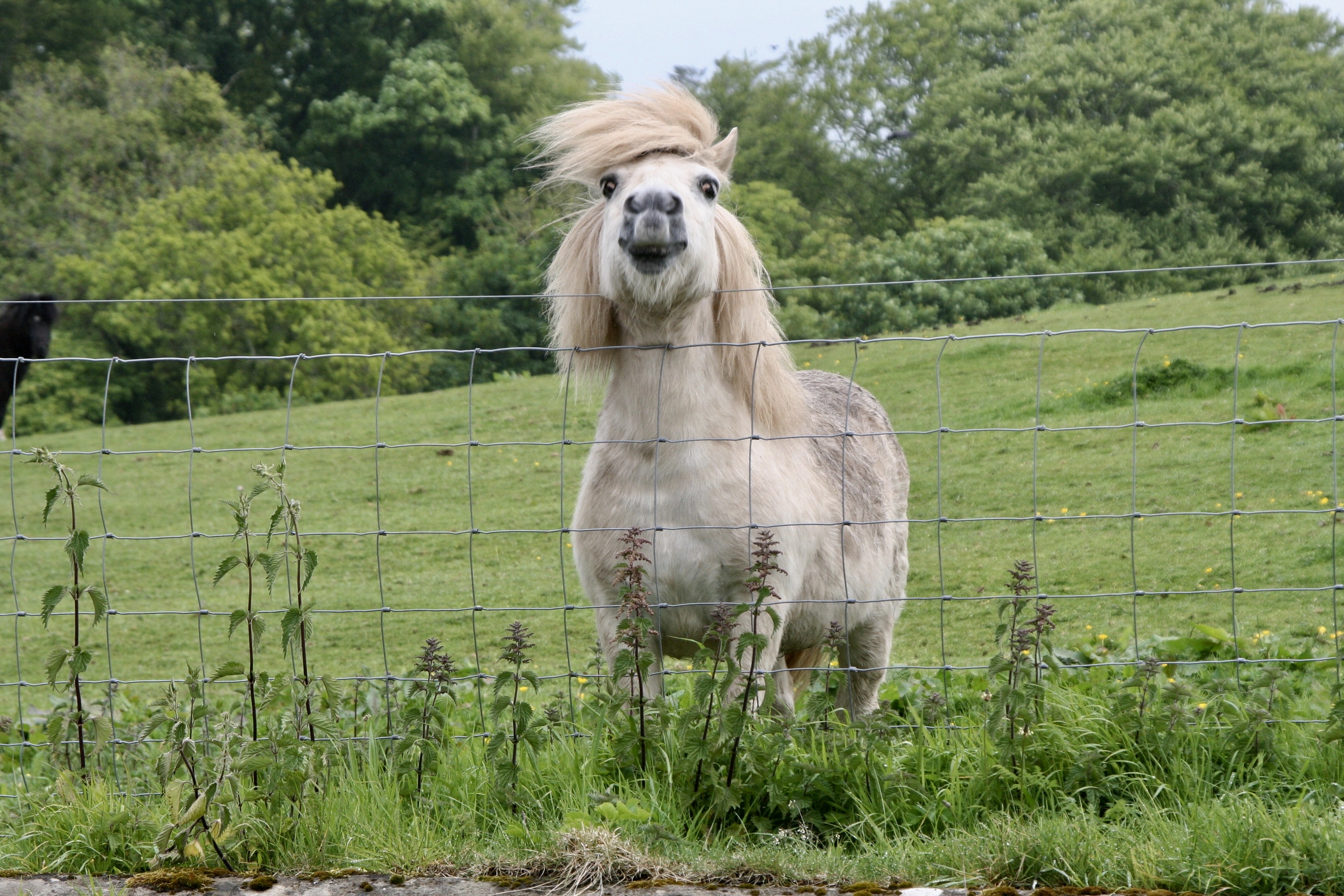
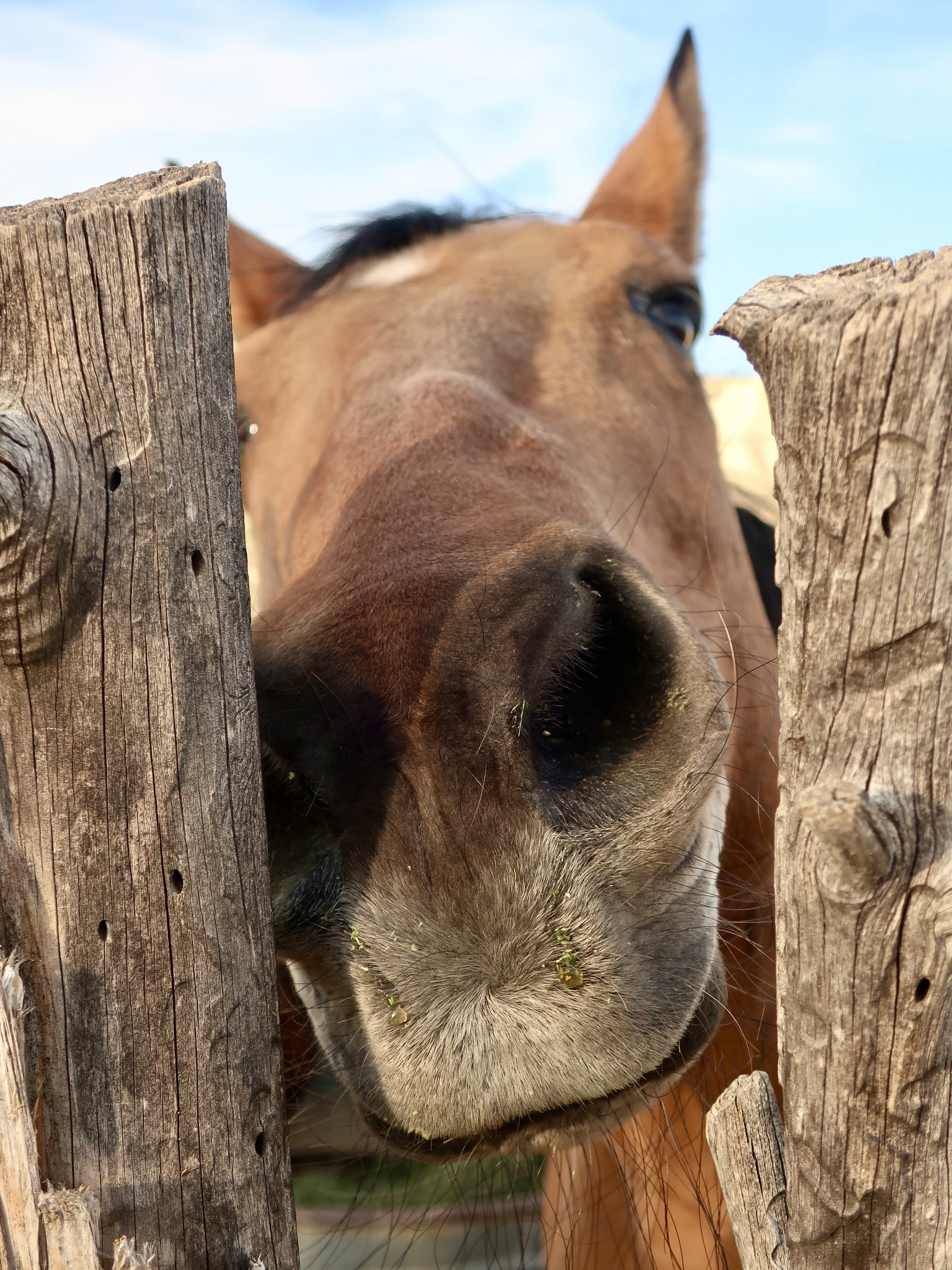
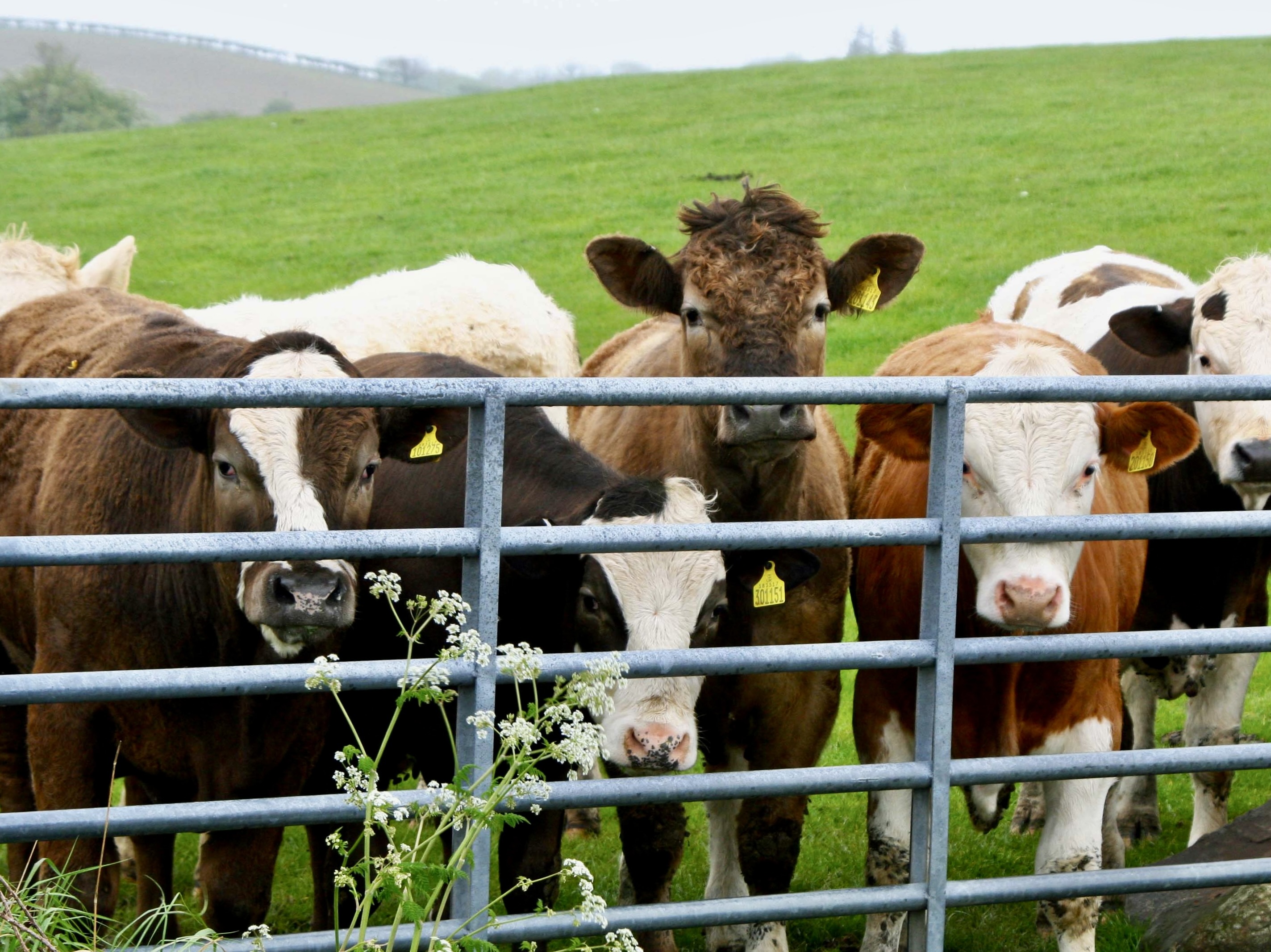
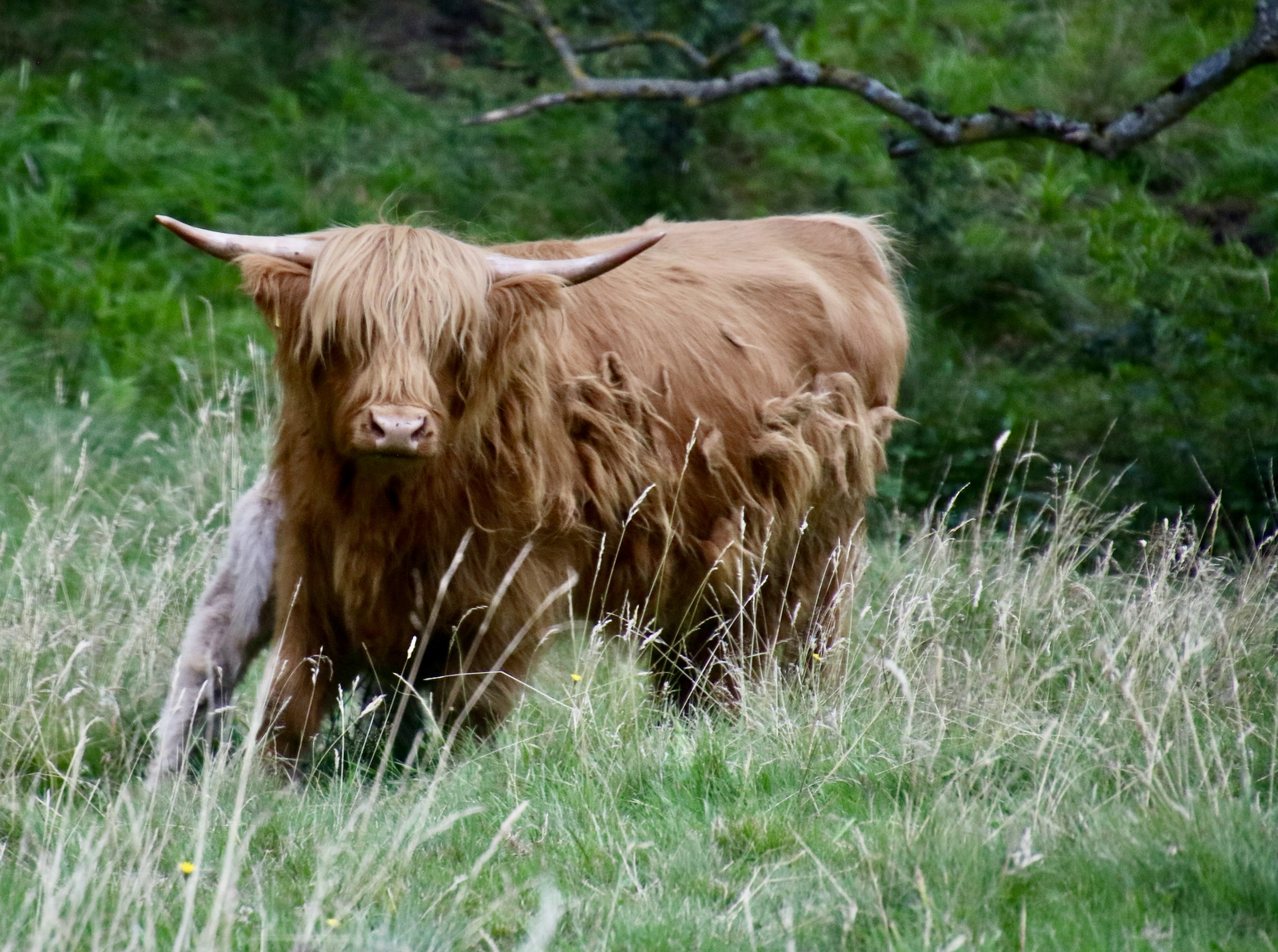
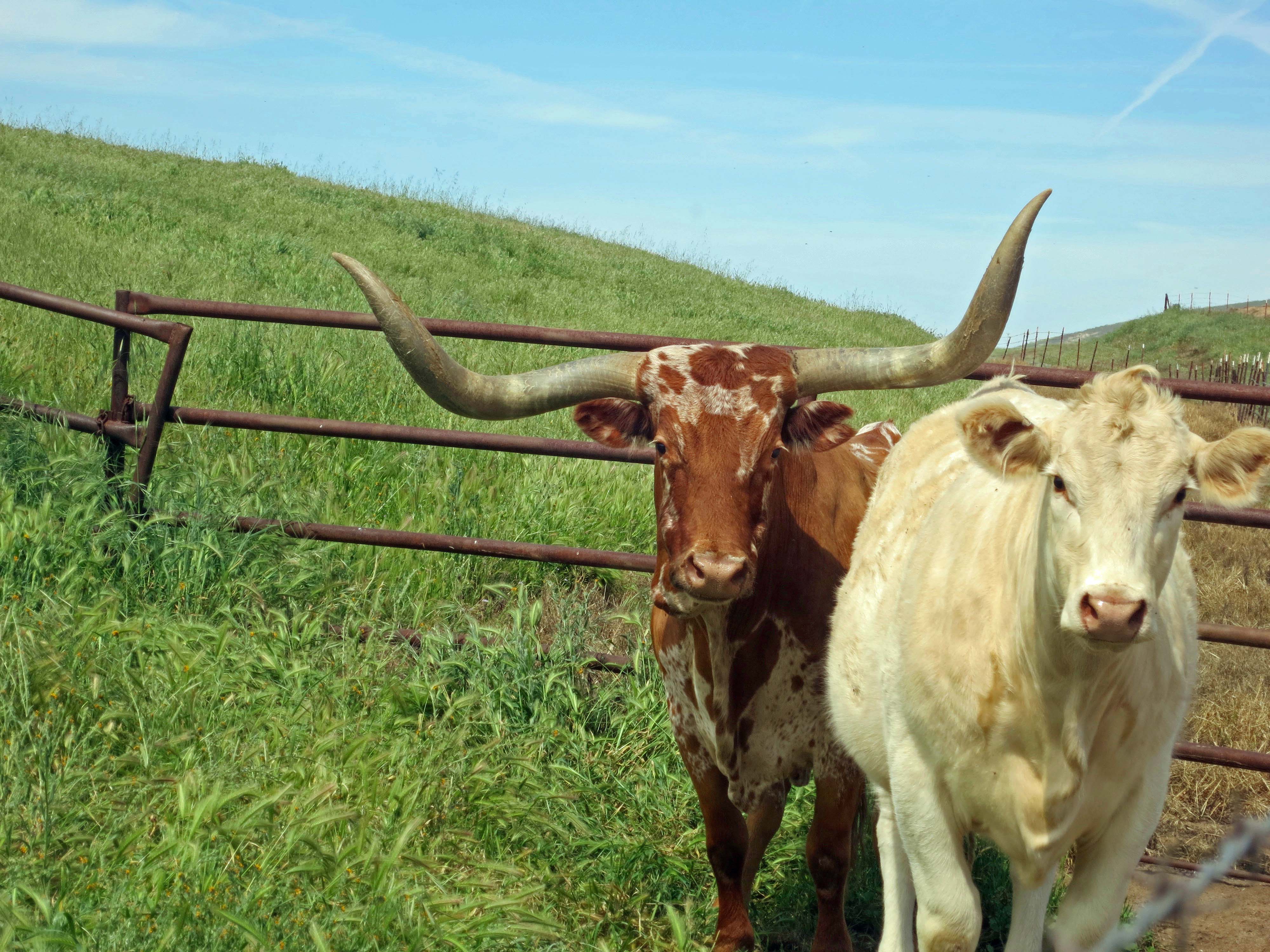
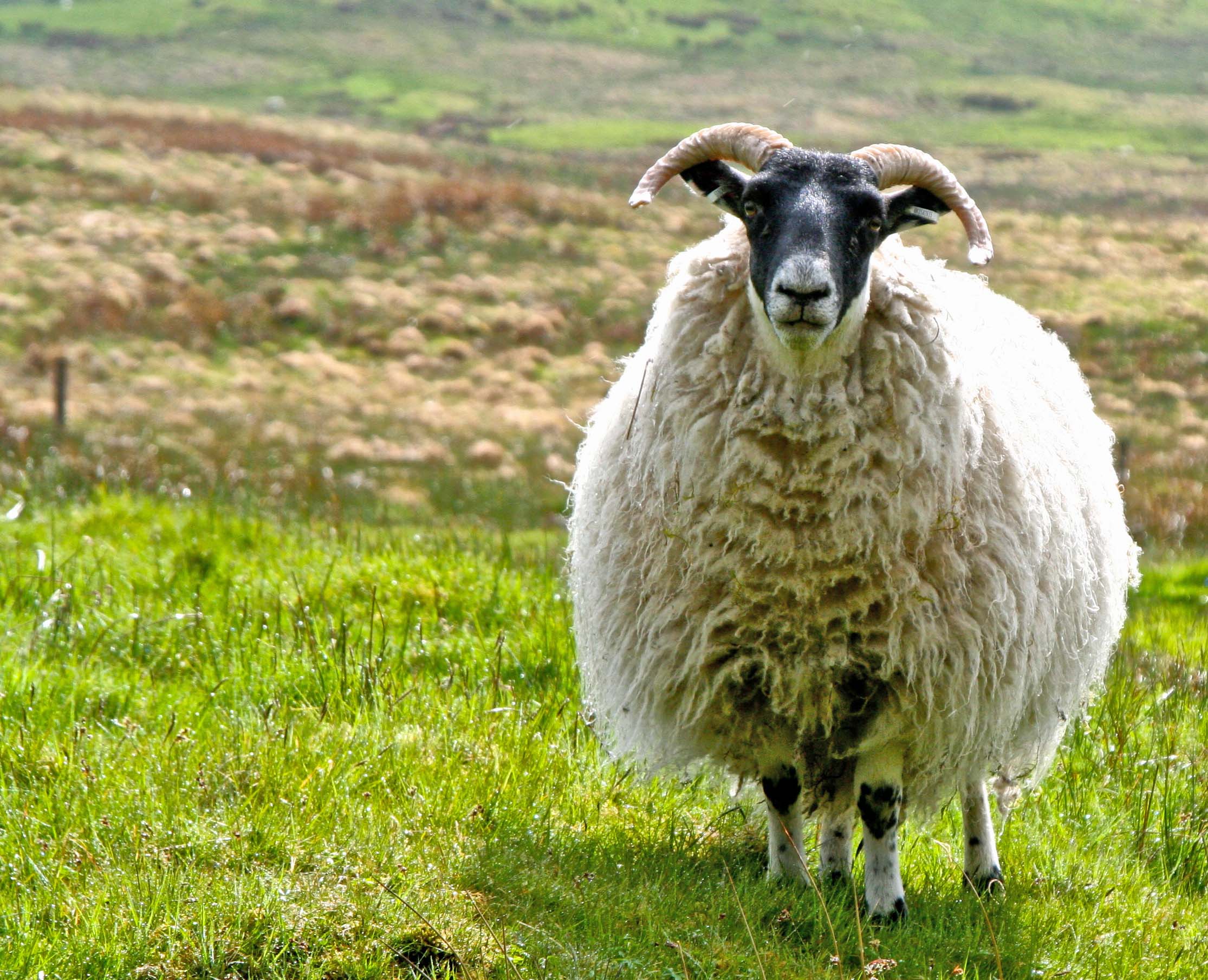
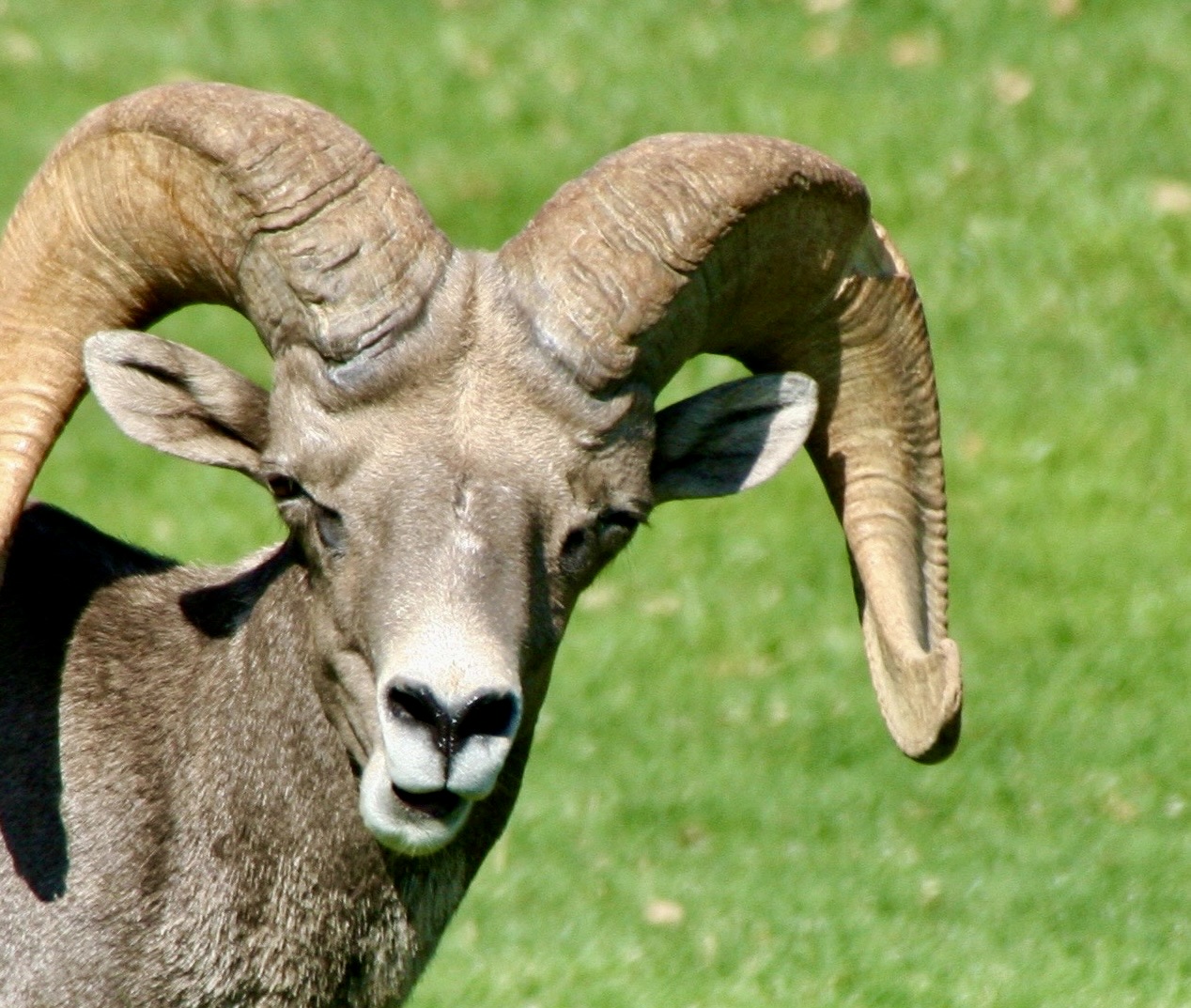
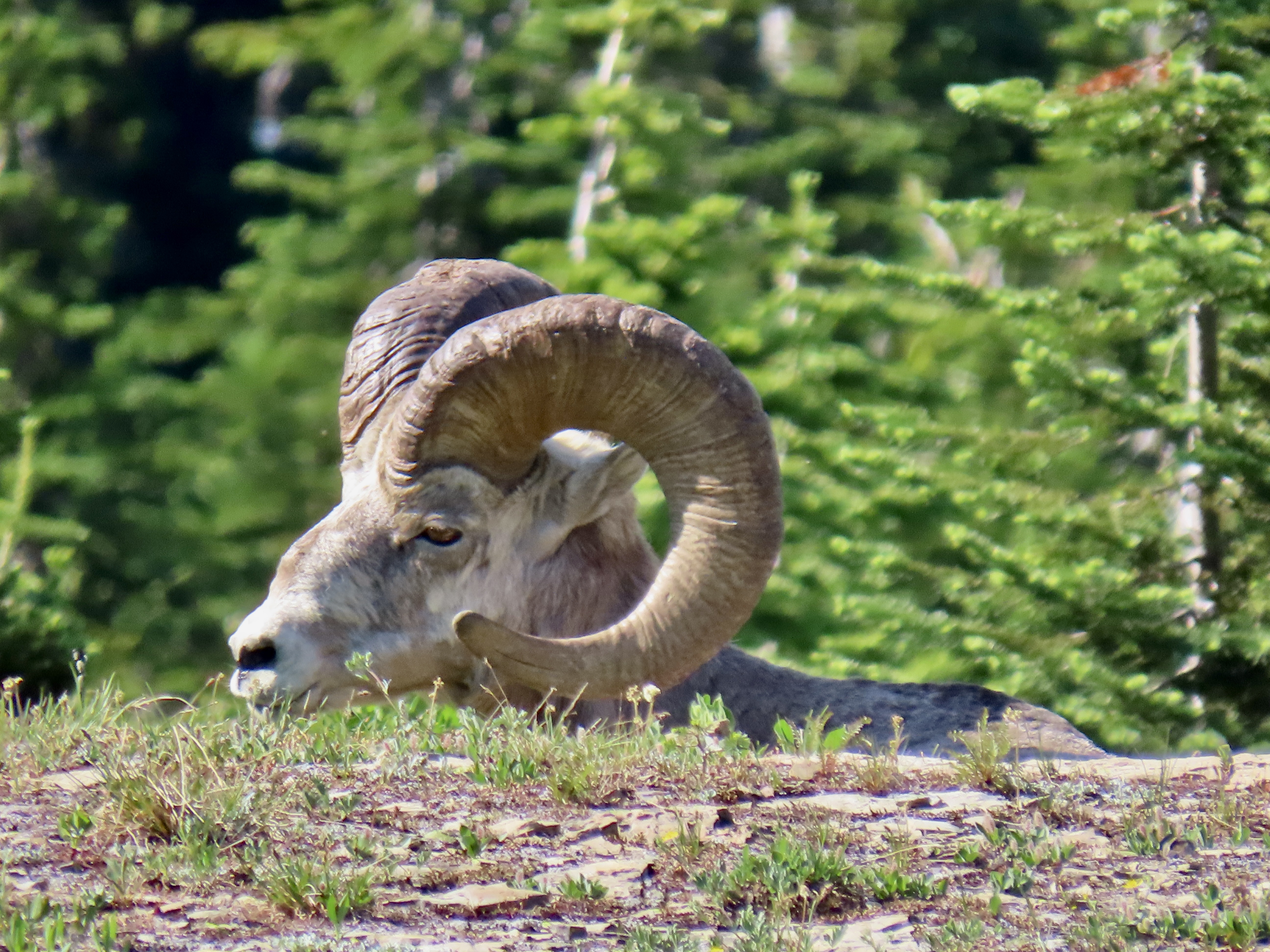
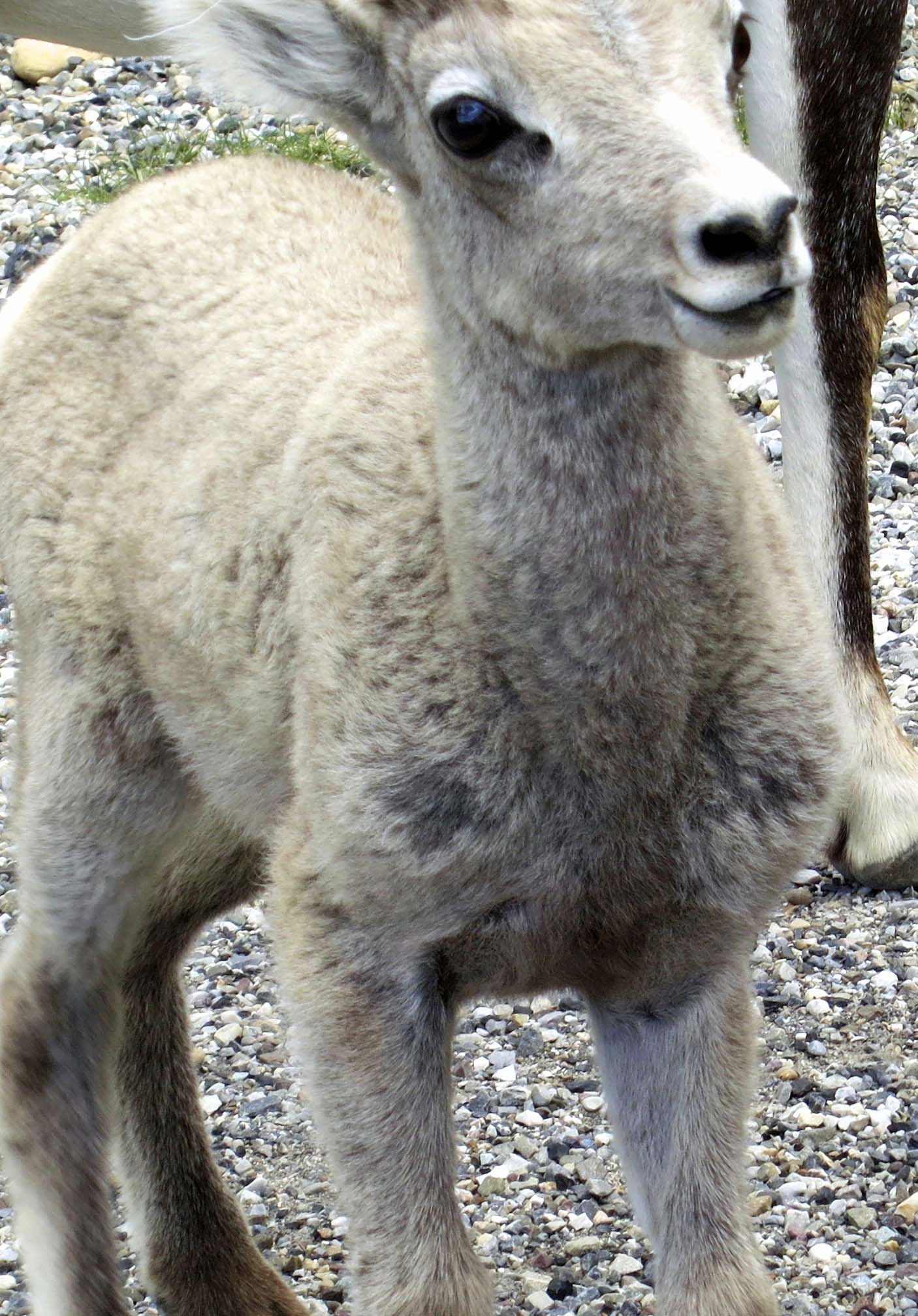
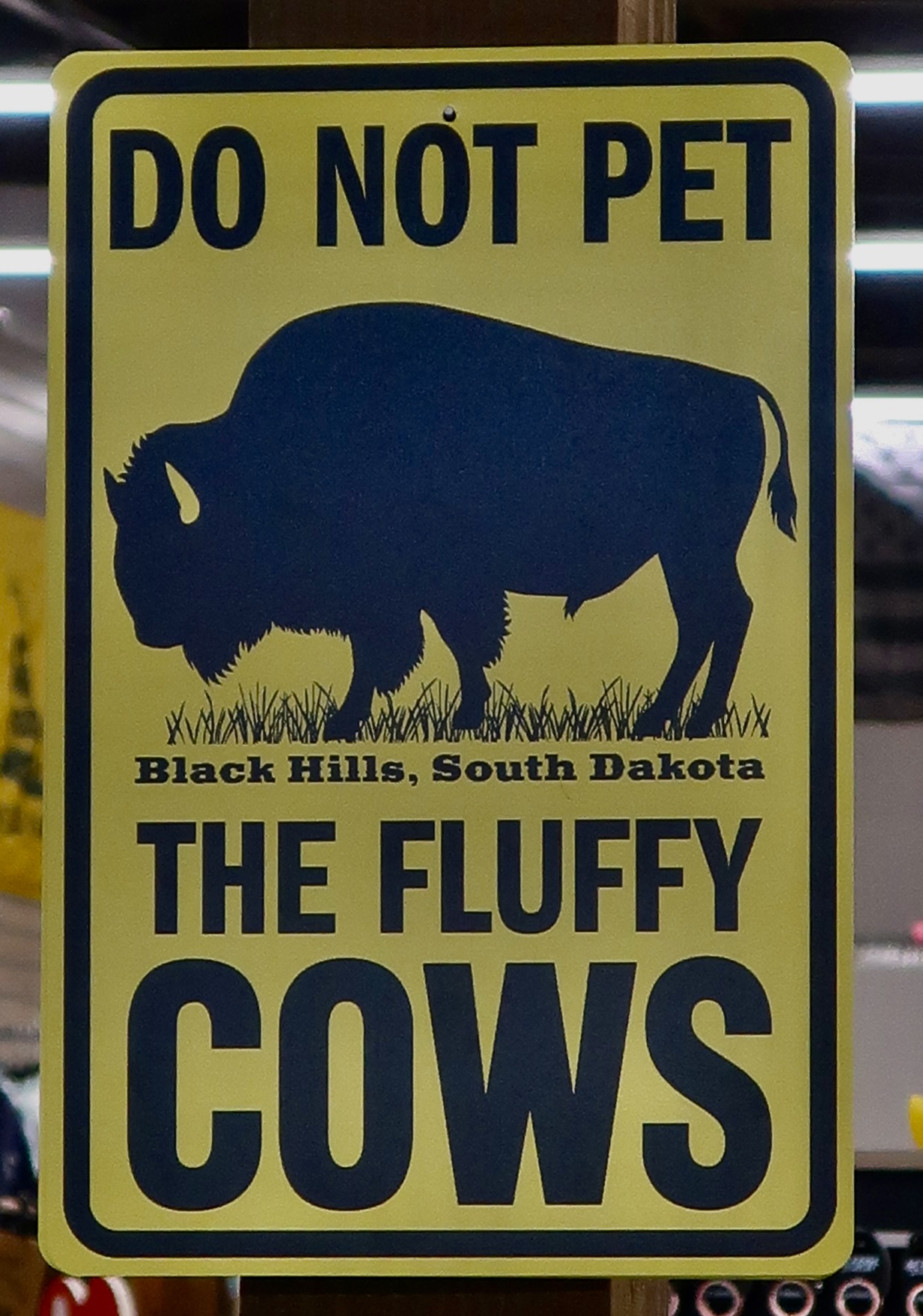
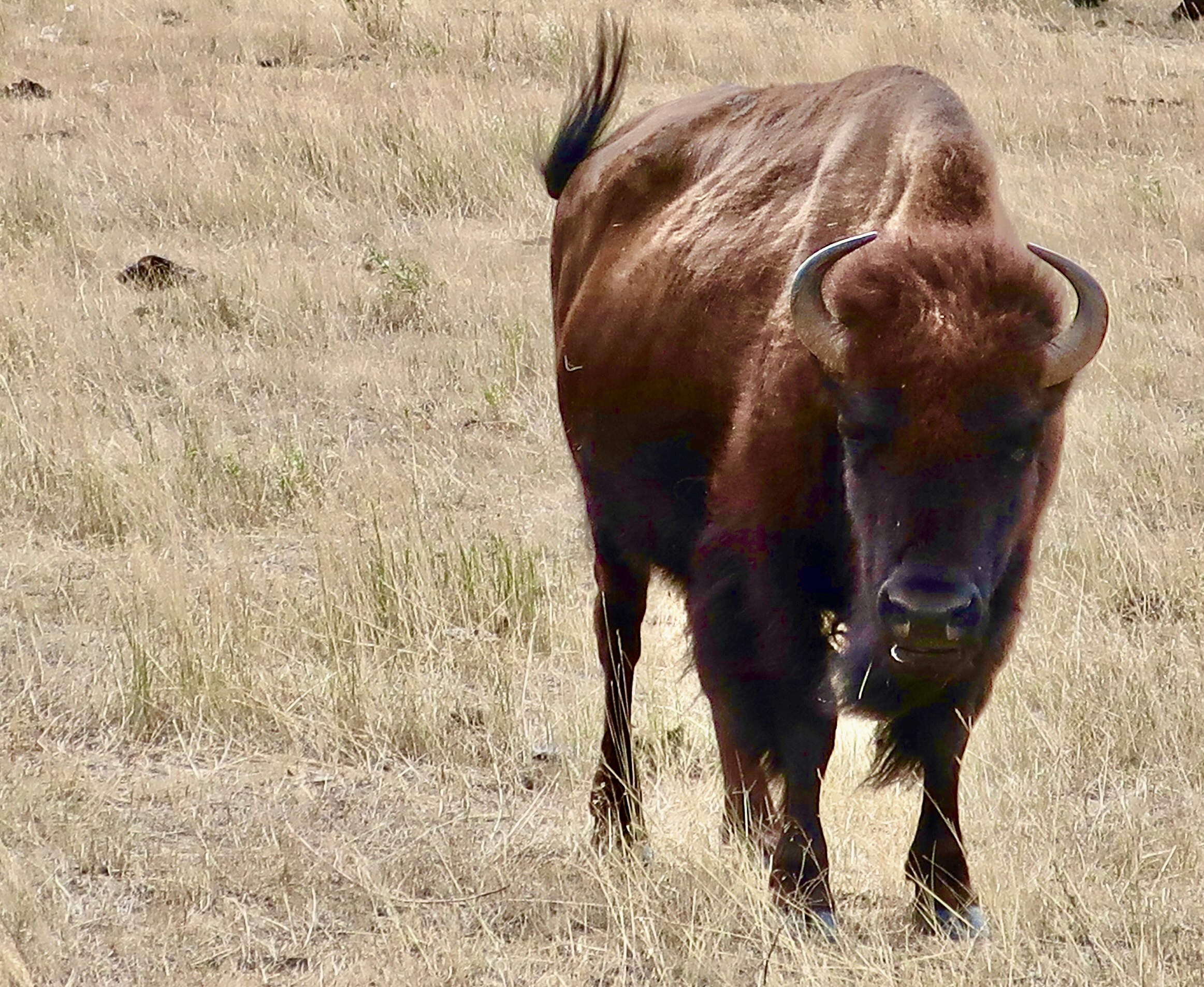
Bad dog! This was one of those occasions I was ever so glad to have a camera along. We had known that we would need one. Our neighbor Jim in Oregon had called and urged Peggy and me to come over and see his recently-born baby goats. Of course we went. Immediately. Who can resist baby goats? Plus, it was a photo op waiting to happen. I just didn’t expect this scenario where one, very small baby goat appeared to be dominating one very large dog. Have you ever seen such dejection? The dog, btw, wasn’t just a large dog; it was one of the largest, most ferocious dogs in the world, a Kangal Dog from Turkey. They are massive animals weighing up to 200 pounds that were originally bred to protect livestock from bears, wolves and other predators. Jim kept his to discourage unwanted intruders, whether four legged like our local bears and cougars, or two legged. I’m not sure what triggered the response above. The big dog had walked over and sniffed his latest charge and then started slinking away. Maybe baby or mom had objected.This is what we expected in terms of cute baby goat photos. Lining up for food cafeteria-style. Daddy. A handsome fellow. He had escaped from Jim’s and come over to visit us. Jim called him Rambo and was very careful not to turn his back on him. He had been butt butted far too many times. Goats are two toed ungulates, which make up the majority of the ungulates.Whenever I go to a county or state fair, my first stop is to visit the goats. I love the way they come over to visit and possibly nibble at your shirt. I found this guy at the Modoc County Fair in California, the same place I found the hogs shown below. In Africa, we met another two toed ungulate. It’s hard to find one more different from the goats. The birds are hanging out nearby because the big fellow stirs up lots of bugs as it shuffles along.While we are on the safari, we might as well check out other African ungulates. The giraffe is by far the tallest.A tree top perspective.The most dangerous of Africa’s two toed ungulates: The water buffalo. This is their “What are you looking at?” pose. I liked how each of them had its knee bent exactly the same. Horns and hooves, like finger nails keep growing for life. Apparently, there is a lack of farriers willing to trim water buffalo hooves.Africa’s numerous antelopes are also two toed. This antelope with a distinctive ring around its hind quarters is a waterbuck. Supposedly, the distinctive marking helps waterbucks follow each other when they are running through the woods. My guess is they would help a lion as well. “Target is in sight.” Horns, like hooves and your fingernails, are made of keratin.“I’d like to interrupt this presentation to announce that I, too, am a two toed ungulate even though Curt and Peggy didn’t find me on the safari. It was on the Nile River trip.Apologies for the interruption. Like the horses, donkeys and mules they resemble, zebras are single toed ungulates.I close my coverage of two toed ungulates in Africa with the warthog. It’s always in competition for one of the ugliest mammals to be found. Or maybe, it’s just cute. Guess who this one is related to?Yep. I found this handsome pair of porkers at the Modoc County Fair in northeastern California when I was on the way to Burning Man. Speaking of Burning Man, this is the time of the year that people sign up to attend the late August event that is held in the remote Black Rock desert of Northern Nevada. I often do a few posts around now to give newbies and curious folks an overview of what to expect. I’ve been going off and on since 2004. My friend Tom is trying to persuade me to join him this year in giving away hundreds of margaritas on the Playa. I’ll probably be rewarded for my work with all of them I can drink. Woohoo!Horses are one toed ungulates. Rarely do you find them sitting on their butt in the mud, however. Why would they? But Hungarian Cowboys, the Csikós, do things differently. We took this photo at the Bakodpuszta Horse Farm in Hungary, on our trip down the Danube River. Something else you wouldn’t find an American cowboy doing.This cutie came dashing up to a fence to see us when we were searching for ancestors of mine in Lowland Scotland near Stranrae. Given its excitement, I wondered if it wasn’t an ancient relative of mine reincarnated as a Shetland pony.I featured this horse in a promo for today’s post. He was hanging out on a ranch near Bryce Canyon National Park in Utah. I think it probably had high hopes for an apple..Cattle are two toed ungulates. We went looking for the unique Scottish Hielan coo (Highland cow) while we were in Lowland Scotland but only found what we normally find wandering around North America. Like the Shetland, they ran over to check us out.We found this Hielan coo in the Black Forest of Germany. Go Figure. This summer we are going to be exploring the Highlands of Scotland instead of the Lowlands. We are expecting to find the coos where they belong. This two toed ungulate with the large horns is immediately recognizable. It’s a Texas longhorn. We found it in the foothills of California.Not so clear in terms of heritage was this strange looking steer. But we found it about a mile from the gate to Area 51 in south eastern Nevada. Could it have been a cleverly disguised visitor from outer space? Hmmm.Sheep are also two toed ungulates. This stout fellow had been blocking a small rural road when we were lost in Scotland. It was being baaad. Had its body been black, I would have cited the old nursery tale to it: Baa, baa, black sheep have you any wool? Yes sir, yes sir, three bags full. BTW, sheep are closely related to goats and on rare occasions even crossbreed. Their offspring is called a geep. And no, I’m not making that up.Among sheep, nothing—from my perspective— is more regal than the wild big horned sheep of the deserts and mountains of Western North America. This magnificent example chewing his cud had bought his herd down to graze at a small county park between Las Vegas and Lake Mead Nevada.
There’s a fun story here. The big ram above had been bringing his flock down to the park from the mountains for years when a new subdivision was built beside the trail. This didn’t seem to bother the big horns and you can imagine what a treat it was for the people. But then, one of the home owners put a shiny aluminum door on his garage next to the trail. The leader looked over and saw his reflection. Except it wasn’t his reflection in his mind. It was another lage male challenging him for the leadership. He reared back and charged at the same time the other big horn did, again and again. Nobody was going to get his nannies. The story the locals told us was that the owner of the garage door had a really hard time convincing his insurance agent how the damage had been caused!
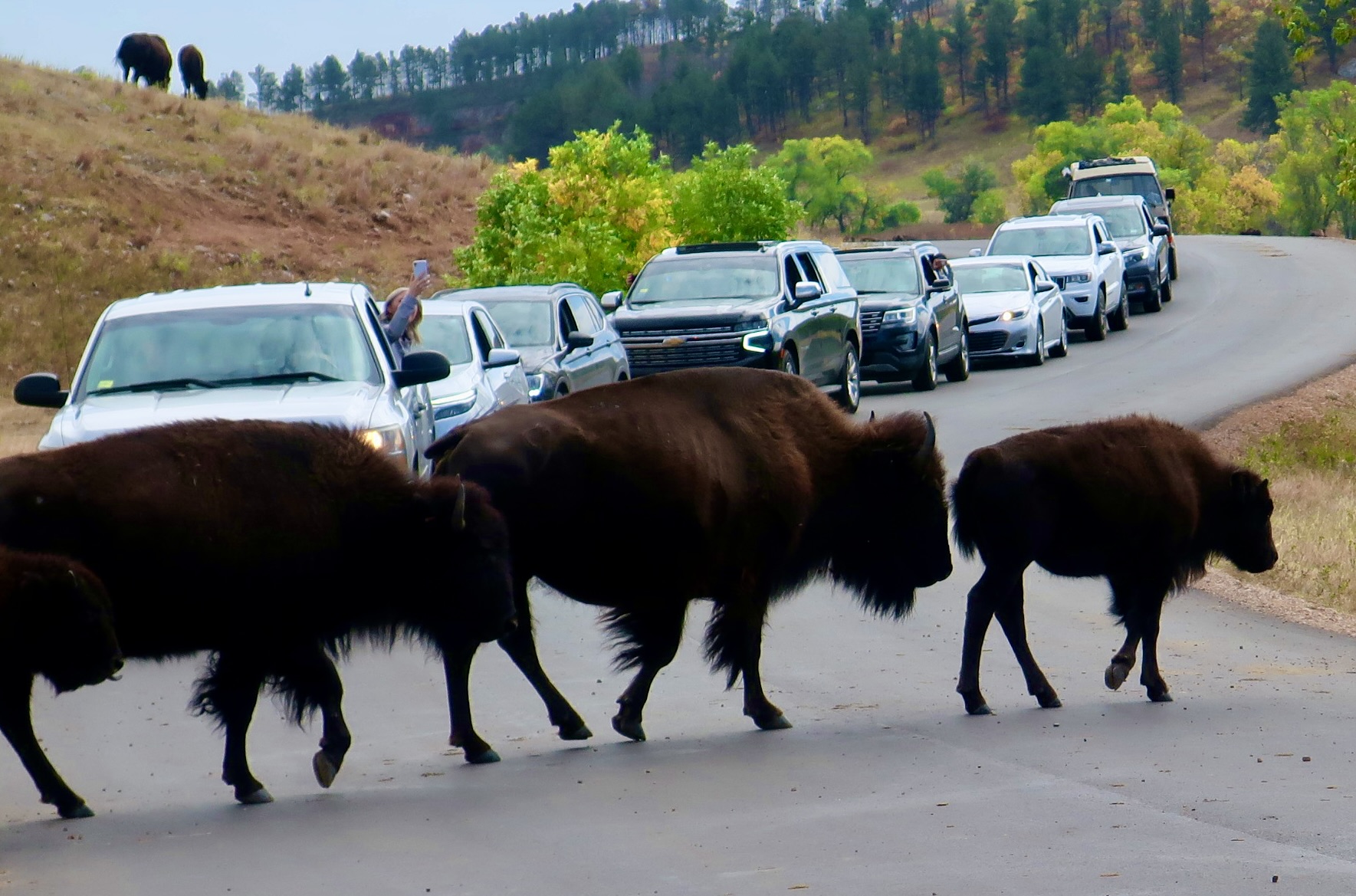
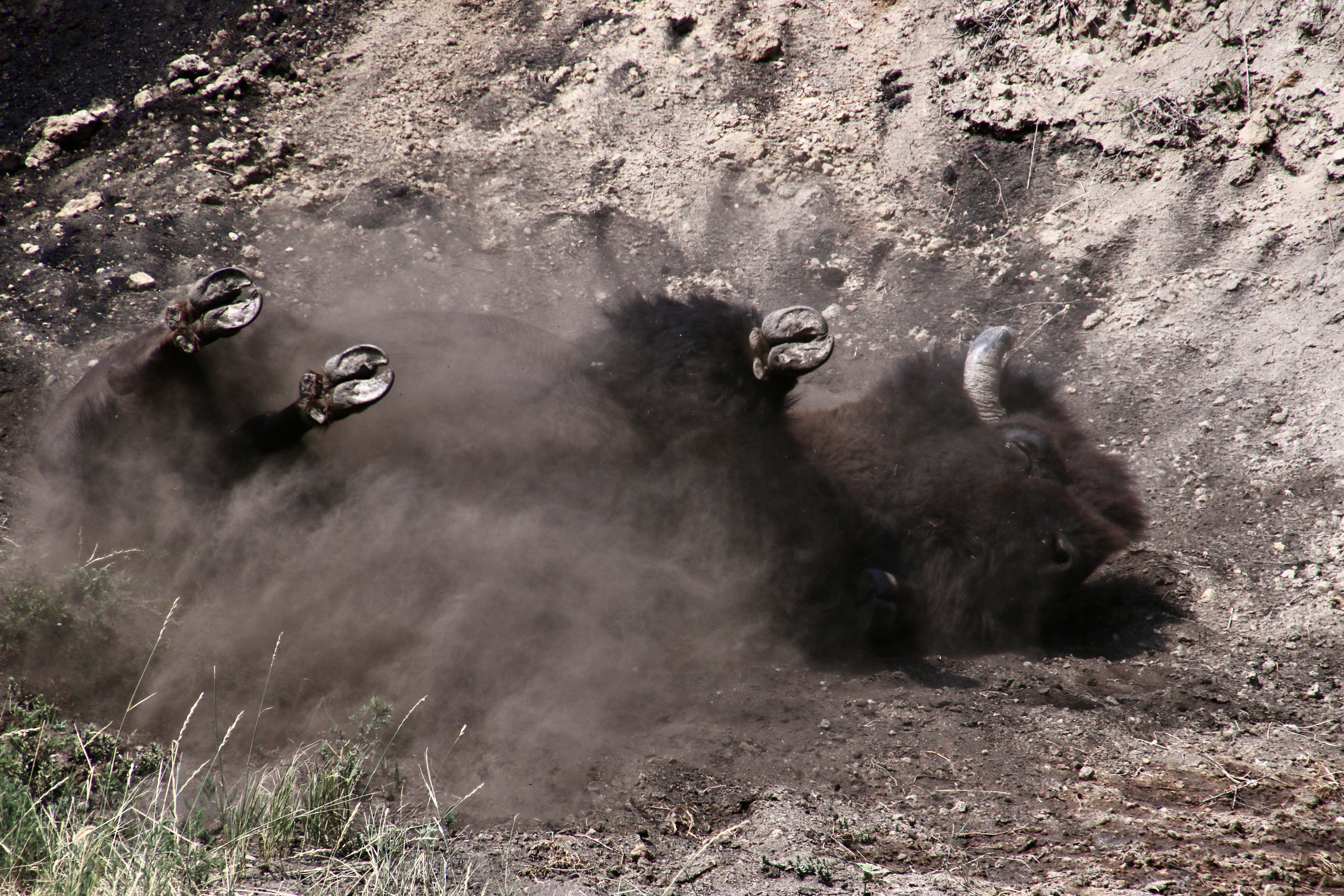
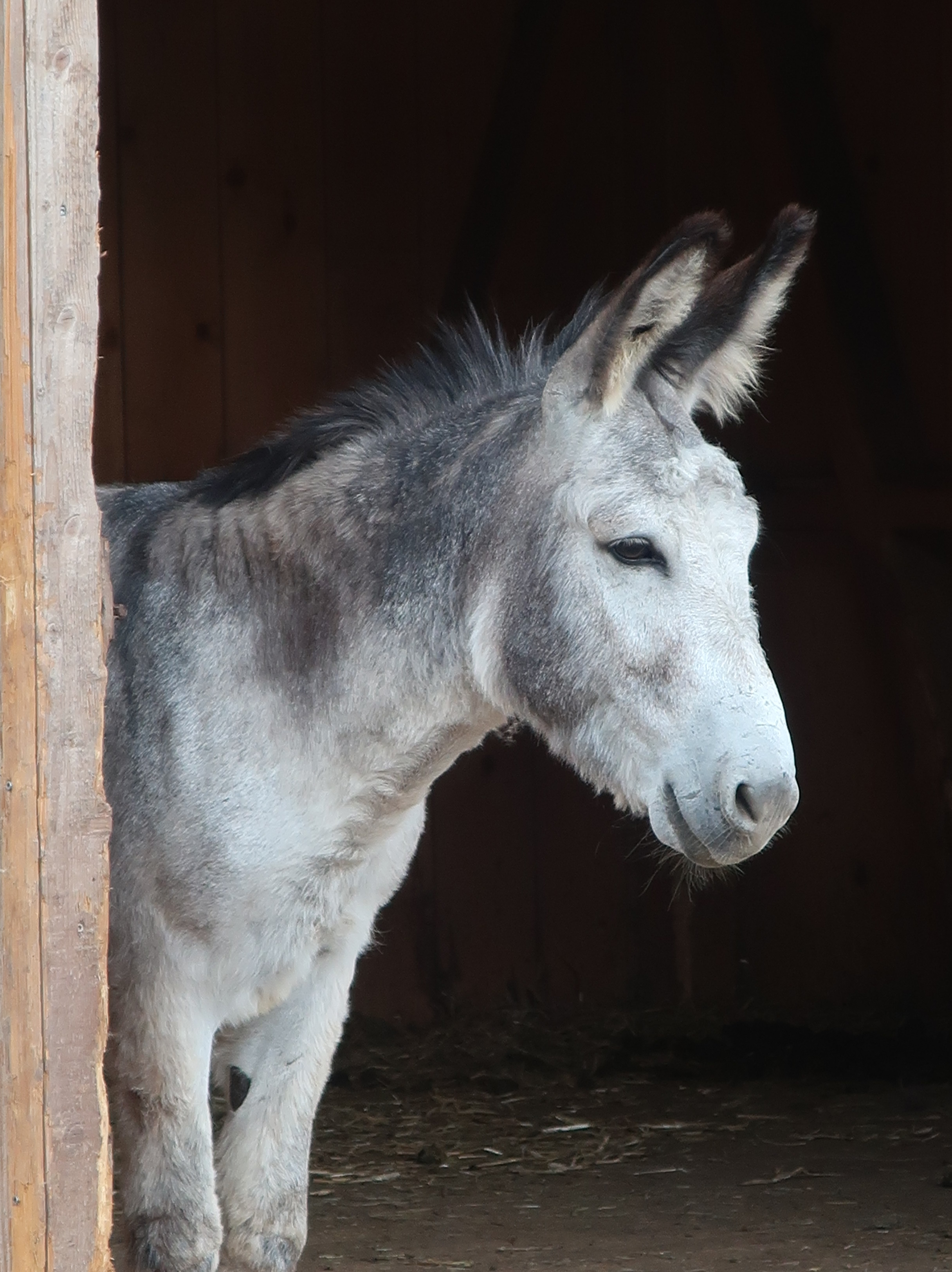
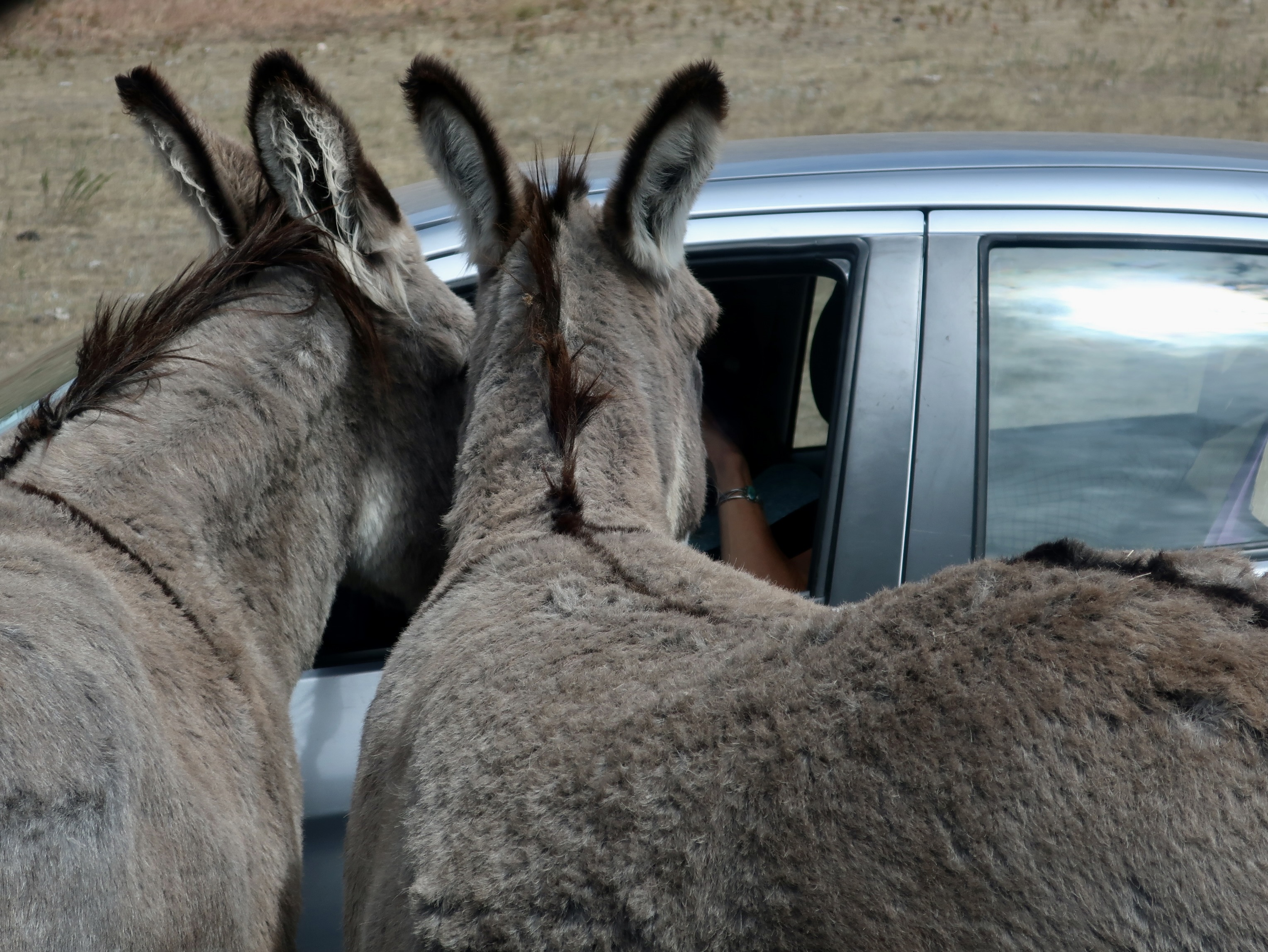
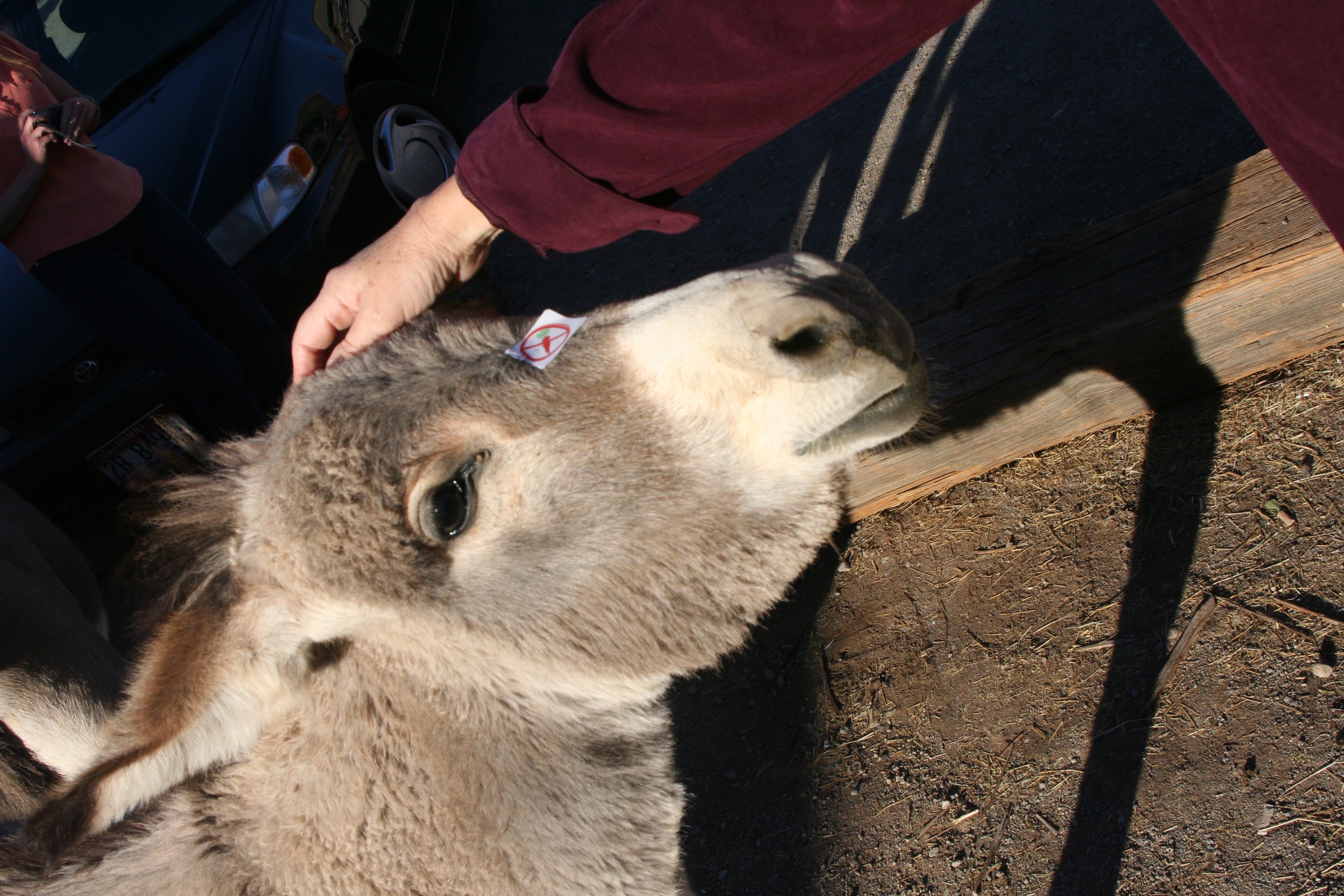
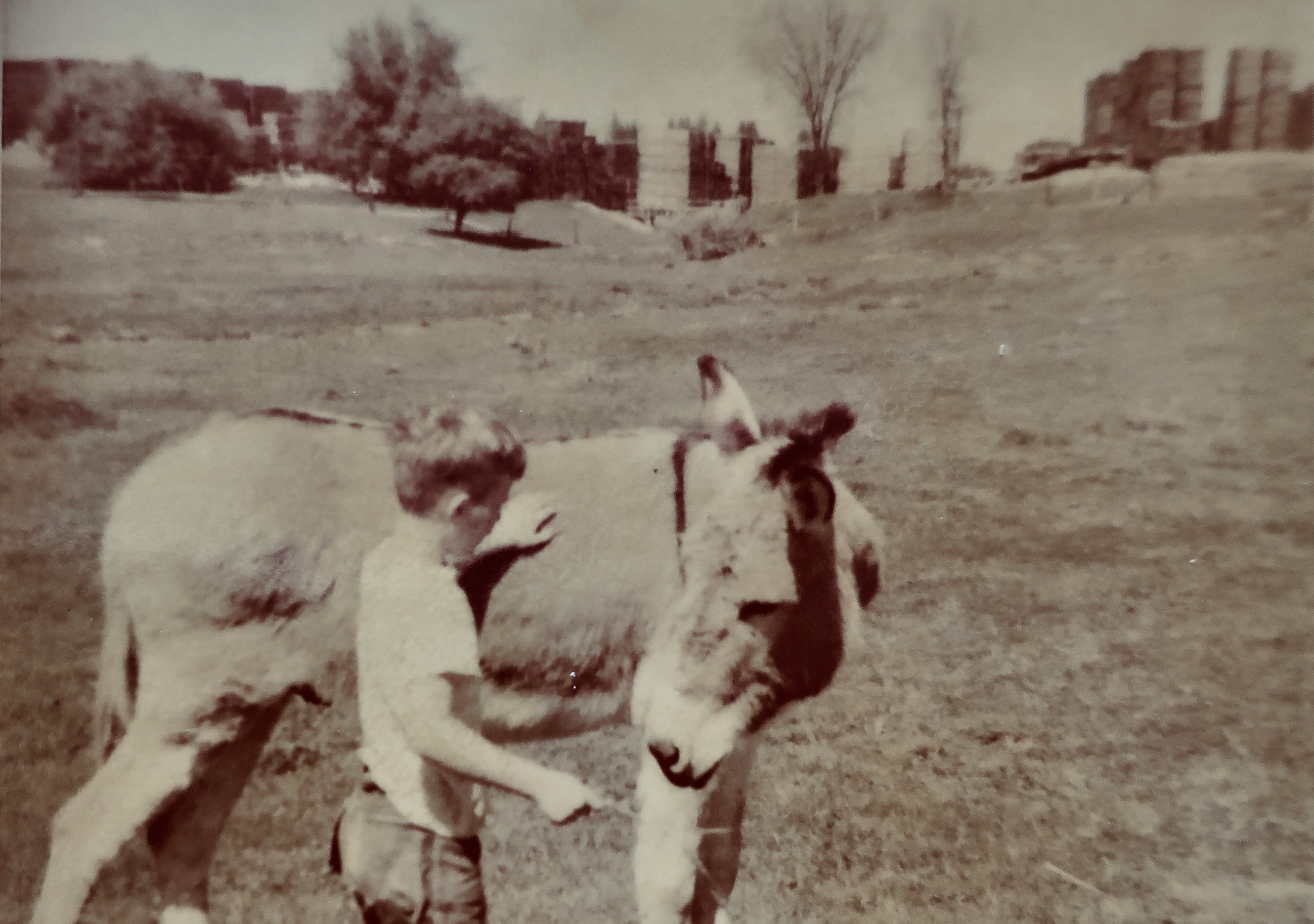
A big horned sheep at Glacier National Park.This young big horn sheep was standing beside the Alaska Highway in Canada’s Yukon Territory.Buffalo are another two toed ungulate. This sign was located in a store in Custer, South Dakota. We were on our way to Custer State Park. It’s good advice.If a buffalo stares at you, raises its tail, paws the ground and grunts, you are too close! It’s best to stay at least 75 yards away. Farther if there are calves around. This youngster was feeling its oats even though I was using my telephoto lens from a safe distance. The family of buffalo was crossing the road in Custer State Park. We waited patiently and took photos from the safety of our truck.Have you ever wondered how buffalo create their buffalo wallows? We caught this one wallowing away and taking a dust bath in Theodore Roosevelt National Park in North Dakota. It provides a good look at a two toed ungulate.I’ll close this post with what are our favorite one toed ungulates: Donkeys. This beauty was standing in a shed in Germany’s Black Forest.There were more than buffalo stopping cars at Custer State Park, South Dakota These two answered the age old question of how many donkeys can stuff their heads in a car’s window at one time.This donkey foal was obviously enjoying having its head scratched in Oatman, Arizona— but not nearly as much as Peggy was enjoying doing the scratching! The sticker on its head was put there to discourage people from feeding the youngsters carrots. They can choke on them.And finally, this is me petting a donkey in a field near my house in the early 50s. The lumber stacks in the background are at Caldor Lumber Company in Diamond Springs, California where my dad worked as an electrician. I may have been holding something to feed the donkey.
Next up on UT-OH, my blog-a-book-memoir, I learn valuable lessons that every first grader should know: It’s not smart to put your head down on a track to judge a train’s distance when it’s a hundred yards away (it makes the engineer nervous), deciding to go on a mile and a half hike by yourself at 5:30 a.m. may be frowned upon, habanero peppers are hot, and why it’s valuable to wear underwear. Getting caught in your zipper and having to have the first grade teacher free you is no joke.
A bit older than five, the Graveyard no longer holds the terror it once did for me. Plus they have cut down all of the heavenly trees and ripped out the myrtle. It is no longer a jungle. Our house still stands across the alley, about 50 yards from this tombstone.
The Graveyard was out the backdoor and across the alley.
We lived with its ghostly white reminders of our mortality day and night. Ancient tombstones with fading epitaphs whispered of those who had come to seek their fortune in California’s 1849 Gold Rush and stayed for eternity. Time had given their resting place a sense of permanence and even peace. But not all of the graves were old. Occasionally a fresh body was planted on the opposite side of the cemetery. I stayed far away; the newly dead are restless.
At some point, Heavenly trees, brought over from China by Chinese miners during the Gold Rush, had been planted to shade the aging bones. They behaved like devil driven weeds. Chop them down and they sprang back up, twice as thick. Since clearing the trees provided Diamond Springs Boy Scout Troop 95 with a community project every few years, the trees retaliated by forming a visually impenetrable mass of green in summer and an army of sticks in winter. Trailing Myrtle, a cover plant with Jurassic aspirations, hid the ground in deep, leafy foliage.
A standard picture of me with pets in our back yard. Just across the alley, the Graveyard looms as an impenetrable mass of green covered by young heavenly trees. Trailing myrtle is escaping out of the edges.
The Graveyard provided my first ‘wilderness’ experience. During the day, it took little imagination to change this lush growth into a jungle playground populated with ferocious tigers, bone crushing boas, and half-starved cannibals. Marshall and I considered the Graveyard an extension of our backyard. Since it was within easy calling distance of the house, our parents had a similar perspective. Either that or they were glad for the quiet time.
The skinny Heavenly trees made great spears for fending off the beasts, or throwing at each other. At least they did until we stuck one in Lee’s hand. Neither he nor his parents were happy. (And why does William Golding’s Lord of the Flies come to mind?) Spear throwing was crossed off our play schedule. We turned to hurling green, black walnuts at each other instead. They grew in abundance on the trees in our front yard. Plus, we could hide behind the trees and toss them at passing cars on Highway 49. Screeching brakes and one really pissed-off driver brought that activity to a halt.
Night was different in the Graveyard— it became a place of mystery and danger. Dead people abandoned their underground chambers and slithered up through the ground. A local test of boyhood bravery was to go into the Graveyard after dark and walk over myrtle-hidden graves, taunting the inhabitants. Slight depressions announced where they lived. Marshall persuaded me to accompany him there on a moonless night. I entered with foreboding: fearing the dark, fearing the tombstones and fearing the ghosts. Halfway through I heard a muzzled sound. Someone, or thing, was stalking us.
“Hey Marsh, what was that?” I whispered urgently.
“Your imagination, Curt,” was the disdainful reply.
Scratch, scratch! Something was digging behind a tombstone and it was not my imagination. Marshall heard it too. We went crashing out of the Graveyard with the scary creature of the night in swift pursuit, wagging her tail.
“I knew it was the dog all of the time,” Marsh claimed. Yeah, sure you did.
I also began to explore the Graveyard on my own. One of my 6-year-old memories was spying on Mr. Fitzgerald, a neighbor who lived across the alley. He’s dead now— and has been for decades— but at the time he was a bent old man who liked to putter around outside. At one time he had been the Superintendent of El Dorado County Schools. A black locust tree, perched on the edge of the Graveyard, provided an excellent lookout to watch him while he worked.
One particular incident stands out in my mind. I had climbed into the tree and was staring down into his yard. It was a fall day. Dark clouds heavy with rain were marching in from the Pacific while distant thunder announced their approach. A stiff, cool breeze sent yellow leaves dancing across the ground.
Mr. Fitzgerald wore a heavy coat to fight off the chill. I watched him shuffle around in his backyard as he sharpened his axe on a foot operated grinding wheel and then chopped kindling on an oak stump. When he had painfully bent down to pick up the pieces and carry them into his woodshed, I scrambled down from the tree so I could continue to spy on him through a knothole. I must have made some noise, or maybe I blocked the sunlight from streaming into the shed. He stopped stacking wood and stared intently at where I was, as though he could see through the weathered boards. It frightened me.
I took off like a spooked jack rabbit and disappeared into the safety of our house. Mr. Fitzgerald was intriguing, but his age and frailty spoke of death, and the dead people who lived in the Graveyard.
Our focus post on Monday will be on Ungulates. As a clue, here’s one of many different types…
The focus series looked at cats last week. Dogs insisted it’s their turn this week.
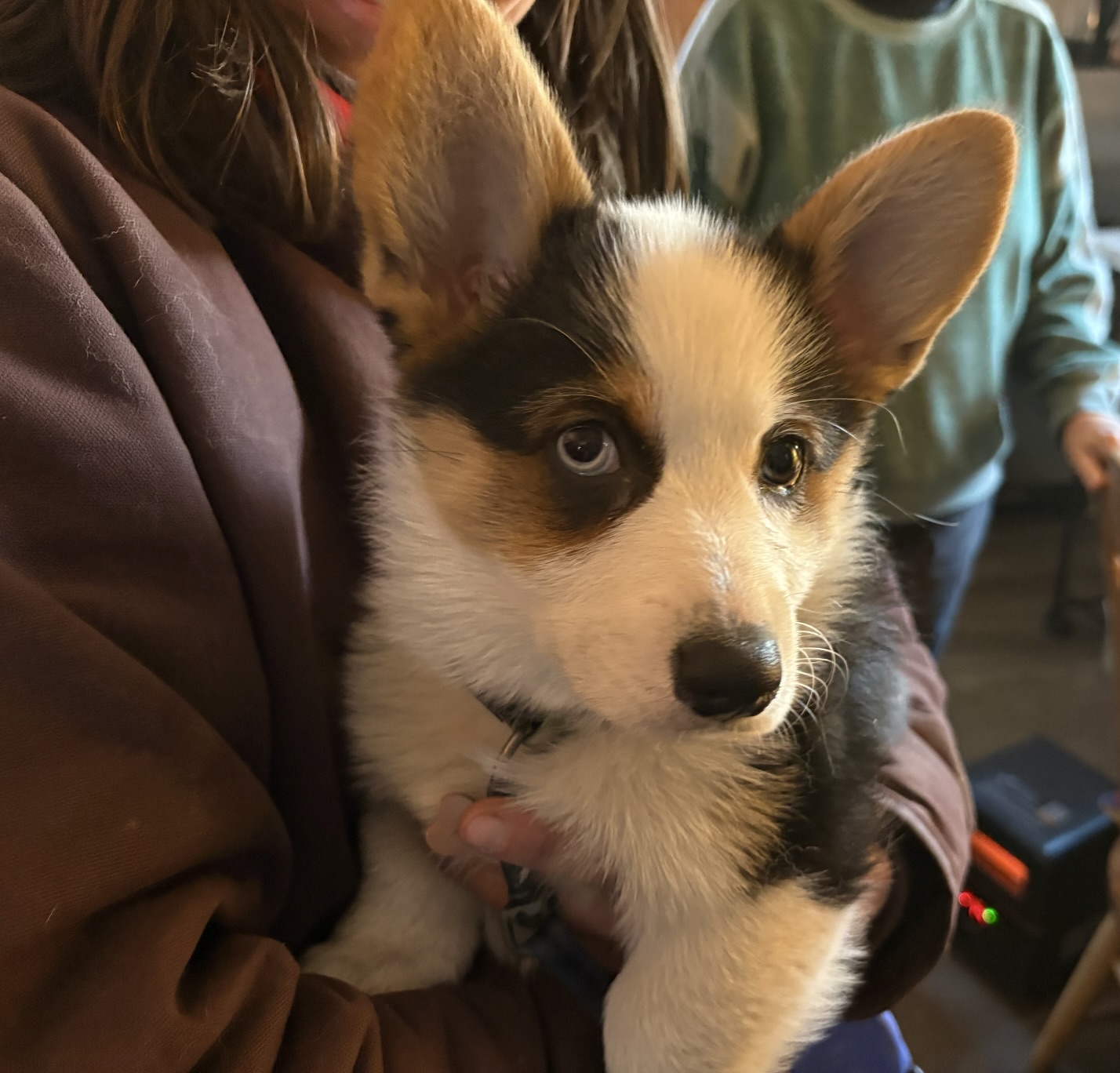
Meet Leta. When our grandson Ethan’s friend, Annie, came to visit recently, she bought her Corgi pup with her. It was ‘cuteness’ personified.
Here are some fun facts about the puppy and other dogs as well. Leta’s nose print is unique to her. Just like your thumbprint is to you. No two dogs have the same one. What her nose does share with most other dogs are some 150 million olfactory receptors. Humans have around 6 million. That’s why their sniffing ability far exceeds ours. Some dogs have a lot more. The blood hound is top dog with around 300 million. They can follow tracks several days old and can stay on a scent trail for over 100 miles. Their sense of smell is so well documented that it can be admitted as evidence in a court of law. “Sniff, sniff. Woof, woof, woof!” Translated: Number three in the lineup robbed the bank.
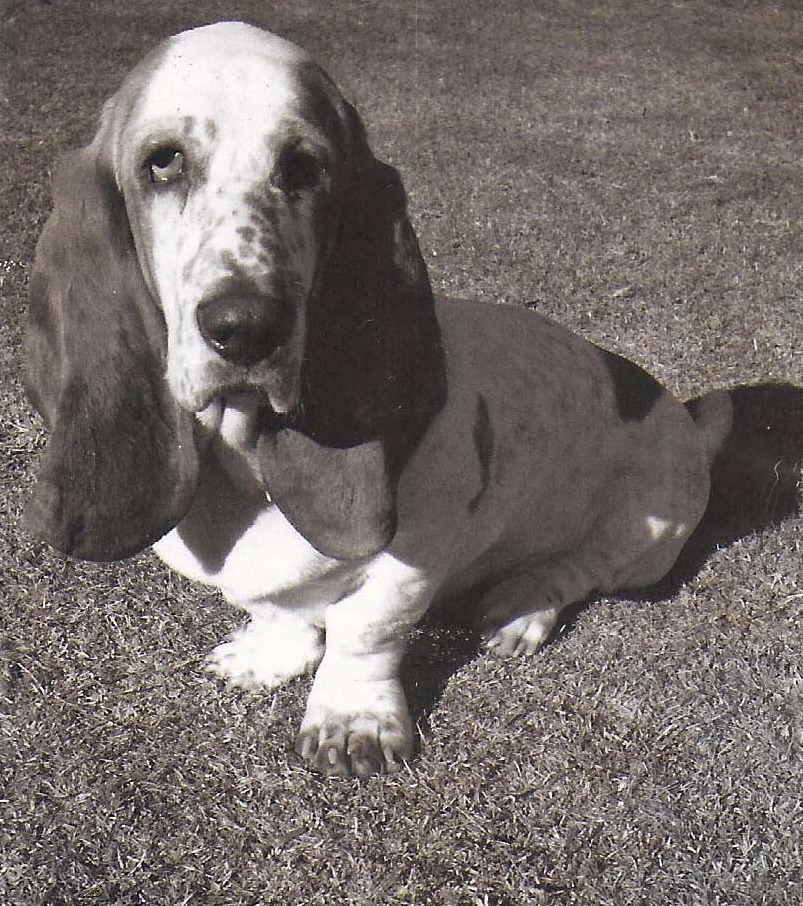
Basset Hounds are #2 in olfactory receptors and their capabilities for tracking. This is Socrates, my dog of the late 60s and 70s. He loved to go backpacking with me and wander off on his own— after who knows what. Gophers maybe. He specialized in trying to dig them up. I never worried about him, however. He always tracked me down later. He knew the source of his milk bones.
While we are dealing with a dog’s sense of smell, here’s a fact I didn’t know. They have a back up system for ‘smelling’ pheromones (chemicals) that contain a great deal of information. It’s called Jacobsons Organ and is found on the roof of their mouth. It has a direct line to the brain where the information on the pheromones is translated: Valuable information to Bowser: Such as whether Fifi is ready to breed. Information on health and mood can also be transmitted. Yours, as well as another dog’s.
Pee, poop, and even feet carry pheromones which are created by scent glands. Because pheromones are volatile, they are released to the air and can travel long distances. That’s why Bowser might get excited if Fifi is in heat, even if she lives three miles away. Given an opportunity, he will go roaming and show up on her doorstep. I found the information about feet interesting as well. You’ve likely seen a dog kicking backwards after it has done its business. I’d always thought it was making a half hearted attempt to cover its poop. Actually it’s using the scent glands on its feet to mark its territory. It’s kind of a “I pooped here,” message. The pheromone is the sentence; the poop the exclamation point.
Scent glands near the anus provide all kinds of information, which is why dogs are always sniffing each other’s butts. Each dog has its own unique pheromones that travel to the sniffing dog’s Jacobsons Organ and then their brain where they are stored and interpreted for immediate and future use. A dog can actually recognize a dog it has sniffed years before. And remember its mood. “When I was a puppy, you were grouchy and bit me. Now you are old and I’m twice as big. Guess what?”
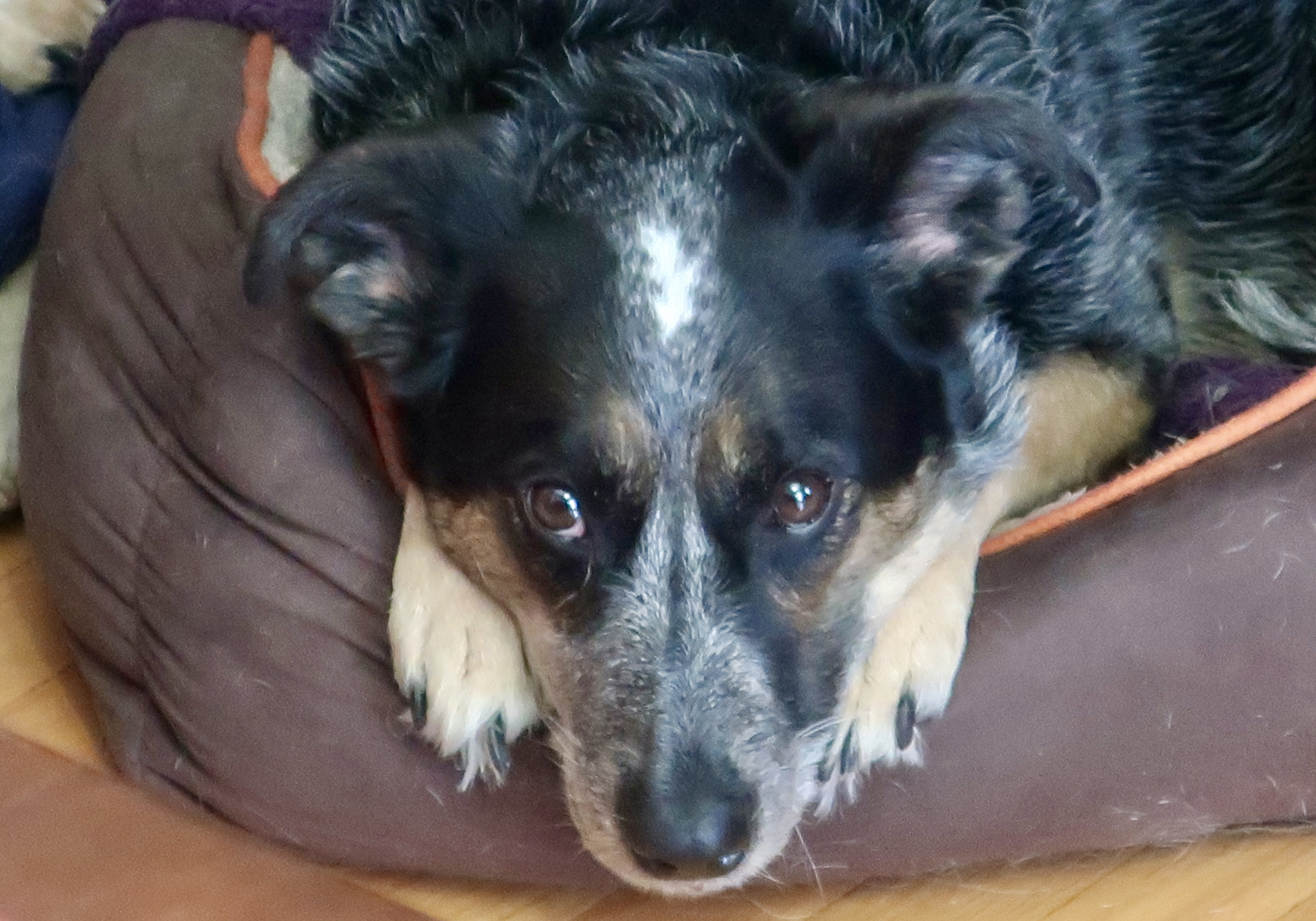
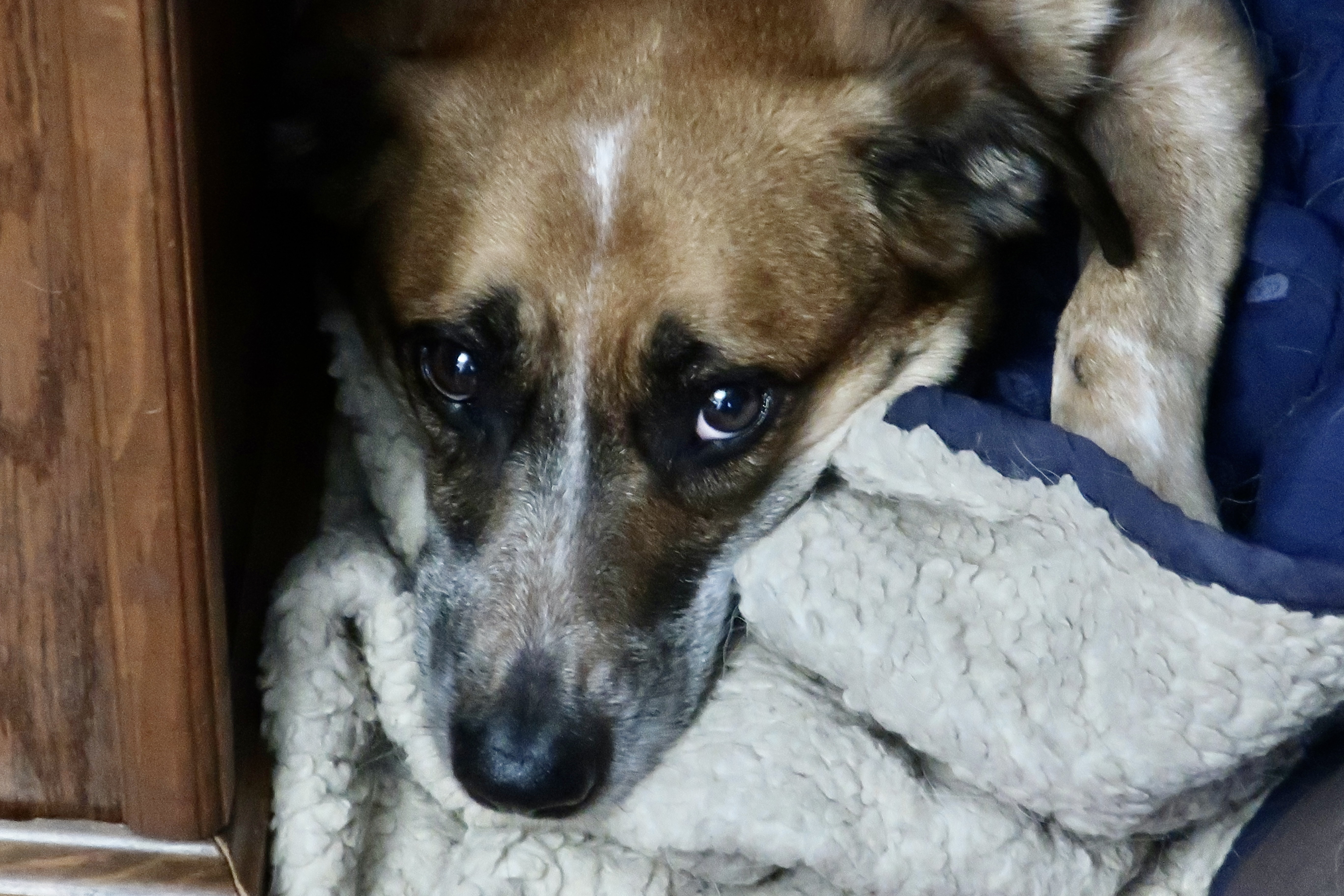
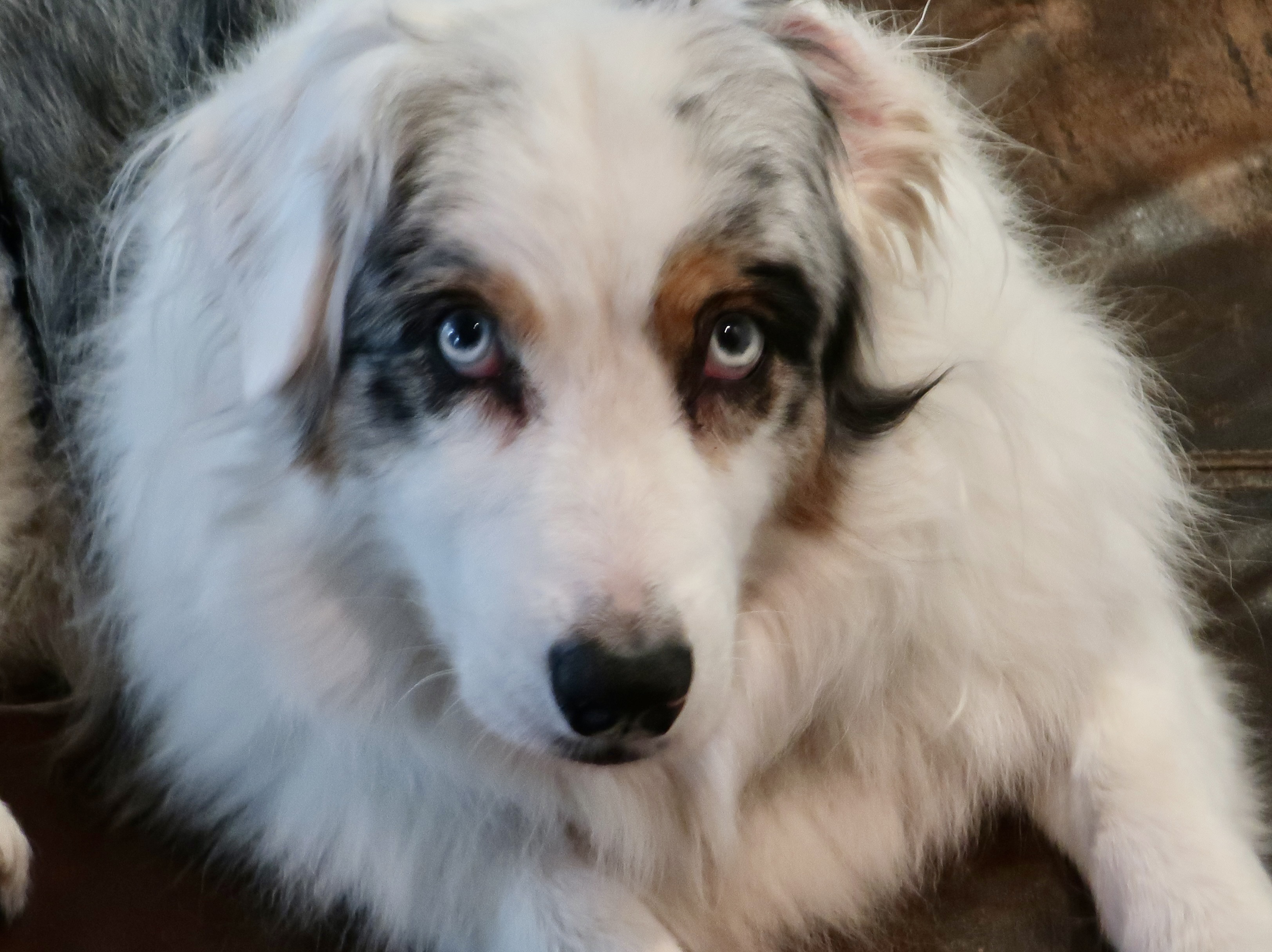
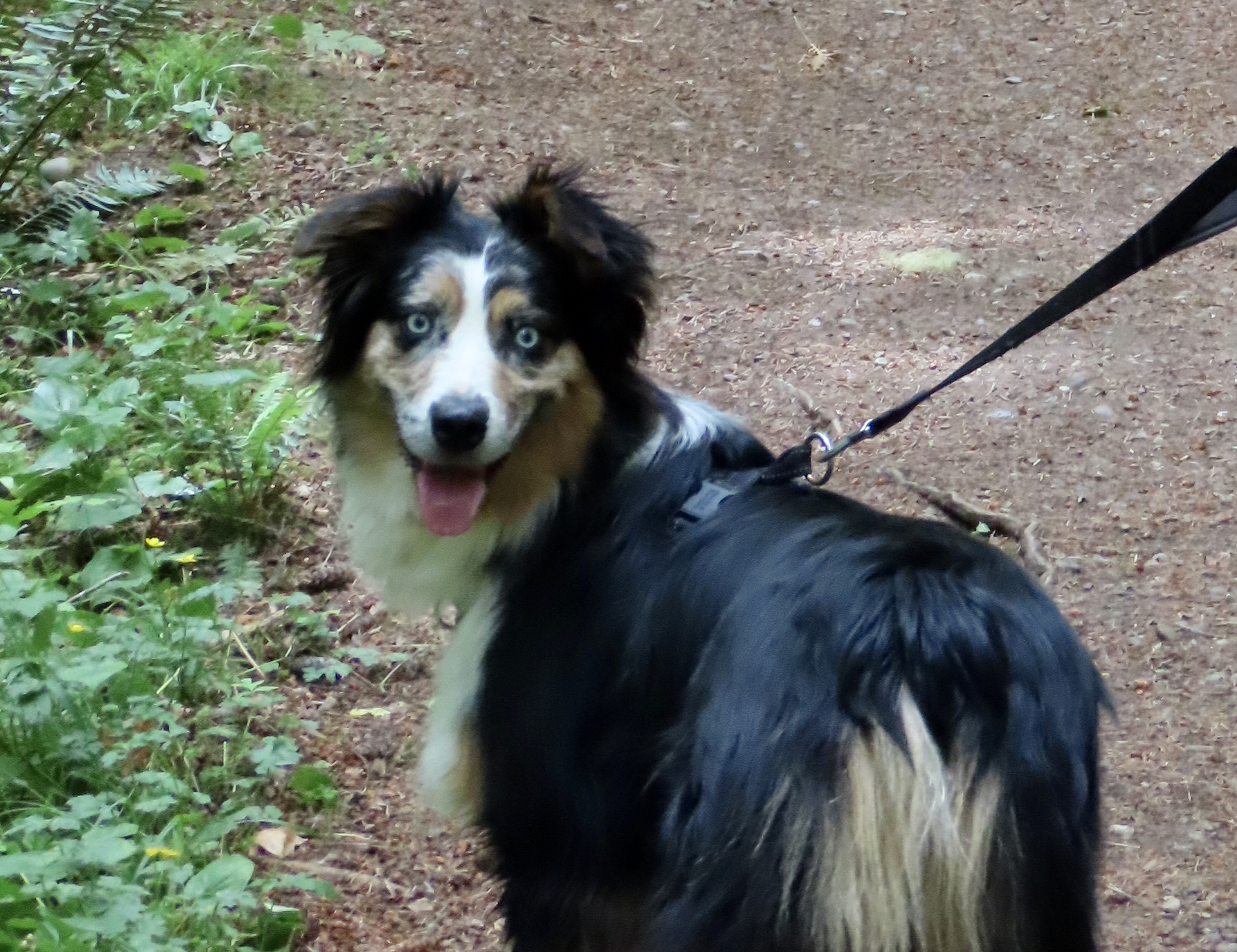
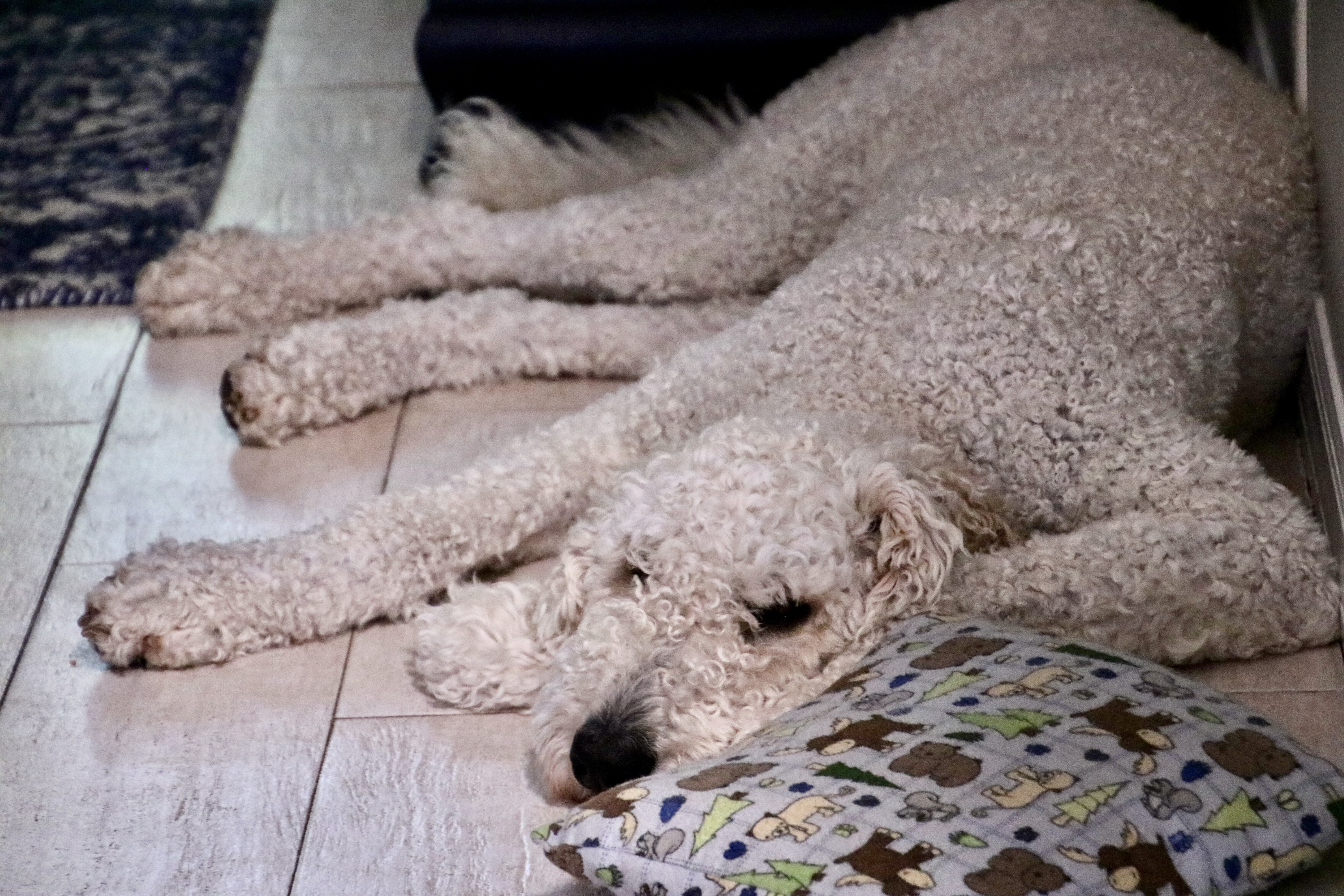
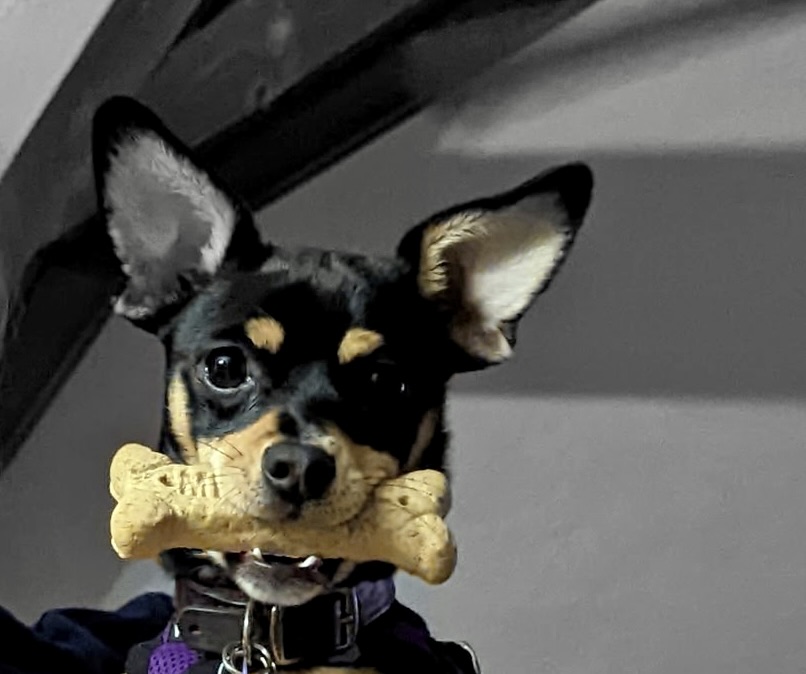
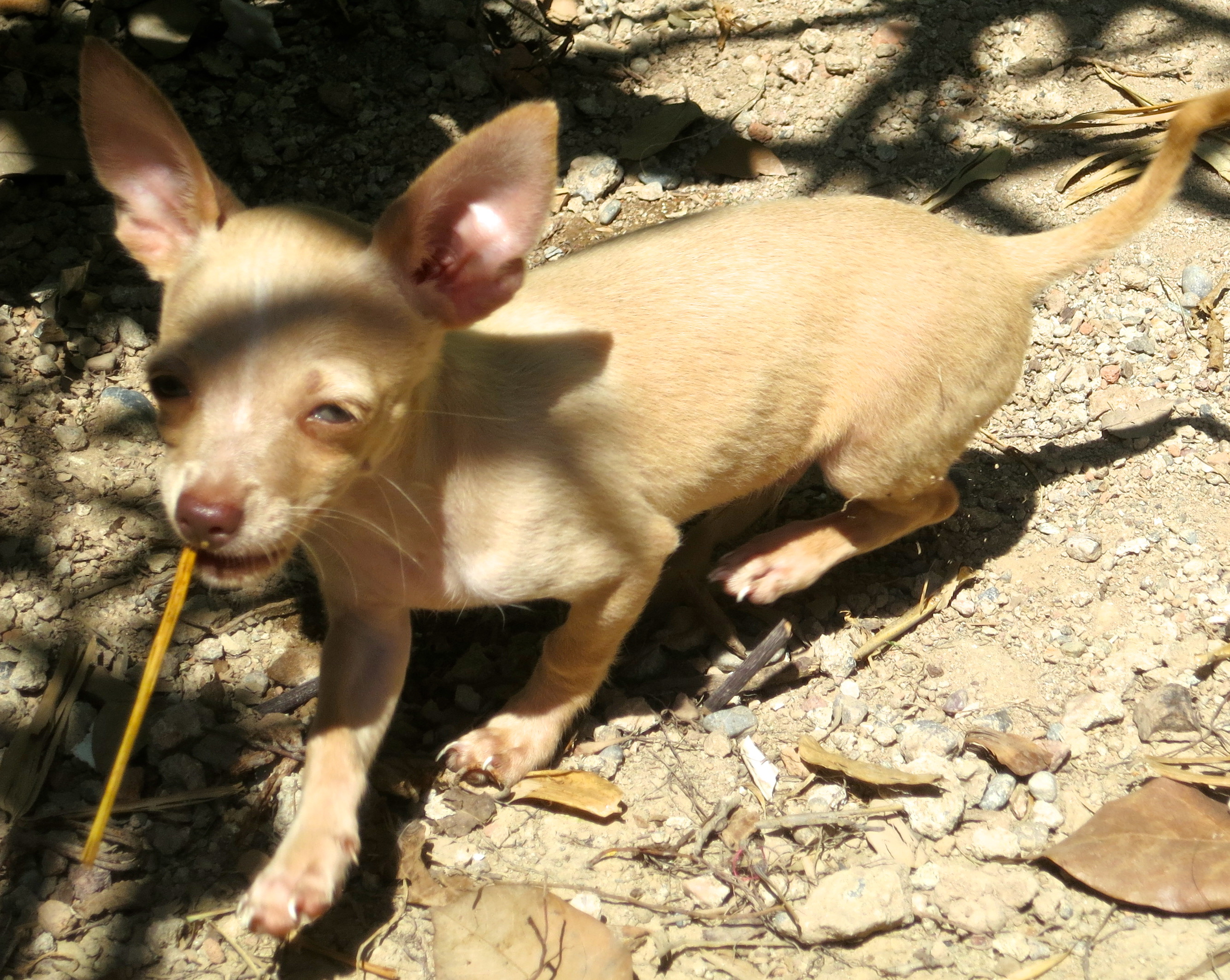
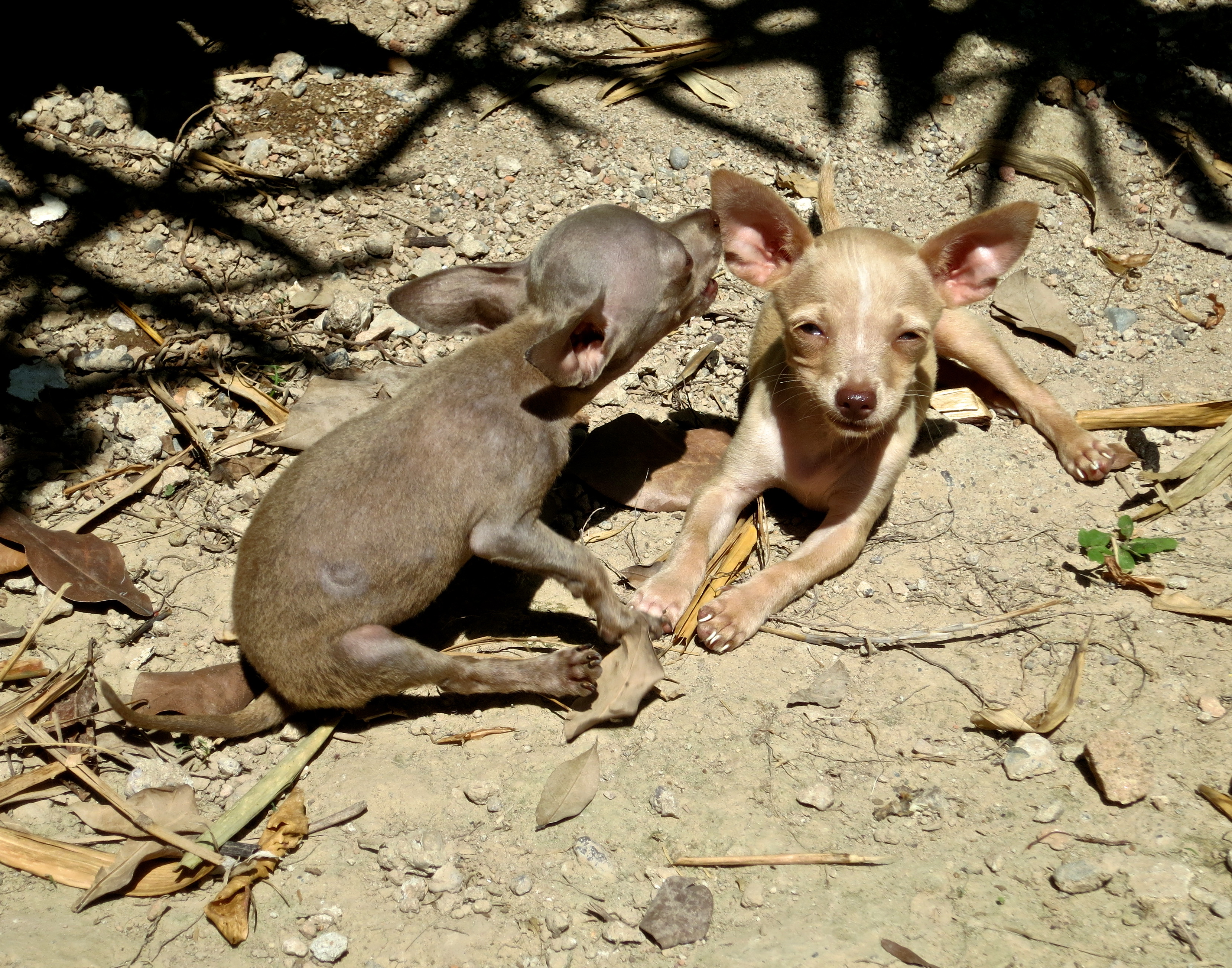
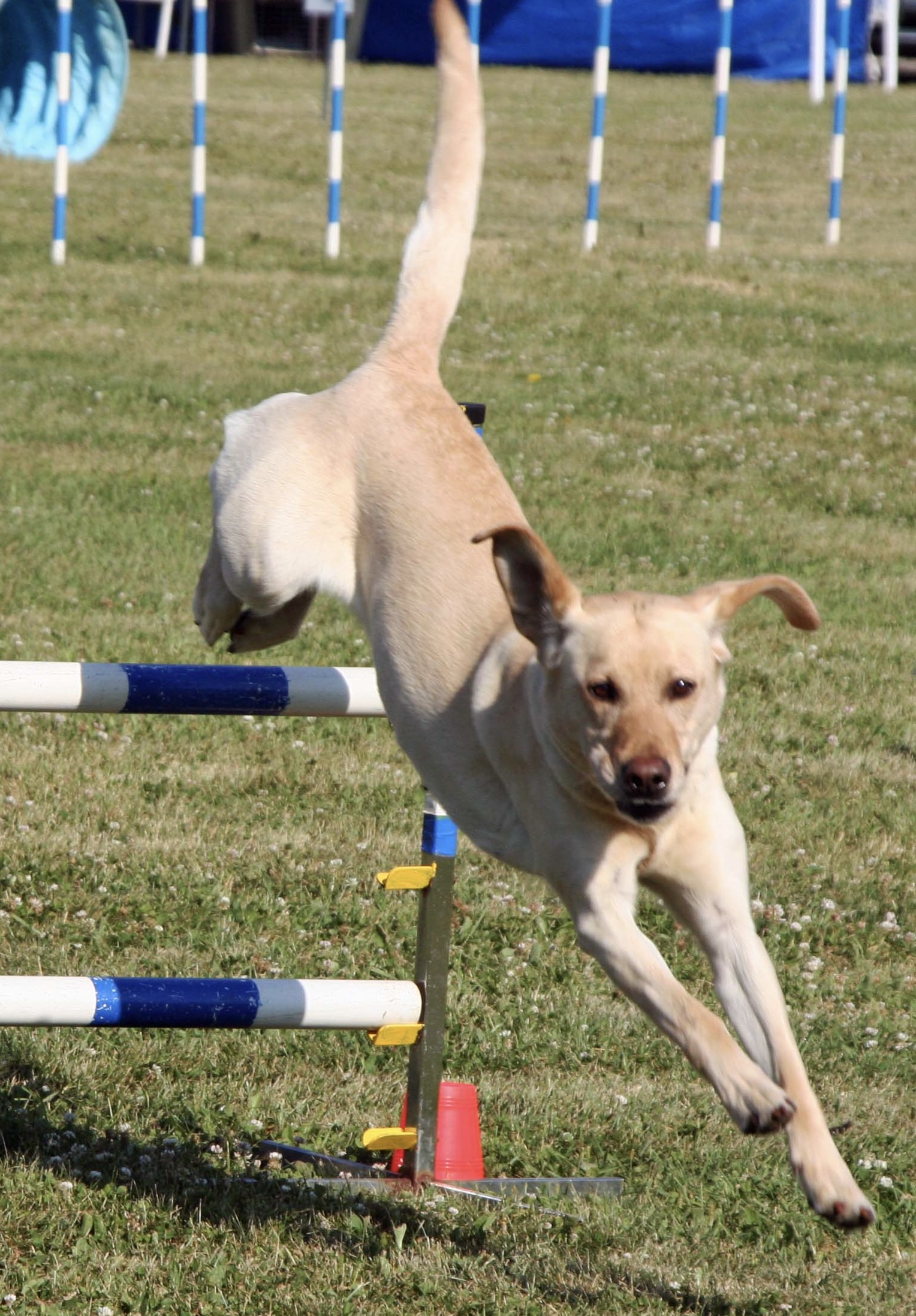
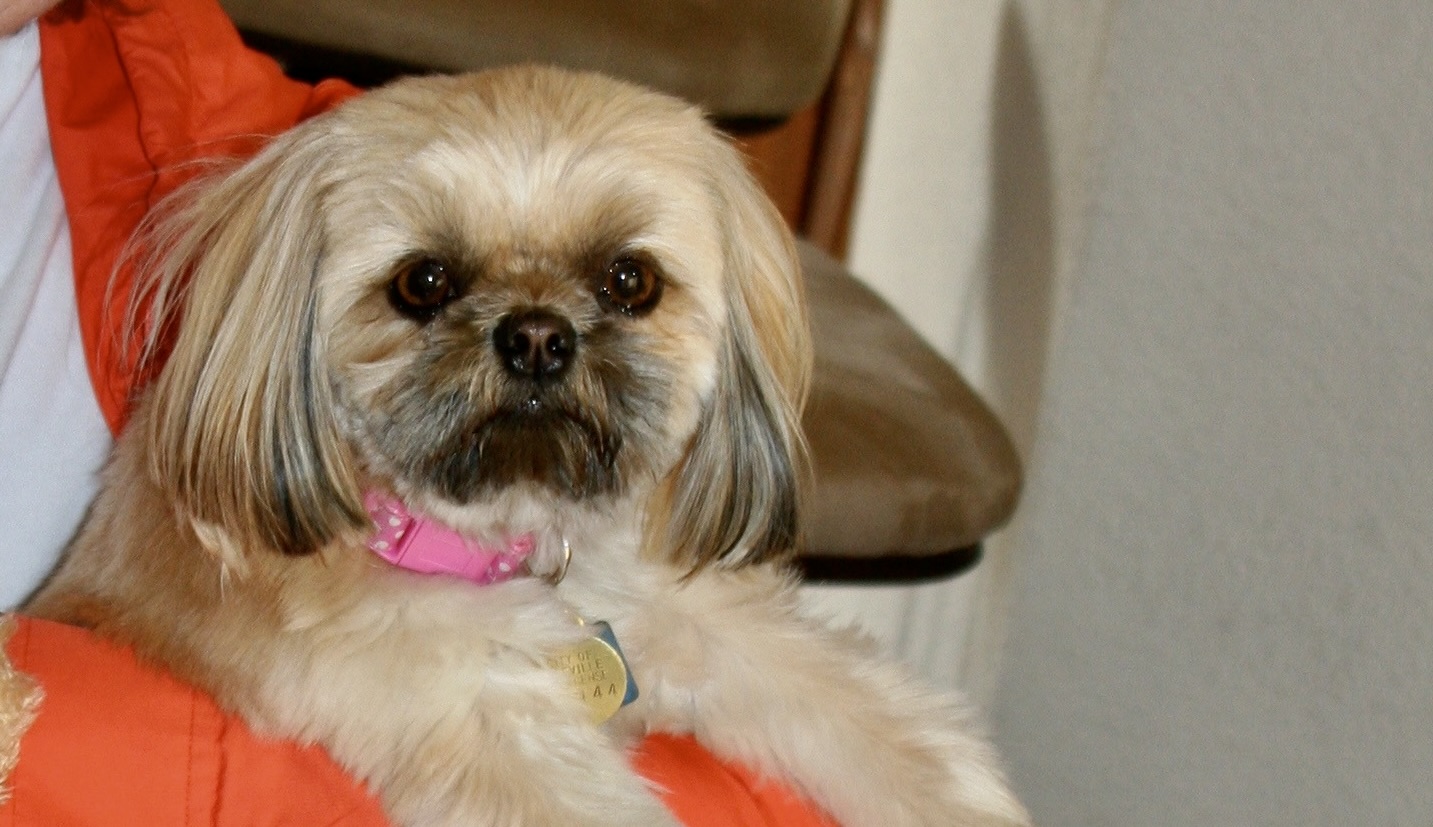
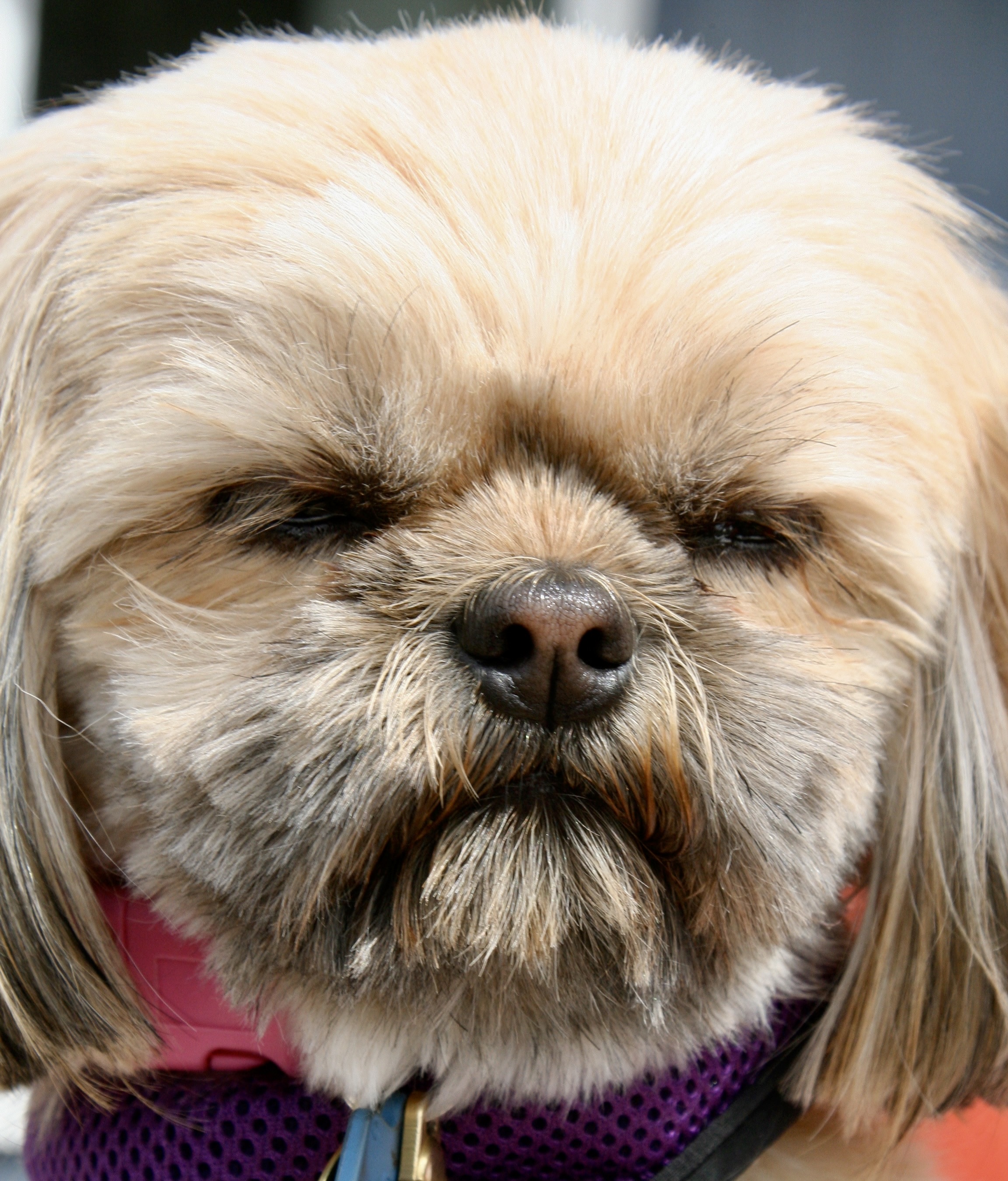
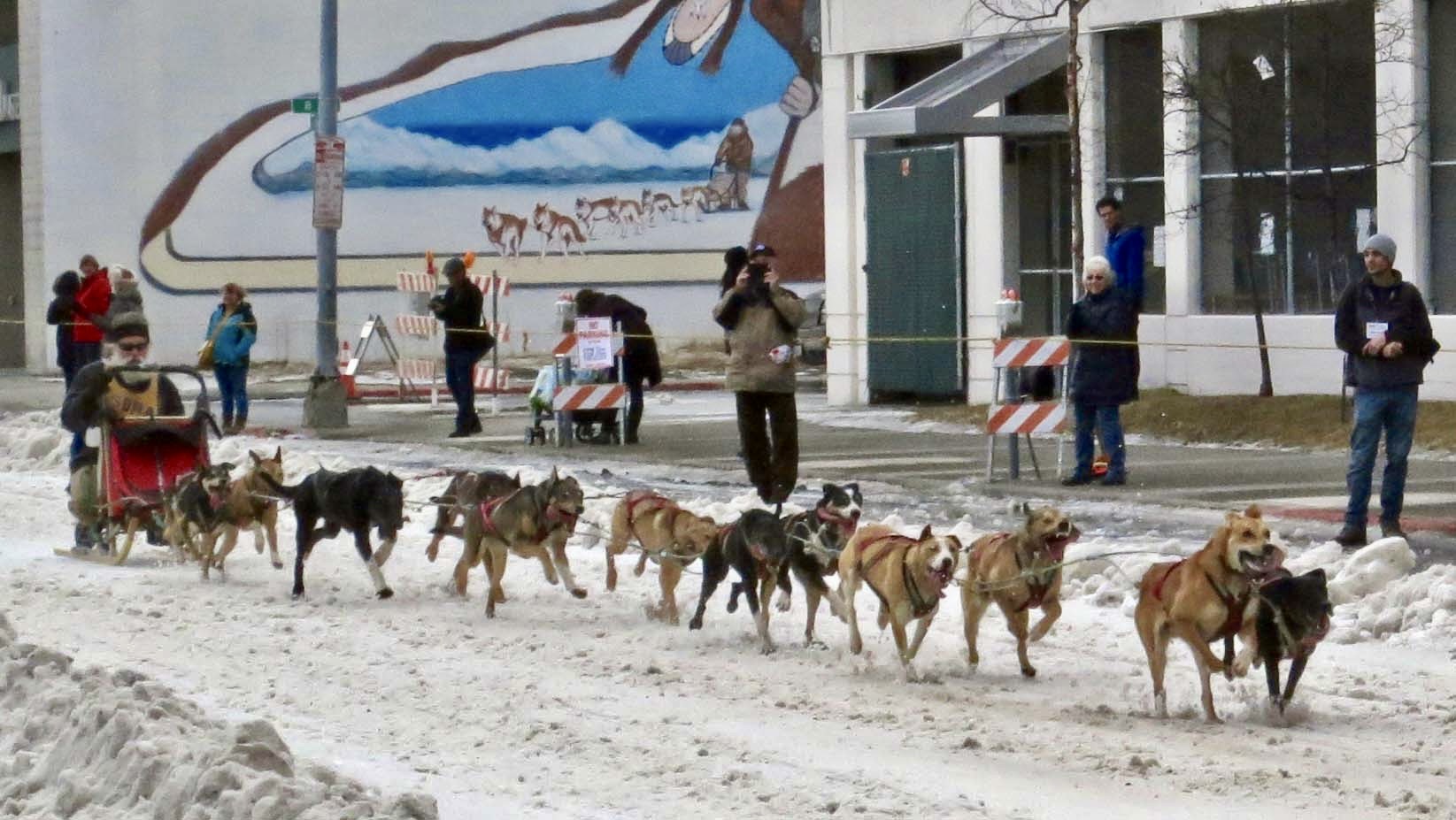
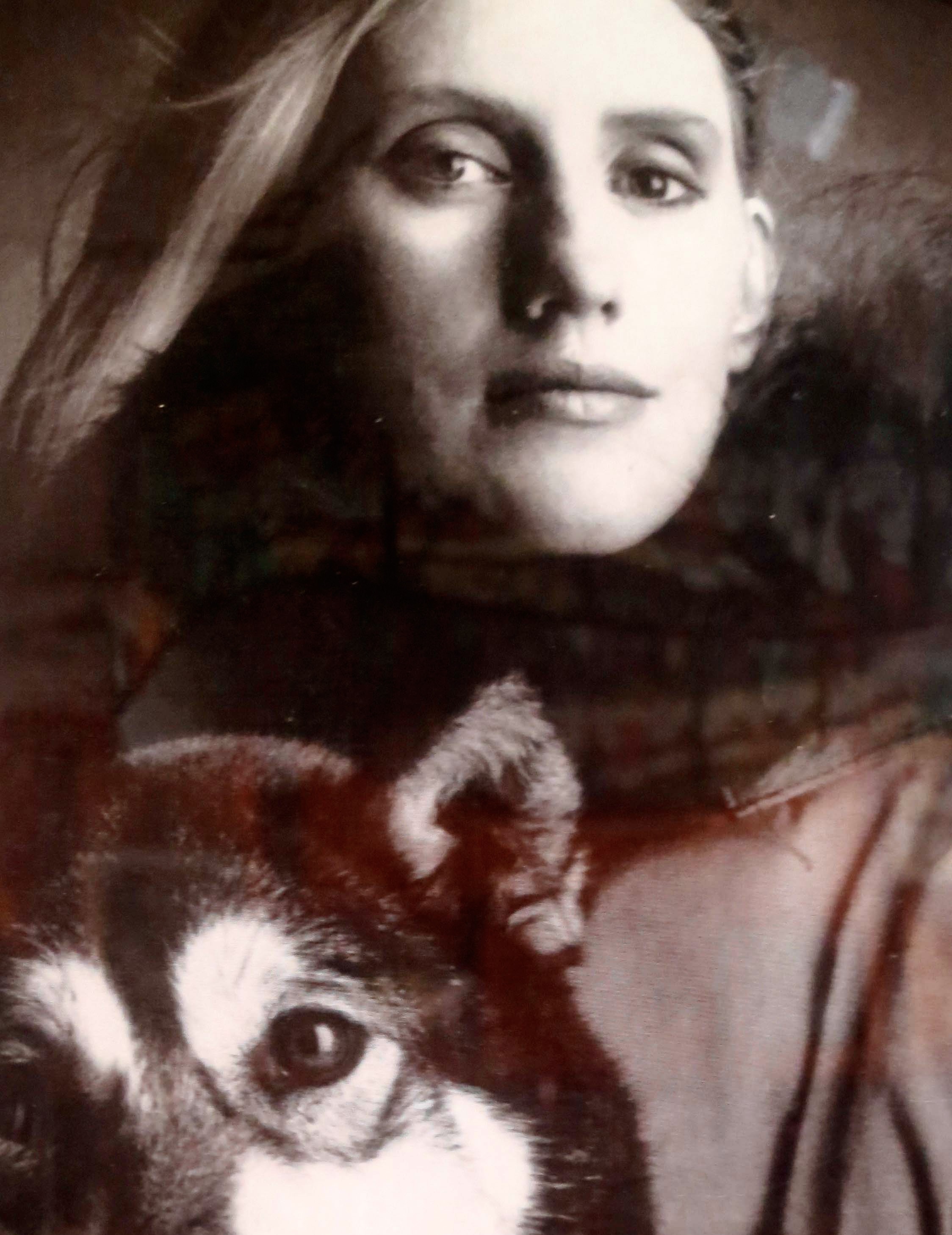
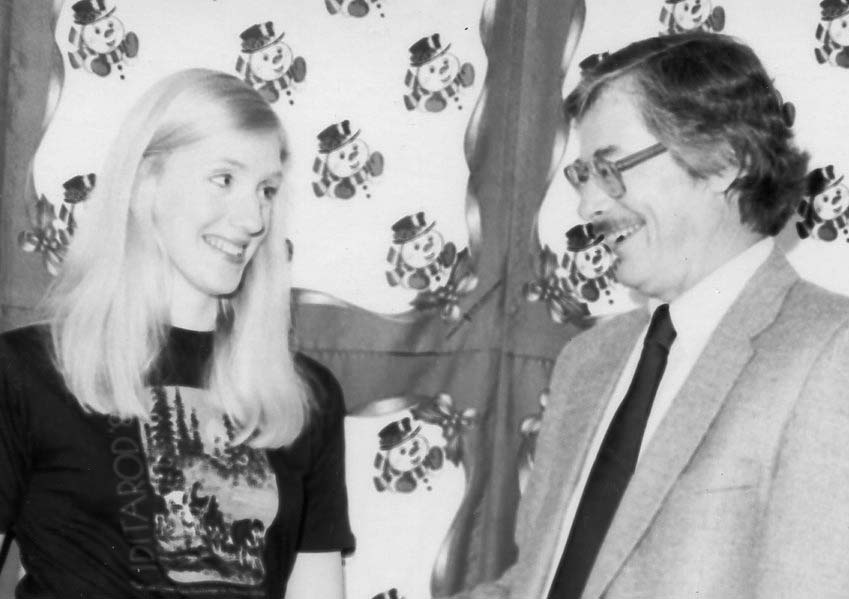
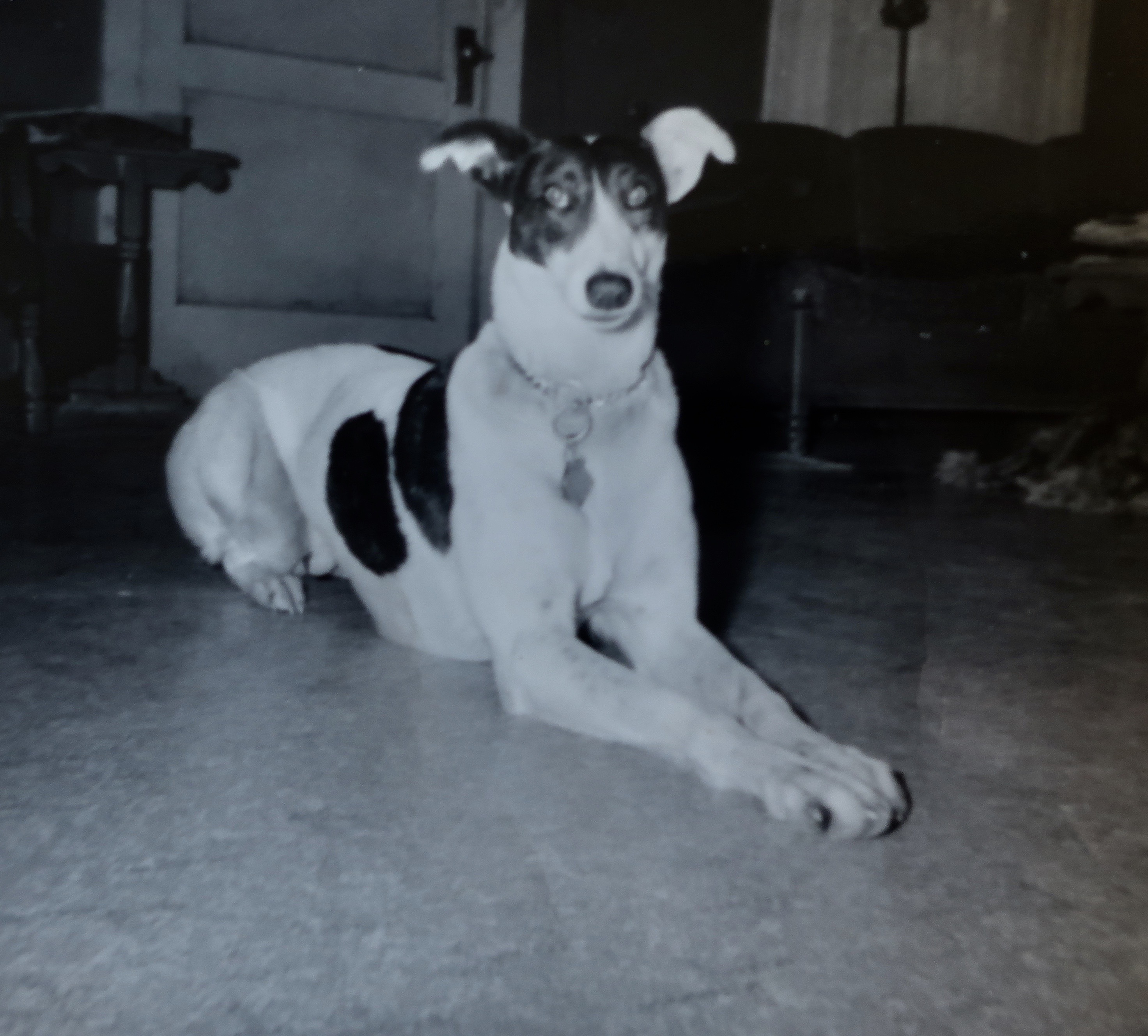
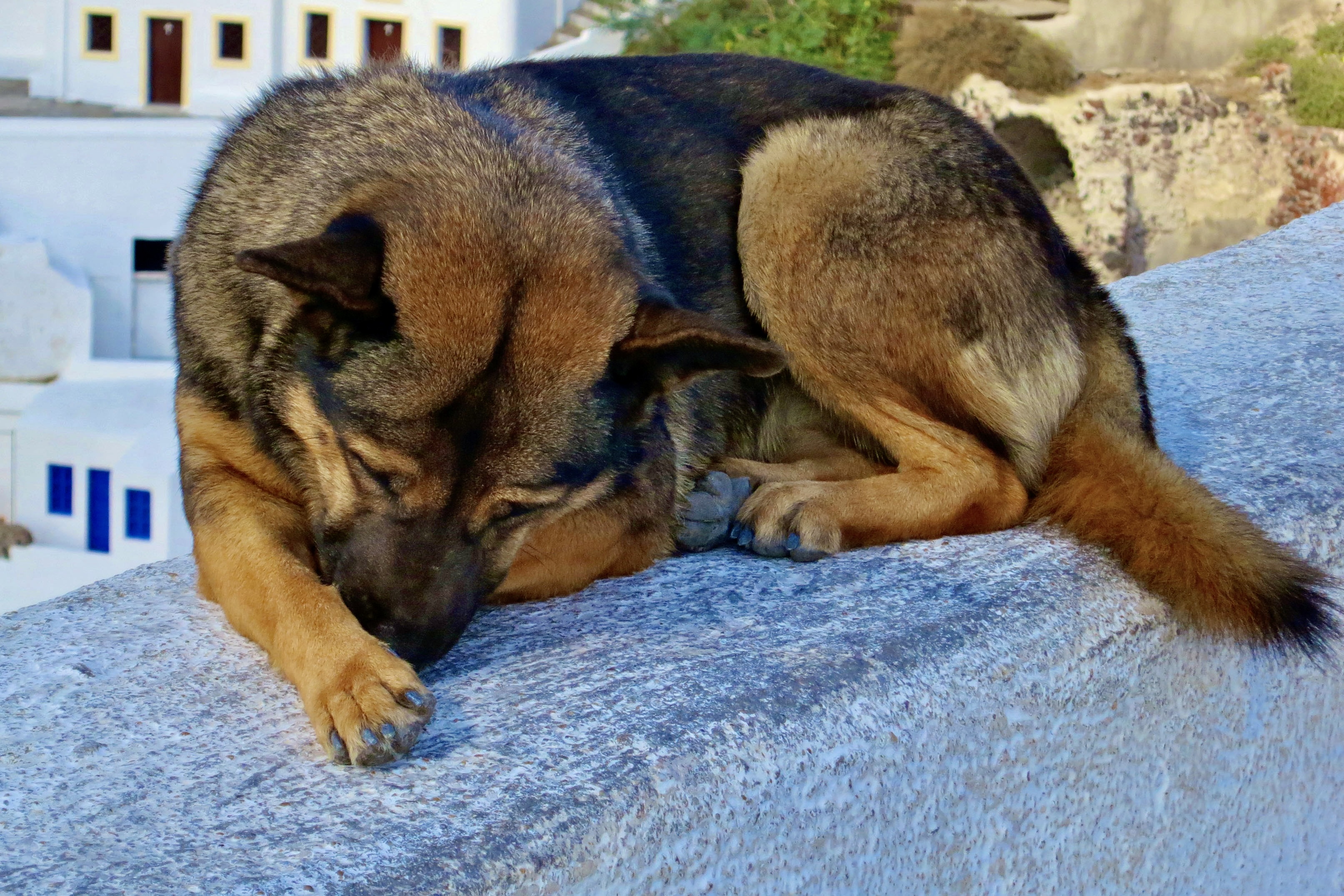
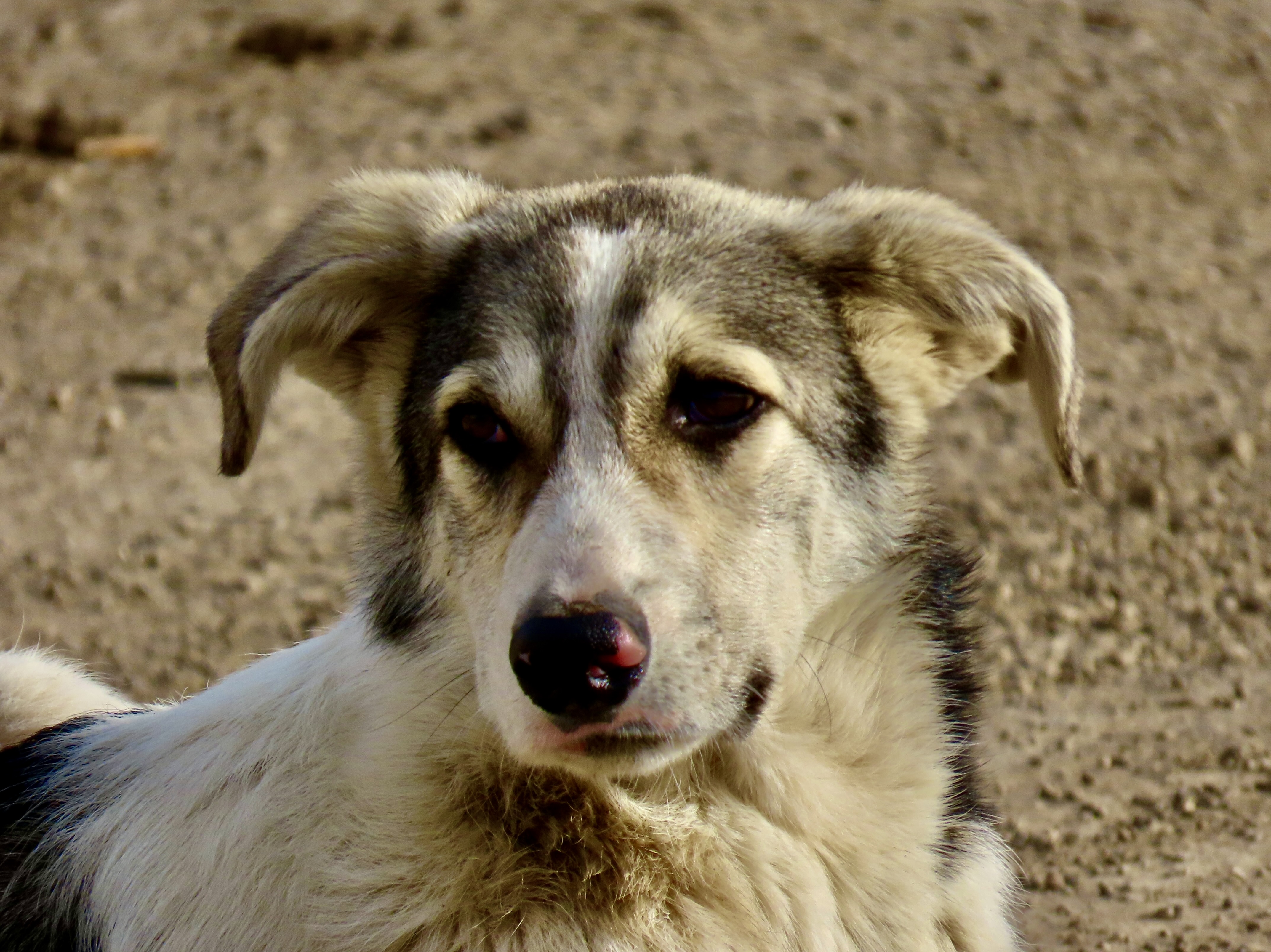
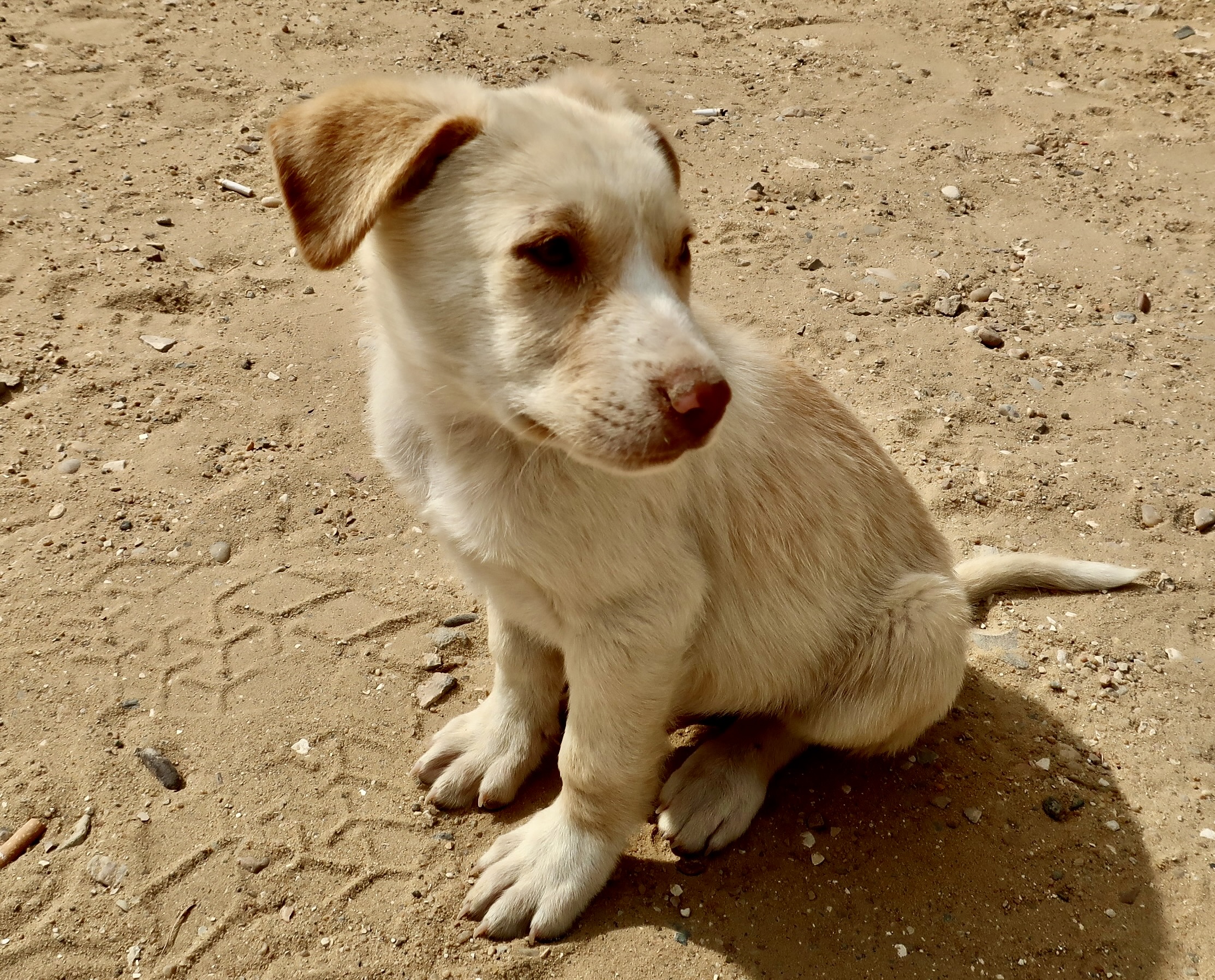
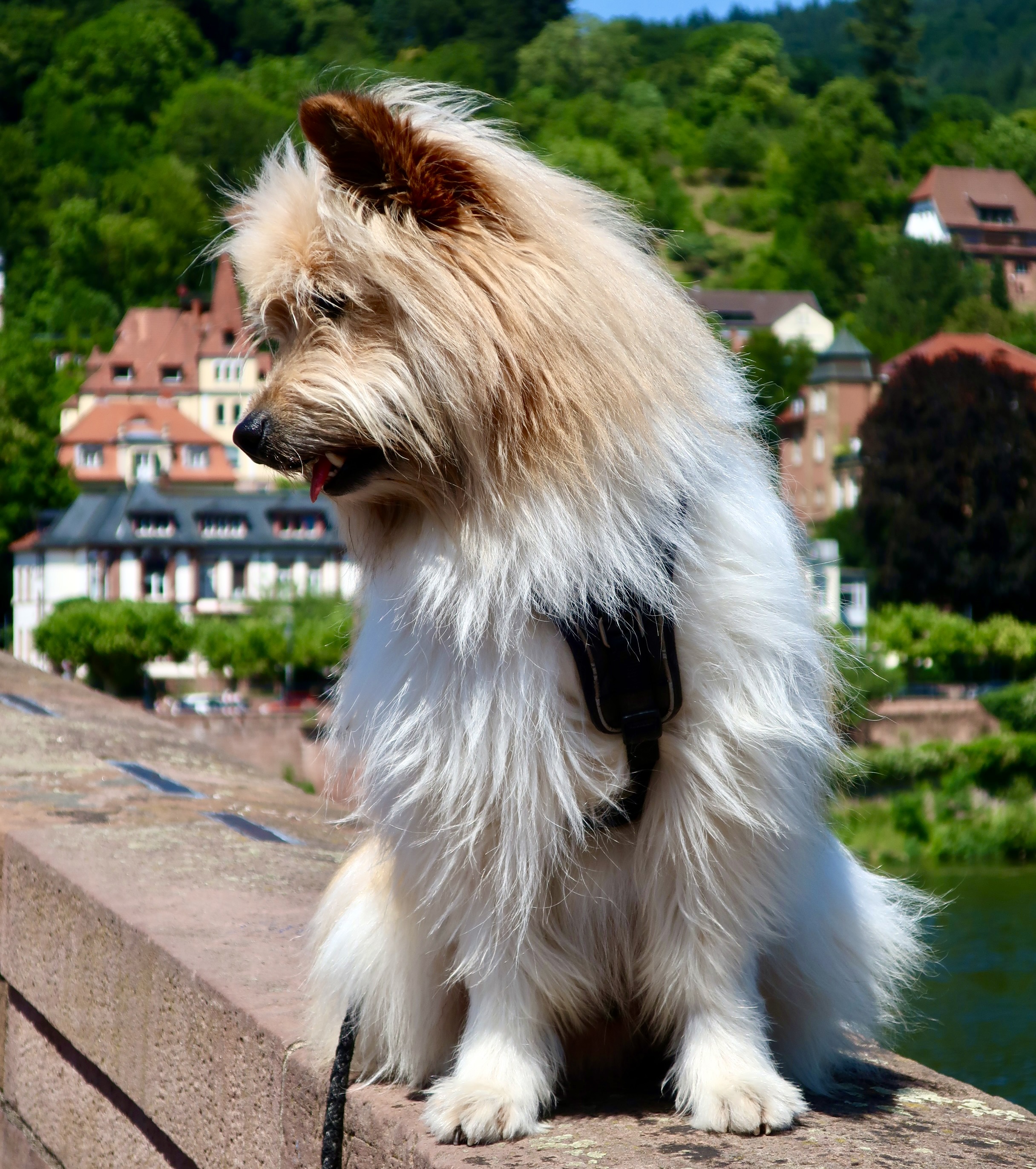
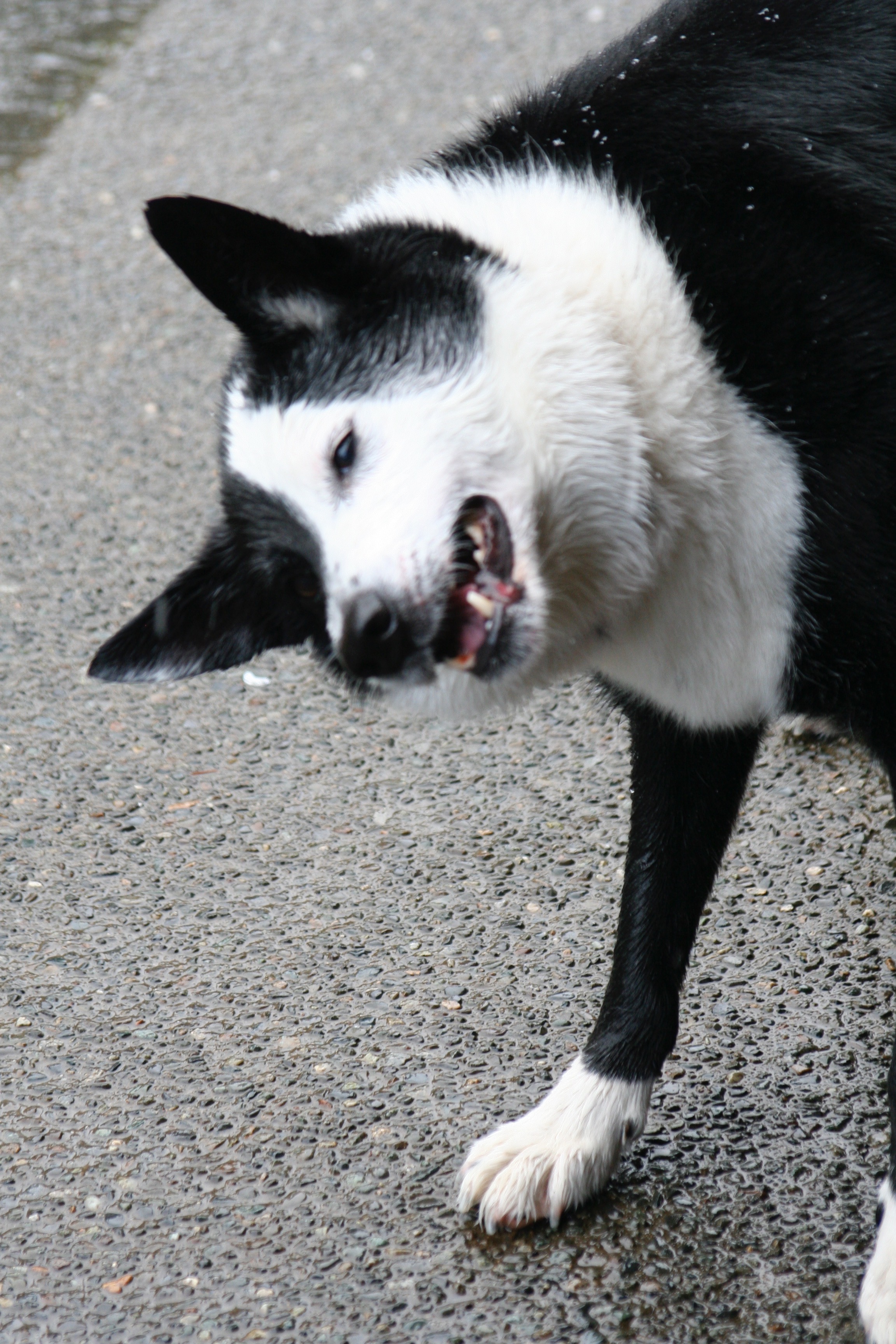
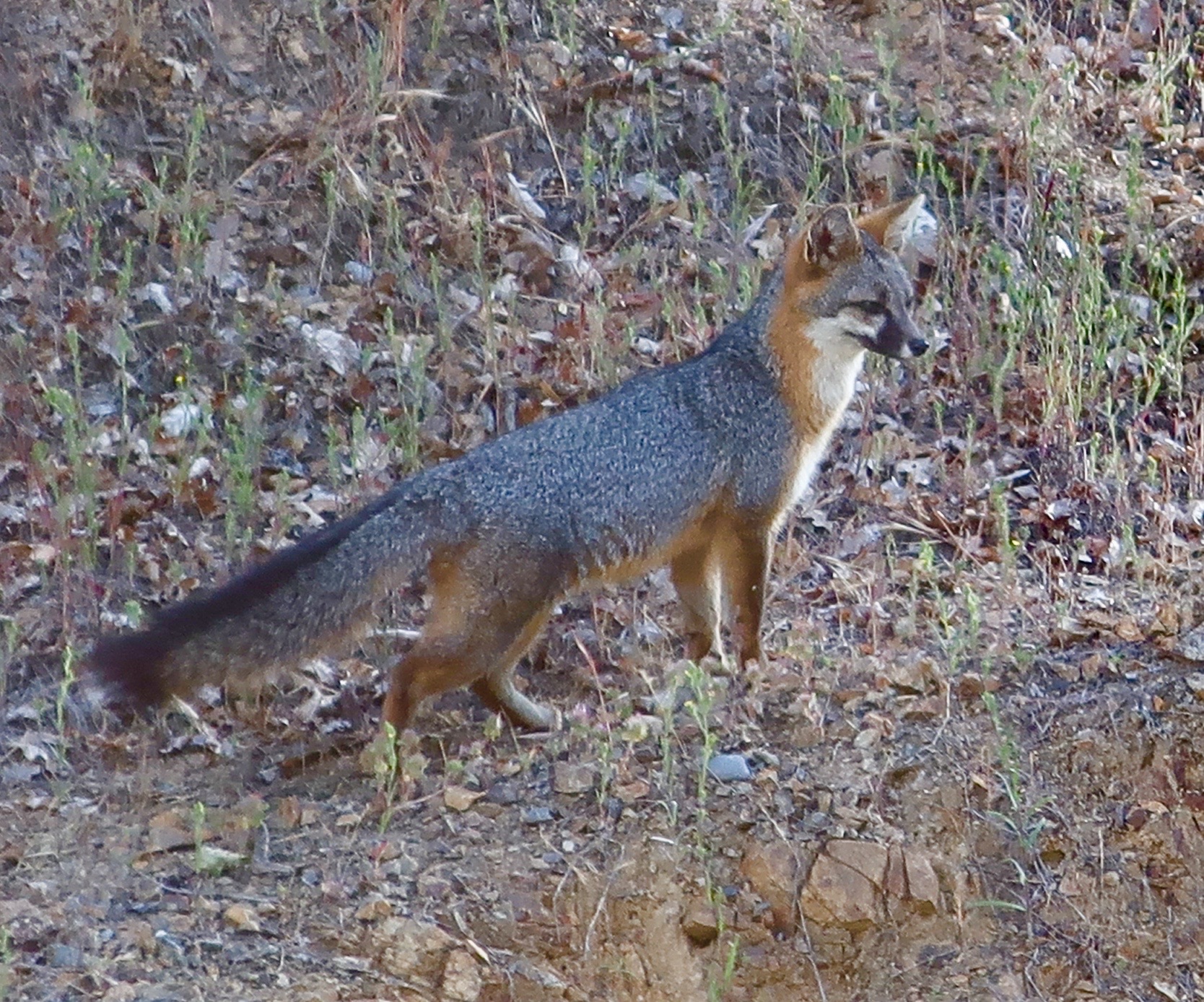
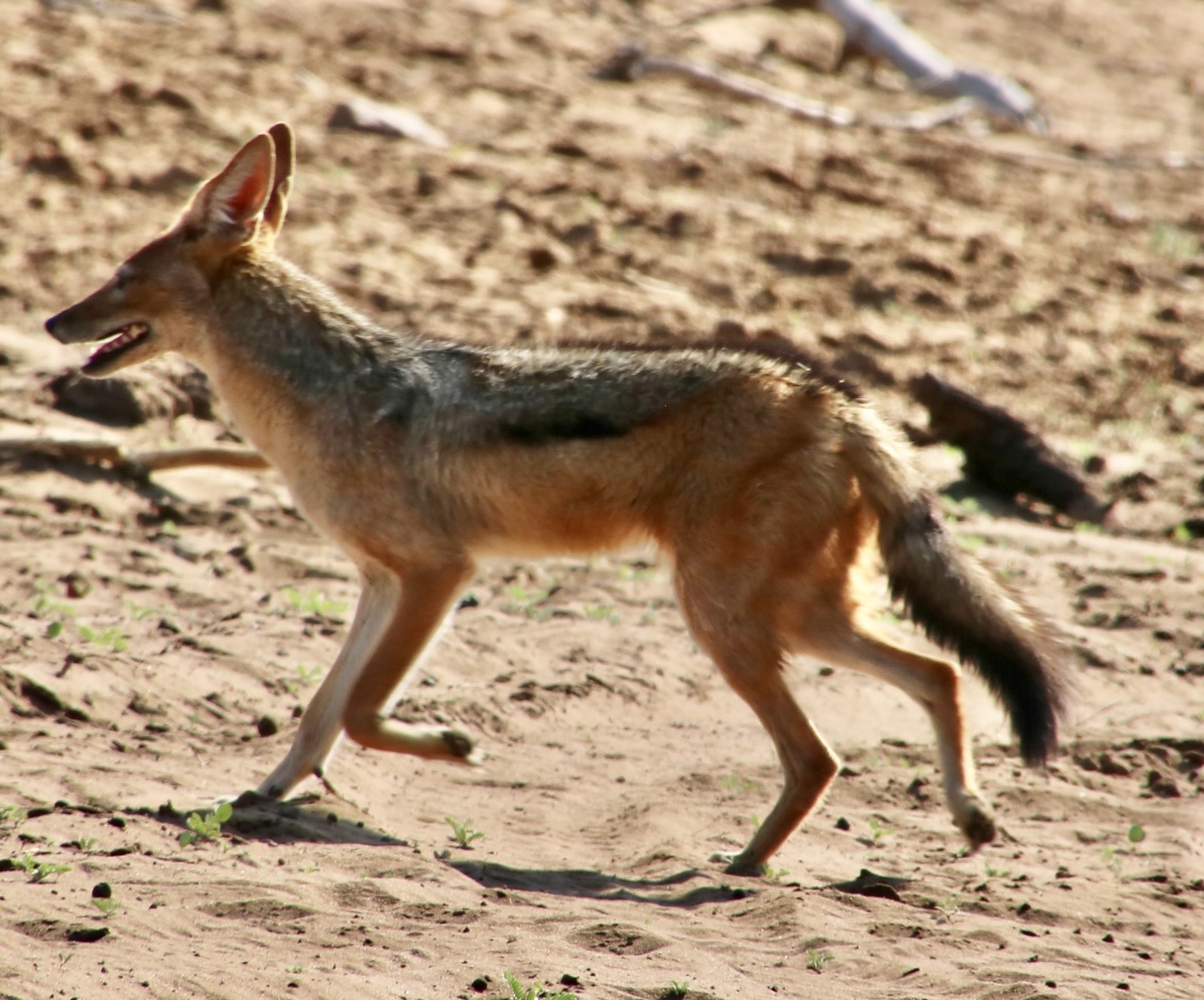
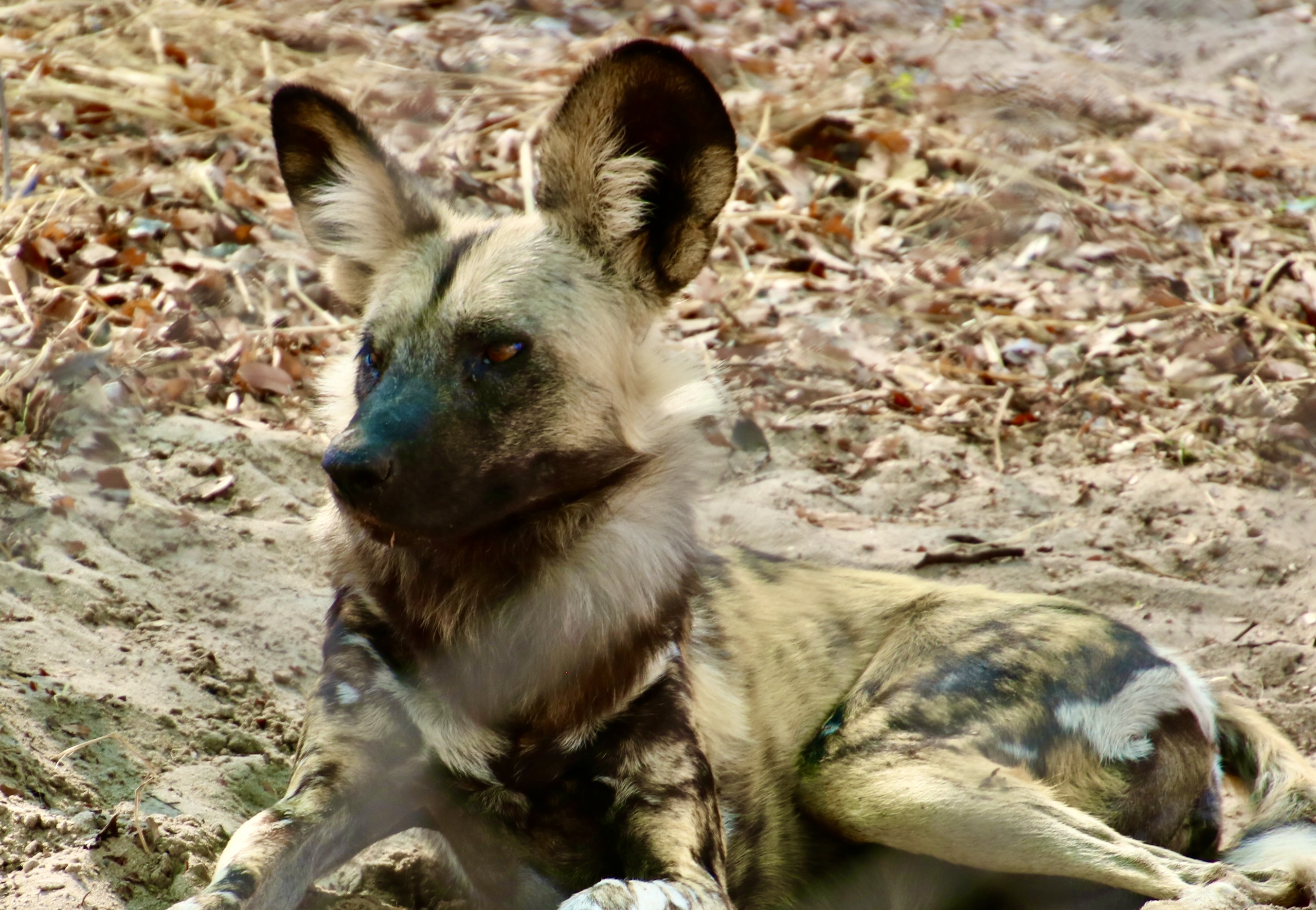
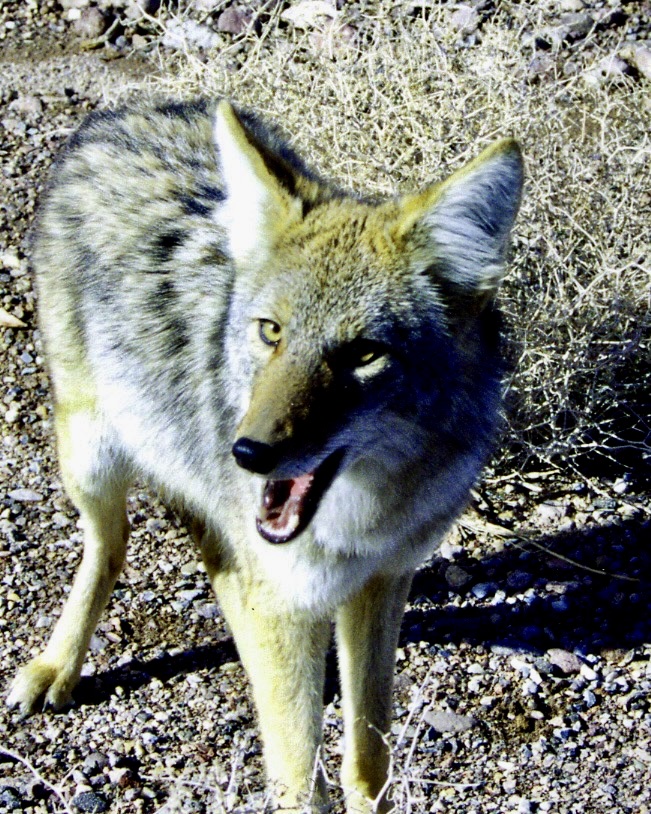
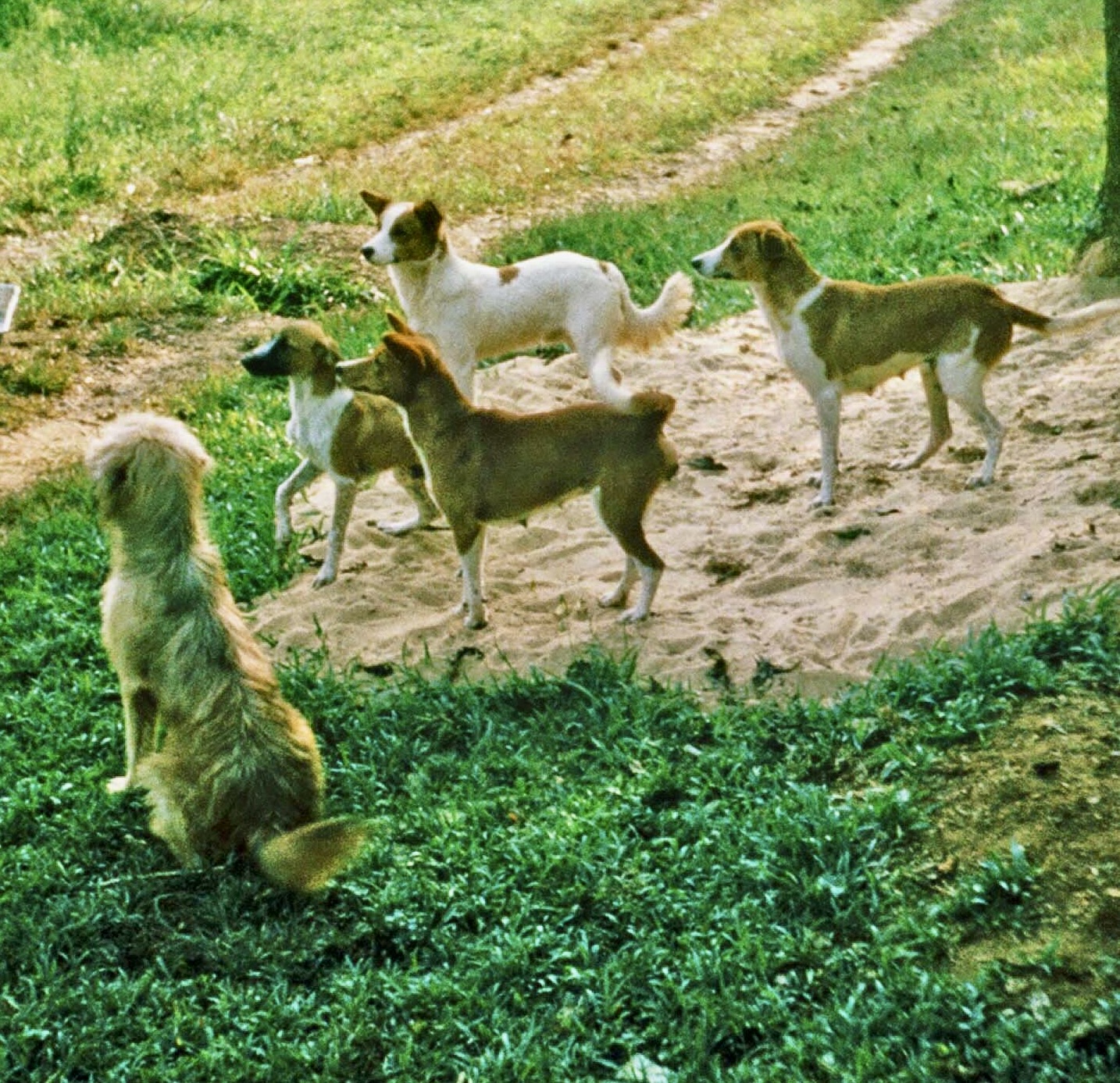
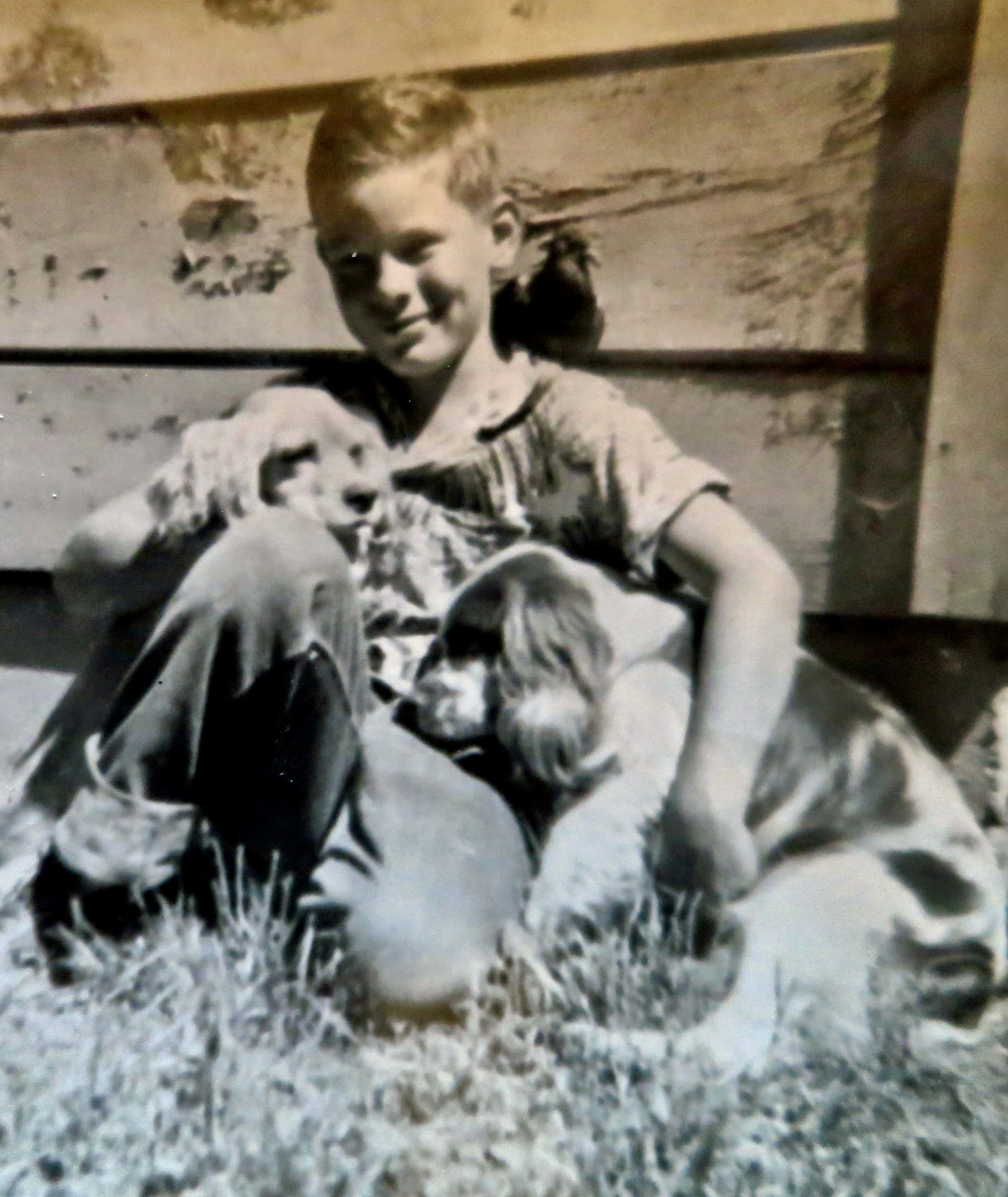
Dogs have been hanging out with humans for over 20,000 years, longer than any other domesticated animal. I commented on puppy eyes in my headline. It is theorized that they are an evolutionary development caused by people picking out dogs they found appealing down through the ages. Lexi, a blue Australian Cattle Dog definitely had them as a puppy.As did Chema, her sister, a brown Australian Cattle Dog. Both are by owned our daughter Tasha and her family. These were puppy pictures. They are both old dogs now but they still have the ‘look.’While we are on Aussies, this is an adult Australian Sheperd that belonged to our niece, Christina. It certainly hadn’t lost her puppy eyes. The blue eyes also capture your attention. The puppy Leta has them as well.As does Christina’s other Australian Shepherd, Zoe. This is a look that demands attention and includes a question. Likely, “Why are we stopped here, Mom.”A couple more family dogs before moving on… This is Lila, a Goldendoodle that belongs to my son Tony, his wife Cammie and their kids. No puppy eyes here but lots of brains (not to mention long legs). Poodles are noted for their intelligence. Of the above dogs, Corgi’s and Australian Cattle Dogs are also near the top. Socrates? Not so much. I once met a fellow Basset owner in Canada and we started talking about our respective dogs, as Basset Hound owners always do. I mentioned how difficult it was to train Socrates. He laughed. “My basset hound was kicked out of a dog training class in Edmonton. He was a bad influence.” Yep.I find the difference between our son’s family dog Lila and our daughter’s family dog, Rio, amusing. The milk bone provides perspective on Rio’s size. I asked Tasha what breed Rio was, assuming Chihuahua. And, yes, Tasha mentioned Chihuahua and then went on to list a few others. “Ah,” my response was, “Rio is a mutt.” Albeit a cute and loving mutt. “She sleeps on our bed with us,” Tasha admits. Actually, studies suggest around 50% of dogs sleep on their owner’s bed in the U.S. It might even be closer to 70%.The mention of Chihuahuas led me to remember an encounter that Peggy and I had with one in Puerto Vallarta, Mexico. I thought he looked cool carrying his small stick along in his mouth.This photo suggested that his ‘girlfriend’ had a different point of view. I imagined this to be the conversation. Her: “If I told you once, I’ve told you a hundred times, it’s stupid to walk around with a stick in your mouth. Odds are that you will stumble and drive it into your pea-sized brain.” Him: “Whatever.”Have you ever watched dogs compete on an agility course. We came on a competition once in British Columbia. Dogs work their way through a number of challenges that range from poles that they have to weave their way through to see-saws and tunnels. The more advanced the dog, the more barriers they have to overcome. Owners run along beside the dogs encouraging them to do their best. It’s as much fun watching the owners as it is the dogs. The dog that completes all of the challenges in the shortest period of time for its class wins. This small papillon was almost flying!Hurdles are another barrier the dogs have to leap over. The bigger the dog, the higher the hurdle.I asked this fluffy pooch with a pink collar if she had ever thought of competing in one of the dog agility competitions.Her response.The most renown dog competition in the world is the Iditarod, Alaska’s thousand mile sled dog race from Anchorage to Nome. This photo is actually from Anchorage’s Fur Rendezvous where the dogs were running more like 100 yard sprints than 1000 miles. They can run up to 20 miles per hour. I lived in Alaska for three years in the 80s and watched the beginning of the Iditarod each year. In fact, I was in Alaska the year that Libby Riddles was the first woman to win the race. I was Executive Director of the Alaska Lung Association at the time and called her up immediately afterwards and asked if she would consider serving as our Christmas Seal Chair. Winning the Iditarod is a huge deal in Alaska. Her immediate response was yes. Could I pick her up at the airport in a week when she got back from a photoshoot in Chicago.It was for Vogue Magazine.Libby and I with a backdrop of Christmas Seal scarves. I spent a couple of days driving Libby around to various media interviews. In addition to getting great PR for the Association, I had a lot of fun— and learned a lot about sled dogs.While sled dogs are fast and extremely tough, they aren’t the fastest dog in the world. That title goes to the greyhound. The fastest speed one was ever clocked at was 41.83 mph (67.32km/h). This is Pat, my greyhound, in our house in Diamond Springs CA. I named her after the local Greyhound bus driver I knew as a kid. Pat had been running wild, making a living off of jack rabbits and ground squirrels. She was getting skinnier by the day. One day, my mother stopped our car, opened the door and invited Pat to come home with her. Thereafter, she was my dog. What a great companion. I’d come home and she would be one big wiggle. Watching her run was poetry in motion.As we do with cats, Peggy and I take photos of dogs when we travel. This one had found a convenient ledge to sleeping on the Greek Island of Santorini.At a bus stop in Romania.This puppy hoping for food next to the pyramids in Egypt.A small village along the Amazon River.On a bridge overlooking the Neckar River in Heidelberg, Germany.Catching snowflakes on Vancouver Island, Canada. It took a second look to figure out what the dog was doing.We also try to capture photos of dogs’ ancestors when we get a chance. We had a pair of foxes that lived on our property in Oregon. One night we were awakened by them howling down near the road. It was repeated the next night and the next. Finally I went down to see if I could find out what was making them excited. I found a dead fox killed by an automobile. What we were hearing was its partner mourning its loss! I gave the dead fox a decent burial and said a few words over the grave. The nightly howling stopped.We caught this photo of a jackal when we were on our photo safari in southern Africa. In our post on cats, I mentioned how the cat was sacred to ancient Egyptians. So was the Jackal. Anubis, the god who guided souls into the afterlife and weighed people’s hearts during the final judgment had the head of a jackal.This is an African Wild Dog that we photographed in Zimbabwe. It is also known as a Painted Dog for its unique color.And finally, a coyote we found in Death Valley, obviously looking for a handout. Feeding them is a no-no in national parks.I could go on and on with dogs, but I realize it is past time when I should wrap up this post. See the little dog standing in front. She was a Basenji named Do-Your-Part by her Liberian owner. Basenjis are noted for not barking. Actually, they yodel. While she belonged to the principal of the high school where I taught in the Peace Corps, she adopted me. Everywhere I went, she went. Including my classroom. With zero training she was the best mannered dog I have ever known. And the sweetest. The day I had to leave, Do Your Part, who never climbed up on me, climbed up in my lap and shivered a goodbye. It broke my heart.One last photo. As a kid I was in charge of all the family pets. My first dog, Tickle, a Cocker Spaniel, is on the right. Another Cocker, Happy, is on the left. Our pigeon is on my shoulder. Missing was our grey squirrel, Pugemite, and several cats. Tickle, like Do Your Part, followed me everywhere. Much to his disgust, and mine as well, however, he wasn’t allowed to go to school with me.
In my next post on UT-OH, I relate how listening to the Lone Ranger on our family radio almost led to my head being smashed by a train. Our next focus post will be on Hoofing It with Ungulates.
Unknown to me, I had grown two days older. But what did I know. I was only five years old.
I can still hear the clanking treads and feel the bite of the blade as my D-8 dug into the side of the steep hill. Dirt and rocks tumbled into the canyon below. I was working alone, cutting a logging road across mountainous terrain. A hot Indian-Summer sun was beating down on me. My body was drenched in sweat and covered in dirt. And then it happened. A portion of the cliff gave away— and the bulldozer went tumbling off the edge.
“Fuck!” I yelled.
It was a wonderful word, one that I had learned from my seven-year old brother, Marshall. I didn’t have a clue what it meant, but it was deliciously bad and not to be said around adults. Or my sister.
At five years of age, I was too young to be operating a bulldozer by myself in our backyard, even if it was only four-inches long and the road I was cutting was along the edge of our compost pit. But my mother wasn’t the hovering type; she drank a lot. Empty wine bottles had a way of mysteriously appearing under her bed and in the clothes’ hamper that hid out in the closet. I spent a lot of time outdoors. My mother’s alcoholism was my introduction to being alone with nature. Not necessarily a bad deal.
I wasn’t totally alone. Coaly, our black Cocker Spaniel, was assigned babysitting duty. At “fuck!” she wagged her tail and barked into our compost pit where the toy had fallen.
“Go get the bulldozer, girl,” I urged. She gave me a ‘go get it yourself’ look. She wasn’t the ideal faithful-dog. The gray hair around her nose and aching joints spoke to her advanced years. She felt little need to please me and zero tolerance for my youthful pranks. Healing scars on my foot reflected how little.
We fed Coaly and our cats canned Bonnie dog food. She got half, and each of our two cats got a quarter. She’d wolf down her food and then go after the cats’ portion. I had discovered that Coaly growled ferociously if I messed with her share. We fed our animals outside on the finest paper towels. I always went barefoot in the summer and it was easy to reach over with my big toe and slide their food away. I quickly learned to leave the cats with their lightning fast claws alone. But Coaly was all bark and no bite. At least she was until she sunk her teeth into my foot. I ended up in the ER with a tetanus shot, stitches and zero sympathy. Coaly ended up gobbling her dinners and hassling the cats in peace.
At the time of the bulldozer incident, I had been granted a reprieve from school, or, to put it bluntly, I had been kicked out of the first grade— for a year. My mother was not happy. She had good reason to drink.
As her last child to enter school, she had been eager to get me out of the house. Make that desperate. The evidence is irrefutable. California had a rule then that five-year olds could go to the first grade if they turned six on or before March 1 of the following year. There was no such thing as kindergarten, at least in Diamond Springs in 1948. Since my birthday was on March 3, I missed the deadline by two days. Darn.
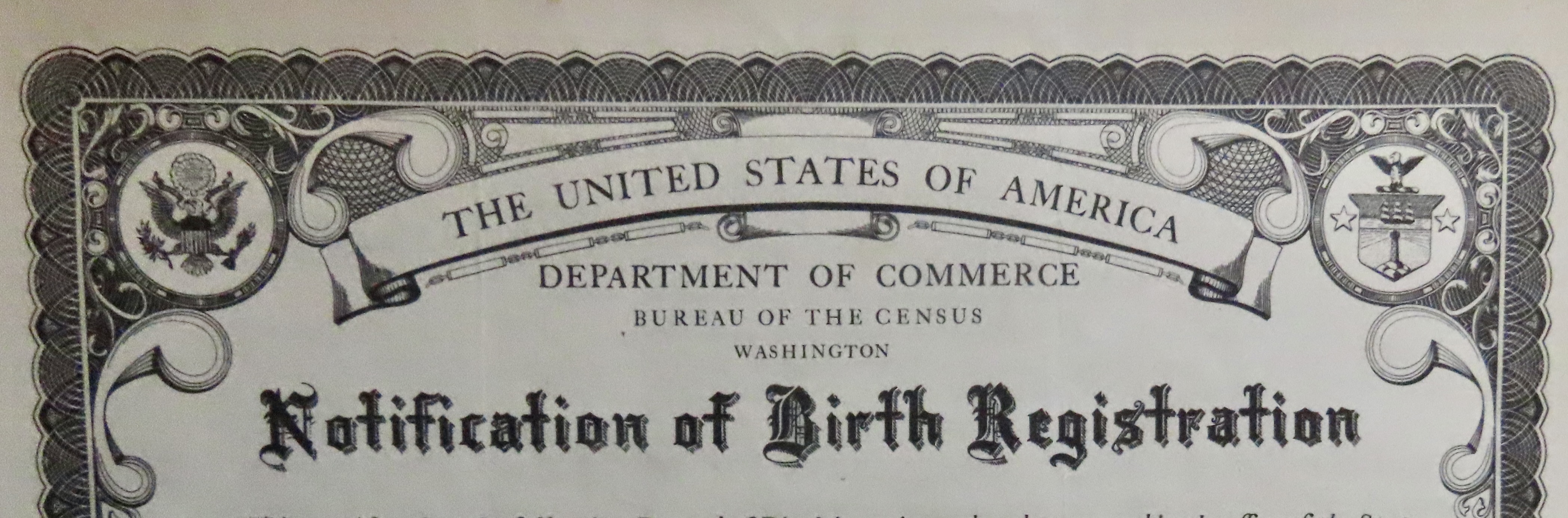
Mother’s reaction was more colorful. She made a command decision. Forty-eight hours were not going to stand in the way of her little boy’s education, or her freedom. So, she changed my birth certificate. March 3 was carefully erased with a typewriter eraser and March 1 typed in. I was bathed, dressed and shipped out, not the least bit aware that I had matured by two days. I think I recall hearing music and dancing in the house as my 12 year old sister walked me to school, a block away.
Things weren’t so rosy at school. The other kids were all older, bigger, and more coordinated. For example, Alan Green could draw a great horse. It came with four legs, a tail, a head and a flowing mane. Mine came with unrecognizable squiggles. It was hard to tell whether my objective was to draw a tarantula or a snake with legs, but the world’s wildest imagination on the world’s most potent drug wouldn’t have classified the picture as a horse. It was not refrigerator art. The whole exercise created big-time trauma.
This negative experience was compounded by the exercise of learning to print within lines. Forget that. If my letter came anywhere close to resembling a letter, any letter, I was happy. Mrs. Young, the teacher, was more critical.
“Curtis, I asked you to make Bs, and here you are printing Zs.”
“So what’s your point?” was not an acceptable response. Mrs. Young was suspicious and that suspicion increased each day I was in school. She was a tough old gal who had been teaching first grade for eons. She knew first graders, and I wasn’t one. As for the birth certificate, Mother’s forgery was in no danger of winning a blue ribbon at the county fair. After a few weeks, Mrs. Young sent off to Oregon for a copy. I remember her calling me up to her desk.
“Curtis” she explained, “you have a choice. You can either go home now or you can go home after school. But either way, you are going home and can’t come back until next year.”
Just like that, I was a reject, a first grade flunkee.
Mrs. Young couldn’t have made it any clearer: Mother was going to get her little boomerang back. This was okay by me, if not by her. Playing out in the backyard was infinitely more fun than competing in ‘Scribble the Horse.’ I did decide to stay for the day. Mrs. Young was reading about Goldilocks to us after lunch and I wanted to learn if the bears ate her.
It would have been interesting to listen in on the conversation that took place between Mother and Mrs. Young, or even more so between my mother and father, or Pop, as he was known to us. I’ve often wondered if he participated in the forgery or even knew about the March 1 rule. I doubt it. He was not the parent frantic to get me out of the house during the day. (Had it been in the evening the jury might still be out, he laughingly reported to me years later.) But I wasn’t privy to those high-level discussions. My job, which I took quite seriously, was to enjoy the reprieve. I was about to begin my wandering ways. The Graveyard was waiting. Join me next Thursday as I learn how it served as a great playground during the day but became terrifying at night when the ghosts slithered out from their graves.
The change that made me two days older. I don’t know if this was the evidence that led to my being booted out of the first grade but the change is obvious. First, check out the the size of the ‘1′ in March 1 with the ‘1′ in 1943. While the type face is the same, the first 1 is much smaller. Second, but less obvious, there is a slight indentation and discoloration of the certificate where my mother used the typewriter eraser.
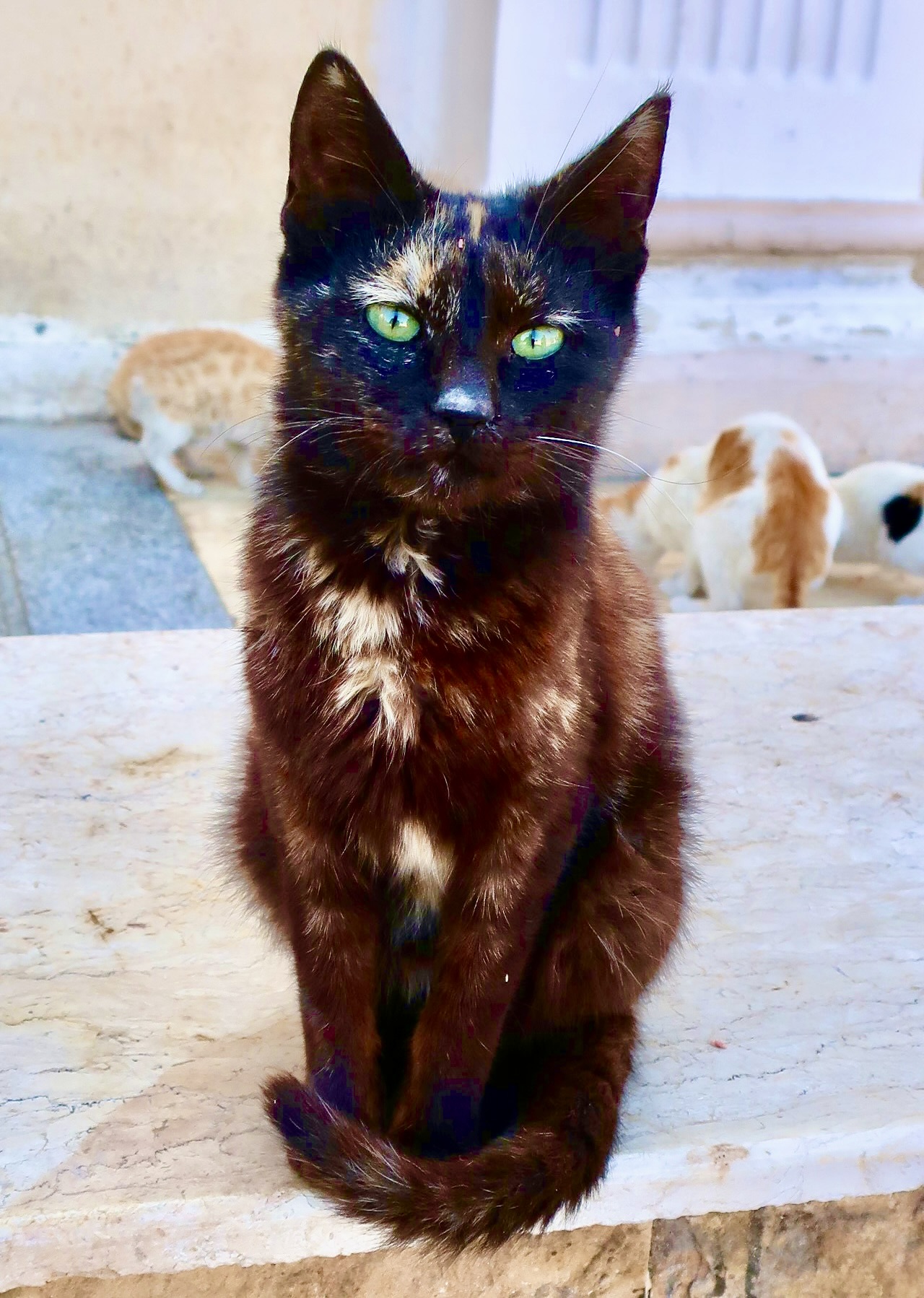
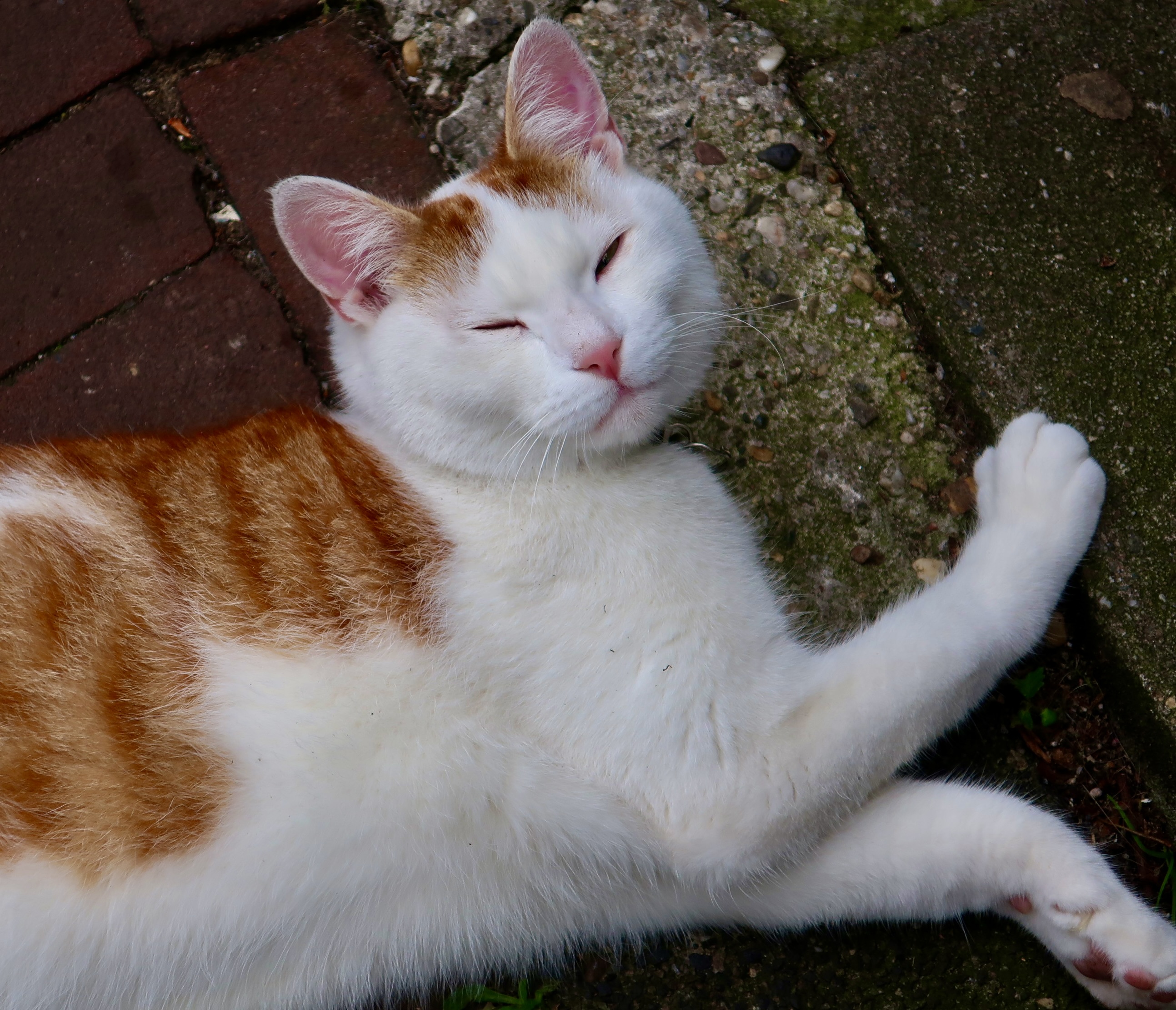
We are continuing our focus series today with a look at cats. Our travels provide us with lots of opportunities to watch and photograph our feline companions. In their own enigmatic way, they are quite photogenic. Most of today’s entries are from around the Mediterranean Sea— or from my personal experiences of being owned by three cats: Demon, Rasputin and FE.
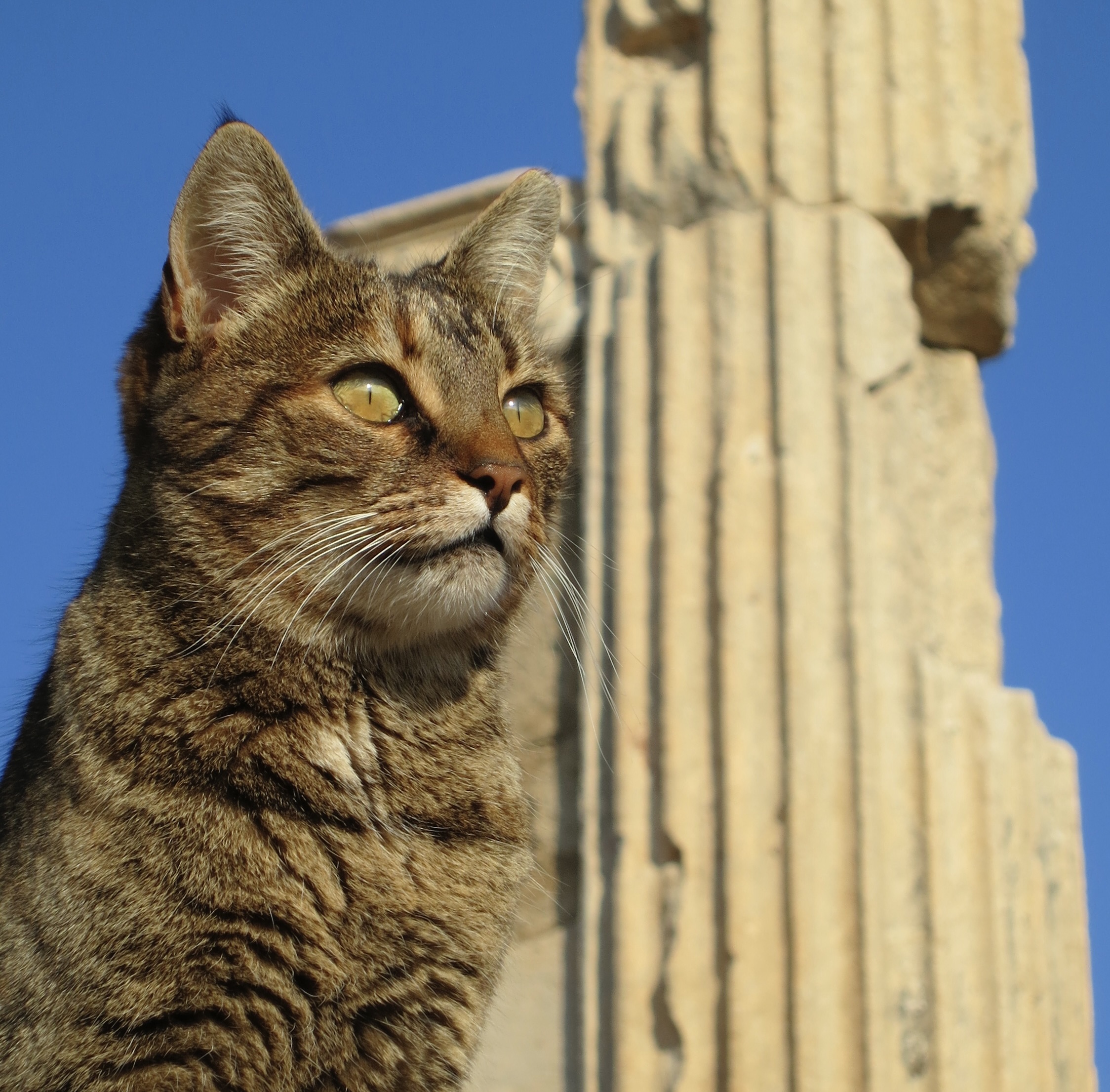
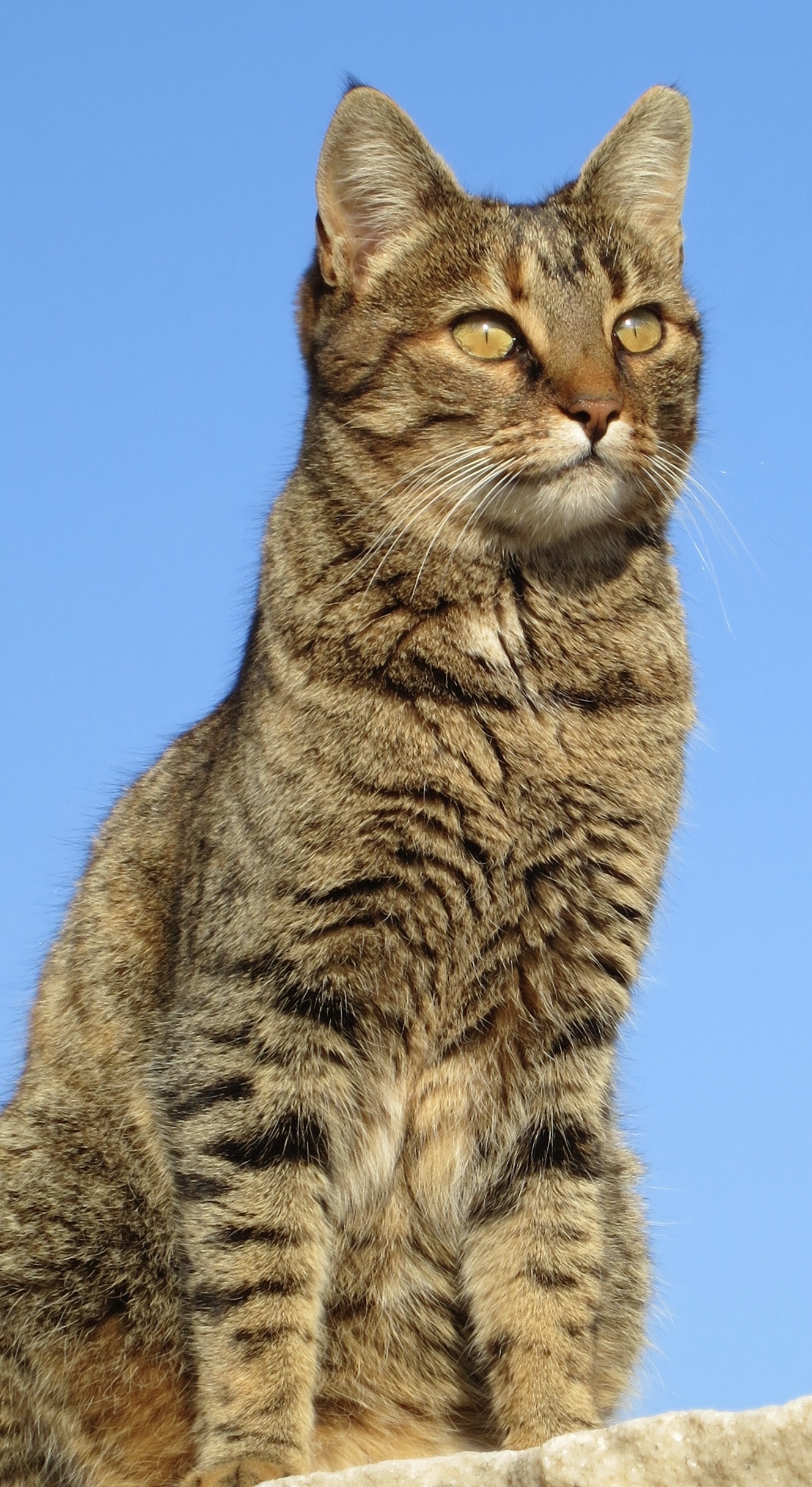
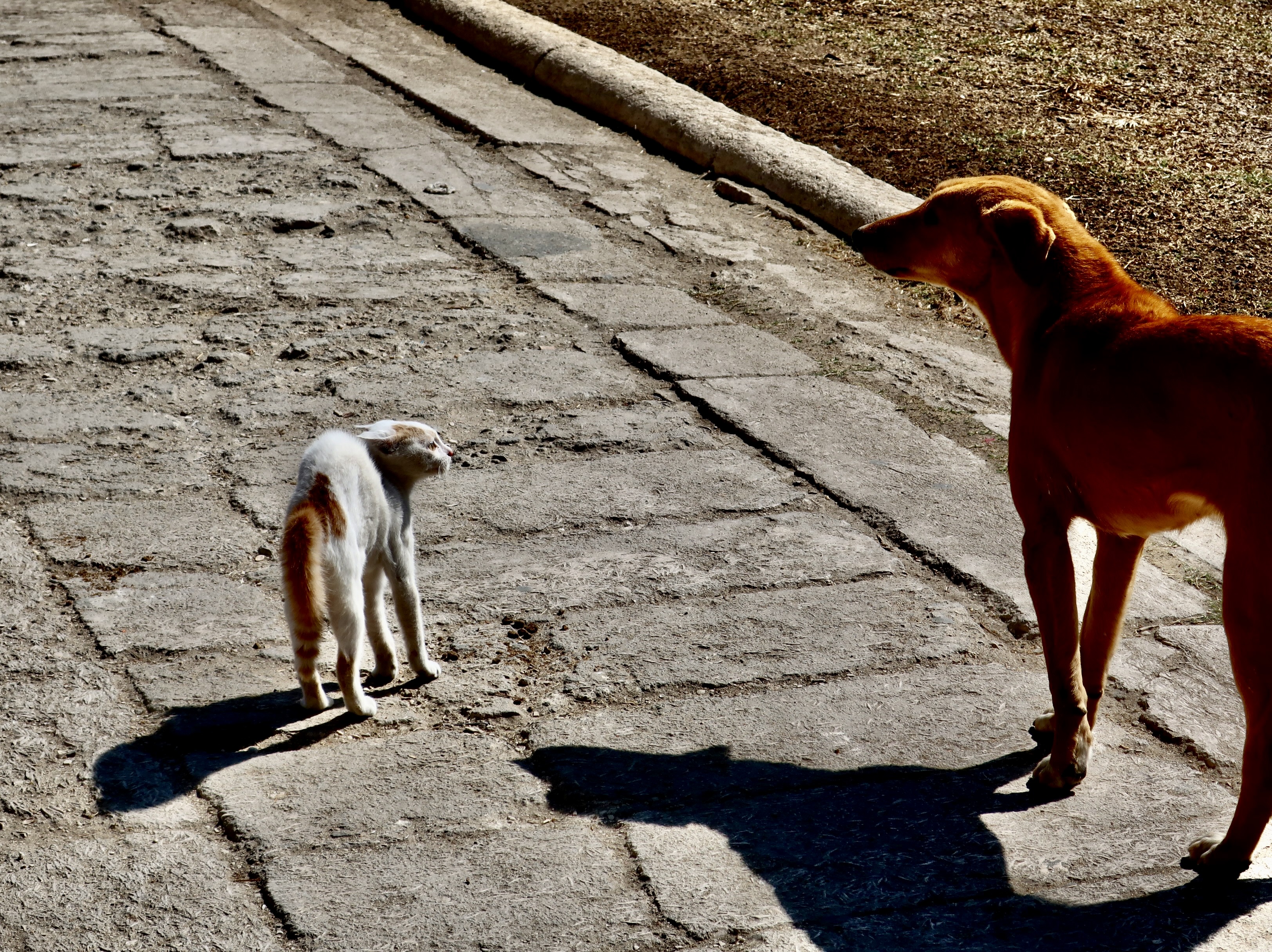
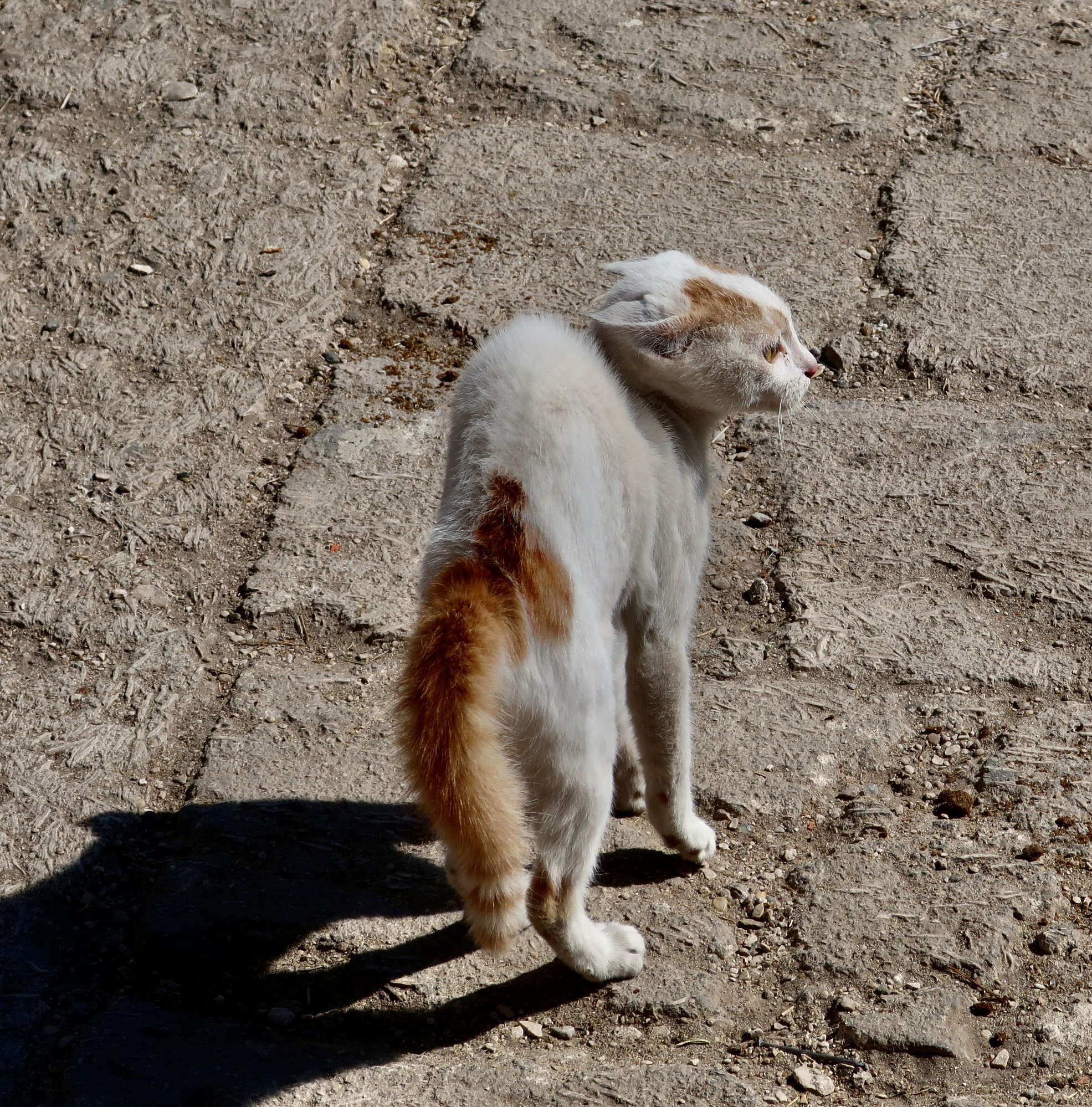
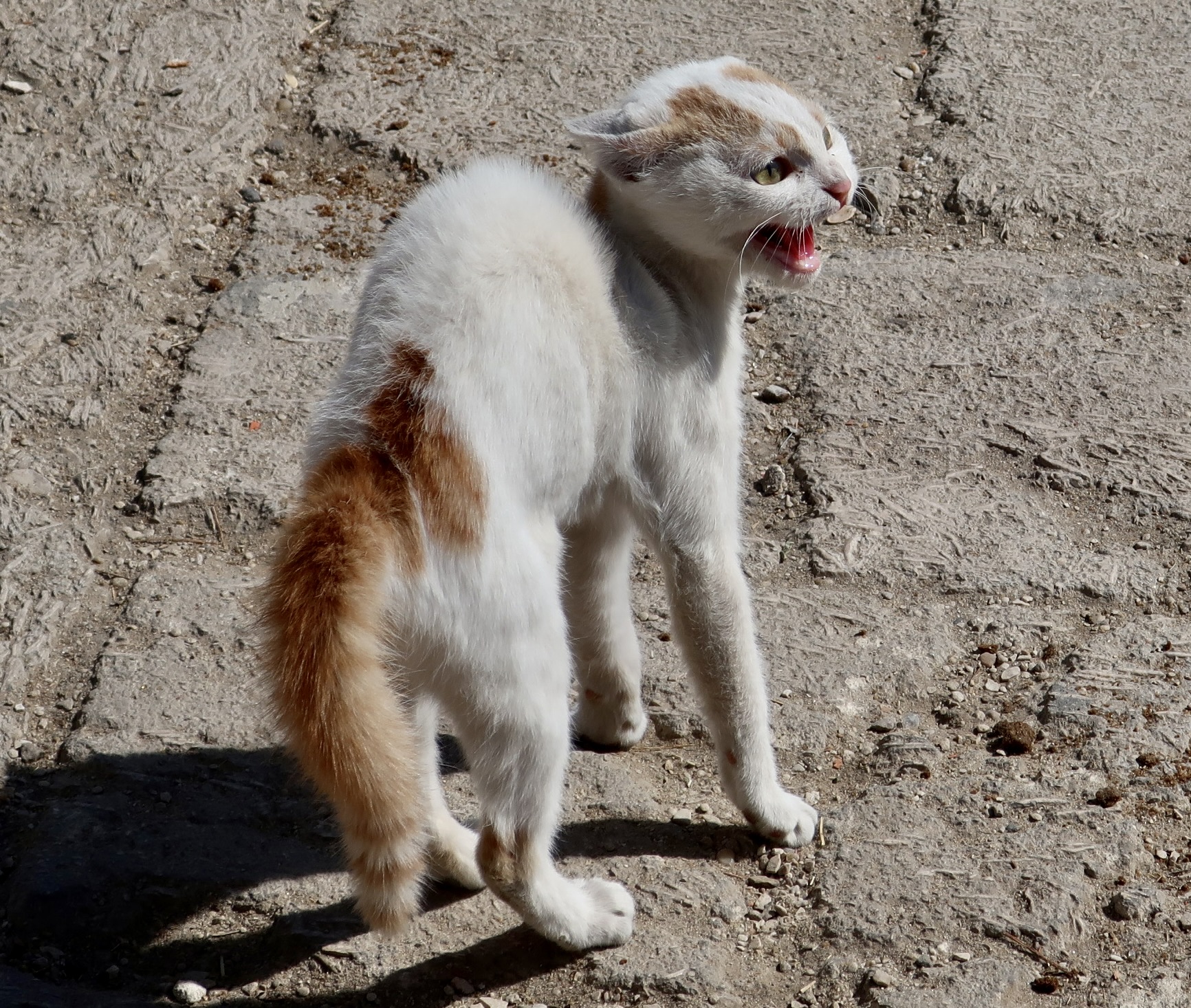
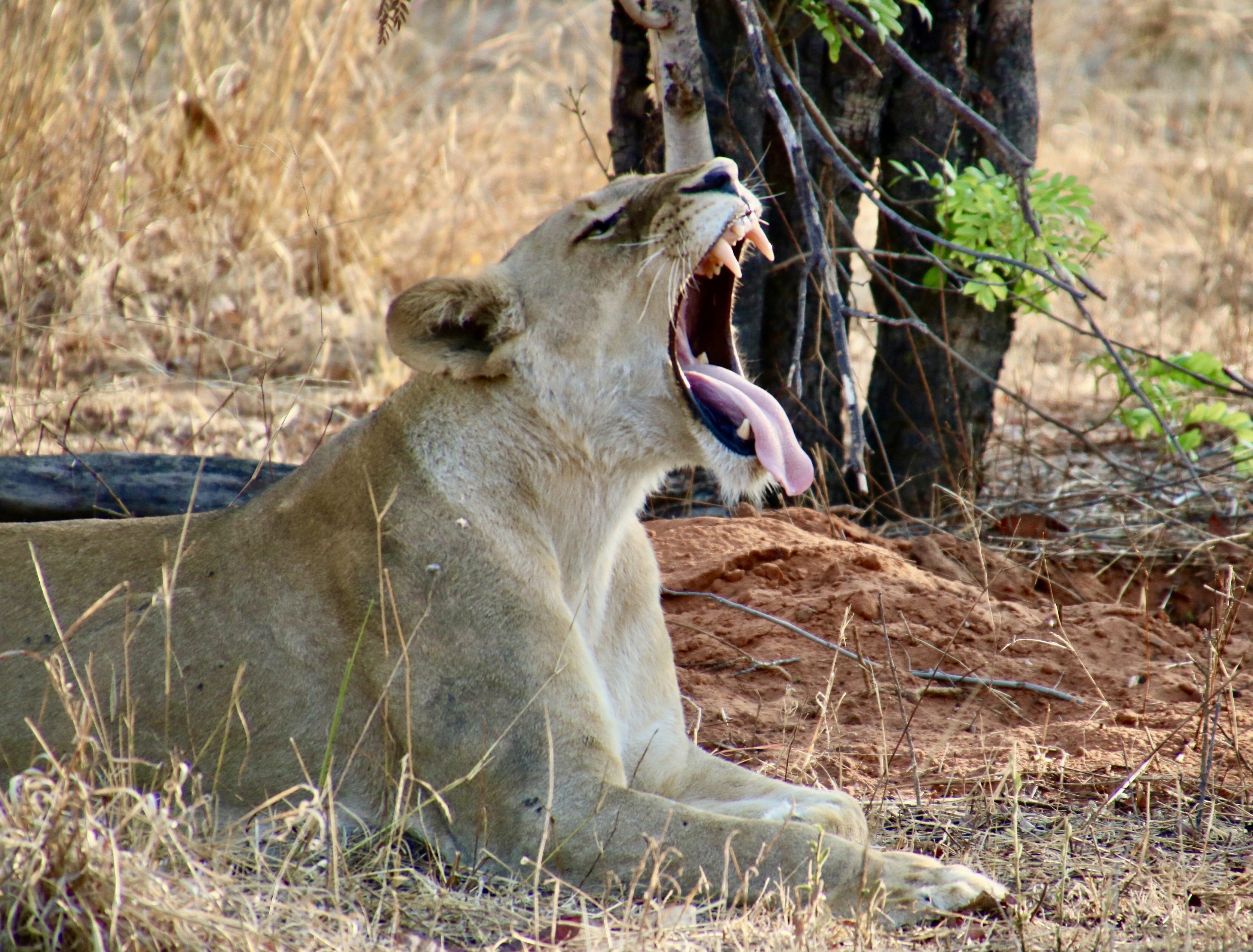
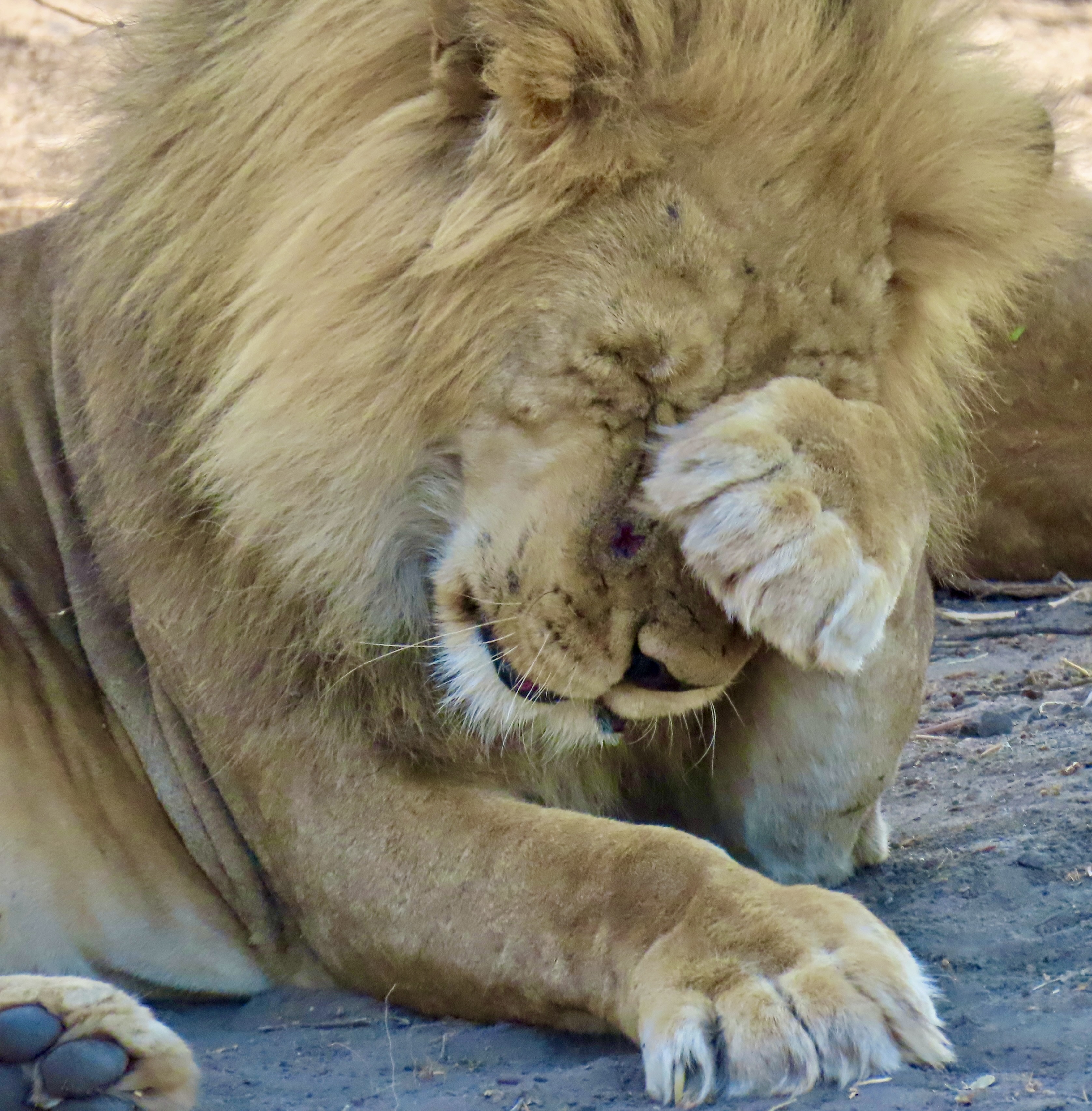
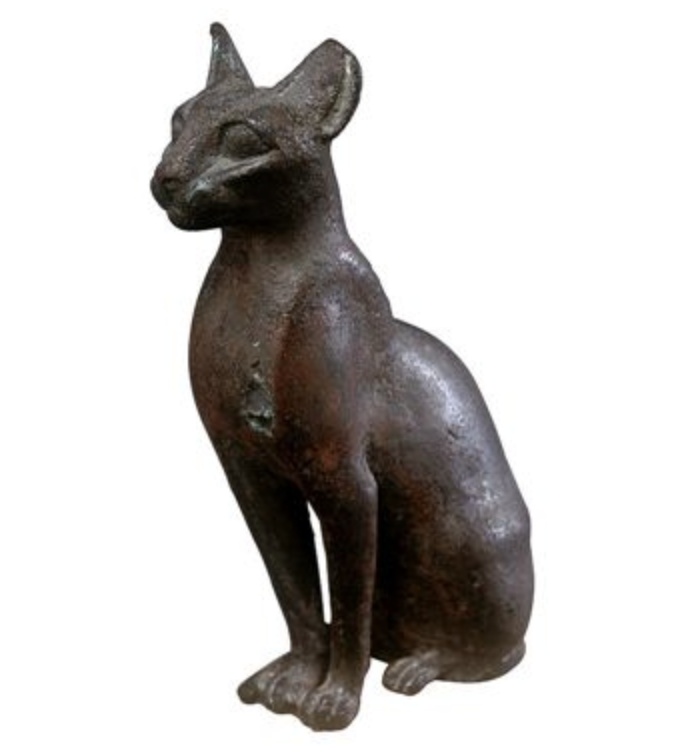
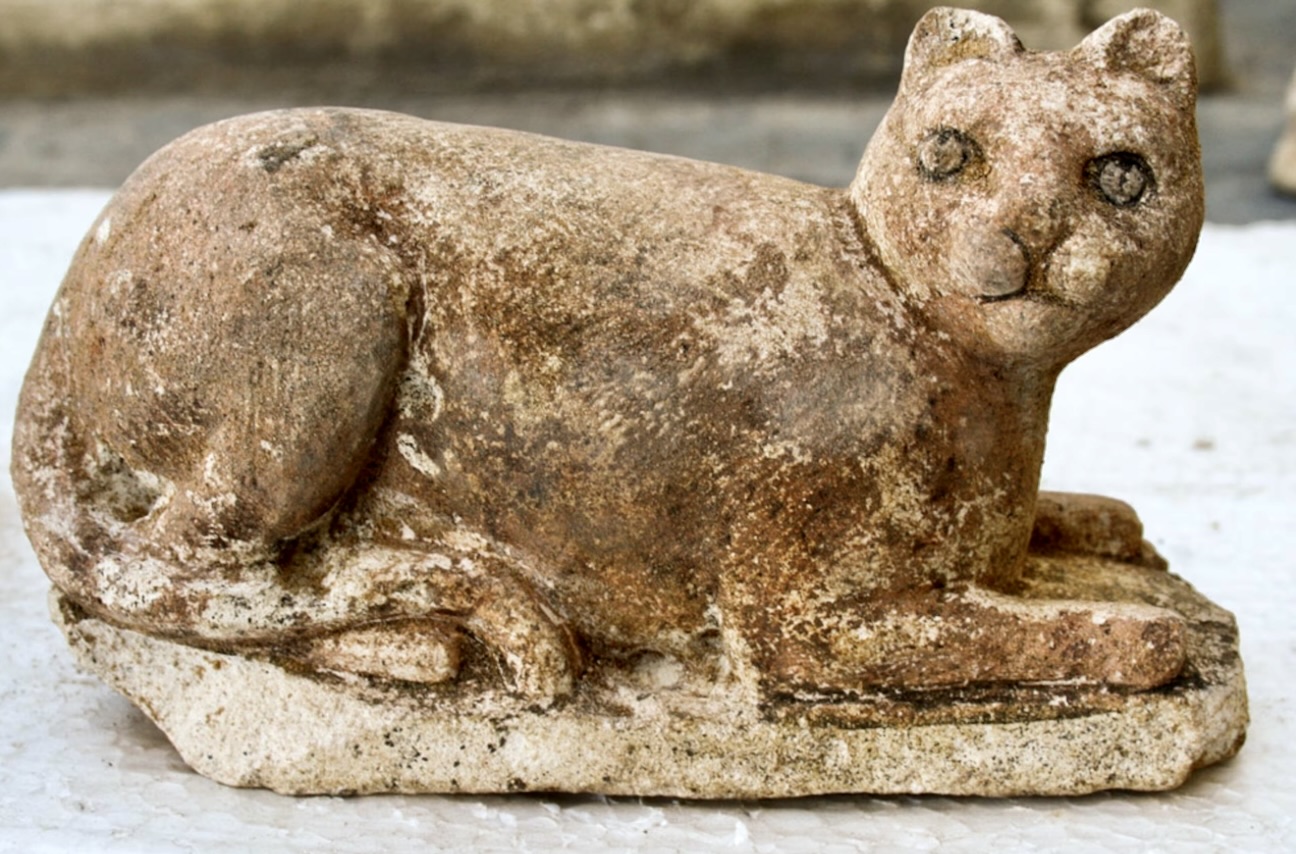
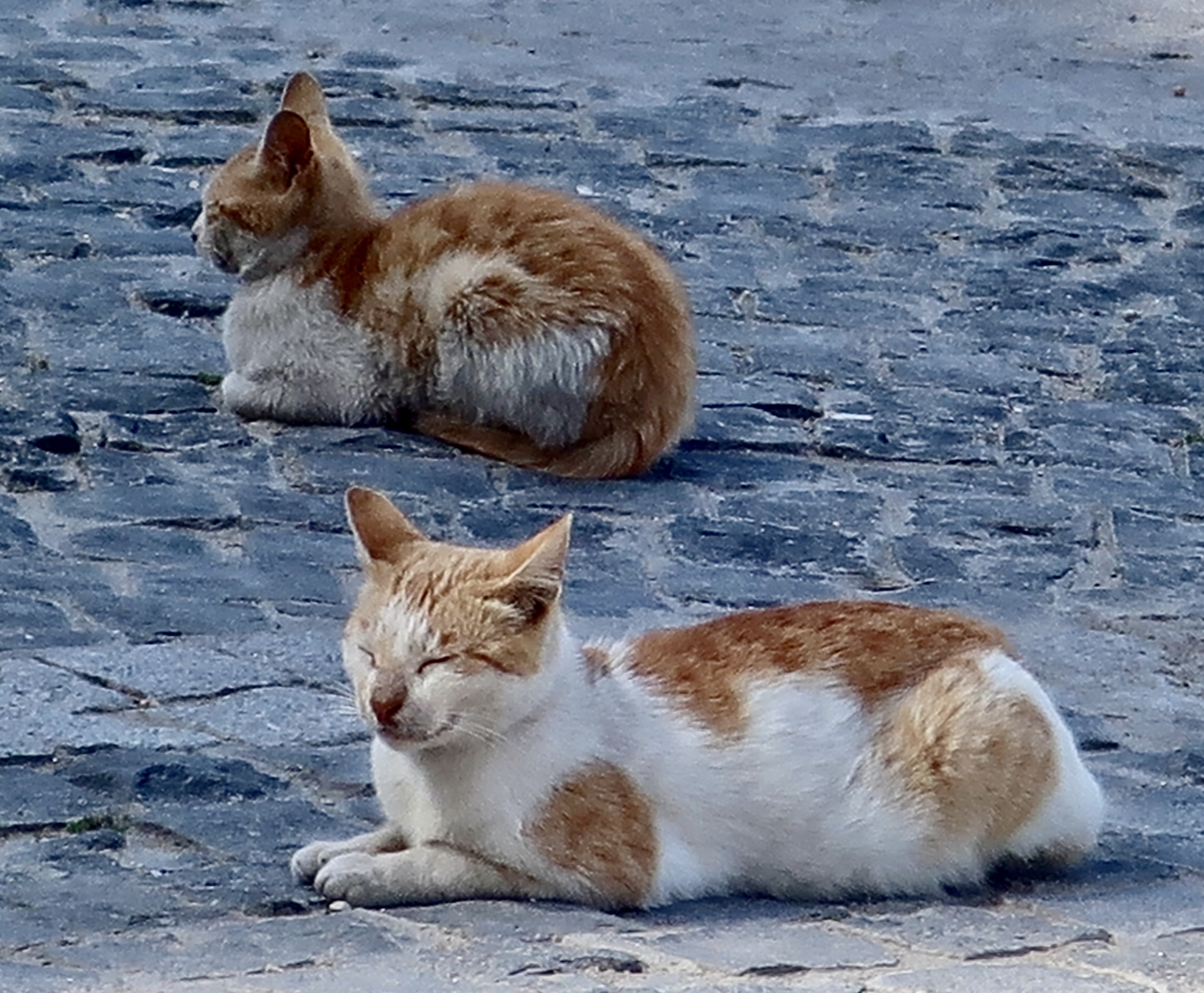
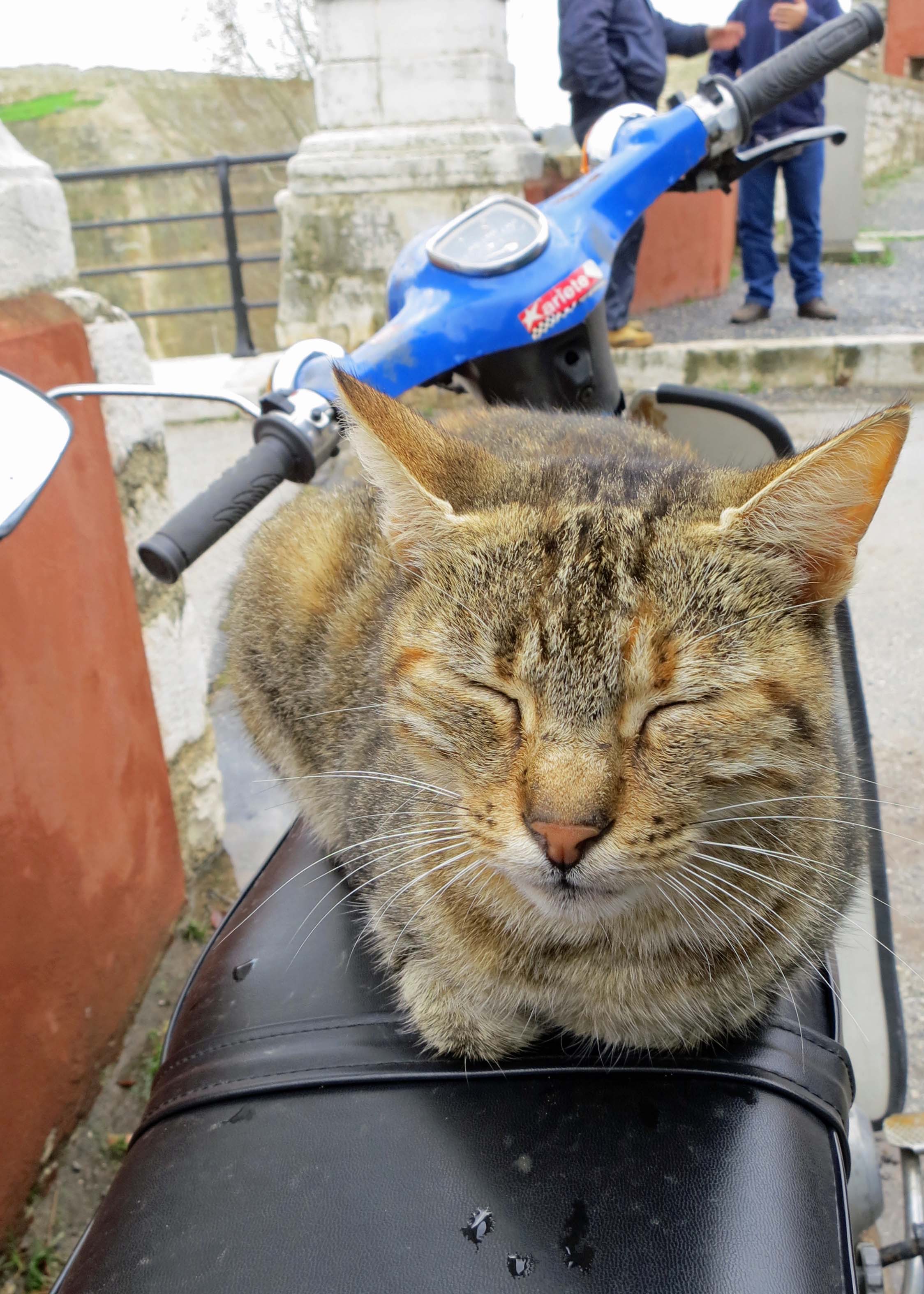
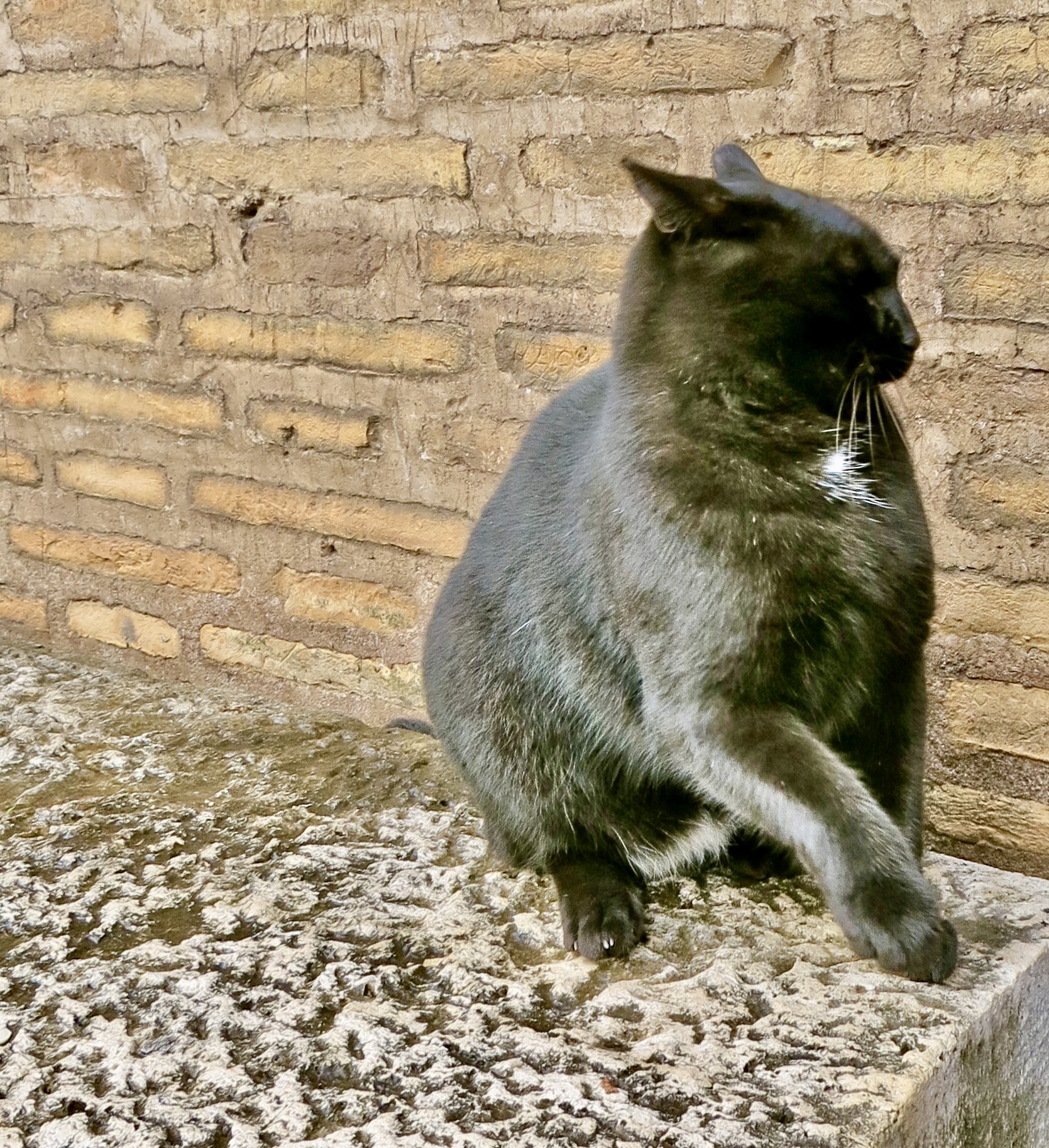
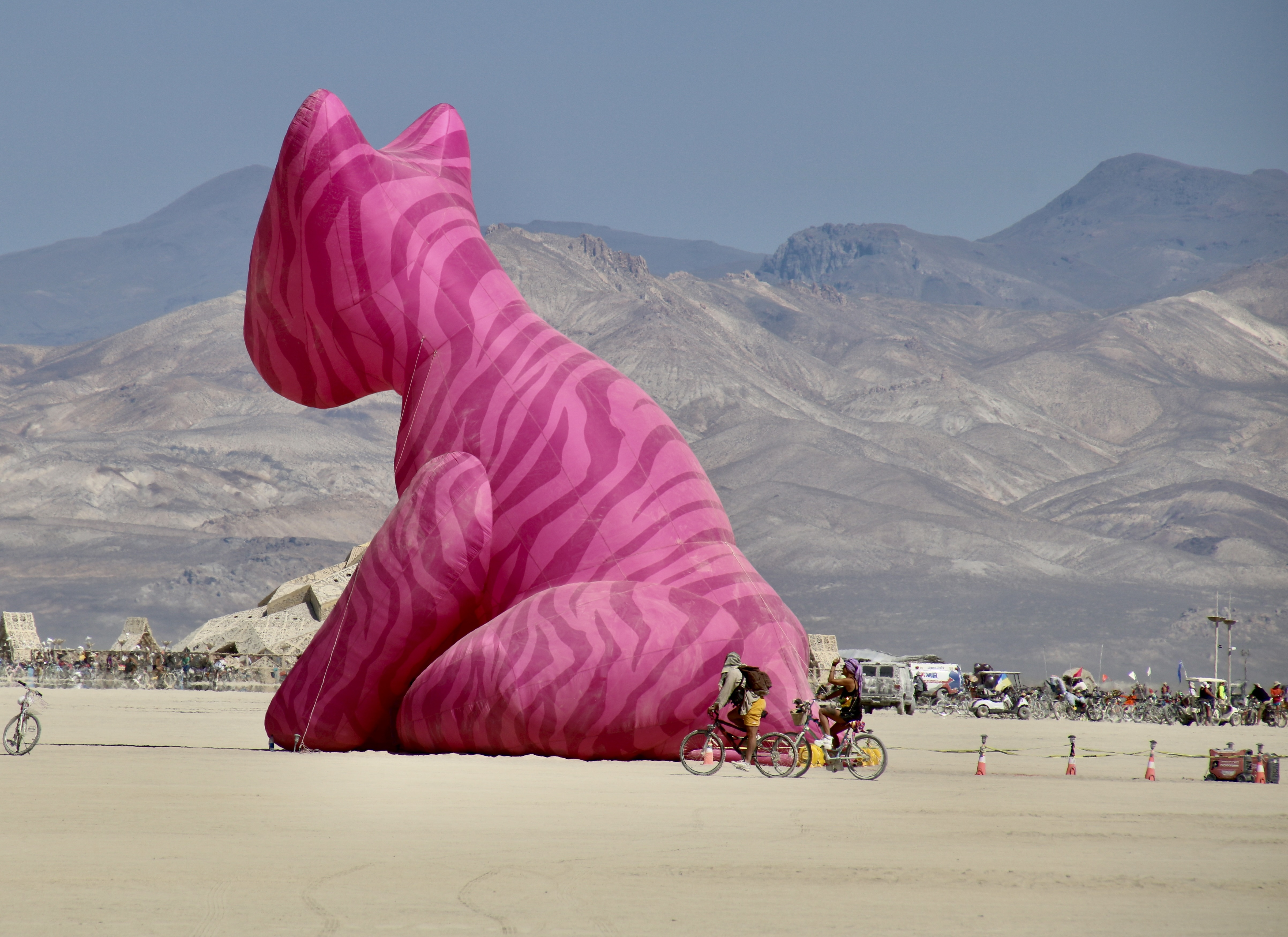
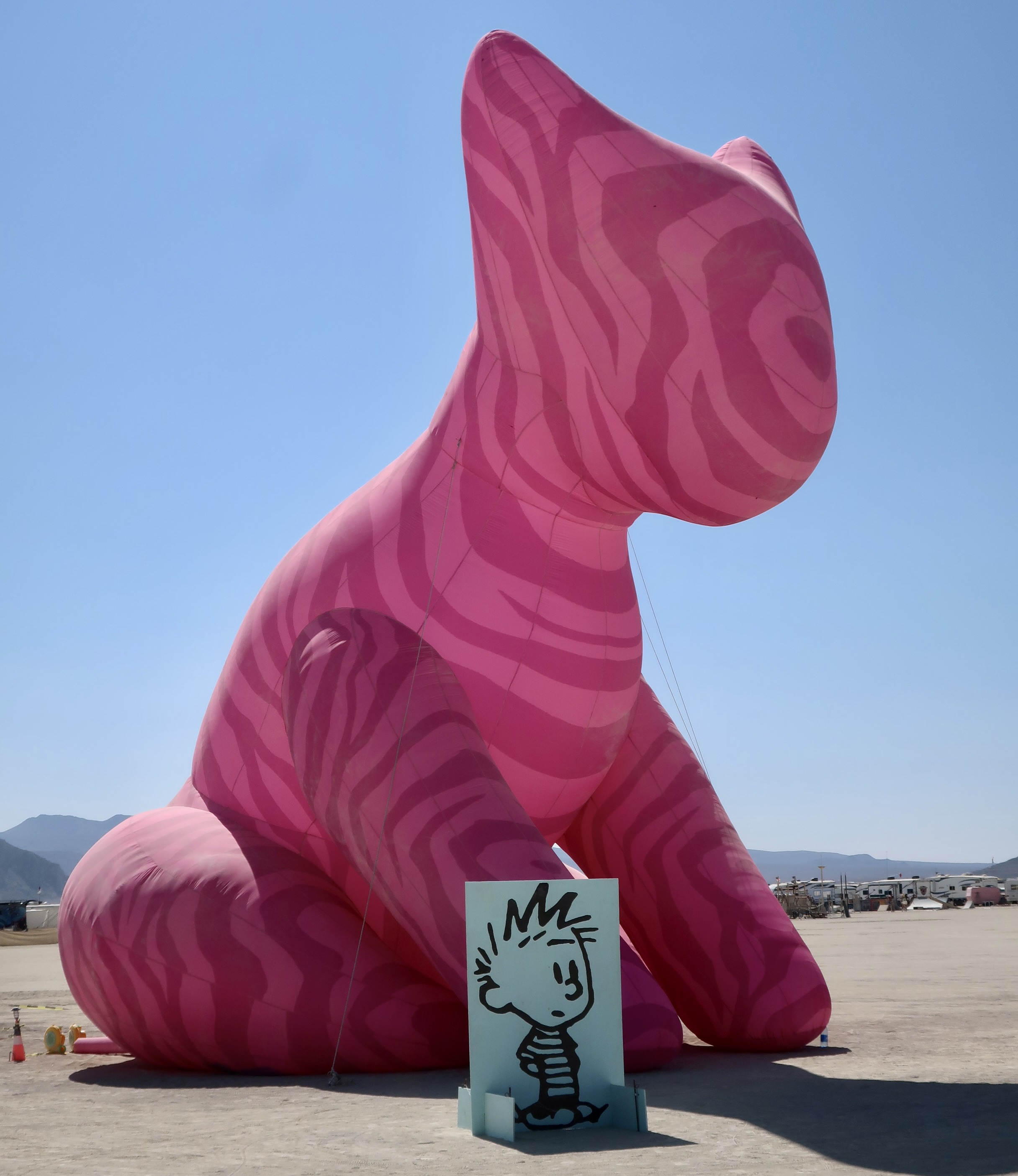
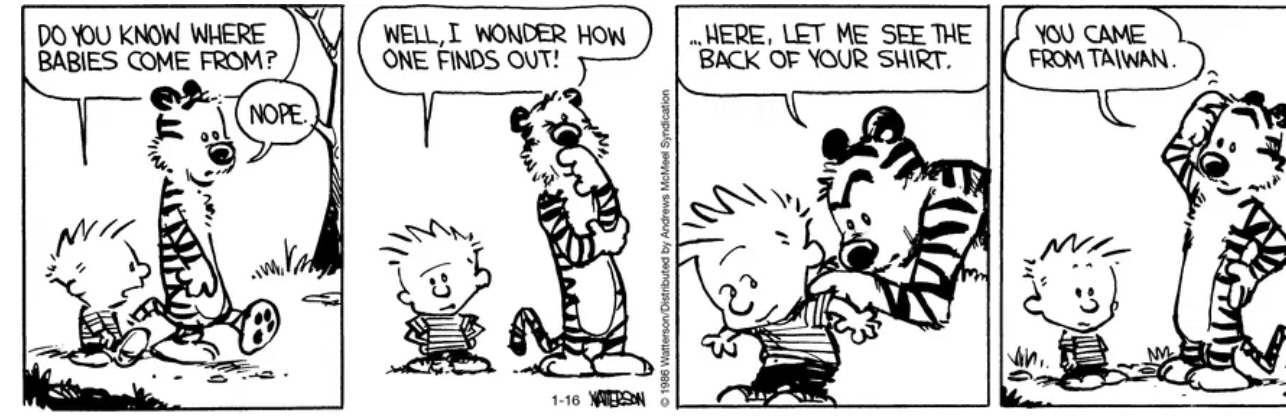
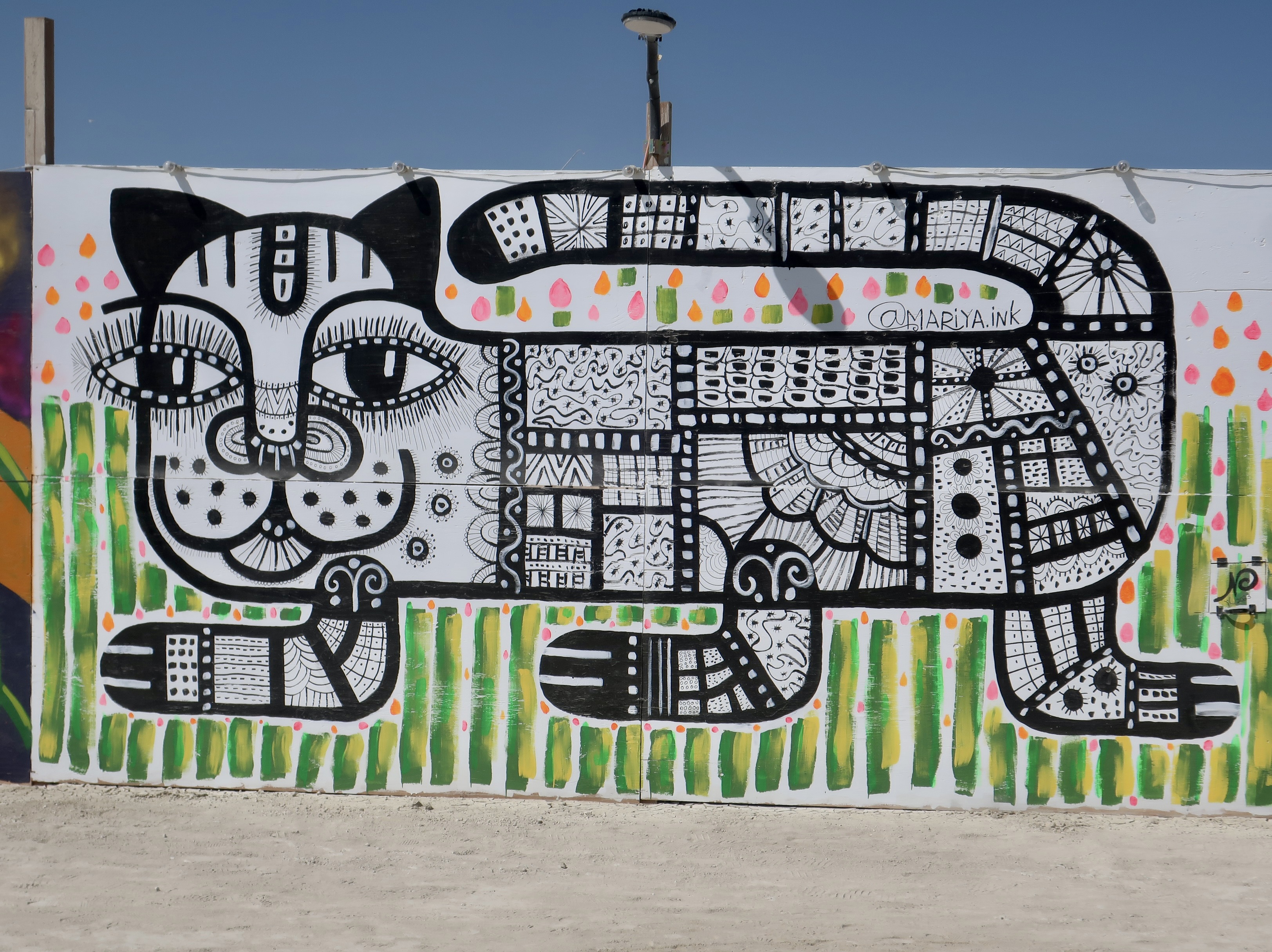
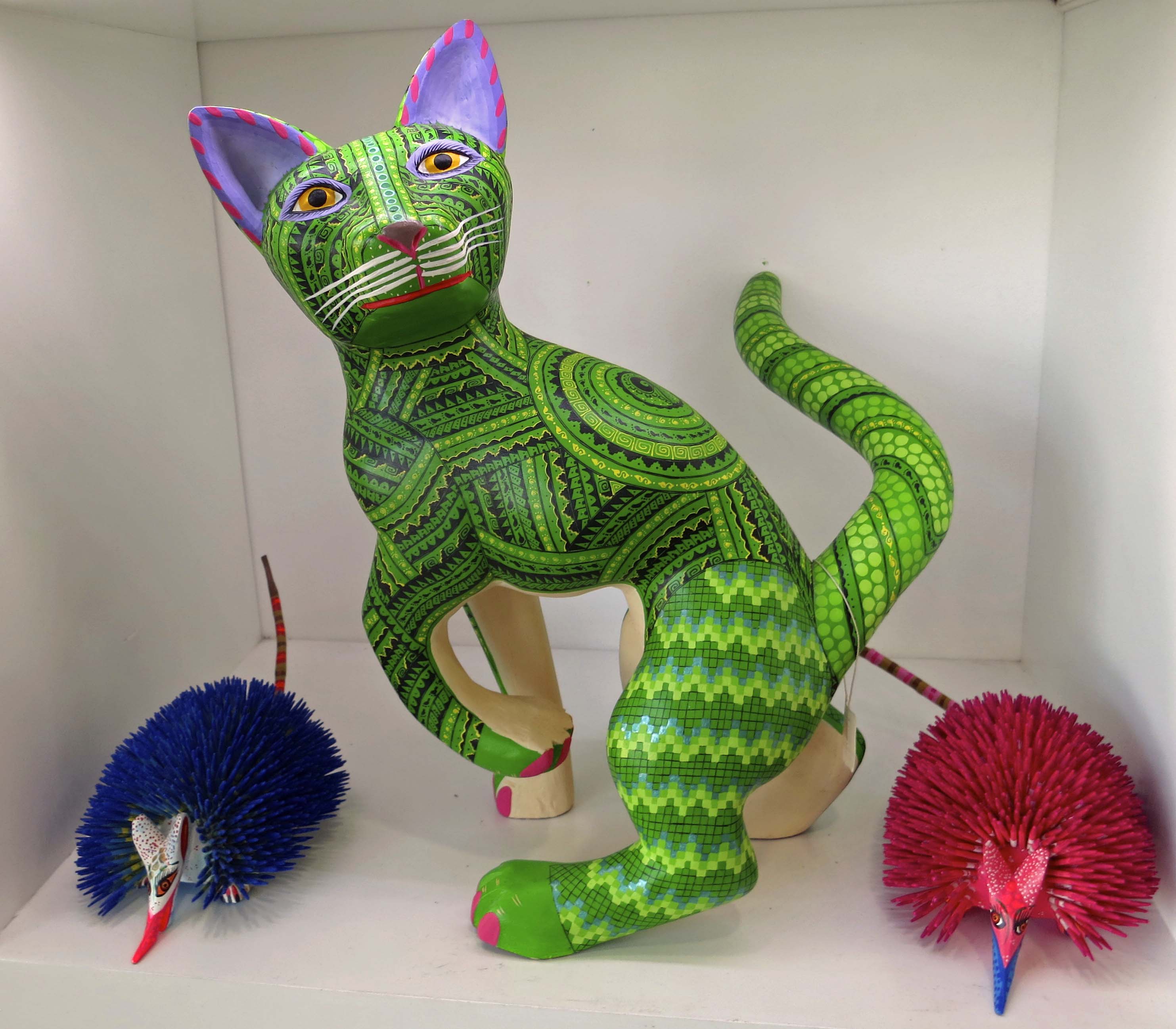
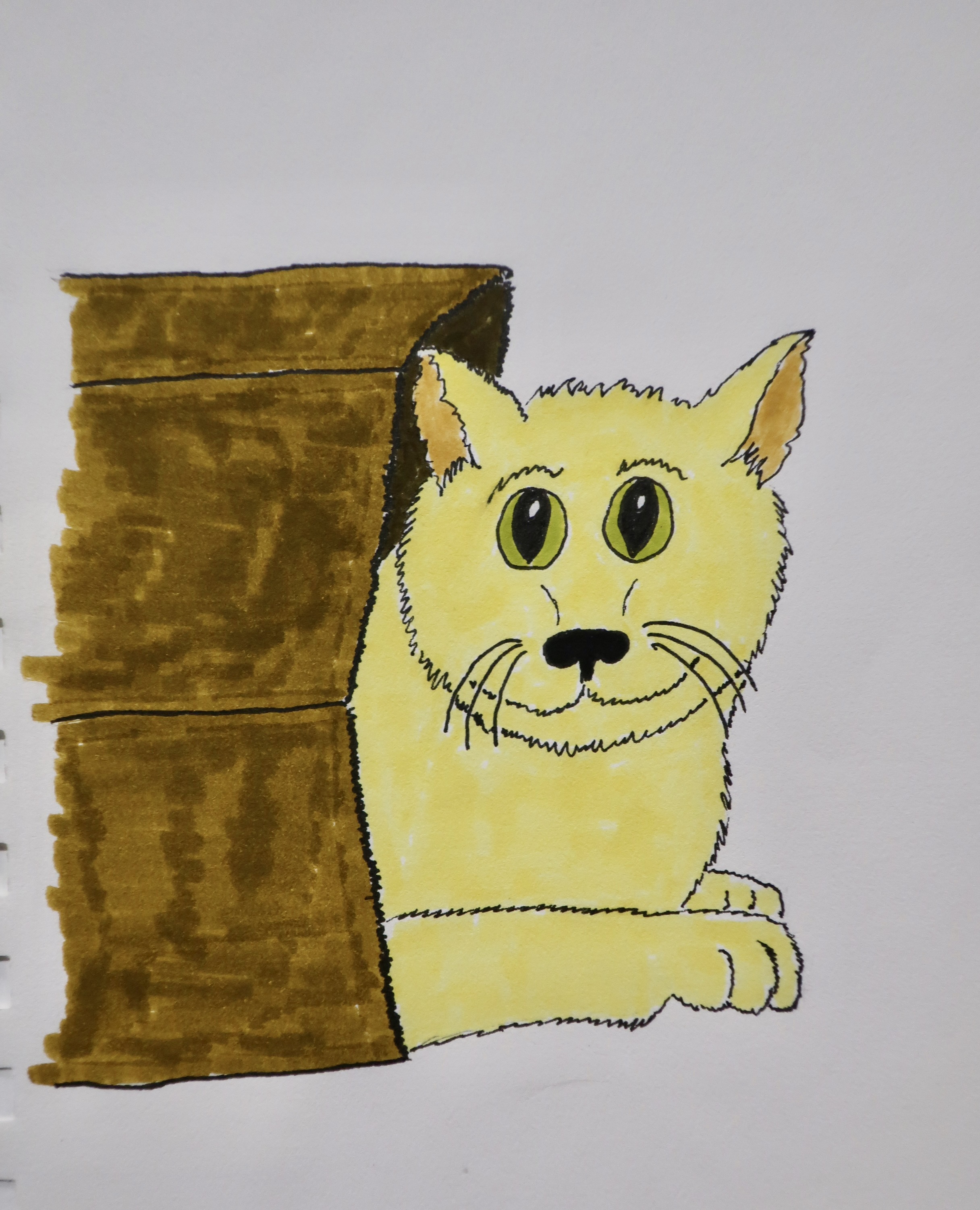
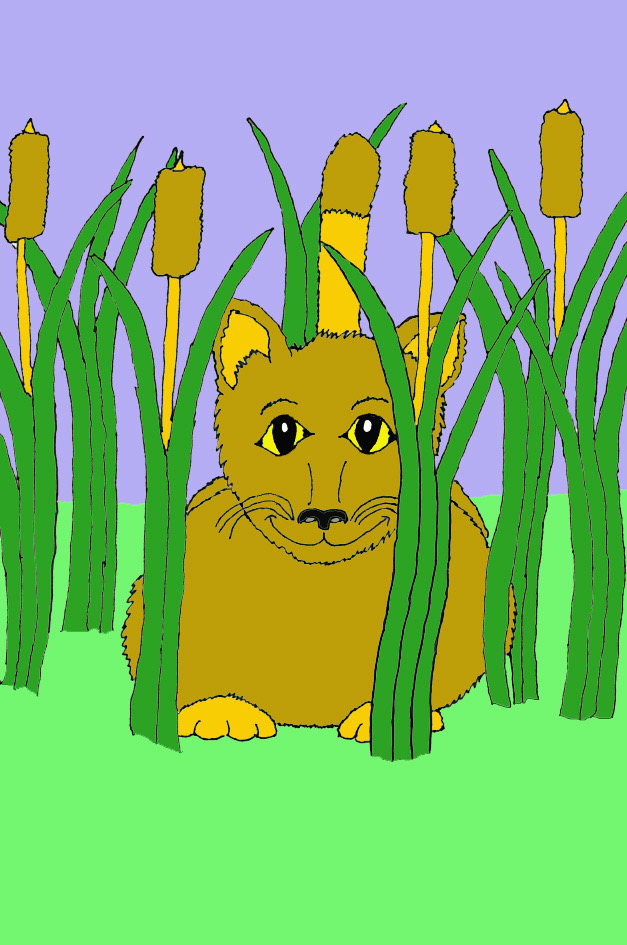
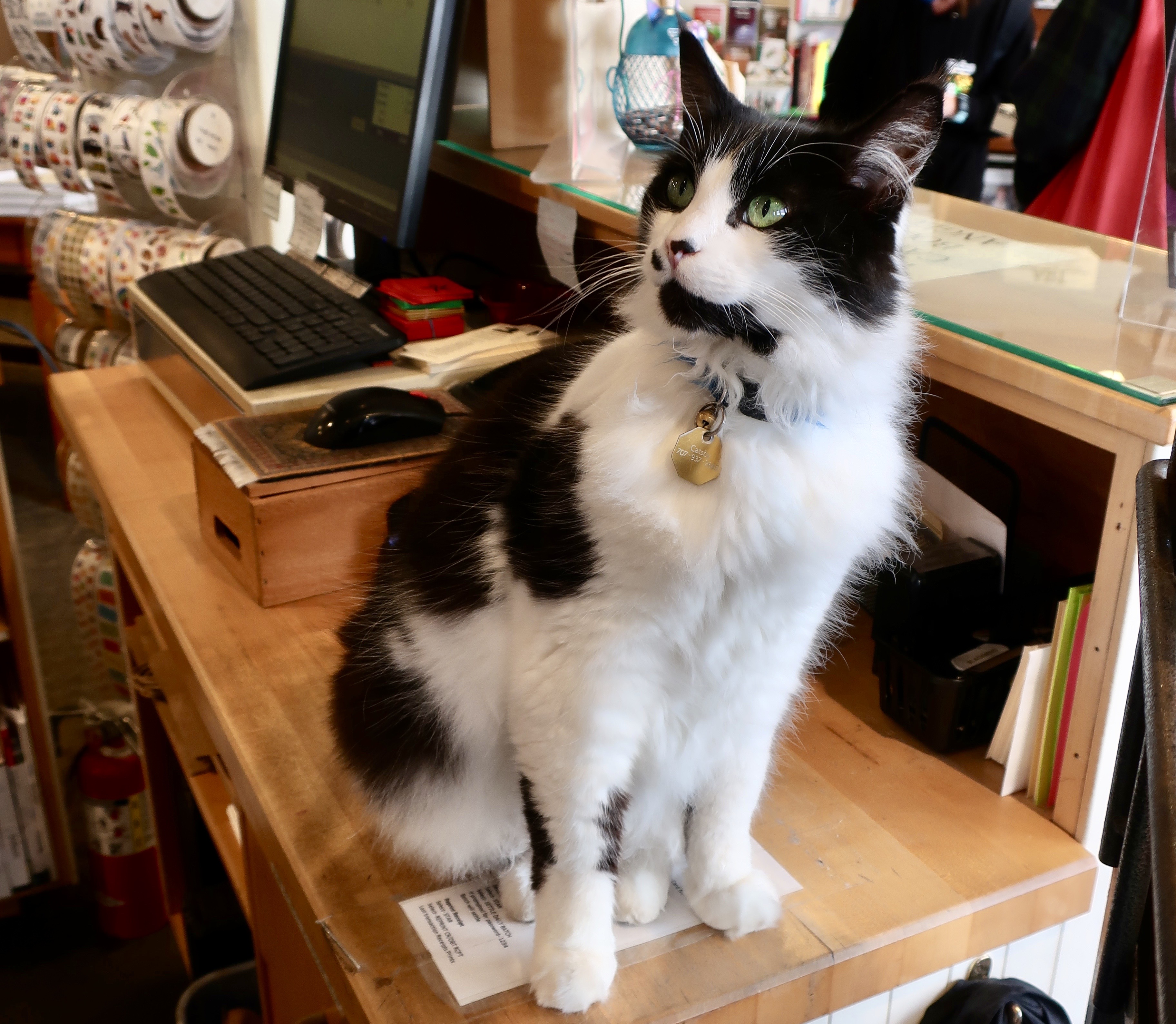
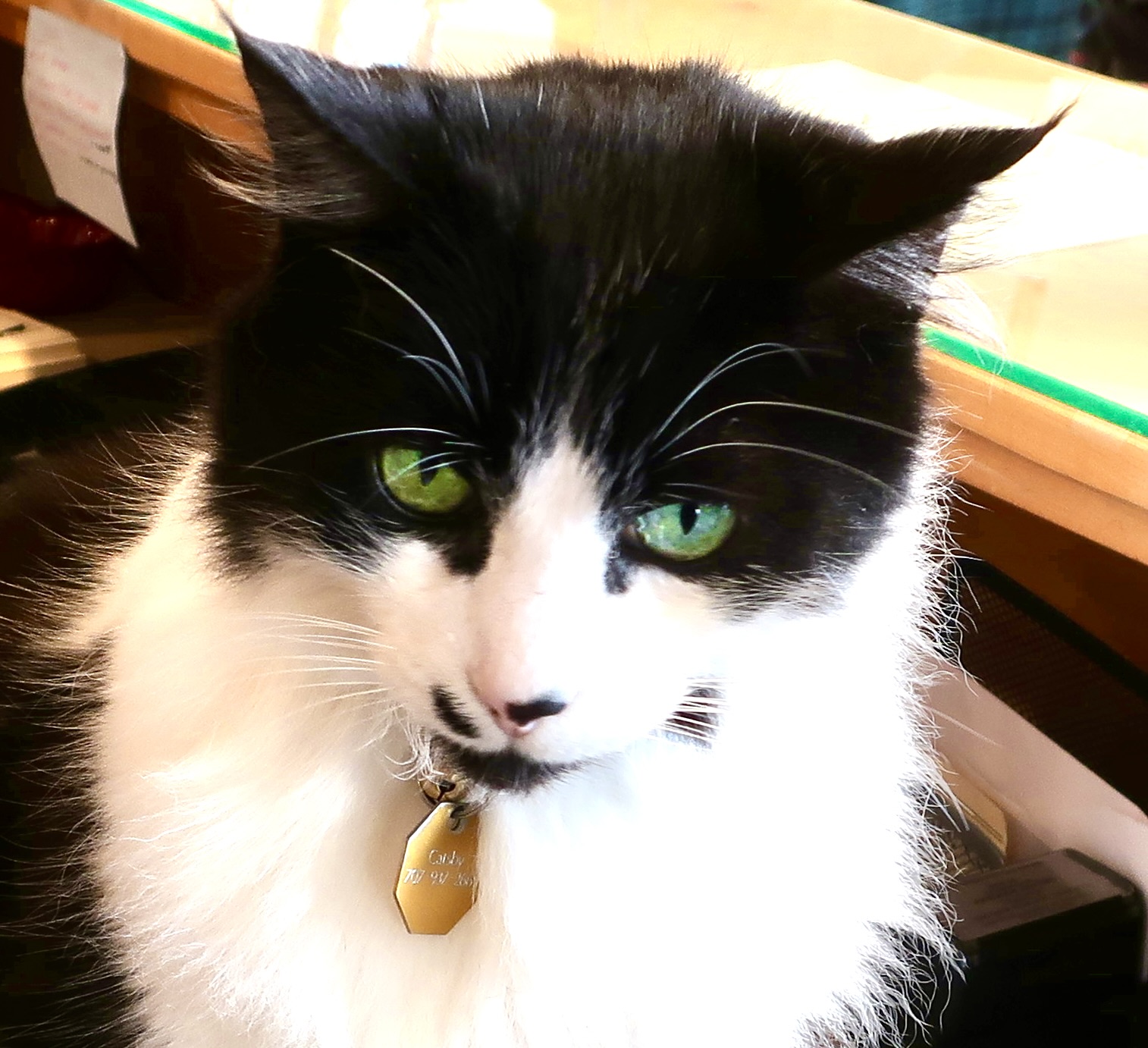
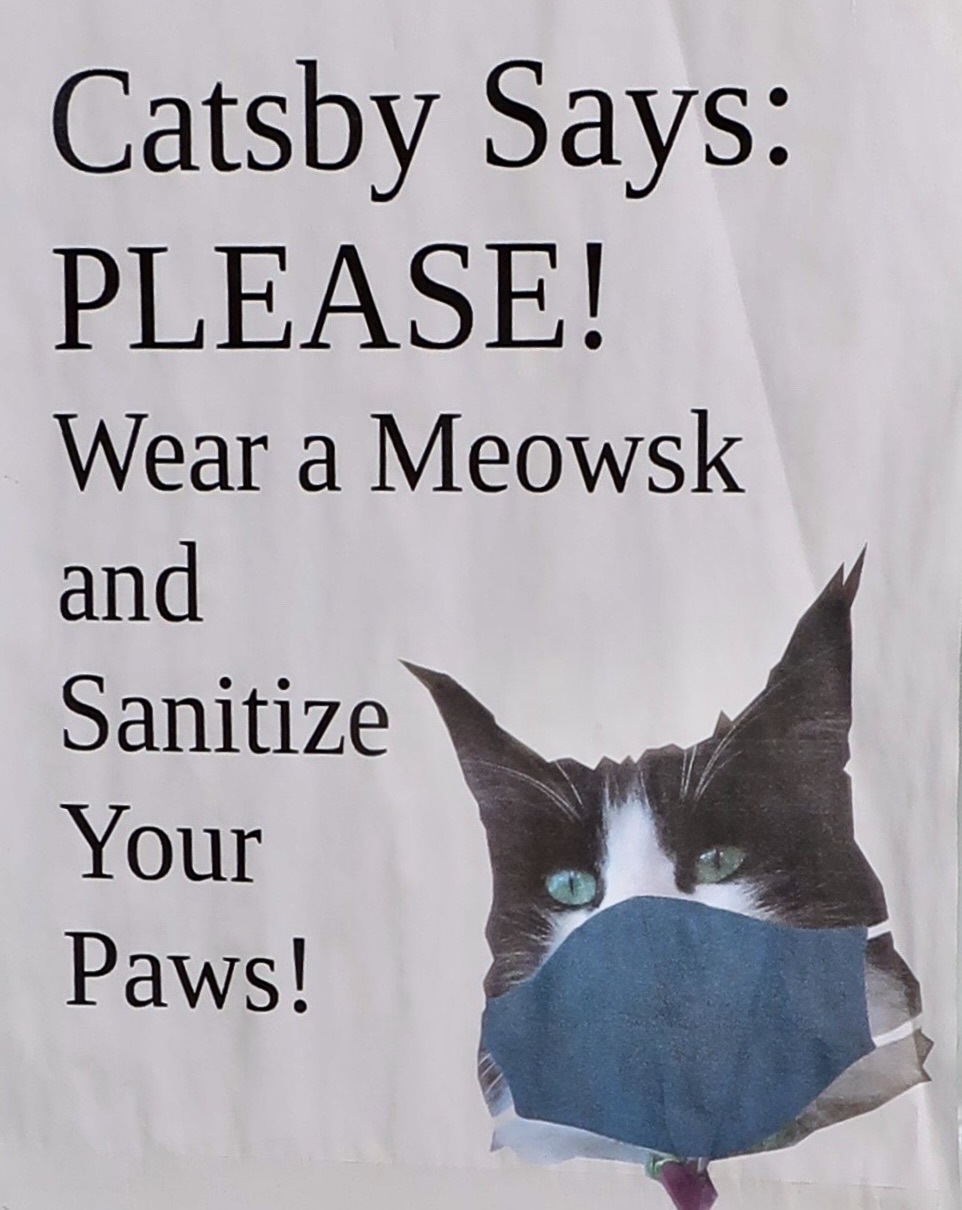
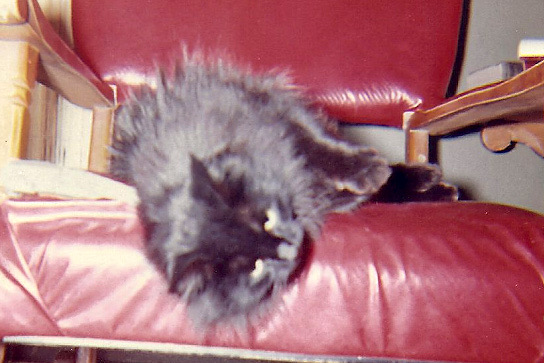
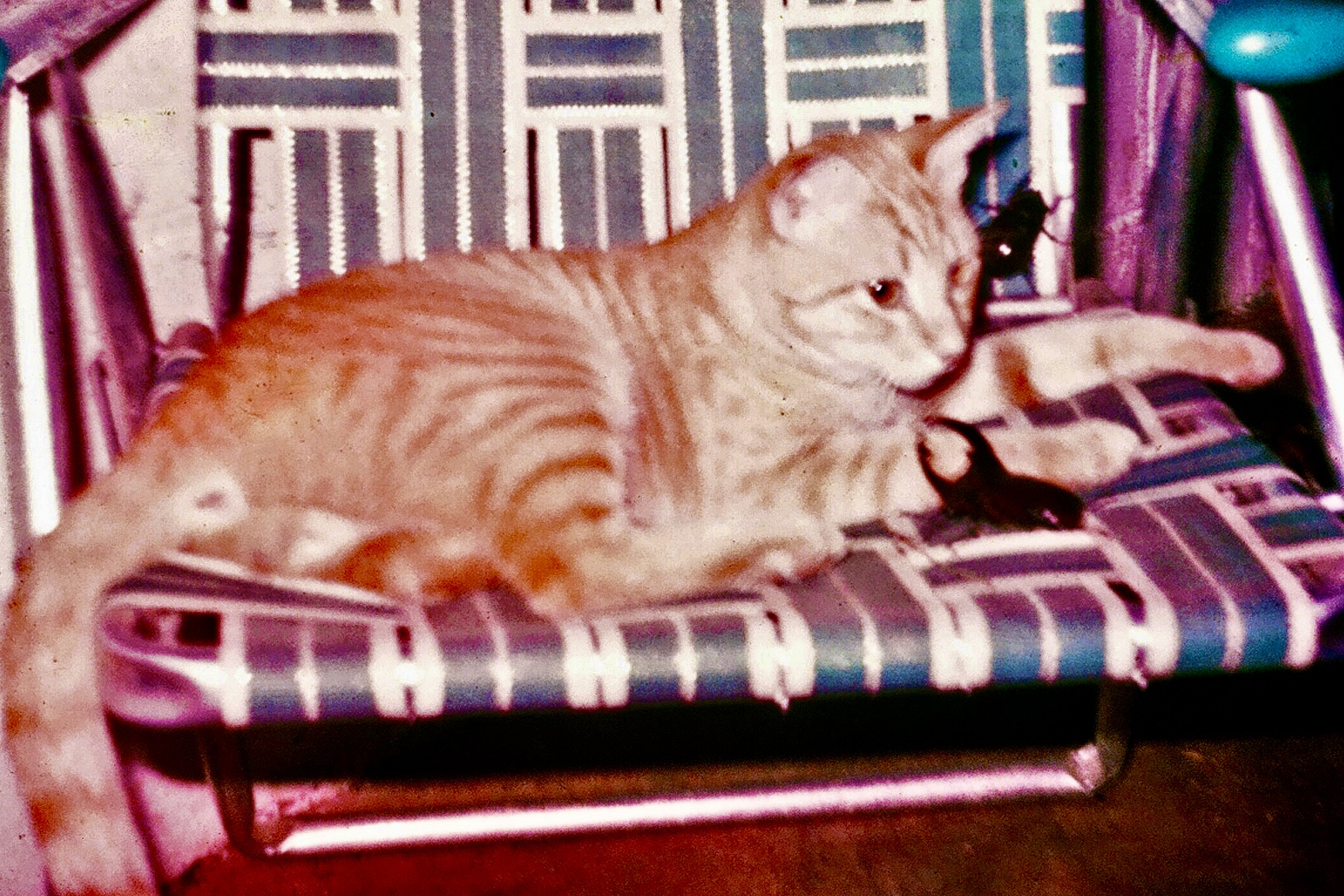
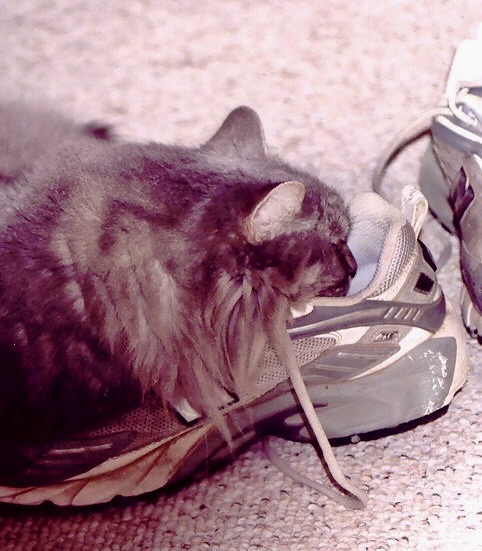
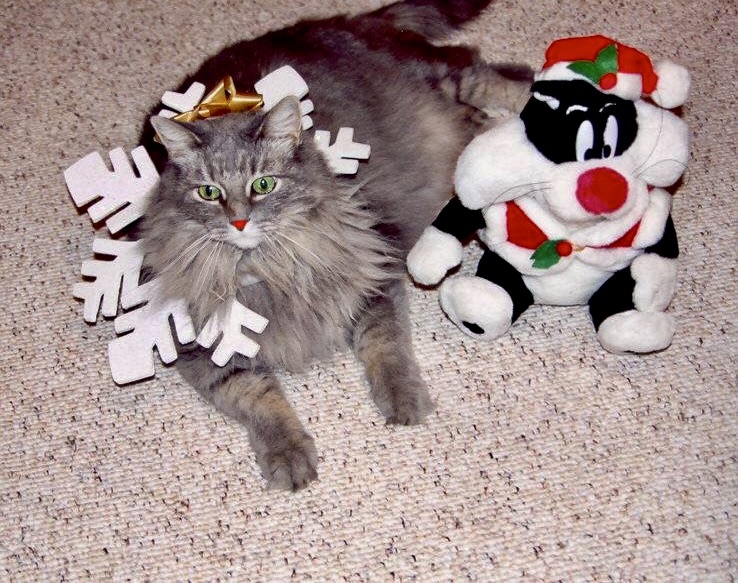
Cats, we have discovered, like to hang out in ruins. Maybe there are more mice there. This one had placed itself on a pedestal (no surprise there, cats like high places) in the Ancient Greek city of Ephesus in Turkey. Check out its gorgeous whiskers. Other than being handsome, they are an important part of a cat’s navigation system, helping them slip though tight spaces and avoid objects in the dark. The whiskers are so sensitive, they can even measure changes in the air flow, such as that caused by a mouse running by. Din,din!It looked quite regal. As the author Terry Pratchett wrote, “In ancient times cats were worshipped as gods; they have not forgotten this.” To explore their early godhood, we need to travel to Egypt where the cat goddess Bastet reigned. We found this cat near the beautiful Alabaster Mosque in Cairo. Ears laid back and body arched, she was letting a dog know to stay away from some small chunks of cat food located nearby.She was quite insistent.Our favorite photo. Hisssss. The goddess Bastet went through several changes evolving down through the ages from being like a ferocious lioness initially to much closer to our domestic cats by 1500 BCE or so. We thought this one was definitely representing her lioness phase.“Need help with that dog, sister? We cats have to stick together.” (Photo from our African safari two years ago.)“Damn, why does she have to do that when I’m having my nap!” It’s no secret that cats like their naps— up to 70% of the time. In fact, the lioness above wasn’t roaring ferociously, she was yawning. (Photograph from our photo safari.)Originally Bastet was represented as a woman with the head of a lion. Eventually, she assumed the look of a woman with a cat’s head, or simply a cat like this representation of Bastet in the Egyptian Museum in Cairo. During the 22nd Dynasty, the city of Bubastis, located in the eastern part of the Nile Delta (the modern city with the interesting name of Zagazig), became the cult center of Bastet. A granite temple there was dedicated to Bastet and thousands of mummified cats were buried in a nearby cat cemetery. An annual festival, best described as a drinking party, drew thousands to celebrate Bastet. As the Greek historian Herodotus noted: ‘More wine grapes were consumed at the Festival than the whole rest of the year together.’A temple to Bastet built around 230 BC was found beneath the streets of Alexander, Egypt in 2010. Included in this important archeological find were 600 statues of cats such as this one.We found a number of their ‘descendants’ still hanging out in the city at the tall Pompey column, including the above two catnapping in the sun.A calico cat posed prettily for us while her brothers and sisters were busy eating behind her. I’d bet on her being female because male calico cats are extremely rare and sterile. It’s all about genes.Speaking of poses…James Herriot once said that “Cats are connoisseurs of comfort.” This fellow proves the point. What could be more comfortable than a soft, black, motor scooter seat absorbing the sun after a rainstorm. I’d say the look on the kittie’s face is pure bliss. The Cat’s Meow, perhaps? (You might have to Travel back to the 1920s for this reference. Or at least Google.) We took this photo on the island of Corfu in the Ionian Sea.This young cat on the Greek Island of Santorini also proved Herriot’s point. It would probably still be sitting there enjoying a head rub by Peggy if we hadn’t of had a boat to catch.Not so this guy. I’d moved to rub behind his ears and he had responded by trying to take my hand off. It wasn’t too surprising due to the fact that we were in Rome’s Colosseum where his ancient relatives once dined on reluctant Christians. He had a reputation to maintain. Now, to cross the ocean and return to Burning Man…On our first journey out to the Playa in 2023 we discovered this huge pink cat dominating the desert. Curiosity drove us to ride our bikes around to the front. What did we discover???It was Hobbes, as Calvin made plain! But why pink? The simple answer: It was Burning Man where being different is an art form. It’s close to a rule.Calvin and Hobbes is my all-time favorite comic strip. I’m fortunate that my digital newspaper does reruns. I jumped into the comic section on Friday when I was putting this post together. This was the daily strip. How can anyone not love these two characters?I included a Burning Man mural featuring a cat in my blog last week promoting today’s post on cats. This is another cat mural from BM 2023.Traveling south to Mexico, we found an imaginative green cat in a box in Puerto Vallarta (along with what I assume were two armadillos). The cat came from the state of Oaxaca in southern Mexico, which is renowned for its wood carvings. If you have ever had a cat, you know they love to play in boxes and paper bags.This is one of the cat cartoons I’ve created. It’s titled, ‘Who let the cat out of the bag?’Here’s another one of my cat cartoons. I titled this “Old Tom cleverly disguises himself by hiding out in the cattails.” I think he was tying to catch the ‘blue bird of happiness.’ He’d heard it was a Happy Meal.Peggy and I are strong supporters of Independent bookstores and firmly believe that each of them should have a cat. We’ve discovered over the years that some of the best do. This is Catsby at the Gallery Bookstore in Mendocino, California.A closeup of Catsby.Peggy and I have visited the Gallery Bookstore several times over the years. Once it was during Covid. Catsby’s poster was next to the front door. And now it is time to wrap up this post with a visit to the the three cats I have been closest to over the years.I grew up with cats and dogs. This was Demon, named after her black cat persona, piercing eyes, and all of the time she spent in the Graveyard next door. My first memory of her was when I was six and she was one very pregnant cat. My mother had prepared a box filled with old clothes as a nursery. I was home alone one day when Demon was walking across the living room and suddenly stopped, squawked and squatted. Much to my surprise, and hers as a first time mother, a little black head appeared out of her undercarriage. Not knowing what else to do, I jumped up, grabbed her by the nape of the neck, and dashed for her closet nursery. Not fast enough. I was charging through the kitchen when the little black kitten completed its journey out of mom and was heading for a crash landing on the floor. Somehow I caught the little bundle and delivered Demon and her newborn to the box. Demon and I were bonded forever after that experience. I tell more Demon stories in my blog-a-book series, UT-OH.This is a photo of Rasputin, my cat when I was a Peace Corp Volunteer in Liberia from 1965 to 1967. He’s sharing his chair with a pair of Rhinoceros Beetles. I took this photo with the Brownie camera I brought with me to Africa. It isn’t the best of photos, but it is what I have. I wish I had more. He was quite the character and kept us entertained for the year and a half he lived with us. I included several tales about him in The Bush Devil Ate Sam, my memoir about my Peace Corps experience. I’d like to share one today because it illustrates the ability of a cat to jump high into the air, up to five feet. Liberian cats, like all Liberians share a belief that all snakes are deadly poisonous to be avoided at all costs. One night, probably after drinking a few Club Beers, I decided to try an experiment that would test both the Liberian fear of snakes and a cat’s ability to jump. We had an old fashion screen door with a long, round spring on it. In a moment of inspiration I unhooked the spring and rolled it across the floor toward Rasputin. The answer is yes, yes. Yes Liberian Cats are deathly afraid of snakes and ,yes, cats can jump high. I’m pretty sure it was over five feet. Not only did he leap high into the air but he managed to land on his stool, safely above the floor.And finally there is FE, the sweetest cat I have ever known. Peggy had got her for our daughter Tasha, but when Tasha moved away to go to college, FE adopted me. And showed it by choosing my shoes as her sleeping quarters. And by rubbing her face on my clothes frequently. That’s one way cats claim you as their territory, and cat’s are quite territorial. It beats the heck out of how tom cats claim their territory by backing up against things and peeing on them.I dressed Effie up for a photo with Felix the Cat and photoshopped a red nose on her. Peggy and I featured them in our annual Christmas letter. It speaks to how gentle she was by the way she tolerated her snowflake neckless. Rasputin would have torn it to shreds.
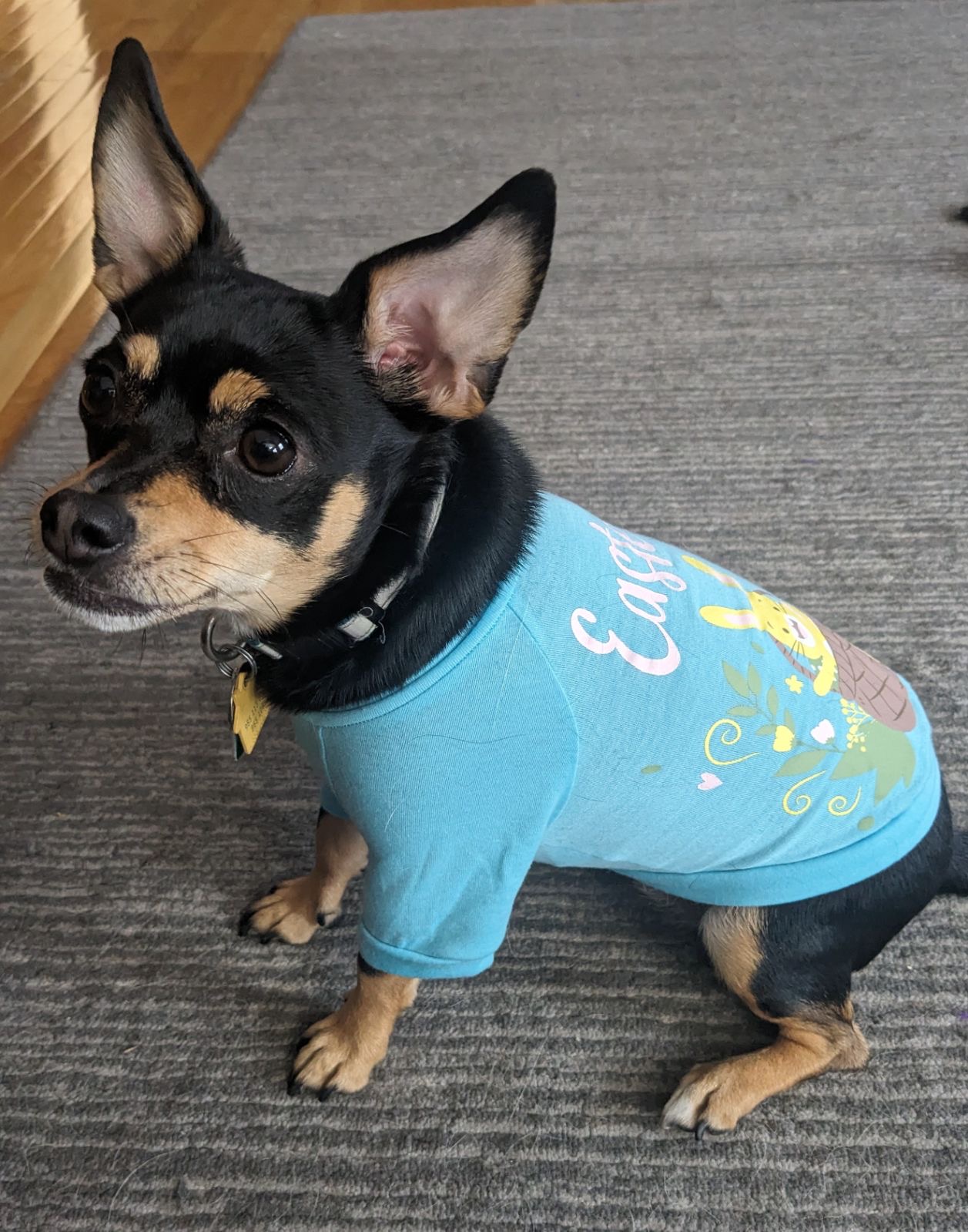
An endearing habit FE had was playing fetch with me. I’d roll up a small sheet of paper and toss it across the floor. Off she would go to retrieve it, bring it back to me, and drop it on the floor. Over and over. I never had the heart to tell her she was behaving like a dog. I’ll end this cat post with a quote from Einstein: There are two means of refuge from the misery of life: music and cats. I’d have to add dogs. They will be featured in our focus series to be posted a week from today.Our daughter’s dog, Rio, dressed up for Easter.
On Thursday, join me as I get kicked out of the first grade for a year! It’s the first chapter in UT-OH!
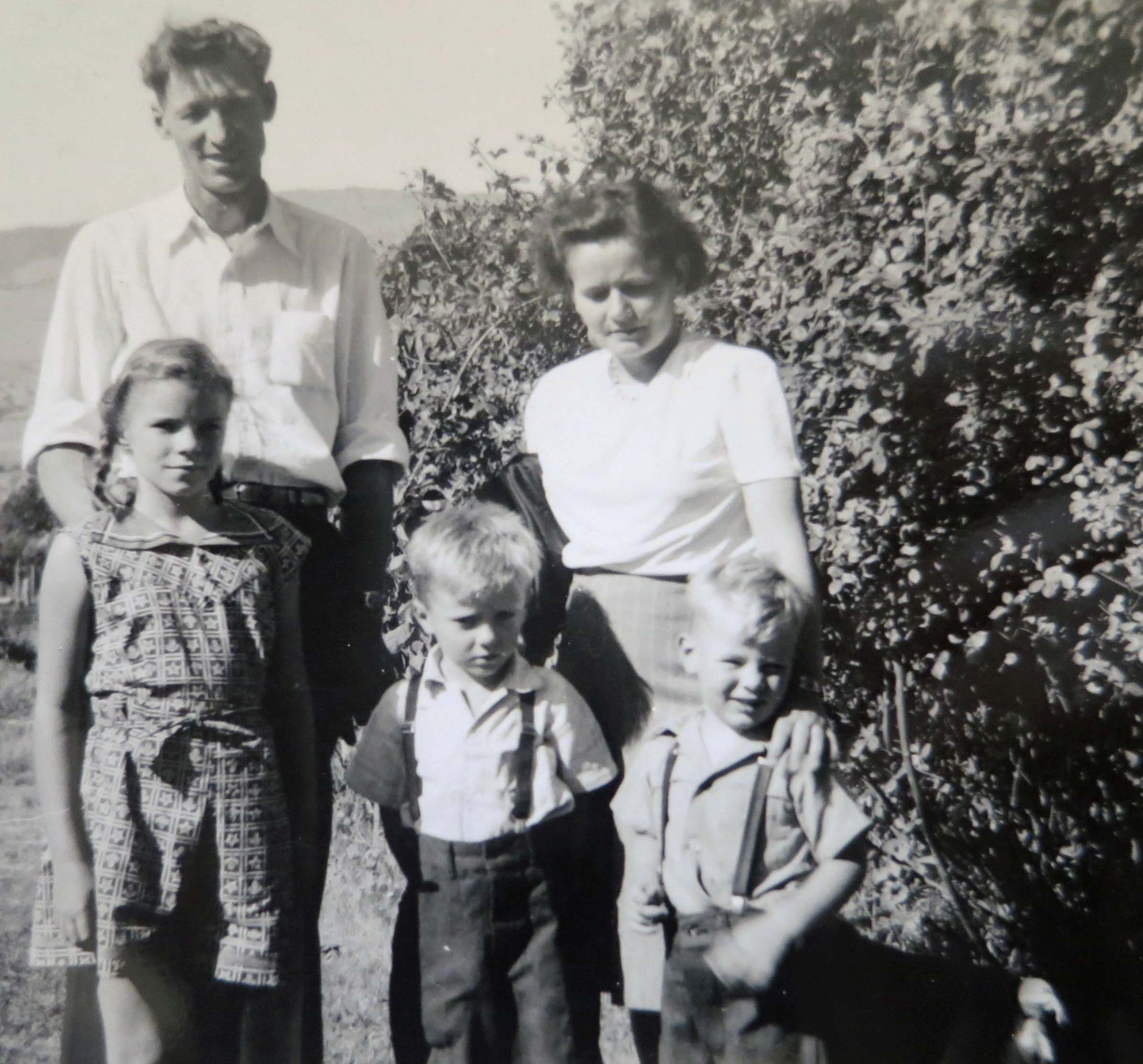
A family portrait taken near Santa Jose, California in 1945. My father, Pop, and my mother, Mother, are in the back. My sister Nancy, brother Marshal and me, the giggling two-year-old, are in the front.
Years that end in three have a special significance to me. They mean another decade has passed. I was born on March 3, 1943. According to the March issue of Life Magazine that year, Americans and Australians were duking it out with the Japanese at the Battle of Bismarck Sea, Westinghouse was firing frozen chickens at airplane windows, and women were wearing bow ties as a fashion statement. None of these events registered on my mind. It was still devoted to getting milk, although, looking back, I would have loved to have witnessed the frozen chicken splat test.
The introduction to my new series is below, but first I want to share a few thoughts in general about UT-OH.
My objective is to relate stories from my past in a memoir format which incorporate— if you’ll pardon the expression— Oh Shit! moments. We all have them, right. My focus will be on such experiences that you laugh about later, not on those you find yourself asking yourself, “Why or why did I do that?” I can haunt myself on those. I don’t need to haunt you.
Second, let’s talk about the name: Ut-Oh. Some of you may look at it and say, “Curt doesn’t know that the proper spelling of Uh-Oh. Maybe I should tell him before he embarrasses himself further.” For the record, I know it’s Uh-Oh, but Ut-Oh is how I pronounced it as a kid and I have every intention of continuing to, no matter how embarrassing. It fits.
Third, a number of these stories I have told in the past in my 15 years of blogging. In fact I even started to organize them once before. I’m doing it again. My apologies to those of you who have already read them. A handful have been with me the whole 15 years. I love you, but a good story deserves to be told over. And there will be new tales!
Finally, there is the issue of accuracy. Peggy read an article recently that stated the older the story from your early childhood, and the more it has been told over the years, the more likely it is to change. Very slightly each time perhaps, but after 75 years? Who knows. Here’s a summary of what AI has to say about it: “Yes, memories from early childhood change over time… reflecting how our brain develops, making narratives richer or more fragmented.” I like richer. Having said that, I’ve tried to make my stories as accurate as possible given my memory and active imagination. Each one actually happened, even if my mind has modified the script, especially from my earliest years.
My intention, assuming I don’t get sidetracked, is to post UT-OH stories on Thursdays and my normal travel blog and focus stories on Mondays.
UT-OH! ANINTRODUCTION
We all have Ut-Oh moments where things don’t go according to plan. Most are relatively minor, like spilling a bowl of spaghetti in your lap when you are having lunch with your future mother-in-law (first marriage). Minor, perhaps, but it’s better if she does the spilling. Either way, it’s an ut-oh in small letters unless your sense of humor (or hers) is out of whack. Even then, it has the potential for making a good story.
In this book, I am mainly talking about larger Ut-Ohs, even all cap UT-OHs— like the time a group of murderers, kidnappers, bank robbers, and Patty Hearst got stuck in a snowbank next to me on a remote mountain road in the Sierra Nevada Mountains. They were out practicing with their automatic weapons, apparently preparing to rob a Sacramento bank.
UT-OH is full of such tales. Most take place in the outdoors. How could it be otherwise given that I’ve spent over 77 years of my life wandering in the woods. I started when I was five by exploring the jungle-like graveyard next to my house. (I’d been kicked out of the first grade for a year.) At 75 I was backpacking 750 miles down the Pacific Crest Trail to celebrate my birthday. Now in my 80s, the adventures continue— as do the Ut-Ohs.
I know what it’s like to be stalked by a grizzly bear in Alaska, charged by a herd of elk in New Mexico, and attacked by army ants in Africa. Once, a rattlesnake tried to bite me on the naked butt. I hadn’t seen it slither into a cat-hole I had dug for bathroom duty in the woods and I’d almost pooped on him. Fortunately for both of us, he had rattled his displeasure as my rear loomed above him.
There are lessons to be learned in this book. Checking your cat-hole for rattlesnakes is one of many. For example:
You should sleep with your shoes in the sleeping bag when you are snow camping in minus 30° F weather at Denali National Park. Toasty warm toes do not appreciate being shoved into solidly frozen shoes.
Screaming loudly may dislodge a bear when you wake up at 4 AM with one standing on top of you.
It’s best to be in shape before venturing out on a solo 10,000 mile bicycle journey around North America. Boy did I pay for that. Did you know that having calluses in your crotch is an important part of preparing for a long distance bike trip?
And finally, I recommend you have more than a 20 mile backpacking trip behind you before you decide you are qualified to lead 60 people, aged 11-70, on a hundred mile backpack trip across California’s Sierra Nevada Mountain Range. The learning curve was straight up that time— for nine days in a row.
But hey, I’m a man who has been carrying a horse bone with him as a traveling companion for 48 years. What could possibly go wrong? Join me next Thursday as I get kicked out of the First Grade and learn that the graveyard next door is a very scary place at night.
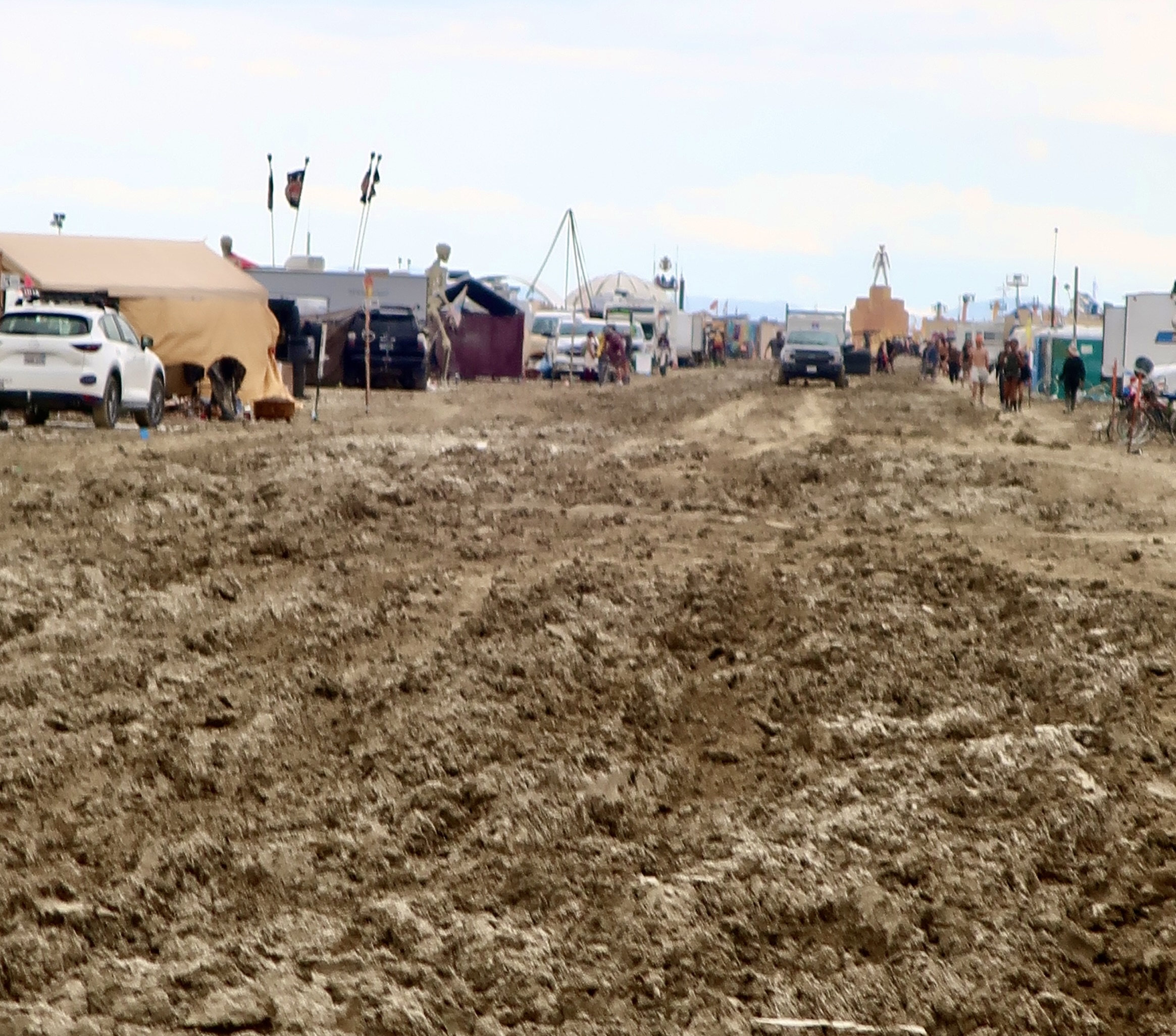
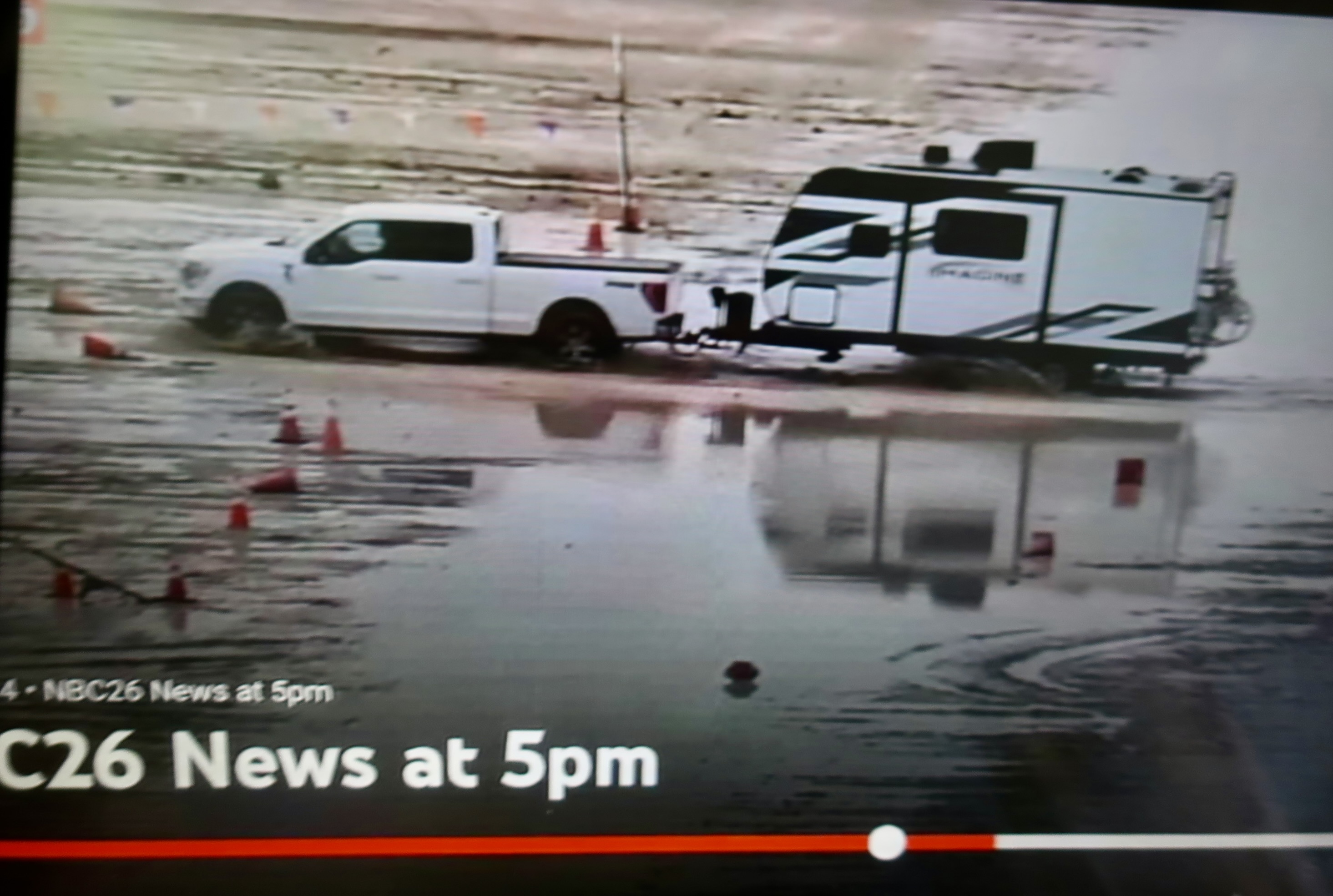
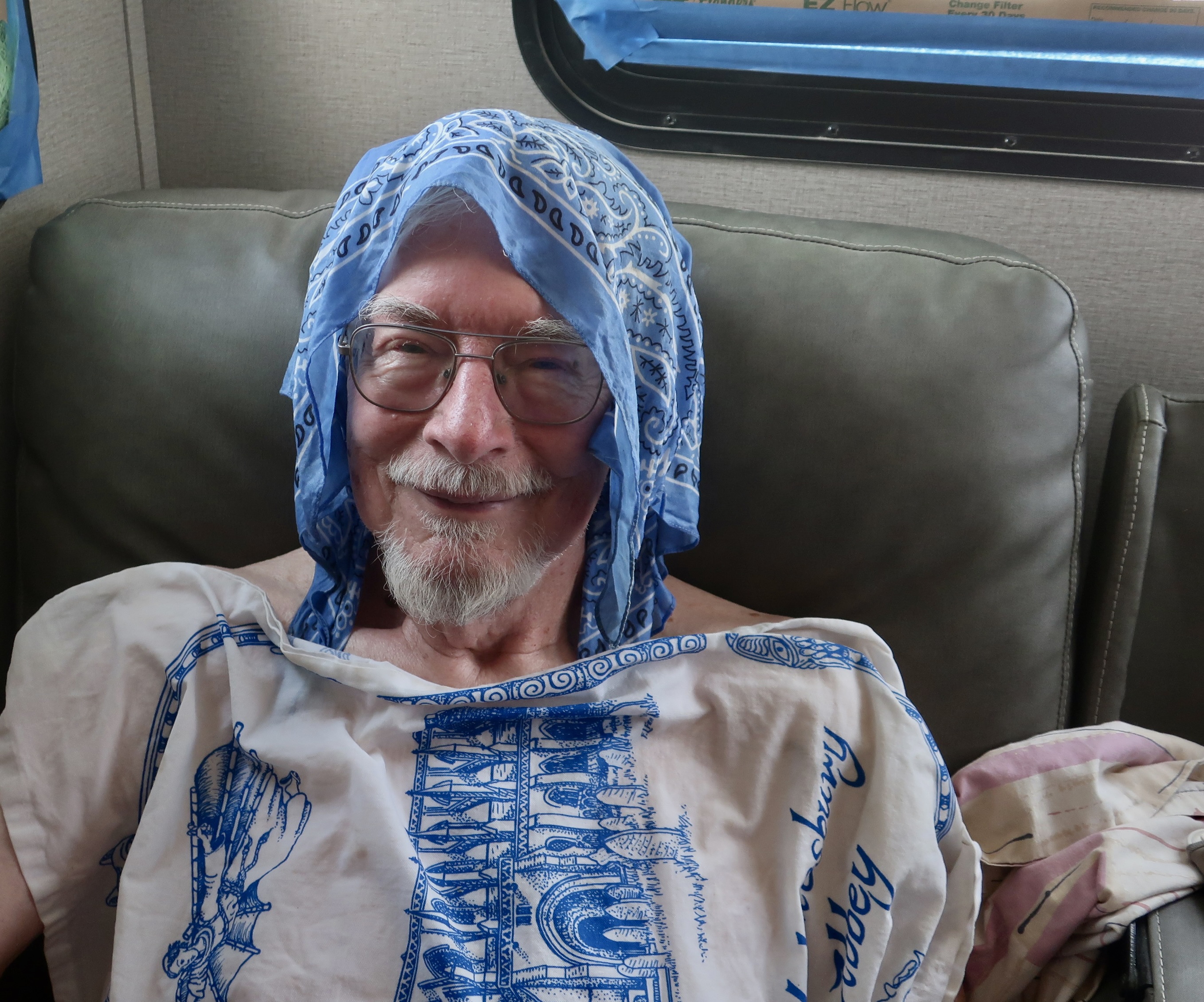
Bone at Burning Man in 2023. He’s been there 10 times with me, starting in 2004. Here he is making a sacrificial offering to the Rain Gods: Not to make rain start. But to make it stop!Everything had come to a dead halt, mired in mud. The porta-potties were overflowing and nobody was going anywhere. It was scary— a hair raising, nail biting experience. UT-OH!We lucked out. A Ranger told me we could leave, given our powerful 4-wheel drive F150 complete with a special mud and ruts drive mode. Off we went, merrily fish tailing along while pulling our small Imagine trailer. Bone sat up on our dashboard, supposedly guiding us. He was covering his eyes instead. We were out in 20 minutes. A television camera caught us escaping and the video was shown nationally. When the Burners were finally released to leave the next day, it took up to 14 hours to get out.Peggy found this photo of us escaping on an Imagine Trailer Facebook page.I mentioned that you would learn things in this series. Here’s one way of keeping cool when you find yourself at Burning Man and the temperature has climbed over 100° F, dust storms are whipping across the Playa, and you don’t have air conditioning. Settle into your vehicle, take your clothes off, and cover your body in wet dish towels. In no time, you will be grinning like me. That’s it for today. Join me on Monday for our post on “Cats of the World.”From a mural at the 2023 Burning Man.
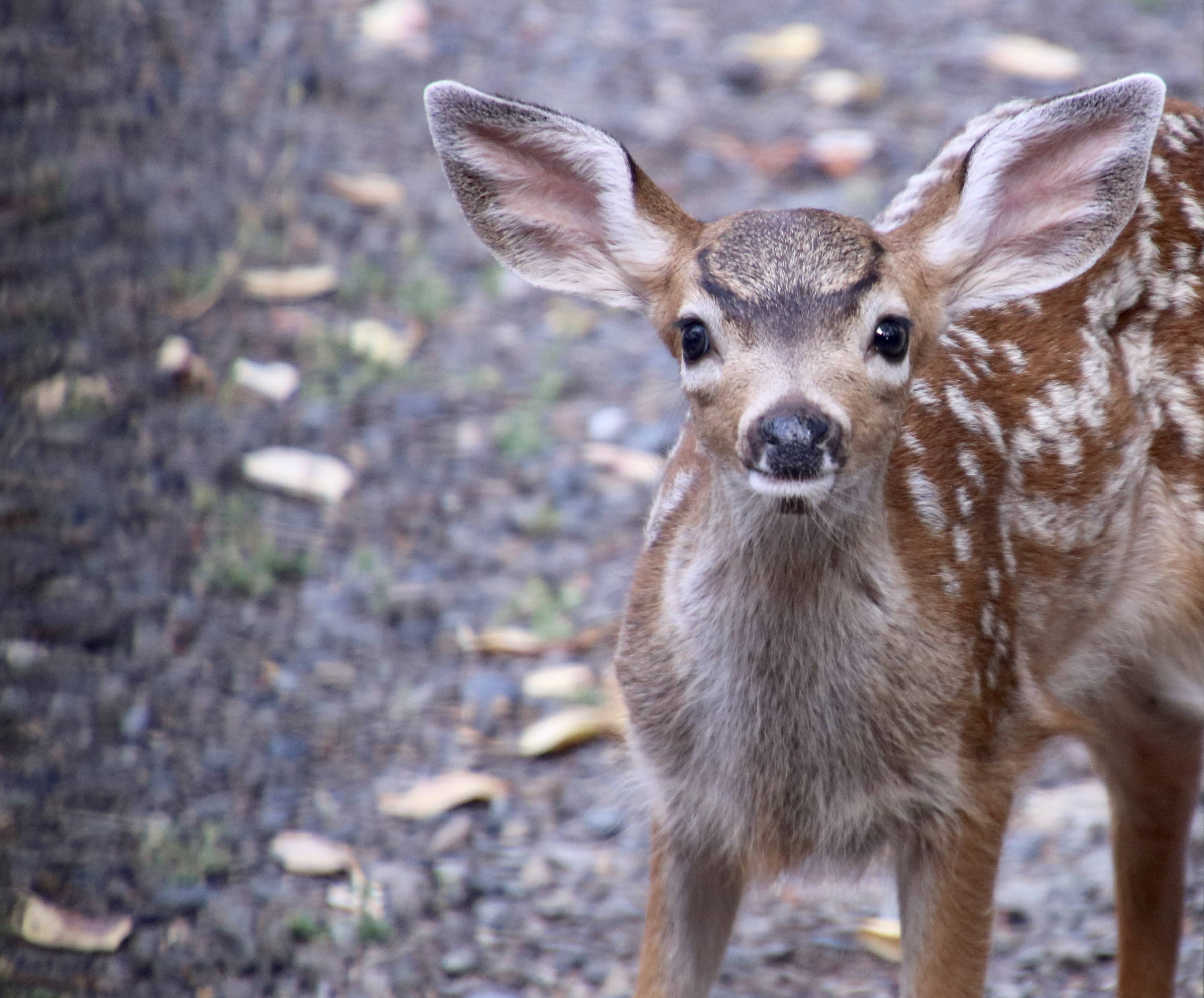
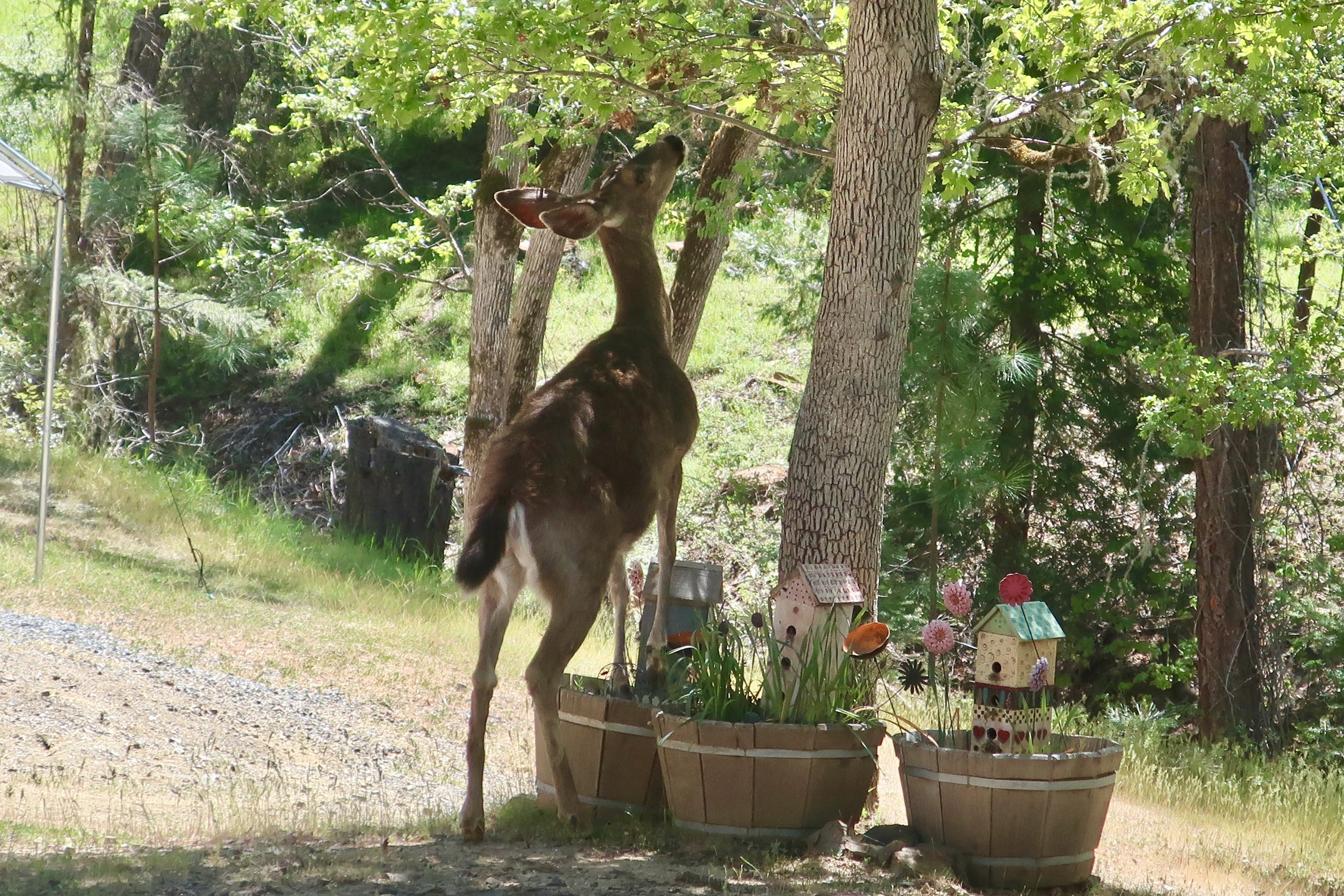
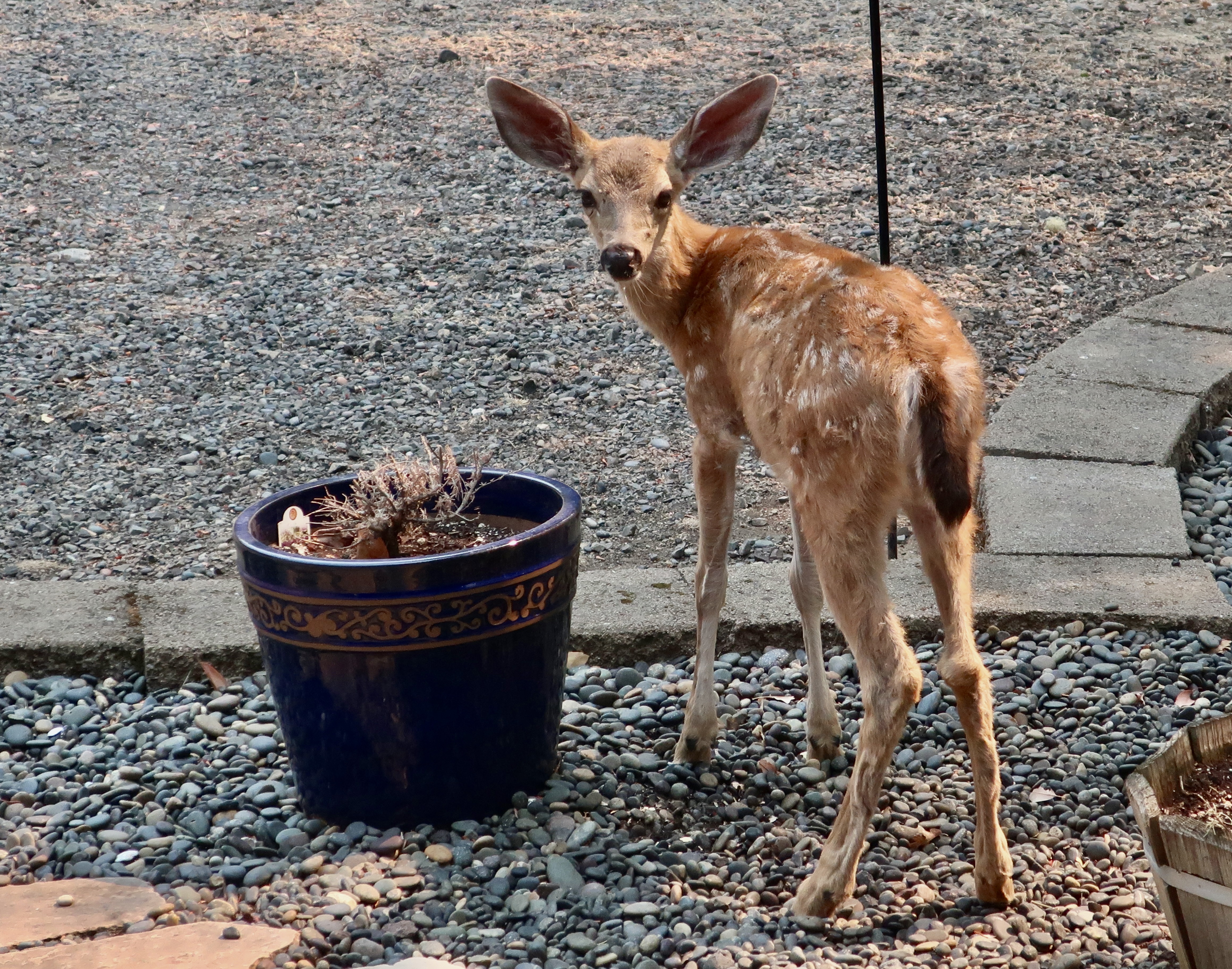
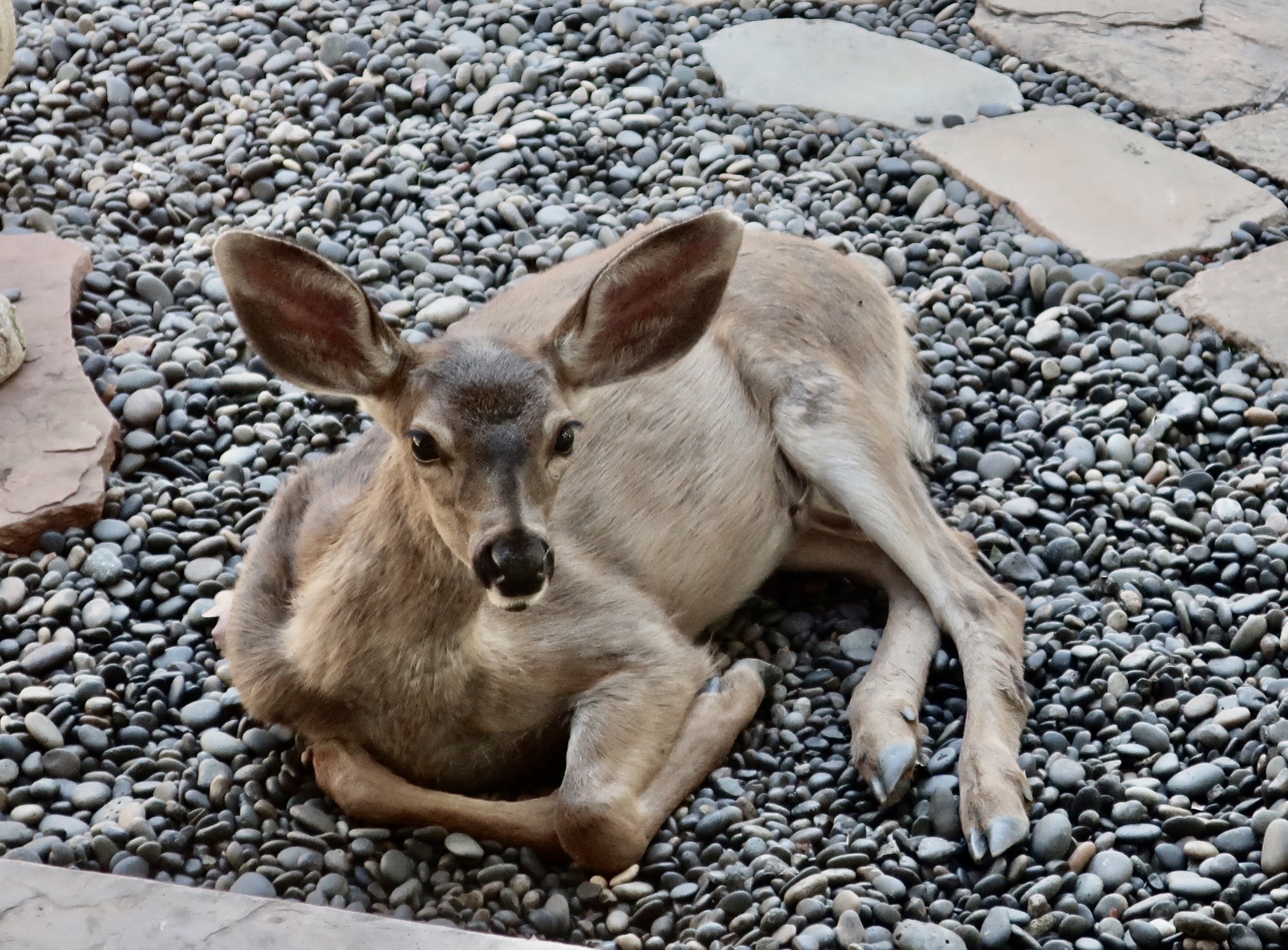
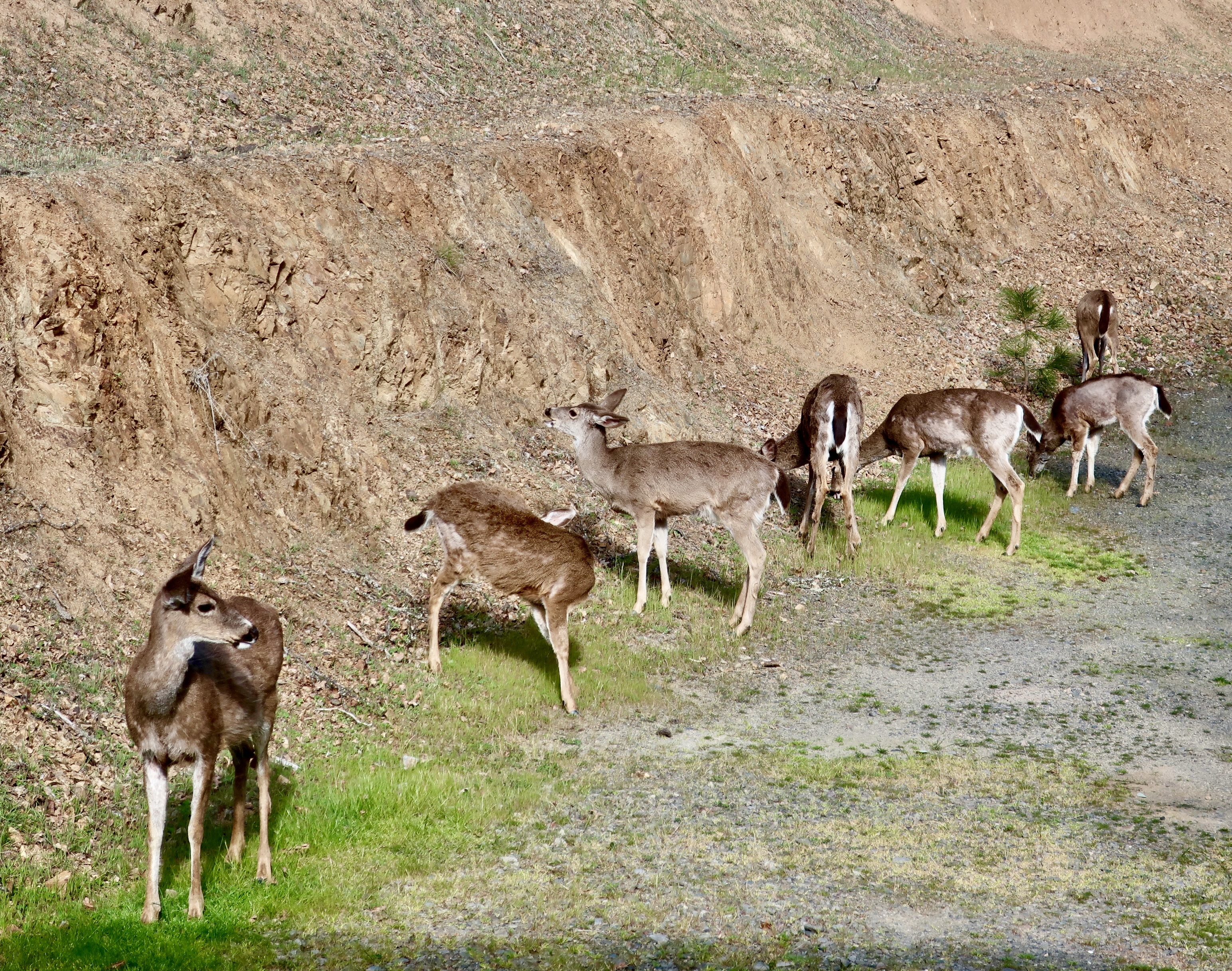
Today’s post on deer is part of our focus series where I make use of our extensive photo library to feature a single subject. From 2011 to 2021 we lived in Southern Oregon up in the mountains about 30 miles west of Ashland on five acres that backed up to a million acres of national forest. There were many things that we loved about the property. The deer herd that insisted on calling it home was a big one!
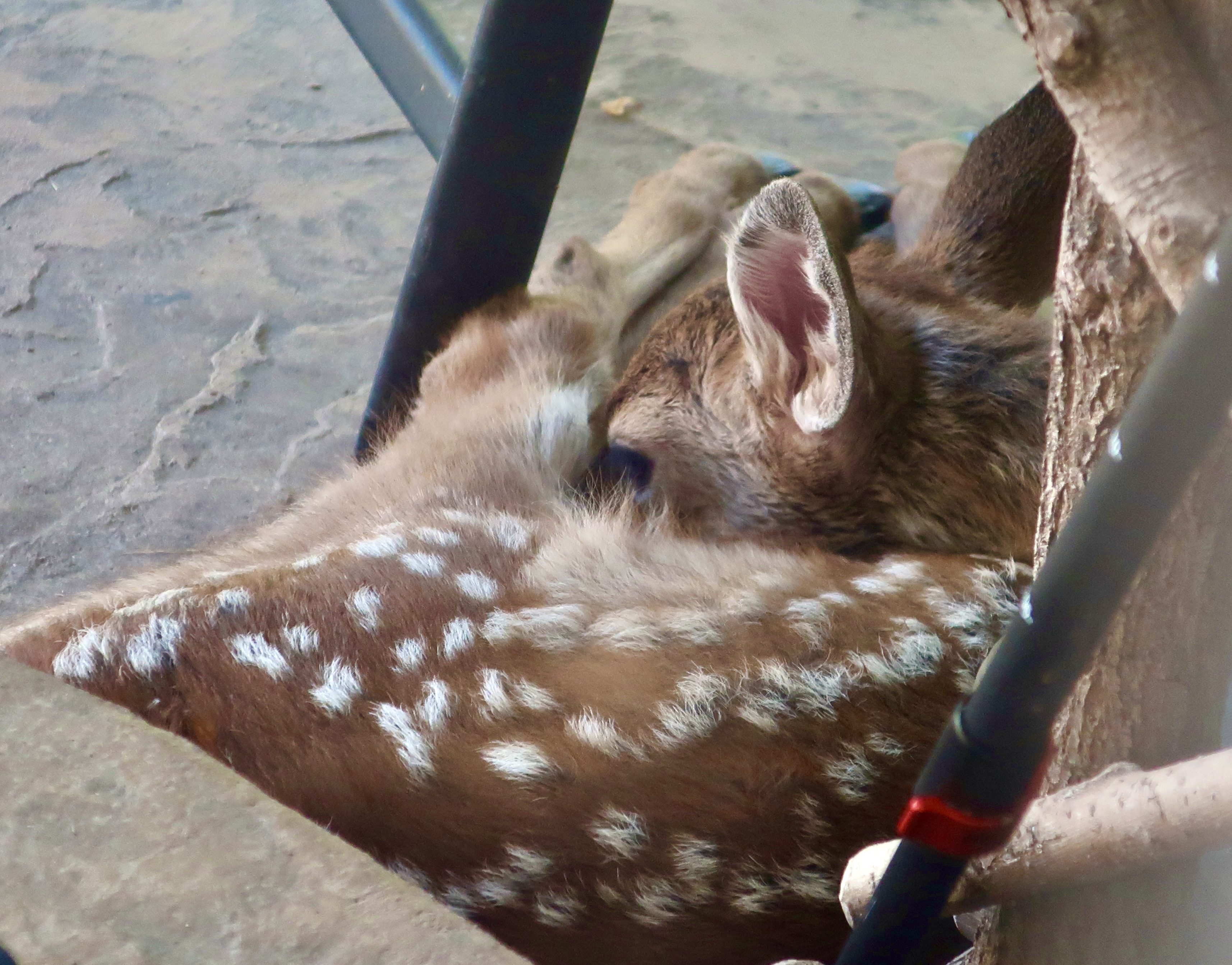
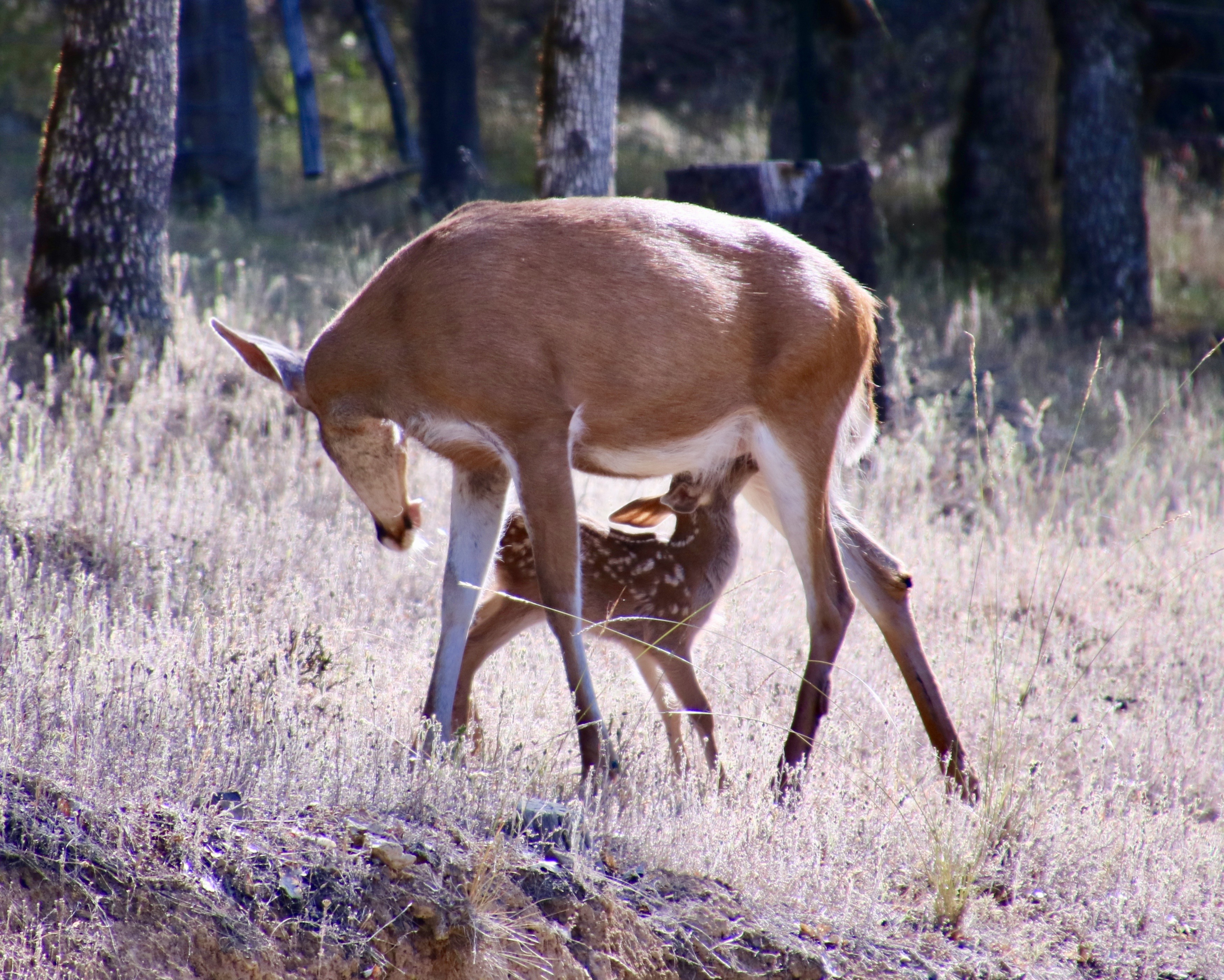
I walked out my door one June day and found this fawn napping next to our doorstep. It was wedged in between the step, a chair, my walking stick, and a natural wood shelf we used for our shoes. One eye was checking me out but it obviously wasn’t worried about my presence. In its short life, it had determined that I was harmless and might indeed be helpful. Mom wasn’t worrying either. She was out browsing (eating) while her baby was sleeping. Our house and yard served as a safety zone for the herd and the cement porch was apparently the safest place in the yard, considering how often it was used as a day bed. Hunters weren’t allowed on our property and natural predators of the deer such as bears and cougars tended to avoid it— for the most part.This was the first time we saw this youngster. Mom was performing some hygiene with her tongue while the baby ate. Grooming is common among deer and is one way they maintain close ties. We’ve watched adult deer simultaneously groom each other.
Fawns on our property were normally born in April or May, hidden away by the doe, and sternly instructed to stay put and not move when she was away eating for the first 2-3 weeks. The spots they are born with serve as natural camouflage making the fawns extremely difficult to see. They are also scentless when born, making them impossible to smell.
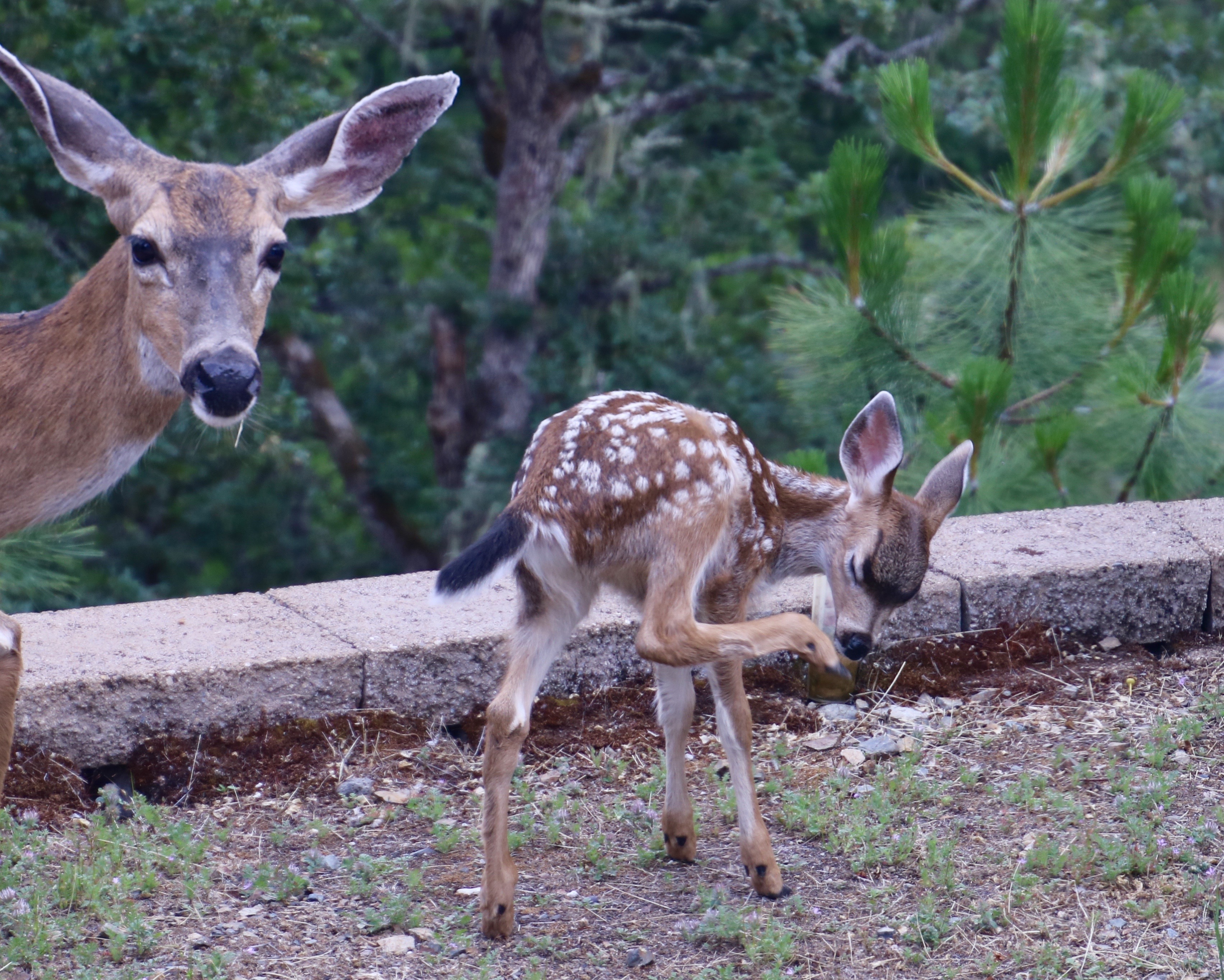
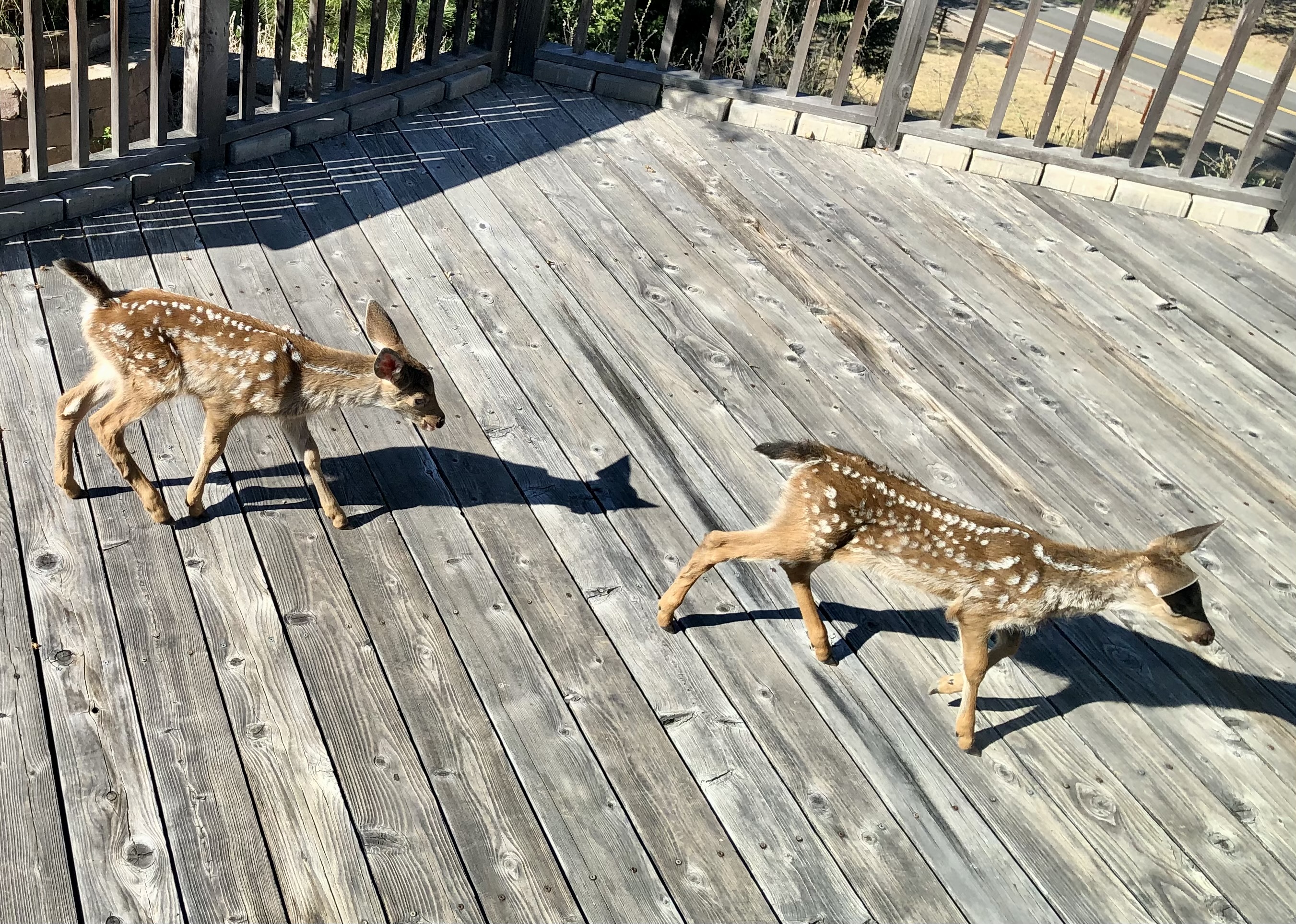
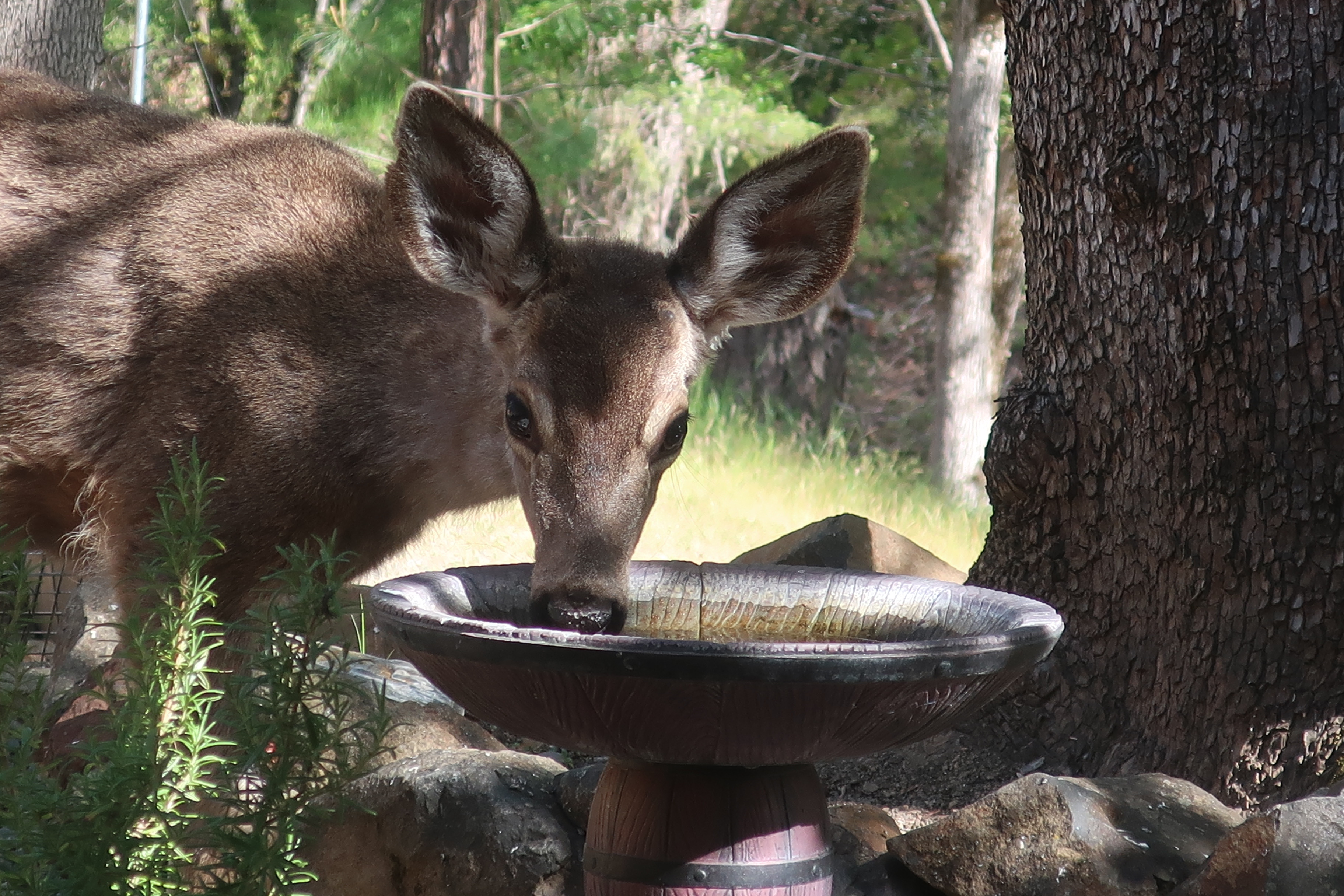
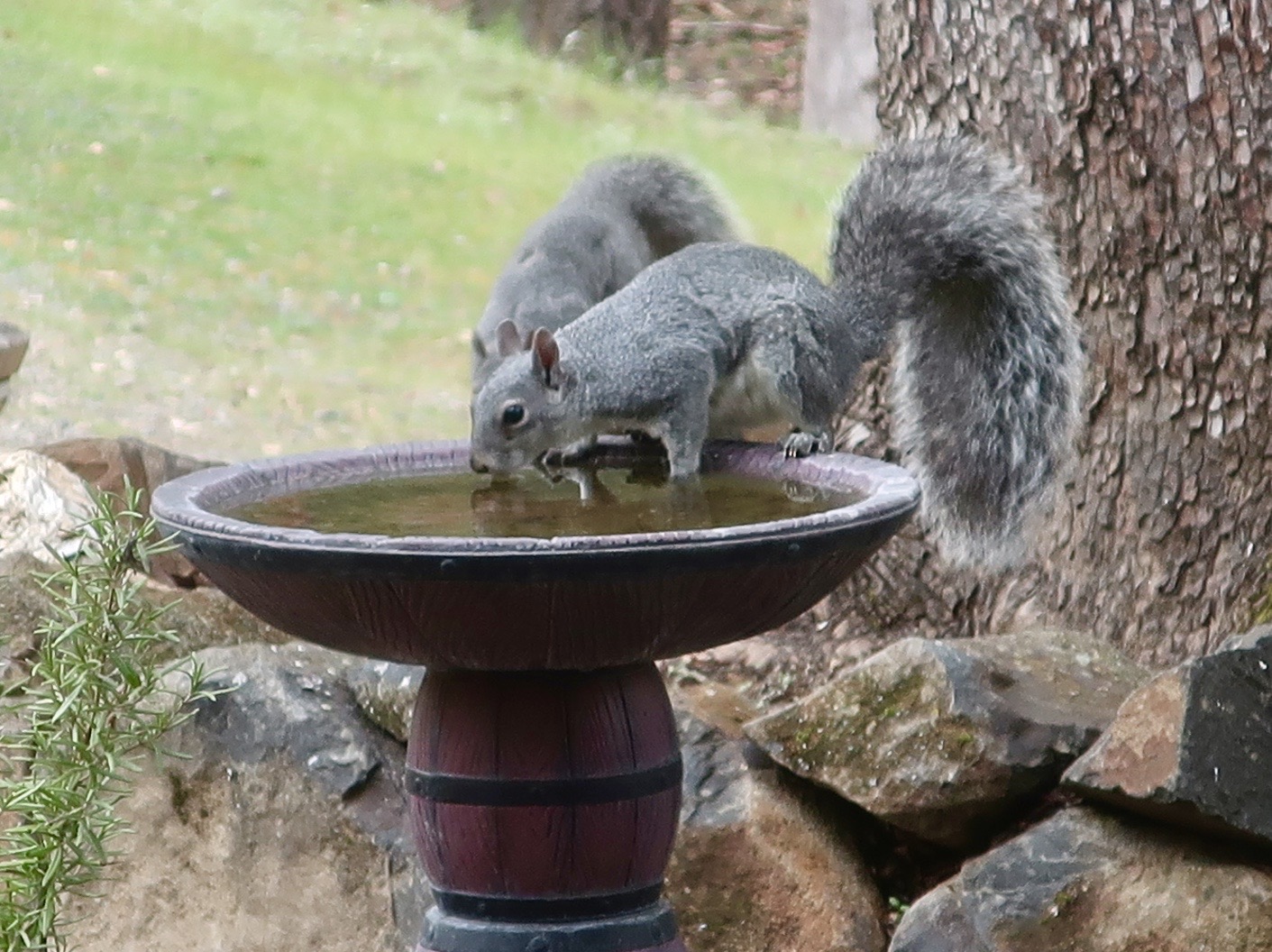
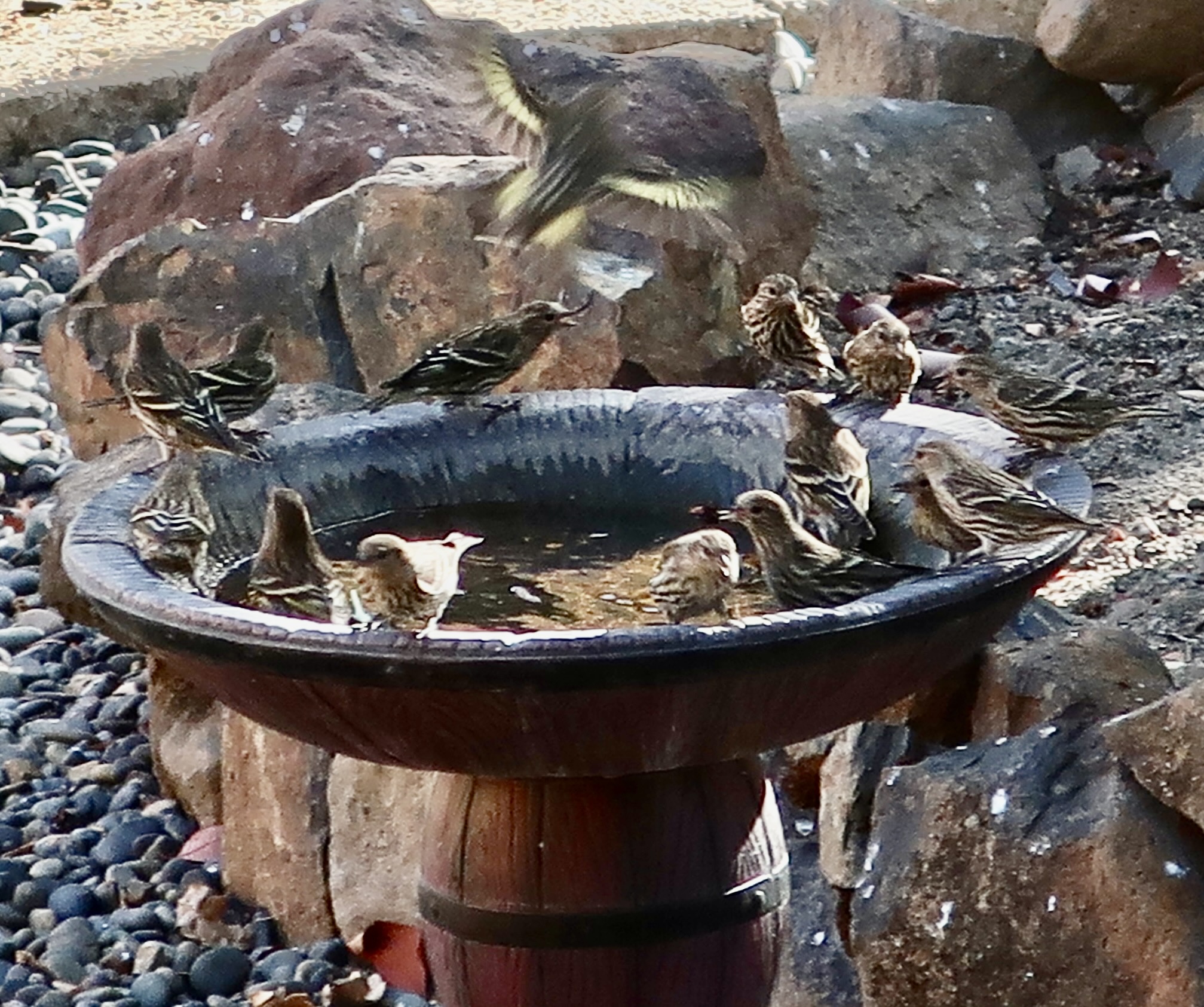
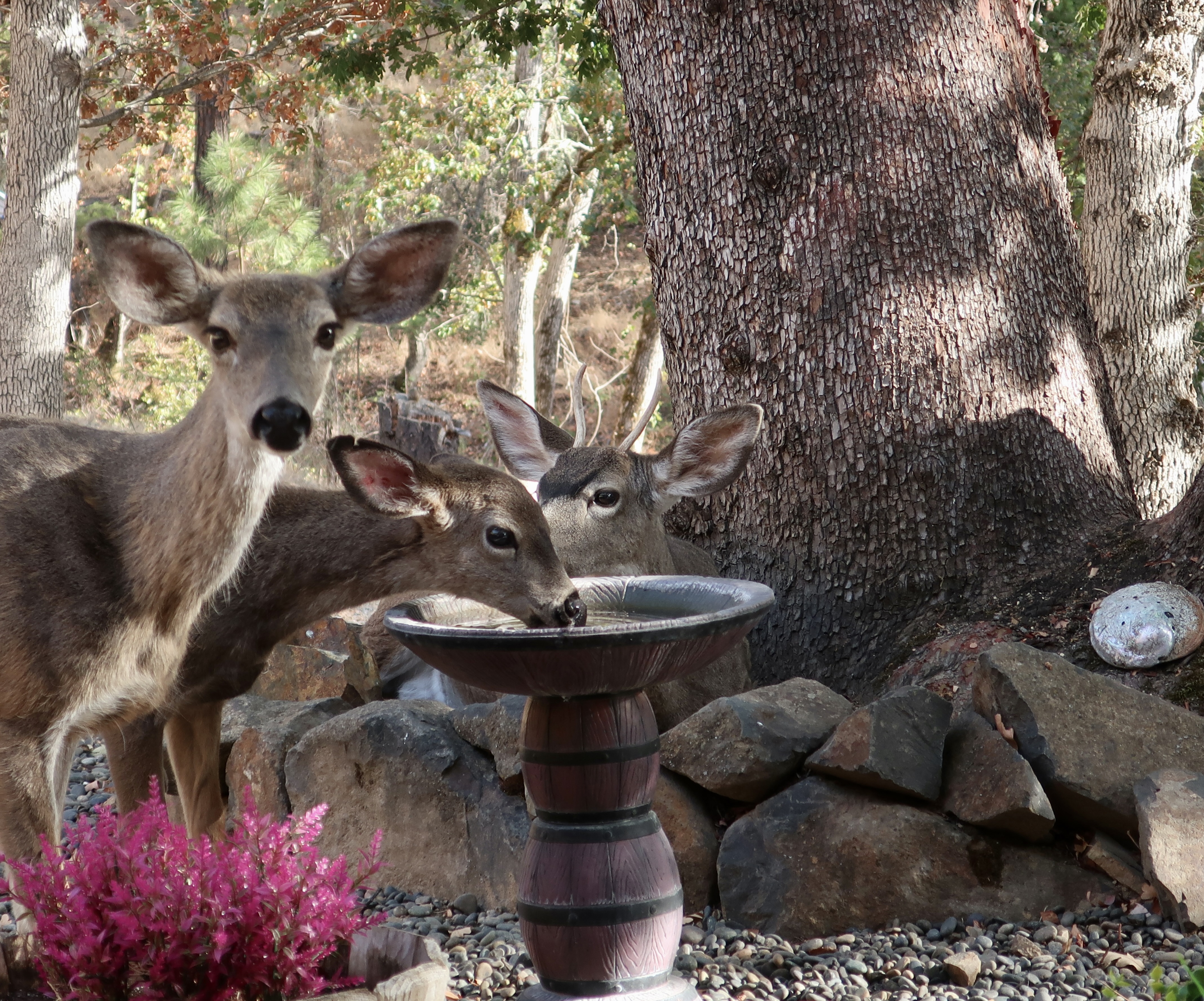
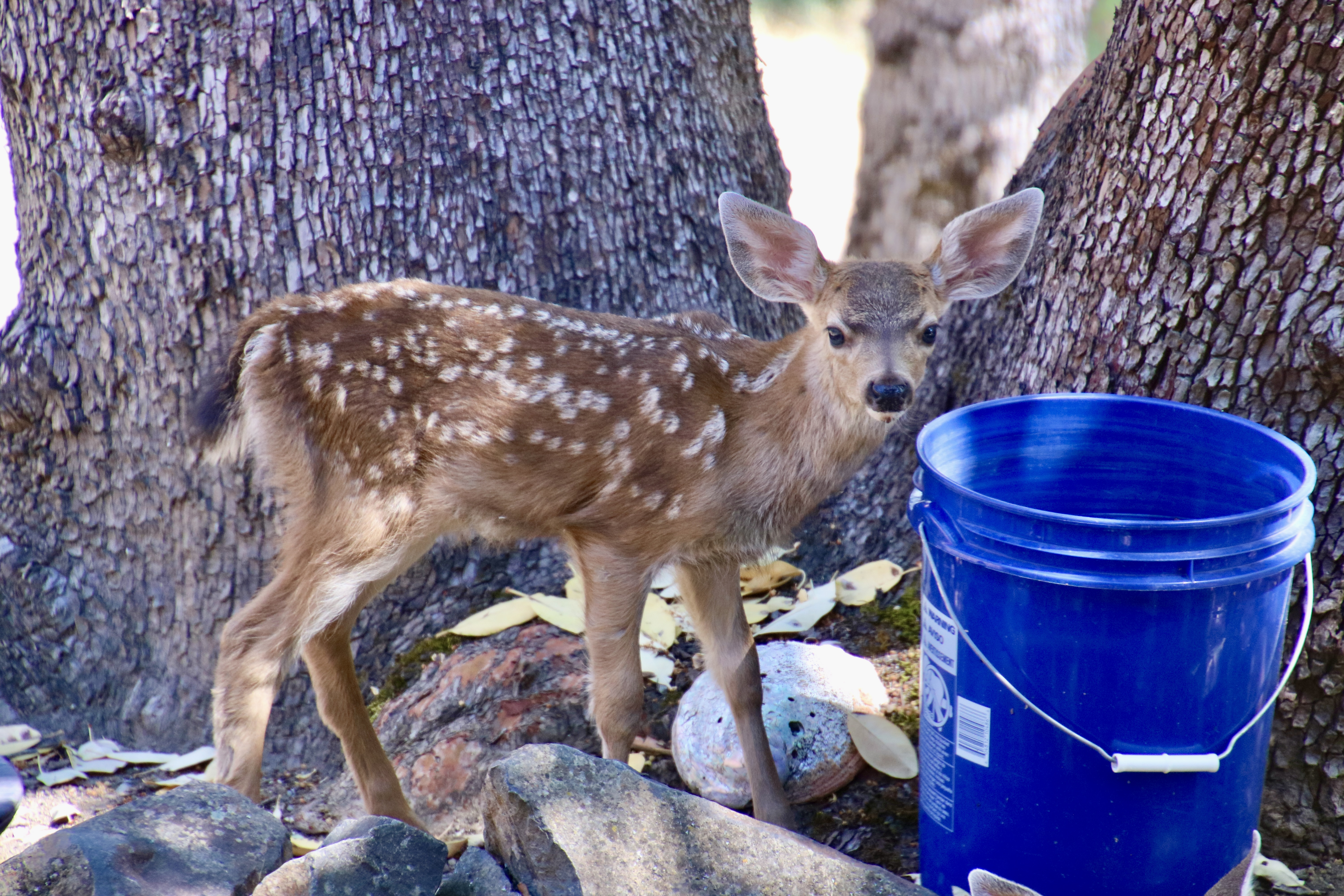
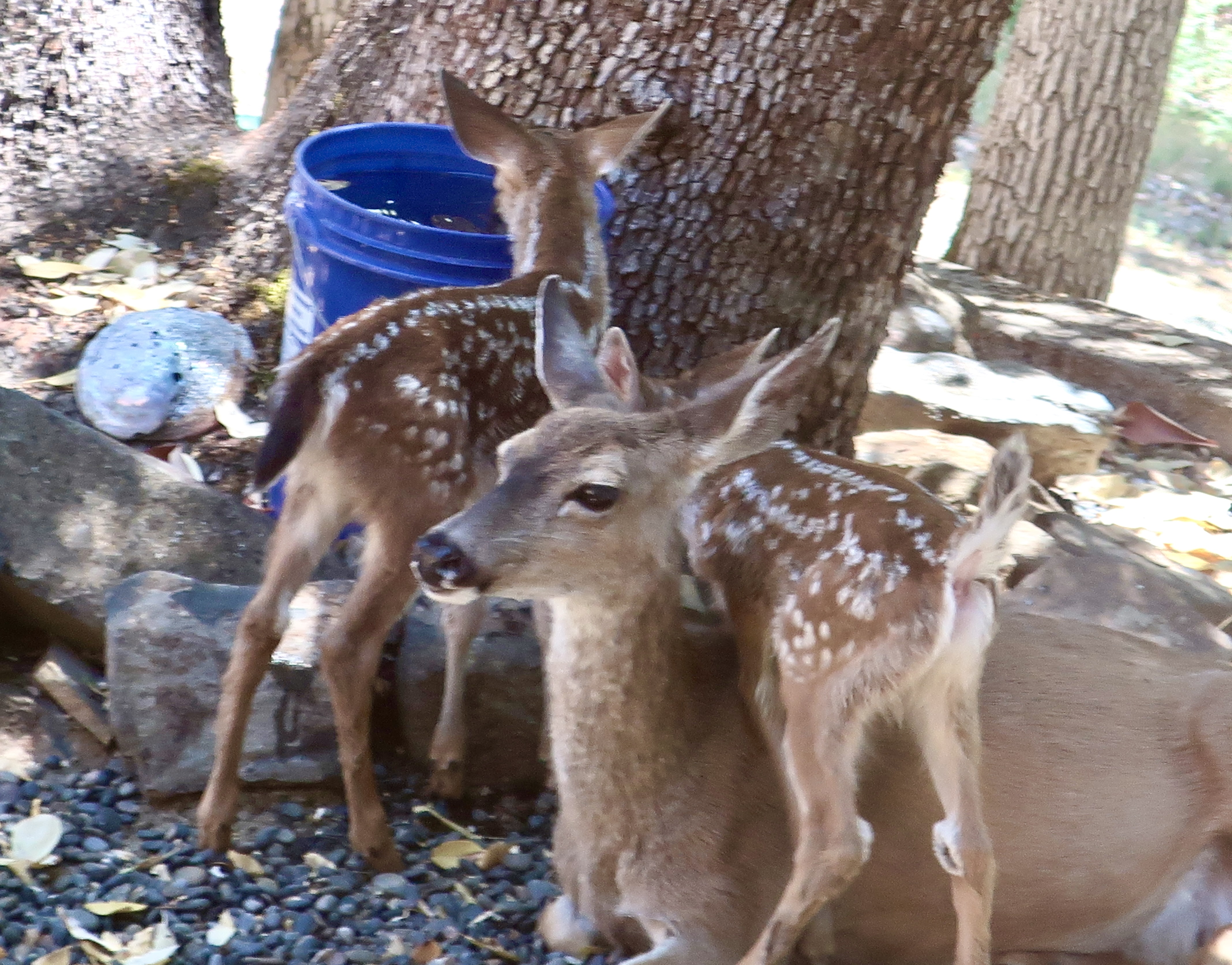
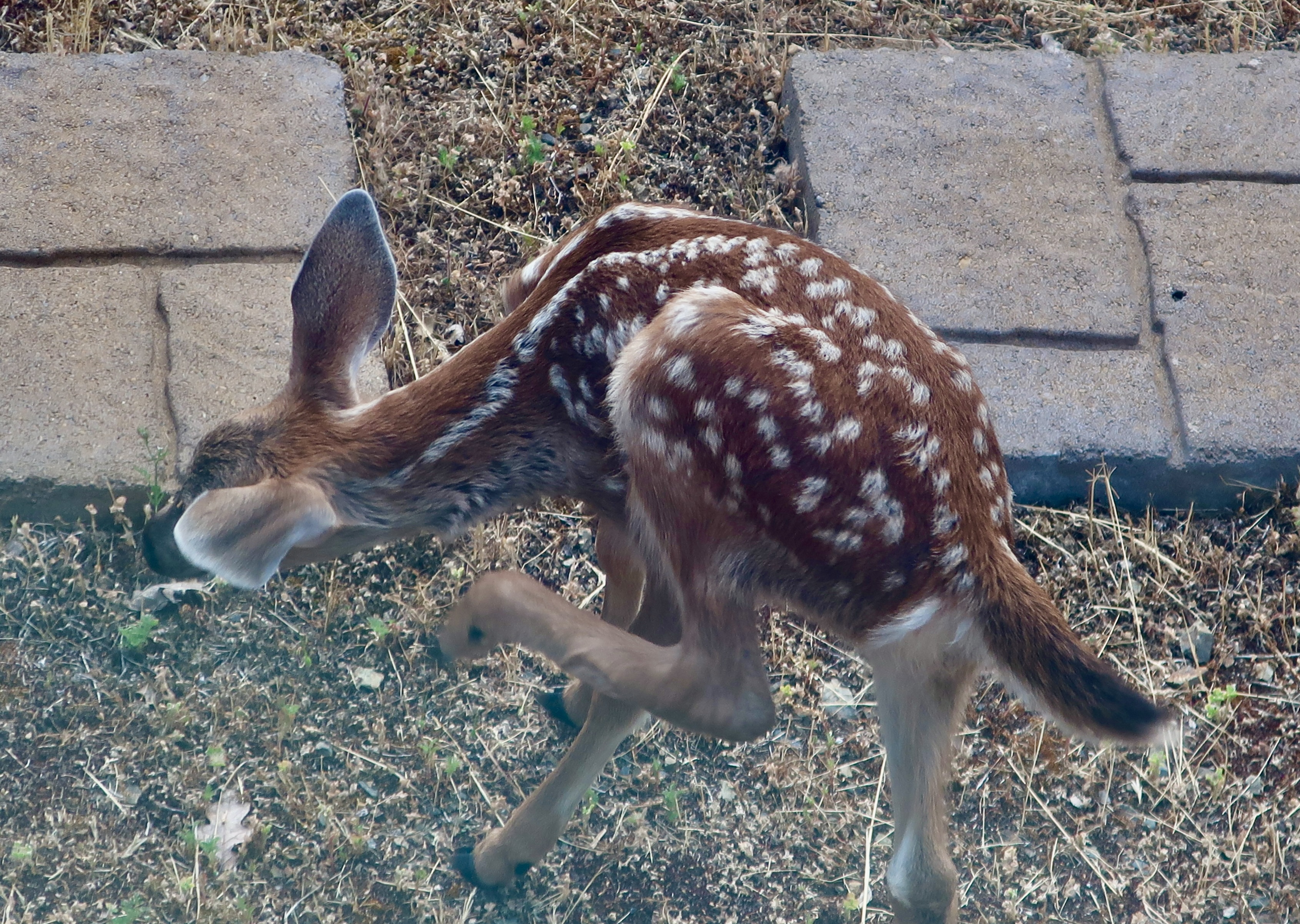
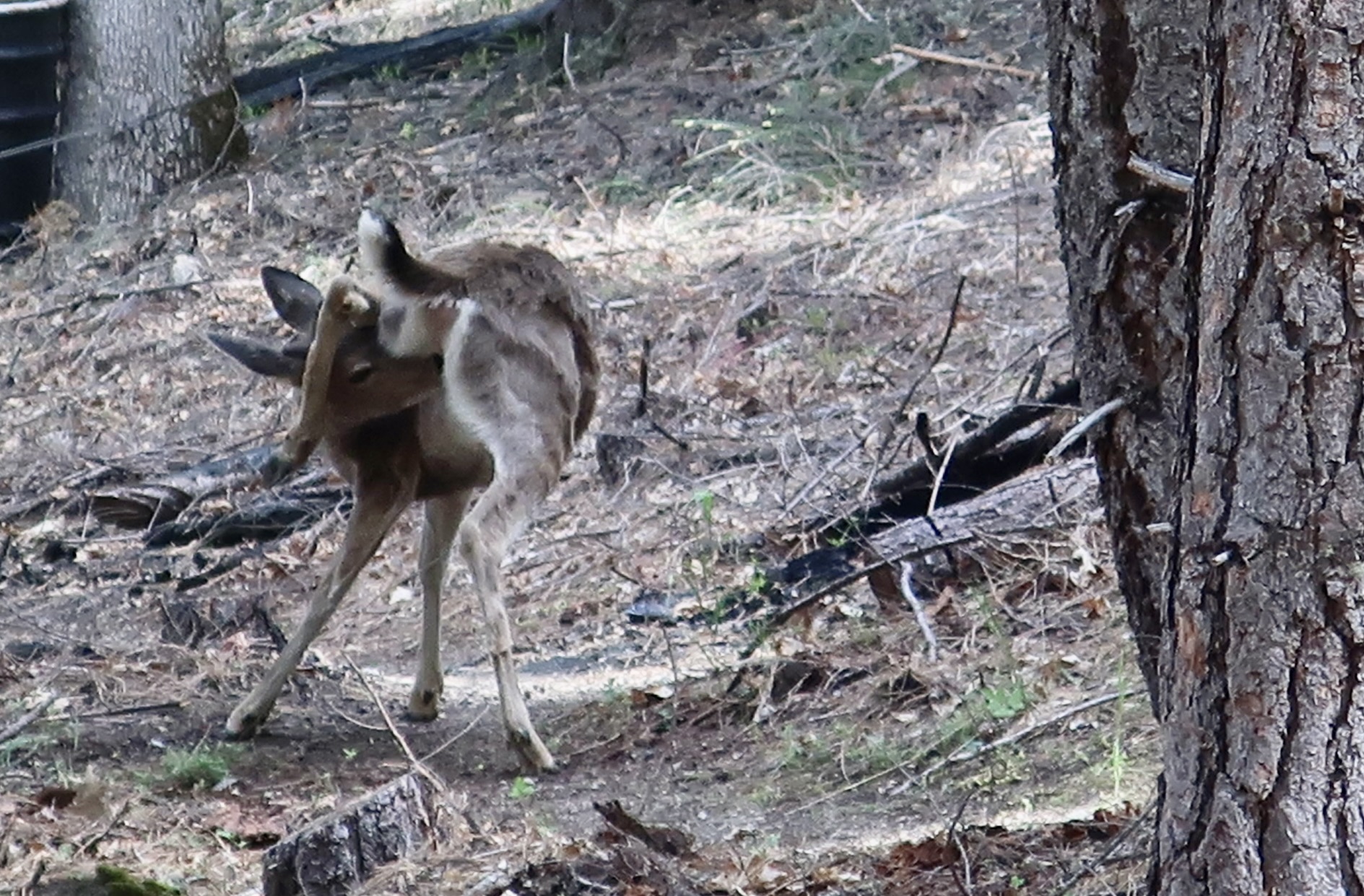
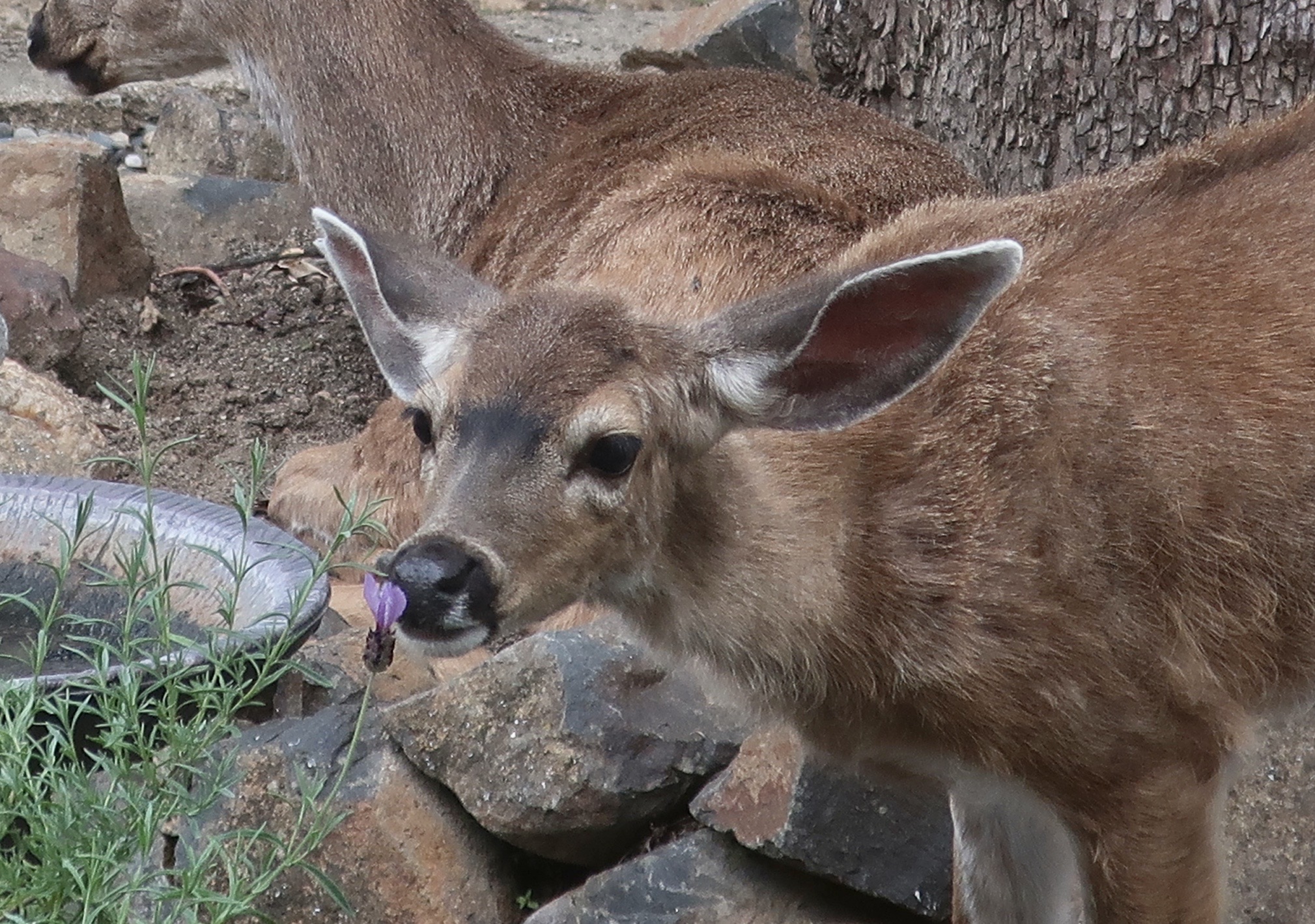
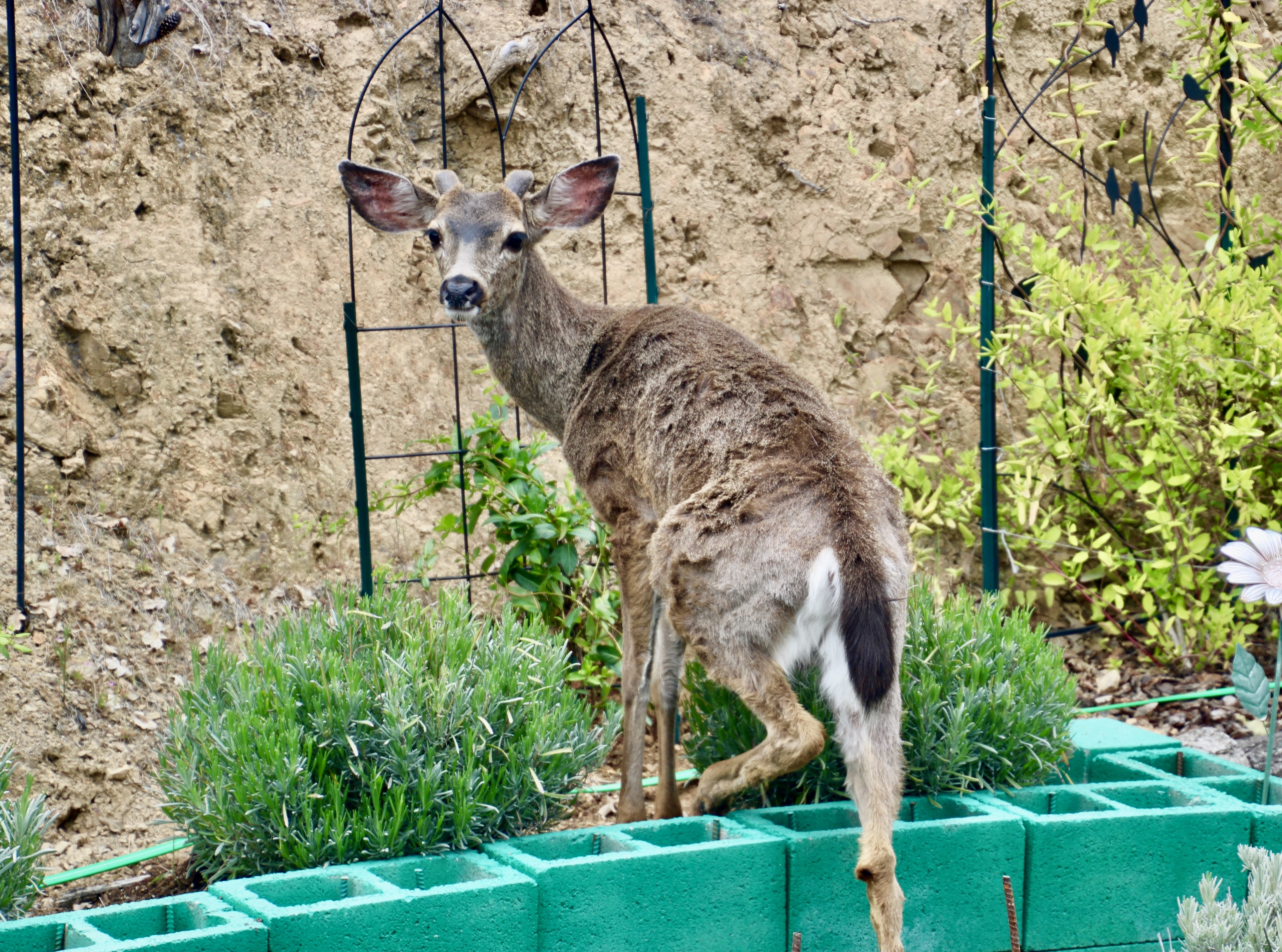
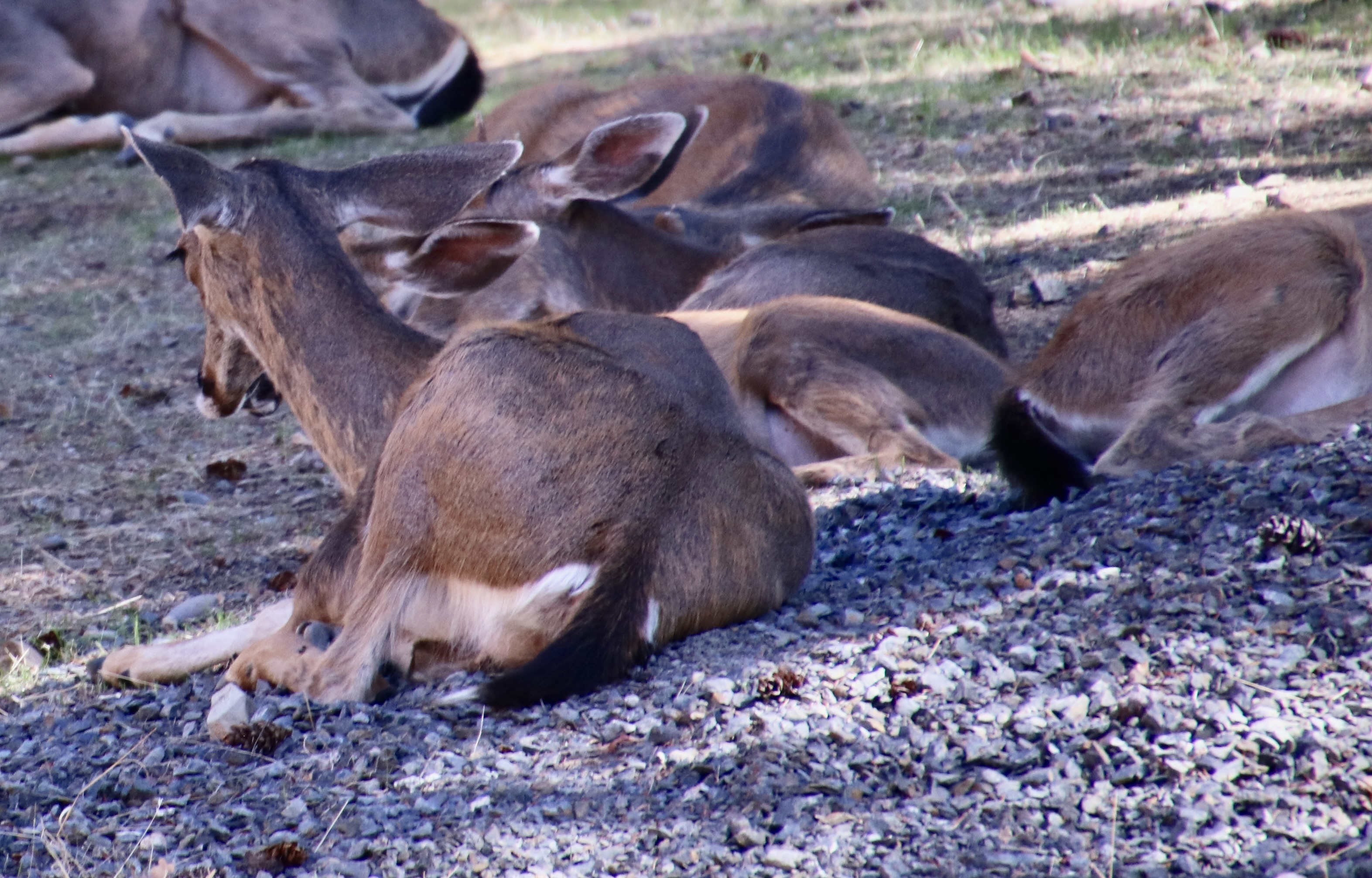
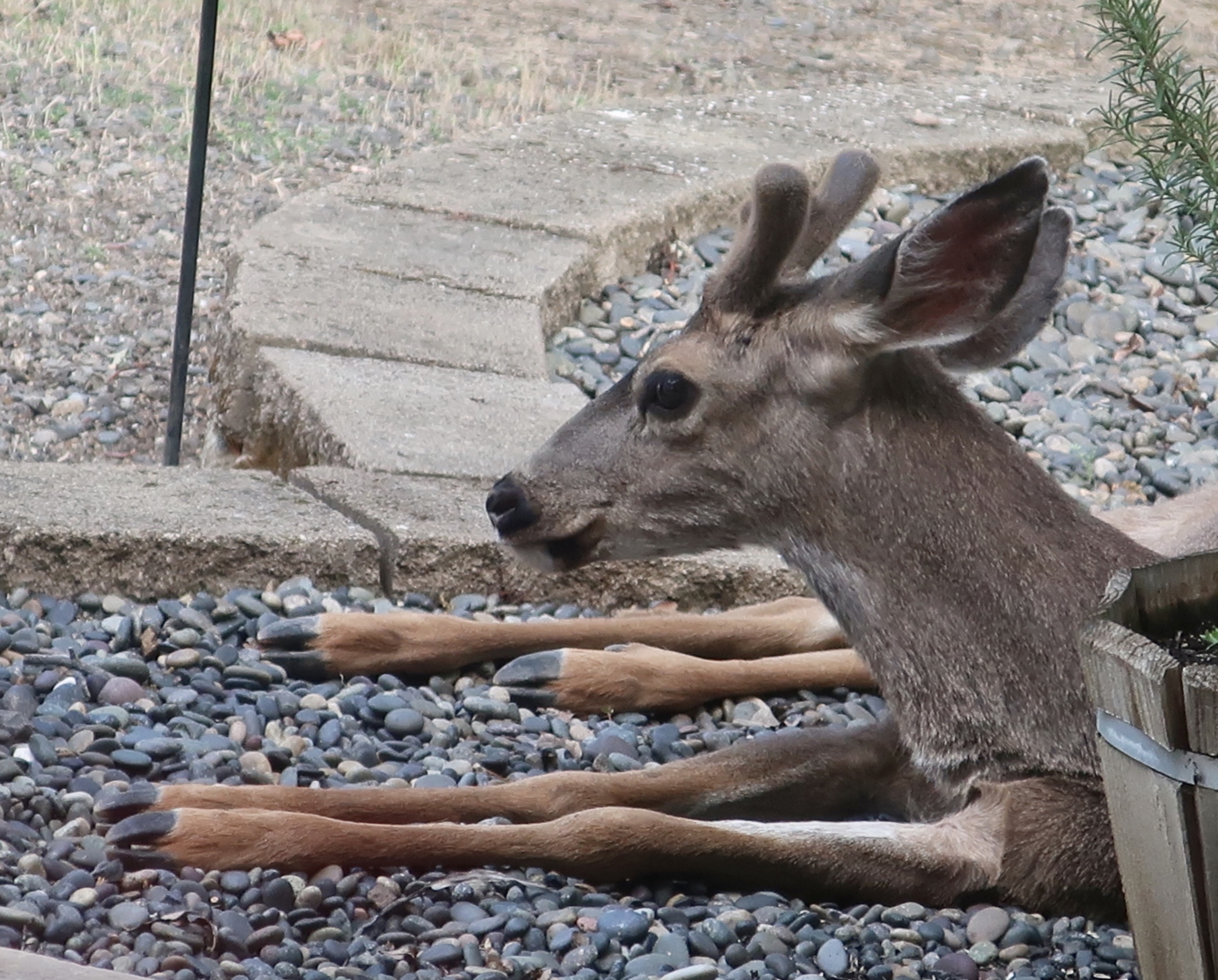
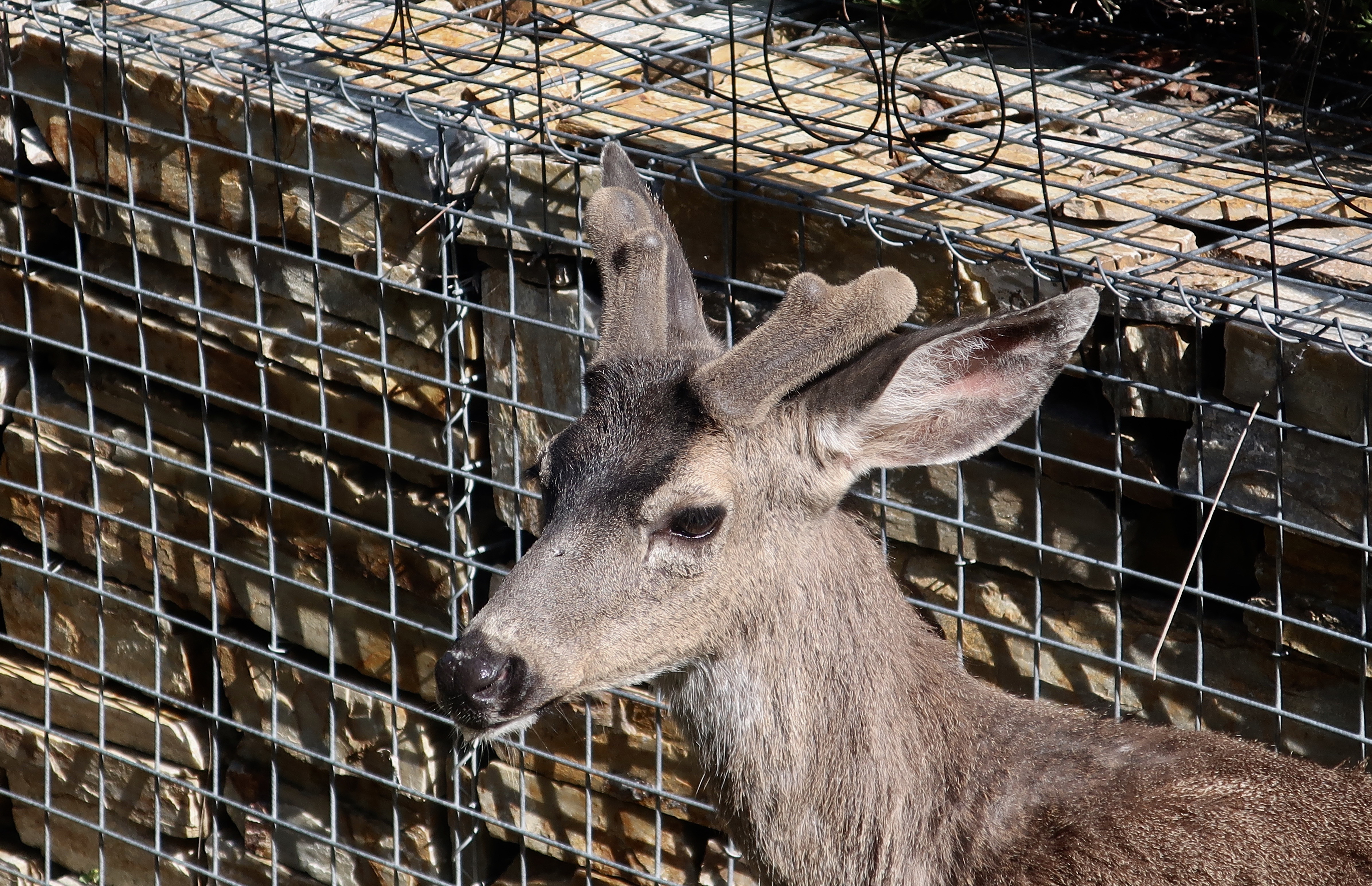
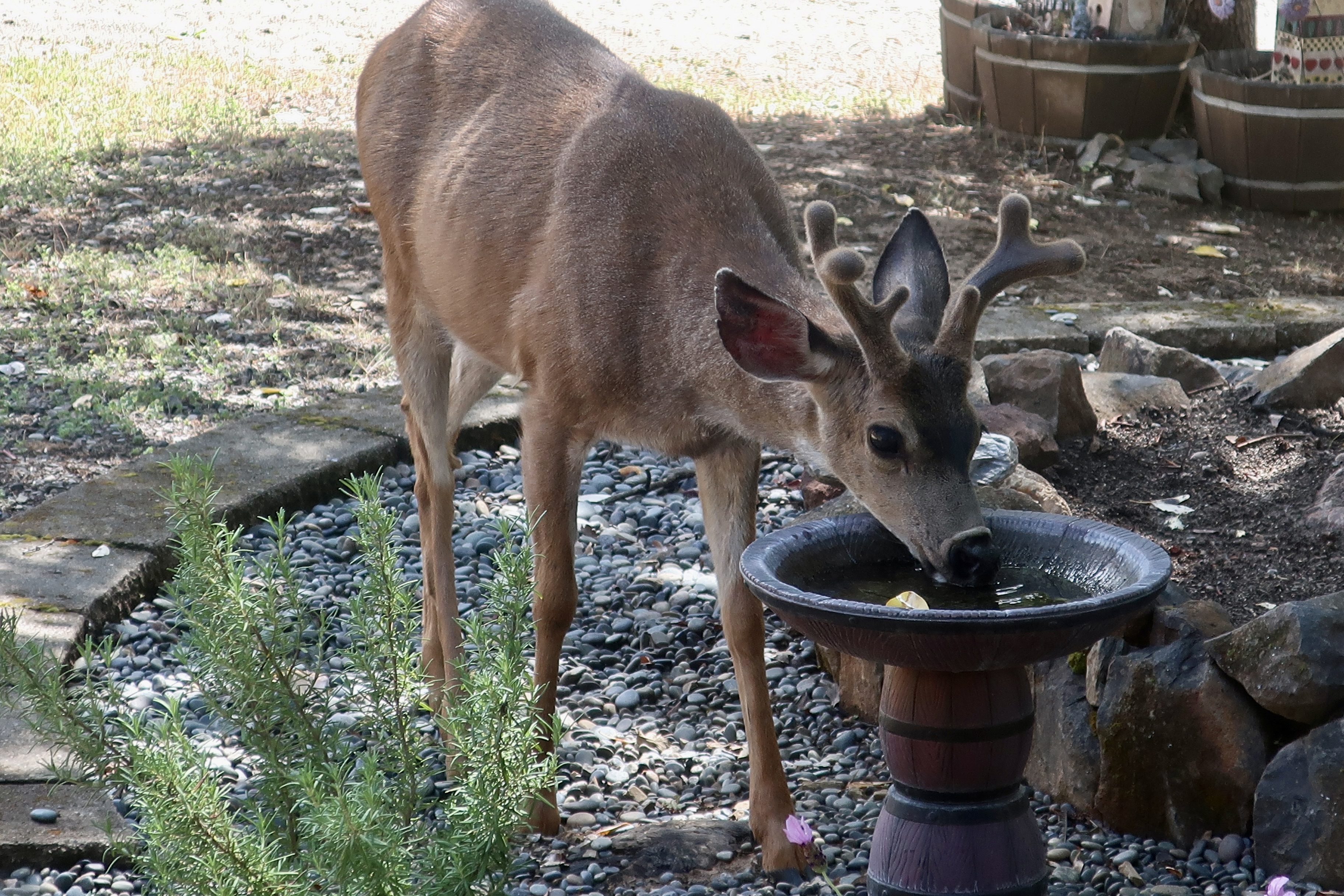
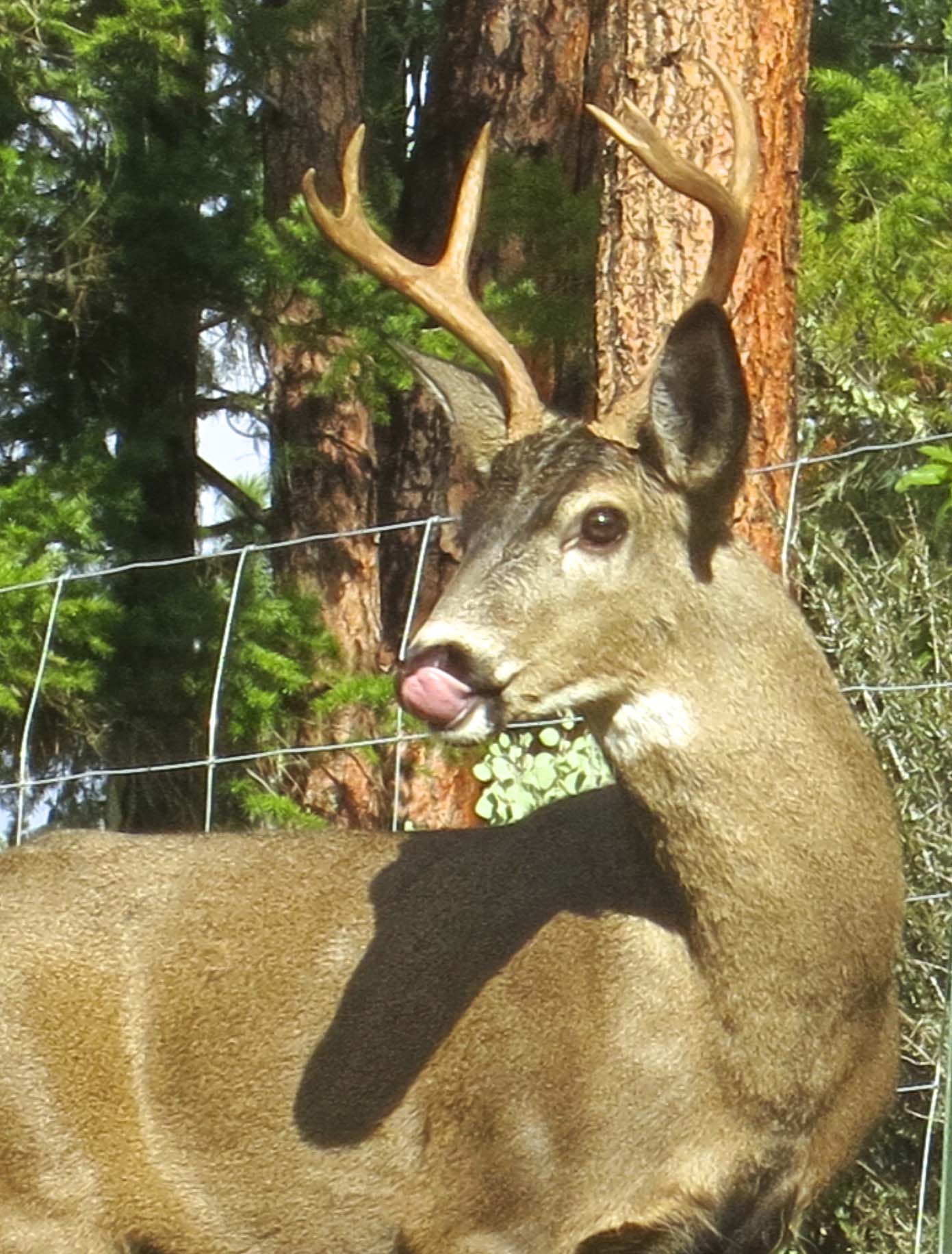
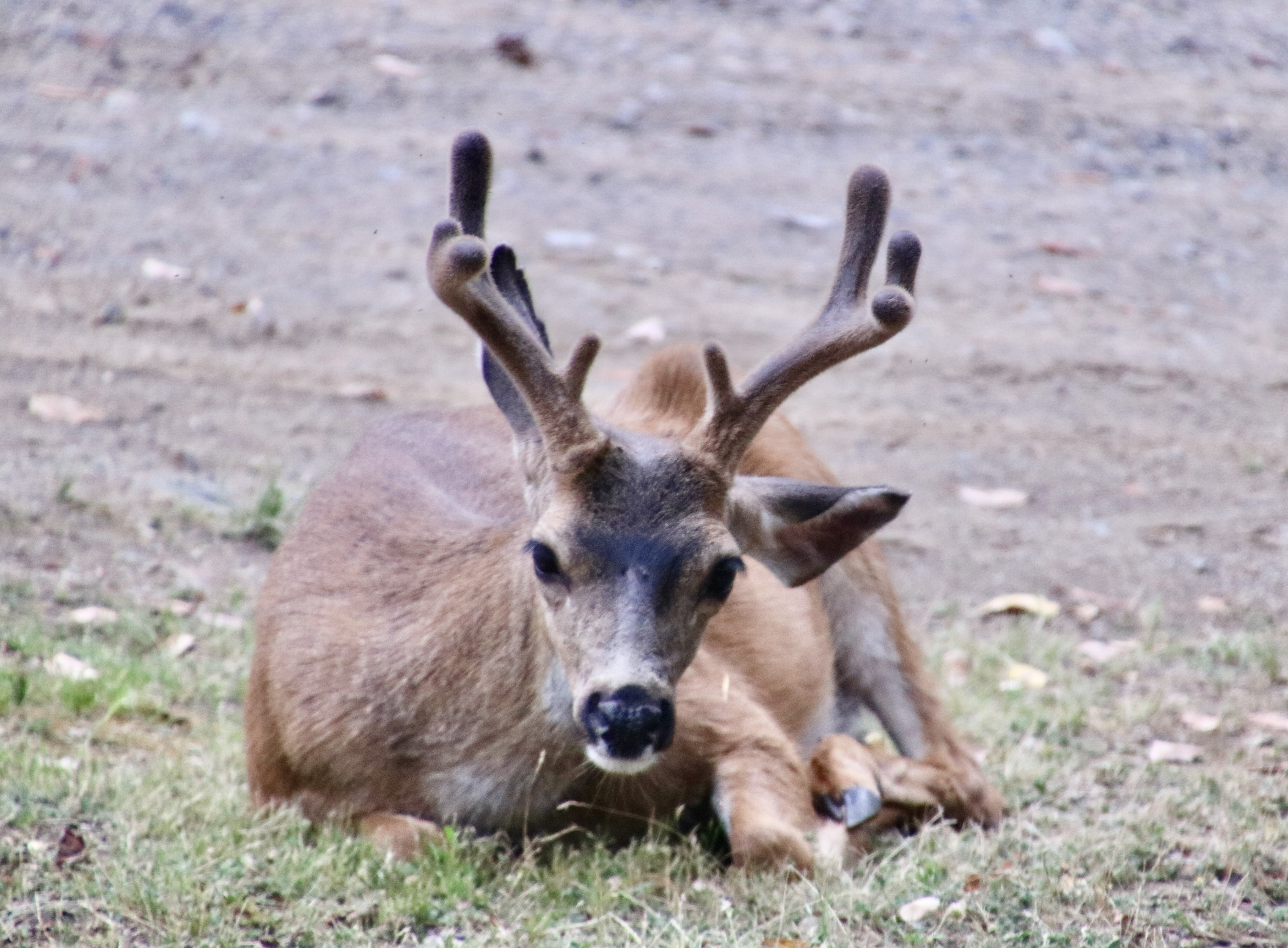
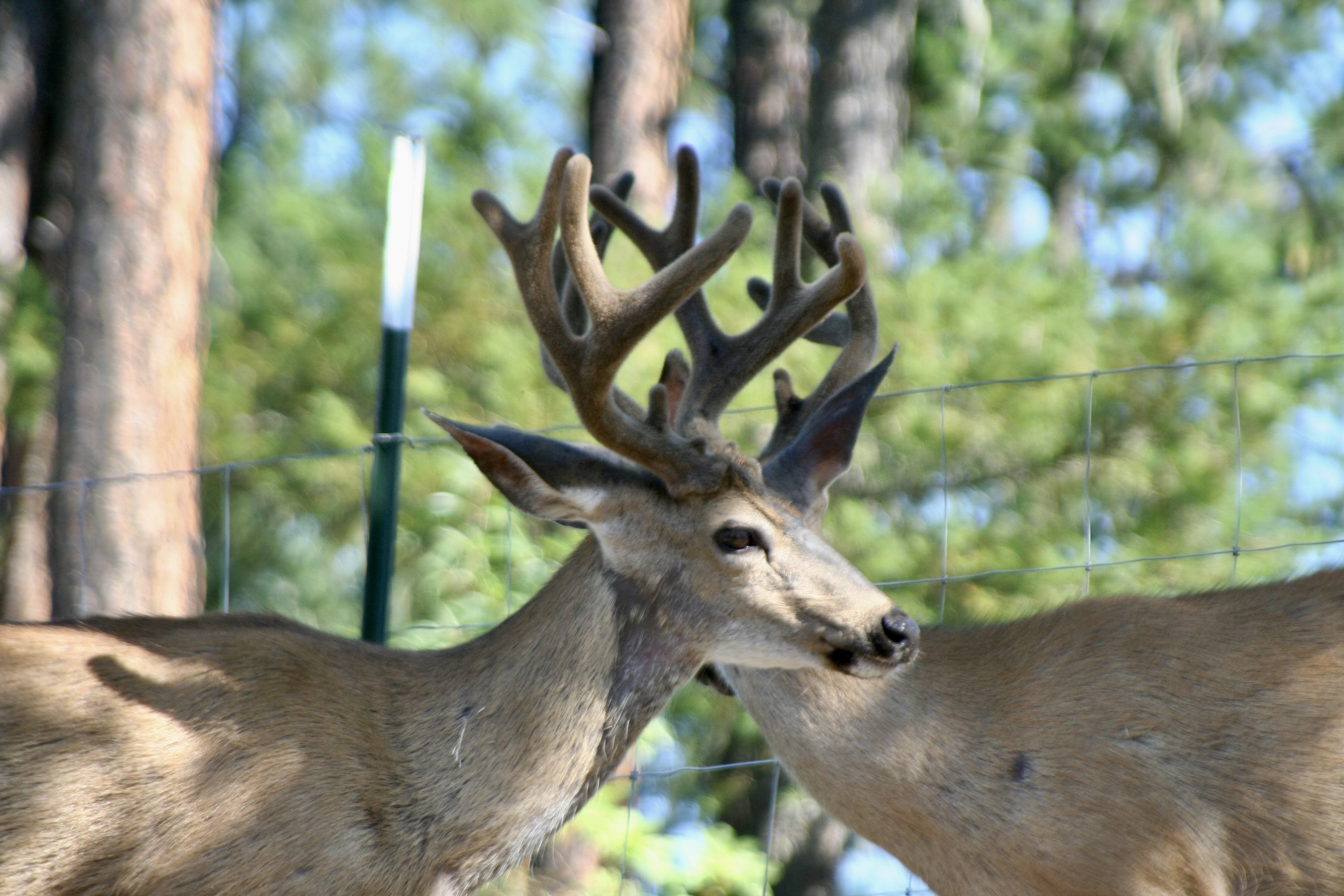
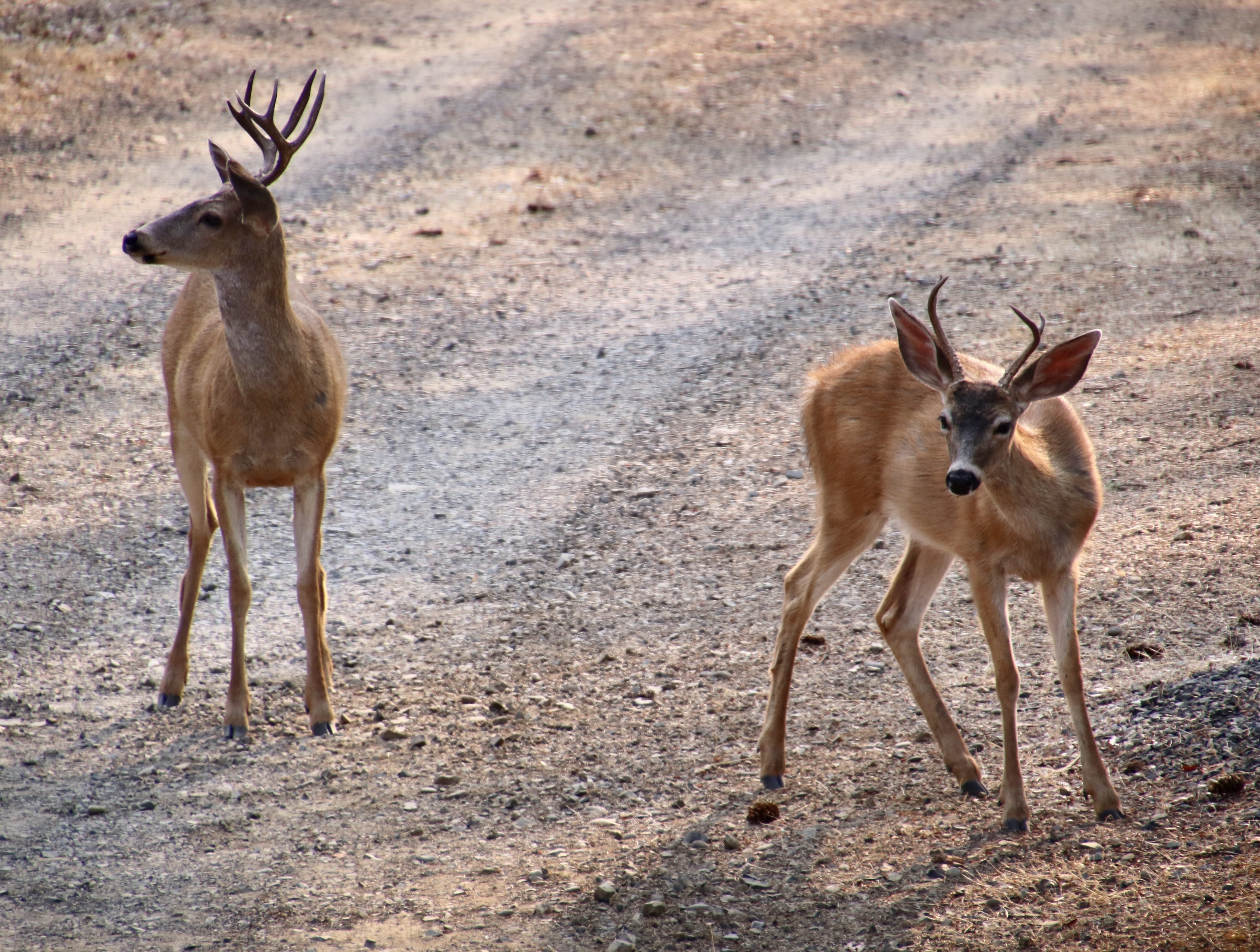
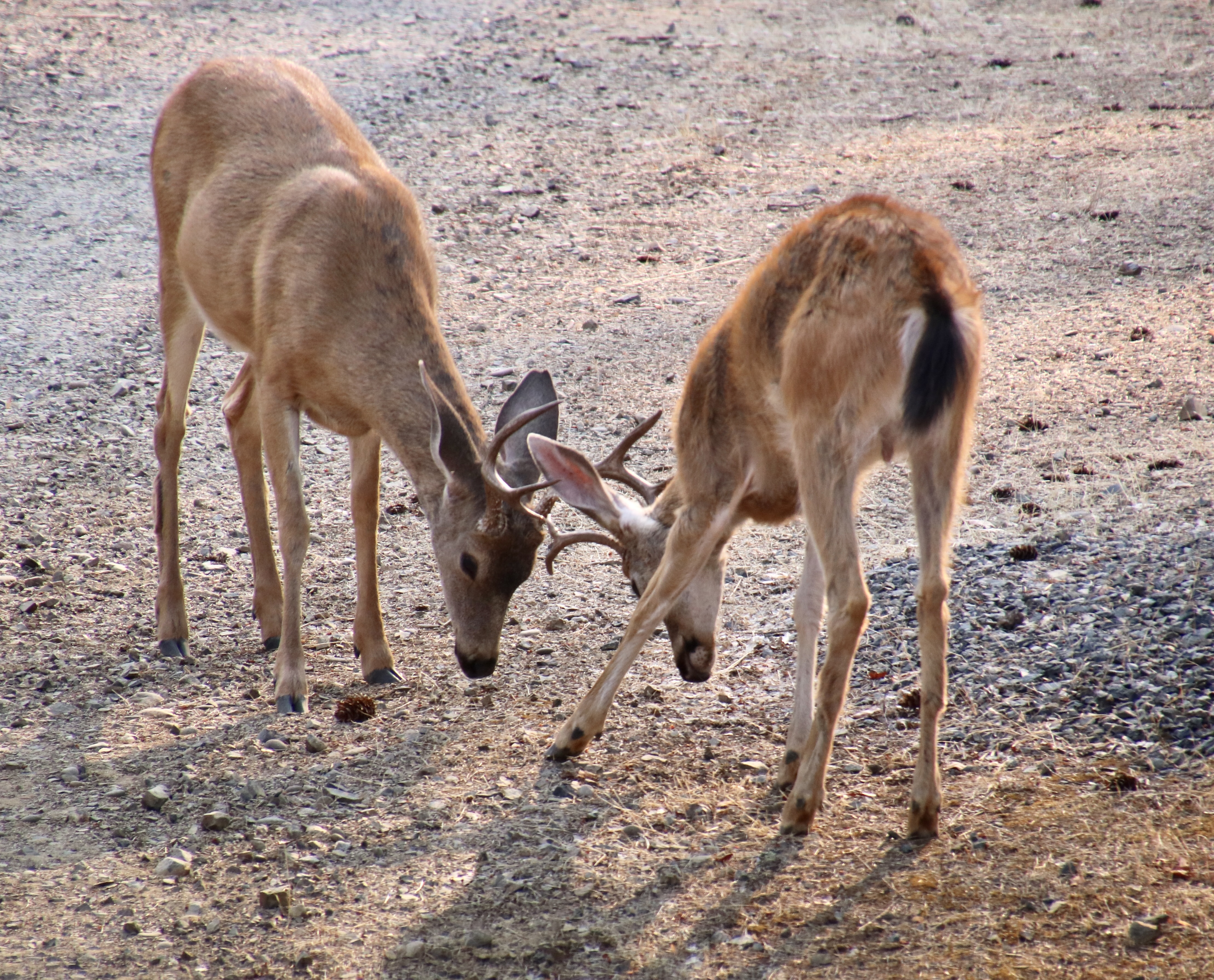
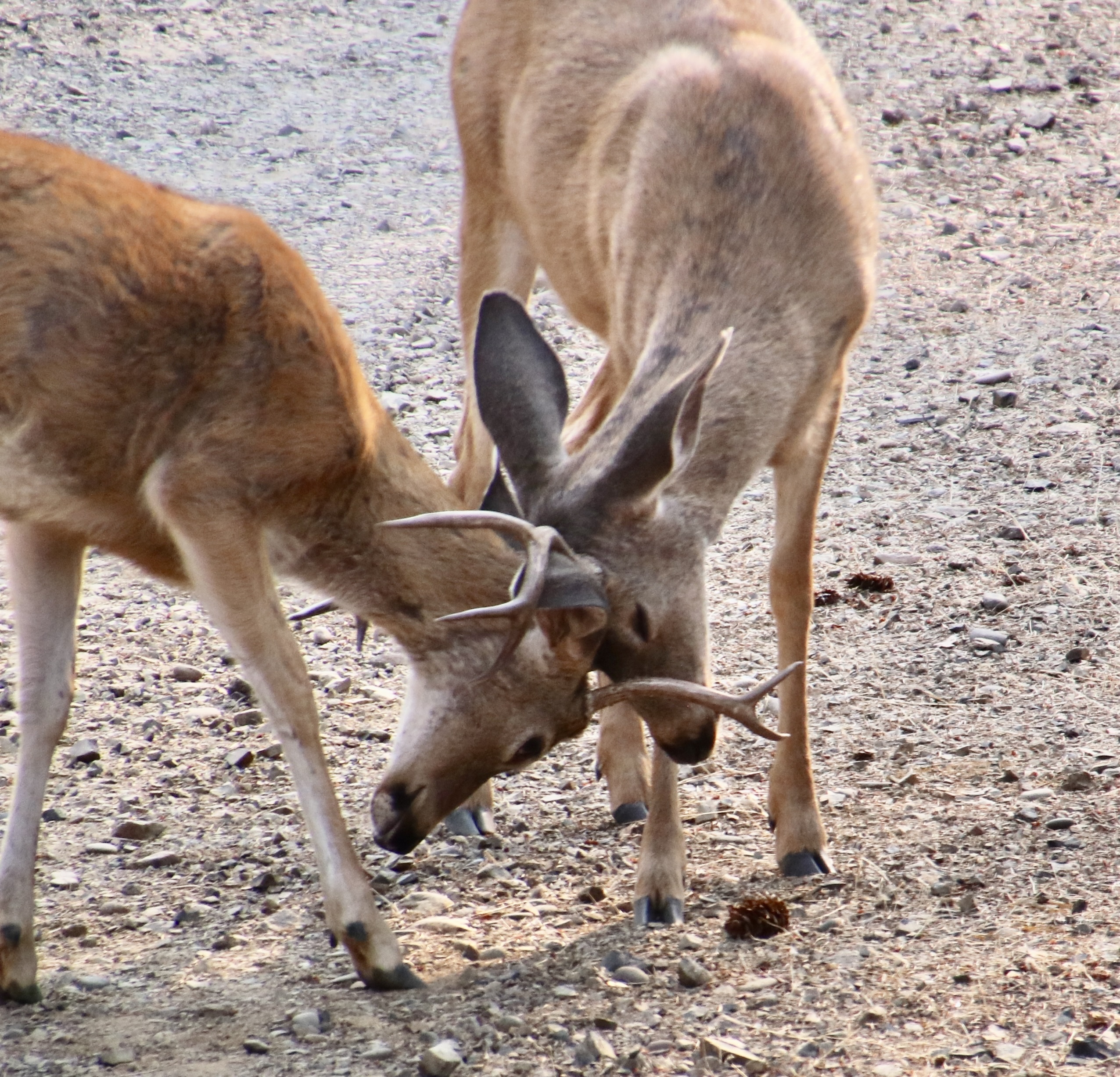
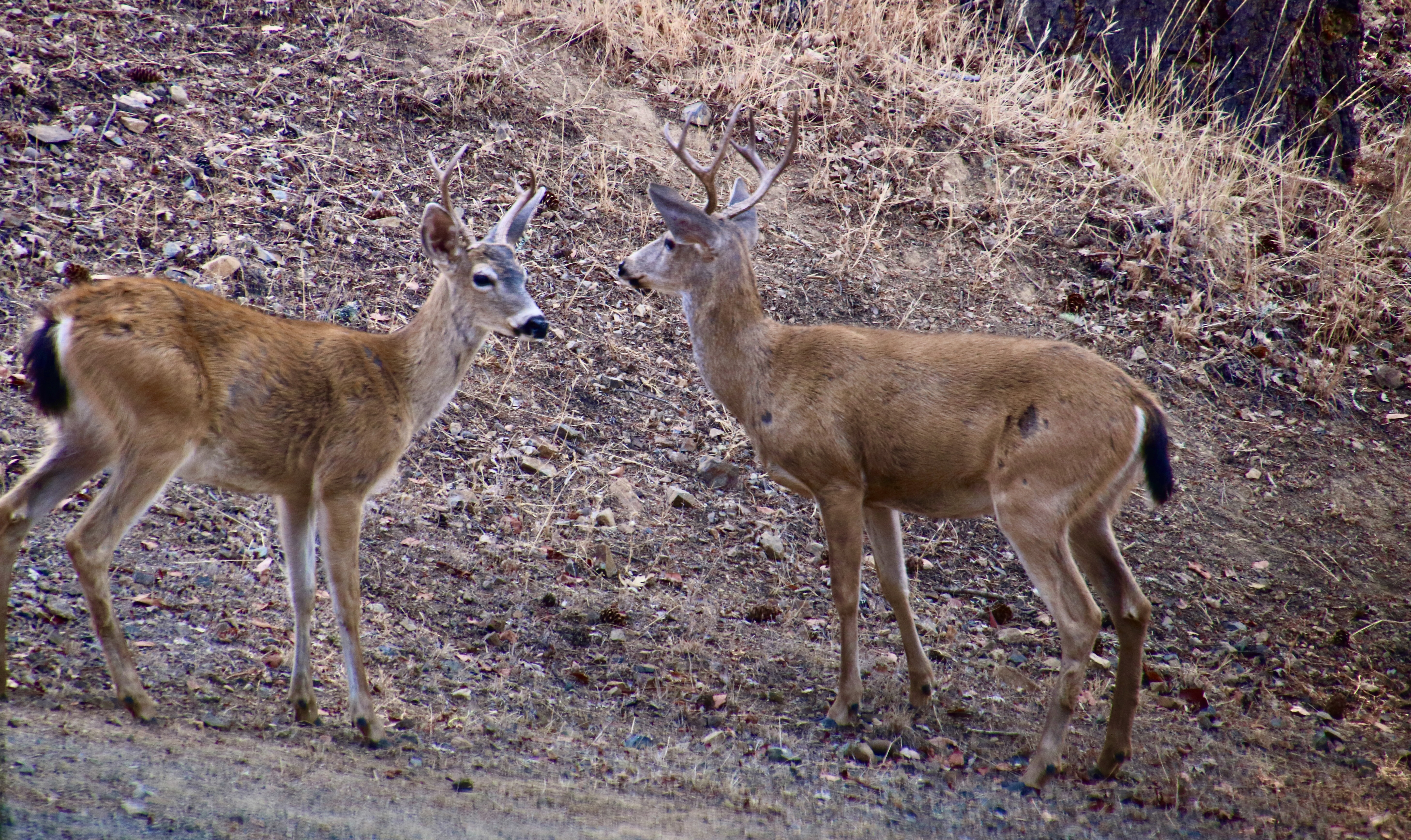
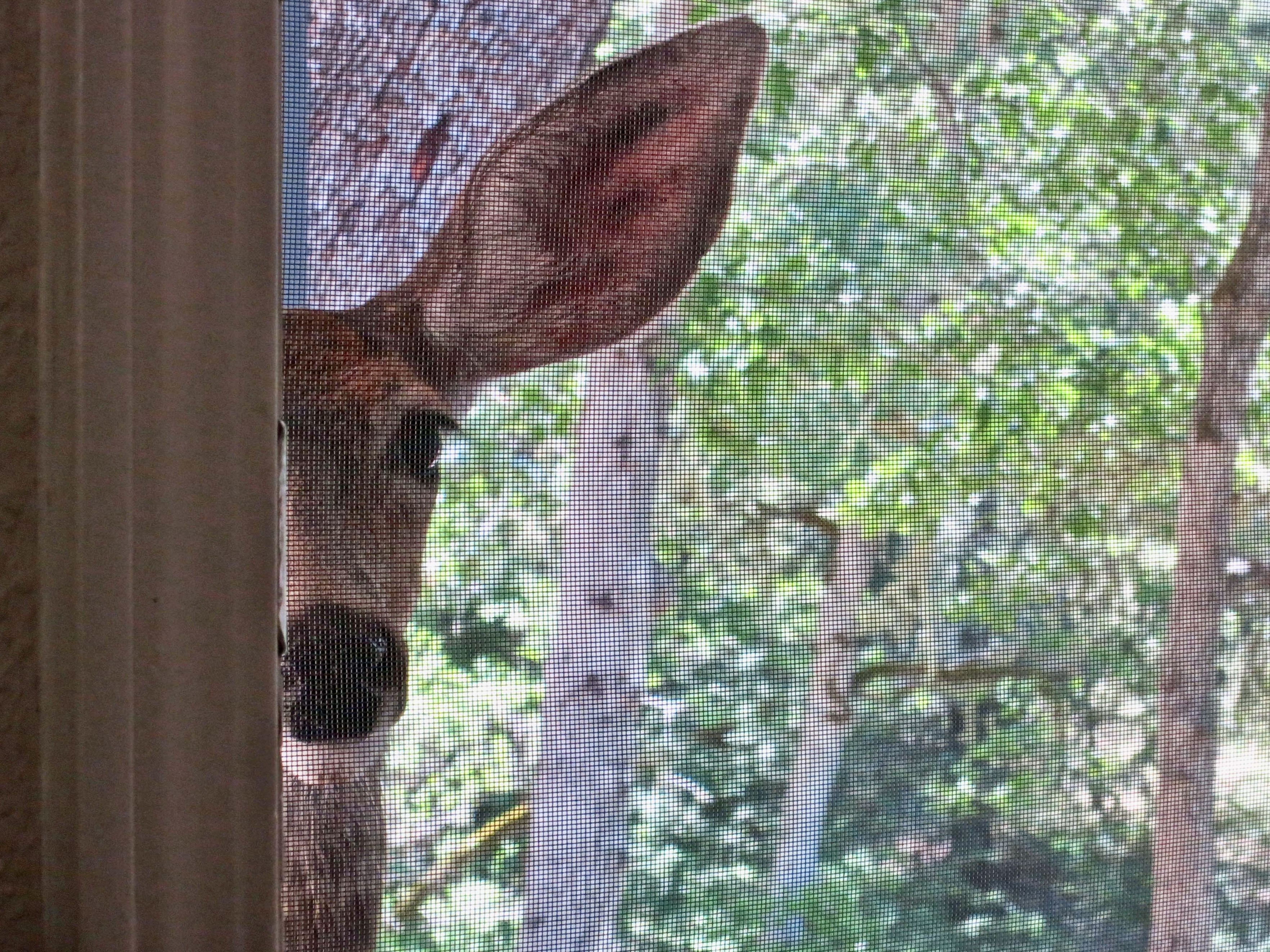
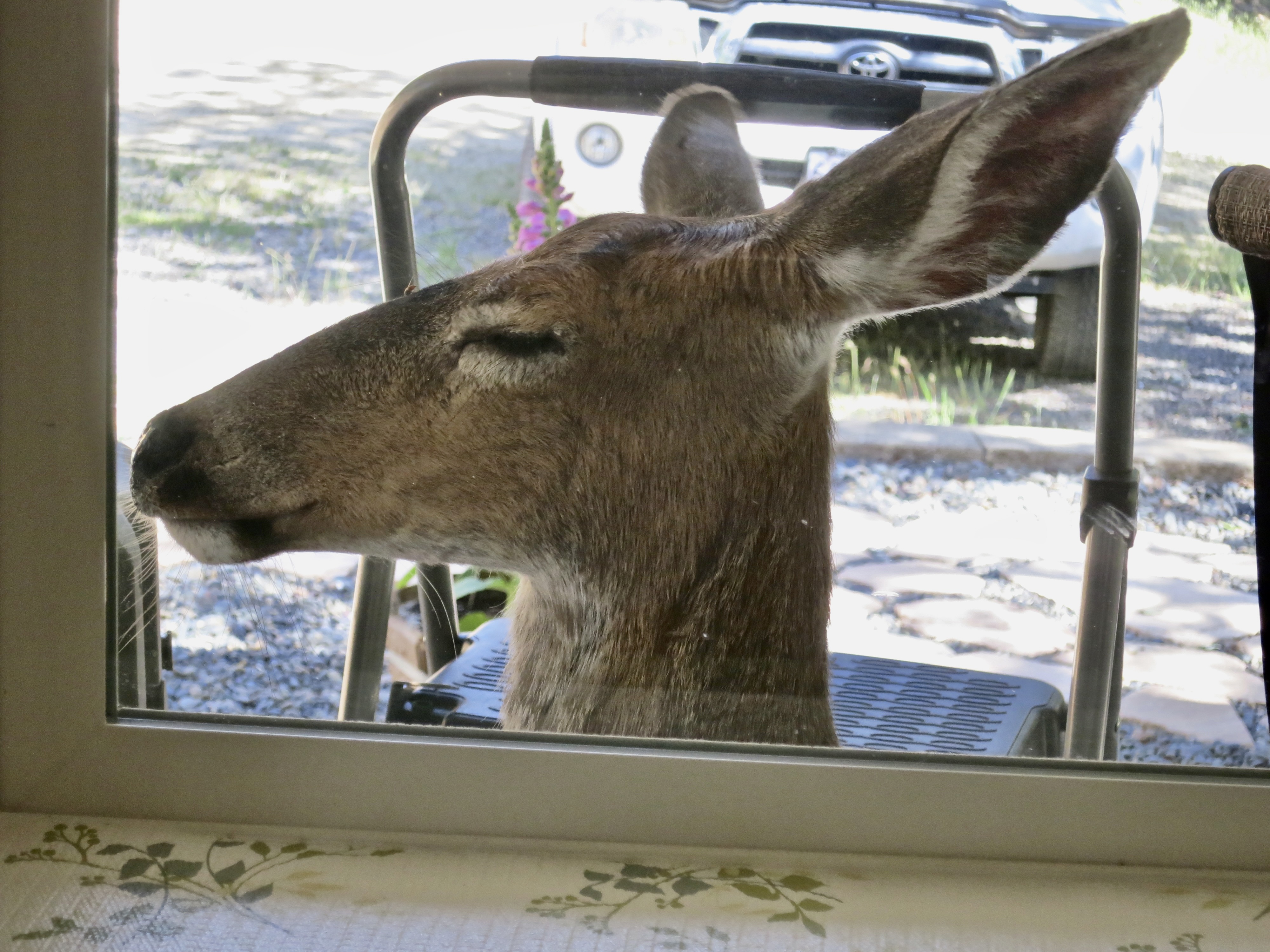
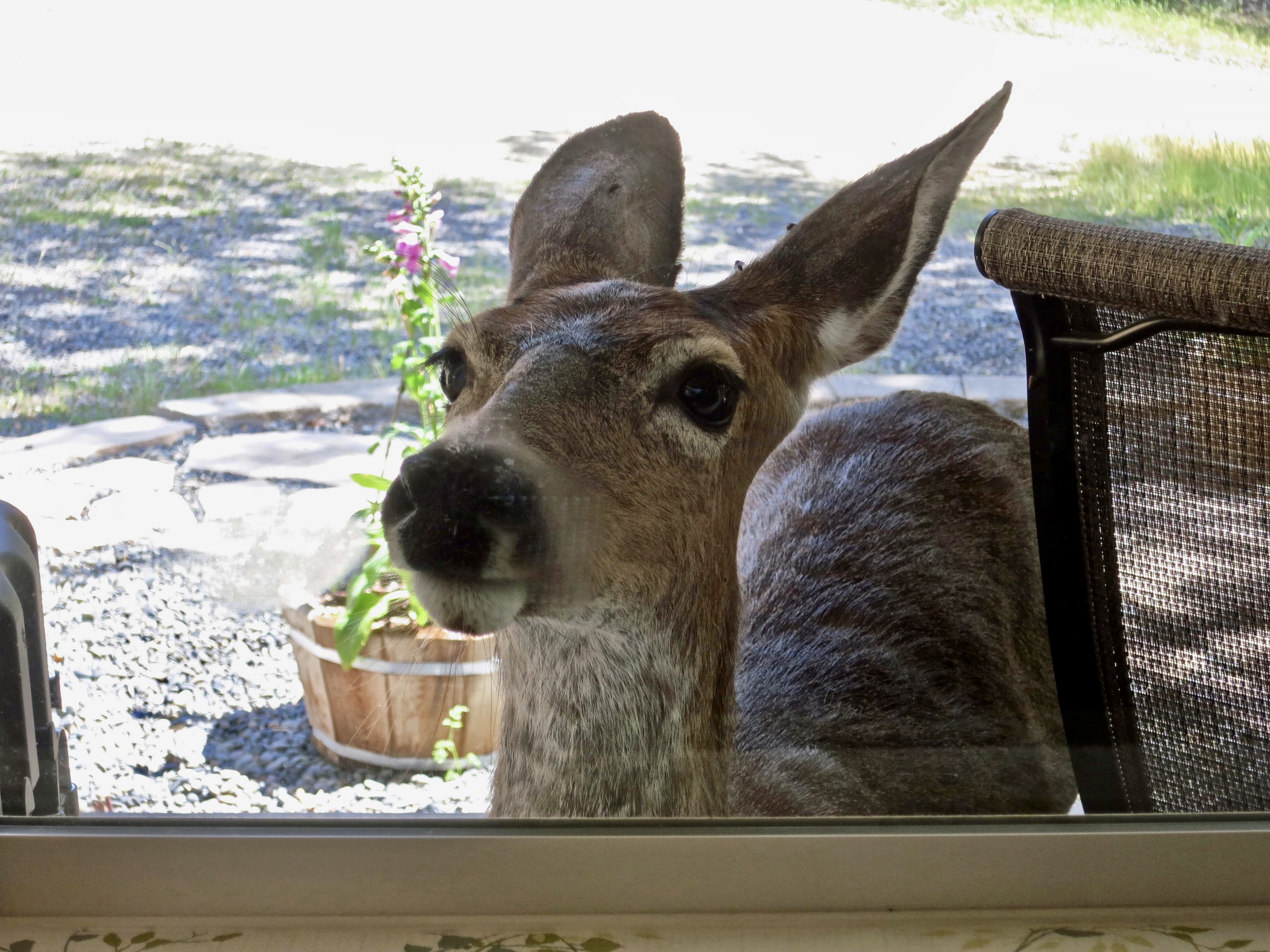
We did come upon a newborn fawn once. The mother had blown it and given birth right in the middle of our driveway. We were returning from town and sat for 30 minutes as the doe urged the baby to get up. Its twin was already off to the side. Finally the youngster stood on wobbling legs and managed to totter off to the side. I kicked myself very hard for not having my camera.If this buck appears nervous, it’s for good cause. A few minutes earlier we had watched junior walk under him, see danglies, and assume they were udders. Reaching up, it had chomped down. Deer are noted for their prodigious ability to leap, jumping over fences as high as 5-6 feet. I swear this guy cleared 10! Apparently, the baby was coming back for more. The buck ran away. The small size of the fawn signifies how young it is. They grow fast. The buck’s antlers are still growing and are in velvet. More on that shortly.Does brought their fawns by to meet us shortly after they had grown out of the ‘hide the baby’ stage. Or at least it seemed that way. Anyway, they trailed along with mom. At 3-4 weeks, they could easily keep up with her and even run fast enough to get away from many predators. They would dash madly around in our yard playing. Not sure whether baby is smelling its feet or scratching an itch. The ears on the doe are almost as big as its head! Deer have extremely sharp hearing and constantly move their ears to detect sounds that might suggest danger. I actually watched one with its ears pointed in two different directions.Hello. The deer in the west are black tail deer as opposed to the white tail deer found in the east and the south. One sign of a black tail deer is its dark forehead.The fawn from above and its twin walking across our deck. Speaking of the deck, it was right next to our bedroom and we could hear deer (and bears) when they crossed it at night. Once we heard a loud thump followed by two quieter thumps immediately afterward. I went out and checked the tracks in our yard the next morning. It was a deer that had made the loud bump as it landed on and cleared the deck in one leap. It was a cougar right behind in hot pursuit.One of the reasons the deer were frequent visitors was that they considered our bird bath their watering hole, especially in the summer. The section of Southern Oregon we lived in has a Mediterranean Climate and is very dry in the summer. The nearest water was down the hill, across the road, and down to the Applegate River. I’m sure that the deer thought ‘why bother.’ The challenge was that two thirsty adult deer would come close to emptying the bird bath. Other deer, birds, squirrels, foxes, etc that used the watering hole were out of luck until I refilled it.Hey, save us some water. We don’t drink much.What is it that you guys don’t get about bird bath!Who? Us? Note the antlers on the buck in the background. There’s a reason why yearlings are know as spikes.My solution to the water hole problem was to add a five gallon paint bucket filled with water. It was a welcome addition. How welcome?Well, baby climbing over Mom to get to it is an example. The laid back ears suggest that Mom wasn’t particularly happy with being used as an obstacle course.No smelling this time. The fawn is scratching an itch. Flies, fleas and ticks all hassle the deer. Again, I enjoyed the three leg acrobatics. Now note the next photo…Don’t ask.One of the fawn’s responsibilities is to learn what is and isn’t edible. It watches what Mom eats and also smells her breath. Lavender isn’t on the deer menu. We grew lots. It took us a few years to figure out what plants the deer wouldn’t eat and plant accordingly. In the meantime, Peggy would rush out and lecture the deer. It was quite humorous, for me and the deer.This young buck, who had leapt over our Gabion cage wall, climbed over the cement blocks, and worked its way past the lavender, stopped to listen to Peggy’s lecture before leaping up the cliff to gobble down the plants and flowers it loved to eat.The real treat was acorns. Squirrels, turkeys, woodpeckers, Stellar jays, and bears seemed to agree.Remember how I said the fawns grow up quickly. Check out the legs. Also note that the fawn’s spots are disappearing.By fall the spots have totally disappeared. The young deer will hang out with their mom through the winter until she gives birth to her new fawn in the spring. Mom then chases them away. They aren’t happy about it and often continue to stay nearby for a while longer—at a safe distance. The young doe will become part of the herd that Mom, Grandma, and possibly Great Grandma oversee. The herd of does browsing in our back yard…And taking an afternoon snooze.The young buck, Spike, here growing his first set of antlers, will slip off to join the boys.And now to the bucks. They lose their antlers in January and February and begin to grow new ones in March and April. A soft, hairy skin known as velvet covers the new antlers providing them with the blood and nerves necessary for bone growth. Aren’t the legs impressive?The antlers will continue to grow until they have reached the size of the previous year and then grow larger, dividing into more points.Bucks are judged by the size of their racks and the number of points on one side. A deer with two points is a forked horn, with three, a three pointer, and so on. The first year the deer grows spikes. Second year is normally a forked horn. Third year 3 and 4 pointers. Five pointers plus grow in the fourth year and beyond.A three point buck without velvet. “Did somebody say apple?”This big boy in velvet is a five-pointer. The back antlers are split but can’t be seen in this picture.Two bucks displaying a forest of antlers! We thought this was a fun photo. Come August-September the antlers have completed their growth and the bucks scrape off their velvet on anything available, normally a tree or bush. It’s time to get in fighting form. One year we arrived home and found a buck using our hammock to scrape off his velvet. I chased him off but it was too late. The hammock was torn to sheds. By November and December it’s time to decide who gets the girls.This is a contest that the bigger buck normally wins. Size is often enough to decide the outcome without a contest.These two three pointers have been checking each other out. The one on the left is larger and has a bigger rack, but…They go at it, head to head and antler to antler. The biggest buck shoved the smaller buck around. I worried about their eyes.And then they separated without either being harmed. The big fellow seems to be saying, “You want more of me?” The smaller guy had had enough, however. He vacated the scene. For a day or so, the three pointer chased does around our yard, happily making the rounds and rutting away— until a bigger buck came off the mountain. After the rutting season is completed is when the bucks lose their antlers and a new year begins.A very pregnant doe.As you have probably figured out, this doe and her twins were the stars of our blog. She was usually somewhere nearby and was the first to bring her fawns by. Always curious about what we were doing, she often stared in our window. Here she is looking though our screen door.Our house was surrounded by windows providing excellent views of everything happening outside. I had the best seat, however. I turned my writing chair around in our library and could watch all of the action in our backyard. We considered it a great privilege that the deer herd allowed us to share in its daily and yearly life. Here, Mom taking a snooze on our back porch, was about four feet away. That’s it for the day. Next up:
On Friday I will do the intro to the my memoir: UT-OH. I am blogging one chapter at a time. I am quite excited about the book and have already written 22 chapters. Please join me.
2025 was a good year for us from a travel perspective. We stayed home, so to speak, and limited our wandering to Hawaii, the Southwest, and New England. Now we have the itch to go abroad again. We’ve chosen three areas known for their beauty, culture, wild areas— and relative safety: Costa Rica, Scotland, and Bali.
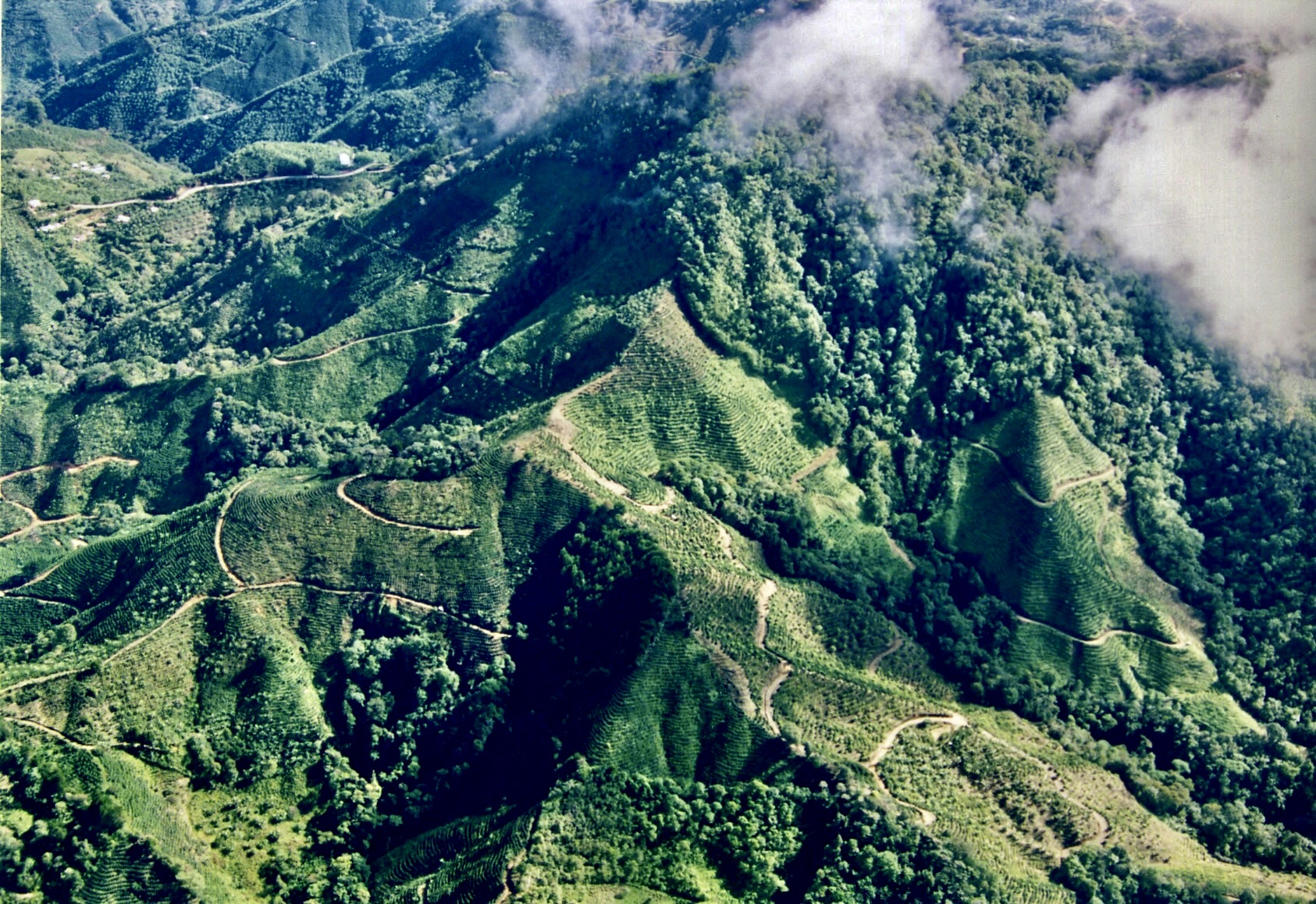
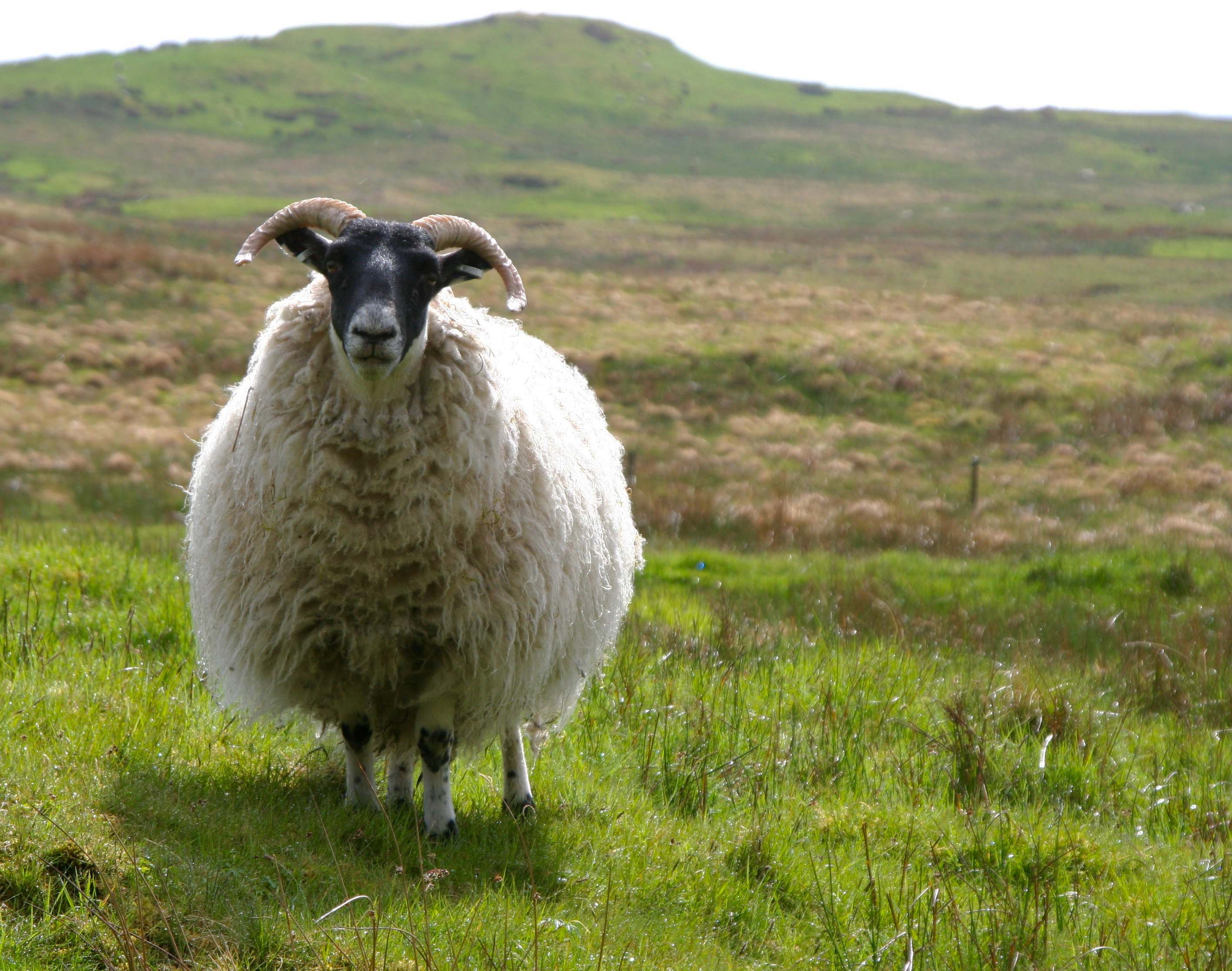
First up: Costa Rica. We took the above photo when we were in a small plane flying back and forth across the country on a tour in the 90s. This year we will be renting an SUV with high clearance and driving ourselves. The country roads can be challenging— even in the dry season! Peggy and I will be going there for the month of March. Our son Tony and his family will join us for a week in Monteverde.Next up, we will be visiting Bali. I visited in 1976 as part of a six month tour of the South Pacific. I’d lost my camera in Fiji, so I don’t have any Bali photos. I brought a painting home instead. The region is known for its colorful art. This one depicts a rice harvest. The woman on top is making an offering. It’s important to keep the gods happy. We will be there in May. Our grandson Ethan will join us for a week.We met this fellow in Scotland when we were doing family genealogical research in 2014. He had positioned himself in the middle of the narrow road we were driving on for about 10 minutes before finally moving over to the grass. Peggy and my families were Lowland Scotch so we were in the southern part of the country. This year we are visiting the highlands, coastal regions and islands of the north in late June and July. We will be checking out castles and looking for Nessie, the Loch Ness Monster. Our grandson Cody will be joining us for two weeks. We are planning to hop over to Northern Ireland after Scotland.
Naturally, we will be blogging about our journeys. But there is more, as they always say on late night TV ads. Or at least they used to. Peggy and I don’t stay up that late and most of our TV time is streaming without ads. I am continuing our focus series over the next two months and beyond. “Oh Deer” is my next one. I’ll be featuring the herd that lived in our backyard in Oregon and liked to stare at us through the windows.
A not unusual sight!
And finally, I’ll be offering a new series I’m calling “Ut-Oh” where I will be pulling together posts that I have included on my blog over the past 15 years plus new material featuring my more serious/humorous misadventures in my life. I’ll do an introduction to it next week.
The question here is why should such an innocent looking child be kicked out of the first grade for a year. My first post will answer the question plus relate how a caterpillar I was using to cut a road fell off a cliff— with me on it.
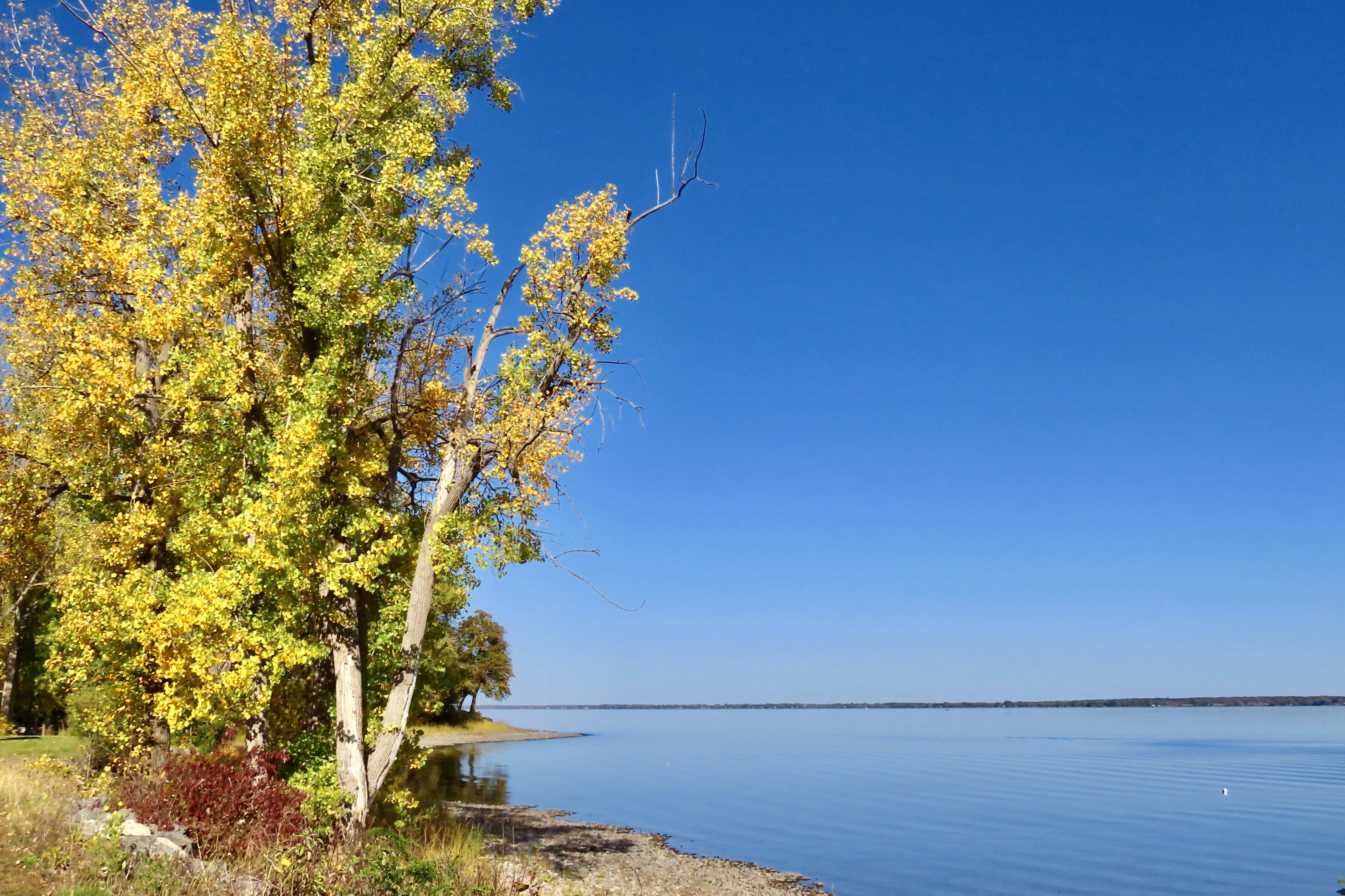
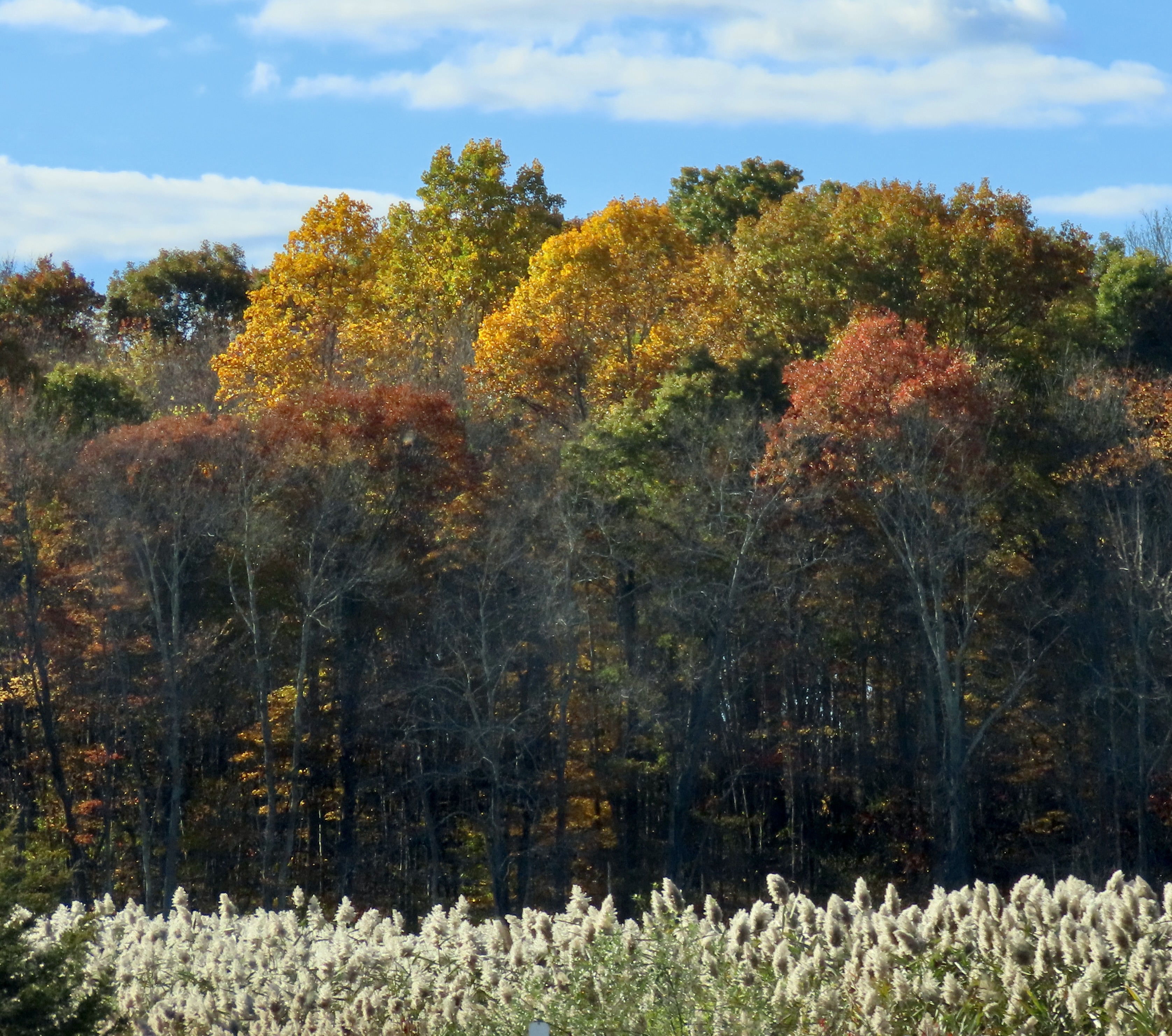
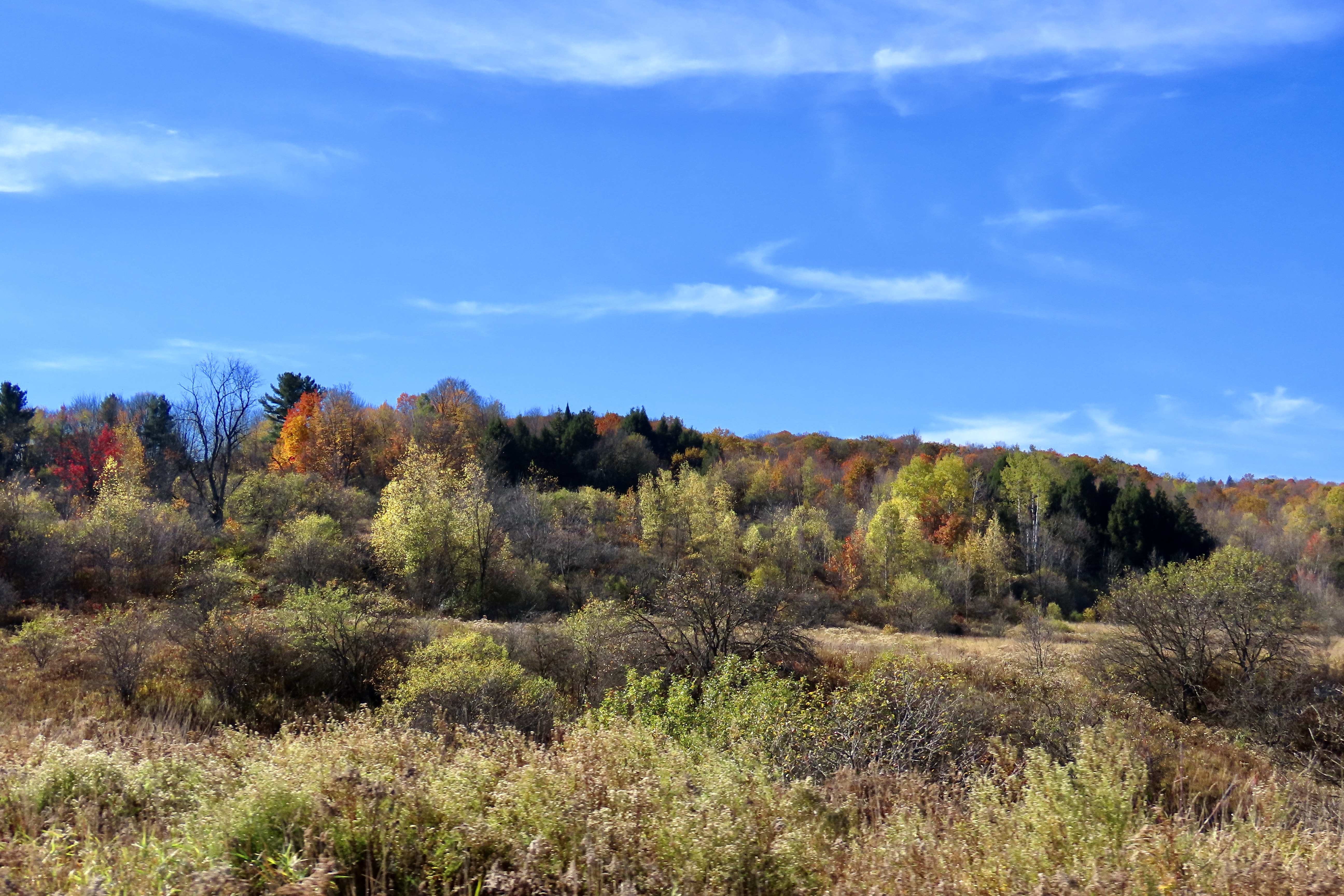
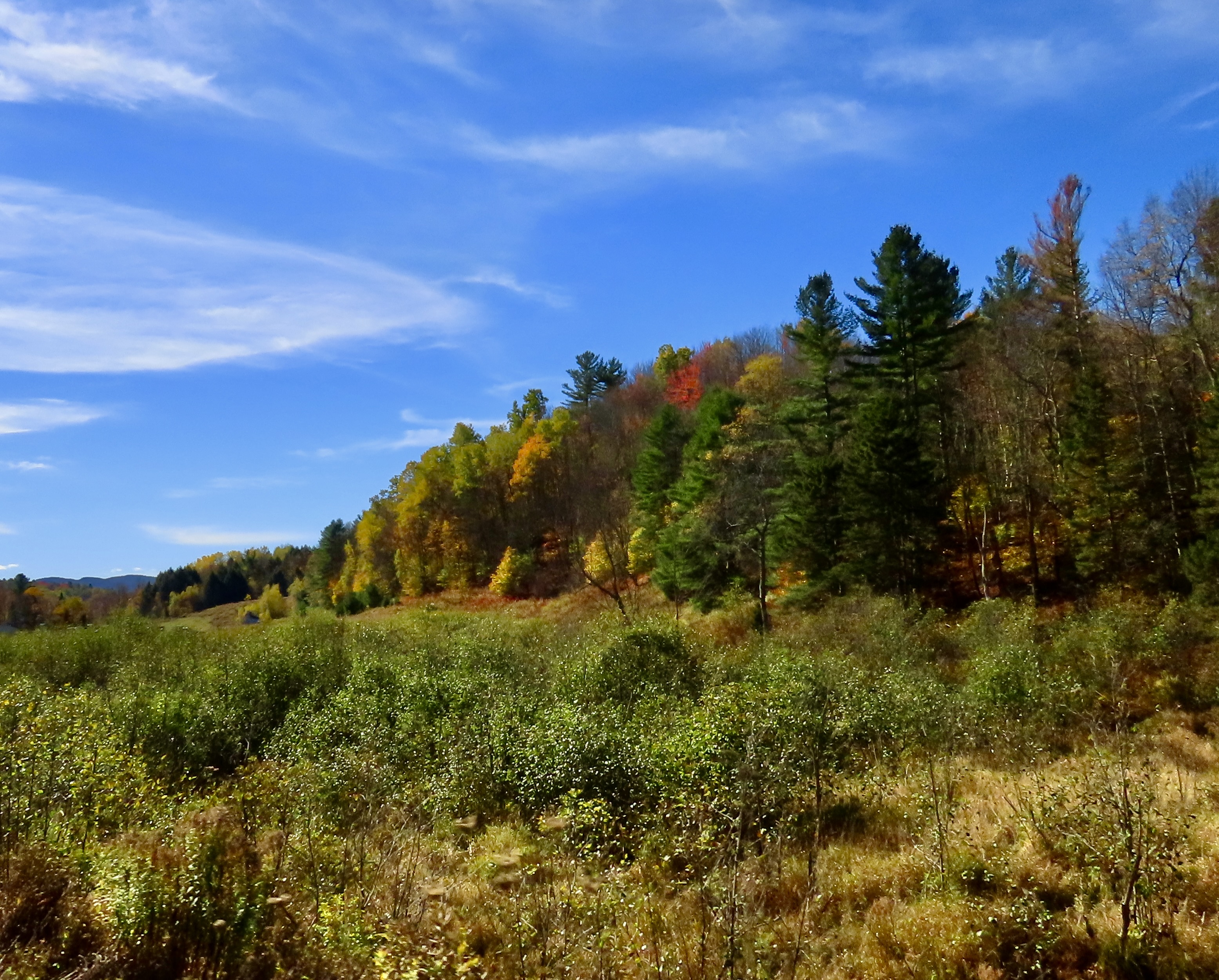
Our 2025 wrap-up is based on three trips we made during the year and blogged about. The first was Hawaii, which I posted two weeks ago. The second was our Southwest journey that I posted last week. Today we are covering our third, and final trip of the year: The leaf-peeping drive through New England in October and November.
While the photos we selected for the Hawaii and Southwest were ones we chose to use in our annual family calendars, this one is different. Because our New England trip was recent, I’ve selected photos not used in the calendars. Most were also not used in our blogs—sort of a third level, so to speak. But, in New England, even ‘also-ran’ is colorful!
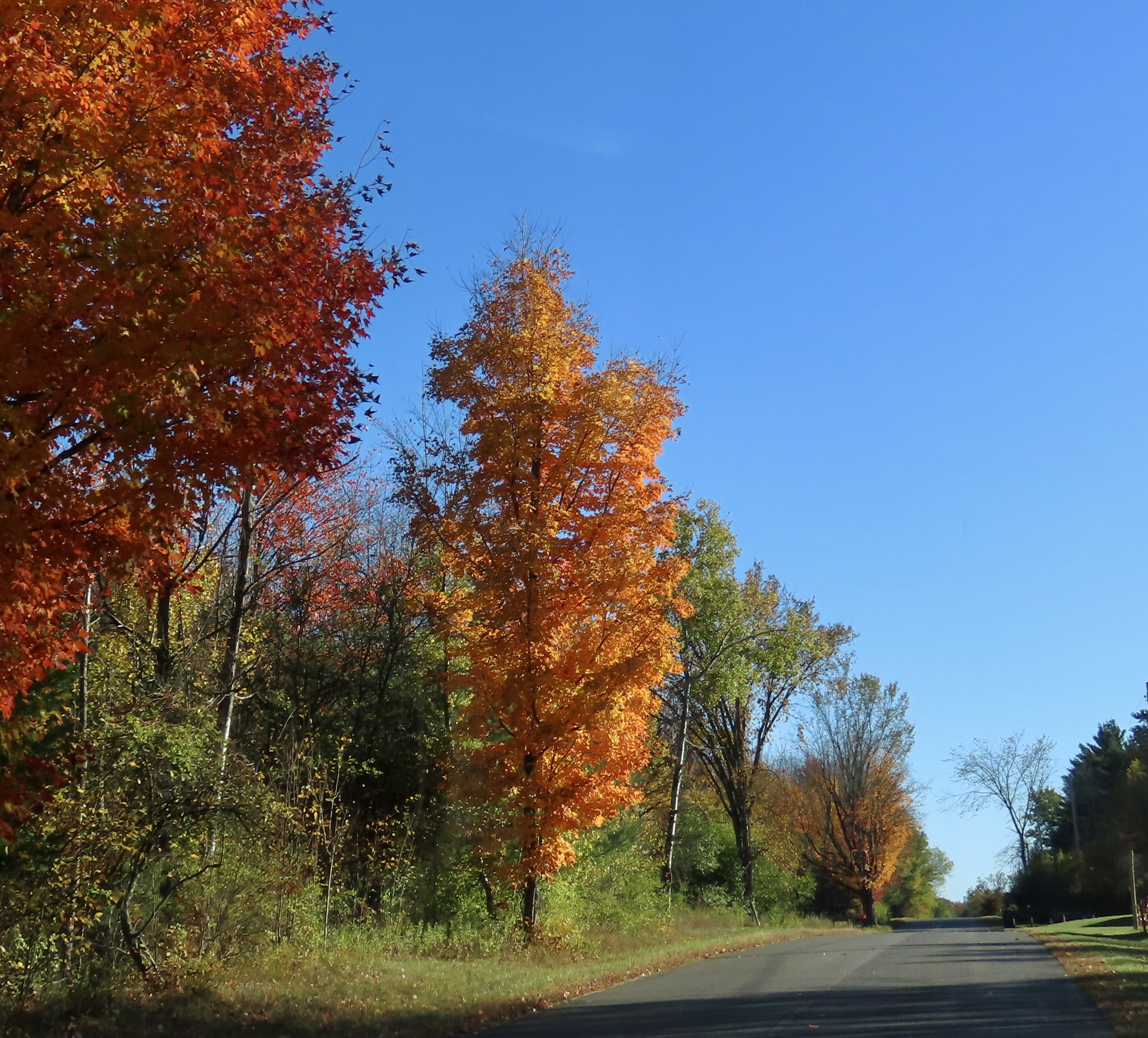
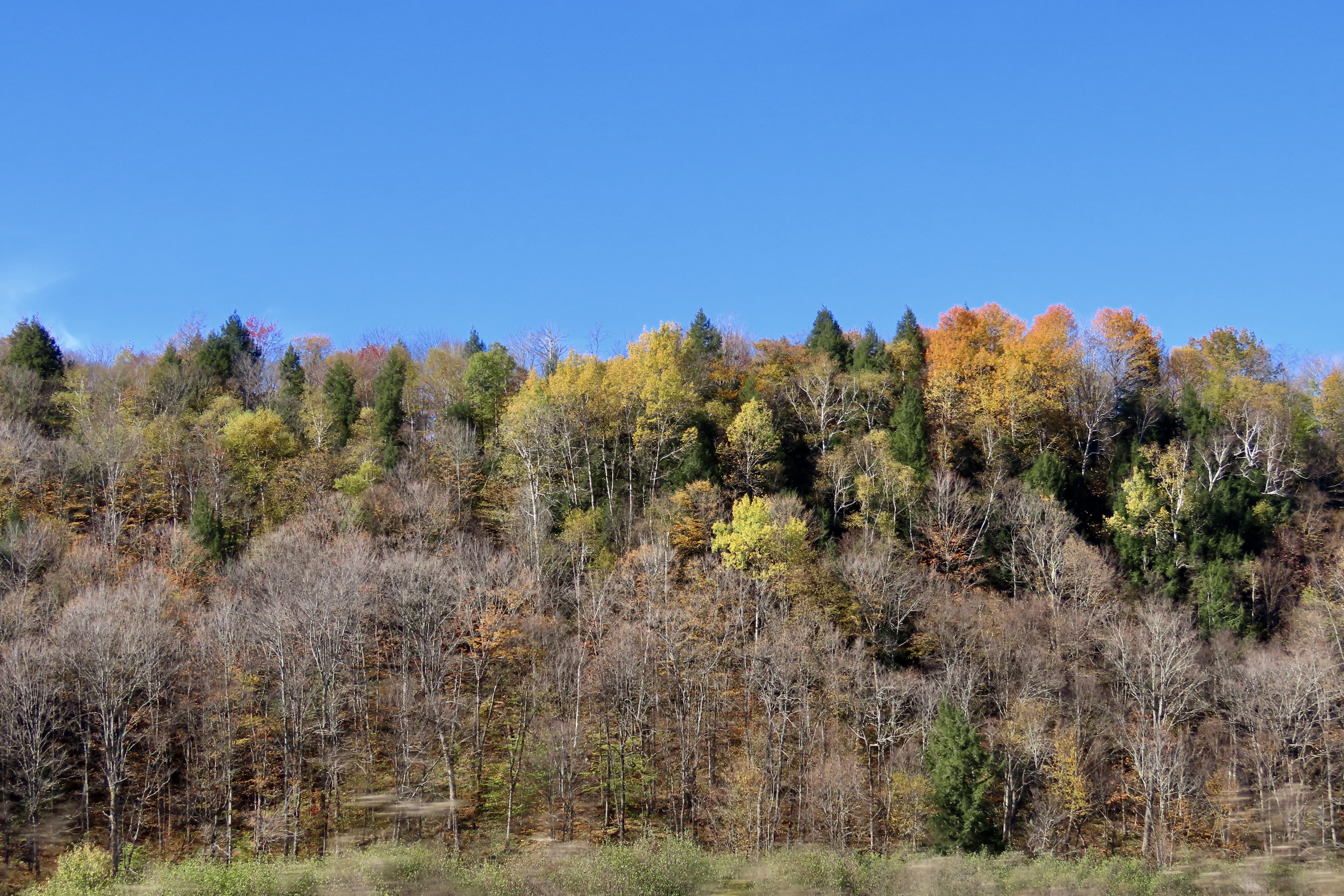
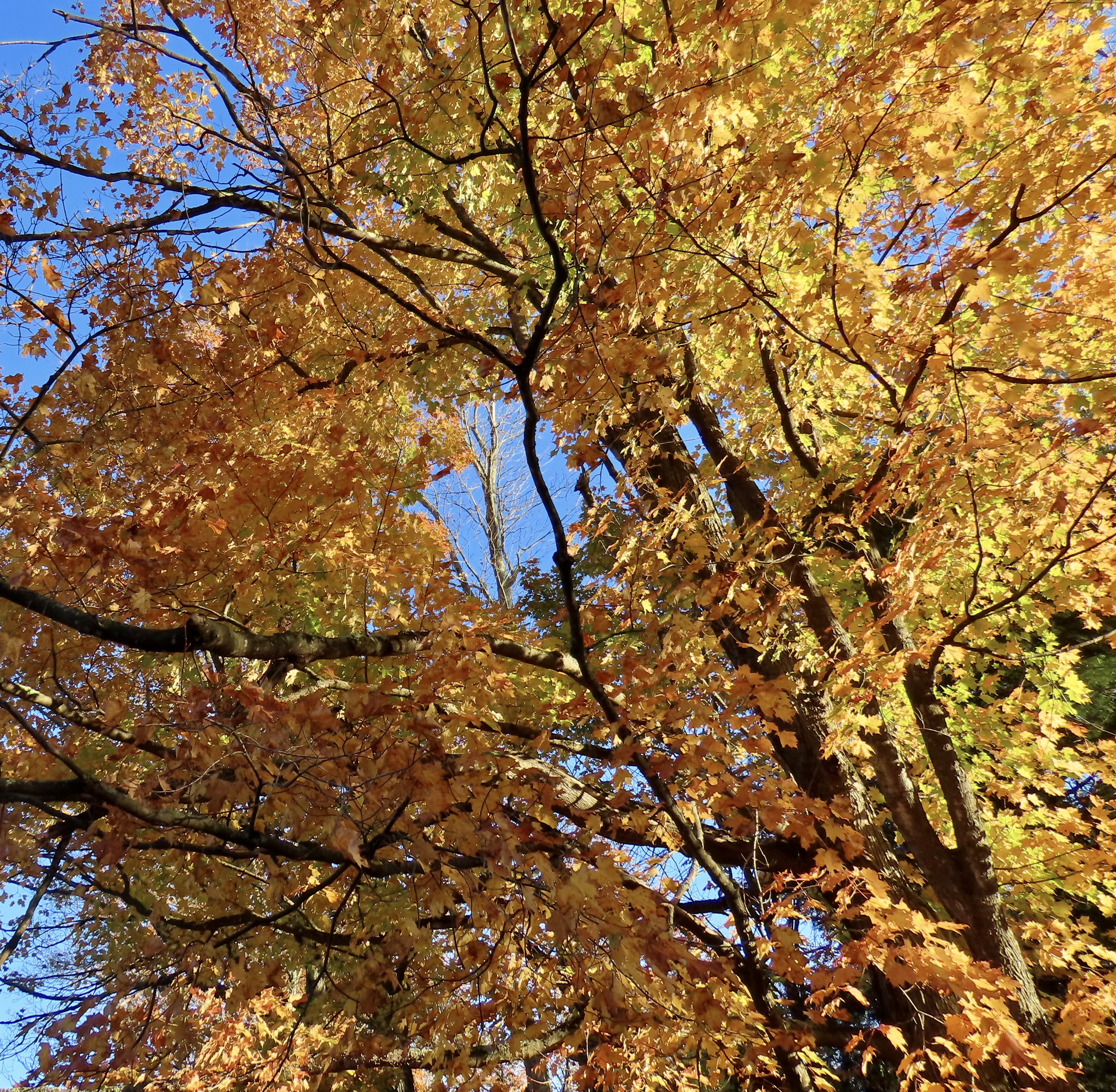
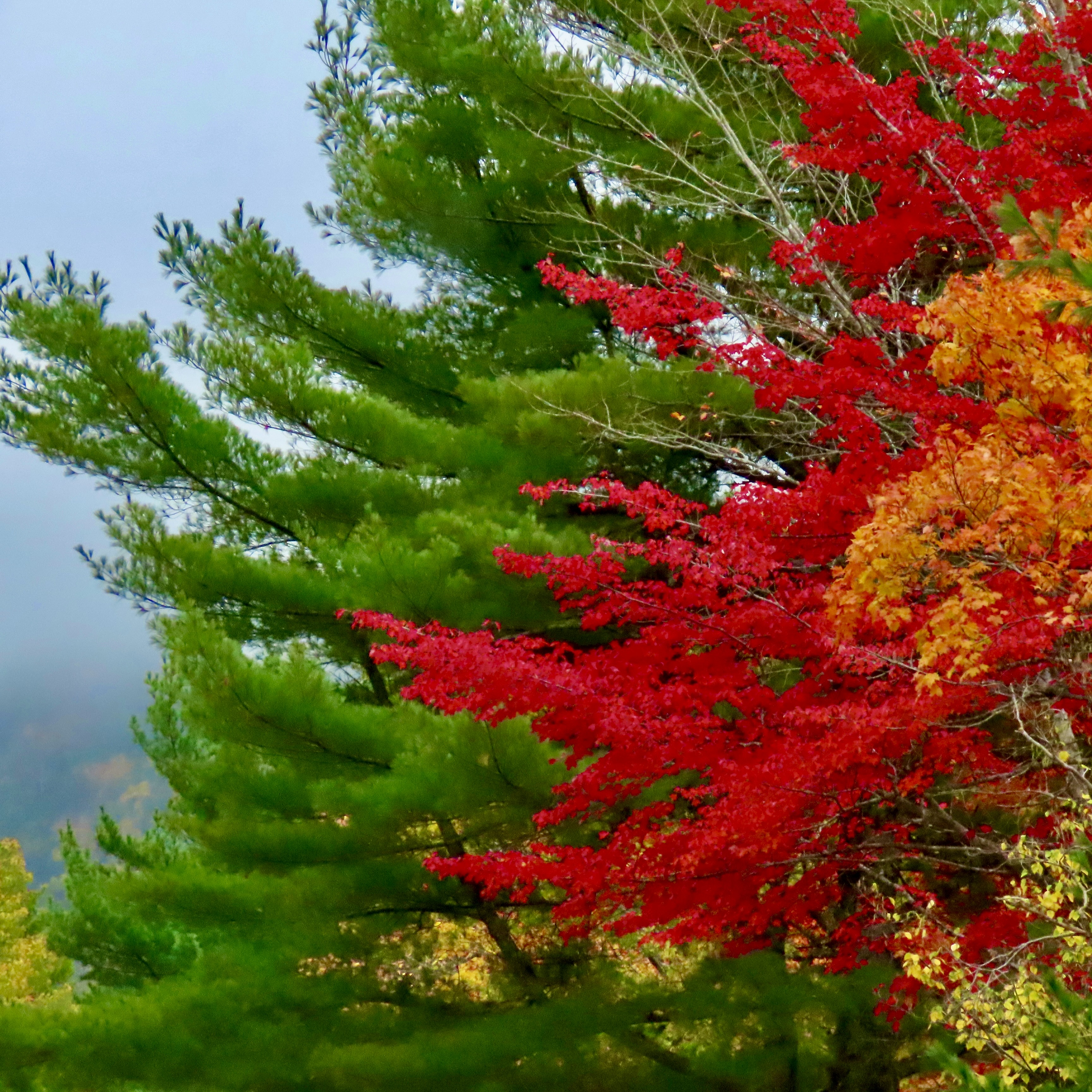
Drive down any country road in New England at the right time in the fall and you will see what leaf peeping is all about. In the photo above, the road wasn’t filled with as much color as many we drove down, but the reddish-orange tree lit up by the sun was enough for us to snap a picture out the window.
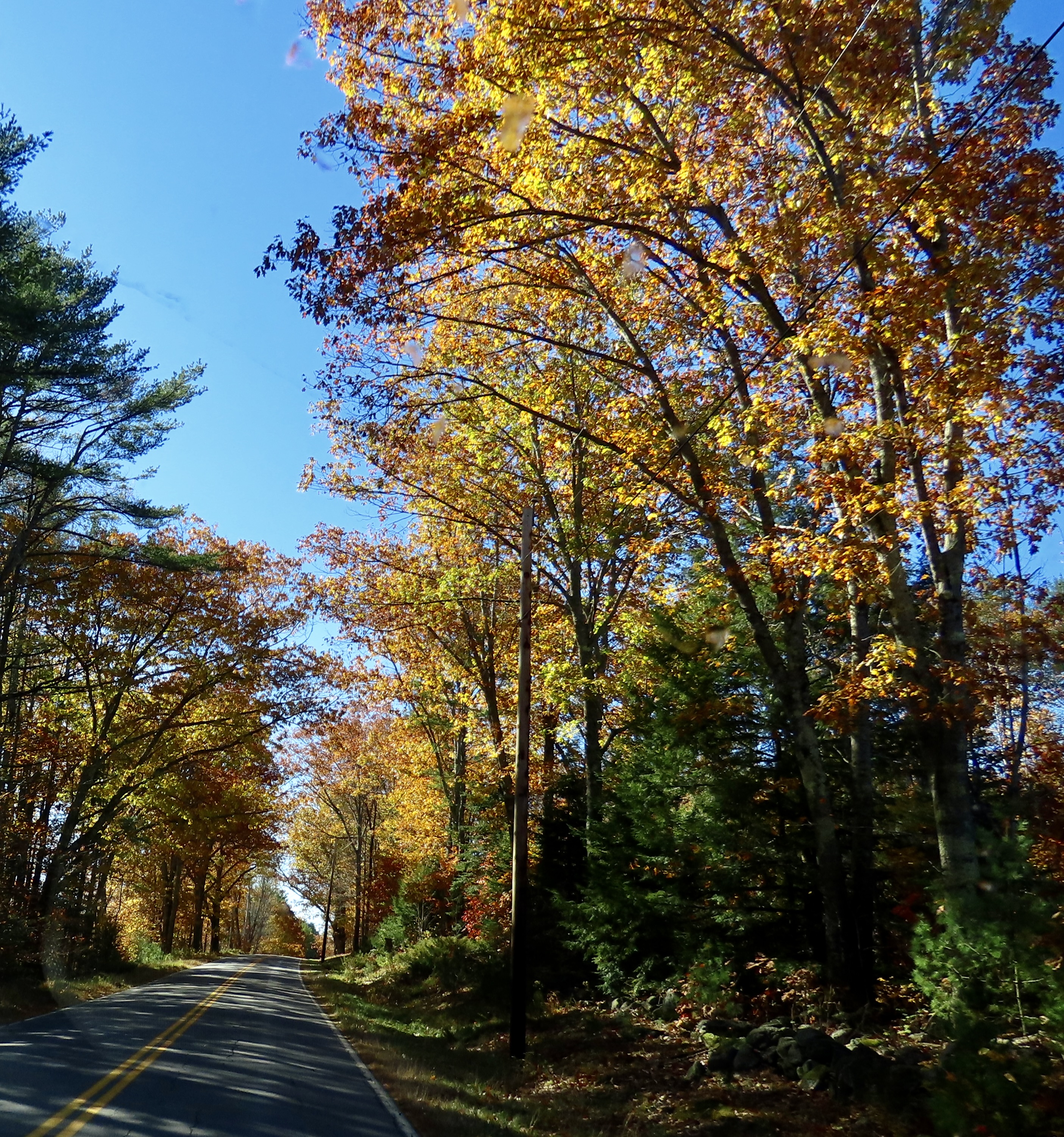
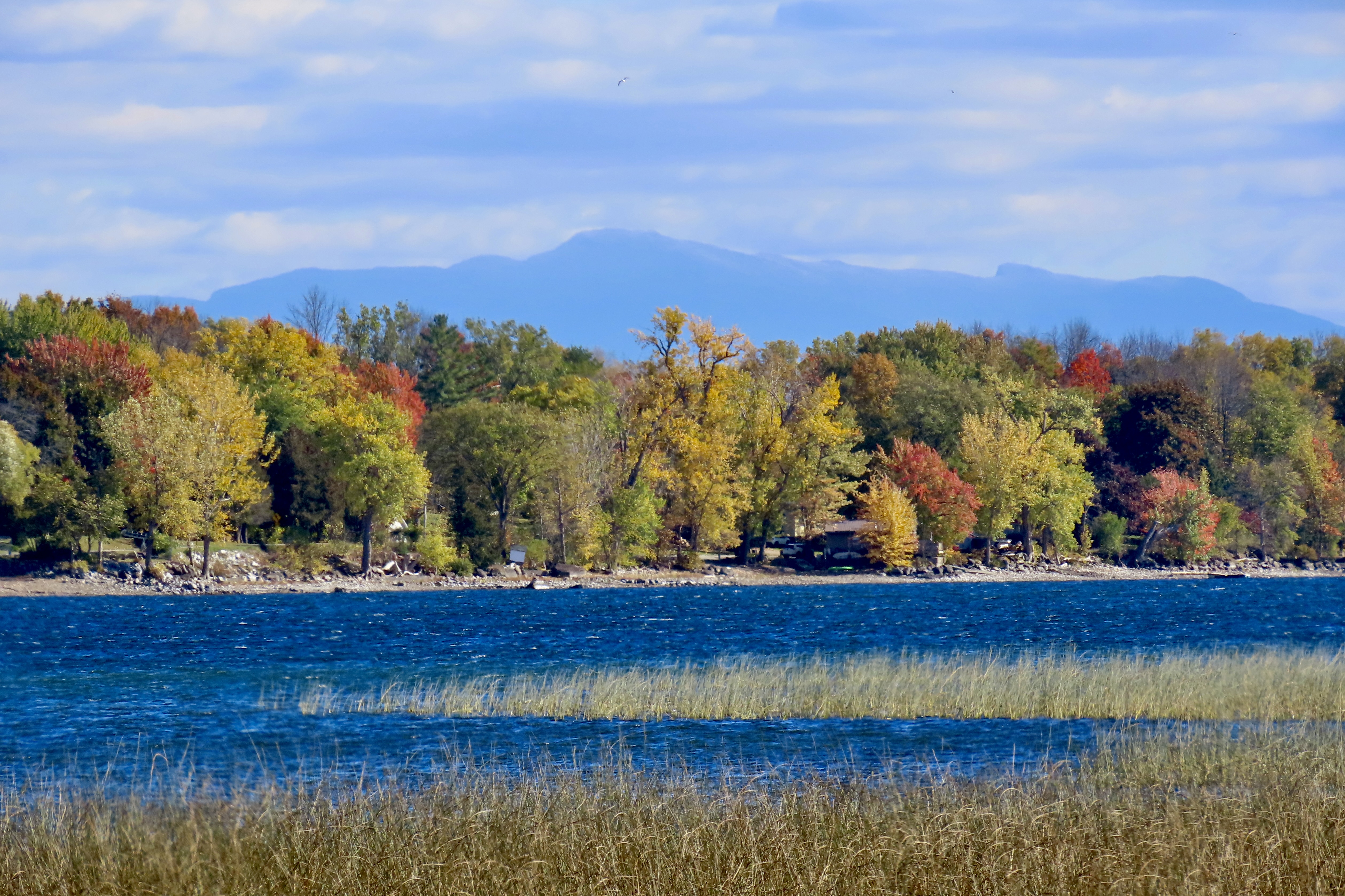
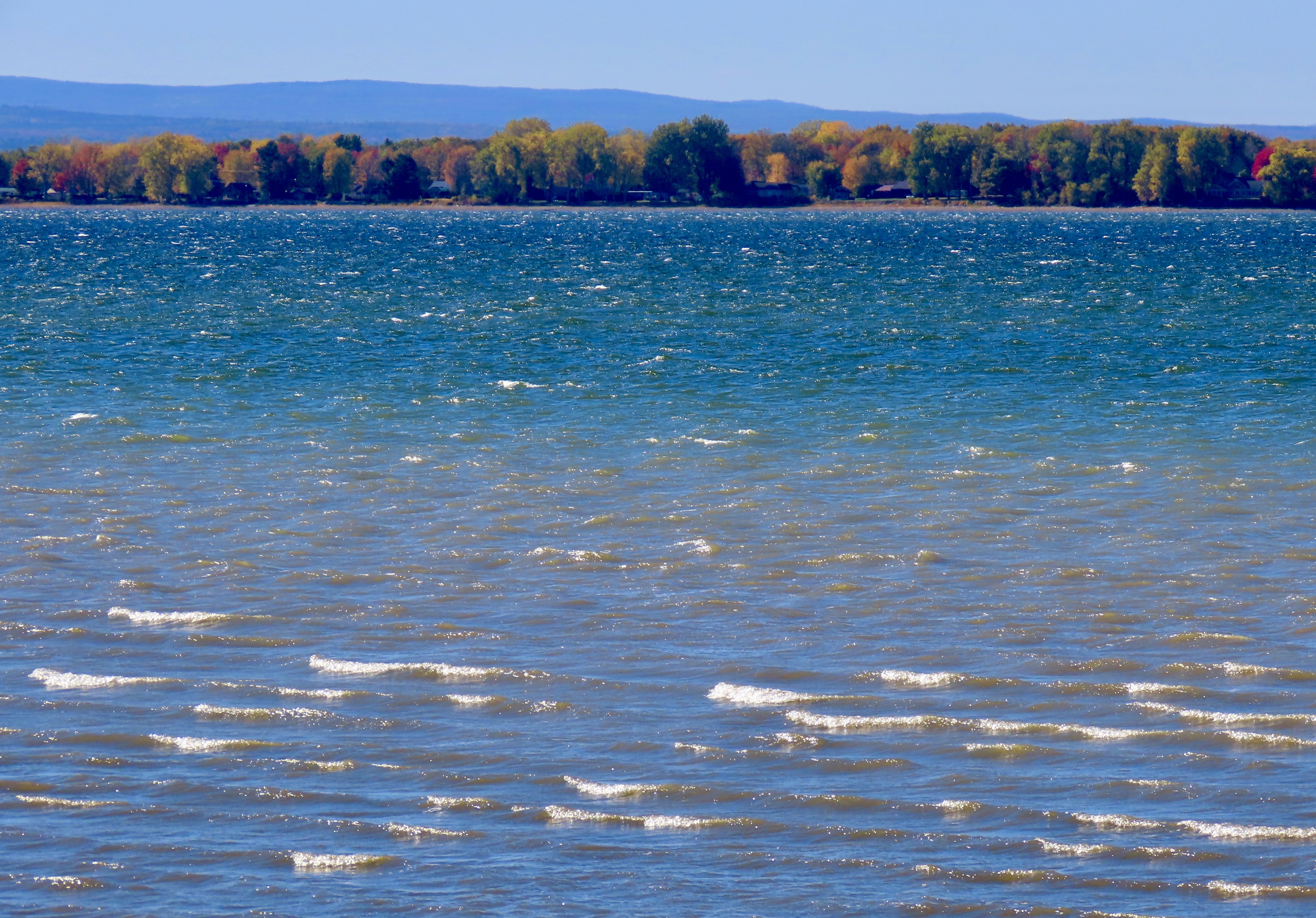
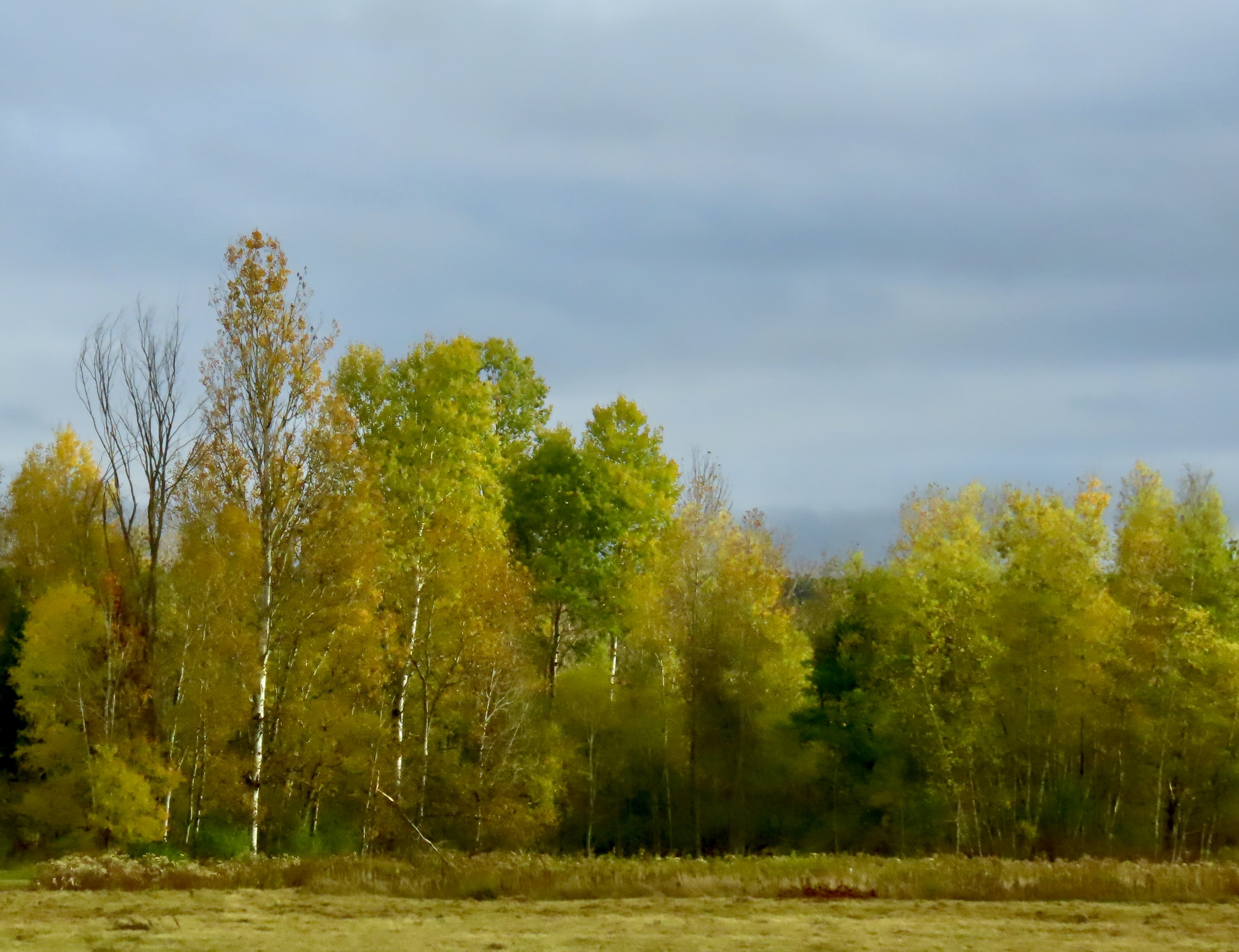
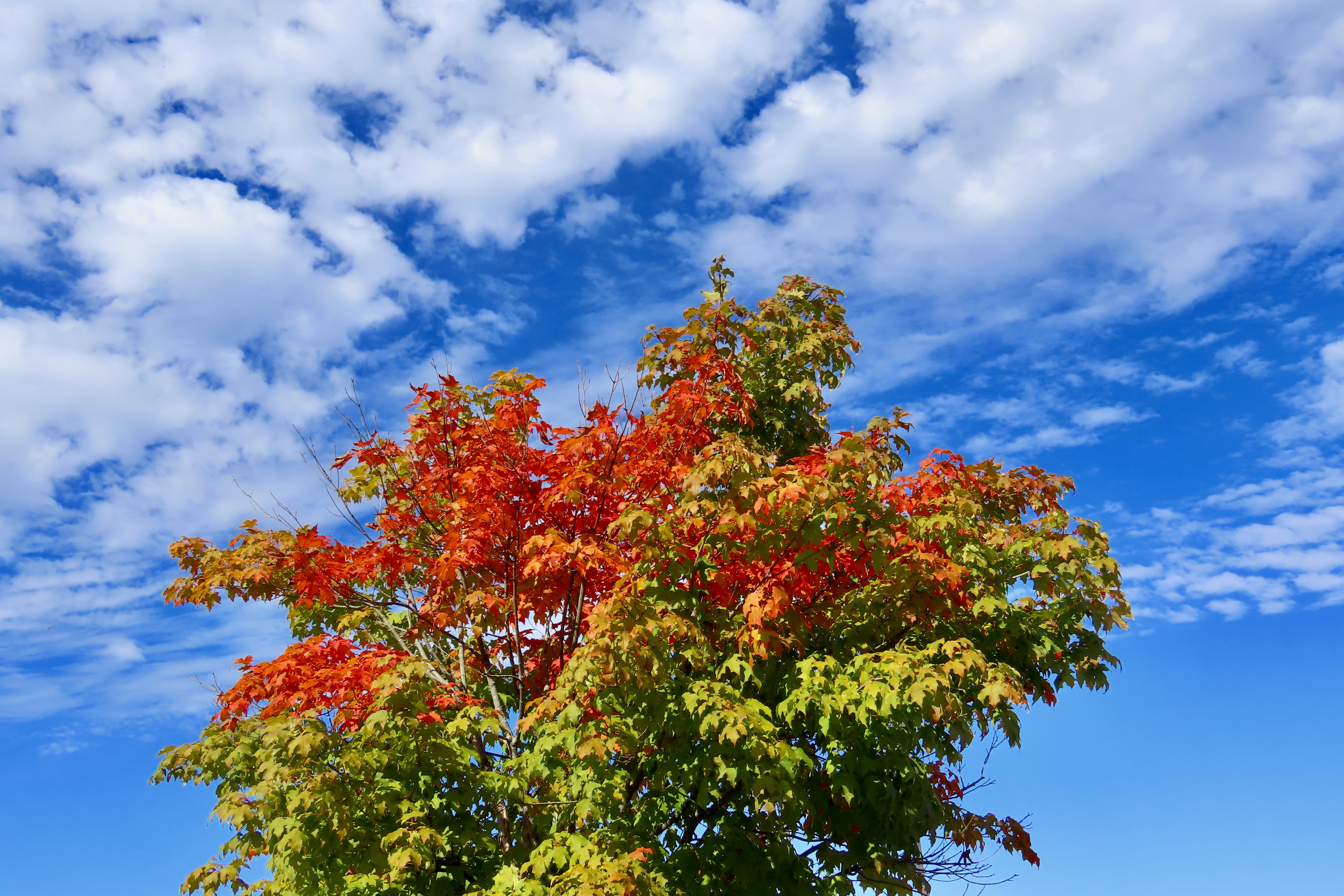
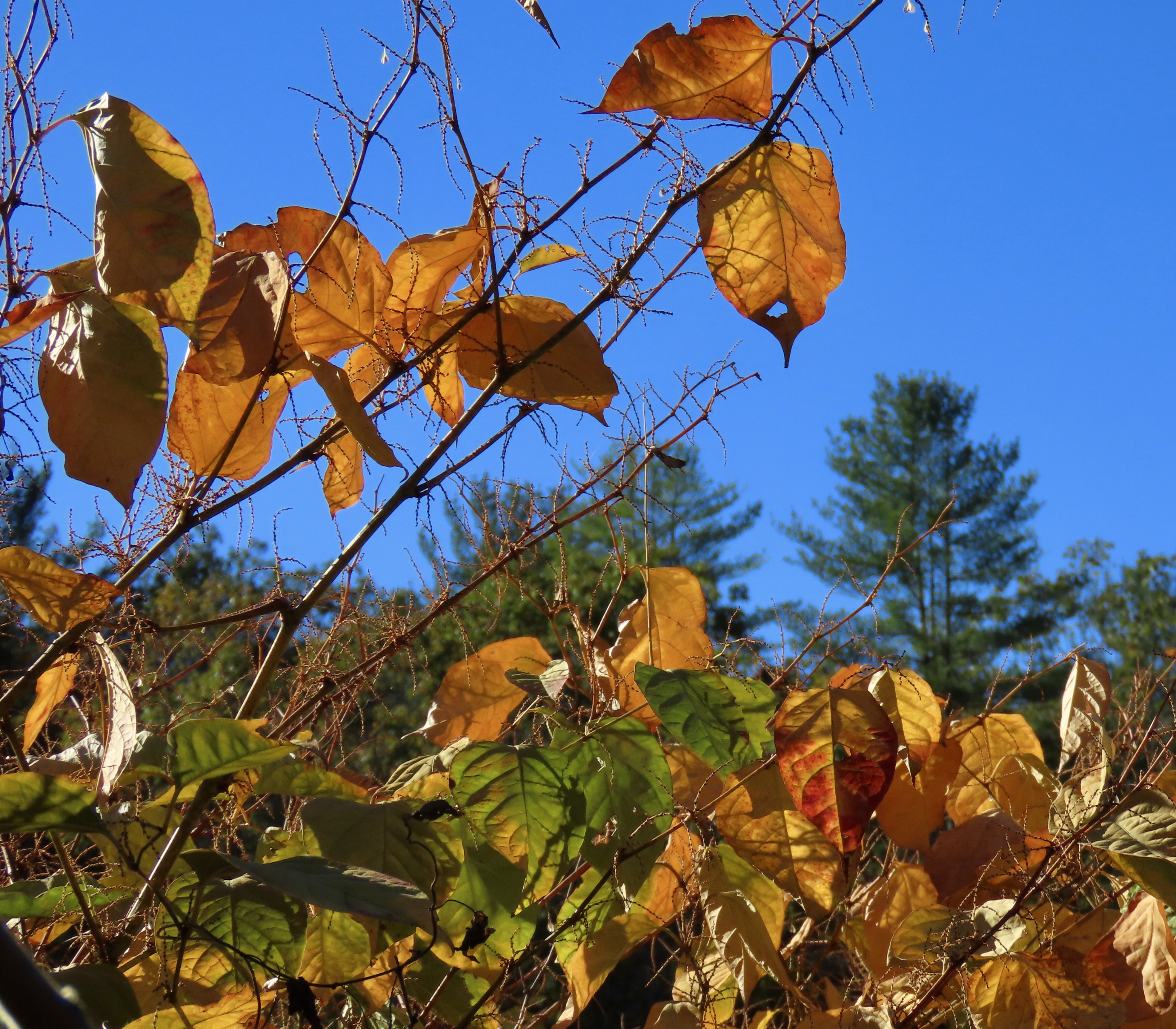
Another example. The way the trees reached across the road here made us feel like we were driving through a kaleidoscope.Lake Champlain provided us to with numerous opportunities to admire the fall colors. The mountains in the background are the Green Mountains of Vermont. We were following a road down on the northern end of the lake that connects a series of islands.A view across Lake Champlain from one of its islands.This photo was taken from the northwestern bank of Lake Champlain. The view is all the way across the lake.We felt that the foreground often added interest to our photos.Color wasn’t limited to the trees. Both grass and brush joined the palette.Another example with the grass adding a golden color. The trees in the foreground had lost their leaves, but they provided a contrast to the trees behind them.Again, one of the close to impressionistic photos of New England I included in my blogs and calendar.It seemed curious to us that the leaves on some trees could still be green while the other leaves on the tree had completely changed. The red and green made me think about Christmas.When the leaf peeping isn’t great, a few leaves can substitute.I thought this tree would be a fitting end to our 2025 travels. The limbs provided a contrast to the colorful leaves, but, in a way, they also reminded us of the many roads we had traveled over in 2025.
Next up: What we have planned for our blog in 2026!
As we noted in last week’s post, our 2025 wrap-up is based on three trips we made during the year and blogged about. The first was Hawaii, which I posted last Monday. Today’s post features our Southwest journey where we wandered through the Southwestern US for five months visiting national parks, state parks, and national monuments. Next week’s post will cover our three week leaf-peeping trip through New England in the fall.
The photos used in the three posts are all from ones we selected to include in three calendars we developed for our extended family, each focused on one of out trips. (Not all of the photos here made it into the calendars, but it was a flip-of-the-coin type decision.)
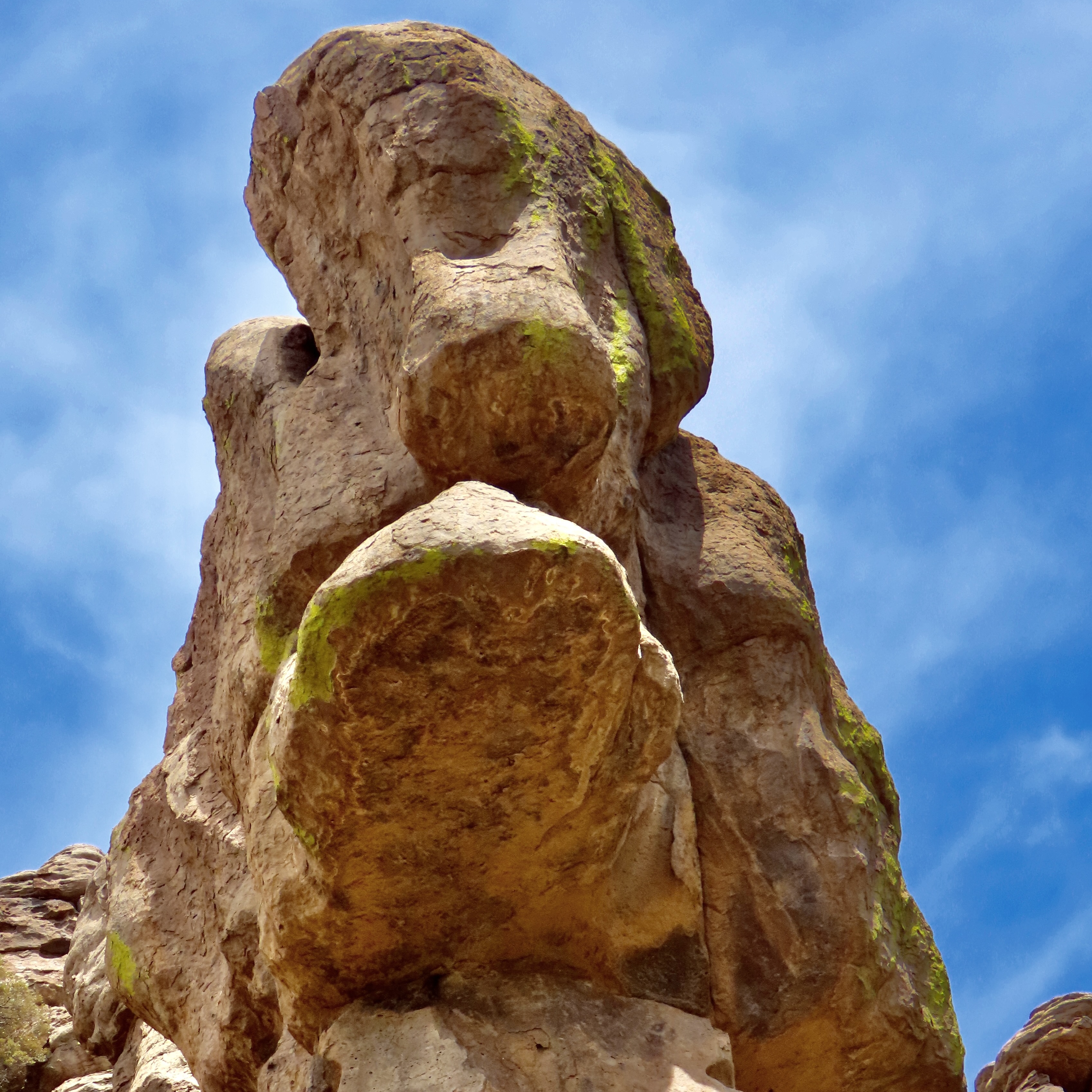
We discovered the towering rock above in Chiricahua National Monument, which is located in southeastern Arizona. The monument is named after the Chiricahua Apaches who roamed the area prior to it being occupied by pioneers from the eastern US. A couple of notes. One, the park is filled with a fascinating variety of rock structures. Two, we have discovered over the years that national monuments often include scenery, geology, history, plants and animals that easily match those found in national parks. They are definitely worth visiting and are usually far less crowded.
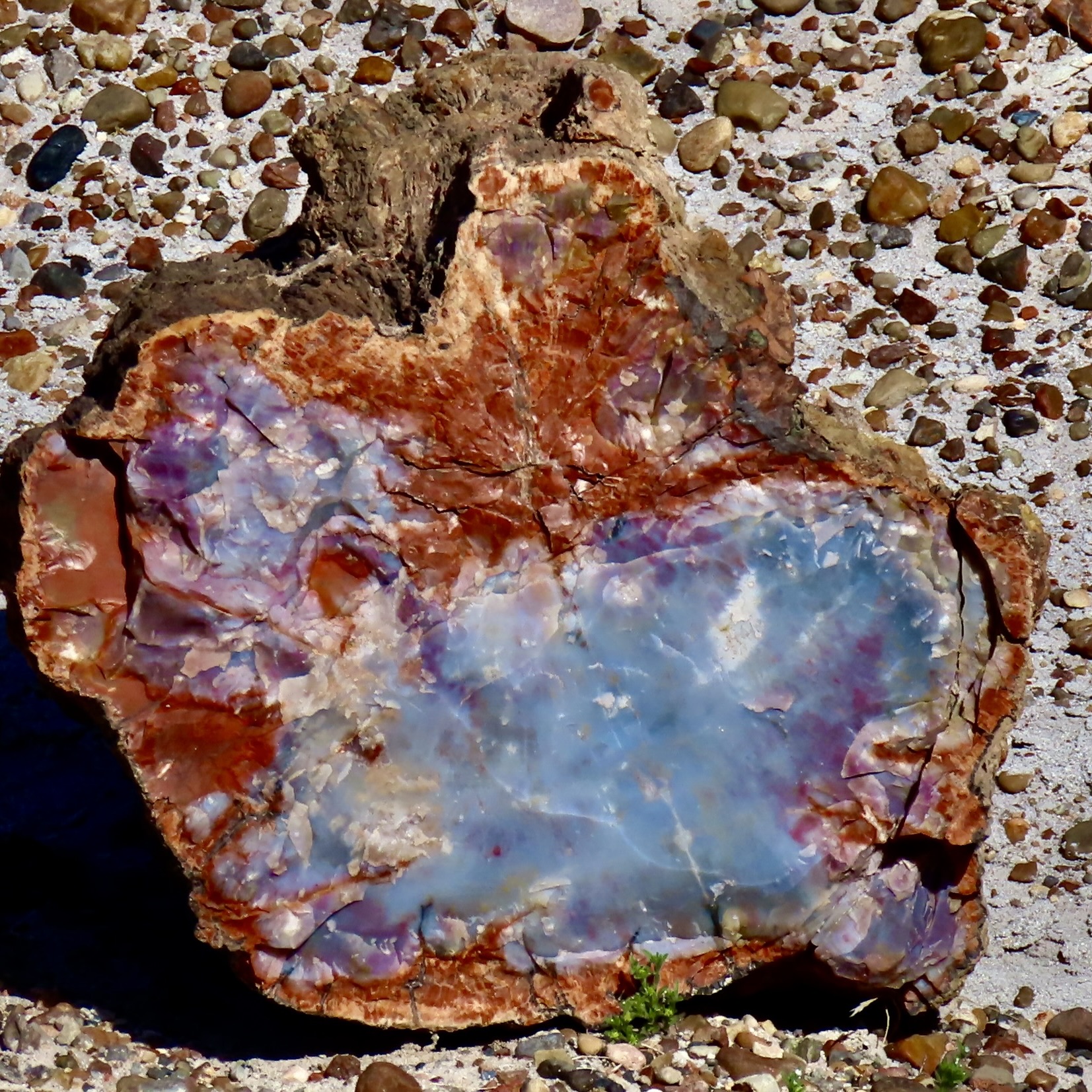
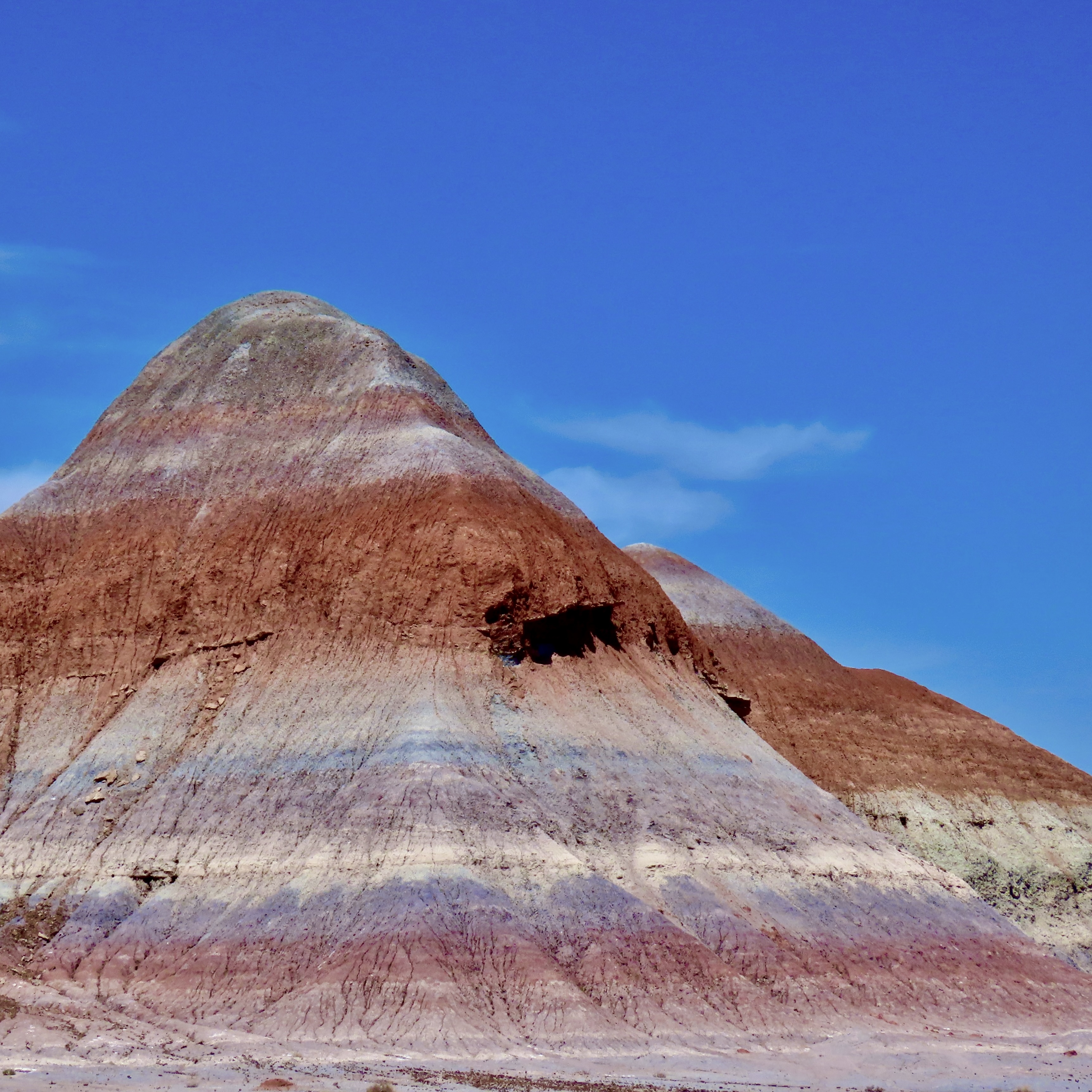
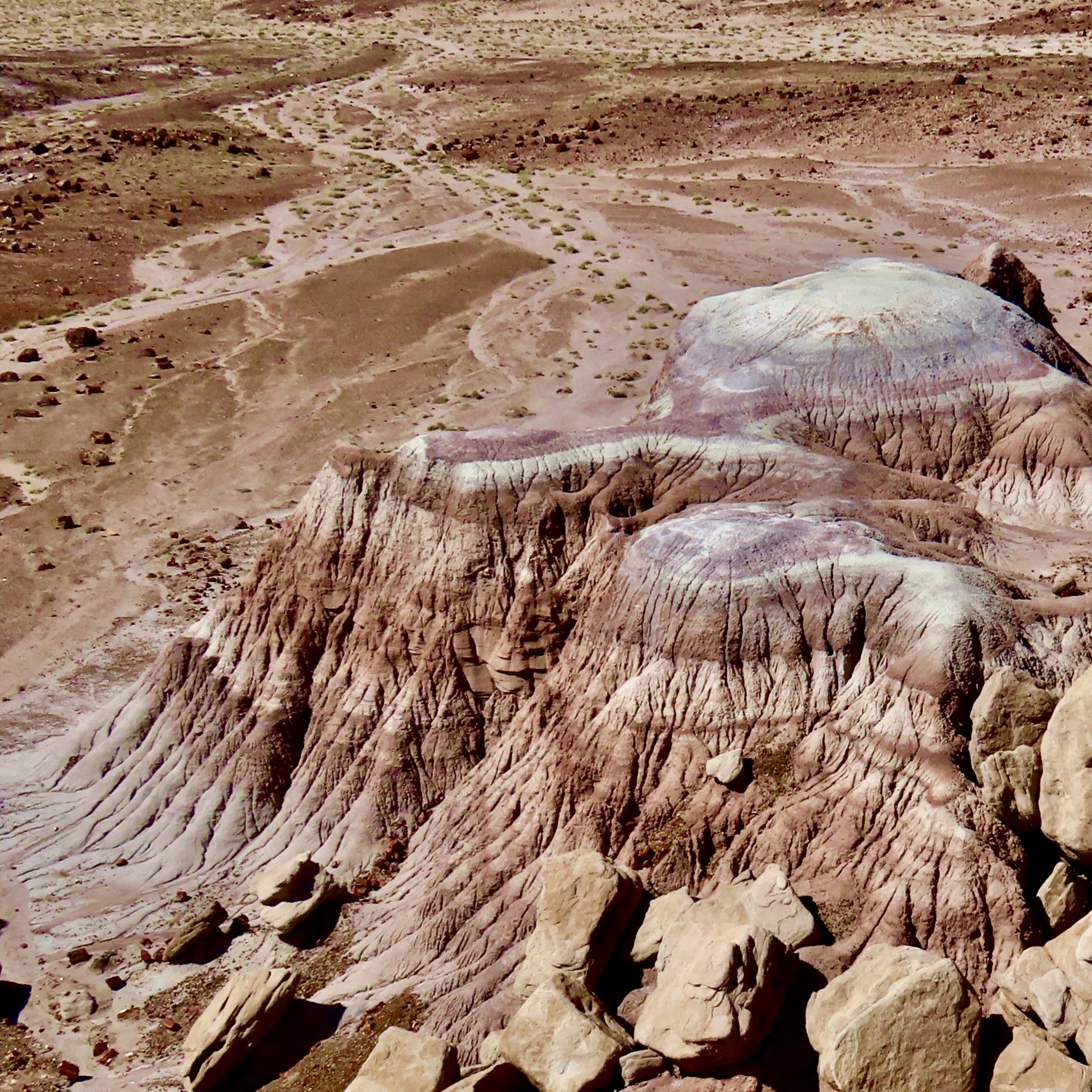
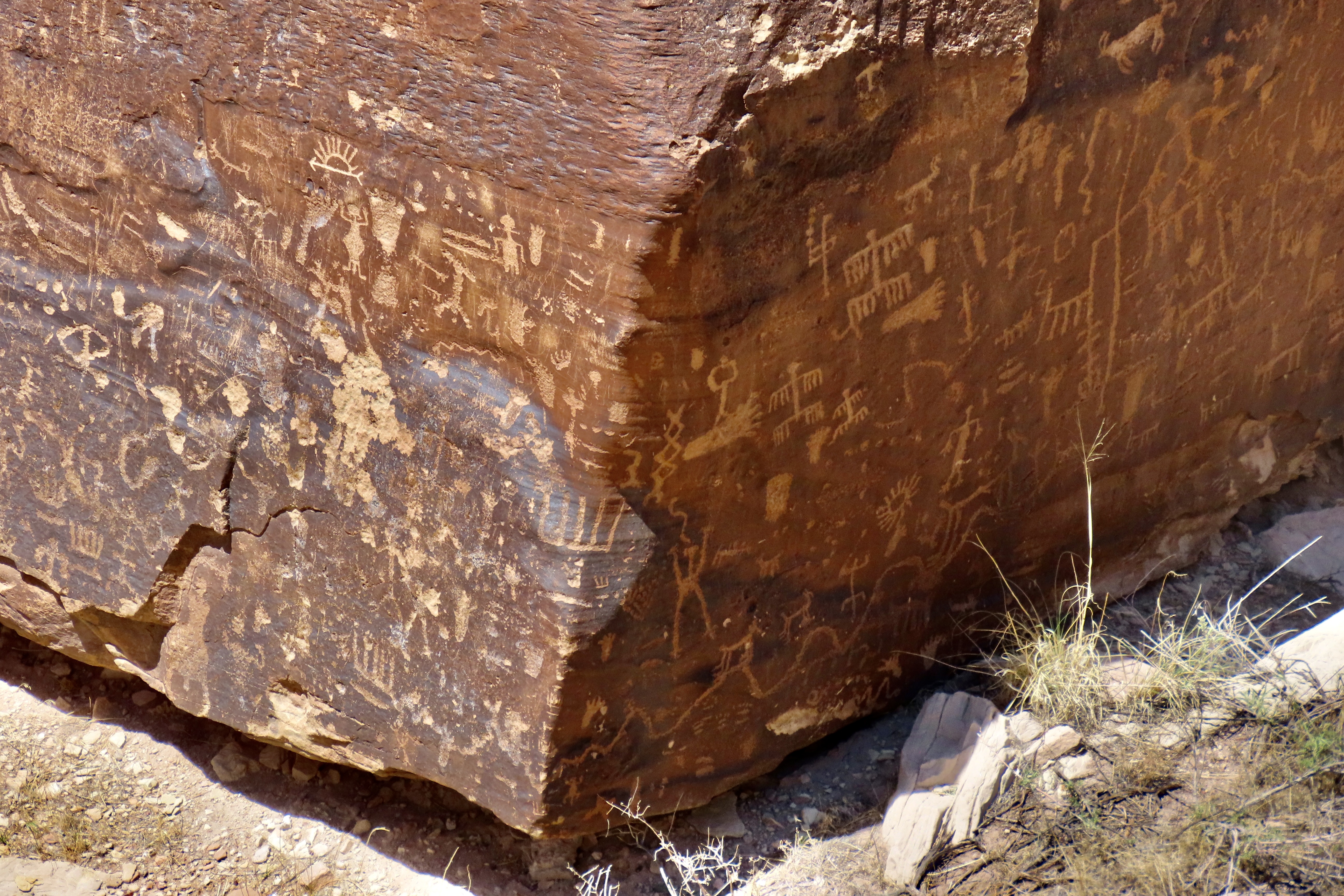
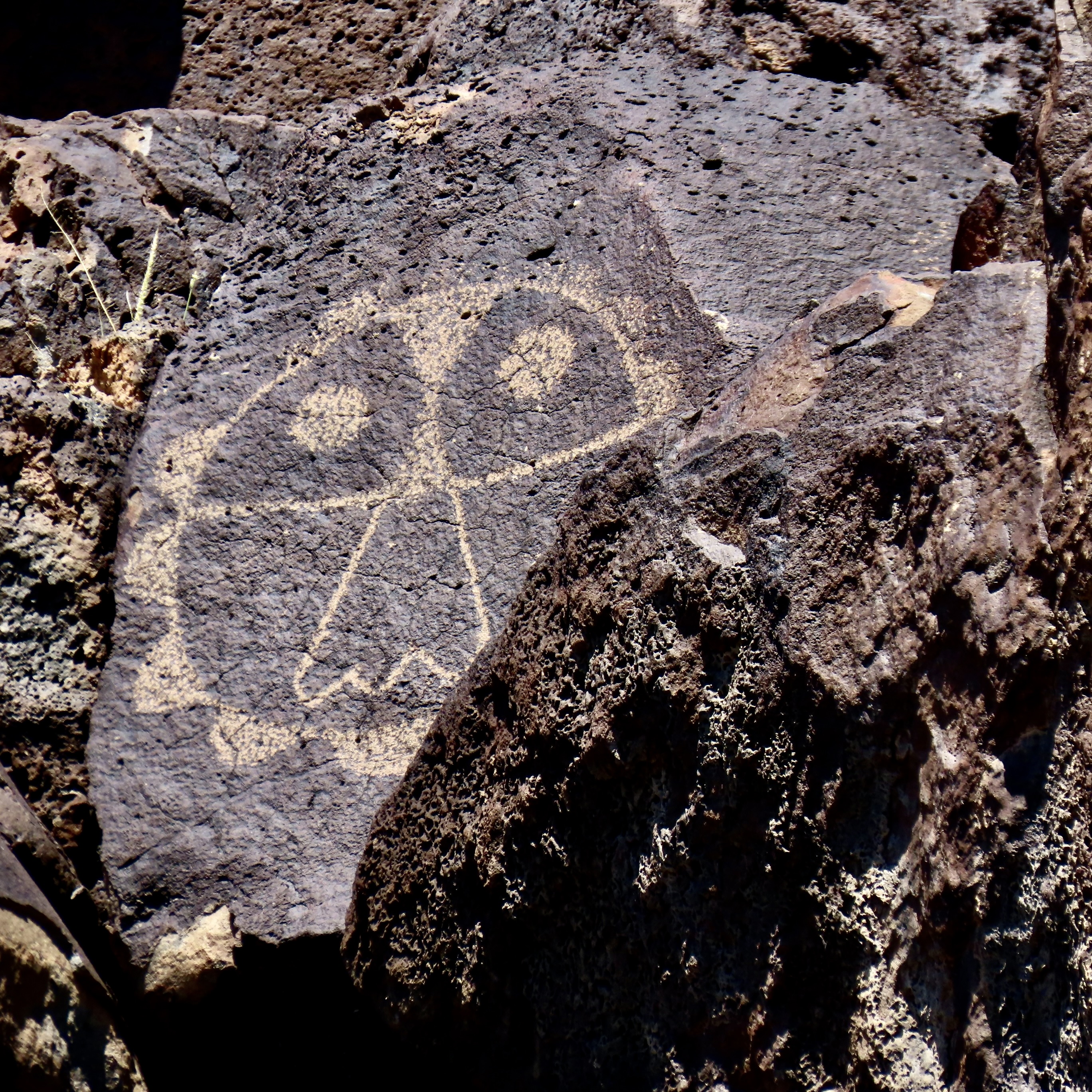
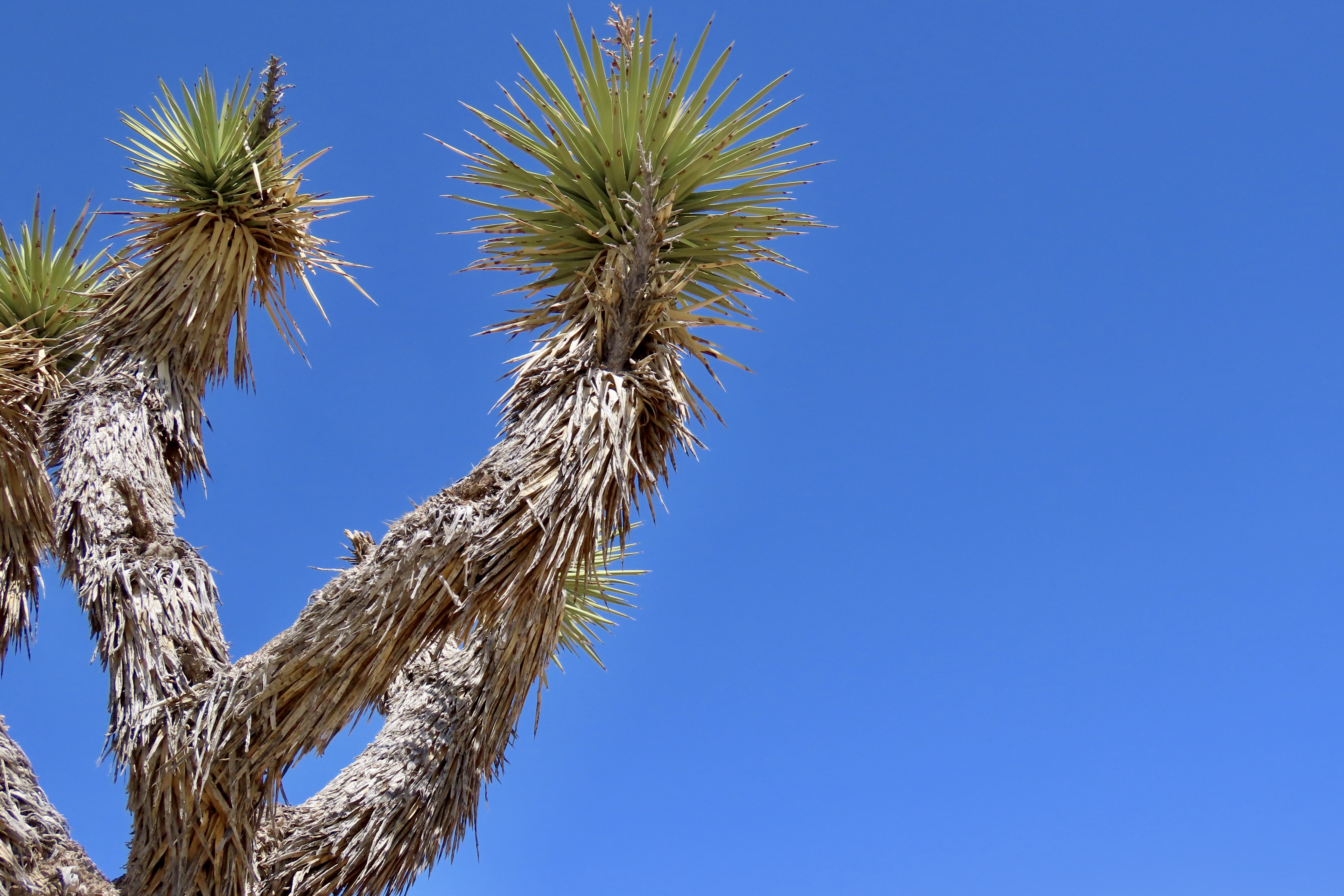
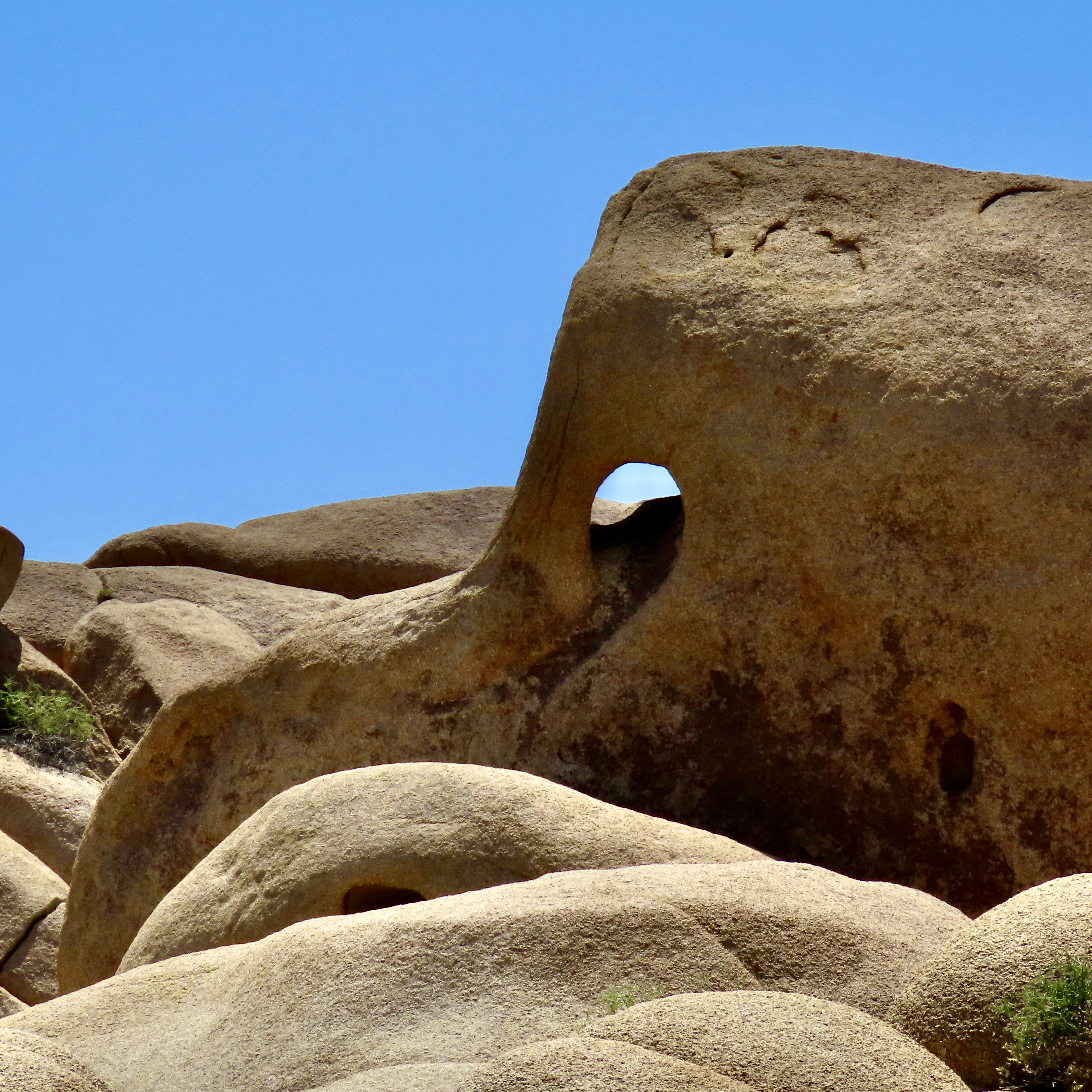
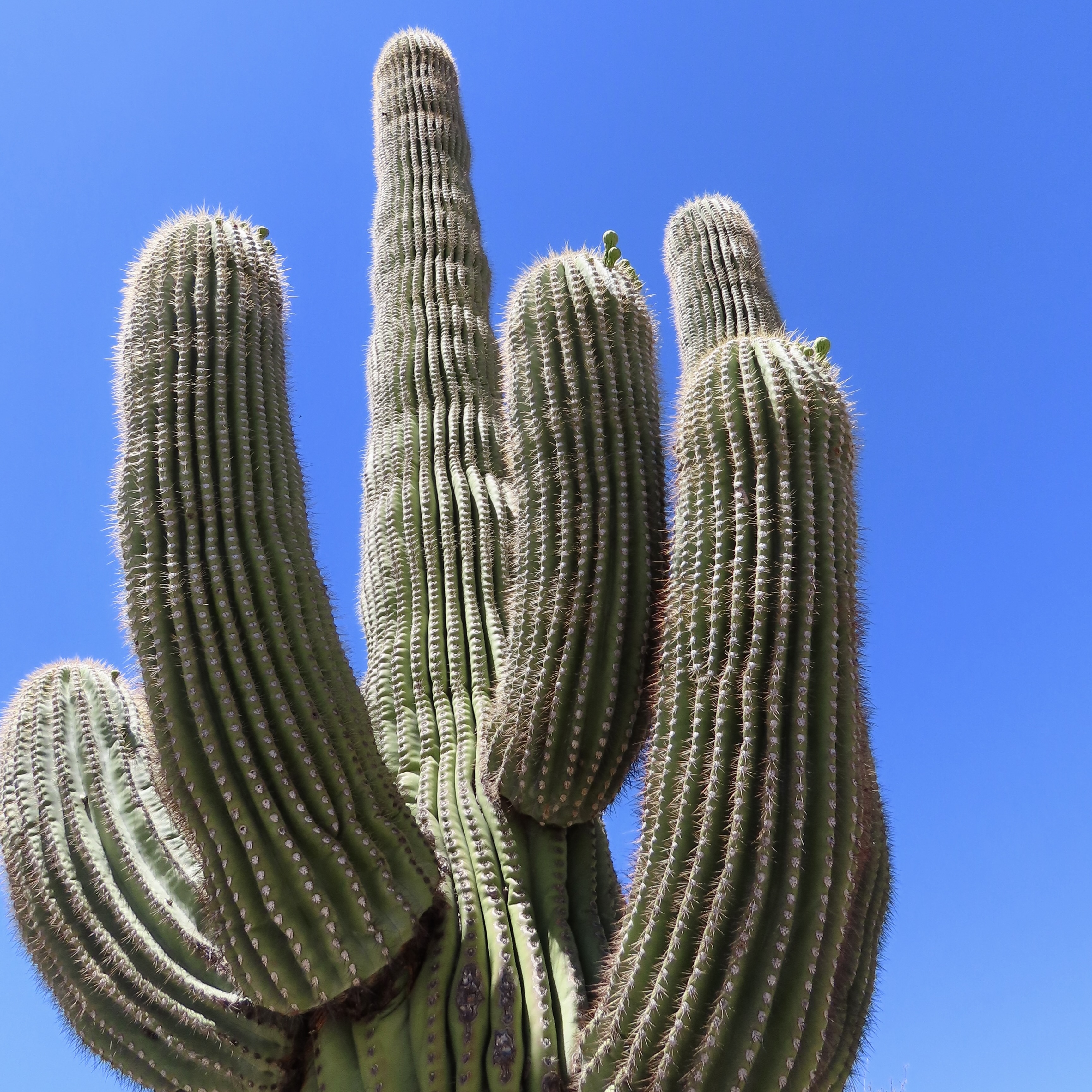
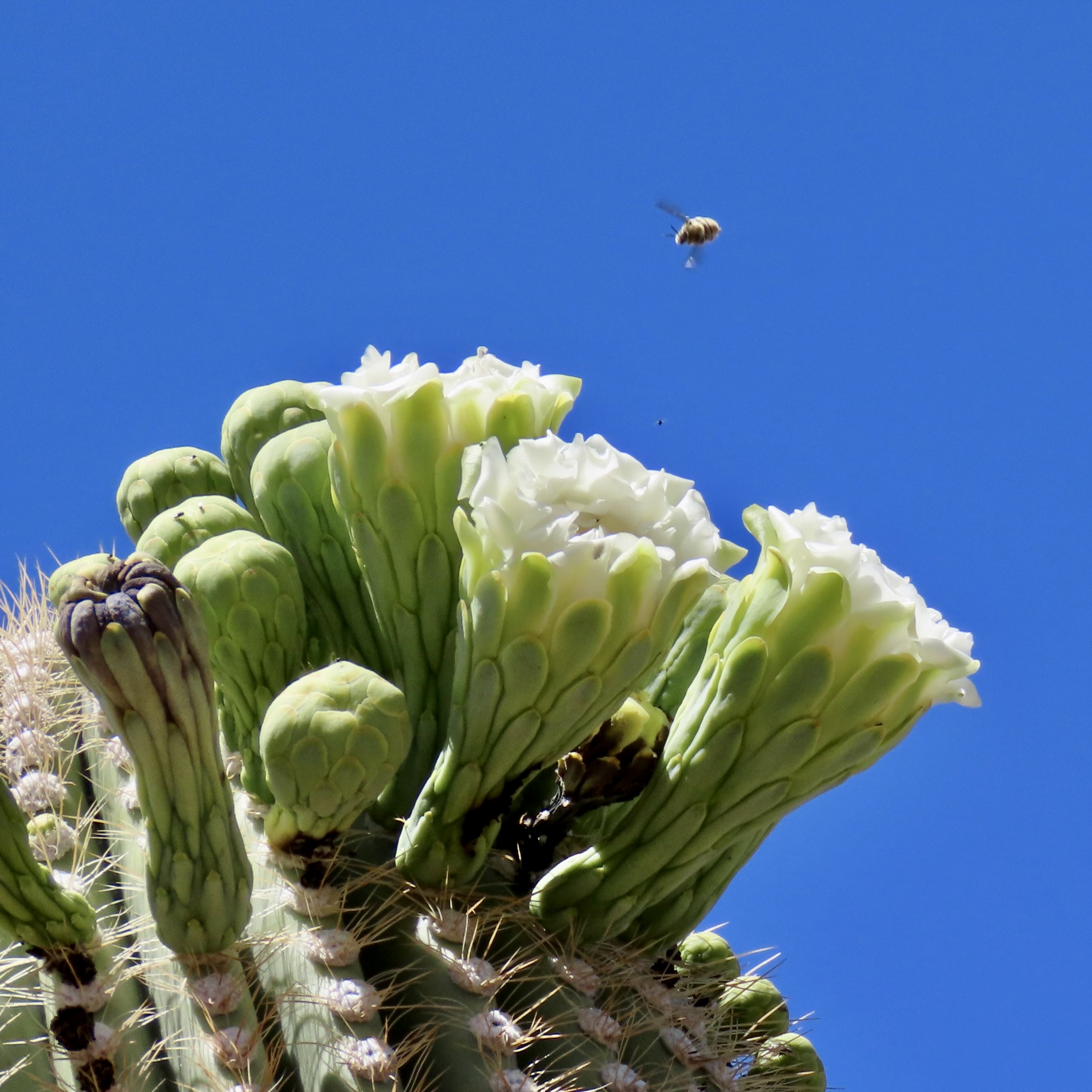
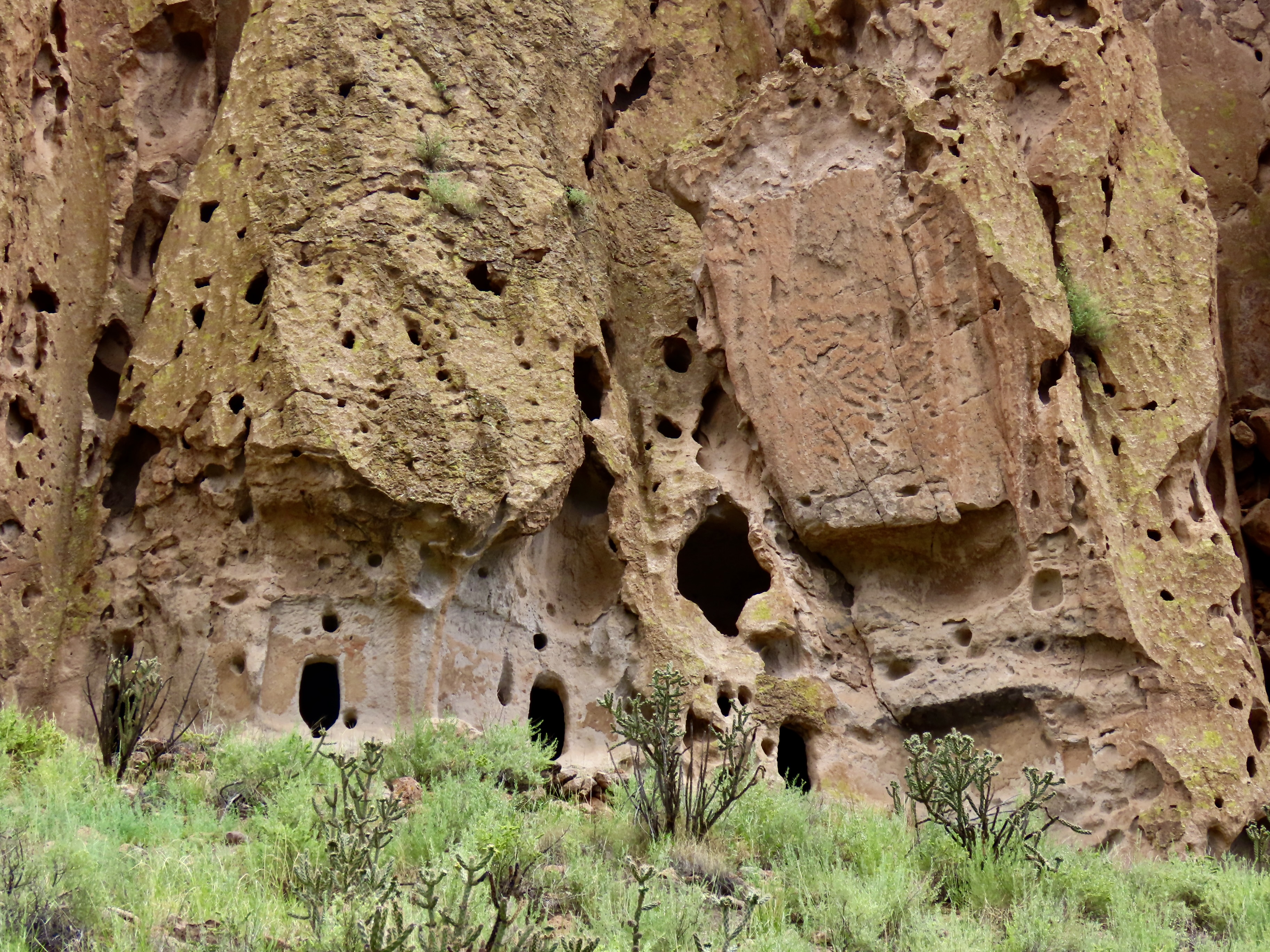
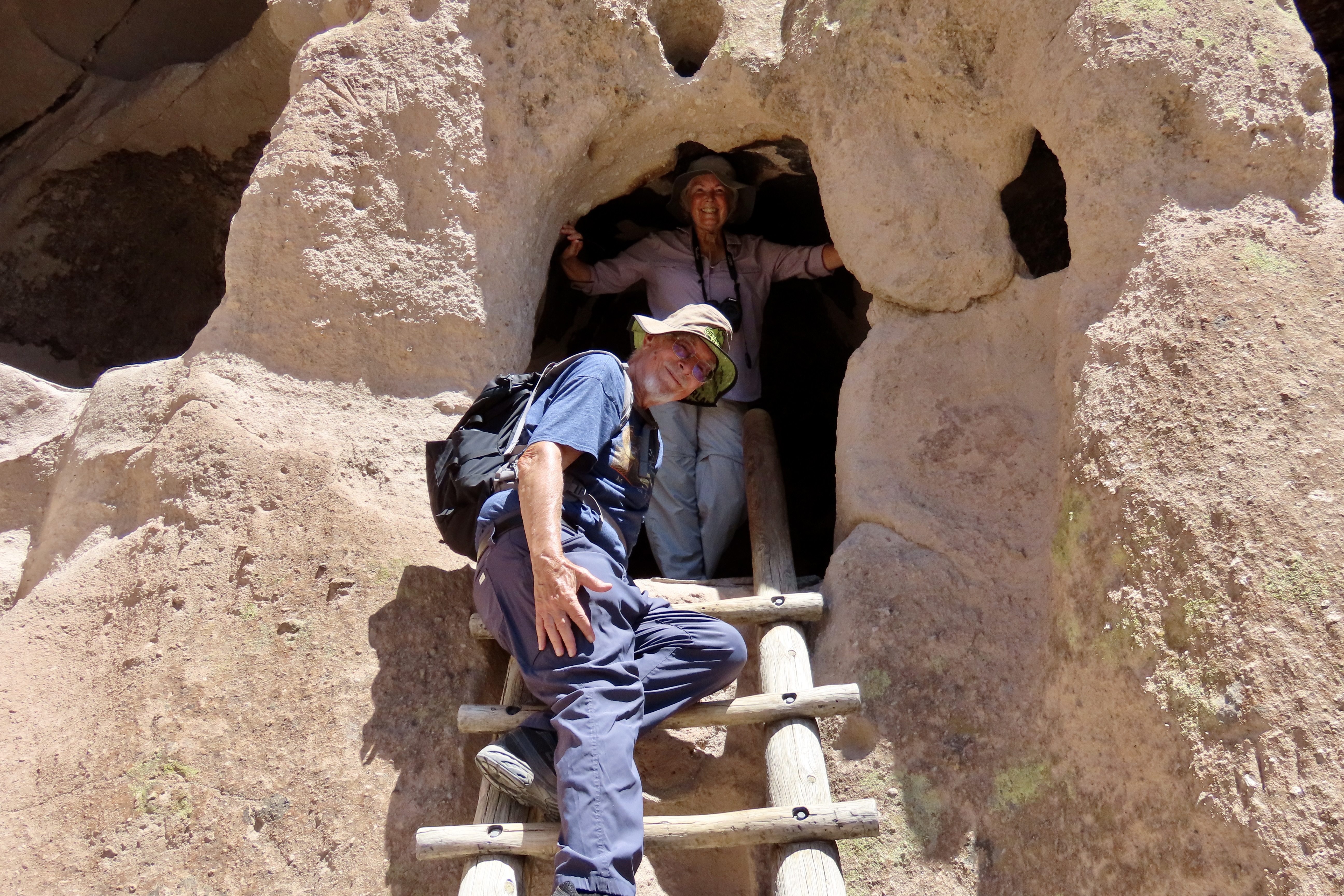
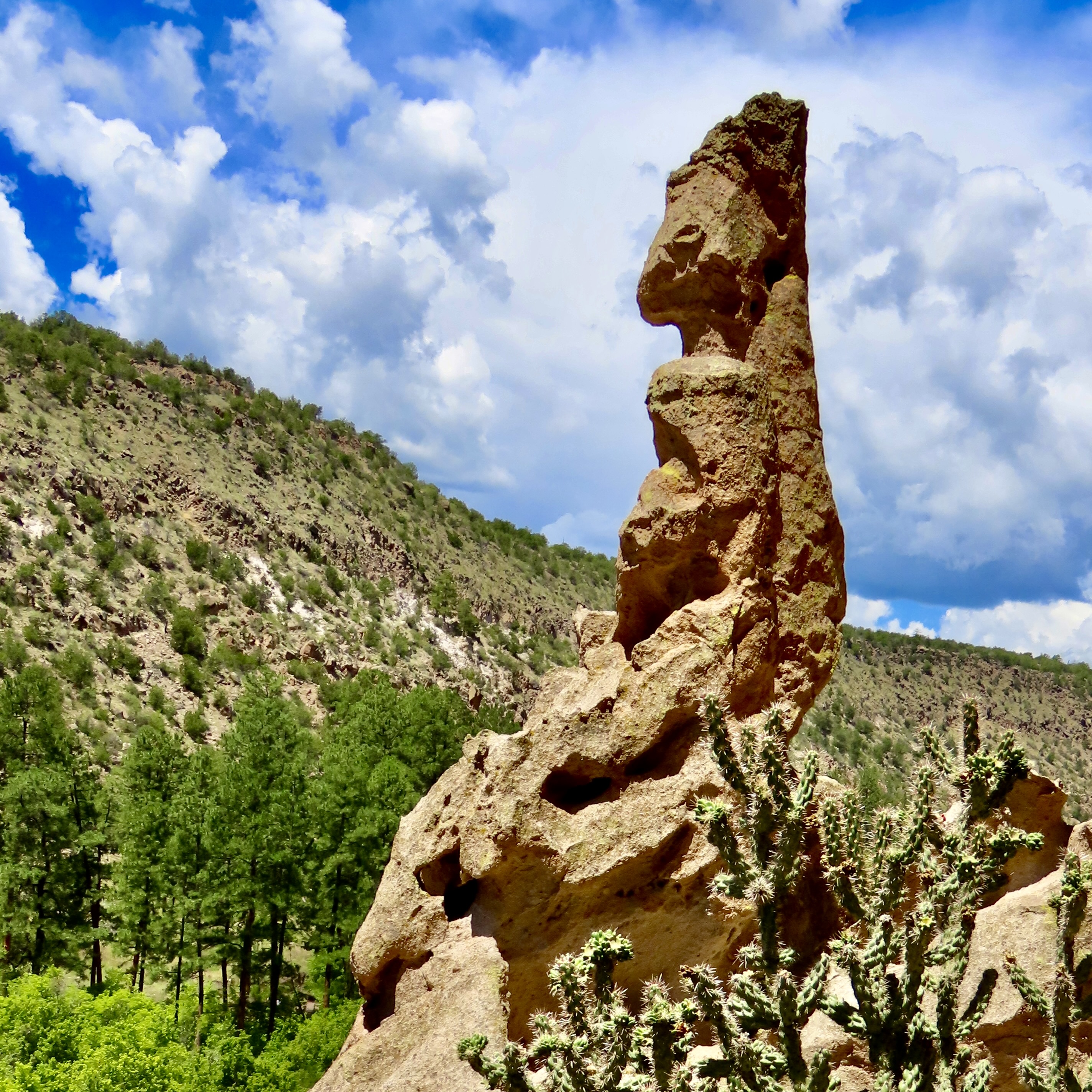
Petrified Forest National Park is found just off of I-40 in eastern Arizona. There are thousands of logs like the one above found in the park. You can still see the bark on this petrified wood that was once a tree that fell 200 million years ago.While most people come to the park to admire the petrified wood, there is also much beauty such as the colorful ‘Teepees’ found on the main road. Each color has a different story to tell representing millions of years in geological history.The Blue Mesa side road includes many other interesting and colorful land forms such as this. If you visit the park, be sure to take the short detour. A walk out in the desert on well maintained trails is definitely in order.Ancestral Puebloans and other indigenous tribes left a view of their ancient world in Petrified Forest NP in petroglyphs on Newspaper Rock. While our understanding of what they were communicating is limited, there is magic in contemplating the possibilities.While we are on the subject of petroglyphs, we found this unique one staring out at us in Petroglyph National Monument in Albuquerque, NM. Over 20,000 petroglyphs have been discovered in the monument. Peggy has plans to include this one in the revision of her word search book: Artistic Word Searches, Unique and Magical: Discovering Petroglyphs from the Southwest.Canyon De Chelly (pronounced shay) is located in northeastern Arizona. Jointly operated by the Navajo Nation that owns the property and the National Park Service, Canyon De Chelly features striking canyon views plus Ancestral Pueblo ruins and petroglyphs left behind by both the Pueblo peoples and Navajos.Our trip this past spring and summer took us into Califonia where we visited family and friends in San Diego, LA, and Sacramento. We also took time to visit Joshua Tree National Park in Southern California, known for its strange trees, after which it is named.We found the rock structures to be of equal, if not greater, interest. Some of which could be said to possess personalities.In addition to being known for its outstanding rock forms (think of the Grand Canyon, Zion, Bryce and Arches— plus what we visited this year), the Southwest is noted for its deserts and cacti, none of which is better known than the Giant Saguaro. We’ve often stopped to admire these huge plants in Saguaro National Park but have never been in Arizona when they are blooming. Things were about to change. Note the buds popping out on top of the arms.This time we were lucky. The blooms are almost other-worldly, in addition to being a source of food for numerous insects such as the bee coming in for a landing.A number of other cactus flowers also lit up the desert.Like plants, animals adjust to the deserts of the Southwest. Several birds choose to nest among the needles of various cacti including the curved bill thrasher Peggy found raising her family in a cholla cactus. The thrasher was not happy when she sneaked up to it and her hatchlings to catch a photo with her iPhone. It’s probably a good thing Peggy couldn’t understand what momma was saying.Bandelier National Monument, located mere miles away from where the first atom bomb was created at Los Alamos, New Mexico, features the ruins of homes built by Ancestral Puebloans that included natural and carved caves (cavates) with pueblo structures once built up against them.Peggy and I climbed up to one of the cavates. It was quite cozy inside. “Honey, I’m home.”Just beneath the cavate, this outcropping of rocks overlooked the large Tyuonyi Pueblo at Bandelier. A corner of the ruins can be seen here. It was built in a circle and contained contained 400 rooms.This tall rock was among the rocks in the outcropping. My first thought was wow! Nowhere in our travels though out the Southwest have we seen a statue like it carved by Ancestral Puebloans or any other indigenous tribes. We had a guide to the trail we were walking on, but there was no information on the statue. Nor was there anything in the information center. The emphasis was all on the scenery, cavates, petroglyphs and pueblos. Human or nature carved, I would think that the park’s literature would at least comment on it. That’s it for today. Next up:We wrapped up our year of travel with out trip to New England so it’s proper that we finish off 2025 with the trip.
Happy New Year to everyone and thanks for joining us on our adventures in 2025. It’s much appreciated. Costa Rica, Bali, and Scotland are coming up in 2026! Curt and Peggy















 Wandering through Time and Place