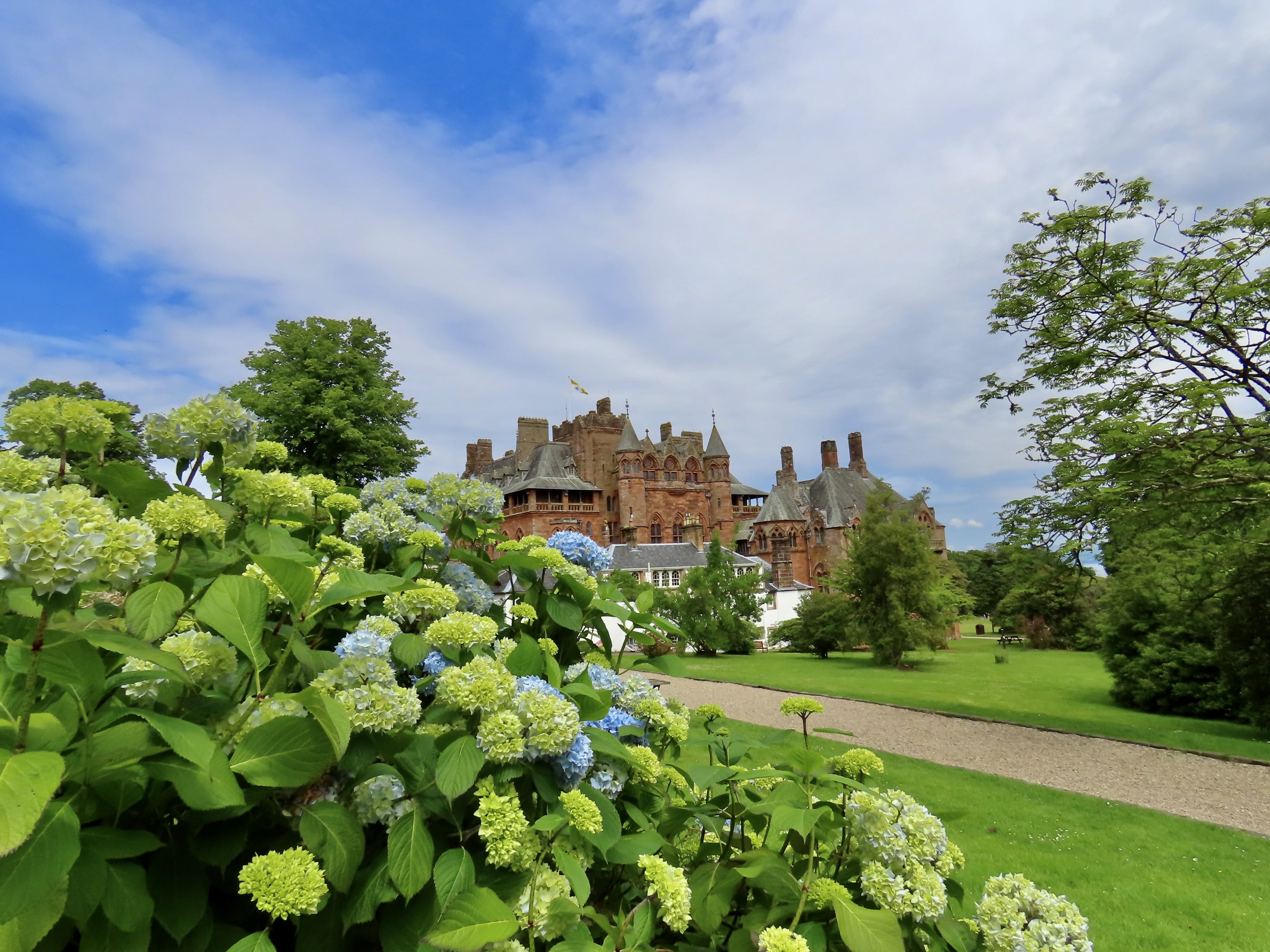
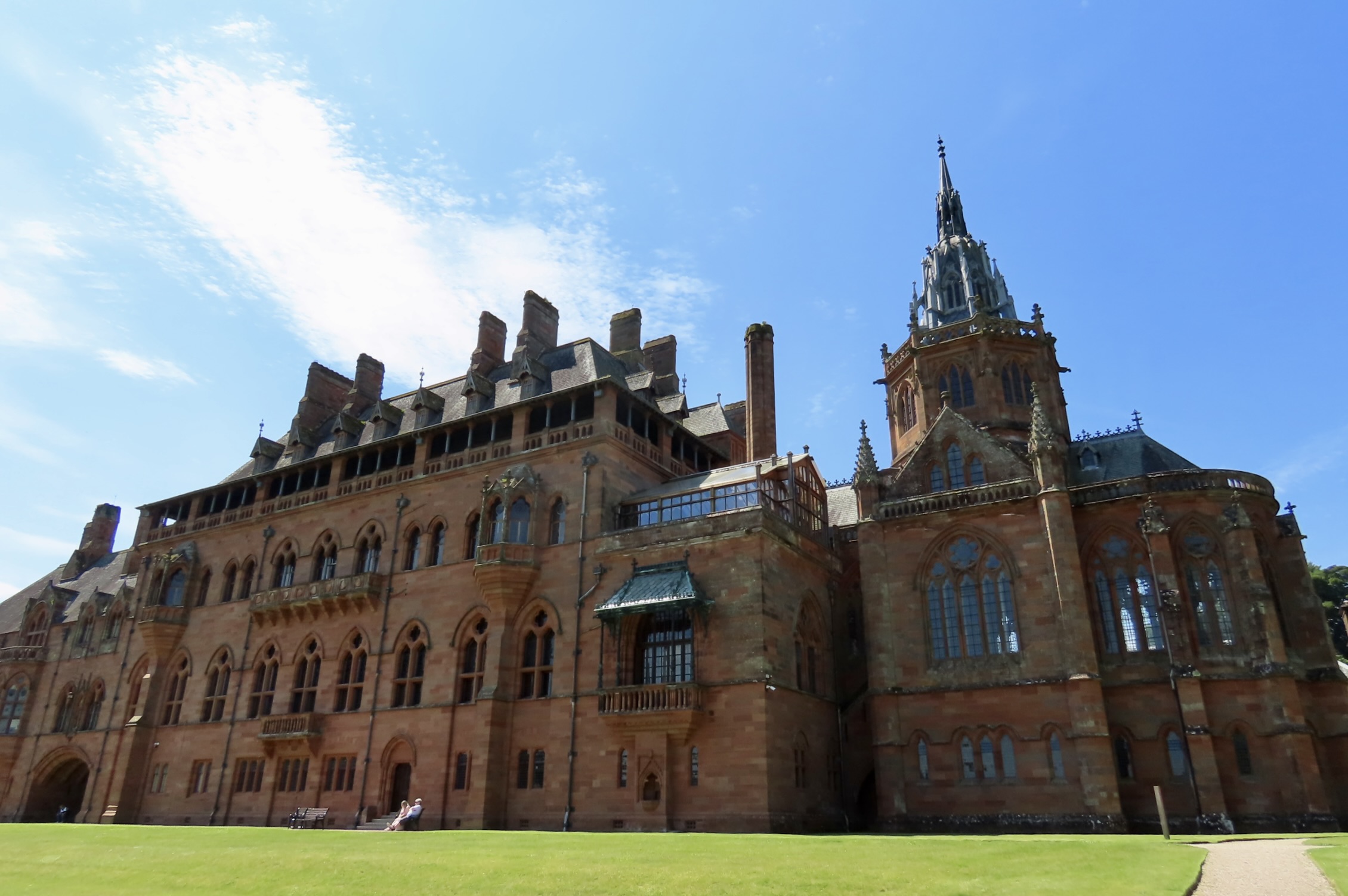
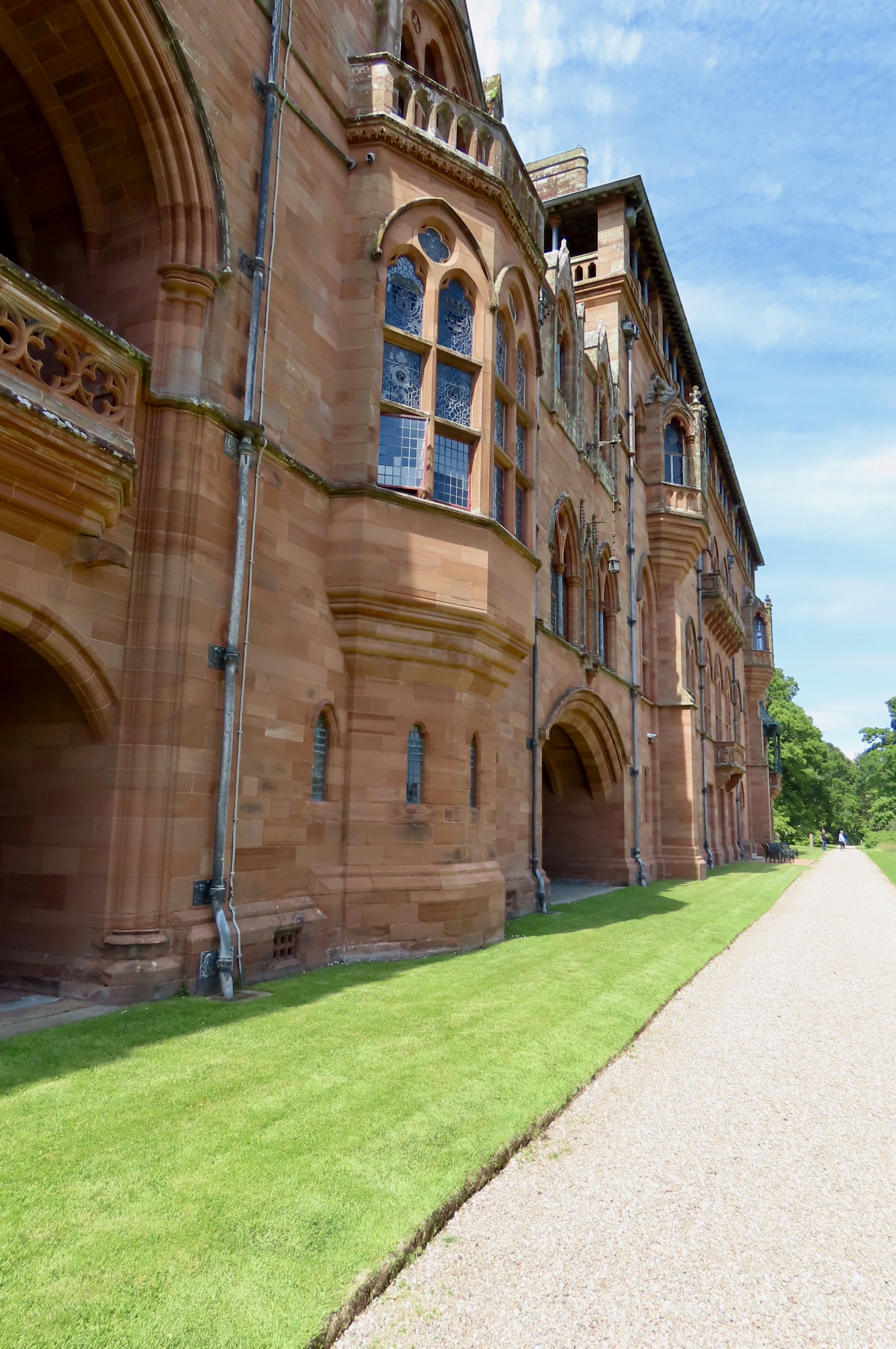
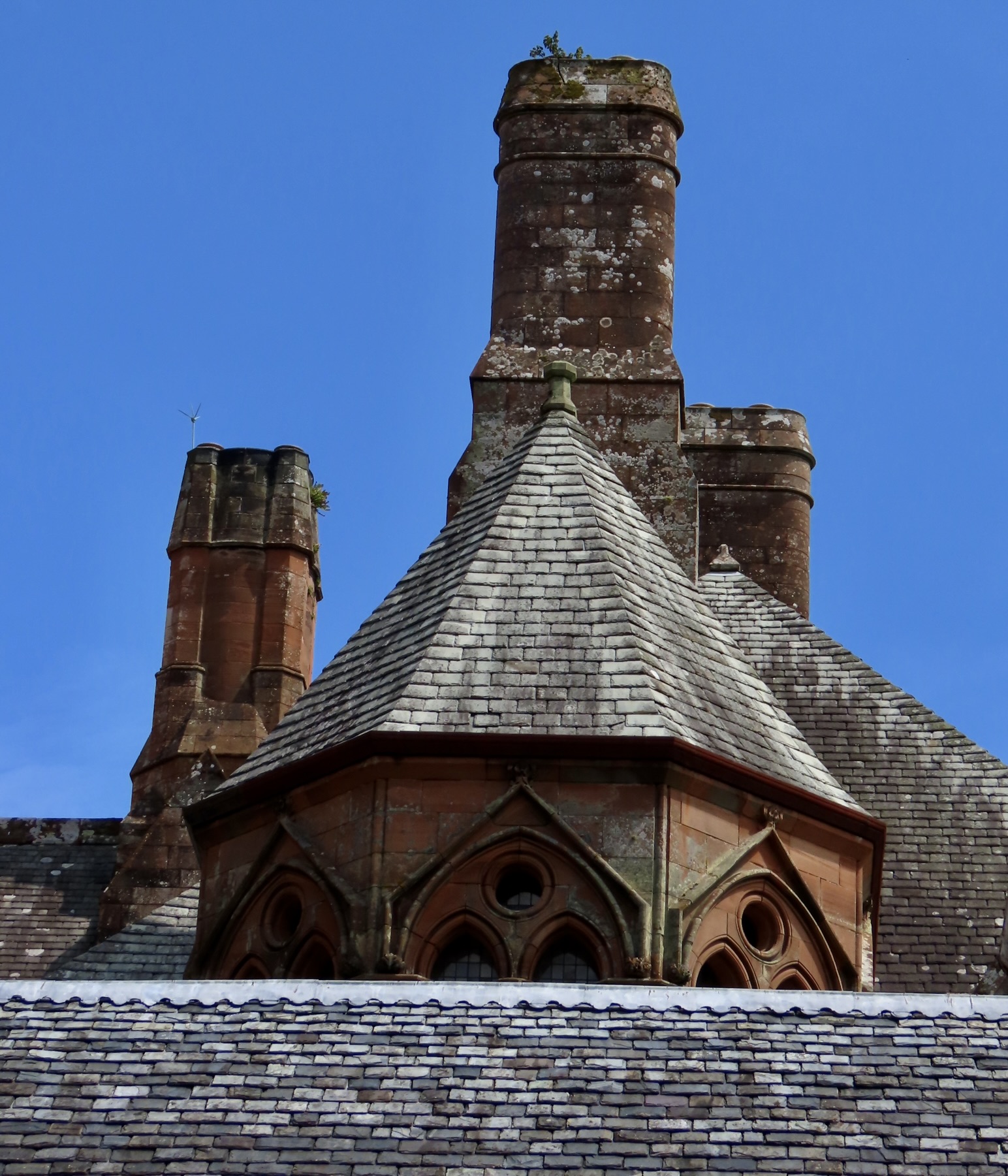
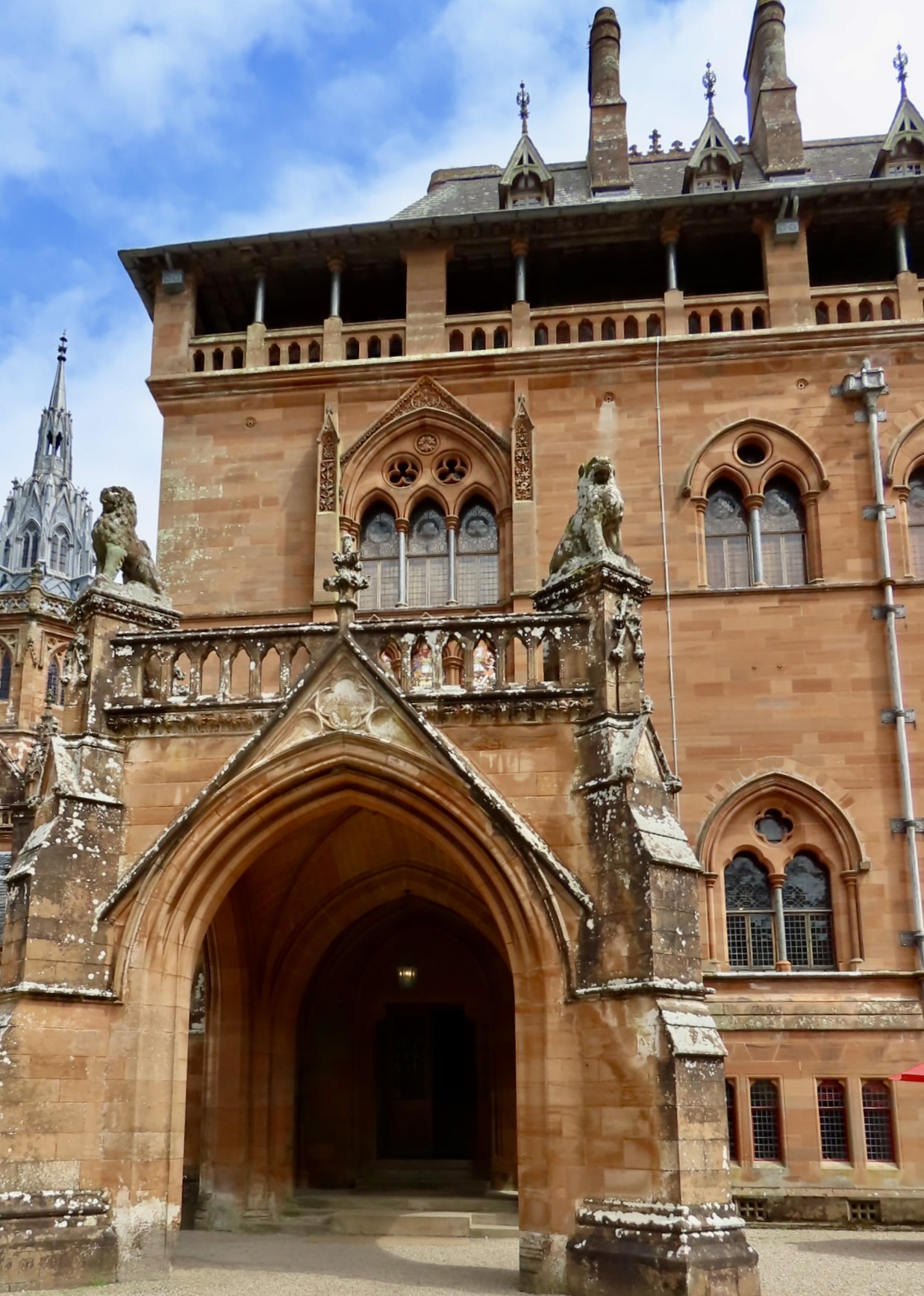
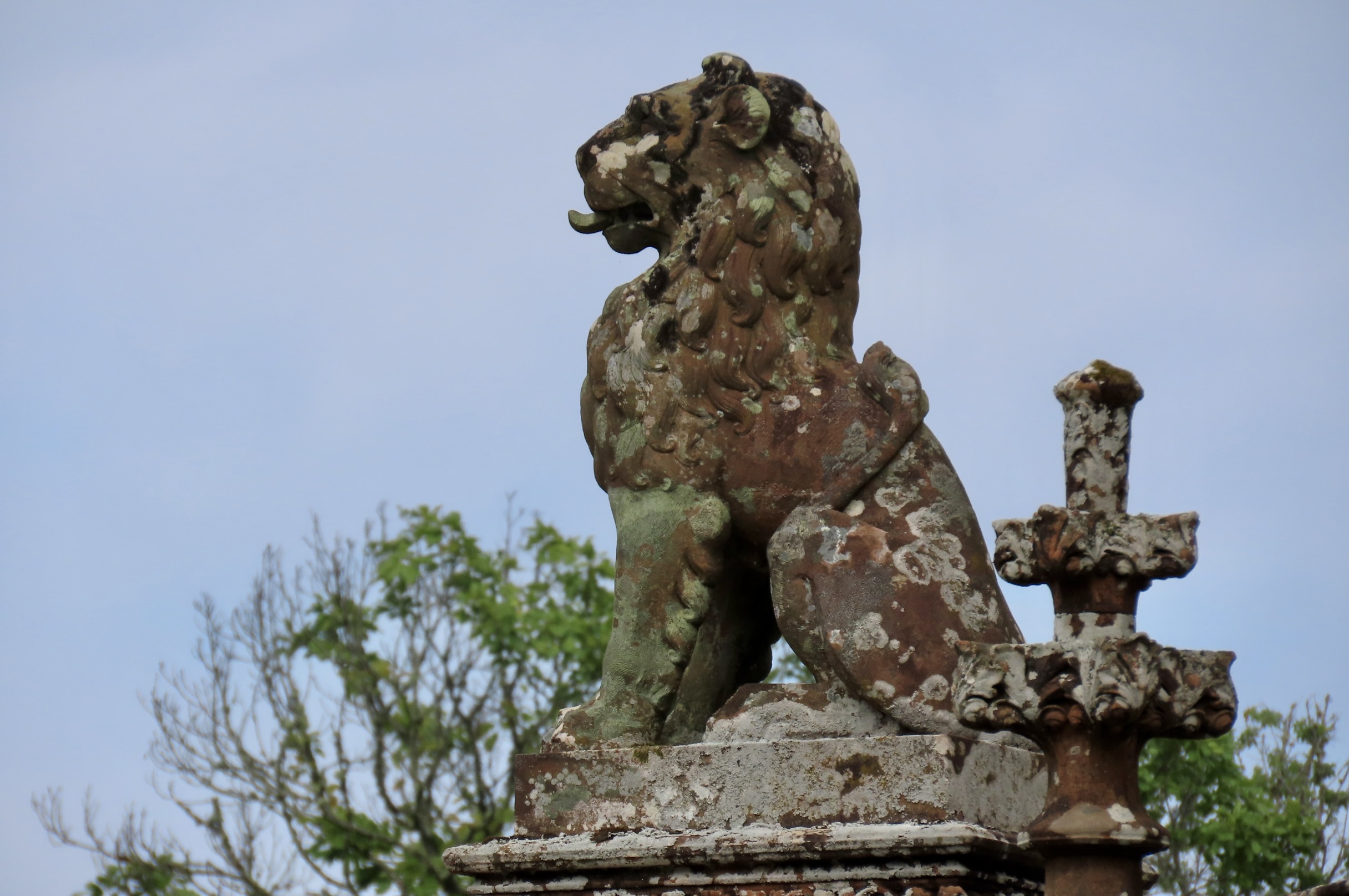
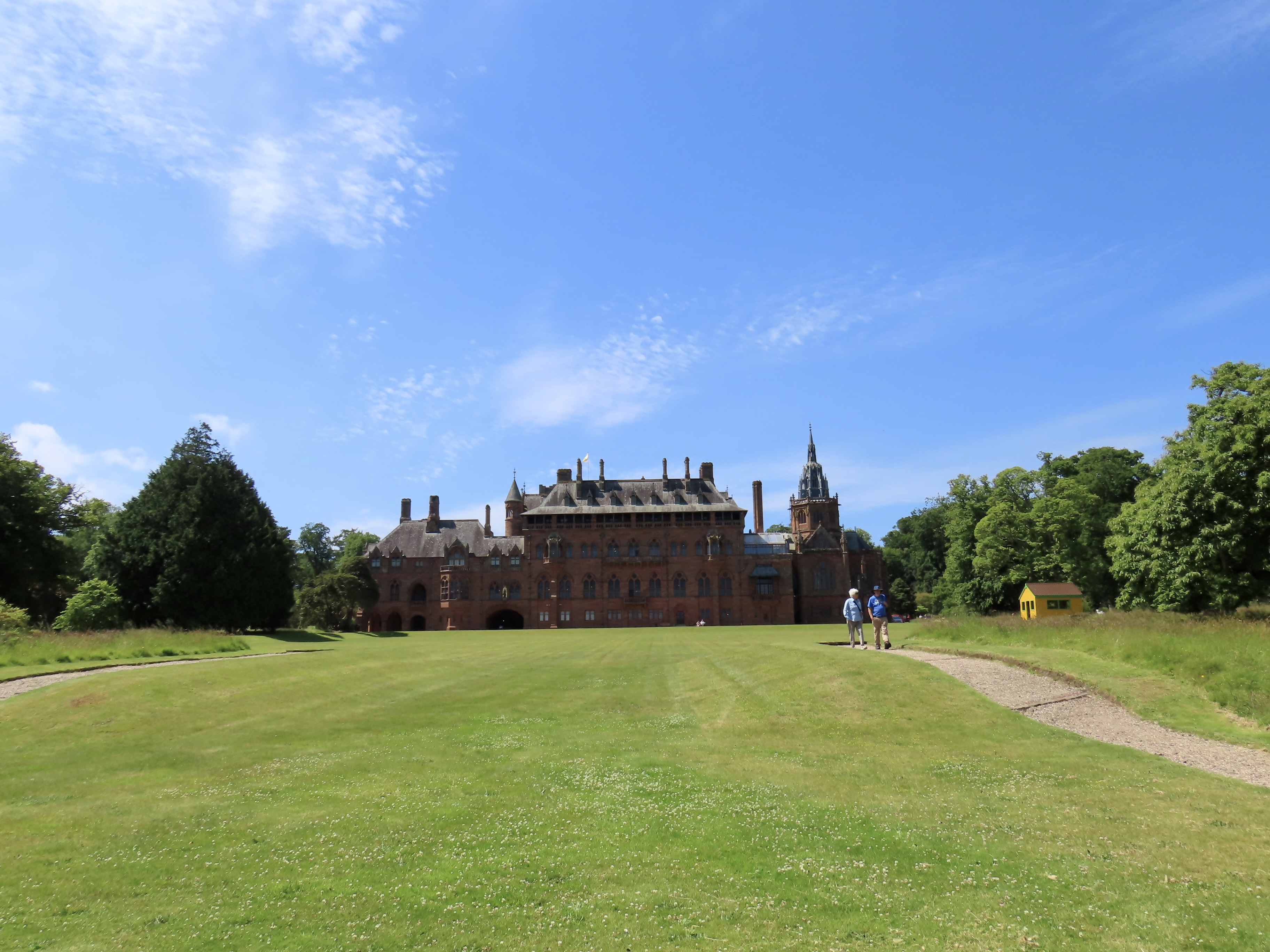
The hydrangeas couldn’t disguise or hide the House of Stuart’s castle-like appearance.From any angle.Taking the long view.Or the top one. The roof even included turrets, which are great for providing wrap-around views of invading enemies. (Although one might wonder why it featured stained glass windows instead of cannon ports. But maybe the round windows were fake news.)The creme de la creme of the Stuart House’s castle-like appearance were two medieval lions perched above the entrance.Both with their tongues sticking out. The tongue means they are roaring and are ready to fight! The message is “To get to the castle, you have to go through us!” See below.Would you challenge this lioness with her mouth stretched wide, fangs showing, and tongue sticking out! We certainly didn’t— even though, as it turns out, it was nap time and she was yawning. We took this photo when we were on a safari in southern Africa.
Entering the ‘castle,’ changed our mind about its pedigree. It was a house, after all. A very big house.
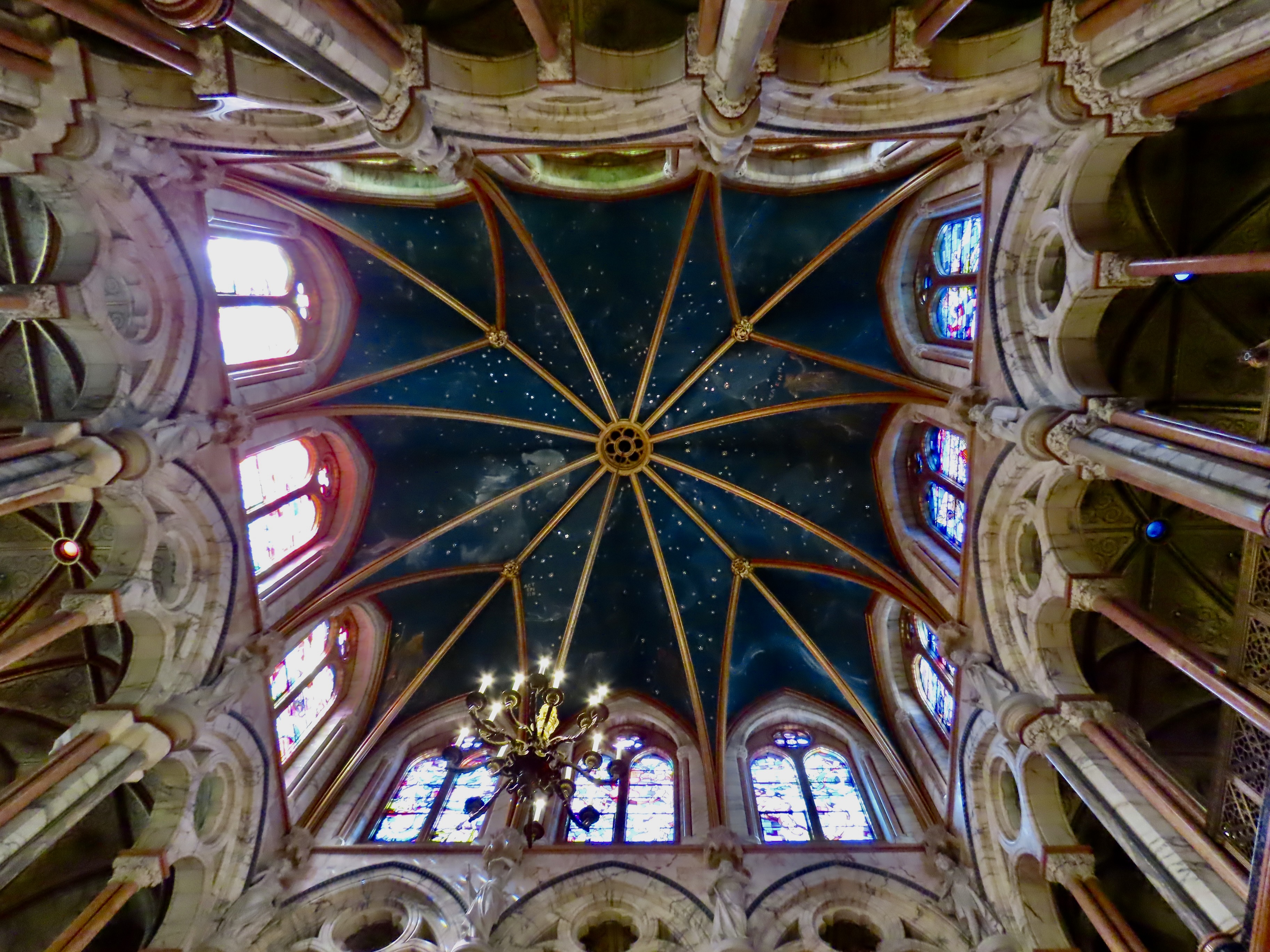
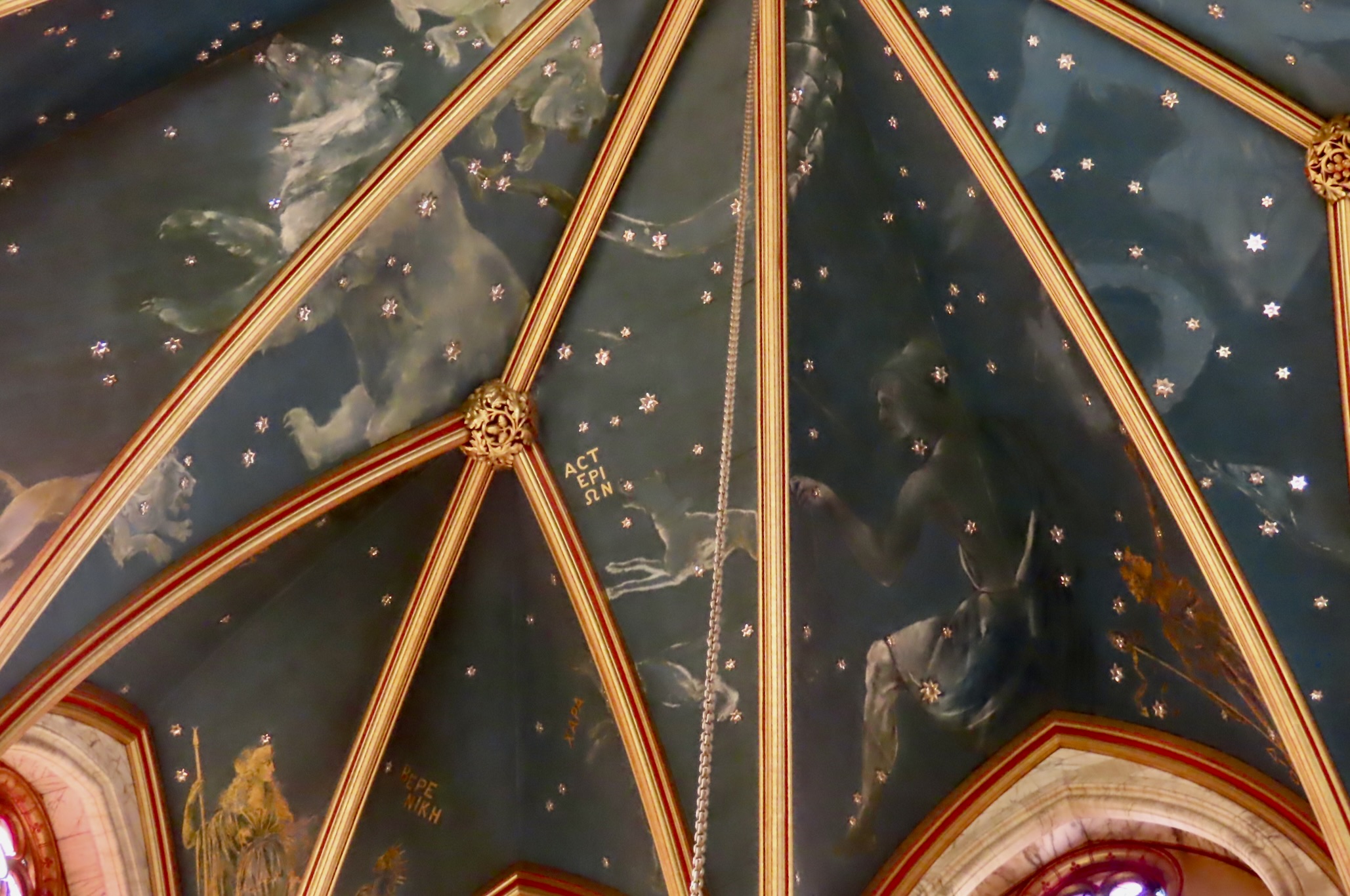
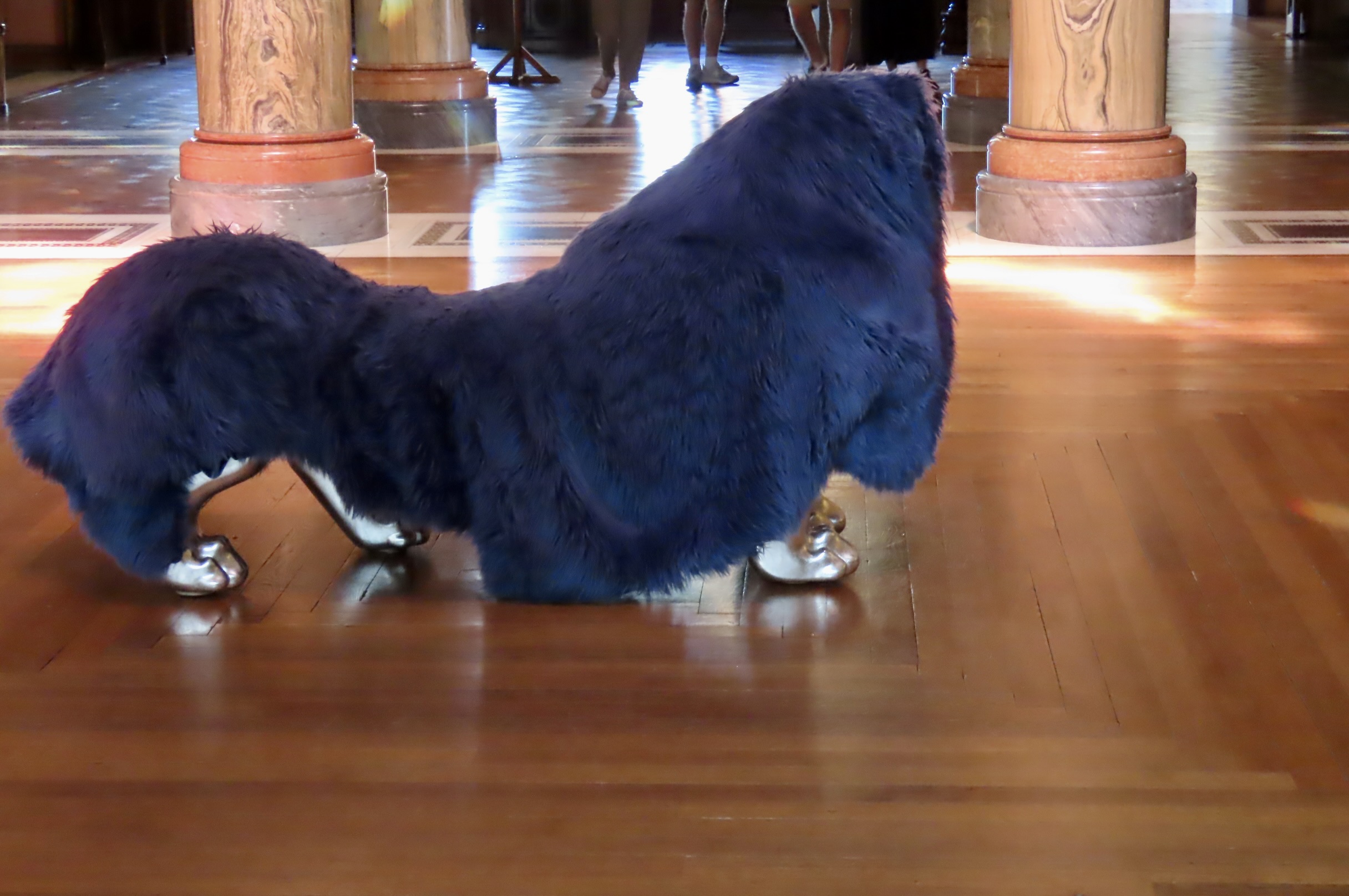
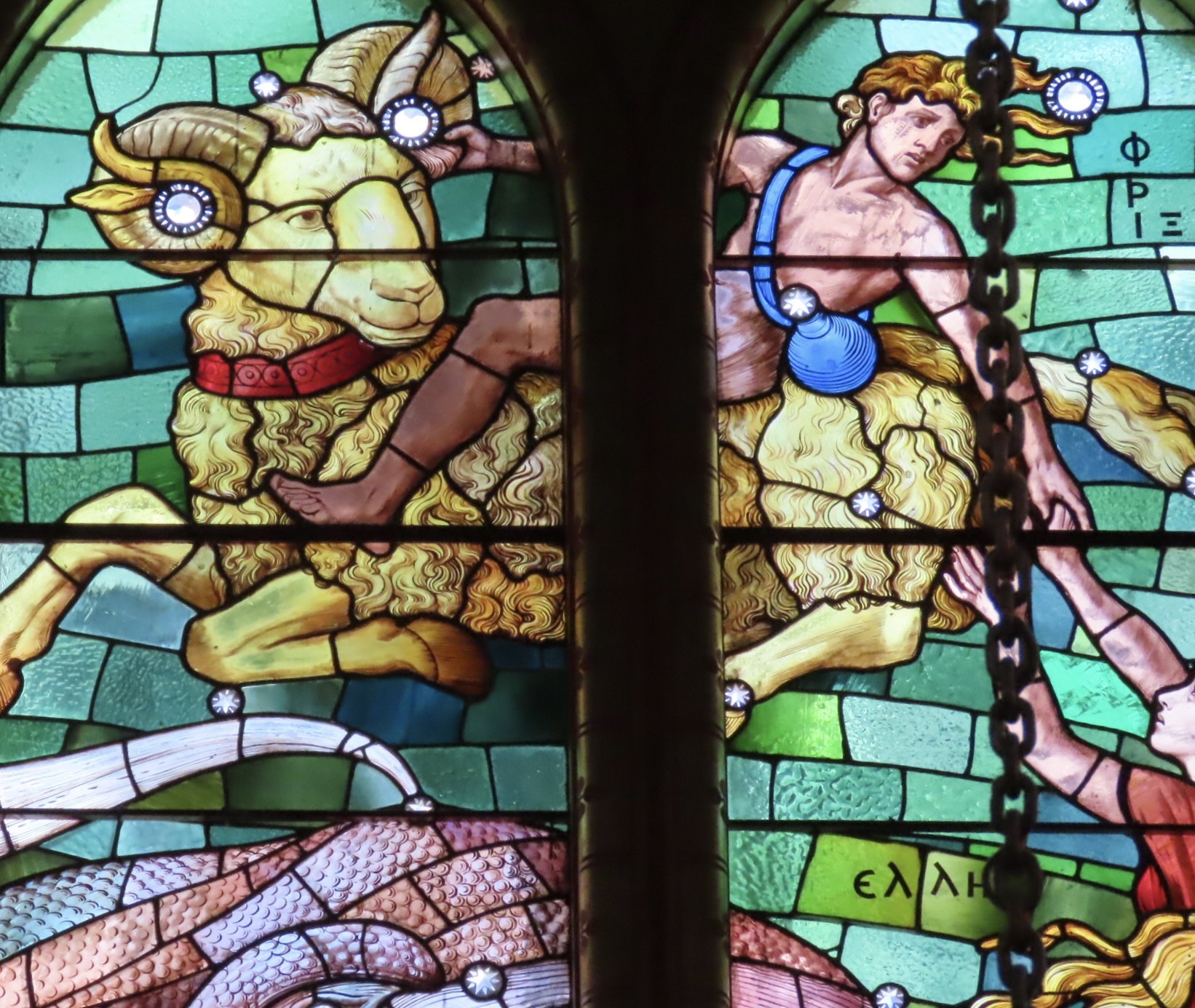
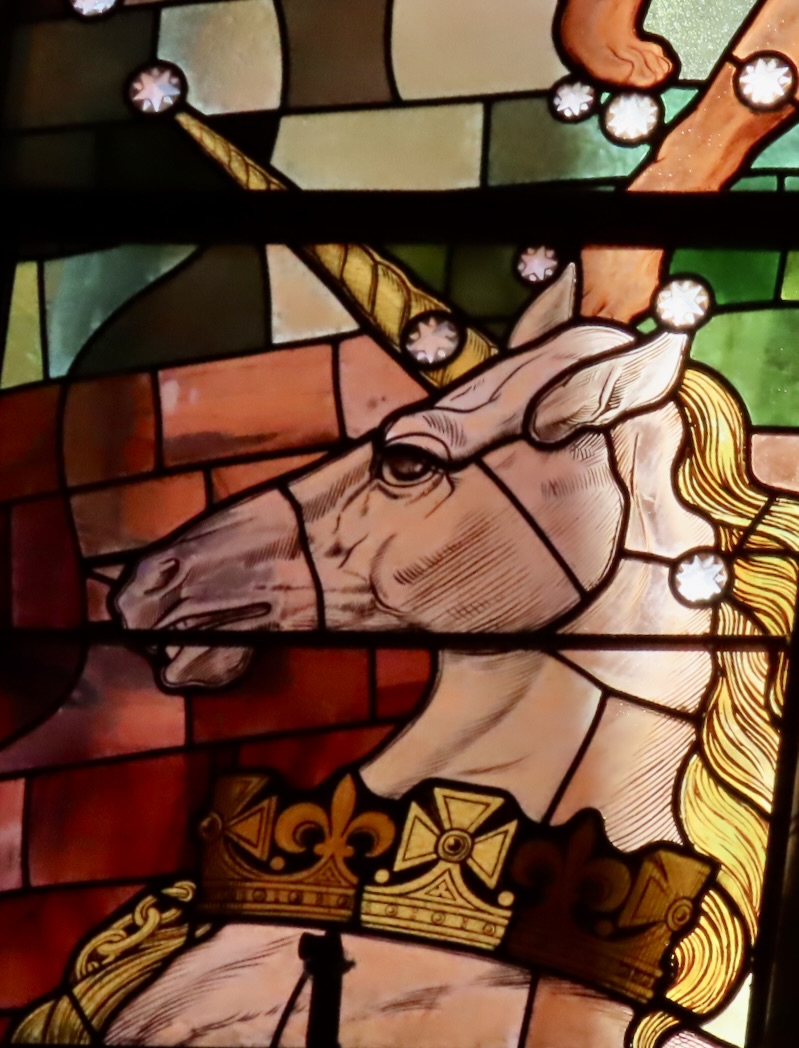
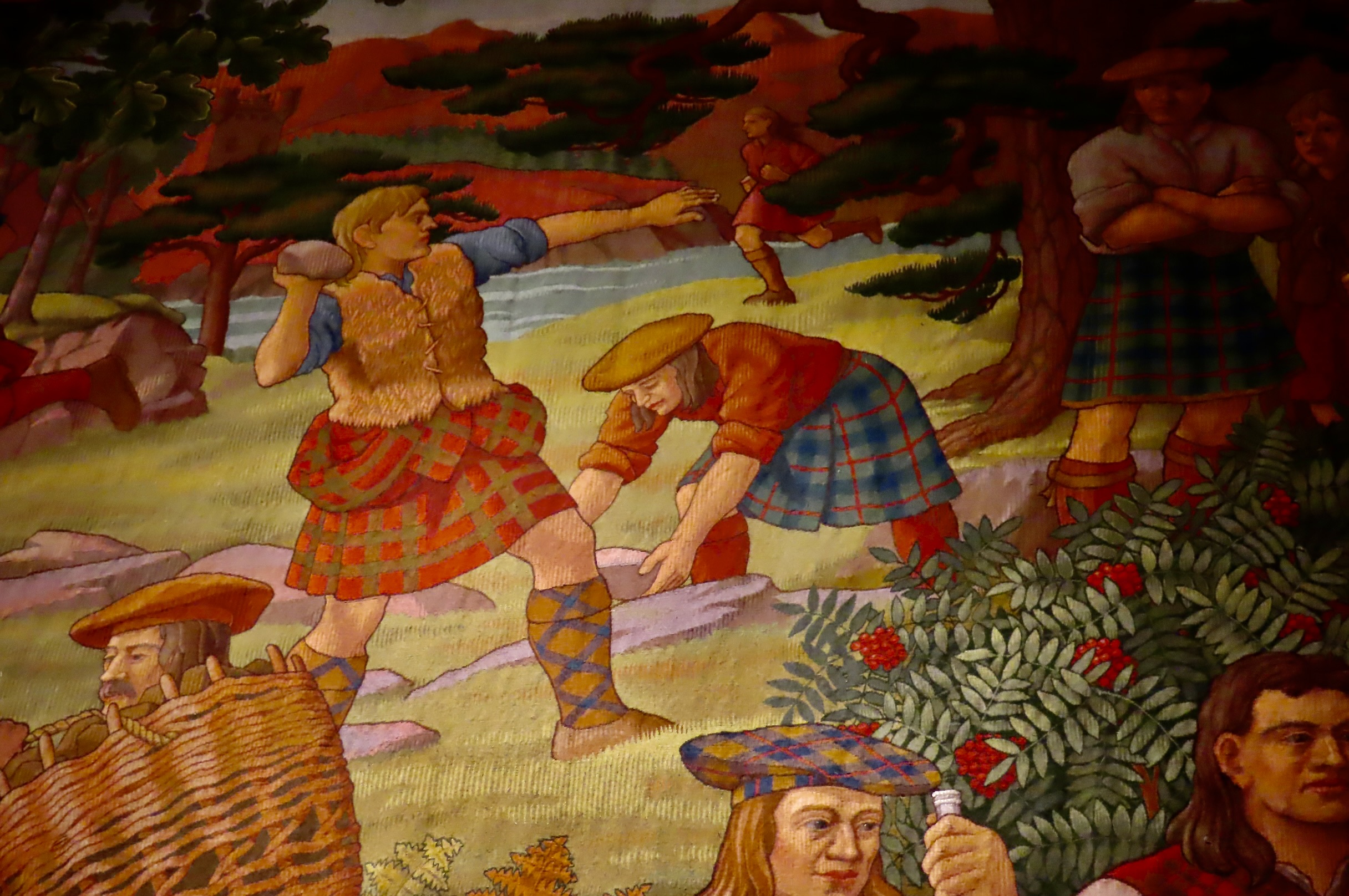
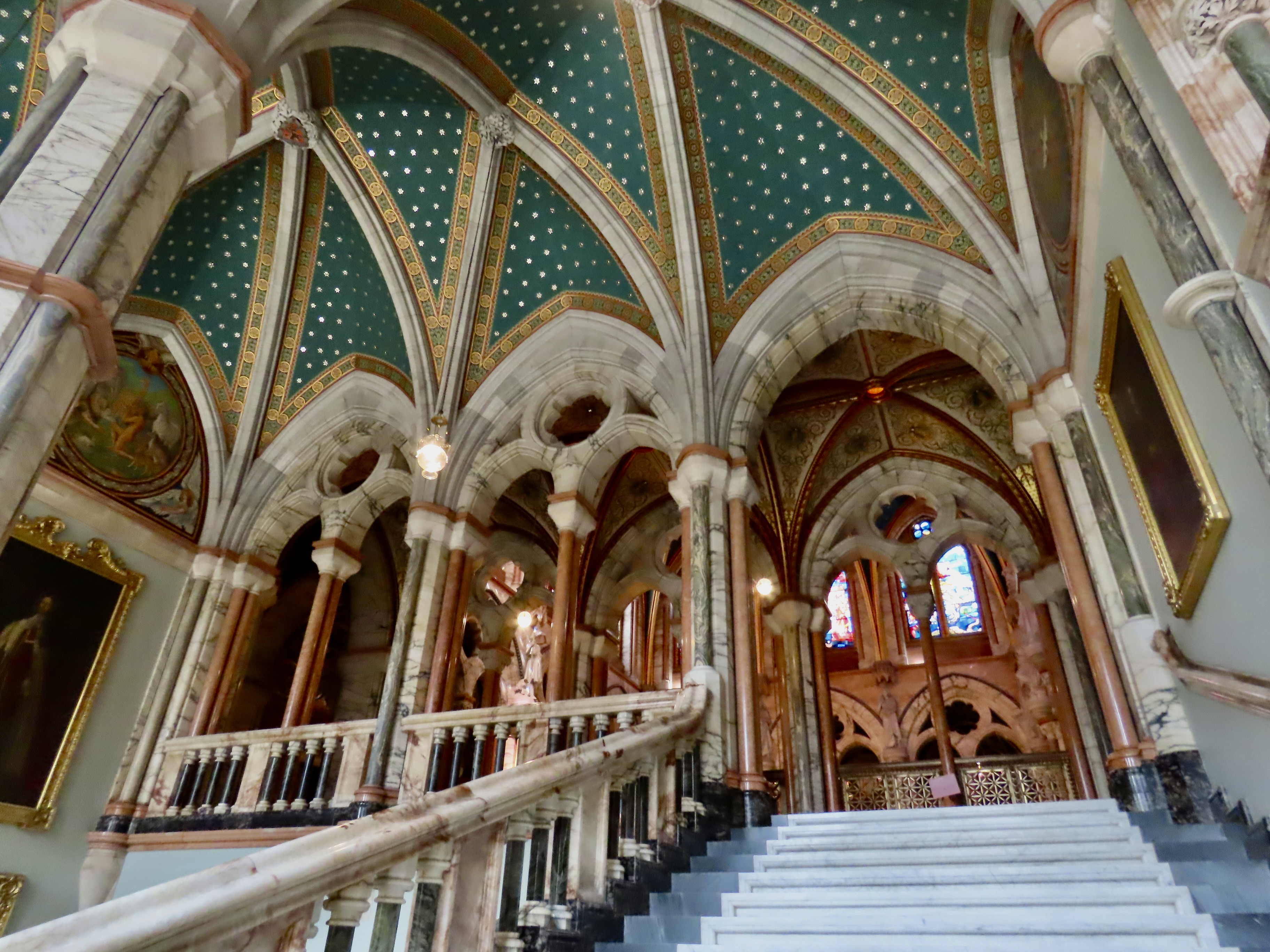
What castle comes with a star studded roof featuring constellations?Ursa Major can be seen on the left.Or turn a ferocious lion into a chaise lounge by covering it with a thick, soft, furry blue blanket and invite visitors to sit on it.Or uses stained glass windows for depicting myths. This is the golden fleeced ram who became the zodiacal Ares while its fleece became the object of Jason and his argonauts’ quest. There’s a back story: “The cloud nymph Nephele placed her children, Phrixus and Helle, on the flying ram to save them from sacrifice. Helle fell into the sea and drowned, but Phrixus safely reached the distant land of Colchis.” He sacrificed the ram to Zeus in thanks and gave the fleece to the local king. How’s that for gratitude? Zeus did send the ram’s spirit off to the stars.A unicorn needs no introduction. Note how the star theme from the roof is continued in the stained glass windows. There are a number of other fun and interesting stained glass windows.Several tapestries reflected life at the castle and within the Highland Society. This is the Highland Games version of shot put using a rock instead, i.e. rock put.
As it turns out, the Mount Stuart House is a Neo-Gothic mansion designed by Sir Robert Rowland for the 3rd Marquess of Bute, John Patrick Crichton-Stuart, who, at the time, was considered the richest man in the world. He was also something of a Renaissance man. In addition to being a Scottish Landlord with vast holdings, he was an industrial magnate, scholar, antiquarian, architectural patron, and philanthropist. (And don’t we wish our modern crop of billionaires were more like him.) His interest are reflected in both the exterior and interior of the house. The mansion was the first home in Scotland to be lit by electricity and was an early adopter of a telephone system and central heating. It also claims to be the first house ever to have a heated swimming pool inside. Located in the basement, we didn’t get to see it.
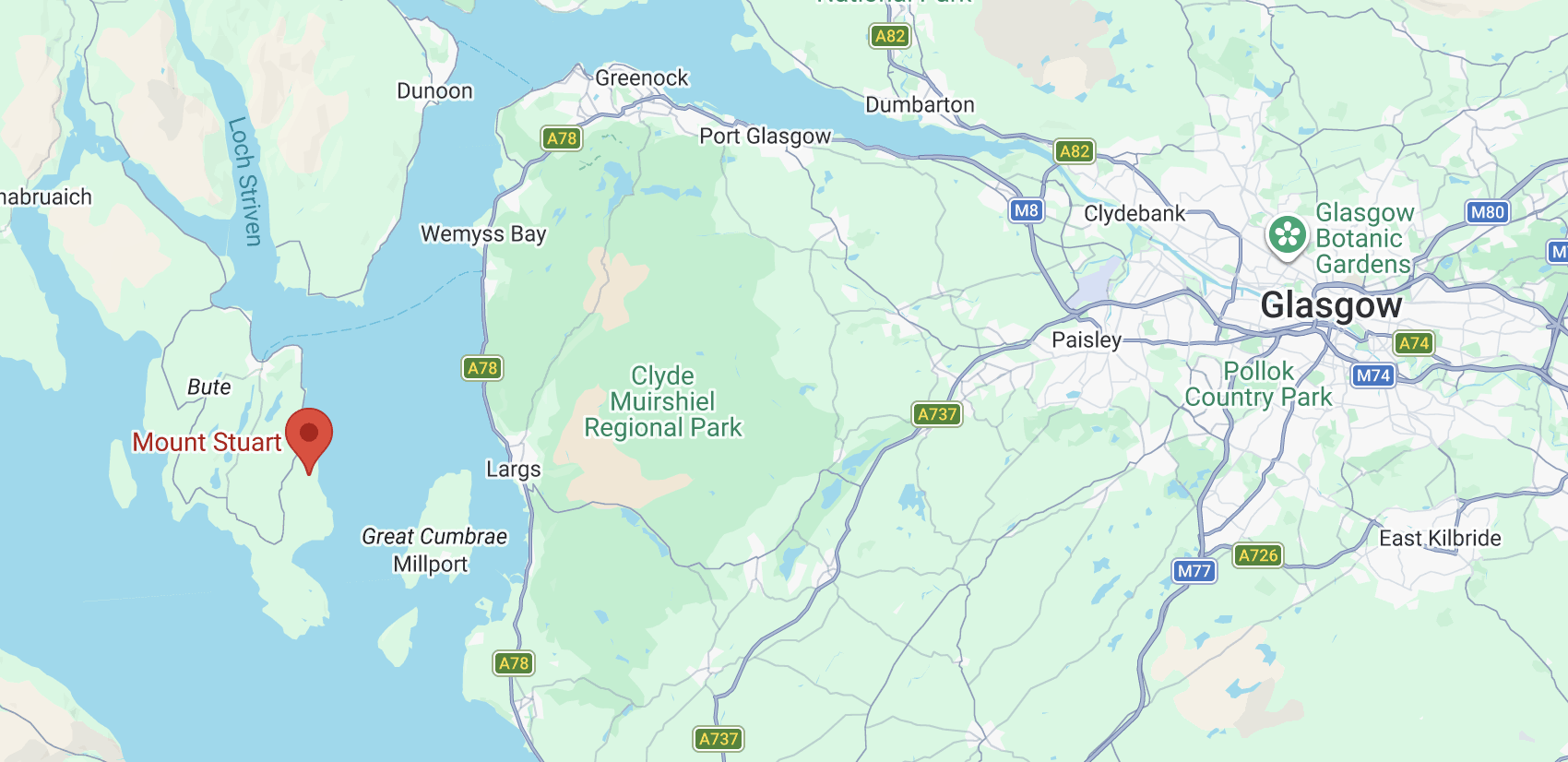
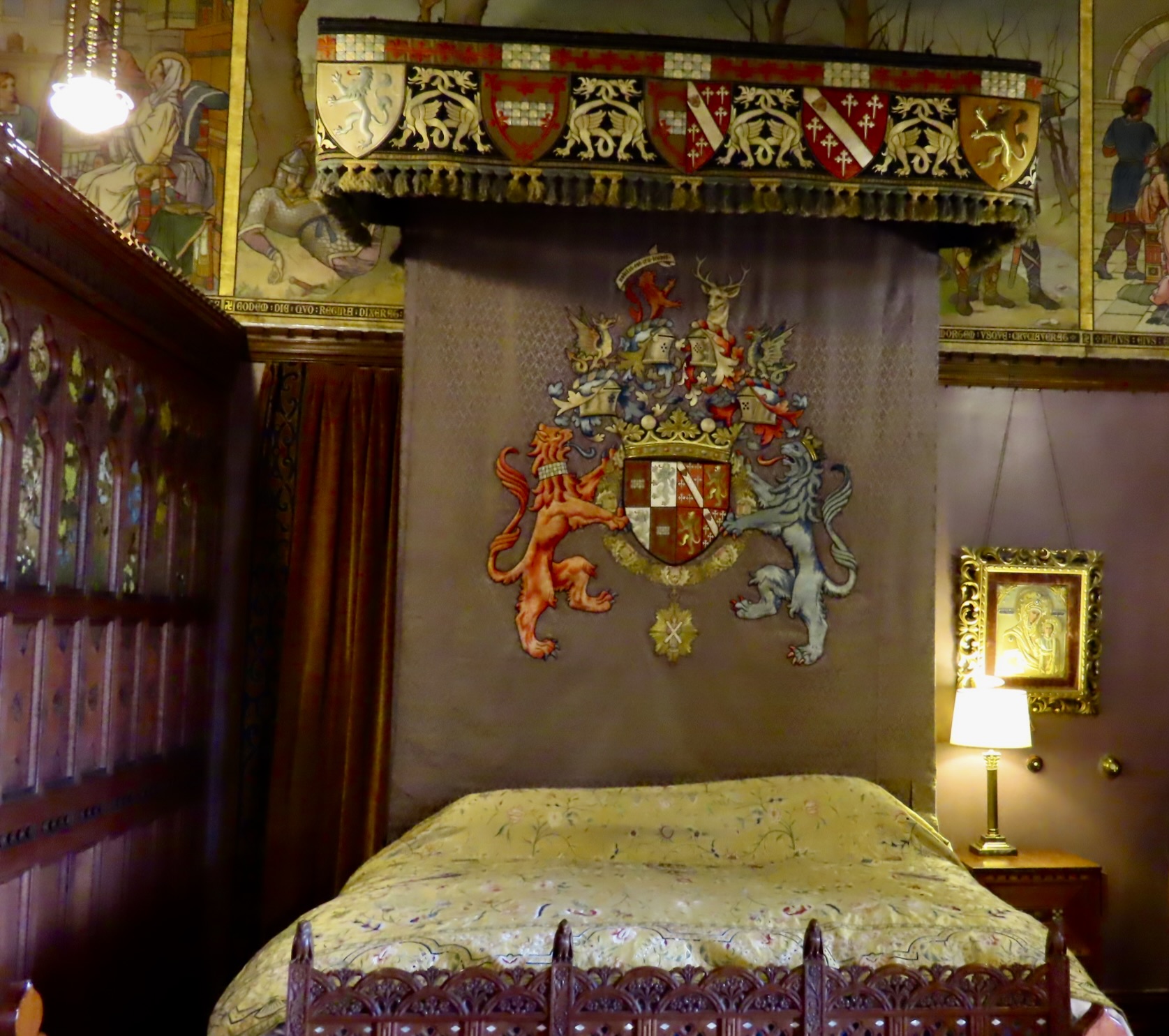
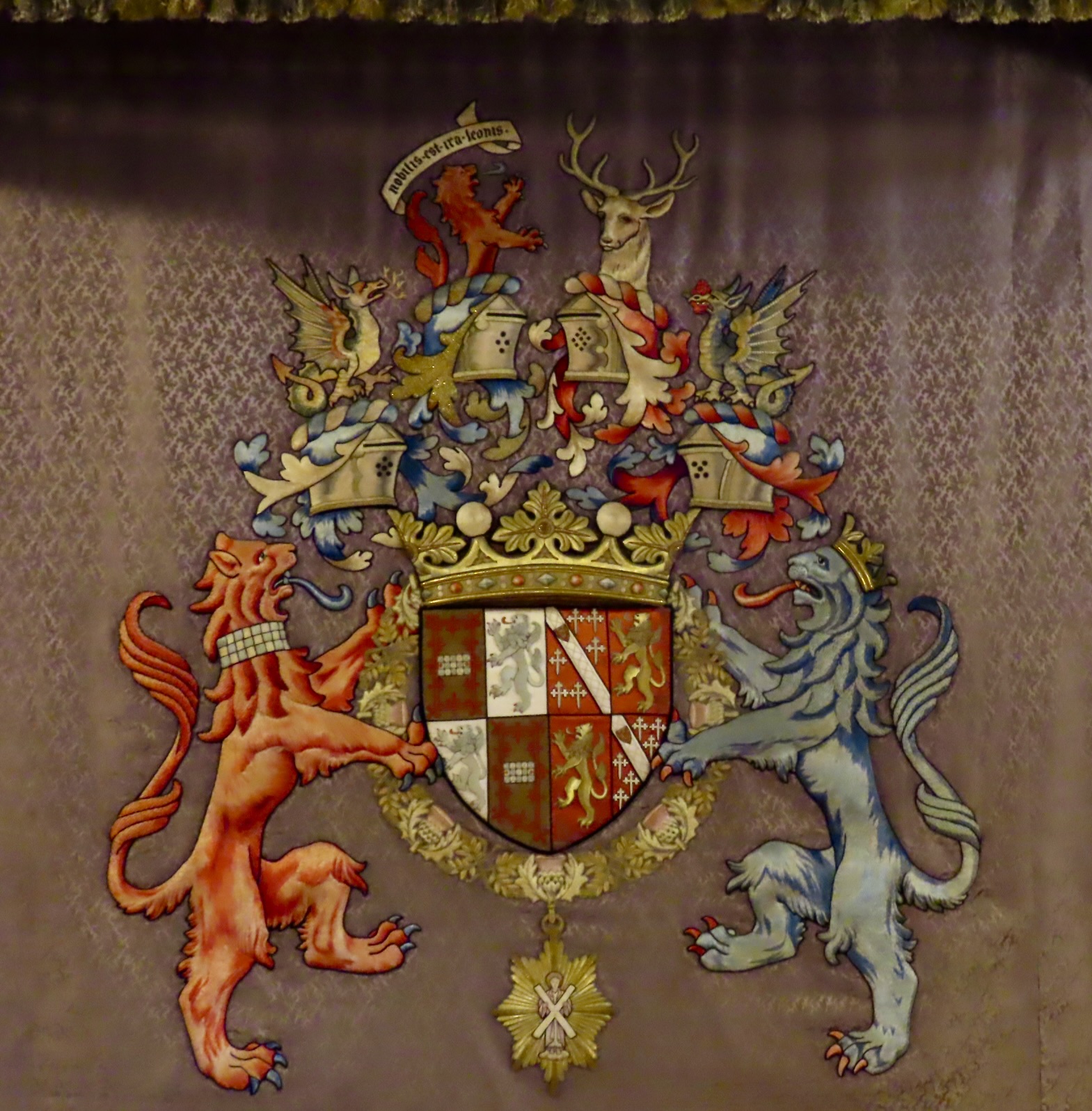
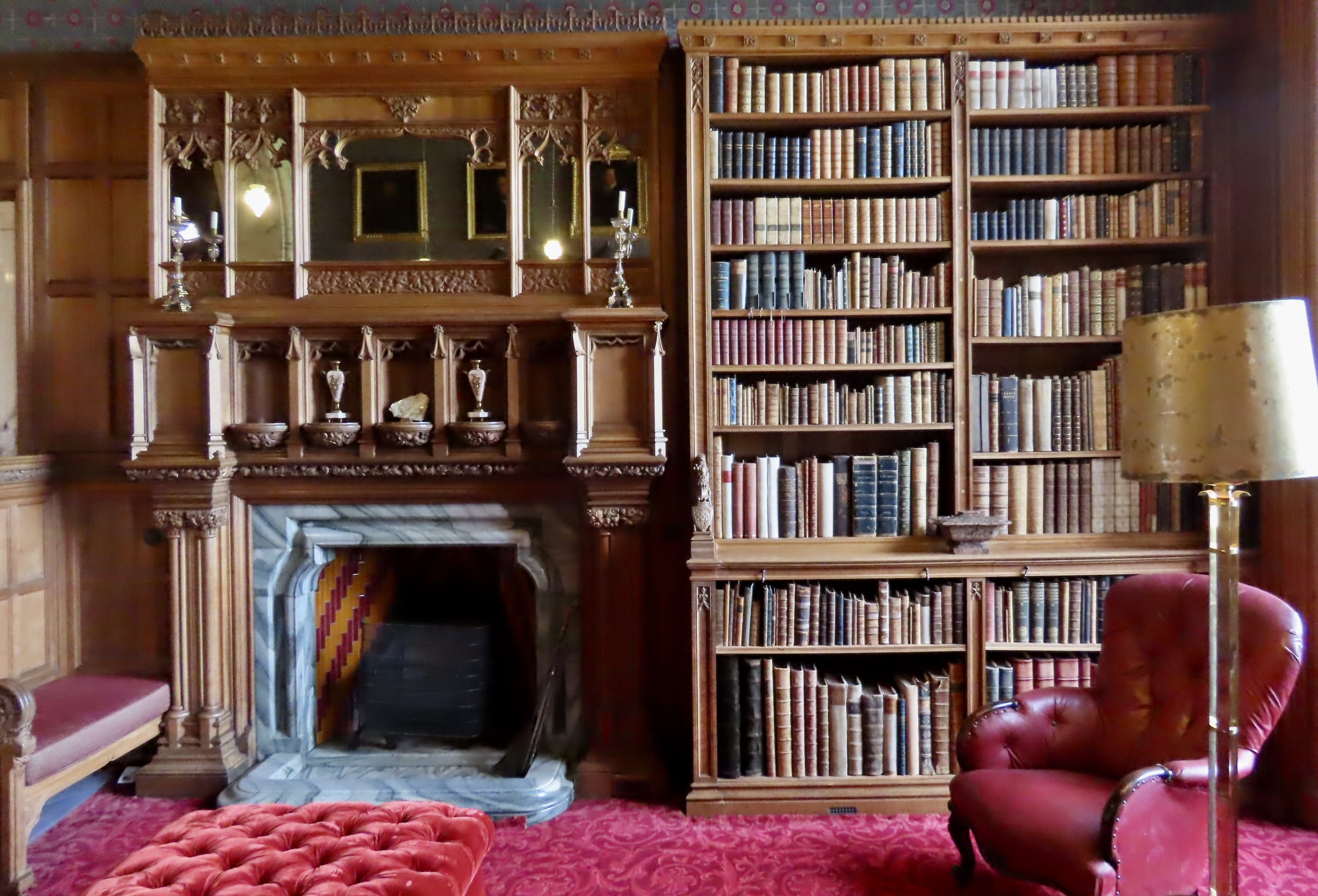
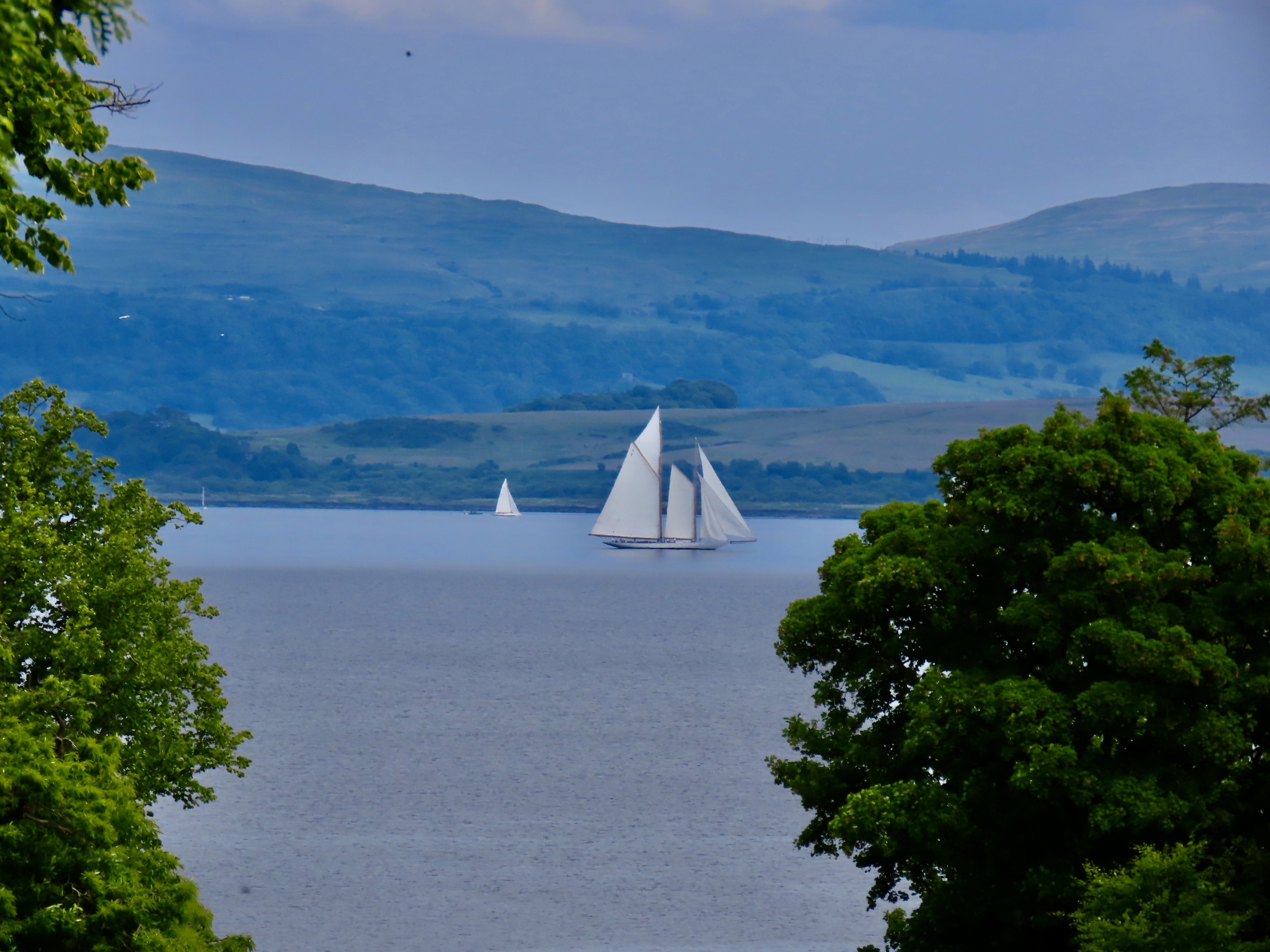
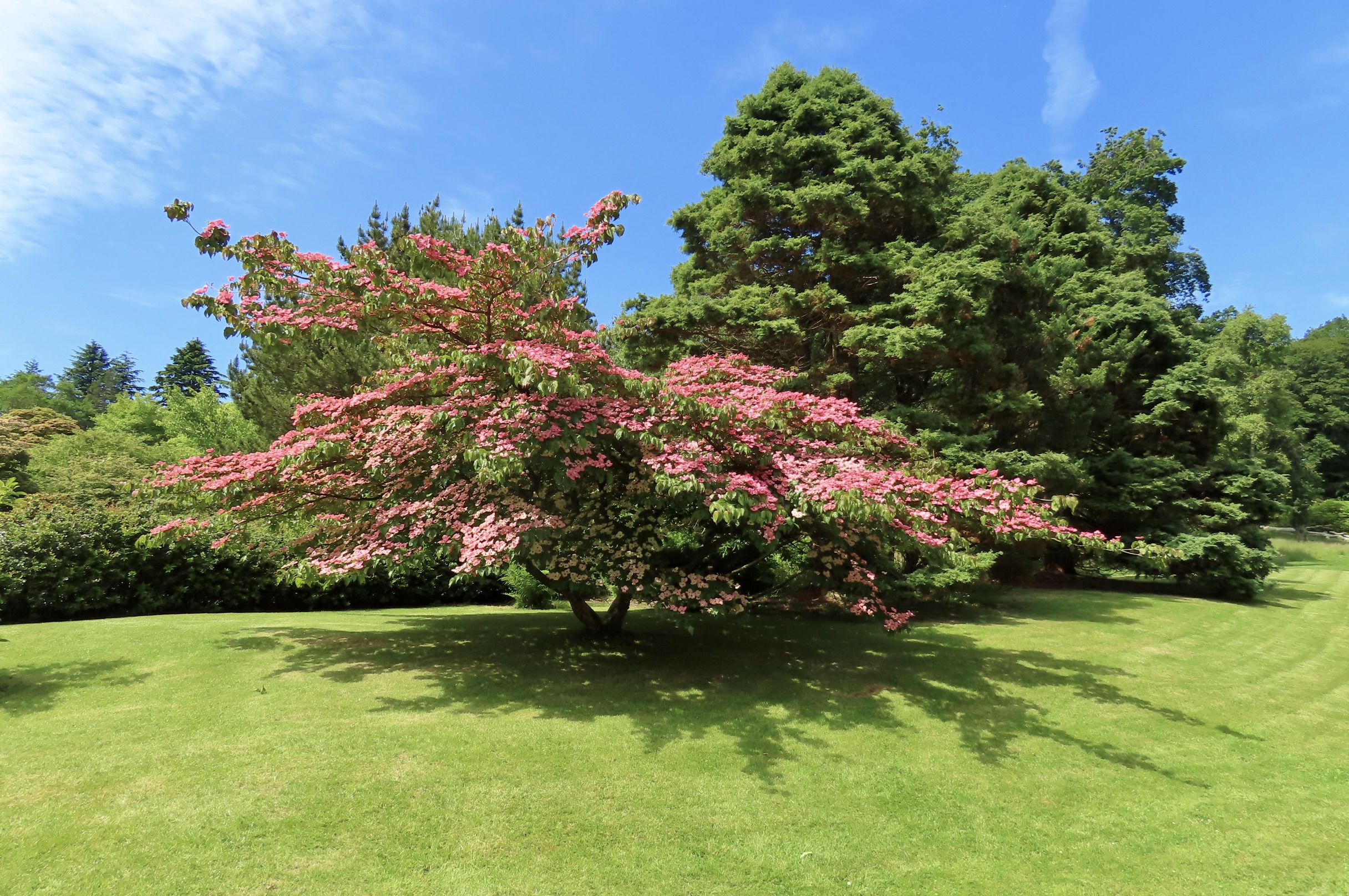
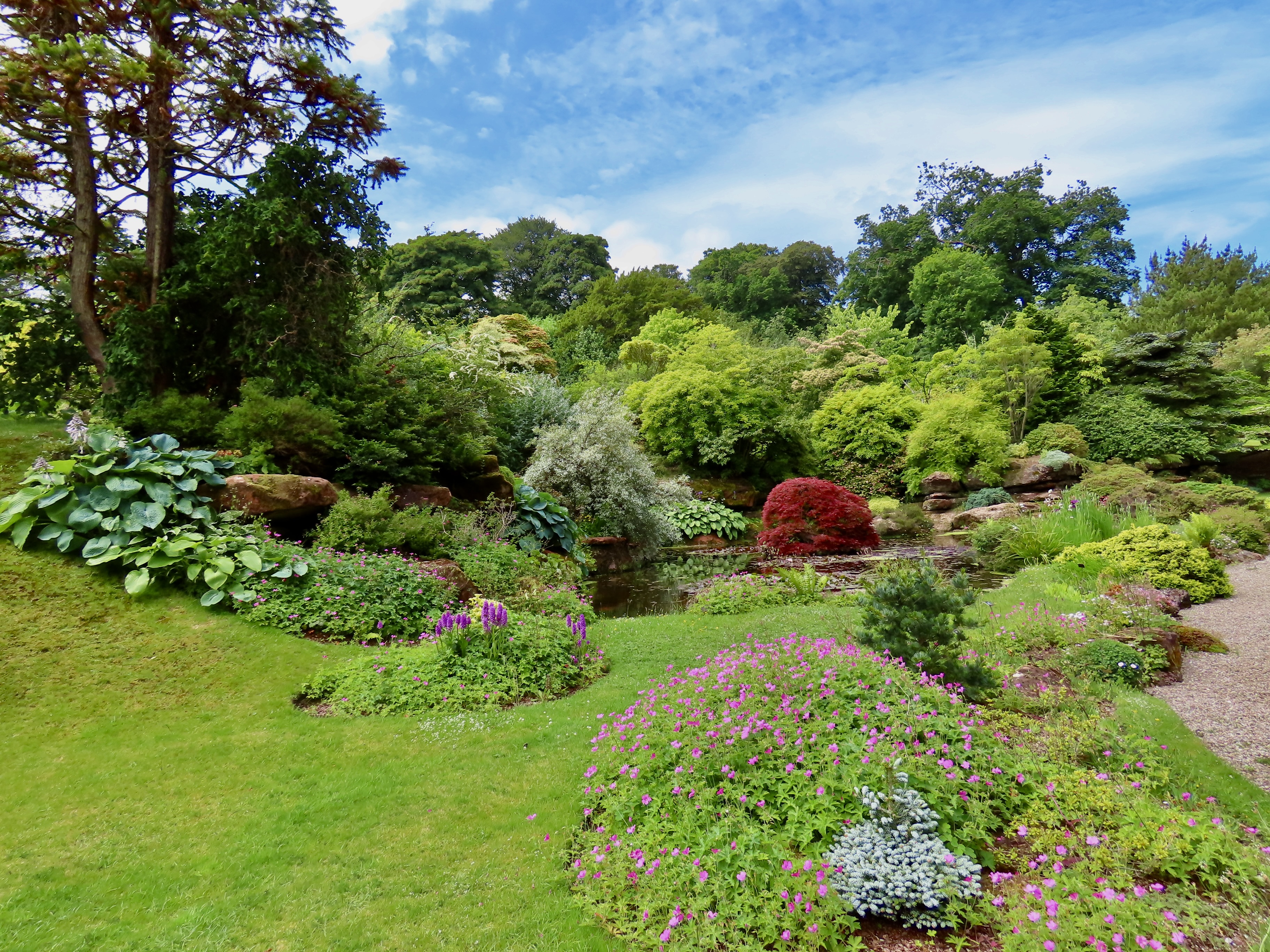
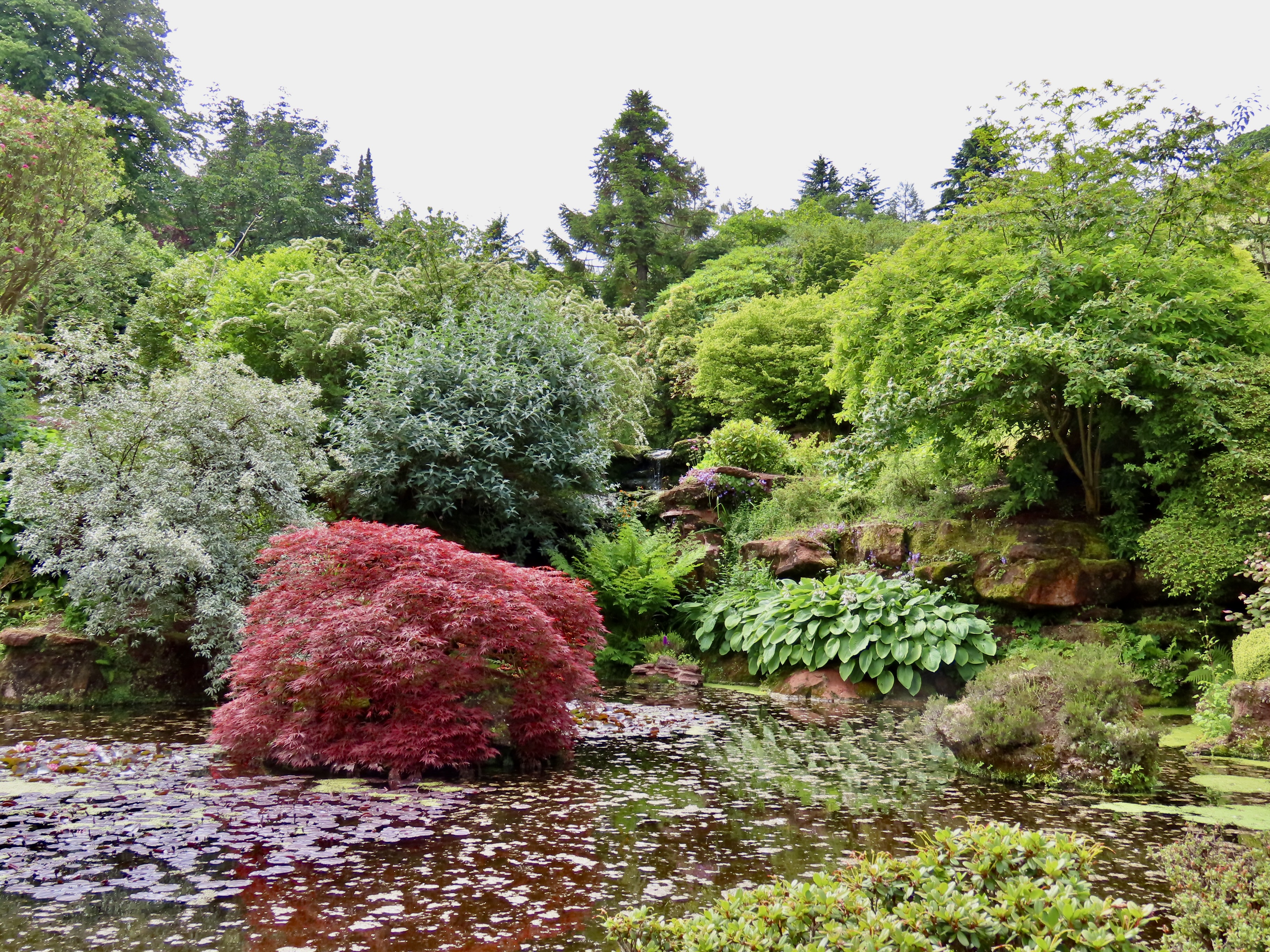
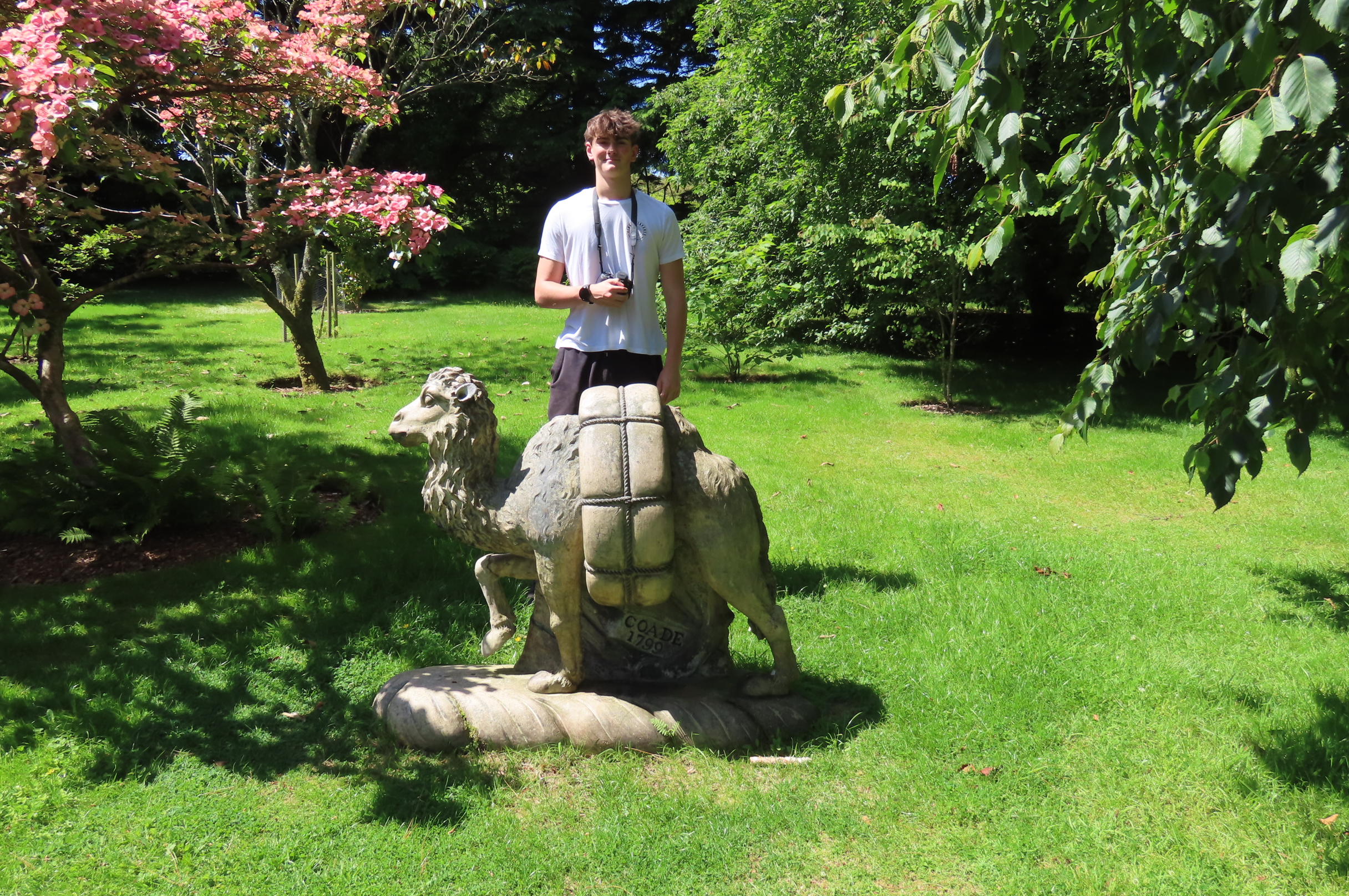
This is the location of the house. A ferry boat took us over to the island.In addition to the stained glass windows and tapestries, we found a number of other items of interest in the castle, such as this bed. The coat of arms behind it is the combined coat of arms of John Patrick Crichton-Stuart and of his wife, Gwendolen Mary Anne FitzAlan-Howard, representing the joining of the two families.A close up. Note that the lions have their tongues sticking out. One blue and one red, matched by their claws. The blue or azure tongue comes from the Crighton-Stuart Family and the red or gules tongue from the Fitz Alan-Howard Family.A large library of over 25,000 books on a variety of subjects ranging in age from 1477 up until today. It’s easy to picture myself sitting in that red chair reading away. A beautiful marble staircase connected the first and second floor.Peggy, Cody and I also took time to explore the extensive grounds surrounding the Stuart House. Here, Cody caught Peggy and me walking across the large lawn in front of the house to check out the Firth of Clyde. Looks like I have a big foot! (Actually I do: Size 14.)Where sailors were enjoying a pleasant day on the water.The back of the house had extensive landscaped gardens.Which were quite beautiful.A close up.Cody even found a loaded camel! That’s it for today. Next up from Scotland: Three castles in one post.
20 thoughts on “The Mt. Stuart House on the Isle of Bute… Call It What You Will, but It Looked Like a Castle to Us”
We have been to a couple of the most frequently visited castles [e.g., Inverness] and heard of some of the others, but this one was completely new to us. Thanks.
What a castle, Curt! That lioness yawning is something else, along with the lion chase lounge. 🙂 Loved all the photos and gorgeous landscapes too. Glad you all had a great time!
This place makes sense of the British way of referring to overdone country ‘houses’ as ‘piles.’ The details are marvelous, but as a whole it does look like a pile of bricks and such just dumped in the country.
At first, I thought the genetic specialists had gotten ahold of some wandering beagle; at first glance, I did see a beagle rather than a lion. All of the new technologies employed in the place, like electricity and the heated pool, reminded me of another rich dude’s house: the Fulton mansion near Rockport, Texas. As far as I know it wasn’t air conditioned, but it did have gas lighting, central heating, and indoor plumbing with hot and cold running water. The owner, George Fulton, was a bit of an engineer, and his creativity went into overdrive with his house.
It fits into a specific era, Linda. A lot of this went on in 18th Century Scotland and Britain as new money went into fixing and remodeling old places from a romantic perspective, and the need for wealthy people to show just how wealthy and important they are. Today’s McMansions (of which we have a lot around us) perform the same purpose.
All in all, I was impressed with the Marquiss who built it. He was something go a Renaissance Man in his knowledge and also very generous in his donations.
I believe you are right, Brian. Undoubtably on a dark and stormy night filled with lighting and thunder.
On a side note: Peggy loves bookstores and has become a big fan of bookstore murder mysteries!
haha! I now see I’ve repeated the “murder in the library”.
My compliments to Peggy. I love bookstores too and the classical murder mysteries…
When Peggy and I took a sabbatical to travel in 1999/2000, one of her goals was to find and read all of the classical murder mysteries. She had great fun doing it.
All of them? There is quite a bunch… I’ve read all Agatha Christie, am still reading other authors and “I ain’t done yet!” 😉
She had a book which listed the best women mystery writers of all time and listed their award winners. Peggy’s target was the award winners.
That looks like a castle to me too. I love the landscaping as well!



We have been to a couple of the most frequently visited castles [e.g., Inverness] and heard of some of the others, but this one was completely new to us. Thanks.
New to us as well, Ray. It was quite impressive. Each of the five castles/houses we visited was unique.
Looks like a castle to me too. I do like the starry ceiling.
It was an interesting and fun place, Peggy.
What a castle, Curt! That lioness yawning is something else, along with the lion chase lounge. 🙂 Loved all the photos and gorgeous landscapes too. Glad you all had a great time!
We certainly did, Lauren, and thanks! The yawning lioness was definitely one of those being in the right place at the right minute. 😁
This place makes sense of the British way of referring to overdone country ‘houses’ as ‘piles.’ The details are marvelous, but as a whole it does look like a pile of bricks and such just dumped in the country.
At first, I thought the genetic specialists had gotten ahold of some wandering beagle; at first glance, I did see a beagle rather than a lion. All of the new technologies employed in the place, like electricity and the heated pool, reminded me of another rich dude’s house: the Fulton mansion near Rockport, Texas. As far as I know it wasn’t air conditioned, but it did have gas lighting, central heating, and indoor plumbing with hot and cold running water. The owner, George Fulton, was a bit of an engineer, and his creativity went into overdrive with his house.
It fits into a specific era, Linda. A lot of this went on in 18th Century Scotland and Britain as new money went into fixing and remodeling old places from a romantic perspective, and the need for wealthy people to show just how wealthy and important they are. Today’s McMansions (of which we have a lot around us) perform the same purpose.
All in all, I was impressed with the Marquiss who built it. He was something go a Renaissance Man in his knowledge and also very generous in his donations.
Amazing. That’s typically where the Butler killed the master in the Library, isn’t it, old chap? What.
I believe you are right, Brian. Undoubtably on a dark and stormy night filled with lighting and thunder.
On a side note: Peggy loves bookstores and has become a big fan of bookstore murder mysteries!
haha! I now see I’ve repeated the “murder in the library”.
My compliments to Peggy. I love bookstores too and the classical murder mysteries…
When Peggy and I took a sabbatical to travel in 1999/2000, one of her goals was to find and read all of the classical murder mysteries. She had great fun doing it.
All of them? There is quite a bunch… I’ve read all Agatha Christie, am still reading other authors and “I ain’t done yet!” 😉
She had a book which listed the best women mystery writers of all time and listed their award winners. Peggy’s target was the award winners.
That looks like a castle to me too. I love the landscaping as well!
The British and Scots really do landscaping well, Diana! I’m going to do a post on it.
Size 14 – holy cow! Nice house and garden pics also!
Hard to shoe this ‘old horse,’ Lexi. Thanks.
What a wonderful place! I adore the unicorn stained glass, but most of all the constellation ceiling.
That ceiling was really neat, Crystal. I think that the Marquess would have been a very interesting man to know!