If I was going to base my future on my organizational skills, I had to practice, right? So, I organized a protest my senior year. As a 60’s issue, it wasn’t a biggie. The Administration had axed our Senior Ditch Day and we wanted it back.
I drew up a petition and Patti Foley, who had great calligraphy, made it fancy. Almost all of the seniors signed. (I still have it.) A student strike was organized. I’m sure it was the first time El Dorado Union High School students had even considered such an action, Mabe even the last. Some of our rowdier students even lit trash cans on fire.
It wasn’t the issue that got me threatened with jail, however. The school administration called me in and asked if we couldn’t work out some type of compromise on Senior Ditch Day, which I readily agreed to. The strike was called off, the rowdies stopped lighting trash cans on fire, and we switched our Ditch Day to one more agreeable to the Administration. Everyone won. My civics teacher was impressed.
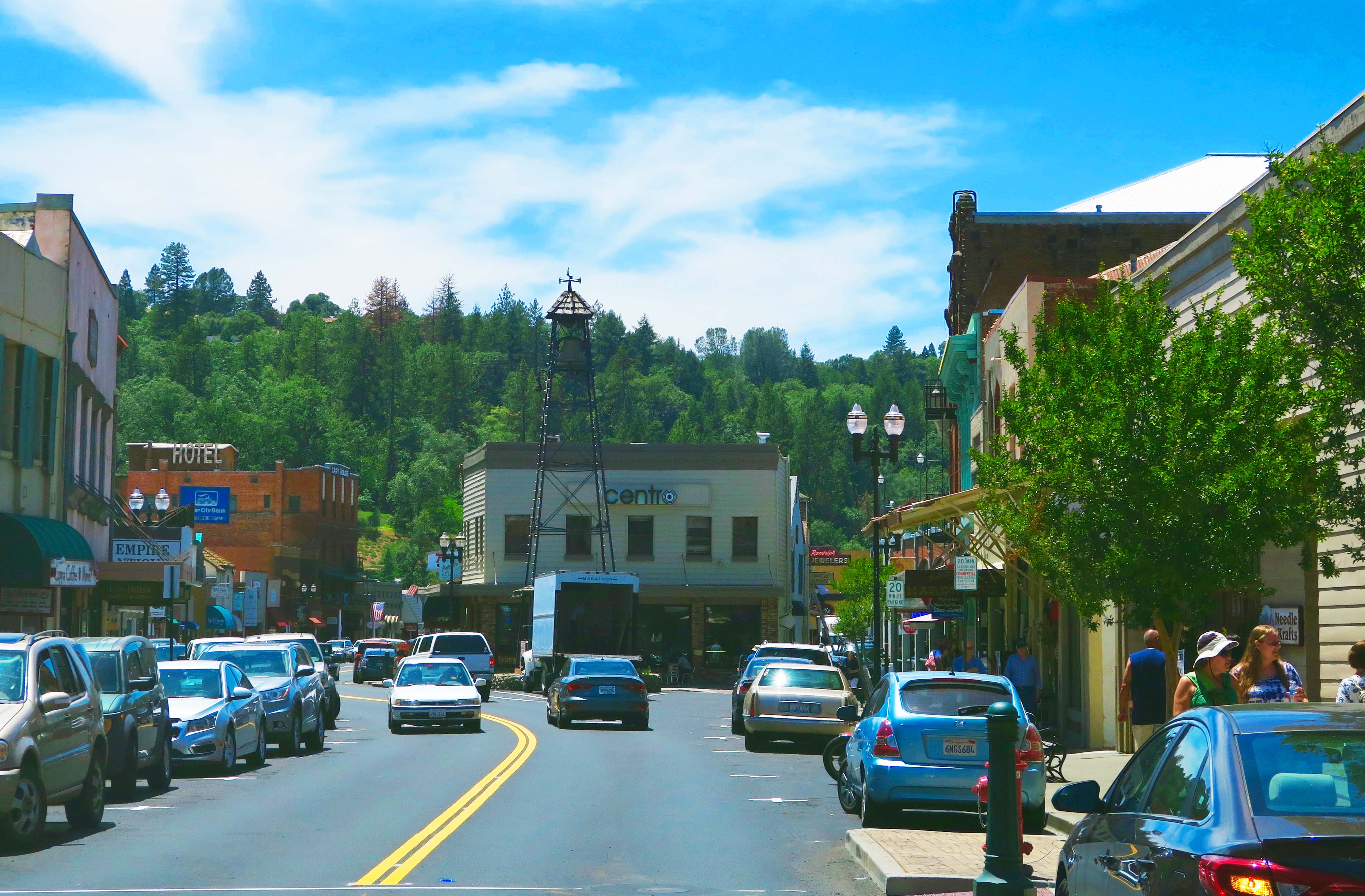
My problem with the law took place on Graduation Day when I inadvertently (or is that idiotically) crossed paths with Mike De Natly, the Placerville Chief of Police. Few of my UT-OH! moments can hold a candle to this one. As one might expect, our last day of high school was a goof off day. All the tests were over, yearbooks signed, and caps and gowns fitted. There really wasn’t much to do except revel in the fact that we were through and to say goodbye to friends. Lunchtime meant a final cruise of Placerville’s Main Street to check out girls, to see and be seen.
What happened was out of character for me. I normally keep my comments on other peoples’ driving habits to myself and car-mates. The horn is for really bad infractions, and, on very rare occasions, a single digit comment is appropriate. I would never stick my head out the window and yell at someone. That can get you shot.
But we were hot stuff on graduation day. When a blue car decided to stop in the middle of Placerville’s crowded, narrow downtown street right in front of us and forced us to hit our brakes, it irritated me. And then, the driver nonchalantly got out to have a conversation with the driver of the car in front of him. It pushed me over the edge. Out went my head as we edged around the two cars and I had an attack of uncontrollable Y chromosome aggression.
“You SOB,” I yelled, “get your F-ing car out of the way!”
So what if I didn’t recognize the Chief of Police out of uniform in an unmarked car. So what if he had stopped to offer help to a guy who had managed to stall his car on Placerville’s busy Main Street. So what if I had suggested he had canine parentage in a voice that half of Placerville heard. It was an innocent mistake.
“That was Mike De Natly you just cussed out,” our driver managed to stutter with mixed parts of fear and awe.
As a teenager, I had pulled some fairly dumb stunts. Teenagers have a responsibility to push the envelope. It’s the rather awkward method evolution has provided for growing up and developing unique personalities. Mistakes are bound to happen and that’s okay. But I was carrying my responsibility too far; I had gone beyond dumb and plunged into really stupid.
“Keep driving,” I uttered with all the hope of the irrevocably damned, “maybe he is too busy and will ignore us.”
Sure, like maybe the sun won’t rise tomorrow. The poor stalled guy could still be sitting in the middle of Placerville for all of the attention the police chief paid to him after my little admonition. De Natly jumped in his car, slapped his flashing light on his roof, hit his siren and sped after us. Not that he needed to speed fast or far. We were creeping up Main Street in sheer terror about one block away. I am sure my car-mates were wishing fervently that Curt Mekemson hadn’t gotten out of bed that morning, had never made their acquaintance, and was, at that very moment, facing a group of starving cannibals in some far-off jungle.
We pulled over with De Natly literally parked on our rear bumper and resigned ourselves to the firing squad. Luckily, for my friends, the Chief had no interest in them. He appeared at my window red-faced and shouting about five inches away. Under the best of circumstances, he was known for having a temper and these were not the best of circumstances.
“Get out of the car,” he yelled. “Get out right now!”
I moved fast. This was not the time for bravery and stubbornness. It was a time to be humble— it was groveling time. And I groveled with the best. I blathered out apologies and managed to work “sir” into every sentence, several times. I trotted out my friendship with his stepson, I threw in the City Treasurer who was a mentor, and I even brought in Father Baskin, the Episcopal minister, as a character reference.
“Get in my car,” he ordered. My groveling seemed to be having minimal impact. At least he hadn’t handcuffed me.
We drove up to City Hall, and I had visions of being booked and thrown into a cell with some big hulking giant who either didn’t like young men or liked them too much. I thought of having to call my parents and explain how their son had become a common criminal. But De Natly had an even more diabolical plan in mind. We slowly made a turn through the jail parking lot to give me a sense of my future fate and then, to my surprise, hopped on Highway 50 to Canal Street and drove up to the high school.
I was going to have to explain my actions to the principal. My chances of graduating that night slipped down a notch. I doubted that he would have much of a sense of humor about one of his students cussing out the Chief of Police. But explaining my inexplicable actions to him would have been mercy in comparison to what happened.
It was a beautiful late spring day, this last day of school, and it seemed like half of the student body and a significant portion of teachers were enjoying their lunches on the expansive lawn in front of the school. De Natly pulled up to the sidewalk beside the lawn and ordered me out. The Chief of Police arriving with me in tow was enough to capture the attention of several students sitting close by. Then he made sure that everyone was aware of our presence.
“Do you want to spend the night in jail or graduate, Curtis?” he asked in a voice that was easily equivalent in volume to the one that I had used in suggesting he move his car. Conversation on the lawn came to a dead halt. Every ear in the place homed in on us with the intensity that a cat reserves for a potential mouse dinner. And I was the mouse. This was a Kodak moment, not to be missed.
My answer was easy: Of course, I wanted to graduate, SIR. And so it went, De Natly barking questions with the voice of an army sergeant and me responding as the lowest of recruits. Finally, after a few minutes that felt like eternity, the Chief got in his car and drove away.
I was left to deal with the not so gentle humor of the students and faculty plus a principal who wasn’t quite sure whether he should take over where De Natly left off or laugh at my predicament. At least he had the grace to wait until I left his office before he chose the latter. I could hear his laughter echoing down the empty hallways. And yes, I was allowed to graduate that night.


Hilarious. Laugh out loud funny.
Thanks. Glad you enjoyed the tale! Much appreciated.
Oh this is a doozy.. 😂😂😂😂
A lesson learned and remembered. Thanks for the laugh.
Yep, Peggy. He was the first and last police chief I ever cussed out…
I am in awe that you can recall so much of your younger years with such vivid strokes. This incident would surely have stuck though.
Good stories hang together, Crystal. Remember a snippet, and the rest falls into place. Also, these are the type of stories that I would tell a few times, orally, or even written down.
Groveling can be an option.
Laughing. Probably the only time I ever did, Brian.
One has to adapt to circumstances.