UT-OH! Chapter 17: A Pear Picker’s Guide to Happiness

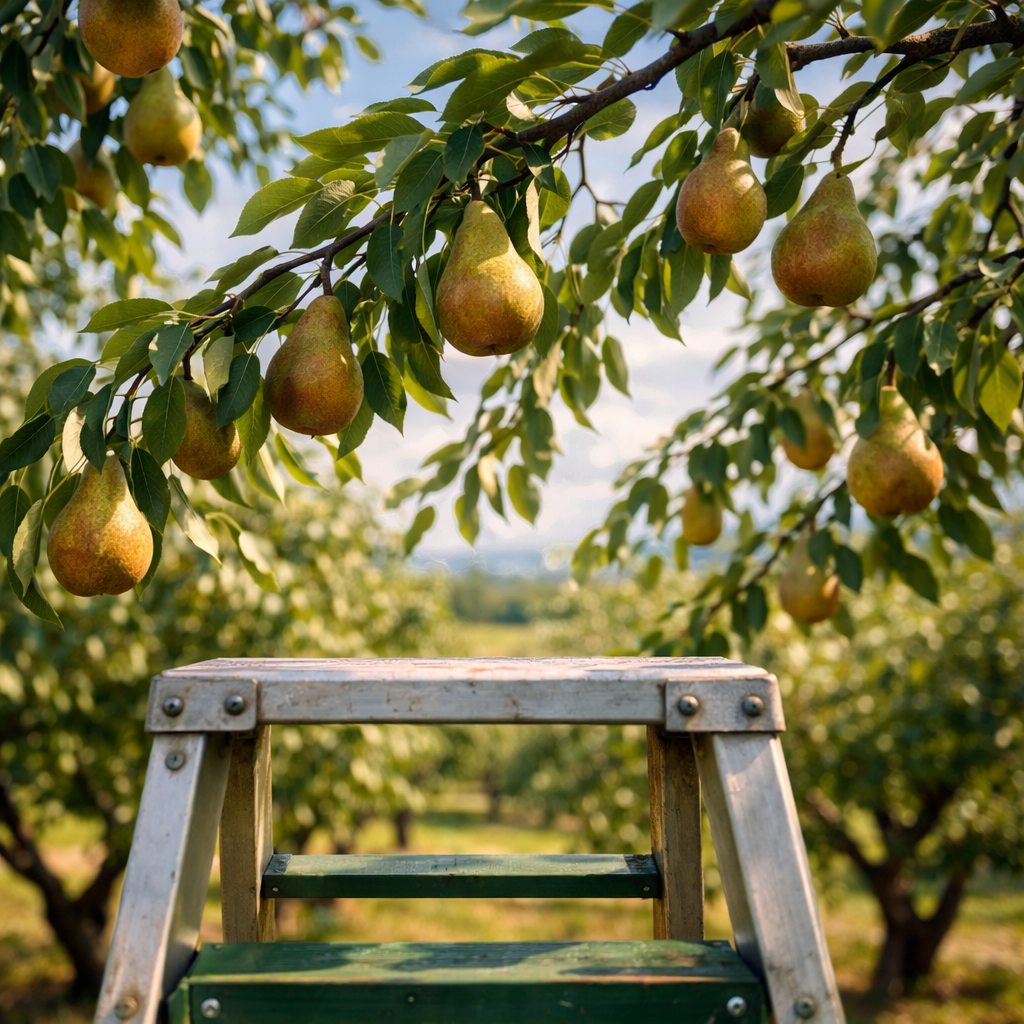
Ladder beneath ripe pears hanging from branches in a pear orchard
This is what you see when you are 5-6 steps down on a 12 or 14 foot pear ladder. Now, imagine climbing up and balancing one step from the top to reach pears in the top of the tree. UT-OH! (I’ve gone over to the dark side here. This is an AI generated picture. My challenge, as always when writing about my youth, is that the photos were few and far between. That’s hard to fathom in the digital age, when I can easily take more photos in one day that I have from the first 20 years of my life. When I pushed the key that asked WP to produce an AI photo for this post, it read my blog and came up with three good suggestions. That may be scarier than standing on the second step! It didn’t catch, however, that the ladder only had three legs. Maybe there is hope.

A number of things combined to pull me out of the puberty blues. For one, I ceased being a freshman. Hormones slowed down, my voice abandoned octave leaps, and I bought a pair of contact lenses. Academics were a plus, even during my freshman year. Lacking a social life, I studied full-time and managed to pull straight A’s. If I couldn’t be ‘ruler of everything,’ ‘sex symbol’ or ‘sports hero,’ maybe I could at least be ‘the brain.’ Was I driven or what?

I also believe that having a job helped. I began working in the pear orchards around Placerville starting the summer of my eighth-grade graduation and continuing through high school. It was a nine hour a day job of hard physical work, one more fit for an adult than a 14-year-old. Dealing with the 90-105° F summer heat of the Sierra foothills didn’t help. But I actually enjoyed the work. And the money. The general rule in our cash poor family was that the basics were covered. We were responsible for the extras, such as dates.

In addition to being hard, there was also an element of danger. Pear picking consisted of hazardous duty without hazardous pay. We were each given a 12-foot ladder, a sizing ring, and as many boxes as we could fill. The pears we plucked from the trees were placed in a canvas bag that fit around our front like a pregnant belly and carried up to 50 pounds. We had the option of working by the hour at $.90 per hour or by the box at $.20 per box. I opted for the per box under the assumption I could earn more.

The ladder was a suicidal three-legged device with two legs playing standard ladder while the third served as the balancing arm we threw out to provide ‘stability.’ I use the quote marks here because the stability was questionable. There was always a chance that you, your bag of pears, and the ladder would come crashing down. The first few rungs were solid; it was on the top four that life became interesting. Even here it was tolerably safe, assuming you focused on easily reachable pears.

The problem was that the best pears had a way of hiding away in the highest, most unreachable part of the tree.  Such premium fruit couldn’t be left hanging, even if it meant taking risks. At least that’s how my ut-oh mind functioned. It was nothing that the boss required. Success meant performing a one-legged-ballet-balancing act. I became quite proficient at the move. Only once did I reach beyond the imagination of my ladder and follow a rapid descent path straight to the ground. Fortunately, the only limbs broken belonged to the tree. I wrote the experience off as a lesson in Newtonian physics.

A greater challenge was entertaining myself for nine hours a day. Reaching out and picking a pear requires a minimum number of brain cells and very few of those are located in the frontal lobes. My favorite ploy was singing at the top of my voice. Harry Bellefonte’s tune about picking bananas was a natural. I adapted it to picking pears. But I also belted out many other popular tunes of the day.  “Does Your Chewing Gum Lose Its Flavor on the Bedpost Overnight” was a mistake. I couldn’t get it out of my mind; I would wake up in the middle of the night humming it. To this day I have to be careful in bringing it up or it is right back there on the tip of my tongue, waiting to escape. Like now:

“Does your chewing gum lose its flavor
On the bedpost overnight?
If your mother says don’t chew it,
Do you swallow it in spite?
Can you catch it on your tonsils,
Can you heave it left & right?
Does your chewing gum lose its flavor
On the bedpost overnight?”

A more productive form of amusement was challenging myself to pear picking contests. The more I picked the more money I made. When the fruit was plentiful and well sized, I could pick 60-80 boxes a day and earn big money, $12-$16. By the way, that seemingly measly sum is the equivalent of $130 to $180 today. Once I even reached a magical 100 boxes. My goal was to try to match the professional pickers, the folks who made a living helping harvest crops. On really good days, I could. 

Over my five-year career in the pear orchards I worked with Filipino crews, Braceros, and the usual contingent of semi-nomadic types who followed the various crops as they ripened from state to state. Most were good, even excellent workers. Of course, there was also the occasional guy who worked just long enough to buy a gallon of Red Mountain Wine and then disappear.

After my first year of working in the fruit orchards, I graduated to swamper status, which meant I delivered empty boxes to the pear pickers and took out their full boxes. I also learned such fine skills as tractor driving, tree trimming, sprinkler changing, post hole digging and crew bossing. And, I might add, enjoyed most of it. There is a certain satisfaction that comes from doing hard work, challenging your body, and being dead-tired at night. 

I also gained a farmer’s satisfaction that comes from seeing a crop evolve from spring bloom to fall harvest. And finally, as my pear orchard responsibilities increased, the work helped me overcome the puberty blues and regain my confidence. Becoming buff and tanned didn’t hurt either. Working in the orchard with my shirt off, picking pears and stacking 50-pound boxes above my head on a truck guaranteed a tan to die for and muscles from my big toes to my hair follicles. 

Almost on cue, girls reappeared in my life, with Paula being an example. Admittedly it was a slow process, in fact far too slow for my hormone driven fantasies. But there the girls were, tentatively giving me the eye and practicing a wiggle or two to see if anyone was home. There was. Down boy.

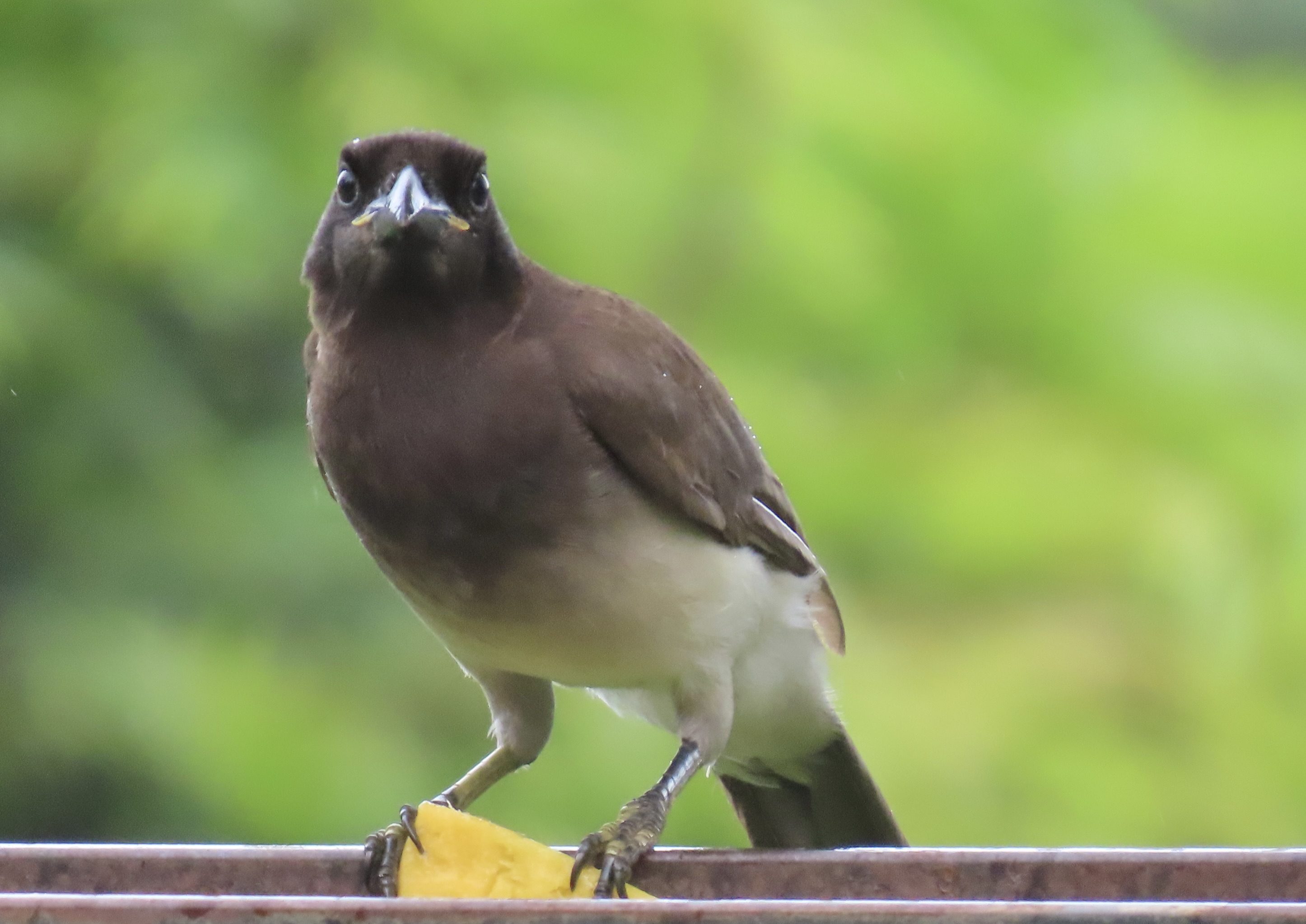
Next Monday’s Post: A jay by any other name is still a jay, plus 7 other interesting and fun birds of Costa Rica. This is Costa Rica’s Grey Headed Jay suggesting I don’t interfere with its breakfast.
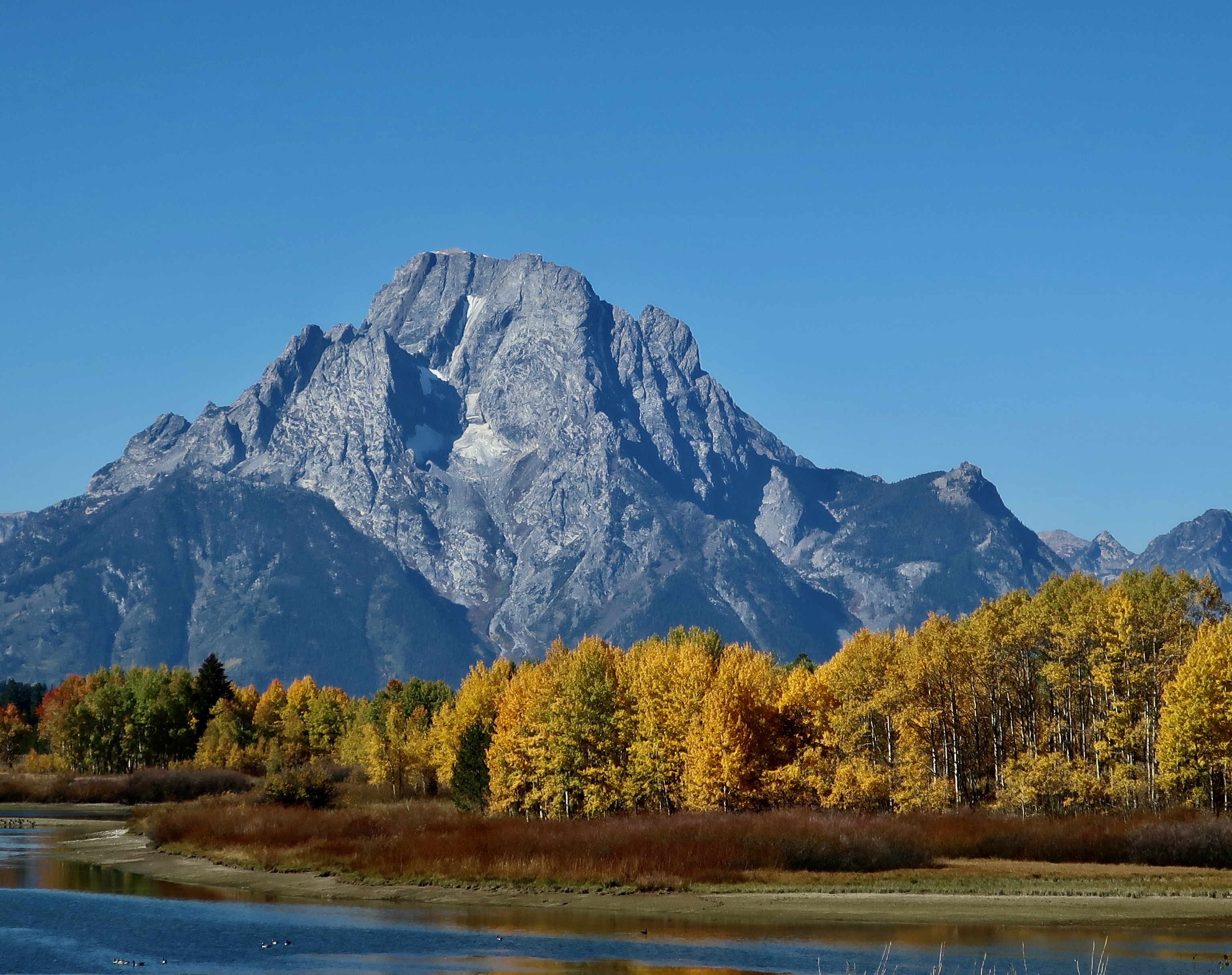
Grand Tetons National Park: Next Wednesday, April 22 is special. It’s Earth Day 56. Please join me as I take you back to April 22, 1970 where I participated in Earth Day 1 on the Davis Campus of the University of California. Earth Day 1 changed my life and helped to change the world. Its message today is as relevant as ever, and possibly even more so, as so many of the gains we have made are now under threat.

UT-OH! Chapter 14: Surviving Baseball Bats and Dynamite Caps

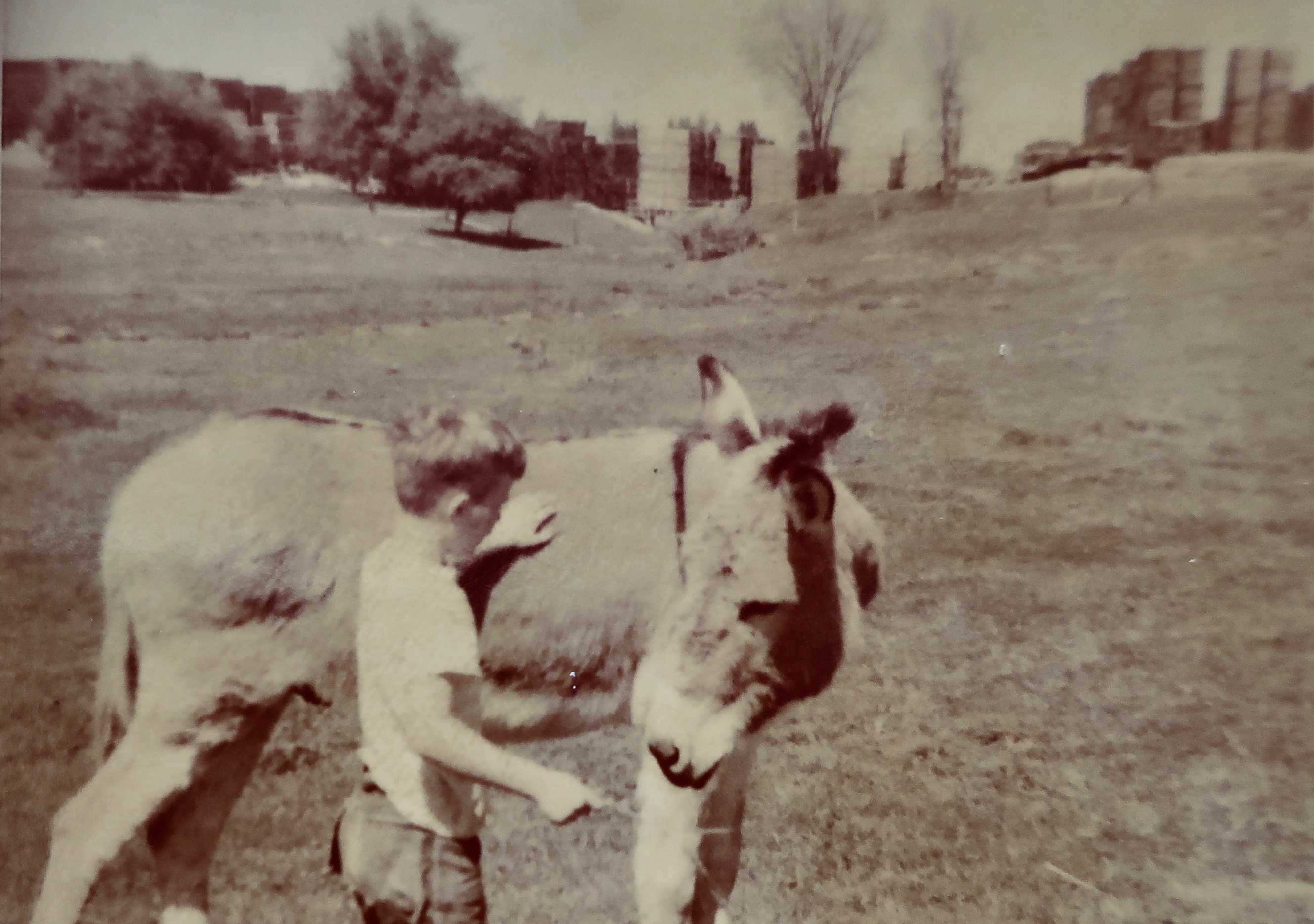
This donkey was hardly dangerous. I was offering it a carrot. The stacks of lumber in the background, at Caldor Lumber Company’s drying yard, had potential, however. One of our sports was climbing to the top of the stacks and leaping between them.

That we survived childhood wasn’t necessarily a given. Racing up and down a 75-foot-tall tree, leaping between 20 foot high lumber stacks, joyriding on railroad push carts, avoiding being shot, playing on a 50 foot high trestle and other similar activities aren’t particularly conducive to a healthy childhood. On a scale of 1-10, I would have placed Marshall’s chances of harm at 9.9 while mine were more like 4.4. I took my share of risks, but rarely without considering consequences. Marshall rarely did. Pop provided some perspective years later.

“If Marshall screamed, I ran. When you screamed, I walked.”

Except for the dog bite and stepping on a rusty nail once, my serious injuries were more in the nature of stubbed toes. Not that I am minimizing the pain of a stubbed toe, mind you. They hurt like hell. There is a reason why flaying skin was a form of torture in ancient times. I’d have certainly been willing to confess things I had done, and lots of things I hadn’t. 

I did have a baseball bat used on me once, however. My parents were semi-serious Republicans, semi in the sense that they didn’t devote their lives to the cause but they did vote the party line. The family tradition went back to Abe Lincoln and the founding of the Party. A quote in a book written by my Great Grandfather stated, “We have always been Republicans, and we always will be.”

My indoctrination started young with the 1952 campaign of Dwight Eisenhower against Adlai Stevenson. According to Mother, Franklin Roosevelt and Harry Truman were responsible for most of the bad things that existed in the Country, and Ike was going to right the wrongs of the previous two decades. I, of course, accepted this view whole-heartedly, and had all the makings of a fine Young Republican. Naturally I was eager to share my correct or ‘right’ perspective with fellow students and proudly wore an I Like Ike button to school.

They weren’t particularly interested. 

After all, what do nine year olds know or care about politics? One student, whose parents were avid Democrats, was ready to take me on, however. He wore a button that declared Adlai was Our Next President. Our debate started in the boys’ bathroom when we were lined up at the urinals, and continued on to the playground. Things began well. Even then I was a high verbal, and the points I didn’t win on logic, I was taking with volume. But the situation deteriorated rapidly. My fellow debater did what most politicians do when they appear to be losing ground— he started slinging mud.

“Eisenhower is a blankety, blank,” he declared with a smirk to underline his cleverness. It was his mistake; now we were talking my language.

“In that case,” I argued with glee, “Stevenson is a blankety-blank, blank, blank.” I had more blanks. Marshall, and Allen had taught me every swear word in the English language and a few in Spanish. I could go on for minutes without repeating myself. In fact Allen and I had challenged each other to a contest once to see who could swear the longest and the loudest. 

There was a vacant lot filled with tall grass down on the corner where Missouri Flat Road ran into Highway 49. We got down on our hands and knees and chased each other through the grass while shouting obscenities at the top of our lungs.  We were so engrossed in our efforts that we didn’t note that Marsh had time to run the block home and retrieve Pop to listen in on the exchange. He was not impressed with our command of the language or our volume. My thought about Marshall for telling was that he was a blankety-blank, blank, blank, blank, blank. A real asshole.

Anyway, I was not to be outdone in the mudslinging department; I had a bright future as a campaign manager. I demolished my opponent. Regrettably, I was about to learn an important Hobbesian lesson in power politics: Never start political arguments with a person carrying a baseball bat, which he was. When I continued to hassle him out on the playground, he wound up and swung the bat like he was going for a home run, whacking me across my right leg. Down I went onto the playground and off I went to the hospital as my leg muscle knotted up to the size of a softball. Fortunately, he didn’t break a bone— and my man Ike won the election.

Marshall’s scariest accident happened at Caldor’s logging camp. One summer, Pop arranged for the family to use a house at the camp for a week’s vacation. It was a great opportunity. We were surrounded by El Dorado National Forest, and we could wander to our heart’s content. 

The first day out, we discovered an old miner’s shack that had long since given up any pretense of being useful. It was leaning precariously. Naturally, we had to explore it. There might be a treasure. Dark and musty comes to mind as my first impression. Floors creaked in objection on our entrance. A pack rat had set up home in one corner. A treasure for Tickle the dog, perhaps, but not for us. 

A table in the opposite corner held more promise. We found an old Phillies Cigar box on top, which was a treasure in itself. Inside there was more: Dynamite caps! Think Big Bang.  Caps contain a small amount of an explosive material that when lit by a connected electric current, cause a blast that sets off the dynamite. BOOM. My immediate reaction was to get out of the shack. Marshall’s was to take the box with us. I assumed he was going to give it to Pop so he could dispose of the caps. It was never wise to make assumptions about what my brother might do.

Mother was putting dinner on the table and Marshall was still outside when we heard a loud bang followed by a louder scream. Pop ran. Marshall had held a match down to the dynamite cap to see what would happen. He found out. The whole front of his body from his groin to his head was covered in blood. The only thing that saved his eye sight was that he was wearing shatter-proof glasses. A neighbor, who had come out at the sound of the blast and scream, immediately volunteered to take Nancy and me for the night. My parents jumped in our car and rushed off to the hospital in Placerville, 20 miles away.

 Marshall spent a couple of days in the hospital as the doctor removed brass splinters from his body. We returned home. So much for our idyllic vacation. The important thing was that Marshall survived the experience— possibly a bit wiser. Occasional splinters of brass were still making their way out of his skin when he was in his 20s.

UT-OH Chapter 13: Your Mother Chases Fire Trucks

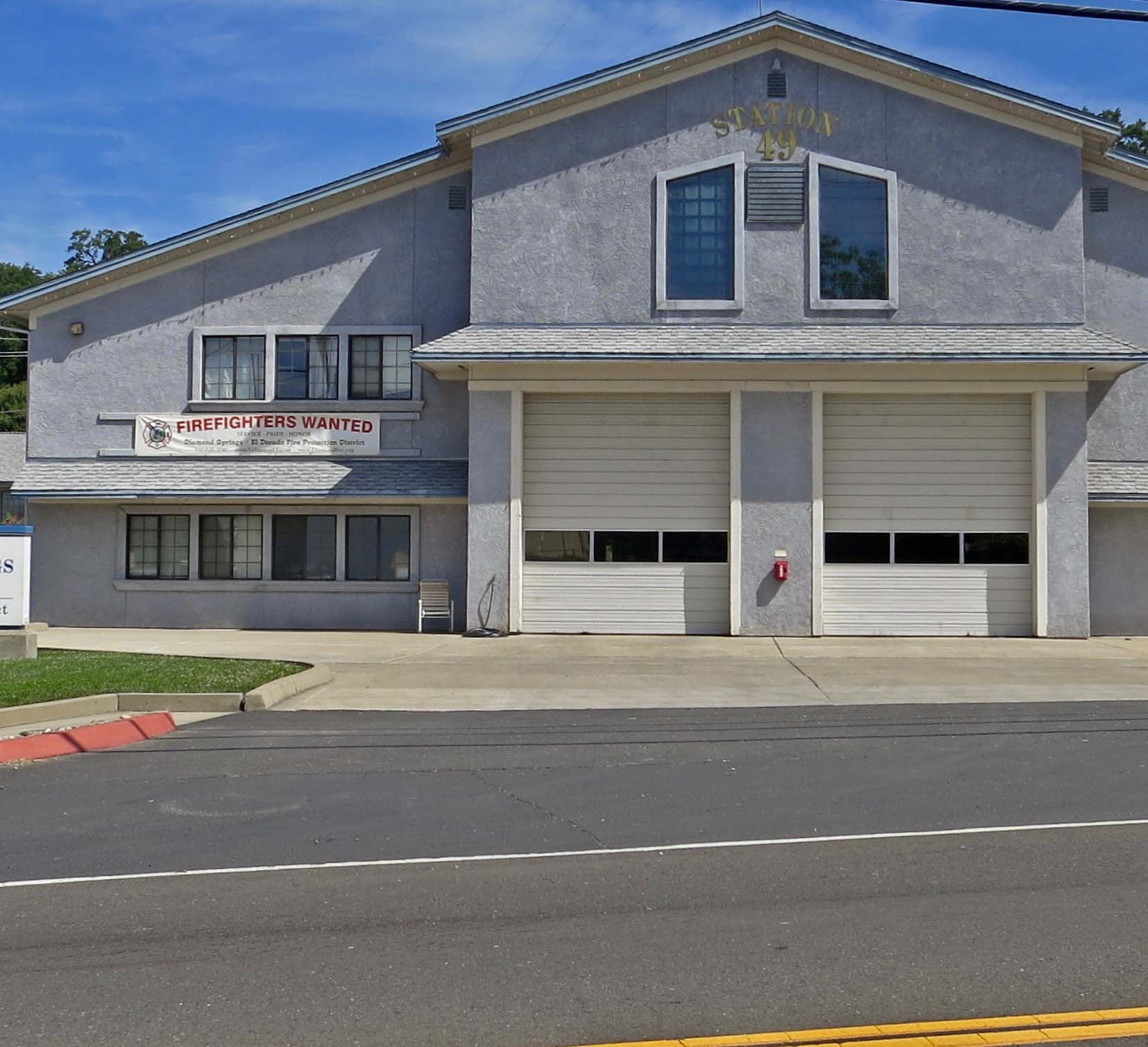
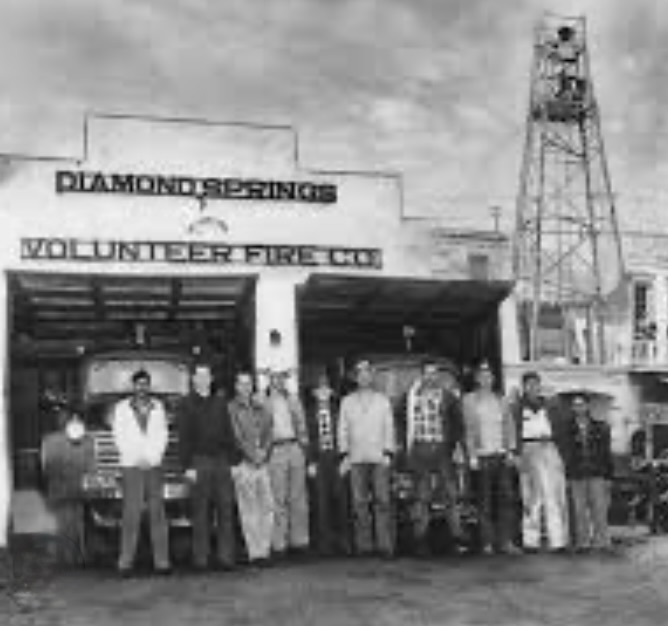
While the Diamond Spring’s Firehouse has been rebuilt from when we were children, it still stands in the same location. It was about a block away from where we lived. The siren was loud. The sign at the top says Station 49. It’s appropriate. Diamond’s first firehouse was built in 1849 along what is now Highway 49.
In comparison, this is the firehouse not all that different from what it looked like when I was a child, which I featured in my last post. As I recall, they did rebuild it once when I was a child. Pop wired it.

If it sounds like parental supervision of our bad behavior was somewhat lax in my growing up years, that’s because it was. There were times when our parents, or at least Mother, provided tacit approval of our misdeeds. Returning the cherries we confiscated from Pagonni’s orchard or the frogs from Pavy’s Pond was never an issue. They were quietly added to the pantry and happily consumed by all, including Pop. No questions asked. 

Once we were even encouraged to break the law. 

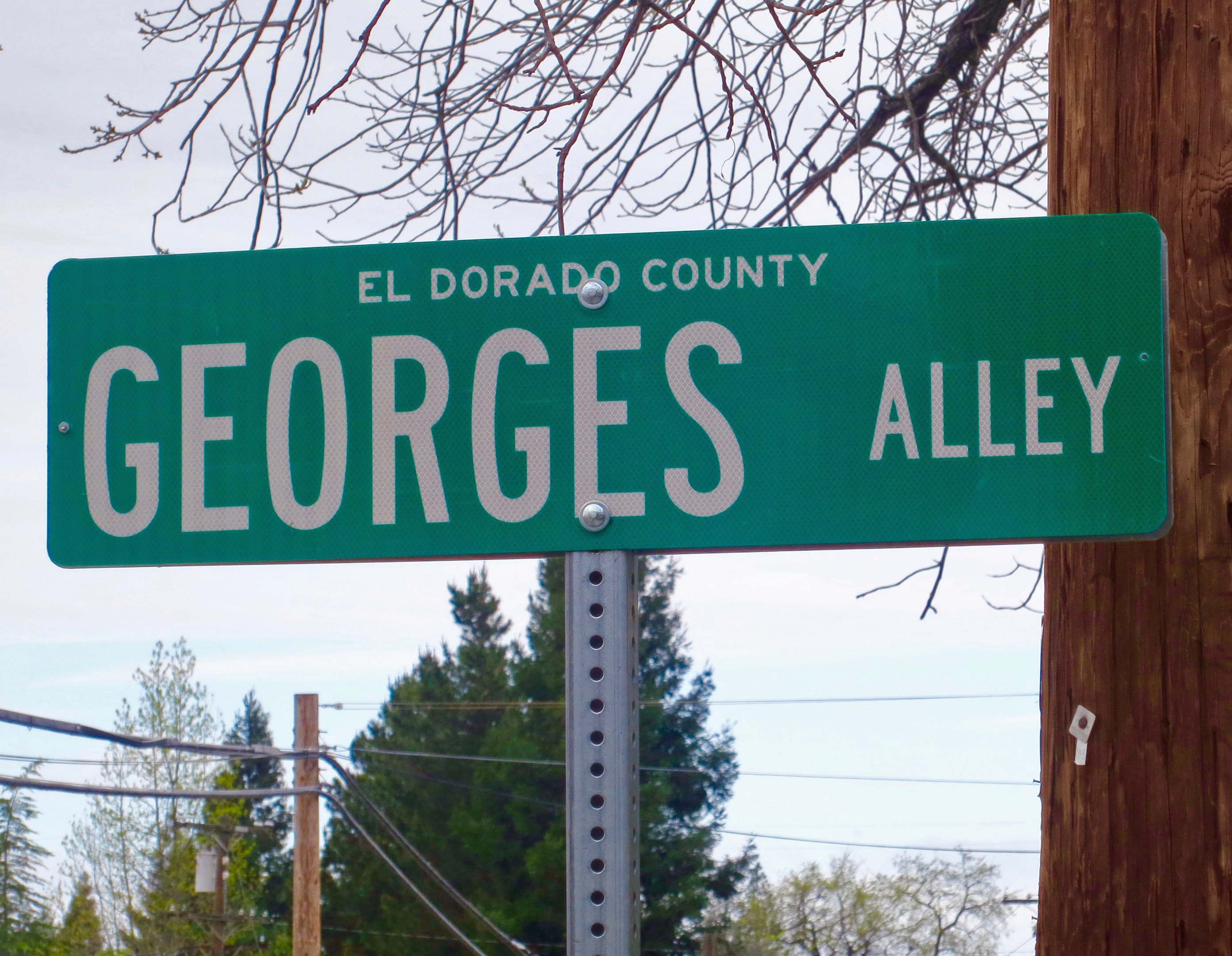
Because the dirt road we lived on circled the graveyard, the County decided it should be named Graveyard Alley. No one living on the road was asked for an opinion or informed of the decision. The signs simply appeared one day. Mother was infuriated and fired off a letter to the County Board of Supervisors. She was not going to live on Graveyard Alley! Nothing happened, there wasn’t even a response. 

Marsh and I were given marching orders: Sometime around midnight go out and remove the signs. We carried out the charge with enthusiasm. No neighbors complained about this obvious act of vandalism since they weren’t particularly happy about living on Graveyard Alley either.

The County replaced the signs. We made another raid and this time the County got the point. They changed the name in honor of an old fellow, George Croft, who was an original resident. We all liked George. It became George’s Alley, which it still is today. 

I’m convinced we inherited our trouble making potential from our mother. Pop was a good man who had avoided marriage until he was 38. He was the type of guy who served on the Vestry of the Church, was a Boy Scout leader, and was always available to help out a neighbor. I am sure there were times he wished he had avoided marriage for another 38 years. A lesser man might have said bye-bye and been on his way. But he took his role seriously and pushed on, through thick and thin. 

Mother could be something of a ‘wild child,’ wilder than her wild children. Going to fires in Diamond Springs was an excellent example.

Pop was a volunteer fireman for Diamond. As an electrician, it was his job was to show up at burning houses and shut off electricity. When the siren wailed, he was off and running, as were all the other volunteer firemen in town. It was serious business. 

For Mother and for us, it was high entertainment. We also took off at the sound of the siren, jumped in whatever old car we had, and sped along behind the fire truck. The time of day and activity of the moment didn’t matter. If it were three in the morning, we would jump out of bed and throw on our clothes; if we were eating, the meal would be abandoned; if we were playing, the toys would be dropped. Nothing could compete with a good fire. Our devotion to disaster was right up there in the same league as it is with today’s news media. 

The star performer was someone’s house. There was excitement, danger and pathos. Firemen blasted away with their hoses in a desperate attempt to save the home while the unfortunate family looked on in dismay. But the climax, the Fourth of July finale, was when the roof and walls would crash down and shoot sparks and fire high into the sky. I did keep my oohs and ahhs to myself. Somewhere in the back of my mind a small voice whispered that our family outing was not totally appropriate.

“Your mother chases fire trucks,” one of my little buddies jeered at me in an argument. 

My response at the time had been, “So…,” but later in life I would ponder what the towns-people must have thought about Mother, two or three kids, and a dog always showing up. Pop must have been terribly embarrassed. I remember him telling Mother once to stay far behind the fire engine and far away from the fire. He did it under the guise of being concerned for our safety. I now suspect he hoped we wouldn’t be recognized. But he never did have much success in telling Mother what to do. The siren’s call was not to be denied— for either one of them.

Monday’s Post: It’s back to Costa Rica where Peggy and I will show you a ficus, which I would bet is unlike any ficus/banyan/fig tree you have ever seen before unless you have been in Monteverde. No photos this time, I’m keeping it as a surprise. Here is a banyan tree we visited on the Big Island of Hawaii last year, however…

UT-OH! Chapter 11: Raw Sex, the Nuclear Holocaust, and Being Bonked by a Baseball

This is how I felt after being bonked on the head by a baseball! Just kidding. It’s actually here because I didn’t have a photo for Chapter 11. This one is an introduction to Friday’s post on Costa Rica Butterflies.

There came a time when I grew out of my mischief making phase. Other things took precedence: school, wandering in the woods, church, girls, and even sports. Few of these earned an Ut-Oh. There were a couple of incidents that earned inclusion in this book, however. The first had to do with a girl.

Starting as far back as the third grade, I had a girlfriend, or at least believed I did. The girls didn’t have to agree. My first heart throb was Carol. She was a younger woman: cute and smart. While I appreciated those qualities, what fascinated me about Carol was that she could run like the wind. I was in love with her legs. We both lived within a couple of blocks of school and would walk home for lunch. 

The advantage of going home was we would arrive back at school before the other kids were let out for noon recess. This meant we could grab the best positions for whatever game was being played. My problem was that Carol could outrun me and this meant I was usually second in line. It seemed like a small price to pay for seeing those legs kicking up the dirt in front of me.

Next, I fell for an older woman, the fifth grade sister of one of my classmates in the fourth grade. She had quite a mouth on her and called her little brother pet names like shit-head and fuck-face. I was fascinated to hear a girl talk like that. One weekend, I found myself walking 2 ½ miles following the Southern Pacific railroad tracks to ‘visit her brother’ with my primary objective hearing her speak those ‘guy’ words. She didn’t disappoint…

The Ut-Oh, however, took place when I was in the fifth grade. Judy was a fourth grader with flaming red hair who had several boys in the fourth and fifth grade passionately pursuing her. The competition was fierce. Judy loved it. To encourage us, she cut off small locks of her hair and gave one to each of her admirers. I was surprised she had any hair left but I cherished my locket.

My main competitor for Judy was Eric. He was an up and coming fourth grader, small, but extremely athletic and an all-around nice kid. Judy let it be known that we were the chosen two. 

We had our showdown at a school movie that provided instructions on what to do when the Russians bombed us. We spent a lot of time in the 50s worrying about that. People began building bomb shelters in their backyards. The teachers would make us crawl under our desks to prepare for the explosion. We were taught to cover our faces with our arms so glass shattering in from the windows wouldn’t blind us. It is not surprising that the traumatized children of the 50’s grew up to be the anti-war advocates of the 60s and 70s. I stayed up one night to watch atomic bomb testing in the Nevada desert over 200 miles away. It lit up the whole Eastern sky and added a touch of reality to our hide-under-the-desk practice.

In the lineup for the movie, Eric aced me out and managed to get next to Judy. A half dozen other fourth graders played honor guard and I couldn’t even get close, but my luck didn’t abandon me altogether. I grabbed the seat immediately in back of her where I could at least monitor Eric’s behavior. The lights went down and the movie started. I strained to keep an eye on Eric. He reached over and grabbed Judy’s hand and she let him hold it. Damn! I could have killed him.

But then, unbelievably, Judy slipped her other hand between the chairs and grabbed my knee. My knee! It was raw sex. The ut-oh bulge in my pants proved it. 

Sports presented a totally different type of challenge. I am not a natural jock. It isn’t so much physical as mental. You have to care to be good at sports and I find other things more interesting. Part of this evolved from a lack of enthusiasm on the home front. There was little vicarious parental drive to see us excel on the playing field. 

Being as blind as a bat didn’t help much either. Like most young people in the 50s, I was not excited about wearing glasses. When Mrs. Wells, the school nurse, came to class with her eye charts, I would memorize the lines while she was setting up and then breeze through the test. As for class work, I would sit close to the black board and squint a lot. While I got away with this more or less in the classroom, it became a serious hazard on the Little League field.

I remember going out for the team. All of my friends played and social pressure suggested it was the thing to do. Nervously, I showed up on opening day and faced the usual chaos of parents signing up their stars, balls flying everywhere, coaches yelling, and kids running in a dozen different directions at once.

“Okay, Curtis,” the Coach instructed, “let’s see how you handle this fly.”

Crack! I heard him hit the ball. Fine, except where was it? The ball had disappeared. Conk. It magically reappeared out of nowhere, bounced off my glove and hit me on the head.

“What’s the matter? Can’t you see?” the Coach yelled helpfully. “Let’s try it again.” My Little League Career was short lived. I went back to carrying out my inventory of the number of skunks that lived in the Woods. This didn’t mean I was hopeless at sports. In the seventh grade I finally obtained glasses and discovered the miracle of vision: Trees had leaves, billboards were pushing drugs, and the kid waving at me from across the street was flipping me off. I could even see baseballs. It was time to become a sports hero.

It says something about your future in sports when your career peaks in the eighth grade. 

Thanks to Mrs. Young, I was slightly older than my classmate and, thanks to genetics plus an early growth spurt, slightly bigger. More importantly, I had mastered the art of leadership: Make noise, appear confident and charge the enemy. As a result I became quarterback and captain of the football team, center and captain of the basketball team and pitcher and captain of the softball team. I even went out for track and ran the 440, but they didn’t select me as captain. That honor went to a seventh grader. I was bummed.

UT-OH Chapter 6: Nancy Jo and the Graveyard Ghost—A Twisted Tale of Fright (Or Maybe a Tale with a Twist?)

PLUS A Bonus: Costa Rica Is for the Birds… That’s a Good Thing

A change of plans today. I was going to do a post on unique Burning Man structures, but Peggy and I are down in Costa Rica happily settled into a villa above Lake Arenal. A warm tropical breeze is making me feel sleepy. My ‘get up and go has got up and went,’ as the song proclaimed, galloped off to the north. Pura Vida, the Costa Ricans would say. We are living the good life. Posting a tale I have already written plus throwing up some fun photos of birds that Peggy and I have taken is a lot easier than putting together a Burning Man post. Plus, over half the time I went to research a subject for the post, I found that Google had placed one of my blogs on the subject at the top or near the top of its research list and/or just opposite its AI answer. That’s great for SEO, but it also suggests how much I have already written on the subject.

So, my apologies to those who have tuned in to learn more about Burning Man, but hey, a ghost story makes a great substitute, right? So here it is as a chapter in my ongoing blog-a-book series: UT-OH. I’ll eventually get back to Burning Man. I always do.

Nancy Jo and the Graveyard Ghost

My sister was seven years older than I and lived on a different planet, the mysterious world of teenage girls. Her concern about ghosts makes this story a powerful testimony to teenage hormones. If Marshall and I had a healthy respect for the Graveyard at night, Nancy’s fear was monumental.

This story begins with Nancy falling in ‘love’ with the ‘boy’ next door, Johnny. His parents were good folks from a kids’ perspective. Marshall and I raided their apple trees with impunity, and Mama, a big Italian lady, made great spaghetti that included wild manzanita mushrooms. I was fascinated with the way she yelled “Bullll Sheeeet” in a stentorian voice when she was whipping Papa into line. He was a skinny, ‘Old Country type of guy’ who thought he should be in charge. Papa was the one who suggested the gunny sack method of castration for MC.

I use the terms love and boy somewhat loosely since Nancy at 16 was more in infatuation than love, and Johnny, a 22-year-old Korean War Veteran, was a little old for the boy designation, not to mention Nancy. Our parents were not happy, a fact that only seemed to encourage my sister.

Her teenage hormones aided by a healthy dose of rebellion overcame her good sense and she pursued the budding relationship. Johnny didn’t make it easy. His idea of a special date was to drive down the alley and honk. Otherwise, he avoided our place. If Nancy wanted to see him, she had to visit his home. It should have been easy; his house was right behind ours.

But there was a major obstacle, the dreaded Graveyard. To avoid it, Nancy had to climb over the fence that separated our houses. Her other option was walk up the alley that almost touched the tombstones. Given her feelings about dead people, the solution seemed easy— climb the fence. Marsh and I had been over it many times in search of apples. Something about teenage girl dignity I didn’t understand eliminated fence climbing, however. Nancy was left up the alley without an escort.

While she wasn’t above sneaking out her window, Nancy asked permission to see Johnny the night of the Graveyard Ghost attack. She approached Mother around seven. It was one of those warm summer evenings where the sun is reluctant to go down and boys are granted special permission to stay up. Marshall and I listened intently.

“Mother, I think I’ll go visit Johnny,” Nancy stated and asked in the same sentence. Careful maneuvering was required. An outright statement would have triggered a parental prerogative no and an outright question may have solicited a parental concern no.

Silence. This communicated disapproval, a possible no, and a tad of punishment for raising the issue.

“Mother?” We were on the edge of an impending teenage tantrum. Nancy could throw a good one.

“Okay” with weary resignation followed by, “but you have to be home by ten.”

What we heard was TEN. Translate after dark. Nancy would be coming down the alley past the Graveyard in the dark and she would be scared. Knowing Johnny’s desire to avoid my parents, we figured she would also be alone. A fiendish plot was hatched.

At 9:45, Marsh and I slipped outside and made our way up the alley to a point half way between our house and Johnny’s. Next, we took a few steps into Graveyard where weed-like Heavenly trees and deep Myrtle provided perfect cover. Hiding there at night was scary, but Marshall and I were operating under inspiration.

Marsh stripped the limbs off of one of the young trees, bent it over like a catapult, and draped his white T-shirt on the trunk. We then scrunched down and waited.

At exactly 10:00, Nancy opened the back door and stepped outside with Johnny. Our hearts skipped a beat. Would he walk her home? No. After a perfunctory goodnight, Johnny dutifully went back inside and one very alone sister began her hesitant but fateful walk down the alley.

She approached slowly, desperately looking the other direction to avoid seeing tombstones and keeping as far from the Graveyard as the alley and fence allowed. 

At exactly the right moment, we struck. Marshall let go of the T-shirt and the supple Heavenly Tree whipped it into the air. It arched up over the alley and floated down in front of our already frightened sister. We started woooooing wildly like the eight and ten-year-old ghosts we were supposed to be.

Did Nancy streak down the alley to the safety of the House? No. Did she figure out her two little brothers were playing a trick and commit murder? No. Absolute hysteria ensued. She stood still and screamed. She was feet stuck to the ground petrified except for her lungs and mouth. They worked fine.

As her voice hit opera pitch, we realized that our prank was not going as planned. Nancy was not having fun. We leapt out to remedy the problem.

Bad idea.

Two bodies hurtling at you out of a graveyard in the dark of night is not a recommended solution for frayed nerves and an intense fear of dead people. The three of us, Nancy bawling and Marshall and I worrying about consequences, proceeded to the house. After a thorough scolding, we were sent to bed. I suspect our parents laughed afterwards. Many years later, even Nancy could see the humor in our prank— and laugh as well.

A fun note on The Bush Devil Ate Sam

I often get comments from people who have read my book including a number of my followers and fellow authors. They are always appreciated. I also hear from people outside our WordPress community. Here’s what I found on Gmail yesterday.

Loved The Bush Devil Ate Sam

Hi Curtis,

I just finished reading The Bush Devil Ate Sam, and I have to say, it was such a vivid, immersive experience! The way you bring Liberia to life, the chaos of students strolling in with termites for breakfast, the encounters with the army ants, and the tension of navigating the local authorities, had me laughing, gasping, and completely captivated. It’s clear how much heart and firsthand experience went into every story.

Reading it also got me thinking about my own writing journey. Each book I’ve worked on has taught me something new about patience, perspective, and letting a story evolve naturally, even when it takes unexpected turns. It’s always fascinating to reflect on the ways our experiences shape the stories we tell.

I’d love to hear about your own process with this book. Did you find it easy to translate your Peace Corps experiences into these stories, or was it more of a challenge to capture the humor, the tension, and the history all at once? Thank you for sharing such a memorable and honest perspective on life as a Peace Corps volunteer. Half the fun was getting to see Liberia through your eyes.

Warmly,
Taylor Jenkins Reid

The thoughtfulness of this comment caught my attention. And how well it was written. Of course, I responded to Taylor. But there is more. Taylor is a best-selling author of the New York Times and has won a number of national awards for her writing. Among her books is The Seven Husbands of Evelyn Hugo, a book that the book club that Peggy and I belonged to for 36 years had picked to read. An Amazon Prime television series based on one of her books is now playing.

Taylor immediately responded to my comments and asked if I would share my body of work. Now I have to tell her she has it, the rest is tied up in 1500 WordPress blogs. Grin. I must say, I am now inspired to finish UT-OH! asap. You may be seeing a couple of chapters a week. I’d prefer that my body of work include two books.

Costa Rica Is for the Birds. It’s a good thing.

Our villa looks out on a large bird feeder that the staff and guests (including us) of Lake Gardens daily fill with a variety of fruits that the local population of birds love. I hate to confess this as a would-be birder, but I can sit on our couch and take photos of all the action. And action it is, constant drama of who gets to eat when, a veritable pecking order of turkey-size birds down to sparrow-size. A lot more photos will be coming of birds and hopefully other jungle life. This is a teaser.

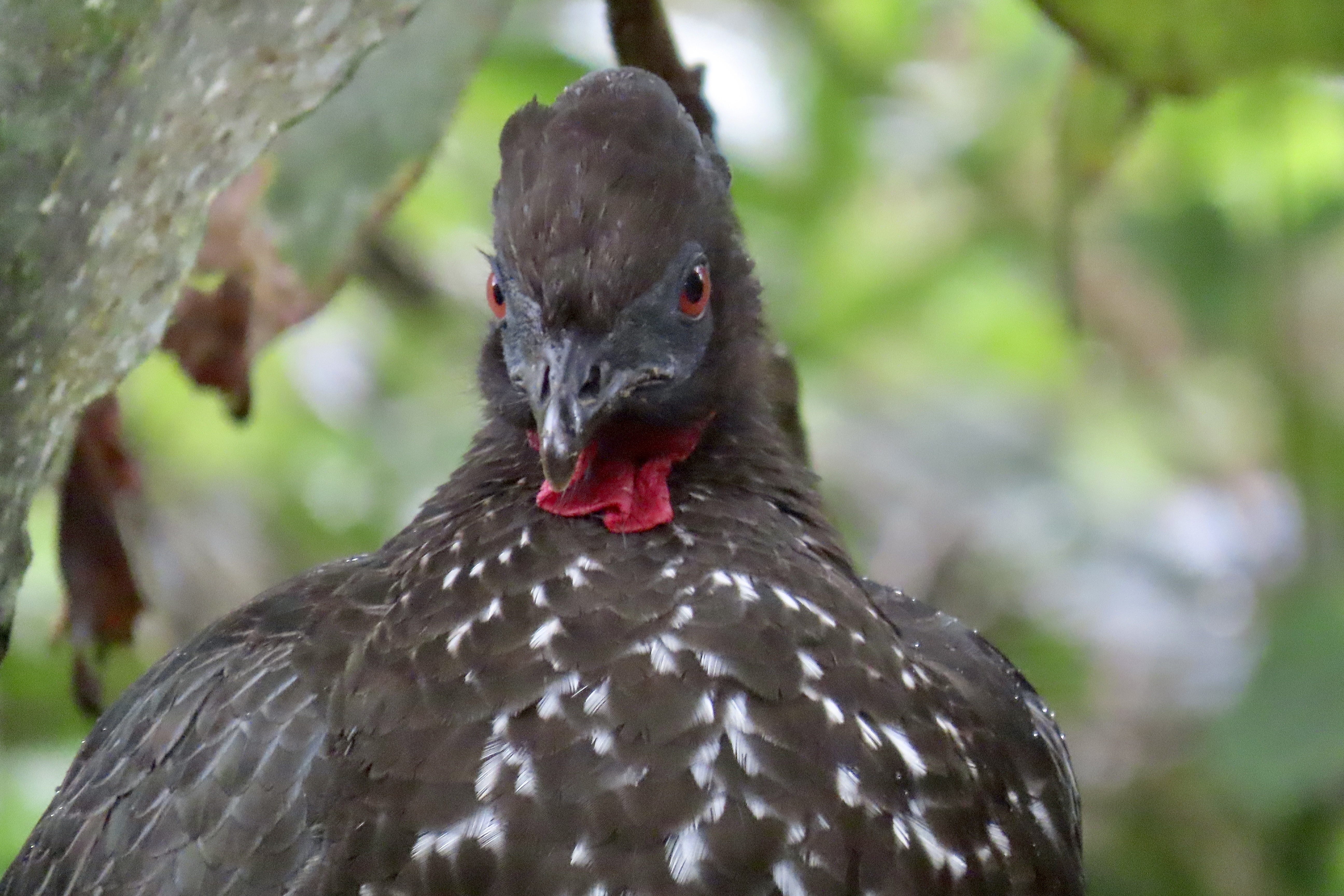
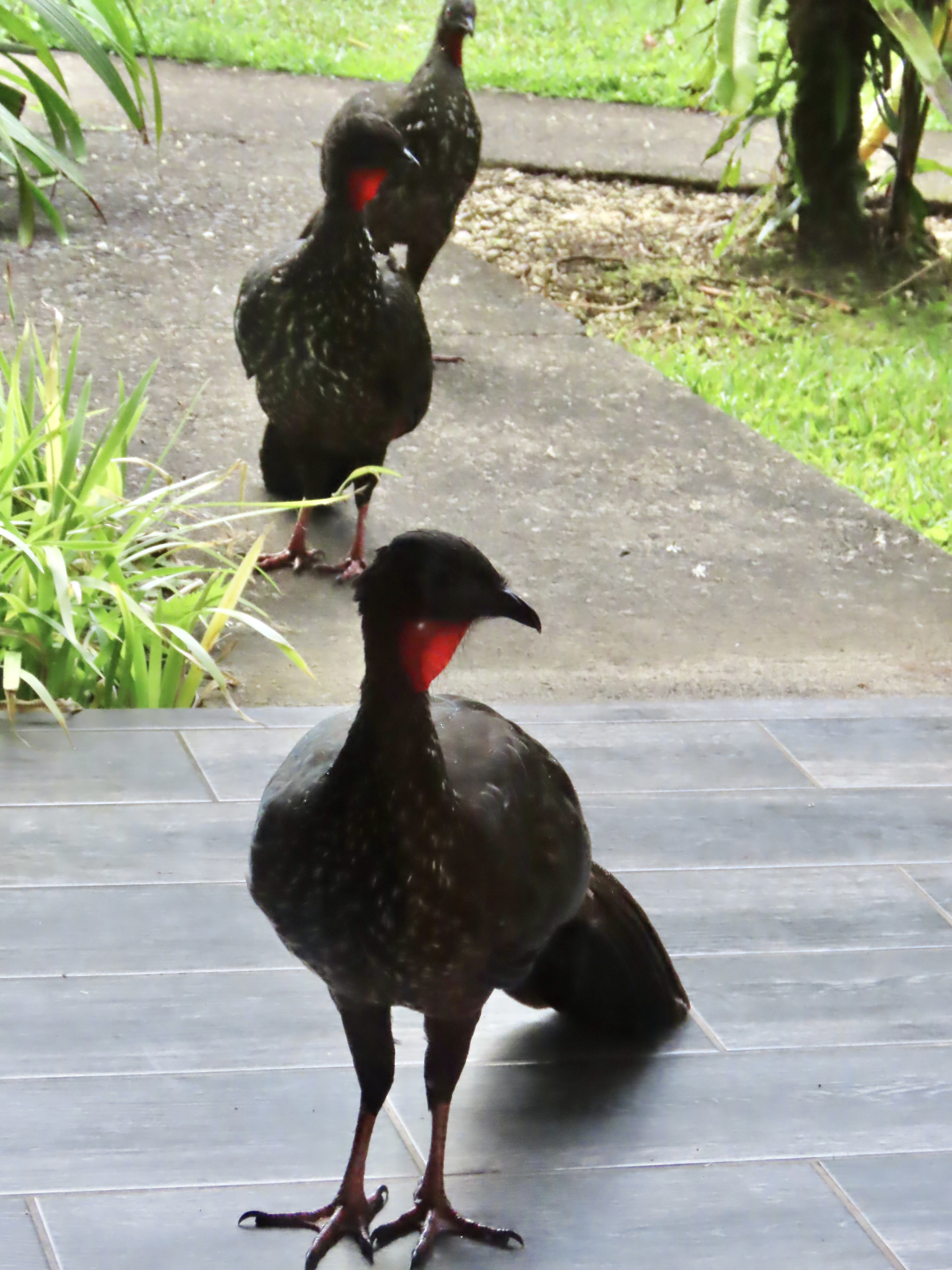
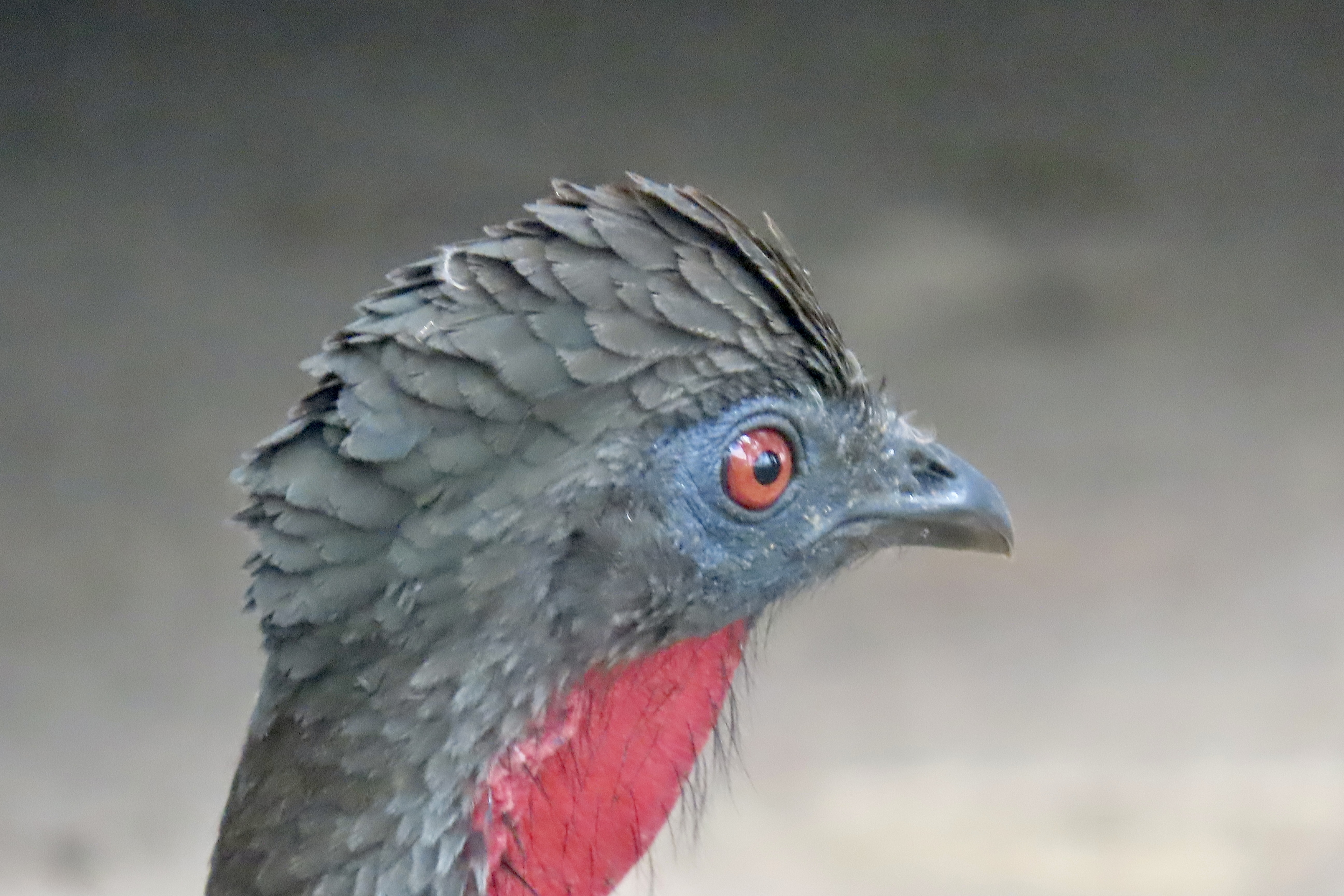
This is the king or queen of the feeder. A Crested Guan. All other birds are required to leave the platform when they are on it.
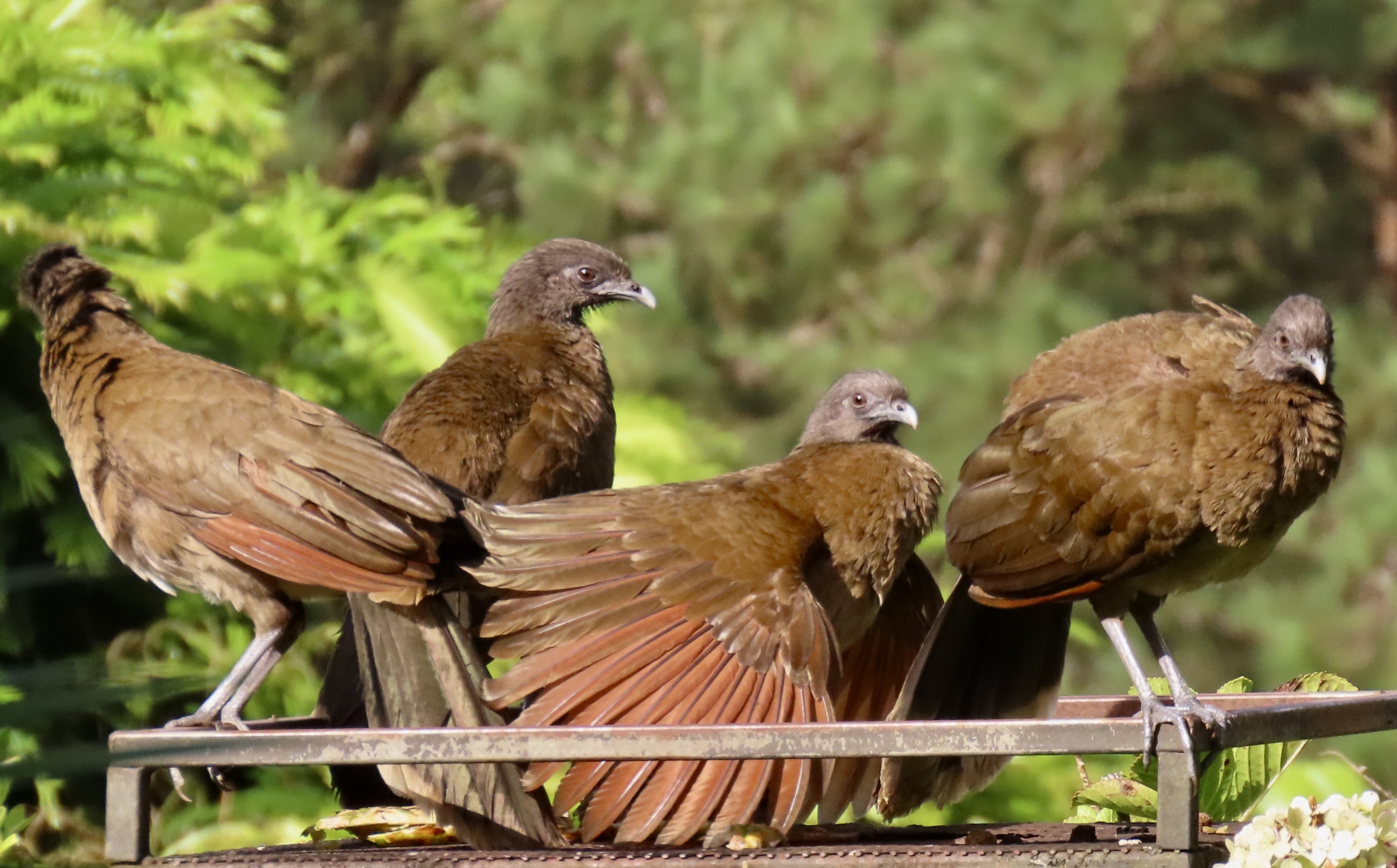
When Peggy opened our curtains on our first morning, Peggy found this crew back-lit by the sun lined up for breakfast and snapped their photo.
Up close and personal.
Number 2 on the pecking order was this fellow. We aren’t sure what it was, but our assumption is a fledgling Guam. If so, their parents were not about to share food with them. A bush was just below the feeder that the adults would chase the kids around, and around. It was like the Keystone Cops.
Here are the kids up on the bird feeder.
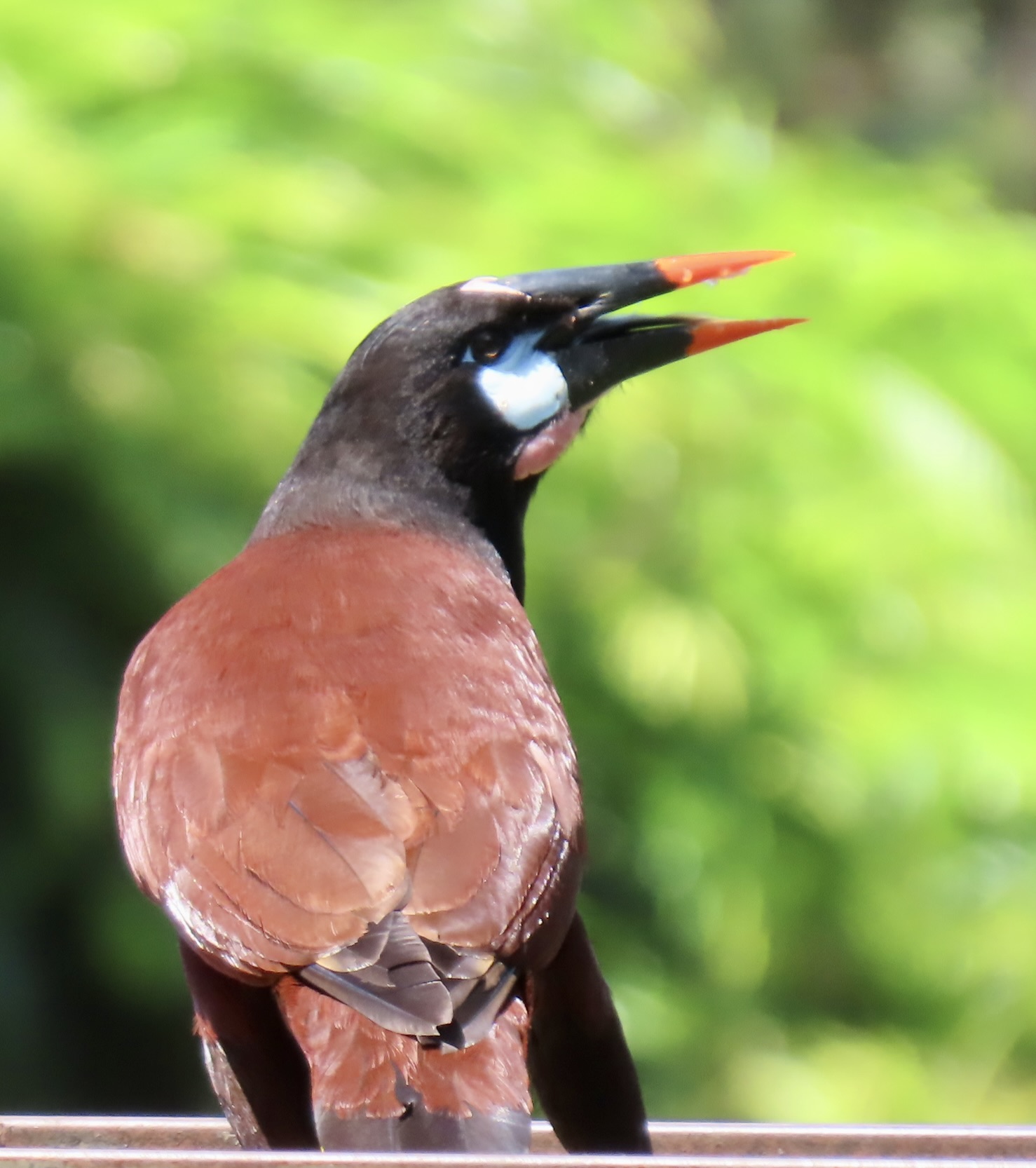
Number three was a Montezuma oropendola.
Peggy caught a photo of it looking the other direction.
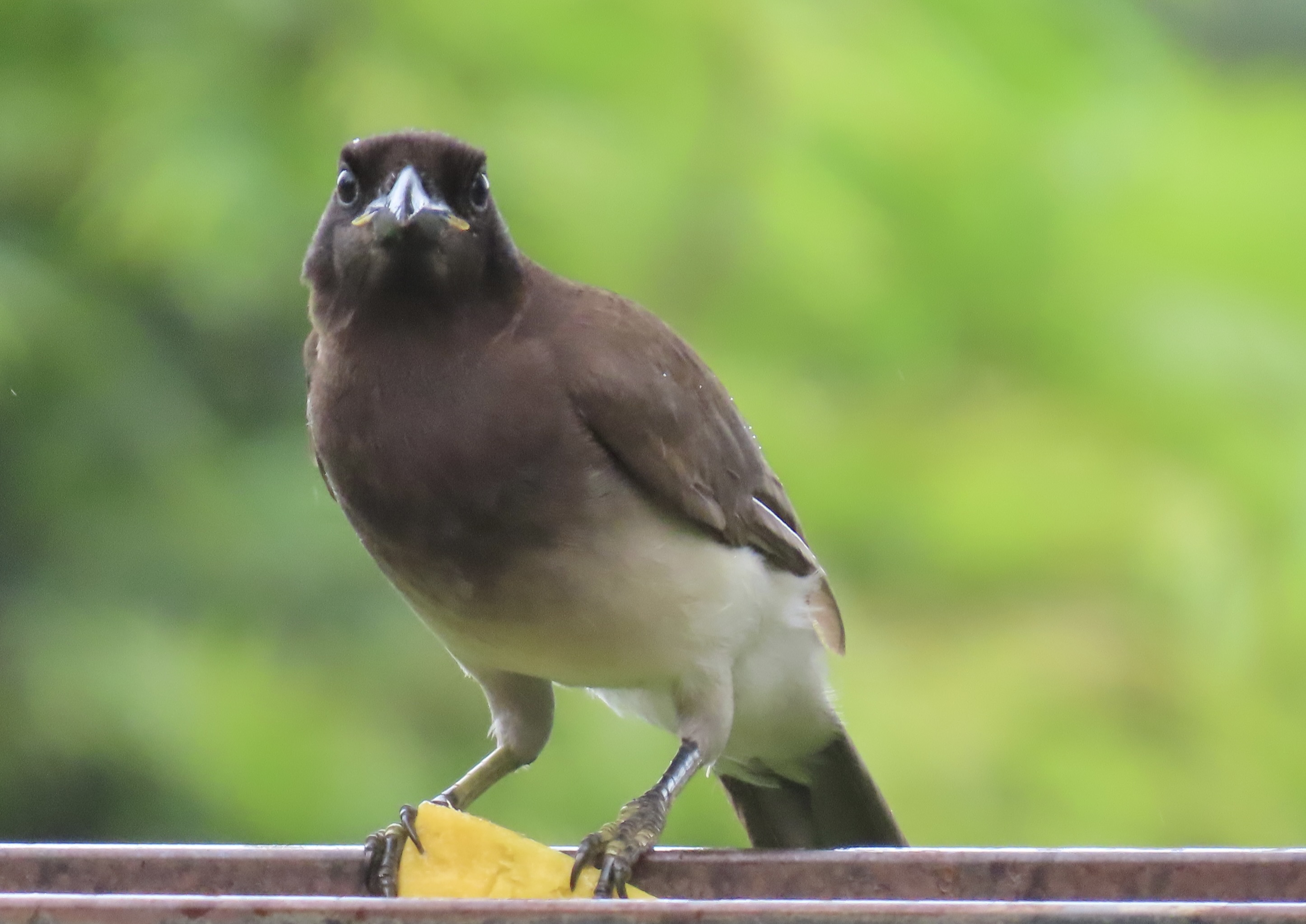
Number 4: A Brown Jay. We recognized this fellow immediately by its call. We’ve spent our lives with various members of the jay family, but never a brown one.
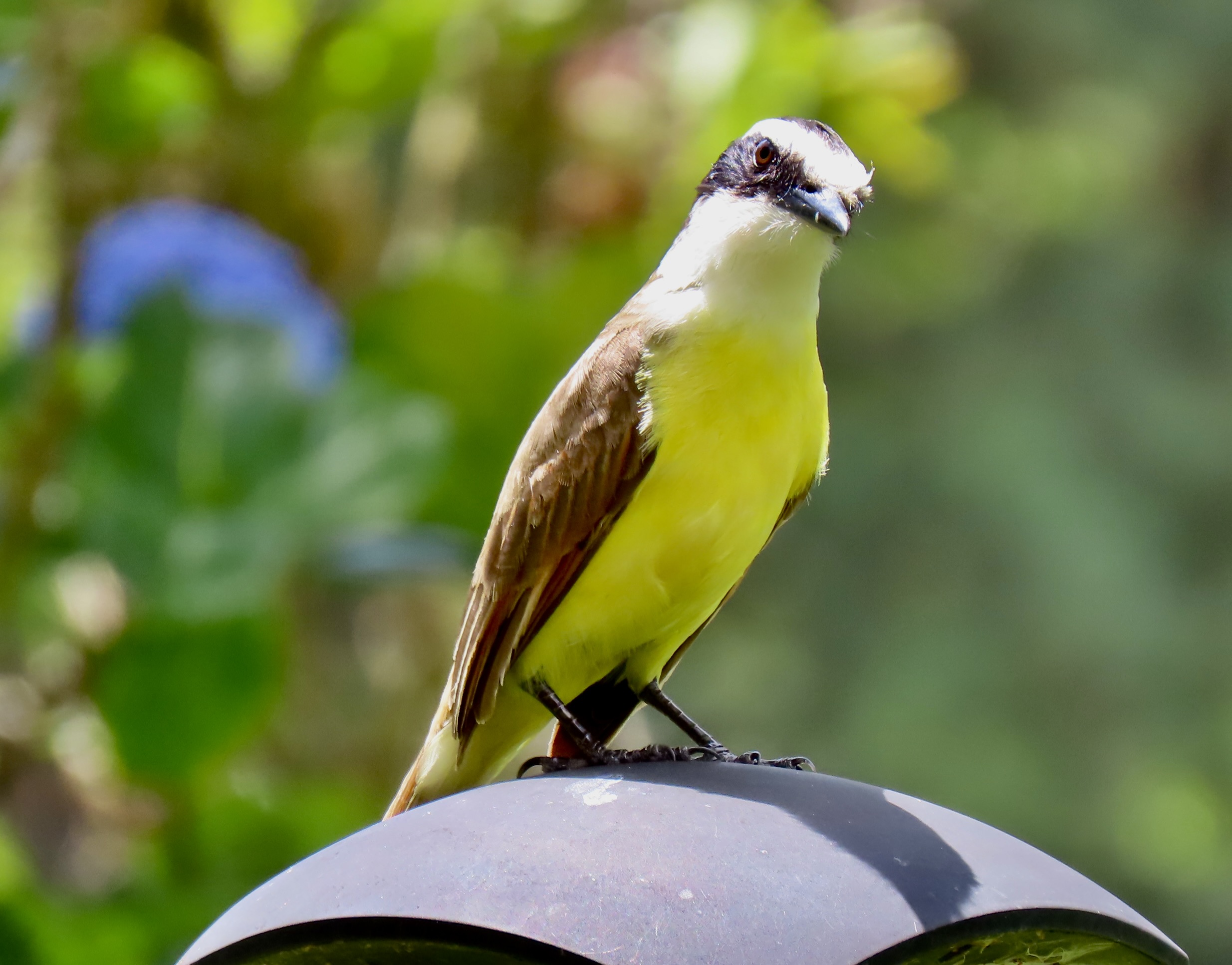
I swear the pretty bird was posing for Peggy. He kept coming back to this lamp outsiide our villa and looking in the window. He didn’t eat fruit, however, He ate bugs. It’s a Social Flycatcher.

That’s it for today. On Thursday, I’ll write about a death defying tree race in UT-OH, one of our many adventures that makes me wonder how we ever lived through childhood. And, there will be more bird photos from Costa Rica.

UT-OH Chapter 6: Searching for God in all the Wrong Places

This photo was taken 2-3 years after our parents sent the Mekemson kids off to Vacation Bible School, but here we are. I’m on the left, my dog Tickle is next, then my sister, Nancy and my brother, Marshall. Tickle got to stay home. He didn’t need religion; he was a good dog.

How to develop a warped view of religion

I’m continuing with my blog-a-book/memoir/misadventure series today with my first two experiences of organized religion. It was a rocky start.

Pop inherited most of the religious fervor in our family. According to my mother, his mom was a hardline Scotch Presbyterian with a sense of humor to match. One didn’t drink, cuss, smoke or perform any of the other nefarious deeds the devil so cunningly uses to capture wayward souls. Fortunately, he missed some of the thou-shall-nots his mother preached. But he did inherit a sense that church is “good for you,” however, and this meant it would be doubly good for his kids. While Mother had more doubts about religion, even she felt that a little God wouldn’t hurt us. Or, at least she recognized kid-free summer time when she saw it.

Eventually this led to the three Mekemson kids being spiffed up and marched off to Vacation Bible School. My brother, Marshall, and I got a rare midweek bath, clean clothes, and the lecture: No shoving, shouting, fighting or farting. Our older sister, Nancy, bathed regularly and didn’t need the lecture.

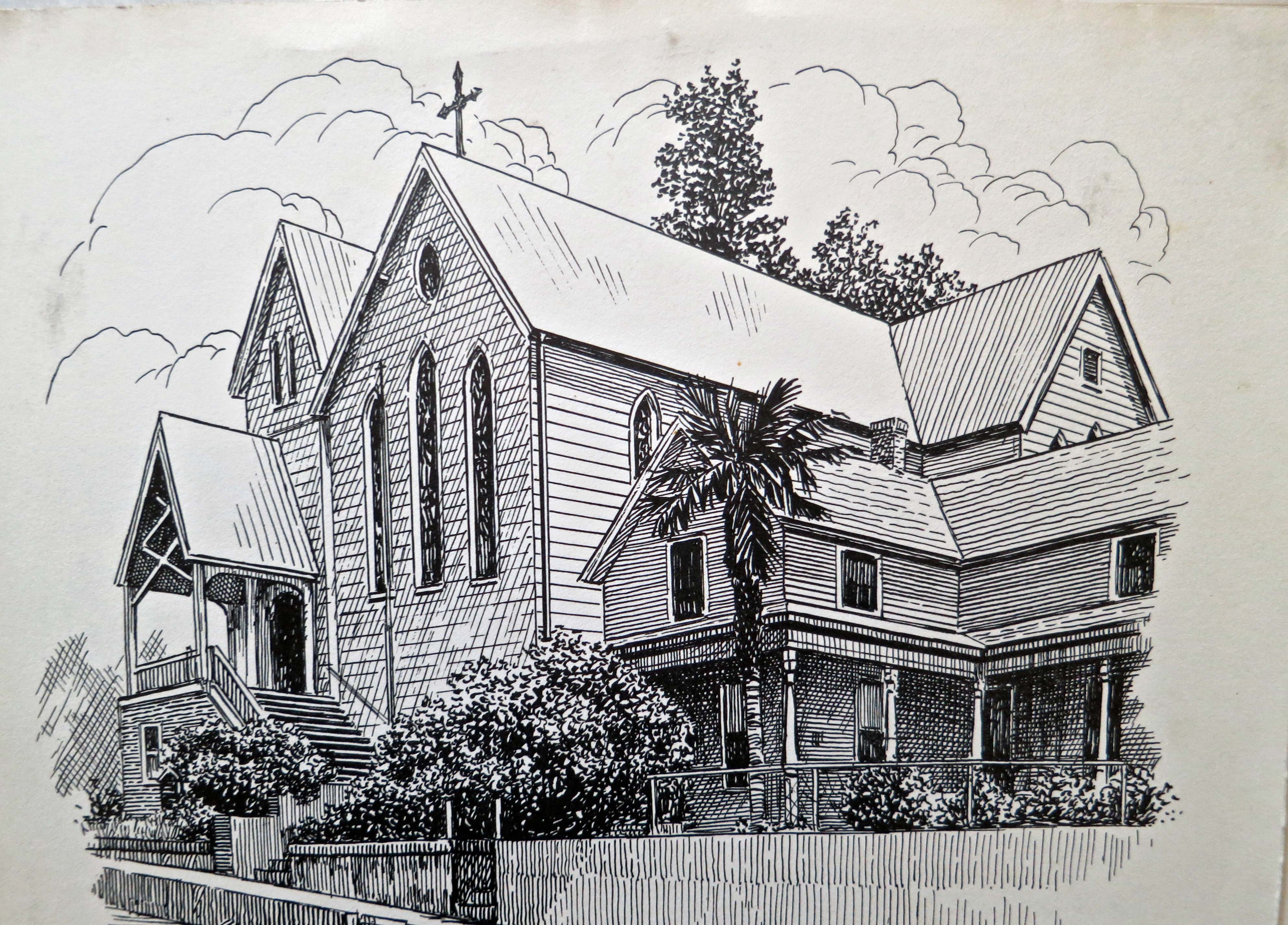
In those days, going to church in Diamond Springs meant going to the Community Church, a small, white, box-shaped building that came with a straight steeple and fundamentalist leanings.

Other than the fact that Bible School seriously interfered with my play time, it wasn’t all that bad. I was encouraged to color lots of sheep and no one seemed to mind that they were purple. But the real fall-on-your-knees thing that grabbed my attention was all the stuff about miracles. I was fascinated to know how Noah got all of those animals on one boat, what he did with the poop, and how Christ walked on water. I had so many ‘hows and whys’ the Bible School teacher stopped calling on me. I went back to coloring sheep.

One day we were privileged to witness a true miracle in progress. Somehow, we had escaped from Vacation Bible School only to be corralled into attending an actual kids’ service. I think it was a graduation ceremony meant to put the exclamation point on our lessons. It came complete with hymns, prayers, a sermon and lots of Amens. Then the big moment arrived.

“Would you like to hear the Lord knocking at your heart?” the Minister asked.

“Oh yeah!” “Wow!” “Really?” What little kid could resist? The minister instructed us to bow our heads and close our eyes. He was quite insistent on the eye part.

“None of you little kids open your eyes until I tell you to,” he ordered. Apparently, you can’t witness miracles with your eyes open.

Twenty little children dutifully bowed their heads and screwed their eyes shut. Three didn’t. If there was to be a miracle, the Mekemson kids wanted to see it. So we watched the preacher with eagle-eyed attention. He glared back at us. Whoa, this was getting interesting. Next, he tiptoed from the pulpit to the back of the church. What was he up to?

Bang, bang, bang. He was up to pounding on the back door. Yes indeed, the Lord does work in mysterious ways. We watched the minister tiptoe back to his pulpit.

“OK,” he said, “you can open your eyes now. Did you hear the Lord knocking?”

Twenty little sets of big round eyes popped open and twenty little mouths started gabbing all at once. The minister smiled smugly until his eyes fell on us. You could almost hear what he was thinking and I didn’t think ministers were supposed to think those kinds of thoughts.

“Vacation Bible School is over,” he announced abruptly. “I want you all to think about what you learned today. You can go home now.” We jumped up for a quick escape.

“Nancy, Marshall and Curt, I want you to stay.”

Ut-Oh. We were about to learn that the devil had reserved a special place for us. The Mekemson kids were very bad and downright sinful. We had better change our ways or we were going to spend eternity in a very hot place. We were also being held hostage until the other kids left. It wouldn’t do to have us spread malicious rumors.

After being pummeled by twenty minutes of non-stop haranguing, we were finally turned loose. It was pushing 100 degrees outside and Mother was waiting impatiently in one of our ancient, non-air conditioned cars. She lit into us with an intensity that would have made the Minister cry “uncle.” I wondered if our punishment had already begun. But Nancy straightened things out quickly with all of the righteousness of a 12-year-old girl— and forever became my hero. Not only was the minister a ‘lying, deceitful, old so and so,’ she was never coming back to that church again. Ditto.

Marshall, who was seven, sought his own peculiar form of revenge. (He told me about it later out of fear I would tattle.) Our friend, Lee Kinser, lived next to the church and had an old outhouse up the hill behind his home. In-door plumbing had long since replaced its primary use and the daily deposits had turned to dust. The outhouse’s appeal to Marshall was that if he sat on the seat and left the door open, he had a straight shot at the church’s bell. All Marshall needed was his BB gun and a Sunday service. Actually, I think he enjoyed more than one service from his box seat. In my imagination, I can still hear the minister saying to his Sunday congregations, “Do you hear the Lord pinging?”

Brother Jones and a Glowing Jesus

And that was my introduction to religion. Almost. Another fine tutor was Brother James Allen Jones, or some such name long since forgotten. He was a southern radio preacher par excellence in an era when radio still dominated the airwaves. At least it did in Diamond. There was only one TV in town and it certainly didn’t belong to us.

Normally, Marshall and I focused our radio listening time to standard kid fare like the Lone Ranger, Sergeant Preston of the Yukon and the Shadow. We would sit glued to the radio with all the concentration of later TV/computer/phone screen generations and listen to such immortal words as “Who was that masked man?” “I don’t know but he left a silver bullet behind.” And then an awed, “That was the Lone Ranger,” as off in the distance you heard “Hi O Silver away!” We knew that Sergeant Preston and his faithful dog King would always get their man, just like we knew the Shadow would open his program with the question, “Who knows what evil lurks in the heart of man?”

The Shadow knew. And so did Brother Jones. He also knew how to ream it out. On Wednesday nights, we belonged to him. I am sure the devil quaked in his hooves to know that he had such a ferocious opponent. Brother Jones was more than fire and brimstone, however. He could cure anything. After his show the lame would walk, the blind would see and the deaf would hear. Even hardened criminals would fall on their knees and start sobbing. It was at the conclusion of the show that Jones was at his finest, though. It was time to go for the gold.

“I can see you now. I can see you sitting in front of your radio.” The good Brother would start out in his most hypnotic voice, repeating himself so people would get the message right.

“I can see you reaching in your back pocket. I can see you reaching in your back pocket and taking out your wallet. Praise the Lord! I can see you opening your wallet. I can see you opening your wallet and taking out a ten-dollar bill. Hallelujah! Now you are taking your ten-dollar bill and laying it on the radio. I am blessing you and your ten-dollar bill. Lay your hand on the radio. Feel my blessing coming through. Do you feel it? Do you feel it? Hallelujah and Amen Brothers and Sisters! Now I can see you getting out an envelope and a pen. You are addressing the envelope to me, Brother James Allen Jones. You are now taking the ten-dollar bill and placing it in the envelope. Thank the sweet Lord! You are closing the envelope and stamping it. The first thing you will do in the morning is mail it to me. Blessed are those who give! In return, I will mail you a fine gift, a genuine picture of Jesus Christ that glows in the dark.”

I always wanted the genuine picture of Jesus, but I was a little concerned about its glow in the dark qualities. Marshall and I had been given a cross that glowed in the dark at Vacation Bible School and Marshall kept it on our dresser. It scared me, like the tombstones in the Graveyard. I’d wake up in the middle of the night and there it would be, glowing at me. You couldn’t turn it off and Marshall wouldn’t let me shove it in a drawer. My only solution was to hide under the covers. Can you imagine the trauma of growing up with a glowing cross that forces you to hide under the covers? Who knows what damage a glowing Jesus might have caused.

As you might surmise, by this early point in my life I had already developed a somewhat warped view of religion, not to mention a frustrated pair of parents. But they weren’t about to give up. Their savage little beasts would be tamed. It took Tarzan to show me the light.

Next on my parent’s road map to religious enlightenment was the Episcopal Church of Our Savior in Placerville. This time they used a different tactic, bribery. After church, we stopped at Tom Raley’s grocery store and were allowed to buy a Pepsi and pick out a comic book. I would eagerly search the rack for the latest issue of Tarzan, and, on really lucky weekends, find one. It was like winning a gazillion dollars in the lottery. The mere thought of joining the ape-man on his romp through the jungle was more than I could resist. I became a devout Episcopalian.

Next on our Burning Man focus series, we will take a look at some unusual structures that are built at Burning Man.

“There was an old woman who lived in a shoe. She had so many children, she didn’t know what to do.” Obviously.

Next on UT-OH: Nancy Jo and the Graveyard Ghost— a terrifying experience.

UT-OH! Chapter 4: Part 2 of ‘Hiring the Family Pets to Scare Away the Ghosts’

Imagine sharing a small army cot with this large dog. Now throw in a cat or two and another dog…

I am continuing the story about how I had hired my pets to sleep on my bed and scare away the ghosts that came out of the Graveyard next door to haunt me when I slept outside. I introduced Demon the Black Cat in my last UT-OH post. Today, it’s Pat the Greyhound’s turn. She joined our family as a stray. For weeks, Mother had watched this large, starving dog wander the countryside catching jack rabbits and ground squirrels for food. One day she stopped the car, opened the door, and invited Pat home for a meal.

“Oh, it is just until she gains a little weight,” Mother explained to one very disgruntled Pop. He already believed the size of our pet menagerie was far too large. People were known to drop off unwanted cats in front of our house knowing that they would find a home. As the dog put on the pounds, Mother modified her strategy.

“It would break Curt’s heart if we had to give her away,” she argued. Mother was a master at manipulation. Pat, who I named after the local Greyhound bus driver, became my dog. 

Like all of our pets, she lived outside. It was Pop’s rule; pets were limited to daytime visitation rights only. The pregnant Demon had been an exception imposed by Mother. Since there were no leash laws, Pat was free to come and go as she pleased. Mainly she chose to hang around with her food dish in sight. It was a lot easier than catching rabbits.

The night of the skunk was an exception to Pat’s normal stay-at-home routine. As usual, I had crawled into bed with an assortment of animals. That evening, it was minus Pat. Good, she took up a lot of room. Somewhere around midnight, I half way awoke as she hopped up on the bed, completed three dog turns, and snuggled down. Consciousness made a quantum leap as my nose was assailed by an unmistakable perfume.

“Seems we have a skunk visiting,” I told Pat and reached down to scratch her head. The fur was moist. As I pulled my hand back, the skunk suddenly got much closer. Now, I was totally awake. Ms. Greyhound had been bullying the wrong pussycat. It was a night to sleep inside. In fact, Marshall had a roommate for several days. I don’t know how many times I washed that hand, but I do know that the bedding was tossed and Pat learned what a tomato juice bath was. When I finally made it back outside, the animals were put on notice: One more problem and off they went. 

Then Demon made her contribution.

She was well into middle age by this time and there had been no pause in kitten production. This was a time before spaying became common. Every few months, Demon shelled out another litter. She had long since finished overpopulating Diamond and was working on surrounding communities. We were teetering on becoming known as the Cat Family of Diamond Springs. My father reverted to drastic measures. Demon was not pleased. She started hiding her kittens and became a master at subterfuge. If someone tried to follow her, she would stop and nonchalantly give herself a bath, her whole body, one lick at a time. Then she would wander off in the opposite direction.

Mother paid me in cookies to track Demon down. When the Graveyard was her destination, I had a flat tombstone I would stand on as a lookout. There was an added advantage: Demon didn’t check for people perched on tombstones. Who would? Eventually, the missing litter would be discovered. I felt like Daniel Boone.

Demon’s special home delivery took place the same summer Pat had her close encounter with the skunk. As noted earlier, my attitude about bed companions had become testy. I wasn’t above rolling over quickly to see how many I could dislodge. A really good roll would net three or four. Sleeping with me was like living on the San Andreas Fault.

I did feel guilt over routing Demon, however. Once again, she was pregnant. I watched her balloon out. By this time, I was a veteran of the birthing process and found it interesting rather than troublesome. One night I had awakened to Pat howling, found that she was delivering puppies, and sat up with her through the process. Another time I had gone out with Tom Murphy, our grocer, and assisted in the delivery of a calf that wanted to come out the wrong way. It was messy, up to the elbow work. Remember the coke I stolen from in front of his store on my early morning walk home from Rudy and Robert’s? Tom was repaid many times over. I should have been rewarded with free cokes for life.

I really didn’t expect to be around for the arrival of Demon’s kittens. That would take place in some hidden nook. One should never make assumptions, I learned. Again. It started as a normal night. Roll over, kick the animals off, and go to sleep. Wake up and repeat the process. It was not a normal morning. I woke up with wet feet. 

“What the heck!” I exclaimed as I sat up quickly, dislodging Pat in the process. Demon looked innocently back at me from the foot of the bed. Okay, nothing suggested why my feet were wet. Then I noticed movement. Demon was not alone. Several little black clones were lined up for breakfast. Demon had delivered her litter on the bed and my feet were awash in afterbirth.

That did it.  My bed was not a home for wayward dogs who encountered the business end of skunks and it certainly wasn’t designed as a maternity ward for unwed cats. After Demon and her brood were moved elsewhere and my bedding given a bath, I bought a water pistol and initiated a campaign of terror. Any four-legged critter on the bed became fair game. The cats learned quickly; getting shot with a water pistol was not their idea of a proper bath. The dogs were more resistant. Usually it took several squirts and then I would get the look: Big brown eyes accusing me of dark deeds. But I was tough and my canine companions eventually vacated the premises as well.

As soon as I fell asleep, however, the whole menagerie, fleas and all, would quietly slip back up on the bed.

“There was an old woman who lived in a shoe.” Next Monday’s focus post will be on the sculptures of Burning Man.

On Thursday join me as I relate the story of how MC the Cat refused to have his danglies cut off in UT-OH! Chapter 5.

UT-OH Chapter 2: Scary Ghosts and Half-Starved Cannibals… The Graveyard

A bit older than five, the Graveyard no longer holds the terror it once did for me. Plus they have cut down all of the heavenly trees and ripped out the myrtle. It is no longer a jungle. Our house still stands across the alley, about 50 yards from this tombstone.

The Graveyard was out the backdoor and across the alley. 

We lived with its ghostly white reminders of our mortality day and night. Ancient tombstones with fading epitaphs whispered of those who had come to seek their fortune in California’s 1849 Gold Rush and stayed for eternity. Time had given their resting place a sense of permanence and even peace. But not all of the graves were old. Occasionally a fresh body was planted on the opposite side of the cemetery. I stayed far away; the newly dead are restless.

At some point, Heavenly trees, brought over from China by Chinese miners during the Gold Rush, had been planted to shade the aging bones. They behaved like devil driven weeds. Chop them down and they sprang back up, twice as thick. Since clearing the trees provided Diamond Springs Boy Scout Troop 95 with a community project every few years, the trees retaliated by forming a visually impenetrable mass of green in summer and an army of sticks in winter. Trailing Myrtle, a cover plant with Jurassic aspirations, hid the ground in deep, leafy foliage. 

A standard picture of me with pets in our back yard. Just across the alley, the Graveyard looms as an impenetrable mass of green covered by young heavenly trees. Trailing myrtle is escaping out of the edges.

The Graveyard provided my first ‘wilderness’ experience. During the day, it took little imagination to change this lush growth into a jungle playground populated with ferocious tigers, bone crushing boas, and half-starved cannibals. Marshall and I considered the Graveyard an extension of our backyard. Since it was within easy calling distance of the house, our parents had a similar perspective. Either that or they were glad for the quiet time. 

The skinny Heavenly trees made great spears for fending off the beasts, or throwing at each other. At least they did until we stuck one in Lee’s hand. Neither he nor his parents were happy. (And why does William Golding’s Lord of the Flies come to mind?) Spear throwing was crossed off our play schedule. We turned to hurling green, black walnuts at each other instead. They grew in abundance on the trees in our front yard. Plus, we could hide behind the trees and toss them at passing cars on Highway 49. Screeching brakes and one really pissed-off driver brought that activity to a halt.

Night was different in the Graveyard— it became a place of mystery and danger. Dead people abandoned their underground chambers and slithered up through the ground. A local test of boyhood bravery was to go into the Graveyard after dark and walk over myrtle-hidden graves, taunting the inhabitants. Slight depressions announced where they lived. Marshall persuaded me to accompany him there on a moonless night. I entered with foreboding: fearing the dark, fearing the tombstones and fearing the ghosts. Halfway through I heard a muzzled sound. Someone, or thing, was stalking us.

“Hey Marsh, what was that?” I whispered urgently.

“Your imagination, Curt,” was the disdainful reply.

Scratch, scratch!  Something was digging behind a tombstone and it was not my imagination. Marshall heard it too. We went crashing out of the Graveyard with the scary creature of the night in swift pursuit, wagging her tail.

“I knew it was the dog all of the time,” Marsh claimed. Yeah, sure you did.

I also began to explore the Graveyard on my own. One of my 6-year-old memories was spying on Mr. Fitzgerald, a neighbor who lived across the alley. He’s dead now— and has been for decades— but at the time he was a bent old man who liked to putter around outside. At one time he had been the Superintendent of El Dorado County Schools. A black locust tree, perched on the edge of the Graveyard, provided an excellent lookout to watch him while he worked. 

One particular incident stands out in my mind. I had climbed into the tree and was staring down into his yard. It was a fall day. Dark clouds heavy with rain were marching in from the Pacific while distant thunder announced their approach. A stiff, cool breeze sent yellow leaves dancing across the ground. 

Mr. Fitzgerald wore a heavy coat to fight off the chill. I watched him shuffle around in his backyard as he sharpened his axe on a foot operated grinding wheel and then chopped kindling on an oak stump.  When he had painfully bent down to pick up the pieces and carry them into his woodshed, I scrambled down from the tree so I could continue to spy on him through a knothole. I must have made some noise, or maybe I blocked the sunlight from streaming into the shed. He stopped stacking wood and stared intently at where I was, as though he could see through the weathered boards. It frightened me.

I took off like a spooked jack rabbit and disappeared into the safety of our house. Mr. Fitzgerald was intriguing, but his age and frailty spoke of death, and the dead people who lived in the Graveyard. 

Alaskan moose lying down.
Our focus post on Monday will be on Ungulates. As a clue, here’s one of many different types…