UT-OH Chapter 20: Young Love, a Forest Fire, Evel Knievel and a World-Famous Rocket Scientist… Part 1

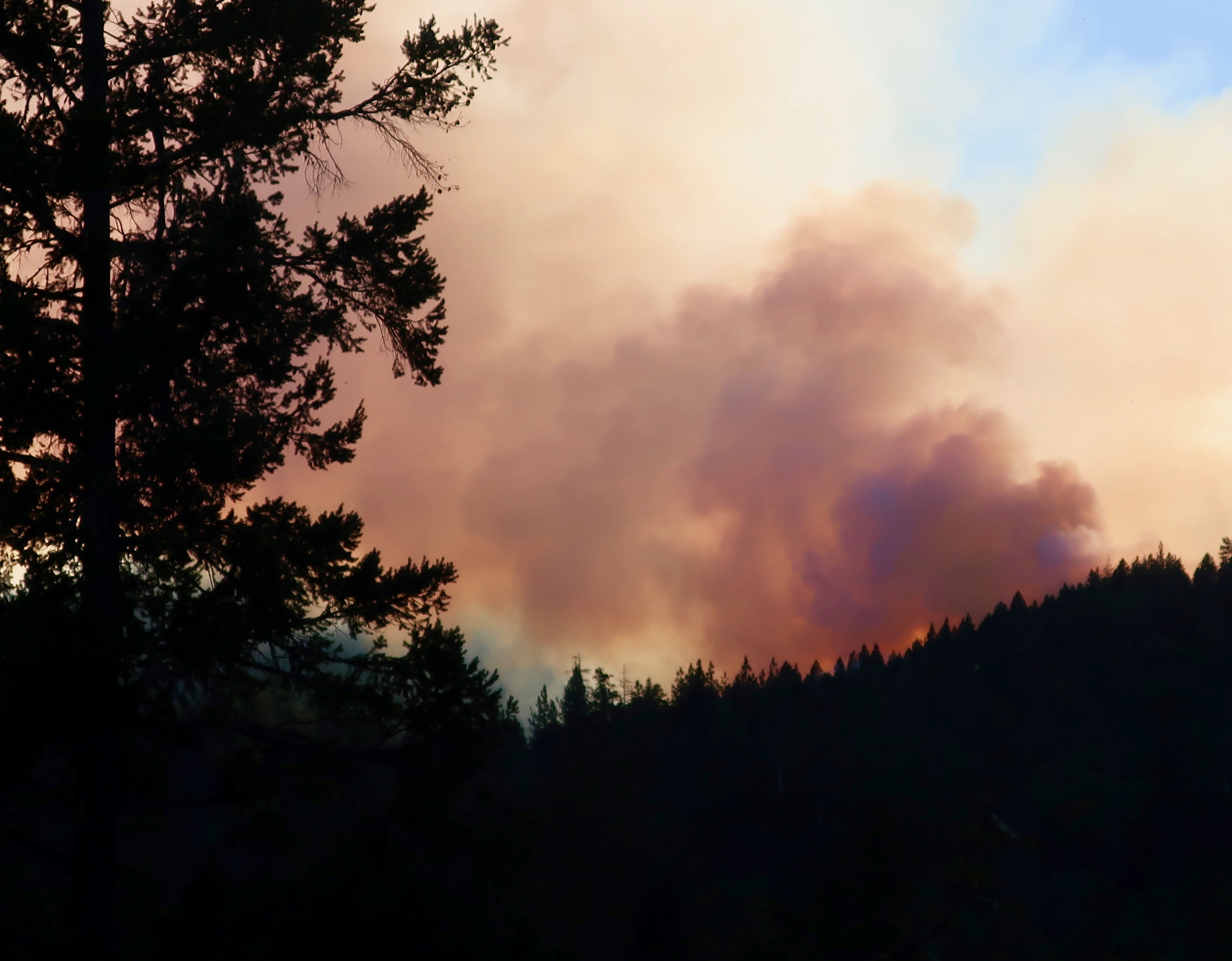
Living in the forests of the Western United States is subject to a constant threat of forest fires in the summer. This is a photo from our deck when we lived in Oregon. Fires raged throughout the area a number of times while we were there, and once we had to evacuate when the one came within a mile of our home. The forest fire I fought as an 18-year old near Georgetown, California would have looked much like this.

I was a senior before “love” hit me: That starry eyed, loop de loop feeling which has little to do with rational thought and one hell of a lot to do with hormones and ancient instincts that go all the way back to the beginning of life. It had all of the subtlety of a sledge hammer. Nature has a myriad of ways to assure we pass on our genes. A mere sniff works for some. For humans it’s more complicated. We are expected to hang out and help raise kids, a process that takes 18 years, or longer— at a minimum. That takes a lot of incentive.

Falling ‘head over heels in love,’ is just the beginning.

I met D in speech class. She was blond, bright, sexy and interested in me— an irresistible combination. Somehow, she ended up sitting in my lap as a joke when the teacher was a few minutes late. And bam! I was in love. We started dating and decided to ‘go steady.’ I even gave her my class ring. We became an item in the lingo of the day, a couple to be invited out together, a future with a question mark. We even had matching shirts, the ultimate in commitment.

But my question mark was bigger than D’s, or at least it came to fruition sooner. I was graduating from high school while she had another year. There was a big world waiting out there and I wasn’t ready to limit its horizons. So, with a degree of sadness, I ended the relationship. D was not happy. She had our future planned, even down to naming the babies. 

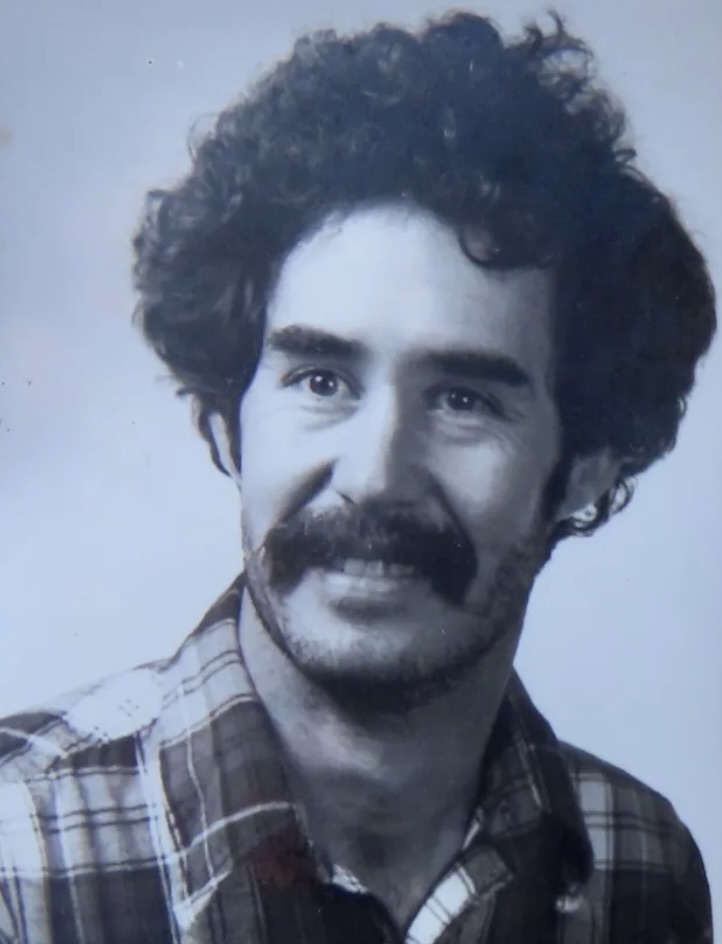
That summer, being a ‘free man,’ several young women attracted my attention, one was Kathy Truax. She had large brown eyes that consumed and a sharp mind that challenged. She seemed sophisticated, almost exotic to me, and came from a very different world. 

Her father, Robert Truax, was one of America’s premier, pioneer rocket engineers. He had kicked off his career prior to World War II when a childhood interest in Robert Goddard led him to build rockets at his home in Alameda, California. He had then gone on to work with the Navy on rocket development during World War II, and later helped build both the Thor and Polaris missiles. By 1959 he had left the military and was heading up Aerojet-General’s advanced rocket development division in Sacramento, California.

Kathy had transferred to El Dorado County High School as a senior when her dad had gone to work at Aerojet. She was on her way to Occidental College in Los Angeles in the fall and I was on my way to the local community college. They were a long way apart, and miles weren’t the only measure. Still, I thought a date would be fun.

The only drawback was I had to pick up the phone and call. There was a very real chance that Kathy would say no, and I am lousy at rejection. So I practiced something I am good at, procrastination. When I finally worked up the nerve to call, she picked up the phone on the first ring. “Oh, hi Curt,” she answered cheerfully. No, she wasn’t totally tied up in getting ready for Occidental and, yes, it would be fun to go out. So much for all of the time I’d spent anguishing. Our date would be a visit the California State Fair in Sacramento the following Saturday evening. I hung up with a loud ‘YES’ to myself.  The rest should be easy.

Except it wasn’t. When is it ever. Time slowed down to thwart me. Weeks later, Friday finally arrived. Fortunately, pear season was at its height, and I had a busy nine hours swamping out 50-pound boxes of pears from the orchard and bench pressing them onto a fruit truck. That night, my friend Hunt Warner was hosting a beer party that killed several more hours not to mention brain cells.  Midnight and Saturday were thirty minutes away when the phone rang.

“Hey Curt, it’s your mom,” Hunt announced over the din.

I had a sinking feeling that there was a family emergency.  And yes, it was, just not family.  The forest around Georgetown, a small community in the Sierra foothills, was burning down. The United States Forest Service had called seeking a few good men but was willing to accept anything that walked on two legs and could swing a mattock (a heavy tool with a pick on one side and a hoe on the other). 

I had signed up to fight fires at the beginning of summer and had gone through a one-day training, which apparently qualified me to go out and risk my life. It was one of those things you do on a lark and later wonder why. I was definitely at the wondering stage when my mother gave me the phone number I was supposed to call. Normally, my better judgment would have kicked in.  The date was looming, and a good party was roaring. But I was eighteen and had three (or more?) beers down my gullet. Fighting a fire seemed exciting. It was an adventure not to be missed, an Ut-Oh moment for sure… Stay tuned: Part II of today’s post will be next Wednesday.

Monday’s Travel Post: Scenes from Costa Rica.

Chapter 19: Graduate or Go to Jail. I Was Given a Choice.

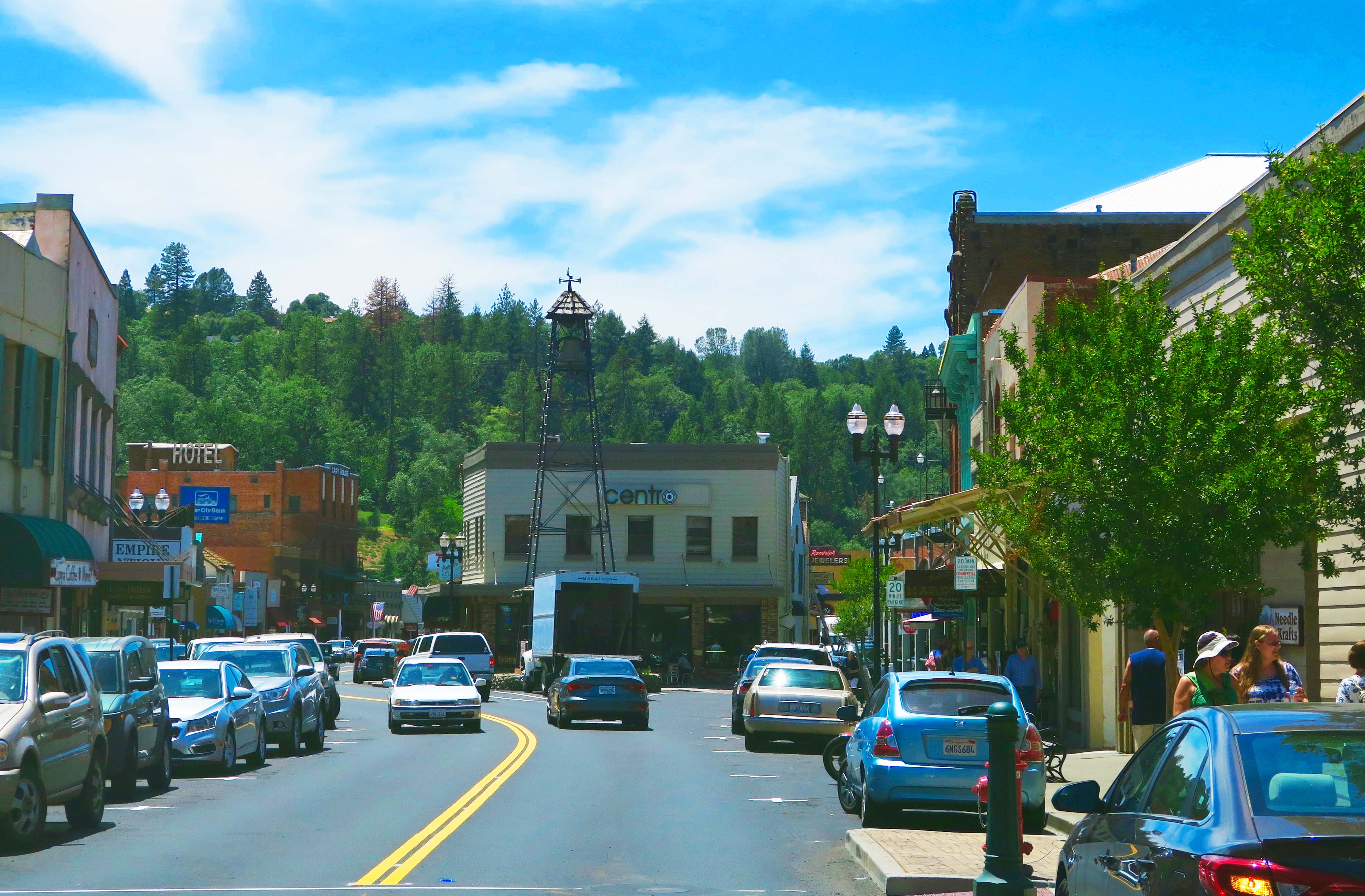
The Main Street of Placerville looks pretty much the same today as it did in 1961. The Chief of Police pulled our car over on the right hand side of the street here. The incident took place near the red hotel building, a block or so down the road.

If I was going to base my future on my organizational skills, I had to practice, right? So, I organized a protest my senior year. As a 60’s issue, it wasn’t a biggie. The Administration had axed our Senior Ditch Day and we wanted it back. 

I drew up a petition and Patti Foley, who had great calligraphy, made it fancy. Almost all of the seniors signed.  (I still have it.)  A student strike was organized. I’m sure it was the first time El Dorado Union High School students had even considered such an action, Mabe even the last. Some of our rowdier students even lit trash cans on fire. 

It wasn’t the issue that got me threatened with jail, however. The school administration called me in and asked if we couldn’t work out some type of compromise on Senior Ditch Day, which I readily agreed to. The strike was called off, the rowdies stopped lighting trash cans on fire, and we switched our Ditch Day to one more agreeable to the Administration. Everyone won. My civics teacher was impressed. 

My problem with the law took place on Graduation Day when I inadvertently (or is that idiotically) crossed paths with Mike De Natly, the Placerville Chief of Police. Few of my UT-OH! moments can hold a candle to this one. As one might expect, our last day of high school was a goof off day. All the tests were over, yearbooks signed, and caps and gowns fitted. There really wasn’t much to do except revel in the fact that we were through and to say goodbye to friends. Lunchtime meant a final cruise of Placerville’s Main Street to check out girls, to see and be seen.

What happened was out of character for me. I normally keep my comments on other peoples’ driving habits to myself and car-mates. The horn is for really bad infractions, and, on very rare occasions, a single digit comment is appropriate. I would never stick my head out the window and yell at someone. That can get you shot.

But we were hot stuff on graduation day. When a blue car decided to stop in the middle of Placerville’s crowded, narrow downtown street right in front of us and forced us to hit our brakes, it irritated me. And then, the driver nonchalantly got out to have a conversation with the driver of the car in front of him. It pushed me over the edge. Out went my head as we edged around the two cars and I had an attack of uncontrollable Y chromosome aggression.

“You SOB,” I yelled, “get your F-ing car out of the way!”

So what if I didn’t recognize the Chief of Police out of uniform in an unmarked car. So what if he had stopped to offer help to a guy who had managed to stall his car on Placerville’s busy Main Street. So what if I had suggested he had canine parentage in a voice that half of Placerville heard. It was an innocent mistake.

“That was Mike De Natly you just cussed out,” our driver managed to stutter with mixed parts of fear and awe.

As a teenager, I had pulled some fairly dumb stunts. Teenagers have a responsibility to push the envelope. It’s the rather awkward method evolution has provided for growing up and developing unique personalities. Mistakes are bound to happen and that’s okay. But I was carrying my responsibility too far; I had gone beyond dumb and plunged into really stupid.

“Keep driving,” I uttered with all the hope of the irrevocably damned, “maybe he is too busy and will ignore us.”

Sure, like maybe the sun won’t rise tomorrow. The poor stalled guy could still be sitting in the middle of Placerville for all of the attention the police chief paid to him after my little admonition. De Natly jumped in his car, slapped his flashing light on his roof, hit his siren and sped after us. Not that he needed to speed fast or far. We were creeping up Main Street in sheer terror about one block away. I am sure my car-mates were wishing fervently that Curt Mekemson hadn’t gotten out of bed that morning, had never made their acquaintance, and was, at that very moment, facing a group of starving cannibals in some far-off jungle.

We pulled over with De Natly literally parked on our rear bumper and resigned ourselves to the firing squad. Luckily, for my friends, the Chief had no interest in them. He appeared at my window red-faced and shouting about five inches away. Under the best of circumstances, he was known for having a temper and these were not the best of circumstances.

“Get out of the car,” he yelled. “Get out right now!”

I moved fast. This was not the time for bravery and stubbornness. It was a time to be humble— it was groveling time. And I groveled with the best. I blathered out apologies and managed to work “sir” into every sentence, several times. I trotted out my friendship with his stepson, I threw in the City Treasurer who was a mentor, and I even brought in Father Baskin, the Episcopal minister, as a character reference.

“Get in my car,” he ordered. My groveling seemed to be having minimal impact. At least he hadn’t handcuffed me.

We drove up to City Hall, and I had visions of being booked and thrown into a cell with some big hulking giant who either didn’t like young men or liked them too much. I thought of having to call my parents and explain how their son had become a common criminal. But De Natly had an even more diabolical plan in mind. We slowly made a turn through the jail parking lot to give me a sense of my future fate and then, to my surprise, hopped on Highway 50 to Canal Street and drove up to the high school. 

I was going to have to explain my actions to the principal. My chances of graduating that night slipped down a notch. I doubted that he would have much of a sense of humor about one of his students cussing out the Chief of Police. But explaining my inexplicable actions to him would have been mercy in comparison to what happened.

It was a beautiful late spring day, this last day of school, and it seemed like half of the student body and a significant portion of teachers were enjoying their lunches on the expansive lawn in front of the school. De Natly pulled up to the sidewalk beside the lawn and ordered me out. The Chief of Police arriving with me in tow was enough to capture the attention of several students sitting close by. Then he made sure that everyone was aware of our presence.

“Do you want to spend the night in jail or graduate, Curtis?” he asked in a voice that was easily equivalent in volume to the one that I had used in suggesting he move his car. Conversation on the lawn came to a dead halt. Every ear in the place homed in on us with the intensity that a cat reserves for a potential mouse dinner. And I was the mouse. This was a Kodak moment, not to be missed. 

My answer was easy: Of course, I wanted to graduate, SIR. And so it went, De Natly barking questions with the voice of an army sergeant and me responding as the lowest of recruits. Finally, after a few minutes that felt like eternity, the Chief got in his car and drove away. 

I was left to deal with the not so gentle humor of the students and faculty plus a principal who wasn’t quite sure whether he should take over where De Natly left off or laugh at my predicament. At least he had the grace to wait until I left his office before he chose the latter. I could hear his laughter echoing down the empty hallways. And yes, I was allowed to graduate that night.

UT-OH! Chapter 16: On First Dates and Squashed Skunks

At this point, just beyond the speed limit sign, I ran over a skunk in the summer of 1958, undoubtably impressing the young woman I was on a date with.

As I suggested in Chapter 14, my freshman year of high school was something of a disaster. My social life tanked, dance class sucked, my political aspirations were reduced to running a friend’s campaign for class president, and my success in sports was mediocre, at best. My short legs and I suffered through a season of cross country running where I was lucky to finish in the middle of the pack. 

Things had to improve. 

Do you remember your first date in high school? Was it a roaring success, so-so, or an unmitigated disaster? How about off-the-scale weird? That describes mine. I had a double date with Paula, Mom and Boyfriend. And I ran over a skunk. It happened during the summer between my freshman and sophomore year.

It started with Paula calling me. There was no way I would have called her. Girls still left me quaking in my tennis shoes. ‘Curt, would you like to go to dinner with me in Sutter Creek?’ Sutter creek was a town in Amador County, about 20 miles away from Diamond Springs over curvy Highway 49. It would be a double date with her mother and her boyfriend. That seemed strange, but somebody had to drive. How could I say no…

I remember very little about the drive or dinner— other than it was at an Italian restaurant. After we had our fill of spaghetti and conversation, we returned to the car. I had visions of sitting in the back and snuggling up with Paula on the way back to Diamond.

Mom and Boyfriend had another idea. They hopped into the back seat and promptly told me, “You can drive home, Curt!” Like they were offering me the opportunity of a life time. It did away with my bold plans. But there was more… 

“Um,” I noted nervously, “I only have a learner’s permit.”

“That’s okay, it will be good practice,” Mom jumped in before I could add that I had only obtained it four days before.

Paula, meanwhile, was waiting for me to open the door for her on the passenger side of the car. It was a plot. She gave me a dazzling smile— and my options dropped to zero. Any further hesitation would be ‘unmanly.’ After doing the gentlemanly thing for Paula, I dutifully climbed into the driver’s seat and miraculously found the keyhole and lights. Gear grinding got us out of town and onto the open road. I breathed an audible sigh of relief. It was short lived. We had just made it past the small town of Plymouth and were on our way down to the Consumnes River when I ran over the skunk.

If you drive a lot on country roads in skunk country, you’ve probably noticed that dead skunks are a significant part of road kill. It goes beyond the fact that they are easily recognized by their smell. There really are lots of them. The primary reason for this is that they believe they are omnipotent. Who in his right mind will hassle a skunk? It’s like petting a porcupine or teasing a rhino.

Unfortunately, skunks fail to recognize the damage a 3000-pound vehicle can do, and how difficult it is to stop, or even swerve when traveling 60 miles per hour or more. Last, but far from least, they don’t realize how easily drivers become distracted. A teenage boy just learning how to drive with an attractive girl sitting next to him is an excellent example.

While my encounter with the skunk was in the summer, the most likely time to find them crossing the road is in late winter or early spring. This is when the males come out of hibernation and go in search of true love, or, at least, sex. The Loony Tunes cartoon character of yore, Pepé Le Pew comes to mind. Skunks are willing to travel 4-6 miles to find a hot date. This often means crossing a road with a focus that has nothing to do with fast moving vehicles. Not being able to see clearly beyond 10 feet doesn’t help either. It’s a disaster waiting to happen. And it may all be for naught. Females often reject would-be suitors as poor material for contributing sperm for future generations, or for some other skunk-ish reason. The rejection is brutal. They have a particularly potent form of spray they reserve for the purpose. “Try to climb on me. Ha. Take that you skunk!”

The skunk I ran over had a similar reaction. He reeked revenge in his final seconds by becoming a virtuoso of glandular activity.

“Oh, don’t worry about it,” Boyfriend said as the first powerful whiffs of eau de skunk came blasting through the air vents. “It happens all of the time.”

“Yeah, sure,” I mumbled to myself through tongue-biting teeth, “young men always run down skunks on first dates, especially first dates with Mom and Boyfriend along.”

Fortunately, I made it home without further incident.

One might assume that running over the skunk would have ended my relationship with Paula. But there was one more date. It was a testimony to how much Paula’s mother was committed to the relationship that she loaned us her car. I drove it illegally on my learner’s permit. Paula and I went on an old-fashioned picnic to Buck’s Bar, a 49er-mining site on the Consumnes River. I actually had a young woman, out in the woods, alone. Talk about fantasy. As far as I can recall though, and I would recall otherwise, I behaved myself disgustingly well. So did Paula.

Fridays Post: A Pear Pickers Guide to Happiness.

UT-OH Chapter 6: Searching for God in all the Wrong Places

This photo was taken 2-3 years after our parents sent the Mekemson kids off to Vacation Bible School, but here we are. I’m on the left, my dog Tickle is next, then my sister, Nancy and my brother, Marshall. Tickle got to stay home. He didn’t need religion; he was a good dog.

How to develop a warped view of religion

I’m continuing with my blog-a-book/memoir/misadventure series today with my first two experiences of organized religion. It was a rocky start.

Pop inherited most of the religious fervor in our family. According to my mother, his mom was a hardline Scotch Presbyterian with a sense of humor to match. One didn’t drink, cuss, smoke or perform any of the other nefarious deeds the devil so cunningly uses to capture wayward souls. Fortunately, he missed some of the thou-shall-nots his mother preached. But he did inherit a sense that church is “good for you,” however, and this meant it would be doubly good for his kids. While Mother had more doubts about religion, even she felt that a little God wouldn’t hurt us. Or, at least she recognized kid-free summer time when she saw it.

Eventually this led to the three Mekemson kids being spiffed up and marched off to Vacation Bible School. My brother, Marshall, and I got a rare midweek bath, clean clothes, and the lecture: No shoving, shouting, fighting or farting. Our older sister, Nancy, bathed regularly and didn’t need the lecture.

In those days, going to church in Diamond Springs meant going to the Community Church, a small, white, box-shaped building that came with a straight steeple and fundamentalist leanings.

Other than the fact that Bible School seriously interfered with my play time, it wasn’t all that bad. I was encouraged to color lots of sheep and no one seemed to mind that they were purple. But the real fall-on-your-knees thing that grabbed my attention was all the stuff about miracles. I was fascinated to know how Noah got all of those animals on one boat, what he did with the poop, and how Christ walked on water. I had so many ‘hows and whys’ the Bible School teacher stopped calling on me. I went back to coloring sheep.

One day we were privileged to witness a true miracle in progress. Somehow, we had escaped from Vacation Bible School only to be corralled into attending an actual kids’ service. I think it was a graduation ceremony meant to put the exclamation point on our lessons. It came complete with hymns, prayers, a sermon and lots of Amens. Then the big moment arrived.

“Would you like to hear the Lord knocking at your heart?” the Minister asked.

“Oh yeah!” “Wow!” “Really?” What little kid could resist? The minister instructed us to bow our heads and close our eyes. He was quite insistent on the eye part.

“None of you little kids open your eyes until I tell you to,” he ordered. Apparently, you can’t witness miracles with your eyes open.

Twenty little children dutifully bowed their heads and screwed their eyes shut. Three didn’t. If there was to be a miracle, the Mekemson kids wanted to see it. So we watched the preacher with eagle-eyed attention. He glared back at us. Whoa, this was getting interesting. Next, he tiptoed from the pulpit to the back of the church. What was he up to?

Bang, bang, bang. He was up to pounding on the back door. Yes indeed, the Lord does work in mysterious ways. We watched the minister tiptoe back to his pulpit.

“OK,” he said, “you can open your eyes now. Did you hear the Lord knocking?”

Twenty little sets of big round eyes popped open and twenty little mouths started gabbing all at once. The minister smiled smugly until his eyes fell on us. You could almost hear what he was thinking and I didn’t think ministers were supposed to think those kinds of thoughts.

“Vacation Bible School is over,” he announced abruptly. “I want you all to think about what you learned today. You can go home now.” We jumped up for a quick escape.

“Nancy, Marshall and Curt, I want you to stay.”

Ut-Oh. We were about to learn that the devil had reserved a special place for us. The Mekemson kids were very bad and downright sinful. We had better change our ways or we were going to spend eternity in a very hot place. We were also being held hostage until the other kids left. It wouldn’t do to have us spread malicious rumors.

After being pummeled by twenty minutes of non-stop haranguing, we were finally turned loose. It was pushing 100 degrees outside and Mother was waiting impatiently in one of our ancient, non-air conditioned cars. She lit into us with an intensity that would have made the Minister cry “uncle.” I wondered if our punishment had already begun. But Nancy straightened things out quickly with all of the righteousness of a 12-year-old girl— and forever became my hero. Not only was the minister a ‘lying, deceitful, old so and so,’ she was never coming back to that church again. Ditto.

Marshall, who was seven, sought his own peculiar form of revenge. (He told me about it later out of fear I would tattle.) Our friend, Lee Kinser, lived next to the church and had an old outhouse up the hill behind his home. In-door plumbing had long since replaced its primary use and the daily deposits had turned to dust. The outhouse’s appeal to Marshall was that if he sat on the seat and left the door open, he had a straight shot at the church’s bell. All Marshall needed was his BB gun and a Sunday service. Actually, I think he enjoyed more than one service from his box seat. In my imagination, I can still hear the minister saying to his Sunday congregations, “Do you hear the Lord pinging?”

Brother Jones and a Glowing Jesus

And that was my introduction to religion. Almost. Another fine tutor was Brother James Allen Jones, or some such name long since forgotten. He was a southern radio preacher par excellence in an era when radio still dominated the airwaves. At least it did in Diamond. There was only one TV in town and it certainly didn’t belong to us.

Normally, Marshall and I focused our radio listening time to standard kid fare like the Lone Ranger, Sergeant Preston of the Yukon and the Shadow. We would sit glued to the radio with all the concentration of later TV/computer/phone screen generations and listen to such immortal words as “Who was that masked man?” “I don’t know but he left a silver bullet behind.” And then an awed, “That was the Lone Ranger,” as off in the distance you heard “Hi O Silver away!” We knew that Sergeant Preston and his faithful dog King would always get their man, just like we knew the Shadow would open his program with the question, “Who knows what evil lurks in the heart of man?”

The Shadow knew. And so did Brother Jones. He also knew how to ream it out. On Wednesday nights, we belonged to him. I am sure the devil quaked in his hooves to know that he had such a ferocious opponent. Brother Jones was more than fire and brimstone, however. He could cure anything. After his show the lame would walk, the blind would see and the deaf would hear. Even hardened criminals would fall on their knees and start sobbing. It was at the conclusion of the show that Jones was at his finest, though. It was time to go for the gold.

“I can see you now. I can see you sitting in front of your radio.” The good Brother would start out in his most hypnotic voice, repeating himself so people would get the message right.

“I can see you reaching in your back pocket. I can see you reaching in your back pocket and taking out your wallet. Praise the Lord! I can see you opening your wallet. I can see you opening your wallet and taking out a ten-dollar bill. Hallelujah! Now you are taking your ten-dollar bill and laying it on the radio. I am blessing you and your ten-dollar bill. Lay your hand on the radio. Feel my blessing coming through. Do you feel it? Do you feel it? Hallelujah and Amen Brothers and Sisters! Now I can see you getting out an envelope and a pen. You are addressing the envelope to me, Brother James Allen Jones. You are now taking the ten-dollar bill and placing it in the envelope. Thank the sweet Lord! You are closing the envelope and stamping it. The first thing you will do in the morning is mail it to me. Blessed are those who give! In return, I will mail you a fine gift, a genuine picture of Jesus Christ that glows in the dark.”

I always wanted the genuine picture of Jesus, but I was a little concerned about its glow in the dark qualities. Marshall and I had been given a cross that glowed in the dark at Vacation Bible School and Marshall kept it on our dresser. It scared me, like the tombstones in the Graveyard. I’d wake up in the middle of the night and there it would be, glowing at me. You couldn’t turn it off and Marshall wouldn’t let me shove it in a drawer. My only solution was to hide under the covers. Can you imagine the trauma of growing up with a glowing cross that forces you to hide under the covers? Who knows what damage a glowing Jesus might have caused.

As you might surmise, by this early point in my life I had already developed a somewhat warped view of religion, not to mention a frustrated pair of parents. But they weren’t about to give up. Their savage little beasts would be tamed. It took Tarzan to show me the light.

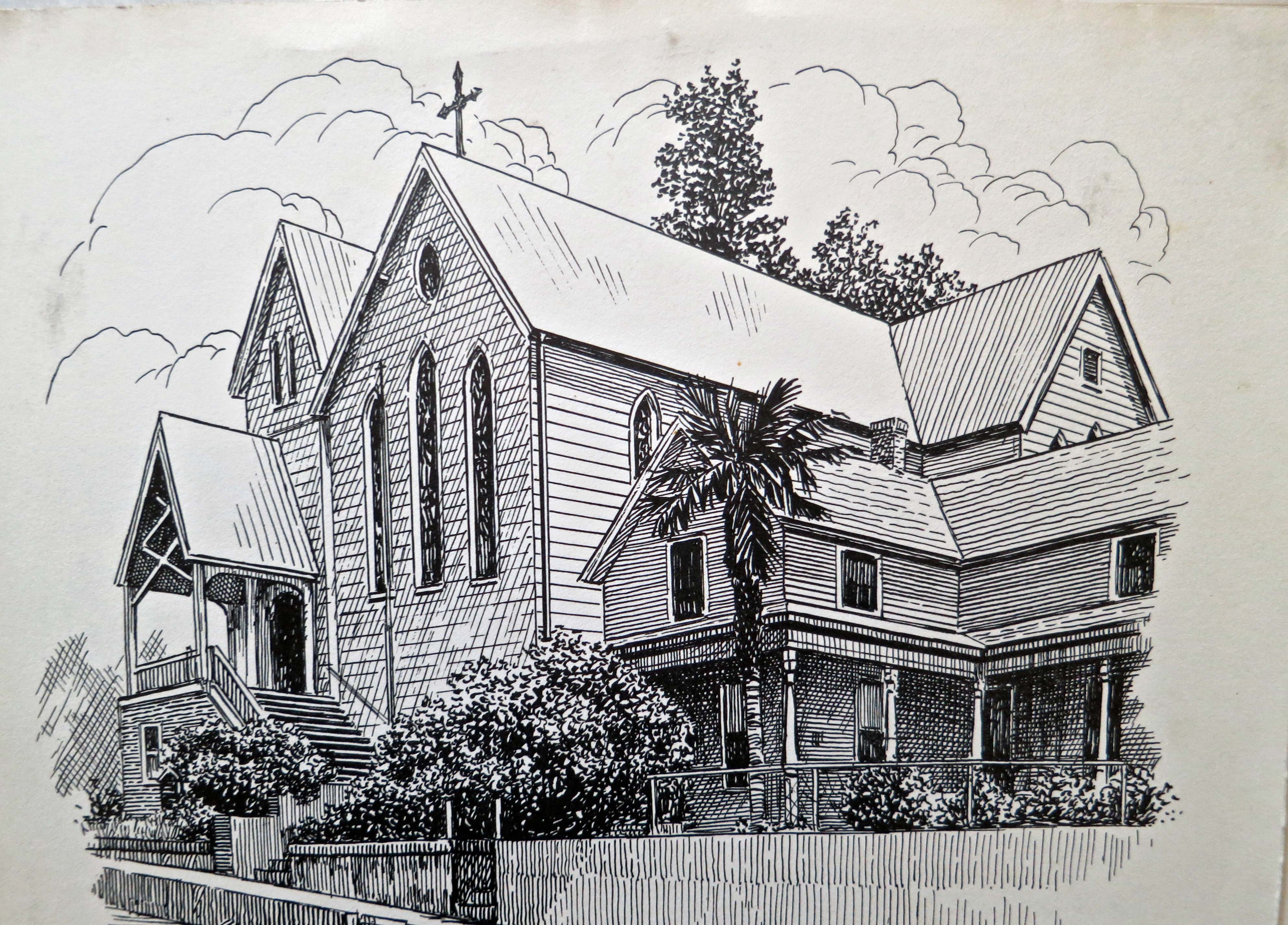
Next on my parent’s road map to religious enlightenment was the Episcopal Church of Our Savior in Placerville. This time they used a different tactic, bribery. After church, we stopped at Tom Raley’s grocery store and were allowed to buy a Pepsi and pick out a comic book. I would eagerly search the rack for the latest issue of Tarzan, and, on really lucky weekends, find one. It was like winning a gazillion dollars in the lottery. The mere thought of joining the ape-man on his romp through the jungle was more than I could resist. I became a devout Episcopalian.

Next on our Burning Man focus series, we will take a look at some unusual structures that are built at Burning Man.

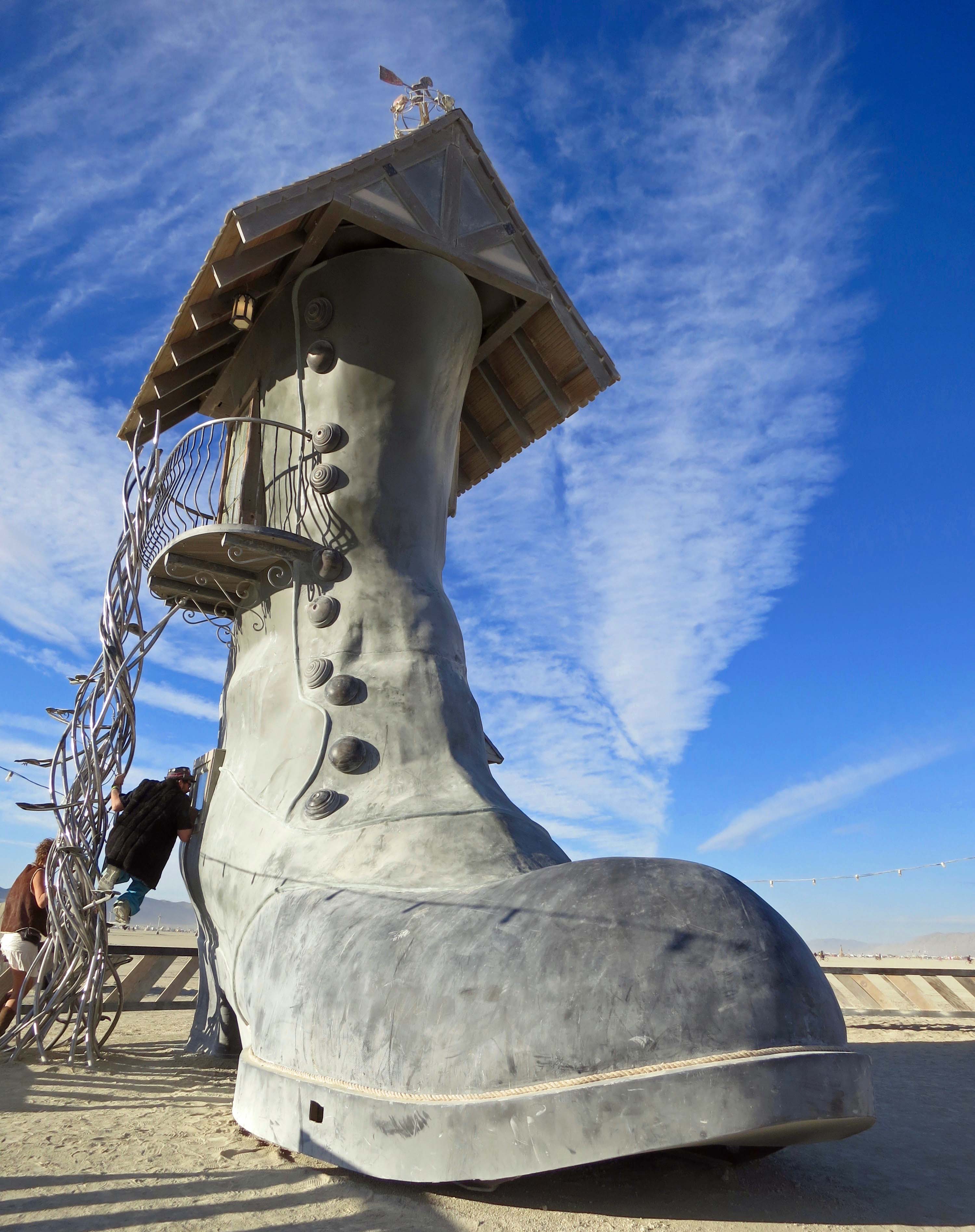
“There was an old woman who lived in a shoe. She had so many children, she didn’t know what to do.” Obviously.

Next on UT-OH: Nancy Jo and the Graveyard Ghost— a terrifying experience.