From the Sublime to the Weird… Burning Man Murals and Paintings

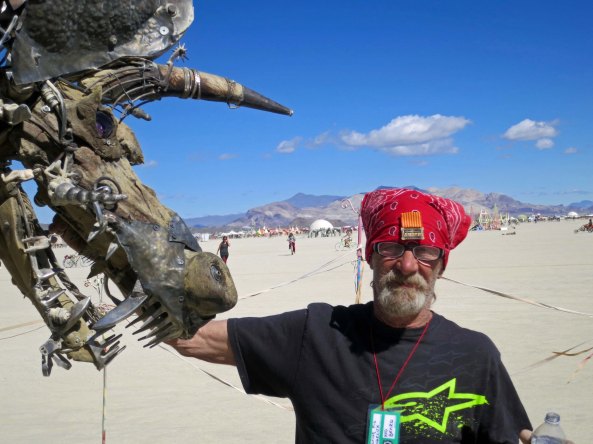
T-Rex looking for dinner at Burning Man back when the playa was an ocean.
As you might expect, mural art and paintings at Burning Man reflect the event. Much of the art has a mystic feel about it with both Eastern and Western influences. Surrealism also seems to have found a home at Burning Man. Then there is the fun— bordering on strange— art that always appeals to my sense of weird. Following are examples of what I see as I ride my bike or walk around Black Rock City and out in the Playa.
I am going to start with what I call Chakra art that takes its inspiration from Eastern mysticism. A Chakra, simply put, represents seven levels of awareness or spiritual power in the human body that work their way up your spine starting with basic urges and ending with higher consciousness. Meditation is the primary tool that mystics use to reach the higher levels.

Chakra art doesn’t get much clearer than this. Beyond the primary chakra points are a multitude of secondary points. This fellow also comes with an aura.

Maybe you can even get high enough to earn a halo. This one features several languages.

An eagle and a buzzard have arrived here.

This mural portrays a woman meditating. Off to the left is a chakra.

Mandalas are aids in meditation. I feel like this one could take me into infinity.

Of course there is much more to eastern mysticism and myths than meditation and chakras. Traveling farther east to China, we have this magnificent dragon.

What I call Nature art focuses on our deep connection with all life on earth and has a more Western/shamanistic feel to it that is more reflective of what we find in Native American, First Nation, and South American native traditions, as well as other animistic cultures throughout the world.

A shaman sits in a meditative pose while jaguars peer out of the jungle and a snake circles his body. I was amused to see that he is wearing a watch.

This painting also makes me think Shaman.

I am fascinated with the art at Burning Man that combines people and the natural world.

Another example.

How about this for a hair do?

This woman is morphing into an owl, or vis-versa.

Bird eyes.

A touch of green.

The tree of life and death with the left side representing nature and the right side our industrial civilization (sort of like a page out of Dante’s Inferno).

Surrealism is, well, Daliesque.

Mr. Surreal, himself.

A surreal landscape featuring Burning Man founders, I believe, along with several Burning Man icons such as El Pulpo Mechanico looming in the background.

A surreal dragonfly.

And a sort of surreal painting featuring lips, a red candelabra, light fixtures and speakers as UFOs, and apparently people worshipping all of the above.

I will conclude with several paintings/murals that fit my description of fun, funky, and possibly weird.

This mural should easily qualify as weird.

As does this painting of ‘children’ playing.

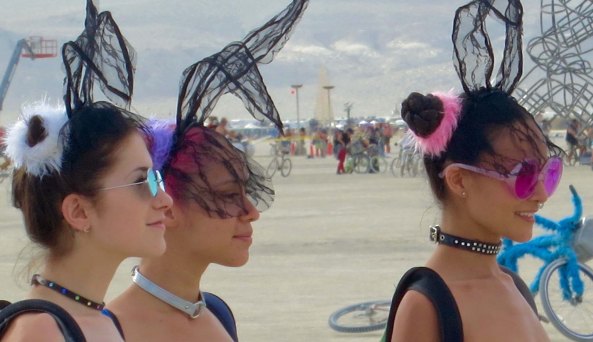
Peggy stands next to a giant rabbit. One of the events at Burning Man includes a thousand or more people dressing up like rabbits and parading around Black Rock City.

How about ostriches with people heads?

One year Burning Man had a circus theme that led to the creation of all kinds of strange circus art.

My favorite from the circus art.

The fish were fun, especially the one on the right with the teeth.

This was strange…

As was this beetle.

I’ll conclude with another favorite of mine: a 3-D Bossy.

NEXT BLOGS:

Monday: It’s back to the Oregon coast to visit a cave filled with sea lions, plus another lighthouse.

Wednesday: Bone is found and a rattlesnake threatens to bite me on the butt.

Friday: Burners and their costumes at Burning Man.


Raging Rivers, Kamikaze Mosquitoes and Naked Ladies Jumping… How Bone Was Discovered: Part II

Bone contemplates a book on the Tahoe-Yosemite Trail and the high mountain meadows he loves. I used this book by Thomas Winnett on several early Treks that I led between Lake Tahoe and Yosemite.


This is second in a series of Blogs on how Bone was found in the Sierra Nevada Mountains. Go here for the first one.

I watched regrettably as April and Lynn headed out. I would miss the inspiration. Soon, however, my mind was more than occupied with route finding. The trail had disappeared under the snow.

Velma Lakes where we parted company with April and Lynn. I took this shot in the evening on another trip.

Tom pulled out his map and compass to establish our general direction. We searched for ancient tree blazes left behind by early foresters, cattlemen and sheepherders. We also watched for ducks where the snow had melted. I’m not talking about fowl that quack and taste good in orange sauce. Ducks, in trail finding terminology, are piles of stone set up to show the way. With a little imagination, they can look like their namesake. Caution is advisable. The people creating the ducks may have had a different destination in mind, or perhaps they were lost.

Tree blazes were the primary way of marking routes by the early explorers of the Western mountains. The short rectangle on top and longer one on the bottom mean ‘this is the trail.’ Blazes were normally within sight of each other.

These are duck ducks, Mallards to be specific. They are not trail ducks. Following them might get you lost, or wet. Check out the eye on the male. He was not happy with my waking him up.

This is a trail duck. The three rocks in the middle are what a normal trail duck looks like. I added a rock on each side to create a Sierra Trek duck so Trekkers would know what to follow. I borrowed these rocks from Peggy’s rock garden and put them on our railing. I had strict instructions to return them to where I found them. BTW, three ducks in a row mean danger to Boy Scouts. We rarely had Boy Scouts follow us.

This is an example of a duck in use. A trail splits. The duck tells you to use the left one. I borrowed our backyard and deer trails for this.

An hour later we found ourselves more or less where we were supposed to be, on the edge of the Rubicon River. A student of ancient Roman History undoubtedly named the stream. Like Julius Caesar, we were faced with crossing it. In a month or so it would be a tame creek inviting a refreshing dip but now it was a roaring river, filled with icy water from quickly melting snow fields.

I entered with trepidation and was almost washed off my feet. Facing up-stream, I used a walking stick to give myself a third leg. Water crept up to my knees and beyond. It was cold; I have short legs. The force was incredible. I set each foot carefully and moved crab-like, searching for solid ground between slippery rocks.  I’d undone my pack belt so I could shuck the pack if I were knocked over. Swimming in freezing water with 50 pounds on your back is hazardous to your health. In a few minutes that stretched out forever I was across. Tom and Terry also made it without incident.

We plopped down on a convenient log to catch our breath and munch down on GORP (good old raisins and peanuts). It was a quick meal. A thick swarm of mosquitoes dive-bombed us with kamikaze abandon.  Slap one and five more landed, gleefully licking off our bug repellent before plunging in their proboscises. We were driven to put on our packs and scurry up the trail. Fortunately, Rockbound Valley is relatively flat and we were able to escape. Stopping was not an option as we hoofed it for the next four miles, crossing the Rubicon two more times before we began our labored ascent up aptly named Mosquito Pass.

Life slowed down immediately as we began climbing. The blood sucking hoards caught up. Near the top, we were confronted with a different challenge, more snow. Eight hours of hot sun had turned it to mush. We spent as much time sliding as we did climbing. It was slow, hard, slogging work. And it was dangerous. Running water, partially exposed boulders and tree trunks melt snow from the ground up and create hidden cavities. More than once we plunged through up to our knees.

Ignoring the danger, Tom and I laughed our way down the other side, glissading in our boots. Control was minimal. Camp was in sight. Terri came along at a much more sedate and careful pace.

There was nothing about Lake Aloha that made me think Hawaii. It was a strange Dali-like creation with a convoluted shoreline and innumerable Rorschach type islands. What’s more, mini-icebergs decorated its surface. Bright white on top, they turned an icy blue under the water. All I could think was cold. Plowing through snow on our way around the lake to camp added freezing to my thoughts.

That night, we built a small campfire to fight off the chill. Terry wandered off to bed. Tom was slightly melancholy. He looked off into the distance over my shoulder.

“I was married on that peak,” he announced to the night. I turned around and stared across Lake Aloha at the towering Pyramid Peak, the centerpiece of the Crystal Range. It was bathed in moonlight. Several years earlier, Tom had met and fallen in love with Hilde, a slight, attractive blonde who shared his love of the wilderness. They decided to get married on the mountain. Mom, wedding party and friends were invited to share their 9983 feet “I do.”

The marriage didn’t last long and Tom was reluctant to talk about it. The fire burned down to glowing embers. We shared the silence in memory of lost love.

This map from the Tahoe-Yosemite Trail book shows our route from Velma Lakes to Upper Echo Lake. The red trail shows the actual route. The dotted trail shows the route we picked to Lake Aloha because of the deep snow going up past Dicks Lake.

I was up early the next morning and eager to hit the trail. My body was starting to adjust and feel good. More importantly, the resort at Echo Lake was calling. A quick breakfast and we were off. I took the lead with Tom following and Terry trailing. Soon we had climbed out of Lake Aloha, hiked past Lake Margery  and worked our way across Haypress Meadows where cattlemen once harvested grass for winter feed. As we began our descent into Echo Lake, I left my companions behind. The vision of cold beer and a hamburger drove me on. Short shorts may have been a factor as well. Lynn and April were supposed to rejoin us at the Echo Lake Resort.

There was a decision to make when I reached Echo Lake. I could continue to follow the Tahoe-Yosemite Trail around the upper and lower lakes or I could call the Lodge from a phone located at the end of Upper Lake. It would send a boat taxi to pick me up for five bucks. The trail was hot and filled with day hikers. I made the phone call. A half hour later, the throbbing of the motorboat’s engine caught my attention as it worked its way up the lake. Soon it arrived, coughing slightly. The boat slowed and bumped into the pier. My ‘taxi driver’ was a 16-year old plus teenager who had managed to snag a great summer job.

“Hop on,” he told me. An elderly couple was along for the ride. I nodded at them. I was halfway between the boat and the pier when I heard a commotion.

“Over here, Curt,” a familiar voice shouted. I looked up. A few yards away alders had hidden another pier. Two very attractive and very naked women were jumping up and down to get my attention. They succeeded. It was April and Lynn. They had come over on an earlier boat and were working in a little sunbathing while waiting for us. The young boatman and the old man were all eyes. The elderly woman looked thoroughly irritated and glared at all of us, especially her husband.

“Uh, I think I’ll stay here,” I told my driver.

“Can I stay too?” he asked and grinned at me. The elderly man wisely stayed silent.

I joined the girls as the boat coughed its way back toward the resort. Tom showed up soon afterwards. We were waiting for Terry and the women were dressed when the ranger showed up.

“There has been a complaint about naked women jumping up and down over here,” he told us.

“Boy, I wish I would have seen them,” Tom responded. I am not sure the ranger bought our story but he wandered off in search of other criminals.

The same boatman picked us up and told me that the first thing the elderly woman did when she got back was to complain loud and long about the perverted people across the lake. She even cornered a ranger. My new young friend speculated that the ranger came looking for us as an excuse to escape. “Or maybe he wanted to see the naked ladies,” I noted.

I happily downed a hamburger and a beer, or maybe it was two. But we still had a few miles to go before camp, so I didn’t want to eat or drink too much. Backpacking is hard enough as is—alcohol and a stuffed tummy makes it harder.

Be sure to check in next Wednesday and learn how Bone was found!

Three more photos from the journeys that Bone has been on since his discovery.

Riding an elephant in Nepal. Bone is hard to see but he is resting on the elephant’s head. He is being held by Mary Johnson who had taken Bone along for good luck. Many people have travelled with Bone over the years.

Iguanas chat with Bone in the South Pacific, where he was taken on a diving expedition by Jose Kirchner.

Bone sits in the sand at twilight on the edge of the Tasman Sea on the South Island of New Zealand. He was traveling with Peggy and me.

NEXT BLOGS

Friday: It’s back to Burning man with some very Burning Man-like murals and paintings.

Monday: A cave filled with sea lions on the Oregon coast and another beautiful lighthouse.

Wednesday: Bone is found! Hypothermia threatens! A rattlesnake tries to bite me on the butt!


What Makes a Lighthouse So Appealing?

The Coquille Lighthouse sits on a point jutting out into the Coquille River opposite of Bandon, Oregon. Its replacement, an automated beacon, can be seen on the left across the river on the South Jetty. A glimpse of the Pacific Ocean appears on the right. (Photo by Peggy Mekemson.)


I am sure that there are people who drive by lighthouses never noticing their existence. I am not one. There is something romantic about them that pulls me in. Maybe it is their historic role: saving mariners from crashing into rocky shoals and other shoreline hazards. Or maybe it is their isolation and the thought of a lighthouse keeper’s lonely life. Having a bit of hermit in me, I can easily envision such a life-style, assuming, of course, that I have my good buddy and a boatload of books along. Or possibly it’s their setting along dramatic ocean and lake shorelines. Rocky shorelines offer beauty as well as hazards.

The history of the Coquille River Lighthouse was closely tied to the logging industry. Early lumber barons wanted to get at the virgin forests located along the Coquille River. Access was relatively easy, assuming ships could cross the hazardous bar located at the mouth of the river next to Bandon. A jetty was built out into the ocean, which led to the creation of a deep channel. The lighthouse was built to guide ships along this channel. The 1890 funding proposal stated:

“A light of the fourth order with a fog-signal, at this point, would enable vessels bound into the river to hold on close to the bar during the night so that they would be in a position to cross at the next high water. The light would also serve as a coast light and would be of much service to vessels bound up and down the river.”

“A light of the fourth order,” refers to the type of the Fresnel lens used in the lighthouse. Fresnel lens are made up of multiple lens arranged in concentric circles around the light source. If you’ve been in a lighthouse, you will have likely seen one. They range in size from the first to the sixth order. Fourth order Fresnel lights could normally be seen for 15 miles out to sea and were commonly used to guide mariners into harbor mouths.

A Fresnel lens of the sixth order on display at the Columbia River Maritime Museum in Astoria, Oregon. This light could be seen for about five miles and would be used in harbors and along rivers.

Funding was approved by Congress and the lighthouse was functioning by the mid-1890s. It was operated up until 1939 when the Coast Guard took it over and determined that a less expensive, automated beacon placed on the end of the Bandon South Jetty would work as well. The abandoned lighthouse was neglected up until 1976 when it was taken over by the state of Oregon as part of Bullard’s Beach State Park. A joint effort by the state and the Army Corps of Engineers restored the lighthouse as an historic attraction. Various efforts since have maintained it, much to the enjoyment of thousands of visitors— including us.

Peggy and I stayed at the state park while we were visiting Bandon and used one of our mornings to go over and check out the Coquille Lighthouse, North Jetty and Bullard’s Beach. The following photos record our visit.

Peggy and I walked around the lighthouse to capture photos from various angles. I took this from the river’s edge. Low tide enabled me to shoot from below the tide line. The North Jetty stretches off to the left.

Peggy caught this close up.

And I took this picture looking over sea grass. Parts of Bandon can be seen across the river. We were on our way to walk out the North Jetty.

One of the first things that struck me about the jetty was the amount of driftwood piled up along it. This reflects the power of the ocean. It also warns that you wouldn’t want to be anywhere near the jetty in a storm.

Peggy posed for me in front of this large stump on top of the jetty, a remnant of logging up the river and along the coast.

I returned the favor posing for Peggy out toward the end of the jetty. A wave can be seen breaking over the end. And this is at low tide! We stayed far back. I would bet that people have been swept off of here while trying to photograph winter waves. (Photo by Peggy Mekemson.)

I appreciated the sea gulls adding a touch of sea life to my photo. One wave hits the end of the jetty while another rolls in. Watch out for the ninth!

A pair of seals with their big dark eyes swam along the side of the jetty and checked us out. (Photo by Peggy Mekemson.)

A view north from the jetty along Bullard’s Beach shows again how much driftwood (drift logs?) is brought in by winter storms.

Peggy took this shot looking up from Bullard’s Beach toward the lighthouse.

And this photo of a fort someone had built taking advantage of the driftwood. You can imagine the amount of fun kids would have building and playing in such a fort. Adults too. (Photo by Peggy Mekemson.)

I added a close up.

Walking along the beach we found a flock of Sanderlings. These small shorebirds are a delight to watch as they charge in unison along the beach following the tide as it rises and falls in search of delectable bugs. I liked the reflection provided by the receding water. (Photo by Peggy Mekemson.)

Get too close and off they fly, whirling in unison as they head a few yards up the beach to continue their endless search for dinner.

I’ll close today with this final shot of the coastal land that backs up to Bullard’s Beach.

NEXT BLOGS:

Wednesday: While Bone waits to be found, we continue our backpack trip down the Tahoe-Yosemite Trail— finding our way through deep snow, crossing a raging river, and running from kamikaze mosquitoes.

Friday: Murals and other wild/weird art of Burning Man.

Monday: I travel north up Oregon’s coast and explore a cave filled with lions, sea lions that is.


A Church Trap, a Temple for Timothy Leary’s Ashes, and other Unique Burning Man Buildings

The Church Trap was amusing, and possibly a wee bit scary. Scrolls of music are emerging from the windows, roof and steeple.


Did you ever try to catch birds as a kid using a box held up by a stick? Being a curious little boy with dreams of being a mountain man, I did. I baited the trap with birdseed stolen from Budgie, our parakeet, and tied a long string to the stick. When some innocent sparrows followed the trail of seeds into the trap, I yanked on the string and the box fell down, capturing the birds. After announcing my great accomplishment to the world, or at least my mother, I let them go— a bit beat up but wiser.

I had totally forgotten the experience until I discovered the Church Trap at Burning Man in 2013. It was set up the same way. A full-sized church had been raised up on one end with a 4×4 stick ‘holding’ it up. A rope was attached to the stick. Scrolls of paper with religious songs printed on them had been attached to an organ within the church. They poked out the windows, roof and steeple, symbolic of music (bait) emerging from the church to attract people passing by.

The church was solidly set in the ground. It was not about to be pulled down. Had it, however, a lot of burners would have been caught. People stopped by for weddings, to play the organ, and to give sermons from the pulpit.

The Church Trap was one of many unique buildings built on the Playa in 2013 to entertain and engage participants. The next year I found myself checking out the Temple of Confession where Susan Sarandon had placed ashes of LSD guru Timothy Leary. I am featuring the temple in my photo essay today along with several other buildings that have captured my interest and/or amused me.

The Temple of Confession was covered in photographs…

They were very creative, but strange, including this three-breasted woman with a dress of skulls.

The Temple of Confession at night.

This rather impressive goat, along with a confessional, a photo of Timothy Leary, and a portion of ashes from his cremation were found inside.

Eyes like this one that included peepholes were also found in the temple. Naturally, I had to look.

This is what I saw. It spoke to the incredible detail, and surprises, built into so much Burning Man art.

This is the Temple of Photos produced for an earlier Burning Man. Both of the temples were burned.

The Prairie Wind Chapel came with a windmill. Like the Church Trap, it had an organ and hosted weddings for people who wanted to get married at Burning Man.

I was attracted to the Mazu Temple because of its dragons and other mythical creatures. Its large lotus was also rather spectacular. A group from Taiwan brought this temple to Burning Man. It was also burned.

A close up of one of the dragons. The lanterns were lit at night and the dragon breathed fire.

This multi-eyed demon was on one of the side pillars of the Mazu Temple.

And how about a real movie theater out in the deep playa. You could even attend movies there and get popcorn, but I think show time started around 1:00 a.m.

Occasionally, several buildings are included together. Wall Street was built at Burning Man right about the time America was suffering the severe economic crisis that had been brought on by corporate and individual greed.

Here’s the Wall Street Bull backed up by the Bank of UnAmerica. 

A graffiti artist urges people to dream on Wall Street’s main building. I am sure, by now, that you realize that the whole complex was doomed to go up in flames.

Speaking of dreams, the Life Cube Project at Burning Man encouraged people to write their dreams and goals on a sheet of paper and insert them into a slot in the building, with the idea that your dreams and goals are a step closer to realization if you commit them to writing.

The back of the Life Cube building was decorated with art.

I’ll use this close-up to conclude today’s post. Do you have a favorite among the buildings I featured today?

NEXT BLOGS:

Monday: I’ll finish up my look at Bandon, Oregon with a trip that Peggy and I made out to the Coquille Lighthouse.

Wednesday: Part II of the backpacking trip that led to Bone’s discovery. Remember, it features a raging river and kamikaze mosquitoes.

Friday: The murals of Burning Man and other paintings that may have you scratching your head.

Bandon, Oregon… An Attractive Coastal Town Where Trash Becomes Art

Trash gathered along the coastline near Bandon, Oregon is turned into art by the nonprofit organization, Washed Ashore. In this case, the artists have created a puffin.


Here’s something to think about:

A study carried out by the World Economic Forum and Ellen MacArthur Foundation predicts that the plastic we are dumping into the ocean will weigh more than the fish in a short 30 years. While most of this plastic circles the ocean as sludge following currents known as gyres, a significant amount washes up on our beaches creating hazards for wildlife and visual pollution for the rest of us. Even the most pristine locations fall victim to this onslaught.

When Peggy and I drove into the small town of Bandon on the coast of Oregon two weeks ago, we spotted several colorful sculptures of marine life that immediately caught out attention. On closer inspection, we found out they were made out of trash collected from the local beaches and turned into sculptures by a local organization named Washed Ashore.

The non-profit is the creation of Bandon artist Angela Haseltine Pozzi who decided to do something about the pollution that was cluttering local beaches in 2010 and begin turning the trash into art.

“First you just want people to stop and look at the art,” Angela noted. “And then you want to have them stop and think about the problem.”

It certainly worked with us.

Today, hundreds of volunteers join with Angela and her staff in creating sculptures that travel the country and even the world creating awareness about our use of the oceans as a garbage dump. Last year, a number of Washed Ashore’s sea creatures even made it to the Smithsonian National Zoo in Washington DC.

This delightful fish is another example of Washed Ashore’s artistic endeavors. Note the old phone on the fish’s nose right above the child’s sand shovel.

Here is the puffin featured at the beginning of the post…

And this is a view of tide pool life created from trash.

A closeup of the feathers on the puffin’s chest.

A head on view of the fish with it’s scary teeth and trashy mouth.

Peggy, who always makes sure that her trash is properly disposed of and recycled, can stick her hand in the fish’s mouth without any fear of retribution.

But here’s what it might be like if she dumped her trash in the ocean! (She really is a good sport when serving as a model. “Look like it is biting you,” I had told her.)

Most towns along the Oregon coast spread out along Highway 101 like strip malls and feature the same motels, gas stations and fast food joints you can expect to find anywhere else in the US. Peggy and I have discovered, however, that most of these small communities also had the foresight to save their historic districts. These in turn have become attractions for tourists, a source of important jobs and dollars.

Bandon welcomes visitors and provides activities that range from walking on its beautiful beaches, to shopping and eating in town, to playing golf on some of Oregon’s finest golf courses.

The other side of this sign over Bandon’s main street welcomes you to Old Town. This side looks out on busy Highway 101 from the historic district.

Such is the case with Bandon. Peggy and I wandered around Old Town and did our bit for the local economy. We bought books in a fun little bookstore, nibbled our way through a chocolate store, and quaffed a couple of pints of Guinness at an Irish pub. We even checked out a store that is dedicated to producing and selling candy made with cranberries. It turns out that Bandon grows over 90% of Oregon’s cranberry crop and 5% of the nation’s!

I would describe the Old Town area as fun and funky. The nature of the original town has been preserved without pretensions.

As you might imagine, the town’s access to the ocean guarantees an abundance of fresh seafood. I liked the sense of humor reflected by the fish.

An attractive boardwalk featuring several works of art fronts the Coquille River and forms the northern border to Old Town. We concluded our visit to Bandon by strolling along the walkway, checking out the marina, and admiring the art.

A world globe we found on Brandon’s Boardwalk conveniently located where we were.

A regal seahorse checked us out…

A carved turtle grinned at us…

And led me to focus in on its smile.

A friendly harbor seal…

Gave us a look that seemed to say, “Feed me a fish, please.”

And a crab did what crabs do so well— look crabby.

My favorite, however, was this octopus. I took several shots.

Back lit by the sun, he looked a little scary, like something out of 20,000 Leagues Under the Sea.

I decided to use my last photo to introduce my next post on Bandon (next Monday). Peggy and I will cross the Coquille River to check out this lighthouse and the ocean beach next to it. We are looking at the lighthouse from Bandon’s Boardwalk.

NEXT POSTS:


Wednesday: I begin a three-part series that focuses on a backpack trip near Lake Tahoe where we found Bone.

Friday: I will continue my photo essays on the art of Burning Man.

Monday: I’ll wrap up the Bandon, Oregon series with a trip to the Coquille Lighthouse and the surrounding area.


The Ten Questions People Most Frequently Ask Bone… The Interview!

Bone has been in many tough situations in his life; he can handle tough questions. Here he rests on top of a saguaro cactus in Arizona looking for border control agents. His lack of official papers, or even a birth certificate, can cause problems at times.

Q: Do you really talk? We’re speaking ethics here, Bone. Blogging is about transparency. That means honesty.

A. Are you crazy? Have you ever heard a bone talk? Of course I don’t talk. I just think out loud.

Q: Curt sometimes refers to you as he. Does this mean you are a male bone?

A. No. He makes assumptions, lot of them. He was showing me to a biologist at a writers’ conference and she suggested I have my DNA tested. “Just cut a small chip off of it,” she said nonchalantly. “You can determine its sex and breed.”

“Just cut a small chip off of it!Outrageous! I am not some it to have chips cut out of. Besides, I lead a rich fantasy life and have no desire to know whether I am male or female. Call me she, he, or Bone, but never it.

Um, I think Bone is definitely a male in this photo. –Curt

Q: You have travelled all over the world and met thousands of people. How do they usually react to you?

A. With befuddlement. You should have seen the look on the face of the customs agent in New Zealand who tried to seize me as ‘animal matter.’ But emotions run the gamut. There was a Japanese man who got off a tour bus at Yellowstone National Park and wanted to hold me for good luck. Soon there were 40 other Japanese handing me around, oohing, and taking photos. I was thrilled. On the opposite side, I know a woman who refuses to touch me, like I have cooties. “I don’t know where Bone has been,” she states primly. Not surprisingly, there is also jealousy. “I want to be you and travel the world,” a good friend in Sacramento told me.

Some people act like I have cooties. This woman almost dropped me and then washed her hands! –Bone

Her daughter, on the other hand, so to speak, understands proper bone etiquette and respect. –Bone

Q:  What is your favorite thing to do?

A. Visit graveyards; there are lots of old bones there. My favorite grave is Smokey Bear’s in Capitan, New Mexico. I once stood on his tombstone for ten minutes trying to communicate but all I could get was something about ‘growling and a prowling and a sniffing the air.’ A close second is the grave of Calamity Jane in Deadwood, South Dakota. What a woman! These are difficult choices, though, when you toss in the likes of Hemingway, Daniel Boone and Billy the Kid. On the light side I once visited Ben and Jerry’s graveyard of discarded ice cream flavors in Vermont. My spookiest experience was a visit to the Capela dos Ossos, the Chapel of Bones, in Evora, Portugal. Those folks definitely have a skeleton in their closet, lots of them.

Bone has a special fondness for unusual graves. Here he hangs out with Billy the Kid in New Mexico. Has he been in a shoot out? Is that blood on his vest?

Q: So, what’s your second most favorite?

A. Too hard; I am a dilettante dabbler, but here are a few.

  • Wandering, of course, anywhere and everywhere and by all modes: bikes, kayaks, rafts, skis, backpacks, sailboats, planes, helicopters, trains, cars, RVs, etc.
  • Visiting wild, remote and beautiful natural areas. I started life wandering the Sierra Nevada Mountains, John Muir’s Range of Light.
  • Seeking out the strange such as ghosts and aliens (I’ve been to Roswell four times).
  • Attending unique events like Burning Man but I also have a fondness for any type of fair.
  • Meeting weird people like Tom.

Bone backpacking on the John Muir Trail.

Tom being eaten by a bony desert monster.

Q: Speaking of Tom, he and Curt ‘discovered’ you in 1977 and you have wandered extensively with both. Which do you like best?

A. Eeyore, the jackass who can’t keep track of his tail. We’re traveling companions and he saved me from being strung up and buried on Boothill in Tombstone Arizona. I’d robbed a bank, cheated at cards and hung out with women of questionable character. (This is what I mean by having a rich fantasy life. It’s also known as evasion.)

“I was in deep trouble in Tombstone. Wyatt Earp had arrested me for robbing a bank and Doc Holiday was checking me for weapons.

My life as Bone was in serious jeopardy.

Odds were I was going to end up on Boothill, along with Billy Clanton.

But then the ever brave Eeyore came to my rescue! I hopped on his back and we went riding off into the sunset while leaping over large rocks.

Q: Which of your journeys has been most memorable?

A. I would have to say traveling the length of Africa in the back of a truck from the Sahara Desert in the north to Cape Town in the south. Almost falling off the back of a riverboat into a piranha infested section of the Amazon River would have to be a close second. I was perched on the back railing doing a photo shoot. And then, of course, there was the 10,000-mile bike trip.

Bone on photo shoot barely escapes falling off the edge into the Piranha infested waters of the Amazon. “I was falling off when Curt leapt across the boat and grabbed me.”

“I was much smarter when I rafted down the Colorado. I wore a life jacket!”

“That didn’t protect me from pirates. The dreaded pirate Steve held a knife to my throat and demanded to know where I buried my treasure.”

Q: You are often seen scrambling over rocks in remote sections of the Southwestern United States. What’s that all about?

A. I’ve developed a fondness for Native American Rock art. It resonates with my bone-like nature. It’s also another excuse to go wandering around in the outdoors. Plus, some those places might be haunted and it is a great place to look for UFOs. Some of the petroglyphs look amazingly like aliens. Finally, wandering in the desert is known to be good for the soul. Ask the Prophets of yore.

How can this guy and his strange dog not be aliens?

Here I am making tracks across White Sands National Monument in New Mexico. It’s a great place to watch out for UFOs.

Q: Ah, being a born-again bone, do you have any insights into the great unknown?

A. Ommmmmmmmmmmmmmmmmmmmmmmmmmmmmmmmmmmm.

Q: Finally, and this may be a little sensitive, but do you always run around naked?

A. What kind of a question is that? Do you think I am uncivilized? For shame. I am the epitome of haute couture! A bow and arrow toting, card-carrying NRA member in Montana has designed and made me two leather vests. What’s more, an 80 plus year old woman in Kansas going on 20 with a crush on Johnny Depp and a room devoted to the Egyptian gods has made me a kilt and several other outfits. Then there is the horse woman actress in Ohio whose husband is an ex-secret service agent who has promised me an outfit and the artist head of a PR firm in the Bahamas who has promised me another. Face it; I am hot stuff, clothed or naked. I may take up a modeling career.

Rod Hilton fashions a new leather vest for bone.

My Bahamian/Canadian friend makes me a new vest in the wilds of Montana. –Bone

Bone, wearing his newly made kilt, fights off a ferocious sea monster in a scene straight out of ‘Pirates of the Caribbean.’

So… now you have heard from Bone, do you have any questions you would like to ask him? He promises to answer.

NEXT BLOGS:

Friday: The stunning temples of Burning Man.

Monday: Bandon by the Sea. It’s back to the Oregon Coast.

Wednesday: The exciting tale of how Bone was rescued from a life of quiet contemplation. Part I

Face Rock State Scenic Viewpoint… The Oregon Coast Series

The face of the Indian maiden is clearly seen here in the rock. If you start on the right you can see her chin, mouth, nose and eye. (Photo by Peggy Mekemson.)


Peggy and I have driven through the town of Bandon several times without stopping on our journeys up and down the Oregon Coast. We decided to correct that oversight this past week. I had googled the small town along Highway 101. Photos of striking rock sculptures at the Face Rock State Scenic Viewpoint were included on the site. That alone would have demanded a visit. But there was also the town of Bandon, Bullard Beach State Park, and the Coquille River Lighthouse to explore. Today, I will feature the scenic viewpoint. Next Monday I’ll focus on the town, park and lighthouse.

There’s a native American legend that goes along with Face Rock. It has to do with an evil spirit, a lovely maiden, and her favorite pets. The Indian maiden, Ewauna, had come with her father, Chief Siskiyou, to visit with several chiefs along the coast. In honor of the occasion, a great potlatch was thrown. After everyone had eaten far more bear and salmon than he or she should have and stumbled off to bed, Ewauna decided to go for a swim in the ocean, even though she had been warned not to. The evil spirit Seatka lived in the ocean and had a thing for fair maidens. Naturally, he captured Ewauna along with her dog, cat, and kittens. You can still see them today down among the rocks.

Face Rock near Bandon, Oregon.

Another view of the maiden, Ewauna. This one taken at sea level. (Photo by Peggy Mekemson.)

The maiden with her cat and kittens off to the right. (Photo by Peggy Mekemson.)

We were lucky to visit the scenic viewpoint at low tide, so we followed a wooden stairway down to the beach, wandered around among the rock sculptures, explored some caves, and admired the general beauty of the area.

Stairs led us down to the beach. (Photo by Peggy Mekemson.)

I caught a photo of Peggy making her way down the stairs. Marvelous rock sculptures were waiting for us.

A small stream crossed the path at the bottom of the stairways.

Peggy caught it coming out on the other side of the colorful rocks. (Photo by Peggy Mekemson.)

And I captured a broader perspective.

I promptly name this rock Elf.

Peggy took this for perspective.

Another towering giant caught our attention. I named it Bigfoot.

Peggy and Bigfoot’s toes.

This photo provides a Peggy perspective on Bigfoot’s big foot.

A distant view of Bigfoot looking small— and other rocks— from the scenic viewpoint.

These cliffs rose up dramatically behind the beach.

A pair of eye-like caves had been cut into the cliffs by the pounding waves. I was pretty sure that there would be pirate booty in them. (Photo by Peggy Mekemson.)

One of the caves was filled with rocks. I was tempted to dig.

A view out from inside the cave. We hadn’t been alone in checking out the cave. (Photo by Peggy Mekemson.)

The same rock looking down from the viewpoint.

Looking up at the rock from below.

The other cave provided a view through the rock cliff. (Photo by Peggy Mekemson.)

Another view. The yellow plant seen on the other side is gorse. (Photo by Peggy Mekemson.)

George Bennet, the founder of Bandon, brought the thorny gorse with him when he came from the town of Bandon, Ireland in 1873. He saw it as a touch of home. Local Oregonians view it as an invasive plant that crowds out native plants.

It does have a certain beauty, but don’t try to hike through its thorns. The cave comes through the cliff on the right.

Another view.

There were many more rocks to keep us entertained. (Photo by Peggy Mekemson.)

The cat and kittens looked a little more riled up here as the tide began to roll in. (And no, the cat and kittens aren’t obvious to me, either.)

Peggy caught the tide slipping in between thesis giants. Can you spot the misplaced Canadian Goose on top of the rock on the left? It flew off honking. (Photo by Peggy Mekemson.)

I photographed the tide edging around this rock. The bottom of the rock, BTW, is packed with sea life.

Peggy’s close up shows goose neck barnacles, regular barnacles and mussels. Every inch is filled!

Our exploration complete, it was time to head back up the stairs.


NEXT BLOGS:

Wednesday: The interview with Bone!

Friday: The beautiful temples of Burning Man.

Monday: It’s back to Bandon, Oregon.


A Texas Bull Comes Out of the Ground; A Canadian Goose Is Created with 120,000 Pennies… The Art of Burning Man

There are regional groups of Burners around the US and around the world. One year, Burning Man requested that regional groups come up with art projects. Texas produced this magnificent bull.


As I’ve noted before, my primary reason for going to Burning Man is the art. The creativity involved goes on and on and can, at times, be mind-boggling. Over the past couple of months, I’ve provided examples, looking first at mutant vehicles and then at large-scale sculptures. Today, I am going to wrap up my posts on sculptures. Next week, I’ll introduce some very unique buildings that seemingly spring up overnight in the Black Rock Desert only to be disassembled or burned down a week later.

The same year that Texas produced the bull, the Northern California regional group produced this lighthouse.

A close up of the stained glass top.

There are dragons at Burning Man! Always. This guy’s tail needed propping up.

I thought this dragon looked friendly…

And this fellow scary. You may remember the quote, “meaner than a junk yard dog.” Well this was a junk yard dragon, made out of 100% pure junk. And check out that shadow!

A closer look at the skin on the dragon’s back. I thought the dog was a fun addition.

Meet Penny, the Canadian Goose. Over 100,000 pennies cover her body.

Is this a small woman or a big chair? It is definitely an Alice in Wonderland kind of thing. (Photo by Horse Bone Tribe member Don Green.)

“I shot an arrow into the air. It fell to earth I know not where.” –Longfellow

I really liked this illusion of cubes climbing into the sky. (Photo by Don Green.)

Tom Lovering caught this beautiful photo of a lotus with the sun behind it.

Large letter messages such as DREAM can be found at Burning Man almost every year.

This sculpture served as a gateway between the Center Camp Cafe and the Playa. A large dust storm stretches across the Playa and will soon invade Black Rock City, possibly causing a white out.

One expects to find ocean creatures scattered around Burning Man. A fence surrounding this octopus included hand cranks you could turn to move the tentacles. Much Burning Man art is designed to be interactive.

It isn’t unusual to find art that focuses on the Man, such as these hands…

And these circles.

A side view of the circles provided a different perspective.

I’ve always liked the grace of this simple sculpture.

The same sculpture from the back. Check out the stick sculpture under the wing.

A closer look. Imagine putting this together.

This prehistoric bird is another example of interactive art. Peggy climbed into its chest and worked pedals that made the wings flap. Slowly.

A large butterfly encouraged climbing!

This wood carving made me think I had arrived at Easter Island. I decided it would look good in black and white.

Lets get down and boogie!

A gypsy wagon is pulled by a rather unique horse.

I’ll close today with these colorful geometric structures.

NEXT BLOGS:

Monday: Bandon… I’ll continue my series on the beautiful Oregon coast.

Wednesday: The interview with Bone. You won’t want to miss it!

Friday: The buildings of Burning Man, including some stunning temples.

The Journeys of Bone… Forty Years of Wandering the World

Bone has been wandering the world for 40 years. Given his nature, it is only natural that he would end up at Burning Man. He and a butterfly are perched on “Horse with No Name,” preparing to ride off into the desert.


Have you met Bone? He’s been hanging around here for 7 years and traveling the world for 40. Once upon a time, and it seems like a long time ago, this blog was even titled the Peripatetic Bone. There’s a story here, of course. In January of 2010, I had attended the San Francisco Writers’ Conference. Part of the event had involved ‘speed dating’ with agents.  I had carried Bone with me to San Francisco and introduced him to three of the agents, suggesting that I wanted to write a book titled “Travels with Bone.” They had been a bit surprised to meet Bone, but had been intrigued by the concept. Each had suggested that I go home and write up a proposal.

 I had also learned at the conference that I needed an Internet presence and would be expected to market any book I succeeded in publishing. I dutifully went home and created a blog for Bone on Word Press. Somewhere in the process, I decided that my first book should be on my Peace Corps experience. So, I wrote and published, “The Bush Devil Ate Sam.” I also changed the name of my blog to “Wandering through Time and Place.”

 I decided it would be fun to reintroduce Bone and do a five-part mini-series on his adventures. Today, I am going to summarize his travels. Next week I will do an interview with Bone. Then I will follow up with three posts on how he was found.


Bone has traveled twice to the base of Mt. Everest.


Part I: The History of Bone

Sometime in 1900s Bone started his life as part of horse wandering through the Sierra Nevada Mountains. The horse was allegedly eaten by a bear. Bone ended up in a high mountain meadow practicing Zen and being nibbled on by a miscreant rodent.

1977: He was ‘discovered’ by two lost backpackers (Curt Mekemson and Tom Lovering) on the Tahoe Yosemite Trail above Lake Tahoe and launched his career of wandering the world.

1980-81: Bone commenced his first World Tour with Tom.  He visited Asia including Japan, Hong Kong, Bombay, Delhi and Katmandu where he trekked to the base of Mt. Everest. He then wandered on to spend spring and summer in Europe stopping off in Greece, Spain, Portugal, France, Italy, Austria, Liechtenstein, Luxembourg, Germany, Belgium, England and Ireland. Getting cold, Bone headed south and hitched ride in back of truck through Algeria, Niger, Chad, Nigeria, Cameroon, Central African Republic, Zaire, Sudan, Kenya (where he crossed Equator), Tanzania, Zambia, Zimbabwe, Botswana and South Africa. He signed on with Tom as crew of sailboat in Cape Town and headed north to Mallorca, stopping off on the islands of St. Helena, Ascension, Cape Verde and Madeira. Back in Europe he explored his possible Viking roots in Sweden, Norway and Finland.

Bone ends up in Tom’s hair (don’t ask) on a 2010 trip down the Colorado River.

1983-86: Bone assumed Cheechako status and moved to Alaska with Curt where he was stalked by a grizzly bear on the Kenai Peninsula, explored Prince William Sound by kayak, learned to winter camp in 30 degree below zero weather while listening to wolves howl, backpacked in the Brooks Range north of the Arctic Circle, and discussed the finer points of eating salmon with Great Brown Bears in Katmai National Park. He escaped briefly to the warmer climate of Hawaii and participated in New Orleans Mardi Gras.

1986: He backpacked the Western US for five months with Curt exploring the Grand Canyon, the Gila Wilderness of New Mexico, the Rockies, and the Wind River Mountains of Wyoming before returning to his beloved Sierras.

1989: Bone went on a six month 10,000-mile solo bike tour with Curt around North America visiting 18 states and 4 Canadian provinces. He ended his journey by meeting Peggy.

1990: The International Society of the BONE was formed at Senior Frogs in Mazatlan, Mexico, where Bone spent the afternoon being pickled in a pitcher of margaritas and being kissed by lovely senoritas.

1991-97: Various members of International Society accompanied Bone on numerous adventures. Highlights included a White House Press Conference with Bill Clinton, being blessed by the Pope in St. Peter’s Square, visiting with Michelangelo’s David, going deep-sea diving in South Pacific and Caribbean, doing a Jane Austin tour of England, and exploring the Yucatan Peninsula. A group adopted him as a good luck charm and took him back to visit the base of Mt. Everest one year and to climb Mt. Kilimanjaro another.

Bone loves high places. Here he is on top of Mt. Kilimanjaro in East Africa. (He’s with MJ, fourth from right, standing.)

Bone went diving in the Pacific in 1997 with Jose and Barbara Kirchner, visiting a Japanese ship sunk during World War II and receiving his diving certificate.

1998-99: Bone embarked on 40,000-mile journey in the van, Xanadu, through the US, Canada and Mexico with Peggy and Curt, visiting over 30 National Parks, driving the Alaska and Baja Highways, checking out Smokey the Bear’s and Calamity Jane’s graves, kayaking in the Sea of Cortez, leaf peeping in Vermont, jetting to the Bahamas, pursuing flying saucers in Roswell, New Mexico, and completing his visits to all 50 states, etc. etc. etc.

2000-02: Bone journeys up the Amazon, returns to Europe, cruises to Belize, Cancun and the Cayman’s, and goes to New Zealand where a misguided customs agent tries to arrest and jail him as animal matter.

While in the Amazon, Bone slept in the same room that Jimmy Carter had slept in.

2003: Bone undertakes a 360-mile backpack trip in celebration of his discovery and Curt’s 60th birthday. They begin at Squaw Valley near Lake Tahoe and end by climbing Mt. Whitney. Various friends join them along the way.

2004: Bone visits Hemingway’s grave in Idaho, goes horseback riding with Australians and Bahamians in Montana, and makes his first pilgrimage to Burning Man in Nevada, a very Bone like type of place. He also jets off to Costa Rica.

Bone has a love for anything ancient. Here, he perches on a Mayan sculpture in Costa Rica.

2005-2007: Bone returns to Burning Man twice and revisits Europe twice including special stopovers in Portugal, France, Holland, Germany, and Belgium. He also revisits Mexico.

2008 – 2011: Bone commences another exploration of North America. This time he travels in the van, Quivera, along with Curt, Peggy, and Eeyore the Jackass. His journey takes him over 75,000 miles of American Roads. In May of 2010 he begins his travel blog, The Peripatetic Bone, and rafts 280 miles down the Colorado River through the Grand Canyon.

2012-2017: Bone goes into semi-retirement in Southern Oregon. Please note the semi, however. He continues the exploration of the West Coast ranging from Big Sur to Vancouver Island, where he kayaks for a week in search of Killer Whales. He wanders through England and Scotland helping Curt find his roots and spends a week traveling by Canal Boat on the Mercer River. Later, he returns to Europe again, traveling through the Mediterranean visiting Turkey, Santorini and other Greek Islands, Dubrovnik, Venice, Rome, Pompeii, Florence, and Barcelona. He returns to Burning Man several times.  On one trip, he is married to the lovely Bonetta, who he met while exploring a swamp in Florida. Rumor has it that it was a shotgun wedding.

Bone and Big Nose Bonetta are married at Burning Man 2013. Bone’s kilt was made for him by an 80-plus year old woman from Kansas. Bonetta is wearing a designer wedding dress with very expensive plastic jewelry to match.

NEXT Wednesday: Bone grants one of his very rare interviews. You won’t want to miss it! (No, Bone doesn’t talk; he just thinks out loud.)

In the Meantime:

Saturday: A return to Burning Man and the last of the sculptures.

Monday: Peggy and I have just been in Bandon on the Oregon Coast. Are you ready for a visual treat?

Astoria, Oregon… Where the Columbia River and the Pacific Ocean Meet

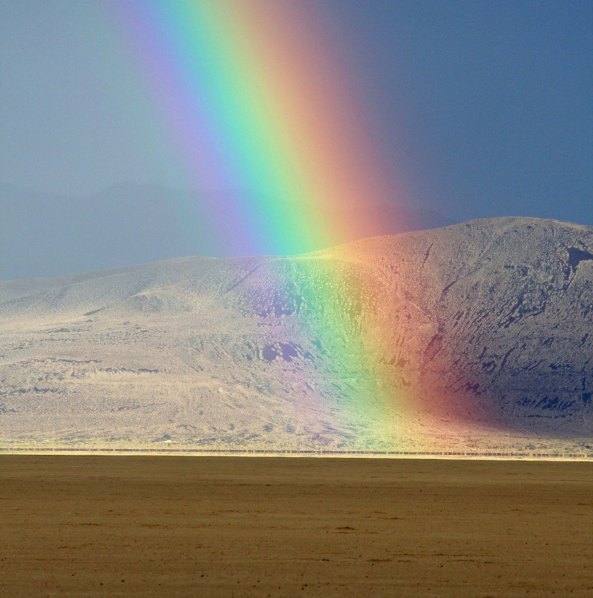
A rainbow hangs over the mouth of the Colombia River and ships that are waiting their turn to head out into the Pacific. Special pilots are brought on board to navigate the treacherous waters, now looking quite calm.


I visited Astoria a while ago and didn’t get around to writing about it. Since Peggy and I are now off playing on the Oregon coast, I decided today would be a good day for featuring this city that sits on the edge of the Colombia River.


The area off of Astoria, Oregon, where the Columbia River flows into the Pacific Ocean, is called the Graveyard of the Pacific. A combination of high seas with 40-foot waves, shallow, shifting sand bars, and the mighty Columbia River have sent some 2000 boats to their watery demise since 1792. It is considered one of the most dangerous navigation passages in the world.

This map, which is located in the Columbia Maritime Museum, shows where some of the shipwrecks can be found.

It’s no wonder that  you are greeted by a sign that proclaims Astoria is an Official Coast Guard City when you enter the community. The town is grateful that the organization is there when someone needs to be pulled out of the turbulent water. A dramatic, full-sized diorama of a Coast Guard rescue effort is featured at the Maritime Museum.

Astoria wears its Coast Guard connection proudly.

A full size diorama of a Coast Guard rescue effort is on display at the Columbia Maritime Museum.

A photo featuring the front of the Columbia Maritime Museum. I liked the way the glass reflected the clouds.

I thought that this anchor that sits out in front of the museum, is an apt symbol for both the museum and the city. The lightship Colombia is seen in the background.

In the days before modern navigation equipment, the lightship Columbia served as an offshore lighthouse, aiding ships entering and leaving the Colombia River. The lightship maintained its position for weeks at a time and stocked in 12 tons of food, 13,000 gallons of fresh water and 47,000 gallons of fuel.

This crows nest mast on the Columbia was used for powerful lights and foghorns as well as observation.

Astoria’s connection with the fledging United States dates all the way back to the Lewis and Clark expedition. The explorers sent out by Thomas Jefferson spent the 1805-6 winter in the area and built Fort Clatsop for shelter and protection. John Jacob Astor, who gave the city its name, followed up by building a fur trading post there in 1811 that became the first permanent settlement the US had on the west coast. Both the Lewis and Clark expedition and Astor’s post helped in the debate with England over who owned the land.

This map from the museum shows Astor’s trading routes.

Traveling by sailboat through the world’s oceans was hazardous. An early fear of sailors was having encounters with sea monsters. I found this illustration of a Kraken in the museum and laughed. If you are familiar with Pirates of the Caribbean, you will recognize it.

Now here is something more real to worry about! I also found this shark jaw and teeth in the museum.

Logging and fishing followed fur trading as the mainstay of the area’s economy. By the mid-1800s, fisherman from around the world called Astoria home. Only 13 percent were born in the US. The majority came from the North Atlantic countries where over-fishing had caused the fishing industry to collapse, a fate that would eventually befall Astoria. A major canning industry that grew up to process the fish also faded when the fish ran out. The canning industry employees were mainly Chinese immigrants. An educational display in the Maritime Museum notes that the most efficient of the Chinese workers could clean a 45-pound salmon in 45 seconds and up to 1700 fish in a standard 11-hour work day.

An ad photo for the Bumble Bee salmon cannery. The bee has a fishing pole.

I suspect that these pilings once supported several thriving canneries..

Now they support a thriving seagull population.

With the boomtown days of fur hunting, logging, and fishing behind it, Astoria has turned to tourists to help support its economy. Nearby Portland  (100 miles away) helps assure a continuing supply, as does the almost constant flow of tourist traffic up the Oregon coast in the summer. The museum, historic sites, fun shops, and several restaurants help meet the needs of visitors.

Downtown Astoria has preserved several historic buildings that add to its ambience.

This shop was packed to the gills with tourist merchandise. Nice kitty. I think you are probably a Mexican immigrant, however, and I doubt you have papers. Watch out.

T. Pauls has an eclectic menu and a foot on the ceiling. I ate under the foot.

It seems only appropriate that I wrap up this post with an old piling and the rainbow across the Columbia River.

Wednesday’s Blog: You are going to meet the world-famous Traveling Bone.

On Friday we will return to Burning Man.