Here Kitty, Kitty: Lyman State Park, AZ… The Backroad Series— Highway 191

Here kitty, kitty, kitty. I was amused by this petroglyph of what appears to be a cougar running at Lyman State Park in Arizona. Other petroglyphs of cougars that Peggy and I have seen in the Southwest often have their tails over their backs.

We had started our backroad exploration of Highway 191 at Arches National Park in Utah and would wrap it up at Lyman State Park in Arizona. The two parks made nice bookends. I’d been by the park twice and considered stopping both times but thoughts of the Rocky Mountains looming ahead had kept me moving. The first time I was on my bicycle and planned to do a hundred mile trip across the range the next day. This time it was getting late and Peggy and I were tired from a long day of driving. We were lucky to get a space.

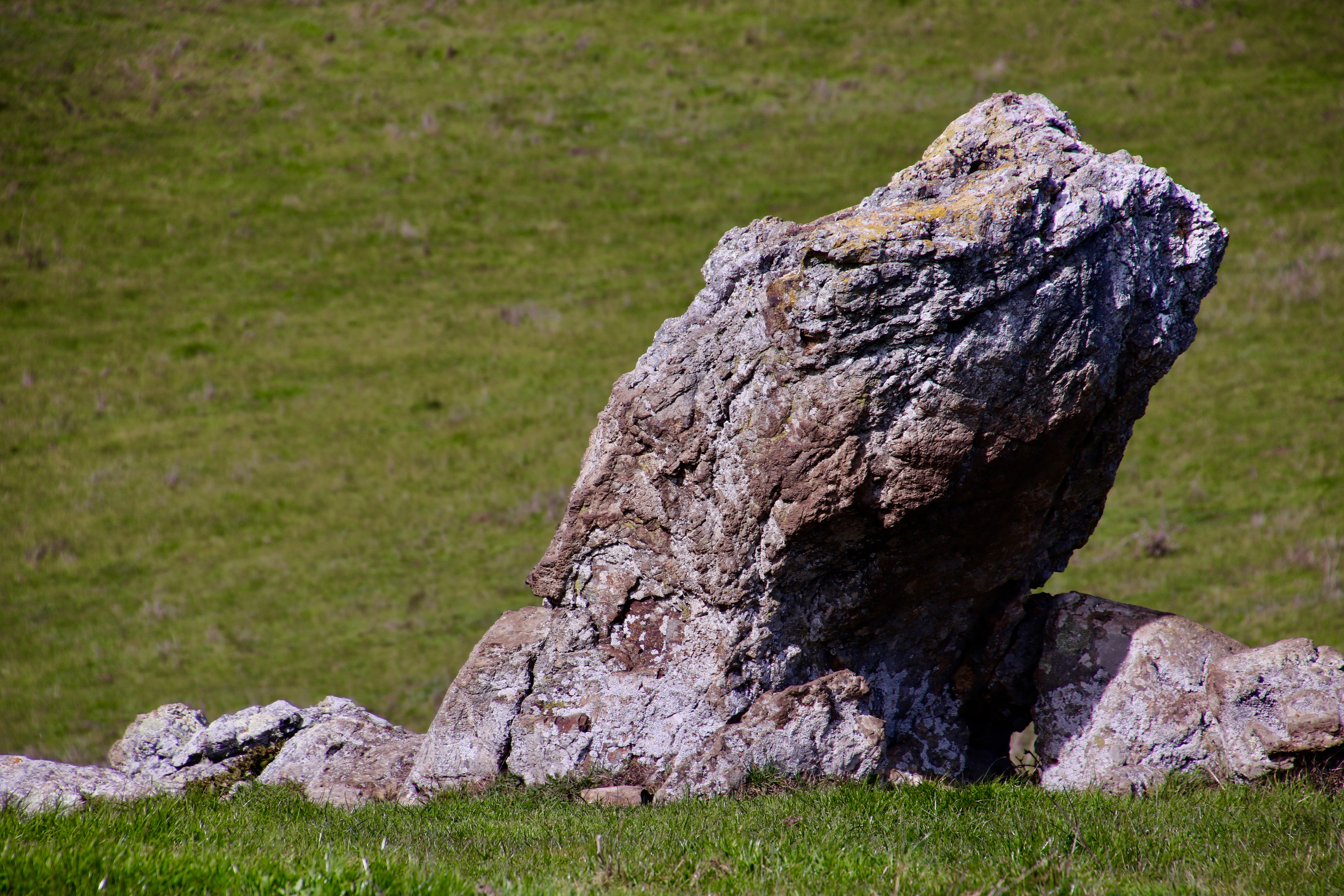
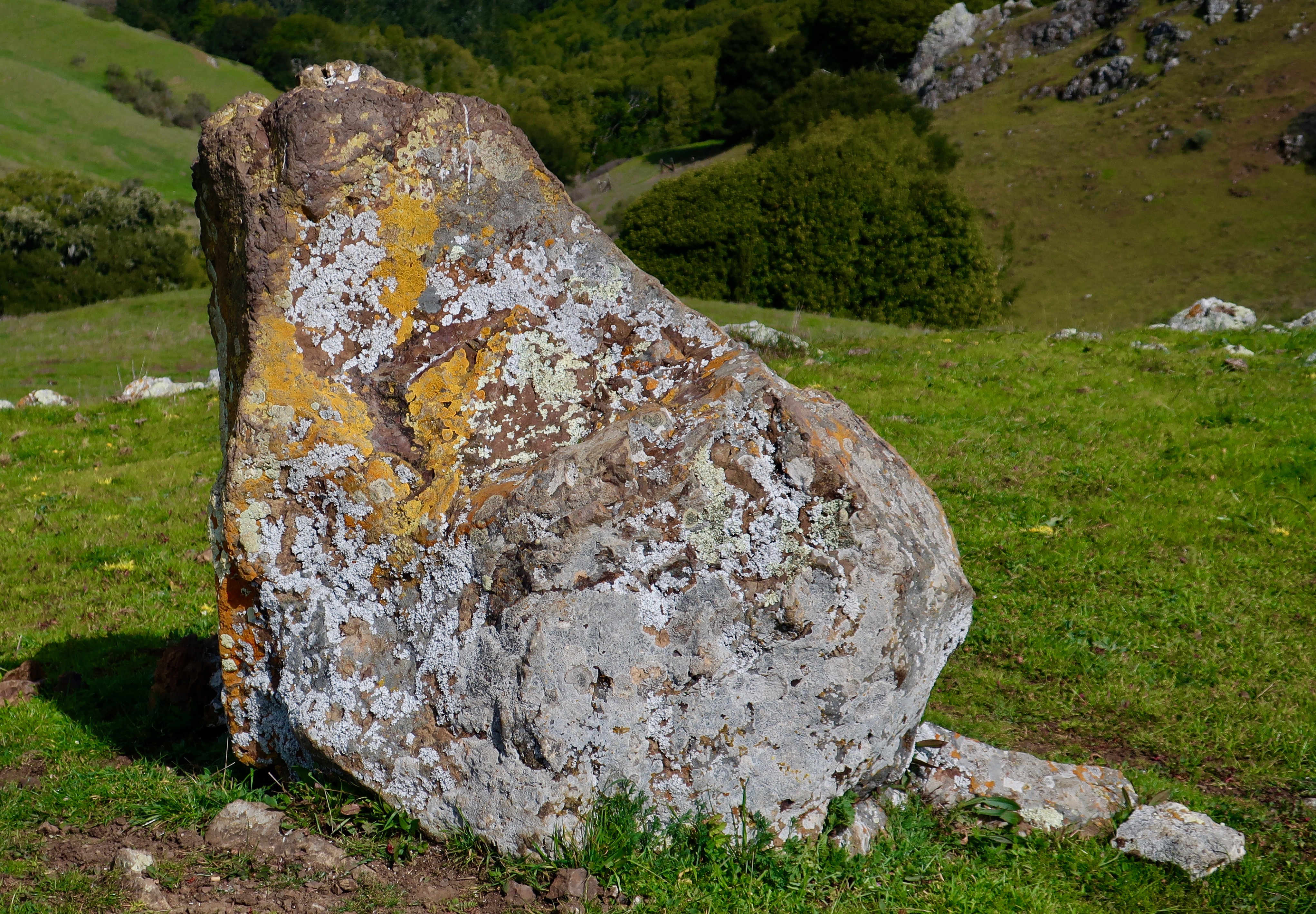
We went out for a walk as the sun was setting. The comic-appearing rock face on the left caught my attention. The nose was hard to ignore!

Our evening walk had taken us past a sign announcing a petroglyph trail, a happy surprise. Peggy and I have visited a number of petroglyph sites throughout the Southwest, many of which I have blogged about. We hadn’t realized that Lyman State Park also features the ancient rock art. We made a quick trip up the trail and vowed to return in the morning. Both the Anasazi and the Hopi had made their homes along the Little Colorado River, which was now damned up forming Lyman Lake. The petroglyphs were found in the rocks above the river. The Hopi believe they entered this world from another world near where the Little Colorado enters the Colorado River.

A sign placed by the park interpreted this rock art. The wiggly line represents the Water Serpent the Hopi would ask for water when water was scarce. Obviously they found it in the Little Colorado, which meant they could settle in the area. The guy on the right is jumping up and down holding corn they were able to grow. Or maybe he’s excited about his companion having a baby. You can see it hanging down. The umbilical cord hasn’t been cut yet. I’d be jumping up and down too. The wildlife looking on may symbolize the availability of game for hunting.
Behold the turtle who only makes progress when it sticks its neck out. At least, I think it’s a turtle. I also admired the lichen on the right.
A pair of very long snakes? Or at least their trail. Have you ever seen a snake trail crossing a dirt road?
There was also an interpretation sign for this. The thick line in the middle was apparently a migration route. Off to the left are snakes. The guy on the right may be dead since that is how death is sometimes shown in petroglyphs. I wonder if the snakes got him. Or Kitty, which was just to the left.
Land use planning? A sign suggested that this was a map that showed the various farms or settlements along the Little Colorado.
Another example of a petroglyph map.
Who knows?
My interpretation here is of a bear print with lots of sharp claws…

There’s much more to Lyman State Park than petroglyphs. For one, the lake is apparently a popular boating lake. None were there at the time, which pleased us given the likely noise. We wandered around and took in the sights

What the…? How’d you like to come home to this?
Hungry swallow chicks. 🙂
Who lives here? It’s a spider. I didn’t shove my finger down the hole.
Peggy made her way along the Petroglyph Trail.
Which overlooked the lake.
And featured this tree…
Rocks…
And more rocks.
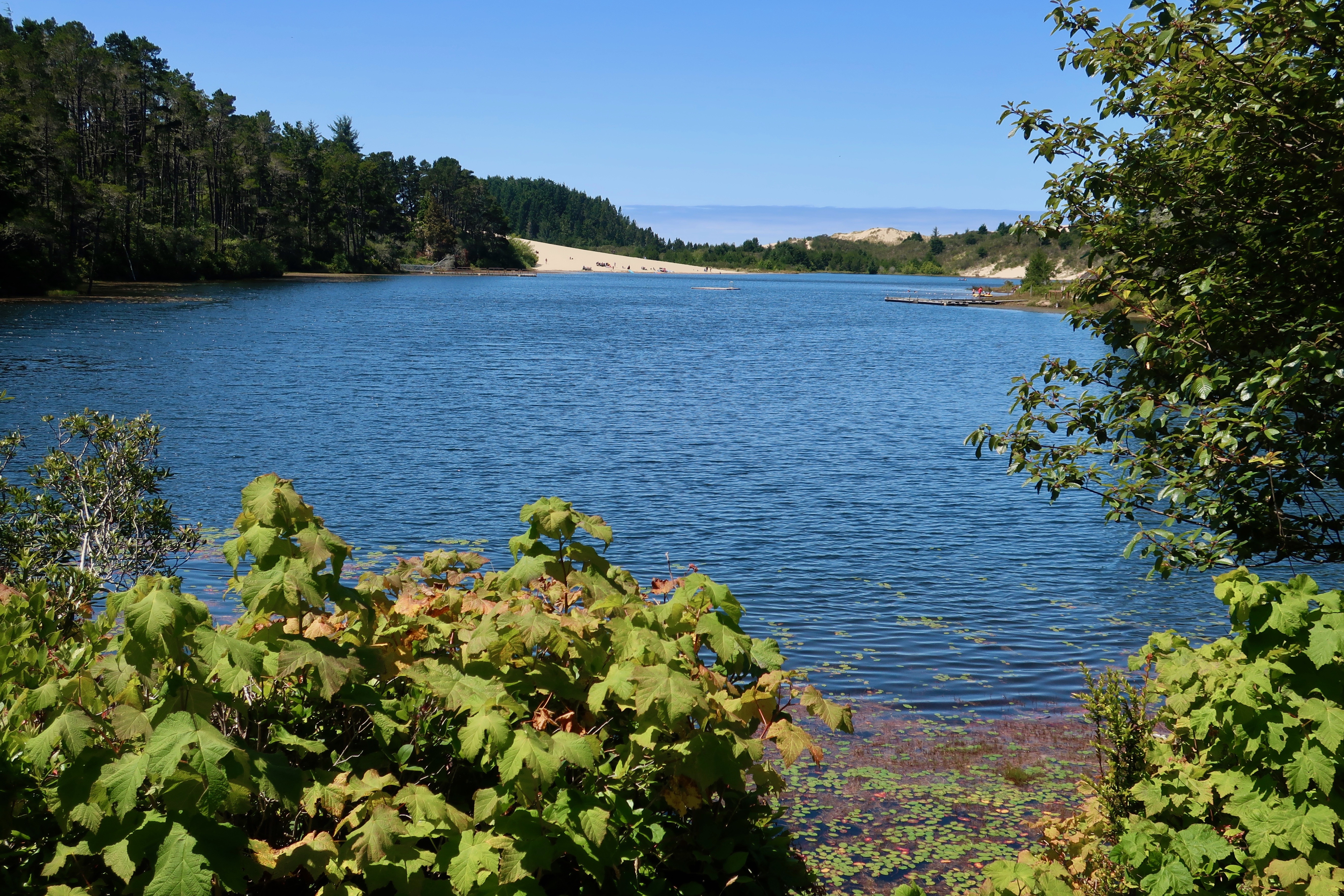
I’ll conclude with this attractive peninsula jutting out onto the lake.

NEXT POSTS:

Blog-a-Book Monday: It’s 4 AM and a Bear Is Standing on Top of Me… I conclude the Sierra Trek story with the greatest surprise of all.

Blog-a-Book Wednesday: The Bush Devil Ate Sam… I contemplate the wandering ways of my ancestors as a factor in my decision to join the Peace Corps. I’ve often been jealous of these early mountain men who travelled with the likes of Daniel Boone. But not Uncle Bill. He had his head cut off by a tomahawk and rolled down a hill…

Highway 191: National Parks and Navajos… The Backroad Series

Our first stop on Highway 191 was only a few miles south of I-70; Arches National Park. I’ve already posted on our visit, but here’s a photo from the park.

There are some backroads in America that we immediately recognize. Route 66 is one. Highway 1 along the California coast is another.  Last summer, Peggy and I went on a road trip in our van exploring several other America’s backroads which aren’t quite so familiar, at least to me. 

Highway 191 was one. This highway starts at the Canadian Border in Montana and ends in Arizona on the Mexican Border. I’ve driven much of it over the years. I’ve even bicycled several hundred miles on the highway. But I confess that if someone had asked me what I knew about Highway 191 before our trip last summer, I would have asked where it was. 
Highway 191 travels from the border of Canada to the border of Mexico.

Peggy and I picked it up off of I-70 in Utah and followed it south into Arizona where we cut off on Highway 180 crossing the southern Rockies toward Silver City in New Mexico. Along the way we visited Arches National Park, made our way through Navajo country, passed by Canyon de Chelly and spent a delightful night at Lyman State Park in Arizona. I’ll feature some pictures that Peggy and I took along the road but will save Lyman Lake for next week’s post.

One more Arches photo. Peggy caught this photo of me checking out Balanced Rock.
There are, of course, impressive arches outside of Arches National Park. Wilson Arch is found along Highway 191 south of the National Park.
Further south along Highway 191, Peggy and I came on this interesting sandstone monument known as Church Rock. BTW, the road into Canyonlands National Park is near here.
Views along 191 included badlands…
These trees…
And the San Juan River.
As we entered the Navajo nation, the concern over Covid 19 was immediately apparent. This dinosaur was wearing a mask at a service station.
I love this sign that shows a sense of humor in the Navajo Nation about social distancing. Very few people were out and about in comparison to 9 months earlier when we had visited Canyon de Chelly. We saw perhaps a half dozen outside of Chinle, gateway to the National Monument.
Two Navajo Sheep. (Photo by Peggy Mekemson.)
A view looking down into Canyon de Chelly from our previous visit. Tourism and tourist dollars came to a dramatic halt with Covid-19 ravaging the Navajo Nation.
People like Alan Ba, from whom we bought this artwork, would have an important source of income eliminated.
As we neared I-40 on Highway 191, there was one more grim reminder of the problems facing the world, a massive forest fire brought on partially by global warming.
Traveling south of I-40 we found more badlands, not all that far from the Painted Desert.
Shortly after arriving at Arizona’s Lyman State Park, we were treated to a sunset over the lake. It had been a long day.

NEXT POSTS:

Blog-a-book Monday: Just when I thought we were out of trouble, the Sheriff pays the Sierra Trek a visit and dynamite threatens to rain rocks down on us.

Blog-a-book Wednesday: I start the book on my African Peace Corps adventure with asking the question: Why?

Travel Blog Friday: We explore the unique early American rock art of Lyman Lake, discover some birds that are more mouth than body, and appreciate the beauty of the area.

The Beauty, the Geology, and the Weirdness of Sunset Bay…

A couple of weeks before Christmas, Peggy and I made a trip over to Cape Arago on the Oregon Coast. The waves featured in my January 7th post were from this trip as is today’s post on Sunset Bay State Park, which is located at the beginning of the Cape just outside of Coos Bay.

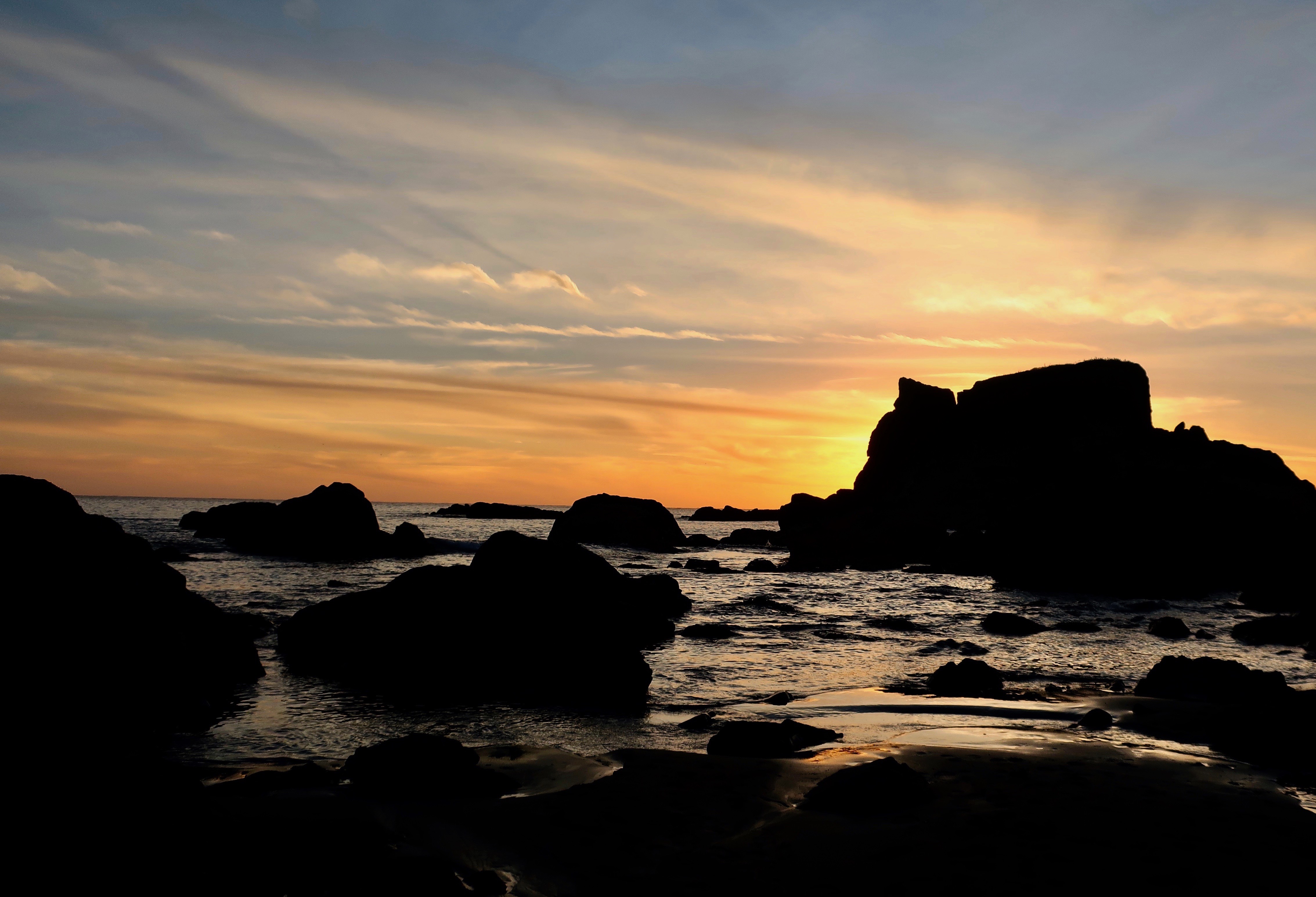
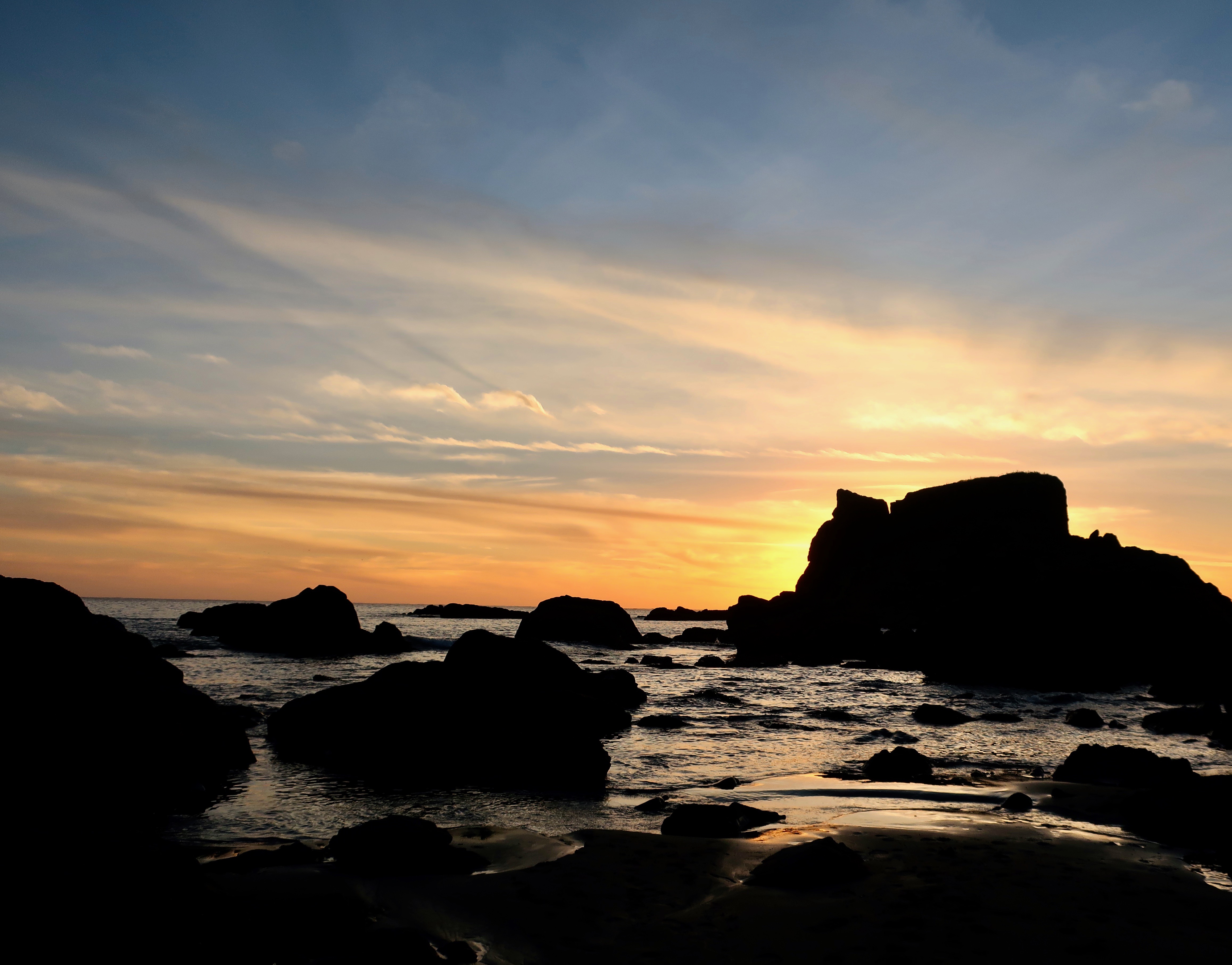
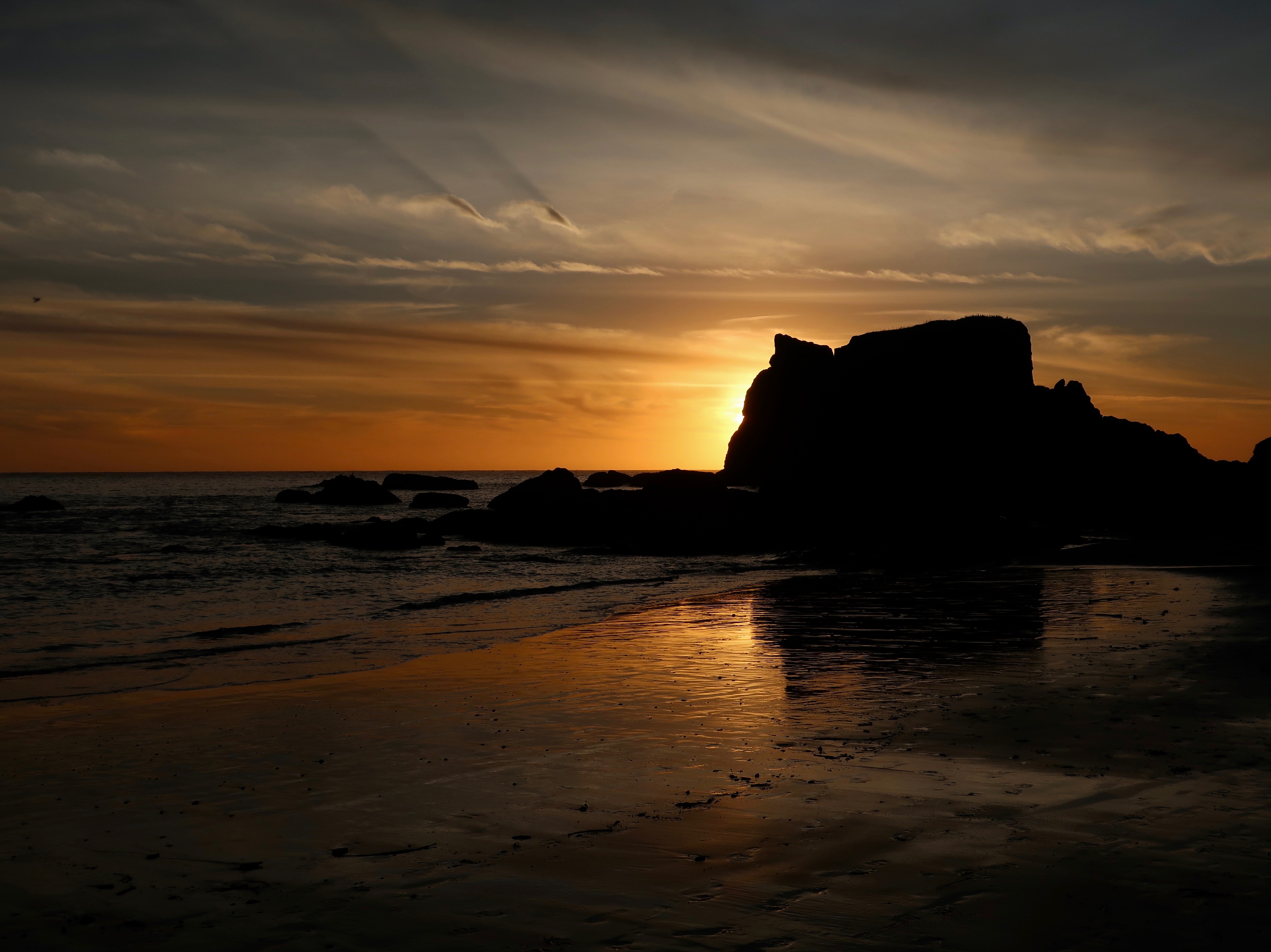
Sunset Bay at sunset with the tide out.

The tourist and real estate industries of the Oregon Coast prefer to ignore the next BIG one, or put it off to sometime in the distant future. The folks involved in predicting earthquakes have a different perspective. The sheer number of tsunami evacuation route signs along the Oregon coast speak to their concerns. The Cascadia Subduction Zone is real. A massive 9-point something or other earthquake known as a mega–thrust is in our future. They happen every 300 to 600 years. The last one was in 1700. The oceanic Juan de Fuca plate is diving under the North American continental plate and it will not be denied. It’s stuck right now. Small earthquakes near the surface are creating pressure on the trapped area, however. When it gives, all hell will break loose.

I, for one, pay careful attention to the evacuation routes whenever Peggy and I visit the coast. If the earth shakes, we will be out of there! So what if we leave our welcome mat behind.

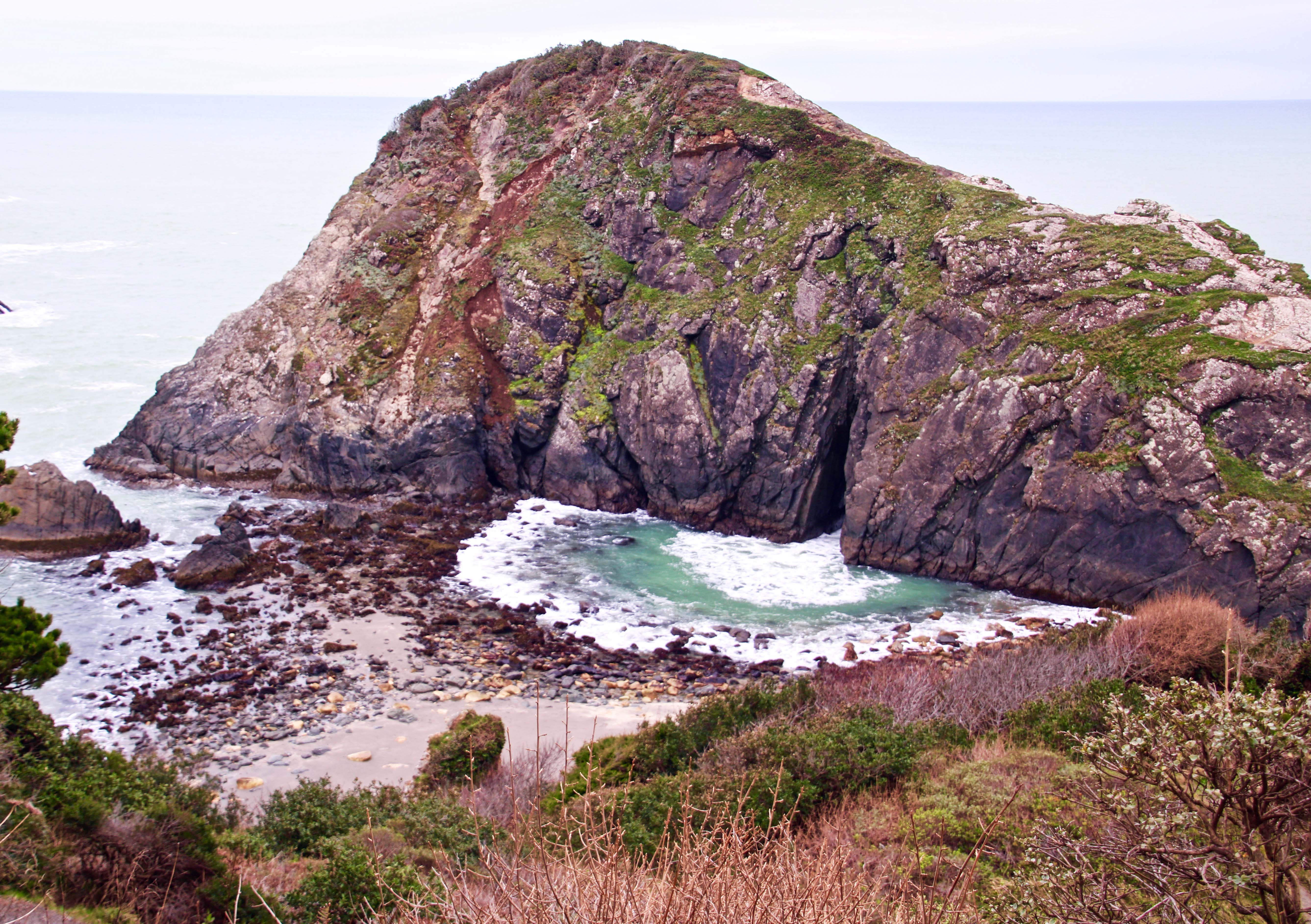
Sunset Bay State Park is a geological wonderland when it comes to featuring various aspects of what can happen when a massive earthquake strikes. The most fascinating to me are the stumps of ancient trees. Twelve hundred years ago, a forest stood above the ocean where Sunset Bay now stands. An earthquake caused a subsidence in the land, drowning the forest. At low tides, the remains can still be seen.

I was fascinated by the different shapes of trunks left by the ancient trees.
Octopus like…
A different perspective…
This ancient tree stump at Sunset Bay State Park bears a strong resemblance to a man doing jumping jacks.
This tree has roots on roots. A genealogist would be impressed.
Incoming tide surrounded the tree trunk and reflected the fluffy clouds in the sky.
Peggy stands in front the ancient tree trunks to provide perspective. Her Covid-19 mask serves as a scarf.

Faults, fractures in the earth’s surface along which the blocks of crust move relative to one another can be seen among the tilted and layered rocks of the Bay at low tide. The rocks, BTW, also provide an excellent area for tide pools that feature sea life loved by kids and adults alike. 

Low tide at Sunset Bay. You can see a number of tide pools to explore, but it also shows a clear fault running from left to right. A second fault can be seen behind it. The crust between the faults moves when earthquakes strike.
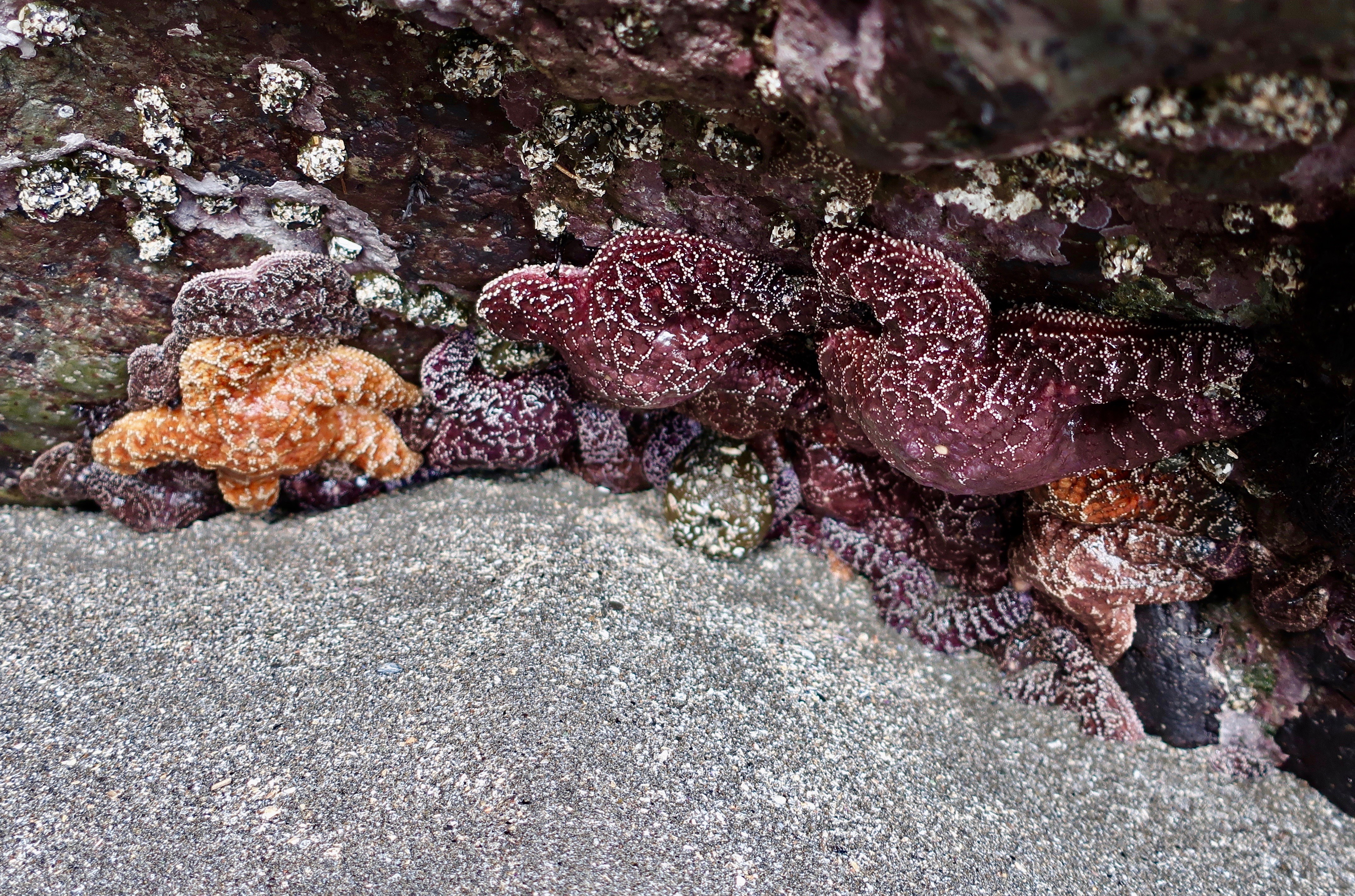
We spent a few minutes peering into tide pools.
We were impressed by the sea anemone. The slit is the anemone’s mouth, and, for convenience, its anus as well. The tentacles contain stingers filled with a toxin for stunning dinner, which is then transported to its mouth.
For fun, I rendered the anemone in black and white.

While the bay represents an earthquake caused subsidence, the Whiskey Run terrace surrounding the Bay represents uplifts and folding also created by tectonic activity related to the Cascadia Subduction Zone. The wave-caused erosion taking place in Sunset Bay operated on the terrace when it was at sea level. It’s estimated that the land rises approximately three feet every thousand years. 

The terrace above Sunset Bay was once at sea level. Like the Bay, waves created the flatness of the terrace.
A close up of the Whiskey Run terrace. The sedimentary layers have been tilted down to the right by tectonic forces and then eroded away by wave action. A layer of dirt/rock has since been laid down on top, providing soil for the forest.

And finally, I would like to feature a strange, non-tectonic feature of Sunset Bay: concretions. Peggy and I first came across these round, rock-like structures on the southern coast of the South Island of New Zealand. They are created when groundwater triggers extra amounts of ‘cement’ around irregularities in the rock such as shells, creating a round structure that continues to grow as more cement is added. The hardness of the covering makes it harder to erode than the surrounding rock. 

This is a concretion.
And these are concretions apparently marching out to sea. Why, I haven’t a clue.

I’ll conclude with a few other photos from Sunset Bay that I found interesting.

An orange rock with ripples…
A ghost tree…
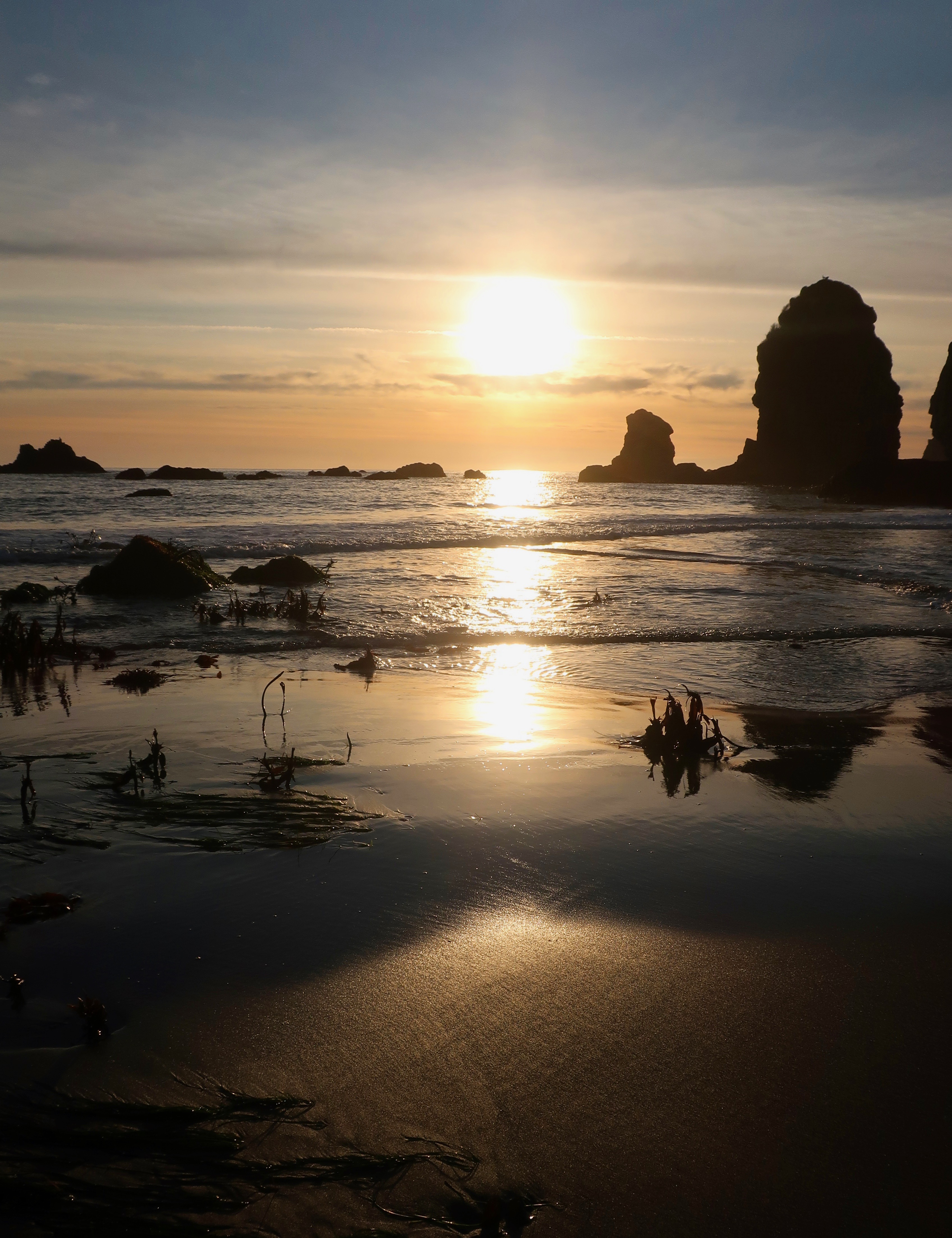
Sea grass in the late afternoon sun…
Peggy walking through the tunnel that connected our campground to the bay.
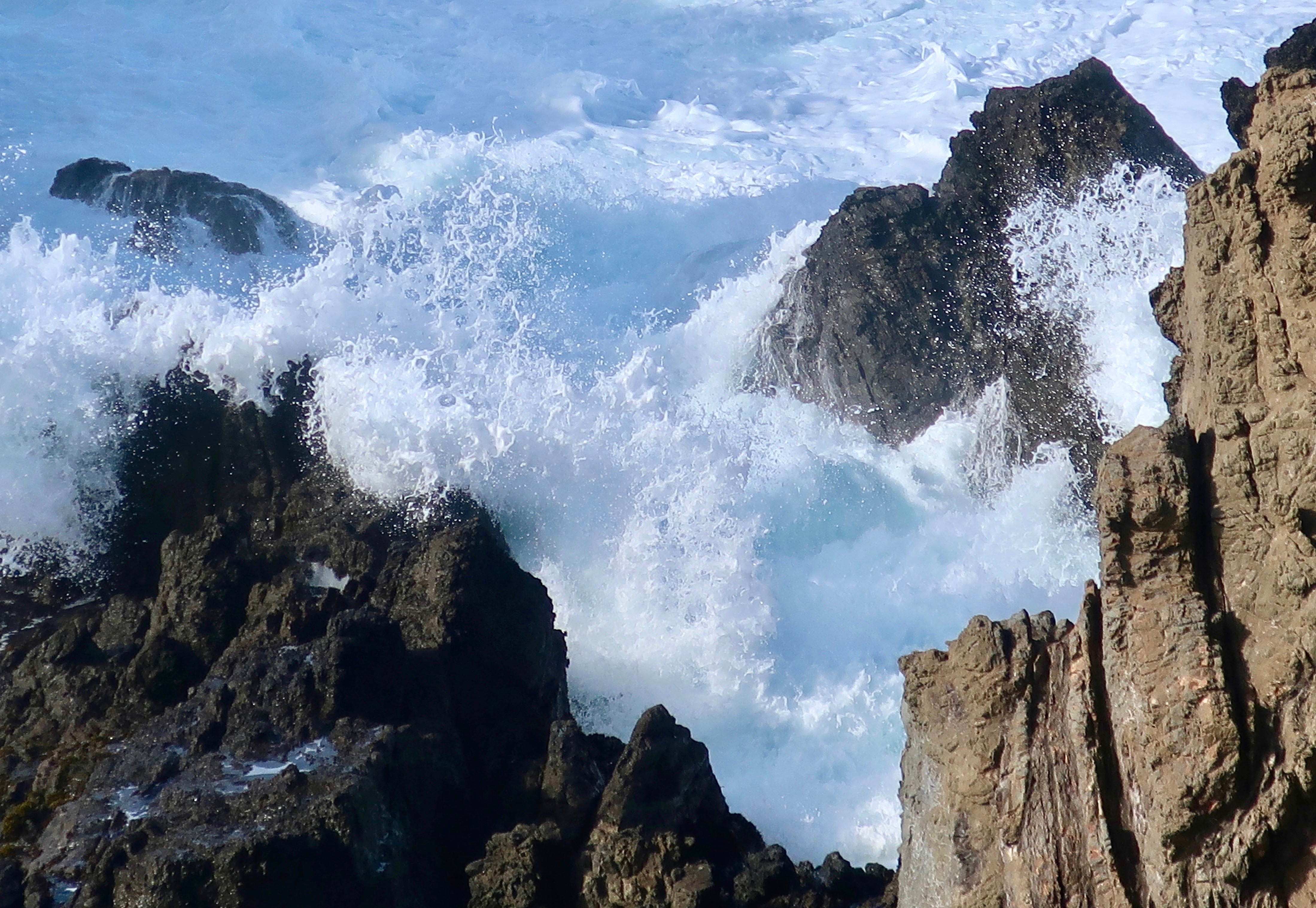
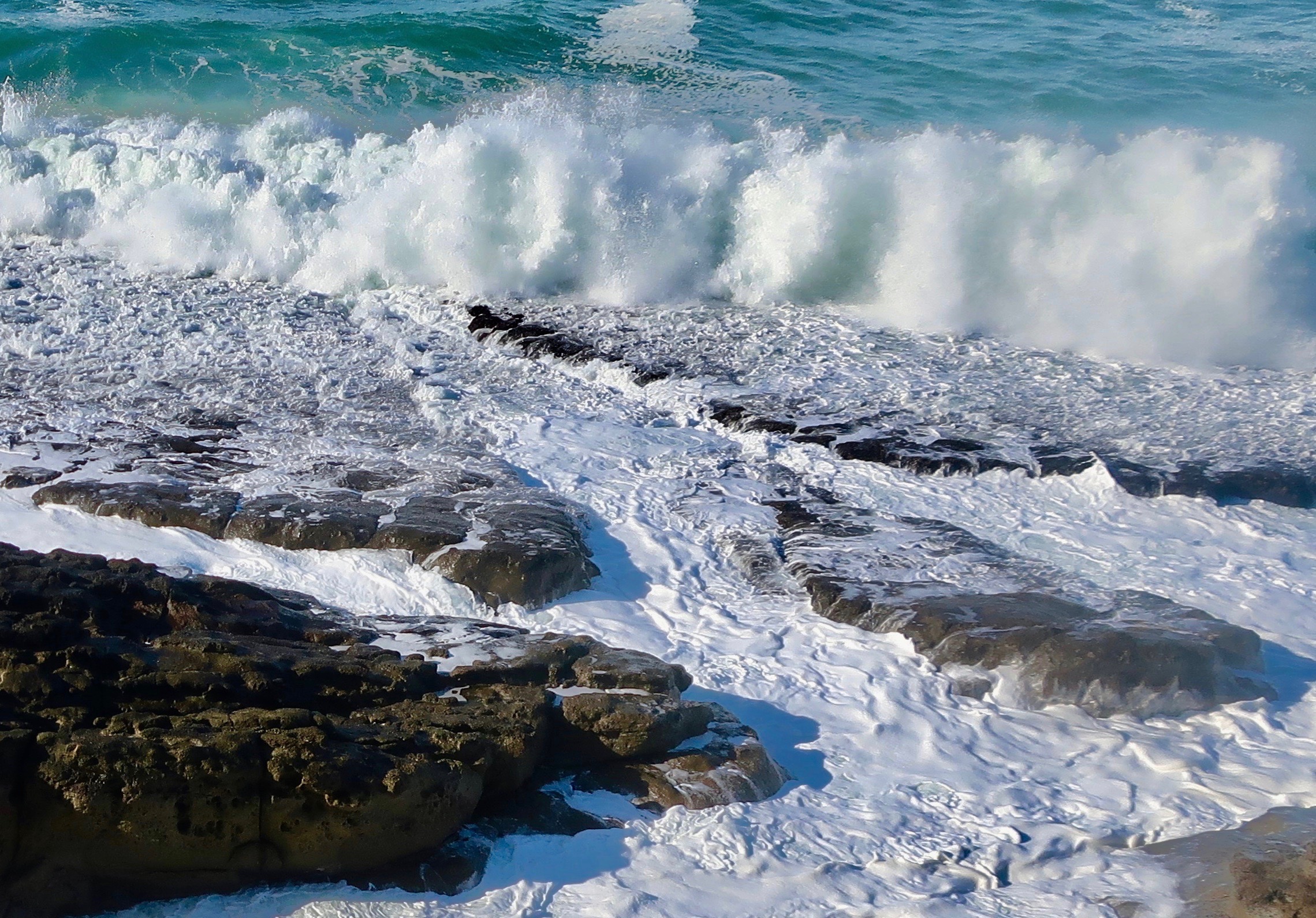
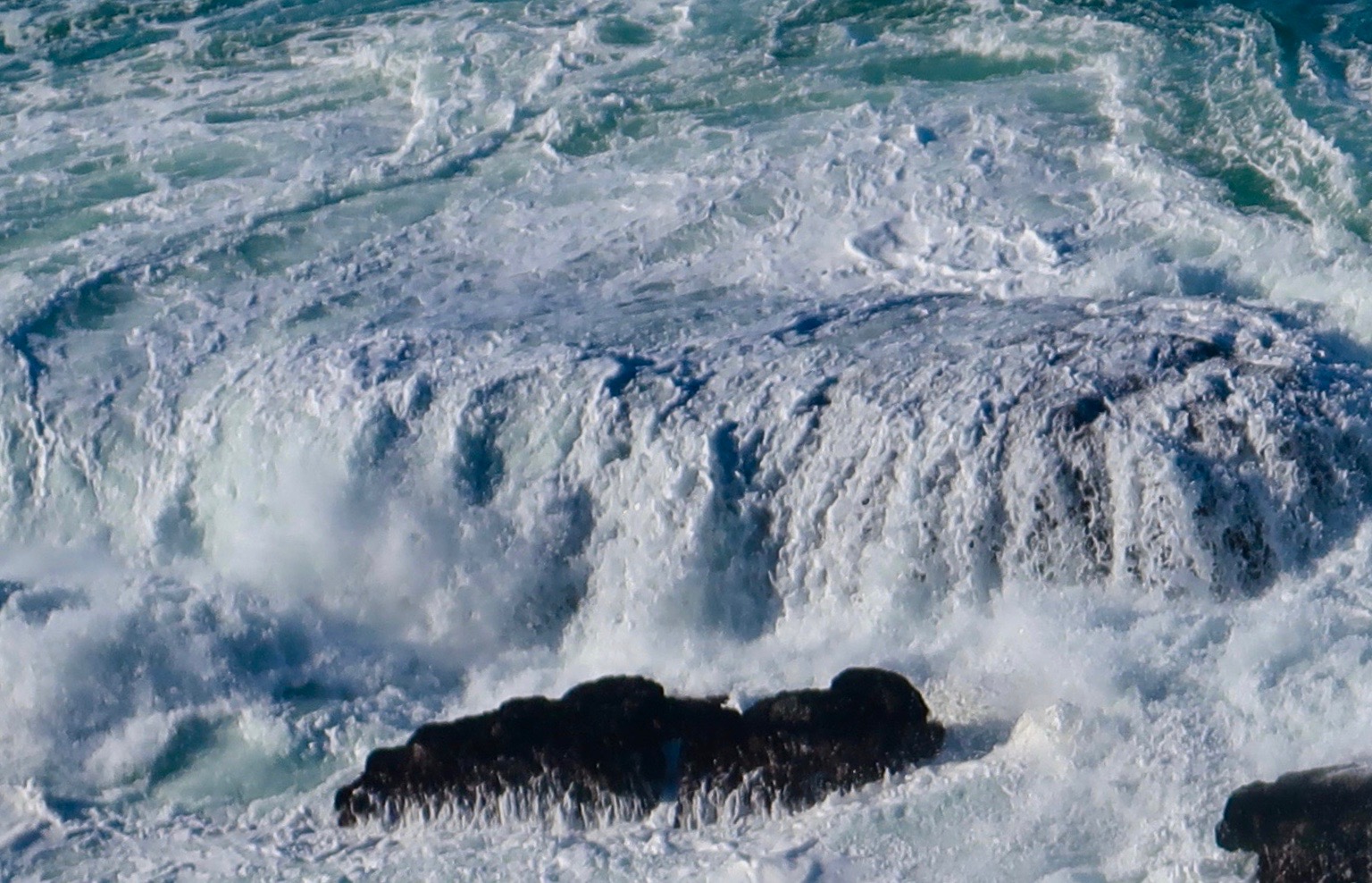
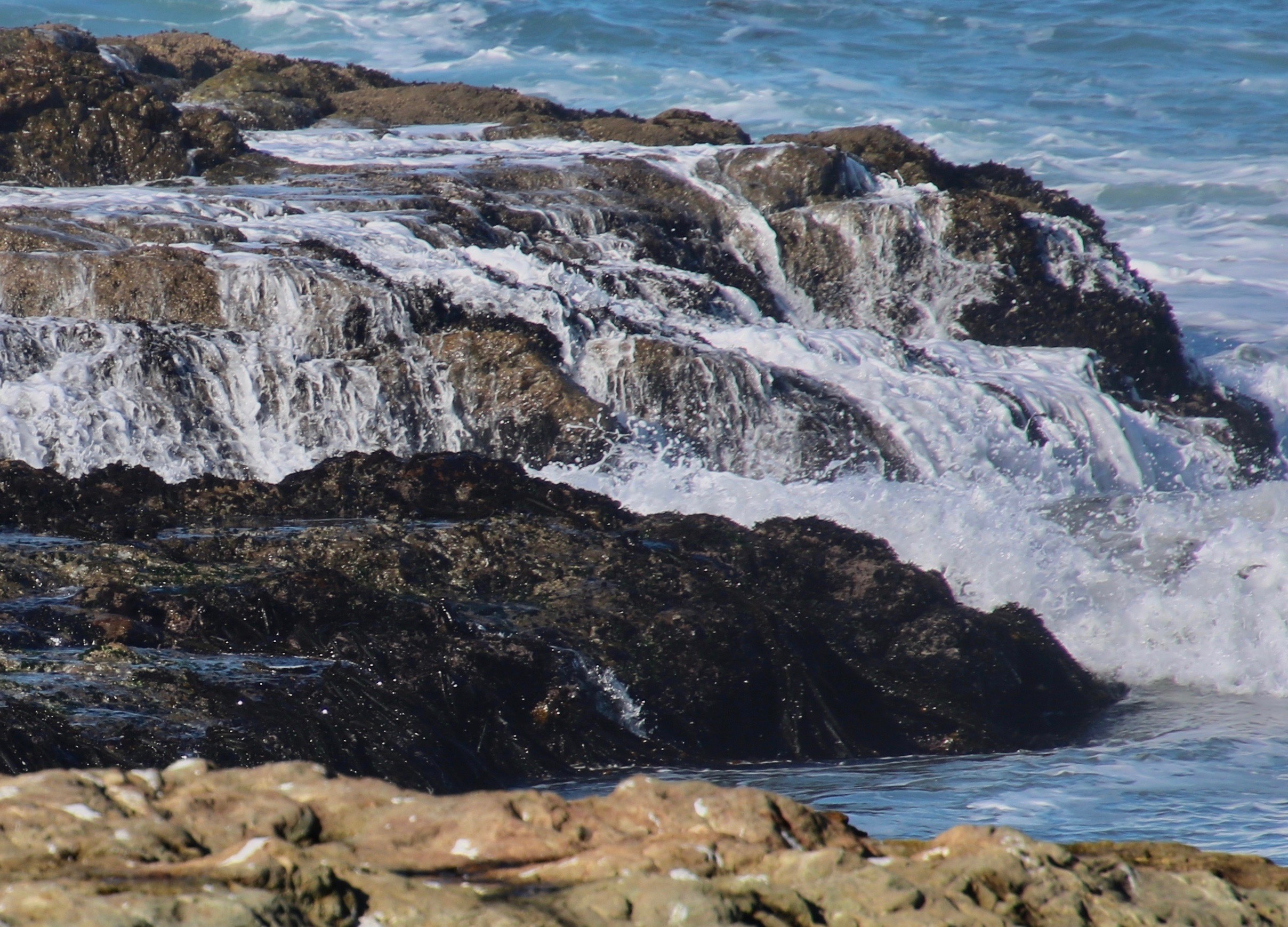
And finally, I’ll wrap up this post on Sunset Bay with more waves.

NEW BLOG SCHEDULE: I’ve been working on revising the book on my Liberia Peace Corps experience— adding a few chapters on my experience working for the Peace Corps after I was a Volunteer and updating the chapters I wrote about modern Liberia. Several of you have read the book and a few of you may have even been around when I first blogged it several years ago. Anyway, I am going to reblog it again, adding it to my schedule. On Mondays I will continue to blog my book, It’s 4 AM and a Bear is Standing on top of Me. On Wednesdays, I will blog The Bush Devil Ate Sam. On Fridays, I will continue my travel blog.

NEXT POSTS:

Blog a Book Monday: Will you believe I actually have a good day on the Sierra Trek?

Blog a Book Wednesday: Introduction to the Bush Devil Ate Sam

Travel Blog Friday: I return to my Backroad series following Highway 191 through Navajo country in Utah and ending up in Arizona’s Lyman State Park.

The Loneliest Road in the US was Lonelier in 7,000 BCE… Petroglyphs of Grime’s Point

I took this photo while standing at Grime’s Point Archeological Area just off Highway 50 about five miles east of Fallon, Nevada on an earlier trip. The terraces above the basalt boulders were cut into the side of the ridge by the ancient Pleistocene Lake Lahontan as it rose and fell. Had I been here 10,000 years ago I would have been under 700 feet of water. Traveling over today’s Highway 50 route would have required a submarine.
Turning around from where I was standing was more basalt and a view of Highway 50. A pickup pulling a trailer makes its way over ‘The Loneliest Road in America.” Looking across the valley you can see ranges fading into the distance that are part of the Basin and Range complex of Nevada, which is part of the Great Basin of the Western US.
Had you arrived on the scene much later, say around 5,000 BCE or 7,000 years ago, you would have discovered that Lake Lahontan was much shallower as glaciers receded to the north and warmer temperatures prevailed. The area would have been marshy and filled with abundant wildlife. Ancient peoples had arrived on the scene and were pecking away at the rocks, creating some of the earliest petroglyphs in Nevada and North America. Grime’s Point features these petroglyphs. A copy of one of the petroglyphs is on the left.
The pit and groove petroglyphs here are among the oldest petroglyphs found in Nevada.
As to what they mean is anyone’s guess. One thought is that they were used in hunting rituals by shaman to assure success.
This basalt boulder was covered with pit petroglyphs. Ancient peoples and later Native Americans would use rocks to peck away the desert varnish that covers rocks to show the lighter rocks underneath. One way of measuring the age of petroglyphs is to see how much desert varnish has since re-covered the rock petroglyphs. The color of these pit and groove petroglyphs has returned to the original varnish color. Translate old.
In contrast, this is a much more recent petroglyph, probably carved in the last 500 years. To me, it appears to be a big horn sheep. But then again…
Most of the petroglyphs fall somewhere in age between the ‘sheep’ petroglyph above and the pit and groove style of petroglyphs. I like the almost-polished look of this basalt boulder. If you look carefully, you can see petroglyphs stretching down and out on both sides of the rock. Following are several examples of the petroglyphs I found wandering around among the boulders. It’s like a treasure hunt. Fun.
I’ll conclude with a final view of the landscape at Grime’s Point Archeological Area. Remains of what may have been a rock fence used to drive deer and antelope to the dinner table is found up near the top of the ridge.

BLOG-A-BOOK TUESDAY: Join me on the first 100-mile backpack trek I ever organized. Leading 61 people aged 11-71 across the Sierra Nevada Mountain Range, I was lucky to escape with my life and career in tact.

TRAVEL BLOG THURSDAY: Peggy and I continue our Back Roads of America Series by stopping off at another petroglyph site along The Loneliest Road in America: The Hickison Petroglyph Area. This time we will be featuring some out-of-this-world rocks and, uh, puberty rites.

The Bandon, Oregon Series: Part 3… Face Rock State Scenic Viewpoint

Peggy and I arrived in Bandon on a stormy day and drove over to the Face Rock State Scenic Viewpoint as soon as we had checked into our campground. Face Rock was shrouded in rain and mist. There’s a legend that says you can hear a woman’s voice in the wind if you listen. It all sounds like an appropriate Halloween tale…

According to Native American lore, the beautiful Indian maiden, Ewauna, arrived with her father, Chief Siskiyou, in the Bandon area for a major potlatch. Ewauna had never seen the ocean and immediately fell in love with it. (For those of you who aren’t familiar with the potlatch concept, the object is to give things away to guests, the more you give, the more you are admired.)

What’s not to love about the beautiful ocean beaches near Bandon? This photo is looking south from the Face Rock Scenic Viewpoint. The rock in the distance is Haystack, which I featured in my last Bandon post about the Devil’s Kitchen State Park. The two people among the rocks provide perspective.

“Don’t go near the ocean,” the old men of the tribe warned Ewauna. The evil spirit of the ocean, Seatka, lived in the waters along the coast and apparently had a thing for beautiful young Indian maidens. But what young woman full of life listens to old men? That night there was a great feast as part of the potlatch. After being stuffed with bear and deer and elk and berries, and mussels and clams, everyone drifted off to a deep sleep. That is, everyone except Ewauna.

She quietly got up, careful not to wake anyone, and slipped off to the ocean taking her dog, Komax, her cat, Tenas Puss Puss, and Tenas’s kittens with her. She carried the cat and kittens in a basket. Ewauna ran up and down the beach with joy and jumped into the ocean for a swim, telling Komax to look out for the cat and kittens. Out she swam, farther and farther, as Komax barked louder and louder, warning her of the danger. Suddenly an ugly monster surfaced and grabbed her. It was the evil spirit, Seatka.
Komax stopped barking, grabbed the basket in his mouth and swam madly out to rescue his mistress. Dropping the basket, he sank his sharp teeth into Seatka’s arm. Good boy! The evil spirit screamed in anger and pain, grabbed Komax, and threw him far out into the ocean. For good measure, he also grabbed Teanas Puss Puss and her kittens, tossing them as well. He then increased his grip on Ewauna, squeezing her tight.

“Look into my eyes,” he demanded. He could only possess her if she looked at him.

“Never!” she had replied, staring steadfastly up at the sky and moon. And that is how Chief Siskiyou found her the next morning, still staring up at the sky, refusing to let the evil spirit to possess her. And that is where you can find her today.

Coming back the next day, Peggy and I found Ewauna still staring up at the sky with a smile on her face. Still free. (Photo by Peggy Mekemson.)
Her pets, too, have been turned into rocks (shown on the right) and wait faithfully for her.
Later we returned to the beach to watch the sunset and found Face Rock turned orange by the setting sun. (Photo by Peggy Mekemson.)
Speaking of faces I caught this photo of Peggy as the wind had fun with her hair at the scenic viewpoint.

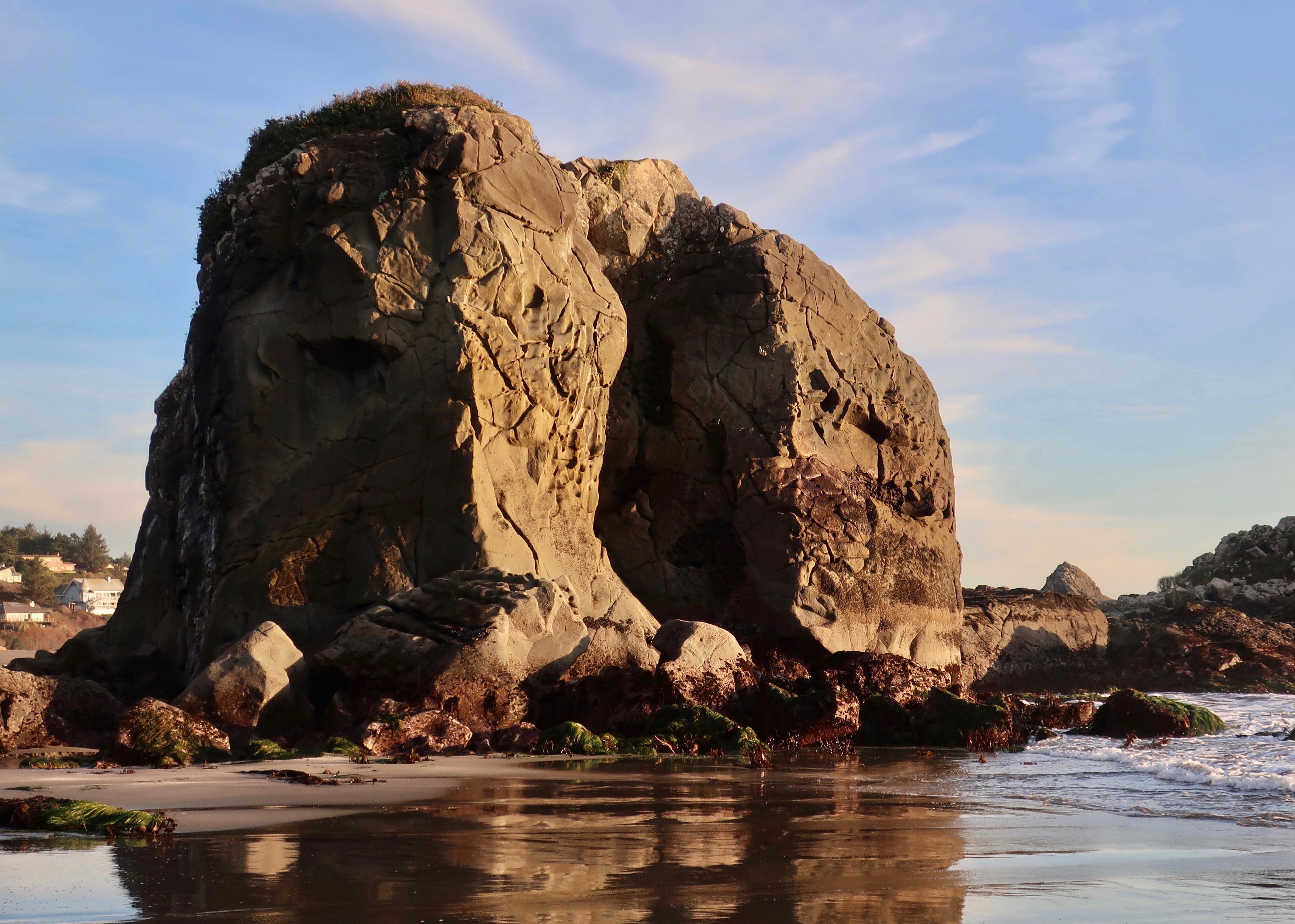
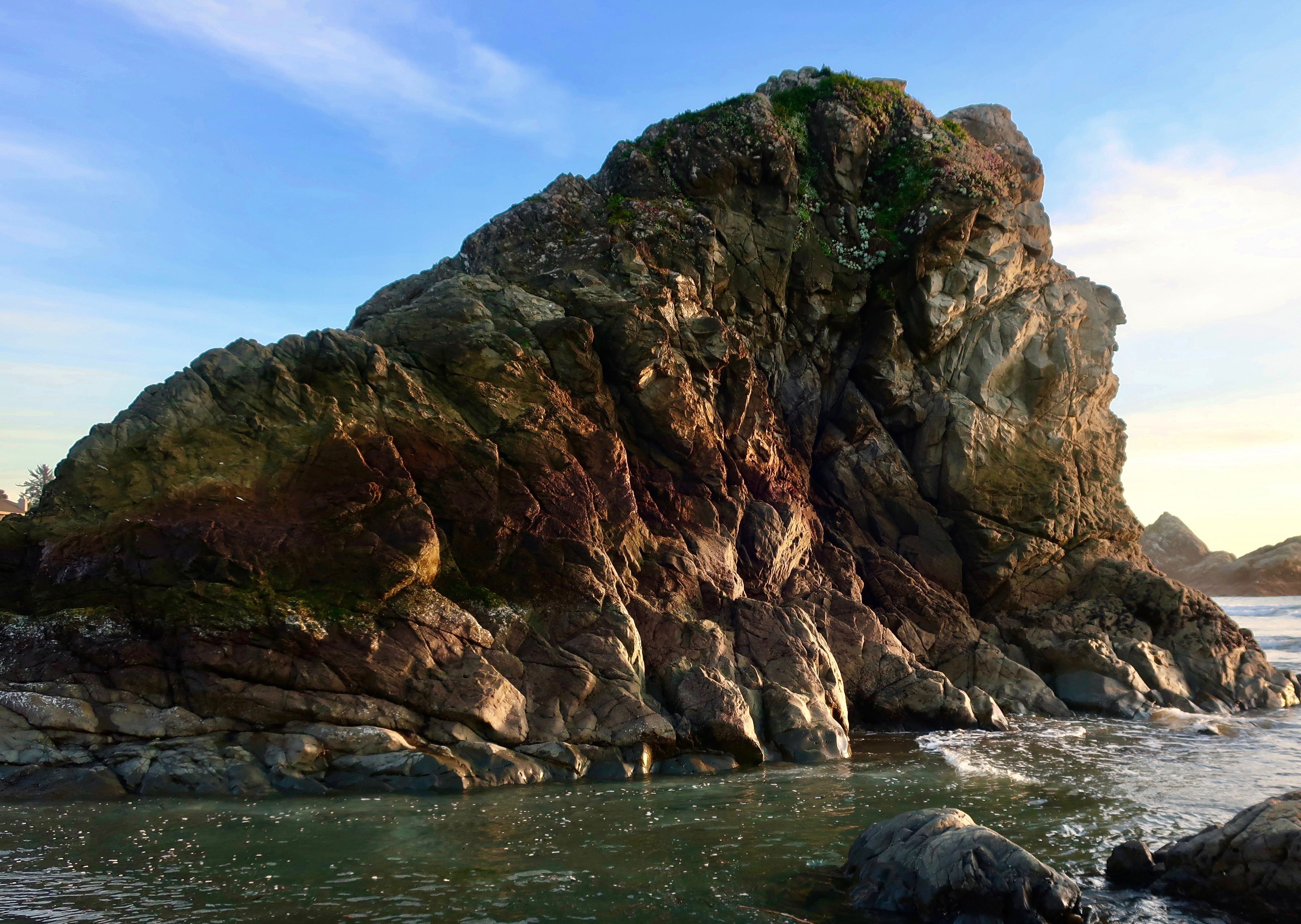
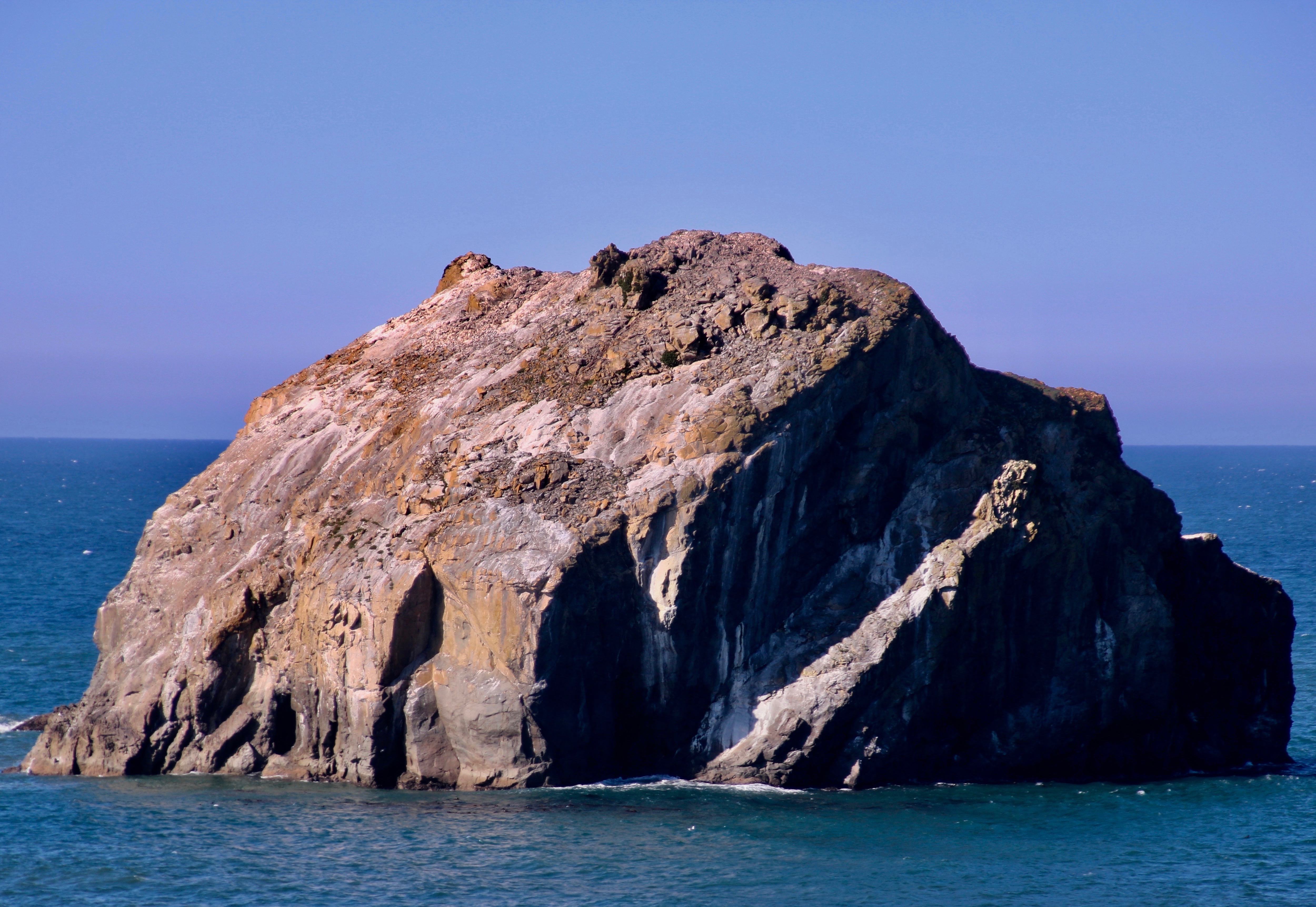
While Face Rock gives its name to the scenic viewpoint, there are a number of other sea stacks to admire.

Photo by Peggy Mekemson.
Photo taken from inside a cave by Peggy.
Peggy caught this unique shot of the sun sinking into the Pacific Ocean. (Photo by Peggy Mekemson.)
Mine was more traditional.
I’ll conclude my Bandon series with this dramatic evening look of sea stacks at Face Rock. (Photo by Peggy Mekemson.)

NEXT POST: After a thousand posts, it’s time to consider changes in my blog.

The Magnificent and Powerful Art Of Marco Cochrane… My 11 Years at Burning Man

In 2010, Marco Cochrane introduced the first of his magnificent nude sculptures to Burning Man, the 40 foot tall Bliss Dance.

When I first ventured out onto the Playa on my 2010 visit to Burning Man, I was immediately drawn to a large sculpture of a nude woman that struck me as being beautiful and full of life. The sculpture, I learned was titled Bliss Dance and had been created by the Bay Area artist Marco Cochrane based on his model, the dancer Deja Solis. Bliss Dance would go from Burning Man to Treasure Island next to San Francisco and is now on permanent exhibition in Las Vegas. Here’s what Cochrane had to say during the unveiling of the sculpture in Las Vegas:

What I see missing in the world is an appreciation and respect for feminine energy and power that results when women are free and safe. It seems obvious to me that feminine energy is being suppressed and that this must change. If we are to find real, lasting solutions to the problems facing humanity, men and women must be able to work together as equals. Bliss Dance is intended to focus attention on this issue.— Marco Cochrane, Feb. 2016 press release

This sentiment also applies to the two other sculptures that Cochrane created for Burning Man as part of a trilogy: Truth Is Beauty in 2013 and R-Evolution in 2015. I consider myself privileged to have been at Burning Man on each of these years. Truth Is Beauty is now on permanent exhibit overlooking the BART station in San Leandro, California.

Truth Is Beauty at Burning Man in 2013.

An 18-foot rendition of Truth Is Beauty and several other art works from Burning Man were recently on display at the Smithsonian’s Renwick Gallery in Washington DC. An introduction to the exhibit stated:

Burning Man, one of the most influential events in contemporary art, is both a cultural movement and a thriving temporary city of more than 70,000 people that rises out of the dust for a single week each year in late summer in Nevada’s Black Rock Desert. During that time, enormous experimental art installations are erected, some of which are then ritually burned to the ground. The desert gathering is a uniquely American hotbed of artistic ingenuity, driving innovation through its philosophies of radical self-expression, community participation, rejection of commodification and reverence for the handmade.

Nora Atkinson, the Lloyd Herman Curator of Craft at The Renwick went on to say this about the exhibit’s title: No Spectators

“‘No Spectators’ is a long-standing saying on Playa. You are encouraged to fully participate. It’s all about being there, being fully present, and not just observing. Two of the ten principles of Burning Man are radical participation and radical inclusivity, meaning that there are no outsiders. Everyone is part of the experience.”

If both of these statements seem a bit familiar, they reflect what I have been saying about Burning Man art and Burning Man in my posts over the last several years. In ways, I believe that Burning Man has been fostering a mini-renaissance in art and is now being recognized world-wide for its contributions.

R-Evolution, the last of Cochrane’s trilogy was actually scheduled to be exhibited on the National Mall in Washington DC between the Washington Monument and the White House. The group responsible for moving and installing the sculpture had written to me and asked for permission to use photos from my blog in a documentary it was preparing for the exhibit. The exhibit was cancelled. It may have been that the idea of a giant nude on the mall was too controversial. Anyway, here is one of my favorite photos of the sculpture:

R-Evolution at Burning Man in 2015.

Peggy (my wife) says what she loves about sculpture is that it is three dimensional art that you can touch and feel as well as see. One of her favorite things about Burning Man is that the art has an up-close and personal aspect, a hands on policy. Most museums have a hands-off policy. The three dimensional aspect of sculpture also has great appeal to me. I believe that that you should be able to appreciate sculpture from any angle. I’ll use the concluding photos on this post to further look at the three sculptures.

BLISS DANCE AT BURNING MAN 2010


TRUTH IS BEAUTY AT BURNING MAN 2013.

My friend Tom Lovering caught this beautiful shot.
At night, LED lights inside the sculptures light them up in a number of ways, changing every few minutes.
A final view of Truth Is Beauty.

R-EVOLUTION AT BURNING MAN 2015

One of my favorite views of R-Evolution because of the Black Rock Desert background. (Photo by Don Green.)

That’s it for today. NEXT POST: UFO’s, aliens, and a giant robot at Burning Man.

What’s in Your Home? Weird Things Hang Out Here…

A quick glance at any room in our house will confirm that weird things hang out here. Since I am normally blamed for this phenomena, I want to note from the beginning that Peggy shares equal responsibility. As an example, she collected these two mola designed creatures in Panama years before we met.

You can blame Leonardo for today’s post. That’s Leonardo as in Leonardo Da Vinci. I was reading Walter Isaacson’s magnificent biography about him on Monday and he attributed Da Vinci’s genius to “an omnivorous curiosity, which bordered on the fanatical, and an acute power of observation that was eerily intense.” So that’s what it takes to be a genius, I thought, and determined to test the theory by curiously observing my surroundings in an intense, eerie way. A large toad stared back at me. A sometimes doorstop, sometimes bookend frog was lying down on the job. I don’t know if my I.Q. jumped, but I did observe that weird things were hanging out in our home. I decided it was a subject worthy of a blog post.

This toad is relatively harmless but you don’t want to stub your toe on him. He’s heavy. Nor do you want him staring at you.
This lovely gal makes an excellent door stop and can double as a bookend in a pinch. She also serves as a conversation starter.

Who is weirder than Bone? You’ve all met him if you follow this blog. This past summer he hiked down the PCT with me. And of course he loves Burning Man. He has traveled to over 50 countries with people on adventures that have ranged from being blessed by the Pope to deep sea diving. There is much more. What you may not know about Bone, however, is that when he is at our house and isn’t carousing with his wife Bonette or the jackass Eeyore, he likes to hang out on a pedestal.

Bone on his pedestal.
He and Eeyore have been bosom buddies ever since Eeyore rescued him from being hung in Tombstone.
Wyatt Earp had arrested him for robbing a bank. Here, Doc Holiday was checking him for weapons.
Eeyore now shares our bedroom. Way back in time when Peggy was an elementary school principal, he lived in her office. It was bad enough being pawed over by every kid who came through, but one day Peggy walked in and discovered Eeyore was missing. A ransom note had been left behind. He would not be returned unless Peggy refilled the candy jar that she kept for teachers with chocolate. Great trauma was experienced in the school when Peggy got on the intercom and announced to all of the classrooms that Eeyore had been kidnapped!
While we are on the subject of cute, furry animals, I might as well introduce this engaging bear. Nothing weird here. There are millions of cute bears. I gave this one to Peggy on Valentine’s Day in 1991. Ever curious, she decided to open the zipper. Out popped an engagement ring! My ever voluble buddy became scarily quiet for a very long minute. Then, she squealed.

Many of the ‘strange’ art pieces found in our home reflect that both Peggy and I like so-called ‘primitive’ art. Like children’s art, it carries a level of creativity and even power that is lost as children and cultures ‘grow up’ and lose their connection with nature, “omnivorous curiosity,” and “acute power of observation.” The mola at the top of the post was obtained by Peggy in Panama from an indigenous tribe. A number of modern artists such as Picasso have used primitive art for inspiration.

I’m sure that most of you as parents or grandparents have had the opportunity to post your children’s/grandkid’s art on the refrigerator. Maybe you even have some of your own childhood efforts buried deep in your memorabilia box. This fantastic beast jumped out of the mind of our grandson Chris. A budding Picasso, perhaps.
This is an authentic African medicine mask from the Ivory Coast that I picked up as a Peace Corps Volunteer in West Africa,
You are greeted by Jungle George, the Poro Bush Devil, every time you visit my post. He was carved by a leper in Liberia and came home with me.
He’s quite proud of the fact that I chose him for the cover of my book about the Peace Corps.
The fact that many cultures have discovered the commercial value of traditonal art and replicate it to sell does not take away from its unique look. These Mayan dogs are an example.
And here we have a Mayan god.
Several examples of Mexican folk art can be found in our home. This frog in its Zen-like pose is from Oaxaca.

Our kids, recognizing our quirkiness, have contributed some of the weird things but I am usually the target. Mom gets more practical things, like chocolate.

Our daughter Tasha gave me this. It sits on the edge of our bathtub with a continual look of shock and amusement on its face. I like the way it is reflected in the faucet.
The bear and the moose are from our son Tony and his wife Cammie. Peggy once spent a whole year looking for moose, and I have had more than my share of finding bears.
This is here because it reflects Tasha’s sense of humor, and hopefully mine. We were visiting the San Diego Zoo, which I really like. But the visit went on and on and on. And I got a little grouchy. It happens. So I left Peggy, Tasha and the grandkids and headed back to the car to read. When the family finally returned, Tasha proudly presented me with this.

Much of what we have simply reflects our own unique brand of quirkiness and can be found outside of our home as well as inside.

Three buddies. Lots of Eeyores remain from Peggy’s days as a principal. The pigs seem to be attracted to me.
We were both attracted to this giraffe.
If our bird houses seem to be a bit rustic, Mr. and Mrs. Chickadee don’t seem to mind. Note the head staring out the hole. (Photo by Peggy Mekemson.)
The last time you saw this rooster, it was covered in snow. While its strange eye makes it look like a dead rooster, it’s the tail made out of tools that amuses me.
We liked the rooster so much we commissioned a pair of Stellar jays!

There are more, lots more in fact, but you get the idea. And that leads me to a question: What strange things hang out at your house?

The Beauty of the Black Rock Desert… My 11 Years at Burning Man

Deserts can have great beauty. The Burning Man festival is fortunate to be located in the remote Black Rock Desert of northwestern Nevada where it is surrounded by dramatic mountain scenery.

Situated on a flat playa that stretches out for over 100 miles, Burning Man is dwarfed by surrounding mountains and a vast, flat, desert floor. Once, the playa was filled with a huge, glacier fed lake that was over 500 feet deep. Wooly mammoths and Native Americans lived on its shore and called it home. Like other Great Basin Lakes, there were no outlets. Water that flowed into the lake stayed there and sediments carried in from the surrounding mountains sank to the bottom. As the climate changed, becoming hotter and drier, the lake dried up and the sediments became the base for today’s Playa.

By the 1840s and 50s pioneers and gold seekers from the young United States of America made their first forays into the desert heading for the goldfields of Northern California and Southern Oregon. The Applegate brothers created a trail through the Black Rock Desert that bears their name. I live in the Applegate Valley of Oregon beside the Applegate River, all named for the family. I also have family connections. Applegates and Mekemsons intermarried in the early 1800s.

Today, I am going to post several photos that place Burning Man in its Black Rock Desert surroundings.

I like this photo because it emphasizes how flat the Playa is. You can barely see the fence that marks the outer boundary of Burning Man. Art can be found even in this remote section but it takes a bit of effort to get there. The flat playa has enabled some land speed records to be set here. It has also provided a good base for launching rockets.
Of course, I like to spend time out there given my love of wide open spaces, desire to escape the crowds, and interest in the art. Here I am on the outside looking in. It was shortly after this that the Black Rock Rangers, the Border Patrol of BMO, came roaring over in an official truck. I hopped the fence and zoomed off on my bike. (Photograph by Peggy Mekemson.)
The Border Patrol is wise to be vigilant on the outer edges of Burning Man, however. Aliens are known to hang out there.
Some even resemble cats. This doesn’t surprise me. I’ve always thought that cats have a taint of alien blood. It may be more than a taint. Have you ever found your cat staring at you in a strange way and wondered what alien thoughts were passing through its mind?
Another perspective. Note the rain clouds. The Black Rock Desert receives less than 10 inches a year, which is the definition of a desert. At times, it seems like the majority falls during Burning Man! All traffic is stopped. A thick, caky mud clings to vehicle tires, bike tires and shoes. A small garbage bag worn on the shoes helps feet avoid the worst of it.
We’ve seen some spectacular rainbows accompany the storms.
Another example.
My friend, Ken Lake, caught a photo of this double rainbow hanging over Black Rock City.
The first rays of the morning sun touch the mountains surrounding Burning Man. Early morning and evening are the best time to photograph the scenery.
A few minutes later.
This sunrise photo is an example of how the large event is dwarfed by its surroundings.
Another example.
The sun sinks into the west, signifying that life at Burning Man is about to be seriously ramped upward.
While many Burners think party as night approaches, others pause to enjoy the beauty.
And beauty there is.
As the sun sets, the moon rises.
With a beauty and drama of its own. (Photo by Don Green.)
I’ll conclude with this photo of the moon hidden by the clouds— a contrast in light and dark.

NEXT POST: I was reading Walter Isaacson’s book on Leonardo Da Vinci this morning and Isaacson was discussing how incredibly observant Da Vinci was. This led me to look up at our house from a slightly different perspective. I was struck by some of the weird things we collect and decided it would make a fun post. The next post: A Home Full of Whimsy… What’s in your House?

A Walk Through Black Rock City… My 11 Years at Burning Man

The point about wandering through Black Rock City is that you never know what you are going to find, such as a goat with purple hair wearing a sagging tutu and a bear necklace.

I spend the majority of my ‘out and about’ time at Burning Man on the Playa. That’s where the major art pieces are displayed, and seeing them is my primary reason for going to the event. Some, I return to several times to admire and photograph in different light. And there is night, where they take on a totally different personality.

Peggy and I always reserve a day for walking around Black Rock City, however. The same creativity found in the creation of art, mutant vehicles, and major camps is found in BRC as well. In fact, you never know what you will find, such as the goat above. In addition to the fun and curious, there are things to do, food to eat, more art, and camps to admire. People watching is also fun, as it is out on the Playa and at the Center Camp cafe.

I’ll let today’s photos reflect our walks over the years. Most of them were taken by Peggy and me, but some were taken by the two other photographers in our camp, Tom Lovering and Don Green.

Joy riding isn’t encouraged at Burning Man. This was an exception. (Photo by Don Green.)
Safety on bikes is critical with 60,000 or so running around in BRC and out on the Playa. Bike crashes do happen, however, and it’s amazing there aren’t more. One year, bikers were invited to crash into empty boxes on the Esplanade.
This guy welcomed Peggy and me with open arms..
This fellow, not so much.
And this creature stuck its tongue out at us. Looking at it now, I’m sorry I didn’t pose Peggy sticking her tongue back out at it.
Hungry? The PB&J camp had a solution. Lots of peanut butter, several different types of jam, and bread! It was all free and is an example of Burning Man’s gifting philosophy.
A close up.
The Kentucky camp developed a Kentucky Fried Chicken theme one year and offered fried baloney sandwiches with a shot of bourbon— for breakfast. That woke me up…
Restrooms, as it turns out, are a major focus at Burning Man. The reason: the restrooms are the modern version of an outhouse, the porta-potty. If you have ever used one, you know they are not the epitome of having a pleasant bathroom experience.
There are banks and banks of toilets, hundreds of them. This is a view of the back side.
Veteran Burners wait until they are cleaned. A whole fleet of trucks is kept busy.
Another view. You want to camp close enough to the porta potties for convenience, but not too close!
Humor is the best approach when it comes to outhouses. There was actually a bowling alley set up next to the toilets! As I remember, I rolled a strike.
I’ll drink to that!
In addition to large trucks running around emptying the toilets, water trucks are constantly watering down the roads to reduce the dust. Nothing stops the dust storms, however. One’s coming.
Burners used to run along behind the trucks getting their daily bath and washing their clothes at the same time, assuming they wore clothes. I saw more than one naked person running by, giving a new meaning to streaking. Today, Burning Man claims the water is recycled from sewer operations, effectively putting a stop to the showers.
Lest you think that Burning Man is a lawless party in the desert, there are police everywhere including the feds, DEA, state police, BLM rangers, and local sheriffs’ departments. It’s best to behave yourself!
I am assuming that Burning Man is not a favorite event of the present administration in Washington, although Ivanka reputedly has a Burning Man photo in her office. Let me report, however, in my 11 years at Burning Man, I have never once seen an illegal alien cross over. I did once, however. How could I not, given Burning Man’s iron clad rule that no-one is to cross the barrier. Within seconds an official BMO truck was bearing down on me. A Black Rock Ranger yelled at my departing back: Do Not Cross the Fence!
Be that as it may, bear with me and I will move on to more officially acceptable Burning Man activity you can see when you walk around BRC.
Such as stacking blocks.
Or playing a trumpet in drag…
Or getting married on top of a bus…
Or checking out Burning Man in a hot air balloon…
Or riding a fish…
Or having a free nipple covering business. Pastie Dan is close to a legend at Burning Man.
Or checking out a Barbie Doll camp.
Or reading the messages on a large birdhouse. Most had to do with being forgiven for something. Burners, apparently, have lots of regrets.
Or wondering why the grinning dinosaur bit the woman’s head off.
It’s hard to get bored at Burning Man, but if you do, there’s always a lending library of some type or other around. Books are free and there is never a requirement that you bring them back.
The book mobile.
Checking out people’s homes is an honored activity just about anywhere. Apparently, it was moving day for this Burner. You don’t have to be a large camp to have an interesting residence, even if it is only for a week.
This gypsy type home was right across the road from us one year.
And last, but not least, is Zsu Zsu’s Home. There was a suggestion on the side that you might want to give her a kiss. (Photo by Tom Lovering.)

NEXT POST: A look at the Black Rock Desert, home to Burning Man and Black Rock City.

When a Camp Becomes an Artistic Statement… My 11 Years of Burning Man

The creativity that goes into making the mutant vehicles I have featured in my last several posts about Burning Man also goes into most other elements of of the event. For example, the Burning Man Organization, BMO, requires commercial media operations to check in and obtain credentials. BMO could put up a nondescript building for this purpose. Instead, this is what they built in 2015 to reflect that year’s theme, A Carnival of Mirrors.
As I recall, the mouth opened and served as the door. I wondered if a person with a fear of clowns would go through the door.

If you have been following my Burning Man posts over the past couple of months, you now have a fair idea of what mutant vehicles look like. Today, I am moving off of the Playa and into Black Rock City, starting with a look at the structures built by large camps (villages). A camp is usually made up of people who share a common interest or background. All of these photos were taken during the 11 years I have attended the event: 2004-5-6-7-9-10-12-13-14-15 and 17. It is interesting to note that these structures are built to last one week, going up at the beginning of Burning Man and coming down at the end.

I never did find the name of this particular village, so, I called it Camp Bubbles. Note how the mutant vehicle at the right follows the camp’s white theme.
The NOLA Camp recreates a bit of old New Orleans. There is even a cafe where free beignets and chicory coffee is offered to Burners.
This structure provided shade for the Sacred Spaces Village at Burning Man one year.
The entrance. Inside a variety of meditation options were featured.
One year, a Burner who wanted to get married at Burning Man built this church for the purpose.
The ceremony after the wedding. For those of you who follow the Bone story, Bone was also married in the chapel to Bonetta.
Bone and the lovely Bonetta are married at Burning Man 2013.
The Elvis Wedding Chapel offered an option. And no, I didn’t see Elvis wandering around Burning Man. But I wouldn’t be too surprised…
Many camps build facilities that double as lounges or bars where free drinks are disbursed to Burners. This is the Shipwreck Tiki Lounge.
I was particularly fond of these Teepees that were set up on the edge of the Playa along the Esplanade. The Esplanade serves as a division point between Black Rock City and the Playa. Most major camps are located along the Esplanade.
Looking out from Center Camp across the Esplanade and out into the Playa.
Vamp Camp was located within the city.
As was the Firehouse with its burned out graffiti look.
A number of camps along the Esplanade located on the outer edges of the city offer music venues, very loud music. Those are speakers.
The DJ for this music venue had the nose of a 747 to spin his tunes.
Celtic Chaos had a castle.
Another music venue.
Looking for a mystic experience? Camp Mystic is the place to be. Numerous classes were offered throughout the week.
This was its mutant vehicle.
This giant fellow (who may be familiar to you, except for his pink Tutu) was found lurking among the buildings. Maybe Kong was in disguise, or drag.
I don’t know whose camp this was, but I liked the eagle with a large heart. Again, massive banks of speakers.
I conclude with this jolly devil whose mouth provided an entry into the Kostume Kult.

NEXT POST: A view of Black Rock City outside of the large camps, out in the boonies where I lived.