They Say that Tom Operates with One Oar… Rafting through the Grand Canyon: Part 6

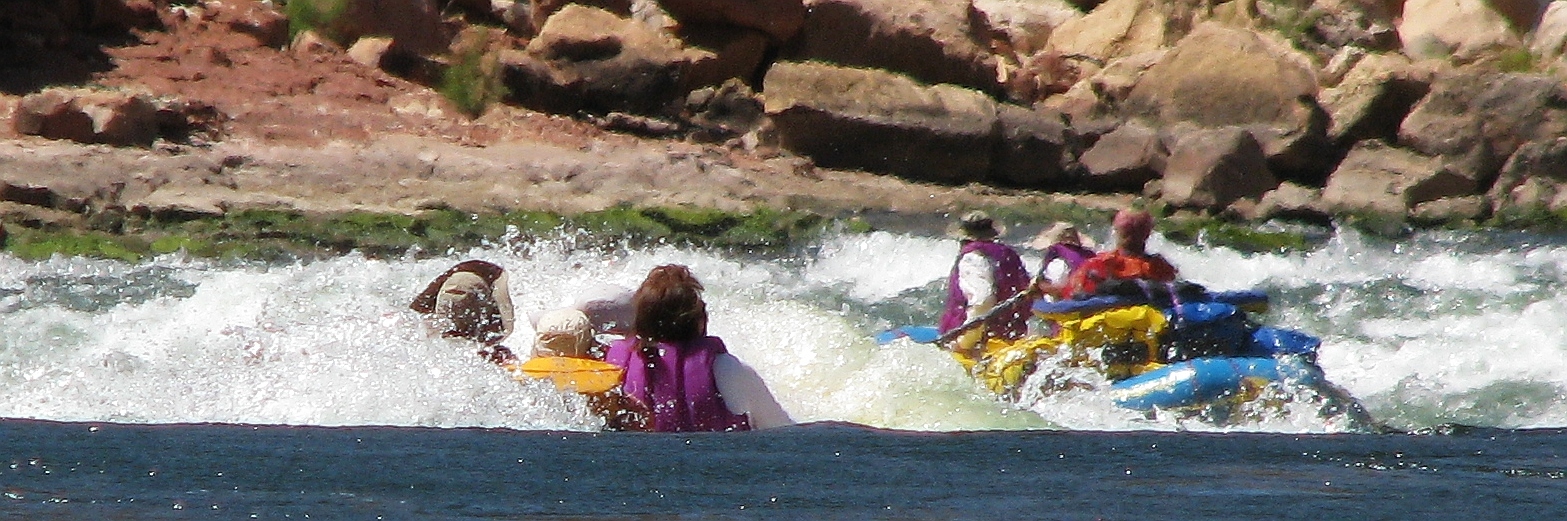
We started with an icy cold rapid. Peggy and I are in the first boat with Tom Lovering rowing— just before he lost his oar. (Photo by Don Green)

Day two starts as day one did: early.

Even the birds are sound asleep. Tom argues it’s six a.m., not the five my watch is showing. “Arizona does not honor Daylight Savings Time,” he primly informs us. He’s right. Adjusting my watch adjusts my attitude— a little.

Adding injury to insult, something akin to Folgers has been sewn up in burlap, thrown in boiling water, and called coffee.  Oh well, it’s hot, it’s brown, and we have a beautiful day of floating down the Colorado through the Grand Canyon ahead.

For those of you who like facts, here are a few about the river. At its widest point it reaches 750 feet from one bank to the other; at its deepest, it plunges down 90 feet. It flows along at a decent 3-4 mile clip but can speed up to 15 miles per hour in rapids. Since the water comes out of the base of Glen Canyon Dam, it is cold: somewhere around a frigid 46 degrees Fahrenheit during the upper part of our trip. Over the course of our adventure the river will drop 1700 feet in altitude, which is an average 8 feet per mile… 25 times that of the Mississippi River.

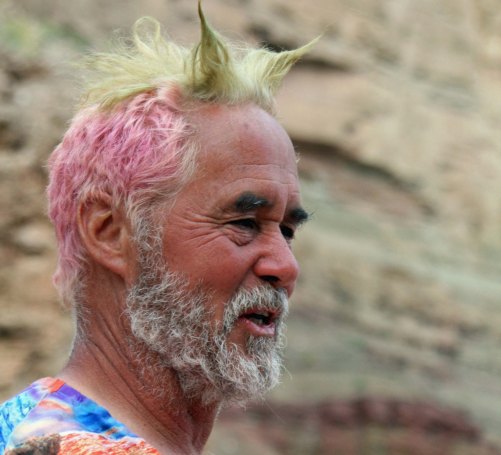
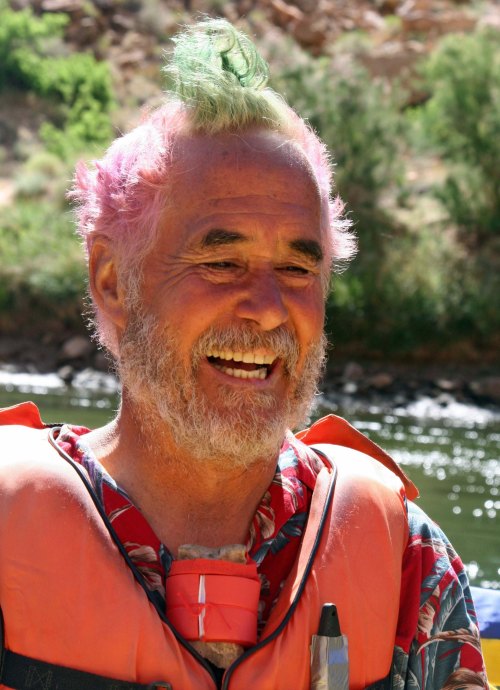
Our boatman for the day, Tom Lovering, with his wild, Canyon hairdo.

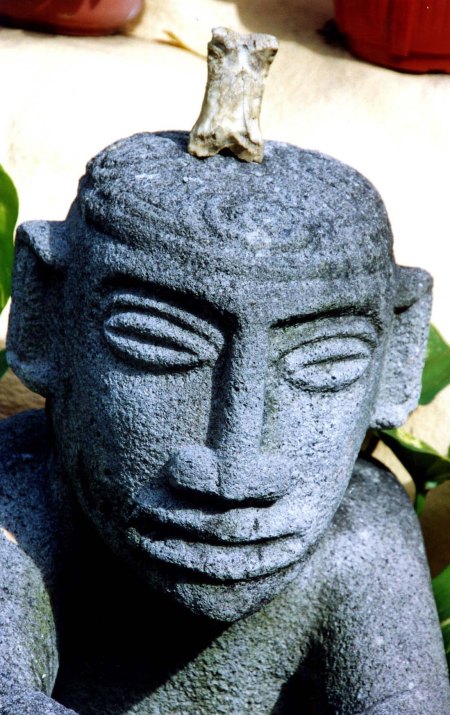
Bone on edge of Sotar Raft in Grand Canyon

Bone decides that it is time for a photo-op on the Sotar raft in the Grand Canyon. Having learned from his experience on the Amazon River, he quickly moved away from the edge…
Tom Lovering and Bone

And snuggled up with Tom.

Tom is our boatman for the day. He checks to make sure our toenails are painted and then lets us board. The wind is still blowing but it has lost its ferocious bite. A mile down the river we pass Ten Mile Rock, a prominent landmark that has fallen from the cliffs above and now juts up out of the river. Made of Toroweap Sandstone, it was laid down in shallow seas that covered the area some 250 million years ago.
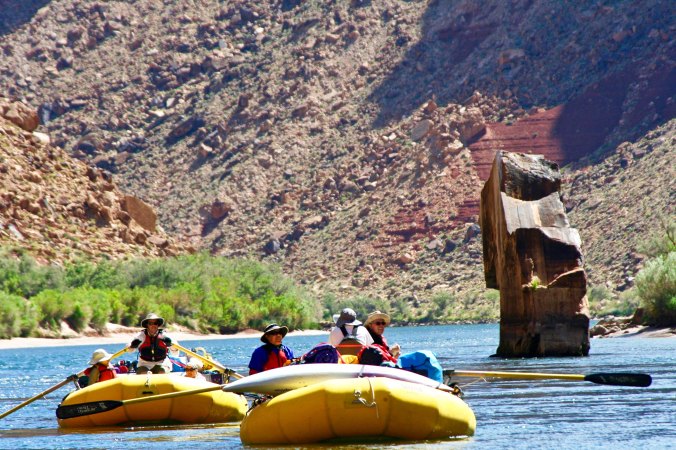
Rafters pass Ten Mile Rock on the Colorado River in the Grand Canyon

Floating by Ten Mile Rock. You wouldn’t have wanted to be near here when this massive chunk of sandstone broke off from the Grand Canyon walls high above the river.

Shortly afterwards we hear our first rapid of the day, Soap Creek. You always hear rapids before you see them; it builds anticipation. Soap Creek roars like a teenage lion. Tom maneuvers through it like the excellent boatman he is but makes sure we get suitably wet. It’s like taking a cold shower outside on a frosty morning with a 15 mile per hour wind blowing.

“I love rowing,” Tom tells us— and it is obvious he does. It is more than the heart-stopping, adrenaline-pumping moments of major rapids where the boatman’s knowledge and skill is matched against the tremendous power of the river with its dangerous rocks and grasping holes. And it is more than the opportunity to enjoy incredible beauty of the Grand Canyon that rowing provides. Tom enjoys the rhythm and the hard work. He even liked the backbreaking challenge of rowing against the wind the day before.

Don Greens ducks along the Colorado River in the Grand Canyon

Nature, like this family of ducks, also adds to the experience of rafting through the Grand Canyon. (Photo by Don Green.)
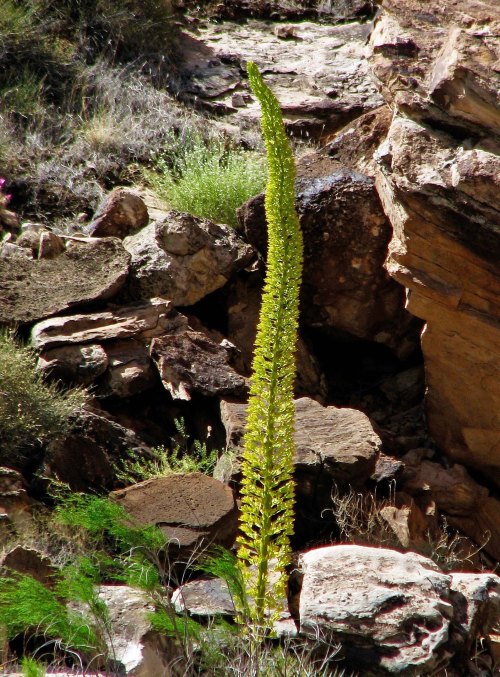
Century Plant in Grand Canyon

As do plants and flowers. This is a century plant. (Photo by Don Green.)
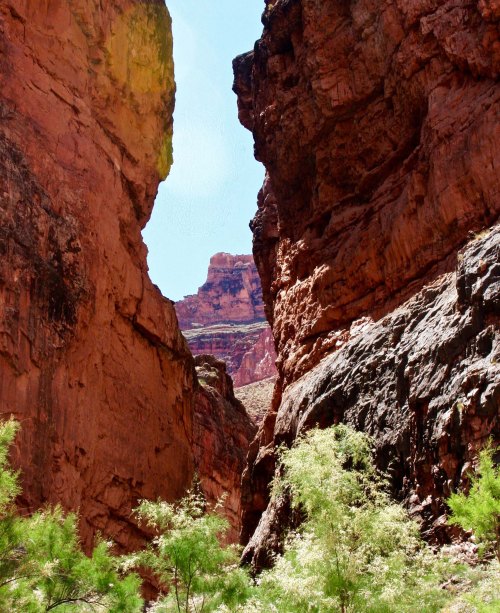
Grand Canyon canyon

Keeping a sharp eye out will reward you with views of canyons within the Canyon. Don’t you want to go exploring?

Beauty of Grand Canyon

And almost any view up or down the river is a treat.

At mile 17 we come on our first, and only, major challenge of the day, House Rock Rapid, where we learn another fact about rafting through the Canyon: water levels depend on electricity needs in the West. Peak demands require large releases of water from Glen Canyon Dam to run its huge generators. Eventually, these releases catch up with rafters. The fluctuations in water levels have significant impacts.

House Rock Rapid demonstrates one of the more serious. The river is at its low point. More rocks are exposed and a massive hole lurks downstream from the largest rock. Even the most skilled boatman will be challenged to avoid it. We all land and climb off our boats to scout the rapid. Tom is eager to move on. Steve is adamant about waiting for more water. After a long discussion between the boatmen, a decision is made to take the more cautious approach. All of our boatmen are experienced, and Steve and Tom have been down the river many times. They respect each others opinions. As with most aspects of dealing with natural forces, it is best to error on the side of caution when you have the opportunity. There are plenty of times when you don’t.

Our group worriedly scouts House Rock Rapid. Peggy shows more enthusiasm than may be called for.

We have lunch, take naps, go for walks and watch as three large boats of commercial rafters chug through the rapids with their large engines. It is mid afternoon when the boatmen finally decide that enough water is flowing to reduce the hazard to a barely acceptable risk.

Tom’s fist knocks me on the head when we are halfway through. One of his oars has popped out. I look left and all I can see is churning, raft-eating hole. We are poised on the edge— about to be sucked in! Tom becomes a virtuoso of one-armed madness.  Ever so slowly, like about a thousand years, the boat decides to go where he wants. We land, and for one of the few times in his life, my ever-talkative friend is silent.

We looked to the left and saw that we were poised on the edge of a massive hole with a rock in the middle.

The next day, Eggin Stalheim, Dave’s niece, is our boat woman. This is Eggin’s first time rowing a raft and her first time rowing through the Grand Canyon. It would seem insane except Eggin is a world-class kayaker. She is an expert at reading water. The problem is that our large, fully loaded rafts do not move like feather-light kayaks—picture driving an 18-wheel Mack Truck with a Ferrari 458 attitude. We have some adventures.
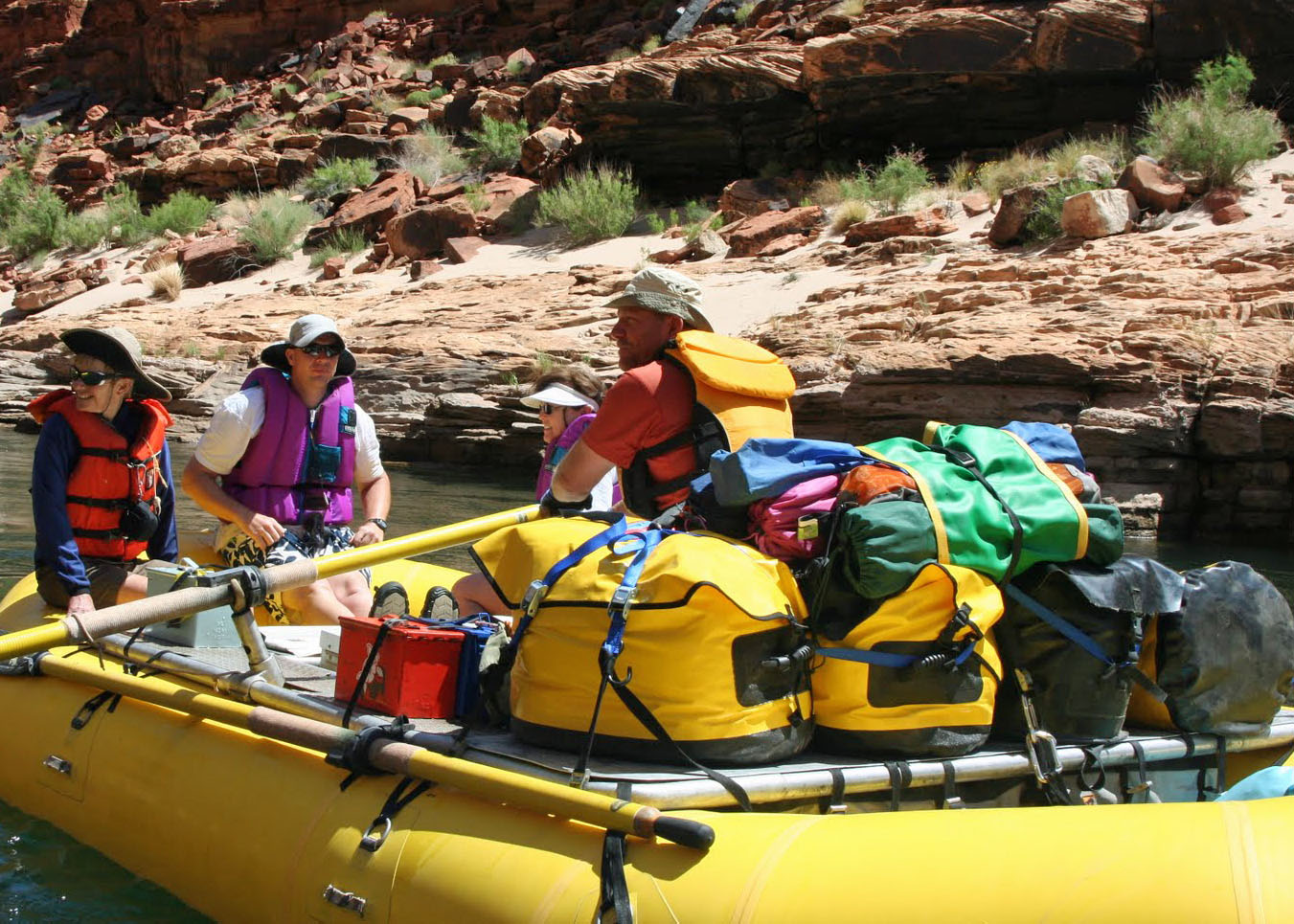
This shot of Jamie’s raft provides a perspective on what our fully loaded rafts looked like.

Eggin keeps the messy side up, however, as rafters say. (The non-messy side is the smooth bottom of the raft.) So it’s all good. Eggin, like me, has served as a Peace Corps Volunteer in West Africa. When she gets off the river she is heading for Tanzania where she will work with a women’s craft co-op.

Beyond our “kayaking” experience with Eggin, the big news on day three is that we began our side-trips. Almost all journeys down the Canyon include stopping off to see the sights. Some are quite beautiful and others provide unique challenges, as if our daily challenges of negotiating rapids aren’t enough.

Our first stop at mile 29 is the Silver Grotto, which includes both beauty and challenge. Wanting a little downtime and solitude, I opt out and take photos. Peggy tells me, “We climbed an 8 foot wall, repelled down a rock face, slogged through a murky, cold pool and slid down a 20 foot rock slide.” The rock slide was more like free-fall.
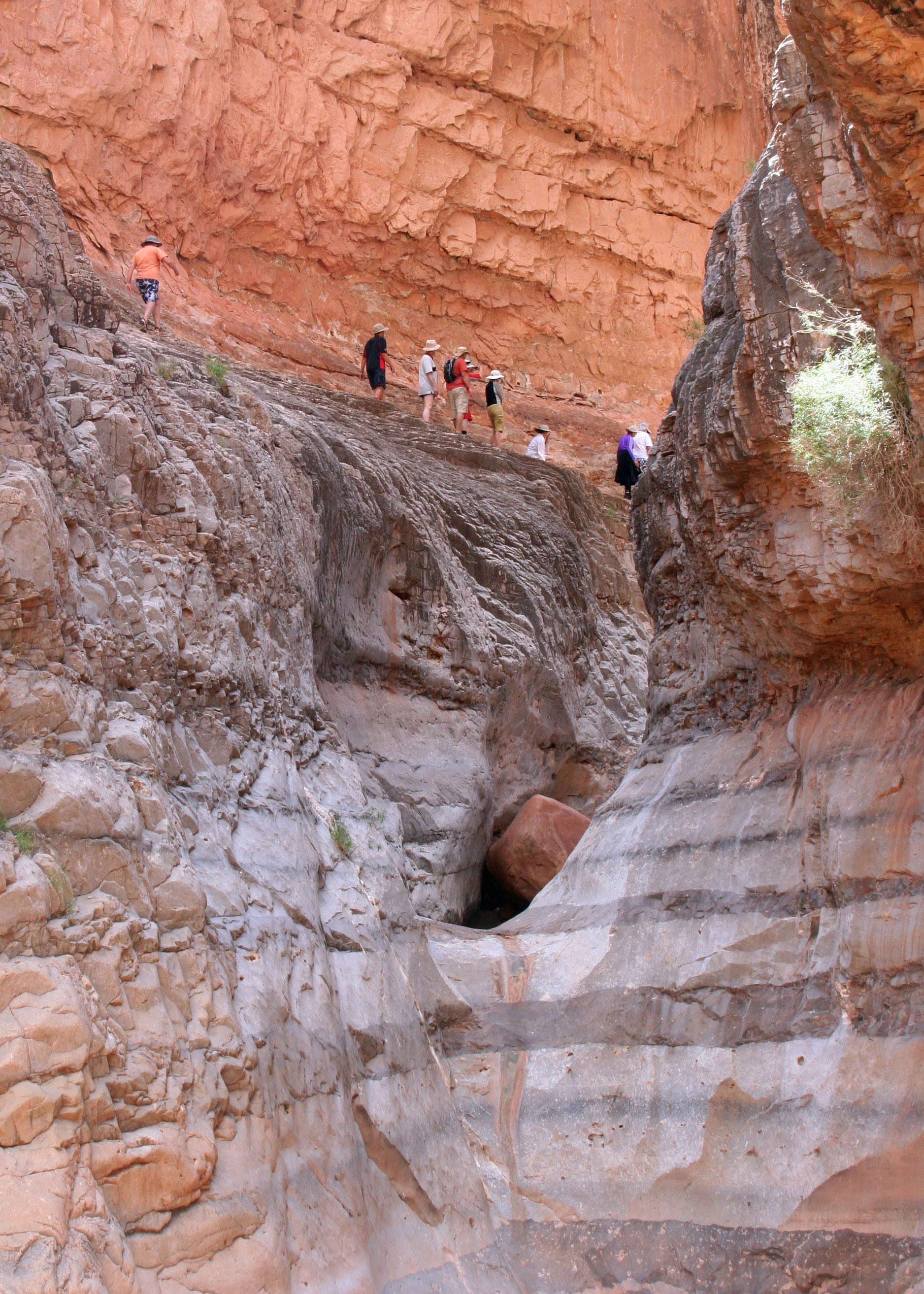
As the group disappeared into the Silver grotto, I took some much needed Curt-time.

Raven arrives on raft in Colorado

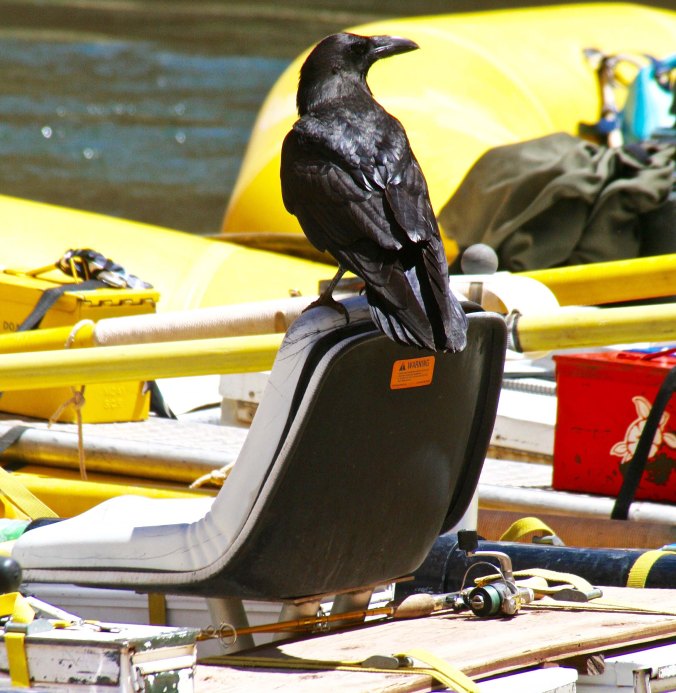
One of the Grand Canyon’s large ravens stopped by for a chat. Note how the ammunition cans were arranged on the side of the boat. This is so we could have ready access to things we might need during the day: cameras, sun block, snacks, etc.
Raven visits on the Colorado in the Grand Canyon

Having determined that I was harmless, the raven settled in on the captain’s chair. I’m sure it would have preferred that I not be there and that we had left some food unprotected.

I didn’t get a photo of our group members leaping but this is what they slid off of into the muddy water below. Water was splashed on the rock slide from a pool behind the lip to make the slide more smooth. Or so they said.

Next we stopped off at Paradise, as in Vasey’s Paradise. A beautiful waterfall shot out of a redwall cliff and created a Garden of Eden at its base. It was worthy of the name.

The waterfall shooting out of the redwall at Vasey’s Paradise, Mile 32. It’s named after a botanist that was part of John Wesley Powell’s exploration of the Grand Canyon.  The water for the falls is made up of ground water that seeps down from above and shoots out of holes in the canyon’s wall.

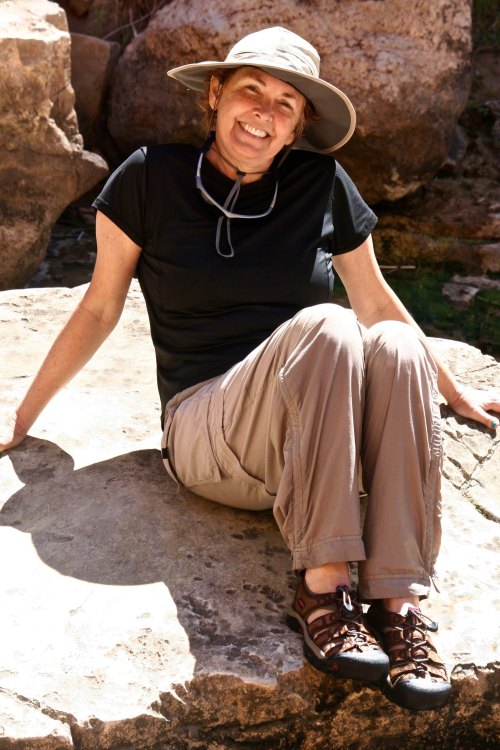
Dave Stalheim and his niece Eggin perched on a rock at Vasey’s Paradise.
Peggy Mekemson at Vasey's Paradise in the Grand Canyon

Peggy enjoys our rest stop at the falls…
Retrieving water on the Colorado

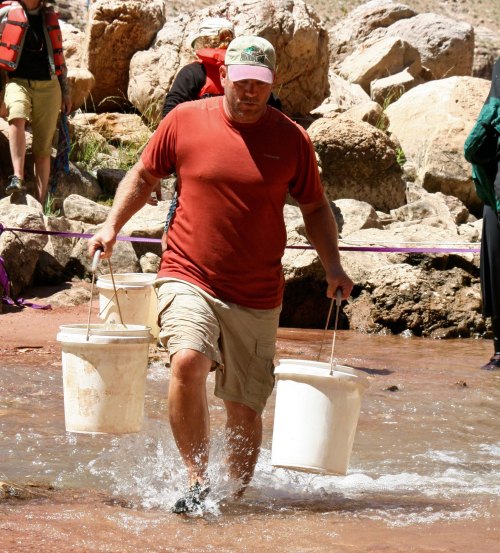
And Jamie retrieves some of the icy fresh water. Whatever work needed to be done, Jamie was always in the middle of it— a good man.

Our final stop of the day is at Redwall Cavern. Major John Wesley Powell was the first non Native American to admire the Cavern’s unique beauty. Powell was a Civil War Veteran who had lost his right arm at Shiloh. His exploratory expedition through the Grand Canyon took place in 1869. Powell thought Redwall Cavern could accommodate up to 50,000 people. Modern estimates are closer to 5000, but it is still big…

Coming around a bend in the Colorado River, we saw our first view of Redwall Cavern.

This photo provides a perspective on the sheer size and beauty of Redwall Cavern.
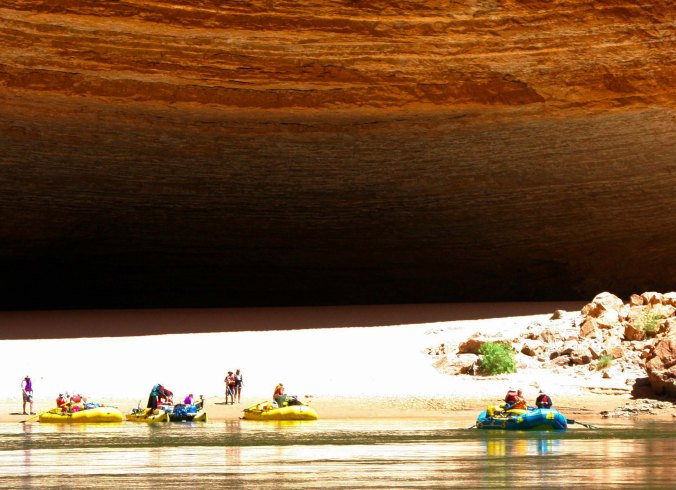
Redwall Cavern on Colorado River with rafters

As does this photo.

Cool dip in Colorado River

Several folks, including Eggin, took advantage of the river here for a cool dip.

A view of the Grand Canyon looking upriver from the Redwall Cavern for my last photo today. (A note on photos: all pictures are taken by either Peggy or me unless attributed to Don.)

Next Monday in my Grand Canyon series we will visit an ancient Anasazi storage facility high on the cliffs above the river and play in the beautiful Little Colorado River.

Wednesday’s Photo Essay POST: We begin our journey up the Alaska Highway with beautiful views and abundant wildlife.

FRIDAY’S Blog-A-Book POST: The Woods, a ten minute walk from my childhood home, teach me a love of the wilderness that exists up until today.

SaveSaveSaveSaveSaveSave

SaveSave

SaveSave

SaveSaveSaveSave

SaveSave

SaveSave

SaveSave

SaveSave

Dogs and Dragons in British Columbia… The Alaska Highway Series

Fraser River at Hope, BC

The small town of Hope in southern British Columbia features this view of the Fraser River.

Adventure travel and the 1400-mile Alaska Highway go together like biscuits and gravy. I’ve driven it five times, once by myself in 1986 when I left Alaska to return to California and two round trips with Peggy since. The last time we traveled with our friends Bob and Linda Bray. Peggy and I were on our way up to visit our son and his family on Kodiak Island where Tony was working as a helicopter pilot flying rescue missions for the Coast Guard. Bob and Linda were going to join a nephew fishing for halibut.

Bob Bray

Bob Bray and I have been friends since he looked like this…

While driving the highway isn’t the challenge  that it once was, it still gives  travelers a taste of the Far North. Over the next few weeks I’ll take you over the highway from Dawson Creek, British Columbia to Anchorage Alaska as part of my Wednesday photo essays. Today, however, we have to get to Dawson Creek. There are various ways to reach the starting point but out last trip took us from Hope, British Columbia up through Prince George, which is the route we will follow today.
Alexandra Suspension Bridge across Fraser River

We followed Canada’s Highway 1/97 out of Hope following the Fraser River. One of our first stops was to admire the old Alexandra Suspension Bridge across the river. It’s a beauty that is no longer used.

Alexandra Suspension Bridge, BC

Another perspective on the Alexandra Bridge.

Grates on Alexzandra Bridge, BC

Looking down through the grates at the Fraser River!

World's largest cross country skis, 100 mile house, BC

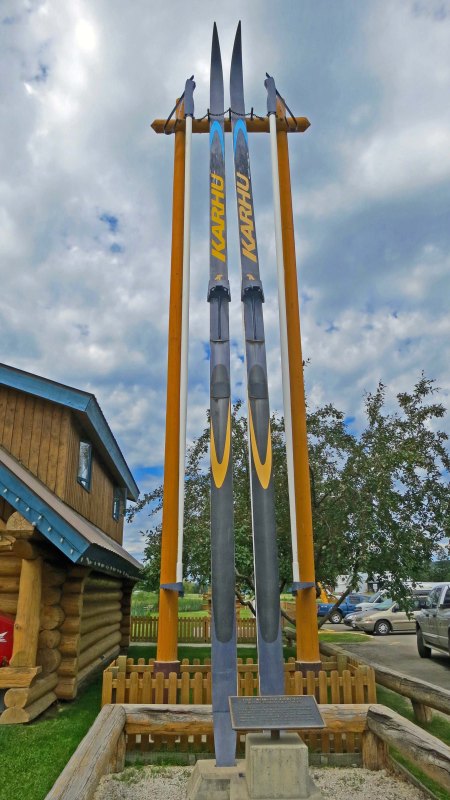
The Visitor Information Center at the 100-mile house featured the world’s largest cross-country skis! Communities throughout Canada use such fun gimmicks to capture the attention of tourists.

William's Lake Visitor's Center, BC

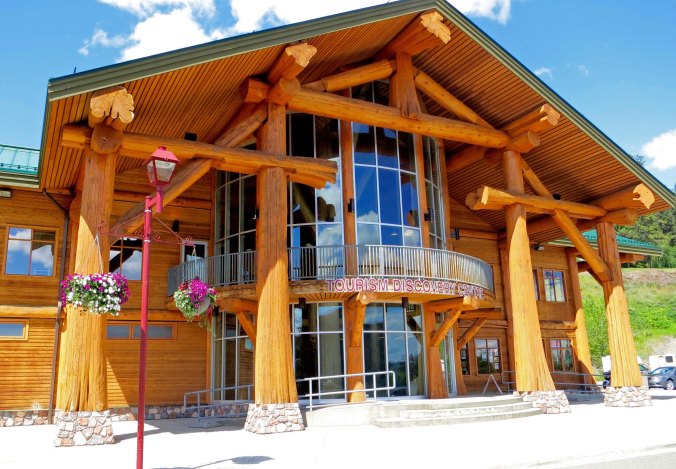
I am a fan of tourist information centers in British Columbia. In addition to being chock-full of information and friendly people, they are often beautifully done, like this example in William’s Lake.

William's Lake Visitors Center

This car in the William’s Lake Visitor Center was a spoof on how much stuff tourists load on top of their cars.

Hanging basket petunias closeup, BC

Hanging baskets of petunias were featured outside. While such baskets are common now, I first became familiar with them on a trip to British Columbia in the late 60s.

Peggy kayaking on Dragon Lake, Quesnel, BC

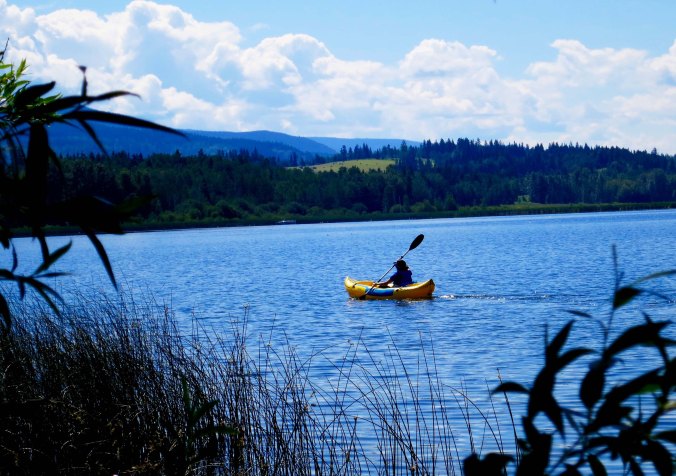
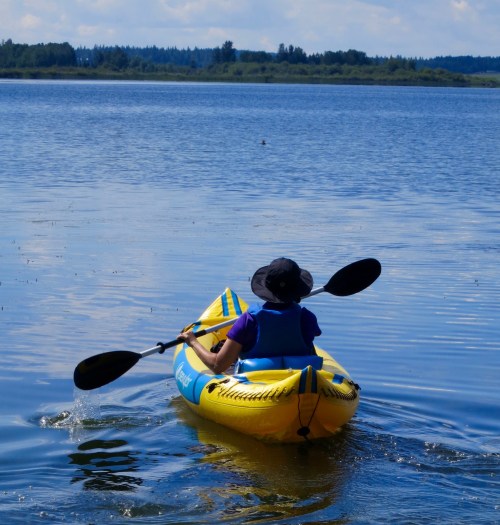
We stopped at an attractive campground on Dragon Lake in Quesnel where Peggy went kayaking to celebrate her birthday.

Peggy Mekemson Kayaking in Quesnel

A closer look.

Ducklings on Dragon Lake near Quesnel, BC

Peggy’s Birthday Parade

Weaving dog agility trials in Quesnel, BC

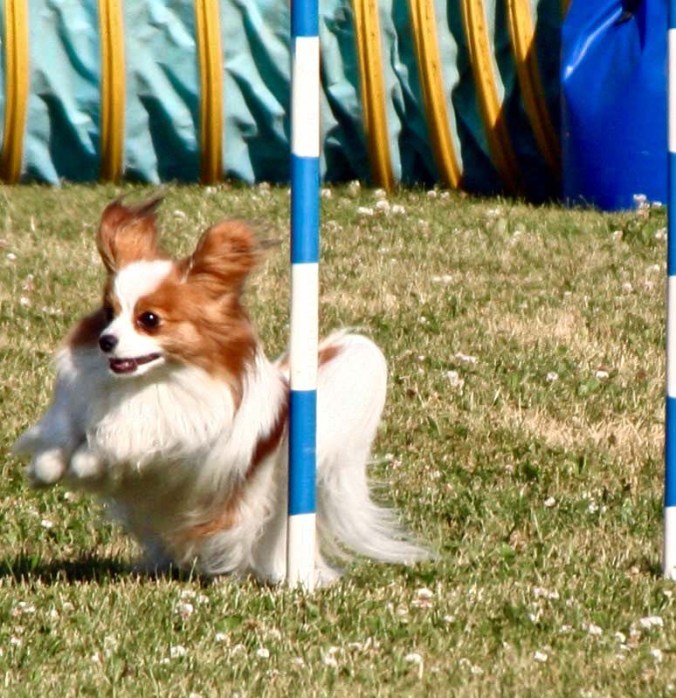
The next morning, we found the campground had gone to the dogs. We were in the middle of dog agility competition. This little fellow was weaving between posts.

Dog agility trials, jumping in Quesnel, BC

Size didn’t matter in the trials. These bars were lowered for the little fellow shown above.

Dog agility trials in Quesnel, BC tunnel

Dogs are required to maneuver through a number of different obstacles including tunnels. The clock is ticking.

Dog agility trials, across bridge in Quesnel, BC

Watching the owners was as fun as watching the dogs. The woman in pink is urging her dog along. The man running along behind is the judge.

Fraser River Valley

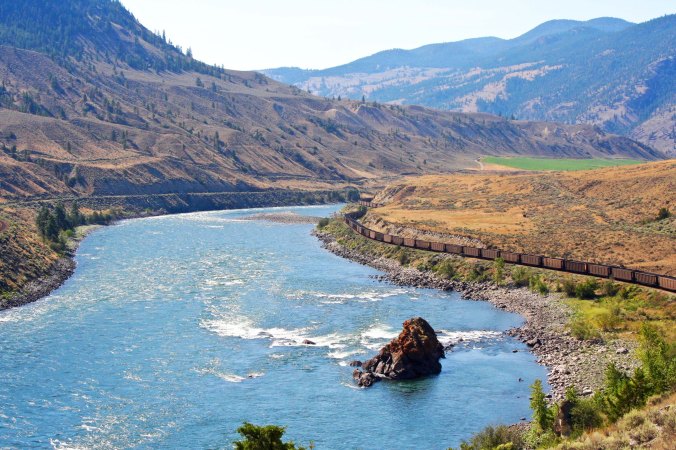
The country changes as you move into the interior of British Columbia, becoming drier.

Train tracks along Fraser River

Rivers have always served as access to the interior, first for river travel and then for building railroads and roads along.

Wood carving of Praying Mantis at Chetwyn, BC

We were in for a real treat when we came to the town of Chetwynd, which is close to Dawson Creek. Wood carvers had been at work in an international competition. This praying mantis had taken first prize but it had a lot of competition!

Pumpkin scarecrow wood carving at Chetwynd

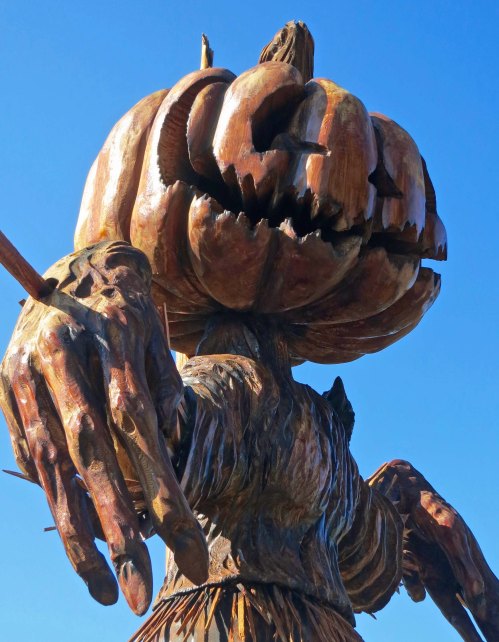
Such as this scary pumpkin head scare crow…

Drangon carving at Chetwyn, BC

And this dragon with an attitude. Or…

Dragon slayer Chetwynd woodcarving

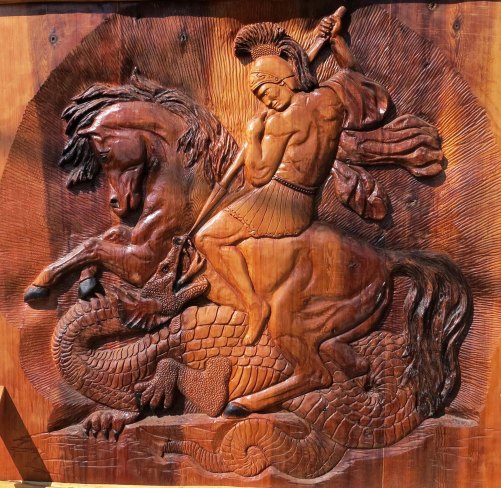
…a bas-relief of St. George slaying a dragon.

Carving at Chetwynd, BC

Or this old gold miner apparently telling you to stay out of his claim.

Scary carving at Chetwynd

I am not sure what this fellow is up to but I wouldn’t want to meet him on a dark night— or in the middle of the day.

Mile zero of the Alaska Highway

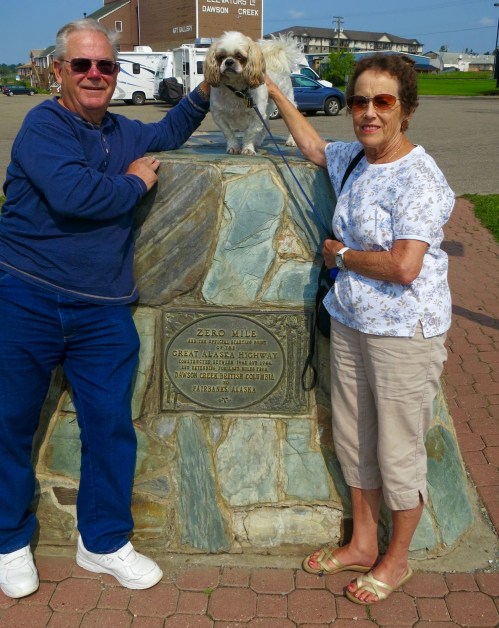
And then we made it to Dawson Creek and mile 0 of the Alaska Highway. Bob, Linda and Sister.

Sign at Beginning of Alaska Highway in Dawson Creek

Peggy and I. Next Wednesday, we begin our trip up the Alaska Highway.


FRIDAY’S POST: Another in the MisAdventures series. I abandon the Graveyard for the Pond.

MONDAY’S POST: Rafting down the Colorado River through the Grand Canyon.

WEDNESDAY’S POST: We begin our journey up the Alaska Highway.


SaveSave

SaveSave

SaveSave

SaveSave

SaveSaveSaveSave

Good Monkey; Bad Monkey… A Visit to an Eco-Tourist Lodge in the Amazon

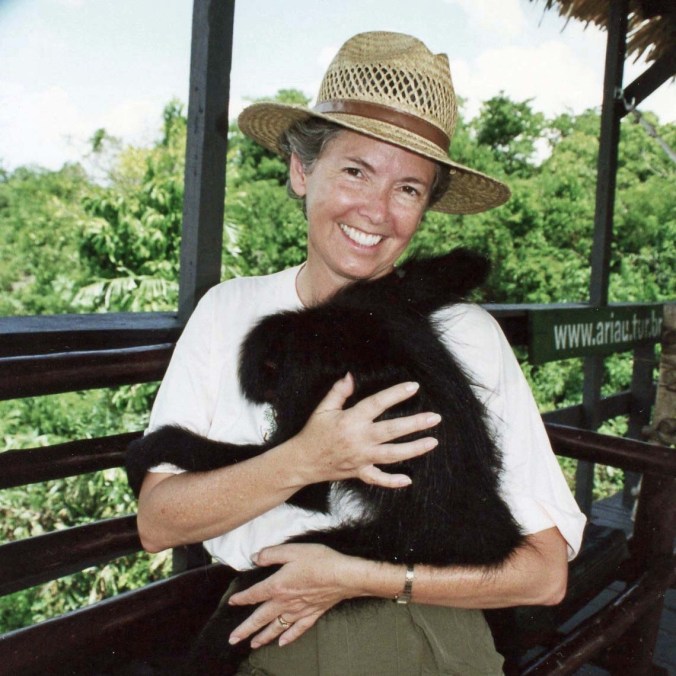
Spider Monkey hug

This spider monkey adopted Peggy. Here it gives Peggy a monkey hug. Later, Peggy wondered where all of her flea bites came from…

Spider monkey hitches a ride

Monkey hug from the back.


“The war of the future will be between those who defend nature and those who destroy it. The Amazon will be in the eye of the hurricane. Scientists, politicians, and artists will land here to see what is being done to the forest.” —Jacques Cousteau


Cousteau’s statement to Dr. Francisco Bernardino inspired him to erect the Ariau Amazon Tower Lodge in the mid 80s to accommodate the expected influx of ‘artists, scientists and politicians,’  which it did up until it was closed in 2015, attracting such luminaries as Bill Gates, Prince Charles and Jimmy Carter, not to mention the Mekemsons.

Since it was located a mere 30 miles outside of Manaus on the Rio Negro River, Peggy and I decided to visit. We ended up staying in the same room that Jimmy Carter had occupied. Today’s photo essay reflects our stay there and how we hung out with the monkeys…

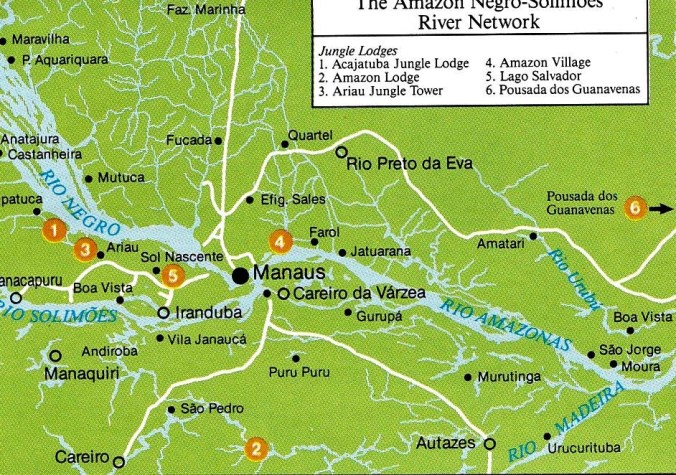
Amazon jungle lodges

The Ariau is located at number 3 on the map. We took a boat out of Manaus to get there.

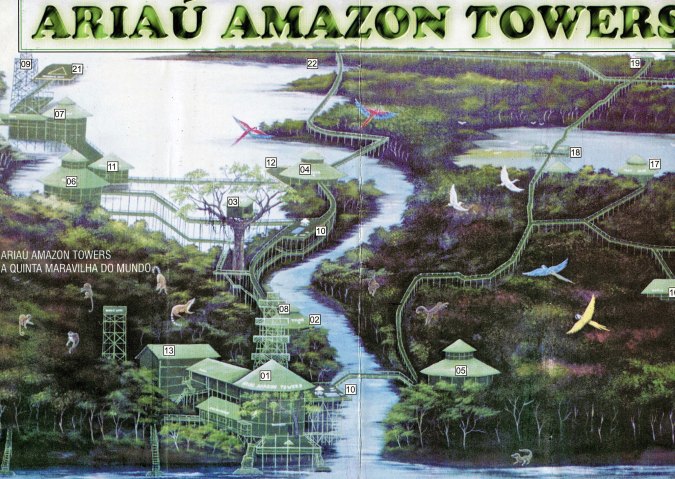
Map of Ariau Amazon Tower

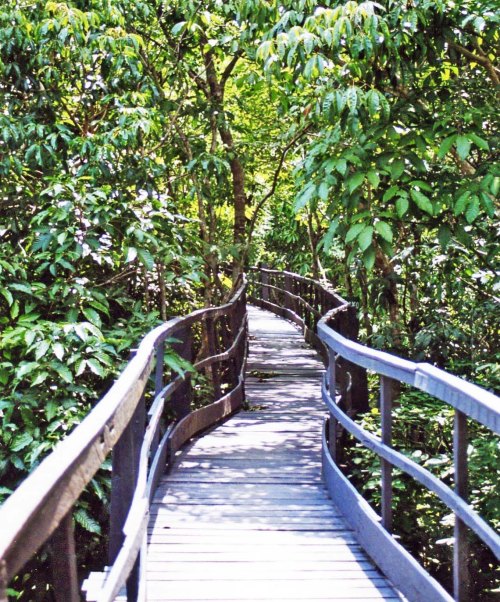
This is a map of the complex with its long walkways that wander throughout the rainforest.

Jungle walkway in Brazil

A view of the walkways. Peggy and I had a lot of fun hiking on them, whether we were accompanied by our monkey friends or not.

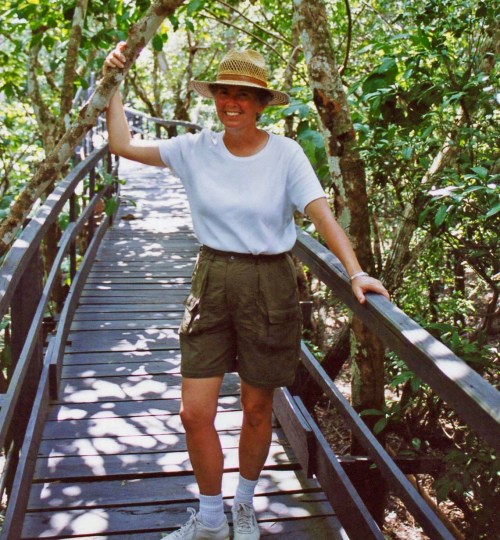
Peggy Mekemson on jungle walkway

Peggy on one of the walkways in the tree canopy.

Jungle walkway at Ariau Lodge in Brazil

Another view.

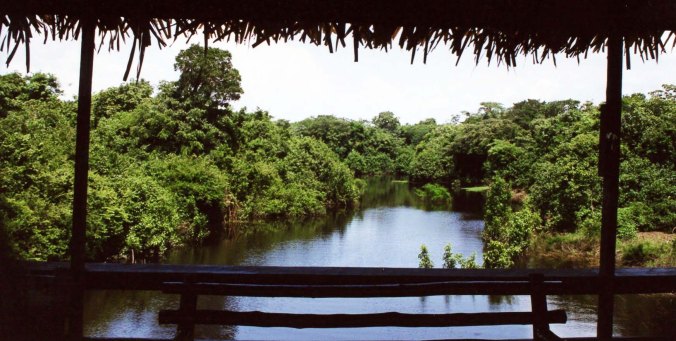
View from Ariau Lodge walkway

Looking out at one of the sights along the walkway.

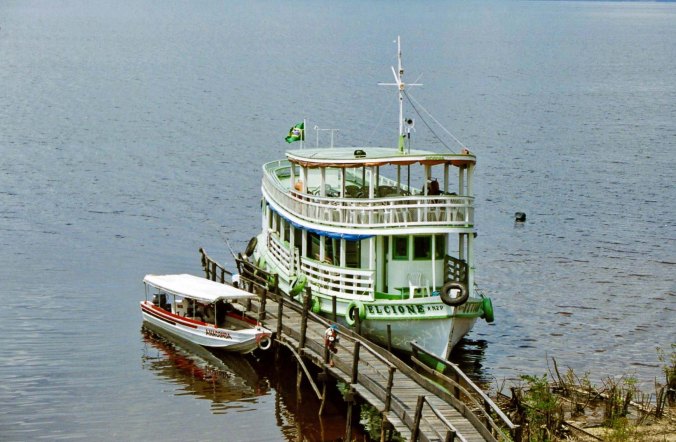
Boat on Rio Negro River

We arrived from Manaus on this double-decker boat.

Ariau Lodge pickup stick look

You didn’t want to spend a lot of time thinking about the structure. I doubt that it would meet earthquake standards. Pickup sticks come to mind.

Our room at the Ariau Lodge

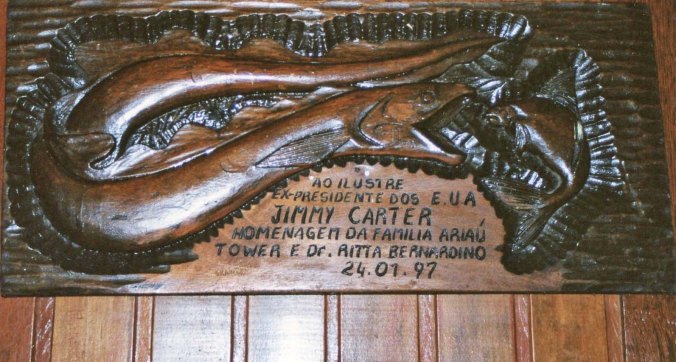
We stayed in the Jimmy Carter room. The eel reminded me of current politics. You don’t want to be a small fish.

Treehouse room at Ariau Lodge

Not to disparage Carter, who I really like, but I would have preferred to stay in the Tarzan suite shown here. It was nestled up in the top of a tall ebony tree.

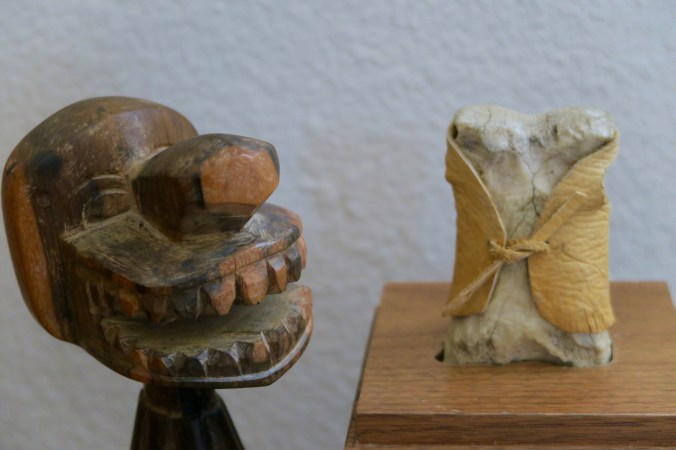
Snake tongue and Bone

Bone put in an appearance.

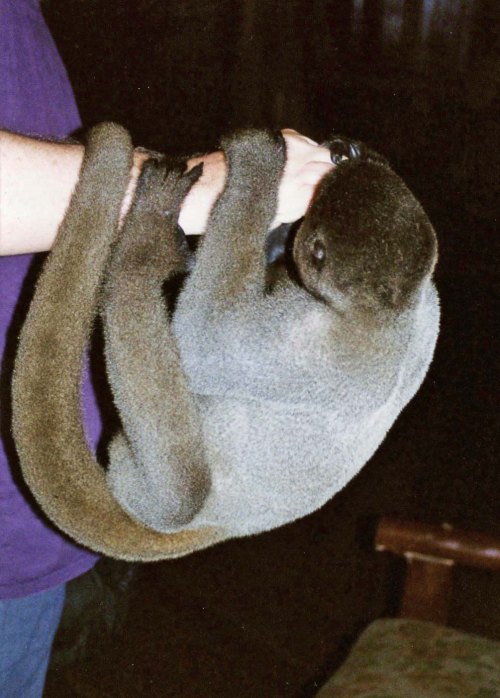
Wooley Amazon monkey

Wooly and Spider Monkeys were found around the lodge and out on the walkways. This Wooly Monkey was behaving how monkeys are supposed to behave, dangling by his tail from a tree.

Wooly monkey hat

And this one wasn’t. It isn’t my best photo. (grin) I was not happy about having a monkey for a hat!

Monkey rear view

When I suggested that he go play with an anaconda out in the jungle, he wrapped his tail around my arm and treated me to this view.

Scary monkey

And then gave me the evil monkey look…

a handful of monkey

Before threatening to take a chunk out of my hand.

Spider monkey near Manaus

Peggy got the good monkey. Given its heart-shaped face and adoring look, this seems an appropriate time to wish everyone a Happy Valentines Day!

Spider Monkey mouth

I will note that the spider monkey had an impressive set of choppers.

Peggy with spider monkey

When Peggy sat down, it settled into her lap and hammed it up for the camera..

Spider monkey in lap

Before deciding to take a nap.

Spider monkey on Peggy's lap

Monkey feet

I decided its feet and our “Travelers’ Tales of Brazil” would make a fitting photo to close my posts on the Amazon.


FRIDAY’S POST: I learn about cross-cultural relations as a second-grader— on a queen sized bed.

MONDAY’S POST: We finally start to make our way down the Colorado River through the Grand Canyon while fighting a strong headwind.

WEDNESDAY’S Photo Essay POST: Peggy and I begin a trip up the Alaska-Canada Highway, one of the world’s premier adventure-travel roads.

SaveSave

SaveSave

SaveSave

The One, the Only, the Interview with Bone….

Bone has been in many tough situations in his life; he can handle tough questions. Here he rests on top of a saguaro cactus in Arizona looking for border patrol agents. His lack of official papers, or even a birth certificate, can cause problems at times. President Trump has yet to tweet about him, however.


One of the more recent followers of this post, Gunta, was doing an Internet search on Tom Lovering a week or so ago when she came across this interview that Bone did— and laughed a lot. Again, many of you will have read this interview, but I am reposting it on behalf of the new folks who have joined my blog in the past year.


Q: Do you really talk? We’re speaking ethics here, Bone. Blogging is about transparency. That means honesty.

A. Are you crazy? Have you ever heard a bone talk? Of course I don’t talk. I just think out loud.

Q: Curt sometimes refers to you as he. Does this mean you are a male bone?

A. No. He makes assumptions, lot of them. He was showing me to a biologist at a writers’ conference and she suggested I have my DNA tested. “Just cut a small chip off of it,” she said nonchalantly. “You can determine its sex and breed.”

“Just cut a small chip off of it!Outrageous! I am not some it to have chips cut out of. Besides, I lead a rich fantasy life and have no desire to know whether I am male or female. Call me she, he, or Bone, but never it.

Um, I think Bone is definitely a male in this photo. –Curt

Q: You have travelled all over the world and met thousands of people. How do they usually react to you?

A. With befuddlement. You should have seen the look on the face of the customs agent in New Zealand who tried to seize me as ‘animal matter.’ But emotions run the gamut. There was a Japanese man who got off a tour bus at Yellowstone National Park and wanted to hold me for good luck. Soon there were 40 other Japanese handing me around, oohing, and taking photos. I was thrilled. On the opposite side, I know a woman who refuses to touch me, like I have cooties. “I don’t know where Bone has been,” she states primly. Not surprisingly, there is also jealousy. “I want to be you and travel the world,” a good friend in Sacramento told me.

Some people act like I have cooties. This woman almost dropped me and then washed her hands! –Bone

Her daughter, on the other hand, so to speak, understands proper bone etiquette and respect. –Bone

Q:  What is your favorite thing to do?

A. Visit graveyards; there are lots of old bones there. My favorite grave is Smokey Bear’s in Capitan, New Mexico. I once stood on his tombstone for ten minutes trying to communicate but all I could get was something about ‘growling and a prowling and a sniffing the air.’ A close second is the grave of Calamity Jane in Deadwood, South Dakota. What a woman! These are difficult choices, though, when you toss in the likes of Hemingway, Daniel Boone and Billy the Kid. On the light side I once visited Ben and Jerry’s graveyard of discarded ice cream flavors in Vermont. My spookiest experience was a visit to the Capela dos Ossos, the Chapel of Bones, in Evora, Portugal. Those folks definitely have a skeleton in their closet, lots of them.

Bone has a special fondness for unusual graves. Here he hangs out with Billy the Kid in New Mexico. Has he been in a shoot out? Is that blood on his vest?

Q: So, what’s your second most favorite?

A. Too hard; I am a dilettante dabbler, but here are a few.

  • Wandering, of course, anywhere and everywhere and by all modes: bikes, kayaks, rafts, skis, backpacks, sailboats, planes, helicopters, trains, cars, RVs, etc.
  • Visiting wild, remote and beautiful natural areas. I started life wandering the Sierra Nevada Mountains, John Muir’s Range of Light.
  • Seeking out the strange such as ghosts and aliens (I’ve been to Roswell four times).
  • Attending unique events like Burning Man but I also have a fondness for any type of fair.
  • Meeting weird people like Tom.

Bone backpacking on the John Muir Trail.

Tom being eaten by a bony desert monster.

Q: Speaking of Tom, he and Curt ‘discovered’ you in 1977 and you have wandered extensively with both. Which do you like best?

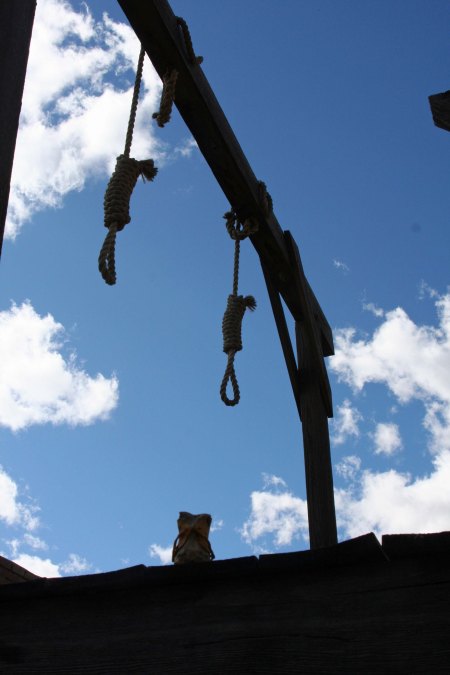
A. Eeyore, the jackass who can’t keep track of his tail. We’re traveling companions and he saved me from being strung up and buried on Boothill in Tombstone, Arizona. I’d robbed a bank, cheated at cards and hung out with women of questionable character. (This is what I mean by having a rich fantasy life. It’s also known as evasion.)

“I was in deep trouble in Tombstone. Wyatt Earp had arrested me for robbing a bank and Doc Holiday was checking me for weapons.”

“My life as Bone was in serious jeopardy.”

“Odds were I was going to end up on Boothill, along with Billy Clanton.”

“But then the ever brave Eeyore came to my rescue! I hopped on his back and we went riding off into the sunset while leaping over large rocks.”

Q: Which of your journeys has been most memorable?

A. I would have to say traveling the length of Africa in the back of a truck from the Sahara Desert in the north to Cape Town in the south. Almost falling off the back of a riverboat into a piranha infested section of the Amazon River would have to be a close second. I was perched on the back railing doing a photo shoot. And then, of course, there was the 10,000-mile bike trip.

“I was much smarter when I rafted down the Colorado. I wore a life jacket!”

“That didn’t protect me from pirates. The dreaded pirate Steve held a knife to my throat and demanded to know where I buried my treasure.”

Q: You are often seen scrambling over rocks in remote sections of the Southwestern United States. What’s that all about?

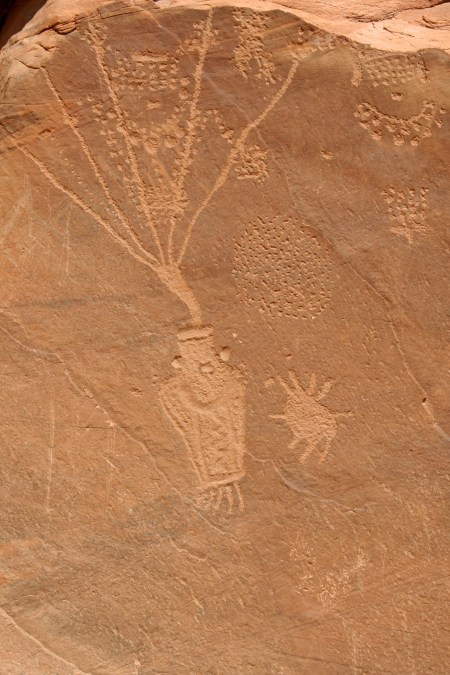
A. I’ve developed a fondness for Native American Rock art. It resonates with my bone-like nature. It’s also another excuse to go wandering around in the outdoors. Plus, some those places might be haunted and it is a great place to look for UFOs. Some of the petroglyphs look amazingly like aliens. Finally, wandering in the desert is known to be good for the soul. Ask the Prophets of yore.

“How can this guy and his strange dog not be aliens?”

“Here I am making tracks across White Sands National Monument in New Mexico. It’s a great place to watch out for UFOs.”

Q: Ah, being a born-again bone, do you have any insights into the great unknown?

A. Ommmmmmmmmmmmmmmmmmmmmmmmmmmmmmmmmmmm.

Q: Finally, and this may be a little sensitive, but do you always run around naked?

A. What kind of a question is that? Do you think I am uncivilized? For shame. I am the epitome of haute couture! A bow and arrow toting, card-carrying NRA member in Montana has designed and made me two leather vests. What’s more, an 80 plus year old woman in Kansas going on 20 with a crush on Johnny Depp and a room devoted to the Egyptian gods has made me a kilt and several other outfits. Then there is the horse woman actress in Ohio whose husband is an ex-secret service agent who has promised me an outfit and the artist head of a PR firm in the Bahamas who has promised me another. Face it; I am hot stuff, clothed or naked. I may take up a modeling career.

Rod Hilton fashions a new leather vest for bone.

“My Bahamian/Canadian friend makes me a new vest in the wilds of Montana.” 

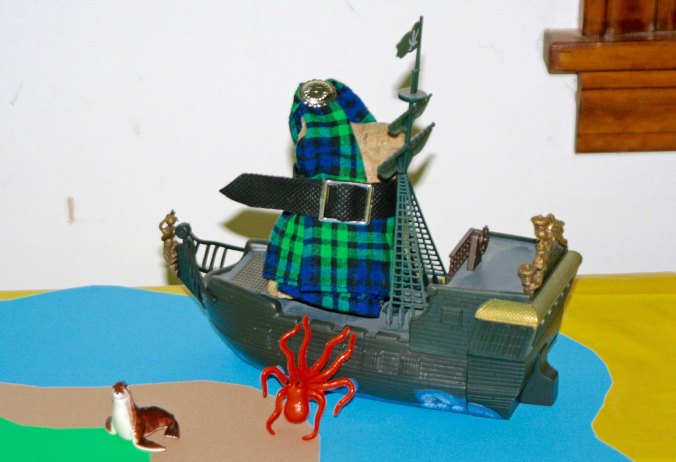
Bone, wearing his newly made kilt, fights off a ferocious sea monster in a scene straight out of ‘Pirates of the Caribbean.’

MONDAY’S POST: Back to the Grand Canyon.

The History of the Bone… Forty Years and Still Wandering

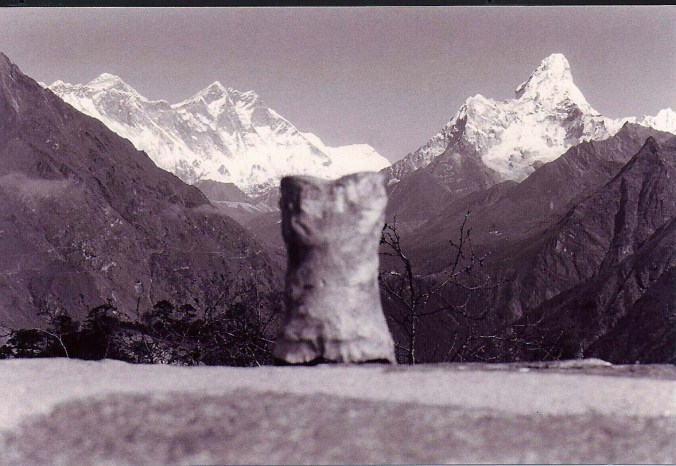
Bone has travelled twice to the base of Mt. Everest.

Since Bone played a prominent role in our raft trip down the Colorado River through the Grand Canyon, I decided to republish his history and an interview he did. This is mainly for the folks who follow my blog and aren’t familiar with his exploits. Many of you will have read today and tomorrow’s posts.

Sometime in the 1900s Bone started his life as part of a horse wandering through the Sierra Nevada Mountains. The horse was allegedly eaten by a bear. Bone ended up in a high mountain meadow practicing Zen and being nibbled on by a miscreant rodent.

1977: He was ‘discovered’ by two lost backpackers (Curt Mekemson and Tom Lovering) on the Tahoe Yosemite Trail above Lake Tahoe and launched his career of wandering the world.

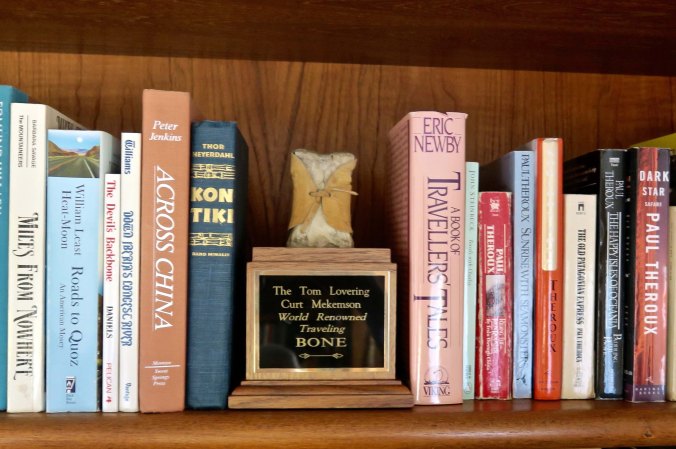
Normally, Bone likes to hang out in our library at home. His favorite section is travel.

He also has a fondness for George, the Bush Devil who is on the cover of my book, “The Bush Devil Ate Sam.” Here, the two of them share a laugh.

1980-81: Bone commenced his first World Tour with Tom.  He visited Asia including Japan, Hong Kong, Bombay, Delhi and Katmandu where he trekked to the base of Mt. Everest. He then wandered on to spend spring and summer in Europe stopping off in Greece, Spain, Portugal, France, Italy, Austria, Liechtenstein, Luxembourg, Germany, Belgium, England and Ireland. Getting cold, Bone headed south and hitched a ride in back of a truck through Algeria, Niger, Chad, Nigeria, Cameroon, Central African Republic, Zaire, Sudan, Kenya (where he crossed the Equator), Tanzania, Zambia, Zimbabwe, Botswana and South Africa. He signed on with Tom as crew of a sailboat in Cape Town and headed north to Mallorca, stopping off on the islands of St. Helena, Ascension, Cape Verde and Madeira. Back in Europe he explored his possible Viking roots in Sweden, Norway and Finland.

1983-86: Bone assumed Cheechako status and moved to Alaska with Curt where he was stalked by a grizzly bear on the Kenai Peninsula, explored Prince William Sound by kayak, learned to winter camp in 30 degree below zero weather while listening to wolves howl, backpacked in the Brooks Range north of the Arctic Circle, and discussed the finer points of eating salmon with Great Brown Bears in Katmai National Park. He escaped briefly to the warmer climate of Hawaii and participated in New Orleans Mardi Gras.

One look at this fellow and Bone decided that he wanted to be elsewhere.

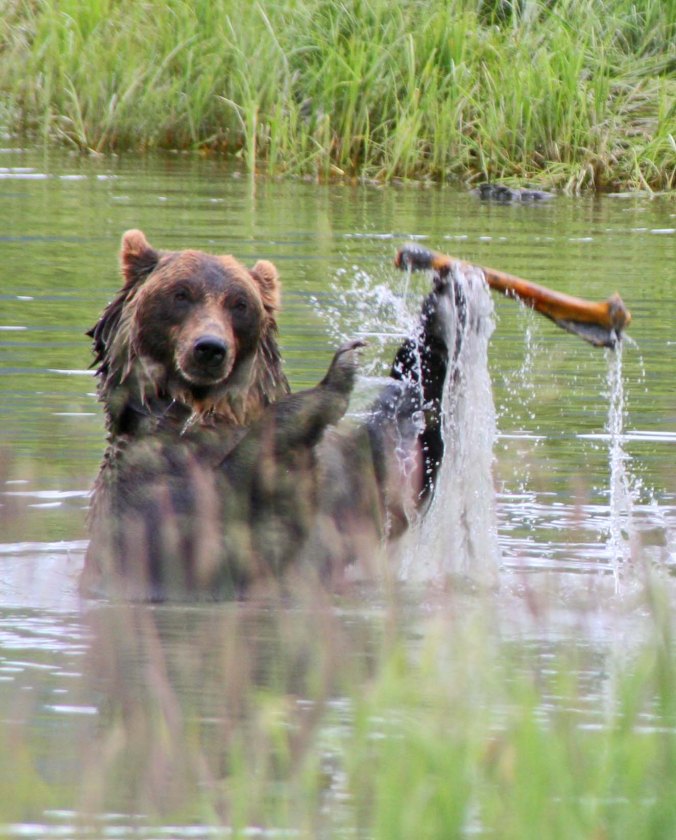
Alaska Brown Bear playing with moose bone.

The big guy was playing with a distant cousin of his.

1986: He backpacked the Western US for five months with Curt exploring the Grand Canyon, the Gila Wilderness of New Mexico, the Rockies, and the Wind River Mountains of Wyoming before returning to his beloved Sierras.

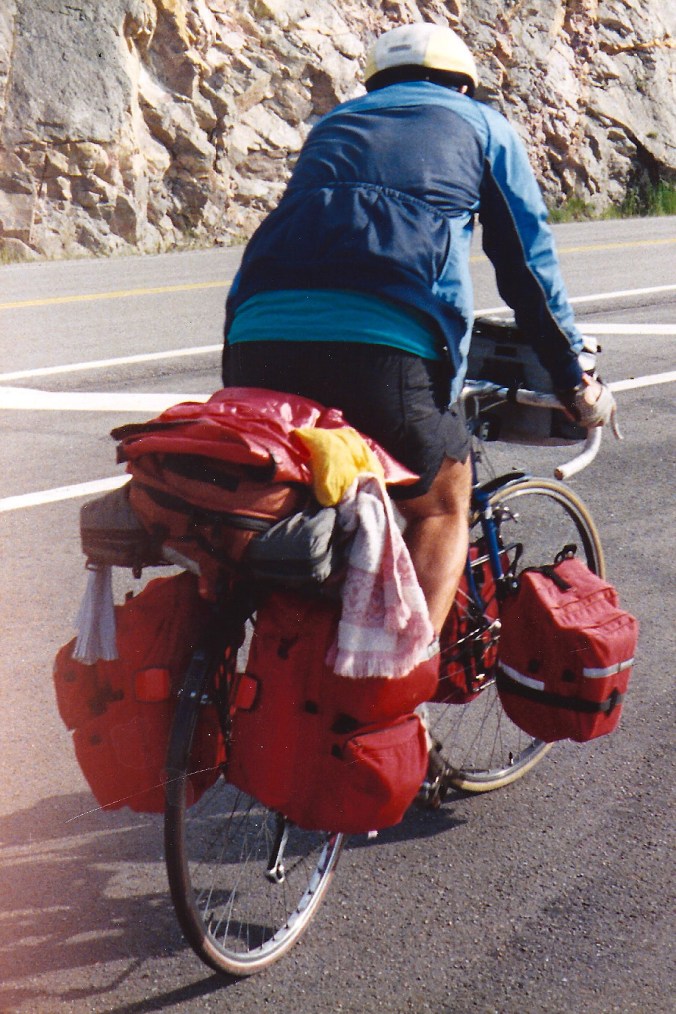
1989: Bone went on a six month 10,000-mile solo bike tour with Curt around North America visiting 18 states and 4 Canadian provinces. He ended his journey by meeting Peggy.

In the spring of 1989 I left Sacramento on my bike for a 10,000 mile solo trip around North America. Everything I would need to survive for six months on the road was packed on my bike, some 60 pounds of gear. It wasn’t totally solo. Bone was riding in my handle bar bag.

1990: The International Society of the BONE was formed at Senior Frogs in Mazatlan, Mexico, where Bone spent the afternoon being pickled in a pitcher of margaritas and being kissed by lovely senoritas.

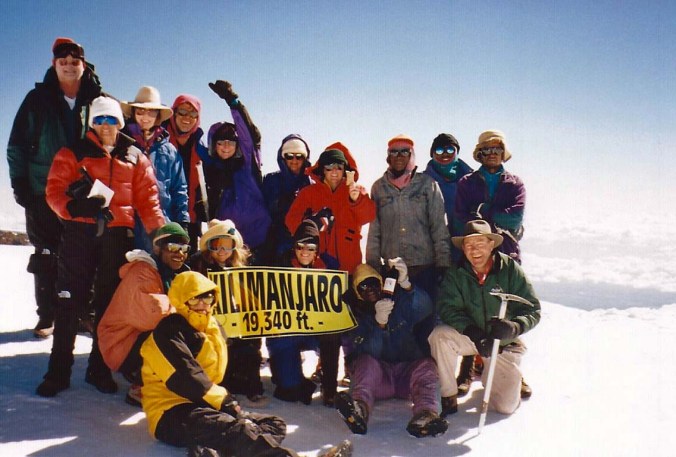
1991-97: Various members of International Society accompanied Bone on numerous adventures. Highlights included a White House Press Conference with Bill Clinton, being blessed by the Pope in St. Peter’s Square, visiting with Michelangelo’s David, going deep-sea diving in the South Pacific and Caribbean, doing a Jane Austin tour of England, and exploring the Yucatan Peninsula. A group adopted him as a good luck charm and took him back to visit the base of Mt. Everest one year and to climb Mt. Kilimanjaro another.

Bone loves high places. Here he is on top of Mt. Kilimanjaro in East Africa. (He’s with MJ, fourth from right, standing.)

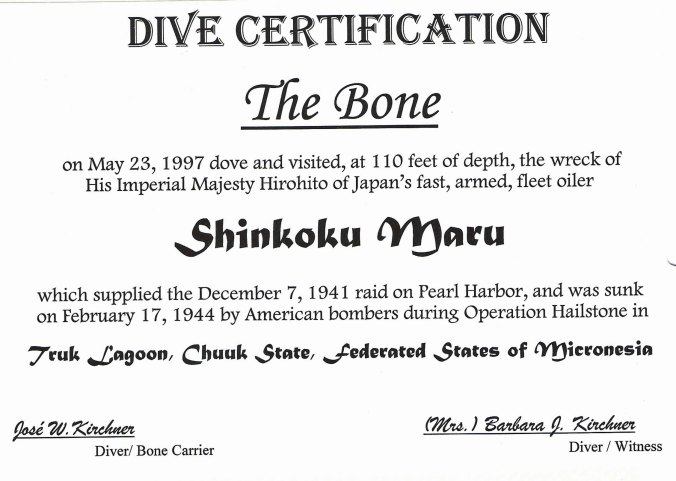
Bone went diving in the Pacific in 1997 with Jose and Barbara Kirchner, visiting a Japanese ship sunk during World War II and receiving his diving certificate.

1998-99: Bone embarked on 40,000-mile journey in the van, Xanadu, through the US, Canada and Mexico with Peggy and Curt, visiting over 30 National Parks, driving the Alaska and Baja Highways, checking out Smokey the Bear’s and Calamity Jane’s graves, kayaking in the Sea of Cortez, leaf peeping in Vermont, jetting to the Bahamas, pursuing flying saucers in Roswell, New Mexico, and completing his visits to all 50 states, etc. etc. etc.

Bone was quite impressed with the size of his ancient relatives. Here he rests on dinosaur toes at the Dinosaur National Monument Visitor Center.

2000-02: Bone journeys up the Amazon, returns to Europe, cruises to Belize, Cancun and the Cayman’s, and goes to New Zealand where a misguided customs agent tries to arrest and jail him as animal matter.

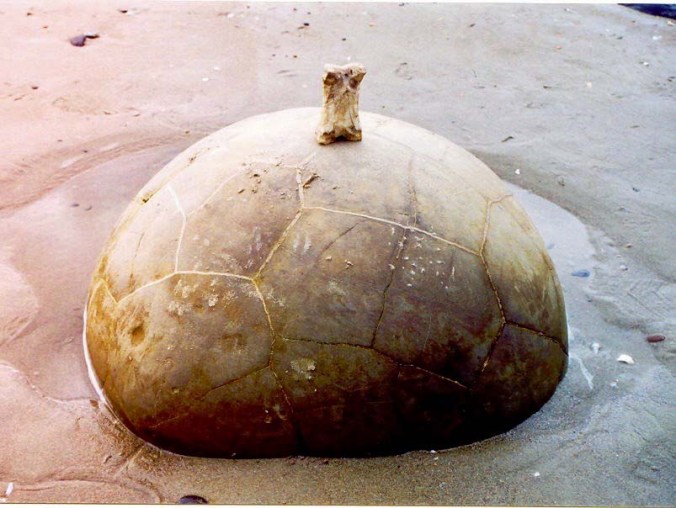
Peggy and I found this mudstone concretion in New Zealand on a South Island beach. Bone, who likes strange things, insisted on having his photo taken with it.

2003: Bone undertakes a 360-mile backpack trip in celebration of his discovery and Curt’s 60th birthday. They begin at Squaw Valley near Lake Tahoe and end by climbing Mt. Whitney. Various friends join them along the way.

Bone got a little high when he helped me celebrate my 60th birthday,  which isn’t surprising considering  he is a California bone.

2004: Bone visits Hemingway’s grave in Idaho, goes horseback riding with Australians and Bahamians in Montana, and makes his first pilgrimage to Burning Man in Nevada, a very Bone like type of place. He also jets off to Costa Rica.

Bone has a love for anything ancient. Here, he perches on a Mayan sculpture in Costa Rica.

2005-2007: Bone returns to Burning Man twice and revisits Europe twice including special stopovers in Portugal, France, Holland, Germany, and Belgium. He also revisits Mexico.

2008 – 2011: Bone commences another exploration of North America. This time he travels in the van, Quivera, along with Curt, Peggy, and Eeyore the Jackass. His journey takes him over 75,000 miles of American Roads. In May of 2010 he helps Curt initiate his blog, and rafts 280 miles down the Colorado River through the Grand Canyon.

2012-2017: Bone goes into semi-retirement in Southern Oregon. Please note the semi, however. He continues the exploration of the West Coast ranging from Big Sur to Vancouver Island, where he kayaks for a week in search of Killer Whales. He wanders through England and Scotland helping Curt find his roots and spends a week traveling by Canal Boat. Later, he returns to Europe again, traveling through the Mediterranean visiting Turkey, Santorini and other Greek Islands, Dubrovnik, Venice, Rome, Pompeii, Florence, and Barcelona. He returns to Burning Man several times.  On one trip, he is married to the lovely Bonetta, who he met while exploring a swamp in Florida. Rumor has it that it was a shotgun wedding. This past year he traveled with Peggy and me on our 10,000 mile trip around North America retracing my bike route and with fellow blogger Crystal Truelove to visit with Native Americans of the Cherokee Nation in Oklahoma.

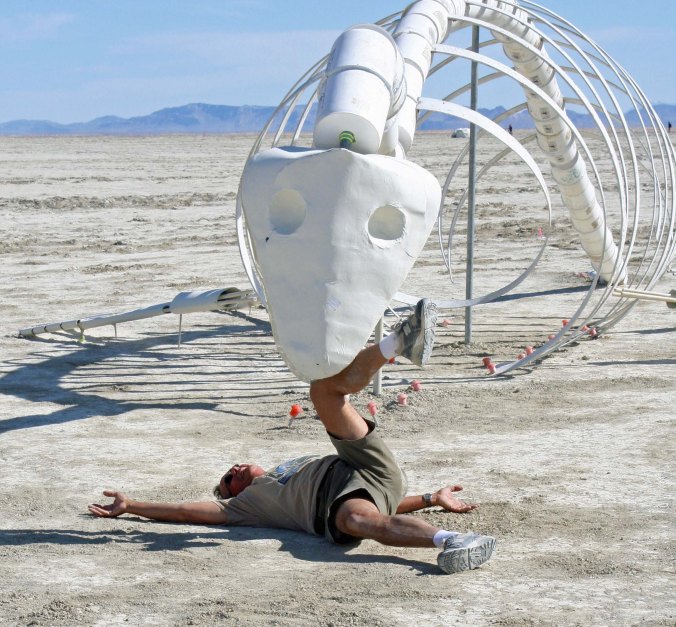
Burning Man is one of Bone’s all-time favorite activities.

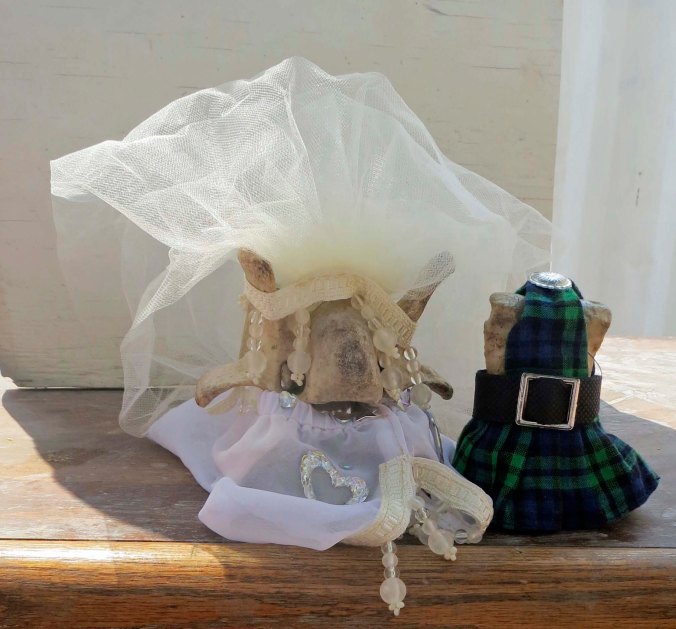
Bone and Big Nose Bonetta are married at Burning Man 2013. Bone’s kilt was made for him by an 80-plus year old woman from Kansas. Bonetta is wearing a designer wedding dress with very expensive plastic jewelry to match.

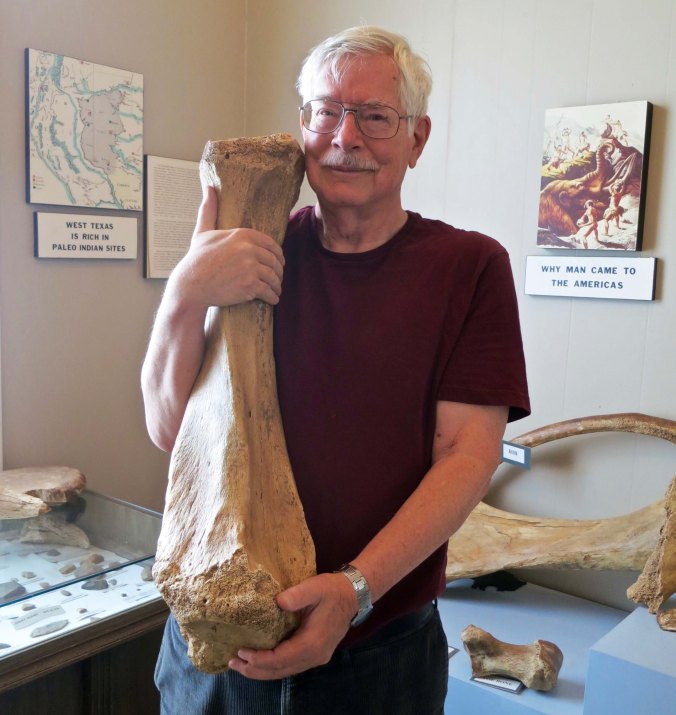
Bone got a wee bit jealous when I snuggled up to this mammoth of a bone when Peggy and I were re-visiting by van my 1999 10,000-mile bike trip last year.

TOMORROW’S POST: You won’t want to miss the interview with Bone!

SaveSave

SaveSave

Up Close and Personal with Piranhas on the Amazon River… The Wednesday Photo Essay

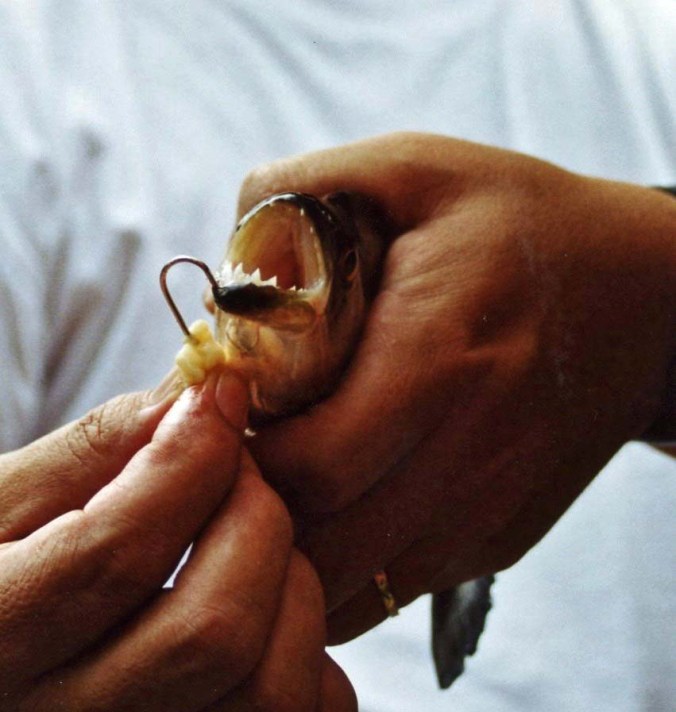
Fishing for piranhas

How do you take the hook out of a piranha’s mouth. Carefully! When one fell off the hook into the bottom of our boat and started flopping around and snapping its teeth, all feet immediately went up into the air.


It’s photo Wednesday and today I will be featuring a trip that Peggy and I took up the Amazon. It was the pre-digital age and the photos produced by our camera weren’t quite as clear as we produce now, but I felt we did a fair job of capturing our experience. Enjoy.

Whenever I think of the world’s great rivers, associations pop into my mind. The Mississippi immediately throws me back into early American history with Mark Twain and riverboats. The Nile takes me even further back in time to Ancient Egypt and pyramids. I think of Hindus plunging into frigid waters when I picture the Ganges. The Yangtze or Cháng Jiāng carries me off to the heart of China and the ‘mysterious East.’ The Danube makes me want to get up and slow-dance— thank you Strauss. And, I imagine exotic adventures when I think of the Congo or Niger. All of this relates to the fact that I am an incurable romantic fascinated with both history and adventure.

But nothing spells exotic for me like the Amazon. The river with its 1,100 tributaries provides a seemingly infinite number of opportunities to get lost. One could easily spend a lifetime exploring the river and unlocking the secrets of the massive rainforest the river and tropical rains supports. More than 20% of the world’s oxygen and fresh water comes from the region. And it is one of the world’s richest centers of biodiversity.

Amazon parrot

One third of the world’s birds, some 1500 species, can be found in the Amazon. This parrot stopped by for a visit. Every evening large numbers would fly between the trees in the forest canopy.

Curt Mekemson searching for wildlife on Amazon River

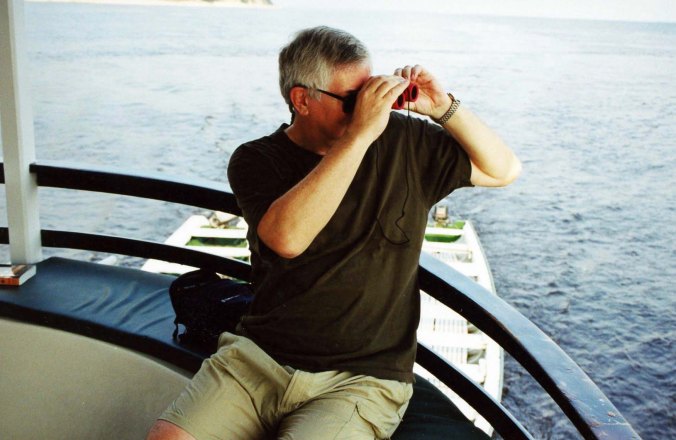
I spent a lot of time checking out the shores and canopy for birds and wildlife.

Catpillars on tree in Amazon Rainforest

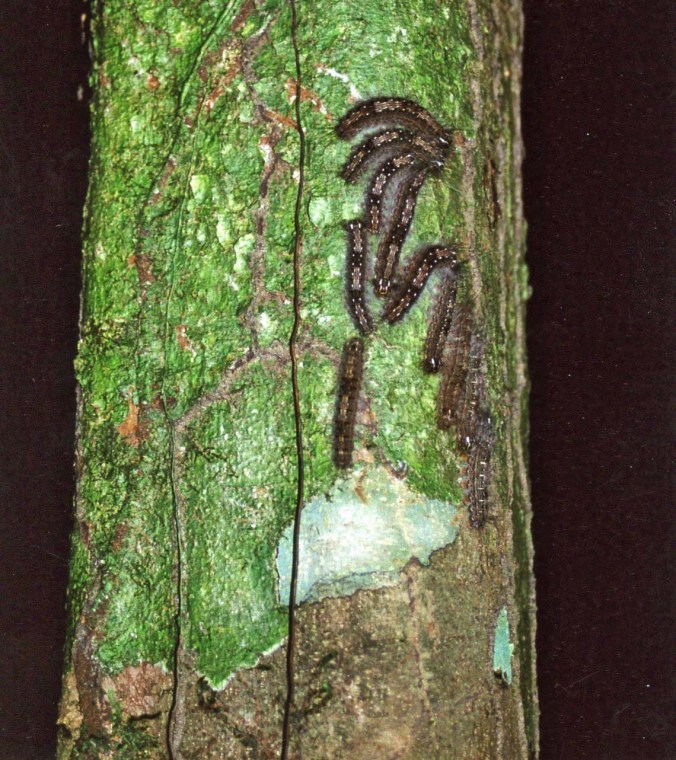
Our trips ashore introduced us to some of the more exotic insect life such as this parade of caterpillars that somehow reminded me of a dancing Kokopelli from Native American mythology. All that was lacking was his flute.

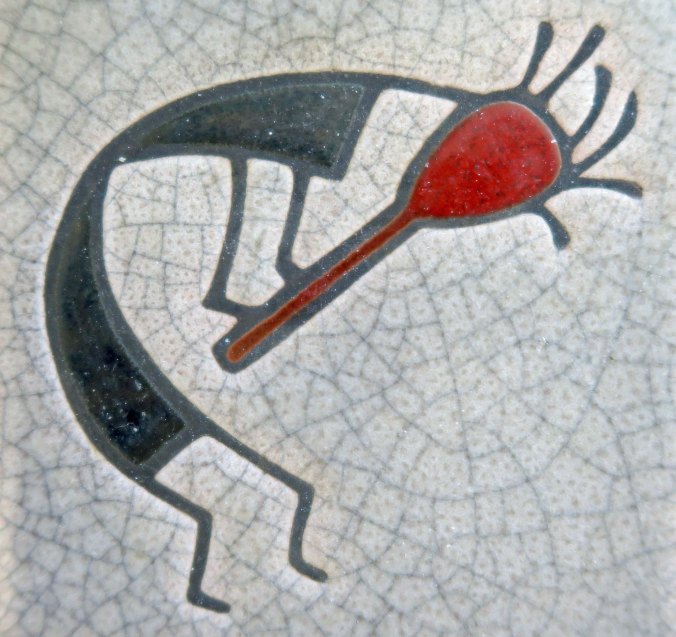
Kokopelli

Kokopelli playing his flute as he appears on a drink coaster of ours. The girls were said to go crazy over him.

Peggy and my journey into the Amazon was tame as such adventures go. Still, we managed to work in a five-day river boat trip out of Manaus and a stay at a tree house lodge up in the rainforest canopy where we hung out with monkeys and slept in a bed that Jimmy Carter had once occupied. Our riverboat trip introduced us to the rainforest plus gave us a slight flavor of life on the river— including fishing for and eating piranhas. It was the law of the jungle: Eat or be eaten. (Grin)

On today’s photo essay, I will feature our river boat trip. Next week, we will hang out with the monkeys.

Amazon Clipper on tributary of Amazon River

Our boat, the Amazon Clipper, settled in for the night on the Rio Negro. Our crew would tie it off to trees in the rainforest.

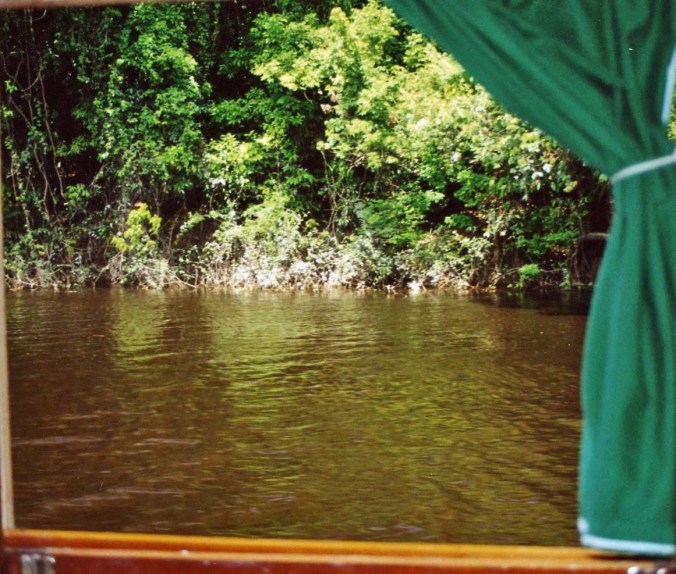
View out window of river boat on the Amazon

The view out our port-side window.

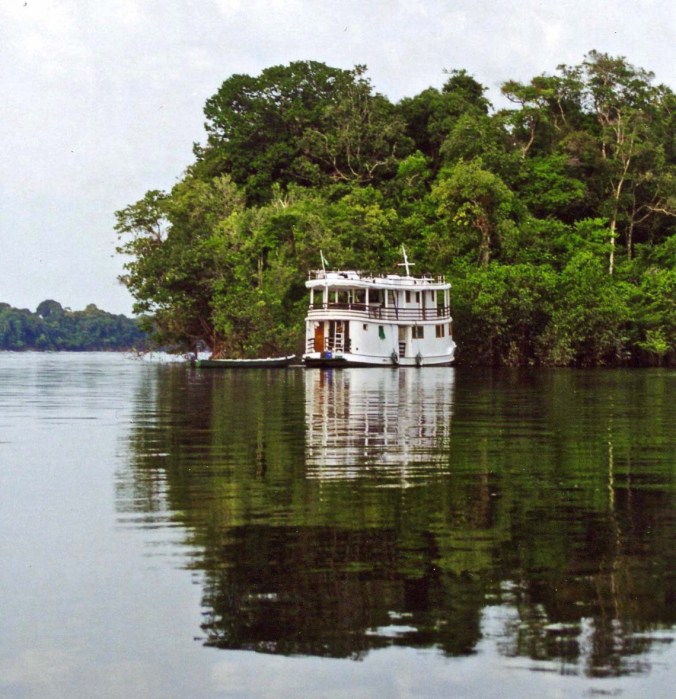
The Amazon Clipper river boat

A closer view of the boat. Six cabins provided space for passengers. The top deck served as an excellent viewing platform.

Peggy Mekemson assuming a Titanic pose on an Amazon riverboat

Peggy also used it for a Titanic-type pose. I would add that the deck made an excellent location for evening cocktails.

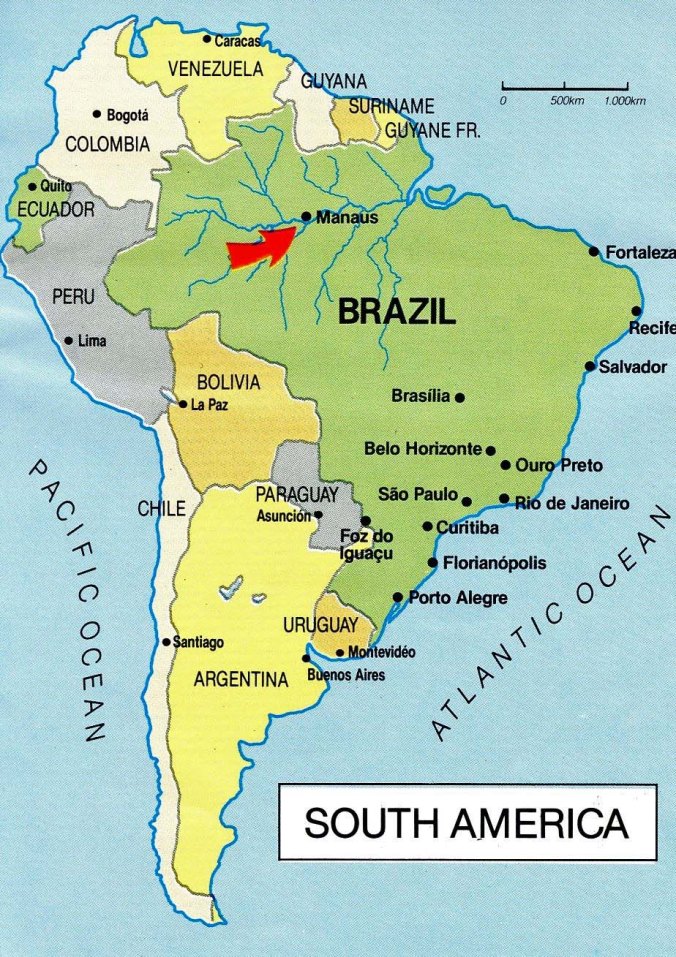
Map of South America

Our journey into the rainforest took us to the city of Manaus which is located at the confluence of the Amazon River and its tributary, the Rio Negro some 1000 miles above where the Amazon runs into the Atlantic Ocean.

Manaus and Rio Negro River

Our riverboat journey would take us out of Manaus, up the Rio Negro River, through the numerous channels of the the Anavihanas, and to the community of Novo Airao. First, however, we boated down to the confluence of the Rio Negro and the Amazon near the # 319 marker where the dark waters of the Rio Negro meet the lighter waters of the Amazon. (Photo from Google Maps.)

Meeting of Amazon and Rio Negro

They call it the ‘mixing of the water’ where the Rio Negro meets the Amazon.

Tributary to Rio Negro

The braided channels of the Anavihanas brought the rainforest in close to the boat.

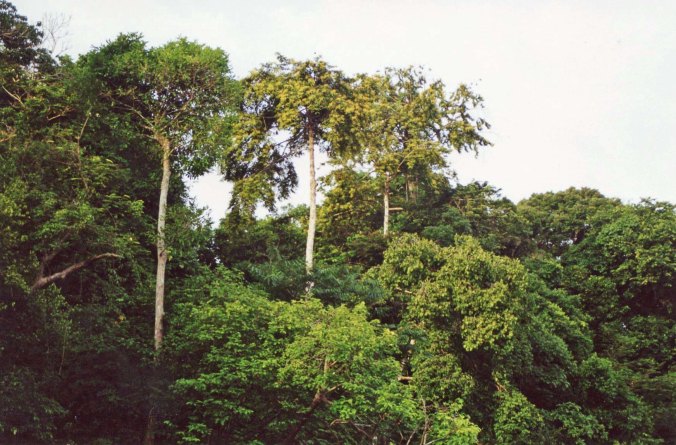
Amazon Rainforest

Evening in the Anavihanas on the Rio Negro River

An evening view.

Bone with river boat pilot on Amazon River

Bone took his trick at the helm.

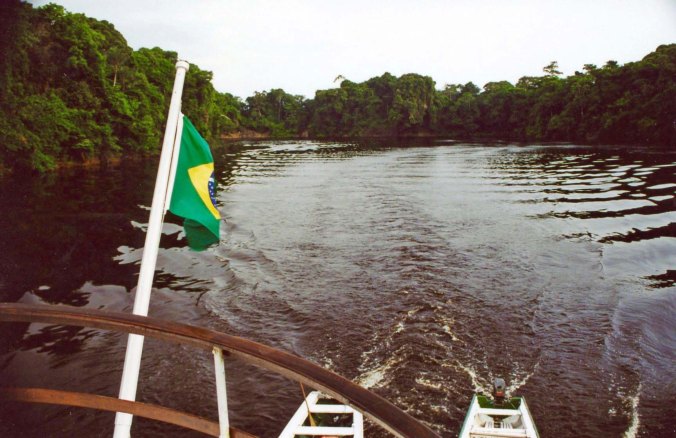
Bone on tributary to Amazon River

And then posed for a photo-op on the rear railing. It almost turned into a disaster as the boat sped up. I leapt up and just caught Bone as he started to fall into the piranha infested waters! I guess if you have to go…

Piranha dinner

Later, as I noted above, we took the boat’s skiff and went fishing for piranhas. These fellows made a tasty treat.

Peggy swimming in Amazon

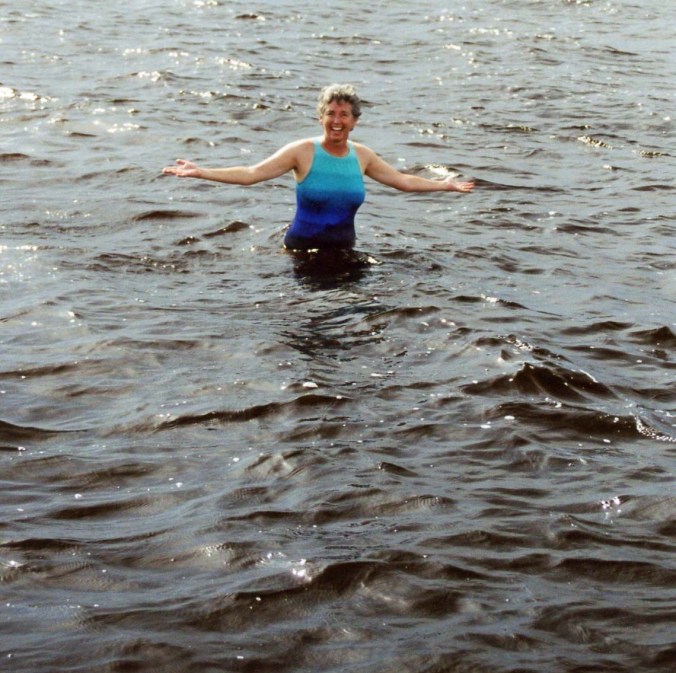
Peggy gave the piranhas their chance for revenge but no one bit. (The crew assured us that this section of the river was piranha free.)

Covered boat on Rio Negro River in Amazon Rainforest

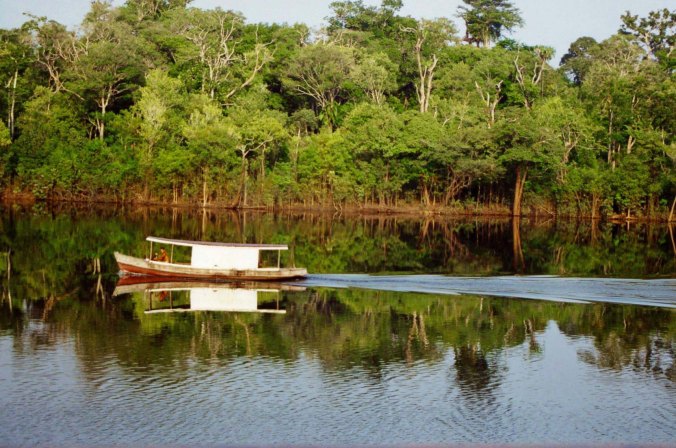
We saw a number of small boats along the river…

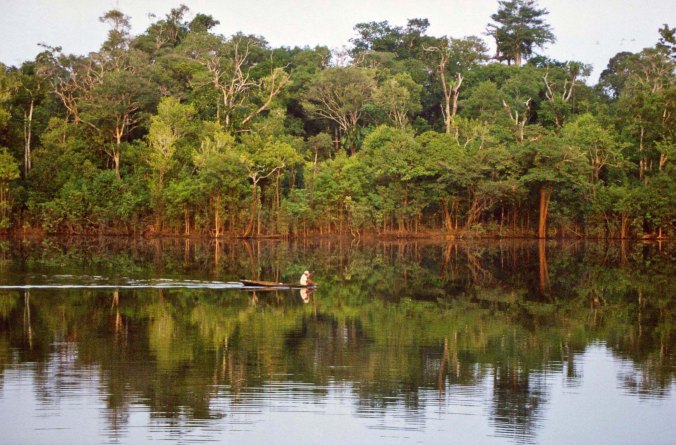
Small boat on Rio Negro River in Brazil

House boat on Amazon

Home along Rio Negro in Bazil

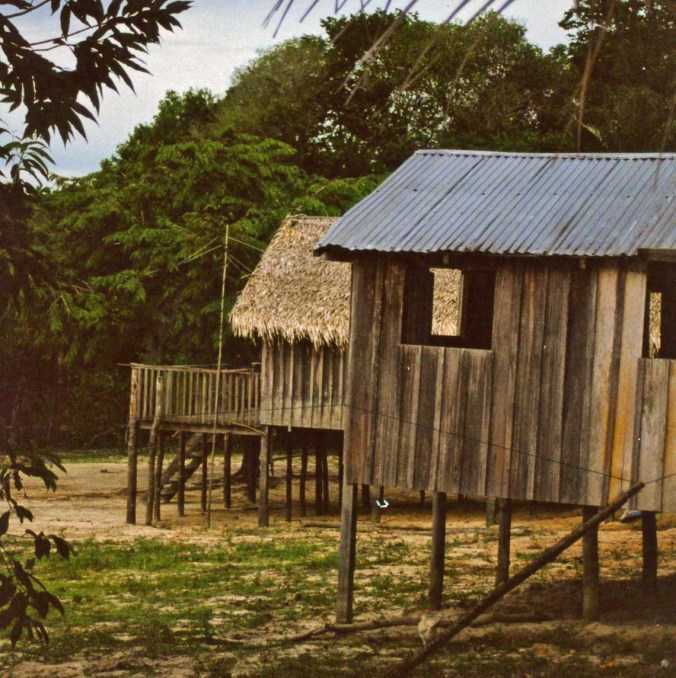
And houses.

Homes along Amazon

We stopped here and went for a walk in the forest.

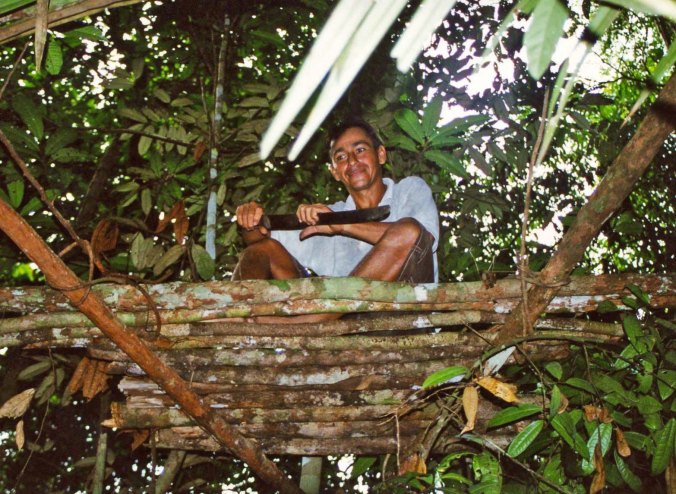
Brazilian with machete

This fellow split open a Brazil nut with his machete and gave us all a taste.

Tree platform for hunting in the Amazon Rainforest

While another machete wielding man showed off a hunter’s platform.

Rubber tree in Brazil

Rubber trees provided the wealth that drove the development of Manaus in the 1800s. Rubber is made from the sap that comes from the cuts in the tree.

Igreja Santo Angelo - Novo Airao, Amazonas Brazil

The town of Novo Airao gave us a feel for how people lived in Brazil’s rainforest communities. This is the church of Igreja Santo Angelo.

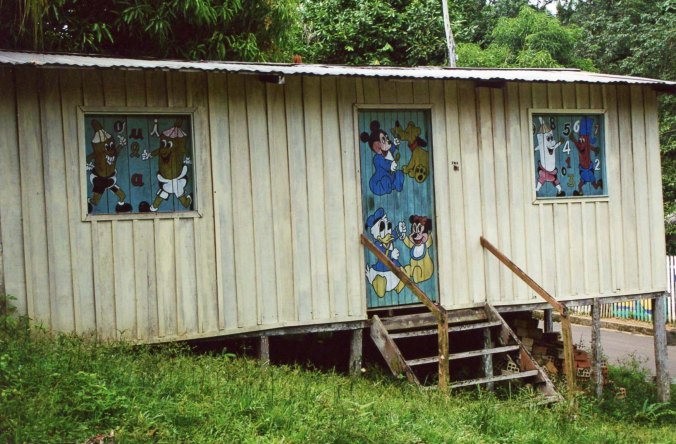
Cartoon building in Novo Airao, Brazil

We were amused by the cartoon characters that decorated what was probably a school.

Open market in Nova, Airao, Brazil

This open market reminded me of the shops in Gbarnga, Liberia where I served as a Peace Corps Volunteer.

Dog in Nova Airao, Brazil

And this handsome dog reminded me of Do-Your-Part, the basenji that adopted me in Liberia.

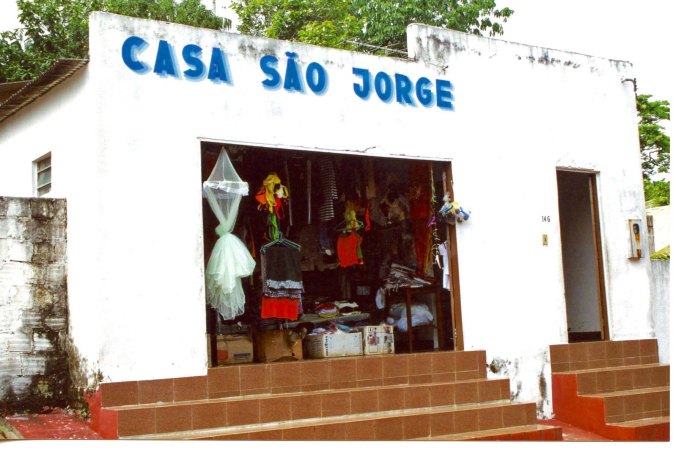
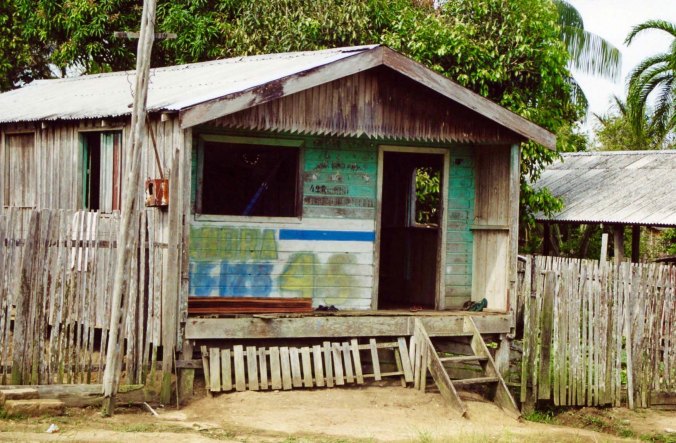
Business in Nova Airao, Brazil

Another typical town building.

Flower in Novo Airao Brazil

We found this flower on a walk through the town…

Breadfruit in Amazon

And what I assumed was breadfruit.

Boats at Nova Airao, Brazil

The boats were on the waterfront of Nova Airao.

Peggy Mekemson sleeping on Amazon River boat.

While I could never break myself away from watching for birds, snakes and wildlife, Peggy found a comfortable place to snooze on our way back to Manaus.

Apartment complex Manaus, Brazil

Manaus is a bustling city. I liked the unique apartment house on the left, boxes stacked on top of each other and leaning slightly to the right.

Amazon boats in Manaus Brazil

Passenger boats are lined up along the waterfront to begin the thousand mile journey down to the ocean and points in between. Their schedule is that they leave when they are full!

Sunset on the Amazon River

I’ll close today’s post with a couple of photos of the sun setting on the Amazon.

Sunset on the Amazon

FRIDAY’S POST: Reading guarantees that I become a wanderer.

SATURDAY AND SUNDAY: Since Bone is traveling with us on our trip through the Grand Canyon, I introduce him/her to those of you who don’t know the small fellow with a huge personality and ego to match. Sunday’s post includes an interview.

MONDAY’S POST: I kick off our raft trip through the Grand Canyon with a fervent wish that I had spent more time getting in shape!

WEDNESDAY’S POST: Peggy and I continue our Amazon adventure with me ending up with a monkey on my head and Peggy with one in her lap.


SaveSave

SaveSave

SaveSave

Homeland Security Goes Searching for a Bomb… Rafting through the Grand Canyon: Part 3

Essential Grand Canyon supplies DG

All of my wilderness experiences have been motivated by a go-light philosophy when it comes to food, which makes sense if you carry it on your backs. River runners, on the other hand, have rafts to carry everything. Other rules apply. Extra pounds don’t matter. And if you are going to carry all of these oranges, you might as well carry some alcohol to mix with your orange juice. (Photo by Don Green.)


The fact that we were full-time travelers made our Grand Canyon trip easier. There was no house, mail, job, pet or the other factors of normal life to worry about. We just pointed our van toward Flagstaff and drove, stopping along the way at places like Arches and Bryce Canyon National Parks.

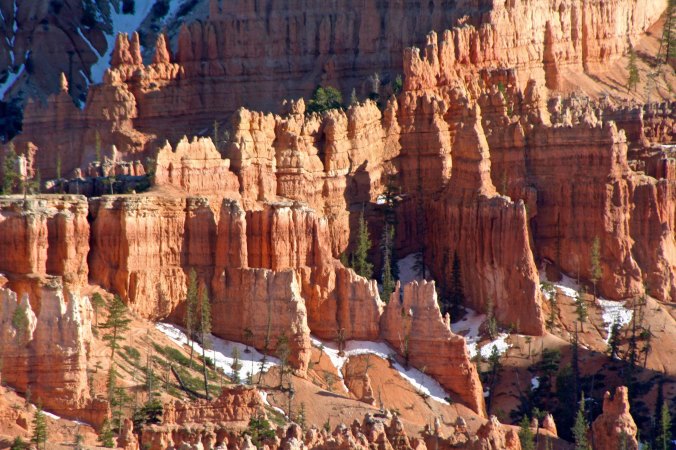
Bryce Canyon

While our fellow rafters were scurrying to wrap up business to prepare for our 18-day raft trip though the Grand Canyon, Peggy and I were visiting Nationals Parks in Utah. This is Bryce Canyon.

Bryce Canyon 1

Another view of Bryce.

Great adventures usually start with mundane tasks, as most of you know. For example, did you cancel the paper? Common sense, travel pundits, (and probably your mother) admonish you that devious burglars have nothing better to do than to cruise the streets looking for rolled newspapers in front of your home.

More importantly, what about the cat?

Once upon a time Peggy and I had a cat named FE. Vacations meant I would carefully measure out twice as much food and water as she could possibly eat or drink and four times the kitty litter she might use. The likelihood of her using our house as a litter box was much greater that the likelihood of her starving. As a reward for my thoughtfulness, she would shed enough fur in our absence to fill a dump truck. For weeks after we arrived home, she would also pad into our bedroom in the wee hours each night and meow loudly to make sure we hadn’t abandoned her again. Or possibly it was punishment…

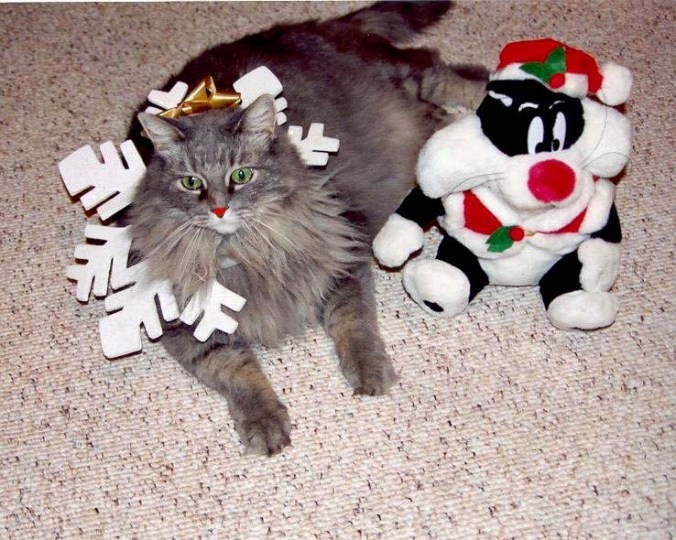
FE and Sylvester dressed for Christmas

FE and her buddy, Sylvester, dressed for Christmas. Note FE’s Rudolph-red nose. I recall that a bit of photoshopping was required to get her ready for the Christmas letter.

We weren’t getting off scot-free on preparation for the river trip, however. In Flagstaff, we had food to worry about. Lots of it. Tom Lovering, his wife Beth and their friend Jamie Wilson arrived in Flagstaff three days in advance of our Colorado River trip. Their car was packed to the brim with empty ammo cans for things like cameras and huge ice chests for food. They were late.

The Department of Homeland Security had delayed their journey at Hoover Dam. The Agency is paranoid about mad bombers, rightfully so. And this was before the new bridge across the river had been completed; people still had to drive across the dam. A vehicle packed with C-4 could conceivably blow a big hole. Stern faced agents carrying guns were posted at each entrance. No smiling was allowed. Homeland Security’s normally low sense of humor (have you ever joked about a bomb during a security check at an airport) dropped to zero when the agents saw all the ammo cans Tom had packed in his vehicle. Rafters love these containers because they are waterproof and easily obtainable at Army Surplus stores. You can imagine what went through the minds of the agents. The whole car had to be unpacked and each ammo can carefully checked out.

Tom Lovering

This was the face that Tom greeted the Homeland Security agents with— furry but friendly. His looks were about to change…

Tom getting a do

Tom getting a ‘do’ in Flagstaff…

Tom Lovering with horns

What if Tom would have met the agents looking like this with green horns? We still might be waiting for him in Flagstaff.

Tom is even more paranoid about food than DHS is about terrorists. In addition to being a highly experienced rafter and trip leader, he’s an old restaurateur who had spent months planning the menu.  Each dish had been tested several times and quantities had been measured down to the teaspoon. Recipes were spelled out in minute detail. We would eat gourmet on the trip and cook it Tom’s way— or die. The options were clear.

Beth, Peggy and I were dispatched to Sam’s Club with marching orders. We filled seven large shopping carts with food. Think of it this way. There were 16 people going on an 18-day trip and eating three meals a day. This equaled 864 individual meals.

When we arrived back at the motel, Tom and Jamie had set up a staging area. Food needed to be organized by meal and day and then stuffed in the appropriate containers. The containers would then be assigned to rafts. It was important that we knew where to find the beer.

Large food containers for Grand Canyon trip

Large food chests waited for us when we got back to our motel. Each would be filled with food. Dry ice would be added to keep our food fresh for 18-days.

We still had to shop for perishables and more food was also coming from Sacramento. Our room, we discovered, was to be the recipient of most of the food. Apparently, it was written into the fine print of being ‘permit holder.’ There was barely space to sleep. Not that we slept much. Soon, we would be on the river! But first, Bone had to be appropriately dressed for his trip.

Supplies for Grand Canyon trip

We went to Safeway to purchase our perishable goods, and once more our small RV was filled to the brim.

Gear and food Grand Canyon trip

We discovered that the majority of the large food containers would be stowed in our room. With our own gear spread out on the bed, it was questionable if we would have room to sleep! Tom provides a perspective on the size of the ice chests. The yellow container is an ammunition can.

Bone in life vest

One of our final responsibilities was to make sure that Bone was adequately dressed for the trip in his PFD. Once, he almost fell off a boat in the piranha infested water of the Amazon. It would not do to lose him in the roaring rapids of the Colorado. Next Saturday and Sunday, I will provide background on Bone since he was an active participant on the river trip.

Loading truck for Grand Canyon trip DG

Finally, it was time to load our food and gear on this truck for transport down to Lee’s Ferry and the beginning of the trip. The truck was completely stuffed by the time we were finished. We were finally on our way! (Photo by Don Green.)


WEDNESDAY’S Photo Essay POST: A river boat trip on the Amazon River. The piranhas are biting and we bite back.

FRIDAY’S MisAdventure’s POST: There is nothing like reading to seduce you into becoming a wanderer.

MONDAY’S Travel Blog POST: We start our raft journey through the Grand Canyon with 30 MPH headwinds. So much for a peaceful (between rapids) float down the Colorado!


SaveSave

SaveSave

SaveSave

The Tragedy and Glory of Ancient Pompeii… The Wednesday Photo Essay


Pompeii body

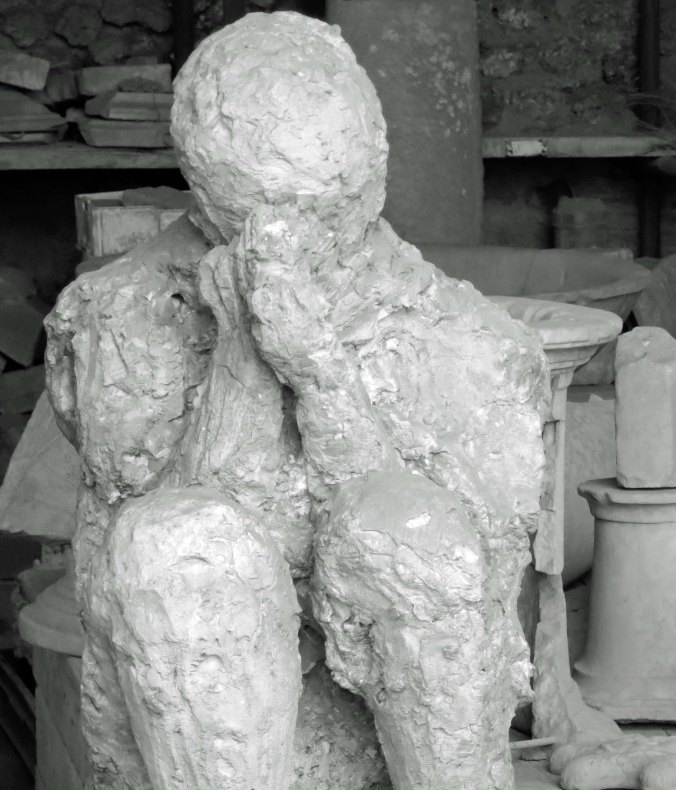
A blanket of ash rushed down from Mt. Vesuvius on Pompeii in 79 CE, suffocating many of the city’s residents. Those who could escape, did. Those who didn’t were covered by a flow of molten rock the next day, preserving their bodies as they died in poses that can still be seen today.
 

It’s time for another Wednesday photo essay where I scroll through the 75,000+ photos that Peggy and I have taken from around the world and find something that catches my attention. Today it is Ancient Pompeii. Next Wednesday it will be Costa Rica.


Their lives would have been interrupted by a series of small tremors. It had to be worrisome; seventeen years earlier Pompeii had come close to being destroyed in a massive earthquake. The city was still being rebuilt. Possibly the residents woke on the morning of August 24, 79 CE and looked fearfully at the restless mountain that loomed over them— and then went on about their business.

Temple of Jupiter and Mt. Vesuvius

Mt. Vesuvius still looms above Pompeii today. This is what it looks like from the Temple of Jupiter.
Ruins at Pompeii and Mt. Vesuvius

Another perspective.

Everything ended at 1:00 PM.

Mt. Vesuvius exploded in a massive eruption sending tons of ash, gas and rocks spewing 20 miles into the sky and forming a dense mushroom cloud. Winds quickly carried the ash into Pompeii, turning day into night and dreams into nightmares. The majority fled, escaping by whatever means available. Those who stayed behind died— suffocating at first under the blanket of thick ash and ultimately, the next morning, by being buried alive under a pyroclastic flow of molten rock and gas that flew down the mountain at speeds close to 100 miles per hour.

Buried alive in Pompeii

It must have been incredibly fast, and frightening.

Pompeii's dead

You have to wonder if this person was simply asleep when it happened.

Viewed from an archeological perspective, history’s tragedy has become today’s blessing. The molten rock and ash that covered Pompeii, also preserved it, providing historians with their most complete view of what life was like in the ancient Roman Empire.

Pompeii street with raised crossing

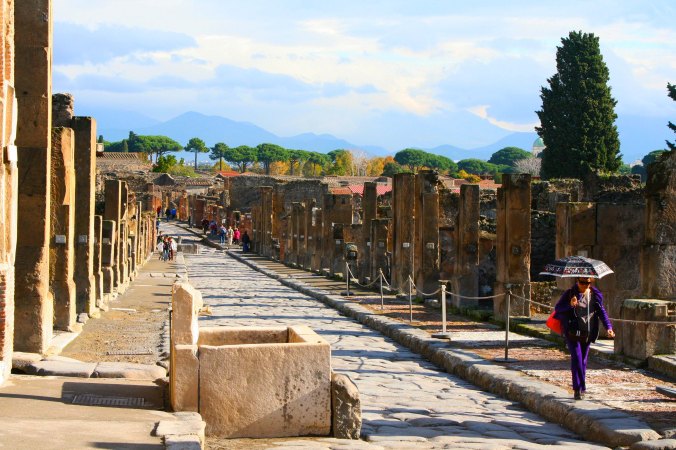
Buildings and streets in Pompeii are well-preserved. Ruts from vehicles using the roads can still be seen, as can road crossings.

Street crossing in Pompeii

Streets were cleaned by flooding them with water. People kept their feet dry by using these crossing stones.

Street in Pompeii

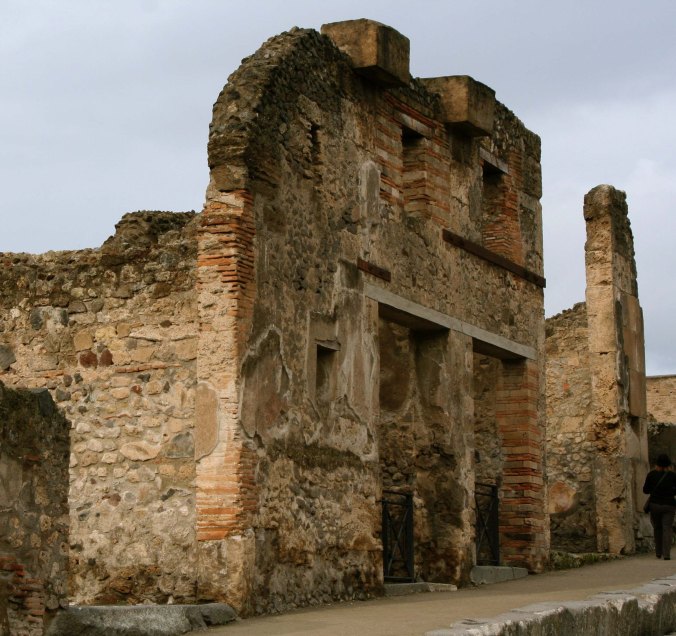
Another street scene. Note how carefully the buildings had been aligned. The square box might have been a community water cistern.


Water faucet in Pompeii

Peggy and I were amused by its modern day equivalent where a faucet was added to the mouth of an early sculpture.

Side of bathhouse in Pompeii

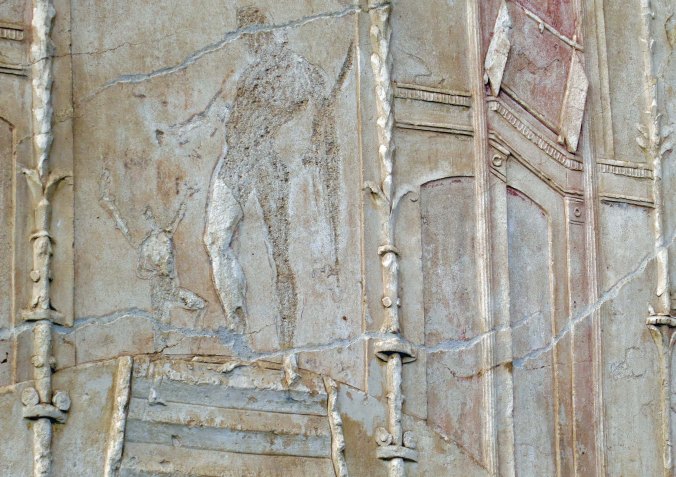
Public baths were a part of most Roman towns and cities. This one was decorated with a detailed relief…

Father and child, Pompeii

Which included a father and child walking down stairs.

Pompeii bathhouse

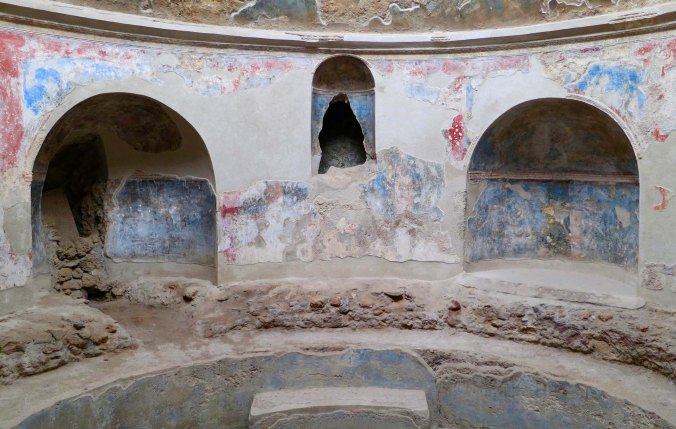
An inside view of the baths provides an idea of how luxurious the baths would have been. Remnants of murals that once covered the walls still remain.

Ceiling of bathhouse in Pompeii

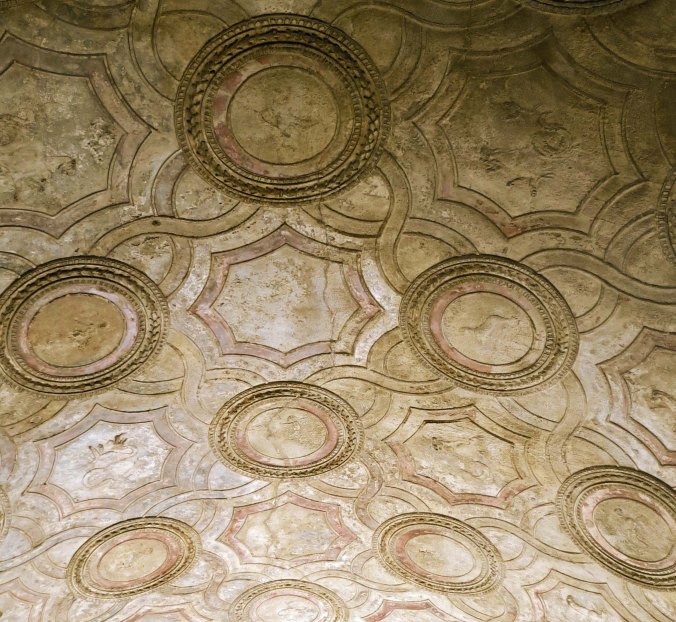
Ceilings were decorated as well. This one shows bas-reliefs of people and animals.

Columns in a row at Pompeii

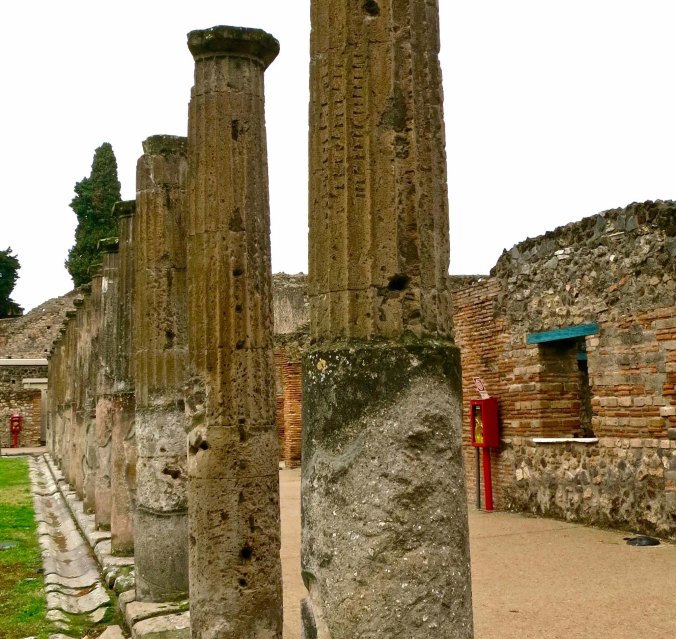
Columns are another thing that most Roman towns shared. These set off a training school of gladiators, who were expected to go out and die for the greater glory of Rome, or to fight and possibly die to entertain Roman citizens. When I closed my eyes, I could almost hear the clashing of swords.

Pompeii Column

Looking up at one of the columns.

Column in Pompeii

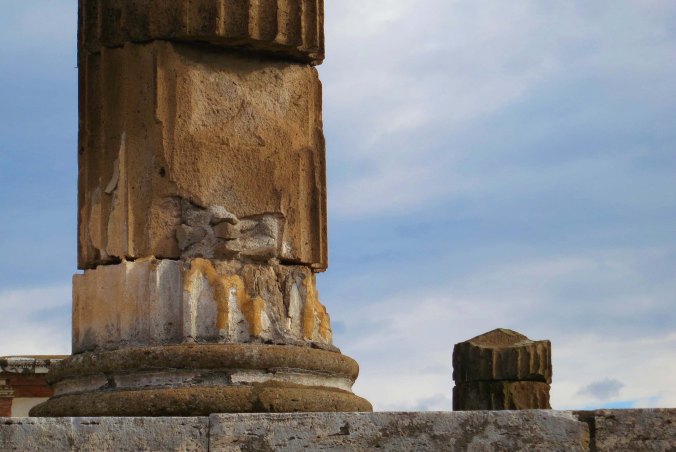
Close-up.

Apollo at Pompeii with his temple

Peggy did a clever job of catching Jupiter with his hand seemingly wrapped around a column in his temple. The god was apparently traveling light that day.

Pompeii building

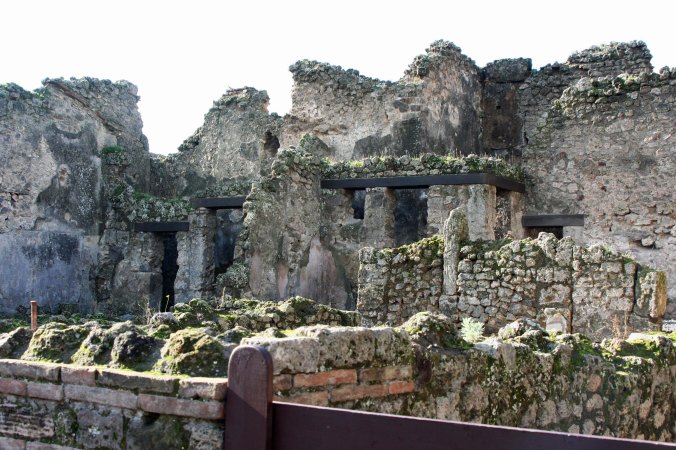
Many of the buildings were remarkably preserved.

Ruins at Pompeii

Others more closely resembled other Roman ruins found throughout the Mediterranean.

Pompeii House of Pleasure

The Lupanar House of Pleasure or brothel is one of Pompeii’s best preserved buildings and our guide gave us a tour…

House of Lupenare bed in Pompeii

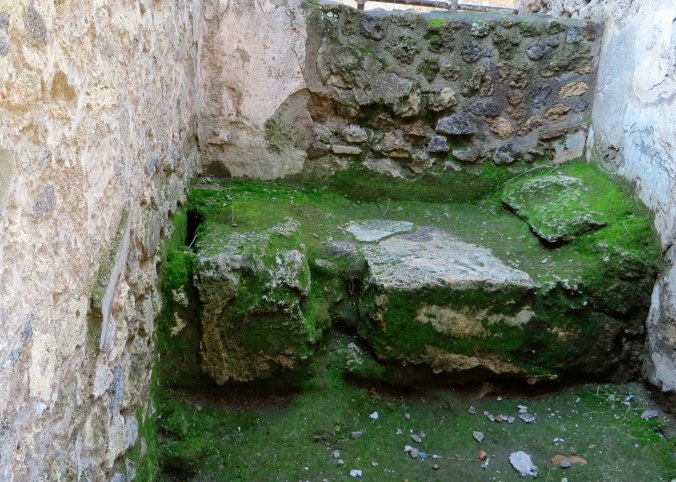
This was one of the beds. It would have been covered with a mattress, but still… The walls of the brothel included paintings that showed the various services available.

Fastfood holders at Pompeii

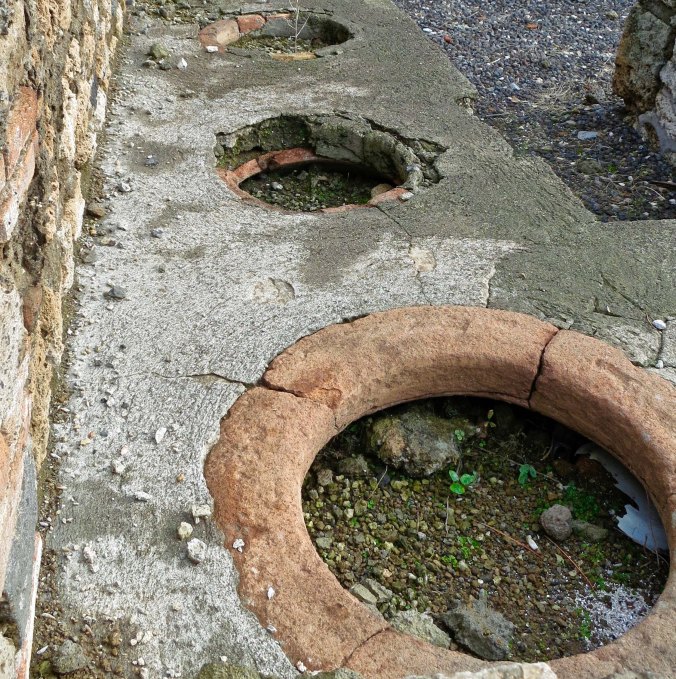
A meal out may have included stopping by this place. These were designed to hold prepared food and keep it hot. It strikes me as a fast food/takeout restaurant.

Bread oven in Pompeii

Bread was baked in this oven.

Jars at Pompeii

A large number of storage jars, such as these, were found in the city.

Amphitheater at Pompeii

The large amphitheater would have accommodated most of Pompeii’s residents. The rich folks got the lower seats. Those not so fortunate, the upper ‘nosebleed’ seats.

Street scene in Pompeii

Another street scene in Pompeii. Murals were  included on the walls. There must have been a great deal of civic pride in the city.

Child with dog at Pompeii

A little girl and her dog…

Dog at Pompeii

And a modern resident of Pompeii.

Edge of Pompeii

I’ll conclude with this photo from the Mediterranean side of Pompeii. In 79 CE, the sea was only a couple of hundred yards away. Today it is a couple of miles. Those who had boats or access to boats would have been fleeing from here on that fateful August day, escaping the death that was raining down on their fair city.
 

FRIDAY’S POST: I determine it’s my job to rule the first grade but no one else seems to agree. Mrs. Young gives me a spanking for my effort.

MONDAY’S POST: It’s all about food on our river trip. And why did Homeland Security determine it was necessary to check our food boxes for a bomb?

WEDNESDAY’S POST: We leave Italy and the Mediterranean to venture off to the Amazon..


SaveSaveSaveSave

SaveSave

SaveSave

SaveSave

SaveSave

SaveSave

SaveSave

SaveSave

SaveSave

Peggy Wins the Lottery… Rafting through the Grand Canyon: Part 2

Mule trip into Grand Canyon

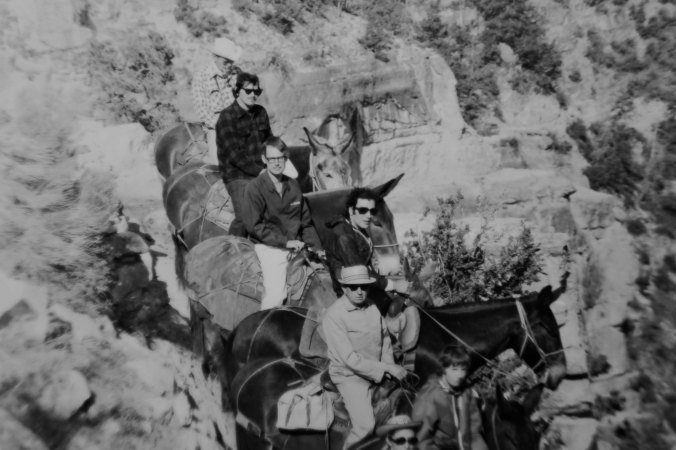
I have journeyed into the Grand Canyon several times over the years. The first was in the late 60s. That’s me, second from the top on Charlie the mule. I was heavier than Charlie liked, so he kept trying to bite me. He also walked as close to the thousand foot drop off as he could. His ultimate revenge, however, was that I was sore for a week afterwards!


Having reported on being in Flagstaff for the beginning of our raft trip down the Colorado River on last Monday’s travel blog, I thought I should back up a step and tell you how we got there.

It started with a strange phone call.

Peggy and I were in the middle of a three-year trip around North American in our small RV when the phone rang late one night. It was 10:00 p.m., far past the time I normally accept calls. They make me grumpy. Usually they are from a Nigerian Prince who wants to make me incredibly wealthy. All I have to do is send him a thousand bucks. But this was from my old friend Tom Lovering. I’m used to him calling at weird hours. He has zero sense of what constitutes a normal day and fervently believes that no one else should either.

He wanted me to immediately stop whatever I was doing (sleeping), jump on-line, and apply for a private permit to raft down the Colorado River through the Grand Canyon. Permits are scarce and the number of people who apply could fill a rock concert. So the Park Service does an open lottery for interested folks. Odds of getting a permit are small— teeny tiny— and Tom wanted to increase his. He’d been scrolling through his list of friends and had already talked a number of people into applying. The clock was ticking; the lottery closed at midnight. Given the late hour, I must have been near the end of Tom’s likely candidates, which isn’t surprising. I know zilch about running rapids.

Thrill sports aren’t my thing. I have always figured that the type of outdoor things I do (like bicycling 10,000 miles around North America by myself, or disappearing into grizzly bear country alone) have enough inherent danger without my challenging raft-eating, people swallowing rapids, or climbing up the sheer face of a thousand-foot rock. Not that I have any problem with the sports. In fact, I have nothing but admiration for people who have the skill and temerity to pursue them and make a career out of flipping off the old guy in a hoodie who carries a big scythe.

My normal response would have been, “Sure, Tom, I’ll get right on it,” followed by promptly rolling over and going back to sleep. But this wasn’t accounting for the love of my life, Peggy, who actually likes water sports and enjoys jumping off cliffs. During college, she had actually attended a session of the Nantahala White Water School in North Carolina where you learn to maneuver rafts through raging rapids. She followed up on Tom’s request immediately: jumping on-line and putting in for a permit— in my name.

I was checking my E-mail the next morning when I came across the note from the National Park Service: “Congratulations you have won a permit for you and 15 other people to raft down the Colorado River through the Grand Canyon! We will be sending you a 5000-page document (slight exaggeration) that outlines your responsibilities.” Oh joy. I called Tom immediately. He was the experienced river runner. He had promised the night before that if, by some miracle I did win, he would take full responsibility for organizing and leading the event. It’s a huge job that takes considerable knowledge about white water rafting.

At first, Tom didn’t believe me. He thought I was joking. Neither he nor any of his rafting buddies had won a Canyon permit in several years. And then he was ecstatic. Yes, he would recruit experienced boat people and their boats for the trip! Yes, he would make all necessary arrangements. Yes, he would plan the menus and organize the food! Yes, he would lead the adventure!

Then the other shoe dropped. Doesn’t it always? I was, after all, “the permit holder.” It was my job to turn in paperwork. But I also had serious responsibilities. If anything went wrong; it was on my shoulders. This ranged from people pooping in the wrong places, to how we washed our dishes, to more serious things. The Park Service had a long list of safety and environmental concerns. I’d be signing on the dotted line. There would be an inspection before we left!

I admit I had concerns. But these were countered by the fact that I love the Grand Canyon. I have returned to it numerous times over the years. I have both hiked and backpacked into it. One time I rode mules into the Canyon. Another time I flew in by helicopter. And I am perfectly happy just sitting on the edge and staring out into the vast space at the incredible rock formations. I did that for Christmas one year (and many other times). Floating down the Colorado would give me a totally new perspective. I was almost as excited as Tom and Peggy. Almost.

Between three tours of duty as a Marine helicopter pilot in Iraq and then serving as a Coast Guard pilot flying rescue missions, our son Tony did a brief stint of flying tourists over the Grand Canyon and into the Havasupai Indian village in the canyon.  When he flew Peggy and me into the village, he was playing the theme song from Star Wars as he swooped down past the steep cliffs.

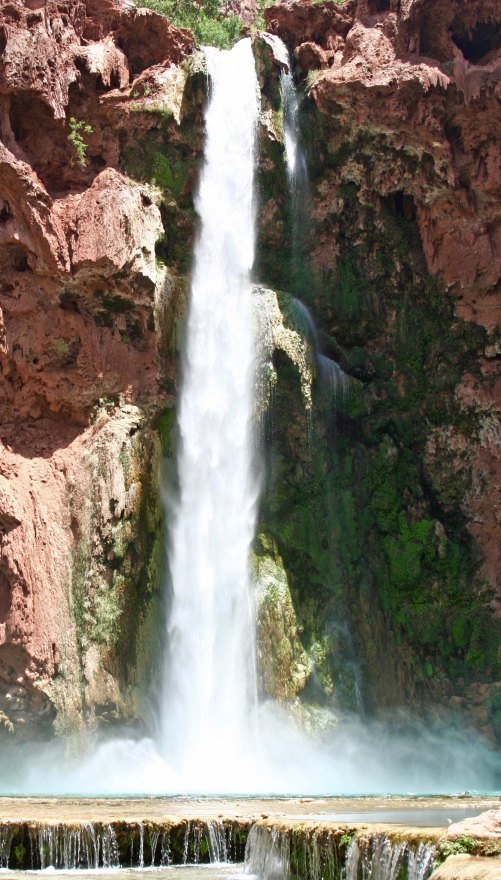
Waterfalls at Havusupai

This gorgeous waterfall was the main attraction at the Havasupai Village.

I am sitting on the edge of the Colorado River, red with mud.  Peggy and I had backpacked down the Tanner Trail retracing a solo trip I had made several years earlier. Our raft trip would bring us through this section of the Canyon and over the Tanner Rapids. (Photo by Peggy Mekemson.)

Occasionally, backpacking through the Canyon requires a bit of scrambling.

But you don’t have to hike or backpack into the canyon, or raft, or fly, or ride grouchy mules to enjoy the beauty of the Canyon. You can drive up, and enjoy numerous pull-offs that give you incredible views. Short walks provide many more. Be sure to include early morning and late afternoon to capture the full beauty.

Grand Canyon 38

The rocks come in a seemingly infinite number of shapes and colors.

A final view.

WEDNESDAY’S POST: We travel to the ancient Roman city of Pompeii.

FRIDAY’S POST: I learn that there is more to life than dead people.

MONDAY’S POST: And why is Homeland Security checking out our food containers for a bomb on the our Grand Canyon rafting adventure?


The Red, Red Rocks of Sedona, Arizona… Part 2

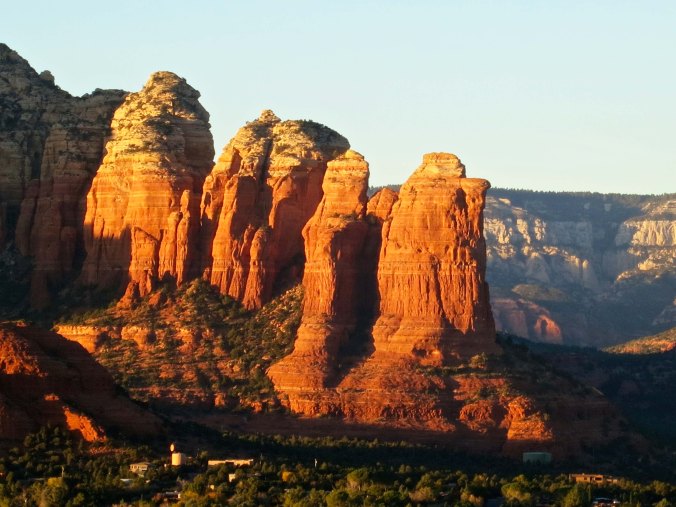
Sunrise on rocks west of Sedona

The best time to be out and about for photography in Sedona is either early in the morning or late in the afternoon when the red rocks of Sedona at are their most colorful.


It’s photo essay Wednesday so I am returning to Sedona, Arizona to wrap up my look at some of the colorful red rocks that surround the town. Last Wednesday, I focused on the formations east of town and the striking Chapel of the Holy Cross. Today I will include photos of the rock formations west of town and take a trip up the ‘mystical’ Boynton Canyon.


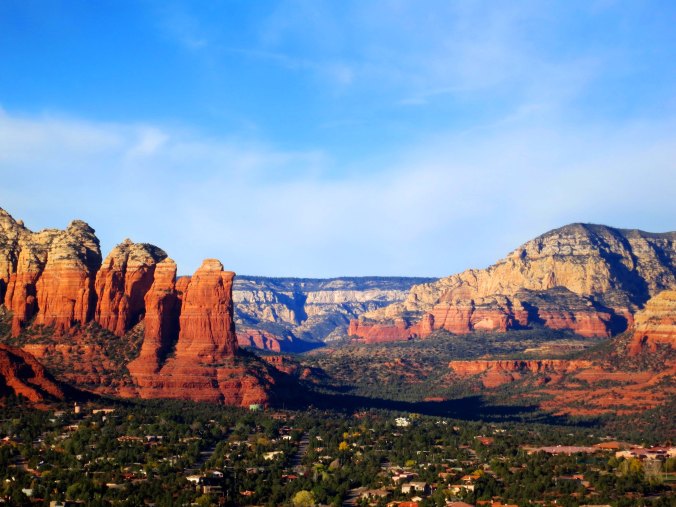
Sedona rocks in morning

Peggy and I took these photos from up near the Sedona airport looking west across the town. The rock formation I featured at the beginning of the post is shown on the left here.

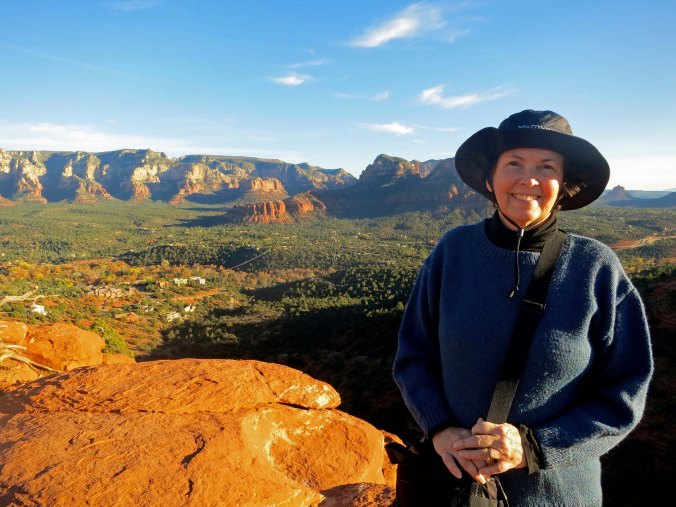
Peggy and view across Sedona

Peggy was standing on the ‘vortex’ near the airport when I took this photo. (Actually, looking at it, I think it is toward the east.)

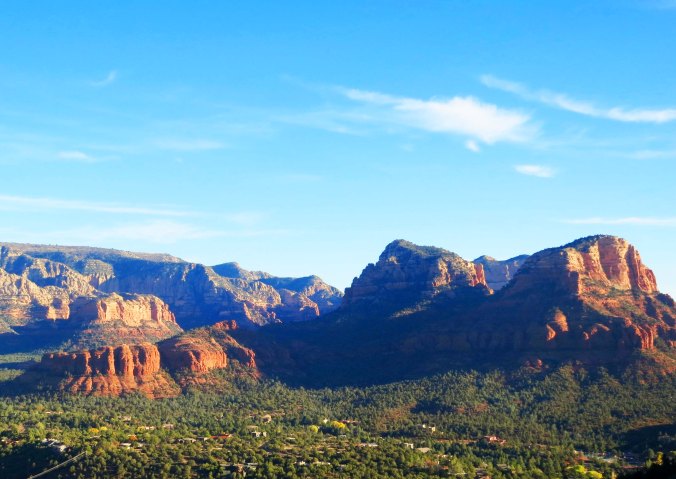
Sedona view

Another perspective. Possibly my blogging friend who lives in Sedona, Johanna Massey, can provide the location.

Sunset west of Sedona

Definitely looking west here. This time the formation that I included in the first photo is on the right.

Sunrise west of Sedona

A close up…

Sedona Sunset

Sedona Sunset.

Layers upon layers, Sedona

I liked this photo because the ridges seemed to fade off into infinity.

Capstone rocks in Boynton Canyon

We took a detour on our hike up Boynton Canyon to visit with the Kachina Woman, on the left. There is supposedly another vortex in the area that emphasizes balance. (Photo by Peggy Mekemson.)

Capped rock in Boynton Canyon

A photo of the same formation from the Boynton Canyon Trail. Some claim that the vortex is between the Kachina Woman and the knoll. Since a little balance never hurts, I stood between the two formations for a few minutes. (Photo by Peggy Mekemson.)

Boynton Canyon

This is the type of view you can expect hiking up Boynton Canyon. No wonder people find the area mystical.

Sandstone rock in Boynton Canyon

Each sandstone formation provides several views as you hike up the short trail. Following are examples of this one…

Sandstone formations in Boynton Canyon

Sandstone in Boynton Canyon

Stacked rocks in Boynton Canyon

Stacked rocks and circles of rocks apparently reflect hiker’s spiritual journey up the canyon. There are so many that some people are beginning to feel that they detract from the beauty of the area. Not to worry; they are easily removed. I wonder if it gives you bad Karma.

Pinted by mineral water, Sedona

Mineral rich waters created this dry waterfall. If I remember correctly the cave on the left belonged to early Native Americans. (Photo by Peggy Mekemson.)

Anasazi dwelling in Boynton Canyon

This Anasazi dwelling definitely did. (Photo by Peggy Mekemson.)

Fortress rock in Boynton Canyon

Another of the impressive rock formations up Boynton Canyon.

Red rock of Boynton Canyon near Sedona

And another!

Peggy at end of trail in Boynton Canyon

That’s it for today, folks!


FRIDAY’S Blog-a-Book POST: The great tree race where my brother and I face off against each other in a death-defying race up and down the 70-foot tall Incense Cedar tree in the Graveyard.

MONDAY’S Travel Blog POST: Where Homeland Security checks out our food supply for the Colorado River trip.

WEDNESDAY’S Photo Essay POST: A visit to the ancient Roman city of Pompeii, Italy that was buried by the volcanic eruption of Mt. Vesuvius in 79 CE.

SaveSave

SaveSave

SaveSave

SaveSave

SaveSave