Face Rock State Scenic Viewpoint… The Oregon Coast Series

The face of the Indian maiden is clearly seen here in the rock. If you start on the right you can see her chin, mouth, nose and eye. (Photo by Peggy Mekemson.)


Peggy and I have driven through the town of Bandon several times without stopping on our journeys up and down the Oregon Coast. We decided to correct that oversight this past week. I had googled the small town along Highway 101. Photos of striking rock sculptures at the Face Rock State Scenic Viewpoint were included on the site. That alone would have demanded a visit. But there was also the town of Bandon, Bullard Beach State Park, and the Coquille River Lighthouse to explore. Today, I will feature the scenic viewpoint. Next Monday I’ll focus on the town, park and lighthouse.

There’s a native American legend that goes along with Face Rock. It has to do with an evil spirit, a lovely maiden, and her favorite pets. The Indian maiden, Ewauna, had come with her father, Chief Siskiyou, to visit with several chiefs along the coast. In honor of the occasion, a great potlatch was thrown. After everyone had eaten far more bear and salmon than he or she should have and stumbled off to bed, Ewauna decided to go for a swim in the ocean, even though she had been warned not to. The evil spirit Seatka lived in the ocean and had a thing for fair maidens. Naturally, he captured Ewauna along with her dog, cat, and kittens. You can still see them today down among the rocks.

Face Rock near Bandon, Oregon.

Another view of the maiden, Ewauna. This one taken at sea level. (Photo by Peggy Mekemson.)
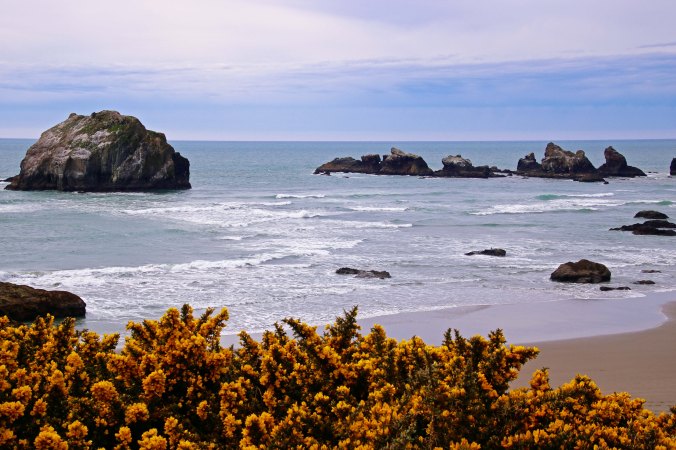
The maiden with her cat and kittens off to the right. (Photo by Peggy Mekemson.)

We were lucky to visit the scenic viewpoint at low tide, so we followed a wooden stairway down to the beach, wandered around among the rock sculptures, explored some caves, and admired the general beauty of the area.

Stairs led us down to the beach. (Photo by Peggy Mekemson.)
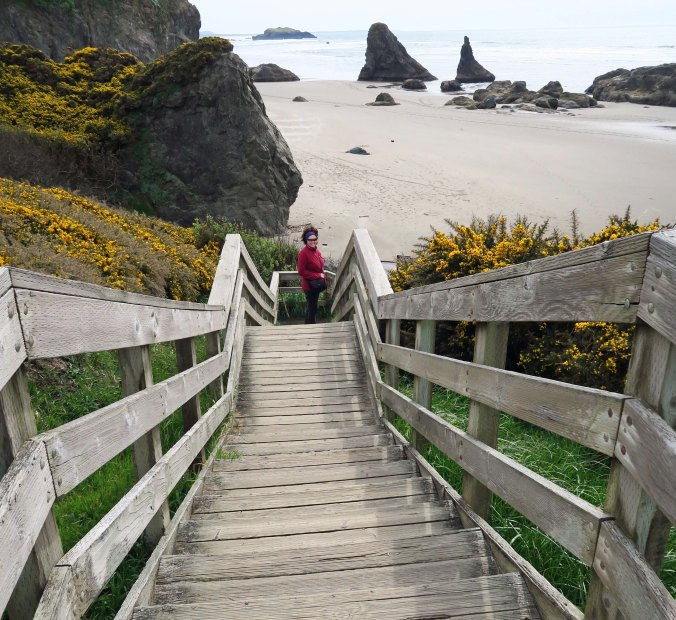
I caught a photo of Peggy making her way down the stairs. Marvelous rock sculptures were waiting for us.
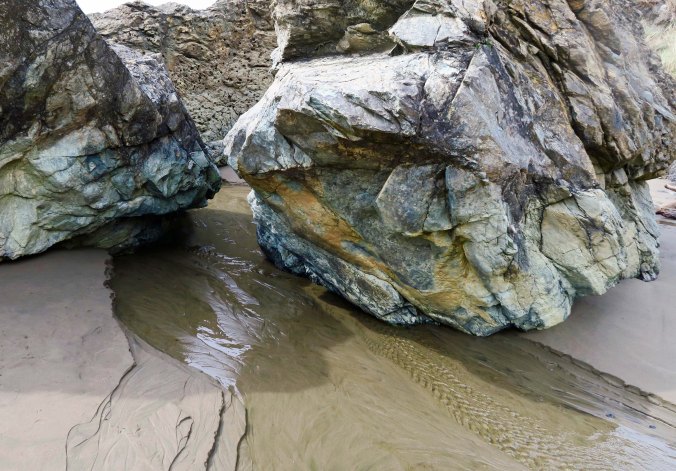
A small stream crossed the path at the bottom of the stairways.
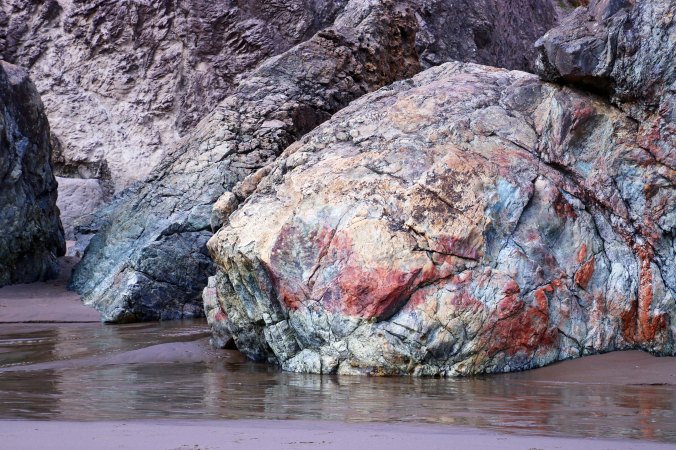
Peggy caught it coming out on the other side of the colorful rocks. (Photo by Peggy Mekemson.)
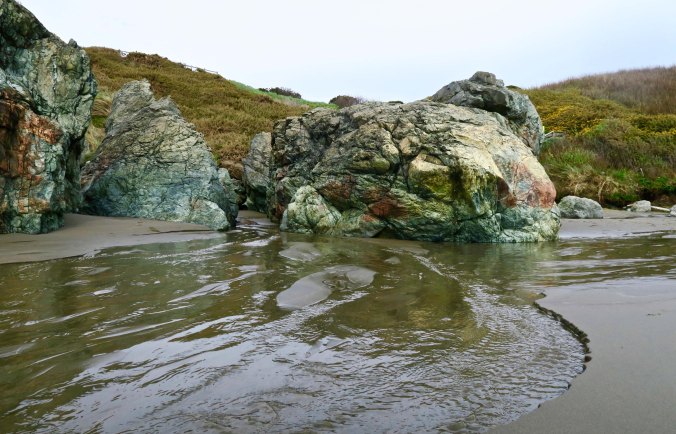
And I captured a broader perspective.
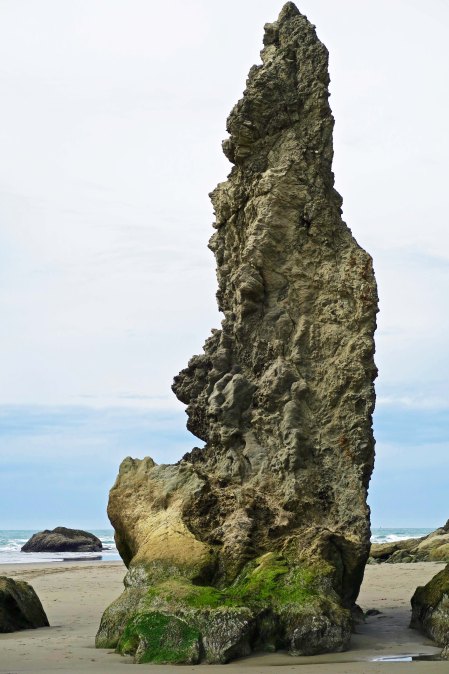
I promptly name this rock Elf.
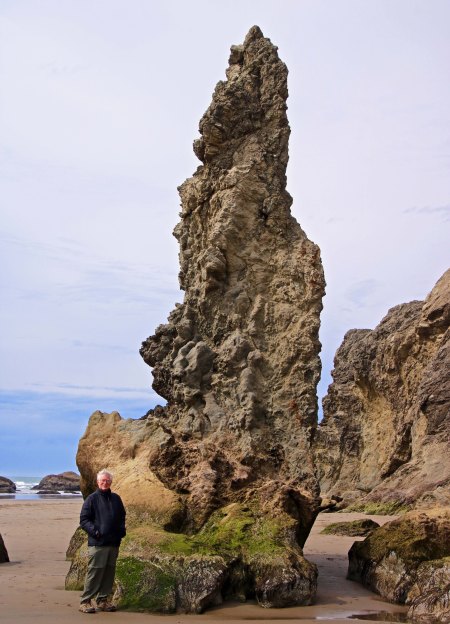
Peggy took this for perspective.
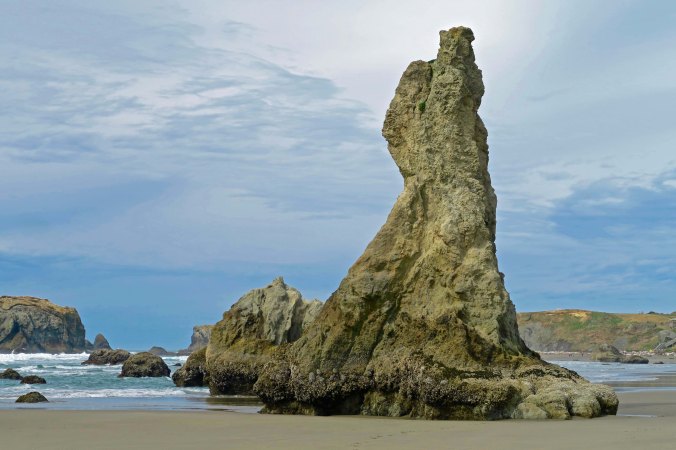
Another towering giant caught our attention. I named it Bigfoot.
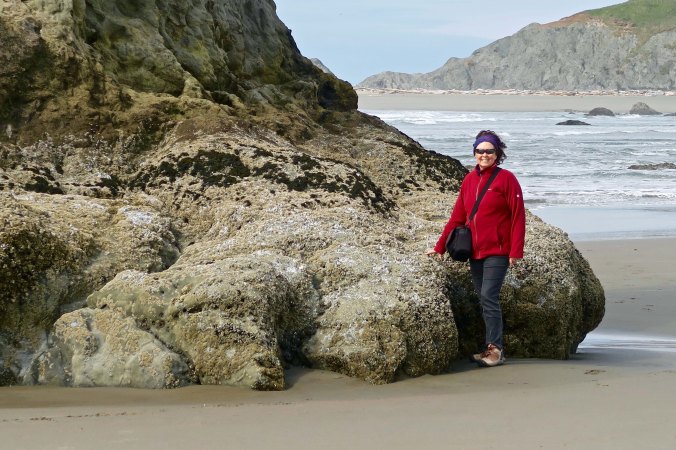
Peggy and Bigfoot’s toes.
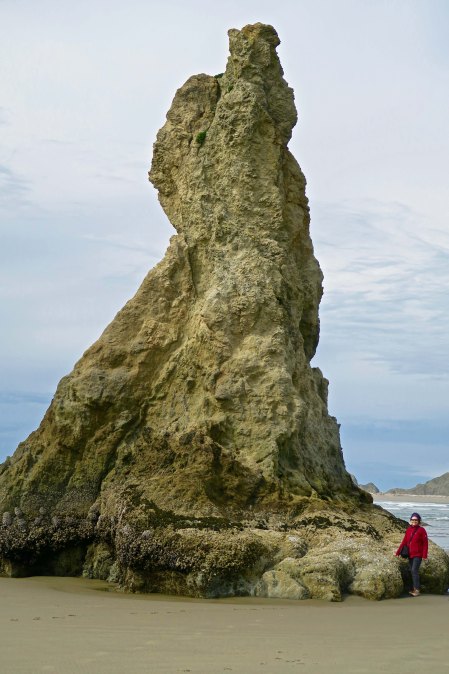
This photo provides a Peggy perspective on Bigfoot’s big foot.

A distant view of Bigfoot looking small— and other rocks— from the scenic viewpoint.
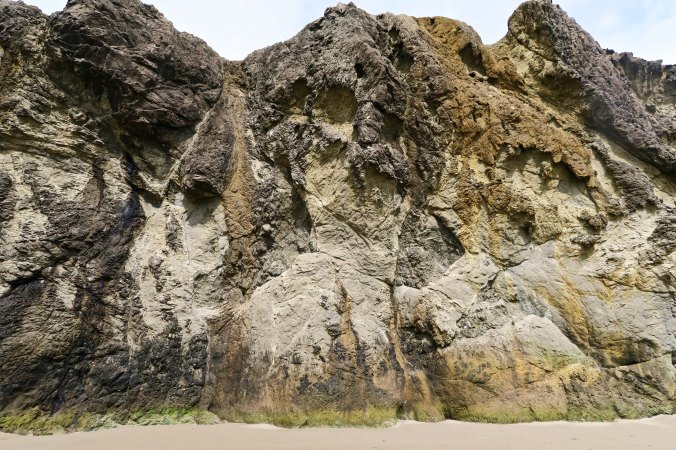
These cliffs rose up dramatically behind the beach.
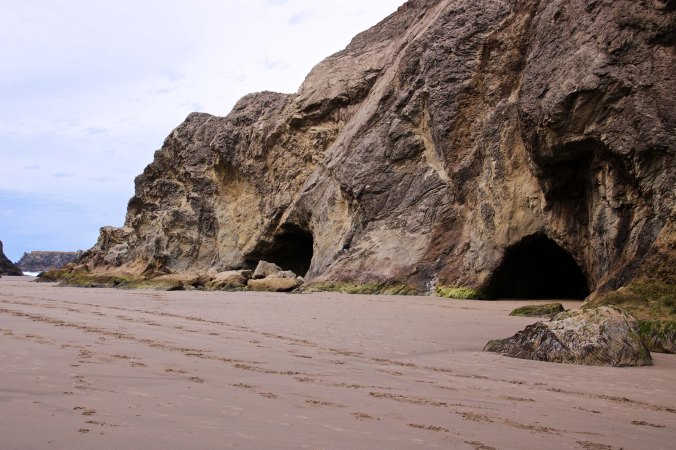
A pair of eye-like caves had been cut into the cliffs by the pounding waves. I was pretty sure that there would be pirate booty in them. (Photo by Peggy Mekemson.)
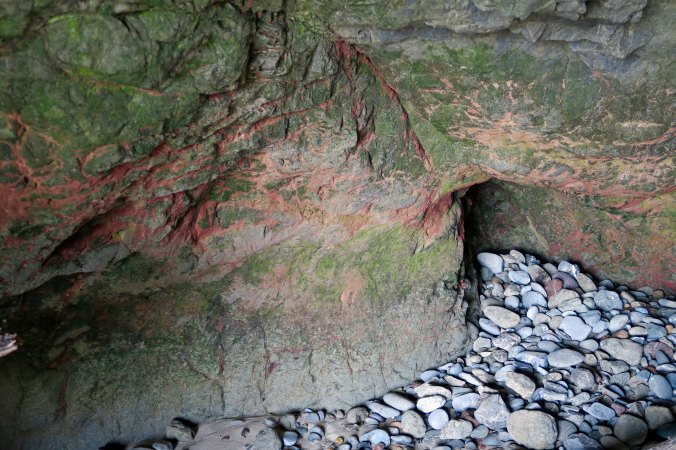
One of the caves was filled with rocks. I was tempted to dig.
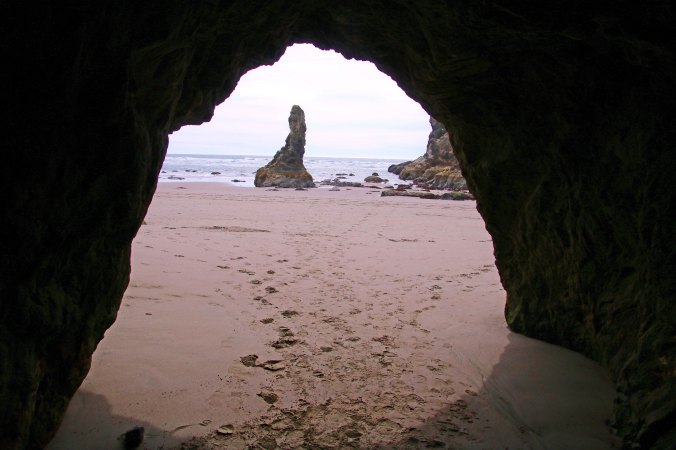
A view out from inside the cave. We hadn’t been alone in checking out the cave. (Photo by Peggy Mekemson.)

The same rock looking down from the viewpoint.

Looking up at the rock from below.
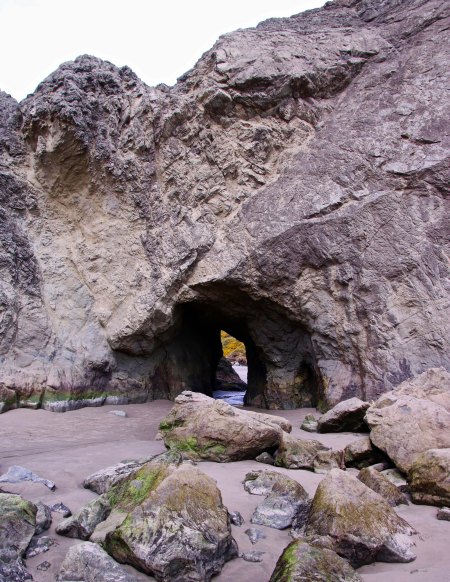
The other cave provided a view through the rock cliff. (Photo by Peggy Mekemson.)

Another view. The yellow plant seen on the other side is gorse. (Photo by Peggy Mekemson.)

George Bennet, the founder of Bandon, brought the thorny gorse with him when he came from the town of Bandon, Ireland in 1873. He saw it as a touch of home. Local Oregonians view it as an invasive plant that crowds out native plants.
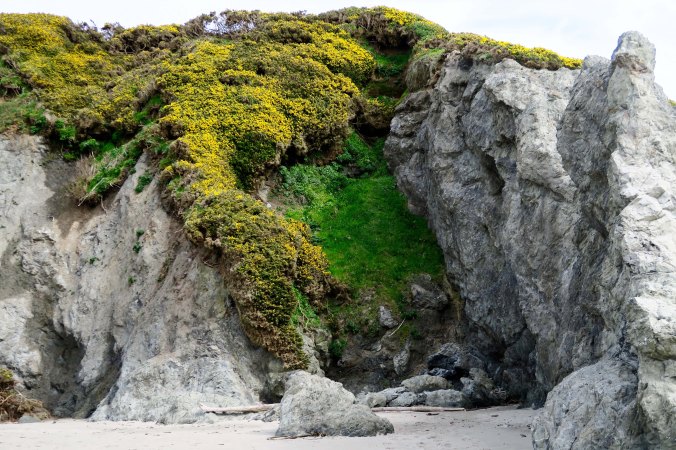
It does have a certain beauty, but don’t try to hike through its thorns. The cave comes through the cliff on the right.
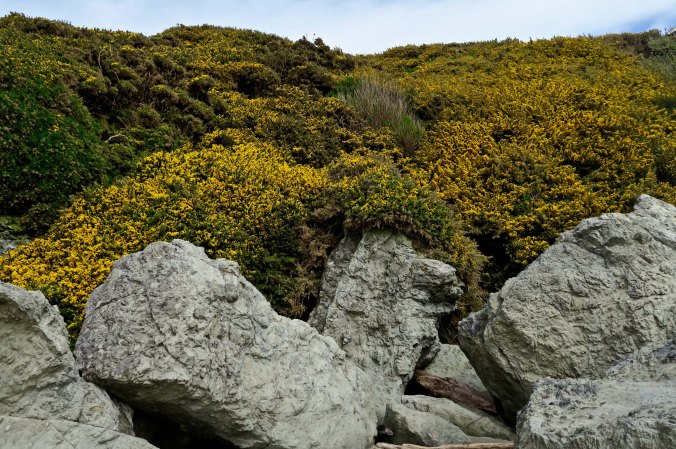
Another view.

There were many more rocks to keep us entertained. (Photo by Peggy Mekemson.)

The cat and kittens looked a little more riled up here as the tide began to roll in. (And no, the cat and kittens aren’t obvious to me, either.)
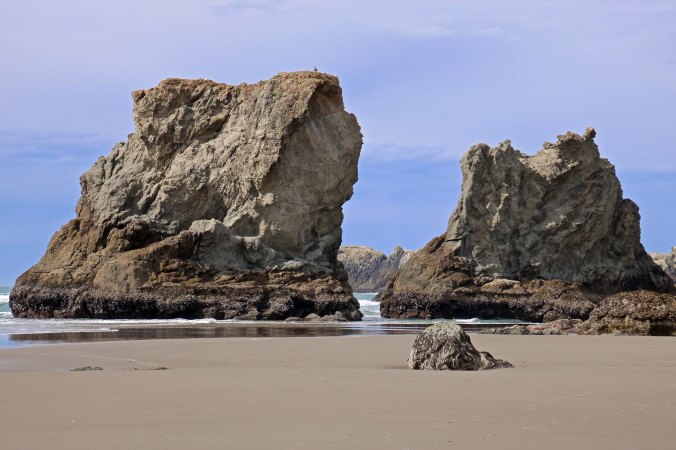
Peggy caught the tide slipping in between thesis giants. Can you spot the misplaced Canadian Goose on top of the rock on the left? It flew off honking. (Photo by Peggy Mekemson.)

I photographed the tide edging around this rock. The bottom of the rock, BTW, is packed with sea life.
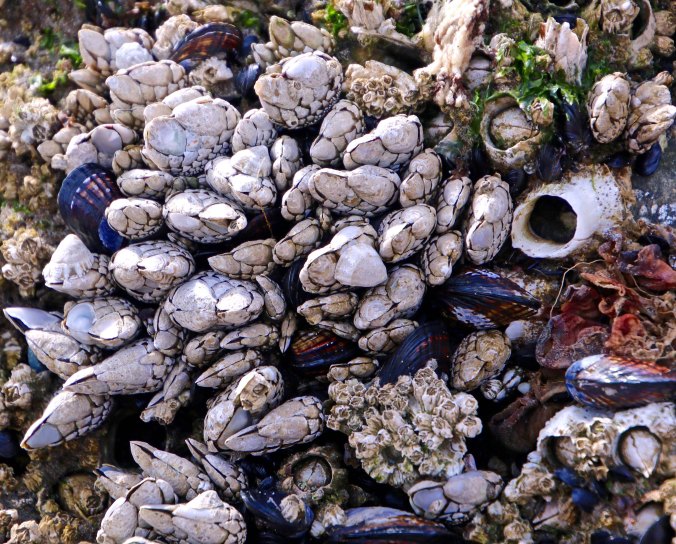
Peggy’s close up shows goose neck barnacles, regular barnacles and mussels. Every inch is filled!
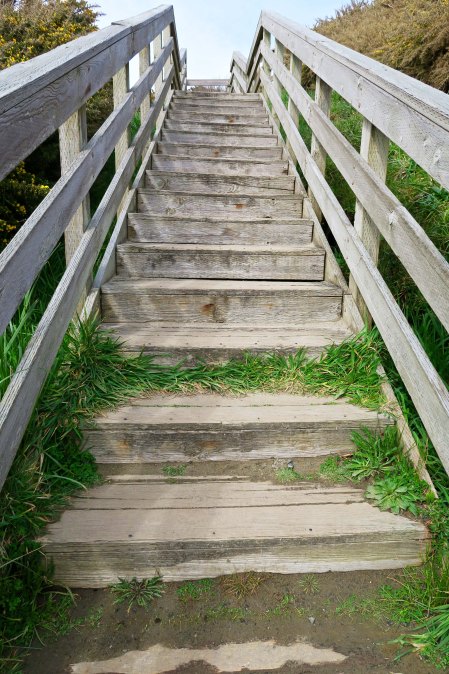
Our exploration complete, it was time to head back up the stairs.


NEXT BLOGS:

Wednesday: The interview with Bone!

Friday: The beautiful temples of Burning Man.

Monday: It’s back to Bandon, Oregon.


A Texas Bull Comes Out of the Ground; A Canadian Goose Is Created with 120,000 Pennies… The Art of Burning Man

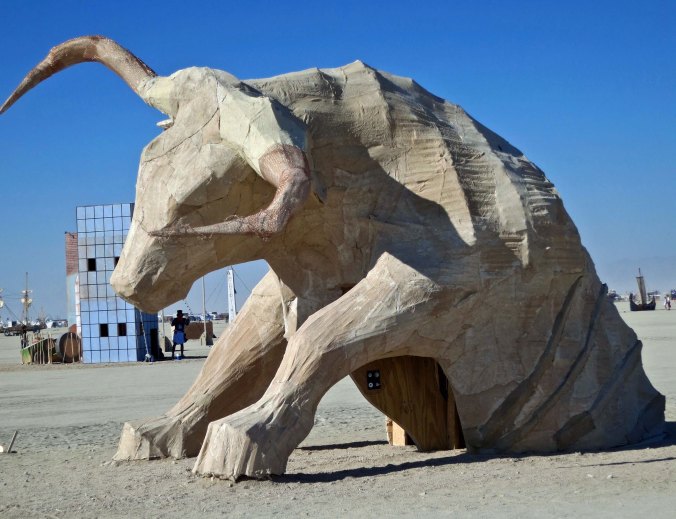
There are regional groups of Burners around the US and around the world. One year, Burning Man requested that regional groups come up with art projects. Texas produced this magnificent bull.


As I’ve noted before, my primary reason for going to Burning Man is the art. The creativity involved goes on and on and can, at times, be mind-boggling. Over the past couple of months, I’ve provided examples, looking first at mutant vehicles and then at large-scale sculptures. Today, I am going to wrap up my posts on sculptures. Next week, I’ll introduce some very unique buildings that seemingly spring up overnight in the Black Rock Desert only to be disassembled or burned down a week later.

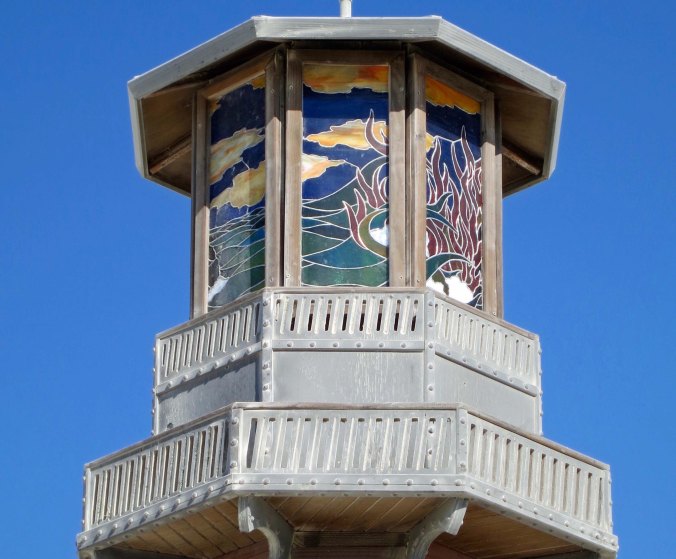
The same year that Texas produced the bull, the Northern California regional group produced this lighthouse.

A close up of the stained glass top.

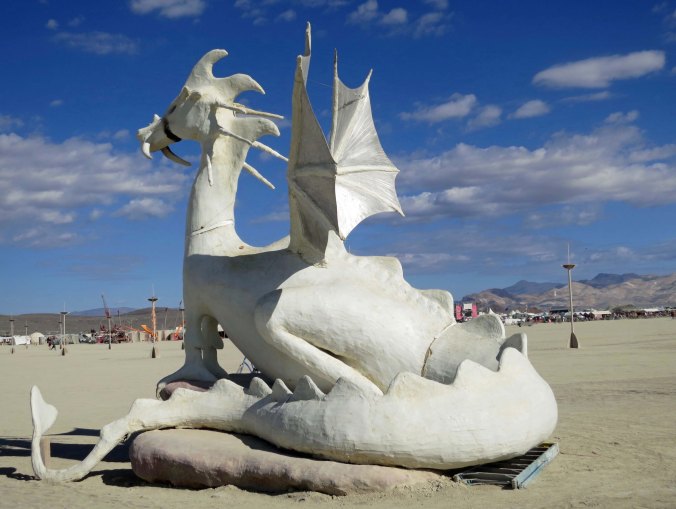
There are dragons at Burning Man! Always. This guy’s tail needed propping up.

I thought this dragon looked friendly…

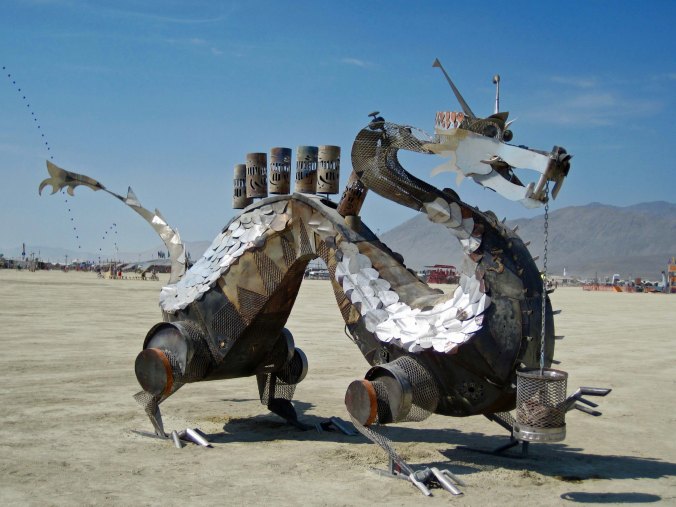
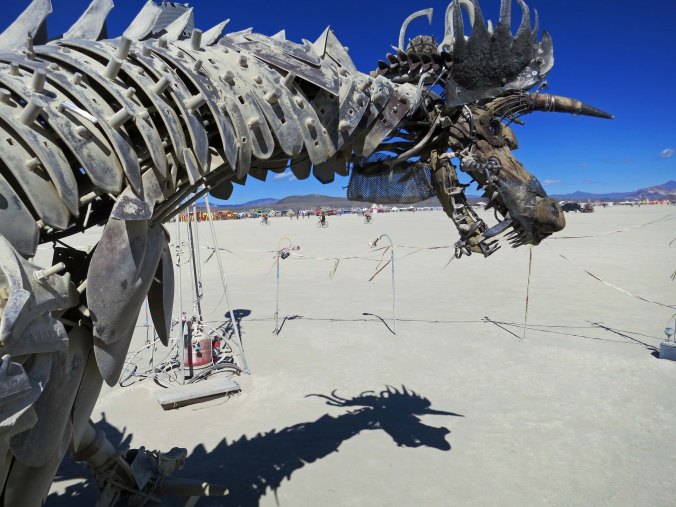
And this fellow scary. You may remember the quote, “meaner than a junk yard dog.” Well this was a junk yard dragon, made out of 100% pure junk. And check out that shadow!

A closer look at the skin on the dragon’s back. I thought the dog was a fun addition.

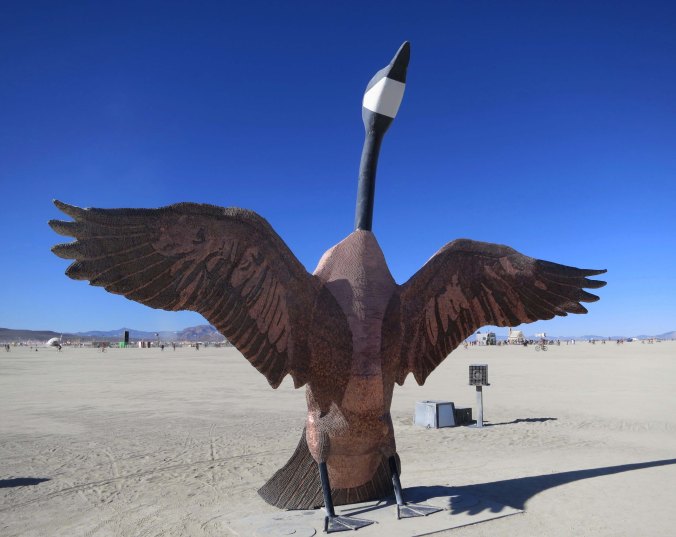
Meet Penny, the Canadian Goose. Over 100,000 pennies cover her body.

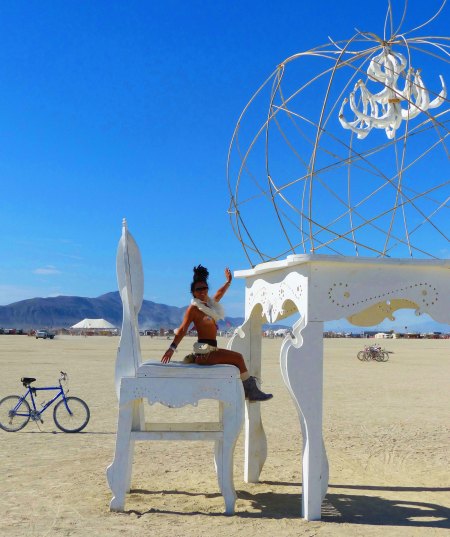
Is this a small woman or a big chair? It is definitely an Alice in Wonderland kind of thing. (Photo by Horse Bone Tribe member Don Green.)

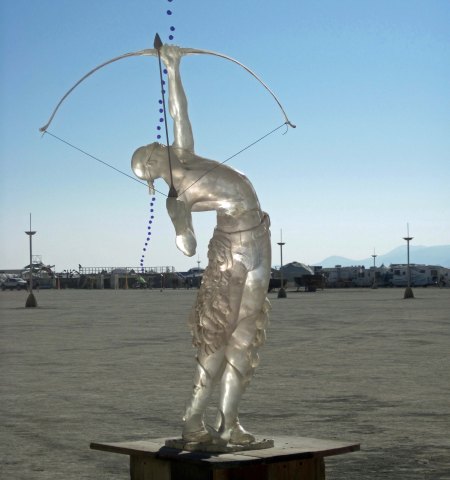
“I shot an arrow into the air. It fell to earth I know not where.” –Longfellow

I really liked this illusion of cubes climbing into the sky. (Photo by Don Green.)

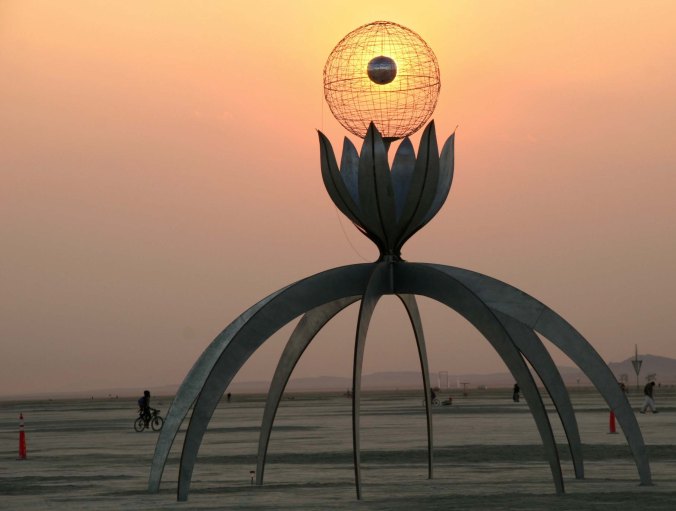
Tom Lovering caught this beautiful photo of a lotus with the sun behind it.

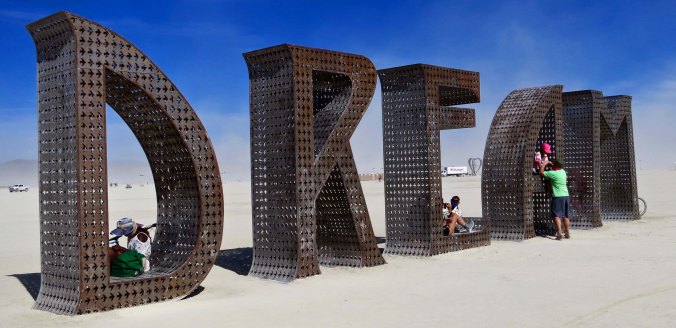
Large letter messages such as DREAM can be found at Burning Man almost every year.

This sculpture served as a gateway between the Center Camp Cafe and the Playa. A large dust storm stretches across the Playa and will soon invade Black Rock City, possibly causing a white out.

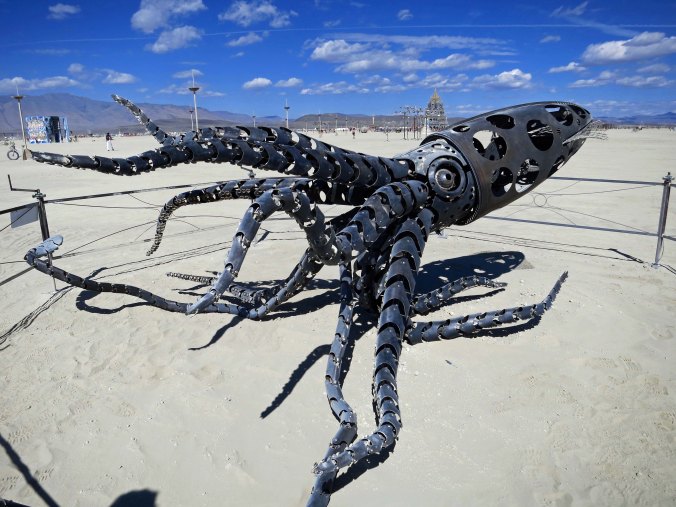
One expects to find ocean creatures scattered around Burning Man. A fence surrounding this octopus included hand cranks you could turn to move the tentacles. Much Burning Man art is designed to be interactive.

It isn’t unusual to find art that focuses on the Man, such as these hands…

And these circles.

A side view of the circles provided a different perspective.

I’ve always liked the grace of this simple sculpture.

The same sculpture from the back. Check out the stick sculpture under the wing.

A closer look. Imagine putting this together.

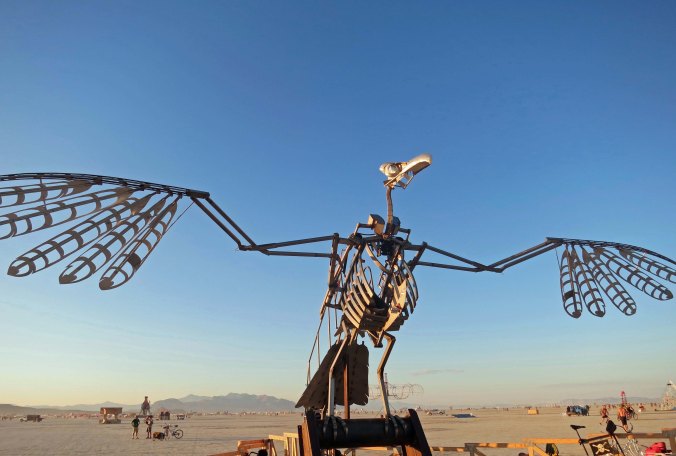
This prehistoric bird is another example of interactive art. Peggy climbed into its chest and worked pedals that made the wings flap. Slowly.

A large butterfly encouraged climbing!

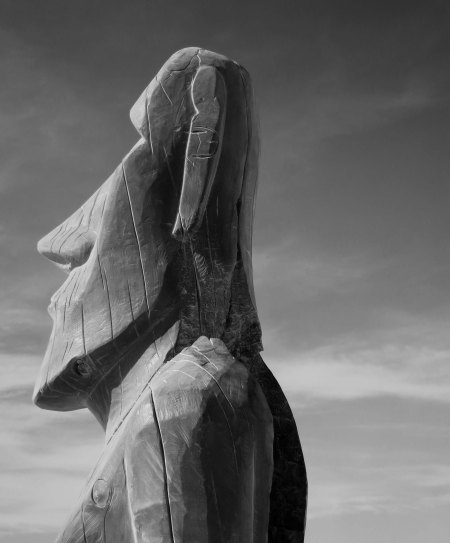
This wood carving made me think I had arrived at Easter Island. I decided it would look good in black and white.

Lets get down and boogie!

A gypsy wagon is pulled by a rather unique horse.

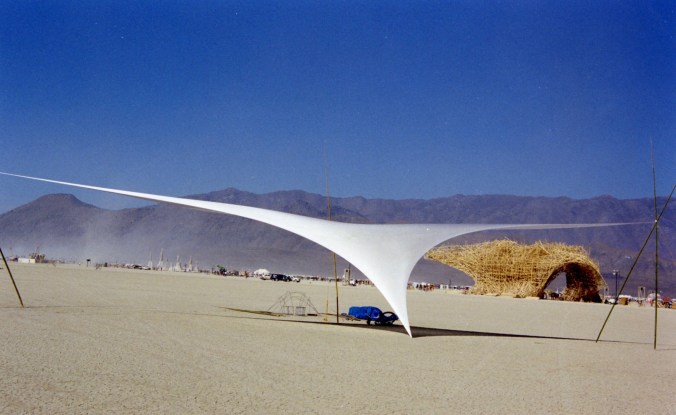
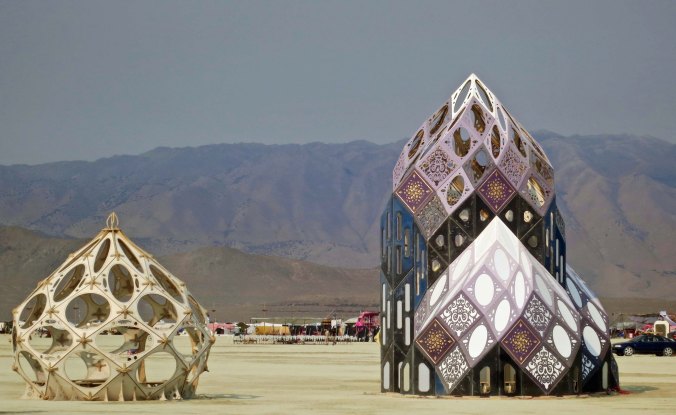
I’ll close today with these colorful geometric structures.

NEXT BLOGS:

Monday: Bandon… I’ll continue my series on the beautiful Oregon coast.

Wednesday: The interview with Bone. You won’t want to miss it!

Friday: The buildings of Burning Man, including some stunning temples.

The Journeys of Bone… Forty Years of Wandering the World

Bone has been wandering the world for 40 years. Given his nature, it is only natural that he would end up at Burning Man. He and a butterfly are perched on “Horse with No Name,” preparing to ride off into the desert.


Have you met Bone? He’s been hanging around here for 7 years and traveling the world for 40. Once upon a time, and it seems like a long time ago, this blog was even titled the Peripatetic Bone. There’s a story here, of course. In January of 2010, I had attended the San Francisco Writers’ Conference. Part of the event had involved ‘speed dating’ with agents.  I had carried Bone with me to San Francisco and introduced him to three of the agents, suggesting that I wanted to write a book titled “Travels with Bone.” They had been a bit surprised to meet Bone, but had been intrigued by the concept. Each had suggested that I go home and write up a proposal.

 I had also learned at the conference that I needed an Internet presence and would be expected to market any book I succeeded in publishing. I dutifully went home and created a blog for Bone on Word Press. Somewhere in the process, I decided that my first book should be on my Peace Corps experience. So, I wrote and published, “The Bush Devil Ate Sam.” I also changed the name of my blog to “Wandering through Time and Place.”

 I decided it would be fun to reintroduce Bone and do a five-part mini-series on his adventures. Today, I am going to summarize his travels. Next week I will do an interview with Bone. Then I will follow up with three posts on how he was found.


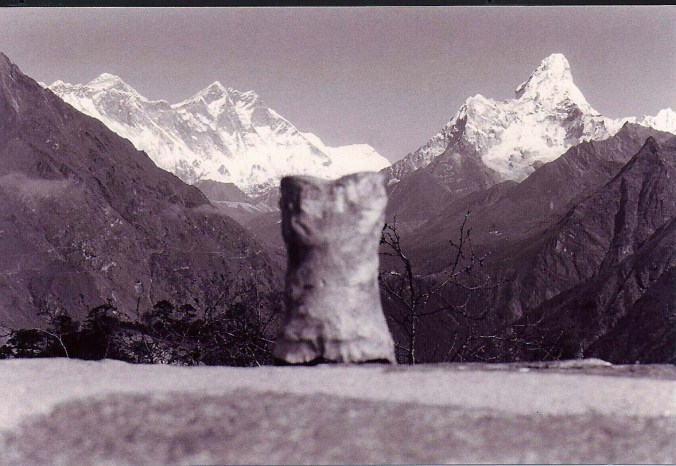
Bone has traveled twice to the base of Mt. Everest.


Part I: The History of Bone

Sometime in 1900s Bone started his life as part of horse wandering through the Sierra Nevada Mountains. The horse was allegedly eaten by a bear. Bone ended up in a high mountain meadow practicing Zen and being nibbled on by a miscreant rodent.

1977: He was ‘discovered’ by two lost backpackers (Curt Mekemson and Tom Lovering) on the Tahoe Yosemite Trail above Lake Tahoe and launched his career of wandering the world.

1980-81: Bone commenced his first World Tour with Tom.  He visited Asia including Japan, Hong Kong, Bombay, Delhi and Katmandu where he trekked to the base of Mt. Everest. He then wandered on to spend spring and summer in Europe stopping off in Greece, Spain, Portugal, France, Italy, Austria, Liechtenstein, Luxembourg, Germany, Belgium, England and Ireland. Getting cold, Bone headed south and hitched ride in back of truck through Algeria, Niger, Chad, Nigeria, Cameroon, Central African Republic, Zaire, Sudan, Kenya (where he crossed Equator), Tanzania, Zambia, Zimbabwe, Botswana and South Africa. He signed on with Tom as crew of sailboat in Cape Town and headed north to Mallorca, stopping off on the islands of St. Helena, Ascension, Cape Verde and Madeira. Back in Europe he explored his possible Viking roots in Sweden, Norway and Finland.

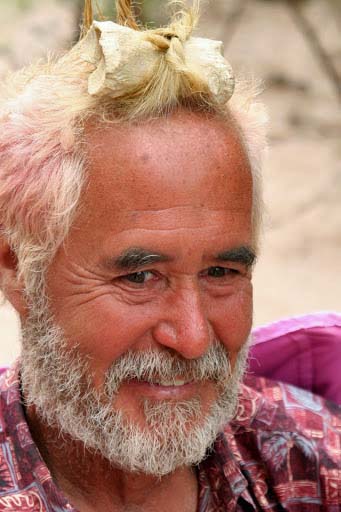
Bone ends up in Tom’s hair (don’t ask) on a 2010 trip down the Colorado River.

1983-86: Bone assumed Cheechako status and moved to Alaska with Curt where he was stalked by a grizzly bear on the Kenai Peninsula, explored Prince William Sound by kayak, learned to winter camp in 30 degree below zero weather while listening to wolves howl, backpacked in the Brooks Range north of the Arctic Circle, and discussed the finer points of eating salmon with Great Brown Bears in Katmai National Park. He escaped briefly to the warmer climate of Hawaii and participated in New Orleans Mardi Gras.

1986: He backpacked the Western US for five months with Curt exploring the Grand Canyon, the Gila Wilderness of New Mexico, the Rockies, and the Wind River Mountains of Wyoming before returning to his beloved Sierras.

1989: Bone went on a six month 10,000-mile solo bike tour with Curt around North America visiting 18 states and 4 Canadian provinces. He ended his journey by meeting Peggy.

1990: The International Society of the BONE was formed at Senior Frogs in Mazatlan, Mexico, where Bone spent the afternoon being pickled in a pitcher of margaritas and being kissed by lovely senoritas.

1991-97: Various members of International Society accompanied Bone on numerous adventures. Highlights included a White House Press Conference with Bill Clinton, being blessed by the Pope in St. Peter’s Square, visiting with Michelangelo’s David, going deep-sea diving in South Pacific and Caribbean, doing a Jane Austin tour of England, and exploring the Yucatan Peninsula. A group adopted him as a good luck charm and took him back to visit the base of Mt. Everest one year and to climb Mt. Kilimanjaro another.

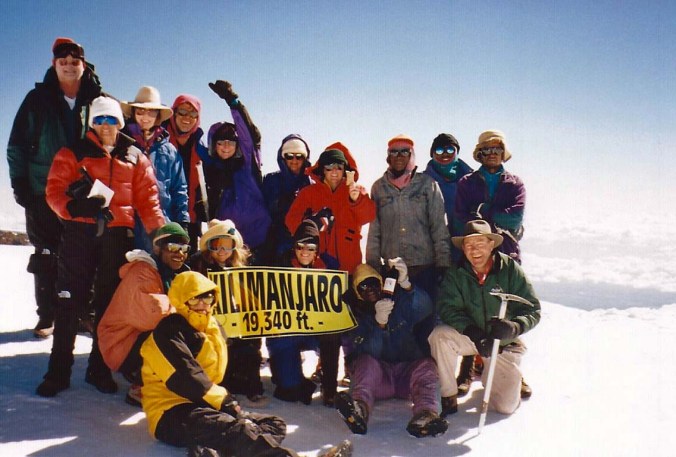
Bone loves high places. Here he is on top of Mt. Kilimanjaro in East Africa. (He’s with MJ, fourth from right, standing.)

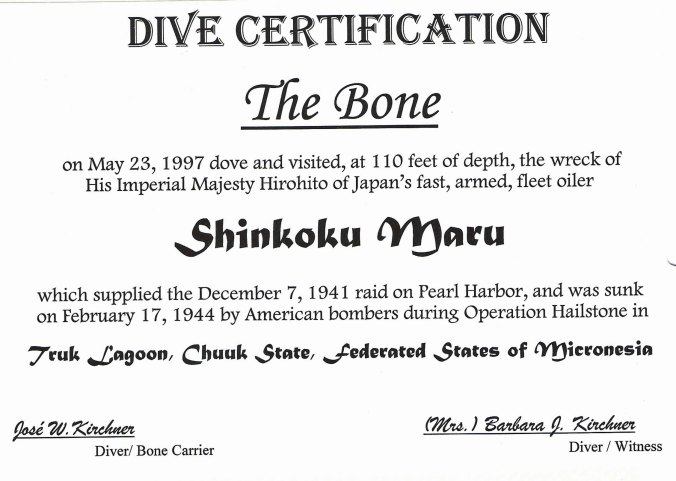
Bone went diving in the Pacific in 1997 with Jose and Barbara Kirchner, visiting a Japanese ship sunk during World War II and receiving his diving certificate.

1998-99: Bone embarked on 40,000-mile journey in the van, Xanadu, through the US, Canada and Mexico with Peggy and Curt, visiting over 30 National Parks, driving the Alaska and Baja Highways, checking out Smokey the Bear’s and Calamity Jane’s graves, kayaking in the Sea of Cortez, leaf peeping in Vermont, jetting to the Bahamas, pursuing flying saucers in Roswell, New Mexico, and completing his visits to all 50 states, etc. etc. etc.

2000-02: Bone journeys up the Amazon, returns to Europe, cruises to Belize, Cancun and the Cayman’s, and goes to New Zealand where a misguided customs agent tries to arrest and jail him as animal matter.

While in the Amazon, Bone slept in the same room that Jimmy Carter had slept in.

2003: Bone undertakes a 360-mile backpack trip in celebration of his discovery and Curt’s 60th birthday. They begin at Squaw Valley near Lake Tahoe and end by climbing Mt. Whitney. Various friends join them along the way.

2004: Bone visits Hemingway’s grave in Idaho, goes horseback riding with Australians and Bahamians in Montana, and makes his first pilgrimage to Burning Man in Nevada, a very Bone like type of place. He also jets off to Costa Rica.

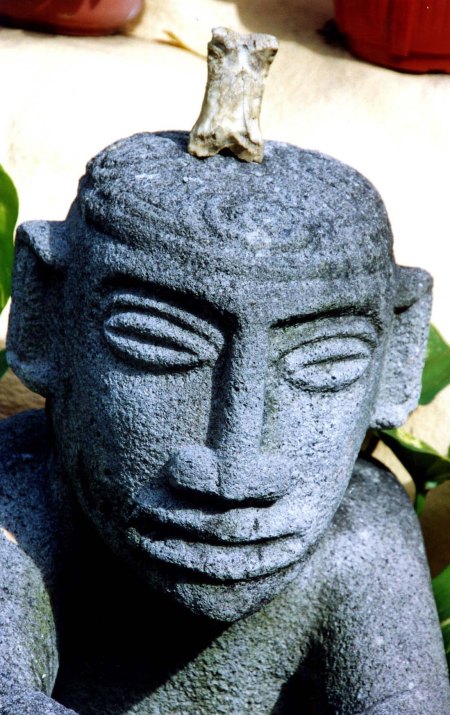
Bone has a love for anything ancient. Here, he perches on a Mayan sculpture in Costa Rica.

2005-2007: Bone returns to Burning Man twice and revisits Europe twice including special stopovers in Portugal, France, Holland, Germany, and Belgium. He also revisits Mexico.

2008 – 2011: Bone commences another exploration of North America. This time he travels in the van, Quivera, along with Curt, Peggy, and Eeyore the Jackass. His journey takes him over 75,000 miles of American Roads. In May of 2010 he begins his travel blog, The Peripatetic Bone, and rafts 280 miles down the Colorado River through the Grand Canyon.

2012-2017: Bone goes into semi-retirement in Southern Oregon. Please note the semi, however. He continues the exploration of the West Coast ranging from Big Sur to Vancouver Island, where he kayaks for a week in search of Killer Whales. He wanders through England and Scotland helping Curt find his roots and spends a week traveling by Canal Boat on the Mercer River. Later, he returns to Europe again, traveling through the Mediterranean visiting Turkey, Santorini and other Greek Islands, Dubrovnik, Venice, Rome, Pompeii, Florence, and Barcelona. He returns to Burning Man several times.  On one trip, he is married to the lovely Bonetta, who he met while exploring a swamp in Florida. Rumor has it that it was a shotgun wedding.
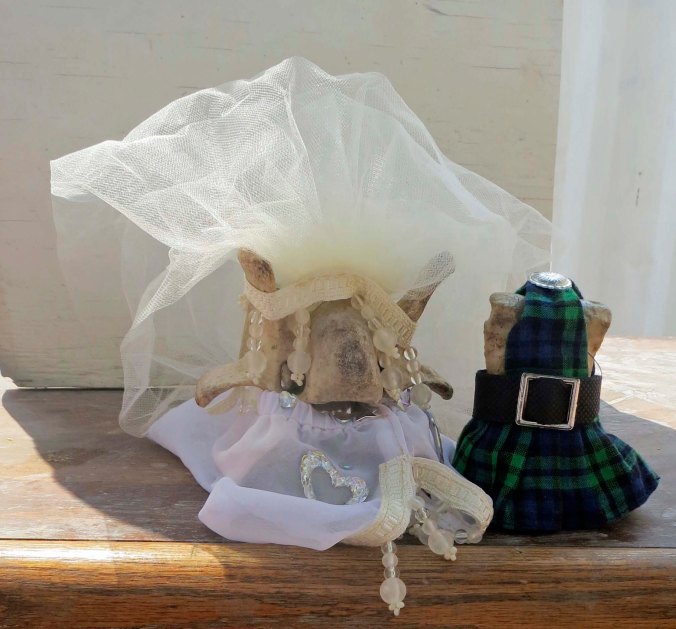
Bone and Big Nose Bonetta are married at Burning Man 2013. Bone’s kilt was made for him by an 80-plus year old woman from Kansas. Bonetta is wearing a designer wedding dress with very expensive plastic jewelry to match.

NEXT Wednesday: Bone grants one of his very rare interviews. You won’t want to miss it! (No, Bone doesn’t talk; he just thinks out loud.)

In the Meantime:

Saturday: A return to Burning Man and the last of the sculptures.

Monday: Peggy and I have just been in Bandon on the Oregon Coast. Are you ready for a visual treat?

Astoria, Oregon… Where the Columbia River and the Pacific Ocean Meet

A rainbow hangs over the mouth of the Colombia River and ships that are waiting their turn to head out into the Pacific. Special pilots are brought on board to navigate the treacherous waters, now looking quite calm.


I visited Astoria a while ago and didn’t get around to writing about it. Since Peggy and I are now off playing on the Oregon coast, I decided today would be a good day for featuring this city that sits on the edge of the Colombia River.


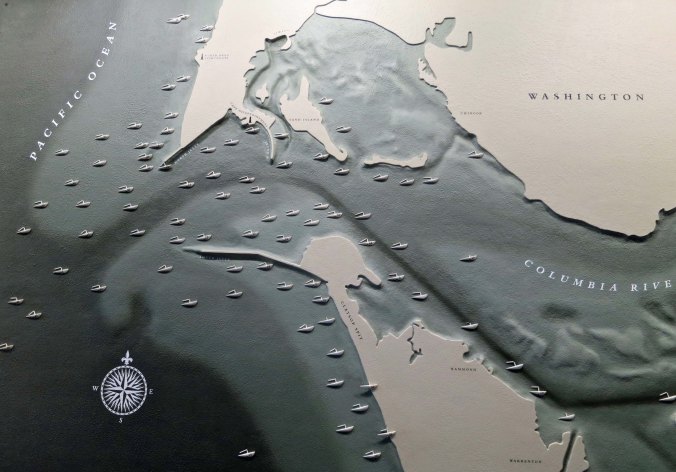
The area off of Astoria, Oregon, where the Columbia River flows into the Pacific Ocean, is called the Graveyard of the Pacific. A combination of high seas with 40-foot waves, shallow, shifting sand bars, and the mighty Columbia River have sent some 2000 boats to their watery demise since 1792. It is considered one of the most dangerous navigation passages in the world.

This map, which is located in the Columbia Maritime Museum, shows where some of the shipwrecks can be found.

It’s no wonder that  you are greeted by a sign that proclaims Astoria is an Official Coast Guard City when you enter the community. The town is grateful that the organization is there when someone needs to be pulled out of the turbulent water. A dramatic, full-sized diorama of a Coast Guard rescue effort is featured at the Maritime Museum.

Astoria wears its Coast Guard connection proudly.

A full size diorama of a Coast Guard rescue effort is on display at the Columbia Maritime Museum.

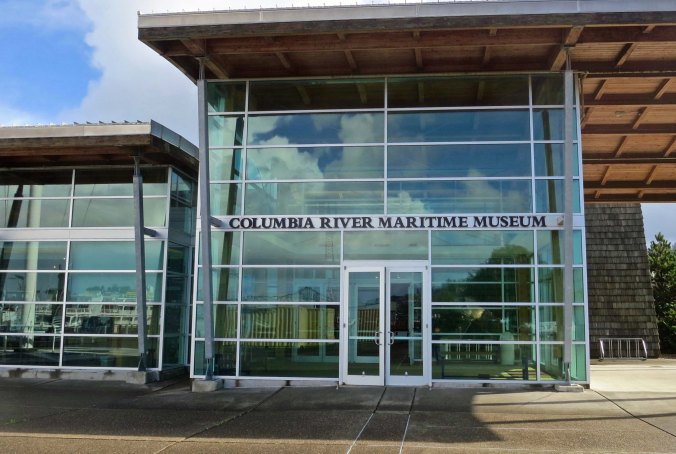
A photo featuring the front of the Columbia Maritime Museum. I liked the way the glass reflected the clouds.

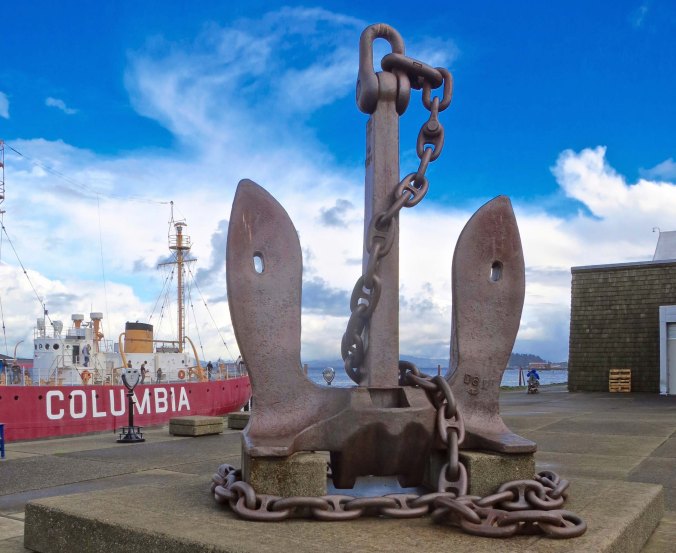
I thought that this anchor that sits out in front of the museum, is an apt symbol for both the museum and the city. The lightship Colombia is seen in the background.

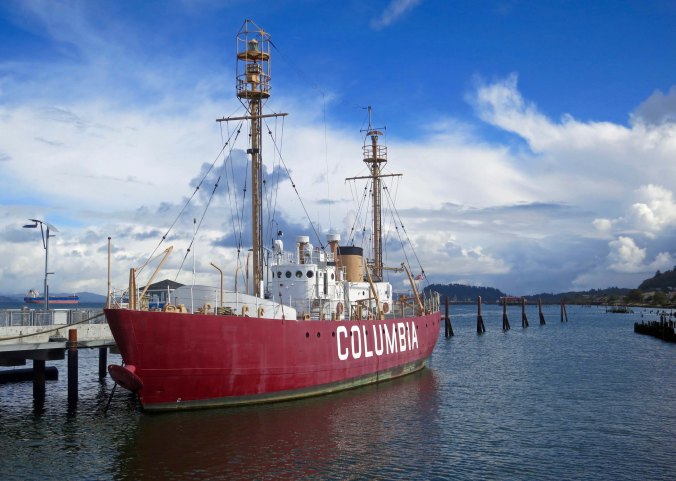
In the days before modern navigation equipment, the lightship Columbia served as an offshore lighthouse, aiding ships entering and leaving the Colombia River. The lightship maintained its position for weeks at a time and stocked in 12 tons of food, 13,000 gallons of fresh water and 47,000 gallons of fuel.

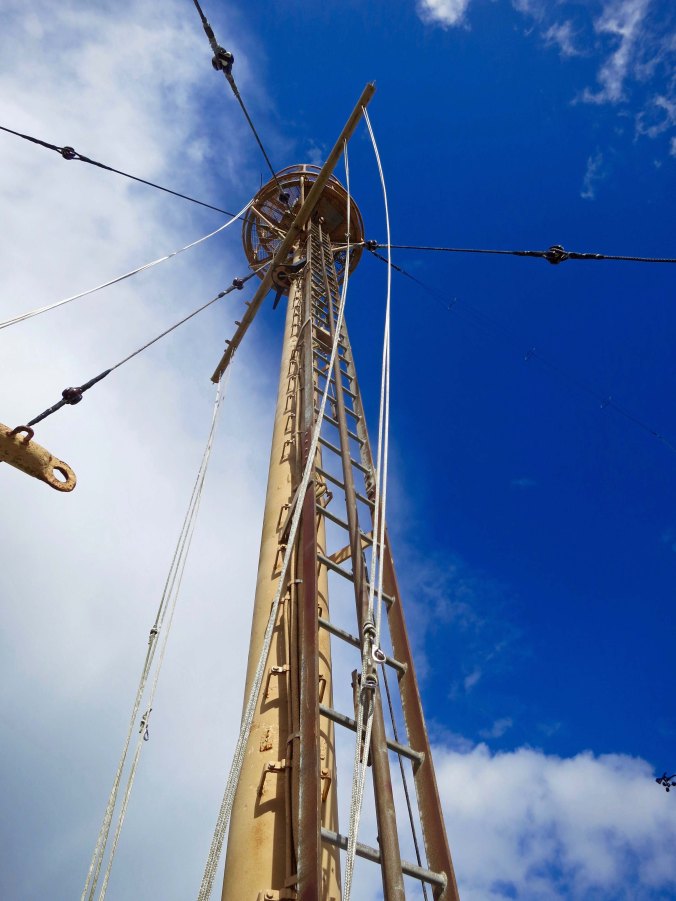
This crows nest mast on the Columbia was used for powerful lights and foghorns as well as observation.
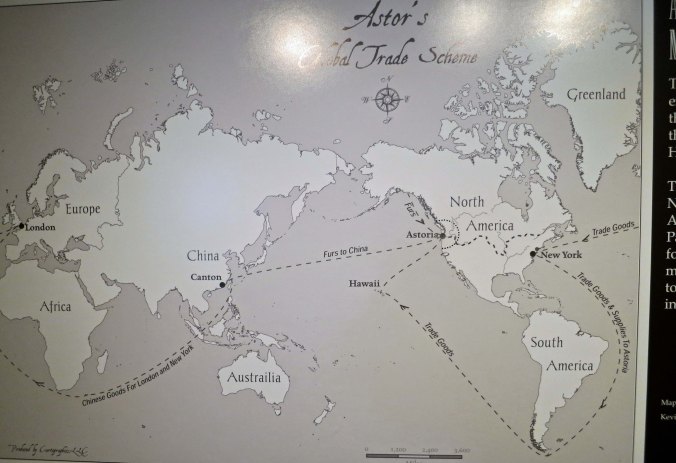
Astoria’s connection with the fledging United States dates all the way back to the Lewis and Clark expedition. The explorers sent out by Thomas Jefferson spent the 1805-6 winter in the area and built Fort Clatsop for shelter and protection. John Jacob Astor, who gave the city its name, followed up by building a fur trading post there in 1811 that became the first permanent settlement the US had on the west coast. Both the Lewis and Clark expedition and Astor’s post helped in the debate with England over who owned the land.

This map from the museum shows Astor’s trading routes.

Traveling by sailboat through the world’s oceans was hazardous. An early fear of sailors was having encounters with sea monsters. I found this illustration of a Kraken in the museum and laughed. If you are familiar with Pirates of the Caribbean, you will recognize it.

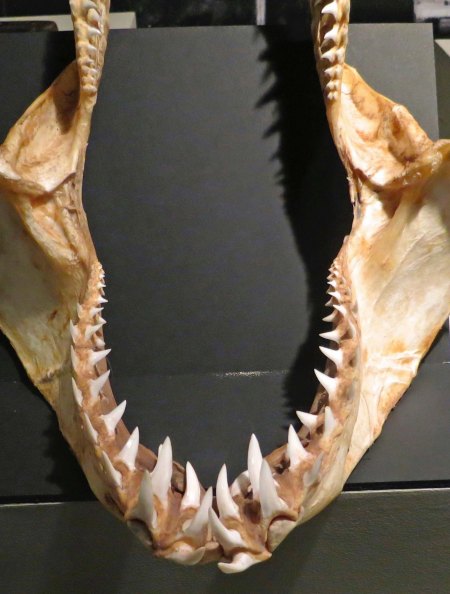
Now here is something more real to worry about! I also found this shark jaw and teeth in the museum.

Logging and fishing followed fur trading as the mainstay of the area’s economy. By the mid-1800s, fisherman from around the world called Astoria home. Only 13 percent were born in the US. The majority came from the North Atlantic countries where over-fishing had caused the fishing industry to collapse, a fate that would eventually befall Astoria. A major canning industry that grew up to process the fish also faded when the fish ran out. The canning industry employees were mainly Chinese immigrants. An educational display in the Maritime Museum notes that the most efficient of the Chinese workers could clean a 45-pound salmon in 45 seconds and up to 1700 fish in a standard 11-hour work day.

An ad photo for the Bumble Bee salmon cannery. The bee has a fishing pole.

I suspect that these pilings once supported several thriving canneries..

Now they support a thriving seagull population.

With the boomtown days of fur hunting, logging, and fishing behind it, Astoria has turned to tourists to help support its economy. Nearby Portland  (100 miles away) helps assure a continuing supply, as does the almost constant flow of tourist traffic up the Oregon coast in the summer. The museum, historic sites, fun shops, and several restaurants help meet the needs of visitors.

Downtown Astoria has preserved several historic buildings that add to its ambience.

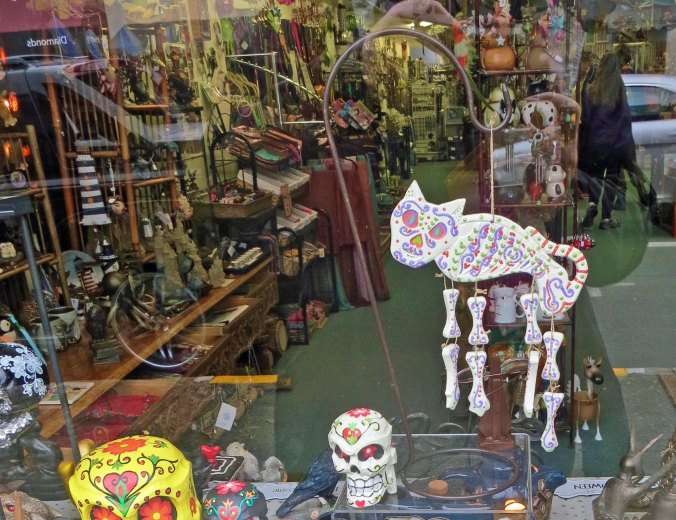
This shop was packed to the gills with tourist merchandise. Nice kitty. I think you are probably a Mexican immigrant, however, and I doubt you have papers. Watch out.

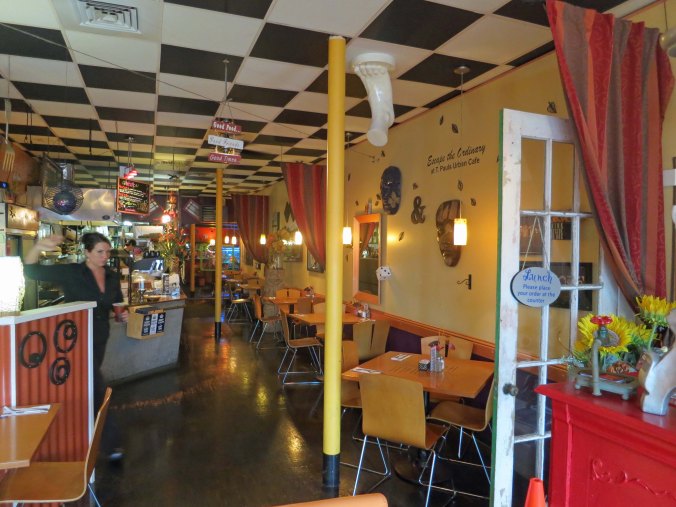
T. Pauls has an eclectic menu and a foot on the ceiling. I ate under the foot.

It seems only appropriate that I wrap up this post with an old piling and the rainbow across the Columbia River.

Wednesday’s Blog: You are going to meet the world-famous Traveling Bone.

On Friday we will return to Burning Man.
 

Ten Major Art Installations from Burning Man’s History

The Big Rig Jig was made up of two oil tanker trucks, taken apart and put back together.

I’ll be journeying to Burning Man alone this year. I obtained my ticket in February. Peggy joined the long queue for tickets on Wednesday, all to no avail. When she was finally moved to the ticket purchase site, the message was that all 30,000 tickets had been sold out. (The other 40,000 tickets are distributed in other ways.) Neither are other members of the Horse Bone Tribe going this year. So, it’s back to me, like it was in 2004, when I went by myself except for my friend Ken Lake. I’ll miss my friends, especially Peggy, but I am okay with going alone. I can easily spend eight days exploring and photographing the art.

Today I am featuring ten of the major art installations I have enjoyed the most over the years. This doesn’t include buildings like the temples, which will have their own posts. Since I missed four years when I was off wandering or had ended up on the wrong end of the Burning Man ticket circus, there are undoubtedly other pieces I would include.  Also, I already included a post on the 40 to 60-foot-tall sculptures of women that are definitely among my favorites.

Another view of the Big Rig Jig. I felt a bit nervous standing underneath it.

Often the major art installations are tied into Burning Man’s Theme for the year. In 2007 the theme was “The Green Man,” which had an environmental emphasis. The Big Rig Jig tied into the impact of oil.

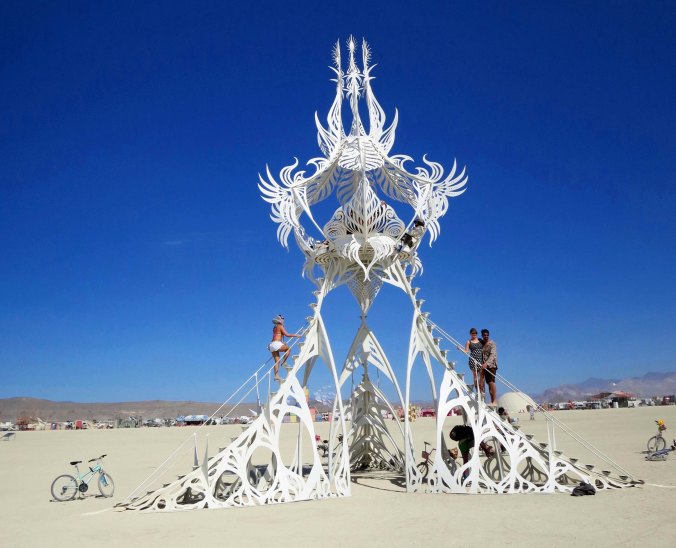
I’ve always considered this intricate white tower beautiful.

A close up of the top.

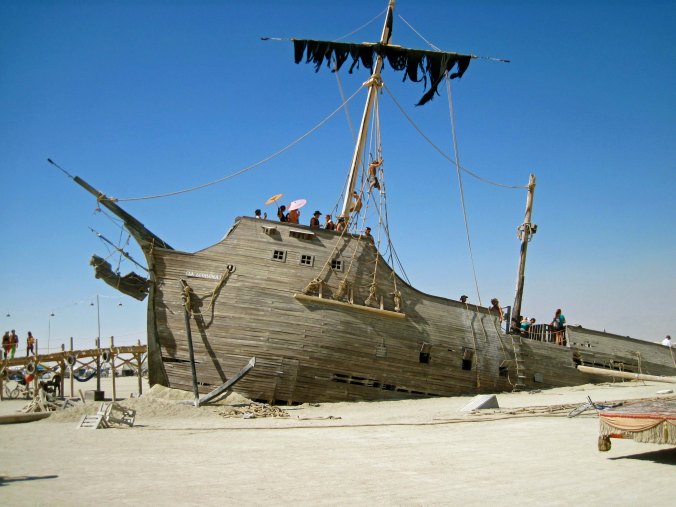
This massive sailing ship appeared to be sinking into the Playa.

A front view of the sailing ship. I thought that the detail was incredible. The ship was built in Reno.

As is often the case at Burning Man, what was inside the art piece was also fun and interesting. I like the stylish hat.

Dragons are common at Burning Man. This one, protecting its egg, is my favorite.

I don’t think I would be tempted to harm its baby.

Especially at night.

Buck Rogers would have been happy with this rocket ship. Peggy provides perspective.

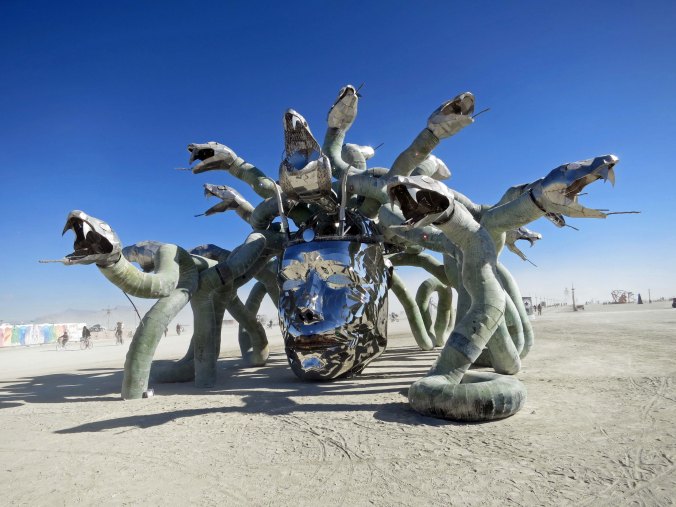
Medusa with her snaky hair was one of the most unusual sculptures at Burning Man.

Her wiggly hairdo from the back.

And at night.

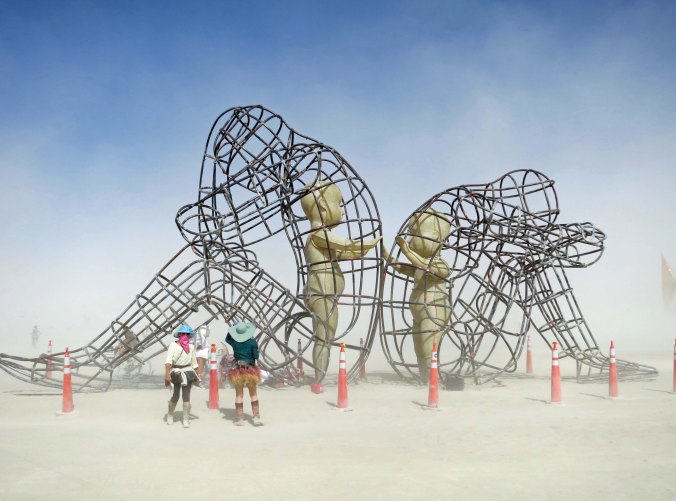
The inner children of these two estranged adults reach out to each other.

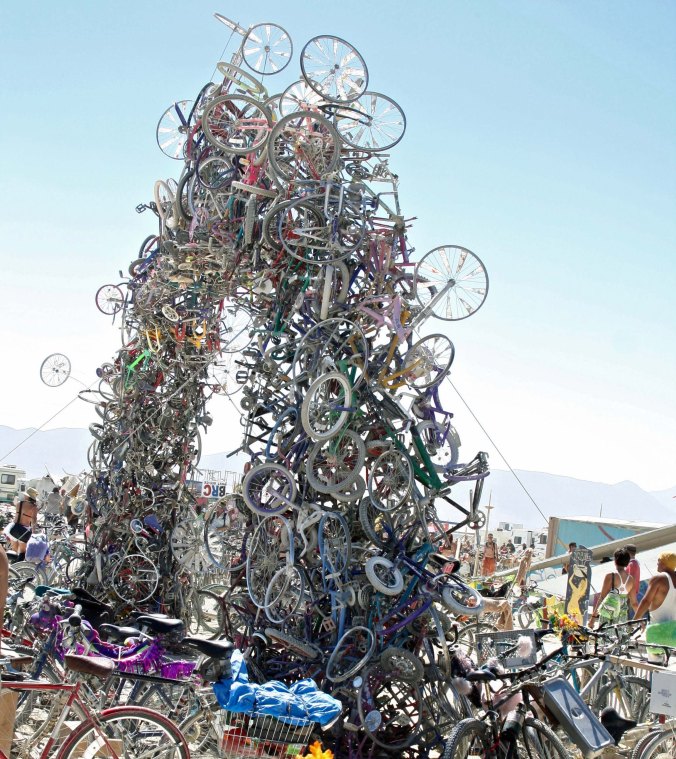
I have always liked this bike sculpture that was located in front of the Center Camp Cafe because of the significance of bikes for transportation at Burning Man.

The top of the heap, so to speak.

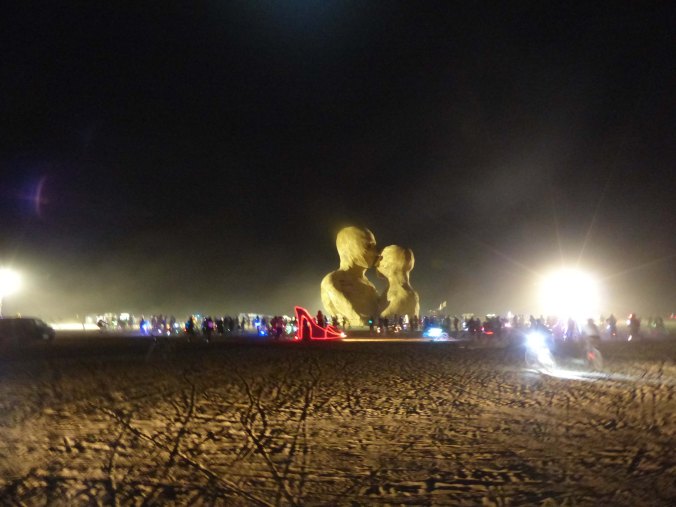
This giant couple embraced. The Man looks on from the left.

A close up.

This art was located in the head of one of the sculptures.

At night.  A red, high-heel mutant vehicle is in the foreground. (Photo by Don Green.)

A coyote raises its head to howl. (Photo by Tome Lovering.)

A tail view of the coyote.

I chose the coyote at night for my last photo today. The two bright lights on his head are from headlamps of people climbing the sculpture.

NEXT BLOGS:

Monday: Back to the Oregon coast with a visit to the town of Astoria on the mouth of the Columbia River.

Wednesday: I’ve often mentioned the Horse Bone Tribe and Camp at Burning Man. This is the story of the horse bone, or Bone, as he prefers to be known.

Friday: A continuation of my Burning Man art series with a final look at sculptures.

All’s Well that Ends (grin)… The Sierra Trek Series

Treks have always been about adventure. In addition to the physical and mental challenge, there is a more important element of experiencing nature on a very personal level, both the beauty and the wonder. Imagine, for example, coming on this Aspen that bears have climbed and used as a marking tree to establish their territory.

This is my last post on the first Sierra Trek series. Last week left us in the American River Canyon, waiting while the US Bureau of Reclamation blasted rocks off the hill sides in preparation for building the Auburn Dam. (The discovery of an earthquake fault zone under the dam would lead to its not being built.) Today I will take us on into Auburn, California where the 100 mile backpack trip ended.

As in the previous posts, I have selected photos from other Treks since I don’t have any from the first. There are several other areas in California I would lead Treks besides the Sierras. These photos are from the Trinity Alps. 

Another photo of a bear tree in the Trinity Alps of California. And yes, those are claw marks.

Early the next morning we had an important decision to make: whether to wade across the American River in water up to our belly buttons and then follow the river or climb up and along the steep canyon following alternative trails. I let the Trekkers vote and they voted to cross the river. One woman was deathly afraid, however, and broke down in hysterics. She was the same person who had, at first, refused to ride the Squaw Valley tram. We offered to carry all of her gear and even carry her, all to no avail. Finally, I decided we would all hike the canyon route. I was not about to split our group again. (It was the only time in my years of leading Treks that I ever allowed participants to vote while on the trail. Treks, I decided, were not a democracy.)

This shot of the Trinity Alps provides a great perspective on why the mountain range was given its name. (Photo by Peggy Mekemson.)

A view from farther away. These are rugged mountains that provide challenging, beautiful backpacking opportunities.

Our last night was fifty-fifty on the plus and minus scale. On the plus side, I knew that we had succeeded. Our Trekkers, except for the two or three who were now riding in the jeep, had made it— survived if you will. We had managed to solve each of the crises we had faced along the trail. I could say goodbye to the Trekkers the next day knowing that I had put everything I had into getting them through the nine days. On the minus side, Steve had taken a few of the ‘cool’ Trekkers to camp away from the main group. I hated seeing this, it was a really bad decision, but it was already a done deal by the time I came into camp as rear guard. I could have hiked up the canyon and insisted the group rejoin us, but I just didn’t have the energy to do it, physically or mentally.

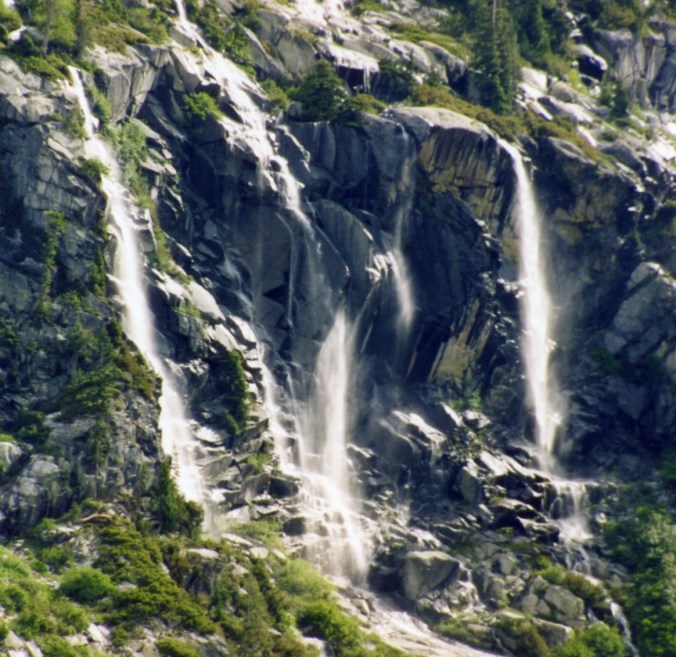
The Trinity Alps includes a number of impressive waterfalls.

Another…

And another.

Sunday, we hiked into Auburn Fairgrounds as a group with the Trekkers in high spirits, singing the Ham Cheddarton song. They had a bar-b-que chicken feast to look forward to and then they were going home— home to hot showers, clean clothes and loved ones. They had enough tales to fill the next week and possibly their lifetime. As we approached the fairgrounds, our Auburn volunteers and several Board members were there to cheer our arrival.

I didn’t know how things would end. At best, I hoped our Trekkers would recognize that even though we had made enough mistakes to fill a book (or at least a long chapter), we had tried as hard as we humanly could to rectify them. And I had learned, boy had I learned. Mainly, I felt relief. I was going back to focus on our mail fundraising campaigns with a vengeance.

What took me by surprise was the response as Trekkers started to leave.

“Thanks, Curt, for the most incredible experience in my life. Where are we going next year?”

“You and Steve were great, Curt. I would like to help with next year’s planning.”

And on and on. People were excited about their experience. It was one of the most difficult things that they had ever done, and they had succeeded. They left feeling better about themselves, and that feeling translated over to us and the Lung Association. Instead of the negative comments I expected, and in some ways deserved, we were getting rave reviews. While not everyone was eager for next year’s adventure, most were asking, even demanding that we repeat it.

I left that day not quite convinced but leaning toward doing another Trek. One thing was for sure, my experience had matched that of the Trekkers. The event had been one of the most difficult things I had done in my life from both a physical and mental perspective. I came out of the Trek with a new confidence in myself and a new understanding of what I was capable of accomplishing— and an increased love of the wilderness.

One final amusing note: that night as I took my first shower in nine days, I reached around behind me to wash my fanny and it wasn’t there. It had disappeared. Between the trail review work, my trauma with Jo, and the Trek, I had lost 20 pounds in two weeks.

This is Sapphire Lake, one of a series of high alpine lakes in the Trinity Alps.

A reflection shot along a trail climbing up into the mountains.

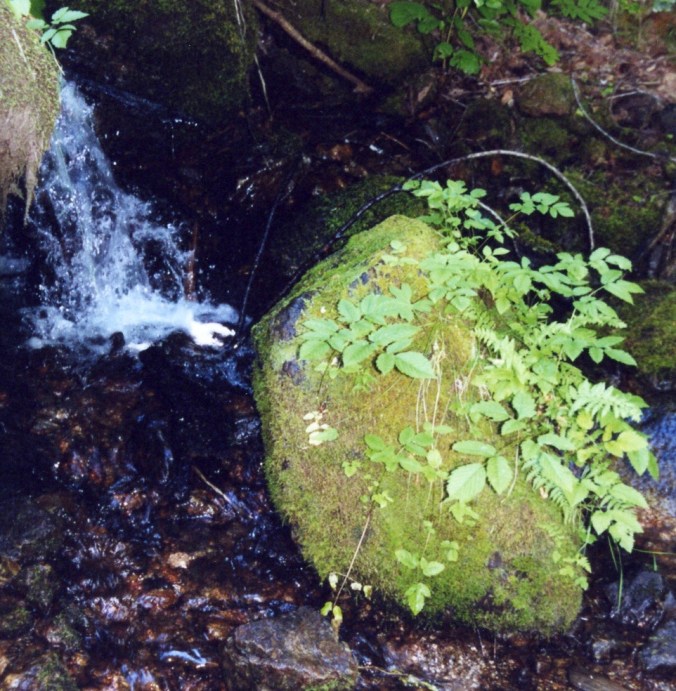
Peggy caught this luscious scene along a small creek where we refilled our water bottles. (Photo by Peggy Mekemson.)

While this rock caught my attention.

I am the fan of the small as well as the large when out in the woods. This is a shelf fungus.

A dandelion. Have you ever picked one of these and blew on it to watch the seeds go flying off?

And a butterfly on a Leopard Lillie.

EPILOGUE

The Sierra Trek turned out to be a success. We hadn’t raised a lot of money on our adventure, but special events rarely do the first time. What we had raised in abundance were new volunteers, the life blood of volunteer organizations. These were people who, because of their Trek experience, would develop a deep commitment to our organization.

I had several ideas on how to increase our returns and reduce our risks. In the future, we would set a pledge minimum and charge a registration fee. I would also set an age limit of 18 unless the minor was accompanied by a responsible adult. There would be no more 11-year-olds wandering in the woods by themselves. This wasn’t a negative comment on the Mouseketeers, they had been great, but the nature of the Trek made it much more of an adult kind of event. I would also limit group size to 20, and eventually 15, making the event much more manageable and reducing its environmental impact. And finally, our veterans would become the backbone of the program, providing advice and help in planning, organizing, and leading Treks.

From a personal perspective, my “far-out excuse for escaping to the woods” succeeded beyond my wildest hopes. I happily spent the next 25 years of my life leading wilderness adventures. When I worked it right, I could spend most of my summers out in the woods, especially when I supplemented official Lung events with personal outings. Treks also became an important annual event for many of the participants. Eighteen years after I had told Orvis he might be too old to Trek, he was still backpacking. He did his last trip with us when he was 88 years old. Altogether, he had raised the organization well over $100,000. That Trek also happened to be Peggy’s first long distance backpack experience. “How can I complain with Orvis out here?” she had told me with a grin, and hiked up another mountain.

I went on to create bike treks, winter treks, and canoe treks. I also pushed the Trek Program nationwide with the American Lung Association, persuading the organization that the events were valid fundraisers, and becoming the national consultant on Treks. For a while, Treks became one of the top special events for ALA. Charlie had been right that night we had laid our sleeping bags out under the stars at our Last Chance campground and he had declared: “What an experience. I can’t believe I am out here. Someday, people will be doing these Treks all over the nation!”

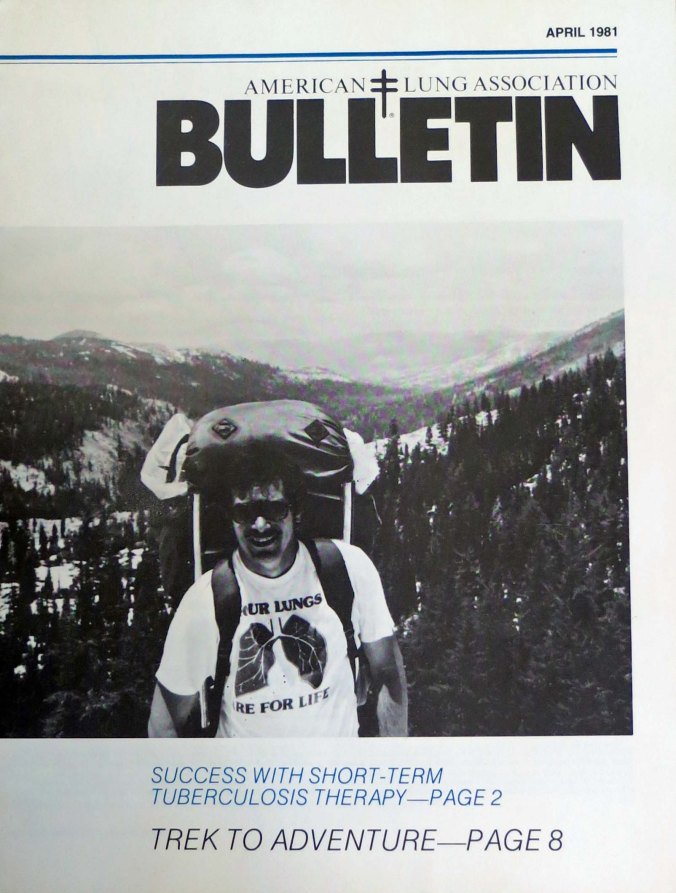
Having created the Sierra Trek in 1974, I had turned trekking into a national fund-raising  event for the American Lung Association by 1981. This is a photo of me on the cover of the American Lung Association’s national magazine.

If Someone Steals your Spouse or Cow, Who Do You Call? The Lightning Man!

The Bush Devil is a powerful figure within traditional Liberian Culture. This is a Bush Devil of the Grebo Tribe that visited a Peace Corps Haight-Ashbury Party Liberia circa 1967.


I was in serious need of inspiration over the weekend when it came to today’s post. I had a bad case of blogger’s block. And then I was hit by a thought— why not throw in a chapter from my book. Other than the promo I run in the upper right hand corner, it’s been a long time since I’ve done anything with “The Bush Devil Ate Sam” on this blog. If you are new to The Bush Devil Ate Sam and enjoy this chapter, the book is available on Amazon.


Sam, the young man who worked for us in Liberia, was enamored with western culture. It fired his imagination. He spent hours listening to the Kingston Trio get Charlie off the MTA and dove into peanut butter and jelly sandwiches like a frog dives into water. Still, for all of his excitement about things modern, ancient African was an integral part of who he was. He had the scars to prove it. They marched down his chest in two neat rows.

“How did you get those,” Jo (my former wife) asked with ten percent concern and ninety percent curiosity.

“I can’t tell you,” Sam replied with obvious nervousness as Jo’s eyebrows rose. “But I can tell Mr. Mekemson.”

Aha, I thought, Sam and I belong to the same organization, the Men’s Club! Actually, Sam belonged to a very exclusive men’s organization, the Poro Society, which I wasn’t allowed to join. Its functions were to pass on tribal traditions, teach useful skills, and keep errant tribe members in line. Everything about the organization was hush-hush. Tribal members who revealed secrets could be banned and even executed.

Political power on the local level was closely tied to membership in the Poro Society. On the national level, President Tubman assumed leadership of all Poro Societies in Liberia. Tribal women had a similar secret organization called the Sande Society, which prepared young women for adulthood and marriage. A controversial aspect of the Sande initiation ceremony was female genital mutilation— cutting off the clitoris.

Sam got off easy.

He had been to Bush School the previous summer and learned how to be a good Kpelle man. Graduation to adulthood consisted of an all-consuming encounter with the Poro Society’s Bush Devil. It ate him— metaphorically speaking. Sam was consumed as a child and spit out as a man. The scarification marks had been left by the devil’s ‘teeth.’ It seemed like a tough way to achieve adulthood, but at least it was fast and definitive.

The Bush Devil was a very important tribal figure who was part religious leader, part cultural cop and part political hack. Non-Kpelle types weren’t allowed to see him. When the Devil came to visit outlying villages, a frontman preceded him and ran circles around the local Peace Corps Volunteer’s house while blowing a whistle. The Volunteer was expected to go inside, shut the door, close the shutters and stay there. No peeking.

We did get to see a Grebo Devil once. The Grebo Tribe was less secretive, or at least more mercenary. Some Peace Corps Volunteers had hired the local Devil for a Haight-Ashbury style African party. It was, after all, 1967, the “summer of love” in San Francisco and the “Dawning of the Age of Aquarius.” Along with several other Volunteers, we hired a money bus to get to the party. Had we been thinking, we would have painted the bus with Day-Glo, like Ken Kesey’s bus, Further.

The Devil was all decked out in his regalia. His persona was somewhere between a voodoo nightmare and walking haystack. Grebo men scurried in front of him with brooms, clearing his path and grunting a lot. We stayed out of the way and took pictures.

Another area where Sam showed his tribal side was his fear of the newly dead. A person’s spirit was considered particularly powerful and dangerous right after he or she died. Later, the spirit would move away into the bush and fade. But first it had to be tamed with appropriate mourning, an all-night bash. One didn’t take chances. When Sam worked late for us after someone had died, he would borrow a knife and a flashlight in case he had to fight off the malevolent ghost on his way home. I had grown up next to a graveyard and was sympathetic with his concern.

Juju, or African witch doctor medicine, was another area where African reality varied from modern Western reality. Late one evening, in the middle of a tropical downpour, one of my high school students appeared on our doorstep very wet and very frightened. Mamadee Wattee was running for student body president. His opponent had purchased ‘medicine’ from a Juju man to make him sick.

It was serious business; people were known to die in similar circumstances. Had the opposition slandered Mamadee or stuffed the ballot box, I could have helped, but countering a magic potion wasn’t taught at Berkeley, at least not officially. I took the issue to Mr. Bonal, the high school principal, and he dealt with it. Mamadee stayed well and won the election.

The use of Juju medicine represents the darker side of tribal culture. Human body parts derived from ritual human sacrifice are reputed to be particularly effective in creating potions. Cannibalism may be involved. On the lighter side, my students once obtained a less potent ‘medicine’ and buried it under the goal post on the football (soccer) field with the belief that it would cause the other team to miss goals. Apparently, it wasn’t potent enough; the other team won.

Mamadee was also the reason behind our introduction to the Lightning Man. When Jo and I went on vacation to East Africa, we left Mamadee with $50 to buy a 50-gallon drum of kerosene. When we returned, there was neither kerosene nor $50, but Mamadee was sitting on our doorstep. Someone had stolen the money and Mamadee was extremely upset. Fifty dollars represented a month’s income for a Kpelle farmer. Mamadee’s father, a chief of the Kpelle tribe, was even more upset and wanted to assure us that his son had nothing to do with the missing fortune. It was a matter of honor. He offered to have Mamadee submit to the Lightning Man to prove his innocence.

The Lightning Man had a unique power; he could make lighting strike whoever was guilty of a crime. If someone stole your cow or your spouse, zap! Since we were in the tropics, there was lots of lightning. Whenever anyone was struck, people would shake their heads knowingly. Another bad guy had been cooked; justice had been served.

We didn’t believe Mamadee had taken the money, and even if he had, we certainly didn’t want him fried, or even singed. We passed on the offer. The Chief insisted on giving us $50 to replace the stolen money.

Another Liberian Peace Corps Volunteer in a similar situation chose a different path. Here’s how the story was told to us. The Volunteer had just purchased a brand new $70 radio so he could listen to the BBC and keep track of what was happening in the world. The money represented close to half of the Volunteer’s monthly income. He had owned his new toy for two days when it disappeared.

“I am going to get my radio back,” he announced to anyone who would listen and then walked into the village where he quickly gathered some of his students to take him to the Lightning Man. Off he and half the town went, winding through the rainforest to the Lighting Man’s hut. The Volunteer took out five dollars and gave it to the Lighting Man. (Lighting Men have to eat, too.)

“I want you to make lighting strike whoever stole my radio,” he said.

The Volunteer and his substantial entourage then returned home. By this time, everyone in the village knew about the trip, including, undoubtedly, the person who had stolen the radio.

That night, there was a tremendous thunder and lightning storm. Ignoring for the moment that it was in the middle of the rainy season and there were always tremendous thunder and lightning storms, place yourself in the shoes of the thief who believed in the Lightning Man’s power. Each clap of thunder would have been shouting his name.

In the morning, the Volunteer got up, had breakfast and went out on his porch. There was his radio.

NEXT BLOGS:

Wednesday: I wrap up the Sierra Trek series.

Friday: A look at several major art installations at Burning Man.

Monday: Astoria: A return to the Oregon Coast.

From a Giant Rabbit to The Old Woman’s Shoe… More Whimsical and Weird Sculptures of Burning Man

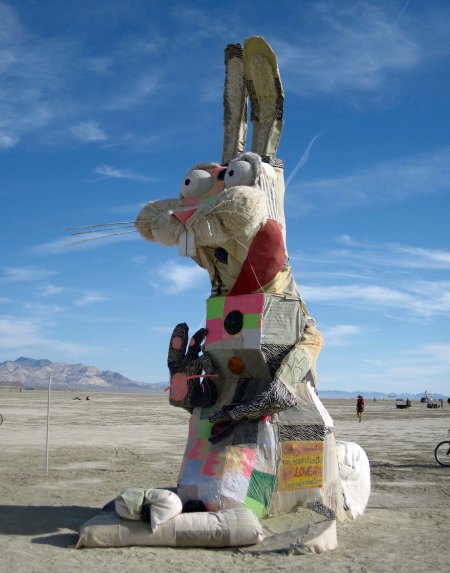
This huge rabbit out on the Playa had a message of love, transformation and living in the present. After staring at it for a moment, I thought it might also be a lesson in watching which brownies you eat at Burning Man. (Photo by Tom Lovering.)

I am going to wrap up my posts on whimsical and weird sculptures at Burning Man with something of a hodgepodge today. Bugs Bunny is a good place to start. I had looked at this sculpture from several angles before the rabbit made its sudden and obvious appearance. And I am pretty sure that is what the artist meant to happen. The big Alice in Wonderland type rabbit at the top was much less subtle!

I was thinking that this was a random, modern art kind of wood sculpture as I walked around it at Burning Man…

And then I came to this view and thought immediately of the ‘wascally wabbit,’ Bugs Bunny. For those of you not up on your cartoon history, “wascally wabbit’ is what Elmer Fudd called Bugs,

Our friend Tom Lovering took the photo of the zonked out rabbit at the top of the post. Here Tom is snuggling up to a Playa dinosaur. The look on Dino’s face is what led me to include it here with my whimsical and weird photos. It’s kind of the look of a puppy after it has puddled on your floor.

The dinosaur.

The bone tree has been around Burning Man for as long as I have, I think. At least I can never remember not seeing it since I first started in 2004. It lives at First Camp where most of the original organizers of the event hang out. The combination of skulls and bones place it in my weird category. Liking weird, it has always been a favorite of mine.

The Bone Tree at Burning Man is a regular at the event.

Here’s a close up.

The Bone Tree comes with its own set of wheels so it can move around.

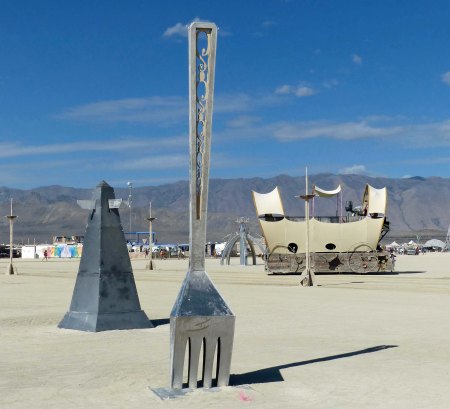
The old woman’s shoe, a fork of cork, an excitable mantis, metal devils, giant specks, and a couple of toothy sculptures finish out my selection for today.

“There was an old woman who lived in a shoe. She had so many children she didn’t no what to do.” I like to add ‘obviously.’ How would you like to have that guy outside your window? I’d be dialing 911!

Another view of the shoe.

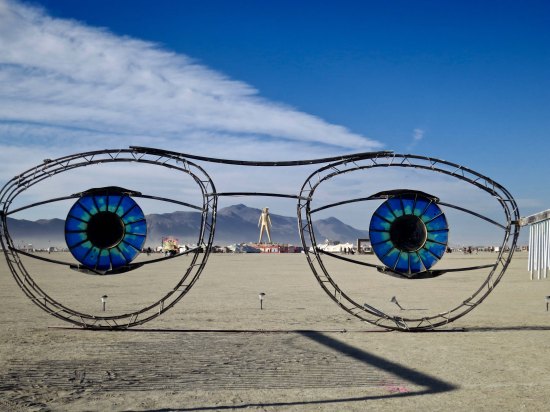
I thought these glasses with their blue eyes made an interesting sculpture. The Man can be seen in the distance.

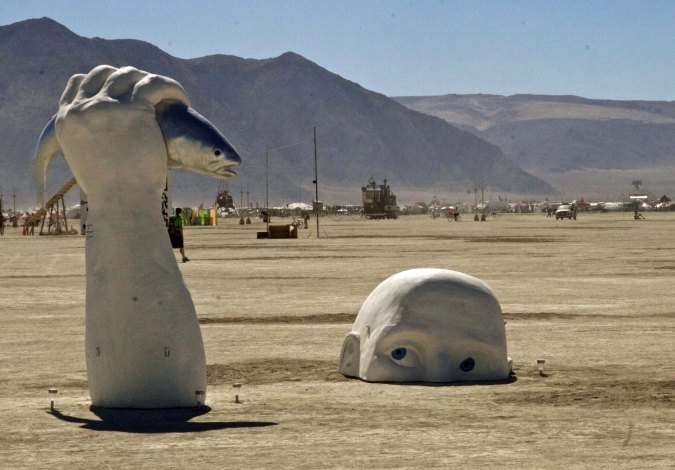
Does this fellow with his fish strike you as weird?

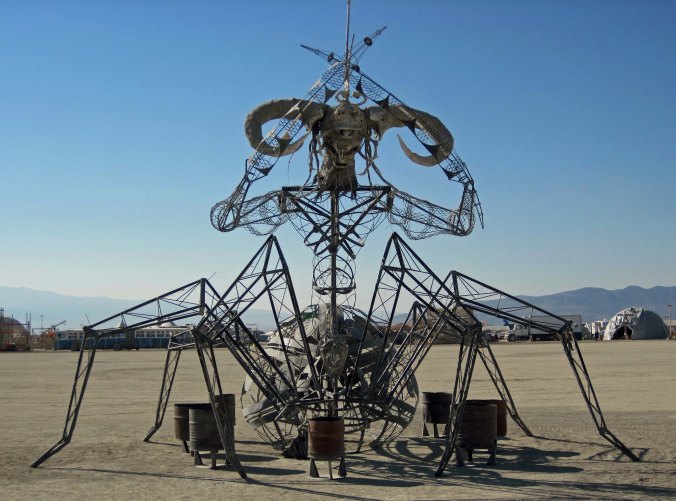
Metal devils seem to be a thing at Burning Man. The teeth are marvelous.

I was always pleased with the way I caught this fellow with his red background, especially the way it shows through his right eye. Evil!

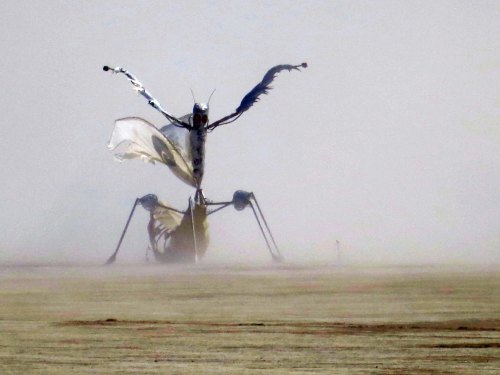
And then there was this scary praying mantis that appeared out of a dust storm.

Its front legs are something else! I don’t think you would want a hug.

Okay, this is fun. It wouldn’t be nearly as much if you didn’t know that the fabulous bathrooms are porta-potties, which can be far from fabulous!

Have you ever seen a cork fork?

How about a fork in the road?

Definitely weird.

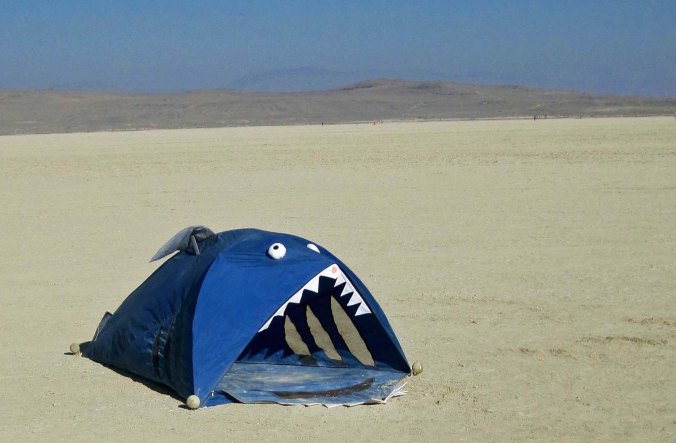
This little shark that found a home way out on the Playa just had to make it into this collection. I’ll close with it.

Have Aliens Landed at Burning Man?

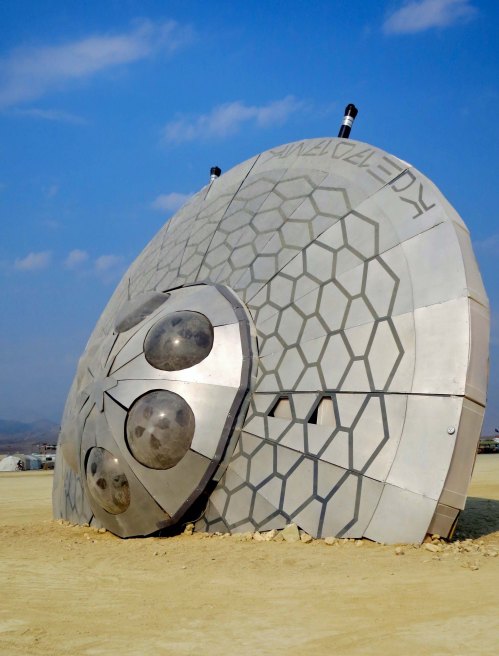
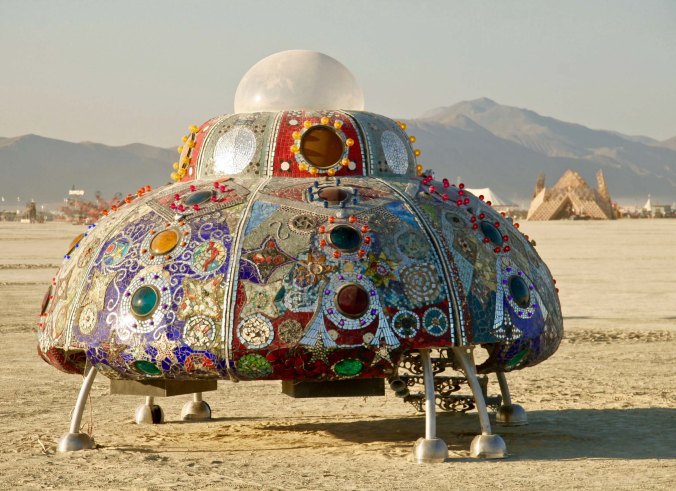
What better evidence could there be than a crashed UFO on the Playa that aliens are carefully monitoring Burning Man?


I am continuing my exploration of the humorous, whimsical and weird sculptures of Burning Man today and tomorrow. Today I want to focus on possible alien influence…


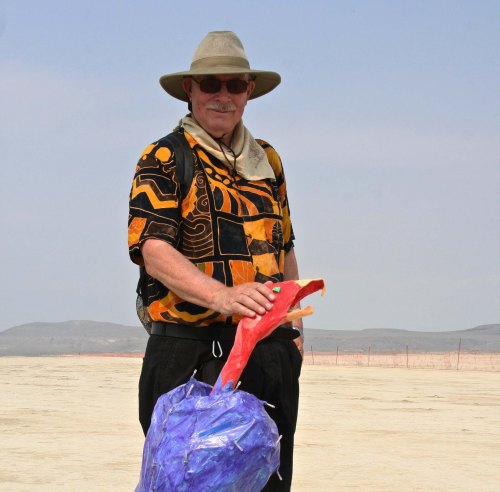
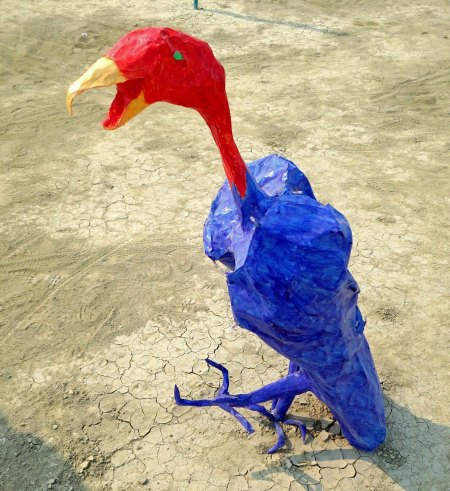
I saw a flying saucer once, so it is not surprising that I would assume this buzzard that I am petting came from outer space. (Photo by Peggy Mekemson.)

One of my blogging friends from Canada wonders what aliens from a UFO might think if they landed at Burning Man.  Would they feel right at home? Would anyone even recognize them? (Well here’s a secret, Sue, a top-secret, a ‘for the President’s eyes only’ type secret. They already have! Don’t tell anyone, however. There is dire punishment. You will be forced to cross the border and live at the White House.)

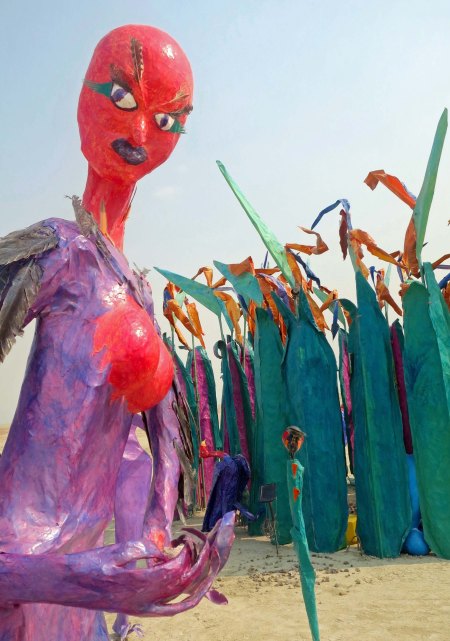
My post today features irrefutable proof of aliens at Burning Man. There are orange aliens and blue aliens and buzzard aliens. There are Burners who may or may not be aliens. Who would know? There are flying saucers and baby aliens and monster aliens. There are even alien robots. But most frightening of all, the most horrifying thing, is the alien BLOB.

And all of this is true, I swear. Or is that fake true?

If further proof of alien presence at Burning Man is needed, consider this UFO. Before landing at Burning Man, it was seen in the Bay Area, and just about everyone knows that the Silicon Valley is under alien influence, not to mention UC Berkeley.

Alien robots are often found out in the Playa and in Black Rock City.

I wandered into a tent and was met by this fellow. Note the eyes on this fellow and on the guy above…

Now check out these eyes! This alien cycled into our camp and demanded a cold beer.

This monster robot and his alien dog (photo left) hung out in front of the Center Camp Cafe.

Who could ever deny that this monster came from another galaxy.

Or this alien baby?

Its mama, a famous ballet dancer on her planet, had stopped off at Burning Man several years earlier. She must have left an egg.

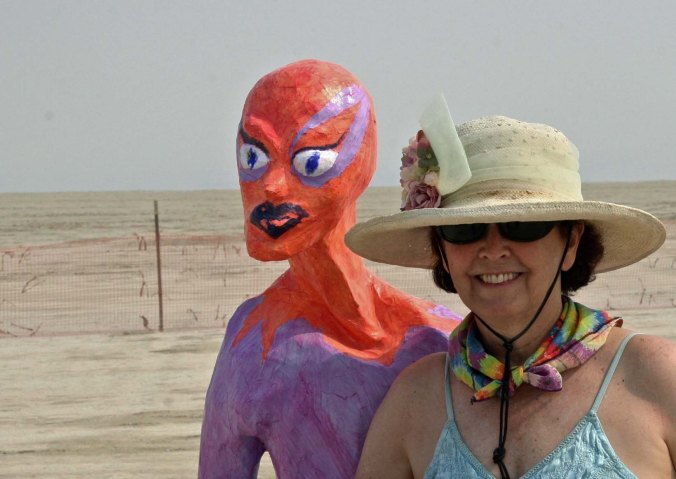
Peggy snuggled up with this orange alien for a photo. The fence in the background tells you that you have arrived at the Outer Limits of Burning Man, where you would expect aliens to hang out.

Sure enough, we soon found their camp.

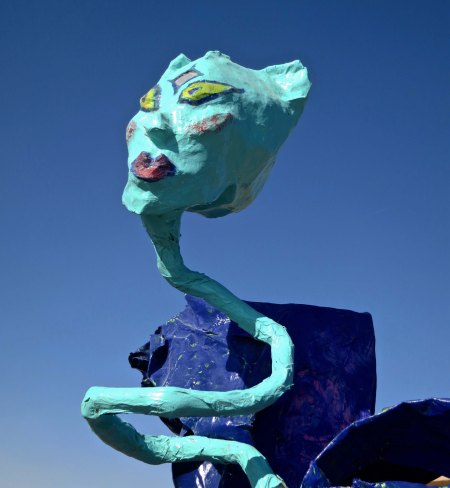
An alien cat…

And the alien buzzard I stopped to pet.

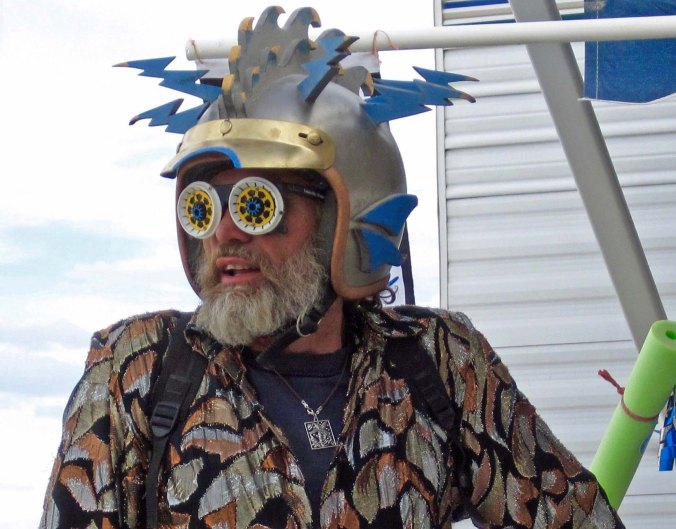
As for Burners (the inhabitants at Burning Man) it’s hard to tell who might be an alien. I figured this guy definitely had alien blood. Either that or he had just stuck his finger in a light socket.

There is no doubt about this purple man. It is rare that the aliens are so obvious.

Another obvious alien. This one had six limbs, two from her torso and four from her head.

And don’t you just know that there have to be aliens in this group. The one on the left with his wild hair, limited vision, and small hands seemed the most suspicious to me.

And for my final proof, I submit this blob we found out on the playa one day. I am pretty sure that it is dedicated to reproduction and world domination.

Here’s a close up for my last photo of the day.

Tomorrow’s Blog: Another post on the humorous, whimsical and weird  sculptures of Burning Man.


A Big Bosomed Bee, Curious Cats, and Other Whimsical Art of Burning Man

I came across these cats a few years back way out on the Playa, about as far as you can get from Black Rock City and still be in the area fenced off for Burning Man. They definitely meet my description for whimsical.


It’s photo Friday for me where I put out a blog that is long on photography and short (or at least shorter) on words. I’ve been concentrating on Burning Man the past several weeks and will continue for a few more. I have my ticket for 2017 so I am excited. Hopefully next week, we will get a ticket for Peggy as well.


It isn’t just anywhere you would expect to find a big bosomed bee. But then again, you never know what to expect at Burning Man. Someone must have had a lot of fun crocheting the bra.


Having tackled the giant women of Burning Man, I’ve been thinking about what to feature next on Burning Man sculptures. Like mutant vehicles, there are so many it is difficult to choose and even harder to organize. I started by going through my photo library and picking out a few I thought might be of interest. That got me down to 1500. I think you can see my problem. “Okay, Curt, focus!” I admonished as I scrolled through the 1500 photos for the third time.

There are categories, sort of. They are totally arbitrary and from my perspective. But it’s a start. So today, I am going to feature what I find humorous, whimsical and weird, recognizing that the three are often combined in my mind. There are enough here that I will be presenting more over the weekend.

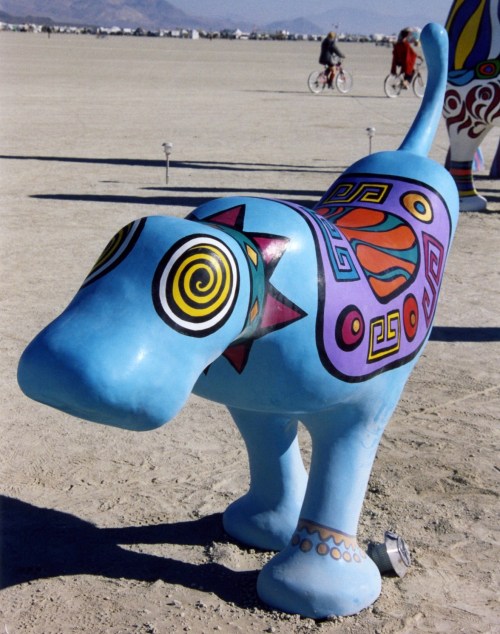
Dogs aren’t allowed at Burning Man, but they made an exception for this fellow in 2006.

My friend Ken decided that the dog was large enough to ride, but was a little confused as to the direction. Meanwhile, the dog’s family looked on, including…

Mr. Big Bottom…

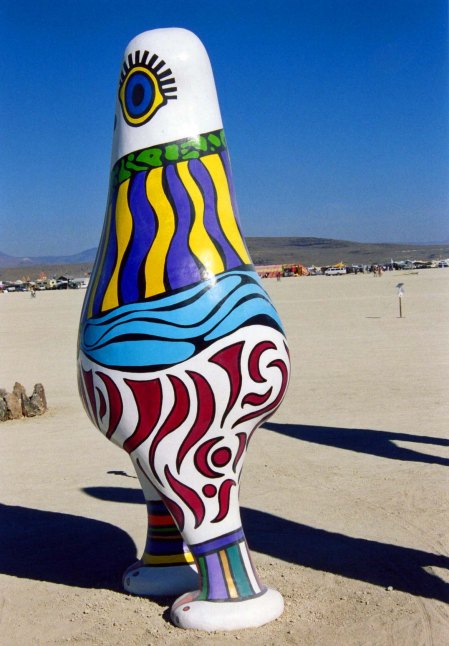
Miss Short Legs…

And Miss Long Legs.

Pucker up…

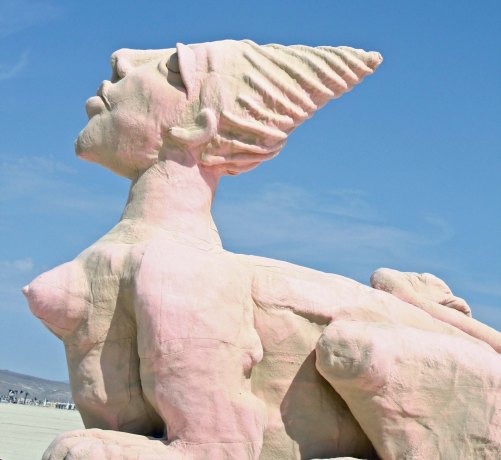
And meet a suave Sphinx.

Ready for a little monkey business?

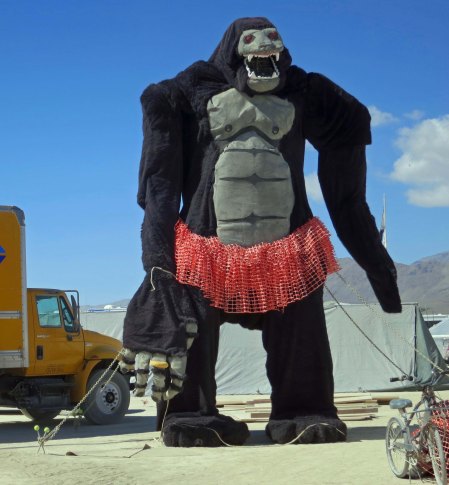
Or maybe some big monkey business? All dressed up in his pink tutu, Kong is ready to go out on the town.

Do you want to dance?

The sound man is ready…

With his necklace of speakers.

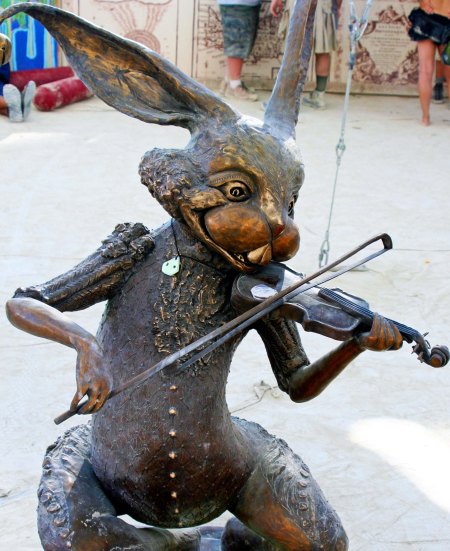
The hare will fiddle… (Photo by our friend Don Green.)

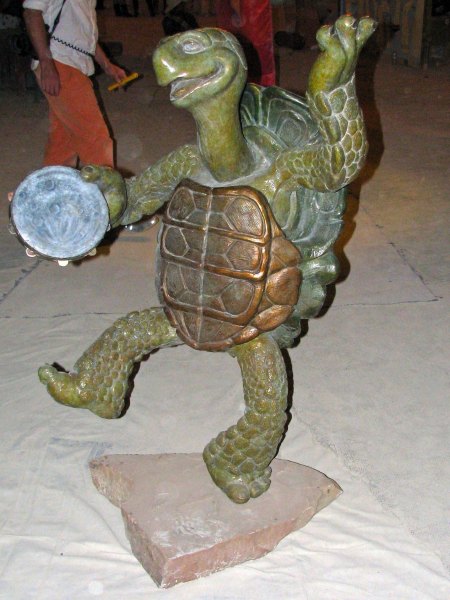
And the turtle will dance with you. (Photo by Don Green.)

Tomorrow’s Blog: More humorous, whimsical, and weird Burning Man sculptures.