A Fangorn Forest and a Really Weird Rock… Pt. Lobos Part II

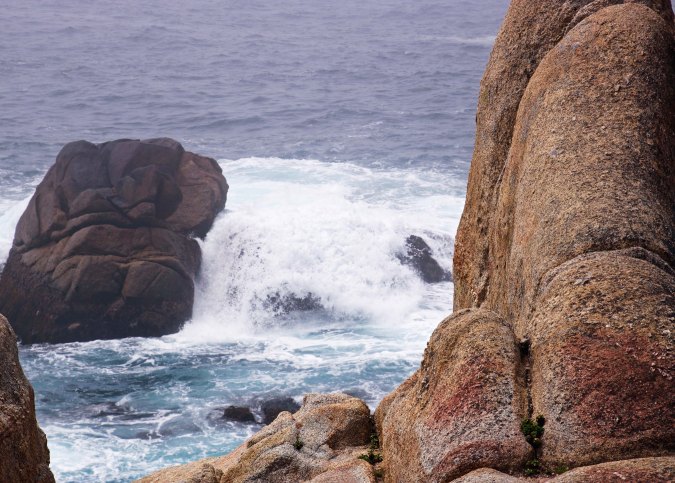
This sandstone  at Pt. Lobos has worn away to expose the concretions that were created in it millions of years ago. It gets my vote as a really weird rock.

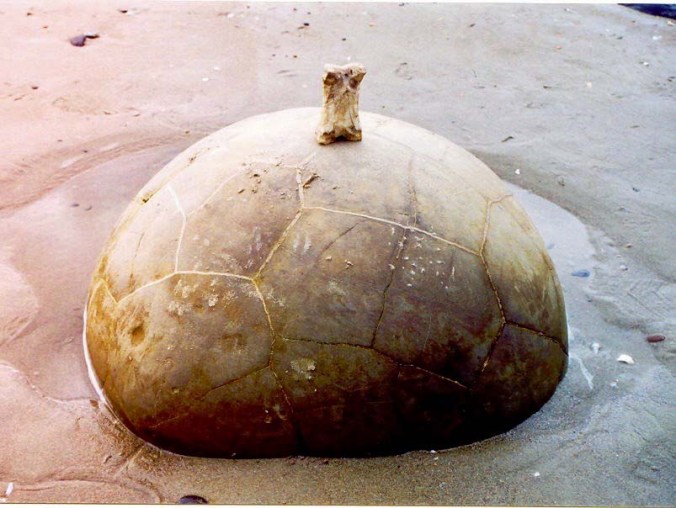
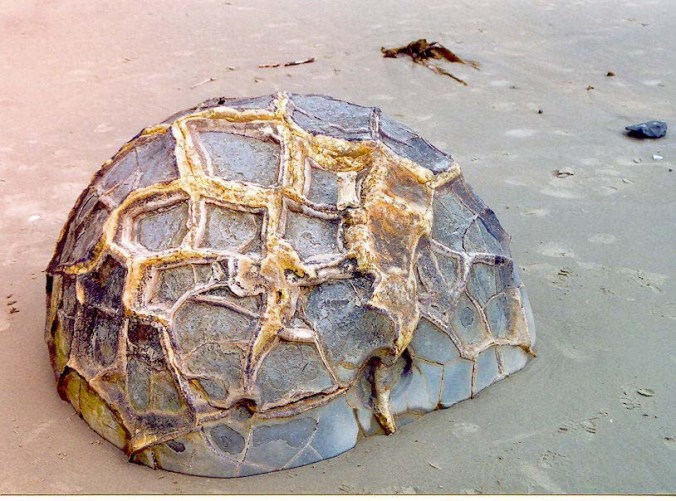
I’ve become used to the idea that concretions can lead to some strange rocks. Several years ago, for example, Peggy and I had wandered about as far south on the Southern Island of New Zealand as you can go and had come across the rocks shown below. Bone, who is about four inches tall, perched on top of the rocks to provide perspective. These large boulders, known as the Moeraki Boulders, are concretions formed from Paleocene mudstone.

Peggy and I found this mudstone concretion in New Zealand on a South Island beach. Bone, who likes strange things, provides perspective.

Another of the New Zealand concretions and Bone.

Up until I found the sandstone concretions on Pt. Lobos three weeks ago, I was sure that New Zealand would win the prize for really weird rocks. Now I am not so sure. For some murky reason, according to geologists, these concretions form as lumps in sand and grow in concentric rings cemented together as the sand turns to rock. The weathering of the rocks at Pt. Lobos exposes a cross-section of the concretion, which is what you see in the photo at the top of the post. Like the rocks in New Zealand, I found them almost alien.

The concretions are found on the South Shore of Pt. Lobos, which is considerably different from the North Shore that I featured in my last blog on California’s Central Coast. Sedimentary rocks of the Carmelo formation replace the granitic rocks and the terrain is more accommodating to roads and parking lots. Consequently, there are a lot more visitors. While I had mainly hiked alone before, a number of people now joined me along the trail. I preferred the ‘splendid isolation,’ but my hiking companions in no way detracted from the beauty of the area.

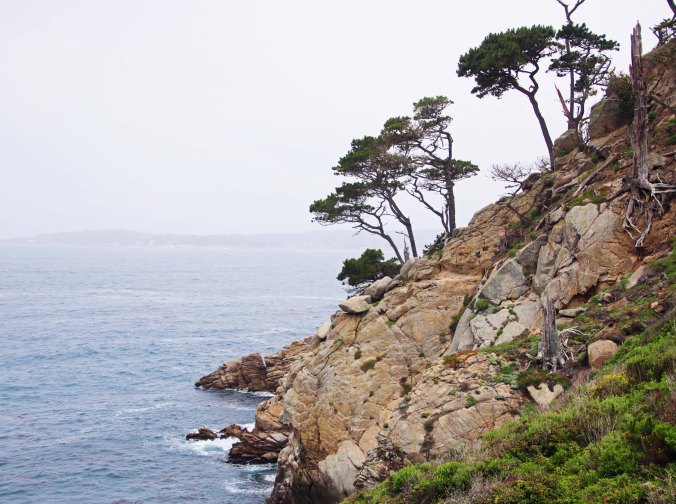
Carmelo sandstone on the South Beach of Pt. Lobos replaces the granitic rocks on the North Shore. Like the granite, it is moving northward along the San Andreas Fault. This rock has been folded upward by geological forces. The distant land is part of Big Sur.

I found this large chunk of sandstone attractive.

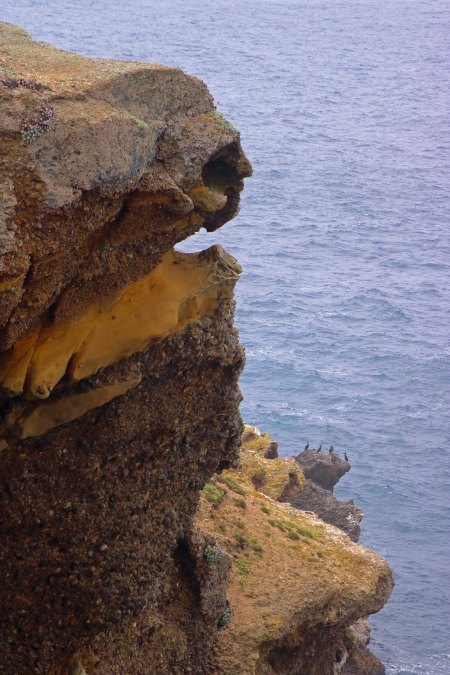
The Sea Lion Trail along the South Beach included a face. The pebbly rock is a form of conglomerate. Cormorants gather down on the point.

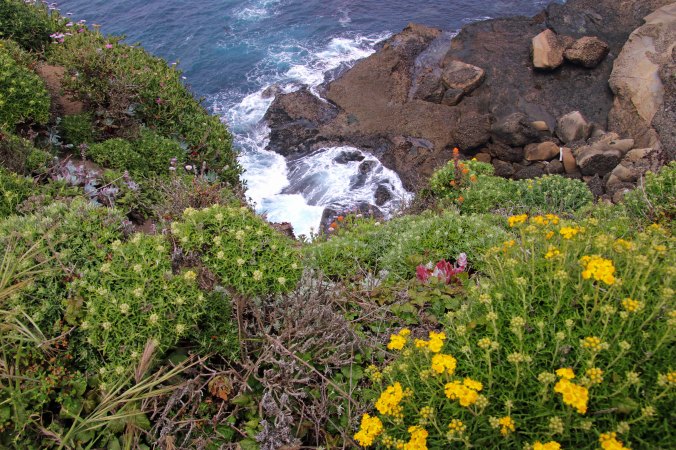
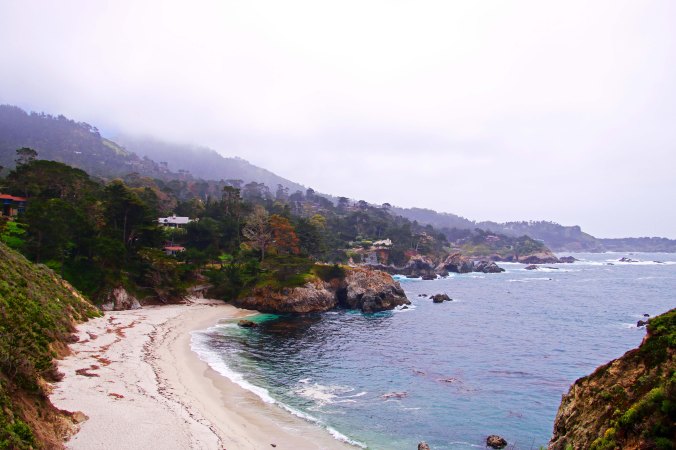
Looking down into one of the coves along South Beach.

As might be expected, given that it was spring, the trail around Pt. Lobos was filled with flowers. Having ‘borrowed’ Peggy’s camera since she was playing grandmother in North Carolina, I was able to get up close and personal with several of them.

Monkey flowers.

California Poppies.

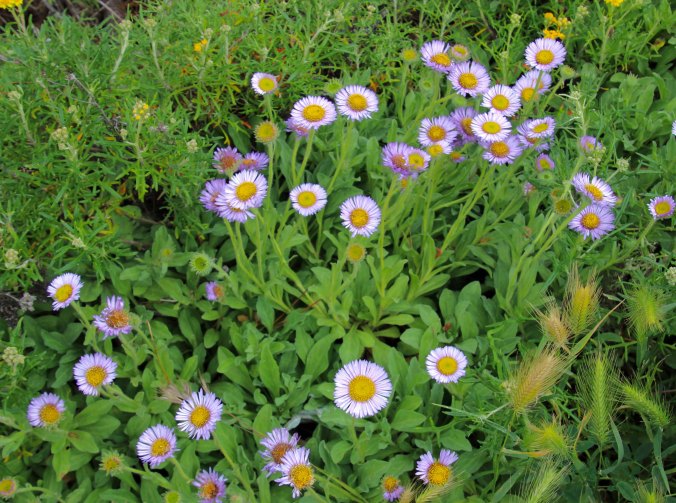
Asters.

Wild Hollyhocks.

Miner’s Lettuce. It goes great in a salad, as the early 49ers discovered.

Lupine.

Indian Paint Brush.

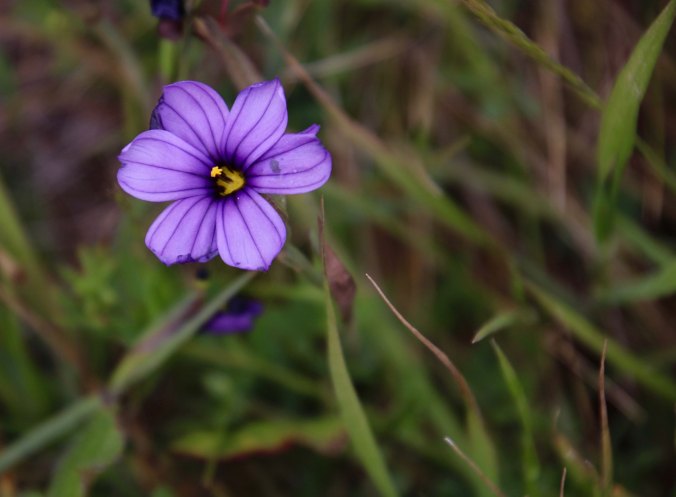
Blue Eyed Grass.

And a rose, by any other name, is still a rose— even a wild rose.

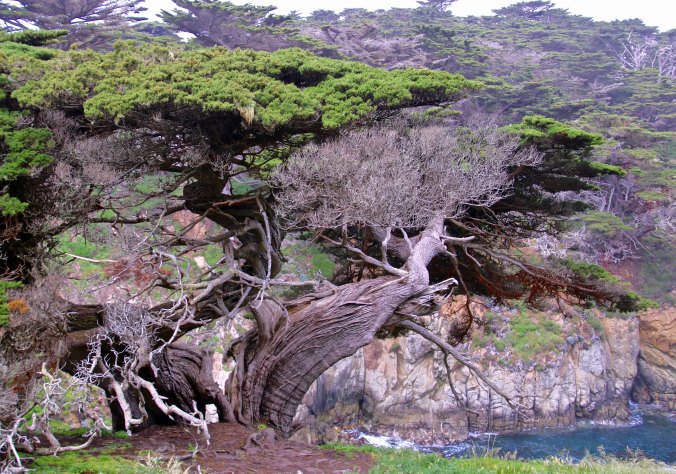
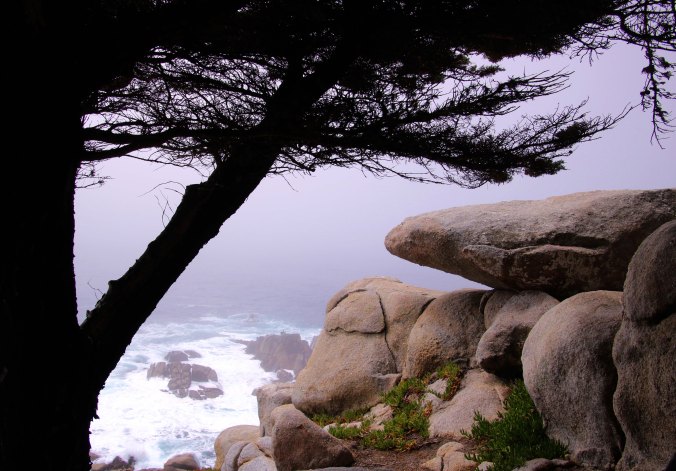
My final view of the ocean from Pt. Lobos was looking south at the Big Sur Coastline, which is where we will travel next on my posts about the Central California Coast. The buildings you see on the left are located in Carmel Highlands. I once stood on one of the rocky outcrops and watched a whale breach just off the shore. The Highlands Inn, a fine old hotel hidden up in the trees, offers fine views of the ocean. I’ve eaten in the restaurant a few times but never stayed there. I could fly to Europe for the cost of a one night stay: $600 to $900. I said goodbye to the coast and hiked back toward the entrance station. Along the way, I met a tree that belonged in Tolkien’s Fangorn Forest. It leaned over the trail and watched me as I passed.

Beach at Carmel Highlands.

I thought these tree limbs were reaching out to grab me. And then I noticed the eyes. I looked around hoping to find Treebeard.

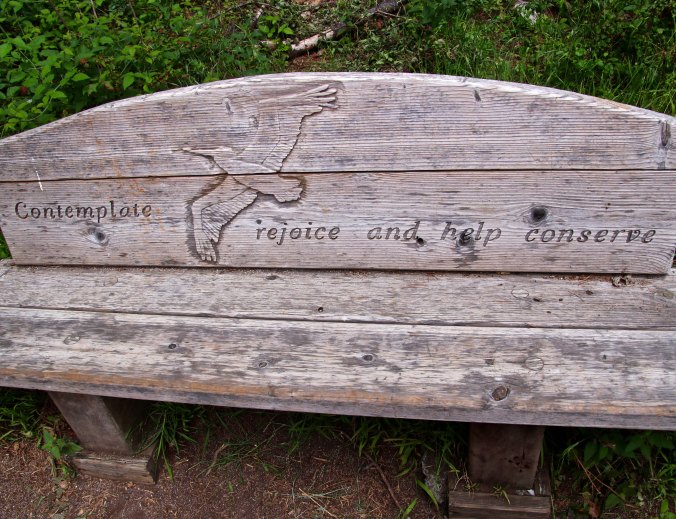
Instead I found this bench with its carving of a Pelican and important reminder. I thought it was an appropriate ending to my hike through Pt. Lobos Nature Preserve.

Next Posts: Lost in a snow storm, Big Sur, and the Man at Burning Man.

Special Note: For those of you who follow Bone’s wandering ways, he has traveled up to northern Oregon and will be out having adventures with Crystal Truelove at Conscious Engagement. Not sure all of what he will be involved in (you never know with Bone), but I think he will be attending a gathering of Cherokees. Last I saw of him he was perched on a beehive at Crystals.

So, You Want to Become a Billionaire… Maybe You Should Go to Burning Man

Burning Man appeals to a wide range of ages and these young women with their floppy ears are on the lower end of the spectrum. Children are rare at the event. Only 1.3% of participants are under 20.


I’ve been perusing the 2016 Burning Man census. The organization makes a serious effort to know who comes to Black Rock City each year and I am always curious about the results. Today I will share some of the data. It may surprise you. I will also post photos that Don Green and I took of Burners who attended the 2015 event. (I didn’t make it last year.) In addition to providing a small sample of participants, the pictures demonstrate another aspect of Burning Man’s creativity: costumes.
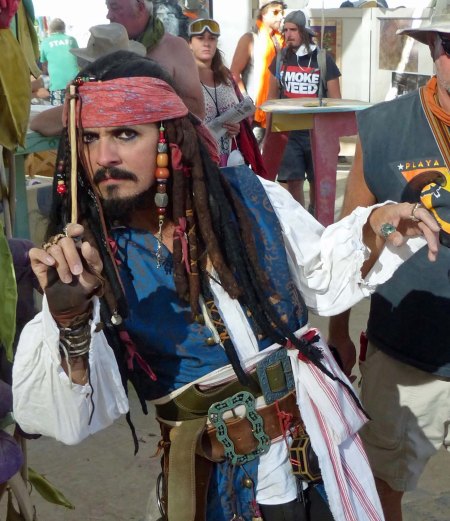
Costumes are an important part of individual creativity at Burning Man. Captain Jack, for example, looked a lot like Johnny Depp. Maybe he was. Hollywood has discovered Burning Man. (Photo by Don Green.)

Before starting, however, I want to summarize a news story that NBC ran in February. It’s relevant.

In 2001 Google was searching for a new CEO. While Larry Page and Sergey Brin had taken Google to dizzying heights in five years, its board had decided that the 20-something entrepreneurs needed an older, more steady hand around to help run the ever-growing company. A massive search had been undertaken using a variety of metrics ranging from education, to experience, to the ability to crack MENSA-like brain tests— all to no avail. As Brin would tell the press, “Larry and I managed to alienate fifty of the top executives in Silicon Valley.”

There were mountains of talent available in the Valley, but Google needed a special mix that could bring an element of discipline to the company without reigning in the genius and unique approach to work that are the secrets to its success.

My son-in-law, Clay, works for Google in Charlotte, North Carolina and I’ve been to his office. The visit provided an insight into how Google works. All employees, regardless of position, share a common space where both individual contribution and group participation are encouraged and inspired. Creative ideas and problems are thrown into the hopper and anyone with suggestions from throughout the Google world is invited to participate, from the newest employee up to Larry and Sergey. There is a constant flow of action and reaction. It seems like a recipe for chaos; instead, it has proven to be a key to the company’s ongoing success.

When Clay returned to his office after a trip he had made just before Christmas, he found that every object on his desk, including his computer screen, had been wrapped in Christmas paper. It’s the type of hijinks you can expect at Google, where play is taken seriously.

The challenge that Larry and Sergey faced was finding someone who fit in. They decided that desperate measures were necessary to finalize their decision. When they discovered that one of their top candidates, Eric Schmidt, a Berkeley PhD computer scientist from Sun Microsystems had been to Burning Man, they modified their rankings to bring him back in for another interview. Here’s the thing: Brin and Page loved the creative, communal chaos of the event. Their office building in Silicon Valley was filled with photos of employees who had been to Black Rock City and were decked out in Burner costumes doing Burner things, like twirling fire. Each year, Google provided a free shuttle from the Bay Area to its participants who wanted to go. Google’s first Google Doodle was a stick figure of the Man, the symbol for Burning Man.

Page and Brin were a mere two years away from leaving their Stanford dorm room and founding Google when they headed off to the Nevada desert for their first trip to Burning Man in 1998. To let people know that they were out of the office and had gone to the event, they put the stick figure of the Man behind the company’s name, thus creating their first Google Doodle.

They liked what Schmidt had to say and decided to give him the acid test: they would take him to Burning Man with them and see how he reacted. How would he handle the heat, the noise, the dust, and the 24/7 activity? Would he fit in and become part of the team? Would he go with the flow and contribute? Or would he withdraw into himself? The rest, as they say, is history. Eric passed the test and became CEO of Goggle. The company at the time was worth somewhere in the neighborhood of $100 million. In 2011, when Larry resumed his role as CEO, the company was worth around $40 billion.  Today, Larry and Sergey are listed among the world’s richest people. And Schmidt? He, too, has become a billionaire. Not bad for a group of Burners.

So, what about the rest of us, the ones who don’t qualify as the one percent of one percenters.

The majority of folks who attend Burning Man aren’t exactly poor. In 2016, the average income for all participants was $60,000. 29.5% had an income of between $50,000 and $100,000 while 24% made between $100,000 and $300,000. 3.4% made over $300,000, up from 2.3% in 2013. The education level and age of Burners reflects the income. 74% had a bachelor’s degree or higher. The median age was 34. Only 1.3% of Burners were under 20 while 32% were over 39.


It isn’t unusual at all to find people in their 50s and 60s, and even 70s, attending Burning Man. (Photo by Don Green.)

This fellow had been around long enough to grow a fine set of horns.

39% of the participants in 2016 were virgin Burners, first timers. Only 13% have been more than 8 times, which, at 10 times, happens to be the category I fit in. Not sure what that makes me. Maybe my synapses are covered in Playa dust; I wouldn’t be surprised. I’ve certainly had enough up my nose and in my eyes and ears.

Men outnumber women by 56.8% to 41.4%, leaving a couple of percentage points for ‘other.’ I was amused that the census listed its gender figures under current gender— like it might change at any moment. Ethnicity-wise, close to 80% are white. 20% 0f Burners come from countries other than the US. Within the US, 48.5% of the participants came from California, which isn’t particularly surprising given its proximity and population size. It is a bit more curious that the number two state was New York with over 8%, given that New York City is some 2700 miles from Black Rock City via Interstate 80.

Men outnumber women but it isn’t really obvious at Burning Man. This Burner’s costume was his tattoos.

I discovered this woman with her smile writing at the Center Camp Cafe, an activity that I like to pursue. It is fun to sit there and watch the world flow by while making an occasional note.

This man intrigued me. Although my photo wasn’t as clear as I like, I couldn’t resist including him with my galley of Burners.

My sense is that the diversity of people attending Burning Man has been increasing, but it has been a slow process. (Photo by Don Green.)

The most interesting figures to me are those that relate why people decide to run off to the desert and play in the dirt for a week. Participants were asked to check the reason or reasons they came to Burning Man from a prepared list. I was pleased to see that my reason— wanting to see and experience the art—was marked by 62.5% of the participants, the highest percentage received. Next up was to be with friends or to share an experience with like-minded people. 44% said they wanted to experience freedom and play. Considering you can wander wherever and do whatever— assuming you aren’t doing any harm to another person or the environment— that’s a lot of freedom! Go ahead and parade around naked if that has been your deepest desire forever. You’ll have company. 28% wanted to escape the world for a week. (That number may go up significantly this year.) Contrary to what many people think about Burning Man, only 3.7% said they came to consume intoxicants. But then, would you claim that if it were your reason? 21.6 % mentioned spirituality among their reasons for attending. I discussed the spiritual factor in my post on Burning Man’s temples. While only 6.1% of Burners marked that they belonged to a specific religion, 46.5% in 2016 claimed they were spiritual.
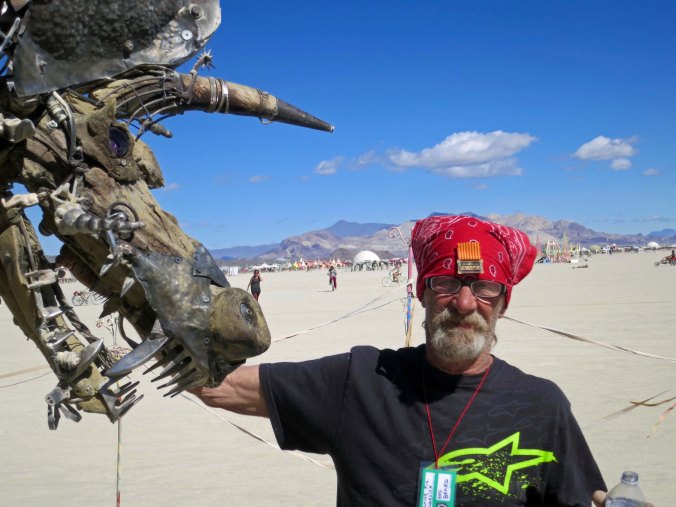
Enjoying and appreciating art is a major reason why people go to Burning Man. Creating art is another reason. This man was standing next to a dragon sculpture he had made out of recycled and repurposed materials.
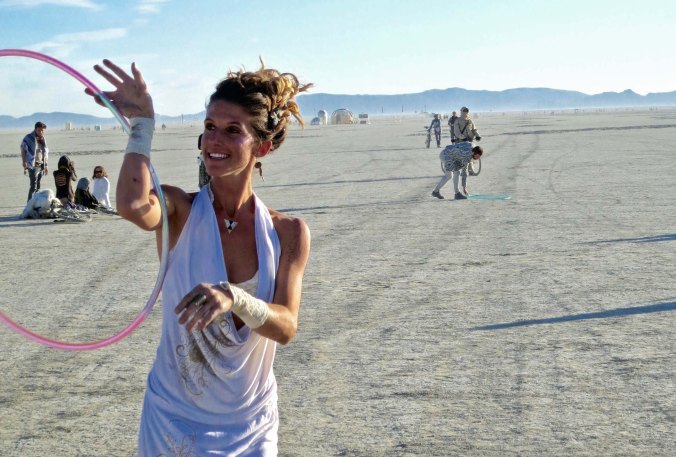
People also come to watch and participate in performance art. Hula Hoops have always been popular at the event, as is fire twirling.

The opportunity to share the Burning Man experience with friends is one of the top reasons people give for going to the event. (Photo by Don Green.)

Couples are common.
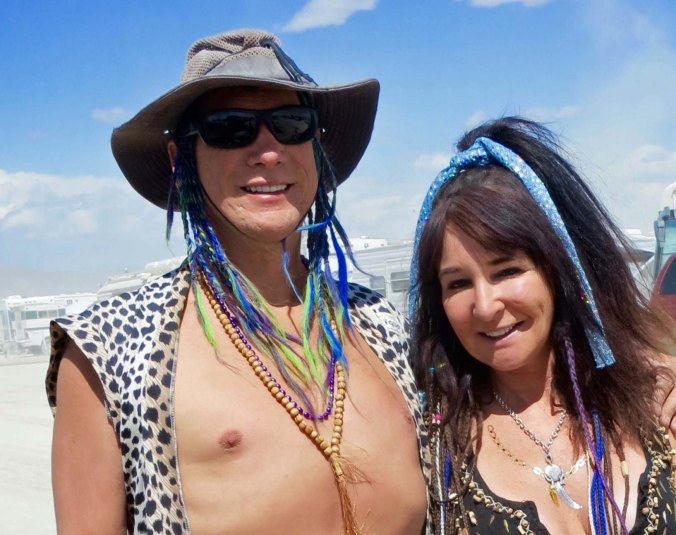
These folks were just down from where we camped and were busily giving away oranges. They told me that they had a large orange tree in their back yard in Southern California that they harvested each year just before coming to Burning Man.

This skinny pair was glad to pose for both Don and me.

Over 20% of Burners listed that they attended Burning Man seeking a spiritual experience. A visit to the Temple at any time of the day or night confirms this.

Enough on figures! If you’ve managed to make it this far, congratulations. On the other hand, if you want to learn more, check out the 2016 Burning Man Census data here. My thanks to the Burning Man volunteers who worked so hard to gather and analyze this data.

A few more photos of the people of Burning Man.
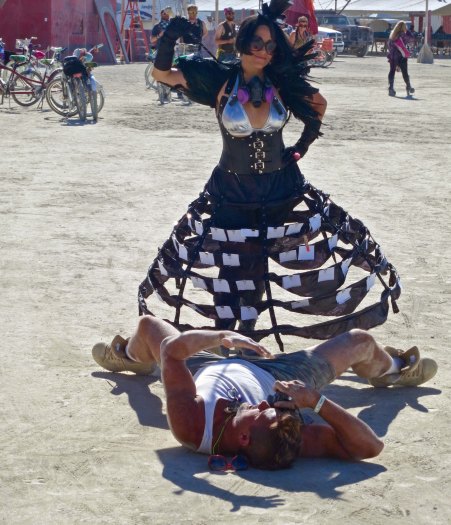
Costumes are important, and expected at Burning Man. Some photographers will go to any extreme to get pictures. Wait, is that a whip?!

One of my favorites. This man works for Burning Man’s Department of Public Works and helps build the city.

Dapper.

Cute smile.

Green feather.
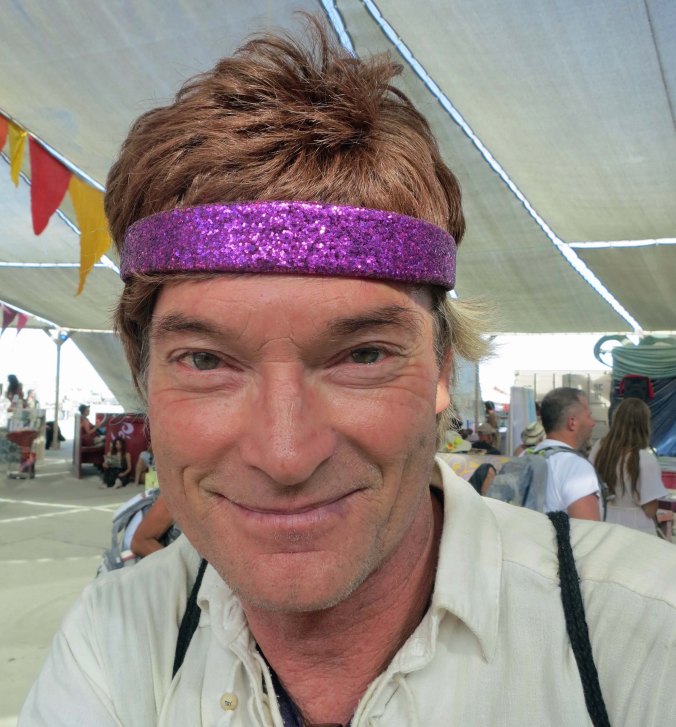
And how could you resist this smile? He gave me a CD from his band.

NEXT BLOG: Back to Pt. Lobos on the Central California Coast.


When Lightning Strikes… Tales of Wilderness Survival

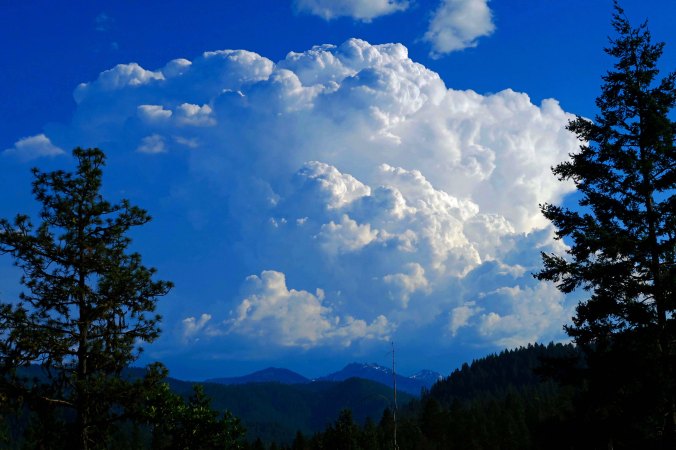
Towering cumulus clouds are beautiful and lightning storms are exciting, but they can also be dangerous and deadly. Numerous forest fires are created by lightning strikes each year and there are approximately 50 lighting caused fatalities annually in the US alone.


When you have spent as much time as I have wandering in the woods, there are bound to be situations that qualify as more tenuous, or scarier than others. I’ve already written about some of these, like the time I woke up in the middle of the night with a bear standing on me. Over the next few weeks I am going to relate other incidents on my Wednesday posts— assuming I haven’t disappeared into the wilderness again, which is always a strong possibility.

I’ll start by going back in time with my first three stories, back to when I was still shooting things. My first tale is about being caught in a lightning storm. The second relates to being lost in a snow storm. The third is about encountering Patty Hearst, aka Tanya, and her gun-toting SLA buddies on an early season fishing expedition in the Sierras. Let’s get started…


I grew up in the country where hunting and fishing were common. So, it isn’t surprising that I returned to the sports in the 70s. Actually, desperation drove me to the action. It isn’t that I was particularly enamored with catching or killing things. The meat I got from the local butcher tasted much better than anything I could shoot out in the woods. Freshly caught fish are good for breakfast, particularly when backpacking food is the option, but the process of gutting, cooking and cleaning up detracts seriously from the experience, especially when your objective is to get out on the trail. My general philosophy is live and let live unless necessity intervenes. Starvation qualifies, as does discouraging some large creature with big teeth and sharp claws that regards me as dinner.

No, my desperation had to do with my need to escape into the woods on a regular basis. I think of it as going home. It’s what led me to create the Trek program for the American Lung Association, and it’s what led me back to the hunting and fishing.

I am not sure whether I recruited my old friends from elementary and high school days (Bob Bray, Hunt Warner and Chuck Lewis) to go on expeditions or that they recruited me, but it wasn’t very long after I returned to Sacramento that the value of trout season and deer season became apparent: Fishing in the spring and hunting in the fall extended serious outdoor time by another four months. And then there was bonding, the old tribal ritual of going off into the woods with your friends on adventures. Generous allotments of beer consumed around the campfire helped.

Normally our trips involved little more than lots of good exercise and an occasional hangover. I enthusiastically joined in the efforts to entice fish with a Panther Martin lure, but usually avoided shooting anything. Killing a deer meant dragging it back to camp, hanging it up by the feet, gutting it, and skinning it— all of which was much more work than it was worth from my perspective, not to mention the deer’s. I had enough of that helping my friends. Occasionally I would shoot near a buck that was foolish enough to appear in my sights. I figured it was my job to remind him he was only a leap away from the stew pot.

The truth is, deer don’t have to worry about me— and they know it. This buck in one of many that stop by our house to visit.

I photographed this doe yesterday as she rested between flower pots in our back yard. The last couple of weeks, five or six have been hanging out around our house trimming the grass, eating Peggy’s rosebush, and sleeping in the shade.

On three occasions our expeditions became a little more adventuresome than we had bargained for. The first involved a much too close encounter with lightning.

Bob, Hunt and I were deer hunting north of Interstate 80 in the Tahoe National Forest on a high ridge. As usual, we were spread out, the theory being we might jump a deer and send it blundering into another member of our party. Usually bucks are too clever for this ploy. They send their does out into the line of fire while they sneak out the back door. This was apparently one of those days, thankfully. The car was at least two miles away down in a steep canyon. We’d be forever dragging a deer to it. I was wandering along, blissfully thinking of absolutely nothing when the distant sound of thunder caught my attention.

Seemingly out of nowhere, a huge, dark, cumulus cloud had appeared and was ominously working its way in our direction. I sat down on an old white fir stump and watched as it turned a ridge north of us into a battle zone of thunder and lighting. Having a front row seat was highly entertaining and, as it turned out, extremely foolish. Ten minutes later the storm hit our ridge. I was literally surrounded; Blinding flashes were instantly followed by ear-splitting booms. There was no counting 1000-1, 1000-2 to see how far away the lightning was. (Seven seconds is a mile.) It was right there. Pieces of tree were flying through the air and my hair was standing on end with electricity— or maybe it was fright. I was as frightened as I have ever been in my life. I knew I had to get off the ridge, and quickly.

I don’t exactly remember my run down the mountain but I do believe I broke some kind of world record for the two-mile dash. As did Bob and Hunt. We quickly climbed inside the truck to relative safety and called it a day. An ambulance met us as we were leaving. We read in the paper the next day that a hunter had decided to hide out under a tall Jeffrey Pine. Lightning had struck the tree and killed him. It could have been any of us.

Next Blogs: 1) Back to Burning Man; 2) Pt. Lobos Part II; 3) Wilderness survival: It was a dark and stormy night.


I’d Almost Swear that Harbor Seals Smile… Pt. Lobos Part I

I don’t know if this could be classified as a smile, but I would certainly call it a look of pure contentment!


I hadn’t expected to be hiking in the Sierra Nevada Mountains when I visited Pt. Lobos just south of Carmel on the Central California coast two weeks ago, but that’s what geologists claim. They say the same thing about Pt. Reyes National Seashore north of San Francisco, another favorite hangout of mine. We can blame crashing oceanic and continental plates, and the ever-restless San Andreas Fault, which is responsible for much of California’s earthquake history. Millions of years ago, according to geologists, the Pacific Plate broke off a section of the southern Sierra Nevada Range from the North American Plate and has been carrying it northward along the coast ever since.

I became something of a believer when I ran into granite on the North Shore of the nature preserve. When I think granite, I usually think of the Sierras.

I found this granite outcrop along the North Shore Trail.

And this large granitic island with its colony of cormorants just off the north shore.

I started my Pt. Lobos adventure at the entrance station and hiked over to Whaler’s Cove, which is on the North Shore. Once upon a time there had been a station for hunting whales here. From about 1850 to 1880, men would go out in small boats to harpoon whales and then bring them into the cove for processing. Mainly, they were interested in killing the whales to obtain oil for lanterns. A large Grey Whale produces close to a thousand gallons. Kerosene eliminated that industry, which was fortunate for the whales. A small museum in the cove tells about the whale hunting and other human activities at Pt. Lobos.

This small museum located at Whaler’s Cove once housed whalers.

I found this whale bone carving of the Carmel Mission inside…

And surprisingly, an old deep sea diver’s suit.

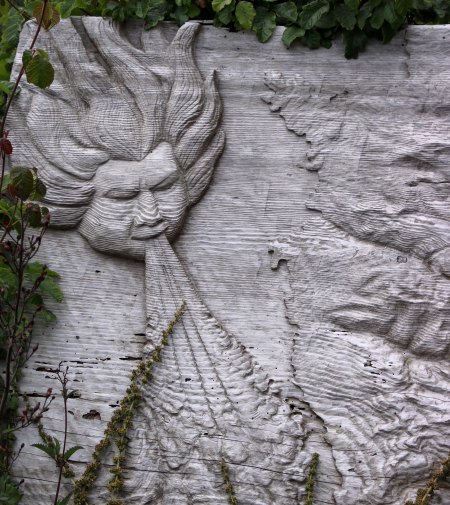
Just outside the museum I found a pair of information signs. One featured this carved representation of the prevailing northwest winds that the area experiences in the spring and summer.

And a Monterey Cypress on the other.

What fascinated me most about Whaler Cove were the harbor seals, however. There were a number along the shore: lazing in the bay, rolling around in the sand, and sun bathing on the shore. There was even a mom nursing her pup.  My camera and I were quite busy.

Here is another shot of the Harbor Seal I featured at the top of the post. This time the seal’s eyes are open. The water provided a magnifying effect to make the already plump seal appear even rounder.

This seal was coming out of the water…

And this one was ecstatically rolling back and forth, apparently using the sand for a good scratch.

I caught a pup lined up for breakfast!

It was when I left the cove and hiked up the ridge behind it on the North Shore Trail that I started noticing the granite— not to mention all sorts of other things. There were moss-covered trees, cormorants building nests, lots of gorgeous wildflowers, and several impressive Monterey Cypress trees.

Hiking up the ridge on the North Shore Trail gave me this view back across Whaler’s Cove toward the coastal hills above Carmel. The small, white building seen on the hill is the Carmelite Monastery.

An old trail sign told me I was not lost. The total hike took me around three hours but about an hour of that was devoted to photography.

A group of cormorants was nesting on Guillemot Island, the large granite island I featured earlier.

This fellow was busily gathering nesting materials. I watched as he carried it over to his lady-love.

Flowers were everywhere. I will feature some closeups on my next blog about Pt. Lobos.

I came upon this ghostly, moss-covered tree…

And several dramatic views of Monterey Cypress.

The most impressive, however, was the cypress named Old Veteran.

I’ll conclude today’s post with a view of Old Veteran from the other side. Next Monday I’ll feature the south side of Pt. Lobos, which is surprisingly different.

Next Blog: Lost in a snowstorm with survival at stake. I return to my outdoor adventure series.


This Place Called Black Rock City… Burning Man

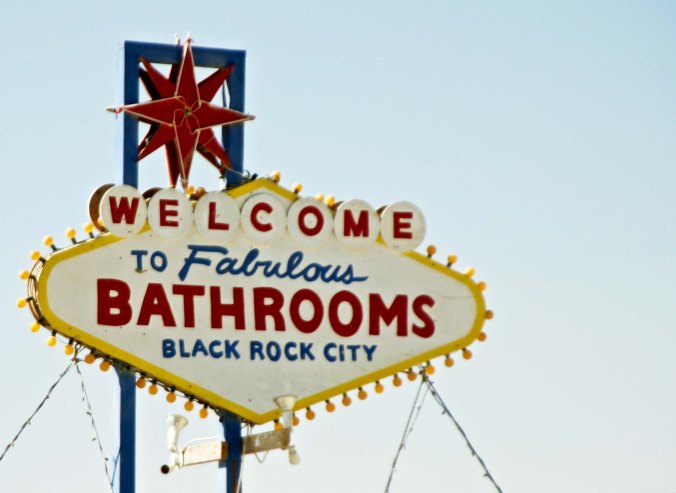
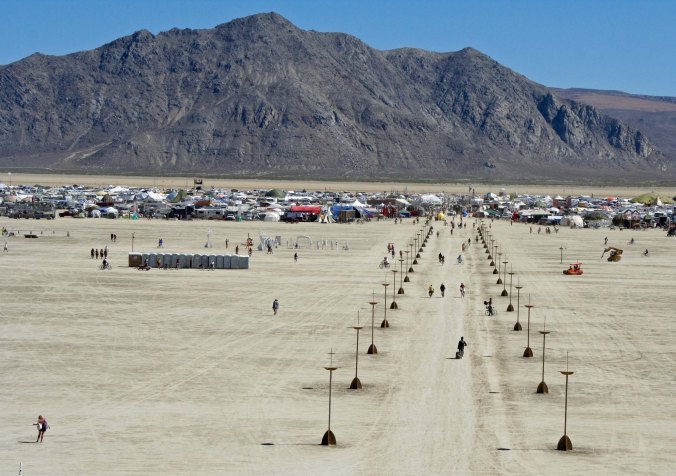
Imagine, if you will, having enough port-a-potties to accommodate 70,000 people. It’s one of many issues Burning Man has to deal with in planning Black Rock City.


I always like to include a post on Black Rock City when I am blogging about Burning Man to give readers a view of how everything fits together. Obviously, you can’t throw up a city for 70,000 people in the desert without some serious planning. Think of it this way: For the one week of its existence, Black Rock City is the third largest city in Nevada— only Las Vegas and Reno are larger.

It all starts with locating where the Man will be placed out in the Black Rock Desert a few miles east of the small, northern Nevada town of Gerlach. A ceremonial spike is driven into the ground to mark the placement.  Everything else including the Temple, Center Camp, the surrounding fence and Black Rock City evolve from there. Official Burning Man structures and major camps are built before the event. Sort of. It is not unusual to arrive on Sunday with work still being done on the Man, the Temple, Center Camp, etc.

Black Rock City is laid out in a semi-circle as shown on the 2016 map below. The circular roads are given names based on the annual theme and are in alphabetical order. For example, the 2016 theme was Da Vinci’s Workshop. The road names were Arno, Botticelli, Cosimo, Donatello, Effigiare (Italian: to portray), Florin, Guild, High Renaissance, Italic, Justice, Knowledge, and Lorenzo. The main road that separates Black Rock City from the Playa is always the Esplanade. Roads that cut across the circular roads are numbered clockwise and lead out to the Man.

The large circle on the bottom is Center Camp, the middle circle the Man, and the upper circle the Temple. Both the Man and the Temple are located on the Playa, which continues out to the fence. Shaded areas are for assigned, organized camps; non-shaded areas for everyone else. Space in the non-shaded areas is on a first come, first serve basis and you can have as much as you need for your camp, assuming you come in early— there seems like a lot of space in the beginning. By the end of the week, everything is packed! The total area encompassed within the fence including Black Rock City and the Playa is approximately seven square miles.

The official Burning Man map of Black Rock City for 2016.

The following photos provide a glimpse into what it is like to live in Black Rock City.

If you come in early on Sunday, you feel like you have a lot of space. We always mark out our site with rope and reflectors.

Things fill up rapidly as the week progresses. Quivera, our van, marks one end of our camp. Our goal is to be somewhere between 5:00 and 6:00 on H or I.

By Friday, there is no room left. If you haven’t clearly marked your area, you will have guests!

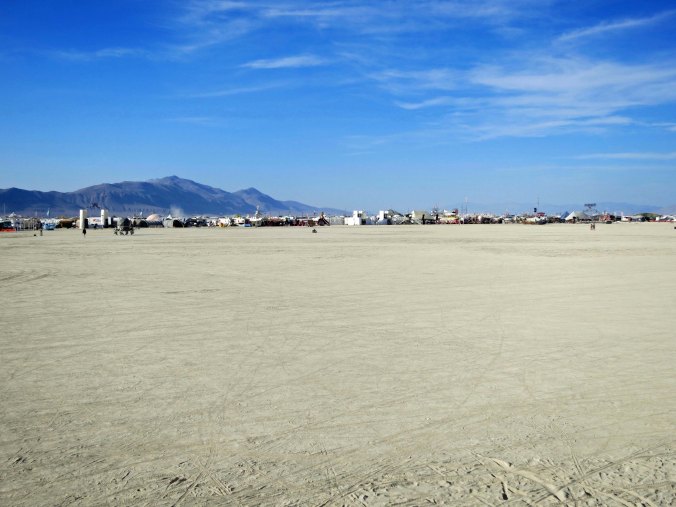
If things feel too crowded, you can always bike out onto the Playa where the Man, the Temple and many of the major art pieces are located.

If things are still too crowded, you can head out farther…

And farther…

And farther. By now you are out in what is known as the Deep Playa.

This is where you come to the fence that limits further exploration of the desert. Actually, during a dust storm when visibility is close to zero, it is good to have the fence available to keep you from wandering off. There is a vast amount of space to get lost in.

Burning Man is serious about Burners staying inside the fence. Part of this is for safety and part of it is to keep people from sneaking in for free. When I crossed the fence for a photo-op, a BM truck came speeding over to where I was.

A substantial infrastructure is required to operate the event. These lifts are located in the Public Works Department lot.

Safety is always a concern. Burning Man has its own safety officers know as the Black Rock Rangers. Of course there are also numerous local, state, and federal law officers present. There is also an extensive emergency medical operation.

Lamps are lit at night to help Burners find their way. The lamp lighters are volunteers who have their own camp.

Providing ice for Burners to keep their food (and beer) cold is also a major operation run by volunteers. A recruitment poster urges Burners to sign up. Ice is one of the very few things you can purchase in Black Rock City.

The tongue in cheek sign at the top of the post refers to the numerous banks of port-a-potties found throughout Black Rock City and out on the Playa. An army of trucks is constantly servicing the outhouses. (Photo by Don Green.)

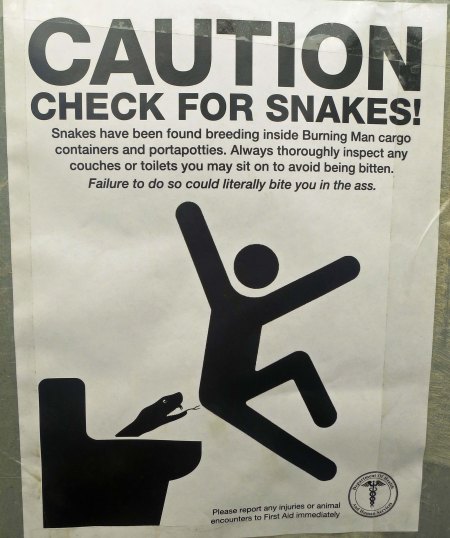
I found this in one of the toilets.  I imagine that this sign had some city folks checking. (grin)

Sand spiders are more dangerous.

Heat, wind, and dust storms are a part of life at Burning Man. It can also rain.

This photo was taken a few minutes after the above photo. The storm has arrived!

While it is important to be prepared for the heat and dust storms, there is also great beauty and good weather at Burning Man.

Looking out from our camp at the sunset.

And a rainbow.

If things get too rough out in the desert, you can always stop and have a beer.

Next Blog:  Some really cute seals and the beautiful Pt. Lobos nature reserve near Carmel.

The Deer Don’t Have to Pay a $275,000 Membership Fee to Play at the Monterey Peninsula Country Club on the 17 Mile Drive

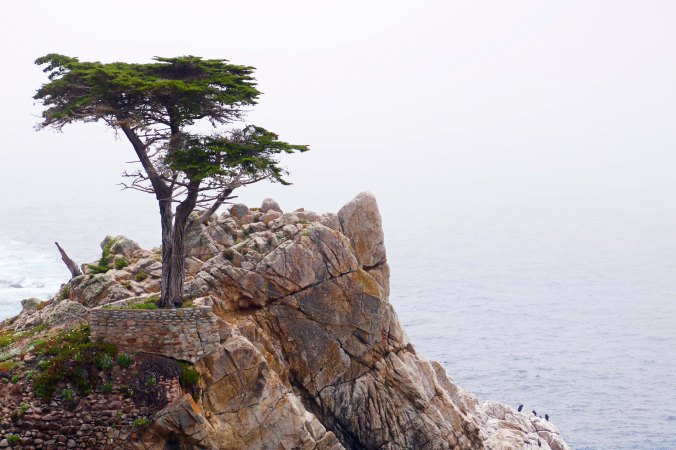
This ‘lone cypress’ is almost synonymous with the 17 Mile Drive and serves as the logo for the Pebble Beach Resort. I am pretty sure that it is the most photographed cypress in the world and it is certainly the most cared for.Check out the rock-work.  The tree probably has its own arborist.


Monterey and Carmel take me back in time, back to the 60s and 70s, back to when the world somehow seemed more promising— it was, after all, the Dawning of the Age of Aquarius. I used to drive down to Monterey humming the tune in my Volkswagen Camper, Van-Go, and free camp at a surfer beach just south of Carmel. The surfers are still there riding the waves, but the free camping has long since disappeared, a victim of the times. The welcome sign has been taken down. The hospitality industry prefers that tourists pay for their lodging and the locals prefer that their visitors drive Mercedes.

I considered myself lucky that I could still find a campsite for $32 a night last week when I visited California’s Central Coast. Maybe that’s because the water was unpotable at the Laguna Seca Campground. I noticed the signs after a couple of days of happily drinking away. Turns out the water is laced with arsenic. (If I seem a little strange… But, hey, how would you know the difference?)

The Laguna Seca Campground is located up in the hills here, hidden away among the trees.

While green grass was still growing in the valley, it had turned a ‘California gold’ next to my campsite.

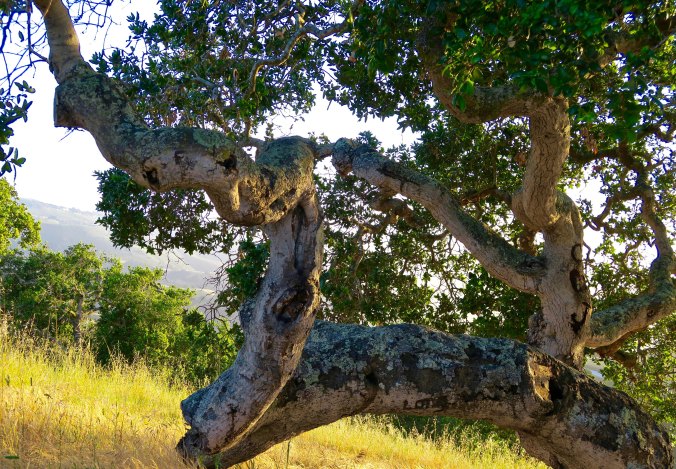
I liked the trees. Our grandkids would have been all over this one.

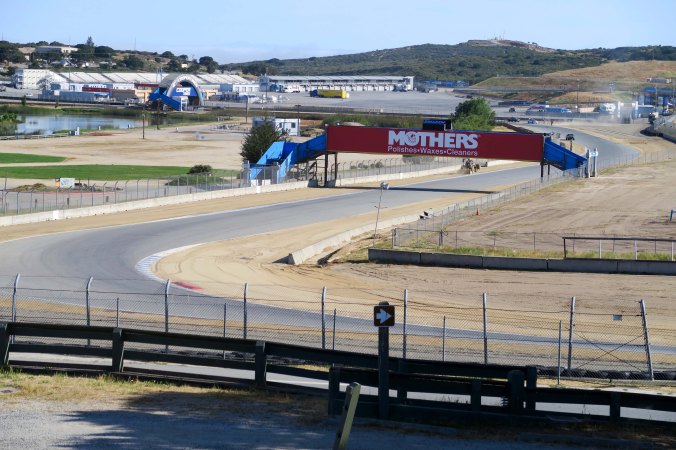
The campground is operated by Monterey County and nestles on top of the beautiful coastal hills that surround Monterey-Carmel. If you are a car racing fan, you will recognize the park as home to the Mazda Laguna Seca Raceway. I stayed there until I had to vacate the premises. People had signed up to pay $120 per night for my $32 site. It provided an excellent view of the raceway and the Ferraris were coming to town for the Ferrari Challenge.  I watched as 18-wheelers rolled in carrying their precious cargos.

The Ferrari Challenge was the first major race of the season. Crews were out preparing the track.

This site of the track was about 50 feet away from my camp. You can see why it was prime territory.

All of the 18 wheelers you can see in this photo were carrying Ferrari race cars. There was close to a parade of them going by my camp the morning I had to leave.

I don’t know what a Ferrari race car costs, but you can pick up a classic Ferrari 250 GTO for the tidy sum of $57 million. It’s a bit out of my price range— and my imagination. Somehow, I can’t picture myself running down to the store to pick up a carton of milk in one.

Laguna Seca is about 7 miles outside of Monterey on Highway 68, the road that connects Monterrey with Salinas. It’s hard to imagine two more different worlds. Salinas is prime agricultural land and the one-time home of John Steinbeck. (Be sure to visit the Steinbeck museum if you are in the area.) As I drove through, migrant workers were busily harvesting crops, probably hoping to get though before ICE agents showed up to arrest them. I suspect the farmers were even more eager for the workers to finish their job. If the price of your veggies skyrocket this summer, you’ll know what happened.

A trip along the 17 Mile Drive,  which runs along Monterey Bay and connects Monterey with Carmel, provides an excellent example of how the other half, or make that the one percent of the one percent, live. There are folks here who live in mansions perched on the ocean’s edge who can afford to go out and buy one of those Ferrari 250 GTOs— and pay cash.

The 17 Mile Drive is golfer heaven. Think Pebble Beach. Or, if you go back far enough in time, the Bing Crosby Pro/Am Golf Championship. Today it is known as the AT&T Pebble Beach Pro/Am. There are several golf courses in the area. If you are an avid golfer, you can purchase an inexpensive golf club membership for $18,000 plus a couple of hundred a month in dues. If that doesn’t strike you as inexpensive, you may want to compare it with a membership at the Monterey Peninsula Country Club for $275,000 with $1045 in monthly dues. Of course, membership is by “invitation only.” How else are you going to keep out the riffraff?

The Bird Rock Hunt Course, #9 on the map below, was once used for equestrian hunt and steeplechase competitions. In the 1920s it did double duty for riding and saber practice for the US 11th Calvary. Now it serves as the Shore Course for the Monterey Peninsula Country Club. Here, deer and golfers share the course.

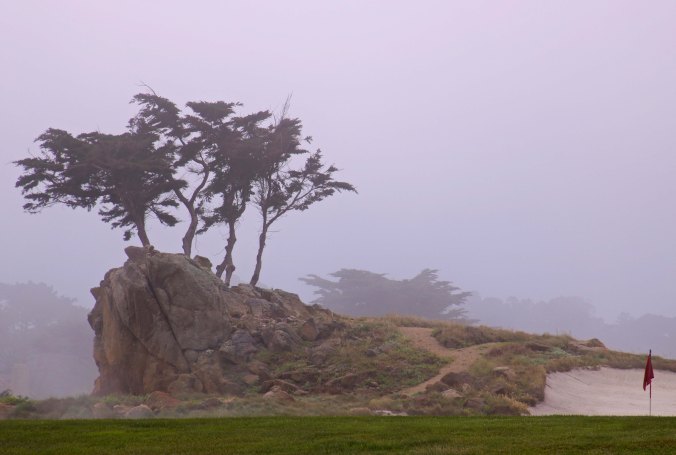
A green on the Shore Course just below the small grassy hill has its hole marked by a flag. The cypress on the granite rock behind the green adds beauty to the course. The fog adds mystery. Numerous sand traps come with the territory at the golf courses along the 17 Mile Drive.

This cypress was also on the course, just off the road.

A happy, obviously well-fed buck, whose antlers are still in velvet, munches down grass on the course. He is welcome to eat all of the grass he wants and is not required to pay the course’s $275,000 initiation fee,

I’m having a bit of fun here; my apologies to golfing fans. I’m not one. In fact, the only C I ever got in PE was for golf. I was not happy. I’ve held it against the sport ever since. Peggy did much better. In fact, she was goofing around at Mary Baldwin College (or was that golfing a round) and hit a hole in one. The golfing coach happened to witness the event and immediately recruited her for the college team.

I have watched my share of golf matches on TV, however. It turns out that father-in-law number one and father-in-law number two both loved the sport. Bonding included many an hour of listening to the announcer whisper in awe at the difficulty of a particular tee shot. Exciting stuff. I classified my TV golf time as part of my marriage vows under ‘and other duties as required.’

If I were a golfer, or even if I just watched golf on TV for fun, the 17 Mile Drive is an incredibly beautiful location for the sport. The brochure for the route is justifiable in declaring it “one of the most famous scenic drives in the world.” Since the area is privately owned by the Pebble Beach Resort, you will pay a $10 per vehicle fee to visit, but it is definitely worth it. The resort is owned, btw, by an investor group headed by Clint Eastwood, Arnold Palmer, and Peter Ueberroth. They bought it from a Japanese company, possibly in a fit of patriotism.

Clint, you may recall, was mayor of Carmel in the mid-80s. He also owned a pub/restaurant in the town known as the Hog’s Breath Inn.  Being a fan of his spaghetti westerns, I ate there once in the early 70s shortly after it opened. Eastwood wasn’t happy. Apparently I resembled riffraff. He walked over to my table, pulled out his .44 Magnum Smith & Wesson Model 29 and said “Are you feeling lucky, punk?” Just kidding. Eastwood was off making a Dirty Harry movie and we were more than welcome at the restaurant.

Of course there is much more to the 17 Mile Drive than manicured golf courses.  A restless ocean, graceful Monterey Cypress, impressive rocks, and abundant wildlife are all part of the scenery. Following is a map and some of the photos I took.

I borrowed this map from Google. There are several entrances. This time I came in through the Highway Gate on Highway 1 and drove down past the Poppy Hills Golf Course. My first stop was to admire the ‘Restless Ocean’ at #6.

The marker at the site told me that the ocean was restless because of all the rocks that the waves had to break over on their way into shore.

A wave cooperated with me by breaking over a rock.

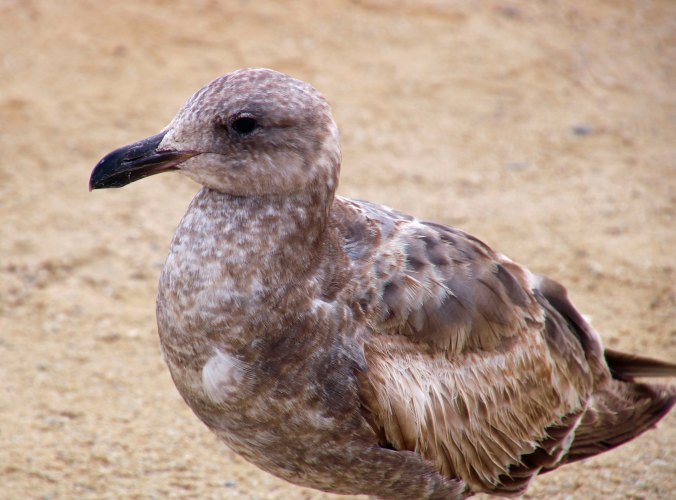
The fog reduced my view of Bird Rock at #10. Cormorants were the main birds I could see. Harbor seals with sea gulls in between can be seen on the lower right. Fortunately some sea gulls flew over to see if I had any food to offer. I call them my galley of gulls.

Definitely a “Do you have any food?” look.

A bit more laid back.

The feathers on this fellow caught my attention.

I don’t think I have ever seen a darker eye.

Here we are back at the Lone Cypress at site #16. It has hung out on its perch for 250 years. A number of guy wires holding it up are meant to assure that it continues to hang out for many more years.

The road itself is worth the trip. Here it has a bower of tall cypress trees next to the Ghost Tree Stop at #17, which was my last stop.

This is the tree on the left from the above photo. I can see where it might be considered ghostly.

I am not sure which tree was ‘the ghost tree’ but I found a number of candidates.

Another candidate…

One of the 17 Mile Drive Mansions overlooks the Ghost Tree site. This is a different perspective on the tree shown above.

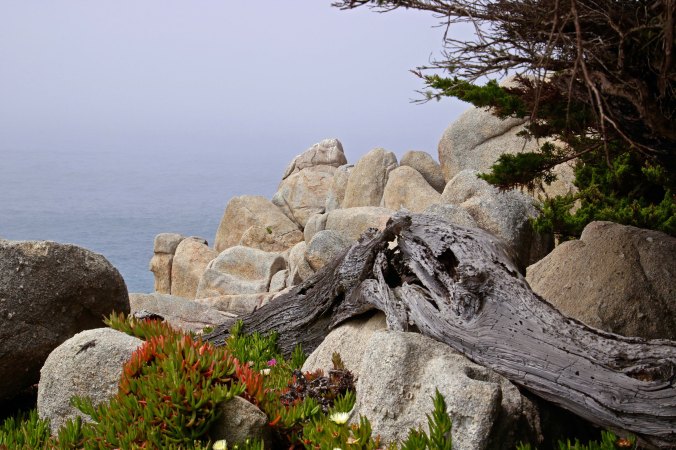
Maybe not ghostly, but I liked the way this ancient downed cypress seemed to drape itself over the rock.

Speaking of rocks, I felt these might have been something that Druids would worship.

The rock in the ocean seemed to fit right in!

Another perspective.

I liked the combination here of a shadowy cypress, rocks and the restless sea.

Another photo featuring a cypress tree, rocks and the ocean.

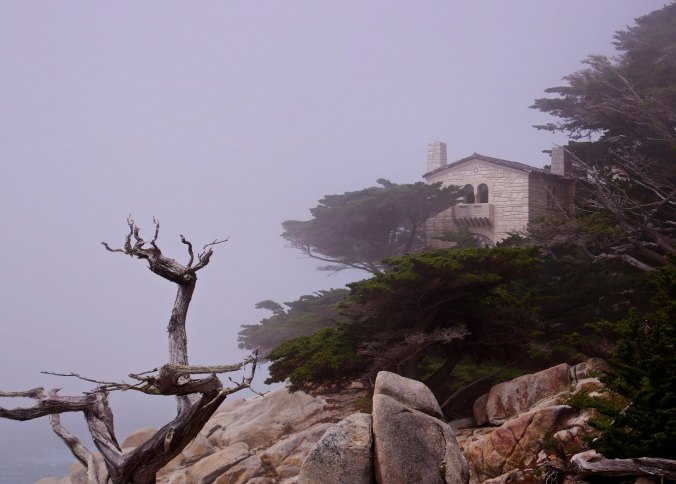
This cypress, another candidate for the Ghost Tree, seems an appropriate end for this post on the 17 Mile Drive.

Theme Camps and the Tribes of Burning Man… The Burning Man Series

The 2015 Art Theme at Burning Man was “Carnival of Mirrors.” The Kostume Kult Tribe out of New York responded by building this camp on the Esplanade, Black Rock City’s main street. Here’s how the tribe describes itself: “The  Kostume Kult  arts collective is a volunteer-led, non-profit community organization supporting interactive arts, costuming, street theater and absurdist fun while bringing wonderful people together.”


Tribes and theme camps are an essential part of part of Burning Man. Tribes are basically a group of people who decide to hang out and camp together. They can come together through friendship, a common interest, or geographical location. Some number in the hundreds and have a sophisticated structure with year around planning. Others consist of a few people who more or less show up and camp together with minimal arrangements. My tribe, the Horse-Bone Tribe, resembles the latter. The increasing difficulty of obtaining tickets and the spiraling cost of attending has played havoc with smaller tribes, including ours. I may be the tribe this year. It’s a good thing I have multiple personalities. Bone will keep me company.

The larger the tribe, the more elaborate the camp. And some can be quite impressive, as today’s photos show. They help create Burning Man’s unique atmosphere. Many larger tribes also support mutant vehicles and all participate in Burning Man’s gifting society by offering some type of free service including entertainment, classes, alcohol, food, costumes, bike repair, etc. The list goes on.

Each year, Burning Man has an art theme. This year’s is Radical Ritual. According to Burning Man: “In 2017, we will invite participants to create interactive rites, ritual processions, elaborate images, shrines, icons, temples, and visions.” That’s a lot of room for creativity, and mischief. My camera will be busy. Both artists and tribes use the theme for inspiration, although it is not required. The photo of the Kostume Kult Tribes camp at the top of this post is an example.

Following are a few examples taken from different years of major camps built in Black Rock City by tribes to reflect the year’s theme or the tribe’s particular vision.

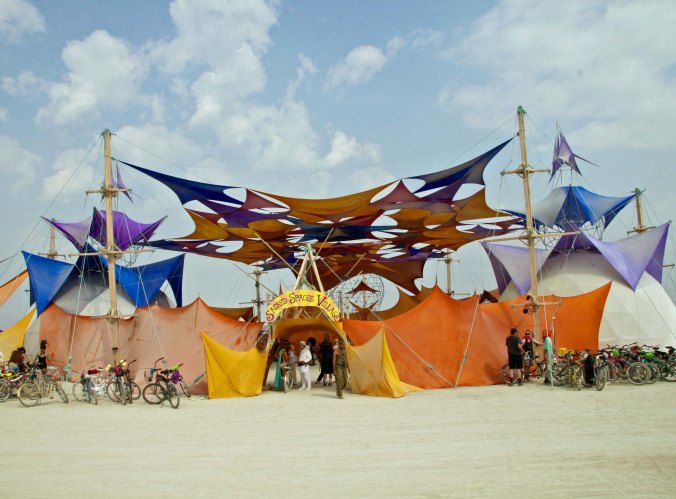
Searching for massage, raw food, ambient trance, native wisdom or numerous other paths to spiritual enlightenment, the Sacred Spaces Village offers it all— plus a really gorgeous structure.

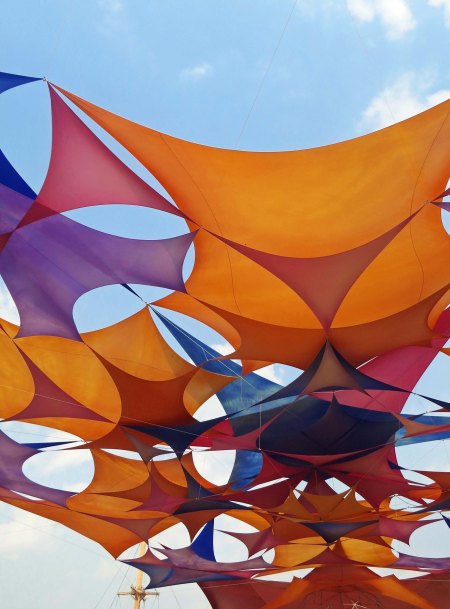
Looking up from inside the Sacred Spaces Village.

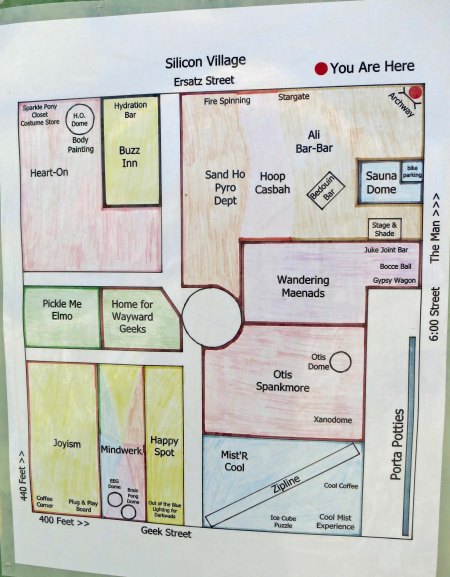
The folks from Silicon Valley have been creating a village at Burning Man for many years. Don’t be surprised to find the billionaire founders of such companies as Google hanging out here. The camp is large enough that it needs its own map. Smaller groups within the overall village sponsor the different areas and provide different opportunities for Burners. For example, if you want to sample various types of sauerkraut, you could check in at Pickle Me Elmo.

A number of the larger camps at Burning Man are music venues. One of these is Ooligan Alley with its 747 cockpit serving as the DJ booth. The sound equipment for this camp alone is worth several hundreds of thousands of dollars.

Celtic Chaos is another major music venue. I was amused to read that its motto is “Bringing a little more mayhem to the universe.”

The French Quarter at Burning Man brought to Black Rock City by Burners from New Orleans has always been one of my favorite camps. Great coffee and pastries can be found here, along with New Orleans Jazz.

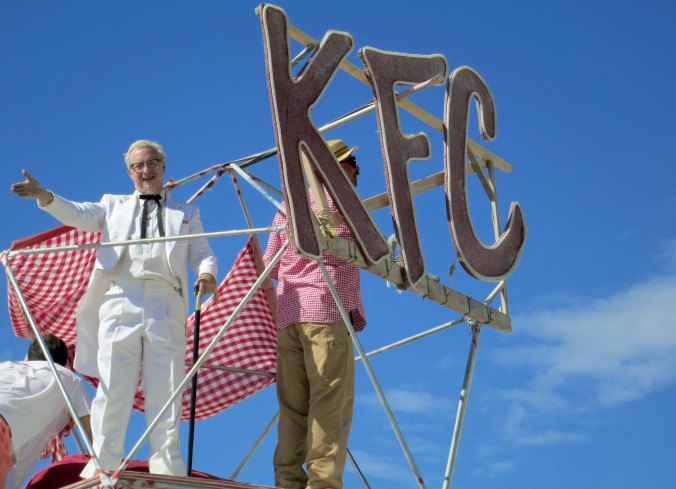
Burners from Kentucky sponsored the KFC camp which featured fried baloney on white bread and a shot of bourbon. I stopped by for breakfast and the Colonel waved at me.

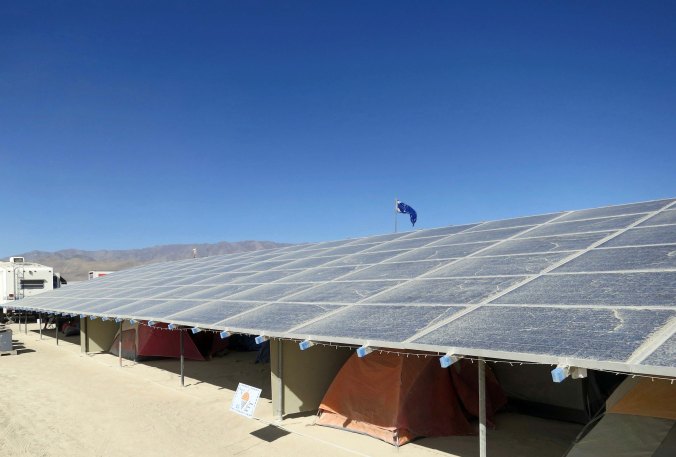
The Alternative Energy Village is the place to go if you want to learn more about alternative energy or even live off the grid. No generators are allowed in the camp.

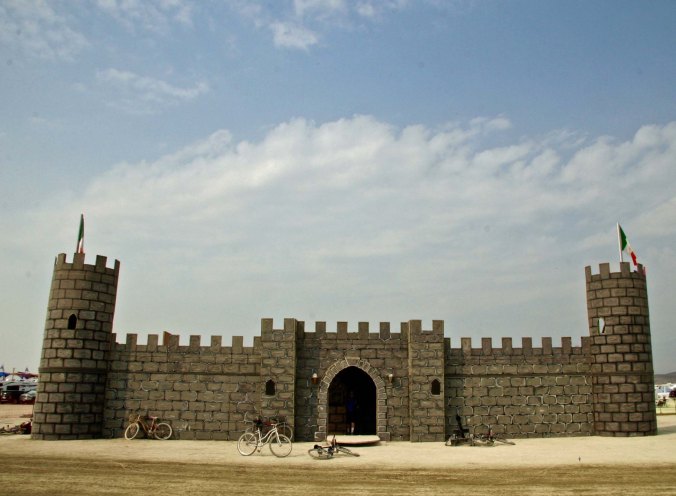
This ‘Firehouse’ was created by the Do More Now tribe out of Seattle. Its objective is “empowering participants to challenge themselves by coming together to create innovative and playful spaces that enable and encourage the creation of art, performance and community activities. In other words – we create possibility!” It is a goal that could be applied to many of the camps at Burning Man.

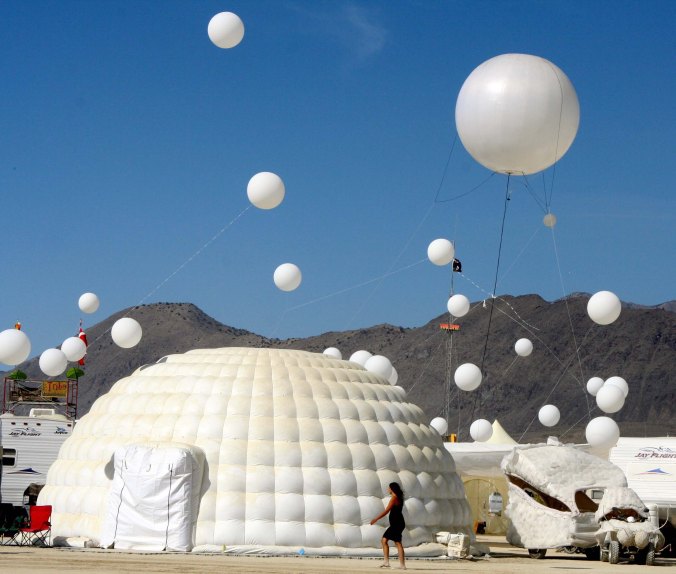
I’ll conclude with this rather dreamy creation, which I have always found appealing because of its focus on white and its use of balloons. Also, check out the white mutant vehicle on the right. Unfortunately, I don’t know which tribe sponsored this camp.

NEXT BLOGS:

I’ll be taking a blog break to wander the Central Coast of California for the next couple of weeks. See you back here afterwards!

Bone Is Found— but he is still just a bone… Part III

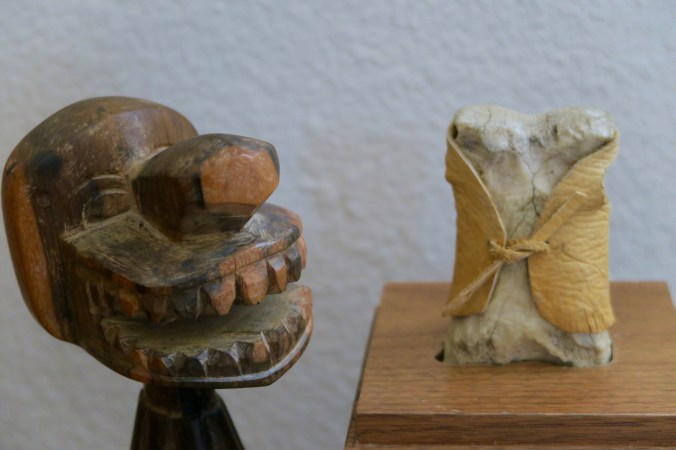
George, the Bush Devil from my book, “The Bush Devil Ate Sam,” checks out Bone. NO, George, Bone is not edible!


This is the third and final post on how Bone was discovered. In last Wednesday’s post my fellow backpackers and I had ended up at the resort on Echo Lake after coming out of the Desolation Wilderness. We had celebrated the first part of our journey with lunch and a beer or three…


My system complained about the third beer as we hiked on across Highway 50 and up to Benwood Meadow where we stopped for the night, some 34 miles from where we had started.

Our fourth day started out as a typical backpack day: we climbed. It was gentle at first and then became more serious. Once again snow-covered large segments of the trail. We spread out and searched for tree blazes. I scrambled over a particularly steep section and found myself in a high meadow.

Something half buried in a field of young corn lilies caught my eye. A few days earlier it would have been covered with snow. Curiosity led me to detour through the still soggy ground. Mud sucked at my boots.  My treasure turned out to be a disappointing, short, squat bone. Gnaw marks suggested it had been part of someone’s feast. I was about to toss it when a devious thought popped into my mind.

“Trash,” I hollered at Tom and held up the bone. We had a game where if one person found a piece of trash, the other person had to carry it out. But first you had to catch the other person.

Tom sprinted down the trail with me in pursuit. Unfortunately, we had made it over the mountain and our route ranged from flat to downhill. Tom was very fast. We had traveled two miles and were almost to Showers Lake before he stopped, concerned about leaving our companions too far behind. Very reluctantly, he took the bone and stuffed it in his pack.

“How can you classify a bone as trash,” he whined. I figured Tom would toss his new traveling companion as soon as I was out of sight.

X marks the spot where Bone was found, resting in a high mountain meadow. (Map from the Tahoe-Yosemite Trail book by Thomas Winnett.)

It was a pleasant hike down to Carson Pass on Highway 88, and relatively dry since we were on a south-facing slope. Kit Carson had come through here in February of 1844 along with John C. Fremont. It wasn’t pleasant then. The snow was deep and food was limited. The mountain men ended up dining off of their horses, mules and the camp dog. The dog apparently went quite well with pea soup. Later, the trail they discovered would become a major entry point for the 49ers rushing west to find gold. (Eventually, the trail cut through Diamond Springs, the foothill town where I was raised.)

There was nary a bar, restaurant or gas station near the pass so we hiked on another three miles to Lake Winnemucca. Rain was threatening and I set up my tube tent, a large sheet of plastic shaped into a round tunnel. It wasn’t particularly sturdy, but it was light and dry. Tom, on the other hand, was carrying a luxurious three-season tent. He stacked the women in head to toe and ended up smelling April’s feet all night.

The next day was all downhill— down to Fourth of July Lake, down to Summit City Canyon, and down to Camp Irene on the Mokelumne River. After dropping 4000 feet in 14 miles I found myself bone-tired again.

Camp Irene provided an attractive campsite but turned out to be rattlesnake country. I had discovered the perfect toilet spot, dug my cat hole, and was baring my behind when one buzzed at me. It’s amazing how fast you can pull up your pants. I was lucky the snake didn’t bite me on the butt. I grabbed a stick and chased him away with a couple of sharp prods for good measure. He was lucky I was something of a nature boy. Otherwise he would have been smashed. The next time I did any serious bathroom duty was when I was parked on a flush toilet at Lake Alpine the next day.

Climbing out of Camp Irene is a challenge. The 4000 feet we dropped the day before in 14 miles we were now expected to re-climb in six. Low clouds filled the canyon. It wasn’t raining but it was cold and damp. Somewhere in the mist a male grouse made its familiar ‘whump, whump, whump’ sound, working to attract a female companion. I empathized. Dripping wet Buck Bush grabbed at our legs.

To stay warm and dry we broke out our rain gear. Lynn moved from being cold and miserable to shivering and not caring. She was on the edge of hypothermia, a very dangerous state. The body loses its ability to maintain warmth and the rational mind ceases to function. Coordination spirals downward. It is very easy to die.

Tom and I acted quickly. I fired up my Svea gas stove and Tom had Lynn stand over it wearing her cagoule, a dress like poncho. We positioned the stove carefully. While this wasn’t a solution to hypothermia found in survival guides, it worked. (The recommended solution is to break out your sleeping bag and crawl in naked with the victim.) Within minutes, Lynn was ready to tackle the rest of the mountain.

Hypothermia can strike fast but it can also be quickly cured— assuming of course you catch it in time. Tom was next. “Curt,” he called plaintively from off in the brush where he had gone to pee. I rushed over and begin laughing. He had managed the first half of his chore but couldn’t zip his pants up. His mind was working fine but his coordination had gone south. He was all thumbs. I called Lynn over to help as I returned to the trail chuckling. There are some chores a trek leader doesn’t need to handle.

We hiked the rest of the way into Alpine Lake without difficulty. Since our ride wasn’t coming until the next day, we rented a one-room cabin to share. Rain poured down outside as we relived our adventures and made up tall tales way into the night. Our journey was winding down, but it wasn’t over.

I was shaking the dirt out of my pack at home when the bone fell out. Apparently, I had been carrying it all the way from Winnemucca Lake. “Darn Lovering,” I thought to myself, “I am going to get even.” I decided to keep the bone. There would be an opportunity on a future trip to slip it back into Tom’s pack. I would have revenge!

And that’s it, the story of Bone’s discovery. It started like so many things in our lives often do, as a non-event. Bone didn’t come up as a subject during our night in the cabin. Naked jumping ladies, lost trails, swollen rivers, gorgeous country, rattle snakes, the physical challenge, hypothermia and even the upside-down map were the stories of legend, not a small, insignificant bone that came from who knows what.

But time has the power to rewrite history. When Tom opened his suitcase in Japan at the beginning of a two-year exploration of Asia, Africa and Europe, he found a surprise, the bone. I had my revenge, and the bone became Bone. When I moved to Alaska and was unpacking my boxes, who should fall out but Bone. The tales goes on and on and on…

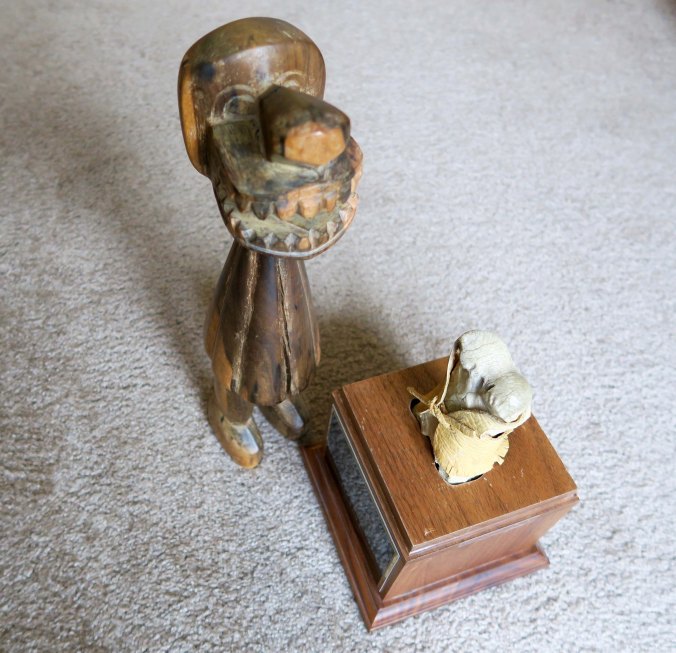
The Bush Devil has travelled with me since 1967 and Bone since 1977, a combined total of 90 years.

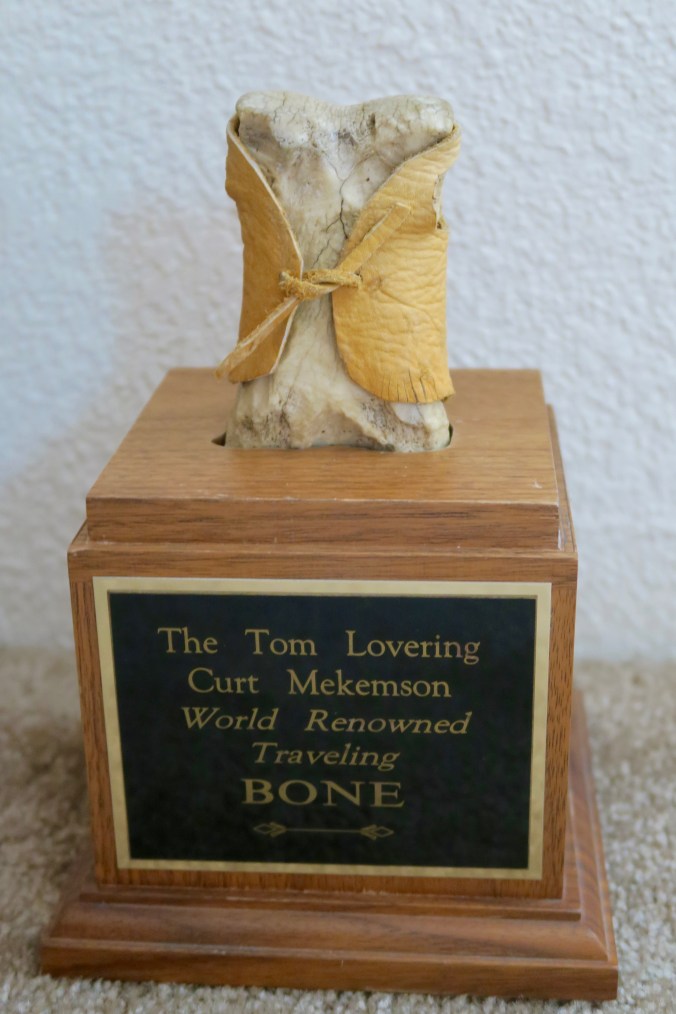
Bone on his pedestal.

From Sea Gulls to Sea Lions to Sea Lights… The Oregon Coast Series

The Heceta Head Lighthouse is one of the most photographed lighthouses in the US.

My older brother, Marshall, is visiting this week and it has taken us back in time, back to our childhood, a time with mixed reviews— and back to when Marshall was living in Oregon. I am going to skip over the early years here, but the Oregon time is relevant. First, however, a little on Marshall: He is a homeless man with a red cargo van and a healthy bank account.

I’ve mentioned our families wandering ways before. I think it is genetic. Both sides arrived in the US before it was the US and immediately started making their way west. Marshall likes to say if it weren’t for the Pacific Ocean, we still would be. For the past several years he has lived in the Southern United States and migrated with the weather, basking in the warmth of southern Florida in the winter and hiding out from the heat in the mountains of North Carolina during the summer. His rule is that he never camps in any one place for more than two weeks.

He takes great pride in his freedom, and in his ability to live inexpensively. For example, he always camps for free. He loves the outdoors and satisfies his love by camping in beautiful locations. He is also an avid reader, consuming a book every two days. I’ve never know him to be happier than he has been since he decided to become homeless in 2002 when he turned 61.

Three years ago, he discovered that he had throat and mouth cancer. He tackled it with a sense of humor his doctor couldn’t believe and continued to camp out while he had his treatments. Marshall has now been declared cancer free. He can continue roaming until he can’t any more. He decided to move west, however. He will now migrate between Arizona and Oregon. We will be one of his regular stop offs.

And this brings us back to Oregon and my post today on the Oregon Sea Lion Cave and the Heceta Head Lighthouse. In the late 1970s, Marshall and a partner bought an old motel on the Oregon coast about six miles north of Heceta Head and eight miles north of the Sea Lion Cave. It was a rambling, funky old place called Gull Haven. Professors from the University of Oregon, writers, and others needing an occasional escape could stay there for $10 per night. Marshall installed our 75-year-old dad there and he happily ran the place while he wandered up and down the coast— taking photos, painting landscapes, collecting rocks, and gathering mussels off the rocks to cook up and eat.

Gull Haven in 1979 when my brother owned it and my father managed it.

Naturally, I went up to visit. I was living in Sacramento at the time. Pop had tried to feed me mussels, no thanks, and showed me around the area. He had photographed the Heceta Lighthouse numerous times, and painted it once. I visited the Sea Lion Cave on my own, descending into the depths to the sounds and smells of a hundred or so sea lions. The sound was substantial and the smell… well, it was odoriferous. It isn’t one you forget, although I’ve since come to the conclusion that the sea-lion cave smells like a petunia patch in comparison to cattle feed lots in California’s Central Valley.

After a year or so Marshall sold the motel— cheap. And didn’t tell me he was going to. I never have totally forgiven him; I would have been sorely tempted to buy it. Today, it is a beautiful B&B known as Ocean Haven. Go here to check it out.

The Ocean Haven B&B north of Florence, Oregon.

Gull Haven today. Or Ocean Haven as it is known now with its magnificent views of the Pacific Ocean.

I visited the area again a few weeks ago when Peggy was back East. Following are some photos I took of the Lighthouse and the Sea Lion Cave.

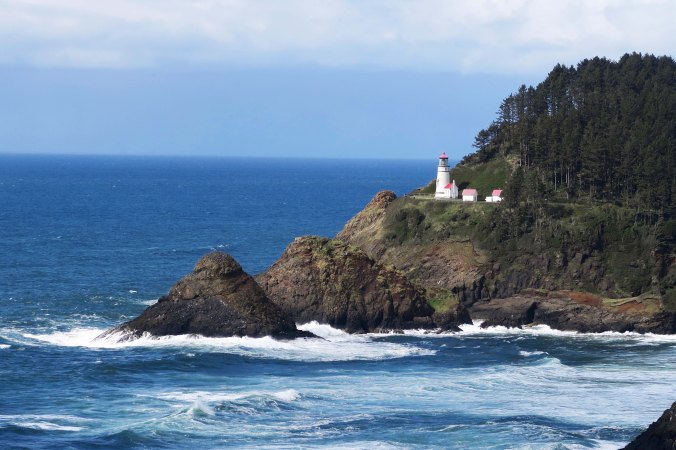
A distant view of the Heceta Lighthouse. It sits 205 feet above the sea.

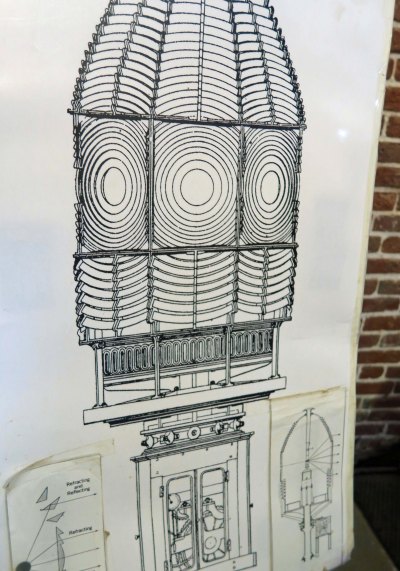
The first order Fresnel Lens in the tower of 56-foot tall lighthouse shines a beam that is visible for 21 miles out in the ocean, making it the most powerful lighthouse on the Oregon coast.

This picture of the Fresnel Lens is found on the ground floor of the lighthouse. Our guide told us that when one of the bottom glass sections broke a few years ago, it cost as much to replace as the whole light cost originally.

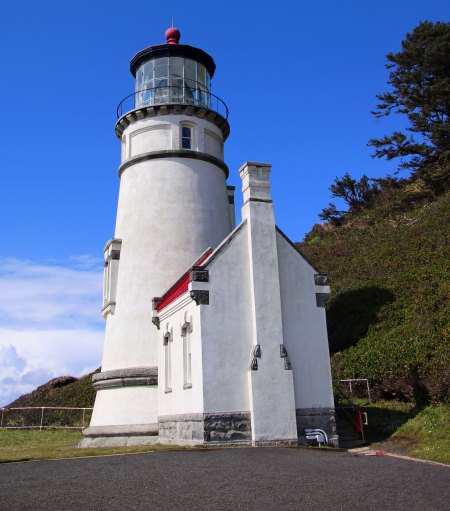
A final view of the lighthouse. Over 1000 barrels of blasting powder were required to create a flat space on Heceta Head to build the lighthouse.

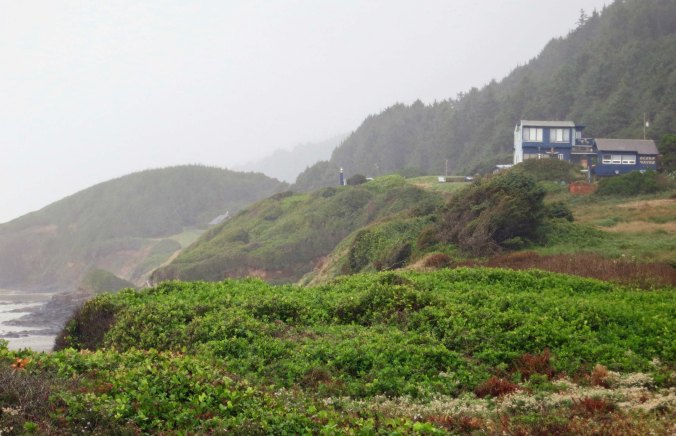
This is a view of the lighthouse keeper’s home seen from the trail leading up to the lighthouse.

When the lighthouse was automated in the 70s, it was turned over to Lane Community College for classes. Not bad, eh? Today it is a B&B. The house also comes with its own ghost named Rue. It is said that she doesn’t like change.

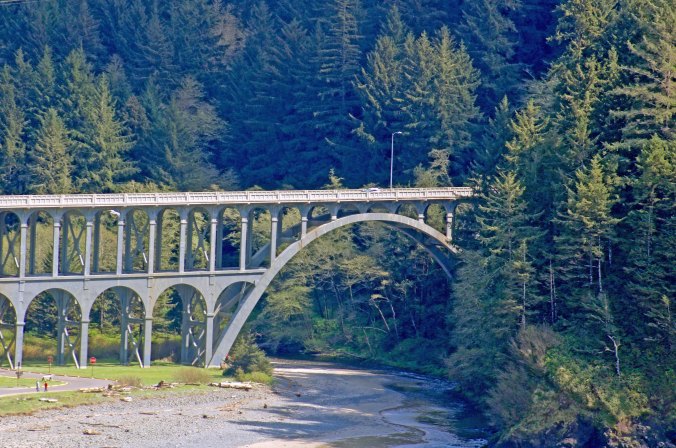
A view of the Cape Creek Bridge from the lighthouse.

And a close up. The Cape Creek Bridge is one of several gorgeous bridges along the Oregon coast.

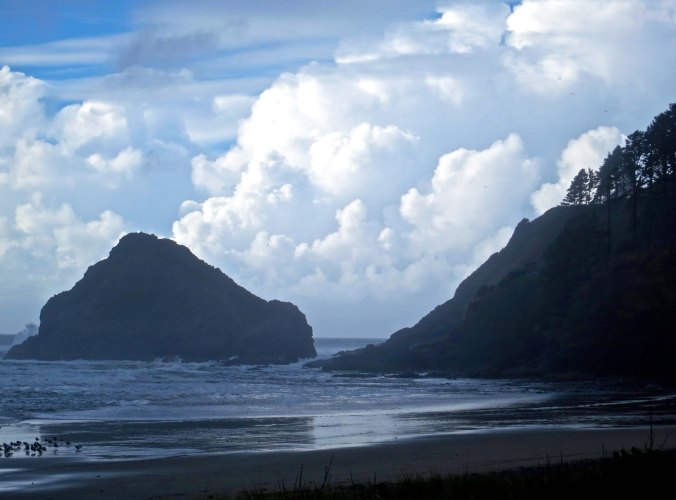
The small bay created by Cape Creek is also quite scenic. The lighthouse sits on the hill to the right.

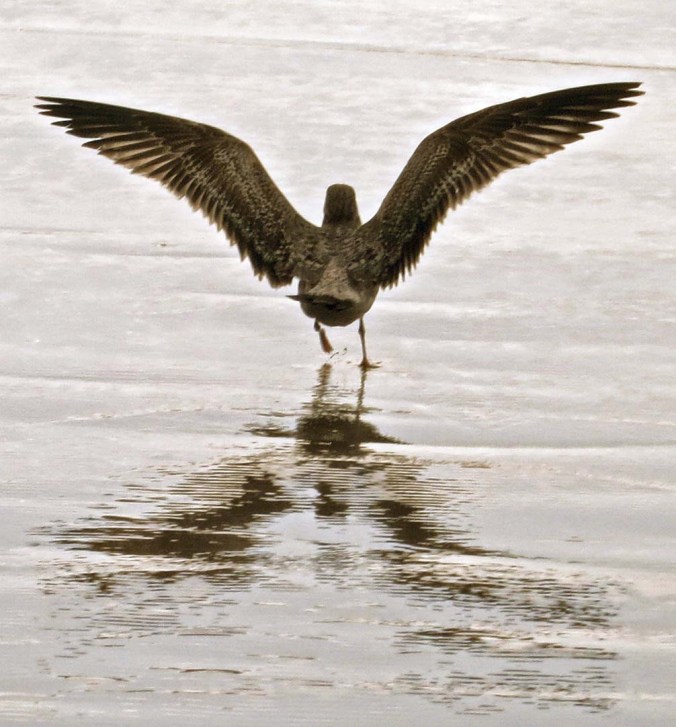
A sea-gull takes off from the beach of the Cape Creek Cove. I took this photo (and the two above) on an earlier trip.

A final view from the lighthouse. If you look closely, you will see the Sea Lion Caves building on the distant headland. Find the cut made for Highway 101 as it snakes its way along the cliffs and follow it to the far right.

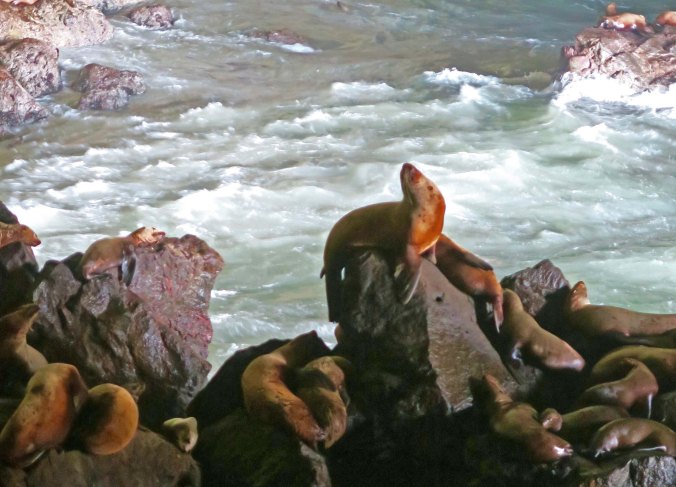
Over 100 sea lions (eared seals) were in the cave when I visited. An elevator whisks visitors down into the main cave.

Steller Sea Lions live for about 20 years. They can swim up to 17 miles per hour.

This big fellow had his head back and was barking most of the time I was in the cave.

I found the drama of the waves in the cave to be as interesting as the seals.

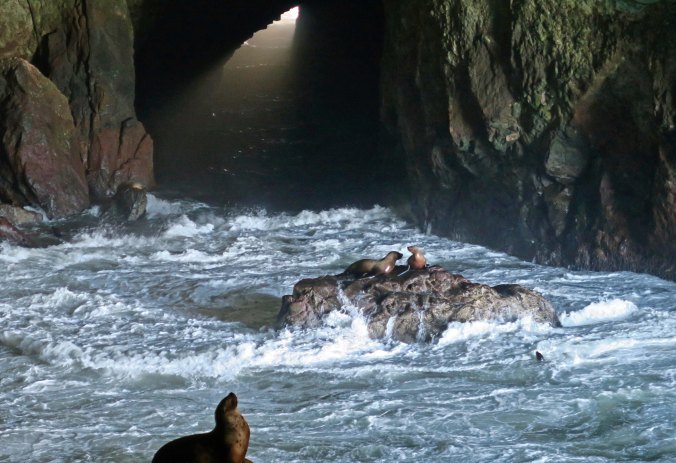
The rock in the middle is also prime seal territory. The waves actually washed over it as I watched, leaving only two sea lions on top.

A final view of the rock with its two sea lions and the big guy.

NEXT BLOGS:

Wednesday: Bone is Found!

Friday: The Tribes of Burning Man…

Next week I will be traveling down around Big Sur, Carmel, Monterey and Santa Cruz on the Central Coast of California. It may be blog-break time. 🙂


From the Sublime to the Weird… Burning Man Murals and Paintings

T-Rex looking for dinner at Burning Man back when the playa was an ocean.

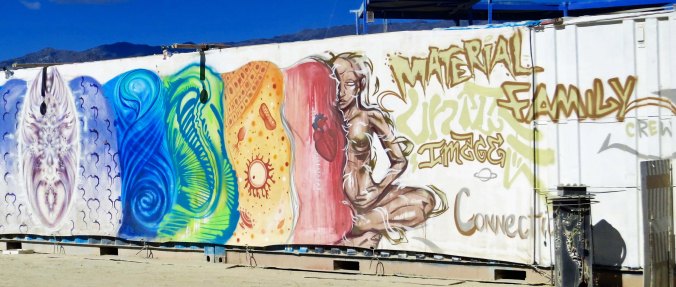
As you might expect, mural art and paintings at Burning Man reflect the event. Much of the art has a mystic feel about it with both Eastern and Western influences. Surrealism also seems to have found a home at Burning Man. Then there is the fun— bordering on strange— art that always appeals to my sense of weird. Following are examples of what I see as I ride my bike or walk around Black Rock City and out in the Playa.

I am going to start with what I call Chakra art that takes its inspiration from Eastern mysticism. A Chakra, simply put, represents seven levels of awareness or spiritual power in the human body that work their way up your spine starting with basic urges and ending with higher consciousness. Meditation is the primary tool that mystics use to reach the higher levels.

Chakra art doesn’t get much clearer than this. Beyond the primary chakra points are a multitude of secondary points. This fellow also comes with an aura.

Maybe you can even get high enough to earn a halo. This one features several languages.

An eagle and a buzzard have arrived here.

This mural portrays a woman meditating. Off to the left is a chakra.

Mandalas are aids in meditation. I feel like this one could take me into infinity.

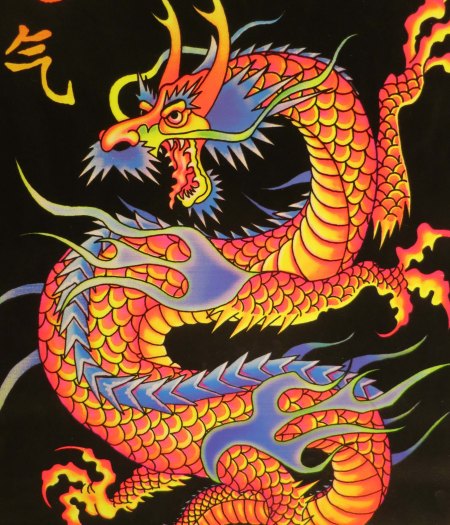
Of course there is much more to eastern mysticism and myths than meditation and chakras. Traveling farther east to China, we have this magnificent dragon.

What I call Nature art focuses on our deep connection with all life on earth and has a more Western/shamanistic feel to it that is more reflective of what we find in Native American, First Nation, and South American native traditions, as well as other animistic cultures throughout the world.

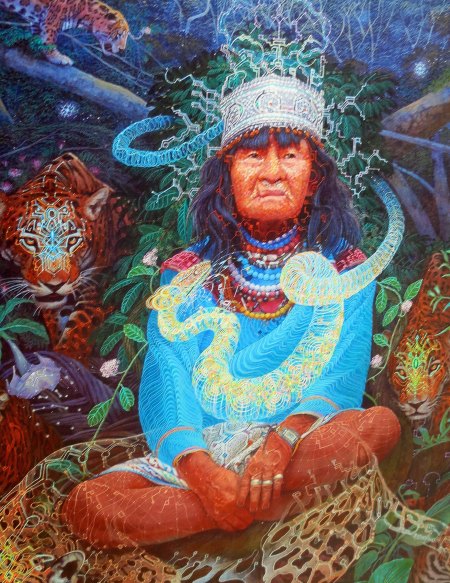
A shaman sits in a meditative pose while jaguars peer out of the jungle and a snake circles his body. I was amused to see that he is wearing a watch.

This painting also makes me think Shaman.

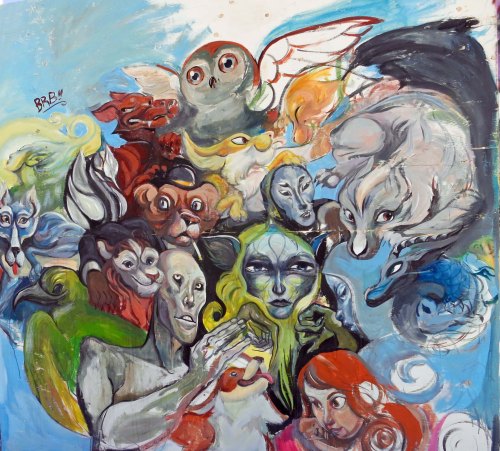
I am fascinated with the art at Burning Man that combines people and the natural world.

Another example.

How about this for a hair do?

This woman is morphing into an owl, or vis-versa.

Bird eyes.

A touch of green.

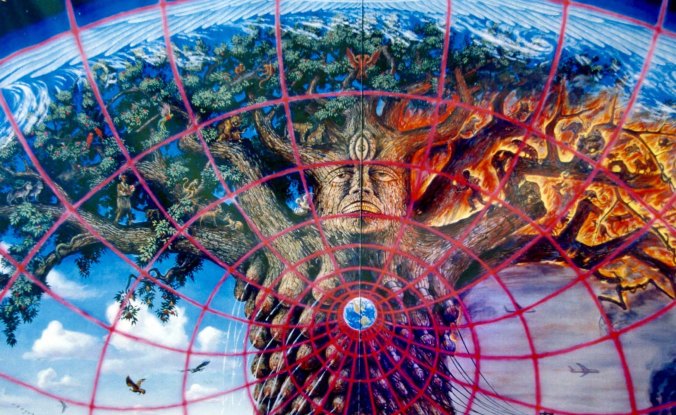
The tree of life and death with the left side representing nature and the right side our industrial civilization (sort of like a page out of Dante’s Inferno).

Surrealism is, well, Daliesque.

Mr. Surreal, himself.

A surreal landscape featuring Burning Man founders, I believe, along with several Burning Man icons such as El Pulpo Mechanico looming in the background.

A surreal dragonfly.

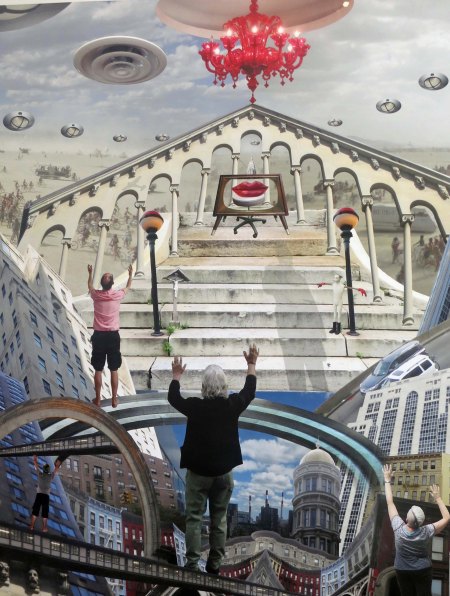
And a sort of surreal painting featuring lips, a red candelabra, light fixtures and speakers as UFOs, and apparently people worshipping all of the above.

I will conclude with several paintings/murals that fit my description of fun, funky, and possibly weird.

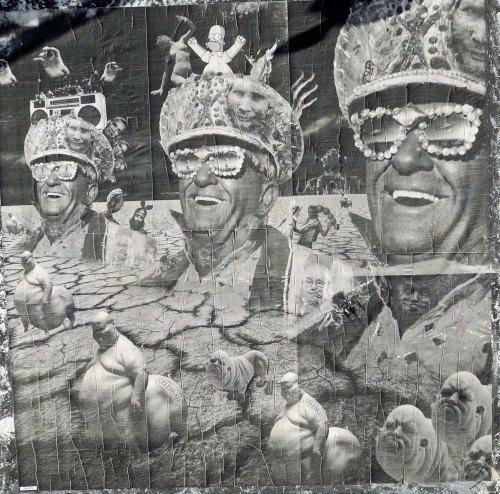
This mural should easily qualify as weird.

As does this painting of ‘children’ playing.

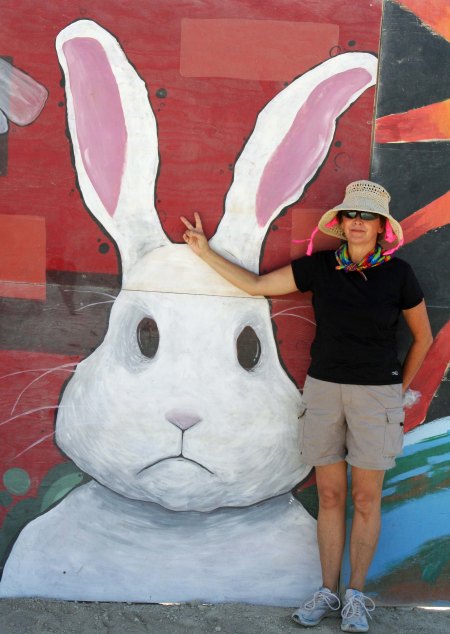
Peggy stands next to a giant rabbit. One of the events at Burning Man includes a thousand or more people dressing up like rabbits and parading around Black Rock City.

How about ostriches with people heads?

One year Burning Man had a circus theme that led to the creation of all kinds of strange circus art.

My favorite from the circus art.

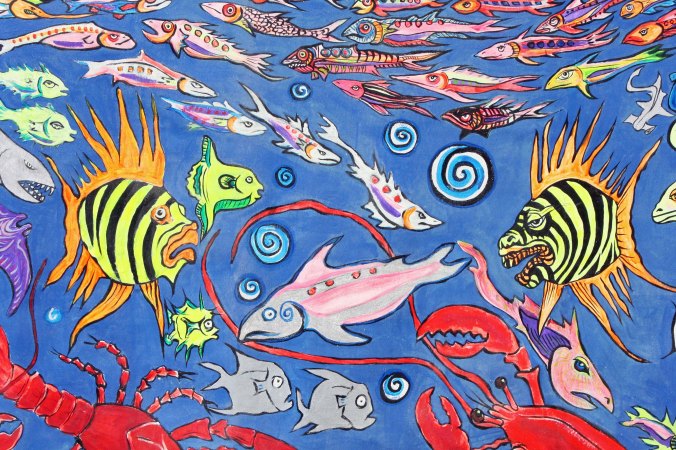
The fish were fun, especially the one on the right with the teeth.

This was strange…

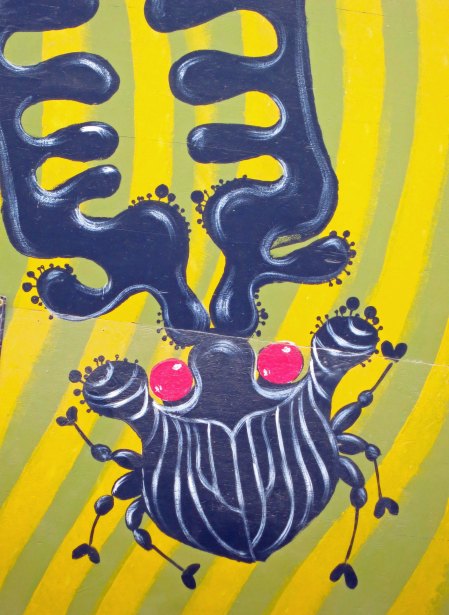
As was this beetle.

I’ll conclude with another favorite of mine: a 3-D Bossy.

NEXT BLOGS:

Monday: It’s back to the Oregon coast to visit a cave filled with sea lions, plus another lighthouse.

Wednesday: Bone is found and a rattlesnake threatens to bite me on the butt.

Friday: Burners and their costumes at Burning Man.