Bug Eyed Alien or Shamanistic Vision… The Rock Art of the Three Rivers’ Petroglyph Site: Part 2

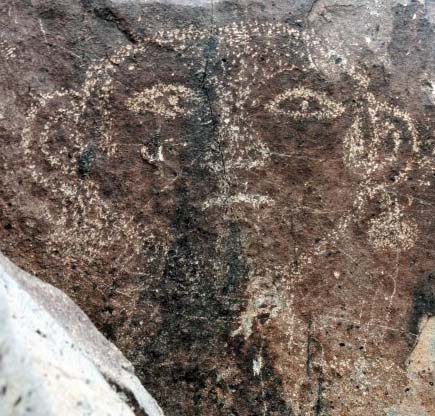
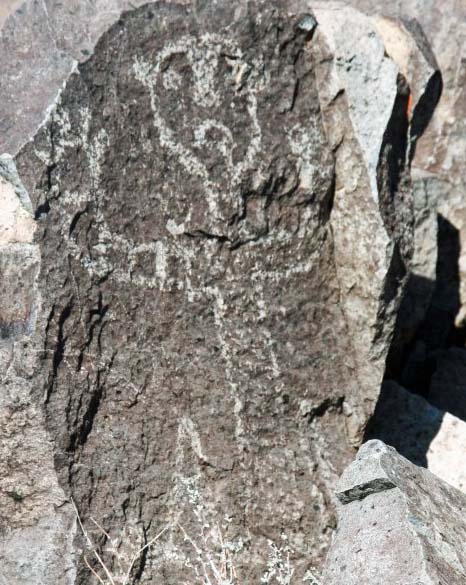
This is one of my favorite petroglyphs from Three Rivers. It makes me want to say, BOO! So, is it a bug-eyed alien or a shamanistic vision?


Peggy and I are still off playing (details to come later), so I am continuing to revisit earlier posts I did on the Three Rivers’ Petroglyph National Recreational Site located in south central New Mexico.

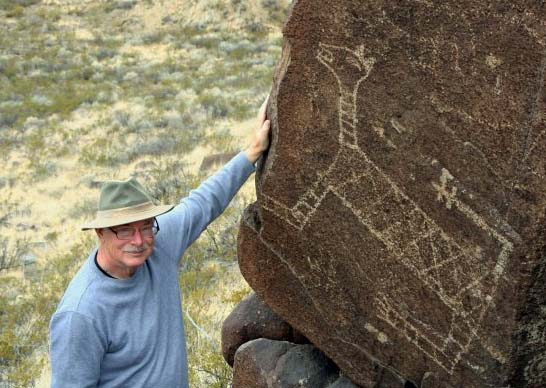
A lot of guessing takes place in determining the meaning of rock art. Present day Native American myths and rituals provide some clues. Others can be deduced from the petroglyph itself. An antelope filled full of arrows relates to hunting, but is it a record of an actual event or a hopeful prediction of the future?

Today I am featuring petroglyphs from the Three Rivers site that represent humans and gods. Some look quite alien, while others appear quite human. It’s assumed that shamanistic activities and visions were often the inspiration behind petroglyphs. Or the inspiration might be as common (and dramatic) as a woman having a baby, which is reflected in a number of Three Rivers’ petroglyphs.

This petroglyph of a man struck me as quite realistic. Does he look like anyone you know?

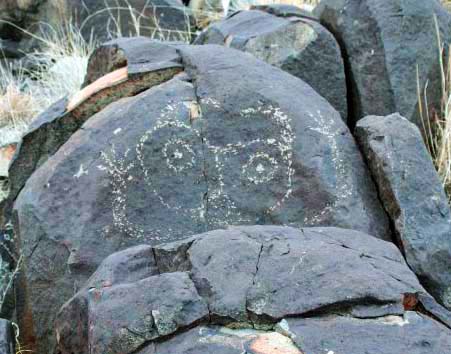
This fellow is a bit further out. I am assuming he is a Shaman either exorcising a demon or having a bad trip. (Since no one can be sure of the actual meaning of rock art, you are free to speculate.) The circle surrounded by dots just below his chest, is thought to represent Datura, a powerful hallucinogen.

A sad fellow, I thought at first, given his downturned mouth. But then I noted the eyes. And are those cat whiskers on his cheeks?

Okay, scary.

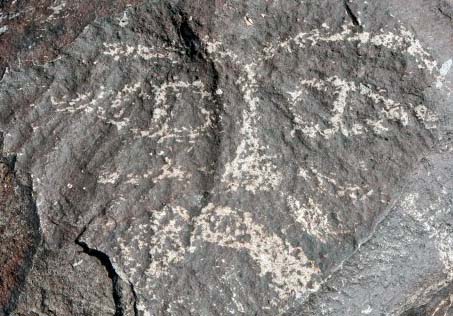
A petroglyph of a woman in this position is usually assumed to be having a baby. She’s even screaming, or practicing deep breathing.

Here’s another example. A little empathy, please.

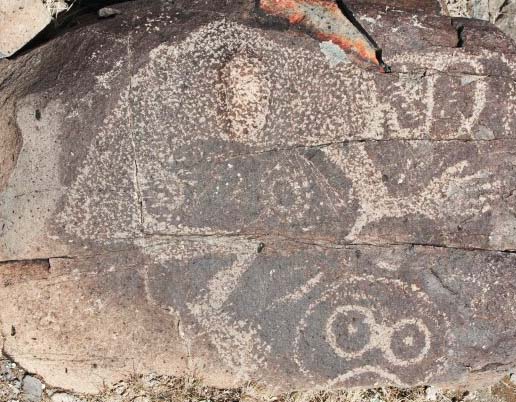
Often the figures are assumed to represent gods. This one could be corn.

This final photo is to prepare you for my next post where I will feature some of the wildlife of Three Rivers. This is a rather magnificent mountain lion.

SaveSave

SaveSave

SaveSave

SaveSave

SaveSave

A Journey Back in Time to the Spectacular Three Rivers’ Petroglyph Site of New Mexico… Part 1

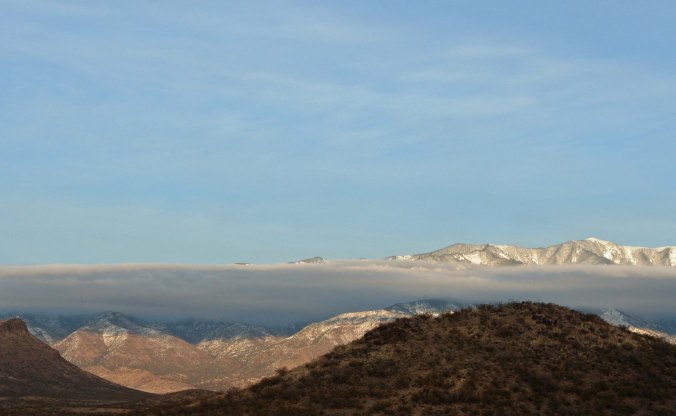
Sacramento Mountains of New Mexico.

Evening shadows, combining with a layer of clouds stretching along the Sacramento Mountains, provided an air of mystery for the Three Rivers’ Petroglyph Site of southern New Mexico. Peggy and I could hear coyotes on the hunt calling to each other in the valley below, a sound as old as humankind.


It’s tough when play gets in the way of blogging. Something has to give. Guess what? (grin) I had slated today for the beginning of my Native American rock art series. And so it shall be. But I was going to feature the trip we made a few days ago through the Lava Beds National Monument. There’s no time to produce it now; Peggy and I are on the road again. After all, we stayed home for five days. So, I am going to take you back in time to our visit of the Three Rivers’ Petroglyph Site of southern New Mexico. I know some of you traveled there with us. I think you will find the revisit worthwhile. For the rest of you, be prepared for a treat. I can’t think of a better place to begin an exploration of the rock art sites that are found scattered throughout the western United States.

Groups of petroglyphs found at Three Rivers Site, New Mexico.

Three Rivers is chock full of petroglyphs, made by ancient peoples using a rock to peck through desert varnish. Searching for rock art is like a treasure hunt. Sometimes you strike it rich and find a bunch in one location, like this. How many can you find among the rocks here?

Peggy and I have been visiting rock art sites throughout the Southwestern United States for the past 19 years. The Three Rivers’ site is one of our favorites. Some 21,000 petroglyphs featuring everything from people to bugs are spread out over 50 acres. Created by the Jornada Mogollon people of the Chihuahuan Desert, the glyphs were pecked into rock using stone tools for a period of over 500 years starting in 900 AD.

This is wide-open country, set off by dramatic mountains. Within a hundred miles of Three Rivers, Billy the Kid fought in the Lincoln County Wars, Smokey the Bear was found hidden in a tree avoiding a forest fire, bug-eyed aliens became synonymous with Roswell, and history was forever changed with the explosion of the world’s first atomic bomb.

Three Rivers Petroglyph site in southern New Mexico with Sacramento Mountains providing the backdrop.

Native Americans often chose cliff areas such as those on the left for their rock art. Peggy and I have spent a lot of time scrambling around on such cliffs.

I rode through the area on my bicycle as part of my ten-thousand-mile trek around North America. It’s a long way between pit stops. The remoteness of the area is reflected well in the photo above.

Native Americans often chose special sites for their rock art and it is immediately apparent that the Three Rivers site is special. The words raw beauty come to mind. Set on a ridge, the site provides commanding views of the surrounding desert and mountains. Today, I am featuring the natural beauty of the region. In my next posts, I will focus on petroglyphs of people, animals, birds, geometric designs, animal tracks, reptiles, bugs and anything else that caught the fancy of the Jornada people, and us– including a whale and a mysterious ship.

Peggy stands on the ridge next to a rock likely to hold petroglyphs. Some glyphs are immediately obvious while others are hidden. Sharp eyes are required. And you need to hike around the whole rock.

Three Rivers Petroglyph site in southern New Mexico.

A final view of the remote, mysterious area. I’m always on the lookout for UFOs!

NEXT BLOG: I will look at glyphs that feature the Jornada Mogollon people and their gods. Below is an example.

Petroglyph from Three Rivers Petroglyph site in southern New Mexico.

…An abstract geometric design with eyes. Another reason I scan the skies for aliens!

SaveSave

SaveSave

SaveSave

SaveSave

SaveSave

SaveSave

SaveSave

SaveSave

SaveSave

An Ugly Pit Viper Drops by for a Visit… Let’s go backpacking: Part 2

I heard a noise and looked up. A Diamondback Rattlesnake had come to visit.


Today’s post finds me out on a backpacking trip I went on last week. Friday’s post introduced the trip and took me off into the woods by myself.


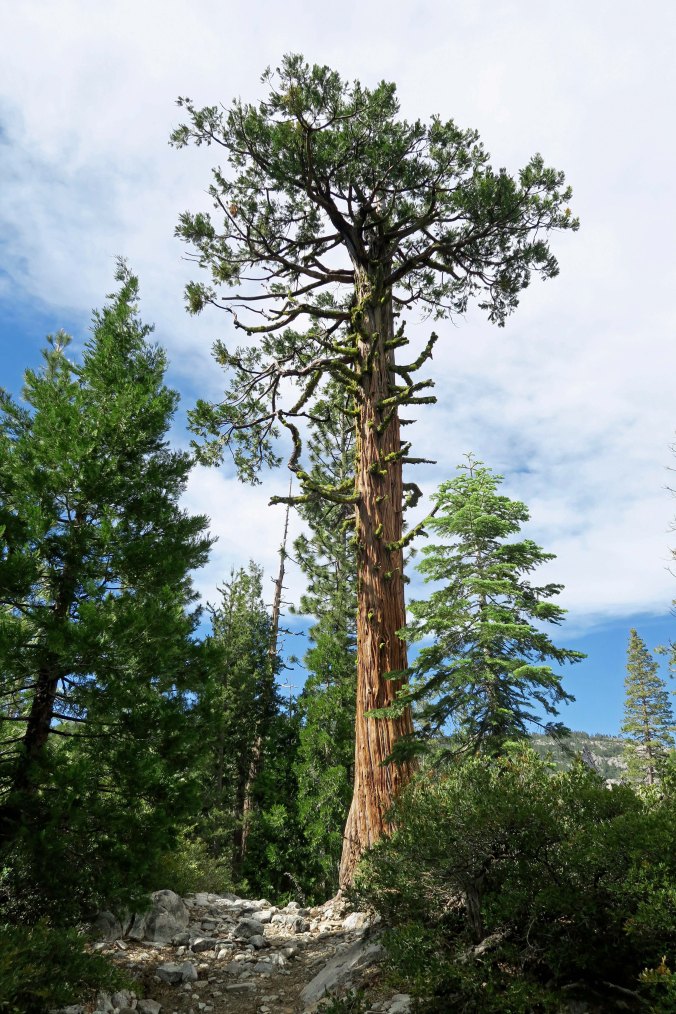
I decided to remain camping where I was and go day hiking. That way I could explore the surrounding area early in the morning and late in the afternoon, while hiding out under a shade tree during the hottest part of the day. I had a number to choose from including incense cedars, ponderosa pines, white firs, and lodgepole pines. There was even a large sugar pine in the neighborhood with its 18-inch-long cones.

The Sugar Pine.

Staying in the shade involved moving as the sun made its way across the sky. This was a good thing; it forced me to get up every so often.

I create a very comfortable nest for myself in the woods, the type I can snuggle down in and read a good book, or write, or prepare a quick snack, meal or cup of coffee. My ‘kitchen’ is always on my right; my ‘living room’ and ‘office’ on the left. The Therm-a-Rest mattress converts to a chair and my backpack forms a great back rest. Everything is easily reachable from where I sit. Moving’s a bit of a bother (grin). It involves two trips and about five minutes to transfer everything. I quickly establish which trees provide the best shade and breeze for the time of the day.

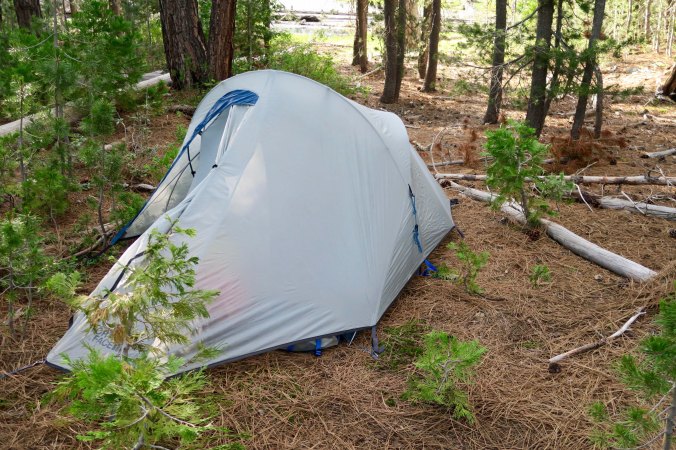
Here’s my home away from home in the woods. Everything I need from entertainment and food to water and mosquito repellent is conveniently located. My clothes bag in the front rests behind my knees and adds comfort. My journal is resting on my chair.

I was in my five o’clock spot under a lodgepole pine when a movement caught my eye. I looked up from my Baldacci book and saw a Diamondback Rattlesnake slithering toward my tree through the pine needles. An ugly pit viper had dropped by for a visit! Keeping a close eye on my guest, I quickly pulled out my camera. The Diamondback kept coming. When it was about 10 feet away I said, “Ahem, Ms. Snake, do you see me? Do you even have a clue I am here?” (It might have been a male, but how in the heck do you tell the sex of a snake? I looked it up, actually, since I knew you would want to know. Male snakes have a couple of tiny penises under the skin inside their cloacal opening (vent under their tail.) You shove a snake probe up there. It goes up farther for a male than a female. Now you are an expert. I don’t think my snake would have cooperated.)

Ms. Snake came to visit me when I was sitting under one of the Lodgepole pines behind my tent.

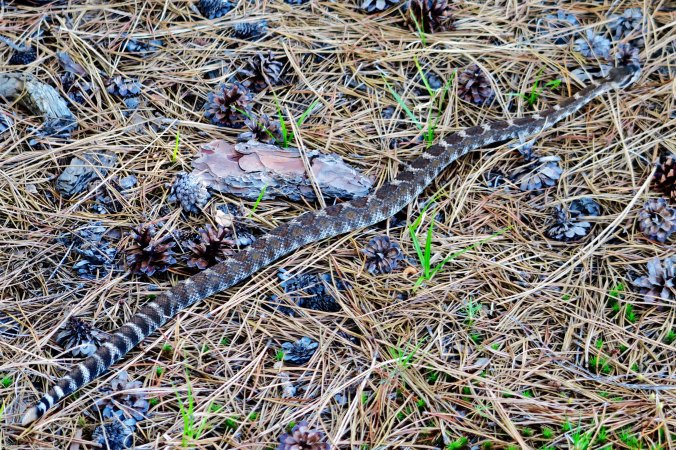
The rattlesnake was close to four feet long and had ten rattles which suggested she was around five-years old. Note the triangular-shaped head that is typical of pit vipers.

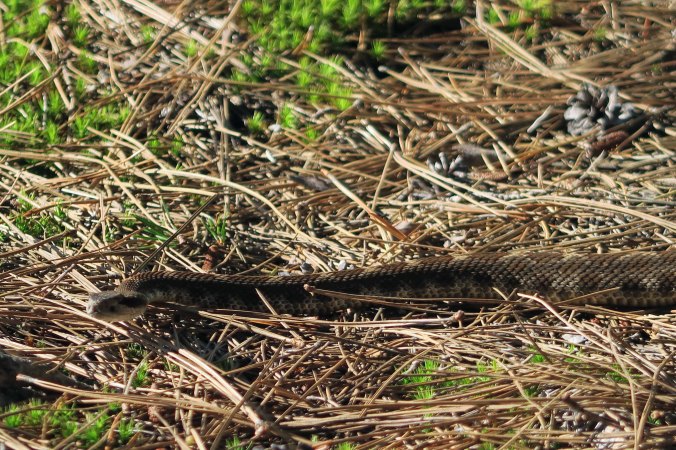
She stopped abruptly as her neck and head rose into the air. Out came a forked tongue. Her spade shaped, pit viper head and yellow-slit eyes pointed in my direction, checking me out, fangs poised for action. Who or what had invaded her territory? Was I food or foe? Heat seeking facial pits that work something like infrared detectors determined that I was too big to eat and might be trouble. So, she started slipping off to the right. Naturally I had to get up and follow. (This is where Peggy normally urges me to do something else, anything else, but she wasn’t along.)

She raised her head and checked me out.

I walked a respectful few feet behind. You never want to get within striking distance. The Diamondback is responsible for the majority of snake bites in the US and its toxin loaded injection can be fatal. The snake kept twisting her head back Linda Blair-like, watching me. Her rattles were pointed up, ready to explode into the loud buzzing sound rattlers are famed and named for. Twice she almost coiled. I could have forced the issue— it makes for a great photo-op. A timely prod with a stick would have had her coiling and buzzing in a flash. But I figured she wasn’t bothering me so I wouldn’t bother her. At least not much. Finally, she slipped off into some brush and waved goodbye with her tail. I wished her good hunting. I think I heard something like “fat, juicy mouse.”

Her rattles were pointed up in the air, ready to start buzzing. The circles on the tail and diamond shapes above them identified the rattlesnake as a Diamondback. The pinecones are from a Lodgepole Pine.

While I wasn’t particularly bothered by the visit, I did move to a different shade tree on the other side of camp. Had Ms. Snake returned, she would have slipped up behind me. I was also more careful about watching where I stepped! Immediately afterwards, I called Peggy and related the story. She laughed. She knows my ways. Or maybe she was laughing from relief that I hadn’t been bitten.

Speaking of ‘my ways,’ one was that I would never carry a cell phone while backpacking. It was more or less written in granite. I go to the woods for tranquility, not the hustle, stress, incessant noise and constant connectedness of modern society. And nothing represents that more than cell phones. And yet, here I was with cell phone in hand. There was even a decent signal from a cell tower on I-80. My decision to break with my long-standing tradition was something of a compromise for my wife. Not many 74-year-olds go wandering off by themselves backpacking. In fact, the number of people who backpack alone at any age is limited to a relatively few adventuresome souls. Peggy is 100% supportive of my backpacking, even when I ramble off alone. But that doesn’t mean she isn’t concerned. My checking in on a daily basis— and being able to check in, if needed, in an emergency— helped allay her worries.

Cell phone service isn’t a given in the wilderness, however, especially in the US where profitability plays an important role in determining where service is offered.  So, I went one step further. I picked up an emergency Gen 3 GPS tracking device named Spot. It’s kind of like Spot, the family dog of Dick and Jane repute, or Lassie, if you will, able to track me down when necessary. But all I have to do with the Gen 3 is hit an SOS button and it immediately sends out a message to local rescue groups that gives my exact location and the fact that I am in a dire emergency situation. Help’s supposed to be on the way within the hour.

There were other steps I took as well— carrying trekking poles, for example. They cut down on wear and tear on the knees and add a degree of balance. More importantly, I did everything I could, minus eliminating my creature comforts, to reduce weight. Modern equipment makes a huge difference. When I first started packing in the late 60s, my pack for a week trip was normally in the neighborhood of 55-60 pounds. By the 90s it was 45-50 pounds. Now it is down to 35-40 pounds.

This is a photo of what I was carrying on my trip. Everything is organized in bags. So there is a kitchen bag, a bathroom bag, a ten essentials bag, etc. Each bag has its place in my pack which is organized for access and weight distribution.

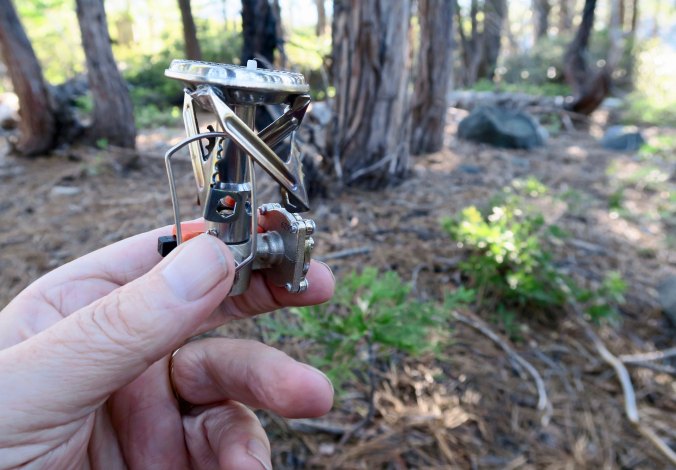
Here’s my stove ready for packing, which will give you an idea on how compact and light backpacking gear is today.

Everything I carry is designed to reduce weight. A plastic spoon, bowl and cup are my dishes. I’ve been carrying the insulated cup for over 40 years. Once it was lost beneath 20 feet of snow. I found it when the snow melted.

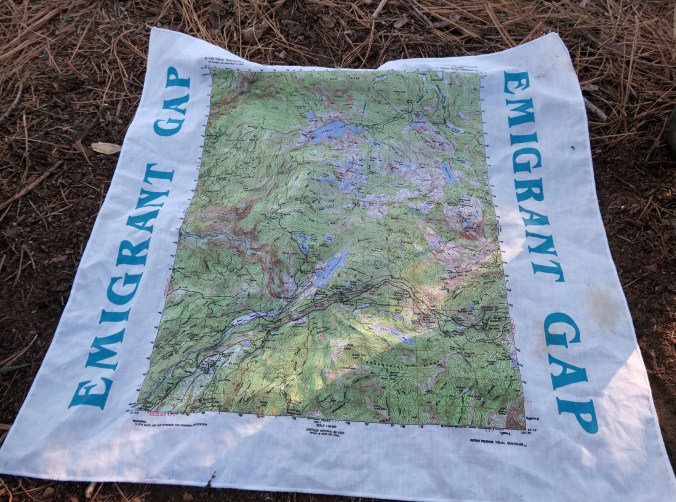
Here’s another example of going light. This is my neckerchief, handkerchief, and topographic map. It also serves as an air conditioner! On a hot day, I dip it in a stream and wrap it around my neck.

There is great beauty in the wilderness, if you are willing to slow down and look around. It ranges from expansive vistas down to plants, rocks, and wildlife.  Following are some more photos that reflect what I saw this past week. Enjoy.

Fordyce Creek was a half mile away from where I was camped and filled with snowmelt. The hiking bridge provided a way across the otherwise unfordable creek.

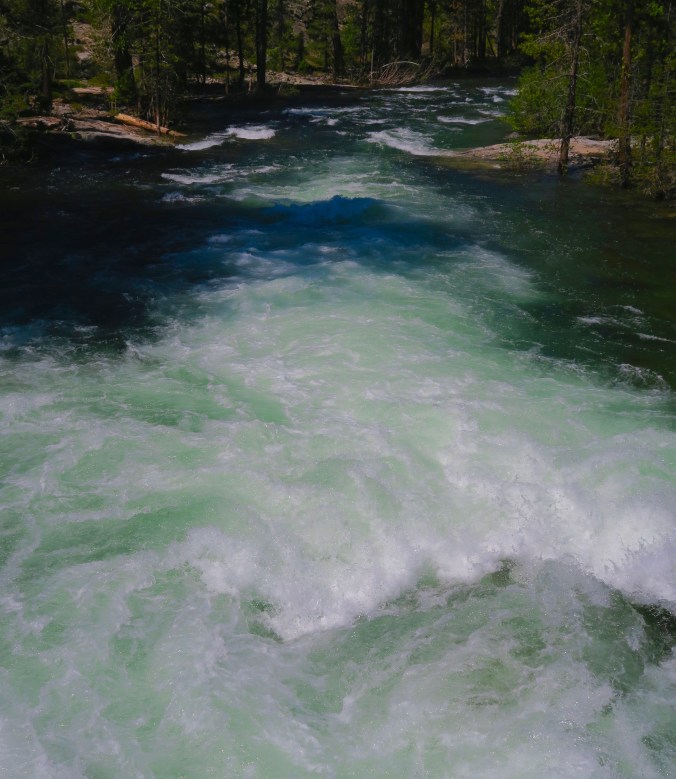
I captured this photo from the bridge. One of the challenges of backpacking early in the season is the amount of water flowing in the streams. Great caution is required when no bridges are available, which is usually the case in the Sierras. It is best to cross early in the morning before the sun begins to melt the snow.

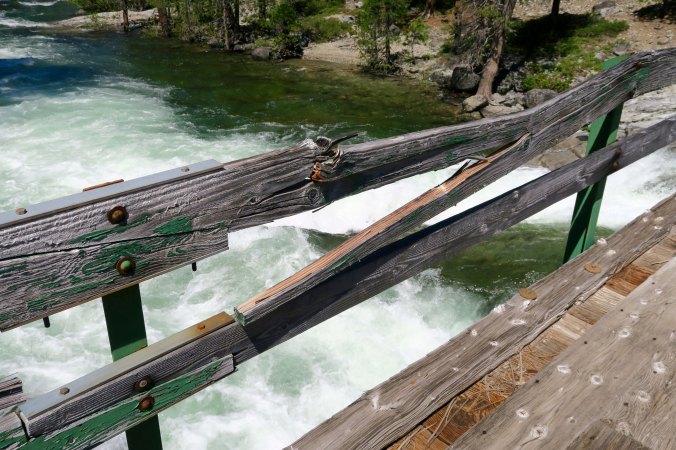
The broken side-boards on the bridge made me wonder about its overall condition!

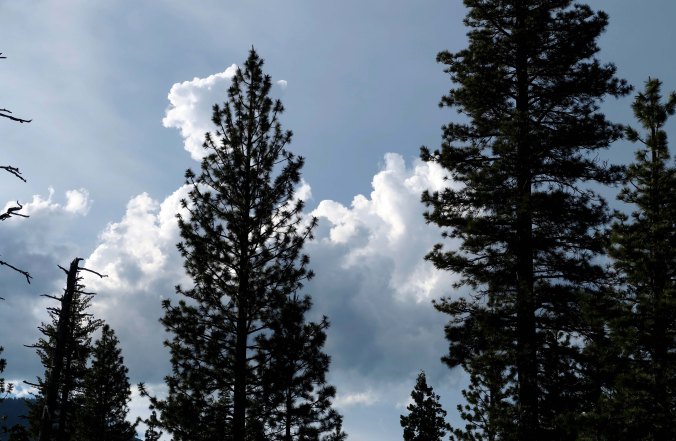
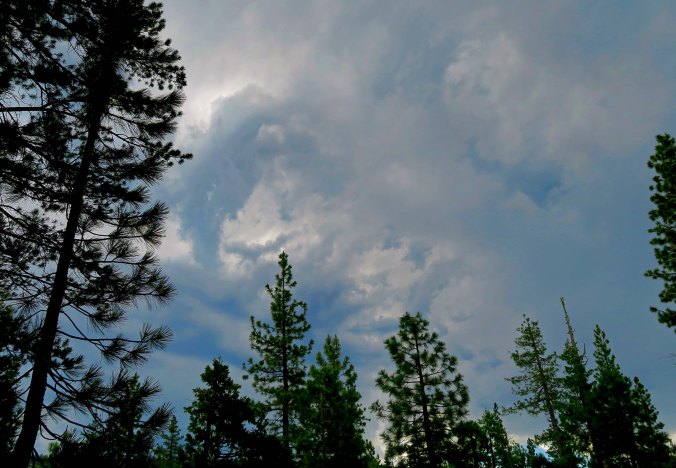
Thunderheads provided a dramatic backdrop but threatened a thunder and lightning storm. All of my gear was packed away in my tent, just in case.

These circling clouds would have made me think ‘tornado’ had I been in the Midwest or South. BTW… all I had was a few drops of rain with no thunder or lightning.

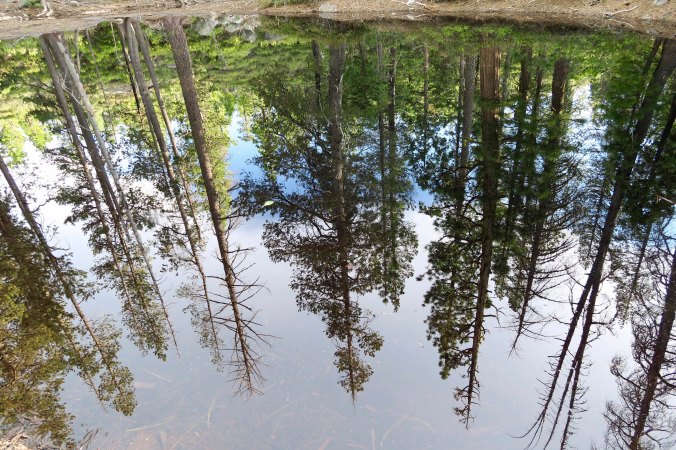
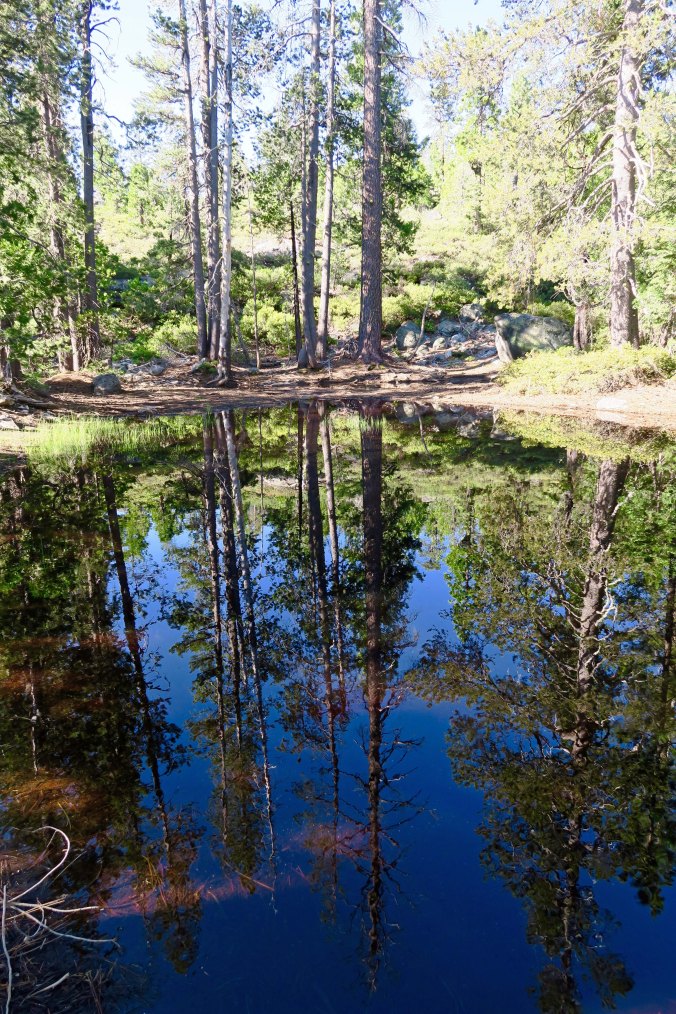
A small reflection lake was located a hundred yards from my camp. It came with its own water snake. The snake didn’t cooperate for a photo shoot, however.

I’ll close today’s post with this photo that provides a perspective on the size of the lake. Glaciers once worked their way through this portion of the Sierras, carving hundreds of such lakes from small to large.

NEXT POST: Native American rock art at Lava Beds National Monument in Northern California that dates back over 4000 years.


Goatsuckers in the Night… Let’s Go Backpacking! Part 1

Putting a pack on my back makes me happy. It means I am heading out for another wilderness adventure. This gorgeous Incense Cedar graced my camp and became the subject of many photos. Incense Cedars are normally found around the 4-5 thousand foot level in the northern Sierras.


I’ve been out on a solo backpack trip this past week at the 5000-foot level in the Sierra Nevada Mountains north of Interstate 80, about half way between Sacramento and Reno. Peggy drove me up from Sacramento where she was spending time with her 96-year-old mother.


I first started backpacking 48 years ago. Peggy caught this photo as I was prepared to head out on last Sunday.

It was time. Peggy took out her camera for a couple of photos, I shouldered my backpack, waved goodbye, and headed down the jeep road that led to Eagle Lakes. Since it was Sunday, most of the four-wheel enthusiasts were coming out, joyously running their vehicles up and over treacherous rock piles and though waist-deep mud holes. It’s not my thing, but I admire the people who are passionate about the sport. I was raised in El Dorado County, California, home to the granddaddy of all four-wheeling events, the Jeepers Jamboree. Mark Smith created the event in 1953 and it is still going strong.

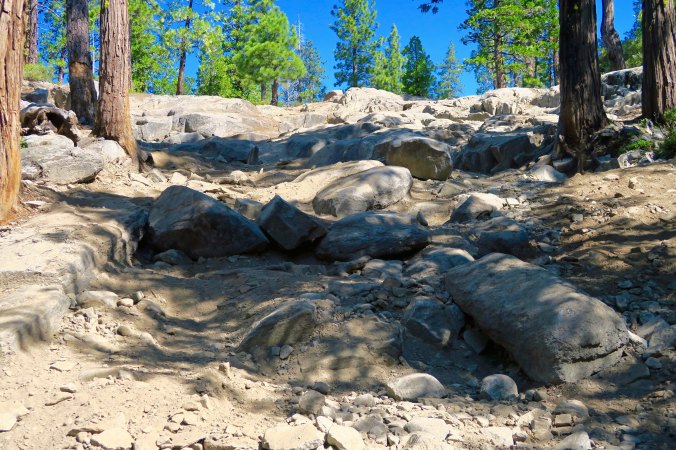
Does this look like a road to you? It’s the type of challenge that gets a four-wheeler’s heart racing— one they dream of and are long after telling tales about.

I placed my trekking pole on the road to provide a perspective. Yes, jeepers drive over this! As for the dark stain you see, think oil pan…

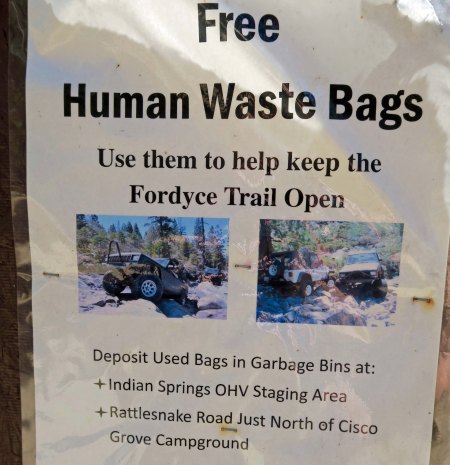
A series of four-wheel clubs help maintain this road and the camping areas. Most of these groups have a fairly strong wilderness ethic. I thought that the Madhatters was the most entertaining name.

They even carry out their poop!

My goal wasn’t to hike the jeep road, however. It was to hike beyond the jeep road and beyond the numerous four-wheelers who were out for a weekend drive or camping trip. Actually, it wasn’t hard. All I needed to do was to travel a couple of miles past where the jeep road ended. Whereas, four-wheeling isn’t my sport, hiking and backpacking aren’t sports for most four-wheelers. I found a delightful spot and only saw four people while I was there: two hikers and two mountain bikers. One of the hikers, a good Christian fellow, even stopped to bless me… and Peggy… and our children… and our grandchildren… and any pets we happened to own. I was beginning to wonder if he would ever stop, but finally, he ran out of breath. I quickly thanked him and he happily went on his way— his job done.

I didn’t travel particularly far, but it was an adventure for me. I wanted to see how my ‘senior’ body would handle the trip. I’ve been backpacking for 48 years and have several thousand trail miles behind me from the tundra to the tropics, so it isn’t like I’m inexperienced. Mentally, I was ready to go. More than ready. But would the knees, and the hips, and the back, and miscellaneous other body parts agree? Well, I am here to report that they whined a bit. In fact, they whined a lot. They always do on the first outing of the year. But they also knew that whining alone wouldn’t get them back to the easy chair they love so much. I hiked along at 2 to 2 ½ miles per hour, which is a good pace for backpacking in the mountains, and eventually, they shut up.

I was one tired puppy when I found a place to camp, however. I unpacked, set up my kitchen, cooked my gourmet dinner (i.e. boiled water and poured it onto freeze-dried food), put up my tent, and anxiously waited for the sun to go down. I was ready to climb into my sleeping bag. Unfortunately, the longest day in the year (for those of us who live north of the Equator) was only a day away, and the sun didn’t want to cooperate. It lingered until 9:00. There was ample time for the ants, and flies, and mosquitoes, and several other biting bugs to enjoy the fortuitous feast that had arrived in their tiny corner of the universe. And feast they did, apparently giving me an allergic reaction. I sneezed and sneezed and sneezed and sneezed. My nose ran so fast that I had to put on my running shoes to catch up. I was still sneezing when the sun miraculously went down and I crawled into my tent, removing three large ants who had missed out on dinner.

I amused myself while waiting for the sun to set by wandering around taking photos. This was the pond I camped next to.

Lily pads came close to covering the water. This shot reminded me of the work done by the Impressionist painters. Monet would have had his brush out.

Old Man Mountain loomed above me, a reminder that much of the Sierra Nevada Mountain Range is composed of granite.

This was my view looking up when I arrived and cooked dinner.

The same view later. It was just about bed time!

I walked out to check out the sunset…

And enjoyed the reflection in the pond.

There was no climbing into my sleeping bag, however. It was too damned hot. When Peggy and I had left Sacramento for our 60-mile drive into the mountains, the thermometer was pushing 109 degrees. It was cooler in the Sierras, but still in the 90s. Hiking in the heat was part of the reason I was so bushed. And now, along with the incessant sneezing, it was keeping me awake. I laid there in my altogether on top of my Therm-a-Rest mattress, took an antihistamine, and waited. Finally, things calmed and cooled down. I began to doze off. That’s when the other shoe dropped. The thousand frogs (slight exaggeration) that lived in the shallow lake next to where I was camping began to croak, all at once. I’d just managed to tune them out when the Goatsucker flew over.

Goatsucker? Was I beginning to lose it? Not exactly. For those of you who aren’t card carrying members of the Audubon Society, goatsuckers are members of a fairly large, noisy family of night birds. Whip-poor-wills are an example. My particular nemesis wasn’t a Whip-poor-will with its mournful all-night jabber, though, it was a Nighthawk, who had his own unique way of making noise. You can tell they are in the neighborhood when you hear their distinct “peent, peent” calls, but that’s only the beginning. In order to win their lady-love’s favor, the males climb high into the sky, close their wings and dive bomb the objects of their affection. Just as they reach the females, they open their wings. The wind rushing through their primary feathers makes a loud bloop sound. The bigger the boy, the louder the bloop. Apparently, it turns the girls on.

As to how the family obtained the name goatsucker, there’s an interesting story that goes way back in time to Europe. It starts with the fact that the birds have tiny beaks that open up to huge mouths they use for catching insects. In Europe, they liked to hang about around smelly goats at night that attracted lots of bugs. But the Europeans believed that the birds had a more nefarious purpose in mind. They believed that they were using their large mouths to grab hold of the nanny goats’ teats and suck them dry. Here’s what Pliny, the Roman Elder, had to say about them in 71 CE. (1601 CE interpretation.)

The Caprimulgi (so called of milking goats) are like the bigger kind of Owsels. They bee night-theeves; for all the day long they see not. Their manner is to come into the goat-pens, and to the goats udders presently they goe, and suck the milke at their teats. And looke what udder is so milked, it giveth no more milke, but misliketh and falleth away afterwards, and the goats become blind withall.

They were bad birds indeed. Not only did they steal nanny’s milk; her teats fell off and she went blind as well. Anyway, with this thought in mind I eventually fell asleep to the sounds of nature: croak, croak, peent, peent, BLOOP!

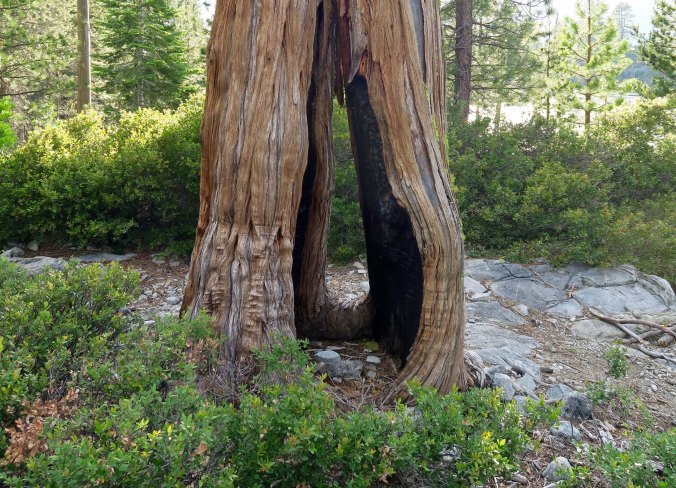
In my walk-about after dinner, I discovered that the Incense Cedar I featured at the top of the post was actually two trees. Fire, possibly set by lightning, had burned out the space between the twins.

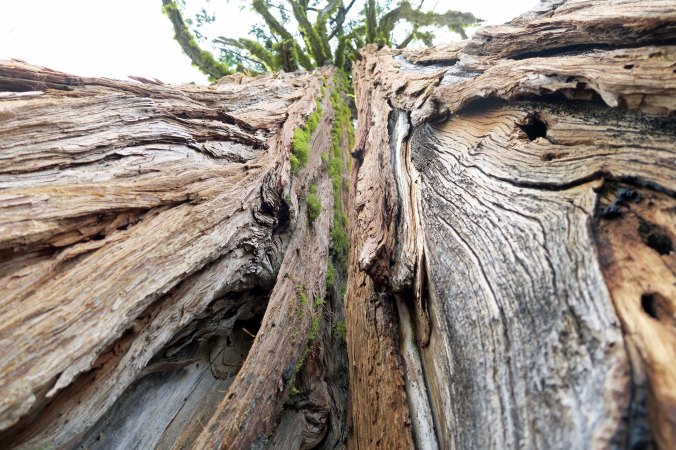
I shot up the trunks for a different perspective.

I’ll conclude today’s post with a picture of the twin cedars being caught in the early morning sun the next day.

NEXT POST: Let’s go backpacking: Part 2… An ugly pit viper comes slithering into my kitchen.

SaveSave

SaveSave

SaveSave

SaveSave

SaveSave

SaveSave

SaveSave

What to Do When Attacked by a Herd of Elk… Play Ape

Peggy photographed this herd of elk near the Redwoods last year.

Since I am off backpacking by myself in the wilderness, I thought I would repost a blog from when I was off on another solo adventure. This time I was heading into the Gila Wilderness next to Cliff Dwellings National Monument in southern New Mexico. I had just returned from Alaska and was taking six months off to backpack in the West.

Where I was going backpacking in the Gila Wilderness was something of a mystery to me. I didn’t have a clue.

My pack was loaded with a week’s worth of food and six topographic maps, more than enough to let me wander wherever I wanted and hopefully avoid getting lost. I had started off up the West Fork of the Gila River in the Cliff Dwellings National Monument but soon came across a trail jogging out of the canyon to the right.

Looks good to me, I thought to myself and started climbing. I was determined that wherever I went for the week would be based on random decisions. So much of my wilderness experience had involved leading groups or scouting out potential routes for organized trips that the sense of abandon felt delicious.

Consequently, years later, it isn’t exactly clear to me where I went. I was more than happy to hike 4 to 5 miles in one direction and then 6 or 7 in another. The only thing I tried to avoid was backtracking. I do remember wandering through Woodland Park and Lilly Park as well as climbing in and out of several canyons.

I had brought along two science fiction books for evening and early morning entertainment. Southern New Mexico is UFO Country. I was also carrying my usual field ID book and one serious read, Aldo Leopold’s “Sand Country Almanac.” Leopold had been responsible for the creation of the Gila Wilderness in 1924, making it the first specifically designated wilderness area in the United States, and, I might add, the world. People who love wild country and understand its intrinsic value owe a great debt to the man for his vision. I had read the book before but reading it again in the Gila Wilderness added a special significance.

I declared a layover day so I could savor it all at once. I was camped on a small stream located in a minor canyon and hadn’t seen a soul for four days. It was the perfect setting for getting lost in a book.

At some time in the early afternoon, a loud “Woooeee” shattered the silence.

Big Bird, I thought to myself. Big Bird on steroids. Aldo Leopold would have been up in a flash to discover the source. Of course, he would have had his rifle with him. He was quite the hunter. As usual, my only weapon was a dull three-inch pocketknife. Still, the mountain man in me demanded I get off my lazy tail and go exploring. I grabbed my binoculars and climbed out of the canyon. I was greeted by a broad, flat expanse of Ponderosa Pines but no Big Bird. “Woooeee,” I heard receding into the distance.  I put on my stalking cap and begin to sneak through the forest.

“Woooeee!” Big Bird shouted behind me. I whirled around only to catch a glimpse of something disappearing behind a bush. Big Bird it wasn’t. Nor was it the ghost of Geronimo, whose territory I was wandering through. It looked suspiciously like a cow elk that had morphed from stalkee to stalker. I wasn’t sure that I liked my new role but decided to play along.

“Woooeee,” I called out and jumped behind a Ponderosa.

“Woooeee,” I heard a delayed three minutes later. I stepped into the open to discover that my female companion had come out from behind her bush and was staring intently at my tree.

“Woooeee,” I shouted at her as she once again disappeared. We had a game. A cow elk was wooing me.

Years earlier I had discovered that much of the higher animal kingdom is quite curious about humans that don’t act like humans. I once had a similar experience to my elk chat with a coyote on the American River Parkway in Sacramento. First I would hide and then he would hide. Finally, out of frustration, the coyote plopped down in the middle of the trail, raised its head, and began howling. I plopped down in the trail as well, raised my head and joined him. We had quite the discussion.

The elk and I continued our game for about 15 minutes when I changed the rules. I sat down in plain sight with my back against the tree. Instead of hiding, she stood watching me for several minutes. I could tell the wheels were grinding away in her mind.

Suddenly she charged. I didn’t move from my seat but my adrenalin cranked up several notches. She was all of 10 feet away when she slammed on her brakes, lowered her head, stared me in the eye, and woooeeed again. Half fascinated and half frightened, I didn’t budge. Several hundred pounds of frustrated female were looming over me. I had zero doubt that she could kick the stuffing out of me. She held my gaze, snorted in disgust, shook her head, and trotted off.

While smaller than the bull elk, there is nothing puny about the females. (Photo by Peggy Mekemson.)

Whatever conversation we had been having was over. I breathed a sigh of relief and returned to camp. My first chore was to get out my guidebook. Female elks, it noted, can become rather aggressive and dangerous in the spring when they have calves. I’d been both ignorant and lucky.

After dinner, I went for my evening walk following an animal path that ambled along beside the creek. I heard a snort and looked up. Five elk were standing on the canyon rim staring down at me. The old girl had recruited some buddies to check out the weird human.  Unfortunately, this time I knew enough to be worried. I was an intruder in their territory, a possible threat to their precious babies.

My worry level turned to panic when all five came charging down the canyon wall. One moose had been scary; now I had the whole damn thundering herd! Running was out of the question. Think, Curtis, went dashing through my brain. The only thing I could dredge up was something I had fantasized I might do if charged by a grizzly bear in the wilds of Alaska. I started jumping up and down, scratching my armpits, pounding on my chest, and screaming ooh, ooh, ooh! It worked for great apes, why not me.

For the second time that day, I heard the screeching of elk brakes. This time there was no standing and staring, however. The herd turned as one and charged back over the canyon rim, disappearing into the night. Somewhat satisfied with myself, I returned to camp and the security of my tent.

I wandered around for another two days, keeping an eye out for UFO’s, steering clear of cow elk, and visiting sites where this or that pioneer had been killed by Apaches. The pioneers also did a pretty good job of killing off each other, not to mention the Indians. With my food running low, I finally ceased my wandering ways and hiked back to the National Monument.

NEXT BLOG: A beaver comes to visit in the Wind River Mountains of Wyoming.

Note: I am still out backpacking and will respond to comments when I return.

SaveSave

SaveSave

Stuck in the Snow with Tania… On Meeting a Terrorist Group in the Sierras

Patty Hearst, holding an automatic weapon, proudly posed for a photo in front of the seven headed cobra symbol of the Symbionese Liberation Army.


I’ve now written about two of three adventures from my 20s when I was hunting and fishing: one about escaping from a lightning storm and the other about searching for a lost friend in a snow storm. Both of them were on the scary side. This tale fits the category of being scary, but it was also strange.

“Death to the fascist insect that preys on the life of the people.” —Motto of the Symbionese Liberation Army


The final of our three adventures was more in the nature of a scouting trip. We had driven up into the mountains early in the spring to look for likely fishing holes. Trout season was only a few weeks away. The mountains were still coated with snow. We drove up an ever-narrowing road until a snow bank suggested that further progress was best left up to animals with big furry feet. Stopping fifty feet before the end, we parked and got out to stretch our legs.

We had wandered no more than a few feet when a white van came roaring up behind us and tried to slip by the right side of our car without slowing down. Normally it wouldn’t have been more than an irritation but the narrowness of the road combined with the snow left just enough room for one and one half cars, not two.  We watched in slow motion disbelief as the van barely missed our vehicle, slid into the snow, and became seriously stuck.

“Yes!” we said in unison, there is justice in this world. Right about then the side door of the van opened and disgorged a polyglot group of rough-looking characters. “Whoa,” I mumbled more quietly, “we had better keep our opinions to ourselves.” While two or three of the men bent down to look under the van, a not so rough, in fact an attractive young woman, disentangled herself from the group and came strolling over to where we were standing.

“I am in love,” Hunt mumbled. Bob and I joined the admiration society while an elusive thought began tugging at the back of my mind.

“Hi, guys,” she smiled at us, becoming even lovelier. “Do you have any guns in your car?”

My tiny elusive thought suddenly became a very large insistent nag. Pretty girls don’t normally start conversations by asking whether you are carrying weapons. Hunt, on the other hand, was beaming. He liked guns and girls that liked guns.

“I have a twenty-two along,” he announced proudly.

“Oh,” she replied, apparently a little disappointed at the size of Hunt’s gun. “My friends taught me how to shoot automatic weapons in the Bay Area. We are up here to practice.” It was stated with the same type of pride a new mother might talk about her child’s first steps or words. My large, insistent nag turned in to a three-stage fire alert. What was a pretty girl doing in the mountains hanging out with a scruffy looking group blithely talking about shooting automatic weapons?

Meanwhile Hunt had suggested that he and his new friend take the twenty-two out for a little practice since it was obvious that the van wasn’t going anywhere quickly. I don’t remember how I managed it, but I pulled Hunt and Bob aside sans beauty for a very quick and quiet conversation.

“I am not one hundred percent sure,” I began, “but I think the young woman who likes big guns is Patty Hearst, aka Tania, and that her friends over at the van are members of the SLA. If I am right, we are in a very dangerous situation.”

The SLA, or Symbionese Liberation Army, was one of the more bizarre and misled of the radical groups to be born out of the ferment of the late 60s and early 70s. Viewing itself as an urban guerrilla movement, SLA’s first action of note had been to gun down Dr. Marcus Foster, the black Superintendent of Oakland Schools, and seriously wound his deputy, Robert Blackburn. Blackburn had earlier served as Peace Corps Director of Somalia and then gone on to work for the Philadelphia School System. He had been responsible for recruiting my first wife, Jo Ann, and I as teachers when we left the Peace Corps. It would have been hard to find two people more committed to helping disadvantaged inner city kids in America than Foster and Blackburn.

SLA’s next major public statement was to kidnap Patty Hearst, heiress to the newspaper tycoon William Randolph Hearse, while she was a student at UC Berkeley. At some point, Patty switched from being an unwilling kidnap victim to willing participant in SLA and adopted the name of Tania, who had been a girlfriend of Che Guevara. The common assumptions were that Hearst was brainwashed or a victim of the Stockholm syndrome, a psychological response through which a kidnap victim comes to associate with his or her captors. Certainly, the young woman we talked with was proud of her skill with automatic weapons and had the freedom to come over and chat with us. She hardly seemed like an unwilling prisoner.

In 1974 Patty participated in a San Francisco bank robbery and then moved to Los Angeles with the SLA where several members of the group met their death in a fiery confrontation with LA police. Some 400 LAPD officers had surrounded a house occupied by SLA and emptied over 5,000 rounds into the structure. Patty, who wasn’t there, watched the whole confrontation on television. She, along with William and Emily Harris, then fled to Pennsylvania for several months before making their way to Sacramento and another bank robbery.

There was enough connection with Hearst and the SLA that I suggested we go over to the van, smile a lot, and help the nice folks get unstuck— which we did. They drove up to the end of the road, turned around, carefully edged by our car and headed off down the mountain. We waved and smiled vigorously as they disappeared.

Was it Patty Hearst and the SLA? The timing was right, the young woman looked like Patty, and the group could have fit a description of the SLA. I have often pondered the question.  In May of 1975, the SLA robbed a bank in Sacramento (Carmichael) and a young mother, Myrna Opsahl, was shot and killed. Patty Hearst drove the get-a-way vehicle. It was one more sad and sordid event in the history of the SLA. In most ways this group of want-to-be revolutionaries was a group of losers. Their murder of Marcus Foster was regarded with disgust by most members of the radical community. It was their kidnapping of Patty Hearst and, even more so, the fiery shootout in LA that gave the organization status.

As for Hearst, I have no doubt that the Stockholm syndrome played a role in her behavior. But I am also convinced there was more. The atmosphere of the time encouraged radical thinking and Patty, who was something of a rebel, was living in a cauldron of dissent at Berkeley. I suspect it wasn’t all that hard to slip into a role of radical chic.

NEXT BLOG: What to do when an elk attacks: Play ape.

NOTE: I am away backpacking and kayaking. I’ll respond to comments when I return.


SaveSave

SaveSave

Playing Dodge Ball with Bounding Boulders on Big Sur’s Iconic Highway 1

Waves crash against the shore along Big Sur’s picturesque coast.

It was raining hard and our view of the Pacific Ocean was limited to pretty much nothing. We were working our way north through Big Sur country along California’s iconic Highway 1 perched on a cliff high above the Pacific Ocean. An orange Cal-Tran’s (the California Department of Transportation) sign warned us to be prepared to stop. And we were. You pay attention to such things when you are driving on a wet, narrow, curvy road with the threat of an all-to-brief flying lesson.

“There’s the flagger,” Peggy warned, and I slowed down from turtle to snail pace. No one else was in line so I stopped at where he was standing. He signaled for me to lower my window. I expected him to tell us that the road was one-lane ahead. Closures are to be expected on Highway 1 during the winter. Either the downhill side is sliding into the ocean or the uphill side is covered with rocks and dirt. This time it was different.

Lane closures are to be expected along California’s coastal Highway 1 north and south of San Francisco.

“We have a spotter just up the road,” he told me. “He’s watching for rocks bounding down the cliff.” I looked ahead and saw the spotter 100 feet ahead. “As soon as he is sure nothing is crashing down, we’ll give you the go ahead to cross the area. Don’t stop.” Don’t stop? Talk about unnecessary advice. A rousing game of dodge ball with bounding boulders has never appealed to me. I was just sorry I couldn’t race through at 100 miles an hour. So were Quivera the van and Peggy. I made my way across at a nervous 30 while Peggy looked up the cliff for rocks— mentally forcing them to stay put while floor-boarding the gas pedal in her imagination. I’m pretty sure her right foot was cramped afterward.

Landslides along Highway 1 are frequent during the wet months. The nature of the rocks and soil in the area, frequent California earthquakes, and ocean waves crashing against the cliffs all contribute. When water from rain or springs is added to the equation as a lubricant, portions of the hillsides go tumbling into the ocean far too often. Highway 1 through Big Sur has been closed over 55 times since it was carved out of the cliffs in 1937. The heavy rains this past season have made for one of the worst years ever.

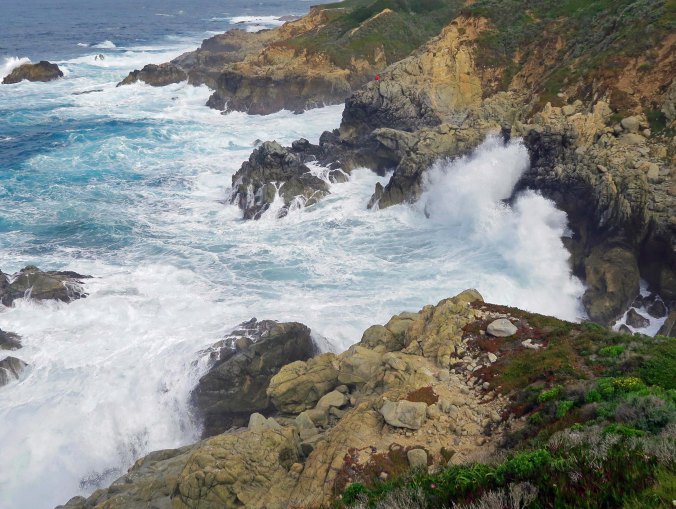
Crashing waves are responsible for some of the Pacific Ocean’s most scenic views, but they can also undercut cliffs leading to landslide danger. Note the lone fisherman with a red coat perched on the rock trying to catch fish in the pounding surf.

I had planned to drive down the Big Sur coast from Carmel to Hearst Castle on my recent trip to the Central Coast but the road was blocked 20 miles down the road. The rains had caused the Pfeiffer Canyon Bridge to crack and it couldn’t be repaired. Cal Trans was forced to knock it down. The transportation department estimates the bridge can be rebuilt by September. A landslide was also blocking the road further on. Businesses along the highway were suffering. The normal thousands of visitors had slowed to a trickle. One resort had even turned to flying in guests by helicopter.

And it was about to get worst.

On Saturday, May 20, four weeks ago and one week after I had left the area, over one million tons of rock went sliding into the ocean just north of Gorda, about 60 miles south of Carmel/Monterrey. It’s in the same area where Peggy and I had played dodge rock a few years earlier. Locals are calling it the Mother of all Landslides. One third of a mile along Highway 1 is now covered by 65 feet of dirt and rock and there are 13 acres of new shore front property. Someone (with apparently too much time on his hands) has estimated that 800 Olympic sized pools could be filled with the dirt.

Who knows how long it will take to clear the area, but Cal-Trans is working away. Keeping the road open is a priority, regardless of time and expense. Highway 1 is regarded as one of the most scenic highways in the world. And I heartily concur. In addition to driving the road many times and camping out along the ocean, I have also bicycled it, which was an incredible experience.

A scenic view along Highway 1 in Big Sur.

The area’s renowned beauty has also served as a prime attraction to writers, artists and counter-culture types. One was Henry Miller, who has a memorial museum located just south of the now defunct Pfeiffer Canyon Bridge. Miller moved to the area in 1944 while his semi-biographical books, The Tropic of Cancer and The Topic of Capricorn, were still banned in the US for obscenity. I had managed to pick up copies and read them in the early 60s, before either they, or I, were yet legal. I don’t remember anything about the sex, but I do remember Miller’s incredible power of observation and description. It totally transported me to another world. (The museum has been temporarily relocated to the Barnyard Shopping Center in Carmel.)

If you keep driving south on Highway 1 another 20 miles or so below the Miller museum, you come to Esalen, known worldwide as a center for the human potential movement and new age thinking. The shotgun-toting writer, Hunter S. Thomson, served as a caretaker for the Big Sur Hot Springs before it became Esalen. At the time, the old hotel on the property was occupied by a Pentecostal group while the hot springs were normally filled with gay men from San Francisco. (It’s difficult to imagine Thomson, the Pentecostals and San Francisco gays in close proximity during the late 50s.)

Michael Murphy and his friend Richard Price leased the land from Michael’s grandmother in 1962 with the idea of creating a center for non-traditional studies free from the restraints of academia. Encouraged by Alan Watts, Aldous Huxley, and Gregory Bateson, they founded Esalen. Workshops on encounter groups, sensory awakening, and gestalt awareness were soon being offered. The faculty was close to a who’s who of the human potential movement. Included among the luminaries were Joseph Campbell, Abraham Maslow, Arnold Toynbee, Ansel Adams, Buckminster Fuller, Timothy Leary, Linus Pauling, Carl Rogers, BF Skinner, and Fritz Perls.  I was amused at how many of these people have written books that I’ve read over the years, which I guess says something about me.

While my trip down the coast wasn’t to be, I did drive the few miles I could and captured enough photos to provide a feel for Big Sur country— but the dramatic, thousand-foot cliffs you find further south along the coast are absent. Those will have to wait for another trip. Maybe I’ll take a class at Esalen and re-up my New Age credentials. (grin)

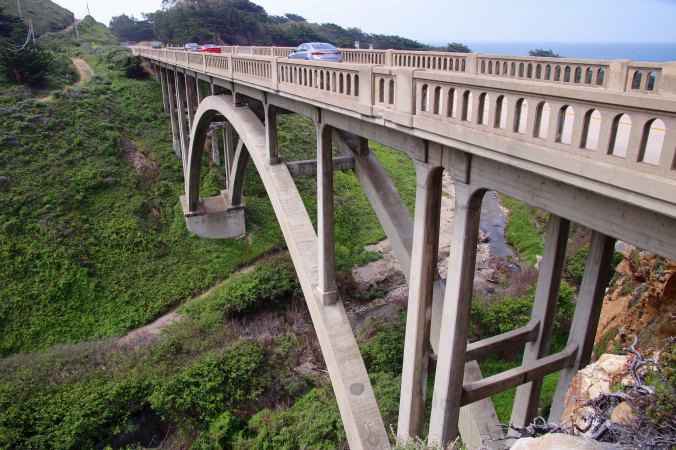
Big Sur is noted for its classic bridges that were built during the Great Depression of the 1930’s as a means of putting people to work. This is the Garrapta Creek Bridge built in 1931.

Another of the Big Sur bridges I photographed on my trip.

And a third. Bright colors at the base caught my attention.

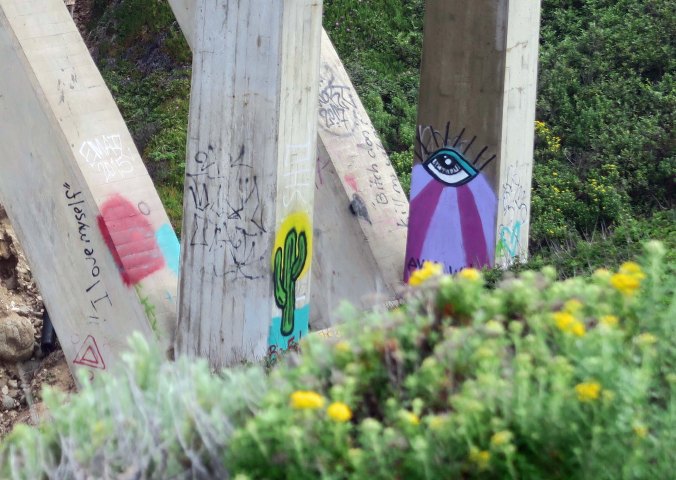
Even these classic reminders of another era can’t escape graffiti.

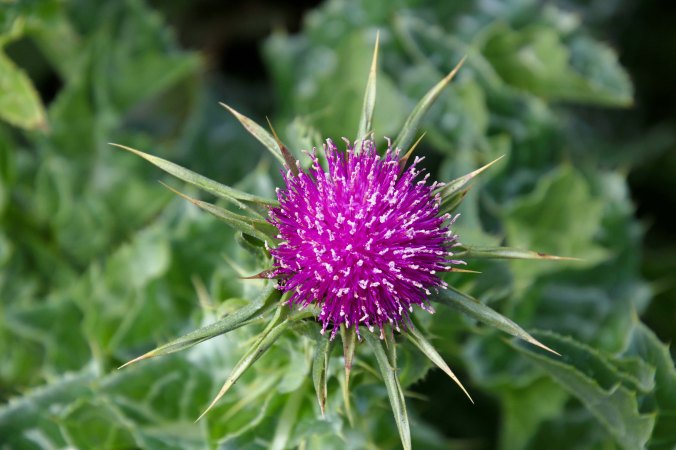
Numerous flowers, such as this Milk Thistle decorate the roadsides in Big Sur.

The Milk Thistle gets its name from the white sap that flows through its veins.

This beauty belongs to an Ice Plant, which is actually an invasive species.

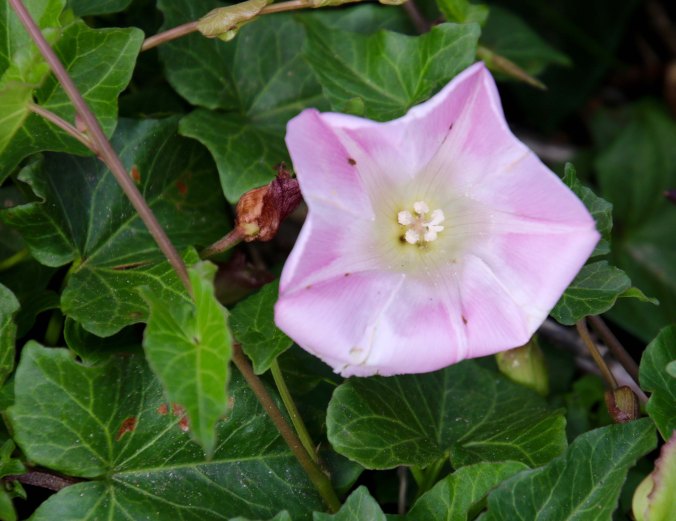
I assumed that this was a morning-glory.

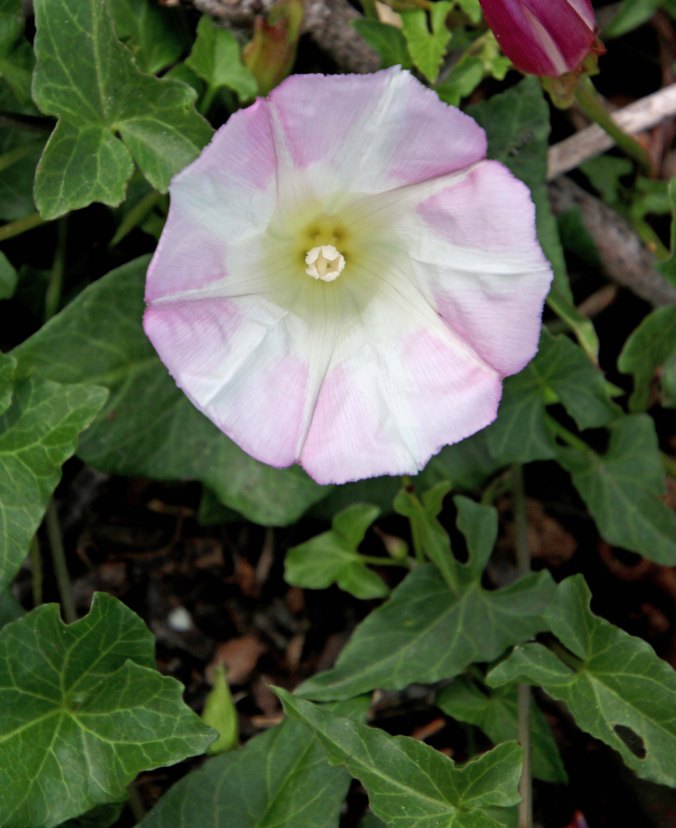
Another shot.

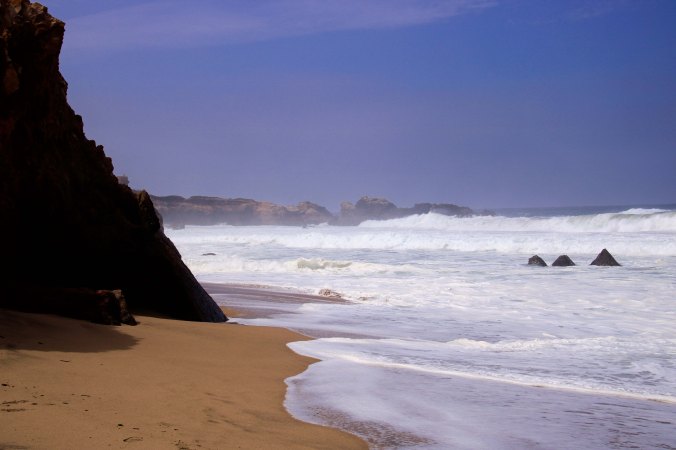
No trip to Big Sur is complete without visiting the beach, assuming you can get to it.

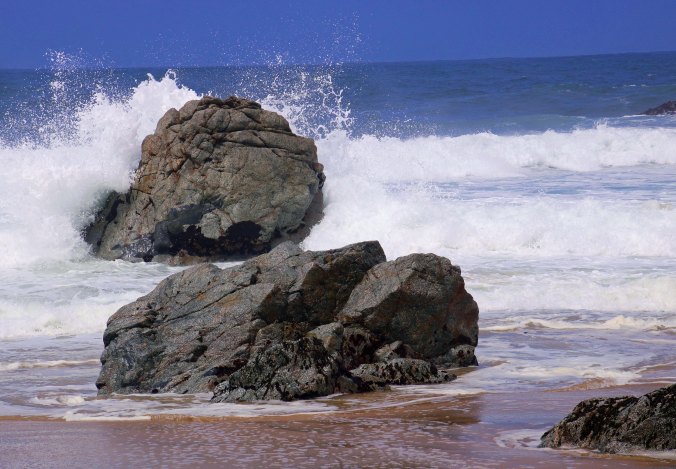
Crashing waves are a given. Hear the roar! Feel the spray!

Each wave has its own personality, which varies per second.

Crashing over rocks adds another element of beauty and drama.

An old-time black and white rendition.

Another perspective.

And another.

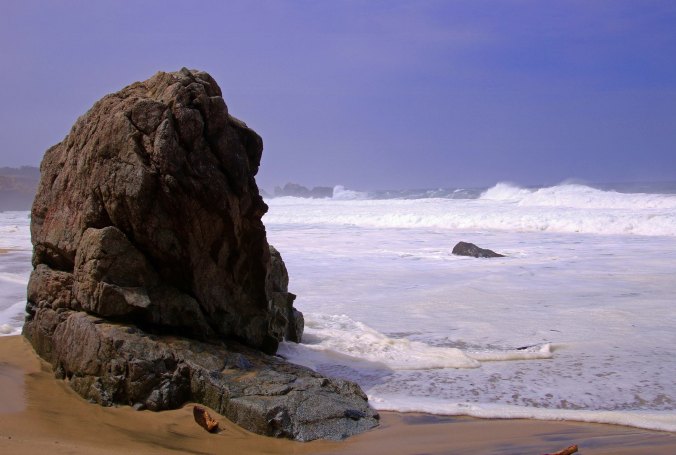
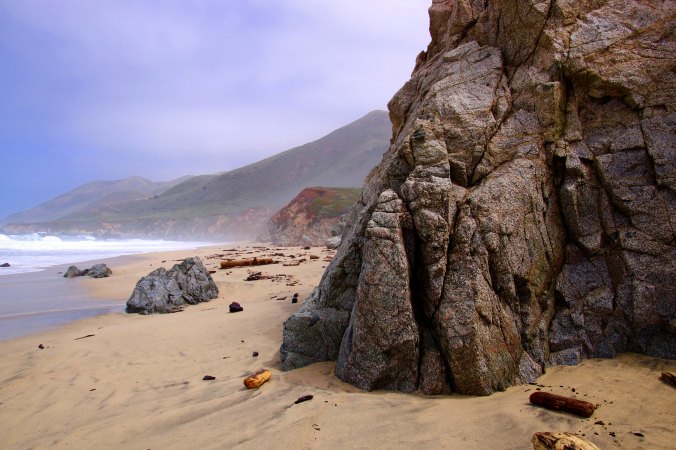
Impressive rocks always catch my attention.

I’ll conclude today with this blue-gray shaded granitic rock that contrasted sharply with the gold-colored sedimentary rocks beyond it.

NEXT BLOG: Join me as I encounter Patty Hearst, a.k.a. Tanya, and her kidnappers/comrades, the 1970s terrorist group known as the Symbionese Liberation Army, in the Sierra Nevada Mountains.

I’ll be out backpacking by myself for several days, which means I will be totally away from any internet connections. I did pick up a Spot Gen 3 Satellite GPS messenger at REI yesterday, however. If I break a leg, I can hit the SOS button and shoot out a message to local emergency responders with my exact location. Peggy worried enough about me when I went off traipsing in the wilderness by myself when I was a brash young man of 60. Now I am an older, more mature fellow of 74, she worries even more.


Just too Cute to Ignore… When Fawns Come to Visit

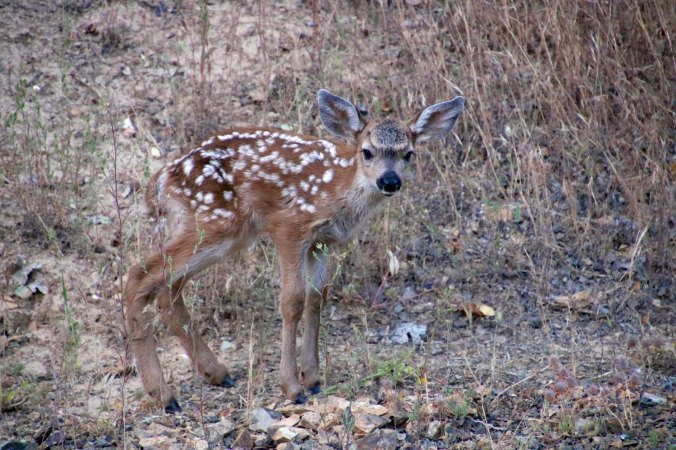
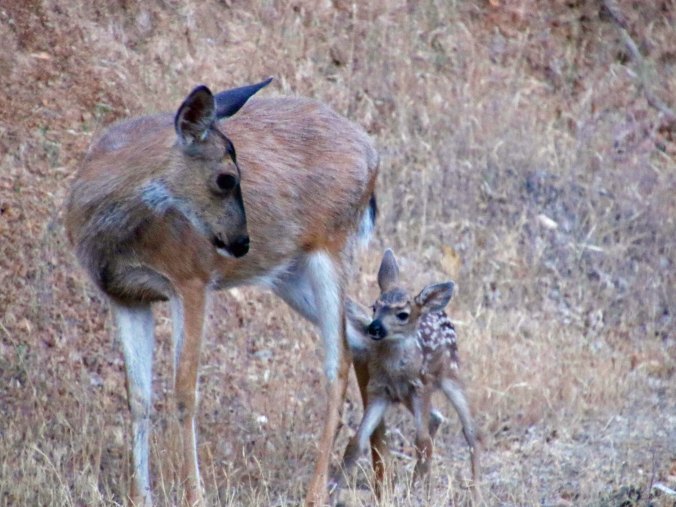
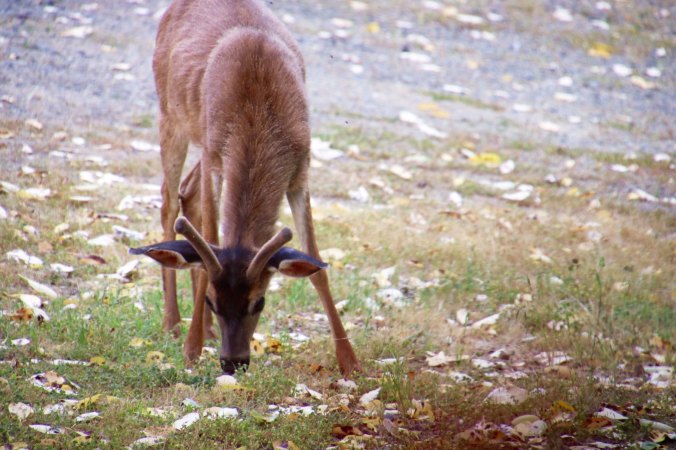
Missy, a Black Tail Deer, brought by her baby for a visit yesterday. The kid was all legs and just a few days old. (Photo by Peggy Mekemson.)

I had intended to put up a blog on Big Sur today, but then one of the does that hangs out on our property decided to bring by her fawn for a visit yesterday evening. It was just too cute to ignore and Peggy quickly grabbed her camera. So Big Sur can wait until later in the week! I’ve also taken several photos of the local deer herd over the past few weeks and one very bad squirrel, so I am adding them to the post. It has been a while since I’ve featured anything on the zoo we normally call our yard. Enjoy…

Missy and her baby. The kid’s older sister was there too and joined in the grooming, which is something I hadn’t seen before. Normally does drive off their kids from the previous year when they have a new baby. (Photo by Peggy Mekemson.)

Wait up Mom! (Photo by Peggy Mekemson.)

Our five acres on the Upper Applegate River in Southern Oregon at times resembles a zoo as I’ve already noted. A deer herd, foxes, coyotes, skunks, raccoons, possums and squirrels make their home here. Earlier this week, our neighbor reported that a momma bear with two cubs was making the rounds. We quickly put bungee cords on our garbage cans!

My writing chair looks out on our backyard, which can be hazardous to the writing process. I glanced out the window the other day and a whole herd of deer had settled in for a nap.

We call this guy Little Buck. I think he is commenting on the lack of apples. He’s another of Missy’s children. Actually, he was born two years ago. Missy had driven him and his sister off last year when she had a fawn. When the fawn had an unfortunate encounter with a car, Missy re-adopted her children.

Another shot of Little Buck. His antlers are still in velvet. Bucks lose their velvet in late summer in preparation for mating season debates over who gets the girl. Little Buck will likely be a spike with no points on his antlers this year, which will leave him out of the competition.

This fellow is obviously on his way to becoming at least a ‘forked horn’ with two points. The bucks usually join together in a guys’ club until mating season. Little Buck, who is something of a momma’s boy, still hangs out with Missy and his sister.

I took this photo of Missy in our backyard a few weeks ago before she had her fawn. She is maybe 15 feet away from where I write and often keeps me company along with Little Buck and Sis.

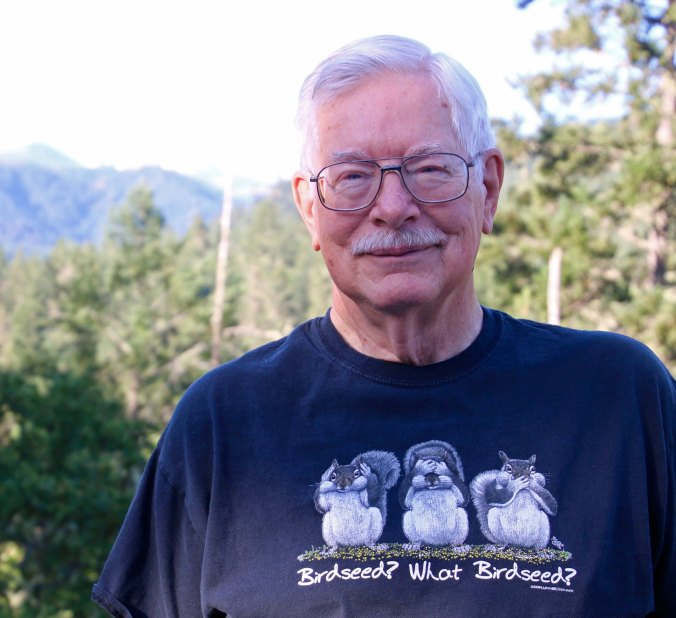
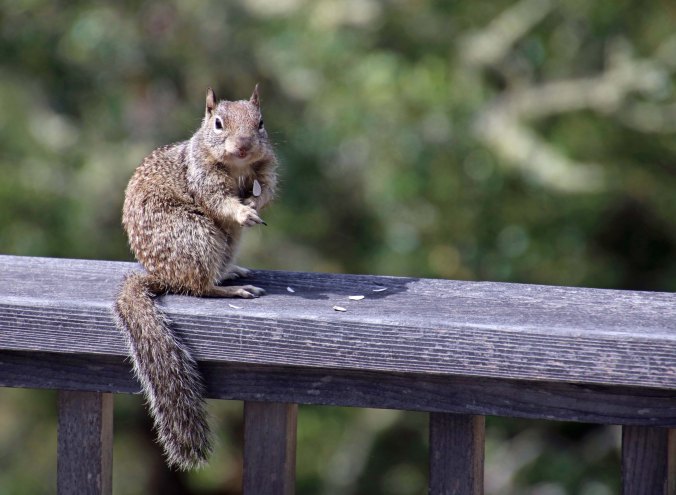
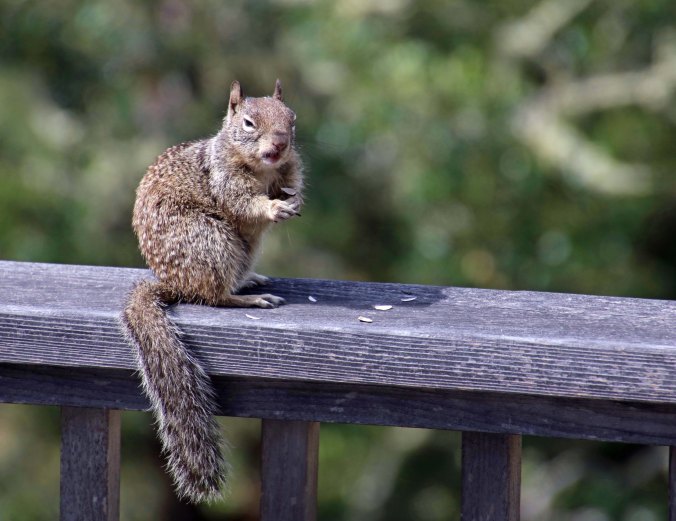
There are lots of gray squirrels who live up in the trees and ground squirrels who live in burrows on our property. And they all love birdseed! If you accuse them of stealing it, however, they all deny they have been anywhere near the bird feeder. They claim things like executive privilege, or say they can’t remember, or plead the fifth, or argue that the information is classified. I have a T-shirt I like to wear that reflects their behavior.

Birdseed? What birdseed?

A close-up. The cheeks are an absolute give-away.

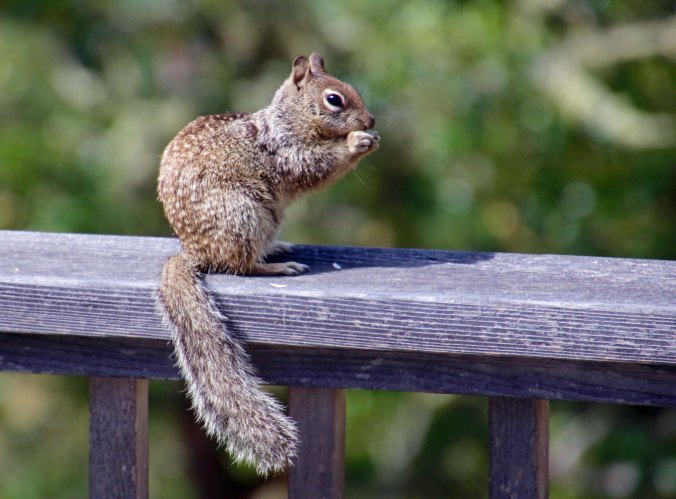
Three days ago I caught a culprit with the goods up on the railing of our deck. He still denied any knowledge of bird seed even though sunflower seed shells were scattered all over the railing. When I pointed this out to him, he, um… well, wait and see for yourself.

I looked out our bedroom window and spotted a ground squirrel eating what looked a lot like bird seed.

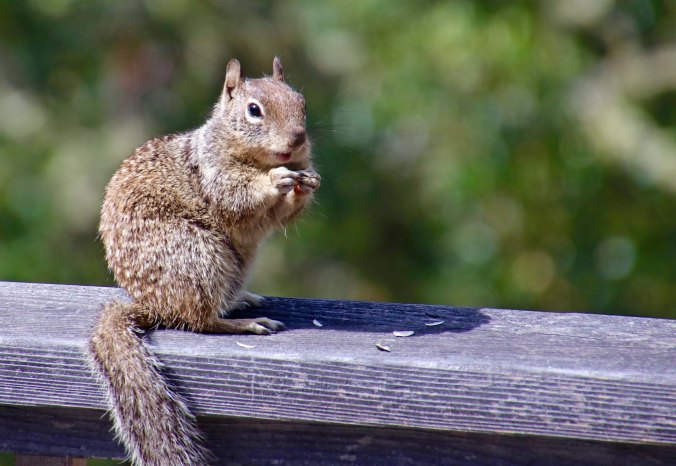
When I pointed out that he was surrounded by empty sunflower seed shells he claimed they proved nothing.

When I suggested he was lying, he spit out a shell and gave me an internationally recognized salute! Check out his right paw.

Just in case I didn’t get it!

That’s it for today. (grin) On Friday, I’ll be back with the post on Big Sur.

SaveSave

SaveSave

SaveSave

SaveSave

SaveSave

SaveSave

From Baker Beach to the Black Rock Desert… The Fiery Journey of Burning Man’s Man

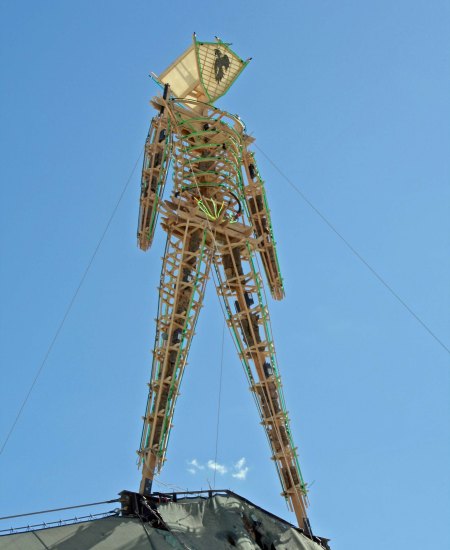
The Man at Burning Man burns in 2012. A few remaining fireworks fall from the sky.


One of the first things I do at Burning Man each year is head out to the Playa to visit the Man. It’s a way of paying homage. Given that the annual event in the Black Rock Desert of Nevada wouldn’t exist without the Man and his appointment with fire, my ‘pilgrimage’ seems appropriate. Here’s what I wrote a few years back on Burning Man’s beginnings in San Francisco:

A striking sight of the Golden Gate Bridge dominates the view from Baker Beach in San Francisco. It’s a romantic spot, a popular place to get married. Folks also get naked; it’s a nude beach. It was here that Larry Harvey and his friend Jerry James decided to host a bonfire in honor of the summer solstice in 1986. As to why they chose a nine-foot wooden effigy of a man (and his dog) to burn, Harvey remains mysteriously mum. Whatever the reason, it was out of the flames that Burning Man was born. Larry and his friends had such a great time they vowed to come back the next year with a bigger Man.

By 1990 the Man had grown to 40 feet tall and word of mouth had guaranteed that a sizable crowd was present for the solstice bonfire on Baker Beach. It wasn’t to be. Golden Gate Park police had decided that burning the Man posed a fire hazard to the Park and City. A single Park Ranger rolled in on a motorbike and said no go. You can’t be too careful, right? Fires were raging across Southern California.

The Man was taken apart and returned to the vacant lot he called home. The people who had come to watch the burn were angry. This might have marked the end of Burning Man, except for a bit of synchronicity. The Man had caught the attention of a group in San Francisco known as the Cacophony Society, an organization that specialized in outrageous pranks and strange outings known as zone trips. Several of its members, including co-founder John Law, suggested to Larry that the place to burn the Man was in the remote Black Rock Desert of Northern Nevada. It would make an ideal zone trip— far out in the language of the 60’s. A Ryder Truck was rented for the Labor Day weekend and stuffed with the man plus personal gear. Cars were loaded with people and some 80-100 Burners headed off into the desert. A tradition was born.

Today’s Burning Man is tame in comparison to the early years on the Playa. In the beginning, people camped wherever and drove when, where, and as fast as they wanted. Admission was free, open to anyone who wanted to make the drive up (primarily people from the Bay Area). At times, the event took on the guise of a shooting gallery. Running in and out of fire became a sport, particularly popular to those who were drunk or drugged out of their minds. Once again, Burning Man could have easily ended, but Larry and the others who founded the event had a broader vision and the event evolved, instead. By the late 90s, rules had been developed to make the event safer. Elements of its art, environmental, social and spiritual culture had begun to develop. When I first arrived in 2004, Burning Man had more or less become the event it is now, minus 35,000 people.

This year, 32 years after the first Man first burned on Baker Beach, some 70,000 people from the US and around the world will make the journey into the desert for the week-plus of craziness starting on August 27th and ending September 3. On Saturday evening, September 2, most of these Burners will make their way out onto the Playa and form a huge circle around the Man. The majority will either walk or bike, but many will also journey out in mutant vehicles that form their own large circle where they blast out music and fire. As night settles in, hundreds of fire dancers will perform their fiery art in the center of the circle followed by a solemn procession to set the man on fire, which also kicks off a massive fireworks display. Sometimes the Man burns quickly as he has been prepped to do, other times it seems to go on and on. Regardless, almost everyone stays until the sculpture comes crashing down, creating one of those moments of silence, which is so rare at Burning Man, followed by a very loud celebration.

It’s impossible to get the full sense of the event without being there, but photos help. I will start with several pictures I have taken of the Man over the years and then move on to the burn.

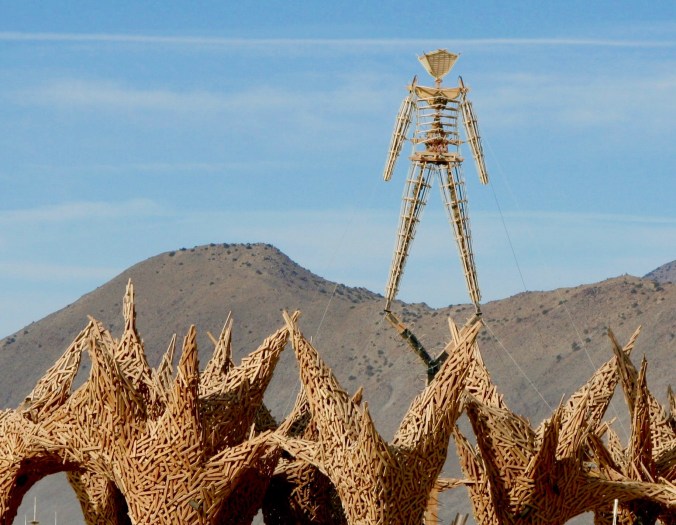
The Man begins his week located at the center of the Playa. While his look remains more or less the same, his base changes each year depending on the theme for the year. I took this photo in 2006.

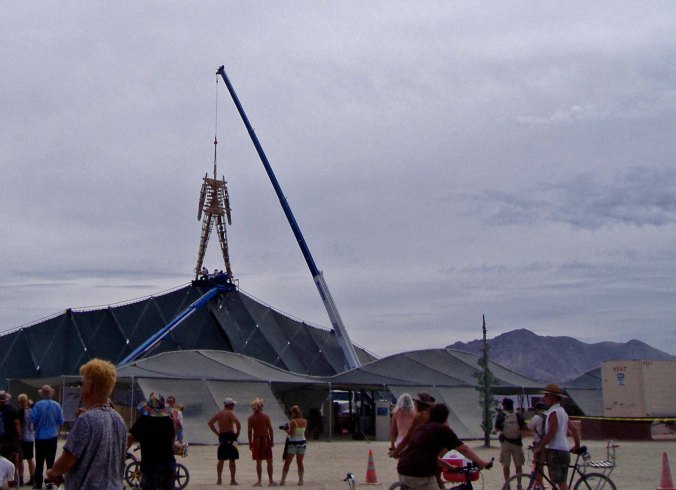
In 2007, the Man burned twice— the first time in the early hours of the morning by a rogue Burner. I had actually missed the act of vandalism by only a half hour. Note the Phoenix on the face, like the mythological bird, he was able to rise again.

BMORG, the Burning Man organization was able to put together another Man in San Francisco and get him back to the desert in time for his Saturday burn. Here, he is being placed on his pedestal, still headless. (Photo by our friend Ken Lake.)

One of my favorite bases was this one from 2009.

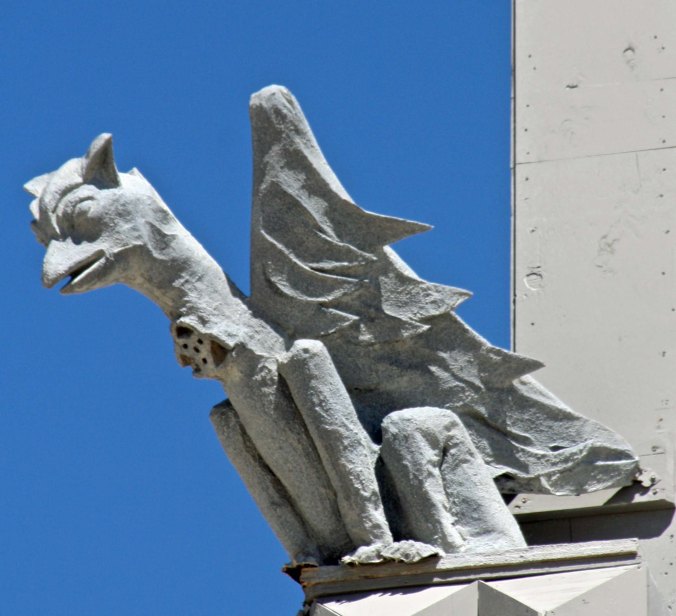
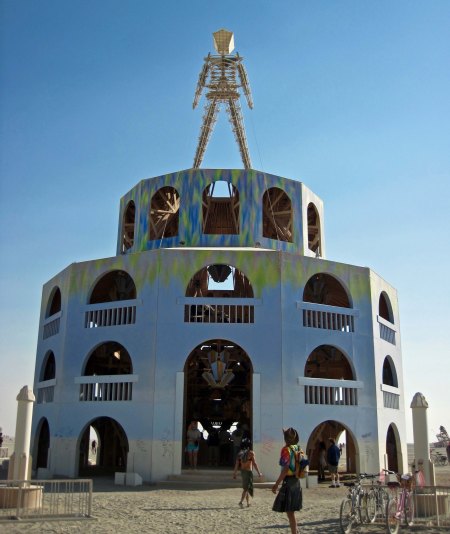
In 2010, the Man came with gargoyles, like a European cathedral. In this photo they are still working on the base. It isn’t unusual for finishing touches to be added at the beginning of the week. The steps up to the fourth level provided Burners with an opportunity to look out over Black Rock City, the Playa and the surrounding mountains.

One of the gargoyles I photographed when I reached the top.

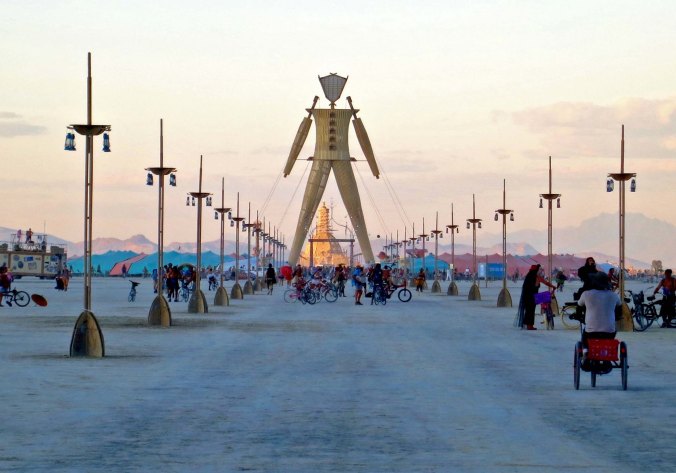
Three main roads lead out from Black Rock City to the Man. This one was from Center Camp. Lanterns are hung from the poles at night. The 2012 base was one of the largest.

A close up.

What the structure inside the base of the 2012 Man looked like. No nails were used in putting it together.

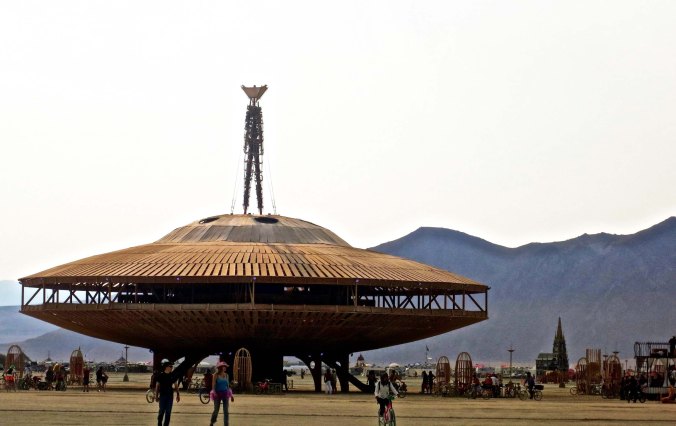
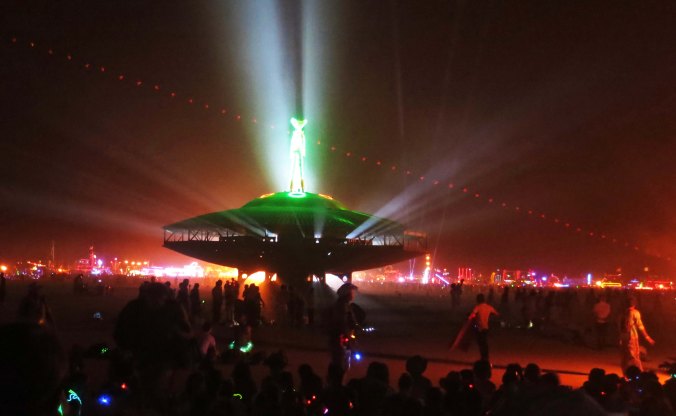
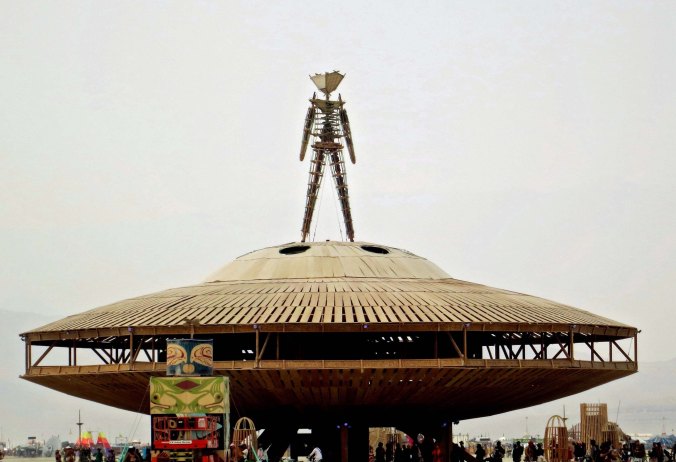
A flying saucer provided the base in 2013.

The Man’s head had been altered to have an alien appearance..

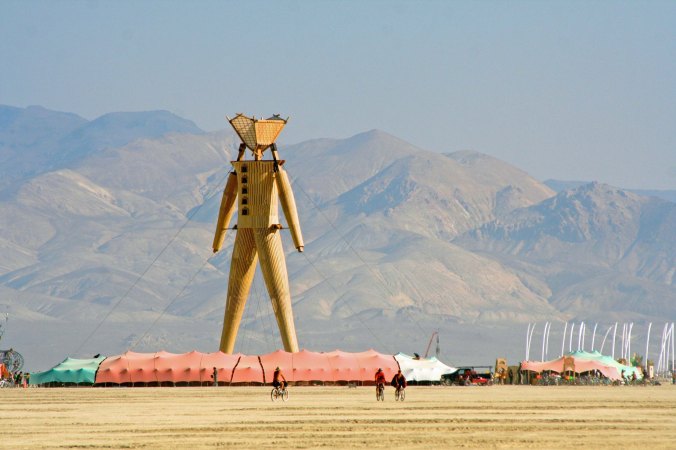
The man was fleshed out, so to speak, in 2014. The Temple, lit up by the sun, can be seen through the Man’s legs. Each year, Center Camp, the Man and the Temple are lined up.

Part of Burning Man’s appeal is the magnificent mountains of the Black Rock Desert that surround the event.

I liked this shot of the 2014 Man’s face lit up by the sun.

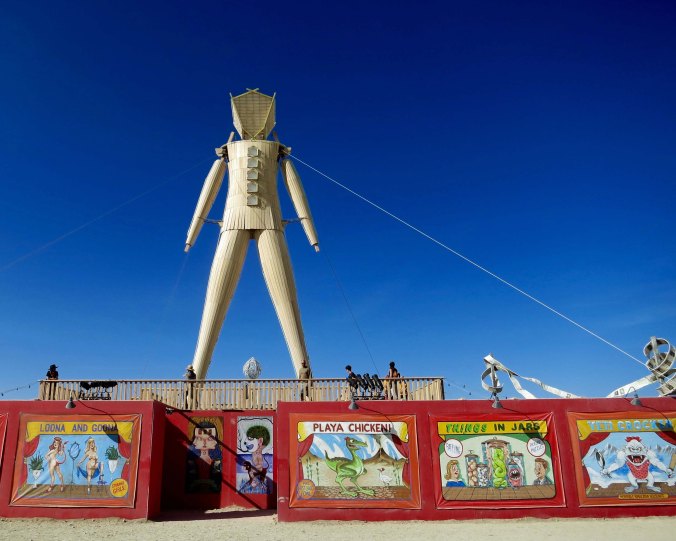
The 2015 Man was perched on top of a maze covered with side-show circus posters reflecting the year’s theme.

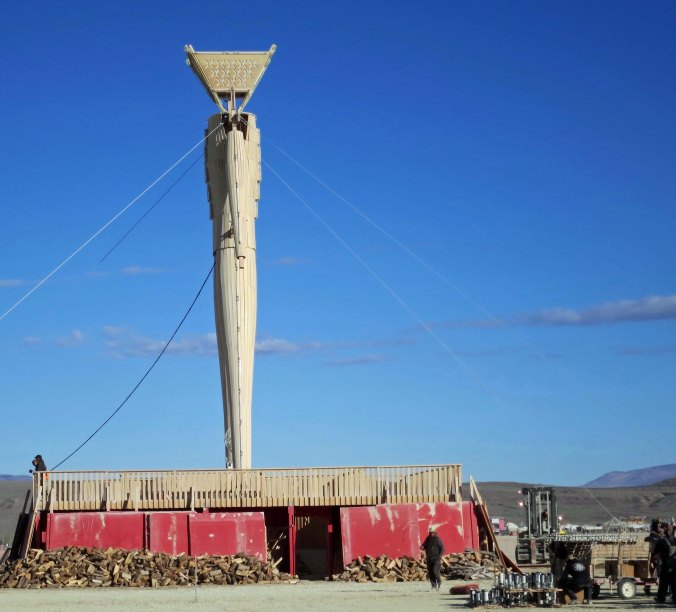
And now we come to the 2015 Man being prepped for Burn Night. It’s Saturday. The art work has been removed and the firewood piled high. Entrance into the area has been closed off.

On burn night almost everyone in Black Rock City gathers around the Man. The Man on top of its flying saucer base in 2013 is looking even more ET-like. Lighting has been added to help create the effect.

Fireworks and arms raised means the Man is about to burn!

The 2014 Man goes up in flames. (Photo by Don Green.)

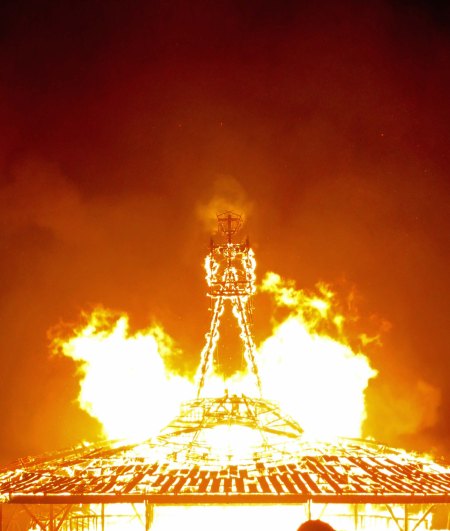
This shot of the base of the 2012 Man captured the intensity of the fire well. You can almost feel the heat!

The Man is standing on his ‘last legs’ here. He and his flying saucer teeter on the edge of falling into the fire.

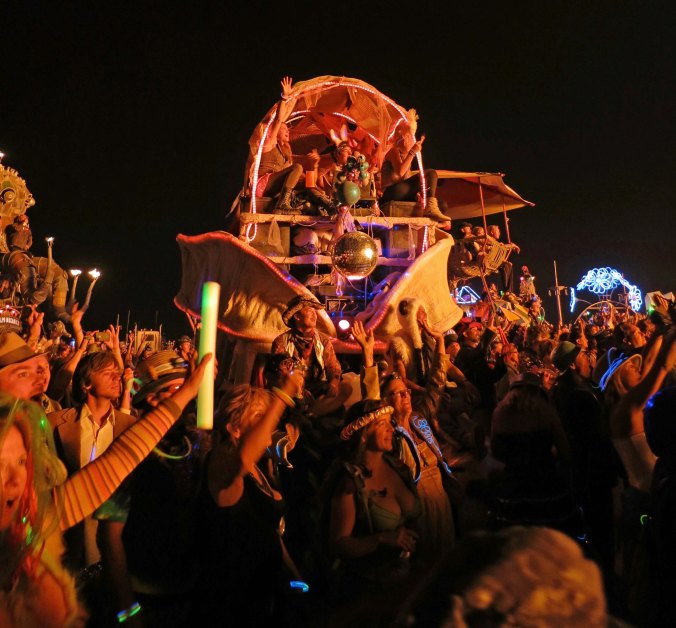
Burners celebrate as the Man falls. Mutant vehicles provide prime seating for the event.

The morning after: Burners use glowing embers from the night’s Burn to roast a lamb. Life goes on. The Man will rise again the next year.

This completes my series on Burning Man for now. I may do a couple more posts before I head off to Black Rock City again on August 26. In September and October I’ll post the results of my 2017 adventure!

NEXT POSTS:

Big Sur with its iconic bridges, beautiful coastline, and a bit of history.

I encounter a 70s terrorist group in the Sierra Nevada Mountains.

A new series: The fascinating, ancient rock art of the Western United States.


Lost in a Sierra Snow Storm… When the Stakes Are Survival

There is beauty in freshly fallen snow, but there can also be danger. Avalanches, hypothermia and getting lost are three frightening possibilities. (Photo by Peggy Mekemson.)


This is the second of three stories about  my years of hunting and fishing during my 20s. I wrote about escaping from a massive lightning storm in my last post. This time I am going to write about another hazard of wilderness travel: getting caught in a snow storm. Once again, I was out hunting with my friends Bob and Hunt, along with another friend we had grown up with in Diamond Springs, Phil Dunlop. As usual, I was enjoying the excuse to be out in the woods. Deer season had come down to its last weekend…

Pushing the season to its limit meant risking bad weather. We were hunting north of Highway 50 in El Dorado National Forest about 30 miles west of Lake Tahoe one Saturday afternoon in late October when the snowflakes started drifting lazily out of the sky.

It wasn’t much to worry about; we zipped up our coats and continued hunting. If anything, the gently falling snow added an enjoyable element to the trip. But it kept snowing and the flakes became more serious. After a couple of hours there were six inches of the white stuff on the ground and my tracks were beginning to disappear. I decided it was time to make a judicious retreat to the T-bone steaks that were waiting for us back at the jeep. I soon ran into Hunt who was walking with Phil.

“Have you seen Bob?” I asked. He and I had parted an hour earlier at the edge of a large thicket of brush where Bob had been convinced he would jump an evasive buck.

“I haven’t seen him since it started to snow,” was Hunt’s reply. Phil hadn’t see him since lunch. Normally we wouldn’t have been overly concerned; we were used to traipsing around through the woods on our own. But evening was coming, the temperature was dropping, and the snow was continuing to accumulate.

“Maybe Bob has more sense than we do and has already returned to the jeep,” Phil suggested. That seemed logical so we made the short 15-minute walk back to it. No Bob.

“This is getting worrisome guys,” I said in a definitely worried tone. It wasn’t like Bob to be late for dinner. “Let’s go back to where I saw him last and see if we can find his tracks.” The advantage of snow is that it leaves a trail even a city slicker can follow, assuming that it hasn’t already covered the tracks. Even then there is usually a remnant of dimples in the snow.

These turkey tracks show how clear tracks can be in the snow.

Unfortunately, no tracks or convincing trail-like dimples were to be found. I did spot the tracks of a very large deer, but they disappeared at the edge of the thicket.

“It looks like the buck stops here,” I said to Phil and elicited a weak groan. I suggested we split up and look around.

“We need to meet back here in 30 minutes,” I urged. “Don’t go far and pay attention to where you are going. It is getting close to dark and the last thing we need is a second person missing. If you come across Bob’s tracks, fire your rifle and we will join you.” My degree of concern was reflected in my bossiness. Normally we were a very democratic, almost anarchical group.

Ten minutes later I had made my way to the other side of the thicket and found nothing. Neither had I heard any rifle shots announcing neither Hunt nor Phil had success. Discouraged, I turned around to rejoin my fellow searchers. It was then I spotted tracks leading out of the thicket. Up went my Winchester and I fired off a shot.

“Bang!” the sound of another rifle being fired resounded from the direction Bob’s track had headed. I quickly levered in another bullet and fired again. There was no response. I did hear Phil and Hunt making their way through the brush toward me, though. They sounded like a pair of large bears. We held another council. Once again, we decided to split up.

Phil would return to the road where the jeep was parked and flag down a car. His job was to get a message through to the El Dorado County Sheriff’s Department that Bob was missing. Hunt would cut back through the thicket and wait on the jeep trail where the thicket began in case Bob made his way back there. He’d fire his rifle if Bob appeared. I was going to follow Bob’s tracks until dark to see if I couldn’t catch up with him. There was only about 30 minutes of daylight left so the odds were slim. My concern was that Bob had somehow injured himself and was stranded, or that he had become disoriented and become lost.

Following the tracks was a challenge. They would be clear for a few yards and then disappear under the snow. It was continuing to fall and beginning to drift, whipped on by a strong breeze. Each time I lost the tracks I would work forward in a zigzag pattern until I found them again. It didn’t help that Bob was tending to wander or that I was tired from a full day of tramping over mountains avoiding deer. Dusk was rapidly approaching when I came across another set of tracks that crossed the trail I was following. They were fresher, and they were also Bob’s! I yelled but the only response was the silence of the snow filled woods. It seemed to me that Bob was beginning to follow the classic lost person syndrome of wandering in circles.

I wanted to go on, needed to go on, but knew that the decision would be the wrong one. Dark had arrived to reduce an already limited visibility. I was tired, close to exhaustion, and cold. Hypothermia was a real threat. Ever so reluctantly I turned around and begin to make my way back toward Hunt, leaving Bob behind to face whatever fate the dark and snow and cold had in store for him.

The realization of how tired I was really hit me when I came to a downed tree and couldn’t persuade my leg to step over. We had quite the discussion. I reached down, grabbed my pants cuff and gave the reluctant appendage a boost. Hunt was waiting where we agreed and I filled him in on my findings as we made way back to the jeep through the ever-deepening snow.

Phil had had more luck. The vehicle he flagged down had a CB Radio and the driver was able to contact the Sheriff’s office. A team with snowmobiles would be at our jeep at first light, prepared for a full search and rescue operation. Bob, who was manager of Placerville’s newspaper, The Mountain Democrat, was well-known and liked in the community. We knew we would have lots of support in our search.

There wasn’t anything else we could do. We were too tired to set up the tent so we climbed in the jeep, grabbed a bite to eat, downed a Bud, and prepared for a long night. Hunt got the front seat—it was his jeep— and Phil and I shared the back. It was beyond uncomfortable and even exhaustion couldn’t drive me to sleep. Somewhere around two I finally managed to doze off only to be awakened at 5:30 by Hunt’s cussing about how damn cold it was. And it was. Our sleeping bags hadn’t kept us warm and the doors had frozen shut. We had to kick them open. We soon had our Coleman lantern blasting out light and our Coleman stove cooking up a mass of bacon, eggs and potatoes. We were expecting a long day and knew we would need whatever energy the food could supply. The storm had passed, leaving an absolutely clear sky filled with a million twinkling stars.

The Sheriff’s team arrived just as the sun was climbing above the Crystal Range of the Sierra Nevada Mountains, exactly on time. Introductions were made, snowmobiles unloaded and we filled the team in on our efforts of the previous day. The deputy sheriff in charge asked me to climb onto the back of his snowmobile and take them to the point where I had left Bob’s tracks the night before. It was to be my first ever snowmobile ride; except it wasn’t.

Just as the search team was firing up their engines, a wraithlike figure wearing a plastic poncho came slowly hiking up the hill toward the jeep. He looked like a bad guy out of an early Clint Eastwood western. It was Bob. As soon as the sun provided a hint of dawn, he had managed to orient himself and start walking back toward the jeep. Yes, he was freezing, but he was alive. We knew just how alive he was when he demanded his share of breakfast. As we cooked up another mass of bacon and eggs (fortunately we hadn’t eaten everything), Bob told us his story.

He had become disoriented after coming out of the thicket and headed off in the direction he thought would take him back to the jeep. It didn’t. He fired his rifle several times to get our attention but the sound of shots is fairly common in the forest during hunting season. We just assumed a deer hunter had gotten lucky. Bob continued wandering and eventually came across his own tracks. That was when he seriously began to worry.

Knowing he was lost and knowing night was coming on, he gathered wood for a fire. The wood was wet and refused to start burning. Bob’s lighter ran out of fuel but he still had a few matches. He took his lighter apart, placing the innards under the wet wood and used his last matches to light it. The good news was that the fire started. The bad news was that the wind and snow put it out almost immediately. It was some time during this process that I had fired my rifle and Bob had used his last shot to respond. Out of options, he had dug out a packrat’s nest to provide shelter and prepared for the longest night in his life. He had survived in lodging that made Hunt’s ancient jeep seem like a five-star hotel.

“I even fell asleep once or twice,” Bob managed to get out around a mouthful of eggs.

Of course, the Mountain Democrat ran a major story on Bob and he had to take considerable ribbing in Placerville over the next several months. It was a small price to pay considering the alternatives. That Christmas Bob received several compasses for gifts. It was years before he had tolerance for any temperature below 70.
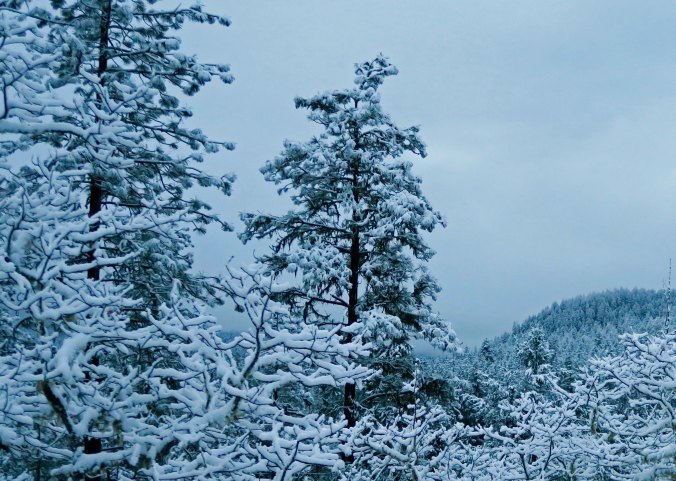
I took this photo out my front door of our home in Oregon. And then went back inside…
NEXT BLOGS:

The Man: It’s time in my Burning Man series to visit the Man— and witness Black Rock City’s premier ceremony, the Saturday night burn.
Big Sur: Noted for being one of the most beautiful coastal areas in the world, my visit is limited by massive landslides.

Patty: My friends and I were on a preseason scouting trip for trout streams in the Sierras when a white van roared around us, lost control, and ended up in a snow bank. We were about to encounter Patty Hearst and one of the scariest terrorist groups of the 70s: The Symbionese Liberation Army.