Peyote, Shamanistic Vision and Art… The Huichol Indians of Mexico

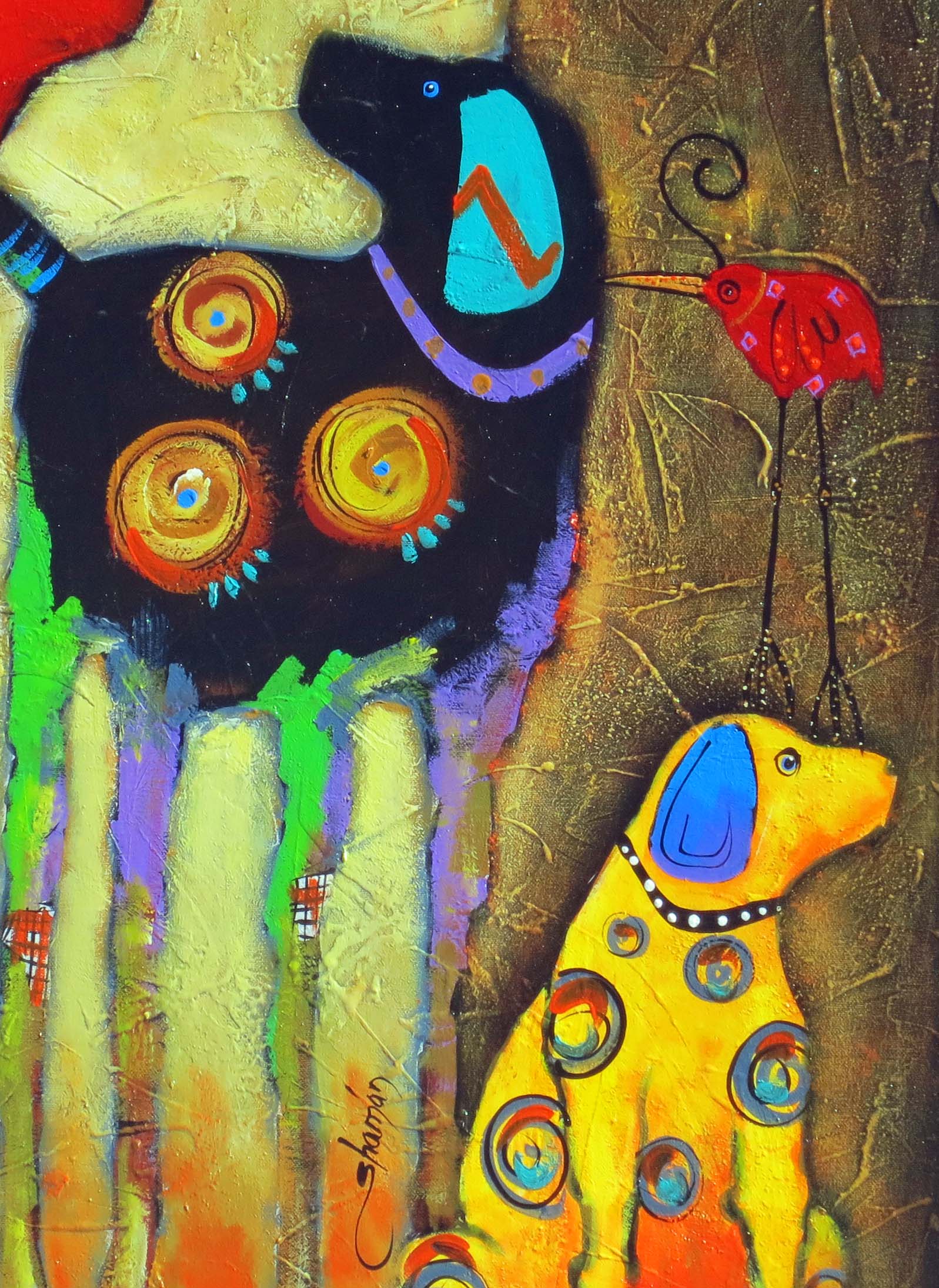
Huichol work of art representing the journey to gather Peyote. Photo by  Curtis Mekemson.

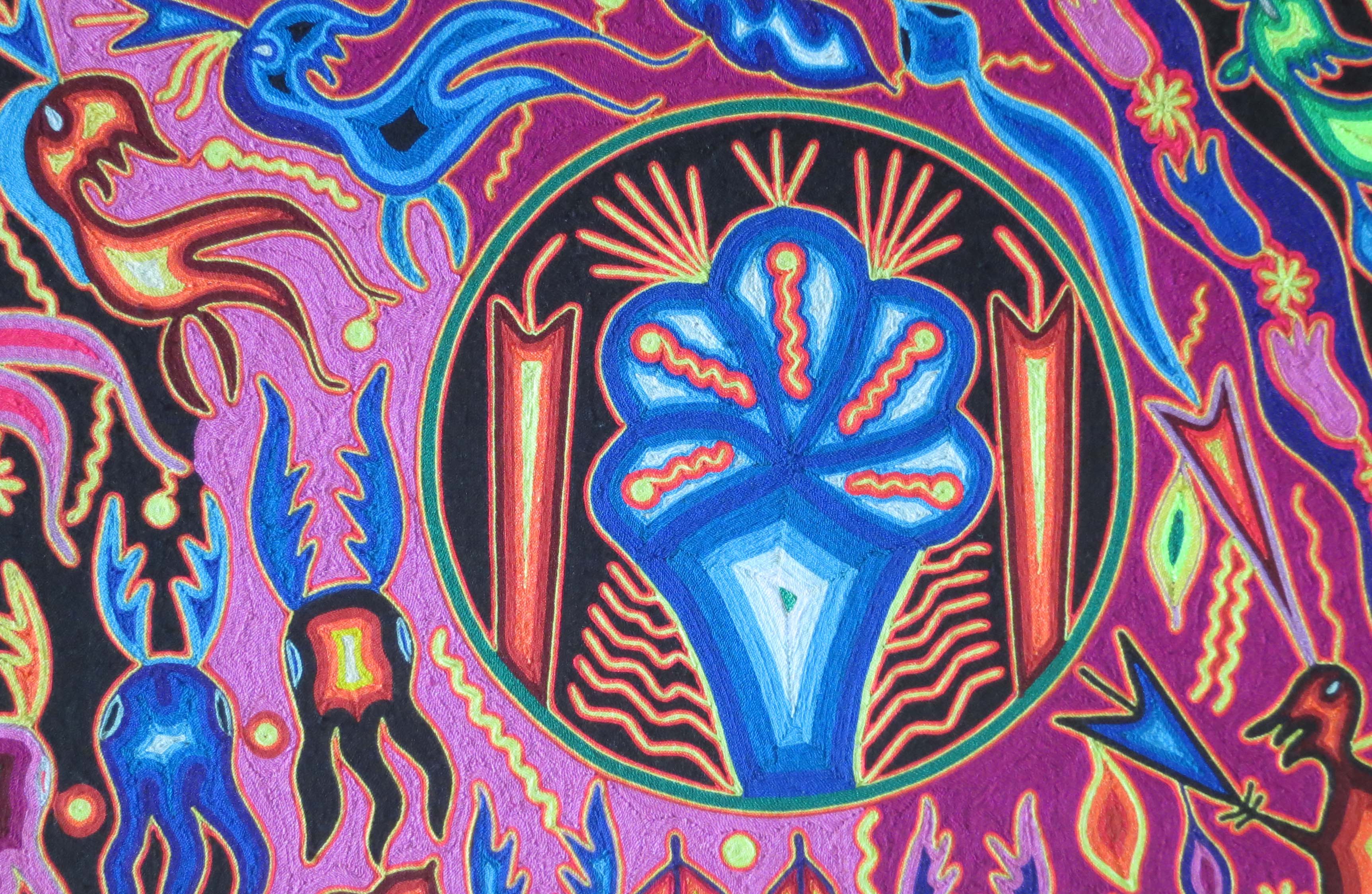
Peggy and I bought this Huichol yarn art painting several years ago. Yarn is pressed into beeswax to make the painting. This piece represents the Huichol’s annual journey to the sacred mountain of Wirikuta to gather peyote, which is central to their religion.

My fascination with indigenous art was piqued again on our recent trip to Mexico. The Huichol Indians, one of the last tribes in North America that has preserved pre-Columbian cultural traditions, are noted for their brightly colored bead and yarn art.

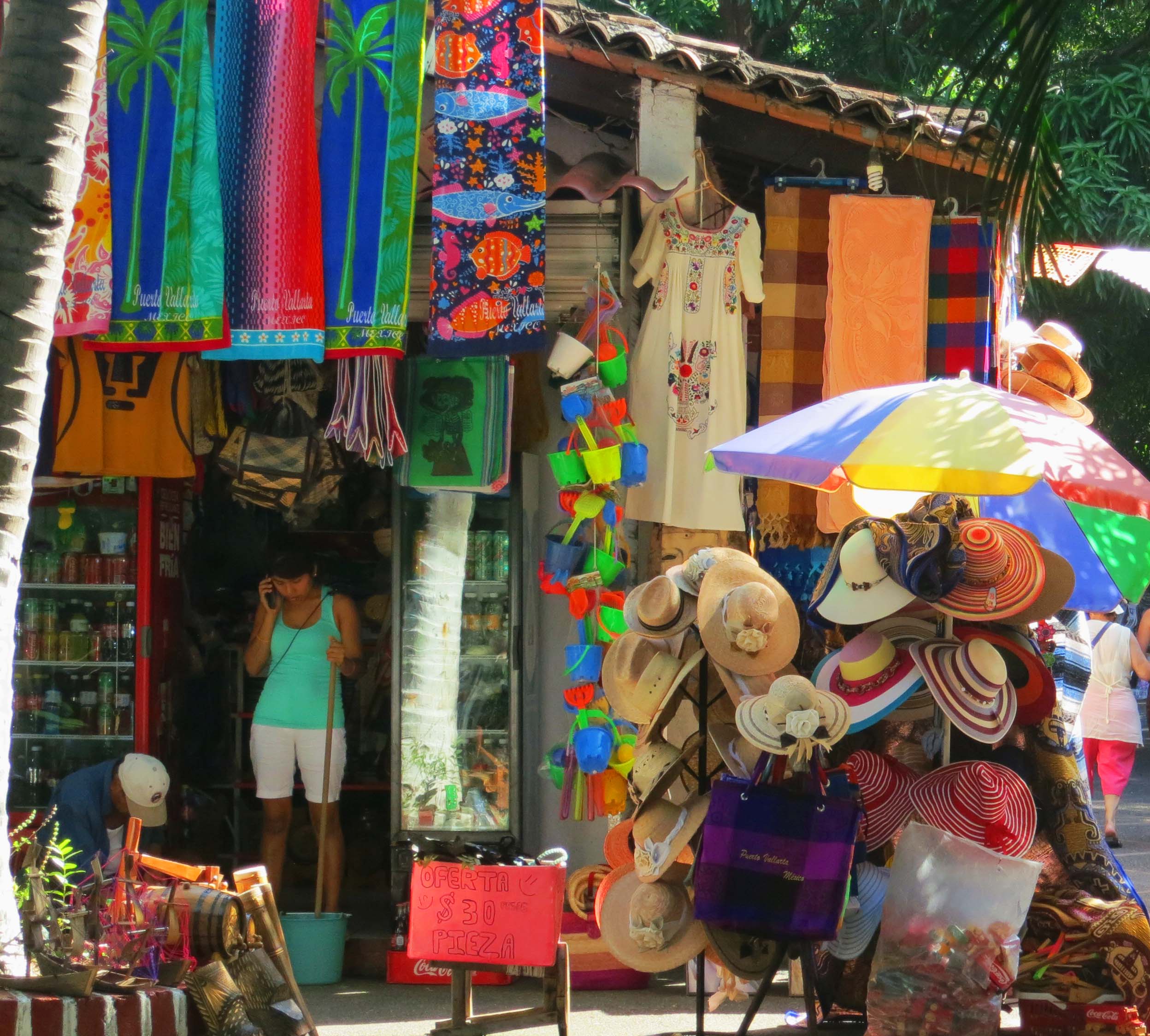
You can’t miss their work as you stroll down the streets and through the markets of Puerto Vallarta. What most casual visitors don’t realize, however, is that the art incorporates shamanistic visions inspired by peyote. Each piece provides an insight into the religion and mythology of the Huichol.

For example, the round buttons in the center of the painting above represent peyote. Just to the left of the peyote is the plant solandra, also with hallucinogenic qualities. The deer serve as intermediaries with the gods and the eagle serves as a messenger. Below the deer on the right is maize. To the left of the maize is what I believe is a prayer arrow with eagle feathers attached and to the left of that another arrow that has been shot into the base of a peyote plant. The wiggly lines represent communication that is taking place– between everything.

The Huichol, as they are known in Spanish, or the Wixaritari, as they call themselves, live in the Sierra Madre Occidental Range of Mexico. Each year, representatives of the tribe make a journey of several hundred miles to the sacred mountain of Wirikuta in central Mexico where they gather peyote.

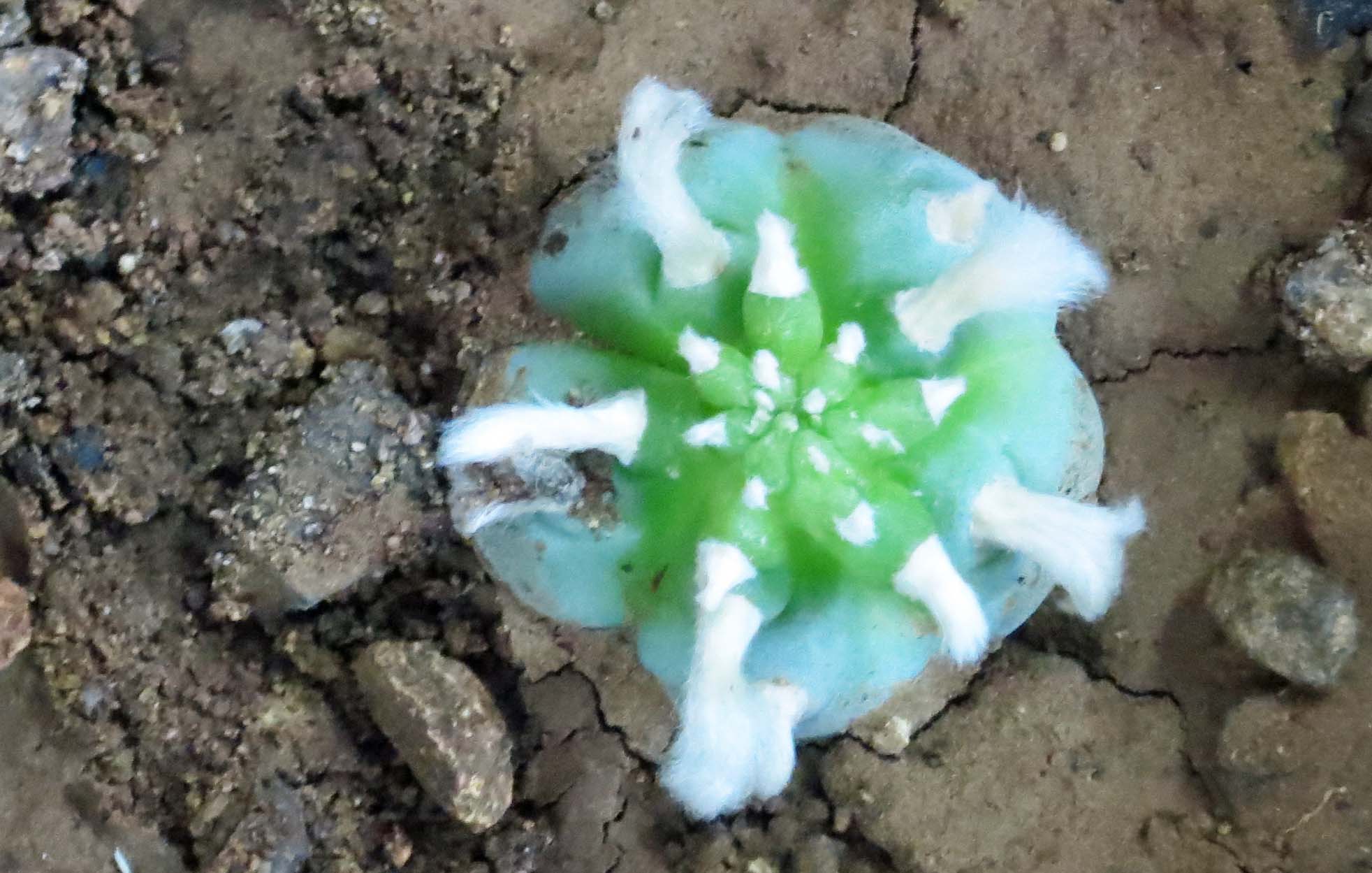
Peyote is a small cactus with psychoactive alkaloids, particularly mescaline, which can create hallucinogenic reactions similar to those created by LSD. (If you’ve been around for a while, you will immediately think of Timothy Leary and the 60s.)  Effects include alterations in the thinking processes, sense of time, and self-awareness. Colors are said to appear brilliant and intense. Synesthesia, where senses interact, may also occur. An example of the latter is seeing colors when listening to music.

Peyote photo taken by Curtis Mekemson in Mexico.

The peyote plant is a small, spineless cactus that contains mescaline, a hallucinogenic drug. 

Huichol Shamans use the peyote to enter a trance where they communicate with the gods of the Huichol people. The shamans then make small yarn paintings known as Nierikas that represent the visions they experienced. The paintings are left as offerings to the gods in caves, temples and streams.

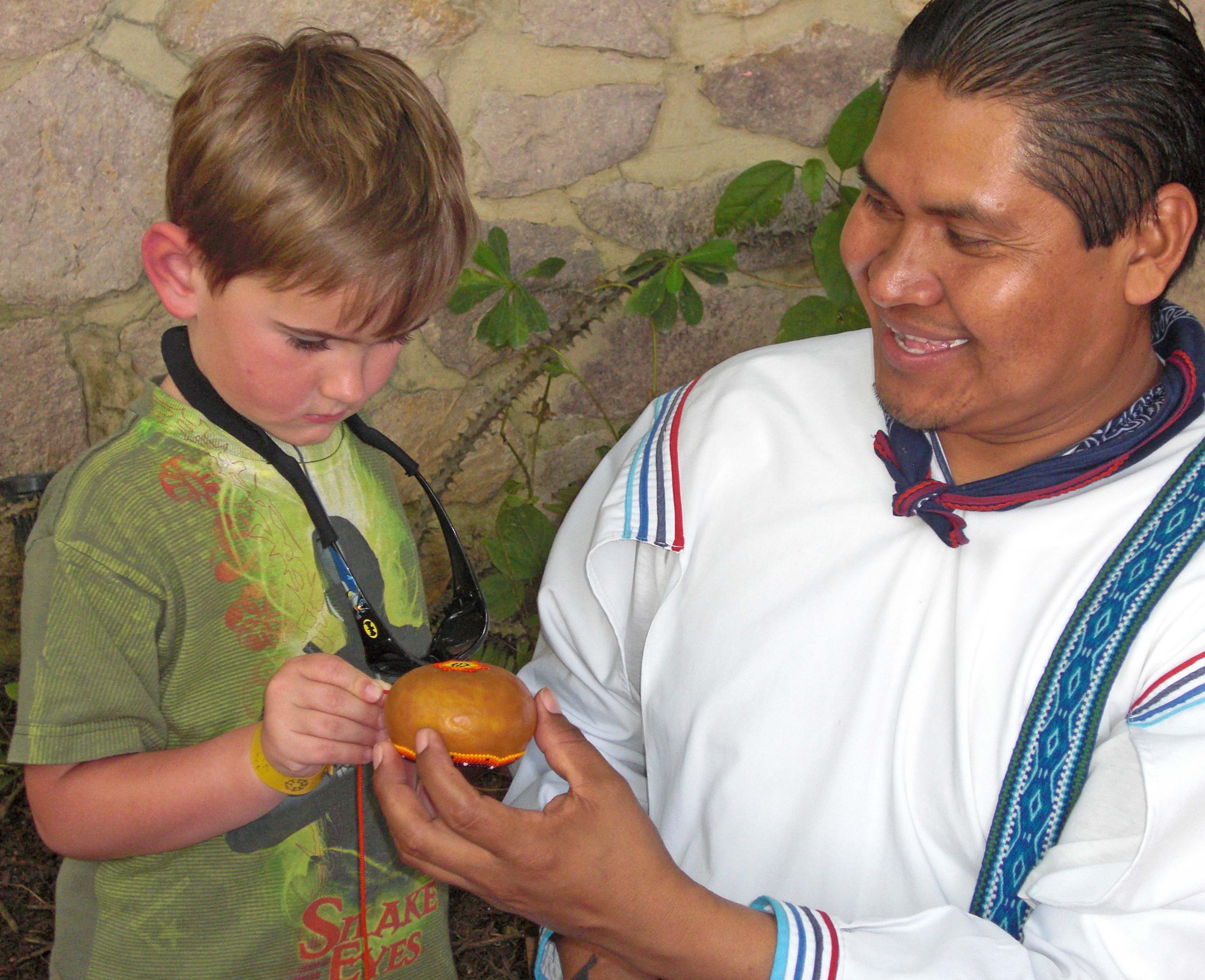
The Nierikas serve as the foundation for the Huichol art found in Puerto Vallarta, Guadalajara, and other urban locations. We have bought several pieces of the art, as has our daughter, Tasha. Our favorite Huichol artist for small bead art, Ernesto, maintains a table along the Rio Cuale. This year he took time to let our grandson, Cody, press some beads into a piece he was working on.

Ernesto shows lets our grandson Cody press beads onto a gourd covered with beeswax. (Photo by Ethan's mom, Natasha.)

Ernesto shows our grandson Cody how to press beads onto a gourd covered with beeswax. (Photo by Ethan’s mom, Natasha.) 

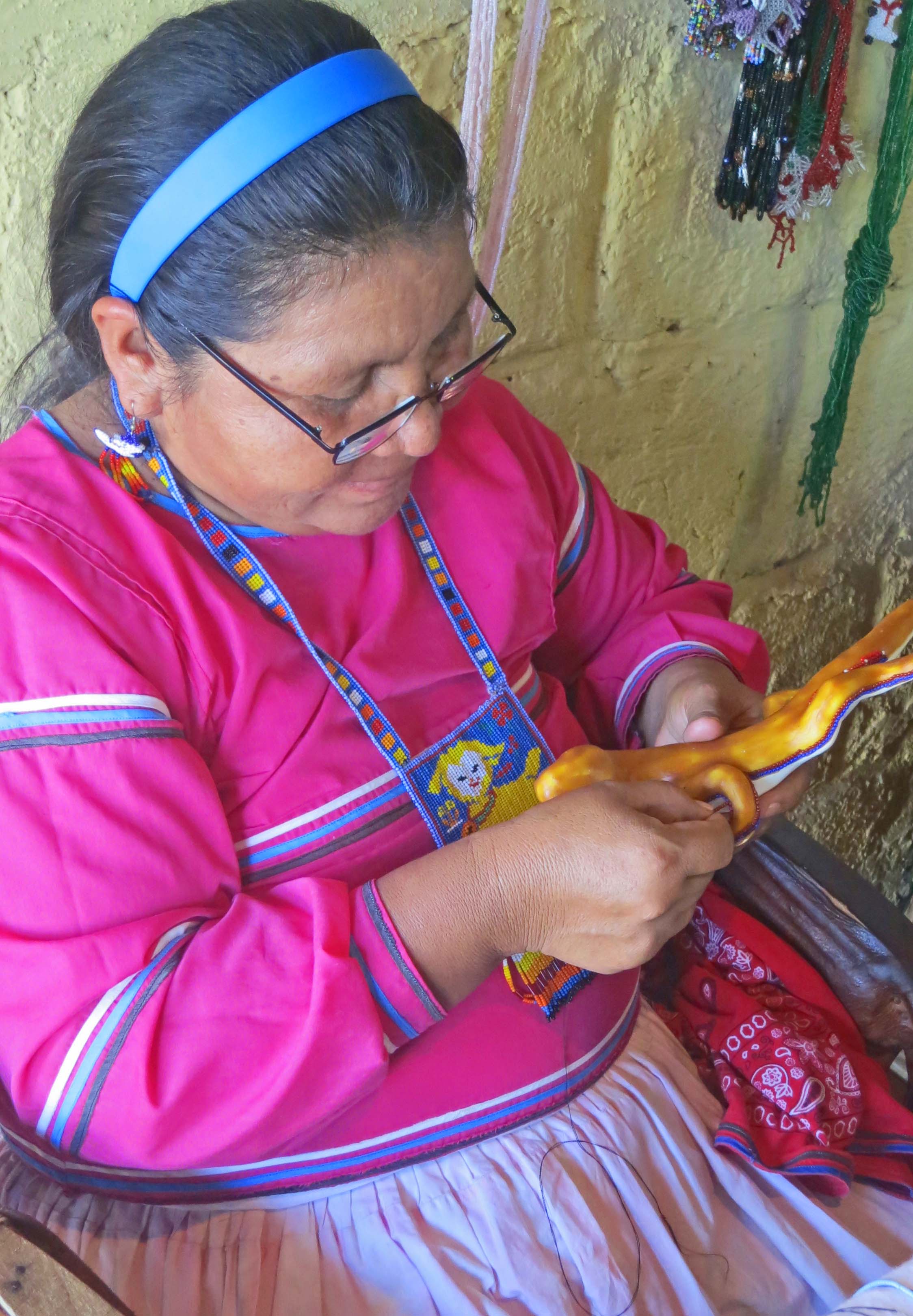
Huichol woman works on a bead art sculpture in Mexico. Photo by Curtis Mekemson.

In this photo, a Huichol woman works on another bead art sculpture.

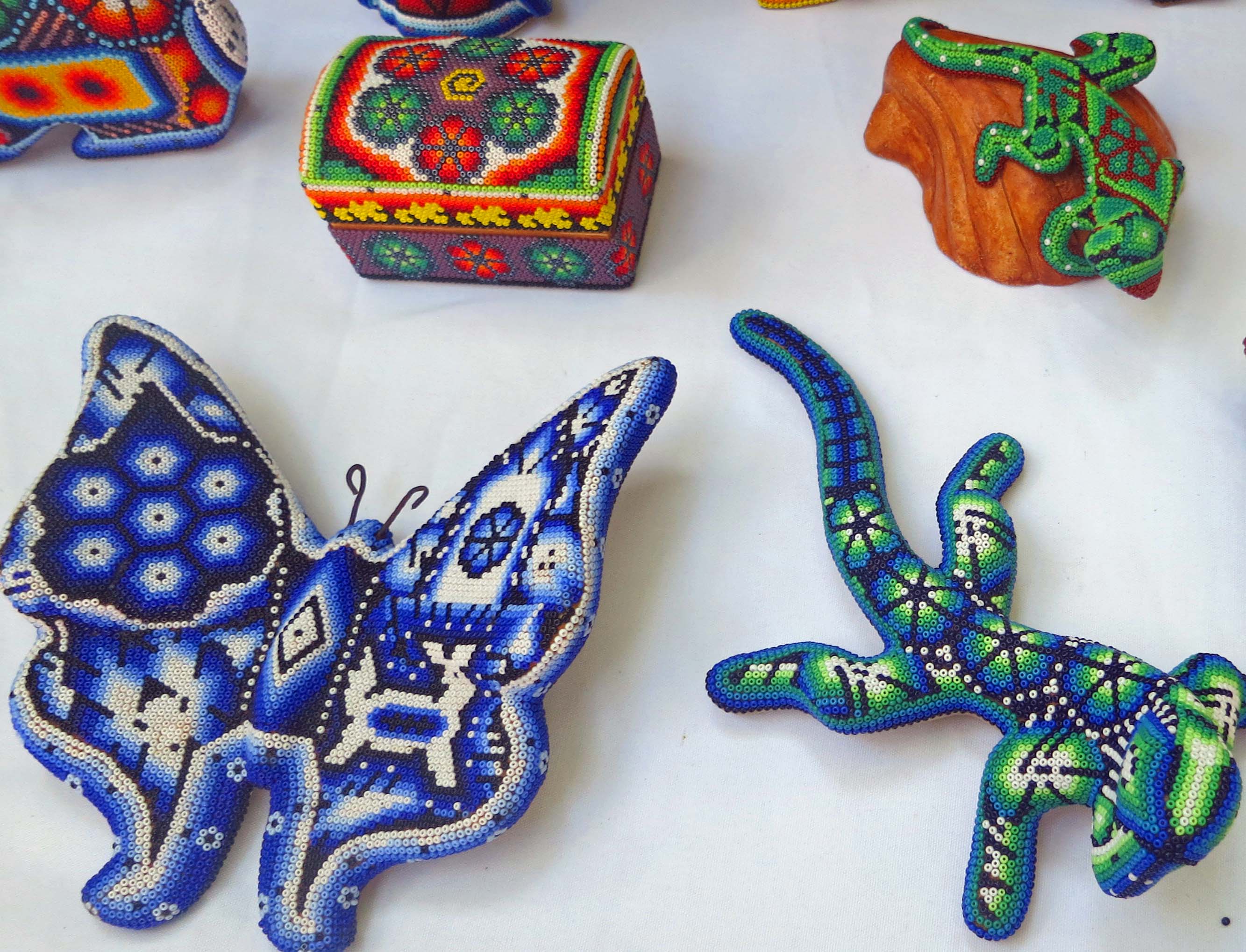
Beaded Huichol art. Photo by Curtis Mekemson.

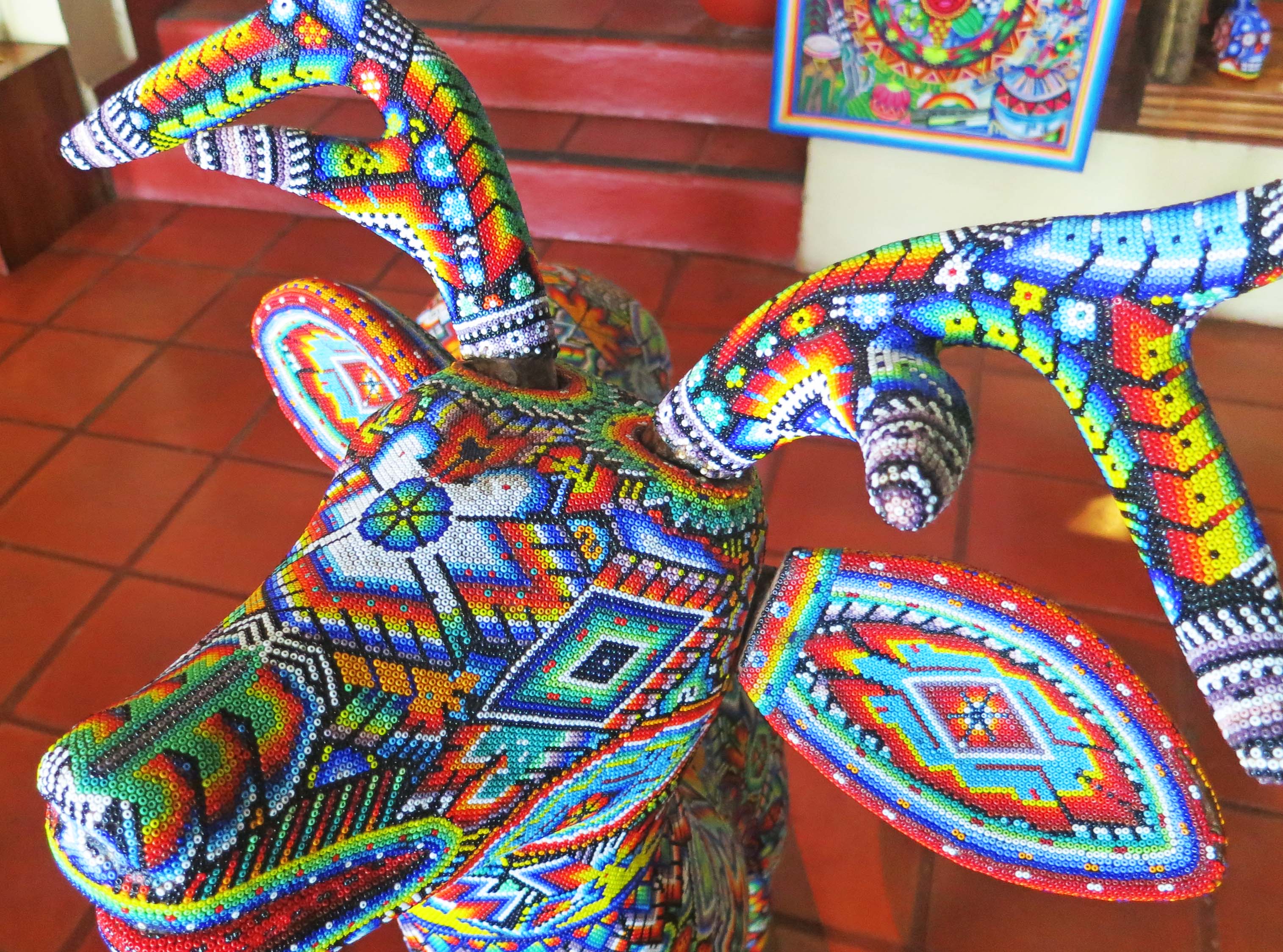
Beaded Huichol art can range in size from these small pieces created by Ernesto to much larger sculptures such as the deer shown below. Beaded art, like the yarn art, includes symbols of the Huichol Indians’ religion. The salamander, with peyote buttons marching down its back, helps bring rain.

Photograph of Huichol deer by Curtis Mekemson.

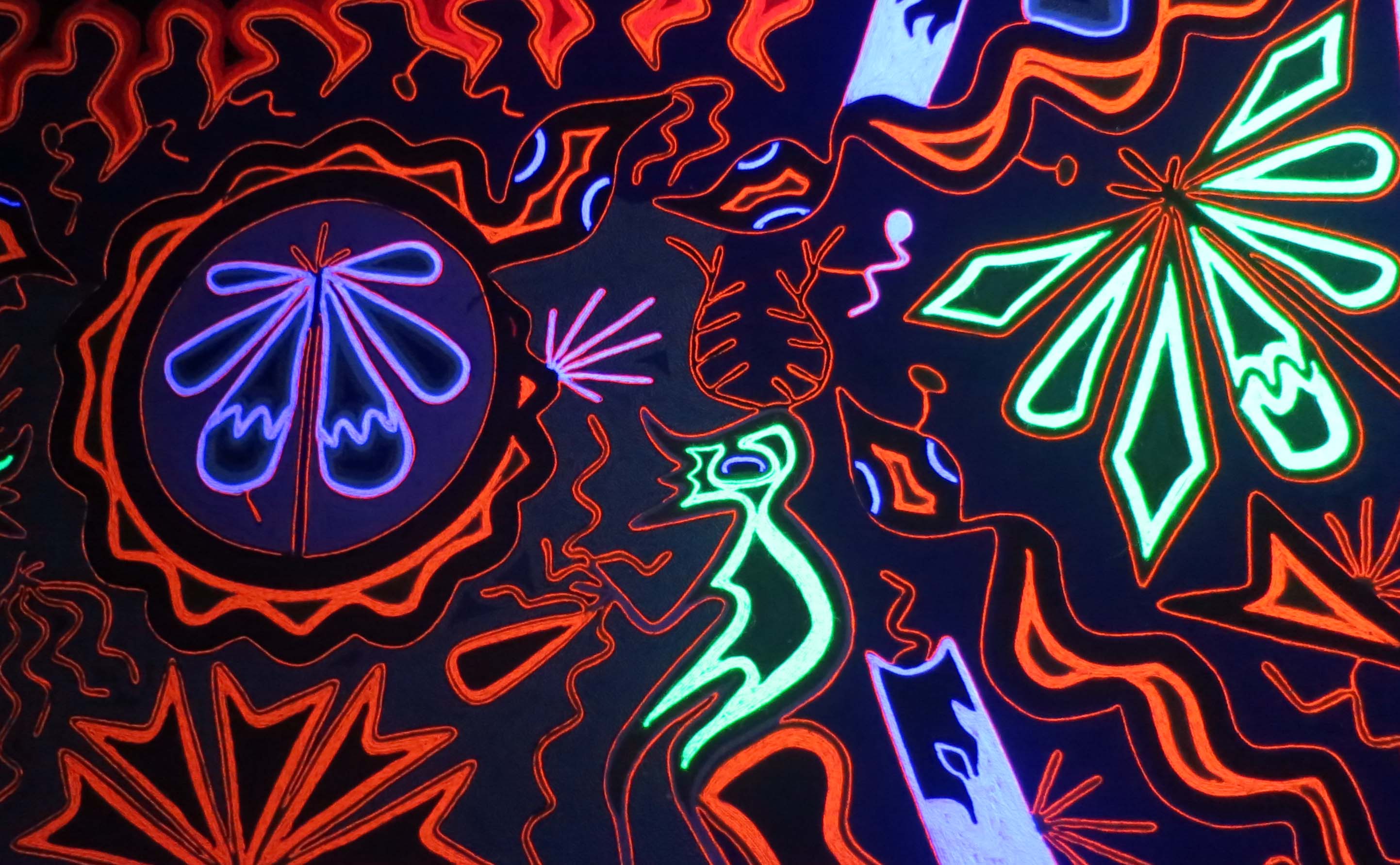
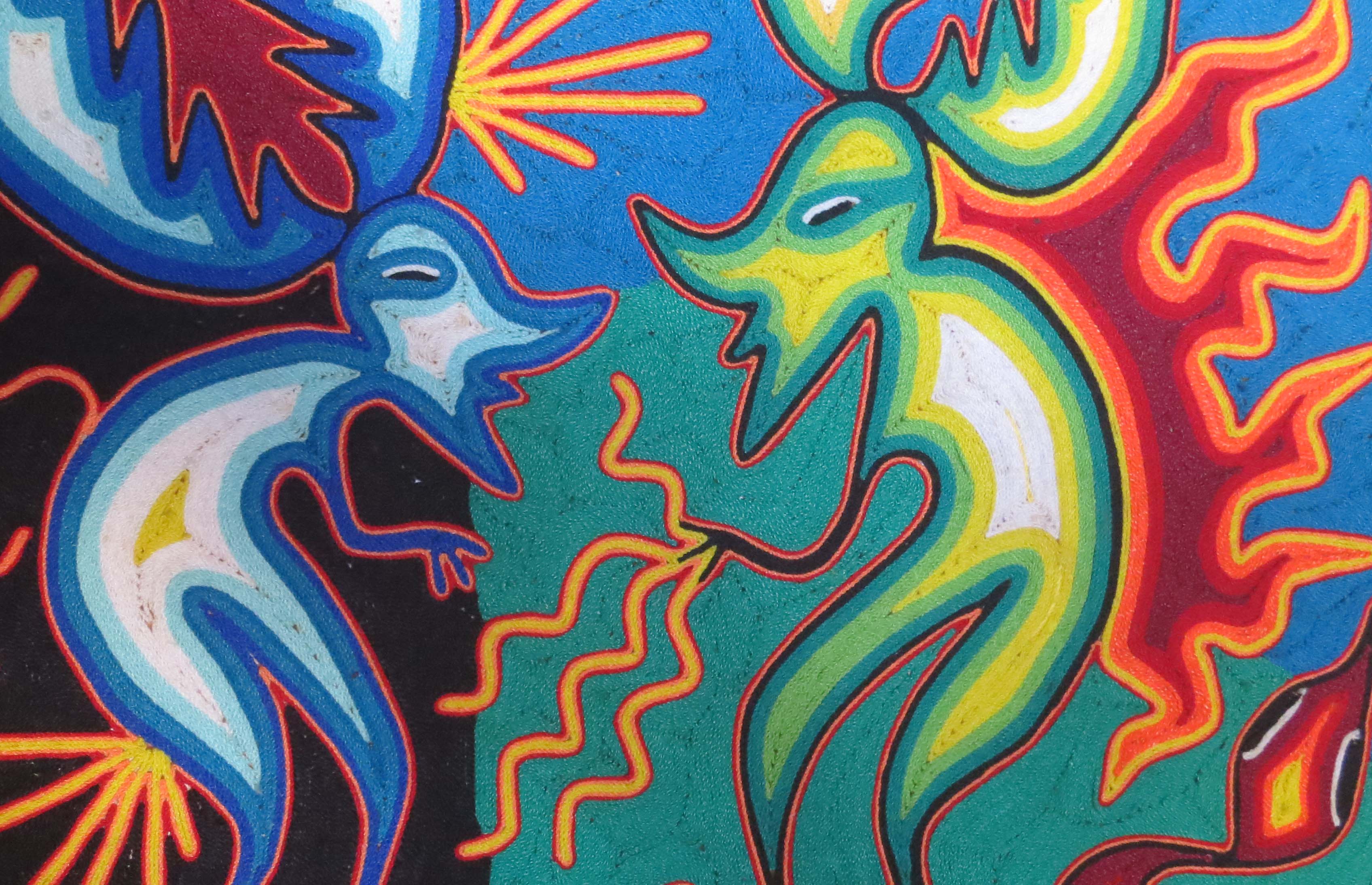
I’ll conclude today’s blog with several examples of Huichol yarn art which demonstrate the vibrant colors and spiritual figures seen by shamans while in trance.

Huichol art representing shamanistic visions. Photo by Curtis Mekemson.

Deer person in center represents a shaman.

Deer people representing shamans in Huichol art. Photo by Curtis Mekemson.

Huichol yarn art photo by Curtis Mekemson.

NEXT BLOG: I hope you are enjoying this journey into Mexico. I will be taking a break from blogging over the next couple of weeks to celebrate the season. Peggy and I would like to wish each of you Happy Holidays. –Curtis

“Oh my, what a big dewlap you have.” The Iguanas of Puerto Vallarta

Our grandsons Ethan and Cody were fascinated by the iguanas we found in Puerto Vallarta. The 8-year-old Ethan took this photo as  and iguana checked him out. (Photo by Ethan Cox.)

Our grandsons Ethan and Cody were fascinated by the iguanas we found in Puerto Vallarta. The 8-year-old Ethan took this photo as an iguana checked him out. (Photo by Ethan Cox.)

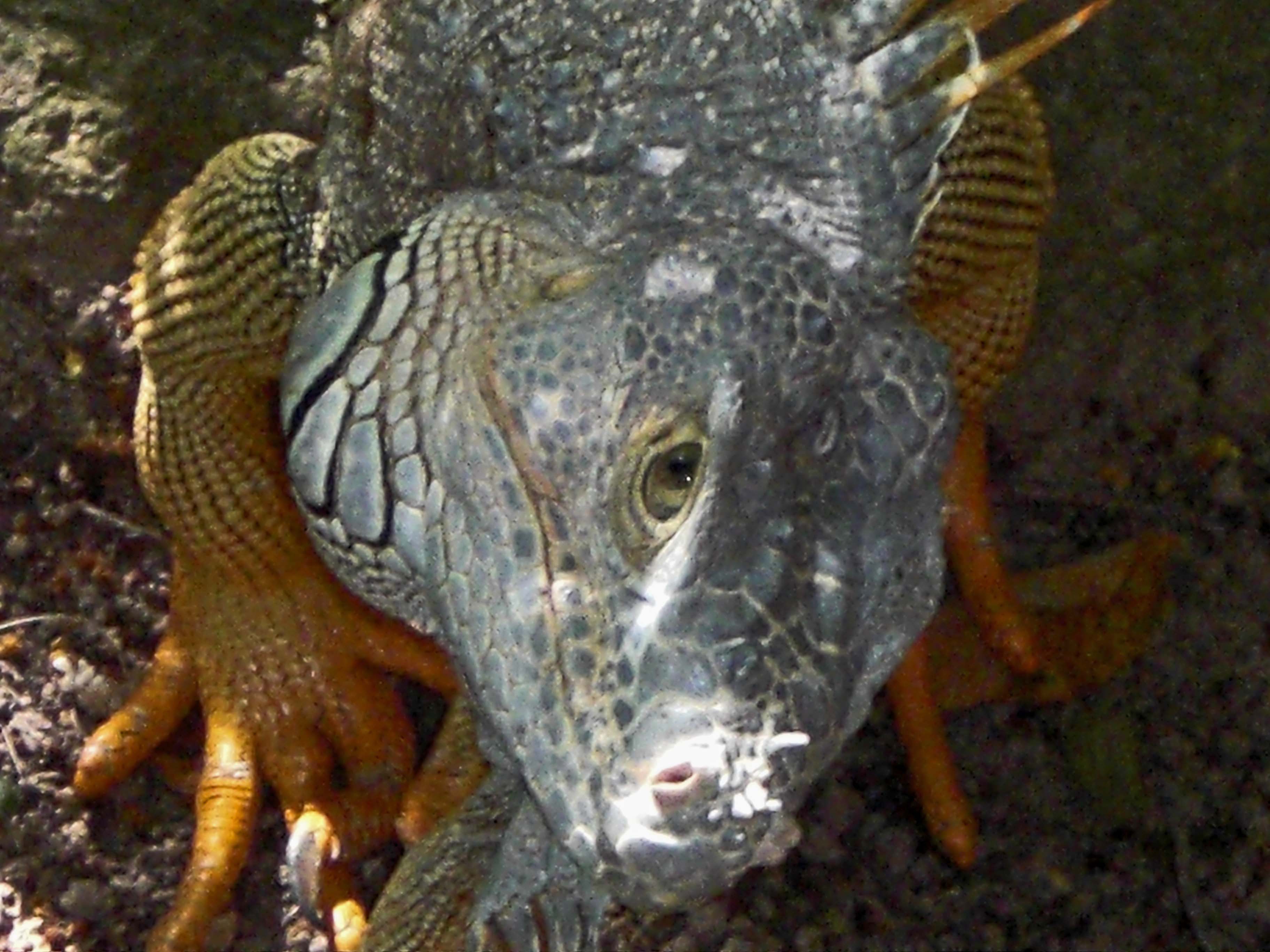
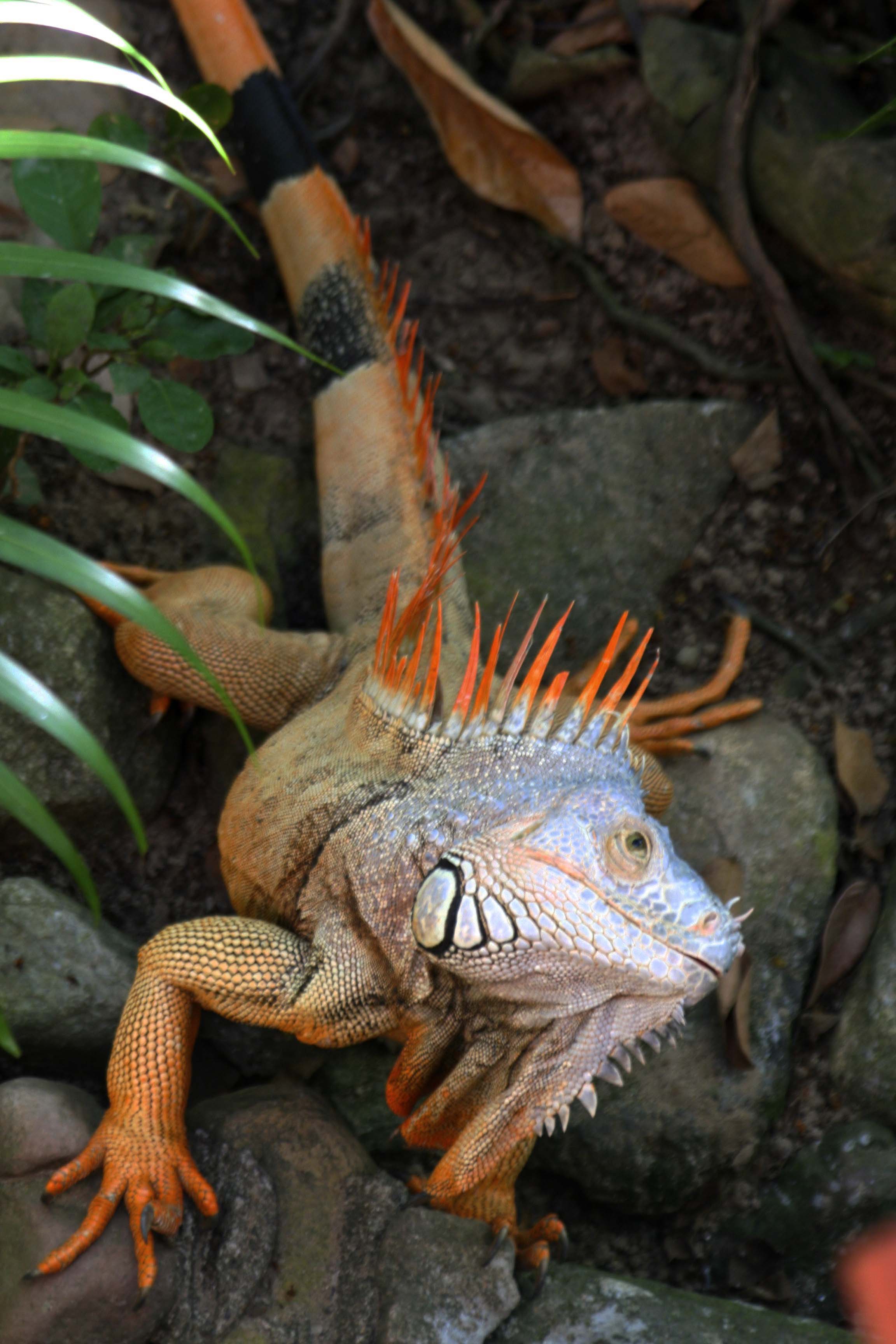
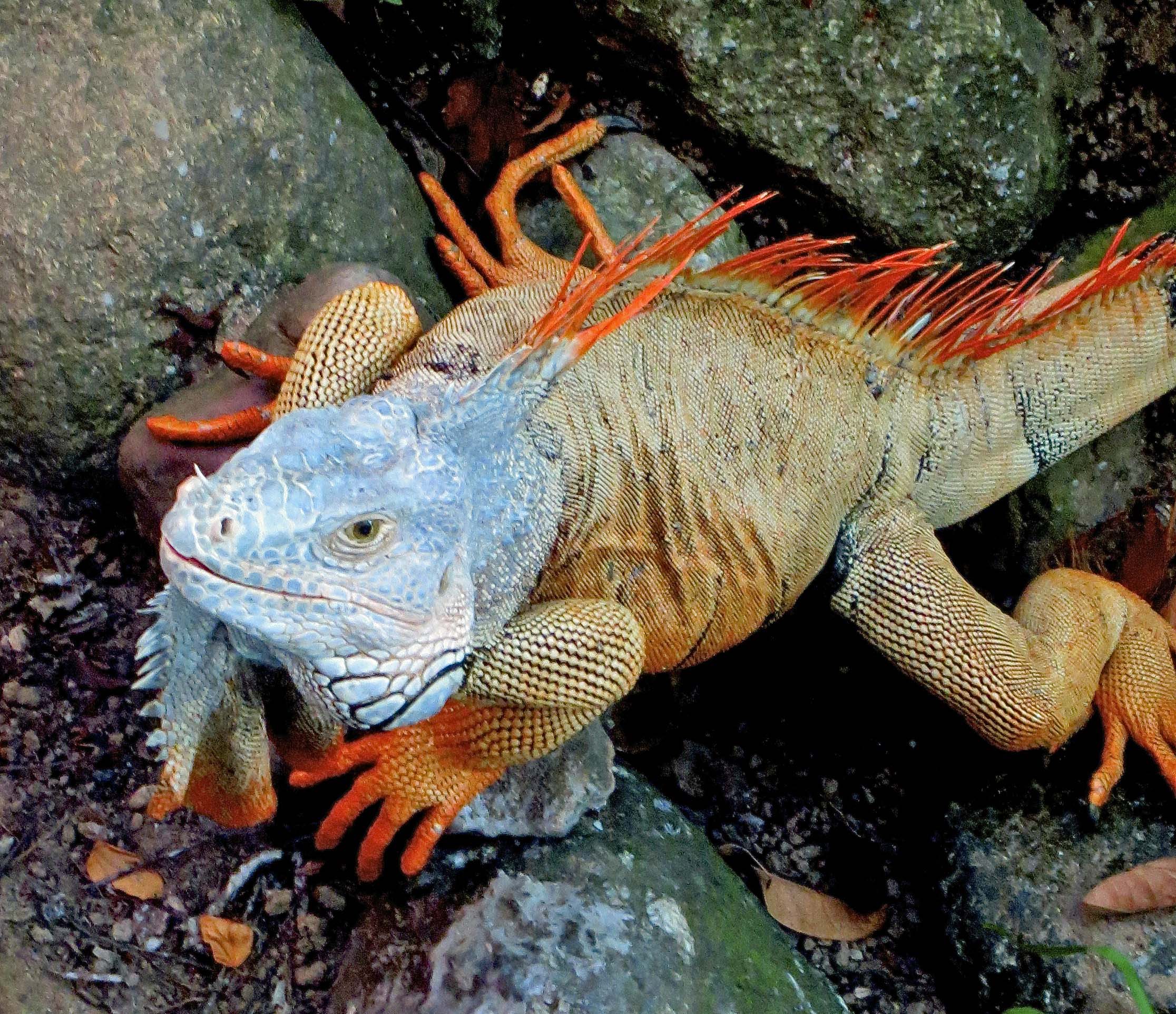
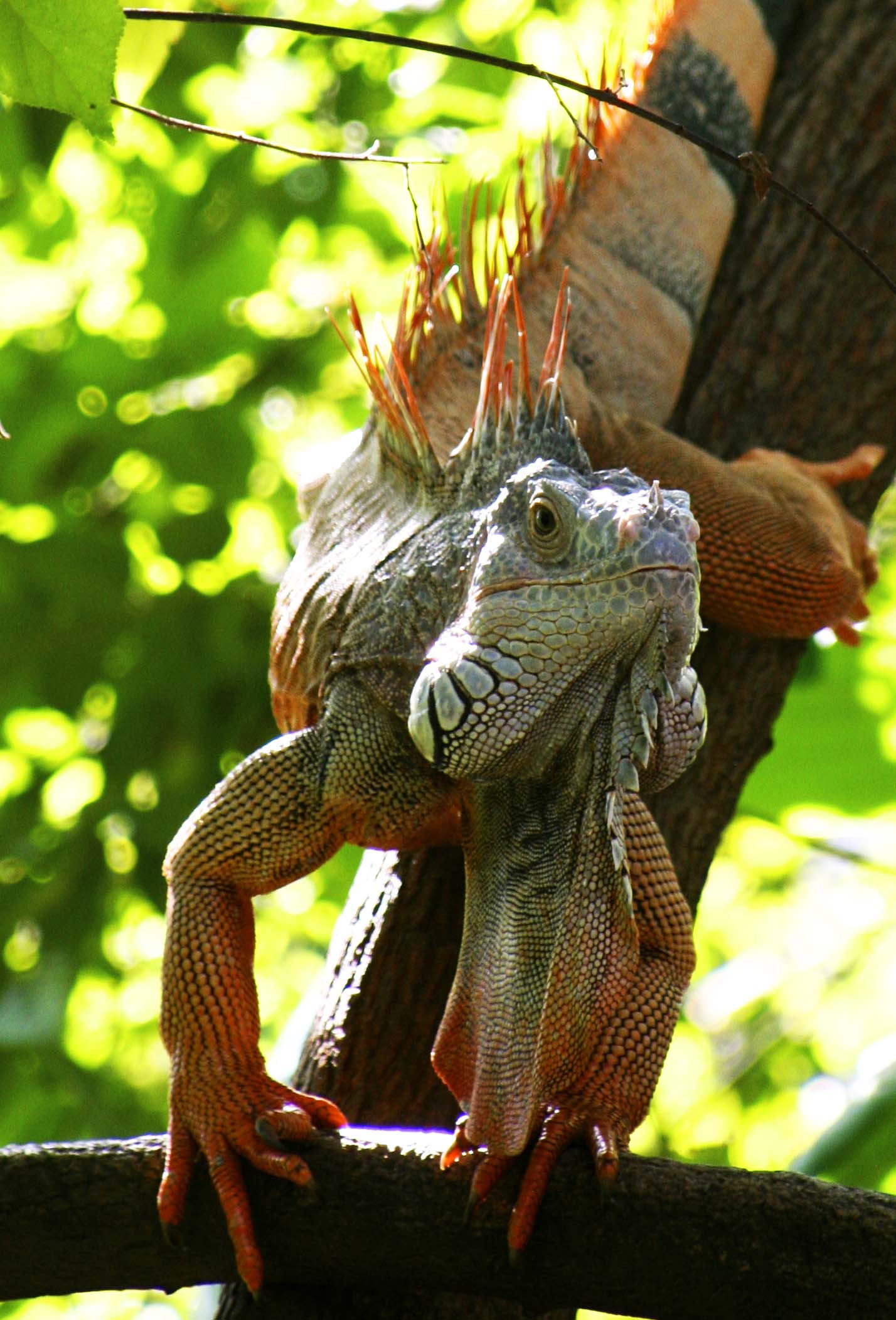
The iguana I named Big Orange was staring up at us with a curious eye. He had come down out of his tree and shuffled over to where we were having lunch on a patio above the Rio Cuale. My eight-year-old grandson, Ethan, was scratching the wall to attract his attention. The iguana and the boy seemed equally interested in each other.

Iguana in Puerto Vallarta, Mexico. Photo by Curtis Mekemson.

Another shot of the curious iguana. I named him Big Orange because of his color.

These large lizards can grow to be over 5 feet long. If their tastes tended toward meat, they might be worrisome, especially given their fearsome appearance. But iguanas are vegetarians and prefer to avoid conflict. Still, you wouldn’t want to irritate one; their lightning fast spiky tails and sharp little vegetarian teeth can do considerable damage.

Iguana in Puerto Vallarta, Mexico. Photo by Curtis Mekemson.

I, for one, would hesitate to get in an argument with the iguana I named Big Orange with his spiky tail, long claws and his tiny, but sharp teeth.

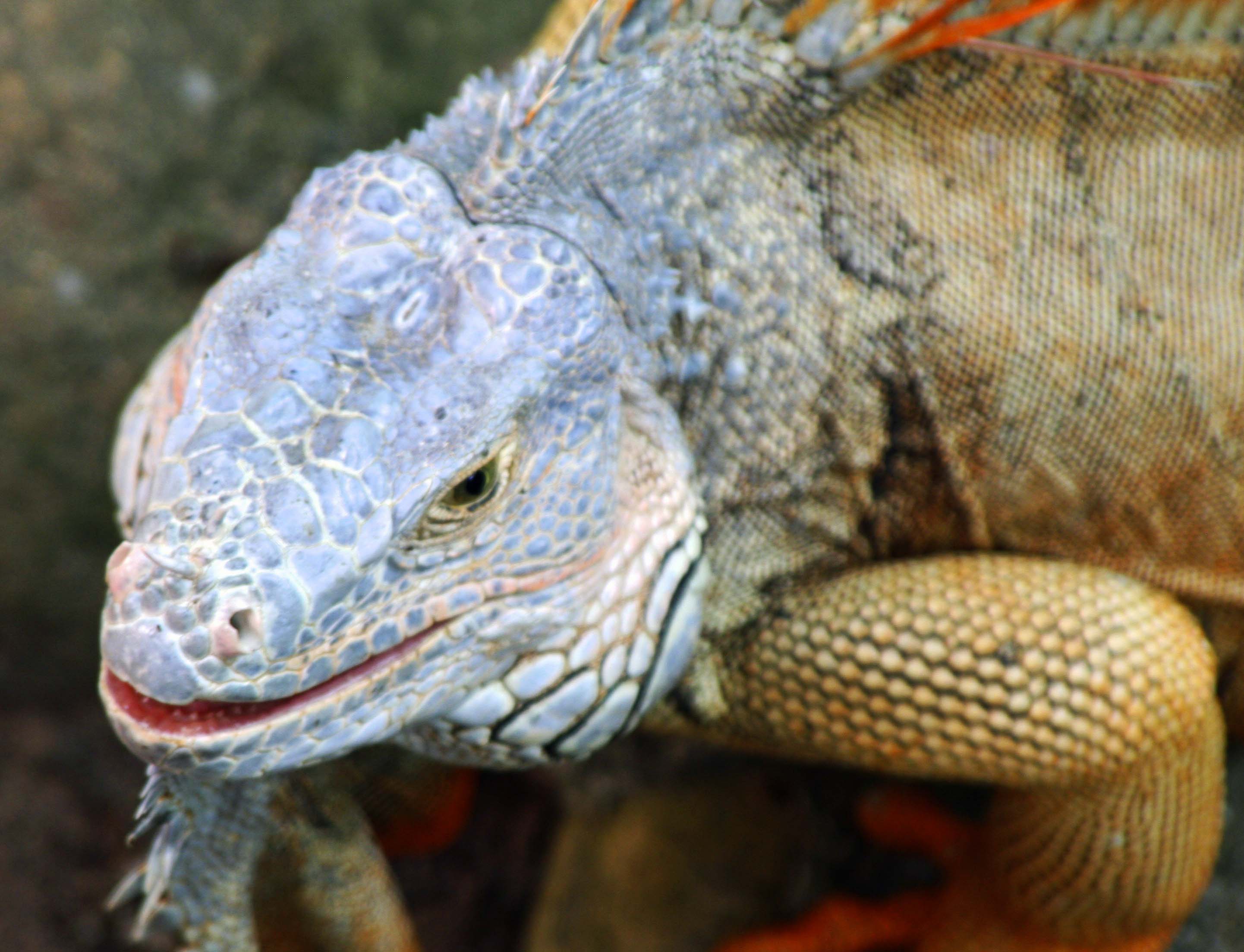
They also have a third eye, located on top of their heads. As eyes go, it is rather primitive. Cells sensitive to light and dark can warn an iguana when something is blocking the sun, such a hawk hovering over its head. One way of escape is to fall out of the tree. If there is a river underneath, you might call it a dive. They are good swimmers and use their powerful tails for locomotion.

Parietal eye of iguana. Photo by Curtis Mekemson.

The small oval on top of the iguana’s head serves as his third eye and is sensitive to light and dark. This photo also shows Big Orange’s leaf-eating teeth.

If a convenient river isn’t present, they land on the ground with a loud plop. Peggy witnessed one such fall. It was a little close for comfort. She was living in Panama at the time with her first husband. Our daughter Tasha, Ethan and Cody’s mom, was splashing around in a baby wading pool in the shade of a palm, when one of the big guys fell out of the tree and crash landed next to the pool.

“The iguana landed flat and seemed stunned. Then he stood up on his legs, shook his head, and wandered off.” Apparently iguanas can fall for up to 50 feet and survive. Whether baby Tasha could survive an iguana falling 50 feet and landing on top of her was another issue. Peggy moved the pool.

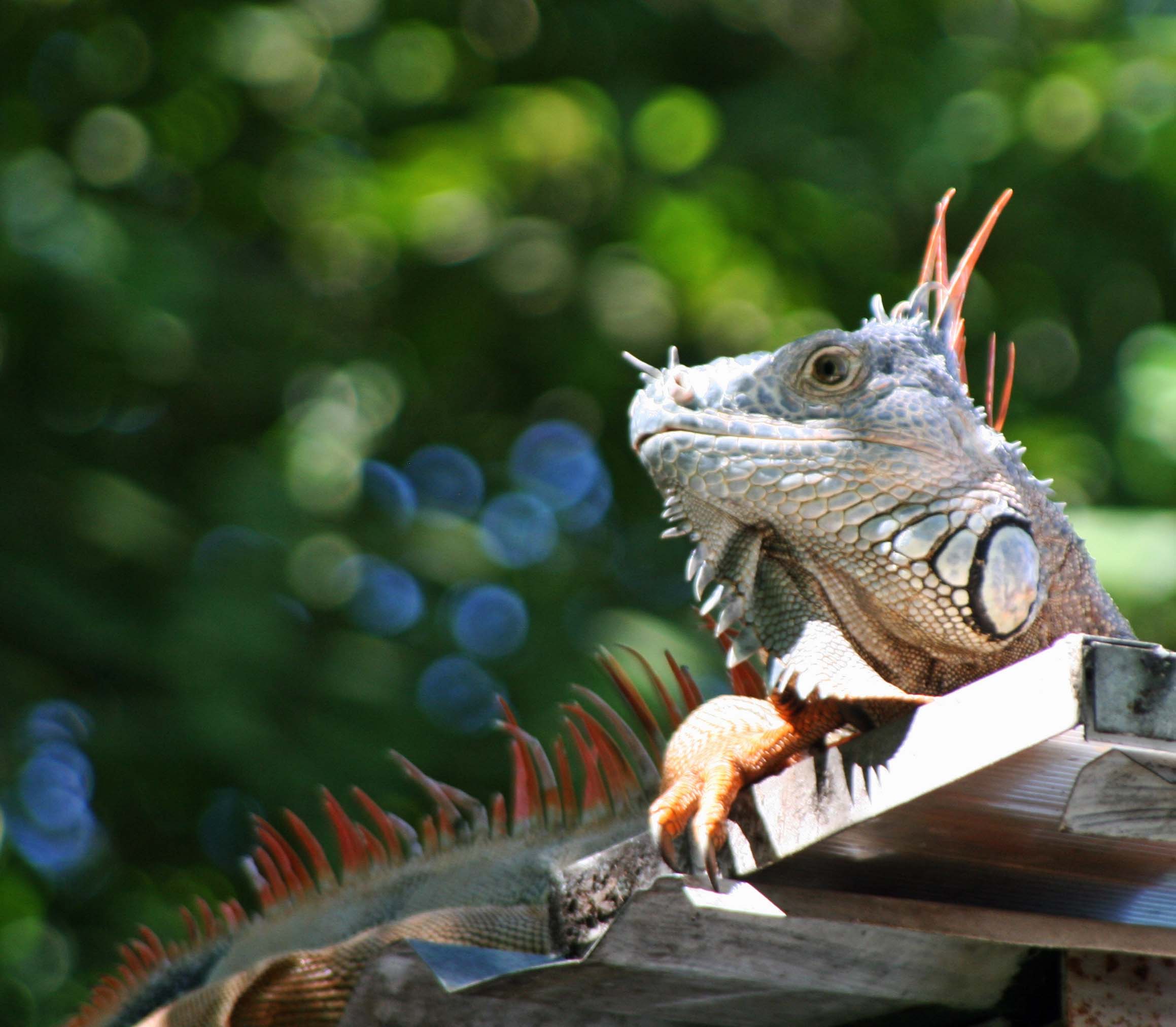
Iguana on roof in Puerto Vallarta. Photo by Curtis Mekemson.

Iguanas are arboreal (live in trees). A convenient roof will do in a pitch, however.

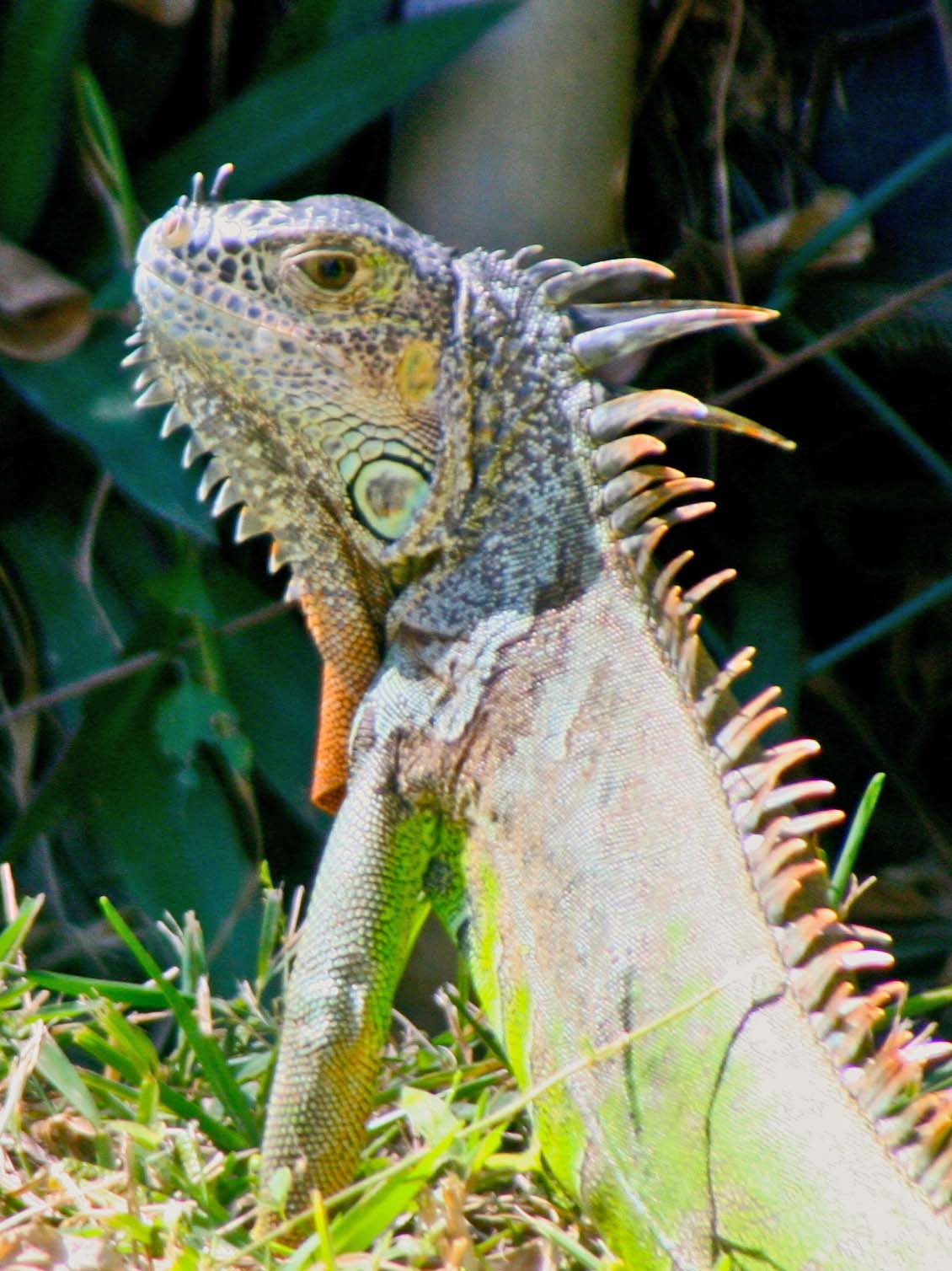
One of the stranger aspects of iguana physiology is a rather large dewlap that hangs down from the chin. I am surprised Big Orange didn’t stumble over his. Male iguanas bob their head and shake their dewlap when trying to impress a lady iguana. They also do the same thing to scare off the male competition. It must get confusing at times.

Large dewlap on Puerto Vallarta iguana. Photo by Curtis Mekemson.

Check out the large dewlap on this iguana. The loose skin hanging down from his chin does double duty, both attracting females and scaring away males. This guy was bobbing his head and shaking his dewlap at a lady iguana.

Human-iguana interaction goes in two very different directions. One, iguanas are used as pets. Their normally benign disposition and bizarre looks makes them quite popular. The downside here is that they require an unusual diet that pet owners frequently fail to provide. Two, they have served as a source of food in South America for over 7000 years. A common name is gallina de palo, which translates chicken of the tree. And yes, you guessed right. They supposedly taste like chicken.

I’ve never eaten an iguana but I did eat a rattlesnake once that tasted like chicken. Eating it, however, was like chewing a rubber band.

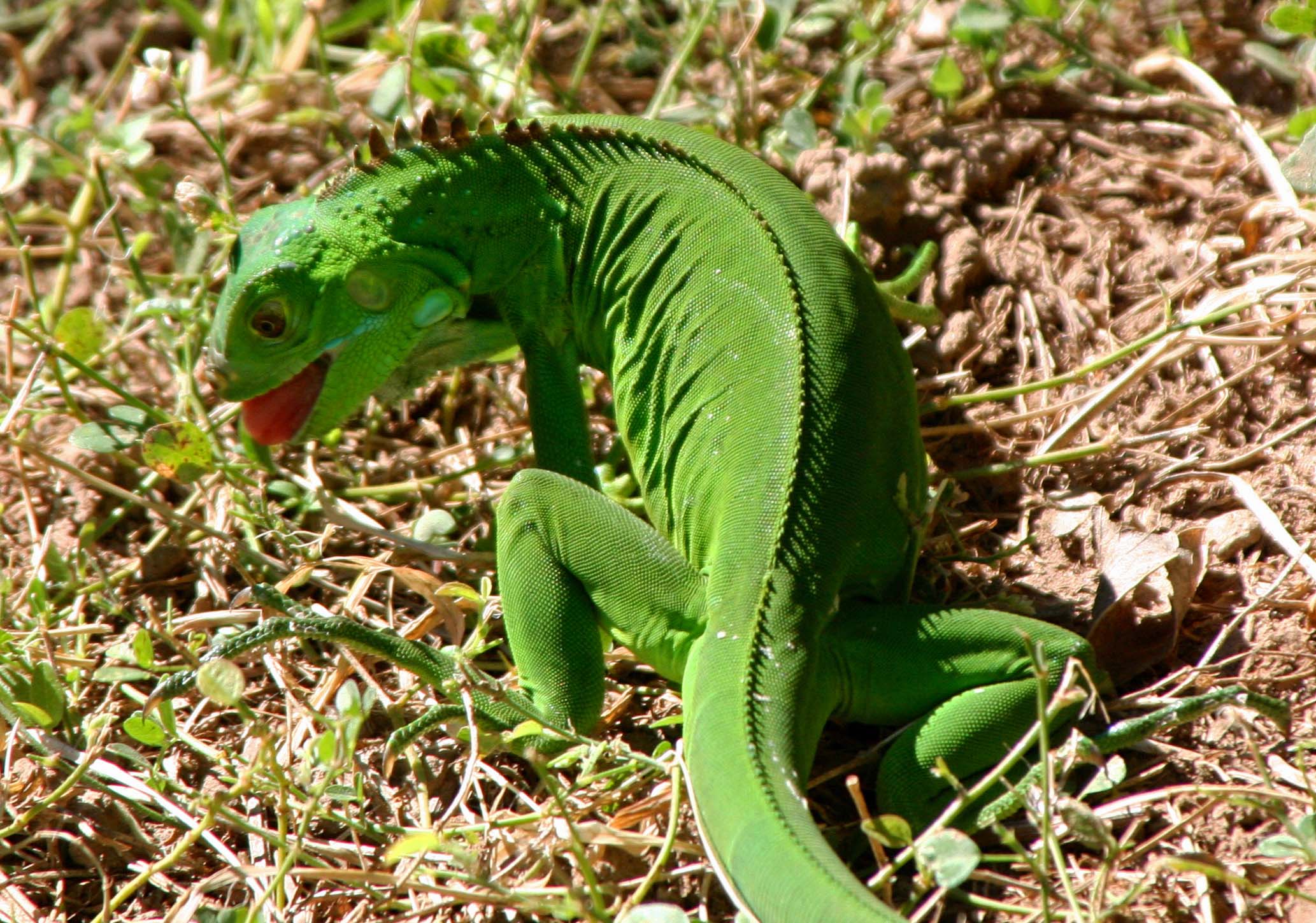
In addition to the iguanas that hang out in the middle of Puerto Vallarta on the Rio Cuale, we had a family in our back yard. The challenge each morning was to try to find where these arboreal lizards were hiding out in the trees. Later in the day they would come down and graze on our grass. Clover was in high demand.

A Mexican Green Iguana. Photo by Curtis Mekemson.

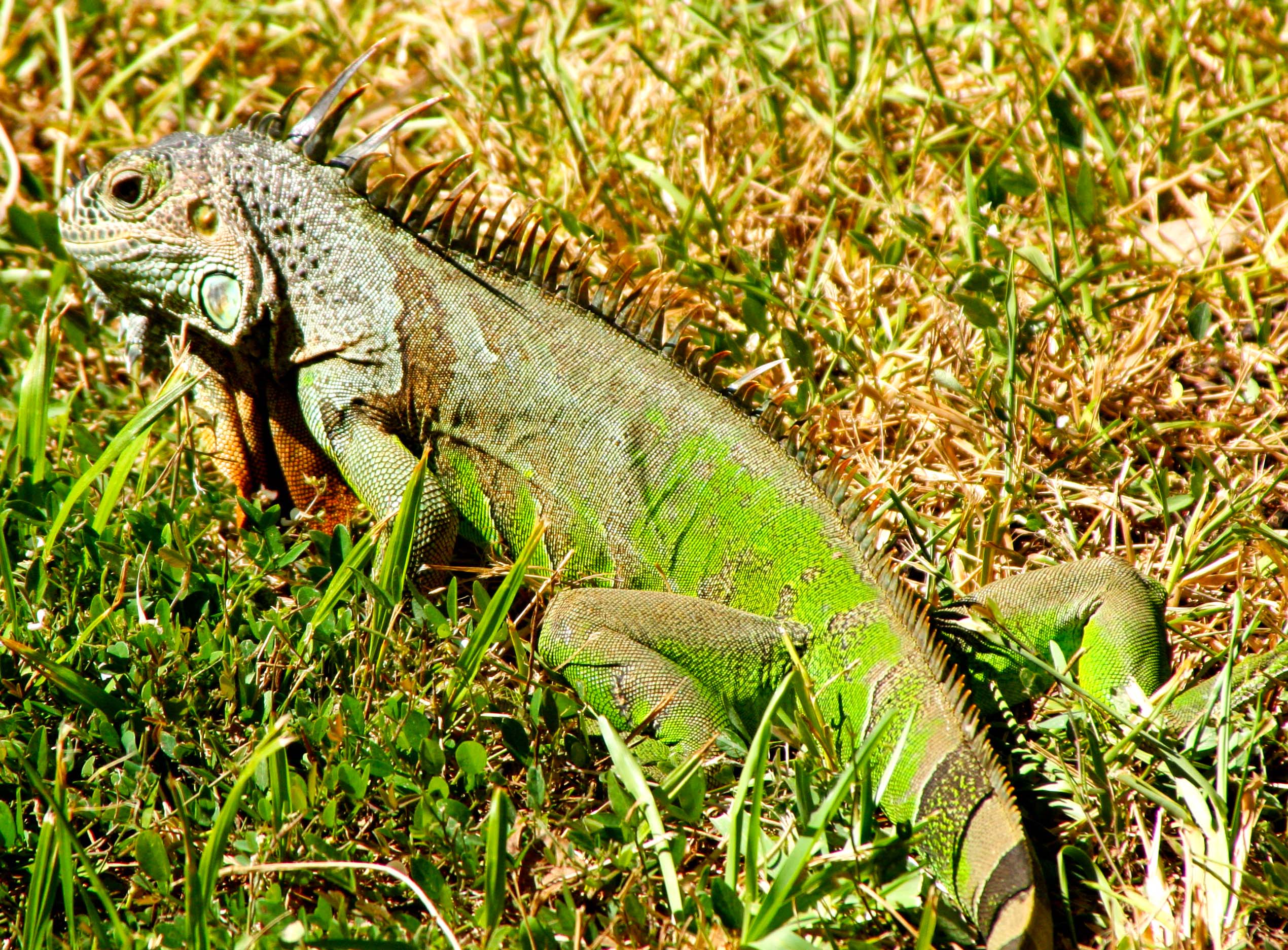
“Come quick, Curt,” Peggy urged. A Green Iguana had come down from its tree and was grazing on the grass in our yard.

Green Iguana in Puerto Vallarta Mexico. Photo by Curtis Mekemson.

The grass-eating iguana ignored me for the most part, until I tried to sneak up on her for a photo. I got the eye. It was pretty much the same look Peggy gives me when I am misbehaving.

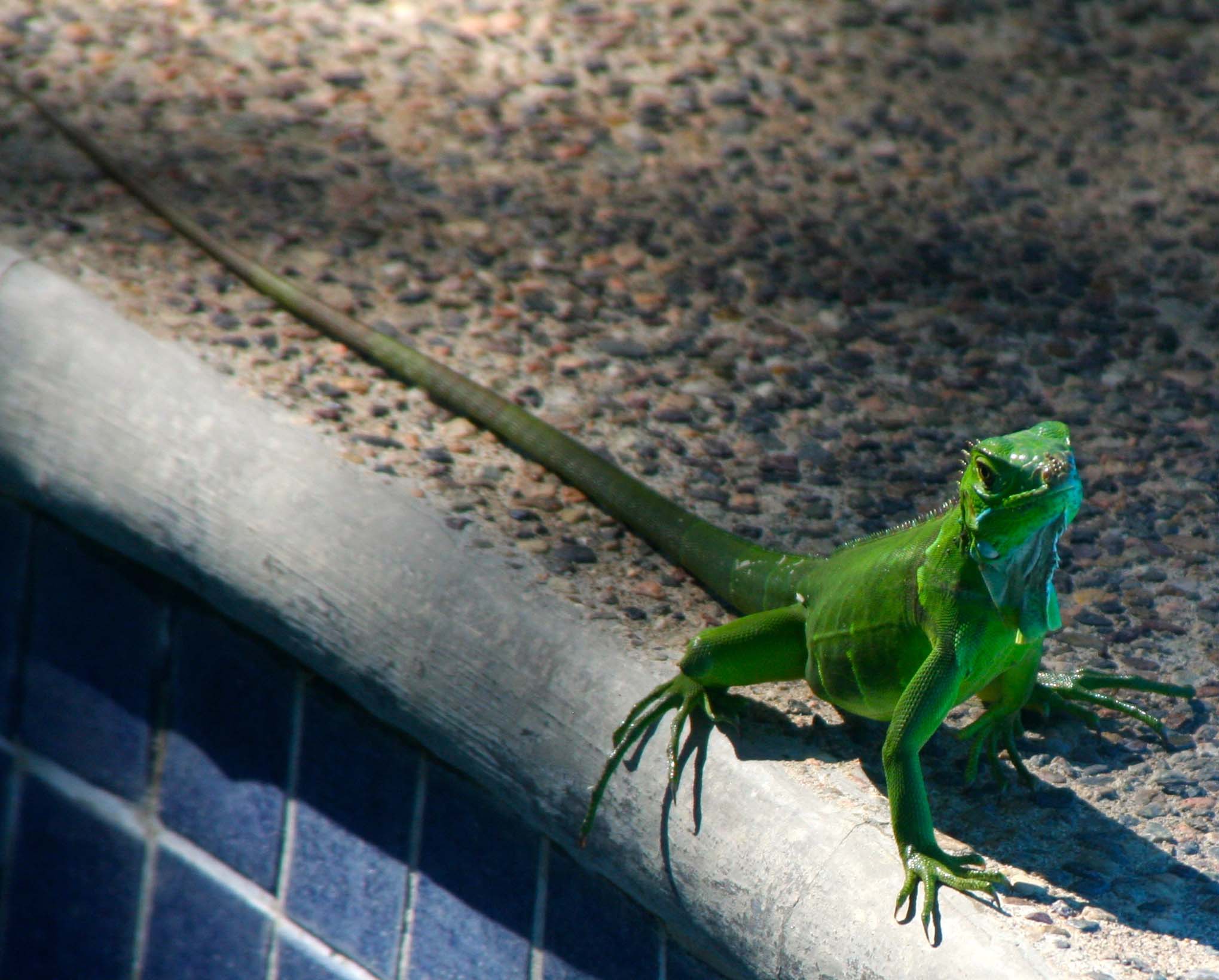
Baby iguana in Puerto Vallarta. Photo by Curtis Mekemson.

While I was sneaking up on the Green Iguana, this youngster came scurrying out next to our pool.

Young iguana grazing on grass in Puerto Vallarta, Mexico. Photo by Curtis Mekemson.

Having satisfied itself that I was not dangerous, the young iguana returned to grazing on our grass. He is about to chomp down on a tender clover leaf.

NEXT BLOG: The peyote influenced art of the Huichol Indians.

What a Wonderful Bird Is the Pelican… A Puerto Vallarta Feeding Frenzy

Pelican hist water upside down in Puerto Vallarta. Photo by Curtis Mekemson.

A Brown Pelican executes an amazing upside down dive to catch fish in Puerto Vallarta as three other pelicans join in the feeding frenzy.

 “What a wonderful bird is the pelican, whose bill will hold more than his belican.” Dixon Merritt

I am enamored with pelicans. These large, gregarious birds that appear to have been created by a committee, skim over the ocean in graceful lines, fly in V formations to distant locations, and crash into the ocean with abandon to catch fish.  Most of my pelican viewing has taken place on the coast of California and Oregon but I have also enjoyed their antics in Florida and the Mediterranean.

California Brown Pelican posed for flight. Photo by Curtis Mekemson.

A Brown Pelican stands on its toes and prepares for flight in California. I called this photo flight-line.

California Brown Pelicans in flight. Photo by Curtis Mekemson.

Shortly afterwards, I caught this photo of the pelicans, along with seagulls in flight.

Petra the pelican of Mykonos. Photo by Curtis Mekemson.

We found this Great White Pelican named Petros holding court on the Greek Island of Mykonos last year on our trip through the Mediterranean.

Petra the Pelican of Mykonos. Photo by Curtis Mekemson.

Petros the Pelican of Mykonos gives me the eye. “You wouldn’t happen to have a fish would you?”

Over the past three weeks I have been enjoying pelicans in Mexico. Peggy and I were particularly lucky to find a large flock of them involved in a feeding frenzy right next to Puerto Vallarta’s boardwalk, the Malecon. I’ve often watched pelicans make their unique dives from a distance; this was up close and personal– as I hope our photos demonstrate. I was also able to videotape them and captured 15 plus dives in a few seconds. The action was wild!

Pelican drains water from bill in Puerto Vallarta. Photo by Curtis Mekemson.

One pelican seems to float in open-billed-amazement as two other pelicans crash into the ocean. Actually pelicans have to drain the water out of their mouths before swallowing their catch, which is what this fellow is doing.

Pelican shows throat pouch in Puerto Vallarta. Photo by Curtis Mekemson.

Check out the size of the Brown Pelican throat pouch here.

Pelicans prepare to dive in Puerto Vallarta, Mexico.

Hovering in flight, pelicans prepare to dive. (Photo by Peggy Mekemson.) The terns, BTW, are hoping to participate in the feast and will happily steal fish from the pelicans.

Brown Pelican in Puerto Vallarta hovers above the water in search of fish. Photo by Curtis Mekemson.

Preparing for a high dive…

Brown Pelican takes flight off of Banderas Bay in Puerto Vallarta. Photo by Curtis Mekemson.

Brown Pelican takes off from water.

Brown Pelican appears to walk on water in Puerto Vallarta.

And this guy appears to be walking on water. (Photo by Peggy Mekemson.)

Brown Pelican dives toward the water of Banderas Bay in Puerto Vallarta.

A Brown Pelican plunges toward the water. (Photo by Peggy Mekemson.) Note the pouch filled with water on the lower right.

Pelican diving for fish in Puerto Vallarta, Mexico.

Plunging into the water. (Photo by Peggy Mekemson.)

Brown Pelicans demonstrate different aspects of fishing in Banderas Bay, Puerto Vallarta. Photo by Curtis Mekemson.

A small portion of the flock, some 17 pelicans, demonstrate various aspects of fishing.

Pelican feeding frenzy in Puerto Vallarta.

Hard to tell who is doing what, here. (Photo by Peggy Mekemson.) Liked the graceful tern on the left.

Pelicans feeding in Banderas Bay, Puerto Vallarta Mexico.

Or here. But I really liked the wing action. (Photo by Peggy Mekemson.)

Now it is time to put all of the action together in a brief video…

Pelican caught in sunset glow at Puerto Vallarta, Mexico. Photo by Curtis Mekemson.

A pelican flies toward its nest at the end of the day.

NEXT BLOG: Having featured the Brown Pelicans of Puerto Vallarta, I’ll move on to feature the Green Iguanas.

Watson Lake: A Forest of 70,000 Signs… North to Alaska

If you look closely, you just might find your hometown among the 70,000 signs of Watson Lake.

If you look closely, you just might find your hometown among the 70,000 signs of Watson Lake.

When you are driving north to Alaska and enter the Yukon Territory, the first major town you come across is Watson Lake. The community has a strange claim to fame: a forest of signs from 70,000 communities around the world. People travelling the road have been leaving them behind for 70 years; they represent towns, cities, businesses, individuals and organizations.

According to legend, it all started in 1942 when a homesick GI who was helping build the Alaska Highway put up a sign that pointed toward his home and listed the miles. Ever since people have continued the tradition of saying “I was here.”

Peggy and I, along with our friends Bob and Linda Bray, wandered through the sign forest looking for our hometowns (no luck). It was like entering a maze. The following photos provide some perspective on what it is like, but you truly have to be there to get the whole effect.

Watson Lake sign forest

This close up provides an idea of how closely the signs are packed together and how far people have come to place them here. (Photo by Peggy Mekemson)

My friend Bob Bray, provides a perspective on how high the "trees" in the forest are.

My friend Bob Bray, provides a perspective on how high the “trees” in the forest are. (Photo by Peggy Mekemson)

Watson Lake sign forest in Yukon Territory.

Just about anything can be turned into a sign, as this toilet seat demonstrates. Also note the skull. How about “Parking for Estonians Only.”

I wonder how many street signs from around the world have been ripped off to make their way to the Yukon Territory?

I wonder how many of these street and town signs from around the world were stolen before making their way to the Yukon Territory?

The Watson Lake Sign Forest also features equipment used in making the Alaska Highway. In this case, Peggy serves as my model. Later I will do a blog on the building of the Alaska Highway in 1942.

The Watson Lake Sign Forest also features equipment used in making the Alaska Highway. In this case, Peggy serves as my model. Later I will do a blog on the building of the Alaska Highway, which took place in 1942 under the threat of Japanese invasion.

Speaking of the Alaska Highway, it was also featured in the forest.

Speaking of the Alaska Highway, it was also featured in the forest. (Photo by Peggy Mekemson)

Just outside of the sign forest, we stopped at the corner of 9th Street and the Alaska Highway. It was time to continue our journey.

The Watson Lake Sign Forest provided an interesting stop on our way north to Alaska.  But it was time to hit the road. (Photo by Peggy Mekemson)

NEXT BLOG: In 1980 Mt. St. Helen, located in the state of Washington, blew its top and became one of the world’s most famous volcanoes. Peggy and I stopped by for a visit on our way home from Alaska. (I am presently at Burning Man and will return next week to begin the Burning Man 2013 series.)

The Beavers of Toad River… North to Alaska

Beaver lodge on the Toad River.

The view out the back window of our van at Toad River. The beaver lodge is in the foreground.

By the time we reached Toad River in Northern British Columbia on the Alaska Highway, we were ready to call it a day. Peggy and I had stopped at the lodge on a previous trip for lunch. The restaurant claims to have the largest collection of baseball caps in the world. If you make the trip, be sure to stop by and look up at the 7,000 on the ceiling.

Toar River Lodge in northern BC

The lodge on the Toad River had an RV park and Internet. It turned out to be one of the best Internet connections we had on the Alaska Highway.

Toad River Lodge caps in northern BC.

Some 7000 caps decorate the ceiling of the restaurant at Toad River Lodge.

Kodiak Coast Guard cap at Toad River Lodge.

Since we are on our way to visit our son Tony who flies helicopters for the Coast Guard in Kodiak, I took this photo.

The Toad River Lodge had this toad for sale.

The Toad River Lodge had this toad for sale.

As to how Toad River got its name, the residents claimed it was originally Towed River dating from the days when the Alaska Highway was being built in the 1940s and heavy equipment had to be ferried across the river. Wikipedia claims the name came from big toads living next to the water. Peggy and I heard large toads croaking that night. Maybe it was our imagination.

We backed into our campground and immediately discovered a beaver lodge was built in the pond directly behind our van. Closer inspection revealed busy beavers buzzing about. You’ve undoubtedly heard the comment, “busy as a beaver.” It means really busy and there is a reason for its use. Beavers work hard. There are trees to bite down, lodges and dams to be built, food to gather, territories to protect, and children to raise.

Families are important. Mom and dad mate for life and both parents take care of the kids. Teenagers hang around for a year or two and help babysit. Everyone chips in on dam and lodge building.

Pop very carefully marks the family property. A lot of work has gone into improvements. No trespassing signs consist of small piles of debris dredged up from underwater, deposited on land, and then marked by anal gland secretions. I watched a beaver perform this task when I was backpacking in the Wind River Mountains of Wyoming. He backed up to the pile, raised his tail, and let go. Invading beavers that cross over property lines are quickly run out of town. It can get nasty.

Beavers are known for modifying the landscape by building dams across small creeks and then building their homes of lodges in the lakes that are created. No other animal, with the exception of man, has such an impact on the environment. And beavers don’t have to file EIRs, obtain building permits, or worry about zoning laws. Lodges, or homes, consist of one or two rooms with underwater entrances.
Ducks, frogs, and trout love the riparian habitats created by beavers. Farmers are less pleased with their activities and frequently tear down the dams. New ones are promptly built overnight. We watched our busy beavers for an hour or so. They were mainly busy with stuffing their tummies. Have another bite of bark. Yum.
Beaver dam on Toad River in northern British Columbia.

Looking down on the beaver dam at Toad River. A beaver can be seen on the left center of the photo.

Beaver dam on Toad River in northern BC

Looking up at the beaver dam across the pond at the beaver lodge. Still green leaves suggest that the dam is a work in progress.

Beaver lodge on the Toad River in British Columbia.

Another perspective on the beaver lodge.

Beaver eating on Toad River in northern BC

Beaver chomps down on limb. Check out the claws. (Photo by Peggy Mekemson)
Beaver on Toad River in northern BC

The beaver stopped eating to look at me. Is he grinning?

Beaver eating on the Toad River in northern British Columbia.

This guy was working on his dinner. Note the chunk of bark in his mouth. He is holding it with his paw. (Photo by Peggy Mekemson)

Beaver swimming on Toad River in northern BC

I like this shot Peggy took because you can see the beaver’s body under the water. (Photo by Peggy Mekemson)

Beaver and beaver lodge on Toad River

A final photo featuring a beaver, beaver lodge, and mountain. (Photo by Peggy Mekemson.)

Next Blog: The sign forest of Watson Lake.


The Delicate Art of Chainsaw Wood Carving: Part 2… North to Alaska

Peggy, who had just been kayaking on Dragon Lake in Quesnel, BC was immediately attracted to this dragon wood carving in Chetwynd.

Peggy, who had just been kayaking on Dragon Lake in Quesnel, BC, was immediately attracted to this dragon wood carving in Chetwynd. (Photograph by Peggy Mekemson)

On Monday I provided an introduction to the art of wood carving with a chainsaw in Hope, British Columbia. Today we will see what Chetwynd, BC has to offer. As I mentioned earlier, Chetwynd holds an annual contest in June that attracts wood carvers from around the world. We quickly found that the number and variety of carvings was even greater than we had found in Hope. I was amazed at what could be accomplished in 36 hours. it made me think about the months and even years, sculptures spend working on a block of marble.
Chainsaw wood carving at Chetwynd, BC

I was more entranced by this scary pumpkin scarecrow.

Chainsaw wood carving at Chetwynd, BC

A close up of the head. How would you like to meet up with this guy on a dark night?

Chainsaw wood carving in Chetwynd, BC

The complete sculpture. Like Scarecrow in Oz, he had straw stuffing trying to escape.

A close up of the head on Peggy's dragon. (Photo by Peggy Mekemson)

A close up of the head on Peggy’s dragon. (Photo by Peggy Mekemson)

Chainsaw woodcarving at Chetwynd, BC

Was this crusty gold miner saying “Don’t take my photo”?

Chainswa wood carving in Chetwynd, BC

A close up of the miner’s face in Chetwynd, BC.

Chainsaw wood carving in Chetwynd, BC

I found the perspective on this bear totem pole interesting.

Chainsaw carving in Chetwynd, BC

Deer totem pole.

Chainsaw wood carving in Chetwynd, BC

An eagle lands to feed its chick. (Photograph by Peggy Mekemson)

Chainsaw wood carving in Chetwynd, BC

A bear tries to raid an eagle’s nest. The eagle objects.

Chainsaw wood carving in Chetwynd, BC

The Thinker? (Photograph by Peggy Mekemson)

Chainsaw woodcarving in Chetwynd, BC

Another perspective. This ram had quite a set of horns.

Chainsaw wood carving in Chetwynd, BC

A Samurai warrior.

Chainsaw wood carving in Chetwynd, BC

A carved relief on the side of the Chetwynd, BC Visitor Center of St. George slaying the dragon.

It seems appropriate to end this blog on Chetwynd, BC chainsaw wood carving with a moose.

It seems appropriate to end this blog on Chetwynd, BC chainsaw wood carving with a moose.

Chainsaw carving in Chetwynd, BC

Another photo of the moose.

Next Blog: The busy beavers of the Toad River.

When Your Campground Goes to the Dogs… North to Alaska

Peggy decided to go kayaking on beautiful Dragon Lake near Quesnel BC for her birthday.

Peggy decided to go kayaking on beautiful Dragon Lake near Quesnel BC to celebrate her birthday.

It was Peggy’s birthday. We picked out a nice campground near Quesnel, BC and declared a layover day. I am expected to celebrate the day appropriately. When we first got married Peggy told me that forgetting her birthday was grounds for divorce. Apparently her first husband missed one…

I’d been careful when leaving home to pack candles, animals, and a hanging birthday sign. “What’s with the animals?” you ask. Peggy’s family has a tradition. Over the years they have gathered dozens of miniature plastic and metal animals. Several of them are placed on the birthday cake. The person having the birthday is then expected to make the sound each animal makes. Like what sound does a hippopotamus make? I’ve been known to leave town on my birthday.

I gathered cards, gifts and a birthday pie along the way. Our friends Bob and Linda joined us and I explained the animals. Peggy then made the necessary growls, grunts, coughs, chest pounds, etc. and had a good time. It appears I am married for another year.

What we didn’t realize was that our campground was about to go to the dogs. Robert’s Roost Campground was hosting dog agility trials. Our campground filled up with dogs of all breeds, shapes and sizes. We went over to watch the action. The dogs are expected to run through tunnels, climb over bridges, weave in and out of a line of sticks, and leap over hurdles in a timed performance. Their owners run along beside shouting instructions. I think the owners work harder than the dogs.

Dog agility trial

A number of hurdles had been set up for the dogs. (Photo by Peggy Mekemson)

Dog agility trials at Quesnel BC

Hurdles are set at different heights to accommodate dog size.

Dog agility trials at Quesnel BC.

This guy seemed to float over his hurdle. “Jump!” his owner urged. (Photo by Peggy Mekemson)

Dog agility trials at Quesnel, BC

An even smaller dog weaves his way through the poles. (Photo by Peggy Mekemson)

Peggy captured the passion this dog was showing.

Peggy captured the passion this dog was showing. (Photo by Peggy Mekemson)

Dog agility trials at Quesnel, BC

Another shot that captures the intensity of the dogs participating in the agility trials. (Photo by Peggy Mekemson)

Dog agility trials at Quesnel, BC

Stepping out on the bridge at the dog agility trials.

Another dog challenges the bridge. This time from the opposite direction.

Another dog challenges the bridge. This time from the opposite direction.

Dog agility trials at Quesnel, BC.

Tunnel exit at dog agility trials. (Photo by Peggy Mekemson.)

Bob and Linda's dog, Sister, stands in our shadows and watches the action. Sister decided that much more than "Good dog," would be required for her to leap over hurdles.

Bob and Linda’s dog, Sister, stands in our shadows and watches the action. She decided that much more than “Good dog,” would be required for her to leap over hurdles.

Next Blog: Busy as a beaver on Toad River

Wood Carving with a Chainsaw… North to Alaska

Fraser River, Hope BC

Hope, British Columbia sits on the Fraser River. This photo is taken from the river park in front of the town.

Peggy and I have ventured into British Columbia several times. And we have always been impressed. This time is no exception. The natural beauty, abundant wildlife, proud communities and friendly people guarantee our return– again and again.

We are also amused by the efforts of small communities to capture their moments of fame and share of tourist dollars. The world’s largest cross-country skis, the world’s largest beehive, and the world’s largest golf ball are all examples. These fun gestures make us smile. Out come our cameras for the obligatory photos.

The world's tallest cross country skis.

The world’s tallest cross-country skis.

Chainsaw wood carving exists on another level. This once primitive art form has taken on a surprising level of sophistication. Two towns we passed through on our journey north to Alaska featured chainsaw creations: Hope is an hour or so from the border of Washington State; Chetwynd is near Dawson Creek, the beginning of the Alaska Highway.

The helpful folks at the Chetwynd Information Center explained how they had obtained their extensive collection of carvings. Each year the town hosts a chainsaw wood carving contest. Participants come from all over the world. The process starts with importing logs from Vancouver Island. The logs dry for several months and are then tagged with numbers. Individual participants draw numbers to see which log he or she gets. Contestants then have 35 hours over five days to complete their masterpieces.

Today I am featuring Hope, which is located on the mighty Fraser River. Chetwynd will be featured two or three blogs up the road.

Woodcarvings in Hope BC

Hope is quite proud of its chainsaw woodcarvings. A map from the Visitor’s Center took us on a walk to find the town’s sculptures.

Woodcarvings in Hope BC

These herons are an example of how sophisticated chainsaw wood carving has become.

Chainsaw woodcarving in Hope BC

Animals are a common subject for chainsaw woodcarvers.

Chainsaw woodcarving in Hope BC

A pair of wolves.

Chainsaw carving in Hope BC

Fantasy figures, such as this wizard, also serve as common themes for chainsaw carvings. Note the mouse living in his beard.

Chainsaw woodcarving in Hope BC

The wizard also wore an eyeball ring.

Many of the chainsaw woodcarvings in Hope, BC display a sense of humor such as this tourist with a guidebook in his hip pocket.

Many of the chainsaw wood carvings in Hope, BC display a sense of humor such as this tourist with a guidebook in his hip pocket. Another carving can be seen on the next block.

Chainsaw woodcarving in Hope BC

Speaking of humor, I found this face on a statue of Bigfoot rather funny.

Chainsaw woodcarvings in Hope BC

In my last blog I featured totem poles. Given the First Nation influence in British Columbia, it was not surprising to find Raven as one of the wood carvings.

Chainsaw woodcarving in Hope BC

This eagle and girl also represented a First Nation theme.

I also found this face rather powerful.

I found this face rather powerful.

Stallones First Blood in Hope BC

My friend Bob decided to look tough in this Rambo photo board outside of the Hope Visitor Center. Stallone’s “First Blood” was filmed in the town.

Peggy and Linda share a laugh on the edge of the Fraser River at Hope BC.

Peggy and Linda share a laugh on the edge of the Fraser River at Hope BC. Possibly they were amused at Bob’s effort to look like Stallone.

Next Blog: When a campground is taken over by dogs.

Sailing Off into the Sunset… And On to New Adventures

Mediterranean sunset.

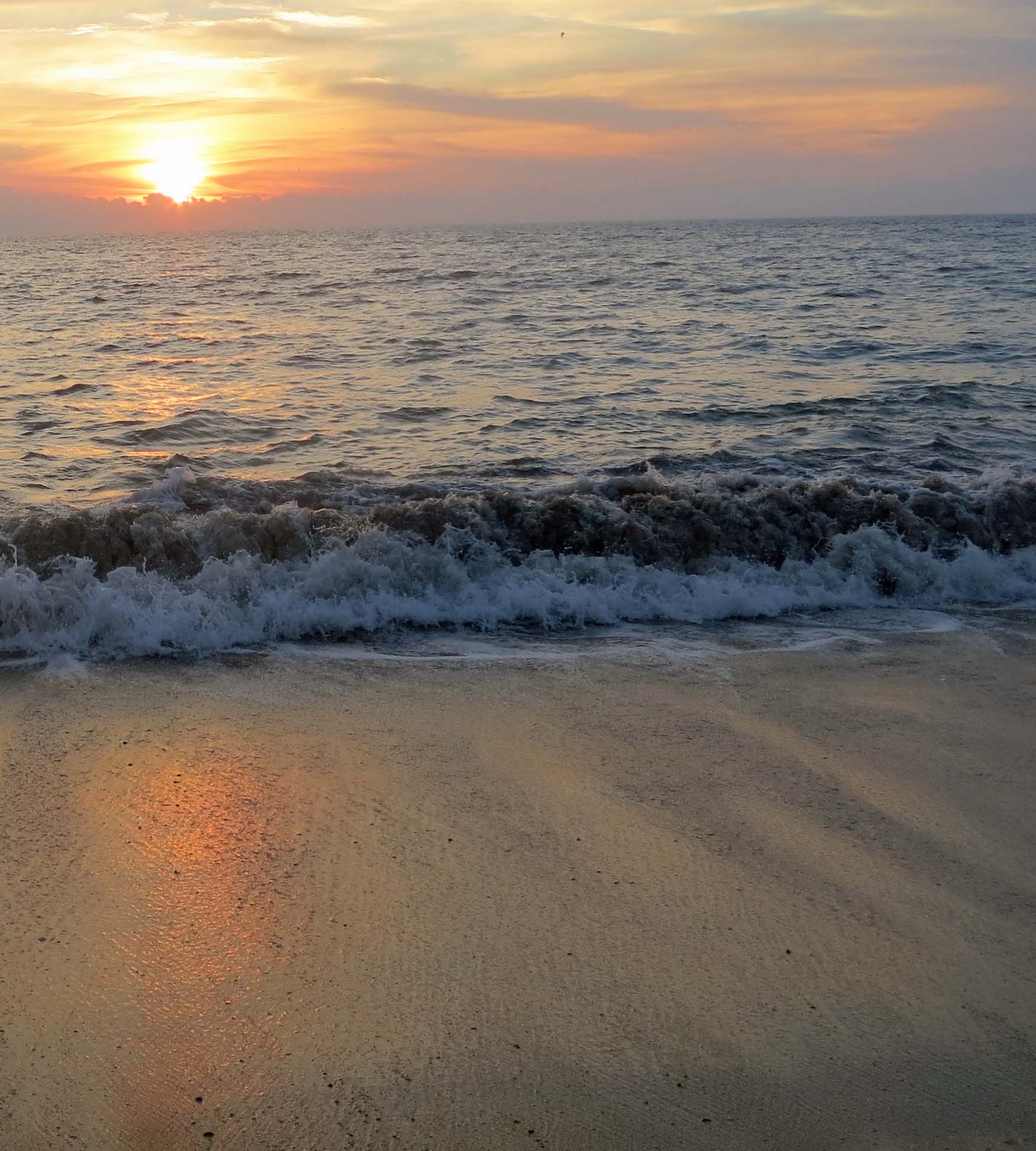
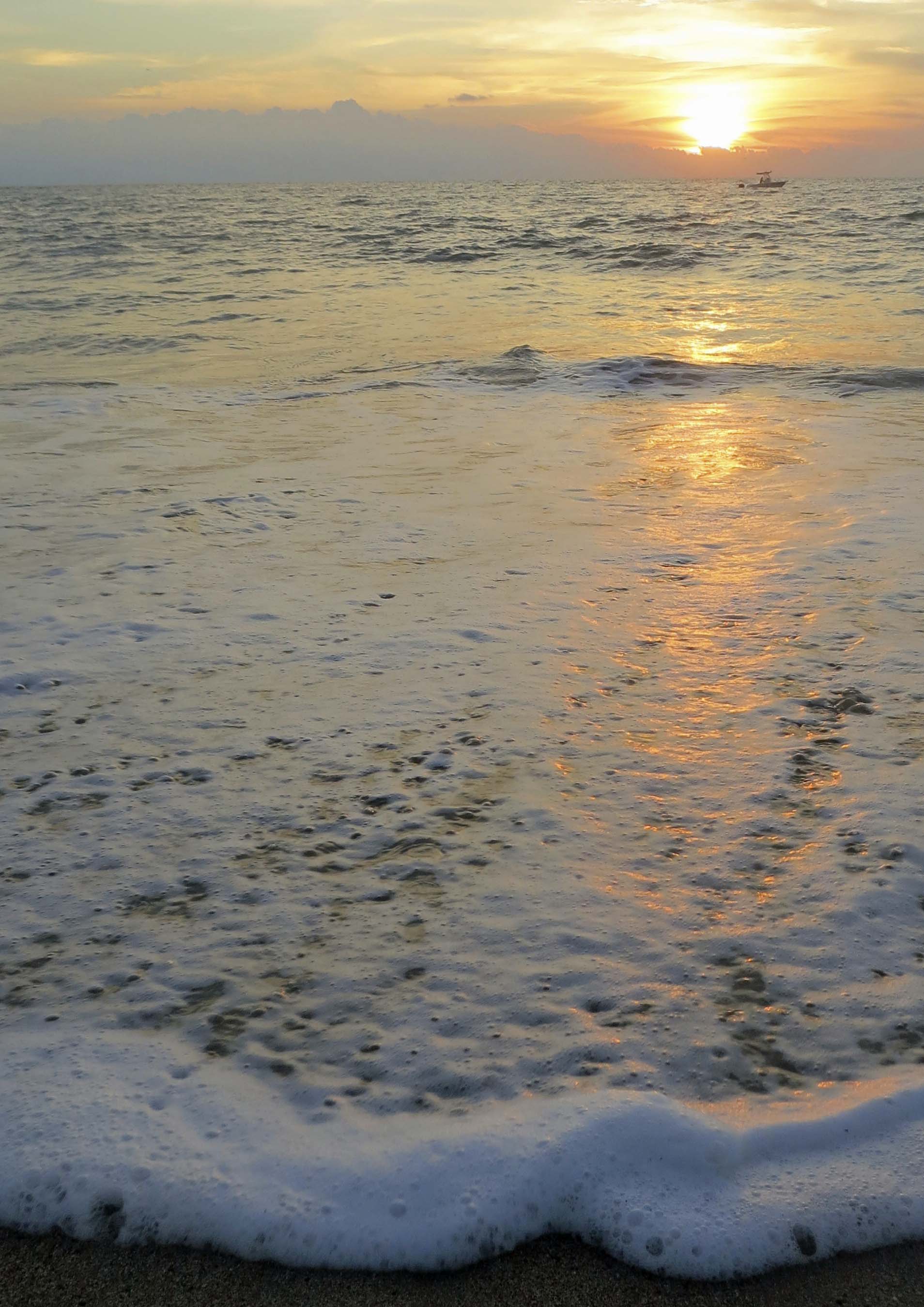
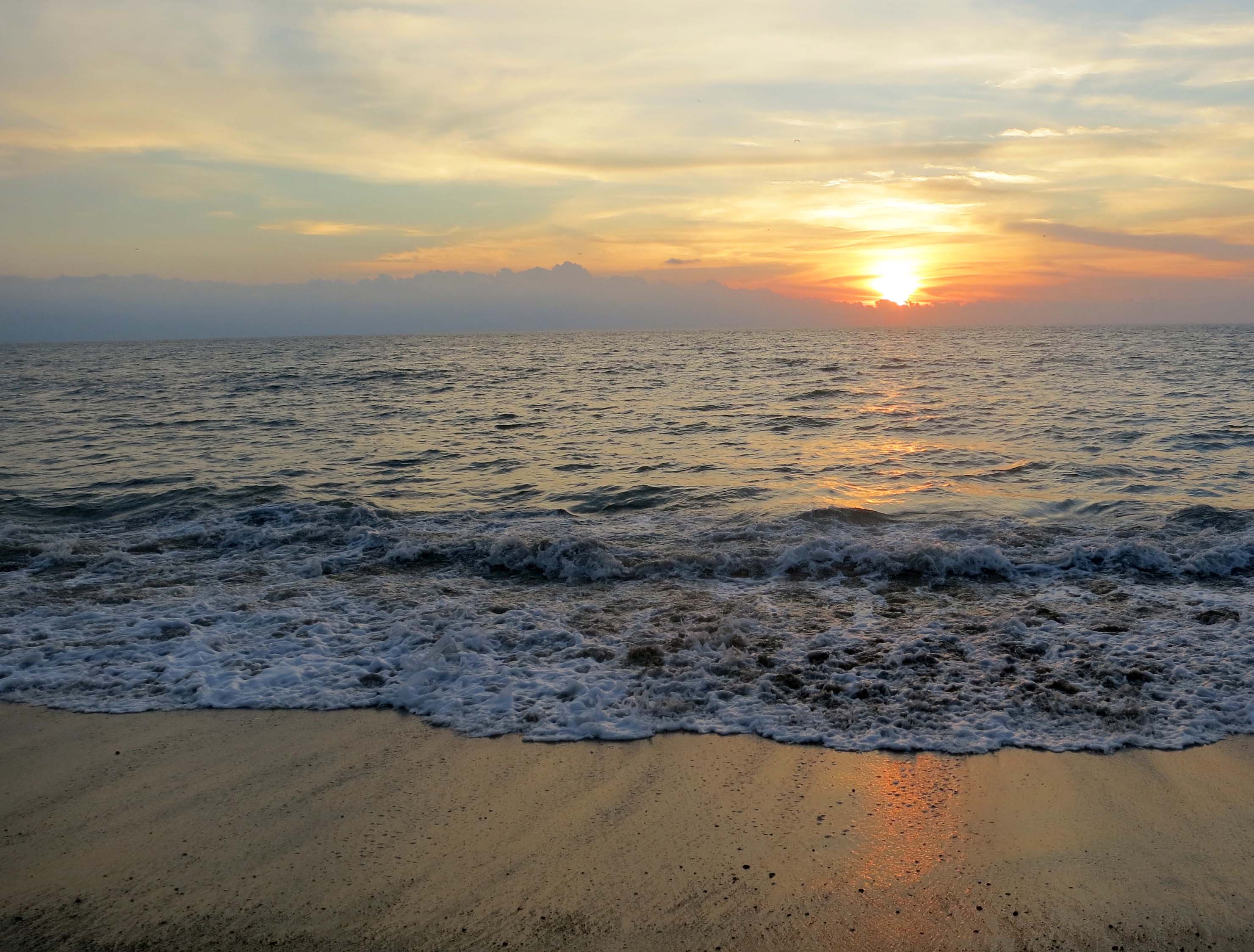
What’s not to like about a beautiful sunset. This one took place off the southern coast of Italy in the Mediterranean Sea.

I am a sucker for sunsets, which is a good thing. Sunsets, waves and spectacular cloud formations are what pass for scenery on the open ocean. My dad, who started and ended his life as a painter, dismissed sunsets as postcard pictures. Nevertheless, when I went through several thousand of his photos after he died, I discovered numerous photos of the setting sun. Nobody can resist a beautiful sunset. Along with fireworks, they are the number one cause of oohs and ahs.

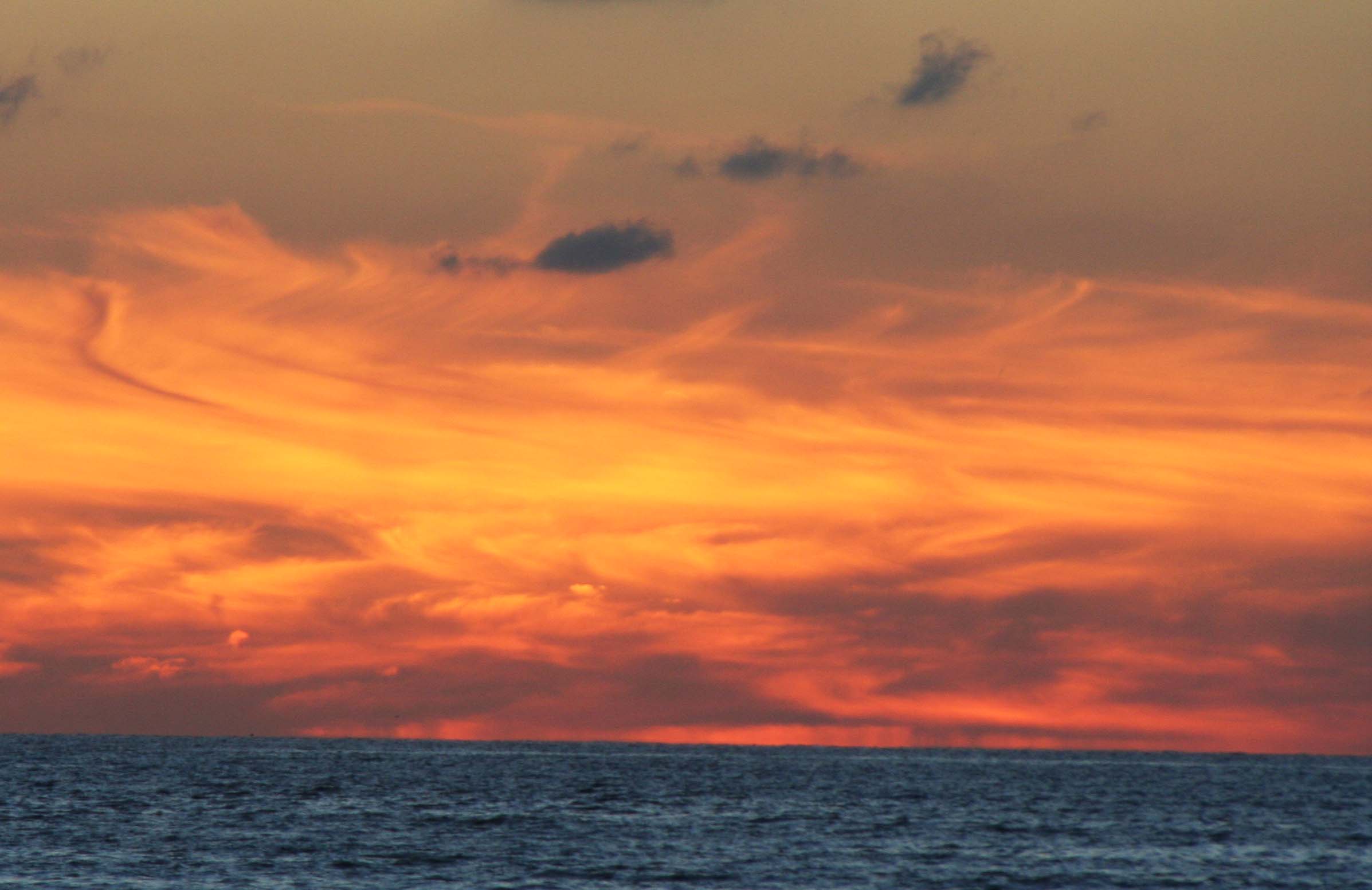
Mediterranean sunset off the coast of Southern Italy.

A close up of the same sunset shown above.

As for sailing off into the sunset, sailors have been doing this since the first sail was invented. (The western heroes of my youth rode off into the sunset, instead. After doing in the bad guys, they would kiss their girls goodbye– probably on the cheek, climb on their faithful horses, and ride off into the west as the sun sank behind the horizon and the picture slowly faded. “Hi-o Silver away!”)

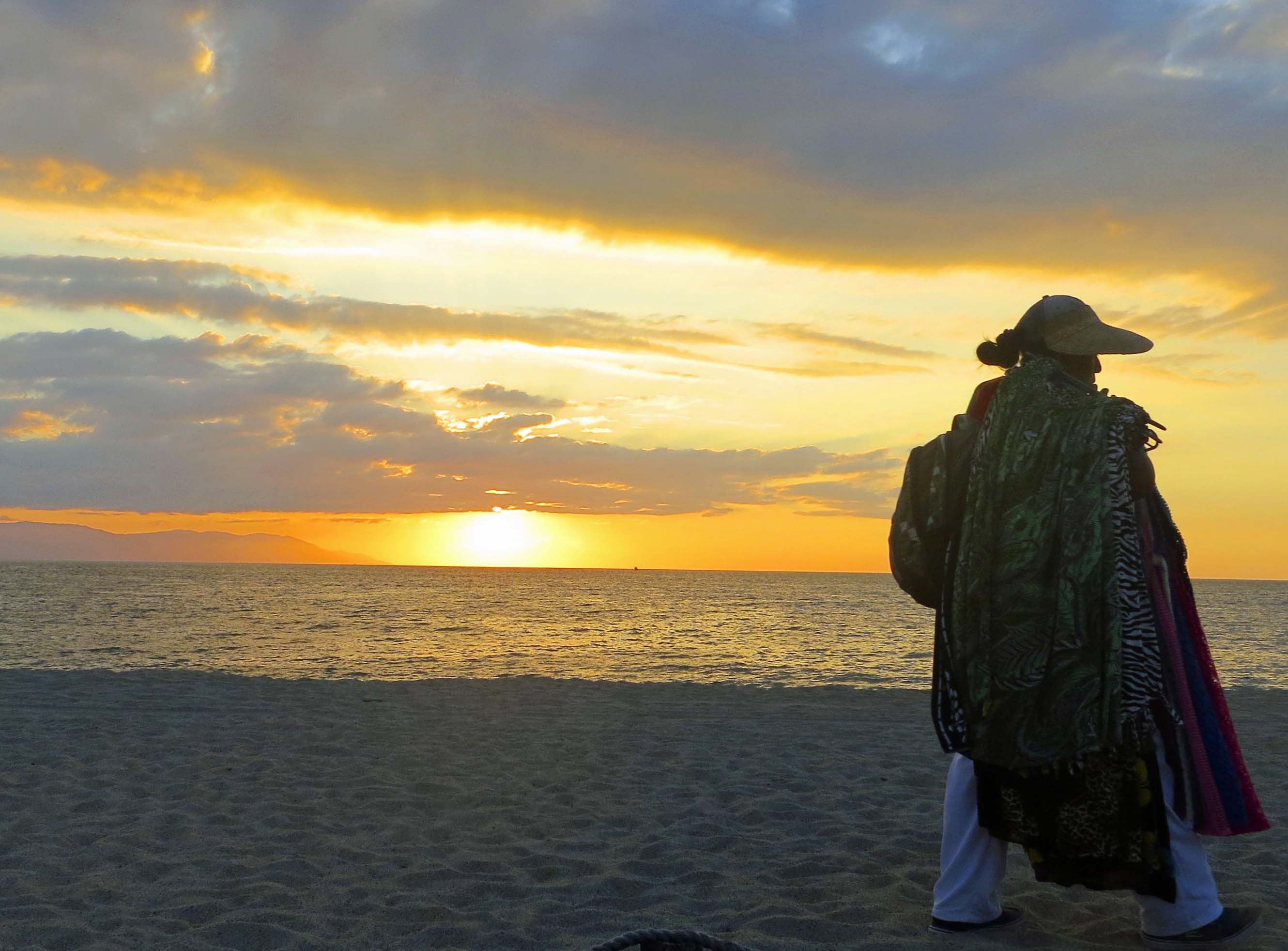
Once we left our farthest point to the east, Kusadasi, Turkey, we sailed into the west all the way to Galveston, Texas. Since our ship inevitably pulled out of port in late afternoon, there were ample opportunities for sunset photos. I decided that a few of these sunsets, along with some cloud formations, would make a fitting end for my series on Mediterranean Ports.

Sun shining through clouds on the Atlantic Ocean.

Sun shining through clouds can be quite dramatic. We took this photo in the Atlantic.

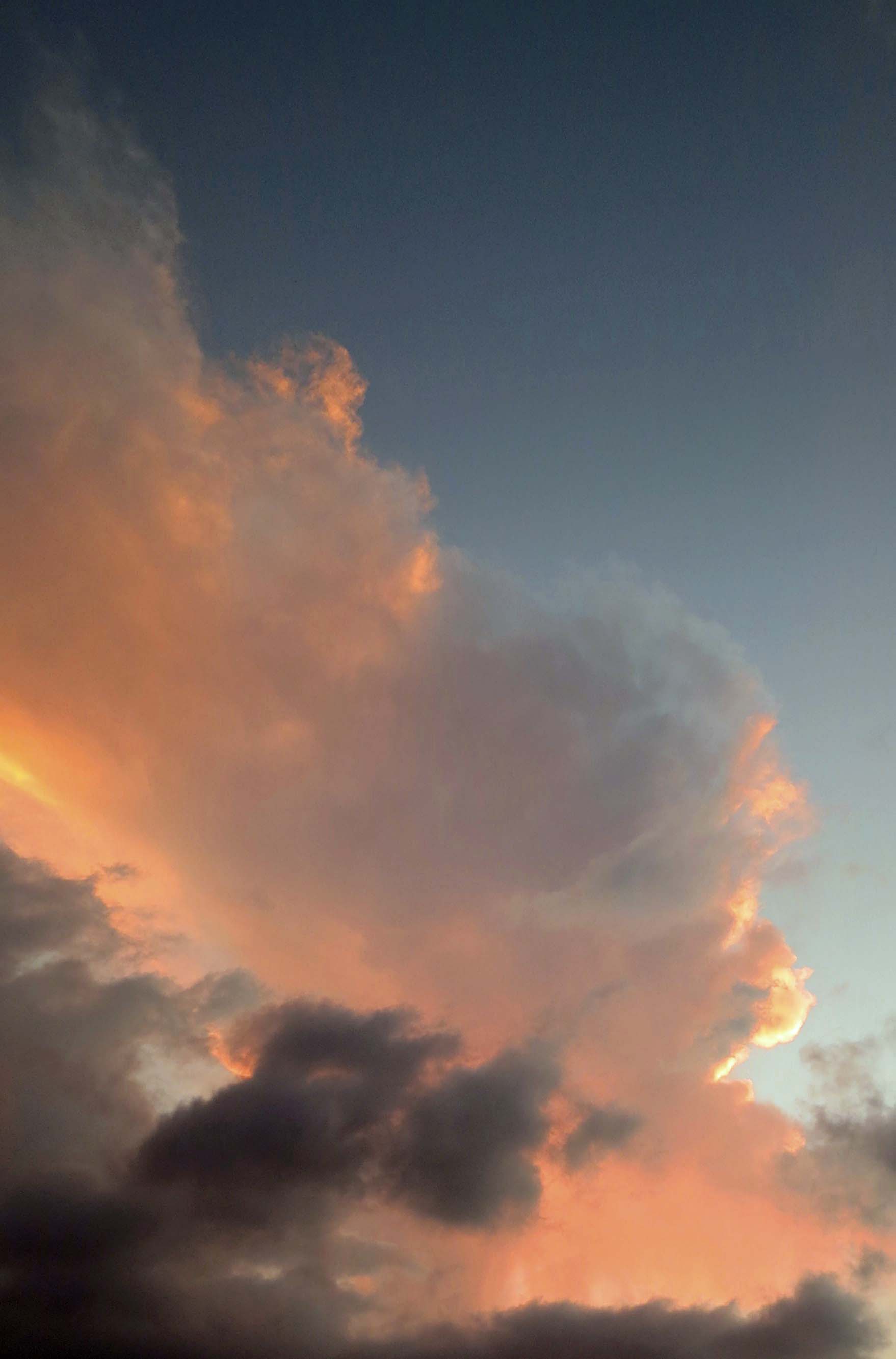
Somewhere in my youth, I was required to color clouds like this in Sunday School. The image has never quite left me.

Close up of the above photo. Somewhere in my youth, I was required to color clouds like this in Sunday School. The image has never quite left me.

Cumulous clouds over Mediterranean Sea.

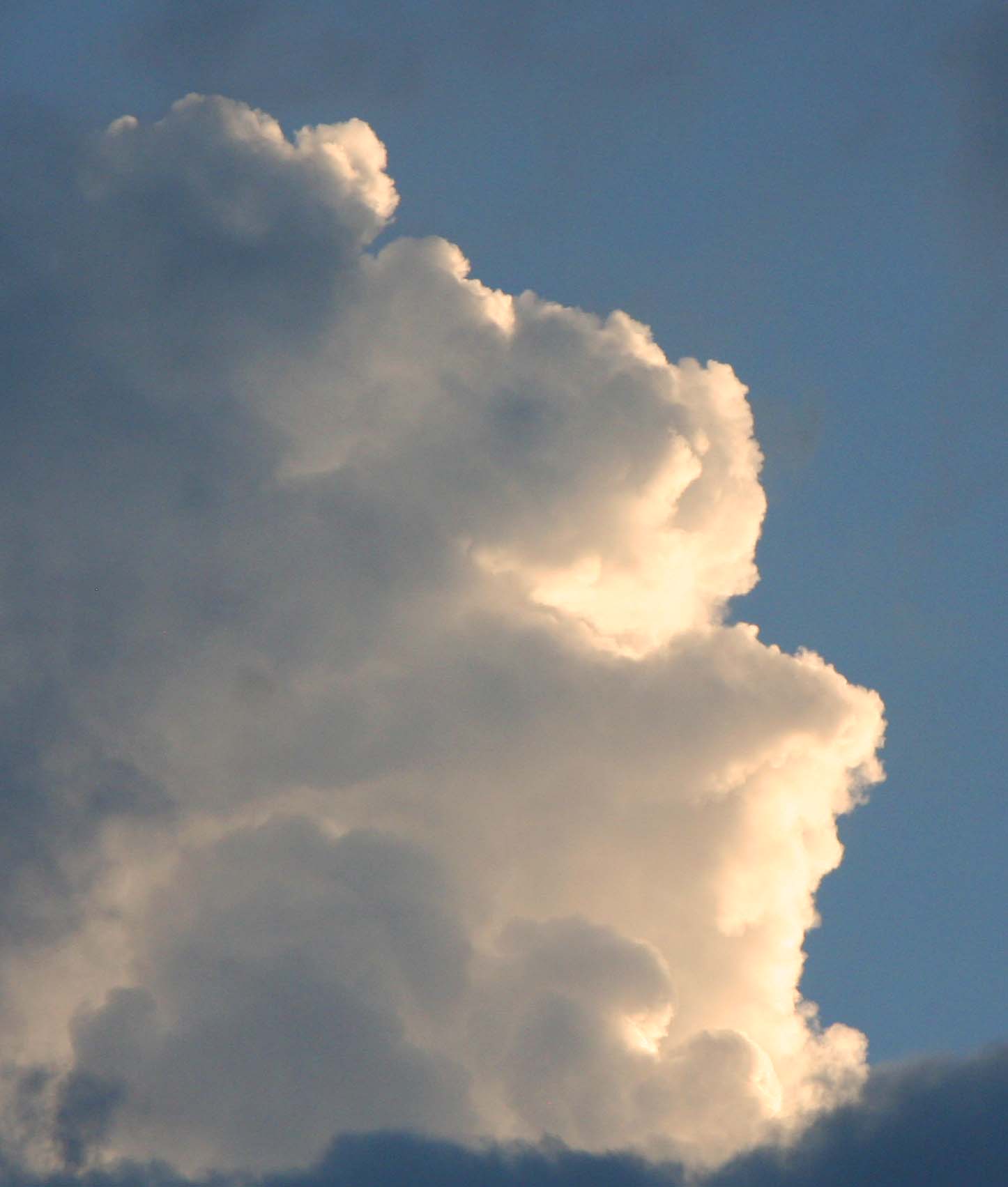
Clouds over the sea can also provide drama, as this towering cumulus does.

Towering Cumulous cloud over the Mediterranean.

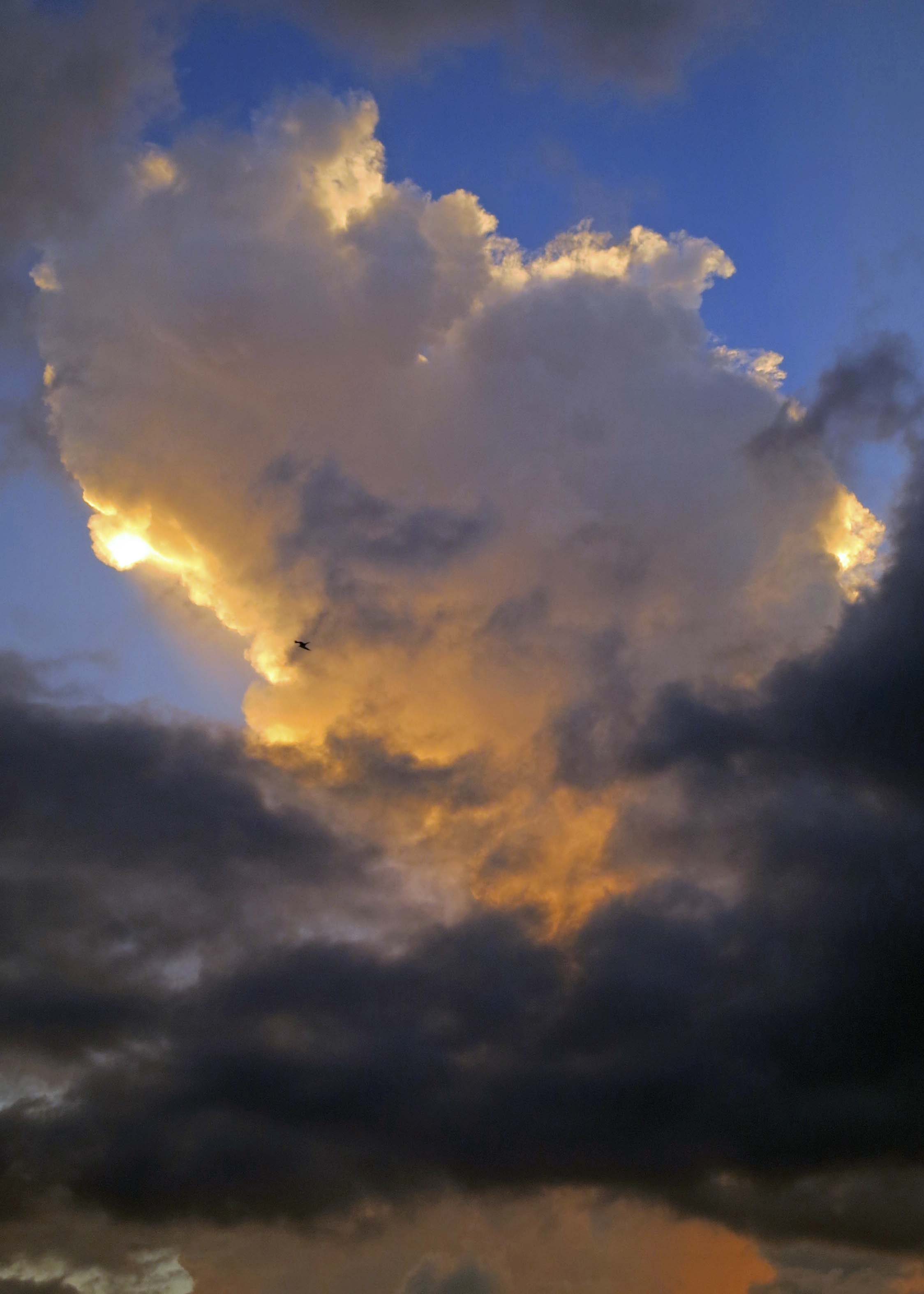
Another cumulus cloud over the Mediterranean.

The sea bird soaring between the clouds spoke to how close we were to shore.

The seabird soaring between the clouds spoke to how close we were to shore.

These clouds over the Atlantic appeared less threatening but brought a storm.

These clouds over the Atlantic appeared less threatening, but brought a storm.

Caribbean sunset

This impressionistic photo of purples and pinks was taken in the Caribbean south of Florida at the end of the trip.

NEXT BLOGS: I hope you have enjoyed our journey through the Mediterranean. In three weeks Peggy and I will begin another adventure, this time driving from our home in Southern Oregon to Alaska via the Northwest US, British Columbia and the Yukon Territory. Please join us. In the meantime, I will introduce you to our hometown of Jacksonville, Oregon; take you on a trip though the Southwestern US exploring thousand-year-old Native American rock art, and catch up on what’s happening with Burning Man 2013. Peggy and I will again be traveling to Burning Man after we return from Alaska.

The Azores: Last Stop before Sailing into the Sunset

Street scene in Ponta Delgado on the Island of San Miguel in the Azores.

We spent a pleasant three hours wandering along the streets of Ponta Delgada. Note the fun pavement.

Nine hundred miles west of Portugal we arrived at Ponta Delgada on the island of San Miguel. The Azores Islands are an autonomous region of Portugal and Delgada is the administrative center. When the Portuguese arrived in the 1400s, they found the islands uninhabited. In the days of sailing ships the islands became an important stop for resupplying with fresh food and water.

We found Delgada quite occupied and very pleasant, almost charming. Surrounded by green mountains that feature pineapple groves and grazing cattle, the city of 45,000 is nestled against the ocean. Instead of scrambling to see sites, we simply wandered through the streets.

The pineapples grown in the Azores are known for their sweetness and considered a gourmet treat.

The pineapples grown in the Azores are known for their sweetness and are considered a gourmet treat.

I even found time to check in on my blog. Normally, I had to use the ship’s Internet, which cost the proverbial arm and a leg. (Cruise ships are dedicated to separating passengers from their cash. We were dedicated to keeping as much of ours as possible.)

The town of Punta Delgado on the Island of San Miguel in the Azores

The town of Pont Delgada is surrounded by green mountains where cattle graze.

A church in Ponta Delgado in the Azores

Our stroll around Delgada took us past attractive churches.

Church door in Ponta Delgado in the Azores

This door on the church was quite dramatic with its white background.

As always, our traveling companion, Kathi, could be expected to find tasty pastries.

As always, our traveling companion, Kathi, could be expected to find tasty pastries. (Photo by Peggy Mekemson)

Carriage ride in Ponta Delgado in the Azores

These horses waited patiently to provide tourists with a carriage ride.

Ponta Delgado City Hall and reflection pool

I loved the way the street tile was extended into the reflection pool in front of Ponta Delgada’s city hall.

Peggy, Kathi and Frances take a break at the pool's edge.

Peggy, Kathi and Frances take a break at the pool’s edge.

Graffiti in Ponta Delgado

We found interesting murals in Delgada including this chicken?

Whale mural in Ponta Delgado

I found these abstract squid quite attractive.

Ponta Delgado balcony in Azores

As in Europe, we found a number of attractive balconies.

Balcony in Ponta Delgado, Azores

Another balcony in Ponta Delgada.

A bouquet of roses in the Azores

A flower stand provided a beautiful bouquet of roses.

Crown Princess

As the shadows lengthened it was time to return to the ship.

NEXT BLOG: Sailing into the sunset. The proper term is probably cruising into the sunset but I find sailing much more romantic. Our next stop would be Florida.