The Ten Questions People Most Frequently Ask Bone… The 10,000 Mile Journey

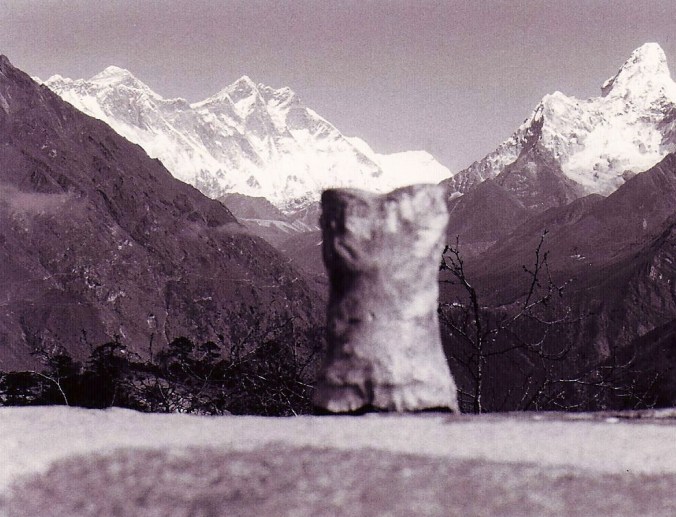
Bone checks out Mt. Everest in Nepal

Bone checks out Mt. Everest in Nepal

Note: Last post I introduced you to my travelling companions as Peggy and I make our way around the US and Canada following my bike route. Peggy, Eeyore and I are relatively normal. Well, at least two of the three are. But Bone is way out there. For example, yesterday he was looking for Elvis Presley… but that’s a story for later. Today I want to provide greater insight into Bone’s character by reposting an earlier interview that Bone had. I think that you will agree he/she/it is really strange.

1: Do you really talk. We’re speaking ethics here, Bone. Blogging is about transparency. That means honesty.

Are you crazy? Have you ever heard a bone talk? Of course I don’t talk. I just think out loud.

2: Curt sometimes refers to you as he. Does this mean you are a male bone?

No. He makes assumptions, lot of them. He was showing me to a biologist at the San Francisco Writer’s Conference and she suggested I have my DNA tested. “Just cut a small chip off of it,” she said nonchalantly. “You can determine its sex and breed.”

 “Just cut a small chip off of it?Outrageous! I am not some it to have chips cut out of. Besides, I lead a rich fantasy life and have no desire to know whether I am male or female. Call me she, he, or Bone, but never it.
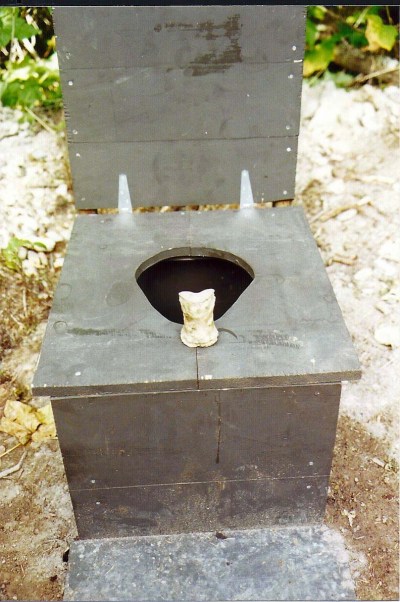
Um, I think Bone is definitely a male in this photo.

Um, there are reasons why I tend to think of Bone as a male.

3: You have travelled all over the world and met thousands of people. How do they usually react to you?

With befuddlement. You should have seen the look on the face of the customs agent in New Zealand who tried to seize me as ‘animal matter.’ But emotions run the gamut. There was a Japanese man who got off a tour bus at Yellowstone National Park and wanted to hold me for good luck. Soon there were 43 other Japanese handing me around and oohing. On the opposite side, I know a woman who refuses to touch me, like I have cooties. “I don’t know where Bone has been,” she states primly. Not surprisingly, there is also jealousy. “I want to be Bone and travel the world,” a good friend in Sacramento claims.

4:  What is your favorite thing to do?

Visit graveyards; there are lots of old bones there. My favorite grave is Smokey Bear’s in Capitan, New Mexico. I once stood on his tombstone for ten minutes trying to communicate but all I could get was something about ‘growling and a prowling and a sniffing the air.’ A close second is the grave of Calamity Jane in Deadwood, South Dakota. What a woman! These are difficult choices though when you toss in the likes of Hemingway, Daniel Boone and Billy the Kid. On the light side I once visited Ben and Jerry’s graveyard of discarded ice cream flavors in Vermont. My spookiest experience was a visit to the Capela dos Ossos, the Chapel of Bones, in Evora, Portugal. Those folks definitely have a skeleton in their closet, lots of them.

5: So, what’s your second most favorite thing to do?

Too hard; I am a dilettante dabbler, but here are a few.

  • Wandering, of course, anywhere and everywhere and by all modes: bikes, kayaks, rafts, skis, backpacks, sailboats, planes, helicopters, trains, cars, RVs, etc.
  • Visiting wild, remote and beautiful natural areas. I began life wandering the Sierra Nevada Mountains, John Muir’s Range of Light.
  • Seeking out strange phenomena such as ghosts, Big Foot and aliens (I’ve been to Roswell four times).
  • Attending unique events like Burning Man but I also have a fondness for any type of fair.
  • Meeting weird people like Tom.
Tom, being wonderfully weird on a raft trip down the Colorado River he was leading, put on a Bone headpiece.
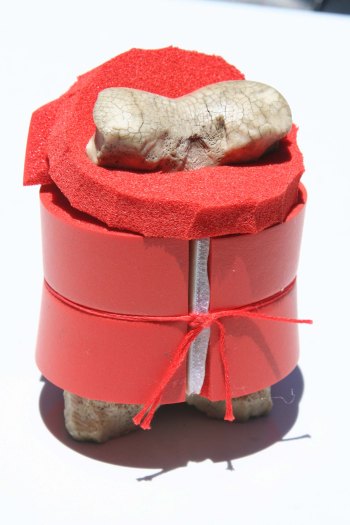
Tom, being wonderfully weird on a raft trip down the Colorado River he was leading, put on a Bone headpiece.

Bone dressed up for the Canyon trip in his own life best.

Bone dressed up for the Canyon trip in his own life vest. The vest, BTW, was certified by our son Tony, who flies helicopters for the US Coast Guard.

6: Speaking of Tom, he and Curt ‘discovered’ you in 1977 and you have wandered extensively with both. Who do you like best?

Eeyore, the jackass who can’t keep track of his tail. We’re travelling companions and he saved me from being strung up and buried on Boot Hill in Tombstone, Arizona. I’d robbed a bank, cheated at cards and hung out with women of delightful character. (This is what I mean by having a rich fantasy life. It’s also known as evasion.)

7: Which of your journeys has been most memorable?

I would have to say traveling the length of Africa in the back of a truck from the Sahara Desert in the north to Cape Town in the south. Almost falling off the back of a riverboat into a piranha infested section of the Amazon River would have to be a close second. I was perched on the back railing doing a photo shoot. And of course there was my 10,000-mile bike journey.

Bone doing his photo shoot on the Amazon. Shortly after this he started to fall off. I made a quick leap and barely caught him. The photo shoot was over for the day.

Bone doing his photo shoot on the Amazon. Shortly after this he started to fall off. I made a quick leap and barely caught him. The photo shoot was over for the day. We did eat piranha that night in his honor, however. They taste like fish.

8: You are often seen scrambling over rocks in remote sections of the Southwestern United States. What’s that all about?

I’ve developed a fondness for Native American Rock art. It resonates with my bone-like nature. It’s also another excuse to go wandering around in the outdoors. Plus, some those places might be haunted and it is a great place to look for UFOs. Some of the petroglyphs look amazingly like aliens. Finally, wandering in the desert is known to be good for the soul. Ask the Prophets of yore.

9: Ah, being a Born Again Bone, do you have any insights into the great unknown?

Ommmmmmmmmmmmmmmmmmmmmmmmmmmmmmmmmmmmmmmmm.

10: Finally, and this may be a little sensitive, but do you always run around naked?

What kind of question is that? Do you think I am uncivilized? For shame. I am the epitome of haute couture! A bow and arrow toting, card-carrying NRA member in Montana who is building an airplane in his basement has designed and made me two leather vests. What’s more, an 80-plus year old woman in Kansas going on 20 with a crush on Johnny Depp and a room devoted to the Egyptian gods has made me a kilt and several other outfits. Face it; I am hot stuff, clothed or naked. I may take up a modeling career.
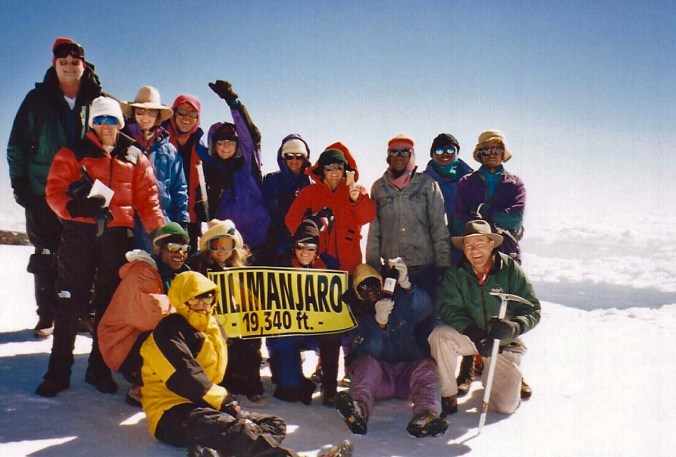
Bone celebrates on top of Mt. Kilimanjaro!

Bone celebrates on top of Mt. Kilimanjaro! (red coat above the O)
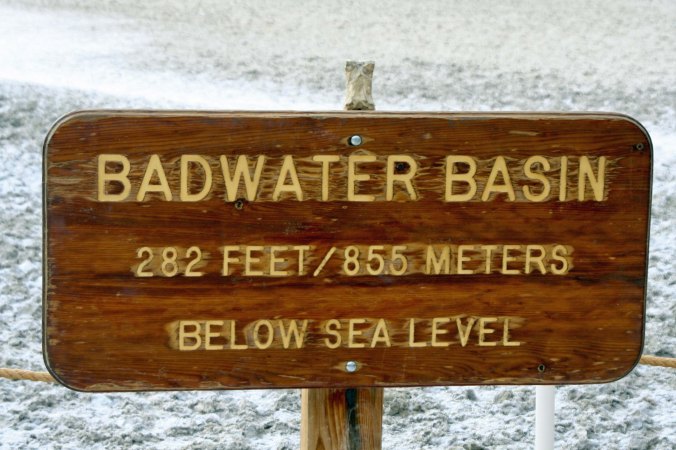
Here's Bone at the lowest point in North America in Bad Water Basin in Death Valley, 282 feet below sea level. (He was there on the bike trek and has since returned.)

Here’s Bone at the lowest point in North America in Bad Water Basin in Death Valley, 282 feet below sea level. (He was there on the bike trek and has since returned.)

NEXT BLOG: I return to my bike route. My first days are supposed to be easy short days, a time to make up for the fact that I didn’t do anything physical to prepare for my adventure. The second day turns out to be a doozy, however. And I am greeted by a great white whale at the end.

From Anchorage, Alaska to Fairbanks by Rail… A Perfect 10

One of many views we had of Mt. Denali as we rode the Alaska Railroad from Anchorage to Fairbanks.

One of many views we had of Mt. Denali as we rode the Alaska Railroad from Anchorage to Fairbanks.

The conductor told us we were a 10, or I should say he told us we were among the 10% of people who travel by rail from Anchorage to Fairbanks and get to see Mt. Denali. Normally it is covered in clouds, or maybe you get a teasing glimpse. Having lived in Alaska for three years, I know how special it is to see the mountain.

Once, I was camped out at Wonder Lake, which is way out at the end of Denali Highway. I’d been backpacking in Denali National Park dodging grizzlies and had a small backpacking tent that I had pointed in the direction of the cloud-hidden mountain. I woke up early with the sun (in summertime Alaska, that’s really early). A huge mountain had appeared out of the clouds. “Wow! I said to my friend. You have to see this.” And then a larger mountain appeared behind it. As we sat there in awe, the clouds parted and a third, even larger mountain appeared, a massive mountain, Mt. Denali. At 20,310 feet, is the tallest mountain in North America.
Denali has only recently reclaimed the name it was known as for centuries by the Athabaskan natives of the region. It means big mountain, or the tall one. In 1896, an Alaskan gold miner named it Mt. McKinley in honor of the man he hoped would become president. McKinley won and the name stuck. Alaskans have been lobbying for years, quite rightly I would argue, to return the name to Denali. Their efforts had been continually blocked by a small contingent of politicians from Ohio, McKinley’s home state. On August 28, 2015, President Obama renamed the mountain Denali on the basis of a recommendation by the Alaska Geographical Society. I suspect the Ohio politicians are trying to impeach the President because of his action.

The sky was clear on our whole 350 mile trip from Anchorage to Fairbanks and we had several views of the Mountain. The engineer would stop the train each time we saw it. In fact, the engineer stopped the train several times to point out other things of interest as well, like moose for example. There’s a reason why the trip took 12 hours! Alaska is a state of great natural beauty, and we were privileged to see much of it on our trip. Following are a few of the many photos that Peggy and I (along with grandsons) took along the way. Enjoy.

I used this photo earlier on another post but you are getting to see it again because I like it so much and feel it is symbolic of our trip.

I used this photo earlier on another post but you are getting to see it again because I like it so much and feel it is symbolic of our trip with the train, mountains, rivers and trees.

Another photo of the train. I liked the perspective, and the trees.

Another photo of the train. I liked the perspective, and the trees.

My nose was glued to the window for the whole trip. (Except of course to eat and pay attention to the family.) Many of the views, like this one, were right beside the track.

My nose was glued to the window for the whole trip. (Except of course to eat and pay attention to the family.) Many of the views, like this one, were right beside the track.

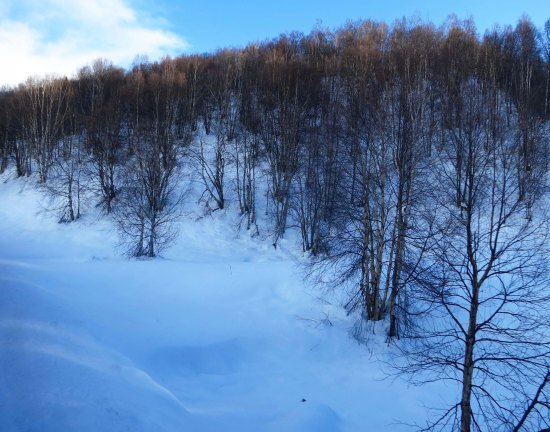
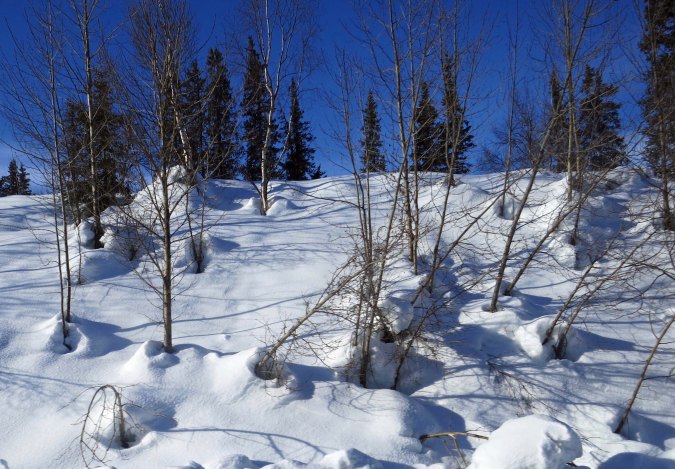
Snow, trees and shadows provided interesting compositions.

Snow, trees and shadows provided interesting compositions.

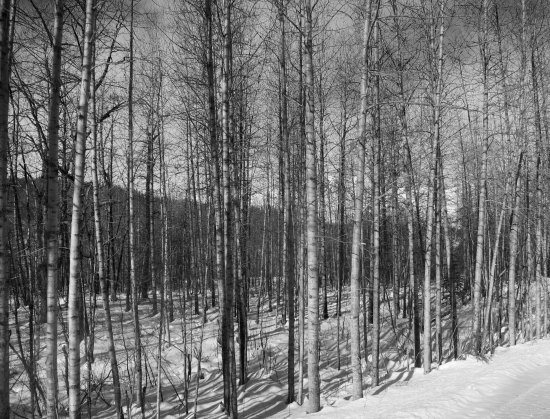
I thought these birch trees deserved a black and white look.

I thought these birch trees deserved a black and white look.

Numerous rivers dot the Alaska landscape we found several along the tracks.

Numerous rivers dot the Alaskan landscape. We found several beauties along the tracks.

Another example.

Another example.

Homesteaders living along the railroad give a new meaning to 'off the grid.' Most live several miles apart and all depend on the railroad to provide access to the outside world. The conductor/guide told us they stood along the tracks and flagged the train down when they needed a ride out.

Homesteaders living along the railroad give a new meaning to ‘off the grid.’ Most live several miles apart and all depend on the railroad to provide access to the outside world. The conductor/guide told us the homesteaders stood along the tracks and flagged the train down when they needed a ride out.

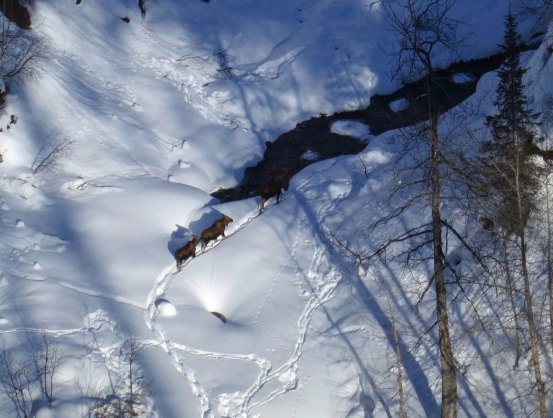
While bears hibernate during the winter, moose operate year around, this open, ice covered river provided a moose highway as indicated by the trails.

While bears hibernate during the winter, moose operate year around. This open, ice-covered river provided a moose highway as indicated by the trails.

We were there long enough to see them moving along at the upper end of the small lake.

The engineer had stopped the train on the bridge over Hurricane Canyon when we spotted this family of moose following a trail.

I liked the shadows they cast in the bright sunlight.

I liked the shadows they cast in the bright sunlight.

Looking the other way across Hurricane Canyon provided this magnificent view of the canyon and the Alaska Range.

Looking the other way across Hurricane Canyon provided this view of the canyon and the distant Alaska Range. (Click on this for a larger view.)

Much of our time was spent admiring magnificent mountains. A different kind of animal made the tracks in this photo, people on snowmobiles, a primary form of transportation in backcountry Alaska.

Much of our time was spent admiring magnificent mountains. A different kind of animal made the tracks in this photo, people on snowmobiles, which are a primary mode of transportation in backcountry Alaska. I think these guys was playing.

More impressive mountains...

More impressive mountains…

Mountain Scene on Alaska Railroad between Anchorage and Fairbanks.

And more.

And a final view of Mt. Denali in the distance.

And a final view of Mt. Denali in the distance.

Our son Tony and his family talked us into the railroad trip and other great adventures we had on this visit to Alaska. We owe the family big. In this photo, Tony and Cammie's son Cooper has decided my head is a good place for a snooze. (I took this as a selfie.)

Our son Tony and his family talked us into the railroad trip and other great adventures we had on this visit to Alaska. We owe the family big time. In this photo, Tony and Cammie’s son Cooper has decided my head is a good place for a snooze. (I took this photo as a selfie.)

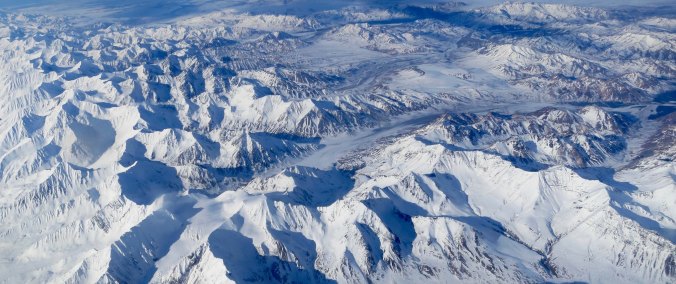
I usually don't have much luck with photos taken out of airlines but I feel this photo of the Alaska Range taken on our Alaska Airways trip back to Anchorage from Fairbanks is an exception.

I usually don’t have much luck with photos taken out of airlines but I feel this one of the Alaska Range I took on our Alaska Airways trip back to Anchorage from Fairbanks is an exception. It seems worthy of concluding my series on Alaska. (Click on this for a larger view.)

NEXT BLOG: A new adventure! Peggy and I hit the road in our 22 foot van retracing the route I followed on my 10,000 solo bike trek I took around the US and Canada in 1989.


Encountering BIG Brown Bears and other Alaskan Wildlife…

I met my first Brown Bear in Katmai National Park, which is at the beginning of the Aleutian Peninsula. He was coming along a trail I was walking down. He and I had a discussion and then I slowly backed away. Never run from a bear.

I met my first Brown Bear in Katmai National Park, which is at the beginning of the Aleutian Peninsula. He was coming down a trail I was walking up. He and I had a discussion and then I slowly backed away. Never run from a bear unless you are hiking with someone slower than you are. (grin)

Peggy and I are off in Alaska as you read this blog. Since I won’t have time for blogging or reading blogs, I decided to repost a few blogs from the trip we made to Alaska three years ago. If you have been following me for a while, you will have read these blogs previously. I will try to respond to comments. –Curt

Back in the 1980s, I spent three years living in Alaska and dedicated as much time as I could to wandering in the woods. Along the way I met most of the wildlife Alaska is famous for. A grizzly bear stalked me on the Kenai Peninsula. I went to sleep listening to wolves howl on a winter cross-country ski trip in Denali National Park. Even more entertaining, a pair of Dahl Sheep had a head-butting contest in my campsite in Chugach State Park.

You don’t have to disappear into the vast wilderness of Alaska to encounter animals with big teeth, claws and antlers, however. Our friends Edith Barrowclough and David  McElroy reported that both a black bear and a moose wandered through their yard in Anchorage over the weekend. They have also seen a wolf and a lynx in the area.
Our friends David and Edie. Edie went to high school with Peggy in Port Clinton Ohio. She now works as a CPA in Anchorage. Her husband, David, is a bush pilot working on the North Slope and a published poet.

Our friends David and Edie. Edie went to high school with Peggy in Port Clinton, Ohio. She now works as a CPA in Anchorage. Her husband, David, is a pilot working on the North Slope and a published poet. (Photo by Peggy Mekemson.)

Peggy and I stayed with them for four days. Every time Chula the Dog barked Peggy darted outside in hopes of spotting something large and furry. All she saw was the neighbor’s dog but we did end up seeing our share of wild animals. David and Edie insisted on taking us to the Alaska Wildlife Conservation Center at the southern end of Turnagain Sound. The Center serves as a wildlife sanctuary and is designed to duplicate the animals’ natural surroundings. They have done a good job. The photos in this blog were taken there.

Our trip down Turnagain Arm to the sanctuary was a trip down memory lane for me. It was one of my favorite drives when I lived in Alaska.

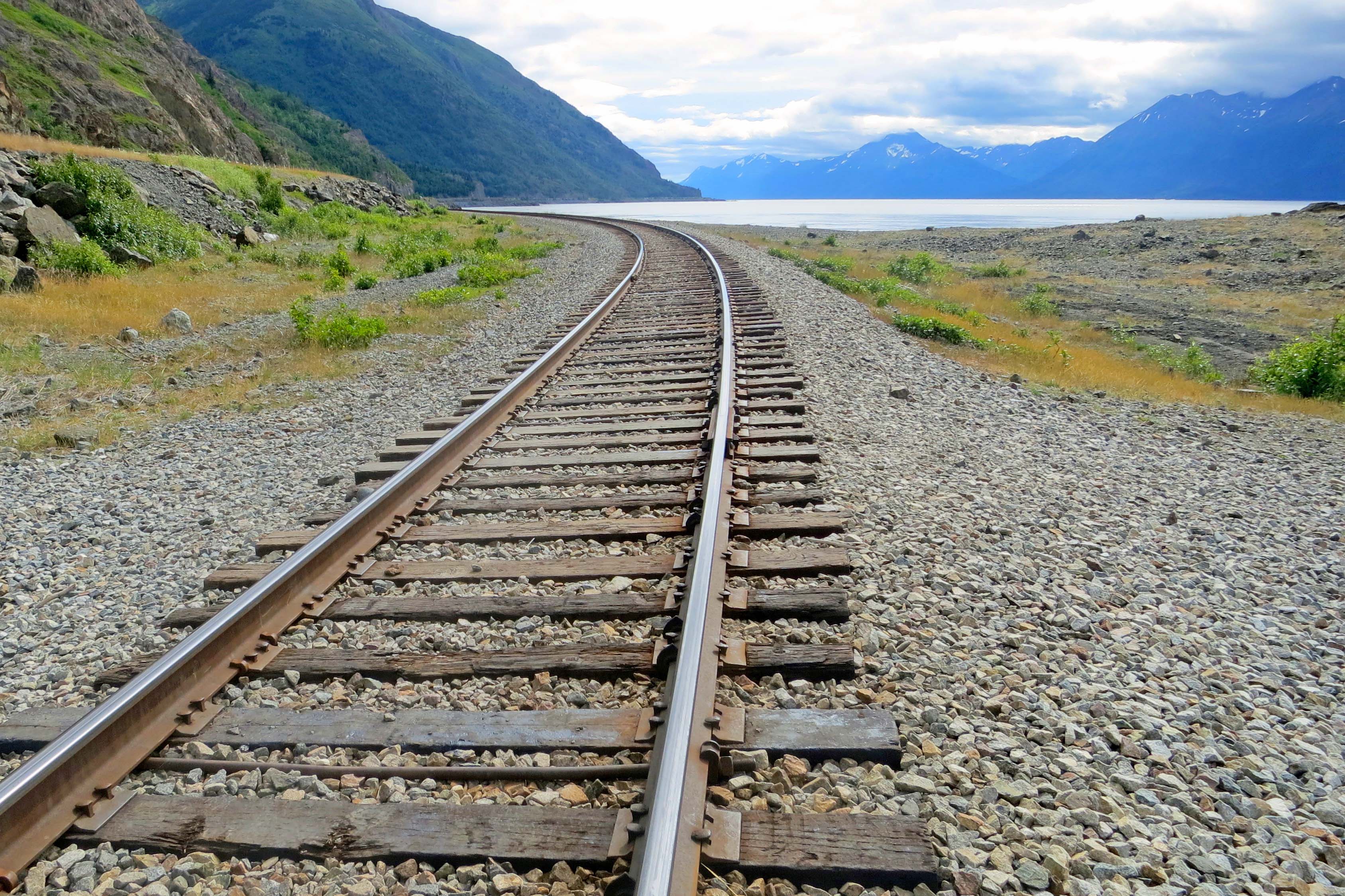
Turnagain Arm and the Alaska Railway.

A shot of the railroad tracks running along Turnagain Sound. The V in the mountains on the right is where the town of Hope is located. Hope was the starting point for 100 mile backpack trips I led across the Kenai Peninsula.
Salmon fishing on the Bird River in Alaska.

We stopped off at Bird River on our way down Turnagain Arm. The dots on the river are people fishing for salmon. Three days later we would be fishing for salmon on Kodiak Island.

Black bear with cave in Alaska

Black bears are smaller than their cousins. I once woke up with one standing on my chest in Yosemite. I screamed loudly. You may have heard me. This guy was about to join his companion in the cave.

Black bear entering cave in Alaska.

Here he goes.

Alaskan Brown Bear

Our first view of the Brown Bears was of one playing in the water throwing a moose bone into the air. (Photo by Peggy Mekemson)

Alaska Brown Bear playing with moose bone.

Here he catches the bone with one paw while pointing out his skill with the other. He didn’t have to persuade us.

Alaska Brown Bear growling.

My, what big teeth you have. And no, we have no intention of taking away your bone. (Photo by Peggy Mekemson)

One wet Alaskan Brown Bear, up close.

One wet Alaskan Brown Bear, up close.

Alaska Brown Bear displaying his claws.

Check out the claws on this guy.

Head shot of Alaska Brown Bear.

My grandson Connor insisted I include this head shot I took of one of the Brown Bears. The bear was sitting up.

I though I would conclude with this photo because it emphasizes just how big Alaskan Brown Bears become on their diet of salmon.

I thought I would conclude with this photo because it emphasizes just how big Alaskan Brown Bears become on their diet of salmon. A large male can weigh up to 1200 pounds.


When …—… Saved Lives: The Marconi Telegraph Station at Point Reyes


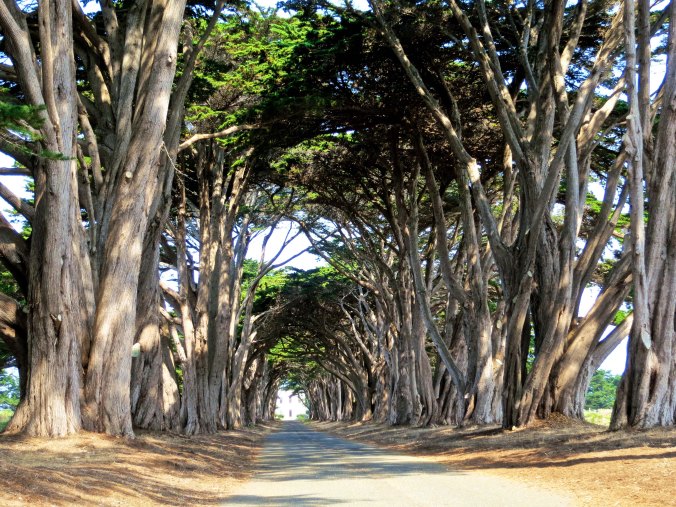
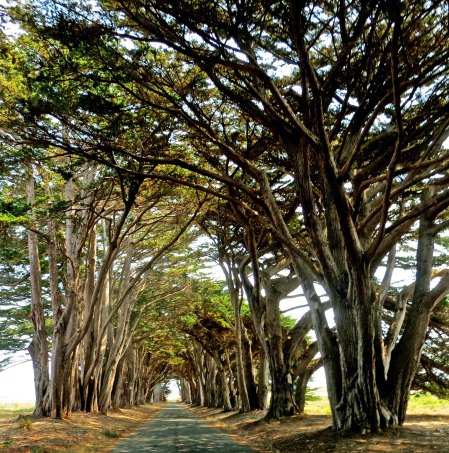
1 Tunnel of Cypress Trees at Marconi-RCA wireless site Point Reyes

This tunnel of cypress trees leading into the Marconi-RCA wireless receiving station at Point Reyes National Seashore in California is considered one of the most beautiful tree tunnels in the world.

Do you recognize the dits and dahs? I memorized what they meant for a Boy Scout badge back in the Dark Ages, back before satellites and modern communication systems came to connect almost anyone, anywhere, anytime. Here’s a clue: the three dots stands for S, and the three dashes for O. Think SOS: Save Our Ship. You will recognize the whole alphabet spelled out in dits and dahs as Morse Code, named after the American inventor Samuel Morse, who developed it in 1838.

Morse Code

Morse Code

Combined with telegraph lines and operators, it revolutionized communication. Getting the quickest message between points A and B no longer required finding the fastest horse or train. Seconds instead of days or weeks became the rule for sending important communications over long distances.

What Morse did for land based communication, Guglielmo Marconi did for oceans. His claim to fame was being the prime inventor of wireless communication using radio waves. He started at the young age of 21, working in his attic in Italy with his butler Mignani. (I am reminded of the young Steve Jobs, sans butler, working out of his garage in Palo Alto.) Like Jobs, Marconi was an entrepreneurial genius as well as an electronics wizard, or geek, if you prefer. He began by sending a message across his attic in 1894 to ring a bell. By 1902, he’d cornered the market on sending wireless messages using Morse Code across the Atlantic Ocean.

Ships at sea and their passengers were among the primary beneficiaries of the new technology. “Surprise, you are a new father. Send money,” could now be transmitted immediately instead of weeks down the line. There was also a safety factor. For the iceberg bound Titanic, it meant that 30% of its passengers were saved— instead of none.

By 1914, Marconi had extended his operation to the Pacific Ocean and built sending and receiving stations in the Marin County towns of Bolinas and Marshall north of San Francisco. (Because of interference, sending and receiving stations had to be separated.) During and immediately after World War I, military concerns combined with a touch of nationalism, and, I suspect, a generous dollop of old-fashioned greed, led to the take over of Marconi’s American operation and its transformation into RCA, the Radio Corporation of America.

A Mural in Olema, California that provides a look at what the community looked like when it served as the sending station of Marconi telegraph. The blue surfboard represents a bit of artist creativity. (grin)

A mural in Olema, California just north of San Francisco that provides a look at what the community looked like when it served as the Pacific Ocean telegraph sending station for Marconi-RCA telegraph. The blue surfboard represents a bit of artist creativity. (grin)

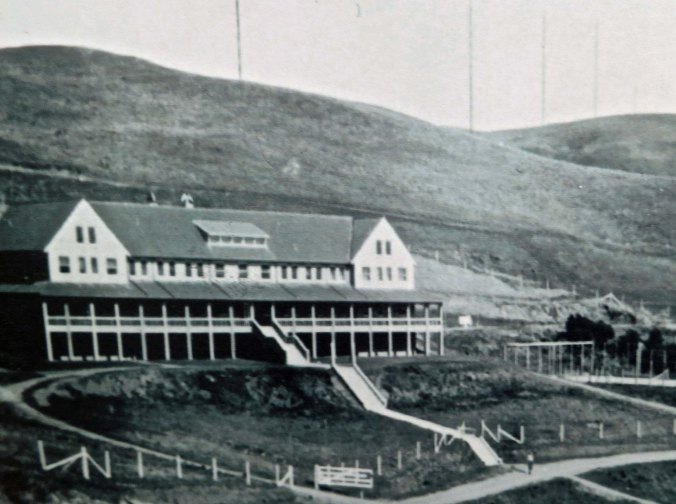
An early photo of the Marconi receiving site in the small town of Marshall on Tomales Bay.

An early photo of the Marconi receiving site in the small town of Marshall on Tomales Bay. Workers lived in the hotel.

The hotel as it looks today as part of the Marconi Conference Center.

The hotel as it looks today as part of the Marconi Conference Center.

6. Old Highway 57 and Highway 1 in Marshall

Old Highway 57, the dirt road, once serviced the Marshall Marconi wireless receiving site. Modern Highway 1 is seen below along with Tomales Bay. The distant hills are part of Point Reyes National Seashore.

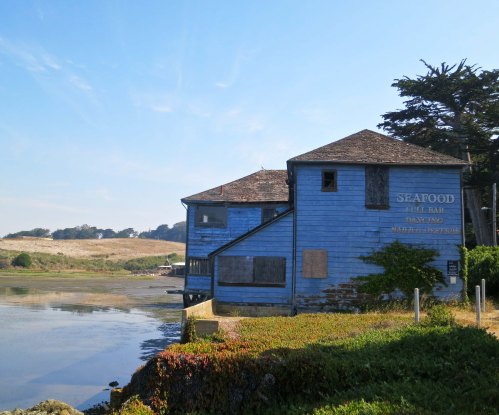
7 Old 1873 Seafood restaurant in Marshall Ca

Historic Marshall included this old/now deserted seafood restaurant built in 1873.

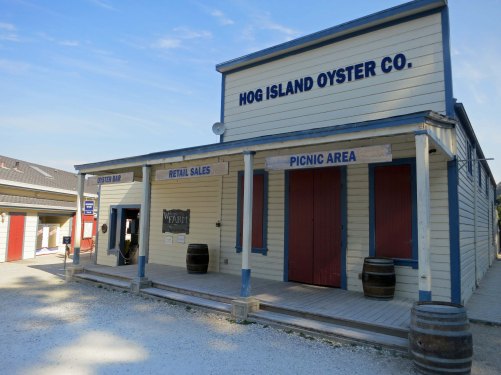
Today, Marshall is know for its oysters and kayak eco-tours.

Today, Marshall is known for its oysters and kayak eco-tours.

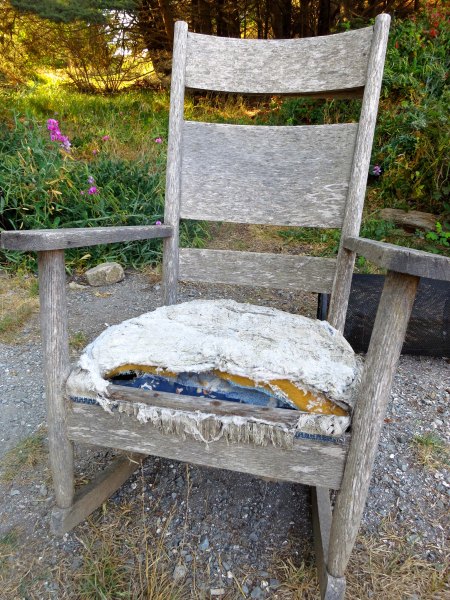
I hound this old rocking chair sitting alone Highway one. All it needed was an old codger to sit in it.

I found this old rocking chair sitting along Highway 1. All it needed was an old codger to sit in it.

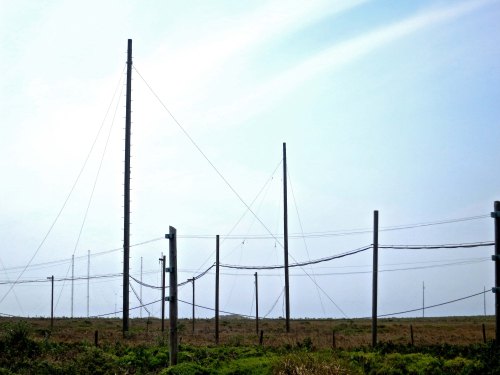
In 1929, the Marshall operation was moved to Point Reyes. It was still there actively receiving messages when I first started visiting the National Seashore in the late 60s and early 70s. A forest of receiving antennas and no trespassing signs announced its presence. Most of the communication with American ships involved in the Vietnam War passed through the facility. On July 12, 1999, the station sent its last message. Dits and dahs had been made obsolete by bits and bytes.

I was drawn there on my August trip up the North Coast of California by a statement I had found on the Net stating that the cypress trees at the entrance formed one of the most beautiful tree tunnels in the world. Even though I had driven by the facility dozens of times over the years, I had never noticed. Shame on me. When I drove up, a group of amateur photographers with expensive cameras were busily proving the point. I joined the queue with my small Cannon S-100.

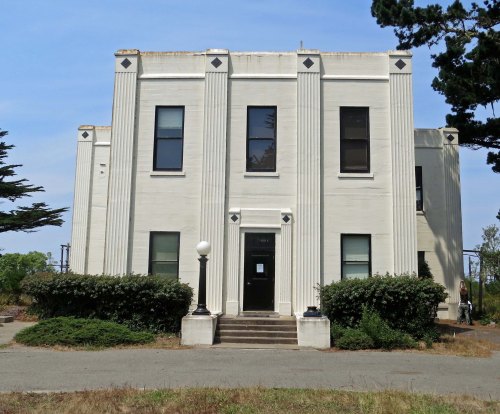
I was also blessed with a touch of serendipity. A display sign announced that the Maritime Radio Historical Society was featuring a display on telegraph use in Marconi’s impressive Art Deco headquarters. I drove down under the tunnel of trees and walked through the building’s open door. An hour later I emerged with the distinctive sound of a telegraph keys clattering away in my ears and enough information for a dozen blogs.

The lovely art deco building built by Marconi-RCA for its telegraph receiving station at Point Reyes National Seashore.

The lovely art deco building was built by Marconi-RCA for its telegraph receiving station at Point Reyes National Seashore.

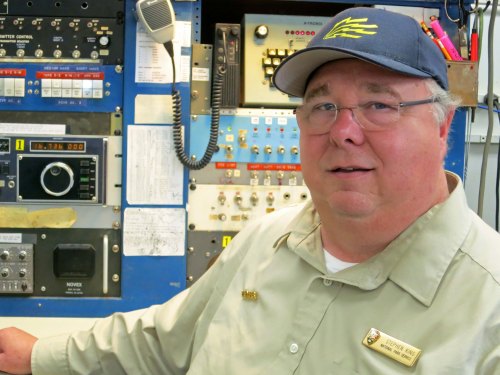
Steven King, a volunteer with the Marine

Steven King, a volunteer with the Maritime Historical Radio Society and the Point Reyes National Seashore spent most of an hour explaining how the Marconi-RCA wireless receiving station worked during its heyday.

12 Telegraph call letters for ships at Marconi-RCA wireless site Point Reyes

Every ship at sea had its own call sign for receiving telegraphs. These were left when the last telegraphs were sent out in 1999.

A view of the telegraph receiving antennas as they look today.

A view of the telegraph receiving antennas as they look today.

This tunnel of cypress trees leading into the Marconi-RCA headquarters receiving station at Point Reyes National Seashore in California is considered one of the most beautiful tree tunnels in the world.

I had a final opportunity to drive under the beautiful bower of trees as I returned to the highway.

NEXT BLOG: I head north for the small town of Bodega to explore where Alfred Hitchcock’s movie The Birds was filmed and discover a church that was photographed by Ansel Adams.

What to Do When a Nike Missile Is Pointed at You… Surrender.

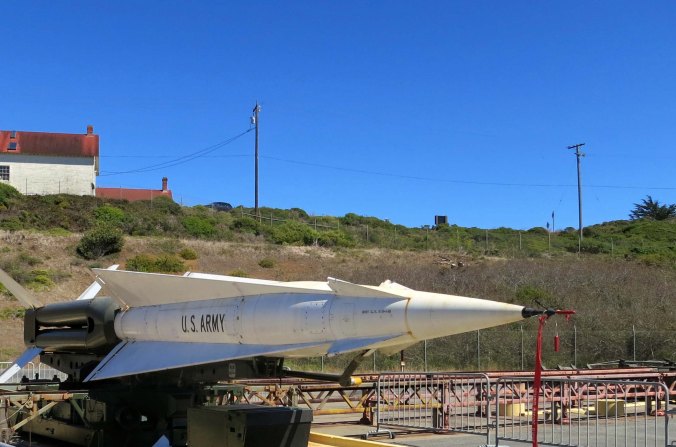
This Nike missile came out of the ground and was pointed at me when I was visiting Golden Gate National Recreation Area just north of San Francisco. I quickly moved aside and snapped its photo.

This Nike missile came out of the ground and was pointed at me when I was visiting Golden Gate National Recreation Area just north of San Francisco. I quickly moved aside and snapped its photo. Missiles were raised skyward before being fired.


I heard a whirring sound just before the large metal gates clanked open. A Nike missile rose ominously out of the ground. It was pointed at me. “I surrender,” I said to the missile as I slowly raised my hands. It seemed like the wise thing to do. Not very long ago (1953-1979), back in the disturbing days of the Cold War, this deadly weapon had been loaded with a nuclear warhead two-three times as powerful as the atom bombs America had dropped on Japan at the end of World War II. It still spoke of destruction, but now it was defanged. It had become a museum piece, a shell of its former self, a relic of our very scary past.

SF-88 is located in what is now the Golden Gate National Recreation Area just across the Golden Gate Bridge from San Francisco. It was one of 300 Nike missile sites across the US built as a last line of defense against Soviet bombers carrying nuclear weapons. It now serves as the only restored Nike site in America.

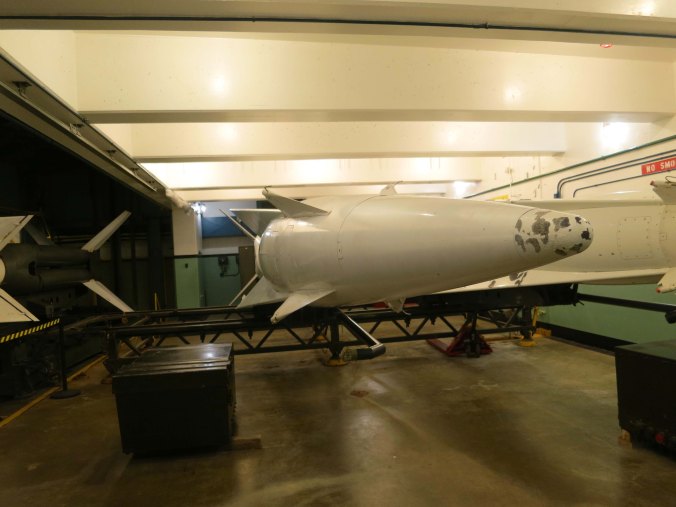
I visited the museum as part of my August trip up the North Coast of California. When I arrived, two park rangers sat outside enjoying the sun. I put one to work; he volunteered to take me on a personal tour of the underground facility. We climbed down the stairs with our footsteps echoing into a large room filled with missiles. After describing how the massive weapons were to be used, he suggested I try pulling one on its track. I couldn’t believe how easily it moved; I felt like I had super powers. He explained that the system was designed for getting the missiles up and ready to fire in 15 minutes. Several million lives depended on quick action.

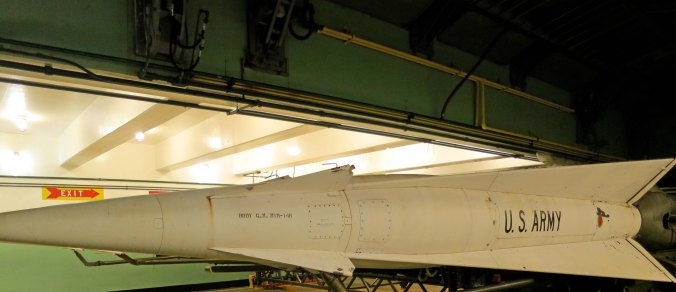
Each of the 300 Nike missile sites around the US had several Nike missiles ready to fire off in 15 minutes to take down Russian bombers.

Each of the 300 Nike missile sites around the US had several Nike missiles ready to fire off in 15 minutes to take down Russian bombers approaching the country.

4. One of the Nike missiles at SF-88

A view of one of the missiles. They were large enough I couldn’t capture the full missile within the confines of its underground bunker.

I easily moved one of the Nike Missiles.

I easily moved one of the Nike Missiles along the track toward its launching station.

5.The Nike missiles at SF-88 would rise through these gates

These gates would open in preparation for a launch of the Nike Missiles.

The Nike missiles at SF-88 were intended to target Russian bombers 90 mile off the coast from the Golden Gate. The nuclear warheads were to assure that none got through. The greatest fear was that they might be carrying 50-megaton Tsar Hydrogen bombs, the mother of all bombs. The Russians had built one and blown it up as a warning to the US. To put things in perspective, it had 1,350–1,570 times the explosive power of the atom bombs that destroyed Hiroshima and Nagasaki.

“The Tsar Bomb,” the park ranger explained, “would be exploded a few thousand feet up in the air above San Francisco.” All people living in the region would be killed. There would no longer be a San Francisco, an Oakland, a San Jose, a Berkeley, or any of the other communities located in the Bay Area. Neither would there be any birds, mammals, reptiles, trees, grass, or other life left living. A chill settled over me as I recalled I was a student at Berkeley during the 60s, at the height of the Cold War.

I thought even the smaller Nike weapons would be devastating to the region. The prominent west winds would bring deadly radiation from the explosions raining down on the Bay Area and points east. “What would it matter?” the ranger asked. What indeed. Once a nuclear war started, the US and Russia had enough nuclear weapons to wipe out life on earth— several times over.

Having heard enough bad news, I climbed out of the bunker leaving the ranger to explain doomsday to another group of visitors that had arrived. I was outside by myself when Nike Missile came rumbling up from its underground hideout. No one had told me it was part of the tour.

The gates as seen from above. I don't know, but I suspect they would have been camouflaged during the Cold War.

The gates as seen from above. I don’t know, but I suspect they would have been camouflaged during the Cold War.

I heard a whirring sound, the gates clanked open, and the missile arose out of its bunker.

I heard a whirring sound, the gates clanked open, and the missile arose out of its bunker.

What would have been lost during a nuclear war.

A view of the Golden Gate Bridge and San Francisco from the Golden Gate National Recreation Area. The Nike missile site is over the hill from where I took this photo.

NEXT BLOG: I visit the Marconi Station at Point Reyes National Seashore where Morse Code messages were once sent out to all ships at sea in the Pacific Ocean— and are still sent out to the sunken Titanic in the Atlantic.


Olompali: Miwoks, the Grateful Dead, and a Hippie Commune… The North Coast Tour

I photographed this picturesque oak tree at Olompali State Park. Later I discovered the same tree was featured on the cover of the Park's brochure. Acorns from oaks were a major source of food for the Miwok Indians.

I photographed this picturesque oak tree at Olompali State Park. Later I discovered the same tree was featured on the cover of the Park’s brochure. Acorns from oaks were a major source of food for the Miwok Indians.


When Peggy headed off to England with her sister in August to visit English gardens, I headed off to the north coast of California for a couple of weeks to see what mischief I could get into. Peggy has promised some guest blogs on her experiences. Here is the first of several blogs on mine. 

The small community of Novato lies 20 miles north of San Francisco along Highway 101. The little known California State Park of Olompali is just north of Novato. The staff at the Days Inn where I stayed didn’t even mention the park when I asked about interesting places to explore. “Go to the Marin Museum of the American Indian; explore historic Novato; check out the Marin French Cheese Company,” they told me. And I dutifully complied. My adventure started just outside my door.

To me, the coastal ranges of California provide some of the most scenic views in the world. This was behind the Days Inn where I stayed in Novato. I love the contrast between the gold of the grass and the green of the oaks.

To me, the coastal ranges of California provide some of the most scenic views in the world. This view was behind the Days Inn where I stayed in Novato. I love the contrast between the golden brown of the grass and the dark green of the oaks.

One evening I went out and captured the same shot as the sun went down.

One evening I went out and captured the same shot as the sun went down.

It is a good thing that the Marin Cheese Factory isn't located near my home. I'd end up weighing 300 pounds. Its brie cheese is to die for.

It is a good thing that the Marin French Cheese Factory isn’t located near my home. I’d end up weighing 300 pounds. Its brie cheese is to die for.

As for Olompali, I had to find it on my own. It was a mile up the road from the motel, just past the US headquarters of Birkenstocks. It proved to be a very interesting place, indeed.

Once, the area had been home to the Miwok Indians. They had been living in the region for over 3000 years when Sir Francis Drake landed at nearby Point Reyes. Although he was something of a pirate, and would have been an illegal alien by today’s definition, Drake claimed the land for Queen Elizabeth. The Spanish arrived a few years later and claimed the land for Spain. The Miwoks weren’t invited to participate in either decision.

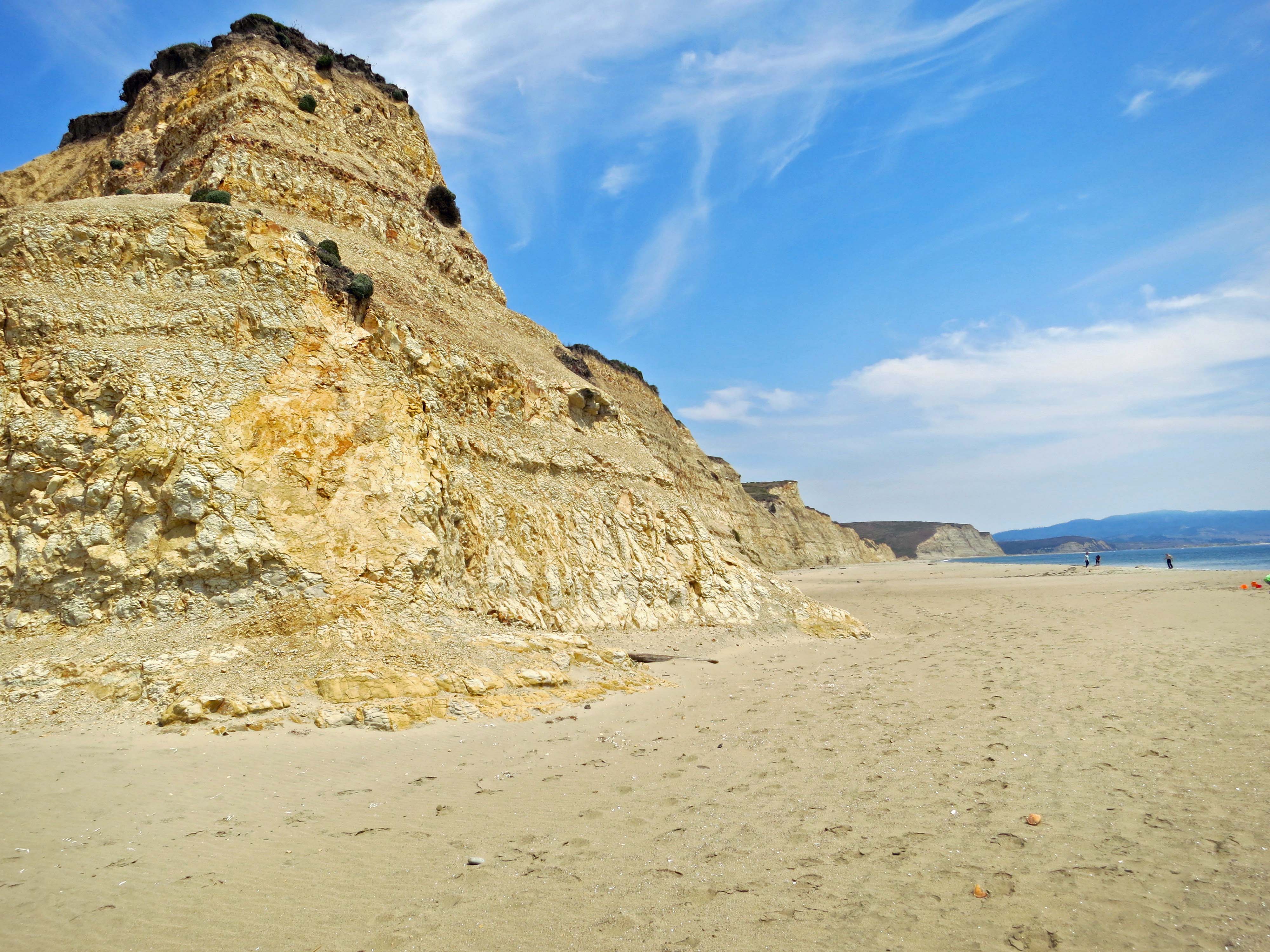
These distinctive cliffs at Drakes Bay in Point Reyes National Seashore were used to help identify where Sir Francis Drake landed in

These distinctive cliffs at Drakes Bay in Point Reyes National Seashore were used to help identify where Sir Francis Drake landed in the late 1500s. The tracks in the foreground speak to how popular this beach is in the summer. I had a difficult time capturing a photo that wasn’t packed with people.

By 1776, when Americans were fighting for independence from Great Britain, the Spaniards were busy establishing their first missions north of San Francisco, an effort that was a continuation of the work of Junipero Serra. In return for supplying ‘civilization and salvation’ to the Miwoks, the Catholic priests expected the natives to work for nothing in what can best be described as a system of slavery. Going home to visit family without permission, or even going fishing, could earn a whipping and a jail sentence. And, if ‘civilization and salvation’ weren’t enough, the Spaniards brought the European diseases with them that more or less wiped out the native population and opened the area for white settlement. It’s small wonder that California’s remaining Native American population didn’t celebrate the recent canonization of Junipero Serra with enthusiasm.

The Miwok, for the most part, were a gentle people who lived in close harmony with the land. An area of Olompali State Park has been put aside to display the native plants and housing the Miwoks used. The natives practiced house cleaning in the extreme: They burned down their houses once a year to get rid of bugs and vermin that had taken up residence.

The Miwoks built some of their homes with redwood siding, or at least redwood bark. This example of a Miwok shelter is located at Olompali.

The Miwoks built some of their homes with redwood siding, or at least redwood bark. This example of a Miwok shelter is located at Olompali.

While most of the plants on display were suffering from the drought, an attractive Bay Laurel caught my attention. A signpost reported that the Miwok had eaten the fruit raw. Nuts were dried and then pounded into flour that was used for bread. The leaves were used for spice. A tea made from the leaves was used for stomach-aches, colds and sore throats. Fresh leaves were put on the head for headaches and an infusion of the leaves was used for washing sores. Shoots growing from the tree were used as arrow shafts. Visiting the Bay Laurel, it seemed to me, would have been like making a trip to the grocery store. I found several of the plants the Miwoks made use of, such as the California Buckeye and Harvest Brodiaea, were also common to the Central Valley of California and the Sierra Nevada Mountain foothills where I lived for many years.

The drought that has California in such a tight grip, didn't seem to impact this Bay Laurel that was growing in the garden of native plants important to the Miwok.

The drought that has California in such a tight grip, didn’t seem to impact this Bay Laurel that was growing in the garden of native plants important to the Miwok.

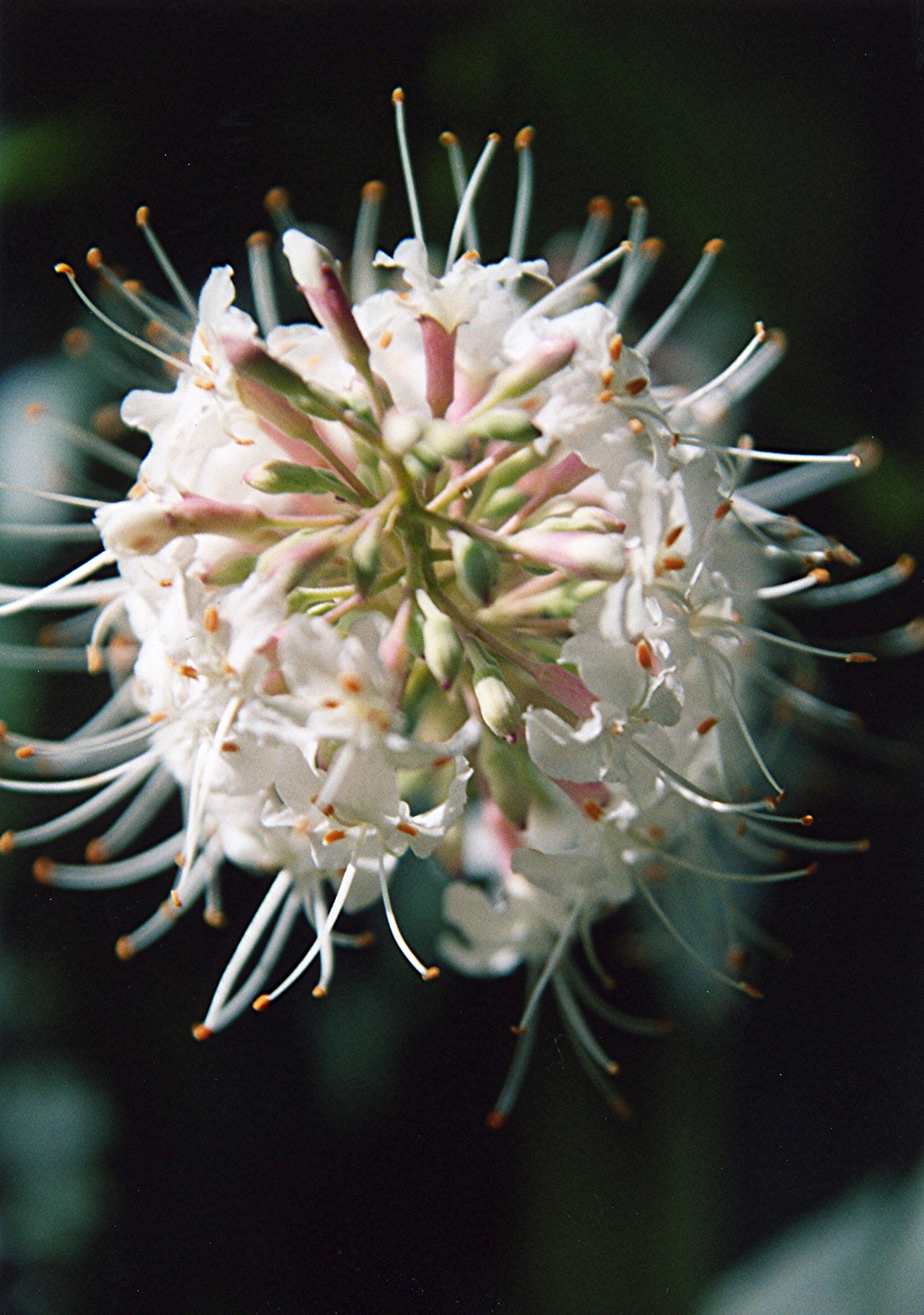
Buckeye trees in bloom along the American River Parkway in Sacramento. Buckeyes, well leeched to remove poison, served as back up food when acorns were scare.

Buckeye trees in bloom along the American River Parkway in Sacramento. Buckeyes, well leached to remove poison, served as back up food for the Miwoks when acorns were scarce.

A close up I took of buckeye flowers while hiking along the American River Parkway. The fruit of the buckeye was also crushed by the Miwok and thrown into streams to knockout fish that were then gathered for food.

A close up I took of buckeye flowers while hiking along the American River Parkway. The unleached fruit of the buckeye was crushed by the Miwok and thrown into streams to poison fish that were then gathered for food.

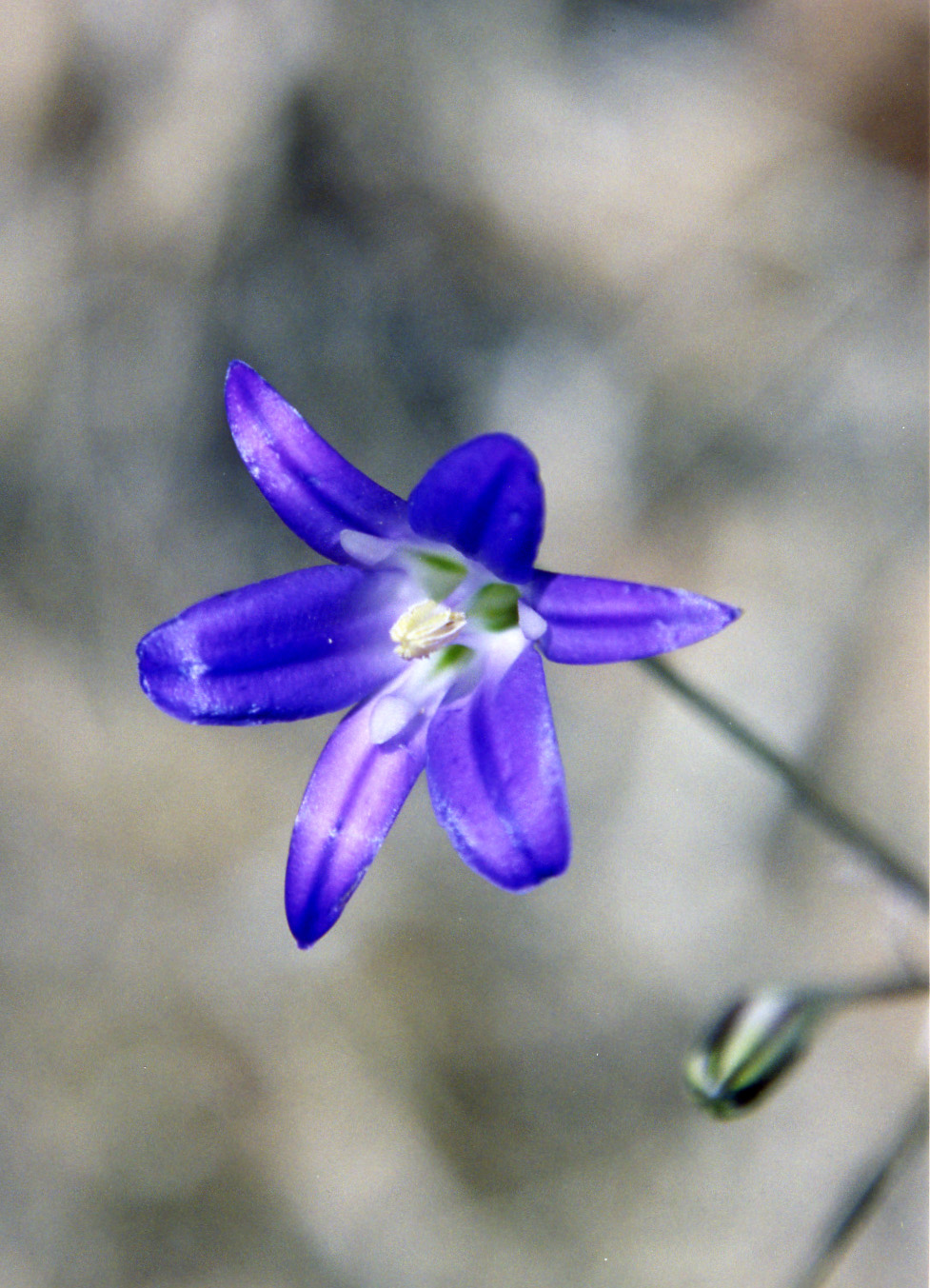
Bulbs of Harvest Brodiaea were baked, boiled or eaten raw by the Miwok. This is another photo I took along the American River Parkway.

Bulbs of Harvest Brodiaea were baked, boiled or eaten raw by the Miwok.

Wild animals, like native plants, were central to the existence of the Miwok. An informative book by Betty Goerke, Discovering Native People at Point Reyes, notes that the Miwok considered Coyote the creator of their world. As in much Native American lore, Coyote was also a trickster god, often getting into mischief. His god-like status kept him from getting eaten, however. Other animals didn’t fare as well, but even they deserved respect. “It was necessary and a common courtesy to honor an animal when it was killed,” Goerke notes. Beads were thrown into a fire to honor a dead bear. Even a small bird would receive a dance— “so it wouldn’t feel bad.” I’m not sure the dead bird appreciated the dance, given an option, but I like the sentiment behind it.

NEXT BLOG: How Olompali moved from being home territory for the Miwoks to a temporary home for the Grateful Dead and then the site of one of California’s most famous hippie communes.


Backpacking into the Grand Canyon… Part II

Looking down from Lipan Point at the start of the Tanner Trail. Then sharp bend in the Colorado River... far away, is where I am heading. (The photos of the trail down I actually took several years later when I backpacked down with Peggy.)

Looking down into the Grand Canyon at the start of the Tanner Trail.  By the end of the day I would be near the sharp bend in the river. At the beginning, my body was having serious doubts about whether it wanted to go there. It wasn’t the distance. It was the drop of several thousand feet which can be tough on both knees and downhill brakes.

You may (or may not) recall that I left you hanging on the edge of the Grand Canyon when I took my summer break from blogging starting in July. I had hoisted my 60-pound pack and was preparing to drop off the edge of the world following one of the Canyon’s toughest and least traveled trails several thousand feet down to the Colorado River. My body was having a serious discussion with my mind over the wisdom of the decision. You may want to go back and read Part I of the Grand Canyon Odyssey to refresh your memory.

Tanner trail dropped away under my feet as I began my journey and descended through millions of years of earth history. About a half of mile down it disappeared, having been washed away by winter rains. “I told you so,” my body whispered loudly as I mentally and physically hugged the side of the Canyon and tentatively made my way around the washout.

Although this photo is a little blurry and from another Grand Canyon trail, I included it because it provides a perspective on the trails into the Canyon that receive minimal attention from the Park service. Main tourist trails are like freeways in comparison.

Although this photo is a little blurry and from another non-maintained Grand Canyon trail, I included it because it provides a perspective on the trails into the Canyon that receive minimal attention from the Park Service. Main tourist trails are like freeways in comparison.

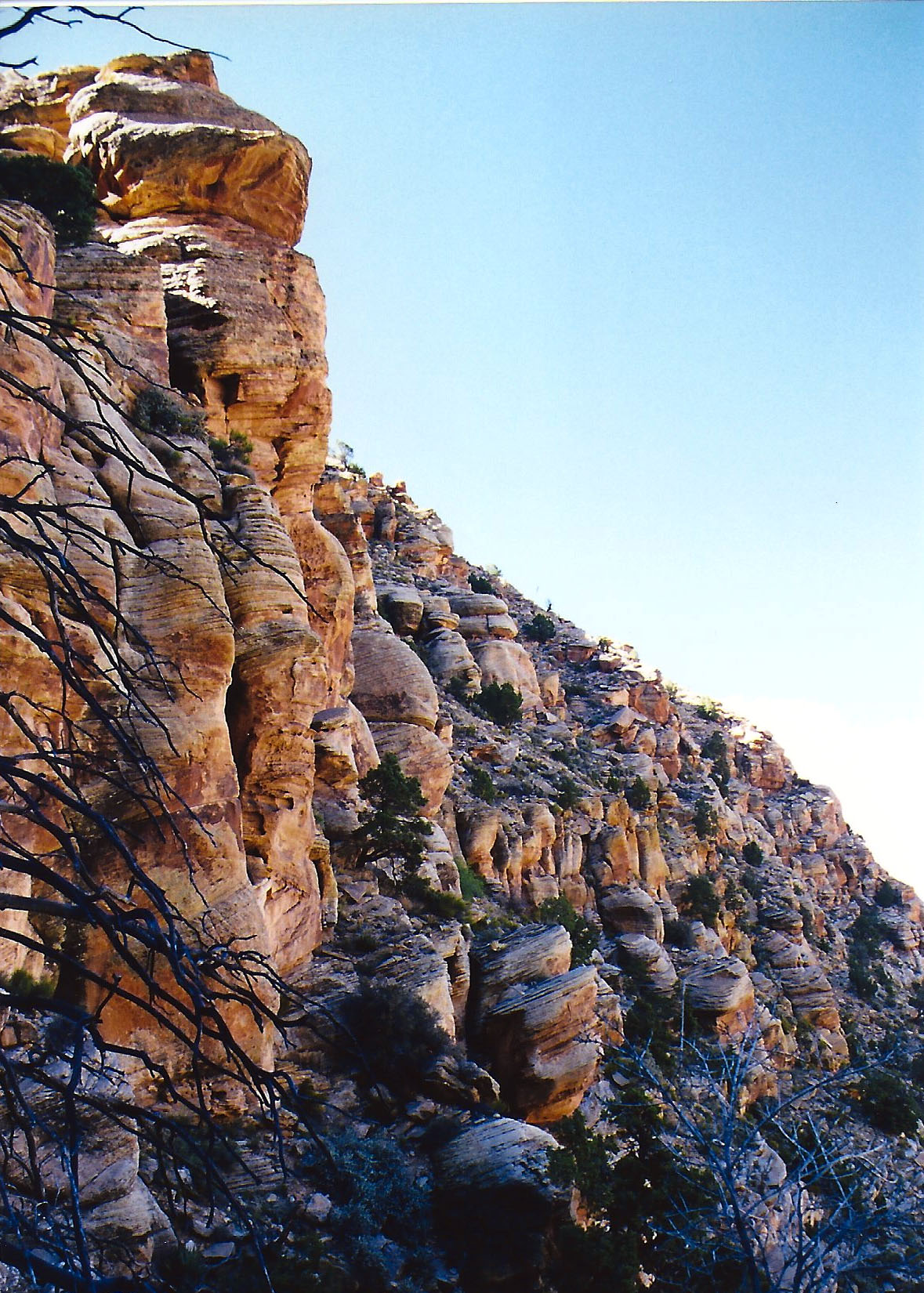
Steep drop offs are a common factor in all trails leading into the Grand Canyon. The first trails were created by Native Americans. Later miners, rustlers, and companies interested in promoting tourism would enhance the original trails and create new ones.

Steep drop offs are a common factor in all trails leading into the Grand Canyon. The first trails were created by Native Americans. Later miners, rustlers, and companies interested in promoting tourism would enhance the original trails and create new ones. The top of the photo reflects the different rates of erosion that create bluffs.

I am not sure when my legs started shaking. Given the stair-step nature of the trail and the weight on my back, not to mention an extra 20 pounds of winter fat, my downhill muscles were not having a lot of fun. Fortunately, Mother Nature provided a reprieve. The erosive forces of wind and water that have sculpted the mesas and canyon lands of the Southwest are less challenged by some types of rocks than others.

Somewhere between two and three miles down I came upon the gentle lower slopes of the Escalante and Cardenas Buttes, which allowed me to lollygag along and enjoy the scenery. I escaped from the sun beneath the shadow of a large rock, drank some of my precious water, nibbled on trail food, and took a brief nap. It would have made a good place to camp. Others had obviously taken advantage of the shade and flat surface, but the Colorado River was calling.

Ignoring the screams of my disgruntled body parts, I headed on. At mile five or so my idyllic stroll came to a dramatic halt as the trail dropped out of sight down what is known as the Red Wall. (It received this imaginative name because it is red and looks like a wall.) Some fifty million years, or 625,000 Curtis life spans, of shallow seas had patiently worked to deposit the lime that makes up its 500-foot sheer cliff. It is one of the most distinctive features of the Grand Canyon.

My trail guide recommended I store water before heading down so I could retrieve it when I was dying of thirst on the way out. I could see where people had scratched out exposed campsites here as an excuse to stop for the night. The accommodations weren’t much but the view was spectacular.

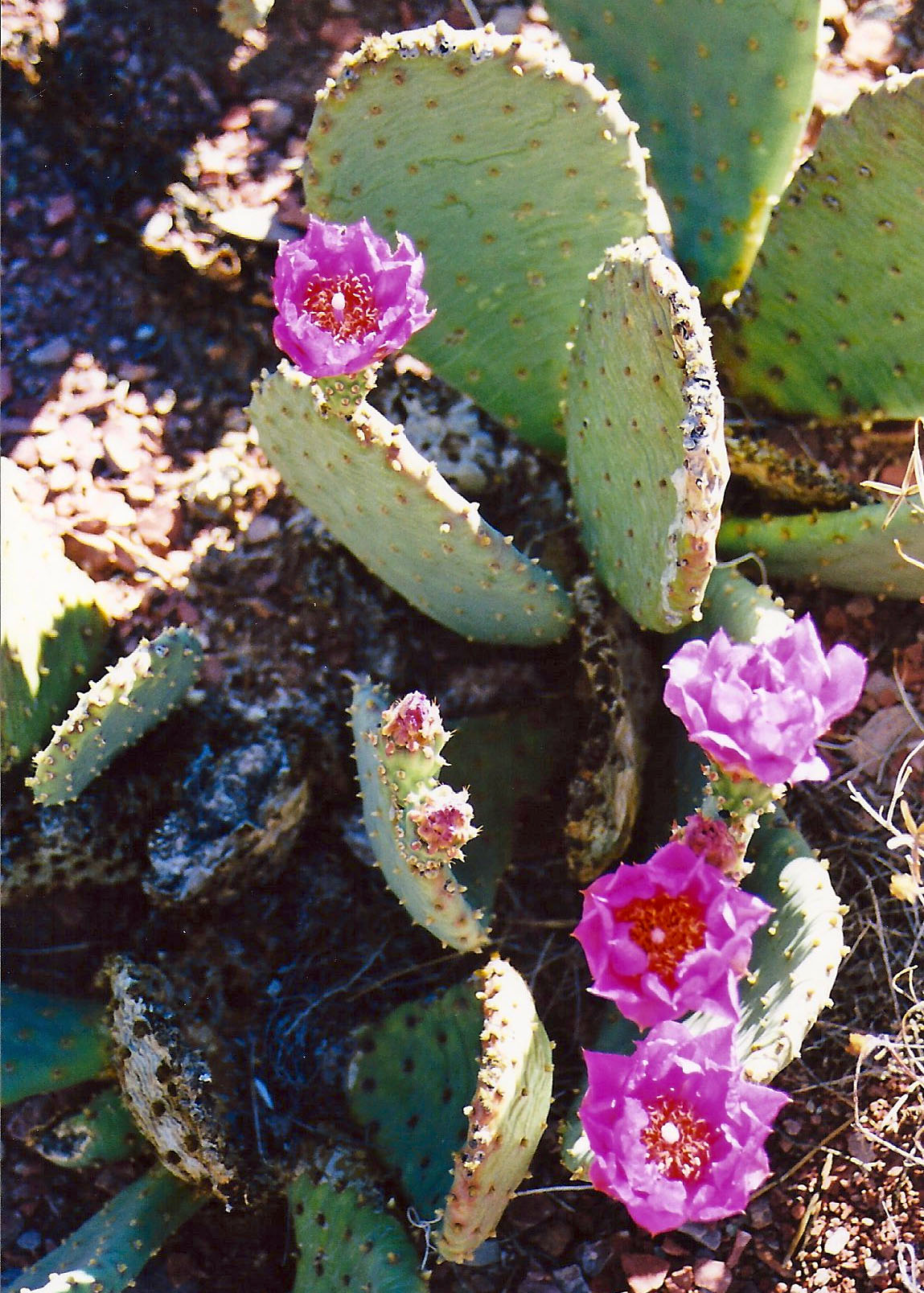
The rest of the five-mile/five month journey was something of a blur. (It was closer to five hours but time was moving very slowly.) I do remember a blooming prickly pear cactus. I grumbled at it for looking so cheerful. I also remember a long, gravelly slope toward the bottom. My downhill muscles had totally given out and the only way I could get down was to sidestep. I cackled insanely when I finally reached the bottom. I was ever so glad the Sierra Club guy (see Part I) wasn’t around to see me.

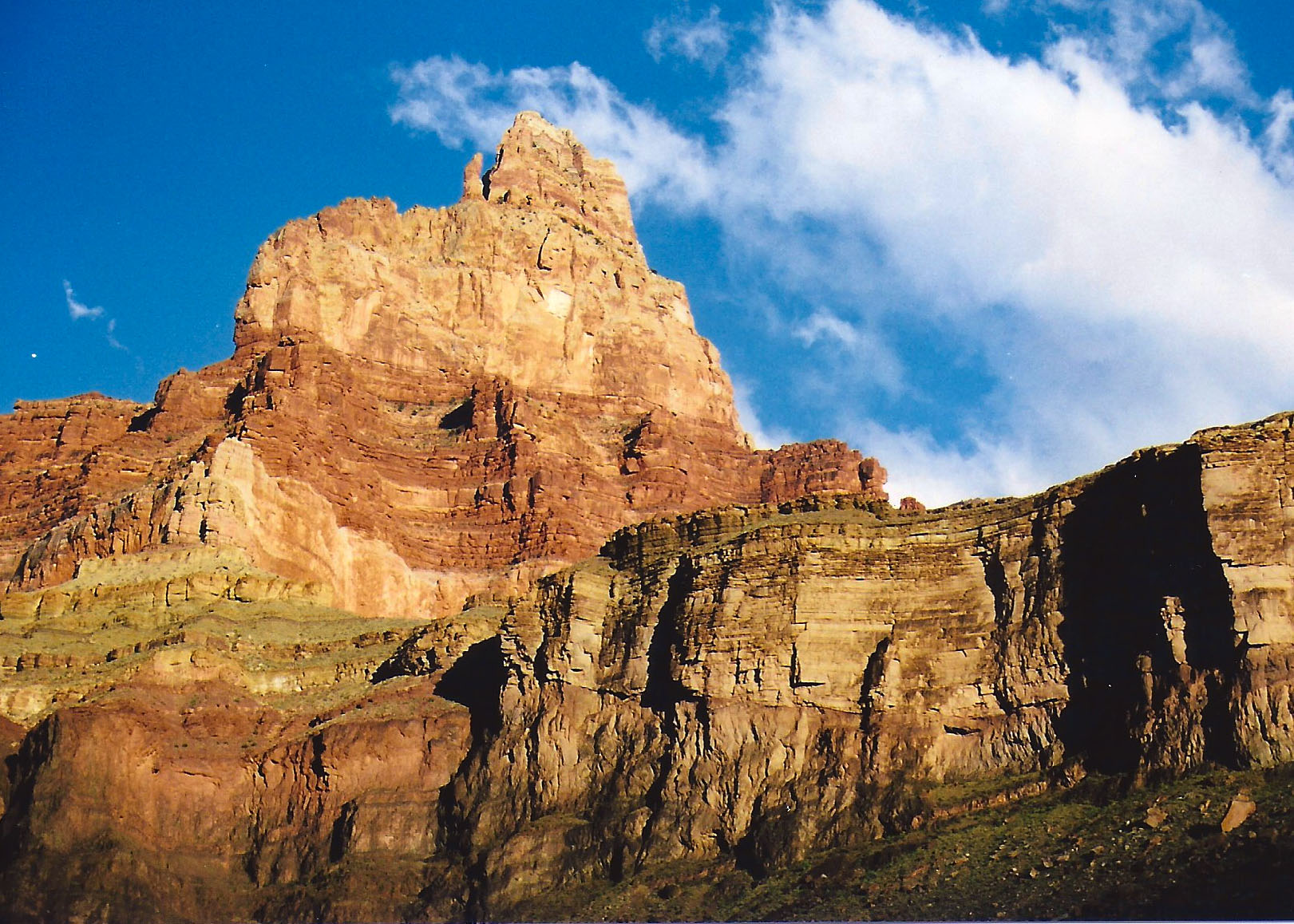
As tired as I was, I enjoyed the beauty of the inner Canyon.

I was so tired, I could hardly enjoy the beauty of the inner Canyon. (These photos are from a later trip I took down with Peggy. I waited until after she said “I do” before introducing her to the Tanner Trail. Otherwise she might have said “I don’t.”)

I smiled at the Prickly Pear Flowers on my way out of the Canyon that I had growled at coming in.

I growled at a prickly pear for looking so cheerful.

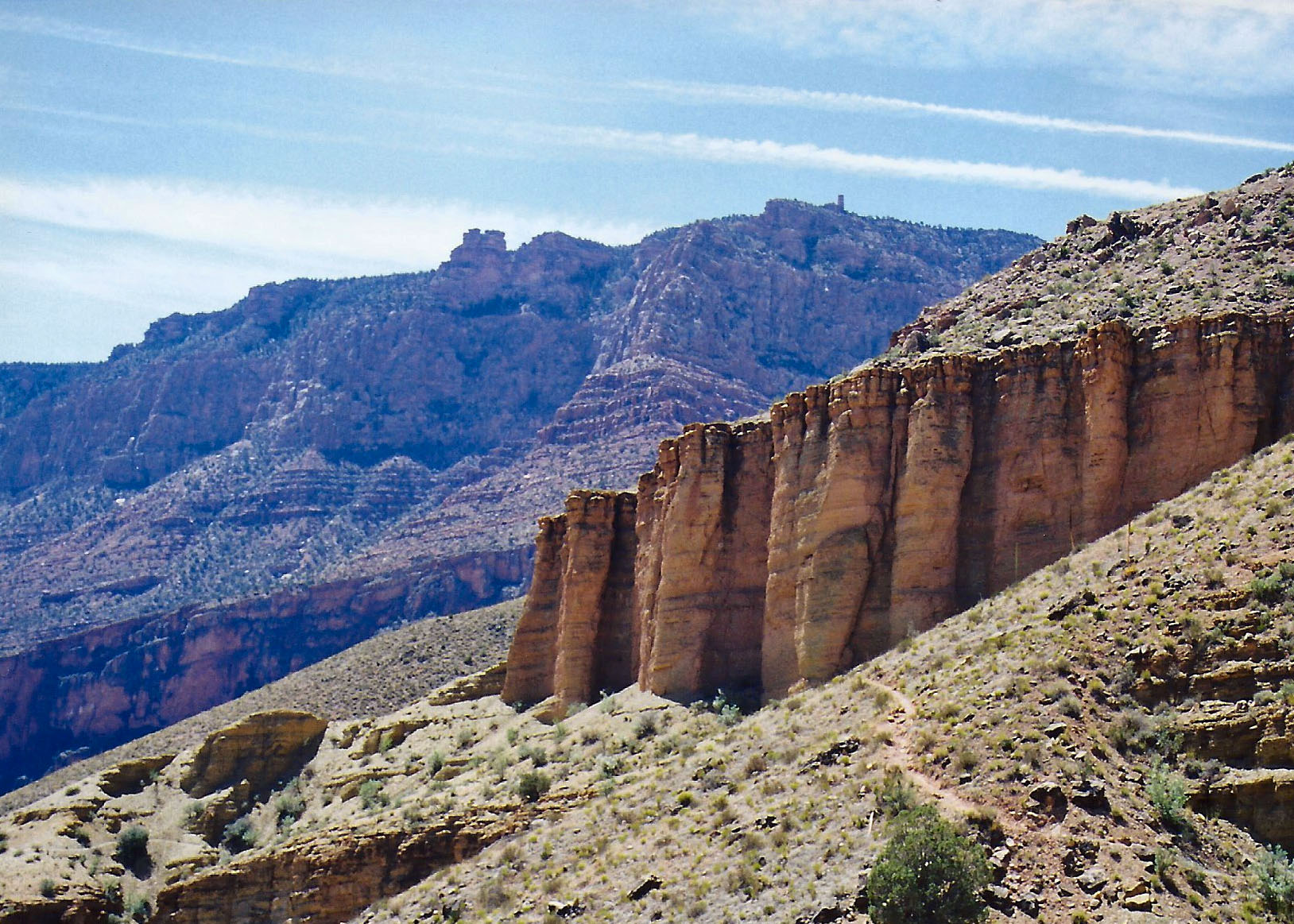
Looking back up the trail provided a perspective on how far I had come. The small, needle-like structure is Desert View Tower.

Looking back up the trail provided a perspective on how far I had come. The small, needle-like structure is Desert View Tower, about a mile away from the Tanner trailhead.

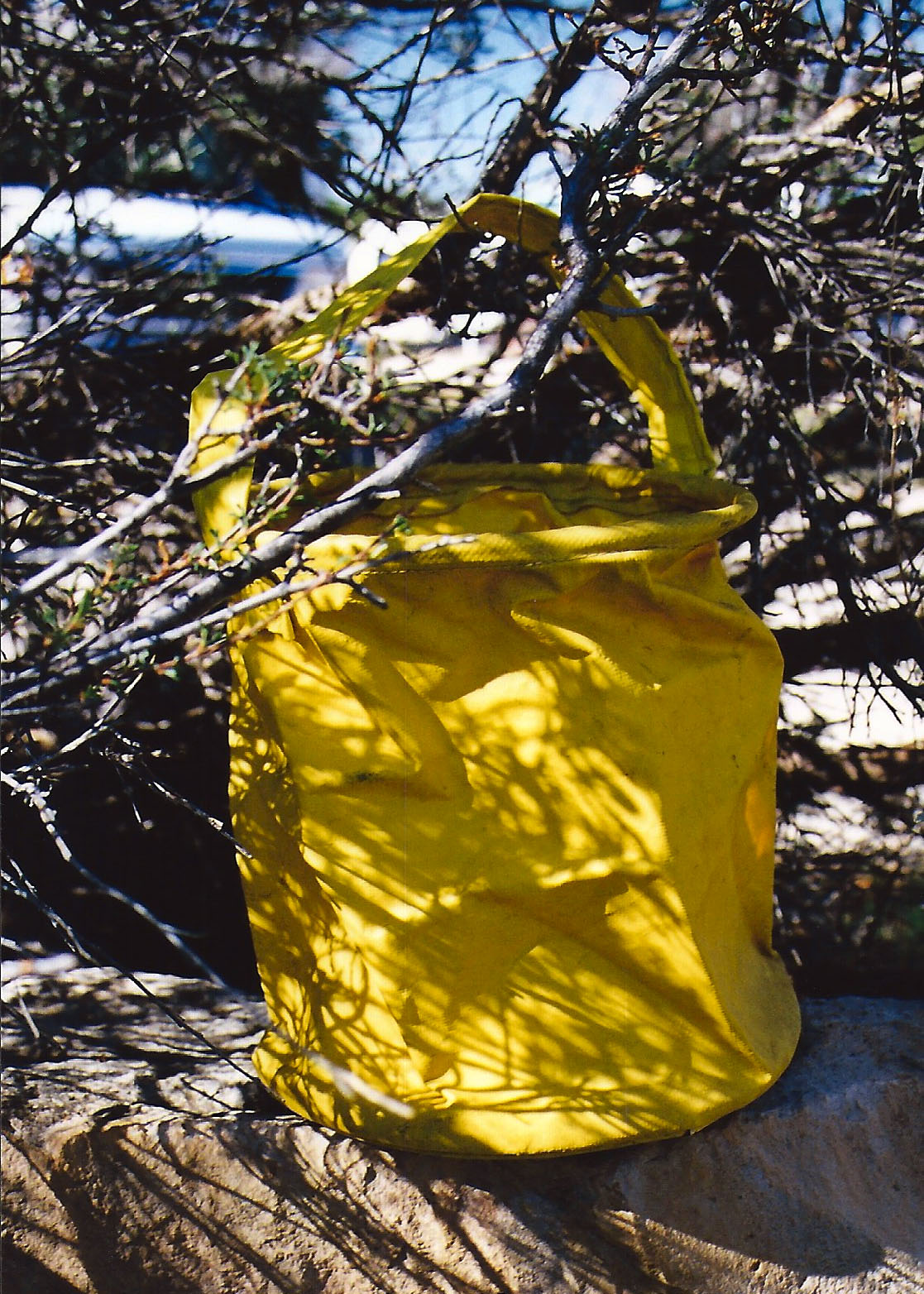
Setting up camp that night was simple. I threw out my ground cloth, Thermarest mattress, and sleeping bag on a sandy beach. Then I stumbled down to the river’s edge and retrieved a bucket of brown Colorado River water that appeared to be two parts liquid and one part mud. I could have waited for the mud to settle but used up a year of my water filter’s life to provide an instant two quarts of potable water.

My old yellow bucket, a veteran of dozens of backpacking adventures, holding Colorado River water. It retired after my second trip

My old yellow bucket, a veteran of dozens of backpacking adventures, holding Colorado River water. It retired after my second trip down the Tanner Trail.

All I had left to do was take care of my food. Since people camped here frequently, four-legged critters looked on backpackers as a major source of food. I could almost here them yelling, “Dinnertime!” when I stumbled into sight. Not seeing a convenient limb to hang my food from, i.e. something I wouldn’t have to move more than 10 feet to find, I buried my food bag in the sand next to me. Theoretically, anything digging it up would wake me. Just the top was peeking out so I could find it in the morning.

As the sun went down, so did I. Faster than I could fall asleep, I heard myself snoring. I was brought back to full consciousness by the pitter-patter of tiny feet crossing over the top of me. A mouse was worrying the top of my food bag and going for the peanuts I had placed there to cover my more serious food.

“Hey Mousy,” I yelled, “Get away from my food!” My small companion of the night dashed back over me as if I were no more than a noisy obstacle between dinner and home. I was drifting off again when I once more felt the little feet. “The hell with it,” I thought in my semi-comatose state. How many peanuts could the mouse eat anyway?

The river water I had consumed the night before pulled me from my sleep. Predawn light bathed the Canyon in a gentle glow. I lay in my sleeping bag for several minutes and admired the vastness and beauty of my temporary home. The Canyon rim, my truck and the hoards of tourists were far away, existing in another world. My thoughts turned to my visitor of the previous evening.

I finished my last blog with a picture of the view across the Colorado River from my camp near Tanner Rapids. This and the photo below demonstrate how much colors change depending on the time of day.

The early morning view from my camp site near Tanner Rapids on the Colorado River.

Out of curiosity, I reached over for my food and extracted the bag of peanuts. A neat little hole had been chewed through the plastic but it appeared that most of my peanuts were present and accounted for. My small contribution had been well worth my solid sleep. I then looked over to the right to see if I could spot where the mouse had carried its treasure. Something on the edge of my ground cloth caught my eye. It was three inches long, grey, round and fuzzy.

It was Mousy’s tail!

Something had sat on the edge of my sleeping bag during the night and dined on peanut stuffed mouse. Thoughts of a coyote, or worse, using my ground cloth as a dinner table sent a shiver down my spine. I ate a peanut in honor of Mousy’s memory and threw a few over near his house in case he had left behind a family to feed. I also figured that the peanuts would serve as an offering to whatever Canyon spirits had sent the night predator on its way.

I visited a bush to meet the demands of my bladder, fired up my MSR white gas stove, and soon had a cup of coffee in my hand and hot morning gruel (oatmeal) in my tummy. I dutifully downed my daily ration of five dried apricots. (This may be more than you need to know, but they help keep you regular, an important consideration in wilderness travel.)

With breakfast out of the way and a second cup of coffee to enjoy, it was time to get out my topographic map and contemplate the adventure of the day. My intention was to work my way up the Colorado River following the Beamer Trail to where it was joined by the Little Colorado. The odds were I would have it to myself. The trail was named after a prospector who had searched the area for gold in the 1800s but it also incorporated ancient sections of trail the Hopi Indians had used to reach their sacred salt mines.

Hopi legend claims that their ancestors emerged into this world from a cave in the bottom of the Little Colorado River Canyon. I found the combination of history, mythology, isolation and scenery quite attractive and was eager to get underway. Unfortunately, my body had other plans. It was going on strike.

NEXT BLOG: I declare a layover day where I hardly move and then begin to explore the beauty of the inner Canyon.

There Is Much More to Mt. Rainier National Park than a Mountain

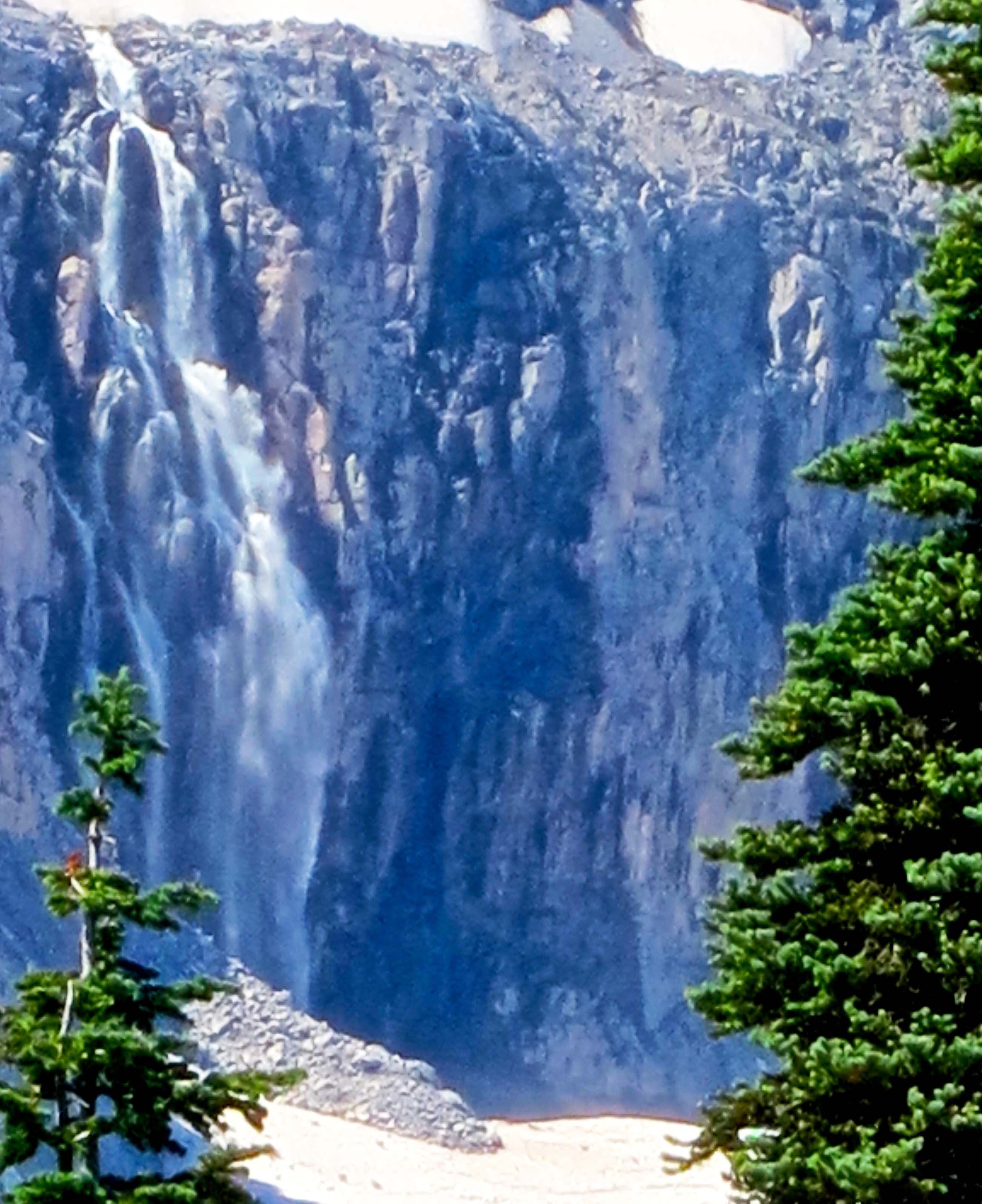
A waterfall in Mt. Rainier National Park. Photo by Curtis Mekemson.

Mt. Rainier National Park has much more that its majestic mountain to offer visitors. Ancient forests, glacial rivers and tumbling waterfalls are found throughout the Park.

At 14, 410 feet (4,392 meters), Mt. Rainier is the tallest volcano in the Cascade Mountains, a range that starts in northern California and works its way through Oregon and Washington before ending in southern British Columbia. The range is part of the famous, or perhaps I should say infamous, Ring of Fire that surrounds the Pacific Ocean and represents the epic crashing of oceanic and continental tectonic plates. Volcanic eruptions, earthquakes and tsunamis are its legacy.

Mt. Shasta in northern California. Photo by Curtis Mekemson.

Starting at Mt. Shasta (shown here) and Mt. Lassen in northern California, the Cascade Mountain Range of volcanoes works its way northward into southern British Columbia.

Rainier is an active volcano, which means it is capable of blowing its top at any time. Every volcanic eruption in the last 200 years that has taken place in the contiguous United States (outside of Hawaii and Alaska) has happened in the Cascade Range. The most recent was Mt. St. Helens in southern Washington, which exploded in 1980. I flew over the mountain a few weeks after the eruption. The destruction was unimaginable.

Mt. St. Helens in Washington. Photo by Curtis Mekemson.

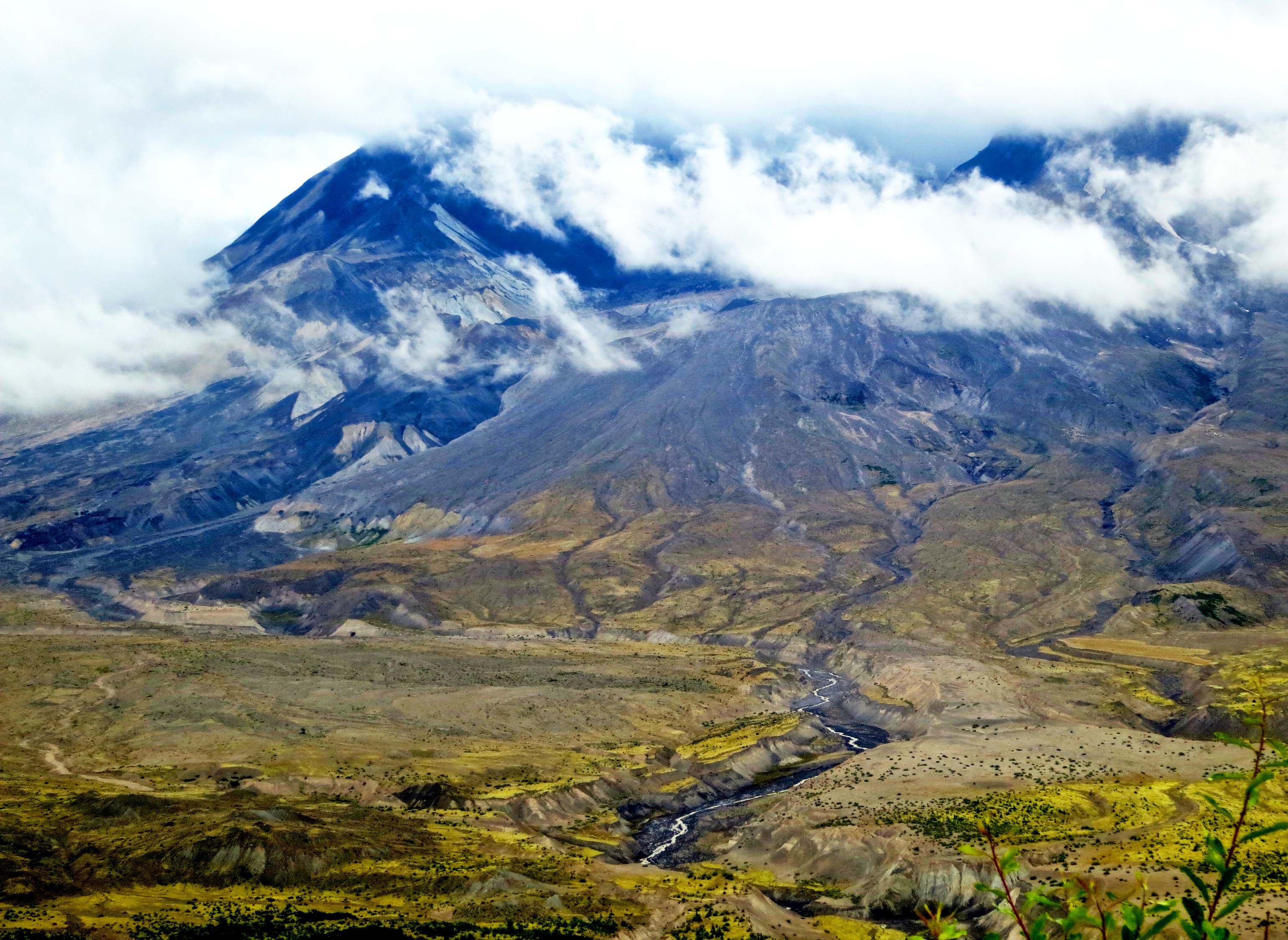
Mt. St. Helens today, its once majestic peak now a crater. The river has carved a canyon through the mudflow the volcano left behind. I took this photo two years ago.

Jet stream driven storms coming off the Pacific Ocean bring the rain that the North West is justifiably famous for. During the winter, this rain turns to snow as the storms are forced up and over Mt. Rainier— lots of snow. During the winter of 1971/72, 1,122 inches of snow fell. This translates into 93.5 feet or 28.5 meters. It set a world record at the time. The snow is responsible for the 14 named glaciers that slowly work their way down from the top, grinding up rocks as they go, and creating several rivers.

Photo of Mt. Rainier Glacier taken by Curtis Mekemson.

Fourteen named glaciers make their way down Mt. Rainier.

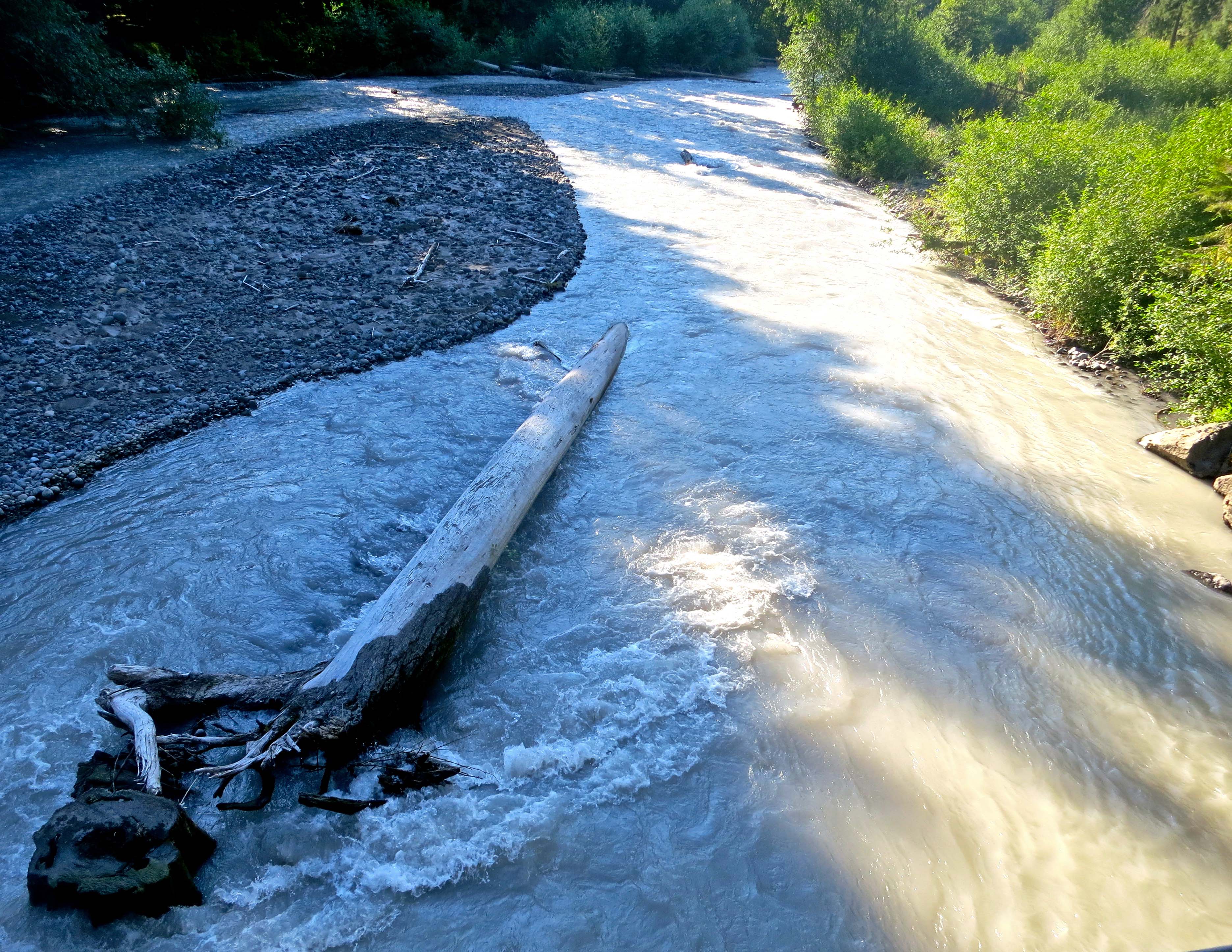
Fed by the Emmons, Frying Pan and Winthrop Glaciers, the White River is given its color by ground glacial rock dust.

Fed by the Emmons, Frying Pan and Winthrop Glaciers, the White River is given its color by ground glacial rock dust. BTW: Ancestors of my mother barely missed being massacred by indians on the White River around the time Seattle was founded.

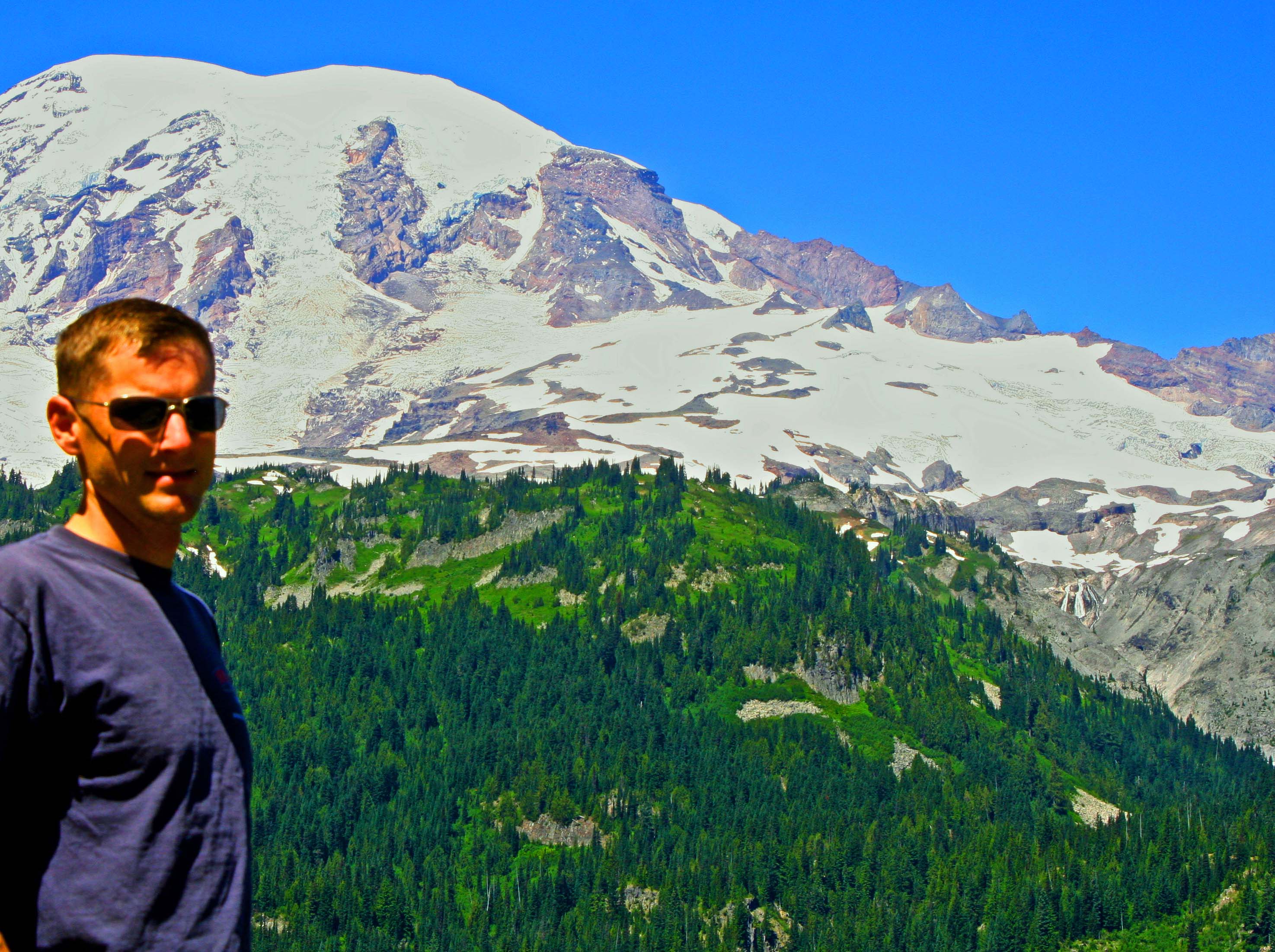
Peggy and I, along with our son Tony, worked our way clockwise around the mountain from the Sunrise Visitor Center to the Henry (Scoop) Jackson Memorial Visitor Center, covering about a third of the mountain. The road has enough twists and turns to hassle a snake and has more picturesque scenes than a National Geographic photographer could capture in a month. Misty waterfalls and an ancient forest competed with the snow-topped mountain for our attention. We finished off our exploration of Mt. Rainier with a breath-stealing hike that climbed up 1400 feet behind the Jackson Memorial Visitor Center.

Roots of a downed giant in the Grove Of Patriarchs, Mt. Rainier National Park. Photo by Curtis Mekemson.

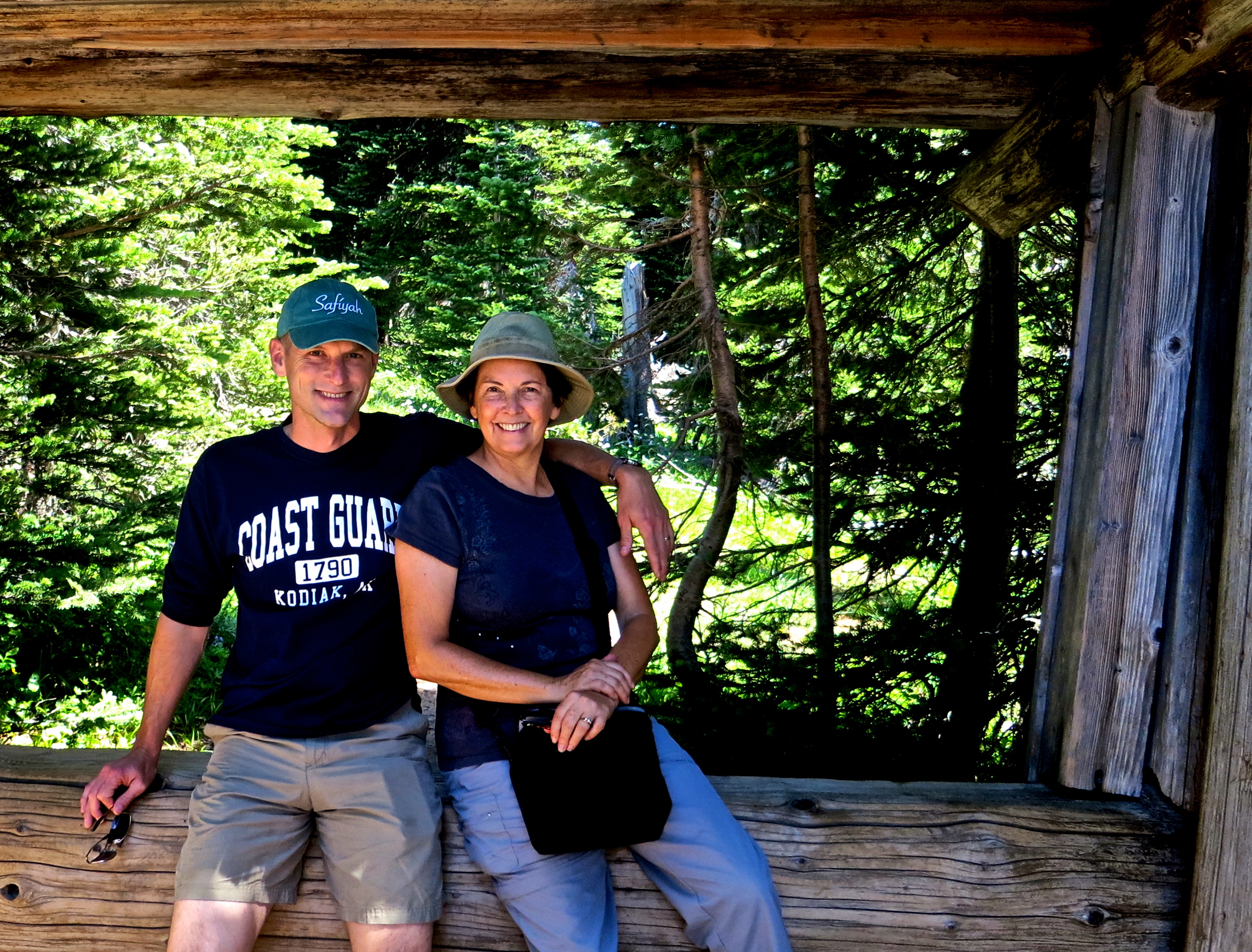
You would expect to find large trees in an area called the Grove of Patriarchs. We weren’t expecting this. Peggy is perched inside the roots of a downed patriarch. Or maybe it was a matriarch.

Creek reflects green of surrounding forest in Mt. Rainier National Park. Photo by Curtis Mekemson.

This creek flowing through the Grove of Patriarchs immediately made me think of a Claude Monet Impressionist painting.

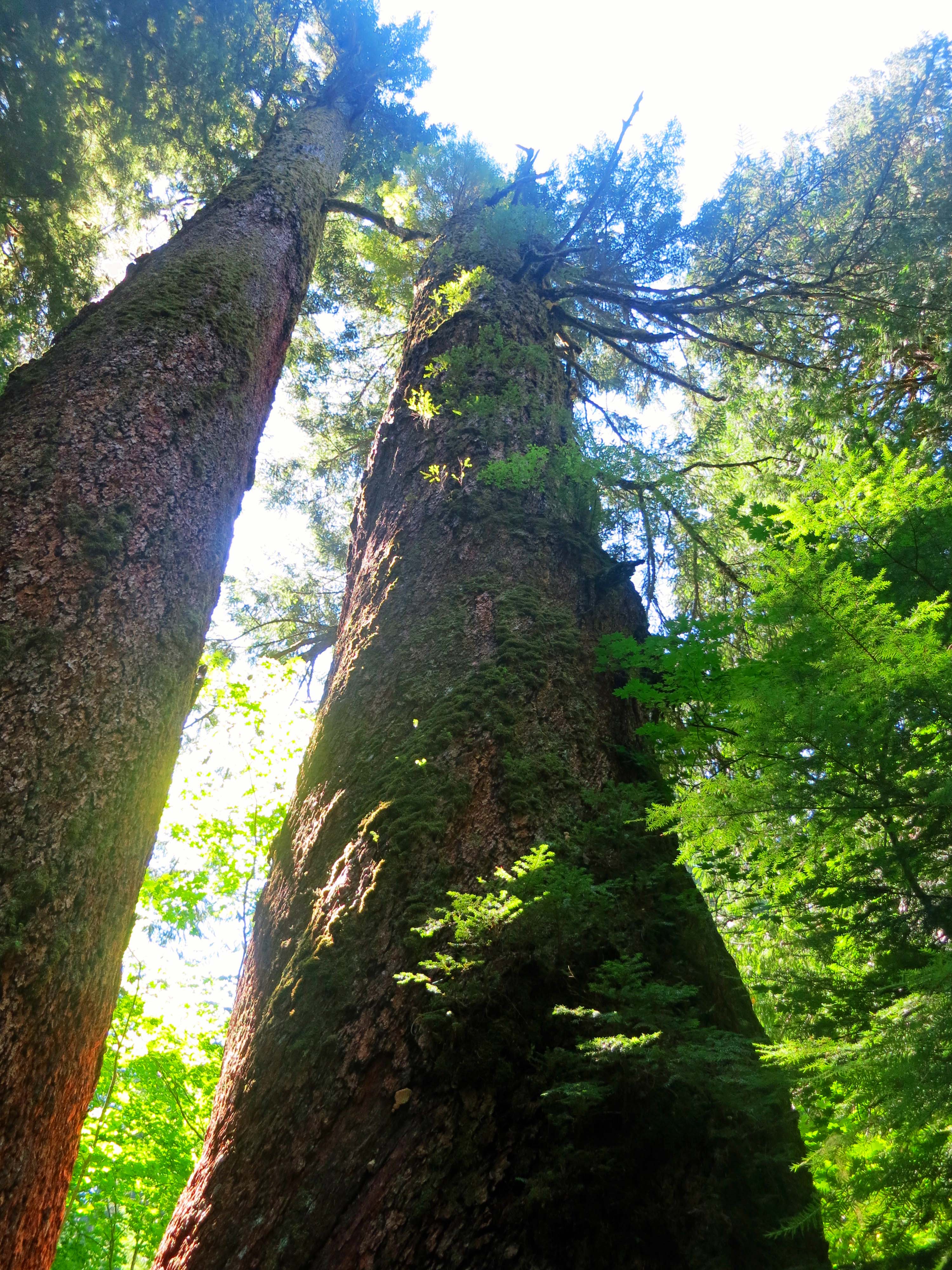
Since we are in the Grove of Patriarchs, a photo of big trees is required.

Since we were in the Grove of Patriarchs, a photo of big trees is required.

Wood grains on a downed tree in Patriarch Grove, Mt. Rainier National Park. Photo by Curtis Mekemson.

Whirls of wood grain appeared on a downed tree in the Grove. I was reminded of a 3-D topographic map.

Saffron robed monk throws snowball on trail above Jackson Memorial Center at Mt. Rainier National Park. Photo by Curtis Mekemson.

We came across a saffron robed monk throwing snowballs as we hiked on the trail above the Jackson Memorial Visitor Center. “Throw one at me,” I urged with camera poised.

View from Mt. Rainier above the Jackson Memorial Center. Photo by Curtis Mekemson.

One of many views we had climbing up the trail. As I recall, Peggy broke out singing Climb Every Mountain. It was a Julie Andrews’ moment.

Looking around we saw several waterfalls tumbling off the mountain.

Looking around we saw several waterfalls tumbling off the mountain.

Peggy captures Tony at our turn around point on the trail. He definitely wanted to keep on going. (Photo by Peggy Mekemson.)

Peggy captured Tony at our turn around point on the trail. He wanted to keep going to the top of the green hill but was outvoted by Mom and Dad. (Photo by Peggy Mekemson.)

Phlox flowers at Mt. Rainer National Park. Photo by Curtis Mekemson.

I took time to photograph these cheerful Phlox flowers on the way down.

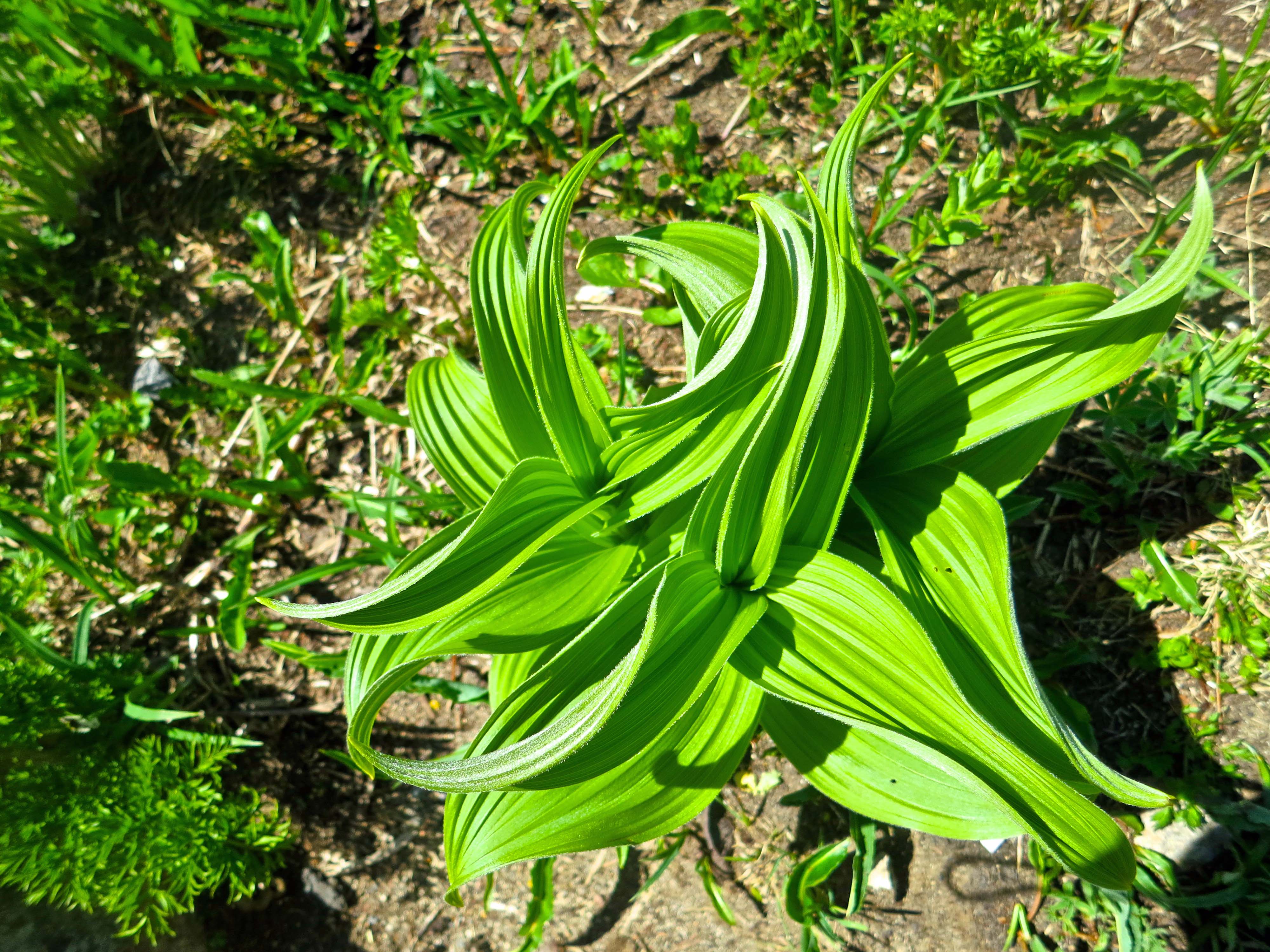
Corn lily growing on the side of Mt. Rainier. Photo by Curtis Mekemson.

And this wonderfully wild corn lily.

A goodbye view of Mt. Rainier.

A final goodbye view of Mt. Rainier. Next Blog: We begin our kayak adventure and search for Orca Whales off the north coast of Vancouver Island.


“Now, that’s a glacier…” Mt. Rainier National Park

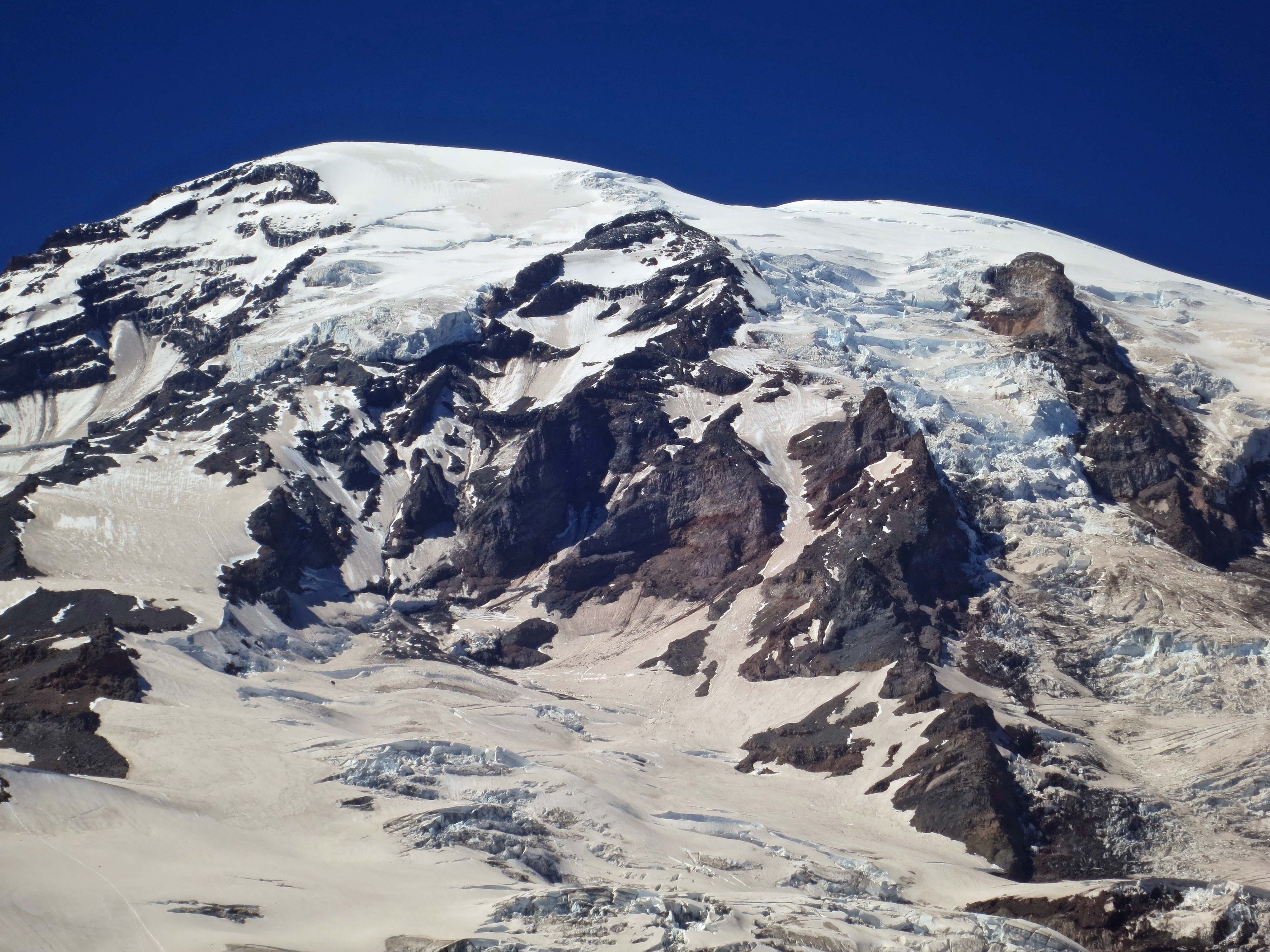
Mt. Rainier National Park. Photo by Curtis Mekemson.

Mt. Rainier is the most glaciated mountain in the lower 48 states of the US.

It was supposed to be a laid-back summer. Our daughter Tasha would come out from Tennessee with our grandsons Ethan and Cody for a week or two in June. And then we would go to Burning Man in late August. In between, we’d hang out at our home in the mountains, relax, and explore more of Southern Oregon— if we had the energy.

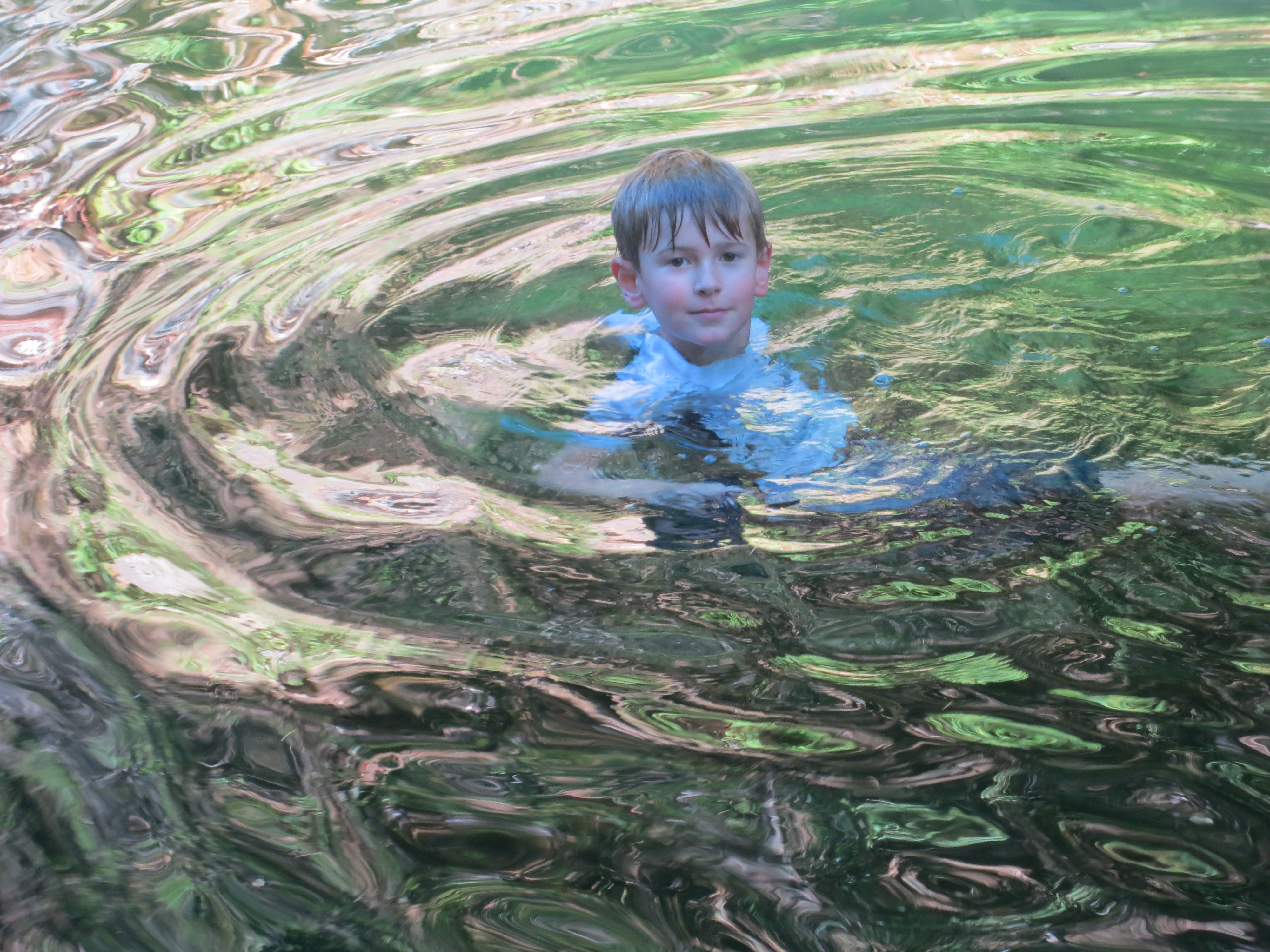
Our grandson Ethan enjoys a dip in the Applegate River this summer a few miles from our house .

Our grandson Ethan enjoys a dip in the Applegate River this summer a few miles from our house.

Then Edie called. Edie is Peggy’s old high school friend who lives in Anchorage, Alaska. She and her husband David had found what sounded like a great sea-kayak adventure looking for Orcas off the northern tip of Vancouver Island in August. Would we like to go? How could we resist? It would make our trip to Burning Man tight, but it was still doable.

Tony, our son who flies helicopter rescue missions for the Coast Guard off Kodiak Island, was next. He had helicopter crash training in Spokane in early August. This is where a huge machine takes a helicopter and dumps it upside down in a large pool of water so the pilot and crew can practice their escape routines. Wouldn’t it be great if we could pick him up at the Seattle airport before the training and head out for a few days of camping and hiking at Mt. Rainier? Yes it would, declared Peggy, doing a happy-mother dance. I wasn’t to worry that the Rainier trip backed up on the kayak trip that backed up on Burning Man.

Then Tasha called. She couldn’t come in June but had found some great tickets to fly out in July for a couple of weeks. Oops, said Mom. The latter part of the trip was double booked with the Tony trip. Not to worry, said Tasha. She’d only stay for a week and a half. If we hurried we could get to Seattle the day before Tony arrived so we could grab a campsite before they all disappeared. We found a campsite, barely. What disappeared was our laid-back summer.

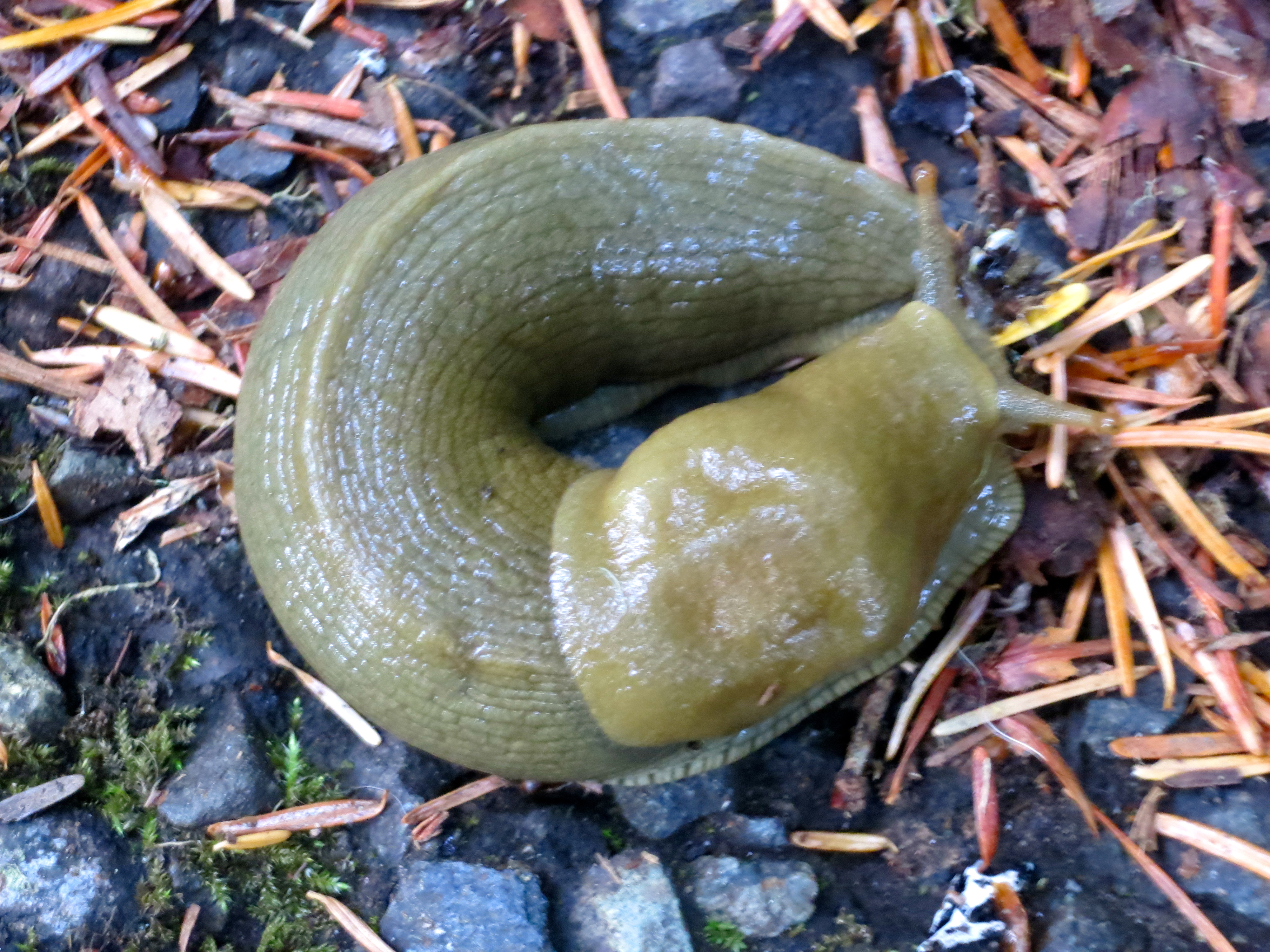
Photo of large slug at Mt. Rainier by Curtis Mekemson.

This slug we found at Mt. Rainier National Park was traveling at just about the pace I had hoped we would enjoy our summer. It wasn’t to be.

Join Peggy and me on my next two posts as we explore Mt. Rainier with Tony. After that, we will zip off on a search for whales with Edie and David.

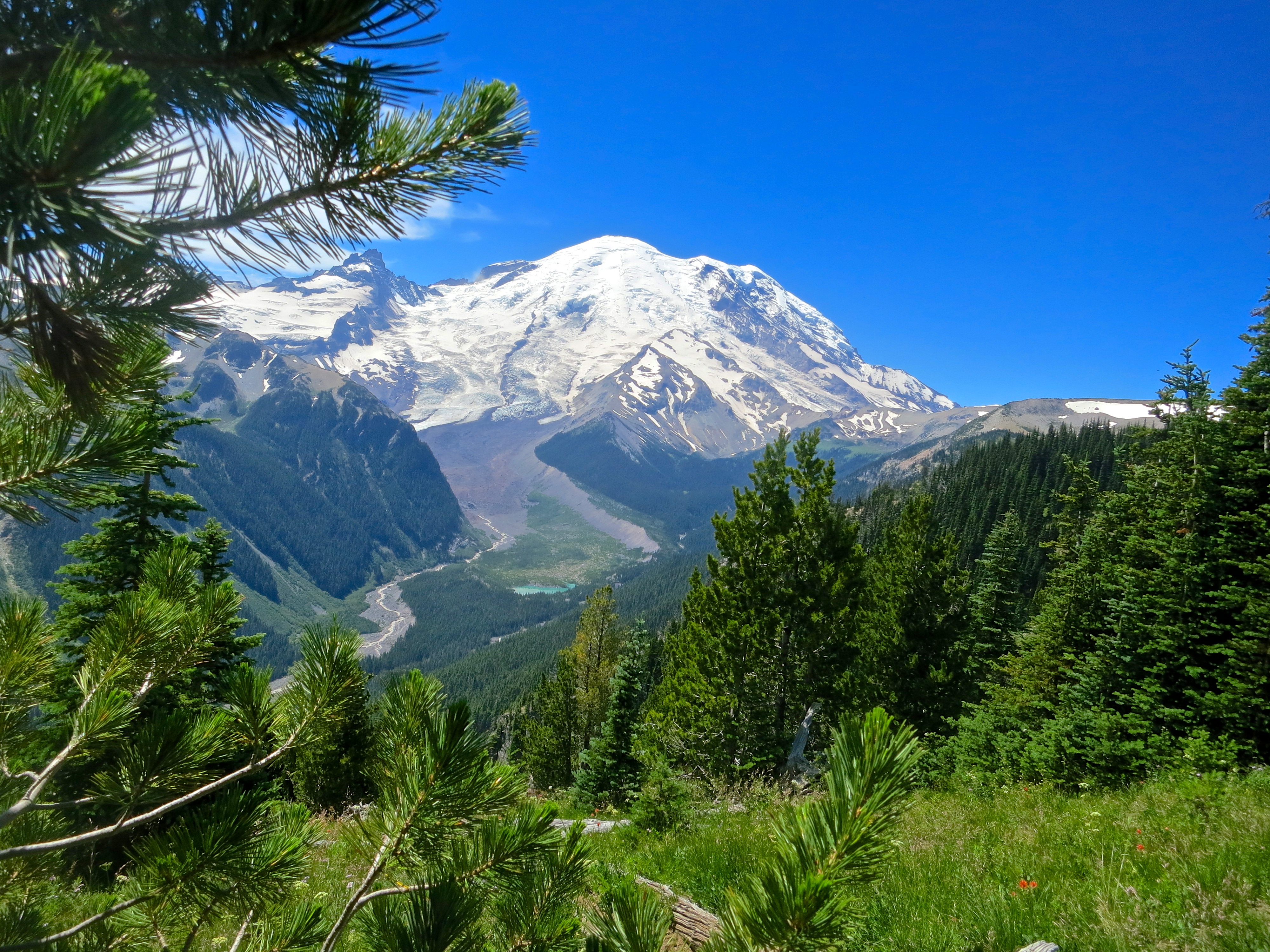
View from Sunrise Visitors center at mt. Rainier National Park. Photo by Curtis Mekemson.

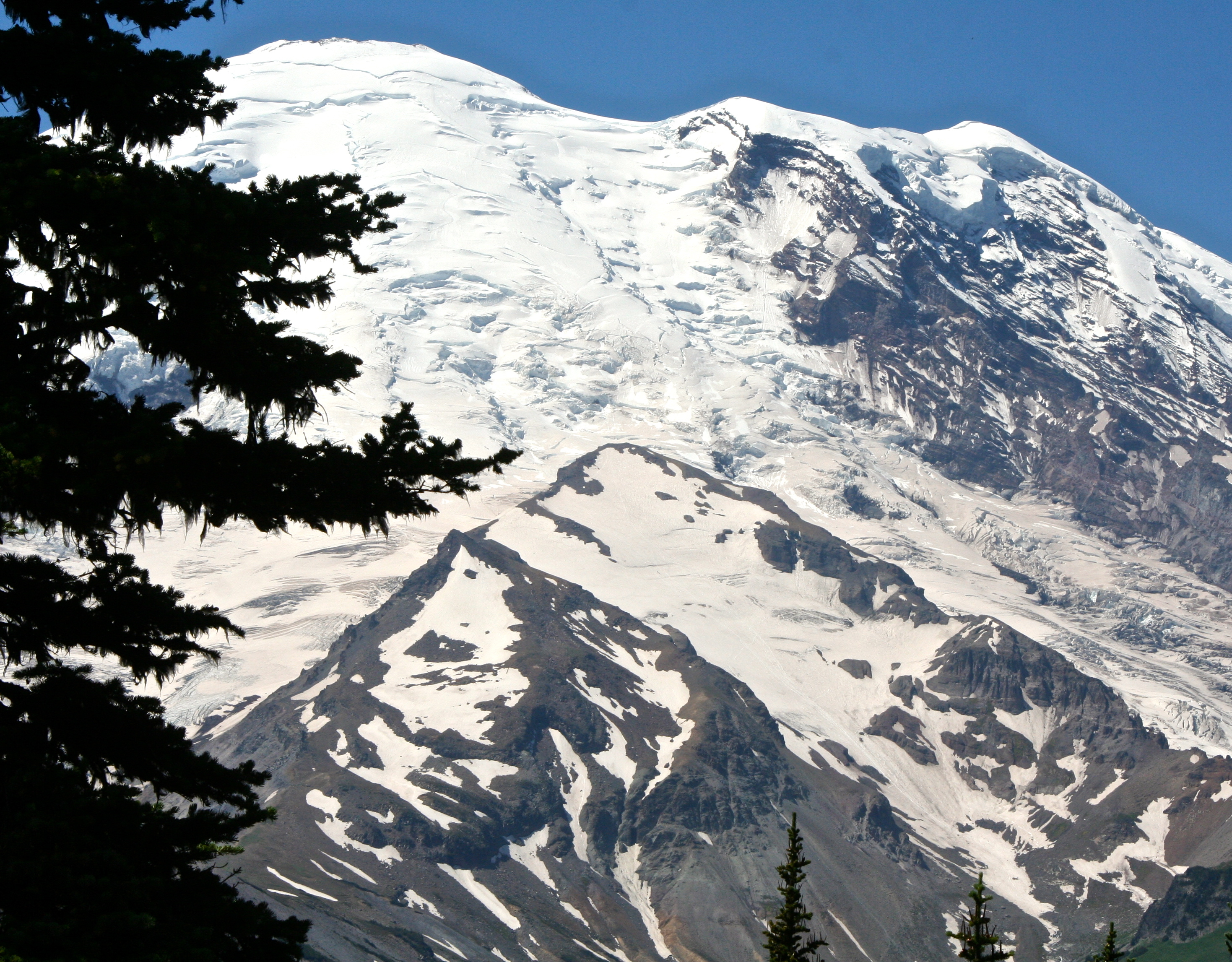
Looking up at Emmons Glacier from the Sunrise Visitor’s Center at Mt. Rainier.

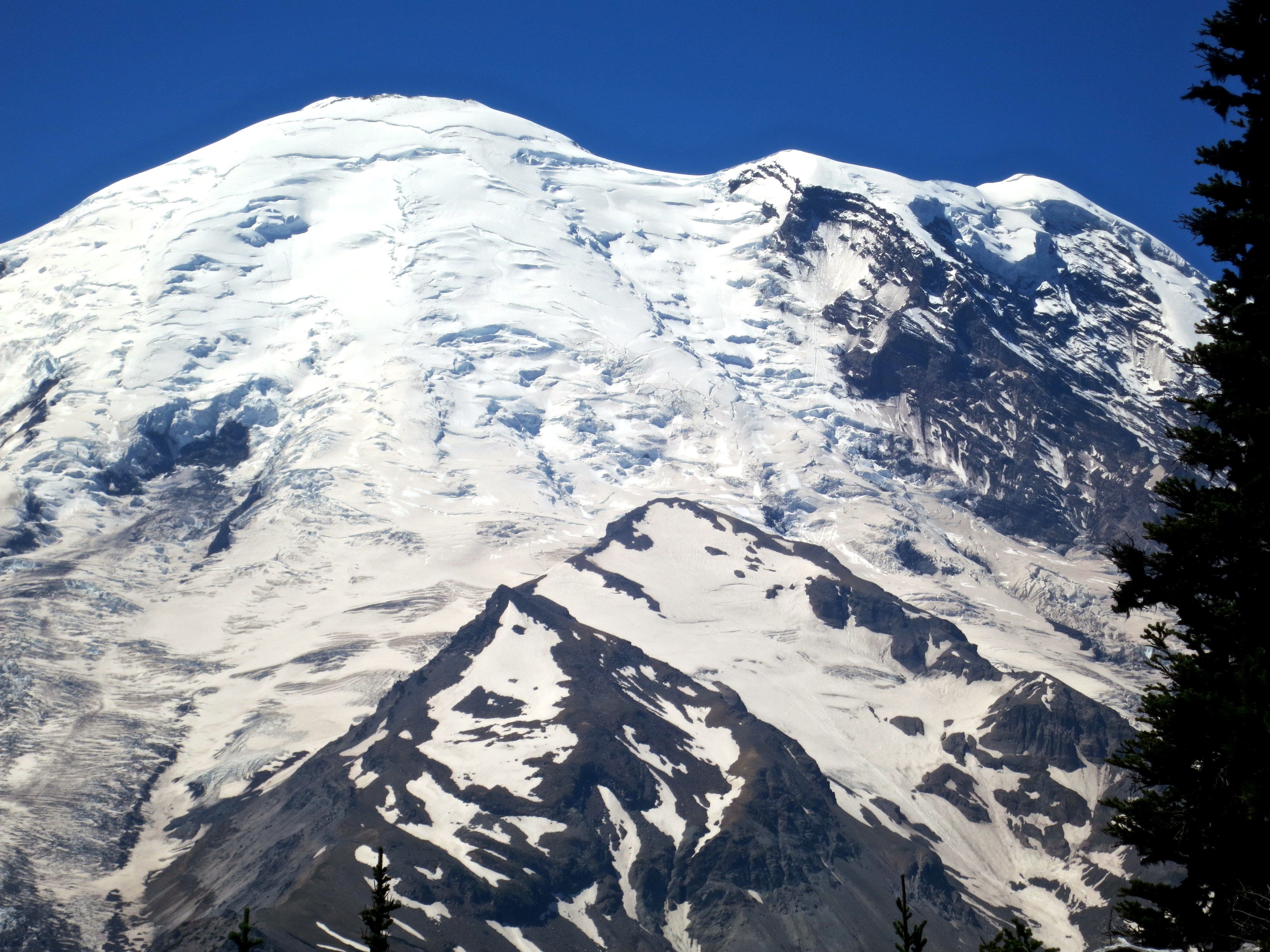
Close-up of Emmons Glacier at Mt Rainier National Park. Photo by Curtis Mekemson.

A close-up of Emmons Glacier.

Peggy and Tony pose fro a picture near the Sunrise Visitor Center at Mt. Rainier National Park.

Peggy and Tony pose for a picture near the Sunrise Visitor Center at Mt. Rainier National Park.

Indian Paintbrush at Mt. Rainier. Photo by Curtis Mekemson.

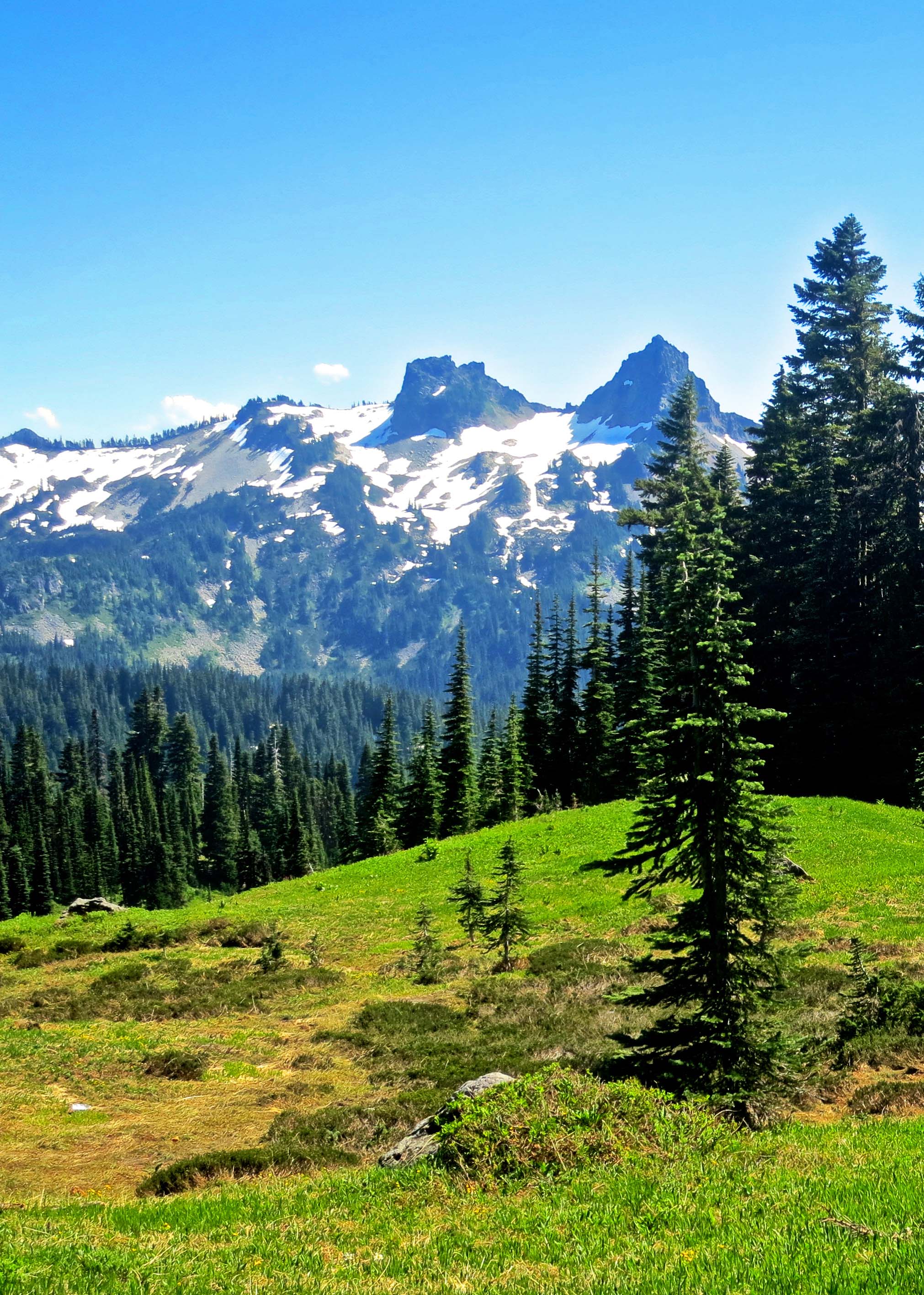
A short walk along the Silver Forest Trail from Sunrise Center included fields full of flowers as well as spectacular views of the mountain. This is Indian Paintbrush.

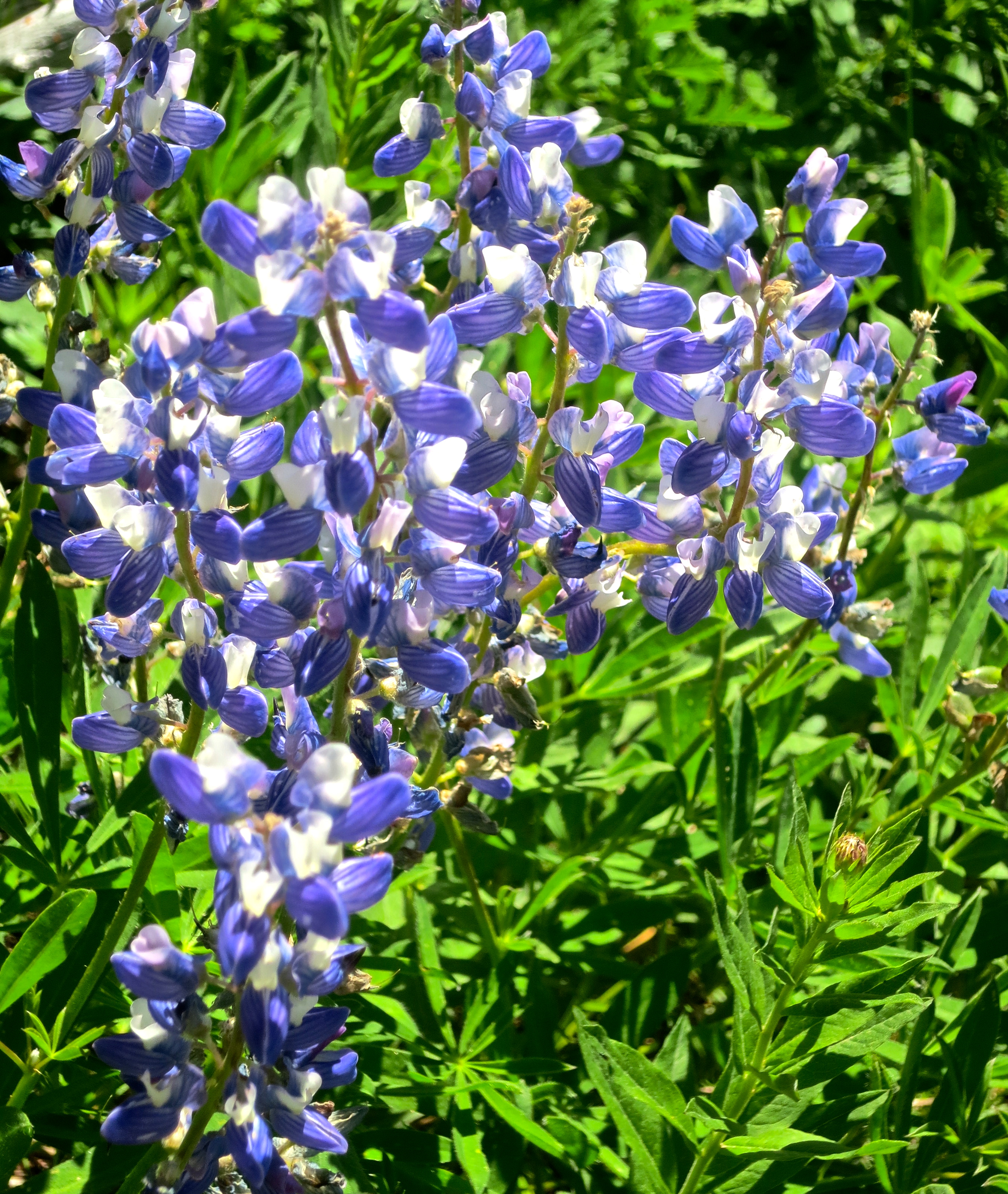
Lupine at Mt. Rainier National Park. Photo by Curtis Mekemson.

Lupine.

A strange and fuzzy Western Pasqueflower. Photo by Peggy Mekemson.

A strange and fuzzy Western Pasqueflower. Photo by Peggy Mekemson.

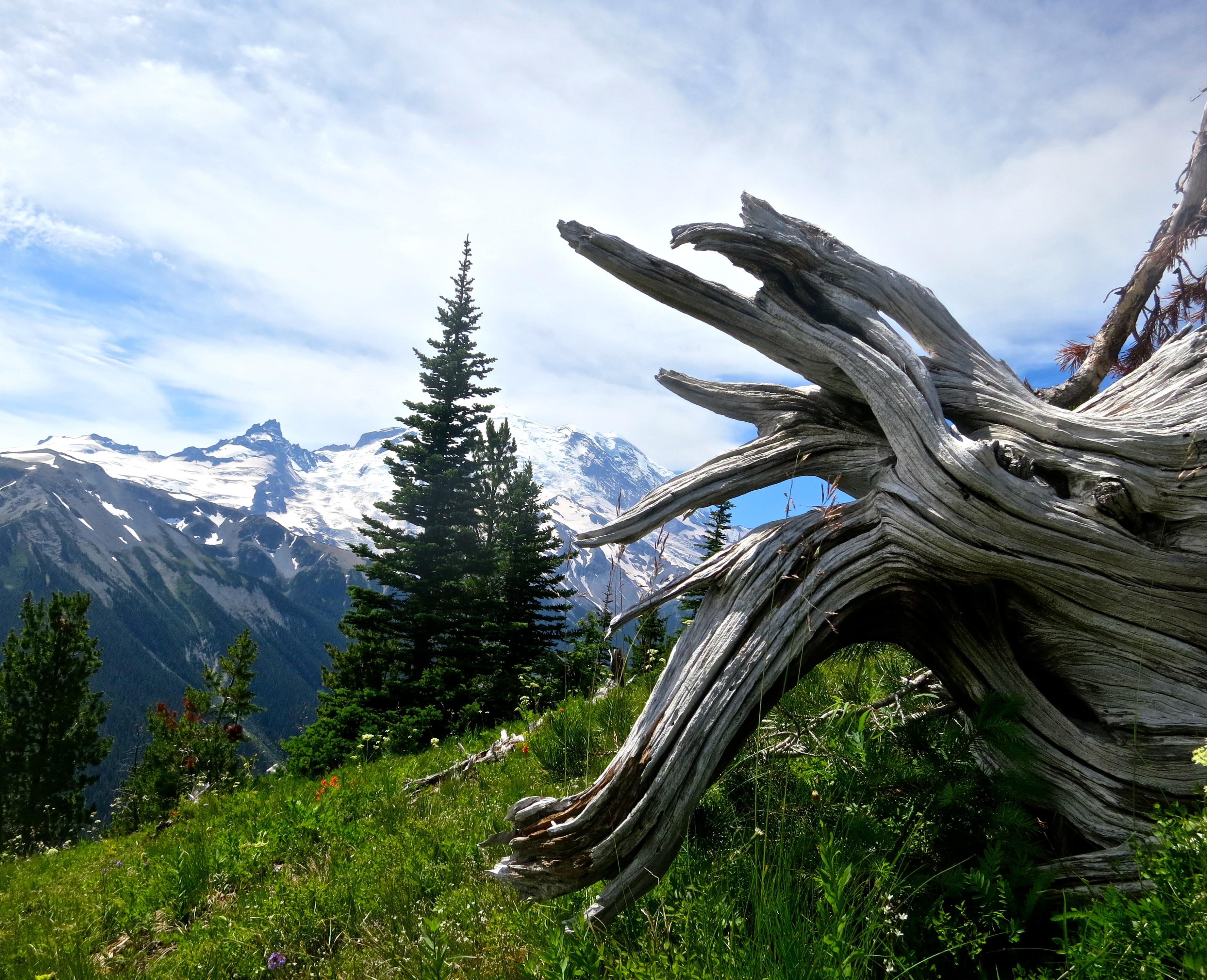
Aged tree root near Sunrise Center at Mt. Rainier National Park. Photo by Curtis Mekemson.

This aged tree root with its magnificent backdrop caught my attention.

Dead tree outlined against the sky in a black and white photo at Mt. Rainier National Park. Photo by Curtis Mekemson.

As did this dead tree.

A final view of Emmons Glacier. Next Blog: A giant forest, beautiful falls, and more views of Mt. Rainier. (Photo by Peggy Mekemson.)

A final view of Emmons Glacier. (Photo by Peggy Mekemson.) Next Blog: A giant forest, beautiful falls, and more views of Mt. Rainier. 

A Journey Underground… Oregon Caves National Monument

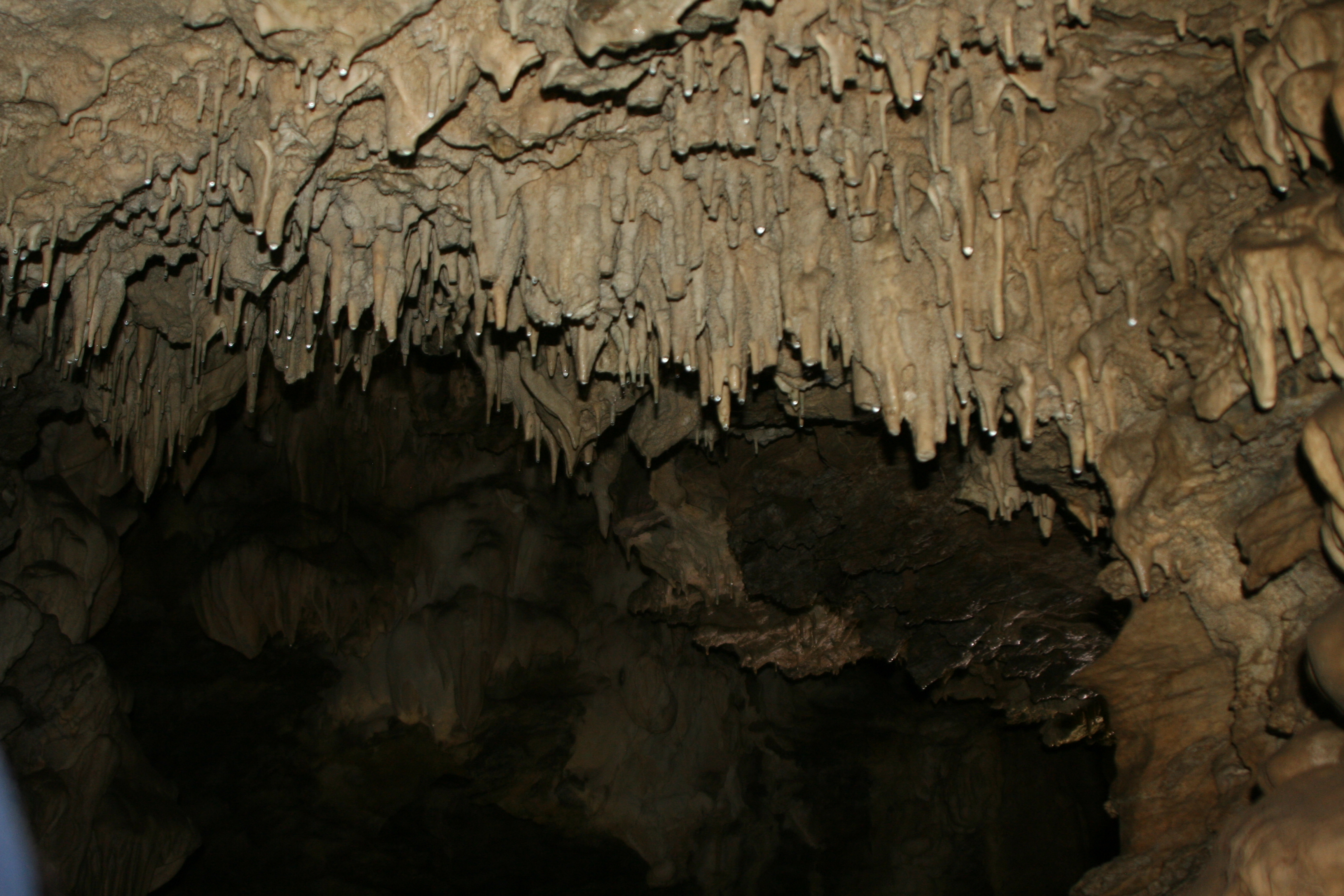
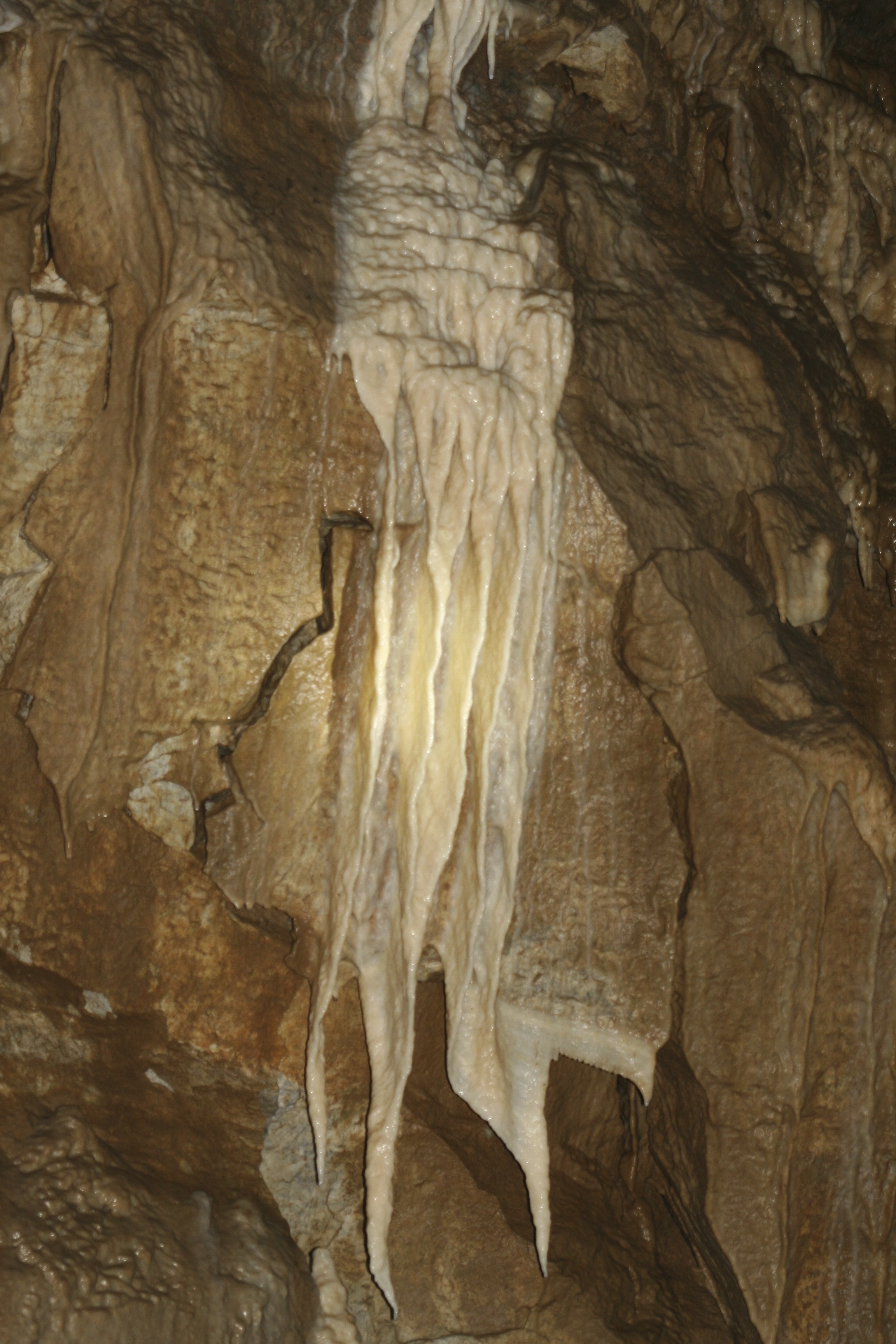
Rock formations in Oregon Caves National Monument.

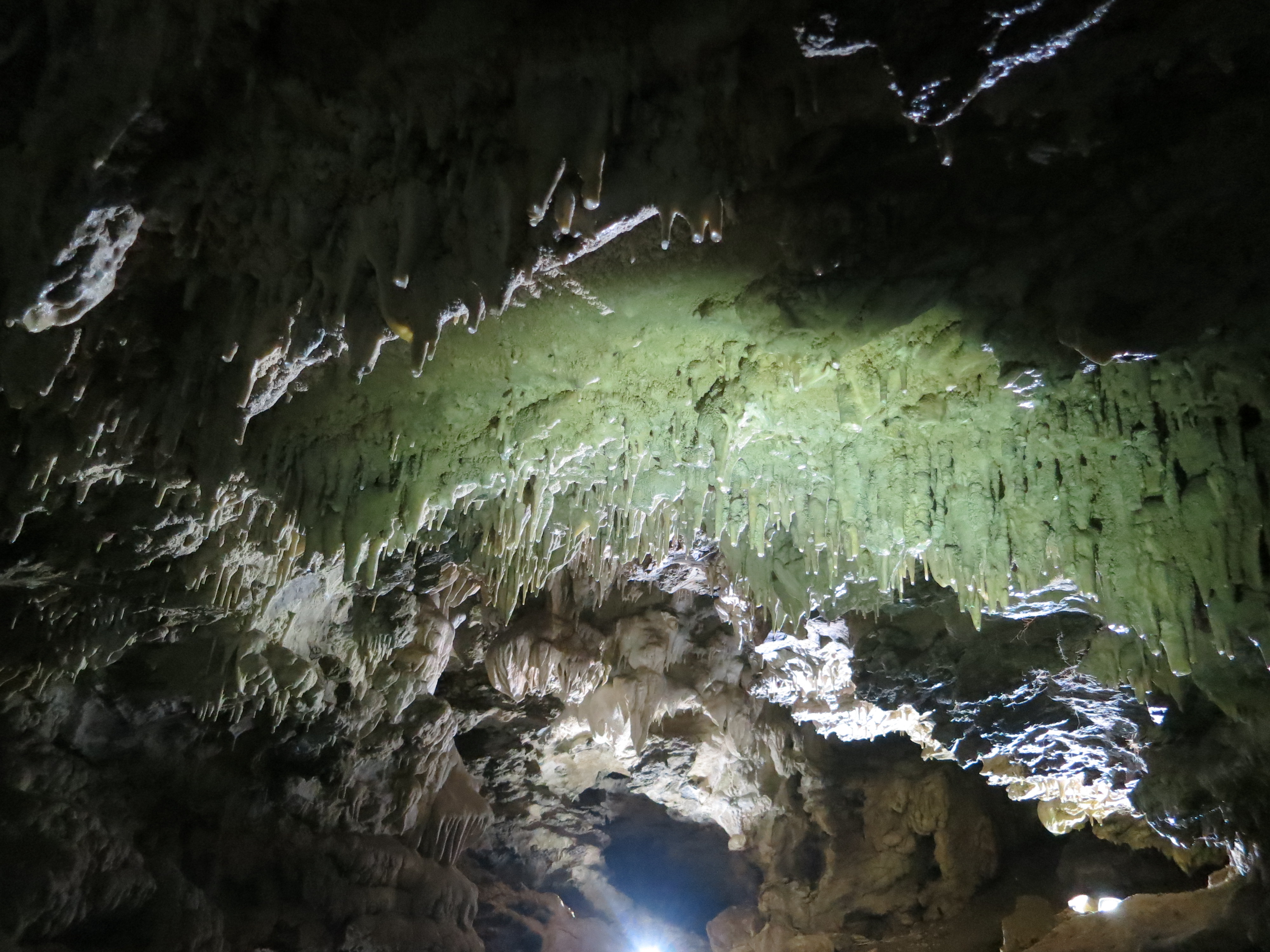
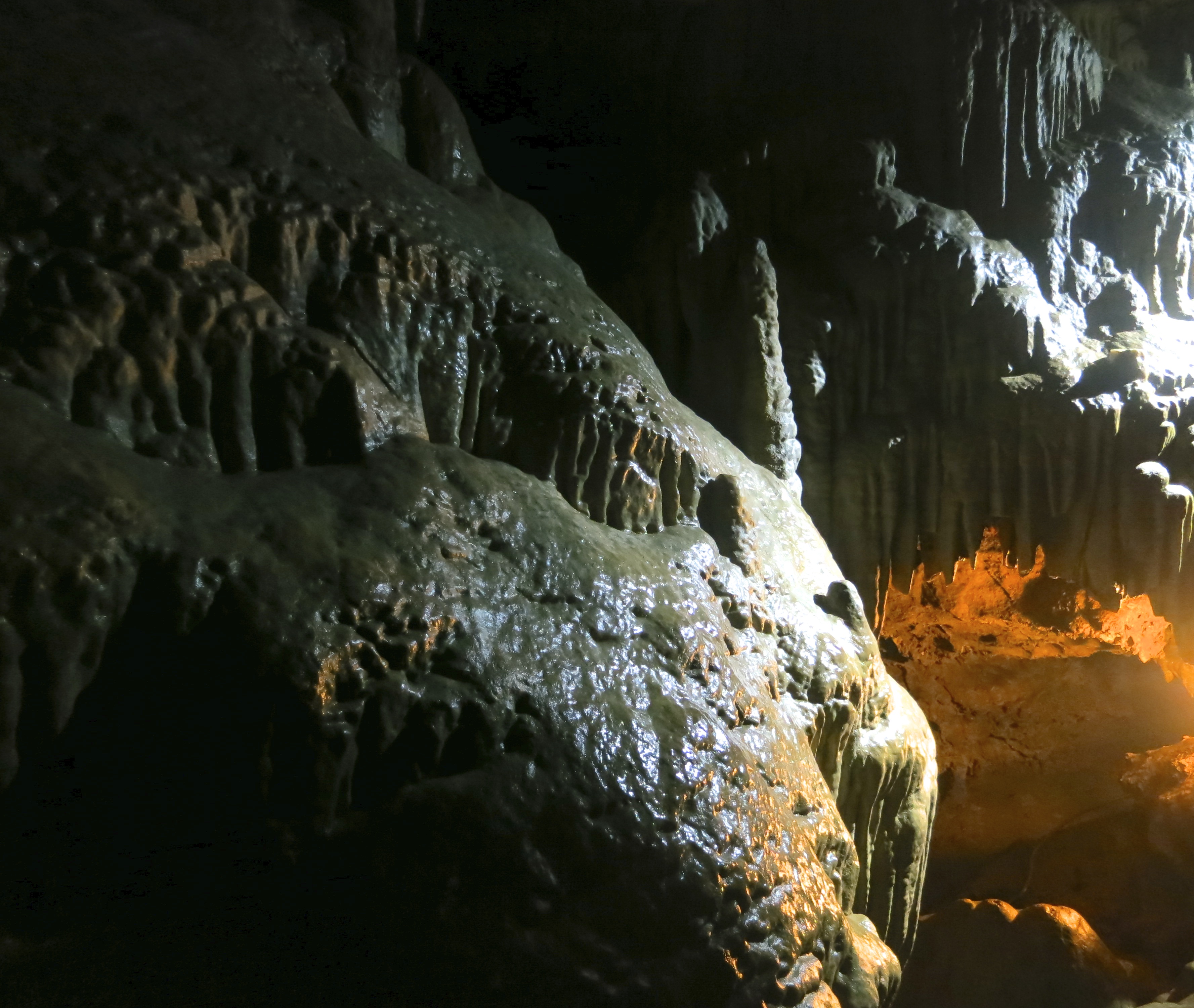
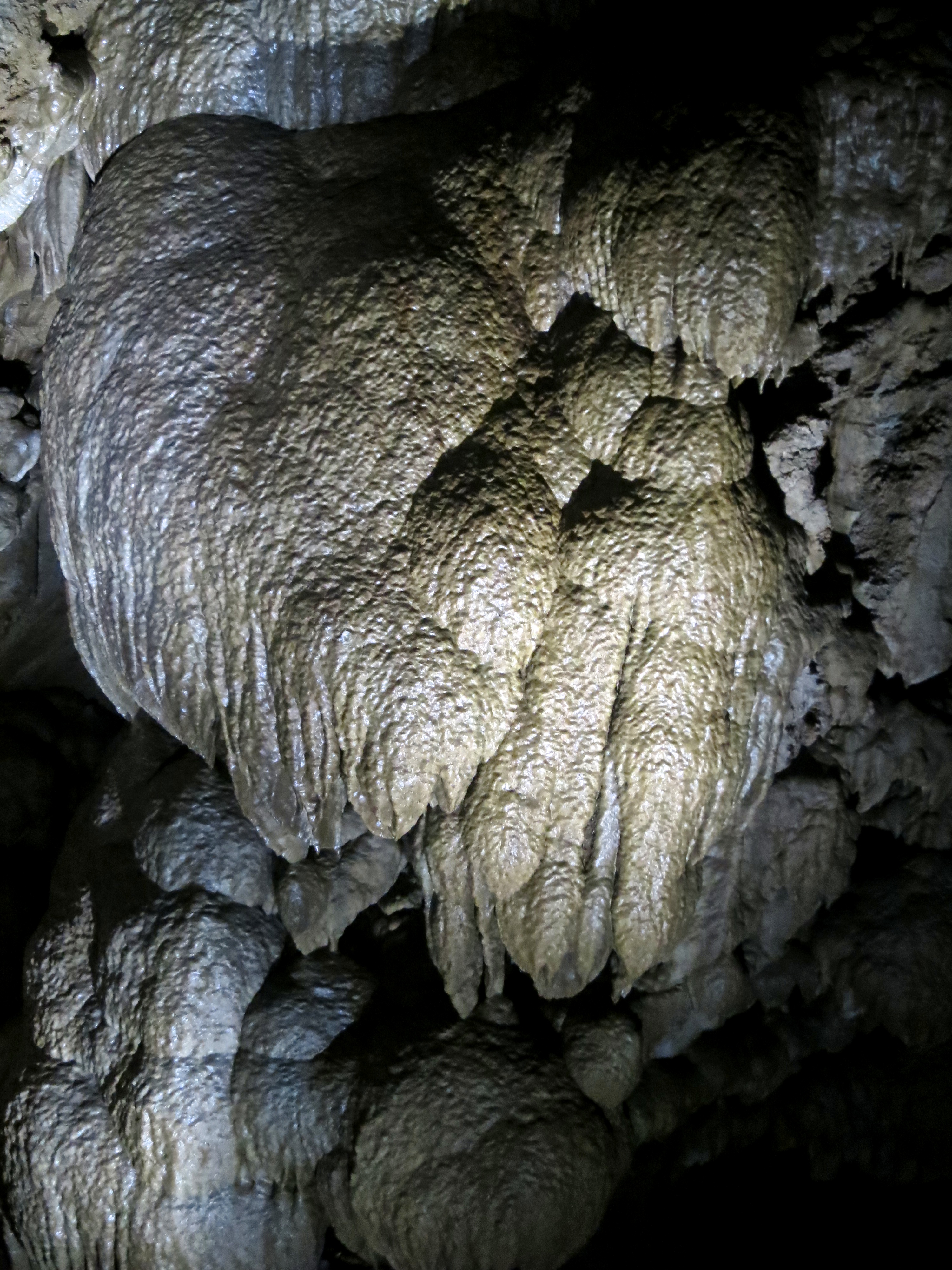
Unusual rock formations created by minerals from dripping water led the Oregon Caves to be set aside as a national treasure in the early 1900s.

Claustrophobia: A fear of confined places

Acrophobia came up in my blog about Mt. Whitney. No surprise there, thousands of feet are between the hiker and a rather unfortunate landing. Splat! It’s a reasonable fear. Claustrophobia is just as real as fears go, but more irrational. The odds of being squished in a tight space— unless you are Indiana Jones or a misplaced wookie caught in a starship’s garbage disposal unit— are between slim and none. Don’t sweat it, right?

Try telling that to someone who is claustrophobic. I suggest you don’t stand between her and the exit. I get it. I am not particularly fond of enclosed spaces myself, whether they are physical or mental. I don’t like driving through tunnels and I hate freeway construction where imposing cement barriers shrink down to your vehicle’s width and provide a view of what hell is like. And that’s even before the gigantic truck comes barreling down on you and breathes fire up your tail pipe because you insist on driving 45 MPH in a 45 MPH zone. At least I can take my revenge when they put up plastic cones instead of cement barriers, as Peggy might tell you. Crunch. Curt strikes another blow for freedom.

Where does this leave me with caving, or spelunking, as the sophisticates call it? How do I feel about getting down on my belly and crawling through a space my skinny fourteen-year-old body would have gotten stuck in several hundred feet under ground? Not a problem; it’s not on my to-do list. But for some unfathomable reason, the standard well-known cave tours don’t bother me. In fact, I find them fascinating. Stalactites and stalagmites tickle my fancy and stir my imagination.

Photo showing how stalactites grow in Oregon Cave National Monument.

These small stalactites show tiny drops of mineral laden water that come down from a tube in the center of the stalactite. They will add about an inch of growth in a thousand years. (Photo by Peggy Mekemson.)

This photo from Oregon Cave National Monument shows the development of stalactites (coming down) and stalagmites (coming up). Eventually they meet, as demonstrating on the left. (Photo by Peggy Mekemson.)

This photo from Oregon Cave National Monument shows the development of stalactites (coming down) and stalagmites (going up). Eventually they meet, as demonstrated on the left. (Photo by Peggy Mekemson.)

So when Peggy suggested we head off to the Oregon Cave National Monument for her birthday a couple of weeks ago, I readily agreed. We’d been talking about it ever since we moved to Oregon. Except for the last few miles of the road that shot up a mountain and redefined the meaning of curves, the hour and a half drive was quite pleasant.

A ranger greeted us and gave us the bad news. We should expect a two-hour wait. He also wanted to know if we had been in any eastern caves in the last five years. If so— no go. White nose syndrome was wiping out eastern bats. So far their western cousins had lucked out. It had been six years since we had visited Mammoth Cave in Kentucky. We were in by a cat’s whisker.

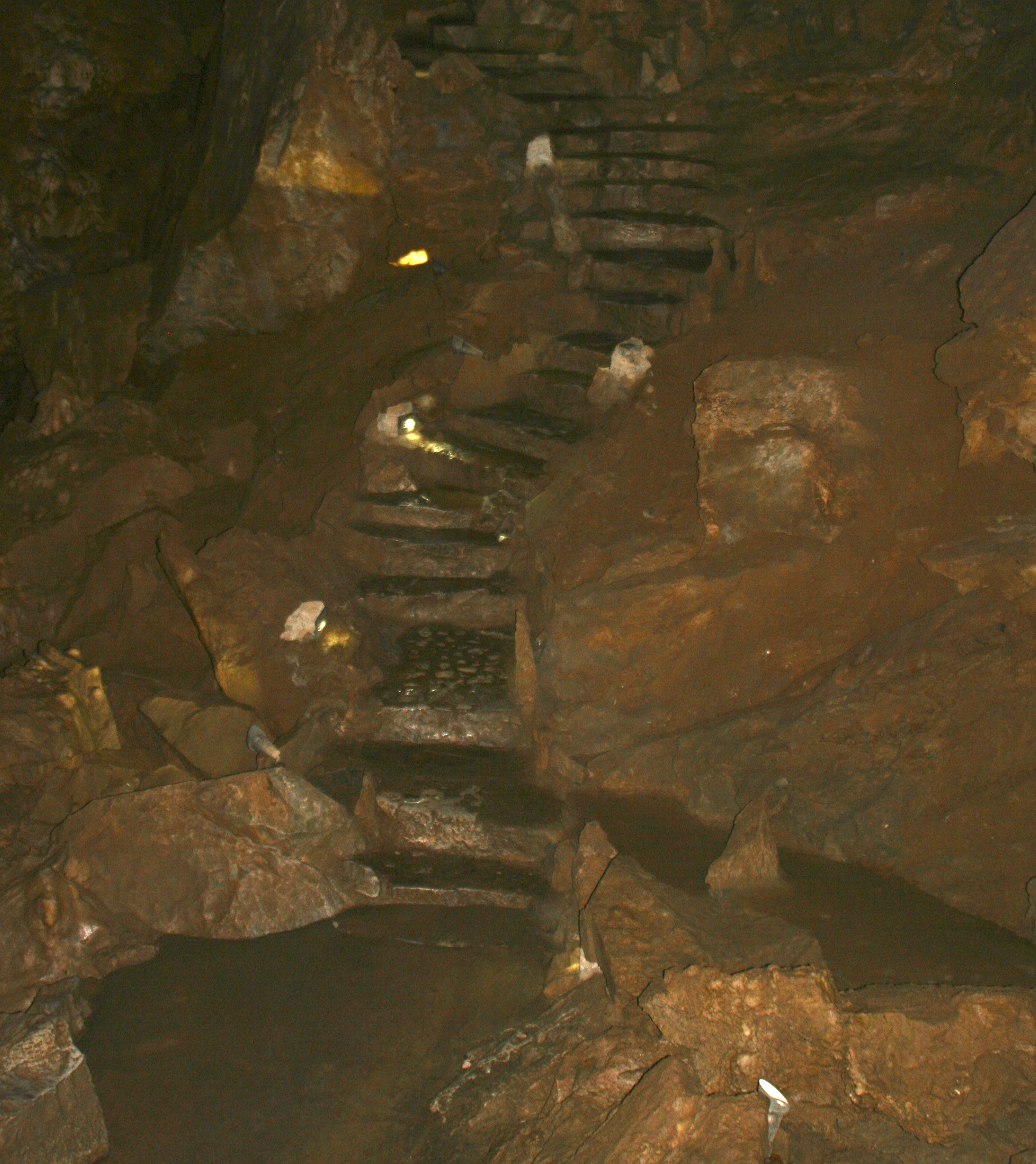
Our wait turned out to be just over an hour. There was barely time for lunch and a look through the visitor’s center before we found ourselves at the cave entrance shivering from a blast of 44˚ F air. “Cave’s breathe,” our guide stated. He also told us about the 500 narrow stairs we would be negotiating and the low ceilings. I would be bent over double with my size 14 shoes balanced precariously on wet slippery rocks. I looked enviously at a small girl who would be standing up straight with her feet resting solidly on the narrow stone steps. She gave me an impish grin.

Stone steps in Oregon Caves National Monument

Dimly lit stone steps make their way up from what is known as Ghost Cave. The narrowest ones were about half the depth of my size 14 shoes. (Photo by Peggy Mekemson.)

The Oregon Caves are somewhat unusual in that they are made out of marble. Once upon a time they were a coral reef far out in the Pacific. Plate tectonics sent the Pacific Plate diving under North America and scraped off portions of the ocean floor some 100 million years ago, adding new land to the continent. The tremendous heat and pressure involved changed the lime into marble. Folding, faulting and water created the caves.

This map shows the location of Oregon Caves National Monument.

This map shows the location of Oregon Caves National Monument. (Center Right)

Lit up stalactites in Oregon Caves National Monument.

Artificial lighting adds to the magic of caves.

Another example of the impact of lighting. The rock on the left had been signed by all of the members of a geology class that had visited in the 1800s. Strict rules are now in place to protect the cave.

Another example of the impact of lighting. The rock on the left had been signed by all of the members of a geology class that had visited in the 1800s. Strict rules are now in place to protect the cave.

Unusual stone structure in Oregon Caves National Monument.

This unusual structure caught my camera’s attention.

Ghostly rock waterfall at Oregon Caves National Monument.

Peggy captured this ghostly rock waterfall. (Photo by Peggy Mekemson.)

Cave exit at Oregon Caves National Monument.

A view of where we came out from our 90 minute tour.

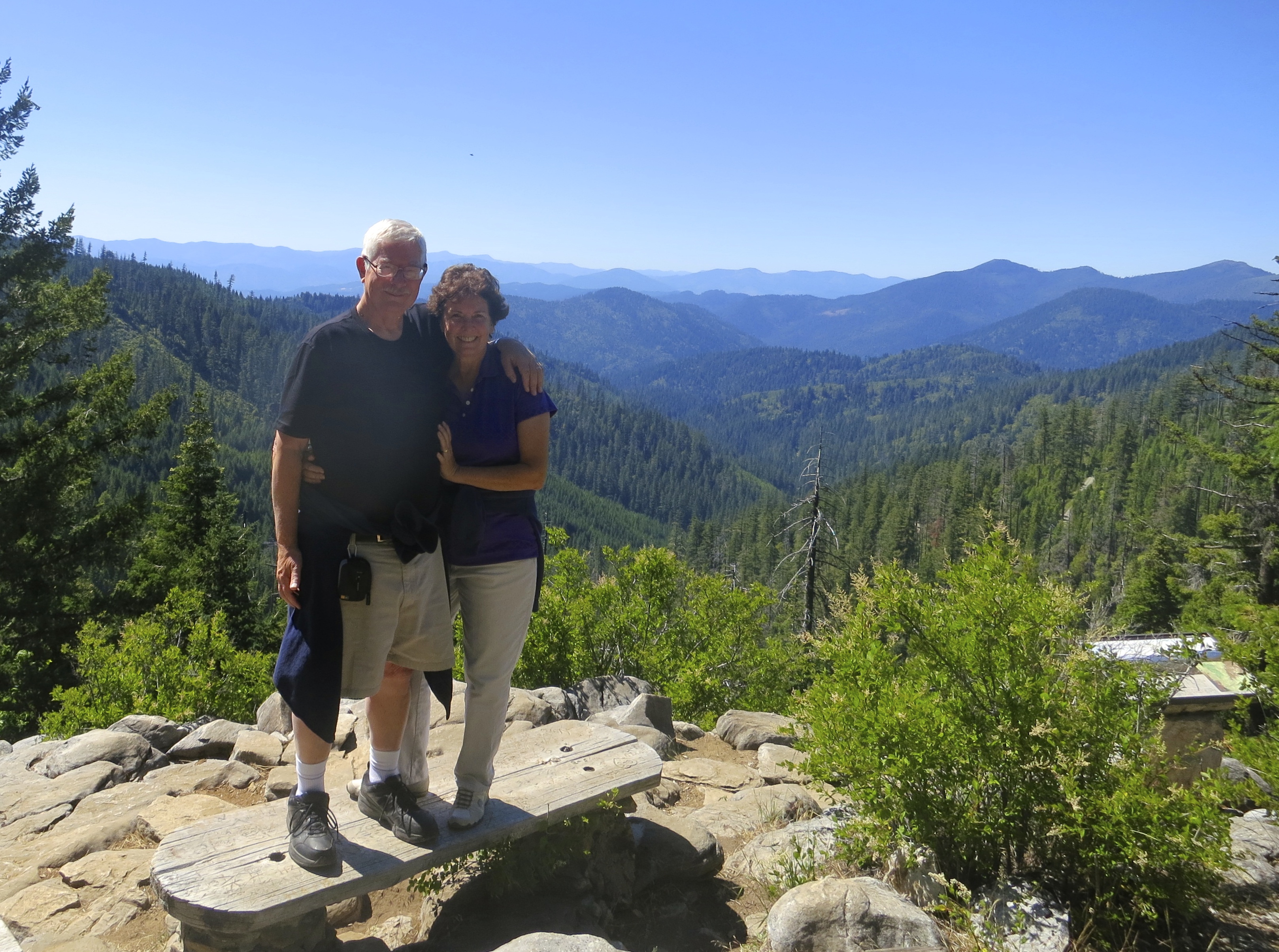
Standing on top of the mountain that contains Oregon Caves National Monument.

Tour over, Peggy and I stand on top of the mountain that contains the caves. This photo gives a perspective on the surrounding countryside.

NEXT BLOG: Peggy and I are headed off for a brief hiking tour at Mt. Rainier National Park for the next several days so I may be out of computer range. When I come back I will report on my recent experience as a chicken farmer: The Chicken Whisperer.