
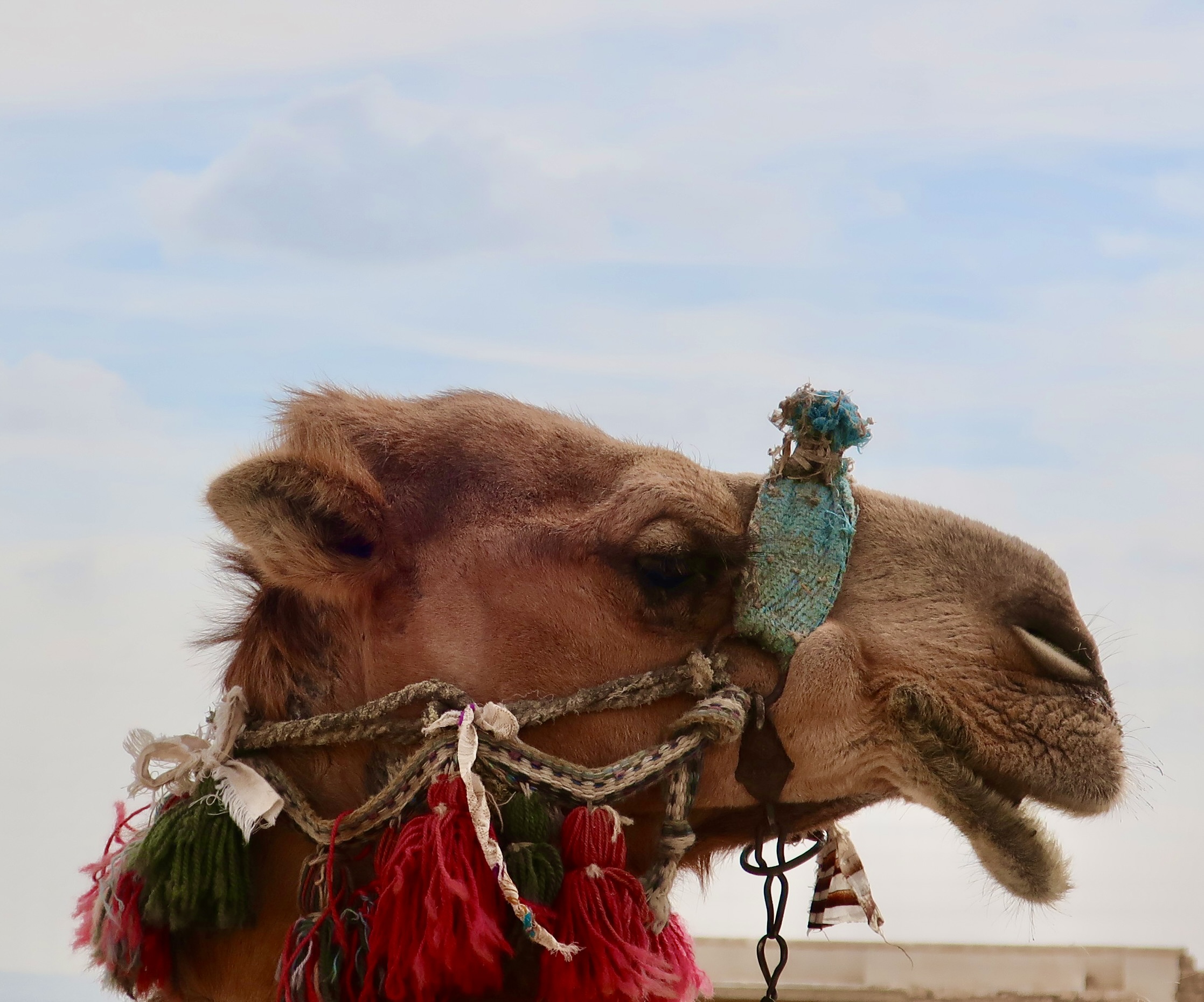
Whenever people think of ancient Egypt, one of the first thoughts that pops into to their minds is the three pyramids of Giza: The Great Pyramid, the Pyramid of Khafre, and the Pyramid of Menkaure, along with the Great Sphinx. They were in built Egypt’s early history during the Fourth Dynasty of the Old Kingdom between 2600 and 2500 BC and are the main focus of my next Egypt post— along with camels.
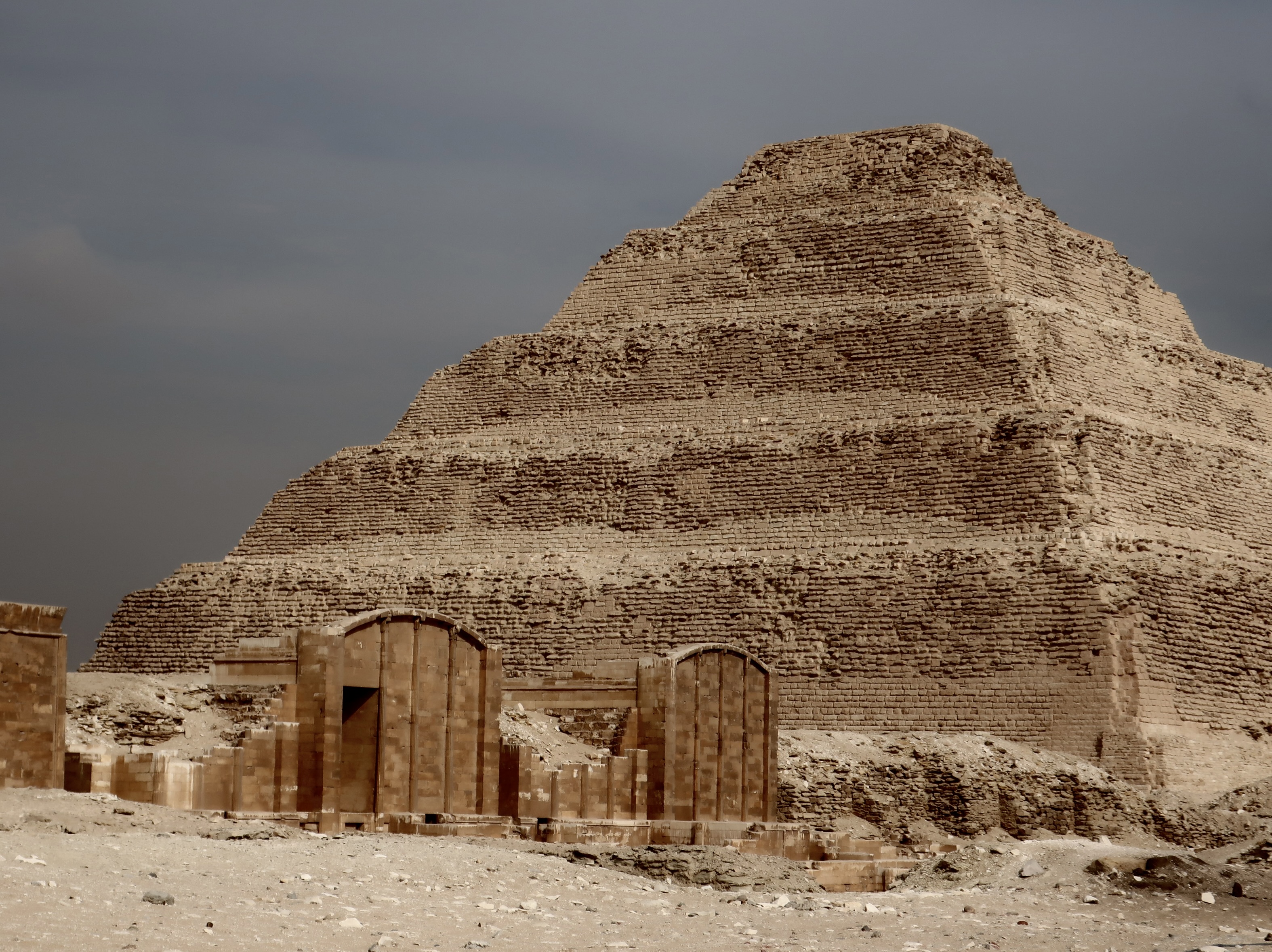
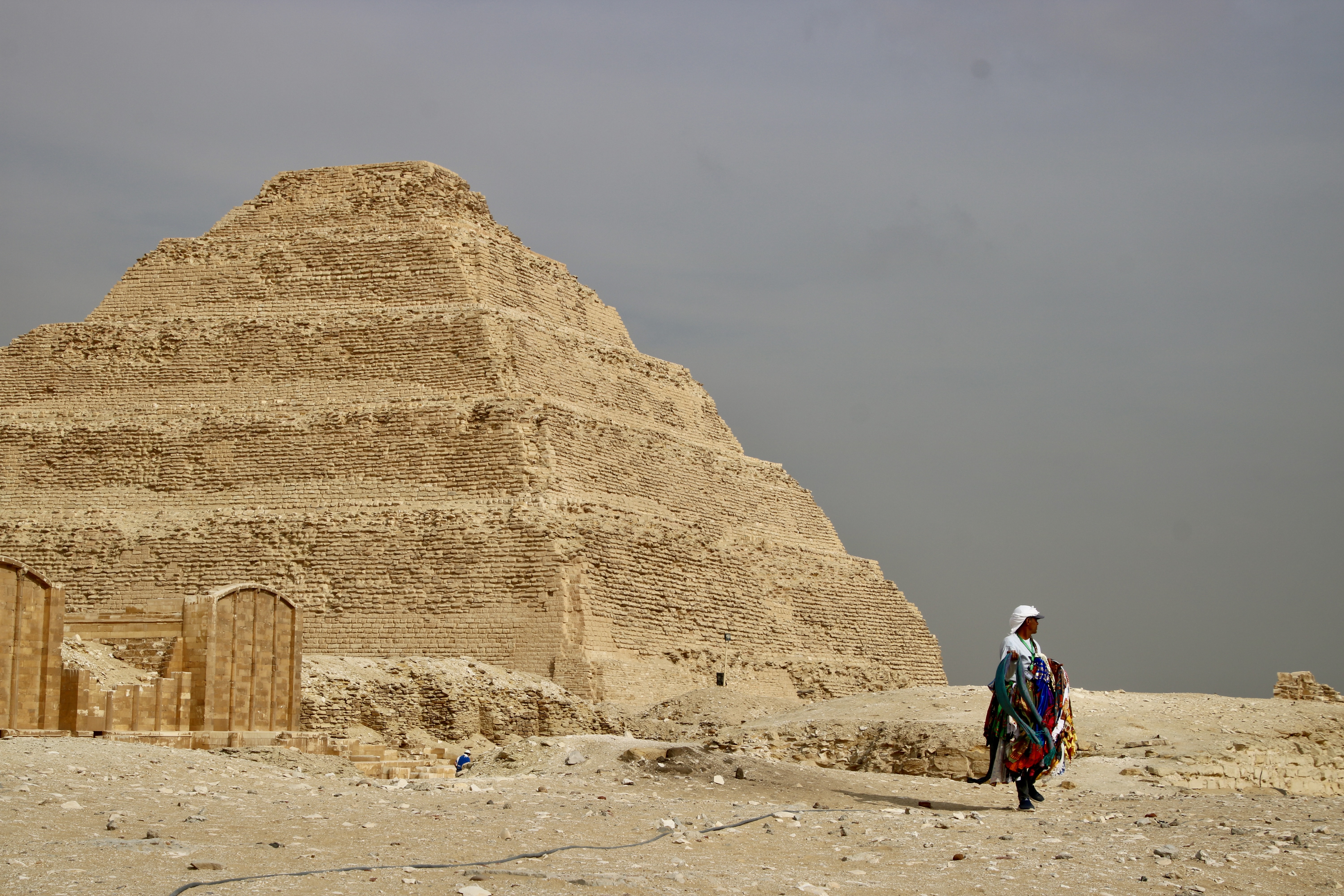
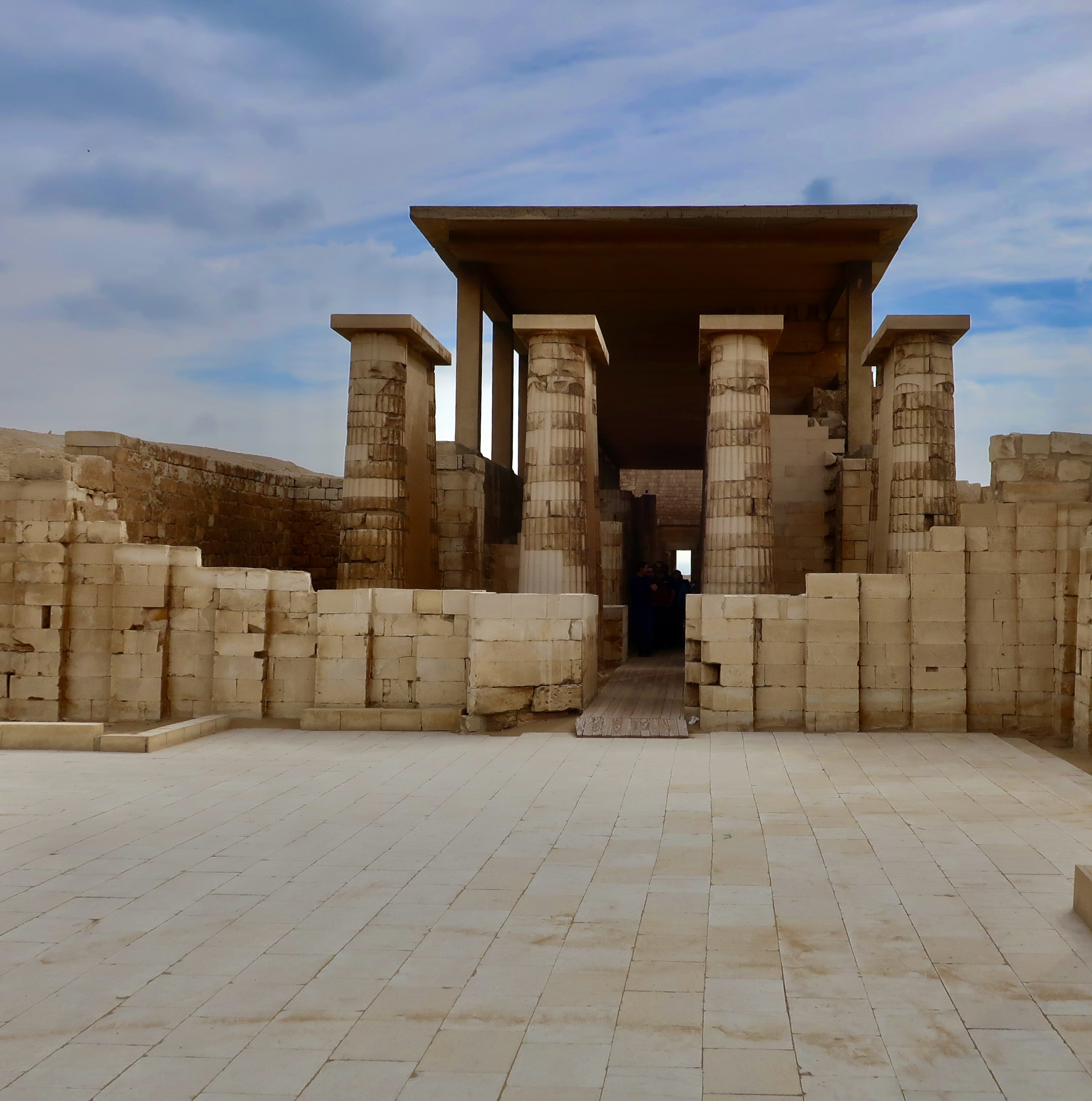
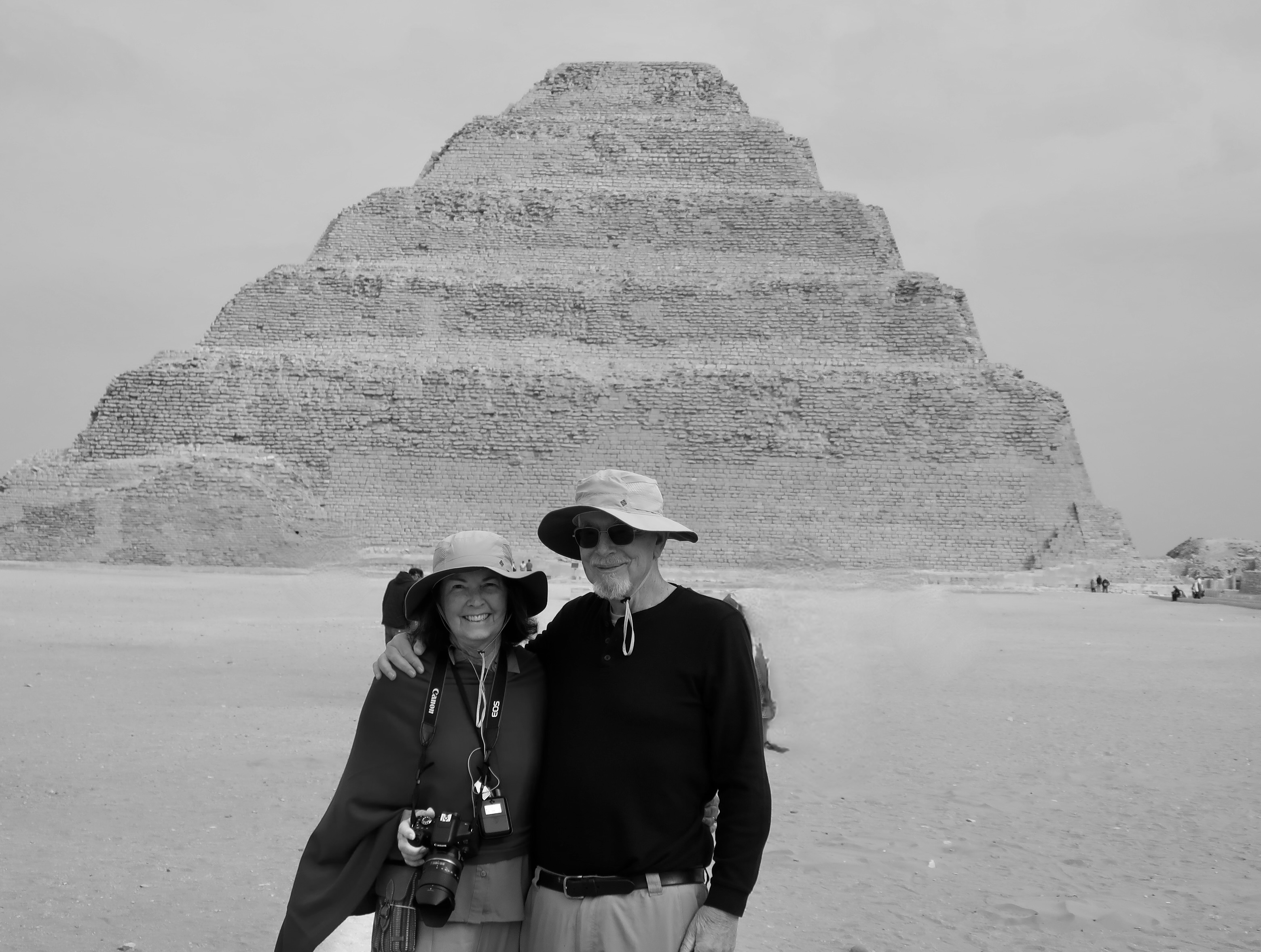
But today, I want to go back to their precursor, the Step Pyramid of the Pharoah Djoser, located in the Saqqara necropolis outside of Memphis. Built in the 27th Century BCE (2700-2600) during Egypt’s Third Dynasty, it is the oldest, complete stone building complex known in history. Its architect was Djoser’s brilliant vizier, Imhotep. If you ever watched the Mummy movie series, he was cast as the bad guy, intent on world domination and allergic to cats. But to ancient Egyptians he was a good guy, so good that he was eventually (with eventually being 2000 years Egypt time) given the status of a god complete with a portfolio that included major medical responsibilities.
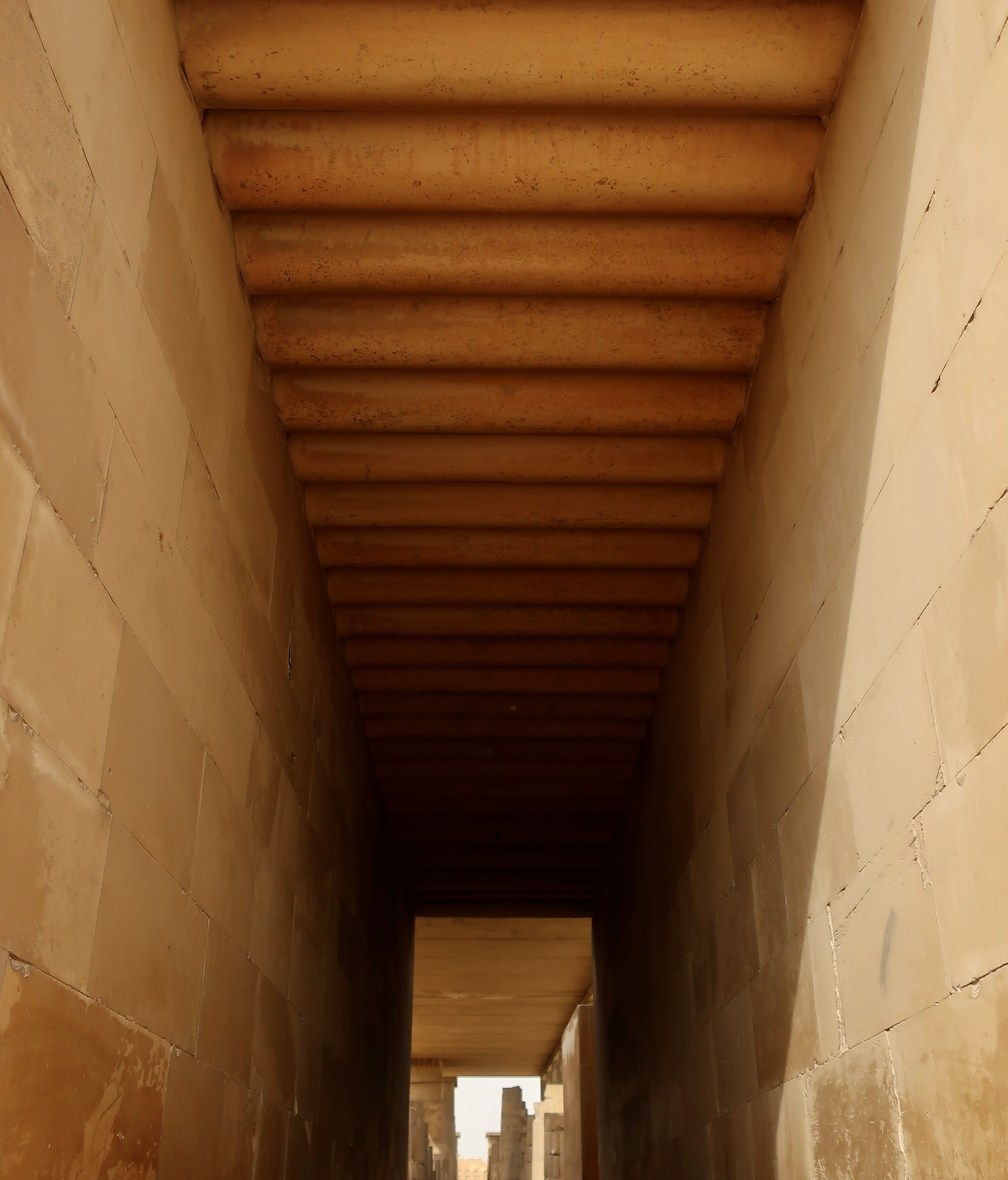
Imhotep’s first layer of the pyramid was based on a mastaba, or eternal house, an ancient Egyptian tomb that was built as a one story, rectangular mud brick building with inward sloping sides where royalty from Egypt’s Early Dynastic and Old Kingdom period were buried. He then proceeded to build a series of five mastaba-like structures on top of the first one with each being smaller, thus creating the pyramid concept. The structure stands at 203 feet tall with a base of 410 by 357 feet. A maze like series of tunnels run under the pyramid that were used for the burial of Djoser, royal family members, and grave goods from royal ancestors. The latter included over 40,000 vessels.


Next Post: We will travel back to South Dakota and the incredibly ambitious stone carving of Chief Crazy Horse. After 75 years, it may be a quarter finished.
 Wandering through Time and Place
Great trip, Curt. That was more detail on the step pyramid than I had read before – and I loved the camel portrait.
Thanks Ray. Peggy and I have been having a lot of fun reliving our trip. As for camels, I can’t resist their unique, ‘put together by a committee’ look.
As usual, your photos are a lot better than mine – though it has been fun to go down memory lane with my photos. Your text has certainly filled in some info for me.
Thanks, Margy. Glad you are following along with our photos. ‘Memory makers’ is what Peggy calls them. 🙂 I’m also pleased that you are finding the text helpful.
Oh the pushy salespeople. I was lucky to have a good comeback. I could say, in Arabic, ‘I lived here for two years in the 1970s and bought everything then. Can I bring it back and have you sell it for me?’ Always got a laugh and also got through to them to stop badgering me.
Haha – love it!
You are right Peggy. The vendors do have a sense of humor. And to be able to do it in Arabic…
Wonderful article and great photos Curt. Yes, I remember the sellers and beggars. So desperate to geta bit of food. We are so privileged.
Indeed we are, Gerard.
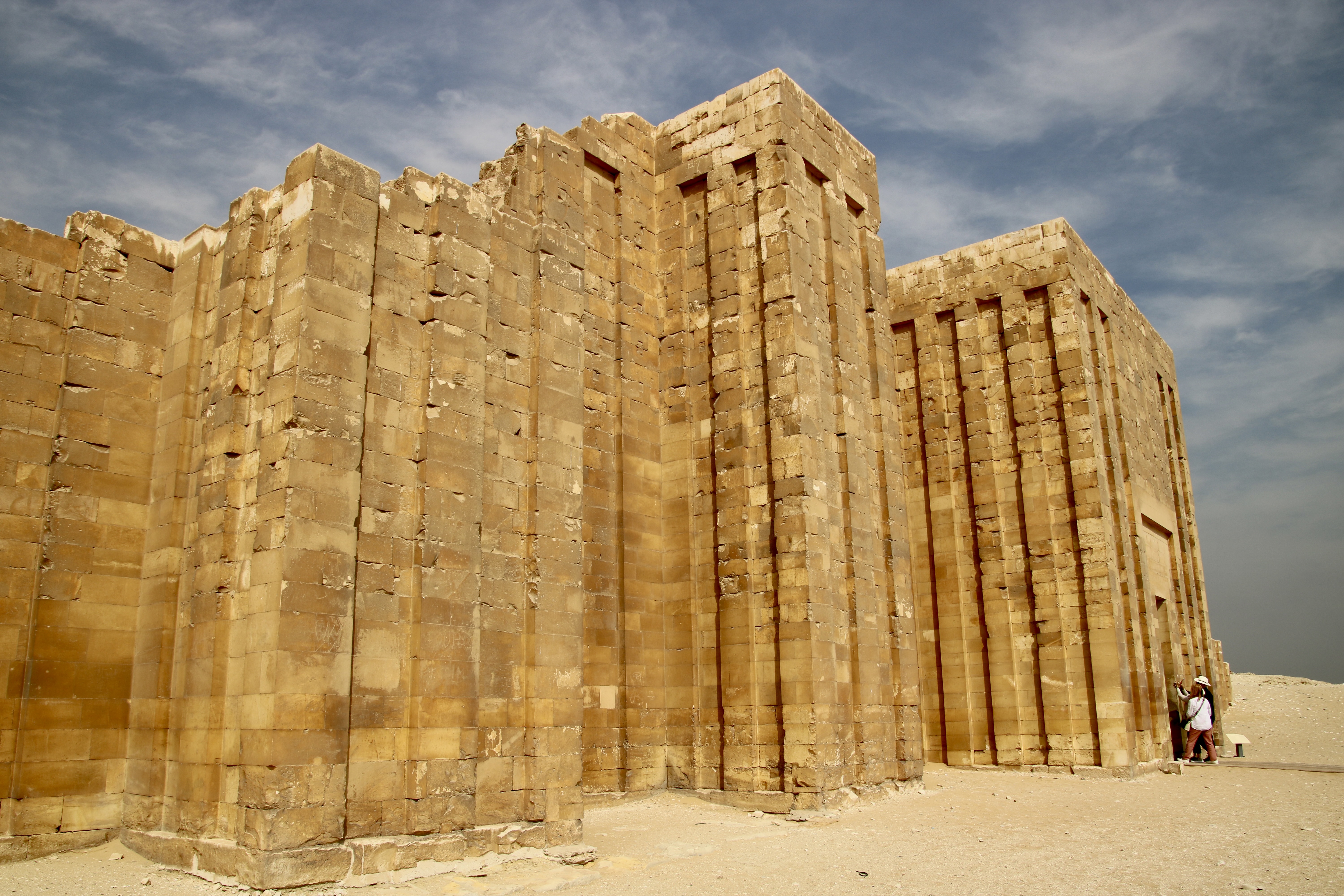
Thanks again for the commentary. The temple by the step pyramid was one of my favorites in Egypt. Glad to see I could be a B&W photographer!!🤪
See, you have talents on top of talents, Steve. 🙂
By coincidence this was featured in a TV programme just last night.
Interesting, Andrew. Not too surprised, however, given its status and Imhotep.
What a great post Curt and loved the history of the Step Pyramid and that statue of King Djoser in limestone is almost as good as the black and white one of you and Peggy. Great shot of you both and I love the black at white. It’s always the way with the vendors.. “tick on dog”! It’s for for a minute and then you’re sorry. Thanks for sharing your fun experience! 💞
Thanks, Cindy. Black and whites are old-timey and always fun. (At 80, I probably qualify for the old-timey category.)
On my next Egypt post, I have a photo od where Peggy and I were ‘taken in’ in by one of the vendors.
Nah not you at 100 you might qualify… young in spirit always and looking good!
Oh that should be a fun one!!! 🤔🤷♀️
You are kind! The one of Peggy and I is now up, which speaks to how far I have fallen behind in responding to comments! Grin.
That’s one heck of a stepping stone!
I can’t read the word “vizier” without thinking of the Disney movie, Aladin. That in turn evokes Robin William’s genie. So now, I’m seeing a faded hint of a smart a** blue djin atop your very serious and VERY ancient pyramid.
The ancient Egyptians would have thought it natural, I’m sure, Dave. What’s one more Demi-god when you already have so many. They would hav set out to build him a temple immediately.
I love all the photos, Curt, and your narrative is always so entertaining along with being educational. Your posts make me want to visit Egypt, and the photo of you and Peggy is wonderful. The black and white is also perfect for the purpose. Thanks for sharing and Happy travels!
Thanks, Lauren. I’m always intrigued by the historical photos of travelers of yore. I often can’t resist throwing in a black and white. Speaking of happy travels, Peggy and I are now in our last preparation for the next adventure. It will be another 3-5 months of wandering around the US and possibly Canada. I’m hoping to hit the road next week.
That’s amazing, Curt! I can’t wait for more photos! 🙂
Many more coming, Lauren. I’m still working on them!
It’s fascinating to think about how long ago these places were built. That hallway looks almost pristine after almost 5 thousand years. And I like the old-timey photo of you and Peggy. All you’re missing is a little pick and brush. Looking forward to Crazy Horse and Camels. 🙂
I am so far behind on comments D. My bad. Sorry. Crazy Horse and camels are both up. Since we are now on the road I should be able to catch up on reading blogs and responding!
🙂 Whenever. Don’t let blogging become a chore – Just enjoy yourselves! That’s what it’s all about.
Blogging is a world unto itself, D. Normally, I have a lot of fun. But it can resemble work on occasion. Grin
Those times when it feels like work are great times to take ashort break. 🙂
And a short break it will be, D. 🙂 It’s all in the definition of short. As noted above, Peggy and I have decided that two months is short!
Lol. Two months sounds perfect.
Just following your advice, D. Grin. Thanks.
Where have I been? I’ve never heard of this complex; apparently some of the other sites have better PR teams. In any event, I found this place fascinating, and if I could visit only one site in Egypt, I’d take this one over the better-known ones. Despite its smaller size, the variety and complexity of the constructions are appealing — and of course there’s that history to plumb. My favorite photo is the one showing the single individual next to the temple; I presume that’s one of your sticky salesmen!
It was certainly one of our favorite sites, Linda. The temple was incredibly well-built. As for the individual at the entrance to the temple, she was a visitor. The vendor was waiting for us in front of the pyramid. The whole experience was close to overwhelming. Three months later and I am still processing photos. You will be interested to know that I am working on Alexandria now.
More fascinating info about this ancient civilization. I’m reading quietly going wow . . .wow . . wow to myself. We didn’t get to the step pyramids, but your post brought back wonderful memories of the ones at Giza.
Alison
PS What theme are you using for your blog. I’ve recently had to change mine, and I quite like the one I chose, but like this one also, so I might change again. Thanks
A.
Sorry for my delay here, Alison. I use the Hemingway theme.
Thanks. Will look into it.
There’s a lot of Wow! in Egypt, Alison. No doubt about it. Peggy and I are finally on the road. Between family events, packing, and dealing with vehicles, I can finally relax!
Oh, that camel and his trappings! And the temple whose stones glow like gold. So many magnificent things to see there, including the very nice shot of you and Peggy and pyramid!
Have to love the camels, Lexi! Wasn’t the temple beautiful. And to think that it is thousands of years old! The photo that Steve took of the two of us is one of out favorites. Thanks!