Magnificent Mutant Dragons… 11 Years of Burning Man Art

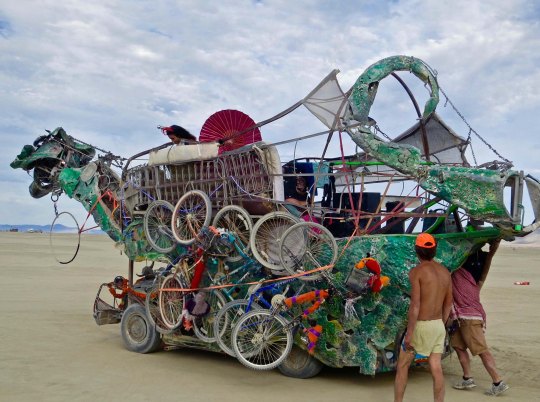
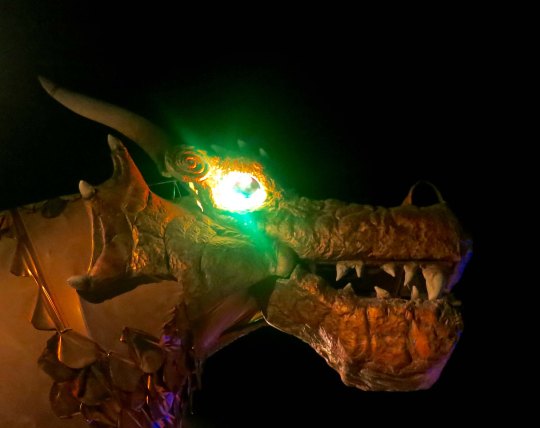
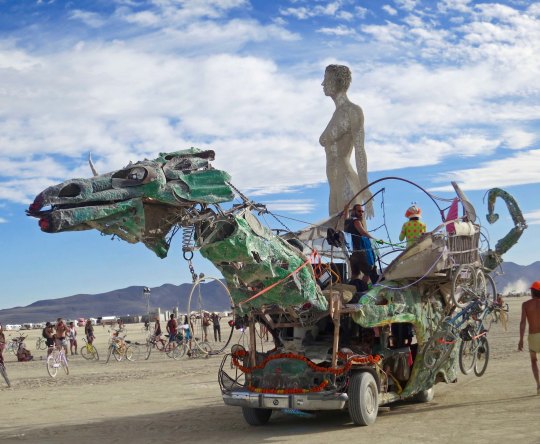
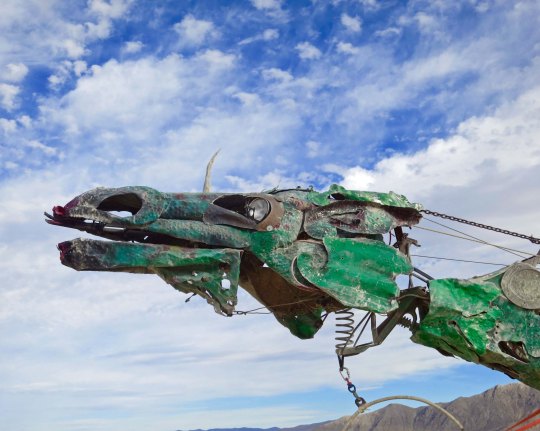
Burning Man green dragon mutant vehicle.
A green dragon waits patiently while its passengers climb off to admire a 30 foot high sculpture on the Playa at Burning Man.

I’ve been sorting through and categorizing my Burning Man photos, all 11 years’ worth including 2004-5-6-7-9-10-12-13-14-15 and 17. As you might imagine, there are several thousand pictures. I’ve created 15 categories and will do posts on several of my favorites from each category over the next few weeks. My plan is to use Mondays and Wednesdays for my Burning Man posts and Fridays for my Pacific Crest Trail posts. Expect a few other subjects on Fridays as Peggy and I wander.

I debated with myself over how to kick the series off. Frankly, starting anywhere works when focusing in on the creativity of this annual event in the remote Nevada desert. Art is everywhere. Appreciating and enjoying it is the primary reason I have returned to Black Rock City again and again. Of course, people go to the event for many other reasons as well, such as dancing and drinking to the rolling thunder of heavy metal into the wee hours of the morning. They also go to see and be seen, to dress up in elaborate costumes, to attend lectures, to escape from their everyday worlds, and to participate in and contribute to Burning Man’s unique culture. The latter is central to the event. I consider photographing the art and sharing it with you as part of my contribution.

One of the most creative endeavors at Burning Man is the building of mutant vehicles, which is undertaken by both individuals and groups, or tribes as they are sometimes called out on the Playa. They are three ways to get around at Burning Man: to walk, to bike (which most do) or to travel in radically altered vehicles— i.e. mutants. Normal cars, vans, trucks, etc. must be parked. Mutant vehicles come in a variety of forms from bugs, to animals, to ships, to you name it. Today I am going to focus on dragons, most of whom breathe fire! Now, back to the green dragon featured at the top of the post.

Burning Man green dragon mutant vehicle.
The green dragon’s head and neck are operated by a series of pullies and springs.
A close up. I’d say that this fellow is about to spring into action. Note the dirty snout. That’s where the dragon breaths out its fire.
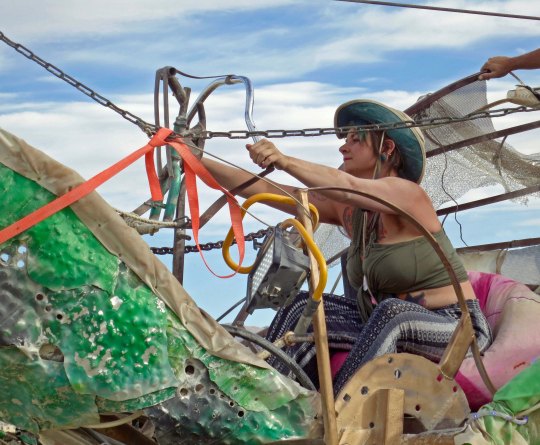
Burner uses cables to operate green mutant dragon at Burning Man.
The Burner here is preparing to take the dragon across the Playa at Burning Man. The chains are used for operating the head and neck. Imagine yourself in the driver’s seat!
Bikes loaded on a green dragon mutant vehicle at Burning Man.
The dragon prepares to depart as a Burner climbs on board. The bikes provide passengers with an alternative form of transportation. Note how the tail has been lifted to provide a door.
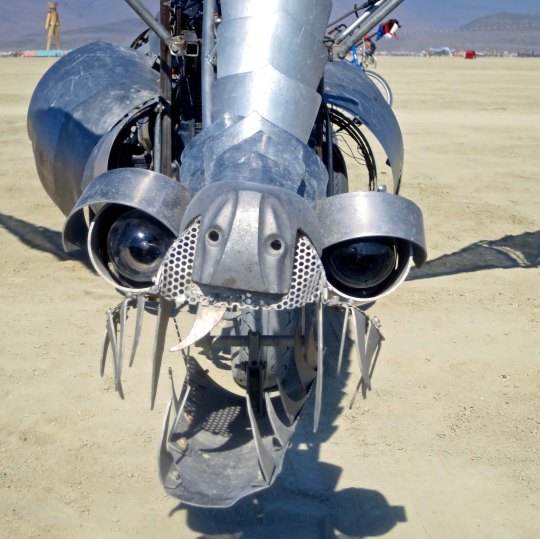
Silver dragon mutant vehicle at Burning Man.
This dragon appears eager. On your mark, get set…
Go! Wait, could that intrepid driver be the fearless Peggy?
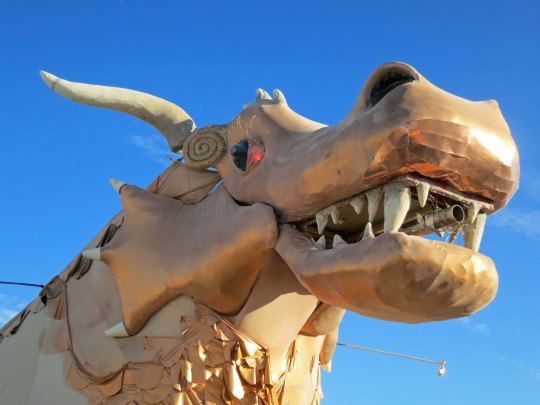
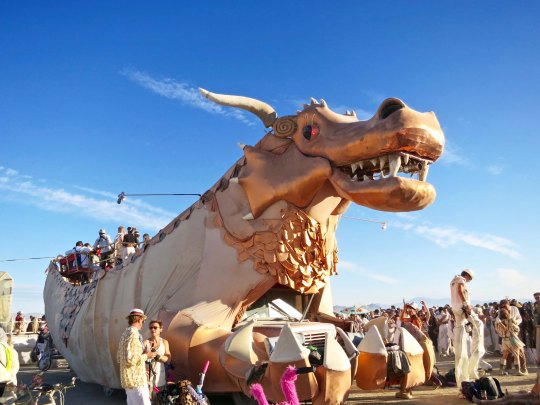
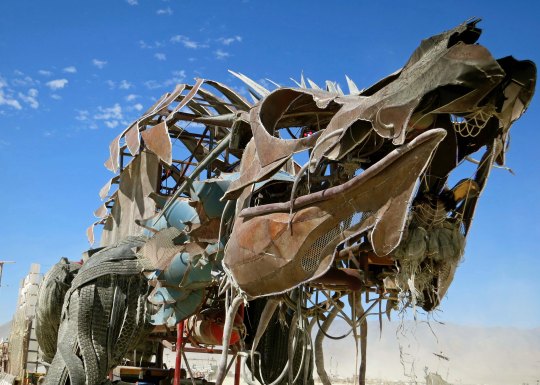
Golden dragon mutant vehicle at Burning Man.
It took me a while to decided that this sharp-toothed golden creature was a dragon. But the tube in its mouth persuaded me that when the sun went down, she would be breathing fire!
Large claws on golden dragon mutant vehicle at Burning Man.
And check out those claws!
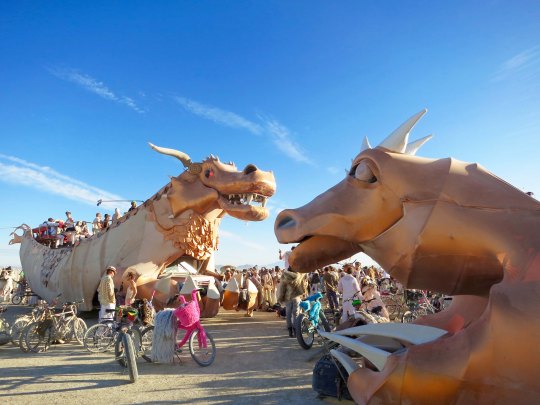
Golden dragon mutant vehicle at Burning Man with baby dragon.
One year the dragon ran around on the Playa by itself. The next year it had a baby. Given all the dragons found at Burning Man, it hardly seems surprising.
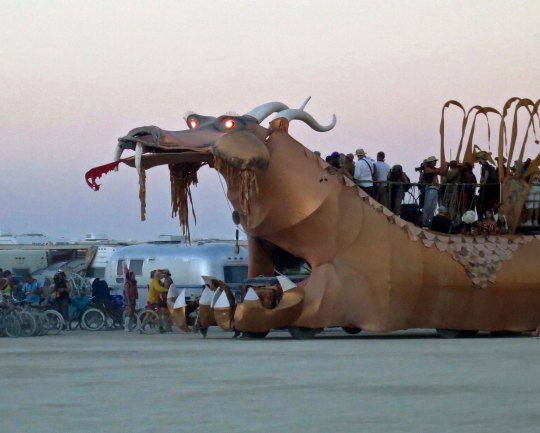
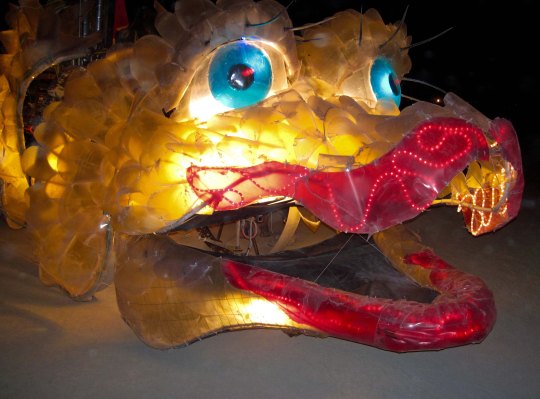
Golden dragon mutant vehicle at Burning Man with eyes glowing.
I caught an earlier version of the dragon with its eyes glowing at dusk. I’ve noted over the years that the same mutant vehicles may come back again and again, but they often morph.
Smiling dragon mutant vehicle at Burning Man.
Is this dragon smiling? I’d still be reluctant to get too near its mouth.
Lest you get taken in by its teeth as well as its smile. I would suggest that the weapon up on its back speaks to ill-intentions.
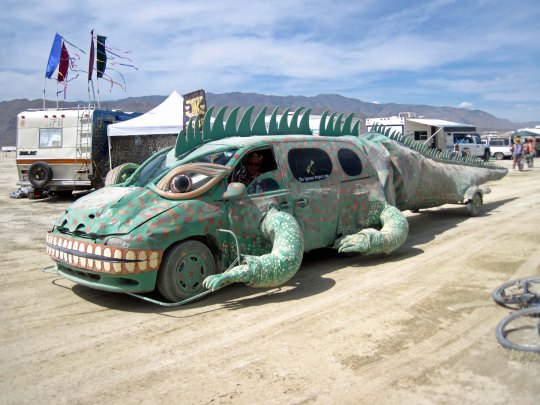
Car dragon mutant vehicle at Burning Man photographed by Tom Lovering.
My friend and fellow Burner Tom Lovering caught this shot of a car dragon.
Frog eating mutant vehicle dragon at Burning Man.
Another low to the ground dragon. If you look carefully at its mouth, you can see that it is eating a frog. But maybe the frog is escaping.
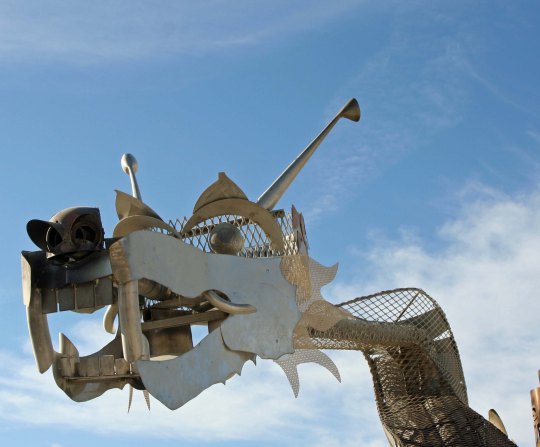
Dragon sculpture on the Playa at Burning Man.
This dragon was personality plus, although it was more sculpture than mutant vehicle.
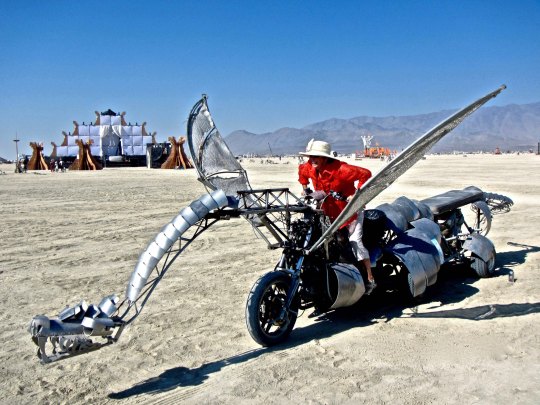
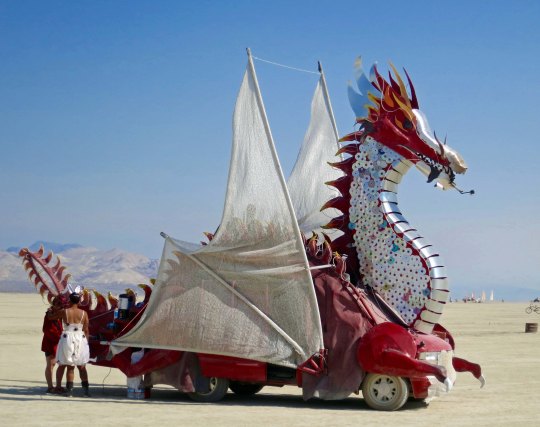
Silver and red mutant vehicle dragon at Burning Man.
And what about this beauty with its bright colors and proud wings… (Photo by Tom Lovering.)
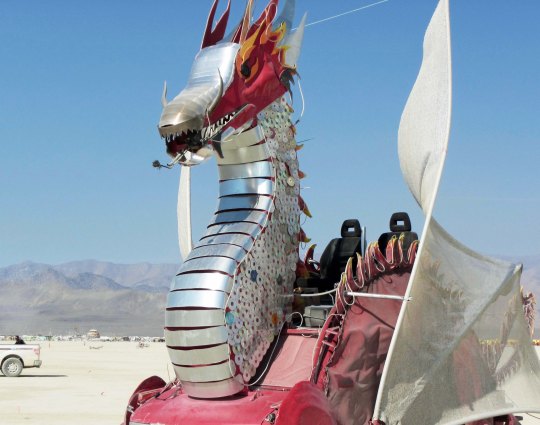
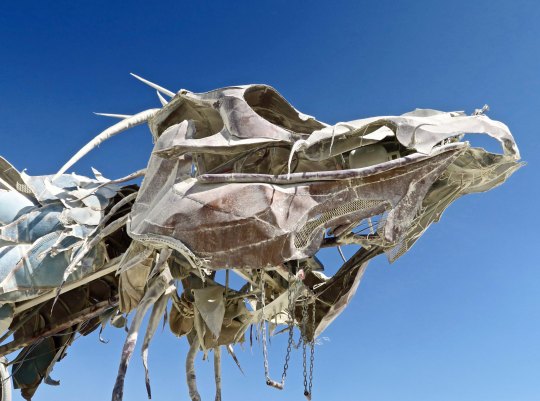
Head of silver and red dragon at Burning Man.
A close up. That almost looks like a sword hanging down from its mouth. Maybe a dragon slaying knight met his untimely end.
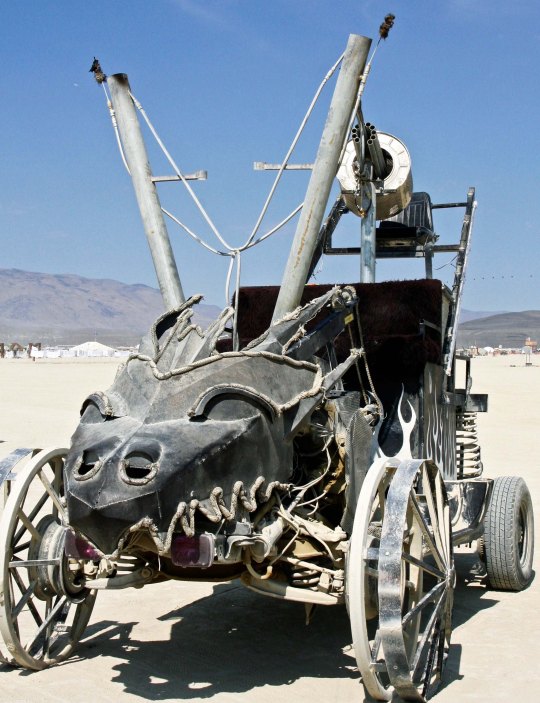
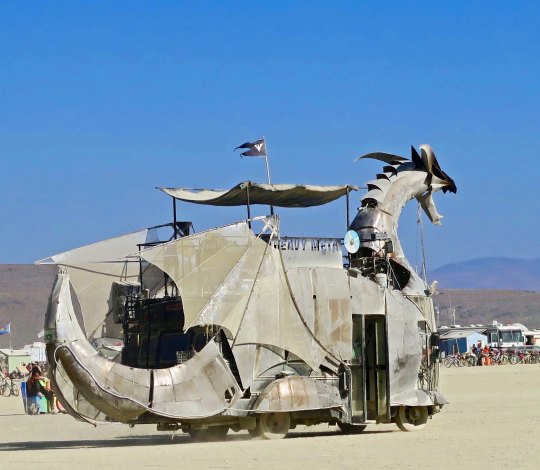
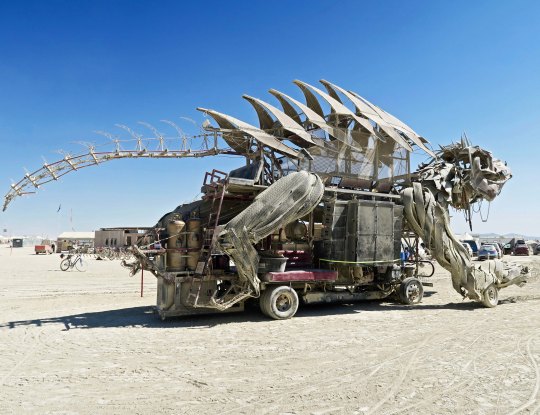
Heavy Metal mutant vehicle dragon at Burning Man.
This impressive dragon was labeled Heavy Metal, which was probably the name of its tribe. I was sorry that I only got one photo of it.
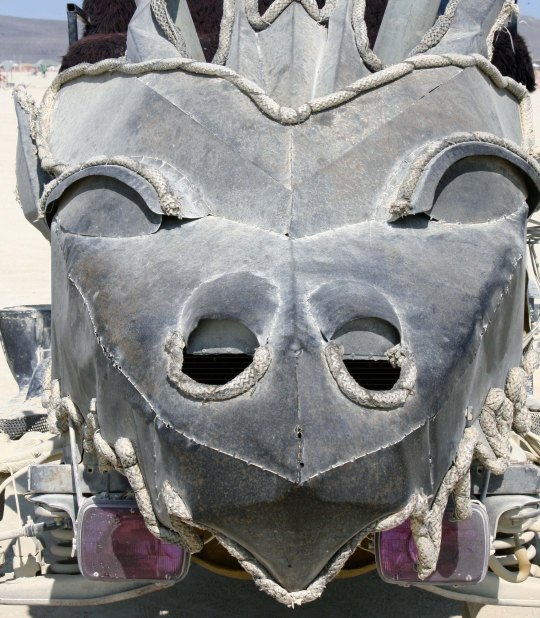
I’m convinced that this dragon is one of the scariest at Burning Man.
Head shot of scary mutant vehicle dragon at Burning Man.
Here’s another head shot.
Very scary mutant vehicle dragon at Burning Man.
A full shot of the dragon. I would not like to meet it at night! Check out the size of those hind legs.
Mutant vehicle dragon at night in Burning Man.
Speaking of night, mutant vehicles take on different personalities as the sun goes down behind the desert mountains.
Mutant vehicle dragon with eyes glowing in the night at Burning Man.
Whoa! Eyes that glow in the night. Mr. Blue Eyes in the photo above this guy appears positively friendly in comparison.
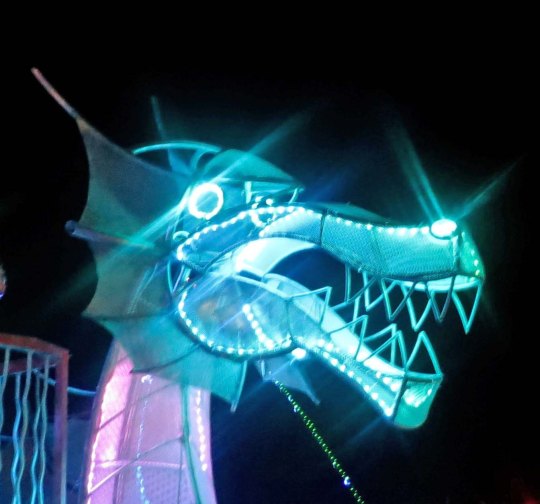
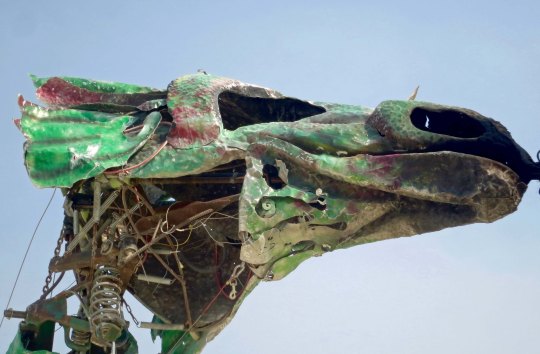
Striking green head of mutant vehicle dragon at night at Burning Man.
Striking green dragon head with interesting teeth.
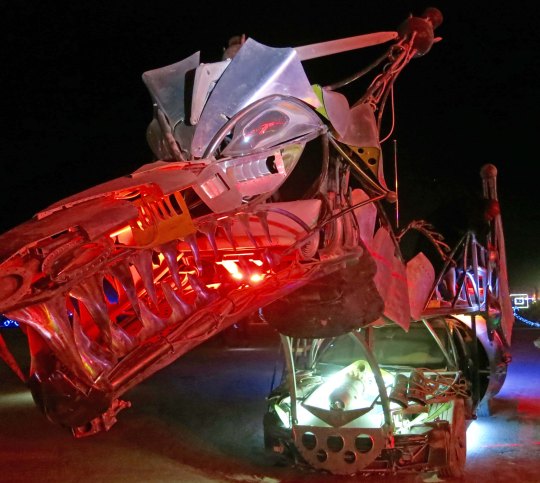
Red snouted mutant vehicle dragon at Burning Man.
Dragon with red snout!
Impressive blue-green dragon mutant vehicle at Burning Man.
Not sure that this creature was a dragon, but it was impressive. Maybe it is a mutant cat or?
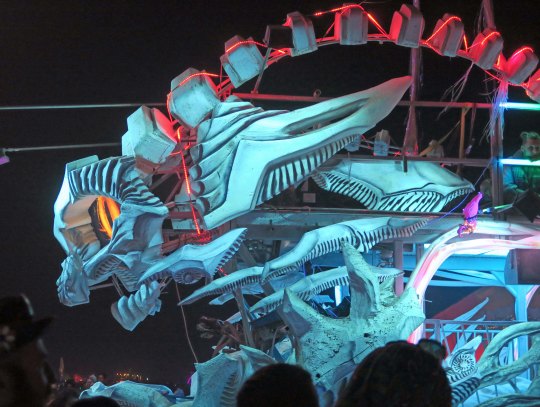
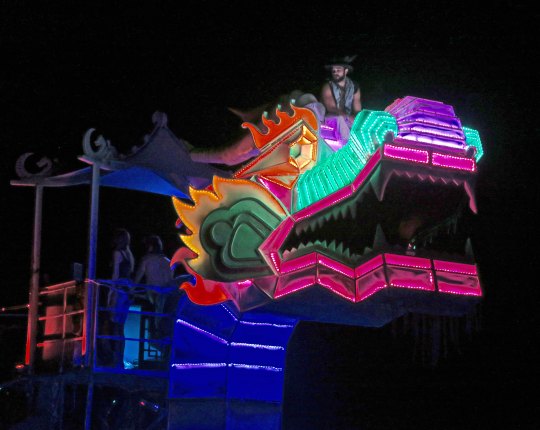
Large dragon mutant vehicle at Burning Man.
This night dragon wins the prize for size among the dragons of Burning Man. The driver is up on top.
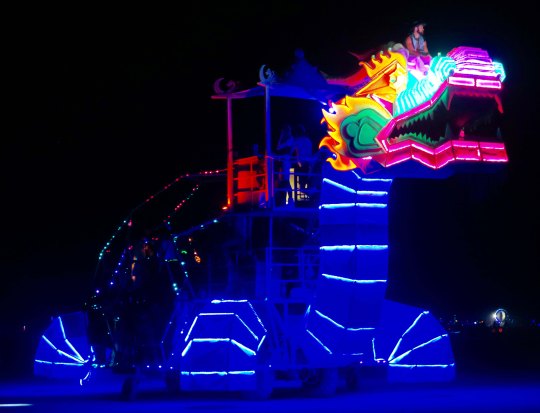
Mega dragon mutant vehicle on the Playa at Burning Man.
A full view. People actually walk near the front and sides of these large mutant vehicles to guide them and make sure that they don’t run over anyone!
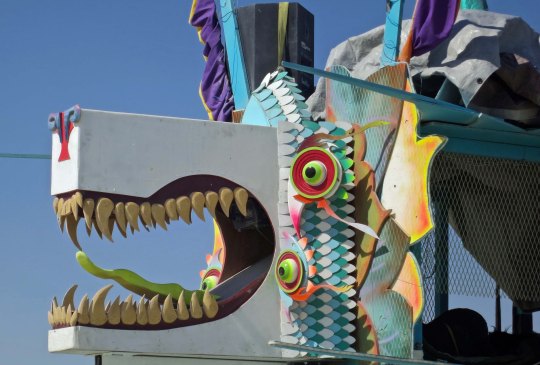
Four eyed mutant vehicle dragon at Burning Man.
A four eyed dragon, rather Asian in its look.
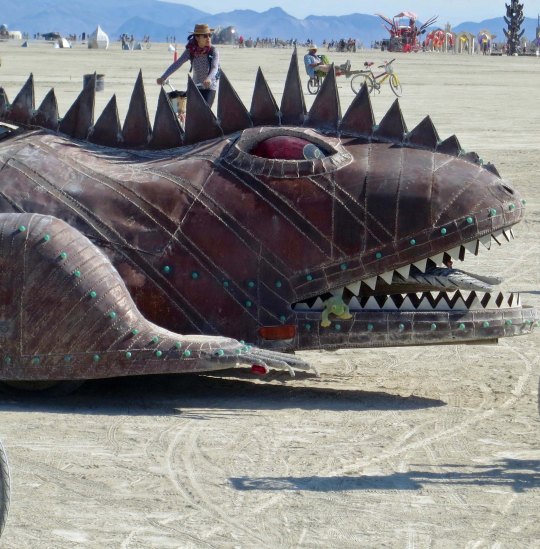
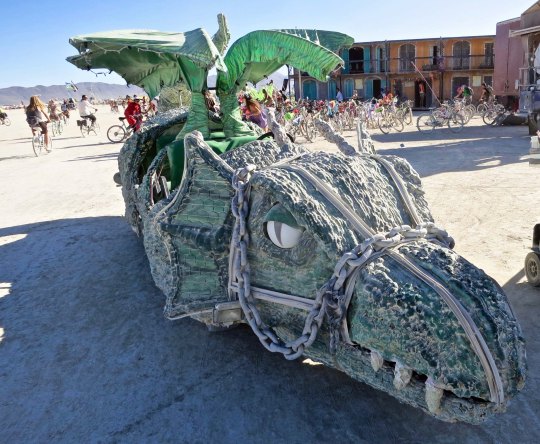
Alligator mutant vehicle at Burning Man.
And I will conclude with one of my favorites, which just might be a alligator. I found it hanging out near the New Orleans tribe’s camp. It either had green wings or was lurking under a palm tree, waiting for an unsuspecting victim.

NEXT POST: From dragons to bugs, to cats, and hippos! More mutant vehicles.

A ‘Ghost Mill’ at the Southern Entrance to Death Valley

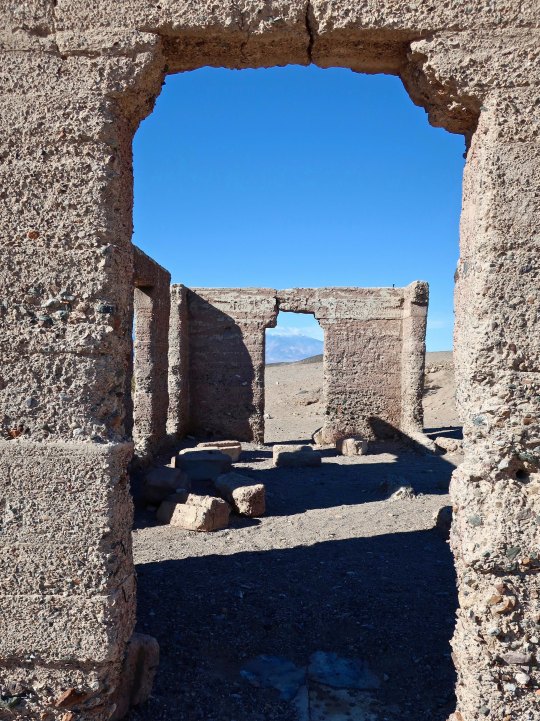
Old, abandoned towns of the West are given the name of ghost towns. While Ashford Mill hardly meets the requirements of being a town, I decided we could at least think of it as a ‘ghost mill.’

Abandoned mines litter Death Valley’s history. In my last post, I featured one of the most successful mines in the area, the Harmony Borax Works. It was so successful that the twenty-mule team responsible for hauling its ore across the desert served as a logo for the long running TV show, Death Valley Days. The show was hosted by none other than Ronald Reagan in the 1964/65 season when I was a student at Berkeley. It’s possible I even watched an episode or two while avoiding the baton-wielding police sent to campus by Edwin Meese, Oakland’s District Attorney at the time— and Reagan’s future Attorney General.

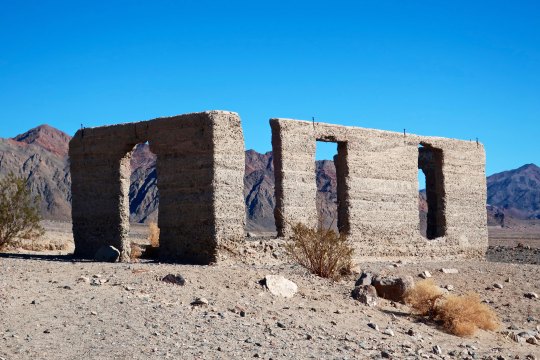
Mercury, talc, gold, silver, sodium chloride, Epson salts, tungsten, and copper were some of the other minerals that miners pursued with visions of wealth dancing in their heads. Few were successful. Some 2000 mine ruins were left behind as their legacy. Ashford Mill is one such ruin. It was built by the Ashford brothers to process ore from their Golden Treasure Mine located 5 miles to the east in the Armargosa Range. The brothers alternated working the mine and leasing it out to various companies for over 30 years until they finally gave up in the early 40s. A lot of money, work and heartache was devoted to the effort, but the ‘golden treasure’ was not to be found. Today, all that remains of the mill are the cement walls of what was the office and a few remnants.

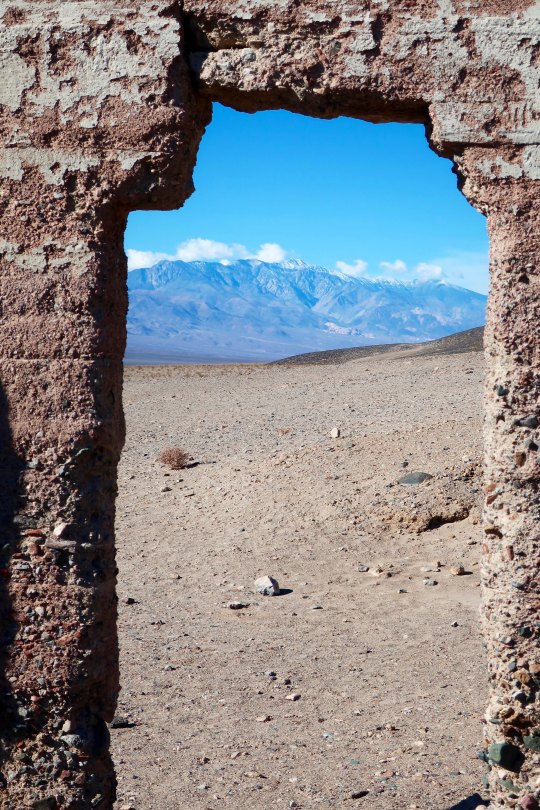
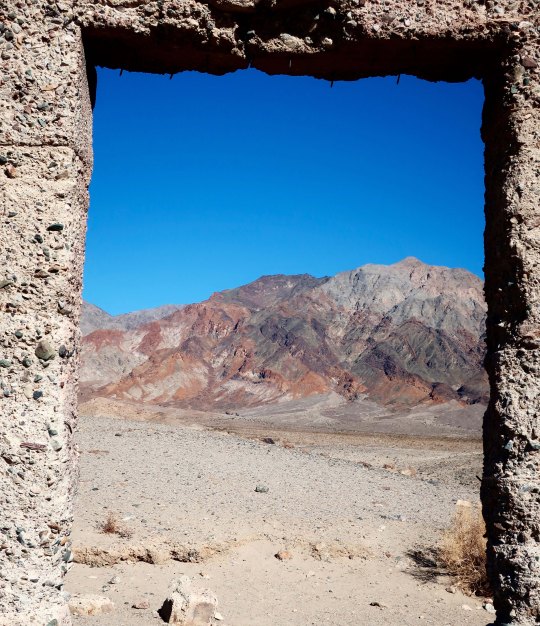
A view of the office as it now looks. I decided in would be fun to photograph the surrounding desert using the various openings as frames.
Looking out toward the Panamint Range.
The Golden Treasure Mine is located up in the mountains.
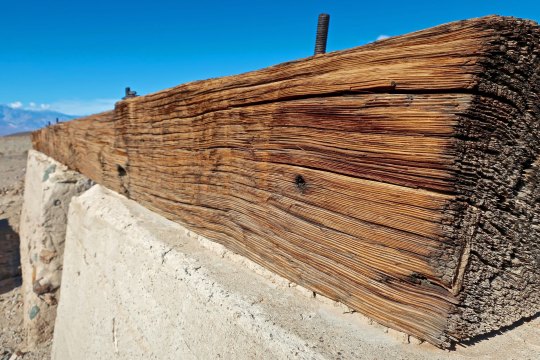
While there was little left of the old mill, I found this timber beam rather impressive.
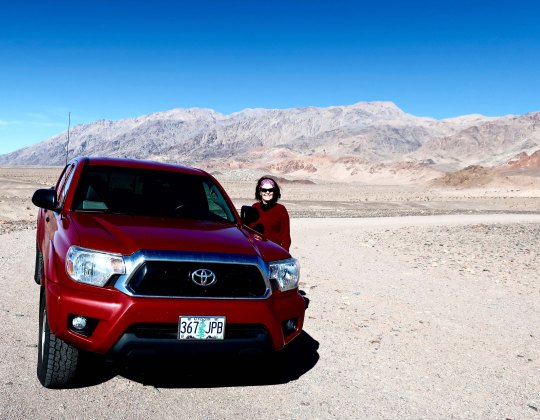
Here’s Peggy looking cool in her shades while standing next to our red Toyota Tacoma. The Amargosa Range is in the background.

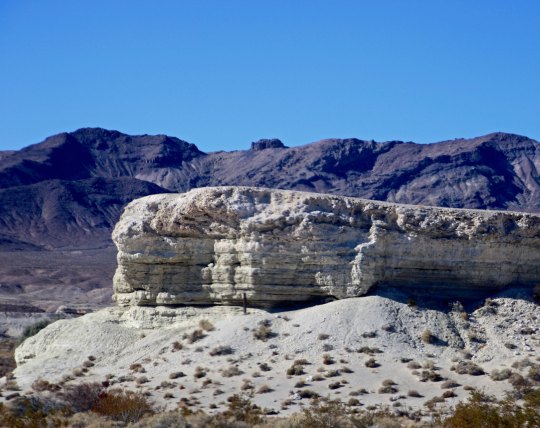
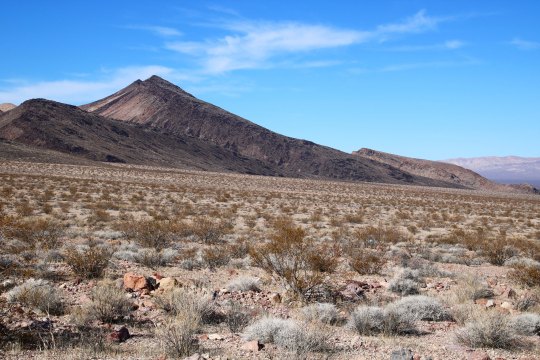
For all of our trips into Death Valley over the years, Peggy and I have never entered from the south end of the park. We remedied that this time by heading over to Pahrump from Las Vegas following Highway 160 and then cutting over to the remote town of Shoshone on 178 and on into Death Valley. Following are some of the photos that Peggy and I took illustrating this route.

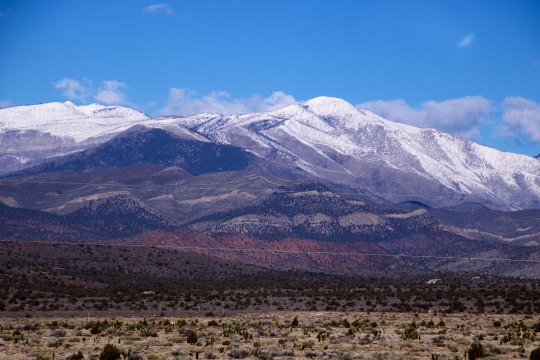
Looking east from the southern entrance to Death Valley, Mt. Charleston dominates the view. A ski area for Las Vegas is located up in the mountains. (Photo by Peggy Mekemson.)
The road worked its way around this rock. (Photo by Peggy Mekemson.)
Climbing up toward the pass into Death Valley provided views like this. (Photo by Peggy Mekemson.)
And this.
Once over the top we began to make our way down into Death Valley.
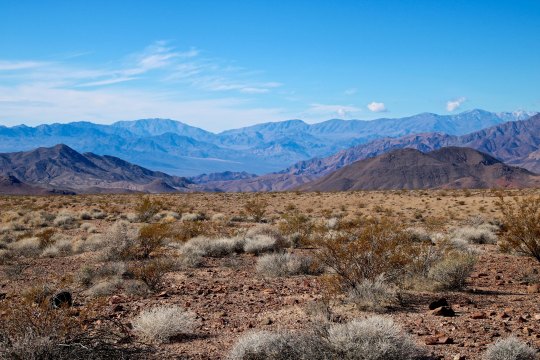
The Panamint Range can be seen stretching across the horizon. (Photo by Peggy Mekemson.)
I liked the contrast here.
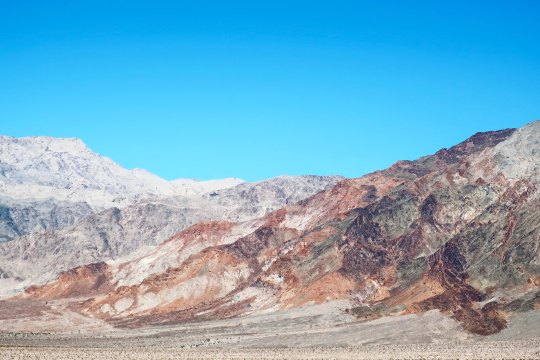
Rocks made up of different minerals and laid down under differing geological conditions provide the color for which Death Valley is famous. (Photo by Peggy Mekemson.)
Check out this mountain as an example.
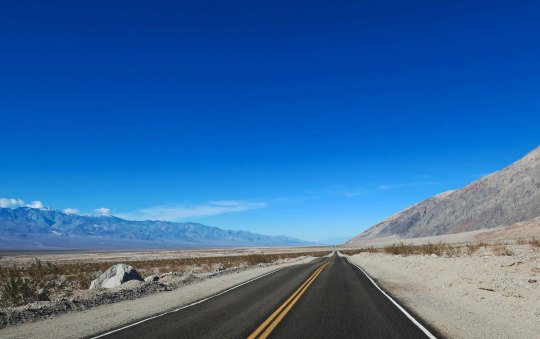
I’ll wrap up our trip into Death Valley with this photo that demonstrates just how flat things can get. I loved the perspective of the road disappearing into the distance. It seems like everything was converging.

NEXT POST: A bit of Las Vegas and the road north to Reno.

The Devil’s Golf Course in Death Valley… An Interlude

The sun beats down on the Devil’s Golf Course in Death Valley.

Only the Devil could play golf here.” 1934 National Park guide book.

Peggy and I are playing hooky, extending our seemingly endless time away from home. One would think that backpacking the PCT, visiting Puerto Vallarta, and spending over a month with our kids in Florida and North Carolina would satisfy our wandering needs for a while. But no, here we are in Las Vegas, or Lost Wages, as I like to call it, ensconced in a comfortable suite at the very southern tip of Las Vegas Boulevard, the infamous Strip. Or is that famous?

Few people who visit this city venture outside of its mecca of gambling and entertainment pleasure palaces. Peggy and I always do. There is much to see and do. There is a desert on its doorstep, and it is a desert of rare beauty. Death Valley National Park is a prime example. It is a mere two hours away and Peggy and I drove out there on Sunday. To us, it’s like seeing an old friend; we have been there many times.

It is a geologist’s dream— there are rocks everywhere, and the rocks all have stories to tell. It’s a story of ancient seas and lakes and volcanic activities and clashing, mountain-building plates. Death Valley is a rift valley, or a graben in technical terms, formed along a fault zone between two mountain ranges. As the mountains were thrust up by tectonic forces, the valley dropped between them, several thousand feet. The two mountain ranges have since filled the valley up with eroded debris.

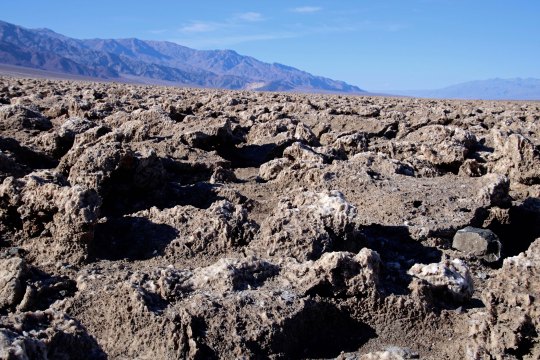
The shallow Lake Manly filled the basin a few thousand years ago. As the climate of the area changed and became more desert like, the lake dried up. Its briny waters left a deep deposit of salt behind, which brings us to today’s post. The Devil’s Golf Course is located a short 10 miles away from Bad Water Basin, which, at 282 feet below sea level, is the lowest point on the North American continent. Water that drains into the Basin melts the salt and becomes undrinkable, thus the name. The Devil’s Golf Course is several feet higher and avoids the melting water. Instead, capillary action pulls salty subsurface water up creating the crystalline structures that the area is famous for.

Peggy and I caught the area at a particularly good time for photography, which surprised me, given the location of the overhead sun. Anyway, here are the results.

This close up provides a view of the crystalline structures developed by the capillary action. BTW, they are composed of 95% table salt. (Photo by Peggy Mekemson.)
I took this photo looking east toward the Amargosa Range.
Looking southwest along the Panamint Range.
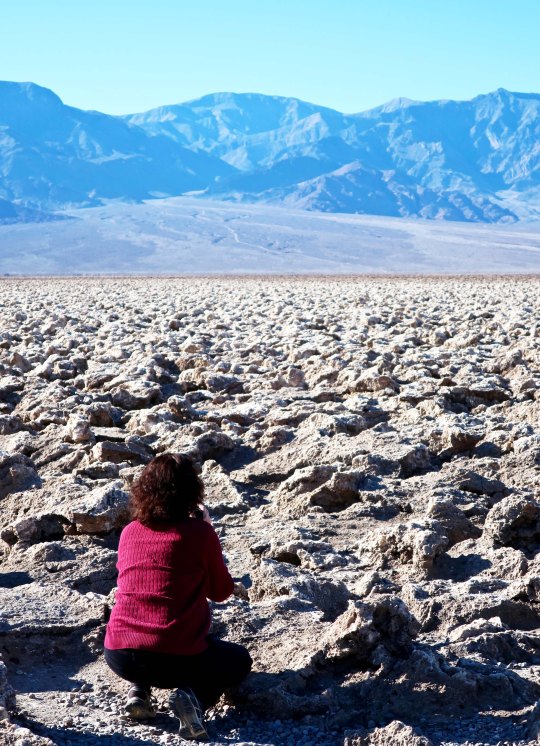
Peggy photographing the Devil’s Golf Course provides a perspective on the size of the crystalline structures.
A final shot of the Devil’s Golf Course backed up by the Panamint Range. (Photo by Peggy Mekemson.)

NEXT POST: A ghostly reminder of Death Valley’s past, and more.

A Limb with Tusks, Plus More Impressive Rocks and Trees along the PCT near Ebbett’s Pass

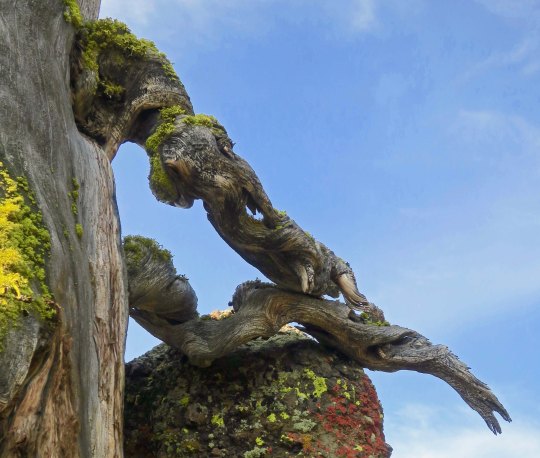
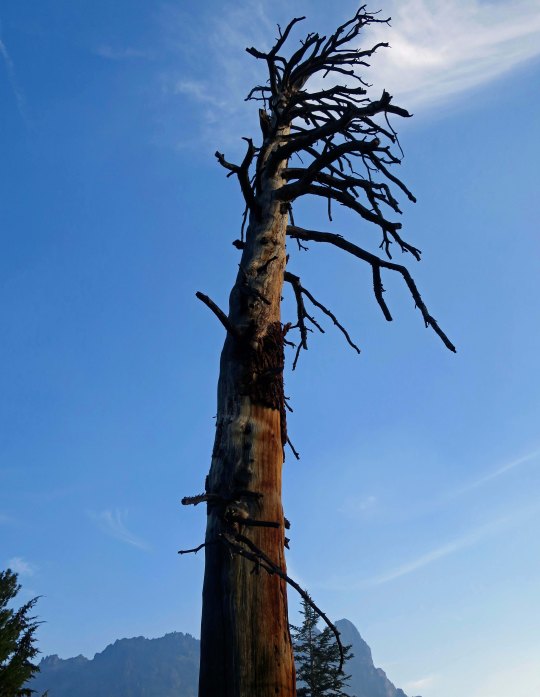
I didn’t spot the tusks on this tree limb until I checked out my photos. There’s no doubt which is the dominant creature here! Or maybe they are just snuggling.

Peggy and I had lunch yesterday with Barbara and Carl, the couple that dropped us off at Mt. Ashland for the beginning of our trek south down the PCT. It was the first time I had seen them since the beginning of the adventure. There was a lot to tell.

Naturally, I talked about both the challenges and the rewards of backpacking for 700 miles over difficult terrain at 75. I also discussed how 50 years of backpacking had prepared me for the trip, and threw in a few of my more humorous adventures from those years. They will be in my book.

“Knowing what you know now, would you do the PCT hike again?” Carl asked.

“Absolutely,” I replied. This doesn’t mean I will forget just how hard it was. It’s an important part of the story. But the beauty and the nature of the adventure are what will stick in my mind. I once had a woman who had been on one of my hundred mile treks tell me it was one of the most difficult tasks she had ever undertaken. But in the end, she said, it was an incredible, life-changing experience. The pain faded; the experience remained. “The only thing I can equate it with, Curt,” she had related, “was having my first baby.” Ouch, and then ‘Oh my!’

For the first 25 years or so of my backpacking, I hadn’t carried a camera. Those were the days before you could expect to obtain quality photos from a small camera, and I didn’t want to add the extra weight to the 60 pounds I was already carrying. I was also reluctant to spend the time that good photography required. And often I was leading groups that demanded my full attention.

I am sorry now. “I can’t believe you go to all of these beautiful places and don’t carry a camera,” my father had told me time and time again. He was right. I wish I had those photos now to remind me of where I had been and what I had seen. But there is more. Photography helps you see the world in different ways. It encourages you to focus in on details you might miss, it helps you notice the differences that light and varying perspectives make, and it forces you to stop and look around.

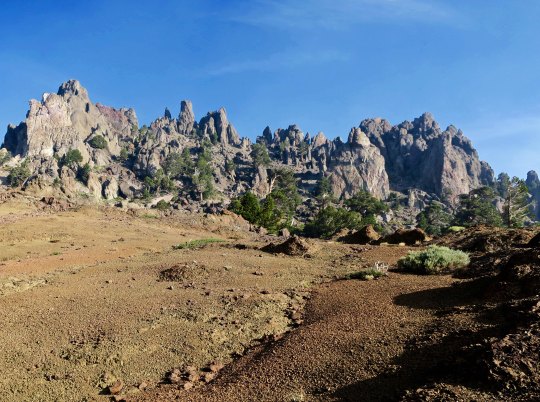
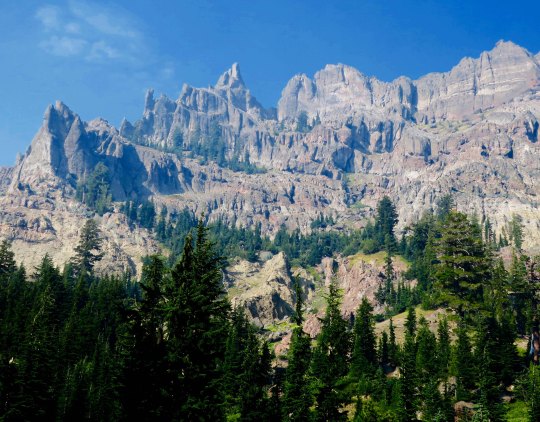
Today’s photos pick up where my last post left off, hiking down the PCT from Carson Pass on Highway 88 to Ebbetts Pass on Highway 4. The first four illustrate the value of stopping and looking around. They are all of the same scene from different perspectives.

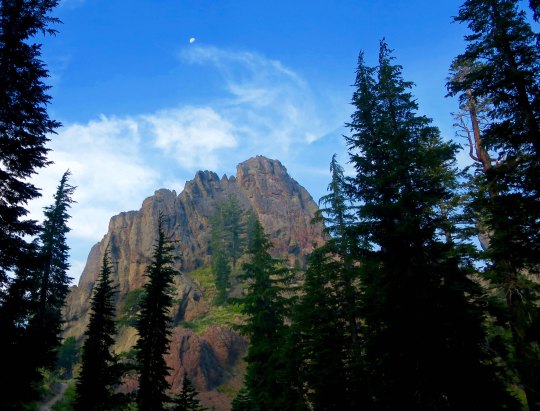
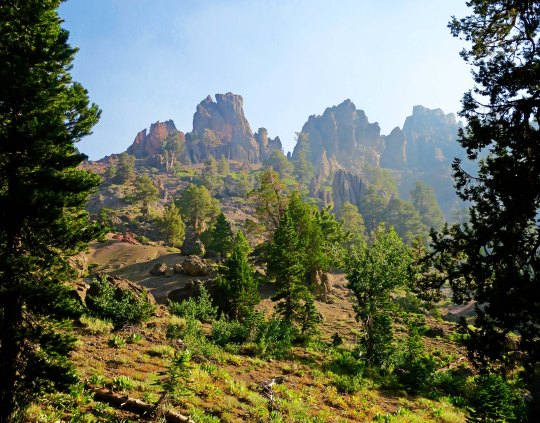
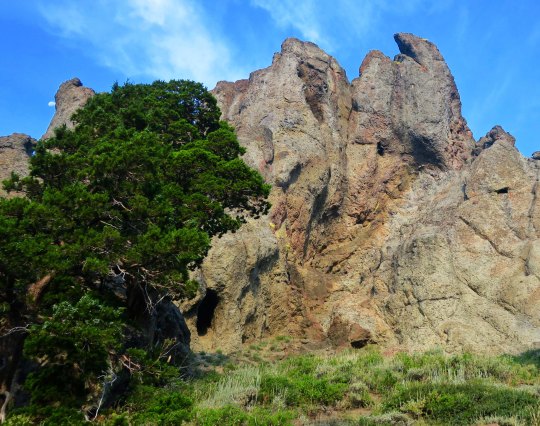
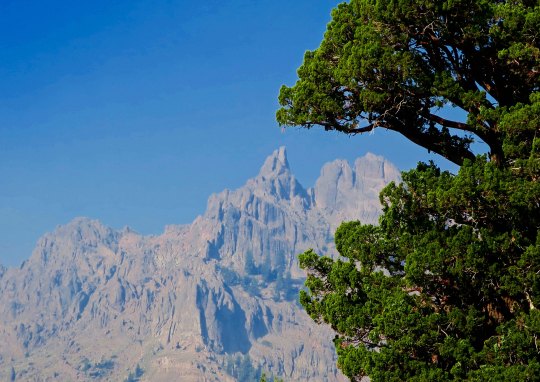
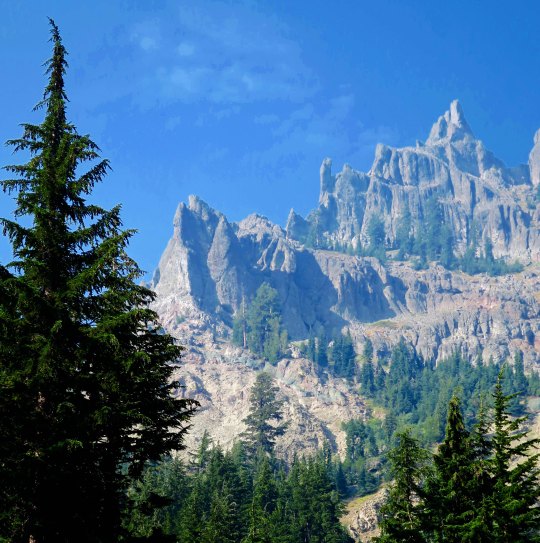
Once again, there were towering cliffs to admire. These were framed by hemlocks.
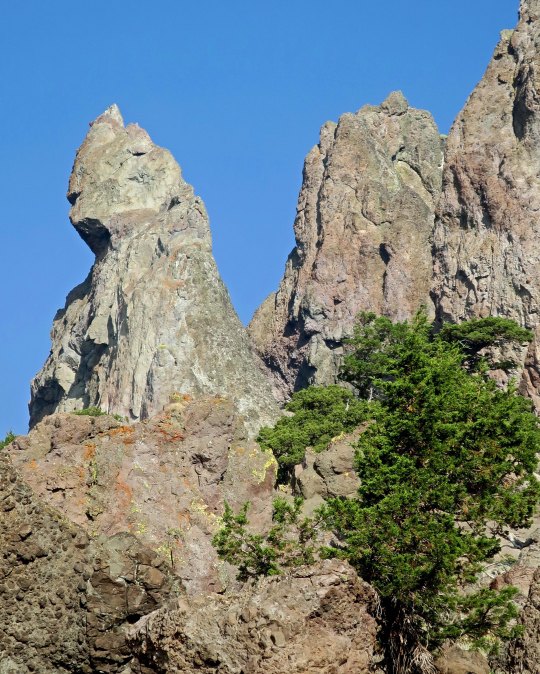
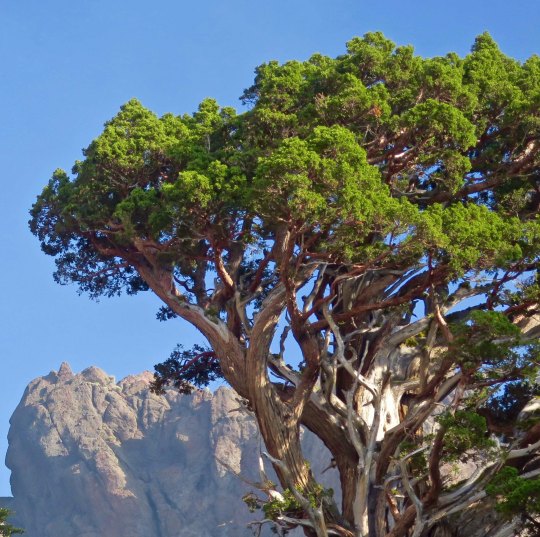
A closer look showed junipers growing beneath the cliffs. A tiny moon appears in the upper left.
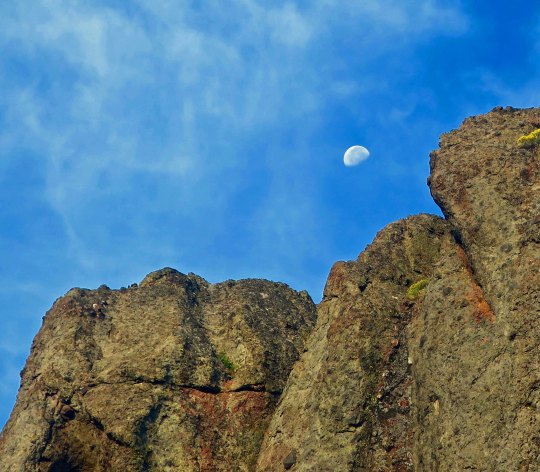
And my telephoto brought the moon into perspective with the cliffs.
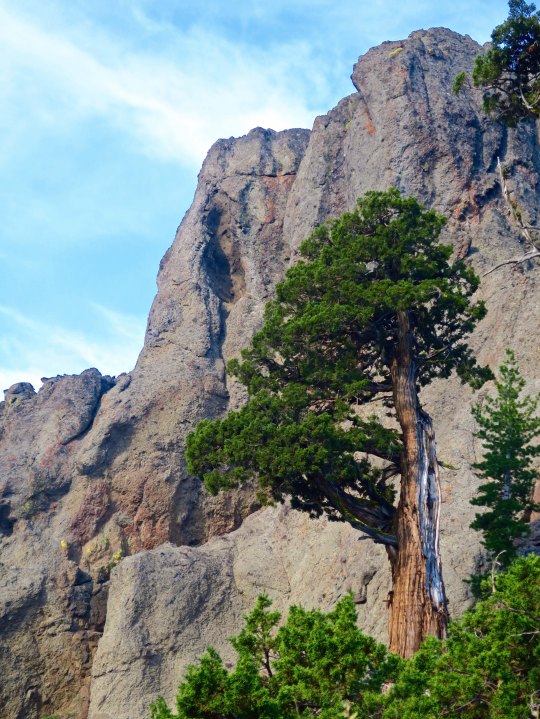
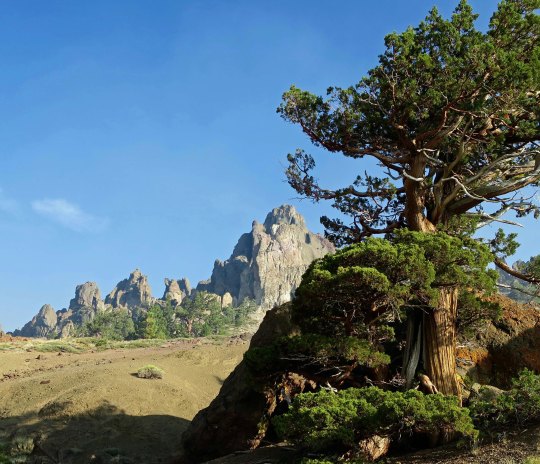
While another photo featured one of the junipers standing tall against the cliff.
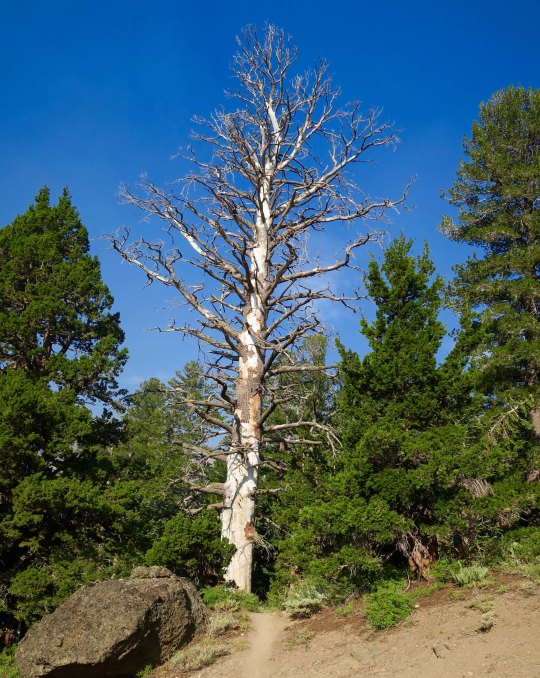
One of the magical things about following a trail is that you never know what you will see next. It’s a thought that forever pulls me on. The PCT made its way around a large snag here and disappeared into the woods.
I was assured that the views would just keep coming.
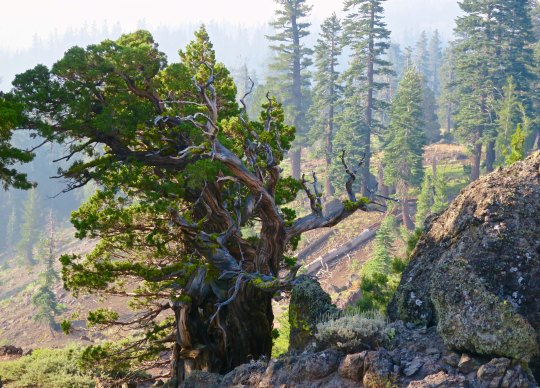
The smoke did more than hassle my lungs; it also provided some interesting photos as it filtered the sun. This juniper is an example.
And another smoke filtered scene.
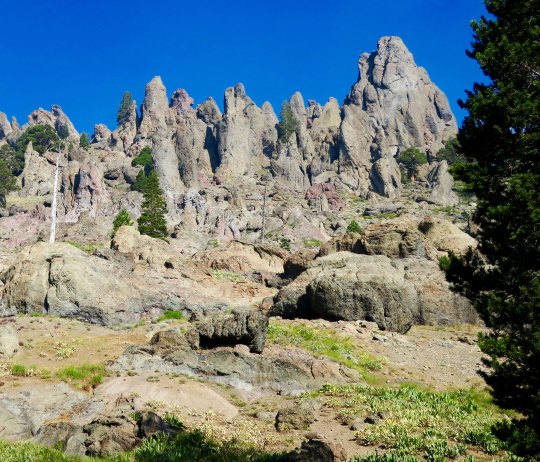
As might be expected from my last post on the PCT through the Mokelumne Wilderness, there was no end to magnificent rocks.
Rounding a bend I came on a new view with a juniper, rock and open area leading to a distant peak.
This perspective had the intensity of surrealism. I could see Dali carefully painting the rocks in the foreground and adding a melting clock.
The contrast between a juniper and rock guaranteed that my camera came out.
And then I was treated to my first view of Mt. Reynolds.
Wow!
I’ll conclude today with this view. I loved the contrast.

NEXT POST: Variety, being the spice of life, it’s back to Mexico.

Who Ate the Gingerbread House? … Good Doggy, Bad Doggy

I went searching for three wise men at Carowinds Amusement Park on the border of North and South Carolina. I didn’t find them. Maybe they were lost in the pre-Christmas crowd. But I did find one of their camels.

It’s Christmas Eve here in Charlotte, North Carolina. The tree is up and loaded with goodies. The gingerbread houses have been built and the Christmas cookies are ready to eat. (Minus those that Grandpa has already eaten. I have a serious responsibility to test the cookies as they come out of the oven. Sometimes I have to eat two, or three, just to be sure they meet my high standards.) Our son-in-law Clay will soon be up and preparing tonight’s roast. He’s one heck of a cook. All’s well with the world, or at least all is well with our little corner. And that’s enough for today.

Like Santa, we are in the middle of our holiday rounds. Last week, we were in Florida visiting with our son and his family. This week we are with our daughter and her family in Charlotte. It’s her turn to have us for Christmas. Next year is Tony’s turn, as we have already been reminded several times. (grin) Santa, of course, has the advantage of being able to be in both places. That’s because he has that magical sleigh and eight reindeer plus the red-nosed fellow. We have to travel by airplane, where we are lucky to arrive at all.

Santa dashing away on top of one of the rides at Carowinds.
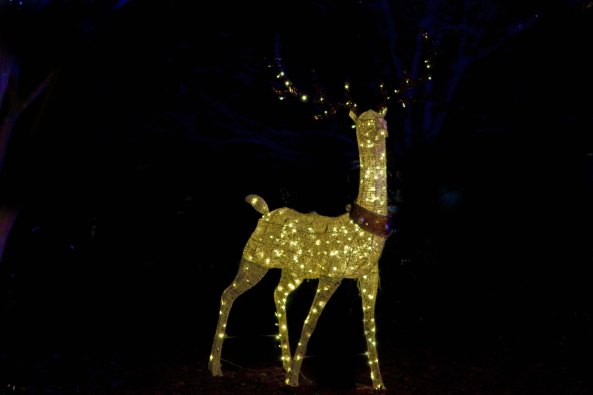
One of his eight reindeer!

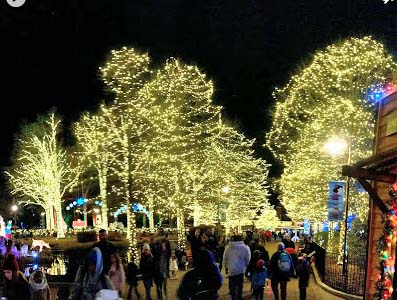
Both sets of kids (and grandkids) decided it would be fun to check out the holiday decorations at major amusement parks this year: Busch Gardens in Florida and Carowinds in North Carolina. They were impressive:

Clay used his Google Android phone to capture this photo at Carowinds. (Clay works for Google as a manager at their data center in South Carolina.)
Both parks featured decorated trees. This is at Busch Gardens.
Another Busch Gardens tree.
This tree with the moon hanging out above was at Carowinds.
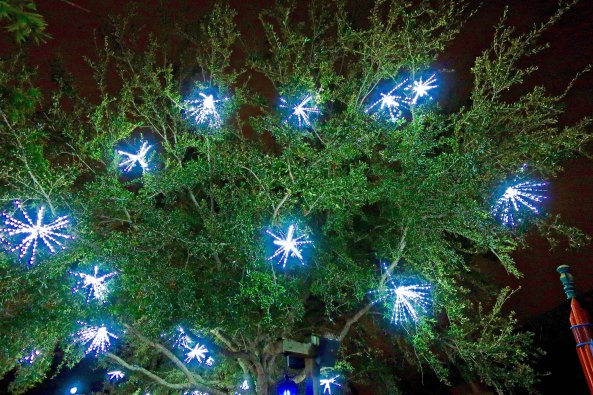
Clay caught this ‘bulb-tree.’
And I took a close-up.
As usual, I couldn’t resist a reflection shot. This is Carowinds.
A very big Christmas tree ornament at Carowinds.
As expected, both parks had impressive Christmas trees: Busch Gardens…
Carowinds. This tree, BTW, sits on the border between North and South Carolina.

Making gingerbread houses is a tradition at both houses, which isn’t surprising considering Peggy’s love of all things Christmas. The grandkids join in the effort with total dedication, except for eating half of the house decorations. They are not alone in their passion for jelly beans and M&Ms and candy canes, gumdrops etc. The doggies also have a sweet tooth. But which one ate the gingerbread house?

Was it Natasha and Clay’s dogs: Miss Innocence (Chima) here?
Or, “How could you even think I might eat the Gingerbread House? ” Lexi.”
Or Tony and Cammie’s Miss Definitely Not Me (Lyla).

Chima and Lexi were actually innocent— this time. Not that they wouldn’t eat a gingerbread house if someone left it on the floor by mistake and no-one was home. But they lack Lyla’s long legs. (Clay swears his dogs would not eat the gingerbread house.) Cammie and boys had just finished their house and were briefly out of the room. Cammie returned to find Lyla on her hind legs scarfing down their house. In Lyla’s defense, she had only thoroughly licked one side— but I am pretty sure that the house’s demise was just a matter of time. Anyway, here are the Cox family gingerbread houses:

Cody’s Robot House… Check out the teeth!
Ethan’s Reindeer House…
And Peggy’s. She would never be left out when it comes to building gingerbread houses.
While I didn’t catch Lyla’s well licked gingerbread house, Peggy and I found that our bedroom had been invaded by animals. This was special. Imagine kids loaning out their animals, even for a night! It was the true Christmas spirit.

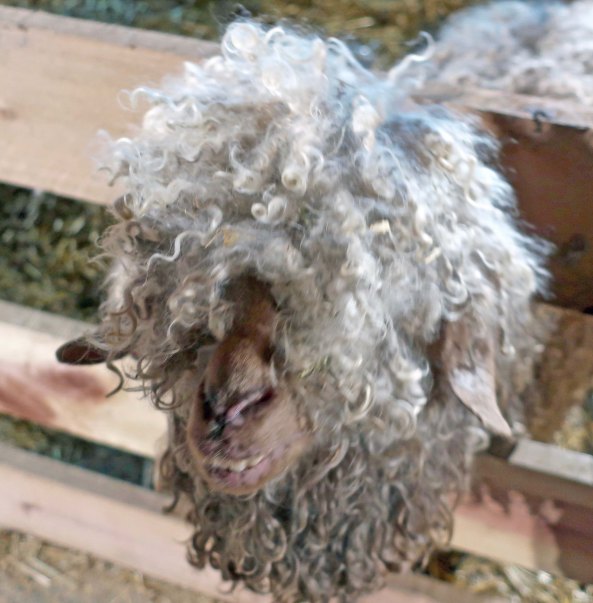
Speaking of animals, Carowinds had put together a petting zoo for Christmas. It’s where I found the camel. There was also a very, very strange looking goat that looked like it was having a really bad hair day, that it was an ancient goat from another time…

I decided that it was… are you ready for this… The Goat of Christmas Past.

A VERY HAPPY HOLIDAY TO ALL OF OUR GREAT INTERNET FRIENDS. THANKS FOR FOLLOWING ‘WANDERING THROUGH TIME AND PLACE.’

CURT AND PEGGY

HOB-nobbing on the PCT in the Mokelumne Wilderness

I was looking for the perfect camp location on Forestdale Creek when I noticed another man putting up a tent nearby. I went over to chat, or hobnob, so to speak.

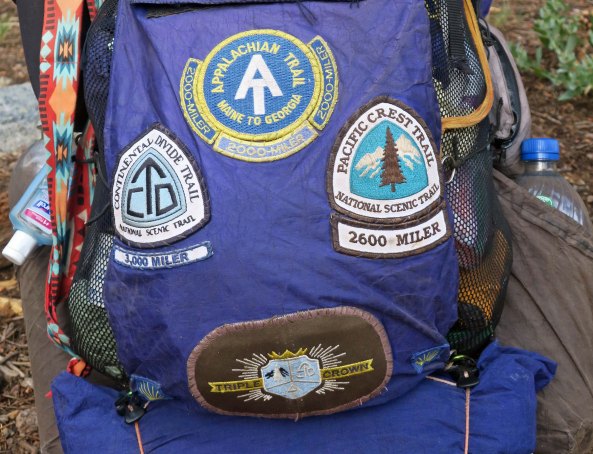
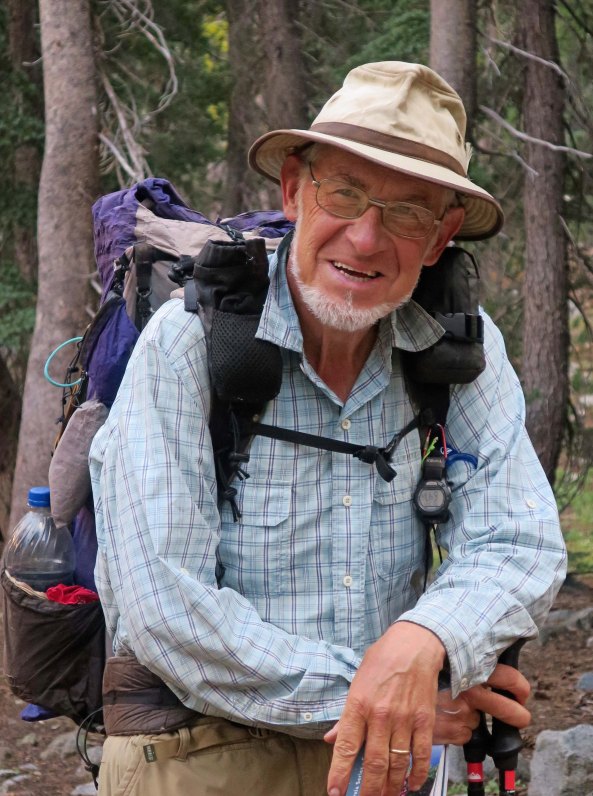
The 65-year-old Hob McConville was on a mission: finish his second trip over the PCT. (His first trip had been back in 1976 when I was hiking on the Appalachian Trail in Maine.) He had already hiked the Appalachian Trail twice, and the Continental Divide Trail once. He and his wife had walked across Europe three times. In other words, hiking long distances is pretty much what Hob does. He didn’t know whether he would do the Continental Divide again. Large bears, i.e. grizzlies, worry him. 

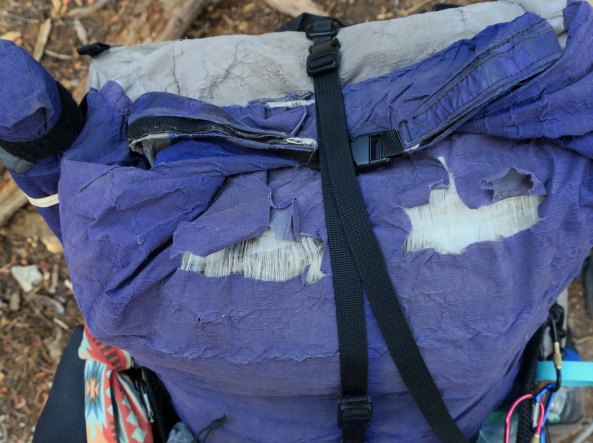
“I’ve camped under this beautiful sugar pine,” he informed me, “because it is my tent’s last night and I want to give it a good experience.” Obviously he liked his tent. In fact, it was well-loved, like a child’s teddy bear after five years of hard loving. The tent was literally falling apart at the seams and Hob had been repairing it with Post Office packaging tape. “My wife is meeting me at Echo Summit with a new tent,” he sighed, more sad than excited. Hob deeply believes that anything you purchase should be used until it is beyond use, and then a little longer.

I hated to tell him that his beautiful sugar pine was a white pine. I’m not sure why I did, except older mountain men like the two of us enjoy knowing our trees. He wanted to debate until I pointed out the cones. And the tree was a beauty, regardless of the type of cones it produced. I am sure that his tent felt well-honored. I wondered if Hob would take it home and bury it in his Connecticut backyard, like a favorite pet. Hob’s pack was in similar condition, but apparently it had a lot of miles left.

This gorgeous white pine with limbs askew sheltered Hob’s tent on its last night.
Hob’s backpack looked a bit threadbare, as well. But it hadn’t quite reached the status of being retired.

The next morning, our discussion turned to the PCT and Hob’s philosophy on long-distance hiking. “It shouldn’t be a race,” he proclaimed fervently. His feeling was that it was becoming more and more like one. He could foresee the day when companies like Nike might sponsor races to see who could finish the trail in the shortest amount of time. I agreed. Just completing the trail in a season leaves little time to appreciate the beauty of the region. Jumping from the already long 20-25 mile days to 30 or 40-mile days would make such appreciation much more difficult. I see nothing wrong with the pride through-hikers feel in finishing the trail; it is a pride well earned. And Hob was quite proud of his accomplishments. But the ultimate value of the hiking the PCT— beyond personal satisfaction and growth— is in experiencing nature and developing a commitment to protecting wilderness areas. The PCT is not a race track.

While the conversation had been stimulating, Hob had miles to go to meet up with his new tent (and wife), and I had more nature to go appreciate. We parted company with Hob heading north and me heading south. Here are some of the things I saw along the way.

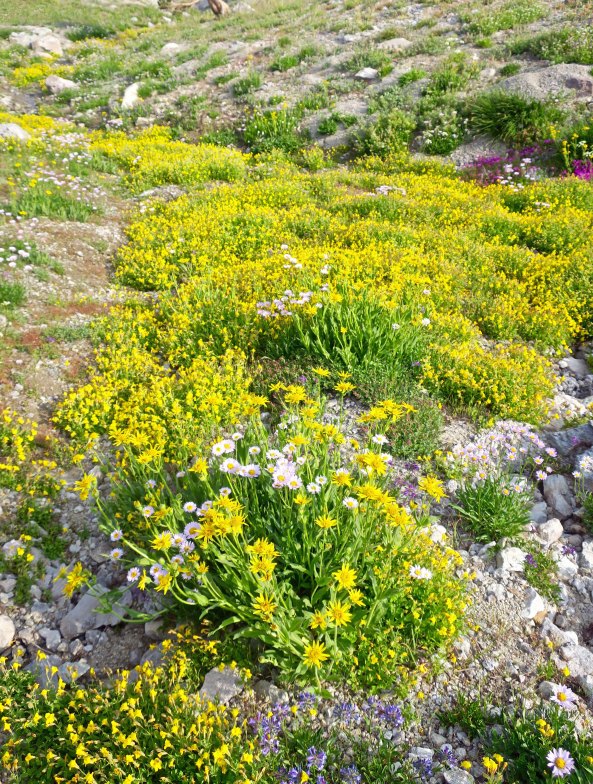
No more than a quarter of a mile up the trail, I came on a beautiful flower garden that would make an English lord lust over having it on his estate. I promptly took a half hour off to admire it, which is time that few through-hikers could spare.
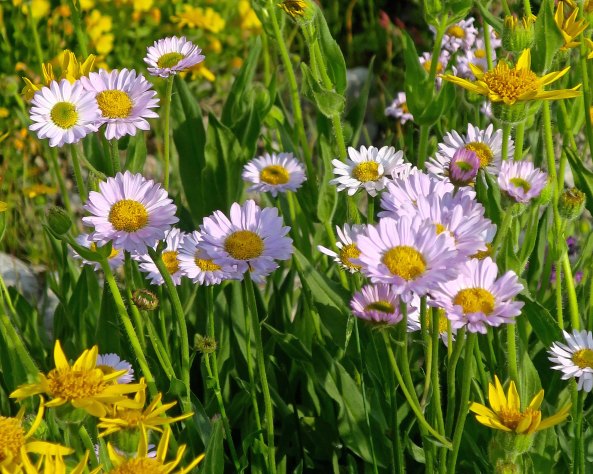
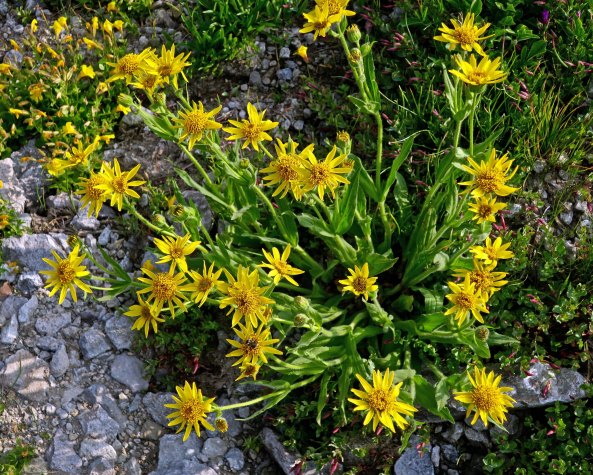
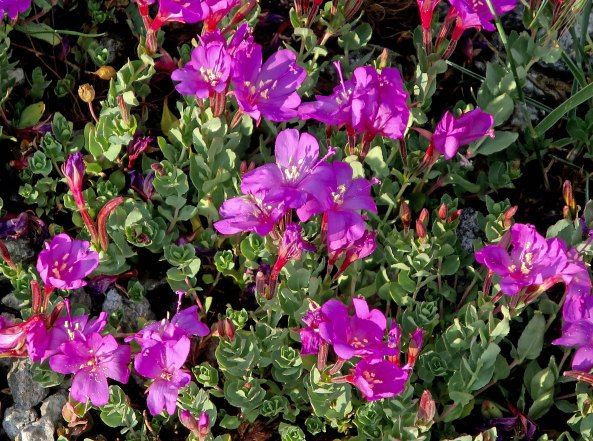
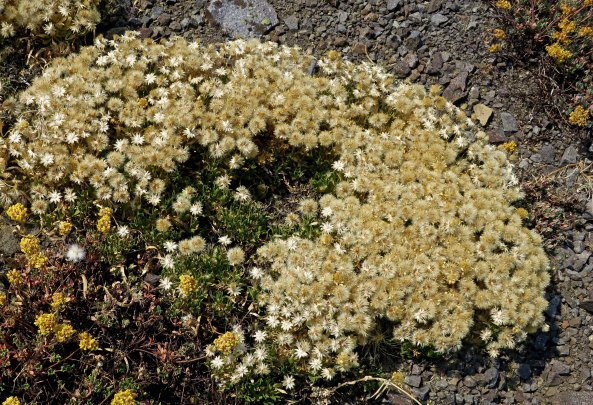
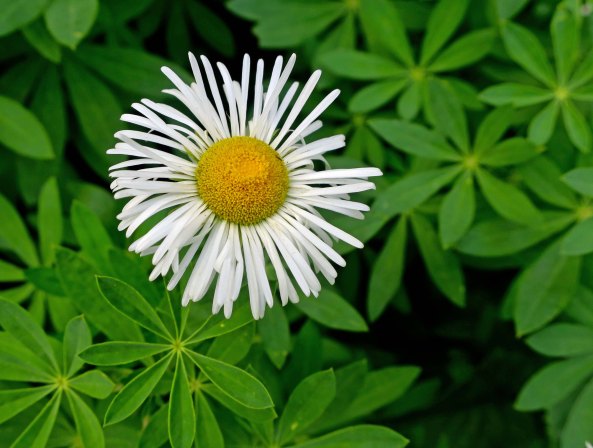
The garden was filled with a variety of flowers. I think that the daisy like flowers are asters. The yellow flowers are groundsel.
The aster-like flowers up close.
And the groundsel.
More groundsel.
Rock fringe.
And monkey flowers.
Not much farther along, I came on this small lake that demanded another 15 minutes of my time.

I passed a few more lakes and then the PCT did what the PCT always does. 

It headed up a mountain.

I met a young woman who was talking on her cell-phone with her brother. “I just saw a bear up the trail,” she told me breathlessly. I didn’t see the bear, but I did see…

Red elderberries…
Rabbit bush with an iridescent blue butterfly… 
A caterpillar chomping down on a leaf. When I tried for a closeup, it saw my shadow, assumed I was something wanting to eat it, and dropped to the ground.
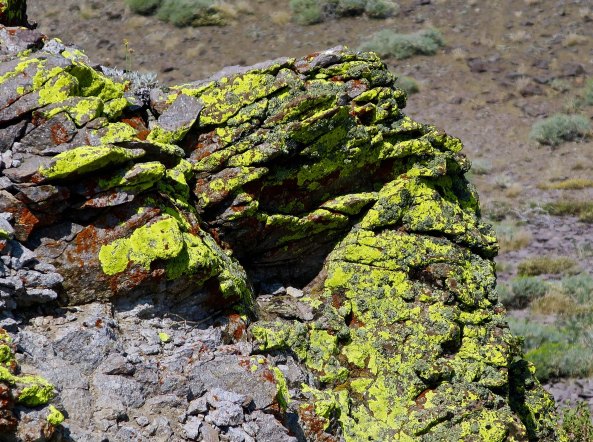
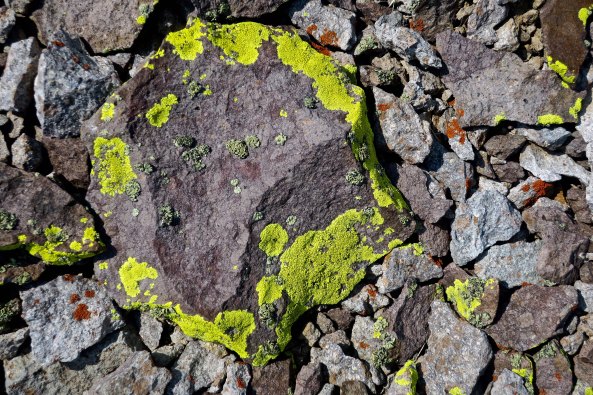
Charteuse green on the rocks. This may not be Facebook, but I am lichen it!
A closeup of the lichen. A pretty rust-colored lichen is also found in the area.
I don’t have a clue what this plant is, but I am pretty sure it was left behind by a UFO-alien. I kept my distance.
Looking way down from the mountain I could see the Blue Lakes. The tiny dot on the road is a car.

The last time I had hiked through this area, we had walked around the lakes. The night before, one of my long time trekkers, Nancy Pape, had choked on pills. My friend Ken Lake had jumped in with the Heimlich Maneuver and saved her life. The time before, we had hiked out from the lakes to the small town of Markleeville, California and happened upon the Clampers holding their sacred initiation rites. Men were walking around with toilet seats over their necks shouting obscenities. They were quite upset that we had women along who witnessed the ceremony. The women were amused.

As I started down from the mountain, I came on this bunch of dead flowers that were reflecting the coming fall. I thought of it as a dried floral arrangement.
I also had a view of this Mokelumne Wilderness landmark that has been known from the days of the early pioneers up to today as the Nipple. Once again, smoke filled the skies.
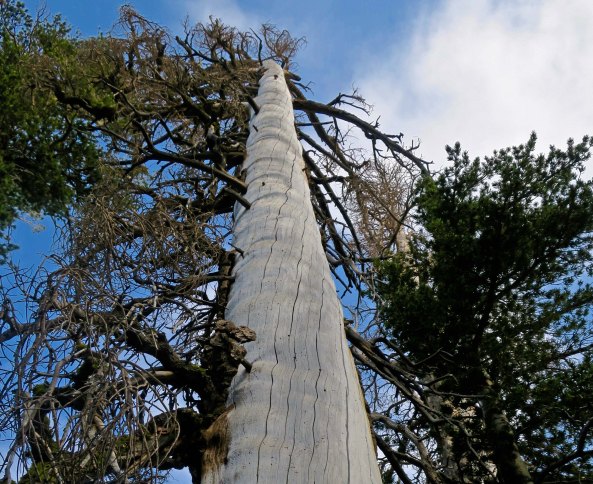
I found a snag…
That pointed toward the Nipple.
And a tall, weird, flowering plant that is known as deer’s tongue. Why? I don’t know.
A close up of its greenish flowers.
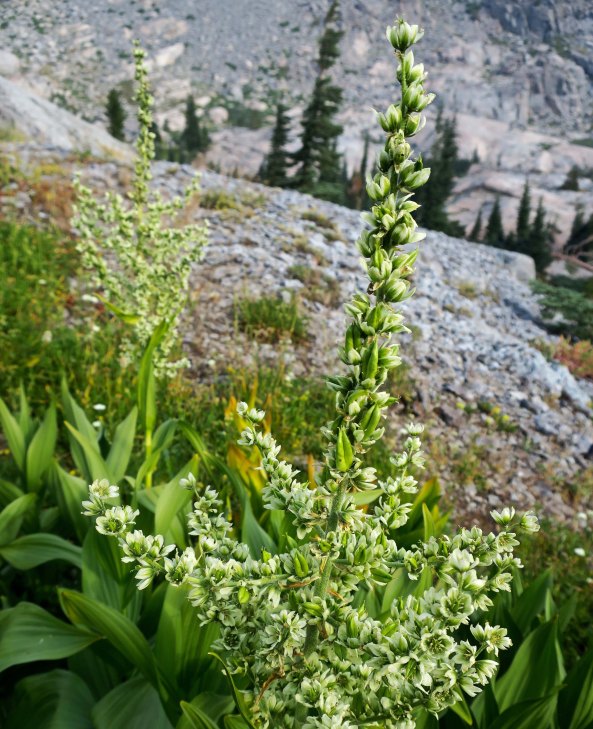
Corn lilies are another plant with greenish flowers. These were backlit by the sun.
These are corn lily flowers.
I’ll close today’s post with this shot of hemlock trees silhouetted against the sky and forest. You can tell that they are hemlocks by the way their tops are bent.

NEXT POST: A walk down Puerto Vallarta’s Malecon and an exploration of the public art along the way. After that, I will do a post on Huichol art in PV and then another post on the PCT.

Into the Mokelumne Wilderness… South from Carson Pass on the PCT

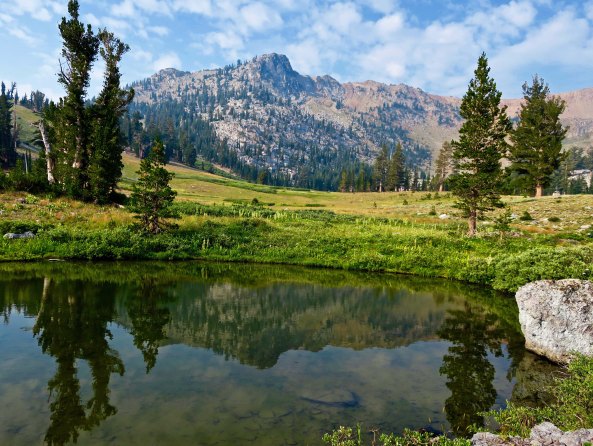
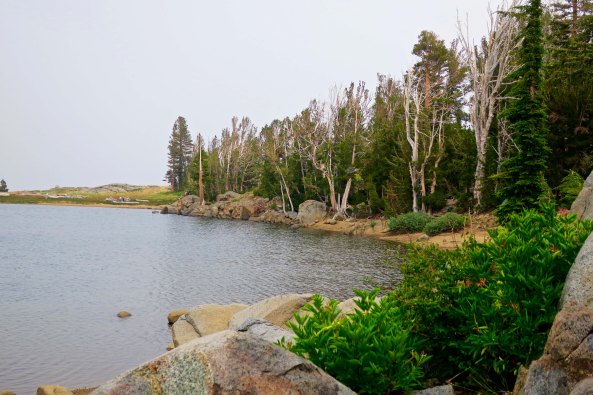
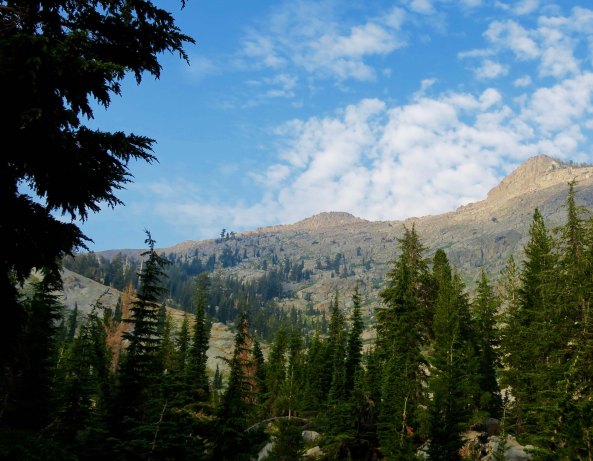
Lakes, mountains, and meadows, oh my. The Mokelumne Wilderness south of Carson Pass has it all, plus streams and rivers. I took this photo of Round Top Mountain from along the Pacific Crest Trail.

I’ve backpacked south from Carson Pass several times over the years, usually leading backpack treks following the old Tahoe Yosemite Trail. Those were the days before the present PCT route was built. I was excited to explore the new trail.

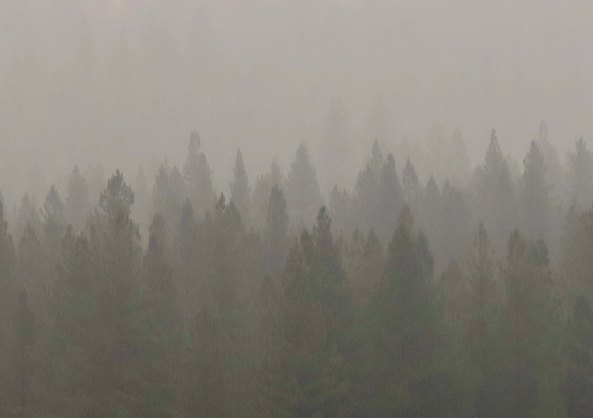
I arrived at the trailhead a few weeks earlier than I had planned. When I came out at Chester after hiking through Lassen National Park, smoke from the massive Carr Fire near Redding was so thick that it was difficult to see a couple of hundred yards into the trees. Having empathy for my 75-year-old lungs, I decided to skip south in hopes of finding clean air to breathe. 

Smoke from the Carr Fire on the PCT near Chester, CA

The pass was named after the mountain man, explorer, military leader and rancher, Kit Carson. During California’s gold rush era, it had served as one of the main entrance points to California. The trail worked its way down the mountain eventually delivering its gold seeking 49ers to the small town of Diamond Springs where I was raised. The town was established when some miners from Missouri found a 20 pound nugget of gold lying on the ground and decided to stay. Which I get. As a youth wandering far and wide through the woods surrounding Diamond, I’d always dreamed of finding my own large nugget. It wasn’t to be. But I did develop a love for the outdoors, which is worth a lot more.

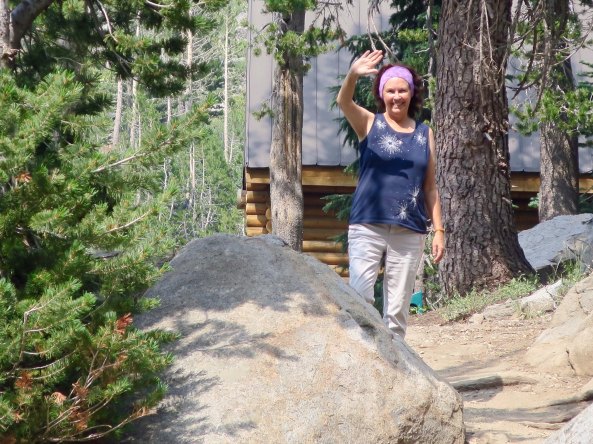
Peggy dropped me off at the trailhead and waved goodbye. She had seen me off several times by now, and was more confidant that she would see me at the other end. But my lovely friend was always a bit nervous…

Peggy waves goodbye with sincere hopes that she will greet me at Sonora Pass when and where I predicted I would come out.
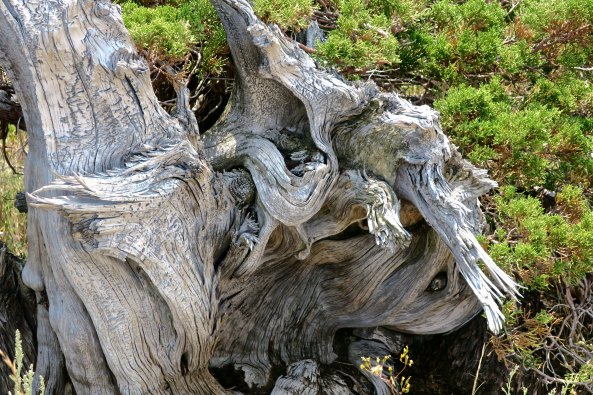
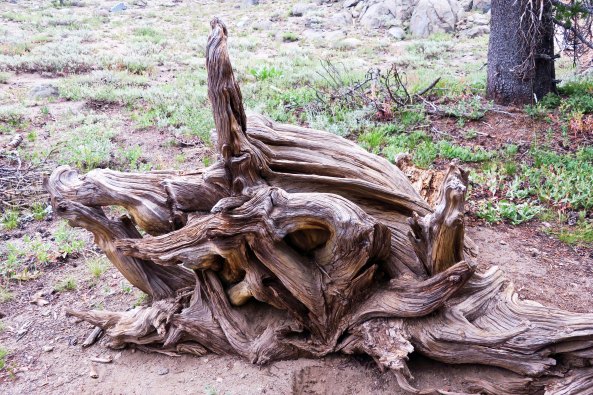
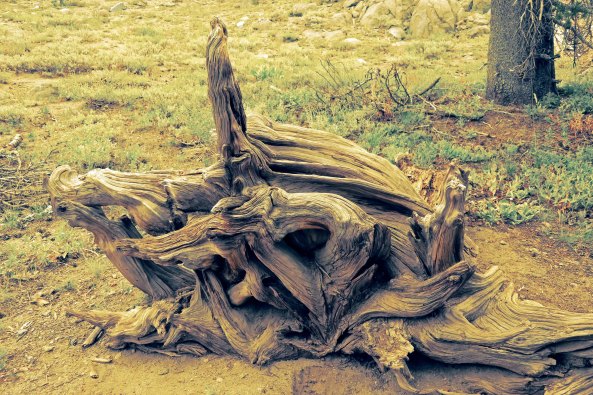
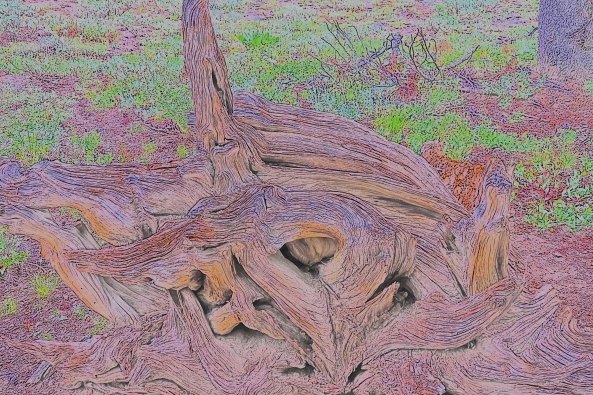
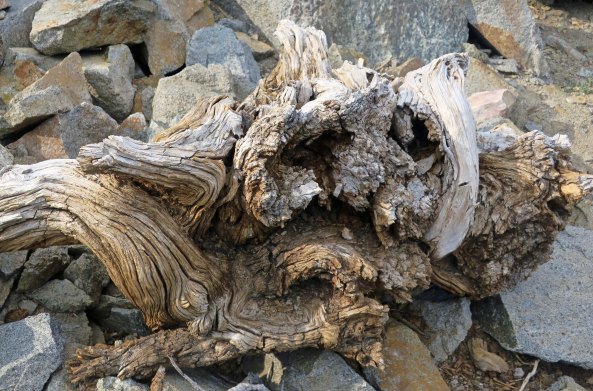
Being a sucker for roots and wood sculptures, this was the first photo I took along the trail. I hit the wrong button and my camera took several more photos, rendering each one differently. Normally, I like to stick with realistic portrayals, but I was amused with the results…
In yellow…
And in strange, impressionistic colors, like a Van Gough haystack.
I took a short detour up to Frog Pond. In the past, I had always hiked by it and wanted to see what it looked like. I thought it might connect to the PCT. It didn’t, but I enjoy detours. They added lots of miles to my journey. There weren’t any  obvious croakers.
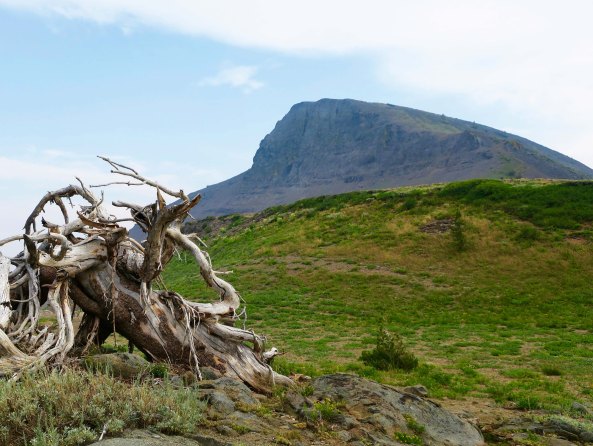
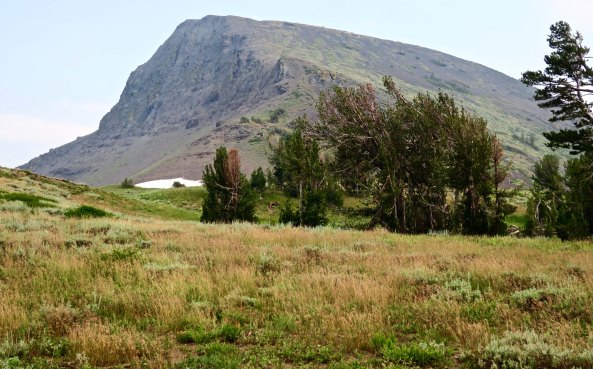
The correct trail provided this view of Elephant Back, one of the primary landmarks of Mokelumne Wilderness.
Another view of Elephant Back from the PCT.
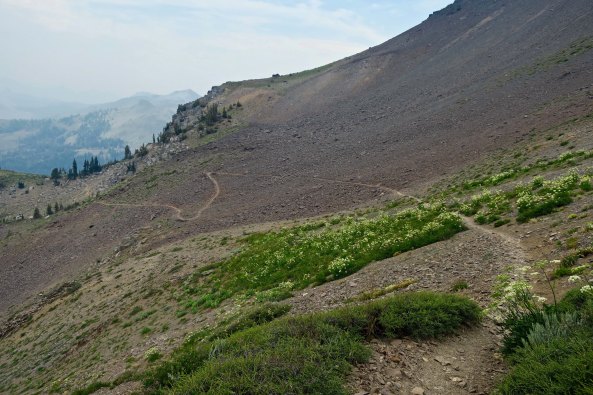
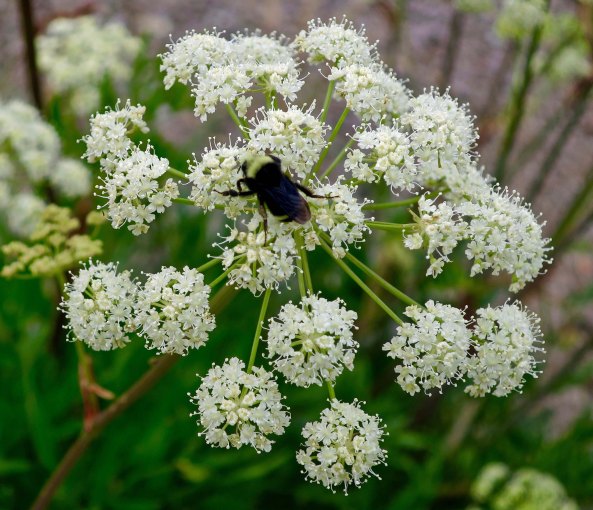
I had always hiked around the front of Elephant Back. The ‘new’ PCT took me behind it. The trail starts off making its way through Queen Anne’s Lace, a member of the parsley/wild carrot family.
A close up of the flower with a bee providing perspective.
Hiking on, I was reminded that I was well into summer. A granite rock provided the backdrop for this colorful grass.
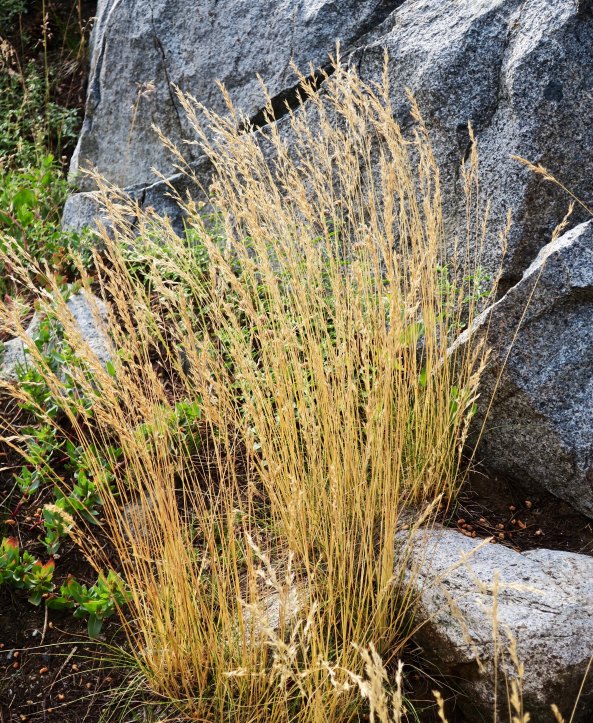
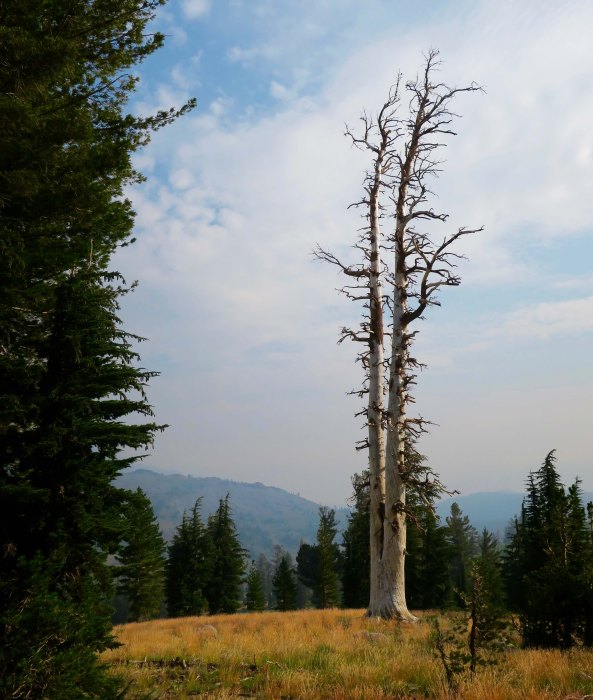
The brown grass here, which Californians insist on calling golden, provided a foreground for this photo of two snags.
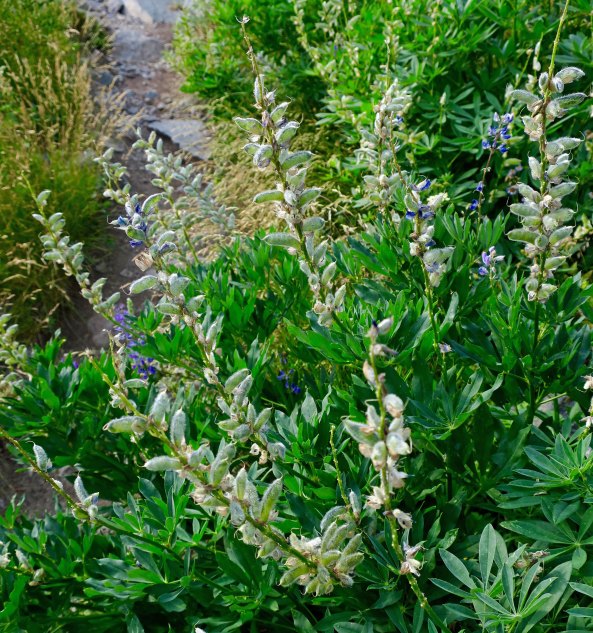
These pods on a lupine bush were also reminders of the fact that summer was winding down. They also show that lupine is a member of the pea family.
There was still plenty of water along the trail, however, which was a fact that I appreciated given how often water was scarce along the PCT.
And there were lots of flowers where I found water! This is rock fringe.
And what I know as ranger’s buttons, another member of the carrot/parsley family.
You can smell this one as you pass by. It is western pennyroyal, a member of the mint family. I always break off a leaf (it has lots) and urge people I am hiking with to sniff it and take a bite. It can also be used in making mint tea.
Larkspur is always a challenge to photograph, but I wanted to emphasize the ‘spurs’ here, from which it gets its name.
This daisy is known as fleabane. Pioneers believed that the bundled flowers would chase fleas out of their homes.
And here we have greenish corn lily flowers.
I found this half dead tree dramatic.
Another grass, rock, and tree photo. The haze in the distance suggests that my hopes for escaping smoke were about to be thwarted. Smoke from the Carr Fire had followed me south!
I almost tripped over this wood sculpture. Can you spot the sad owl-like face?
My next PCT post will take us up this flower covered ridge and far beyond.
I will also introduce you to a 65-year-old trekker who has hiked the PCT, the Appalachian Trail, and the Continental Divide Trail, giving him the right to wear a Triple Crown patch.

NEXT POST: For my next post, however, I will take you back to Puerto Vallarta again and some really neat art!

Furniture Mart or Zoo or??? … The Art of Puerto Vallarta

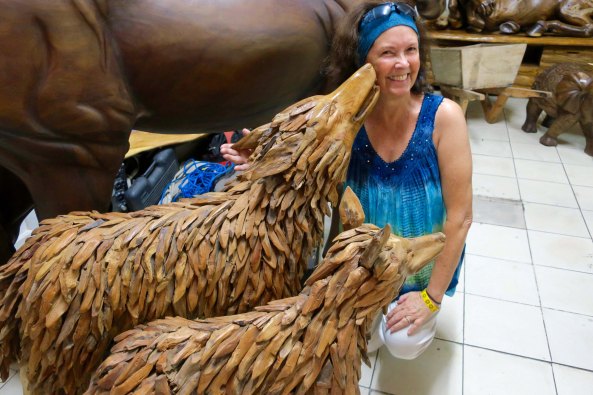
A friendly wolf licks Peggy’s face at the Furniture Mart in Puerto Vallarta.

Peggy and I have been coming to Puerto Vallarta, Mexico for a long time, long enough to see the lovely two and three story hotels along the north beach replaced by would-be sky scrapers that encroach on more and more beach.

We always stay at the Krystal Hotel, which is located along the main road between the airport and downtown. Years ago, we bought a time share here. It’s not something you do as an investment, regardless of how fast the sales people talk or whip out figures that you are not allowed to take away and study. In fact, there are much less expensive ways to see Mexico. Forget what we paid originally, the ever-increasing maintenance fees alone would easily cover an annual visit to PV, or anywhere else in Mexico.

But Peggy and I like the staff, our villa comes with a swimming pool, and we have fallen in love with Puerto Vallarta: its art, great dining, tropical sunsets, friendly people and amazing wildlife. There is even a taste of more traditional Mexico once you escape from the popular tourist areas.

I’ve blogged a fair amount about the town, more than I remember. I laughed a couple of days ago when I was doing Google research on PV’s public art, came across a promising heading, clicked on it, and landed on my blog.  

I’ve even blogged about the furniture store directly across the road from the Krystal. And I am going to blog about it again— today. I can pretty much guarantee that it is unlike any furniture store you have ever seen. It all started as a failed restaurant. Peggy and I ate there once upon a time.The food was good but the customers were scarce.

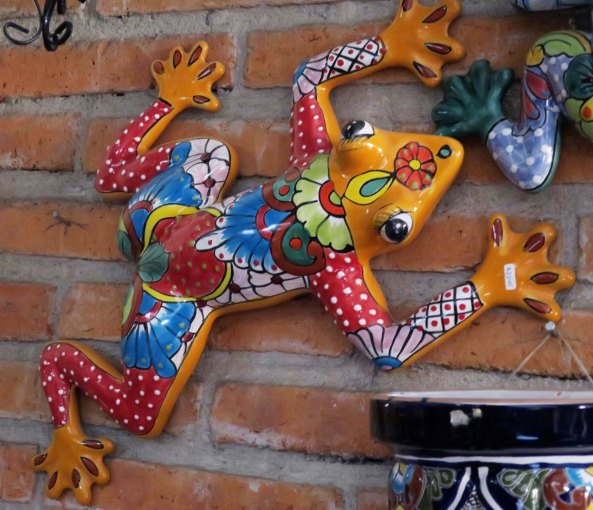
The family scurried about,searching for some other way to make a living and decided to make furniture.They also decided to sell art decorations for the home, everything from cute little ceramic frogs to giant metal rhinos. Collecting unusual items became something of a passion.

There must be hundreds of ceramic frogs hanging out at the Furniture Mart. This one is a cutie, complete with eyelashes.
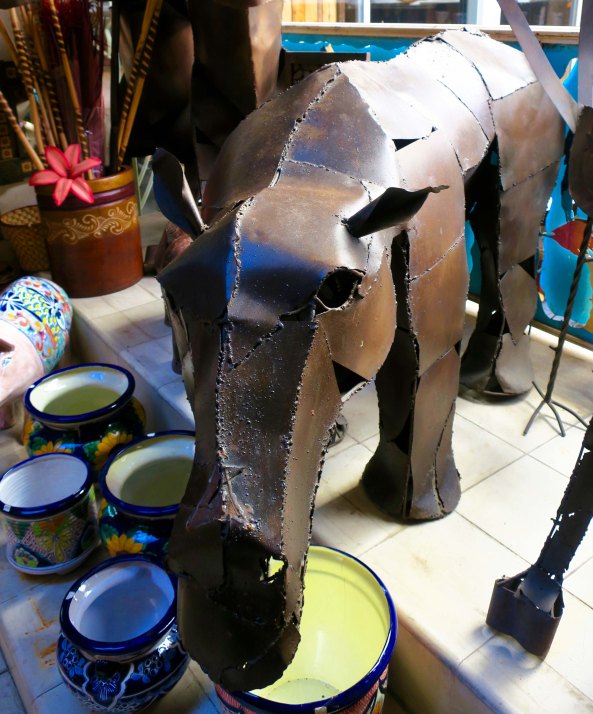
Contrast it with a full sized metal rhino!

The three, or four, or maybe five story structure feels like an Escher painting where you meet yourself coming and going. It is crammed full of art, wood carvings, pottery, strange statues, masks, and Mexican knick-knacks galore, as well as very unique furniture. There are thousands of items. The family of Carlos Paez Coronado describes their building as the Furniture Mart, the largest store of its type in Mexico, and a museum.

We visited this time with Peggy’s sister Jane and her husband Jim who were staying at our villa with us for a week. Jane loves ceramic plates and has dozens of them. We knew she would like the store. Senior Pepe greeted us and assured us that if we bought any item costing a few grand and weighing who knows how many pounds, he would personally deliver it to our doorsteps in Oregon or Sacramento. (Anyone need a 20-foot-long table?) He and his brother fill up a truck with purchased items and make an annual trip across the border. We disappointed Pepe on the mucho grande sale, but Jane almost bought enough plates to make up for it.

I have enough fun wandering through the Furniture Mart that I am going to do three posts on it: One on the wonderfully wild (and tame animals), one on the pottery, and one on the furniture and weird things. Today it is all about animals!

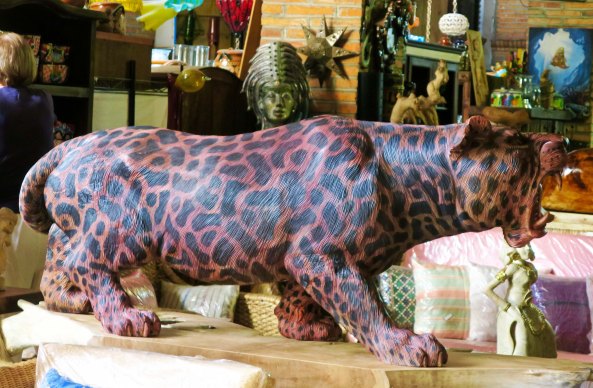
A ferocious jaguar stalking across the floor.
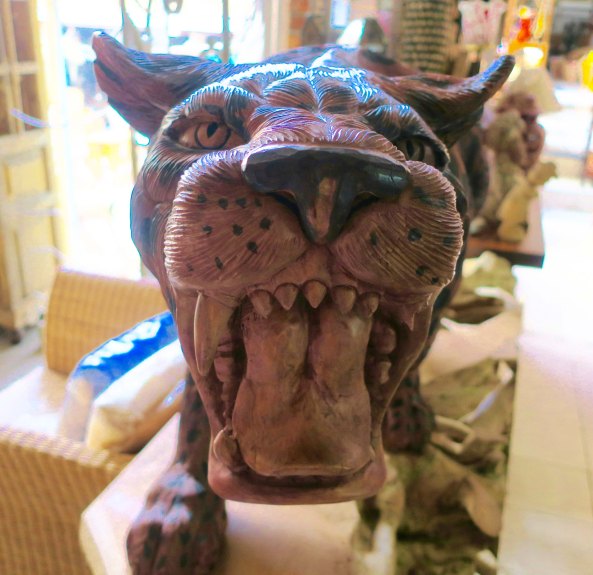
With big teeth.
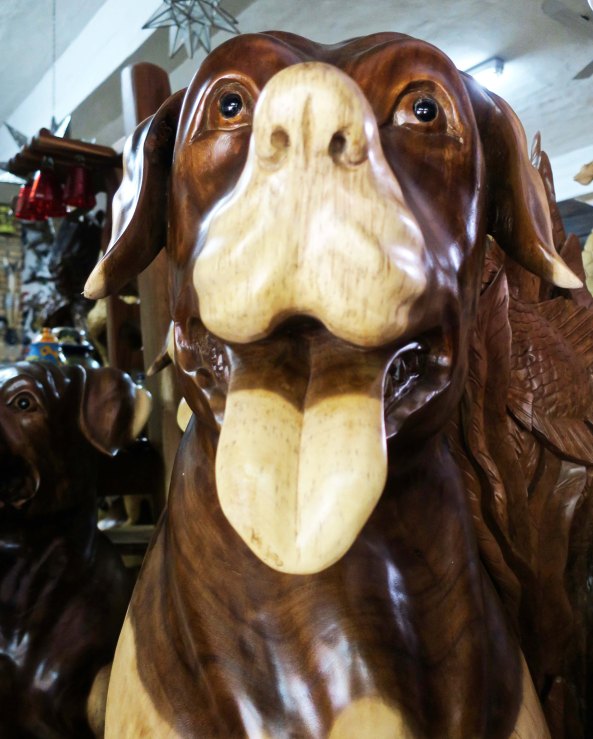
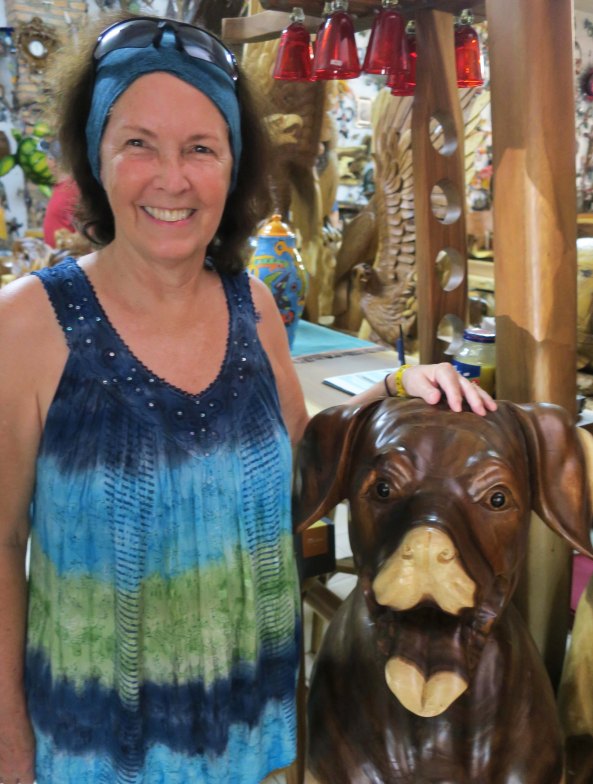
A friendly dog…
That Peggy pets.
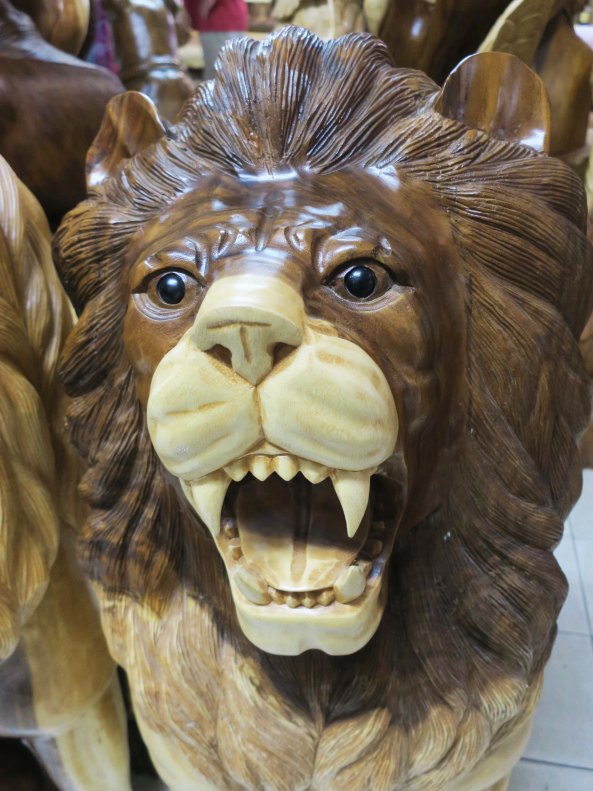
A toothy lion.
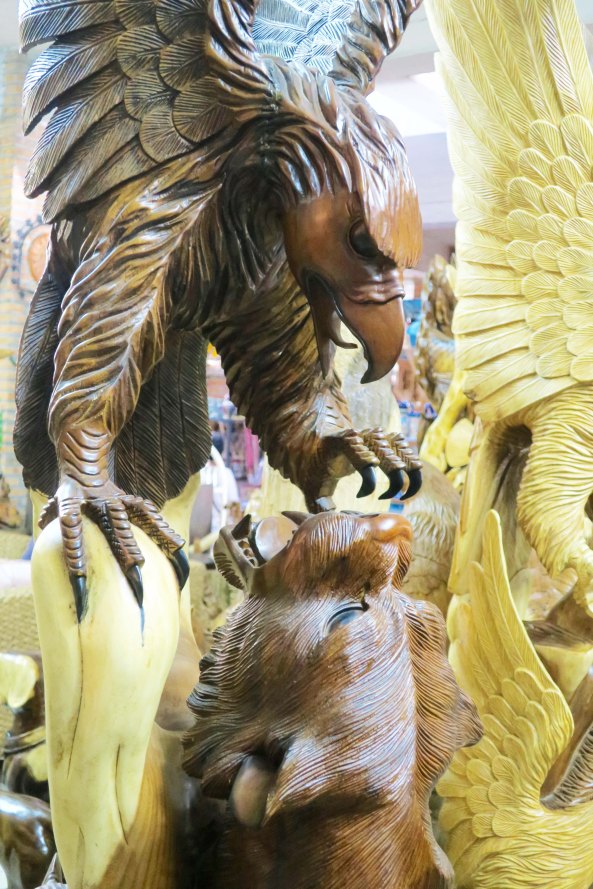
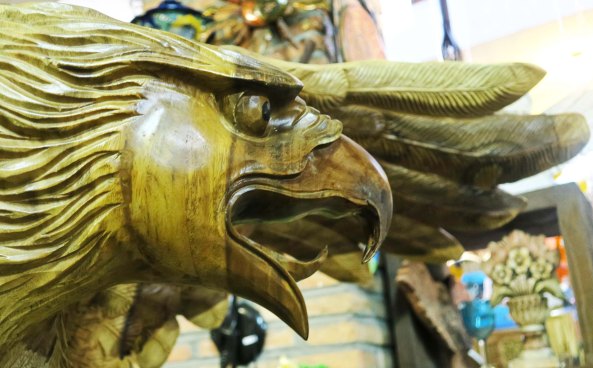
An eagle and a jaguar have a discussion about which is most ferocious.
Given this eagle, I’d say a toss-up.
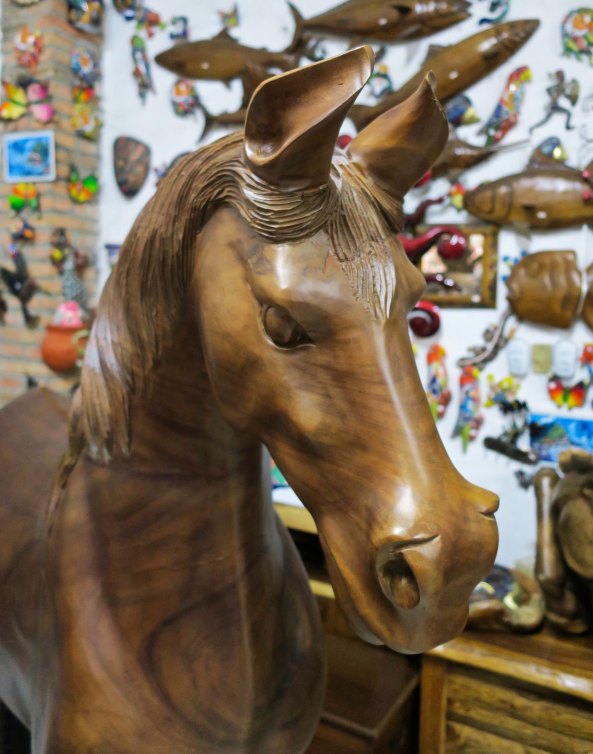
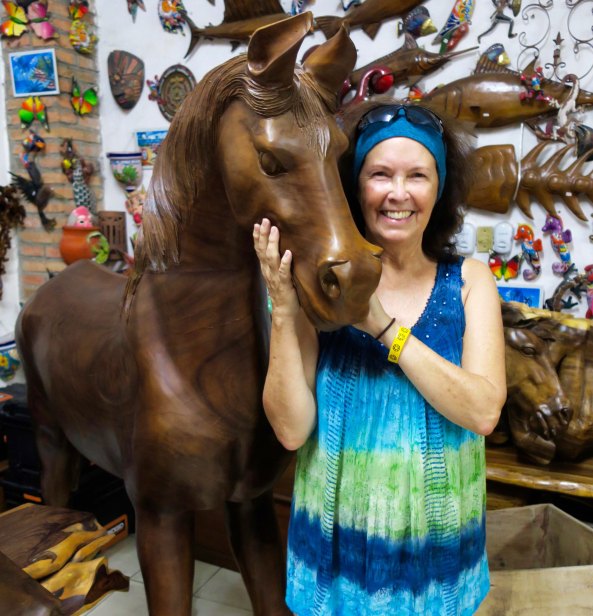
A realistic carved horse…
That Peggy befriends.
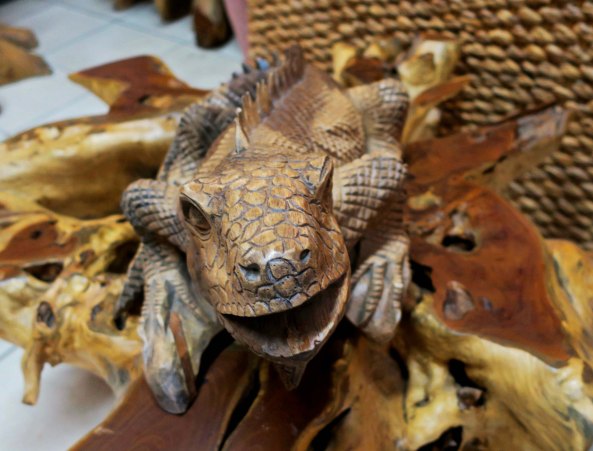
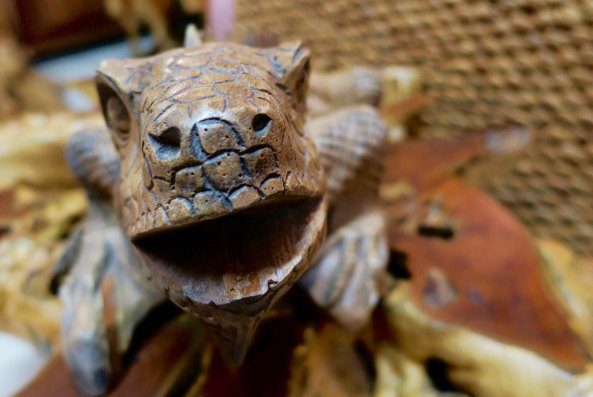
Puerto Vallarta’s favorite lizard: The iguana. I’ll be doing a post on these big fellows.
Head shot!
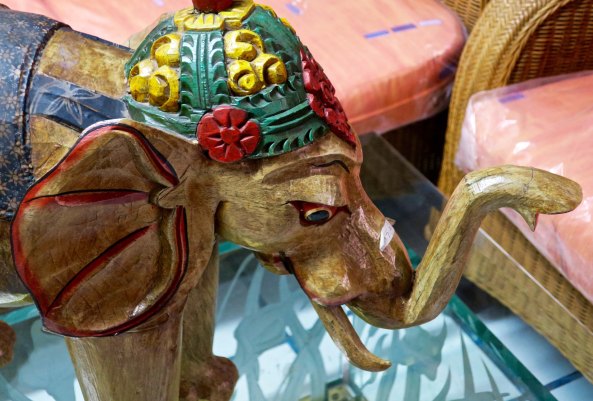
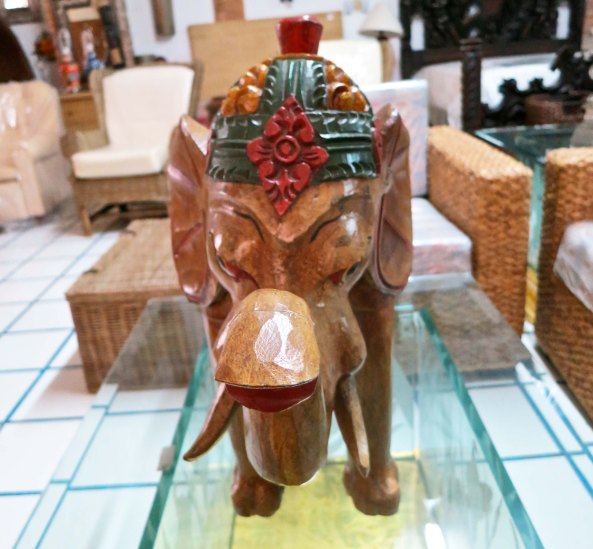
A turbaned elephant…
A trumpeting trunk.
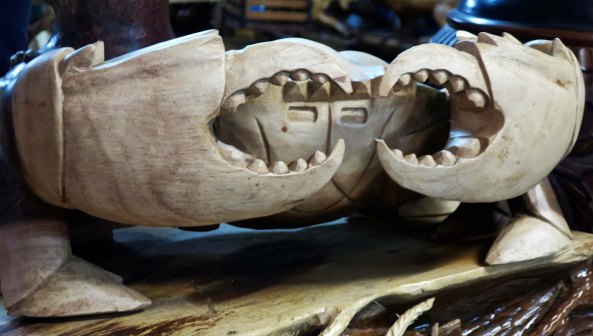
A crabby crab.
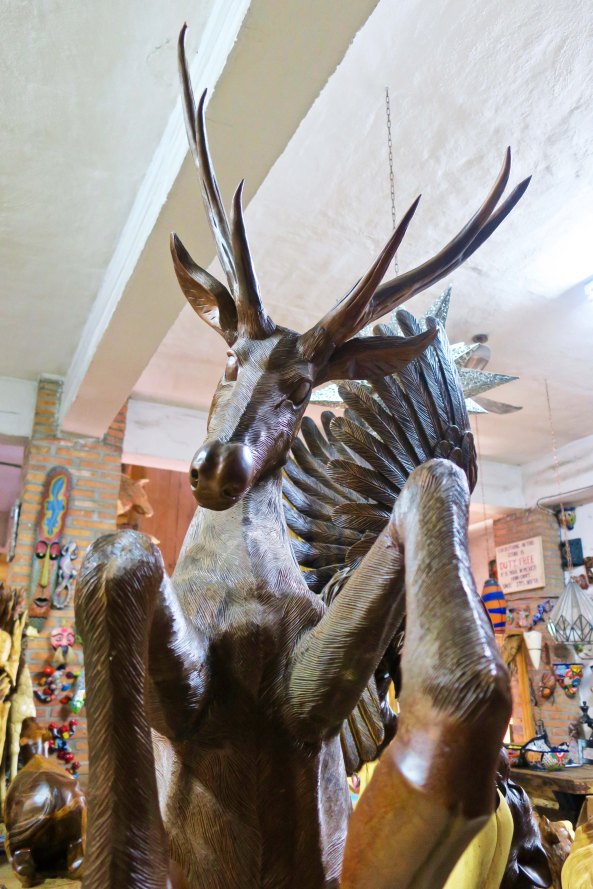
A fighting stag displays its hooves.
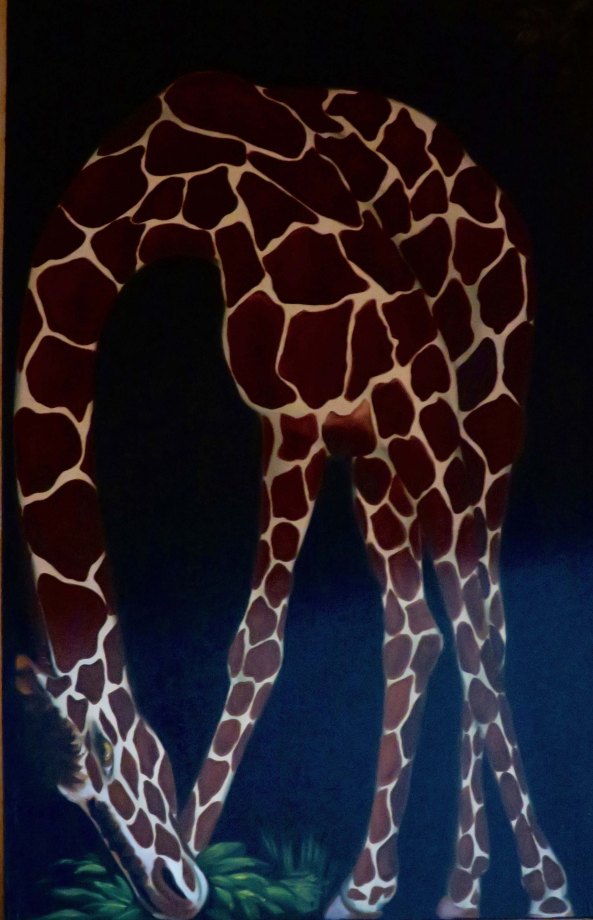
I’ll conclude my exploration of the Furniture Mart today with this striking painting of a giraffe. Next up on the Mart will be ceramics ranging from pigs to plates.

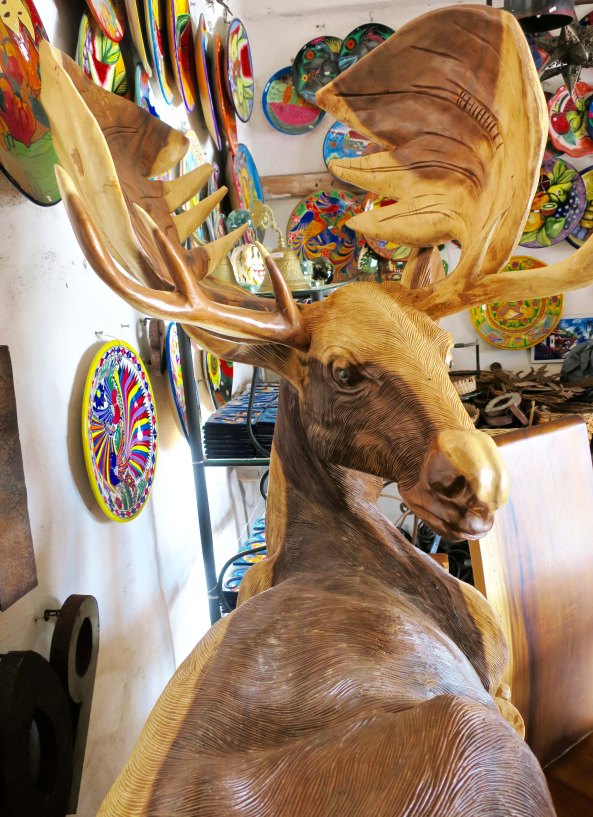
It’s Turkey Day here in Puerto Vallarta, so Peggy and I will be heading out for a traditional Thanksgiving dinner. Several restaurants cater to the day. But I couldn’t find a turkey to represent the holiday…

So, a moose will have to do!

HAPPY THANKSGIVING to all of our Internet friends! –Curt and Peggy. 

The Natchez Trace: A Bicyclist’s Paradise… The 10,000 Mile North American Bicycle Tour

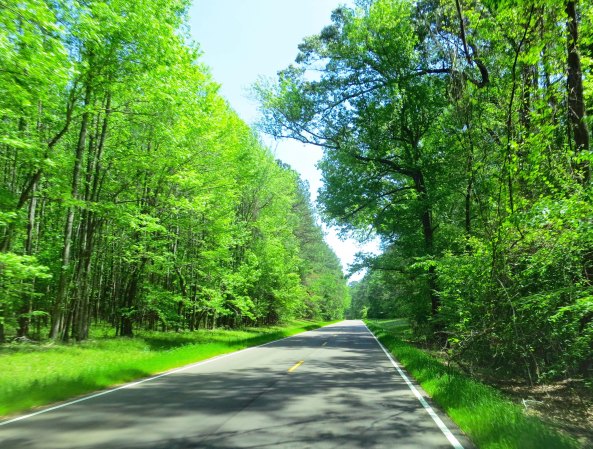
The Natchez Trace between Natchez and Jackson Mississippi.

I don’t think there is a place along the Natchez Trace that isn’t beautiful. I traveled on it for 370 miles of its 450 mile length.

This is my fourth post introducing new followers to the type of tales they can find in my blog. Way back in 1989, I did a solo 10,000 mile bicycle tour of North America. While the journey predated blogging, Peggy and I retraced my route three years ago. Traveling out of California, we crossed the US following a southern route, went up the east coast into Canada, headed back west through Canada to Minnesota, and then finished our tour following a northern route back to California. This is a chance to visit much of North America and hear tales about my bike trek. Want more: Here’s a post from Canada. Scroll forward or backward for the rest of the story:  https://wandering-through-time-and-place.com/2016/09/28/

A large, yellow mutt came wagging his way into my camp. I’d unpacked my gear, set up my tent, and taken off my shoes and socks. My toes were celebrating their freedom.

“Well hello big fellow,” I said to the dog, glad for the company. He sat down beside me and worked his head under my hand, demanding that I scratch behind his ears. Then I was required to pet the rest of him. I had just worked my way down to his tail when he rolled over and insisted on equal treatment for his tummy.

I provided an initial scratch but my coffee water had started boiling. “Priorities,” I told him, “the petting zoo is closed.” Apparently this meant it was play time. He leapt up, grabbed one of my socks, and bounced off about 15 feet.  “Hey! Bring that back,” I urged. Fat chance. He put the sock down, backed off a couple of feet, and started barking.

I finished pouring the hot water into my coffee filter and got up, tiredly, to retrieve my sock. It had been an 80-mile day and I really didn’t want to play ‘chase the dog around the yard.’ I pretended that I didn’t care, that I wasn’t going for the sock, and that I was terribly interested in a large bullfrog that had taken up residence in the swimming pool. The pool hadn’t been cleaned since the previous summer. It made a great pond.

The dog didn’t buy it. He dashed in, grabbed the sock and ran off across the yard. “Okay, you win,” I declared while picking up a stick. “How about a game of chase the stick?” The dog cocked his head and increased his wags per second. I tossed the stick and off he dashed, leaving my sock behind. I quickly bare-footed it across the lawn and grabbed my sock.

“Ha, ha, Mr. Dog,” I called after him while waving the sock about enticingly. To compensate my new friend for his loss, I played tug-of-war with the stick. We growled at each other appropriately, all in good fun.

It was early to bed. I had completed my trip from Alexandria by biking through the city of Natchez and was now camped about a mile from the beginning of the Natchez Trace.  I was eager to get up the next morning and start my 370-mile journey up the fabled Parkway through Mississippi and Alabama into Tennessee. As I zipped up my tent, the big yellow mutt did three dog turns outside the door and plopped down, making me wonder where his home was. I was hardly in a position to adopt a pet. Besides, he was well fed and wearing a dog tag.

My last memory before going to sleep was of the bullfrog singing to his lady-love. “Chug-a-rum, chug-a-rum, chug-a-rum.”
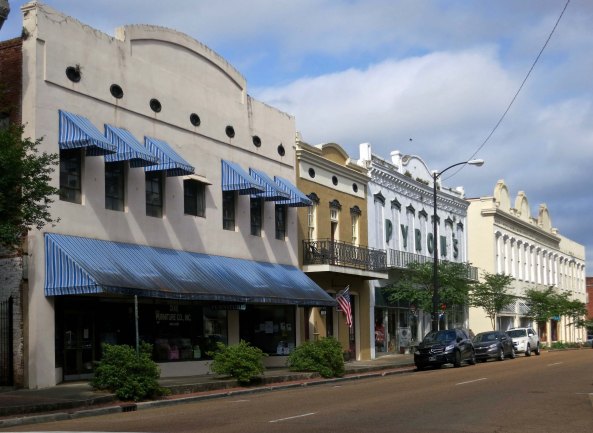
Downtown Natchez, Mississippi.

Peggy and I drove through Natchez on a Sunday morning and pretty much had the historic section of the downtown to ourselves.
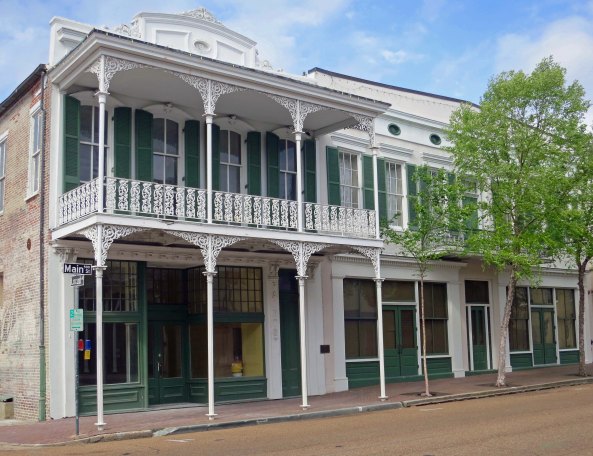
Historic building with balcony in Natchez, Mississippi.

This historic building in Natchez came with an attractive balcony.
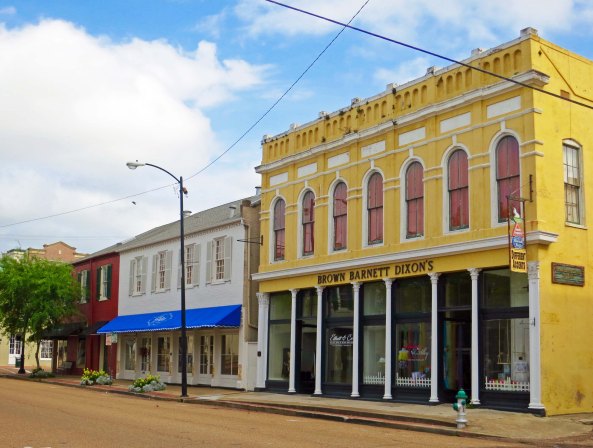
Downtown Natchez, Mississippi on a quiet Sunday.

The colors captured my attention here.
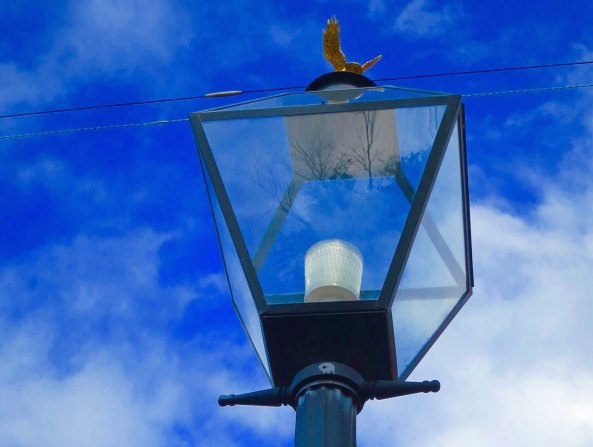
Old lamp posts adorn the historic part of Natchez.
Old lamp posts adorn the historic part of Natchez.

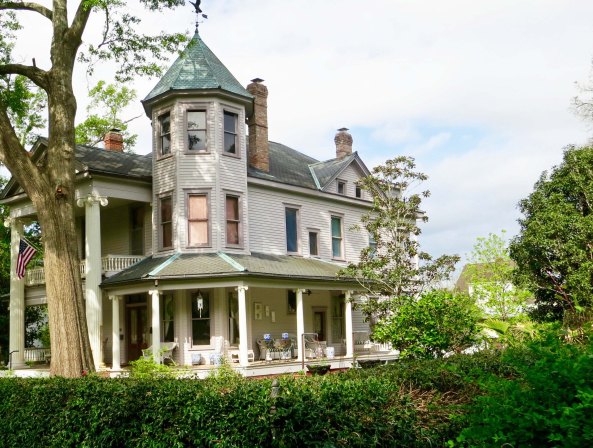
The city is known for its antebellum mansions.
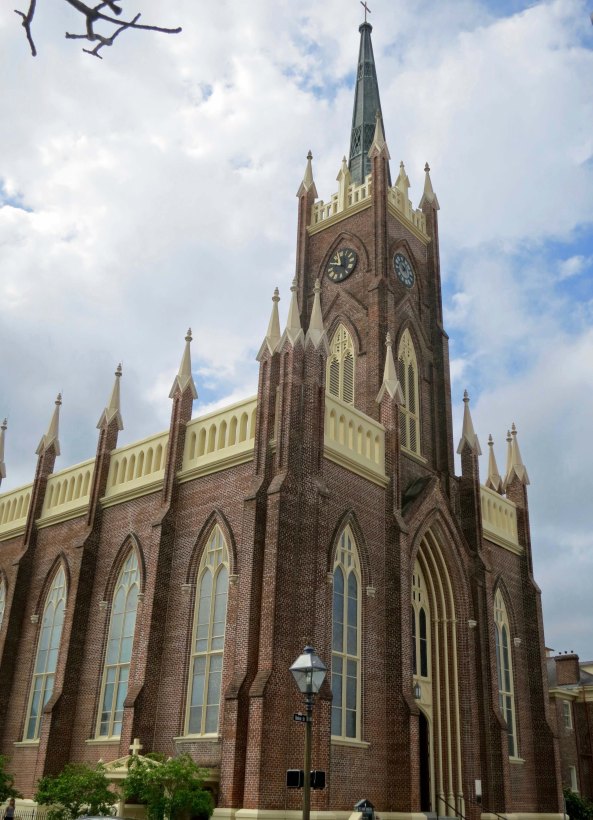
The city is known for its antebellum mansions.

St. Mary's Catholic Church in downtown Natchez, Mississippi.

St. Mary’s Catholic Church was busy with its Sunday service so I didn’t go inside.
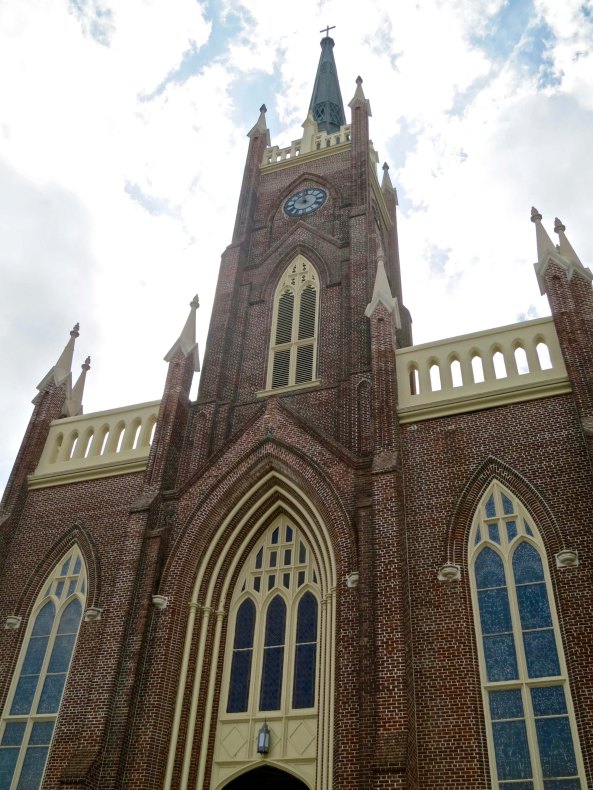
St. Mary's Catholic Church is located in downtown Natchez, Mississippi.

It was quite impressive from the outside, however.

Natchez has an interesting history. Once the site of a major Native American village, its initial contact with Europeans goes all the way back to Hernando de Soto in the mid 1500s. He wandered through the area searching for gold to steal, the primary occupation of Spanish Conquistadores. By the 1700s the French had entered the area followed by the British, the Spanish again, and finally, in 1795, the Americans. Native groups in the region included the Natchez, Chickasaw, Yazoo, Cherokee, and Creek, as well as the Choctaw further to the north.

As for the Natchez Trace, its beginning goes back 10,000 years and was probably tied to buffalo travelling along ridges doing buffalo things. Since these broad, heavy animals make good trails (think of them as early day bulldozers), Native Americans were soon using the routes for trade and travel between large communities.

The next stage in the Trace’s evolution was brought about by river trade in the late 1700s and early 1800s. Kaintucks, boatmen from the Ohio and Mississippi River Valleys, loaded flatboats with merchandise and paddled downstream to Natchez or New Orleans where they made handsome profits for their goods. The challenge was that you don’t row a boat up the mighty Mississippi. The boatmen had to hike or ride horses home. They sold their boats as lumber and made their way back to Nashville via the Natchez Trace

It was an adventure. There is a reason why the Trace became known as The Devil’s Backbone. It was crawling with highway men eager to separate the Kaintucks from their newly earned wealth. And that assumes that they could even get their money out of Natchez where cheap whiskey cost a fortune, hot love was based on cold cash, and cut-throats came by the bushel.

The development of steamboats in the 1820s changed things dramatically. These boats with their large, steam-driven paddle wheels could travel upriver. Boatman no longer had to hike or ride horses back to Nashville while fighting off thieves.  Gradually, people stopped using the Trace and it faded from memory.  But not totally.

In 1903, the Mississippi chapter of the Daughters of the American Revolution took on a project of placing markers along the original route. In 1918 the precursor to the Natchez Trace Association was created with the rallying cry of “Pave the Trace!” Work on the Parkway was started in 1937 and in 1938 it became a unit of the National Park system.

When I rode my bike out of Natchez in the spring of 1989, the Trace was mainly complete and had become something of a bicyclists’ paradise. (Today it is considered one of the top ten bike rides in America.)   To start with, there was no commercial traffic. No 18 wheelers would be whizzing by me. Nor were there any commercial properties or billboards, just lots of beautiful woods and small farms. Campgrounds and restrooms were located conveniently along the way.  Frequent rest stops featured local history. I was free to ride along and enjoy the scenery.

But I did have two responsibilities. The first was to persuade the large, yellow mutt that he wasn’t going with me. It started with a discussion in camp that I thought he had understood. Where I was going was dangerous for doggies. It was dangerous enough for me. About a mile from camp I chanced to look back, there he was, about 50 yards back. I stopped and waited for him to catch up, all a waggle. “No!” I said forcefully. “You cannot go. Go Home!” The tail stopped wagging. Two sad brown eyes accused me of horrendous deeds. Ever so slowly, he turned around and started back, tail between his legs. I felt terrible.

The second chore was more pleasant— rescuing baby turtles. Bunches were migrating across the Trace outside of Natchez. Each time I came on a crowd, I would stop, climb off my bike, and give the little tykes a lift across the pavement. I knew that there would be more coming along behind but I must have transported at least a hundred,undoubtedly saving them from being run over.

Following are several photos of the Trace from Natchez to Jackson, Mississippi that I took during the route review Peggy and I did this past spring.  In my next blog we will make a slight detour to the town of Philadelphia, Mississippi where a good friend lives and then head up the Trace to Tupelo and visit with Elvis.
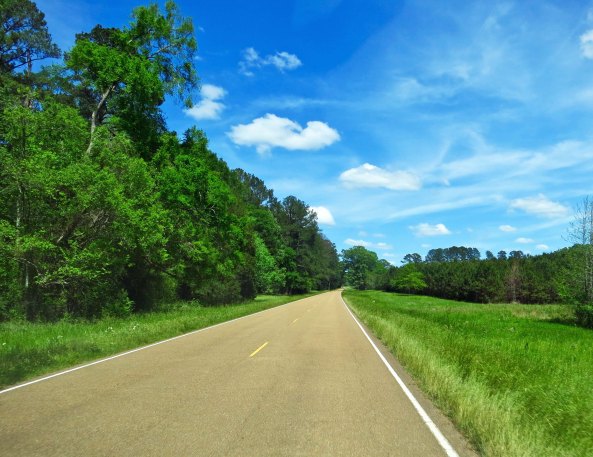
Views along the Trace were constantly changing from being forested to open.
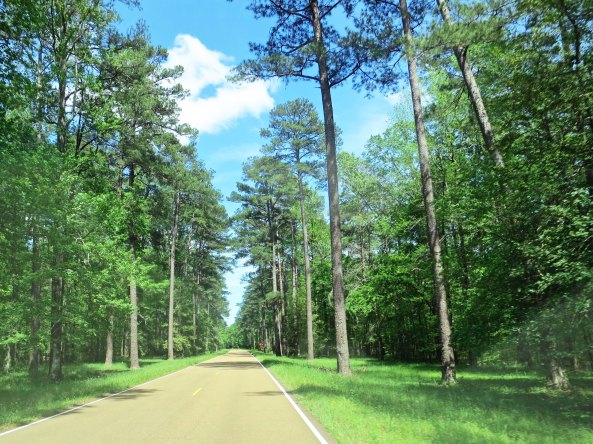
Views along the Trace were constantly changing from being forested to open.

Pine trees became common around Jackson, Mississippi.
Pine trees became common around Jackson, Mississippi.

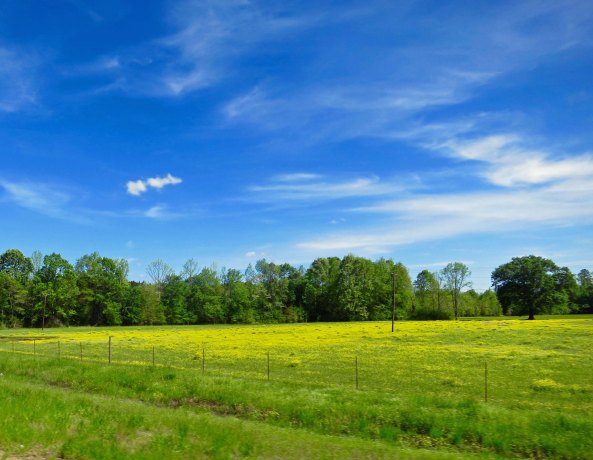
Rich farmlands border some of the Trace.
Rich farmlands border some of the Trace.

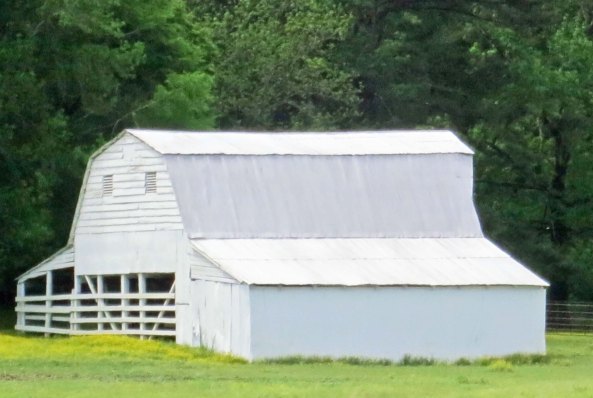
There are a number of barns.
There are a number of barns.

These trees had yet to leaf out.

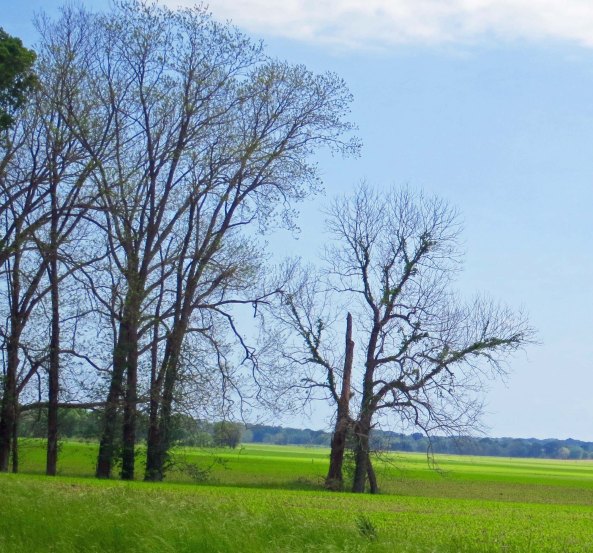
These trees were just beginning to leaf out. I enjoyed the silhouettes they created.
Numerous exhibits featuring the history of the Trace provide interesting breaks along the way.
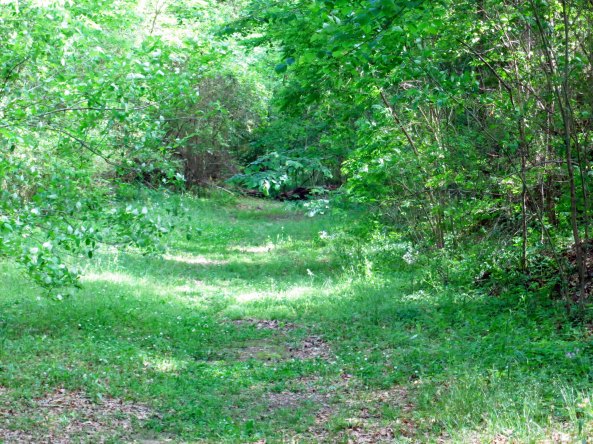
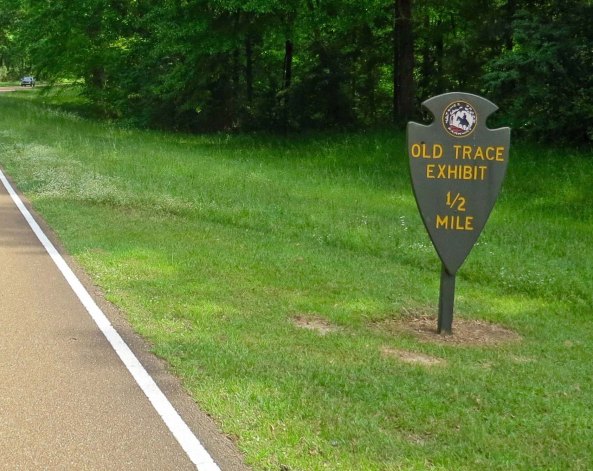
Numerous exhibits featuring the history of the Trace provide interesting breaks along the way.

A number of the stops, like this one, include original sections of the trail.
A number of the stops, like this one, include original sections of the trail.

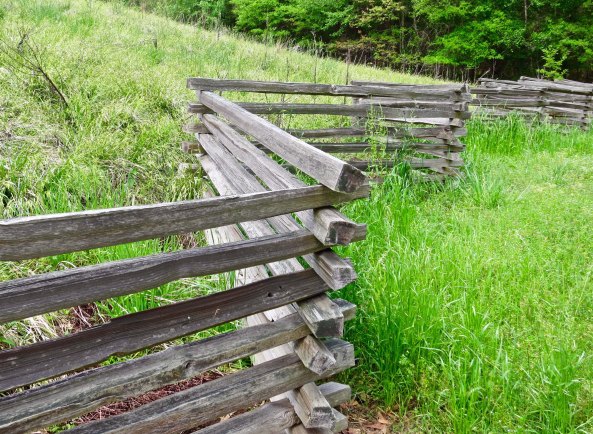
The Park has also rebuilt traditional fences that the pioneers who lived along the Trace would have built.

The Park has also rebuilt traditional fences similar to ones that the pioneers who lived along the Trace would have built.
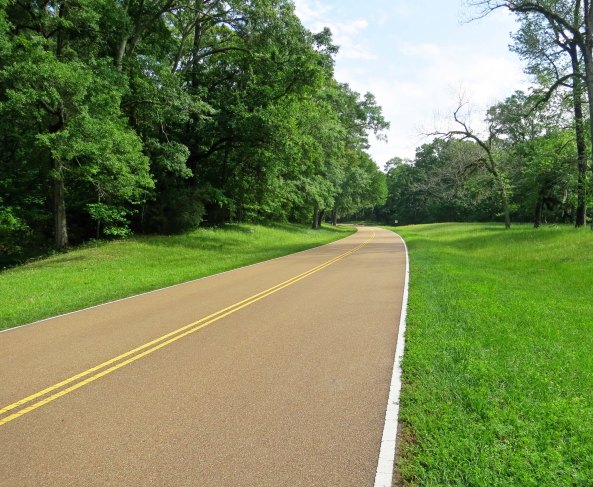
A final view of the Trace for today. Many more will be included in my next three blogs.
A final view of the Trace for today. Many more will be included in my next three blogs.


Kayaking among the Orcas/Killer Whales of British Columbia…

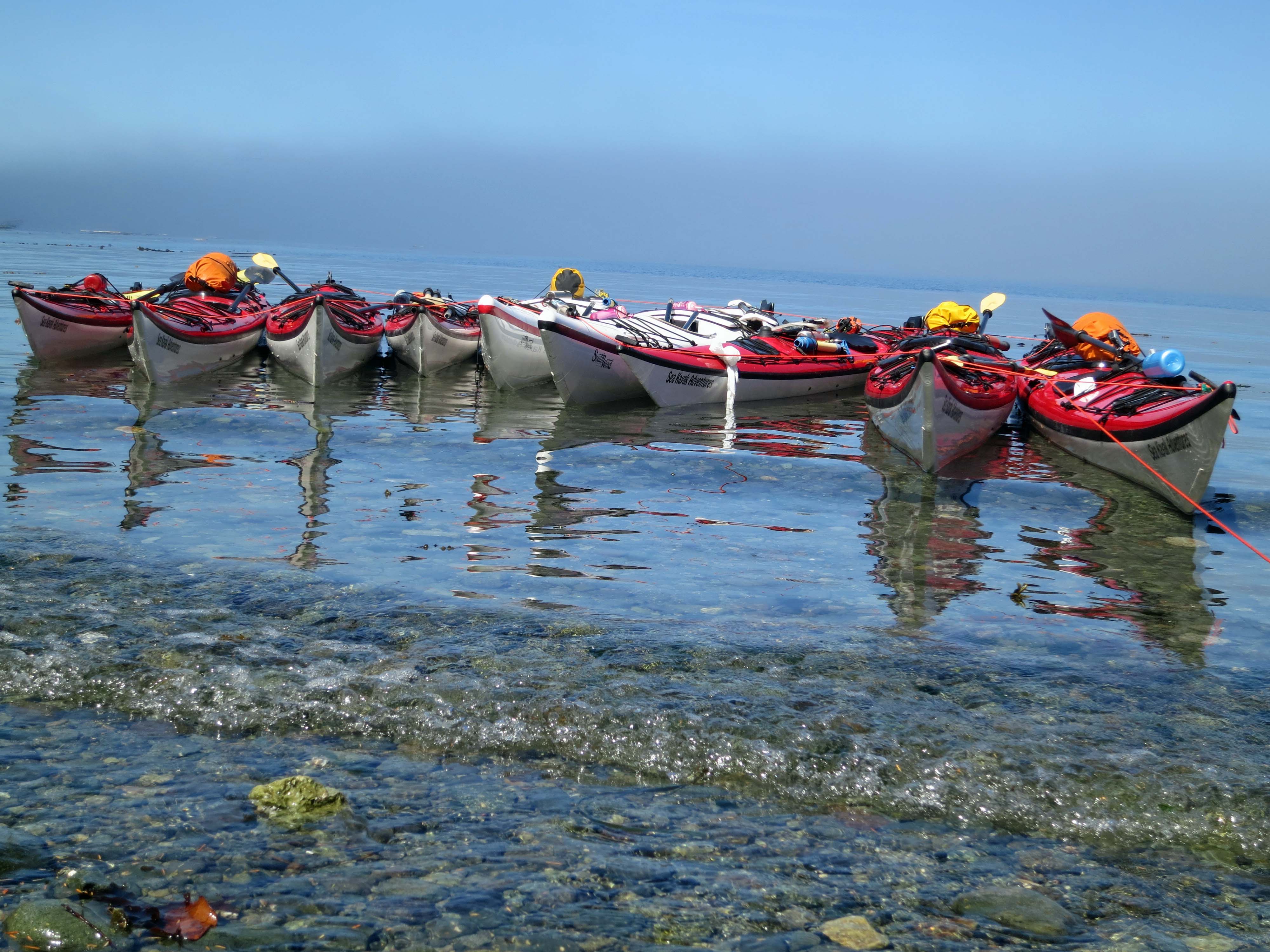
Kayaks belonging to the Sea Kayak Adventure group in the waters of Johnstone Strait, northeastern Vancouver Island.

Our sea kayaks wait patiently for us as we have lunch in a cove off of Johnstone Strait.

This is the first of my series of ‘oldies’ I am reposting from my archives to give new followers a taste of what they can expect to find on my blog. Peggy  and I made a trip to Vancouver Island, British Columbia in 2014 to go kayaking among the orca whales. The next post in the series can be found here:  https://wandering-through-time-and-place.com/2014/10/30/

I was nervous as we drove into the town of Port McNeill on the northeast shore of Vancouver Island in August. Peggy and I had signed up for a six-day sea kayak tour out of Telegraph Cove with Sea Kayak Adventures.We would be searching for orcas, which are also known as killer whales—as our son Tony, the Alaska Coast Guard pilot, reminded us. A little Jaws music, perhaps?

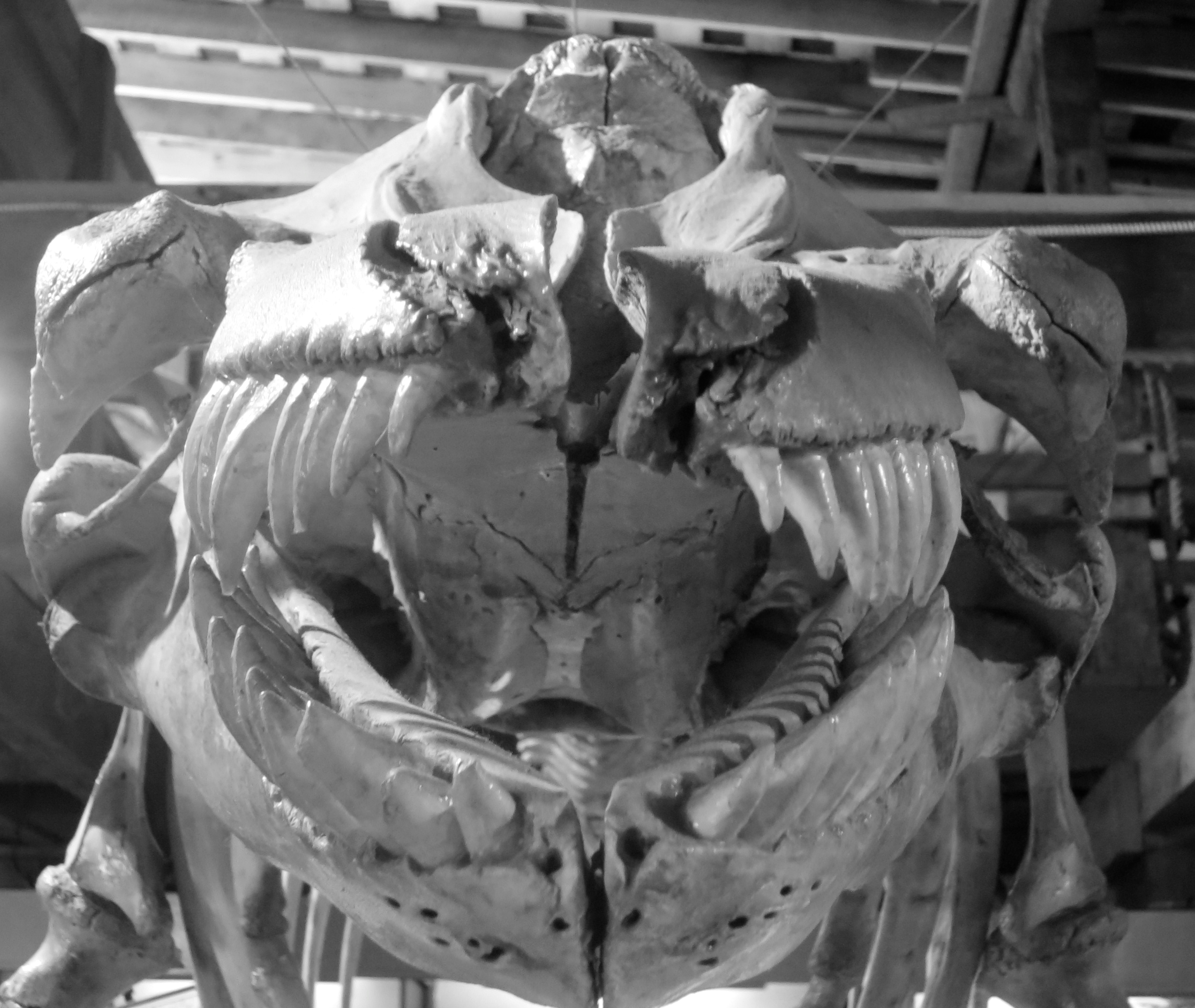
This orca was on display at the Whale Museum in Grove. I named him Smiley and addressed him as sir.

This orca skeleton was on display at the Whale Interpretive Center in Telegraph Grove. I named him Smiley and addressed him as sir.

“Okay, Curt, what have you gotten yourself into this time?” was bouncing around in my skull like a kangaroo on steroids. It’s a question I ask myself often.

I wasn’t nervous about the whales, however. I’ve spent my life communing with nature. Besides, these particular giants are gentle, relatively speaking; they get fat off the salmon in Johnstone Strait. They don’t need to eat people. But sea kayaking would be a first for me. The old dog had to learn new tricks, and that is always a reason to get excitable. Fortunately, Peggy and I had played around a fair amount with inflatable kayaks. We had even ventured out on challenging multi-day lake trips into remote areas such as Prince Albert National Park in Saskatchewan and Voyageurs National Park in Minnesota. So how hard could it be?

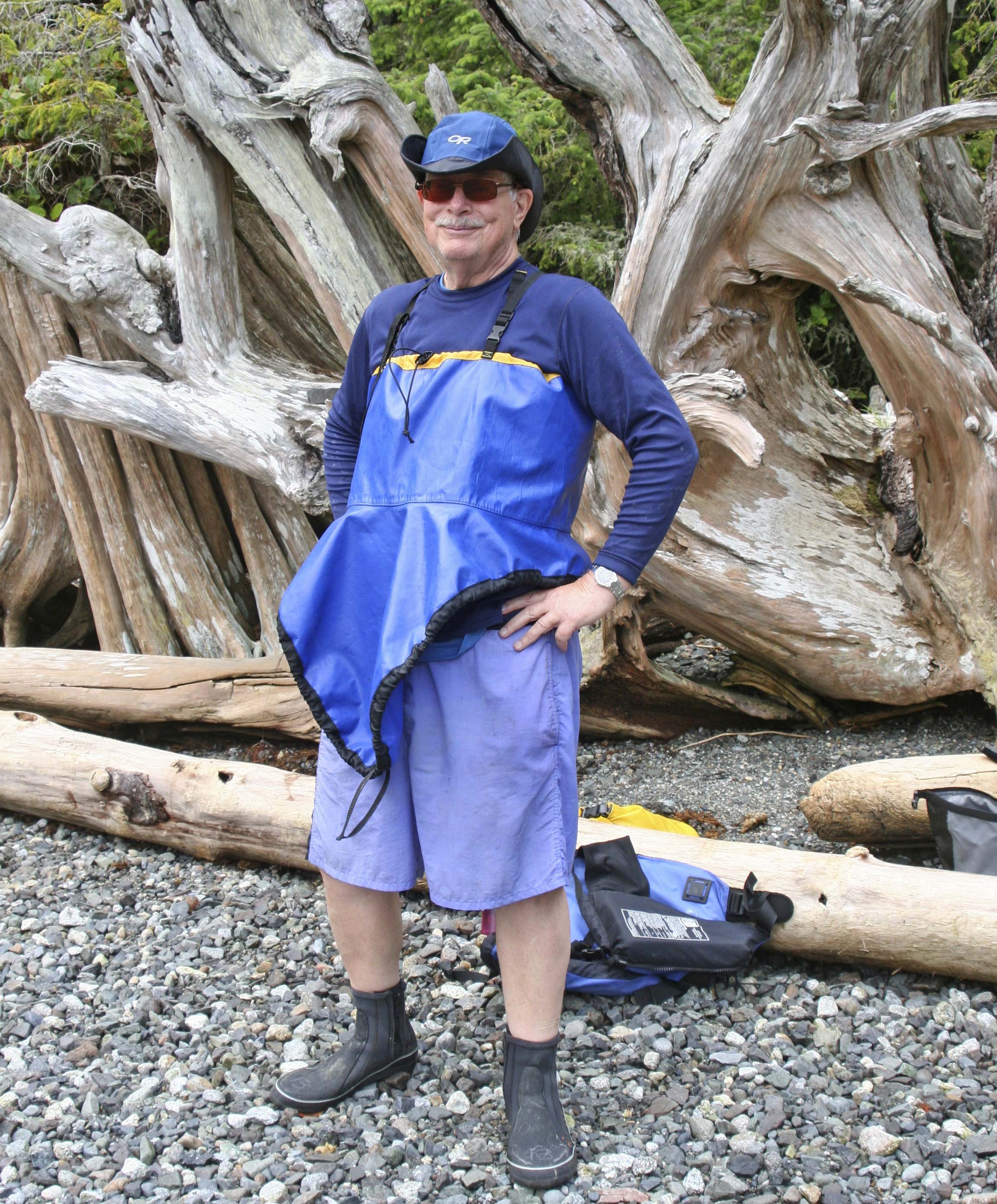
Aren't I pretty? There was no way I was going to make this skirt look good. (Photo by Peggy Mekemson.)

Aren’t I pretty? No? Maybe I wasn’t meant to wear a skirt. This skirt is designed to fit snugly over the cockpit of the kayak and keep out the water.  It’s so snug that you really have to stretch it to fit, which isn’t easy— particularly around the back. My skirt and I had several discussions while I was learning how to make it behave. It learned new words. Ask Peggy. (Photo by Peggy Mekemson.)

I confess I was more nervous about the idea of being on a tour. I am not much of a tour group person. This is a strange statement coming from someone who spent over a quarter of a century leading backpacking and bicycle fundraising treks for the American Lung Association. But the truth is— I am an independent cuss. I like to go where I want to go and stop when I want to stop. On an organized tour, I would be expected, even required, to adhere to the group schedule and itinerary. This isn’t a complaint. It has to be that way on group outings. Common sense and liability demand it.
And then there were the people. We’d be living closely with these folks for six days under potentially trying conditions. What would our guides be like? How about our fellow tour group members? Would we get along well? Would they be strange— even stranger than I am?
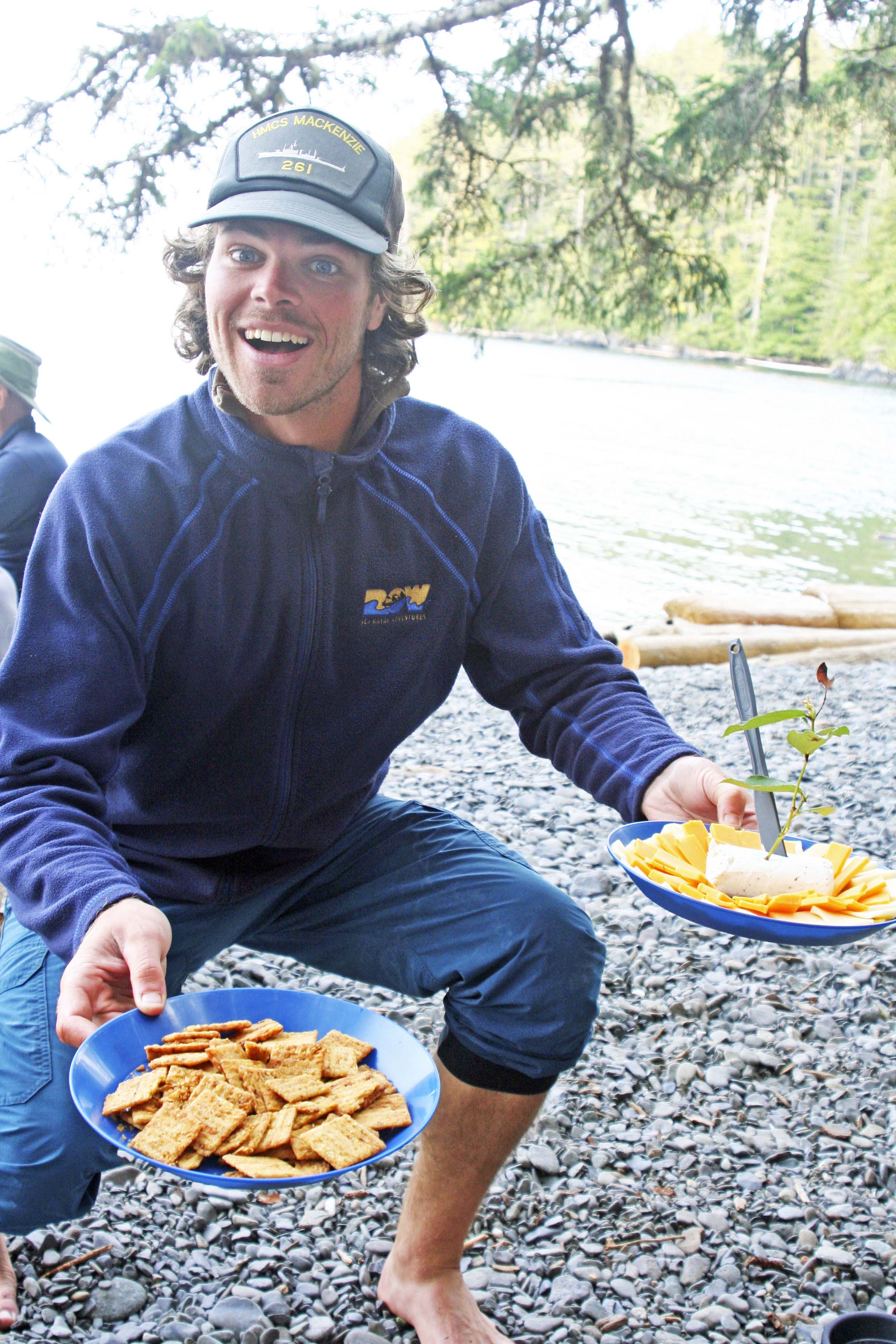
"Could I interest you in a cracker?" The tour promo promised good food, but it failed to mention the presentation. This is Nick, one of our three group leaders.
“Could I interest you in a cracker?” The tour promo promised good food, but it failed to mention the presentation. This is Nick from New Brunswick, one of our three group leaders. Note the sprig artfully shoved into the cheese.
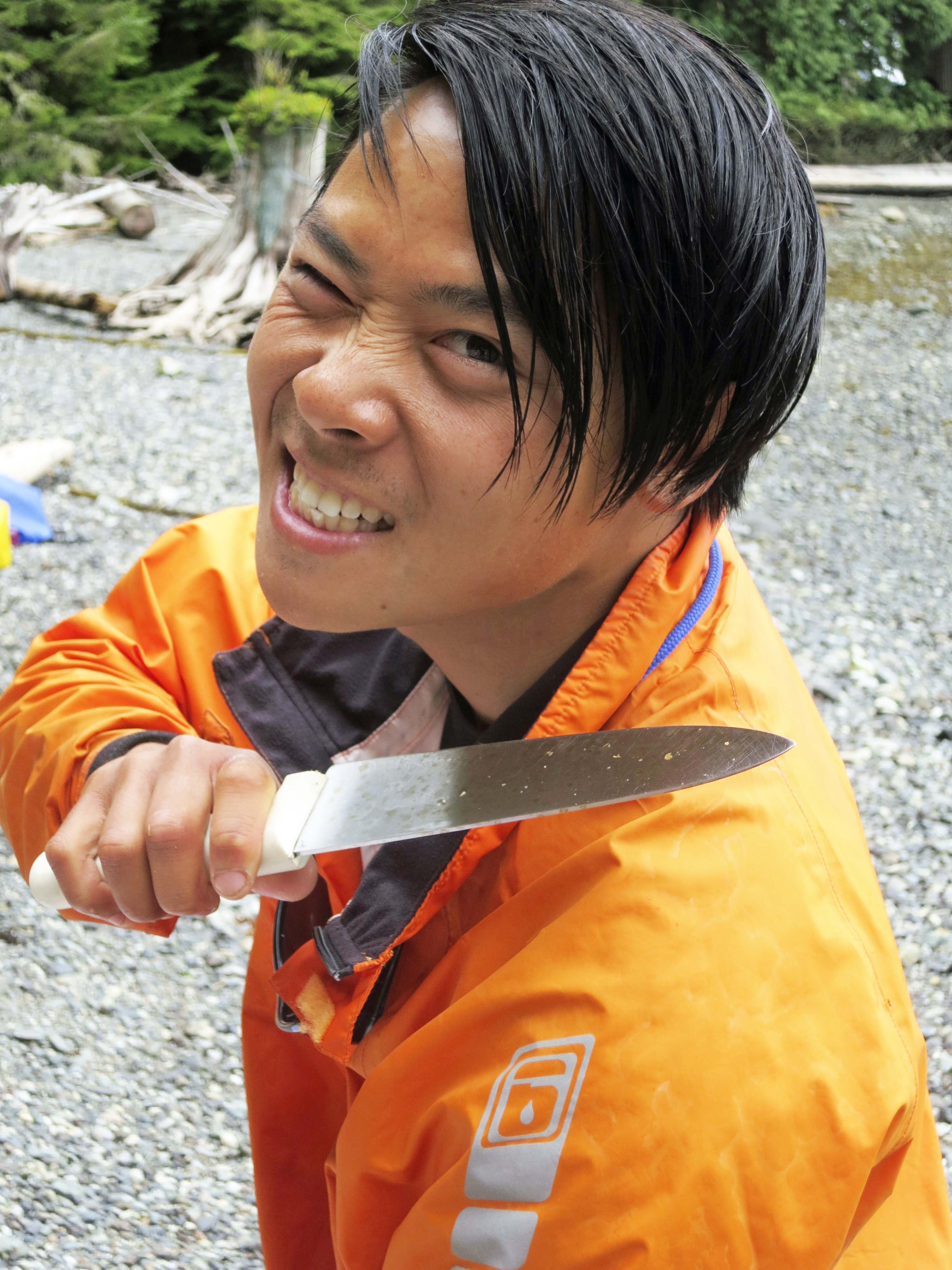
Quy, another of our guides, is a gentle soul who in his other life works as a computer geek in Vancouver. So what is he doing with this knife?

Quy, another of our guides, is a gentle soul who in his other life works as a computer geek in Vancouver. So what is he doing with this knife?

Julia, our third guide and assigned trip leader, may use Quy's knife on me for this photo of her toes, but I couldn't help myself. And no, I don't have a foot fetish. My fascination was that these bare toes could run over sharp rocks. The last time I had feet that tough I was ten years old.

Julia, our third guide and assigned trip leader, hails from Germany and is quite charming. She may use Quy’s knife on me for this photo of her toes, but I couldn’t help myself. And no, I don’t have a foot fetish. My fascination with her toes was that they could run over anything, including  rocks. The last time I had feet that tough, I was ten years old.

And how about our fellow travelers? David is a psychologist out of LA. How much more strange can you get?

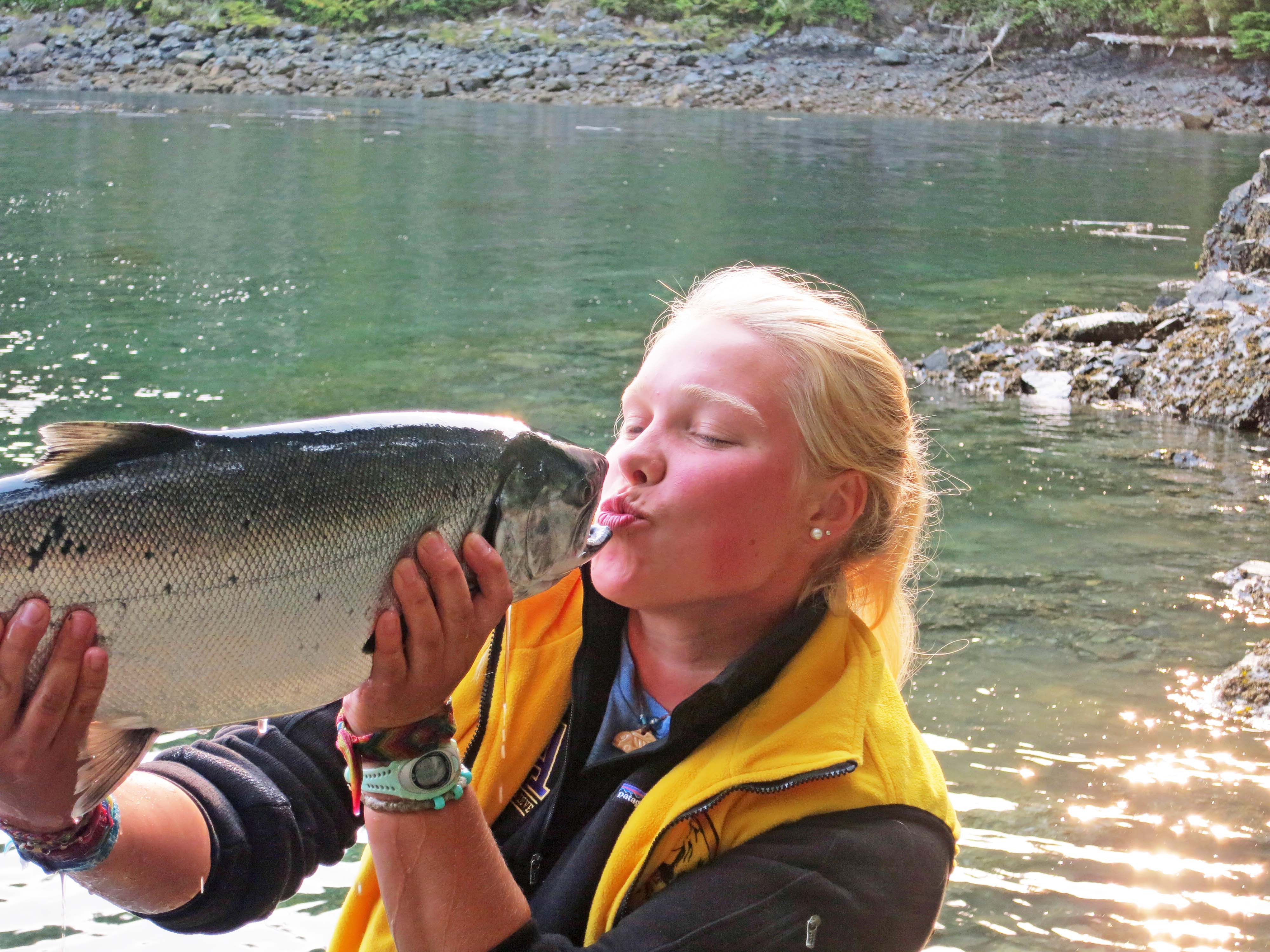
And how about our fellow travelers? David is a psychologist out of LA. How much stranger can you get than creating this mustache? Well maybe someone who kisses fish…

Well, maybe someone who kisses fish??? "But he was so beautiful," Lindy told me. He was dinner, Lindy,. Dinner.

“But he was so beautiful,” Lindy told me. He was dinner, Lindy. Dinner.

Regardless of how nervous I felt, the trip was simply too much of an opportunity to pass up. Like how could I not go on a sea kayaking adventure out among the orcas in beautiful British Columbia? As for Peggy, she is always up for adventure. When our friends Edie and David from Anchorage, Alaska called and asked if we would be interested in going, we gave a resounding yes. It turned out to be great decision. The guides, our fellow tour group members, and the incredible views were delightful. Even the orcas cooperated.

Today marks the beginning of my series on the trip. I’ll start by exploring the quaint town of Port McNeill. In my next post, we will climb in our kayaks and push-off from Telegraph Cove. The orcas are waiting. Let the adventure begin.

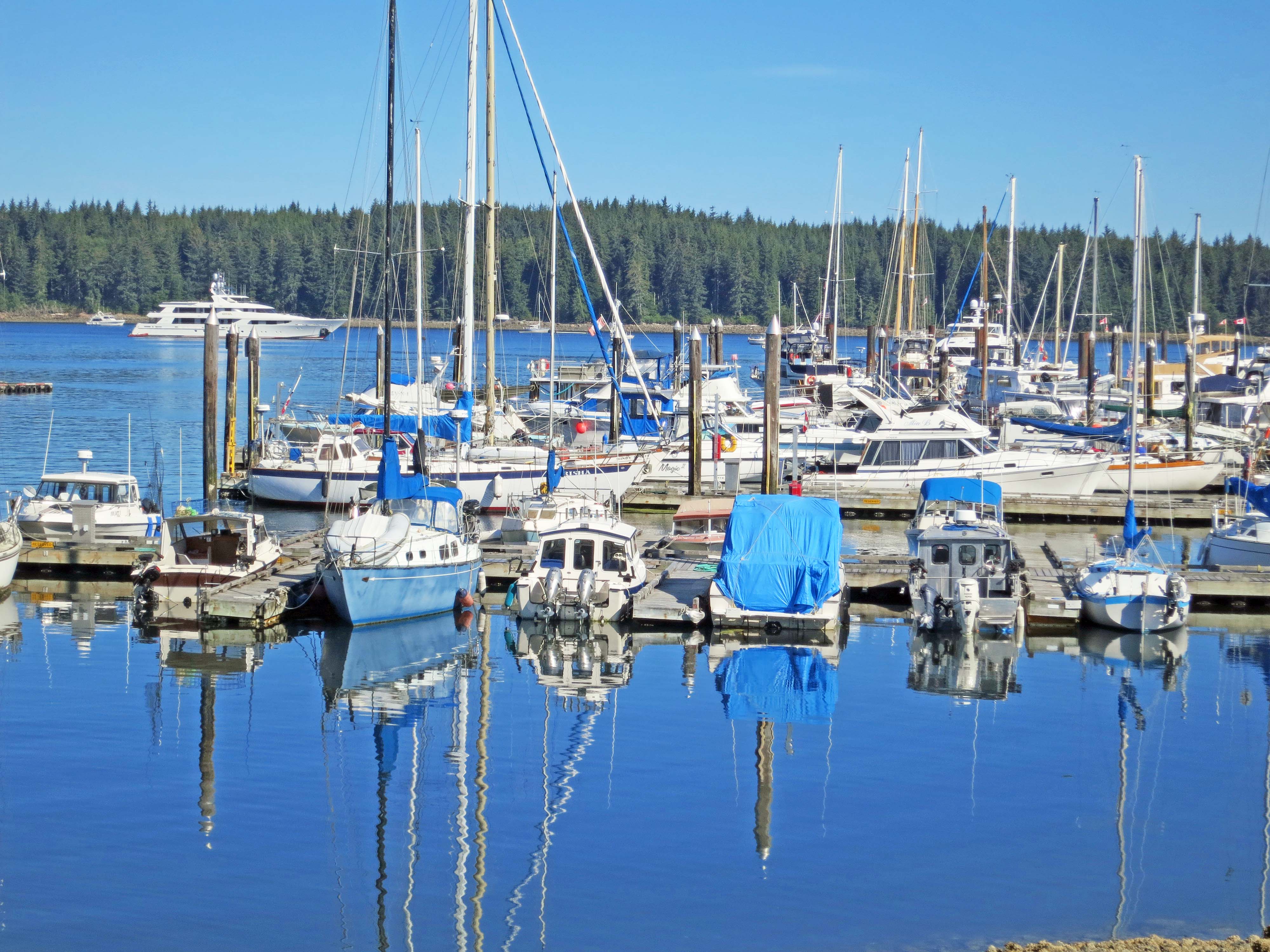
Harbor in Port McNeill on northeastern Vancouver Island. Photo by Curtis Mekemson.

While the main source of employment for the people of Port McNeill is the timber industry, the town also has a charming harbor. Note the yacht in the background. It had its own helicopter.

I loved this guys sense of humor.

In case anyone was wondering. I loved this guy’s sense of humor.

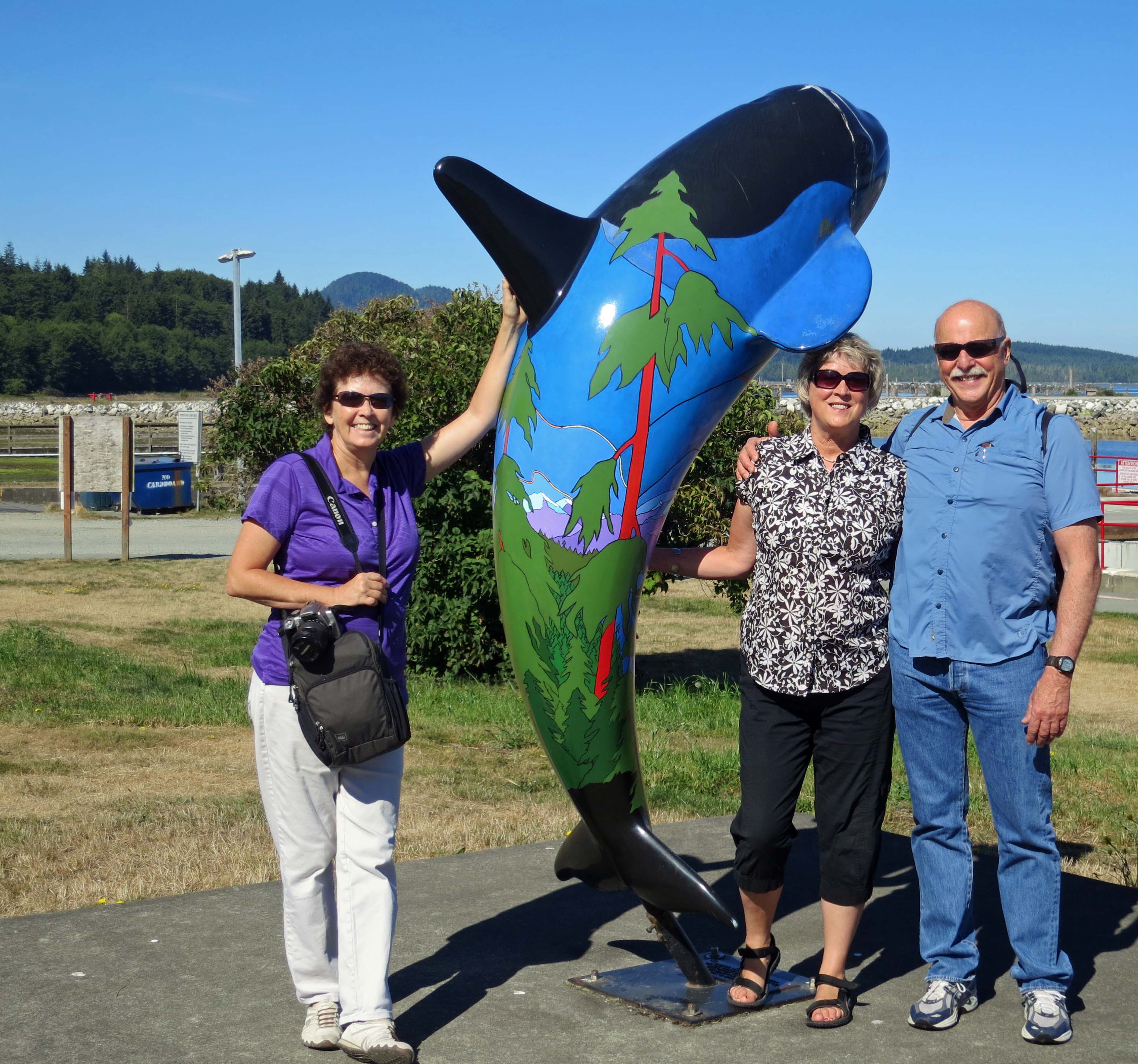
Dolphin statue at Port McNeil on Vancouver Island, British Columbia.

Peggy, David and Edie pose in front of a dolphin statue that faces the harbor. Edie went to high school with Peggy in Ohio and runs a tax accounting firm in Anchorage. David is an Alaskan bush pilot who works on the North Slope, and is a published poet.

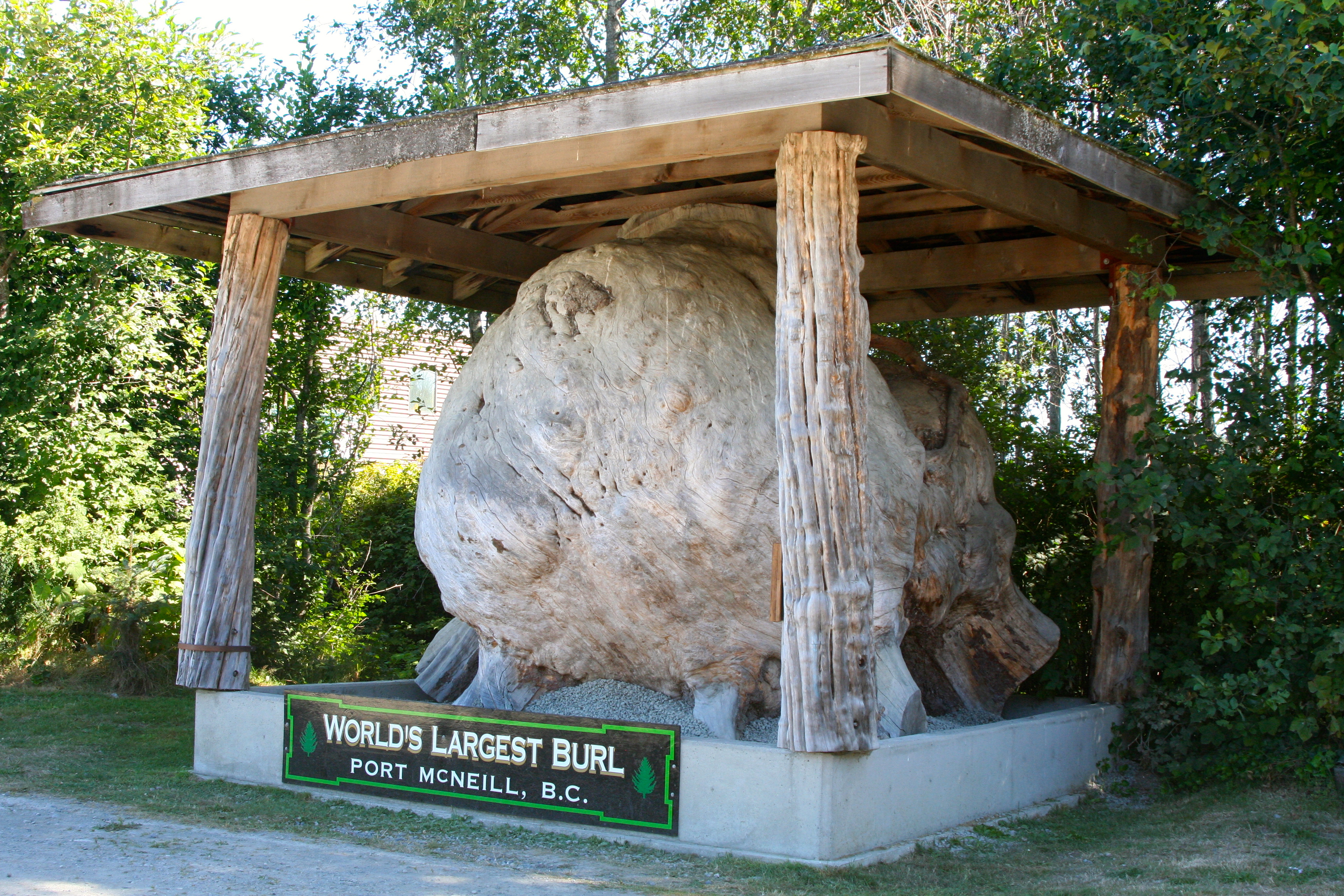
You are looking at Port McNeill's pride and joy: the worlds largest burl. Can you imagine this thing growing on a tree? (Photo by Peggy Mekemson.)

You are looking at Port McNeill’s pride and joy: the worlds largest burl. Can you imagine this thing growing on a tree? (Photo by Peggy Mekemson.)

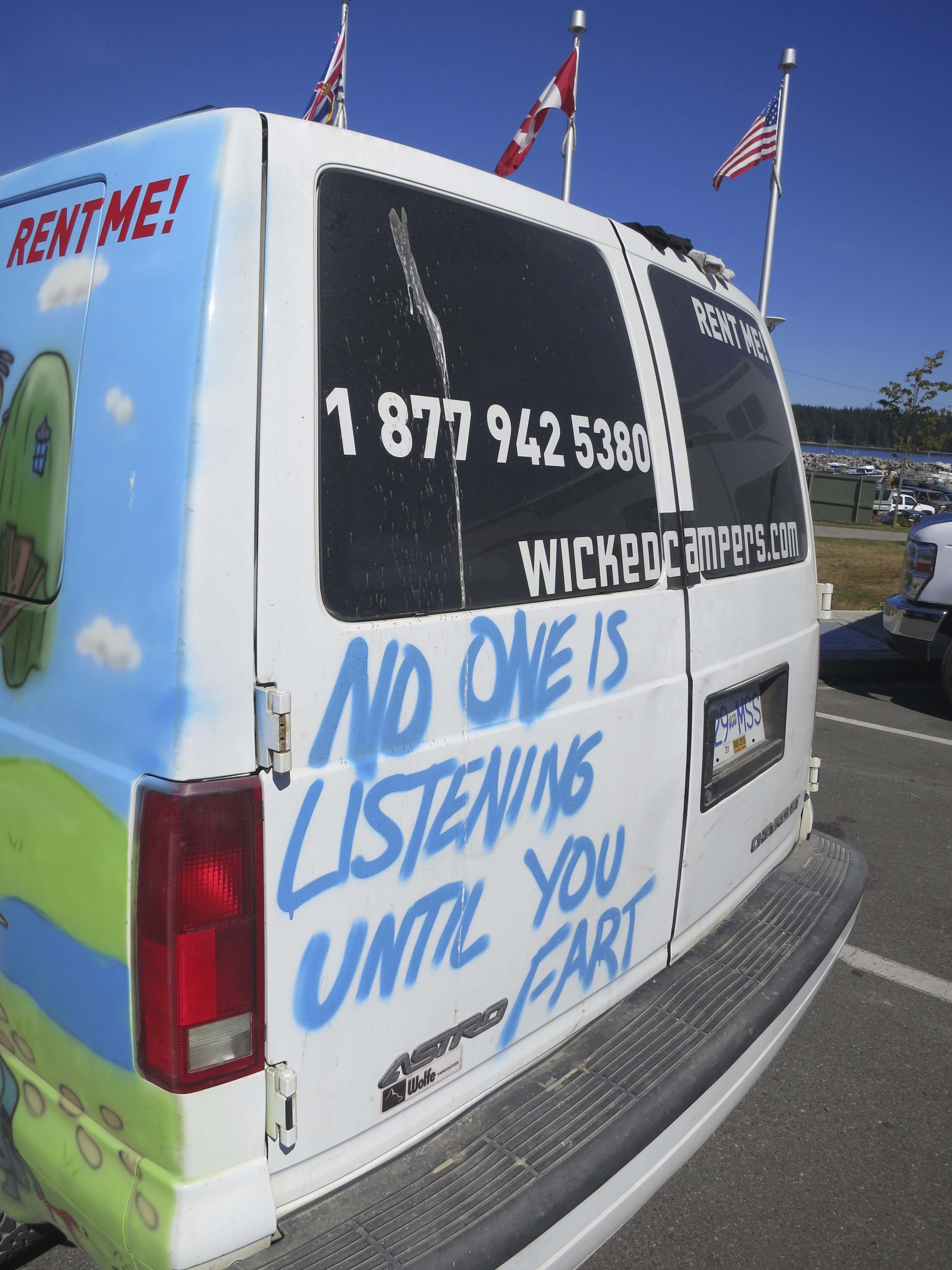
Wicked Campers is now providing inexpensive travel vans and raucous humor in a number of countries.

Tourism is also an important industry for Port McNeill. Wicked Campers caught my attention. The company provides inexpensive travel vans and its raucous brand of  advertising in a number of countries.

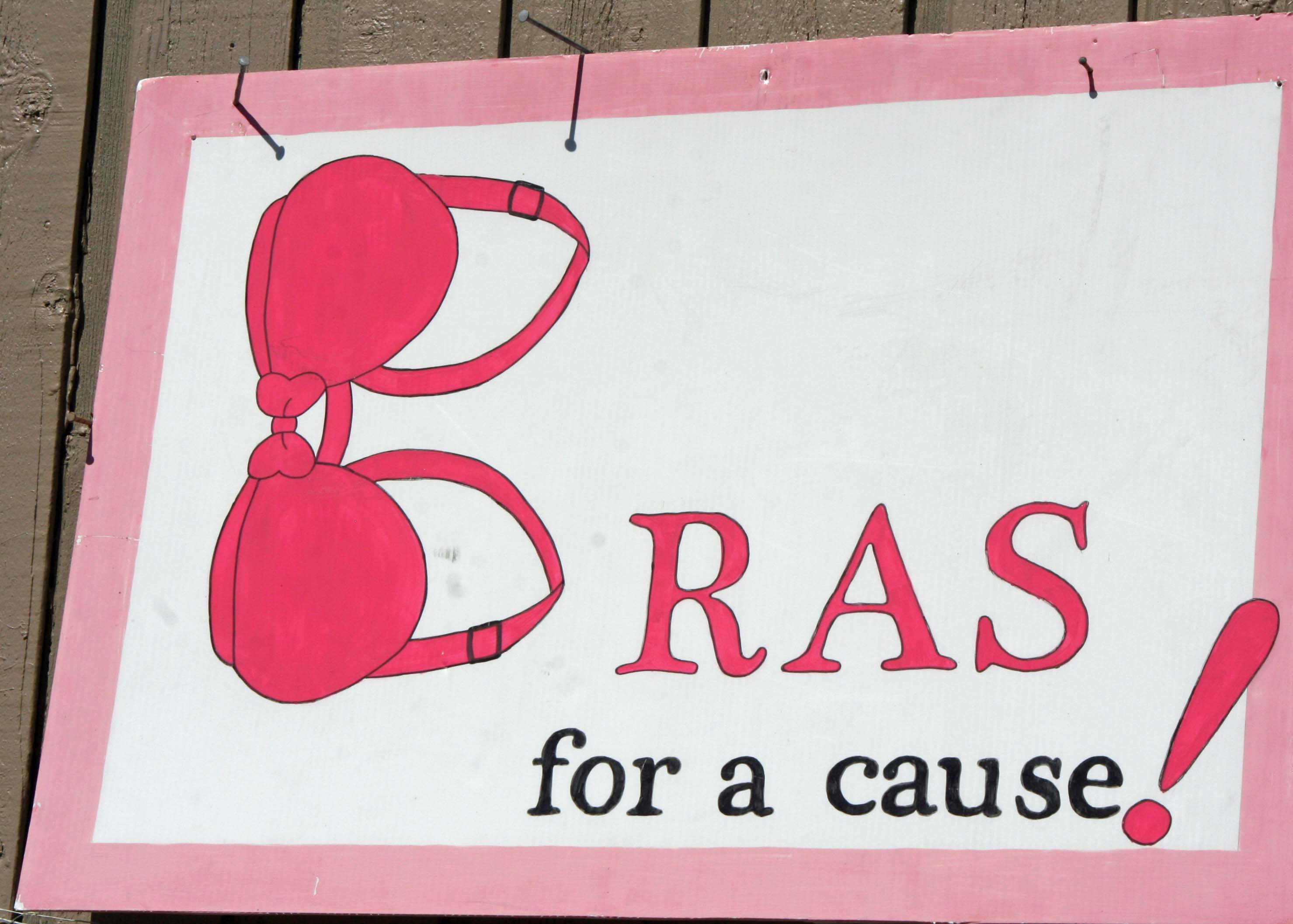
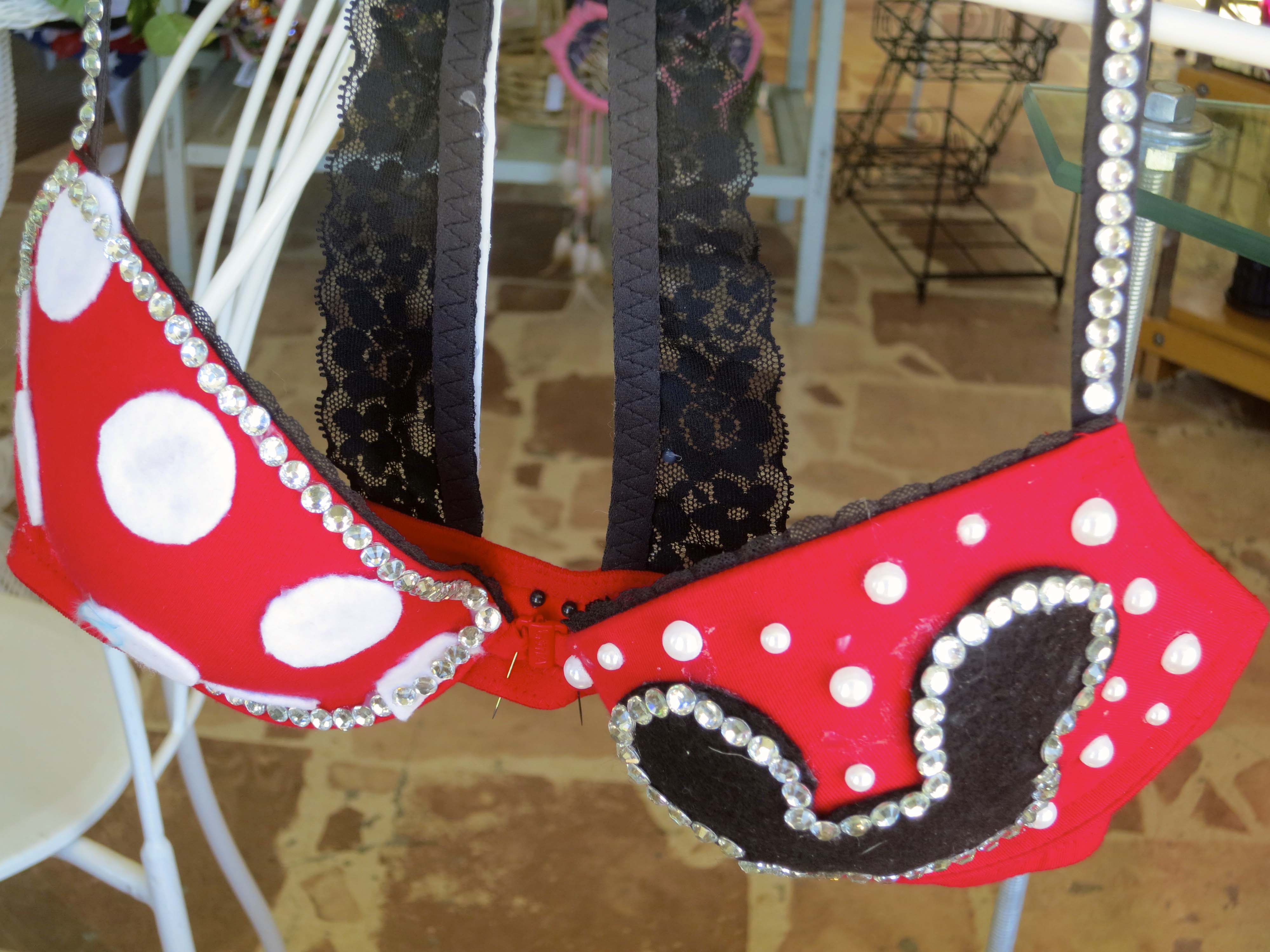
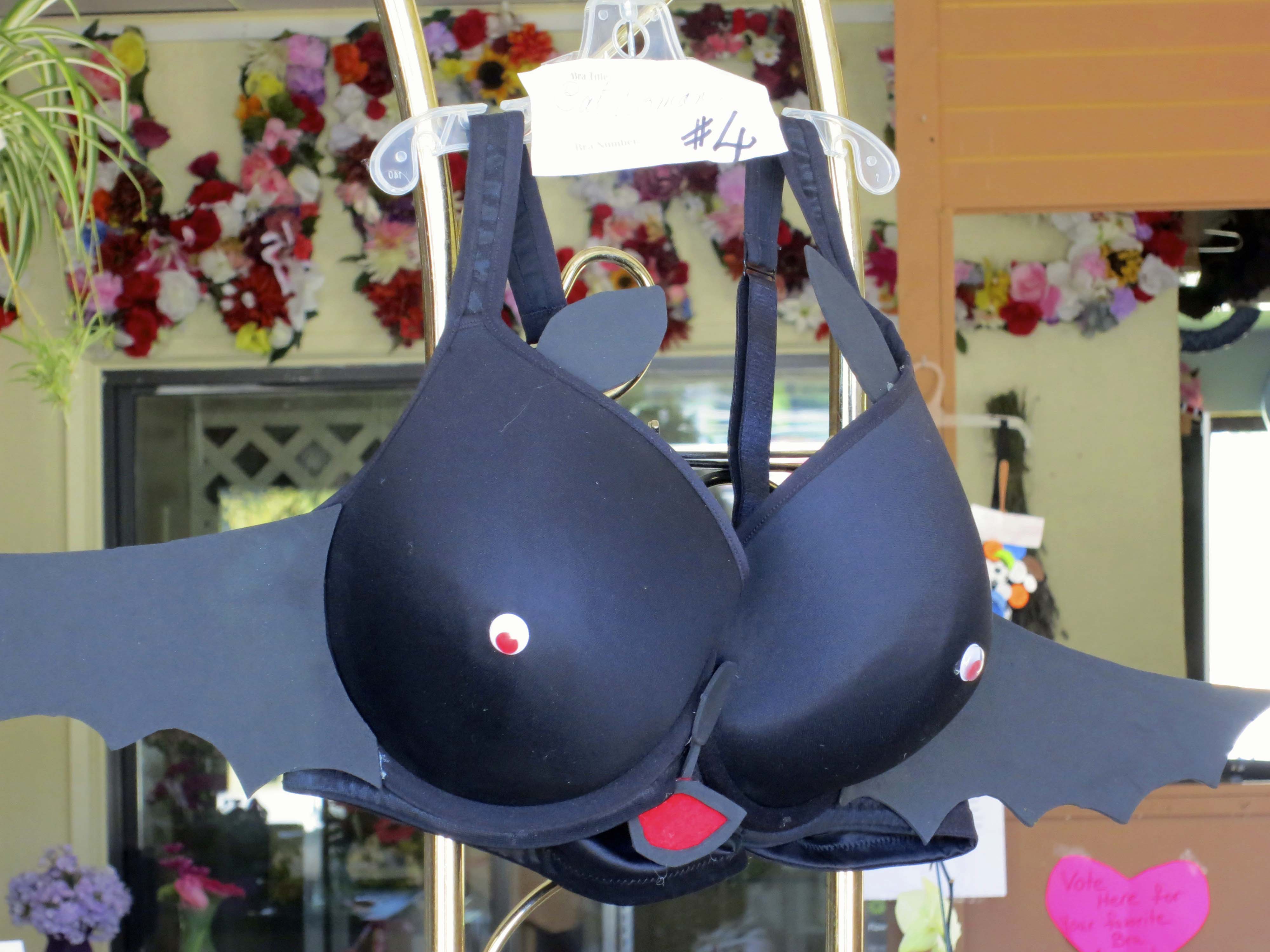
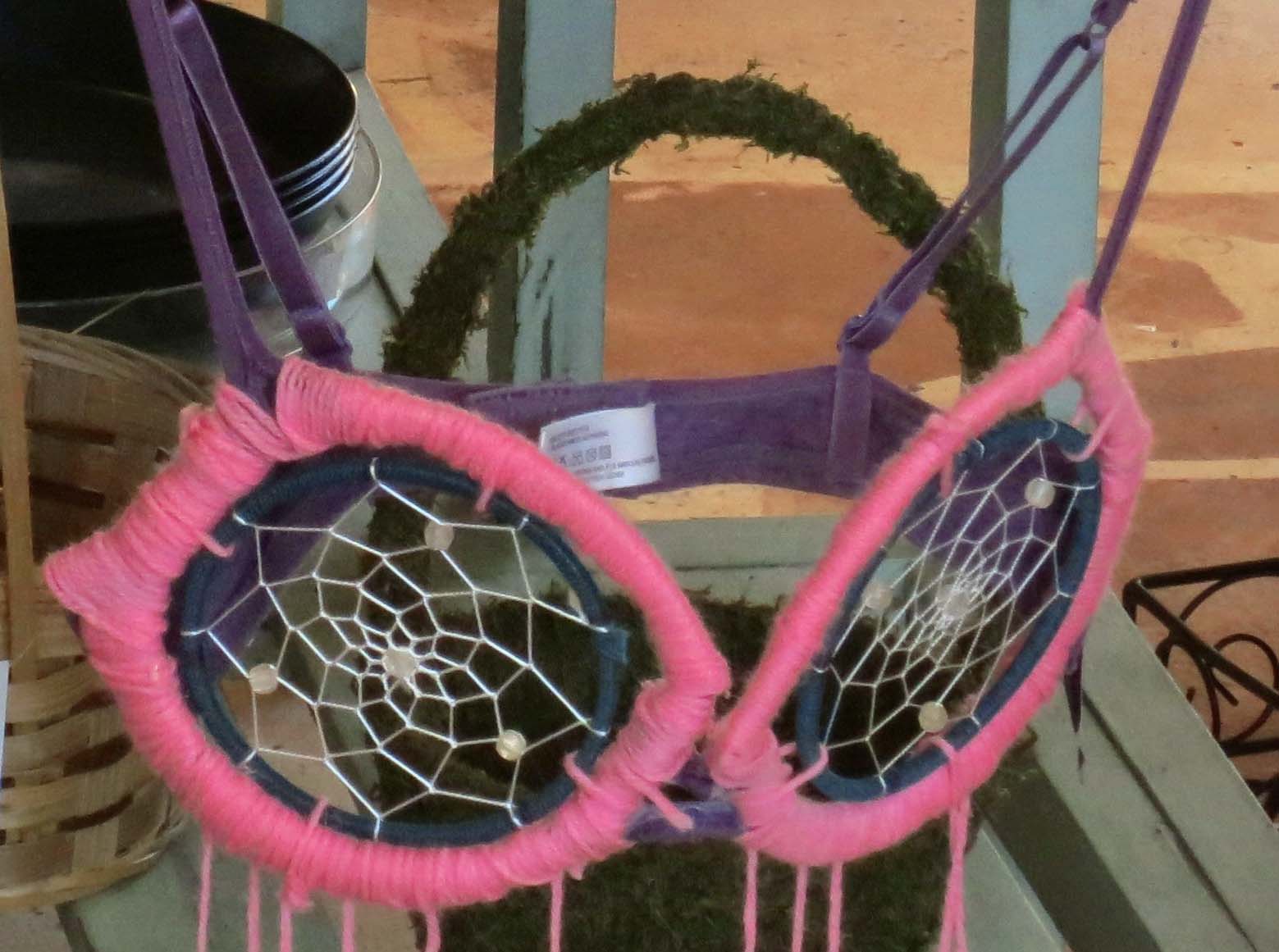
We were also amused by Port McNeill's unique way of fund raising where bras are decorated and then auctioned off. Which of the following three would you vote for?

We were also amused by Port McNeill’s unique way of fund-raising where bras are decorated and then auctioned off. Which of the following three would you choose?

Given the ears, I am thinking Mickey Mouse was the inspiration.

Given the ears, I am thinking Minnie Mouse was the inspiration.

Bat woman?

Bat woman? Great eyes.

Dream catcher. Ouch.

Dream catcher? Ouch. This one would leave an impression.

Flowers at Port McNeill on Vancouver Island. photo by Curtis Mekemson.

The flower shop that featured the bras was closed so I couldn’t get inside to photo more of the entries. I did capture this petunia on the outside, however.

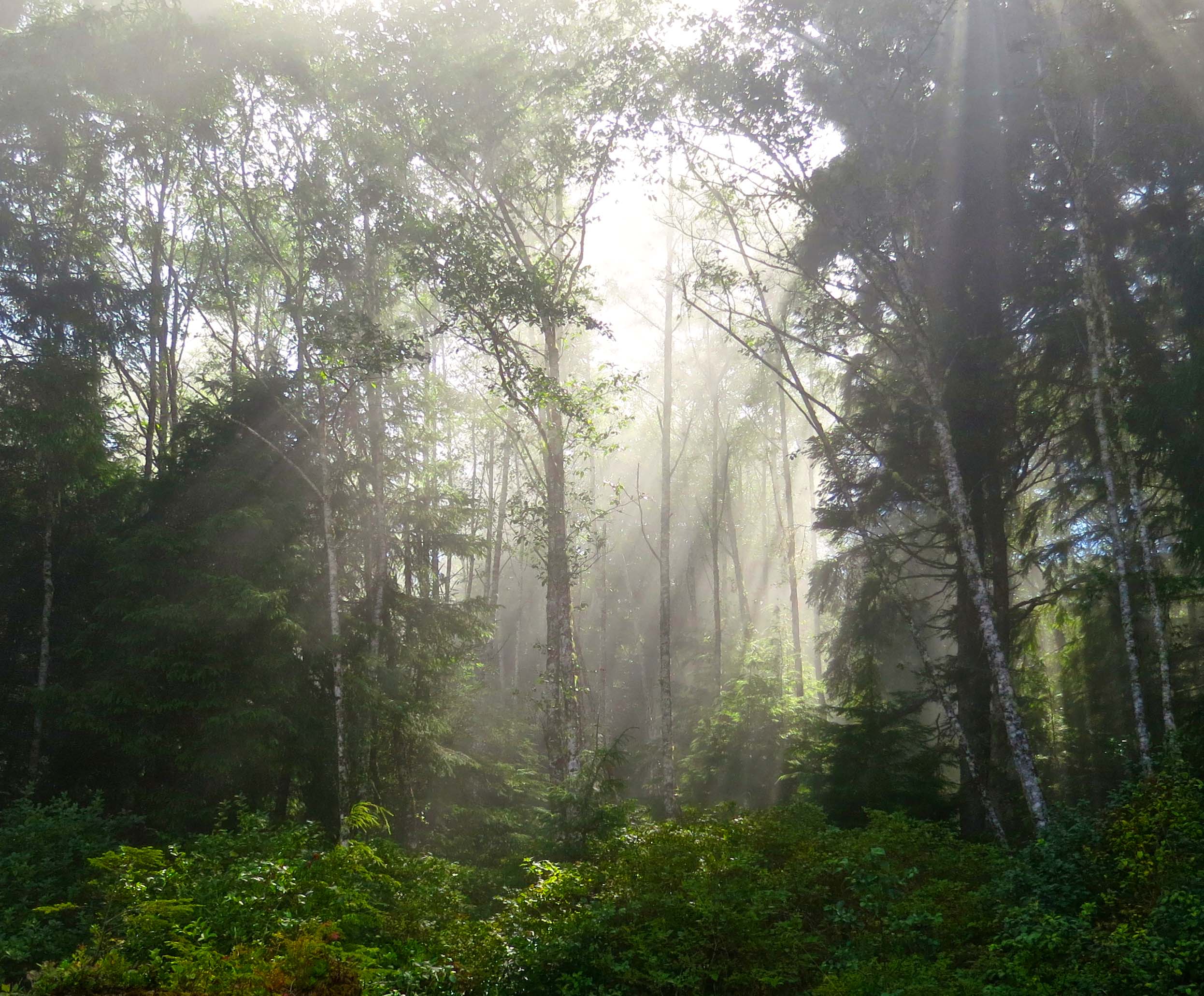
Mist in trees on Vancouver Island sea kayak trip. Photo by Curtis Mekemson.

Mist in the trees. A final photo to whet your appetite. Let the adventure begin.