I Meet a Babe in Minnesota… The 10,000-Mile Bike Trek


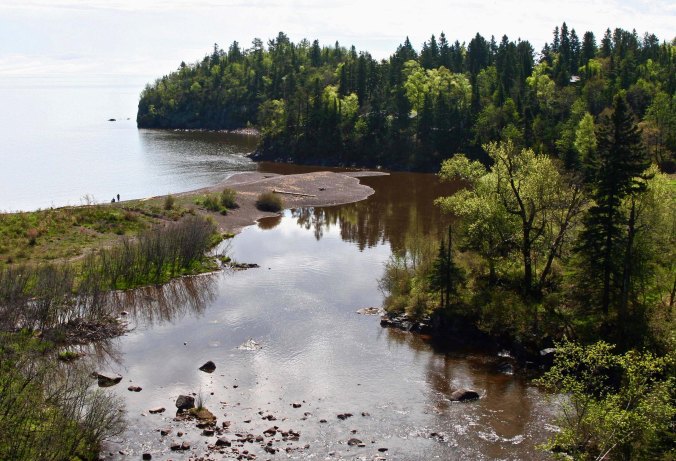
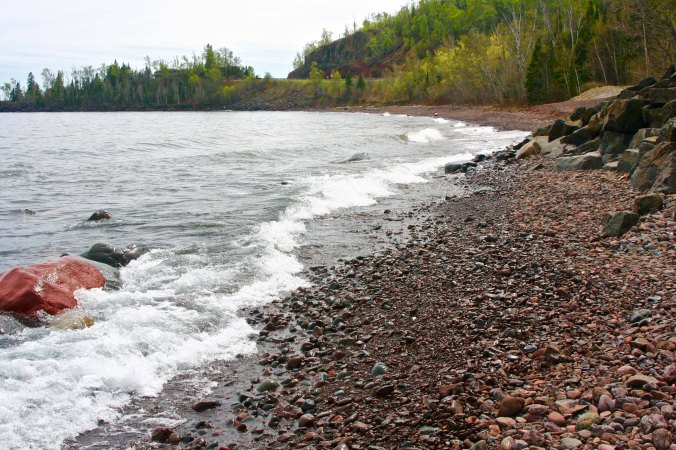
This beautiful cove is found along Minnesota's scenic Highway 61 on the north coast of Lake Superior.

This beautiful cove is found along Minnesota’s scenic Highway 61 on the north coast of Lake Superior.

The Canadian Border guard glanced at my California driver’s license, smiled, and waved me through. How threatening could a guy on a bicycle be? It was a simpler time— a peaceful interval between America’s seemingly endless wars, before the onslaught of real and imagined terrorism, and before two good neighbors required passports to enter and leave.

The American Custom’s inspector was a bit more suspicious. They usually are. Maybe I was a pot-smoking hippie, an escapee to Canada from wars past. Middle-aged men were supposed to be busy working 40-hour weeks, knee-deep in kids and nose-deep in debt while supporting the American economy, not running away on six-month bicycle adventures. He had questions to ask. How long had I been in Canada, where had I traveled, what was my reason for being in the country, where had I stayed? I didn’t tell him about sleeping out along the highway or taking a bath in two cups of water. It might have been pushed him over the edge. Eventually he sent me on my way, grumpy that he hadn’t found a reason to declare me Un-American. I was just glad he didn’t make me empty my panniers. He would have discovered my very dangerous dirty socks.

I was sad to leave Canada. It had been an important part of my bicycle journey. I remembered the friendly people, the beauty of Nova Scotia, my first stumbling attempts at long forgotten French in New Brunswick, and the endless miles and wilderness of northern Quebec and Ontario. But further adventures waited. First up was a 114-mile ride along Minnesota Highway 61, a scenic road that parallels the north shore of Lake Superior from Canada to Duluth and is renowned for its beauty, a beauty that includes the lake, islands, quiet coves, crashing waterfalls, and one of the world’s most photographed lighthouses.

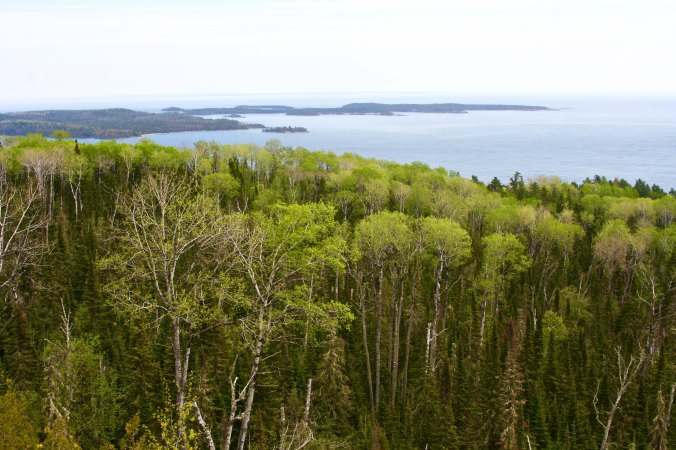
Overlook on Minnesota Highway 61 that provides a view of Islands in Lake Superior.

An overlook provided a view of islands in Lake Superior.

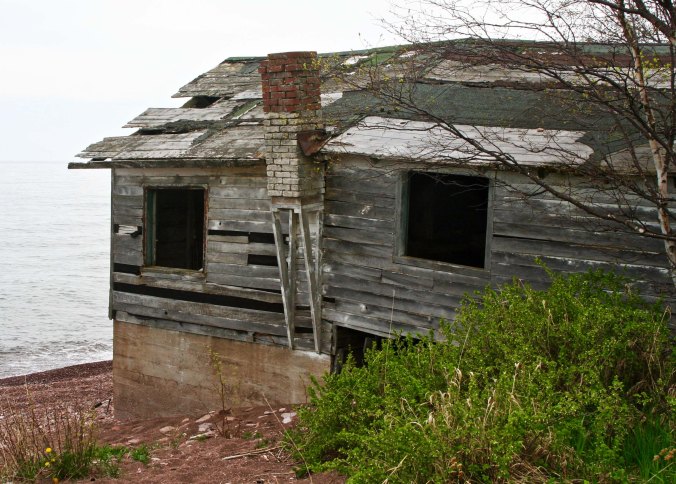
Old cabin on Minnesota's scenic Highway 61 along the north Shore of Lake Superior.

This old cabin was once someone’s beach front property on Lake Superior.

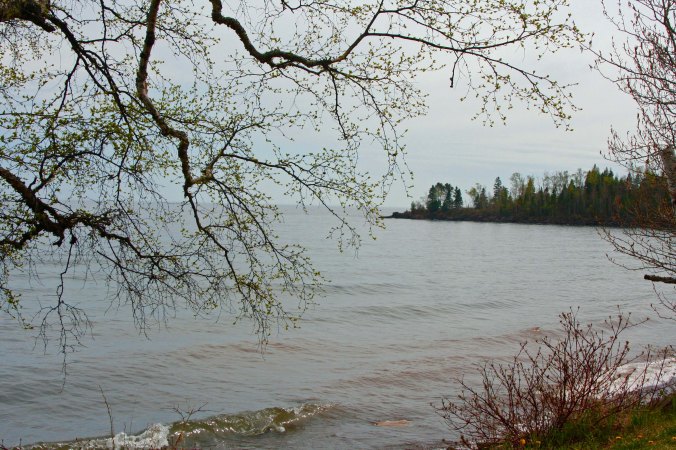
Lake Superior provided a storm-free days for me with small lapping waves, not the monsters that are known to roll across the lake in November.

Lake Superior provided storm-free days for me with small lapping waves, not the monsters that are known to roll across the lake in November.

A beach on the North Shore of Lake Superior.

Another example. The red rocks caught my eye.

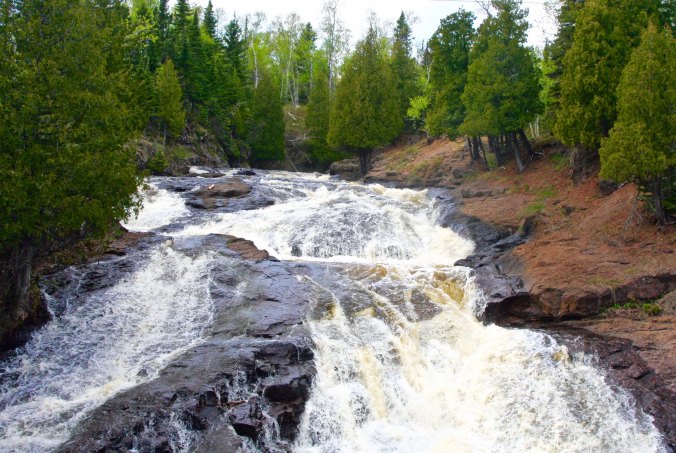
The Cross River on the north shore of Lake Superior along Minnesota's scenic Highway 61.

Foaming falls on the Cross River just before it flows into Lake Superior.

The Cross River of Michigan just before it flows into Lake Superior.

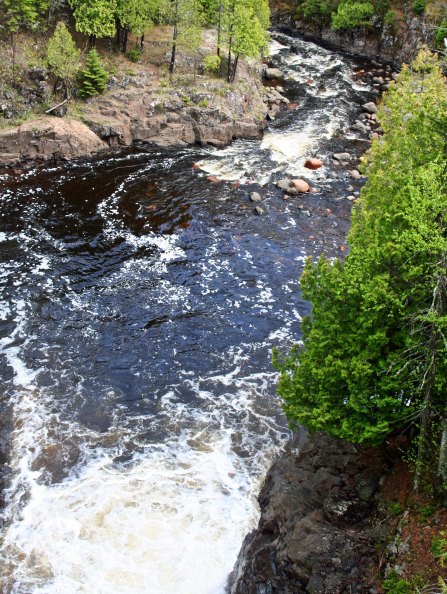
The Cross River below the falls.

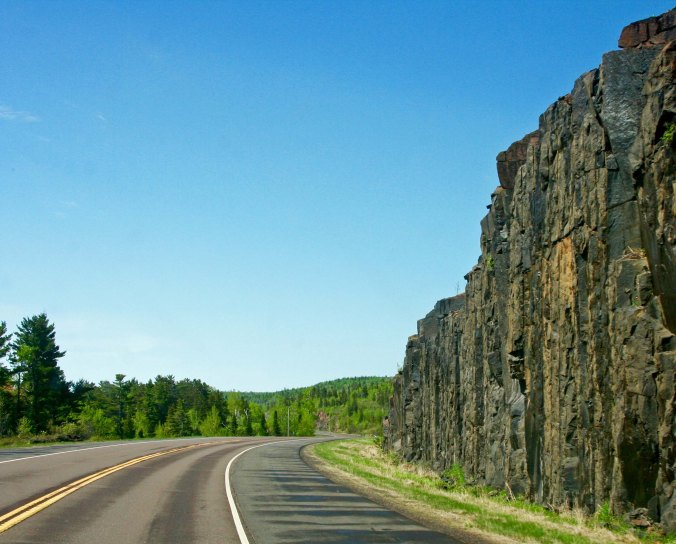
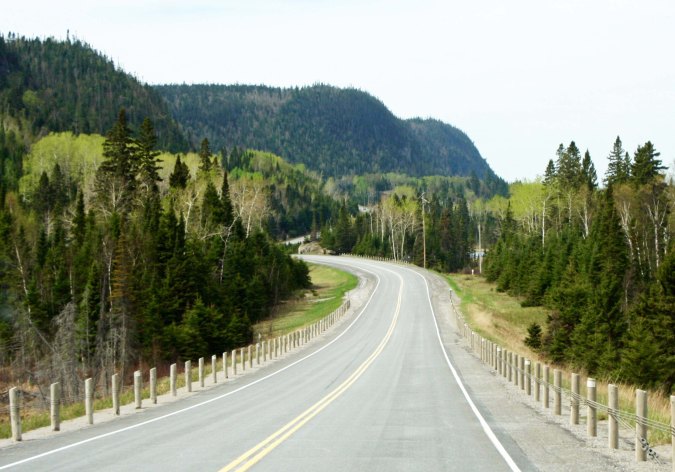
A view of Minnesota Highway 61, a great road for bicycling.

A view of Minnesota Highway 61, a great road for bicycling.

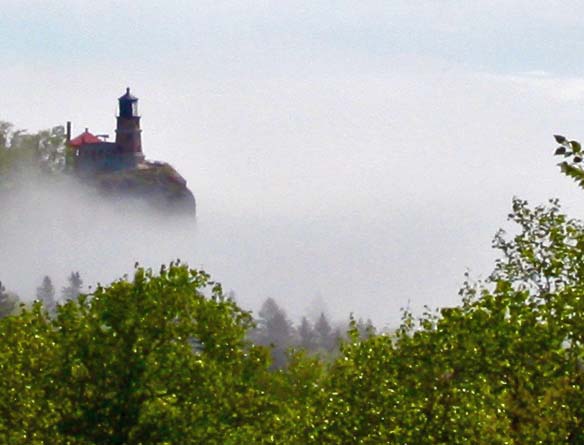
The photogenic Split Rock Light house poised on a ledge above a foggy Lake Superior.

The photogenic Split Rock Lighthouse poised on a ledge above a foggy Lake Superior.

Split Rock Lighthouse on the North Shore of Lake Superior in Minnesota.

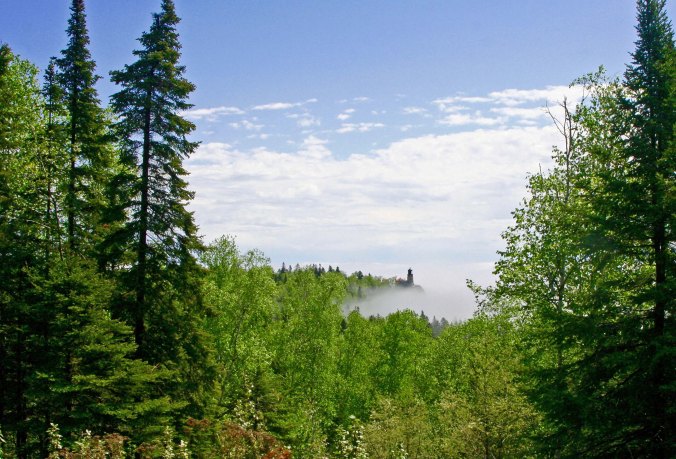
And in the distance.

Lake Superior is indeed a superior lake. It contains 10% of the world’s fresh water, which is enough to flood all of North and South America to one foot in-depth. Surface-wise, it is the largest lake on earth. The states of Vermont, Massachusetts, Rhode Island, Connecticut, and New Hampshire could easily be plopped down on top of it. Had I ridden my bike around the lake, I would have traveled some 1300 miles, an equivalent to 13% of my whole journey.

It’s so big that 40-foot high waves have been recorded rushing across its surface, sinking ships unfortunate enough to be out on the lake during major storms. Some 6,000 ships have gone down in the Great Lakes altogether, causing upward to 30,000 deaths— and the numbers may be much higher. Gordon Lightfoot memorialized one of the shipwrecks in his 1976 ballad, The Wreck of the Edmond Fitzgerald. On November 10, 1975, the ship had encountered a massive storm with 35 foot waves on Lake Superior and been sunk, taking all 29 of her crewmen to a watery grave.

Fortunately the weather was beautiful for my bike trip. November gales were still months away. I had futzed along, taking a couple of days to enjoy the beauty and give my body a break from the 80-100 mile days I had spent peddling through Quebec and Ontario. I stopped a lot.

So did Peggy and I on our revisit in June. We admired the views and took photos. The picture taking was a bit iffy, however. My Canon Power Shot 100 had died in Ontario. “Use my camera,” Peggy had urged. But her Canon EOS Rebel was sick as well. It kept giving us an Error-99 message. We looked it up on the Internet. The problem was referred to as “the dreaded Error-99 message.” Apparently the camera gave it to any issue its software couldn’t diagnose. I babied the camera along, changing its battery, cleaning its terminals, and saying nice things to it, hoping it would last until we got it to Duluth. “We’ll get you fixed, sweetheart,” I promised, and she kept snapping pictures. (It was not to be.)

The camera made it (just barely) to Duluth. The city is actually a seaport for ocean-going ships that make the 2300-mile journey to and from the Atlantic Ocean via the Great Lakes Waterway and the St. Lawrence Seaway. It has had its ups downs, historically speaking, from boom to bust, but now it seems quite healthy. We passed some lovely old buildings including a snazzy high school in our search for a camera shop. I had found an Internet recommendation for one on the outskirts.

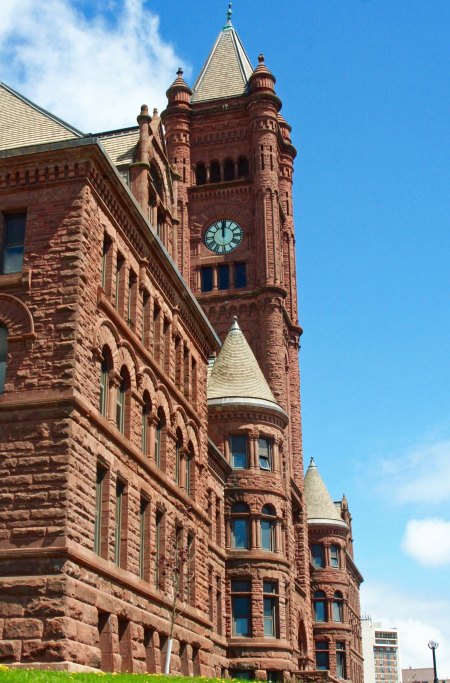
Central High School in Duluth, Minnesota.

I found it hard to believe that this beautiful structure was built originally as a high school in Duluth. They certainly didn’t build high schools like this in California. I’m thinking Harry Potter and Hogwarts!

The owner of the camera shop, a really nice guy who was being driven out of business by the same Internet that recommend his store, looked at our camera and said, “Uh-oh. You have the dreaded Error-99 message.” We laughed. What else was there to do? He took the camera apart, did what he could, put it back together, and snapped a shot out his window. Error-99 popped up on the screen.

I bought a new Canon G7X for the road. Peggy’s new camera is waiting for Christmas.

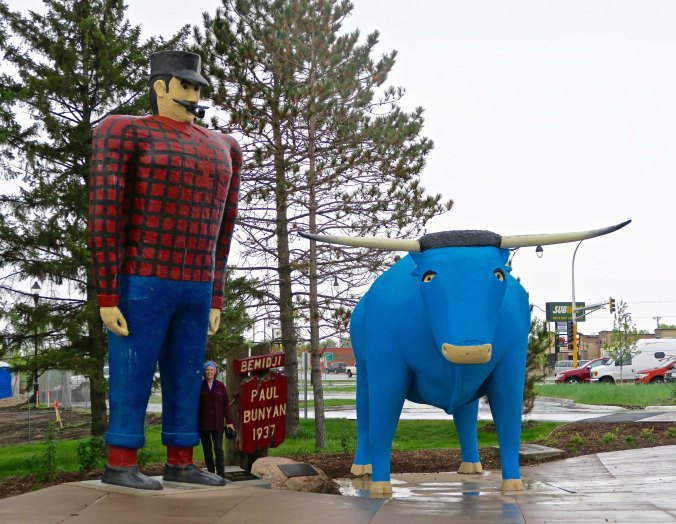
US Route 2 took me out of Duluth all the way to Grand Forks on the border of North Dakota. Cycling was relatively easy; the weather sunny. The highlights of my ride included throwing a rock across the Mississippi River and meeting a babe— a big blue babe about 15 feet tall with four legs and a tail. A sculpture of the legendary lumberjack, Paul Bunion, and his giant Blue Ox, Babe, is located in the town of Bemidji, Minnesota. Babe was so big, folklore tells us, that Paul used her to straighten out crooked logging roads by hooking her up to one end of the road and having her pull. When she had to scratch an itch on a tree, the tree would fall down and beg for mercy. Once she was pulling a water cart that sprang a leak. It created the Mississippi River! Statues of Paul and Babe are actually found in several locations in the US. (Peggy and I drove by one last week in the Redwoods of Northern California.)

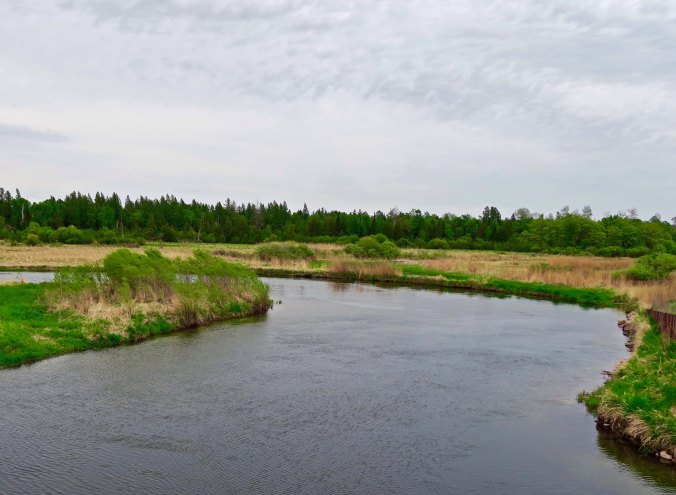
A view of the Mississippi River as it looks in Northern Minnesota.

A view of the Mississippi River as it looks in Northern Minnesota.

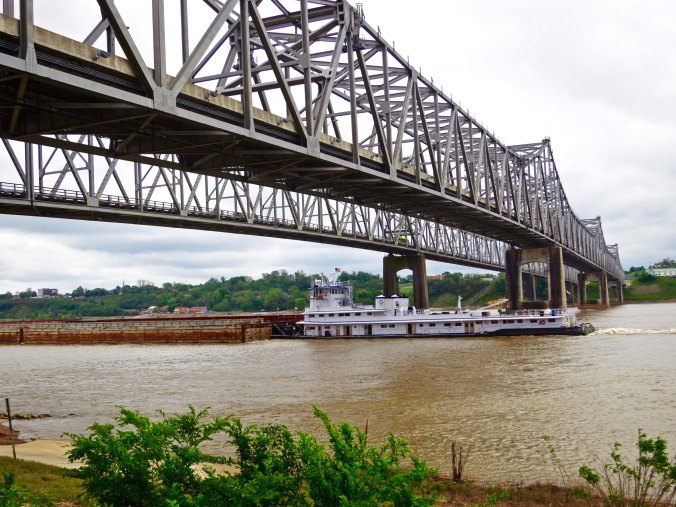
A side view of the Visalia-Natchez Bridge across the Mississippi River with a barge passing under it.

The Visalia-Natchez Bridge I had used to cross the Mississippi River earlier in my trip when I had left Louisiana and entered Mississippi. Maybe Paul Bunion could throw a rock across it.

Another view of the Mississippi in Minnesota.

Another view of the Mississippi in Minnesota. Even I could throw a rock across this one.

Paul Bunion and his Blue Ox Babe in Minnesota. Peggy is standing next to Pau's leg to prove a perspective on size.

Paul Bunion and his Blue Ox Babe in Bemidji, Minnesota prove that Canada isn’t alone in creating large, humorous statues. Peggy is the tiny person standing next to Paul’s leg to provide a perspective on size.

Minnesota Highway 2 leads me into North Dakota, more stormy weather, and the sneakiest dog in 10,000 miles.

Next Blog: Minnesota Highway 2 leads me into North Dakota, more stormy weather, and the sneakiest dog in 10,000 miles.


From Flying Saucers to a Monster Moose: Bicycling across Ontario… The 10,000 Mike Bike Trek

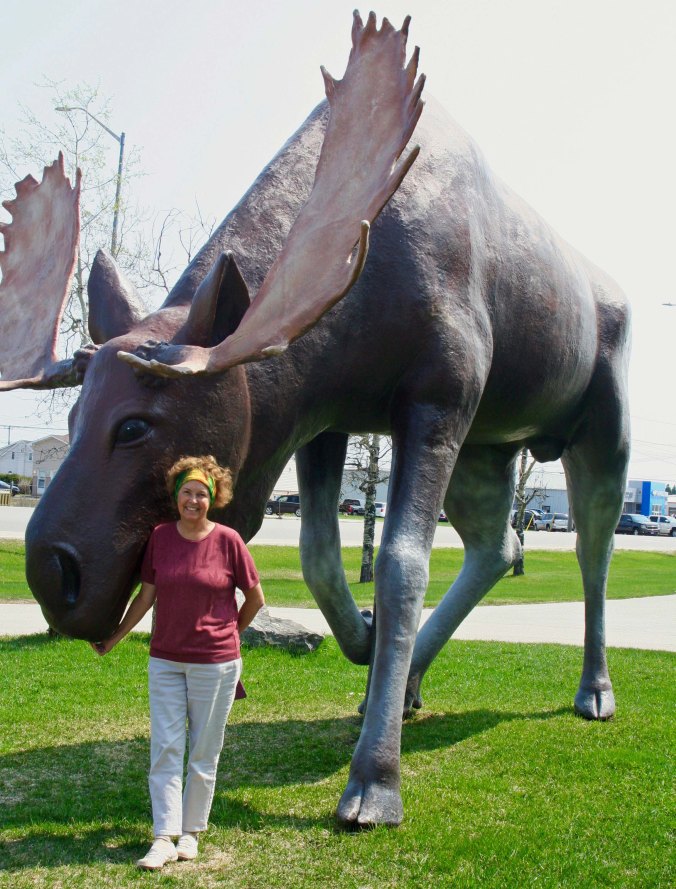
Large moose culture found in Hearst, Ontario Canada.

Large sculptures are often found in Canadian towns. They serve as tourist attractions but also give the town a unique character. We found this large moose that Peggy is snuggling up to in Hearst, Ontario.

Quebec and Ontario shared a unique status on my Bike Trek: They were huge— two to three times the size of Texas. Each took over a week to bicycle across and each had a lot of no-where miles, long distances between towns. Northern Quebec won the prize, however, for being the most remote. As I bicycled south and picked up Quebec Route 117, larger towns reappeared at more frequent intervals. Val-d’Or and Rouyn-Noranda were close to being small cities.

Crossing into Ontario, smaller communities were the rule. Ten thousand people constituted a major metropolis. Larder Lake, the first community I biked through in Ontario, had a population of around 1000 in 1989. It had dropped to 700 when Peggy and I drove through in May. I was reminded of West Texas, where most of the towns seemed to be losing population. Once upon a time, Larder Lake was considered to have a golden future. A mining investment company ran an ad in the 1907 Ottawa Citizen claiming:

“The Larder Lake district is believed to be the richest gold country ever known, and it is just now being opened up. Soon will commence the most tremendous outpouring of gold known to civilization.”

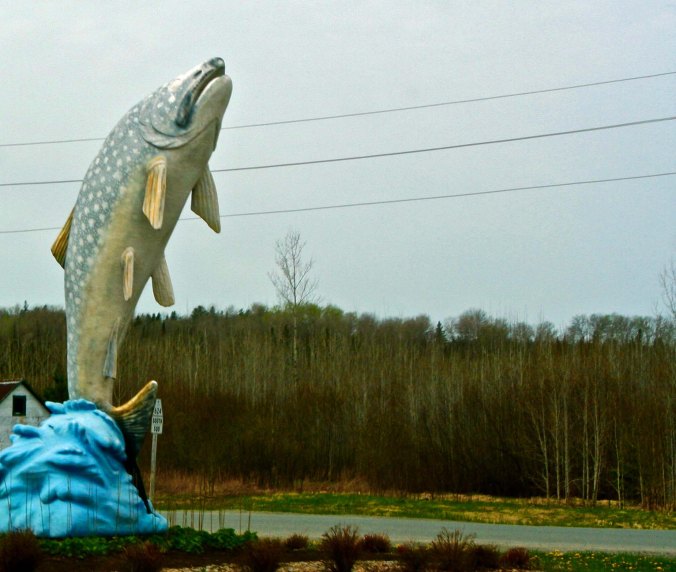
If you could get past the English, how could you not invest? The person who wrote the ad copy likely had a great future as a time-share salesman. Eventually a little gold was found, but it was more like a trickle than a “tremendous outpouring.” Today, the town is better known for fish. Peggy and I found a large one beside the road. It was leaping out of the ‘water.’

Lake Trout Sculpture in Larder Lake, Ontario Canada.

A large Lake Trout leaping out of the water served to let travelers know that Larder Lake was a great place to go fishing, and, I might add, enjoy the outdoors in general.

I am in love with the large, often outlandish sculptures, that so many Canadian towns adopt to encourage tourism, or maybe because the residents have a warped sense of humor. Peggy and I first became aware of the phenomena when we were driving into British Columbia in 1999 on Highway 97 out of Washington and came upon the “World’s Largest Golf Ball” and the “World’s Largest Beehive.” Here are some that we found as we made our way across Ontario on Trans-Canada Highway 11.

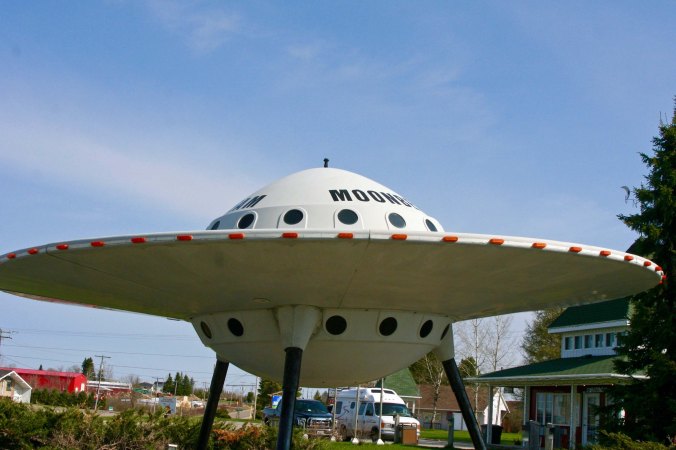
Flying saucer sculpture in Moonbeam, Ontario Canada.

If your town is named Moonbeam, why not have a flying saucer sculpture in front of the Information Center? Quivera, our van, can be seen peeking out from behind the saucer.

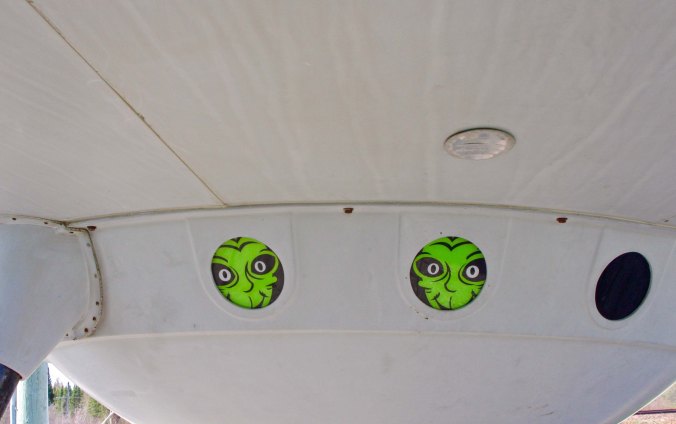
Aliens peak out window of flying saucer in front of information center in Moonbeam, Ontario Canada.

Curious aliens were staring out the windows of the flying saucer.

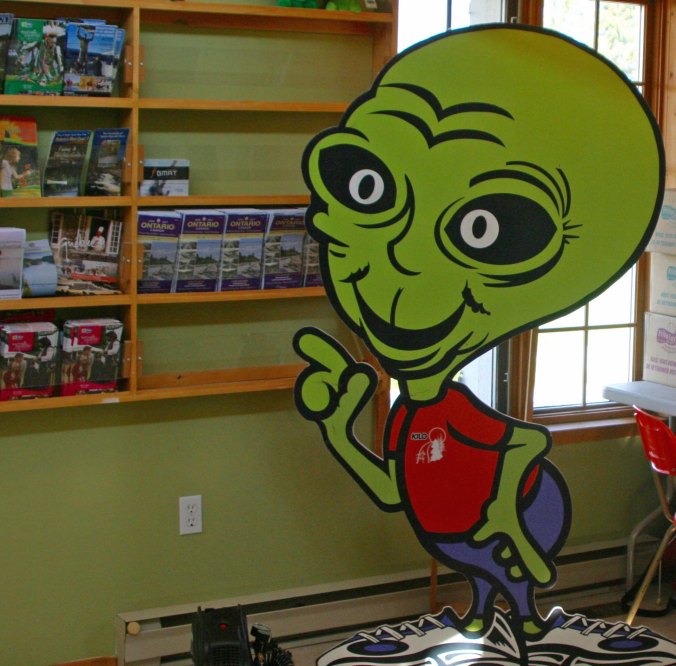
Alien points out brochures in Information Bureau in Moonbeam, Ontario Canada.

A helpful alien points out brochures inside of Moonbeam’s Information Center.

This young woman staffed the Information Center. She spoke fluent English but confessed her first love was French. She also told us there were great hiking trails in the region but that she avoided them because of bears.

This young woman staffed the Information Center. She spoke fluent English but confessed her first love was French. She also told us there were great hiking trails in the region but that she avoided them because of bears.

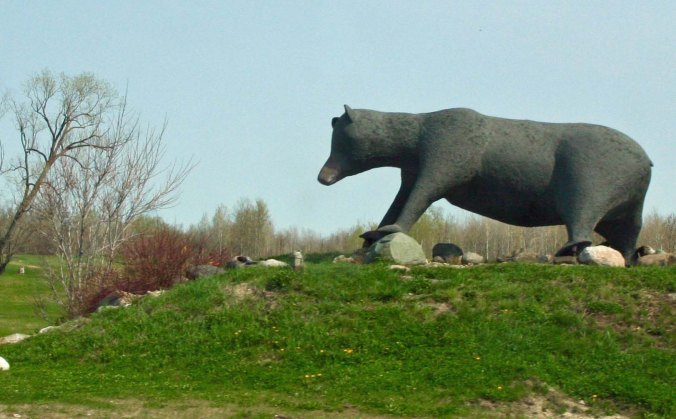
Large black bear sculpture found in Kapuskasing, Ontario Canada

Shortly afterwards we found this huge black bear statue at Kapuskasing. I’d be staying off the trails, too.

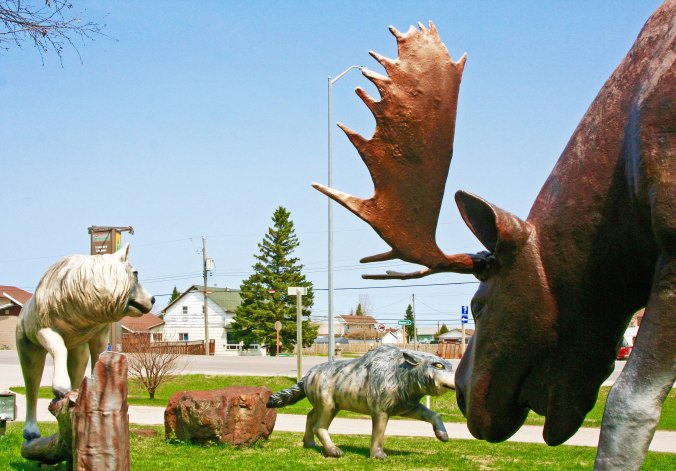
Giant moose and wolf sculptures in Hearst, Ontario Canada.

Here is another shot of the moose I featured at the top of the post— not looking so friendly as he stares down a pair of wolves.

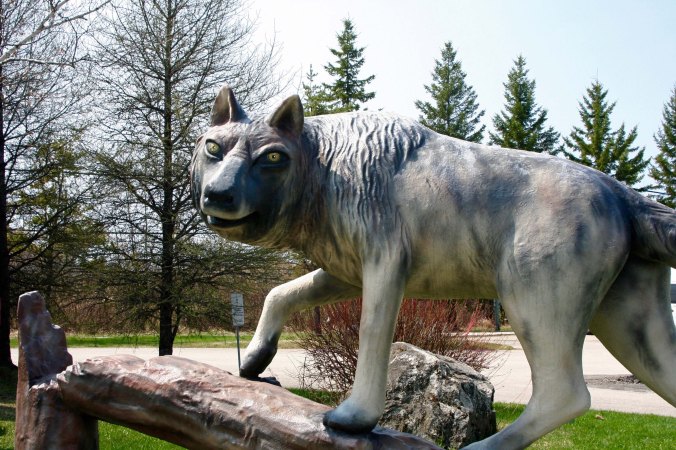
Wolf sculpture in Hearst, Ontario Canada.

A view of the wolf looking like he might belong in the movie, Twilight. “Jacob, is that you in there?”

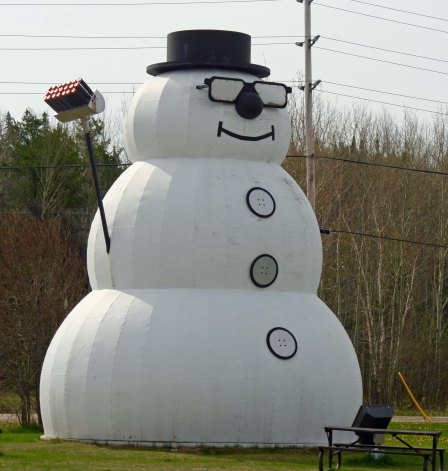
The 'World's Largest Snowman' in Beardmore, Ontario Canada.

Beardmore proudly boasts the World’s Largest Snowman as its claim to fame.

My bicycle trip across Ontario in 1989 was something of a blur. One thing I do remember was a gradual change from French to English. It wasn’t like I arrived at the border and the language changed. Local loyalties seemed to depend on culture rather than the provincial boundary. I was reminded of my experience in West Africa where loyalty was to the family first, the tribe second, and the country third. Peggy and I still noticed remnants of these emotions in Ontario 26 years later. A house might be painted in tri-color French, warning off potential Anglophiles. Or British lions would be proudly displayed as lawn ornaments, prepared to pounce on someone who spoke French.

Towns became more frequent, which meant there were more excuses to stop. I could start with breakfast and eat my way through the day. I had given up on cooking for myself by now, unless I was desperate. There was mid-morning snack, lunch, mid-afternoon snack and dinner to look forward to, not to mention coffee breaks. My hundred-mile a day bicycling body demanded constant fueling. Plus I liked the companionship. Bicycling by myself for 8-10 hours was lonely business. On occasion, I would even stay at a motel, just so I could turn the TV on and hear people talk. The downside of this was that I ran through my trip budget more quickly than I had planned. When I arrived in Thunder Bay, I called my brother-in-law and had him transfer some money he owed me into my account so I could finish off my journey in the style I had become accustomed to!

The terrain in Ontario wasn’t much different that I had been peddling over in Quebec, more or less flat with rolling hills. I worked my way through forests and farmlands, continuing to pass by numerous lakes and occasional rivers. As I neared Thunder Bay on Lake Superior, however, more mountainous country came into view, and with that more serious uphills and downhills. Following are several photos that Peggy and I took of the countryside.

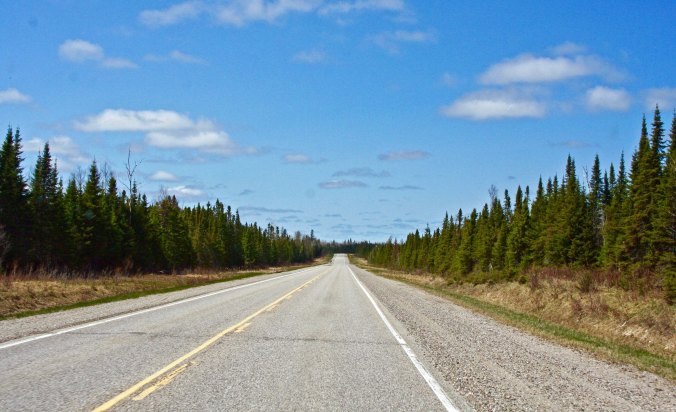
Trans-Canada Highway 11 works its way across Ontario— in this particular instance forested, flat and straight.

Trans-Canada Highway 11 works its way across Ontario— in this particular instance forested, flat and straight. Can’t say much for the gravelly shoulder.

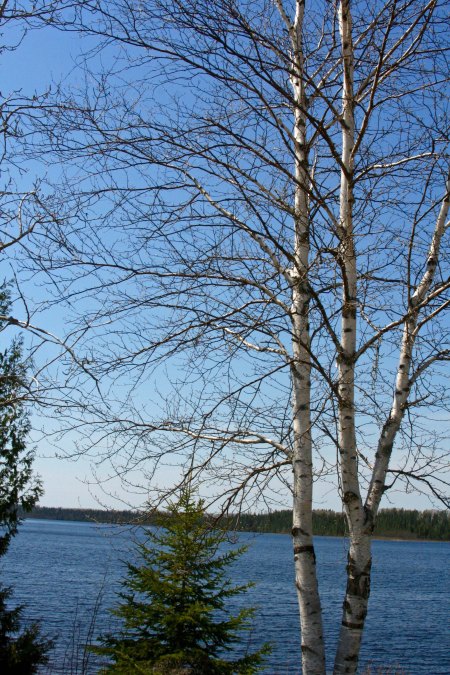
Bear Lake in Ontario Canada along Trans-Canada Highway 11.

Many lakes are found along the highway in Ontario. Bear Lake was one of the first I came across. In line with its name, bear-proof trash containers were provided at the wayside. (Photo by Peggy Mekemson.)

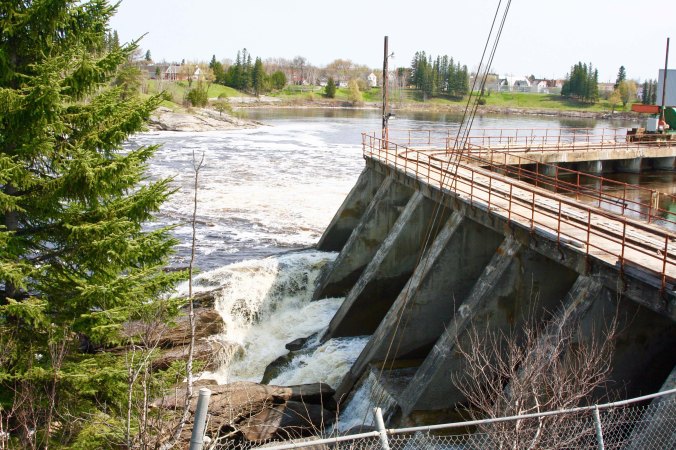
The Kapuskasing River provides hydro-electric power for the town of Kapuskasing.

The Kapuskasing River provides hydro-electric power for the town of Kapuskasing. Peggy and I also saw extensive use of solar power along Highway 11.

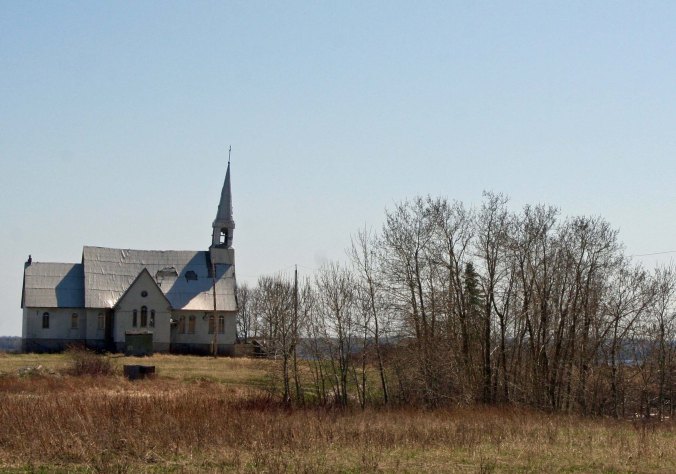
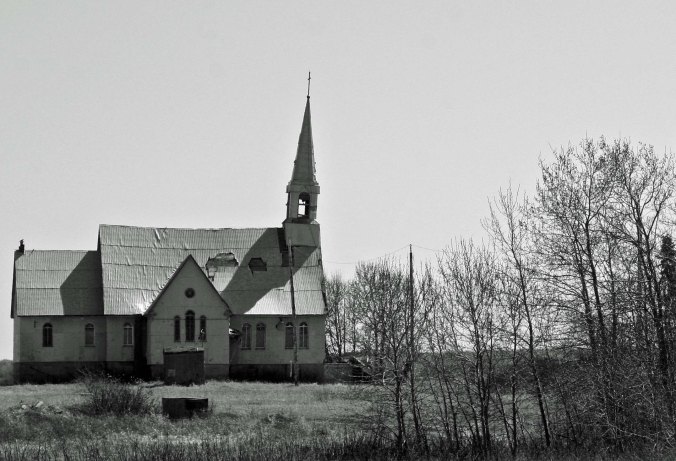
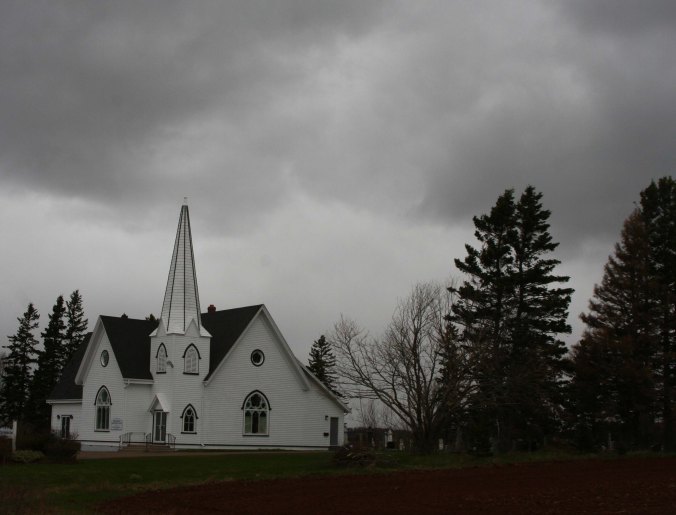
This abandoned church caught my attention...

This abandoned church caught my attention…

It's feeling of ages past led me to render it in black and white.

It’s feeling of ages past led me to render it in black and white.

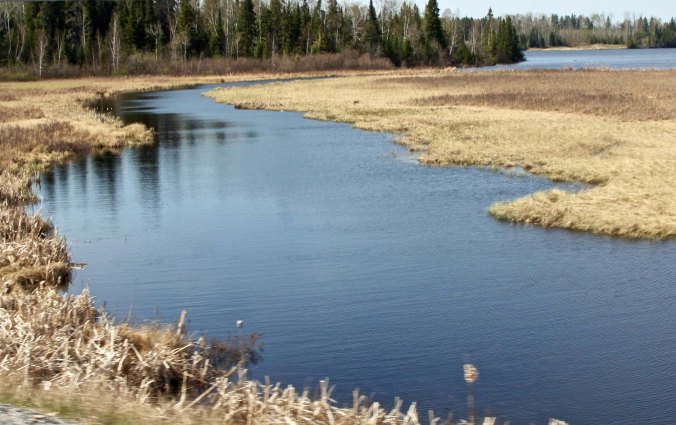
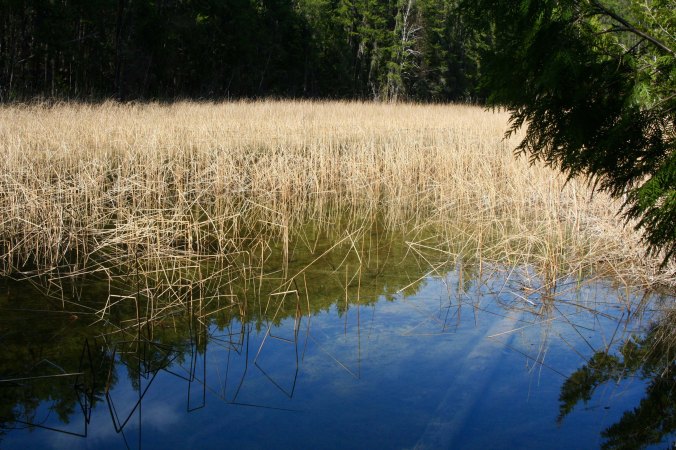
Wild Goose Campground near Long Lake provided some scenic views...

Wild Goose Campground near Long Lake provided some scenic views…

Reedy lake at Wild Goose Campground in Ontario.

Plus this one of reeds.

As I approached Thunder Bay, Mountains provided both beauty and a more challenging ride.

As I approached Thunder Bay, mountains provided both beauty and a more challenging ride.

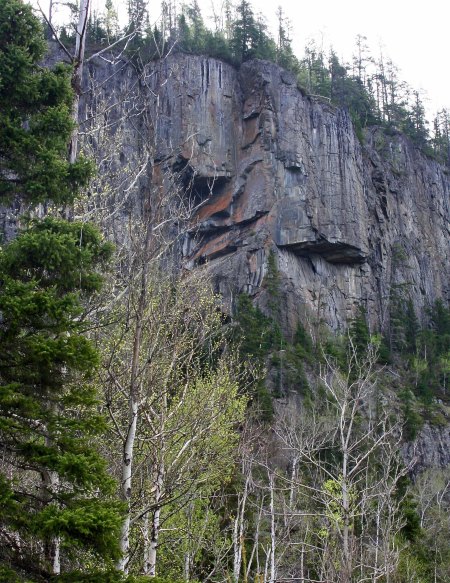
Peggy and I stopped to photograph this cliff.

Peggy and I stopped to photograph this cliff.

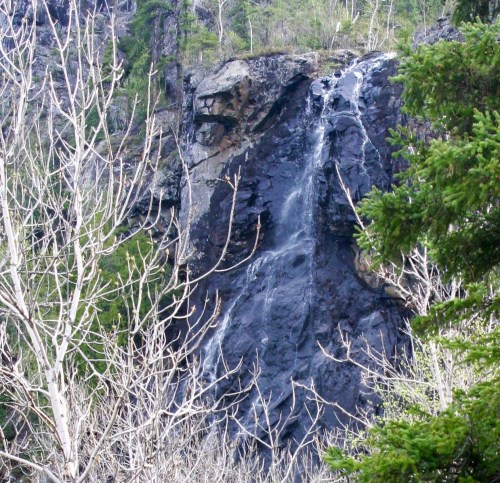
And its small waterfall.

And its small waterfall.

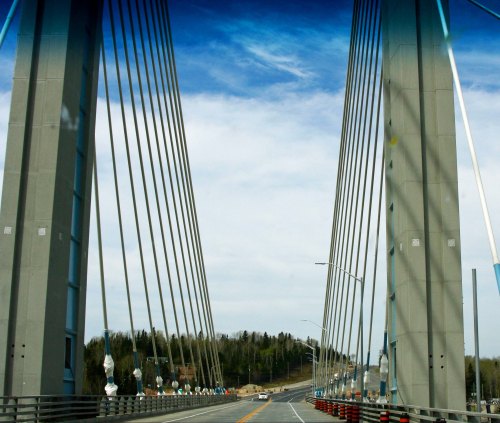
Nipigon River Bridge in Ontario Canada

This bridge across the Nipigon River near Thunder Bay has only been opened for a short while. It was closed briefly in January this year because it became detached from the approach. Given that it provides the only way across the river for Canada’s major East-West highways, you can imagine the resources that were devoted to fixing it! Peggy and I headed across the bridge, stopped in Thunder Bay for lunch, and then drove into Minnesota — returning to the US as I had on my bike.

NEXT BLOG: I cross Minnesota, throw a rock across the Mississippi River, and visit with a babe (as in Babe the Blue Ox).

The Case of the Disappearing Woman… and other Scary Halloween Tales: Part III

The ghostly grave of John Brown the Martyr on a lonely Scottish moor.

The ghostly grave of John Brown the Martyr on a lonely Scottish moor.

I mentioned the Scottish Presbyterian Martyr, John Brown, in a recent post I wrote about the Scottish presence on Cape Breton, Nova Scotia. My connection to Brown goes back to my Great, Great, Great Grand Father, James Mekemson, who had married Mary Brown Laughhead Findlay. John Brown was her Great Grandfather.

The story of John Brown’s murder verges on legend. He was, as the saying goes, a Covenanter’s Covenanter, a very devout man. The Scottish Covenanters received their name from signing a Covenant that only Christ could be King, which eliminated the King of England from being God’s representative on earth. The King was not happy. So he set out to eliminate Covenanters.

Reverend Alexander Peden, one of the top leaders of the Covenanter Movement, described Brown as “a clear shining light, the greatest Christian I ever conversed with.” High praise indeed; the type you reserve for a man who is killed for your cause.

They say that Brown would have been a great preacher, except he stuttered. Leading Covenanters visited his home and secret church services were held there. Important meetings took place. Alexander Peden stayed at his house the night before Brown earned his martyrdom and warned of dark times. Peden was something of a prophet when it came to predicting dire events. This time he was right.

Brown was out gathering peat with his nephew the next morning when soldiers led by John Graham of Claverhouse appeared out of the mist and captured him. The date was May 2, 1685. Claverhouse, or Bloody Clavers as the early Presbyterians identified him, was the King’s go-to man when it came to doing away with Covenanters. He was not noted for his compassion.

He took Brown back to his home and demanded that he swear an oath to the King in front of his wife and children. Brown started praying instead. The legend states that Claverhouse ordered his soldiers to kill Brown but they refused. So he took out his own pistol and shot him in the head in front of his family. The story then goes on to describe how Brown’s wife, Isabel Weir, went about the yard collecting pieces of her husband’s brain. (I don’t mean to treat this lightly, but somehow I can’t help thinking about a TV episode of Bones.)

An early sketch of John Brown the Martyr of Priesthill Scotland being shot down by Bloody Clavers.

An early sketch of John Brown the Martyr of Priesthill Scotland being shot down by Bloody Clavers.

Three years ago, Peggy and I made a trip to Scotland where I went on a search for ancestors. In looking for John Brown’s grave, we had stayed at a wonderful Bed and Breakfast known as the Old Church B&B in the village of Muirkirk. The owners had provided us with directions on how to find the site. It wasn’t obvious. Old and older roads led to a farmhouse where we were to park our car and then hike down a barely visible trail a mile or so to the grave.

The Old Church B&B in Muirkirk Scotland where we stayed when searching for John Brown's grave.

The Old Church B&B in Muirkirk Scotland where we stayed when searching for John Brown’s grave.

Finally the old farmhouse came into sight. A woman was standing on a porch enclosed by a three-foot high rock wall. She was wearing clothes that my great-grandmother times five might have found fashionable. Since we would be walking through her property in search of John Brown’s grave, I got out to talk with her.

But she did something strange. She disappeared. Now this was strange in two ways. Obviously she didn’t want to talk with us. She turned her back and walked rapidly toward the door.  Okay, I could live with that even though we had found most Scots to be friendly and helpful. Possibly she was shy.

What bothered me more was she sank. It was like she was traveling down an escalator or open elevator. Her head disappeared beneath the stonewall before she reached the door. I did not see her go inside.

“Maybe there are steps down to an underground cellar,” I thought to myself. Or maybe she merely bent over to work on a flower garden. Curiosity got the better of me. I walked over. There was no woman; there were no flowers; there were no stairs. As far as I could see the floor of the porch was solid stone.

I asked Peggy, “Did you see that woman disappear?”

“She went inside,” my logical wife explained.

“Ah,” I said and put the matter out of my mind as we wandered out the indistinct trail across the vacant moors to John Brown’s lonely grave. But the thought, unlike the woman, wouldn’t conveniently disappear; it kept nibbling away at me. Later I asked Peggy if she had seen the woman sink into the porch.

“Yes,” she replied.

“Did you actually see her go in the house?”

“No.”

So there you have it. Had we actually seen a ghost? Was this some ancient ancestor? I will wrap up my Halloween tales at this point but how about you? Do you have any ghostly tales you would like to share on this scary 2016.

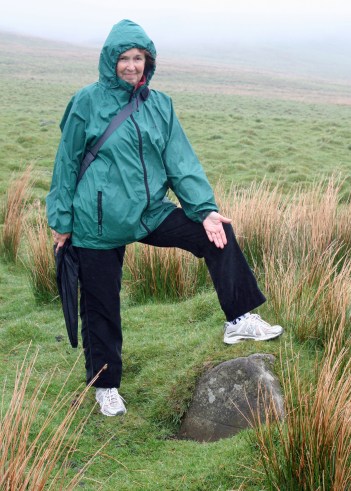
Peggy stands near where John Brown was shot on the likely remains of his house. Mist covers the distance as it would have on the day he was captured.

Peggy stands on the site where Isabel Weir may have once gone about her ghastly chore of gathering up John Brown’s brains. Mist covers the distance as it would have on the day he was captured.

NEXT POST: I will be back to bicycling across the province of Ontario, Canada.

The Cannonball Ghost… and Other Scary Halloween Tales: Part II

On November 15, 1777, the British lobbed 1000 cannonballs per hour into the tiny Fort Mifflin in an all out effort to resupply British troops in Philadelphia. Four of my ancestors fought in the battle and two were killed. Did they become ghosts?

On November 15, 1777, the British Navy lobbed 1000 cannonballs per hour into the tiny Fort Mifflin in an all out effort to resupply British troops in Philadelphia. Four of my ancestors fought in the battle and two were killed. Did they become ghosts? The forts ammunition magazine can be seen on the other side of the Canadian Geese.

Fort Mifflin, located next to the Philadelphia Airport, is well-known for its ghosts. For a time during the Revolutionary War, it was all that stood between the mighty British Navy and George Washington’s ragtag army of Revolutionaries. The few brave men stationed there had fought a heroic battle and succeeded in holding off the British for several weeks. Many of the defenders were killed, including two of my Great, Great, Great, Great Grandfather’s brothers.

Peggy and I visited the Fort several years ago on Halloween and decided it would be fun to go on a special Halloween Night tour. “Maybe the Mekemson ghosts will be lurking,” I had told Peggy.

Our guide had gathered us up. His lantern was immediately blown out. “It’s only the wind,” he explained. “I don’t believe in ghosts. I don’t hunt them and they don’t hunt me.” His disclaimer came with a ‘but.’ He worked at the Fort, and occasionally ‘things’ happened. Doors closed and latched on their own. A woman screamed like she was being murdered. The police were called but couldn’t find anyone— or thing.

He related story after story as we made our way through the candle lit buildings of the fort. Other staff, volunteers and visitors had also experienced strange phenomena. More than one visitor had left on the run and even the guide had packed up and gone home on one occasion. He was spending the night in a second-floor room when he heard footsteps coming up the stairs. He opened the door and no one was there. Next he heard voices coming from the room next to him. He checked. No one was there either. He packed up and left, quickly.

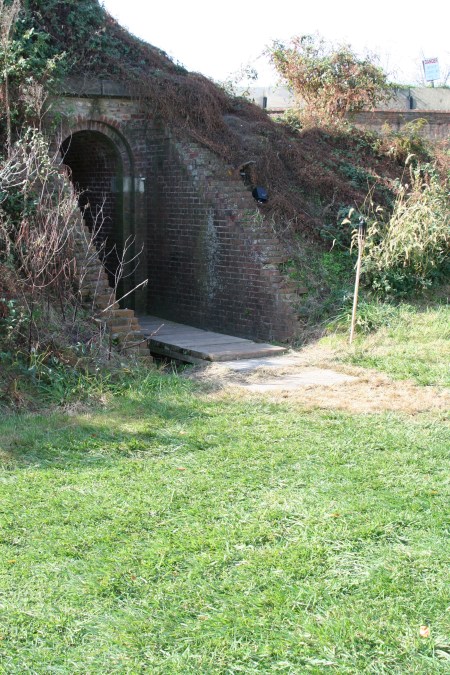
We arrived at the Fort’s ammunition magazine, a bush covered hill that resembled an ancient burial mound. A bright hurricane torch outlined the dim opening. We entered and walked down a narrow, dimly lit corridor that opened out to a large, arched bunker. A single candle created dancing shadows on the far wall. Reputedly, a man dressed in Revolutionary Soldier garb had once greeted guests in the dark room and vividly described the horrendous battle that had taken place on November 15, 1777. Afterwards, the tourists had stopped at the park headquarters to report on how much they had enjoyed the presentation. The Fort had no such guide.

The entrance to the ghostly ammunition magazine taken during the day.

The entrance to the ghostly ammunition magazine taken during the day. The hurricane lantern is on the right.

“I’ve never felt anything in here,” the tour leader related. “It’s dead space,” he quipped. I stared hard into the corner where the soldier had supposedly stood, trying to create something out of nothing. But there were only the dancing shadows. Peggy tried to take a photo but the camera froze and refused to work. As she struggled with it, the last of our tour group disappeared down the narrow corridor, leaving us alone with the flickering candle.

We hurried after the group. There was no one outside the magazine, only the glowing torch and the dark night. “I saw them heading down a side corridor,” Peggy said. With more than a little reluctance, we dutifully trooped back inside. Peggy’s corridor was a bricked in wall. I was starting to feel spooked.

“Maybe we should go back to the bunker,” she suggested.

“Maybe not” I had replied and headed for the entrance, with Peggy close behind. Just as we arrived, the hurricane torch, which was designed to withstand high winds, was blown out by a slight puff of ice-cold air, leaving us with nothing but dark.

The hairs on the back of my head stood at attention. Was my ancient Uncle Andrew trying to communicate with us? He had been cut in half by a cannon ball after saving the Fort’s flag. Maybe he was still seeking his other half. Peggy and I decided it was time to vacate the premises.

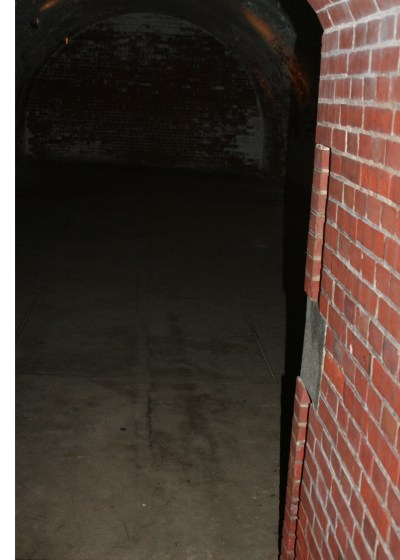
Once you've become thoroughly "spooked," every dark corridor, such as this one at Fort Mifflin becomes a potential hiding place for a ghost.

Once you’ve become thoroughly “spooked,” every dark corridor, such as this one at Fort Mifflin becomes a potential hiding place for a ghost.

Fortunately, we found our group several buildings away and stuck like super glue to them the rest of the tour.

Tomorrow’s Halloween Blog: A Lonely Grave… Peggy and I are looking for the grave of an ancestor, shot down as a Scottish Presbyterian Martyr, when we see what almost had to be a ghost.

Quebec Independence plus a Dark and Stormy Night… The 10,000 Mile Bike Trek

As I climbed out of toward beautiful rivers such as the kept me company.

As I climbed out of Sainte-Simeon toward Lac Saint-Jean, beautiful rivers such the Little Saguenay kept me company.

I had ridden 110 miles when I arrived at Parc national de la Pointe-Taillon on Lac Saint-Jean in Quebec. The rain was coming down in buckets and I was exhausted. It was a perfect night for hypothermia and all I could think of was setting up my tent and crawling into my warm goose-down sleeping bag. I was pounding in my last tent stake when a woman came over and asked if I would like something hot to eat. I almost fell in love.

I’ve long since lost and forgotten her name, but what I remember was that she was a PhD candidate doing her thesis on some type of plant growing in the region. We’d had a brief conversation when I arrived with water dripping off my nose. She had wanted to know where I had biked from. “California,” had been my reply. Apparently my answer had impressed her, or maybe she was just nice person concerned about a guy who didn’t have enough sense to get out of the rain.

In addition to hot food, she had a large, dry van. I wasn’t the only one lusting after it. Three 20-something men from Montreal who were car camping soon joined us with a case of Labatt Beer, a Canadian brew out of Ontario. All I had to contribute to the party were tales of the open road, but apparently they were enough. I felt a bit like a troubadour who was singing for his dinner and drink.

It was another dark and stormy night on the road— but cozy. As the rain pounded down on the roof, our conversation had ranged far and wide. And, I might add, long, since it was close to 1:00 a.m. when we downed the last beer, wished each other good night, and stumbled off in the rain.

The topic that had interested me the most was the issue of Quebec independence from the rest of Canada. It turned out that the three young men were separatists and believed that Quebec would be better off going it alone. The dispute over independence was buried deep in past. Quebec, of course, was predominantly French in culture, while the rest of Canada was primarily English. French Canadians had long worried that their culture and language would be buried under an avalanche of English language and customs. In the late 60s and early 70s this concern had turned to violence. In 1980 a referendum had been held to determine whether Quebec should pursue independence. Sixty percent had voted no, but nine-years later the issue was still simmering.

Given that our group was made up of three French Canadians, one British Canadian, and one American, our discussion on Quebec independence had been quite animated, but surprisingly amicable.  It’s amazing what a rainy night, a dry van, and a case of beer can accomplish for international relations. We laughed a lot and as parted friends.

My photos today trace my journey from the St. Lawrence River ferry at Sainte-Simeon to Lac Saint-Jean. I followed Quebec Routes 170 and 372 up to Saguenay and then Routes 172 and 169 to Parc national de la Pointe-Taillon on the north side of the lake. (Peggy and I followed 170 up to 169 and went around the south side of the lake.) The ride included substantial climbs, rugged terrain, beautiful rivers and small to mid-sized communities. As I/we approached Lac Saint-Jean and climbed onto the Laurentian Plateau, the land flattened out considerably.

Landing at the ferry dock at St. Simeon.

Landing at the ferry dock at St. Simeon. The ship was maneuvering around to drop its ramp on the exit way.

This one time lighthouse at St. Simeon had become a souvenir shop and ticket booth.

This one time lighthouse at St. Simeon had become a souvenir shop and ticket booth.

Quebec 170 out of St. Simeon had proven to be quite a climb.

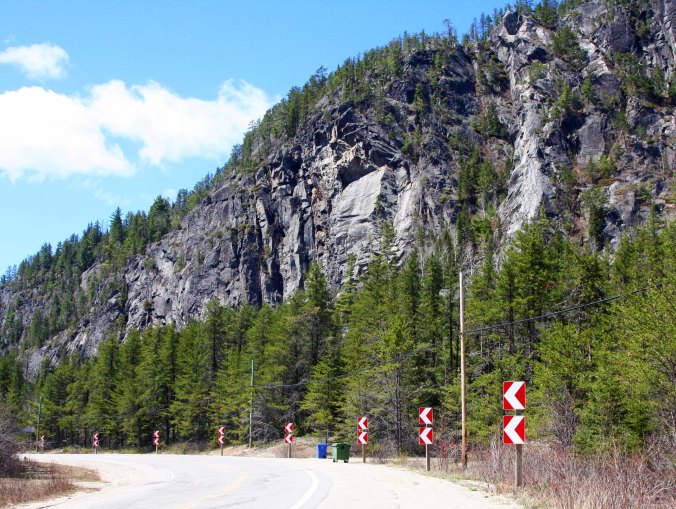
Quebec Route 170 out of St. Simeon had proven to be quite a climb.

There was a lot of up and over...

There was a lot of up and over…

The Palisades on top were impressive. The signs suggested I make a left turn.

The Palisades on top were impressive. The signs suggested I make a left turn.

A close up...

A close up…

Small towns along the way were neat and orderly. I think this is Sagard.

Small towns along the way were neat and orderly. I think this is Sagard.

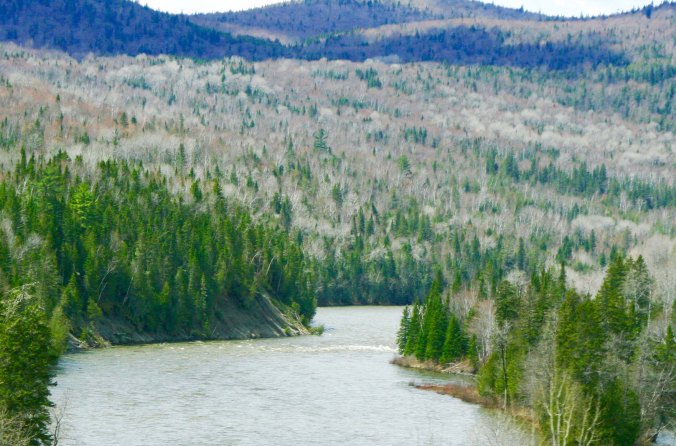
A river ran through it...

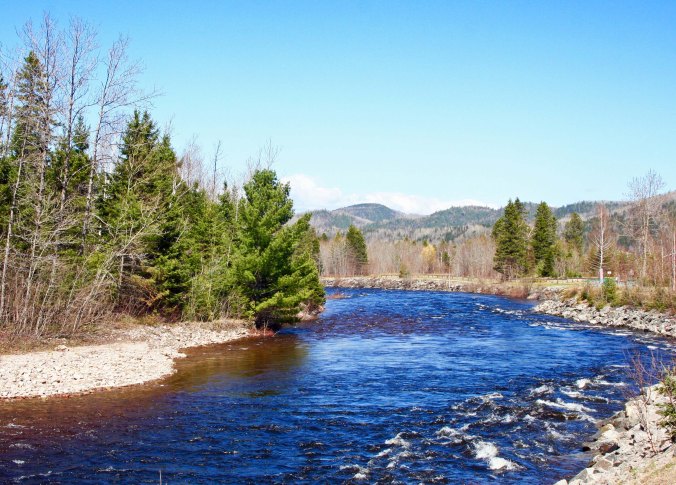
A river ran through it…

Spring time flows guaranteed rapids when Peggy and I re-drove the route.

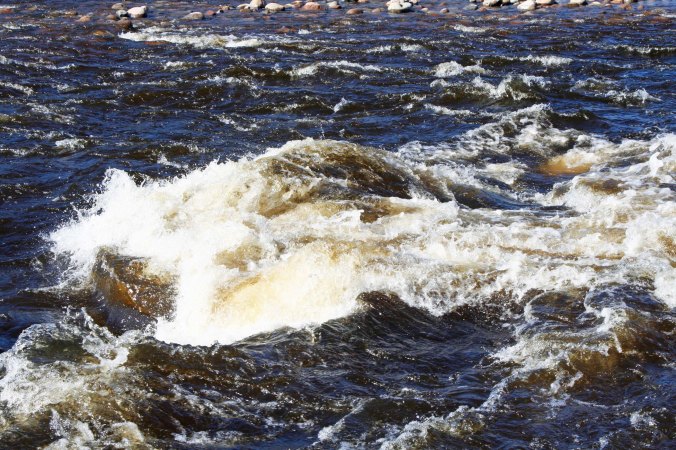
Spring time flows guaranteed rapids when Peggy and I re-drove the route.

Jesus welcomed Peggy and I with open arms— not surprising in Quebec.

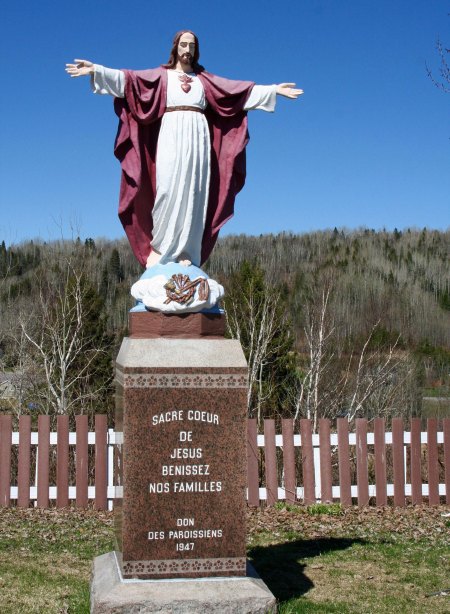
Jesus welcomed Peggy and me with open arms— not surprising in the Catholic province of Quebec.

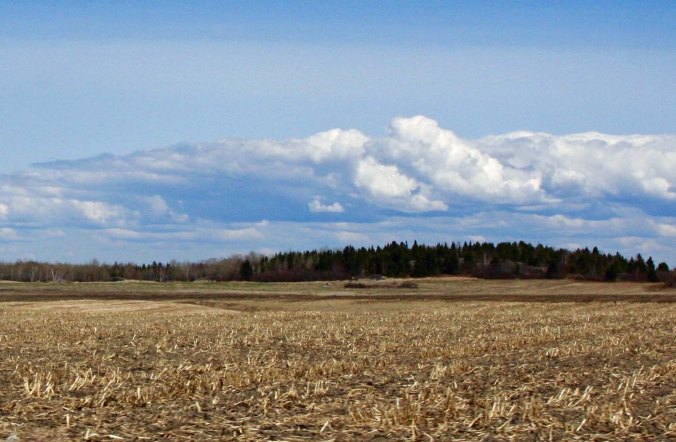
The land flattened out as we neared Lac Saint Jean, providing scenes kill this one.

The land flattened out as we neared Lac Saint Jean, providing scenes like this one.

The gentler terrain supported large farms...

The gentler terrain supported large farms…

And wide open country.

With wide open country.

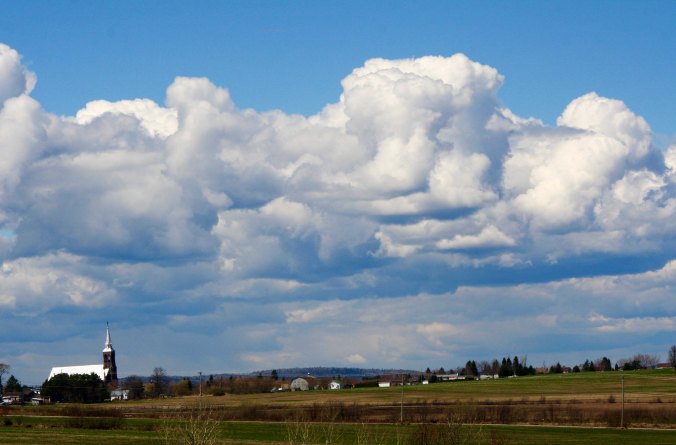
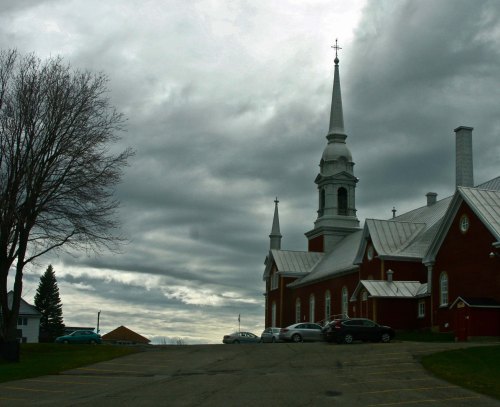
I took this photo with its tell-tale Catholic Church next to Lac Saint Jean.

I took this photo with its tell-tale Catholic Church next to Lac Saint Jean. The clouds were gorgeous.

Looking out toward Lac Saint Jean.

Looking out toward the large Lac Saint Jean. The campground where I spent my rainy night is on the opposite shore.

NEXT BLOG: I continue my journey into the far north riding over muddy dirt roads, dodging three trailer logging trucks, and taking a bath with eight ounces of water.

New Brunswick, the Gaspé Peninsula, and the St. Lawrence River… The 10,000-Mile Bike Trek

Like so many other rivers I followed on my bike trek, the Matapedia River on the Gaspe Peninsula provided a convenient route for road builders over terrain that might have been close to impassable.

Like so many other rivers I followed on my bike trek, the Matapedia River on the Gaspe Peninsula provided a convenient route for road builders over terrain that might have been close to impassable otherwise.

The road kept rolling on as I cut across the northern part of New Brunswick. I picked up New Brunswick Route 15 in Elgin and followed it west to Shediac where I followed NB-11 and NB-8 to Bathurst, passing through a number of small villages such as Boutouche, Richibucto and the larger community of Miramichi. It wasn’t a particularly scenic route; the roads had been constructed to get people from point a to point b, not dazzle them with natural wonders. Still, there were things to admire: forests, farmlands, towns, and occasional rivers opening out onto bays on the Gulf of St. Lawrence.

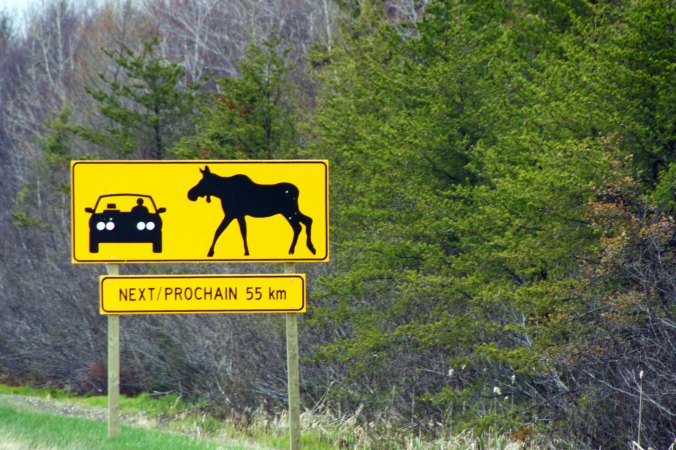
Watch out for moose signs take on a more urgency along roads that are built for speed. The New Brunswick highway department wanted to make sure that drivers got the point that a moose is a big animal you do not want to run into!

Watch out for moose signs take on more urgency along roads that are built for speed. The New Brunswick highway department wanted to make sure that drivers got the point that a moose is a big animal you do not want to run into!

Although I selected the first part of my route across New Brunswick for speed (speed being relative at 10-15 miles per hour) instead of scenic beauty, there were

Although I selected the first part of my route across northern New Brunswick for speed (speed being relative at 10-15 miles per hour), I still found much that was scenic.

The nature of my bike trek changed when I left New Brunswick. I had upped the ante. Where I had been bicycling from 60-80 miles per day, I would now be traveling 80-100. Routes would be more direct. Layover days would become few and far between, and journal entries rare. It was time to get serious.

I decided in Bathurst that I needed to experience at least a part of the New Brunswick coast so I picked up NB-134 and followed it most of the way west to the beginning of the Gaspé Peninsula and Quebec. The road runs along the edge of Chaleur Bay and serves as the main street of several small villages with very French names. The first town I came across, however, was Nigadoo, which is a First Nation Mi’kmaq name that means place to hide. Whatever reason the Mi’kmaq had for choosing the name, it worked equally well for the French Acadians.

As elsewhere in the Atlantic Provinces, the Acadians of the region had been deported during England’s mid-18th Century wars with France. Immediately after the Revolutionary War, New Brunswick had become a re-settlement area for Royalists/Tories who had remained loyal to the British Crown. During the late 1700s, the Acadians began to slip back into the country. The isolated north coast where they could live with minimum interference was one of their preferred locations. One might say that they were ‘hiding out.’

If Nigadoo didn’t quite fit my list of towns with French names, Petit-Rocher-Sud, Petit-Rocher, Petit-Rocher-Nord, Pointe Verte, and Belledune certainly did. I quickly discovered that the towns were true to their names. English names dropped off signs. Shopkeepers and others I met tended to speak French first and English as something they preferred not to. I even had an opportunity to try out my rudimentary high school French: “Où est la salle de bain?” Where is the bathroom? My efforts were appreciated, however, and I suspect that they produced a few chuckles when I left.

A number of Acadian towns were located along New Brunswick's north coast that borders on the Gulf of St. Lawrence and

A number of Acadian towns were located along New Brunswick’s north coast that borders on the Gulf of St. Lawrence and Chaleur Bay where gentle waves lap at the relatively flat coast line.

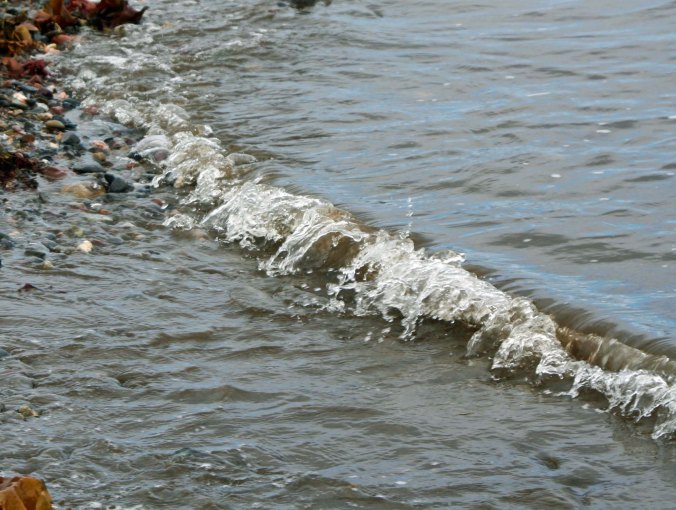
A close up of the three inch high waves. I am sure that storms bring in more serious waves.

A close up of the three-inch high waves looking a lot like their larger cousins.

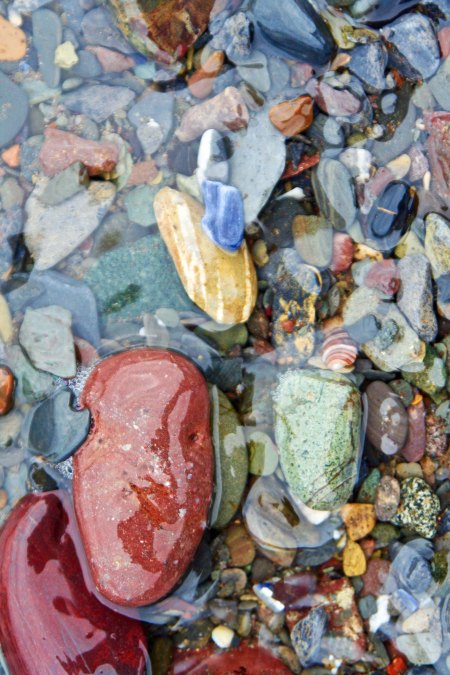
The wavelets were large enough to cover these rocks and bring out their colors.

The wavelets were large enough to cover these rocks and bring out their colors.

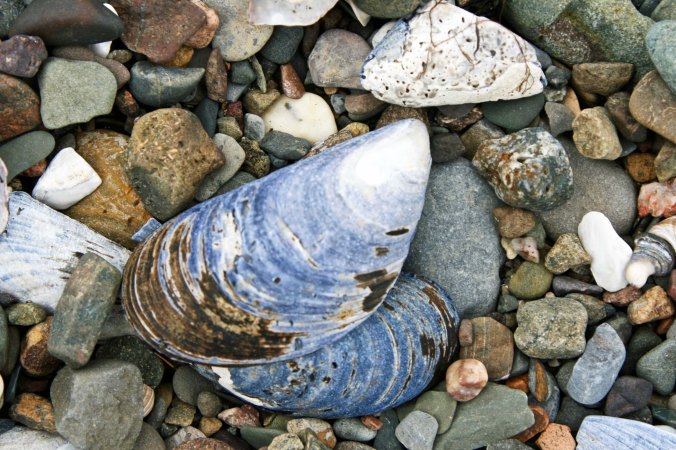
I found these shells much higher on the same beach. They spoke to more serious waves and stormy seas.

I found these shells much higher on the same beach. They spoke to more serious waves and stormy seas.

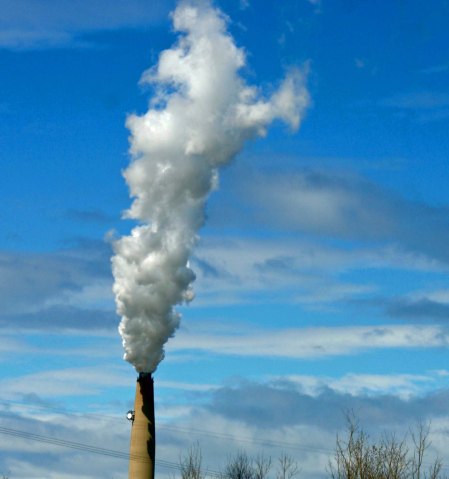
You won't find many photos of industrial plants on my blogs, but I thought this plume was scenic enough to make the cut.

You won’t find many photos of industrial plants on my blogs, but I put my thoughts of air pollution aside long enough to snap this smokestack I found on the coast along NB-134.

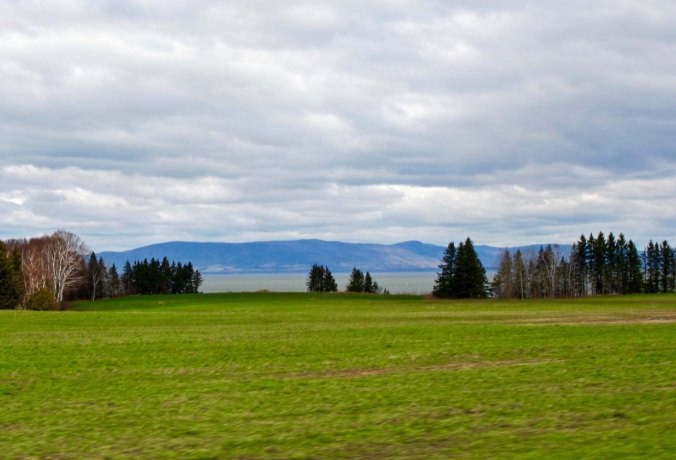
I considered my use of French in New Brunswick as practice for Quebec, which I could see looming in the distance across the Chaleur Bay in the form of the Gaspé Peninsula. It looked suspiciously like another climb — and my suspicions were soon confirmed. As I reached the upper end of the bay, the Chic-Chocs (a Mi’kmaq word for craggy mountains) changed from ‘looming in the distance’ to up close and personal. Once again, I was faced with the Appalachian Mountains, which I had first encountered in my challenging climb up and over the Great Smokies. Would they never end?

Looking across Chaleur Bay at the Chic Choc Mountains on the Gaspe Peninsula, I could see a climb in my future.

Looking across Chaleur Bay at the Chic Choc Mountains on the Gaspe Peninsula, I could see a climb in my future.

Another view along New Brunswick 134.

Another view along New Brunswick 134.

Back on New Brunswick 11, I left behind the flatlands of the coast and entered the province's more mountainous northwest.

Back on New Brunswick 11, I left behind the flatlands of the coast and entered the province’s more mountainous northwest.

The mountainous terrain!

The mountainous terrain!

Fortunately, I was granted a reprieve. The Matapedia River had cut a valley through the mountains and my next road, Quebec Route 132, followed the valley and provided a relatively gentle uphill where I could gawk at the scenery instead of peddling my ass off. (It was pretty much gone anyway.) I said goodbye to New Brunswick, crossed the Restigouche River, entered Quebec, and started my climb.

The Restigouche River widening out before it flows into Chaleur Bay.

The Restigouche River widening out before it flows into Chaleur Bay.

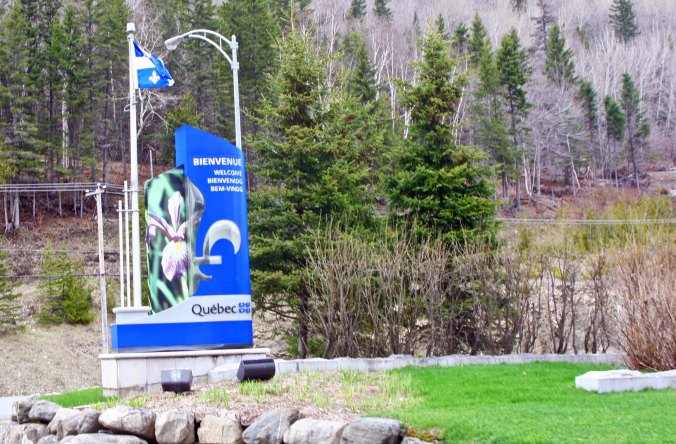
A sign welcomed me to Quebec. I would have many miles of cycling before I left the province.

A sign welcomed me to Quebec. I would have many miles of cycling before I left the province.

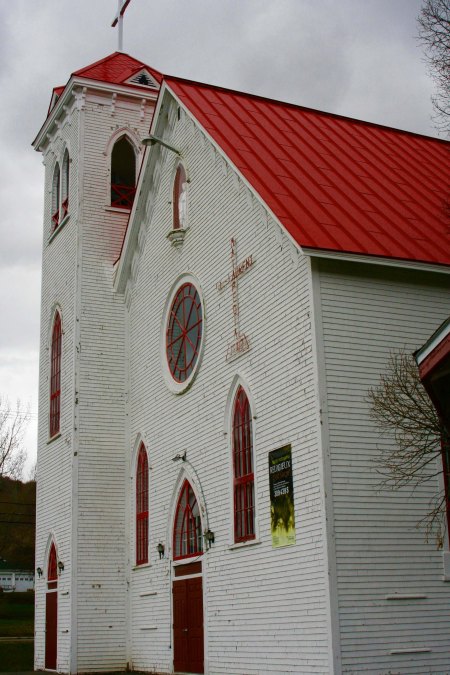
A few miles later, I came to where the Matapedia River flows into the Restigouche. The small town of Matapedia, located just across the river, included a rather impressive Catholic Church for its size, which was another clear sign that I had entered French Canada. Over 80 percent of French Canadians are Catholic, at least in name, and I can pretty much guarantee that there are enough large churches in the province to accommodate everyone. Looking at my map of the region, I was amused to find another reflection of Catholic influence: the majority of the small communities incorporated a saint in their names. I wondered if they ever ran out of saints or fought over which one they were going to get.

The Catholic Church in Matapedia, Quebec was quite large for the small community it served.

The Catholic Church in Matapedia, Quebec was quite large for the small community it served.

The canyon and the river proved to be quite scenic. I dawdled a bit, stopping to check out river overlooks. Eventually, I reached the top and the country opened up. I rode through the town of Amqui, biked around the very large Lake Matapedia, and began my descent toward Mont Joli and the St. Lawrence River. I then continued to follow Quebec-132 south to Rivière-du-Loup where I intended to catch a ferry. (I could have ridden all the way to New York State on the highway.)

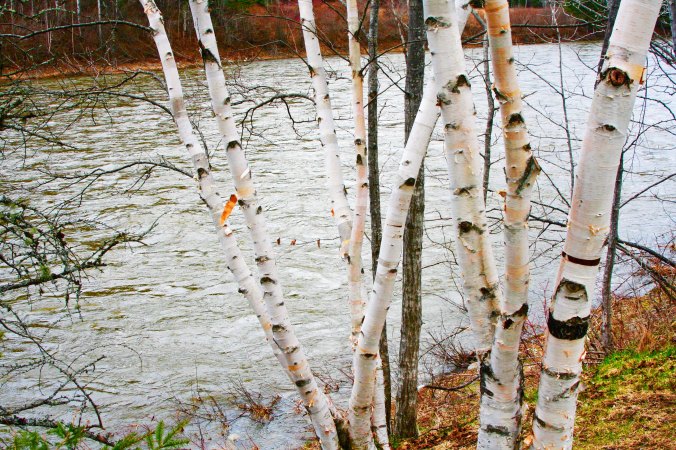
A scenic overlook provided this view of birch trees and the Matapedia River.

A scenic overlook provided this view of birch trees and the Matapedia River. In addition to its beauty, the river is known for its salmon fishing.

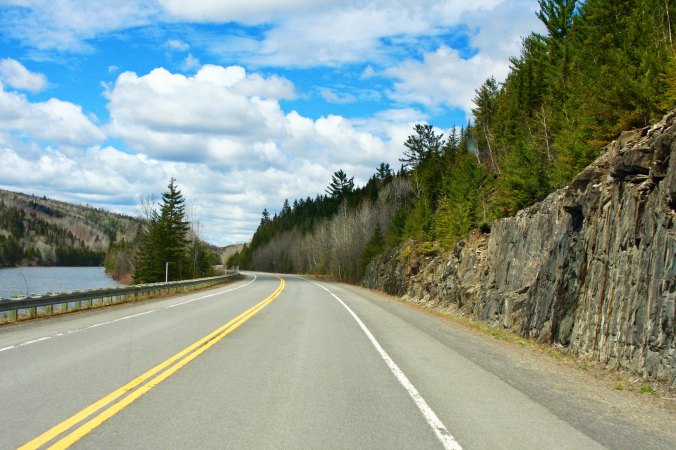
Quebec Highway 132 provided a relatively easy and quite scenic route over the Gaspe Peninsula.

Quebec Highway 132 provided a relatively easy and quite scenic route over the Gaspe Peninsula.

I found large farms, small cities and big churches along the St. Lawrence River. I was curious about how one of the communities, Trois-Pistoles, got its name. Pistole, I learned, is a gold Spanish coin, not a pistol. According to legend, an early explorer lost a silver cup at the location that was worth three of them. In terms of the value, Mr. Cotton’s parrot in Pirates of the Caribbean would say, “12 pieces of eight. Awk! 12 pieces of eight.” Now you know.

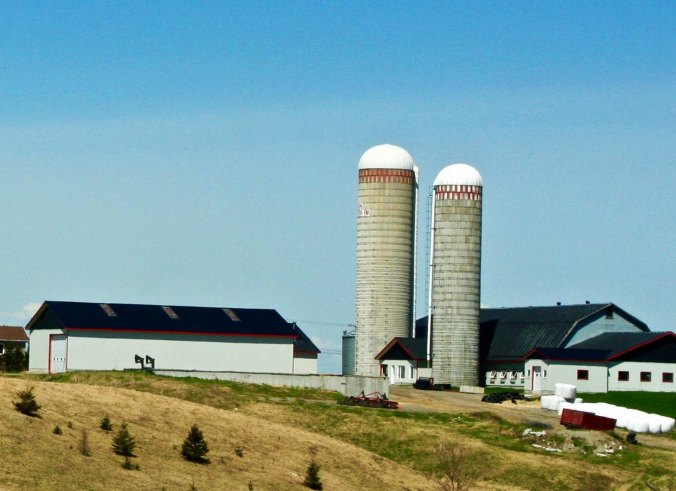
The small farms of the Atlantic Provinces gave way to more industrial size farms in Quebec.

The small farms of the Atlantic Provinces gave way to more industrial sized farms in Quebec.

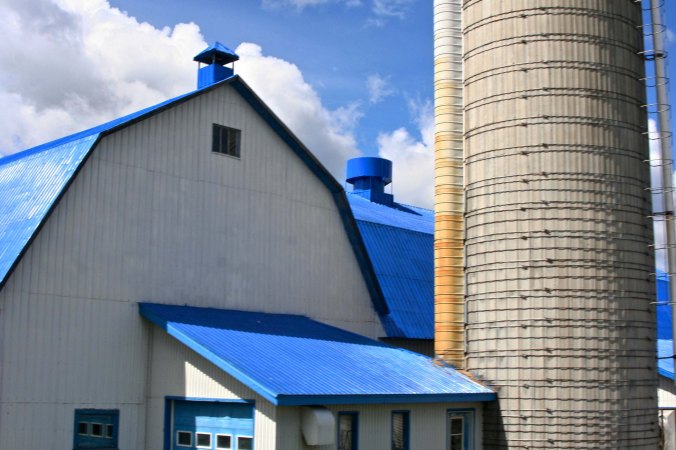
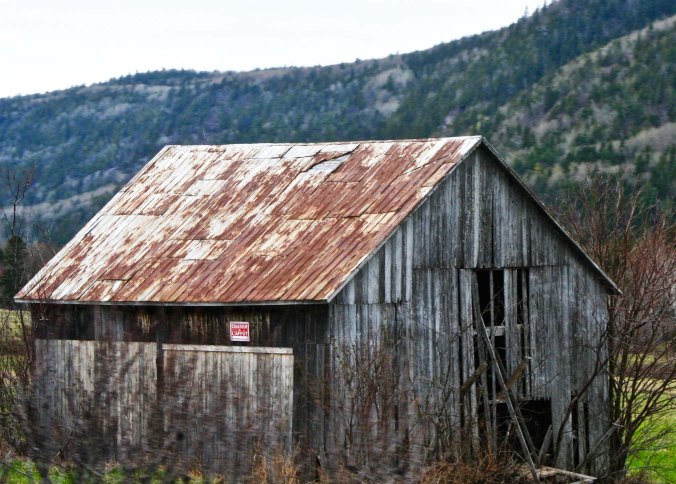
Old barns spoke of simpler times.

Old barns spoke of simpler times.

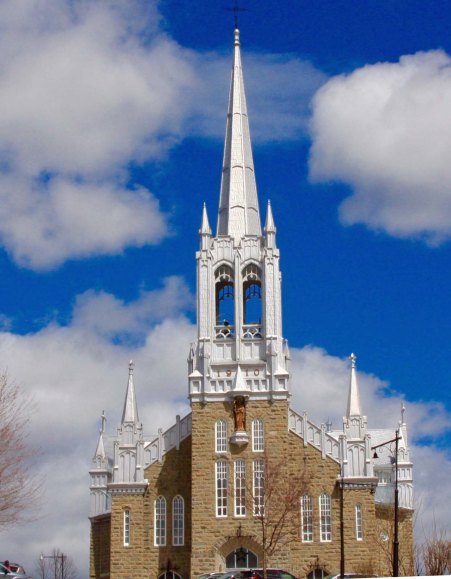
13-catholic-church on St. Lawrence River in Quebec

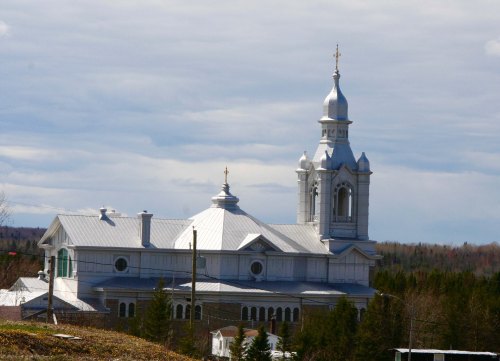
Large Catholic Churches continued to dominate the skyline of communities along the St. Lawrence River in Quebec. Two more follow…

catholic-church along St. Lawrence River

I liked the backdrop provided by the dark clouds with the churches cross caught in the sunlight.

I liked the backdrop provided by the dark clouds with the church’s cross outlined by sun-lit clouds.

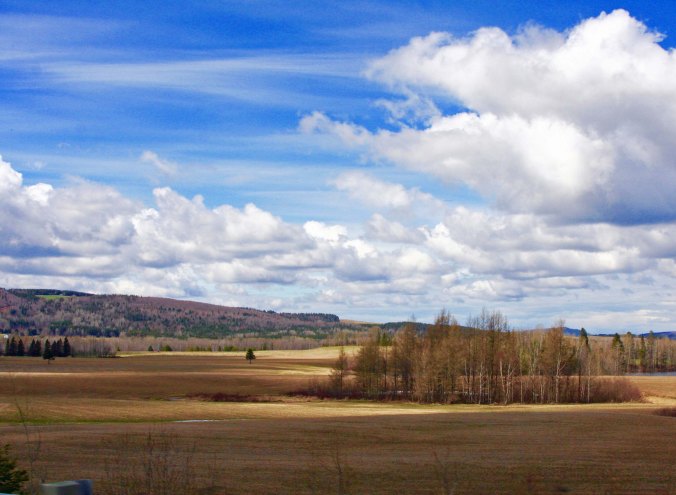
Scenic views along the way included open fields...

Scenic views along the St. Lawrence River included open fields…

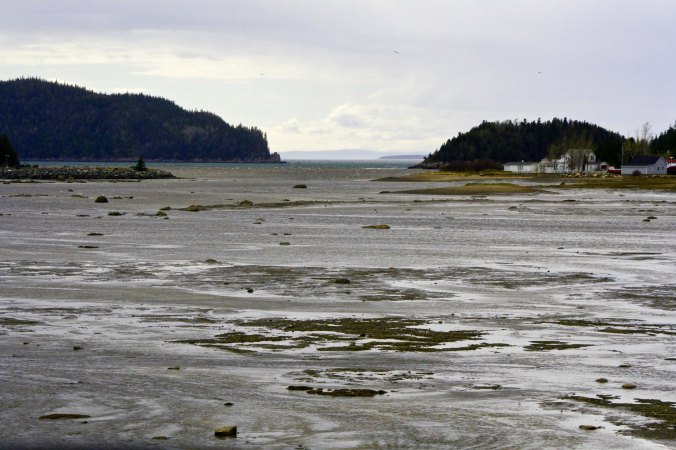
And views of the river as seen on the other side of this mud flat.

And glimpses of the river as seen across this mud flat.

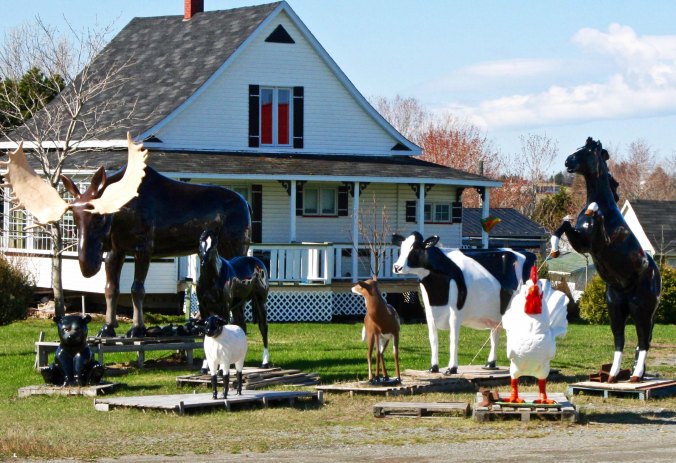
Peggy and I found this unique menagerie on our way to the ferry in

Peggy and I found this menagerie on our way to the ferry in Riviere-du-Loup.

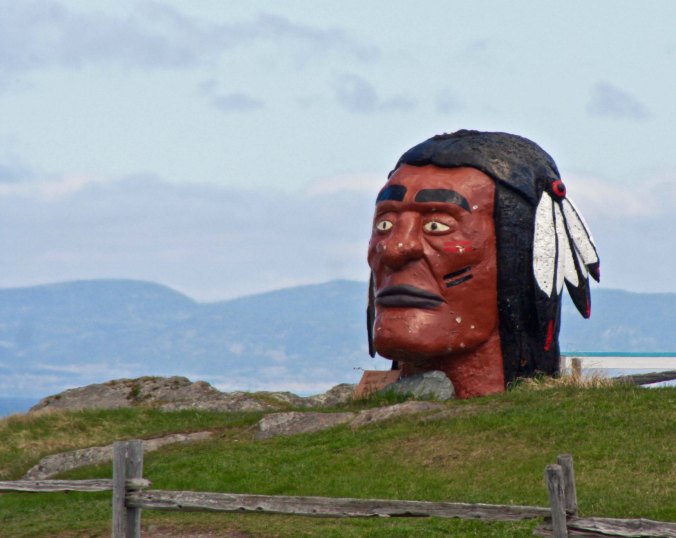
And this somewhat strange sculpture of a First Nation native.

And this somewhat unique sculpture of a First Nation native.

The ferry at Rivière-du-Loup carried me across the St. Lawrence River to Saint-Siméon where I will begin my next post, heading in to the remote wilderness of Northern Quebec. The first night finds me drinking beer while sitting in a van and discussing Quebec separatist politics with three young men and a woman PhD candidate while a storm raged outside.

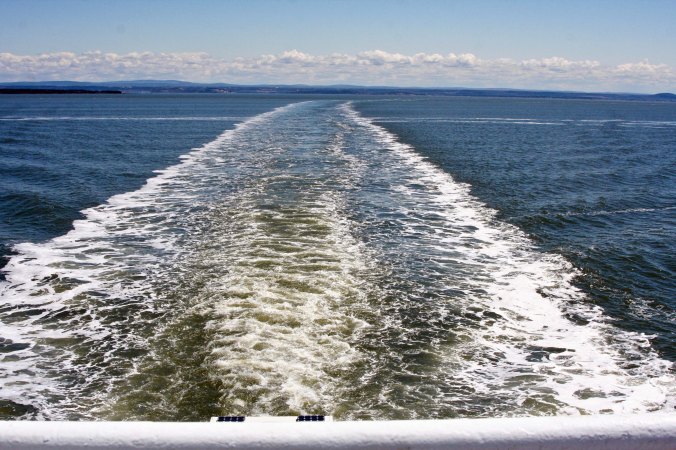
Ferry wake stretching across the broad St. Lawrence River.

Ferry wake stretching across the broad St. Lawrence River.

A Detour to Prince Edward Island… The 10,000-Mike Bike Trek

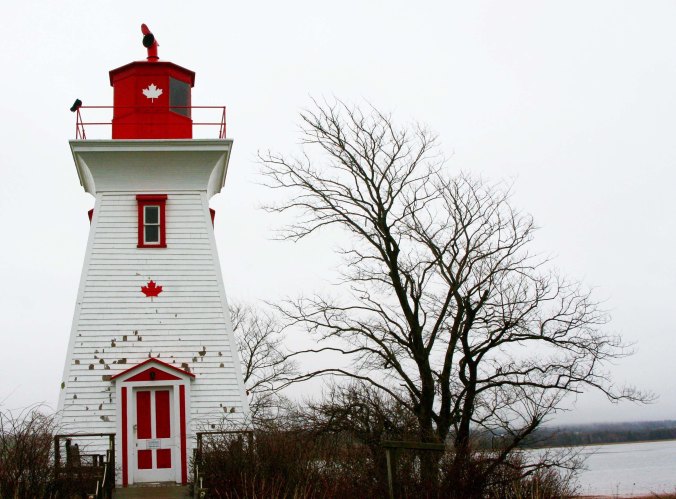
Grey skies detracted from the "picture postcard" look this lighthouse in Victoria, Prince Edward Island is supposed to have, but provided a powerful backdrop for the tree that seems to lean toward it.

Grey skies detracted from the “picture postcard” look this lighthouse in Victoria, Prince Edward Island is supposed to have, but provided a powerful backdrop for the tree that seems to lean toward it. A crow sits on the railing, looking down toward us.

I bicycled past Prince Edward Island (PEI) on my 5000-mile marathon bike ride home— and had regretted it ever since. It was a bucket list item for me, and I was ever so close, merely a ferryboat ride away. But the clock was ticking.

They have built an 8-mile (12.9 k) bridge between New Brunswick and PEI since, and proudly point out that it is the longest bridge in the world— over ice— an interesting clarification that suggests cold and snowy winters. Peggy and I decided we could zip across the bridge, spend a day, and check out what I had missed. Fortunately, it was neither cold nor snowy and the ice had melted, but it was windy and rainy.

A stormy day limited our visibility when we crossed the 8-mile Confederation Bridge to PEI from New Brunswick.

A stormy day limited our visibility when we crossed the 8-mile Confederation Bridge to PEI from New Brunswick. I was ever so glad I wasn’t on my bicycle.

High winds greeted us on the way back. Adjust your speed indeed. To a bicyclist this would be equally worrisome if not more so than the rainy day. I learned that bicyclists and walkers are required to take a shuttle across the bridge— regardless of the weather.

High winds greeted us on the way back. Adjust your speed indeed! To a bicyclist this would be equally worrisome if not more so than the rainy day. I learned, however, that bicyclists and walkers are required to take a shuttle across the bridge— regardless of the weather.

PEI is named after Prince Edward (1767-1820), the Duke of Kent and Strathearn, son of King George III, and the father of Queen Victoria, which is quite a legacy. The French initially named the island Île Saint-Jean and the English followed suit, calling it St. John’s Island. There were too many other St. John’s floating around the Atlantic Provinces, however. Thus Edward got his chance. I don’t have anything against the Prince, or the long-dead Saint for that matter, but I prefer the First Nation, Mi’kmaq name, Abegweit, which translates into land cradled in the waves. It is so much more poetic.

I often find that First Nation or Native American names for places have more magic and power than the current names we have given them. Mt. Denali, the highest mountain in North America, is another example. Originally named Mt. McKinley, after a little-remembered American President, the name has recently been changed back to its Athabascan name, Denali, which means the high one. (See my post on the train trip from Anchorage to Fairbanks, Alaska that Peggy and I made this past spring.)

The names for Prince Edward Island reflect its history, which is quite similar to its neighboring Atlantic Provinces, moving from First Nation to Acadian French to English and finally, expelled Scots. The Gaelic for PEI, by the way, is Eilean a’ Phrionns: the Island of the Prince.

The day we had allowed for our visit led us to focus on one place. We chose the small, south-coast town of Victoria. We couldn’t resist the description by Stephen Kimber, “The Trans-Canada Highway bypassed Victoria. So did the shopping centers and tourist amusement parks. And that— along with its independent-minded citizens— is what makes Victoria the enchanting, picture post card place it is today.” It sounded like our kind of town.

We arrived under dark clouds that were threatening a deluge but somehow held off for our visit. Given the bad weather and the fact that we had arrived before the summer crowds, it appeared that we were the only people in town. Most shops were closed and the “enchanting, picture post card” look was dampened somewhat by the lack of sunshine. Still, Peggy and I found much of interest.

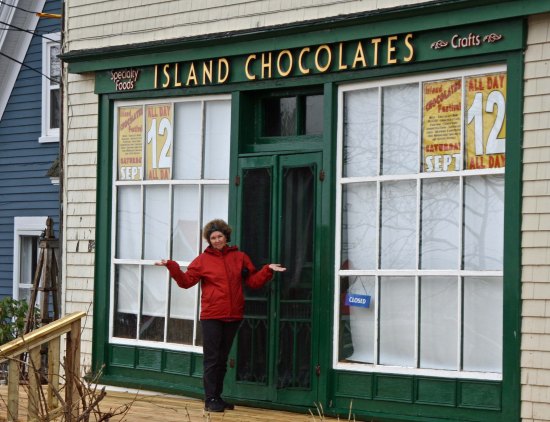
"Where's the chocolate?" Peggy seems to be asking.

“Where’s the chocolate?” Peggy seems to be asking the locked door. Her taste buds had been prepped for it. “Brain food,” she always declares. Fortunately, we were able to find some equally delicious and sinful lobster. Otherwise, it could have been a long night.

Victoria had once been a bustling seaport doing trade with Europe, the West Indies, and the East Coast of the US. Peggy and I walked through the village of precisely laid out streets and Victorian homes that spoke to the earlier times. We were admiring the town’s lighthouse when a man came hurrying out of one of the homes and crossed the road to greet us.

Colorful homes greeted our walk around the town.

Colorful homes punctuated our walk around the town.

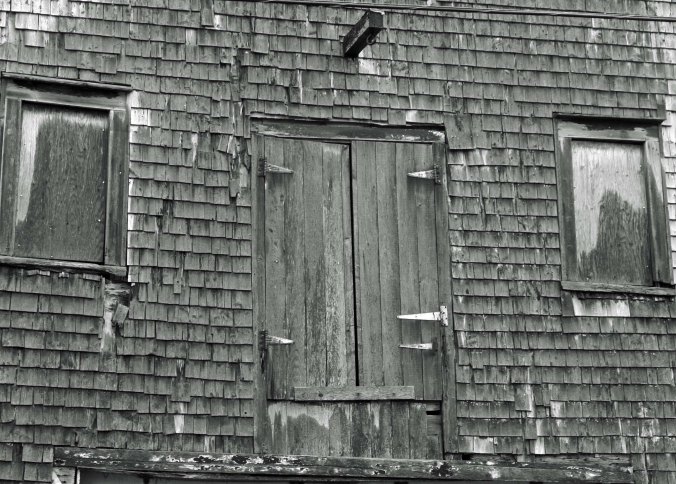
I found these old barn loft doors intriguing.

I found these old barn loft doors intriguing…

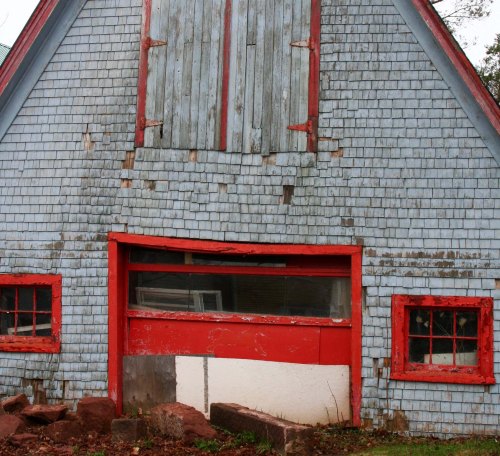
And I admired the imagination of the person who had added red trim to this building of by-gone days.

And I admired the imagination of the person who had added red trim to this building of by-gone days.

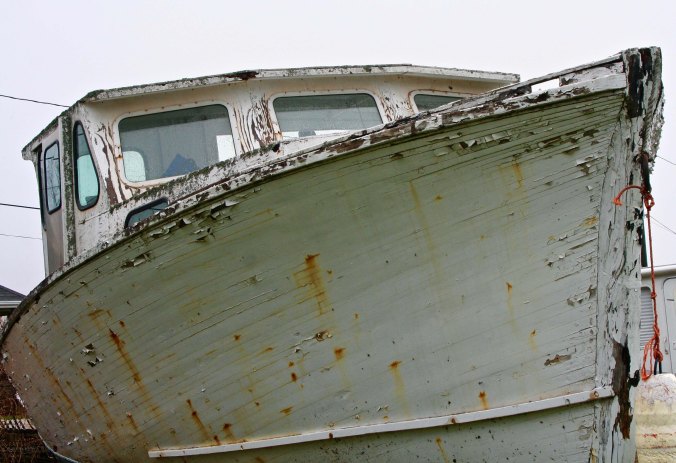
Appropriate to Victoria's seagoing past, we found and admired this retired fishing boat.

Appropriate to Victoria’s seagoing past, we found and admired this retired fishing boat. (Fishing, BTW, is still carried on out of Victoria’s small port. That’s where our lobster came from.)

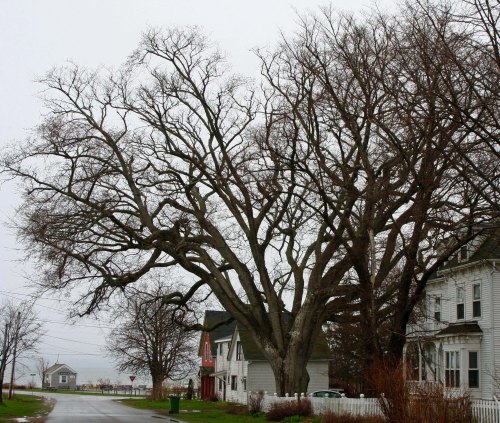
A sign proclaimed that this was the largest tree on Prince Edward Island.

A sign proclaimed that this was the largest tree on Prince Edward Island.

Ben Smith

Ben Smith the “town greeter” of Victoria came bursting out the door of his house and made a beeline for us.

“Would you like to go in the lighthouse?” he asked in a voice that almost demanded we say yes. Naturally we agreed. Of course we wanted to see the lighthouse. He introduced himself as Ben Smith. He was apparently the town greeter, unofficial mayor, and a candle maker— a virtual one-man chamber of commerce, not to mention crow-master. They seemed to be following him.

“Ah yes,” he allowed, “I feed them. Sometimes they go for walks with me, hopping along behind.” We pictured this strange parade walking/hopping down the streets of Victoria and laughed. As Ben hurried off to get the keys, the crows stayed with us, making sure we didn’t slip away.

We were checking out the lighthouse when a man came hurrying across the street and asked if we would like to see in side it.

While Ben went to retrieve the lighthouse key, a crow stood guard on the railing.

Ben turned out to be as knowledgeable as he was nice. We got the A+ Tour, which included climbing into the top of the lighthouse up narrow, steep stairs to check out the light and then butt-scoot around a precipice to go outside for a view of the small town and its harbor. Ben took our photo and provided an ongoing lecture on the area’s history. After all of this, we insisted on seeing his candle shop and bought one as a thank you. We also sat in his ‘lucky chair.’

The light that warned and guided sailors approaching Victoria.

The light that warned and guided sailors approaching Victoria.

Peggy and I standing on the lighthouse look out.

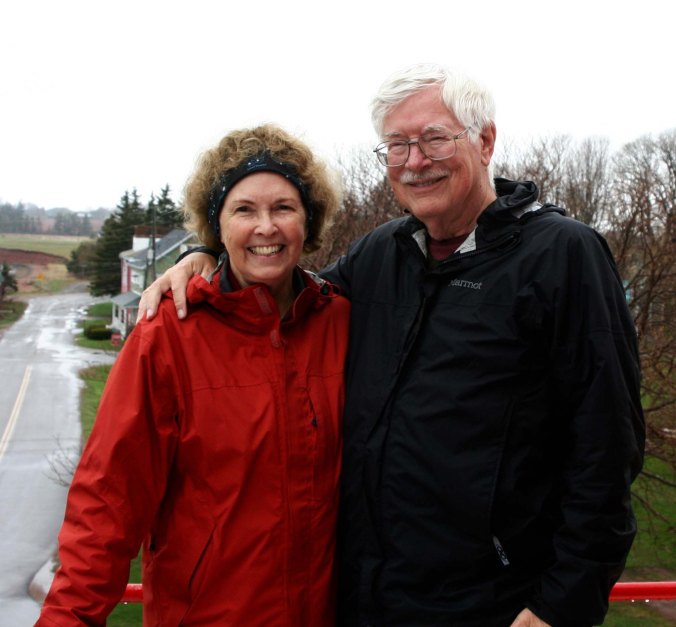
Peggy and I standing on the lighthouse lookout. (Photo by Ben Smith.)

Entering Ben's candle shop...

Entering Ben’s candle shop. Note the horse shoe over the door for luck.

And sitting on the 'lucky chair.'

Peggy sits in the ‘lucky chair.’ Some of Ben’s candles are resting on the table beyond her.

“The man who made this chair and gave it to me was struck by lightning on three different occasions and survived,” he explained. Peggy and I took turns sitting in the chair, just in case. Ben walked us back to our van and insisted we buy a lobster roll from the Lobster Barn restaurant on the dock. It was delicious.

Leaving Victoria, we made our way over to the New Glasgow Highlands Campground in the center of the island, which proved to be quite lovely. Along the way, we got something of a feel for the rural nature of PEI and more of a sense of the island’s beauty. But we knew we were missing a lot. One day is far too short of a time to visit the island. We’ll be back.

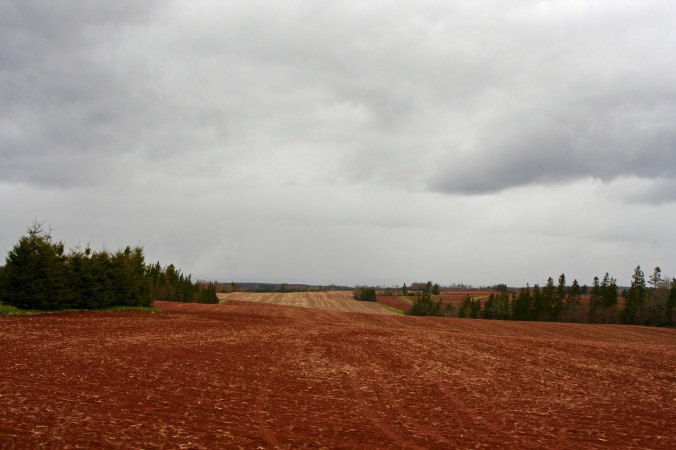
Prince Edward Island thrives off of its small farms where crops such as potatoes are raised. The island is noted for its red soils.

Prince Edward Island thrives off of its small farms where crops such as potatoes are raised. The island is noted for its red soils. Wind breaks surround most farms.

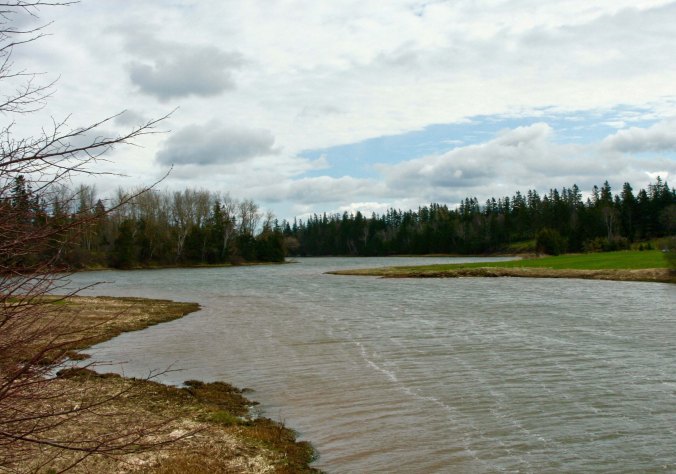
This river reflected the rain the island was receiving. Interestingly, drinking water is primarily ground water pumped up from wells.

This river was brimming with the rain the island was receiving. Interestingly, drinking water is primarily ground water pumped up from wells.

A small bit of sunlight broke through the clouds and illuminated these birch trees.

A small bit of sunlight broke through the clouds and illuminated these birch trees at the campground.

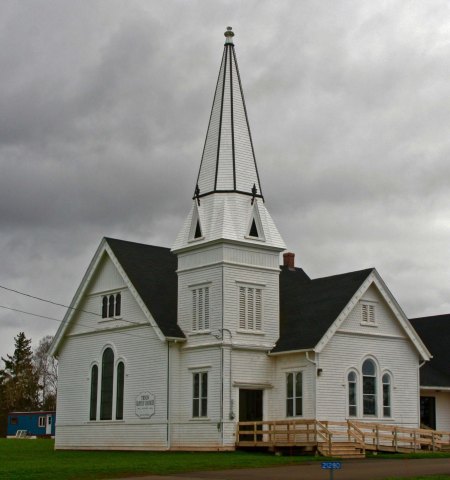
The dark, stormy skies were back the next morning. I liked the drama they created in this photo of a church.

The dark, stormy skies were back the next morning. I liked the drama they created in this photo of a church.

Check this out. Note how similar the church looks to the one above. The other church I photographed was laid out in the same way. I believe the churches were different denominations. Was a common architect involved?

Check this out. Note how similar this church looks to the one above. I believe the churches were different denominations. Was a common architect involved? Does PEI have an agreement on how churches are supposed to look? (Kidding, I think.)

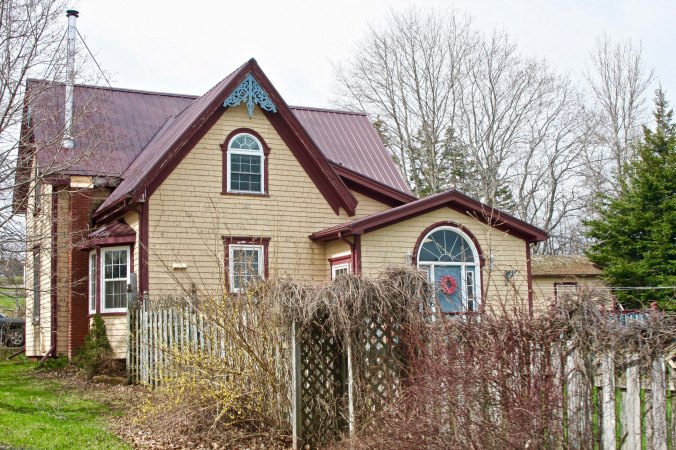
Peggy and I really fell for the charm of the houses we found on PEI.

Peggy and I really fell for the charm of the houses we found on PEI.

Another...

Another…

And a final one.

And a final house, the last photo for this post.

NEXT POST: I am back on my bike route crossing New Brunswick, entering Quebec, climbing up and over the Gaspe Peninsula, and crossing the St. Lawrence Seaway.


Was It the Toughest Climb on the Journey… The 10,000 Mile Bike Trek

I found this spray painted bicycle at the top of Cape Breton's toughest climb and laughed. (photo by Jean Snuggs.)

I found this spray painted bicycle at the top of Cape Breton’s toughest climb and laughed. (Photo by Jean Snuggs.)

Gearing ratios on bicycles are complicated beyond my normal interest in things mechanical. Let’s just say there are high gears for scurrying down mountains, medium gears for flat road travel, and low gears for climbing mountains and fighting headwinds. The more gears you have, the greater your options and ease of travel. The goal is to bike at a speed that is comfortable for your level of physical conditioning while keeping undo pressure off your knees. (Trashed knees can ruin the most pleasant bike trip.) Maintaining cadence, which is the speed you pedal, and knowing when to shift are critical parts of keeping your knees happy. Beginners have to struggle through a steep learning curve, especially in climbing hills and mountains— and yes, I recognize the potential pun.

The reason for this discussion about gears is that it relates to the substantial mountain that Jean, Lindell and I faced when we left our camp at Cape North in Nova Scotia and cycled back up into the Cape Breton Highlands. It was a doozy. We could see it looming in front of us as we cycled through the canyon carved out by the Middle Aspy River. The closer we came, the more it looked like something a mountain climber might enjoy.

One of the steepest climbs along the Cabot Trail in Nova Scotia was climbing up this hill into the Highlands.

The hill loomed in front of us. It was obvious we were in for a climb.

Was it the toughest hill I climbed on my journey? No. It wasn’t nearly as steep as my climb over the Panamint Range in Death Valley. And I had pedaled up several others that were much longer on the Blue Ridge Parkway. What made it so damnably difficult were my low gears— they weren’t as low as Jean’s and Lindell’s! While I was out of the saddle pushing down on my pedals with knee-punishing grit, Jean and Lindell were sitting down and merrily teasing me about my inability to keep up. Talk about a challenge. (grin) Had I been by myself, I would have simply noted the difficulty, complained to the universe, and pedaled on. And I wouldn’t have stopped at the first bike shop I came to and added more gears!

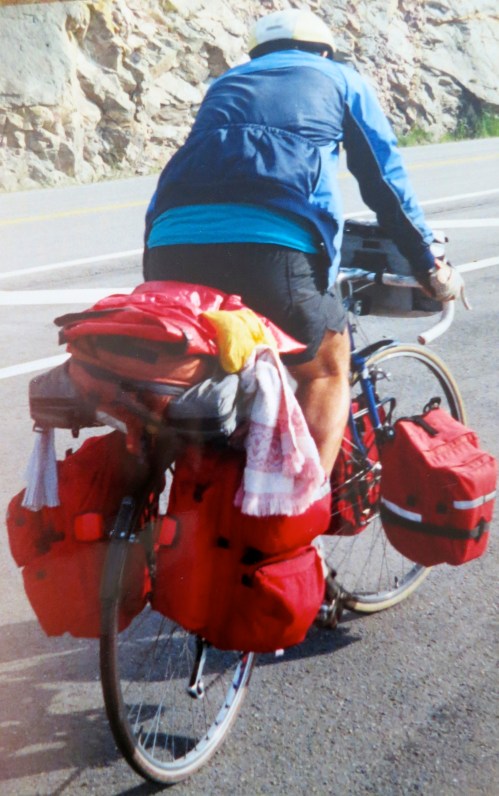
Here I am biking up a mountain in Nova Scotia with 60 pounds of gear.

I posted this photo at the beginning of the series. Jean took it as we crested the mountain. Note the bulging leg muscles that couldn’t keep up with two slight women— even with 5,000 miles of travel.

One of my happiest sights on the 10,000 mile trip: the top of the hill.

One of my happiest sights on any steep climb: the top of the mountain.

Let me note here that Lindell and Jean had a lot more going for themselves than low gears. They had both graduated from the University of Illinois with top honors in physical education and gone on to become highly successful community college track coaches. They had just completed a bike trip that was all about climbing hills. In addition to being bright and competitive, they were as tough mentally as they were physically. They had managed to keep up with me on the flats and downhills as well as busting my butt going up the hill.

Topping the ridge, we came across a bicycle outline that a cyclist had spray painted on the shoulder with the words, “Why?” We laughed in sympathy. Continuing on, we followed the Cabot Trail across the Cape Breton Highlands and down to the small town of Chéticamp on the Gulf of St. Lawrence, leaving the highlands with their Scottish influence behind for flatter, coastal lands with French influence. France had originally named Cape Breton, Île Royale, and had considered the island part of Acadia. We cycled down the coast though villages and cut inland to Margaree Forks where we said goodbye to the Cabot Trail and picked up NS Highway 19 known as the Ceilidh Trail, which we followed for 60 miles back to the Canso Causeway.

A very fast downhill (brakes advised) brought us to this traditional Scotch cabin known as Lone Scheiling. We had flashed by it on our bikes but Peggy and I stopped to admire it.

A very fast downhill after our climb (brakes advised), brought us to this traditional Scottish cottage known as Lone Scheiling. We had flashed by it on our bikes but Peggy and I stopped to admire it.

I took this photo out the window.

I took this photo out the window.

It was surrounded by yellow birch.

The cottage was surrounded by yellow birch.

One of which featured this colorful knot.

One of the trees featured this colorful knot.

A few ghost leaves still flung to branches, waiting for spring growth to push them off.

A few ghost leaves still clung to branches, waiting for the budding spring growth to push them off.

And this creek burbled along beside the cottage.

And this creek burbled along beside the cottage.

Climbing again, we came on this view of the west coast of Cape Breton looking out toward the Gulf of St. Lawrence.

Climbing again, we came on this view of the west coast of Cape Breton looking out toward the Gulf of St. Lawrence.

Signs along the road had been warning us about moose...

Signs along the road had been warning us about moose…

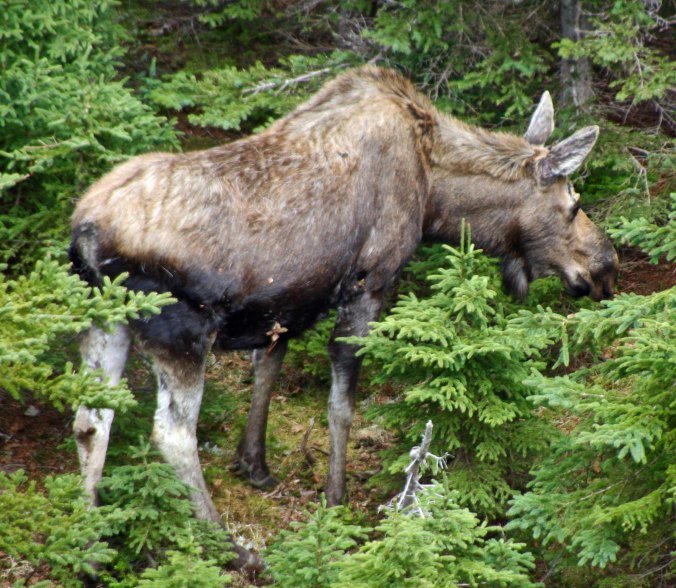
Finally, we got to see one.

Finally, we got to see one. These wonderfully humorous animals can be quite dangerous. You don’t want one chasing you down the road when you are on a bicycle. When I lived in Alaska, a cyclist came around a blind curve on a bike trail and ran smack into one! Fortunately, the surprised moose decided to run away.

The Cabot Trail often requires road work after a rough winter.

The Cabot Trail often requires road work after a rough winter. Peggy and I were entertained by this effort at a traffic stop. Don’t you wonder they got the earth mover up on the hillside?

This impressive cliff was near the road work.

This impressive cliff was near the road work.

Leaving the Highlands, we came on several small communities along the coast where fishing is a major industry. Whale watching is also popular off the coast.

Leaving the Highlands, we came on several small communities along the coast where fishing is a major industry. Whale watching is also popular off the coast.

The Cabot Trail heads inland across much flatter country. Spring waters still flooded this field.

The Cabot Trail heads inland across much flatter country. Spring waters still flooded this field and the grass had yet to turn green. Last year’s cattails can be seen in the left foreground.

I'll finish off my Cape Breton photos with this rather lovely stream.

I’ll finish off my Cape Breton photos with this stream, which spoke to me again of the wild aspect of the island.

Our exploration of Cape Breton was over and my time with traveling companions was drawing to a close. We picked up highway 104 back through Antigonish and on to New Glasgow where Jean and Lindell said goodbye and biked south toward Halifax and their plane. I continued on my lonely journey west, following Highway 6 back to the coast and through towns with wonderful names like Tatamagouche and Pugwash. New Brunswick and new adventures were waiting.

NEXT BLOG: Peggy and I detour to Prince Edward Island, meet the mayor of Victoria, and eat a scrumptious lobster roll.

The Journey Home: Only 5000-Miles left! The Ten Thousand Mile Bike Trek

The road goes ever on. At least it seemed like it on my 10,000-mile bike journey around North America. As I left Nova Scotia and started my journey west, I knew that there would be mountain ranges in my future.

The road goes ever on. At least it seemed like it on my 10,000-mile bike journey around North America. As I started my journey west, I knew that there would be mountain ranges in my future— several of them. This is the Rockies.


“It’s a dangerous business, Frodo, going out your door. You step onto the road, and if you don’t keep your feet, there’s no knowing where you might be swept off to.” J.R.R. Tolkien

I had left my home in California without a clue of what it meant to bicycle 10,000 miles. Like Frodo, I had no idea where I might be “swept off to.” There was even a chance when I reached the East Coast, I might decide to head for Europe and bicycle around the world. Why not? My personal commitments were limited and my job was a maybe. Other people would eagerly step in if I didn’t return.

By the time I reached Nova Scotia, I had gone about as far as I could go east in North America, however, and had enough adventures to last a lifetime— or at least a year.

I had bicycled through rainstorms and hailstorms and snowstorms. I had been up and over three mountain ranges. I had crossed through deserts, swamps, farmlands and forests. I’d been on remote, lonely roads and on highways clogged with traffic. I’d had close encounters with 18-wheelers, cars, dogs, and a coiled rattlesnake. I had met a lot of good folks, and a few not so good. And I had toughened up. I could now bicycle 100-miles in a day with much more ease than I had bicycled 30 miles on my first day out of Diamond Springs.

So I had decided it was okay to head home. Besides, I still had 5,000 miles to bicycle! More adventures waited.

From Nova Scotia, my plan was to bicycle across New Brunswick and into Quebec. (Would my high school French suffice?) I would bike up and over the Gaspe Peninsula, cross the St. Lawrence Seaway by ferry, and then head up into remote northern Quebec before cutting south across Ontario. At Thunder Bay on Lake Superior, I would return to the US and bicycle across Minnesota. I would then bike through North Dakota, Montana, Idaho, and Nevada before finally crossing the Sierra Nevada Mountains again, having gone full circle.

Here are some photos and a map to introduce my homeward journey.

I had been working my way east and north for close to four months. I now had two months of traveling west and south to return home.

I had been working my way east and north for close to four months. I now had a little over two months for traveling west and south to return home if I wanted to renew my contract of running long distance backpacking and bicycle treks. My days of lollygagging were over.

This is the route I followed through the US and Canada. I began and ended my trip in Northern California.

This is the map I originally posted to show my bike trek route around North America. At this point in revisiting my 1989 journey, I am at my farthest point east, ready to head west.

I could depend upon the weather continuing to keep my journey interesting.

One thing I knew for sure about the second half of my trip, I could depend upon the weather to keep my journey interesting…

There would be numerous towns to pass through that promised I would meet interesting people and enjoy unique architecture.

And the people. Whether it would be in the communities I visited, the people I met…

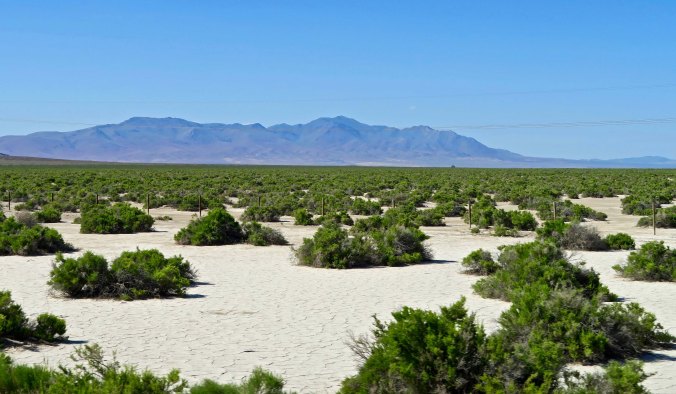
And unique art ranging from murals to this desert sculpture.

Or in the unique art they created.

And history...

I would also continue to be fascinated by the history, as represented by this old barn…

This sculpture of a mountain man...

A mountain man statue…

Or the way people live their mark.

And this hill where high school classes had painted their graduation years for over a century.

And other in distance vistas.

I also knew that the next 5,000 miles would bring unending, beautiful scenery— whether it would be in distant vistas such as this snow-covered mountain range…

Or this desert scene in Nevada.

Or this desert scene…

I had seen much beautiful country in my first 5,000 miles. Much more was to come.

Or in closer views such as this forest of birch,

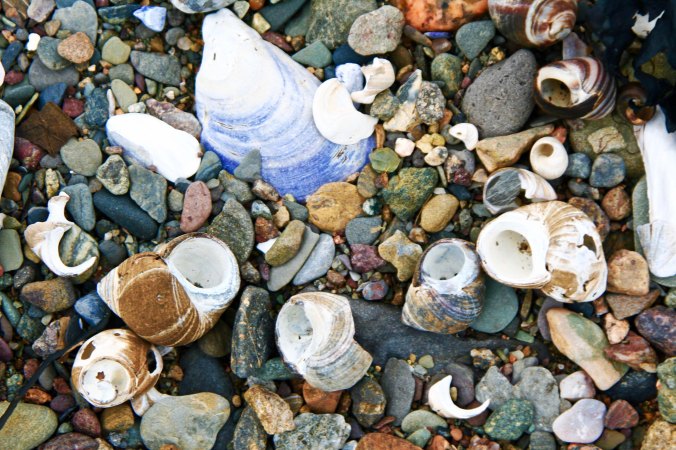
Some would be up close...

These seashells in New Brunswick…

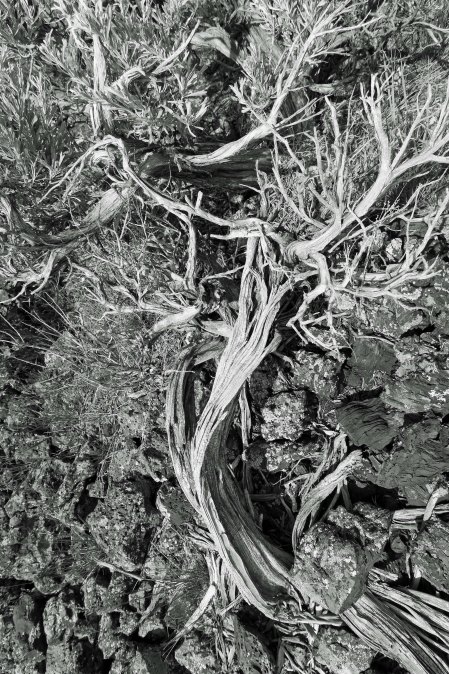
And in these limbs.

A desert shrub…

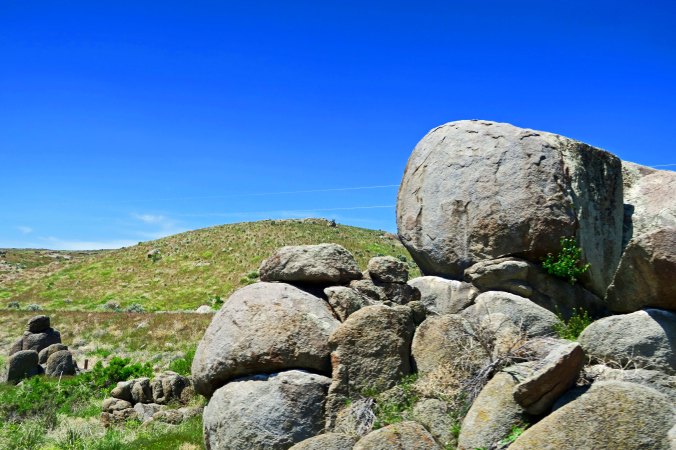
Nevada boulders

These boulders in Nevada…

And rivers...

And numerous rivers…

Idaho river

Idaho River

Montana stream

Snake River, Idaho

Road shot

The road would pull me on through all of it, eager to see what was over the next hill, and never tiring of what I found.

NEXT BLOG: I will finish my trip through Nova Scotia and include a detour Peggy and I made to Prince Edward Island.


Beautiful Canada: Cape Breton and the Cabot Trail… The 10,000 Mile Bike Trek


Rocky shores touched by the Atlantic Ocean are a key element in the scenic beauty of the Cape Breton Highlands along the Cabot Trail.

Rocky shores touched by the Atlantic Ocean are a key element in the scenic beauty of the Cape Breton Highlands along the Cabot Trail.

Cape Breton is a big island: the 77th largest in the world and the 18th in Canada if you are a detail-oriented type of person. Once upon a very long time ago, before the continents got divorced and started drifting away from each other, it was snuggled up to Scotland and Norway on the ancient continent of Pangaea. I feel a certain amount of affinity since my ancient ancestors drifted away from Norway and Scotland, some 300 million years later.

It’s an island of superlatives and you will be hearing a fair number on this post. The tourist bureau should hire me. I’m not alone in my praise. The pretty-picture travel magazine Condé Nast considers Cape Breton to be one “of the best island destinations in the world.” Numerous other magazine and newspaper articles agree.

The Cape Breton Highlands on the northern part of the island are the primary reason for the acclaim. Considered a northern extension of the Appalachian Mountains, the Highlands are noted for their steep ups and downs. I agree; they provided me with some of the most challenging bicycling on my 10,000-mile trip. I was amused when doing research for this post to find a Cape Breton website recommending to motorists, “You may want to check your brakes.” Indeed.

The road around the Highlands is known as the Cabot Trail. It was named after the 15th Century explorer John Cabot who was searching for a way to China on behalf of King Henry VII. (Rumor has it that the King was seeking a new place to send his many wives. Just kidding— the reality is that he wanted to spice up his life, and Asia was the place to go for spices.) Cabot may or may not have landed on the island, but locals are eager to claim him. Most experts believe his landing site was more likely Newfoundland.

There is much more to Cape Breton Island than the Cabot Trail, but the scenic highway is the primary reason that visitors flock to the island.

There is much more to Cape Breton than the Cabot Trail, but the scenic highway is the primary reason that visitors flock to the island. This post and my next one will focus on views along the Trail.

A view form the beginning of the Cabot Trail looking not toward the Cape breton Highlands.

A view from the beginning of the Cabot Trail looking out toward the Cape Breton Highlands.

The Cabot Trail is world-famous. The sign says so. The highway is what I remember most about Nova Scotia. After crossing over the Canso Causeway, I, and my two bicycle-travelling companions, Jean and Lindell, had made a beeline for it. Peggy and I did as well, following the Trans-Canada Highway 105. Since the 185-mile scenic byway travels in a circle (more or less), we had a choice of whether to travel clockwise or counter-clockwise. The travel guides recommend clockwise since going in the opposite direction puts travelers on the outside of the road as it winds along towering cliffs with scary drop-offs. The theory is that most people prefer safety to death-defying edges. But what’s the fun in that? We chose the outside with its dramatic views of the Atlantic Ocean on the east side of the Highlands and Gulf of St. Lawrence on the west. (Besides, I am a veteran of Highway 1 on the California coast, which is much scarier.)

In addition to natural beauty, Cape Breton features both its Celtic and Acadian heritages. Some 50,000 Highland Scots migrated to the area between 1800 and 1850 as a result of the Highland Clearances where small farmers in Scotland were replaced by sheep, i.e. the hereditary aristocratic owners of the land found a better way to make money. Colaisde na Gàidhlig, the Gaelic College, was founded to promote and preserve the Scotch-Irish Gaelic Culture in Nova Scotia. Located on the Cabot Trail shortly after it leaves the Trans-Canada Highway, the college offers courses in Gaelic language, crafts, music, dance and history. Visitors are invited to stop by and see a ceilidh, a traditional Scottish dance, or even buy a kilt.

Scottish sheep photo by Curtis Mekemson.

Furry fellow. An ancestor of the sheep that replaced the Highland farmers. We were happily lost on a remote Scotland road when this guy greeted us. (Photo by Peggy Mekemson.)

The Gaelic College located along the Cabot Trail on Cape Breton Island.

The craft shop of the Gaelic College where everything Gaelic is promoted including the language.

St. Andrew’s Presbyterian Church, located several miles beyond the Gaelic College, reminded me of my own Scotch-Irish (Ulster Scot) family’s heritage— and our journey to the New World in the 1750s. We were Lowland Scots as opposed to the Highland Scots. The Mekemsons had been serious Presbyterians all the way back to the 1600s when Scottish Presbyterians had declared that God and not the King of England was their ruler. This had upset the King considerably. One of my ancestors, John Brown, was even a martyr to the cause. Peggy and I visited his gravesite in Scotland and I did a blog on him. Our family had remained Presbyterians right up until my father had become an Episcopalian (the American equivalent of the Anglican Church), a move that undoubtedly sent generations of our Presbyterian ancestors rolling over in their graves.

St. Andrews Presbyterian Church.

St. Andrews Presbyterian Church.

A close up of the grave of John Brown, the Scottish Martyr shot down in fron of his family in the late 1600s.

The lonely grave of John Brown, the Scottish Martyr shot down in front of his family in the late 1600s.

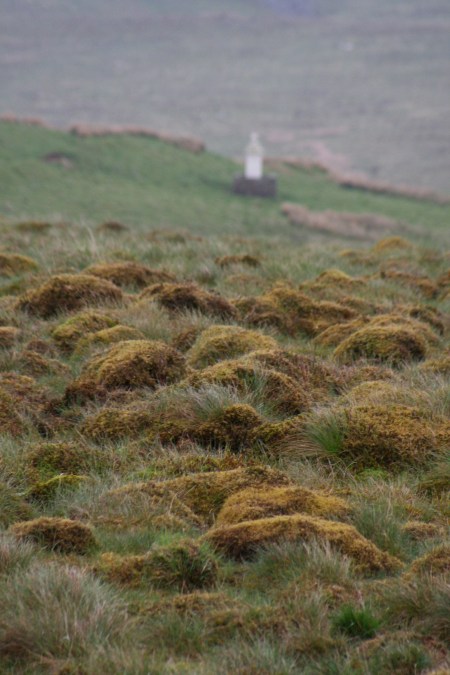
This shot of Peggy captures the isolation of John Brown's Grave, the white speck on the upper left of the photo.

This shot of Peggy captures the isolation of John Brown’s Grave, the white speck on the upper left of the photo.

Anyway, a series of religious, political, and economic factors had sent my ancestors first to Northern Ireland and then on to Pennsylvania and Maryland.

One third of the Cabot Trail runs through the Cape Breton Highlands National Park, which captures the ocean and highland scenery of the area as well as protects the wildlife and plants that call it home. Moose signs along the highway warn motorists of potential automobile-moose confrontations, which are not good for either man or moose. While Peggy and I are always aware of the potential danger, mainly we think of the signs as suggestions we may get to see a moose, always a plus. But that is a story for my next blog, along with the second toughest climb of my 10,000-mile trek and a visit to the Acadian side of the island. Following are several photos I took on the first half of the Cabot Trail.

St. Andrews Provincial Park in the Cape Breton Highlands.

Regional parks, such as St. Ann’s, demanded that we stop and admire them.

Looking the other direction at St. Ann's Provincial Park along the Cabot Trail.

Looking the other direction at St. Ann’s Provincial Park along the Cabot Trail.

Once again Peggy and I found ourselves looking at scenery that sported an early spring look.

Once again Peggy and I found ourselves looking at scenery that sported an early spring look.

Our day along the Cabot Trail varied between sunshine and threatening skies.

Our day along the Cabot Trail varied between sunshine and threatening skies.

We found these boats near the small town of Ingonish.

We found these fishing boats near the small town of Ingonish. Lobster traps are located on the pier.

I liked this lonely structure, which looks like a great place for a picnic.

I liked this lonely structure, which looks like a great place for a picnic.

And these quiet waters.

And these quiet waters.

Climbing up into the Highlands provides scenic views of the Atlantic coast.

Climbing up into the Highlands provides scenic views of the Atlantic coast.

A close-up.

A close-up.

Blue skies color the Atlantic Ocean blue.

Blue skies color the Atlantic Ocean blue.

The Cabot Trail moves between the Highlands and Coast. Give a choice between long sandy beaches and rocky coasts I will always prefer the rocky coasts, unless I happen to be on a tropical island.

The Cabot Trail moves between the highlands and coast. Given a choice between long sandy beaches and rocky coasts, I will always prefer the rocky coasts, unless, of course, I happen to be on a tropical island.

Another view.

Another view.

The cool, windy day fluffs Peggy's hair

The cool, windy day fluffs Peggy’s hair

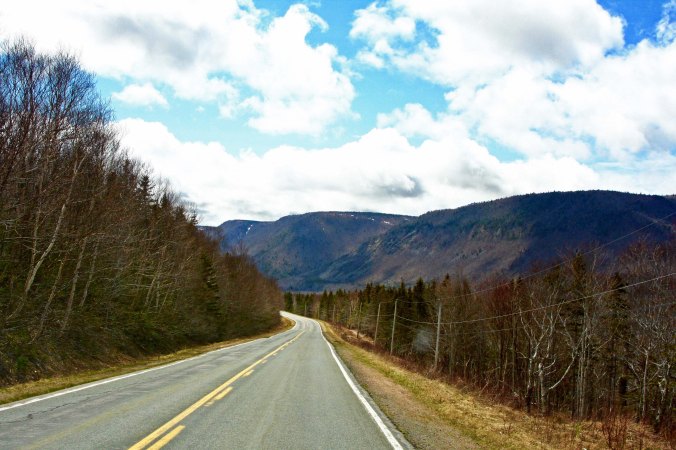
The road leading down to Cape North, which will be the farthest point east I reach on my bike trip.

The road leading down to Cape North, the farthest east I would travel.

This church at North Bay marked my turning point. After this, I would be heading home.

This church at Cape North marked the turning point in my 10,000 mile trek. After this, I would be heading home.

Shortly after we left the church, Peggy and I came on these two bicycle tourists. How appropriate, I thought. The dark cliffs looming in the background would provide the second hardest climb in my whole trip, but that's a story for my next blog.

Shortly after we left the church, Peggy and I came on these two bicycle tourists. The dark cliffs looming in the background would provide the second hardest climb in my whole trip, but that’s a story for my next blog.