A Truly Unique Set of Holiday Lights… The North Coast Series

Grey whale featured in Holiday Lights display at Shore Acres State Park in Coos Bay, Oregon.

Not your parents’ (or mine) display of holiday lights! This grey whale rising out of the ocean had to be at least 30 feet long. Over 10,000 lights provided a back drop.

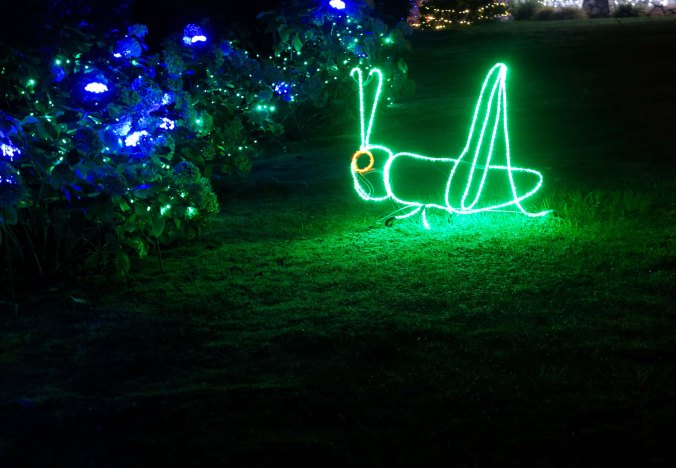
A giant grey whale rose out of the water to a backdrop of ten thousand lights. It wasn’t quite what I had expected when Peggy and I drove over to Coos Bay, Oregon to check out the Holiday Lights display at the Shore Acres State Park. I thought we’d probably see sheep, cows, donkeys and a baby J or two. There might even be deer. They’ve become a common fixture on people’s lawns at Christmas. But frogs leaping into ponds, pelicans flying across the sky, a parade featuring an earthworm, turtle, grasshopper and snail— no way! And these were just a few of the sky, sea and land creatures on display, all created out of holiday lights.

This green fellow was part of a parade that included a worm, two turtles, and a snail, that was going the wrong way, slowly, I assume.

This green fellow was part of a parade that included a worm, two turtles, and a snail, that was going the wrong way, slowly, I assume.

This had to be one happy lady bug working three flowers at once. Aphids beware!

This had to be one happy lady bug working three flowers at once. Aphids beware!

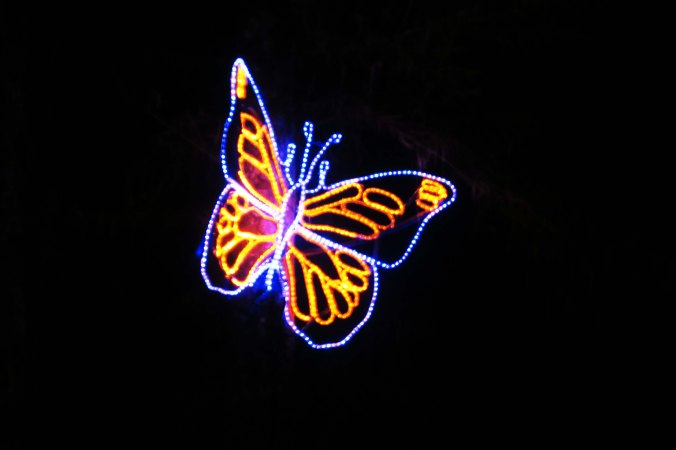
There was a butterfly...

There was a butterfly…

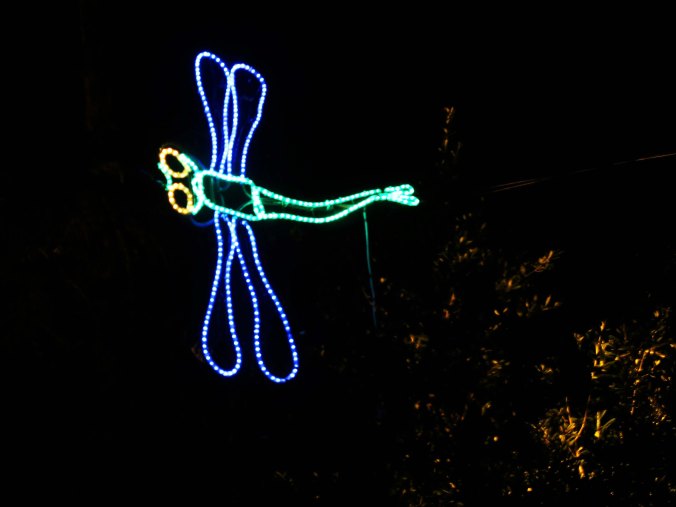
Dragonfly at Shore Acres Park.

A dragonfly…

Holiday frogs at Oregon's Shore Acres State Park.

And frogs.

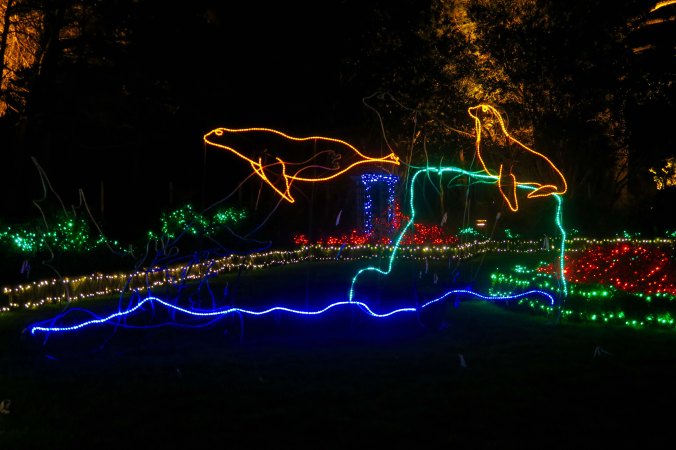
Seals dive int the water at Oregon's Shore Acres' State Park Holiday of Lights display.

Seals leaped into the water. They actually moved and made a splash. As did frogs, and whales.

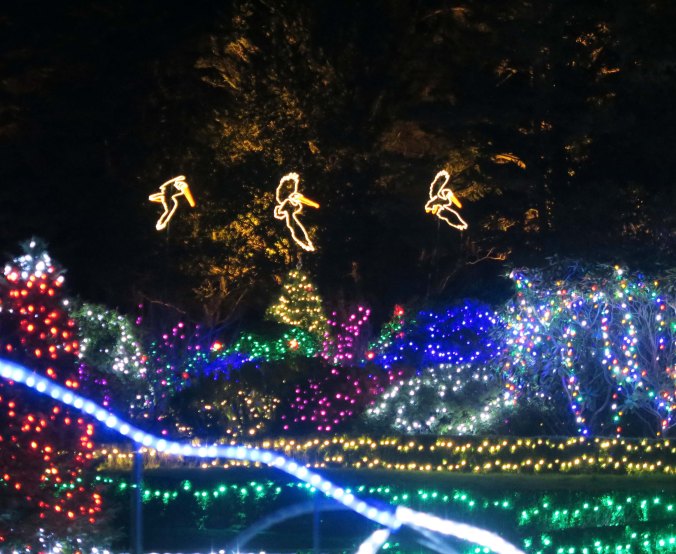
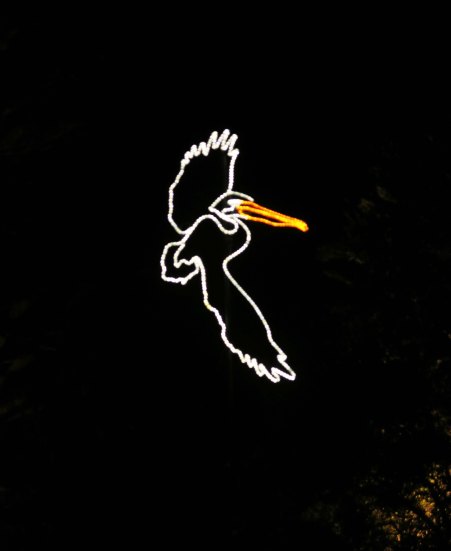
Pelicans at Oregon's Shore Acres' State Park Holiday of Lights display.

Pelicans flew across the sky.

Pelican at Oregon's Shore Acres' State Park Holiday of Lights display.

A close up.

Crab and octopus at Oregon's Shore Acres' State Park Holiday of Lights display.

There was a crab and an octopus…

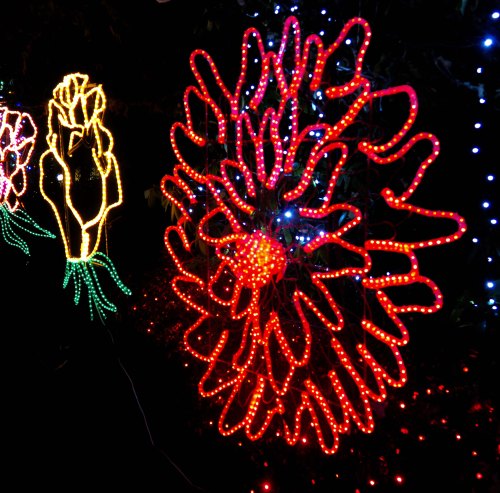
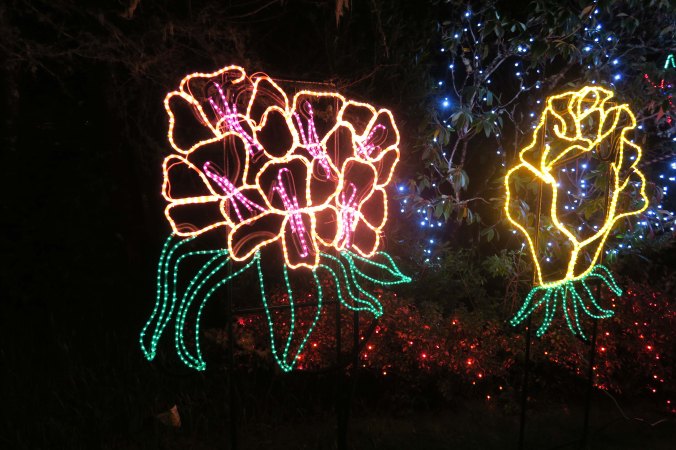
Flowers at Oregon's Shore Acres' State Park Holiday of Lights display.

And beautiful flowers…

More flowers at Oregon's Shore Acres' State Park Holiday of Lights display.

More.

Animals look over fence at Oregon's Shore Acres' State Park Holiday of Lights display.

A porcupine, raccoon, deer and rabbit peeked over the parks fence to check out the display.

It wasn’t all about the wildlife you normally find on the Oregon coast, however. Some 320,000 thousand lights decorated the hundreds of shrubs that turn Shore Acres into a floral delight during the spring, summer and fall. There were lots of Christmas trees. A choral group sang traditional carols. The historic garden house on the site reminded me of fantasy gingerbread homes. And Santa was there! So what if he happened to be taking a bubble bath with a tiger and a moose. Fortunately, he was wearing his long johns. Old men with round bellies that shake like bowls full of jelly shouldn’t be seen in public with their clothes off.

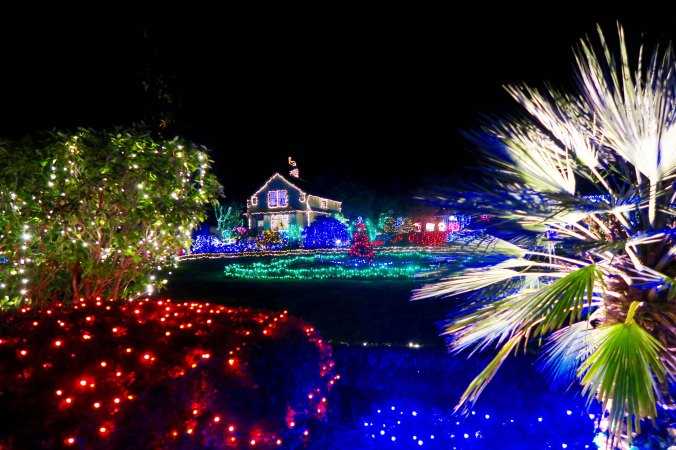
Holiday lights at Oregon's Shore Acres' State Park Holiday of Lights display.

A small pond at Shore Acres reflected some of the 320,000 lights.

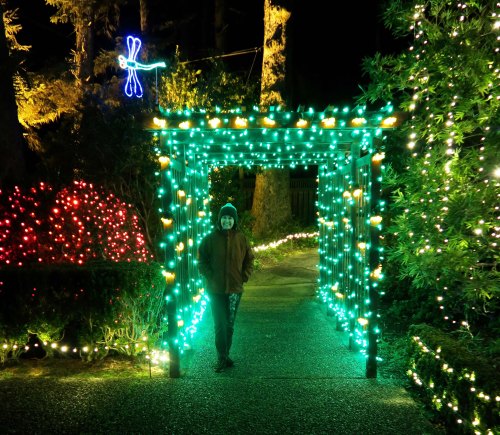
Green lit arbor and Peggy Mekemson at Oregon's Shore Acres' State Park Holiday of Lights display.

Peggy was turned green by an arbor while the dragonfly hovered above her head.

Gingerbread house at Oregon's Shore Acres' State Park Holiday of Lights display.

The historic garden house looked like a gingerbread house.

Another view of the house. A pelican, instead of a stork, hangs out on the chimney.

Another view of the house. A pelican, instead of a stork, hangs out on the chimney.

The Shore Acres Holiday Lights display is a tradition that goes back to 1987 when Friends of Shore Acres decided to ‘string a few lights’ for the holiday season. It’s been growing ever since, both in number of lights and number of people who visit. This year, the visitors should top 50,000. Volunteers do all of the work. Lights are donated.

Shore Acres Botanical Garden

During the spring, summer, and fall, Shore Acres turns into a beautiful botanical garden, reminiscent of English gardens. This is the ‘Gingerbread house.’ All of the plants were covered in lights for the holidays. (Photo by Peggy Mekemson)

Shore Acres Botanical Garden, Coos Bay, Oregon

Rhododendrons at Shore Acres State Park. Two of thousands of beautiful flowers.

Peggy and I discovered Shore Acres two years ago when we were staying at Sunset Bay State Park, which is located a mile down the road. The flower garden reminded us of England. As soon as I saw a newspaper article about its Holiday Light display, I knew we had to return. Peggy lives for holidays. Since we were heading back East for Christmas, she wouldn’t have the opportunity to break out her seven large boxes of decorations and turn our house in to a museum of Christmases past, present and future. I figured the lights provide a substitute. They did.

With Santa, Peggy and I would like to wish each of you a joyous Holiday and a very Happy New Year.

With Santa and friends, we wish each of you and your families a Joyous Holiday and a very Happy New Year. —Curt and Peggy

NEXT BLOGS: I jumped ahead in our recent North Coast travels to include the Shore Acres display for Christmas. My next three posts will serve as a wrap up for 2016 featuring some of our favorite photos from the year. Twelve of them we used in our annual family calendar. In January, I will return to our drive up Highway 101 to be followed by our visit to Sunset Bay State Park in Coos Bay, which, in its own way, is as special as Shore Acres.

There’s an Elk! There are 300! …The North Coast Series

This magnificent fellow was probably the bull of the herd, and proud of it!

This magnificent fellow was probably the bull of the herd, and proud of it! He was surrounded by some of his lady friends.


A blog quickie…

Peggy gets excited when she sees elk. So it’s not surprising that she multiplied the number she saw by 10. I can also get quite excitable. Roosevelt Elk are the largest members of six subspecies of elk in North America. Bulls can weigh up to 1100 pounds! Once, they were close to extinct in California. Today, there are seven herds in and around the Redwoods. The largest herd numbers 250. Most are closer to the size we saw. It was conveniently located in someone’s yard. I drove in so Peggy could take photos.

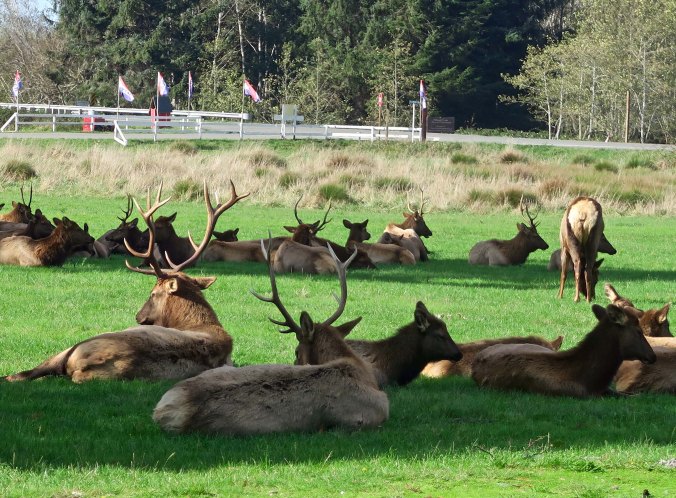
Elk herd near the Redwoods in Northern California.

There were probably 30 elk altogether.

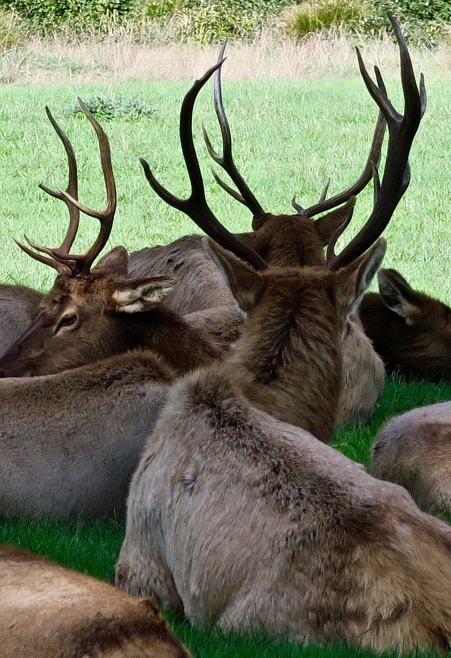
I was impressed by the antlers shown here...

Peggy was impressed by the antlers shown here…

elk with large racks near the Redwoods in Northern California

So she took a close up. Given the season, I figured that Santa could turn to these fellows if his Reindeer refused to fly.

Rudolph the Red Nosed Reindeer on strike. Xmas card by Curtis Mekemson.

Red-nosed reindeer goes on strike. (card by Curt Mekemson.)

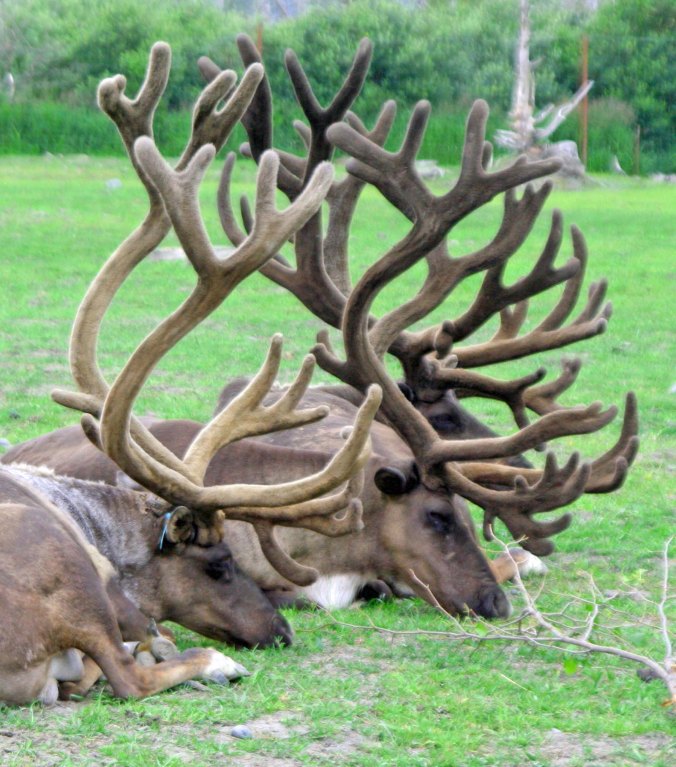
The real deal: Alaskan Caribou. (Photo by Peggy Mekemson.)

The real deal: Alaskan Caribou. (Photo by Peggy Mekemson.)

If this guy were a blacktail deer, we would call him a spike. I don't think I would want him mad at me!

If this guy were a black tail deer, we would call him Spike. I don’t think I would want him mad at me! The marks on his back suggest he has been nibbling at itches.

This doe was quite beautiful...

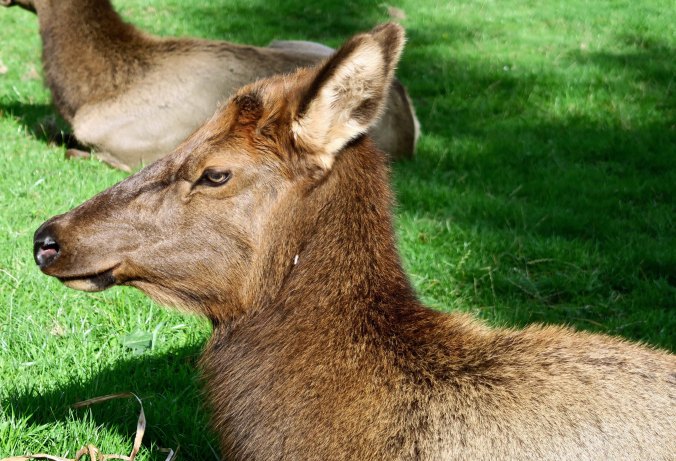
This cow elk was quite beautiful…

So we will end this short post with a close-up.

We will end this short post with a close-up of her. Lovely eyes!

NEXT BLOG: The Christmas lights of Shore Acres State Park

Long Beaches, Redwoods and Rocky Points on California 101… The North Coast Series

Treasures are often found by those who wander off from well-tred paths. This bit of driftwood I found on Clam Beach north of Eureka, California is an example.

Treasures are often found by those who wander off from well-worn paths. I found this bit of driftwood on Clam Beach north of Eureka, California. I am forever taken by grains and texture in wood. What better way to find them!

Far too often, travel consists of hurrying through a number of must-see stops. I understand this. Some places are rightfully renown for their beauty, history shopping, etc., and time is limited. So you have a check-off list and a timeline. If you are on an organized tour, your travel is even more directed and options for wandering are close to nil, which is one of the reasons that I rarely travel that way.

Sometimes I like to travel without an itinerary and stop willy-nilly when something captures my attention. I realize that I run the risk of missing something worth seeing, but I also open the door for new adventures. When Peggy and I visited California’s North Coast in October, Mendocino was our must see stop. We even had a reservation, which is rare for us.

After Mendocino, it was wander time. We followed Highway 1 as it wound its way up the coast and then cut across the coast range to Highway 101 at Leggett. We zipped up 101 to Eureka so we would have more time on the coast north of the city. Eureka, BTW, was apparently what Archimedes, the Greek mathematician, shouted when he discovered a way of determining the purity of gold. It means, “I found it!” California 49ers shortened the concept to mean, “I found gold!” It became the state motto.

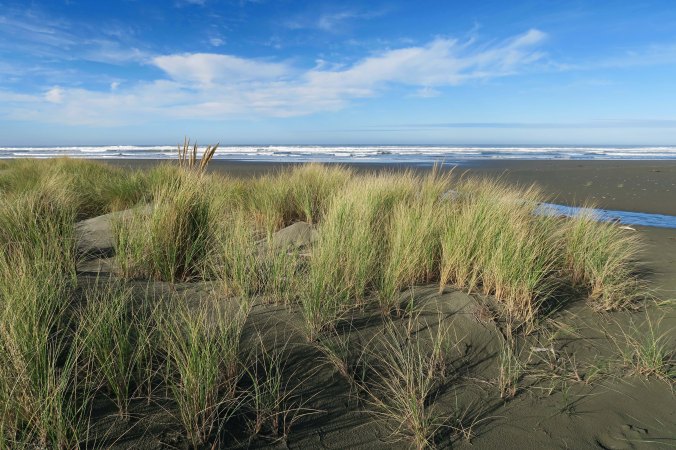
Our first stop above Eureka was at Clam Beach for no other reason than we hadn’t been there before. What we discovered was something of a rarity for the North Coast, a beach that went on and on. A small trail wound its way through brush, eventually leading us out to the beach.

Clam Beach off of Highway 101 north of Eureka, California.

We found golden Dune Grass…

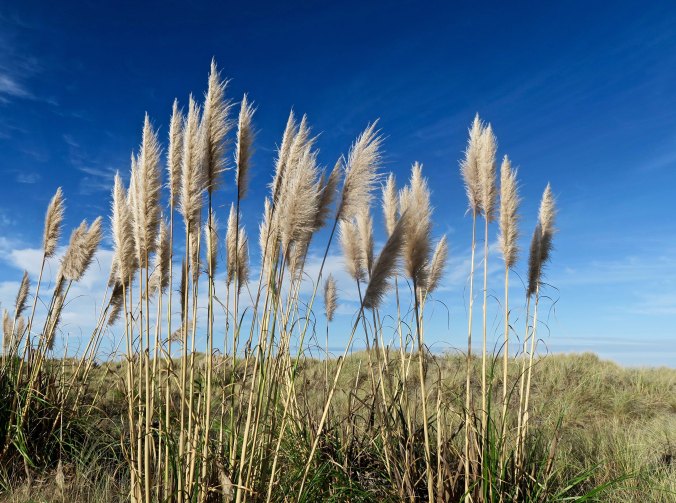
Pampas Grass growing on the California Coast.

And golden Pampas Grass. Its beauty is countered somewhat by the fact that it is an invasive plant from South America, often replacing native plants.

Pampas Grass on Clam Beach in Northern California.

For fun, I shot the same Pampas Grass backlit the sun.

And then had Peggy stand next to it for perspective.

And then had Peggy stand next to it for perspective.

A final shot of Clam Beach.

A final shot of Clam Beach with golden Dune Grass and Pampas Grass in the distance.

Usually when we are in this part of California, we spend some time in the Redwoods. Our views this time, however, were limited to what we saw from the road, except for one ancient giant we found at a rest stop. It had burned years and years ago, leaving nothing but a charcoal remnant of its once magnificent self. Still, it stood as a testament to the miracle of life…

This ancient victim of fire amused me when I noticed that its top was creating a new forest!

This ancient victim of fire amused me when I noticed that its top was creating a new forest!

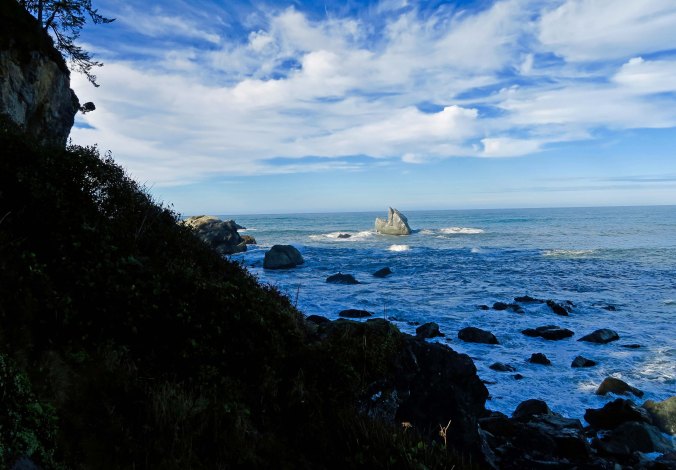
Patrick’s Point State Park returned us to the rocky shoreline I associate with the North Coast. Peggy and I followed a muddy path down a steep cliff to get to the action!

Patrick's Pt. State Park north of Eureka, California on Highway 101.

Hiking down to the ocean at Patrick’s State Park, we spotted a rock that was lit up by the sun.

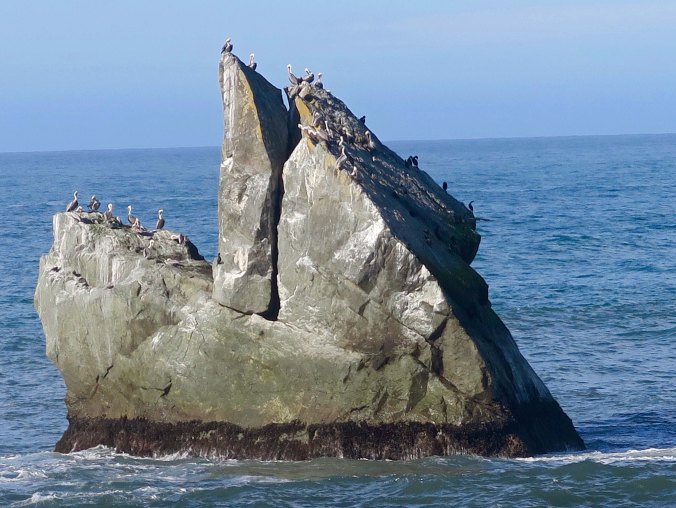
Close inspection showed it to a home for California Brown Pelicans.

Closer inspection showed it to be a home for California Brown Pelicans.

Edging my way around a cliff provided another view.

Edging my way around a cliff provided me with another view.

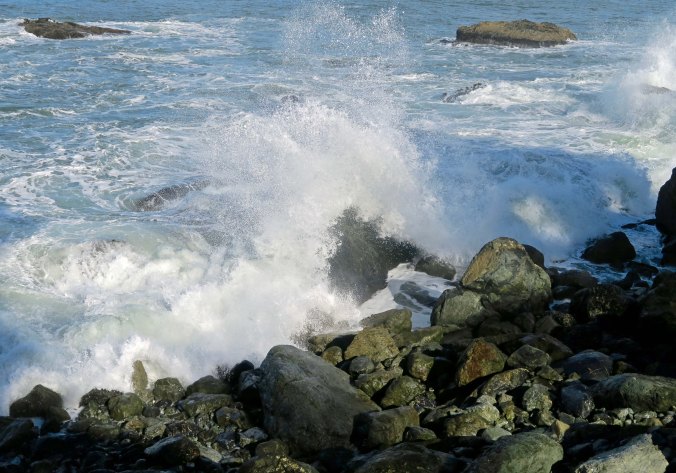
Waves breaking at Patrick State Park north of Eureka and Arcata, California.

Including this…

And this.

And this. I really liked the dark and light contrast, along with the massive rocks.

Inching my way back to where Peggy was, the ocean waved goodby.

When I was inching my way back to where Peggy was, the ocean waved goodby.

NEXT BLOG: “There are elk!” Peggy yelled, almost causing me to crash. “There must be 300!”

Mendocino, California: A Favorite Town… The North Coast Series

A large, carved wooden duck that Peggy and I found gracing a wood-working shop on one of Mendocino's colorful streets.

A large, carved wooden duck that Peggy and I found gracing a wood-working shop on one of Mendocino’s colorful streets.

I’ve always been a fan of rugged, rocky coastlines. I’ve been fortunate in my life to live near the northern coast of California, which I define as starting down in Big Sur country and making its way up to the Oregon Coast. When I lived in Sacramento, summer escapes usually meant the Sierra’s, but winter escapes always meant the coast. Mainly I played along the 300-mile area of coast stretching between Monterrey/Carmel and Mendocino/Fort Brag on California’s beautiful, cliff-hanging Highway 1.

A view of the Mendocino Headlands, which host the town of Mendocino. The steep, rocky cliffs of Northern California, Oregon and Washington make up my favorite coast lines.

A view of the Mendocino Headlands, which host the town of Mendocino. The steep, rocky cliffs of Northern California, Oregon and Washington make up my favorite coast lines.

Now I live in Oregon, I’ve begun to explore the Oregon Coast. Over the years, I’ve also ventured along the Washington coast on occasion and made several trips to Canada’s Vancouver Island.

Last year, I wrote a number of blogs on both the California and Oregon coasts. I did a solo trip along the Oregon Coast while Peggy was off doing grandmother duty in Alaska and then a solo trip north from San Francisco while she was traveling to England with her sister, Jane.

This fall, my side-kick was with me on a couple quick trips: one visiting the town of Mendocino and then traveling north, following Highways 1 and 101 back to Southern Oregon. The second was over to Coos Bay, Oregon and Sunset Bay State Park. My next few blogs will cover these trips. Again, since Peggy and I are off in Connecticut and North Carolina visiting with our kids and grandkids for Christmas— plus making a side trip to Boston— these will be mainly photo blogs.

Mendocino is one of my favorite coastal communities. Founded as a logging town, it was discovered by artists in the 50s and 60s and today supports a thriving tourist industry. Through it all, it has maintained much of its original charm. Quaint buildings, lots of art, a great bookstore, and a magnificent coast all add to its ambience. If you would like to learn more about the town and see more photos, go here for the blog I wrote last year about the town.

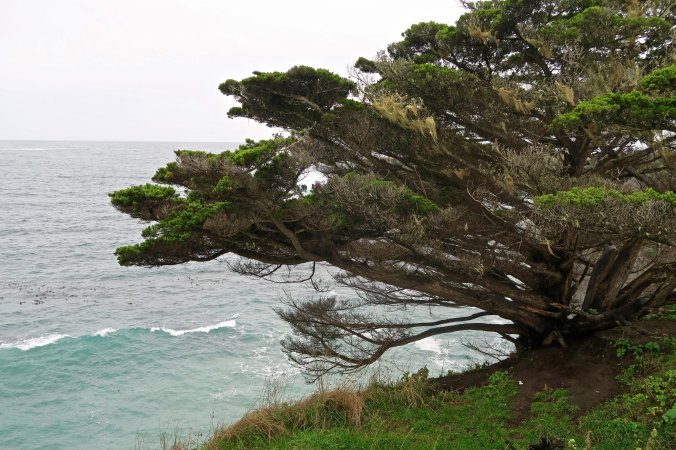
Another view of the Mendocino Headlands, this one featuring a Monterey Pine.

Another view of the Mendocino Headlands, this one featuring a cyprus tree.

The Mendocino Headlands of Northern California.

Looking the other direction through the same cyprus.

A cliff from the Mendocino Headlands next to the town of Mendocino in Northern California.

Rocks, cliffs, and a pounding ocean: music to me on a dark stormy day.

We found these berries growing on the Headlands. T'is the season!

We found these berries growing on the Headlands. T’is the season!

The town of Mendocino, California as seen from the headlands on a rainy day.

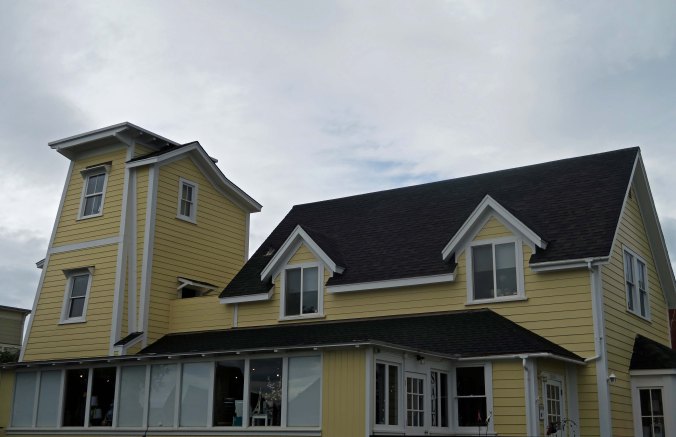
Walking back toward the town from the Headlands, we caught this view of Mendocino. The town has done a superb job of maintaining its historic buildings.

Mendocino, California home.

I find the homes charming.

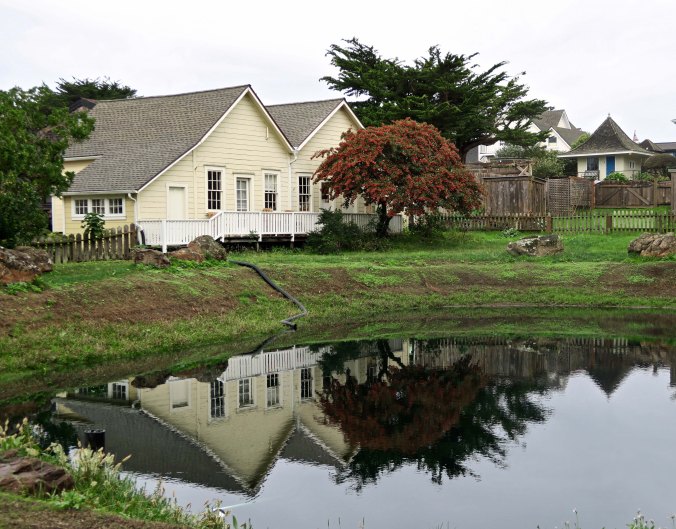
Pond reflection shot in the community of Mendocino on California's north coast.

This small, in-town pond provided a convenient reflection shot.

A landscaped walkway in the town of Mendocino, California.

Inviting walkways are found throughout Mendocino.

Woodworking shop in Mendocino, California.

This is the inside of the woodworking shop where we discovered the duck.

Early social media? Any idea what this is? It's an old fence that has seen service as a community message board for decades.

Any idea what this is? It’s an old fence that has seen service as a Mendocino message board for decades. You might say, it is a ‘staple’ of the community.

Veggies always add a little color on a cloudy day. Peggy and I found these in an old church that had converted to being a natural food store.

Speaking of staples, veggies always add a touch of  color on a cloudy day. Peggy and I found these in an old church that had converted to being a natural food store.

Mendocino, California rooster.

This rooster also added color, and character, to our day.

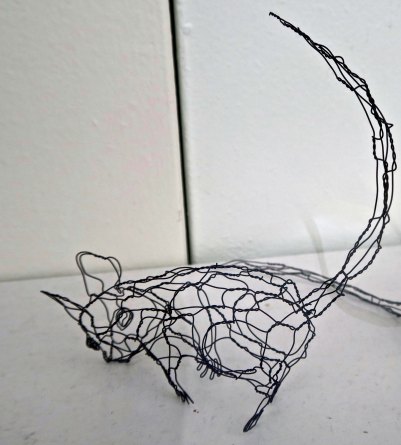
Not so colorful, but there is a story that goes along with this chicken wire Mendocino mouse. In my last blog about Mendocino, I had also included chicken wire sculptures. A person from Japan wrote to me and said he had also visited Mendocino, seen the sculptures in a shop, and wanted to know which shop it was so he could buy some. I was reminded of just how international blogging is...

Not so colorful, but there is a story that goes along with this chicken wire mouse. In my last blog about Mendocino, I had included a chicken wire cat from the same shop. A person from Japan wrote to me and said he had also visited Mendocino, seen the sculptures, and wanted to know which shop it was so he could buy some. I was reminded of just how international our blogging community is…

Tiki god in front of a house in Mendocino, California.

And finally, I’ll include this Tiki-like god sculpture we found protecting a house. Love the toothy grin. Or was I supposed to be frightened?


NEXT BLOG: A North Coast journey along California’s Highway 101.

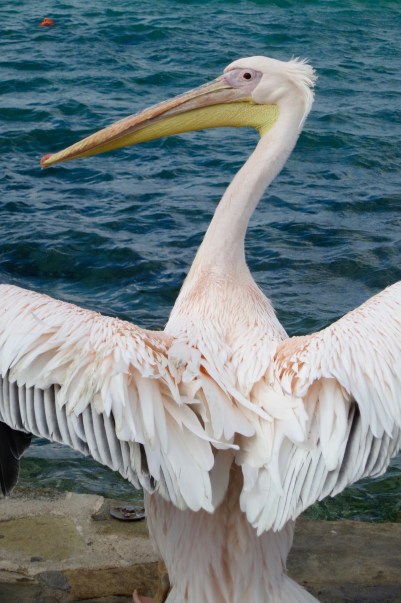
PRESENTING: Petros the Magnificent… A Pelican Of Mykonos

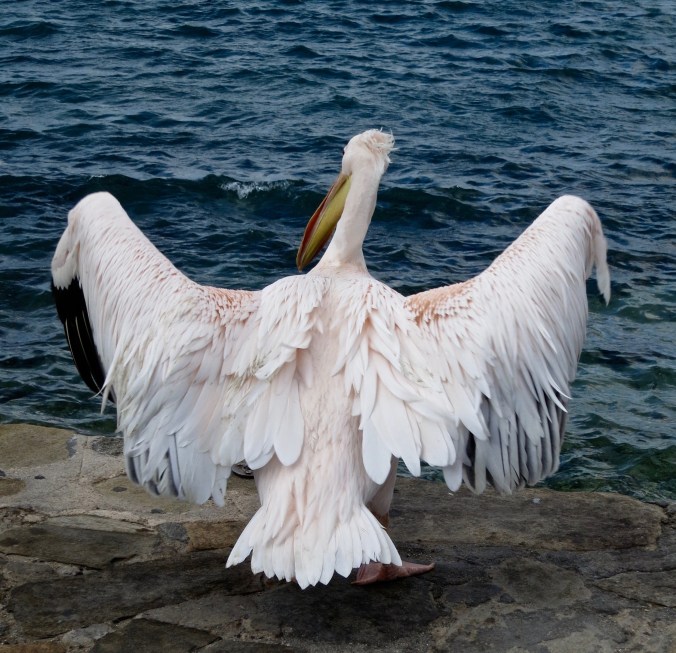
I really like this shot of Petros.

I laugh every time I see this shot of Petros. Somehow I think ghost, or maybe preacher. “Shall we gather at the beach, brothers and sisters?” What do you think?

It’s time for another blog quickie! In fact there will be several short posts over the next few weeks. Peggy and I are heading back East to visit with our children and grandchildren in Connecticut and North Carolina for Christmas. I doubt that our five grandsons will allow much time for blogging. 🙂 Besides, you can probably use a break from my thousand word essays!

I blogged about Petros once when I was out wandering around the Mediterranean and met him on the Greek Island of Mykonos. You can go here for the full story. But the bird is so magnificent that he deserves a second post. If you’ve ever been to the island, the odds are he may have hit you up for a fish. Or ignored you. He sees lots of tourists.

Actually this is Petros II. Number one showed up in the 50s in really bad shape. The good folks of Mykonos nursed him back to health. Rather than fly away and work for a living, he decided to hang around and live the good life. Jackie Kennedy even found him a mate. Unfortunately, Petros I met his demise under a truck.

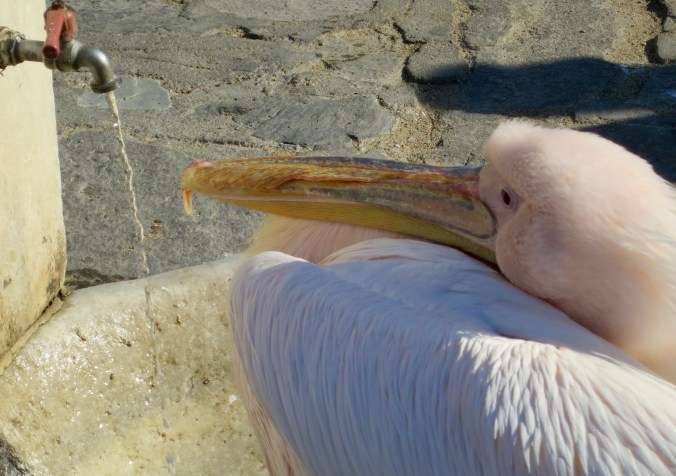
Speaking of the good life, he even has his own little fountain to hang out in.

Speaking of the good life, Petros even has his own little fountain to hang out in.

The bird was quickly replaced. Not only was he well-loved, he was a great tourist draw. One time another island even stole him, hoping to cash in on his popularity. There was almost a war.

That’s it for today… As you read this, Peggy and I are winging our way to Boston.

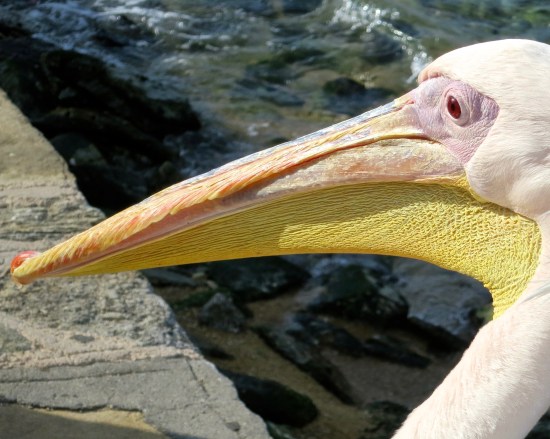
The look. Aren't I pretty!

The look. “I’m so pretty.” Or, “What are you looking at?”

My favorite.

My favorite. Petros looking pensive.

NEXT BLOG: The picturesque town of Mendocino on California’s rugged northern coast.

Home and a Surprise… The Ten Thousand Mile Bike Trek— End of Series

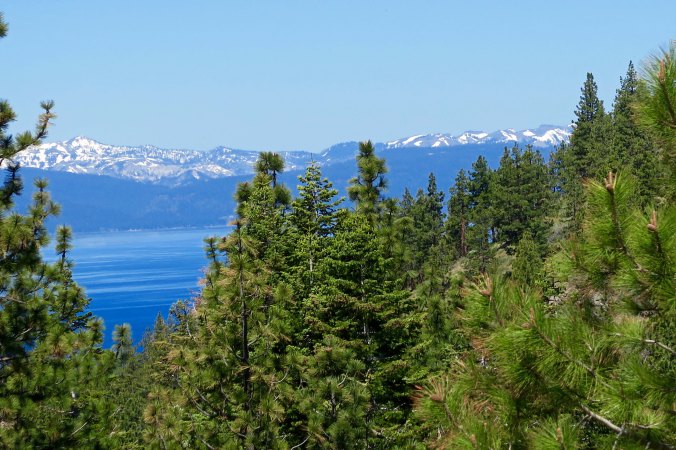
When I arrived at Lake Tahoe, I returned to what I considered my home territory. Half of the beauty of the area is found in the Lake, the other half is in the surrounding backdrop of the Sierra Nevada Mountain Range.

When I arrived at Lake Tahoe, I returned to what I considered my home territory. Half of the beauty of the area is found in the Lake, the other half is in the surrounding backdrop of the Sierra Nevada Mountain Range.

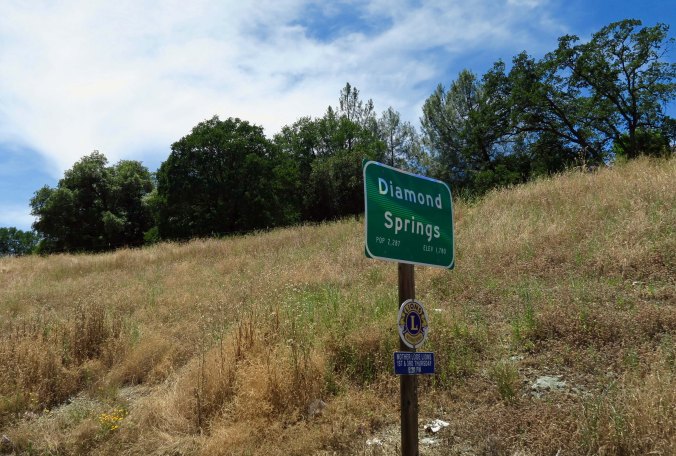
I had planned my six month, solo bike journey around North America as a great circular route, starting and ending in the small, rural town of Diamond Springs, which is nestled in the foothills of the Sierra Nevada Mountain Range east of Sacramento. I grew up there, and the connection was important to me.

I had seen my journey as twofold. My primary purpose was to explore much of the US and Canada in a way few other people had. But I also wanted to use the opportunity to undertake an inward voyage, going back in time to explore my childhood and learn more about myself. Thus the Diamond Springs tie in.

The three-month trip Peggy and I made this spring allowed me to retrace my route and relive my 1989 experience. It also allowed me to share the journey with you, which I have done with 54 posts that included approximately 50,000 words and 1,000 photos: in even more words, that’s a lot! In the end, my North America bike trek had turned out to be everything that I hoped for, and much more. I had seen great beauty, met good people, and had numerous adventures— enough even for me.

Someday, I may share the inward journey. Suffice it to say here, I learned a lot about myself along the way. I achieved a balance and inner peace that have lasted up until today. I haven’t found myself teetering on the edge since 1989. I could run off and play in the woods for reasons other than to put Curt back together again.

But for now, let’s finish up the bike journey and discover the surprise at the end.

I left Carson City, Nevada following Highway 50 up and over Spooner Pass and then dropped into Lake Tahoe, arguably one of the world’s most beautiful lakes. Memories came flooding back. I had spent three college summers driving a laundry truck between Placerville and Lake Tahoe six days a week. The work was easy, the scenery beautiful and the money… well, it was enough to pay for my UC Berkeley education. (I only had to cover my living expenses, books and student fees. Those were the days when tuition at UC was still free, back in the days when government still believed that an investment in public education was one of the best investments it could make, back before it decided that making banks wealthy–er was more important.)

In 1974, I came up with the crazy idea that the organization I was Executive Director of in Sacramento could raise funds off of 9-day hundred mile backpack trips. Actually, I just wanted to go backpacking. The first one I led was from Squaw Valley, just northwest of Tahoe, across the Sierra Nevada Mountains to Auburn. I took 63 people aged 11-70 and learned a lot. (I’ll tell you the story some time.) Fortunately the Trekkers let me live, and the event made money. Later I would add 9-day, 500 mile Bike Treks. Several included Lake Tahoe. I even organized a 7-day winter cross-country ski and camping trek through the Desolation Wilderness west of the lake. That was an experience!

I feel a deep attachment to the Sierra's on the west side of Lake Tahoe, having backpacked up and down and across them many, many times over the years. I feel more at home there than I ever have in any city.

I feel a deep attachment to the Sierra’s on the west side of Lake Tahoe, having backpacked up and down and across them many, many times over the years. I feel more at home in these mountains than I ever have in any city.

This impressive rock greeted me as I biked down to the Lake from Sooner Pass.

This impressive rock greeted me as I biked down to the Lake from Sooner Pass.

The Casinos started a quarter of a mile beyond this lovely meadow!

The Casinos started a quarter of a mile beyond this lovely meadow! Nevada has done a much better job of controlling growth than California.

My bike trip took me along the east shore of the lake to Stateline where I biked past more casinos and entered California and El Dorado County, the county of my youth. Highway 50 wound through South Lake Tahoe and then over to Myers where I climbed my second 7000-foot pass of the day. I felt like I could have done it blind-folded. I was on my laundry route. Every curve, every sight was an old friend. Passing over Echo Summit, I had a wonderfully long downhill ride to Riverton and then climbed up once more to Pollock Pines, where I left Highway 50 and detoured through Camino. I found a small barbershop there and got my first haircut since Nova Scotia. I was a bit on the bushy side. There was a chance that they wouldn’t recognize me in Sacramento, especially if you threw in the fact that I had lost 40 pounds and now had big, bulging muscles.

The Sierra's are world renown for their granite. This view is from the southern portion of the Tahoe basin just before you begin to climb out of it toward Echo Summit.

The Sierras are world renown for their granite. This view is from the southern portion of the Tahoe basin just before you begin to climb out of it toward Echo Summit.

Because of my laundry days, I knew every curve (and straight-stretch) between Lake Tahoe and Placerville!

Because of my laundry days, I knew every curve (and straight-stretch) between Lake Tahoe and Placerville! Just beyond the small hill on the left is a major drop into a deep canyon.

Horse Tail Falls is one of many scenic views I appreciated on my laundry trips and on my bike ride down the mountains. I once crossed the river when it was roaring like this on a narrow log. It was raining and I was by myself. I got down and crawled.

Horsetail Falls is one of many scenic views I appreciated on my laundry trips and on my bike ride down the mountain. I once crossed the river up near the top on a narrow log when it was roaring like this. It was raining, I was by myself, and I was wearing a 50 pound pack. I got down on my knees and crawled.

Sugarloaf Mountain located next to Kyburz Resort on Highway 50 in El Dorado County, CA.

This wonderful chunk of granite is known as Sugarloaf and is another favorite view along Highway 50. It’s quite popular among rock climbers, which is another sport (like jumping off bridges), I see no reason to pursue.

A short five miles brought me to Placerville, where I lingered, not wanting my journey to end. I had gone to high school here and spent my teenage years in the town learning about life, love, sex, and books, not necessarily in that order. Eventually, I climbed back on my bike, picked up Highway 49, and biked 3 miles into Diamond. I jumped off my bike, dropped it, and did a jig with great enthusiasm. People must have thought I was extremely odd. And I was. My 10,000-mile North America Bike Trek was over.

The town of Placerville where I went to high school was once known as Hangtown and is quite proud of it's heritage. A large oak tree in the center of the town was used for hanging bad guys (and probably a few innocents) during the Gold Rush Era.

The town of Placerville where I went to high school was once known as Hangtown and is quite proud of its heritage. A large oak tree in the center of the town was used for hanging bad guys (and probably a few innocents) during the Gold Rush Era.

Hangman's Tree location in Placerville, CA.

The tree was cut down long ago but this rather ghoulish fellow (or his look-alike) has been hanging at the site where the tree was as far back as my memory takes me.

Speaking of evil-doers, you might want to check here to find out why the Placerville Police of Chief was driving me around in his squad car behind the courthouse featured here and wanted to know whether I preferred to go to my graduation from high school that night or go to jail.

Speaking of evil-doers, you might want to check here to find out why the Placerville Police of Chief was driving me around in his squad car behind the courthouse featured above, wanting to know whether I preferred  to spend my night graduating from high school or going to jail.

And finally, after riding my bike for 10,000 miles, I returned to Diamond.

And finally, after riding my bike for 10,000 miles, I returned to Diamond.

But my trip wasn’t quite over; I still had to bike into Sacramento.

I spent the night in Diamond and then rode along Highway 49 through the town, past the cemetery, past my old house, and on to Eldorado, following the same route I had six-months earlier. It felt like decades. In El Dorado, I left my route and followed back roads into Sacramento. I had a Trek-planning meeting that night at the Lung Association. My friend Jane Hagedorn, the Executive Director, had lured me back into town with the promise of Treks. I wheeled my bike into the office at 909 12th street and was greeted royally by Raquel, Jane’s executive secretary, a woman I had hired in 1974.

“Where’s Jane?” I asked, eager to see my friend. “She’s on an important phone conference call,” Raquel answered. The door to her office was closed. I had turned around, a bit disappointed, when a woman I didn’t know came bursting out of one of the offices. Wow, I thought, she’s gorgeous. She gave me a lovely smile that warmed me from my head to my toes, and everywhere in between.

“Hi,” she greeted me, grabbing my hand. “I am Peggy, Jane’s sister. You have to be Curtis! I’ve been hearing stories about you for years.” I swear— I fell in love— then and there.

A new journey had begun.

Last week, Peggy and I celebrated 24 years of marriage and 26 years of happily wandering the world together.

A 1993 photo of Peggy one year after we had married. Always up for an adventure, she had just finished a 150 mile backpack trip down the John Muir Trail I had led. More to the point she had just finished hiking a 16 mile day with a 40 pound pack up and over Mt. Whitney that had included 9000 feet of elevation gain and loss. And she was still smiling!

A 1993 photo of Peggy at 43 one year after we had married. Always up for an adventure, she had just finished a 150 mile backpack trip down the John Muir Trail I had led to celebrate my 50th birthday. More to the point she had just finished hiking a 16 mile day with a 40 pound pack up and over Mt. Whitney that had included 9000 feet of elevation gain and loss. And she was still smiling!

Peggy celebrating the end of re-tracing my bike route at the Diamond Springs hotel. She had driven our RV the whole way so I could take photos and notes. Still smiling!

Peggy celebrating the end of re-tracing my bike route at the Diamond Springs Hotel. She had driven our RV the whole way so I could take photos and notes. Still up for an adventure, still smiling and still gorgeous at 65!

NEXT BLOG: Meet Petros, the world’s most famous pelican. A blog quickie!


On Hearing Voices in the Desert: Nevada… The 10,000-Mile Bike Trek

Early prophets headed into the desert to seek guidance and find their gods. Living in the harsh environment served as a sacrifice. Being totally alone in deep silence of the desert meant they had only themselves to listen to. It was easy to hear the whispers and voices of their inner selves, and possibly something else, ancient voice reverberation down through time.

Early prophets headed into the desert to seek guidance and find their gods. Living in the harsh environment served as a sacrifice. Being totally alone in the deep silence of the desert meant they had only themselves to listen to. It was easy to hear the whispers and voices of their inner-selves, and possibly something else, ancient voices reverberating down through time.


Have you ever heard someone talking to you when no one is around? The mental health folks call this experience an auditory hallucination. If you do it a lot, people start worrying about you. Words like mania or schizophrenia are thrown around. Professional advice is sought, straitjackets purchased. Fortunately, it has only happened to me twice: the first time when I was out backpacking, the second when I was bicycling across the Nevada desert on my 10,000-mile bike trek.

The first occasion I found rather humorous. I was backpacking with my Basset Hound, Socrates. (It should be noted that anyone who backpacks with a Basset Hound is already mildly insane.) Soc was off chasing some imaginary beast in the woods— his deep, hound-bark reverberating through the surrounding mountains. I was meditating using my favorite mantra, ‘goat.’ Don’t ask.

The session was progressing well. I had quieted my ever-noisy mind; colors were taking on intensity, the forest becoming alive, and Soc’s bark sounding like a Beethoven Sonata. That’s when it happened. A clear voice out of nowhere spoke to me.

“Talk to me, damn it!”

Now you can’t make this up. It’s too weird. Apparently, the inner me wanted words to munch on, not silence. It’s used to my constant nattering. So it broke into my conscious mind, took possession of me, and made a demand. I could only laugh. I went back to meditating but it was hopeless. (If you want to hear the rest of my story about backpacking with Socrates, go here. It’s a very 70’s type of tale.)

People who are really serious about hearing voices, however, go off to the desert and hang out for 40 days, or years. Saints and other holy people have been doing this for millennia. Big, booming voices tell them to go off and save the world, or take dictation, or whip themselves. Piddly things like “Talk to me, damn it!” are never heard.

Rocks are one thing that prophets find in abundance when they head off into the desert. They are great for caves; the ideal home for self-sacrificing god-seekers.

Rocks are one thing that prophets find in abundance when they head off into the desert. They are great for caves: an ideal home for those eager to live in misery.

Nevada is totally filled with rocks. I am actually surprised it hasn't produced any prophets.

Nevada is totally filled with rocks. I am actually surprised it hasn’t produced any prophets (that I know of).

More Nevada rocks.

More Nevada rocks. Possibly three wise men, or three aliens?

And more rocks.

And more rocks.

The Nevada desert fully qualifies as a place to get messages. It’s full of vast amounts of nothingness and rattlesnakes and jackrabbits and dust devils and rocks and UFOs and sagebrush and casinos. A common message people receive is, “You’re bank account is empty.” I don’t think that the state has produced any saints. Characters, on the other hand, are a dime a dozen. It’s my kind of place. I’ve crisscrossed it many times.

I've often thought about the people who choose to live their lives isolated from others. What kind of a person does it take to make such a choice? What does living out here do to a person?

I’ve often thought about the people who choose to live their lives isolated from others. What kind of a person does it take to make such a choice? What does living out here do to a person? Something about the choice resonates with me. I did, after all, choose to go on a six month bike ride by myself.

thunder-mountain-monument

Nevada is filled with wonderful characters. One was Frank Van Zant who heard voices that directed him to go off and build this structure along Interstate 80. Known as the Thunder Mountain Monument, Zant built it as a haven for spiritual seekers (hippies) of the 70s, and as a reminder of how we have mistreated Native Americans.

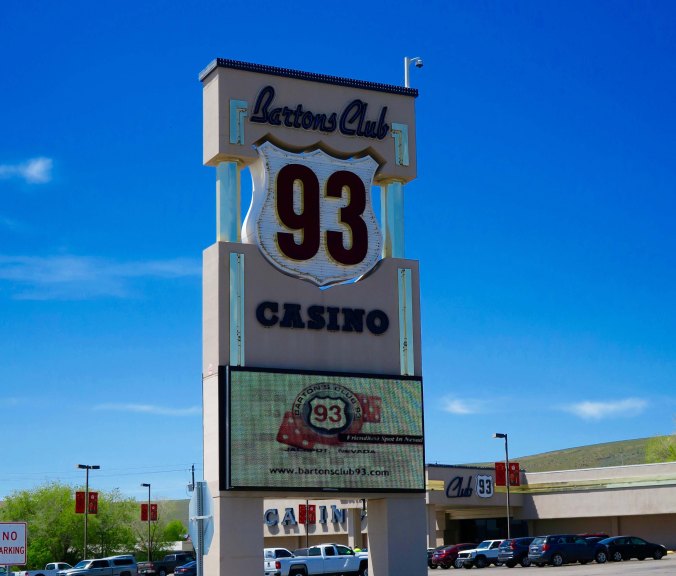
I entered the state on my bicycle following Idaho/Nevada 93. I knew that I had arrived when I spotted the casinos. (There are very few ways that you can enter the state without finding at least one, and often several.) They were a welcome sight, being the only place I could get a snack and refill my water bottles on my hundred-mile ride from Twin Falls to Wells. I even donated five dollars in quarters to improving Nevada’s economy.

It really has to be a remote road that enters Nevada without a casino present. Highway 93 isn't nearly remote enough!

It really has to be a remote road that enters Nevada without a casino present. Highway 93 isn’t nearly remote enough!

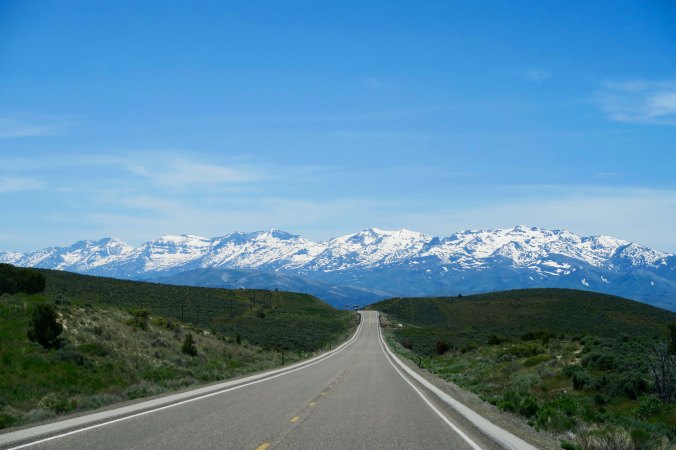
Highway 93 connecting Twin Falls, Idaho with Wells, Nevada featured this view. It reminded me of how beautiful Nevada is.

Highway 93 connecting Twin Falls, Idaho with Wells, Nevada featured this view of what I believe is the Humboldt Range or Ruby Mountains. It reminded me of how beautiful Nevada is.

Another view. Nevada is part of the Great Basin and is made up of several ranges with basins between. During the winter and into early summer, these ranges are often covered with snow.

Another view. Nevada is part of the Great Basin and is made up of several ranges with basins between. During the winter and into early summer, these ranges are often covered with snow.

In Wells, I picked up Interstate 80, one of America’s major East-West routes. I had been dreading this part of my journey. For well over 9000 miles I had been travelling on America and Canada’s back roads whenever possible and busier two lane highways when forced to. Now I would be riding on a four-lane freeway packed with a high percentage of the nation’s cross-country 18-wheelers. My only option was to detour to the south and pick up Highway 50, known as America’s “Loneliest Highway” as it crosses Nevada. It sounded great, but I was out of detour time. So I bit the proverbial bullet— and was happily surprised.

A constant line of traffic heading west on I-80.

A constant line of traffic heading west on I-80.

You can see almost anything traveling along I-80. Peggy and I were amused with this pick up load of squished porta-potties. I had my doubts about how they were fastened down.

You can see almost anything traveling along I-80. Peggy and I were amused with this pick up load of squished port-a-potties. I had my doubts about how they were fastened down. I pictured seeing them on my bike trip with the rope breaking. News Flash: Biker killed by flying port-a-potty. What an epitaph that would make!

The surprise was that I-80 has great shoulders. There were also occasional breaks in the traffic.

The surprise was that I-80 has great shoulders. There were also occasional breaks in the traffic.

The freeway has great shoulders. I could ride along and totally ignore the traffic. In time, the freeway noise even faded away. There was nothing but the desert, distant horizons and me. There weren’t even any cows to talk with, at least not many. I was free to meditate— and hear voices.

Cows to talk with were few and far between.

Cows to talk with were few and far between.

When the voice came, it was the booming type, not the silent whisper you hear in the back of your mind on occasion that suggests you really shouldn’t do something you have every intention of doing. It caught me off guard and scared me. I probably should have listened. Maybe I would have learned something, like to go home and build an ark. But I shut it down. I’m not crazy, and I had forgotten to bring my rose-colored glasses. Besides, I had no desire to become the first prophet to arise out of the Nevada desert (a scary thought), or end up in a straitjacket.

A couple of days later I did have a bit of a revelation, though. Maybe it was even related to the booming voice, or not. I’d left Sacramento with a lot of questions that could be traced all the way back to my youth and even DNA. To say I was restless is a massive understatement. While I had worked hard and had my share of success, I considered work an interlude between adventures. And my adventures were as much about running away as they were about my unending desire to explore new areas. My experience with relationships was similar. I’d had several since my divorce in 1976, and they had all been with good women, people who would have made great life-companions. But I had no desire to settle down and get married, much less have a family.

Something clicked in my mind out there in the middle of the Nevada desert, however. Maybe it was the result of sitting on the back of a bicycle by myself for six months. There was a lot of time to think, and a lot of alone time. I had a strong, clear thought that felt right to me. I could wander and explore without ‘running away.’ It was okay to go home and enter a serious relationship. It would be okay to get married again. It would be okay to have a family. I even went as far as thinking about the women I had dated over the past several years. As I said, they were good people, but I doubted that any of them had a sense of humor about my desire to wander. A week, yes, or even a month, but six months or a year? No way. I needed a companion who liked to wander as much as I did.

The rest of my trip across the desert was tame in comparison. I spent a lot of time going up and down. Nevada is basin and range country. I was constantly climbing up ranges and racing into basins. Towns were relatively close together and each one came with a number of casinos featuring inexpensive and plenteous food. My pure life of the open-road quickly deteriorated. I caught a bad casino cold as a result, after not having a touch of anything for six months. Eventually I hit Highway 95, the cutoff to Fallon where I picked up Highway 50 and cycled into Carson City. The Sierra Nevada Mountains loomed before me. The next day I would cross them, and then head home.

Leaving Interstate 80 toward Fallon, Nevada I entered what is known as the 40 mile desert, which was a nightmare for early pioneers crossing in wagon trains.

Leaving Interstate 80 toward Fallon, Nevada I entered what is known as the 40 mile desert, which was a nightmare for early pioneers crossing in wagon trains. An 1850 survey found 1061 dead mules, 5000 dead horses, 3750 dead cattle, and 953 graves along the route.

Highway 50 between Fallon and Carson provided a gentler view of the desert.

Highway 50 between Fallon and Carson City provided a gentler view of the desert.

And signs to watch out for wild horses.

And signs to watch out for wild horses crossing the road.

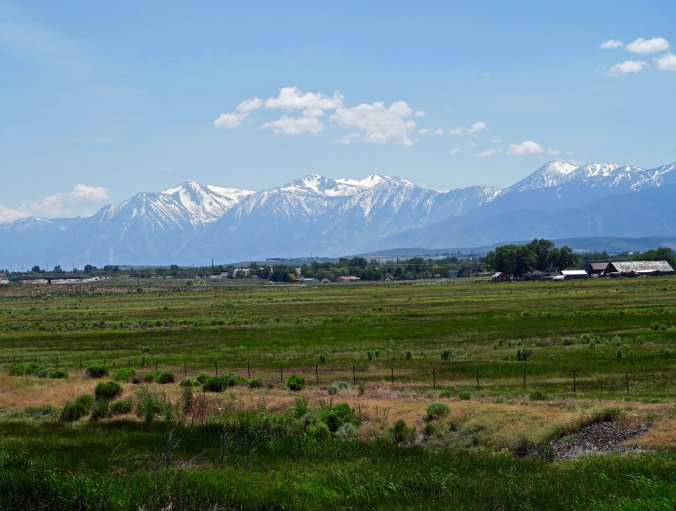
As I entered the Carson Valley, the Sierra Nevada Mountain Range loomed up before me. I was approaching the end of my journey. I was approaching home.

As I entered the Carson Valley, the Sierra Nevada Mountain Range loomed up before me. I was approaching the end of my journey. I was approaching home.

NEXT BLOG: I finish my 10,000 mile journey and return home. A surprise is waiting that will change my life.

Jumping into and across the Snake River Canyon of Idaho… The 10,000-Mile Bike Trek

When Peggy and I arrived at the bridge across the Snake River, a man was hanging by his fingers on the edge of the bridge, 500 feet above the water.

When Peggy and I arrived at the Perrine Bridge across the Snake River, a man was hanging by his fingers on the edge, 500 feet above the water.

I biked out of Bozeman, Montana facing another climb across the Rockies. It turned out to be surprisingly easy. And beautiful. Highway 191 follows the scenic Gallatin River with its rushing waters up into the northwestern corner of Yellowstone National Park in Wyoming. Snowmelt during June turns this branch of the Missouri River into a seething whitewater-fantasy trip for rafters. Beyond its beauty and rapids, the river is also known for its world-class fly-fishing.

Snow melt turns the Gallatin River of Montana into a river runner's dream.

Snow melt turns the Gallatin River of Montana into a river runner’s dream.

Cliffs along the Gallatin River on Montana's Highway 191 add to the areas scenic beauty.

Cliffs along the Gallatin River on Montana’s Highway 191 add to the area’s scenic beauty.

Trees along the Gallatin River on Montana's Highway 191.

As does the forest.

Fly fisherman try their luck in the upper waters of the Gallatin River in Wyoming's Yellowstone Park.

Fly fishermen try their luck in the upper waters of the Gallatin River in Wyoming’s Yellowstone Park.

By the time I had biked the route in August of 1989, the river had ceased its mighty roar but held onto its scenic beauty. Things were still roaring when Peggy and I drove up it in June as we re-traced my route. We stopped to admire the rapids and watch rafters. In the town of West Yellowstone, Peggy relived her youth by trying to find a bar she had once visited with a fake driver’s license in the early 70s.

She had obtained a summer job as a waitress in Yellowstone Park between her freshman and sophomore year at Mary Baldwin College in Virginia. (Mary Baldwin, once a finishing college for Southern Belles, was trying to make its way into the 20th Century. Peggy, a Northerner from Ohio, was much more interested in obtaining an education than becoming a ‘lady,’ and had only lasted for two years before transferring to the University of Tennessee in Knoxville. UT included certification for working with the hearing impaired as part of its curricula, which was where she wanted to focus.)

In the meantime, Yellowstone had provided a welcome reprieve from Mary Baldwin— plus first love. Between waitressing at the park’s lodge and watching Old Faithful shoot towering plumes of water skyward, Peggy had discovered Bill, who definitely wanted to show her a good time. Part of this had included the trip into West Yellowstone and barhopping with a fake driver’s license.

My bike route followed Highway 20 out of West Yellowstone up and over the Continental Divide at the 7072-foot Targhee Pass, which also served as the border of Idaho. From here on, rivers would be flowing into the Pacific Ocean. I continued on Highway 20 down to Rexburg following Henry’s Fork of the Snake River and then made my way west on Highways 33 and 93 to the Craters of the Moon National Monument.

Henry's Fork flows into the Snake River, which flows into the Colombia River and then into the Pacific Ocean. I had left the great Mississippi-Missouri River drainage system behind.

Henry’s Fork flows into the Snake River, which flows into the Colombia River and then into the Pacific Ocean. I had left the great Mississippi-Missouri River drainage system behind.

The mountains of central Idaho loomed in the distance above what was probably a potato farm near Rexburg.

The mountains of central Idaho loomed in the distance above what was probably a potato farm near Rexburg.

Idaho's Highway 33 seemingly stretches on forever as so many roads did during my 10,000 mile bike trek around North America.
Idaho’s Highway 33 seemingly stretches on forever as so many roads did during my 10,000 mile bike trek around North America.

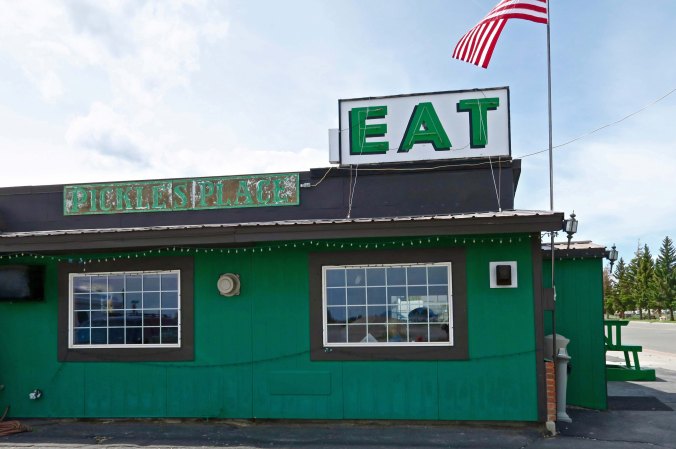
Pickle's Place is one of many delightfully unique restaurants I found along the road. Located in Arco, Idaho (once known as Root Hog) it features the Atomic Burger in honor of the fact that Arco was the first place in the world to be lit with atomic power.

Pickle’s Place is one of many delightfully unique restaurants I found along the road. Located in Arco, Idaho (once known as Root Hog), it features the Atomic Burger in honor of the fact that Arco was the first place in the world to be lit with atomic power.

This mountain next to Arco features the local high school's graduating classes going back to the early 1900s.

This mountain next to Arco features the local high school’s graduating classes going back to the early 1900s.

The Craters of the Moon National Monument encompasses a wonderfully weird lava flow on the Snake River Plain that covers 618 square miles and was formed between 15,000 and 2,000 years ago. Early astronauts, including Alan Shepard and Edgar Mitchell, had arrived here on August 29, 1969 to practice future landings on the moon— one month after Neil Armstrong had already taken his “one small step for man; one giant leap for mankind.”

Idaho's Highway 93 winding its way through the northern part of Craters of the Moon National Monument, seemingly disappears here.

Idaho’s Highway 93, winding its way through the northern part of Craters of the Moon National Monument, seemingly disappears here.

Nature, in her marvelous way, is gradually reclaiming the volcanic landscape.

Nature, in her marvelous way, is gradually reclaiming the volcanic landscape. Sagebrush is the most obvious plant in the area.

Flowers at Craters of the Moon National Monument in Idaho.

But Peggy and I also found these flowers.

Dead sagebrush at Craters of the Moon National Monument in Idaho.

As well as this stark but beautiful reminder of how difficult it is to reclaim lava.

Art in the Park sculpture in Craters of the moon National Monument in Idaho.

This sculpture added a colorful touch to the monument.

Sculpture in Craters of the Moon National Monument in Idaho.

I also liked this perspective, which seemed to capture the strangeness of the monument. A small-explorer’s foot can be seen on the right.

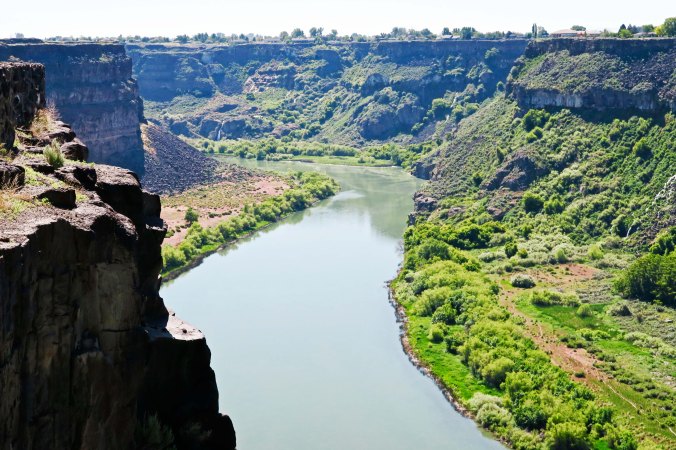
From Craters of the Moon, it was a short 80-mile ride to the Snake River and Twin Falls over relatively flat country. The river features a dramatic 500 feet deep canyon, which was created by cascading water from melting glaciers. When Peggy and I arrived, a man was dangling on the edge of the Perrine Bridge by his fingers, ready to leap into the canyon (featured at top of this post). Fortunately he had a parachute on. Still, he plummeted for 200 feet or so before engaging it. Scary stuff.

Perrine Bridge across the Snake River near Twin Falls, Idaho.

See the shadow on the river. It’s made by the parachute, the small triangle located center-left above the shadow.

Snake River looking west from the Perrine Bridge overlook.

This view of the Snake River is looking west from the overlook next to the Perrine Bridge. Boats have created the wakes.

When I crossed the bridge on my bike in 1989, I was thinking of another leap across/into the canyon— that of Evel Knievel in 1974. Evel, at the time, was synonymous with the word daredevil. During his life he made some 275 motorcycle jumps over cars, busses, and trucks. Fifteen of the jumps involved spectacular accidents. He suffered numerous concussions and shattered his pelvis three times. Overall, he broke 35 bones. Maybe he should have pursued a much tamer sport, such as playing NFL football.

Knievel was always on the lookout for new ways to upgrade his act, obtain more publicity, and increase his income. Mainly this involved adding more vehicles to leap (for a number of years, he held the world record of 19 cars), but he also had a dream of jumping the Grand Canyon. Concerns with National Park regulations, however, eventually led him to the Snake River. The 1700-foot jump was a bit long for his Harley, though, and this is where Robert Truax came into the picture.

Truax was one of America’s premier, pioneer rocket engineers, beginning his career prior to World War II when a childhood interest in Robert Goddard led him to build rockets at his home in Alameda, California. He then went on to work with the Navy on rocket development during World War II and later helped build both the Thor and Polaris missiles. By the late 50s/early 60s, he had left the military and was heading up Aerojet-General’s advanced rocket development division in Sacramento, California. I met the man when I promised him I would have his daughter home by midnight.

Kathleen (Kathy) Truax was a dark-haired beauty with brains to match. She had transferred into El Dorado Unified High School in Placerville during my senior year. After graduation, I had worked up the nerve to ask her out on a date to the California State Fair in Sacramento. Her immediate “yes” had me kicking myself for not asking sooner.

The weekend turned into a marathon. I had worked ten hours on Friday hauling 50-pound boxes of pears out of an orchard and then gone to a party at a friend’s. My mother called at midnight to tell me that the forest service had just phoned wanting me to help fight a raging forest fire that was threatening to engulf the small foothill community of Foresthill. So away I had gone and spent from 2 a.m. until 10 a.m. chopping a fire trail across a steep American River canyon with a heavy pickaxe. The looming inferno encouraged fast work.

After a two-hour nap break and lunch, our crew chief had told us that the fire was burning back on itself and that we could leave if necessary. I’d buzzed home to Diamond Springs, showered, and taken off for Cameron Park where I picked up Kathy in my 54 Chevy, met her dad, and gone on to the State Fair. I returned her home promptly at midnight as promised. We’d had fun and I had won Kathy a large stuffed bear that hardly fit in the back seat.

Later that summer, we had gone on a date up into the Sierra foothills near Pleasant Valley where her grandmother lived. Kathy had told me that her dad shot off rockets in the area that he had built in his garage. His visionary dream was to build inexpensive rockets that would make space travel affordable for everyone. Eventually, 13 years after the summer I had dated Kathy, that dream would lead him to build the Volksrocket (Skycycle X3) designed to carry Evel Knievel across the Snake River Canyon. The rocket had worked fine, but the parachute had malfunctioned, deploying when the rocket took off, which allowed the wind to pull it back into the canyon. Evel had landed on the river’s edge with minimal injuries (for him), and Truax had taken responsibility for the accident.

While Knievel died in 2007 and Truax in 2010, their dream was finally realized on September 16th of this year. Professional Hollywood stuntman Eddie Braun working with Truax’s son Scott used an exact replica of the Skycycle X3 with a well-tested parachute to successfully jump the canyon. Children of both Knievel and Truax were there to witness the event. Had Peggy and I been a couple of months later in our route review, we would have been there as well.
Looking east up the Snake River from the Perrine Bridge toward where Evel Knievel tried his 1974 leap across the river.

Looking east up the Snake River from the Perrine Bridge toward where Evel Knievel tried his 1974 leap across the river.

NEXT BLOG: I bicycle across Nevada and hear voices. Seriously. Were the desert gods trying to tell me it was time to end my journey?
I Know I Am in Montana; The Question Is Where? … The 10,000-Mile Bike Trek

They call it Big Sky Country for a reason. The heavens seem to stretch on forever. But the enormity of the sky is matched by the state's mountains and rivers and valleys. Even this single tree has a statement to make.

They call it Big Sky Country for a reason. The heavens seem to stretch on forever. But the enormity of the sky is matched by the state’s mountains and rivers and valleys. Even this single tree has a statement to make.

I don’t really know if you can make a wrong turn in Montana. Almost everywhere you go the skies are big, the mountains high, the rivers clear, and the views forever. With that said, I am not 100% sure about my bike route through the state. For most of my 10,000-mile journey I had maps, or my journal, or letters, or even just logic to retrace my route of 27 years ago. Many of the roads I traveled down were the only roads available or at least the only roads I could use and get where I wanted to go without a major detour.

And often there were significant events that reminded me where I traveled. Many of the views I saw in Montana could have played this role— except those views were just about everywhere. The two events I do recall happened on my first day. One, I bicycled 120 miles with the elusive tailwind I had hoped for in North Dakota. Two, I found a restaurant that offered a free pancake to anyone who could eat the whole thing. It was a yard across, two inches deep and took the whole griddle to cook. I passed. But I watched a giant consume one and go on to eat a second. I thought he deserved a standing ovation, but hesitated with the thought that he might not like standing ovations. I try not to irritate mountains.

But my memory aids were unavailable for Montana. Still, I know most of my route. About 250 miles are in contention, which in Montana isn’t a big deal. Now if I were talking Rhode Island or Delaware… Anyway, if you are a map fiend, I either traveled from Malta on Highway 2 to White Sulphur Springs, or from Havre on Highway 2 to White Sulphur Springs. Both seem logical choices. Since the former route came first, Peggy and I drove it. Sections seemed quite familiar. Others not so much. One of these days, I will go back and start from Havre. Anyway, here are some views Peggy and I saw along the way.

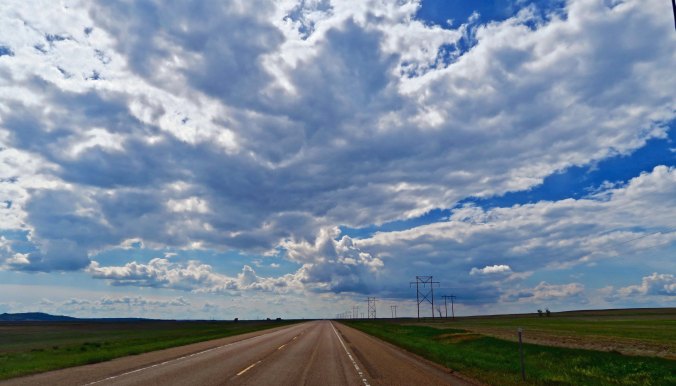
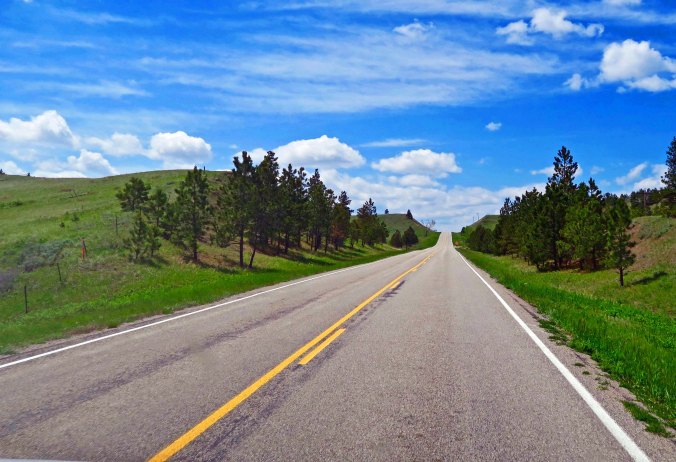
Another perspective on Big Sky Country. This one along US Highway 2 as it makes its way through northern Montana.

Another perspective on Big Sky Country. This one along US Highway 2 as it makes its way through northern Montana.

Fence showing Montana cattle brands at Culbertson, Montana museum.

If ever there was a modern catch phrase in the writing, art, and business world, it is “branding.” Over and over we hear about how important it is that we establish our own unique voice or product. Well, there was a time when the concept of branding was a lot simpler. 🙂 We found this fence at a small museum in Culbertson, Montana. These are cattle brands from the region.

Cow weathervane found at museum in Culbertson, Montana.

We also found this fun weather vane at the Culbertson Museum. Somehow, it reminds me of the recent election. (grin)

Old beauty parlor hair curlers on display at Culbertson, Montana, Museum.

Another photo from the Culbertson museum and another bit of post-election humor: After the election, Mrs. B decided to head for the beauty parlor to have her hair done— and her brain rearranged. (Move on Curt.)

Whoa! Another roadside attraction.

Whoa! Another roadside attraction. Dinner? We came on this unlikely pair along with another  20 acres of other such creatures along Highway 2. There was no sign to tell us why they were there.

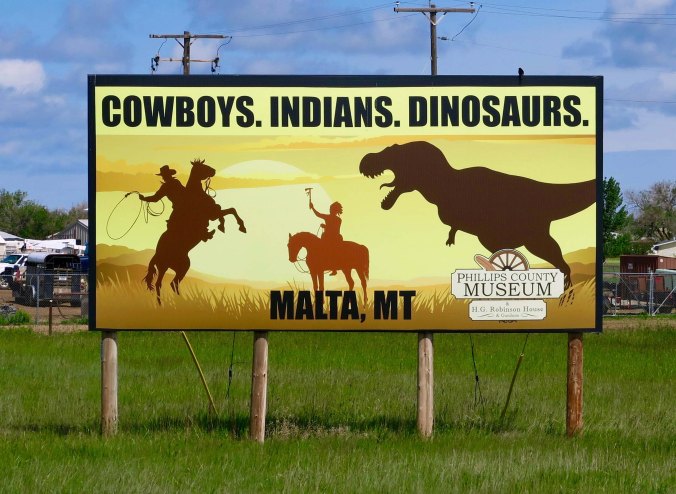
Sign for the Malta, Montana museum.

Here’s a cowboy with high hopes, “high in the sky apple pie hopes.” The Native American is saying, “Go get him guy. I’m behind you all the way.”

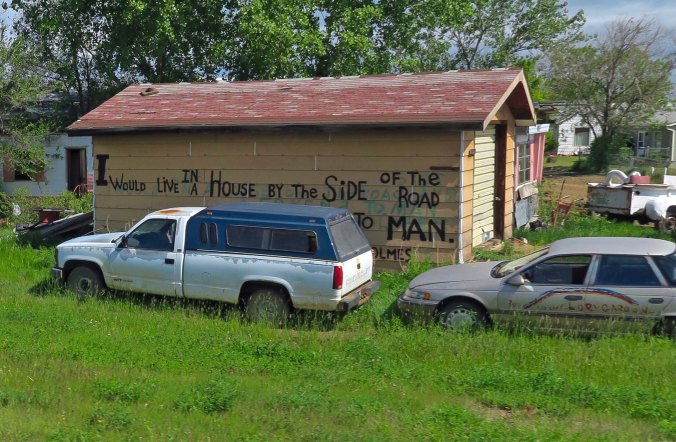
Peggy and I came across this derelict old house with its life-affirming message along Highway 2. It's a great message for these troubled times from a poem by Sam Walter Floss: "Let me live in a house beside the road/ Where the race of men go by/ The men who are good and the men who are bad/ As good and bad as I/ I would not sit in the scorner’s seat/ Nor hurl the cynic’s ban/ Let me live in a house by the side of the road/ And be a friend to man."

Peggy and I came across this old house with its life-affirming message along Highway 2. It’s a great message for these troubled times from a poem by Sam Walter Floss: “Let me live in a house beside the road/ Where the race of men go by/ The men who are good and the men who are bad/ As good and bad as I/ I would not sit in the scorner’s seat/ Nor hurl the cynic’s ban/ Let me live in a house by the side of the road/ And be a friend to man.”

Petroglyph from Sleeping Buffalo Rock along Highway 2 in Montana.

Another Highway 2 site featured the Sleeping Buffalo Rock covered with carved petroglyphs. This symbol is usually interpreted to represent a badger.

US Highway 191 in Montana

In Malta, Peggy and I picked up US Highway 191, which runs from the Canadian Border to Mexico. Unlike most of America’s historic north-south/east-west blue highways, 191 is a combination of many north-south roads that were put together in the 80s.

Another view of Montana countryside along Highway 191

Another view of Montana countryside along Highway 191.

A Montana stream found along US Highway 191.

A calm stream…

The Missouri River in Montana along US Highway 191

And the mighty Missouri River— Montana style.

Cattle roundup in Montana.

This is Montana! Cowboys and cattle. Two cowboys rode horses, and one is using an ATV.

Tempting! A trout contemplates a lure in a Lewiston, Montana mural.

Tempting! A trout contemplates a fly in a Lewiston, Montana mural.

I found this town fun. The high school looms in the background. The vote for the 2015 commencement speaker was unanimous. Dakota Jolliff asked her uncle to give the address. She was the only senior. The principal lives across the road from the school. First thing in the morning during winter storms, she looks out her window. If she can't see the school, classes are canceled. The school is also haunted. Lights are turned on at night and locked doors opened.

I found this town fun. The high school looms in the background. The vote for the 2015 commencement speaker was unanimous. Dakota Jolliff asked her uncle to give the address. She was the only senior. The principal lives across the road from the school. First thing in the morning during winter storms, she looks out her window. If she can’t see the school, classes are canceled. The school is also haunted. Lights are turned on at night and locked doors opened.

You may have noted the windmills in the Judith Gap sign. Check out the cattle at their base. There are 90 of the 40 story high monsters. They proved electricity to the 80 homes in Judith Gap plus another 360,000.

You may have noted the windmills in the Judith Gap sign. Check out the cattle at their base. (Tiny dots at the fence line right center— they may be antelope.) There are 90 of these 40-story high structures. They provided electricity to the 80 homes in Judith Gap plus another 360,000.

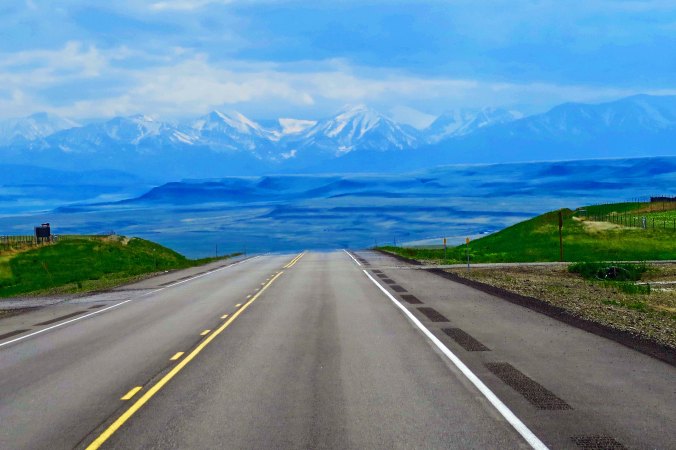
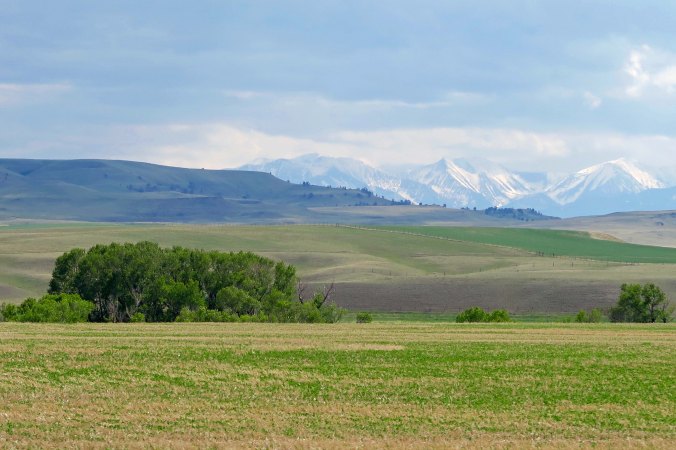
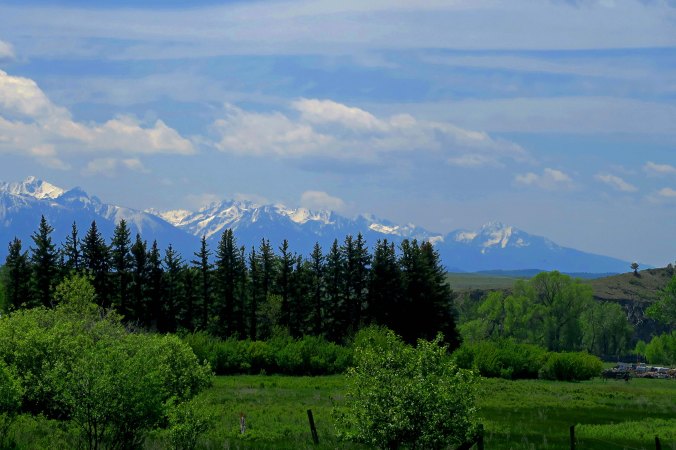
The Rocky Mountains viewed from Highway 191 in Montana.

When it comes to mountains, Montana is not shy. These are the Rocky Mountains.

Rocky Mountains in Montana.

Another view.

Rocky Mountains behind lake in Montana.

And another…

View of Rock Mountains in Montana.

And another.

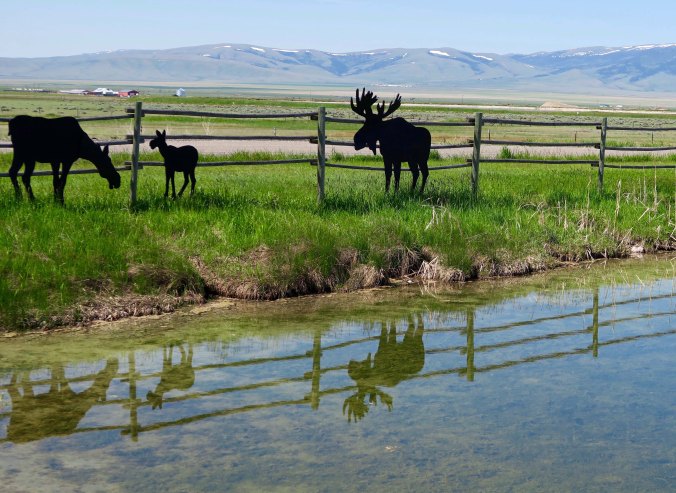
Wood cutouts of wild animals in Sulphur Springs, Montana.

Peggy and I stayed at an RV campground in White Sulphur Springs that featured wild animal cut outs. I really liked this moose family with its reflection.

Peggy fed this one. Don't do this at home kids, Don't ever stick your hand in the mouse of an elk! :)

Peggy fed this one. Don’t do this at home kids. Don’t ever stick your hand in the mouth of an elk! 🙂

Here is my mandatory old barn photo for this blog with its dramatic backdrop of the Rocky Mountains. I didn't feel that this barn was simply falling down. It looked like it was melting!

Here is my mandatory old barn photo for this blog with its dramatic backdrop of the Rocky Mountains. I didn’t feel that this barn was simply falling down. It looked like it was melting!

Mountain men played a key role in the westward movement, first as trappers and later as guides.

Mountain men played a key role in the westward movement, first as trappers and later as guides.

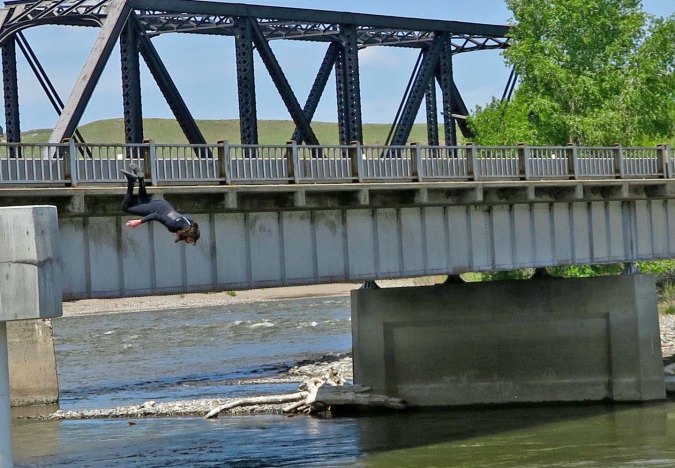
Did this guy just hear the election results? (Kidding) We watched this guy and another jump into the Yellowstone River— and come out alive. They had carefully waited for a policeman to pass.

Did this guy just hear the election results? (Kidding) We watched this guy and another jump into the Yellowstone River— and come out alive. They had carefully waited for a policeman to pass. I am reminded of a statement by Joseph Campbell. “When you find yourself falling, dive.”

The Yellowstone River in Montana.

The Yellowstone River

A final view for today's post. This one is near Bozeman, Montana. In my next post I will head south from Bozeman and into Idaho, another beautiful state.

A final view for today’s post. This one is near Bozeman, Montana. In my next post I will head south from Bozeman and into Idaho, another beautiful state.


North Dakota and the Sneakiest Dog in America… The 10,000-Mile Bike Trek

Peggy and I discovered this pair of Canadian Geese in their idyllic setting near Minot, South Dakota.

Peggy and I discovered this pair of Canadian Geese in their idyllic setting near Minot, South Dakota.


I’m back in the saddle again/Out where a friend is a friend/Where the longhorn cattle feed — On the lowly gypsum weed/I’m back in the saddle again. –Old cowboy song by Gene Autry

My brother-in-law John wanted to know when it might be safe to come back to my blog. I really like John: he’s bright, is a talented writer, has a wonderful sense of humor, and is great to travel with, not to mention he has a really neat wife.  But we avoid talking politics. So this one’s for you, John. I am back in the saddle again. (grin)

I only needed one hand to count the number of people I met traveling through the US and Canada who were on long distance bike treks. So when I saw a fellow bicyclist loaded down with gear coming out of North Dakota on Highway 2, I flagged him down.

“The state is relatively flat,” he informed me, “and it should have been easy peddling. But I fought a strong head wind the whole way. It was tough.” I couldn’t help smiling. I appreciated his difficulty; I’d certainly dealt with my share of nasty headwinds. A strong headwind for him, however, would mean a strong tailwind for me. I would fly across North Dakota.

“One more thing,” the cyclist had cautioned, “there is a really nasty dog about five miles up the road. Be careful.”

I’d shared my experiences of bicycling through Minnesota and we had chatted for a while longer. We then parted company with him cycling east and me west.

Fifteen minutes later, I discovered the headwind— going in the wrong direction. That’s the thing about headwinds in North Dakota. They are close to legendary among bicyclists. You are always bicycling into the wind; it doesn’t matter which direction you are peddling. I hadn’t traveled for more than 15 minutes when I felt the first puff on my face. It hassled me all the way to the Montana border.

No large, drooling dogs came charging out to eat me, however. So I felt like I had dodged at least one bullet. I was thinking happy thoughts when I felt an irritation on my right heel with each rotation of the pedal. Curious, I glanced back. “What the…” went bouncing around my skull! A large, drooling dog that looked suspiciously like a pit bull was running silently beside me trying to grab my right foot each time it came close to his snapping teeth. I had met the sneakiest dog in America! My reaction was instinctual. I grabbed my bike pump and swung it backwards with a fair amount of force— and was rewarded with a solid thump and a surprised yip! I had caught the miscreant on his nose. Problem solved. The last I saw of him, he was low-tailing it home. Maybe he would think twice before hassling another bicyclist. Or bite harder…

Besides the large dogs and headwinds, two other things struck me about North Dakota. The first was sunflowers, millions of them, all pointing the same direction. I found them beautiful. North Dakota has more of them that anywhere else in the US. When they are young, they practice heliotropism. And no, that isn’t some weird sexual practice. Their necks are flexible and they track the sun. Early in the morning they are looking east. By late afternoon they are facing west.

When Peggy and I travelled through North Dakota in early June, it must have been too early for the sunflowers. So I recruited one from our yard that was hanging out a few months ago.

When Peggy and I travelled through North Dakota in early June, it must have been too early for the sunflowers. So I recruited one from our yard that was hanging out a few months ago.

The importance of agriculture to North Dakota could be seen everywhere, as with these distant storage elevators. I also like this photo because it provides a perspective on how flat certain portions of the state are.

The importance of agriculture to North Dakota could be seen everywhere, as with these distant grain elevators. I also like this photo because it provides a perspective on how flat the terrain in North Dakota can be.

It was obvious that people had been farming in the state for a long time!

It was obvious that people had been farming in the state for a long time!

Large farming equipment could be found everywhere.

Large farming equipment was found for sale in most towns.

And some of it I really would not like to meet on a dark night.

Including some that I wouldn’t like to meet on a dark night..

As I travelled west, ranching became more prevalent. Windmills are symbols of the West.

As I travelled west, ranching became more prevalent. Windmills are symbols of the West.

Cow now have strong competition from oil wells out in western North Dakota. Peggy and I saw oil operations everywhere. This wasn't the case when I biked through in 1989. Fracking seems to be the prime way for getting oil out of the ground. Can earthquakes be far behind?

Cows now have strong competition from oil wells out in western North Dakota. Peggy and I saw oil operations everywhere. This wasn’t the case when I biked through in 1989. Fracking seems to be the primary way for getting oil out of the ground. Can earthquakes be far behind?

The second thing I remember was a massive storm that caught up with me in the western part of the state near Williston. I’d been watching the clouds gather all afternoon and they had morphed into towering cumulus clouds that threatened one hell of a downpour and possibly a massive hailstorm. It was nothing I had wanted to be caught out in, and nothing I wanted to face in my tent. The higher the clouds had climbed the faster I had pedaled. I’d whipped into the first motel I had come to on the eastern edge of Williston and begged sanctuary.

“Sorry,” the clerk had told me, “We’re booked up.” Some type of event was going on and all of the motels in town were apparently full. Owners were calling around looking for space. “I just talked to a motel across town with three spaces left. Would you like me to call?” I had quickly answered yes. “You are in luck,” the clerk smiled, hanging up the phone. “You have the last space but you need to hurry.” People in Williston who looked out their windows must have thought that the Tour de France had made a wrong turn.

I pulled up in front of the motel office and opened the door halfway. “We are booked up,” the owner had growled. The pit bull had seemed much friendlier and probably was. “Ah, but I have a reservation,” I had responded, sounding cheerful, giving my name, and explaining about the motel across town. He had sourly looked down at a note he had made.

“You can stay,” he said. “But I don’t like bicyclists.” Whoa, I had thought, welcome to Williston. I wondered if a bicyclist had trashed one of his rooms forever condemning all bicyclists to hell. “You have to leave your bicycle outside. If you take it into your room, I am kicking you out, regardless of the weather.” I saw him staring out the window of the office, watching as I locked up my bike outside. Shortly afterwards the storm hit: drenching rain, high winds and hail. It was a nasty night in a cheap motel that had long since seen its glory days. Around 10 p.m., I went outside and retrieved my bike, carried it inside and put it down on newspapers. I was up and out by six the next morning. The sun was shining.

Some more memories of North Dakota…

This is the pond with the geese in it that I featured at the top of the blog.

This is the pond with the geese in it that I featured at the top of the blog.

A one room school house along Highway 2.

A one room school-house along Highway 2. Modern wind mills can be seen off to the right in the distance. There is a lot of wind in North Dakota.

I discovered the geographical center of North America when I road through Rugby, North Dakota. It was still there when Peggy and I drove through. (grin)

I discovered the geographical center of North America when I rode through Rugby, North Dakota. It was still there when Peggy and I drove through. (grin)

Another small lake we found along Highway 2.

Another small lake along Highway 2. I really liked the tree border.

It was skies like these that sent me scurrying for Williston. (The town has now become a city due to the oil boom, but it has been having tough times since Oil prices dropped.)

It was skies like these that sent me scurrying for Williston. (The town has now become a city due to the oil boom, but it has been having tough times since oil prices dropped.)

A North Dakota stream in the western part of the state. Note the hills!

A North Dakota stream in the western part of the state. Note the hills!

I'll conclude with this tree that lives out west.

I’ll conclude with this tree that we found out west. It was outlined by the sun, which had broken through the clouds.

NEXT BLOG: It’s off to Montana and Big Sky Country!