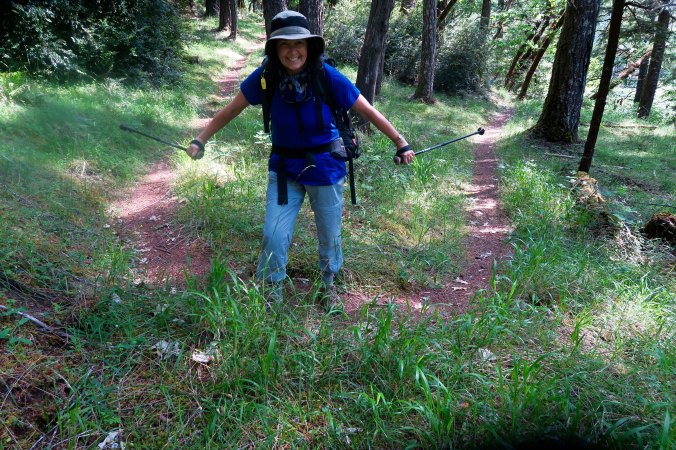
Towns along the PCT

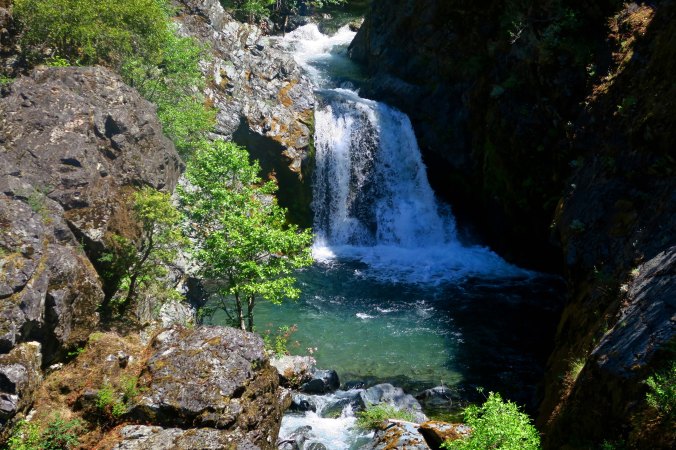
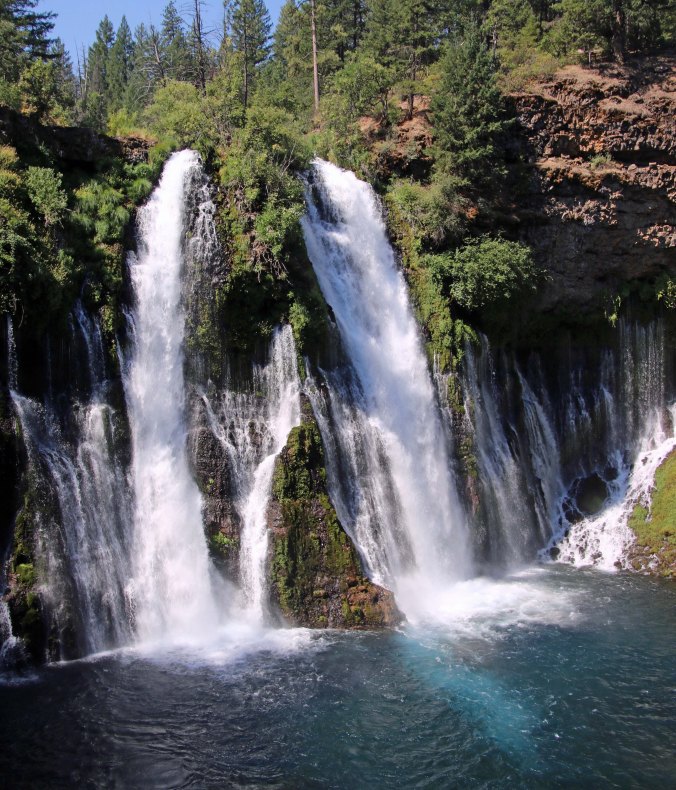
While I puff my way up and down mountains, Peggy explores the surrounding country and towns, having adventures of her own. A hike over to Burney Falls rewarded her with this view. (Photo by Peggy Mekemson.)


Today’s Post:

Small towns along the PCT are lifelines to through hikers. First and foremost, they are where hikers pick up their supplies for the next section of the trail. But they also provide a break— a chance to eat a good meal, shower, wash clothes, and possibly down a few cold beers. Sometimes the towns serve as meeting points where trekkers catch up with friends they have made along the trail.

Information about the communities passes along the trail quickly. One night I was perched in a dry camp up on a high ridge between Castle Crags and Burney Falls when a hiker came through and asked a person camped across the trail from me if he had heard about the pizza parlor in the town of Mt. Shasta that offered an all you can eat lunch for $7.50— a through-hikers’ Paradise. I felt for the owner as he saw his profits dwindle and disappear down the gullets of gaunt, semi-starved PCTers. It would be like seeing a plague of locusts take on your wheat crop.

Between the time Peggy drops me off and picks me up, she has been exploring these small towns and having adventures of her own. She is going to be doing a ‘guest’ post on her experiences in a couple of weeks but today I want to share some of the photos she has been taking.


Current Location

I was late and Peggy was starting to worry. She was waiting at Sonora Pass on Highway 108 to pick me up. As usual, she was making friends with through-hikers. She had asked a charming French couple from Leon (Camilla and Bastion) to keep an eye out for me on the trail since they were hiking north and I was hiking south. I met them while they were enjoying a snack break as I was slowly making my way up the north side of Sonora Peak to the 10,400-foot (3170 meters) trail pass.

Camilla and Bastion, PCT hikers from Leon, France, on Sonora Pass. (Photo by Peggy Mekemson.)

Let me emphasize “slowly.” The last half-mile had been steep and my short legs had not been happy with the numerous knee-high stone steps built into the trail. They were squeaking unprintable comments whenever I came to one.

“You must be Curtis,” Camilla called out. The PCT Telegraph was at work. “You have a wonderful wife. She’s worried about you.” It sounded like Peggy to me— both wonderful and worried. Peggy had fed Camilla and Bastion blueberry scones from Trader Joes. More to the point, she had fed them scones slathered in peanut butter that Camilla had been lusting after. They were still talking about it. Apparently, they had hung out with Peggy for almost an hour while they waited for their resupply.

Bastion explained that the trailhead parking lot closed at 6:00. Peggy would have to move. And there was no cell phone service. I’d be stuck up on the mountain for the night with my remaining Cliff Bar for dinner and Peggy would probably be frantic. It was now 3:00. I assured them that I would be there before 6:00. Bastion looked a bit skeptical, (he’d seen me coming up the mountain), but Camilla was more optimistic. I hiked in at 5:00.

Later, I told Peggy not to worry about the no-parking after 6:00 rule. What cop or forest service official is going to seriously hassle a 68-year-old woman who is concerned about and waiting for her 75-year-old husband to come off a difficult and occasionally dangerous wilderness trail? “Move on lady. Rules are rules.” I doubt it.

But I had already made use of the PCT telegraph to alleviate Peggy’s worry. I’d been hiking up the East Fork of the Carson River when Bones had come beeping by as if I were standing still. Like me, he was traveling north to south. I assume his long and lanky build had earned him his trail name. I knew that he would be into Sonora Pass a couple of hours before me so I asked him to check for Peggy and tell her I was fine and coming along. Which he did. When I arrived, he had been chatting with her for an hour and a half while he recharged his phone in our van.

I insisted that Bones have his photo taken with Bone when he passed me. Both seemed delighted.
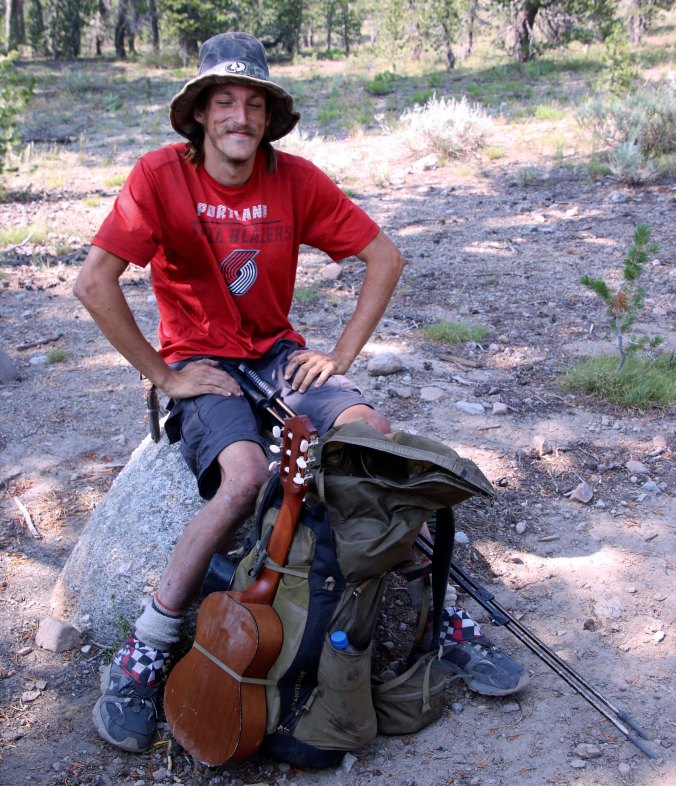
Bones, who comes from Portland, Oregon, had been chatting with Peggy for an hour and a half when I came off the trail. You can tell he is a PCT hiker by how skinny he is. I look equally gaunt. I was surprised that Peggy hadn’t pulled out her guitar so the two of them could have performed a concert. (Photo by Peggy Mekemson.)

We were fortunate to leave Sonora Pass when we did. Peggy had been watching a worrisome cloud of smoke. It had grown from a small, seemingly insignificant plume to covering a third of the sky. The Donnell fire located a few miles farther to the west on Highway 108 was being pushed by winds and had jumped the highway.  Bones and I had experienced the winds up on the trail around Sonora Peak. I estimated that they were gusting close to 50 miles per hour. Bones had put his pack down to take a photo and watched it be blown along the ground. He scurried to retrieve it. So much for the photo-op. I’d had to lean into the wind to keep my footing, not particularly pleasant on a narrow, high-pass trail with steep drops. But it wasn’t boring.
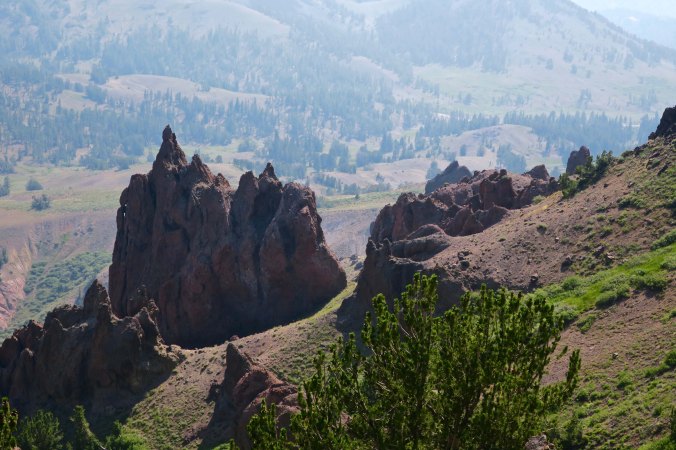
The wind hit me as I came over the trail pass. I could hardly take this photo. Highway 108 can be seen in the distance on the top right (the white speck). I still had a ways to get to Peggy!
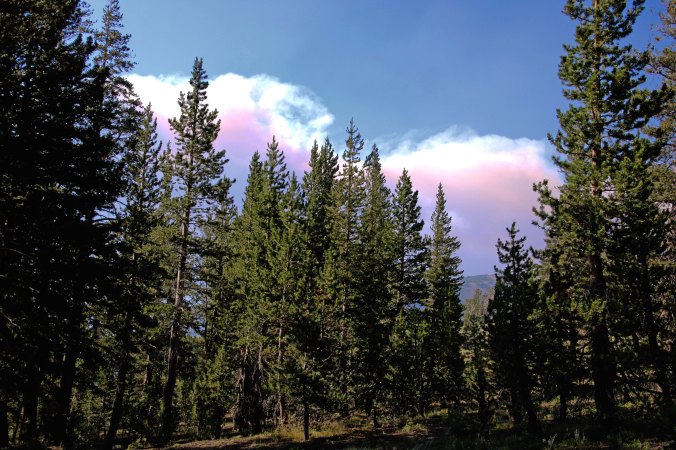
Smoke from the Donnell fire was rapidly increasing when we left Sonora Pass.

I was familiar with the area from previous backpack trips and told Bones the fire could easily make its way from Clark’s Fork up to the PCT. An hour later, after Peggy and I had driven down to Highway 395, we were informed that the Sonora Pass Road had been closed. I read this morning (August 6), that the PCT above Clark Fork was in danger of being closed as well. Kennedy Meadows, where Bones was going to spend the night and wait for his parents, had been evacuated. Peggy and I are concerned for Bones, Camilla, Bastion and other trekkers in the area.
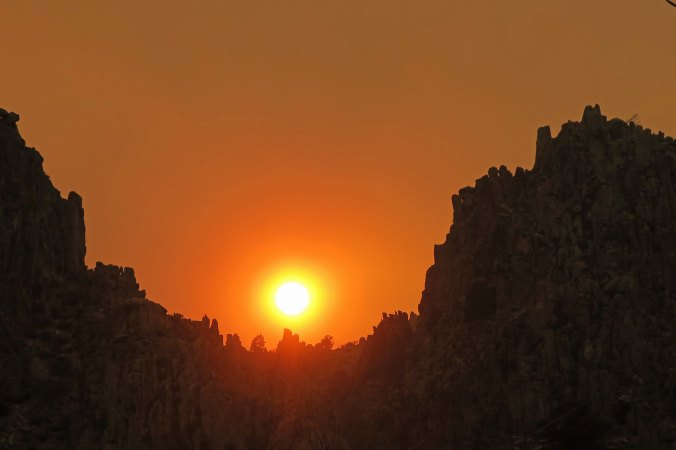
Peggy and I stayed at a KOA along Highway 395 that night. Once again, smoke filled the air. It did make for a rather dramatic photo of the cliffs overlooking the KOA, however.

This is a major story of the PCT this year. In my last post, I had reported how I was jumping south to escape the thick smoke from the Carr fire near Redding. I didn’t escape. As I made my way from Carson Pass to Sonora Pass over the past week, I was followed by smoke from the Carr fire and greeted by smoke from the Ferguson/Yosemite fire. Now smoke from the Donnell fire had been added to the equation. The huge new Mendocino fire around Clear Lake is threatening to be the largest in California’s history. Other fires are raging around LA. Air pollution levels in California are now some of the worse in the world because of the smoke.

Peggy told me that all out-door sports events in Sacramento had been cancelled yesterday because of the problem. And yet, here I am hiking up mountains, pushing as hard as I have ever pushed in my life, breathing the same pollution deep into my lungs. I may have to change my objectives. One possibility that several hikers are considering is to head north to Washington where the fire problem (so far) isn’t nearly as extensive. I’m thinking about joining them.

Photos taken by Peggy as she has her own adventures while providing support for me.
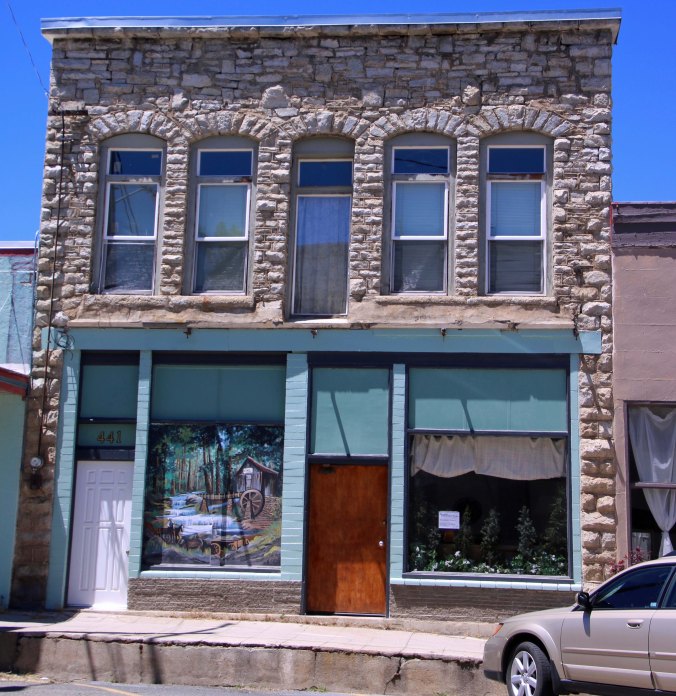
Etna is a favorite town along the PCT, known by hikers for its hospitality. Peggy found the historic buildings in the community of particular interest. This one sported a mural emphasizing its history, as did a number of other buildings. (Photo by Peggy Mekemson.)
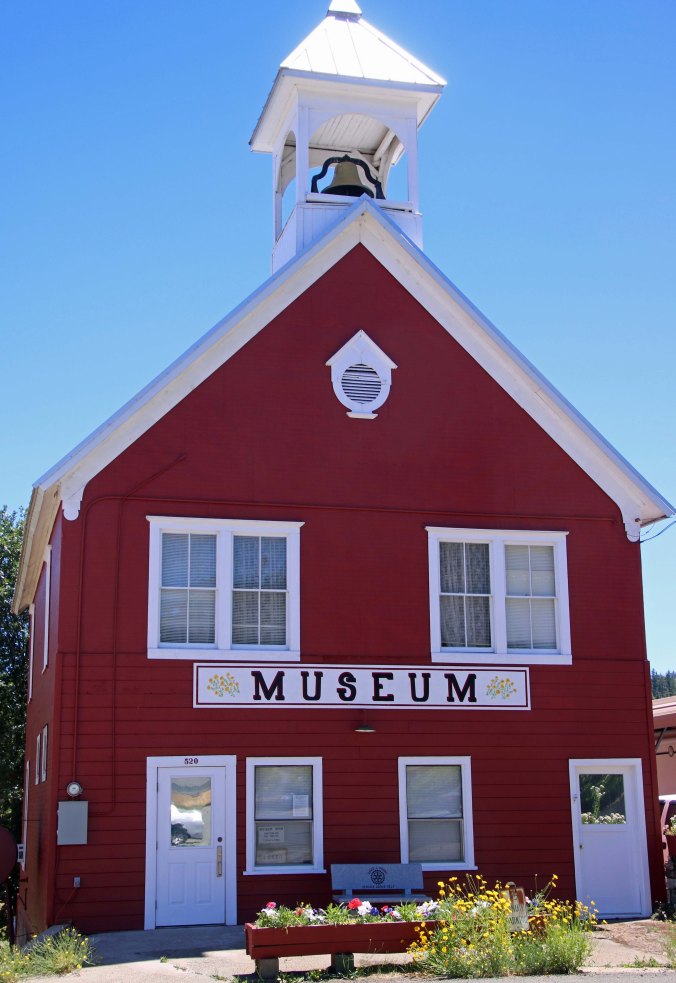
The town’s museum was located in what I assume was an old school.
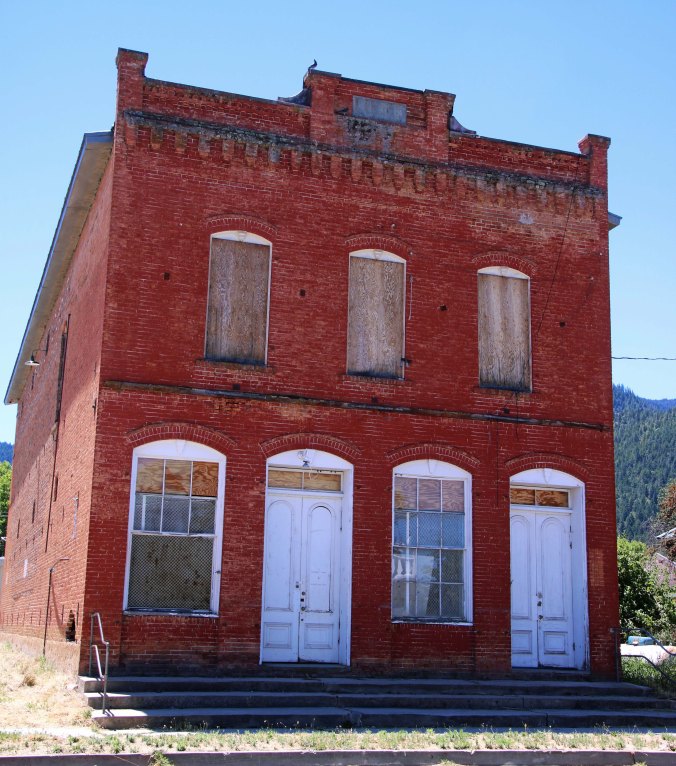
I suspect, or at least hope, that this boarded up historic building will morph into some modern use. (Photo by Peggy Mekemson.)
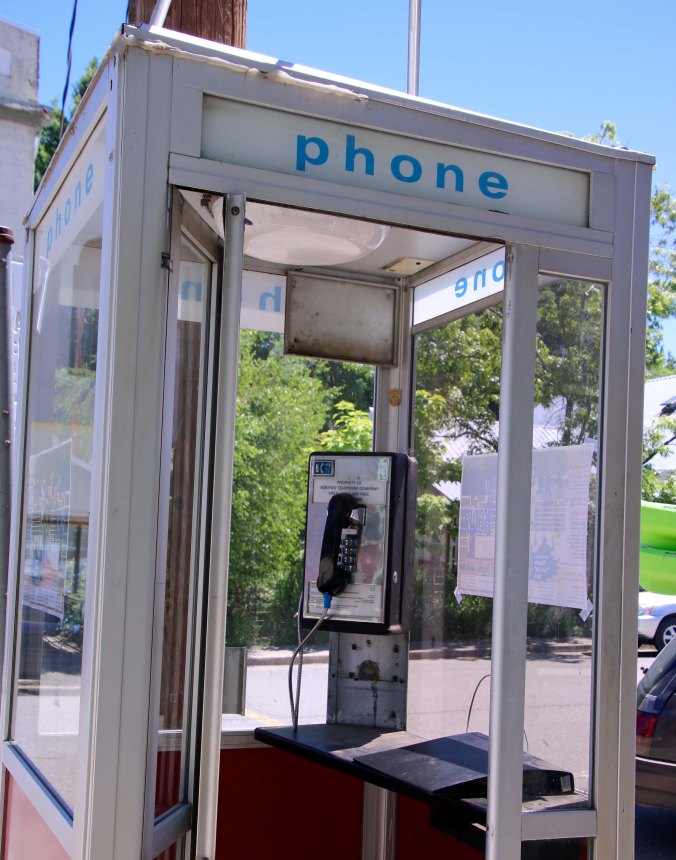
Speaking of historic, this phone booth certainly fits the bill. And it still functions! Local calls were for free. (Photo by Peggy Mekemson.)
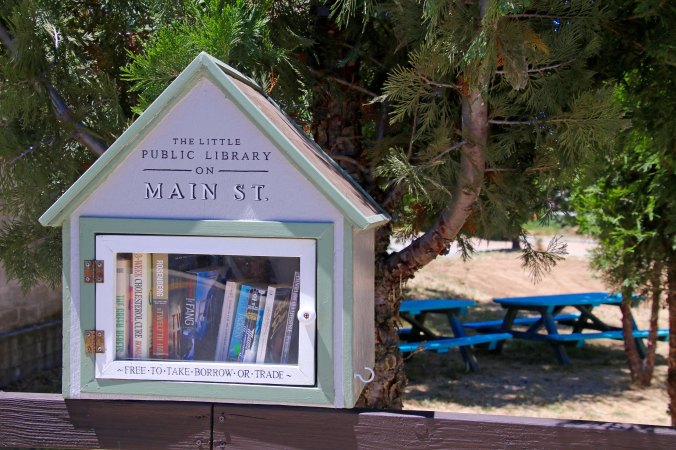
This “Little Library” where folks can pick up, trade, or donate books was near and dear to Peggy’s heart. As President of Friends of the Library in Ruch, Oregon, she has supported a similar program for our community.
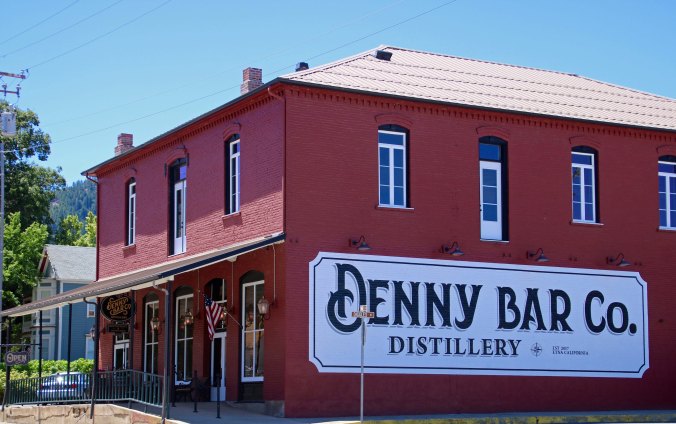
This restaurant was ‘near and dear’ to my heart. Our trail friends, Big Foot and Peter Pan, had recommended it and Peggy considers it a sacred duty to stuff me every time I come off the trail. Stuff away we did.
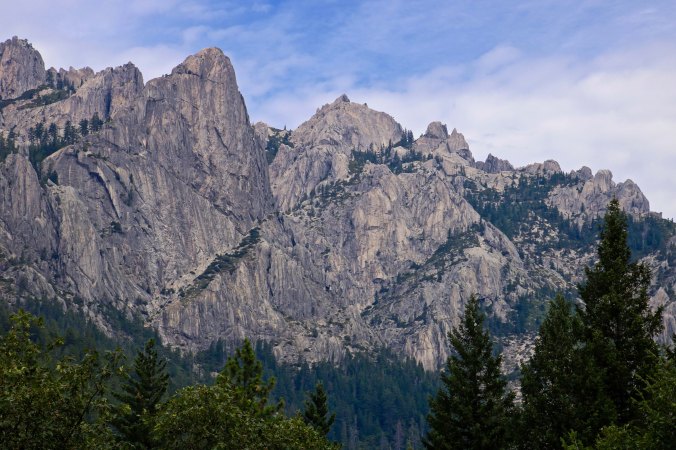
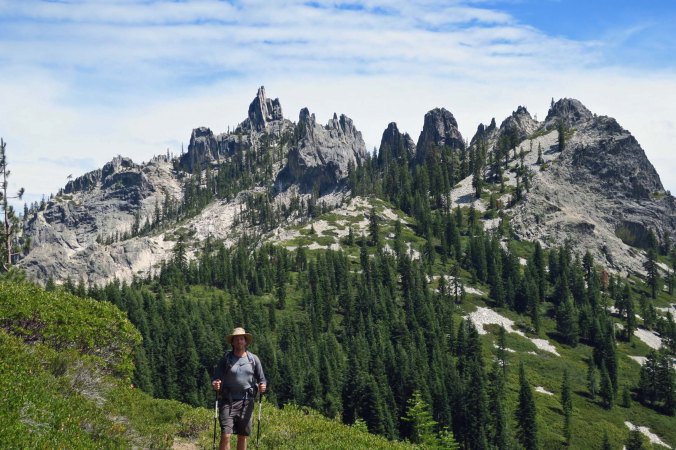
Peggy entertained herself with a long hike at Caste Crags and was rewarded with this view. (Photo by Peggy Mekemson.)

She also found these large Umbrella plants fascinating… (Photo by Peggy Mekemson.)
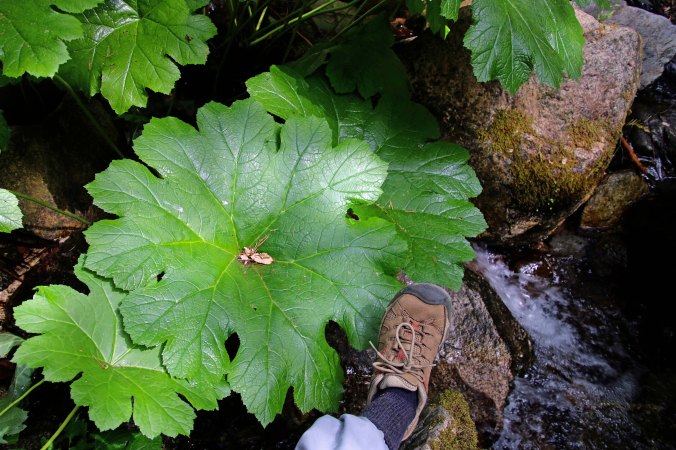
And used her foot for perspective. (Photo by Peggy Mekemson.)

One place she stayed at Castle Crags while waiting for me was at the RV camp at Railroad Resort Park. People can actually rent these cabooses to stay in. Castle Crags looms in the background. (Photo by Peggy Mekemson.)
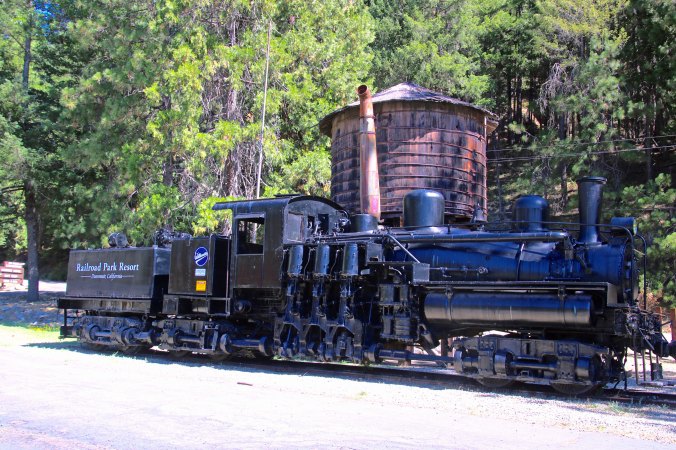
This train engine is located at the park. (Photo by Peggy Mekemson.)
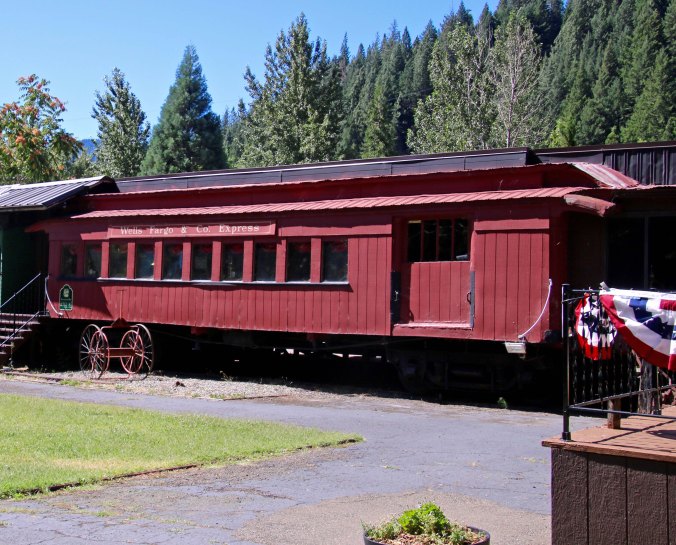
As was this dining car— another place that I was stuffed. (Photo by Peggy Mekemson.)

McCloud featured this somewhat scary sculpture of a logger. You wouldn’t want to meet him at night— or get in an argument over logging practices with him! (Photo by Peggy Mekemson.)
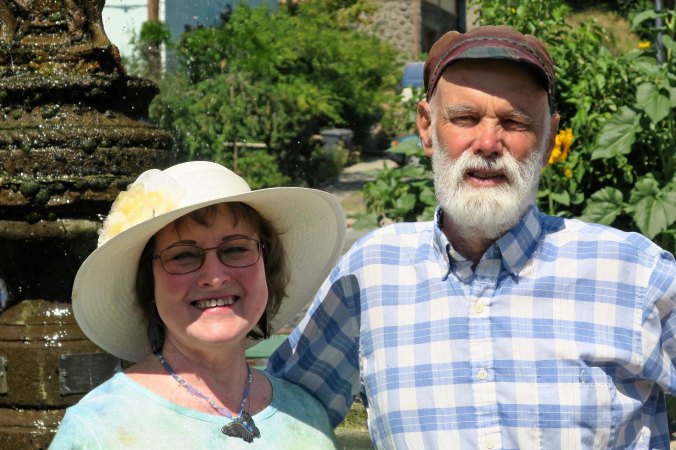
In the town of Dunsmuir, we were joined by Sandra and Tim Holt. Longtime friends, they had kept my nephew Jay’s car for him while we hiked from Etna Summit to Castle Crags. Peggy had lunch with Sandra while we were out on the trail.

Tim and I go all the way back to the 70s and 80s in Sacramento when he wrote, edited and published the Sutter Town News that focused on downtown Sacramento where I was a community activist on health and environmental issues. Now days, Tim and Sandra perform folk song concerts at local venues as well as volunteer extensively in Dunsmuir.
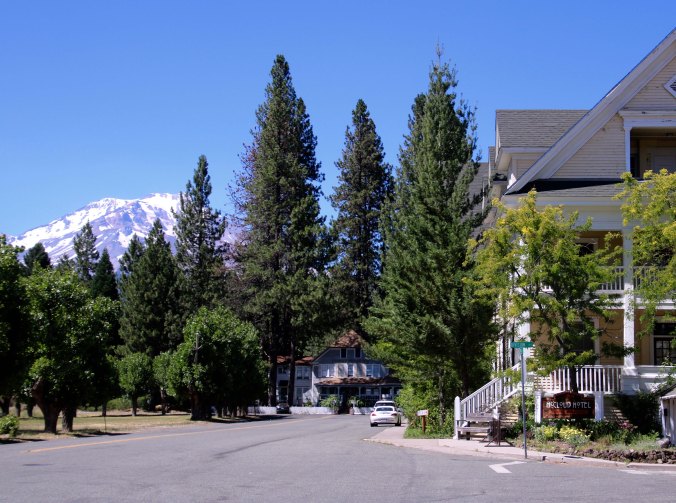
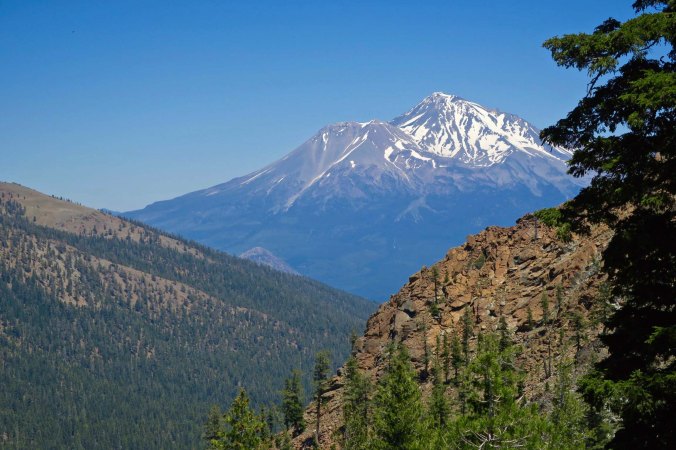
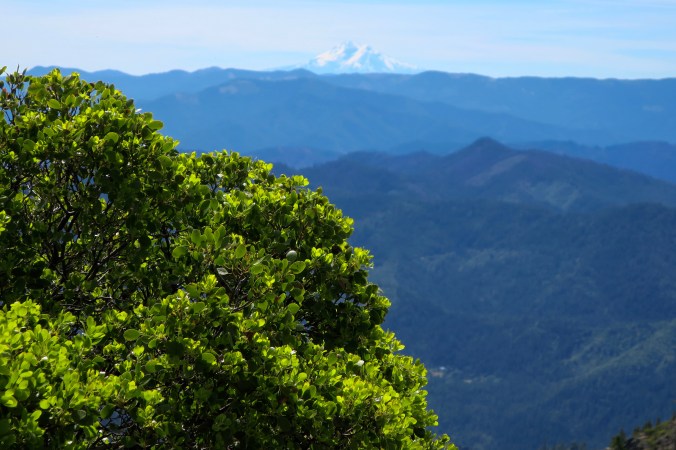
Peggy enjoyed numerous views of Mt. Shasta just as I did out on the trail. This photo was also taken at McCloud by Peggy.
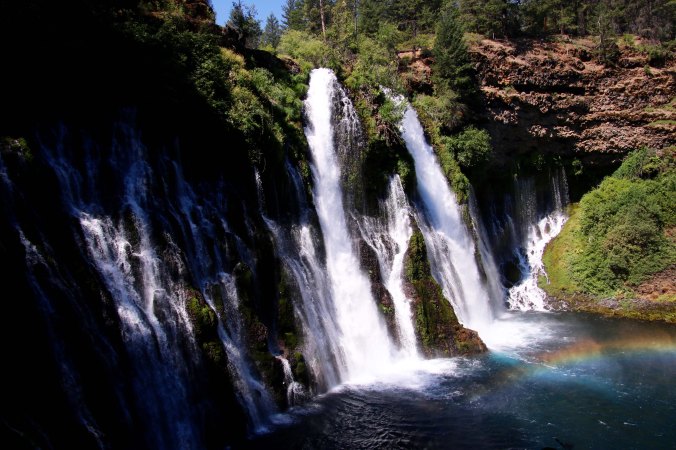
A long hike in Burney took Peggy over to Burney Falls where she even found a rainbow, which she was quite pleased to capture. (Photo by Peggy Mekemson.)
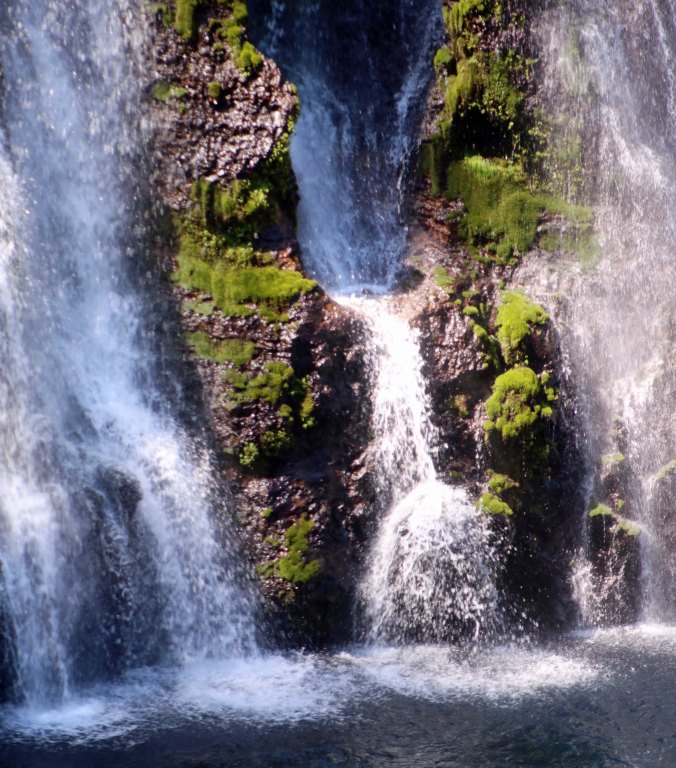
I’ll conclude today with this close-up that I really liked. (Photo by Peggy Mekemson.)

My 13-year old grandson is joining me today. Tomorrow we will start a journey from Donner Summit to Carson Pass. A trip I have been on many times and sections of which I have done with his grandmother, mother, Uncle Tony and Cousin Jay.

When Fire and Smoke Strike along the Pacific Crest Trail… (Plus more photos from Section P)

Smoke from the Carr fire out of Redding plus smoke from a nearby Susanville fire impact the PCT near Chester, California

Up until now, I’ve been lucky in avoiding fires on my hike down the PCT to Mt. Whitney from Southern Oregon. Certainly this was true of Section P that I have been featuring in my last few posts. Jay and I had a couple of days of minor smoke from fires near the Oregon border, but as my photos have shown, most of our trip was either beautifully clear or only slightly hazy. My luck continued all the way through Lassen National Park to Highway 36 and Chester (close to half of my trip). The Carr fire near Redding and several other Northern California fires have changed that.

It seems like the whole West is burning, a phenomenon that has become all too common. And it’s no stranger to those who hike the Pacific Crest Trail. Tinder dry forests, excessive heat, low humidity, strong winds, lightning, and people careless with fire are all factors. A small blaze can quickly escalate into a conflagration that consumes hundreds and even thousands of acres.  Through-hikers and section-hikers pay close attention to the latest news. First, because of potential danger. Pushed by strong winds, forest fires can move quickly and threaten life. Second, and much more common, fires force trail closures. Dreams of hiking the whole trail straight through are often frustrated. Global warming is taking its toll on the PCT!

I met “Steady” from the Netherlands when I was hiking into Lassen National Park. “My trail name is Steady,” he told me, “because I am slow but steady on the trail.” He immediately wanted to know about fire closures along the PCT. Like so many through hikers, he dreamed of making the whole trail without any interruptions. The dead trees in the background are the result of a past fire.

Smoke is also an issue. Visibility drops quickly. Distant vistas that the PCT is famous for and that trekkers love disappear. Of even more concern, air pollution becomes a health threat. The fine particulate matter created by smoke can make its way deep into your lungs. As the American Lung Association notes: Wildfire smoke can be extremely harmful to the lungs, especially for children, older adults (which I vaguely resemble at 75) and those with asthma, COPD and bronchitis or a chronic heart disease or diabetes. Unhealthy air from the Ferguson Fire was a major reason for evacuating Yosemite Valley this summer.

During heavy smoke episodes, people are warned to stay inside and avoid exercising outdoors. The harder a person breathes, the deeper smoke is pulled into his or her lungs. As you might imagine, staying inside and avoiding exercise are not options for people out on the PCT. In fact, through-hikers are exercising way beyond what is normal, especially when hiking up a steep trail or backpacking 20-30 miles a day. (I’ll add my 13-15 miles a day here— grin)

Many of you have expressed concern over how the numerous fires in Southern Oregon and Northern California are impacting my journey. The Carr fire that has garnered so much national media attention, is a case in point. As of this morning the fire has consumed 89,000 acres and is threatening Redding. It has even created its own weather system, including fire tornadoes. Fortunately for me and others hiking the PCT, it is about 50 miles west of the trail. We don’t have to worry about the flames, at least not yet. Hopefully, the fire will be contained by the time you read this post.

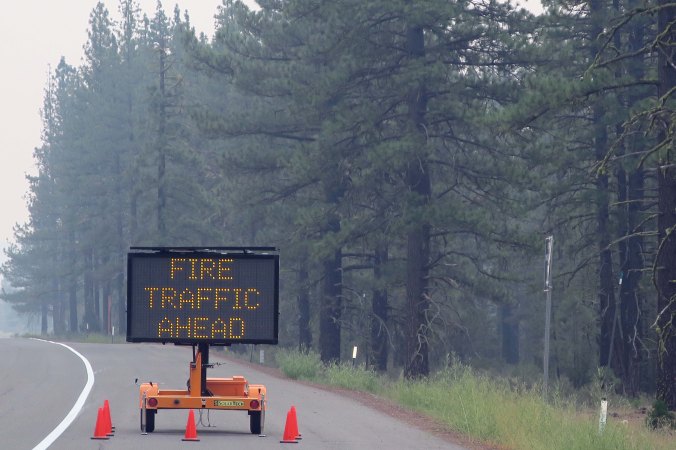
Avoiding the Carr fire hardly puts through-hikers in the clear. Numerous other mountain fires rage in California and Oregon. We came across this sign just a few miles outside of Chester on our way to Susanville. It is a sign of the times.

The smoke from the Carr fire was something else.

When Peggy drove me over to the trailhead on Highway 36 yesterday morning (July 28) for the next segment of my trip, the smoke was so thick that visibility was severely reduced. Smoke from the Carr fire to the west had been joined by smoke from the Susanville fire, about 30 miles to the east. With a 2600 foot climb ahead of me in temperatures likely to climb into the 90s F and possibly low 100s (32-37 C), I was not a happy camper. I would be working hard, hot, and breathing smoke. So, I decided that there was another solution: Give the smoke 2-3 three days to clear out a bit or pick up the trail farther south. While most through-trekkers prefer to hike straight through, nature often has other plans. High snow in the Sierra’s, for example, often forces people to skip that section and hike it later. (I had already skipped one section of the trail where 100 degree plus F heat combined with no water for 30 miles.)

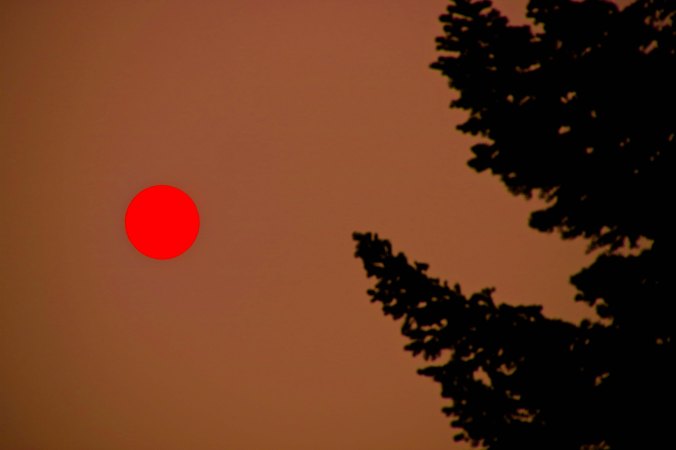
The early morning sun in Chester had been turned red-orange by smoke from the fires.

I can always come back and do the trail or make up the distance in a less smoke-choked area, if one exists in California or Oregon or Washington. My goals are to enjoy the wilderness and its beauty, hike a thousand miles, and follow the PCT as much as is possible, hopefully ending with Mt. Whitney. But beyond enjoying the wilderness, there is a lot of flexibility in my plans. My trail of choice for the moment is to follow the PCT from Carson Pass on Highway 88 to Sonora Pass on Highway 108 and then do the section just north, hiking from Donner Summit to Carson Pass.

……..

But enough seriousness, now it’s time for some fun— brought to you courtesy of my being off the trail for a couple more days. In addition to beautiful scenery and wood sculptures, the trail from Etna Summit to Castle Crags was filled with flowers, some interesting characters, colorful rocks, a seemingly tame frog, pitcher plants, and a very colorful caterpillar. Here are some photos. Enjoy.

This happy fellow who had its own spring seemed to pose for us. It was used to being admired by through-hikers.

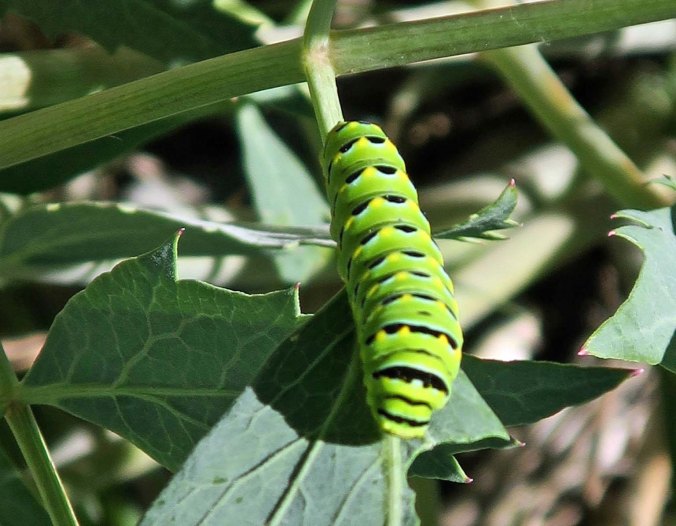
And this fat caterpillar was not about to stop its consumption of a leaf because of our attention.

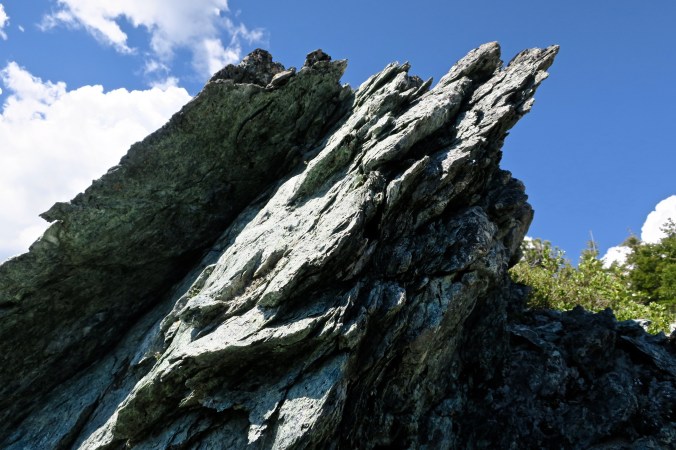
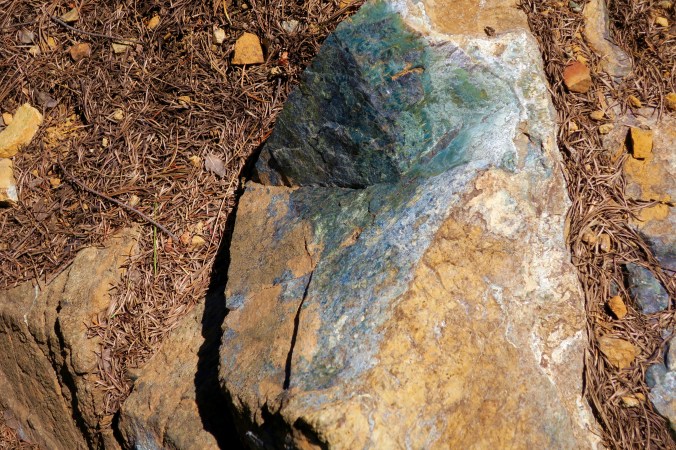
Have you ever seen a rock like this? I could only wonder about its mineral composition and the forces of nature that had created it.

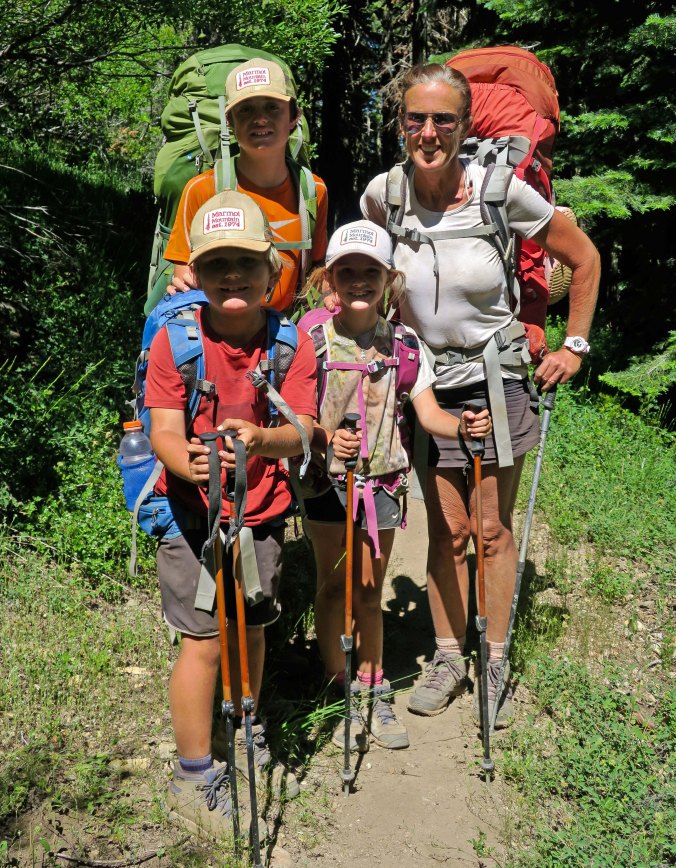
This woman, whose trail name was Mama Bear, had been traveling with her cubs since Mt. Whitney, a distance of several hundred miles.

Wendy and Tim were doing an excellent job of representing Australia. They were hiking down the PCT and hoped to hike across America. Tim, who hailed from Sydney, had previously hiked from the southernmost point in Australia to the northernmost point, raising money for suicide prevention. Wendy hailed from Queensland.

We met Rowan later. She was also from Australia and was hiking in memory of her twin brother who had died. Another brother was also hiking with her. Rowan works as an actress in Sydney.

A beautiful small stream where we met Rowan, made an excellent camp site for Jay and me.

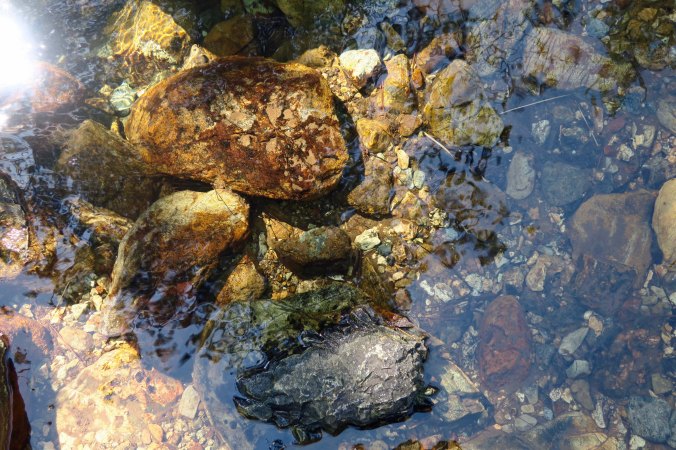
Shooting down into the water, I caught this photo.

PCT trail signs come in many flavors depending on the particular national forest, wilderness, park, etc. I liked the sentiment that someone had expressed on this one.

It seemed to go along with this Zen-like garden a spring had created.

There is nothing calming about this sign. It’s for Bloody Run Trail. Given how the tree is consuming the sign, I thought of running myself.

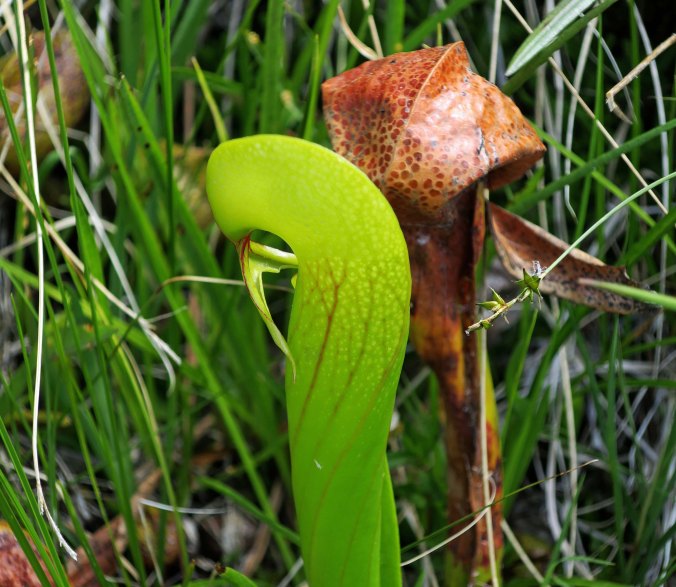
Also in the slightly weird category are these pitcher plants we found where the frog was hanging out. These guys, a young one and an old one, are carnivorous plants that eat insects, which are trapped inside the ‘pitcher.’ Another name for this plant is the cobra plant, given the shape of the plant and its ‘forked tongue.’

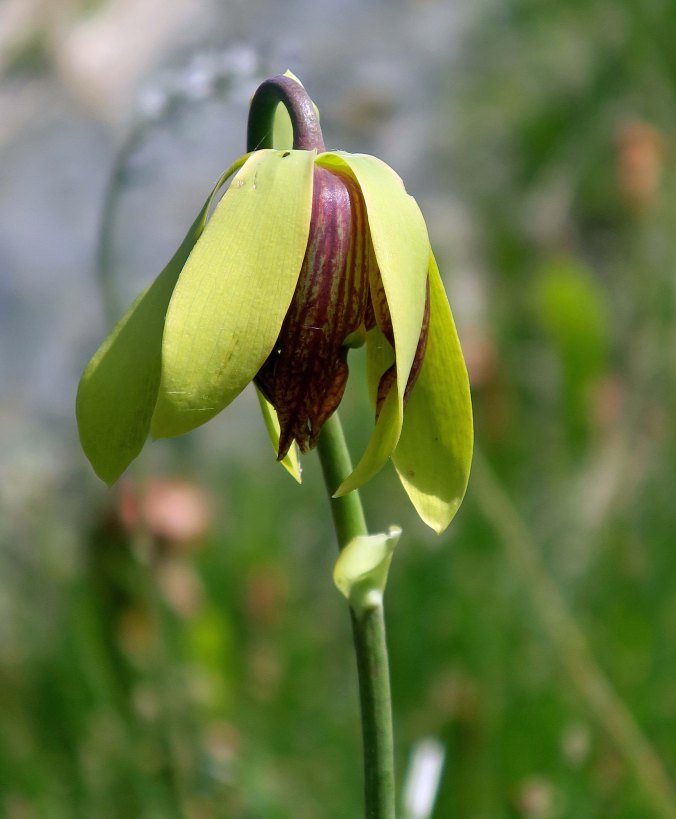
This unusual flower went with the pitcher plant.

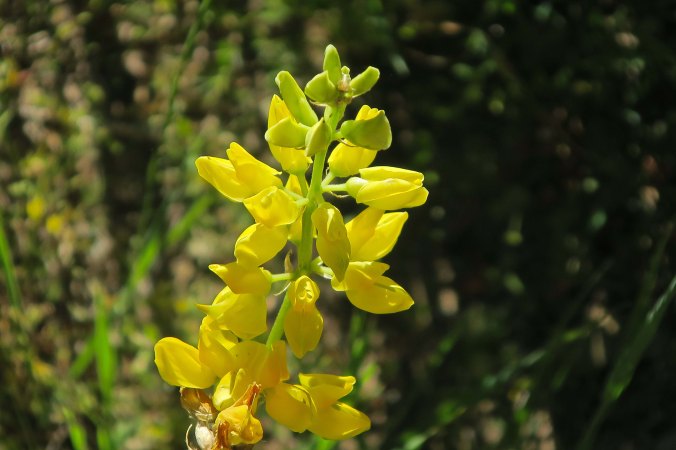
There was no lack of ‘old friends’ when it came to flowers along the trail. Yellow lupine decorated this one.

A close-up of the Lupine.

Recognize this little beauty? It is a wild hollyhock.

I caught this cow parsnip backlit by the sun, but I had to sit on wet ground to do it.

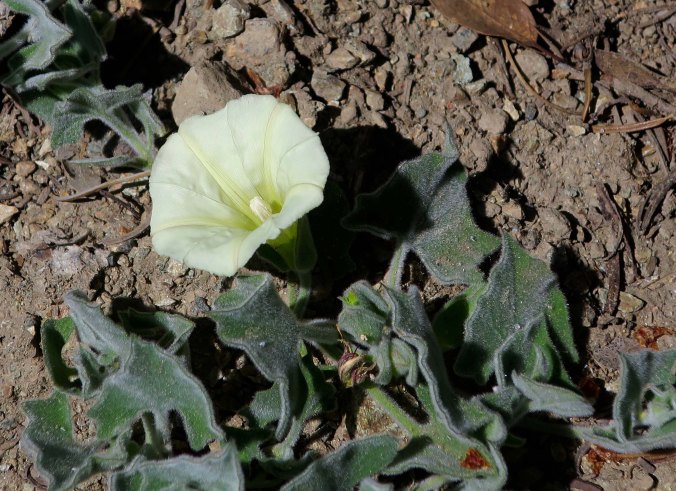
A morning-glory if I am not wrong. Strange leaves, it seemed to me.

A shooting star flower. Hundreds grow in our backyard.

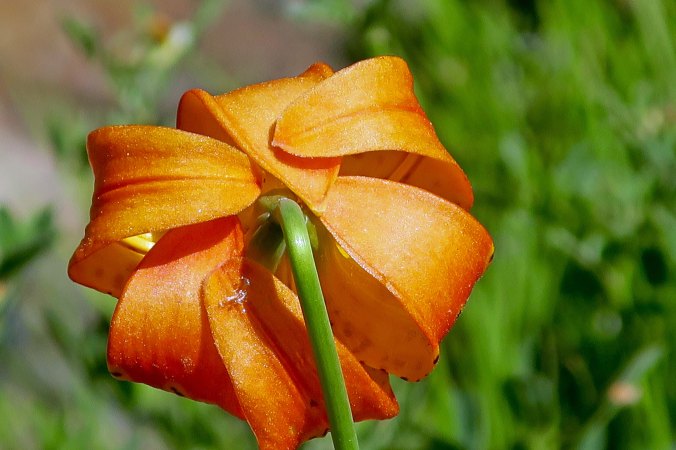
The back side of this tiger lily was quite attractive…

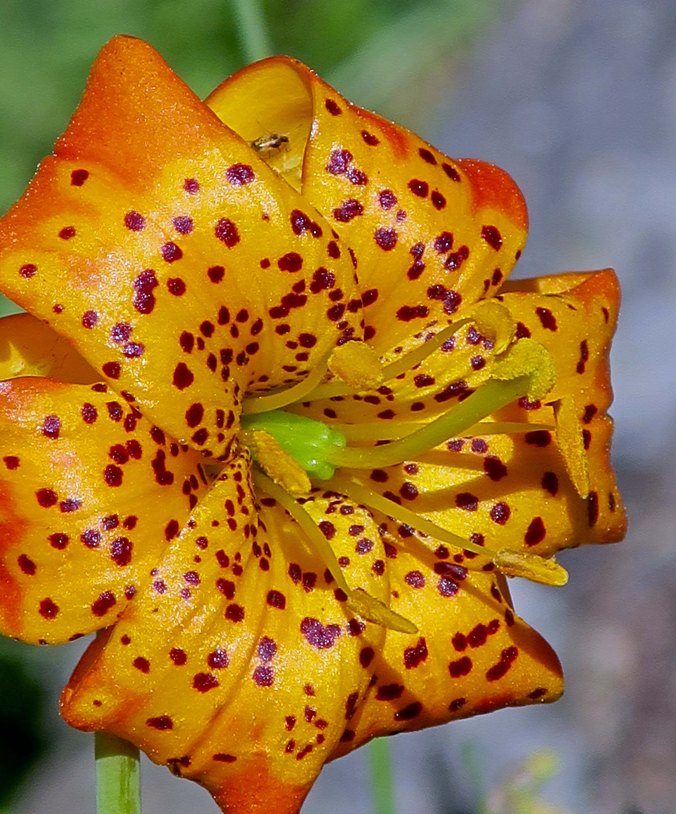
But not as pretty as the front.

I took this photo of Jay as we were hiking down into the Castle Crags Wilderness. No smoke here!

Around the time I took the photo of Jay, we ran into Bill Whitaker. Bill had started his hike at Castle Crags and done a little over 10 miles in two days. He was planning to hike on to the Washington/Oregon border, a long ways at that pace! He was 68 years old.

We also ran into Bilbo, Ducky and Shoe. Their approach to the trail was to take a couple of hours off everyday at lunch, which was a quite civilized approach to the PCT. Bilbo was from German, Ducky from Utah, and Shoe from Canada, representing the international nature of those who hike the trail.

“Watch out for rattlesnakes,” a through trekker told us. Jay, who was in the lead, didn’t have to be told twice. In fact he found two. Neither seemed to be interested in a photo-op and disappeared into the brush even though I invited them to come out. Can you find the rattler here?

Jay and I at the end of the trail where Peggy was waiting for us. (Photo by Peggy Mekemson.)

I’ll conclude with this photo of ‘Aunt’ Peggy and Jay at Railroad Resort RV Park beneath the Crags.

Next up: Peggy’s photos of Etna and Dunsmuir, two small towns that through-hikers visit on their way through Northern California.


SaveSave

SaveSave

SaveSave

The Incredible Castle Crags… Hiking from Etna Summit to Castle Crags: Section P of the PCT, Part 3

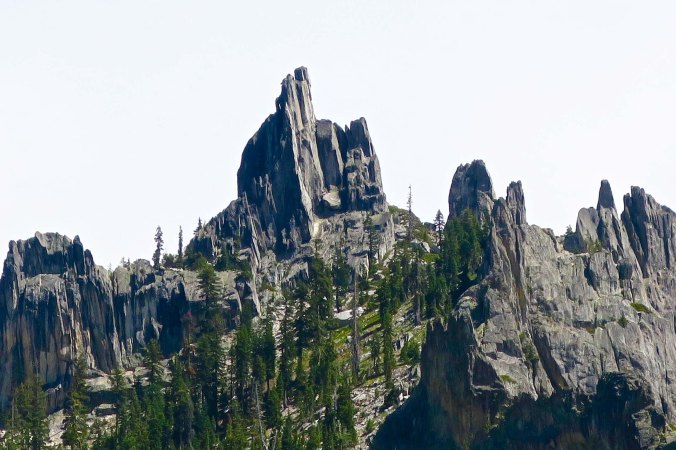
One of our first views of the Crags, which are indeed craggy.


For those of you who are following me along on my journey, I am now in the Northern California town of Chester, having finished hiking through Lassen National Park. I just ate four pieces of French Toast, two eggs, two sausage patties and half of Peggy’s garlic french fries. I’m ready to blog!

Actually, when you read this post, I should be nearing the town of Belden on the Feather River, which will be close to my halfway mark! Peggy and I are planning to take a break for a few days there, which should allow me to get caught up on the blog.

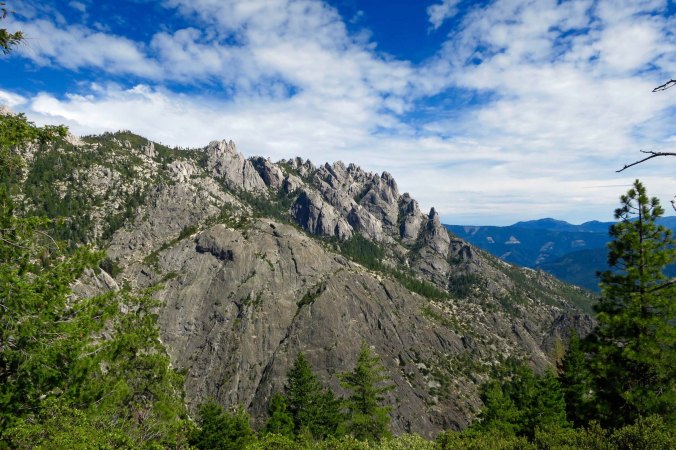
But for today, I want to introduce you to Castle Crags, a massive hunk of carved granite that sits beside Interstate 5. I’ve been passing and admiring it from the highway for decades. It is totally different to see it from the Pacific Crest Trail. My nephew, Jay, and I experienced it as we dropped several thousand feet down to I-5 on an 18 plus mile day. The views and photography helped me forget my aching feet.

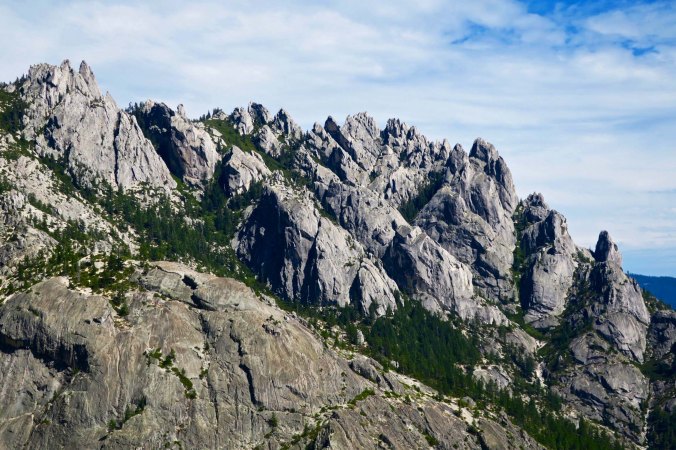
The Crags are noted for their white granite.

A photo showing how dramatic the spires can be.

And a closer view.

As we dropped down, the Crags took on a different look.

Again, closer.

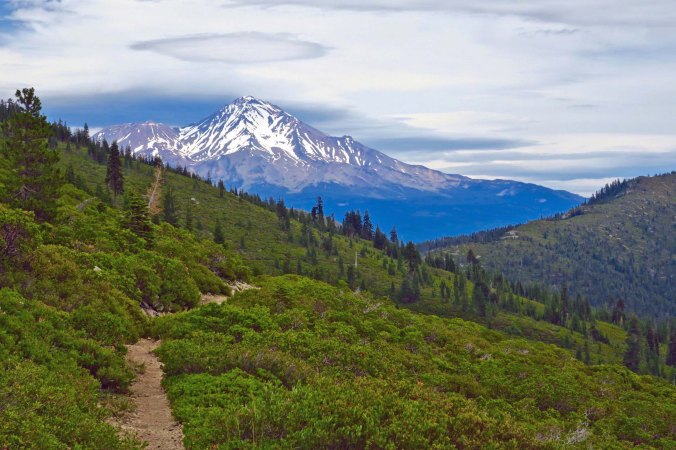
The trail down also provided this dramatic view of Mt. Shasta with its interesting cloud.

Early the next morning provided this view.

Followed by this…

A final view from the trail.

And this was Peggy’s view from where she was staying at the Railroad Resort RV Park. No climbing up or down involved. (grin)


Scenes from along the Trail… Hiking from Etna Summit to Castle Crags: Section P on the PCT Part 2

The100-mile section of PCT trail through the Russian Wilderness, Trinity Alps and Castle Crags Wilderness is filled with beauty and wide open vistas, making it one of the most impressive sections of the route,


I played a bit in my last post, featuring wood sculptures and ‘faces’ from along the trail from Etna Summit to Castle Crags following the PCT. I can’t resist these sometimes beautiful, sometime humorous and sometimes downright weird contributions by nature. You’ll see more. Guaranteed! Today, I am going to take a different tack and make an effort to capture the beauty of the Russian Wilderness and the Trinity Alps, which I hiked through with my nephew, Jay. I’ll follow up with a post on the incredible Castle Crags. As one through-trekker noted, “Why aren’t these a National Monument?”
I wish I had more time to devote to these posts, but I face the same problem as folks doing the whole PCT. Time. You have to do the miles. Because I am only doing a thousand, I have a bit more. I can leave my camp around seven and usually get in somewhere between three and four, having done my 12-15 miles. It’s a good thing! My 75-year-old body can use the recovery time. When I camp with through hikers, they are almost always out by 6 or earlier (some tromp by in the dark), and don’t come in until 7-9ish. Or by flashlight. Once they hit the trail, they are moving. There is little time to stop and admire the flowers like I do.

My layover days, when Peggy picks me up, are crammed with activity. First up, is stuff Curt. Peggy is quite concerned about how skinny I have become and I have no objection to her admonitions to “eat!” Then there are the necessary chores to prepare for the next leg. I am ever so lucky to have Peggy’s help here. She does the laundry, for example, and earns beaucoup credits for handling my ‘trail-flavored’ clothes. PCTers are a smelly bunch. There is no help for it, even though most of us make an effort to stay clean. A shower is top priority, right after the cold beer. Organizing my resupply and repacking takes time, and I need to review and pack my next set of maps. And then there are the posts, reviewing my journal, downloading and processing photos, and writing.

So, without further ado, here’s my photo essay for the day. These are from the Russian Wilderness.
Views of mountain ranges entertained, and wowed us, every day. These photos are from the Russian Wilderness.
Another view…

Snow was light this year, so there isn’t much left.

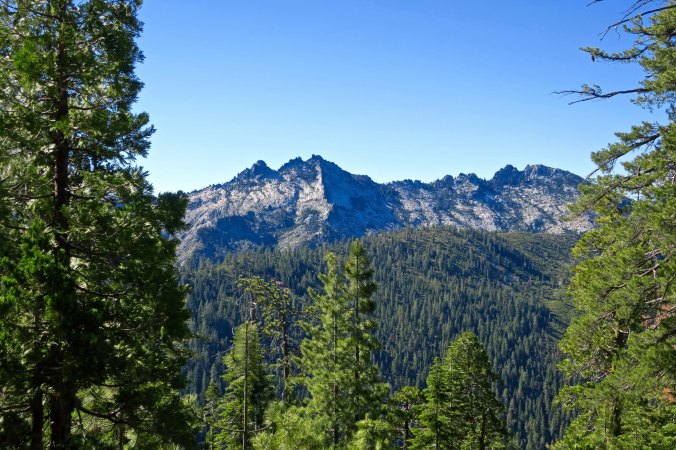
I found these craggy peaks lined up against the mountain unusual.

A snag added color here.

Every corner Jay and I hiked around provided another view. We were cutting across the ridge on the left. In a day or two, we would be to the distant mountains.

This section had much more than mountains. Rocks, for one.

A close up.

This snag with its curled limbs caught my attention. Our trail snakes along on the bottom right across quite steep terrain.

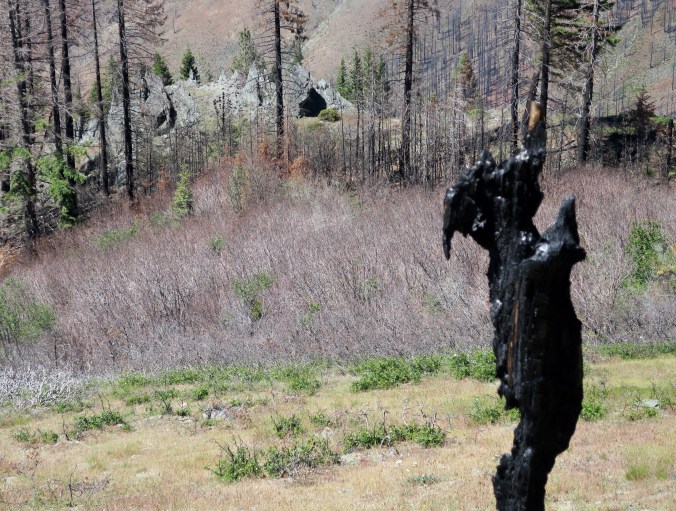
Again, we found ourselves passing through burned over areas.

Our campsite that night, however, was blessed with these beauties, and a barely flowing stream. But water is water!

Our journey then took us into the Trinity Alps.

The area has a number of enticing lakes, many of which I have camped on in previous treks into the area.

And Alp-like mountains, for which it was given its name.

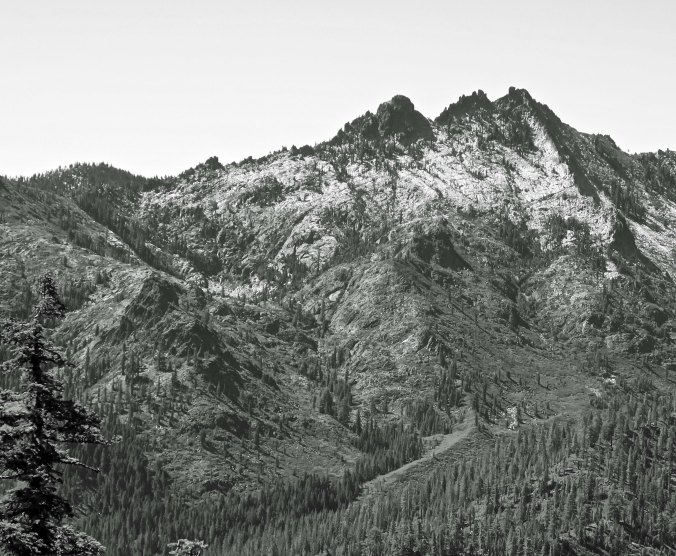
The same peaks rendered in black and white.

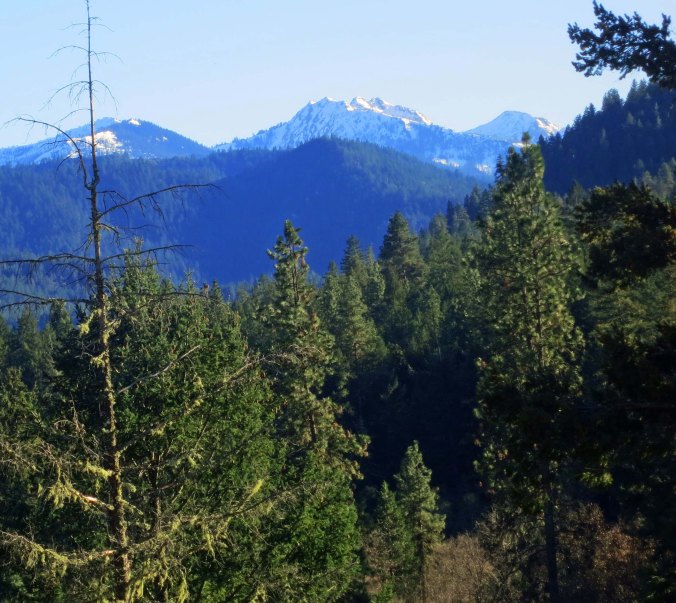
And, as we have gotten used to in our trek through Northern California, enticing views of Mt. Shasta.

Another.

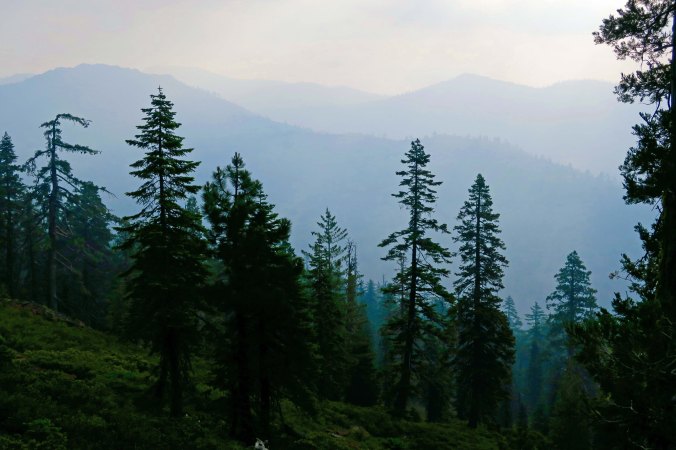
Forest fires burning in the area provided this smokey perspective.

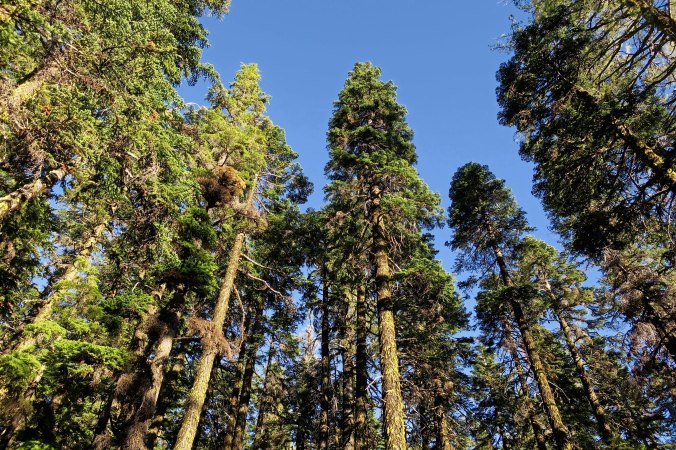
This stand-alone forest giant, a cedar, was impressive.

And who can resist mountain meadows that invite you into distant views.

Another.

I liked this white pine with its long cones.

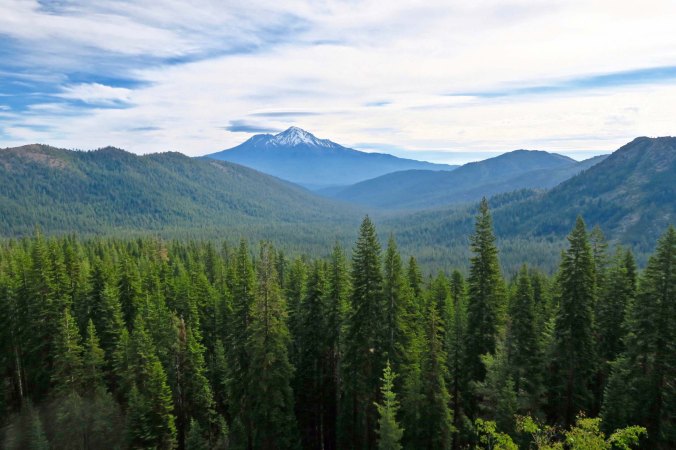
And I will close today with this forested view of Mt. Shasta in the distance.

What’s in a Name? … Hiking from Etna Summit to Castle Crags: Section P on the PCT Part 1

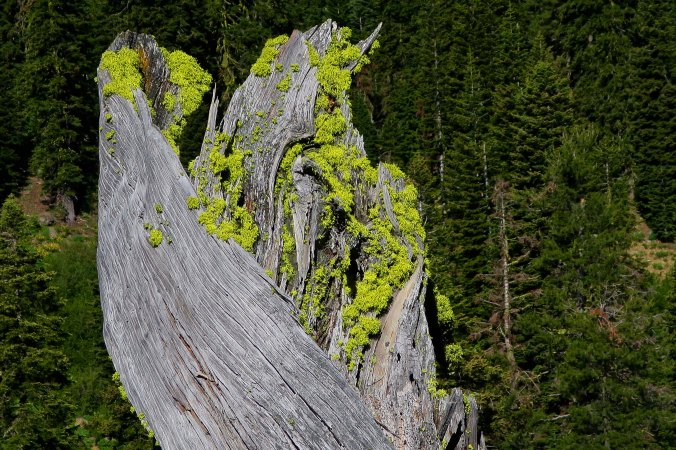
My nephew, Jay, and I couldn’t resist the beautiful wood sculptures along the PCT between Etna Summit and Castle Crags. I liked the drama created by rendering this one in black and white.


It’s official: I am The Wanderer, or more simply, Wanderer, which will come as no surprise to followers of this blog. Trail names are important out here on the PCT. You are supposed to earn one by your actions, looks or quirks. For example, a young woman came in to get water at Deer Creek Springs above the McCloud River where I was camping for the night and introduced herself as Pez. Apparently, she likes the candy, was using it for encouragement along the trail, and was glad to share.

“I’m running low,” she told me, somewhat concerned. I understood. It would be like my eating the last of my nightly Oreos before reaching Peggy and my resupply. It’s like seeing your gas needle hit empty on a lonely road. I pictured Pez raiding the stores in the Castle Crag area, buying enough to get her over the next mountain range.

Pez allowed that she might not keep the name. Through-trekkers are allowed to accept or reject the trail names they are given, and choose another— if a better one comes along. Does that make us a fickle bunch? She chatted for a while, maybe a little lonely. Her boyfriend was hiking the Appalachian Trail while she was hiking the PCT. She seemed so young. “I felt it was important for my independence.” I admired her.

There is great equality out on the trail. We are all hiking up the same mountains, facing the same issues of weather, biting insects, and miles and miles to travel. The lack of water in the last section I just hiked through, added the serious problem of having adequate water to drink. Forget having enough to bathe or wash clothes! My nightly sniff-test suggested I was deteriorating rapidly.

Beat up feet are one of the things that PCT hikers share, although problems like blisters are more likely in the beginning before feet toughen up. Paper tape has always been my go-to solution. I earned the black and blue toenail on the Rogue River. In six months there should be a new one.

“Grab a handful of fir needles and rub them over your shirt,”Pop Corn! suggested. “Then you will smell like a fir-tree.” I was bemoaning the fact that there was no swimming hole in Peavine Creek to jump in before I met up with Peggy. None of us ‘smell like a daisy’ out on the trail, which isn’t a problem until we approach civilization. I thought Pop Corn’s! suggestion was the ultimate in PCT wisdom. (grin)

Temperatures climbing above 100-degrees F (37.7 C) on the sizzling hot afternoons didn’t help. There was also a major lightning storm. It missed me; Peggy was worried. Another through-trekker was struck. Luckily he wasn’t killed and is recovering. Several forest fires were started as well, which are always a worry for those of us who live and travel through Western forests in this era of global warming. I can smell smoke now. One is out there lurking, waiting to pounce.

As a general rule, the through-hikers are a cheerful bunch. I rarely hear a negative word, regardless of how tough the day. A ready smile and “How are you doing?” is the normal greeting. “Great” or “Good” is the normal answer. And there is always, “Have a great hike!” or something similar. Occasionally we stop and chat. But the need to get on down the trail always drives us on.

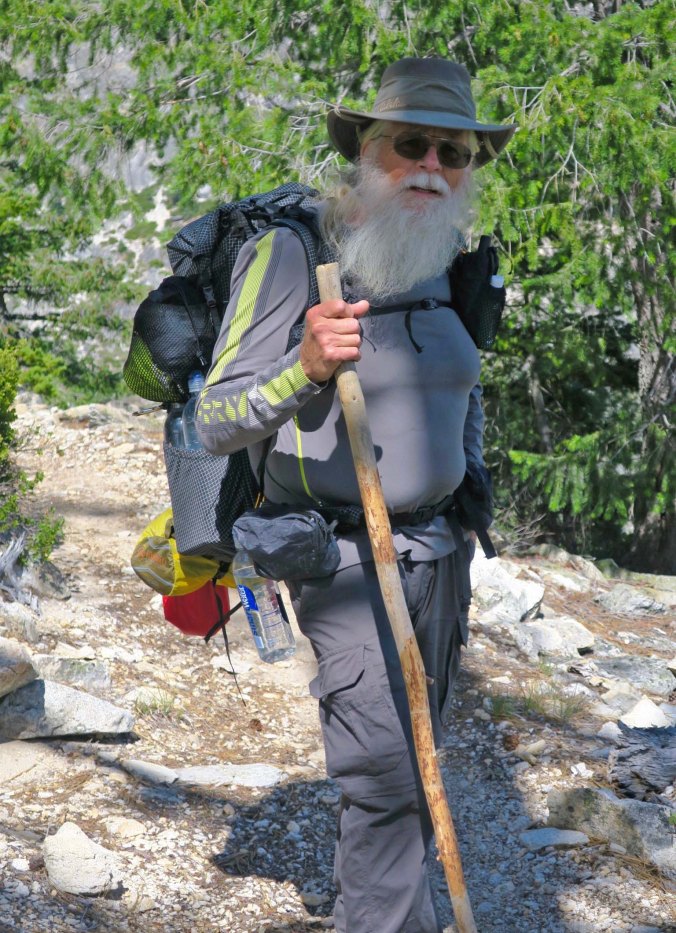
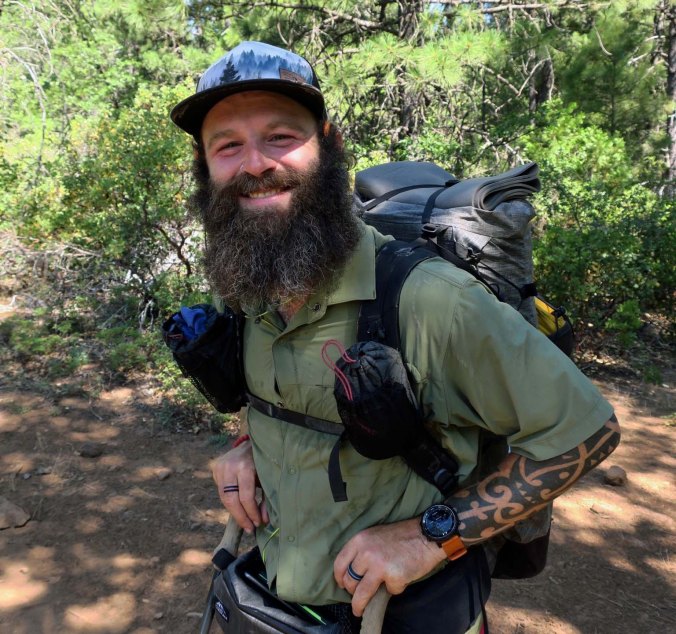
As usual in my life, I am going against the flow. While the vast majority of trekkers are going south to north, I am going north to south, hiking to my own drummer, so to speak. In fact, I have only met one other couple going the same direction I am. It makes it more difficult in the name game. One minute, or even five-minute encounters along the trail, are hardly enough time to observe a quirk or trait that might suggest one. “Grey Beard” Peggy urged. And that fit. At 75, I am certainly of the age that a name implying elder seems appropriate. And it made me think of Gandalf the Grey! But I have seen several youngsters along the trail in their 60s with magnificent grey and white beards that put my puny efforts at growing whiskers to shame.  (My students in Africa where I was a Peace Corps Volunteer teaching high school in the 1960s called me Ho Chi Minh because I sported a see-through beard like his.)

It’s pretty hard to claim the name Grey Beard when the competition is this tough. Jay and I ran into Bill Whittaker as he was climbing out of Castle Crags.

I was hiking up Grider Creek out of Seiad when I came on Adam and Eve. They wanted to know my trail name. “Happy Wanderer,” I replied spontaneously. I had just been singing the song to help me up the trail. Immediate recognition filled their eyes as they sang a few bars of the tune that was once popular in my (and their) youth. It fit even better than Grey Beard.

The title of my blog is “Wandering through Time and Place.” My business card for this trip announces ‘celebrating 75-years of wandering in the wilderness.” I have a lifetime of wandering behind me. But it goes further. Ancestors on both sides of my family were wanderers. My father’s side, the Mekemsons, arrived in Pennsylvania in 1755 and had soon moved on the Maryland. (All six sons fought in the Revolutionary War.) They were living in Kentucky by the late 1700s and had then moved on to Illinois, Iowa and then west coast by the early 1900s. My mother’s side, the Marshalls, followed a similar route, arriving even earlier in Boston in 1630. They had moved on to Connecticut, New York, Illinois, and then west. Wandering is in my blood.

The name fit well but I had given it to myself, which certainly happens… but isn’t supposed to. I was reluctant to use it.  The next time someone asked, I replied “still searching,” meaning I was still searching for my name. They assumed it was my name and liked it! It certainly isn’t a bad one. I am ‘still searching’ at 75 and would love to be at 95. But now I had three active names, and that can get a bit confusing.

I was hiking along the ridge above Moosehead Springs a few days ago between Castle Crags and Burney Falls when a fellow with a large red beard, named Red of course, stopped me and asked “Are you Curt, or Grey Beard, or Wanderer?” Naturally I was delighted. The question meant he had run into Peggy and was carrying a message. But you can see the difficulty.

It came to a head when I was hiking out to Burney Falls. Peggy was a bit confused about when I would arrive and had found a much better location to pick me up. The confusion wasn’t surprising. My first four days on the section had been tough (I’ll cover them in a later post.) I’d given myself a semi-layover day on the McCloud River and fallen behind. Three days out from the falls, I’d found myself with over 45 miles to travel— a walk in the park for the hardened PCTers with 1500 miles under their belts, but tough for my 75 year-old-body that was already complaining.  None-the-less, I buckled down and vowed to do it. I dutifully arrived at Peavine Creek, 15 miles from the Falls at the end of the second day. The next morning found me shooting down the trail at 3-4 miles per hour. I can still move when inspired and It was mainly downhill. Peggy, cold beer, a shower, a good meal, and clean clothes were waiting!

I’d made it 10 miles when Patch stopped me. He had pointed to his belt pouch and pulled out my card. “You must be Grey Beard or Wanderer, or something else,” he had announced laughing. ‘Peggy is waiting for you at the Dam and she is a really neat woman.” Peggy had given him and his buddies apples and PCTers respond amazingly well to fresh fruit. Thus, it started. A dozen people must have told me that Peggy was waiting and raved about her. “A lovely young woman is waiting for you at the Dam and she said you should hurry,” was one comment. I hurried. Peggy was now distributing cold beer and I wanted to make sure I got there before she ran out. (Kidding, sort of.) A couple greeted me at Rock Creek and the man asked if I was Graveyard— at least that’s what my ears heard. “Um, not yet,” I had responded. He assured me he had said Greybeard. His companion asked, “Wanderer?”

Patch pulled out my business card and told me Peggy was waiting for me at the Pit River Bridge/Lake Britten Dam.

That did it. When I reached my lovely wife, and had been properly greeted and handed a cold beer, she announced, “We have to do something about this name thing. You are Wanderer!” Peggy had spoken— and I couldn’t have agreed more.

*******

Now it’s time to drop back to my 100-mile trip between Etna Summit and Castle Crags of a week ago. There is a lot to cover, having hiked through the Russian Wilderness, the Trinity Alps, and the magnificent Castle Crags Wilderness. I was lucky to have my nephew Jay along. He had joined when he was a somewhat shy 16-year-old as I wrapped up a 360-mile backpack trip from Lake Tahoe to Mt. Whitney 15-years ago. Now he was 31 years old and a talented photographer, cameraman, and director in the early stages of a Hollywood career. He was also in love; no longer shy. I heard a lot about the young woman. (grin) More to the point of this trip was his incredible enthusiasm for the country we were hiking through. I’d often hear him exclaim “Wow!” as he found something of interest or beauty. It seemed that half of our hiking time was taken up with photography as we found something new to photograph.

Jay on our Etna Summit to Castle Crags trip.

At age 16 on top of Mt. Whitney when he joined me on part of a 360 mile backpack trip I did from Lake Tahoe to Mt. Whitney.

I could tell that Jay was a serious photographer by the various poses he assumed while taking photographs— all with a pack on his back!

Here’s my photo of what I believe Jay was trying to capture.

I am going to do several posts on this section. One, because there is so much to cover, and two because I would like to do a separate post featuring Jay’s photography and another featuring Peggy’s photos of Etna. The small towns along the PCT are very important to the through hikers. They are where they pick up their resupplies but they also provide a break from the trail. Again: think cold beer, good meal, shower, and clean clothes.

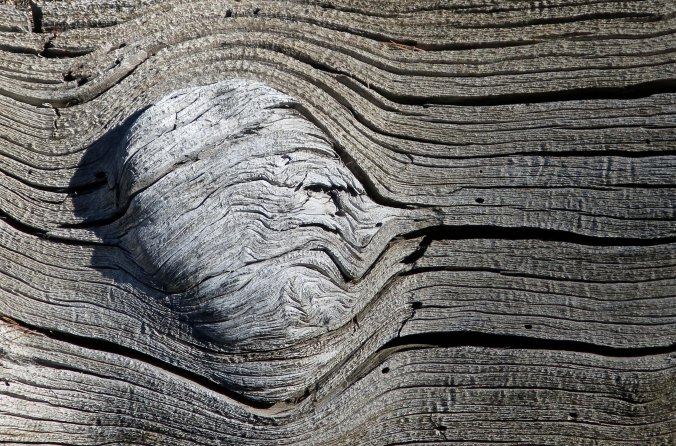
I’ll do these as photographic essays on a thematic basis. Where to start is the question? Logically, I would show photos of the general terrain we were hiking through. But for fun, I am going to start with the natural wood sculptures Jay and I found along the trail. These almost guaranteed a frenzy of photography. Also, there were the strange faces peering out at us from the wood. The forests are alive. A little theme music please…

I am a bit of an Animist when it comes to nature. I believe that awareness flows through all living things, be they animal or plant. Finding faces staring out at you is totally for amusement, however. This fellow with his bulbous nose and laughing eyes resembled an ancient Greek comedy mask.

While this guy hidden in the crack seemed a bit more ominous!

And this one was just ducky. Check out his bill. Is he grinning or grimacing?

It was the ‘wind-blown’ hair that captured my attention here.

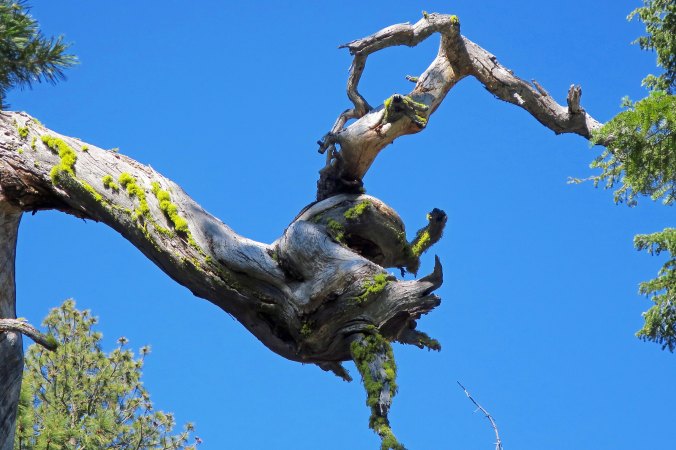
This was our first view of the wood sculpture I featured at the beginning of the post. It guaranteed that Jay and I would be off on another detour. Completing the PCT would probably take the two of us years because of all the time we spend being sidetracked.

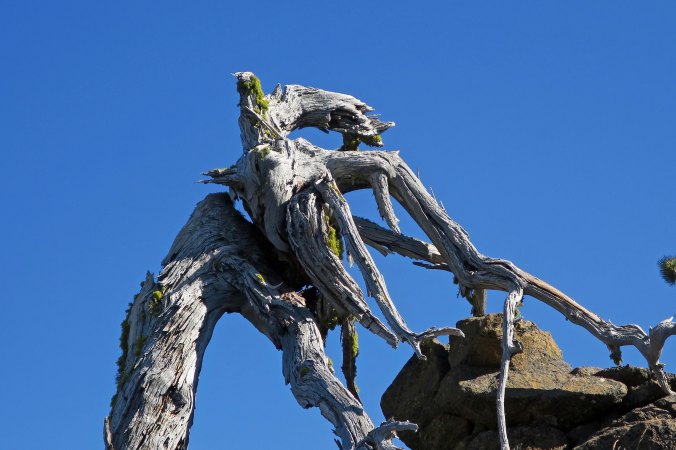
This was another impressive wood sculpture that caught our attention. It looks like it was climbing the cliff.

A close up.

Less dramatic wood sculptures created by dead trees also demanded stops. I thought of these two as ‘family.’

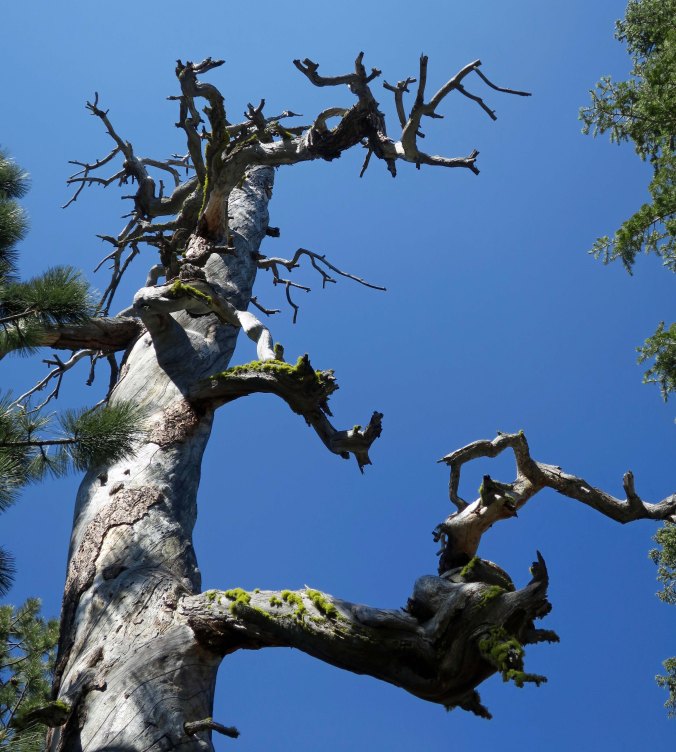
This large dead tree provided…

… this interesting limb.

Roots grow around rocks and continue to hold onto them after the tree dies, providing for interesting contrast of wood and stone.

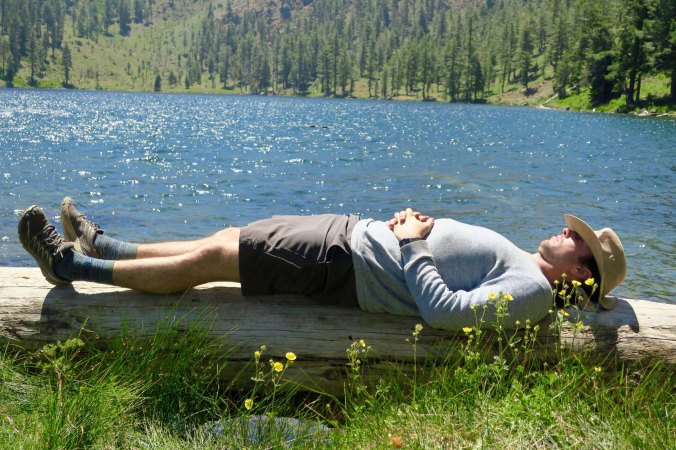
And one of the downed trees that give Deadfall Lake its name provided Jay with a convenient place for a nap.

I imagined a discussion going on here. The bird with the large beak is giving the snooty creature on the left an earful, and he doesn’t want to hear it!

I’ll conclude today’s post as I started, with another black and white.

I am back into the woods today, but this time for a short 50 miles. I’ll get up more posts on the PCT between Etna Summit and Castle Crags when I come out, including photograph collections by both Jay and Peggy.


When Large, Very Noisy Animals Invade Your Camp, Who Do you Call… Hiking 1000 Miles Down the PCT at 75

Our backpack trip though the PCT section R of the Siskiyou Mountains took us through our backyard…the Red Buttes.

The Red Butte Mountains of Northern California and Southern Oregon.

The other side of the Red Buttes Mountains as they appear from our patio during the winter.

I’m happily settled in the small community of Etna while Peggy and our nephew Jay shuttle his car down to the town of Dunsmuir, which is 100 miles down the PCT and our next resupply point. He is joining me as I hike through the Russian Wilderness and the Trinity Alps. Jay is a budding cameraman and director out of LA who focuses on documentaries and independent films. He  last joined me on a backpacking trek when he was 16 and I was 60! “Follow your bliss. Do what you love to do,” I had urged. And he has. I am looking forward to seeing this section of the trail through his cameraman’s eyes and will share some of his photos. 

I’ve now completed my first two segments of the PCT, which included hiking through the Siskiyou and Marble Mountains. Today’s blog will take us back to finish up hiking through the Siskiyous, quite literally our backyard, and down into the small, very independent-minded town of Seiad. Again, given my time limitations, I will do this post mainly as a photo essay.


Life slows down when you enter the wilderness and the every-day world fades away. The beauty of the woodlands and mountains, the sheer physical challenge of the journey, and the brief encounters with the cast of characters hiking the PCT become our everyday reality. I go for days without thinking of ‘The Donald’ or what he might be up to. Instead, the almost mystical Mt. Shasta provides us with tantalizing glimpses, endless flower gardens cling to the steep paths we climb, butterflies flutter among the flowers and then shoot into the air in mating rituals that predate humankind. What’s happening in Korea doesn’t seem to be nearly as important as where the next watering hole is. Even the flatness of our tent site seems to take priority.

What’s around the next corner or over the next mountain always pulls us on. This is Sheep Camp, which I featured in my last post. The lush green grass seen here appealed to both sheep herders and cattlemen for summer grazing. It also appealed to us! This was the view from our campsite.

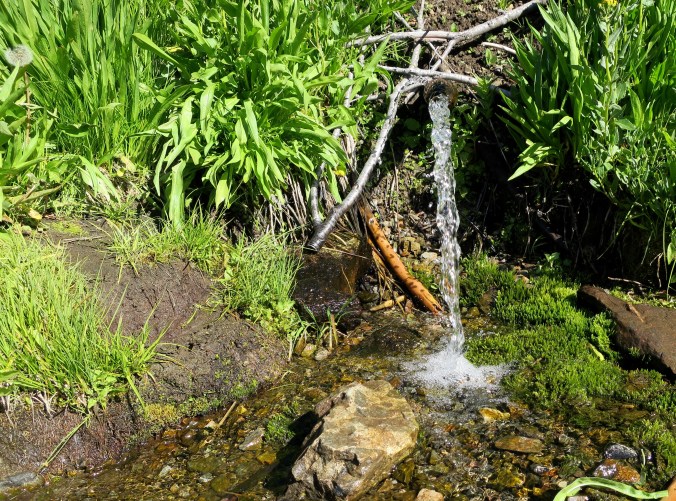
Water can be plentiful or precious in the mountains, and a spring attracts both animals and people. Through hikers on the PCT pay close attention to where the next water may be found. It may be just around the corner or 15 miles up the trail. A pipe delivered water directly from the spring to thirsty hikers at Sheep Camp. And it was cold and delicious!

Peggy found this natural chair along the trail, perfect for the weary hiker. Her grin says it all.

Like lack of water, snow conditions are always a major consideration of people who hike the PCT. Many of the hikers we met had skipped the southern Sierras because of heavy snow over the passes and would return to them after reaching Canada. In fact, through-hikers jump around a lot depending on conditions. I planned my trip so snow wouldn’t be an issue. The concern here was the snowball that I knew would soon be flying my way. Peggy simply can’t resist. It was guaranteed as soon as I turned my back. That’s my “Don’t do it, Peggy.” Ha!

Only a small portion of the people hiking the PCT go from Mexico to Canada. May people hike sections. Molly and Brandon were hiking from Castle Crags to Crater Lake. Others may be out for just a day hike like many of the people we saw around Mt. Ashland.

Ezra and Janie were a mother and son team (the second mother/son team we saw that day) who were hiking from Seiad to Ashland, I believe. Jane owns a clay sculpture shop in the historic mining town of Jerome, Arizona. Ezra is going to college in Portland. “We try to get out on a backpacking trip together every summer,” Ezra told us.

If there is one sign guaranteed to get the heart of every through-hiker beating fast, this is it.

Here’s why. If you are hiking to or from the Mexican border where the PCT starts, it is 1,706 miles away.

Like Sheep Camp, Donomore Meadows was another area that appealed to early ranchers and miners. Just before we reached this meadow, Peggy and I had stopped to check out a lightning damaged tree and a fawn  jumped out of the grass where its mother had hidden it. It bounded off with a squawk that sounded very much like “Mom!” Deer usually do a great job of hiding their newborns. The color of the fawns, their absolute stillness, and an almost total lack of smell helps guard them from hungry predators. Just like human moms, babies can come early, however! We came down our driveway a couple of days before starting our trip and a doe had dropped a pair of twins in the road. One was spry enough to stand up on wobbly legs, but the other still couldn’t move!

The Offenbacher Cabin, built by stockmen in the 1930s, still stands today in Donomore Meadow. Descendants of the family have turned the cabin into something of a haven for through-hikers. Water, chairs, and even a bed greet trekkers.

I found this unusual fungus growing near the cabin…

And Peggy stopped to admire this tree.

Our camp at Bearground Springs brought an unusual surprise. And it wasn’t a bear. We could hear them coming from a long ways off… with bells. BTW, I have my Kindle along and am reading “The Snow Leopard” by Peter Mathieson.

The bells came into our camp and stopped. Peggy, who had to go out and ‘serve nature’ took this photo. Nine cows had come to visit! It sounded like a hundred and it appeared that they were going to hang out with us for the night. There would not have been much sleep. I growled like a bear from inside the tent and the cows remembered an urgent appointment they had over the mountain. We could hear their bells rapidly fade into the distance. Each bell, BTW, makes a different sound and the cowboys are able to recognize the cow by the bell.

Rocks also captured our attention and schist, a metamorphic rock, was common along this section of the trail. Quartz, which Peggy loves, is often found with schist. In fact, Peggy likes to pick quartz up to take home for her rock garden. There was no picking up quartz to go in our backpacks this time, however!

It was ‘look but don’t touch.’

Always on the lookout for strange or interesting things along the trail, I found this rock and couldn’t resist a photo. Quite a set of choppers, eh?

I also find interesting wood sculptures irresistible.

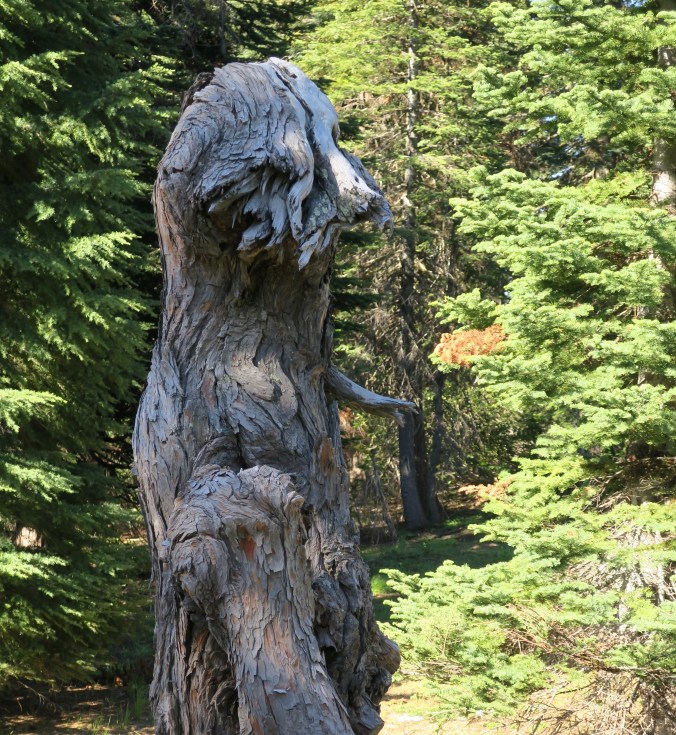
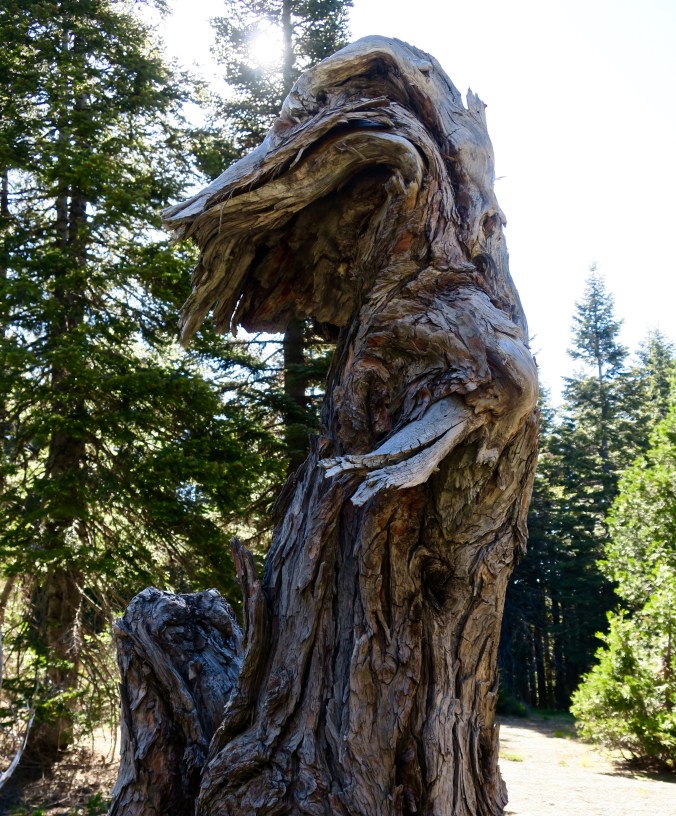
This tree stump looked a bit like a river otter from one perspective…

And quite reptilian from the other side.

“There’s water down here,” we heard a voice pipe up. It was a welcome announcement. We’d been many miles without any. Turns out, it was Strawman, who we had met a week earlier and given a ride when we were scouting out the Etna area where I am today. We had a happy reunion. Such meetings are typical encounters along the PCT. Strawman, we had learned, navigates from a PCT App on his phone, as many, maybe most, trekkers do. I’m old fashioned and prefer a map.

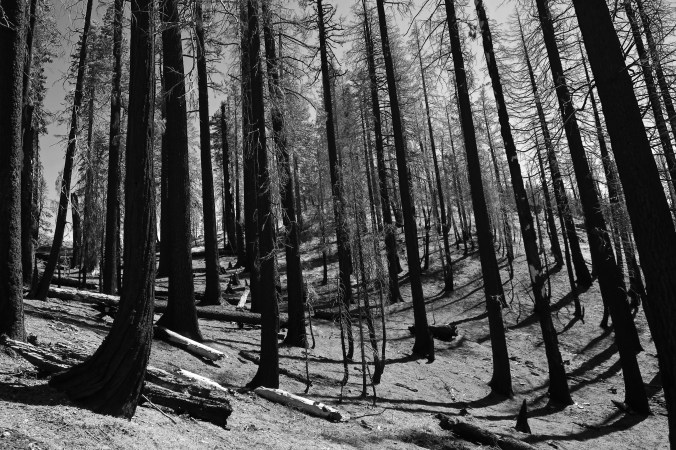
Not too far from Beardog Springs where we met up with Strawdog and camped the night, we began to hike through areas that had been ravaged by forest fires. This was the same series of fires that had forced Peggy and me to evacuate our home last fall. (I’ve rendered it in black and white.) A through-hiker commented to us how ugly it was— I think it was Road Runner who hikes 40 miles a day. Peggy replied she found it interesting and got a strange look. But forest fires are a part of the natural process. A combination of us doing everything to prevent forest fires for the last 70 years and drought/global warming has created the situation where the whole west seems to be burning. (More on this in later blogs.)

Knob cone pines, like this one, actually require fire to free the seeds from the cone so they can germinate.

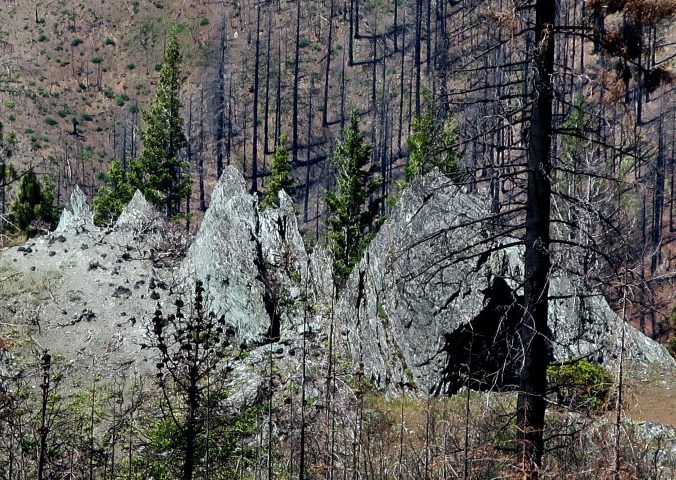
We found these strange looking schist stones in the burn area that looked something like tombs in a fantasy movie. All that was missing was a winged demon…

Which the fire had provided! Note the glowing eye.

Peggy and I felt right at home on Cook and Green Pass. We had hiked up here last year from the road above our home.

The trail from Cook and Green Pass that goes around the Red Buttes Wilderness goes up a bit. Peggy went through 99 bottles of beer on the wall, and then 99 bottle of rum, and then 99 bottle of wine, which was beginning to sound a bit like 99 bottles of whine. 🙂 The hot afternoon sun didn’t help. Flowers did, however. We had found them all along the trail from Mt. Ashland to Seiad. Here are a few of the many:

We also learned what makes the Red Buttes Red. These reddish rocks when broken open…

Are filled with the blue/black mineral Olivine that happens to be rich in iron. The red is rust!

We camped that night at Kangaroo Springs, which is just below Kangaroo Mountain. For my friends in Australia, I don’t know how the mountain got its name.

Here I am with my first aid kit of drugs looking like maybe I’ve had a few too many. Actually, I am contemplating the 4,000 foot drop we have to hike into Seiad Valley. Are my 75-year-old knees, ankles and hips ready for the descent? They are screaming “no.” (They ended up doing fine.)

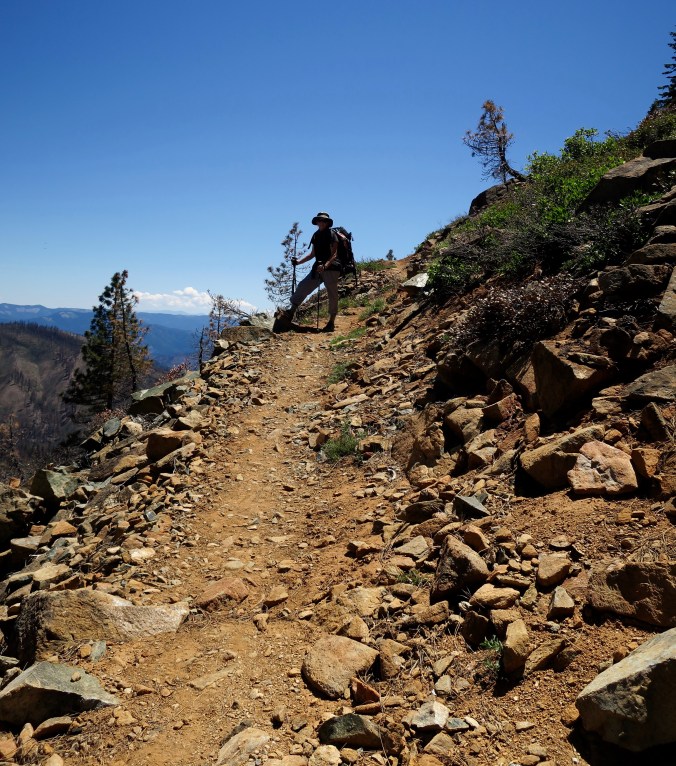
Looking down at the steep, narrow, rocky, occasionally overgrown trail. You can see the switchbacks on the left.

Some stunning views helped. Once again, Shasta can be seen in the distance.

We met Crazy 71 Plus who is now 72. He insisted on pulling his pants up for the photo. Crazy, who is from Hong Kong, got his name last year when he hiked the first half of the PCT. He has returned to hike the second half. Part of what he is doing is raising funds for charities in China.

“We need to take a selfie,” he directed. So we did. “Your face is in the wrong place,” he chided. I told him I liked the photo. I think he was disappointed to learn that I was older.

Once again, our water was getting low when we reached Fern Springs near the bottom of the trail. The water tasted great, but not nearly as good…

As the cold beer we bought first thing when we reached the Seiad store!

We stayed at the Mid Valley RV which welcomes PCT Trekkers allowing them to stay over night and use the facilities for $15.

The owner, Bruce, does everything he can to make hikers feel at home.

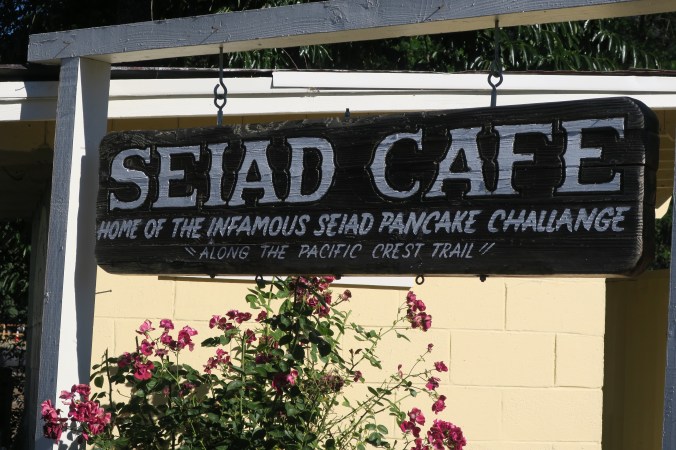
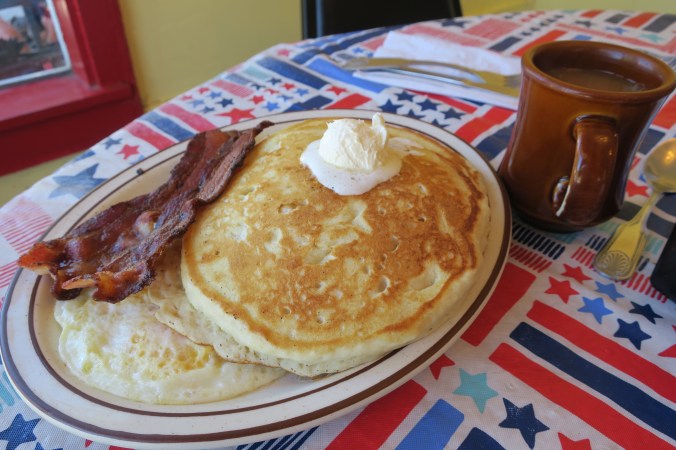
As does the Seiad Cafe that has a pancake challenge. They make five big ones for $15. If you can eat them all, they’re free. The owner told me that several hundred trekkers have tried in the past ten years, but only four succeeded.

Peggy ordered two of their regular size and could only eat one. The owner told me the challenge pancakes were five times as large!

Here’s the spatula used to turn the pancakes.

We met this Jack-a-lope at the store next door where we bought our beer.

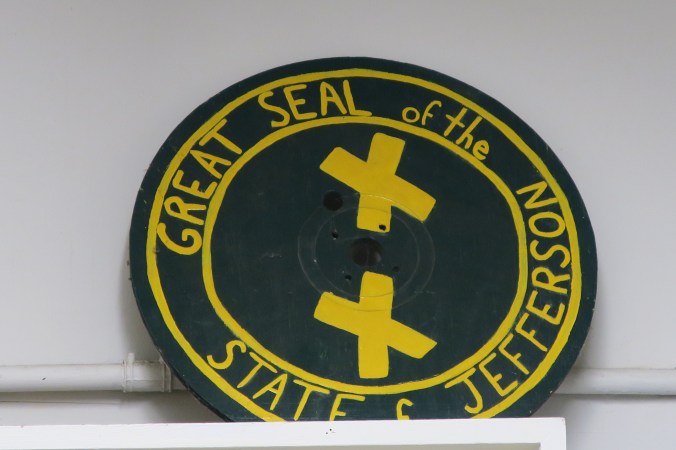
The residents of Seiad are an independent bunch who would dearly love to break off from California and create a separate state. This is the seal. The two x’s apparently mean California double crossed them by not letting them break off after they had voted to do so prior to WWII.

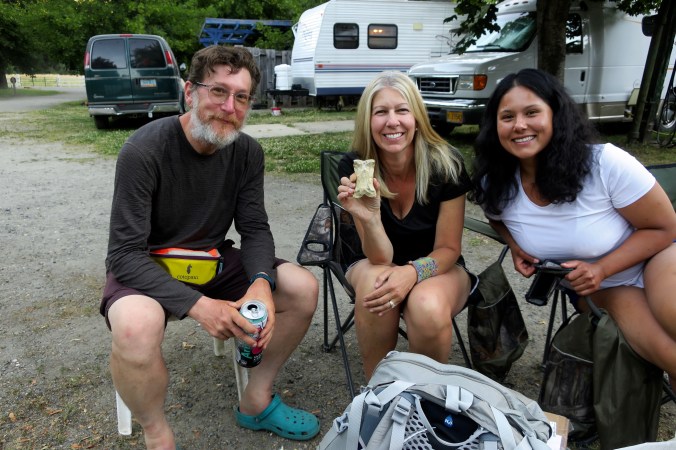
A number of trekkers were staying at the RV campground. We sat around and chatted. Bone, who has been traveling the world since 1977 and is accompanying me on my 1000 mile trek, insisted on coming out and visiting. Mr. O is on the left, Jeanine is in the middle and Julie is on the right.

SaveSave

SaveSave

SaveSave

From Mt. Ashland to Seiad on the PCT: Section R… Hiking 1000 Miles on the PCT at 75

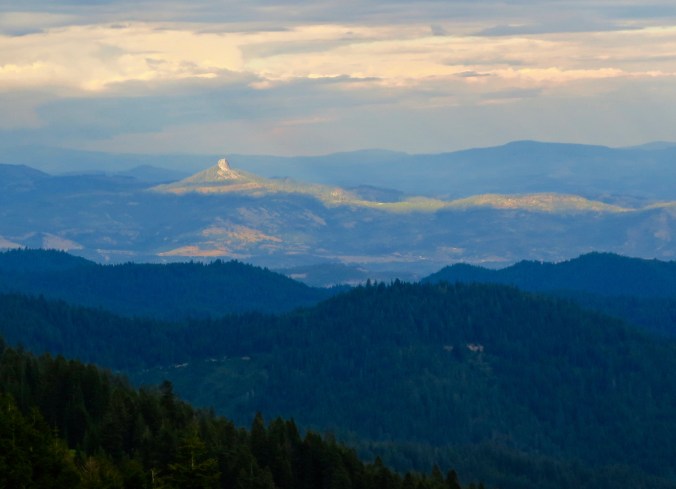
Sheep Camp seems like an appropriate place to start. We camped there on our second night out. It is a beautiful place, but my reason here is the tiny knob you can see off on the left horizon. Early pioneers used it as a major landmark at the end of their 3000 mile journey to guide them into Oregon and a new life. This also shows the distant vistas that inspire and pull long distance hikers on.

The knob lit up by the evening sun.

The day had finally arrived. I was both nervous and excited. How could I not be? I was heading off on one of the great adventures of my life, leaving my home on Southern Oregon’s Applegate River and backpacking 1,000 miles to Mt. Whitney in southern California following the Pacific Crest Trail.

I wasn’t nervous about the backpacking; I am not a novice. In fact I’ve backpacked tens of thousands of miles in my life. Man was landing on the moon in 1969 when I shouldered my first pack. I watched the landing at a Denny’s when I was returning home from backpacking in the Canadian Rockies. The PCT organization, the folks who have done so much to create and maintain the trail, was a fledging one year old. I had stopped in Seattle to buy my gear from REI on my way to Canada when that was the only store that REI had. I guess that puts something of a perspective on how long I’ve been doing this.

But I had never been on a thousand mile trip. And I am no longer the 25-year-old I was then. Knees, hips, shoulders and ankles don’t have the same sense of humor they once did. That’s why I am not telling them they are on a thousand mile journey until I reach at least 500 miles. They understand going home, which is what I will tell them. It isn’t even lying.

One of my friends on WordPress, who thought I was being a little crazier than usual, wanted to know why I was doing this. My answer was simple: Because I love wandering in the woods. I am at home there in a way that I have rarely been anywhere else. This is an opportunity to revisit many of the areas I have backpacked in my life, plus see some new ones that I have always been curious about. And the truth is, I am not getting any younger. I realize how fortunate I am at my age to go out and do this.

The reason I emphasize the 75 part of it is because my wife Peggy and I believe age shouldn’t be a barrier to trying and experiencing new things, whether it is taking up gardening or going on a thousand mile hike. There are  millions of things to explore out there in the world. They help keep us young, both mentally and physical. Plus, just maybe, there are 25 and 35 and 45 and 55 year olds out there who will say, “Wow, if that old dude can do something like this, maybe I can too!”

And perchance, there is something for the soul in this kind of journey as well. John Muir certainly thought so. When Peggy and I hiked into Seiad yesterday, a through-hiker handed me this:

For one who sees Me everywhere and sees everything in Me, I am never lost, nor is he ever lost to Me.” From the Bhagavad Gita.

But then the trekker, (Mr. O is his trail name) also handed me this. I added the bear, a big fellow I met up in Alaska.

“I thought you said beer was around the corner, but it was a bear.” I’ve met my share of bears over they years. I’ll be sharing some of those tales. But I have also downed my share of beer.

Peggy happily consumes a cold Sierra-Nevada Pale Ale yesterday after we concluded dropping 4000 feet into the town of Seiad on a hundred degree day. We stopped at the store, threw down our packs, and bought the beer before doing anything else! The PR Director for the Sierra Nevada Brewing Company, BTW, backpacked with me as a 9-year-old.

There will be lots of time to ponder and wax philosophically over the next three months as I make my journey so let me share a few of the 400 photographs I took on our way from Mt. Ashland. I’ll be doing this as a photo essay in three parts.

The beginning point, Mt. Ashland. I was born in nearby Ashland in 1943. At the time, World War II was raging, Westinghouse Engineers were shooting dead chickens at airplane windows and women considered bow ties to be the latest fashion statement.

A pair of trail angels. Barbara and Carl Krack picked us up from our home on the Applegate River and took us up to the trail head.

Let the journey begin. Through and section hikers beginning the trail from the Mexican border to the Canadian border will begin their adventures with this trail sign and follow it throughout their trek. The weather forecast had talked about 90 degree plus days. It was cloudy and cool. Our first night was spent in the rain.

Guaranteed: Every corner you come around on the PCT will give you a new view. The granite caught our attention, here.

The Crest part of the Pacific Crest Trail is serious. It means you will spend much of your time hiking along mountain crests with views like these.

One of the problems can be a lack of water. It may be five-miles between watering holes, or 10, or maybe even 15. Trekkers often have to hike off the trail to find water.

That happened to us on our first night! Water was only four miles ahead but we were tired and it was getting late, plus threatening to storm. We followed an old road down the mountain and found one of the streams that feeds the Applegate River, the river we live on. Here I am happy to be in camp with a cup of hot tea. It started raining hard shortly afterward and we scrambled to put things away as the thunder roared.

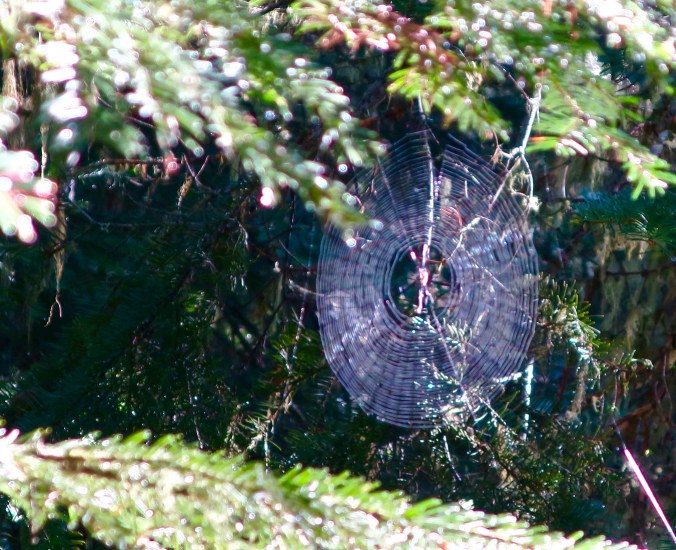
Peggy found this spider web reflecting sunlight the next morning. It promised to be a beautiful day.

A shot of the head waters of the Applegate River. The PCT is found on the ridge to the right.

Our trail that morning was up, as it seems like most of our trails are at the beginning of our days.

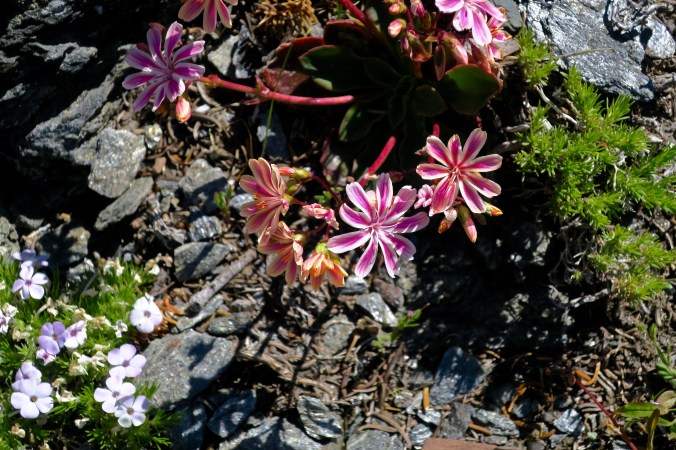
Flowers were in abundance along the whole trail between Mt. Ashland and Seiad. These are flox.

And this is a wild iris.

Ann and Dave Kelly looking jaunty. We met a number of day hikers near Mt. Ashland, including Ann and Dave who are from Ashland. Dave actually hikes with a replaced hip joint and has done part of the John Muir Trail with it!

We are always on the lookout for wild life as we hike. When you can’t see the animals, they often leave other signs like tracks or scat. This animal, probably a chipmunk, had left bits and pieces of pine cones outside its front door.

I’ll conclude with this cloud covered picture of Mt. Shasta. I will literally be hiking around it for the next three weeks. Expect lots of photos! I consider it one of the most beautiful mountains in the world.

I have to pack up for the next section of my trail, friends. I head into the Marble Mountains tomorrow, solo. And it will be early since it is promising to be around 105 degrees down here in the valley. When I get to Etna in a few days I will continue with the Mt. Ashland to Seiad section of my trip.

Trail Angels of the Pacific Coast Trail… I Have My Own

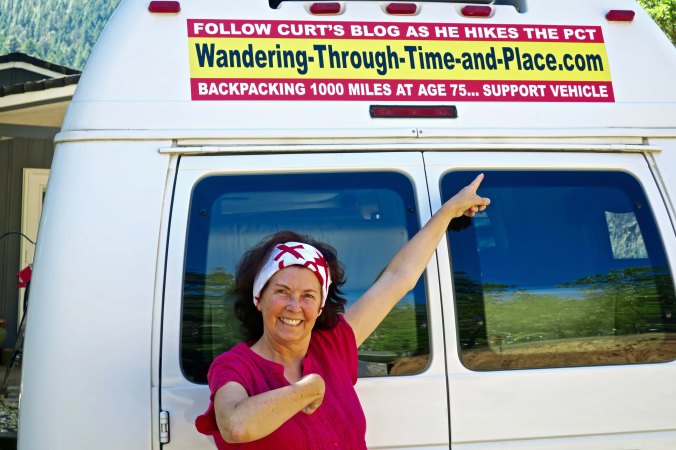
I am ever so lucky to have my wife, Peggy, out on the route supporting me. Most PCT hikers mail their resupply to Post Offices along the way. Peggy will be at trailheads to supply mine plus give me a day’s break from hiking. I suspect that there will be a cold beer in there as well.


People who go out of their way to support through-hikers on the Pacific Crest Trail are known as Trail Angels. My barber, Ed McBee, is such a person. He has written a book on vehicle access locations on the PCT in Oregon. But, more to the point, he also goes out on the trail to greet through-hikers and provide them with fresh food and cold beer. One of his favorite locations is on the Oregon-California border. Trekkers who reach there have hiked from the Mexican border and are ready to celebrate! Knowing how much a cold brew is appreciated out on the trail, I contributed to Ed’s beer fund last summer.

Ed is now working on a book about people doing the PCT. “I feed them hot dogs,” Ed told me. “They are much more likely to talk to me.” I’ll bet. There is no telling what somebody who has been hiking 20-30 miles a day while living off of backpacking food will do for a hot dog! Now, make that a beer and a hot dog…!

Backpacking food is adequate for getting down the trail. Just barely. I have never seen a fat through-hiker. The food has to be light and compact to carry on your back. And while you try to find high calorie food, it’s hard to pack much more that 2 to 3,000 calories for each day. Now, consider that you are burning 4-6,000 calories, daily. Hot Dog? Bring it on!

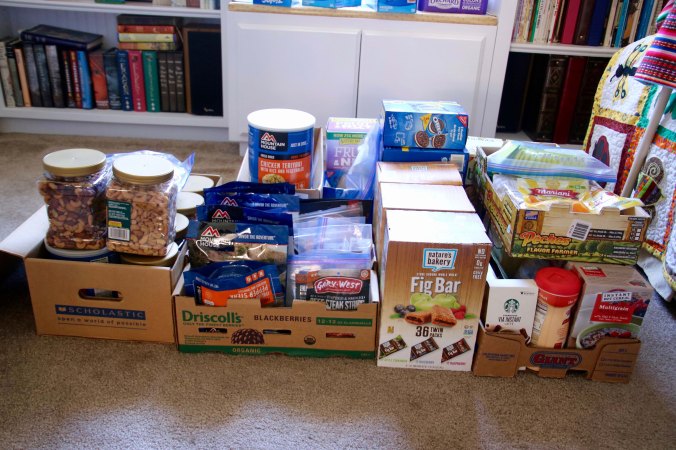
Below is what my food for 90 days looks like. I tried to compromise between things I like and things that might be a little healthy. Those Oreos you see in the back certainly don’t meet the second criteria,  but they are a treat. I’ll be eating two per night, along with my 16 ounce cup of tea. (When I was a poor student at UC Berkeley ever so long ago, lunch was always a cup of coffee, a baloney sandwich and four Oreos.) The #10 can you see in the back is chicken teriyaki. It includes 10 dinner’s worth of food. Instructions are: Add one cup of the freeze-dried dinner to 3/4 cup of boiling-hot water. Cover. Wait 4 minutes. Stir. Cover and wait another 8 minutes. Eat. Life is pretty darn simple out on the trail.

Peggy organized my food for me while I was taking care of other miscellaneous chores and then took this photo. It’s what I will be eating on the trail over the next three months.

Here is the resupply packed in the van. Our sofa/bed comes down and actually covers the food.

Most PCT-ers would kill to have the kind of back-up I will have on my thousand-mile trip. I have my own trail angel, Peggy. Once a week or so, she will meet me where the PCT crosses a road and resupply my food, plus have a cold beer ready (grin). Our plan for most resupplies is to work in a layover day where I can shower, wash clothes, pack in some calories (imagine being able to eat whatever you want to eat), and put up a post or two on my previous week’s experience.

Peggy assumes her ‘where is Curt’ pose. She sees her role as backup (when she isn’t hiking with me) as her own adventure since she will be traveling and camping on her own.

Who knows!? Actually I carry an emergency Spot geo-tracker that I can use in an emergency, if needed, and can keep Peggy and family informed of where I am each night.

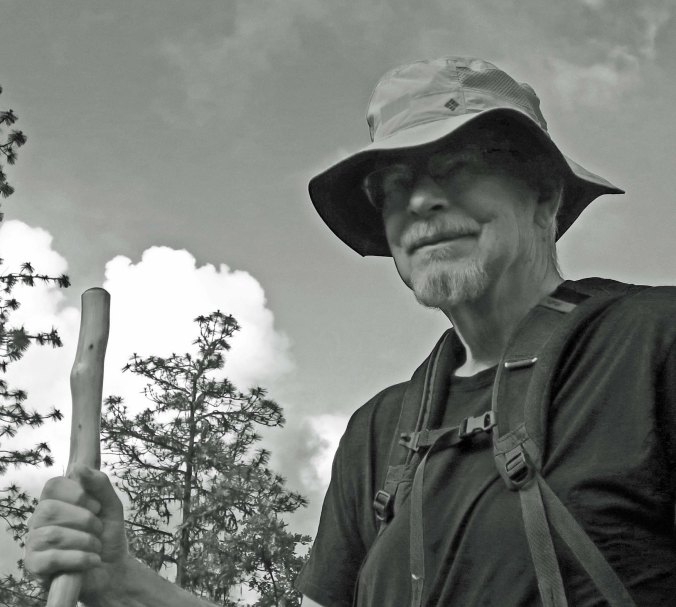
Anyway, here I am in black and white, ready to hit the trail. (Photo by Peggy Mekemson.)

I even developed my own ‘business card’ for the trail. (grin) The photo is taken from our front patio. Next week I will be hiking around the mountains you can see in the distance on my way south!

FRIDAY’S POST: I wrap up my MisAdventure series for the summer. Was I actually able to stay out of jail on my graduation day from high school.

SUNDAY’S POST: I am going to reblog a really nice post from my friend and fellow-blogger out of Sedona, Arizona, JoHanna Massey, that she wrote in support of my journey.


Backpacking the Rogue River Trail… Conclusion

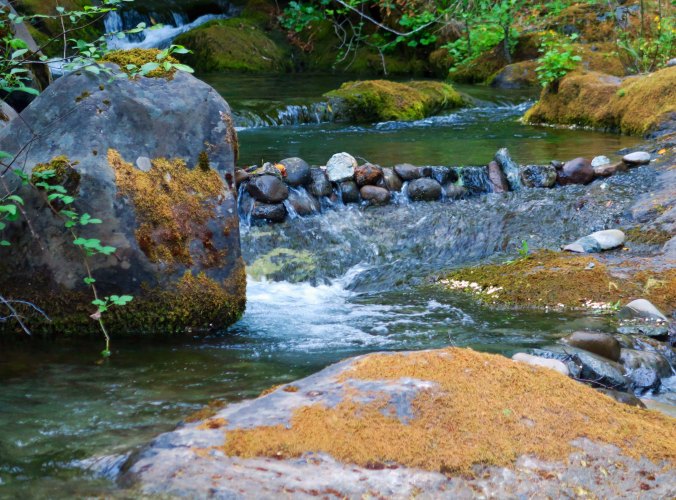
Peggy and I weren’t expecting to find beautiful waterfalls along the trail, but there were several. This is Flora Dell Falls. The pool of water really looked inviting. Peggy took off her shoes and soaked her feet.


It’s countdown time! My thousand mile backpack trek starts in two weeks. Our guest room is filled with gear. Peggy’s office is buried in food. Maps have taken over the library. Miscellaneous other stuff is found in every other room of our house! I have a to-do list that would send Superman flying off-planet. Theoretically, it is getting shorter. One way or the other, on June 17th, I am out of here…

Needless to say, there isn’t much time for blogging or reading blogs. My apologies. I do want to conclude the Rogue River series and put up one more post in the MisAdventure series. After that, I will try to get up one more post before hitting the trail. Then there will be a break until my first posts from along the route start arriving.

Given my time constraints, I am turning today’s post into a photo essay. Enjoy!


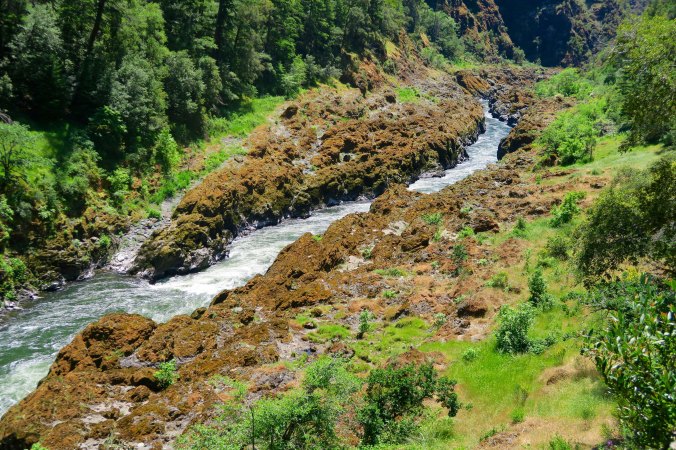
The Wild Rogue Wilderness started a few miles after we left the Rogue River Ranch featured in my last post. The trail snaked along the edge of the river providing great views. The narrow canyon here provides some exciting rides for rafters! There is even a whirlpool.

This gives you an idea of what the trail looks like. We hit this section in the afternoon and it was hot. The rocky cliffs sucked in the heat and threw it back at us.

We were looking forward to Inspiration Point, and we weren’t disappointed. Stair Creek Falls was just across the river. More inviting pools!

A close up of the falls.

We called it a day at Blossom Bar. (That’s a river bar, not one where you can find a cold beer. Darn! I really could have used one.) We didn’t find any blossoms but Peggy found this pool above the rocks. When I came over, she had waded in with her clothes on and the water was up to her waist. She was taking her soapless bath and washing her clothes at the same time. Of course, I had to join her. The water was icy!

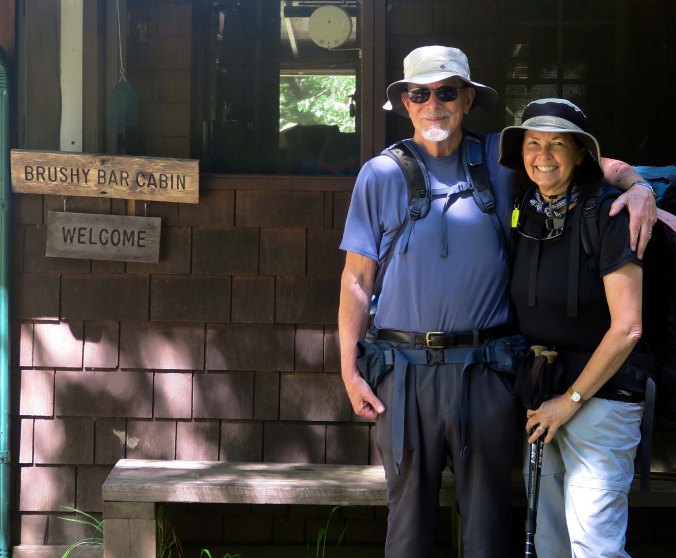
The next day we hiked by the Brushy Bar Forest Service Station that is now run by volunteers in the summer. James and Cammie, a couple out of Southern California, had done a search for opportunities to volunteer on the Forest Service site and found this. (The PCT runs right by their house but it is in the desert section that I won’t be hiking.)

We took advantage of Cammie to have our photo taken! I’d say we were looking quite chipper. My beard caught the sun!

Tate Creek had another spectacular waterfall. We decided to photograph down it since getting to the base involved scrambling though poison oak!

In case you are wondering what poison oak looks like, Peggy is pointing some out. The three leaves are distinctive. As careful as we were, Peggy brought some home. Adding insult to injury, she spread her poison oak from her hands to some bug bites she was scratching.

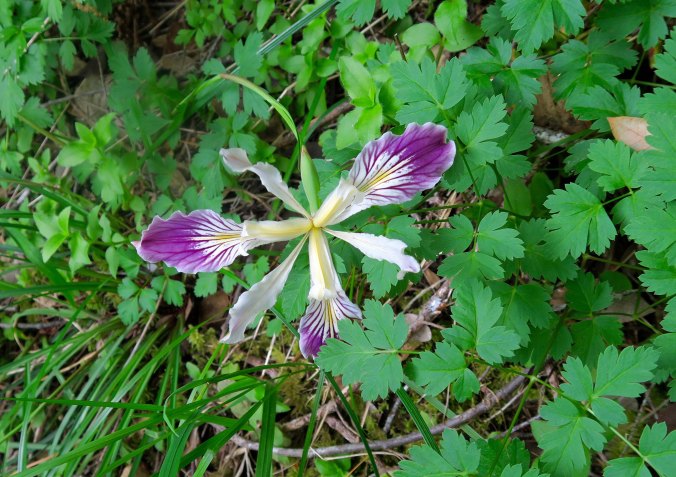
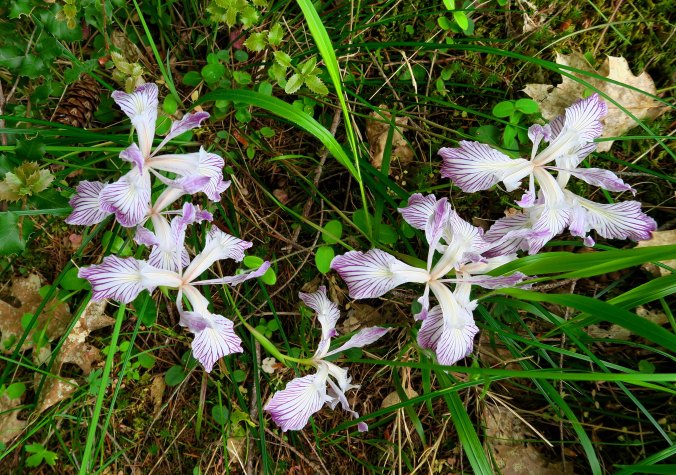
The flowers along the trail continued to impress us. This is yet another variety of Iris.

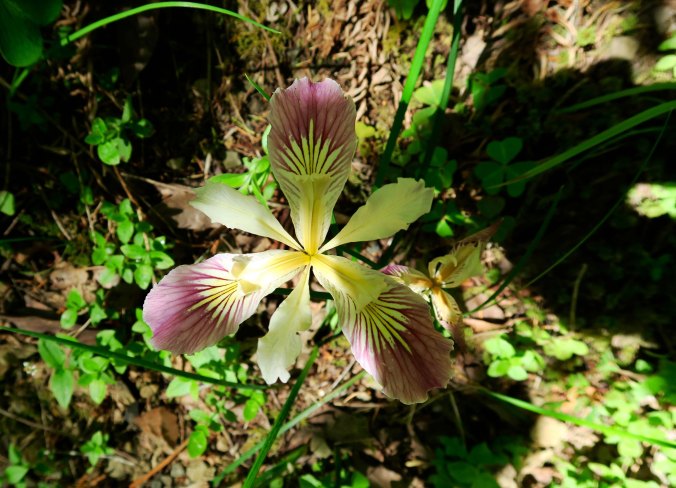
And another. This time a Douglas Iris.

And more of another variety.

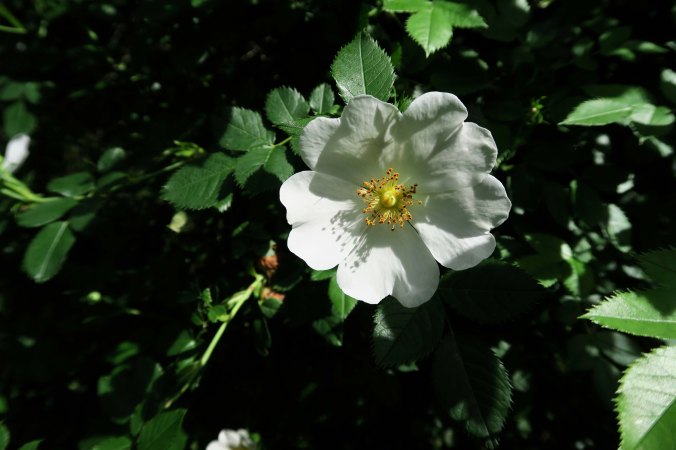
Another wild, white rose…

And wild lilacs. While they couldn’t match the roses in the heavenly smell category, the had a subtle, pleasant smell.

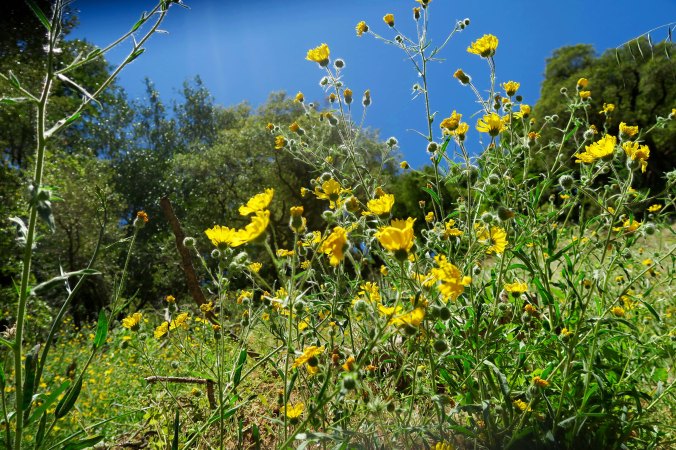
Finally. these cheerful members of the sunflower family.

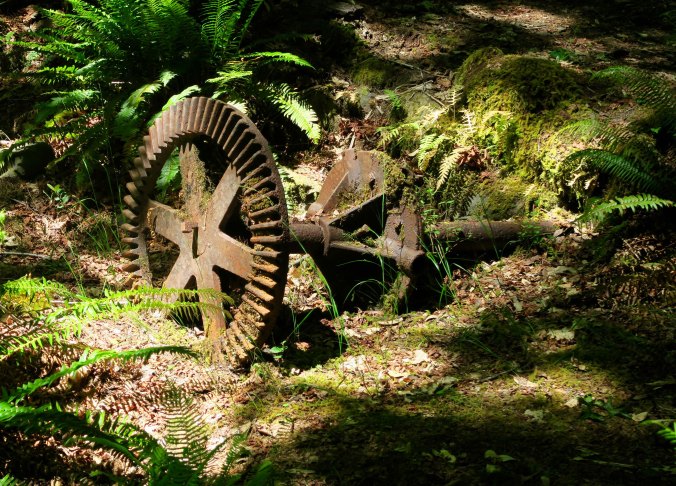
Old mining equipment had been left beside the trail in a number of places to remind hikers of the area’s history.

The Flora Dell camp site, located down stream from the Flora Dell falls featured at the beginning of the post, provided us with another attractive river side location.

I really enjoyed the large rocks beside the river.

The next day had some challenges. (Grin) This is always fun with a loaded pack! My knees were having a discussion with me.

I had little difficulty picturing myself out on the deck of this lodge with a good book and a cold brew… but you had to have reservations. Sigh.

There weren’t a lot of big trees along the trail, so I had to take a photo when we found these.

And use Peggy as a model.

She also volunteered for this shot. No, she isn’t practicing her skiing technique. She is showing a switch back trail. The map showed our last few miles running along the river. Instead it headed up the mountain, not once but twice!

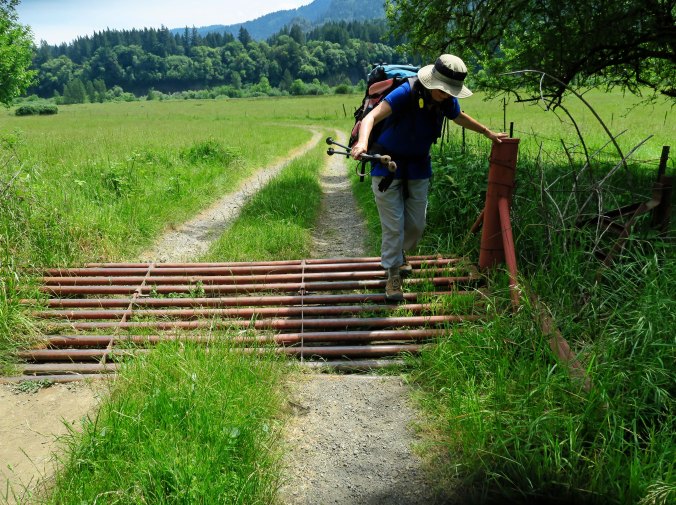
Somehow, at the very end, we managed to get off the trail and hike through a cow pasture that included this rather unusual cattle guard. Normally they are flat and don’t squish down as you walk across them!

The end. I hope you enjoyed our backpack trip down the Rogue River. The next adventure: My thousand mile backpack trek down the PCT. I’ll be posting as I go!

Hiking the Rogue River Trail… Part 2: From Horseshoe Bend to the Rogue River Ranch

A view of the Rogue River from our camp on Quail Creek.


Today marks the second of my three-part series on hiking down the Rogue River Trail. It’s a beautiful 40-mile hike, best done in the spring or the fall. Peggy and I made a leisurely six-day backpack trip out of it, both to enjoy the beauty and to condition our bodies for our summer of backpacking where I will be hiking 1000 miles from Mt. Ashland to Mt. Whitney. Peggy will be joining me for parts of it plus doing back-up, a true trail angel!


Dark skies were suggesting rain when we rolled out of our tent at six. ‘Rolling out’ is a good description. My sore muscles and creaky joints were complaining about our first two days of hiking down the Rogue River Trail. They refused to cheerfully jump up; they threatened to go on strike. I told them to behave or I would double the number of miles they had to travel and cut off their Ibuprofen. They whimpered— but the Ibuprofen got their attention.

I have yet to tell them that they are going on a thousand-mile backpack trip this summer. And I may not, at least until the first 500 miles are over.

Things began to morph. My down pillow of the night before became my down jacket. My Thermarest air mattress changed into a comfy breakfast chair. Fifty years of backpacking have taught me that anything that can serve multiple purposes is a good thing. Routine is also good. I had packed my sleeping bag, clothes and personal items before leaving the tent. Now they were waiting to be packed into my backpack. Right after I put my chair together, I went to gather our food.

It was dutifully waiting in the middle of the ranger-built, electric fence enclosure. No bears had made a feast of it. Either they hadn’t been by to visit or they truly don’t like being zapped. I suspect that a tender nose coming in contact with a live wire is not a pleasant experience. If I were a bear, I’d skedaddle out of there on all fours and look for a ranger to eat.

Breakfast was next; I’m the camp cook. My job description is to boil up two 32 ounce pots of water per day, one for breakfast and one for dinner. Takes about five minutes each. Peggy arrived from doing her chores about the time the pot began to boil. We sifted through our food bags and pulled out instant oatmeal, breakfast bars, Starbuck’s instant coffee, and dried apricots. The latter are to help keep us digging cat holes. “Meow.” Or maybe I should say, “Purr.’” Being regular out on the trail is important.

The literature had promised an outhouse at Horseshoe Bend, but it had been decommissioned, i.e. filled up. The same is happening with the other ‘bathrooms’ that the trail maps promote along the river. Be prepared. Rafters are expected to carry their own port-a-pots. Backpackers are left with digging cat holes. We are used to it. Watch out for the poison oak. (grin)

With breakfast over, we took down the tent and packed up. A few drops of rain encouraged us to put on our rain jackets and pack covers. It promised to be a cool day, which was welcome after the heat of the first two days.

The trail continued its ups and downs, starting with the very steep up we had hiked down the evening before. At times our route dropped almost to the river. The closer we got, the thicker the poison oak and blackberries grew.  Peggy and I stopped and laughed at one point. The blackberries were occupying a third of the trail and the poison oak the other, leaving only a few inches for passage. It was like the plants had an agreement to drive you toward one or the other. We chose the blackberries on the theory that it is much better to suffer a few scratches than be covered in an itchy rash.

We also crossed several recent slide areas where the trail was minimal, about a shoe wide. Careful attention was called for and looking down not recommended. On one slide area, a tree trunk was stretched across the trail, forcing us to balance precariously while climbing over. It was not for the faint-hearted, or for people with a fear of heights.

Beyond that the trail was quite pleasant; passing through woodlands, providing dramatic views of the river, and crossing over brooks and streams on attractive bridges. Once again, cheerful flowers kept us company.

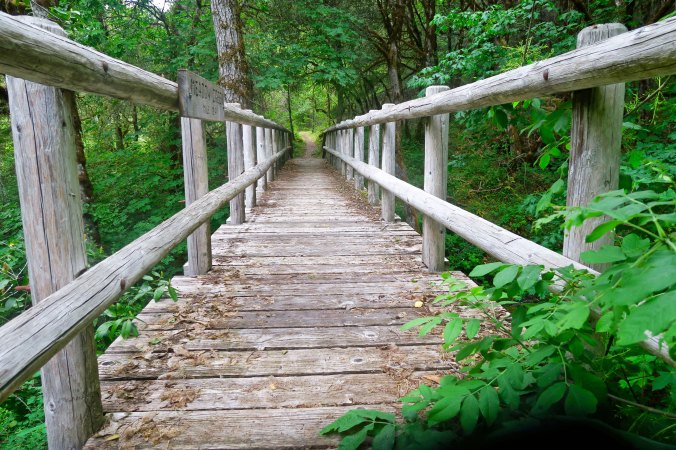
We found that the bridges along the trail were well built and fit in with the environment. This is Meadow Creek Bridge.

Another view of the Meadow Creek bridge.

Peggy on the Kelsey Creek bridge looking down at the water. A rain cover is on her backpack. It never did rain.

Our views of the river ranged from raging rapids…

…to more tranquil scenes.

A number of flowers were found beside the trail, including this wild rose…

This Pretty Face brodiaea…

And a Columbine.

A snack at Ditch Creek provided this view of several small waterfalls tumbling down the hill. Zane Grey’s cabin was a mile or so down the trail.

We missed Zane Grey’s cabin. The trail to it wasn’t marked and we weren’t paying attention to our map. Too bad. I had been an avid fan of his cowboy books during the Western phase of my youth. Such classics as Riders of the Purple Sage had kept me glued to my seat as good triumphed over evil in the Old West of six-gun justice. Grey had used the cabin as a fishing lodge in the 1920s. He even wrote a book about the area, Rogue River Feud.

Our campsite that night on Quail Creek made up for missing the cabin. Located on the edge of the Rogue River, it provided the striking view that is featured in the photo at the beginning of this post. Geese, buzzards, rafters and lizards provided entertainment. The buzzards seemed to be following us. “Maybe they think we are old,” I suggested to Peggy, which elicited a snort. The lizards were just curious, checking out all of our gear and climbing up on convenient rocks to watch us.

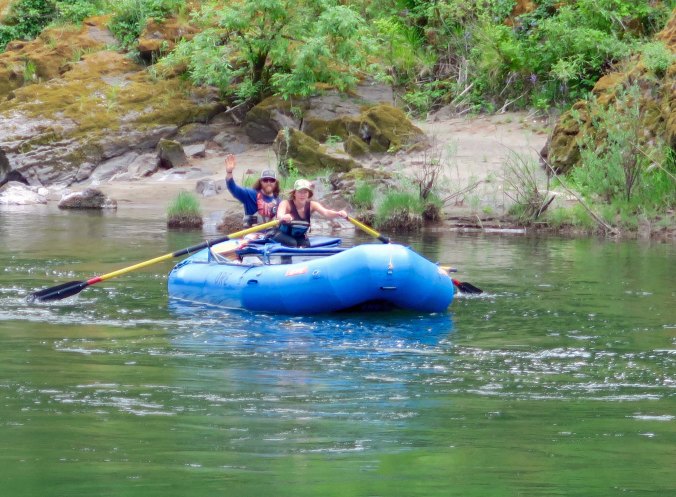
Rafters waved at us from the Rogue as they passed our camp on Quail Creek.

And a pair of Canadian Geese kept their offspring in a careful line.

The morning part of our hike the next day took us in to the Rogue River Ranch, which is a gem. Now on the National Register of Historic Places and operated by the Bureau of Land Management, the ranch was established in the early 1900s by George and Sarah Billings, becoming a lodge for travelers, the post office, and a social center for a small but growing community. In 1927, Billings sold the house to Stanley Anderson, the builder and owner of the Beverly Hills Hotel in Los Angeles. The Andersons upgraded the property and used it to entertain their friends from Los Angeles and Hollywood up until 1970, when they sold it to the BLM.

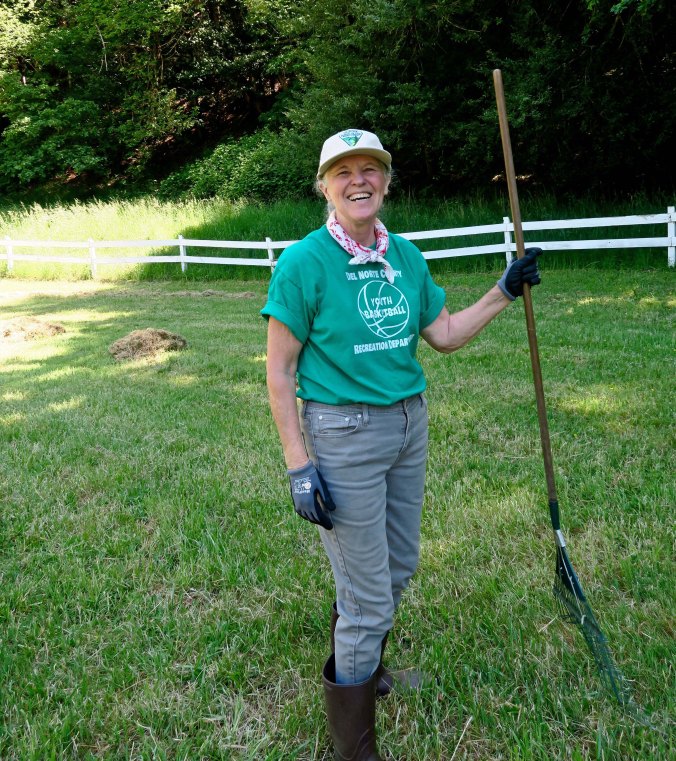
An old barn on the Rogue River Ranch. One of the volunteer caretakers, Sally, can be seen raking up grass the old fashioned way. It went with the barn.

A close up of Sally.

Looking toward the river from the ranch.

Sally and Frank, the volunteer caretakers for the ranch, took a break from raking up grass and gave us an overview of its history. Peggy and I then visited the main house that had been turned into a museum. I was amused to find this description of the one room upstairs lodge provided by an early visitor:

When the place was full at night, it was a nightmare. There was almost continuous coughing, snoring, grinding of teeth, urinating in a can or out the window, and other night noises. There always seemed to be someone walking around the room or to the window or stairways, which shook the floor and building. Sound sleep for any length of time was impossible.

Not quite as fancy as the modern lodges that are found along the river today. But then again, three meals and a bed for the night could be had for a dollar, a far cry from the $150 plus per person charged today by the resorts.

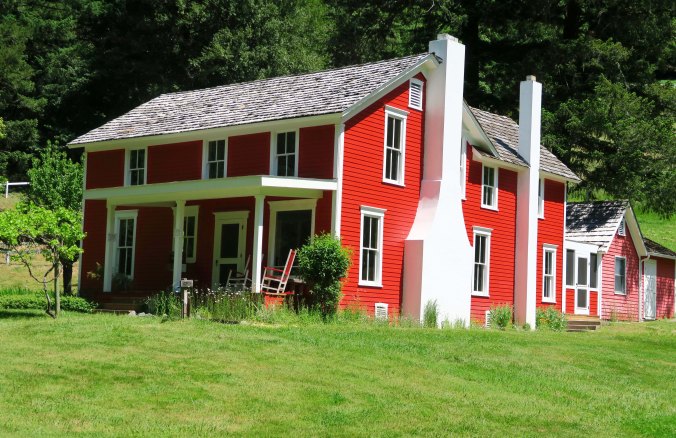
A view of the main house at Rogue River Ranch. A single large room upstairs provided lodging for early travelers.

The ‘Tabernacle’ is located behind the house. This building served as a barn for horses and mules on the first floor and a meeting hall, dance floor, and church on the second floor. Today the building houses a number of artifacts.

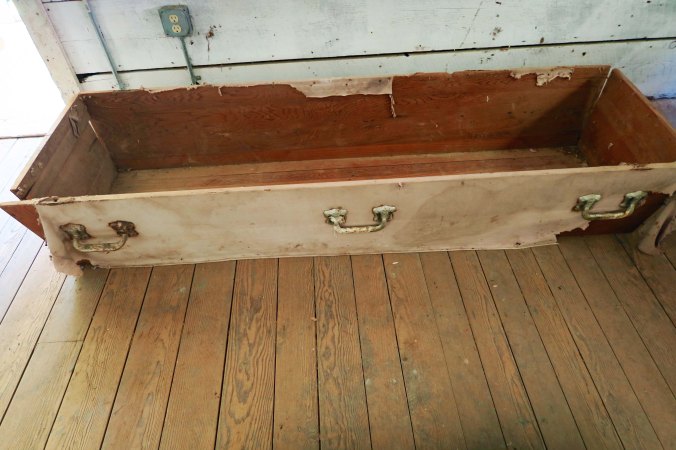
Such as this old coffin…

A pot bellied stove…

And cooking stoves.

I’ll close today with a view of Mule Creek, which flows beside the Rogue River Ranch. The creek was named after a mule named John who wandered off and became lost. The story has a happy ending. Several years later his owner found him. I assume they lived happily ever after.


FRIDAY’S POST: What does a skunk have to do with my first date in high school. The MisAdventure series.

TUESDAY’S POST: I’ll wrap up my Rogue River series.