A Wonderful, Whacky Pelican… Puerto Vallarta

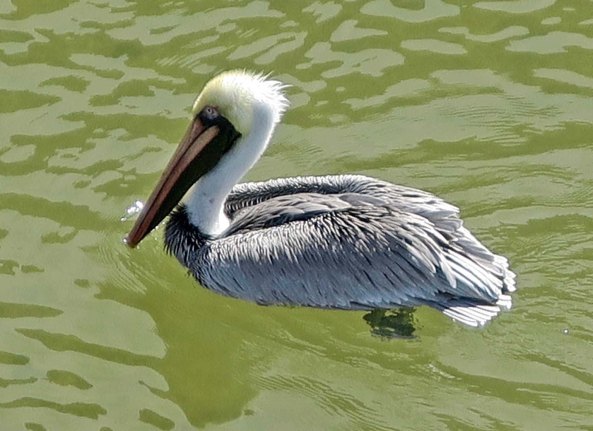
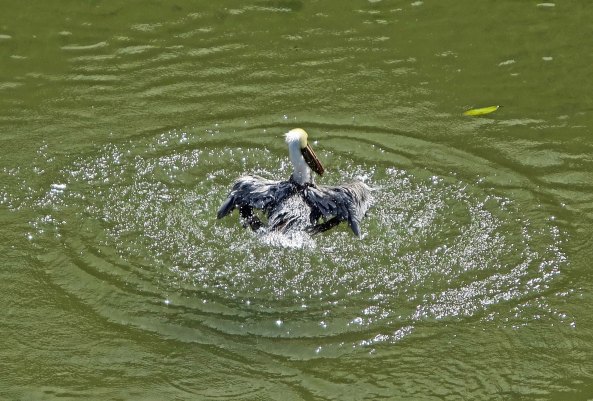
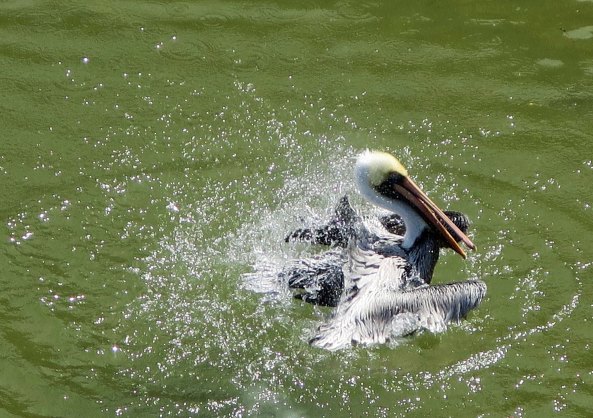
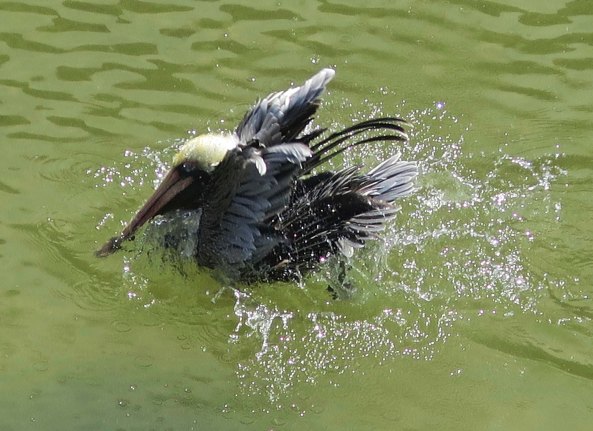
I’ve spent a lot of time watching and photographing pelicans. Their committee-put-together look makes them a favorite of mine. But I have never seen one do this. It delighted me. I think it was trying to scare up a fish. The majority of brown pelicans make their living by diving from the air for dinner. This fellow may have been a bit young and small for the big time.

The Rio Cuale sits in the heart of Puerto Vallarta. It’s a delightful place with a long island in the middle (Isla Cuale) that includes good restaurants, fun shops, and some very interesting art. The island got its start in the 1960s as an airstrip for rich Hollywood types such as Elizabeth Taylor, Richard Burton and John Huston. 

My favorite thing about the Rio Cuale, however, is the rich wildlife it supports including a variety of water birds and giant iguanas. Bird life includes pelicans, cormorants, herons, egrets and more. On my recent visit I was particularly taken by the young fellow featured above and a snowy egret.

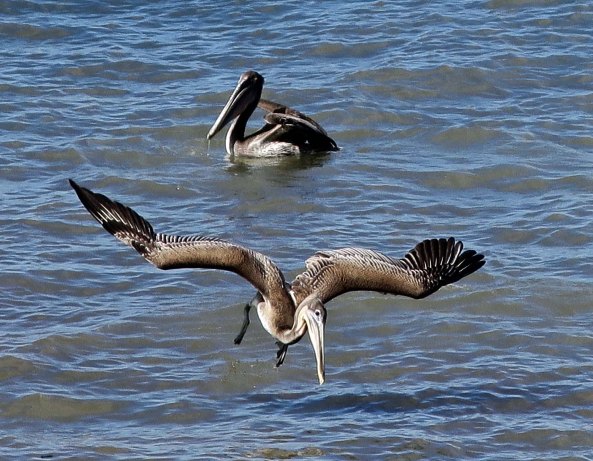
Here is the young brown pelican behaving more or less like I am used to seeing brown pelicans behave.
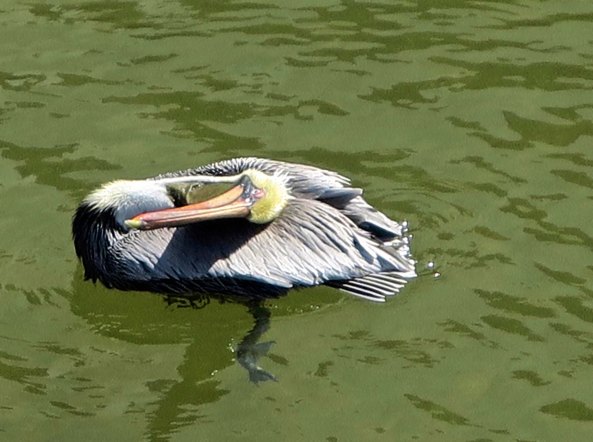
I am not sure what the youngster is up to here. Scratching an itch? Spreading oil?
Its action here is clear. It’s preening. The pelican and other water fowl have an oil gland near their tail that they use for oiling their body to make feathers more waterproof.
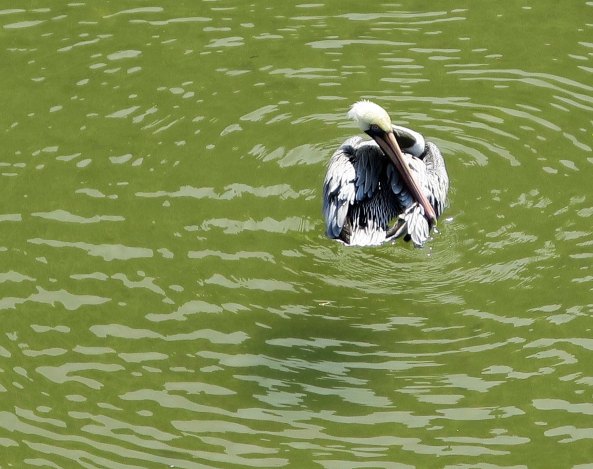
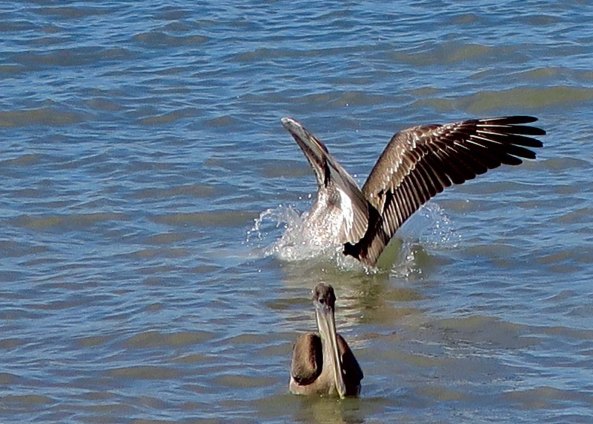
Here it is again, apparently trying to scare up another fish.
And a final shot of our young friend. We speculated that maybe it was a little young for the normal brown pelican approach to fishing.
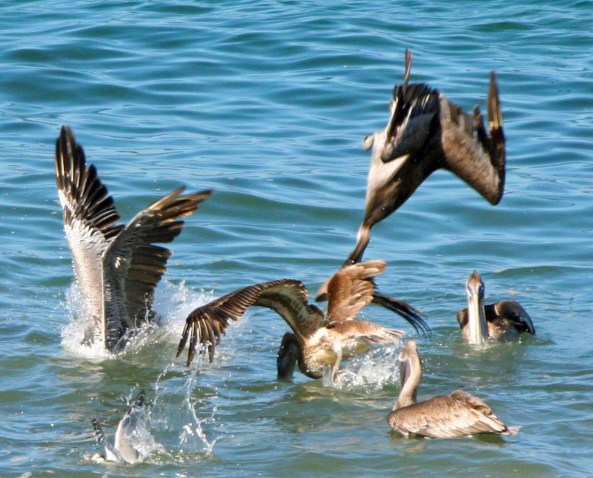
A few hundred feet away, brown pelicans were fishing in the more traditional way.
Kersploosh!
I caught this orgy of Pelican fishing in Puerto Vallarta in 2016. The insane dive on the right is one of the things I love about pelicans.
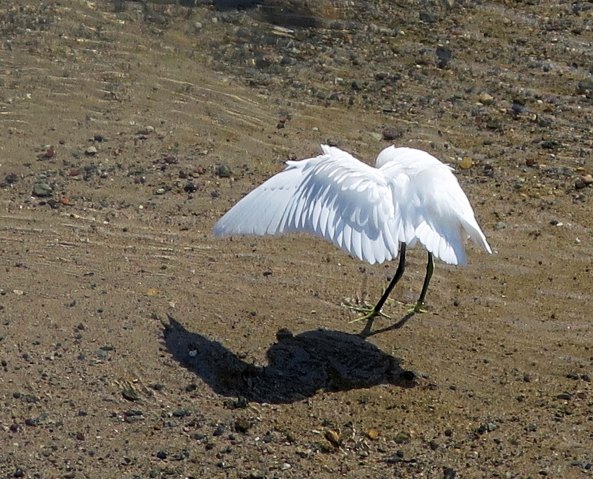
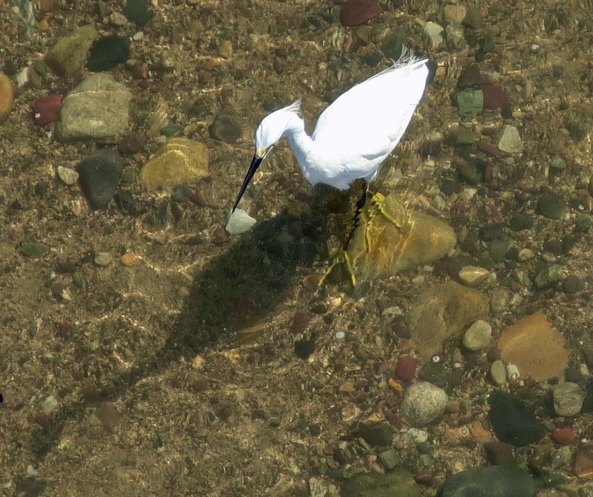
I must say that this snowy egret on the Rio Cuale provided a great photo-op as well.
Here’s the snowy egret in a more traditional pose.

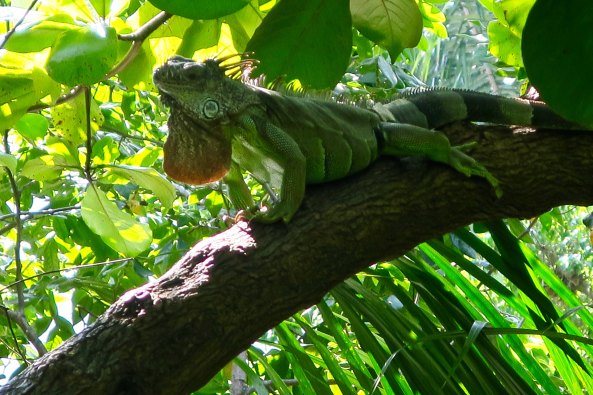
The River Cafe is a short way up the Isla Cuale from where we found the pelican and the snowy egret. We like it for its tasty, well-presented food. But we also like it because you can almost always find iguanas hanging out in the trees and on the ground next to the river. This year we spotted a very green one…

It was so green, it almost disappeared among the leaves. The large flap of skin hanging down from the iguana’s chin is called a dewlap. No self-respecting Iguana would be without one. (Photo by Peggy Mekemson.)

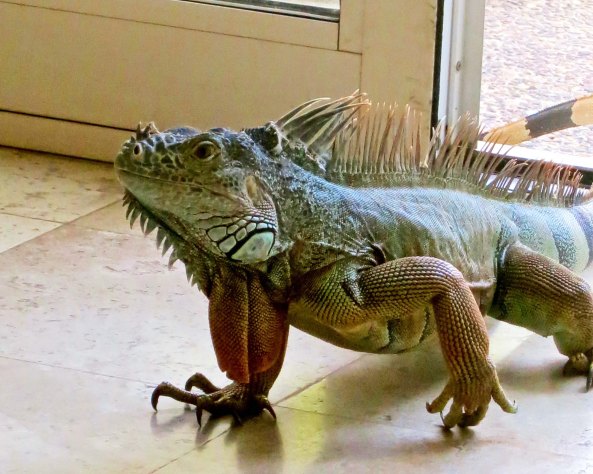
We’ve had numerous encounters with iguanas over the years in Puerto Vallarta. But none matched the time when one came to visit us in our villa. I did a post on our welcome visitor, but just for fun, I decided to put up a few photos on him again.

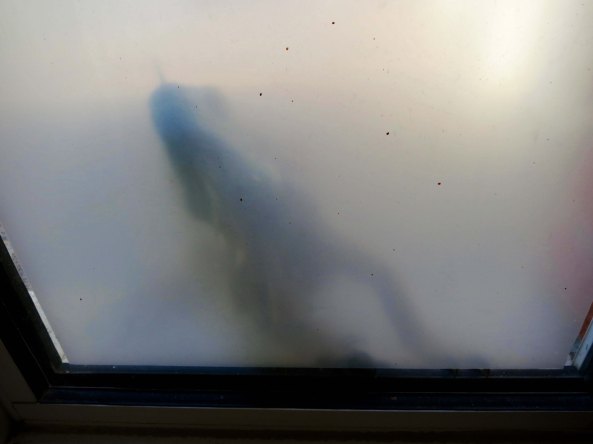
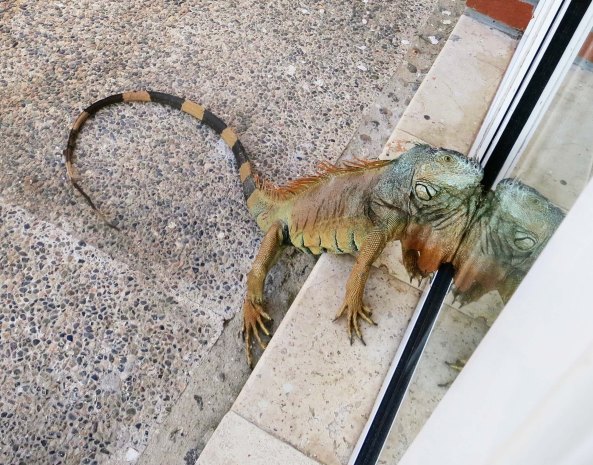
It all started out with a stranger staring in our window at us. Naturally we had to see who had come to visit.
Outside, we found this large iguana staring at his reflection in the window. There were two possibilities: One he had found the love of his life. Or, two, he had discovered a large rival impinging on his territory. Iguanas can be quite territorial.
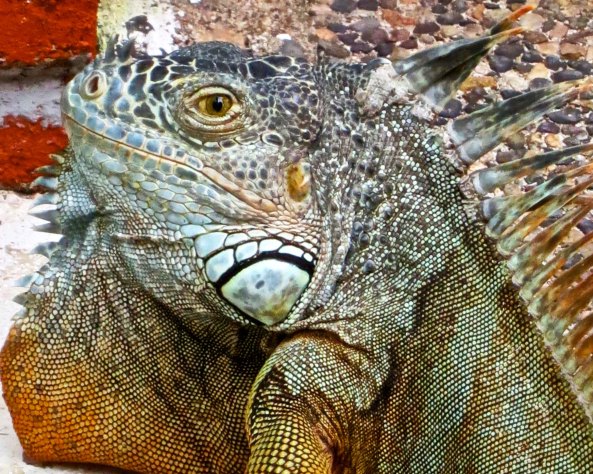
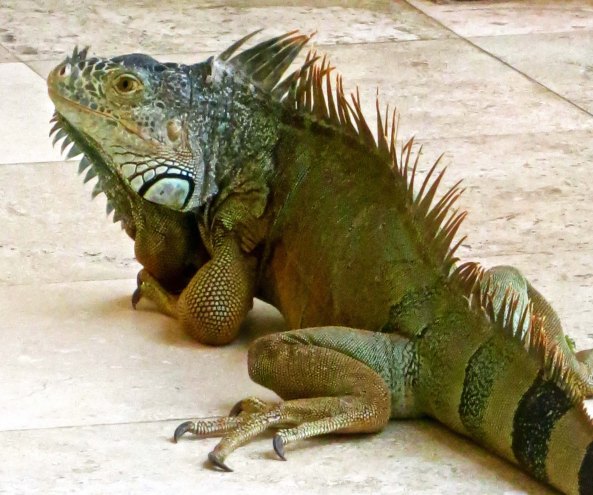
On closer inspection, our visitor appeared to be quite handsome. I imagine he was a heart throb.
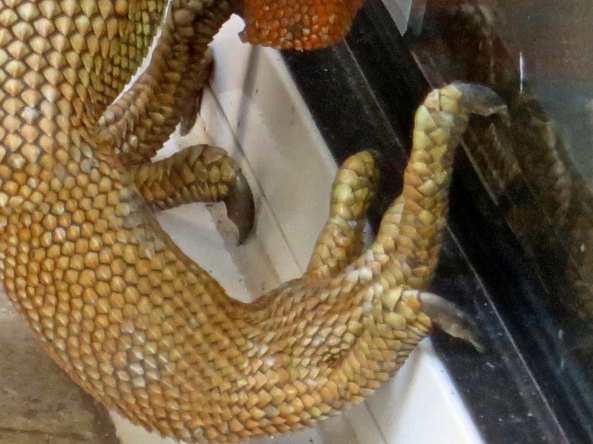
His claws appeared a bit on the scary side. I, for one, wouldn’t want to get on his bad side.
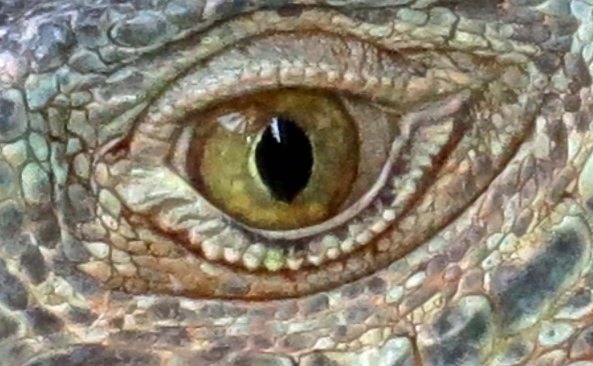
I looked him in the eye, wondering what a lady iguana would see in him. I call this photo The Eye of the Iguana after the Richard Burton, Ava Gardner, Deborah Kerr movie “The Night of the Iguana.” The movie, directed by John Huston, was filmed in Puerto Vallarta giving the then small fishing village a kickstart to becoming a mega-tourist attraction.
Of course we had to invite Senior Iguana in for a visit. His tail is still outside. He was a big fellow.
He wandered around looking for his love/rival and then finally settled down on the floor like a dog. I couldn’t help but think he would make a great burglar deterrent! After a while, he stood up, checked our villa one more time and then wandered back outside. Next post I will feature a chalk art festival and several murals in Puerto Vallarta. After that, it’s hitting the PCT again, hiking south from Carson Pass.

A Beautiful Lake, Fires and Trees… The PCT though Mt. Lassen National Park

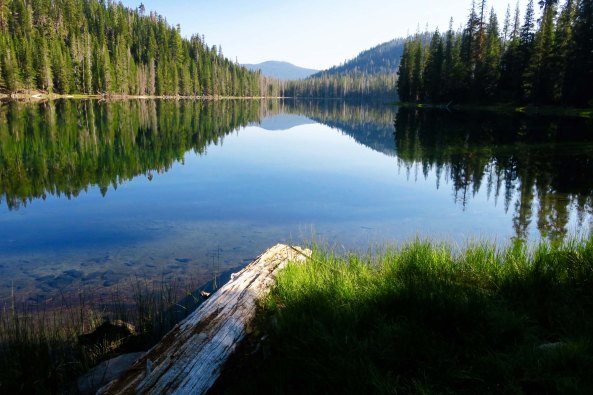
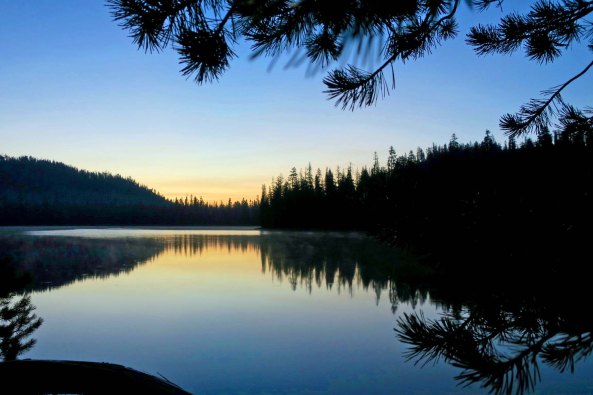
Hiking the PCT is tough, no question about it. But the rewards are numerous. Lower Twin Lake was one such reward. I camped beside it on my hike through Mt. Lassen National Park.

Today, I continue my ramble along the PCT. This time I will finish off my hike through Mt. Lassen National Park. I’ve been posting on our recent trip to Puerto Vallarta. There’s plenty more there, and lots left on the PCT. I intend to continue to mix my posts to provide a variety. And, of course, I am hard at work on my book about this past summer’s adventures and other tales from my 50 years of backpacking. My goal is to have something in hand when I attend the San Francisco Writer’s Conference in mid-February. 

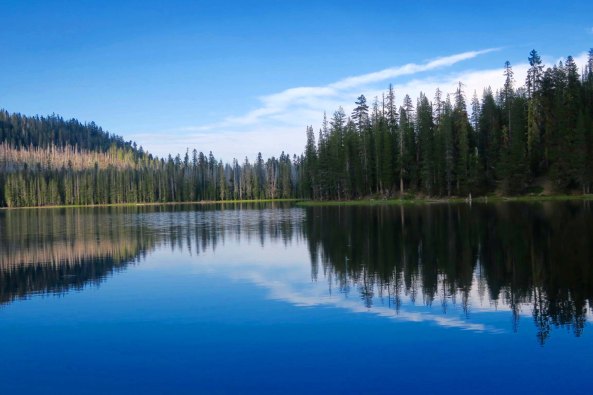
Lower Twin Lake was one of those places you don’t want to leave. I was fortunate to arrive in the afternoon and experience its evening and morning beauty before having to hike on. 

Late afternoon. I came back to camp after this photo and found a chickaree sitting on my journal. I suspect he was more interested in my food than in reading what I had to say. He scurried up a tree and proceeded to scold me for interfering with his search.
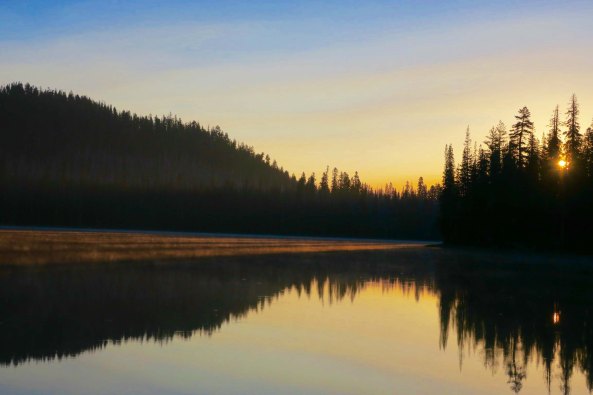
Early morning.
The sun comes up. Note the mist rising off the lake where the sun was hitting it. I felt it was almost magical.

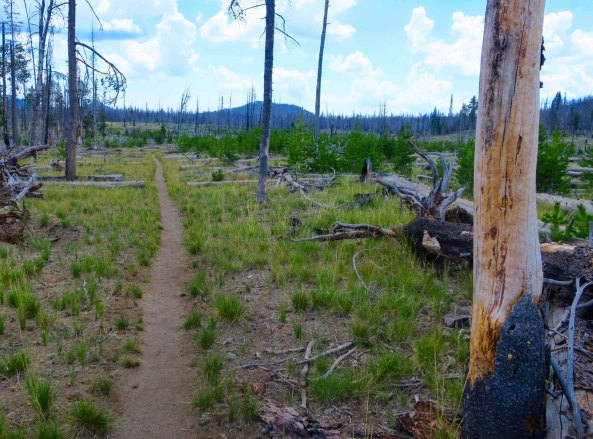
Forest fires had devastated the east side of the park and I hiked for miles through the burned out area, which isn’t unusual for the PCT in these times. Global warming and draught has taken its toll on the west from California, through Oregon and on into Washington, making forests vulnerable. The horrendous Campfire that just caused so much loss of life and property in Paradise, California is one more example. 

Mile after mile of land looked like this on the east side of the park. Not all is bad news, however. Nature is powerful and new growth is beginning to cover the area. This growth supports a substantial wildlife population.
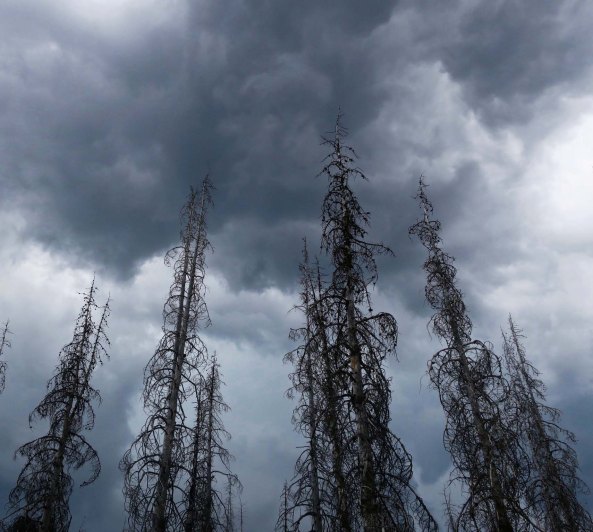
I found this scene beautiful in a threatening sort of way. Dark thunder clouds hovered above drought killed trees. Thunder was rolling across the sky and lightning was striking a nearby mountain. I counted, 1001, 1002…Reaching 1007 means the lightning is a mile away. Once I barely made it through 1001. There is good reason to fear being hit by lightning. There is even more reason to fear that it may cause a fire. These trees would light up like kindling.
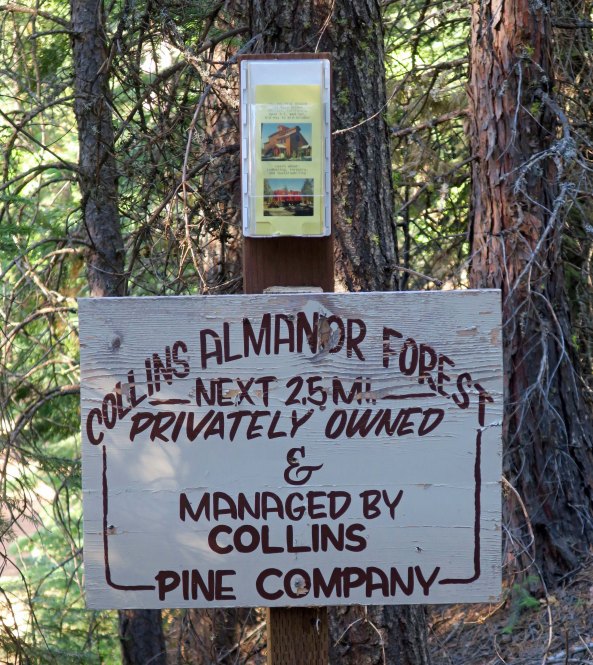
I often here the argument that thinning the trees, i.e. logging, is the solution to forest fires. Mainly it is used as an excuse for more logging. But the Collins Pine Company may actually have a solution. For one, it is committed to selective cutting, leaving a  healthy forest filled with a variety of trees. It also cleans out dead debris lying on the ground and uses the wood to create energy. The debris under the trees is one of the major reasons for devastating forest fires. A group of 50 or so forestry students from the University of California was in the area studying the company’s forest management practices when I hiked through.

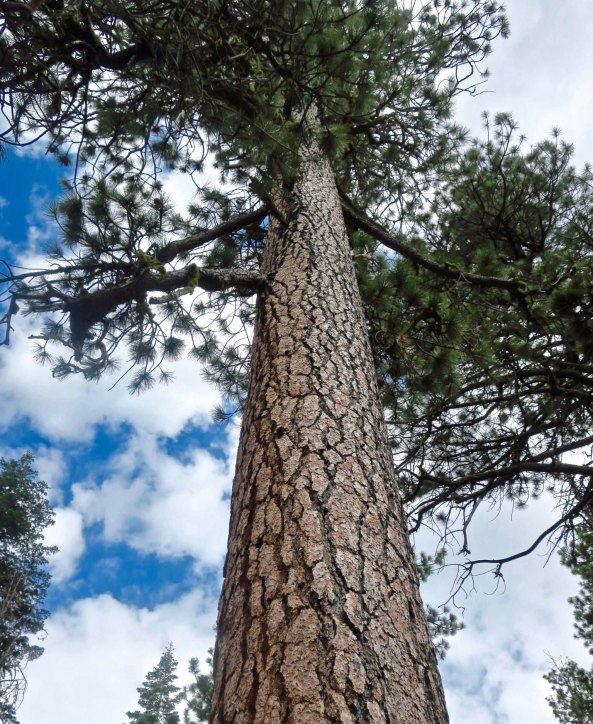
I love trees. Who doesn’t. Here are some of the beauties I found on my backpack trip through Lassen.

I had lunch under this magnificent Jeffrey Pine.
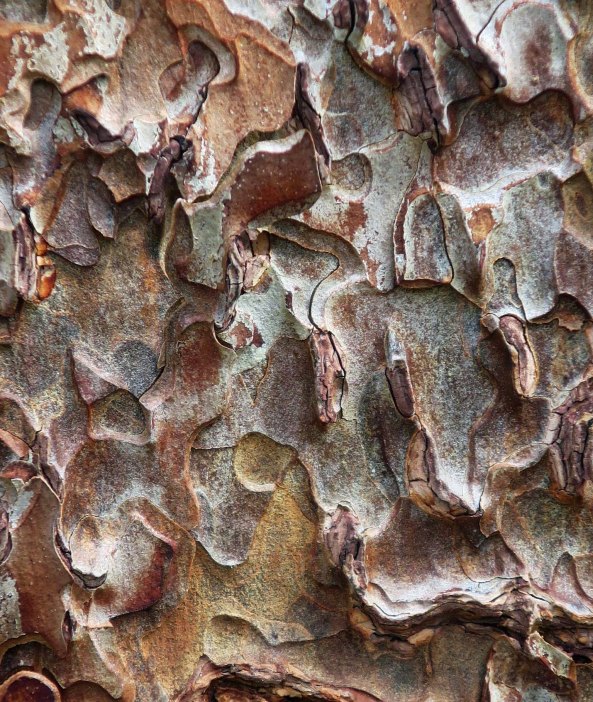
It’s bark resembles puzzle pieces. If you put your nose next to the bark on a warm day, you will be rewarded with a delightful smell of vanilla, or possibly pineapple.
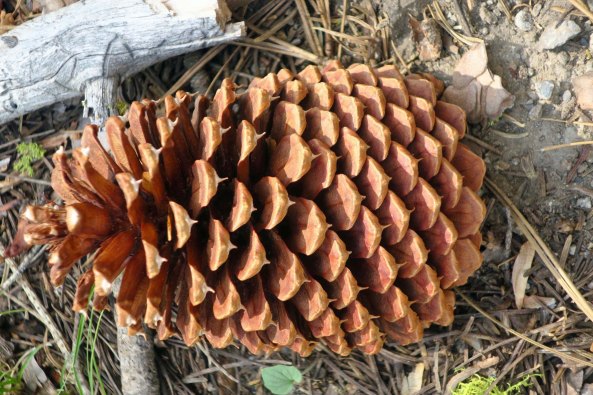
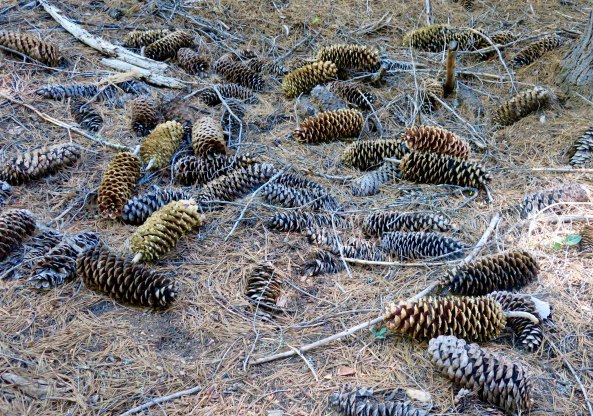
This is one of its gorgeous cones. An easy way to tell the difference between a Jeffrey Pine and a Ponderosa pine is you can pick up a Jeffrey pinecone without pricking you hand. Not so with a Ponderosa pinecone.
The king of pinecones grows on the the sugar pine. Some of these giants were approaching 20 inches in length. You don’t want to be standing under a sugar pine when a squirrel is harvesting its cones! Pine nuts from a sugar pine are delicious, however, and easily cracked. Ask the squirrel.
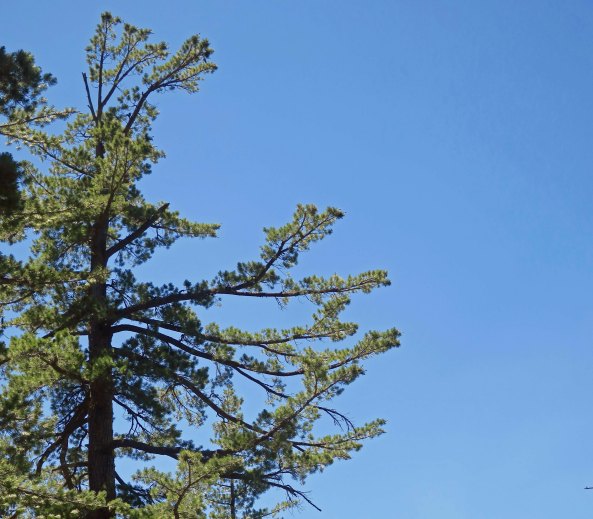
Sugar pines reach high into the sky and have wonderfully wild limbs.
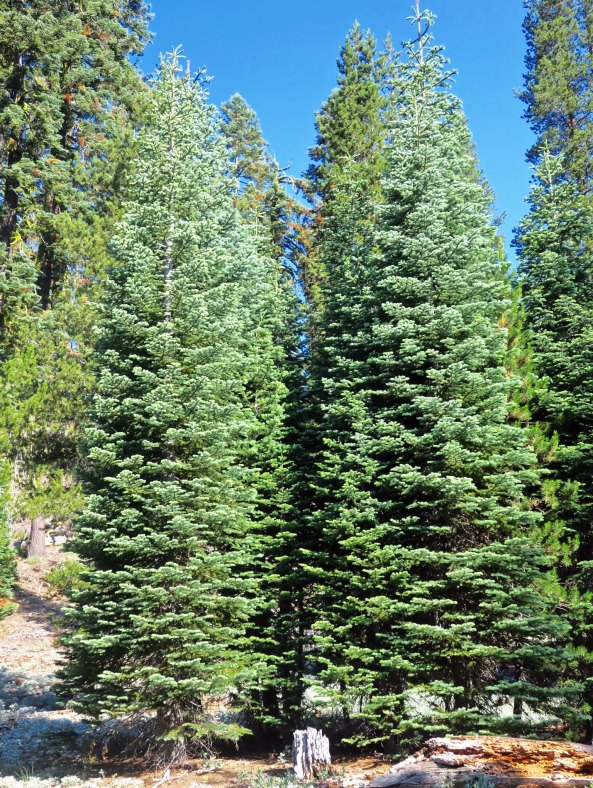
Unlike these two fir trees that were practicing close to perfect symmetry.
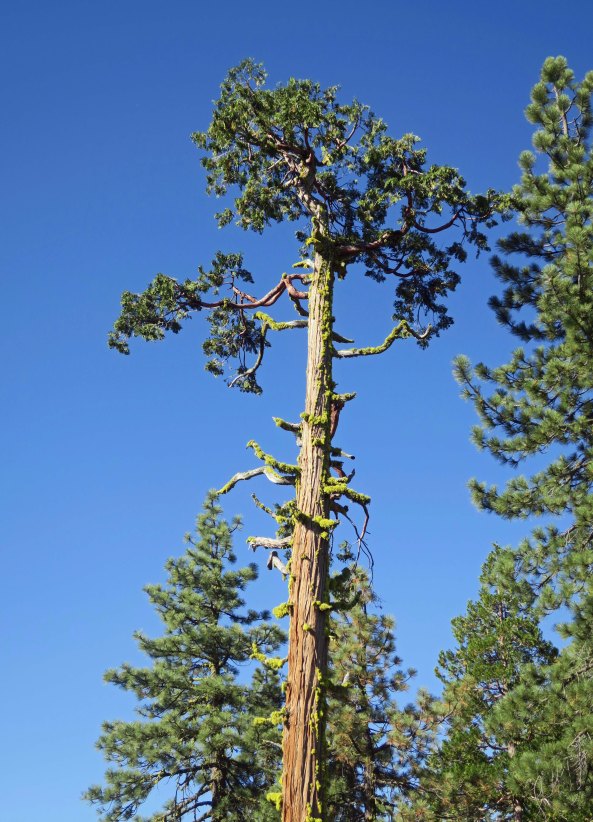
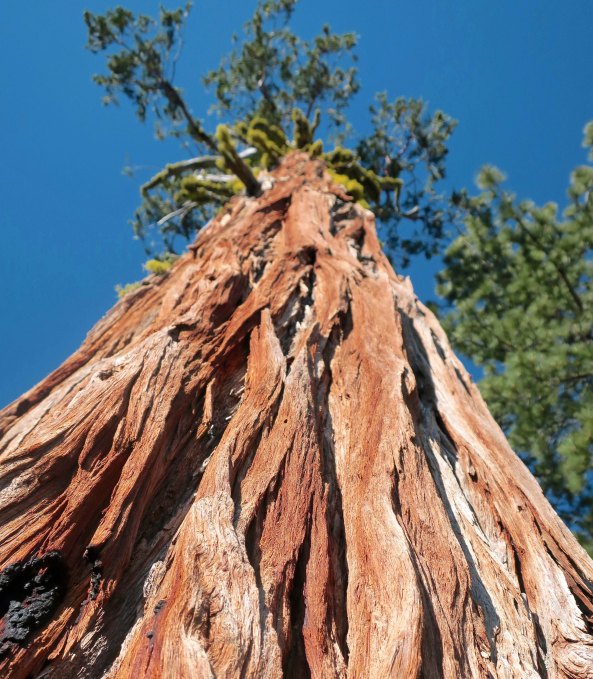
Cedars also provide forest giants.
Here’s a view looking up at the same tree. 

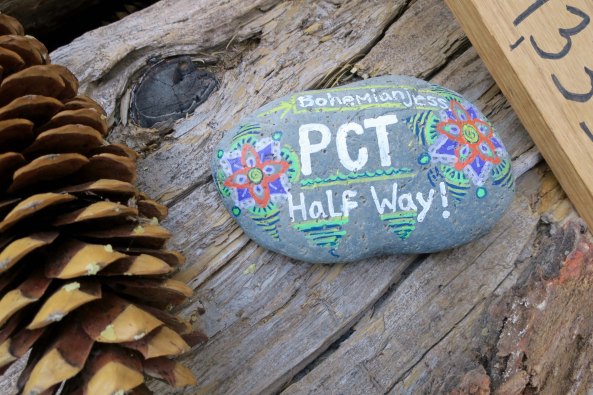
I met lots of through hikers in Lassen Park. The halfway point between Mexico and Canada is just south of the park. Hikers needed to be in the area or through it when I was there if they hoped to complete their hike during the 2018 season.

A stone left behind by Bohemian Jess near the town of Chester marked the halfway point on the PCT.
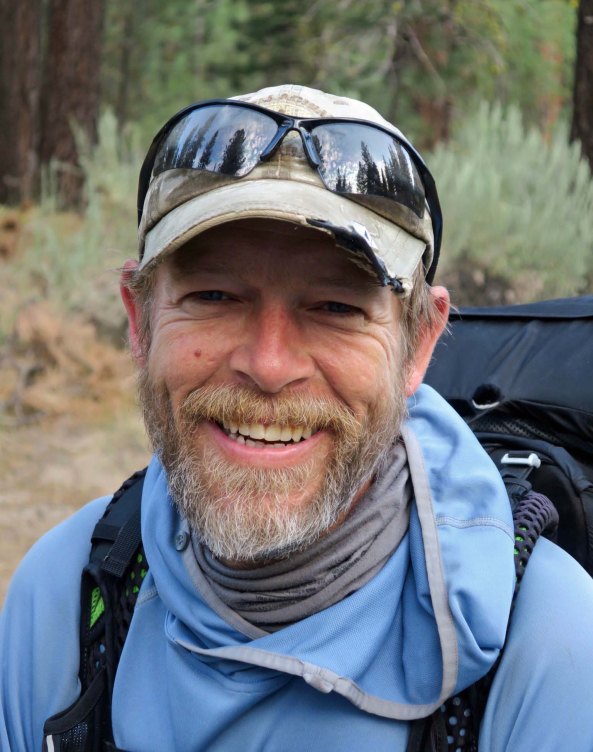
I met Hillbilly when Peggy dropped me off at the trailhead. She enticed him over with an apple. He lived in North Carolina near the Appalachian Mountains that gave birth to the hillbilly name, but he was far from being one. His name was Bill and he lived in Chapel Hill. Thus the name. He owned a company that installed solar farms. Bill had already hiked the Appalachian and Colorado Mountain Trails. Like me, he preferred to camp alone, away from the noise and partying of younger hikers.
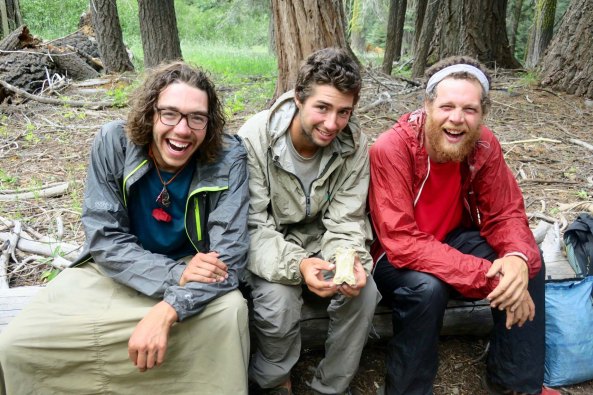
There was no chance of escaping from trekkers at Boundary Springs. (So named because it is located on the southern boundary of the Park.) It was a major source of water. These three camped next to me, so Bone came out to visit with them. They were quite amused. From left to right their trail names were Too Slippery, Bottomless, and Bodhi. Slippery and Bottomless were friends from Truckee, CA. Bodhi was a meditating type of fellow.
Shrek, Pepper, Bessie (the cow) and Chewy were also camped within about 30 feet. So, Bone had to visit them as well. I’d found Chewy looking for a lake where there wasn’t one, even though her map and a ranger had said there was. She had followed me down to the spring to get water.

Here are a few other photos to wrap up my trip through this section of the PCT.

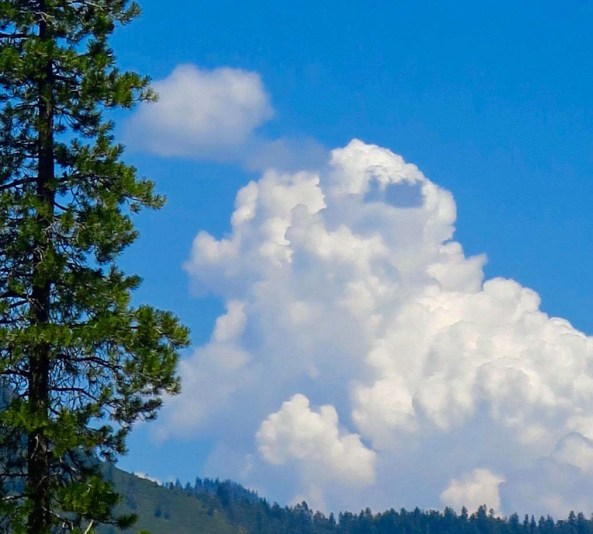
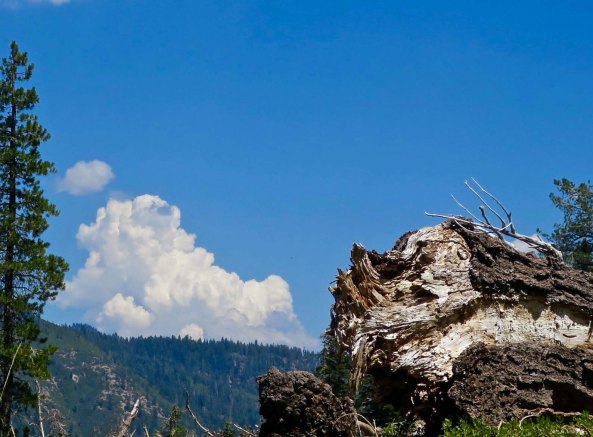
A snag and a thunderhead.
A closer look at the thunderhead.
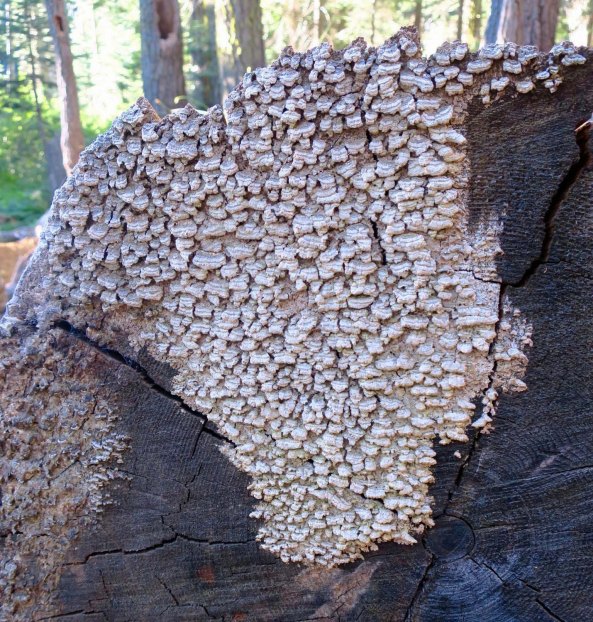
I found this fungus growing on a sawed log interesting.
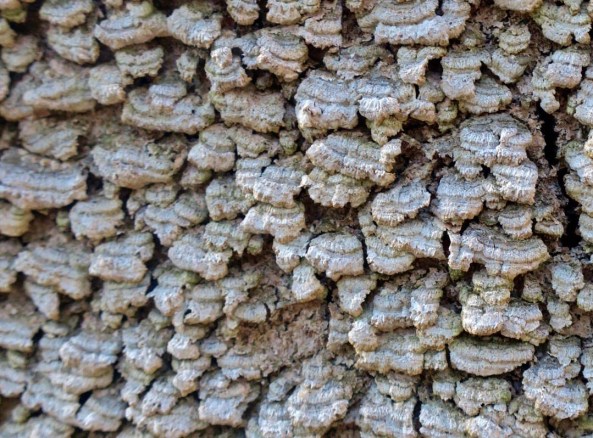
What the fungus looked like up close.
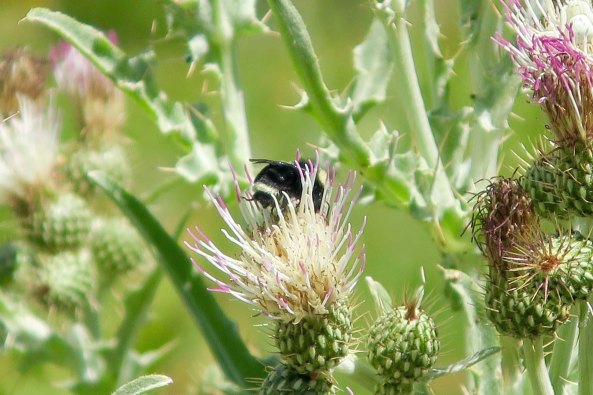
A bee hung out among some thistles.
A bear left his claw sign for me to see…
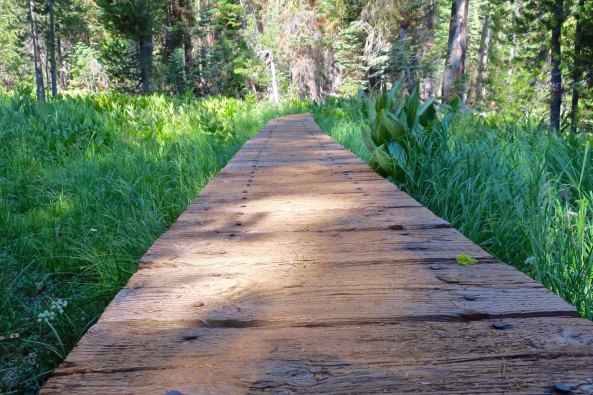
You know you are in a National or State Park when walkways are built across swampy areas.
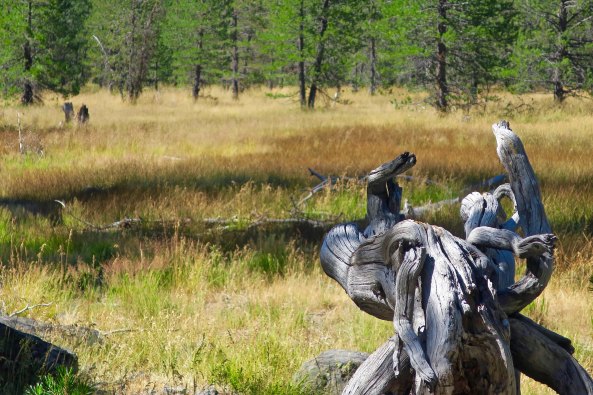
This meadow reminded me that summer was nearing its end. So I will stop here for the day.

NEXT POST: A very strange pelican. And some iguanas.

Weird Things— and Unique Furniture… The Furniture Mart Of Puerto Vallarta

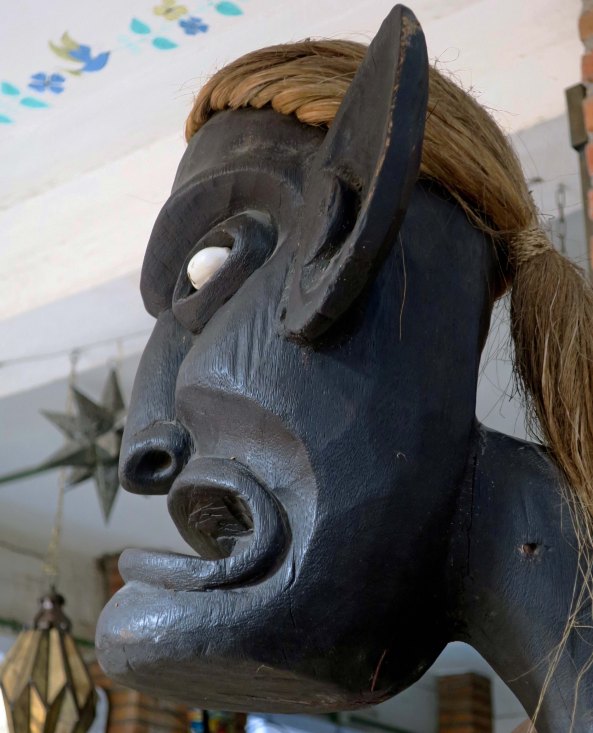
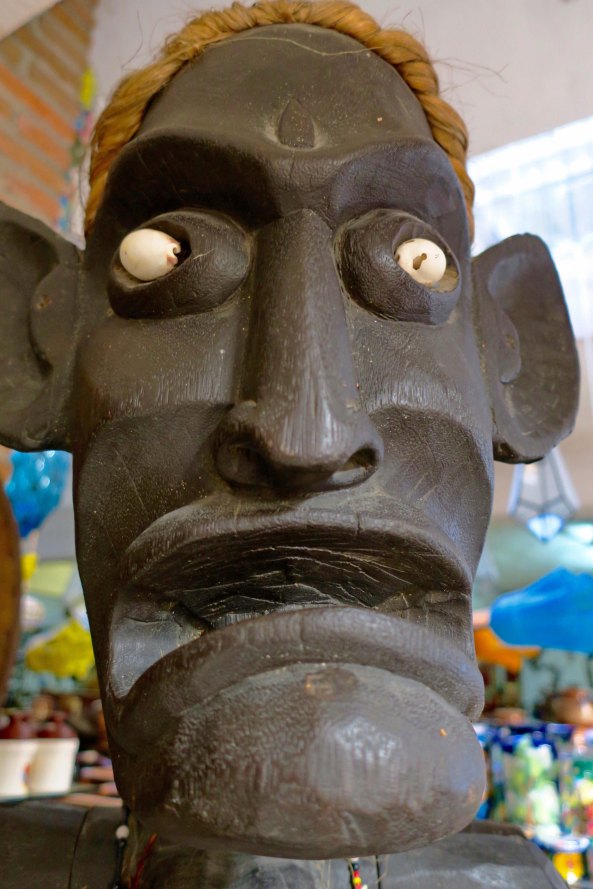
I promised some weird things I found at the Furniture Mart in Puerto Vallarta. I think this guy qualifies. Maybe his weirdness  goes along with having fake, orangish hair. (grin)

Peggy and I have now returned from our trip to Puerto Vallarta. It’s always a good source for blog material. Today, I am going to wrap up our visit to the Furniture Mart, which was right across the street from our hotel. Later I will have several more blogs on PV’s burgeoning art scene as well as get back to a couple of my favorite animals: pelicans and iguanas.  I was amused by both the weird things and unique furniture at the Mart. Enjoy. (Note: Some of these photos came from an earlier visit in 2015.)

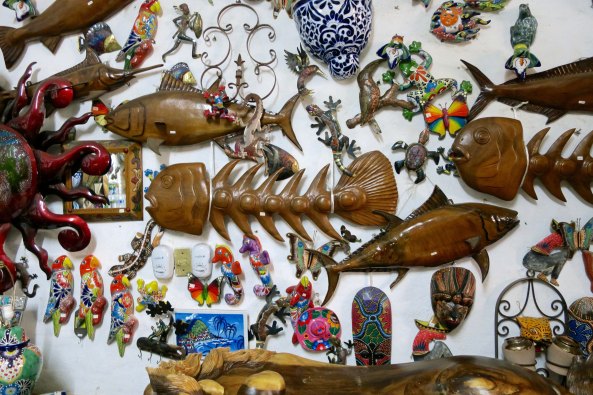
Do you think that the Furniture Mart could have hung more things on its walls? And do you find the bony fish as amusing as I did?
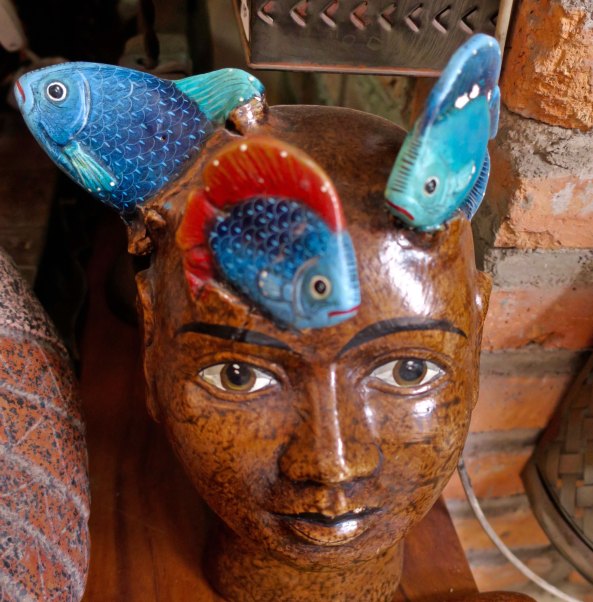
Speaking of fish, I suspect these  gave this guy a horrendous headache. I’m pretty sure there is a myth here, but I don’t know it.
Here’s a front view of the fellow I introduced at the top of the post. He’s still scary.
Not so scary, but still not someone you would want to meet on a dark night. Check out the eyes. The teeth remind me of piranha that Peggy and I caught on the Amazon River— and ate. 
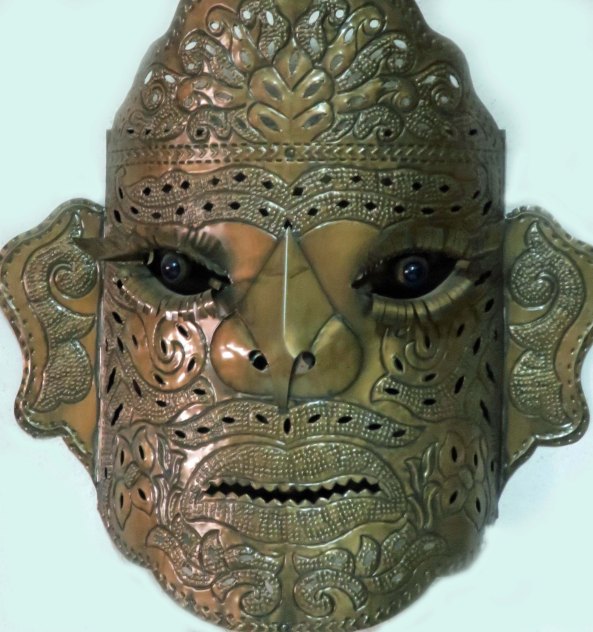
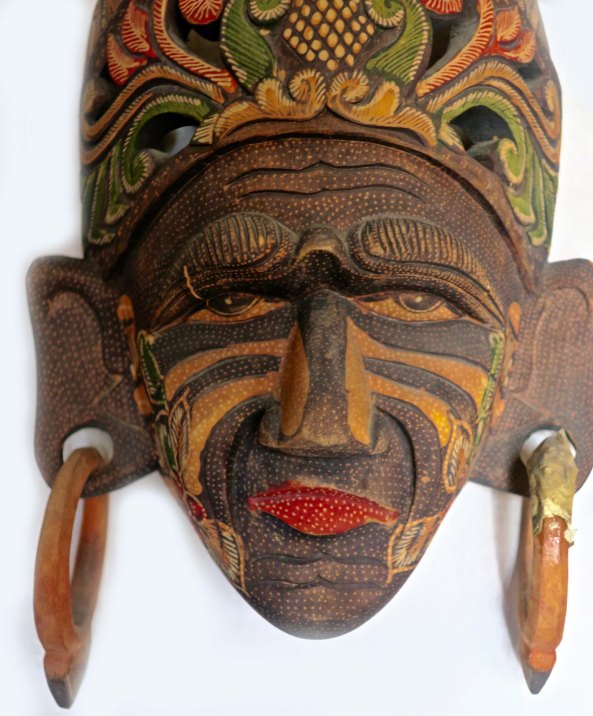
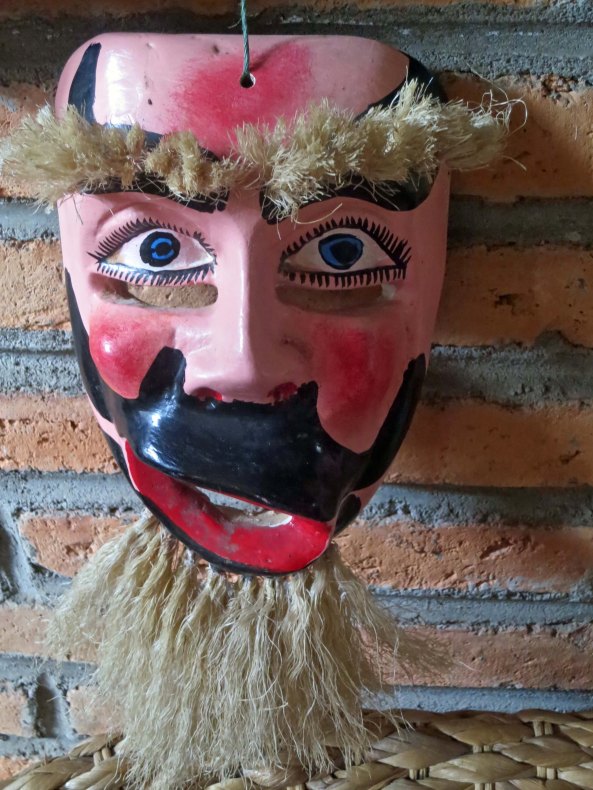
I found these masks more intriguing than frightening. The blood shot eyes suggest a long night of partying.
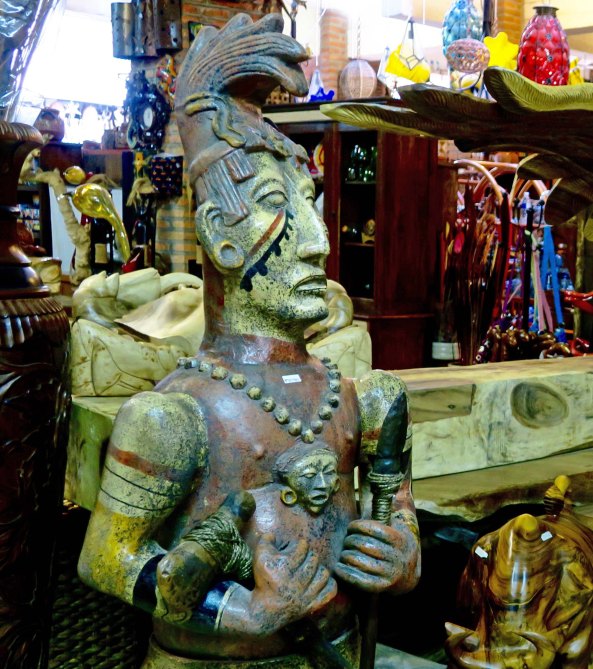
I think that this is a Mayan warrior. There were several life-size sculptures like this scattered throughout the store. Is he holding a monkey or a baby?
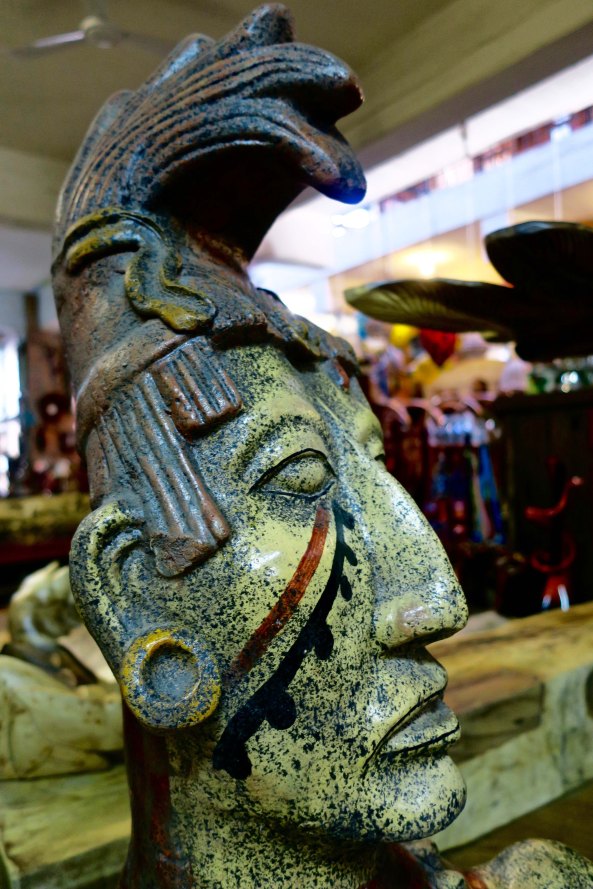
A close-up of his head.
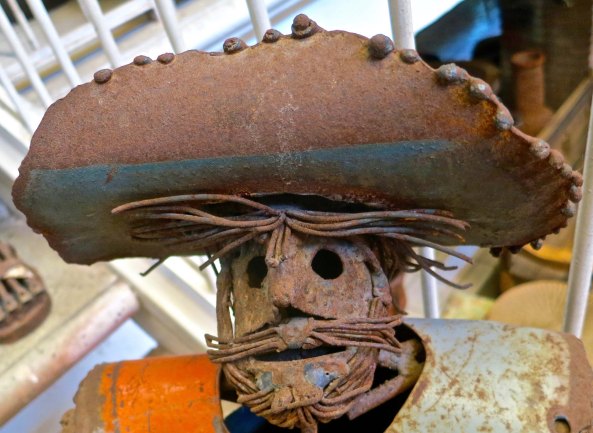
Senior Metal Head had wild hair and a wiry mustache.
But his eyebrows and beard were no match for Senior Rope Hair.
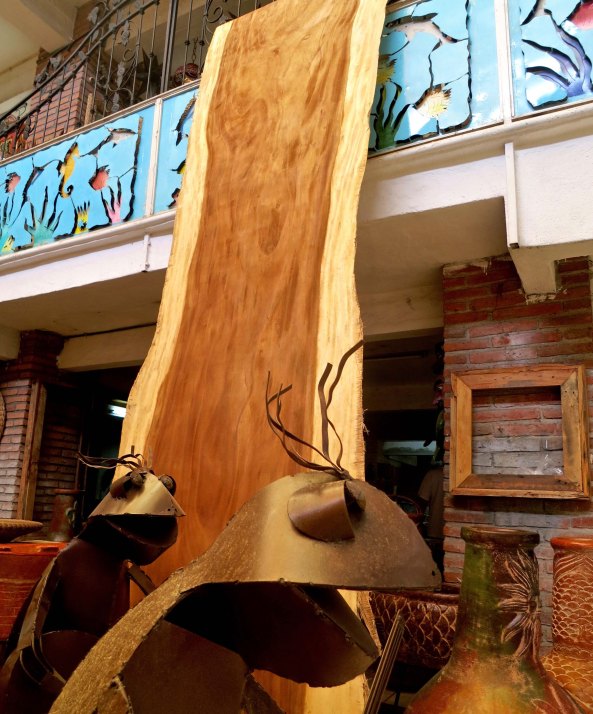
As one might imagine, you can find a lot of furniture in a Furniture Mart. This 20 foot table cut from a single log is an example. It appears that the two frogs were impressed.
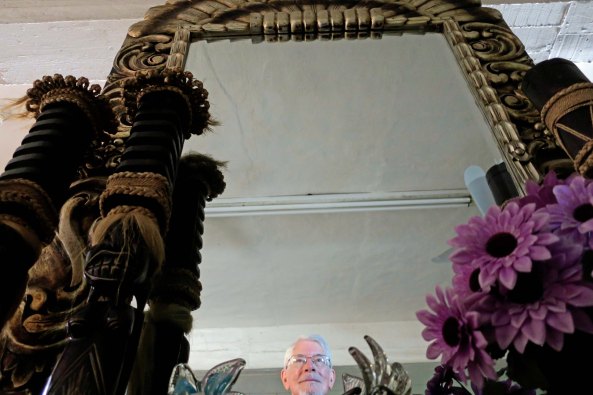
I decided that a large mirror would serve for a selfie. I look appropriately small.
How about carved wild horses for a table and chairs?
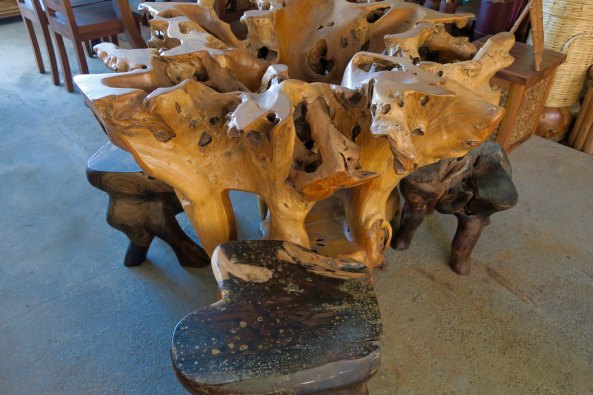
This table was made by cutting through roots of a large tree root. It will be covered with a glass top, I assume.
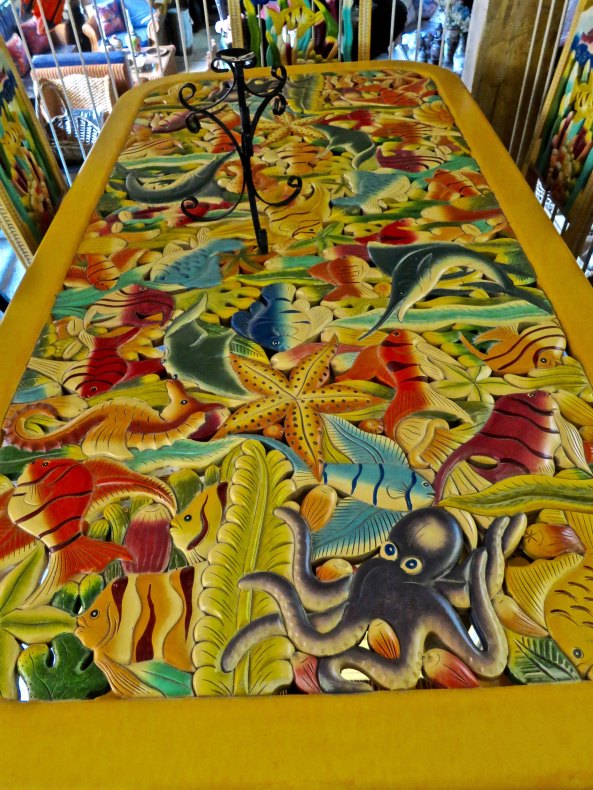
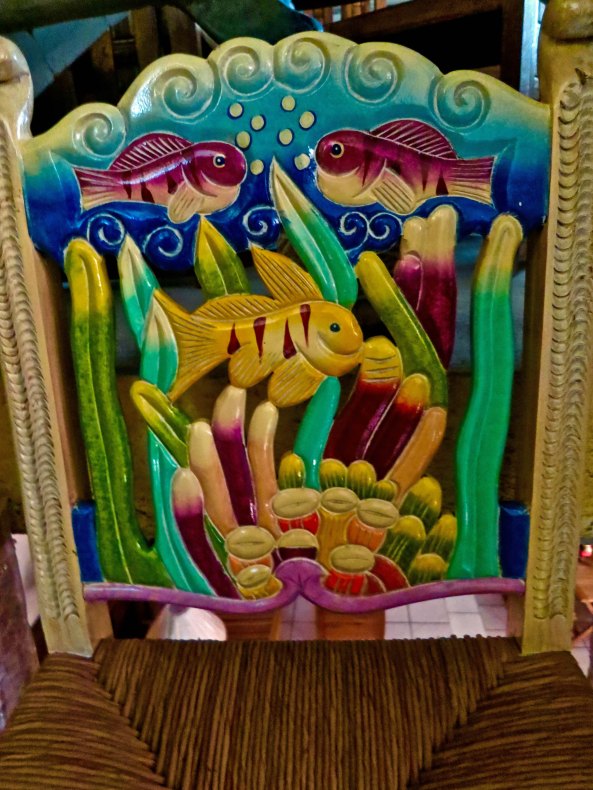
This table featured a colorful, carved ocean scene.
Matched by the chairs.
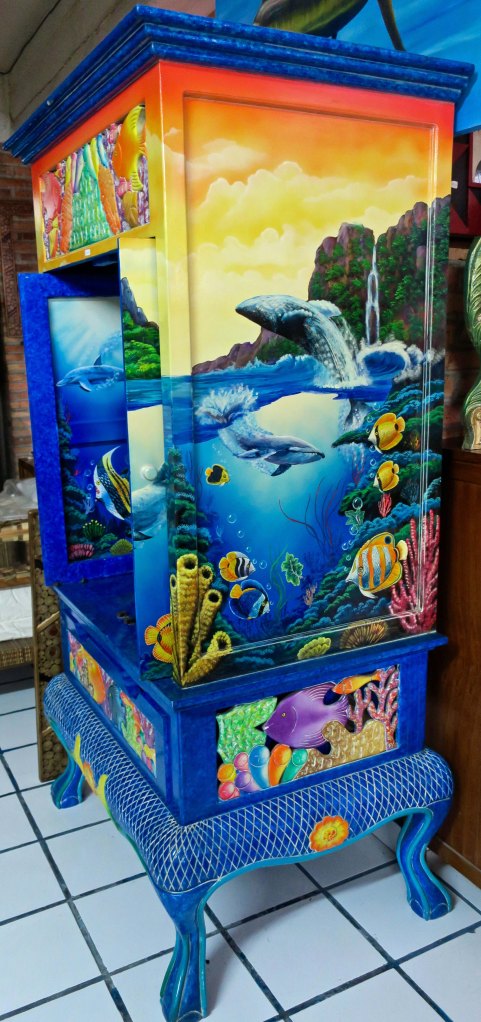
This cabinet, featuring a painted ocean scene, was also quite impressive.
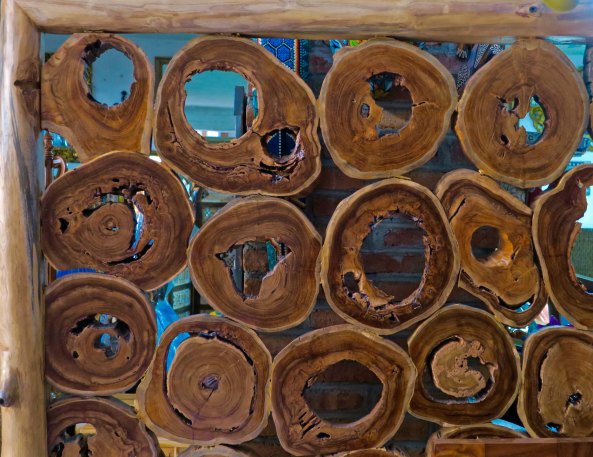
A room divider…
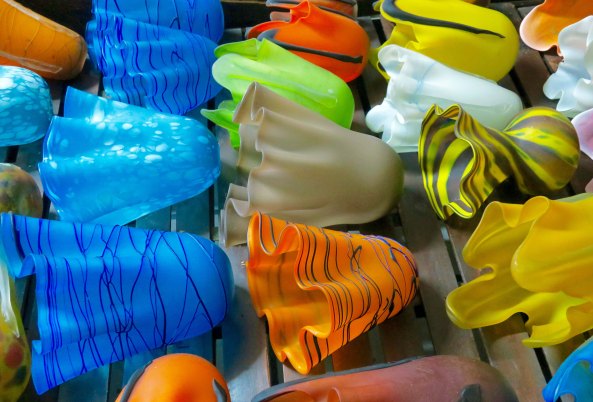
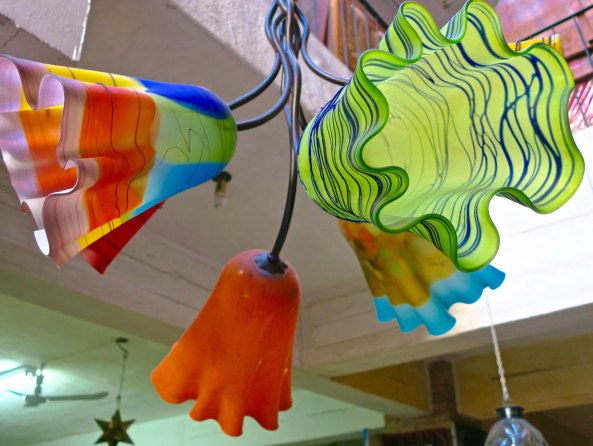
As I mentioned in a previous post, the Furniture Mart is a family affair. 85-year-old Grandpa makes these attractive glass lamp-shades.
I’ll conclude with an example of the lamp shades being used in a chandelier. My next post on PV will include pelicans and iguanas, but first it will be back to my hike down the PCT.

NEXT POST: A beautiful lake in Lassen National Park along the Pacific Crest Trail, plus Bone makes some new friends.

The Furniture Mart + The World of Tiles and the World of Crystal… Puerto Vallarta Art

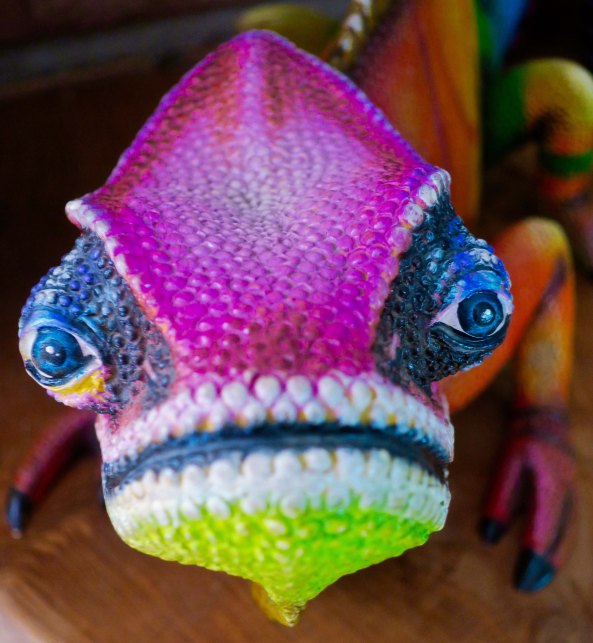
Ceramic art and crafts are found throughout Mexico. I found this colorful iguana at the Furniture Mart.

In my last post from Puerto Vallarta, I featured the Furniture Mart that is located across the road from where we are staying at the Krystal Hotel. As I noted, the Mart is full of thousands of items. These included a wide variety ceramics ranging from the inexpensive mass produced items you find in most tourist shops throughout Mexico to finer pieces that border on art. 

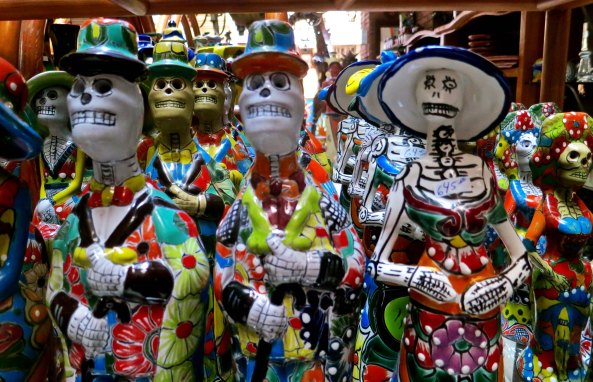
Almost any tourist shop in Mexico features mass produced figures such as these Day of the Dead skeletons. (I am going to do a separate post on Day of the Dead characters, which tend to be more amusing than scary.)
Stereotypical Mexicans wearing sombreros while taking a siesta are another common tourist shop item. (I’ve yet to see a Mexican peasant wearing a sombrero and taking a nap in all my years of visiting Mexico.)
Do you need a butter dish?
My kind of inexpensive pottery.
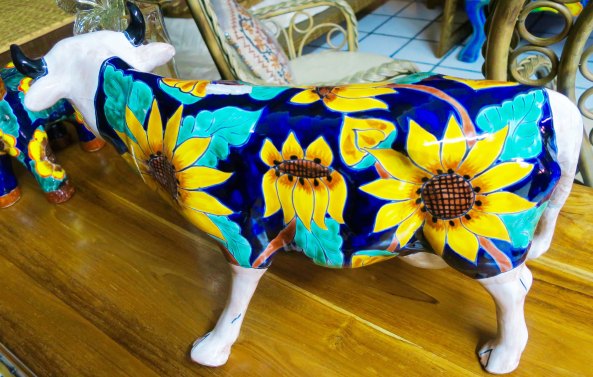
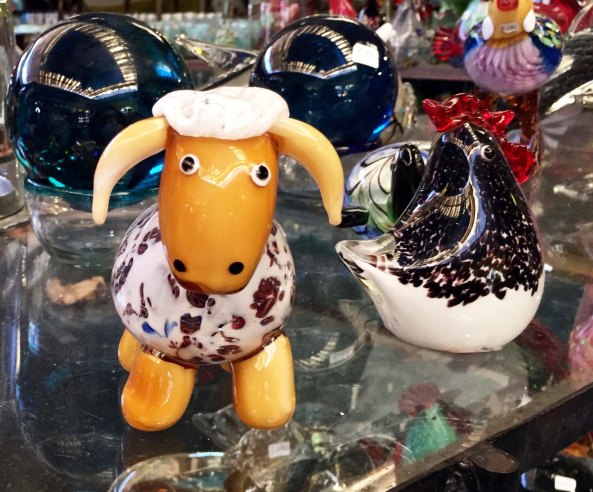
Finer items, such as this cow, receive much more attention in their production.
Peggy’s sister, Jane, was impressed by the dishes found in the Mart.
Many of the dishes were painted with colorful tropical scenes.
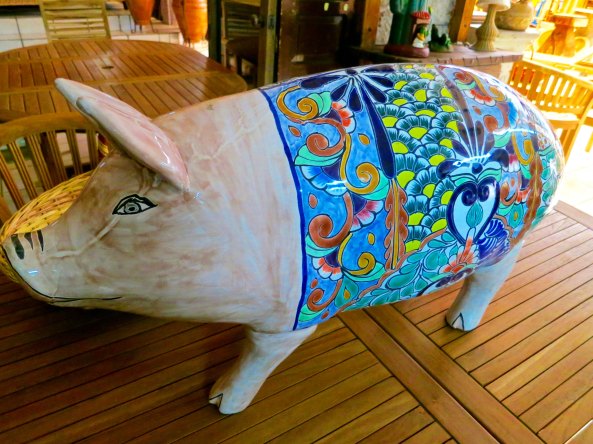
While I found myself amused by this pig.
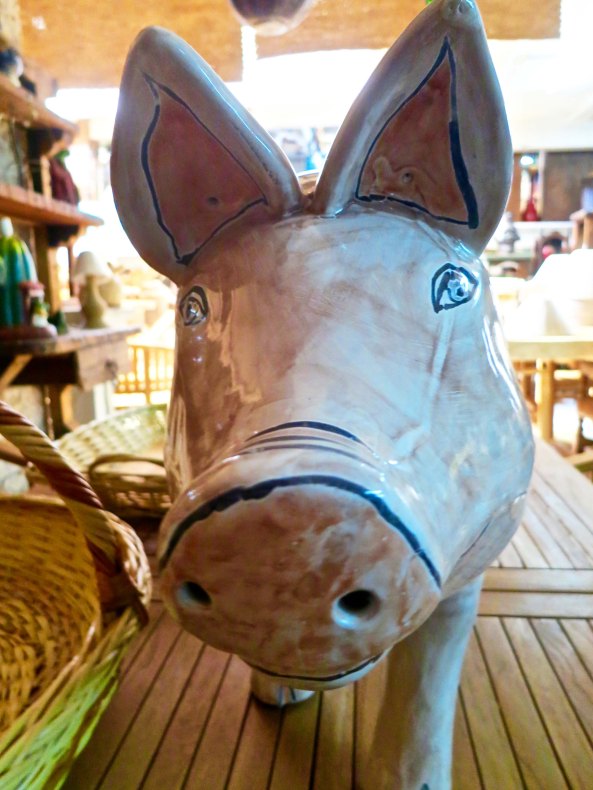
And its snout.
Jane and I would agree on the value of a beautiful vase.
And having a colorful water pitcher.

Today I am also going to include ceramic and glass pieces from the World of Tiles and the World of Crystal located in Puerto Vallarta’s Zona Romantica. I found the World of Tiles particularly interesting because we were able to watch the artisans at work making tiles in the store’s ‘factory.’

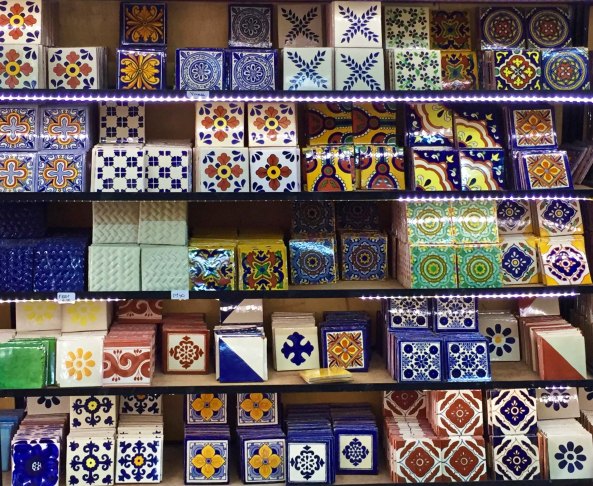
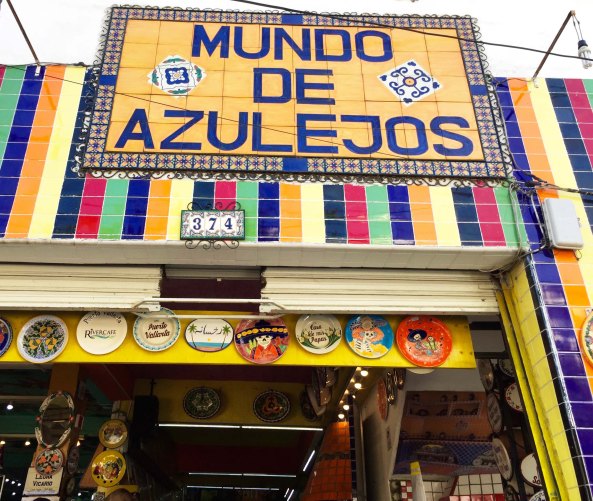
Stopping by the World of Tiles (Mundo de Azulejos) is a must-do for people visiting Puerto Vallarta’s Zona Romantica. As you might expect, there are lots of tiles!
Including humorous ones. This represents the worm occasionslly added to a bottle of tequila. I can remember a few times drinking tequila in my youth when I resembled this worm (grin).
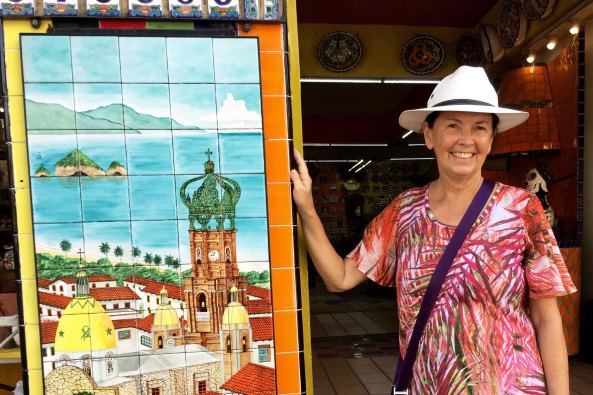
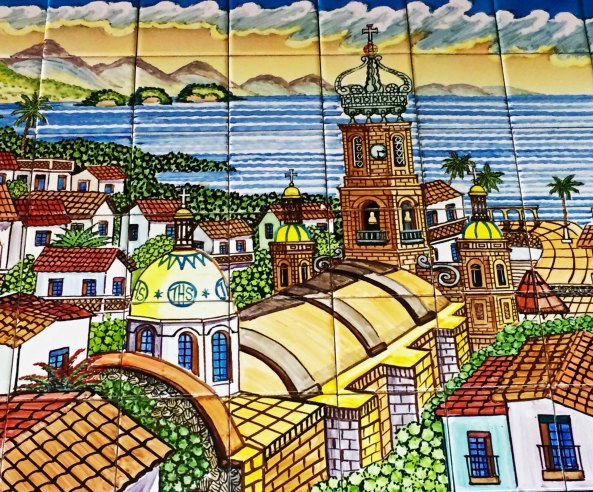
The tiles are sold individually or incorporated into scenes. This is Puerto Vallarta’s famous church, and Peggy.
Another view of the church looking out on Banderas Bay.
A rooster. But with eggs? Maybe the hen hired him to babysit.
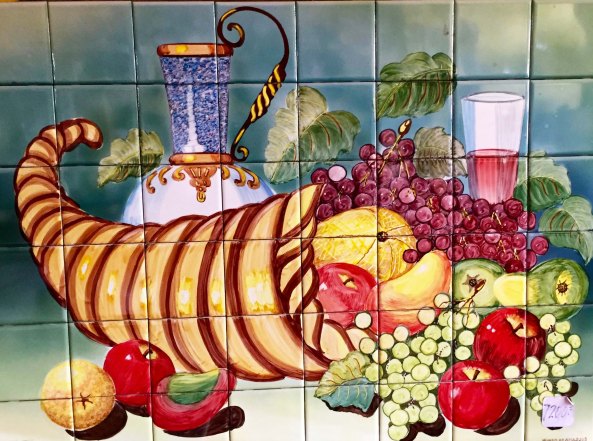
And a cornucopia.
The front of the store…
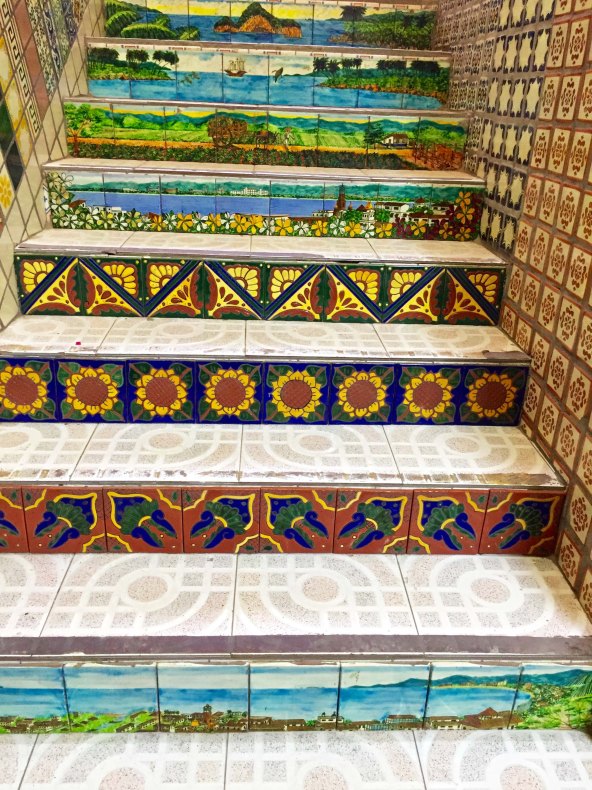
And the tiled stairs leading up to the tile factory.
Where we watched an artist paint a boat scene.
In addition to the tiles, a number of other ceramic items were sold at the World of Tiles including wash basins.
Of which there were many different types. Check out the sun and the moon.
“We are Siamese if we please…” Remember “Lady and the Tramp”? These cats may have come from the same mould, but they each have different personalities. I like the zoned out kitty in the left rear.
There were also dishes.
Including white sheep and cow dish sets.
A large bowl featured a happy bee. But I noted it still had a stinger. I ended up on the wrong side of one of those twice this summer on my backpacking trip.

The World of Crystal featuring glass art is just down the street from the World of Tiles. I’ll include a few items from it to finish off this post.

This glass was reflecting the sun when we walked into the shop.
I discovered a green frog with buggy eyes.
A cute cow…
Doggy tiles…
A cat tile for those of you who lean toward kitties…
And a pair of attractive masks to wrap-up this post.

Next post: I’ll wrap up the Furniture Mart with some real furniture and weird things.

Furniture Mart or Zoo or??? … The Art of Puerto Vallarta

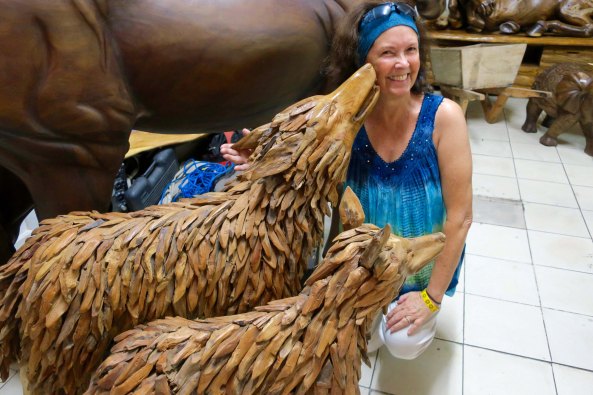
A friendly wolf licks Peggy’s face at the Furniture Mart in Puerto Vallarta.

Peggy and I have been coming to Puerto Vallarta, Mexico for a long time, long enough to see the lovely two and three story hotels along the north beach replaced by would-be sky scrapers that encroach on more and more beach.

We always stay at the Krystal Hotel, which is located along the main road between the airport and downtown. Years ago, we bought a time share here. It’s not something you do as an investment, regardless of how fast the sales people talk or whip out figures that you are not allowed to take away and study. In fact, there are much less expensive ways to see Mexico. Forget what we paid originally, the ever-increasing maintenance fees alone would easily cover an annual visit to PV, or anywhere else in Mexico.

But Peggy and I like the staff, our villa comes with a swimming pool, and we have fallen in love with Puerto Vallarta: its art, great dining, tropical sunsets, friendly people and amazing wildlife. There is even a taste of more traditional Mexico once you escape from the popular tourist areas.

I’ve blogged a fair amount about the town, more than I remember. I laughed a couple of days ago when I was doing Google research on PV’s public art, came across a promising heading, clicked on it, and landed on my blog.  

I’ve even blogged about the furniture store directly across the road from the Krystal. And I am going to blog about it again— today. I can pretty much guarantee that it is unlike any furniture store you have ever seen. It all started as a failed restaurant. Peggy and I ate there once upon a time.The food was good but the customers were scarce.

The family scurried about,searching for some other way to make a living and decided to make furniture.They also decided to sell art decorations for the home, everything from cute little ceramic frogs to giant metal rhinos. Collecting unusual items became something of a passion.

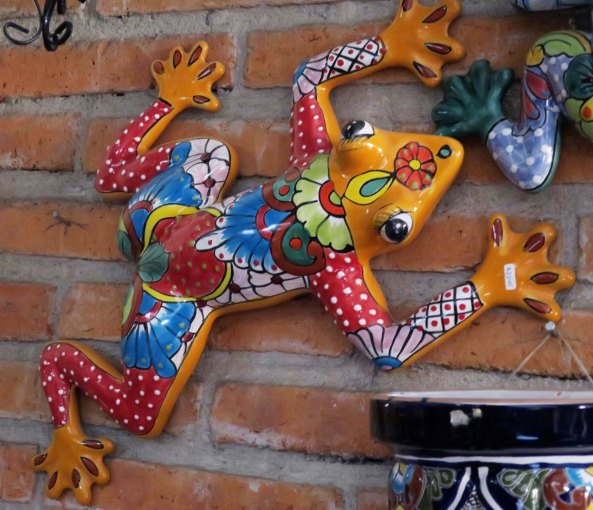
There must be hundreds of ceramic frogs hanging out at the Furniture Mart. This one is a cutie, complete with eyelashes.
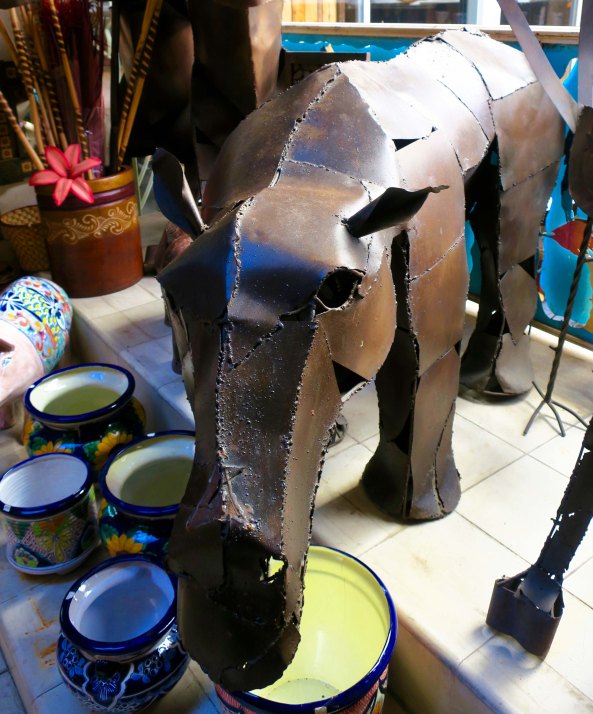
Contrast it with a full sized metal rhino!

The three, or four, or maybe five story structure feels like an Escher painting where you meet yourself coming and going. It is crammed full of art, wood carvings, pottery, strange statues, masks, and Mexican knick-knacks galore, as well as very unique furniture. There are thousands of items. The family of Carlos Paez Coronado describes their building as the Furniture Mart, the largest store of its type in Mexico, and a museum.

We visited this time with Peggy’s sister Jane and her husband Jim who were staying at our villa with us for a week. Jane loves ceramic plates and has dozens of them. We knew she would like the store. Senior Pepe greeted us and assured us that if we bought any item costing a few grand and weighing who knows how many pounds, he would personally deliver it to our doorsteps in Oregon or Sacramento. (Anyone need a 20-foot-long table?) He and his brother fill up a truck with purchased items and make an annual trip across the border. We disappointed Pepe on the mucho grande sale, but Jane almost bought enough plates to make up for it.

I have enough fun wandering through the Furniture Mart that I am going to do three posts on it: One on the wonderfully wild (and tame animals), one on the pottery, and one on the furniture and weird things. Today it is all about animals!

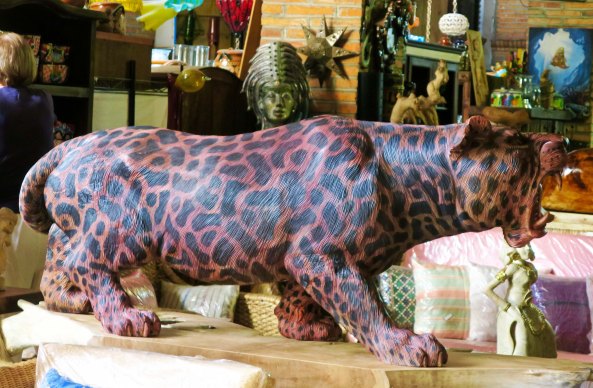
A ferocious jaguar stalking across the floor.
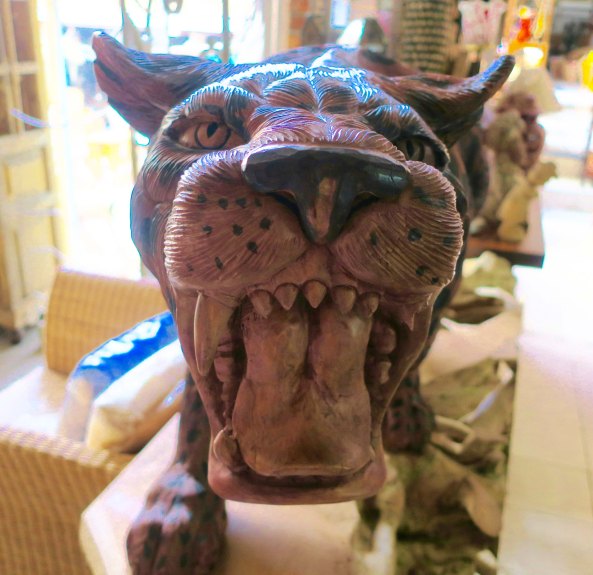
With big teeth.
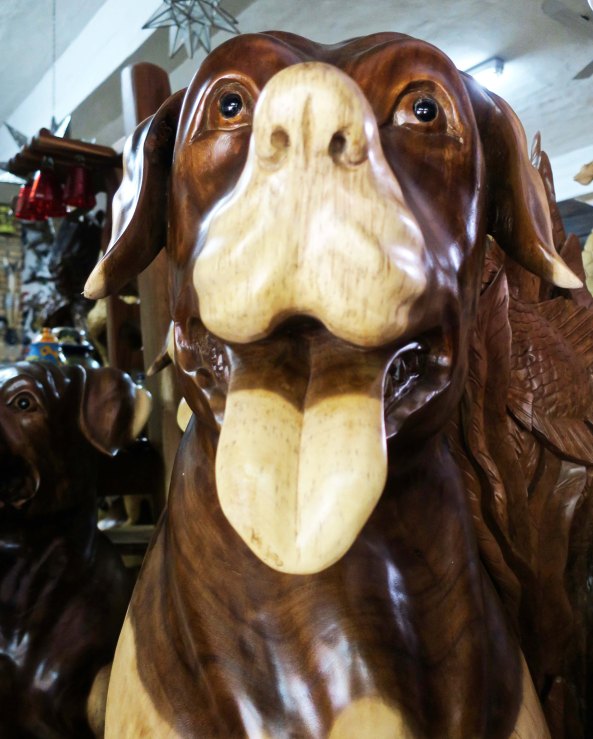
A friendly dog…
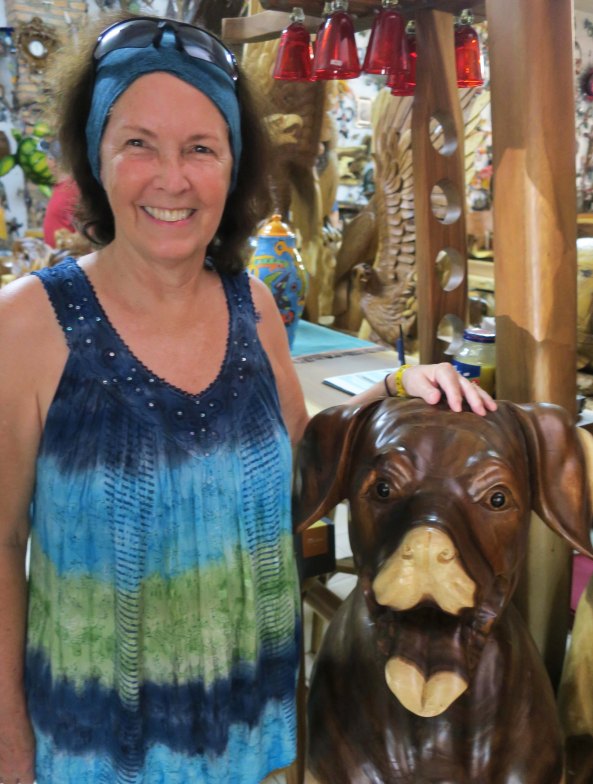
That Peggy pets.
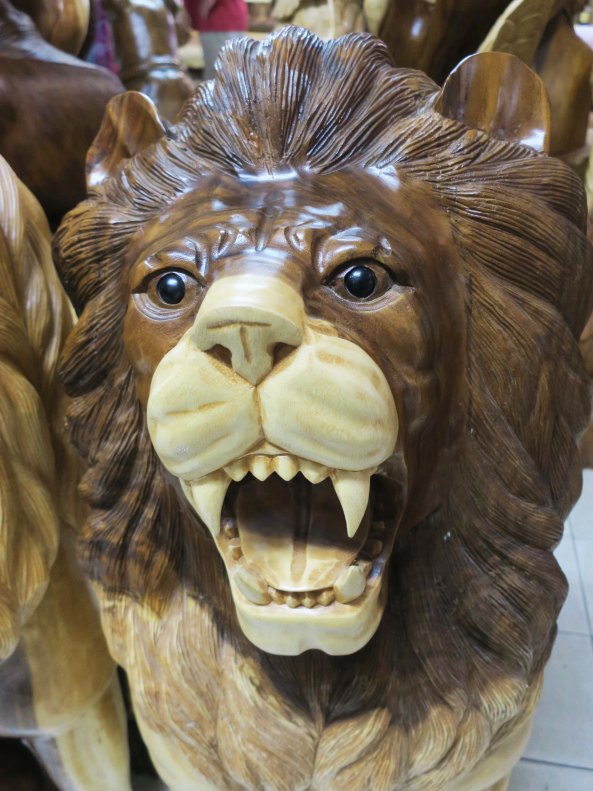
A toothy lion.
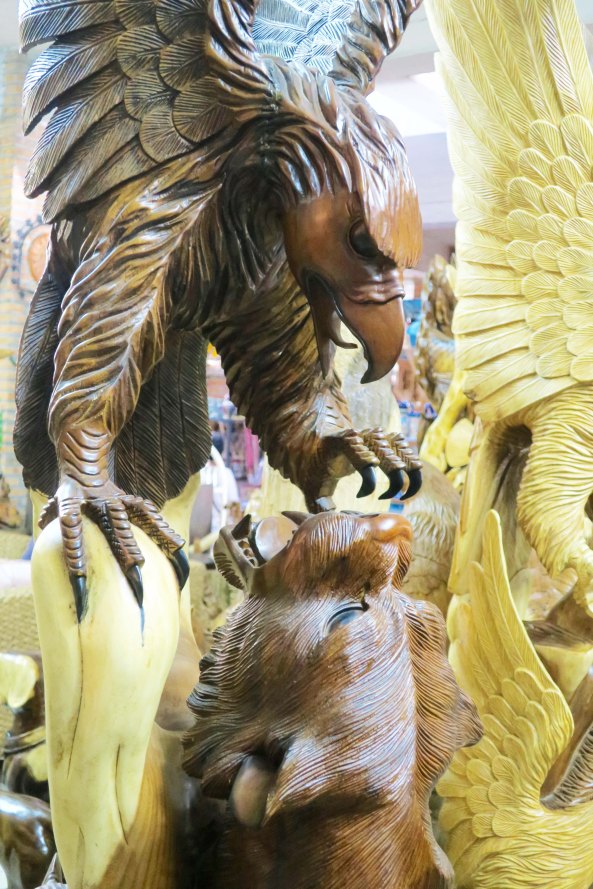
An eagle and a jaguar have a discussion about which is most ferocious.
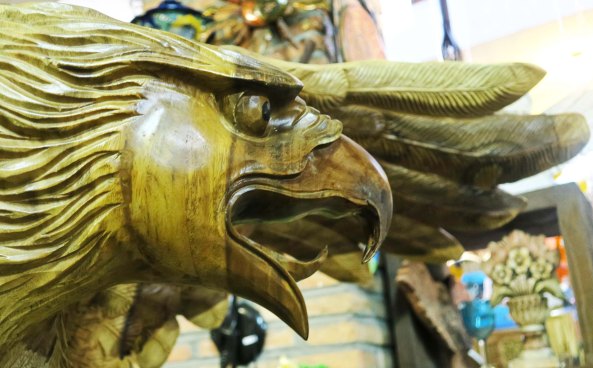
Given this eagle, I’d say a toss-up.
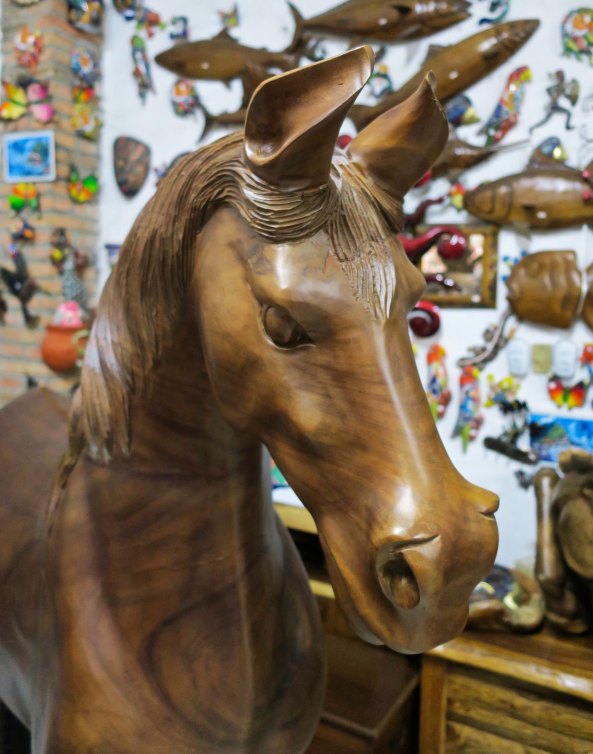
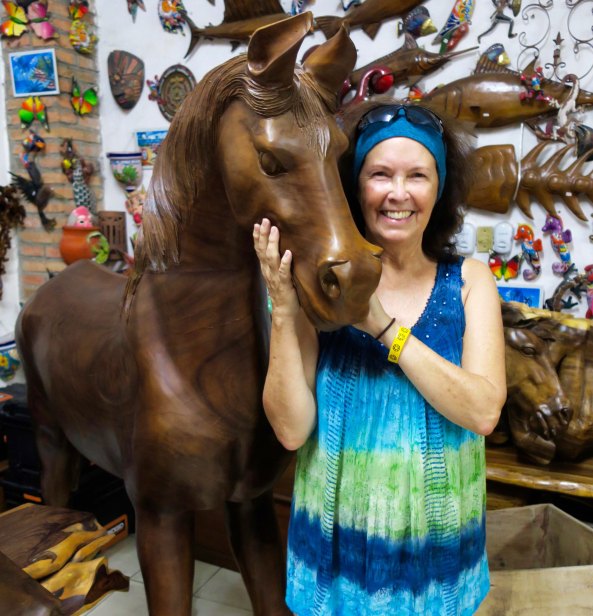
A realistic carved horse…
That Peggy befriends.
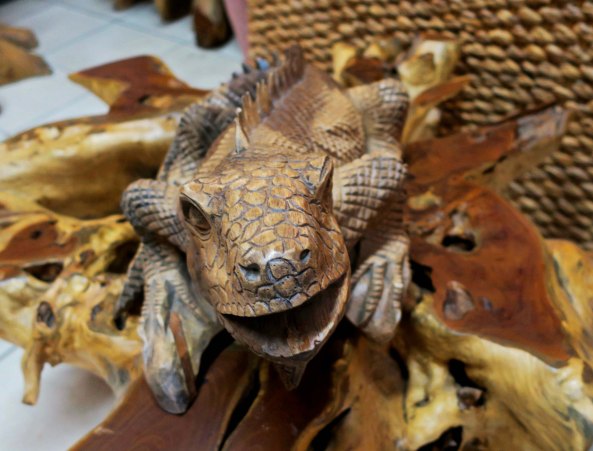
Puerto Vallarta’s favorite lizard: The iguana. I’ll be doing a post on these big fellows.
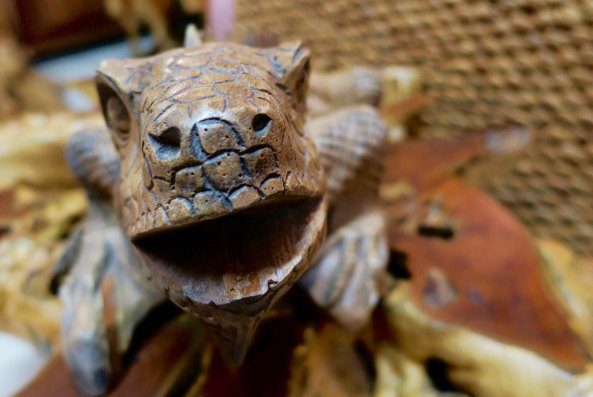
Head shot!
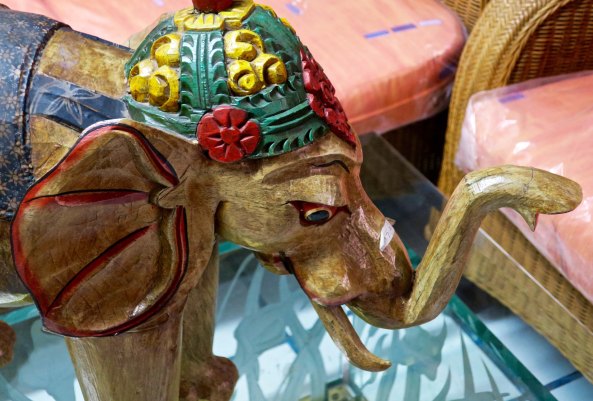
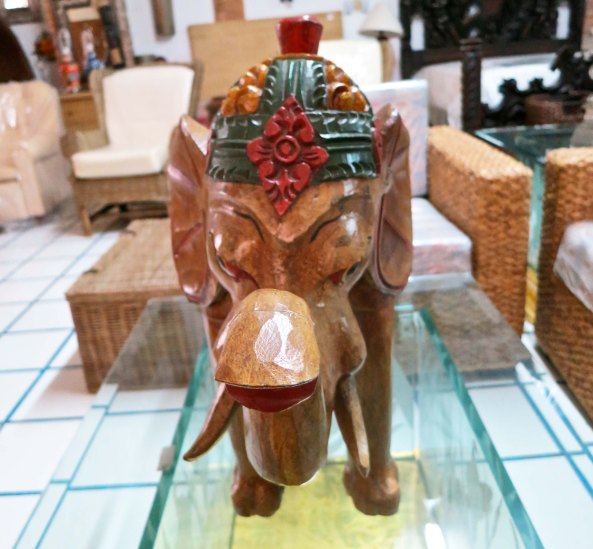
A turbaned elephant…
A trumpeting trunk.
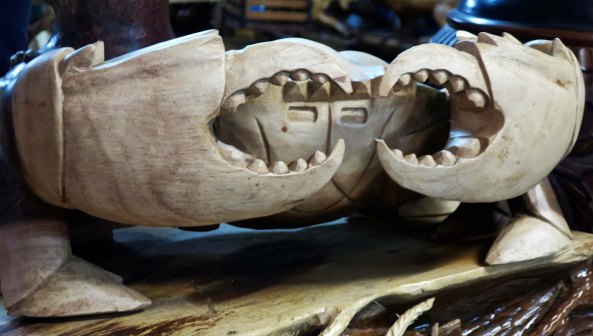
A crabby crab.
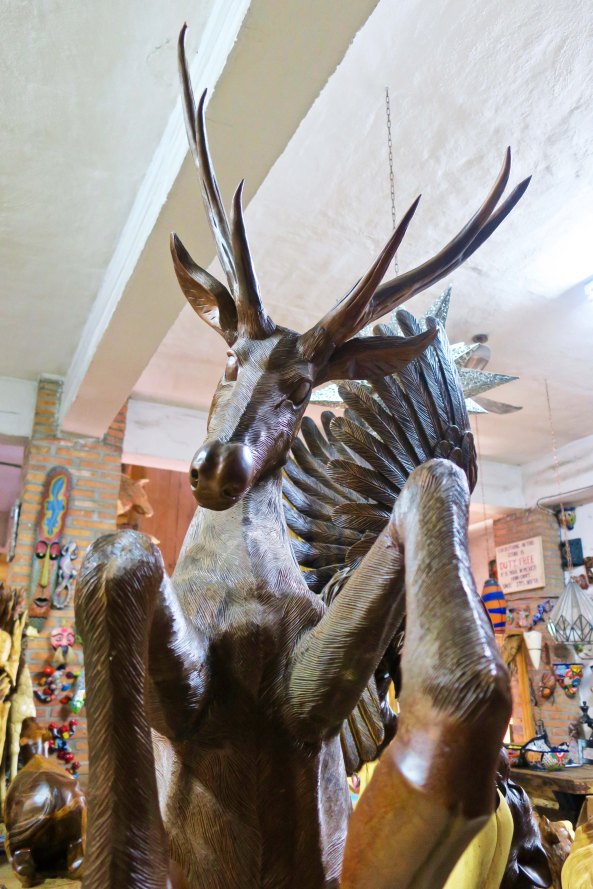
A fighting stag displays its hooves.
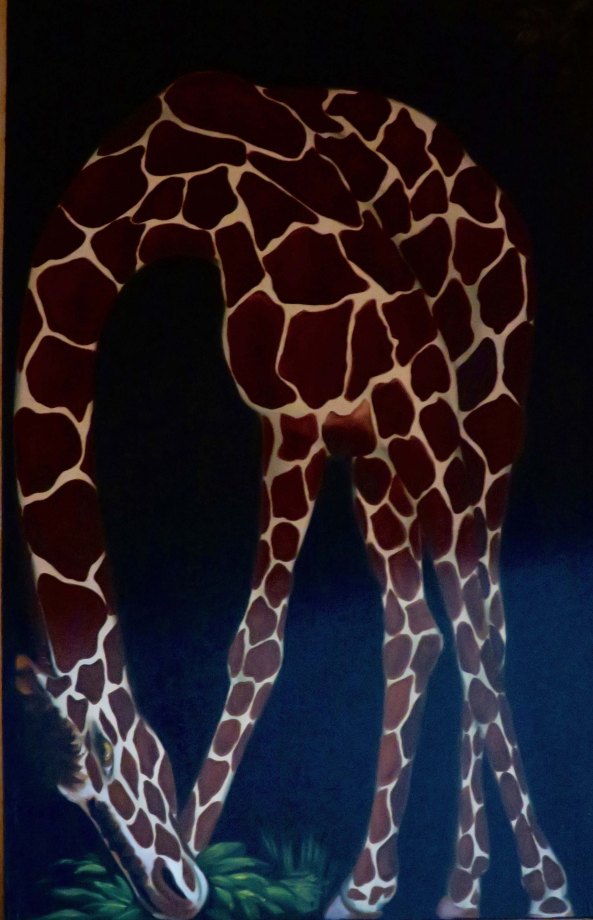
I’ll conclude my exploration of the Furniture Mart today with this striking painting of a giraffe. Next up on the Mart will be ceramics ranging from pigs to plates.

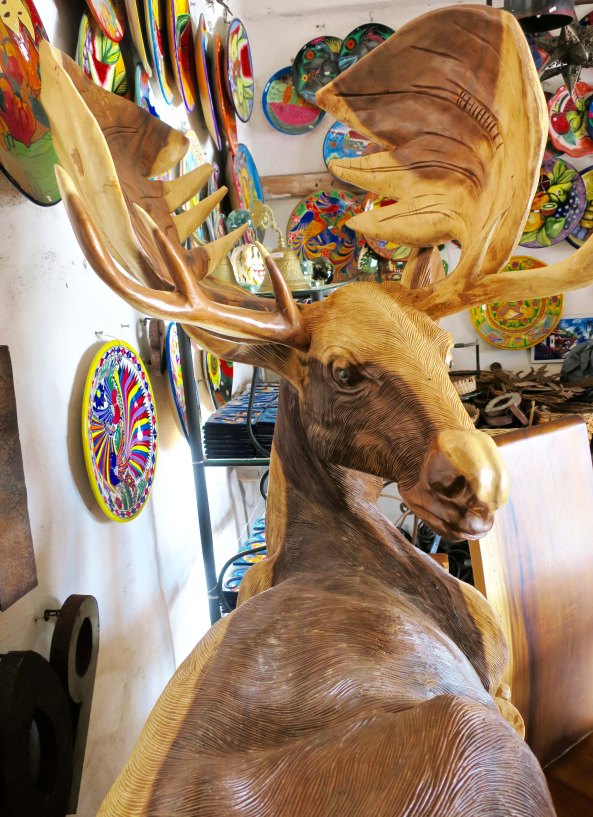
It’s Turkey Day here in Puerto Vallarta, so Peggy and I will be heading out for a traditional Thanksgiving dinner. Several restaurants cater to the day. But I couldn’t find a turkey to represent the holiday…

So, a moose will have to do!

HAPPY THANKSGIVING to all of our Internet friends! –Curt and Peggy. 

The Beautiful Temples of Black Rock City… A Burning Man Experience

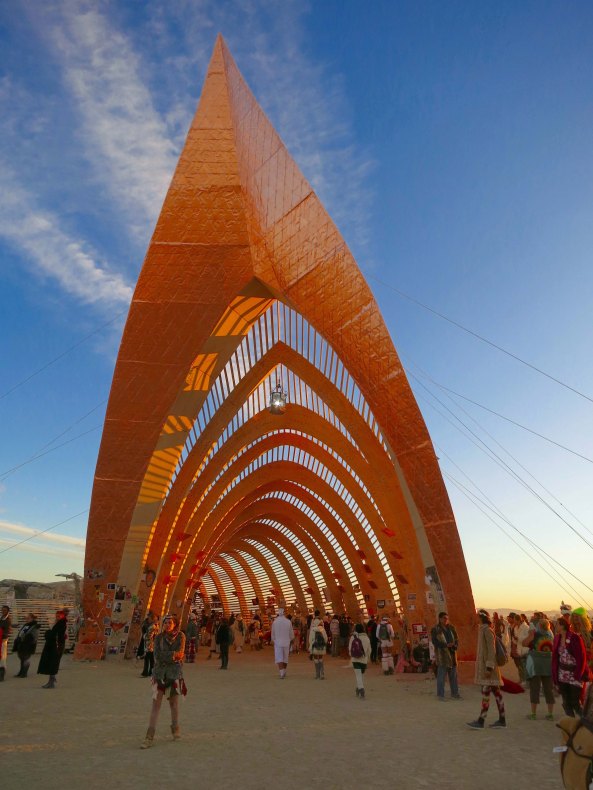
This is the Temple of Promise from Burning Man 2015, a simple and beautiful structure designed to capture the early morning sun.


This is the second in my series of introducing new followers to the type of posts they can expect to find on my blog. Since I’ve been going to Burning Man since 2004, there are numerous posts on the annual event that takes place annually in the Nevada desert. Over the years, my primary focus has been on the art, but I touch on all aspects of the event. Here, I take a look at the beautiful temples that are built each year and then burned at the end of the event. If you would like to see more of my posts on this unique extravaganza, go to mu Burning Man category on the right, click on it, and scroll down. Enjoy!

Census figures from Burning Man show that 71% of the participants claim to have no formal religious affiliation. Given this, it might seem strange that a temple is one of the major structures built in Black Rock City each year. But there is another factor at work here; over 50% of Burners claim that they are spiritual. While they may not adhere to any particular religious doctrine, they believe that they are part of a whole that is beyond any individual’s existence. Or, at least, that’s how I interpret being spiritual. It’s how I feel.

Whatever Burners believe, there is no doubt that visiting the temple can be a spiritual experience. In addition to being a place of beauty, as I hope the photos in this post show, the Temple is a place where 10,000’s of messages are left honoring loved ones who have passed on, asking forgiveness and expressing thanks. At the end of the week, the Temple is burned and the messages drift off into the air or, the Heavens if you prefer, giving a sense of peace to those who have left them.
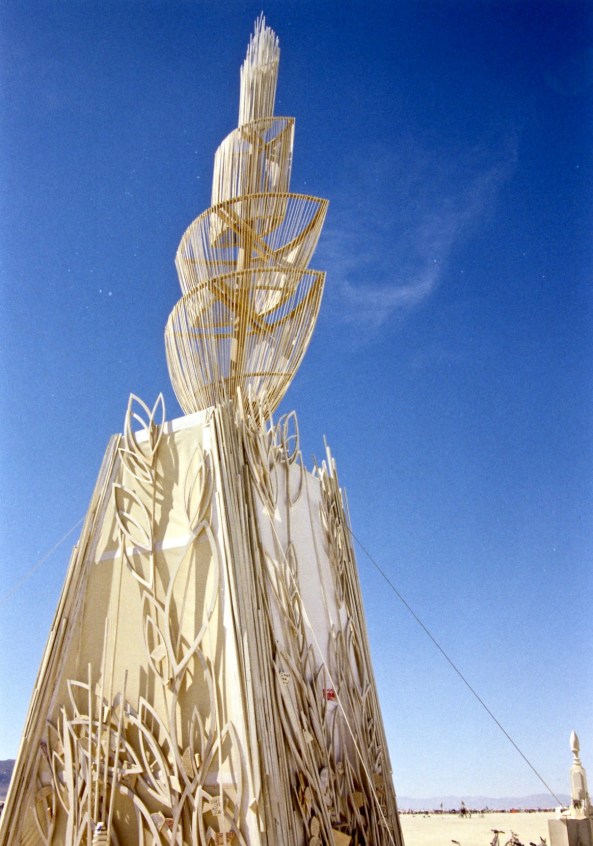
Part of a larger structure, this temple was built in 2007 and was known as the Temple of Forgiveness.
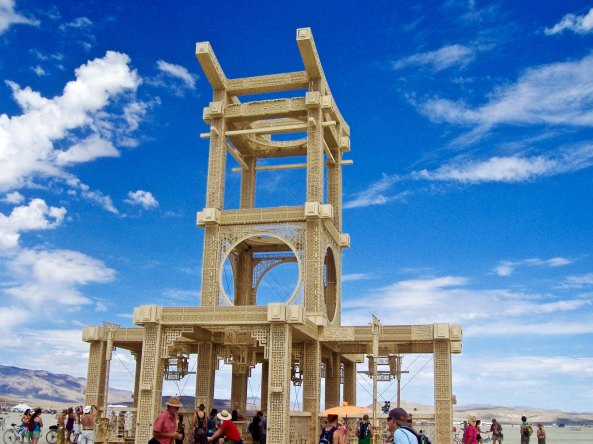
This was the 2008 Temple. (Photo by Ken Lake.)
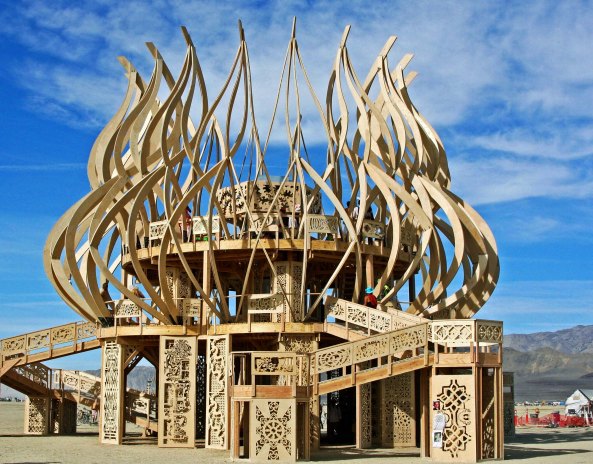
The curving wood on top of the Fire of Fires Temple reflected flames shooting into the sky. Note the intricate detail on the side panels.
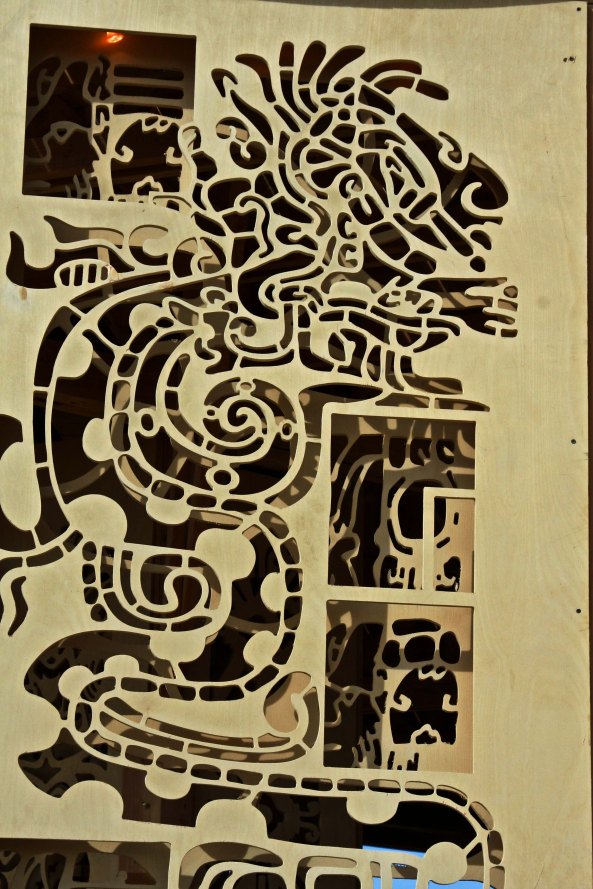
A close up.
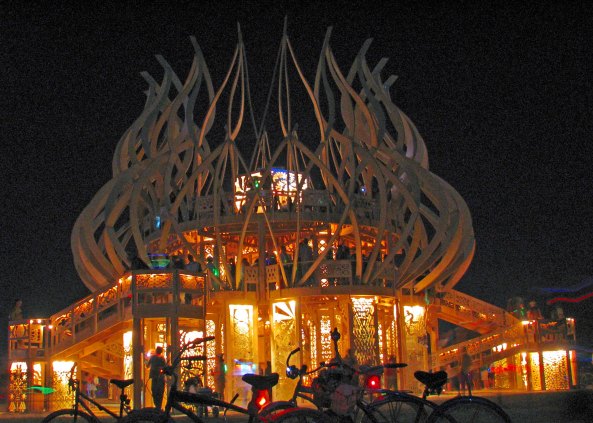
The Fire of Fires Temple at night. (Photo by Don Green.)
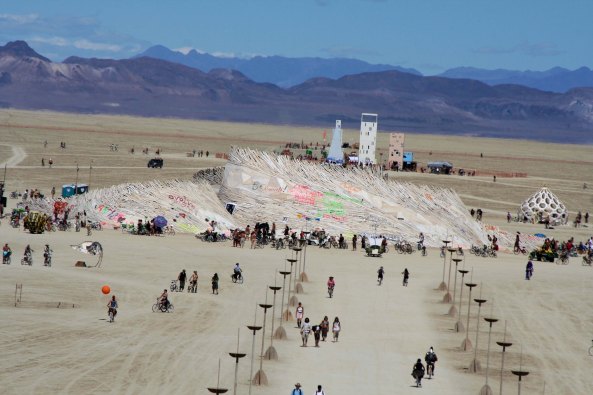
The Temple of Flux represented the constant change we experience in life. It can be seen as waves or as sand dunes. This photo was taken from the Man. The Center Camp Cafe, the Man, and the Temple are always in a direct line. The buildings on the other side represented a city.
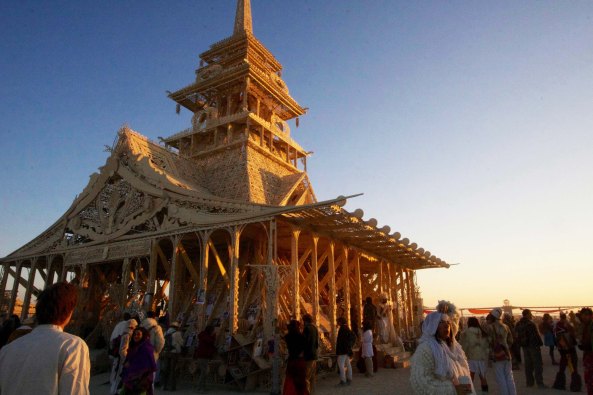
Tom likes to get up early in the morning for his photography. He captured this photo of the Temple of Juno at sunrise. (Photo by Tom Lovering.)
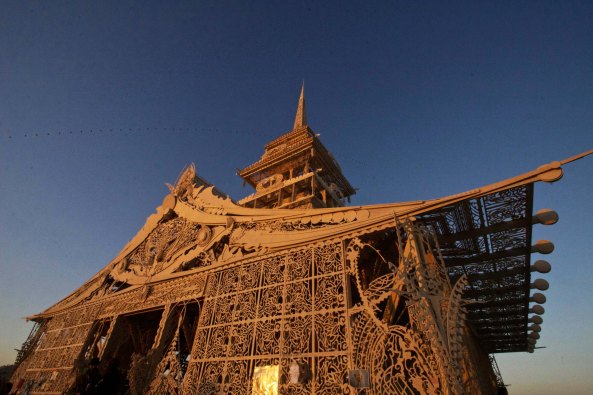
Here’s another. (Photo by Tom Lovering.)
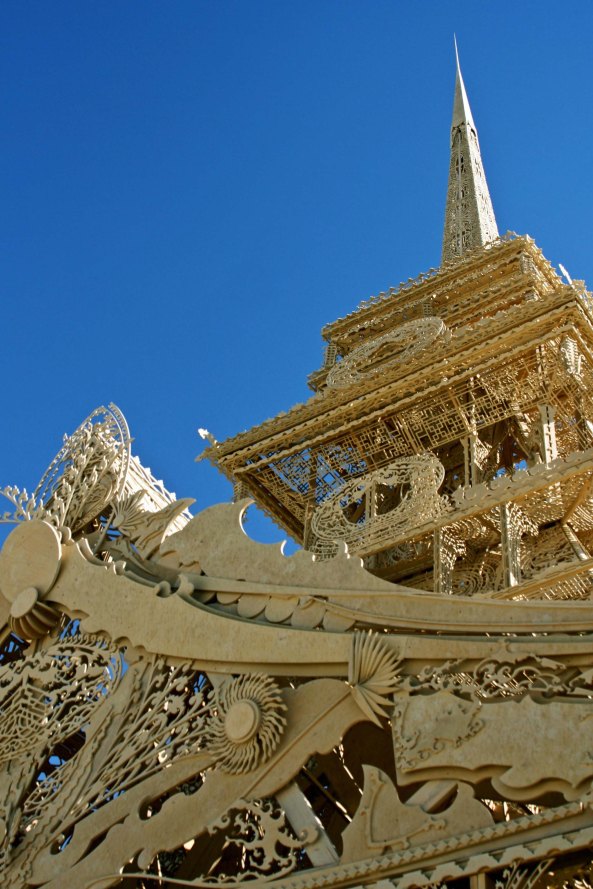
A later photo by me showing detail of the Temple of Juno.
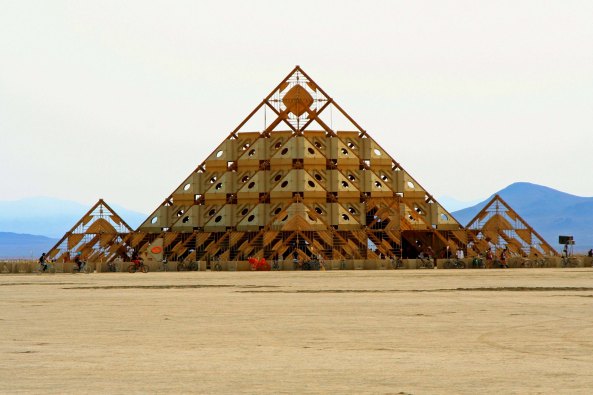
The Temple of Whollyness resembled a Pyramid.
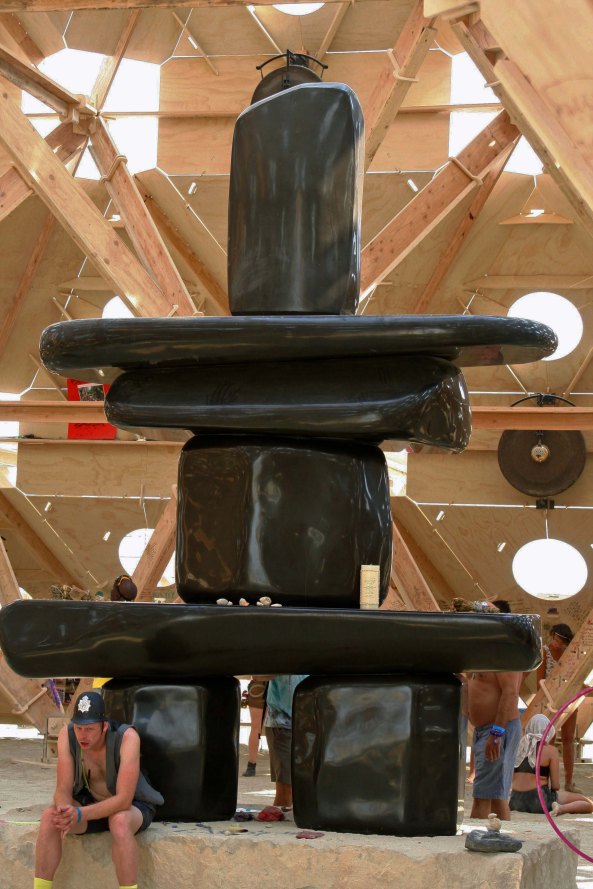
This large stone structure was inside the Temple of Whollyness.
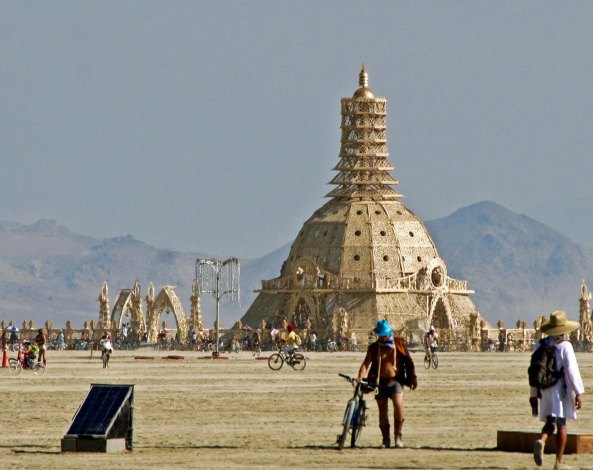
The Temple of Grace was built for the 2014 Burning Man.
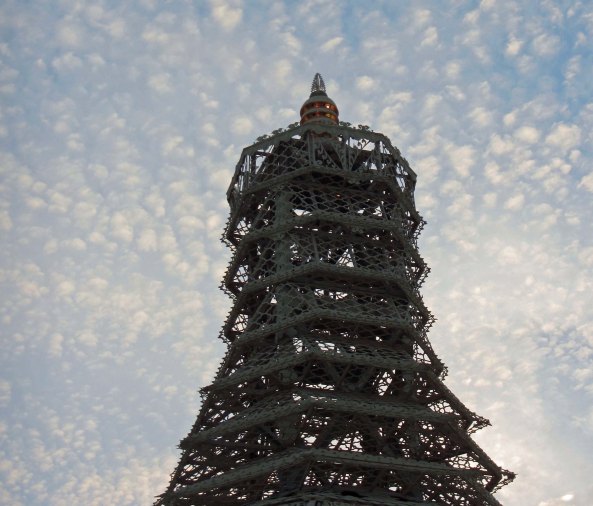
I liked this shot I caught of its spire under butter milk skies.
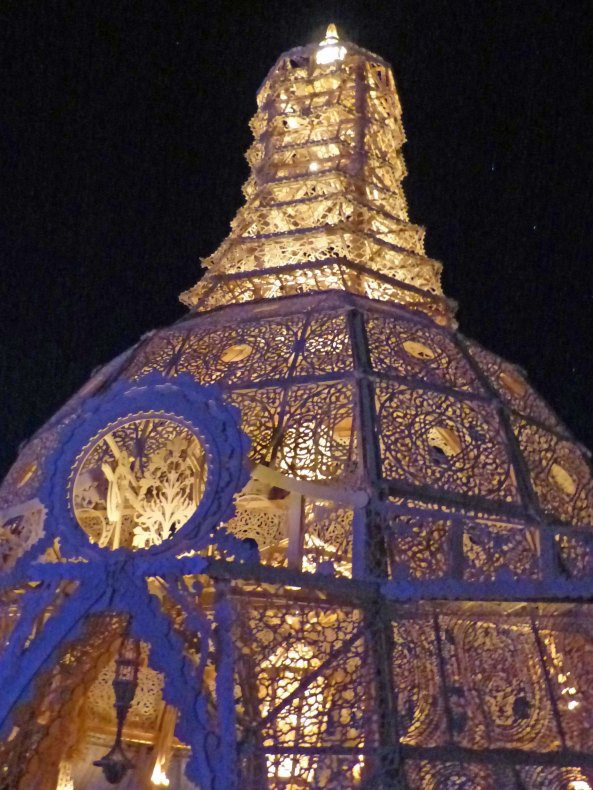
The Temple of Grace at night. (Photo by Don Green.)
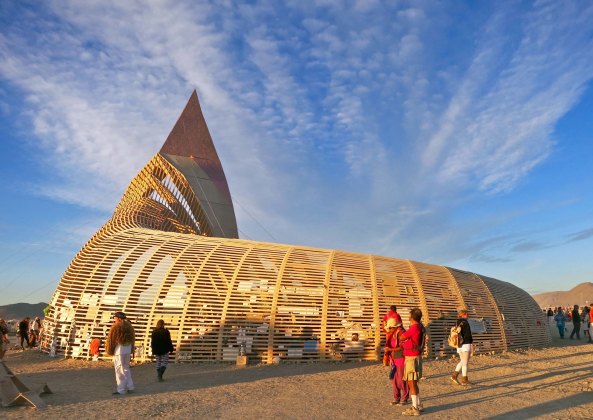
Another photo of the Temple of Promise. I had taken Tom’s advice and rolled out early to capture these photos.
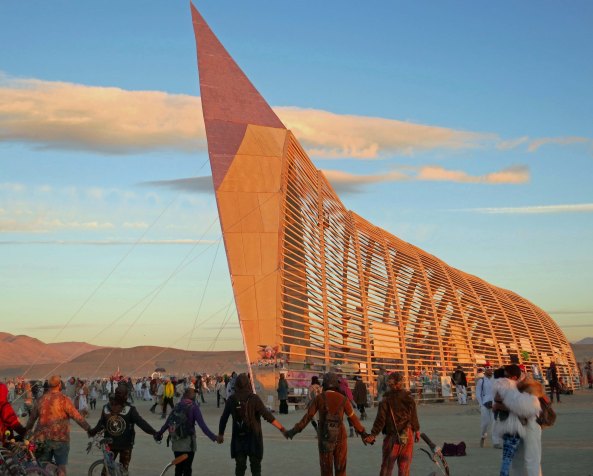
As the sun came up, Burners grabbed each other’s hands and formed a large circle around the Temple. The act was totally spontaneous.

A black and white I created.
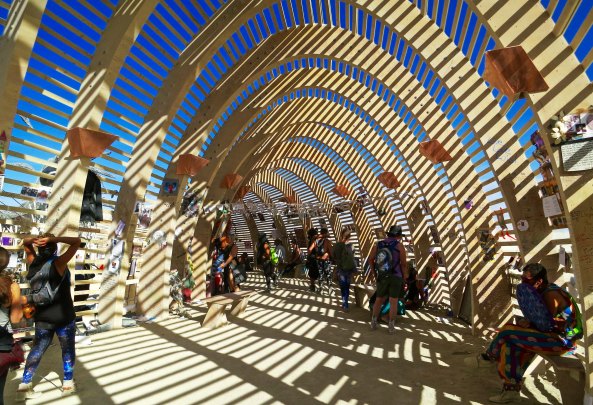
Inside the Temple.

As I mentioned, thousands of messages are placed on the walls. By Saturday, there is little room to write on left within reach.
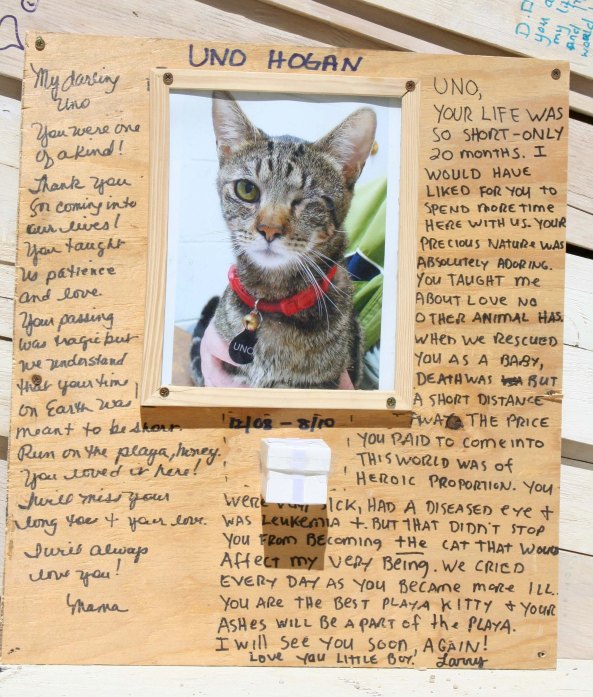
I found this message left behind honoring Uno Hogan quite touching. I think you will as well. It is quite typical of messages found in the temple.

And this message humorous but sincerely meant!
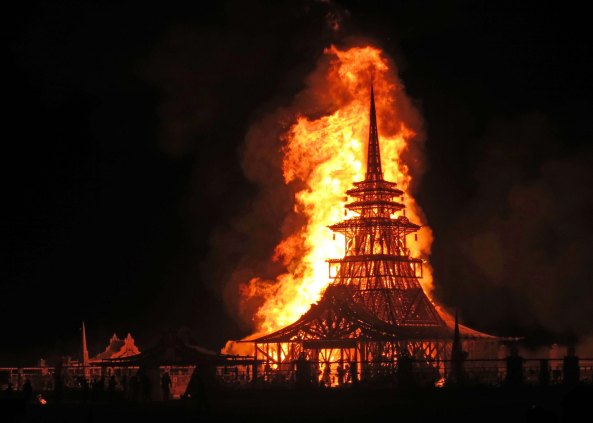
The Temples are always burned on Sunday night, the last night at Burning Man, in a solemn and moving ceremony with the thousands of messages sent skyward. This is the Temple of Juno.

A note on the photographers: All photos that I include in the Burning Man blogs are taken by Peggy, me, or members of the Horse Bone Tribe— all close friends who have traveled and adventured with us down through the years.

NEXT BLOGS:

Monday: Back to Bandon on the coast of Oregon.

Wednesday: I begin my story of how Bone was found.

Friday: I continue my exploration of the unique and beautiful structures at Burning Man.
 

An Active Volcano and an Interesting Bush… Hiking the PCT through Mt. Lassen National Park

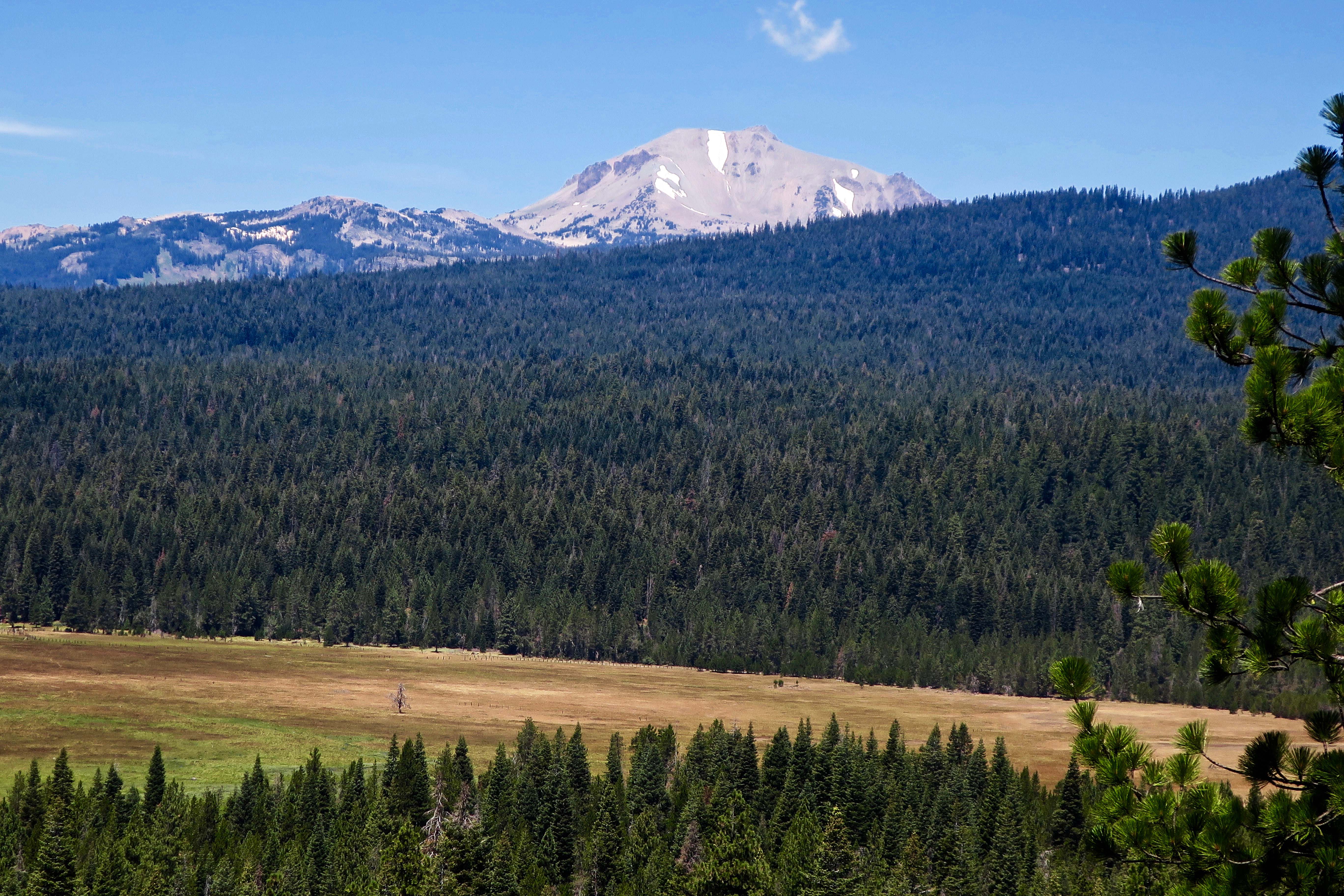
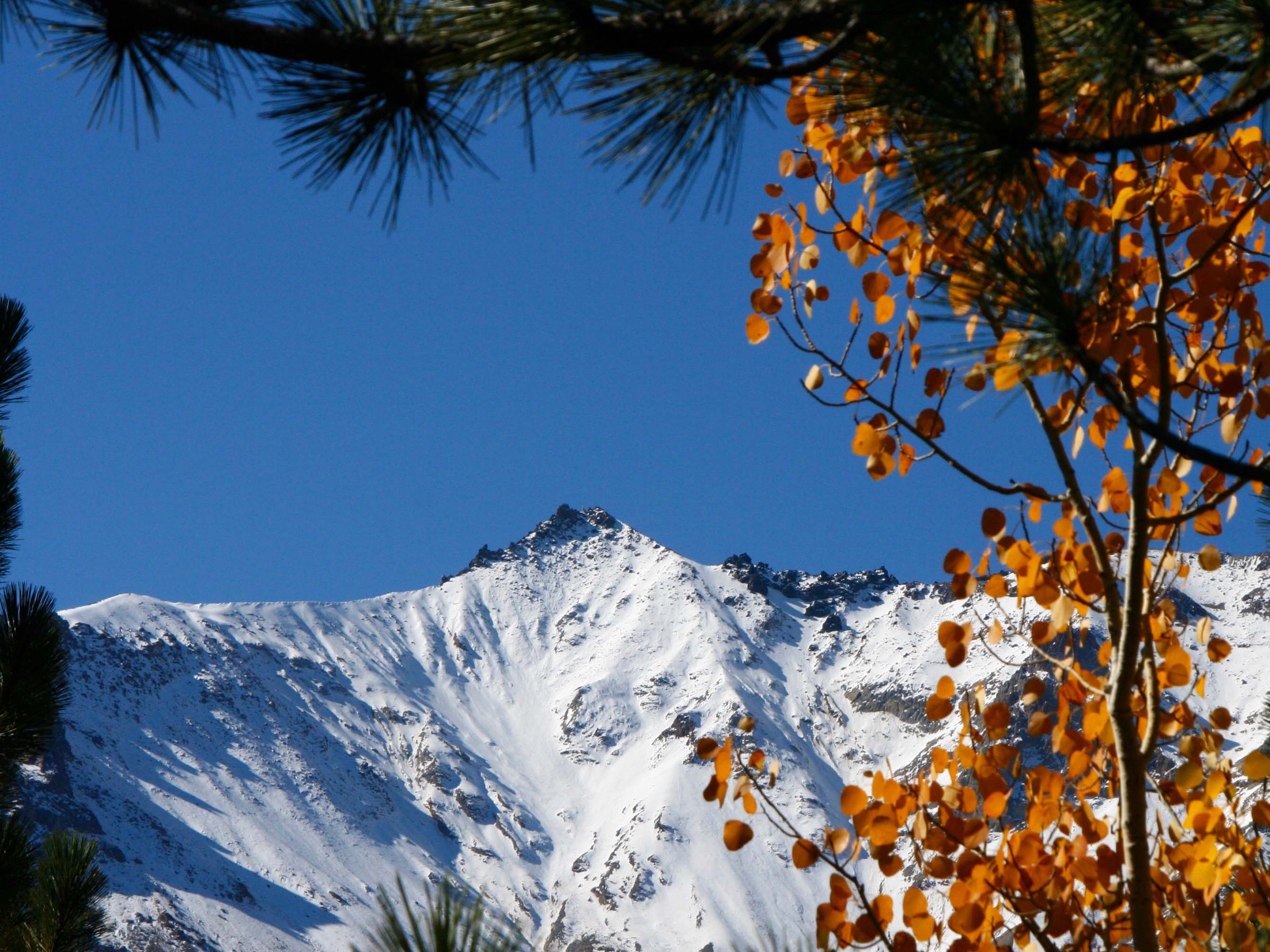
The Pacific Crest Trail wanders along the east side of Lassen National Park and provides limited views of the mountain. I took this photo from the PCT south of the park boundary.

Section N of the PCT includes Mt. Lassen National Park. This series includes portions of the trail leading into and out of the Park as well as the Park. Unfortunately, the PCT passes through the eastern side of Lassen and misses some of the Park’s more impressive features. I was lucky to have Peggy exploring the Park from the road while I hiked the trail, so this post will feature photographs from both of us.

In 1988, I led a backpack trek in Mt. Lassen National Park to honor my old friend Orvis Agee. His family lived near the mountain and he had been working outside on the family ranch when it erupted on May 22, 1915. He was an impressionable 12-year-old. Fifty-eight years later when Orvis joined me on the first hundred-mile backpack trip I led in 1974, the memory was still fresh in his mind.

By the end of that trek, Orvis had become an inspiration for me on what older people can accomplish— and a friend. He proved that an active lifestyle doesn’t have to end at 60, or 70, or even 80, assuming you are healthy. In 1980, Orvis took me to the top of the top of the nearby 14,180 foot Mt. Shasta, a mountain he had climbed many times starting at age 60. He made his 30th and final ascent at 85. He went on his last backpack trek with me at 87! Peggy was along on that week-long expedition. We had just started our relationship and it was her first long distant trek. Given how much I enjoyed backpacking and liked Peggy, I really wanted her to enjoy the experience. I figured that hiking with Orvis would help. It did. As she noted to me later, “It’s really hard to complain when an 87-year-old cheerfully hikes down the trail beside you and sings “Wake Up Little Buttercup” to you in the morning.” Indeed.

Mt. Lassen sits near the southern end of the Cascade Range, a volcanic chain of mountains that reaches from Northern California into British Columbia. It is one of only two mountains that erupted in the contiguous United States during the 20th Century. Mt. St. Helens was the other. (I flew over Mt. St. Helens shortly after it had erupted and was amazed by the devastation.) Lassen, still active, serves as a laboratory for volcanologists and is closely monitored. Oceanic plates diving under the continents and islands around the Pacific Ocean assure continuing volcanic activity, not only for Lassen, but for volcanos all around the Pacific Rim.

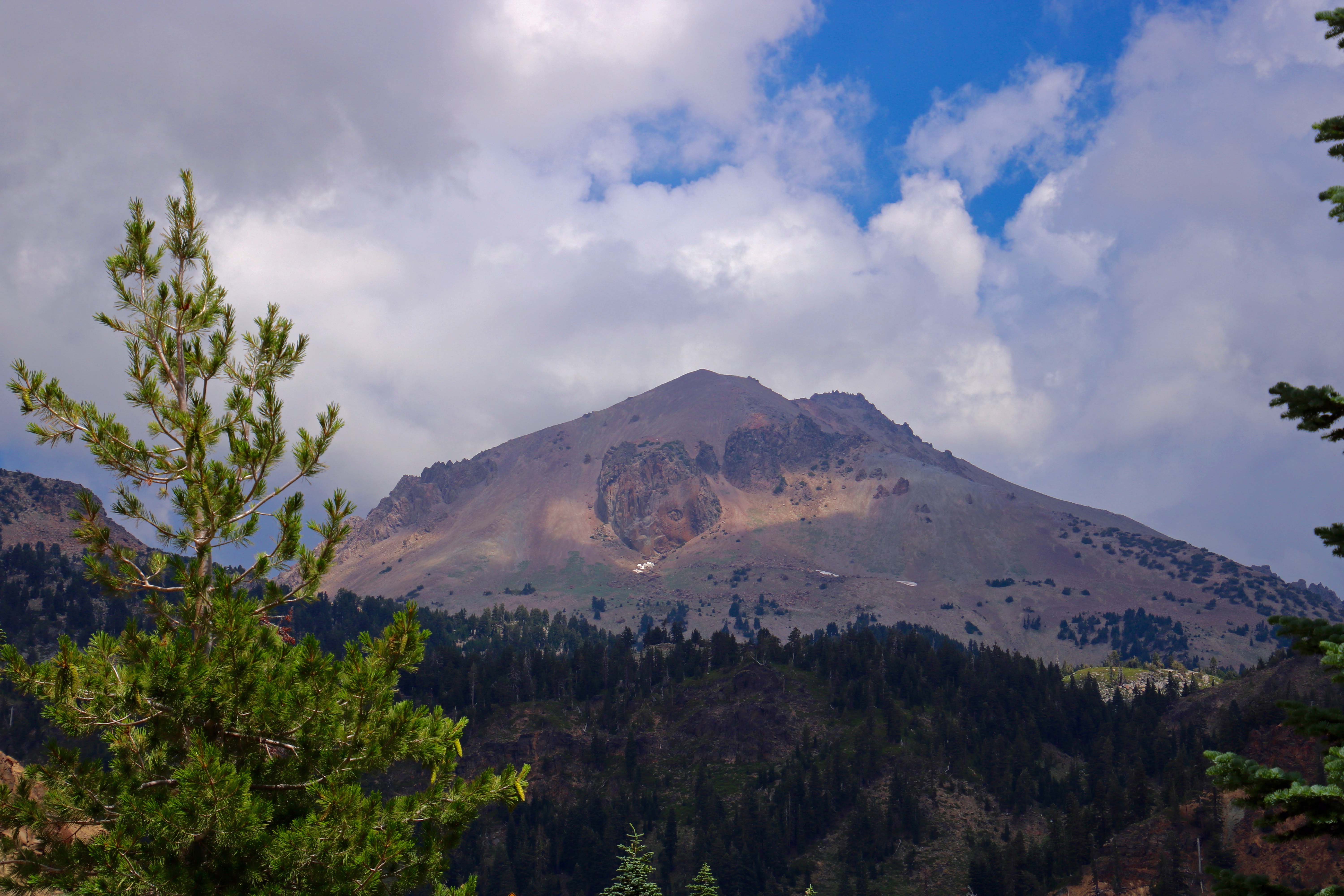
Peggy, who was driving along the road through the park, had closer views of the mountain than I did. (Photo by Peggy Mekemson.)
She planned on hiking to the top of the mountain but was concerned that she might miss me coming out at Chester. I promised her we would climb the mountain for her 70th birthday. The trail up is visible on the lower right. I climbed the mountain the year I led the Trek through the park. (Photo by Peggy Mekemson.)
This photo of the mountain was taken when Peggy and I had visited the park earlier.
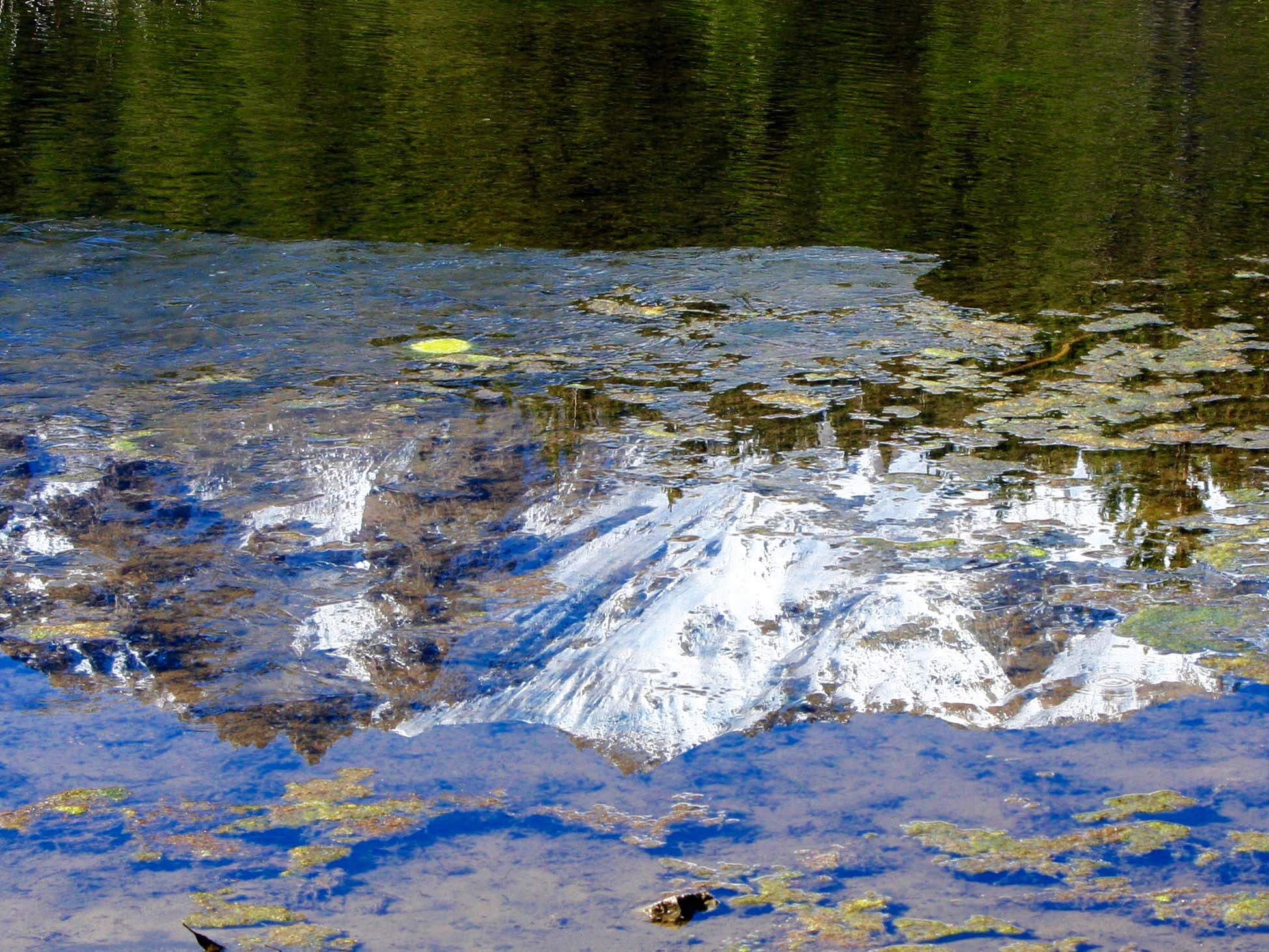
As was this impressionistic reflection shot.
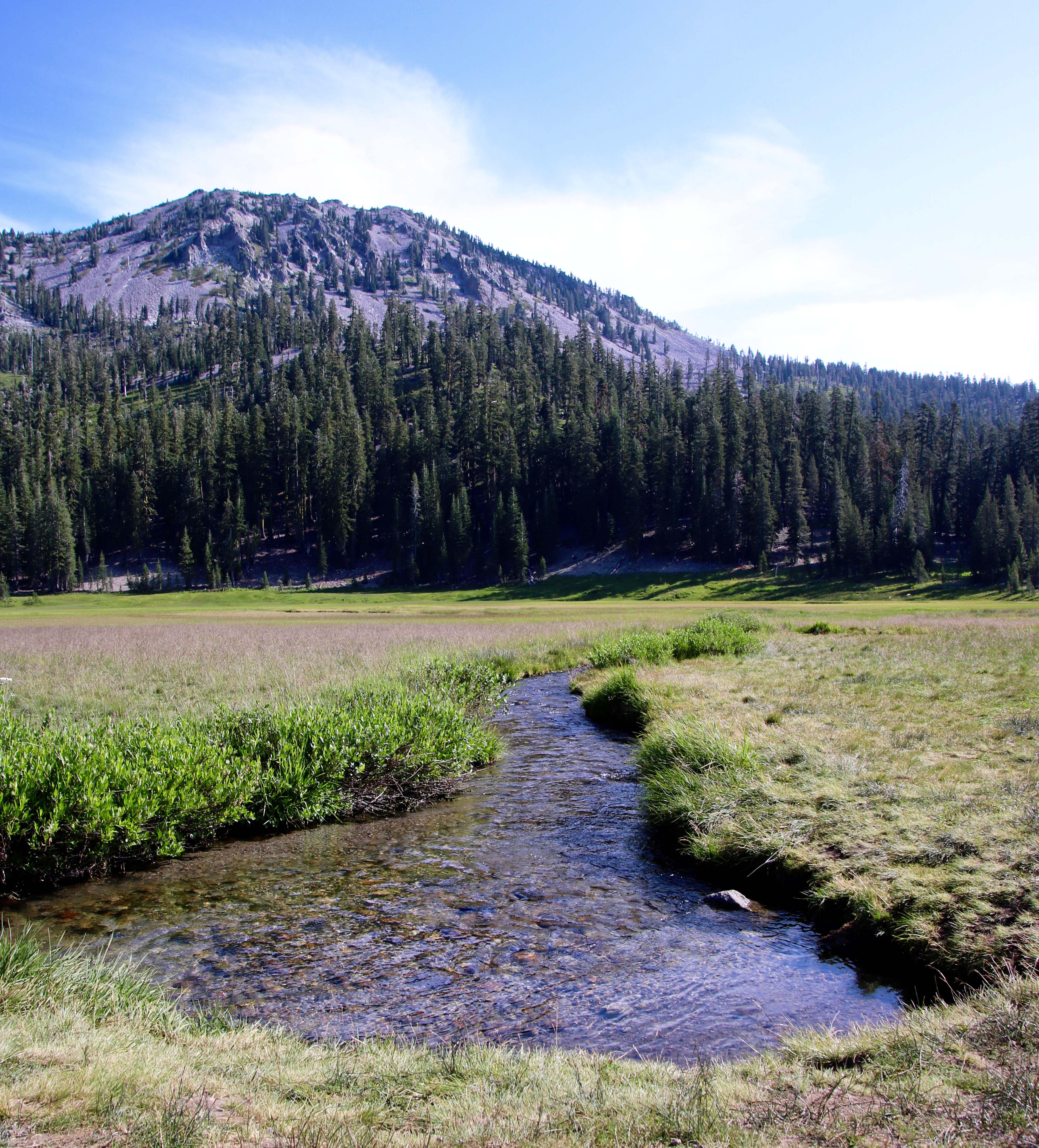
I really liked this meadow shot that Peggy caught. (Photo by Peggy Mekemson.)
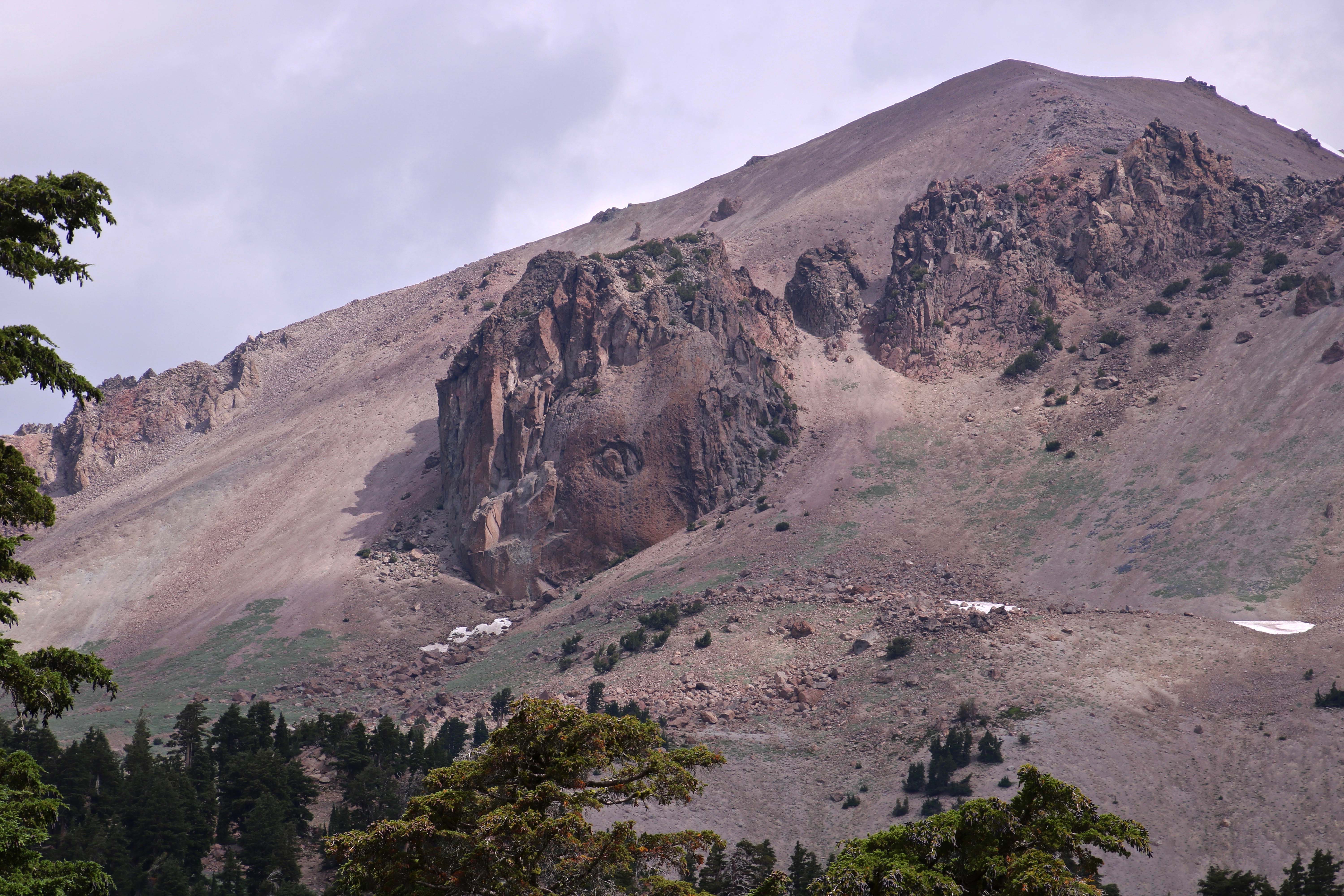
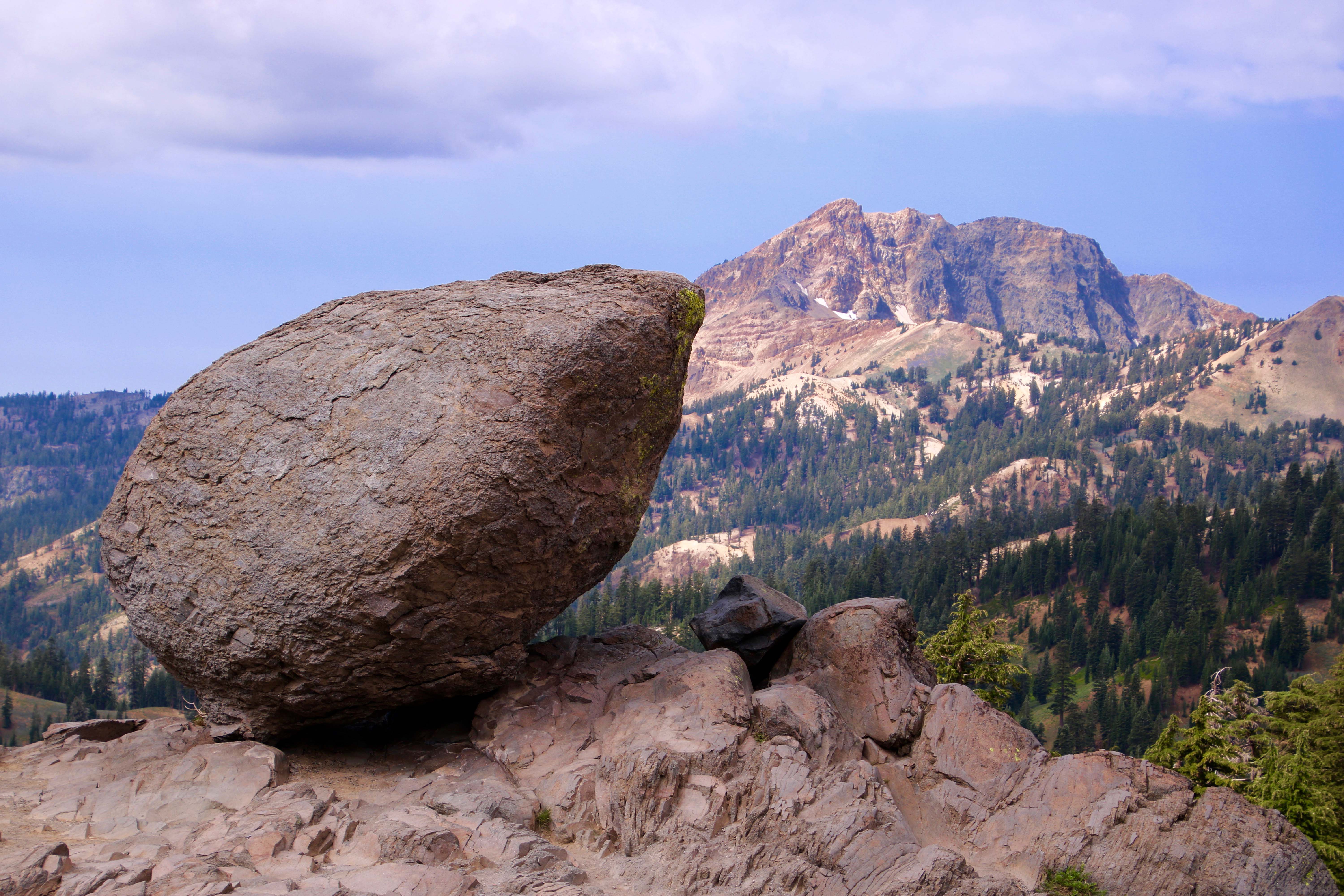
Mt. Lassen sits in the caldera of was once a much larger Mt. Tahama. The large rock points toward what was once the edge of the mountain. Picture a line following the ridge and stretching off to the left. (Photo by Peggy Mekemson.)
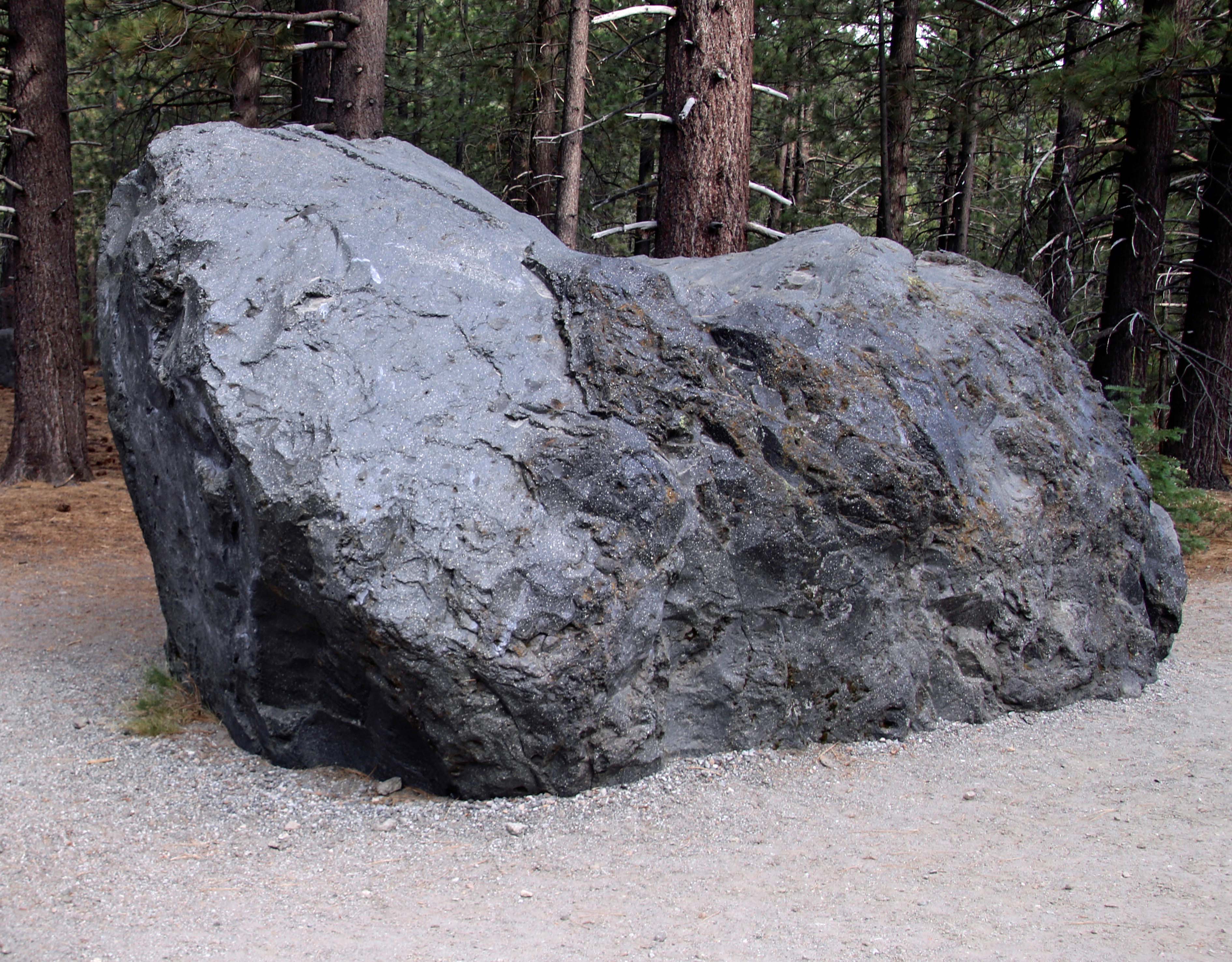
The power of the 1915 eruption was such that it blew out huge boulders and started a major a avalanche that carried boulders like these far from the volcano. (Photo by Peggy Mekemson.)
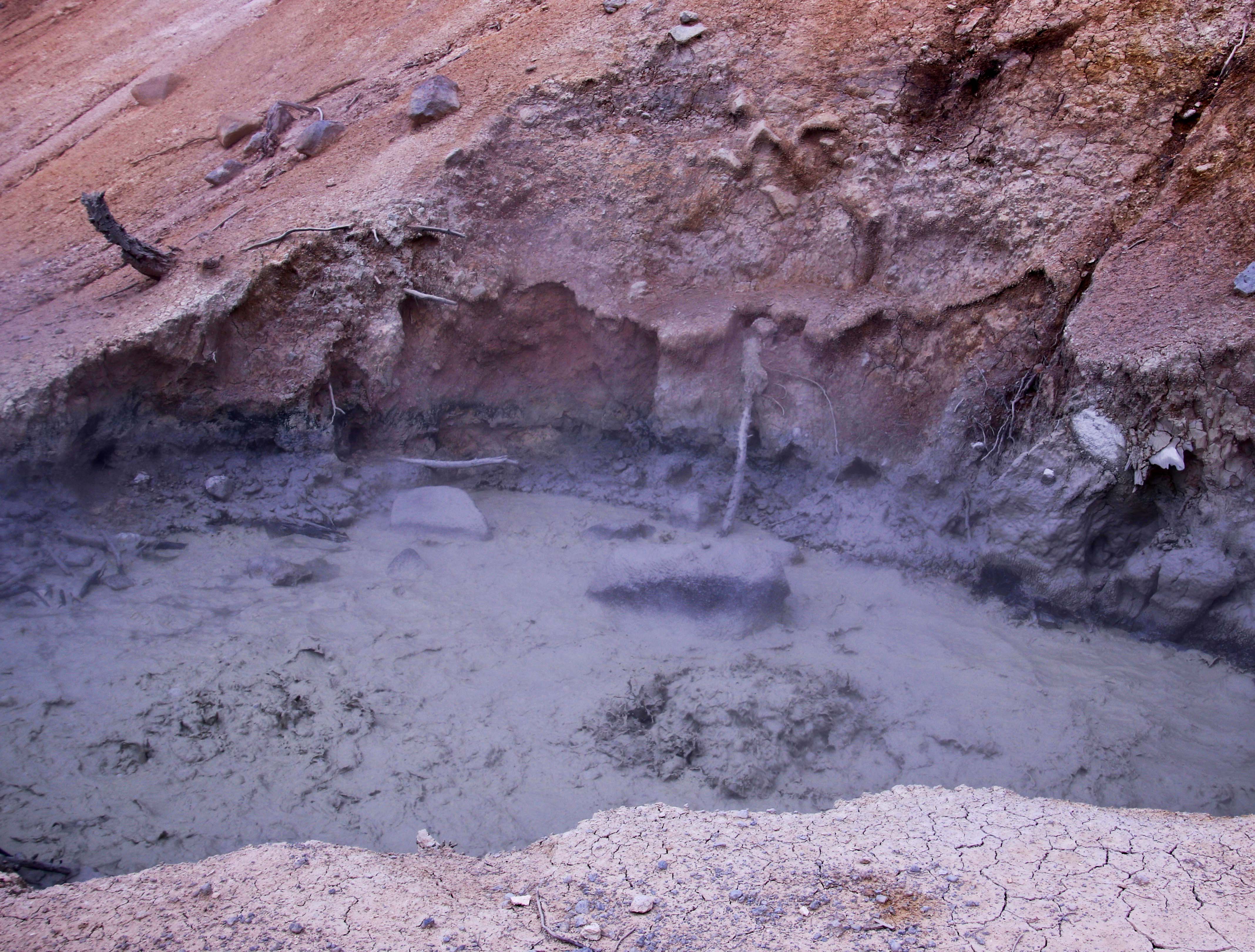
A number of other geologic features common to volcanic areas, such as this boiling mud pot at the Sulphur Works, are located in the park. (Photo by Peggy Mekemson.)
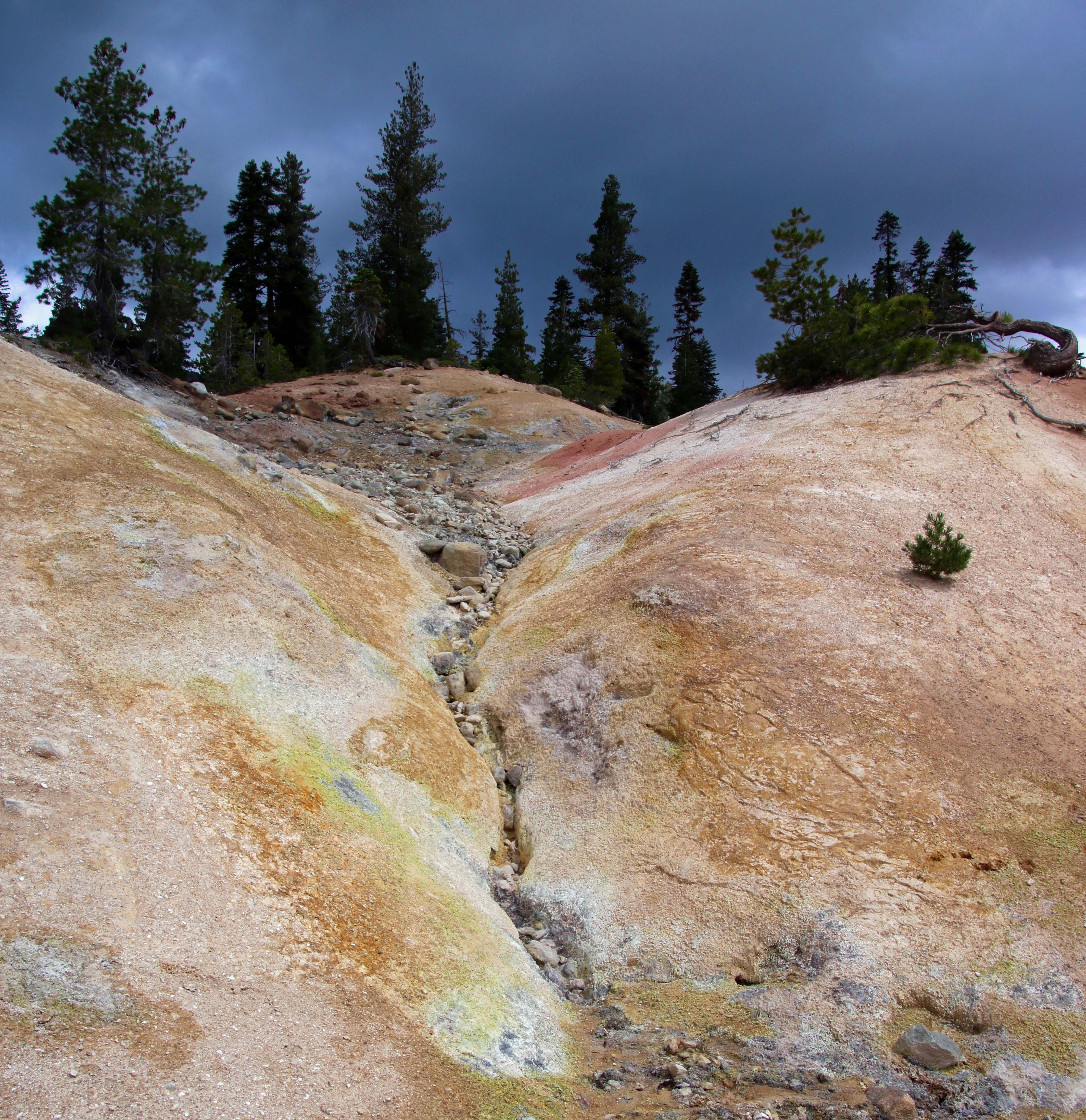
This colorful hill was located above the mud pot at the Sulphur Works. (Photo by Peggy Mekemson.)

I found the Manzanita roots along the PCT near Mt. Lassen strange enough to feature on my Halloween post. Today, I want to focus on the rest of the plant. I was raised in what is known as the chaparral belt of the Sierra foothills where manzanita is common. As kids, we went on outings to gather the large mushrooms that grew under the bushes in a symbiotic relationship with their roots. It was like a treasure hunt.We’d bring the mushrooms home, slice them up, and then dry them on the woodstove that heated our house. My mother then added them to a number of dishes like spaghetti and beef stroganoff where they contributed their unique flavor and texture.

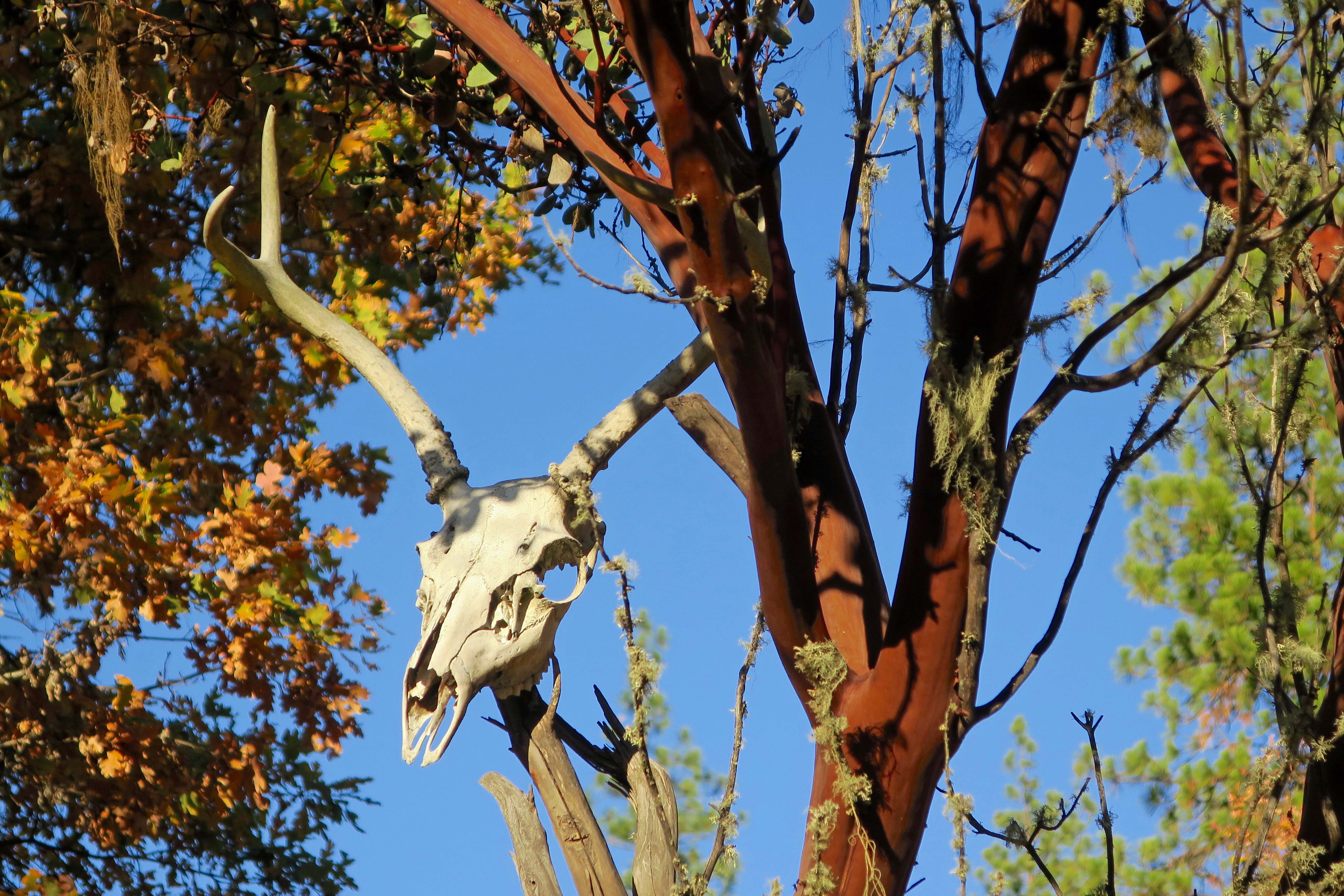
Our property in Southern Oregon also includes a number of manzanita bushes, but I have yet to find mushrooms under them. One of the bushes grows just outside our backdoor. Deer like to bed down near it, which seems a little strange since it features a deer skull. Peggy had found a dead deer on the road near our house, victim of an unfortunate encounter with a car. She decided that it would be interesting to cut off its head, bring it up to our yard, and let nature (translate maggots) clean it off. (Think of it as a scientific experiment.) When I had appeared reluctant to carry out the chore, she had persuaded a deer-hunting neighbor to do it, paying him with a can of beer and a Peggy-smile.

Our manzanita brush with the deer skull. Note the smooth bark.
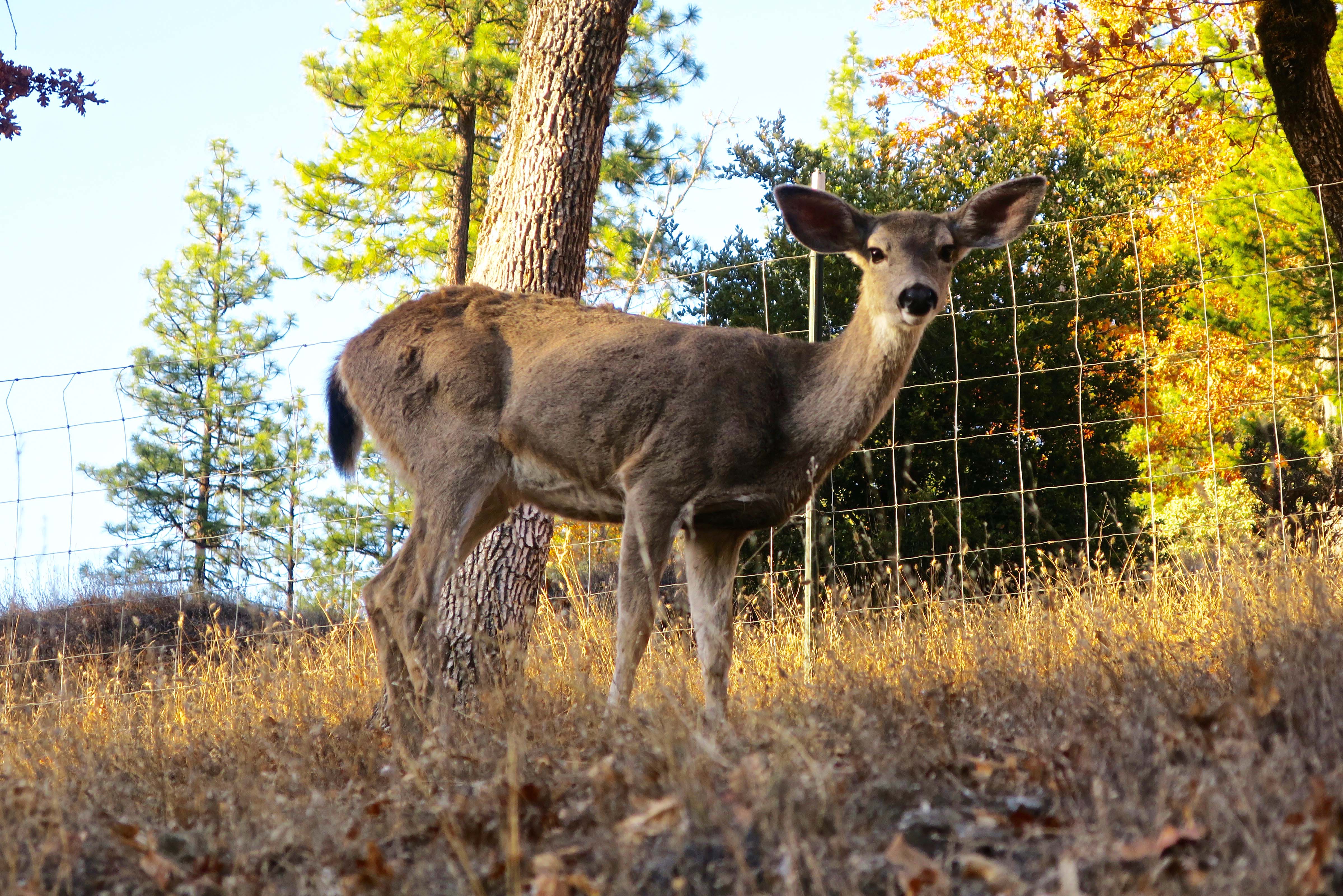
The deer I disturbed when I went outside to take a photo of the bush and skull. She was not happy with me interrupting her snooze.
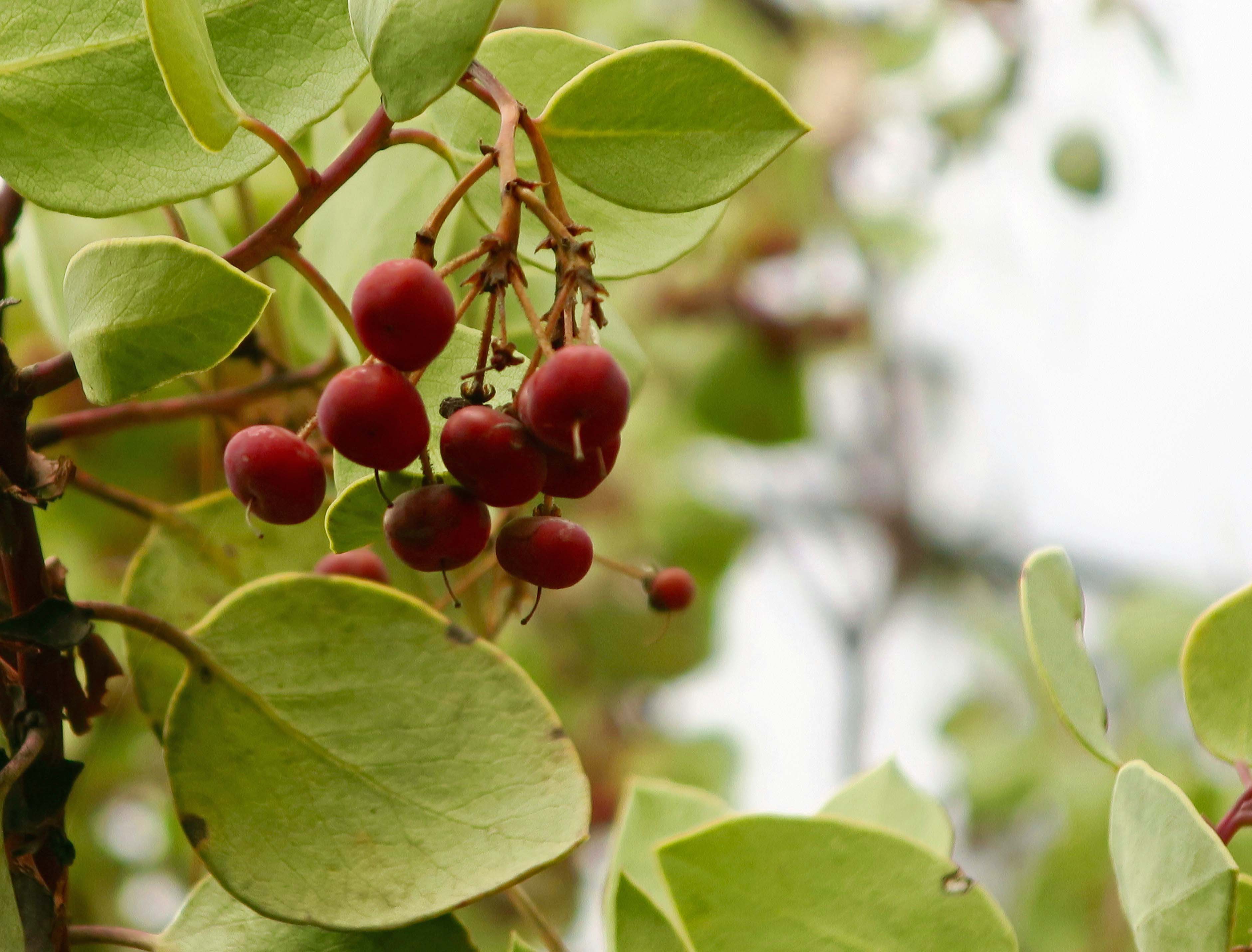
Ripe manzanita berries covered the bush. These are quite edible. (I consumed many as a kid for their sweet taste.) Judging from the berry-filled scat in our neighborhood, the local fox population is enjoying the berries now.
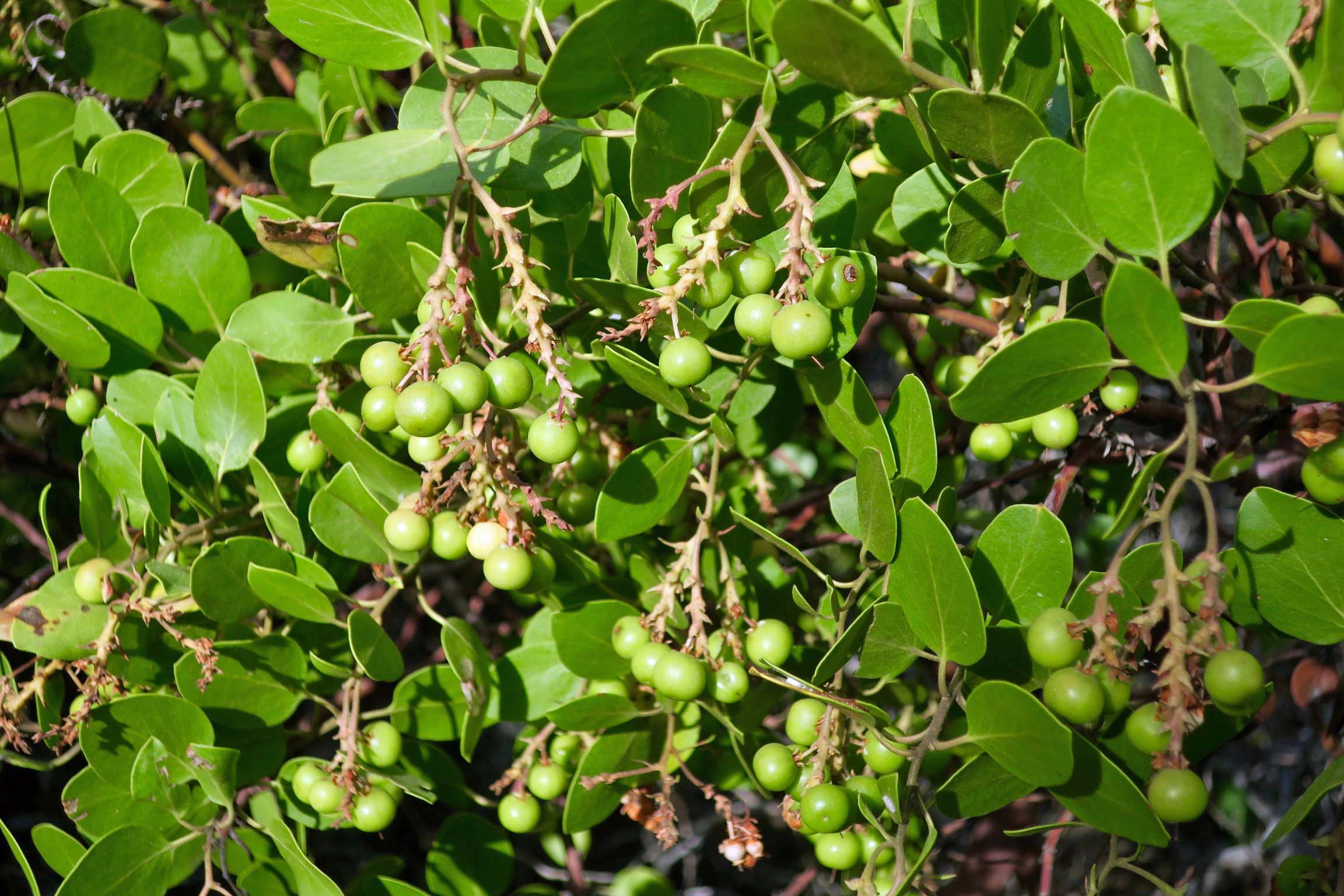
When I hiked the PCT through the Mt. Lassen area, the berries were still green. It’s easy to see how manzanita, which means little apple, got its name.

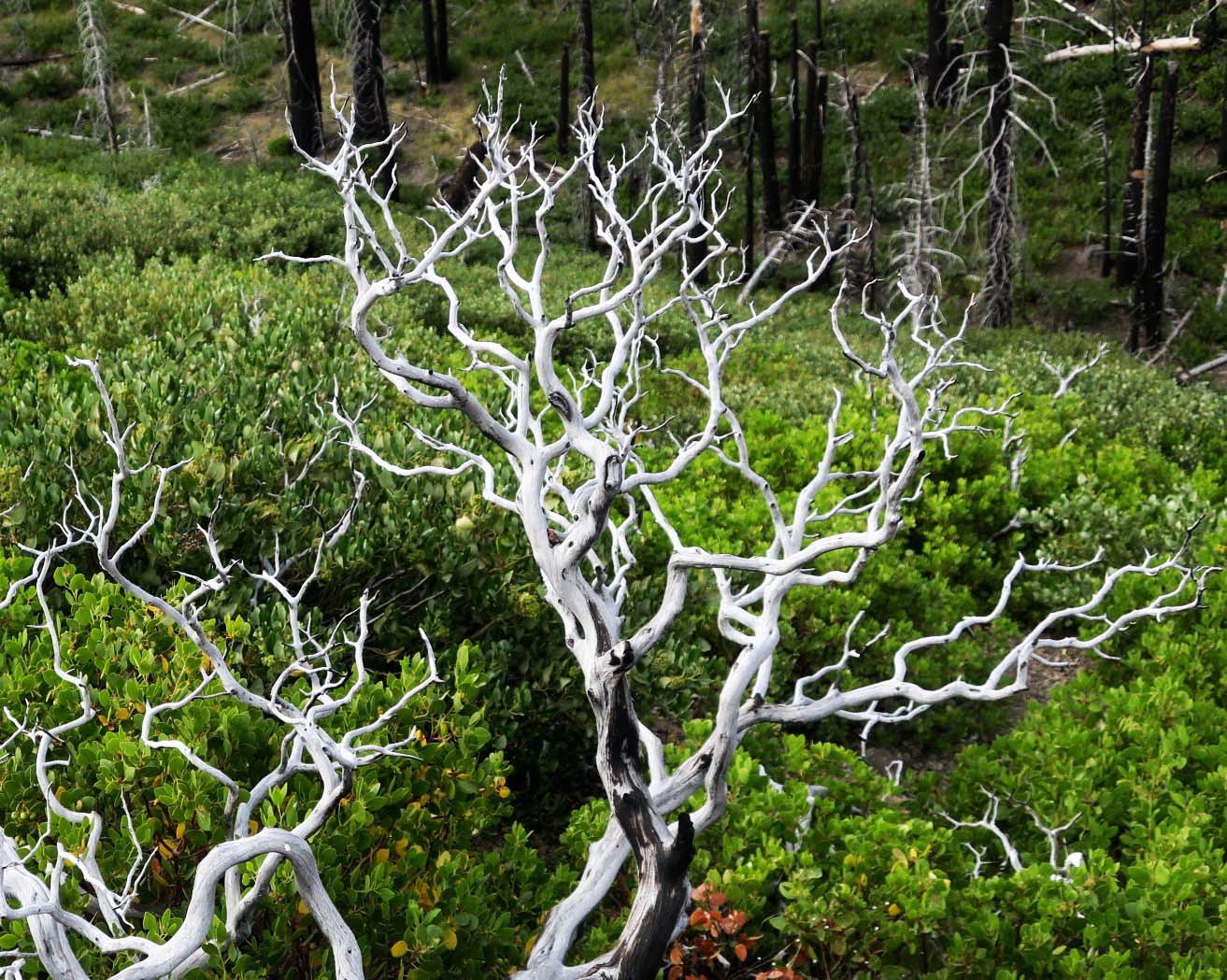
The plant is sturdy and can be quite beautiful with its entangled limbs and smooth, skin-like bark. It is often used in decorations. I found the dead bushes along the PCT l particularly striking.

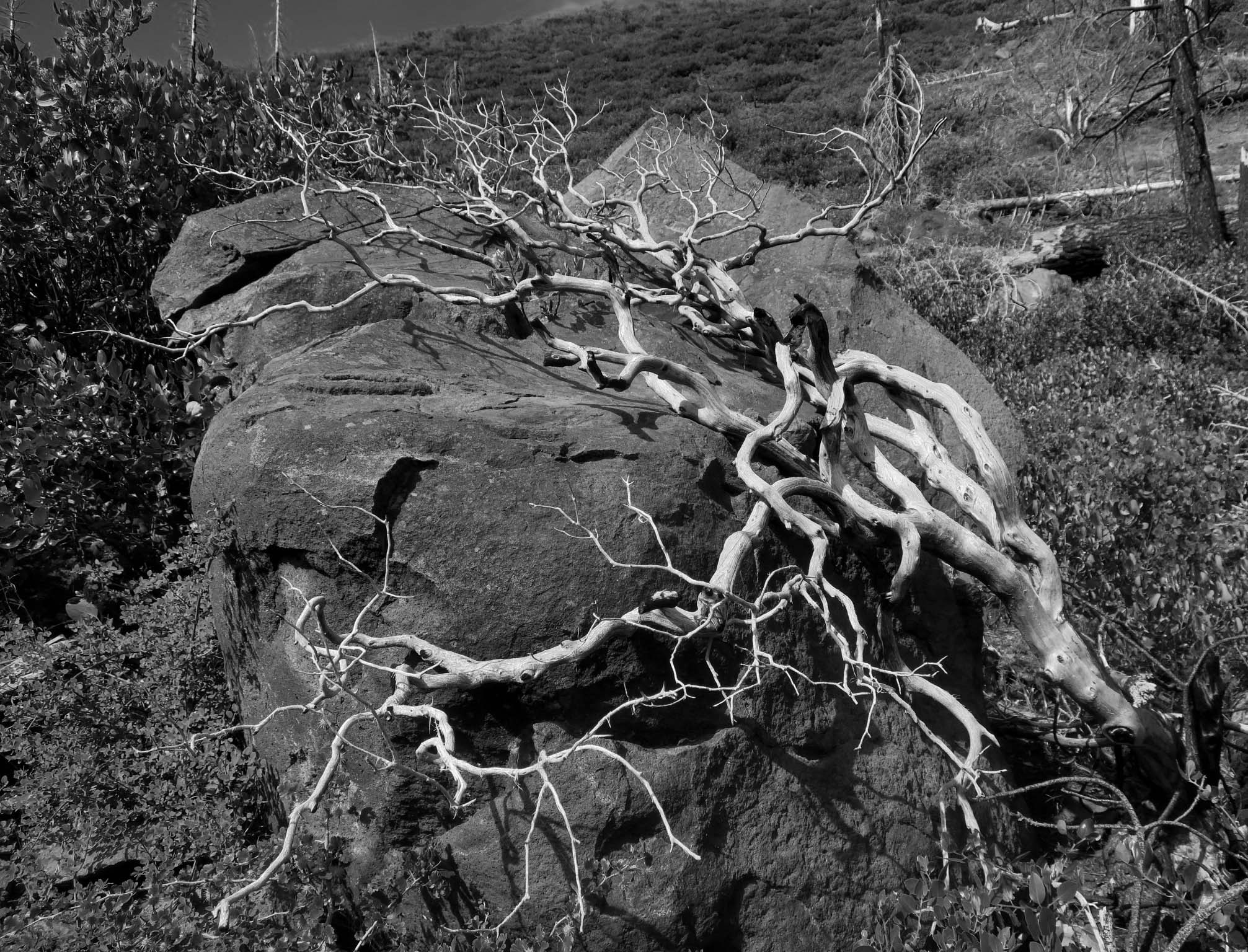
A dead bush draped across a boulder rendered in black and white.
A dead bush set off by live manzanita.
I will conclude today’s post with this rather dramatic bush.

Peggy and I are on our way to Mexico for three weeks, so my posts on the trip down the PCT will be put on hold until I return. My plan is to feature some older posts, which will give followers a perspective on the variety of subjects they can find on my blog that I have covered over the past ten years.

Growl! Mmmm. Me Like Carpenter Ants… Bears along the PCT in Mt. Lassen National Park

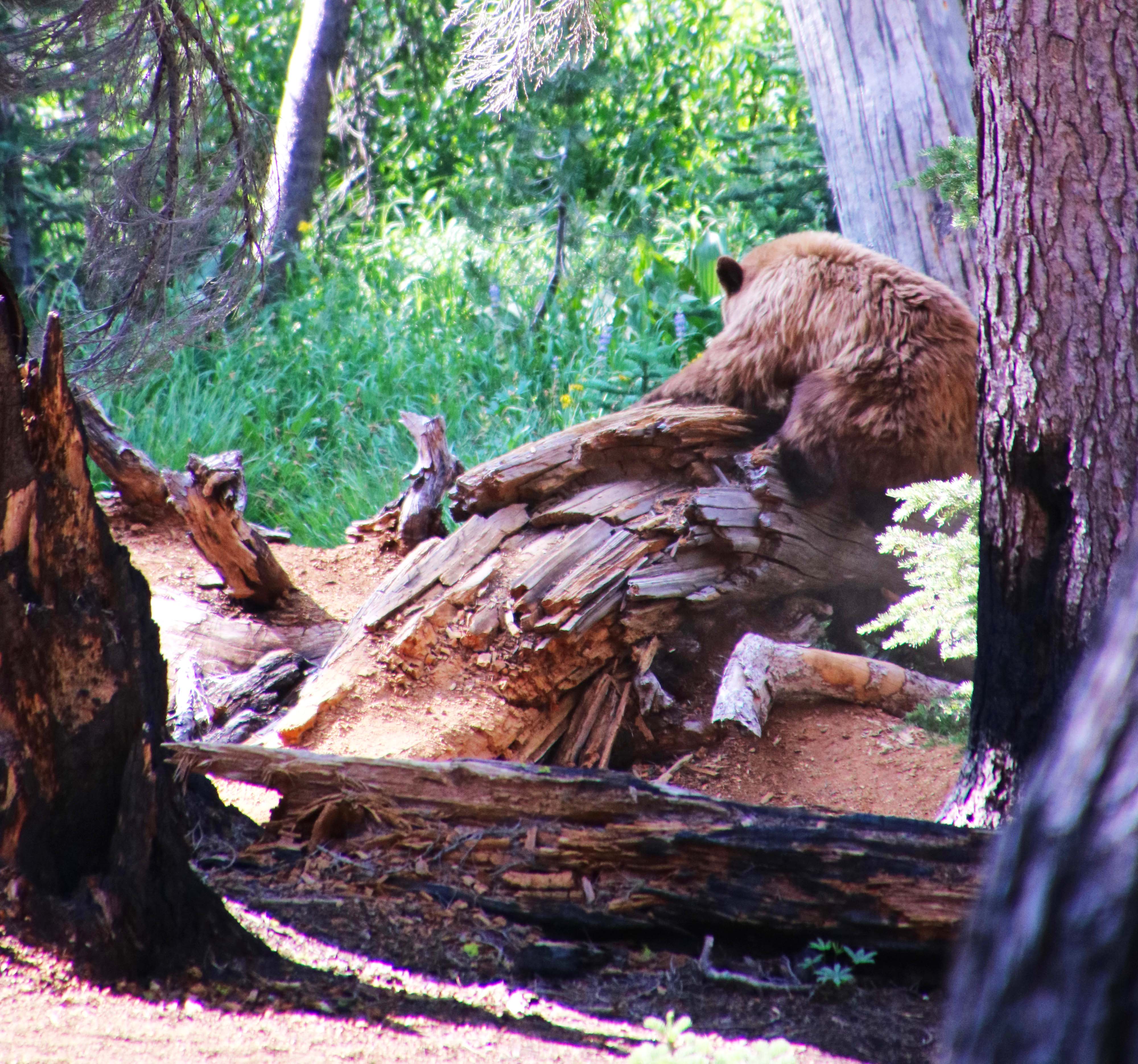
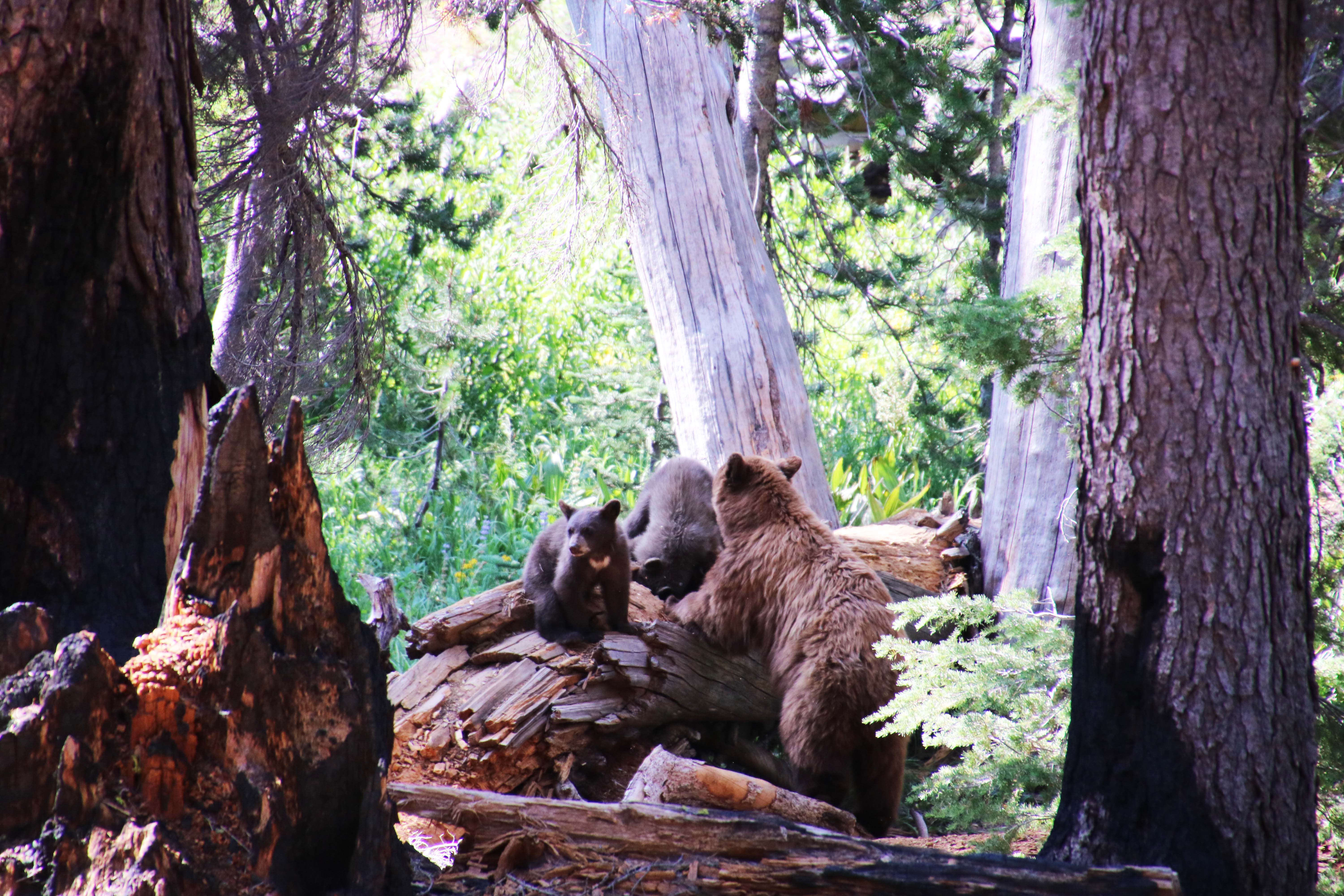
Peggy was lucky to be on the scene when a large sow tore apart a log searching for carpenter ants in Mt. Lassen National Park. Claws firmly sunk into the rotting log, she used her weight to rip help open the dead tree. (Photo by Peggy Mekemson.)

I began seeing a lot of bear sign as I hiked along the Pacific Crest Trail through Mt. Lassen National Park. There were the usual large piles of poop and trees had the tell-tale claw marks of bears chatting with other bears. The trees also provided bears with a great back rub. The effort helps remove winter coats and I’m pretty sure feels as good as it does to us when we get out back rubbed or scratched. It also provides the opportunity to leave a scent mark behind, a sort of personal wilderness want ad. “Large male seeks one night stand with attractive female. Don’t expect me to stick around and help raise the kids. In fact, I might eat them.” Doesn’t seem like the ideal qualities you would want in a mate, but it seems to work.

I also found a number of rotting logs torn apart along the trail. Black bears have a real taste for carpenter ants. “Sweet meat,” like my students of long ago in West Africa used to say about termites. And maybe carpenter ants are sweet. While they are known for tunneling through wood with all the enthusiasm of a chainsaw, they don’t actually eat the wood. They are dairy farmers. They raise and milk aphids for the sugary honey-dew they secrete by stroking them with their antennae.  “Come on sweetie, give it up.” Naturally they eat other things, like dead insects. They will surround the bug, suck out its juices and then return to their nest with full tummies to share. I read that they sometimes carry the head with them. (I can see them marching in and placing it at the feet of the queen. I wonder if they have a trophy room.) Like other ants, they inevitably find the shortest path back to their nest and mark the path with pheromones which other ants can follow. Big bugs can attract lots of ants, which means more pheromones, which means more ants. It can become quite the mob scene.

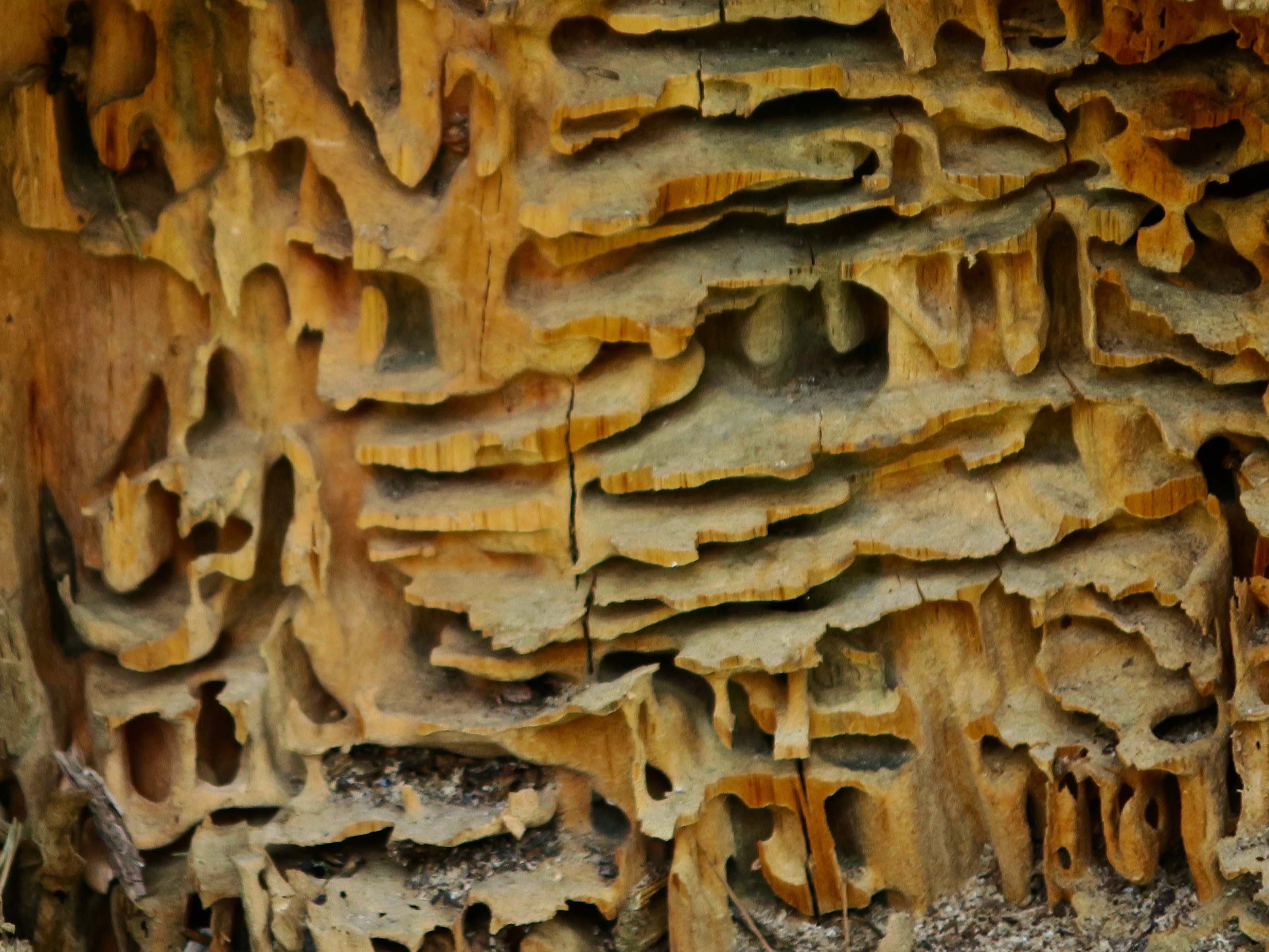
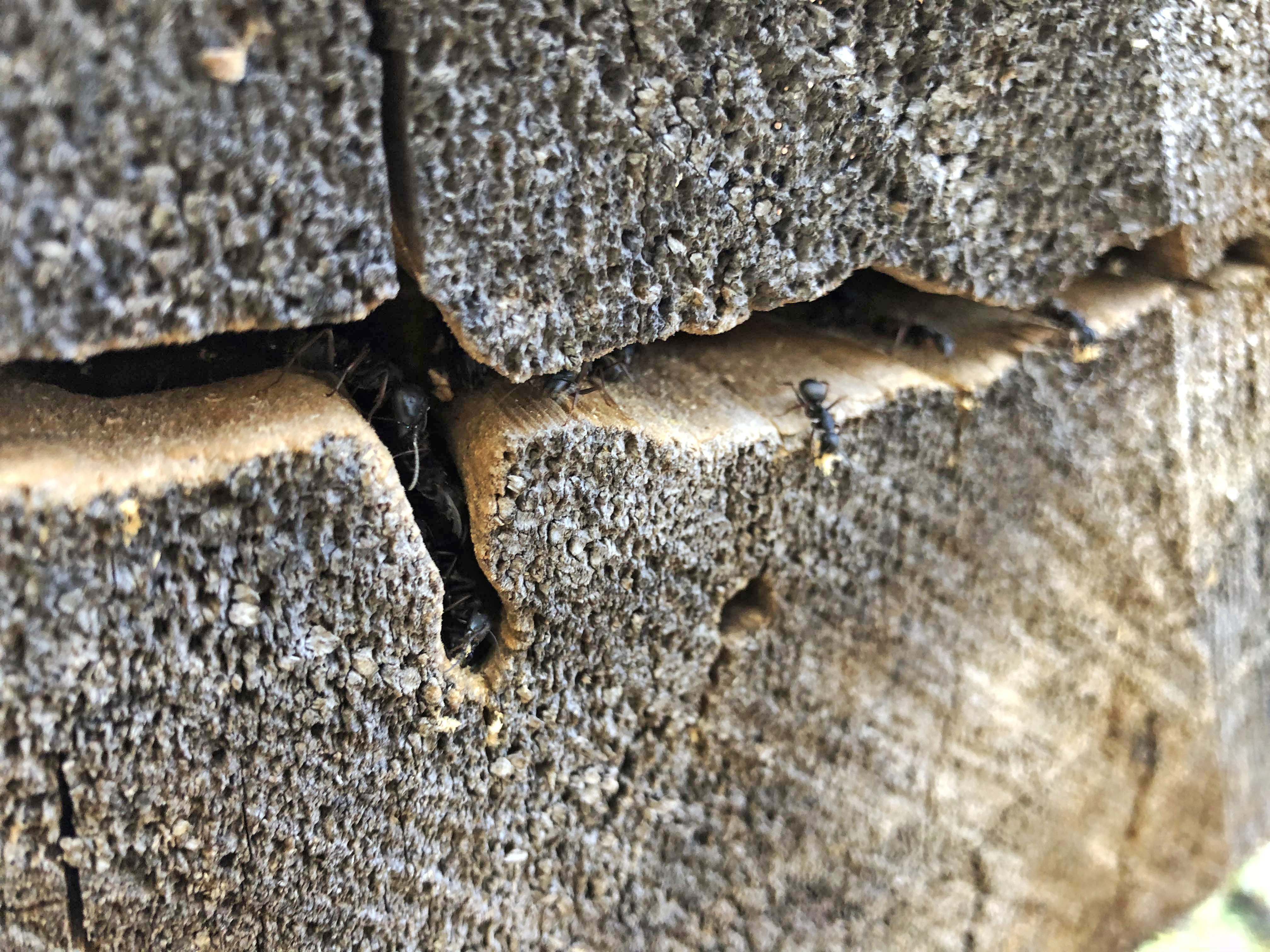
Carpenter ants build amazing labyrinths in dead trees. (Or possibly your house.) If I had to build a maze, I think I would hire these guys to plan it out.
They don’t eat the wood, however. They carefully dump it outside as the ant on the right is doing. More ants can be seen in the crevice to the left and right of the ant. (My nephew Jay Dallen took this photo on his iPhone when we were hiking from Etna Summit to Castle Crags.)
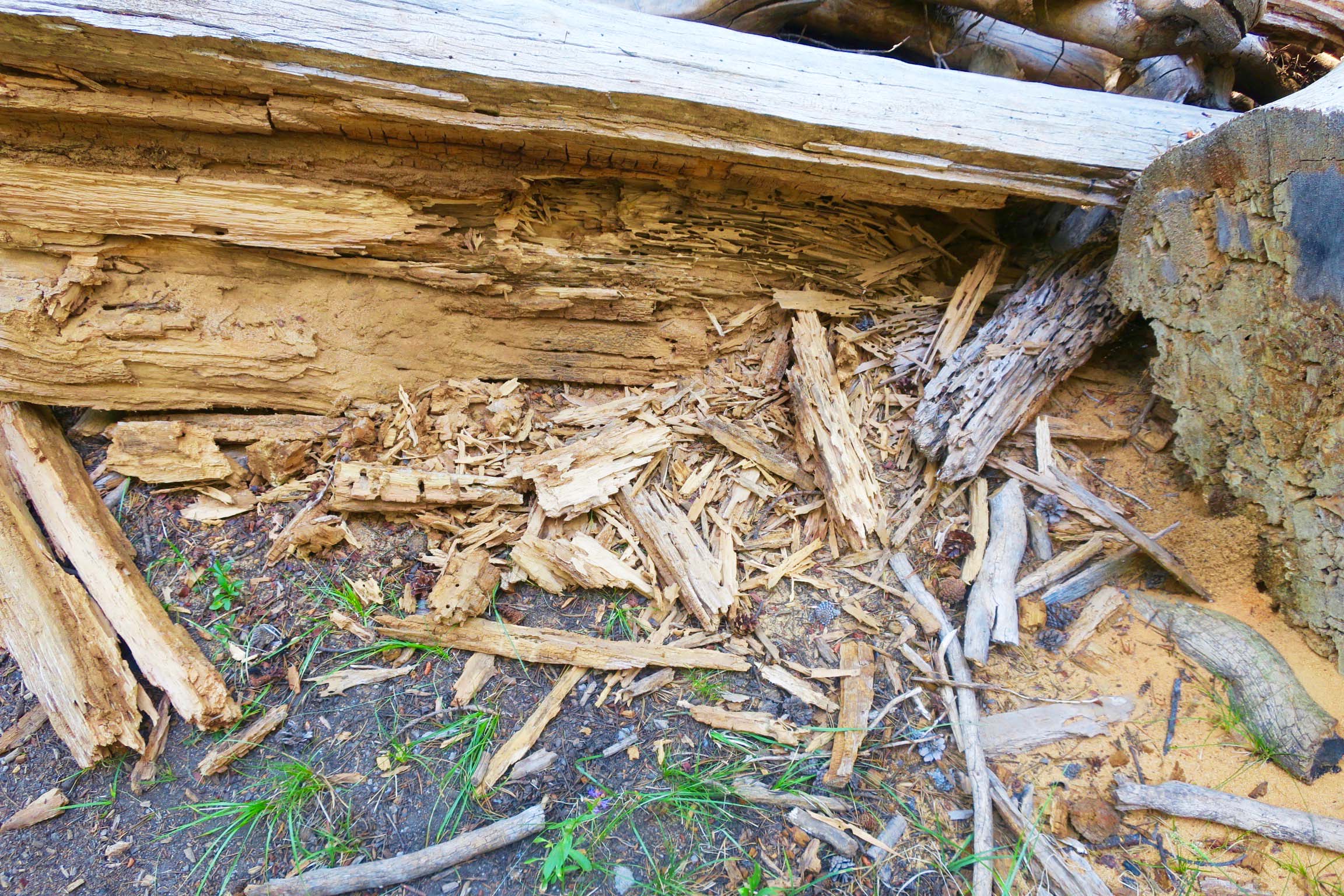
I found this log torn apart by a bear as I hiked down the PCT through Mt. Lassen National Park. Off to the right you can see a pile of sawdust that the ants have deposited. Normally a pile of sawdust like this would suggest that somebody has been working with a saw. 
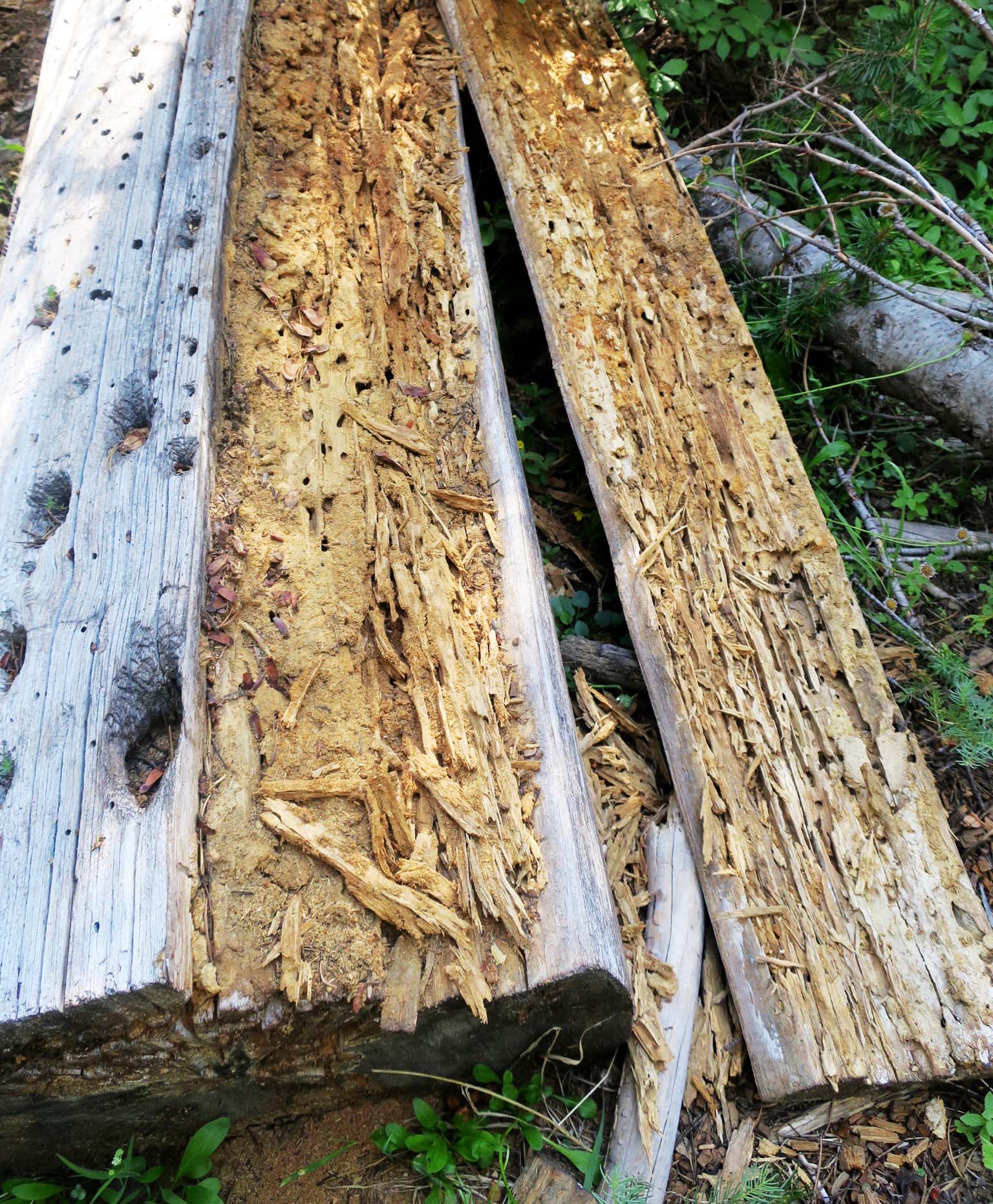
Here’s another log I found along the trail that had been opened up by a bear. These guys go after a log like a six-year-old goes after a Christmas present.

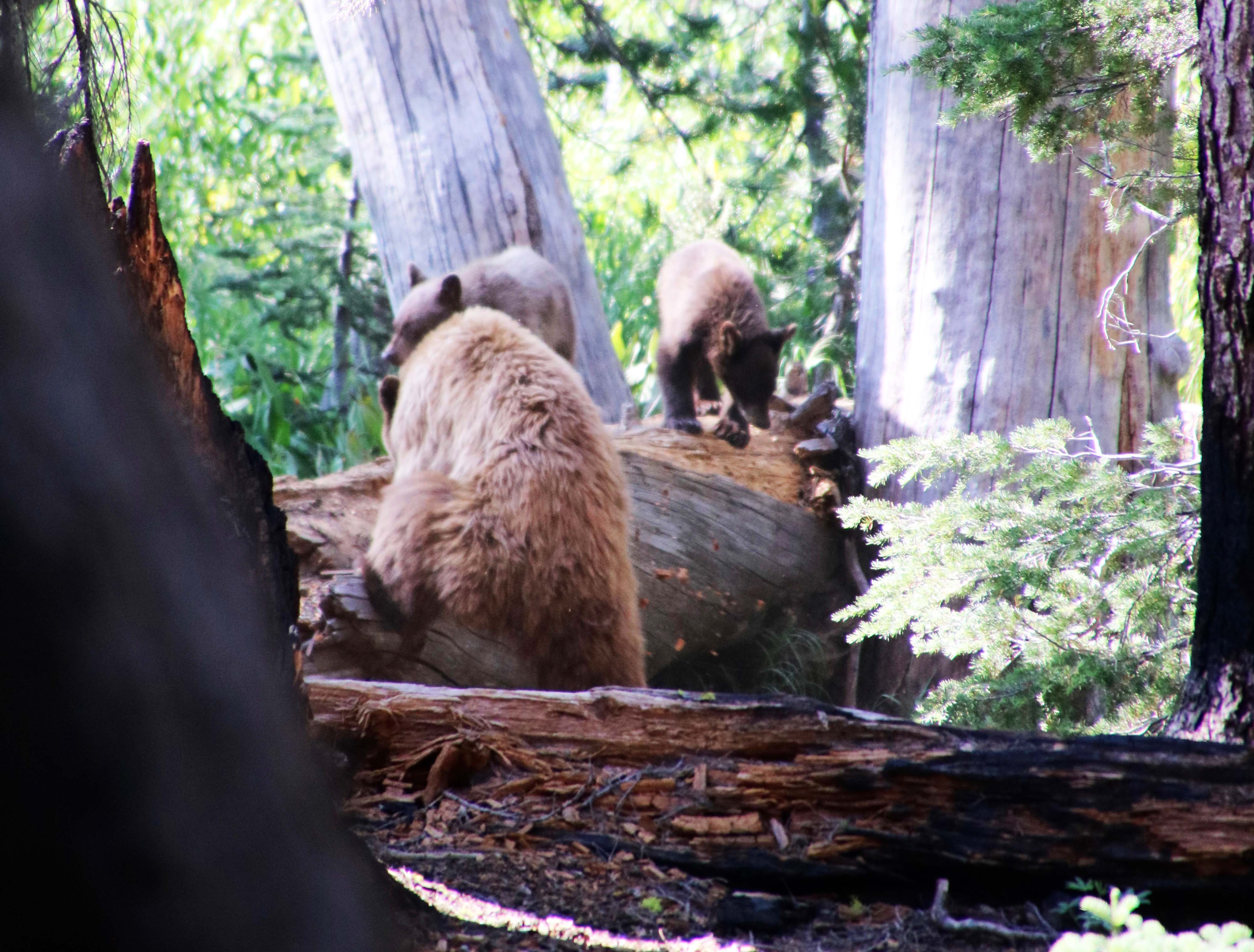
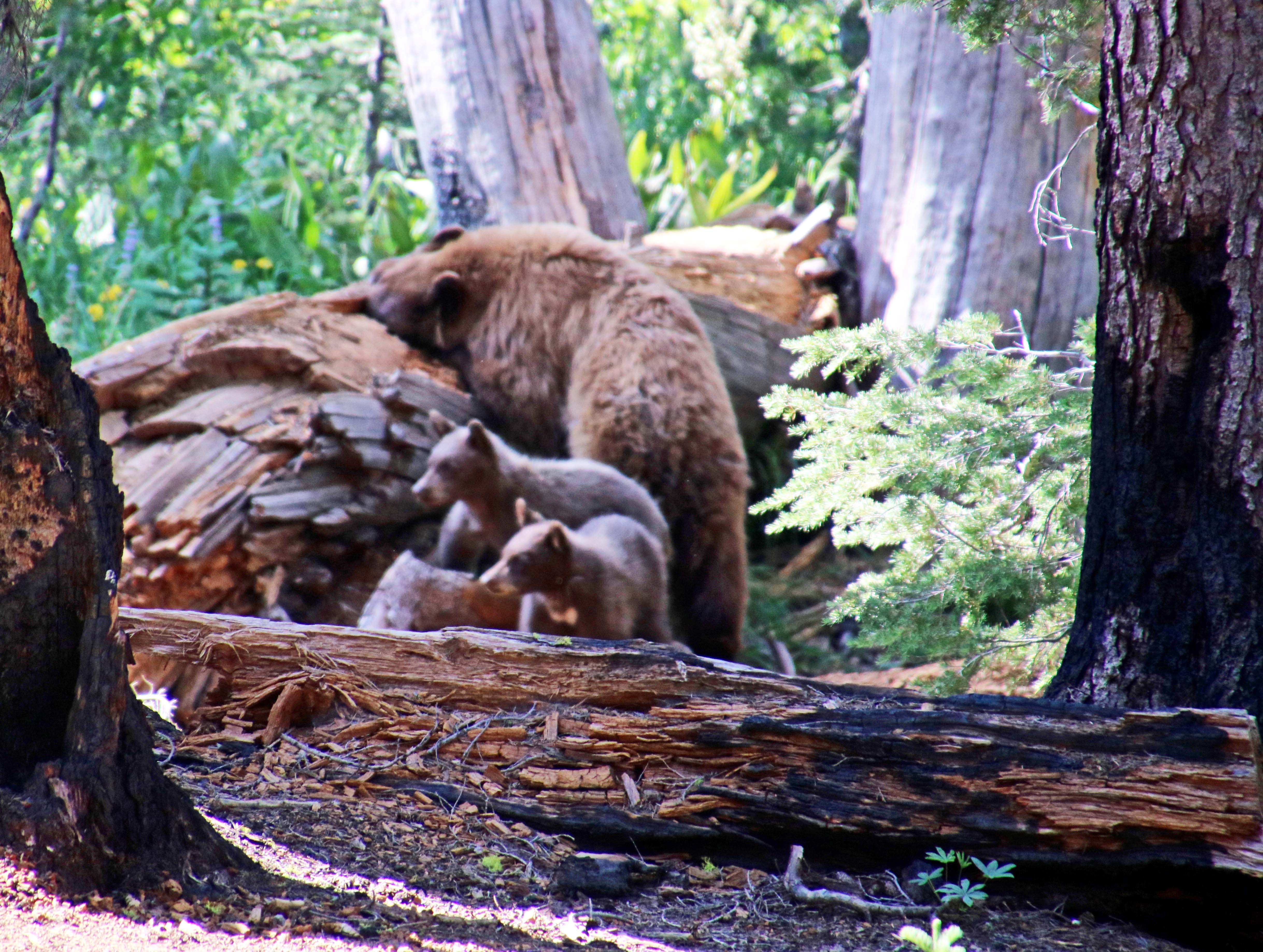
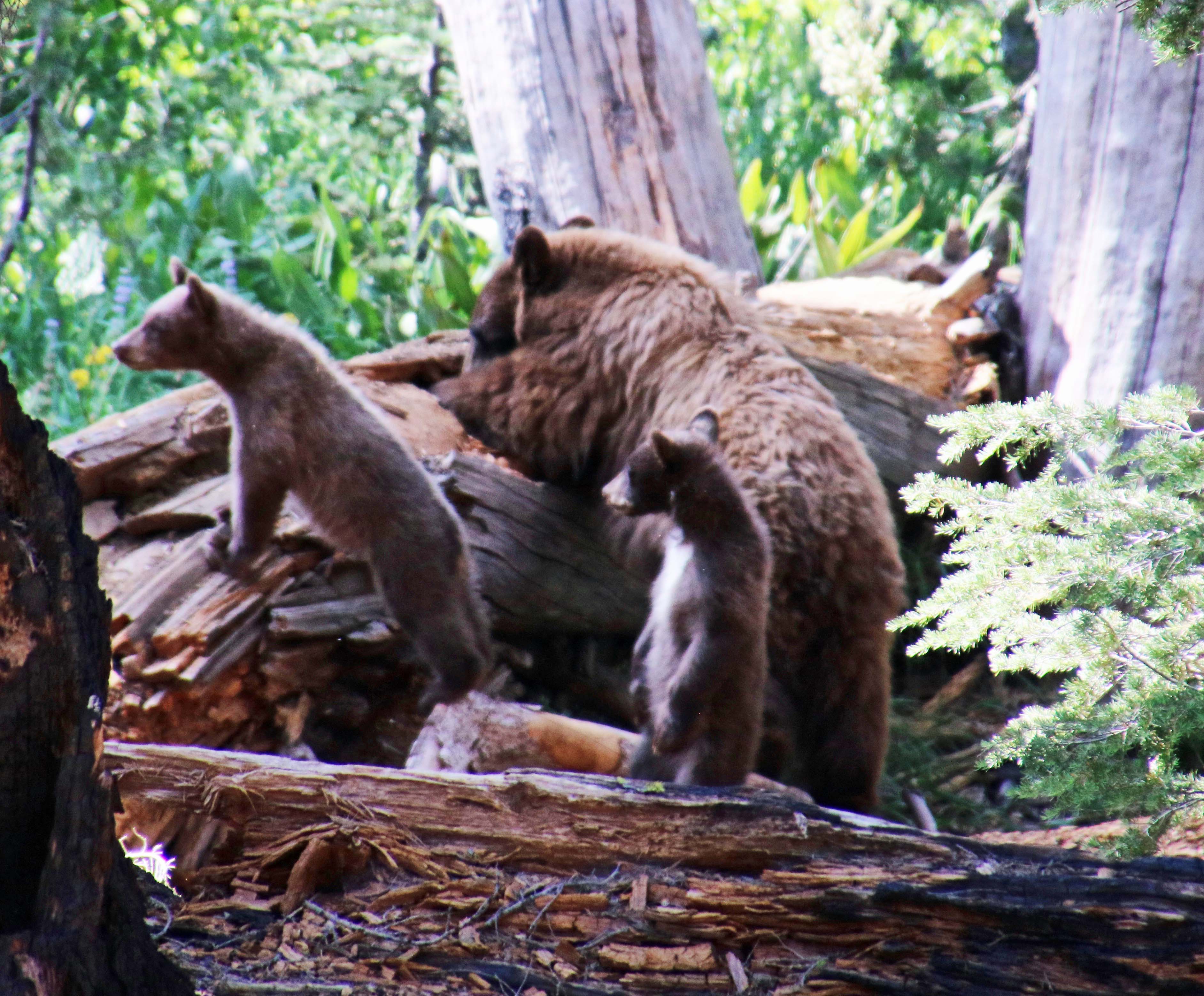
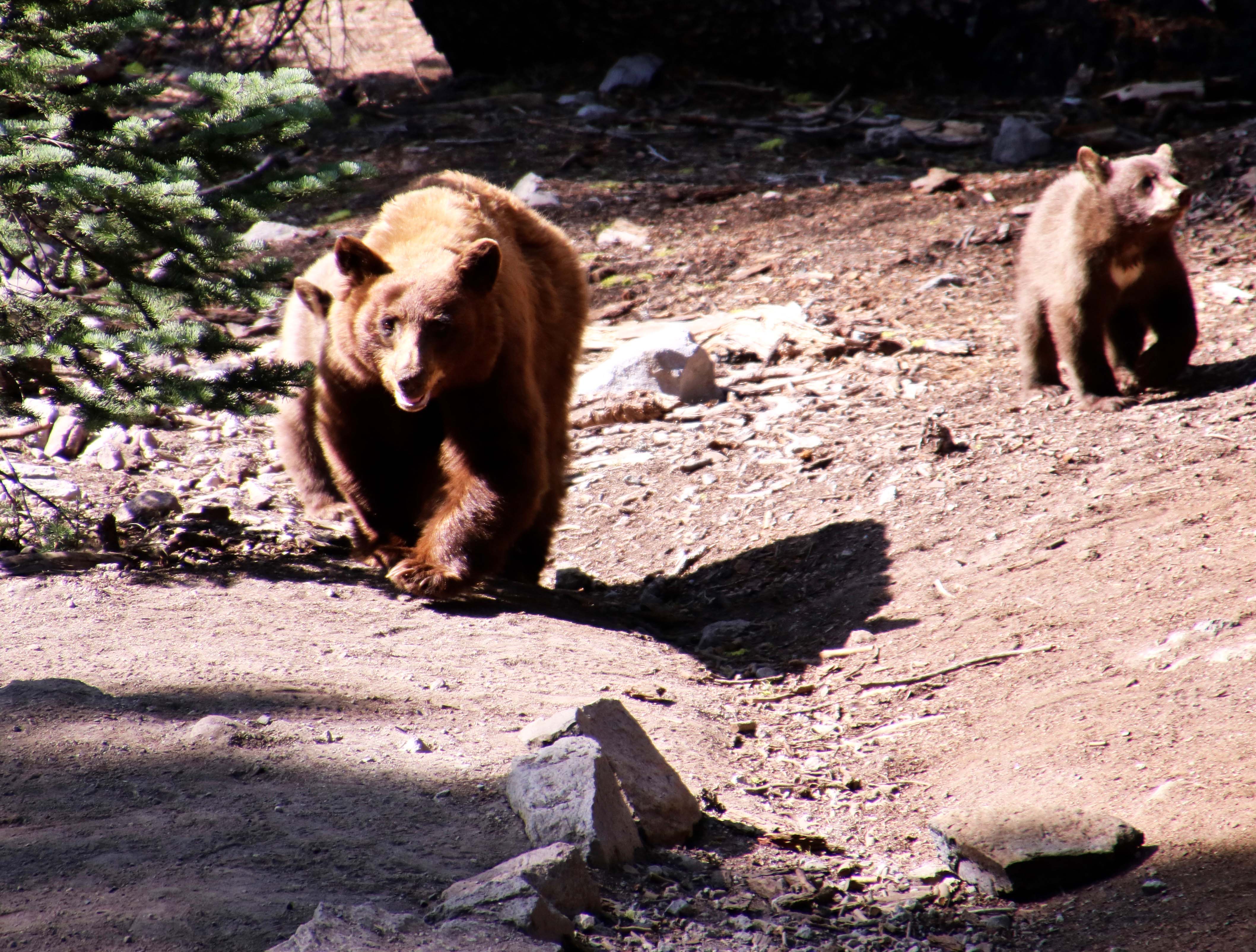
But back to the bears. I dearly wanted to see a bear tearing into a carpenter ant nest.  I didn’t even see a bear. Peggy who was driving around the park and checking out hiking trails while I was making my way along the PCT, had much more luck. She not only saw a mom and her cubs, she saw them ripping into a carpenter ant nest and took photos. When the bear and her cubs finished their meal, and started walking toward her, she made a rapid retreat to our small RV! Smart woman.
When mom had finished tearing open the log, she was joined by her two cubs. (Photo by Peggy Mekemson.)
One of the cubs snacked on a few ants while mom patiently watched. (Photo by Peggy Mekemson.)
They then let mom have her fill. (Photo by Peggy Mekemson.)
It even appeared that they were standing guard. (Photo by Peggy Mekemson.)
They finished their feast and then started walking toward where Peggy was taking photographs. She decided it was time to get back in the van! (Quick photo by Peggy Mekemson.)

When it comes to food, a black bear is an Omnivore’s omnivore,an opportunistic eater that consumes everything from insects to plants to carrion to any fresh meat it catches— although the latter rarely includes humans. As one of my trekking friends used to say, “If bears wanted to eat people, they’d move into towns where there are lots of people to eat.”  Bears, like other members of the animal kingdom, have learned that puny humans are nasty animals with a penchant for killing; they are best to be avoided. They have developed a taste for human food, however. Trash cans are a frequent target. We know. Our property in Southern Oregon backs up to a million acres of national forest. There are lots of bears. Once, one attacked the heavy Weber grill that lives on our back porch and turned it over.  As it came crashing down, my daughter, who was sleeping in the bedroom next to the porch, screamed,“Curtis!” It’s an appeal for help I’d heard before. Bears are also fond of backpacker’s food.

They would occasionally drop by our camp for a bite when I was leading hundred-mile backpack trips up and down the Sierra’s in the 70s, 80s and 90s, especially when I was any where in the vicinity of Yosemite. It wasn’t unusual for a trekker to yell my name on his or her first sighting of a bear up close. I spent a lot of time teaching people how to chase bears out of camp and hang their food in trees so the bears wouldn’t get it. We weren’t always successful.  The food bag is supposed to be at least 12 feet up in the air and 9 feet out from the tree hanging from a limb that is just large enough to hold your food. Otherwise, Mom might send her kids up to crawl out the limb and chew through the rope. One food bag is counterbalanced with another food bag and no ropes are left dangling. Bears are smart and I am convinced that they have a university near Yosemite where they teach their cubs how to outsmart backpackers.

Today, there are bear canisters that are made of heavy duty plastic or carbon that are theoretically bear proof. They are tested by filling them with strong smelling goodies and tossing them into the cage of a hungry bear that has developed a taste for backpacking food. If the canister survives for an hour, it is given the seal of approval. Now days, when you backpack through Yosemite National Park or down the John Muir Trail, you are required to carry one. Just recently, the same policy was adopted for Mt. Lassen National Park. So, I was carrying one.

The good news about canisters is that they work. Bears are broken of the habit of eating backpackers’ food and go back to eating much healthier food, like maggots and ants. Backpackers are given the peace of mind of knowing that they will be able to make breakfast, lunch and dinner the next day. The bad news is that the canisters are heavy and awkward. They add two to four pounds of weight and are hard to fit into a pack along with other essential equipment. While the folks in charge of protecting our wildlands and their inhabitants would like to see backpackers use canisters all the time, it won’t happen until these problems are addressed.

NEXT POST on hiking the Pacific Crest Trail through Mt. Lassen National Park: When the mountain blew its top, there is more to manzanita than scary roots, and a gorgeous lake struts its stuff.

Mt. Lassen National Park— A Spooky Kind of Place along the PCT… Happy Halloween

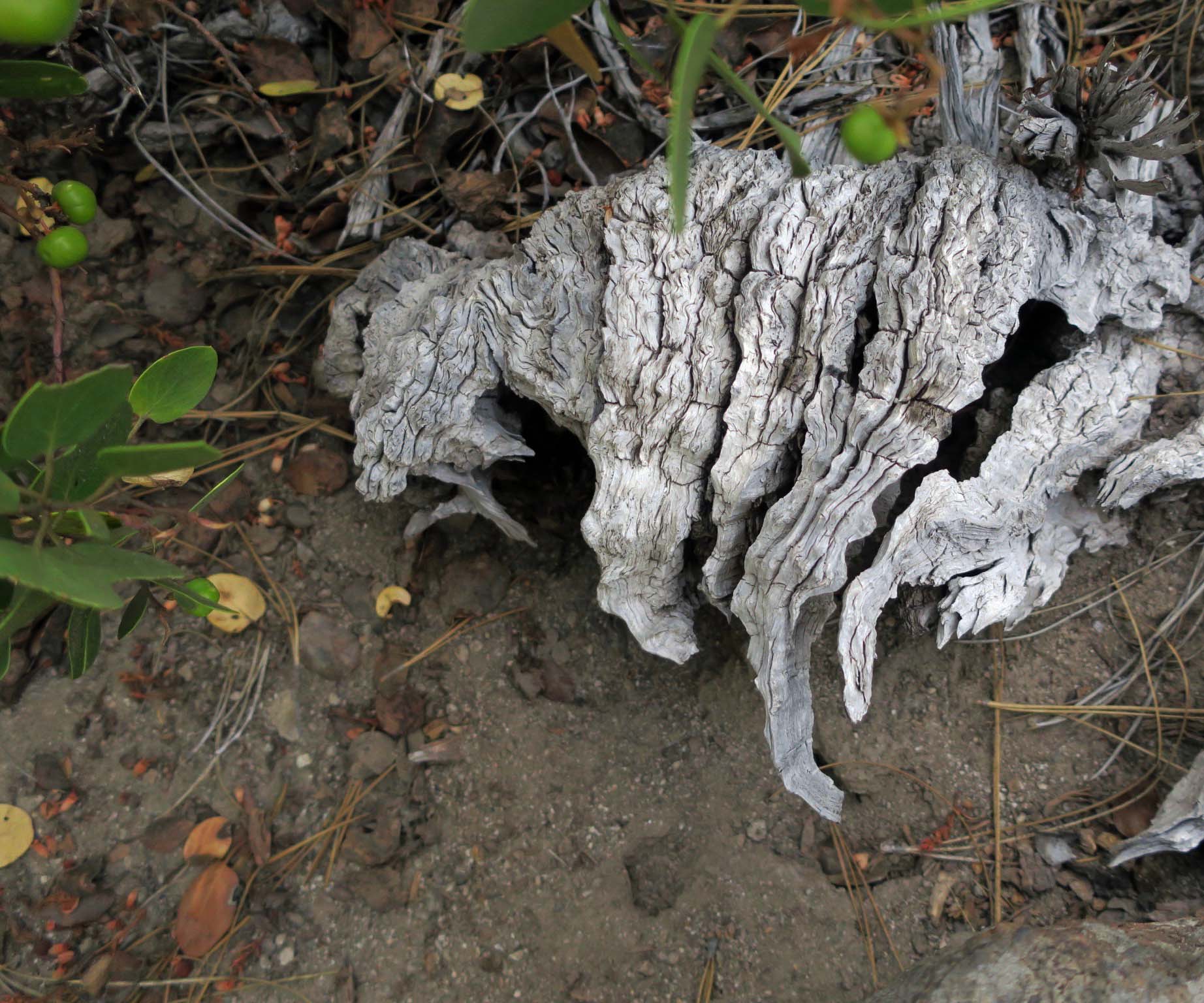
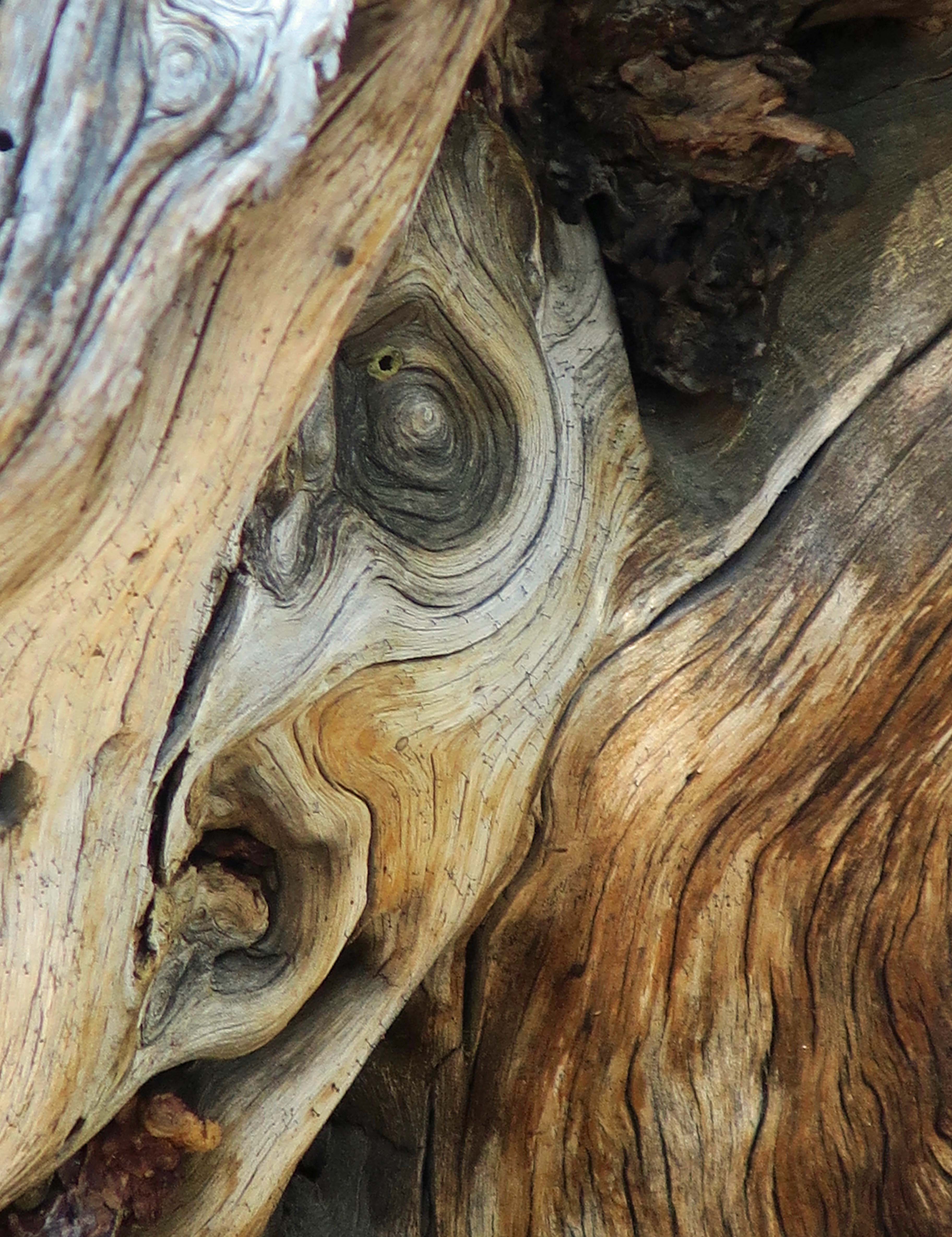
What’s more scary than a spooky face staring at you from the ground? Imagine your flashlight picking this up at night when you are out in the woods alone? For the more scientifically inclined among you, this is a manzanita root.

I hardly imagined that backpacking through Mt. Lassen National Park on my hike down the Pacific Coast Trail this summer would provide me with inspiration for my annual Halloween post— but I had never had an up-close-and-personal encounter with manzanita roots. Trail crews, rerouting the PCT as it approached the Park from the north, had dug up the roots and left them beside the path. 

I often include photos of faces from nature in my blog. And most of these are a bit on the strange side. (“Like you,” I am sure my wife Peggy would point out.) Maybe. My imagination works overtime when I am out in the woods and I can’t resist pulling out my camera when I spot eyes staring back at me from trees, rocks and clouds. They appeal to the animist in me. Plus they are an excuse to stop on long, tough hiking days.

In addition to the roots, I’ve included a couple of other photos from Lassen with Halloween potential and a few other ‘faces’ from my three month backpack trip. Some of these I have included before. Enjoy!

Imagine, if you will, clawed fingers reaching up from the grave, ready to grab unsuspecting hikers.
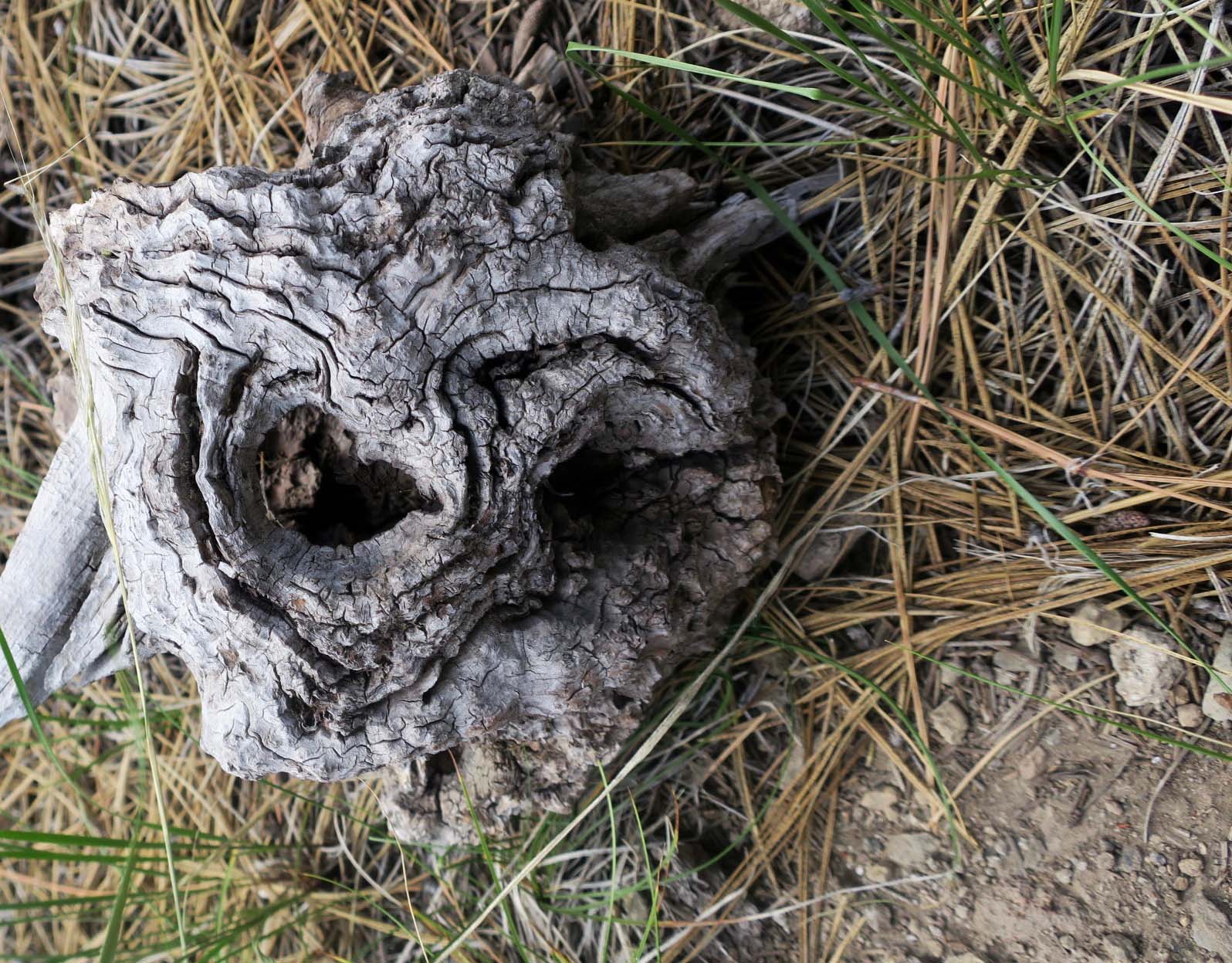
Dark, vacant eyes staring at you are stock in trade for horror film flicks.
More eyes. Maybe the skull of that silent killer of the night: The owl.
Scrooge McDuck’s nemesis, the ghost duck of Halloween past.

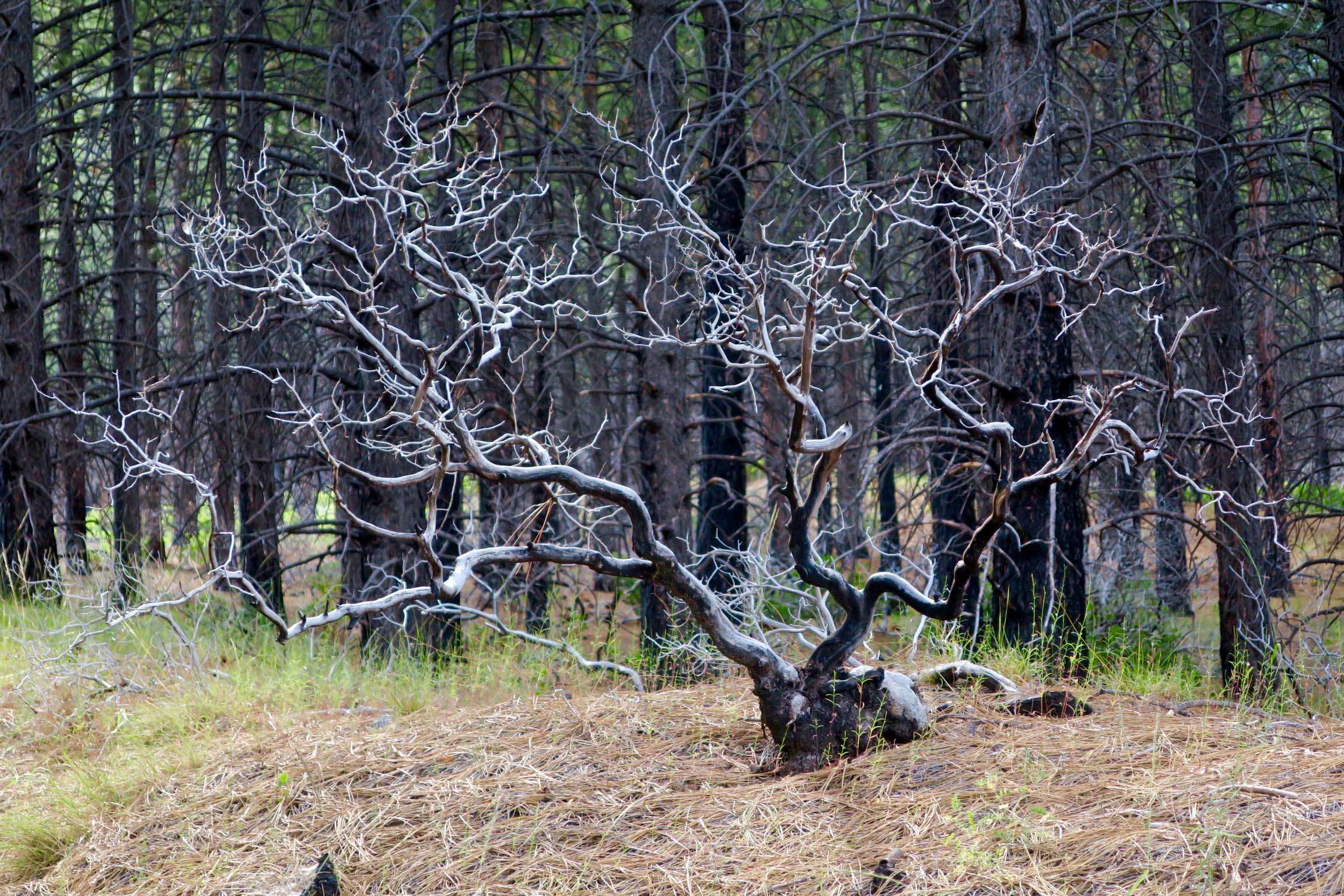
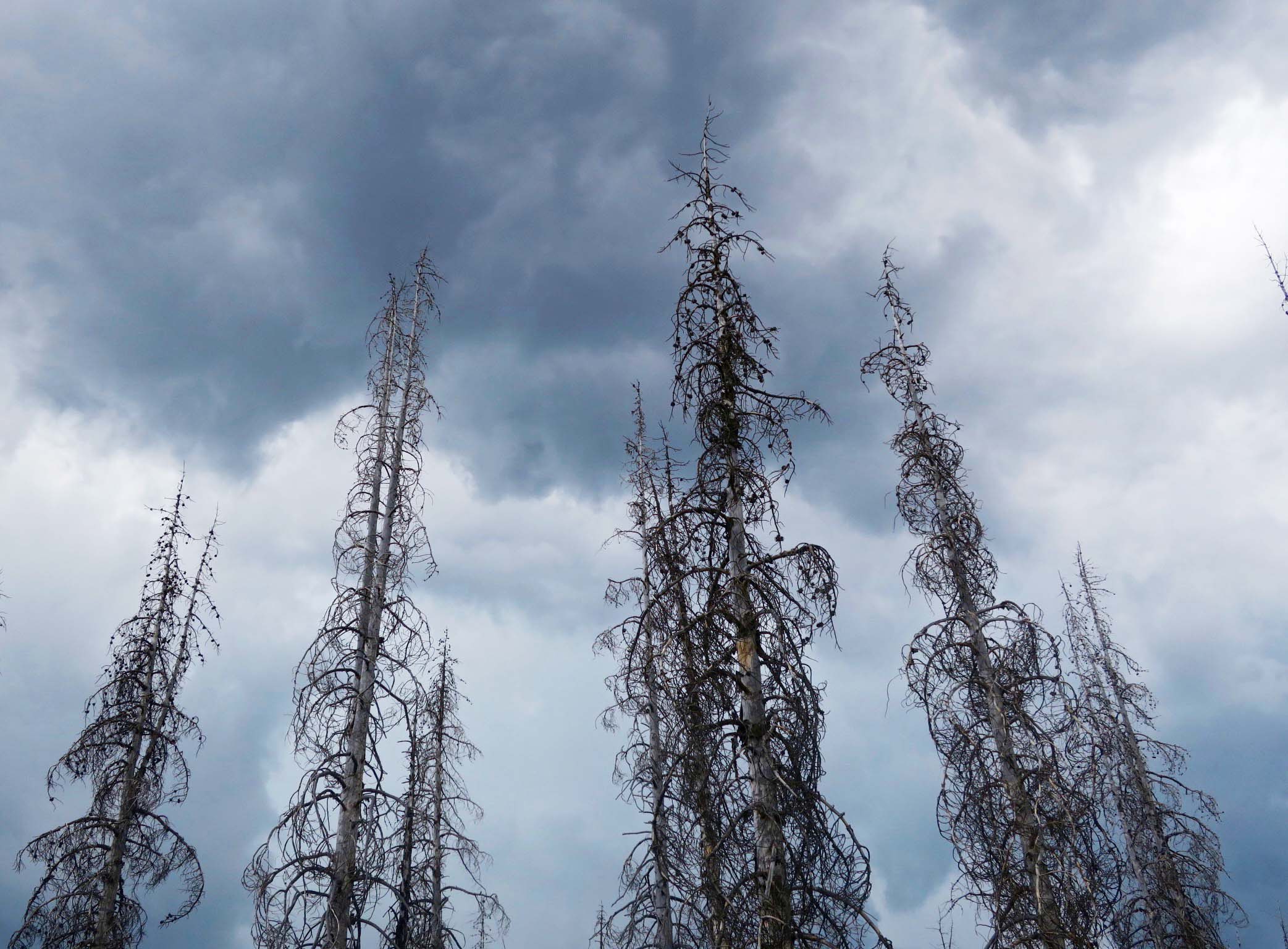
Dead trees are also mood setters for Halloween and horror movies. Here are a couple of many I captured in Lassen.
A lone. dead tree standing on the horizon with grasping fingers is an excellent place to plant a grave.
Scary music, dark, threatening skies, and dead trees: a perfect combination for Halloween night. What monster lurks in the shadows, prepared to leap out from behind a tree, and carry you off to a world filled with zombies and blood thirsty vampires.

And to conclude today’s post for Halloween, a few photos from other faces along the trail, some of which I have included before.

A large eye and a silent scream suggests I frightened this woodland creature peering out at me while half hidden. Am I that scary?
Not so scary but somehow threatening.
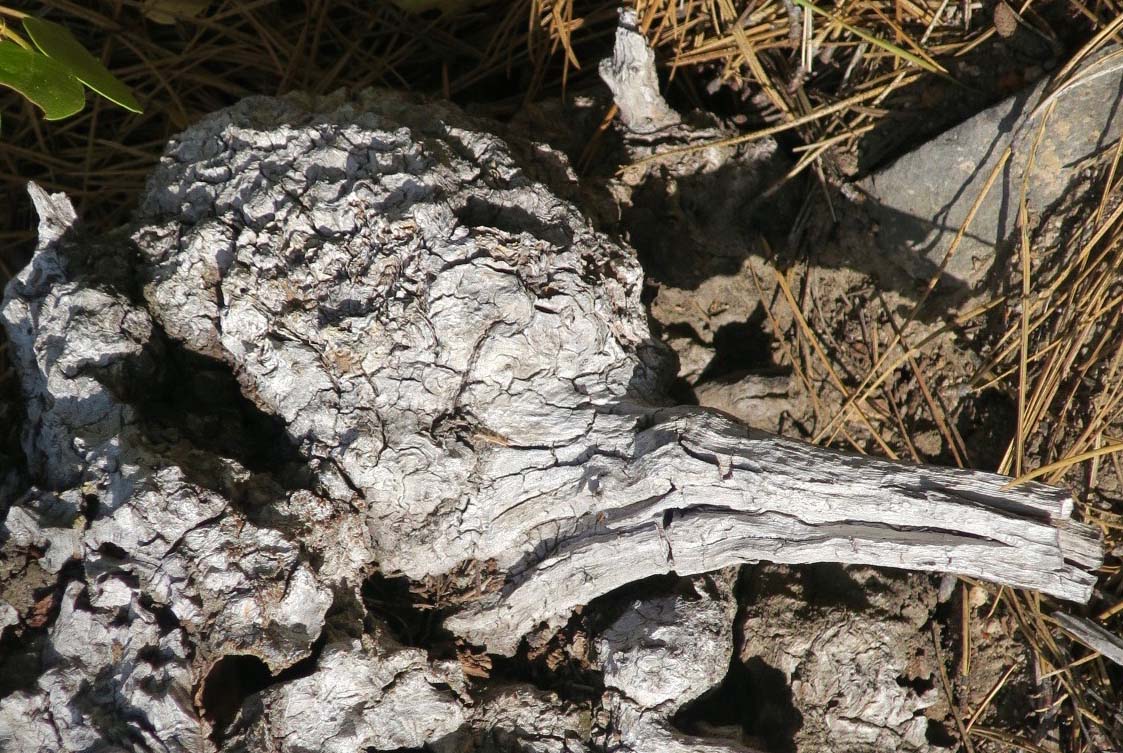
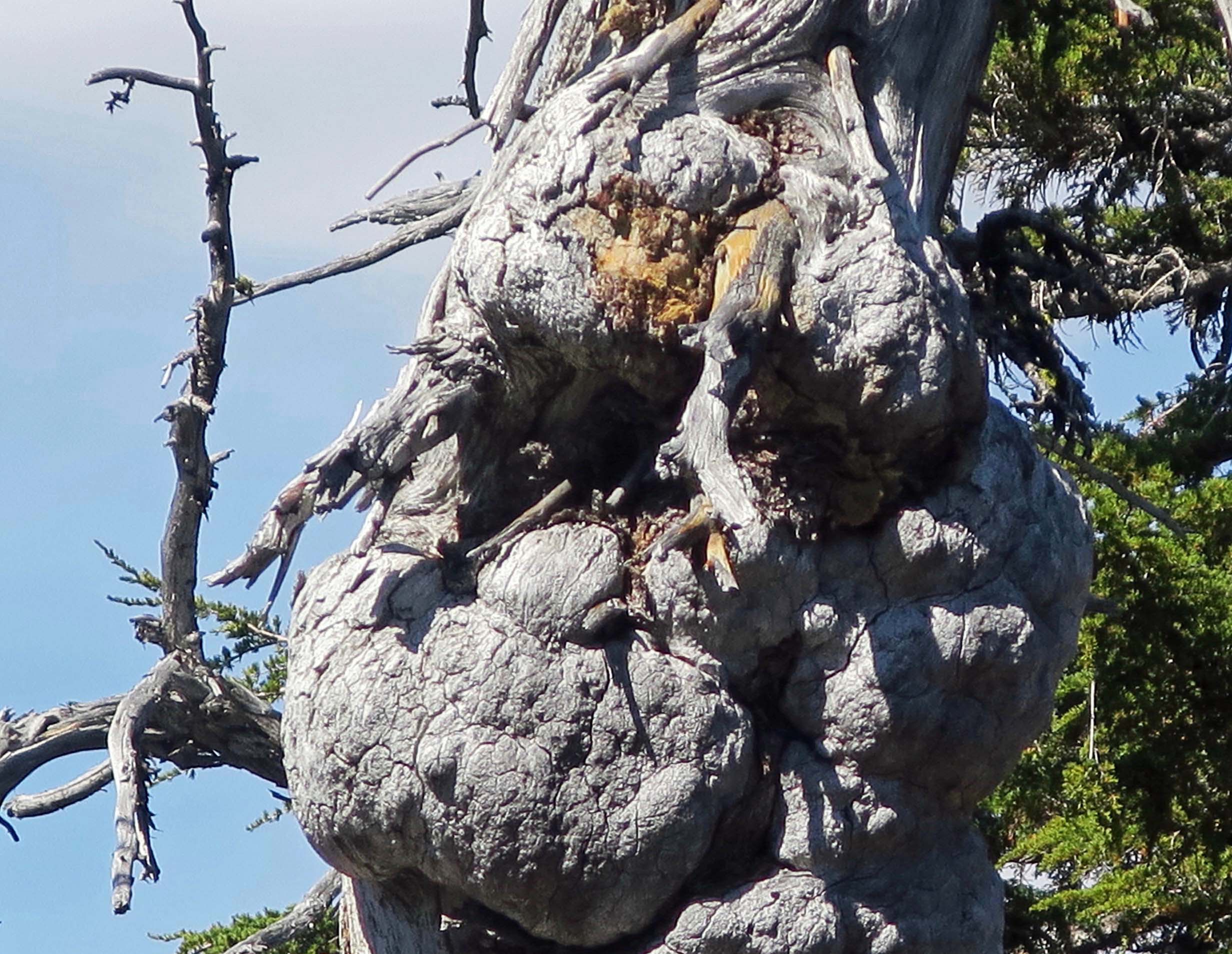
And finally, this rather grotesque character with his pointed head, dark eyes, skinny nose and large jowls. Vey scary indeed!

HAPPY HALLOWEEN FROM PEGGY AND ME.

Next Post: Back to hiking through Lassen National Park on the PCT. 

Fall Colors at Lithia Park in Southern Oregon… and the BSBC

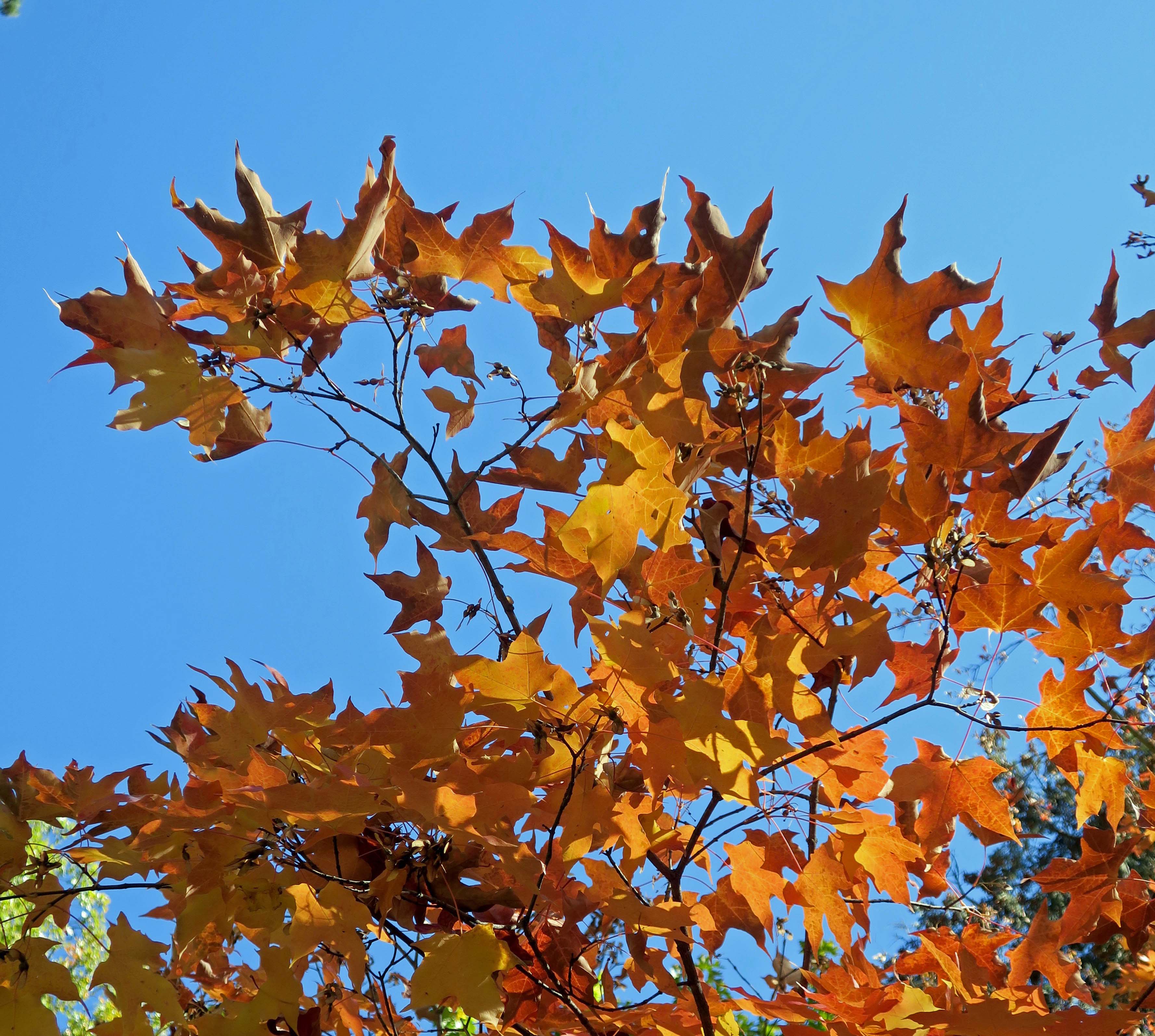
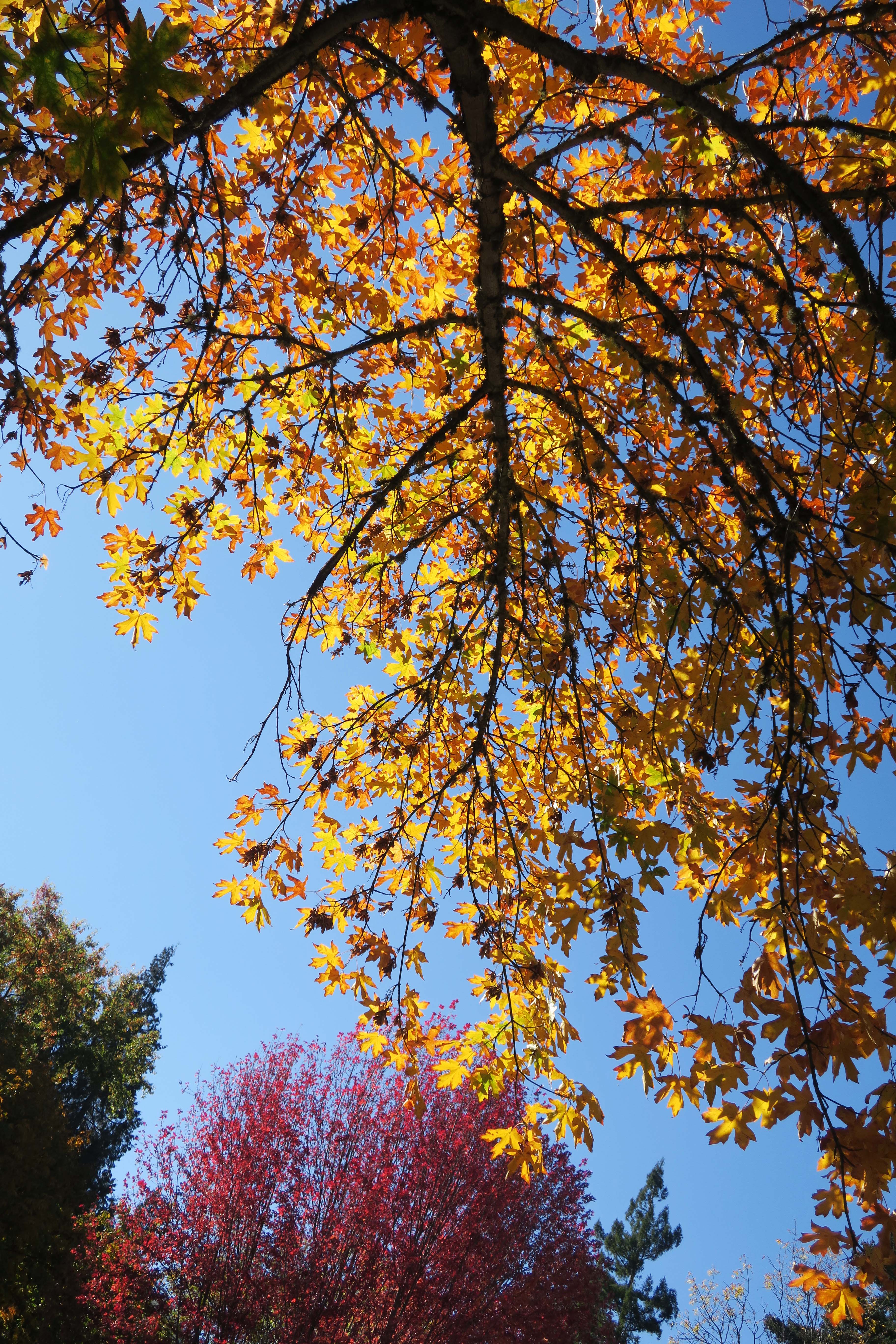
In Southern Oregon, it is hard to beat Ashland’s Lithia Park for fall colors. 

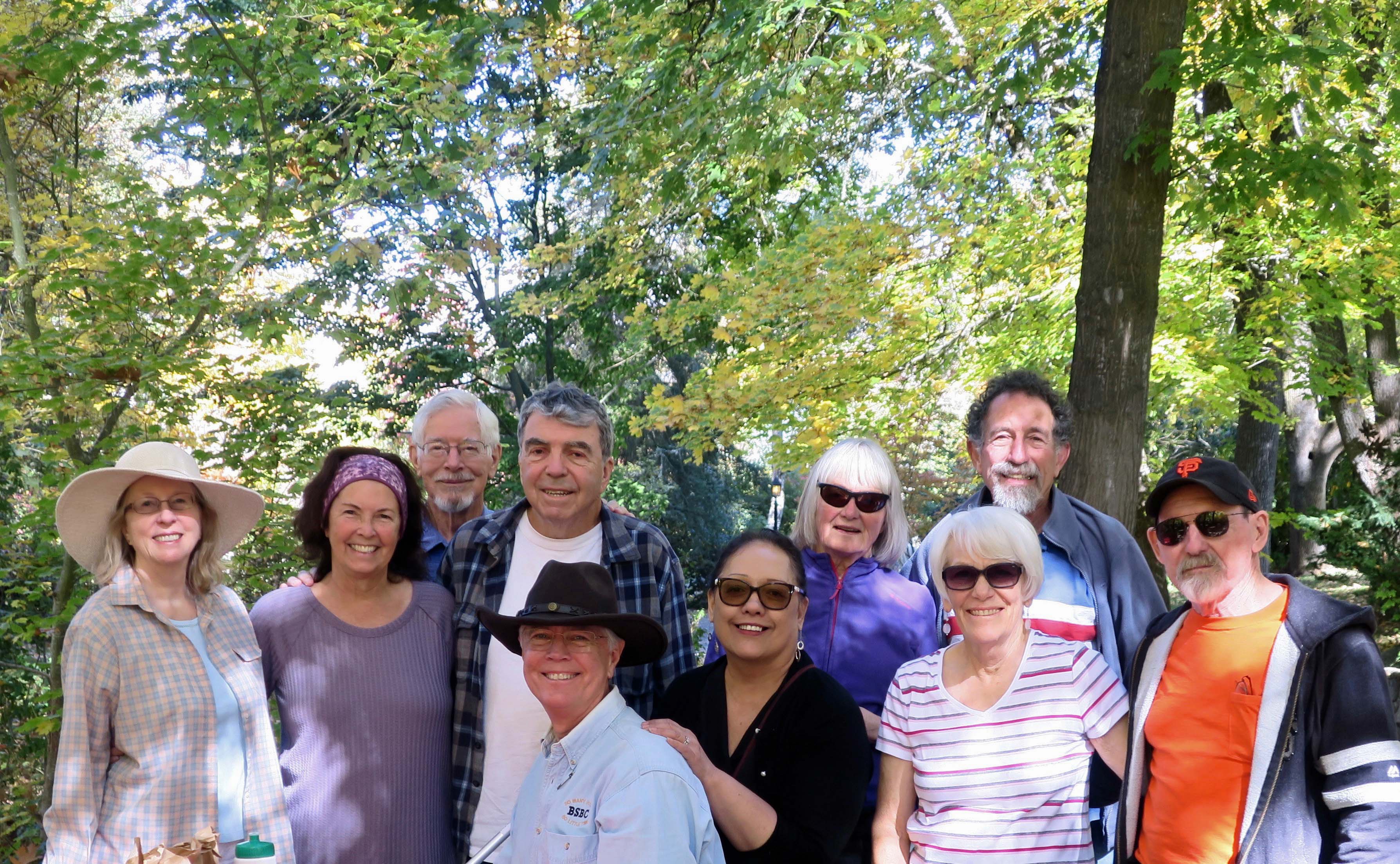
It’s that time when I like to do a post on the fall colors around our home in Southern Oregon. This year, Peggy and I, along with members of the Bigger Sacramento Book Club, drove over to Lithia Park in Ashland for a picnic.

The Bigger Sacramento Book Club at Lithia Park.

The BSBC was created in the late 80s by my friend Ken Lake and was soon composed of five couples. The same couples belong today but ‘Bigger Sacramento’ now includes Southern Oregon, the Bay Area, and France as well as Sacramento! This year marks our 30th Anniversary. Each fall, the BSBC visits our house for a three day retreat. 

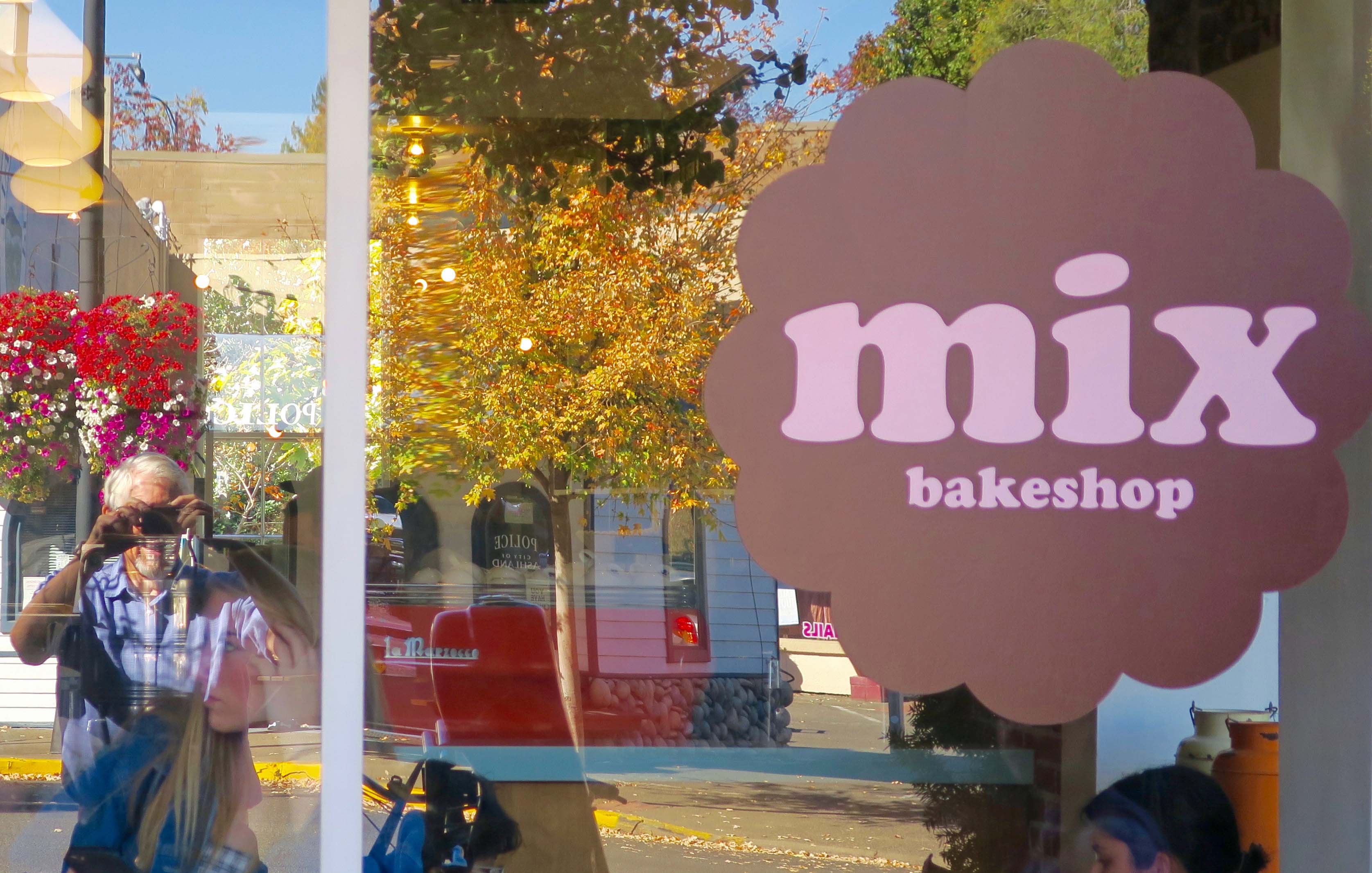
We chose to visit Ashland because our book, Meet Your Baker by Ellie Alexander, is based in the town. Lithia Park, it turns out, was awash in fall colors. After lunch, we walked into town to visit the Mix Bakery in honor of the book and wandered up to the Bloomsbury Bookstore, which is always a delight and makes a pleasant outing for a book club. 

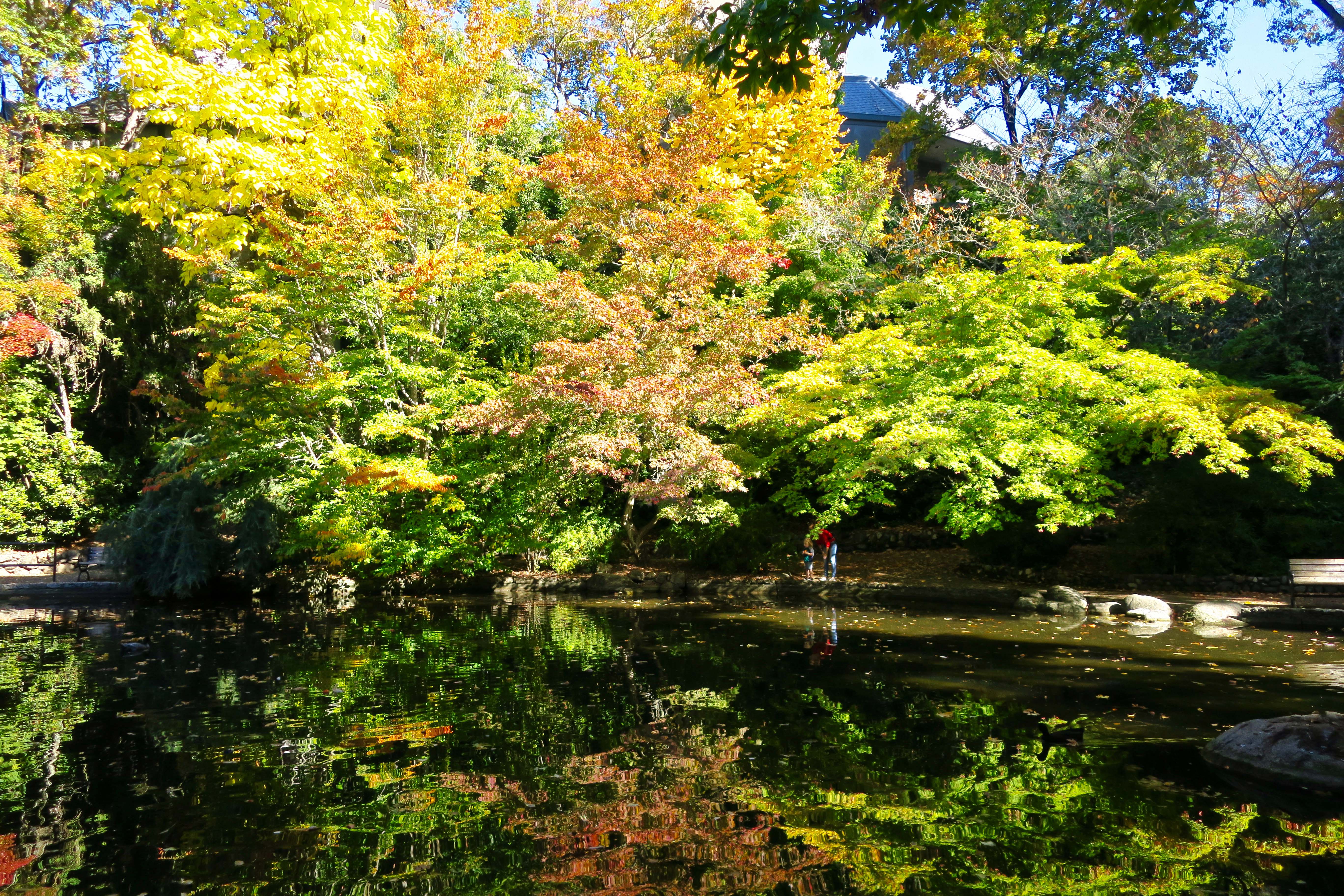
The Duck Pond backs up to the outdoor theater for Ashland’s world famous Shakespeare Festival. The roof can be seen through brightly colored trees.
Reflected fall colors surrounded this duck crossing the pond like an Impressionist painting. Monet would have been jealous.
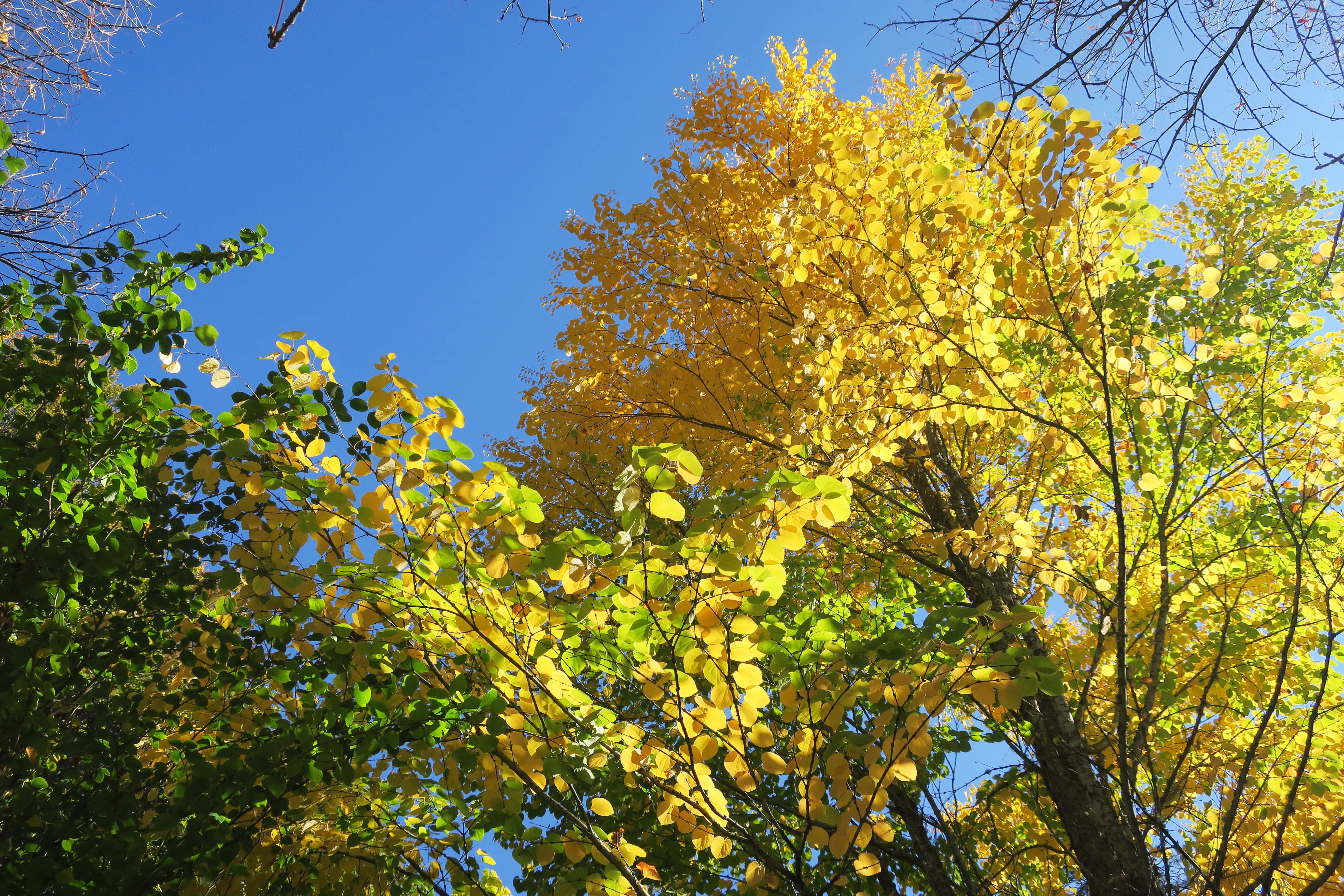
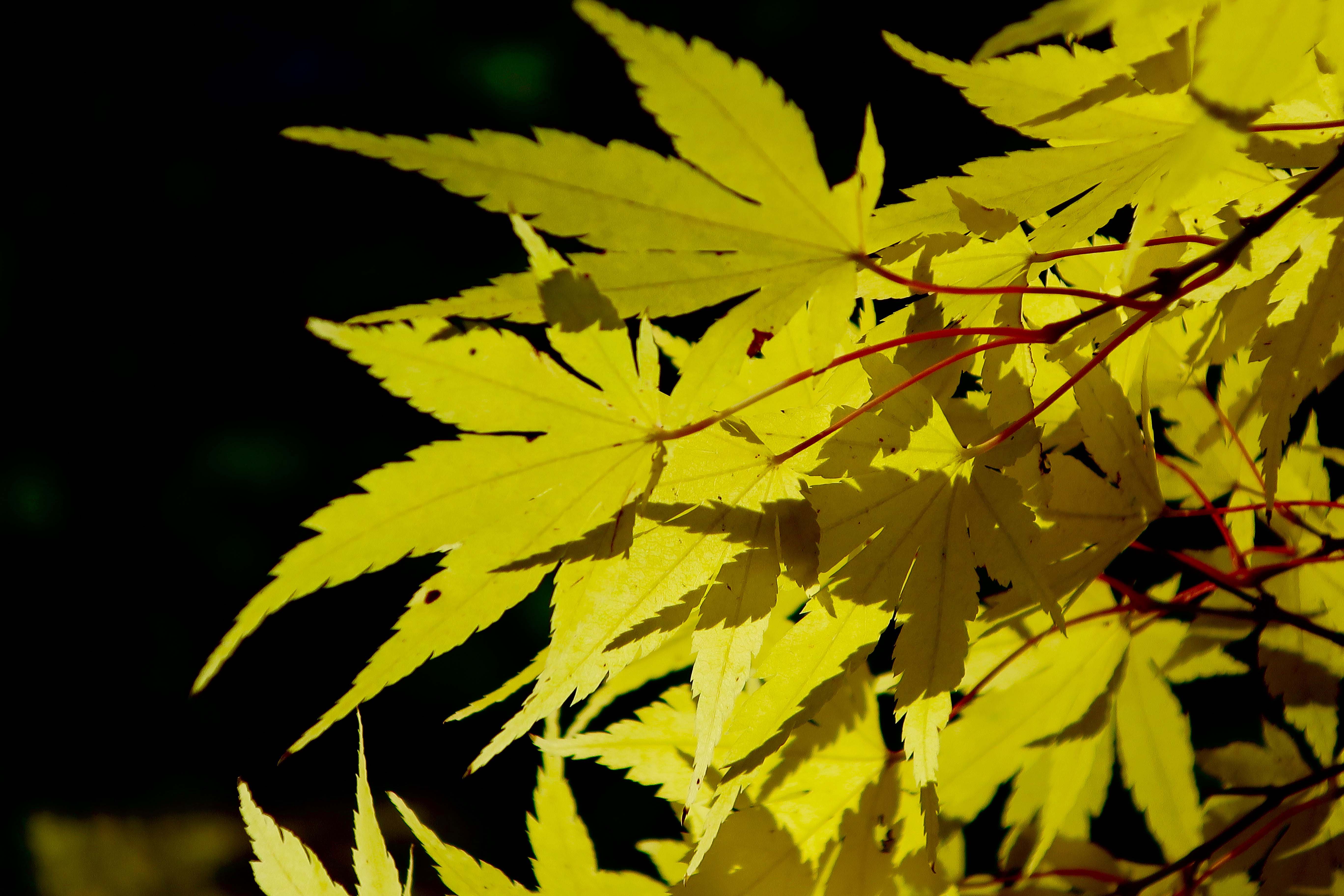
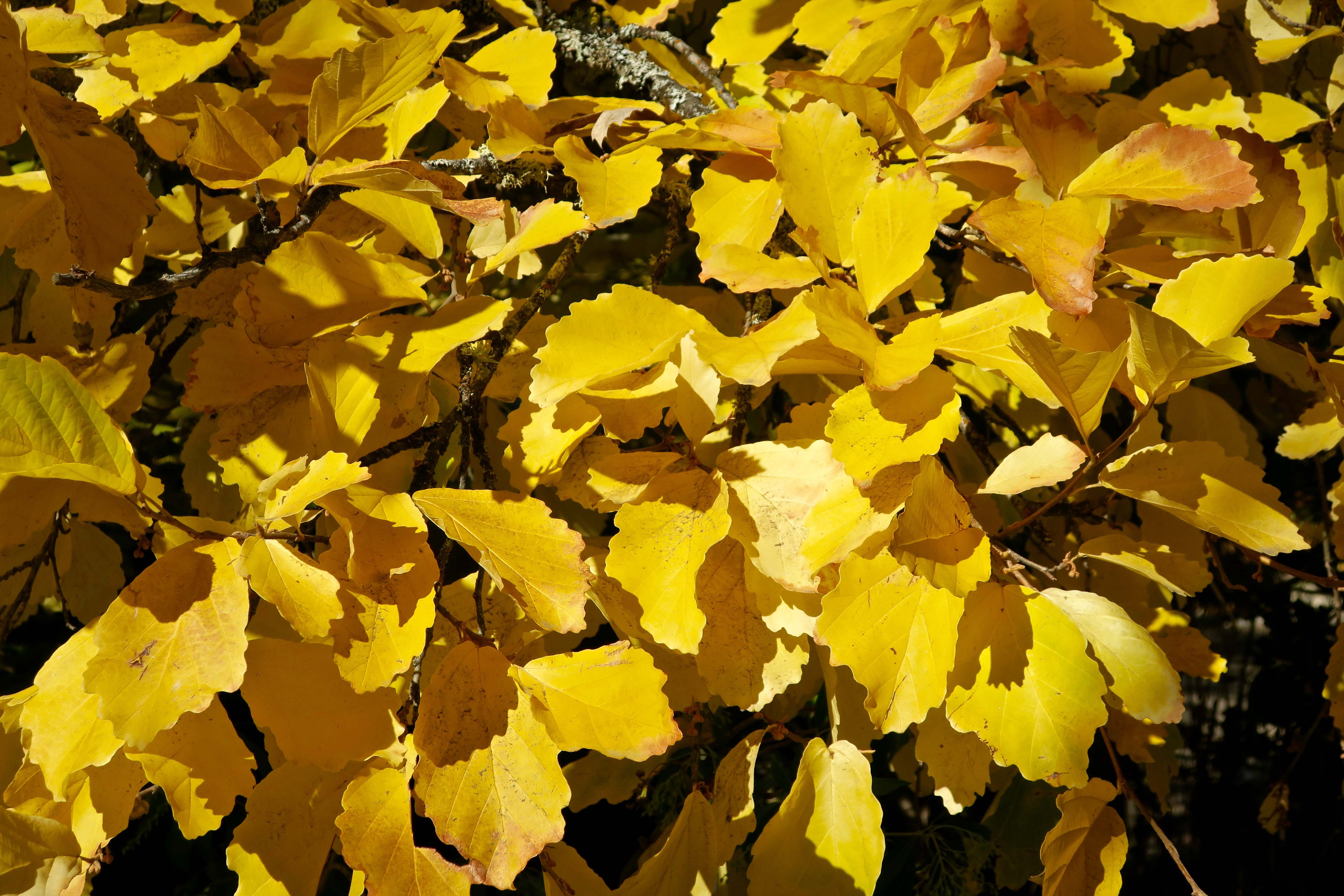
I think the majority of trees in the park must have been chosen for their fall colors as the following photos illustrate.
A bridge across Lithia Creek.
Looking down into the creek.
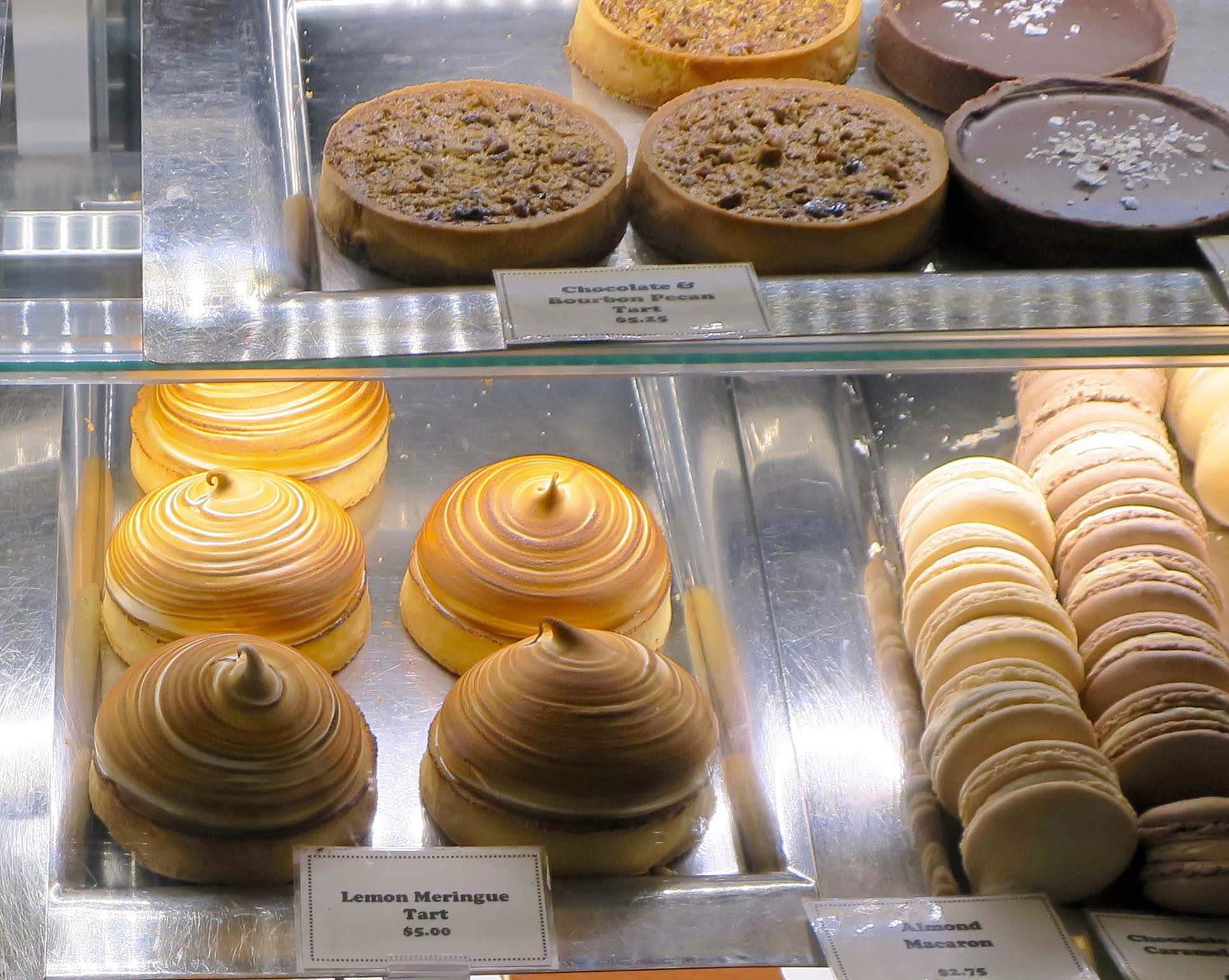
The Mix Bakery was used by Ellie Alexander as the model for her Ashland Bakery in her series. I found the reflections in the window fun. 
Mouth watering goodies are found inside…
Along with fresh bread.
The town, as well as Lithia Park, was filled with fall color
Walking up to the Bloomsbury Bookstore took us past the iconic Ashland Hotel, which hosts an annual chocolate festival guaranteed to get Peggy excited.
Walking past a store window, I spotted this cat, apparently fascinated with an insect that had landed on the window…
Which provided the opportunity for this close-up.
I’ll close today with a photo from our front yard. Our white oaks don’t have quite the color of the trees in Lithia park, but they are definitely looking like fall.

NEXT POST: It’s back to my hike down the PCT and a stroll through Lassen National Park.