On Being Labeled a Radical… The 1964 Free Speech Movement at UC Berkeley


The Press, Governor of California and UC Administration labeled participants in the Free Speech Movement as a small group of radical revolutionaries bent on destroying law and order. Were we?

I was curious about the background of the students who were arrested during the Sproul Hall sit-in, considering I had almost been one. A sociologist was doing a study on who was involved so I volunteered to take part.

We were given extensive questionnaires, trained and told to hit the streets. I seemed to inherit some of the more elusive, fringe types who always hang around Berkeley. Just finding them was an adventure.

When our data was analyzed, we found that a quarter or so of the participants were relatively hard core in terms of having been actively involved in the Civil Rights movement. Most of the participants resembled me: students and grad students who were somewhat on the idealistic side, angry at the Administration, in sympathy with the Civil Rights Movement, and committed to our right to participate in the political process.

Were there truly radical students on campus who saw the protests as a way to radicalize students and achieve objectives beyond retrieving the basic rights that had been taken away?

Yes. I met some when I decided to help create a Free Student Union. A union made sense to me. The student government, by its very nature, was tied closely to the Administration. A union would go beyond the temporary, nonrepresentational nature of the FSM and give us ongoing power and representation that we lacked as individuals.

I participated in two or three meetings including one I hosted at our apartment. Chaos was good, I quickly learned. Policemen dragging students down stairs and bashing an occasional head was to our advantage. It created solidarity among the ranks and radicalized the student body.

We needed to goad the Administration into further action, the more outrageous the better.

It did not reflect who I was or my goals. After sharing my opinion on what I thought about the chosen strategies, I parted ways with the Free Student Union. Apparently, most students shared my perspective. The union, to my knowledge, did not get off the ground.

The focus shifted temporarily in the spring and maybe this shift reflected a more radical strategy. We had our so-named Filthy Speech Movement. People would get up in the free speech area and see how many obscenities they could mouth in the name of free speech.

From my perspective it was inane and counterproductive, a non-issue designed to infuriate the Administration and garner media coverage.  Rather than serve a positive purpose, it degraded our efforts of the fall and was utilized by the Oakland Tribunes of the world and their allies as justification for their condemnation of the campus.

More typical was a return to what some would define as an accepted activity of college life. I was amused to read a Junior Class party announcement in the “Daily Californian” one Friday.

“Everyone is welcome at our TGIF party, especially the FSM: it will give them a chance to quench their thirst.” Dennis O’Shea, Junior Class Activities Chairman was quoted. “It promises to be the hell raiser of the year – lots of girls, a screaming rock and roll band that frequently plays for the Hell’s Angels, and 150 gallons of liquid refreshments.”

I can imagine that the Administration was praying for a return to the good old days when a ‘hell raiser’ was defined as an ocean of beer and a screaming rock and roll band.

Next Blog: Looking back at the FSM: What did we accomplish?

In Honor of Martin Luther King

It is easy to forget what America was like before the Civil Rights Movement changed how African-Americans are treated in the US. I’ve touched on this subject in my articles about UC Berkeley and the Free Speech Movement. Prejudice was not a problem relegated to the South.

Today, in honor of Martin Luther King, I would like to visit the South of 1968, however. I was serving as a recruiter for the Peace Corps at that time, working through out the Southern United States. It was the year Martin Luther King was shot.

The issue of skin color had faded away when I worked as a Peace Corps Volunteer in Africa from 1965-67. My travels through the South as a recruiter brought me face to face again with the reality and tragedy of prejudice.

Supposedly, I was recruiting in the ‘New South,’ a South that had made it beyond the ugliest parts of discrimination. But one didn’t have to dig deep to find old scars or even open wounds.

A few years earlier, George Wallace was announcing his schools would not be integrated, Lester Maddox was waving his pick ax handle, students from Berkeley were participating in the Freedom Rides and young people were being murdered in Philadelphia, Mississippi for registering black voters.

One of our black recruiters had grown up in Alabama and described the experience. I was still mastering ‘Southernese’ so her statement lost a little in the translation but I report it as I heard it.

“When I was growing up,” she had reported, “I always had to step off the sidewalk and into the gutter whenever the Polish came walking along.”

“Wow,” I had replied, trying to comprehend what it would be like to have to debase yourself in such a way and at the same time wondering about the problem with the Polish that I had never heard about before.

“I never knew that there was a problem in the South with the Polish,” I observed.

“Polish,” she had replied in an irritated voice, “P, O, L, I, C, E.” Read my lips.

Properly chastised my mind made the leap. I thought back to Berkeley and remembered my feelings about police on campus. I wondered what it would be like to grow up fearing the very people who were supposed to protect you. How long it would take for those feelings to leave you… if they ever could? How could such experiences do anything other than teach you hatred?

Not long after that my wife, Jo Ann, and I were recruiting at the University of North Texas in Denton along with a black recruiter. The three of us had gone out for breakfast at a local restaurant.

I had noticed that people became quiet when we walked in. Gradually conversations resumed. I really didn’t think much about it. A family with young children was in the booth next to us. Suddenly a little four-year-old head poked up and was staring over the seat at us, all eyes.

“Mama, there is a nigger sitting with those people,” she had announced to her mother and everyone else in the restaurant in a loud, clear voice. From the ‘mouth of an innocent babe’ the prejudice of generations was repeated.

Jo Ann and I were also to learn that prejudice went both directions. One of our assignments was to recruit at Black Campuses. We had accepted readily. Why not?

When we began our recruitment efforts, we quickly realized that we were less than welcome, that there was a barely concealed resentment about our presence. No one yelled at us or threatened us, but the looks and mumbled side comments spoke volumes.

We were guilty of being white. It wasn’t who we were, what we were committed to, or what we had done; it was the color of our skin. It was a powerful lesson on the unthinking, disturbing nature of prejudice. A few weeks later the hatred it spawns would lead to one of America’s greatest tragedies.

It was in the spring of 1968 and we were recruiting at the University of West Virginia in Morgantown. It was our second visit to the campus and we felt like we were returning to see old friends. Students were excited about the Peace Corps and eager to sign up.  We had set up our booth and were well into persuading students to leave the country when the news came.

Martin Luther King had been shot and killed.

For the second time in our relatively short lives (John Kennedy’s assassination was the first), we were struck by instant grief and anguish for someone we had never known, a man who had stood as a symbol of hope that the hatred and bigotry in America could be overcome, and that it could be done without violence.

The preacher of non-violence, the Christian black man with a golden voice and stirring words had been shot down in cold blood. Another hero was dead, destroyed because he believed that he could make a difference, shot down because he had dared to dream. And we were left with the question: why?

Today, the fact that a black man can serve as President of the US, speaks to how far we have come as a nation and honors the efforts of Martin Luther King.

Still, as King would remind us if he were alive today, the struggle against prejudice is not over, and may never be. Hate crimes are a daily occurrence in our world; people continue to discriminate against others because of their religion, ethnicity, sex, economic status and color of skin.

The best way to honor Martin Luther King, and the thousands of others who have sacrificed to make this a fair and just world, is to continue the struggle.

Holding a Police Car Hostage: UC Berkeley’s 1965 Free Speech Movement

Jack Weinberg, creator of the statement "Never trust anyone over 30," was arrested for raising funds to support Civil Rights efforts on the UC Berkeley Campus in the fall of 1965. Students surrounded the police car and held it hostage.

In the fall of 1965, the UC Berkeley Administration declared that the Bancroft-Telegraph Free Speech area was closed and that there would be no more organization of off-campus Civil Rights demonstrations at Berkeley. Student organizers of the various community efforts reacted immediately.

These were not young adults whose biggest challenge had been to organize pre-football game rallies. Some, like Mario Savio, had walked the streets of the South registering black voters and risking their lives to do so.

In the summer of 1964 three of their colleagues had been shot dead and buried under an earthen dam near Philadelphia, Mississippi. Many had cut their political eye teeth four years earlier in the anti-HUAC demonstrations in San Francisco and had participated in numerous protests against racial discrimination throughout the Bay Area since. (HUAC was the House Un-American Activities Committee, a hold over from the McCarthy era.)

The student organizers understood the value of demonstrations, media coverage and confrontation and had become masters at community organization. They were focused in their vision to the degree they were willing to face police and be arrested for their beliefs.

The Administration wasn’t nearly as focused. Liberal in nature and genuinely caring for its students, it utilized a 50’s mentality to address a 60’s reality. Its bungling attempts to control off campus political activity combined with its inability to recognize the legitimacy and depth of student feelings would unite factions as diverse as Young Republicans for Goldwater with the Young People’s Socialist League.

It eventually led to the massive protests that painted Berkeley as the nation’s center of student activism and the New Left.

Over the next three months I would spend a great deal of time listening, observing and participating in what would become known world-wide as the Free Speech Movement (FSM). As a political science major, I was to learn much more in the streets than I did in the classroom.

What evolved was a classic no win, up-against-the-wall confrontation. The Administration would move from “all of your freedoms are removed,” to “you can have some freedom,” to “let’s see how you like cops bashing in your heads.” The Free Speech leaders would be radicalized to the point where no compromise except total victory was acceptable.

Student government and faculty solutions urging moderation and cooperation would be lost in the shuffle. Ultimately, Governor Pat Brown would send in the National Guard troops and Berkeley would take on the atmosphere of a police state.

I found myself being radicalized in the process as well although I never reached the point of moving beyond issue to ideology. It was no more in my nature to be left-wing than it had been to be right-wing. However, I would move across the dividing line into civil disobedience.

Within hours of the time that Dean Katherine Towle sent out her ultimatum to campus organizations, the brother and sister team of Art and Jackie Goldberg had pulled together activist organizations ranging in orientation from the radical to conservative and a nascent FSM was born.

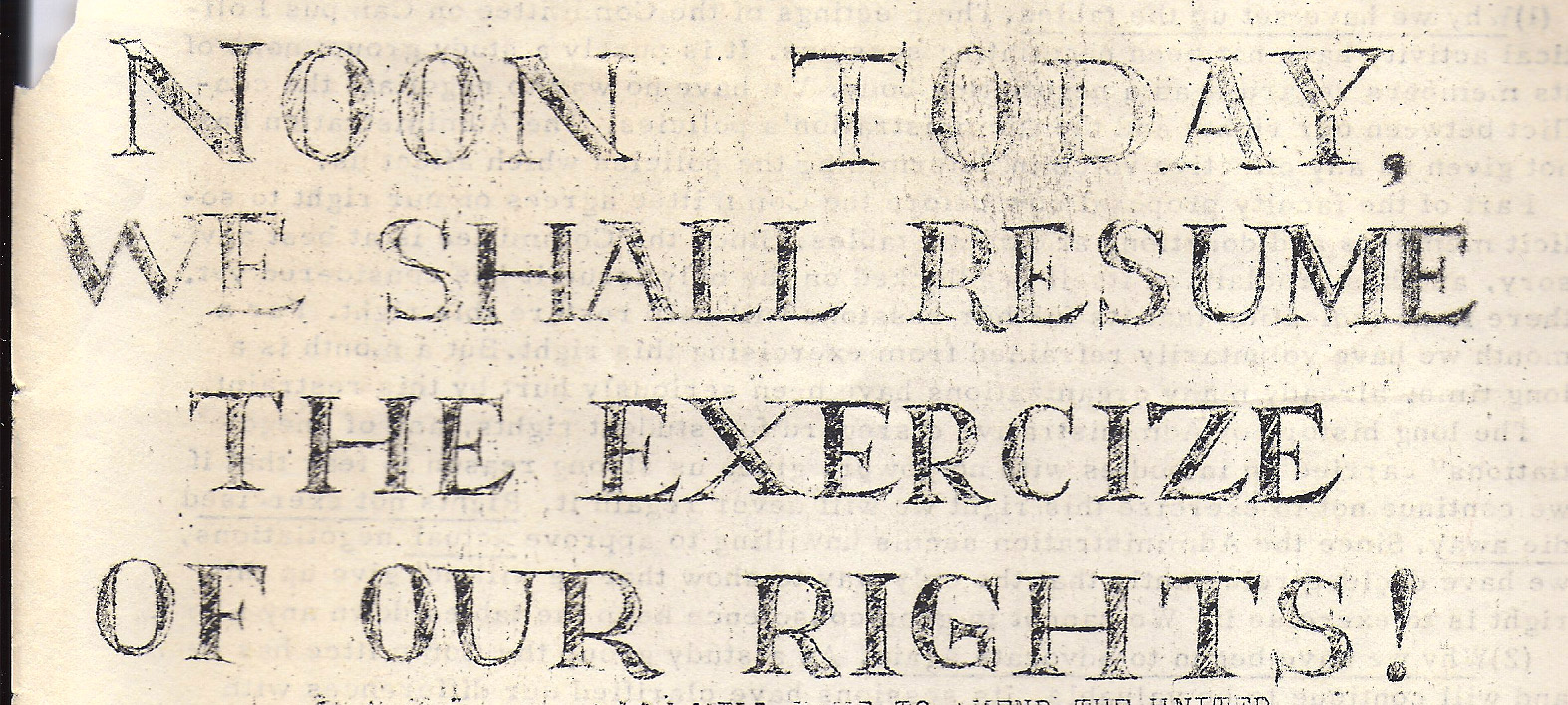
Shortly thereafter the mimeographs were humming and students were buried in an avalanche of leaflets as they walked on to campus. I read mine is disbelief. The clash I had predicted at the student leader meeting a year earlier had arrived. There was no joy in being right.

In an era before social networks and cell phones, FSM organizers relied on mimeographed fliers and word of mouth to build instant support. The above flier is one I saved in my files on the Free Speech Movement.

As soon as it became apparent that the Administration had no intention of backing off from its new rules, the FSM leadership determined to challenge the University. Organizations were encouraged to set up card tables in the Sather Gate area to solicit support for off campus causes.

I had stopped by a table to pick up some literature when a pair of Deans approached and started writing down names of the folks manning the tables. Our immediate reaction was to form a line so we could have our names taken as well. The Deans refused to accommodate us. The Administration’s objective was to pick off and separate the leadership of the FSM from the general student body.

A few days later I came out of class to find a police car parked in Sproul Plaza surrounded by students. The police, with encouragement from the Administration, had arrested Jack Weinberg, a non-student organizer for CORE (Congress of Racial Equality) who had been soliciting support for his organization.

Someone had found a bullhorn and people were making speeches from the top of the police car while Jack sat inside. I situated myself on the edge of the fountain next to the Student Union and idly scratched the head of a German Short Haired Pointer named Ludwig while I listened. (Ludwig visited campus daily and played in the fountain. Later, in Berkeley-like fashion, the fountain would be named for him.)

A scanned photo of Ludwig from Berkeley's student newspaper.

Eventually I stood up and joined those on the edge of the crowd thereby becoming a part of the blockade. It was my first ever participation in civil disobedience. It was a small step. There would be plenty of time for more critical thinking if the police showed up in force.

Being only semi-radical, I did duty between classes and took breaks for eating and sleep. Eventually, after a couple of days, the FSM negotiated a deal with the Administration. Jack was booked on campus and turned loose, as was the police car. A collection was taken up to pay for minor damages the police car had sustained in the line of duty while serving as a podium.

Next Blog: The Police and National Guard occupy Berkeley’s campus