Gold, Screaming Fat Cells, and a Great White Whale… The 10,000 Mile Bike Ride

My plans were to start my trip by cycling down Highway 49 through the foothills of California, which are beautiful in the spring.

My plans were to start my trip by cycling down Highway 49 through the foothills of California, which are beautiful in the spring.

It had rained much of the night, big buckets full, with a smattering of thunder and lighting thrown in for good measure— all of which made me thankful for my lumpy but cozy bed in the Old Well Motel. I rallied at 6:30. The clouds were breaking up and the sun was peeking through. It was good day for biking. More importantly, I knew a cup of hot, steaming coffee was waiting next door at the Old Well Café.

Ten people would constitute a crowd in the Old Well Cafe, but several Hollywood stars of yore had stopped there to eat.

Ten people would constitute a crowd in the Old Well Cafe, but several Hollywood stars of yore had stopped here to eat.

“Did you find the treasure?” the waitress inquired with a wink in her voice. She had told me the story the night before. According to legend, a handful of bandits had buried close to $80,000 on the property before being hunted down and killed in a shoot out. “No,” I had laughed, “but I did find a good night’s sleep.”

Tales of lost treasure are abundant in gold country. Some of them may even been true. Growing up in Diamond Springs, 13 miles from where gold was discovered at Coloma, I had often heard such stories. Millions had been taken out of the ground, initially with gold pans and sluice boxes, then with powerful water canons, and finally from deep, hard rock mines. The Kennedy Mine, located a few miles away, measures some 5912 feet in depth, making it one of the deepest mines in the world. It is hardly surprising that some of the gold would have gone astray.

There were plenty of outlaws to help. The most famous was Black Bart, the gentleman bandit. Always well-dressed, he robbed stages on foot since he was afraid of horses. Targeting Wells Fargo coaches, he would politely request that strong boxes be handed over. Since his requests were backed up by a shotgun, stage drivers were quick to comply. On occasion, Bart would even leave a poem behind. Here’s a sample:

I’ve labored long and hard for bread, For honor, and for riches,

But on my corns too long you’ve tread, You fine-haired sons of bitches.

Maybe not great poetry, but it managed to get Wells Fargo and the media excited.

I made my way through a second cup of coffee, putting off the inevitable moment when I would climb on my bike and start up the steep hill that was lurking just outside the door. Other travelers had lingered here as well. Notes of appreciation from Bob Hope and Phyllis Diller were on the wall. I procrastinated for a bit longer by reading them. Finally, out of excuses, I stepped outside and strapped on my helmet. The day had begun.

My goal was another short day. As you may recall, I had done nothing physically to prepare for my journey. I was conditioning on the road, whipping my fat cells into shape. The first day had been 18 miles, my second was supposed to be around 30, the third 40 and so forth. By the end of the first week I was hoping to be riding somewhere between 60 and 70 miles each day.

“The best laid plans of mice and men often go astray…” –Robert Burns

My problem, I quickly learned as I pedaled out of Drytown, wasn’t that I was bicycling 30 miles my second day out (what kind of a big deal is that?); it was that I was biking down historic Highway 49. The foothills of California don’t understand flat. They go up, and they go down… period. Make that steep up and down. My fat cells were screaming after 100 yards. By 200 yards they were so loud I was convinced that people driving by could hear them. I dropped down in gears until I didn’t have any more to drop into. I climbed out of the saddle. I was travelling so slowly that if I traveled any more slowly I was going to fall over.

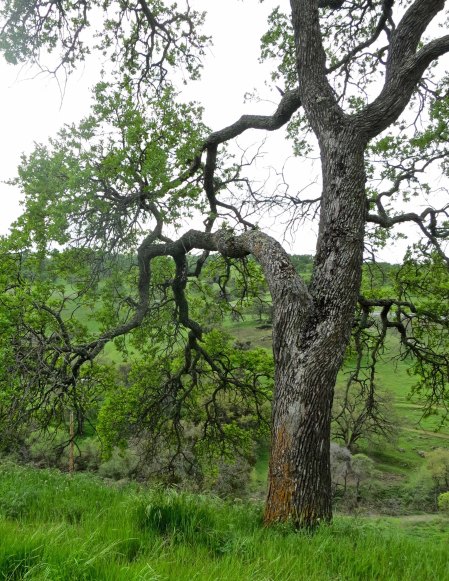
The foothills of California may be beautiful in spring, but they also make for steep cycling— any time of the year.
The foothills of California may be beautiful in spring, but they also make for steep cycling— any time of the year.

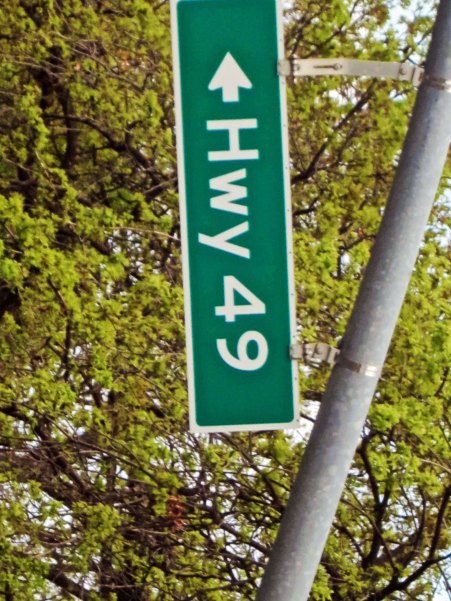
This sign really wasn't pointed this way, but it is how I imagined it.

This sign really wasn’t pointed this way, but it is how I imagined it.

But enough on that. I made it over the hill and coasted down to Amador City. I made it over the next hill and coasted down to Sutter Creek, one of my favorite towns along Highway 49. I had travelled all of five miles. It was time to celebrate. It was time for breakfast. “Yahoo!” the fat cells shouted in unison. You may have heard them.
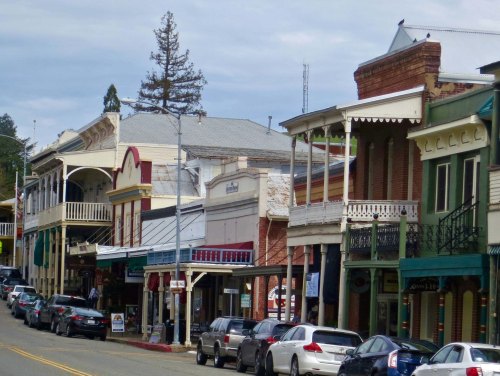
Many of the old gold rush town along Highway 49 have done a great job of maintaining their early buildings. Sutter Creek is a good example.

Many of the old gold rush town along Highway 49 have done a great job of maintaining their early buildings. Sutter Creek is a good example.

The cells did little more than grumble as I cycled out of Sutter Creek and up another hill. They were too busy scarfing down bacon, and eggs, and buttered toast. But then my right knee started to whine. Screaming fat cells are one thing; a whining knee another. It can be serious. By the time I reached Martel, at the top of the hill, I had a decision to make. Highway 49 promised more hills, lots of them, and I had 9,974 miles to go. I didn’t want to mess up my knees. So I turned right. At 26 miles into my trip, I changed my well-planned itinerary. I was headed for the Central Valley of California, which was as flat as the foothills were hilly.
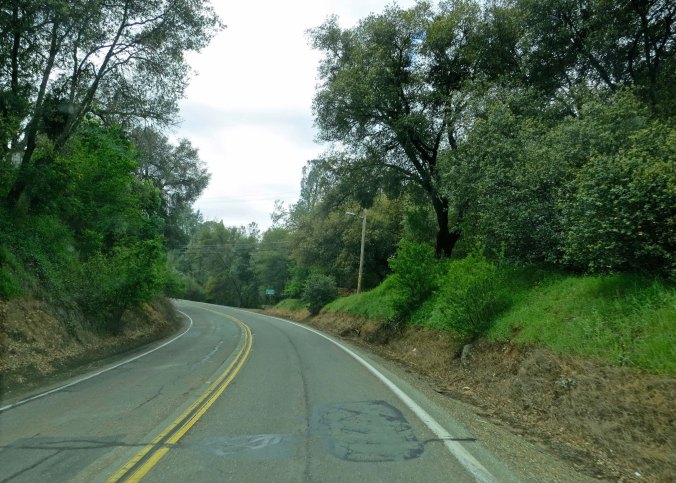
The road out of Sutter Creek. There will be lots of street shots in this series, since this was my world for the six months I bicycled.

The road out of Sutter Creek. There will be lots of street shots in this series, since this was my world for the six months I bicycled. Here’s a bicyclist’s perspective: steep hill, narrow/nonexistent shoulder with no where to ride or escape, rough road, and curve coming up. There is danger if someone tries to pass you (you may want to ride out in the road to force motorists to ride behind you until you get beyond the danger).

Decision time. Do I ride on down Highway 49 to Jackson and beyond? Or do I cut right and ride toward Stockton and the Central Valley?
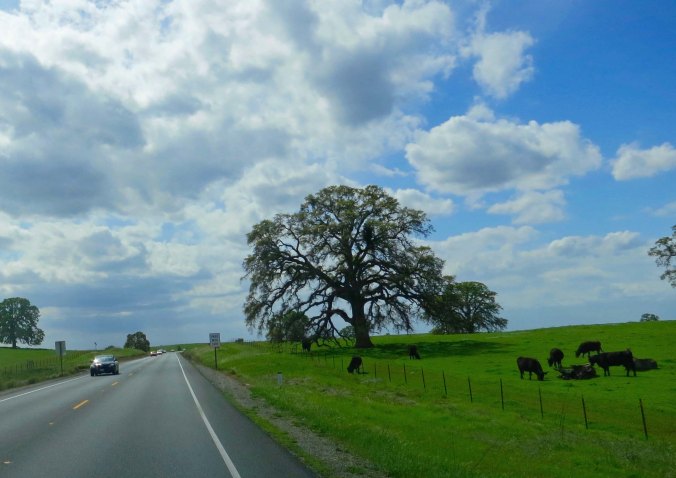
Decision time. Do I ride on down Highway 49 to Jackson and beyond? Or do I cut right and ride toward Stockton and the Central Valley?

The decision, heading for the flat lands.

The decision, heading for the flat lands.

Getting there was 90% of the fun. It was mainly downhill. About 35 miles from Drytown, I reached the small community of Clements, a perfect distance for the day— except the grocery store where I had planned to shop was closed. Boy did that create a dilemma for the fat cells. They could go hungry or cycle on. I decided that the Calaveras River, another ten miles, would make a great camping spot— except the Calaveras turned out to be little more than a mosquito-infested ditch. Are you beginning to see a trend here? I went off route for several miles looking for a motel— except I couldn’t find one.
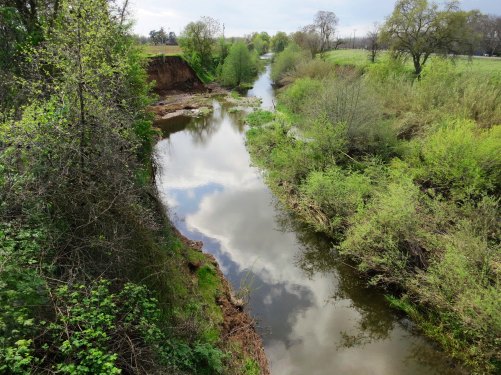
I could have stopped on the Mokelumne River near Clements that still had water, bit I cycled on the the Calaveras.

I could have stopped on the Mokelumne River near Clements, which still had water, but I cycled on to the Calaveras, which didn’t.

My fat cells and my legs were not happy. But they were having a picnic in comparison to my butt. Any bicyclist will concur: few things can match the pain of an out-of-shape abused tail at the beginning of a long bike ride. You don’t get off your bicycle seat, you peel yourself off. And you don’t sit down on your seat. You gently lower yourself and then shoot a foot up in the air from the agony. So there we were: me, my butt, my legs, and my fat cells, unhappily faced with another 20 miles of cycling into the town of Escalon, hoping beyond hope there would be a motel.
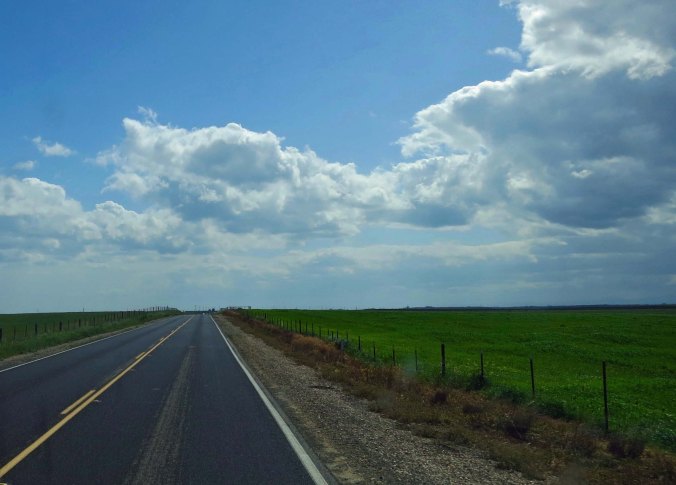
The long road to Escalon...

The long road to Escalon, with a headwind.

I made it. What more can I say. I turned a 30-mile day into a 67-mile day my second day out. And there was a motel, a beat up old motel, a barely standing old motel, the most beautiful motel I have ever seen. I cycled across the highway to the office… and couldn’t get off my bike. My right leg refused to function. It had gone on strike. I couldn’t get it over the bike. There was nothing left to do but laugh. I finally managed the trick by lowering the bike.

The room made my room at the Old Well Motel look like the Taj Mahal. It didn’t matter. Nothing did. I stripped and headed for the shower, hardly stopping. And made a mistake. I glanced in the mirror. Moby Dick, the great white whale, was staring back at me. Ahab would have taken one look and grabbed his harpoon. What in the world was I doing?

It was a three-beer night. I declared the next day a layover.
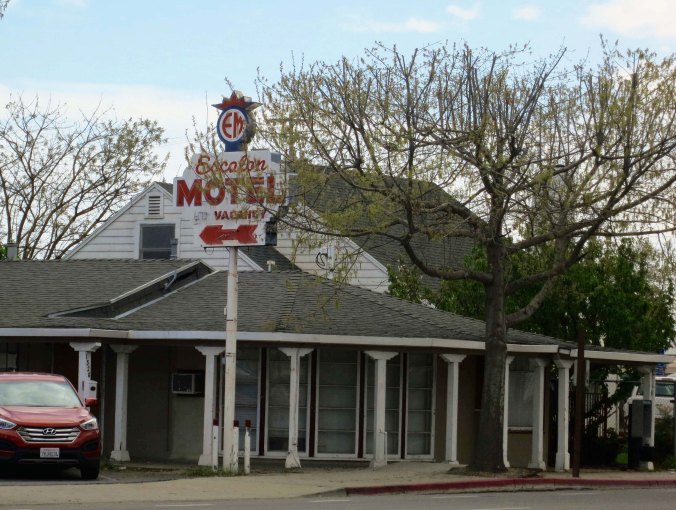
The Escalon Motel as It looks today. Peggy and I stopped for a photo. Several restaurants and a Starbucks are now located nearby and the motel looked like it had received a recent paint job.

The Escalon Motel as it looks today. Peggy and I stopped for a photo. Several restaurants and a Starbucks are now located nearby and the motel looked like it had received a recent paint job. My ‘driver’ was rewarded with a Grande Caffe Latte.

NEXT BLOG: Four days of cycling through the Central Valley. I discover a great air museum, find Bone hidden in my panniers, meet far too many dogs that want to eat me, learn something about the loneliness of the long distance bicyclist, and ride by a prison that tells me I can’t pick up any hitchhikers. Since mass murderer Juan Corona and Charles Manson are housed there, I decide it is a good idea.

Traveling Companions: Peggy, Eeyore, Bone… 10,000 Miles by Bike

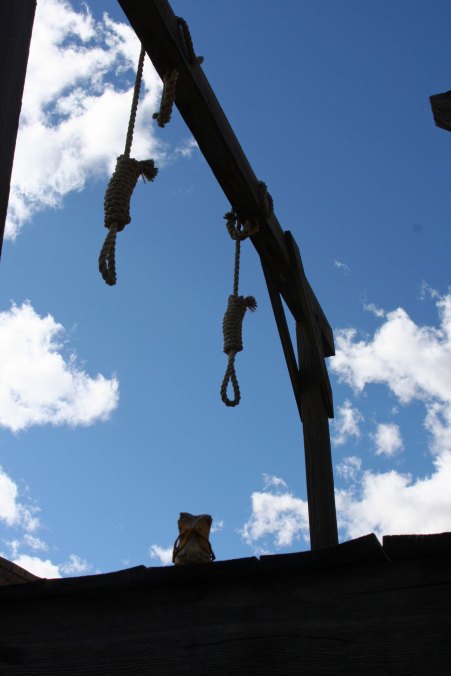
Eeyore rescues Bone from the hangman's noose in Tombstone, Arizona allowing him to continue his journeys around the world. Bone travelled with me on my bike trek.

Eeyore rescues Bone from the hangman’s noose in Tombstone, Arizona allowing him to continue his journeys around the world. Bone travelled with me on my bike trek.

Now that you have had an initial introduction of my journey, it’s time to introduce my travelling companions as Peggy and I cross the country in Quivera the Van retracing my 10,000 mile bike route. If you follow this blog, you know Peggy, of course. She is integral to this story, as she is to all of my blogs. Remember, I met her at the end of my bike trek. Sparks flew. She is the conclusion to this story… and the beginning of another.

I mentioned Eeyore in my first blog of this series. He was peering out the back window, his favorite location when we travel. He prefers looking backward instead of forward. He is a bit of a contrarian. It’s the jackass in him.

Everyone knows this lovable donkey who has trouble keeping track of his tail. He’s been travelling with us for ten years when we travel by van. Normally his life is rather calm. There have been a couple of exceptions, however. The first was the time the teachers kidnapped him from Peggy’s office when she was working as an elementary school principal. They demanded chocolate for ransom.  Peggy dearly loves her chocolate, however, and Eeyore was almost out of luck. He could still be hanging out at Olive Grove Elementary School while being abused (whoops sorry, meant loved) by first graders. Fortunately, Peggy finally gave in. It wasn’t like the teachers were demanding higher salaries…

Bone faces the gallows in Tombstone, Arizona. He'd been cheating at cards, hanging out with loose women, and robbed a bank.

Bone faces the gallows in Tombstone, Arizona. He’d been cheating at cards, hanging out with loose women, and robbing  banks.

The second time was scarier; he had to save Bone from the hangman’s gallows in Tombstone, Arizona. “Wait a minute,” you say. “Who and what is Bone?” Thanks for asking. Those of you who have been around my blog for longer that three years will know the answers. But for the rest of you, here’s the story. In the beginning of my blogging efforts, I had in mind writing a book called “Travels with Bone.” (It’s still coming.) So I developed a blog titled, The Peripatetic Bone. When I decided to write The Bush Devil Ate Sam about my Peace Corps’ experience I changed the blog to Traveling through Time and Place. Here is the very first paragraph from my very first blog.

This is it, the Peripatetic Bone’s blog. And no, I am not Bone. My name is Curtis Mekemson. My wife Peggy and I participate in, or one might say, facilitate, Bone’s wandering ways. Like the ubiquitous gnome, Bone shows up in some rather unique places. Burning Man is an example. Peripatetic means to wander about. It’s a good description for Bone (and me).

My friend Tom Lovering and I found Bone in 1977. He was hanging out half buried in snow in a patch of corn lilies along the Tahoe-Yosemite Trail south of Lake Tahoe. Tom and I had a game when we backpacked. If one of us found trash, the other person had to pack it out. I found Bone, declared he was trash, and Tom had to carry him— at least until he could sneak him back in my pack. Here is Bone’s perspective on being found:

I didn’t plan on seeing the world and becoming famous. Once I was part of a horse located just above the hoof. I had no freedom; I had no glory. Wherever the horse went I went also, a mere slave to his desires. During the summer this meant carrying greenhorn tourists into the backcountry of the mountains above Lake Tahoe. The added pounds gave me bone-jarring headaches. Then the horse died; I like to fantasize that a large bear with big teeth and sharp claws ate him.  Hopefully he ate the tourist as well.

Whatever happened, I was free to be me, Bone. Yes, that’s right, Bone is my name. A kindly coyote picked me up and carried me to a high meadow filled with Corn Lilies. It was there that I discovered my Zen-like nature as I meditated through the seasons. I was alone except for a mouse that came by and nibbled on me occasionally. That hurt. In fact, it interrupted my meditation and scarred me for life; you can still see teeth marks. I blame all of my subsequent bad behavior on that flea bitten miscreant.

My annoyance at the mouse, however, was minor in comparison to my anger at the large two-legged creature who yanked me from my meadow home and begin yelling I was trash as he ran down the trail in pursuit of another two-legged creature.  Can you imagine the insult? I had no way of knowing that this was the beginning of my world travels or that the two creatures, Curt Mekemson and Tom Lovering, would become my servants.

World travels indeed. Bone has now been in over 50 countries and all 50 states. He travelled with me on my 10,000-mile bike trip and with Tom in the back of a truck from the Sahara Desert to South Africa. He has wandered close to 200,000 miles with Peggy and me as we have explored North America. Other people have also carried Bone. He has been blessed by the Pope and attended a Bill Clinton Presidential press conference. “Excuse me, is that a gun in your pocket.” He has been on top of Mt. Kilimanjaro, at the base of Mt. Everest, and on top of Mt. Whitney. He has gone deep sea diving in the Pacific and boated up the Amazon. You get the idea. It’s only proper that he be along with Peggy, Eeyore and me on our present journey.
Bone is going to answer the ten most common questions people ask him in my next blog. After that, I will get back to my bike trip and the big white whale that scared the hell out of me.

Wyatt Earp arrests Bone in Tombstone. Doc Holiday checks him for weapons.

Wyatt Earp arrests Bone in Tombstone. Doc Holiday checks him for weapons.

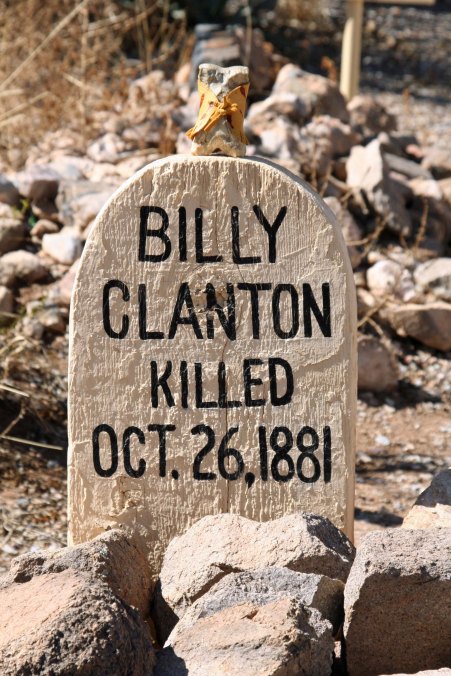
Bone checks out Billy Clanton's grave on Boothill— thankful it wasn't him.

Bone checks out Billy Clanton’s grave on Boothill— thankful it wasn’t him.

A 10,000 Mile Bike Trek Begins with the First Pedal… Maybe

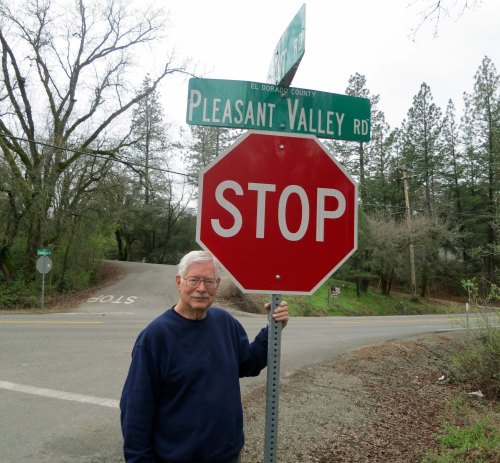
This would have been my first official stop sign on my bike trek. My first grade teacher, Mrs. Young, had lived across the road. She kicked me out for a year when she learned my mother had forged my birth certificate to get me out of the house.

The  first official stop sign on my bike trek. My first grade teacher, Mrs. Young, had lived across the road. She kicked me out for the year when she figured out my mother had forged my birth certificate. The cut off for first grade had been March 1st. I was born on the 3rd. It was a poor forgery. I was happy to return home. My mother, not so much.

“So, you are going out beyond the clouds this morning.” –Pop

I had planned to leave on my birthday, March 3. I liked the symbolism. But it was raining, and I had a few things left to do— like buy my bike. It wasn’t a big thing; I had owned several over the years. My first had been a one speed bike with coaster brakes and handle bars that would have made a laidback Hell’s Angel jealous. It was well-used. Some kid would have been proud to call it new back before World War II. My parents paid five bucks for it. The bike provided me with the freedom to zip around my home town and the surrounding countryside for several years until impending teenagehood suggested it wasn’t cool.

My Trek 520 cost a lot more. It was designed for touring. According to the company: “If you’re a committed touring cyclist looking for the utmost in comfort and durability to carry you to familiar destinations and unexplored vistas, 520 is your ride.” The ad went on to claim that the bike was “ultra-stable even when fully loaded.” Well, I was definitely headed for ‘unexplored vistas’ and ‘fully loaded’ for my trip meant close to 60 pounds of bike gear, camping equipment and books— plus Curt. It was a lot to ask of a bike.

A funny aside on Trek Bikes. The company once threatened to sue the American Lung Association for using the name “Bike Treks,” which was silly, to say the least. When I pointed out that I had trademarked the name two years before the company was created as The Sierra Trek, it became a question of who should be suing whom. The issue was quickly and quietly dropped.

I decided to begin and end my trip in Diamond Springs where I was raised, a small community 30 miles east of Sacramento on Highway 49. Here’s the opening paragraph in my bike journal:

3/10/89

The journey starts today, where so much of who I am started. That’s why I am here. That, and because my father is here and I wanted to spend some time with him.

As I wrote, Pop was out in the kitchen of his trailer meticulously preparing eggs and grumping because he hadn’t prepared everything the night before. At 84, he liked to have things just right. In fact, he had always wanted things to be done just right, maddenly so. Maybe it had come from his training as an electrician where he had once done something wrong and come in contact with a live, 11,000-volt high power line. Those type of lessons stick with you.

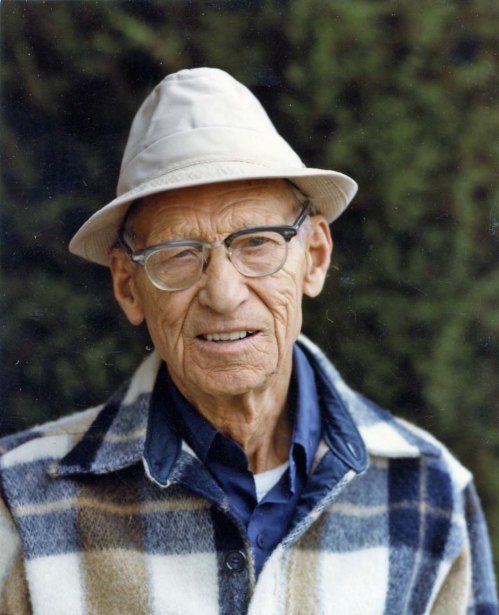
Pop in his 80s

Pop in his 80s

I’d been visiting and sleeping on his couch for the past three days. It had been a good visit, as we relived his youth, and mine. He’d been born back at the end of the horse and buggy age and the beginning of the horseless carriage era. He’d seen a lot, but his favorite times were still when he was growing up in Iowa. I had heard the story many, many times. It was a well warn groove in his brain, to be remembered when everything else was forgotten. He was functioning well for his age, however, even though he had suffered a minor stroke. I treasured our time together.

Finally, after breakfast, I loaded my four panniers and a day pack I would be carrying. Pop came out to wish me a safe journey and take photos. He always carried a camera and was quite disgusted I didn’t. It was one of three complaints I heard regularly. The other two were that I wasn’t happily married and making little Mekemsons (lots of them), and that I had strayed from my Christian upbringing. Of the three, I am still convinced that he believed not taking photos was my greatest sin.

A solid hug sent me coasting down the hill from his trailer in the Diamond Manor Mobile Home Park, a bit teary eyed. I couldn’t be sure he would be around when I returned. My first pedal rotation at the bottom of the hill stopped halfway. “Damn,” I thought, climbing off my bike and almost falling over. I was ever so glad that no one had been present to watch. The problem was immediately apparent. I’d put my panniers on backwards, not a great start. I righted the wrong and began again— the first pedal of 10,000 miles.

Thomas Wolfe said, “You can’t go home again.” He was right, of course. The 46-year old Curtis of 1989 was a world apart from the 6-year old Curtis of 1949. And both were different from the Curtis of today.  And yet you never totally escape from the home of your youth, and in ways, it always remains your ‘home.’ My first short day of bicycling was packed with memories. I’ll let photos tell the story. Pop would be tickled that Peggy and I are redriving the route— and even more pleased that we are carrying cameras.

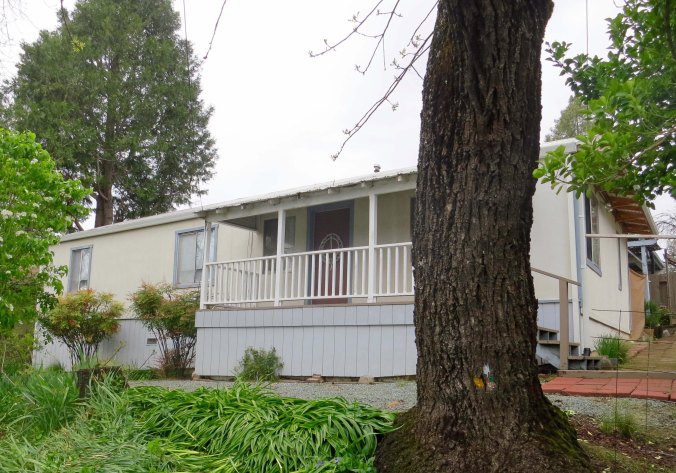
I am rather amazed that the house I was raised in still stands, given that it's parts had been prebuilt foe a World War II army barracks. My room was on the far left.

I am rather amazed that the house I was raised in still stands, given that it was an early version of a manufactured home, prebuilt for a World War II army barracks. My room was on the far left.

Every few feet of bicycling brought back a memory. This sunken ground was once a cave that included the crystal clear springs that gave Diamond its name.

Every few feet of bicycling brought back a memory. This sunken ground off of Main Street was a cave when I grew up. It  included the crystal clear spring that gave Diamond its name. It had once provided water for Native Americans and later was a watering hole for 49ers passing through town. When a group of miners found a 25 pound gold nugget nearby, they decided to hang around and the town was founded.

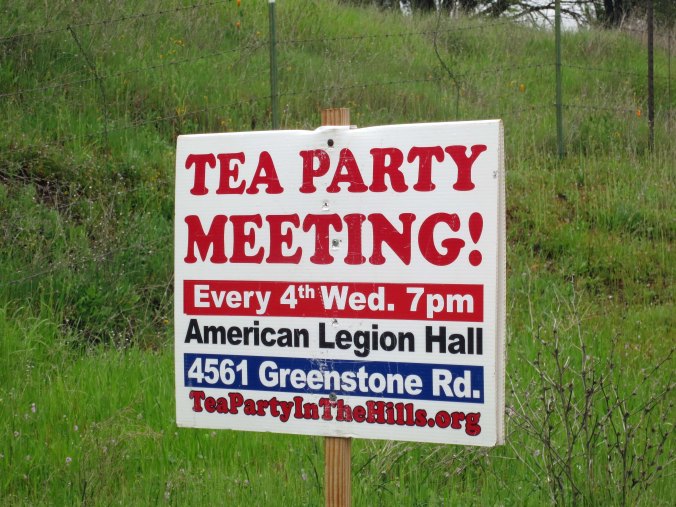
Now it hosted a Tea Party sign. Thinking Tea party led me to think of Alice in Wonderland and I wondered if that was where the name had come from. The Mad Hatter tea party seemed to fit a lot of politics.

Now it hosted a Tea Party sign. Thinking tea party led me to wonder if the Boston Tea Party or the Mad Hatters Tea Party in Alice and Wonderland provided the inspiration for the name. A crazy hatter who had inhaled too many mercury fumes and a March Hare who ineffectively threw tea cups willy-nilly at anyone and everyone seems to be a great model for much of today’s politics.

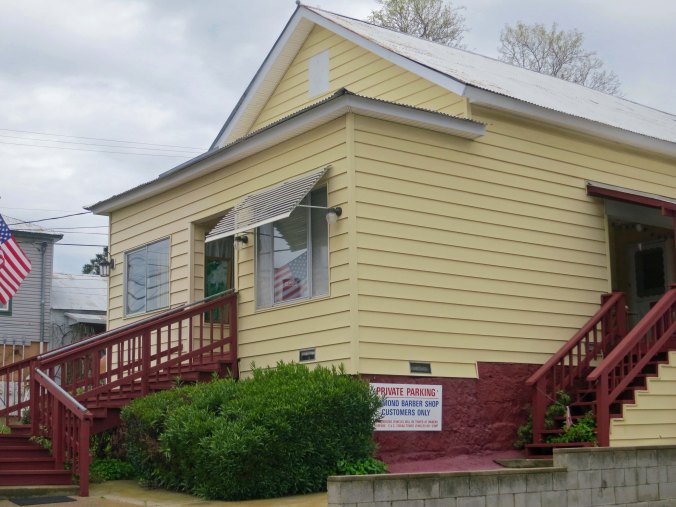
As I made my way down main street, I came to this barber shop. I'd had my hair cut there in the 40s and 50s! Even further back in time, it had served as a one room school house.

As I made my way down main street, I came to this barber shop. I’d had my hair cut there in the 40s and 50s! Even further back in time, it had served as a one room school house.

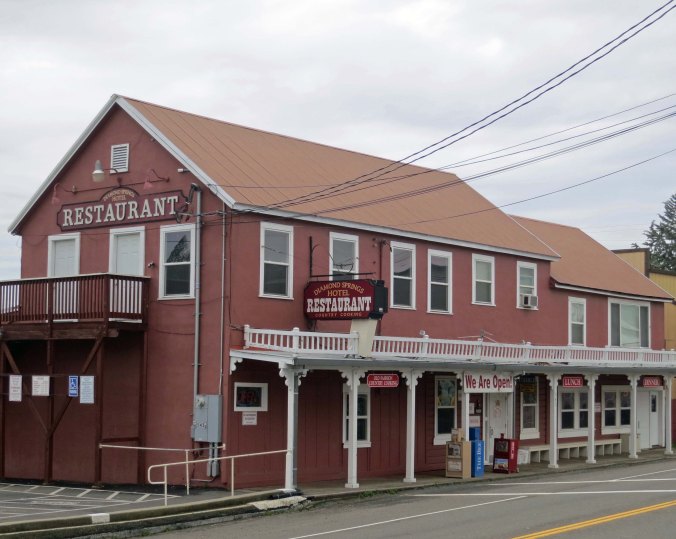
The old Diamond Hotel is just across the road from the barber shop. It still serves good food. Now days, like many old establishments along historic Highway 49, it claims to be haunted. Ghosts are good for business.

The old Diamond Hotel is just across the road from the barber shop. It had served good food when I was growing up and still does. Now days, like many old establishments along historic Highway 49, it claims to be haunted. Ghosts are good for business.

The Graveyard: I could write a book about it. It was just across the alley outside our back yard and dominated many of my early memories. In the day time it was an elaborate play pen. At night it became the dreaded home of dead people and ghosts.

The Graveyard: I could write a book about it. It was just across the alley outside our back yard and dominated many of my early memories. In the day time it was an elaborate play pen. At night it became the dreaded home of dead people and ghosts.

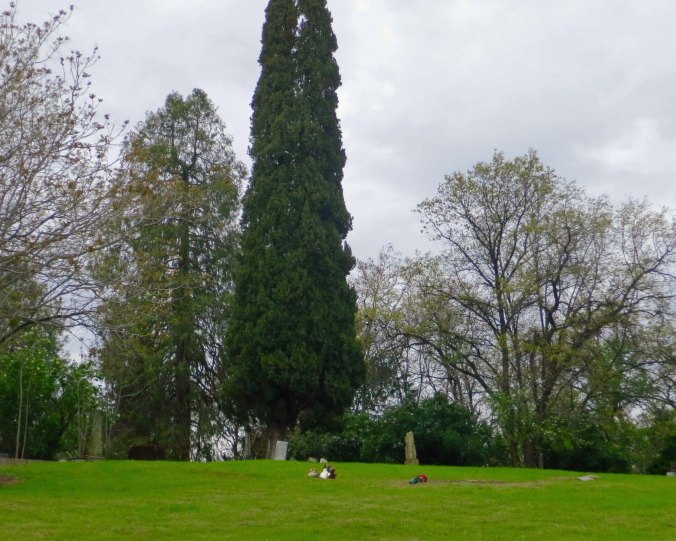
Heavenly trees on the edge of a graveyard in Diamond Springs, CA

It was a wild place covered with Heavenly Trees like these that served to hide the tombstones when we were young. They still lurk on the edge of the Graveyard, waiting to reclaim it. I prefer the wild look to the manicured look.

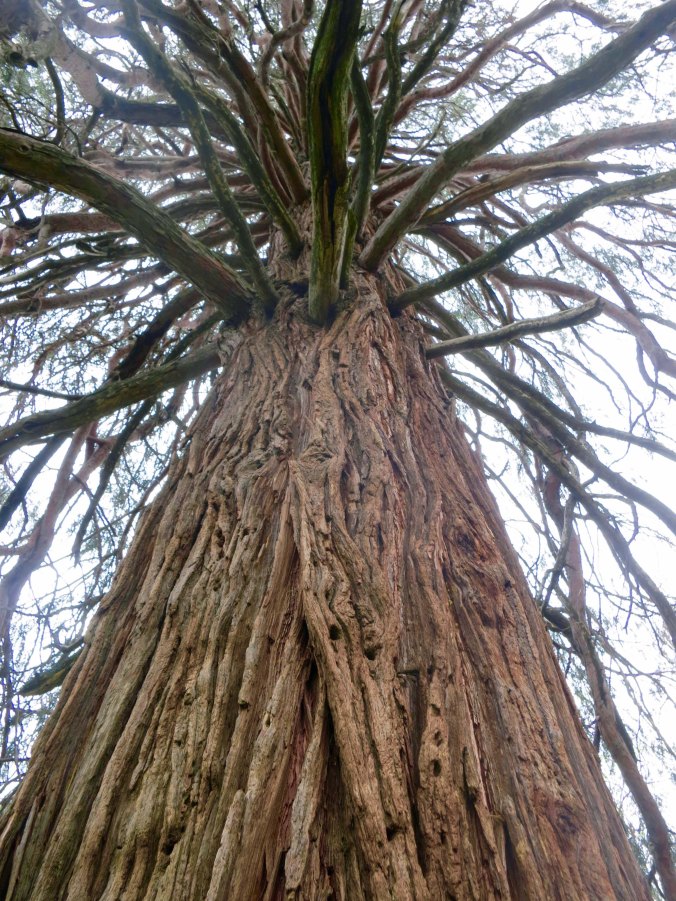
This old Incense Cedar dominated the Graveyard. It was probably planted in the 1850s. it's lower limbs held a tree fort that Pop had built for my brother and me.

This old Incense Cedar dominated the Graveyard. It was probably planted in the 1850s. it’s lower limbs held a tree fort that Pop had built for my brother and me. He built it when he caught us trying to build a fort 60 feet up in the tree. Our big sport was racing each other to the top.

Flowers burst out all over the graveyard in spring, and provided many a bouquet for Mother, picked dutifully by me. This lilac bush was still blooming away.

Flowers burst out all over the graveyard in spring, and provided many a bouquet for Mother, picked dutifully by yours truly. This lilac bush is still blooming away.

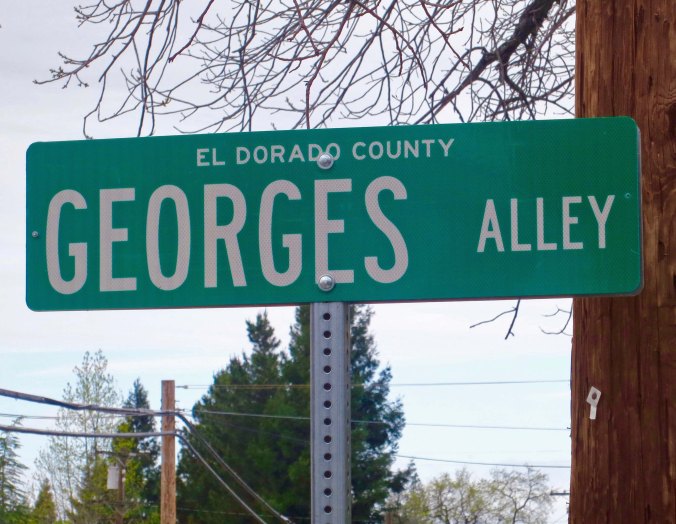
Our alley didn't have a name at first. Then the County decided to name it Graveyard Alley. Mother gave Marshall and me our orders. "Make the sign disappear. Don't tell your father." We did. The County put up another sign. It disappeared. Finally, the County decided to namer it Georges Alley after the first man who lived on the alley. We liked him. The sign stayed.

Our alley didn’t have a name at first. Then the County decided to name it Graveyard Alley. Mother gave Marshall and me our orders. “I won’t live on Graveyard Alley. Make the sign disappear. Don’t tell your father.” We did. The County put up another sign. It disappeared. Finally, the County decided to name it Georges Alley after the man who built it. We liked George. The sign stayed.

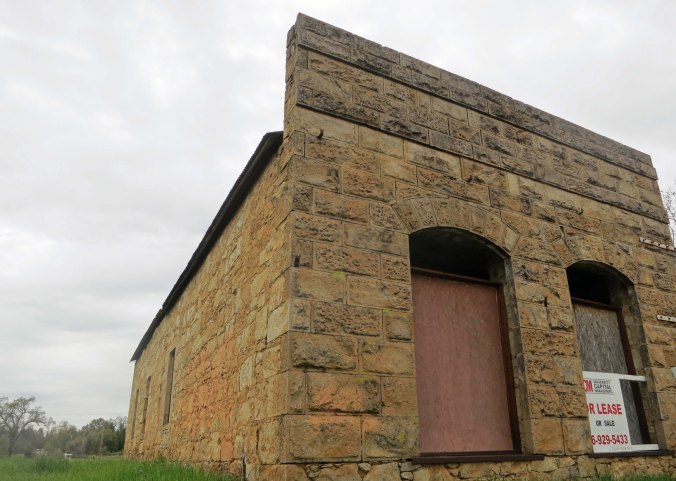
This beautiful old gold rush era building is about a 100 yards away from our house.

This beautiful old gold rush era building is about a 100 yards away from our house. The school was a block beyond it.

Tony Pavy lived just outside of Diamond on the road to El Dorado. As I cycled past it, I was reminded of the time he threatened to shoot me with a shotgun.

Tony Pavy lived just outside of Diamond on the road to El Dorado. As I cycled past it, I was reminded of the time he threatened to shoot me with a shotgun. We’d been hunting squirrels near his property when a bullet ricocheted and took out his pig. “Get my gun, Mama. They shot my pig!” he had screamed. We figured he wasn’t in much of a mood for an explanation and hightailed it. When the sheriff caught up with us later we had a good alibi.

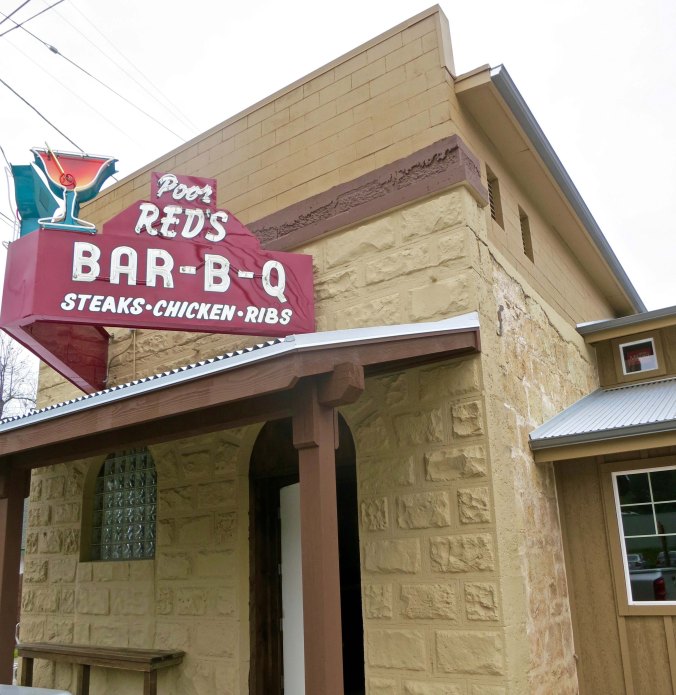
Poor Red is long since dead but his Bar-B-Q restaurant lives on in Eldorado, an historic eatery from the 1940s well-known throughout Northern California.

Poor Red is long since dead but his Bar-B-Q restaurant lives on, an historic eatery from the 1940s well-known throughout Northern California. I consumed many a rib and Golden Cadillac there. I forget the ingredients of Golden Cadillacs but I do remember they tasted wonderful and after two, you didn’t care what was in them. Reds is in the small town of El Dorado, two miles outside of Diamond. I had turned left on my bike there and began making my way south.

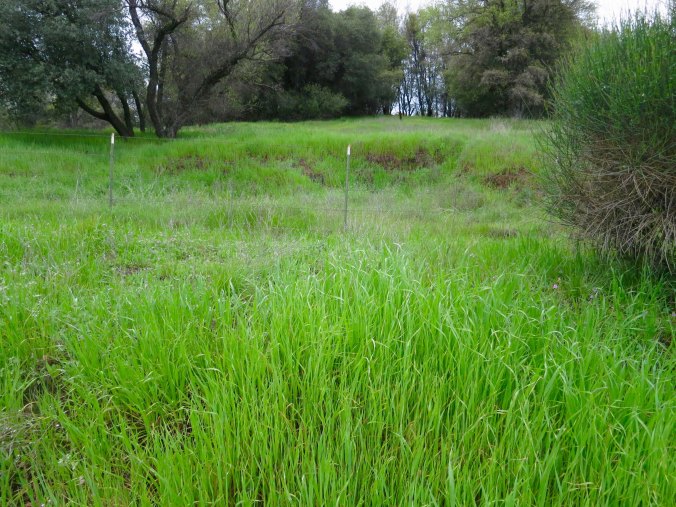
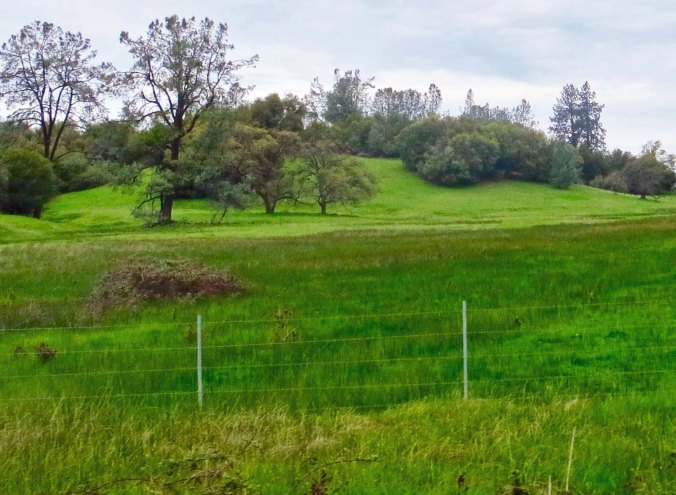
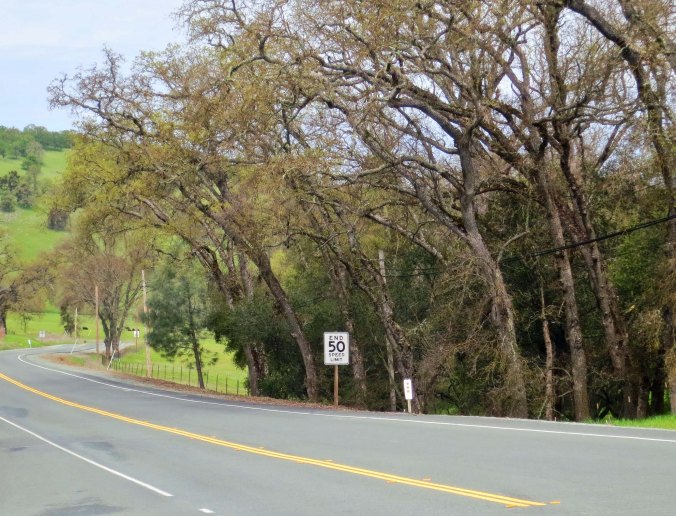
The foothills of California are beautiful in the springtime. Shortly after this Highway 49 began its steep, curvy descent to the Consumes.

The foothills of California are beautiful in the springtime. Shortly after this, Highway 49 begins its steep, curvy descent to the Consumes River. It was my first downhill.

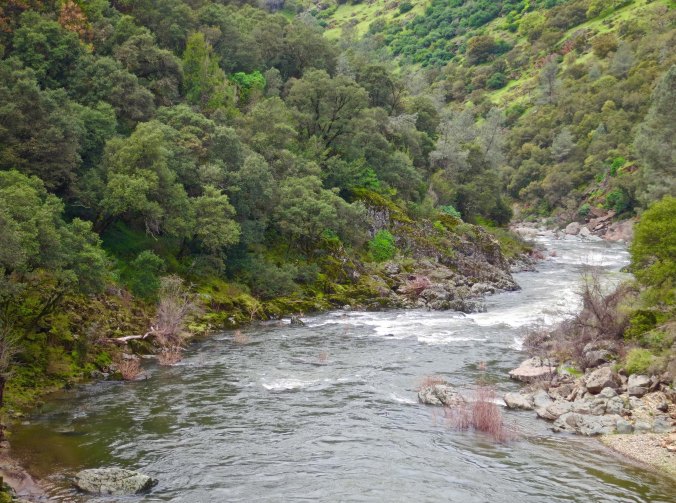
I once organized a student strike so we could have a ditch day as seniors. I wasn't expelled and we got the day. We held our party on the Consumnes River a couple of miles upstream from this photo. I had stopped for lunch at a small greasy spoon restaurant along the river on my bike and was kept company by a cat and a drunk. "You are fucking crazy," he had told me when he learned of my journey.

I once organized a student strike so we could have a ditch day as seniors. I wasn’t expelled and we got the day. We held our party on the Consumnes River a couple of miles upstream from this photo. I had stopped for lunch at a small greasy spoon restaurant along the river on my bike trip and was kept company by a cat and a drunk. “You are fucking crazy,” the drunk had told me when he learned of my journey. Maybe.

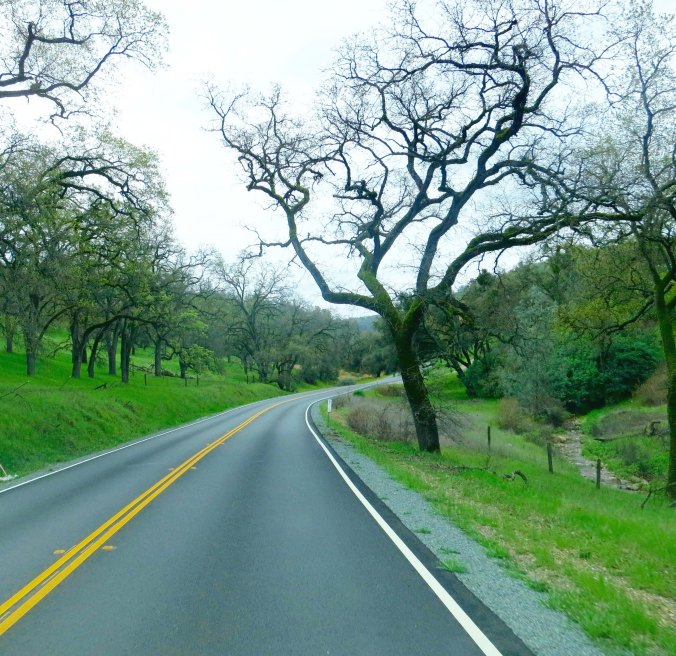
This is an historic spot. I was on my first ever official date. Mom, boyfriend, and Paula had taken me with them to dinner in Sutter Creek. On the way back, boyfriend and Mom had climbed in the back and insisted I drive home. "But I just got my learner's permit last week," I pointed out. I was just beginning to gain confidence when I ran over the skunk here.

This is an historic spot dead skunk spot. I was on my first ever official date. Mom, boyfriend, and Paula had taken me with them to dinner in Sutter Creek. On the way back, boyfriend and Mom had climbed in the back and insisted I drive home. “But I just got my learner’s permit last week,” I pointed out. Didn’t matter. I was just beginning to gain confidence when I ran over the skunk.

I made it 18.3 days on day one and stopped at Old Dry Well Motel and Cafe in Dry Creek. My plan for the next day was to make it 30 miles! The world had other plans for me.

I made it 18.3 miles on day one and stopped at Old Well Motel and Cafe in Dry Creek. Old stories report that outlaws once buried thousands of dollars here. My plan for the next day was to make it 30 miles! The world had other plans…

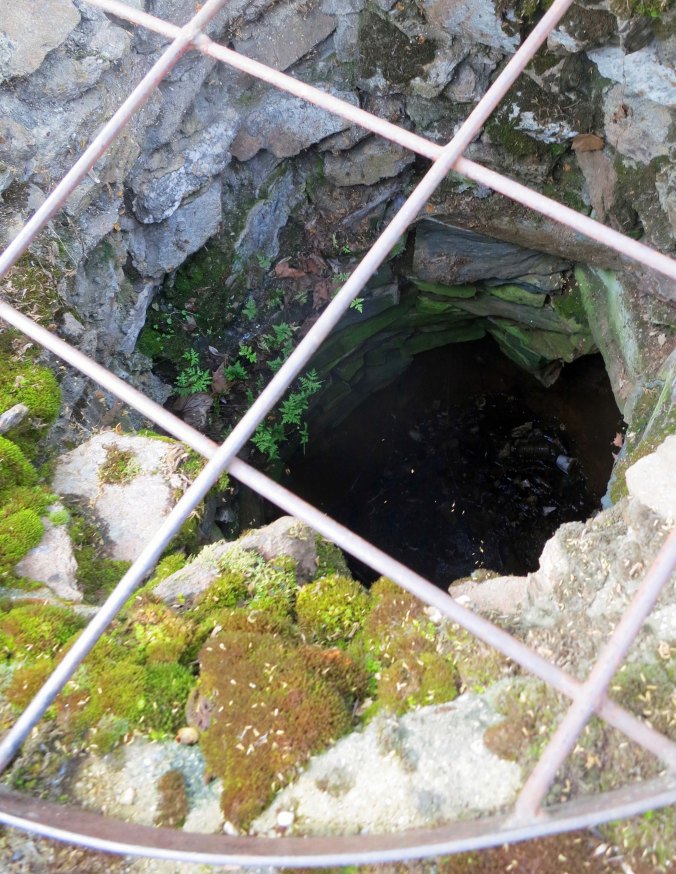
A photo of the well.

A photo of the well. Another relic from the Gold Rush.

Peggy has volunteered to drive the whole trip so I can take photos and write notes. What a woman! Eeyore, another of our travel companions peers out the back window.

Peggy has volunteered to drive the whole trip so I can take photos and write notes. What a woman! Eeyore, another of our travel companions, peers out the back window. The world famous traveling Bone is seated up front.

NEXT BLOG: I will introduce Bone. You probably already know Eeyore.


Is Insanity a Requirement for Bicycling 10,000 miles?

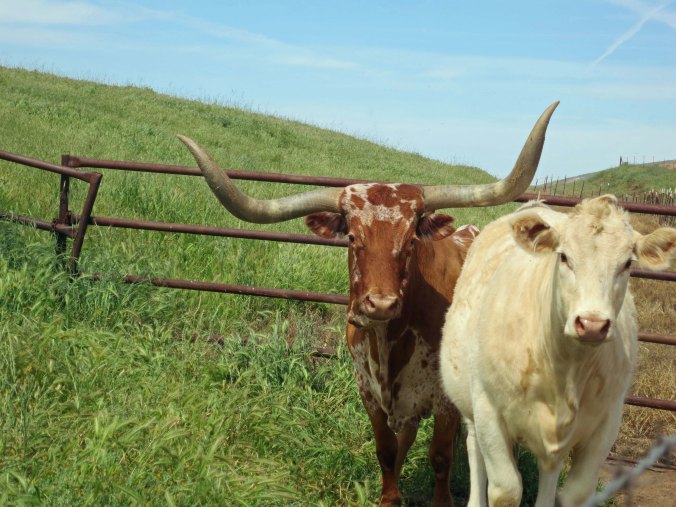
You can get lonely when you are out on the road. I'd moo at cattle along the way for entertainment. They always turned to look, and would often moo back.

You can get lonely when you are out on the road by yourself. I’d moo at cattle along the way for entertainment. They always turned to look, and would often moo back.

Bilbo’s advice: “It’s a dangerous business, Frodo, going out your door. You step onto the road, and if you don’t keep your feet, there’s no knowing where you might be swept off to.”

I was out of the saddle, climbing the steepest hill in Nova Scotia, and grumpy. A couple of friends from California had joined me on a bicycle trip around the province. They were sailing up the mountain and having a merry conversation while I could barely grunt. They were both college track coaches and strong, women athletes. But they hadn’t just bicycled across the US; in fact, they had hardly bicycled at all. What they had that I didn’t were gear clusters on their bikes that made mine look like a one speed. Eventually I made it to the top of the mountain and was greeted by two Cheshire Cat grins and a giggle. On the side of the road a bicyclist had painted a bicycle with the word “WHY?” stenciled next to it.  Having been left in the dust, I could only wonder…

Not many people decide to leave home and go on a six month, solo bike trek. In fact, not many people have the option or, I might add, the desire. But I didn’t have a wife, I didn’t have any children, and I had a solid job offer if I chose to return. I was ready for adventure.

This doesn’t mean that folks were urging me out the door. Three or four women were hoping I would stick around and change my marital status. (This was pre-Peggy.) The legislative advocate for the California Lung Association wanted me hang around and work on the implementation legislation for the tobacco tax initiative we had just passed. My sister Nancy was quite concerned about all of the terrible things that might happen to me out on the road. (My bother, Marshall, thought I should carry a pistol.) Etc.

There were good reasons for staying. They just weren’t as strong as my reasons for leaving. Here are three that I had noted in my journal way back then:

  1. The physical journey— I wanted the experience of travelling, seeing new things, and meeting new people. I love to wander. Going anywhere, anytime, excites me. I think it is genetic. I could have been an early explorer. I would be living in the outdoors, a plus for me, and seeing the US and Canada in a way that few people do. And finally, the trip would be good for me from a health perspective. I was 46 years old and in serious need of a tune up.
  2. An internal journey back in time— I wanted to know more about what drove me. I don’t handle stress well. It drives me bonkers. All too often it had led to depression and could become debilitating to the point where escape was the only solution. I’d run off to the woods to lick my wounds. Even doing things I was good at and enjoyed in time came to resemble a cage I was trapped in. By learning more about what drove me, possibly I could learn to be more in the driver’s seat.
  3. A quest— I am not particularly religious, but I do have a spiritual side. I pictured myself meditating for long stretches as I pedaled for thousands of miles along North America’s highways and byways. Who knows where it would lead me? I carried books like the Tao Te Ching and Bhagavad Gita for inspiration. A friend had even given me a copy of the New Testament.

A Bit on Preparation:

I joked in my last blog about preparing for my trip by increasing my beer consumption from one to two cans a night. There was a bit of truth to that. I did little (nothing) to prepare physically for the adventure. Unfortunately, I had learned from a long history of backpacking expeditions that I could get away with it. (For example: my backpacking trip into the Grand Canyon.) Once my body figures out there are no other options, it reluctantly gets in shape, whining the whole time.

I am a bit more anal about equipment. I would be bicycling for thousands of miles by myself, sometimes in remote regions with the nearest bike shop a hundred (or more) miles away. Even small towns are far apart in America’s great desert regions of the Southwest and up in the vast forest lands of northern Quebec. So I needed a good bike, and I needed to carry enough tools and parts to make repairs along the way. (At least until I could find a bike shop.) My friends in the bicycling business provided good recommendations. As for living outdoors, my backpacking experience made me something of an expert on what was needed to survive in almost any condition nature might throw at me. (The tornado was an exception.)

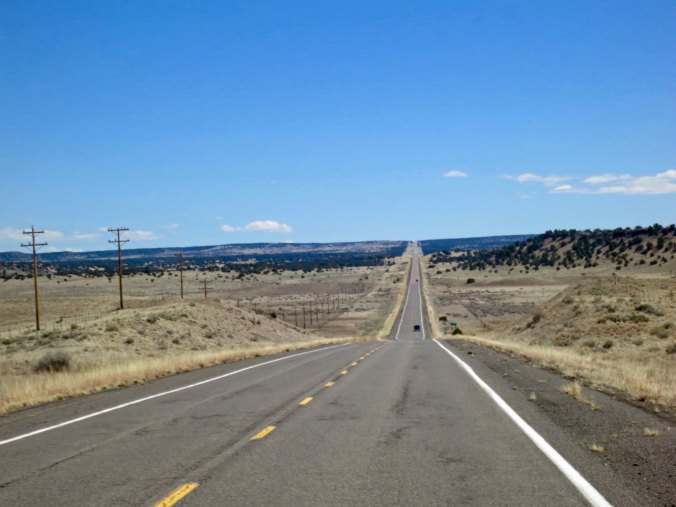
Do you have any idea how many remote, lonely roads there are in America and Canada. I found many of them on my bicycle. They did have a way of going on and on...

Do you have any idea how many remote, lonely roads there are in America and Canada? I found many of them on my bicycle. This one in Arizona went on and on.

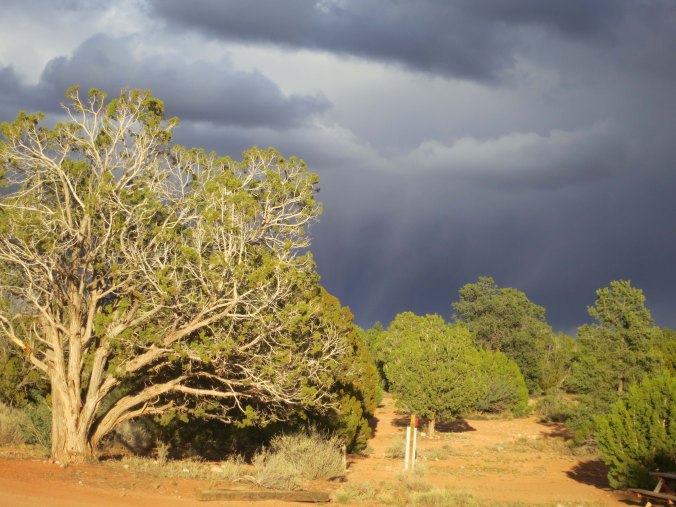
Threatening skies along Route 66

Threatening skies suggest that traveling the interesting and historic Route 66 was about to get more interesting.

Was this rustic accommodation a chance for shelter?

Was this rustic accommodation a chance for shelter? In an emergency, almost anything served as ‘a port in the storm.’ I would end up hiding out from a tornado in a brick outhouse in Mississippi.

I spent hours studying maps and planning my route. It was a blast. Most people who travel a lot (including many who read this blog) will likely agree with me that planning is half the fun. My goals included avoiding cities, staying off of major highways, and visiting remote areas whenever possible. I was not interested in following someone else’s recommended bike route.  I prepared copies of my proposed route for friends and family but added a cautionary note: “This route is tentative. I may find myself out there making changes for any number of reasons.” The original length of the journey was 11, 309 miles. I made my first change at 28.6 miles.

And finally, a note on bicycling. There are bicyclists and there are “bicyclists.” Bicyclists are passionate about the sport. Whether they race, tour, or commute by bike, they talk the talk and wear the clothes. They love their bikes. They have a certain lean look. Most (but not all) think of bicycling as a communal sport. I’ve done a lot in bicycling. I commuted by bike for several years, organized Sacramento’s first conference on bike commuting, and was responsible for creating the American Lung Association’s bike trek program. I even led and rode on a number of 500-mile bike treks. But, at heart, I am a “bicyclist.” My bike is simply a means of getting from point a to point b, hopefully without any mechanical problems. Still, for those passionate bicyclists who want to follow me on my journey, I will confess that I talked with my bike, Blue, as I crossed the country. Maybe there is hope.

Serious bicyclists  wear bright clothes. They want to be seen. I bicycled through Death Valley on my trip. I found this jersey there a couple of weeks ago.

Serious bicyclists wear bright clothes. They want to be seen. I bicycled through Death Valley on my trip. I found this jersey there a couple of weeks ago.

I’ll close with a couple more photos to emphasize why a bit of insanity is valuable for long distance bike trips.

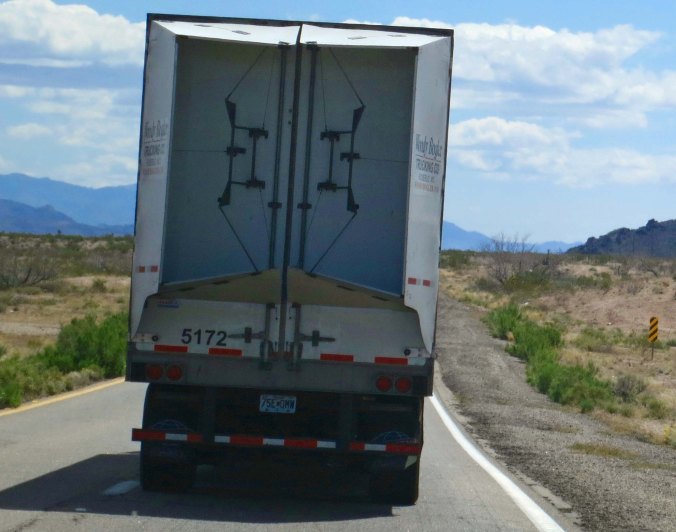
Big rigs traveling 60 miles per hour on narrow roads with no shoulders tended to elevate my heart rate, especially when they chose to come up behind me and honk their horns. (Most were quite courteous.)

Big rigs traveling 70 miles per hour on narrow roads with no shoulders tended to elevate my heart rate, especially when they chose to come up behind me and honk their horns. (Most were quite courteous.)

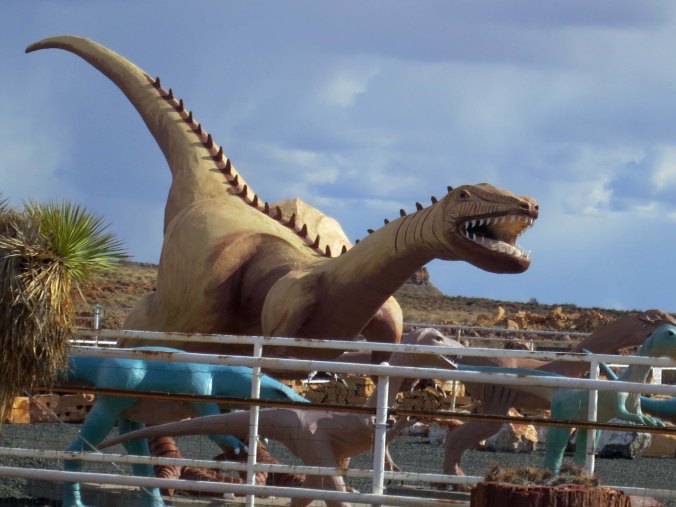
I ran into dogs that were about as big as this dinosaur and wanted to eat me.

I ran into dogs that were about as big as this dinosaur and wanted to eat me.

NEXT BLOG: Join me in Diamond Springs, Northern California as I climb on my bike, coast down my first hill, and discover I can’t pedal because I have put my panniers (bike bags) are on backwards.

A Ten Thousand Mile Bike Trip… Let the Journey Begin

28 years ago, after wrapping up my part in increasing California's tobacco tax, I decided to go on a 10,000 mile bike trip around North America. Peggy and I are now redrawing the route.

28 years ago, after wrapping up my part in increasing California’s tobacco tax, I decided to go on a 10,000 mile bike trip around North America. Peggy and I are now driving the route. Peggy first met me when I stepped off my bike in Sacramento. She said I looked svelte and seemed to appreciate my tight bicycling clothes. Having been by myself for six months, I immediately fell in love.

It had been an exciting night at the Proposition 99 Campaign Headquarters in Sacramento. The tobacco industry had just spent $25 million ($56 million in today’s dollars) trying to defeat our efforts to increase California’s tax on tobacco, which, up to that point, was more than it had spent on any single political campaign in its history. The industry regarded our efforts as the most serious threat it had ever faced, not because we were increasing the tax, but because we were proposing to spend a significant amount of money on prevention. It had hired some of the best political operatives in the nation, including Ronald Reagan’s former media director— and, it had run the kind of campaign you might expect from an industry that had made billions off of successfully marketing a deadly, highly addictive drug to children.

The prevention part of the equation had been my idea. If we succeeded, we would embark on one of the most extensive prevention program ever, anywhere in the world. The industry was right to be worried. And we were right to be nervous. As the full force of the industry’s campaign had come to fruition in the last week before the election, we had seen our once comfortable lead drop to .05%.

But the night was ours. Heroic efforts by our friends in the health and environmental communities, including my future sister-in-law, Jane Hagedorn, made the difference. Early returns showed us leading. Later returns showed that we had won. I gave a talk on the power of a small group to take on one of the world’s most powerful industries and win. I then led the group in a series of cheers as the TV camera’s rolled. I ended my night by consuming more alcohol than a health advocate should. Jane drove me home.

California’s health community went on to prove that prevention works. The state moved from having the second highest incidence of tobacco use in the nation to the second lowest. Five years ago the California Department of Health estimated that over one million lives and $70 billion in health care costs had been saved to date.

The Proposition 99 battle was won in 1988, over a quarter of century ago. Ancient history now— except it relates to the story I will be telling on this blog for the next 2-3 months. The campaign wrapped up an important chapter of my life, and it left me with a question: what would I do next? I decided to buy a bike and go on a solo, six-month, 10,000-mile bike ride around the US and Canada. It was a completely reasonable decision, right… kind of like taking on the tobacco industry. So I went out and did it.
And this brings us to the present. I earned a huge number of husband brownie points last year— billions of them. I spent lots of time with kids and grandkids, supported Peggy’s various efforts to improve our community, and did many manly chores around our property. The wife was impressed. She made a mistake. “Next year is yours, Curt,” she announced. “What would you like to do?” It was like a blank check. I got a wild look in my eye and (before she could reconsider), tossed out, “Take our van and follow the route of my North American bike tour… for starters.”

That’s the reason Peggy and I are sitting in a Big O Tire store now in Roswell, New Mexico while Quivera, our van, has some work done. I am sure a UFO is circling above us, the same UFO that caused us to have a blow-out last night.

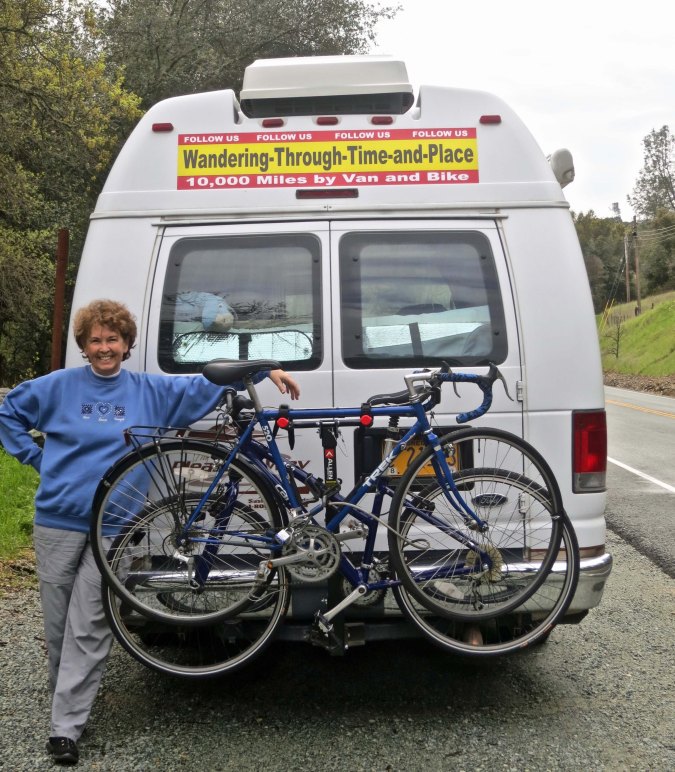
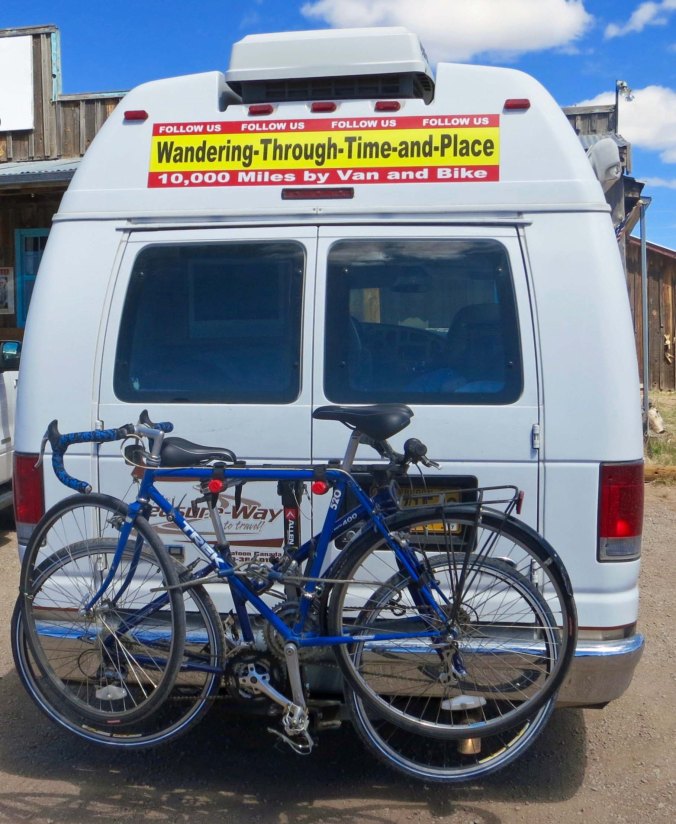
Quivera, the Van. We put a sing on Quivera to encourage people to follow my blog. The blue bike on the outside is the bike I rode around North America.
Quivera, the Van. We put a sign on Quivera to encourage people to follow my blog. The blue Trek bike (creatively named Blue) is the bike I rode around North America.
We were quite amused by the sink in the Big O Tire restroom.

We were quite amused by the sink in the Big O Tire restroom.

Even the toilet paper dispenser followed the theme.

Even the toilet paper dispenser followed the theme.

The staff at Big O was great. Putting new shocks on Quivera was a massive challenge. She is not mechanic-friendly. The mechanic on the left worked diligently. The front desk man helped us maintain our sense of humor. "Twenty more minutes" he told us several times.

The Roswell staff at Big O was great. Putting new shocks on Quivera was a massive challenge. She is not mechanic-friendly and objects to people working on her undercarriage. The mechanic on the left was one of three who worked diligently on her. (He is trying hard to smile.) The front desk manager helped us maintain our sense of humor. “Twenty more minutes” he told us numerous times.

Starting with my next blog, I will take you back to the beginning of my bike trek in Diamond Springs, California. I’ll talk more about my reasons for the trip and I will outline the extensive preparation it takes for such an adventure: I increased my nightly consumption of beer from one to two cans.

The blog will cover both my original journey and our present journey by van. For example, here’s what we have done in the past couple of days:

  • Visited a small town museum in Springerville, Arizona that included a Rembrandt among its treasures that could probably buy the town, or maybe the whole county.
  • Stopped off in Pie Town on the crest of the Rockies that is nationally famed for the pies it sells. The owner, who once gave me a free piece of pie, came out to have her photo taken with Peggy, me, Quivera and our bikes. (Crossing the Rockies was my first 100-mile day on the bike trip.)
  • Magically showed up at the annual open house for the Very Large Array of radio antenna/telescopes that have been featured in movies like Contact and Independence Day. Scientists from around the world compete for time on the radio telescopes. We were given a tour by a scientist who is looking back in time to the very beginning of the universe.
  • Contemplated the devastation created by nuclear bombs as we viewed the Trinity site where the first atom bomb ever was exploded.
  • Paid homage to Smokey the Bear by visiting his gravesite and singing his song. (Do you know it?)
  • Walked the streets of Lincoln where Billy the Kid fought in the Lincoln County range wars of the early West.
  • Kept a sharp eye out for UFOs as we drove in to Roswell.

And that’s just two days. My challenge will not be in finding things to write about! This is a back roads journey through America and Canada, a Blue Highways Adventure. I’ll give more details on my next blog, but to get you started, here is a rough map of the journey I made by bike and we are now making by van. Please join us.

This is the route I followed through the US and Canada. I began and ended my trip in Northern California.

This is the route I followed through the US and Canada. I began and ended my trip in Northern California.

Blog Hopping the World… with Curt and Peggy Mekemson

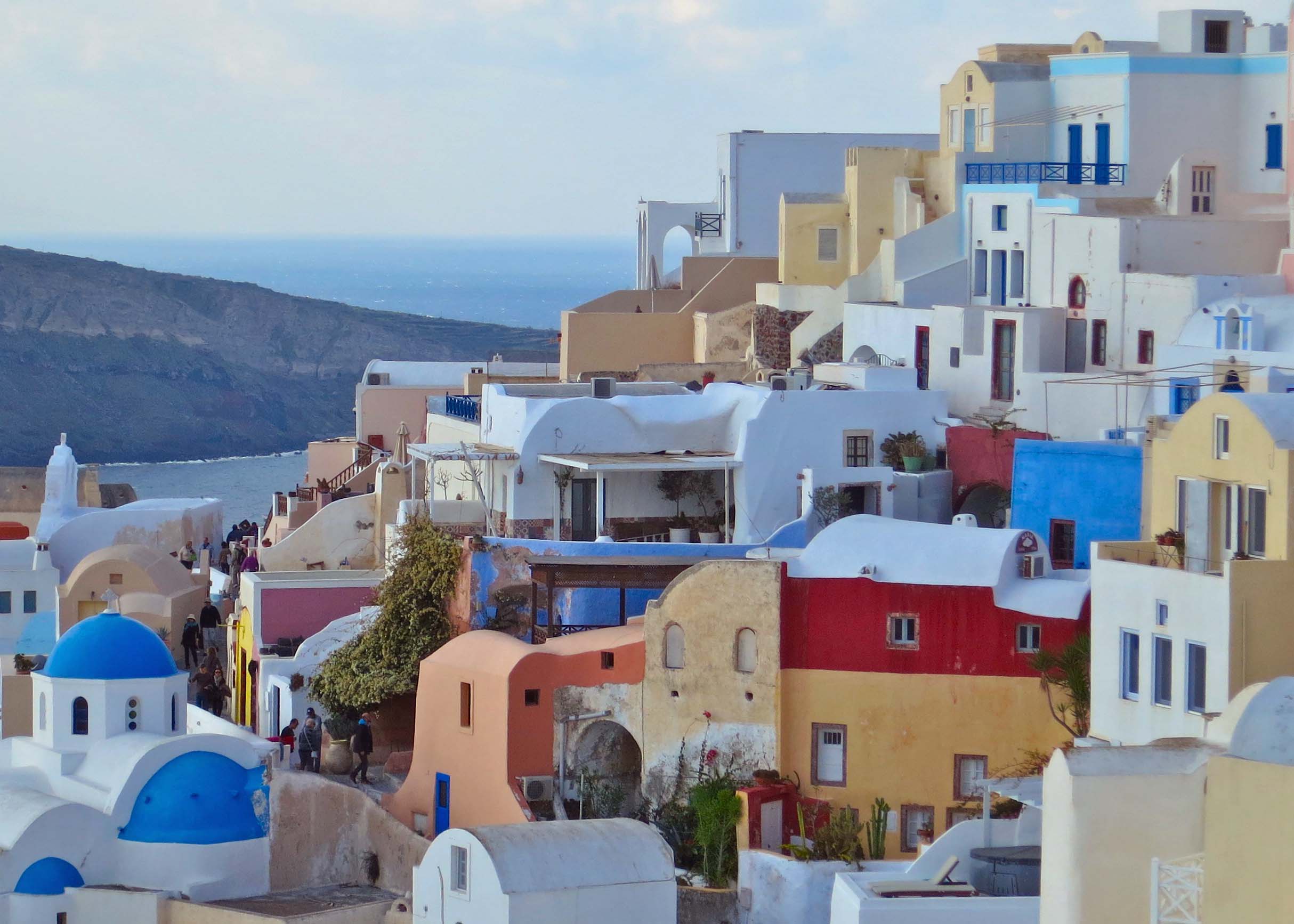
There are millions of beautiful photos of the Greek Island of Santorini, but none can match going there.

There are millions of beautiful photos of the Greek Island of Santorini, but none can match going there.

“There are travelers and then there are Travelers. If you take some time to review Curt’s lengthy résumé you’ll see what we mean: Peace Corps in Liberia, year after year at Burning Man, kayaking with orcas, and backpacking with the grizzlies. He walks the walk and his blog documents all of it.”

Travel Bloggers James and Terri Vance

"Now where did I leave that fish?" A big Kodiak Bear looks for salmon on the Frazer River of Kodiak Island.

“Now where did I leave that fish?” A big Kodiak Bear looks for salmon on the Frazer River of Kodiak Island. He was about 50 yards away from Peggy and me, a distance he could travel in 10 seconds. 1o, 9, 8,7…

A couple of weeks ago, two of my favorite world travelers, James and Terri Vance at Gallivance, nominated me to participate in what is called a “Behind the Scenes Blog Hop.” It’s a project making its way around the blogosphere where bloggers provide insight into why they blog. In this particular case, it was about people who travel frequently and write about their experiences. Go here to learn about what James and Terri have to say about their own journeys. I highly recommend following their blog if you don’t already.

The project sounded like fun but I was busy at the time. Today, I came up for air. Let me start by noting I am a wanderer by nature. I think it’s genetic. I’ve done a fair amount of genealogical research and discovered that my direct line of ancestors, at least as far as the 1600s, hit the road running and rarely looked back. As for me, as soon as I was allowed out of the house on my own, I set off to explore the fields, woods, ponds and creeks of the Sierra Nevada Mountain foothills where I grew up.

Why do you write what you write?

I am a storyteller and some of my best stories are about my travels and adventures. I believe that travel is one of the most enriching experiences we can have. Mark Twain said, “Twenty years from now you will be more disappointed by the things you didn’t do than by the ones you did do. So throw off the bowlines, sail away from the safe harbor. Catch the trade winds in your sails. Explore. Dream. Discover.” Explore, dream, discover: magical words that have always been my motto. Consequently, I have a lifetime full of wandering and very few regrets. My wife Peggy and I are wealthy with the experiences we have had.

And it is wealth we love to share— partially because it is fun to relive the adventures, but there is more. I hope to encourage those who read my blogs to “catch the trade winds in their sails.” And if not? I at least hope I can provide a taste of adventure, a dash of humor, a pinch of education, and on occasion, a serious thought.

There are two of other points I try to make with my travel writing. One, adventure travel doesn’t have to be expensive or difficult. Of course it can be, but it can also be a walk in the woods or a visit to a new restaurant. Anything that broadens our perspective on life can be an adventure. Just recently, for example, I wrote about a visit to a restaurant in Nashville that served really hot chicken. Believe me it was an adventure. And last year I wrote about a walk to my mailbox. It didn’t have to be an adventure, but I turned it into one.

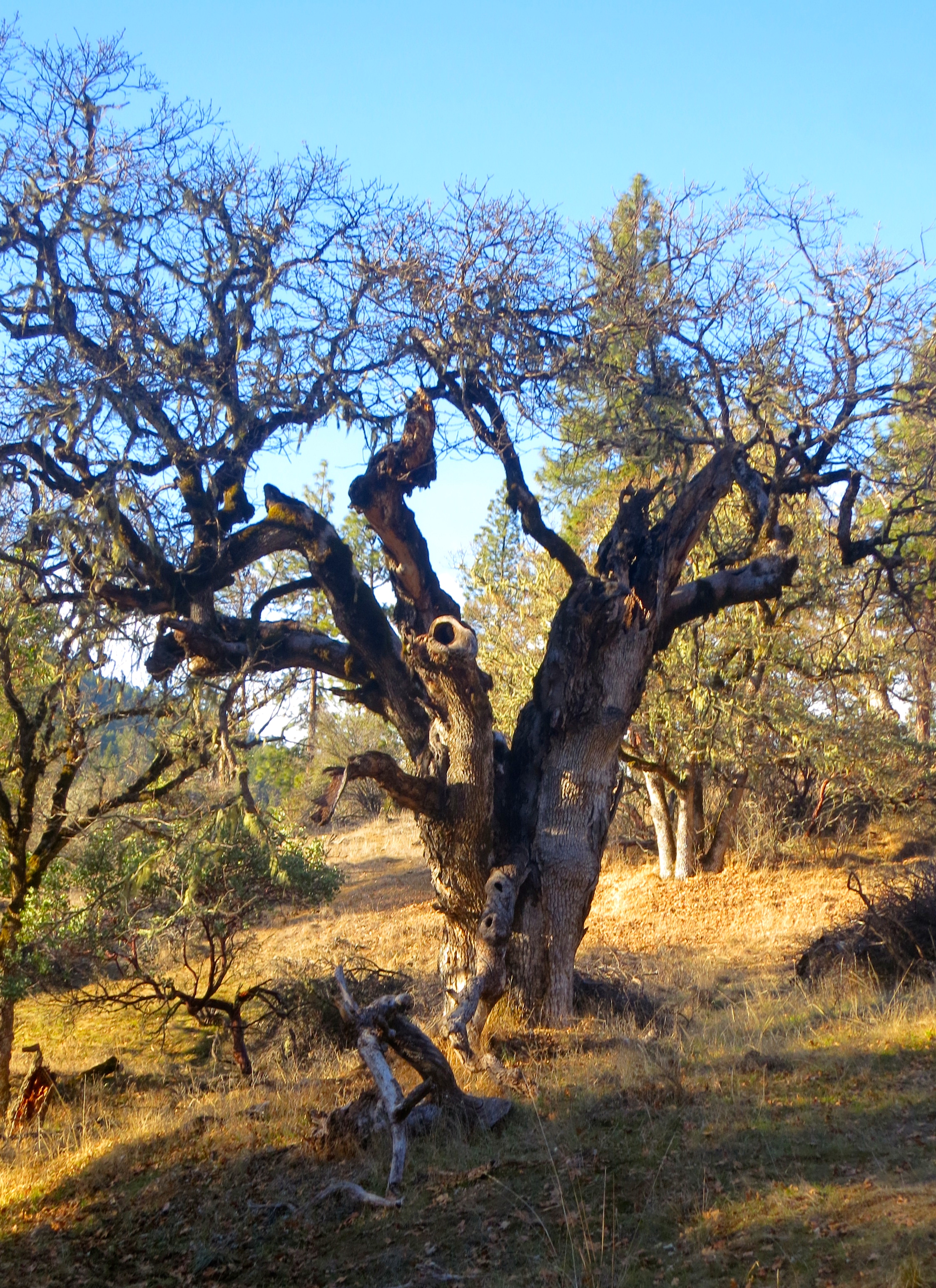
This oak tree lives along the path I walk to the mailbox.

This oak tree lives along the path I walk to the mailbox. In addition to having its own unique look, it serves as a home to a number of woodland creatures. A whole adventure could be built around watching it for 24 hours. I might add, this tree would be completely happy in the Hobbit.

Two, age does not have to be a barrier to travel. Peggy is big on this point. Young and old alike can have adventures. I am now in my 70s and Peggy is in her 60s and yet last year found us disappearing into a remote wilderness on a backpacking trip by ourselves, sea kayaking with the orcas off Vancouver Island, and going to Burning Man in the Nevada desert. If we can do these things, certainly people in their 50s, 40s, 30s and 20s can, not to mention 60s and 70s. And if you have children, take them along. You will create a lifetime of memories.

How does your blog differ from others of its genre?

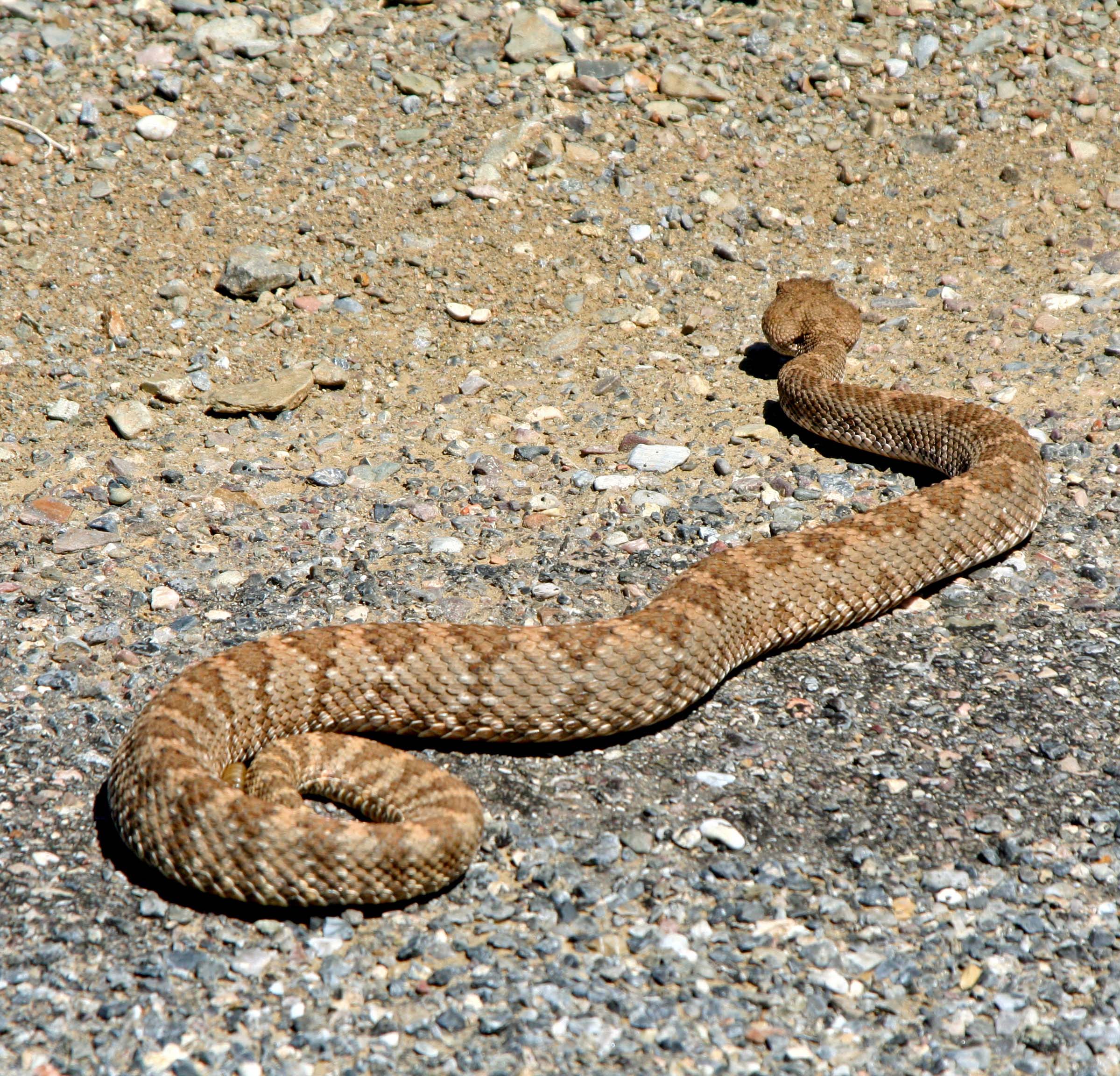
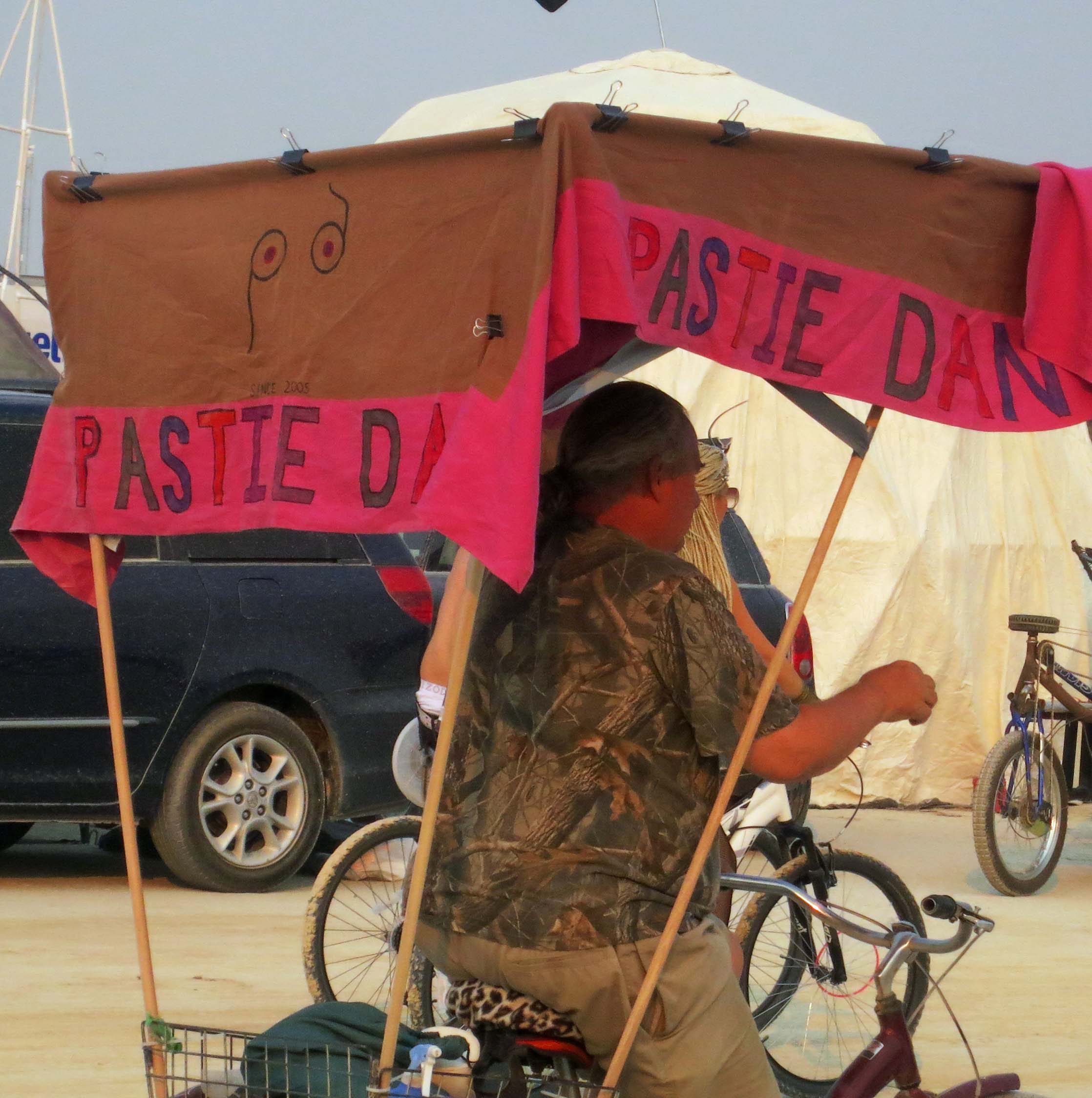
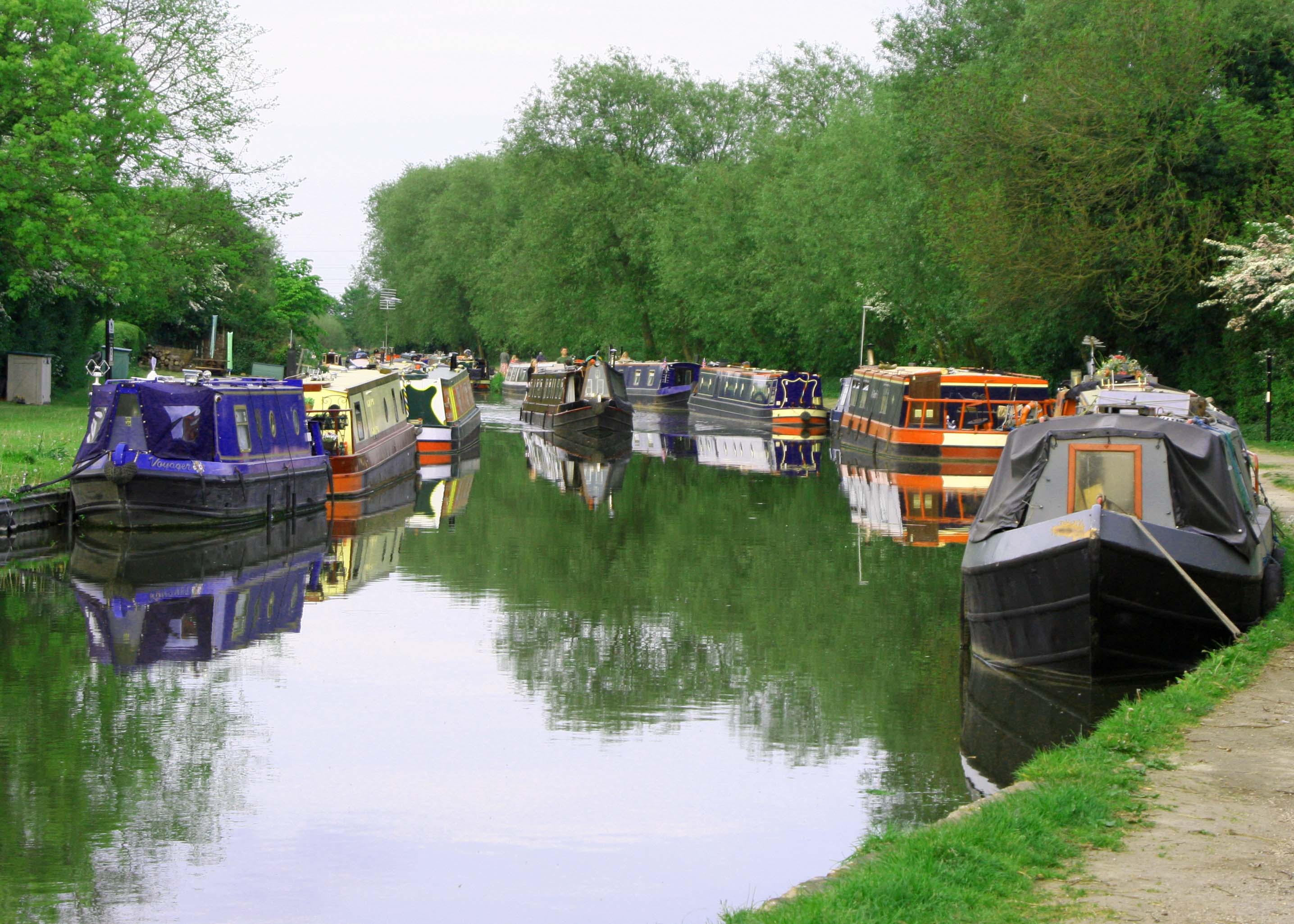
Variety comes to mind. One day I might be writing about cruising the Mediterranean Sea and visiting a Greek Island like Santorini. Another day I could be introducing you to Pastie Dan, a character at Burning Man who makes, and will gladly apply, pasties to cover women’s nipples. You might join me for a raft trip down the Colorado, a boat trip up the Amazon, or a narrow boat tour in England. Want a little excitement? Try waking up at 3 a.m. with a bear standing on your chest in the backcountry of Yosemite National Park. Then there was the rattlesnake that tried to bite me on the butt when I was doing my thing in the woods. My poor sphincter was frozen for a week. Want a touch of the exotic? Join Peggy and me as we search for Big Foot, UFOs and ghosts— it’s all in fun, and yet…

Panamint Rattlesnake in the Panamint Mountains, Death valley.

Admittedly, this guy is a little bigger than the rattlesnake that tried to bite me on the butt. With rattlesnakes, I am not sure size matters, however. (Photo by Peggy Mekemson.)

Bigfoot trap found above Applegate Lake in Southern Oregon.

This Bigfoot trap is located four miles from my home. It was maintained in the 70s in hopes of actually capturing one of the big fellows. (Photo by Peggy Mekemson.)

Pastie Dan in Black Rock City.

Normally Pastie Dan plies his trade at the Center Camp Cafe but occasionally, he wanders the roads of Black Rock City. He stopped at our camp to see if any of the women were in the market for pasties.

Maneuvering a 60 foot long Narrow Boat through the Trent and Mersey Canal in England two summers ago was a very different but equally rewarding experience.

Maneuvering a 60 foot long Narrow Boat through the Trent and Mersey Canal in England is a wonderful adventure that comes with pubs along the way.

How does your writing process work?

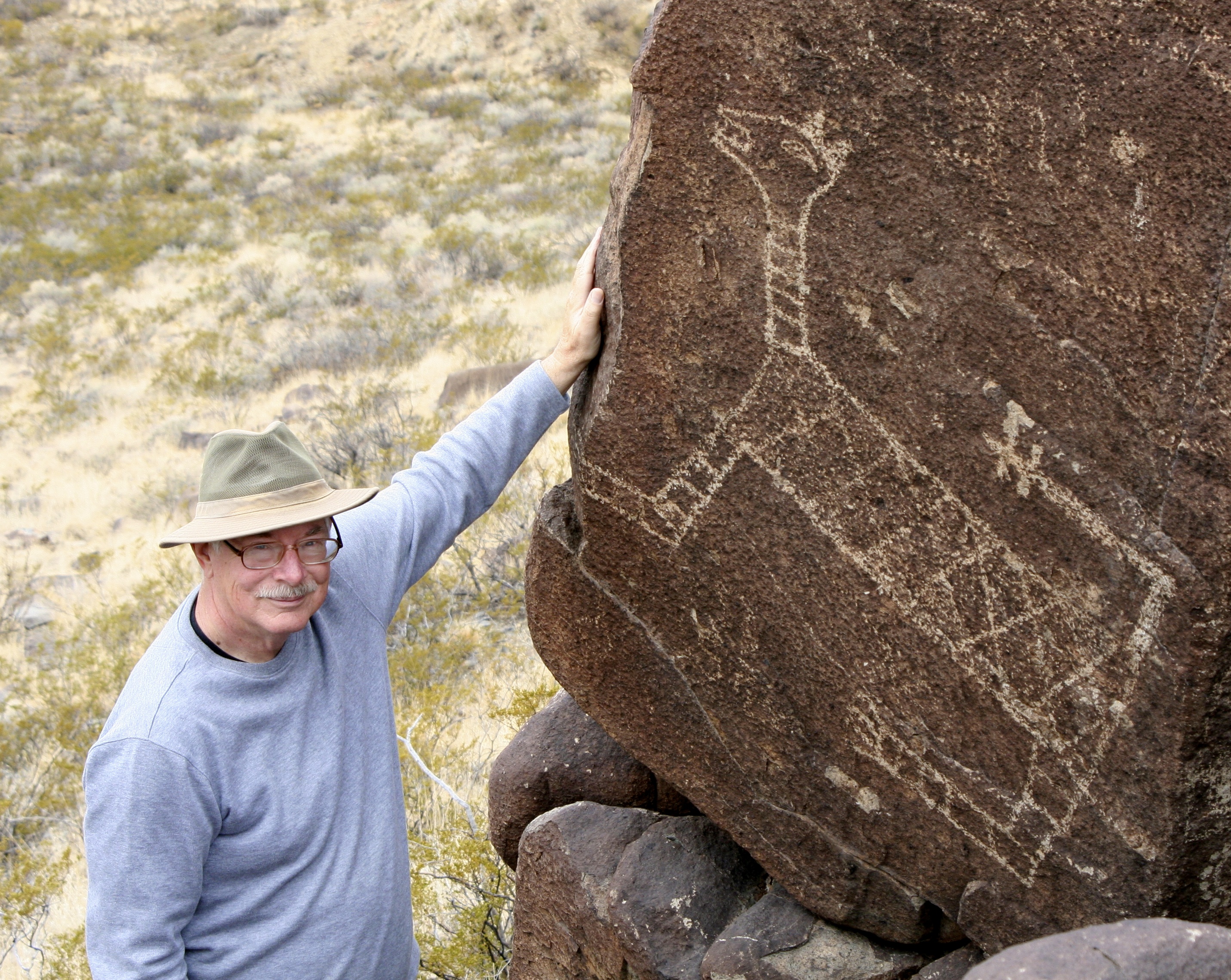
My stories start with experiences. I don’t scramble over rocks in New Mexico looking for petroglyphs because I want to write about the experience. I risk life and limb because I am fascinated with petroglyphs. I will confess, though, that when Peggy and I take photographs, we think about the blog— in addition to documenting our travels.

We call this large cat a cougar, mountain lion, puma… it would be interesting to know what the ancient Native American who made this rock art thought about and called his creation.

We call this large cat a cougar, mountain lion, puma… it would be interesting to know what the ancient Native American who made this rock art thought about and called his creation. (Photo by Peggy Mekemson.)

Research is also part of the process, either before we traipse off on an adventure because it enhances the experience, or afterwards because I want to add depth to what I am writing about.

As for the actual writing… writing is writing; it’s work. And I say this even though I love to write. I will normally think through what I want to write about, create a first draft, do a rewrite and then edit for mistakes. Then I turn it over to Peggy for further editing.

Photographs are also a very important part of my blogging. Between Peggy and me, we often have as many as 100 photos we have taken in relation to a particular blog. Ten to fifteen have to be selected out for a post and then processed. Mainly I work on cropping the photo to capture what I want, but I also make minor adjustments to light, color, shadows and sharpness if needed. Altogether, the process of creating a blog can take from three to eight hours.

What are you working on/writing?

I work from a calendar of blogs I want to write. I’ll usually have two or three months’ worth of blogs in mind. This time of the year, I often do several on Burning Man because many of my readers are Burners, excited about getting tickets. Since I have now been to Burning Man for ten years, I am going to do a best of ten series (from my perspective) of sculptures, mutant vehicles, burns, structures, etc. over the next few weeks. After that, I will return to my north coast series exploring the coast of Northern California, Oregon and Washington. Or I may do a series on California’s gold rush towns. (My home town was one.)

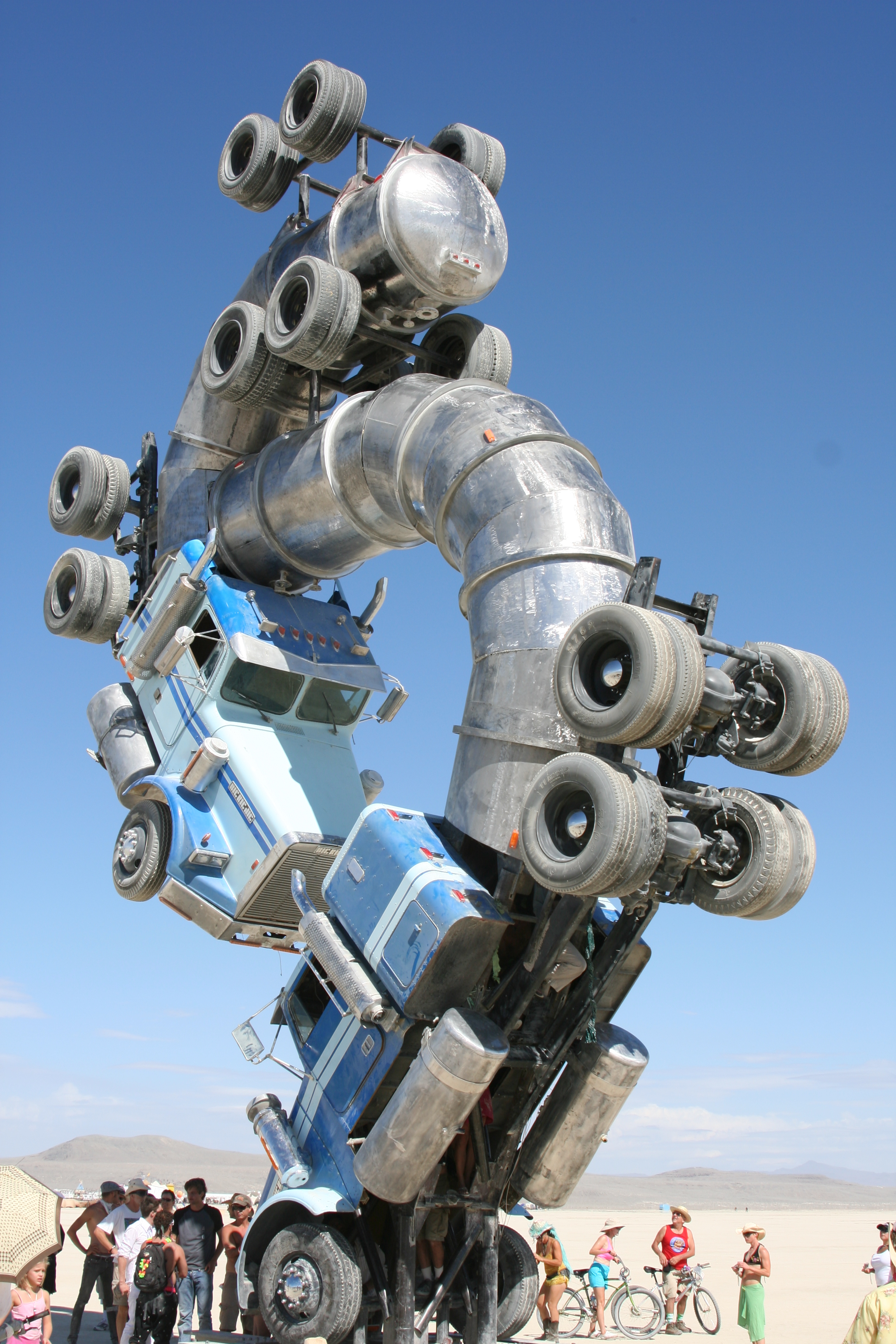
Two oil tankers provide an interesting Sculpture at Burning Man

One of my all-time favorite sculptures at Burning Man.

The really big writing project I have been working on has been the book about my Peace Corps experience in Liberia, West Africa: The Bush Devil Ate Sam. I’ve posted several chapters over the past couple of years on my blog and a number of you helped me select the title of the book. This is my first venture into self-publishing and let me say unequivocally and undeniably, it has been a steep learning curve (understatement). I wrapped up getting the book in to Bookbaby two months ago, or at least thought I did. Bookbaby dutifully put the book on numerous E-pub sites and sent me back printed copies I requested. And what did I discover? Even though Peggy and I had meticulously done a line-by-line edit, some 30 errors. Damn. (A woman who is really good at editing found 25 of them, friends and family others.) So it was back to the drawing boards. Anyway, I sent all the corrections in last Wednesday and also set up the print on demand option. Soon…

One good bit of news, Steven Spatz, the president of Bookbaby, wrote to me on Friday and said he would like to feature The Bush Devil Ate Sam this week on Bookbaby’s blog. Given that Bookbaby is one the largest self-publishing companies in the world, produces thousands of books, and has an excellent reputation, things are looking up. (And no, Steven is not going to use me as an example of how not to.)

Kpelle footbridge near Gbarnga, Liberia circa 1965.

When I graduated from UC Berkeley and travelled off to Liberia, West Africa as a Peace Corps Volunteer, I began one of the grandest adventures of my life. Once there, I continued to explore my surroundings by hiking off into the jungle. Here, I am standing on a bridge built by Kpelle villagers.

NOMINATIONS

As part of this process of blog hopping, we are asked to nominate two other bloggers to participate in the blog hop. This is tough; there are so many great bloggers I follow. But that said, here are my two nominations:

Linda at Shoreacres: Wow, this woman can write. While she isn’t exactly a travel blogger, I can guarantee she will take you on some great journeys. As a compliment to the posts she writes, her followers comment in paragraphs instead of sentences.

Cindy Knoke: Cindy takes you from her home in southern California, the Holler, to journeys around the world. Her photography, particularly in terms of birds and wildlife, is superb.


When Orcas Go Swimming By… British Columbia Sea Kayak Adventure: The Conclusion

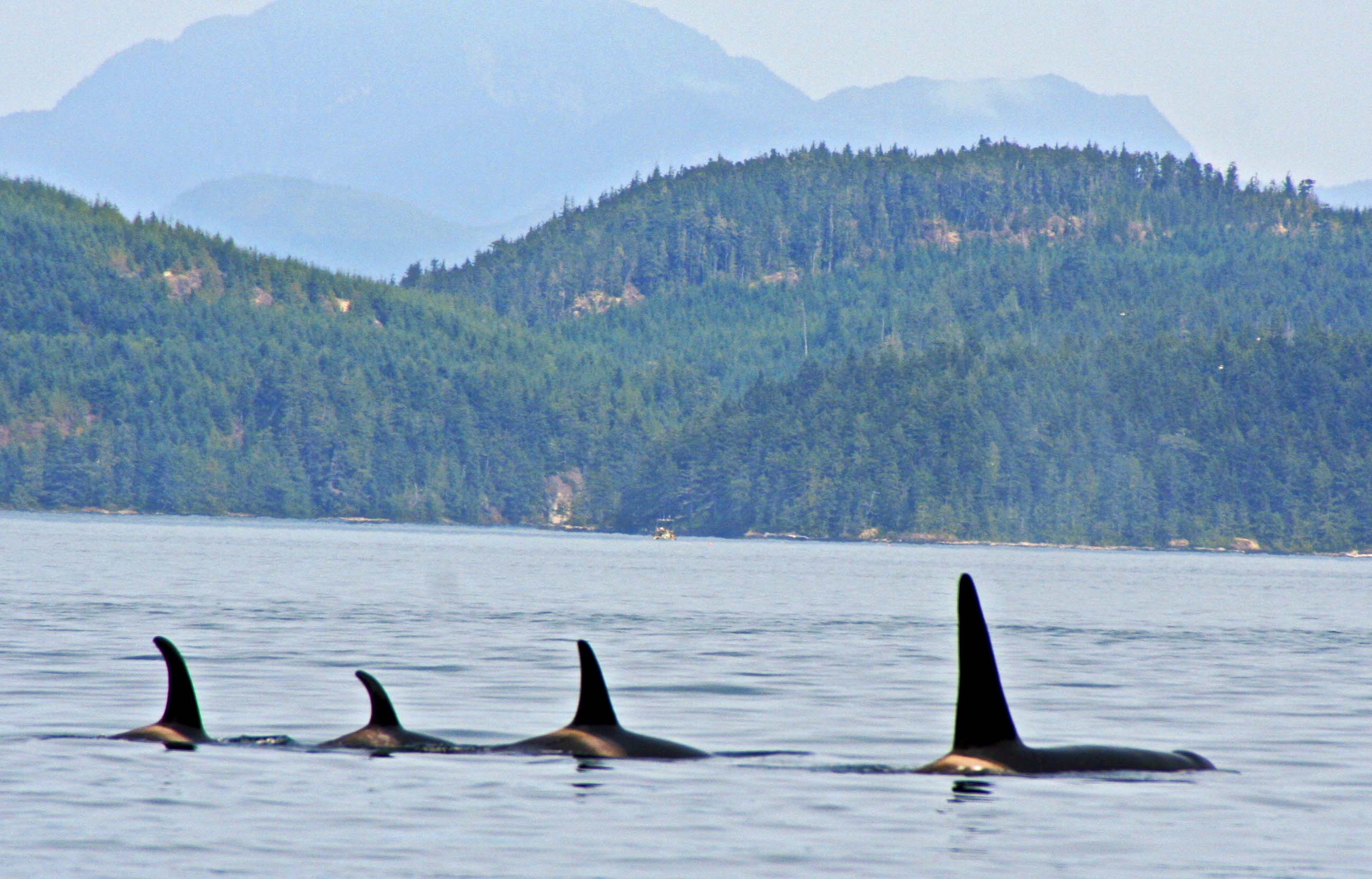
Orca family in Johnstone Strait, British Columbia.

We dropped what we were doing to watch the orca family pass by our campsite. (Photo by Peggy Mekemson.)

“Orcas!” Kimberly cried out, and we all went dashing for the beach with our cameras. Kimberly liked to perch on convenient logs and rocks, looking out at the Johnstone Strait. It gave her a front row seat on the action. I get it. I can stare out at the Pacific Ocean for hours— watching the waves roll in, listening to the lonely calls of seagulls, admiring the crazy antics of pelicans, and, yes, looking for whales.

Looking for orcas in Johnstone Strait, British Columbia.

Perched on a rock, Kimberly keeps a sharp eye out for orcas.

We had barely arrived at our campsite when the first family of orcas came swimming by. We were still in the middle of tucking our kayaks away in the forest above the tide line. Everything was dropped, including the kayaks. There were whales to see.

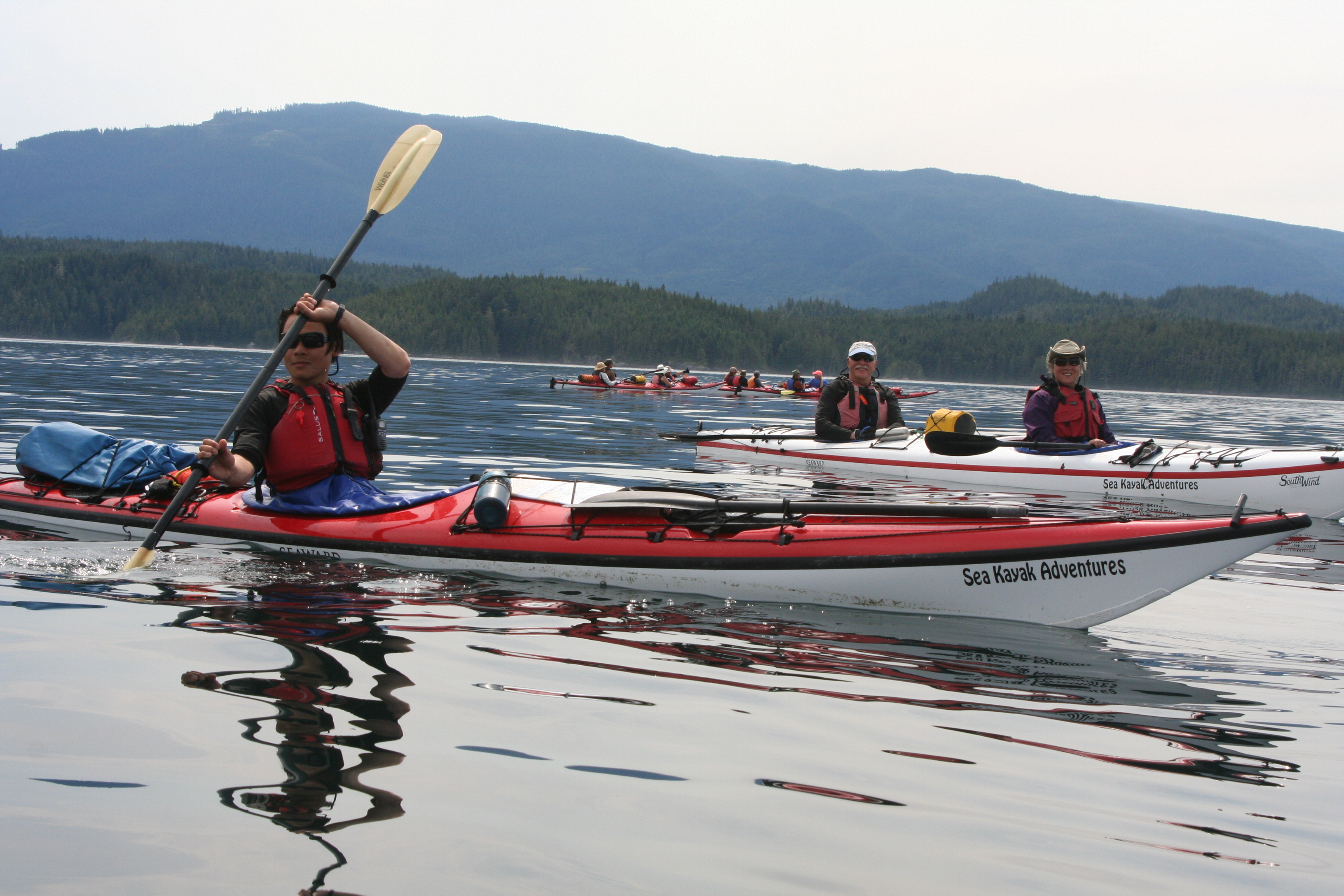
Sea Kayak Adventures group watches orcas in Johnstone Strait, BC. Photo by Curtis Mekemson.

The rallying cry of “Orcas!” sent everyone scrambling for a view.

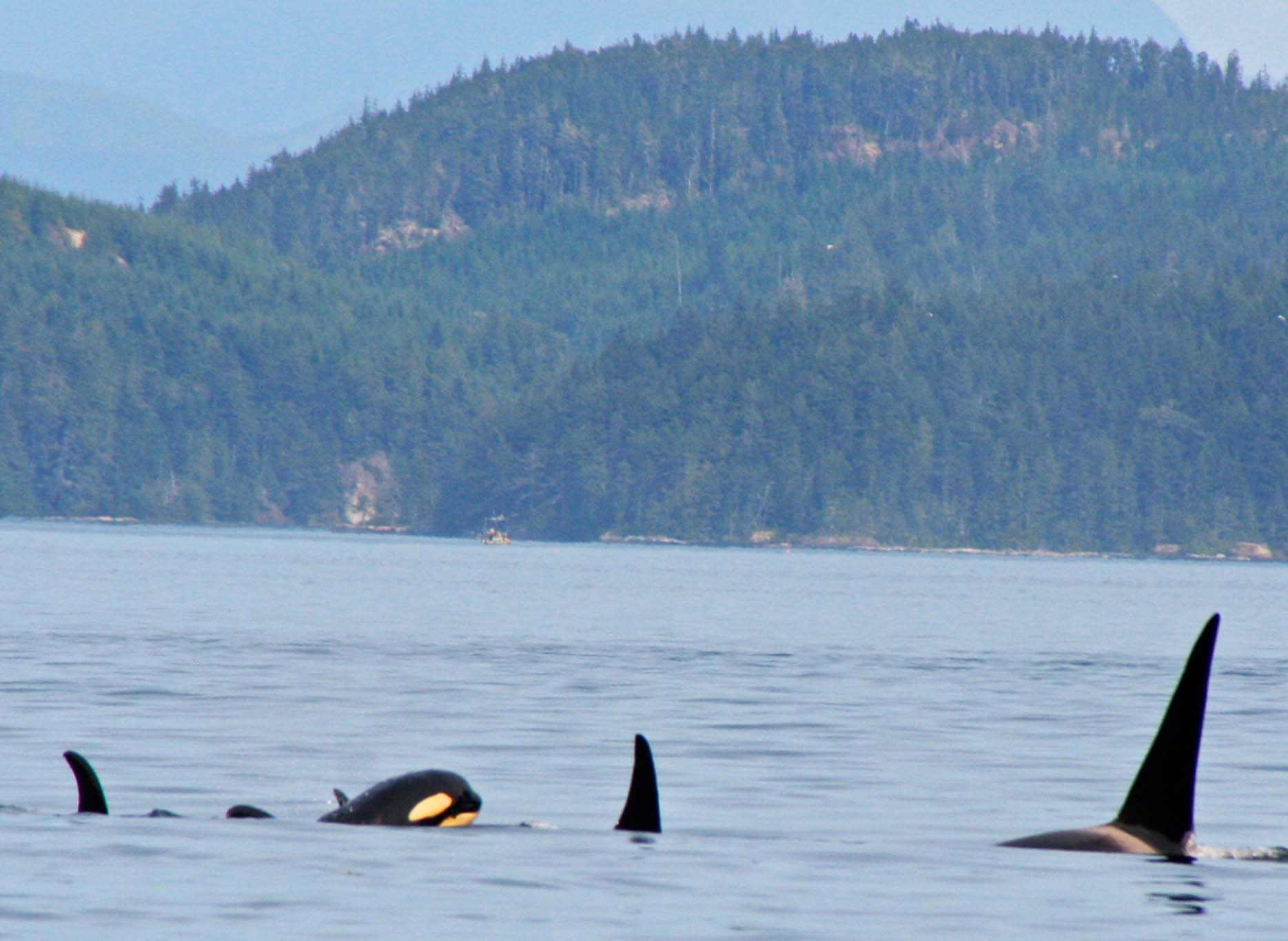
A baby orca surfaces in Johnstone Strait, BC.

A baby orca surfaces. Our reward for being vigilant. (Photo by Peggy Mekemson.)

This was our last campsite before heading home. Once again we had returned to Vancouver Island. We were located at Sea Kayak Adventures’ Little Kai Camp and would be there for two nights. Seeing orcas on our arrival was a good omen. We were happy campers. Not even the surround sound of fishing boats or a deluge of cold rain could dampen our spirits.

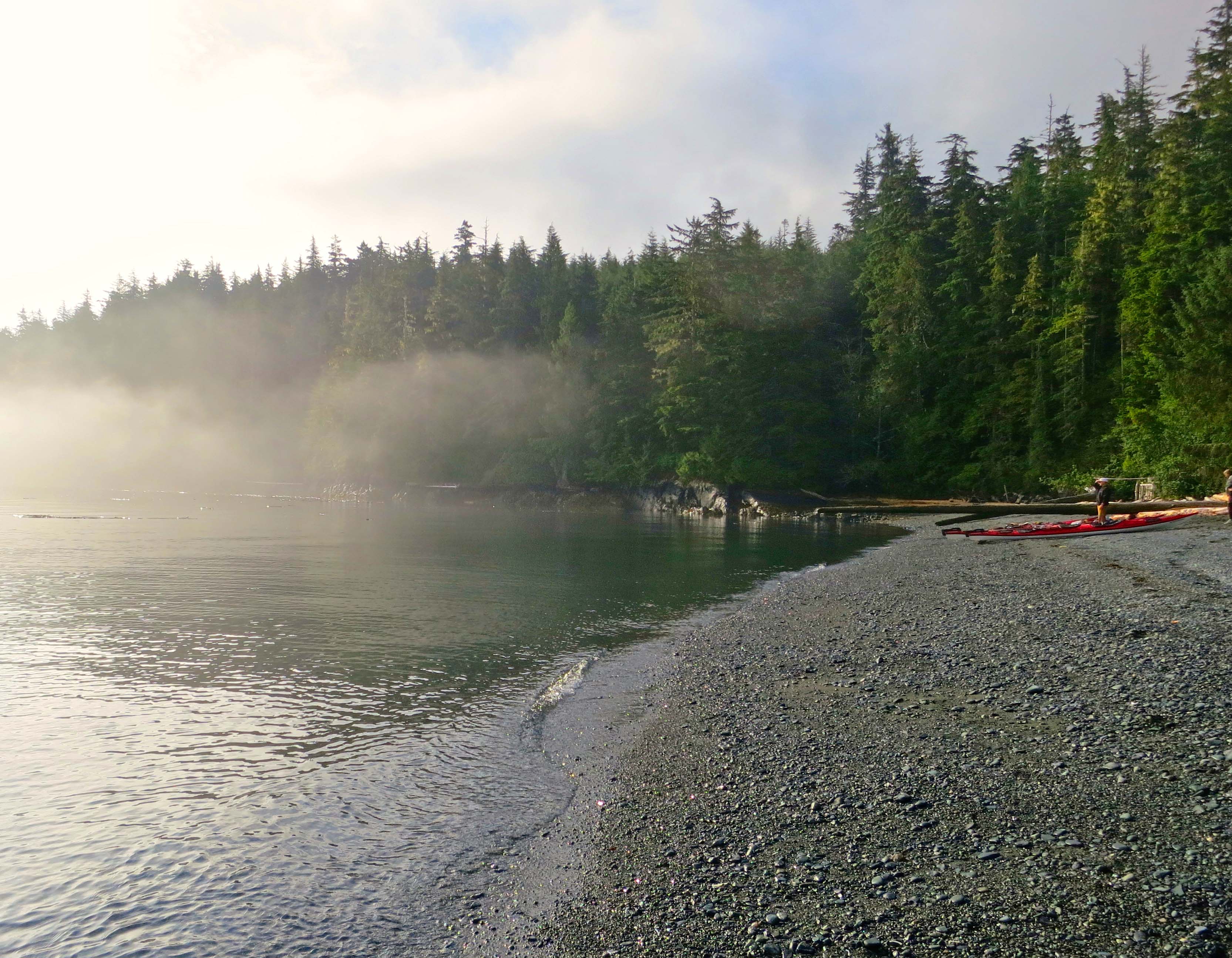
Beach at Little Kai Camp on Vancouver Island. and Johnstone Strait.

The beach at Little Kai camp.

Who can complain when surrounded by good people and beautiful scenery? But our trip was drawing to a close. After several more good meals, another kayak adventure, an evening of fun and story telling, and more orcas, it was time to pack up our kayaks and paddle back to Telegraph Cove. An orca gave us a final British Columbia send-off.

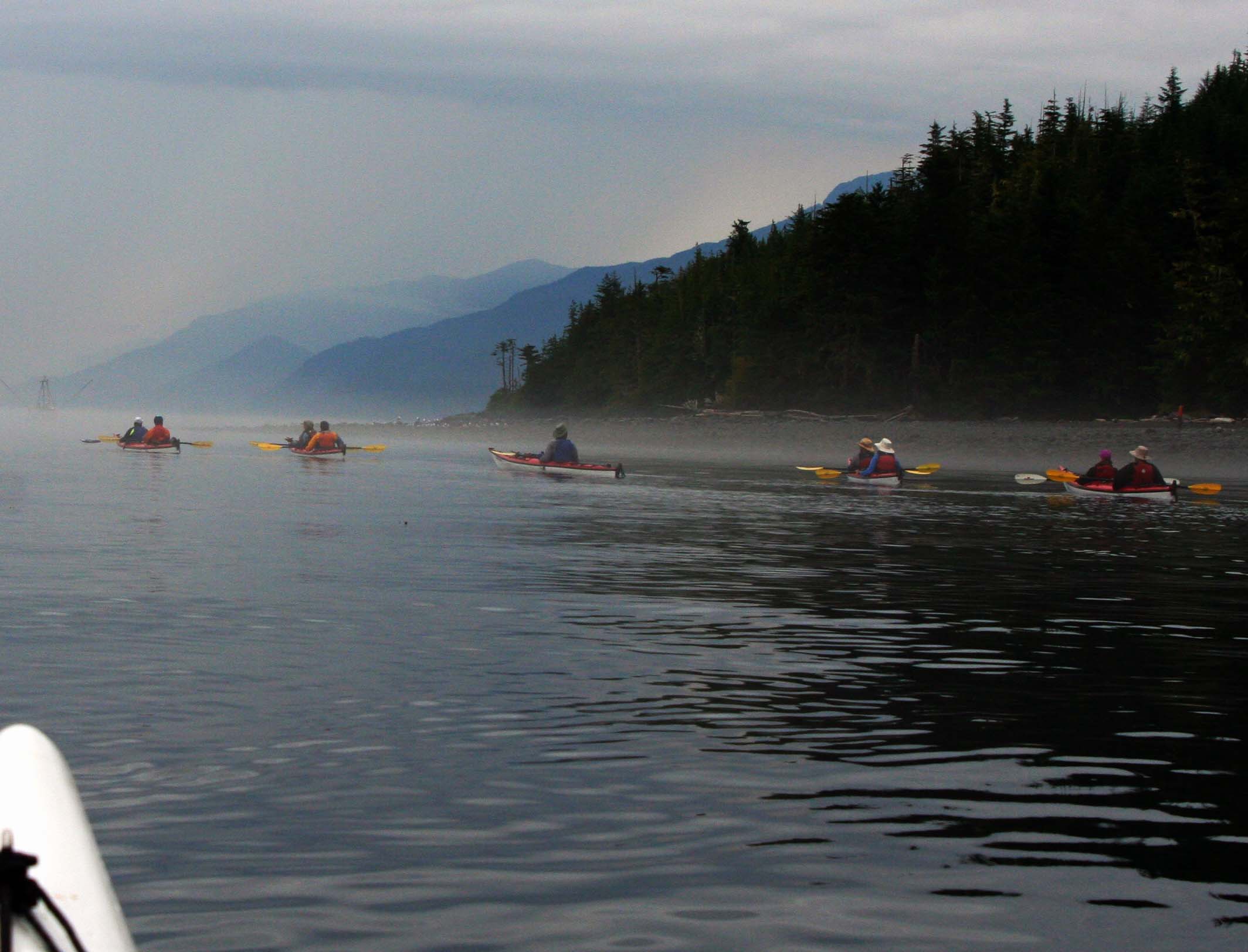
Our group works its way south along Vancouver Island. Shortly afterwards the skies opened up and dumped buckets of rain on us.

Our group works its way south from Little Kai Camp along Vancouver Island. Shortly afterwards the skies opened up and dumped buckets of rain on us. (Photo by Peggy Mekemson.)

Driftwood on Johnstone Strait, Vancouver Island. Photo by Curtis Mekemson.

Back at camp, I found interesting driftwood.

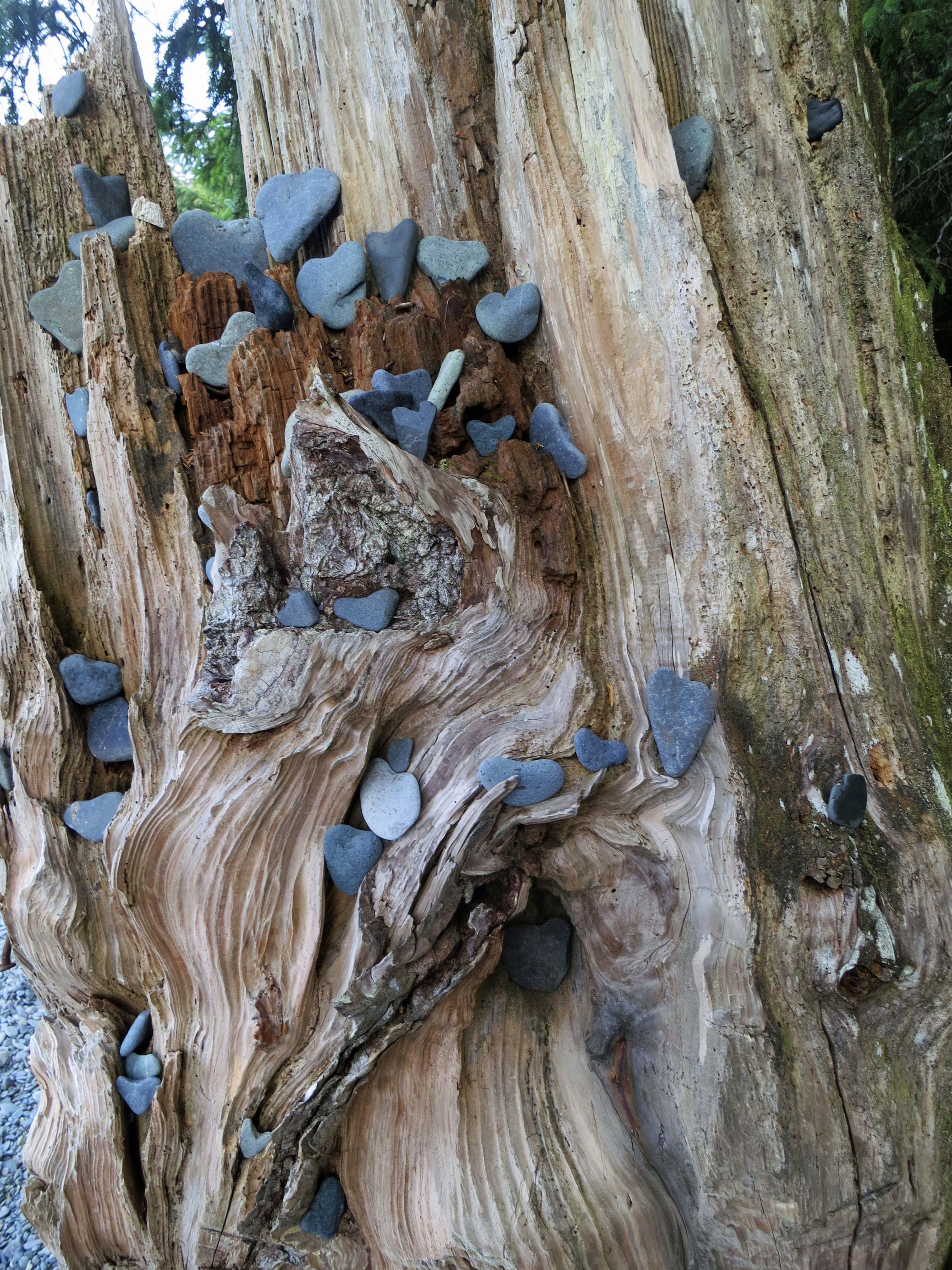
Heart shaped rocks found on Little Kai Beach off of Johnstone Strait. Photo by Curtis Mekemson.

We were amused to find that previous kayakers had collected numerous heart-shaped rocks off of Little Kai Beach.

Dinner is served on Sea Kayak Adventures' trip on Johnstone Strait.

Dinner is served.

Fishing boats shattered the quiet of our campground. BC fisheries had declared an eight hour fishing season to reduce the number of salmon trying to get up streams.

Fishing boats shattered the quiet of our campground. BC fisheries had declared an eight-hour fishing season to reduce the number of salmon trying to get up streams. Boats came from everywhere. (Photo by Peggy Mekemson.)

We wrapped up our final evening with a campfire, story telling, songs and a skit.

We wrapped up our last evening with a campfire, story telling, songs and skits.

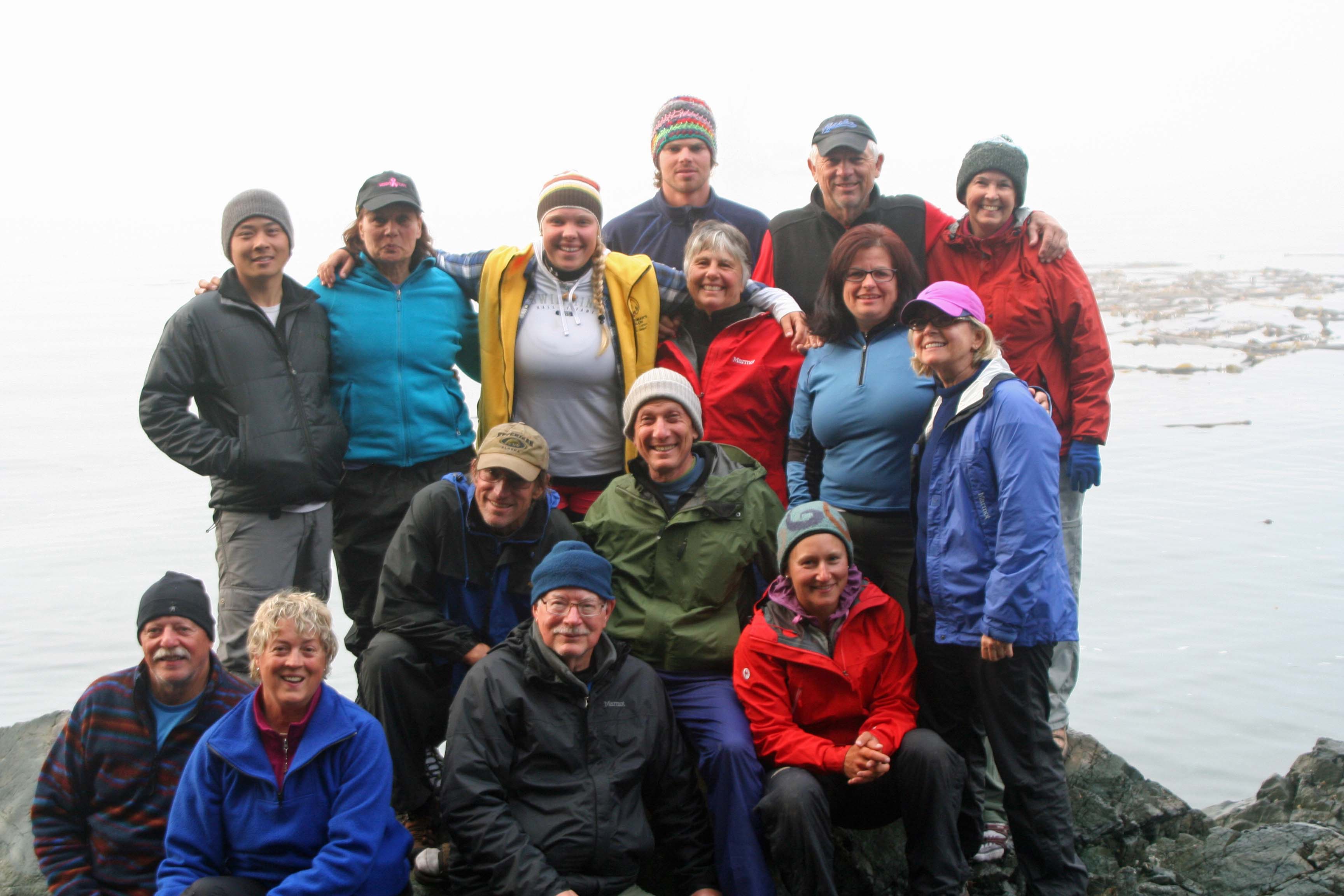
The final morning we posed for an 'official' group photo.

Our ‘official’ group photo.

Bear on Johnstone Strait, BC.

Kayaking back to Telegraph Cove, we came on a black bear. We weren’t able to determine how he managed to get the stick lodged in his fur. Was it the shaft of an arrow? (Photo by Peggy Mekemson.)

Since we had begun our kayak adventure searching for orcas, it is appropriate that I end this series with a picture of the final orca we saw. (Photo by Peggy Mekemson.)

Since we had begun our kayak adventure searching for orcas, it is appropriate that I end this series with a picture of the final orca we saw. (Photo by Peggy Mekemson.)


The Monster on the Rock— And Sasquatch… British Columbia Kayak Adventure: Part 4

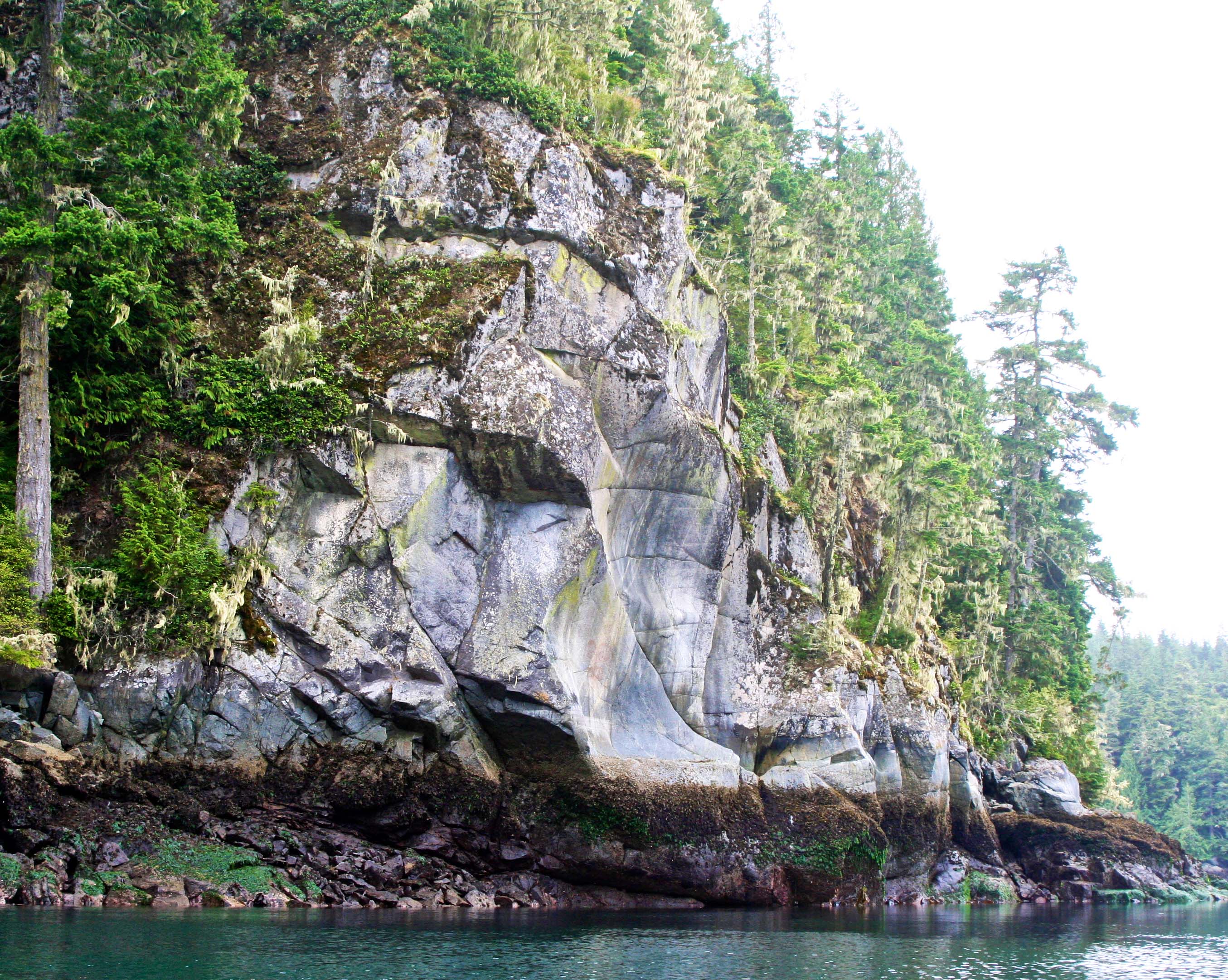
First Nation people had chosen this rock on Berry Island in Blackfish Sound, British Columbia as the location for a pictograph warning people to stay off of the island.

First Nation natives had chosen this rock on Berry Island in Blackfish Sound, British Columbia as the location for a pictograph warning people to stay off of the island. The dark line marks how high the tide climbs.

The third day of our kayak trip was a ‘layover day.’ It was a layover in the sense that we would be spending two nights at our camp on Compton Island, not that we would be sleeping in and relaxing. There was kayaking to do. Berry Island and a pictograph was our morning destination. We found the pictograph on a tall rock cliff that hung over the water.

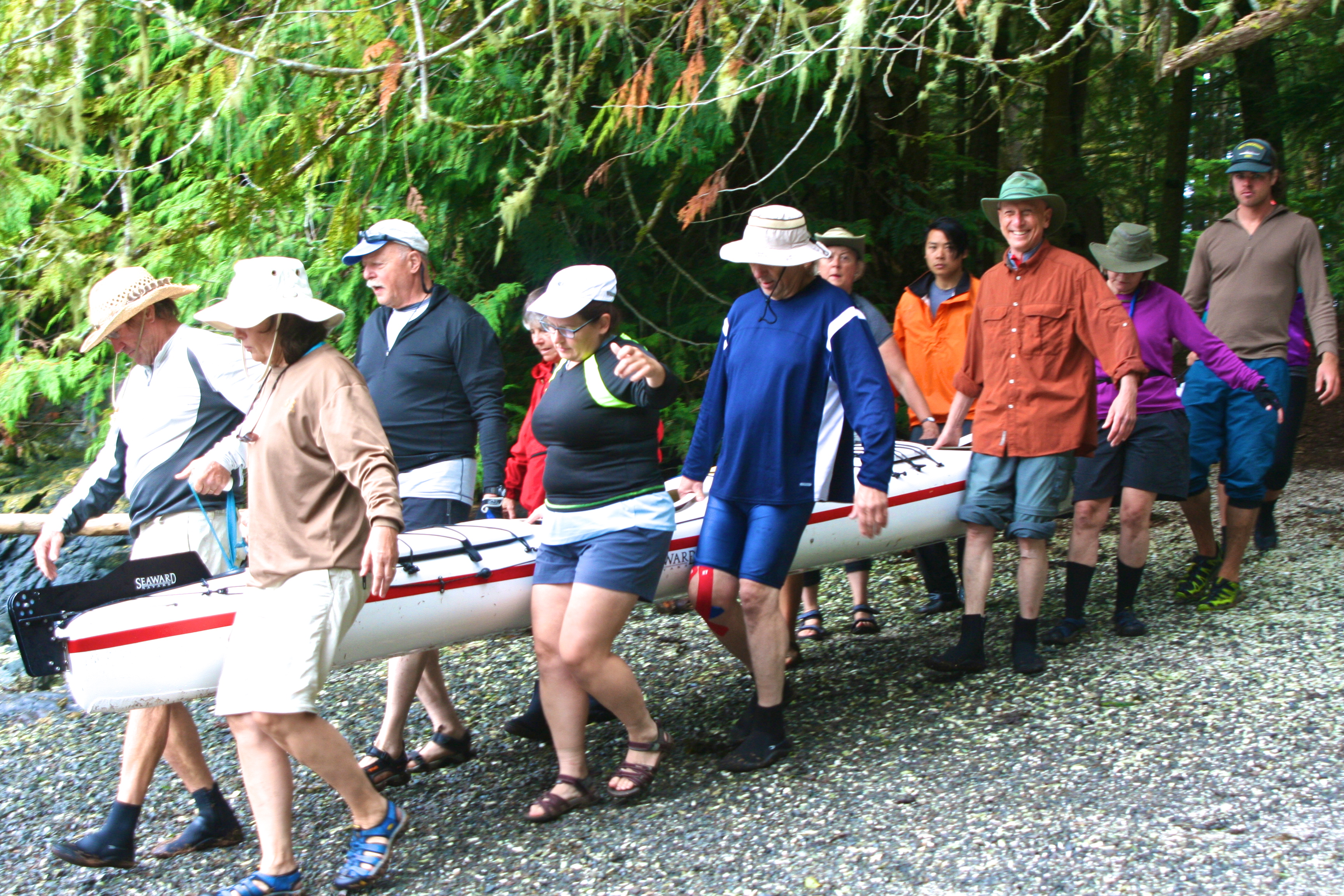
Our layover was not designed to be a kick-back and relax day. Here we are carrying our kayaks down to the water. The number of people required to move Peggy and my kayak suggests how heavy it was.  (Photo by Peggy Mekemson.)

Our layover was not designed to be a kick-back day. Here we are carrying our kayak down to the water. The number of people required to move it suggests how heavy it was. (Photo by Peggy Mekemson.)

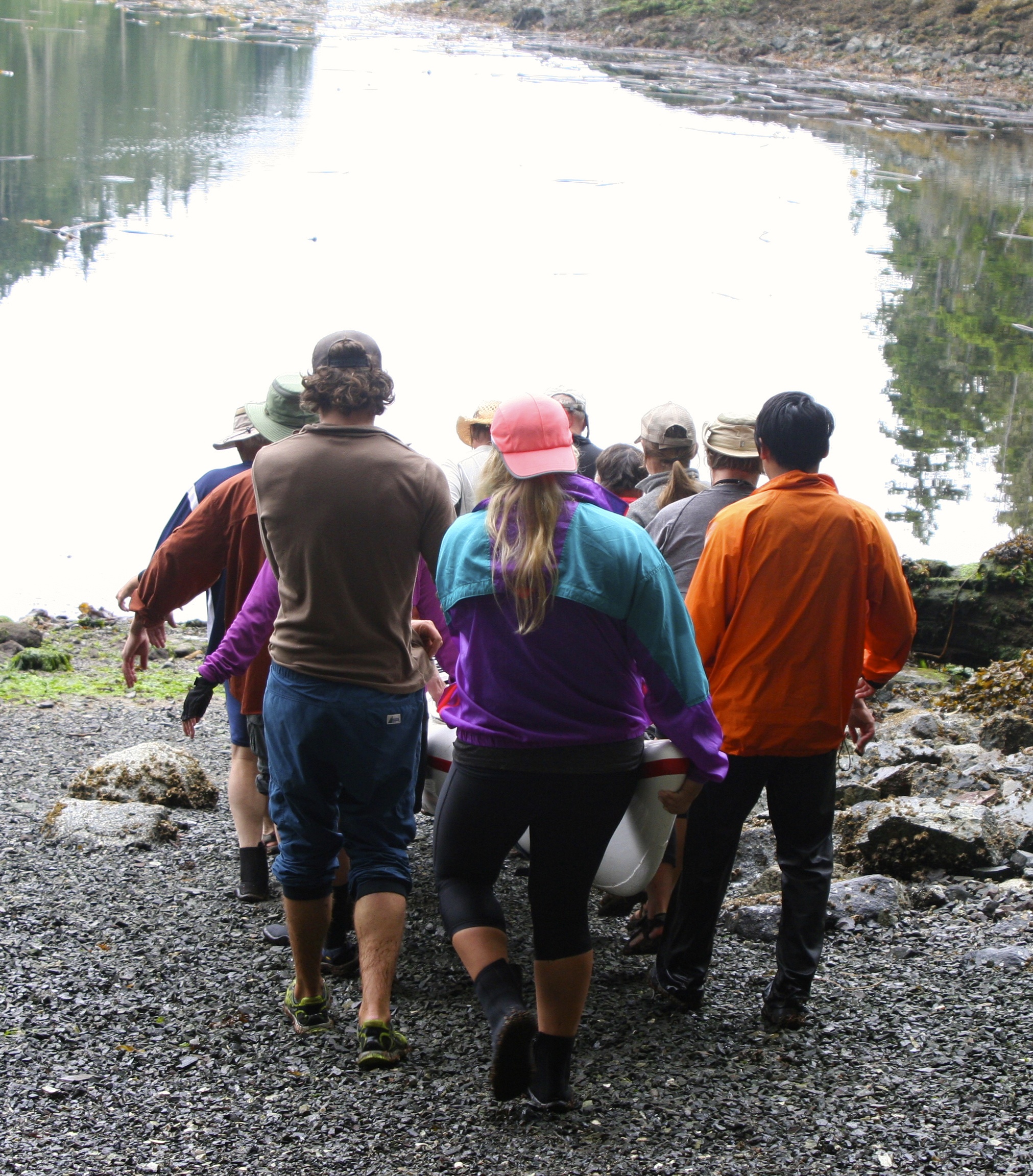
Extreme high and low tides in Johnstone Strait meant we often had to carry the kayaks a fair distance to water.

Extreme high and low tides in Johnstone Strait meant we often had to carry the kayaks a fair distance to water. (Photo by Peggy Mekemson.)

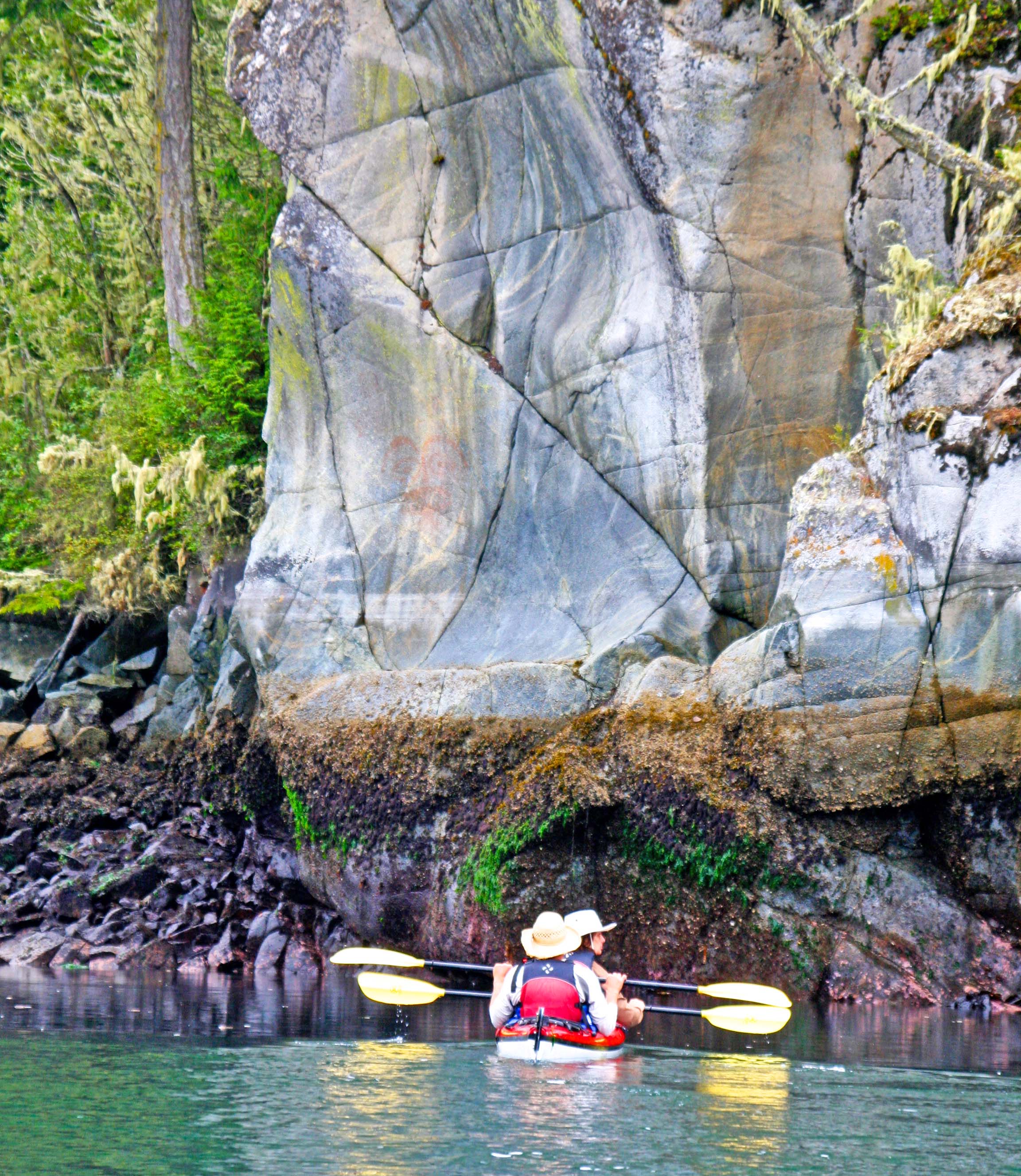
Stretching across the rock face, ancient First Nation natives had painted a monster to warn people away from Berry Island, where they buried their dead. It was an early no-trespassing sign— probably implying that the monster would eat you if you landed. I had seen its modern equivalent in west Texas, except there, the sign had declared that trespassers would be shot. Such admonitions make one hesitate; at least they do me. When my choice is to be eaten by a monster or shot by a Texan, I choose neither.

Mary and Rod, two of our kayakers from Idaho, paddle up close to get a look at the pictograph. It was above there right paddles on the shaded rock face. Can't see it? Don't feel bad; neither could I. (Photograph by Peggy Mekemson.)

Mary and Rod, two of our kayakers from Idaho, paddle up close to get a look at the pictograph(s). One is barely visible above the right paddles. Look closely and you will see two round eyes. Another is above the left paddles— red, round and also barely visible. (Photo by Peggy Mekemson.)

Rod seemed quite happy with what he saw, however. Or maybe he was happy the monster chose not to eat him.

Rod seemed quite happy with what he saw, however. Or maybe he was happy the monster chose not to eat him.

Our guide, Nick, told us another story; this one had been passed on by the kayaking community. A lone, female kayaker had stopped to camp on Berry Island and had set up her tent for the night. Shortly afterwards, a boulder went flying by her head. She neither saw nor heard anyone, but another boulder came whizzing past. It was time to vacate the premises. She grabbed her kayak and paddled away as more boulders landed nearby. When nothing else had been hurled at her for two hours, she paddled back in, grabbed her tent (rather quickly, I suspect) and hightailed it. Back in town, the locals told her that Berry Island was also known as Sasquatch Island. Had Bigfoot been lobbing rocks at her? The Sasquatch/Bigfoot Research Organization claims this is a common practice of the big, hairy fellow. See here.

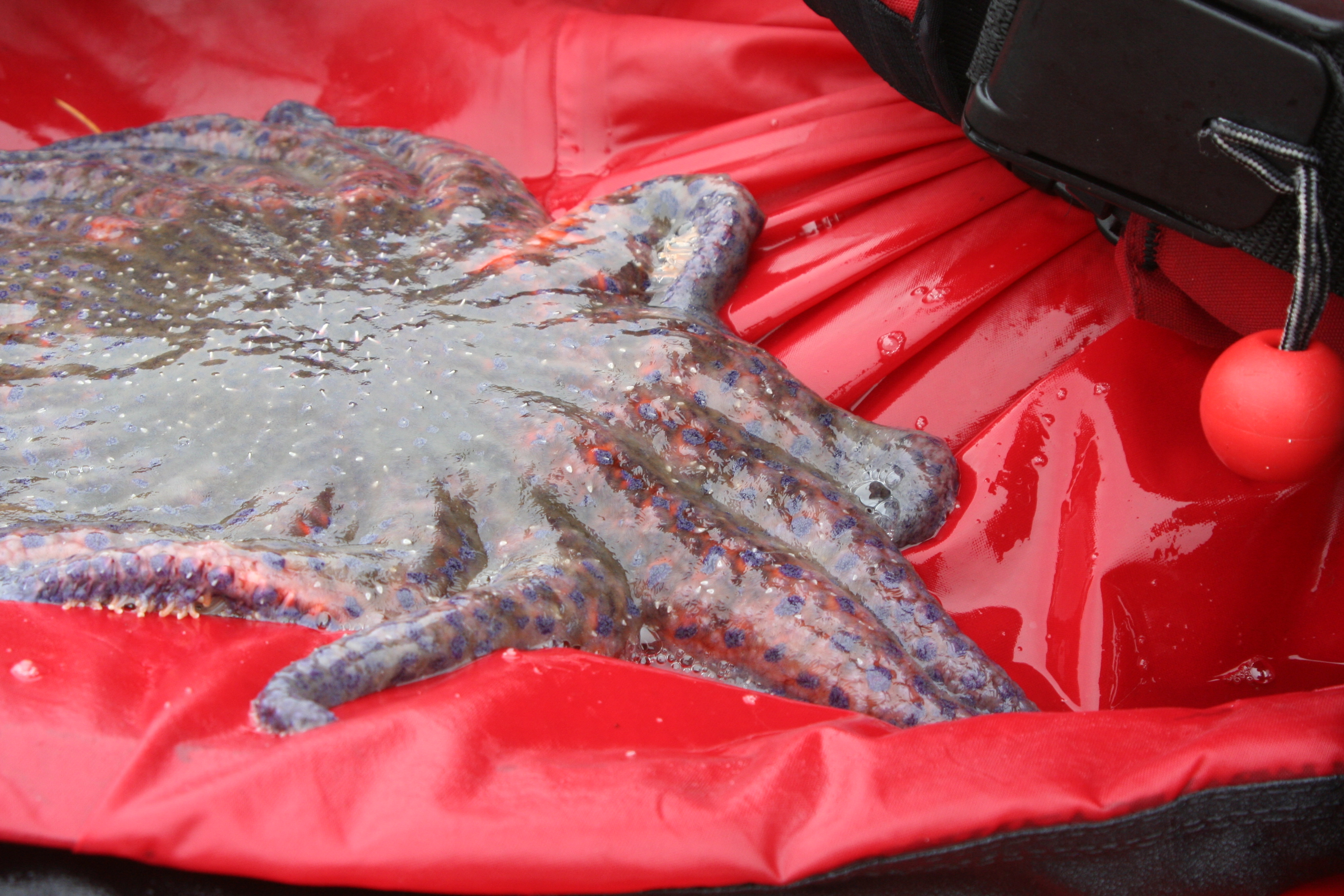
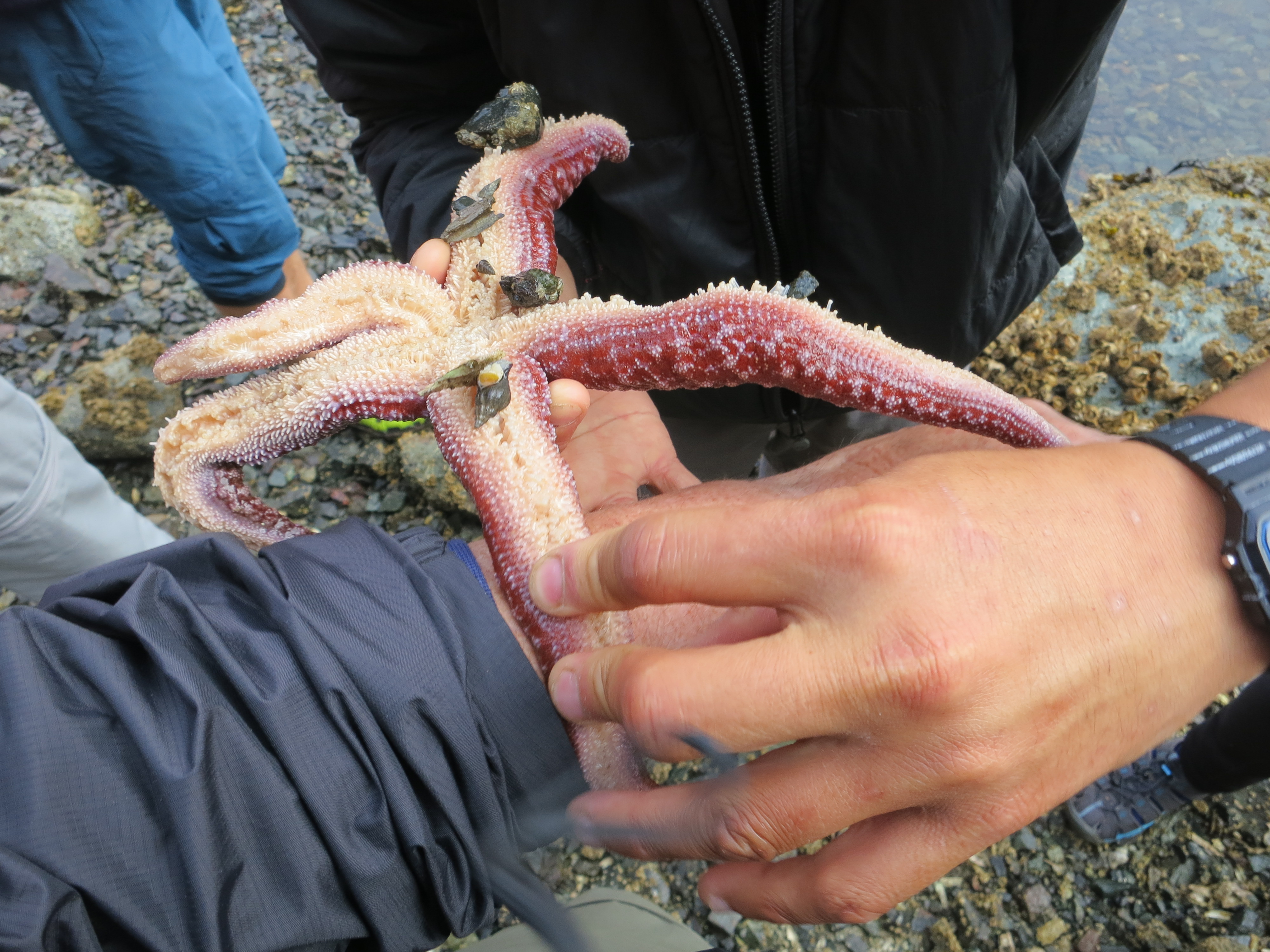
Heading back for camp and lunch, our guide, Julia, found a starfish that made Bigfoot seem normal in comparison. Julia handled it with aplomb, sort of. As for lunch, we ate the delicious salmon that I blogged about in my last post.

Starfish in Blackfish Sound, British Columbia.

This amorphous mass is actually a starfish. Here it rests on our guide Julia’s kayak skirt.

Julia picked the starfish up to show us. I think there was a slight 'ewww' factor. There certainly would have been for me.

Julia picked the starfish up to show us. I think there was a slight ‘ewww’ factor. There certainly would have been for me. (Photo by Peggy Mekemson.)

Sea Kayak Adventures cooks up a delicious lunch of freshly caught salmon at its camp on Compton Island, British Columbia.

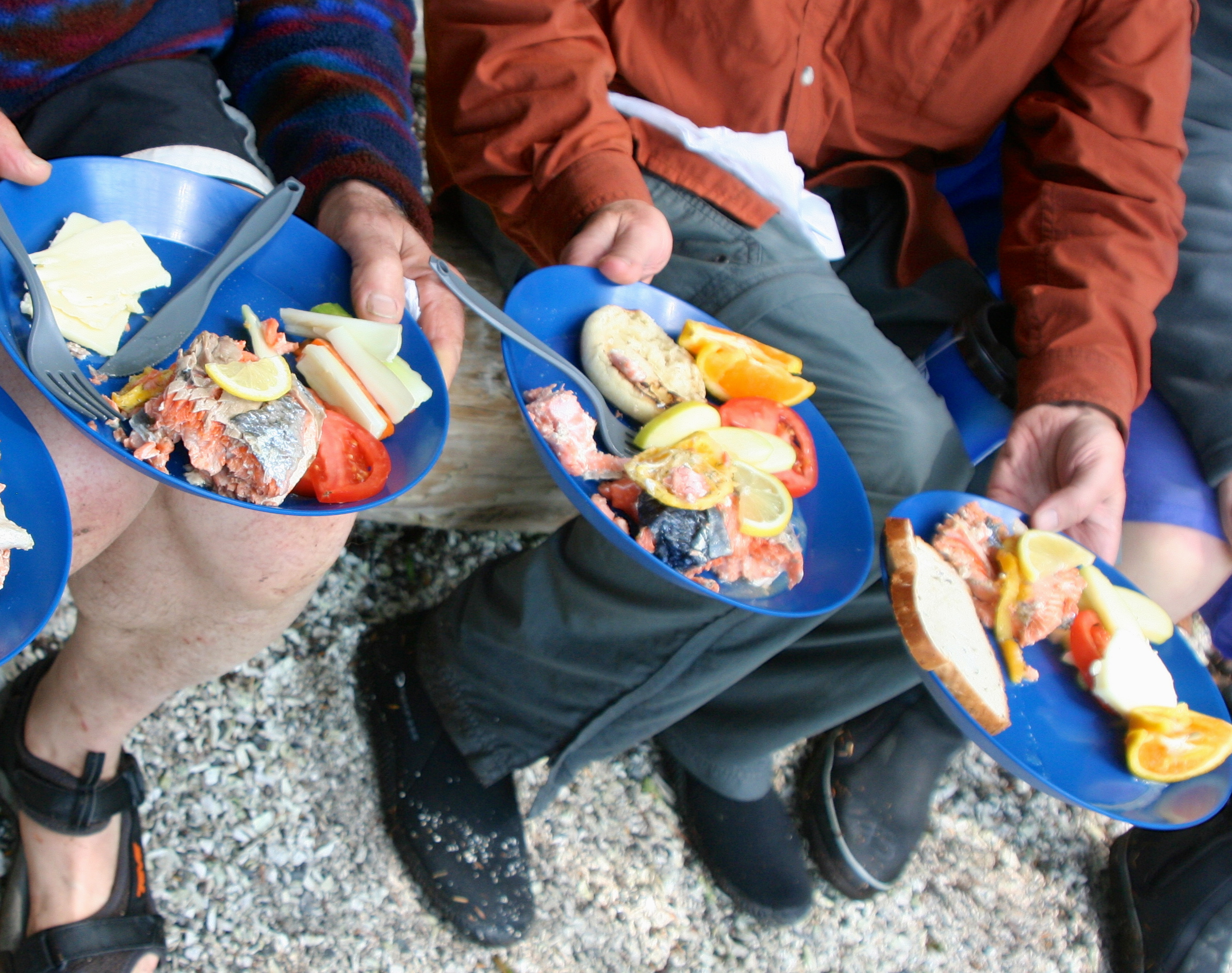
The fresh salmon delivered to us the night before by a fisherman, ended up as a delicious lunch. We weren’t the only ones interested in the salmon, however…

Bald eagle on Compton Island in British Columbia.

Each bite was carefully monitored. This bald eagle had already eaten the salmon’s guts, and he was eager for more fish. Sushi would be fine.

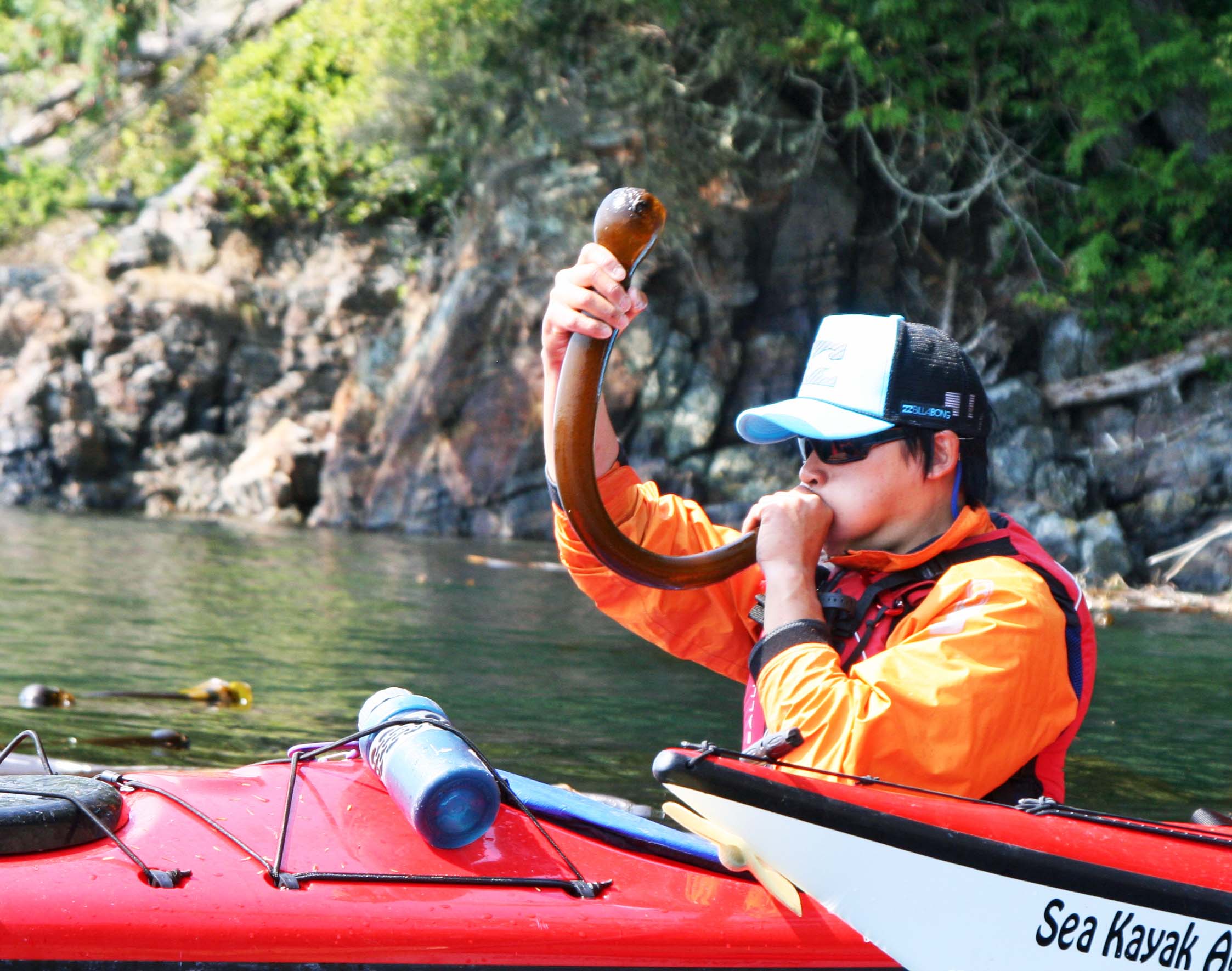
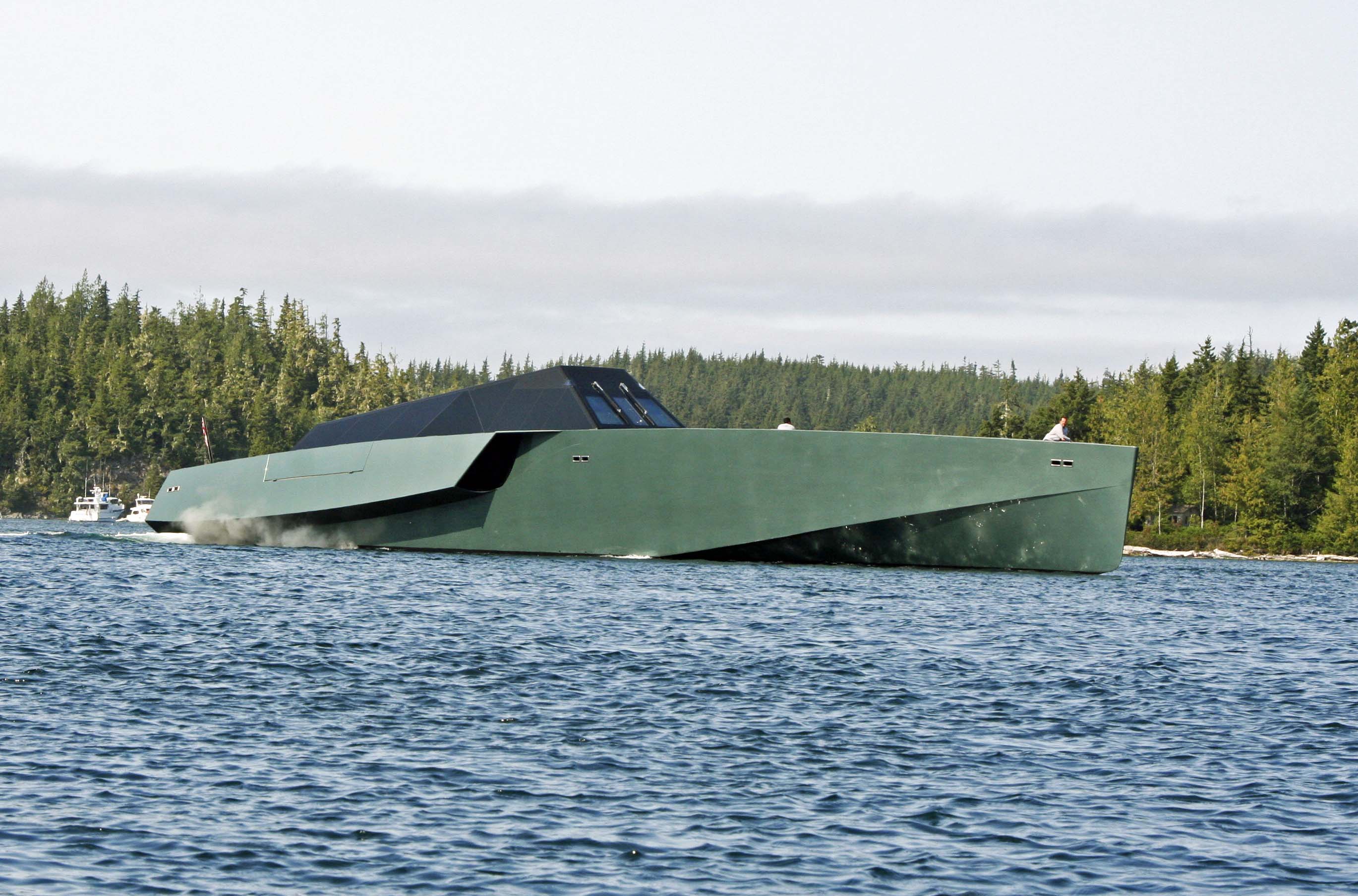
In the afternoon, we went searching for whales again. Along the way, Quy taught us how to blow kelp like a trumpet, and we saw a mysterious yacht that looked like it was straight out of a sci-fi flick.

Kelp beds off Vancouver Island in Blackfish Sound, British Columbia.

Floating kelp provided something of a challenge for kayaking through, but it also provided an opportunity.

Quy taught us how to cut up the kelp so it could be blown like a trumpet.

Quy taught us how to cut the kelp so it could be blown like a trumpet. (Photo by Peggy Mekemson.)

Here Lindy takes a turn. Peggy had also tried her luck. My advice to them: they should keep their day jobs.

Here Lindy takes a turn. Peggy had also tried her luck. My advice to the two of them: they should keep their day jobs.

Nick looks on in amazement at the performance.

Nick looked on in amazement at the performances.

The whales kept their distance, but a curious seal stopped by to check us out. (Photo by Peggy Mekemson.)

The whales kept their distance, but a curious seal stopped by to check us out. (Photo by Peggy Mekemson.)

This futuristic yacht didn't look nearly as friendly as the seal. (Photo by Peggy Mekemson.)

This futuristic yacht didn’t look nearly as friendly as the seal. At first we thought it belonged to the military. (Photo by Peggy Mekemson.)

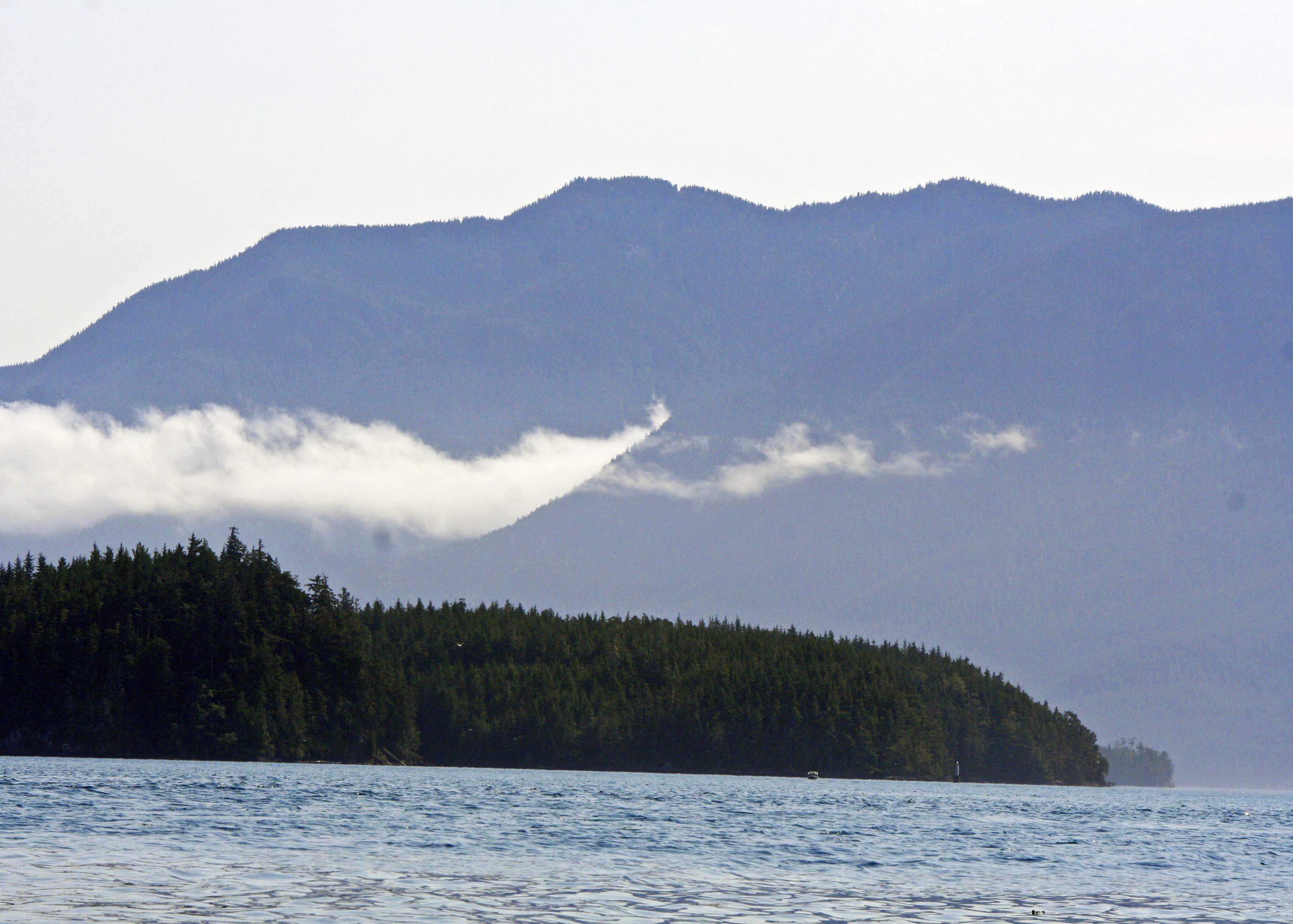
Blackfish Sound in British Columbia.

I liked the contrast here between water, clouds, and islands. (Photo by Peggy Mekemson.)

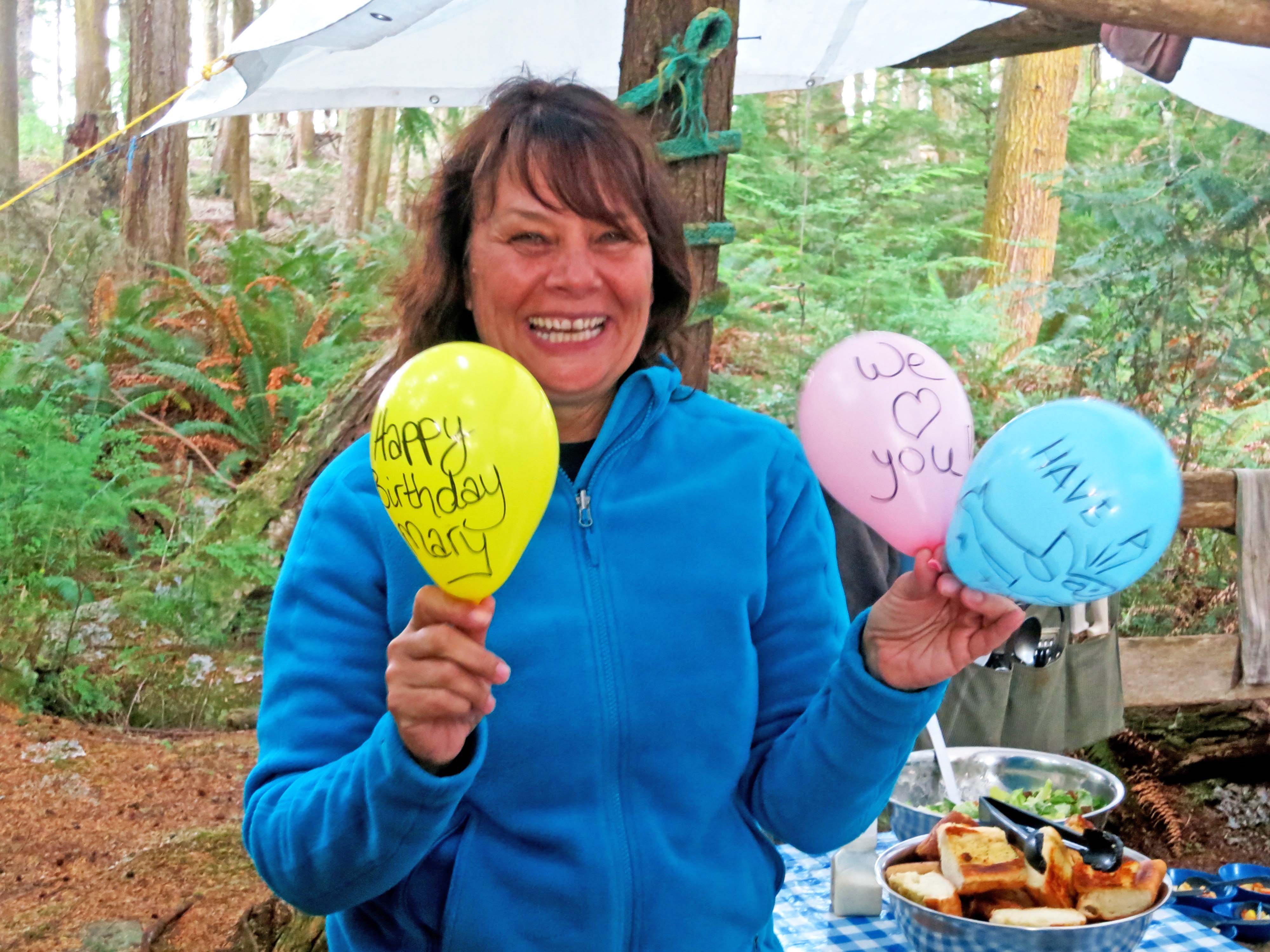
Back in camp, Mary celebrated her birthday...

Back in camp, Mary celebrated her birthday…

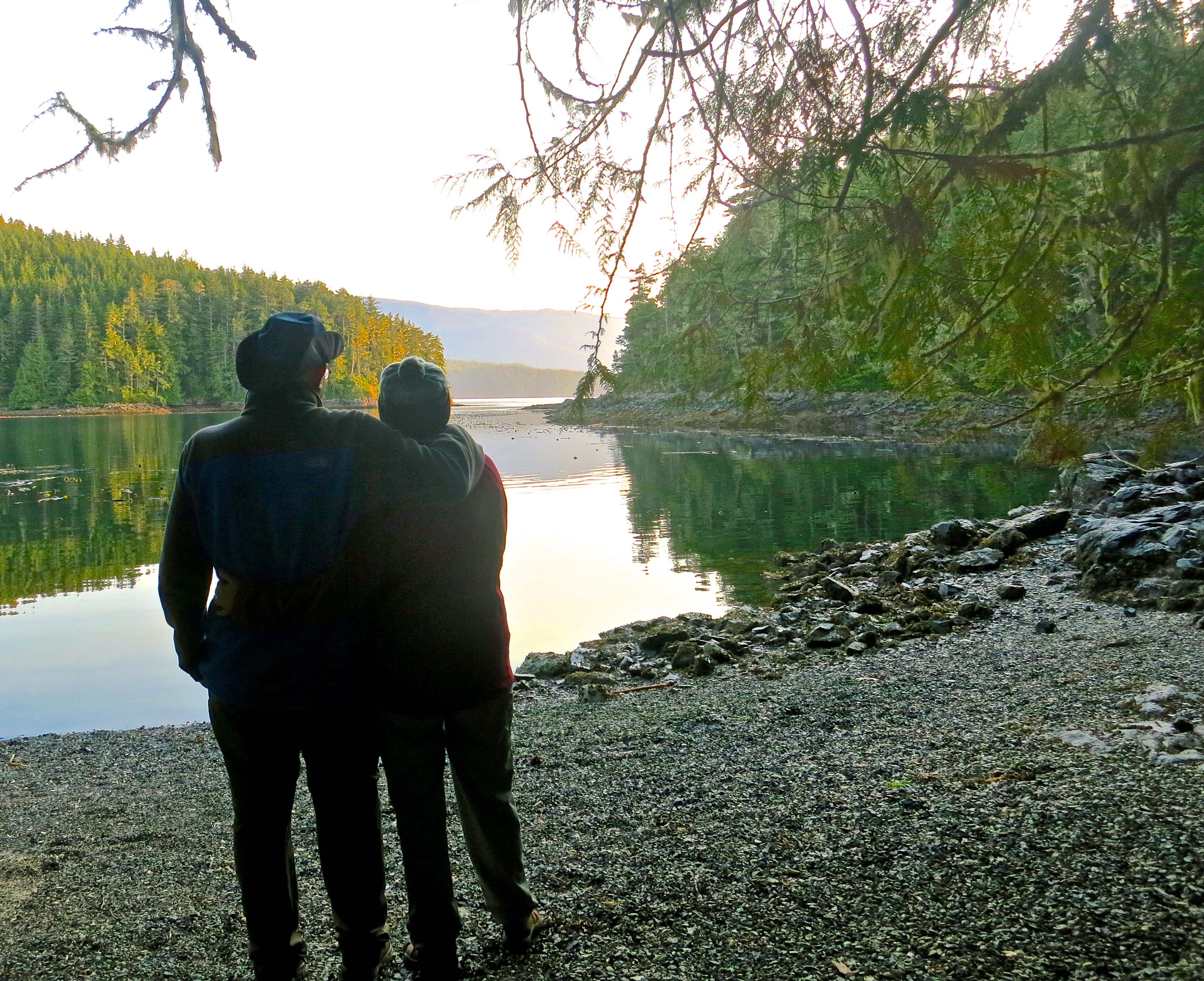
Peggy and Curtis Mekemson on Compton Island off of Vancouver Island, British Columbia.

Peggy and I shared a quiet moment…

Evening on Compton Island, Blackfish Sound, British Columbia. Photo by Curtis Mekemson.

And evening settled in. Next Blog: Peggy and I get caught in a powerful current.


Who Needs A Barber When You Have a Starfish? British Columbia Sea Kayak Adventure: Part 3

Starfish pedicellariae can clip the hair off an arm. Photo by Curtis Mekemson.

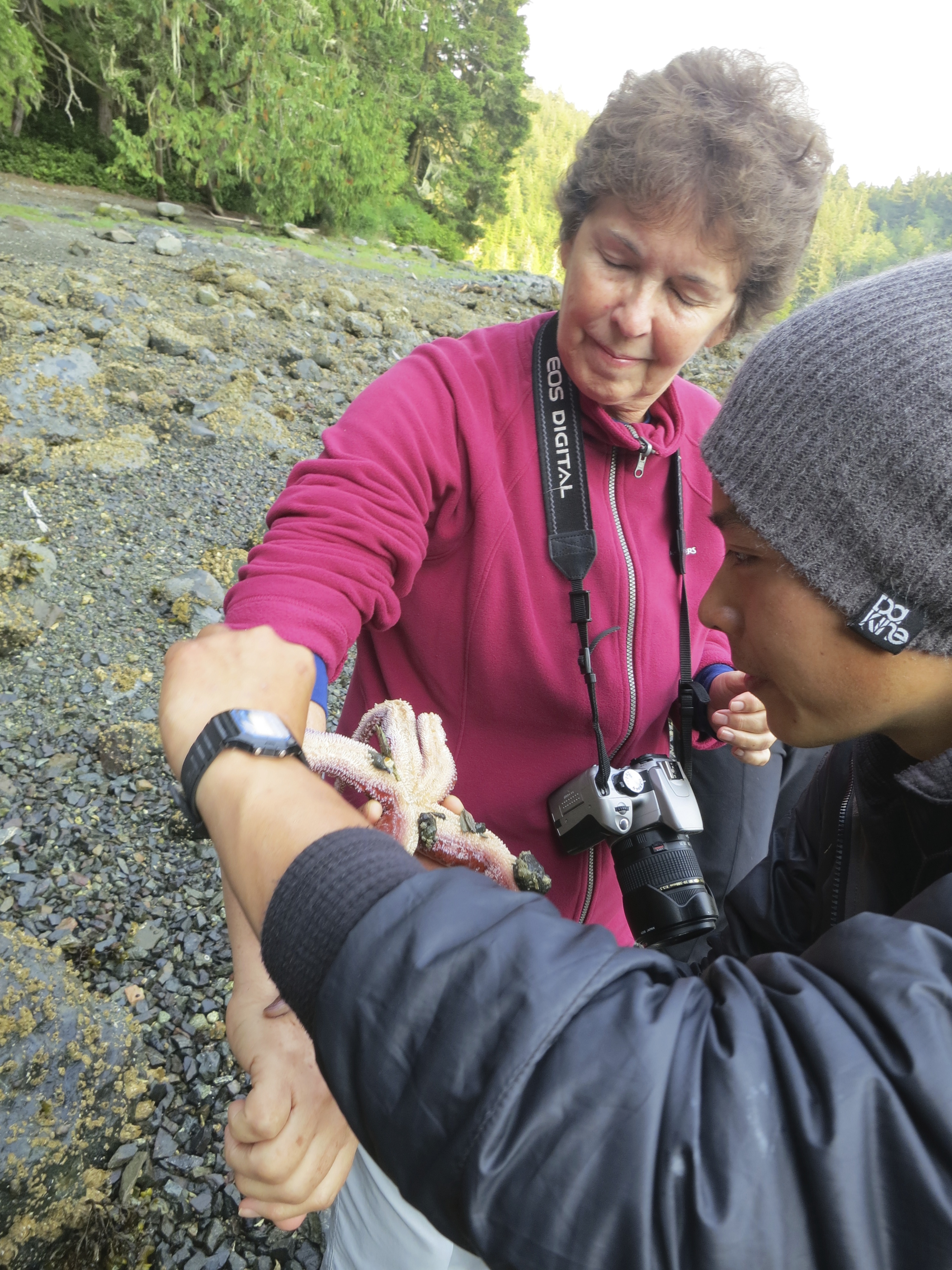
Quy bent the starfish over my wrist, and it clipped hair off my arm while I took a selfie of the process.

I’ve never been much of a with-it type guy. When there is a fad, I try to do the opposite. But I confess I’ve tried a selfie or two. And I just had to take a picture of the starfish clipping hair off of my arm. When Quy picked up a starfish on our six-day, British Columbia sea kayak adventure and offered to demonstrate pedicellariae at work, I was the first to volunteer. Pedicellariae what, you say?

While you are probably stumbling over the word like I did, I’ll explain how it works. Starfish have a defense mechanism for destroying tiny parasites that land on their skin. They have tiny claws that cut the bad guys in half. If you put these claws under a microscope, they look like your worst nightmare. (Check this out.)

Quy, however, assured us that while the pedicellariae would define our hairs as enemy invaders and clip them off, there would only be a slight pulling sensation with no harm done to us. Easy for him to say, right. But that’s what happened. Quy bent the arm of the starfish over my wrist and I felt the pulling sensation. When he removed the starfish, my arm was bare. Peggy was up next.

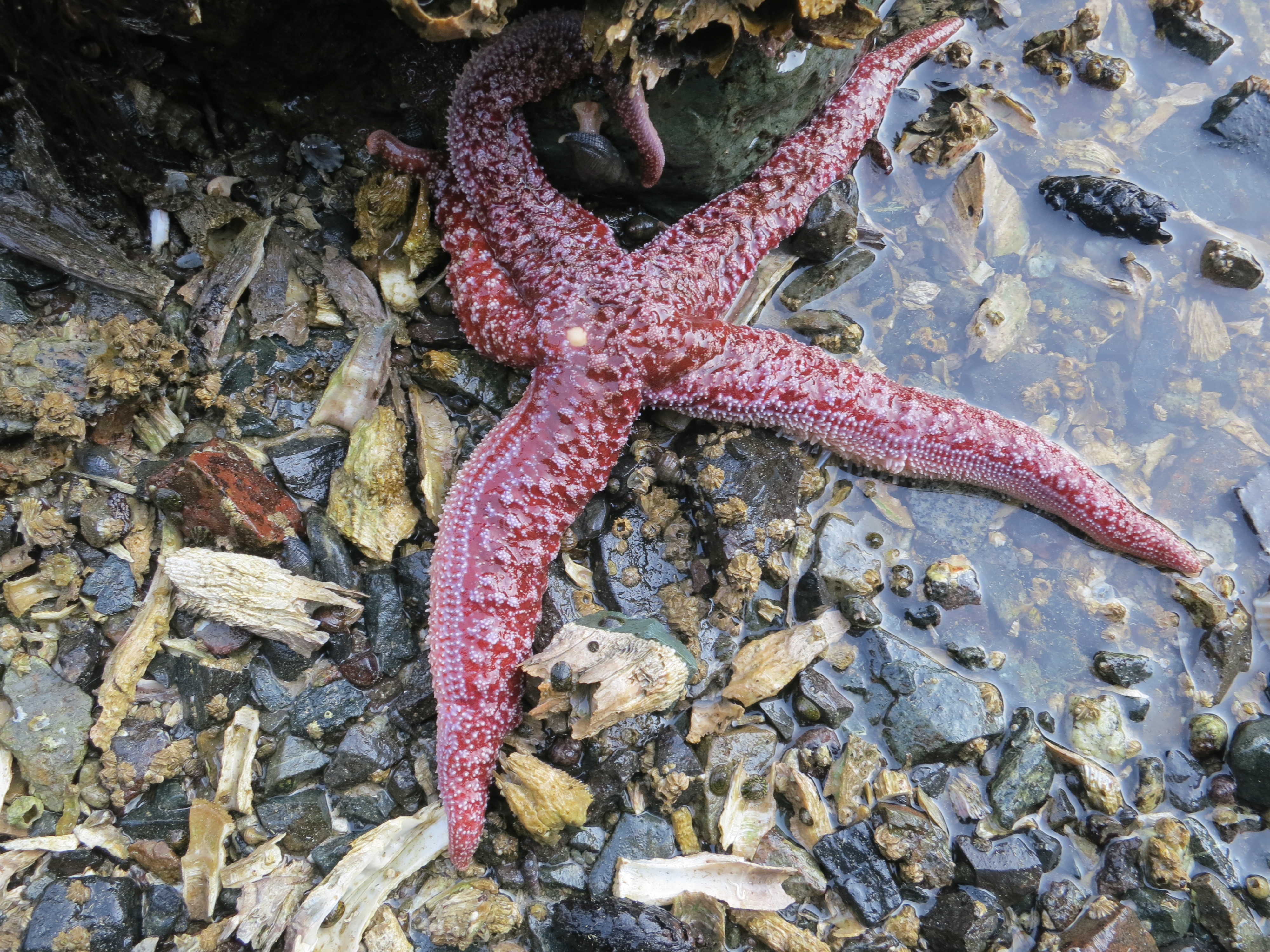
Here is the starfish happily at home in Johnstone Strait before Quy picked him up to clip hair.

Here is the innocent starfish, happily at home in Johnstone Strait before Quy picked him up to clip hair.

And here, the starfish goes to work on Peggy. Is that a smile or a grimace on her face?

And here, the starfish goes to work on Peggy. Is that a smile or a grimace on her face?

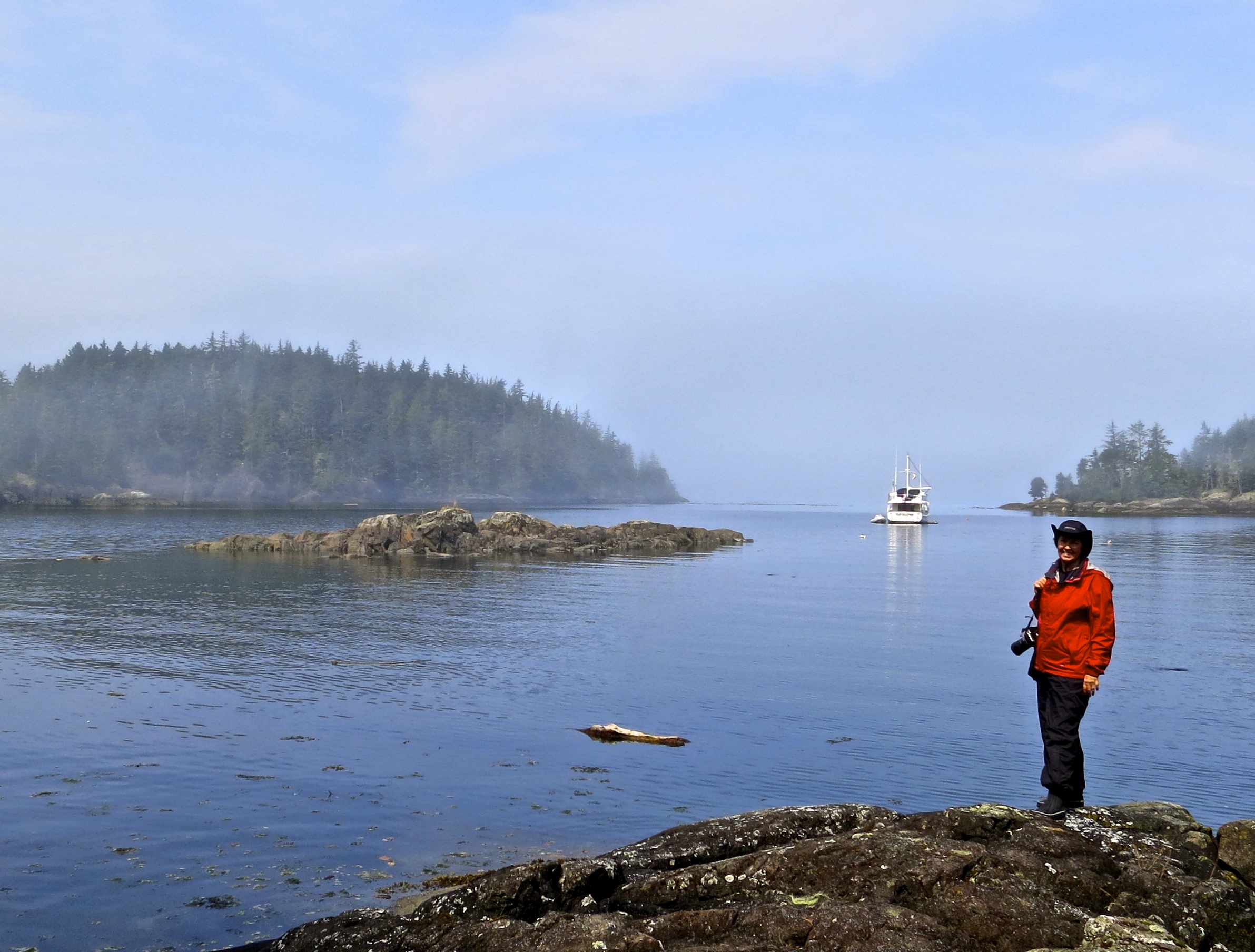
I expected whales and striking scenery on our Sea Kayak Adventures’ trip, but hair-removing starfish, no way. The pedicellariae were only a small part of our second day, however. We kayaked from our campsite on Hanson Island to Compton Island on Blackfish Sound. Along the way we watched humpback whales and were once again awed by the beauty of the region. At Compton Island, we got to play with our food….

Sea Kayak Adventures provides a hearty breakfast to its sea kayakers.

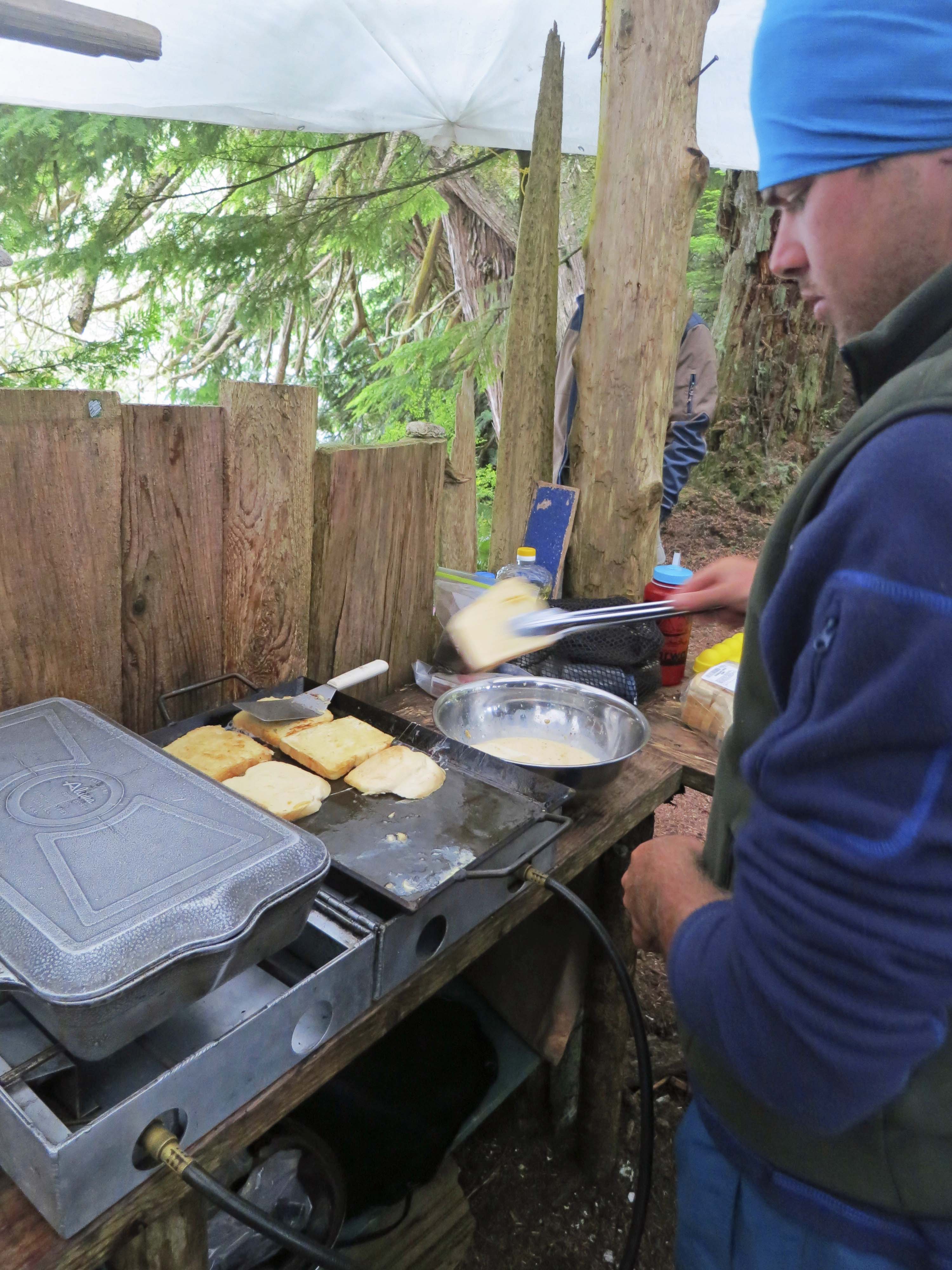
Coffee would be waiting when we got up each morning— to be followed by a hefty breakfast. Here, our guide, Nick, whips up French toast in the make-shift kitchen.

Fishing boat in Johnstone Strait off of Hanson Island. Photo by Curtis Mekemson.

After breakfast, we had time to go for a brief walk. A fishing boat moves between islands on  Johnstone Strait looking for salmon.

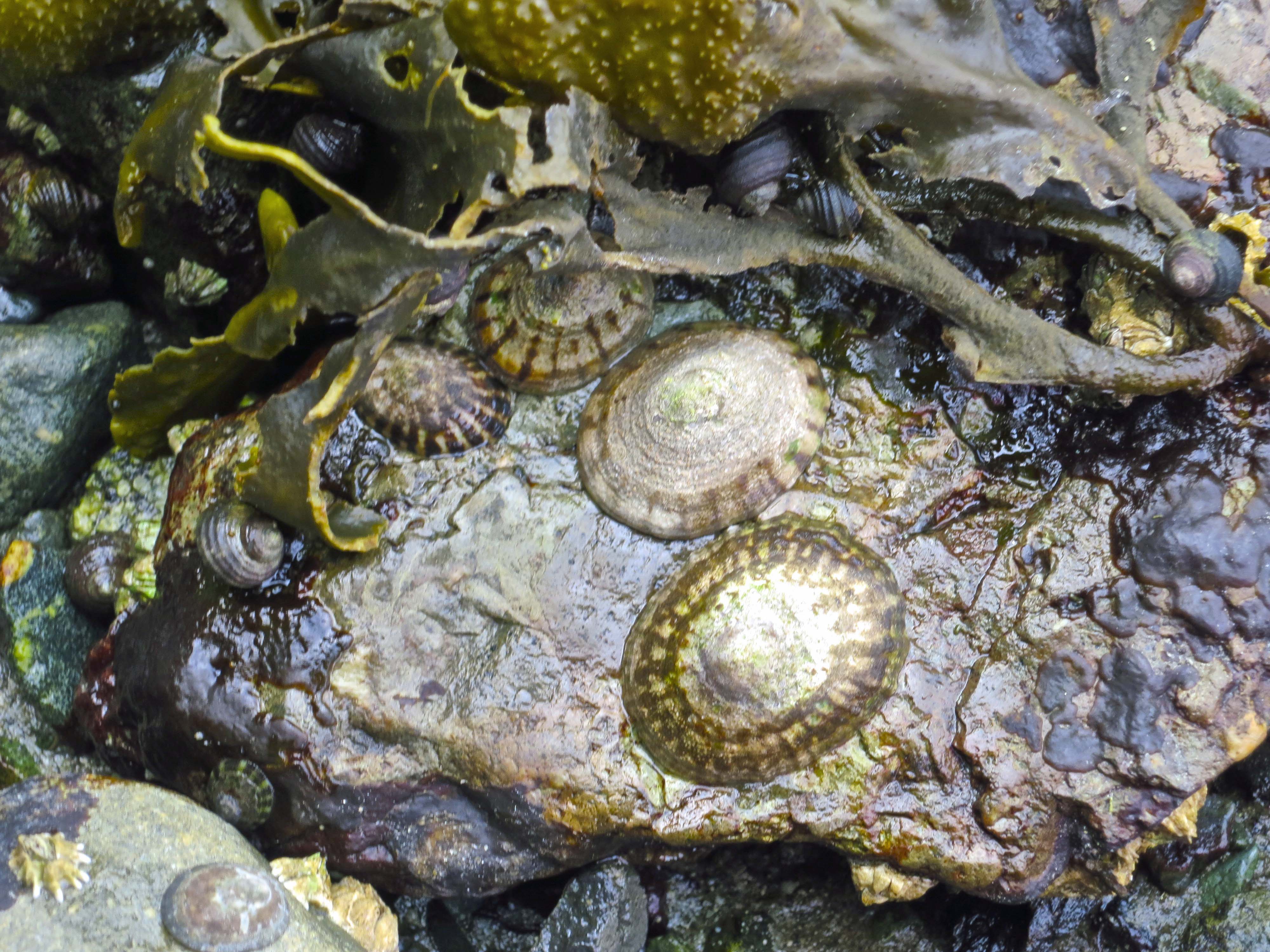
Limpets and snails are exposed by low tide on Hanson Island British Columbia off of Johnstone Strait. Photo by Curtis Mekemson.

Low tide exposed theses limpets and snails.

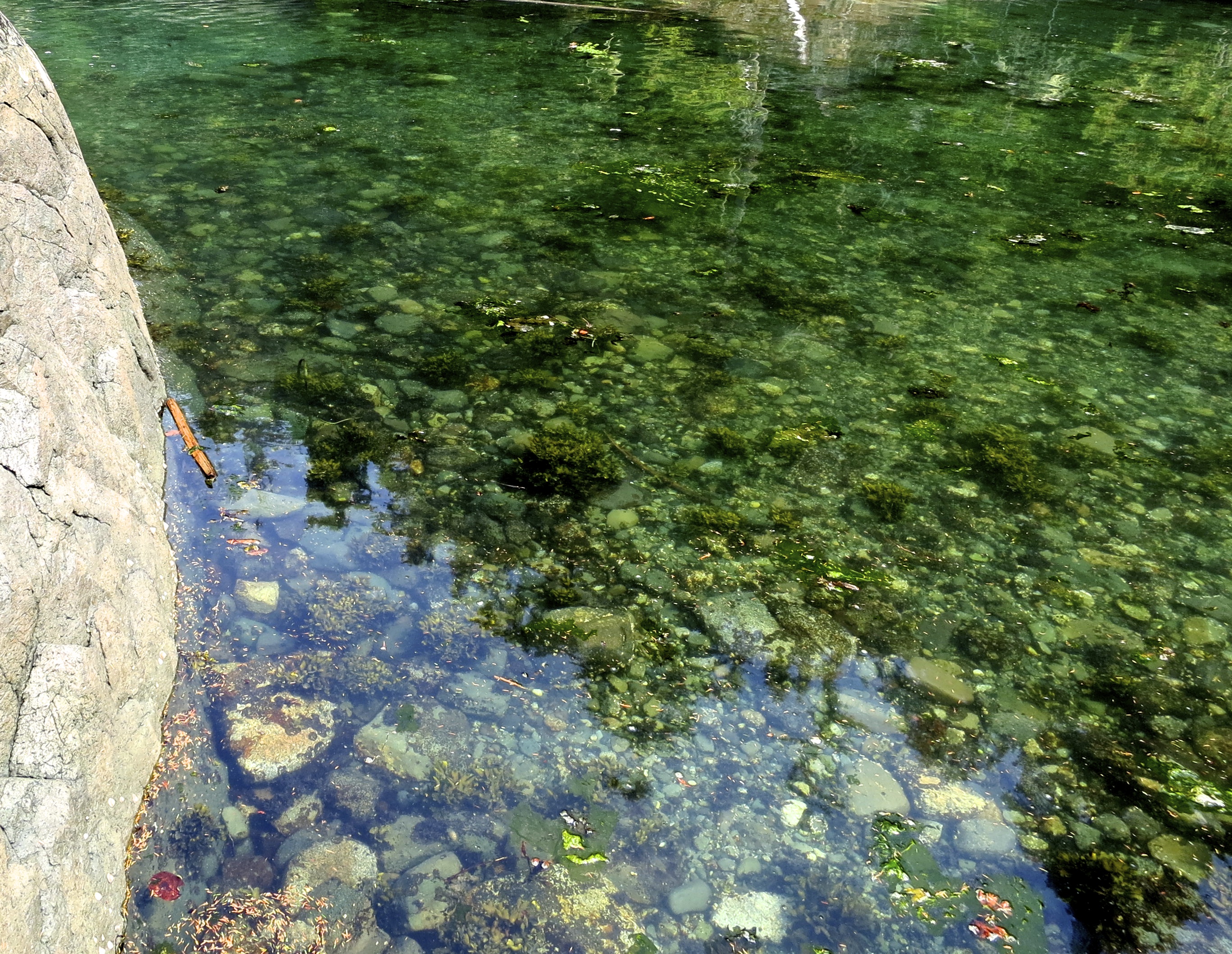
Green waters of a small bay on Hanson Island on Johnstone Strait off of Vancouver Island. Photo by Curtis Mekemson.

We peered in to the green waters of the small bay we were camped on.

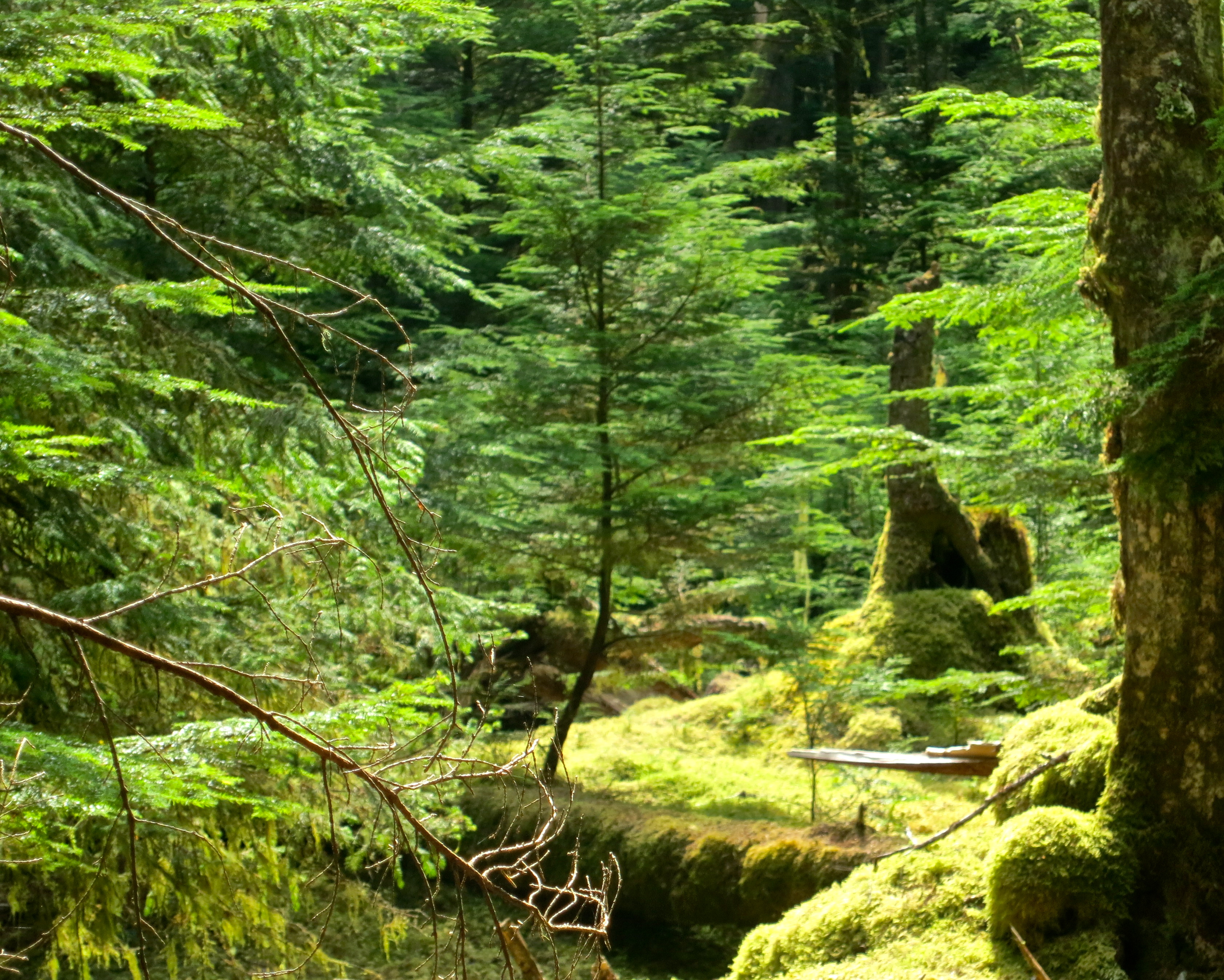
Sunlight illuminates a very green forest on Hanson Island in British Columbia. Photo by Curtis Mekemson.

And were dazzled by the sun illuminated green of the forest.

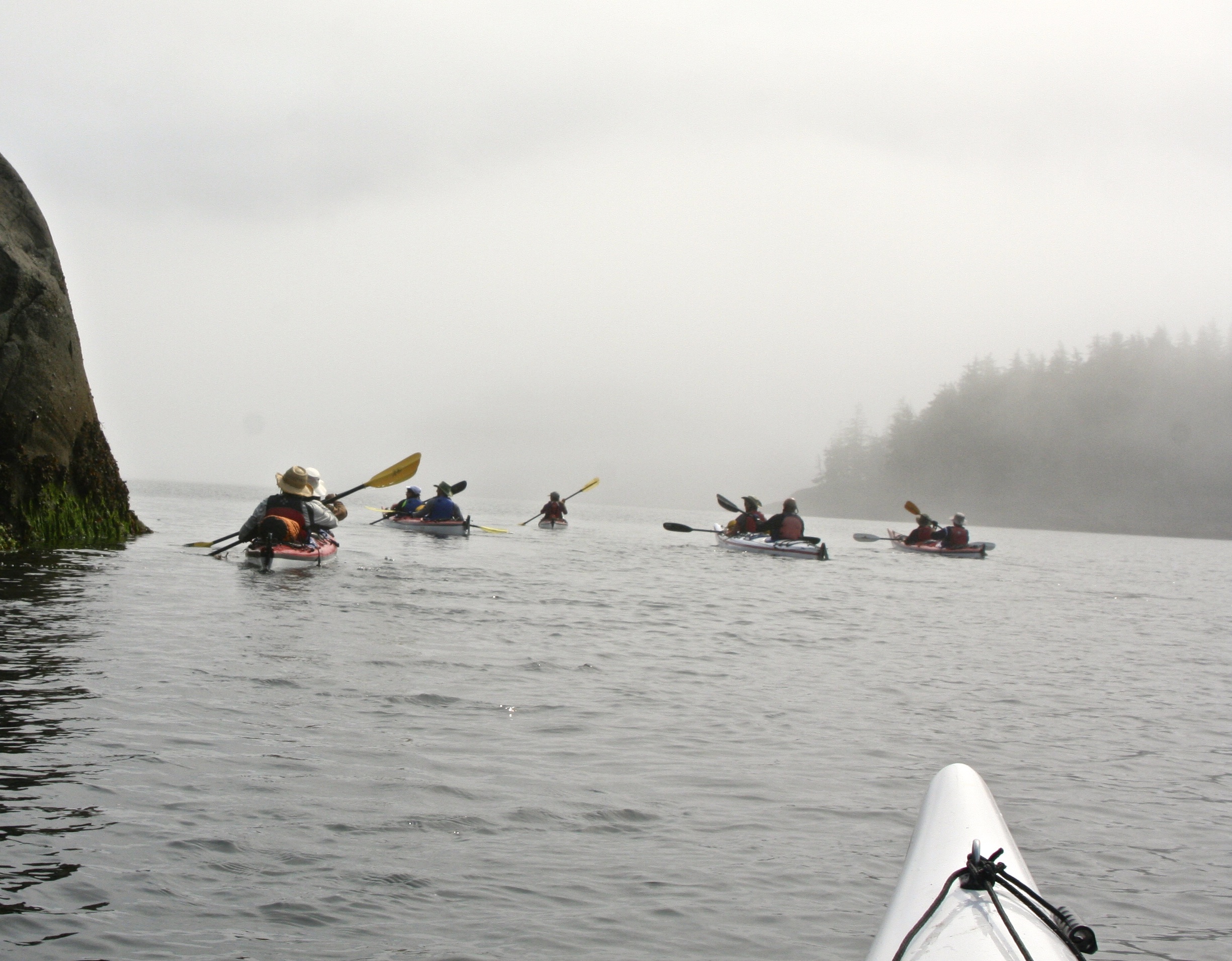
Sea Kayak Adventure group works its way around Hanson Island, British Columbia in the fog.

Morning fog greeted us as we worked our way around Hanson Island and into Blackfish Sound. (Photo by Peggy Mekemson.)

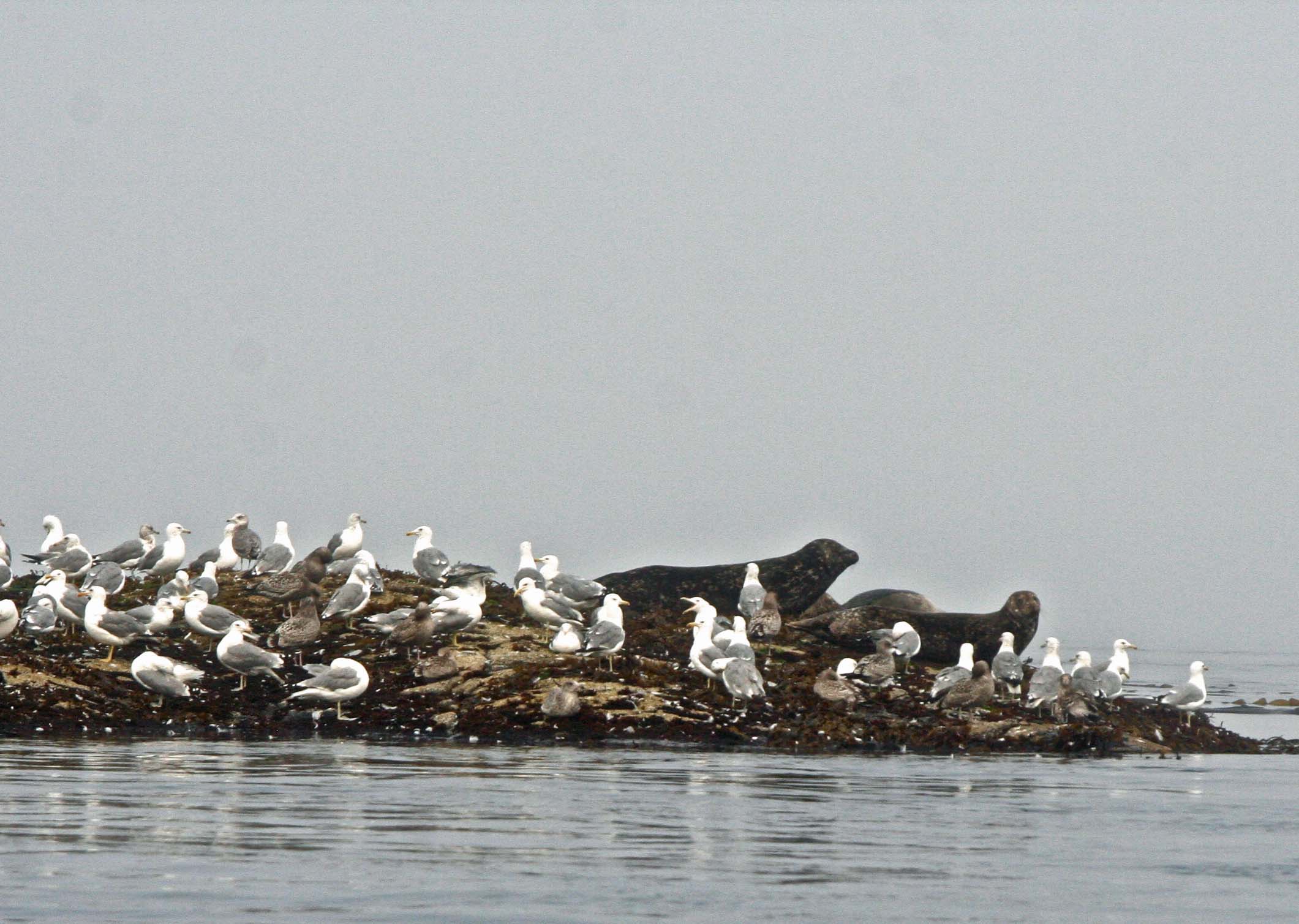
Seals and seagulls on an island in Blackfish Sound, British Columbia.

We checked out these seals and seagulls on a small island. Or were they checking us out? (Photo by Peggy Mekemson.)

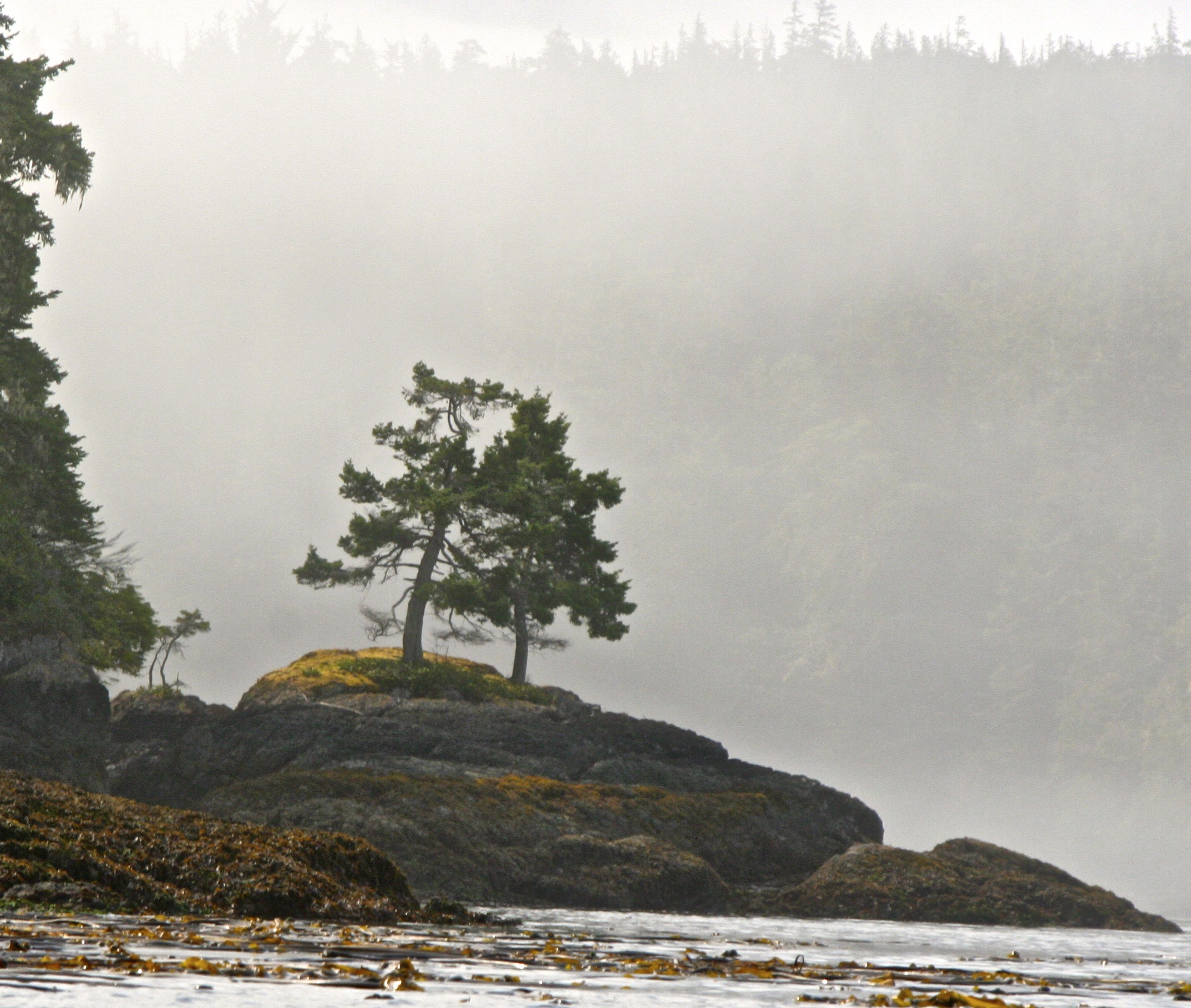
By the time we had worked our way around the end of Hanson Island, the sun was beginning to peak through. (Photo by Peggy Mekemson.)

By the time we had worked our way around the end of Hanson Island, the sun was beginning to peak through. (Photo by Peggy Mekemson.)

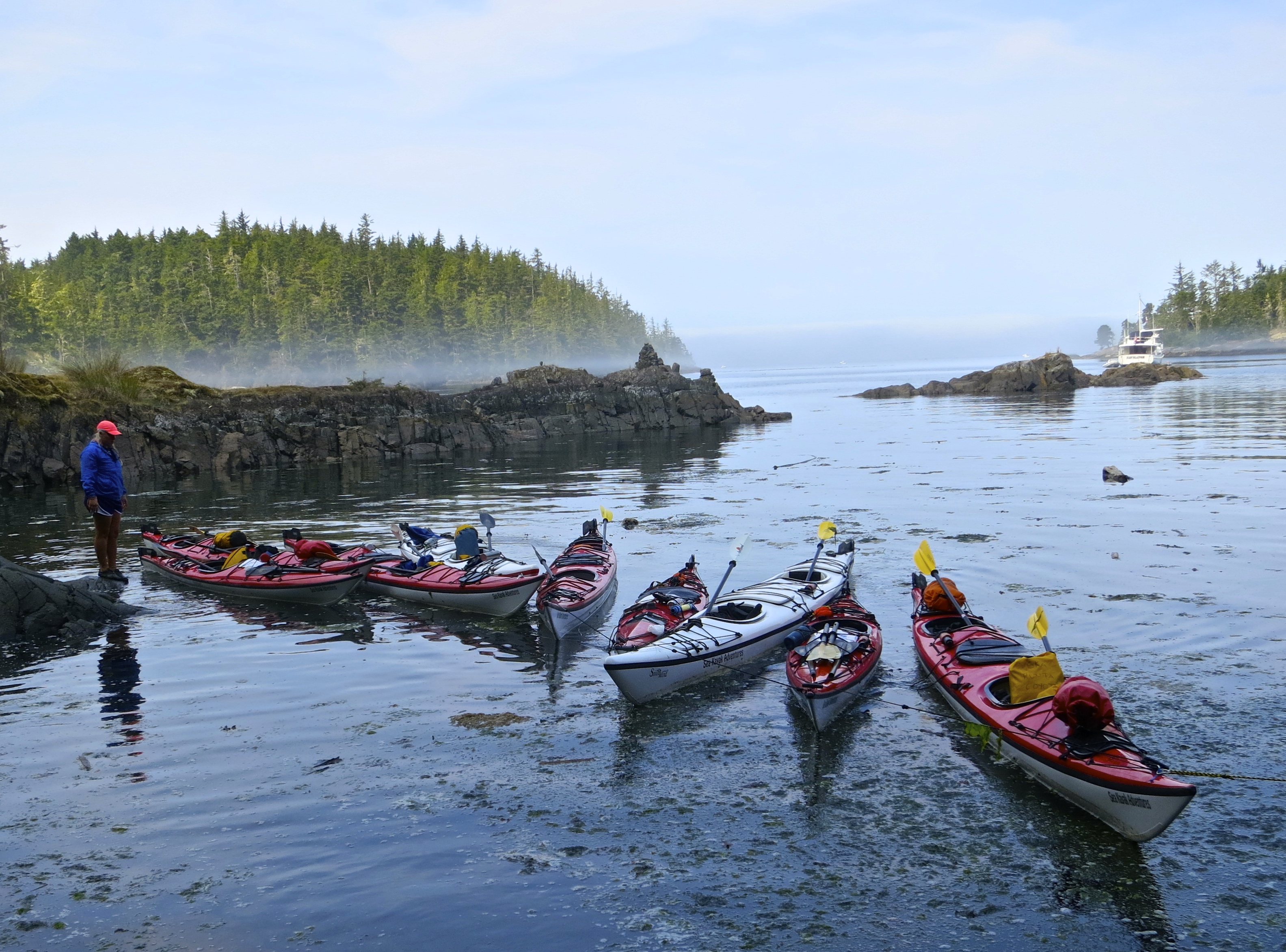
Sea Kayak Adventure kayaks roped together in small inlet on Hanson Island. Photo by Curtis Mekemson.

I took this picture of our kayaks at lunch. They were roped together so they wouldn’t stray.

After lunch, we followed out trip leader, Julia, out into Blackfish Sound. As you will note, most of our on-water photos are taken by Peggy. I was busy paddling. (grin) (Photo by Peggy Mekemson.)

After lunch, we followed out trip leader, Julia, out into Blackfish Sound. As you will note, most of our on-water photos were taken by Peggy. I was busy paddling. (grin) (Photo by Peggy Mekemson.)

A whooshing sound caused us to stop and search for whales. (Photo by Peggy Mekemson.)

A whooshing sound caused us to stop and search for whales. (Photo by Peggy Mekemson.)

Peggy Mekemson prepared to photograph whales in Blackfish Sound, British Columbia. Photo by Curtis Mekemson.

I took this photo of Peggy poised to capture a picture of the whale with her telephoto.

Thar she blows! We spot the tell-tale spume of a humpback whale as it surfaces. (Photo by Peggy Mekemson.)

Thar she blows! We spot the tell-tale spume of a humpback whale as it surfaces. That’s a kayak paddle on the right.(Photo by Peggy Mekemson.)

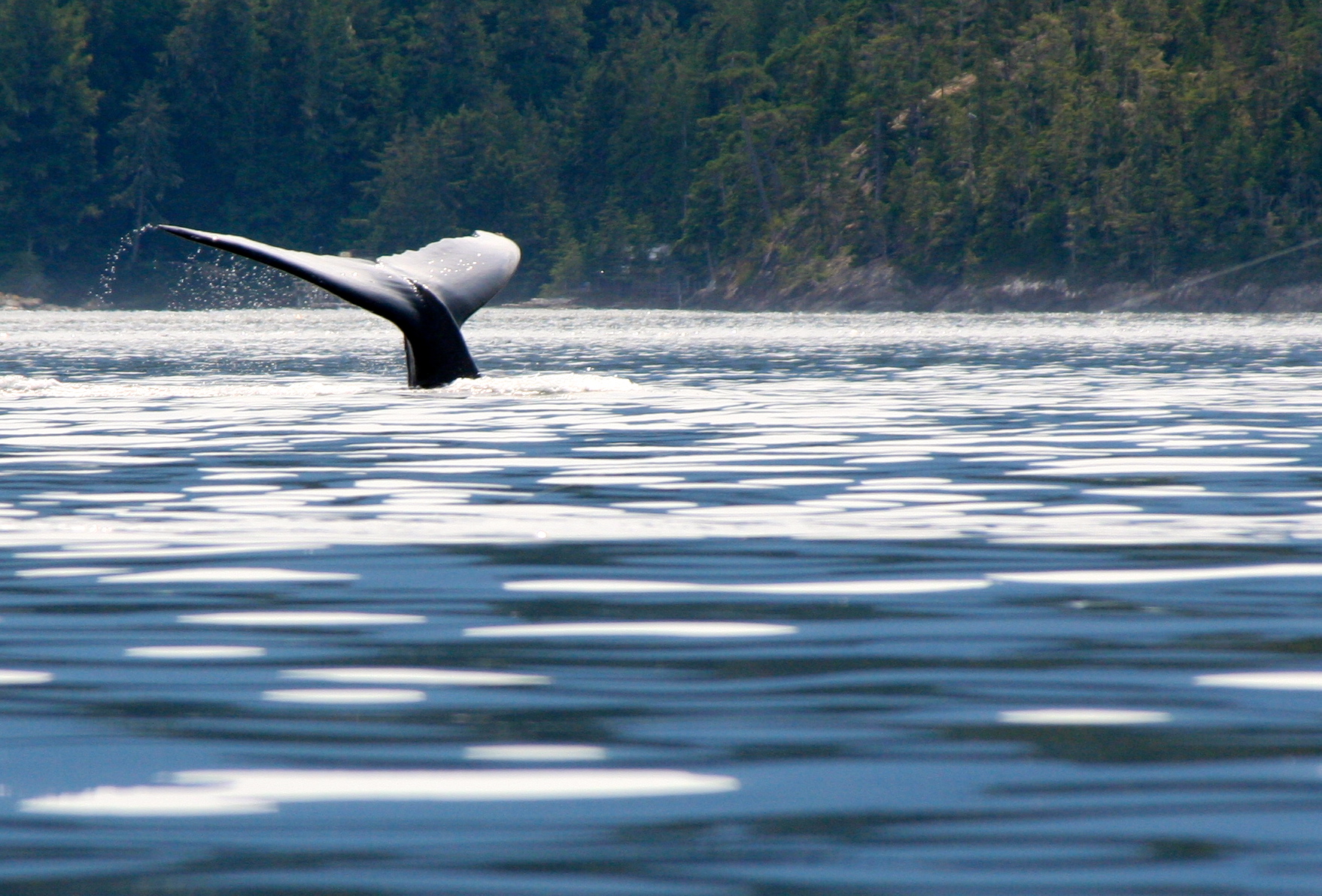
The humpback, brought in closer by Peggy's telephoto, dives back under the water. (Photo by Peggy Mekemson.)

The humpback, brought in closer by Peggy’s telephoto, dives back under the water. (Photo by Peggy Mekemson.)

I liked the watch the waves distorted the reflection of Quy in the water. Edie and Dave look on. The other kayakers are watching the approach of a cruise ship. (Photo by Peggy Mekemson.)

I liked the way the waves distorted the reflection of Quy in the water. Edie and Dave look on. The other kayakers are watching the approach of a cruise ship. (Photo by Peggy Mekemson.)

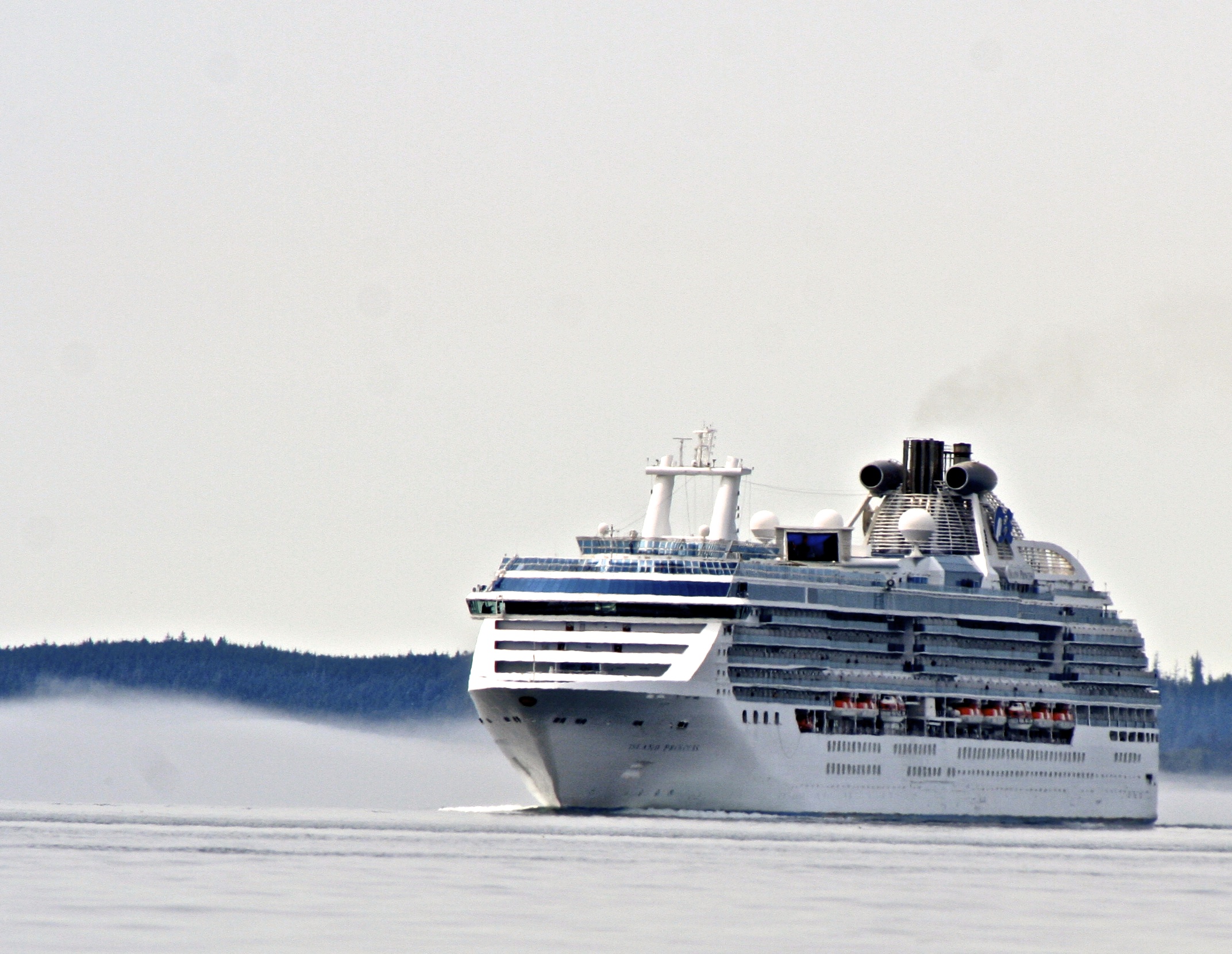
The cruise ship. You can imagine how big the ship seems from the perspective of a kayak. You do not want to get in the way. (Photo by Peggy Mekemson.)

The cruise ship. You can imagine how big the ship seems from the perspective of a kayak. You do not want to get in the way. (Photo by Peggy Mekemson.)

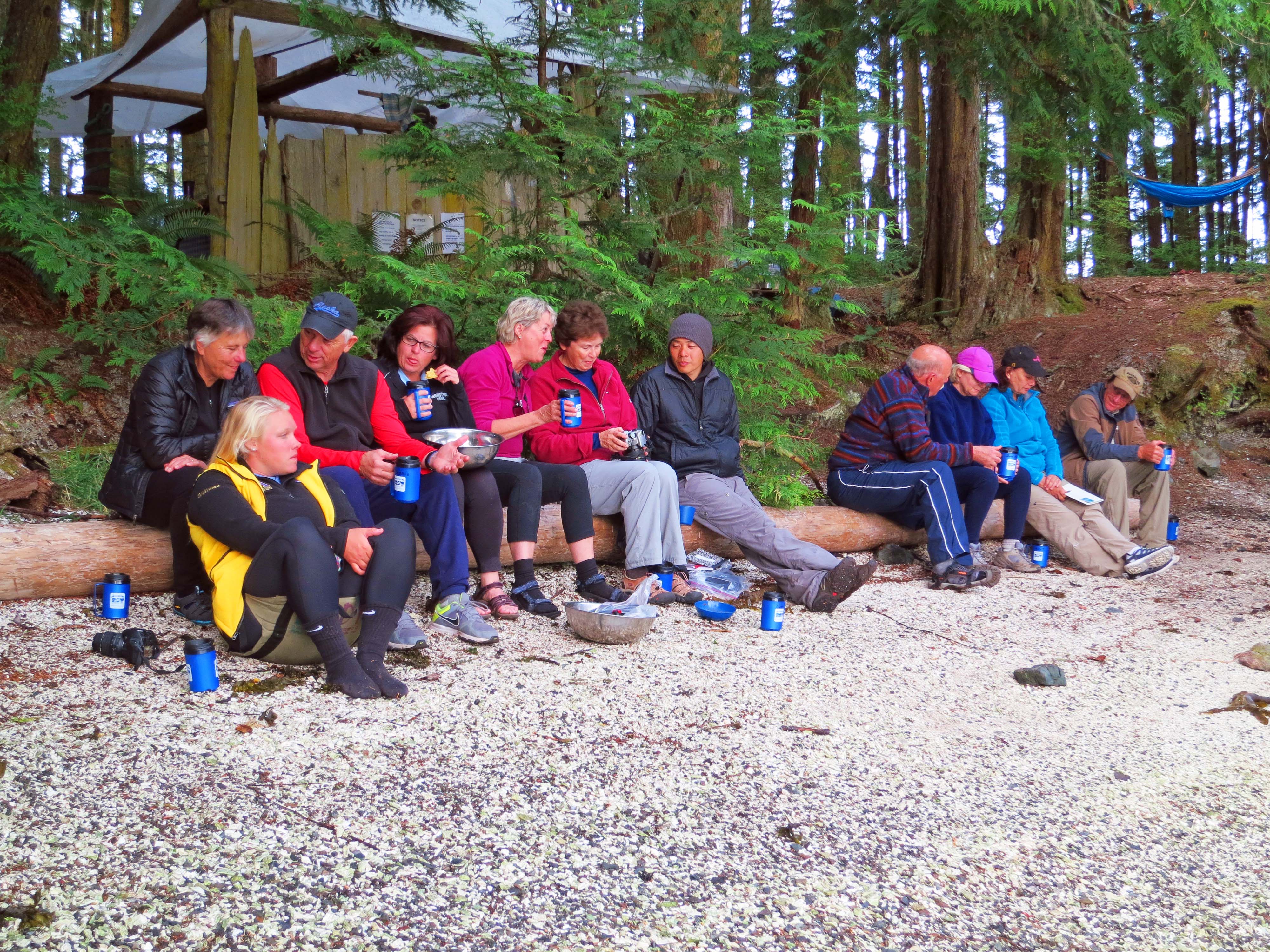
Sea Kayak Adventures group relaxes on beach at campsite on Compton Island, British Columbia.

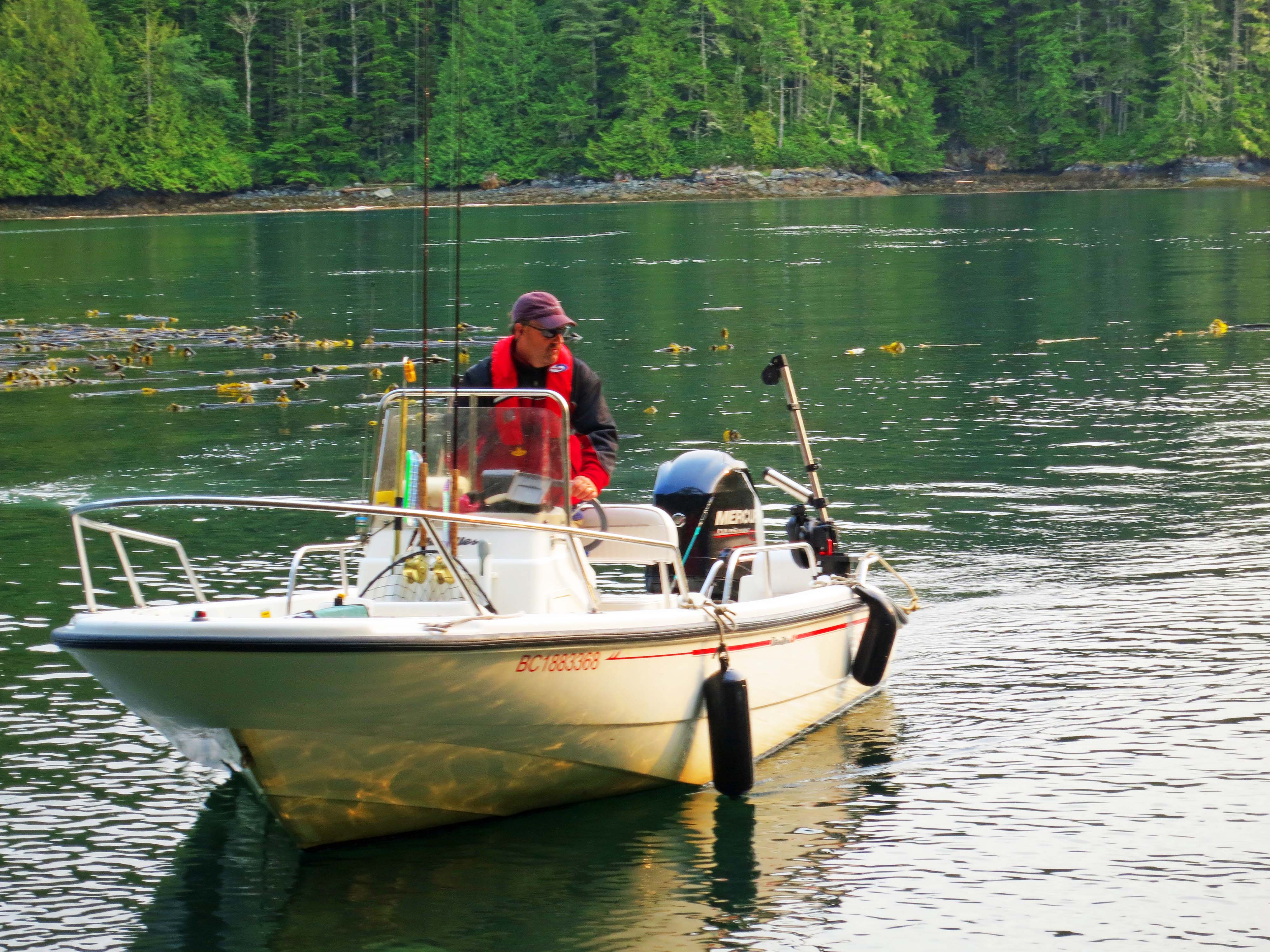
Our group, having safely navigated through the whales and the cruise ships, relaxes at cocktail hour in our campsite on Compton Island. It was right about then that a fishing boat approached the beach.

"Would you like a salmon?" he asked— and to our enthusiastic  yes, threw it overboard.

“Would you like a salmon?” he called out— and to our enthusiastic, yes!, threw it overboard.

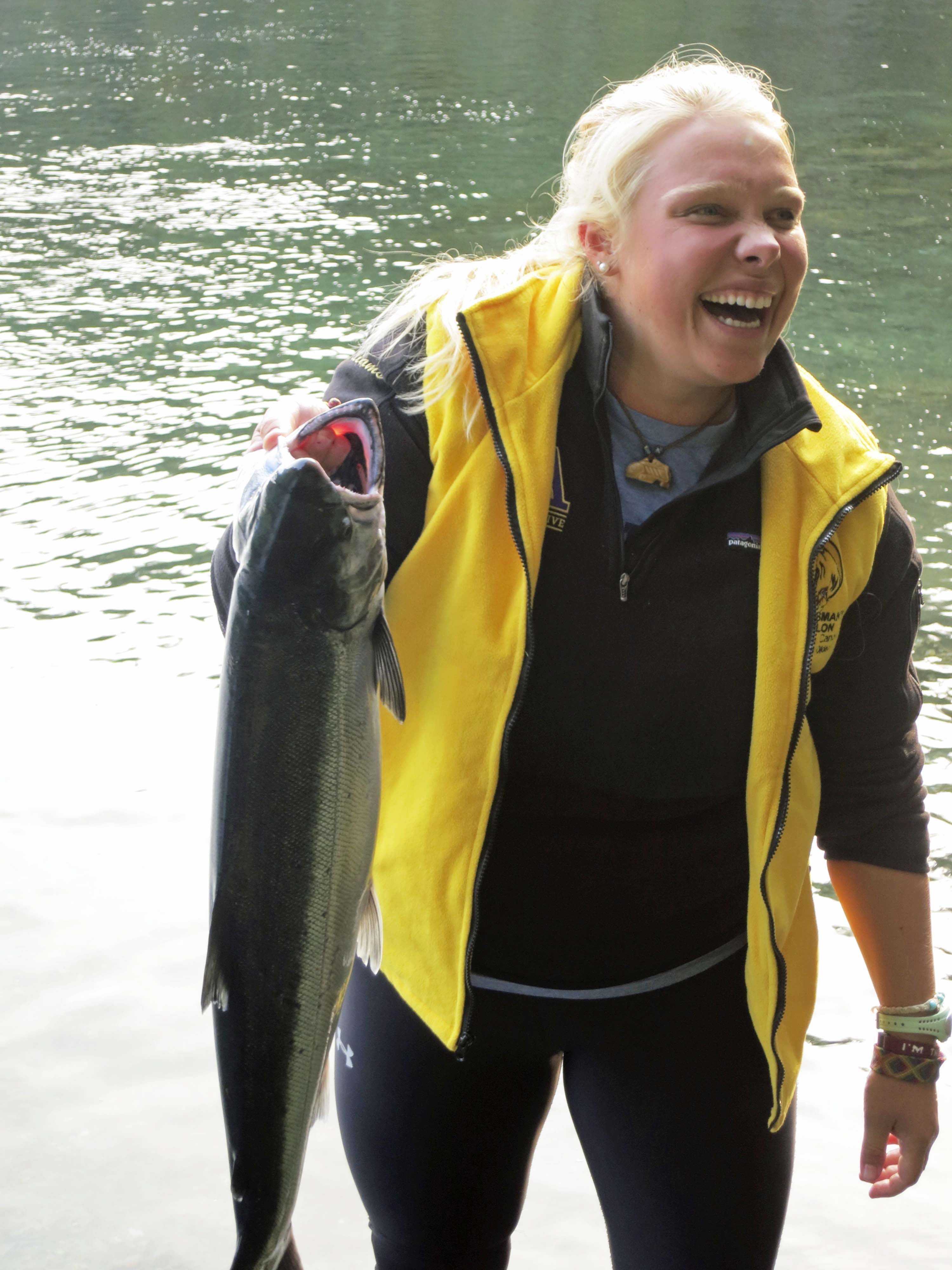
Coho salmon caught in Blackfish Sound, British Columbia. Photo by Curtis Mekemson.

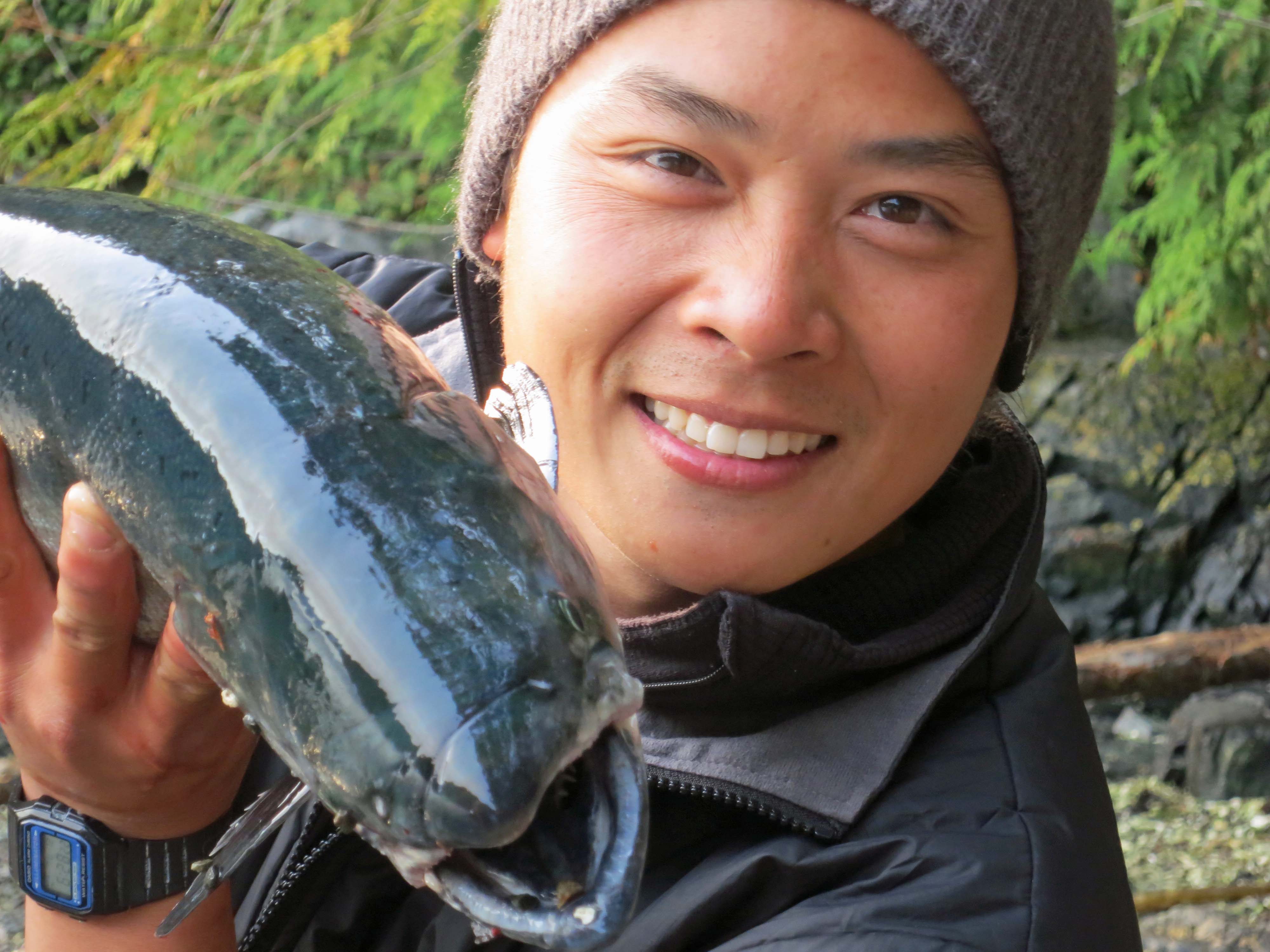
The ever energetic and vivacious Lindy retrieved the salmon and handed it off to Quy.

Quy was happy to pose with the salmon, until...

Quy was happy to pose with the salmon, until…

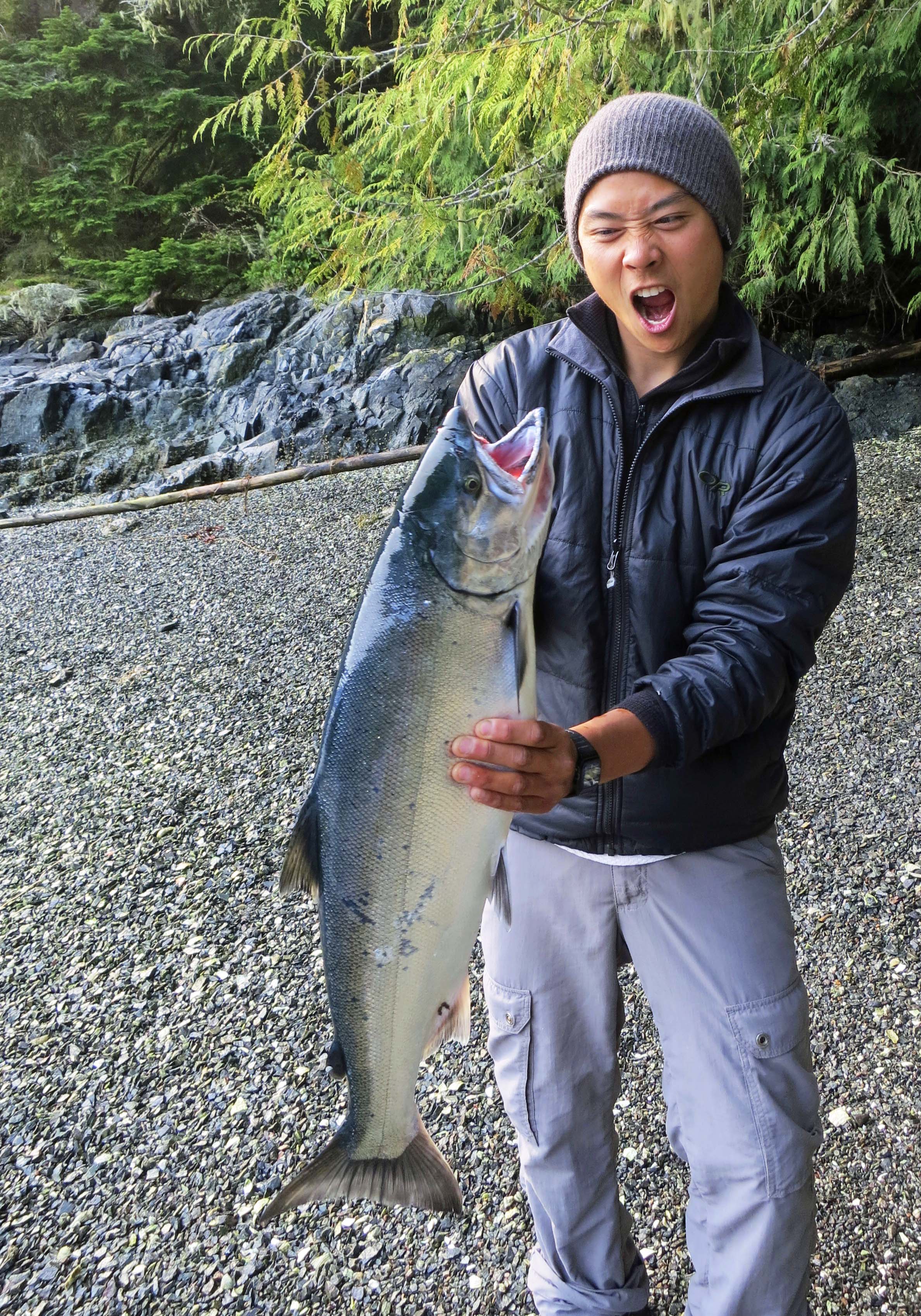
Sea Kayak Adventures guide reacts to wiggling salmon he thought was dead.

… it wiggled.

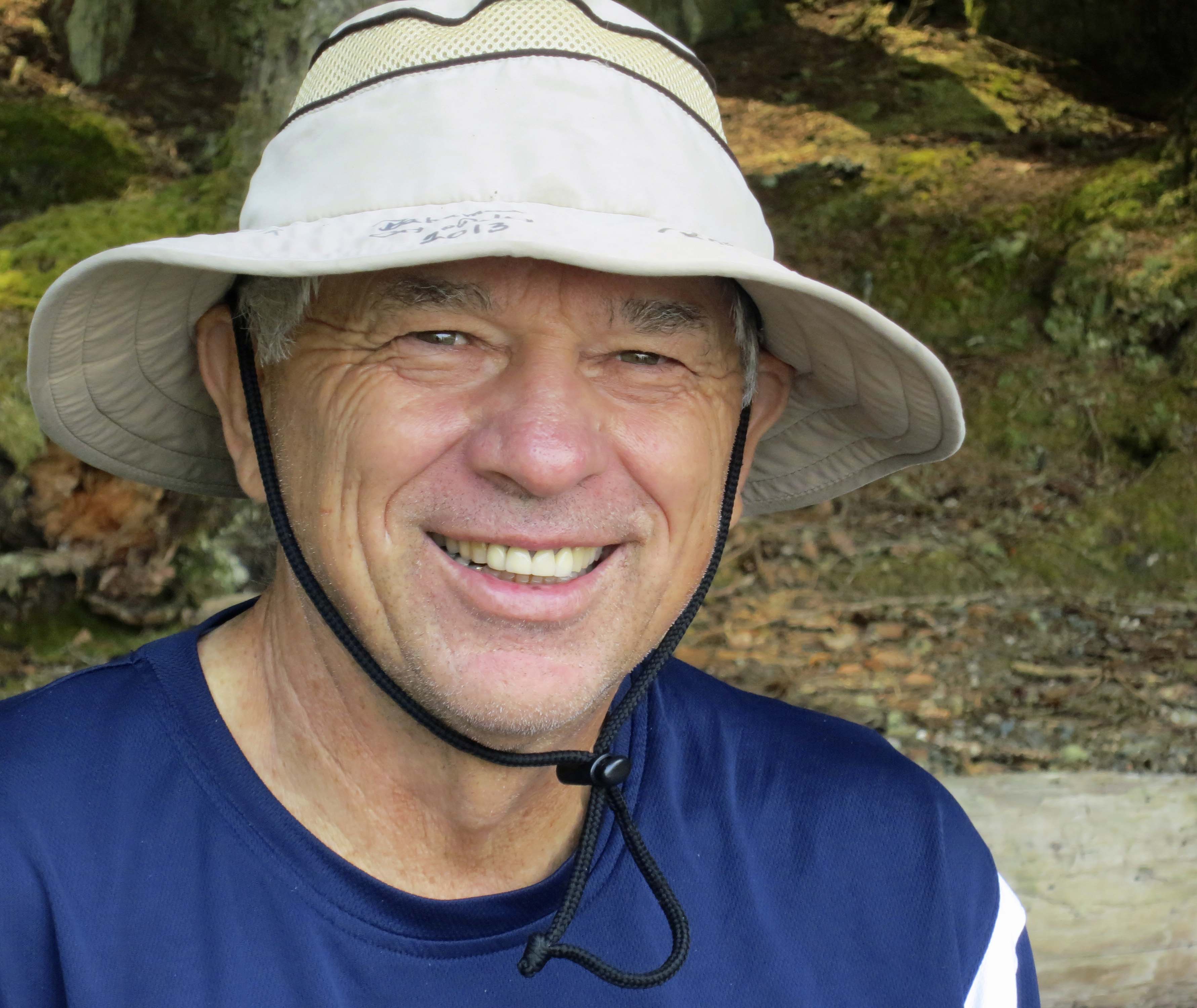
The true hero of the day was Dennis who now lives in Idaho but has fished extensively off of Alaska. He offered to fillet the fish.

The true hero of the day was Dennis, who now lives in Idaho but has fished extensively off of Alaska. He offered to fillet the fish.

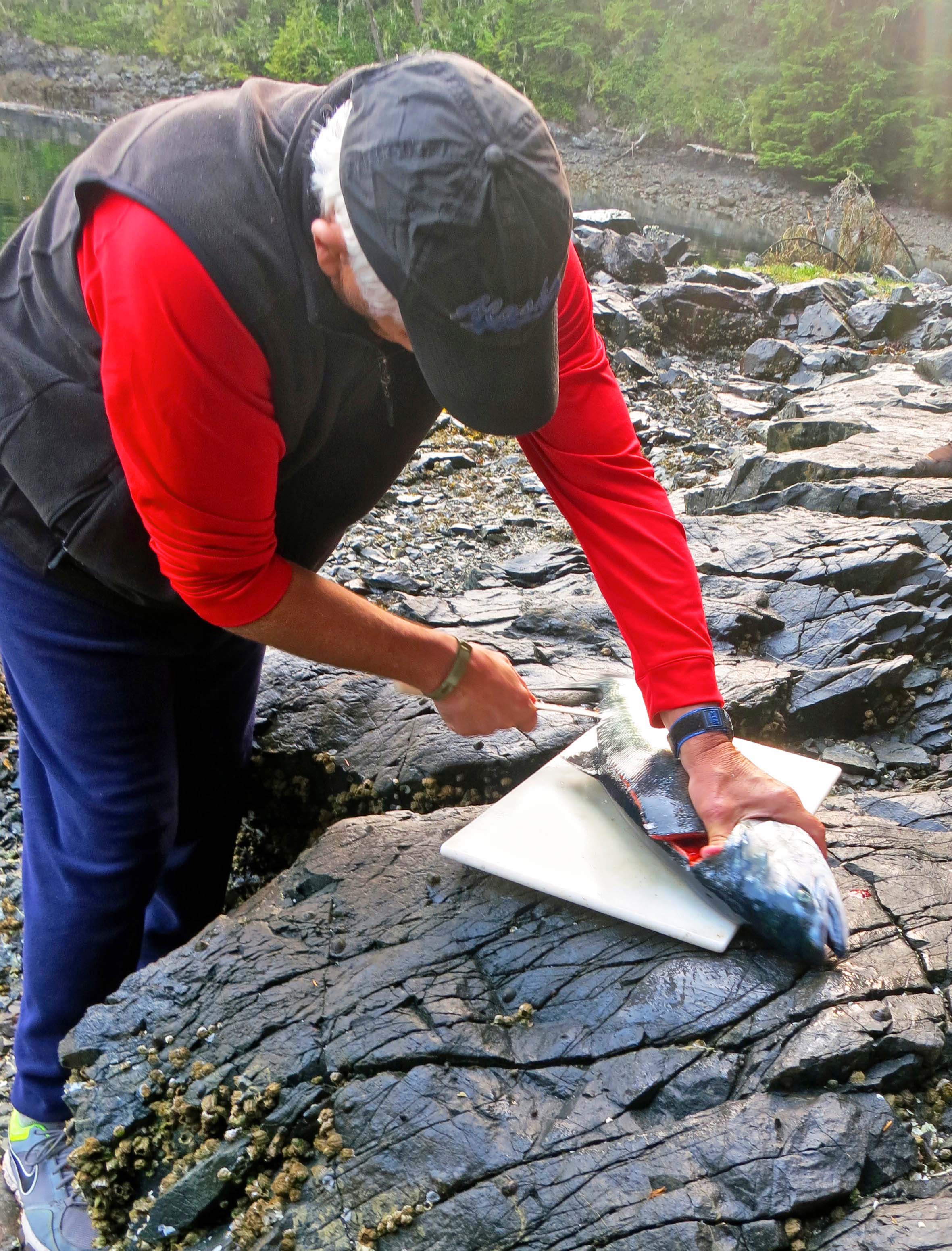
Here, Dennis goes to work.

Here, Dennis goes to work.

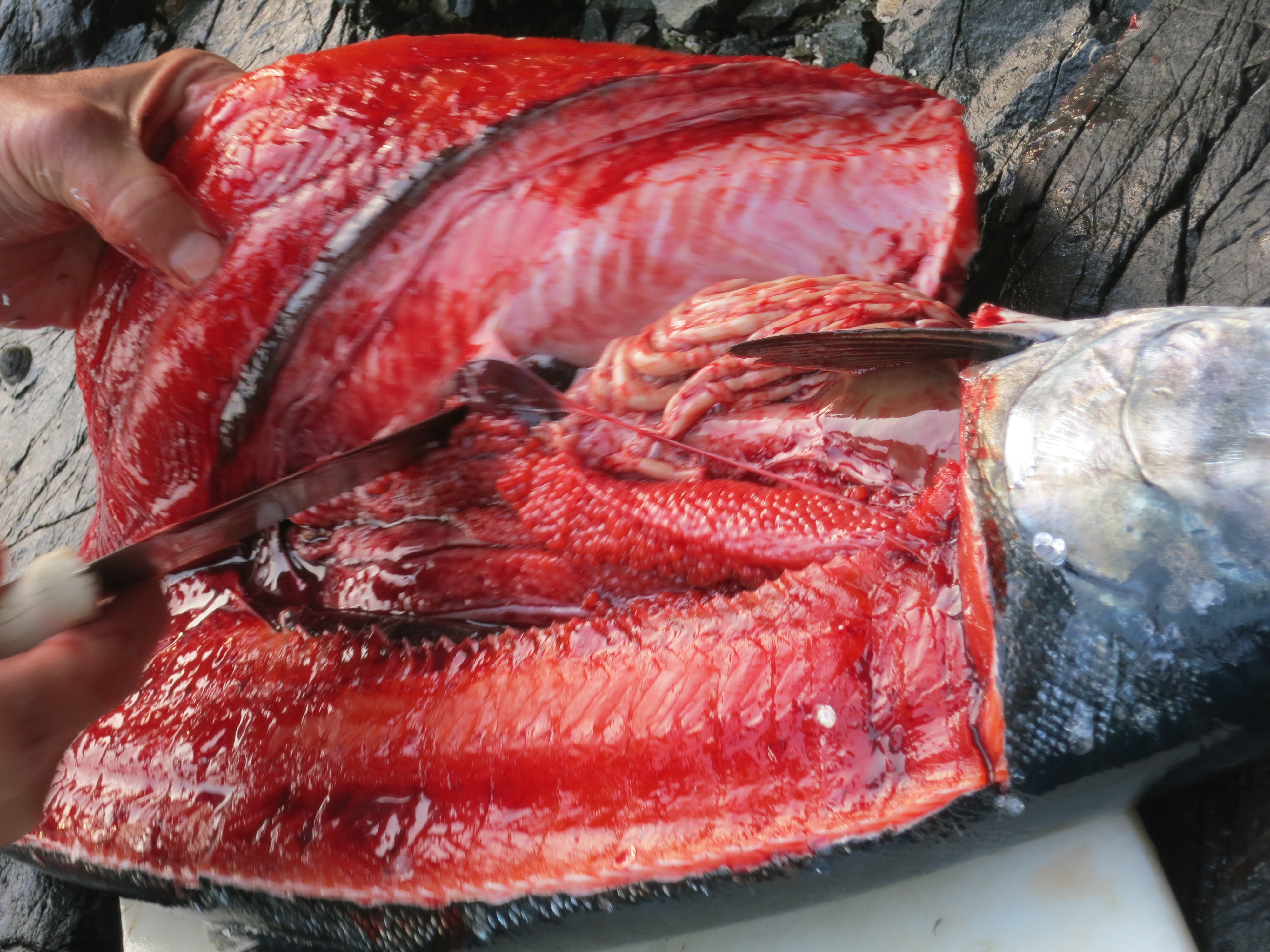
A filleted coho salmon displaying roe. Photo by Curtis Mekemson.

And displays the rich red meat, roe, and innards of the salmon. The salmon made a delicious lunch the next day, easily feeding all of us.

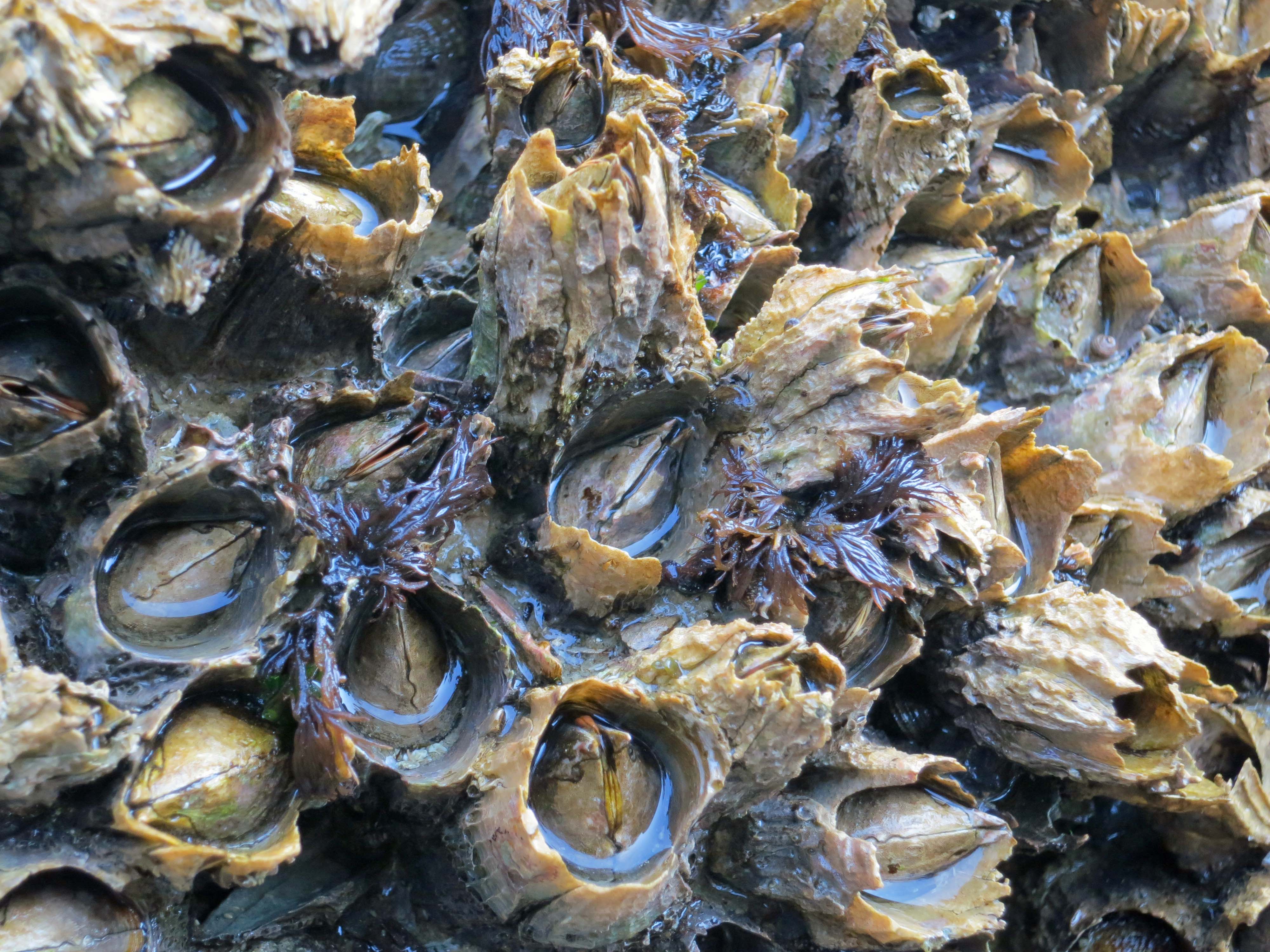
Photo of barnacles off of Compton Island in Blackfish Sound, British Columbia. Photo by Curtis Mekemson.

It was after all of the salmon excitement that we discovered the starfish, and these barnacles.

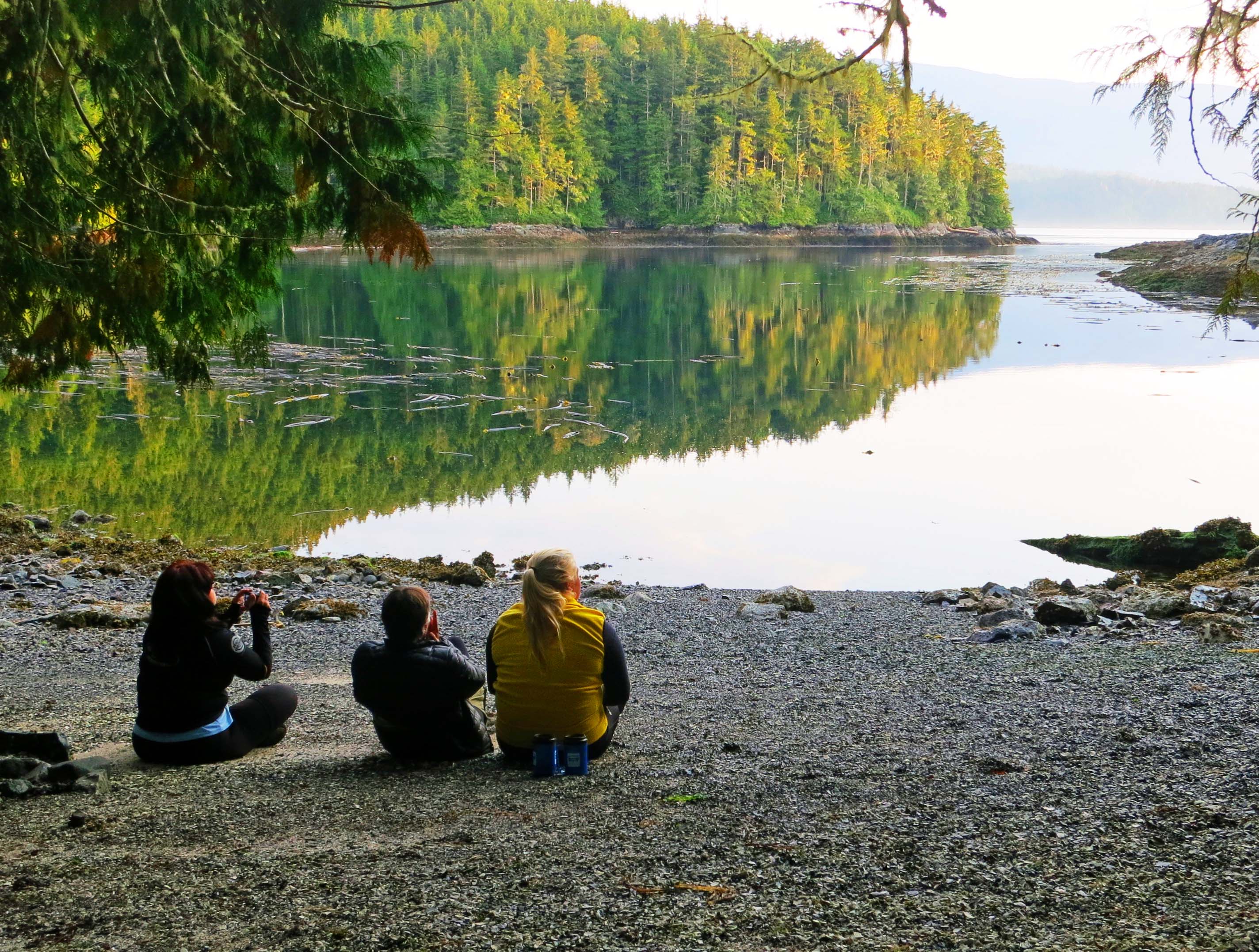
Members of our group enjoy a quiet moment at the end of the day, hoping for a whale to appear. Next blog: we kayak to Berry Island and hear a tale about Bigfoot.

Members of our group enjoy a quiet moment at the end of the day, hoping for a whale to appear. Next blog: we kayak to Berry Island and hear a strange tale about Bigfoot.

Welcome to Burning Man’s Temple… A Spiritual Place

Early morning photo of the Temple of Grace at Burning Man 2014. Photo by Curtis Mekemson.

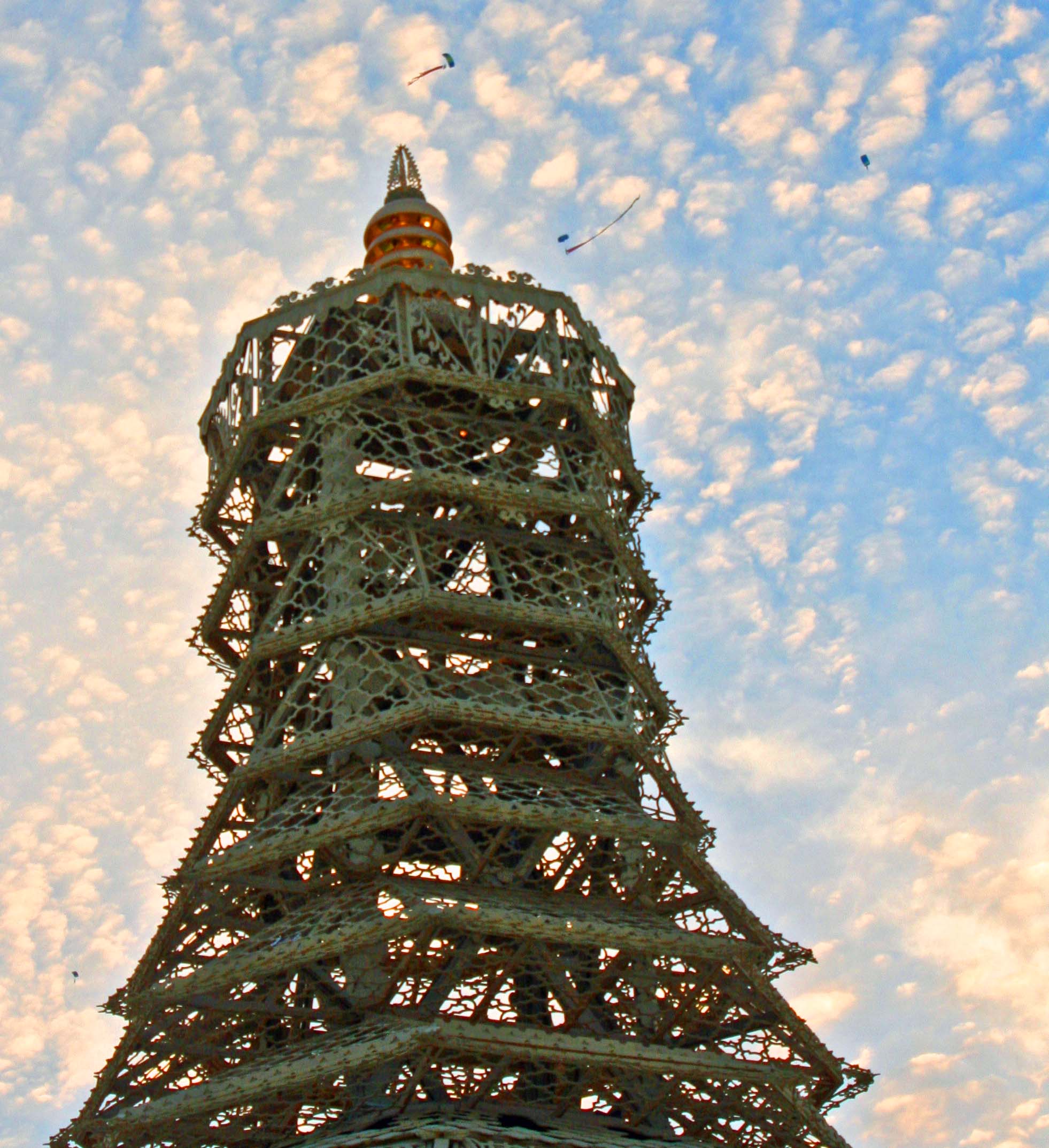
Outlined by early morning sunlight, the 2014 Temple of Grace (designed by David Best) adds an element of tranquility and spirituality to Burning Man.

Black Rock City does an annual census that is chock-full of interesting information, including the spiritual beliefs of Burners. I was going to write about the overall census results today, but decided to wait for the final 2014 data. That means this will be my last post for the season on Burning Man.

Census form being filled out at Burning Man 2014. Photo by Curtis Mekemson.

Burning Man takes its annual census seriously. Here a Burner fills out his form while his friend checks out the entertainment at the Center Camp Cafe.

It seems appropriate that I conclude with the Temple. I consider it to be Burning Man’s most unique structure. And yes, this includes the Man. The Temple is a spiritual place. Thousands of Burners leave messages to friends and loved ones who have passed on, including pets. They also leave messages of thanks and love to people who are still very much with us. By Saturday, it is challenging to find a reachable space that hasn’t been written on. When the Temple burns on Sunday evening, all of these messages are sent skyward, with a prayer, if you will.

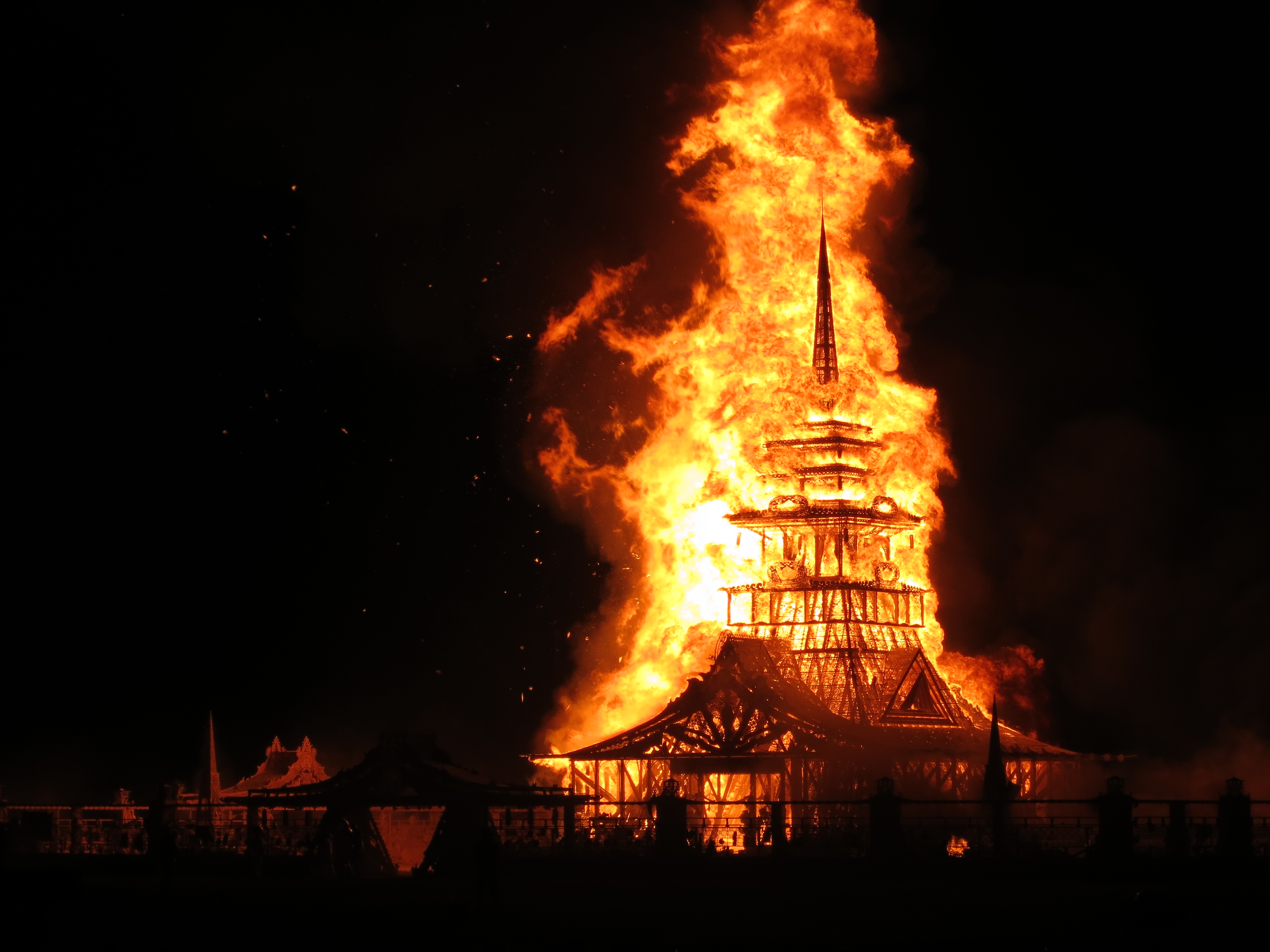
Burning of 2102 Temple of Juno designed by David Best. Photo by Curtis Mekemson.

While Peggy and I left before the burning of the 2014 Temple, we were able to stay for the burning of 2012 Temple, which was also built by David Best.

This does not mean that Burners are religious. In fact, only 7% of Burners define themselves as belonging to a particular religion according to the 2013 Census. Half of all Burners consider themselves spiritual, however. And most of these folks, including me, think of the Temple as sacred space. The thousands of messages of grief and deeply felt love make it impossible to think otherwise.

Messages written on the walls of the Temple of Grace at Burning Man 2014. Photo by Curtis Mekemson.

So many messages are written on the walls of the Temple that no space is left, as this photo illustrates. I was amused by the upper left message that stated, “Goodbye to who I thought I was. Yes!” Warning: Going to Burning Man may impact your concept of reality.

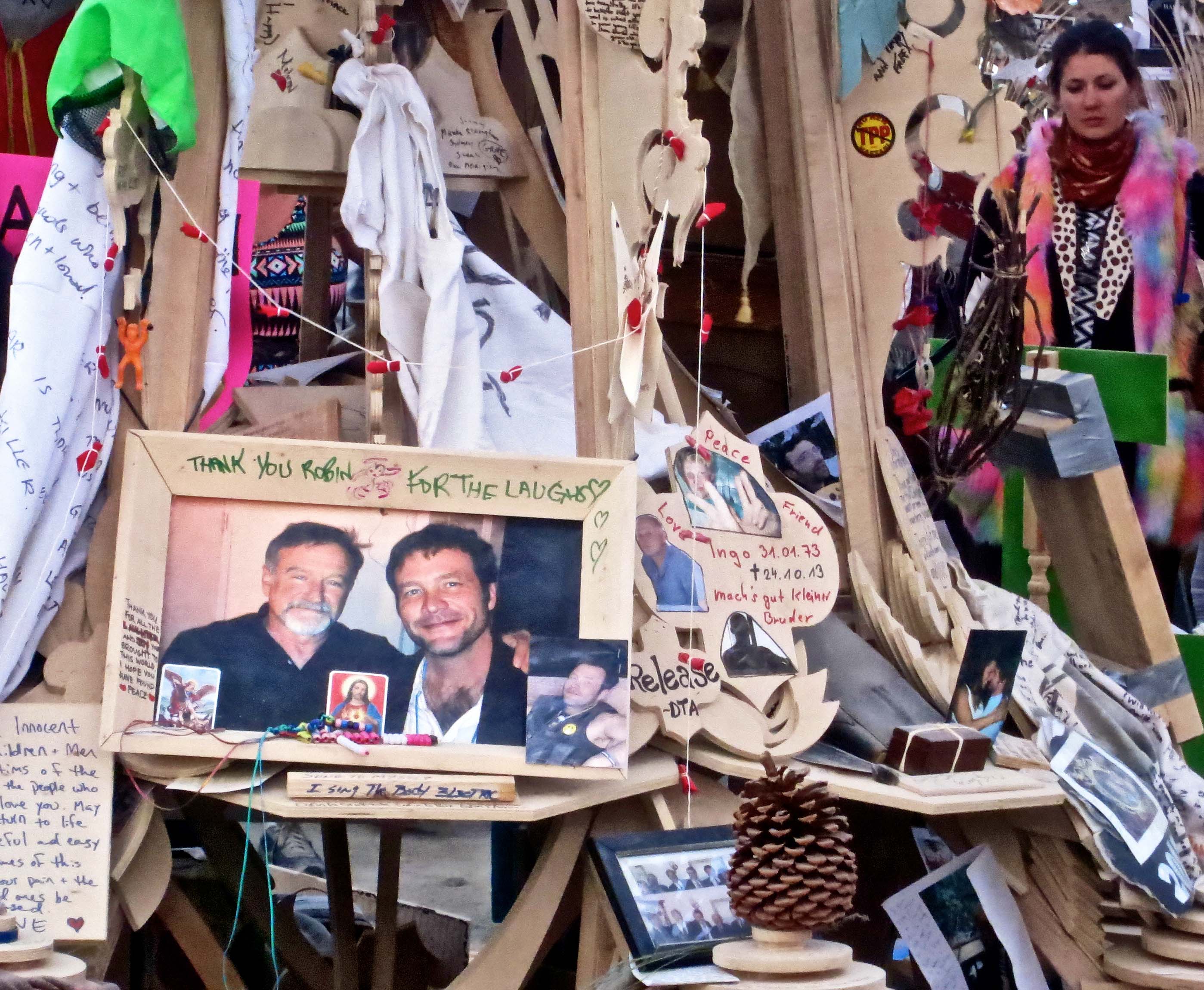
A memorial to Robin Williams at the 2014 Temple of Grace at Burning Man 2014.  Photo by Curtis Mekemson.

There was also a memorial to Robin Williams. “Thank you Robin for the laughs.”

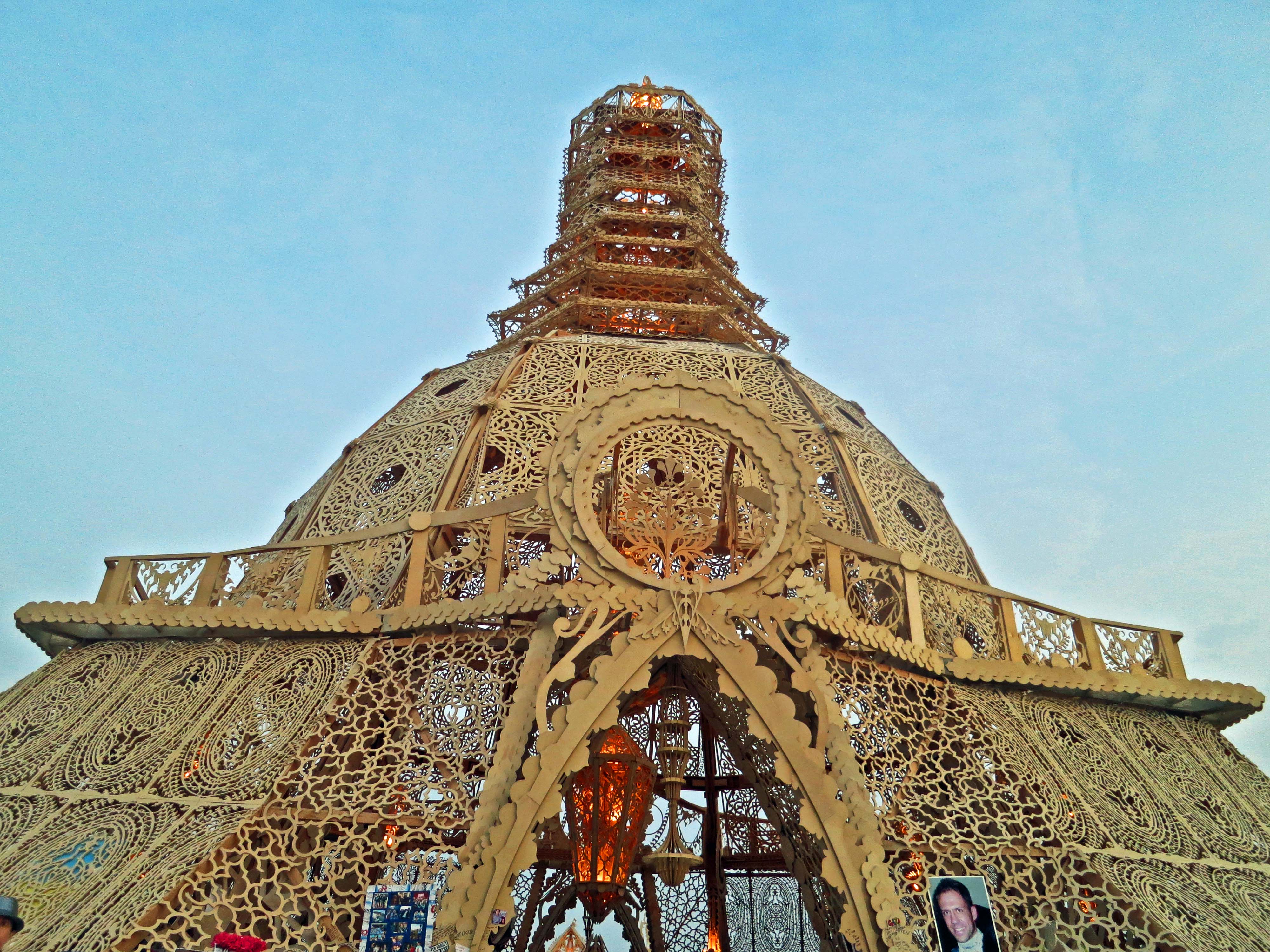
View of Temple of Grace at Burning Man 2014. Photo by Curtis Mekemson.

I like this photo because of the perspective it provides on how intricately the walls of the Temple were carved.

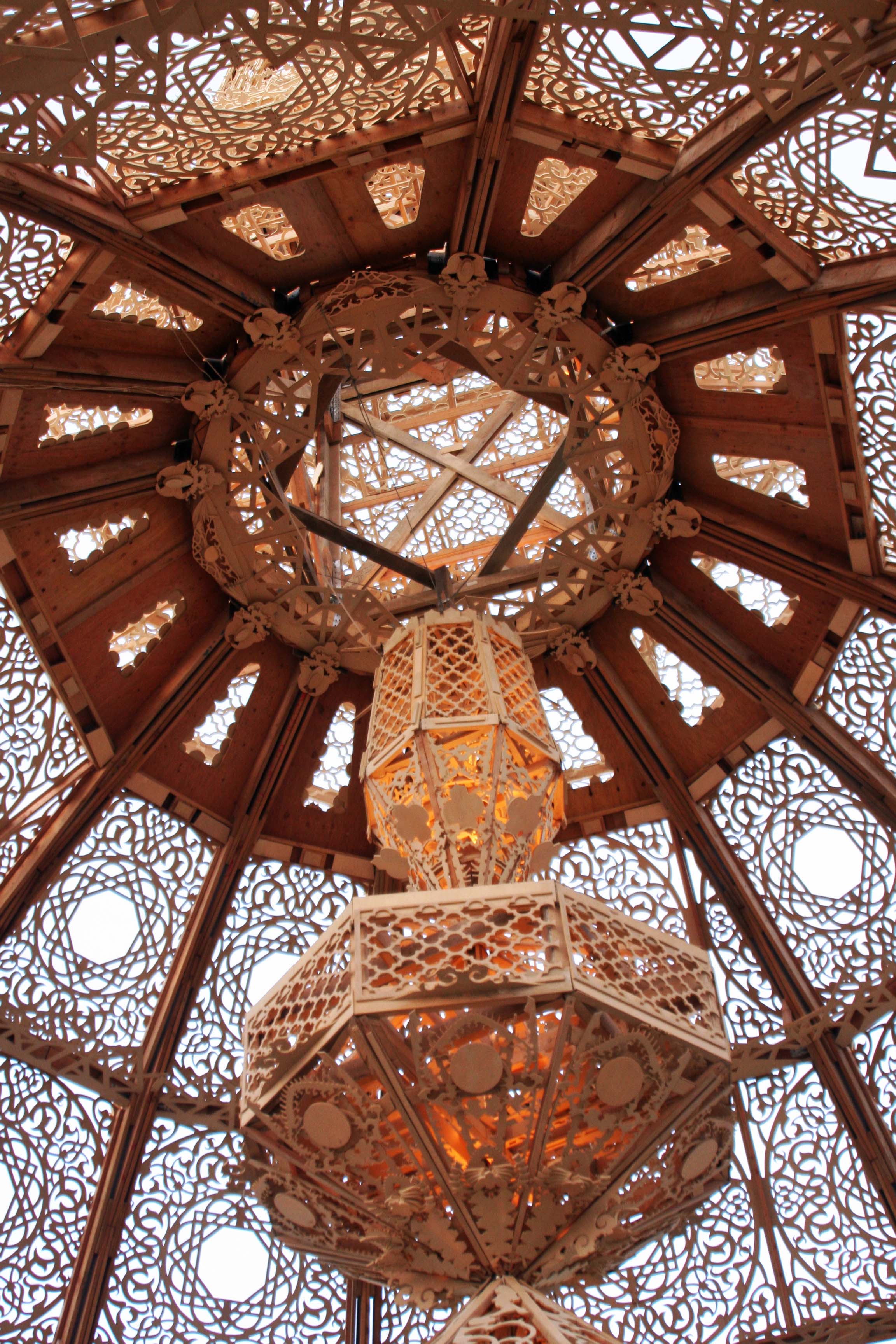
Center piece at Temple of Grace, Burning Man 2014.

This view of the Temple’s centerpiece also demonstrates the intricate carving as well as the open feeling of the Temple. (Photo by Peggy Mekemson.)

Top of Temple of Grace at Burning Man 2014.

Peggy caught this early morning photo of the Temples top. The specks you see up in the sky, BTW, are skydivers. Hundreds of jumps are made during the week. (Photo by Peggy Mekemson.)

Gateway to Temple of Grace at Burning Man 2014. Photo by Curtis Mekemson.

One of the main gateways into the Temple of Grace.

Gateway pillar at Temple of Grace, Burning Man 2014. Photo by Curtis Mekemson.

I liked the contrast with this gateway pillar and the morning sky.

Photo of early morning clouds taken from Temple of Grace at Burning Man 2014. Photo by Curtis Mekemson.

Looking over the wall that surrounds the Temple of Grace, I took this photograph of clouds caught at dawn.

A view of the 2014 Burning Man Temple of Grace at night. Photo by Curtis Mekemson.

A view of the Temple of Grace at night.

A view of the Temple's centerpiece at night. (Photo by Don Green.)

The Temple’s centerpiece at night. (Photo by Don Green.)

Temple of Grace at night during Burning Man 2014. Photo by Curtis Mekemson.

A final view of the Temple of Grace.

NEXT BLOGS: I am beginning a new series on North America’s fabulous Northwest. I will start with a week-long sea kayak trip Peggy and I took this summer off the coast of northern Vancouver Island looking for Orcas. I will then move inland for a look at Washington’s beautiful Mt. Rainier National Park where Peggy and I hiked with our son Tony in August. I will finish up with a road trip down the Oregon coast, which I am on right now. It may even include portions of Washington and California’s Coast. Who knows where I might end up. I don’t.