I am continuing my exploration of the wild side of our property and the surrounding forest by looking at deer behavior today. While I am not sure that it is amusing to the deer, it is amusing to us, except of course, when it involves their eating Peggy’s carefully grown plants. We try to maintain a sense of humor about that. Watching the deer, and all of the wildlife around our property, is also an education. That’s half the fun.
“Okay, guys. Listen up. I am king here. As long as you remember that I eat first, we’ll all get along fine.” Not everyone agreed.
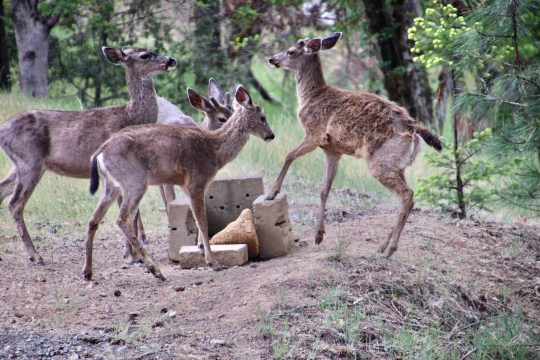
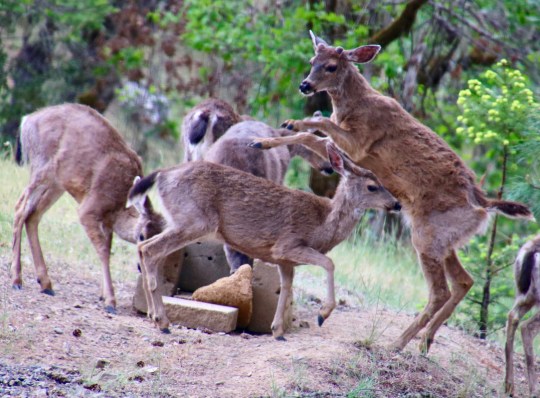
A buck is up at the deer block having a discussion about his right to eat first. It isn’t so much about eating as it is about dominance. If everyone agrees, he will have a few bites and be on his way. And then someone else will have the discussion. It works it way downward. This time, a teenage buck was chased off— rather dramatically. But it doesn’t end there. Buck number one is sent packing by buck number three, who has bigger antlers. Size matters.
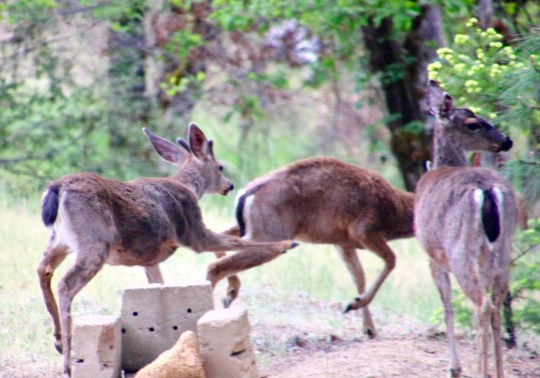
“I warned you. Now you pay.” Note how other deer slip in to grab a bite while the confrontation is taking place.“Not so fast. You may be larger but I have bigger antlers!” Ah, the agony of defeat when the small guy kicks your tail.
I’ve watched a scene unfold several times where the dominant deer chases away the next deer in line, who immediately goes over and kicks the next deer, who goes over and kicks the next one, etc. until there isn’t anybody left to kick. The confrontations are rarely violent. They often end with a gentle tap— as long as the other deer gets the idea. Sometimes there is no confrontation at all, especially among families. And everyone lets fawns eat their fill.
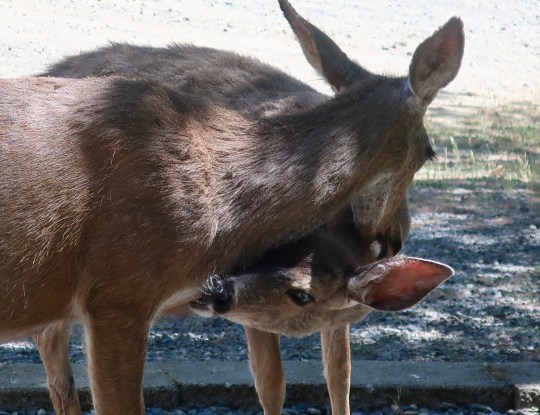
“I’ll scratch behind your ear if you will get my neck.” Grooming is one way deer families build and maintain ties. It starts with moms and fawns and continues even after the kids are fully grown.This short video captures the deer grooming each other. I found it humorous. Peggy said “so much for social distancing.”
Peggy and I usually don’t put up a deer block. We prefer that the deer behave like deer and eat plants. (As long as they aren’t ours.) But I do put up one when the moms are in their last stages of pregnancy. My reason/excuse is that it helps supplement their diet. But I confess, I like the fact that it encourages the moms to bring their kids by, not to mention all the action we get to see.
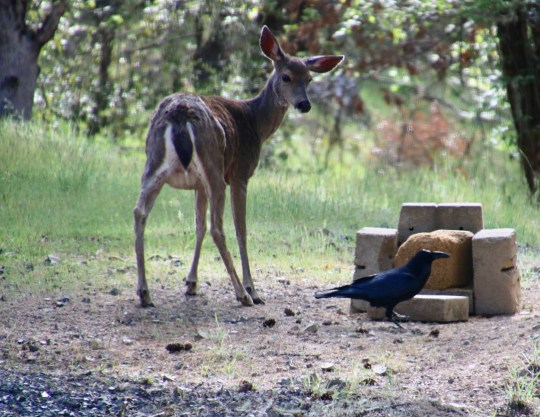
Not much action here. One of the extended deer families is having an afternoon snooze with the deer block only a few feet away. Every once in a while, one stands up for a nibble.Other animals and birds also like the deer blocks including ground squirrels, jays, turkeys, and acorn woodpeckers. In this particular instance, a raven has come to visit. It’s the first one I have ever seen on our property. Judging from Momma-to-be’s reaction, it is the first time she has ever seen one either! Her expression says, “Who and what are you? And what do you intend to do with my deer block?”“Eat!” appears to be the answer. “And if you don’t like it, I’d suggest you bounce on down the canyon!” Momma deer didn’t buy it.
While the deer block is only up for a few weeks, our bird bath is open for business 24/7 year round. I’ve never seen a bird bathe in it (maybe we have dirty birds), but just about everyone stops by for a drink.
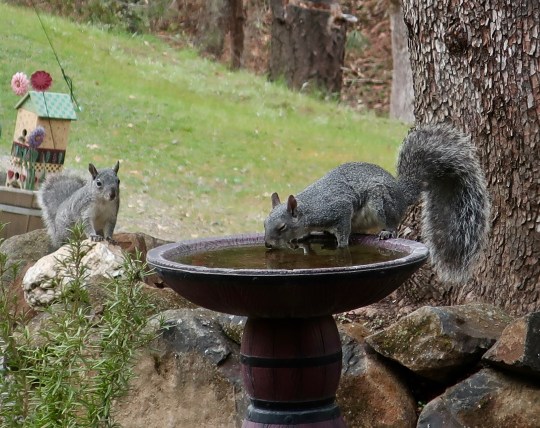
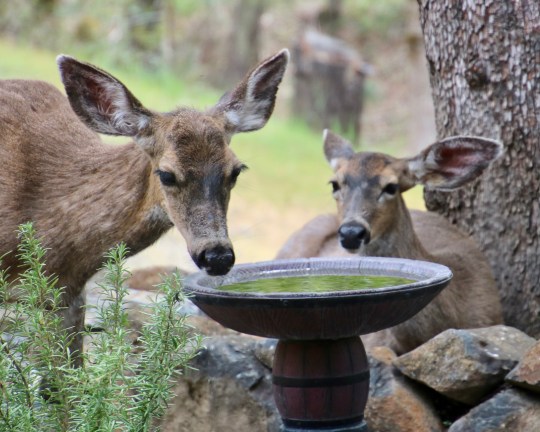
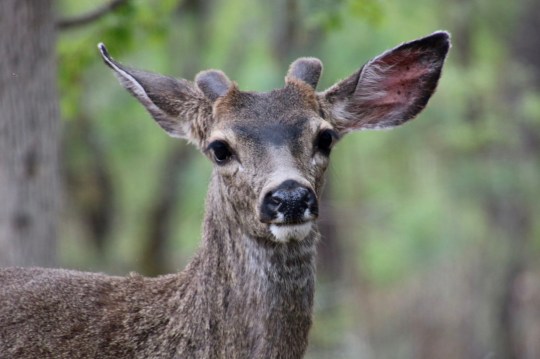
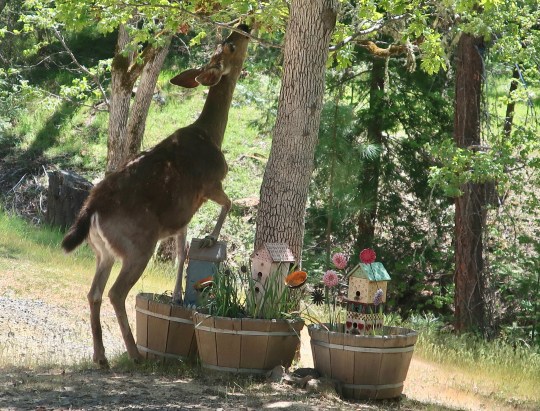
A gray squirrel slurps up water while its companion looks on…And then joins in.Although there is a natural spring down in the canyon, the deer seem to prefer the bird bath. We’ve learned that one deer can drink a lot.And two drink a lot more. Peggy and I are constantly refilling the ‘spring.’Let me introduce Young Buck. His antlers are just beginning their growth spurt. He’s a handsome fellow.And a bit full of himself. If he looks like trouble, that’s because he is. Consider the following:We work hard to keep the deer away from our plants. One solution is planting things they don’t like. The poppies I featured last week are an example. Lavender is another. Our garden has a ten-foot high fence around it! And this is what I call the Maginot Line of deer barriers. Peggy and I built these Gabion cages several years ago. No deer had ever leapt over them. That is until……Young Buck. He jumped over the Gabion cage barrier, scrambled over the cement block wall behind it, sampled the newly plated honeysuckle and leapt over the seven foot dirt wall beyond that. Three times. The last time I had a discussion with him on how delicious venison stew is. Peggy and I also added another small fence. So far, he hasn’t jumped over again. But with him, there aren’t any guarantees. The other deer just stand around and watch in awe, waiting to see what happens. Normally lots of yelling, “BAD DEER!”Having shown a bad deer, I’ll conclude today’s post by showing a good one eating Mekemson-approved deer food, young oak leaves. The problem here is that the deer was using one of Peggy’s planter villages as a ladder. She had been wondering why her houses and elves kept ending up on the ground!
NEXT POST: More wilderness encounters and lore. Peggy and I hike up the mountain looking for cougars and bears and snakes while a small bird feeder provides more entertainment than either the deer block or the bird bath spring. It’s the law of the jungle out there!
Today, Peggy and I continue our ‘walks on the wild side,’ which are a primary form of entertainment for us while sheltering at home. Our local spring wildflowers provide the focus but I couldn’t help adding the rosebush that came across America in a wagon train.
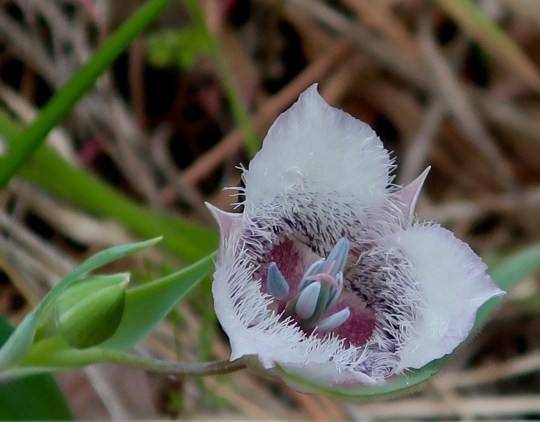
Calochortus elegans lily, or as more commonly known, elegant cat’s ear. It’s easy to see how this fuzzy fellow earned its common name. It is closely related to an old friend of mine, the Mariposa lily of the Sierra Nevada’s.
Our common names for flowers are often amusing. Hound’s tongue and elegant cat’s ear certainly are. But they can also be confusing. For example, one of the flowers I will feature today is Oregon grape. It isn’t the plants only common names, however. I found one list that included holly-leaf barberry, mountain grape, Oregon grape holly, Oregon barberry, blue barberry, creeping barberry, holly barberry, holly-leaved Berberis, holly Mahonia, Mahonia, Mahonie, scraperoot, trailing Mahonia, Uva de Oregon, Vigne de l’Oregon and water-holly— in addition to Oregon grape— for a total of 18 different names! Probably the best physical description is Oregon grape holly, but the plant is neither a grape or a holly. Nor is it found only in Oregon. It’s easy to see why botanists depend upon the plants scientific name, Mahonia aquifolium. Or is that Berberis aquifolium? (Grin) There even seems to be some debate over its scientific name!
These bright yellow flowers of Mahonia aquifolium or Oregon grape will eventually turn into blue grape-like berries. The leaves have a distinct holly-like look.Regardless of its name, Oregon’s state flower is quite beautiful. It’s also known for its healing properties. Native Americans used it for stomach trouble, hemorrhages, and tuberculosis as well as a number of other ailments. Modern herbalists have also found it useful.
I started out mis-identifying hound’s tongue. I thought it was a forget-me-not— lots of pretty little blue flowers lighting up the day. I even had an old rant of mine prepared for today’s post. Legend has it that someone in Europe fell off a cliff or drowned in a river while clutching the flowers. His final act was to throw throw them to his lover while yelling, “Forget me not!” My experience with the plant is that when it goes to seed, all of its pretty little flowers turn into hundreds of obnoxious burrs that end up on your pants, socks and shoe laces! They are extremely hard to brush off and leave numerous stickers in your hands. Once you have had this experience, you never forget the plant.
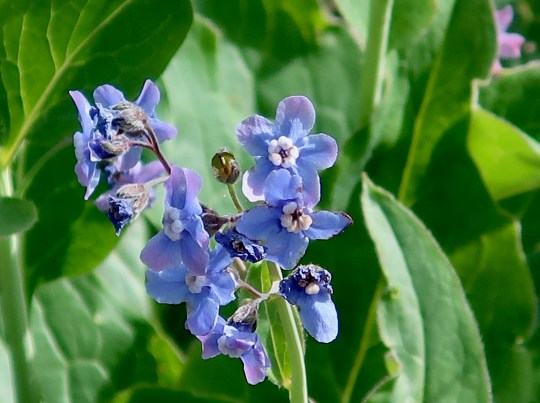
My apologies to hound’s tongue (Adelinia grande), who apparently only wanted to lick me. (Kidding on the latter.) It gets its common name from its leaves that are said to look like a hound’s tongue. They can be found along the west coast of North America from British Columbia to California.
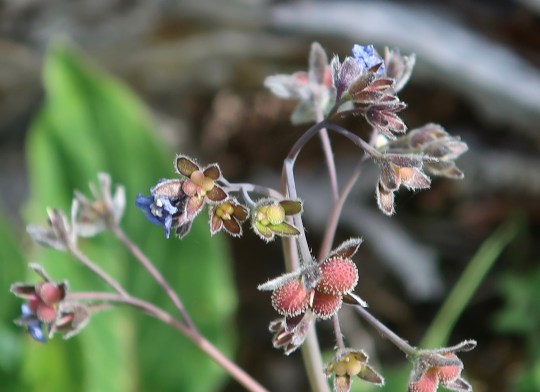
The small blue flowers reminded me of forget-me-nots but the prominent white center and leaves said it was another plant. As to whether the leaves look like a hound’s tongue, they certainly don’t look like the tongue of Socrates the Basset Hound who hung out with me for several years.The white center of the flower turns into prickly nutlets that look suspiciously like they might also stick to you..
And now, for the rest of the flowers:
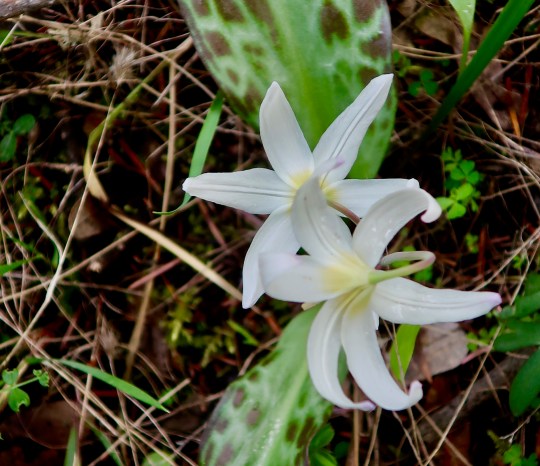
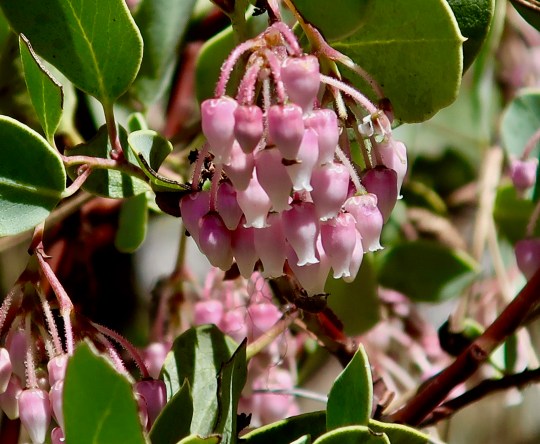
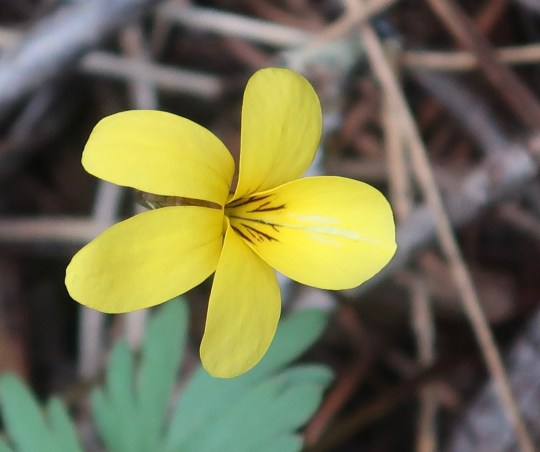
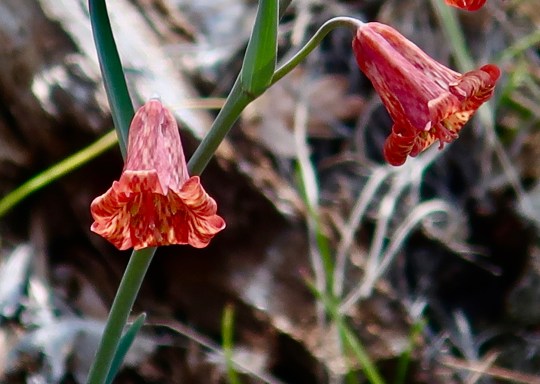
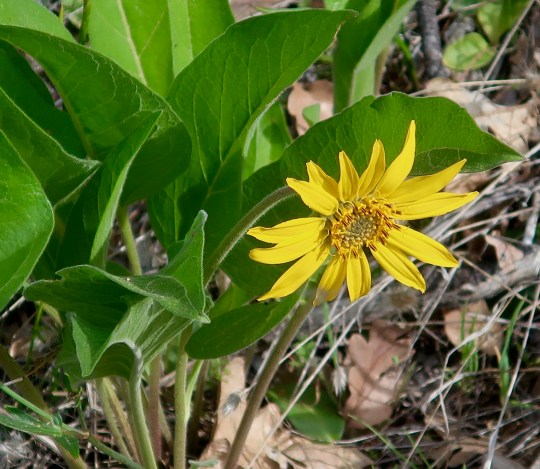
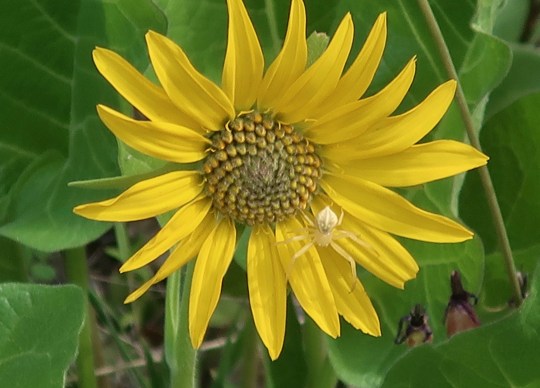
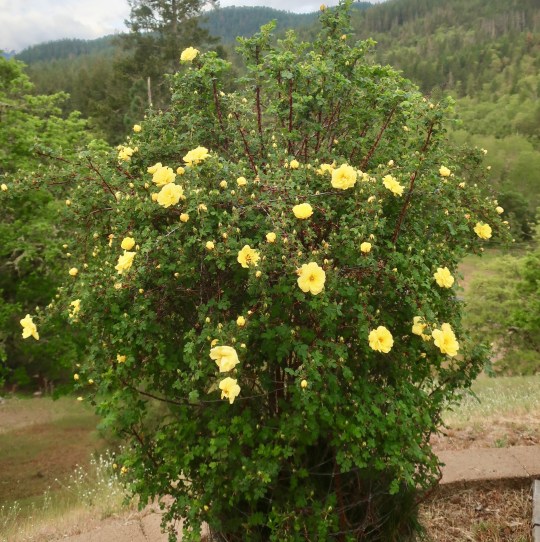
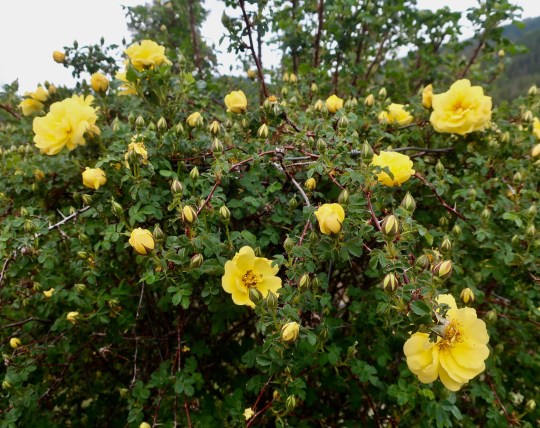
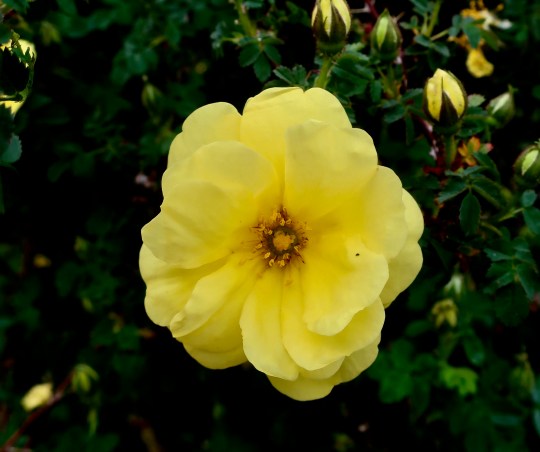
This beauty is a lemon fawn lily (Erythronium citrinum). We normally only have a couple of weeks to catch it bloomingAnother view.I grew up with these, white leaf manzanita flowers (Arctostaphylos viscida). By late summer these flowers produce bright red fruit that is sweet to eat, a favorite of raccoons, coyotes and a number of other animals, including small boys. The plant can live for a hundred years and the seeds can last in the soil for decades. Peggy and I were hiking up in the forest when she spotted this flower. It was new to us, and striking. Of its two common names, grass widow or satin flower, my favorite is the latter. Its scientific name is Olsynium douglasii. Another flower from my youth are shooting stars (Dodecatheon hendersonii). They grow in profusion on our property and are one of the first flowers of spring. And by profusion, I mean profusion! The lonely little yellow flower is a butter cup.My immediate thought was violet, but the leaves seemed wrong. Violet it was, however, Shelton’s violet (Viola sheltonii).We call this pretty flower a red bell or scarlet scarlet fritillary (Fritillaria recurva). It’s a native of Southern Oregon. Another view. The petals demonstrate why”recurva’ is part of its scientific name.There is no doubt about this flower’s family. Arrow leaf balsamroot (Balsamorhiza sagittate) is a member of the sunflower family. Apparently, Native Americans found it yummy. Nearly all parts of the plant were eaten.This photo provides a view of where the name ‘arrow leaf’ comes from.A photo of the flower to show off its camouflaged spider. Check out the face on its abdomen!And finally, I had to include our pioneering Oregon rosebush. Like my Oregonian ancestors it originally came across America in a covered wagon. Unlike my ancestors, it had been stuck into a potato to survive. Peggy obtained the rose as a sprig and has grown it into the beauty it has become today. It has literally hundreds of blooms. It just started blooming this week!A close-up to finish today’s post.
On Monday… We are going to check out the bear’s cave to see if anyone is home and visit with some of our local wildlife, or at least check out some of the signs they left behind! Who ate the turkeys? Who ate our baby Douglas fir? Who left the fur-filled scat (non-scientific name: poop) behind. And that’s just the beginning.
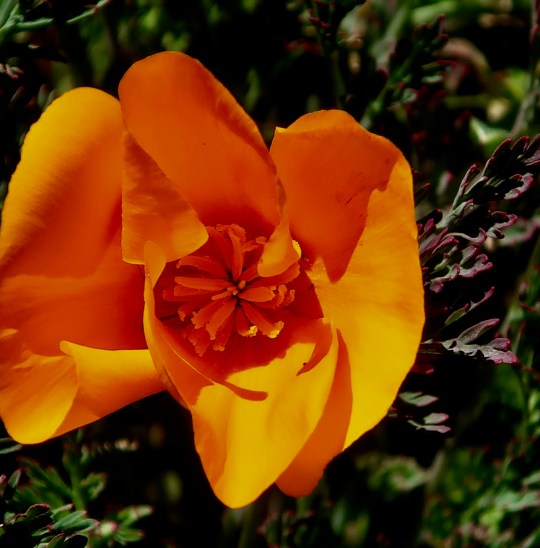
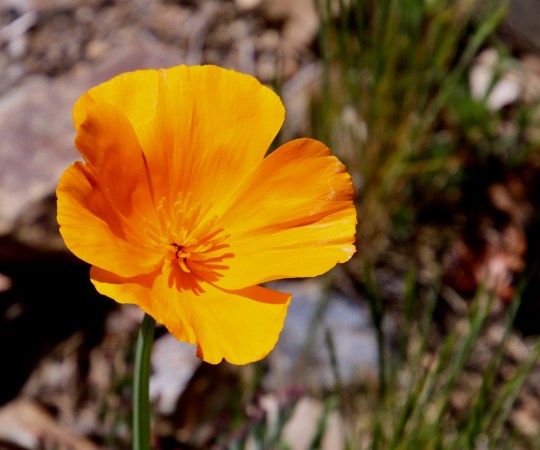
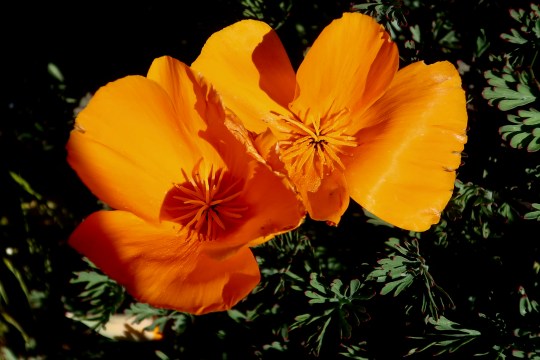
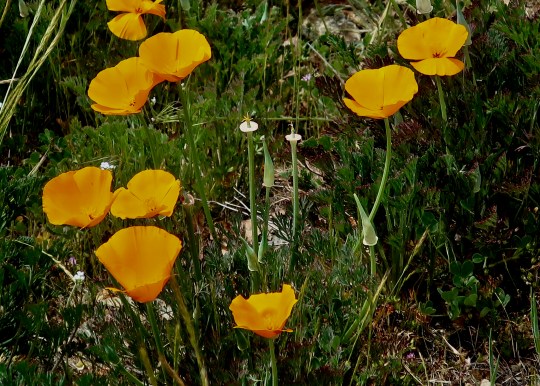
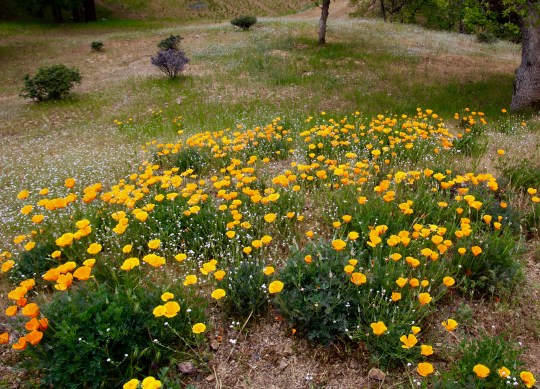
Peggy and I are continuing to hike around our five acres and the Rogue River–Siskiyou National Forest that abuts the back of our property. It serves as a form of entertainment and exercise during our ‘sheltering at home.’ On Monday I featured white oaks with personalities. Today I had picked out ten flowers to feature but the California poppies (Eschscholzia californica) growing down our hill in ever-increasing abundance demanded their own post. These guys produce a gazillion seeds (something like 100,000 per ounce) and are a bit aggressive. Since they are invading territory previously occupied by star thistle— in serious competition for being the world’s most obnoxious plant— we encourage them to invade away. Go, poppies, go!
It was about 9 a.m. and our poppies were just waking up when I took this photo. A spider had used it as a convenient post for attaching its web.
Ring around the rosy, a pocket full of posies…
Remember this rhyme from your childhood? London Bridge is falling down. I don’t remember anyone telling us the grim story behind it in the second grade, but it isn’t totally irrelevant today. The ditty was created during the time of the plague and the rosy was a red spot on a person’s body that indicated that he or she had caught the dread disease. A pocket full of posies were a pocket full of flowers and herbs that the individual hoped would keep the disease away.
The posie evolved into a small bouquet of flowers that could be warn in a person’s hair, fit into a lapel, or placed on a dining table. I’ve further adapted it to mean all flowers. Thus, pretty poppy posies. It’s good for alliteration. As for the plague, if our California poppies want to keep covid-19 away, we won’t complain. They are, after-all, said to have several positive medicinal benefits including managing pain, anxiety, and insomnia, which sounds pretty good, given our present pandemic.
If this also sounds like heavy-duty drugs, you might recall that the California poppy’s distant cousin, Papaver somniferum (which translate as the poppy that brings sleep) is the opium poppy. Derivatives of opium include morphine, codeine, oxycodone, and heroin. Used properly they bring relief from pain. Used improperly, they are all sorts of bad news. Just think of the hassles that Dorothy, the Cowardly Lion, and Toto had when they crossed over the opium-poppy field to get to the Emerald Palace. Snore. Fortunately Scarecrow and the Tin Man didn’t suffer the affliction.
You’ve probably sampled the opium poppy. And I don’t mean that you are shooting up heroin. Its seeds are included in muffins, on bagels, in salads, etc. While the trace amounts of opium aren’t enough to get you high or lead to addiction — although I confess to an unnatural fondness for poppyseed muffins— they are enough to disqualify you for the Olympics or possibly get you fired since they show up in drug tests. “But Coach, I was just eating a poppy seed muffin.” Right.
California poppies don’t have the same package of alkaloids that opium poppies do, but what they do have is enough to discourage deer from eating them, which is the number one criteria for range-free flowers at our place. And that certainly seems to eliminate a lot of pain, anxiety and insomnia for us. So maybe the claims made by the herbalists are true.
But enough on that; it’s time for the pretty poppies posing part of this post!
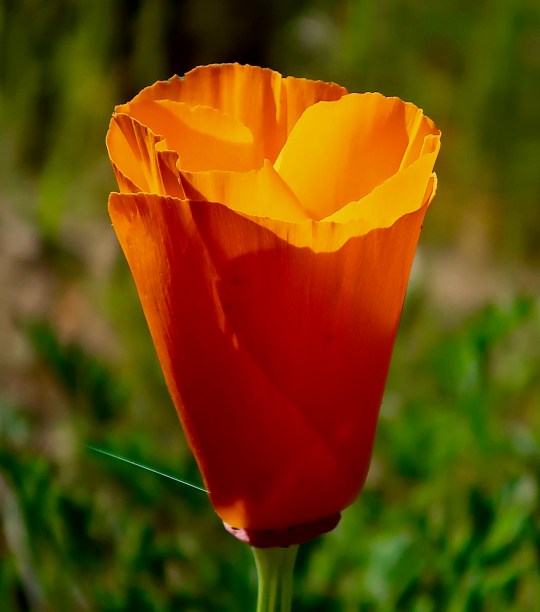
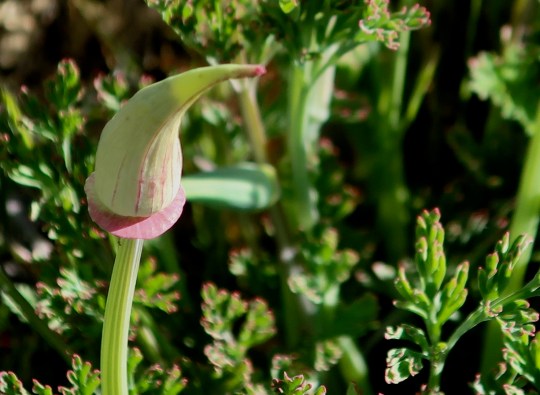
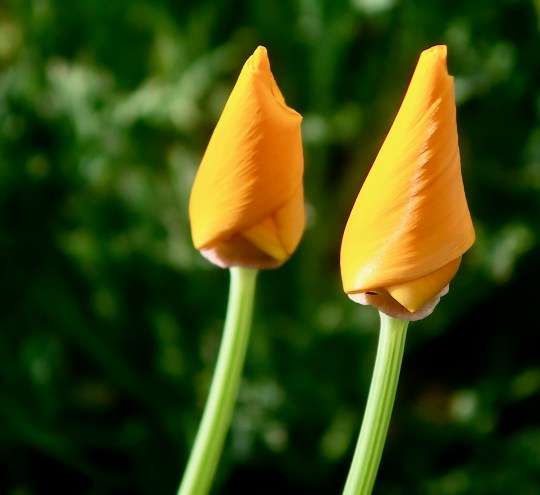
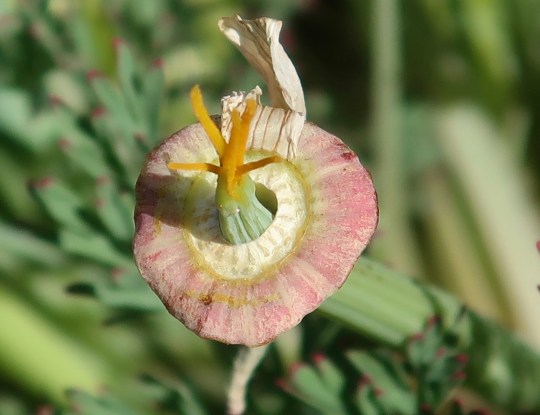
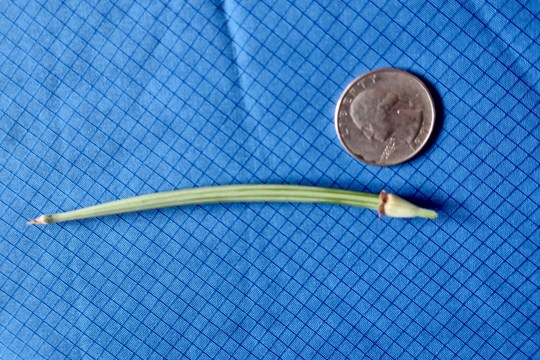
When we moved into our house 10 years ago, what was growing here were wall to wall star thistle plants. I pulled them out, chopped them down and poisoned them, but they insisted on coming back. So we planted poppies. Nothing happened for several years and then three years ago poppies started popping up. They have been spreading like crazy ever since.This will give you an idea of how steep the hillside is. Weed whacking and pulling is a real hassle. Watching poppies spread is ever so much easier! This is three weeks ago before the poppies had started blooming in profusion. (Photo by Peggy Mekemson.)Here is a view of what the leaves and early buds look like.A close up of a poppy bud.The poppy reaches a point where it begins to shed its bud cover.Almost there…Free at last. Free at last. Are these guys twins?And the flower begins to open. The sheer beauty of these flowers explains why California chose the poppy as its State Flower in 1903.And further along. As far as I can tell, the opening of the flower here is the same as the flower opening every morning. Poppies close in the evening and reopen in the morning. They also prefer to remain closed on cloudy days and when a cold wind is blowing.Early morning has always been one of my favorite times of the day to photograph poppies.By ten or eleven the flowers are close to being fully open.Which this one is here. (The white flowers that you see are Cryptantha flaccida, or limp stem cryptantha, not a very flattering name.)And here.Once the poppy petals reach this point they are about to drop, which leads to the next phase of the plant’s life.The poppies in the middle have been pollinated, dropped their petals, and are ready to develop seeds.Here is a close up of the seed pod. It grows longer, a lot longer.Almost ready to spread its seeds. One of the flowers donated this pod so it could live forever on the internet. (Grin) It is packed full of up to 100 seeds. When mature, the pod explodes, shooting seeds up to six feet away. Which is why the poppies are marching down our hill! Outliers can be seen at the bottom. They will soon be joined. Come back at this time in 2021 for the next installment.
FRIDAY’S POST: The rest of the interesting and gorgeous flowers that Peggy and I have found hanging out on our property and in the national forest.
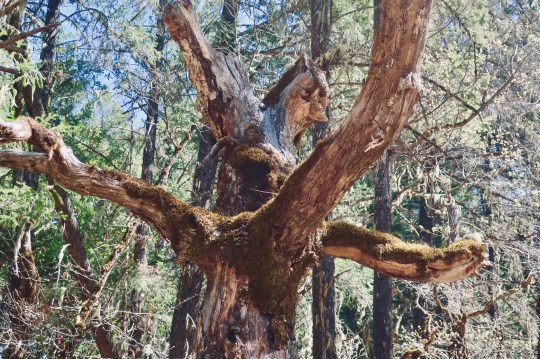
From the beginning we declared this the Hobbit Tree. Look carefully and you can see Smaug sweeping out of the sky on a mission of vengeance.
Peggy and I continue to shelter in place and find ways of entertaining ourselves. One is to go for extended walks around our five acres and in the Rogue River-Siskiyou National Forest that abuts our property. Naturally, I carry my camera on these daily excursions and look for things of interest. I’ve done several posts on these ‘walks on the wild side’ over the last ten years. It’s time for another one.
Walking is one way that many of us are dealing with our extended home-stays. One doesn’t have to live next to a national forest. A local park that is still open, the neighborhood— almost anywhere that is safe— works. It gets us out of the house and it’s great exercise. Looking for things of interest adds to the fun. Peggy, for example, is infinitely curious about what the neighbors are up to. She is constantly urging me to go on detours to find out.
As I was going through my photos last week for this blog, I decided I had enough material for three posts. It’s all about weird trees today. On Wednesday I’ll feature the spring flowers that Peggy and I have found over the past few weeks, including one on the endangered species list. Friday will be pure nature as in who is doing what. For example is a bear living in the bear cave? Peggy makes me throw rocks into the cave to check before we venture in. I’m pretty sure that all that will do is irritate the bear, but I accommodate her wish. And I am sure you will want to help us figure out whether a cougar, bobcat, or coyote left the scat (poop) we found full of hair. How could you not?
But first the trees. A few years ago I decided to do a inventory of what trees grow on our property. White oaks were the most common. I counted over a hundred. For the most part, these are handsome representatives of the tree world— standing tall while providing shade in the summer and a plethora of acorns in the fall. Just about everyone joins in the harvest, or so it seems: deer, tree squirrels, ground squirrels, turkeys, bears, etc. We watch the deer play human and stand on hind legs to reach beyond where their imagination normally takes them. Ground squirrels leave the ground and can be seen precariously perched in the highest branches while they madly chomp away with sharp incisors to free acorns before the acorn woodpeckers arrive.
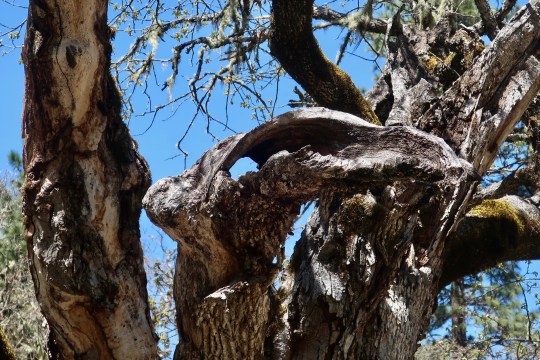
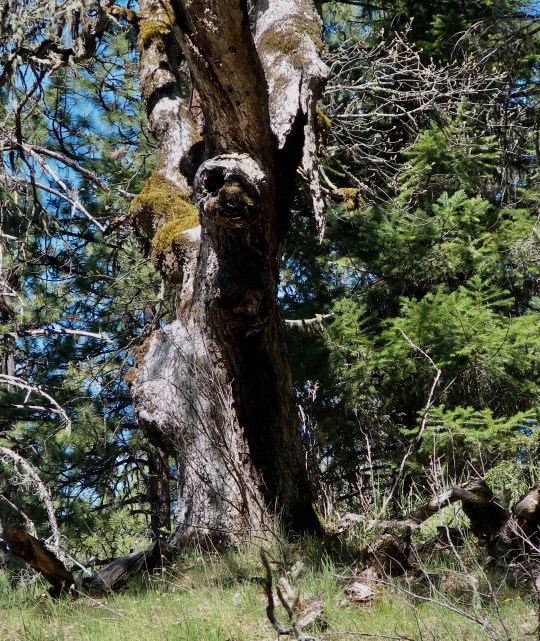
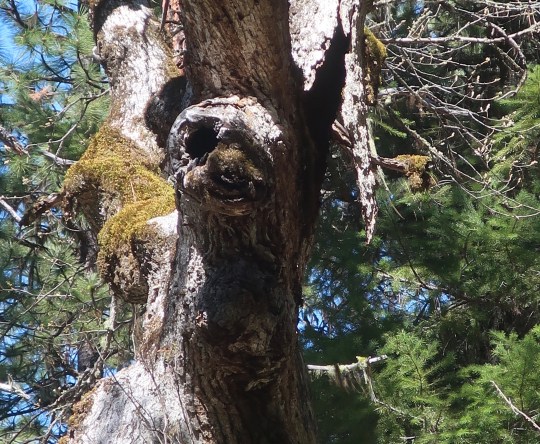
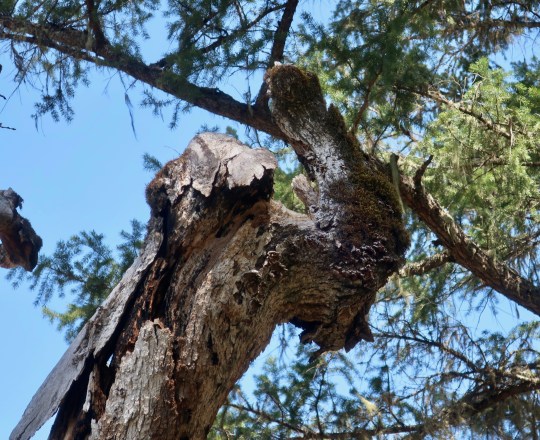
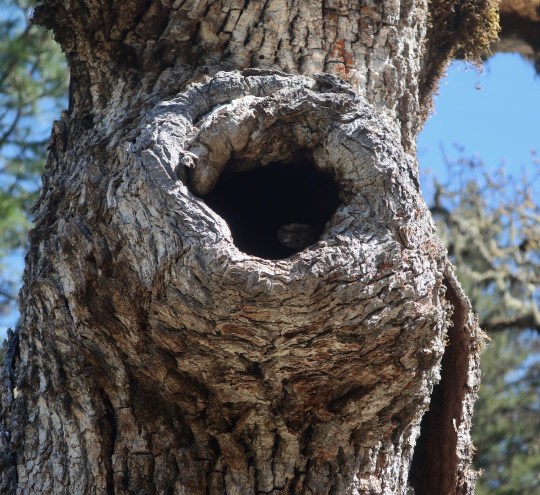
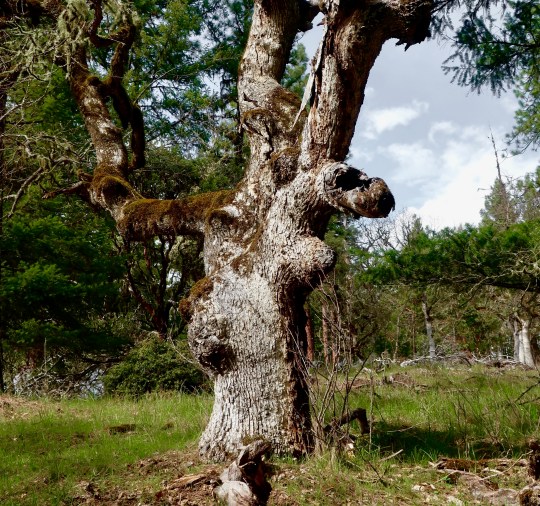
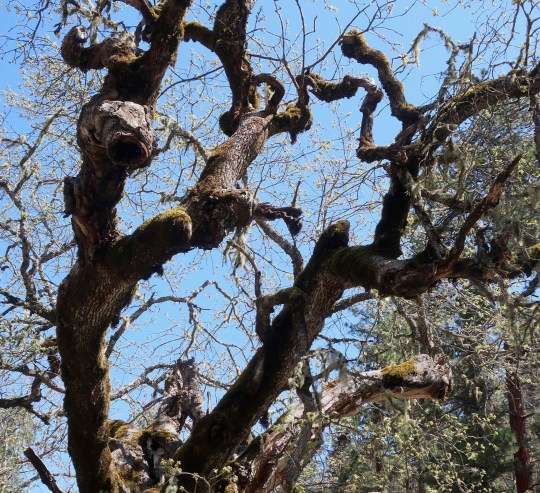
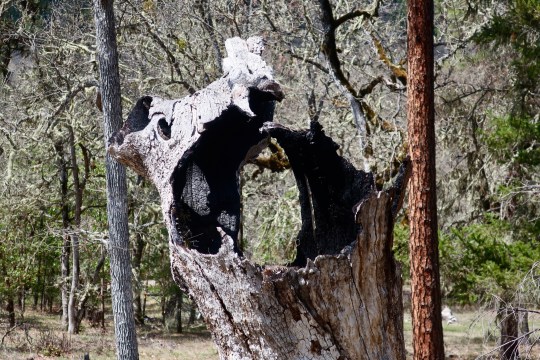
But not all of the white oaks stand proud and tall. Some are stubby and twisted, and ancient— almost scary. A little horror music please. They look like they could easily fit into your favorite scary flick, or a fantasy movie, or a nightmare. My post on last Friday where I featured gargoyles from Dubrovnik made me think of them. Here are some of our favorites:
Smaug stares down at us from the Hobbit tree.This is the Evil Seal tree, definitely resembling a gargoyle.Here’s a close up, complete with vacant eye socket and a grinning, tooth-filled mouth. “Come closer, my dear. Let me whisper in your ear.” Chomp.This eyeless buck with its twisted horns also borders on evil. I may cover the nose in red come next Christmas. And here is where the werewolf hangs out on the upper right. I’m sure we hear him howling on moonless nights.Maybe not so scary, but still… the elephant. Interesting eyebrow, or is that a cap.The Brain!A gaping maw. It would take a brave (or foolish) person to stick her hand into it! “You first,” Peggy suggested.A great tree to be perched on the edge of a graveyard in a horror movie. The snake-like creature coming out of the tree is preparing to strike.Why am I thinking Voldemort?An even better graveyard tree! Perfect for a dark and stormy night.And finally, I will leave you with this lovely creature born out of fire. Make what you will out of it!
Today, I am continuing to dig back into my Word Press archives by looking at gargoyles.I have a weakness for them. While they are said to scare away evil spirits, they attract me. What can I say? As for the various body parts of saints, you will find them scattered in Catholic churches throughout Europe. One can only wonder… Anyway, Gargoyles and a sacred finger are the subject of today’s armchair travel as I wrap up my posts on Dubrovnik.
I found this marvelous gargoyle about a foot off the Stradun connected to the Franciscan Monastery in Dubrovnik, Croatia. Check out the great mustache!
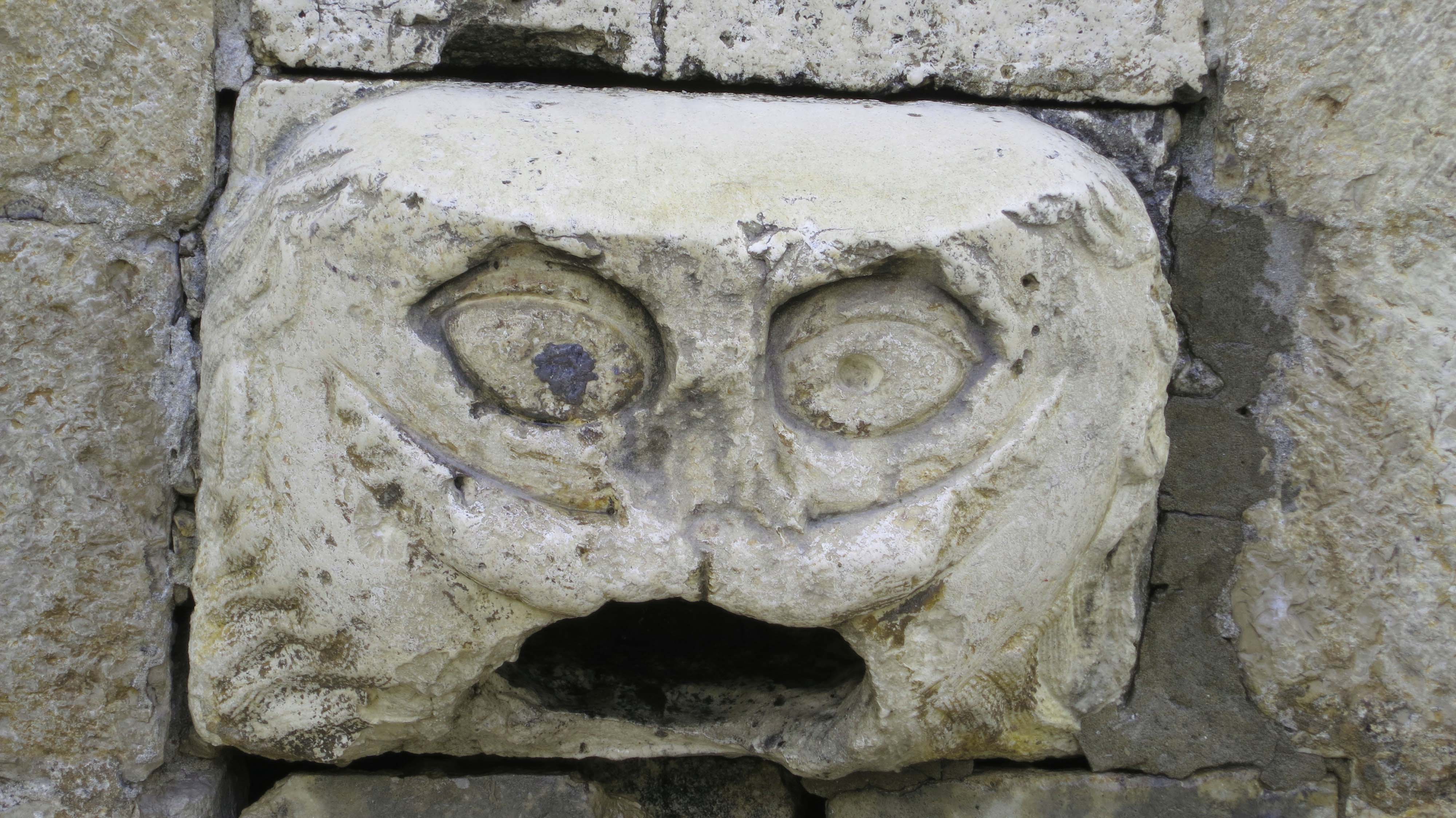
Weird amuses me— and few things are more weird than a gargoyle. During the middle ages, no decent cathedral would be caught without them. In addition to piping water away from the building, they served as reminders to the faithful that evil lurked in the world, an evil that could only be overcome by attending church and donating money. Their cousins, grotesques, were also found on churches. Equally ugly and portentous, they didn’t carry water.
Whenever I get near a gargoyle or grotesque, I can’t help myself; I have to take its photo. Fortunately, Peggy feels the same way.
Peggy caught this Dubrovnik gargoyle. Possibly it represents one of the winds.
I took this closeup of the Dubrovnik gargoyle Peggy photographed above. Note the water dribbling down its chin. I don’t know about you, but I always find it interesting to try different perspectives when I am photographing something.
We found examples of grotesques in the cloister of the Franciscan Monastery of Dubrovnik on top of columns. (Photo by Peggy Mekemson)
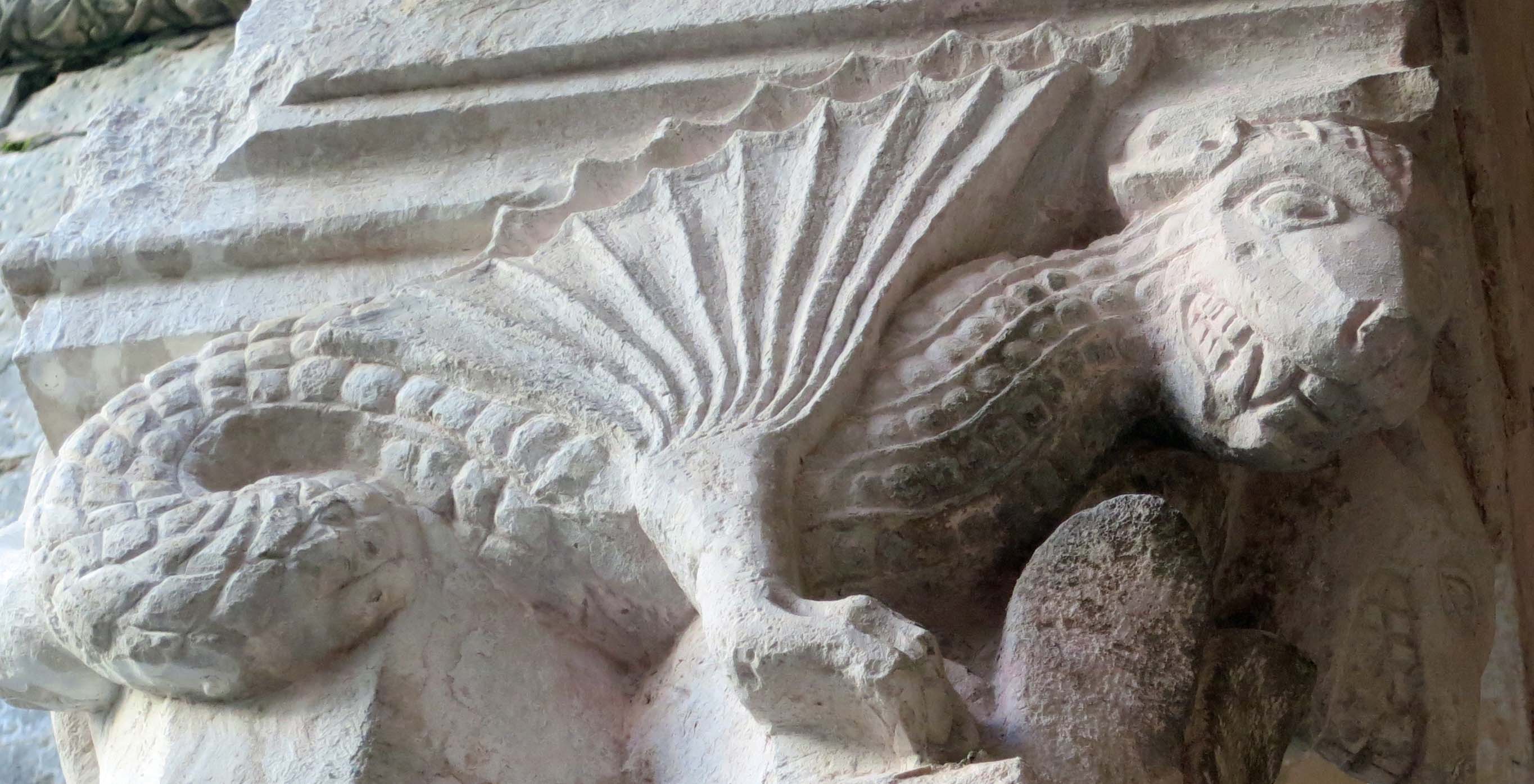
Dragons were a popular subject for both gargoyles and grotesques. What could be more scary. We found this specimen with his fine set of choppers in the Franciscan Monastery.
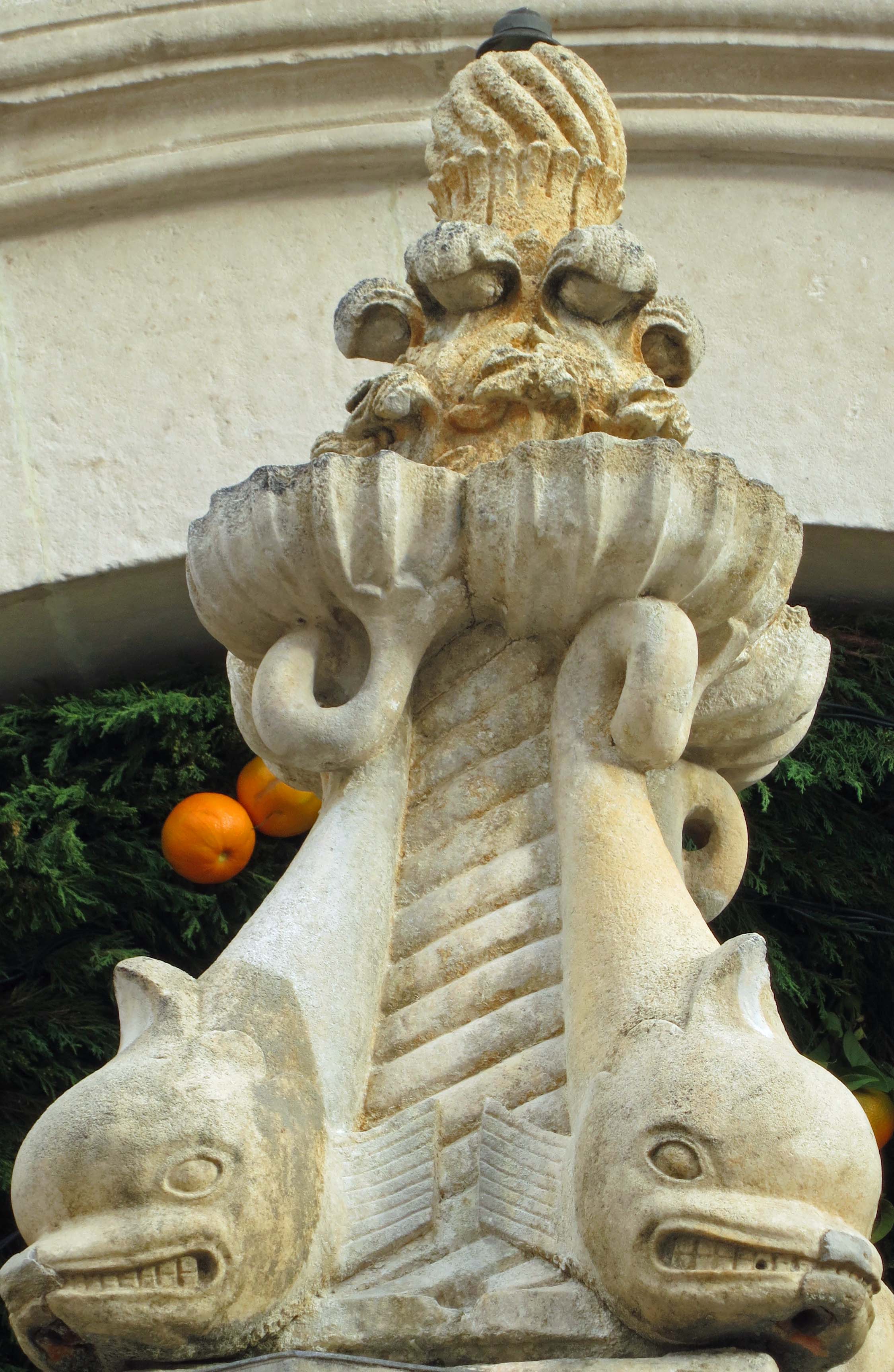
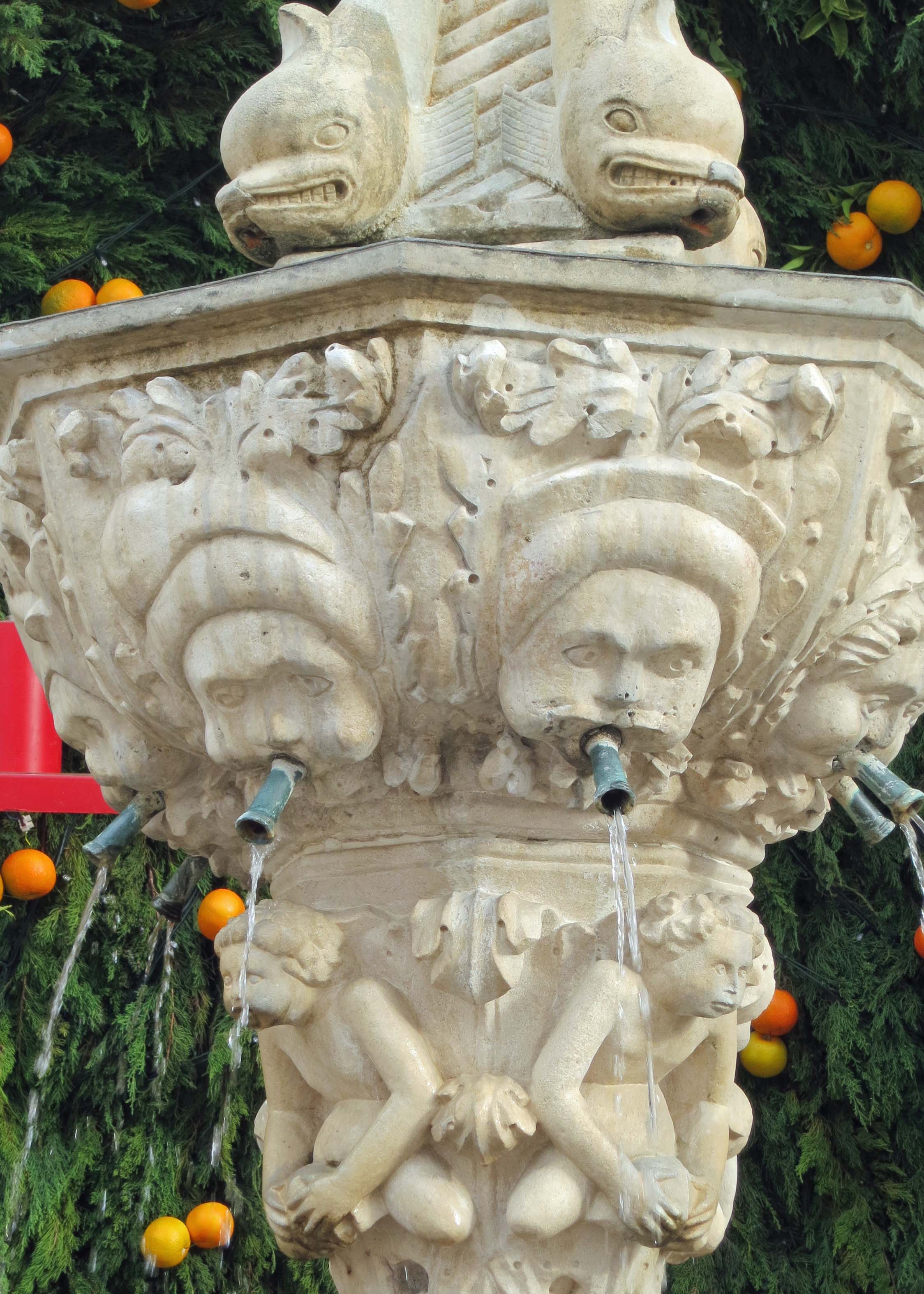
I have also found that fountains in Europe often host strange-looking beings. While the wealthy in pre-modern times might have water piped into their homes, the common folks obtained their water from community fountains. Dubrovnik built an aqueduct system in the mid 1400s to bring water to the city and then located two public fountains on the Stradun: big Onofrio’s Fountain located near the Pile Gate and little Onofrio’s Fountain found next to the clock tower in Lutz Square.
The top of little Onofrio’s Fountain with its ferocious looking fish. The fountain is located near the clock tower in Dubrovnik, Croatia. If I caught something like this, I’d be cutting my line!
Another view of little Onofrio’s Fountain. The oranges, BTW, were part of Dubrovnik’s Christmas decorations.
Big Onofrio’s Fountain located near the Pile Gate had 16 sides and each side featured a different mask with a spout coming out of its mouth. This was a cow mask. Or maybe it was a bull.
Something I find even stranger than gargoyles, grotesques, or fountain inhabitants are relics— bits and pieces of saints or other holy items kept around in reliquaries as items of worship. Pieces of the Cross are a common example. I once read that selling pieces of the cross was a thriving business during the Middle Ages. Scam comes to mind. The Dubrovnik Cathedral has a particularly impressive set of relics including a requisite piece of the Cross, Baby Jesus’ swaddling clothes, and various body parts of St. Blaise.
All of these items are reputedly capable of performing miracles and it is something of a miracle they exist. How they were obtained is usually rooted in the murky past. Pieces of the swaddling clothes were provided to women having difficult births. No matter how many pieces were cut out of the cloth, so it is said, the cloth returned to its original form.
I came across St. Luke’s finger in the small museum found in the Franciscan Monastery in Dubrovnik. The finger is encased in a gold reliquary. I know people take these items seriously and believe they have miraculous powers, but I find them on the far side of strange. I would almost bet that it cost the monastery an arm and a leg to get the finger.
NEXT POST: You want gargoyles? Wait until you see the white oak trees on our property and in the national forest behind us. These trees would fit right into “Lord of the Rings” or most other fantasies— or horror movies. My theory is that they will scare the heck out of the coronavirus if it comes around. Remember how the gargoyles were supposed to scare the evil spirits away from medieval cathedrals in Europe? I bet that they were recruited to frighten the plague as well! I know better, but it is fun to contemplate. And I find the trees interesting and amusing as opposed to scary. (At least during the day.)
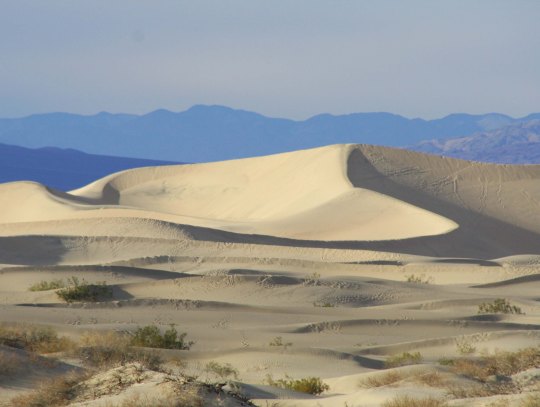
The world is full of incredible beauty that is worthy of our love and protection. These are sand dunes in Death Valley National Park.
I was recruiting for Peace Corps on the Davis Campus of the University of California on April 22, 1970, 50 years ago. For those of you not familiar with the date, it was Earth Day I. At the time, I was running the Peace Corps’ Public Affairs office for Northern California and Nevada out of Sacramento. Curiosity pulled me away from my recruiting duties to check out the event.
UC Davis puts on great fairs. It probably has to do with an event it calls Picnic Day, a rite of spring with roots as deep as humankind. The birds are singing, flowers are blooming, and the snow is melting in the mountains; let’s have a party! All of the departments become involved, put on shows, put up displays, and do silly things.
The flowers were blooming.
Earth Day at Davis was similar, but it incorporated a vitally important message.
Somehow we had forgotten where we had come from in our rush toward progress and the good life— and in the desire to maximize profits. As a result, we were chopping down our forests, polluting our streams, poisoning our air, destroying our last remaining wilderness areas, and saying goodbye forever to innumerable species whose only evolutionary mistake was to get in our way.
We had forgotten that birds can make music as beautifully as any symphony, that peace and balance can be found in the wilderness, and that somehow, in some yet unfathomable way, our fate might be tied to that of the pup fish. It seemed okay that the last brown pelican was about to fly off into the sunset forever so we could squeeze one more bushel of wheat from our crops, and that it was appropriate for the great redwoods, silent sentinels who had maintained their vigilance for over 4000 years, to die for our patio with a lifespan of 20-30 years.
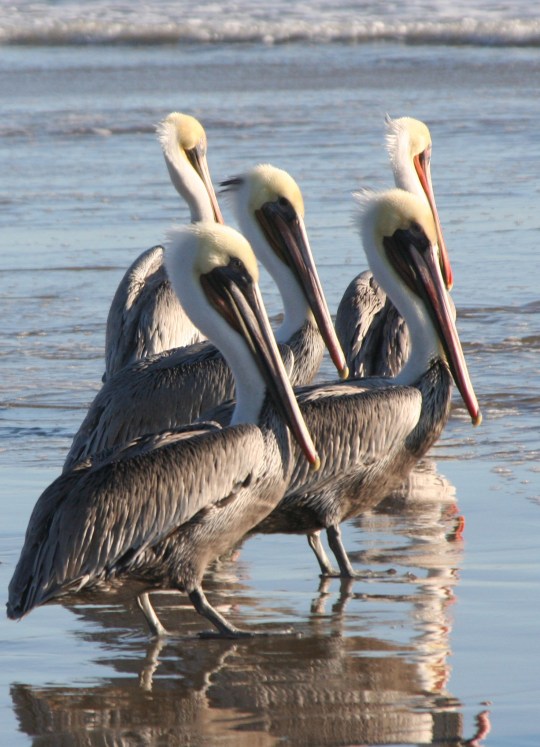
Brown pelicans, once near extinction because of DDT used on crops, have made a dramatic comeback since the use of DDT was banned. I took this photo south of Santa Barbara, California.
Rachel Carson, in her landmark book Silent Spring, had sounded a clarion call to a Holy Crusade: saving the earth. Others, too, were raising the alarm. Earth Day I was an expression of growing concern. Its message struck a deep chord with me. The years I had spent wandering in the woods while growing up, my exploration of the rainforest around Gbarnga, Liberia during my Peace Corps assignment, and my hiking in the wilderness as a backpacker, all came together in a desire to join the environmental movement and help protect the wilderness I had come to love.
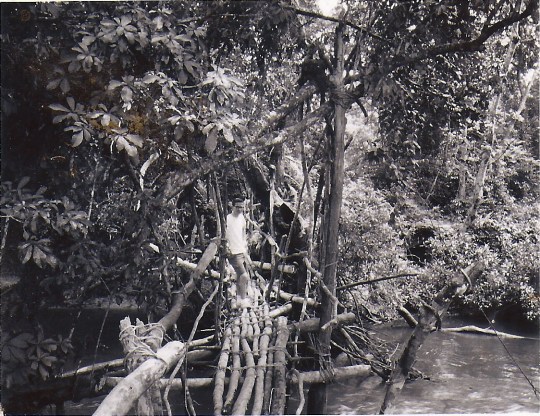
Some of my happiest moments as a Peace Corps Volunteer in West Africa were spent exploring the rain forest surrounding where I lived.
I wandered between booths on campus, talking to the representatives of various organizations and picking up materials. There was information about the redwoods, over-population, water and air pollution, land-use planning, mass transit and the protection of valuable farm lands. I learned about all the species that had become extinct because of our activities— and that many more were threatened.
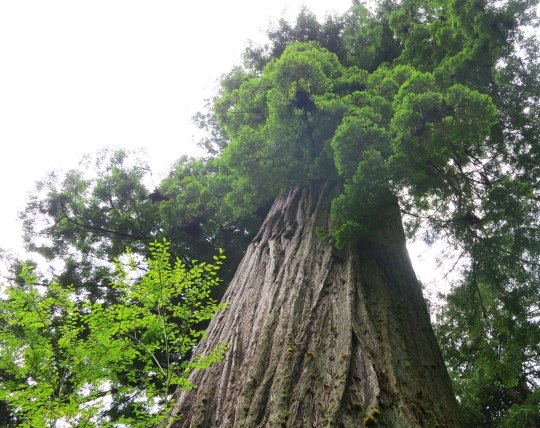
How could one not feel awe when confronted by giant redwoods in their cathedral like setting at Redwood National Park. It seemed terribly wrong to me that the life of a 2000 plus year old giant should be ended with a chainsaw to meet our short-termed demand for wood products.
I went home that night inspired, concerned, and more than a little frightened about what we were doing to our planet— the only home we have. Three weeks later, I had left the Peace Corps and become Executive Director of Sacramento’s first Ecology Education/Environmental Action Center, working 50-60 hours a week for one hundred dollars a month. I would continue to devote a significant amount of my time to supporting environmental causes for the next 20 years of my life, working beside some of the most dedicated, selfless and talented individuals I have ever known.
Our efforts, and those of hundreds, even thousands of others, made a difference. The majority of people in the US as well as in numerous other countries around the world became convinced that protecting the environment was a worthwhile endeavor. Air pollution was reduced, waterways were cleaned up, wilderness areas were saved, and a number of endangered species were brought back from near extinction. Once again, eagles soared, buffalos roamed and wolves howled.
But the progress has never been easy and the war is far from won. Nothing represents this better than our present battle against global warming, a reality that was dramatically brought home to me two years ago as I hiked down the Pacific Crest Trail dodging huge fires in Oregon and California. A drought created by climate change had killed millions of trees and those trees were burning.
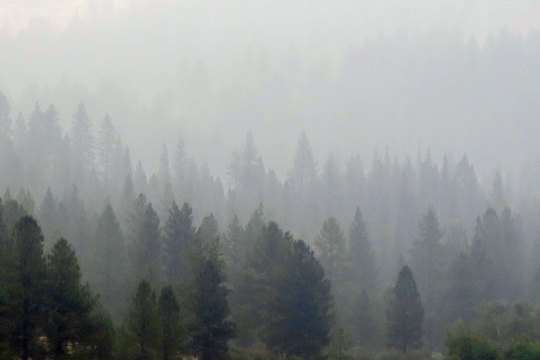
The massive Carr Fire near Redding sent fire tornadoes shooting into the air, reduced visibility to close to zero, and filled the air with choking smoke for hundreds of square miles. This was the view I faced on the PCT near Chester, California.
The 50th Anniversary of Earth Day 1 is an excellent time to take stock of where we are in our efforts to protect the environment. The news is not good. Over the past three years we have seen our national government withdraw from international efforts to combat global warming, eliminate many of the protections that we have fought so hard to put in place over the last 50 years, back away from using science designed to measure the impact of pollution, and systematically dismantle the EPA. Continuing down this path will once again lead to air filled with pollution, waterways poisoned, wilderness areas eliminated, and species exterminated. This isn’t an exaggeration; it is reality.
But it doesn’t have to be. The time to renew our commitment to the environment is today. Each of us can take action on the personal level to reduce our negative impact on the environment, support positive efforts on the local, state, national and world level, and insist that our political leaders do the same. The future of our children, grandchildren and future generations depend on it.
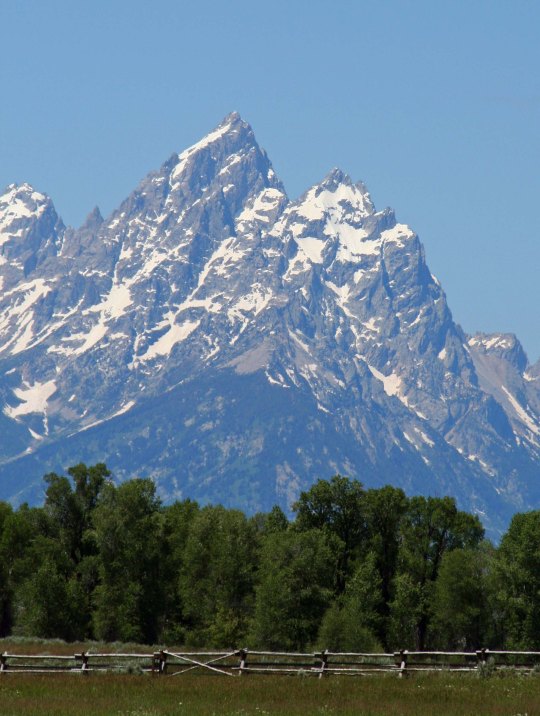
A final reminder of the beauty that exists in our world. This are the Grand Tetons. Happy Earth Day. May we have 50 more!
In this armchair travel post, Peggy and I walk the streets of Dubrovnik reliving our 2013 visit. We were there off-season a few weeks before Christmas, happily putting up with rainy weather to avoid the crowds of tourists!
The Stradun, Dubrovnik’s main thoroughfare, wet after a rain storm.
Luck was with us— the rain held off while we were on the walls of Dubrovnik and waited for us to descend to the Stradun, the city’s main thoroughfare. Lunch and pizza occupied most of the downpour. Afterwards we were treated to shiny, wet streets.
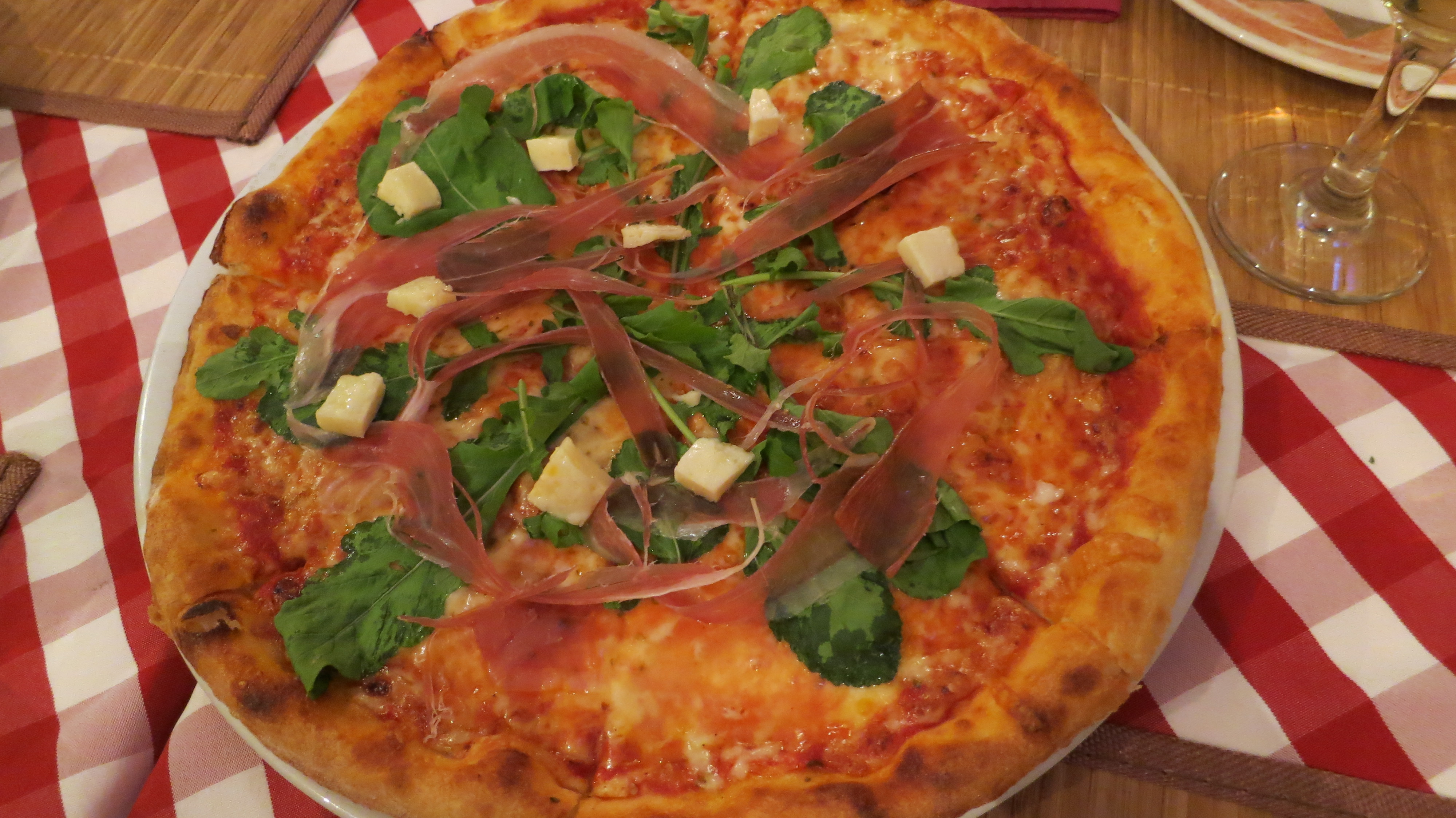
Our pizza, Croatian style.
In its first life the Stradun had been a winding canal separating Dubrovnik’s Roman and Slav populations. The canal was filled in during the Eleventh Century and brought the two populations together. A devastating earthquake took out most of the town in 1667 and Dubrovnik rebuilt the road to its present straight alignment.
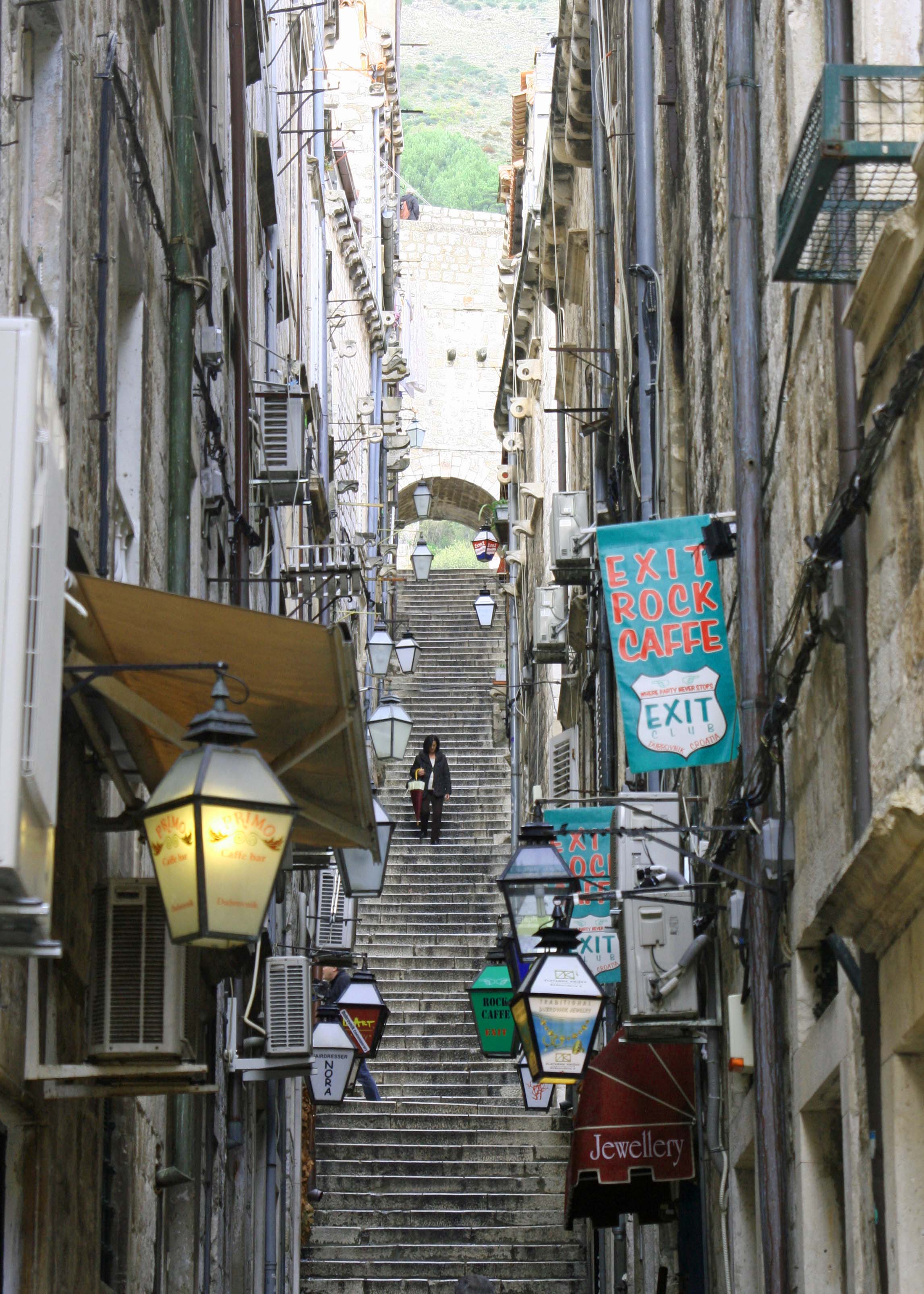
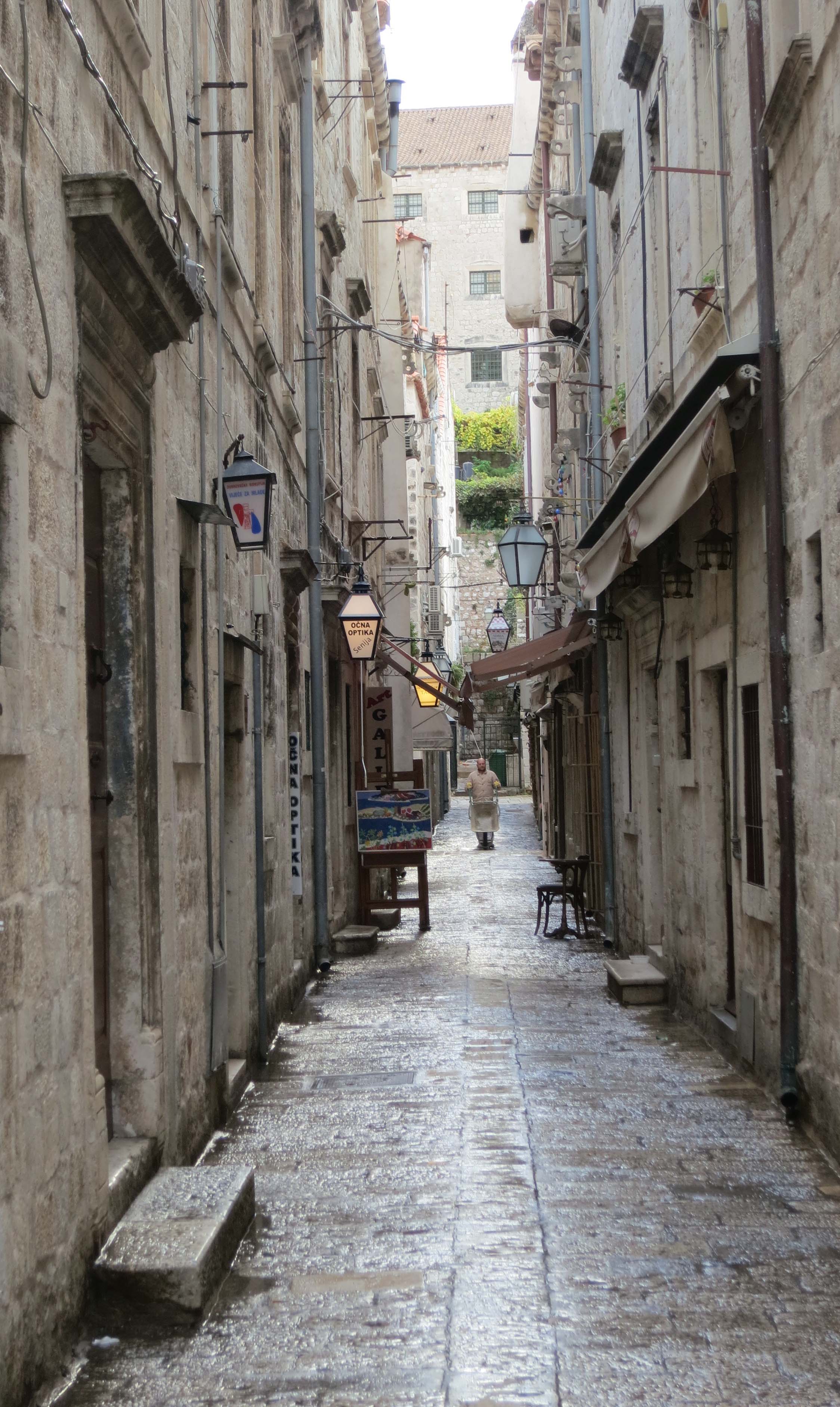
Narrow pedestrian ways shoot off in both directions from the Stradun and invite exploration. Plazas anchor both ends of the street. Since we arrived in December, Dubrovnik was preparing for the holidays. Two Christmas trees competed for our attention in Luza Square. I found one outlined by a window in the old Customs House to be particularly dramatic.
Walkways such as this and the one below branch off from the Stradun in Dubrovnik, Croatia and invite exploration.
Dubrovnik walkway. No crowd here.
With Christmas coming, the city was decorated to celebrate. Here, a Christmas tree is gracefully outlined by a window in Sponza Palace, the old custom-house.
Another photo of Sponza Palace, the Christmas Tree and Dubrovnik’s clock tower.
The town’s bell tower and clock, St. Blaise’s Church and Orlando’s Column and are also prominent features of Luza Square. Both St. Blaise and Orlando symbolize Dubrovnik’s fierce sense of independence.
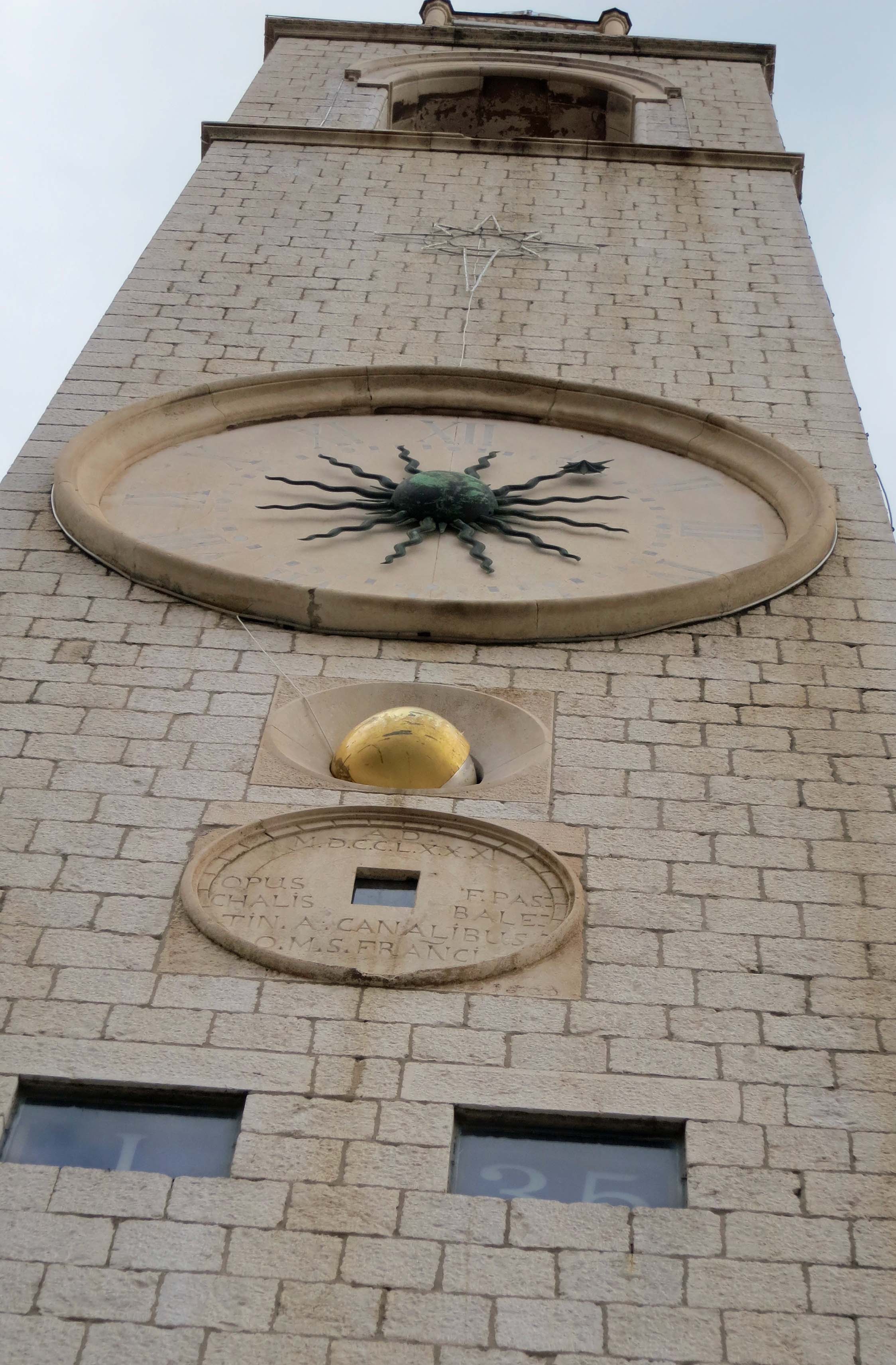
A close up of the Dubrovnik clock tower. A digital clock at the bottom adds a touch of modernization.
St. Blaise was an early third century Christian Martyr from Armenia who was so holy that wild animals were said to drop by his cave for a blessing. The Romans used steel combs to flay off his skin and then beheaded him. Since the combs resembled those used for carding wool, Blaise became the Patron Saint of the wool trade. Go figure.
He earned the everlasting gratitude of Dubrovnik by appearing in a vision to a local priest to warn of an imminent invasion by the Venetians in 971. Ever since, the locals have loved St. Blaise and disliked Venice. They celebrate his birthday by parading various parts of his body through the city on February 3.
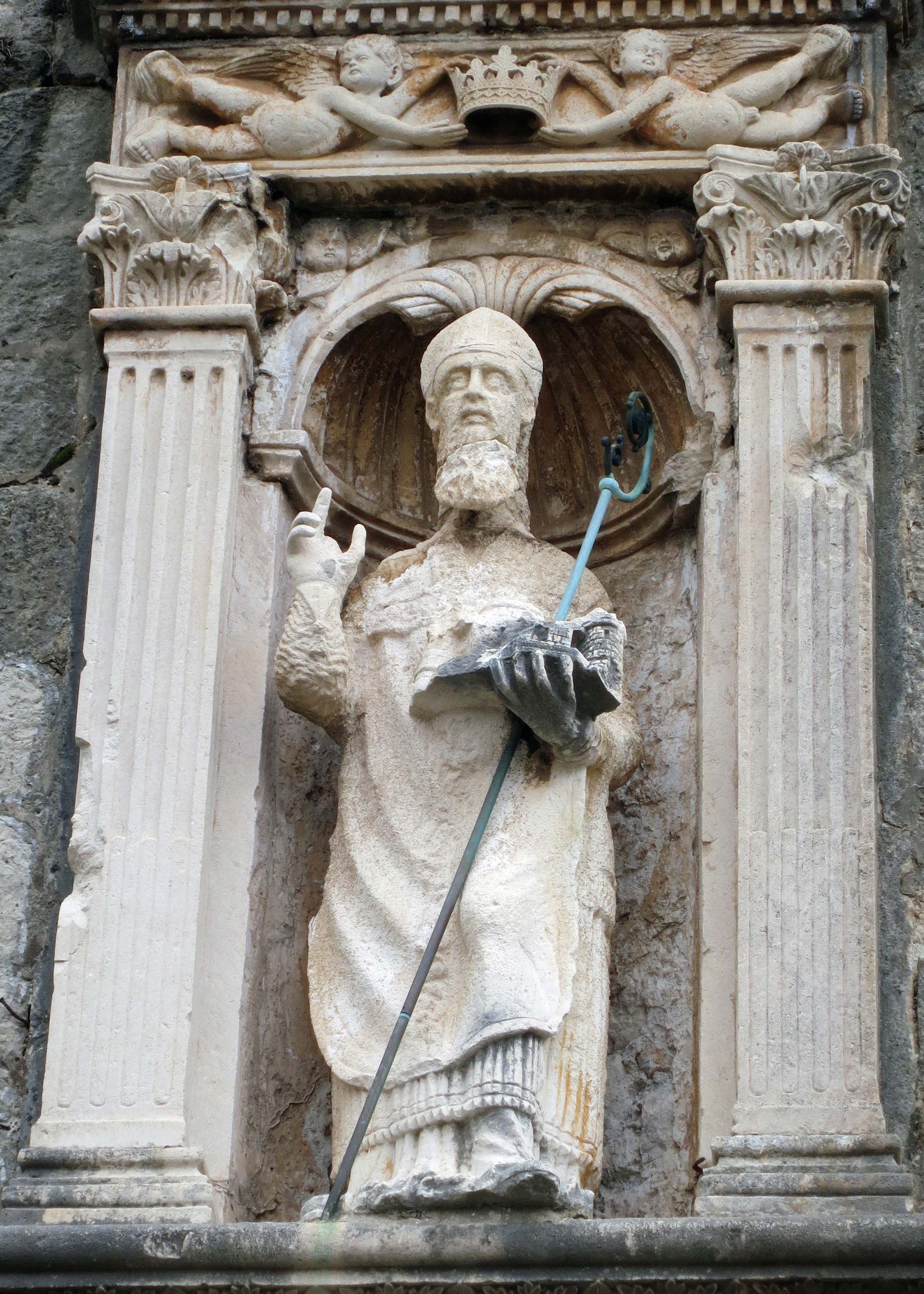
St. Blaise, the Patron Saint of Dubrovnik, holds a model of the city in his hand. This particular statue is found in the Pile Gate at one of the city’s main entrances. (Photo by Peggy Mekemson)
Orlando is known as the legendary knight Roland in Northern Europe. The story is that he rescued Dubrovnik from a siege by the Saracens in the Eighth Century. The fact that the dates of Roland’s life don’t match those of Orlando doesn’t seem to matter. He wasn’t from Venice. Also of note— his arm was used as the standard measure of cloth in Dubrovnik.
The Orlando column in Luza Square. (Photo by Peggy Mekemson.)
The Pile Gate, Franciscan Monastery, and Onofrio’s Fountain are located at the other end of the Stradun. The fountain is a subject of my next blog. The Monastery houses a peaceful cloister and a small but interesting museum that features a pharmacy that opened in 1317— and St. Luke’s finger.
The Franciscan Monastery in Dubrovnik caught in the sunlight.
In 1317 the Franciscans opened one of the first pharmacies in Europe as part of their commitment to provide medical care.
NEXT POST: I’ll conclude our visit to Dubrovnik by looking at gargoyles, St. Luke’s finger, and other oddities that caught my attention.
Continuing my armchair series on Dubrovnik, Peggy and I look down from the walls into the city providing a view of its colorful red roofs. Enjoy.
One of my favorite views into Dubrovnik, this one features the Church of St. Blaise on the right with its statue of the saint holding a model of the city. There was nothing blasé about Blaise, he was martyred for refusing to worship pagan gods and liked to preach to wolves and bears. Note the mechanical bell-ringer in the steeple on the left.
Walking the medieval walls that surround Dubrovnik provides a bird’s eye view across the roofs and down into the city. And what a view it is. Red tile roofs, narrow walkways, and imposing churches invite the visitor to pause and admire the unusual beauty of this town perched on cliffs above the Adriatic Sea.
Twenty years ago most of this beauty was destroyed as Yugoslavia lobbed shells into the city from surrounding hills. Dubrovnik held out, Croatian troops lifted the siege, and the residents proudly rebuilt their city. Today the only reminders of the siege are a few ruins that have yet to be rebuilt and bright red tiles that have yet to mellow with age.
Today’s blog is best reflected through photographs that Peggy and I took.
Looking down on Dubrovnik is like looking down on a sea of red. This photo is taken from Minceta Tower, the highest point on the wall. The Adriatic stretches across the top and the city’s port is on the top left.
This view of red tile roofs and cloudy skies features Dubrovnik’s Cathedral on the left. (Photo by Peggy Mekemson)
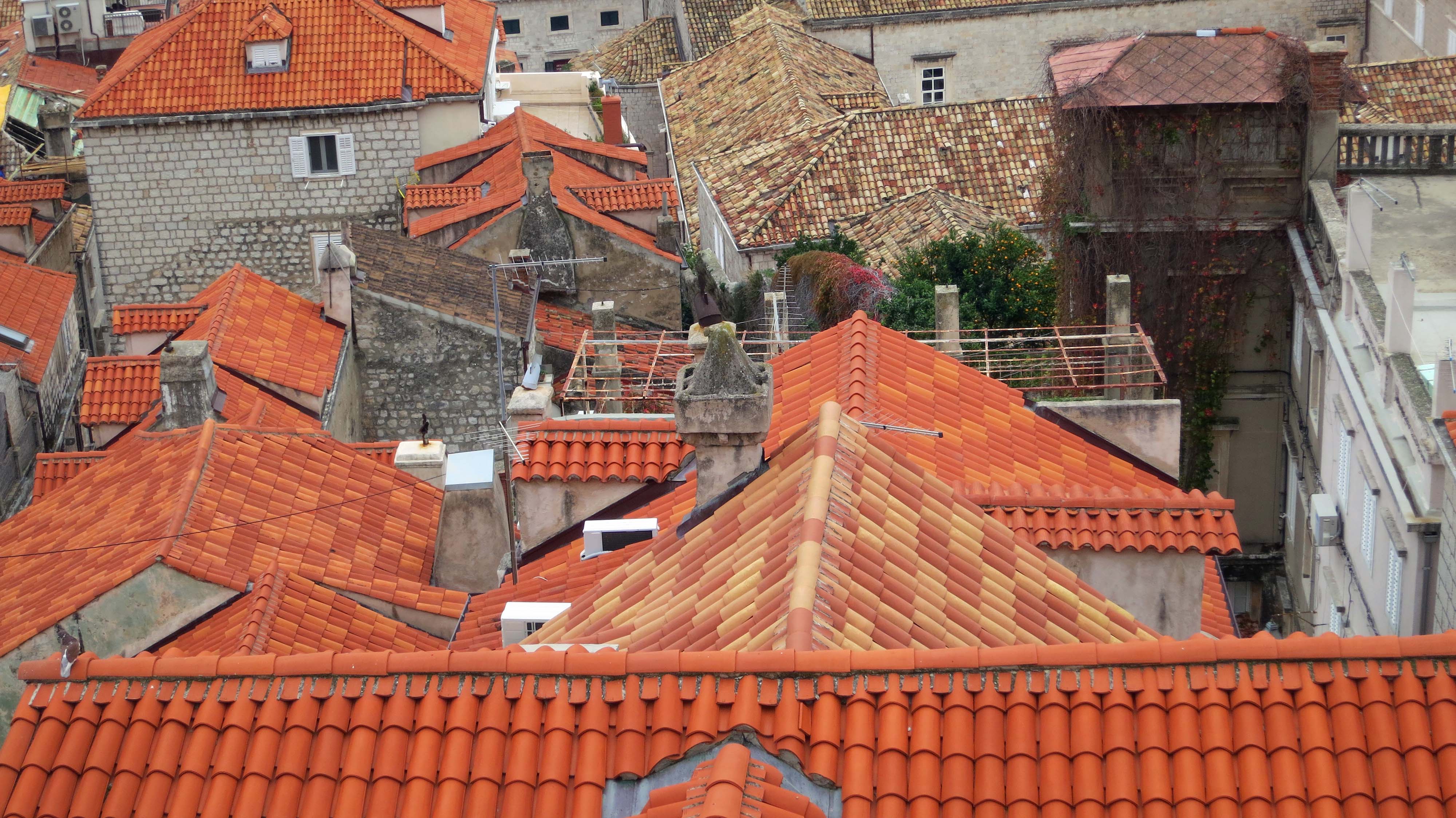
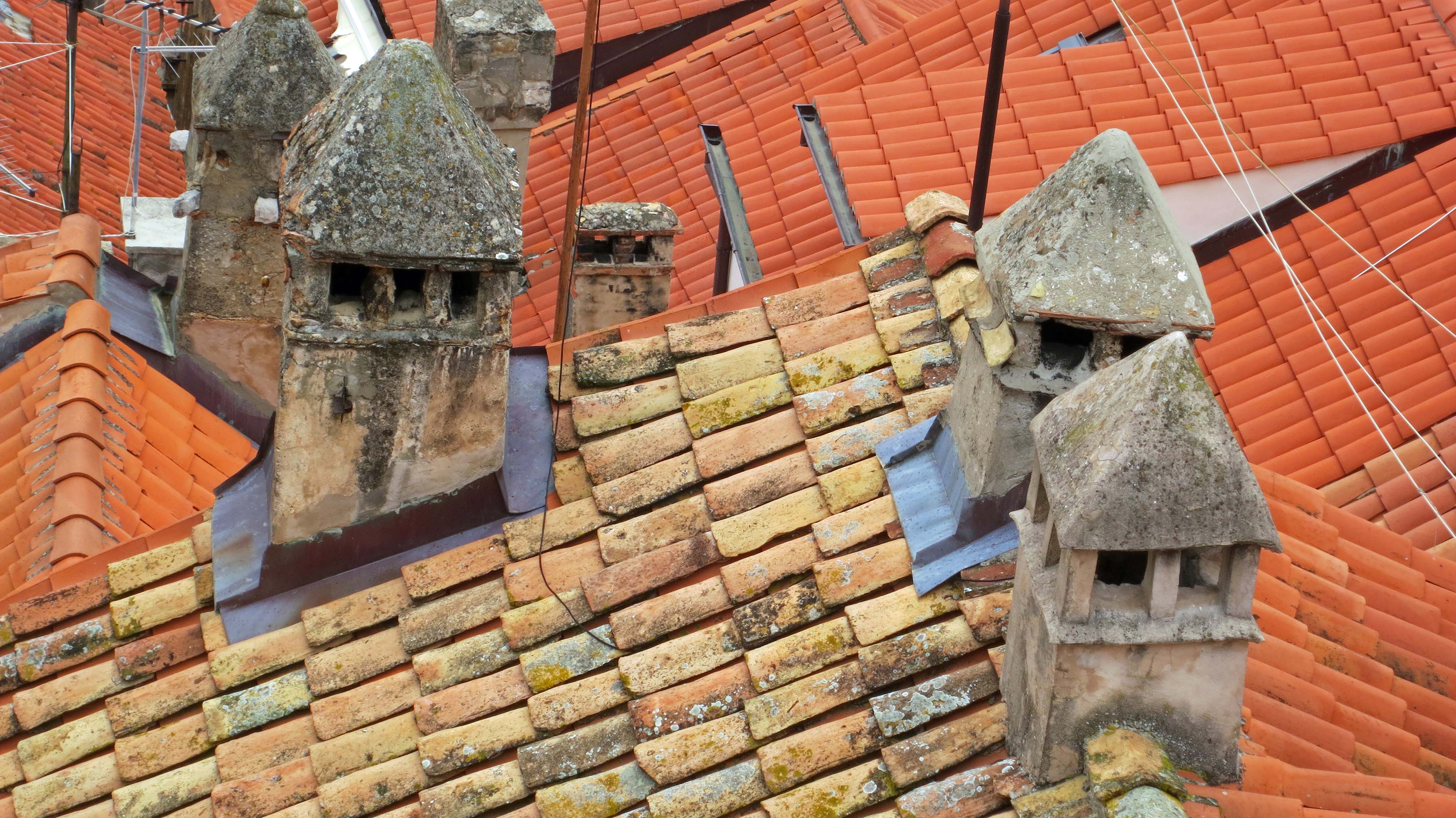
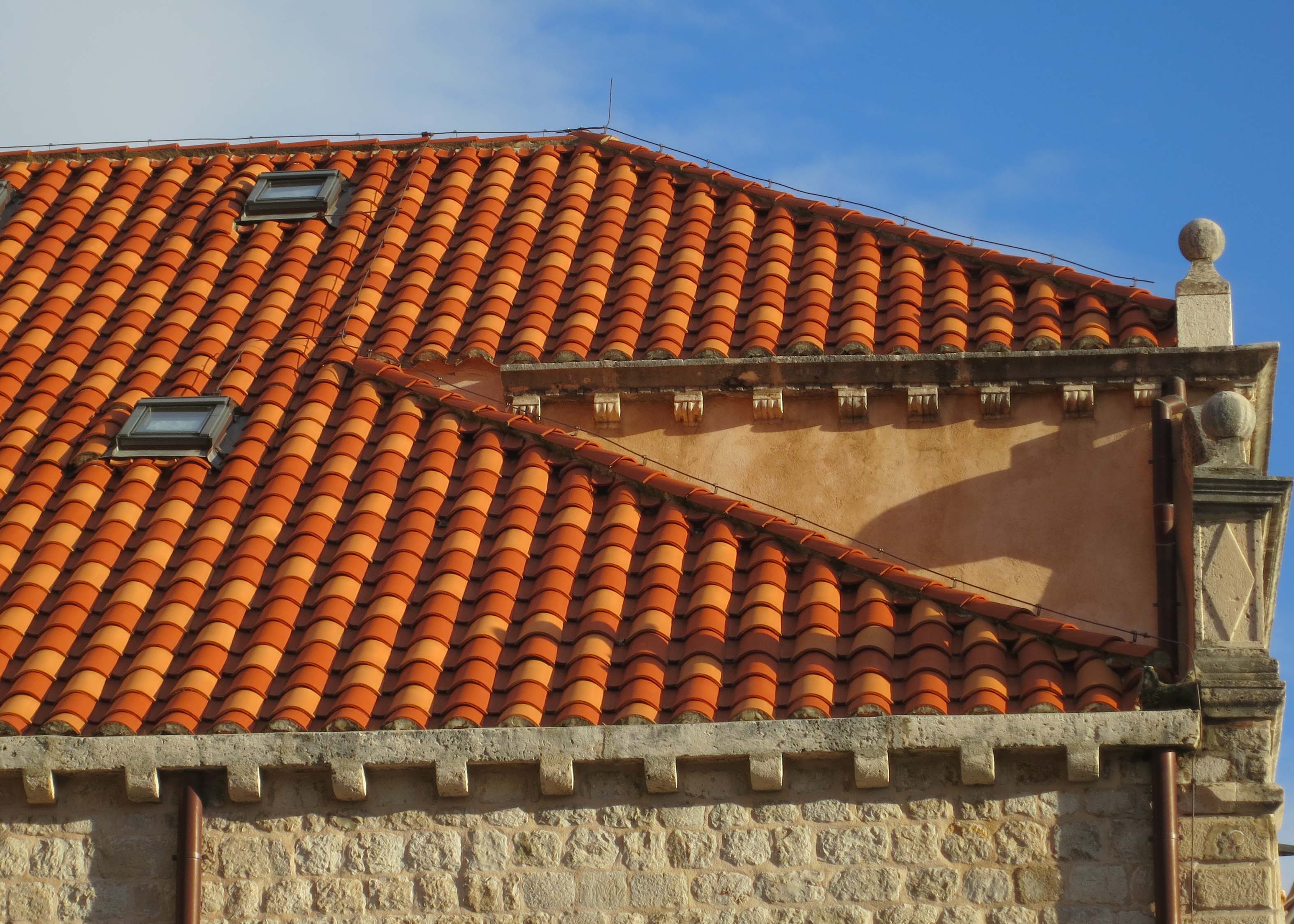
The contrast between new and older tiles is captured here. Many of the newer tiles represent repairs made after the siege of Dubrovnik in 2000-2001. The trellis in the middle covers a garden. Many are found throughout the city nestled between buildings.
Another view of old and newer tiles in Dubrovnik. This one features chimneys.
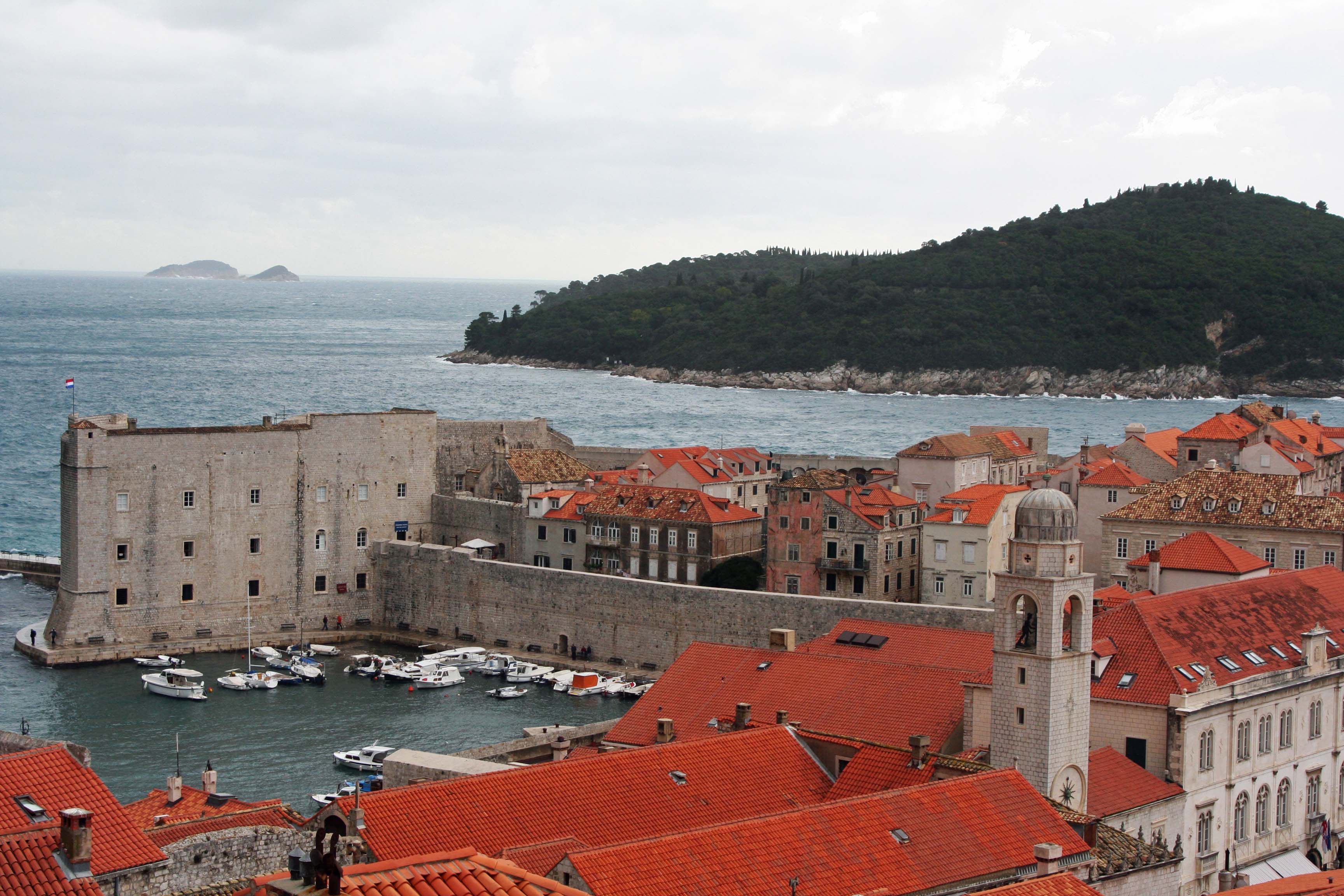
A view looking down on Dubrovnik’s port and St. John’s fortress (now an aquarium and museum) that guarded the harbor against Venetian invasion during the Middle Ages. The town’s clock tower is on the right. Lokrum Island is at the top of the picture. (Photo by Peggy Mekemson)
Peggy’s view of an abandoned building.
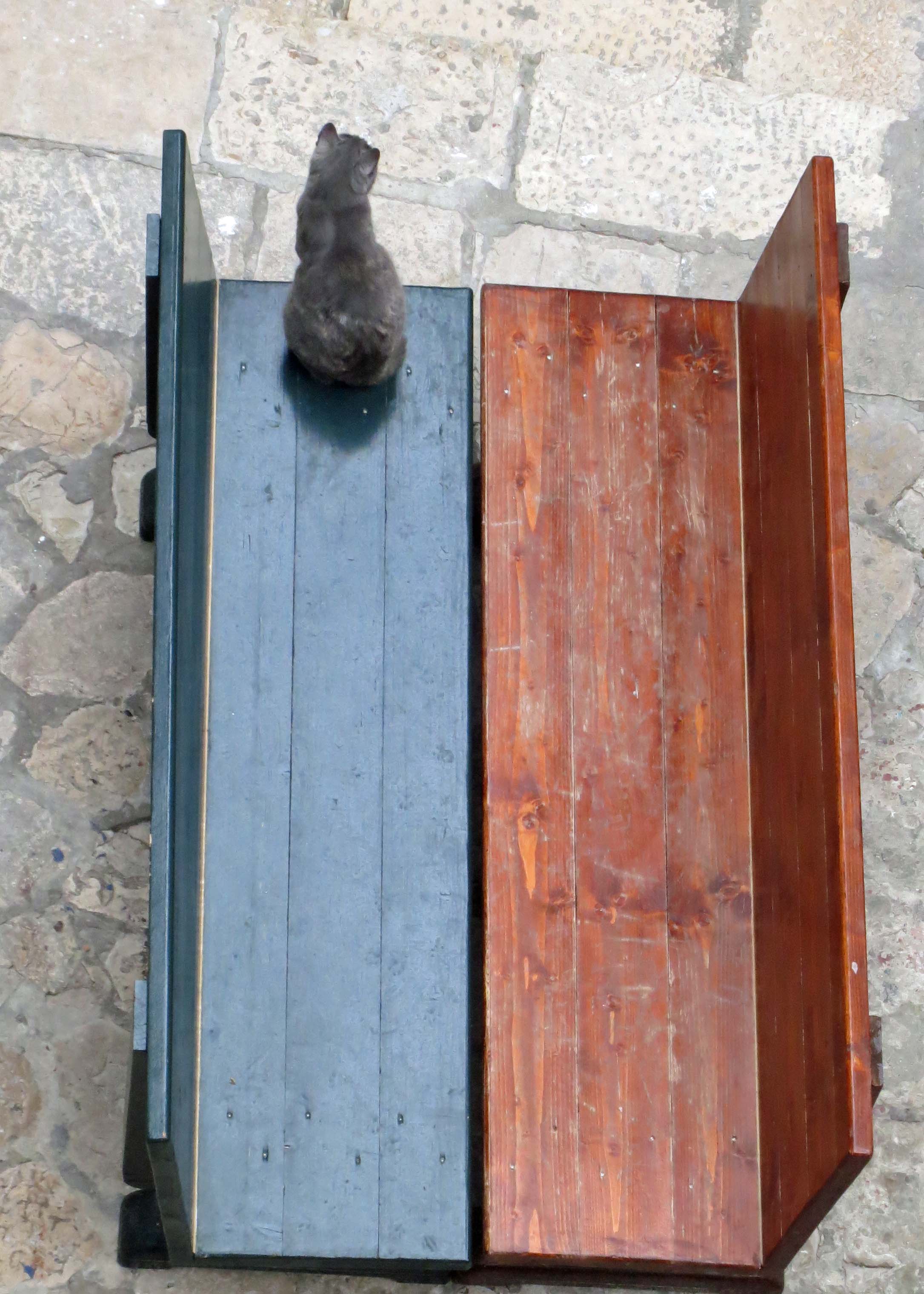
My obligatory cat photo from Dubrovnik. I loved the contrast between the cat and the two benches that had been shoved together.
A long view down the Stradun (Dubrovnik’s main street) looking toward the clock tower. The Franciscan Monastery is on the left.
I like this photo because it shows what Dubrovnik’s red tile roofs look like in the sunlight!
A final view of Dubrovnik taken from the walls. This photo was shot through a window of one of the city’s many guard towers. I thought it made a rather nice frame.
NEXT BLOG: We climb down from the walls surrounding Dubrovnik and walk through the city.
I am continuing my armchair series today and for the next for the next three posts as I revisit the fabulous walled city of Dubrovnik on the Adriatic Coast. Many of my followers will have visited this city. For you, let the memories begin, as they are for Peggy and me. If you haven’t been there, I suggest it would be a great reward for the self-isolation you have practiced during the battle against Covid-19. Start dreaming. The pandemic will pass.
The walled city of Dubrovnik is known as the Pearl of the Adriatic. The walls around the city are listed as a World Heritage Site. The Adriatic Sea is at the top of the photo.
OK, I’m in love. This walled city of Croatia on the Adriatic Sea is gorgeous. Once upon a time Dubrovnik was a major sea power in the Mediterranean Sea. At another time, it was the first nation in the world to provide official recognition for the fledgling United States of America fighting for independence.
As recently as 1991 it was under a devastating siege by Yugoslavian forces that laid waste to much of the city’s renowned beauty. Today it has rebuilt most of what was destroyed.
This is one of four blogs I did on Dubrovnik in 2013 and am reposting on my Armchair Series. First up is a look at magnificent medieval wall that surrounds the city and provides visitors with outstanding views of the Adriatic Sea and surrounding country. Second I will turn inward and look down from the walls on the city and its colorful tiled roofs. Third we will visit the city from street level. Finally, I want to feature some intriguing gargoyles we found in Dubrovnik. (Have I used enough superlatives?)
Any visit to Dubrovnik should include a walk around the mile plus (6,360 feet) wall that surrounds and protects the city. Considered to be one of the great fortification systems of the Middle Ages, the walls were named a World Heritage site in 1979. Reaching a maximum height of 82 feet, the walls were never breached during the 12th through the 17th century— providing five hundred years of peace and prosperity for the residents.
A fast walker can easily do the walk in an hour or so but plan on a more leisurely 2-3 hour stroll. You’ll need the extra time for photography, or just staring in awe.
This photo of the walls was taken from Minceta Tower, the highest spot on the walls. (Photo by Peggy Mekemson)
Here’s a perspective on why enemies would have thought twice— or maybe a dozen times— before attacking Dubrovnik.
If the walls weren’t enough to discourage an invasion of Dubrovnik, the Fort of St. Lawrence stood on the opposite peninsula. BTW, is it just my imagination (admittedly wild) or does the fort look like it is resting on the back of a turtle? (Photo by Peggy Mekemson)
Another view of the Fort of St. Lawrence in Dubrovnik. It was a stormy day as shown by the waves from the Adriatic Sea breaking on the rocks.
This photo looks up toward Minceta Tower, the highest point on the walls of Dubrovnik. The flag of Croatia is seen on the left.
Another perspective on the wall protecting Dubrovnik.
A cannon’s-eye-view looking out from the walls of Dubrovnik.
I liked this photo by Peggy with its dark sky, grey wall and red roof.
A statue of St. Blaise, the Patron Saint of Dubrovnik, looks out on the Adriatic Sea and protects the city from harm. (Photo by Peggy Mekemson)
A final view of Dubrovnik wall. (Photo by Peggy Mekemson)
NEXT BLOG: A journey around the walls of Dubrovnik looking down into the city.
When I was a child, I used to believe in the Easter Bunny who hopped around delivering brightly colored eggs to children all over the world. He was like Santa, magical, but he didn’t have a sleigh and flying reindeer. So he had to be very, very fast. I believed that he was a jackrabbit, which happened to be the fastest bunny I knew. So what if he was a hare.
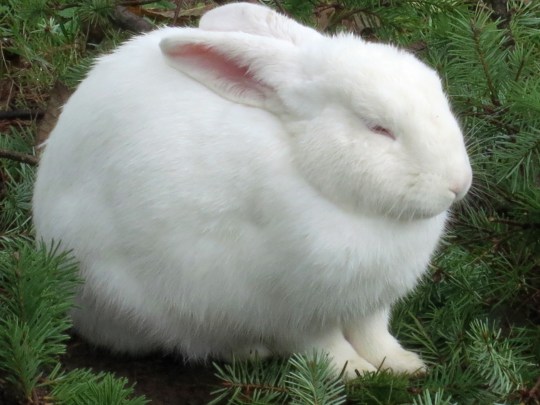
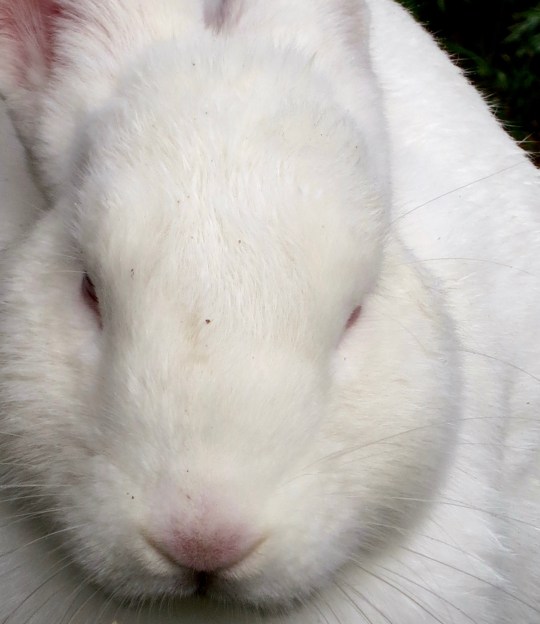
The bunny would need long legs and a streamlined body like these two jackrabbits that showed up in our back yard a few months ago.I mean, how in the heck could a fat, contented fellow like this make it around the world in one day? Furthermore, why would he want to?It’s much nicer to sit around munching green stuff and sleeping in the sun.Any suggestion that he slim down and start exercising would get you the ‘look.’He might even become a bad bunny. An no, no, no— you wouldn’t want that.
As an adult, I sadly gave up the idea of one Easter Bunny. It would take hundreds, thousands even millions of bunnies to make all the deliveries. But why not. Given the proclivity of bunnies to make other bunnies, lots of other bunnies, it is completely feasible. So I now believe in bunnies, bunnies everywhere. I even found one of their bunny production facilities. A few years ago I was traveling up the Northcoast of Oregon and came to the town of Tillamook. You may know it for its cheese, or even better yet, its ice cream.
I pulled into an RV campground and found enough bunnies to easily handle the city and surrounding countryside on Easter. I also noticed bunnies chasing each other around. I stopped one and asked one what was going on. “Are you blind,” he asked in amazement. “We are making more bunnies so the old fat bunnies can retire. They get nasty if they have to work too hard.” Oh,” I had replied.
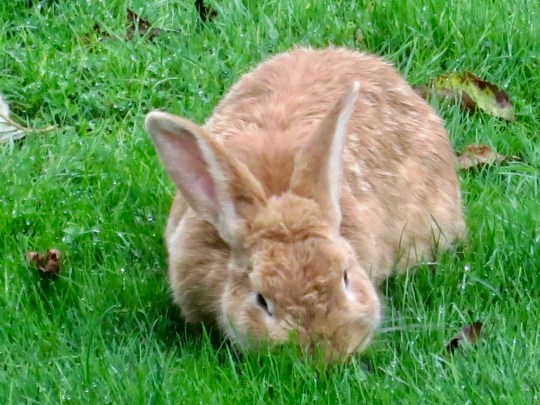
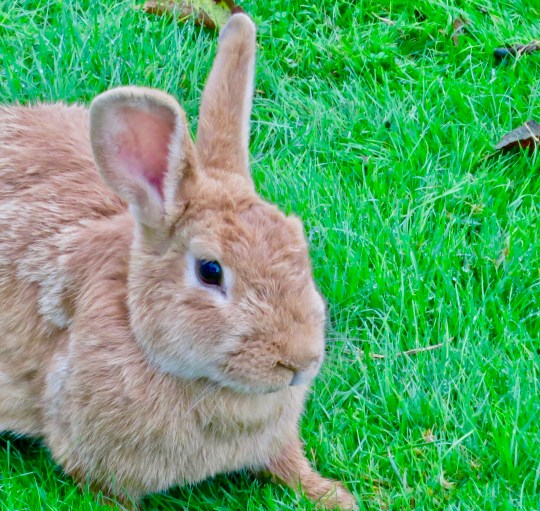
Everywhere I looked in the yard I saw bunnies.A young bunny was chowing down on grass so it could grow up and be an Easter Bunny.She stopped long enough to allow me to take her photo. “Aren’t I pretty,” she noted. And yes, it’s true. Girl bunnies have an equal opportunity to grow up and become Easter Bunnies.
NEXT POST: It’s another arm chair travel day as I head off to the lovely city of Dubrovnik.








































 Wandering through Time and Place