Ten Years and 1,001 Posts… Texas Hospitality

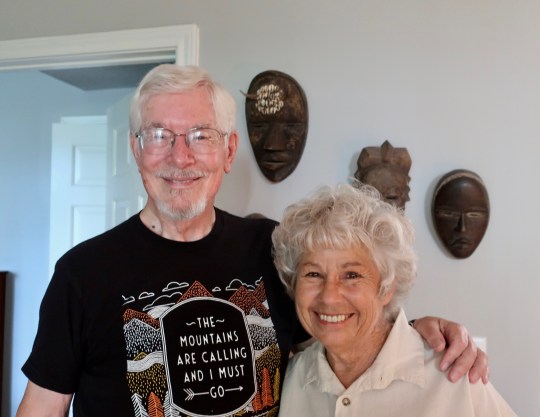
Linda Leinen from her Word Press blog, The Task at Hand, and I in front of her Liberian masks in League City, Texas.

Safety Harbor, Florida: I had intended to make a big deal out of my tenth year of blogging, which, surprisingly, coincided with my thousandth post. But both slipped right by. Post #1,000 was on Balanced Rock in Arches National Park. I was eager to get it up and totally missed my landmark occasion. We’ve covered a bit of ground since and are now in Florida with our son Tony, his wife Cammie and our grandsons Connor, Chris, and Cooper. There hasn’t been much time for blogging— or even backroads. So I am even further behind!

Given all of this, I decided that Texas hospitality would make an ideal blog for post #1001. It began with celebrating Peggy’s 70th birthday. We stopped off in Georgetown, Texas where Peggy’s brother John and his wife Frances live. They spoiled us rotten— feeding us salmon, ribs and steak. When we left, they loaded us down with chocolate cake, pumpkin bread (a true weakness of mine), and beautiful, large, garden tomatoes.

But our spoiling wasn’t over. We drove from Georgetown to League City just outside of Houston where Linda Leinen, a good blogging friend, had prepared another Texas feast for us. It came complete with brisket, potato salad and fruit salad finished off with Blue Bell ice cream topped with cherries. (Linda has been raving about Blue Bell for a long time.) She had also stocked in Texas beer and Texas wine. I’ll get back to Linda; but first, John and Frances.
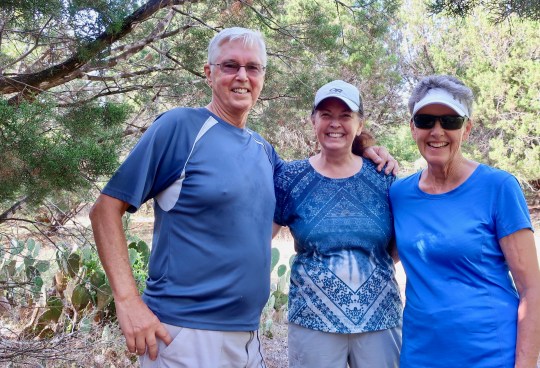
John and Frances share a moment with Peggy on a hiking trail in Sun City.
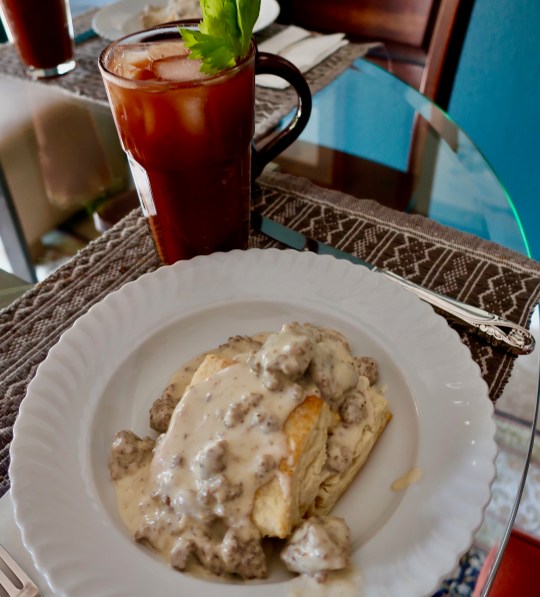
“You have to try my biscuits and sausage gravy,” Frances insisted on Peggy’s birthday morning. “It’s a true Texas dish.” And it was delicious. I gained a pound just looking at it. Frances is a great cook. Breakfast came with Bloody Marys that John made. “They are light on vodka,” he assured us. “Only 25%.” Hmmm, they were BIG Bloody Marys. Light probably meant a couple of shots. At least.
John and Francis live in a the developed senior community of Sun City near Georgetown. Its suburban nature does not discourage the wildlife. Peggy awoke on her birthday morning with four large, whitetail bucks parading by our bedroom window. John and Frances call them ‘The Boys’ Club.’ They are frequent visitors.
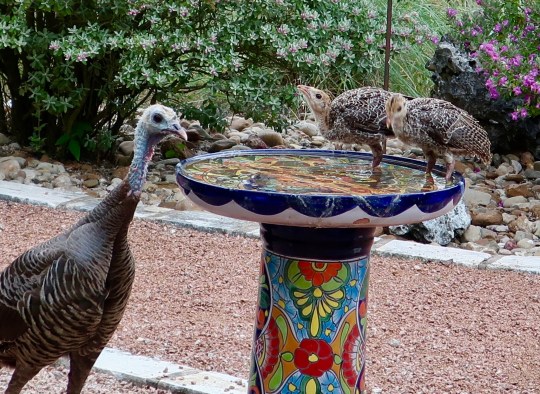
A turkey and her chicks also came by and drank out of the bird bath!
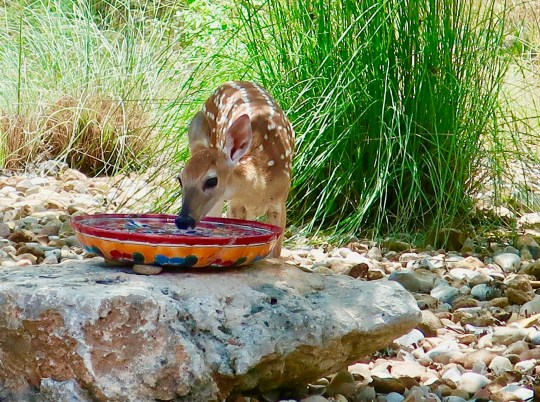
And a fawn stopped off to drink out of another bird bath strategically placed at fawn height. The wildlife made Peggy and me feel right at home!
I love it when people have a passion for doing something. John’s is building magnificent sailing ships. It goes along with his passion for history, which we share.
The attention to detail is incredible.
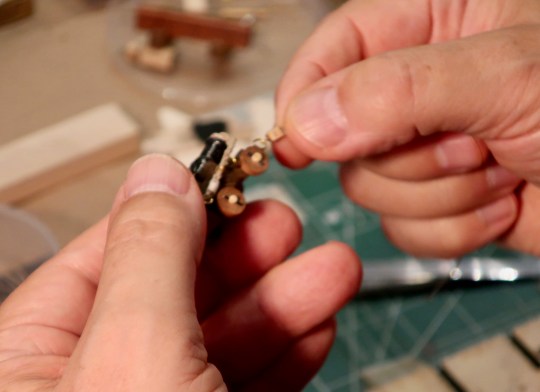
John was working on putting together canons for his latest sailboat project. Everything from wheels to recoil ropes needed to be meticulously added. “How long does it take you to do a ship?” I asked. “2,000 hours,” was his response. Now, that’s passion!

Georgetown has a bit of family history tied to it. The Mekemsons/Makemsons came down from Illinois prior to the Civil War and were among the early settlers of the area. William Makemson was sheriff of the town following the Clvil War and later served as editor of the town’s newspaper. He eventually ran for Governor of Texas on the Republican ticket but lost. It was a time when only Democrats won. Texans still blamed the Republicans for freeing the slaves and for the ‘Reconstruction’ period that followed the Civil War.
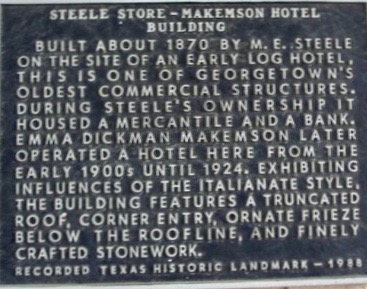
A Texas historical marker provides background information on the Steele-Makemson building in Georgetown.

While we were visiting John and Frances, I got a note from Karen at the WP blog, Philosopher Mouse of the Hedge. “I can’t believe you are in Georgetown,” she exclaimed. “My family had the original Spanish land-grant for the area!” Odds are that our families would have known each other. It’s possible that they even intermarried. Like Linda, Karen lives in the Houston area.

Visiting Linda had been on my agenda for several years. We had almost pulled it off four years ago when Peggy and I had re-driven the 10,000 mile route I had followed on my bike trek around North America in 1989. I had ridden my bike across Texas at the time. It’s a long way by car, so you can imagine what it is like on a bicycle! We had missed that connection with Linda on our road trip, but this time we succeeded.

In addition to enjoying blogging, photography, nature and wandering, we have another bond. We both lived in upcountry Liberia, West Africa. I was a Peace Corps Volunteer there from 1965-67. Linda was connected with a Lutheran Mission in Liberia starting in 1970. We often share tales of our experiences.

When Peggy and I walked into her house, I immediately noticed Liberian tribal masks on her wall and decided we had to have a photo with them as a backdrop. There was also Liberian country money on display. Even more significant to me, she had a wood-carved crucifix from the leper colony in Ganta. If you have read my book, The Bush Devil Ate Sam, the carving of the bush devil featured on the front also came from the colony. It’s possible that Freddy the Carver did both of our pieces. My friend Morris Carpenter, who served as a Peace Corps Volunteer in Ganta and introduced me to Freddy, had a crucifix from him that looked quite similar to Linda’s.
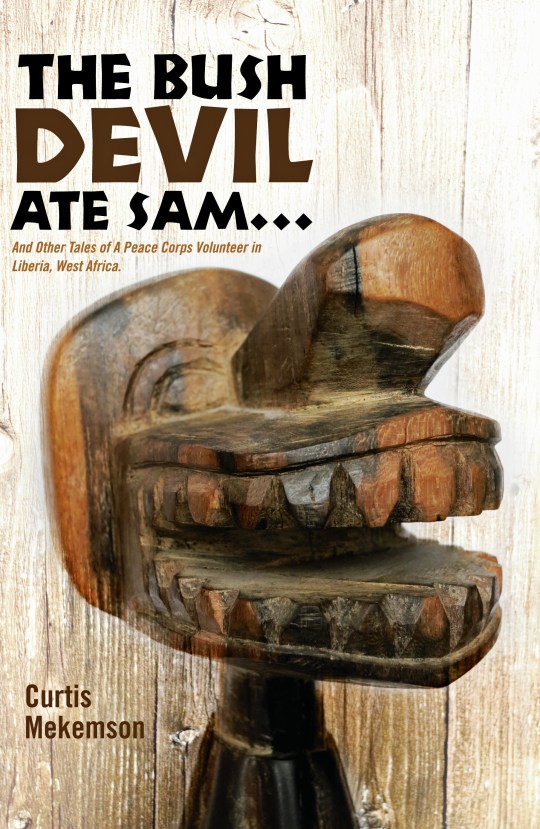
The bush devil was possibly carved by the same leper that carved Linda’s crucifix. Sam, BTW, who had worked for us as a 13 and 14 year old, would later become a physician and work at Phoebe Hospital where Linda had spent some of her time working while in Liberia.

We had a delightful evening with Linda. At 73 she is full of both energy and laughter and can still put in a full week sanding and varnishing sailboats in the harbor next to her condo, which is how she makes her living. She shared some of her fascinating history with us, which I will leave up to her to share other than to note the time she hitchhiked from Liberia up to London. If you have ever been in Africa, you have some idea of what a monumental task that would be! It speaks to what an adventuresome soul she is.

As we left, I noticed that Linda had a collection of rocks in a basket on the floor. I was going to comment on how they reminded me of the collections of rocks you find scattered around Georgia O’Keeffe’s house in New Mexico. Before I could get my observation out, Linda commented, “I collected the large rock from below Georgia O’Keefe’s house.” Forever generous, she reached down into her collection and came up with a fossilized snail from Texas and handed it to us as a memento of our visit.

Later that night, I thought “Darn. I meant to take Bone in to meet Linda.” Turns out she had her own bone that she wanted Bone to meet. “Next time,” she told me in an Email.
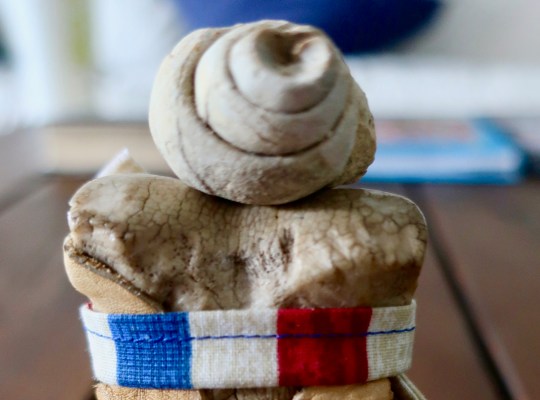
Bone, wearing his Covid-19 mask, took an immediately liking to the fossilized snail. I think that he decided that the snail would make an excellent Texas hat! I told him that it made him look jaunty.

Our thanks to John, Frances and Linda for showing us the true meaning of Texas Hospitality!

NEXT BLOG: Who knows. The good news is that I have plenty of new blog material. The bad news is that I don’t have any time to blog. From here we are heading up to North Carolina where our kids have rented a large home on the Outer Banks as another celebration of Peggy’s birthday! She isn’t suffering. This morning, our son Tony took her flying while I finished this post!

Off to a Rocky Start: Arches NP… The Backroads Series

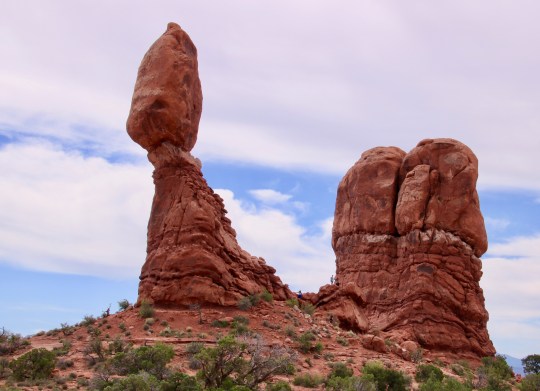
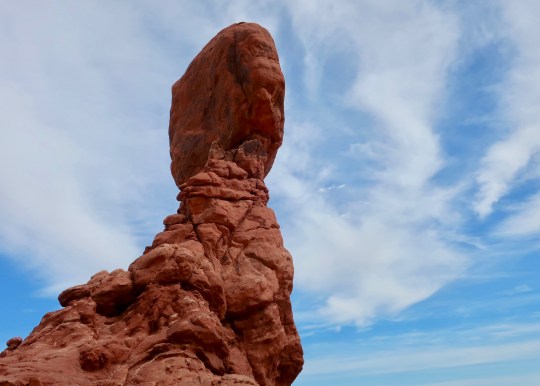
It looked a bit like Snoopy at first glance, making a sarcastic comment to Woodstock. But it wasn’t Snoopy. It was the famous Balanced Rock of Arches National Park. Someday it will come tumbling down. (Photo by Peggy Mekemson.)

We’ve started our journey around America traveling over the country’s backroads while wearing masks like bandits. The beginning of the trip was in Fallon, Nevada, which might seem strange given that we live in Oregon. Getting to Fallon, however, involved traveling over I-5 and I-80, two of Americas busiest freeways. Freeways are to be avoided and ignored in this series— even though Peggy and I have to use them on occasion.

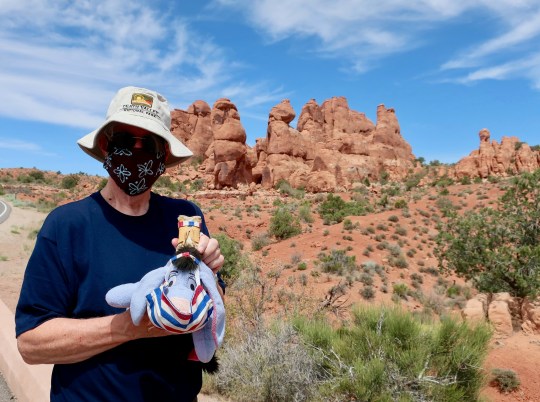
It’s scary out here in America’s hinterland as Covid-19 makes its way from state to state. The lack of a clear national policy is apparent. Peggy and I, as well as our traveling companions, Bone and Eeyore, are all wearing our masks. So far, we seem to be the exception. (Photo by Peggy Mekemson.)

In Fallon, we climbed on Highway 50. Its claim to being the ‘loneliest road in America,’ gives it genuine backroad credentials. I’ll get back to it. There is much to tell about the legendary highway I grew up near. But given Covid-19, our two to three month backroads exploration is off to a rocky start— and there are few places in America rockier than Arches National Park. Peggy and I know. We took 572 photos of rocks there. Peggy promises you won’t have to look at all of them. But there will be quite a few. Grin. I love red rock country.

Today, I am going to start with just one, the famous Balanced Rock. Its total height is 128 feet. The boulder on top makes up 55 feet of its height and weighs in at 3500 tons. If you have been to Arches, the odds are you have a photo. Millions of tourists have stood and stared up at it in awe.

It stands as a testament to the fact that there is much more to see in Arches than just arches. A lot more. Geology is the reason for the park’s unique look. The rocks that make up Arches have been layed down over hundreds of millions of years under a wide range of circumstances ranging from deserts to seas. Their different makeup impacts how fast they erode and that leads to the fantastic rock sculptures and monuments seen through the park. There will be more on the geology in coming posts.

In addition to its unique look and geology, the thing that fascinates me about Balanced Rock is how its look changes drastically from different angles as you walk around it. And that is the subject of today’s photos.

The mushroom look.
A more traditional look of Balanced Rock with a companion. (Photo by Peggy Mekemson.)
A modified ‘Snoopy’ look.
Side view.
A long view including Peggy. She’s safe, but is she balanced. (Grin) Another rock stands behind.
A more human look. Possibly a thumbs up with a thumb ring? (Photo by Peggy Mekemson.)
I’ll conclude with this view of looking up at Balanced Rock from its base. It gives a perspective on how massive the sculpture is.

NEXT POST: We’ll start at the beginning of the park with Wall Street, the Organ, and the Sheep.

We Rub the Nose of a Pig in Florence… Armchair Travel

Peggy eagerly rubs Little Pig’s Nose in Florence.
Kathy and I quickly join in the nose rubbing exercise.

So, here’s a serious question: With all of the beautiful art in Florence, why in the world would we spend our time rubbing the nose of a pig?

I’ll be brief. We were told if we rubbed the nose of the pig, or the snout of the boar if you prefer, we would come back to Florence.  Considering we had six hours to explore everything Florence had to offer, we looked on our nose polishing efforts as a guarantee of a return trip.

Il Porcellino, or Little Pig, as he is known, was sculpted way back in 1612 and was based on an original marble pig of Greek origin dating back to who knows when. The present pig is a copy of the copy. You can tell by his shiny nose that lots of people share our desire to come back to Florence. Apparently rubbing his snout for a return trip dates back to the 1700s.

Little Pig is housed in an attractive marketplace that was built by Cosimo de’ Medici between 1547-1551. Bad merchants, who had the misfortune of going bankrupt, were spanked here before being sent off to prison. I couldn’t find a description on what the spanking entailed.

The overflowing Mercato Nuovo or the Straw Market where bad merchants were once spanked. I doubt that they were ever spanked for cheating a customer.
It’s only right that I should close this post with a photo of Little Pig’s shiny snout.

NEXT POST: A teaser from our present journey around North America in Quivera, our 22-foot RV.

Medusa Loses Her Head and David Is Admired: Florence… Armchair Travel

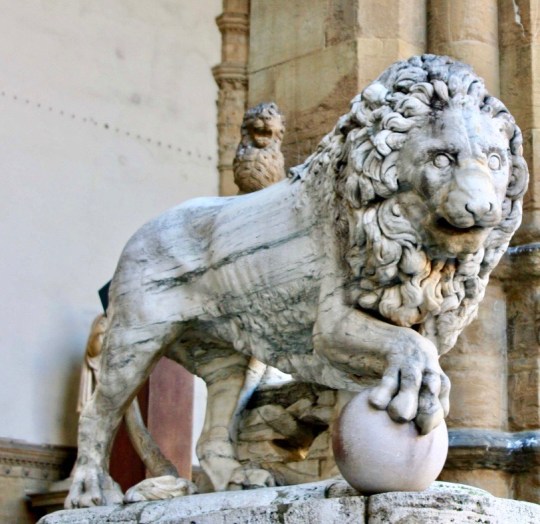
This nice kitty with his finger like paws greeted us on the Piazza della Signoria… along with several other sculptures. (Photo by Peggy Mekemson)

The two-hour trip to Florence from the Port of Livorno and the two-hour trip back seriously sucked up what little time we had to enjoy the legendary Renaissance city. Our first act upon arrival was to plot out our plan of attack, which we did over café lattes and scrumptious Italian pastries. Why suffer? I really, really hate to eliminate treasures, however. Florence is where the birth of the Renaissance took place and is chock full of art.

The latte was delicious and the pastries scrumptious.

The Uffizi Gallery alone, with its world-class art including masterpieces by Sandro Botticelli and Leonardo da Vinci, would take up half out time. Beyond that we plotted out a walk that would take us to the Duomo Basilica and then back to Santo Croce Basilica, where we were to catch our bus. Sadly, I crossed off the Accademia Gallery, which includes Michelangelo’s original David.

But not to worry… there was a magnificent copy of David in front of the Uffizi Gallery in Piazza della Signoria. It was in this square, BTW, that the infamous priest Savonarola (1452-98) held his ‘Bonfire of Vanities’ and encouraged the good citizens of Florence to bring their art treasures and books to be burned.  Somewhat ironically, Savonarola, who was quite vain in his own way, was also burned in the square.

Michelangelo’s David has always been one of Peggy’s favorite sculptures. I wonder why…
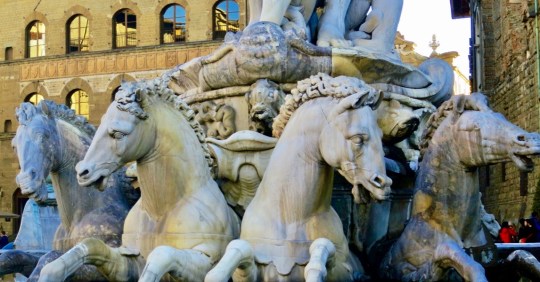
These charging horses pulling Neptune’s chariot on Piazza della Signoria in Florence seemed to be pulling in different directions. The horses were carved by the Sculpture Ammannati.
This sculpture by Benvenuto Cellini shows Perseus holding up the head of Medusa, which he had just lopped off. Hopefully her eyes are closed. Otherwise you would be turned to stone.
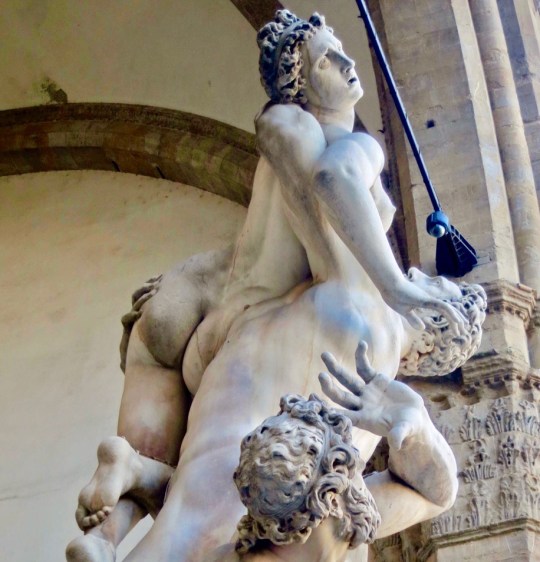
The most dynamic sculpture on the Piazza della Signoria is the Rape of the Sabine Women by the sculpture Giambologna. The story goes that Romulus needed more women for his new city of Rome, so he went to the nearby town of Sabine and kidnapped them.
But enough on violence. They didn’t allow photos to be taken in the Uffizi Gallery, but when we came out, a short walk took us to Florence’s most famous bridge, the Ponte Vecchio.
For my final picture today, I selected this view looking down the Arno River from Pont Vecchio.

NEXT POST: A fascinating pig that people can’t keep their hands off of.

Two of the World’s Most Beautiful Churches Are Found in Florence

After visiting St. Peter’s Basilica in Rome, Peggy and I travelled on to Florence where we were awed by the Duomo and Santa Croce churches, which we found even more beautiful than the Basilica. These two churches are the focus of my re-post today from our 2015 trip to Europe and are part of my armchair travel in the age of Coronavirus series.

Note: Peggy and I are off on another adventure. This time we will be exploring the back roads of America. Carefully. Covid-19 continues to rage across the country. We have our face masks along and enough sanitizer to bathe in. Even Bone and Eeyore are wearing their face masks! I apologize for not reading posts and comments the past few days but will catch up. One challenge of remote America is the lack of good Internet service. Yesterday, for example, I was in the middle of the Nevada desert on “America’s Loneliest Road” following the route of the Pony Express. I have several more posts in my Adventure Travel series and will then start my Backroad series. Peggy, Eeyore and Bone say hi and urge you to be safe! –Curt
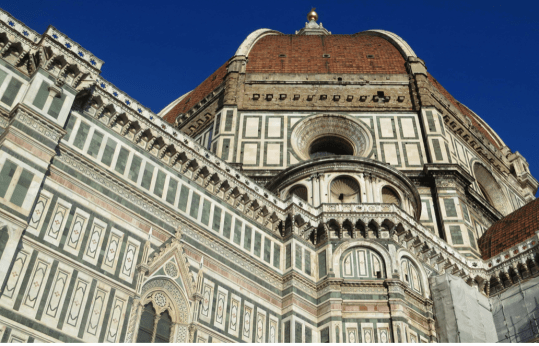
Looking up at the magnificent dome on Florence’s Duomo Cathedral.

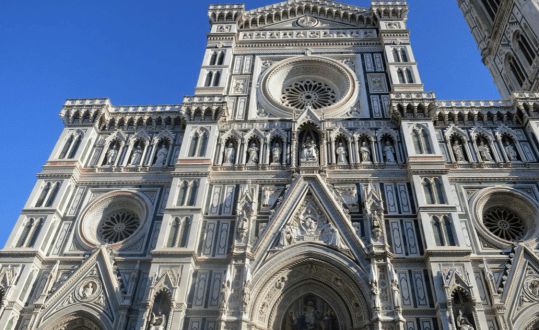
There are at least three reasons for visiting Florence’s Cathedral, commonly known as the Duomo. First is the Church itself, second is the magnificent bell tower, which stands next to the church, and third is the octagonal-shaped Baptistery, which stands in front.

The dome of Duomo was one of the great works of the Renaissance. (The church had been waiting since the Middle Ages for its top.) Filippo Brunelleschi, who built the dome, first studied the ancient Pantheon in Rome. Like so much of the Renaissance, the dome represented a return to, or a rebirth of, the Greek and Roman cultures that had thrived 1000 years earlier before the Dark Ages had arrived along with the Barbarian hordes.

A view of the Baptistery on the left, the front of the Duomo in the center, and the dome on the right.
A front view of the Duomo. The bell tower is looming on the right.
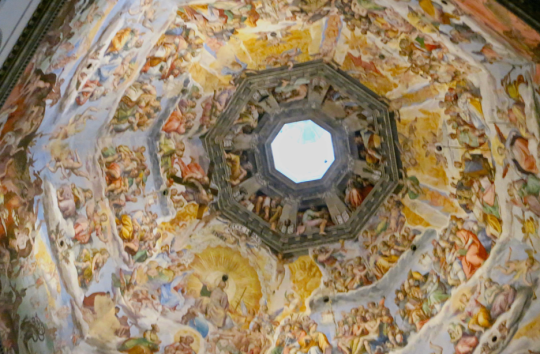
Looking up at the Duomo’s intricately painted dome from inside the church.

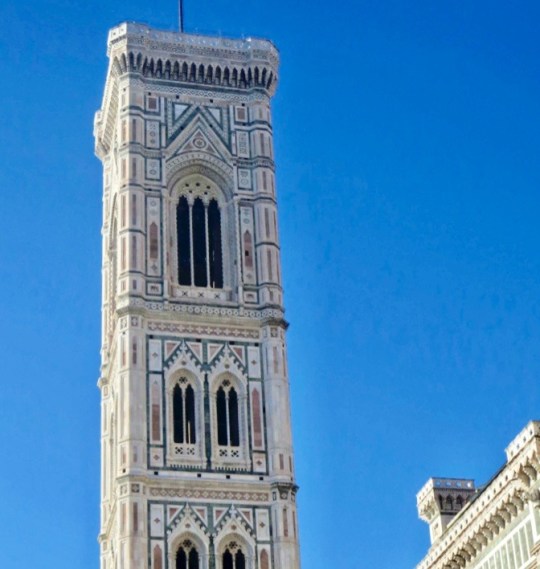
The 270-foot tall Campanile or Giotto’s Tower, which is located next to the Duomo, was actually completed 100 years before Brunelleschi put his finishing touches on the church. Many consider the bell tower to be among the most beautiful in Europe.

Giotto’s bell tower.
A close up of the top of Giotto’s bell tower. (Photo by Peggy Mekemson.)
Looking up at Giotto’s bell tower.

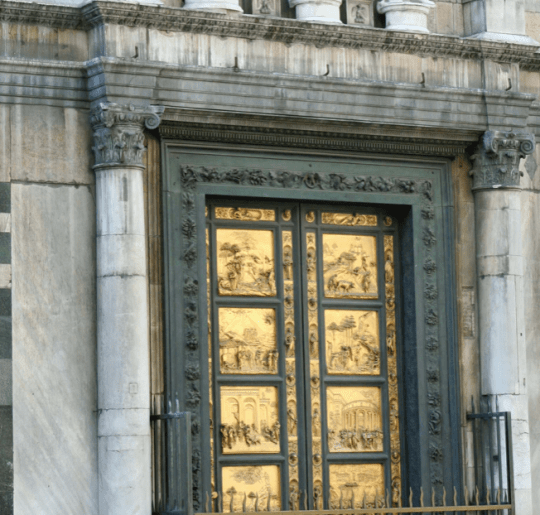
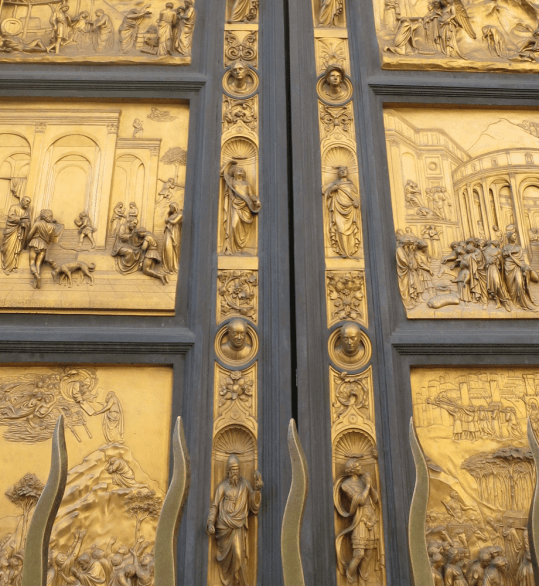
The Baptistery features Ghiberti’s bronze doors. Michelangelo believed these gates were so beautiful they could have served as “the Gates of Paradise.”

The top of Ghiberti’s Bronze Doors on the Baptistery in Florence. Tourists blocked a lower view. (Photo by Peggy Mekemson)
A closer look.
And a detailed look at one of the panels.

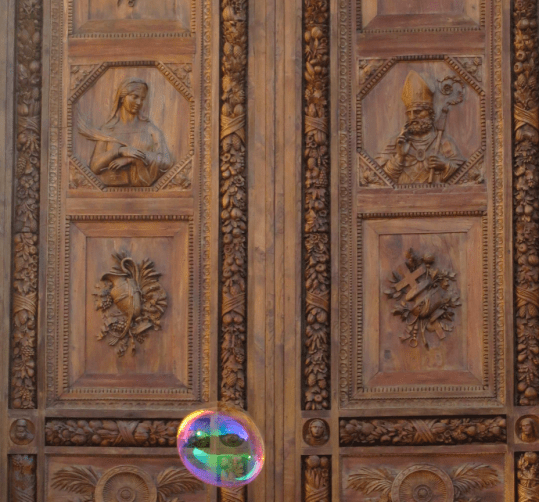
The Basilica of Santa Croce, a 14th Century Franciscan church, also had some great doors but is better known for the people buried inside including Michelangelo, Machiavelli, Rossini and Galileo. As we stood in front of the church admiring its doors, a man sent bubbles floating into the sky.

A bulb floated up past the carved wooden doors of the Basilica of Santa Croce.
I’ll wrap-up today’s post with a view of the the Basilica of Santa Croce in Florence caught in the glow of the afternoon sun.

NEXT POST: Exploring a tiny bit of Florence’s art.

When the Mediterranean Was A Roman Pond: The Forum… Armchair Series

We added Rome’s ancient Forum to our walk-about where we visited the Trevi Fountain and the Pantheon. I’m still tired! Today concludes the Rome section of my adventure travel series from posts I did in 2015. Next up will be Florence.

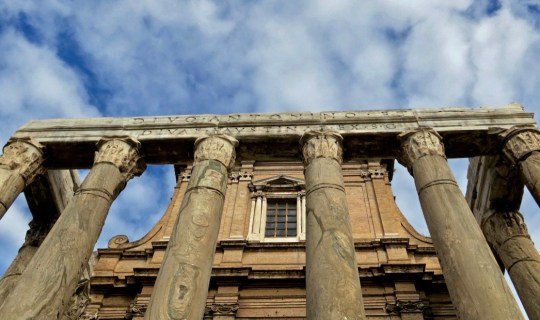
While much of the Roman Forum is in rubble, the temple of Antonius and Faustina still stands proudly… fortunately. The striations around the columns were caused by someone trying to cut them down.

At the height of the Roman Empire, around 100 CE, Rome ruled from England to the Persian Gulf. The Mediterranean Sea was considered a Roman pond. The Forum, located next to the Colosseum, was the site of Rome’s government. Julius Caesar was killed here on the Ides of March, after which Mark Anthony gave his famous speech: “Friends, Romans and Countrymen, lend me your ears.” The following photos are from the Forum.

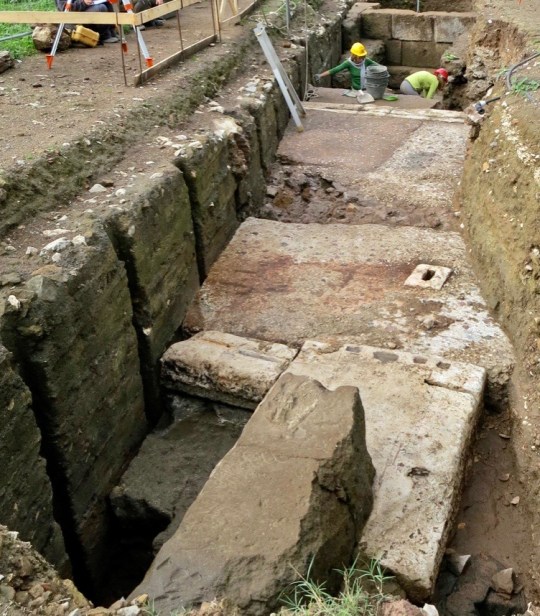
Excavating the Roman Forum is still very much a work in progress, as this photo shows.
I found the simple elegance of this single column outlined against a cloudy sky to be quite beautiful.
These columns were once part of Caligula’s Palace. Caligula, who enjoyed torturing people, built his horse a house and planned to appoint him as a Consul. It was around that time that Romans decided to assassinate the infamous emperor.
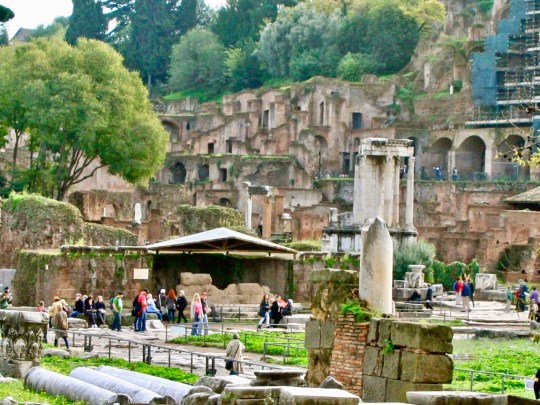
The building on the lower left covers the site where the body of Julius Caesar was burned. Above it, to the right, was the Temple of Vesta, attended by the Vestal Virgins. Their job was to stay chaste for 30 years and attend the eternal flame. Being bad got you buried alive. Flings were few and far between. Palatine Hill, where the wealthy lived and cavorted, is in the background. (Photo by Peggy Mekemson)
The Arch of Titus commemorated the Roman victory over Judaea in 70 AD. (Photo by Peggy Mekemson)
While Peggy was capturing photos of important historical sites, I was busy with the local cat.
What remains of the massive Temple of Constantine, the Emperor who made Christianity the official religion of Rome. (Photo by Peggy Mekemson)
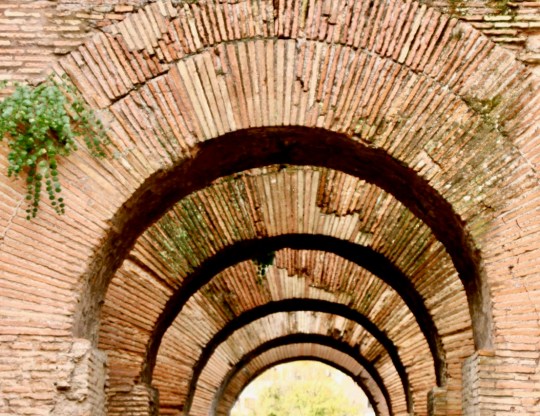
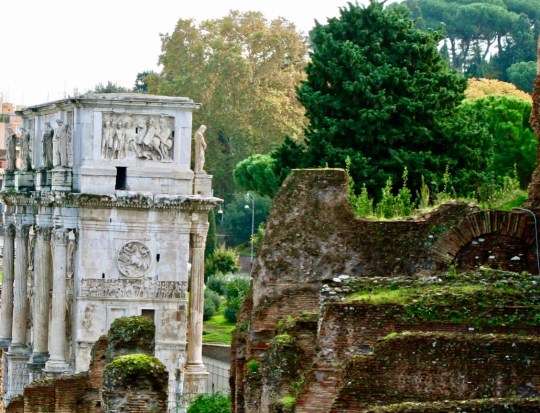
This impressive six-story arch commemorated the victory of the African born emperor Septimius Severus in far off Mesopotamia. BTW, it was the booty from these Roman victories that helped build the arches.
Speaking of aches, I like the perspective of their photo taken by Peggy.
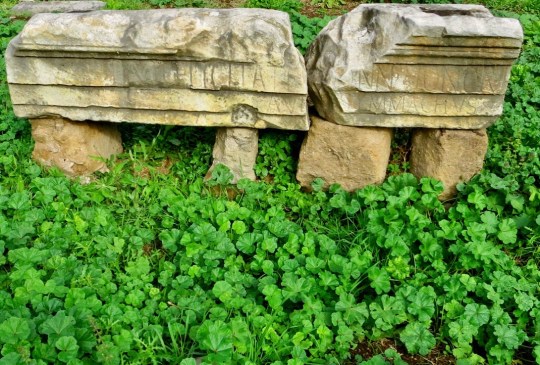
Do you think the Latin says park bench? I was tempted.
For my last picture on my Forum post, I chose this magnificent boar. (Photo by Peggy Mekemson)

NEXT POST: Off we go to Florence

The Go-To Church for 1 Billion Catholics: St. Peter’s Basilica… Armchair Travel

In my last post we stood in St. Peter’s Square and looked at St. Peter’s Basilica. This time we go inside plus visit the Vatican Museum as part of my armchair travel series. This post is based on a 2015 post.

One of the world’s best-loved works of art, Michelangelo’s Pieta, is located in St. Peter’s Basilica.

St. Peter’s Basilica in Rome is one of the world’s great churches. It is simply breathtaking. Walk inside and you are ready to join the Faith… whether you are faithful or not. The church was built during the Renaissance utilizing the greatest artists of Italy when Italy had the greatest artists in the world.

Visiting, you might say, is an indulgence of the highest order. In fact the church was built on indulgence… or, more correctly, indulgences: lots of them. Let’s say you committed a very, very BIG sin. No problem, if you were very, very wealthy. The church was willing to sell you forgiveness, an indulgence if you will. It was a guarantee you’d make it through the Pearly Gates.

The practice was so widespread, and so profitable, and so corrupt in fact, that it led a relatively unknown monk by the name of Martin Luther to tack up a list of 95 demands on the doors of a German church and kick off the Protestant Reformation.

But that is all far behind us in the very distant past. I, for one, am glad that the Pope found a way to pay for his splendid monument. And, I suspect, given a few minutes alone with Michelangelo’s Pieta, the most protesting of Protestants would agree.

Bernini’s ornate seven story high bronze canopy oversees the simple altar where the Pope holds Communion.
Looking up past Bernini’s Canopy at Michelangelo’s dome, which towers 448 feet from the floor.
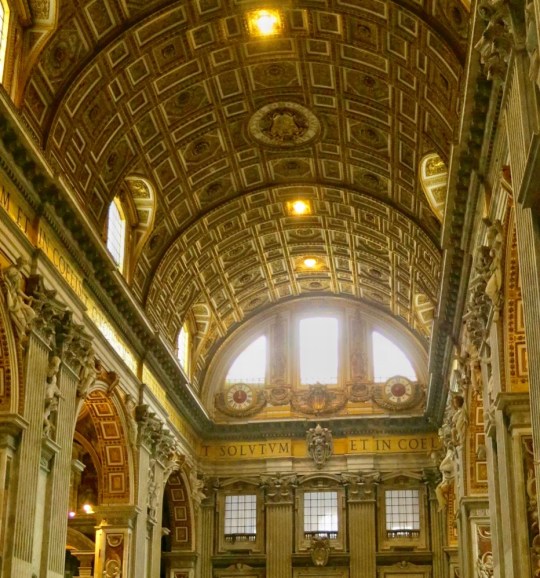
This photo of the nave of St. Peter’s Basilica gives an idea of just how big the church is. 60,000 people standing shoulder to shoulder could stand inside.

If St. Peter’s isn’t enough to pull you into the Vatican, its magnificent museum with over four miles of art should. The tour ends with the Sistine Chapel where Michelangelo spent four years on his back filling 5900 square feet with art.

Our tour of St. Peter’s Basilica and the Vatican Museum was far too short. Even cutting out half of the museum, I felt like an Olympic sprinter. Give yourself a couple of days to explore these outstanding treasures.

The collection of the Vatican Museum ranges from ancient Egypt to modern times. This is a statue, I believe, of the Egyptian God Anubis who had the body of a man and the head of a jackal.
I was quite taken with this lion in the Vatican museum. Note the eyes.
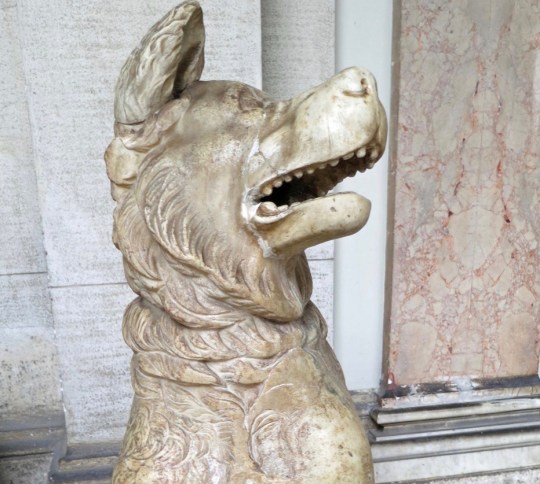
Man’s best friend! Woof!
Finally, I wanted to emphasize how incredibly ornate portions of the Vatican are. This was the ceiling of the map room. (Photo by Peggy Mekemson)

NEXT POST: We will visit Rome’s ancient forum.

A Walk to St. Peter’s Square: The Vatican Part 1… Armchair Travel

Today we will visit St. Peter’s Square as part of my armchair travel series for the Age of Coronavirus. This is based on a post I did in 2015 after a visit to Rome.

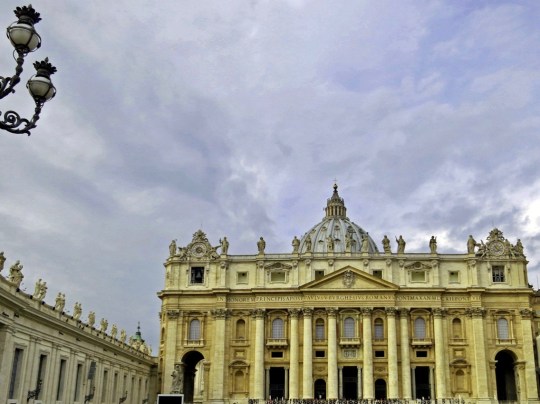
Cloudy skies provide a colorful backdrop for St. Peter’s Basilica with its magnificent dome designed by Michelangelo. This photo is taken while standing in St. Peters Square. Look closely, and you will see ant-like people waiting to enter. Our turn would come.

Our hotel in Rome, the Giulio Cesare, was within a mile of the Vatican. We walked over twice, getting mildly lost both times. It didn’t matter. Rome is chock-full of fascinating architecture and tantalizing history.

The first time we went via the Tiber River, passing by the Castle St. Angelo and its neighboring bridge, the Pont St. Angelo. Eventually this brought us to the broad avenue leading up to St. Peter’s Square and Basilica. Mussolini built the avenue to provide visitors with a better view of the church. He also gave the 100-acre Vatican its independent nation status. Today the Vatican serves as the religious center for some one billion Catholics.

The Victor Immanuel Bridge reflected in the Tiber River of Rome.
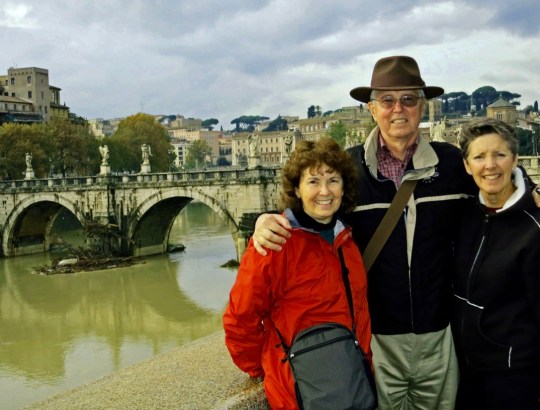
Peggy, her brother John and his wife Frances stand in front of the Tiber River and the Pont St. Angelo (the Bridge of Angels). The bridge was once the Bridge of Emperor Hadrian and dates from the Roman Empire.
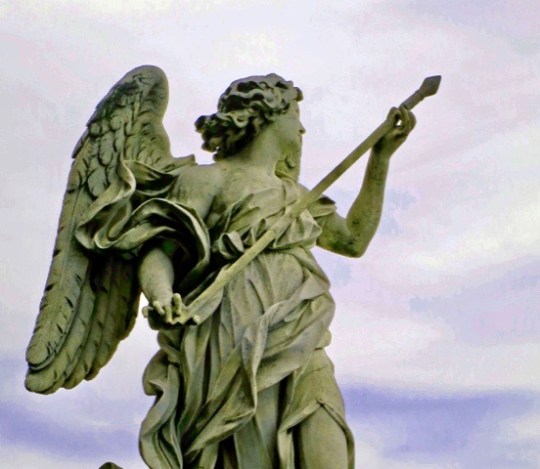
Pont St. Angelo received its name during the Renaissance when Bernini oversaw a project to line the bridge with angels reminding the faithful of Christ’s crucifixion. This one carries a lance representing the spear used by a Roman soldier to jab Christ in the side.
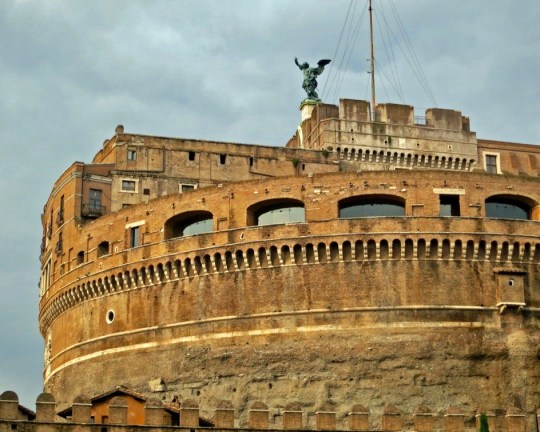
The rounded Castle St. Angelo stands next to the bridge. Built originally as a mausoleum for Emperor Hadrian, it would later become a prison and then fort. Today it serves as a museum. St. Michael stands on top of the castle with sword drawn to fight off the plague.Hmmm, I wonder if he would take on Covid-19? (Photo by Peggy Mekemson.)
A view of St. Peter’s Square featuring a portion of Bernini’s Colonnade. Statues of 10 foot tall saints line the top.
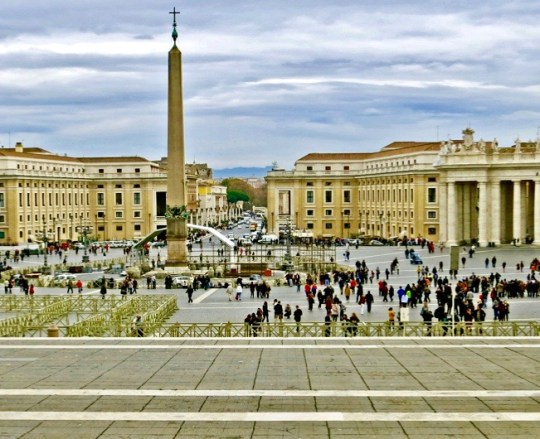
Another perspective of St. Peter’s Square. This is taken from the Basilica looking back. The boulevard built by Mussolini is in the distance. Bernini’s Colonnade opens out, welcoming the faithful.
This obelisk, seen in the previous picture, dominates St. Peter’s Square. Once upon a time it resided in Egypt, but its home in Rome predates that of the Vatican when it stood over Nero’s race track where Christians were persecuted and Peter was crucified upside down.
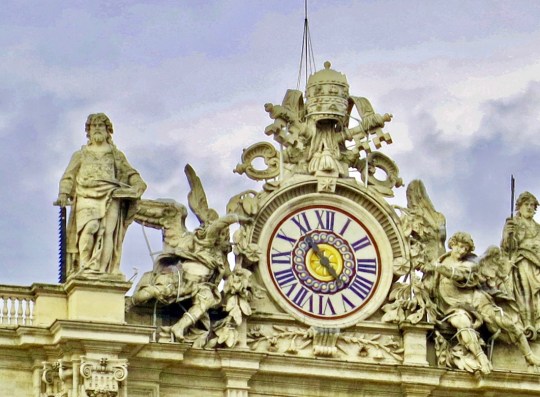
The top of St. Peter’s Basilica, like Bellini’s Colonnade, features saints. The saint on the left is Simon the Zealot. You can tell your saints by the tools they carry. Simon was a carpenter and is shown with his saw. Simon was called the Zealot because he left his wife and kids to follow Jesus. (Photo by Peggy Mekemson)
This lamp from St. Peter’s Square is here because I like it. You’ll see it peeking out on the left hand corner of St. Peter’s Basilica at the beginning of this blog.
I took this photo of the massive columns in front of St. Peter’s Basilica because I felt they provided an interesting perspective on the size of the church. We will be visiting the Basilica in my next post.
No blog on the Vatican would be complete without showing the changing of the Swiss Guard carrying pikes. (Photo by Peggy Mekemson.)

Floppy the Doe Brings by Her Kids… Nature Tales

One of the twins. She had been standing under the bird feeder when a scrub jay flew in and startled her.

I had another post on Rome in the armchair series ready to go. All I had to do was hit the publish button. And then Floppy brought by her twins late yesterday. She has had them well hidden ever since the bear made an appearance. But he hasn’t been around for several days. Apparently it is safe now. Anyway, I promised you photos of Floppy’s babies. Here they are. Enjoy. Peggy and I kept handing the camera back and forth so these pictures are from both of us.

The twins follow along. Floppy was a fawn when we first moved here and has been hanging around ever since. She likes apples and is now the dominant doe in the area. Even young bucks pay her homage.
Floppy noticed us taking photos from inside while one of the twins scratched an itch. I think that was a ‘Where’s my apple’ look but we didn’t’ want to disturb the family.
Floppy made two complete circuits around our house. We took lots of photos!
This is probably about as much cute as you can handle on a Monday morning. Someday this kid will grow into its ears!

NEXT POST: It’s back to Rome, unless, of course…

Going on a Rome Walk About, Plus Pickpockets… The Armchair Series

Today, I am continuing to dip into my archives as part of my armchair travel series in the age of Covid-19. On Wednesday we visited Rome’s impressive colosseum. Today, Peggy and I go on a walk-about visiting various historic sites and dodging pickpockets. In terms of coronavirus, I had an amusing thought: It must be much harder for pickpockets to work when 6-foot social distancing is being practiced!

One of the joys of walk-about is you come on treasures you might not see otherwise. This delightful elephant carved by Bernini is located near the Pantheon. It serves as the base for an obelisk.

If you’ve been following this blog, you know we like to walk extensively when visiting a new city. It’s a good way to become acquainted with the region and its people. Plus it’s great exercise. While Rome is huge, the historic section is confined to a relatively small section. It was large enough, however, that we used mass transit for longer distances.

There were two challenges. The first was figuring out the where and when of catching a train in a language we didn’t speak. The second was that the subway is a great place for pickpockets, especially during rush hour. Rick Steves, in his book on Mediterranean Ports, was constantly admonishing us to be on theft alert.

Peggy, who is more paranoid than I, is always urging me to transfer my wallet to my front pocket when we are in a crowd. Sometimes I even comply. Once, she didn’t even have to ask. We were in Amsterdam and the city had put up huge banners across the streets warning people about thieves. Neither did I require urging in Rome. Folks in Southern Europe were suffering from serious Euro Deficit Dysfunction. Times were tough. We both wore money belts.

The stories are legendary about various scams. Travelers love to share tales. One of my favorites is a woman will ask you to hold her baby while her compatriots grab your wallet. No way was I going to hold a stranger’s baby. Heck, I’ll hardly hold the baby of a woman I know. Babies are known to burp and pee on you. Can you imagine the insult added to injury if a baby was burping and peeing on you while someone was stealing your wallet?

While the stories are fun, the problems are real. A man staying at our hotel lost 2000 euros. A woman told us she was waiting at the airport when a nicely dressed couple told her something was sprayed all over the back of her jacket. The woman took it off. Sure enough, the jacket was covered with green goop. While her husband took the jacket to the restroom to wash, the couple kept her company. They left when her husband returned. Only later did she realize that her purse left with them.

We were at the Termini, a major transfer point on Rome’s transit system, when our turn came. It was at the peak of rush hour and the train was crammed full. John, Peggy’s brother, and his wife Frances had climbed on first. Four little kids, maybe eight years old, jumped on in front of us. Peggy and I were squeezing in when John shouted. He had felt someone reaching in his back pocket. Meanwhile, the four little kids were trying to jump off the train. Peggy, being the ex-elementary school principal she is, thought the kids were confused and tried to shove them back on. The little pickpockets, of course, thought she was trying to collar them. They managed to escape just as the doors were closing. Fortunately, John was also wearing a money belt. He kept his euros and we had a story to tell.

Besides our experience with the pickpockets, we had managed to visit Trajan’s Column, the Trevi Fountains and the Pantheon on our day’s walk-about.

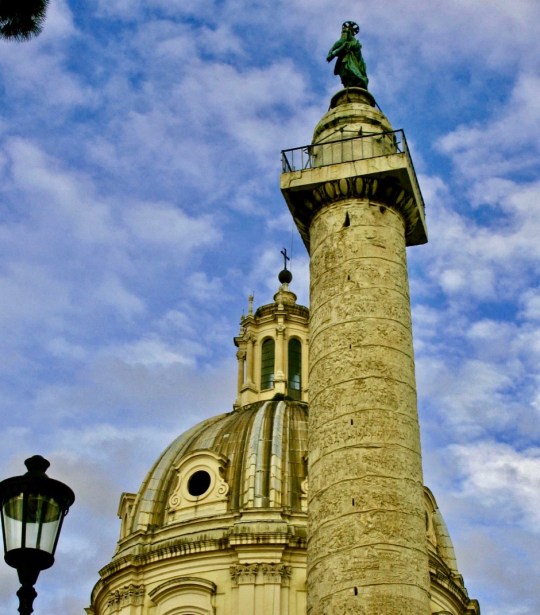
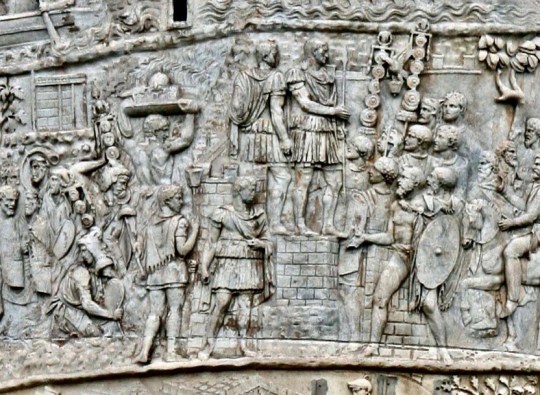
The emperor Trajan apparently had lots to say about his victorious Dacian campaign circa 103 AD. He told it on the bas-relief making its way up the 140-foot column— in a cork-screw fashion. See below for details. (Photo by Peggy Mekemson)
This photo shows how much detail is included on Trajan’s Column. (Photo by Peggy Mekemson)
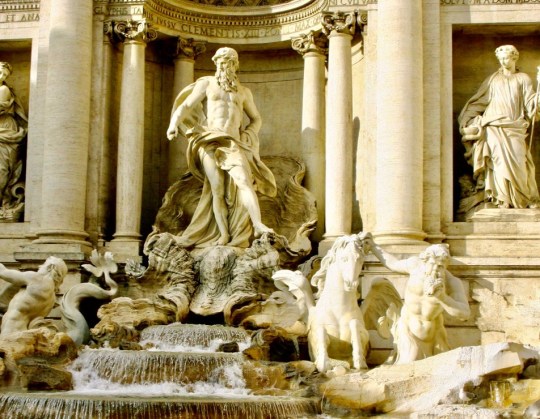
The Trevi Fountain has always been worth visiting on its own but its popularity got a significant boost by the 1950’s movie and theme song, “Three Coins in a Fountain.” Sinatra sang the song. The coins are for wishes. The first gets you back to Rome, the second helps you find true love, the third sees you happily married. Or so they say.
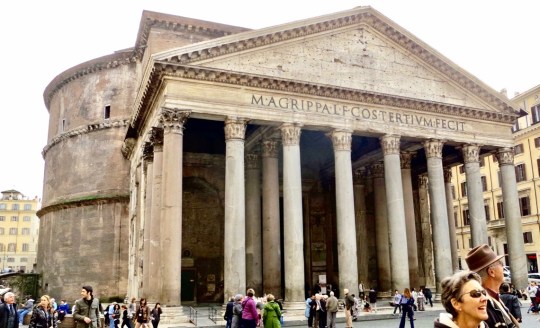
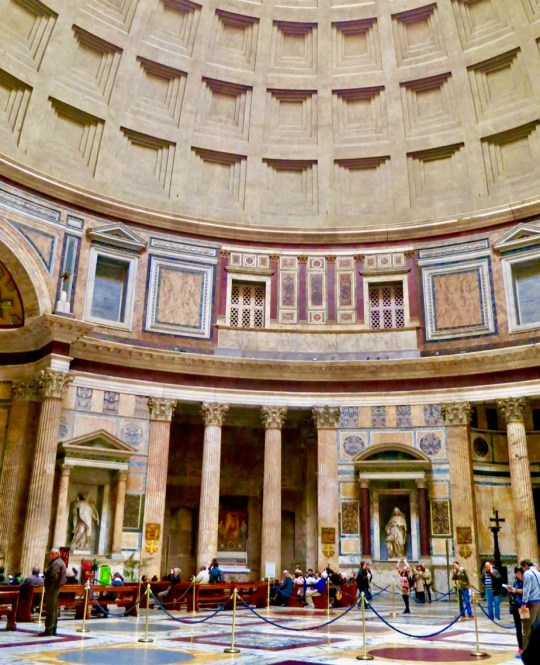
The Pantheon is one of the world’s most famous structures. It was built to honor Rome’s numerous gods. Its dome has served as a model for domes ranging from St. Peter’s Basilica to the US Capitol building. Peggy’s brother John and his wife Frances made it into the right corner of the photo.
The interior of the Pantheon is quite striking.
It was common practice for the Catholic Church to take over sites that had been used to worship Roman gods. It was a clever ploy that the church also used for other local gods as well.
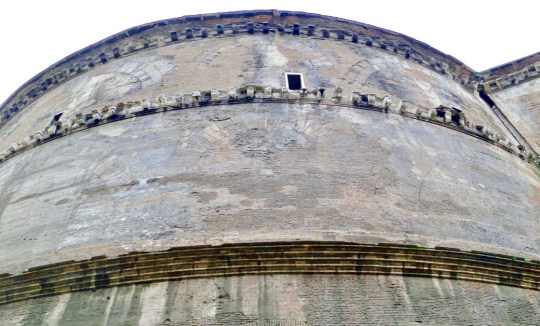
A final view of the Pantheon’s dome from outside.
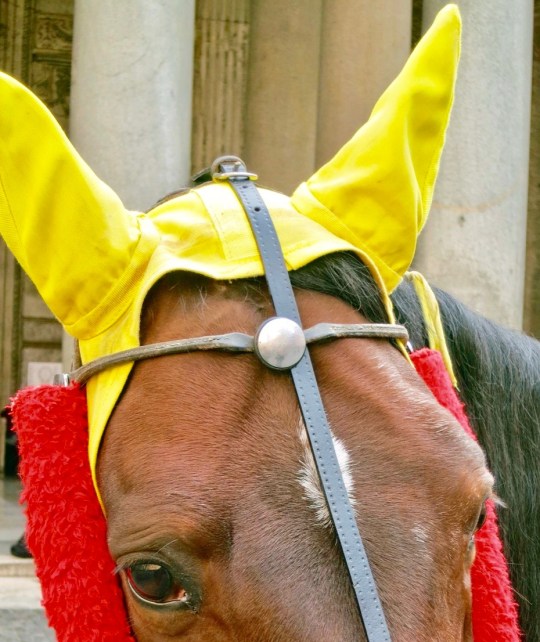
This fellow was attached to a carriage out side the Pantheon. I liked its ear covers. A horse approach to ear muffs! Or maybe just decorations.
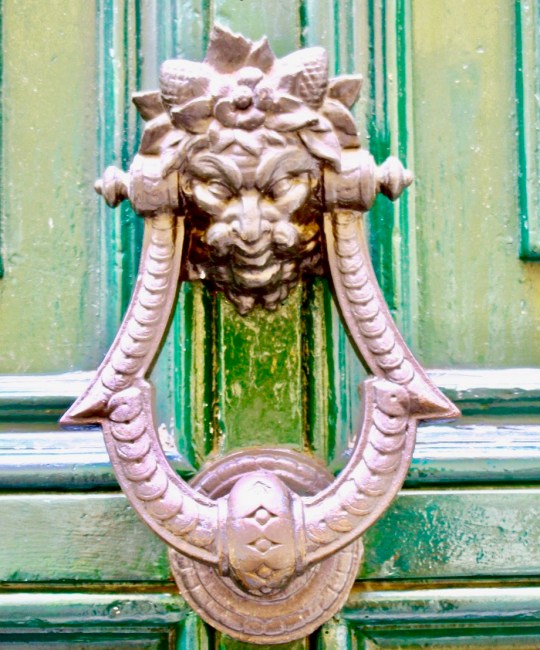
Peggy found this door knocker intriguing. (Photo by Peggy Mekemson.)
And this dragon lamp. (Photo by Peggy Mekemson.)
A final street scene from our walk about through Rome.

NEXT POST: No trip to Rome is complete without a trip to the Vatican.