Reaching for the Sky: California’s Redwoods… The National Park Series

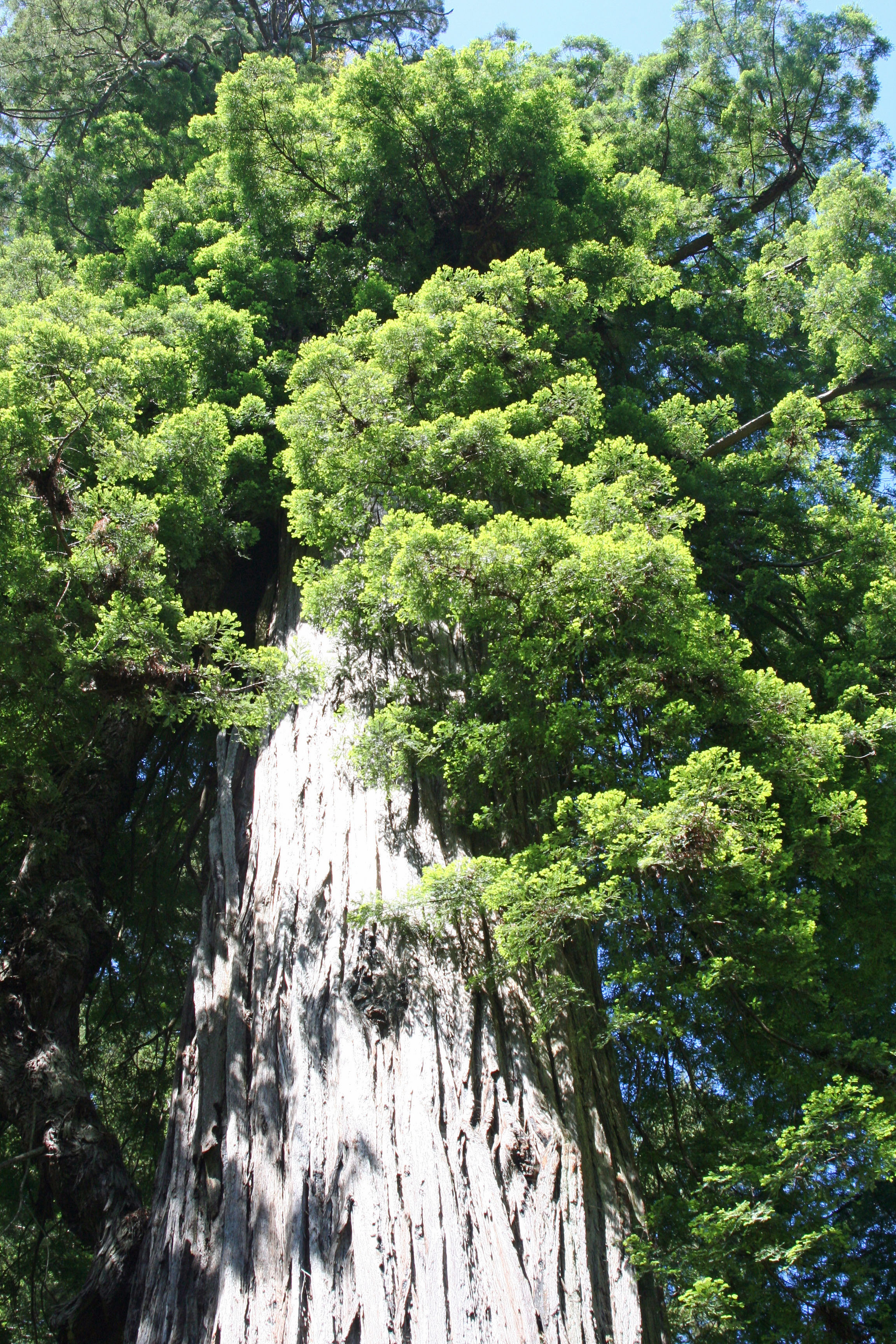
A magnificent redwood on California’s North Coast reaches for the sky.

Ronald Reagan once commented about the Redwoods, “There is nothing beautiful about them. They are just a little taller than other trees.” He was serious. Why save a tree that has been around since 500 AD, stands 305 feet tall, and has a circumference of 61 feet when it can be used to build decks that will last for 30 years?

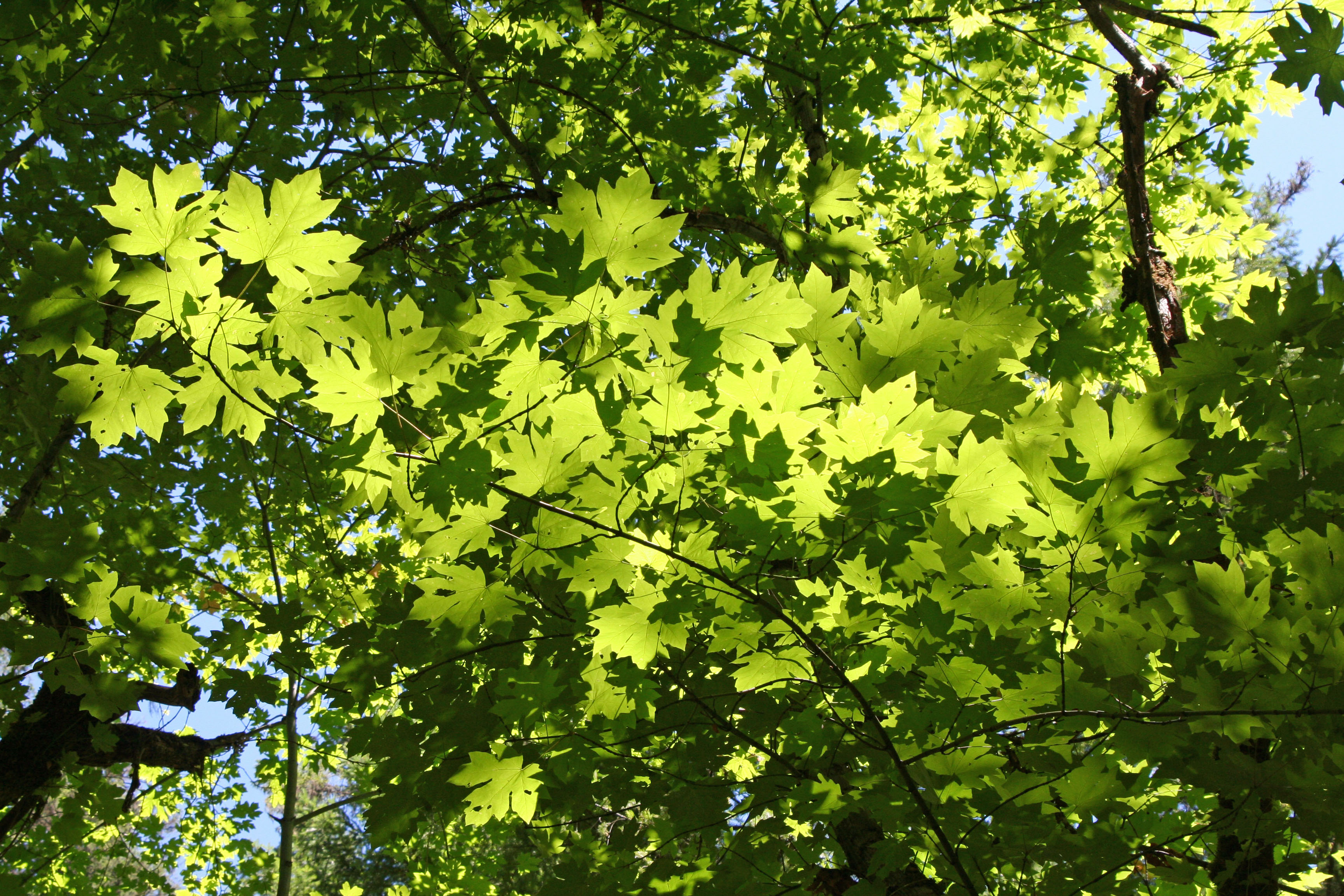
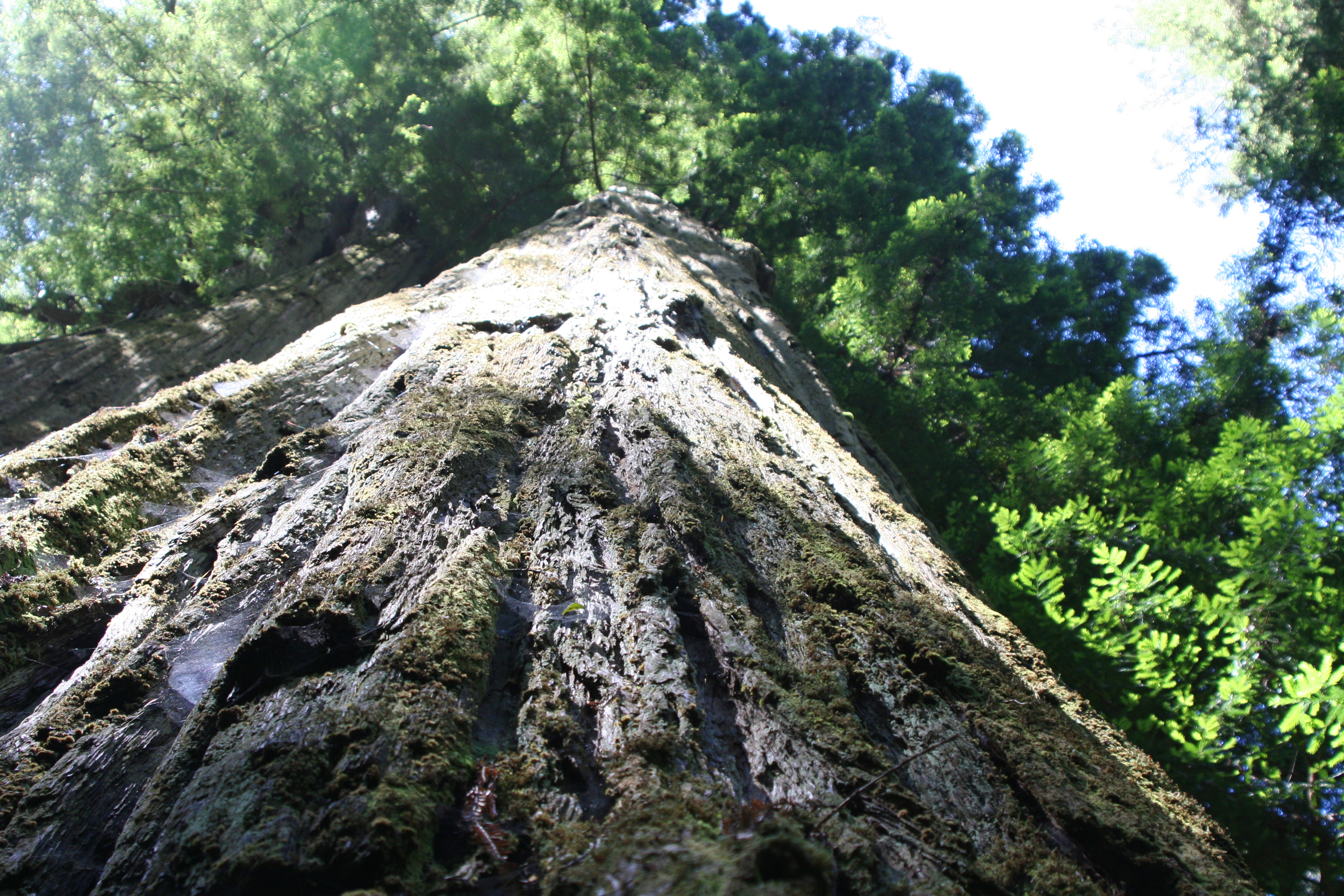
A view of the Redwoods canopy.

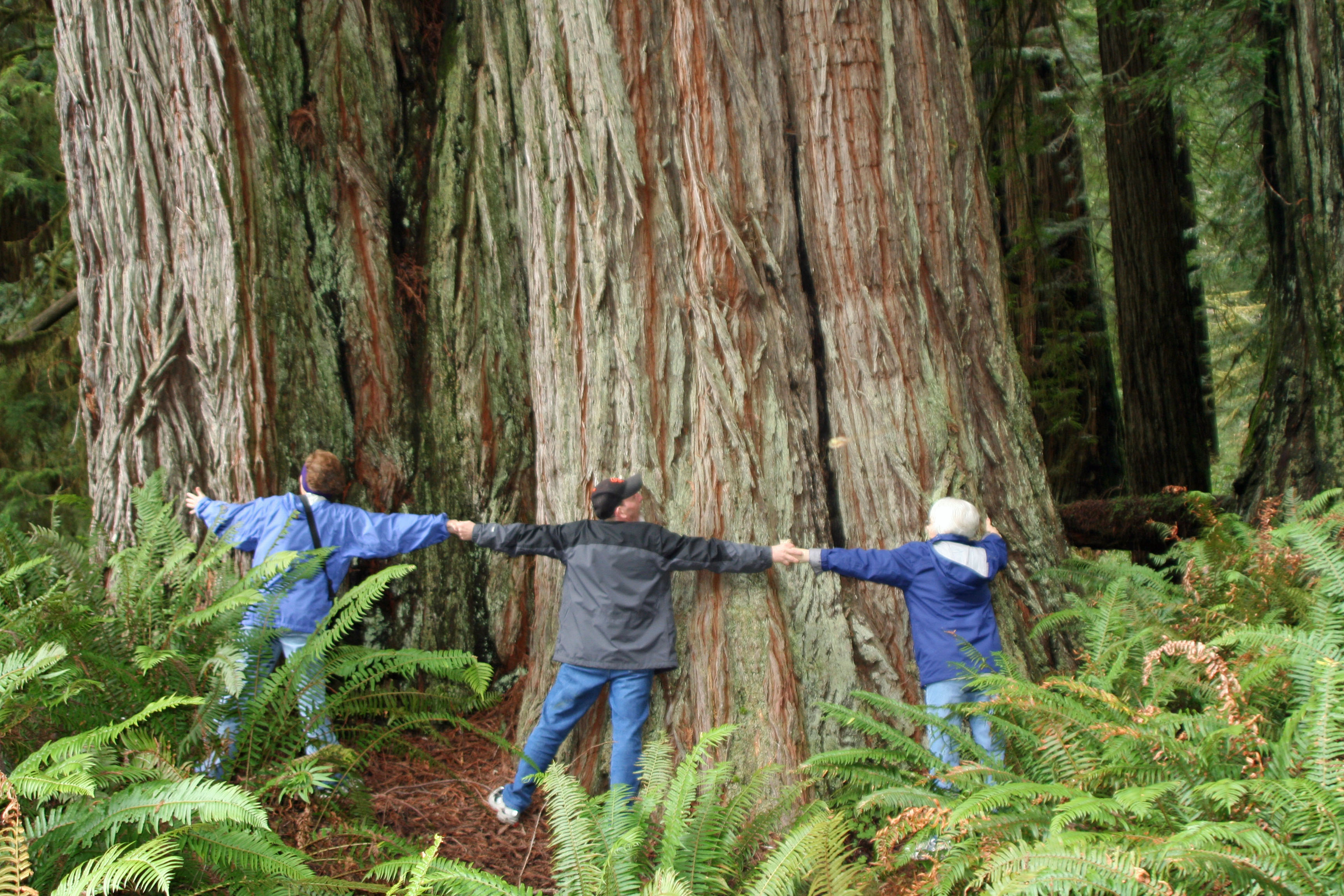
My wife Peggy provides perspective on the size of a giant redwood tree.

Reagan’s statement about the Redwoods is totally beyond my comprehension. Fortunately, thanks to groups like the Save the Redwoods League, we can still visit the rugged coast of Northern California and see these magnificent trees reaching for the sky.

Peggy and I were there last week along with our son Tony and his family. We scrambled to keep up with the grandkids as they rushed down the trails at the Big Tree Wayside. A yellow banana slug, school mascot to UC Santa Cruz, caught their attention and gave us a rest. Hollowed out trees served as perfect caves that demanded exploration. Other redwoods were obviously made for climbing.

The four-year old Connor demonstrates his tree climbing ability as he works his way up a redwood in pursuit of his dad Tony.

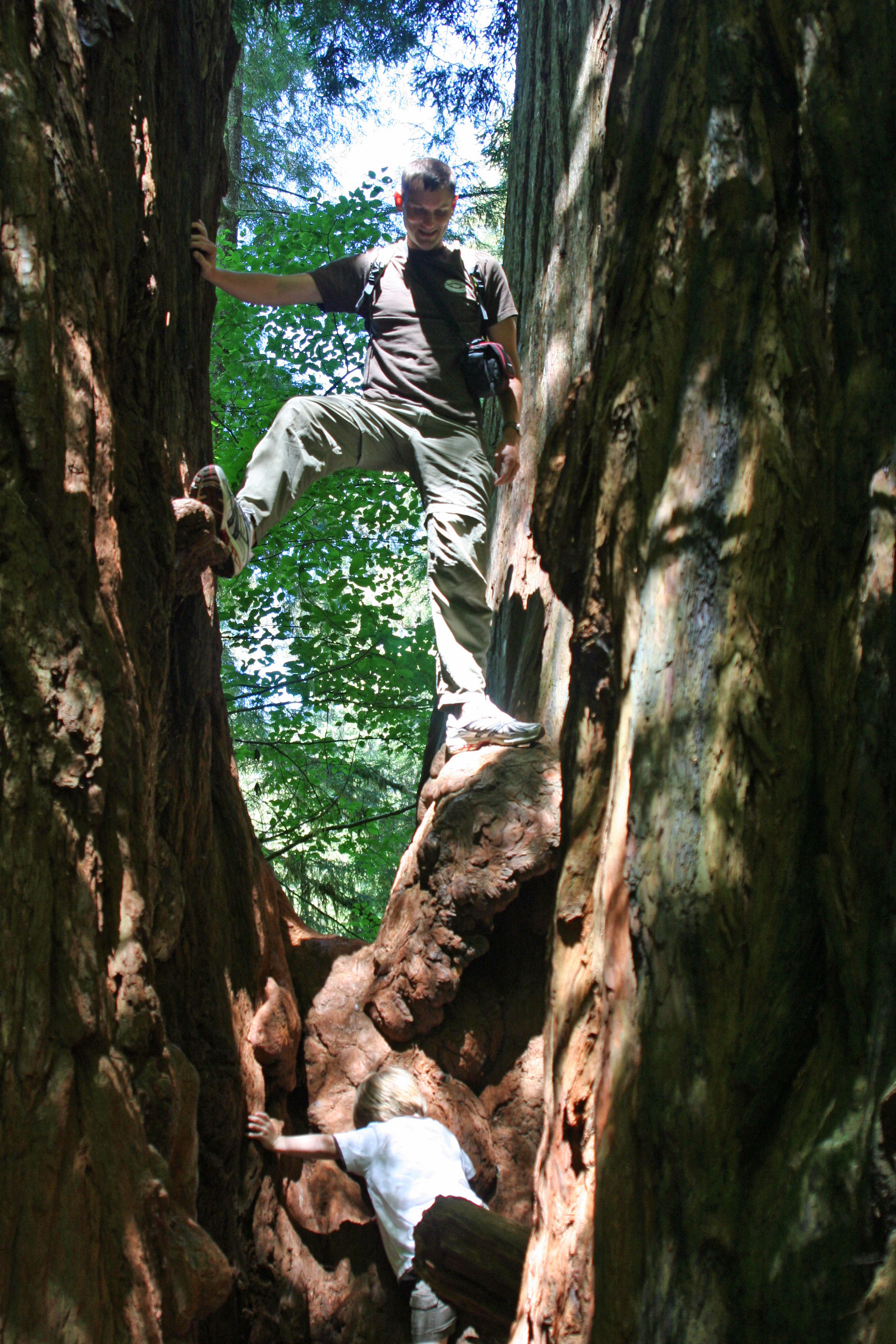
The two-year old Christopher is caught up by his mom Cammie for a photo-op while exploring a hollowed out redwood cave.

We were camping at Prairie Creek Redwoods State Park, which is one of several areas set aside as state and National Parks by California and the US Government to protect the forest giants. The area is famous for it’s Elk herds as well as the Redwoods and the scenic California North Coast.

At two and four, Chris and Connor may be a little young to remember the experience. But they will have photos. More importantly, they will be able to come back. Hopefully their children and grandchildren will as well.

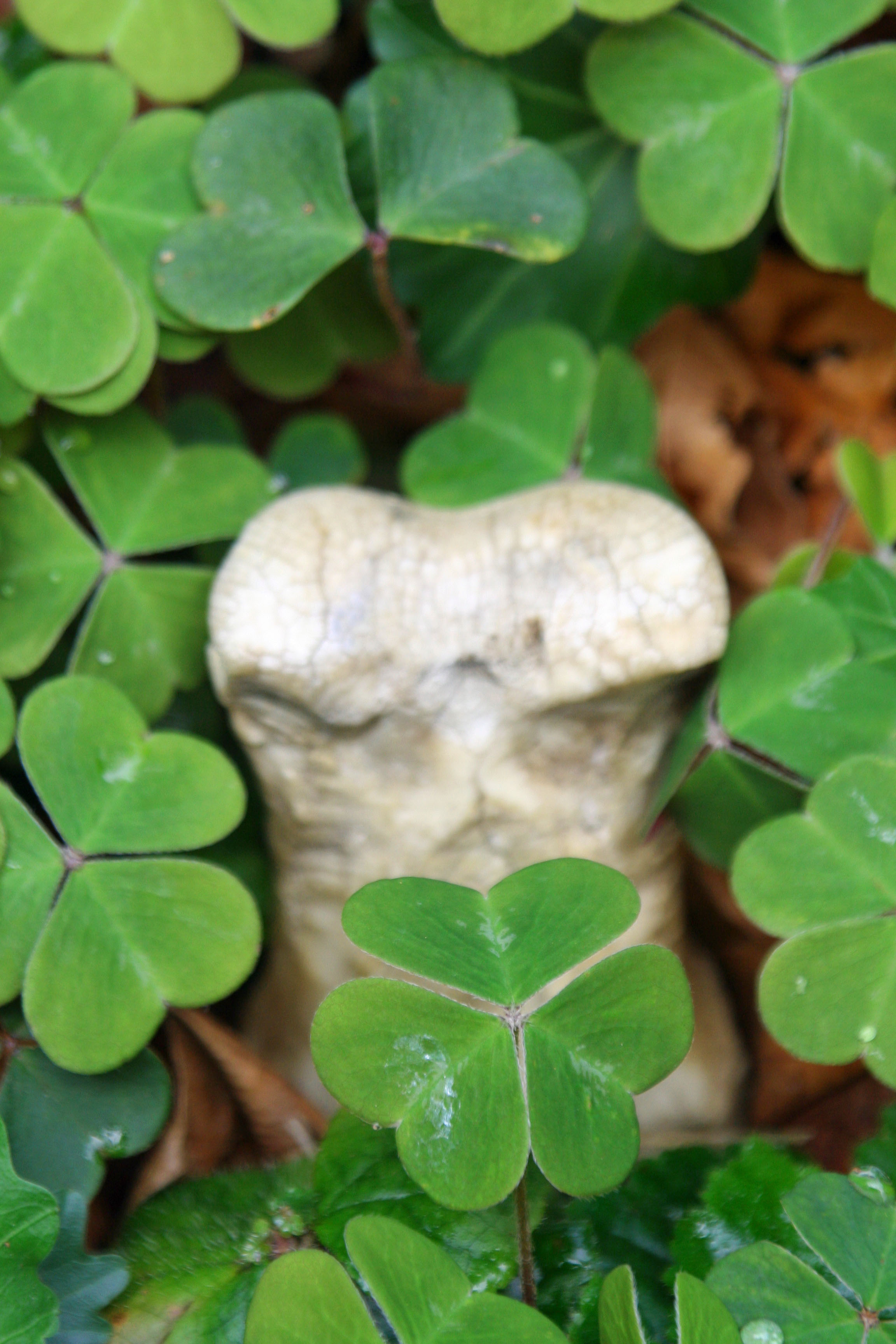
The Peripatetic Bone hides out in the clover at Redwoods National Park.

Peggy shows just how large the clover in the Redwoods can grow.

A final view of the 1500 year old rightfully named ‘Big Tree’ in Prairie Creek Redwoods State Park.

The Dark Side of African Tribal Beliefs… The Peace Corps Series

This week marks the beginning of a new blog about my experiences as a Peace Corps Volunteer in Liberia West Africa from 1965-67. I am using a WordPress theme designed to look and read like a book. Each week I will post a new chapter. When I have completed the book, I will publish it both digitally and in print. Visit me at http://liberiapeacecorps.com/ to read the first and subsequent chapters.

This week I will post three different short stories about Liberia on this blog, “Wandering in Time and Place,” to give my readers a sample of what to expect on the new blog and in the book. Today’s story: The Dark Side of African Tribal Beliefs. (I have posted this story before under Lightning Man.)

Late one evening during a tropical downpour, a very wet and frightened candidate for student body president, Mamadee Wattee, knocked on our door. The opposition had purchased ‘medicine’ from a Ju Ju Man (witch doctor in Tarzanese) to make Mamadee sick.

It was serious business; people were known to die in similar circumstances.

Had the opposition slandered Mamadee or stuffed the ballot box, I could have helped. But countering black magic was way out of my league. I took the issue to the High School Principal and he dealt with it. Mamadee stayed well and won the election.

Later, he unintentionally introduced us to another tribal phenomenon, the Lightning Man.

I had left Mamadee with $50 to buy us a drum of kerosene while my wife and I were on vacation in East Africa. When we returned home, Mamadee was sitting on our doorstep. Someone had stolen the money and he was obviously upset. Fifty dollars represented a small fortune to most tribal Liberians. (Given that we were paid $120 dollars a month for teaching, it was hardly spare change to us.)

Mamadee’s father, a chief of the Kpelle tribe, was even more upset and wanted to assure us that his son had nothing to do with the missing money. It was a matter of honor. He offered to hire a Lightning Man to prove Mamadee’s innocence.

The Lightning Man had a unique power; he could make lighting strike whoever was guilty of a crime. If someone stole your cow or your spouse, ZAP! Since we were in the tropics, there was lots of lightning. Whenever anyone was struck, people would shake their heads knowingly. One more bad guy had been cooked; justice had been served.

We didn’t believe Mamadee had taken the money and even if he had we certainly didn’t want him fried, or even singed. We passed on the offer.

Another Liberian Peace Corps Volunteer chose a different path. Here’s how the story was told to us. Tom had just purchased a $70 radio so he could listen to the BBC and keep up with the news. He enjoyed his new toy for a few days and it disappeared.

“I am going to get my radio back,” he announced and then hiked into the village where he quickly lined up some students to take him to the Lightning Man. Off they went, winding through the rainforest to the Lighting Man’s hut.

“I want you to make lighting strike whoever stole my radio,” Tom said, and then paid five dollars for the service. (Lightning Men have to eat too.)

Tom and his entourage then returned home. By this time, everyone in the village knew about the trip, including undoubtedly, the person who had stolen the radio.

That night, there was a tremendous thunder and lightning storm. Ignoring for the moment that it was in the middle of the rainy season and there were always tremendous thunder and lightning storms, put your self in the shoes of the thief who believed in the Lightning Man’s power. Each clap of thunder would have been shouting his name.

The next morning Tom got up, had breakfast and went out on his porch. There was the radio.

(Note: Mamadee would go on to become an elementary school principal in New Jersey.)

My Name Is Captain Die and This Is My Dog Rover… The Peace Corps Series

This week marks the beginning of a new blog about my experiences as a Peace Corps Volunteer in Liberia West Africa from 1965-67. I am using a WordPress theme designed to look and read like a book. Each week I will post a new chapter. When I have completed the book, I will publish it both digitally and in print. Visit me at http://liberiapeacecorps.com/ to read the first and subsequent chapters.

This week I will post three different short stories about Liberia on this blog, “Wandering in Time and Place,” to give my readers a sample of what to expect on the new blog and in the book. Today’s story: My Name Is Captain Die and This is My Dog Rover.

In our two years of living in Liberia as Peace Corps Volunteers, Peace Corps we would have many unusual experiences. One of our more unusual took place within our first week of living in Gbarnga, the town where we were assigned. It involved meeting Captain Die and his dog Rover.

Captain Die was a well digger who was reported to have spent too much time in dark holes. Our well was one of his jobs. He had dug it for our predecessors, two female Volunteers. Afterwards, he began stopping by to visit the women and bum cigarettes.

Therefore, it wasn’t surprising when he appeared on our doorstep shortly after we moved in. His introduction was unique.

“Hello, my name is Captain Die. My name is Captain Die because I am going to die someday. This is my dog, Rover. Roll over Rover. Give me a cigarette.” Rover, who was a big ugly dog of indeterminate parenthood, dutifully rolled over.

It made quite an impression.

We explained to Captain Die that neither of us smoked but invited him in to share some ice tea we had just brewed. We gave the Captain a glass and he took a huge swallow. I have no idea what he thought he was getting but it wasn’t Lipton’s. He thought we were trying to poison him.

A look of terror crossed his face and he spit the ice tea out in a forceful spray that covered half the kitchen and us. Dripping wet, we found ourselves caught between concern, laughter and dismay. The Captain marched out of our house in disgust with Rover close behind.

In addition to having found our predecessors an excellent supply of tobacco, Captain Die had been quite taken with one of them.  The story was told to us how he appeared at the door when Maryanne’s parents were visiting from the States. Captain Die was a man on a mission.  He was going to request Maryanne’s hand in marriage.

I’ve always imagined the scene as follows.

Maryanne’s parents are sitting in the living room on folding chairs making a game attempt at hiding their culture shock when this big black man and his ugly dog appear at the screen door.

Maryanne jumps up and says, “Oh Mom and Dad, I would like you to meet my friend, Captain Die.” Mom and Dad, brainwashed by Emily Post and wishing to appear nonchalant, quickly stand up with strained smiles on their faces.

Captain Die grabs Dad’s hand and tries to snap his finger at the same time proclaiming, “Hello, my name is Captain Die. My name is Captain Die because I am going to die some day. This is my dog Rover. Roll over Rover. Give me your daughter.”

No one told me how Maryanne’s parents responded to the good Captain’s offer so I will leave the ending up to the reader’s imagination. I can report that Maryanne was not whisked out of the country by her mom and dad.

While Captain Die’s visit had a purpose, there were a lot of folks who were just plain curious about how we lived. One little girl would have put a cat to shame. I never could figure out where she came from.

She would stand on our porch with her nose pressed against the screen door and stare at us for what seemed like hours. After a while it would become disconcerting and I’d suggest she go home. She would disappear but then I’d look up and there she’d be again, little nose pressed flat.

Finally, deciding more drastic measures were called for, I picked up my favorite folding chair and plopped it down a foot from the door. Then I sat down and initiated a stare back campaign. I lowered my head and moved forward until I was even with her head and about five inches away. The little nose slowly moved backward, suddenly turned around and took off at a fast gallop.

After that she watched the weird people from across the street.

A Short Lesson on Cats and Guacamole… The Peace Corps Series

This week marks the beginning of a new blog about my experiences as a Peace Corps Volunteer in Liberia West Africa from 1965-67. I am using a WordPress theme designed to look and read like a book. Each week I will post a new chapter. When I have completed the book, I will publish it both digitally and in print. Visit me at http://liberiapeacecorps.com/ to read the first and subsequent chapters.

This week I will post three different short stories about Liberia on this blog, “Wandering in Time and Place,” to give my readers a sample of what to expect on the new blog and in the book. Today’s story: A Short Lesson on Cats and Guacamole.

The cultural anthropologist James Gibbs was living in Gbarnga while he was studying the Kpelle people. Sam, our houseboy, worked for him as an informant on tribal customs.

One evening James and his wife Jewelle invited my wife Jo Ann and me over for dinner. It was our first invitation out as Peace Corps Volunteers.  I should also note we were still at the point of being recent college graduates and somewhat awed by academicians.

We dressed up in our best clothes and walked a mile down the dirt road past Massaquoi Elementary School to where they lived.

The Gibbs had an impressive house for upcountry Liberia. They were sophisticated, nice folks who quickly put us at ease. Among the hors d’oeuvres they were serving was a concoction of mashed avocado, tomatoes and hot peppers that Jo and I found quite tasteful. We made the mistake of asking what it was.

“Why it’s guacamole of course,” Dr. Gibbs declared. We must have looked blank because he went on, “Surely anyone from California knows what guacamole is.”

Surely we didn’t. I felt like Barbara Streisand in Funny Girl when she learned that pate was mashed chicken liver. It was 1965 and Mexican food had yet to storm Northern California. Yes, we’d graduated from UC Berkeley but dining out on our survival budget meant beer and pizza at La Val’s or a greasy hamburger at Kip’s.

To change the subject I called attention to their cat.

“Nice cat,” I noted.

Mrs. Gibbs gushed. “Oh, that’s Suzy. She’s in love.”

Dr. Gibbs jumped in, obviously glad to leave the subject of guacamole. “The boys are coming by every night to visit. We hear them yowl their affection up on the roof.”

Suzie looked quite proud of her accomplishments. Having been properly introduced, she strolled over and rubbed up against my legs. I reached down and scratched her head, which served as an invitation to climb into my lap. While arranging herself, Suzie provided me with a tails-eye view. Staring back at me was the anatomy of the most impressive tomcat I’ve ever seen. Suzie had the balls of a goat!

I could hardly contain myself. “Um, Suzie isn’t Suzie,” I managed to get out while struggling to maintain a straight face.

“What do you mean Suzie isn’t Suzie?” Dr. Gibbs asked in a voice meant to put impertinent grad students in their place. Rather than respond verbally, I turned the cat around and aimed his tail at Dr. Gibbs. Understanding flitted across his face.

“We never thought to look,” he mumbled lamely. We were even. While the kids from the hills might not know their guacamole from mashed avocados, they did know basic anatomy.

(Note… I may have Suzie’s name wrong after all of these years but the cat definitely had a female name.)

The Murky Depths of the Amazon’s Rio Negro… The Passport Series

The Tropical Hotel in Manaus Brazil.

Having survived swimming in piranha-infested waters, Peggy played Titanic. The Peripatetic Bone decided to get into the act by posing on the rail. The boat lurched and Bone was on his way to reside forever in the murky depths of the Rio Negro. I leapt and made a saving catch as he went over the edge.

Having gone swimming in the piranha-infested waters of the Amazon, Peggy tempted fate again by doing her Titanic pose.

The Peripatetic Bone poses on railing of the M/V Amazon Clipper shortly before he went plummeting toward the murky depths of the Rio Negro.

After being rescued from his fall, Bone was limited to more prosaic activities, such as steering the boat.

We were wrapping up our tour on the M/V Amazon Clipper. There was the village of Novo Alrao to visit and a jungle walk to take. Then we would return to the Tropical Hotel in Manaus. Good-looking Latin men with sharp knives seemed to lurk everywhere. I told Peggy, “No, you can’t bring one home.”

One of our guides. Nice smile, sharp knife/machete.

One of the women applied the word “hunk” to this machete wielding Amazonian who was demonstrating how to open Brazil Nuts. Brazil Nuts, BTW, live in heavy pods high in the trees. Getting hit by one can cause serious damage.

A touch of Disney in the village of Novo Alrao. I assume the building was an elementary school.

I thought this dog in Novo Alrao, Brazil was quite handsome although his ears made his head look small.

These Amazon River boats were beached at the edge of the village.

A Brazilian houseboat came in for resupply when we were in Novo Ariau. Ten of the world’s largest rivers are found in the Amazon Basin. Living and traveling on these rivers makes sense.

I was much more concerned about the soldiers with automatic weapons who filled the Tropical Hotel in Manaus than I was the guys with the machetes. The soldiers surrounded the hotel and were posted in every corridor, at the swimming pool and in the restaurant. A serious looking gunboat cruised back and forth in front of the hotel’s dock.

A sign posted in front of the hotel welcomed the Defense Ministers of North and South America. We had been invaded. We were lucky to still have a room. To escape from constant surveillance, we took a taxi into Manaus to visit the Opera House, public market and waterfront.

Manaus, Brazil has a large colorful market, which is a must see stop on a tour of the city.

The Manaus waterfront. The market is located in the reddish buildings on the right. The boats in the foreground serve as the major form of transportation up and down the Amazon River. Captains wait for the boats to fill before leaving. It can take several days. Passengers bring their hammocks and sleep on the boat.

That night we took photos of the sunset and then finished up our stay by playing cribbage with another couple that had been on the Amazon Clipper with us. He was a CPA out of Texas who specialized in loopholes and apparently cribbage. We were severely trounced. The next day we made the long flight back to Sacramento. Our Amazon adventure was over.

A beautiful sunset capped off our visit to Brazil and the Amazon Rainforest.

Monkey Business at the Ariau Amazon Lodge… the Passport Series

This photo captures the tree house nature of the Ariau Lodge located on the Rio Negro River near Manaus in the Amazon Rainforest of Brazil.

“The war of the future will be between those who defend nature and those who destroy it. The Amazon will be in the eye of the hurricane. Scientists, politicians, and artists will land here to see what is being done to the forest.”

Jacques Cousteau

The Woolly Monkey leapt on to my shoulders and rested one paw on my forehead. I hadn’t invited him and suggested he leave.  When I tried to put him down he wrapped his powerful tail around my wrist and then threatened to bite my hand.

An upside down Woolly Monkey holds on to my arm with his powerful tail at the Ariau Lodge in the Amazon.

When I suggested to the Wooly Monkey that he should get down, he threatened to bite my hand.

My wife Peggy took photos and laughed at my predicament. Her turn was coming.

We were staying at the Ariau Amazon Towers Lodge some 35 miles from Manaus Brazil in the heart of the Amazon Rainforest overlooking the Rio Negro River. Located high in the rainforest above the river, the Ariau is the Mother of all tree houses. Tarzan would appreciate the luxury. In fact there is a “Tarzan Suite” perched 110 feet up in the air.

The Tarzan/Honeymoon suite at the Ariau Lodge perched 110 feet above the Rio Negro.

Catwalks, some as high as 70 feet, radiate out from the lodge for five miles into the forest and provide the visitor with the unique Amazon experience of walking among the treetops and visiting with the wildlife… including parrots and the far-too-tame monkeys.

Attractive walkways or catwalks extend out for some five miles from the Ariau Lodge providing visitors with an opportunity to wander through the tree tops of the Amazon rainforest.

This photo provides another view of the catwalks at the Ariau Lodge in Brazil.

This brilliant green parrot greeted us on our walk at the Ariau Lodge.

Jacques Cousteau inspired building the Ariau in the mid 80s.  His statement to Dr. Francisco Bernardino quoted above led Bernardino to erect the hotel to accommodate the expected influx of ‘artists, scientists and politicians.’ Since then the lodge has accommodated a steady stream of famous visitors ranging from Prince Charles to Bill Gates. Peggy and I stayed in the “Jimmy Carter Room,” which was given its name after Carter slept there.

The Peripatetic Bone insisted on having his picture taken with the Carter sign and with a Brazilian mask.

The Peripatetic Bone rests on the Jimmy Carter sign.

A number of carved artworks are found at the Ariau Lodge. Bone is taking a nap in the mouth of this snake-tongue protruding from the mouth of a Brazilian mask.

But back to the monkeys… Peggy’s want-to-be friend was a long-legged Spider Monkey. He joined us on the walkway and immediately wrapped one leg around her neck and looked up adoringly. He held on for a mile as we strolled along the catwalk. When we stopped, he immediately stretched out on her lap and made faces at me.

She only lost her long-legged furry friend when we returned to the lodge. That night she discovered the flea bites.

The Spider Monkey climbed up on Peggy, draped his arm/leg around her neck, and looked up adoringly.

The Spider Monkey joined us for our walk among the tree tops of the Amazon forest.

When Peggy sat down, her new best friend spread out on her lap and made faces at me.

This “wild” creature of the Amazonian Rainforest then proceeded to take a nap.

Fishing for Piranhas on the Amazon… The Passport Series

The piranha is indeed a fearsome creature.

Hollywood loves piranhas. They make great movies. Take one cow, throw her in the Amazon, and watch with horror as Bessie is reduced from a surprised moo to a pile of bones in mere minutes by a school of frenzied fish with big teeth. PETA does not approve of this activity.

“Today we are going fishing for piranhas,” the captain of our boat, the M/V Amazon Clipper informed us. “Watch your fingers.”

We were chugging up a tributary of a tributary of the Amazon River in Brazil and it was time to replenish the refrigerator.

We dutifully boarded the canoe and were issued hand lines with hooks and a ration of raw chicken. There were no cows or fishing poles. When we arrived at what the guide considered prime piranha water, we baited our hooks and threw them over the edge.

Bam! I got a hit… and a fight. My flesh-eating fish was not happy to have the tables turned. Ever so carefully I pulled him over the side of the boat and was greeted with the snapping jaws of death. My wife Peggy dutifully took a picture and our guide firmly grabbed the piranha and yanked out the hook.

Peggy took a photo of the piranha I caught. I was careful to hold it far away from me.

Fish are slippery characters however and mine slipped out of the guide’s hands, landed on the bottom of the boat, and immediately went looking for someone to eat.  Eight pairs of feet shot up into the air.

Eventually we got things under control and caught several more fish. That night we would feast off piranhas. But first, the itinerary said, we were supposed to go swimming. Why anyone would want to go swimming in piranha-infested water, I didn’t have a clue. The little buggers would be out for revenge.

“They don’t come in here,” the guide assured us when we reached a white, sandy beach. I looked around. It was all part of the same river. There were no signs warning the fish to stay out and there was no fence to keep them out. As far as I could tell the clear water and the white sand would make it easier for the piranhas to find toes.

There is always someone willing to test the waters and jump in feet first, though. Usually it’s Peggy. This time was no exception. I volunteered to take photos. She returned with toes intact.

Peggy went swimming in the Amazon, which was supposedly free of piranhas.

The piranhas were waiting for us at dinner, tastefully cooked. The jaws were on a separate platter, grinning up at us with dentist white teeth. In the age-old question of who eats whom, we had won, at least this time. The fish tasted, uh, fishy with a slight hint of chicken and something else. Was it cow or toe?

Our catch of piranha, ready to face the cook.

An Amazon Boa Went Slithering by… The Passport Series

Our boat, the Amazon Clipper, docked for the evening deep in the rainforest on a tributary of the Rio Negro River, Brazil.

Peggy and I sat on the upper deck of the M/V Amazon Clipper, sipped a cold beer and watched the Rio Negro River hurry along on its journey to the Amazon.

Dark clouds dumped buckets of rain on the forest and threatened our cocktail hour.  Thunder and lightning upped the ante. One thousand one, one thousand two, one thousand three… I counted to determine how close the lightning was in a ritual dating back to my childhood. Seven seconds equals a mile. When the flash and the boom arrive together, it’s time to worry. Lots.

Dark clouds and rain predicted a stormy cocktail hour in the Amazon rainforest.

Between watching the river and watching the storm, we scanned the rainforest for wildlife. A flock of parrots flew by heading for its evening roost. Our guide informed us that the dark blob we spotted hidden in the trees was a three-toed sloth, a creature famed for sleeping four fifths of the time and pooping once a week. He makes a rare trip to the ground to accomplish the latter and digs a hole with his short, stubby tail.

Peggy and I clinked our beer cans, toasted the sloth and toasted another adventure. Two days earlier we had been buried in work. An 18-hour day out of Sacramento California via Los Angeles and Sao Paulo had eventually deposited us at Manaus, Brazil in the heart of the Amazon. Now we were chugging up a tributary of the Amazon River on a small boat with six fellow passengers and a crew of three.

The Amazon Clipper chugs up the Pagodo River, a tributary of the Rio Negro. Our ‘canoes’ trail behind. The afternoon’s storm has passed by. Soon we will be experiencing the Amazon night.

The Amazon is a world of the BIG: big rivers, big forests, big storms and big snakes. We had met the river, forest and a storm during the afternoon. That evening we met one of the snakes. Our crew took us out in a large canoe to experience the Amazonian night. An eight-foot boa went slithering by us in the river and checked out our boat.

“It’s a baby,” the guide teased. Right. The boat came equipped with a large spotlight for peering into the jungle. Bright, shiny eyes peered back at us along the shore. They were Caiman, small alligator like reptiles. The crew caught one for us to examine more closely back on the Clipper and then turned off the spotlight.

It was don’t see your hands dark. Something plopped in the water. A creature went crashing off through the brush. It wasn’t particularly scary, the guides are expected to return their guests unharmed, but it was interesting, especially the sounds our imaginations turned into bone crushing snakes and ferocious jaguars.
Back on the deck of the Clipper, the Caiman was turned loose. It dutifully whipped its head around and snapped at us before escaping back to the river.

Peggy and I retired to our small room with its bunk beds and porthole window. High humidity and heat had us sleeping on top of the covers with the porthole window open and hopes of no nighttime visitors. Fortunately our bodies had been pumped full of protection to foil disease carrying mosquitoes and other tropical maladies.

We slept fitfully and dreamed of our next adventure, fishing for the legendary sharp toothed Piranha.

This Amazon piranha was hardly a dream. I caught him on a hand-line. Check out the teeth.
Wandering through Time and Place… A Writer’s Perspective

Bone has wandered the world for 35 years doing strange things. Here he rests on the Mayan god Chacmool in the place where sacrificial hearts once resided.

After two years of blogging under the title of Peripatetic Bone, I’ve decided to make changes. Bone, as you may know, was found in the Sierra Nevada Mountains in 1977 and has been travelling the world ever since. He has visited over 50 countries, climbed mountains, gone deep-sea diving, been blessed by the Pope and had many epic adventures.

When I started this blog, my wife Peggy and I were travelling around North America full-time in a 22-foot van. Bone rode up front where he could see the world go by. Introducing him to strangers was a weird but great way to begin conversations. We would do a photo shoot with him and wait for people to start asking questions.

It seemed natural to name my blog The Peripatetic Bone. Times have changed, however. We are now settled in Southern Oregon and Bone has retired, at least temporarily, to his Bone Cave.

Also, from the beginning, I wrote about many non-Bone related subjects. He wasn’t around when three British Warships used Andrew Mekemson for target practice during the Revolutionary War, nor was he with me when I served as a Peace Corps Volunteer in Africa. He even missed Berkeley’s Free Speech Movement.

“Wandering through Time and Place” is my new title. This will allow me to continue my travel focus plus incorporate stories from the past. I also plan to expand my grass-roots solution series with an emphasis on the future. Presently I am reorganizing my blogs to fall under three categories: Looking Back in Time, Wandering the World, and Creating the Future

My new tagline, “A Writer’s Perspective,” is what this blog is primarily about and always has been… story telling. Plus I have another motivation. Presently I am pulling my Africa Peace Corps stories into a book that I will publish digitally this year and in print format next year. Some time in the next few weeks I will create a new WordPress blog linked to this one that will feature a new chapter each week.

None of this means Bone is going away. He will still have his own page on this blog and will appear frequently in my travel tales. Thanks again to all the people who read this blog and make the writing of it fun and worthwhile.

Bone contemplates the future of Bad Bones in Tombstone Arizona.

But not to worry… Bone is a good bone and he is not about to be hanged by mistake.

Nor is he likely to fall into any dark, bottomless pits.

Nor be shot down by a desperado such as Billy the Kid.

Nor is his fate to be chomped down by an ancient Hawaiian deity.

Or become iguana food.

Instead Bone will continue to wander the world.

And have adventures that most people only dream about.


The Missing Turtles of Tortuga… The Passport Series

The view from our balcony at Tortuga Lodge on the edge of Tortuguero National Park on the Caribbean side of Costa Rica.

We missed seeing the giant 300 pound Green Sea Turtles and their prodigious effort of laying 80-100 eggs on our trip to Tortuga Lodge in Costa Rica. The large females go into a trance during the process. It sounds like a good idea when you are having 100 babies. Once mom has dug her hole in the sand and settled in, visitors can walk up and watch the process.

Seven weeks later the eggs hatch and the baby turtles instinctively scurry for the ocean. They’re tasty. Scurrying is good. On shore, sea gulls and crabs think feast. Jaguars also hang out in hopes of crunching down their share.

The ocean is hardly safer. Last fall I watched a flock of Brown Pelicans off of the coast of Puerto Vallarta discover a swarm of baby turtles heading out to sea. It was like Armageddon.

Of the hundred or so babies who hatch, one may be lucky enough to make it to adulthood… not good odds. If you are one of the lucky ones, however, you can expect to survive for 80 years. Your only enemies are men and sharks. Of course that’s enough. By the mid 1900s Green Sea Turtles were on the edge of extinction. Sharks were not the problem.

People found the meat tasty and behaved like the Pelicans when the turtles came ashore.  Possibly even worse, they believed the eggs had an aphrodisiac quality. They killed the mamas and dug up the babies.

Tortuguero National Park on the northern Caribbean Coast of Costa Rica was established in 1970 as a sanctuary for the turtles. Tortuga Lodge sits on the edge of the park and offers a “gourmet dining opportunity” to view egg-laying mamas. I checked to make sure turtle soup wasn’t on the menu. Dinner by candlelight in the wilderness and the private viewing sounded good but I was wary of the last sentence, “You might get back to the lodge around 11 pm.”

What was with the might? It implies there is a might not. Could the jaguars somehow be involved? “Let’s see. I can eat this 2-ounce turtle or that 200-pound person. Hmmm.”

Anyhow, we arrived in late November, well past the egg-laying season. Turtles and jaguars were not on our agenda. Instead, we watched giant iguanas climb trees during the day and listened to howler monkeys howl at night. We ventured out on a tour of the regions dark, murky streams and then took out canoes on our own. Crocodiles lurked along the banks, bright butterflies went flitting by, and a Jesus Christ Lizard walked across the water.

Tortuga Lodge, like Monteverde Lodge, is owned and operated by Costa Rica Expeditions. Rooms were quite attractive, the food excellent and the guides knowledgeable. Getting there from San Jose involved travel by both van and boat. We flew back from a small airstrip located near the lodge.

Crocodiles lurk along the edges of canals located in Tortuguero National Park.

The eye of a Cayman.

We found an unusual beetle crawling across the lawn at Tortuga Lodge.

This lizard provided a colorful rear end view.