Chapter 2: The FBI is Told I Run Communist Cell Meetings… Peace Corps Tales

Welcome to “The Dead Chicken Dance and Other Peace Corps Tales.” I am presently on a two month tour of the Mediterranean and other areas so I thought I would fill my blog space with one of the greatest adventures I have ever undertaken: a two-year tour as a Peace Corps Volunteer in Liberia, West Africa. Every two days I will post a new story in book format.

When I have finished, I will publish the book digitally and in print.

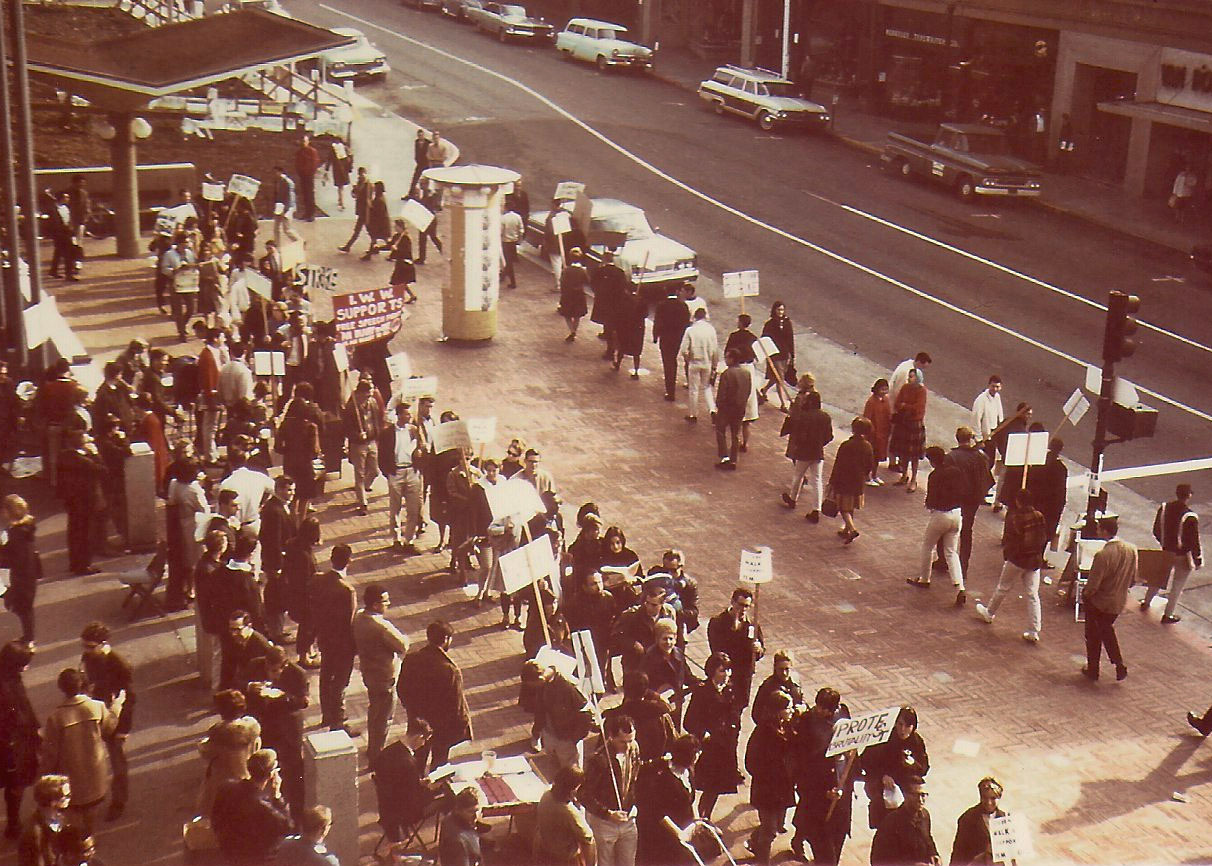
The mid-60s were a time of turmoil at UC Berkeley when the University blocked on-campus support for the Civil Right’s Movement. Here, I am one of many protesters opposing Administration policy by picketing at Bancroft Way and Telegraph Avenue.

In the last post, my first wife, Jo Ann, and I applied for the Peace Corps when we were students at UC Berkeley in 1965. We were tentatively accepted as teachers in Liberia, West Africa.

There were still hurdles. They were tied to the illusive if. We could go if we could get through the background security check, if we weren’t deselected during training, and if we could pass the physical. Training wasn’t a worry. We had enough confidence in ourselves to assume we would float through. How hard could it be after Berkeley?

The Security Check was something else. Jo Ann was squeaky clean but I had been up to mischief at Berkeley, hung out with the wrong people, been seen in a few places where law-abiding people weren’t supposed to be, and had my name on a number of petitions.

“And where were you Mr. Mekemson the night the students took over the Administration Building?”

Maybe there was even a file somewhere; maybe it was labeled Radical. J. Edgar Hoover saw Red when he looked at Berkeley.

Soon I started hearing from friends. The man with the badge had been by to see them. The background security check was underway. One day I came home to the apartment and found my roommate Jerry there. He was pale and agitated. His eyes bounced around the room.

“I have to talk to you Curtis,” he blurted out. “The FBI was by today doing your Peace Corps background check and I told them you had been holding communist cell meetings in our apartment.”

Jerry was deadly serious; Jerry was dead.

“What in the hell are you talking about?” I yelled, seeing all of our hopes dashed and me rotting in jail. I knew that Jerry disagreed with me over my involvement in Berkeley’s Free Speech Movement (FSM) and probably disagreed with me over the Vietnam War, but I hadn’t a clue on how deep that disagreement went. Or what he based his information on.

My degree in International Relations had included a close look at Communism. I found nothing attractive about repressive totalitarian states.

The closest I came to joining a leftist group had been the Free Student Union. Yes I had held committee meetings at our apartment but I had also severed my relationship with the organization. The folks behind the Union apparently believed that confrontation with authority was a good thing in and of itself. Getting bashed on the head with a nightstick made students angry. FSU wanted to radicalize the student body, not serve it.

I was not happy with Jerry that night or for some time after. I assumed the Peace Corps option was out and begin thinking of alternatives. They were bleak.

As it turned out, we received final notification from the Peace Corps a few weeks later. We were accepted. Jerry could live. The people who said good things about me must have outweighed the people who said bad things. Either that or Jo looked so good they didn’t want to throw the babe out with the bath water.

Or possibly the majority of other students who signed up for the Peace Corps from Berkeley in 1965 had rap sheets similar to mine.

There was one final hitch. I was to report to the Army Induction Center in Oakland for my physical. It was an experience not worth repeating. I lined up with a bunch of naked men to be poked and prodded.

“Turn your head and cough. Now, bend over.”

I took it like a man and escaped as soon as the opportunity presented itself. A couple of days later I came back from class and there was a scribbled note from my other roommate, Cliff, who was also going into the Peace Corps.

“The Induction Center called,” he wrote, “and there is a problem with your urinalysis.” I was to call them.

“Damn,” I thought. “Why is this so difficult?” So I called the Center and resigned myself to peeing in another jar. With really good luck, I might avoid the naked-man line.

I got a very cooperative secretary who quickly bounced me to a very cooperative nurse who quickly bounced me to a very cooperative technician who quickly bounced me to a very cooperative doctor… and none of them could find any record of my errant urinalysis.

They didn’t see any problems and they didn’t know who had called. They suggested I call back later and be bounced around again. More than a little worried, I rushed off to my next class.

That evening I reported my lack of success to Cliff. He got this strange little smile on his face and asked me what day it was.

“April 1st,” I replied as recognition of having been seriously screwed dawned in my mind. “You little ass!” I screamed, as Cliff shot for the door with me in fast pursuit. He made it to Telegraph Avenue before I caught him. The damage wasn’t all that bad, considering.

Chapter 1: An Ugly War Encourages Me to Join the Peace Corps

Welcome to “The Dead Chicken Dance and Other Peace Corps Tales.” I am presently on a two month tour of the Mediterranean and other areas so I thought I would fill my blog space with one of the greatest adventures I have ever undertaken: a two-year tour as a Peace Corps Volunteer in Liberia, West Africa. Every two days I will post a new story in book format.

When I have finished, I will publish the book digitally and in print.

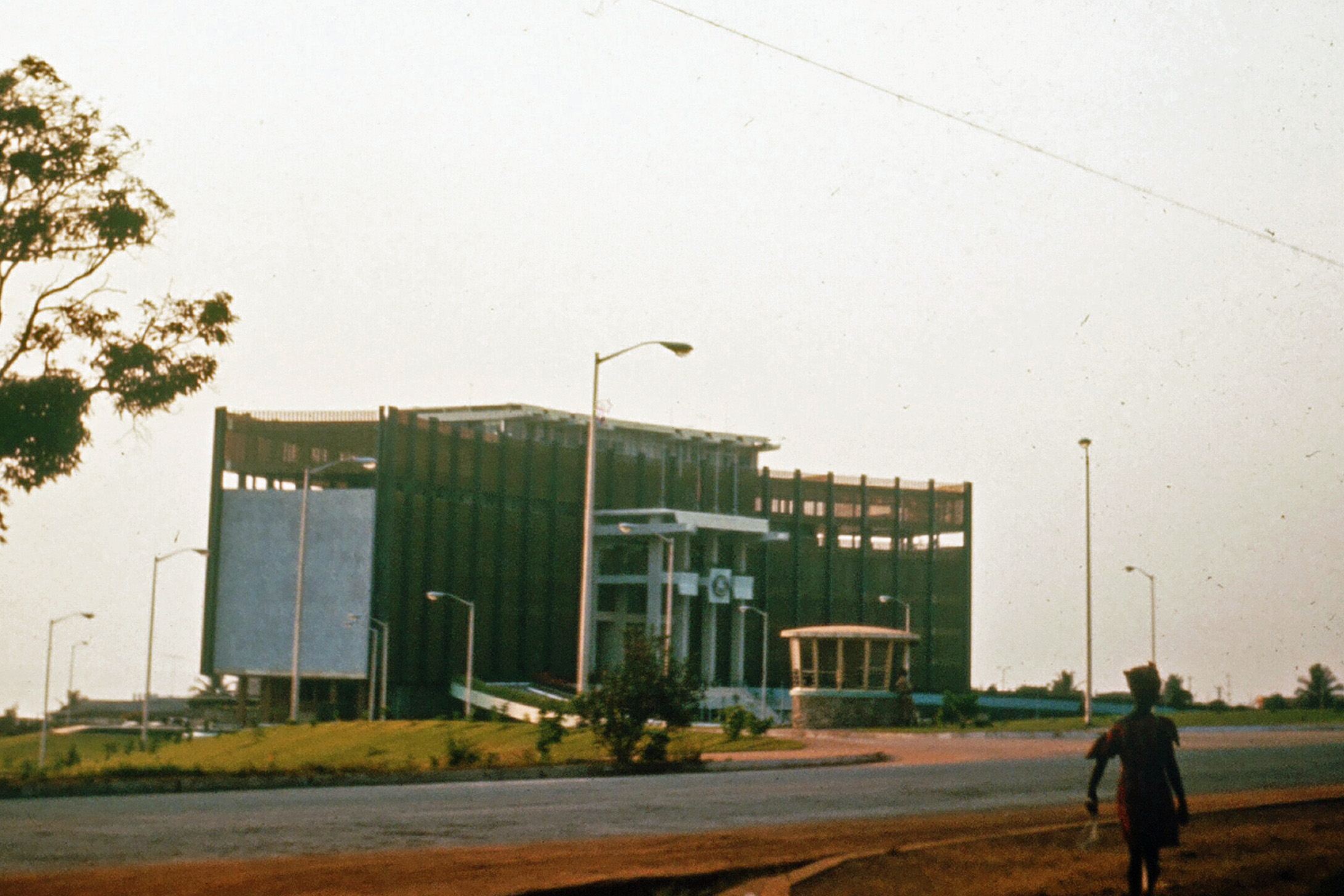
The main street of Gbarnga Liberia in 1965 where I was serving as a Peace Corps Volunteer.

Tears tracked across Jo Ann’s cheeks and I struggled to be sympathetic. It wasn’t easy.

We had just left her parents in San Francisco and boarded a United Airlines jet bound for New York City. Except for the time I surrendered five hard-earned dollars for a helicopter ride at the El Dorado County Fair, it was my first flight ever.

The jet taxied out on to the runway, climbed above the bay, and banked toward the east. We were leaving family, friends and life in the US behind. While Jo wrestled with the past, my thoughts were on the future.

Africa, teaching and adventure beckoned.

For seven hours we would be winging across America and gazing down on cotton clouds, mountain ranges, deserts, plains, cities, towns, farms and forests.

We waved goodbye to California as the plane flew over the Sierra-Nevada Mountains. The towering granite of the Crystal Range gave way to the deep blue of Lake Tahoe. My mind turned to our new status as Peace Corps Volunteers. Six months earlier we had serious doubts this day would arrive.

It was the spring of 1965 and Uncle Sam was looking for recruits. He’d bought a used colonial war from the French and needed soldiers to fight. Being a 22-year-old male about to graduate from college, I was a prime but reluctant candidate.

The conflict in Vietnam dated back to 1946. It was born ugly. France had lost her colonial empire in Indochina to the Japanese during World War II and Charles de Gaulle wanted it back. The Vietnamese Marxist Ho Chi Minh wanted independence. War was the result. Russia sided with the North Vietnamese in hopes of expanding her influence. NATO and the US jumped in to thwart Russia and support France in her colonial ambitions.

By 1955 France had abandoned the fight as a costly, no-win disaster that had sucked up more and more of the nation’s human and financial resources. Now, it was our turn. We would provide ‘military advisors’ and financial aid to the politically corrupt but anti-communist regime of Ngo Dinh Diem in South Vietnam. Over the next ten years our support continued to grow.

By the time I was ready to graduate, the US was ready to send in the troops.

The Cold War was raging. America’s leaders saw Vietnam as a critical step in stopping the spread of communism and communism was seen as an anti-capitalist, anti-Christian, and anti-democratic evil extending its cancerous tentacles throughout the world. Lose Vietnam, the Domino Theory argued, and all of Southeast Asia would follow.

My political science professors in International Relations at UC Berkeley had a different perspective. Communism was changing. It was no longer monolithic in nature but had taken on a nationalist flavor. Communism in Russia was different from communism in China. The Russians were as fearful of Chinese massing on their border as they were of the US’s nuclear weapons.

One day I arrived at my class on Comparative Communism and learned my professor had been invited to Washington to provide advice on Vietnam. The message he carried was that Ho Chi Minh was a nationalist first and a Marxist second. He was seeking independence for his nation. He was no more interested in being dominated by Russia than he had been in being dominated by France.

Becoming involved in a full-scale war was not in the best interest of the United States and might prove to be a costly mistake.

Washington refused to listen. America’s leaders had grown up on a steady diet of Cold War rhetoric. Not even the insanity of McCarthyism had shaken their faith. Being ‘soft on communism’ was political suicide. When Khrushchev banged his shoe on his desk at the United Nations and said he would bury us, we banged back.

But I was convinced there was more to the fight in Vietnam than a communist grab for power. My International Relations major was focused on Africa and the news out of Africa in 1965 was on the struggle for independence from colonial powers.  I felt Ho Chi Minh was involved in a similar fight.

I decided Vietnam was not for me. Fighting in a war I didn’t believe in and killing people I didn’t want to kill was at the very bottom of my bucket list. And there was more. I am allergic to taking orders and can’t stand being yelled at. I’d make a lousy soldier.

I saw a court-martial in my future.

If drafted, I would go, however. I couldn’t imagine burning my draft card, running off to Canada or hiding out in the National Guard. I actually believe we owe our country service. Luckily, a temporary solution popped up. Peace Corps Recruiters were coming to Berkeley.

John Kennedy proposed this idealistic organization to a crowd of 5,000 students during a campaign speech at he University of Michigan on October 14, 1960. He was running four hours late and it was two in the morning. The response was overwhelming. One of his first acts as President was to create the agency.

Peace Corps service would not eliminate my military obligation but it might buy time for the Vietnam War to end. Of more importance, I felt the Peace Corps provided a unique opportunity to travel, represent the US in a positive way, and hopefully, do some good.

I talked the idea over with my fiancé. “Let’s do it!” Jo Ann responded. She and I would go together as a husband and wife team. When the Peace Corps recruiters opened their booth in front of the Berkeley Student Union, we were there to greet them.

“Sign us up,” we urged.

“Fill these out,” the recruiter responded, handing us two umpteen page blue applications. “You will also have to pass a language aptitude test in Kurdish and provide letters of recommendation.” I had my doubts about the Kurdish.

Apparently we looked good on paper. In a few weeks the Peace Corps informed us that we had been tentatively selected to serve as teachers in Liberia, West Africa. My brain did a jig. The age-old question of what you do when you graduate from school and enter the real world had been answered, or at least postponed.

Uncle Sam with his growing hunger for bodies to fight the Vietnam War would have to wait.

Next blog: My roommate at Cal tells the FBI and Peace Corps I am running Communist Cell Block meetings in our apartment.

At Home in the Woods of Southern Oregon


This view from our patio features the first snow of the year. You are looking south at the Red Buttes, which are part of the Siskiyou Mountains that form the border between California and Oregon.

Two years ago Peggy and I decided to ‘settle down’ in Southern Oregon after travelling around North America for three years in our small RV. It was a good decision. We ended up purchasing five acres of property. The beautiful Applegate River flows in front of our house. Our back property line is the gateway to over a million acres of National Forest land.

The Applegate River, in front of our property, displays fall colors.

Walking out the back door and up our road leads to over a million acres of National Forest Land.

This graceful Madrone with its strange, pealing bark, provides shade for our home. It is one of numerous trees on our property. Other trees include Douglas Fir, Ponderosa Pine, White Oak and Red Cedar.

Morning mist outlines one of the Douglas Firs.

The same Douglas Fir, this time set off by the evening sky.

Peggy loves rivers and I love wilderness. It is a perfect match. Every morning we wake up with smiles on our faces.

Deer, bear, squirrels, foxes and numerous species of birds consider our property as part of their territory or at least a convenient stop off place. Last year a bear tipped over our bar-b-que. A couple of weeks ago a skunk let go under our house. This summer Peggy waged an unceasing war against ground squirrels that discovered her garden.

It all comes with country living. Mainly, we are amused by the antics of our furred and feathered friends.

Which way is the garden?

Is it here on your back porch? ( Junior has a better idea about where to find food.)

Surely you can’t resist feeding me? “Our” deer herd has trails running all over the property. Every day we get to see bucks, does, fawns and teenagers go about their lives.

At 2000 feet, we don’t get much snow… just enough to create a beautiful white wonderland. The deer, BTW, are Black Tail Deer. (Note the far deer.)

I used a Have-a-Heart trap to catch the ground squirrels and founded a new colony down the road and across the river on BLM land. The little buggers always went for the zucchini bait. I told them Peggy would be much less merciful. She was starting to practice with her pellet pistol.

We have been enjoying a beautiful fall and feel a slight tinge of regret that we are leaving to travel. I suspect the cruise of the Mediterranean with its extensive stop offs will make up for any regrets. Peggy and I do love to wander.

Gorgeous fall colors keep me running outside with my camera. I am admiring this beautiful Oregon Maple out the window as I type this post.

Another view from my writing chair. With fall arriving and temperatures dropping to freezing, this Geranium is one of Peggy’s last flowers of the season.

I thought about blogging while in Europe but I want to spend my time exploring.

So I’ve decided to focus my blog, Wandering in Time and Place, on my experience as a Peace Corps Volunteer in Liberia, West Africa. The stories are already written. Every other day I will post a new one chronologically in chapter format. When I get back in two months, I intend to publish the tales both digitally and in print as a book.

In the stories you will meet Boy the Bad Dog who ends up as guest of honor at a village feast, learn how to wage war against Army Ants, attend the hot machete trial of the Woman Who Wore No Underpants, and discover why the Liberian government felt the second grade reader I wrote was a dangerous revolutionary document. And that’s only the beginning…

I hope you will join me on the adventure.

The main street of Gbarnga, Liberia in West Africa where I served as a Peace Corps Volunteer.

Floating with My Head Underwater… Rafting Through the Grand Canyon

Beautiful views like this along the Colorado River would have been lost if efforts in the 50s and 60s to dam the Grand Canyon had succeeded.

I will feature two major sites in our journey down the Colorado River on my post today: the Anasazi Granaries at Nankoweap and the Little Colorado River. Then, unfortunately, I will have to put the trip through the Grand Canyon on hold.

Peggy and I leave our home in Southern Oregon on Sunday for a 32-day repositioning cruise on the Mediterranean plus visits with various family members. We won’t be back until January. My already organized wife tells me I have to get ready. That translates into, “You’ve run out of time, Curt.”

On Friday I plan to post photos featuring our property on the Applegate River. (It’s beautiful this time of the year.) On Sunday I will begin a series on another adventure: my two years of serving as a Peace Corps Volunteer in West Africa. The Africa posts are already written and scheduled to go up every other day for the time I am gone. When I return my intention is to publish them as a digital book.

Meanwhile I will be gathering materials for numerous posts on the Mediterranean. But back to the Grand Canyon…

Steve Van Dore and Jamie Wilson serve as our boatmen for the two days we are on the river travelling from our camp at Redbud Alcove (mile 39) to our camp at Upper Rattlesnake (mile 74).

Steve, I’ve already introduced. Like Tom, he is an experienced Colorado River Boatman and loves the Canyon. He is also a specialist. His catamaran is outfitted with groovers: large ammo cans that have been modified to serve as portable potties.  Before toilet seats were added as a convenience, you sat on the rim of the can. It left grooves in your butt… hence the name.

We are all given training in setting up, taking down, and using the groovers. One of the first chores in arriving camp is to find the perfect place for the port-a-pot: a secluded location with a view. One time I found myself sitting on the pot and waving at rafters as they went by. The site received an A for the view and a C for the seclusion.

Steve is very knowledgeable about the Grand Canyon and readily shares his knowledge. Almost immediately he points out a site that was once proposed for a dam that would have covered much of the upper Canyon’s beautiful scenery, geological wonders and archeological treasures with water.

A similar effort was planned for downstream. Fortunately, the Sierra Club was able to stop the dams from being built. Otherwise, one of the World’s greatest natural wonders would have been lost.

A view of the Grand Canyon along the Colorado River between Redbud Alcove and Nankoweap.

When we arrive at Nankoweap (mile 53), Steve points out the granaries used by the Anasazi Indians somewhere between 1000 and 1150 CE (Common Era) or AD, if you prefer. The granaries are located high up on the cliff for protection from animals and insects. I think they are well protected from me as well. Tom has scheduled a hike up, however; I willingly go along.  I am curious about the granaries and think there will be spectacular views.

The granary is interesting and the views great. The climb is definitely worth it.

Our intrepid group hikes up the steep trail to the Granaries at Nankoweap in the Grand Canyon.

The Nankoweap Granaries built by the Anasazi Indians between 1000 and 1150 CE.

A view looking down the Colorado River from the Nankoweap Granaries in Grand Canyon National Park.

Jamie Wilson is our Boatman on the fifth day. He’s a delight. First of all he is funny and positive. Second, whenever a chore needs to be done, he is first in line. Finally, he is incredibly strong, which is a valuable asset when you get in a tight spot on the river. Jamie has his own business as a contractor in the Woodland/Davis area of California.

When we arrive at the Little Colorado River, it is time to play. The Little Colorado has two colors. First is a muddy reddish-brown. The River drains over 25,000 square miles. When it rains upriver, it carries tons of red topsoil.  The second color is a beautiful turquoise blue. When it doesn’t rain, much of the water comes from springs and is loaded with minerals that provide the turquoise color and very interesting deposits.

Looking up the Little Colorado River just above where if flows into the Colorado River. Note the unique water color and mineral deposits.

Another view along the Little Colorado River.

We hike upriver and don our life vests upside down over our legs.  It looks like we have put on huge diapers. We are going to float down the river. At first I carry out my photographer responsibilities but then I too don my diaper and jump in. Just as I go over a small waterfall my life vest slips down to my feet. My feet float fine but my head bobs along under the water.

Peggy models the life vest diaper look.

Hanging on to each other, our group forms a Conga Line Little Colorado River style and makes its way through the rapids.

As my life vest slipped up around my feet, my head dipped under the water.

I will close this post with an appropriate view of the sun setting on the Colorado River as I temporarily leave the Grand Canyon for my trip to Europe. I will return to finish writing about the journey in 2013. (Photo by Don Green)


Rowing House Rock Rapid… with One Oar: Rafting through the Grand Canyon

We started with an icy cold rapid. Peggy and I are in the first boat with Tom Lovering rowing. (Photo by Don Green)

Day two starts as day one did: early.

Even the birds are sound asleep. Tom argues it’s six AM, not the five my watch is showing. “Arizona does not honor Daylight Savings Time,” he primly informs us. He’s right. Adjusting my watch adjusts my attitude… a little.

Adding injury to insult, something akin to Folgers has been sewn up in burlap, thrown in boiling water, and called coffee.  Oh well, it’s a hot, it’s brown, and we have a beautiful day of floating down the Colorado through the Grand Canyon ahead.

For those of you who like facts, here are a few about the river. At its widest point it reaches 750 feet from one bank to the other; at its deepest, it plunges down 90 feet. It flows along at a decent 3-4 mile clip but can speed up to 15 miles per hour in rapids. Since the water comes out of the base of Glen Canyon Dam, it is cold: somewhere around a frigid 46 degrees Fahrenheit during the upper part of our trip. Over the course of our adventure the river will drop 1700 feet in altitude, which is an average 8 feet per mile… 25 times that of the Mississippi River.

Our boatman for the day, Tom Lovering, with his wild, Canyon hairdo.

Tom is our boatman of the day. He checks to make sure our toenails are painted and then lets us board. The wind is still blowing but it has lost its ferocious bite. A mile down the river we pass Ten Mile Rock, a prominent landmark that has fallen from the cliffs above and now juts up out of the river. Made of Toroweap Sandstone, it was laid down in shallow seas that covered the area some 250 million years ago.

Ten Mile Rock on the Colorado River. I thought it should have a more impressive name.

Shortly afterwards we hear our first rapid of the day, Soap Creek. You always hear rapids before you see them; it builds anticipation. Soap Creek roars like a teenage lion. Tom maneuvers through it like the excellent boatman he is but makes sure we get suitably wet. It’s like taking a cold shower outside on a frosty morning with a 15 mile per hour wind blowing.

“I love rowing,” Tom tells us– and it is obvious he does. It is more than the heart-stopping, adrenaline-pumping moments of major rapids where the boatman’s knowledge and skill is matched against the tremendous power of the river with its dangerous rocks and grasping holes. And it is more than the opportunity to enjoy incredible beauty of the Grand Canyon that rowing provides. Tom enjoys the rhythm and the hard work. He even liked the backbreaking challenge of rowing against the wind.

At mile 17 we come on our first, and only, major challenge of the day, House Rock Rapid, where we learn another fact about rafting through the Canyon: water levels depend on electricity needs in the West. Peak demands require large releases of water from Glen Canyon Dam to run its huge generators. Eventually, these releases catch up with rafters. The fluctuations in water levels have significant impacts.

House Rock Rapid demonstrates one of the more serious. The river is at its low point. More rocks are exposed and a massive hole lurks downstream from the largest rock. Even the most skilled boatman will be challenged to avoid it. We all land and climb off our boats to scout the rapid. Tom is eager to move on. Steve is adamant about waiting for more water. After a long discussion between the boatmen, a decision is made to take the more cautious approach.

Our group worriedly scouts House Rock Rapid. Peggy shows more enthusiasm than may be called for.

We have lunch, take naps, go for walks and watch as three large boats of commercial rafters chug through the rapids with their large engines. It is mid afternoon when the boatmen finally decide that enough water is flowing to reduce the hazard to a barely acceptable risk.

Tom’s fist bonks me on the head when we are halfway through. One of his oars has popped out. I look left and all I can see is churning, raft-eating water. We are poised on the edge of the hole… about to be sucked in. Tom becomes a virtuoso of one-armed madness.  Ever so slowly, like about a thousand years, the boat decides to go where he wants. We land, and for one of the few times in his life, my ever-talkative friend is silent.

We looked to the left and saw we were poised on the edge of a massive hole.

The next day, Megan Stalheim, Dave’s niece, is our boat woman. This is Megan’s first time rowing a raft and her first time rowing through the Grand Canyon. It would seem insane except Megan is a world-class kayaker. She is an expert at reading water. The problem is that our large, fully loaded rafts do not move like feather light kayaks… picture driving an 18-wheel Mack Truck with a Ferrari 458 attitude. We have some adventures.

This shot of Jamie’s raft provides a perspective on what our fully loaded rafts looked like.

Megan keeps the messy side up, however, as rafters say. (The non-messy side is the smooth bottom of the raft.) So it’s all good. Megan, like me, has served as a Peace Corps Volunteer in West Africa. When she gets off the river she is heading for Tanzania where she will work with a women’s craft co-op.

Beyond our “kayaking” experience with Megan, the big news on day three is that we began our side-trips. Almost all journeys down the Canyon include stopping off to see the sights. Some are quite beautiful and others provide unique challenges, as if our daily challenges of negotiating rapids aren’t enough.

Our first stop at mile 29 is the Silver Grotto, which includes both beauty and challenge. Wanting a little downtime and solitude, I opt out and take photos. Peggy tells me, “We climbed an 8 foot wall, repelled down a rock face, slogged through a murky, cold pool and slid down a 20 foot rock slide.” The rock slide was more like free-fall.

As the group disappeared into the Silver grotto, I took some much needed Curt-time.

A raven stopped by to visit and checked out the “Captain’s Chair” on Steve Van Dore’s boat. These large birds are one of the primary reasons food needs to be carefully stowed.

I didn’t get a photo of our group members leaping but this is what they leapt off of into the muddy water below. Water was splashed on the rock slide from a pool behind the lip to make the slide more smooth. Or so they said.

Next we stopped off at Paradise, as in Vasey’s Paradise. A beautiful waterfall shoots out of a Redwall cliff and creates a Garden of Eden at it base. It is worthy of the name.

The waterfall shooting out of the Red Wall at Vasey’s Paradise, Mile 32.

Dave Stalheim and his niece Megan perched on a rock at Vasey’s Paradise in the Grand Canyon.

Our final stop of the day is at Red Wall Cavern. Major John Wesley Powell was the first non Native American to admire the Cavern’s unique beauty. Powell was a Civil War Veteran who had lost his right arm at Shiloh. His exploratory expedition through the Grand Canyon took place in 1869. Powell thought Redwall Cavern could accommodate up to 50,000 people. Modern estimates are closer to 5000, but it is still big…

Coming around a bend in the Colorado River, we saw our first view of Redwall Cavern.

This photo provides a perspective on the sheer size and beauty of Redwall Cavern.

A view of the Grand Canyon looking upriver from the Redwall Cavern.

In my next post we visit an ancient Anasazi storage facility high on the cliffs above the river and play in the beautiful Little Colorado River.

Rowing Hard and Going No Where… Rafting Through the Grand Canyon

Peggy captures Dave Stalheim and me before we hit the river. Note my clean and shaved look. It’s the last time you will see it.

With thoughts of facing wind gusts up to 60 MPH, we begin our journey down the Colorado River through Grand Canyon National Park.

Peggy and I perform the ritual of asking a boatman if we can ride with him. It seems like a strange practice to me, designed to remind us who’s in charge. But we have entered the world where each boatman/woman is the captain of his or her ship, even if the ship is a 16-foot raft with two or three passengers.

“May I have permission to come aboard, sir?” Although it’s more like “Can we ride with you today?” It is courteous but I would prefer to be assigned and have the assignment changed each day.

The tradition is so old that it fades into history. Democracy is not an option on a raging sea or, for that matter, in the middle of a roaring rapid. When the captain yells jump, you jump.

Our boatmen are mellow people, however; good folks. There are no Captain Blighs. If they are slightly more than equal, it goes with the territory. We are committed to riding with each boatman. First up is David Stalheim. He makes his living as a city and county planner in Washington.

“I’ve been applying for a permit to go on the Colorado River for 15 years,” he tells us. Our ten-minute effort of obtaining a permit seems grossly unfair.

We push off from shore, excited and nervous. The wind strikes immediately, like it was waiting in ambush. “Are we moving at all?” Dave asks plaintively.

An old rock road makes its way tortuously down from the canyon rim on river left. (Left and right are determined by direction of travel.) They are important for giving directions as in “There is a raft ripping rock on river right!” Since boatmen often row with their backs facing downriver, they appreciate such information.

Up until 1929, this is how travelers made their way to Lees Ferry. It would have been a bumpy ride.

The old road is how people once made their way to Lee’s Ferry, which was one of the few ways to cross the Colorado River between 1858 and 1929. The infamous Mormon, John Doyle Lee, established the Ferry. Brigham Young assigned him the job. Later, Lee was executed by firing squad for his role in the Mountain Meadow Massacre where Mormons and Paiute Indians murdered a wagon train of immigrants near St. George, Utah.

After fighting the wind for what seems like hours, we finally come to the Navajo Bridge, which replaced Lee’s Ferry in 1929. It towers some 467 feet above the river and reminds us that we are already miles behind our planned itinerary.

A view of Navajo Bridge and its newer sister looking downstream. The first bridge was built in 1929 and is now used as a walking bridge. The second bridge was built in 1995 to handle modern road traffic.

A second view of the bridges; this time looking upstream. The newer bridge is in the foreground.

Just beyond the bridge we catch our first glimpse of Coconino Sandstone. It’s geologic history dates back some 250 million years when a huge desert covered the area and the world’s landmasses were all part of the large continent named Pangaea.

During our journey down the river we will travel through over a billion years of the earth’s history.

The wind continues to beat against us as we make our way down the Colorado River. Only Dave’s strenuous effort at the oars keeps us from being blown up-stream. “Go that way,” I suggest and point down the river.

The group pulls in at a tiny beach in hopes our mini-hurricane will die down. It doesn’t. Dave develops blisters and I develop guilt. A manly man would offer to take over at the oars.

An option floats by. Dave’s niece, Megan Stalheim, is also one of our boatmen. Don Green, a retired Probate Judge out of Martinez, California, is sitting opposite her and pushing on the oars while she pulls. It inspires me. I join the push-pull brigade. Peggy also takes a turn.

The push-pull approach to rowing where Don Green was helping Megan. Peggy and I have been friends with Don for over two decades. He belongs to the same book club we do and joins us on our annual journey to Burning Man (as do Tom and Beth). Don is also quite generous in sharing his excellent photos.

Word passes back to us that Tom wants to scout Badger Rapids. In Boatman terminology this means figuring out the best way to get through without flipping. Badger isn’t a particularly big rapid for the Colorado, but it is our first. We are allowed to be nervous.

There is good news included in the message. We will stop for the night at Jackass Camp just below the rapids on the left. We’ve only gone 8 miles but are eager to escape the wind.

Dave is a cautious boatman. He takes his time to study Badger Rapids from shore and then stands up in his raft for a second opinion as the river sucks us in. Time runs out. Icy waves splash over the boat and soak us. Our hands grasp the safety lines with a death grip as we are tossed about like leaves in the wind. Mere seconds become an eternity. And then it is over.

“Quick, Curt, I need your help,” Dave shouts. We have come out of the rapids on the opposite side of the river from the camp. The powerful current is pushing us down stream. If we don’t get across we will be camping by ourselves. Adrenaline pumping, I jump up and push the oars with all my strength while Dave pulls. Ever so slowly the boat makes its way to camp.

Our horrendous day of rowing complete, we have time to enjoy beautiful evening views of the Colorado River and Grand Canyon from camp. (Photo by Don Green)

A Scottish Ghost… Halloween Tales II

The ghostly grave of John Brown the Martyr on a lonely Scottish moor.

Since I am telling family ghost stories this week, I am going to relate a ghostly encounter that Peggy and I had in Scotland last year.

It has to do with my search for the grave of John Brown, the Martyr of Priesthill.

I first heard of Brown in the late 60s when my dad arrived home from a Mekemson family reunion. He proudly produced a family tree that traced a branch of the Mekemsons back to the martyr. Given the staunch Presbyterian leanings of our ancestors, it was an important connection.

My Great, Great, Great Grand Father, James Mekemson, married Mary Brown Laughhead Findlay. (Mary had already seen two husbands die.) John Brown was five generations up the line.

The story of John Brown’s murder verges on legend. He was, as the saying goes, a Covenanter’s Covenanter, a very devout man. The Scottish Covenanters received their name from signing a Covenant that only Christ could be King, which eliminated the King of England from being God’s representative on earth. The King was not happy.

Reverend Alexander Peden, one of the top leaders of the Covenanter Movement, described Brown as “a clear shining light, the greatest Christian I ever conversed with.” High praise indeed; the type you reserve for a man who is killed for your cause.

They say that Brown would have been a great preacher, except he stuttered. Leading Covenanters visited his home and secret church services were held there. Important meetings took place.

Alexander Peden stayed at his house the night before Brown earned his martyrdom and warned of dark times. Peden was something of a prophet when it came to predicting dire events. This time he was right.

Brown was out gathering peat with his nephew the next morning when soldiers led by John Graham of Claverhouse appeared out of the mist and captured him. The date was May 2, 1685.

Peggy stands near where John Brown was shot on the likely remains of his house. Mist covers the distance as it would have on the day he was captured.

Claverhouse, or Bloody Clavers as the early Presbyterians identified him, was the King’s go-to man when it came to eliminating Covenanters. He was not noted for his compassion.

Covenanter’s martyr graves are found throughout the Scottish Lowlands. This woman was staked out in the ocean to be drowned. If violent deaths create ghosts, the Scottish Lowlands are filled with them.

He took Brown back to his home and demanded that he swear an oath to the King in front of his wife and children. Brown started praying instead. The legend states that Claverhouse ordered his soldiers to kill Brown but they refused. So he took out his own pistol and shot him in the head in front of his family.

The story then goes on to describe how Brown’s wife, Isabel Weir, went about the yard collecting pieces of her husband’s brain. (I don’t mean to treat this lightly, but somehow I can’t help thinking about a TV episode of Bones.)

The family eventually escaped to Ireland and then moved on to North America where it settled in Paxtang, Pennsylvania.

John Brown’s appearance on our family chart in 1969 immediately caught my attention. Not many families can claim a certified martyr. When I became serious about genealogy three years ago, I determined I would go to Scotland and find his grave.

It was listed as being near the small town of Muirkirk on Priesthill farm. Priesthill is an old Scottish sheep ranch, dating back to at least the 1600s. This was the time when Scottish Covenanters had gone ‘off the grid’ with their Presbyterian Church and held services out in the open fields hidden away from the prying eyes of the English King and his henchmen. Armed men were posted around the perimeter in case the soldiers came.

Getting caught wasn’t much fun. You could lose your sheep, your cattle, your land and your life. You might find your body quartered and hung up in various communities to provide an example of why you should be a good Anglican.

The Old Church B&B in Muirkirk Scotland where we stayed when searching for John Brown’s grave.

Priesthill was one of the remote sites where the hidden services were held. To get there we drove north on the road in front of our B&B (the Old Church B&B in Muirkirk… highly recommended) for a couple of miles and picked up a dirt road snaking off to the right through a sheep farm.

The road seemed to go on and on; recent rains had turned it into a muddy mess. Our brand new Mercedes rental car bounced along dodging sheep and accumulating glue-like mud mixed with sheep dung. It was still on the car when we returned it to Edinburgh.

One of the sheep we had to dodge.

Finally the old farmhouse came into sight. A woman was standing on a porch enclosed by a three-foot high rock wall. She was wearing clothes that my great-grandmother times five might have found fashionable. Since we would be walking through her property in search of John Brown’s grave, I got out to talk with her. (Unfortunately, I left my camera behind.)

But she did something strange. She disappeared. Now this was strange in two ways. Obviously she didn’t want to talk with us. She turned her back and walked rapidly toward the door.  OK, I could live with that even though we had found most Scots to be friendly and helpful. Possibly she was shy.

What bothered me more was she sank.

It was like she was traveling down an escalator or open elevator. Her head disappeared beneath the stonewall, before she reached the door. I did not see her go inside.

“Maybe there are steps down to an underground cellar,” I thought. Or maybe she merely bent over to work on a flower garden. Curiosity got the better of me. I walked over. There was no woman; there were no flowers; there were no stairs. As far as I could see the floor of the porch was solid stone.

I asked Peggy, “Did you see that woman disappear?”

“She went inside,” my logical wife explained.

“Ah,” I said and put the matter out of my mind as we wandered out the indistinct trail across the vacant moors to John Brown’s lonely grave. But the thought wouldn’t conveniently disappear like the woman; it kept nibbling away at me. Later I asked Peggy if she had seen the woman sink into the porch.

The sign in the farmyard pointing us toward John Brown’s grave.

“Yes,” she replied.

“Did you actually see her go in the house?”

“No.”

So I rest my case for a possible ghost. We did, by the way, find John Brown’s grave. His ghost was said to have appeared gloatingly in Clavers’ tent the night before Clavers was killed in battle.

A close up of John Brown’s grave.

A True Family Ghost Story… Halloween Tales I

On November 15, 1777, the British lobbed 1000 cannonballs per hour into the tiny Fort Mifflin in an all out effort to resupply British troops in Philadelphia. Four of my ancestors fought in the battle and two died heroically. Did they become ghosts?

Do you believe in ghosts?

With Halloween two days away I decided it is time to get into the spirit of the season and post two family ghost stories that involved me: the first took place at Fort Mifflin near Philadelphia; the second in Scotland. They are both true. I will return to my journey down the Colorado River on Friday.

Fort Mifflin

It was the week before Halloween and I was on a ghost hunt. The eerie creatures are known to hang out at Fort Mifflin, which is located next to Philadelphia International Airport on the Delaware River. It’s one of the hottest ghost watching spots in America and has been featured on the popular TV series, “Ghost Hunters.”

A little background is necessary.

In the fall of 1777, 234 years ago, all that stood between the British and the likely defeat of the American Revolution was the small Fort Mifflin on the Delaware River. It is a chapter in American History that is little known and rarely told.

For over a month, the fort had kept the mighty British Navy from resupplying General Howe at Philadelphia. It was a valiant effort that kept Howe from pursuing George Washington and likely defeating him, thus ending the war.

On the morning of November 15th, five British Warships including the sixty-four-gun Flagship Somerset appeared out of the mist below the fort. Of equal, if not more concern, the British had taken advantage of a high flood tide and pulled the converted and armed East Indian merchant ship Vigilant and the gun-sloop Fury within pistol range of Mifflin’s northwest corner. A number of land batteries also had cannons pointed at the fort. (Fort Mifflin had a total of 10 cannons.)

This model provides an overview of where the British Men-of-War were located in relation to Fort Mifflin. Andrew and James Mekemson were part of the artillery company protecting the wall under the guns of the two ships on the upper left hand corner.

Looking out from the lawn in front of Fort Mifflin, the barge is in the approximate location of the British Flagship Somerset.

The Vigilant was so closed to the wall that British Marines positioned in the masts could fire pistols down at my ancestors who were manning the American cannons.

As the sun rose, the ships and land batteries opened fire in a bombardment that sent over 1000 cannonballs per hour crashing into the fort. It was the heaviest naval bombardment of the Revolutionary War.

Joseph Plumb Martin, a young private from Massachusetts, was there during the battle and captured the sheer terror of the experience some years later in his book Ordinary Courage. “They mowed us down like corn stalks,” he reported.

At the height of the bombardment a decision was made to hoist a signal and request help from the galleys and floating batteries above the fort. A volunteer was requested to climb up the flagpole with the signal flag as the cannonballs hurtled in from all directions.

Fort Mifflin’s modern flagpole.

Joseph Plumb Martin had a vivid memory of the event. “…a sergeant of the artillery offered himself; he accordingly ascended to the round top and pulled down the (fort’s) flag to affix the signal flag to the halyard. The enemy, thinking we had struck (surrendered), ceased firing in every direction and cheered.”

“Up with the Flag!” was the cry from our officers in every part of the fort. The flag was accordingly hoisted and the firing was immediately renewed. The sergeant then came down and had not gone a half-rod from the foot of the staff when he was cut in two by a cannon shot.”

The sergeant who climbed up the flagpole was my ancestor, Andrew Mekemson. His brother James was also killed during the engagement. Two other brothers, stationed on the Floating Battery Putnam, also fought in the battle. I figured if there were ghosts at the fort, they might very well be relatives.

Since Fort Mifflin offers ghost tours, Peggy and I signed up for a nighttime tour by lantern.

We decided to do a reconnaissance during daylight hours but a police vehicle blocked the road. A dozen or so media crews were pointing their cameras into the airport at a large UPS cargo plane. It had just flown in from Yemen and was being searched for ink cartridge bombs. We were caught in the midst of a “credible terrorist threat” as President Obama described it.

Ghosts can’t be nearly as scary… can they?

By 6:30 the police car had moved but the TV crews were still on watch. We wound our way through the circus. Dusk had arrived at the Fort.  The tour was scheduled to start as soon as it is fully dark. Make that pitch black; there was no moon.

Our guide gathered us. His lantern immediately blew out. “It’s only the wind,” he explained. “I don’t believe in ghosts. I don’t hunt them and they don’t hunt me.”

His disclaimer comes with a ‘but.’ He works at the Fort, and occasionally ‘things’ happen. There are unexplained footsteps on stairs. Doors close and latch on their own. Voices are heard in the next room. A woman screams like she is being murdered. The police are called but can’t find anyone, or thing. A man walking on the rampart disappears into thin air.

Our guide relates story after story as we make our way through the candle lit buildings of the fort. Other staff, volunteers and visitors have also experienced strange phenomena. More than one visitor has left on the run and even the guide has packed up and gone home on occasion.

Our guide was spending the night in the room at the top of the stairs when he heard footsteps coming up the stairs. He opened the door and no one was there. Next he heard voices coming from the room next to him. He checked. No one was there. He packed up and went home.

We arrived at the Fort’s ammunition magazine, a bush covered hill that resembled an ancient burial mound. A bright hurricane torch outlined the dim opening. We entered and walked down a narrow, dimly lit corridor that opened out to a large, arched bunker. A single candle created dancing shadows on the far wall.

The grave-like ammunition magazine where visitors encountered the well-informed guide dressed as a Revolutionary soldier and where Peggy and I had our ghostly experience.

“I’ve never felt anything in here,” the tour leader related. “It’s dead space,” he quips and repeats himself in case we missed his humor. For others, the story has been different. A group tourists reported on encountering a wonderful guide in the bunker dressed as a Revolutionary soldier. He vividly described the horrendous battle that took place on November 15, 1777. The Fort had no such guide…

I stared hard into the corner where he supposedly stood, trying to create something out of nothing. But there were only the dancing shadows. Peggy tried to take a photo but the camera froze and refused to work. As she struggled with it, the last of our tour group disappeared down the narrow corridor, leaving us alone with the flickering candle.

We hurried after the group. There was no one outside the magazine, only the glowing torch and the dark night. “I saw them heading down a side corridor,” Peggy said. With more than a little reluctance, we dutifully trooped back inside. Peggy’s corridor is a bricked in wall. I was starting to feel spooked.

“Maybe we should go back to the bunker,” she suggested.

“No,” I replied and headed for the entrance. Just as we arrived, the hurricane torch made a poof sound and went out, leaving us with nothing but dark. The hairs on the back of my head stood at attention. Was Andrew trying to communicate with us? Peggy and I decided it was time to vacate the premises.

Fortunately we found our group several buildings away and stuck close to them the rest of the tour. We couldn’t have asked for a better Halloween experience.

Next Blog on Halloween: A Lonely Grave… Peggy and I are looking for the grave of an ancestor, shot down as a Scottish Martyr, when we see what almost has to be a ghost.

Once you’ve become thoroughly “spooked,” every dark corridor, such as this one at Fort Mifflin, becomes a potential hiding place for a ghost.

Painted Toe Nails and Other River Rules… Rafting the Grand Canyon

On a private trip down the Colorado through the Grand Canyon National Park, everyone pitches into help. Here we are rigging the rafts. Straps and more straps! (Photo by Don Green)

It is time to make the leap from life on the road to life on the river. Laptops, cell phones, good clothes and the other accoutrements of modern civilization are stuffed into bags and dumped into the van.

Plus I have to paint my toenails. It’s a virgin experience. Grand Canyon boatmen are a superstitious bunch. Many believe their boats will flip if a person is on board with naked toes. And it’s true; boats have flipped under such circumstances. It makes no difference if the opposite is also true.

We were required to paint our toenails so our rafts wouldn’t flip. We didn’t. Maybe it worked. I don’t think, however, that it made our feet prettier.

Tom lectures me. “I will not let you on my boat unless your toenails are painted.” He’s serious. Peggy dutifully applies blue polish on four of my toes. Does this mean we will only half flip?

Two acres of paved boat ramp greet us when we arrive at Lee’s Fairy. The transport van disgorges us as the gear truck makes a quick turn and backs down the ramp. Another private party is busy rigging boats.

From off to the right a longhaired, 50-something man emerges. I think 60’s hippie or possibly the model for a Harlequin Romance cover. The pirate flag on his boat suggests otherwise. A ‘roll your own’ cigarette dangles from his lips. It’s Steve Van Dore, the last member of our group and a boatman out of Colorado.  No one in our group has met him but he comes highly recommended.

“Please let this be the truck driver,” Steve later admits is his first thought when he meets our green and purple haired trip leader.

He also confides that Tom hadn’t told him we were a smoke-free group. “On the other hand,” Steve confesses, “I didn’t tell him I am on probation.” Somehow this balances out in Steve’s mind. There is no time to become acquainted; we have work to do.

The dreaded pirate Steve threatens our mascot Bone with a knife and demands to know where he has buried his treasure.

There is an unwritten Commandment on private river trips: Thou Shall Do Your Share. No one is paid to pamper us. Not helping will lead to bad things, like banishment from the tribe.

The truck we loaded in Flagstaff demands unloading. Everybody does everything. There are no assignments. Peggy and I become stevedores. Piles of beer and soda and wine and food and personal gear and ammo cans and hefty ice chests quickly accumulate around the truck.

There is no shade and the desert sun beats down ferociously. It is sucked up by the black asphalt and thrown back at us. We slather on sun block and gulp down water.

The rafts are unloaded last. Rigging our five rafts is technical but relatively easy, assuming of course one is mechanically oriented. I make no such claims. Steve’s Cat (catamaran) is already set up and in the water, its pirate flag flapping in the breeze. Our other four boats are self-bailing Sotar Rafts with aluminum frames. Tom owns his own, a blue 14 footer named Peanut. The three we have rented are yellow, 16 feet long and nameless.

Work also requires that we get our feet wet. (Photo by Don Green)

Tom is the last to rig his boat and it is approaching dusk. I hike down the river to find a campsite for our group while the rest boat down. Peggy and I are totally exhausted. We struggle to set up our new tent in 30 MPH winds. A van is coming to pick us up for dinner and we are late.

The walls of the restaurant are covered with photos of rafts and rafters being trashed by rapids.

The windstorm has changed to a dust storm as we crawl into out tents. It covers everything and gets into my eyes, ears, nose and mouth. I pull out a handkerchief to cover my face. I finally fall asleep with the wind ripping at our tent.

We are awakened at five AM the next morning, as we will be every day of our trip. There is personal gear to pack, breakfast to eat, and boats to load. Any thoughts of a leisurely trip down the river are dashed in the cold reality of the early morning’s light.

We also have a lecture on the Grand Canyon’s numerous rules by Ranger Peggy. Somewhere in the middle of rigging boats the previous day she had stopped by to check our equipment. Life vests had been dutifully piled up; stoves and bar-b-que were unpacked. Even the groovers, which I will describe later, stood at attention. You don’t mess with Ranger Peggy.

She knew Tom from other river trips and was amused by his hair-do. He introduced me as the permit holder. “Tom’s in charge,” I noted. The smile dropped from her face. “You are responsible,” she said icily. “I’ll try to keep Tom under control,” I replied meekly. Yeah, fat chance that.

Bells, whistles and alarms started going off in my head. I will face heavy fines if any of our party misbehaves. Dang, why hadn’t I read the fine print?

Our second encounter with Ranger Peggy begins after the boats are packed. Tom starts off with a discussion on river safety. Naturally we are required to wear our safety vests any time we are on the boat.

Tom, with his interesting hairdo, and Ranger Peggy check their lists to see which of the many rules they have forgotten to inform us about.

What’s the first rule if we fall overboard: Hang onto the boat. What’s the second rule? “Hang onto the boat,” we chant in unison. And so it goes. Tom saw his wife, Beth, go flying by him last year as he bounced through a rapid. He caught up with her down river.

If the raft flips, what do you do? Hang onto the boat! “Easier said than done,” I think.

“Your head is the best tool you have in an emergency,” Ranger Peggy lectures. Right. When the river grabs you, sucks you under the water, and beats you against a rock, stay cool.

For all of the concern about safety on the river, the Park Service seems more concerned about our behavior on shore.

Over 20,000 people float down the river annually. And 20,000 people can do a lot of damage to the sensitive desert environment. Campsites are few and far between and major ones may have to accommodate several thousand people over the year.

Picture this… 20,000 people pooping and peeing in your back yard without bathroom facilities. It isn’t pretty. So we pack out the poop. And we pee in the river…

Packing out poop makes sense. But peeing in the river, no way! I’ve led wilderness trips for 36 years and for 36 years I’ve preached a thousand times you never, never pee in the water. Bathroom chores are carried out at least 100 yards away from water and preferably farther.

The first time I line up with the guys I can barely dribble out of dismay.

The rules go on and on. Mainly they have to do with leaving a pristine campsite and washing our hands. Normally, I am not a rules type of guy but most of what Ranger Peggy is preaching makes sense. Sixteen people with diarrhea is, um, shitty.

And I enjoy the fact our campsites are surprisingly clean. The least we can do is leave them in the same condition we find them, if not better. The rules work.

Finally… we are ready to launch. Eighteen days and 279 miles of the Colorado River and Grand Canyon lie ahead. Ranger Peggy has checked our IDs and we are who we claim to be. The boatmen have strapped down the gear… and Tom is anxious.

The same up-canyon winds that whipped sand into our tent last night are threatening to create a Herculean task of rowing. Headwinds of up to 60 MPH are predicted.

Next blog: Our first three days on the river.

The group, ready to launch. Wife Peggy, as opposed to Ranger Peggy, is holding her and my purple life vests.

A Ton of Food and Homeland Security… Rafting the Grand Canyon

Preparation for our 18-day raft trip down the Colorado River through the Grand Canyon quickly taught me that eating was going to be a central part of our adventure. This is the back of my 22-foot travel van after a trip to Safeway in Flagstaff, Arizona.

Great adventures start with the mundane. For example, did you cancel the paper? Common sense (and probably your mother) admonish that devious burglars have nothing better to do than to cruise the streets looking for rolled newspapers in front of your home.

More importantly, what about the cat?

Once upon a time Peggy and I had a cat named Effie. Vacations meant I would carefully measure out twice as much food and water as she could possibly eat or drink and four times the kitty litter she might use. The likelihood of her pooping all over the house was much greater that the likelihood of her starving. As a reward for my thoughtfulness, she would shed enough fur in our absence to fill a dump truck.

Now we have food to worry about. Lots of it. Tom Lovering, the trip leader, his wife Beth and their friend Jamie Wilson arrived in Flagstaff three days in advance of our Colorado River trip. Their car was packed to the brim with empty ammo cans and other watertight boxes waiting to be filled with food and the miscellaneous paraphernalia of river trips.

The Department of Homeland Security delayed their journey at Hoover Dam. The Agency is paranoid about mad bombers. Its normally low sense of humor dropped to zero when the agents saw all the ammo cans. The whole car had to be unpacked.

Tom Lovering, our trip leader, has been running rivers since the 70s. I first met him in 1974 when I persuaded him that his outdoor/wilderness store, Alpine West, should sponsor a hundred mile backpack trip I was organizing for the American Lung Association in Sacramento.

Tom is even more paranoid about food than DHS is about terrorists. In addition to being a highly experienced rafter and trip leader, he’s an old restaurateur who had spent months planning the menu.  Each dish has been tested several times and quantities have been measured down to the teaspoon. Recipes are spelled out in minute detail. We will eat gourmet on the trip… or die. The options are clear.

Beth, Peggy and I are dispatched to Sam’s Club with marching orders. We fill seven large shopping carts with food. Think of it this way. There are 16 people going on an 18-day trip and eating three meals a day. This equals 864 individual meals.

When we arrive back at the motel, Tom and Jamie have set up a staging area. Food needs to be organized by meal and day and then stuffed in the appropriate containers. The containers will then be assigned to rafts. It’s important that we know where to find the beer.

We have yet to shop for perishables and more food is coming from Sacramento. Our room, we discover, is to be the recipient of most food. There is barely space to sleep.

Food purchase and storage for an 18-day river adventure depends upon numerous lists. First you have to plan out menus and quantities. Next the food needs to be purchased. Finally it has to be carefully stored so you will find the right food on the right day. Tom’s wife, Beth, was in charge of the lists. (Photo by Don Green)

One of our participants obviously felt that tequila and oranges needed to be stored together.

Our bedroom was packed with food. Personal gear is on the bed.

Food organization took place outside of our motel rooms.

The next day is more relaxed. Other trip members begin to arrive and Peggy and I assume airport shuttle duty. Tom takes time for a makeover into something resembling an English Punk Rocker from the 70s with green and purple hair. Homeland Security was right to be suspicious.

Tom is 50% businessman, 30% adventurer, and 20% character. Or maybe I have the percentages reversed. Here he is having his hair bleached for the trip. You will see the results in future posts.

Next blog: Three days and 39 miles: The Journey Begins.

The morning of the adventure has arrived. Everything we have packed… our food, personal gear and rafts are stuffed into this truck in preparation for our drive to the takeoff point, Lee’s Ferry.