Folks in Puerto Vallarta Take the Dead Seriously… Sort of

Catrina hound in Puerto Vallarta Mexico

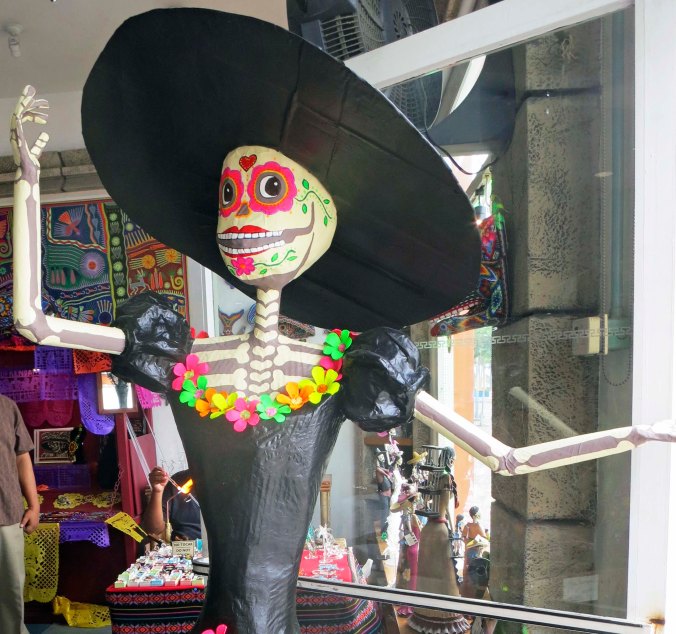
The charming Catrina has come to symbolize the Day of the Dead. Each artist creates his or her own version. I thought the heart and flowers added a special touch.

Come November 1st, people in Mexico prepare to entertain their dead ancestors. El Día de los Muertos, or, the Day of the Dead, has arrived. Home altars are set up; special foods are left out for the dearly departed; and people get ready to party with grandpa, even though he is no longer around. Why not? If you’d been moldering away in a grave for twenty years— or even a day as far as that goes, wouldn’t you be ready for a little fun, a bottle of tequila, and a six-pack of cerveza?

From a more serious perspective, the Day of the Dead allows people to get together and remember friends and family who have passed on. The tradition dates back to the ancient times of the Aztecs. More recently, the Catholic Church adopted it, as it often has with indigenous beliefs, to expand the flock and keep them faithful. The government, in hopes of promoting national unity, declared the day a national holiday.

Not far behind the church and the state, Mexican businesses quickly figured out that El Día de los Muertos was a cash cow waiting to be milked. Almost any market you enter in Puerto Vallarta offers Day of the Dead items for purchase. Among the most popular are skulls.
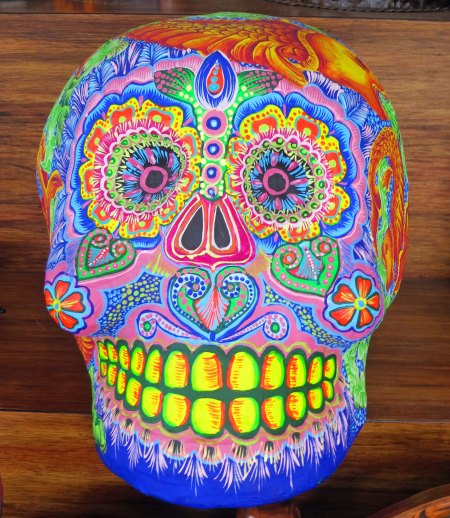
Skull art found in Puerto Vallarta.

Skulls are found for sale everywhere in Puerto Vallarta. This fine example is a from Oaxaca. The shop person told me that all of the paint brushes used in Oaxaca art are made from human hair.

Okay, this skull is wild! The art is created by laying lines of beads into wax, a process used by the Huichol indians.
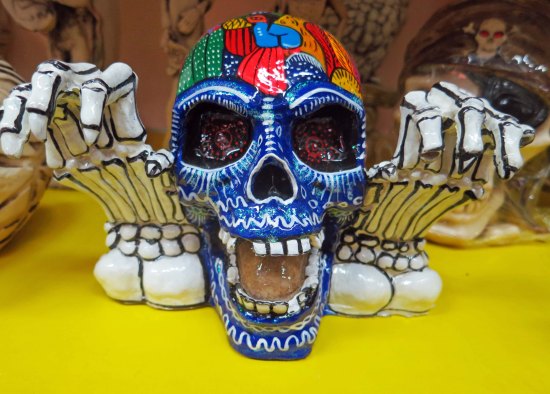
Okay, this skull is wild! The art is created by laying lines of beads into wax, a process used by the Huichol indians.

Skull art found in Puerto Vallarta.

Ceramic skulls are much more common in markets, and much less expensive.
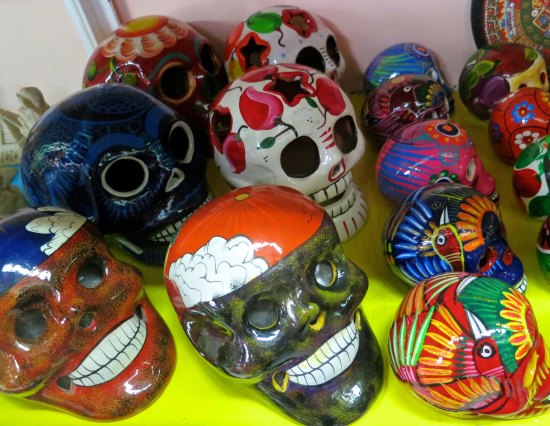
An army of skulls found in the Municipal Market of Puerto Vallarta.
An army of skulls found in the Municipal Market of Puerto Vallarta.

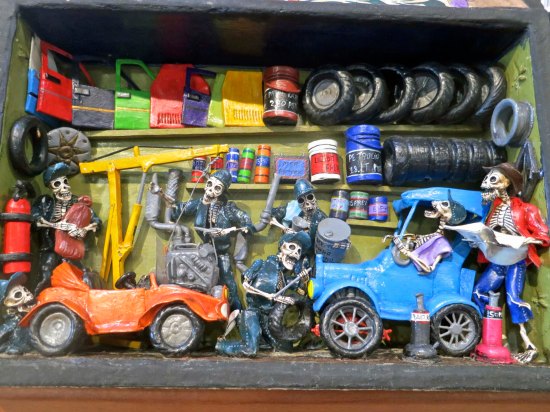
Miniature box art for the Day of the Dead found in Puerto Vallarta.

Miniature box art also captures the spirit of The Day of the Dead. This is a scene in an auto mechanic’s shop. Everyone, it appears, is having a good laugh. Maybe they are discussing the bill.

Dealing with the spirits of the dead is worldwide. When I was a little boy growing up next to a graveyard and sleeping outside in the summer, I encouraged our three cats and two dogs to sleep on the small cot with me. They were my protection from the denizens of the dark. It didn’t matter that there was barely room for me. As a Peace Corps Volunteer in Liberia, I quickly learned that the spirits of the newly dead were particularly dangerous. An all night wake, with lots of rum and much wailing, was required to send the restless spirit on his or her way. My first night in Gbarnga, I heard people screaming and beating drums without a clue about what was happening. It was a long night.

We arrived in Mexico a few days too late to rub elbows with the dead, but we ran into Catrina in a number of locations. This lovely skeleton-woman with her stylish look and clothes has come to symbolize the Day of the Dead and Mexico’s willingness to laugh at death. She started off in the early 1900s as something of a satirical comment on Mexico’s one-percenters of the time, and their desire to wear the latest and most expensive of European fashions. She served as a reminder that regardless of our social status in life, we all end up in the same condition: dead. I salute the people of Mexico for their sense of humor about the subject.
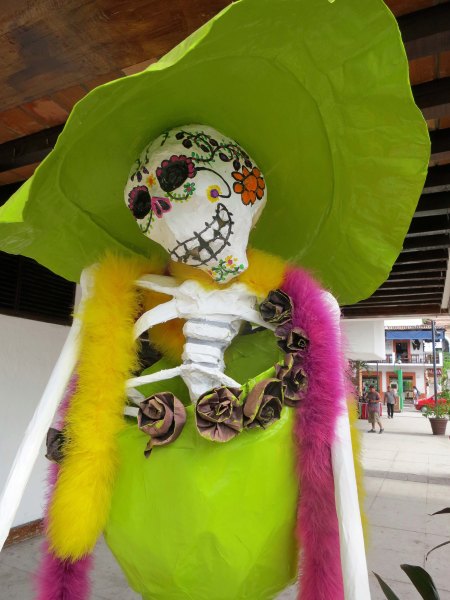
Judging from the number and variety of Catrinas we found, I surmised that Puerto Vallarta's visitors bureau had sponsored a Catrina contest for the Day of the Dead.

Judging from the number and variety of Catrinas we found, I surmised that Puerto Vallarta’s visitors bureau had sponsored a make your own Catrina contest for the Day of the Dead.
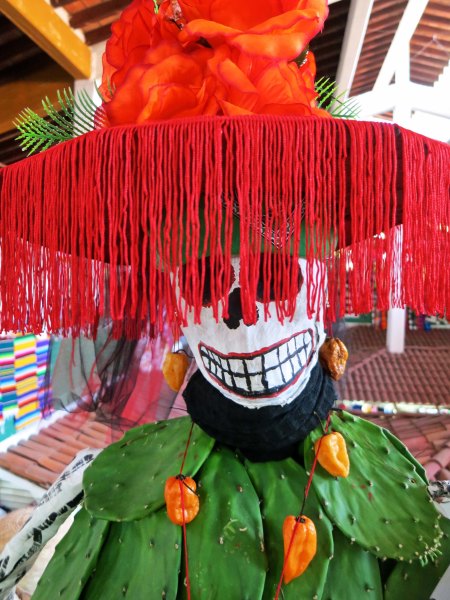
We found this Catrina with her frilly hat at the Municipal Market.

We found this Catrina with her frilly hat, hot pepper necklace, and cactus blouse at the Municipal Market.
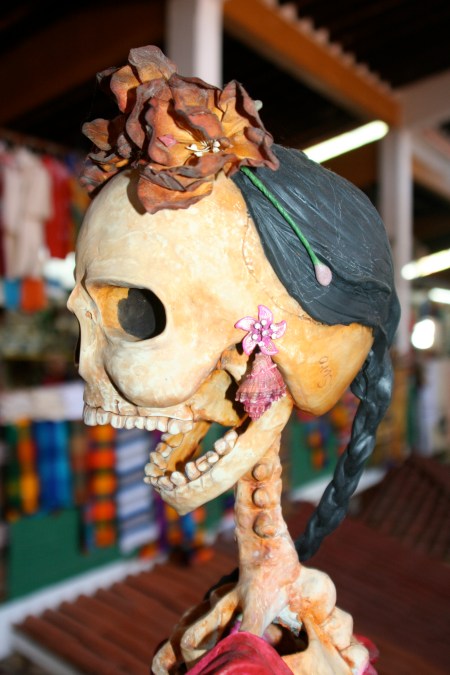
We found this realistic Catrina at the same location in the Municipal Market on a previous visit to Puerto Vallarta.

And this realistic Catrina at the same location in the Municipal Market on a previous visit to Puerto Vallarta. Note the snazzy ear rings.
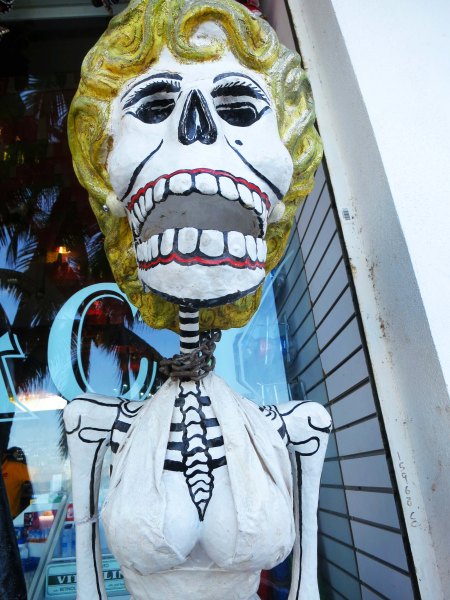
I wondered if this blond bombshell with her generous boobs wasn't a Marilyn Monroe Catrina.

I wondered if this blond bombshell with her generous boobs wasn’t a Marilyn Monroe Catrina.
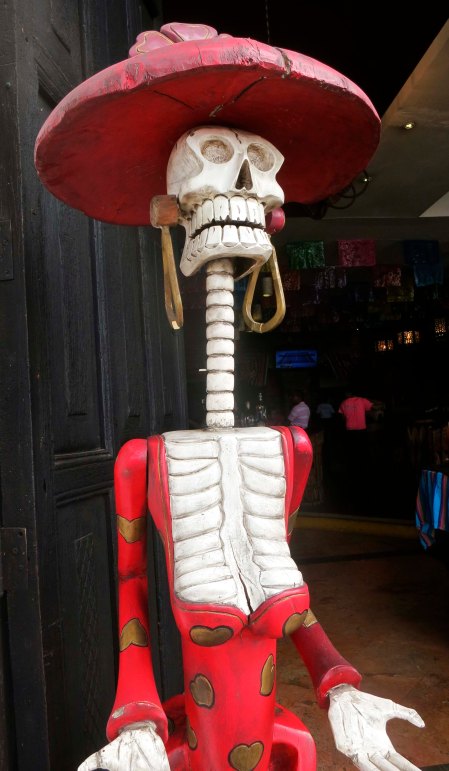
I don't think I have ever seen a plunging neckline plunge this much.

I don’t think I have ever seen a plunging neckline plunge this much. And isn’t the red hat something! I’m thinking this lady is someone’s Valentine.
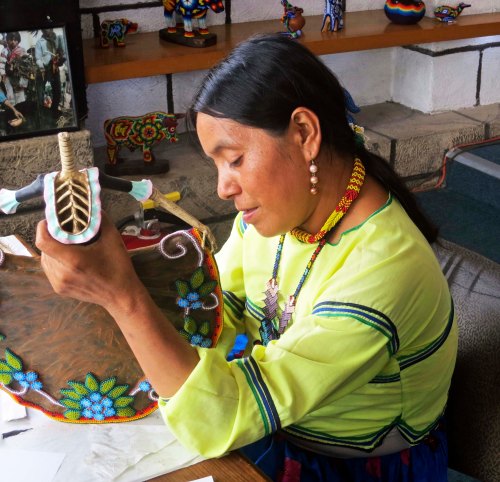
A Huichol artist worked on creating a Catrina in one of the shops we visited.

A Huichol artist worked on creating a Catrina in one of the shops we visited. I added my pesos to her tip jar and snapped a photo.
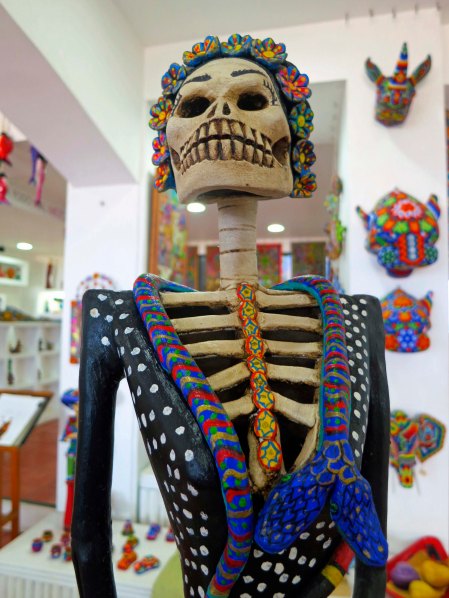
Miniature Catrinas, such as this one, and their male counterparts are created to sell to people who don't have have room, or the money, to buy a big one. Many are quite beautifully made with fine attention to detail.

Miniature Catrinas, such as this one— and their male counterparts, are created to sell to people who don’t have the room or money to buy a big one. Many are quite beautifully made with fine attention to detail.
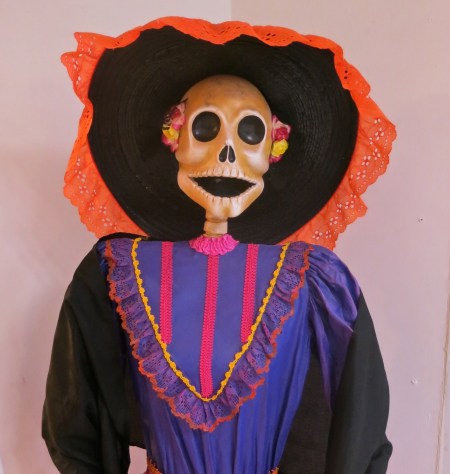
The Puerto Vallarta airport featured a number of Catrina's, including this one.

This gal greeted us at the Puerto Vallarta airport as we were flying back to Oregon.


NEXT BLOG: “Want to buy some junk? Almost free.” words of a vendor as we passed his booth. The markets of Puerto Vallarta carry everything from tourist trinkets to valuable folk art.

A miracle of the modern culinary arts: the self stuffing turkey. Happy Thanksgiving. The turkey above is from one of the cards I used to create before writing and blogging took over my life. While we celebrate family and friends here in the US, I also want my friends in Europe and other parts of the world who have suffered so much recently to know that my thoughts are with you. Every day. –Curt

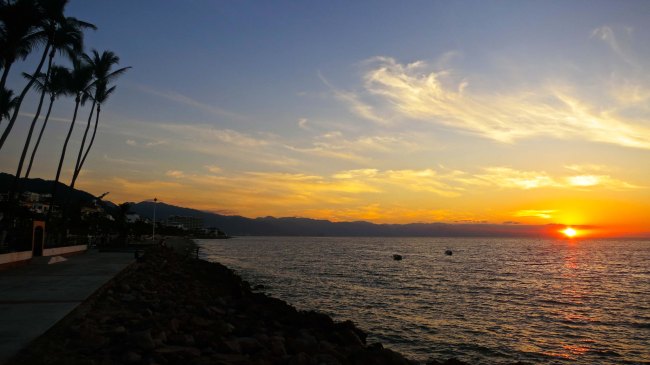
A miracle of the modern culinary arts: the self stuffing turkey. Happy Thanksgiving.     The turkey above is from one of the cards I used to create before writing and blogging took over my life.    While we celebrate family and friends here in the US, I also want my friends in Europe and other parts of the world who have suffered so much recently to know that my thoughts are with you. Every day. –Curt


Strange Art, Wild Nature, and Bounteous Beauty… Puerto Vallarta’s Malecon

Unique, often humorous art, along Puerto Vallarta’s Malecon is one of several attractions that make the walkway appealing.

Unique, often humorous art, is one of several attractions that make a stroll along Puerto Vallarta’s Malecon a must-do activity each time I am in the city. How could anybody resist this flying/swimming whatever?

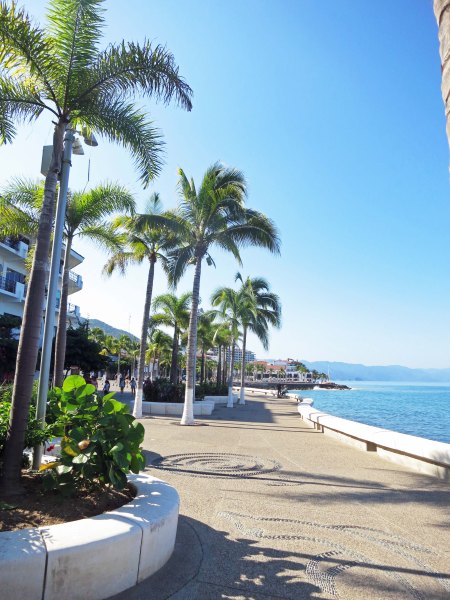
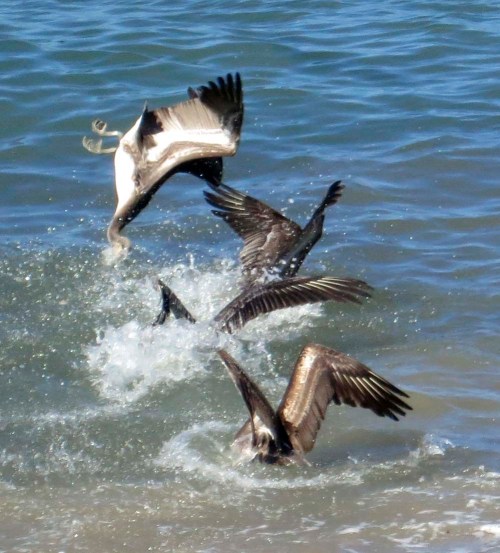
Puerto Vallarta’s Malecon, or walkway, along Banderas Bay is special. Most cities would offer up their top five attractions— or their Chamber of Commerce president, to have it. Beautiful sunsets, cascading pelicans, and waves rolling in from the Pacific are only part of the appeal. Interesting/fun art, views of the town, and the charm of the Malecon itself capture locals and visitors alike.

Looking south from the northern section of the Malecon as the sun sets over Puerto Vallarta and Banderas Bay.

Looking south from the northern section of the Malecon as the sun sets over Puerto Vallarta and Banderas Bay.

Pelicans join a feeding frenzy as they dive into Banderas Bay after a school of fish. The upside down guy made me laugh.

A photo of pelicans in a feeding frenzy from two years ago as they dive into Banderas Bay after a school of fish. The upside down guy made me laugh. Now that is dedication!

A number of sculptures adorn the walk including the Eggplant man…

A number of sculptures adorn the walk including the Eggplant Man, who just happens to be eating an eggplant. His substantial girth captured a bit of the Puerto Vallarta in reflection.

…Long Nose,

I wasn’t sure whether this was an octopus with one tentacle or a creature with a long nose that featured suction cups. “The better to smell you with, my dear.”

…this sea monster with a large mouth. (Check out his tongue and the hand pointing where food is supposed to go.)

This smiling sea monster with a large mouth featured a tongue with directions as to where it hoped tasty tourists might go.

…these graceful dancers,

A taste of the beauty and grace of Mexico…

and this beautiful sculpture that suggests that two heads are better than one.

…and a suggestion that two heads are better than one.

Even without the art and the bay, the Malecon is a very attractive walkway.

Even without the art and the bay, the Malecon is  very attractive. Note the designs built into the walkway.

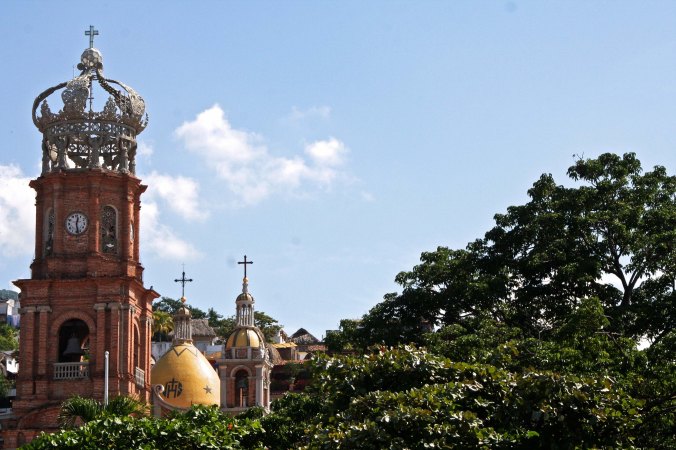
Puerto Vallarta’s iconic cathedral is one of many sights looking inland from the Malecon.

Puerto Vallarta’s iconic cathedral is one of many views looking inland from the Malecon.

For those more into partying or shopping, a walk on the non-ocean side of the Malecon provides countless opportunities for mischief. Senior Frogs and many other bars line the non-ocean side of the walkway. Shops selling everything from tourist trinkets to humorous folk art compete for your attention. Or, you can get serious and spend the kid’s inheritance on something large and silver.

Peggy has her photo taken with Senorita Frog on the landside of the walkway.

Peggy holds hands with Senorita Frog on the landside of the walkway.

A flying cow serves as an enticement to one of the many bars.

A flying cow serves as an enticement to one of the many bars. From the expression on her face, I doubt that she is drinking milk.

Anybody want to buy a great ape? This big fellow is decorated with thousands of beads, Huichol Indian style. The shop was packed full of Huichol art. Peggy bought a small turtle. Apparently the ape was a little large to carry home on the plane.

Anybody want to buy a great ape? This big fellow is decorated with thousands of beads, Huichol Indian style— and a Corona hat. The shop was packed full of Huichol art. Peggy bought a small turtle. Apparently the ape was a little large to carry home on the plane.

I found this three foot alligator in Old Town Puerto Vallarta, but similar silver gifts are available along the Malecon. Armed guards were outside and inside the store.

I found this three foot alligator in Old Town Puerto Vallarta, but similar silver gifts are available along the Malecon. Armed guards were outside and inside the store. And no, we didn’t spend the kid’s inheritance on it. That money goes to our travels. (grin)

Peggy and I usually choose to walk on the ocean side. The ubiquitous vendors found along the bay front of Puerto Vallarta apparently aren’t allowed to push their wares on the Malecon north of the town center. Normally the sales pitches don’t bother us. It comes with the territory, and the people are only trying to make a living. Still, an occasional break is appreciated. Our tolerance for hassling doesn’t extend to timeshare sales people, however. Their approach bares a striking resemblance to that of used-car salesmen.

South of town center as you approach the Rio Cuale and Old Town on the Malecon, your opportunity to obtain ‘bargains’ increases exponentially. Our friend Lesley Lake made the mistake of allowing a bracelet vendor put a bracelet on her wrist. She ended up buying four. These guys are good. When they get you, you’re got.

Our friend Leslie made the mistake of showing interest in a hawker’s bracelets on the lower Malecon and ended up buying four. He was one happy salesman.

The vendor has Leslie. She won’t get away.

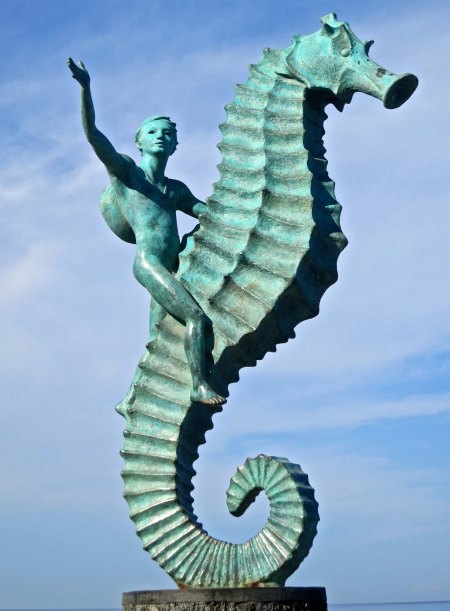
It is appropriate to end this blog on Puerto Vallarta’s Malecon with the statue of a boy on a seahorse, the symbol of Puerto Vallarta.

It is appropriate to end this blog on Puerto Vallarta’s Malecon with the adopted symbol of Puerto Vallarta, a statue of a boy wearing naught but a sombrero while riding a seahorse. Seems it might get a little rough, to me.

NEXT BLOG: Folks in Mexico take dead people seriously— sort of.

The Abbeys of Cotswold… Henry VIII Said, “Get the Lead Out!”… by Peggy Mekemson

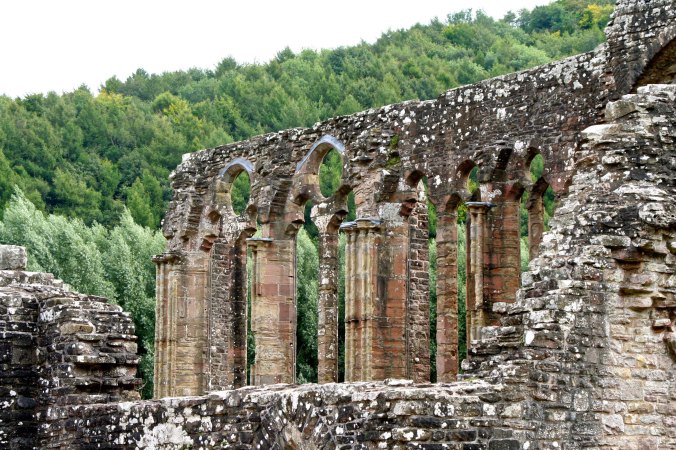
Graceful columns found when stepping inside the ruins of Tintern Abbey.

Graceful columns found when stepping inside the ruins of Tintern Abbey.

Between 1536-1540 (depending on which brochure I read) King Henry VIII declared the Dissolution of the Monasteries during the Protestant Reformation and his break from the Catholic Church. Armies scoured the country— leaving most monasteries in ruin as soldiers took the lead to make cannon balls. Jane and I visited four very different abbeys that had existed at that time and earlier.

Malmesbury, believed to be the oldest inhabited town in England, has a 12th Century abbey. The original spire and tower both collapsed well before the Reformation. Only the nave remained and became part of the active Abbey as part of the Reformation. It is believed that the first King of England is buried nearby while his coffin resides inside the church.

The contrast between the active church and the remaining walls was interesting. Part of the old monastery grounds now houses the Abbey House Gardens (previous garden blog).

The contrast between the active church and the remaining walls was interesting. Part of the old monastery grounds now houses the Abbey House Gardens (previous garden blog).

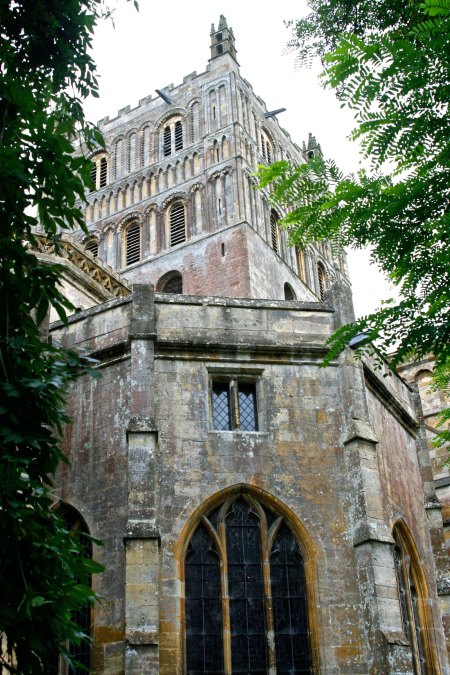
Tewkesbury Abbey survived the dissolution of the monasteries in 1540 when the townspeople bought it from King Henry VIII for the sum of 453 pounds. Although the original church was consecrated in 1121, the current Abbey is 900 years old. It is considered one of the largest parish churches in England.

The armies of King Henry VIII destroyed the churches primarily for the lead. The people of Tewkesbury paid the King the value of the lead and saved the church.

The armies of King Henry VIII destroyed the churches primarily for the lead. The people of Tewkesbury paid the King the value of the lead and saved the church.

The roof bosses were indeed stunning.

The roof arches were indeed stunning.

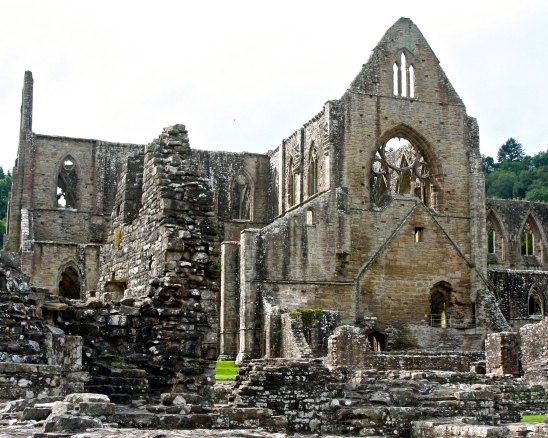
Tintern Abbey, on the border of Wales and Gloucestershire, captivated me! The Cistercian Abbey was founded in 1131 and was a religious center between 1136-1536 at which time it was surrendered to the King’s “marauding visitors.” The lead was taken and 400 years of decay began. There was partial reconstruction begun in 1914. The CADW (a part of the Welsh government dedicated to preserving historic environmental and heritage sites) took over in 1984.

Our first view of the ruins of Tintern Abbey.

Our first view of the ruins of Tintern Abbey.

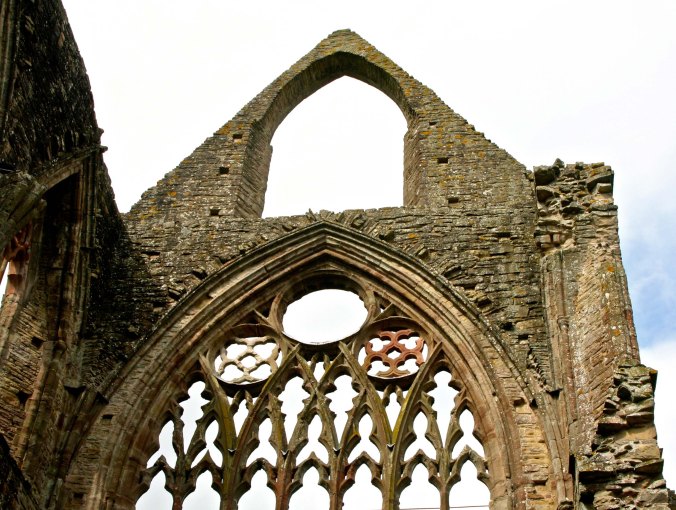
The following photos reflect the beauty of the area surrounding the ruins and the stunning views within the ruins.

Tintern Abbey in England

Wall ruins of Tintern Abbey in England

Tintern Abbey grand hallway

The two small windows in the middle are the only training original windows in Tintern Abbey.

The small windows in the middle are the only remaining original windows in Tintern Abbey.

Tintern Abbey window view in England

Tintern Abbey windows looking out on forests

Tintern Abbey sky view

My last photo of the Tintern Abbey ruins.

My last photo of the Tintern Abbey ruins.

Our last stop was Gloucester Cathedral. Here, our volunteer guide, a wonderful storyteller, greeted us. During the Reformation, this was one of 6 abbeys designated by King Henry VIII as the cathedrals for the new Church of England. No damage was done. Apparently, the historic connections to the monarchy saved it. Our guide’s stories of the stained glass windows were particularly absorbing. The windows reflected the history of the cathedral and religious stories and included several modern stained glass art work.
A front view of Glouchester Cathedral.

A front view of Glouchester Cathedral.

An early stained glass window featuring a knight.

An early stained glass window featuring a knight.

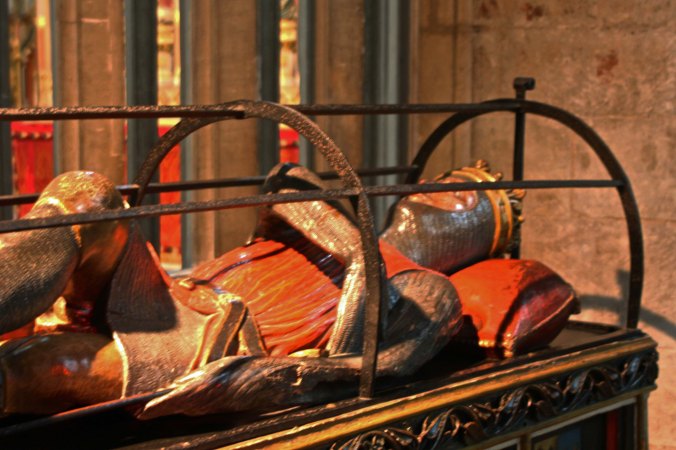
A knight's tomb inside the Cathedral.

A knight’s tomb inside the Cathedral.

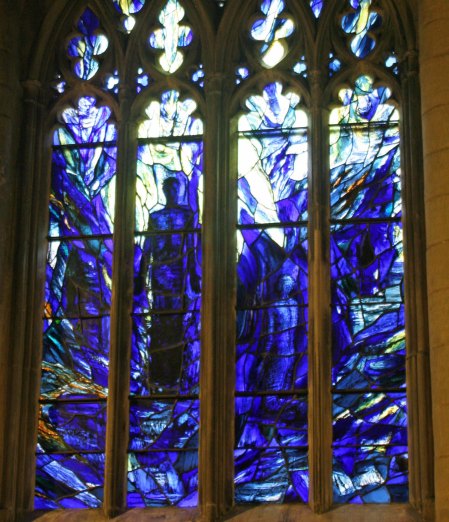
One of the modern stained glass windows.

One of the modern stained glass windows.

I have to admit that I was most fascinated by the stories of the filming of Harry Potter in the cathedral! We walked the halls used in several scenes. I watched the movies on my return so that I could compare Hogwarts School scenes with what I saw.

One of the halls of used for 'Hogsworts' in Harry Potter.

One of the halls used for ‘Hogwarts’ School of Wizardry’ in Harry Potter.

Downton Abbey to Harry Potter… and all the marvelous sites in between. It was quite the photographic adventure! This is my last blog on the Cotswolds. Thanks so much for joining me on the tour. —Peggy

The Day of the Iguana… Adventures in Puerto Vallarta

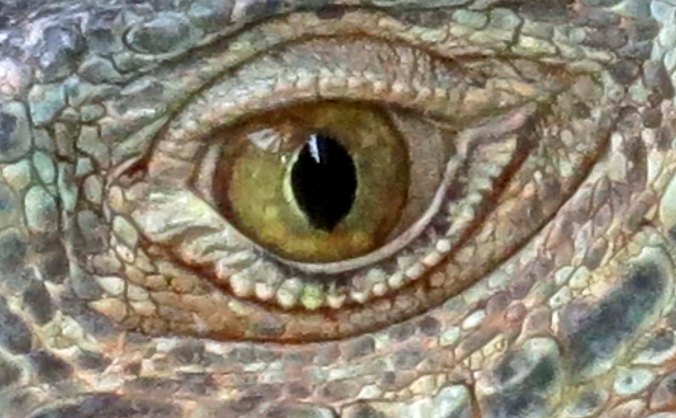
As the iguana stared balefully back at me, his eye seemed to grow.

As the iguana stared balefully back at me, his eye seemed to grow.


Peggy and I are in Puerto Vallarta, Mexico. While she works on her next Cotswolds post, I decided to slip one in on Puerto Vallarta.

I was home alone when I heard the scratching on our door. Peggy had gone off with our friends Ken and Leslie in hopes of finding Wi-Fi in the hotel lobby. I had wished them luck. The Internet is an on again/off again proposition here at the Krystal Hotel in Puerto Vallarta.

I looked up, thinking maybe the maid had come early, or the pool man. But usually they knock and shout “Ola.” No one was there. I went back to writing. I was editing Peggy’s blog on the villages of the Cotswolds.

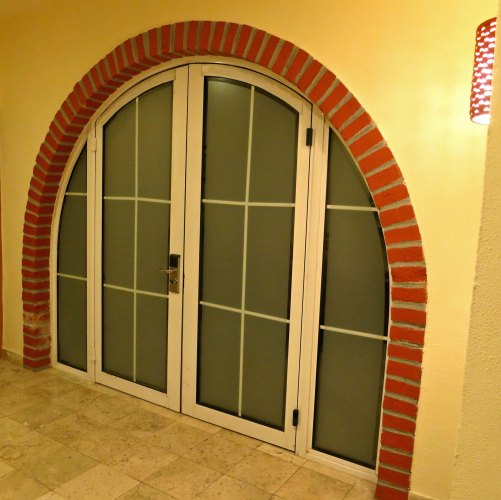
SCRATCH, SCRATCH, SCRATCH. “What the…?” I thought, looking up again. The villa has these large, arch-shaped doors made of frosted glass that let in light but not prying eyeballs. Off to the right I spotted what appeared to be large, scary head staring at me through the opaque glass. I recognized it.

The doorways to our villa in Puerto Vallarta were arched. The iguana appeared in the lower right window.

The doorways to our villa in Puerto Vallarta were arched. The iguana appeared in the lower right window.

The head of the iguana appearing through frosted glass reminded me of the Creature from the Black Lagoon.

The head of the iguana appearing through frosted glass reminded me of the Creature from the Black Lagoon.

“Aha!” went racing through my mind, “Senior Iguana is here for a visit.” I rushed over to the door and opened it, wondering if he would come in. It would be amusing to watch Peggy, Ken and Leslie’s reaction to finding a large lizard hanging out on the floor of our living room. Maybe I could entice him up onto the couch with a banana.

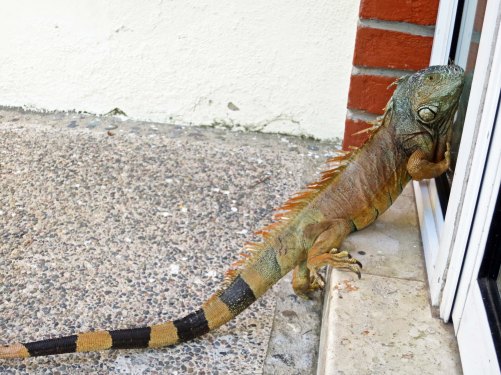
I found the Puerto Vallarta iguana outside scratching at our window. Was it asking to come in?

I found the Puerto Vallarta iguana outside scratching at our window. Was it asking to come in?

“Ola, Buenos Dias Senior Iggy. Welcome!” I proclaimed. Senior Iggy stared up at me balefully and said not a word. Maybe he didn’t like being called Iggy. He went back to scratching the window with his long claws.

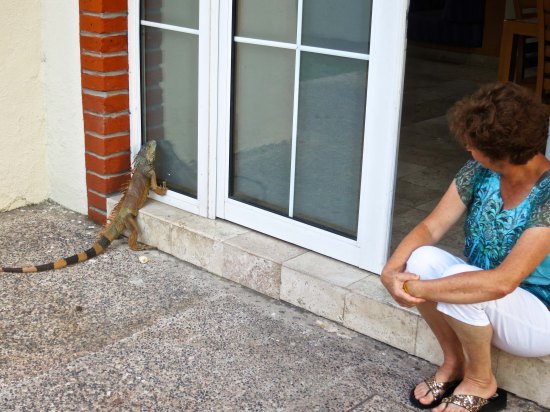
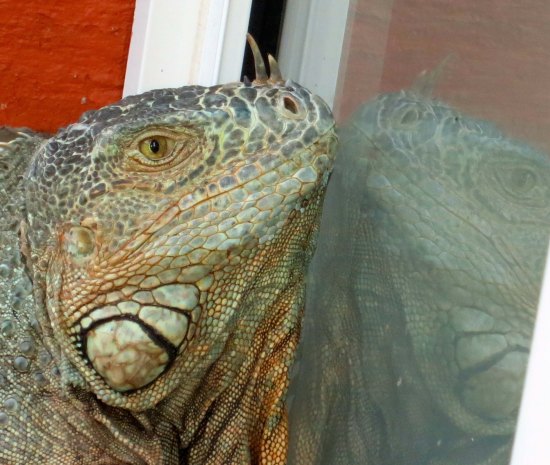
I went inside and retrieved a banana. Back outside I sat down on the porch step, peeled the banana, and tossed a piece to the iguana. He ignored it, like he was ignoring me. It was then that I noticed that Iggy was staring at the window, not through it. He had found true love in a perfect reflection of himself. What’s a puny banana in comparison?

I discovered the iguana was admiring its reflection in the window and wondered if it was breeding season and the large Puerto Vallarta lizard believed he had found true love— or possibly a rival.

I discovered the iguana was admiring its reflection in the window and wondered if it was breeding season and the large Puerto Vallarta lizard believed he had found true love— or possibly a rival.

I was still sitting on the doorstep when Ken, Leslie and Peggy returned. I heard them laughing with one of the gardeners when they spotted me sitting with the iguana. “They are good to eat,” the gardener told them. “They taste like chicken.” Naturally. My friends approached quietly, not wanting to scare Iggy.

“Don’t worry, the iguana is in love.” I doubt that a brass band would have disturbed him. Ken, Leslie, and Peggy each sat down on the porch step where I had been to admire our new best friend. We went inside with the iguana still staring at himself, deeply in love, or perhaps lust. He was still there when we left 45 minutes later, but had departed when we returned in four hours, undoubtedly heart-broken.

Peggy sat where I had and admired the iguana as he tried to reach his reflection.

Peggy sat where I had and admired the iguana as he tried to reach his reflection.

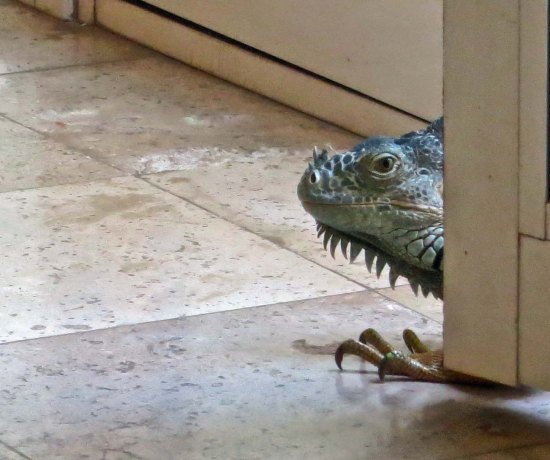
Two days later Peggy and I noticed that another iguana was outside, this time at the door leading to our pool. “Do you think he will come in if we open the door this time?” Peggy asked. “One way to find out,” I responded. Sure enough, a few minutes later we saw a head peaking in. And then the whole iguana followed. Peggy quickly jumped up and closed the door to our bedroom. We might find an iguana in our living room and kitchen amusing. Sleeping under our bed or in our shower would be another issue. He (I am assuming it was a male) wandered around looking for the beautiful girl iguana he knew lived in our villa. He stopped to eat a couple of mosquitos, his big tongue lashing out. (“Go big fellow!” we urged.) Finally, I opened the front door. Off he went.

We left the door open to see if the iguana would come inside searching for the other iguana. We were thrilled to see his head appear…

We left the door open to see if the iguana would come inside searching for the other iguana. We were thrilled to see his head appear…

…Soon to be followed by the rest of the iguana.

…Soon to be followed by the rest of the iguana.

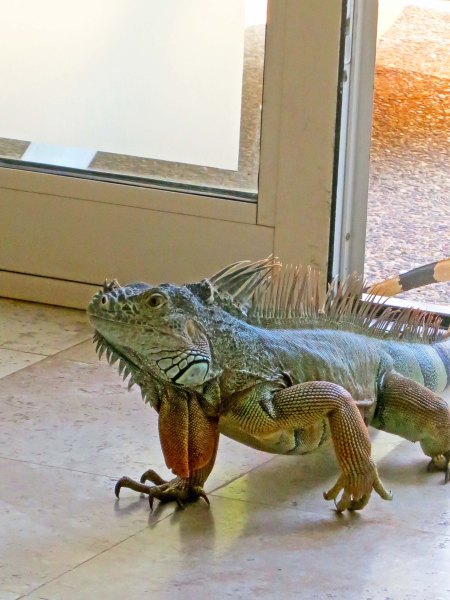
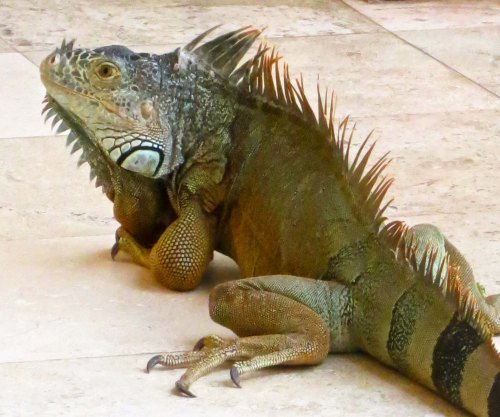
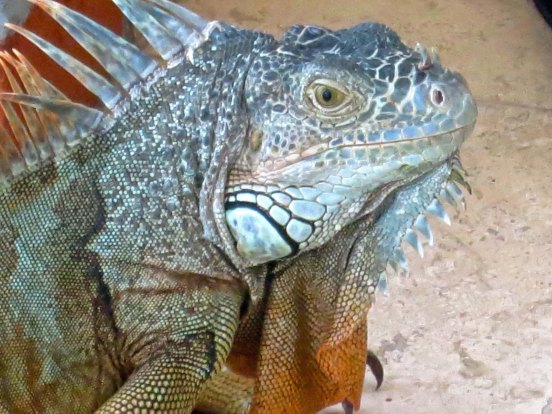
The iguana settled onto the floor and checked us our. He looked much less beat up than the first iguana that had come to visit. Note the size of the claws.

The iguana settled onto the floor and checked us out. He looked much less beat up than the first iguana that had come to visit. Note the size of the claws.

He was truly a handsome specimen.

He was truly a handsome specimen.

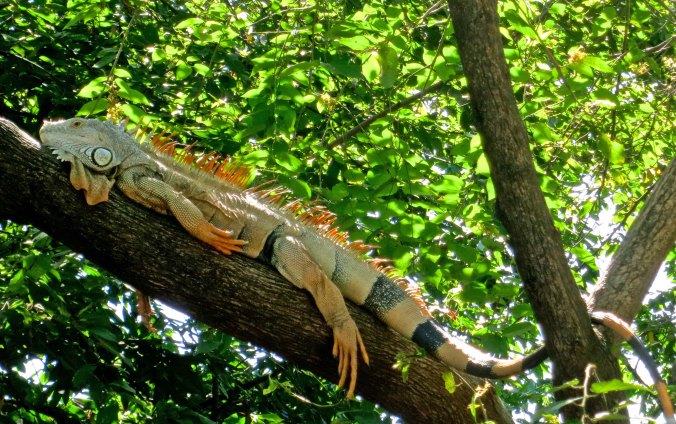
Iguanas are common in Puerto Vallarta. We often spot them on the Rio Cuale, big fellows hanging out in the trees above the river— and this isn’t the first time we have spotted them at our villa. Their images are captured in everything from tourist trinkets to expensive art. They even played a major role in Puerto Vallarta’s top industry: tourism.

This big fellow was taking his afternoon siesta in a tree next Puerto Vallarta’s attractive River Cuale.

This big fellow was taking his afternoon siesta in a tree next Puerto Vallarta’s attractive River Cuale.

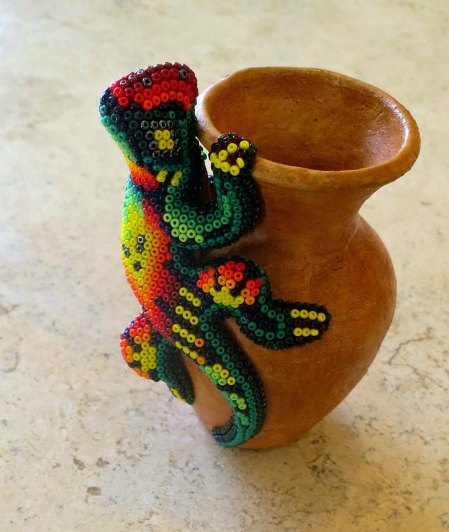
This small vase with a beaded iguana was made by our friend, Ernesto, a Huichol Indian, for our grandson Ethan whom he had met two years ago.

This small vase with a beaded iguana was made by our friend, Ernesto, a Huichol Indian, for our grandson Ethan whom he had met two years ago.

We found this large mural of an iguana in Old Town Puerto Vallarta.

We found this large mural of an iguana in Old Town Puerto Vallarta.

In 1964, Hollywood director John Huston brought his all-star cast of Richard Burton, Ava Gardner, and Deborah Kerr to the area to film The Night of the Iguana (thus the title of this blog), which was based on a play written by Tennessee Williams in 1961. To add a little spice, Burton, who was still married, brought along his future wife, Elizabeth Taylor. Hollywood had discovered Puerto Vallarta, and, because of the scandal between Dick and Liz, the world did as well.

Richard Burton and Elizabeth Taylor had adjoining houses connected by a bridge when they were in Puerto Vallarta for filming The Night of the Iguana in 1964.

Richard Burton and Elizabeth Taylor had adjoining houses connected by a bridge when they were in Puerto Vallarta for filming The Night of the Iguana in 1964.

Walking the Villages of The Cotswolds… by Peggy Mekemson

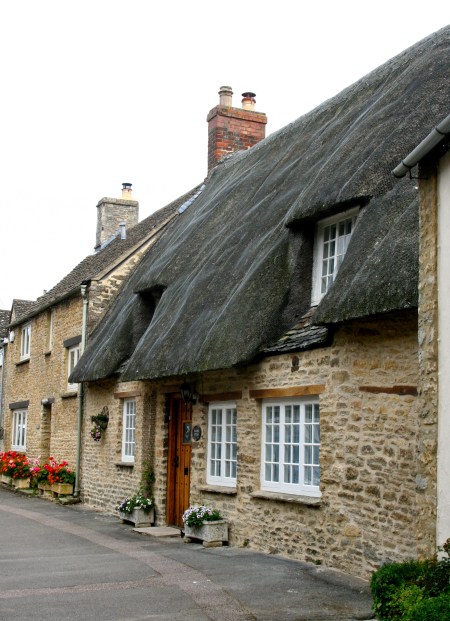
One of my favorite thatched roof homes found while wandering streets away from the village centers.

One of my favorite thatched roof homes found while wandering streets away from the village centers.

Yes, the gardens were beautiful, and the tour allowed us to see a wonderful variety of them from one acre to 5000 acres. My favorite time, however, was wandering the villages in the Cotswolds. Here we had free time to enjoy a lunch and roam at will. The challenge: we only had two hours! Jane and I found the visitors’ centers, gathered maps, asked about recommended walking paths and highlights, and hit the road running— or at least walking fast.

Of course it was not enough time to do justice to each village, but what I saw made me want to return. Following are the visual highlights and a few fun stories.

Our trip started with Highclere Castle, AKA Downton Abbey, a major destination on our tour before we headed to the Cotswolds. Even more fun for me, though, was the visit to Bampton, which is the village featured in Downton Abbey for the weddings, the shopping and general villages scenes. I loved the story that it was chosen not only for its atmosphere but also for the lack of street markings and signs, which made it easier to represent the early 1900s when the story takes place. It was interesting to compare how the village and church look on the TV series with how it looks in reality. I liked the reality; Bampton is a lovely, quaint town.

The Bampton chapel and cemetery was the site of the weddings featured in Downton Abbey.

The Bampton chapel and cemetery was the site of the weddings featured in Downton Abbey.

This tree overlooking the Bampton graves captured my attention.

This tree overlooking the Bampton graves captured my attention.

Taking a Bampton walk about.

Taking a Bampton walk about.

One has to admire the Cotswold stone hamlet.

One has to admire the Cotswold stone hamlet with its gorgeous flowers.

Villages visited were Malmesbury, Chipping Campden, Cirencester, Tewkesbury, Misarden, and Ledbury. Malmesbury, the oldest inhabited town in England, and Tewkesbury, a medieval village with one of the largest parish churches in the country, will be featured for their abbeys in my final blog on the Cotswolds.

A village scene from Cirencester, known as the “Capital of the Cotswolds.” The term “cester” means Roman fort indicating the origin of the village.

A village scene from Cirencester, known as the “Capital of the Cotswolds.”
The term “cester” means Roman fort indicating the origin of the village.

A scene captured during a walk about in Chipping Campden, a favorite village of mine, one to be revisited!

A scene captured during a walk about in Chipping Campden, a favorite village of mine, one to be revisited!

While in Chipping Campden, Jane and I noticed a children’s bookstore called A Festival of Books. Greeted by the owner, Emily Dunn, we asked about local children’s books (we both have grandmother duty, grin), and had a delightful surprise. Emily is the author of The Tale of the Cotswold Mice, a book written for Princess Charlotte and embraced by the royal family. Our luck continued! The illustrator and gold/silversmith, Aneata Boote, owns the shop next door. Not only did Aneata illustrate the book, but she also designed silver napkin rings (complete with the mice) to accompany the book. Naturally we bought a signed copy. As a retired elementary school principal, I highly recommend it for young children. Although the first printing sold out, it is being reprinted with a percentage of the profits going to a children’s art fund. Check out their website www.cotswoldmice.com

The Tale of the Cotswold Mice along with two napkin rings were presented to Princess Charlotte after her birth.

The Tale of the Cotswold Mice along with two napkin rings were presented to Princess Charlotte after her birth.

The author was Emily Dunn, the owner of bookstore, A Festival of Books, located in Chipping Campden. The silversmith and illustrator was Aneata Boote who owned the shop next door. Both were welcoming and charming!

The author was Emily Dunn, the owner of bookstore, A Festival of Books, located in Chipping Campden. The silversmith and illustrator was Aneata Boote who owned the shop next door. Both were welcoming and charming!

While many of the homes and businesses were architectural eye candy, two features caught my eye over and over again: the famous honey-colored Cotswold stone and the thatched roof cottages. My sister had to drag me away from several of the structures in order to catch the bus on time. Just when I thought I had seen the best examples, I would walk another block and then— Wow!

How could I resist this rooftop view with its chimneys.

How could I resist this rooftop view with its fairytale chimneys.

Then there were the markets. Once the centers of agriculture, wool, and silk spinning, the villages are making an economic come back with a refocus on farmers’ markets and crafts. I couldn’t resist the basket market.

Basket market in Cirencester, a city founded by the Romans.

Basket market in Cirencester, a city founded by the Romans.

The market in Ledbury, a photo taken from the bus as we left town.

The historical market in Ledbury, a photo taken from the bus as we left town.

The historical market in Chipping Campden.

The historical market in Chipping Campden.

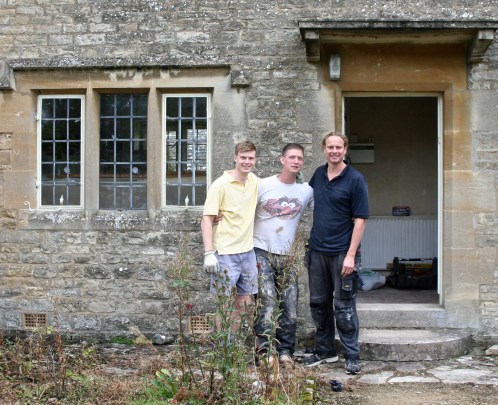
While exploring the village of Misarden (previous garden blog), we discovered a home being renovated. The three young men working on the house noticed our interest and rushed out to invite us inside to admire their work. Their enthusiasm and humor were catching. One, the future tenant, had grown up in the area, and was looking forward to returning home. His plumbing skills were being put to good use in the renovation. Having once remodeled a colonial house, I appreciated what the young men had accomplished and how much work they still had to do.

These are the three men who welcomed us into the cottage they were renovating. They were such fun I promised them I would post their photo!

These are the three men who welcomed us into the cottage they were renovating. They were such fun I promised them I would post their photo!

After leaving the renovation house I came across this garden.It was a a good reminder to take the time to stop and look around, behind, beside, up, down…

After leaving the renovation house I came across this tucked away garden.It was a good reminder to take the time to stop and look around, behind, beside, up, down…

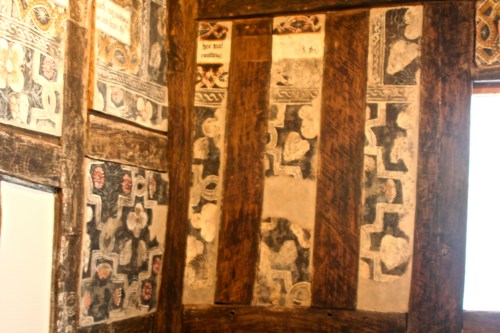
Ledbury, the home of Elizabeth Barrett Browning (memories of English-lit days), is an ancient borough with centuries old timber-framed buildings. As we wandered the town, we stopped outside a building described as a 16th Century Painted House. Curious, we stepped inside only to discover the guide was closing things down. When we insisted we would only take two minutes to see the famous room, she hesitated, took a deep breath, and then led us upstairs. Our two minutes turned into 20. Apparently, a couple was preparing the walls for new paint when they discovered curious painted patterns under the layers of old paint they had removed. What they discovered dated back over 600 years.

 I loved the winding streets in Ledbury with their surprising views, such as the church.

I loved the winding streets in Ledbury with their surprising views, such as the church.

Ledbury is known for its centuries old timber framed buildings. The clock tower made a picturesque addition.

Ledbury is known for its centuries old timber-framed buildings. The clock tower made a picturesque addition.

The 16th Century Painted House was tucked away in the narrow bend of the street.

The 16th Century Painted House was tucked away in the narrow bend of the street. My sister Jane knocks at the door.

Trying to capture the 600 year old painted walls was challenging but worth the try!

Trying to capture the 600 year old painted walls was challenging but worth the try!

I was captivated by what I saw in each village and would return, without hesitation, to continue my explorations. The history, beauty, care, friendly people, and, delicious food all make a visit worthwhile.

This doorknocker found in Chipping Campden seemed a fitting end to this blog. It was hard to resist knocking on this door. I will be back to try it out!

This doorknocker found in Chipping Campden seemed a fitting end to this blog. It was hard to resist knocking on this door. I will be back to try it out!

My Fantasy: Living on a House Boat


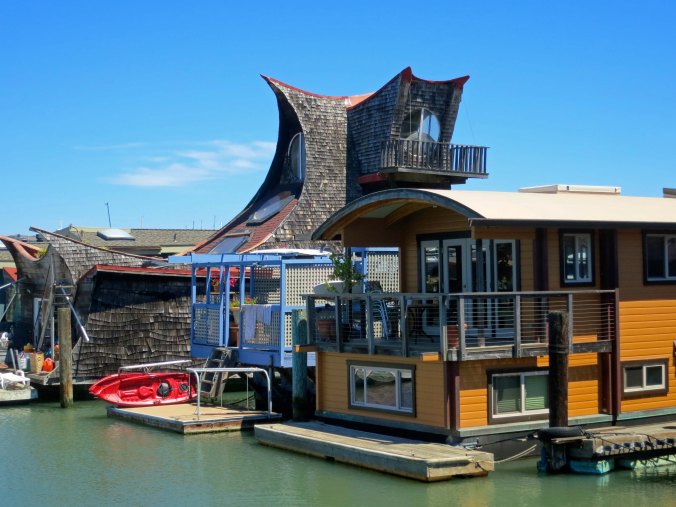
House Boats in Sausalito come in a wide range of shapes, colors and sizes.

House Boats in Sausalito come in a wide range of shapes, colors and sizes.

Peggy and I are in Puerto Vallarta, Mexico. Since the beautiful sandy beaches and an occasional margarita have pulled Peggy away from her guest blogging, I decided to do a quick post on houseboats. Peggy may have soaked up enough sun to get back to blogging later this week. (grin)

As water people go, I’d place myself on the lower end of want-to. Even though I’ve travelled by sailboat, water taxi, gondola, fishing boat, raft, kayak, canoe and cruise ship, I prefer other means of transport— like walking, or bicycling, or driving, or flying. (The flying part, however, thanks to security hassles and the modern cattle car approach to air travel, has worked its way down the list over the years, while kayaking, which I’ve come to think of as walking or backpacking on water, has worked its way up.)

I have a confession to make here, though; I have always dreamed about living on a houseboat. I can’t really explain why. Somehow, it seems romantic. Maybe it appeals to the nascent hippie in me. My introduction to these floating fantasies was in Sausalito during the late 60s. I’d wandered into the town on a whim and there they were: beckoning. I was a responsible adult at the time, however, or at least trying to be. I had a wife, a job, an apartment, and a large basset hound named Socrates who drooled a lot. How much more responsible can you get? (Yeah, I know, have babies who drool a lot.) Anyway, I banished the thought of living on a houseboat and returned to my exciting life in Sacramento.

On my August trip up the Northern California coast, I learned that Don McCoy had helped establish Sausalito’s houseboat community in the mid-60s before he had tuned in and dropped out to found the Chosen Family commune at Olompali. This fact led me to drive thirty minutes south down 101 from Novato to re-explore my lost youth.

Sausalito has changed almost beyond recognition. At least it seems that way to me. I spent most of my time dodging tourists. There were at least a million (slight exaggeration). I didn’t have time to look around when I drove through town for fear of running over one. But the houseboat community felt familiar. Each home had a unique personality, emphasized even more by art and plants surrounding it. If there were a major difference from the 60s, it was in who could afford them. The days of naked hippies joyfully cavorting on the decks had long since passed.

How you build your houseboat is only limited by your imagination. And I might add, the size of your pocketbook.

How you build your houseboat is only limited by your imagination. And, I might add, the size of your portfolio.

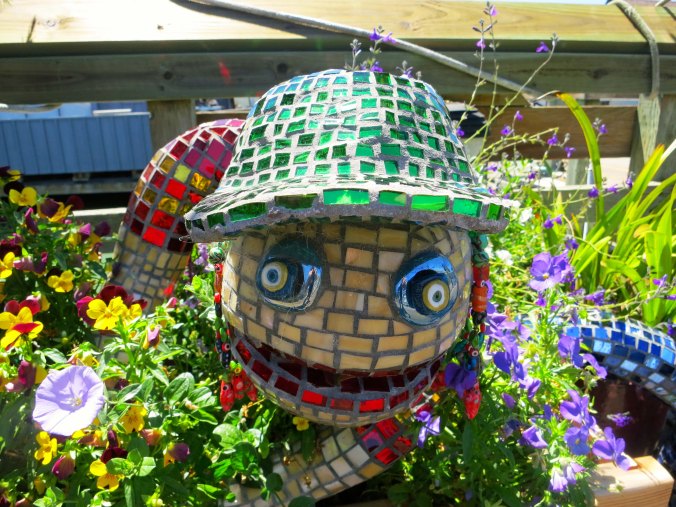
Ditto the above with art and plants.

Ditto the above with art and plants.

This driftwood crocodile was lurking on a ledge.

This driftwood crocodile was lurking on a ledge.

And this guy popped out of a flower pot.

And this guy popped out of a flower-pot.

The houseboat docks were decorated with flower gardens. The flower head here seemed like it was lit from within.

The houseboat docks were decorated with flower gardens. The flower here seemed like it was lit from within.

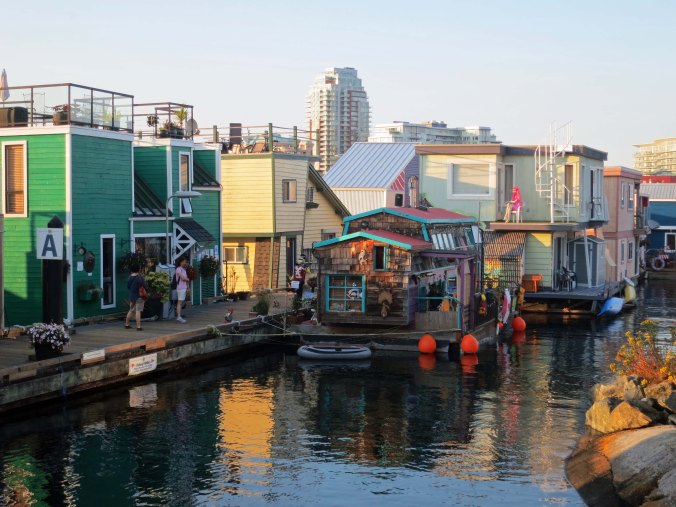
Other areas also have their houseboat communities. Victoria, British Columbia is one. Peggy and I stopped by to check them out on our way home from a weeklong kayak tour on the north coast of Vancouver Island last year.


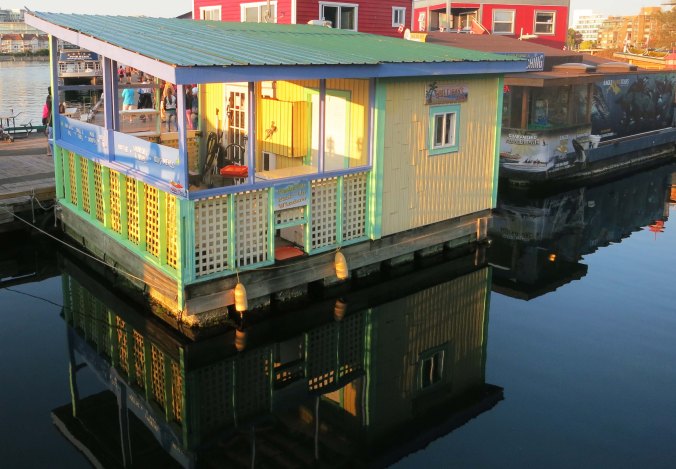
We discovered this little yellow jewel on the Island of Vancouver in Victoria, BC

We discovered this little yellow jewel and its perfect reflection on the Island of Vancouver in Victoria, BC

Caption

Several Victoria, BC houseboats with downtown Victoria in the background.

We found a different kind of houseboat in England. They were six feet wide and up to sixty feet long. (Think of it this way: If we were configured in the same way, our noses would stretch out some 20 feet. Pinocchio would be jealous.) Three summers ago Peggy and I, along with Peggy’s sister Jane and her husband Jim, spent a week piloting one of these “narrowboats” along the Trent and Mercey Canals near Robin Hood’s old hangout. It was a kick— maneuvering our long boat, stopping at pubs and villages along the way, and pulling off at night to camp along the canal. This inexpensive, gypsy-like lifestyle has great appeal for some people and they’ve turned their narrow vessels into gaily painted, imaginatively named houseboats. Sign me up.

Here I am, piloting our 60 foot boat down the Trent and Mercey Canal. It's a good thing we only travelled 3-4 miles per hour.

Here I am, piloting our 60 foot boat down the Trent and Mercey Canal. It’s a good thing we only travelled 3-4 miles per hour.

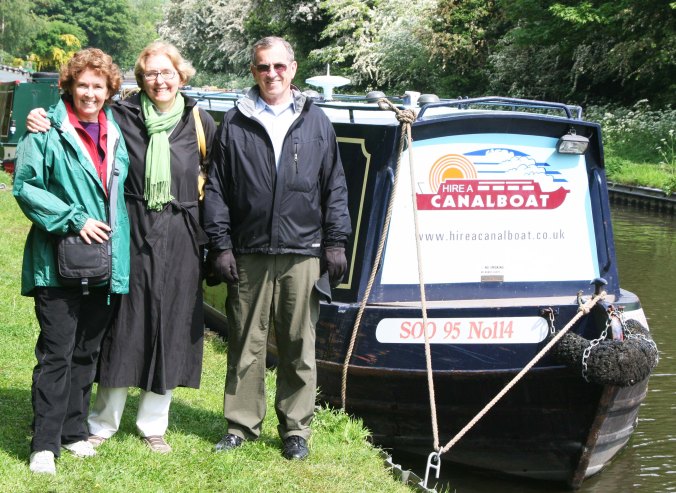
Our crew. Peggy and Jane operated the locks. Jim and I piloted the boat.

Our crew. Peggy and Jane operated the locks. Jim and I piloted the boat.

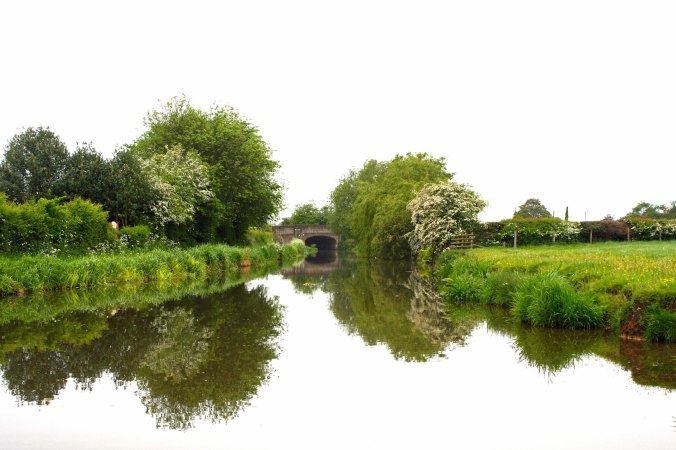
As this photo suggests, the Trent and Mercey Canal Canal can be quite scenic.

As this photo suggests, the Trent and Mercey Canal can be quite scenic. Low underpasses limit the height of the narrowboats.

How would you like to have a house named Belly Button? Fun names, plants and unique paint jobs give narrow boats personality.

How would you like to have a house named Belly Button? Fun names, plants and colorful paint jobs give narrowboats their personality.

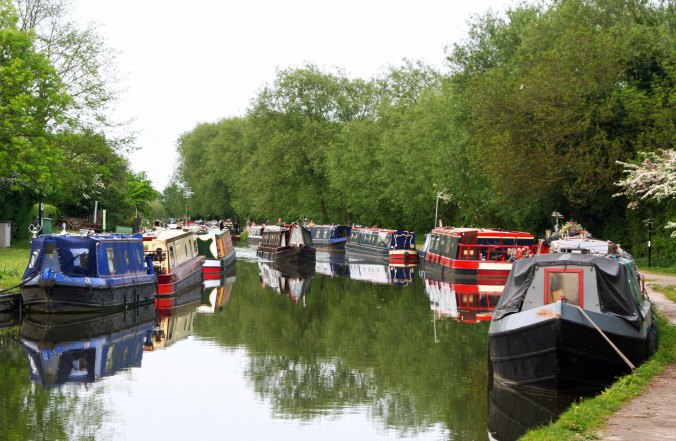
A community of houseboats, Trent and Mercey Canal style. They could be gone the next day.

A community of houseboats, Trent and Mercey Canal style. They could be gone the next day.

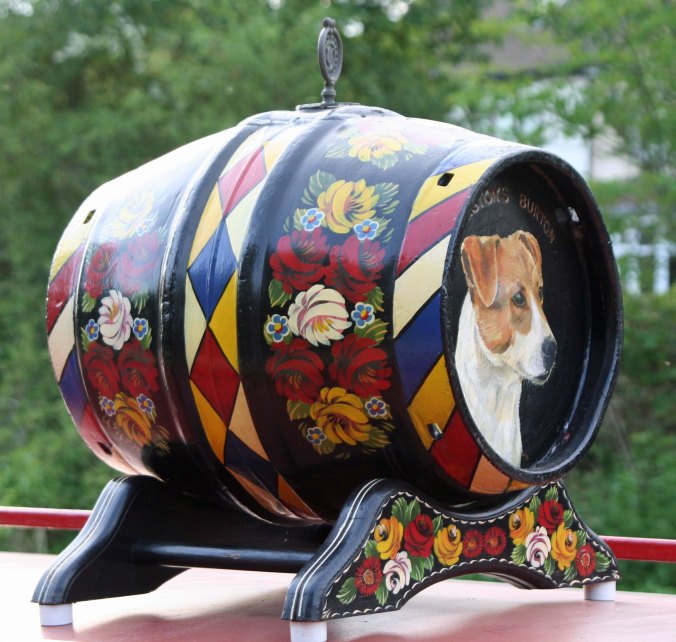
We spotted this water cask with its realistic portrayal of a dog on top of a narrowboat.

We spotted this water cask with its realistic portrayal of a dog on top of a narrowboat.

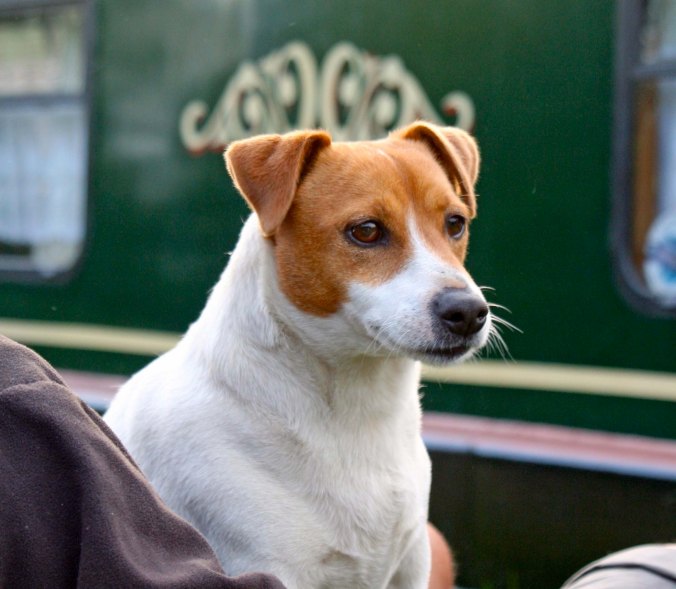
Next to the boat, sitting on the owner's lap, was the dog.

Next to the boat, sitting on the owner’s lap, was the dog.


NEXT BLOG: Peggy will post her blog on the small towns of Cotswold, England.

A Garden of Weeds— and More… in the Cotswolds by Peggy Mekemson

Caption

Yes, Anne, the host AKA “Bad Tempered Gardener,” shared that there were gardens of weeds throughout her garden. Still beautiful…but I did have a massive allergy attack after wandering around. It was still worth the visit!

Today, I wrap up my tour of English gardens with Cerney House, Overbury Court, Whitcombe House, Wyndcliffe Court Sculpture Gardens, Veddw House Gardens in Wales, and Hellens Manor. (I have two more blogs on the Abbeys and Villages of Cotswolds, however. And I may do one on the Tower of London.)

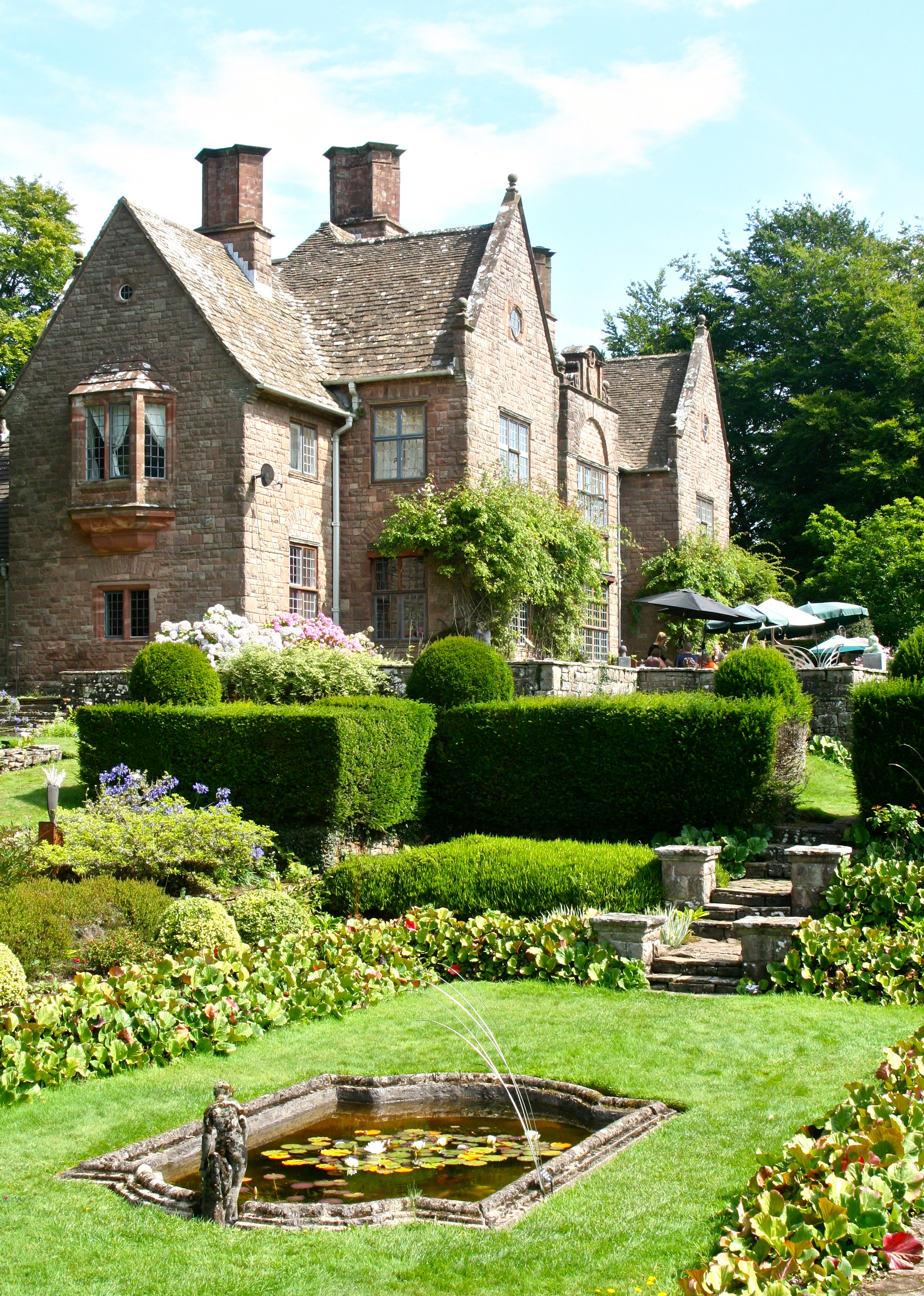
Cerney House was described originally as a romantic, secret place. (It’s also known for its goat cheese.) Built in 1660, it was renovated in 1983 by Sir Michael and Lady Angus. It is still a work in progress with “a pleasantly un-manicured garden, happy plants…unrestrained.” We enjoyed pigs in the woods, Roman snails in the garden and delicious tea and cakes! Rather unique…

Caption

The residence had a unique look compared to our other experiences.

Caption

This was part of the garden in front of the house. How could I resist this rooster?

Overbury House was rebuilt after a fire in 1738. Constructed of the golden, ashlar faced stone famous in the Cotswold, it is privately owned. The head gardener treated us to the tour of the three acre garden and the lush parkland surrounding the house. The owners were present so we were kept discretely away from the main house. The 3000 acres included 2 villages— yes, they own the villages also. This estate is surrounding by 3 rivers and is subject to flooding according to the gardener, perhaps the reason for the lush parkland and simplicity of design!

Caption

Overbury Estate

Caption

The head gardener shared that staff would often enjoy a swim here when work was completed. I like that thought!

Caption

This gives you a sense of the manicured grounds with a view of the estate chapel.

Whitcombe House is literally next door to the Overbury House. It voluntarily participates in the National Garden Scheme, where revenues raised through entrance fees are donated to various charities. We were excited about its lovely one acre garden. We had finally found something we might hope to replicate. We were treated to homemade cakes and tea by the family, while grandchildren ran free with the dog . The personal touch was a delightful change from our previous experiences of estates…. manors….. courts….etc.

Caption

Our first view of Whitcombe House from the bus.

Caption

I love stone walls. I wanted to take this one home!

Caption

Part of the backyard garden, full of delightful surprises, all in one acre.

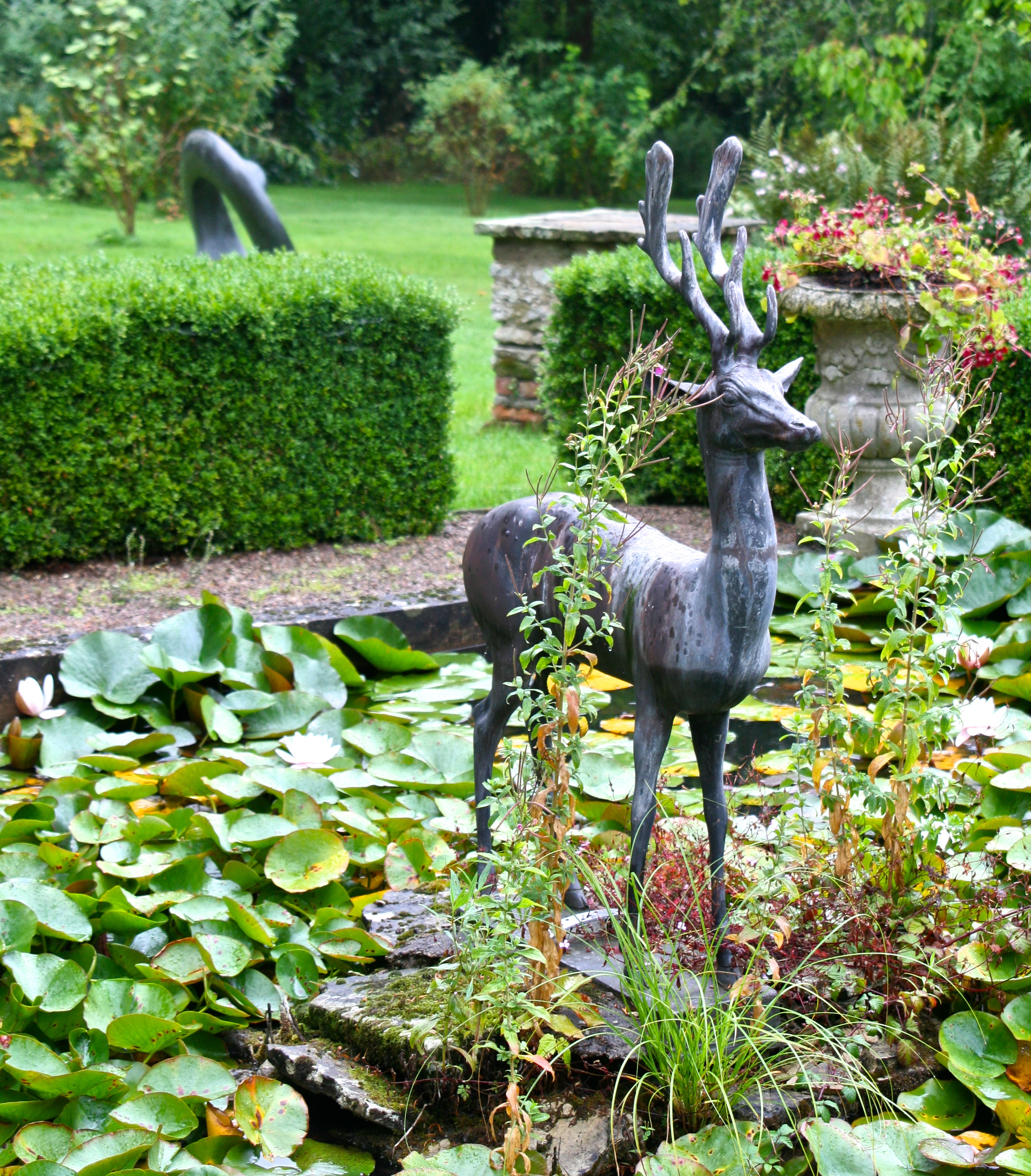
Wyndcliffe Court Sculpture Gardens was not on our original agenda. It turned out to be one of my favorites. Described in the “arts and crafts” style, this estate hosted two sculpture shows during the year featuring hundreds of sculptures throughout the gardens. (There are never enough; I was one happy visitor!) The original gardens were completed in 1933. Eventually, the owner left his fortune to his gardener. Together they had created sculpted yew hedging, topiary birds and animals, and long grass bowling greens, a perfect venue for the present day sculpture displays.

Caption

Wyndcliffe Court

Caption

This bench awaited us as we entered the grounds. Jane and I could not resist. I wanted to bring it home!

Caption

Like this nymph one had to look closely to spot many a hidden delight.

Caption

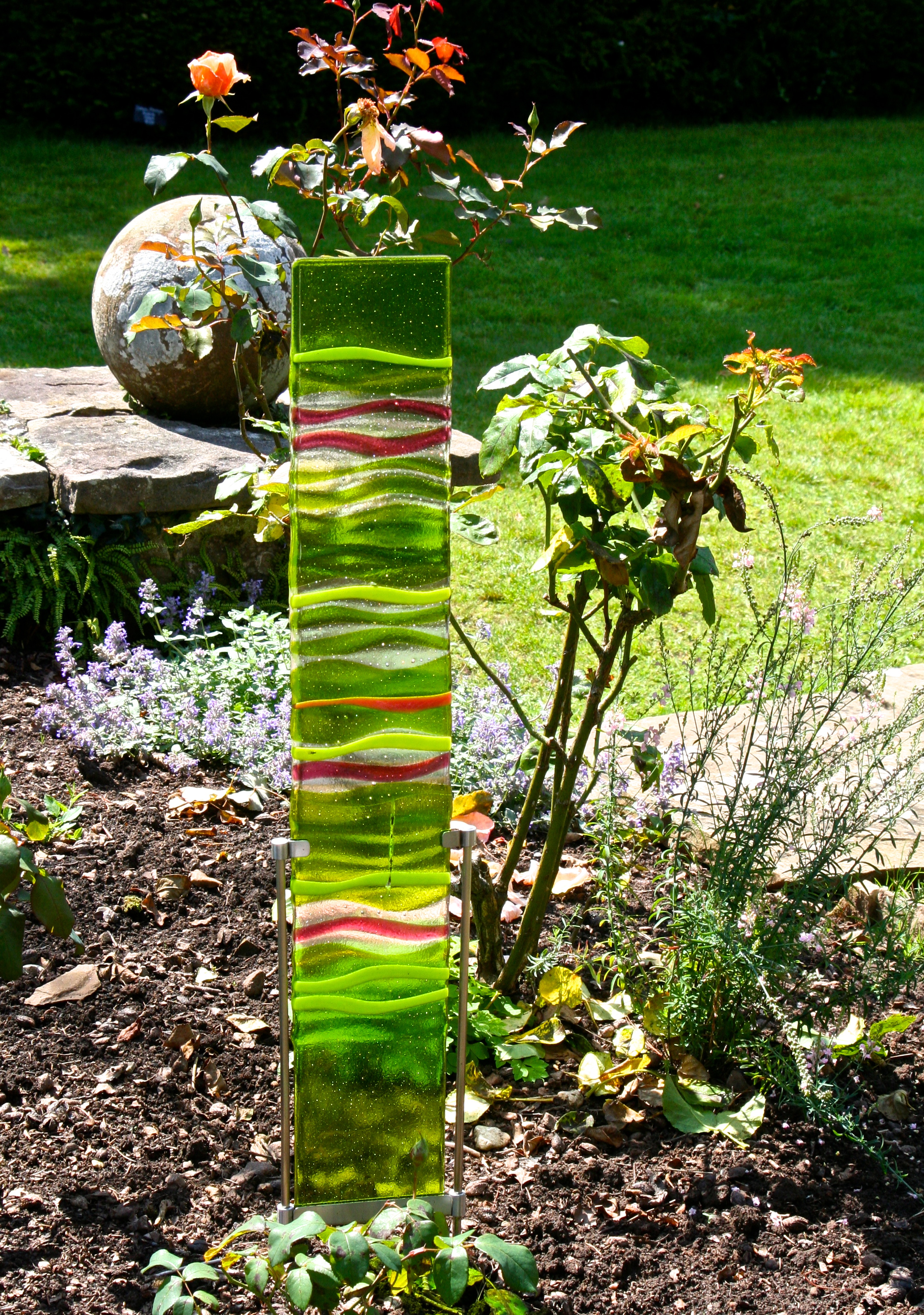
From large metal dragonflies in the forest to these glass sculptures, the variety was amazing.

Caption

Just plain fun…..

Veddw House Garden, in Wales, was truly unique in that it was designed and cared for by “The Bad Tempered Gardener” and her husband. Anne, our hostess, shared with us that she loved gardens but hated gardening! Despite her challenge, they have created what is described as “a modern romantic garden.” Using two acres for gardens and two acres as woodland, the quirky garden was dominated by incredible hedges and LOTS of wild flowers including flowering weeds— yup, I had a massive allergy attack and used up half of England’s supply of Kleenex.

Caption

Each view brought a smile, such creativity.

Caption

This was a favorite. What you do not see is the reflection pool, also mesmerizing.

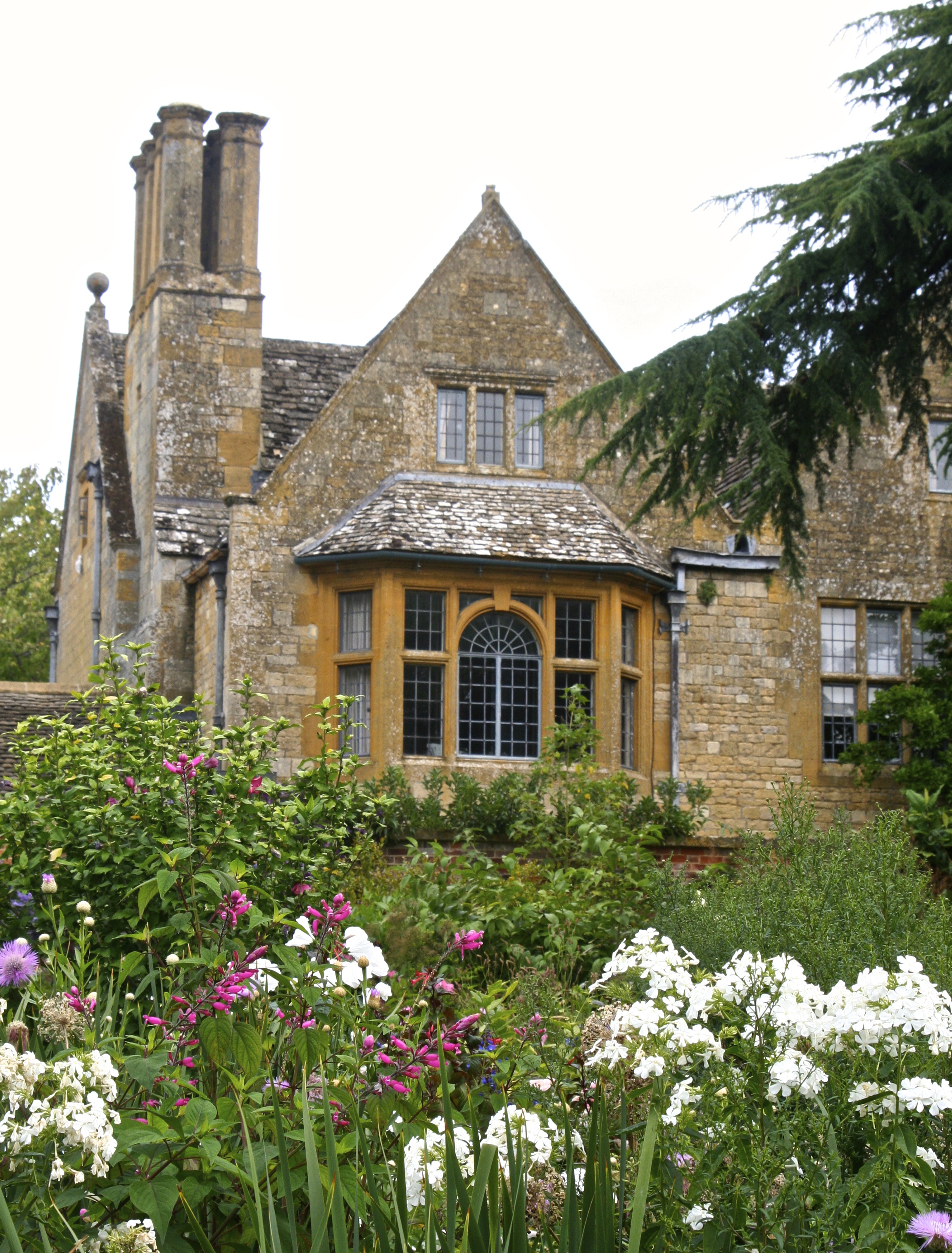
Hellens Manor was our last garden to be visited. More than a garden, Hellens was a historical monument to centuries of history including stories of Ann Boleyn, Mary Tudor, the Earl of Essex, ghosts, and more. The manor was granted to the Bolem Family in 1096, one of whom witnessed the signing of the Magna Carta. Our focus was on the house this time. We had a delightful tour guide who had many stories to tell, including one about surprising guests in a bedroom while leading a tour. The owners created a charitable trust, which runs the estate today. The curator is both American and English, not so unusual apparently based on our experience. The gardens are a work in progress, but did include animal sculptures, a yew labyrinth (easy solved!), and a walled knot garden.

Hellens Manor

Hellens Manor in the town of Much Marcle.

Caption

A favorite part of the garden near Hellens Manor.

As you can imagine, there was so much more to see and describe with the gardens. This was just a taste of our experience, which was absolutely delightful and magical.

Next Blog:

On to the colorful towns in Cotswold were we were free to eat and walk and discover on our own! My kind of touring…

Note: Peggy and I will be traveling in Mexico for the next couple of weeks. We should have Internet but if not we will be off line. –Curt
More Beautiful Gardens in the Cotswolds… by Peggy Mekemson

Hidcote Manor (hedged rooms and sculptured hedges)

Hidcote Manor is known for its “outdoor rooms,” which include  sculptured hedges and dramatic plantings.

In my last blog we visited the gardens of Highclere Castle, Camers, and Abbey House. Today we move on to Hidcote Manor, Kiftsgate Court and Misarden Park.

First up. Hidcote Manor is referred to as the garden of “hedged rooms” and sculptured hedges. In fact, I read that the four miles of hedges require gardeners to work four days a week for seven months just to maintain them! An American horticulturist and later a naturalized British citizen, Major Lawrence Johnson, spent 40 years creating the gardens on land his mother had purchased in 1907. In 1948 he gave this estate to the National Trust. The Trust now advertises this site as an Arts and Crafts Garden.

Caption

Despite overcast days, the colors were still striking.

An example of a hedged room.

An example of a hedged room.

Jane and a sculptured hedge.

Jane and a sculptured hedge.

Caption

The Long Walk at Hidcote Garden.

Caption

The village of thatched stone cottages behind the manor was a wonderful surprise. They were once home to Johnstone’s gardeners. Now the Trust rents them out.

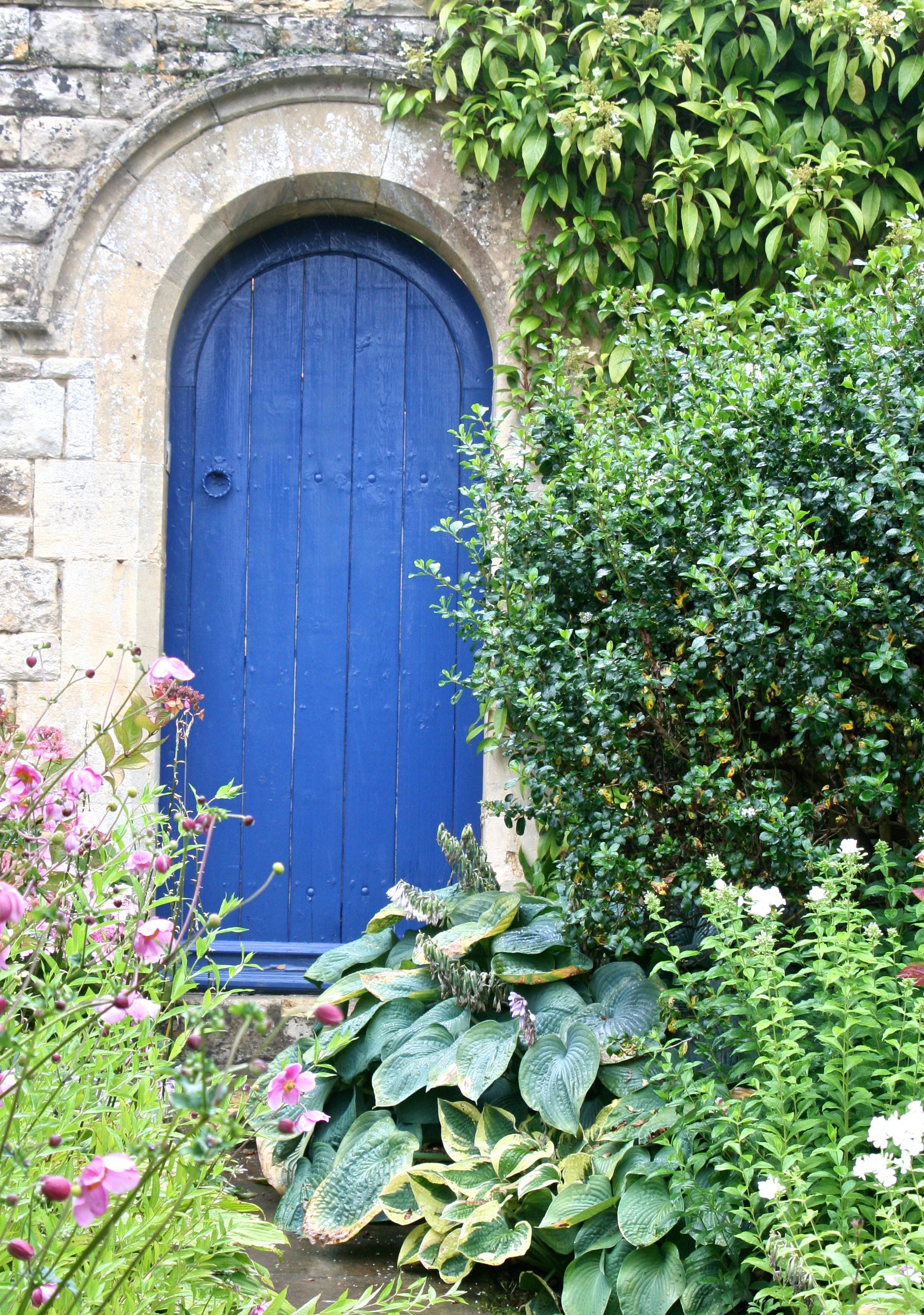
We visited Kiftsgate Court on a rainy day. Having just come from a very dry summer in Oregon, I was thrilled to soak up the rain. With rain comes green, green, green instead of drought, drought, drought! I thoroughly enjoyed the fountains and the reflection pool, which, we were told, is a great swimming hole. The colors that popped out on the rainy day were another treat, especially the blue door leading to who knows what treasures. Your guess is as good as mine.

Kiftsgate Court

Kiftsgate Court

Caption

We were told that we had missed the prime time for full blooms. However, I was pretty impressed by what I saw.

The blue door

The blue door with its overgrown path was quite intriguing.

Reflection and swimming pool.

Our path took us to this reflection pool. We learned that this was also used as  a swimming pool. I was tempted! Just below this overlook was a herd of sheep, quite a magical contrast of white on green.

Misarden Park/Estate began as a 17th century manor house, including 3000 acres and most of the village of Misarden (only the pub and school are not owned by the estate). The Wills, a tobacco family, bought this estate and village in 1913 and takes pride in both “the environment and the wider community.” For example, all electrical lines are buried. They will only rent to tenants who will contribute to the maintaining of the community and the estate. We were delighted to meet a future tenant and his friends who were renovating one of the cottages and happily took us on a tour.

caption

My first view of the residence, which is privately owned.  It was occupied when we arrived. We respected the family’s privacy and gave the house wide berth.

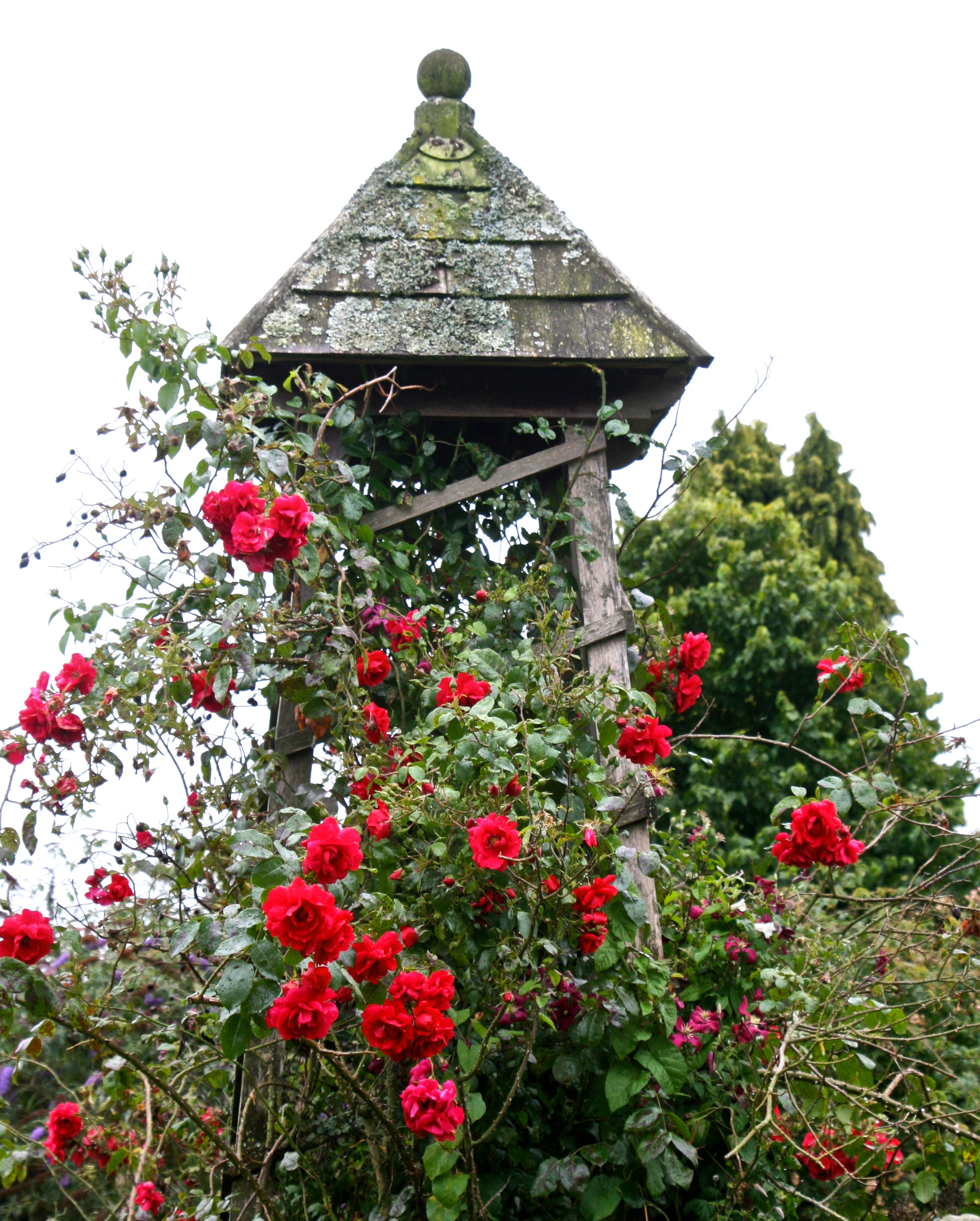
Roses

We had been looking for roses and finally found them— beautifully entwined in this old tower.

Tree

A Hobbit tree? Let your imagination go on this one. Yes, that is a tree packed with stones, all merged for a unique fence.

Gateway

Gateway to another Long Walk. How can one resist following it to the end?

Caption

A final view of the residence with its Cotswold stone roof. I will feature scenes from the village in another blog which captures the character of the small villages in the Cotswolds.

NEXT BLOG: Cerney House, Overbury Court, Whitcombe House, Wyndcliffe Court, Veddw (that’s Welsh, not a misspelling),  and Hellens Manor gardens.

A Garden Tour of England’s Cotswolds… by Peggy Mekemson

Jane and I sit among magnificent Hydrangeas at Highclere Castle (Downton Abbey). A taste of things to come.

Jane and I sit among magnificent Hydrangea at Highclere Castle (Downton Abbey). A taste of things to come.

While I was off touring the California coast north of San Francisco in August, my wife Peggy was on a garden tour of the Cotswolds in England with her sister Jane. She’s been eager to blog about her experience, but I had to finish my Olompali series first. Please join her as she shares the beautiful gardens and charming towns she visited over the next couple of weeks. —Curt
My sister, Jane Hagedorn, loves gardens and she loves England. I love my sister. So when Jane called and asked that I join her for a garden tour in the Cotswolds, of course, I said “yes.” I did little research other than reading the notes sent to us by the tour company and checking the weather in England in August. I was going into this with a completely open mind wondering what my impressions would be….and of course, what kind of photographs would reflect this journey of 12 gardens, several abbeys, a cathedral, and seven English villages. The camera was packed!

We extended our stay to join my brother John and his wife Frances for a few days in London. They had been traveling via auto throughout Europe for 5 months. We had some catching up to do. John also had been blogging about their adventures, a great read. Check it out: http://dallen.posthaven.com

When Curt suggested I put together 4-6 guest blogs, I delayed, delayed, delayed! How could I take 800 photos and select a mere 50-75 to share on the blogs? What would I say— Curt is the writer in this family! Nevertheless here you are, beginning with three blogs featuring a brief photo journey of gardens in the Cotswolds. Following the gardens I will feature the Abbeys and small, colorful towns of Cotswolds.

1st Blog: Highclere Castle aka Downton Abbey, Camers in Old Sodbury, and Abbey House Garden aka Home of the Naked Gardeners in Malmesbury.
Let me start by noting that all of the gardens were gorgeous. The colors, the size of the flowers, the hedges, the orchards, the kitchen gardens, sculptures and water fountains— wow! It was really, really hard to limit myself to 15 photos per blog that Curt suggested. I quickly learned that gardens came in all shapes and sizes ranging from 1 acre to 5000 acres. They were attached to castles, farmhouses, abbeys, manors, courts, parks, and houses. Also, I love architecture, so I have included photos of the various residences.
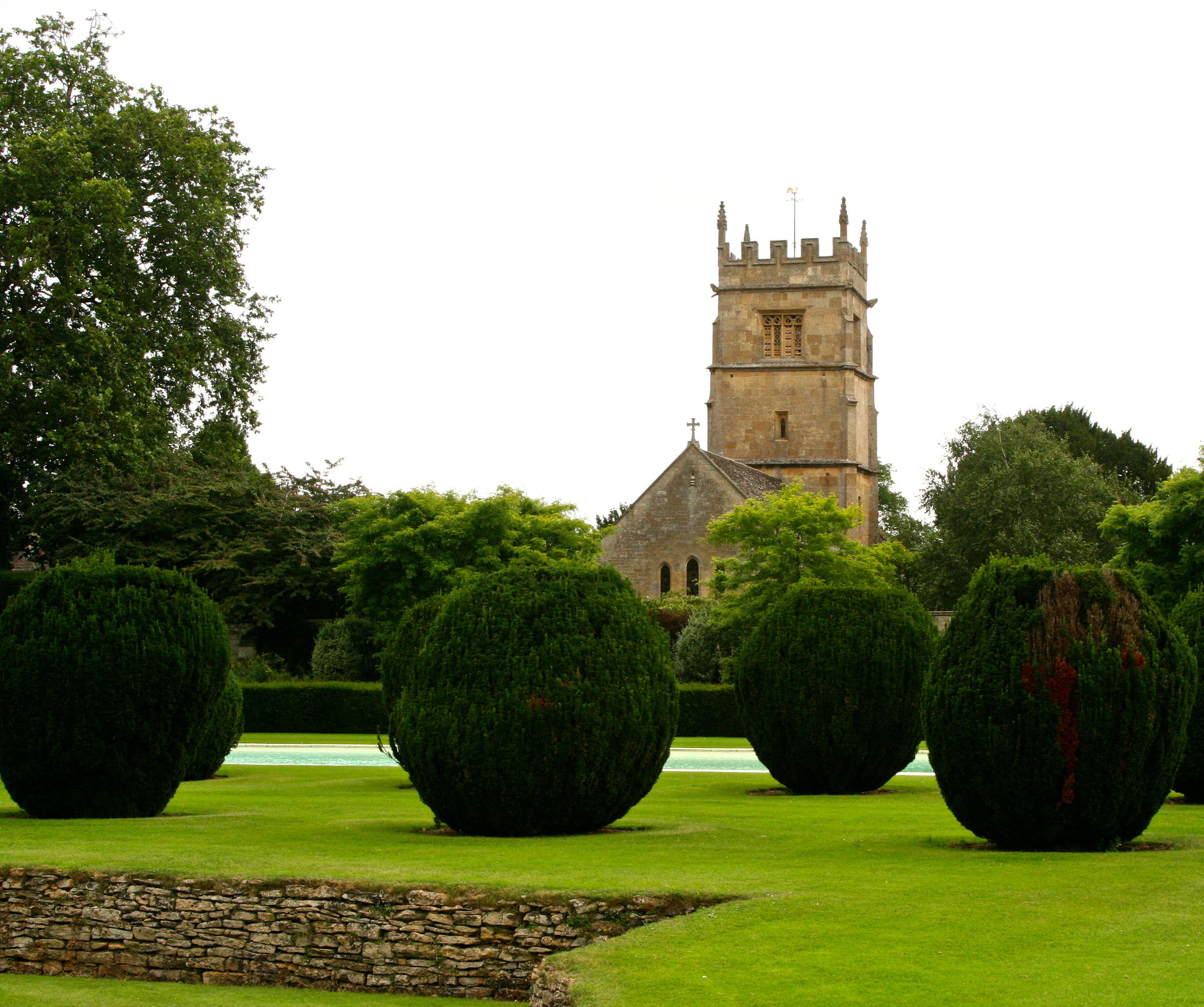
Historically, what was once a medieval palace became a house and then a castle rebuilt between 1838-1878. Over 1000 acres, it is considered a parkland featuring lawns, cedars, and deciduous trees….and a few gardens.

Historically, what was once a medieval palace became a house and then a castle rebuilt between 1838-1878. Over 1000 acres, Highclere Castle is considered a parkland featuring lawns, cedars, and deciduous trees….and a few gardens.

First stop on the garden tour: Highclere Castle aka Downton Abbey. Although its location is actually in Berkshire, it was on the way to the Cotswolds and….we had tickets! With the popularity of the PBS series Downton Abbey, Highclere Castle has become quite a challenge to visit. It is open to visitors only 60-70 days a year. It is privately owned and family still lives in part of the castle! Add to this the fact that August is also a heavy month for tourism— well, there were a lot of people wanting to share this experience.

Second stop: Camers in Old Sodbury (love the English names) was an absolute delight! It is an Elizabethan farmhouse and is part of the National Garden Scheme. That means it is open occasionally for the charity to raise money. We were greeted by the elderly couple who, with their son, own and manage the gardens. They now live in the converted outer building while the son lives in the farmhouse (not open to the public).

We wandered the 2 ½ acre garden which is part of the wooded 4 acres. It was amazing how much color and variety could be found!

We wandered the 2 ½ acre garden which is part of the wooded 4 acres. It was amazing how much color and variety could be found!

Add caption

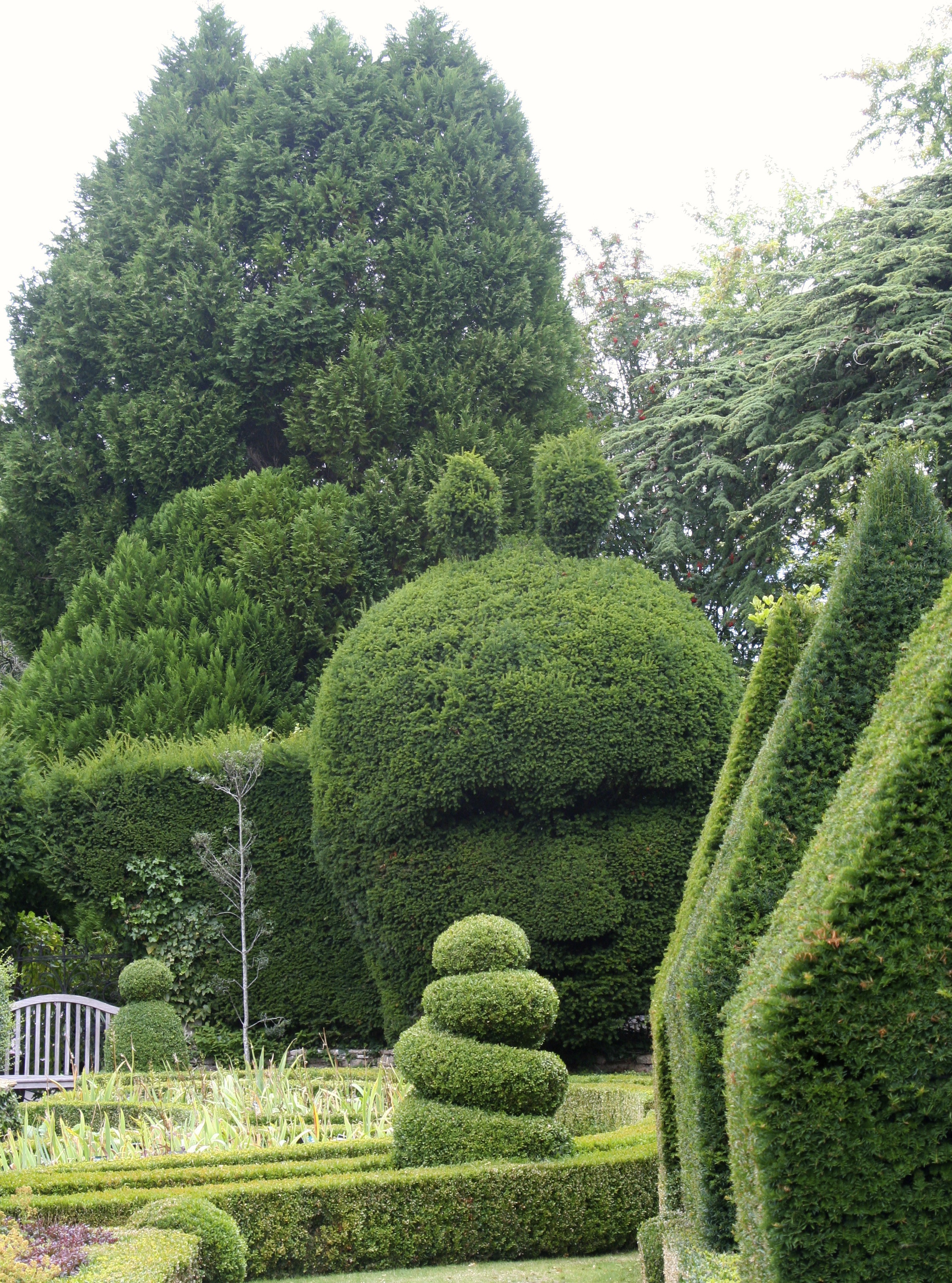
As I soon discovered, hedges are everywhere…all sizes, shapes, and forms.

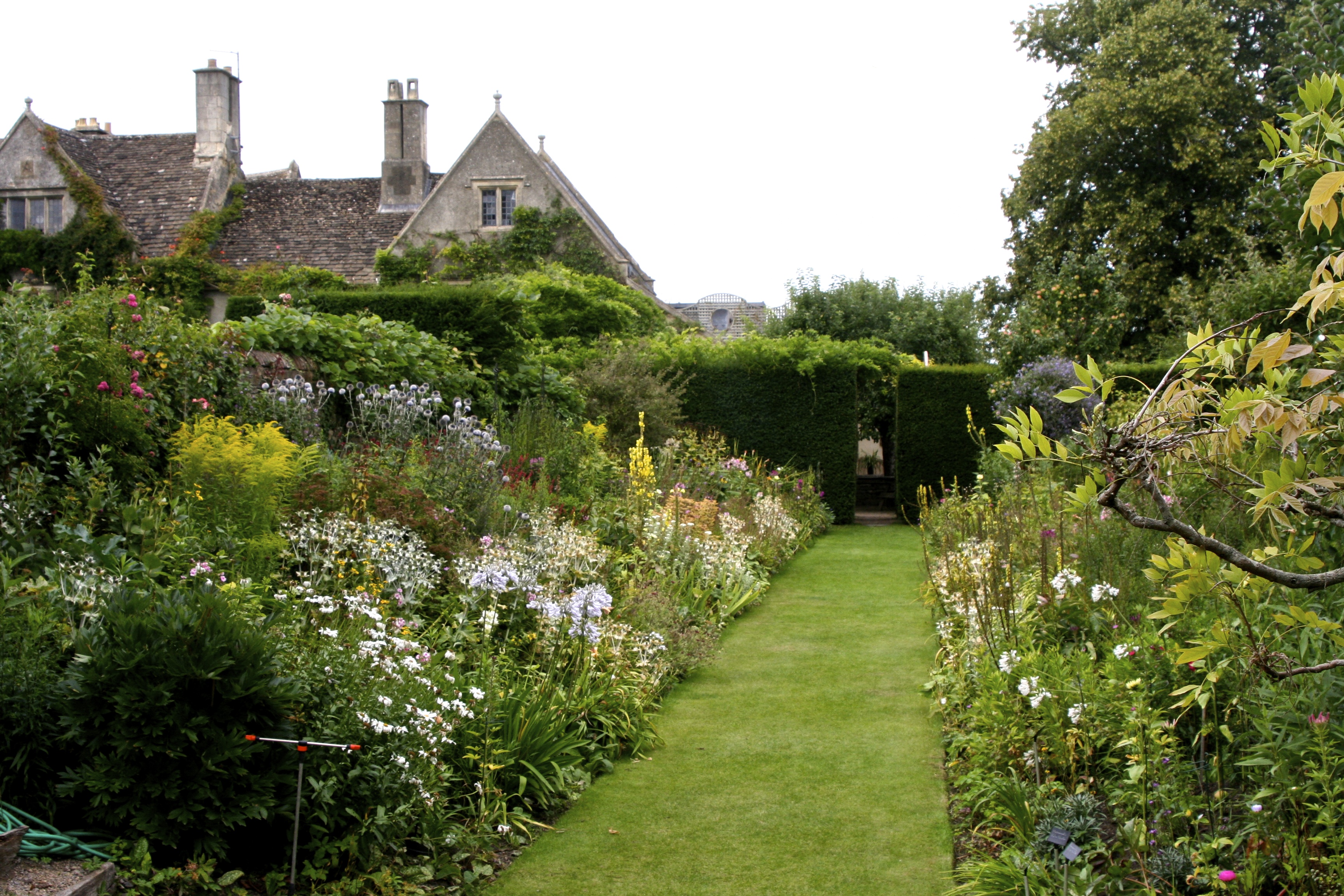
One of many intriguing garden walkways at Camers.

One of many intriguing garden walkways at Camers.

This got our attention. Jane provides perspective! There must be plenty of water in England.

This got our attention. Jane provides perspective! There must be plenty of water in England.

Brilliant colors galore. My last photo at Camers.

Brilliant colors galore. My last photo at Camers.

The final stop today is Malmesbury, the oldest inhabited town in England. Abbey House Gardens is also known as the Home of the Naked Gardeners, Ian and Barbara Pollard. (Their web-site claims clothing is optional on six Sundays during the year.) I couldn’t help but wonder what the monks who lived here in the 12th Century would have thought about going naked. The Pollards purchased the residence and abandoned 5.5-acre garden in 1994 and revitalized it, adding their own touches. I found their design both amusing and eclectic.

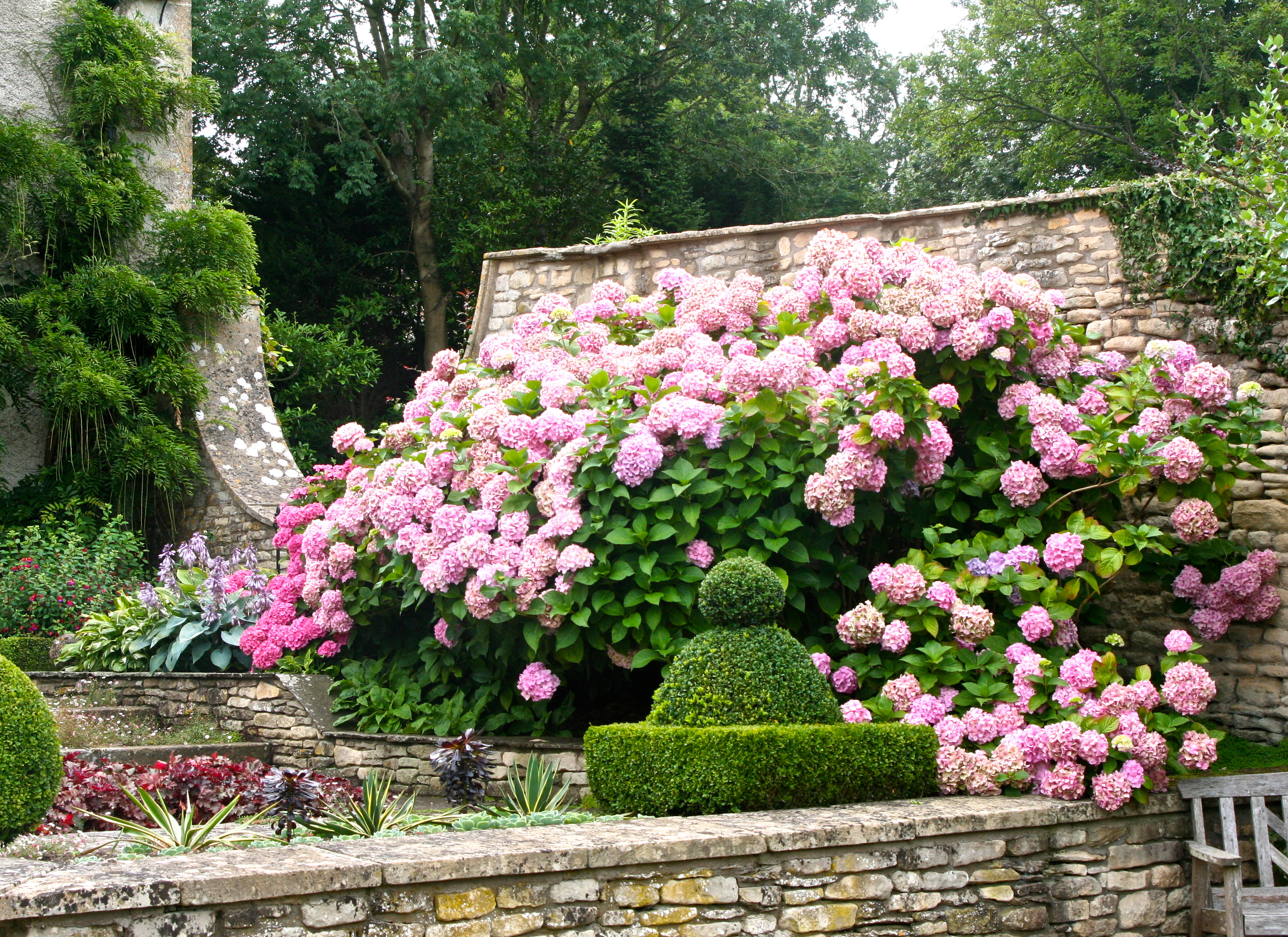
I found the Abbey Gardens eclectic and amusing.

I found the Abbey Gardens eclectic and amusing.

Ad caption

The gardens can be almost overwhelming when trying to capture the design, color, depth, lushness, and uniqueness. However, I had a good time trying!

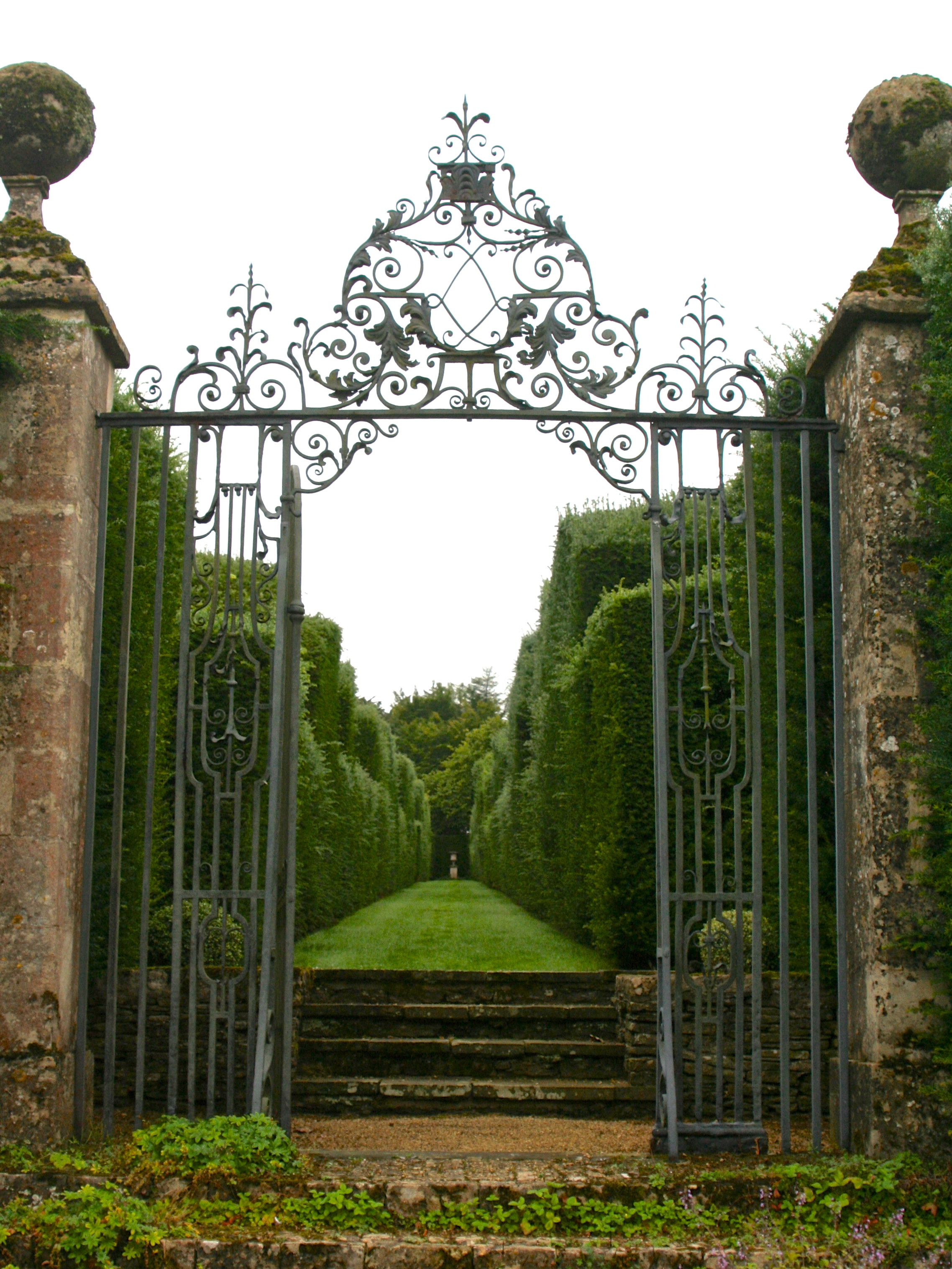
Leaving the Monastery one is greeted by this sculpture at the entrance to Abbey House Gardens.

Leaving the 12th century abbey grounds,  one is greeted by this sculpture at the entrance to Abbey House Gardens.

Next blog: On to Hidcote Manor, Kiftsgate Court and Mismarden Park.

Burning Man: A Media Circus— Or, Possibly, the Greatest Show on Earth

Media representatives are required to check in at Burning Man each year.In line with the 2015 theme, this was the media tent.

Media representatives are required to check in at Burning Man each year. In line with the 2015 theme, this was the media tent. The clown opened its mouth when ready for business.

Burning Man has been in the news a lot, lately. The event has a way of drawing media coverage like, uh, The Donald (that’s in Trump, not Duck). Among the stories: “One-percenters have taken over; The Bureau of Land Management wants Burning Man to pay for million dollar accommodations— plus ice cream, and; (my favorite) Gazillions of bugs are crawling out of the ground. ” The list goes on. Naked people, hippies, and drugs are almost always worked into the story. It improves ratings and readership. If accuracy suffers, oh well.

I thought the 2015 theme, Carnival of Mirrors, was one of the best ever, not to mention an excellent reflection of most media coverage for Burning Man (and presidential politics).

I didn’t think I would be at the event this year, having failed to score in the annual grab bag ticket sale, which rarely works as promoted. But three days before Burning Man, my friends Don Green and Tom Lovering managed to find tickets on Craig’s List in South San Francisco. Don drove down from his home in Lafayette with a thousand dollars cash in his pocket and met a person he didn’t know around midnight on Thursday at a coffee-house he had never been to. The money was for two tickets and a vehicle pass, a real bargain in this age of massive scalping.

I spent all day Friday racing around taking care of the myriad details that involve surviving in the desert for eight days. (Peggy sat this year out since she had just returned from a two-week trip to England with her sister.) The van had to be made ready, my bike checked over, food and water purchased, and a minimal costume assembled. Plus there were the inevitable questions. Where had I put my goggles and bandana for dust storms? Which box hid my bike lock? Did I have enough glow sticks to avoid being run over by mutant vehicles at night? Etc. Eventually, I had everything together and by 10 a.m. on Saturday I was on my way to the small town of Cedarville on the northeastern border between California and Nevada.
Cedarville is our jump off place for Burning Man. We normally stay at the fairgrounds. Not this time. The Modoc County Fair was taking place. You know the old saying, “When you are given lemons, make lemonade?” So I camped at the City Park and walked to the fair. It was perfect. The pigs hammed it up, a goat nibbled on my shirt, and country-western singer sang “Pistol Packing Mama.”

The pigs were 'hamming it up' at the Modoc County Fair in Cedarville, California.

The pigs were ‘hamming it up’ at the Modoc County Fair in Cedarville, California. Check out their cute curlicue tails.

I’ll be writing about Burning Man off and on over the next few months, adding stories in between the other things I blog about. Those of you who have followed my blog for a while, know that Burning Man is one of my favorite things to do— that I love the art, the creativity, and the magic. Regardless of what the media may report, it is one of the greatest shows on earth. What’s not to love about an event where a huge catapult is built to toss a flaming piano for 100 yards? Or where Susan Sarandon shows up with a portion of Timothy Leary’s ashes to re-cremate. (Leary was the guru of LSD in the 60’s and coined the phrase, “turn on, tune in, drop out.” His ashes were distributed among friends after his death. Some were rocketed into space, along with those of Gene Roddenberry, the creator of Star Trek. Susan decided that Burning Man was the perfect place to distribute her share.)

Today, my objective is to introduce Burning Man 2015 with a series of photos. Enjoy. NEXT BLOG: I’ll return to my backpack trip into the Grand Canyon.

A carnival of sorts, complete with sideshows surrounded the Man this year. This was one of four main entrances.

A carnival of sorts, complete with sideshows surrounded the Man this year. This was one of four main entrances. I arrived on Sunday and wandered around before the crowds arrived.

A close up looking up at the Man.

A close up looking at the Man.

Side show posters were located through out the Carnival. I'll show many more in another blog, but this was one of my favorites.

Side show posters were located throughout the Carnival. This was one of my favorites.

Another 'view' of the Man.

Another ‘view’ of the Man and surrounding carnival through a glasses sculpture.

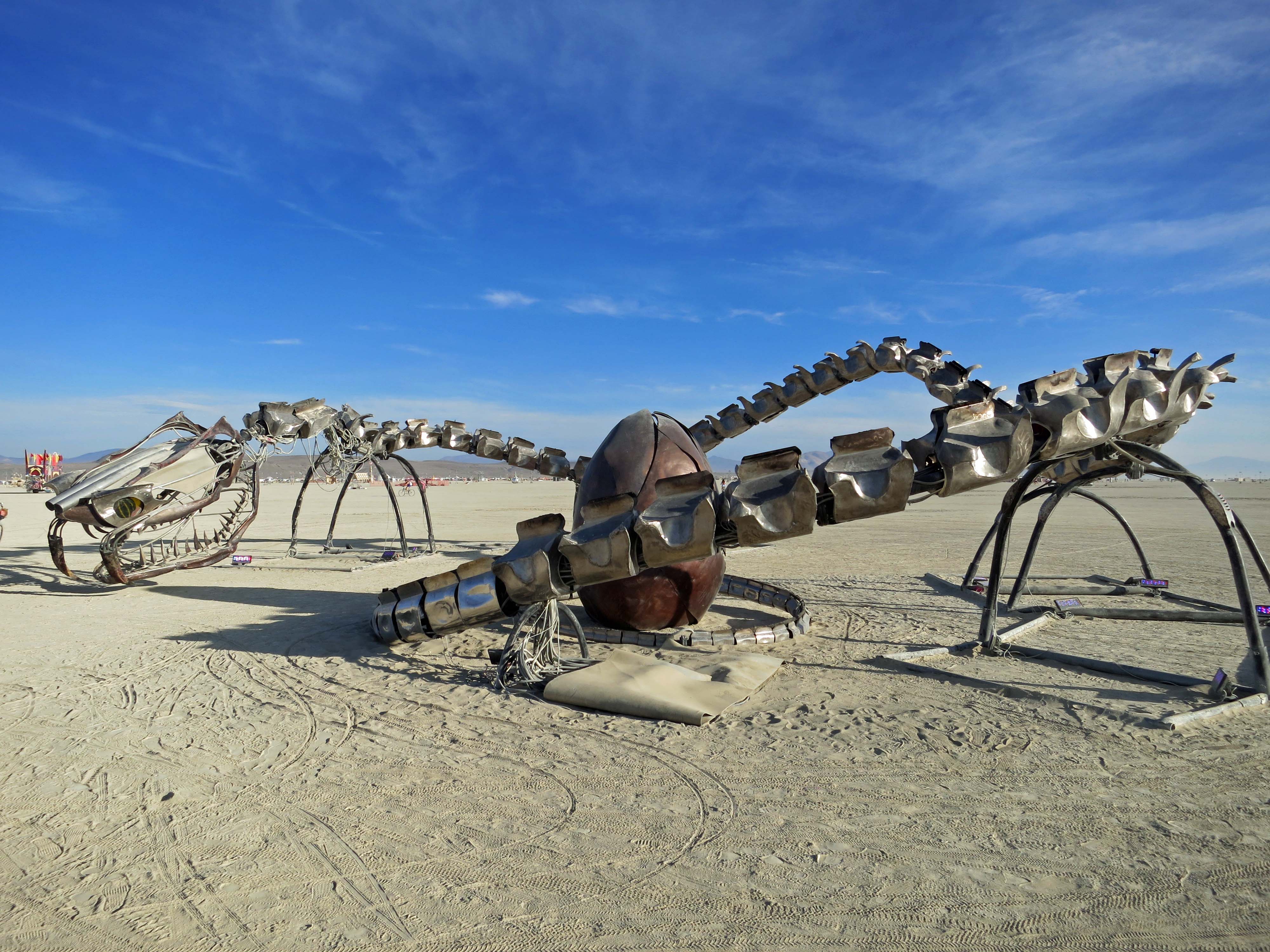
Burning Man is known for its unique sculptures, such as this dragon protecting its egg created by the Flaming Lotus Girls out of the Bay Area.

Burning Man is known for its unique sculptures, such as this dragon created by the Flaming Lotus Girls out of the Bay Area.

Burning Man dragon created by Flaming Lotus Girls for Burning Man.

The same dragon at night.

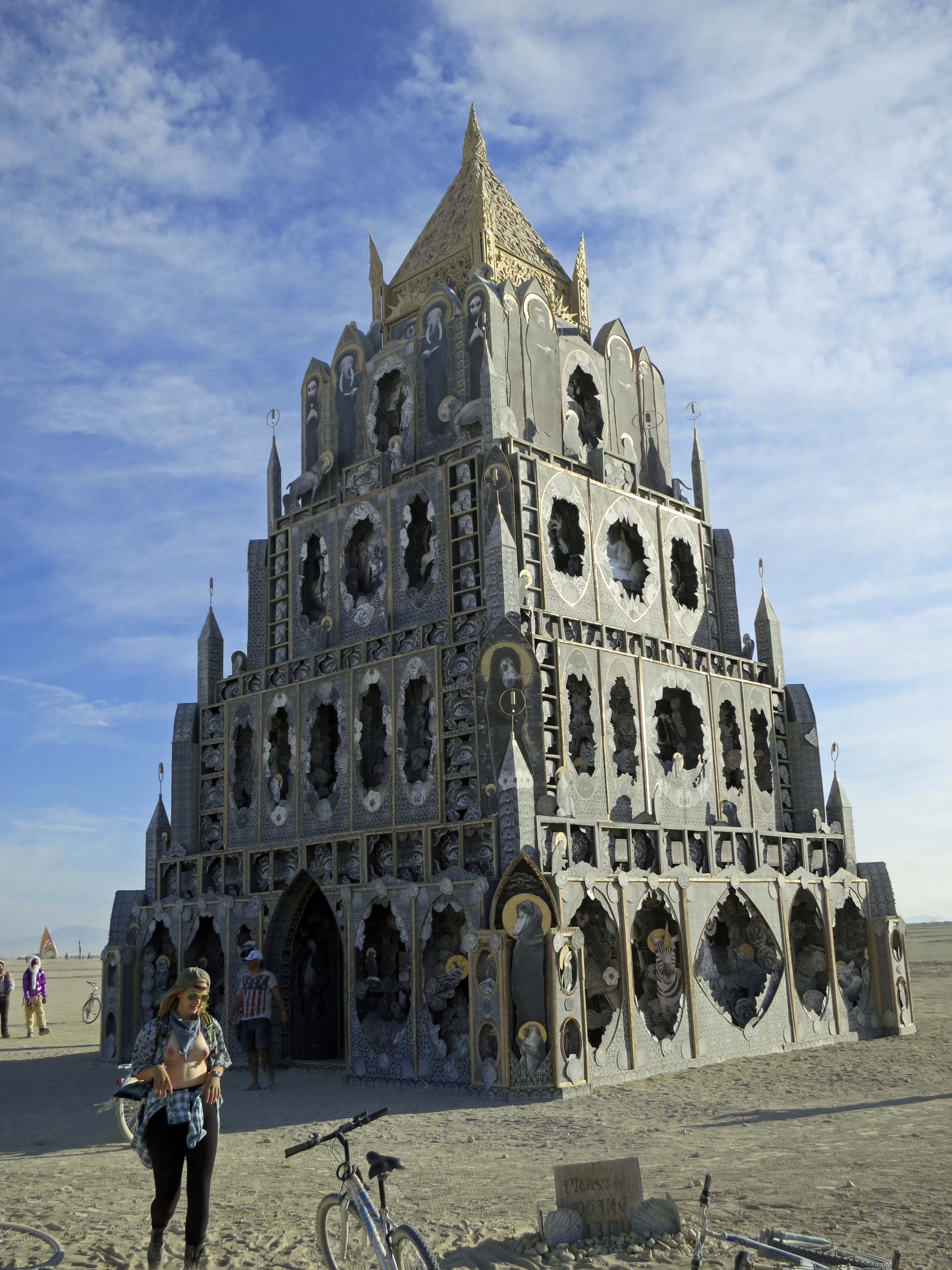
The Temple of Confession where Timothy Leary's ashes were re-cremated.

The Temple of Confession where Timothy Leary’s ashes were re-cremated.

Susan Sarandon donned a wedding dress and led a parade out to the Temple of Confession to deposite Leary's ashes. El Pulpo Mechanico, a 30 foot high octopus was part of the parade.

Susan Sarandon donned a wedding dress and led a parade out to the Temple of Confession to deposit Leary’s ashes. El Pulpo Mechanico, a 30 foot high octopus, was part of the parade.

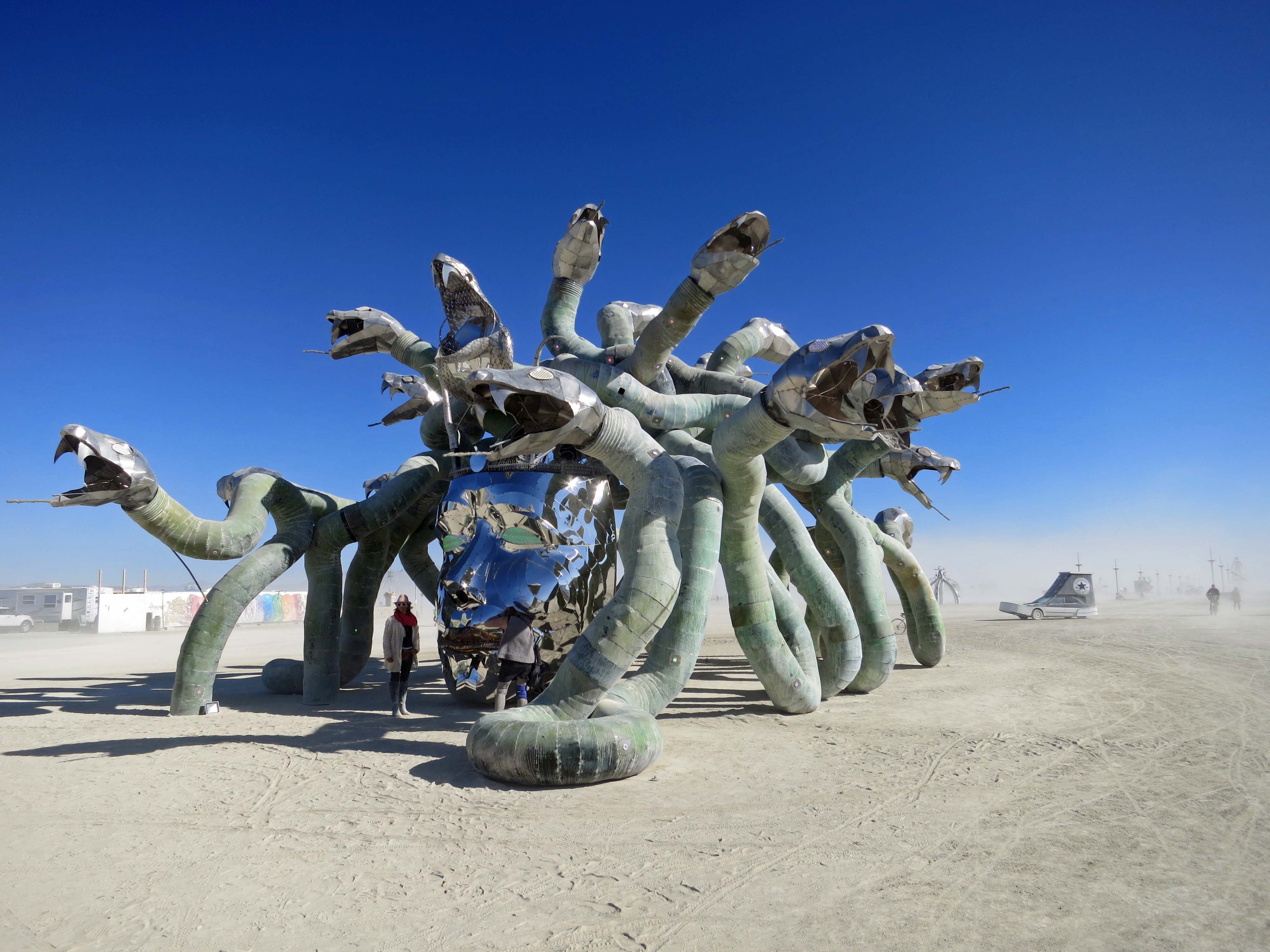
Medusa with her snake hair was one on my favorite sculptures.

Medusa with her snake hair was one on my favorite sculptures. Note the tennis shoe mutant vehicle to the right.

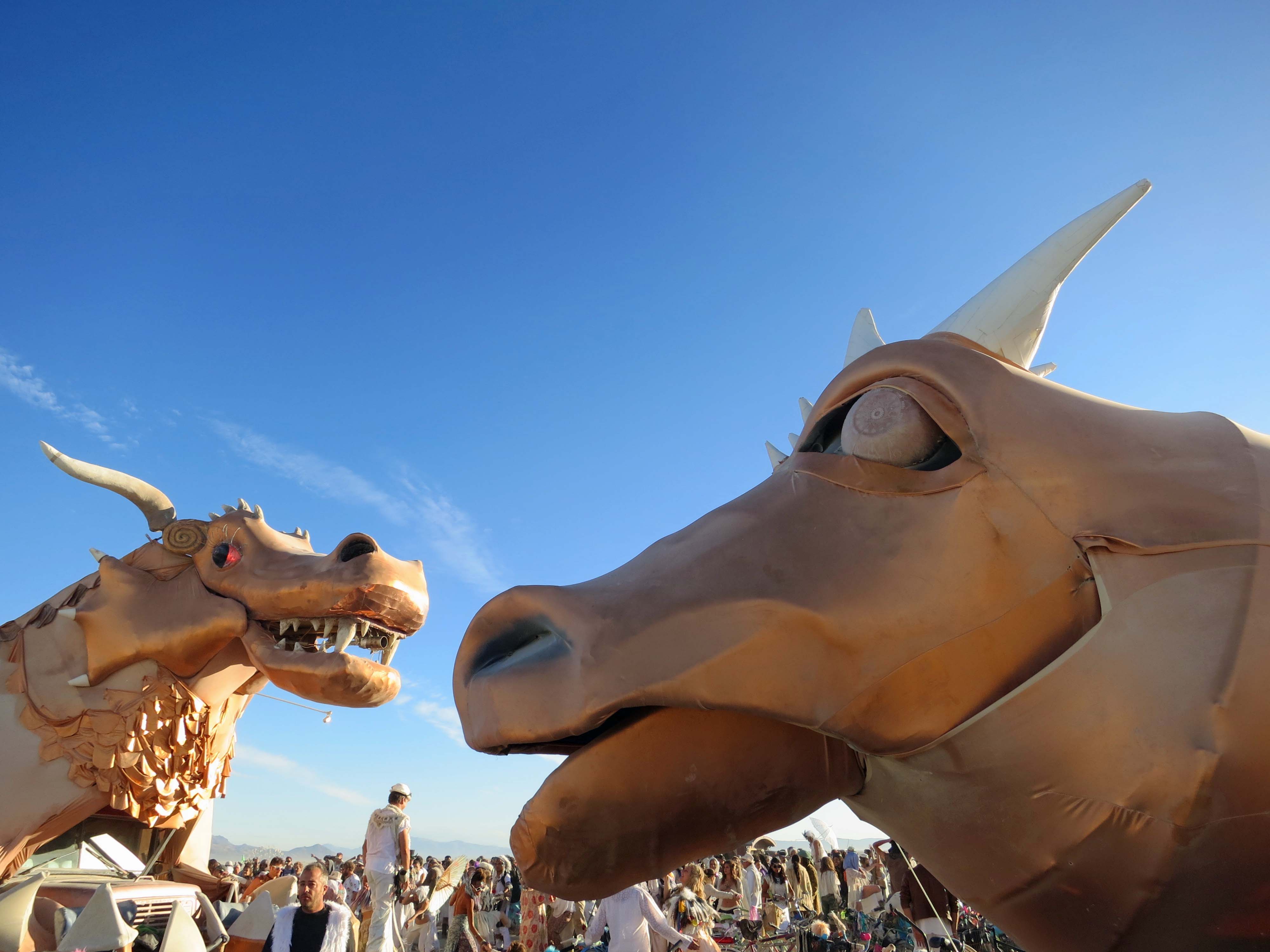
The dragon mutant vehicle on the left brought its baby this year.

The dragon mutant vehicle on the left brought its baby this year.

Costumes are big at Burning Man, as are the dust storms seen in the background.

Costumes are big at Burning Man, as are the dust storms seen in the background.

Sculptures come in all sizes at Burning Man. From this giant woman...

Sculptures come in all sizes at Burning Man. From this giant woman…

To this 'Old Woman Who Lived in a Shoe' sculpture...

To this ‘Old Woman Who Lived in a Shoe’ sculpture…

To this unique sculpture that I found very attractive.

To this unique sculpture that reminded me of flower pollen.

This robot with his dog and a flower was in front of the Center Camp Cafe. He would raise the flower up to his nose and sniff it.

This robot with his dog and a flower was in front of the Center Camp Cafe. He would raise the flower up to his nose and sniff it.

Performance art is found everywhere in Black Rock City.

Performance art is found everywhere in Black Rock City.

The Burning Man Temple at sunrise is guaranteed to draw a crowd. Burners had spontaneously joined hands as the sun little up the Temple.

The Burning Man Temple at sunrise is guaranteed to draw a crowd. Burners spontaneously joined hands as the first rays of the sun bathed the Temple in a gentle light.

I'll conclude with this shot of the Man taking on a ghostly appearance as he burns on Saturday night.

I’ll conclude with this shot of the Man taking on a ghostly appearance as he burns on Saturday night. Hopefully you have found these photos fun and interesting. Many more will follow over the next few months.