Route 66: A Journey Back in Time… The 10,000 Mile Bike Trek

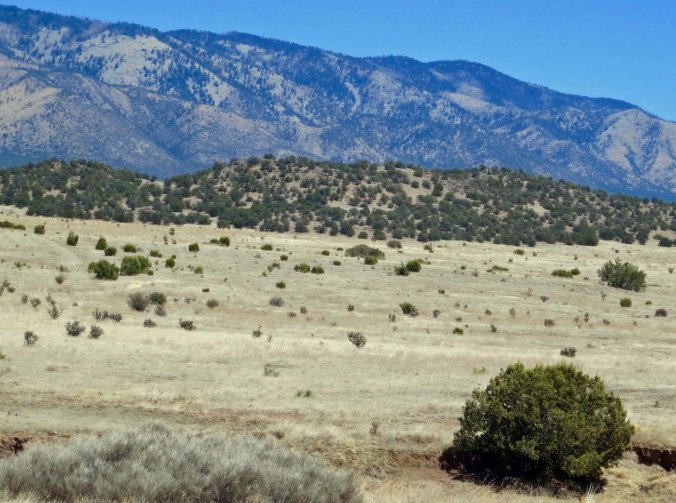
While historic Route 66 travels through six states and numerous climate zones, I always think of it as being in the desert, a prejudice I developed from reading my grandfather's Arizona Highways as a child.

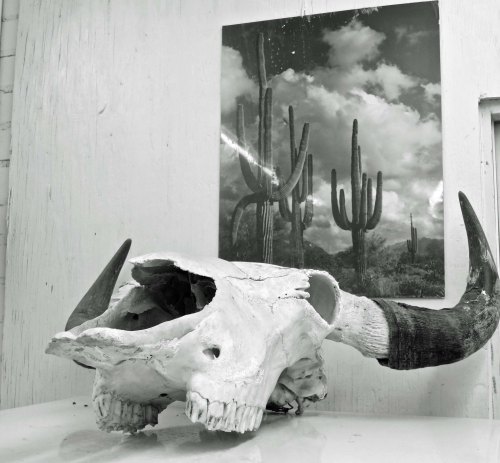
While historic Route 66 travels through eight states and numerous climate zones, I always think of it as being in the desert, a prejudice I developed from reading my Grandfather’s “Arizona Highways” as a child. This photo I took a couple of years ago near Oatman, Arizona would have been the same 60 years ago.


Nostalgia: Pleasure and sadness that is caused by remembering something from the past and wishing that you could experience it again. — Merriam-Webster Dictionary

Route 66 represents nostalgia in mythic proportions. It harkens back to an earlier era— back before the hustle and bustle of modern-day freeways, back before the advent of McDs, BKs, and numerous other fast food restaurants, and back before cell phones insisted that we keep in contact with anyone and everyone all the time, even when on the open road.

It is a blue highway incarnate, and, as I am sure you have figured out, I am a blue highway kind of guy.  When I was planning my bike trip, I designed it to follow some of the loneliest, bluest roads in the US and Canada. Of course there were compromises, Las Vegas being a glaring example. And there were times when my only option was to climb onto a freeway. As I followed busy Boulder Highway up and out of Las Vegas, however, it was Route 66 and North America’s other historic byways that I was dreaming of.

I worked my way up to Railroad Pass, which marks the dividing line between Las Vegas/Henderson and Boulder City. It had been a long haul out of Vegas so breakfast at the Railroad Casino seemed in order. The casino has been there forever and lacks the glamor of its Las Vegas cousins. It even came with an old-fashioned café. I ordered one of my favorites: sausage, two eggs over medium, hash browns, whole wheat toast and coffee. It cost four bucks. I left with a happy tummy and a smile on my face, retrieved my bike from the post it was locked to, and headed for Hoover Dam, keeping an eye out for the Desert Big Horned Sheep that hang out in the mountains above the highway.

Boulder Highway as it looks today... not much different than it looked in 1989.

Boulder Highway as it looks today… not much different from it looked in 1989.

“Watch the road, Curt!” I admonished me. Do you talk to yourself? I always have. Riding on a bike for six months by myself made me much more fluent, or maybe the word is verbose.

There is a fun story about the Big Horn Sheep in the area that I related in an earlier blog but is worth repeating here. A small park is located just off the road that bypasses Boulder City to Hoover Dam. The bright green grass beckons to the sheep up on the mountainside during Nevada’s hot, dry summers and down they come. I’ve stopped by a couple of times to photograph them. An acquaintance of my friend Ken Lake lives across the road from the park and related this tale.

The path the sheep follow down to the park passes right by a house that has a shiny, aluminum garage door. One day the herd ram noticed another large ram in the door— staring back at him, challenging him. Here was competition for his lovely ewes! This wasn’t to be allowed, of course, so he reared up and charged the door full tilt, crashing into it with his mighty horns. But the other ram was still standing, albeit a bit beat up. So he charged again and then again. The door was trashed. Apparently the owner had a hard time persuading his insurance agent how the damage was caused.

The herd ram determining whether my taking his photo was something he should be objecting to.

The herd ram determining whether my taking his photo was something he should be objecting to.

Peggy and I have a similar problem at our home in Oregon. The big tom turkeys that live in the forest like to parade their harems through our yard. The largest of the toms has discovered the turkey that lives in the bumper of our Toyota Tacoma pickup. He is not happy. I’ve seem him stand in front of the bumper for thirty minutes at a time, fluffing out his feathers, sticking out his neck in a loud gobble, and pecking the bumper. The other turkey fluffs his feathers, sticks out his neck and pecks right back. All of this would just be humorous except the big tom goes looking for the other turkey. He flies up, lands in the pickup bed… and poops. Admittedly, turkey poop isn’t as traumatic as having your garage door trashed, but it is copious and messy. The tom and I have had several discussions about my love of roast turkey.

I was yet unaware of the Big Horn Sheep and a long way off from owning a wilderness retreat in Oregon when I cycled by the park on my bike trip. I made my way down to Lake Mead and crossed over Hoover Dam. Looking out over the lake and the distant drop on the far side from a bicycle was quite an experience. If I were to cross the dam today on my bike, TSA would stop me at its check point and make me empty out my panniers to determine whether I was a mad bomber. Why else would someone bike across the dam— and up the other side?

The climb out was hot and steep, filled with hairpin turns, autos and large RVs. I sweated all of them, so to speak. Reaching the top, I was faced with another challenge, miles and miles of sizzling, desolate desert with minimal facilities. My kind of country.

A high four multi-lane bridge has replaced crossing over Hoover Dam when traveling between Nevada and Arizona. This shot looks down on the old highway I was following after climbing out of the canyon.

A high, multi-lane bridge has replaced crossing over Hoover Dam when traveling between Nevada and Arizona. This shot looks down on the old highway I was following after climbing out of the canyon.

A bit farther up the road looking south. Dante would have found this site suitable for his concept of hell.

A bit farther up the road looking south. This photo could have served as an illustration for Dante’s Inferno.

I biked on, catching far off views of the Colorado River and then picking out a distant mountain to bike toward. As I reached my goal, the sun began to set, and warm breezes turned slightly cool. It was time to search for a home. Unfortunately, a sturdy fence blocked easy access to the desert. I wasn’t particularly interested in being caught climbing over. There are a lot of guns in Nevada. A kindly dirt road came to my rescue. I took advantage of a break in traffic and zipped down it and into a dry gulch, the perfect hiding place— as long as it didn’t rain and the local rattlesnake was elsewhere. I fired up my backpacking stove, made a cup of coffee, added a dash of 151 proof rum, and downed a granola bar. Life was good. Coyote music lulled me to sleep.

Looking down on the Colorado River from a viewpoint on the Las Vegas-Kingman road.

Looking down on the Colorado River from a viewpoint on the Las Vegas-Kingman road.

I used this mountain as a marker to determine my progress.

I used this distinctive mountain as a marker to determine my progress.

Looking out toward my home for the night.

Looking out toward my home for the night. Not bad, eh? Or is it that 151 proof rum improves how everything looks?

I was up early in the morning and out before the traffic. Fifty-miles later I was in Kingman, Arizona, a town bursting with pride about its Route 66 heritage, and hoping to harvest a bundle of tourist dollars because of it. I grabbed a room in a beat up old motel that claimed Route 66 vintage and prices. Following a much-needed shower, I headed out to follow the road through the town and absorb some of its ambience.

Kingman, Arizona is quite proud of its connection to Route 66. Two different museums in town feature Route 66 themes.

Kingman, Arizona is quite proud of its connection to Route 66. Two different museums in town feature Route 66 themes.

A number of murals depict a romanticized view of travel on the highway.

A number of murals depict a romanticized view of travel on the highway.

When I talk about the inexpensive motels I found along my bike route, this is what Peggy assumes they looked like.

When I talk about the inexpensive motels I found along my bike route, this is what Peggy assumes they looked like.

A beautiful desert sunset as seen from Route 66 in Kingman.

A desert sunset as seen from Route 66 in Kingman.

The next day found me absorbing much more as I left the town behind and made my way east on what was once one of America’s main cross-country routes. Today it is a quiet road. The majority of the people traveling east and west are zipping by on Interstate 40, rushing toward whatever destination/destiny awaits them.

When I think of Route 66, I think desert. When I was a small boy, I was enthralled by my grandfather’s subscription to “Arizona Highways.” It often featured Route 66, and it featured deserts. My first acquaintance with the highway was when I was driving west from Atlanta in 1968 and followed portions of it through Arizona, including the one I was biking on.

My route for the day took me on a gentle climb up through arid lands with views of mesas along the way. Occasional creeks were teaming with life that was seeking the desert’s most treasured commodity, water. I passed by ramshackle old buildings that had seen their heyday in the 40s and 50s. I waved at the few cars that passed me, either locals going about their business, or romantics like me, seeking a taste of a bygone era. A train whistle receding into the distance fit right in. I ended my day at the Grand Canyon Caverns, a tourist attraction of the early Route 66 that still pulls in visitors today.

Route 66 above Kingman.

Route 66 above Kingman.

A mesa above the highway. Traveling over the mets and beyond will bring you to the Grand Canyon.

A mesa above the highway. Traveling over the mesa and beyond will bring you to the Grand Canyon.

An old building that served as a gas station and garage during the heyday of Route 66. The gas pumps had been updated, but even they were no longer in use. I rendered the photo in black and white to represent the era.

An old building that served as a gas station and garage during the heyday of Route 66. The gas pumps had been updated, but even they were no longer in use. I rendered the photo in black and white to represent the era.

My campground for the evening with a typical Route 66 sign.

My campground for the evening with a typical Route 66 sign.

The campground/motel and caverns also featured dinosaurs. (Photo by Peggy Mekemson.)

The campground/motel and caverns also featured dinosaurs. (Photo by Peggy Mekemson.)

The restaurant featured Betty Boop.

The restaurant featured Betty Boop.

And this map showing historic Route 66.

And this map showing historic Route 66. The arrow points to the Grand Canyon Caverns.

Sunshine lights up dark clouds that were promising rain at the campground.

Sunshine on the juniper trees provides an interesting contrast to the dark clouds that were promising rain at the campground.

Sunset at the Grand Canyons Cavern Campground.

I’ll conclude this post with sunset at the Grand Canyons Cavern Campground.

Note: If you are new to this series, my wife Peggy and I are retracing my 1989 bike route, this time in our van. Most of the photos come from our present trip.

NEXT BLOG: I will feature the rest of my bike trip across Arizona, including a very scary one a.m. invasion of a motel room I was sleeping in.


From Death Valley to Las Vegas… The 10,000 Mile Bike Trek

A coyote ran along beside me for a short while as I rode out of Death Valley. Here's a shot of a Death Valley coyote saying , "Feed me!"

A coyote ran along beside me for a short while as I rode out of Death Valley. Here’s a shot of a Death Valley coyote saying , “Feed me!” (Photo by Peggy Mekemson.)

I struggled with what to title this blog; Death Valley to Las Vegas seemed so ordinary.  I played with titles like ‘from wild to whacky’ and “from the sublime to the stupendous” but gave up. How do you compare Death Valley with Las Vegas? Is it even possible?

I wasn’t thinking about Las Vegas when I cycled out of Furnace Creek. There was another hill to climb. Not bad, just long— maybe 20 miles, and low gear the whole way. I cycled past Zabriskie Point and Twenty Mule Canyon, slowly. There was plenty of time to appreciate the scenery.

A view of Twenty Mule Canyon as seen from Highway 190.

A view of Twenty Mule Canyon as seen from Highway 190.

Another view of the Canyon.

Another view of the Canyon.

At one point, a curious coyote trotted along beside me in the bushes. A few minutes persuaded him I wasn’t going to slip him a snack. Coyotes are animals of opportunity when it comes to meals. The National Park has a strict rule on not feeding them. One time, Peggy and I were coming into Death Valley from Beatty, Nevada and a coyote was sitting beside the road just outside of the boundary, looking hungry. We laughed and stopped to snap its photo. Did the wily fellow (remember Wile E. Coyote and the Road Runner) know that tourists were fair game before entering the park?

Eventually I crested the hill I had been climbing and cycled down to Death Valley Junction. Twenty or so people live in the area. The town population sign announces less. Beside it’s minimal population, the Junction’s claim to fame is an opera house. I didn’t hear any arias, not even ghostly ones, but I was able to refill my water bottles.  I made my own music by blowing into the bottles. Leaving town, out where no one but the jackrabbits could hear me, I belted out O sole meo.

From Death Valley Junction, it was a straight, very flat 20-mile ride into Amargosa Valley and Highway 95. Along the way, I passed into Nevada. My adventure had truly begun. No one was around to help me celebrate except a far-distant free range cow. Or maybe it was a burro. Whatever, I mooed at it.

Highway 373 leading into Amargosa Valley was straight and flat. See any cattle or burros?

Highway 373 leading into Amargosa Valley was straight and flat. See any cattle or burros?

Peggy and I found this large one along the highway as we retraced my bike route. It wasn't there when I biked through the area. I think I would have spotted it.

Peggy and I found this large cow along the highway as we retraced my bike route. It wasn’t there when I biked through the area. I think I would have spotted it.

Highway 95 is Nevada’s main (only) road connecting Reno, Carson City, and Las Vegas. I stopped at the junction and decided to call it a day. A small restaurant/casino promised food and entertainment. A rest stop provided bathroom facilities. A bar across the road pointed out I was in ET country. Area 51 was near by. What more could a lone cyclist ask for? I biked over to the restaurant, downed a chiliburger, and was entertained by a seasoned waitress. “Where you headed, Honey?” Afterwards, a friendly video poker machine paid for my dinner. As dusk approached, I found a hidden area behind the rest stop and took out my ground cloth, sleeping pad and sleeping bag. I went to sleep looking for flying saucers zipping across the sky.

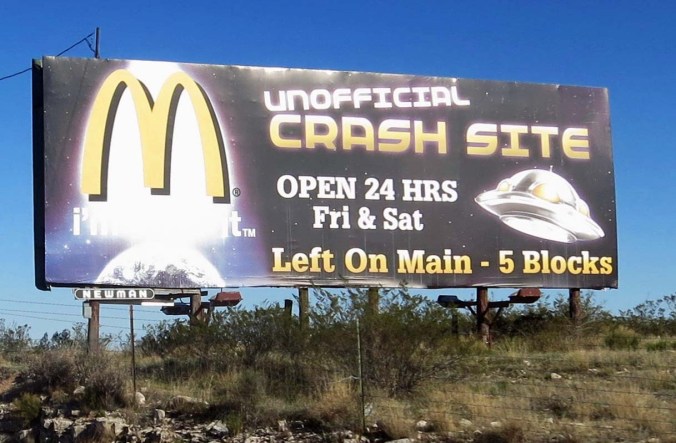
ETs and Area 51 have become tourist attractions. This establishment is in Amigos Valley on Nevada Highway 95.

ETs and Area 51 have become tourist attractions in Southern Nevada. This establishment is in Amargosa Valley on Nevada Highway 95. The more you drink, the more aliens you see.

Area 51 in the Nevada Desert.

The actual Area 51 is a hundred or so miles across the desert. Peggy and I visited the area on one of our trips. I don’t think the government wants you on the site.

I was up early the next morning and on my way to the neon jungle— sin city. There really wasn’t much reason to hang out in the bushes behind the bathrooms, as I am sure you will agree. I did stop for a quick breakfast and chat with my favorite 70-plus waitress. “I see you are on your way dear. Can I ride along on the back?” “Only if you pedal, honey.” “Oh, I have something to peddle, alright. Is that what you have in mind?” I laughed and left a generous tip.

My video poker machine beckoned as I went out the door. It wanted its money back. “Not today,” I told it and patted it fondly.

Twenty-five miles or so down the road, I came on a bizarre sight for the middle of the desert: protesters. I thought maybe my lonely hours on the road were beginning to take their toll and I was seeing a mirage. But the protesters were real and they had a serious mission; they carried “Ban the Bomb” signs. Nevada’s nuclear test site was just off to the east and protests over America’s nuclear bomb testing program had been going on in the area for years. Seventy-five people had been arrested there the week before on Palm Sunday. Government records later revealed that over 37,000 people had participated in the test site protests with some 15,740 arrests made, including the likes of Carl Sagan, Kris Kristofferson, Martin Sheen, and Robert Blake.

As a child growing up in the 50s, I remember witnessing one of the first atom bomb tests in Nevada— from our home in the Sierra foothills! My brother, sister and I got up with our parents at some time in the wee hours in the morning and held a countdown. The whole southeastern sky lit up. Guests staying at hotels in Las Vegas actually got to see the tale-tale mushroom clouds from this and later tests. Strange entertainment indeed. I am sure the casinos protested; it took time away from gambling.

Peggy and I revisited the site a year ago. We took the exit off the road toward Mercury. Nothing was marked on the exit sign except “No Services.” A couple of hundred yards in, not visible from the freeway, a large sign demanded that we stop. Military property existed on the other side and all sorts of bad things would happen to us if we trespassed. No photographs were allowed. Suddenly a black SUV was parked next to us. We had no idea where it came from. A man in dark glasses and a suit, looking suspiciously like a character out of Men in Black, was demanding to know what we were doing and insisting that we turn around and get out of there. “We’re on our way,” I announced. As he drove off, I got out and took a photo of the sign, an admittedly small contribution to the protests of yore.

The sign at the Nevada Nuclear Bomb Test Sight.

The sign at the Nevada Nuclear Bomb Test Sight.

I didn’t make it to Las Vegas that night on my bike trip. It was well over 100 miles. My conditioning was coming along fine, but not that fine. The next day I cycled in, dodged insane traffic, found a KOA that wasn’t afraid of someone carrying a tent, and settled in for a layover day. My bike wanted a tune up and I wanted a day on the Strip.

While Las Vegas has changed extensively over they years, it has retained its purpose of separating you from your money. Early casinos, like the nugget, suggested you would be taking gold home.

While Las Vegas has changed extensively over they years, it has retained its purpose of separating you from your money. Early casinos, like the Nugget, suggested you would be taking gold home.

Another example. What's more symbolic of obtaining untold, unearned wealth than the Golden Goose.

Another example. What’s more symbolic of obtaining untold, unearned wealth than the Golden Goose?

Today's emphasis is more on Las Vegas being a resort destination, somewhere you might take the family. Like to Paris for example...

Today’s emphasis is more on Las Vegas being a resort destination, somewhere you might take the family. The strip now features such places as Paris…

Or Venice...

Venice…

And fantasy land.

And fantasy land.

Show girls have always been popular. (Photo by Peggy Mekemson.)

Show girls have always been popular. (Photo by Peggy Mekemson.)

The city has always had a whacky side...

The city has always had a whacky side…

As demonstrated by this and the last photo.

As demonstrated by this and the last photo.

Note: All of the above photos were all taken during our present trip or on previous trips through the region. You may recognize some photos from earlier blogs I have posted.

NEXT BLOG: Join me as I make my way into Arizona and onto Historic Route 66.

Bicycling through Death Valley… The 10,000 Mile Bike Trek

These gorgeous sand dunes are located next to Stove Pipe Wells.

Of the many reasons for cycling into Death Valley, these gorgeous sand dunes next to Stove Pipe Wells are among the top. Portions of Star Wars were filmed here.

I didn’t have to bicycle through Death Valley, but how could I resist. It is known as the hottest, driest, and lowest place in North America. It holds the world record for heat at 134° F, receives an average of less than two inches of rain a year, and is 282 feet below sea level at its lowest spot. It also happens to be drop-dead beautiful and is close to balmy in spring.

So I packed up my panniers at Isabella Lake and hit the road. Four days of moderate cycling were ahead of me before I arrived at Stove Pipe Wells in the heart of the Valley. At least I was hoping they would be moderate.

Day one was a three-beer day. It wasn’t overly difficult; it’s just that I made a novice mistake, one that can cost you dearly in the desert: I didn’t carry enough water. I know better. Over the years I have lectured hundreds of backpackers and bicyclists on the necessity of staying well-hydrated. Yellow pee is bad. (There is a newspaper at Burning Man in the Nevada Desert called “Piss Clear” to remind Burners of this fact.)

I was carrying two, one-liter bottles of water on my bike, close to a half-gallon. I should have been carrying four. By the time I had cycled 8-miles downhill to the town of Lake Isabella and then climbed for 35-miles and 3000 feet to the 5,250-foot Walker Pass, I had consumed all of it. I had drunk my last drop and was sucking on the nipple of my water bottle like a hungry baby sucks on a tit. Had screaming like a one-month old helped, I would have. What’s worse, not a drop was to be had before I reached my day’s destination at Inyokern. I had arrived in the great southwestern deserts of America where people are few and water is less.

Fortunately, it was only 15 miles and much of the way was downhill on a gentle 6% grade. I arrived at Inyokern, found a cheap motel, and consumed several glasses of its bad tasting water. Immediately afterwards, I headed for the restaurant across the road and had my three beers. Gulp, gulp, gulp. That night I was peeing clear, several times. The first thing I did the next morning was to go out and buy a two-liter back-up bottle of water and add 4.4 pounds to my bike. Here’s the thing, I never drank it; I never had to. But I carried it the next 9000 plus miles, as a reminder.

My next two days of cycling were typical desert cycling with nothing but me, rattlesnakes, scorpions, jackrabbits, mining operations— and the US military. Vast areas in the southern desert regions of California and Nevada have been set aside for practicing war and testing weapons. Leaving Inyokern, I biked through Ridgecrest, the site of the US Naval Air Weapons Station, which covers some 1,100,000 acres, an area the size of Rhode Island. It includes 329 miles of paved road and 1,108 miles of dirt roads, none of which were available to me. It did share the sound of jets flying overhead, however. One was so close it almost knocked me off my bike, so to speak. “The sound of freedom,” an air force pilot friend told me. Right.

I decided to spend my night in Trona, since my other option was camping out with the scorpions. Trona was founded as a company town to harvest its namesake mineral, trona, which you probably know as baking soda. Employees were paid in script that could only be used at the company store. (So much for shopping around for the best price.) Trona is still known as a mining town, rightfully so. And it is also known for having the only dirt football field in the US. Grass won’t grow there. The team is known as the Tornados. They should probably be called the Dust Devils. I saw several as I biked through the area.

I am not sure what particular mineral this huge white mound in Trona consisted of, but I don't think it was baking soda.

I am not sure what particular mineral this huge white mound in Trona consisted of, but I don’t think it was baking soda.

My goal for the next day was to bike through the Panamint Valley to Highway 190, the primary route into Death Valley from the west, and then climb up and over the Panamint Mountain Range down to Stove Pipe Wells, where I would be meeting a friend the next day. It was close to 76 miles with zero services along the way, miles and miles of nothing except magnificently lonely desert and million dollar views. I left at seven and made it to Highway 190 around two. Hiding out behind a highway sign, the only shade I could find, I contemplated the road snaking up the mountain and thought, “NO.” I would be climbing close to 4,000 feet in 12 miles in the heat of a Death Valley afternoon. Panamint Springs, known for a good restaurant, its shade and cool water, was a mile or so in the other direction with a minimal climb. My decision was easy… and it was one of my better decisions on the trek.

The road out of Trona was so empty, I would have loved to come across a donkey.

The road out of Trona was so empty, I would have loved to come across a burro. You will see a lot of roads like this as Peggy and I follow my bike route through the Southwest.

A view of the road through the Panamint Valley.

A view of the road through the Panamint Valley.

Looking up at the Panamint Range, the mountains I had to bicycle over.

Looking up at the Panamint Range, the mountains I had to bicycle over.

The sign that welcomes you to Death Valley today.

The sign that welcomes you to Death Valley today.

I was on the road at six the next morning. Within twenty minutes of starting my climb, I was out of the saddle in my lowest gear, travelling about three miles per hour. The climb to Town Pass was the most challenging climb of my journey. On the steepest parts, I would pedal 100 times and stop for a quick break. Only sheer stubbornness kept me on the bike and not walking. I was still irritated at having to walk through the snowstorm on Greenhorn Pass. The total climb took me four hours. I don’t think I could have done it the day before. What goes up, must come down, however, and there was a splendid downhill into Stovepipe Wells. The only challenge was that my bike wanted to go over 40 miles per hour. I told it no.

Climbing up this pass was one of the toughest climbs of my journey, much more tough than climbing over the Rockies.

Climbing up this pass was one of the toughest climbs of my journey, much tougher than climbing over the Rockies.

The road into Death Valley couldn't match the 13% grade coming off of Green Horn Pass but it was definitely steeper than the 6% coming off of Walker Pass. The breaks on our van were smelling of burnt rubber by the bottom. Our friends Ken and Leslie Lake, who joined us in Death Valley, had to replace a rotor on their left front wheel.

The road into Death Valley couldn’t match the 13% grade coming off of Green Horn Pass but it was definitely steeper than the 6% coming off of Walker Pass.

My friend joined me at noon and I allowed her to give me a ride over to Furnace Creek and Park Headquarters. I had earned a break. It was Easter weekend so we ended up camping with RVs in the overflow area. No matter, I slept solidly that night. The next morning, we biked down to Bad Water Basin and the lowest spot in Death Valley. It was all downhill, which sounds like a good thing, except we had to pedal, in low gear. That’s how strong the head winds were. The good thing was they almost blew us back up the mountain. We arrived back in camp and discovered that my beautiful, light weight and expensive Moss tent had disappeared. My stakes hadn’t withstood the wind. I found it a tenth of a mile away, pretty much trashed.

Still, I enjoyed Death Valley, as I always do, and I enjoyed the break in my solo journey my friend provided. The next morning, we attended a non-denominational Sunrise Easter service on top of a sand dune. I said my goodbyes, hopped on my bike, and headed for the glittering lights of Las Vegas.

Peggy and I took the above and following photos as we retrace my original 1989 bike trip. (We’ve now made it to Nova Scotia. Traveling by van is considerably faster than by bike! Eventually, my posts will catch up.) Our friends Ken and Leslie Lake joined us in Death Valley and Las Vegas. 

 Death Valley Sand Dunes

Another view of the sand dunes next to Stovepipe Wells.

This is the same lot at Furnace Creek where my tent had flying lessons. Ken, Leslie, Peggy and I were about to enjoy afternoon snacks.

This is the same parking lot at Furnace Creek where my tent had flying lessons. Ken, Leslie, Peggy and I were about to enjoy afternoon snacks.

People who have never been to Death Valley think of it mainly in terms of heat and desolation. It is actually quite beautiful. This photo was taken in Twenty Mule Canyon.

People who have never been to Death Valley think of it mainly in terms of heat and desolation. It is actually quite beautiful. This photo was taken in Twenty Mule Canyon.

Zabriskie Point is a short distance from Furnace Creek. I biked right by it on may way out. (Photo by Peggy Mekemson.)

Zabriskie Point is a short distance from Furnace Creek. I biked right by it on my way out. (Photo by Peggy Mekemson.)

Our friends Ken and Leslie Lake in Golden Canyon. Ken, too, has bicycled across the US.

Our friends Ken and Leslie Lake in Golden Canyon. Ken, too, has bicycled across the US.

Another view of Golden Canyon. (Photo by Peggy Mekemson.)

Another view of Golden Canyon. (Photo by Peggy Mekemson.)

We just missed the major display of flowers in Death Valley, but I caught these guys in Golden Canyon.

We just missed the major display of flowers in Death Valley, but I caught these guys in Golden Canyon.

This gargoyle-like rock was on the edge of the Canyon.

This gargoyle-like rock was on the edge of the Canyon.

Devil's Golf Course is on the way to Bad Water. The Panamint Mountains are in the background.

Devil’s Golf Course is on the way to Bad Water. The Panamint Mountains are in the background.

Ken and Leslie, 282 Feet below sea level at the lowest point in North America.

Ken and Leslie, 282 Feet below sea level at the lowest point in North America.

We found this character at Furnace Creek demonstrating how to make arrowheads. For a moment, I though Santa Clause may have made a wrong turn.

I’ll conclude with this volunteer we found at Furnace Creek demonstrating how to make arrowheads. For a moment, I thought Santa Clause may have made a wrong turn.

NEXT BLOG: On to Las Vegas

A Huge Bull, a Blinding Snowstorm, and an Insane Downhill… The 10,000 Mile Bike Trek

The Sierra Nevada Mountains as seen from a road leading into Porterville, California.

The Sierra Nevada Mountains as seen from a road leading into Porterville, California. They appeared to be floating in the sky. (Photo by Peggy Mekemson.)


Greenhorn: a person who lacks experience and knowledge.

There came a time when I was out of options. I had gone as far south in California’s great Central Valley as I cared to go. It was time to head east. It was time to leave the flat lands and climb over the massive Sierra Nevada Mountain Range. They were looming ominously in the distance.

Another view of the Sierras from the Central Valley. These two photos were looking north. I would cross over to the south several thousand feet lower.

Another view of the Sierras from the Central Valley. These two photos were looking north. I would cross over to the south several thousand feet lower. (Photo by Peggy Mekemson.)

I was no stranger to the Sierras. I had been raised in their foothills and spent 15 years leading hundred-mile backpack trips up and down its spine. I had hiked their length and breadth. I’d even biked across them a couple of times. But was I ready for them, now? Had my week of biking down the Central Valley prepared me for the tough climbs I knew were ahead of me? Were my knees and fat cells ready for the challenge?

There was only one way to find out.

I spent a half day in the town of Porterville having my bike tuned up. The town perches on the edge of the foothills and the edge of the valley. When I left the town, I would literally begin my climb. As usual, I picked a remote route. My plan was to start off on a country lane with the name of Old Stage Road. It wanders through the foothills and eventually runs into Mountain Road 109 which morphs into Jack Ranch Road before finally dropping down to Highway 155 at Glenville.

From there I would begin my climb up and over Greenhorn Pass, the true test.  I wasn’t a greenhorn, but I was feeling a little green. Kermit would have seen me as a soul mate. I had never been over the road. I had no idea of what lay before me. My goal was to reach Isabella Lake, a reservoir east of the city of Bakersfield and, for me, the gateway to vast desert lands of the Southwest.

Leaving Porterville after lunch, there was no way I would make the 60 miles in one day, however. So I lollygagged. Why hurry? Orange trees greeted me as I biked out of town. Sampling one led to sampling two. California grows great oranges. Eventually the fruit trees stopped but it was a beautiful spring day and the hills were gentle. Luscious green grass was sprinkled with cheerful flowers. Happy cows munched away out in the meadows.

One of the orange trees I biked by near Porterville.

One of the orange trees I biked by near Porterville.

The road worked its way through the foothills that were coated with spring green.

The road worked its way through the foothills that were coated with spring green.

Rock outcroppings along the road were quite beautiful.

Rock outcroppings along the road were quite beautiful.

As were the flowers, such as these California Poppies...

As were the flowers, such as these California Poppies…

And these carpets of white flowers further up in the foothills.

And these carpets of white flowers further up in the foothills.

After some 30 miles, I began looking for a place to land along Mountain Road 109. Forget campgrounds or motels. There weren’t any. A babbling brook caught my attention. It was hidden by trees in a small canyon beside the road. The trees would also hide me. All that stood between me and Shangri-La, was a barbed wire fence. I hadn’t seen a car for 15 minutes and didn’t hear any coming so I quickly took off my panniers and tossed them over the fence, followed by my bike and then me with nary a tear in my clothes. Barbed wire has a nasty disposition. Panniers, bike and I then disappeared into the trees where I set up a pleasant camp a few feet away from the stream. I went to sleep that night to the gentle sound of water cascading down the canyon and a talkative hoot owl.

I could hear a creek hidden down in the trees on the other side of a barbed wire fence that was designed to keep cattle in. But was it designed to keep bicyclists out?

I could hear a creek hidden down in the trees on the other side of a barbed wire fence that was designed to keep cattle in. But was it designed to keep bicyclists out?

A charming stream beckoned.

A charming stream beckoned.

I awakened by a deep, loud, low moo, the type that comes from 2,000 pounds of bull. I couldn’t see him, which meant he couldn’t see me. That was the good. The bad part was that he was between me and the fence. I set about whipping up breakfast on my small backpacking stove, hoping the bull would move along. He didn’t.

As I was loading my panniers, I was struck with how red they were. Bull fighters use red capes, right?  They make bulls angry and encourage them to charge. With a certain amount of don’t-want-to, I picked up my bull-charging panniers and headed toward the fence. The bull was pressed up against the fence and was as big as his moo. His bull-hood almost dragged the ground. He glanced at me disdainfully and returned his attention to staring across the road. I was saved by two girls. A pair of pretty heifers were making cow eyes at him. He could have cared less about me. I didn’t push my luck, however. In a flash, my bike, panniers and I were over the fence and on our way. But not before thanking the girls.

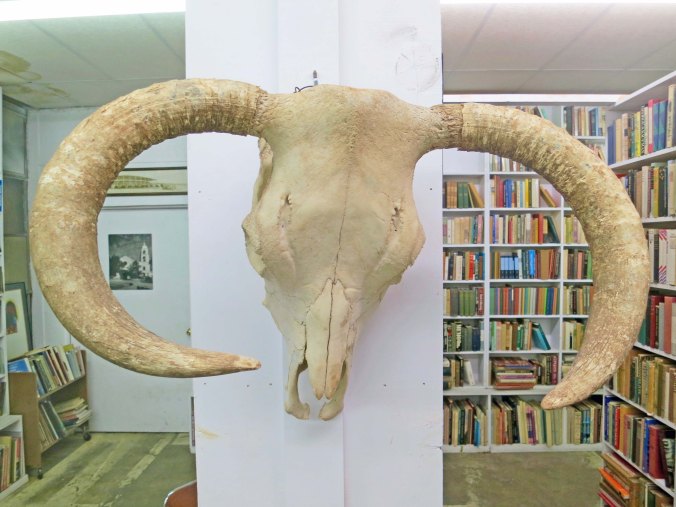
Peggy and I found this Texas Longhorn not far from where I had my bull encounter. The bull didn't have horns like this but he was a heck of a lot bigger!

Peggy and I found this Texas Longhorn not far from where I had my bull encounter. The bull didn’t have horns like this, but he was a heck of a lot bigger!

Two hours later I was eating my second breakfast in the tiny town of Glenville. A pair of old timers eyed me suspiciously. “Where you heading?” one asked. “Over Greenhorn Pass,” I’d replied.

“Oh, I wouldn’t do that. There’s a storm brewing up there today. It’s supposed to snow like crazy. You’ll freeze to death.” He warned me enthusiastically.

“That’s nothing,” his friend declared, not wanting to be outdone in the local doomsday competition. “It’s the drop off on the other side of the pass you need to worry about. Bike brakes can’t handle it.”

Peggy and I found this fun display in Glenville. I didn't remember it from my bike trip.

Peggy and I found this fun display in Glenville. I didn’t remember it from my bike trip. The restaurant is on the other side.

Remember the days when gas was $.40 a gallon? Probably not...

Remember the days when gas was $.40 a gallon? Probably not…

I suspected that the guys were having a bit of fun at my expense so I headed off with only a slight twinge of concern. My attitude changed when I was flagged down by an RV driving down the mountain I was struggling up. “I couldn’t believe how steep it is coming up the other side,” he told me. “I wouldn’t go down it on a bike.” My worry level jumped from a .01 out of 10 to a 9.99 in a nanosecond. But the only option would add a hundred miles. I labored on.

The distant road snakes its way up the mountain toward Greenhorn Pass.

The distant road snakes its way up the mountain toward Greenhorn Pass.

Peggy and I climbed the pass in our van under much more pleasant conditions but these trees mark our elevation gain and are near where the snowstorm started.

Peggy and I climbed the pass in our van under much more pleasant conditions but these trees mark our elevation gain and are near where the snowstorm started.

Thirty minutes later it started snowing. It wasn’t a blizzard but the snow was coming down fast, in large flakes. Visibility was limited. It was cold. I stopped to put on more clothes. At least, I thought to myself, if everyone is right about the drop off on the other side of the pass, I’ll be below the snow-line quickly. It was small consolation— like jumping from a freezing boat into icy water. And first I had to make it to the top. Hypothermia was a real concern. I tried riding but bicycling in the snow without studded tires is difficult and dangerous. So I got off and walked. Summer cabins off to my right caught my attention, but they were still boarded up.

Fortunately, I hit the top in a couple of miles and I wasn’t frozen solid. Better yet, the snow had turned to a few fluttering flakes, and the road off the pass was wet but not covered in slush. I’d survived the bull and the snow, but what about the downhill. A sign announced a 13% grade; 6% is usually enough to post a warning. I thought fondly of the apartment I’d left behind in Sacramento. But what the hell, life’s short. I climbed on my bike and started down. Soon, I was smelling my brakes, like a semi out of control. It was a long, long downhill. I stopped often to let the brakes cool. Even with that, my wheels had lost their true and were slightly warped by the heat when I hit the bottom.

Greenhorn Summit

Greenhorn Summit as it looks on our present trip to retrace my route.

Eeyore peered out the window checking out the elevation. Shortly afterwards he had covered his eyes with his ears as Peggy started driving down the mountain. Even though we were using low gears, we could soon smell our burning breaks. The trip down was as scary as it had been on the bike.

Eeyore peered out the window checking the elevation. Shortly afterwards he had covered his eyes with his ears as Peggy started driving down the mountain. Even though we were using low gears, we could soon smell our burning brakes. The trip down was as scary as it had been on the bike.

I found another motel and declared another layover day. I’d earned it. The motel owner told me that a couple had biked off the pass the week before and then hitchhiked 50 miles into Bakersfield to have their wheels trued. I managed mine with a spoke wrench. Given my mechanical aptitude, it was a small miracle.

NEXT BLOG: Into Death Valley. (Peggy and I will soon be disappearing into a remote part of Canada and may not have Internet access. Also, as noted before, all photos are from the trip we are present on.)

“NO! BAD DOG!!!” The 10,000 Mile Bike Trek

I camped out for the first time on my bike journey at McConnell State Recreation Area on the Merced River

I camped out for the first time on my bike journey at McConnell State Recreation Area on the Merced River.

There’s this thing about my body: it’s tough. Bouncing back from the second day of my bike trip is a good example. Once my body and its fat cells learned there were no options, they resigned themselves to hitting the road. It helped that I would be cycling over flat land. Make that flat, flat, flat.

I attribute my body’s toughness to working hard as a kid. This isn’t an Old Fartism; I didn’t walk five miles to school through a blinding snowstorm and five feet of snow. I lived a block away from school and we were lucky if we had five inches of snow once every five years. But starting at 14, I worked in the fruit orchards around Diamond, and it was hard, grueling labor that I somehow found fun. Both my body and mind learned that hard work didn’t kill me— and that there is a certain satisfaction from meeting hard physical challenges. It was a lesson that served me well in my years of backpacking and bicycling.

Leaving Escalon, I had some 250 miles of the Central Valley of California ahead of me— five days to get in shape before tackling the Sierra Nevada Mountains.

The Central Valley is one of the richest farm lands in the US, and, indeed, the world. I saw a lot of walnut trees, fruit trees and grapes. If you are a farmer, this is exciting stuff. If not, well the first three hours of cycling through grape orchards might be interesting. After that, it is good to have other things to occupy your mind, like dogs for example. They are always good for a few seconds of heart-thumping entertainment. Loose dogs are the bane of bicyclists. Here’s what I had to say in my journal.

3/15/89: It was a long day through raisin land. I must have had 20 dogs ranging in size from Chihuahua to Doberman decide they wanted a piece of me. I varied my tactics depending on the size of the dog. I slowed down for little ones, cycling just fast enough to keep ahead of them while telling them what good dogs they were. I would speed up for mid-sized dogs and get away. The big ones were the problem. First I would try a sharp, “No! Bad Dog!” If that didn’t work, I would calculate my chance of escaping. Having a down hill helped. If all else failed, I would get off my bike and have a discussion with the dog. Bending down and picking up a rock was a language that most of them understood. One particularly large brute didn’t get the message. I yanked off my air pump and prepared for confrontation. All that stood between us was my bike. He issued a deep, hungry growl while I waved my pump around ninja style. Only a whistle and then demand from his master saved the day. Reluctantly, very reluctantly, he returned to his house.

One road, Conejo, was by far the worst. I think that there must have been a requirement that each house have at least one large dog, that it be loose, and that it have a strong belief that cyclists were wild game to be chased down and eaten.

Congo Road featured this market as well as big dogs. The graffiti is a modern addition.

Conejo Road featured this market as well as big dogs. The graffiti is a modern addition.

My journey from Escalon led me down the west side of the Central Valley following Santa Fe Drive, a road with railroad tracks on one side and farms on the other. Traffic ranged from being busy with big trucks to isolated with a few tractors and pickup trucks. One 18-wheeler brushed by my bike and sent me scurrying off the road, causing my first flat. That was the bad part of the day, followed by some very bad words.

Cycling down Santa Fe Drive featured long, straight stretches, fruit trees and a train track.

Cycling down Santa Fe Drive featured long, straight stretches, fruit trees and a train track.

Train tracks meant trains, which I always considered an excuse to get off my bike and watch them pass.

Train tracks meant trains, which I always considered an excuse to get off my bike and wave at as they passed.

The good part was ending up that night at McConnell State Recreation area on the banks of the Merced River. Stately cottonwoods and other trees provided shade while a variety of birds provided music. It was my first camping out on the trip. When I unloaded my tent, Bone fell out. Apparently, he had been napping. A friend had slipped him into my pack. That night, I wrote letters by candlelight.

(Wi-Fi, Facebook, blogs, texting and cell phones and other forms of modern communication were not yet available in 1989. Except for pay phones, letters were the only way I had to communicate during my six-months of travel.)

The Merced River as it flows through McConnell State Park. When Peggy and I drove through there a few weeks ago, a sign warned swimmers that there were leeches in the water. We didn't go swimming.

The Merced River as it flows through McConnell State Park. When Peggy and I camped there a few weeks ago, a sign warned swimmers that there were leeches in the water. We didn’t go swimming.

After the park, I continued my journey down Santa Fe Drive, passing Castle Air Force Base and its impressive museum (A blog special). Next came dodging traffic in Merced followed by more lonely miles on Santa Fe Drive. I spent the night in Chowchilla and then crossed Highway 99 and made my way around Fresno and down to the town of Corcoran.

Castle Air Force Museum features over 60 vintage airplanes.

Castle Air Force Museum features over 60 airplanes dating back to World War II and up to the present. (I am going to give it a special blog.)

In the tiny community of Raisin City, I stopped at a grocery store and discussed cycling with its Indian owner. He told me his job in India as a young man had been to carry water on his bike with 20 gallons (167 pounds) on each side. It made my carrying 50 pounds of gear seem like child’s play.

Raised City reflected the poverty faced by many farm workers in the Central Valley... a poverty not shared by the majority of farmers.

Raisin City reflected the poverty faced by many farm workers in the Central Valley… a poverty not shared by the majority of farmers.

Much of the history of California as been marked by battles over who gets water.

Much of the history of California has been marked by battles over who gets water. California’s drought has brought this battle to the forefront once again. Farmers consider more dams to be the answer to their problems.

When I rode into Corcoran, the big news was that Charles Manson was being transferred to the state prison there on that day. He had been held in Folsom Prison from 1972-76 near Sacramento where I lived. At the time, one of his followers, Squeaky Fromme, had come to town to be near him. In her spare time, she worked a plot of ground at the Terra Firma Community Garden. The garden had been created by the Ecology Information Center where I had been Executive Director. Squeaky took a liking to my friend Steve Crowle who was the Exec at the time. (He had intense dark eyes, like Manson.)

On the morning of September 5, 1975, Squeaky laid off cultivating her garden, put on a red dress, and walked down to Capitol Park where she made history by pointing her pistol at President Gerald Ford. Shortly afterwards, the FBI showed up on Steve’s doorstep. Fortunately, he hadn’t had a clue who she was when she had been working at the garden.

I am going to conclude this blog with a bit of a rant. I promise to get back to the fun of cycling in my next blog. Here’s the rant: my bike trip down through the Central Valley took me by a number of cattle feedlots where thousands of cattle were penned up in small enclosures. The smell and sight of these lots is enough to turn your stomach, but that isn’t my point. My point is our inhumane treatment of animals. Let me put this bluntly, how would you like to stand around in your poop all day? There has to be a better way to raise cattle, even if it means we pay more for beef.
A feedlot steer checked us out. His feet told the story of his incarceration.

A feedlot steer checked us out. His feet told the story of his incarceration.

This photo tells another story about feed lots.

This photo tells another story about the tragedy of feedlots.

Maybe I am adding a human interpretation, but I can't help but believe that these cattle standing out in their fields are much happier than the cattle locked up in feed lots.

Maybe I am adding a human interpretation, but I can’t help but believe that these cattle standing out in their fields are much happier than the cattle locked up in feed lots.

Next Blog: I will slip in a special on Castle Air Force Base Museum.

The Ten Questions People Most Frequently Ask Bone… The 10,000 Mile Journey

Bone checks out Mt. Everest in Nepal

Bone checks out Mt. Everest in Nepal

Note: Last post I introduced you to my travelling companions as Peggy and I make our way around the US and Canada following my bike route. Peggy, Eeyore and I are relatively normal. Well, at least two of the three are. But Bone is way out there. For example, yesterday he was looking for Elvis Presley… but that’s a story for later. Today I want to provide greater insight into Bone’s character by reposting an earlier interview that Bone had. I think that you will agree he/she/it is really strange.

1: Do you really talk. We’re speaking ethics here, Bone. Blogging is about transparency. That means honesty.

Are you crazy? Have you ever heard a bone talk? Of course I don’t talk. I just think out loud.

2: Curt sometimes refers to you as he. Does this mean you are a male bone?

No. He makes assumptions, lot of them. He was showing me to a biologist at the San Francisco Writer’s Conference and she suggested I have my DNA tested. “Just cut a small chip off of it,” she said nonchalantly. “You can determine its sex and breed.”

 “Just cut a small chip off of it?Outrageous! I am not some it to have chips cut out of. Besides, I lead a rich fantasy life and have no desire to know whether I am male or female. Call me she, he, or Bone, but never it.

Um, I think Bone is definitely a male in this photo.

Um, there are reasons why I tend to think of Bone as a male.

3: You have travelled all over the world and met thousands of people. How do they usually react to you?

With befuddlement. You should have seen the look on the face of the customs agent in New Zealand who tried to seize me as ‘animal matter.’ But emotions run the gamut. There was a Japanese man who got off a tour bus at Yellowstone National Park and wanted to hold me for good luck. Soon there were 43 other Japanese handing me around and oohing. On the opposite side, I know a woman who refuses to touch me, like I have cooties. “I don’t know where Bone has been,” she states primly. Not surprisingly, there is also jealousy. “I want to be Bone and travel the world,” a good friend in Sacramento claims.

4:  What is your favorite thing to do?

Visit graveyards; there are lots of old bones there. My favorite grave is Smokey Bear’s in Capitan, New Mexico. I once stood on his tombstone for ten minutes trying to communicate but all I could get was something about ‘growling and a prowling and a sniffing the air.’ A close second is the grave of Calamity Jane in Deadwood, South Dakota. What a woman! These are difficult choices though when you toss in the likes of Hemingway, Daniel Boone and Billy the Kid. On the light side I once visited Ben and Jerry’s graveyard of discarded ice cream flavors in Vermont. My spookiest experience was a visit to the Capela dos Ossos, the Chapel of Bones, in Evora, Portugal. Those folks definitely have a skeleton in their closet, lots of them.

5: So, what’s your second most favorite thing to do?

Too hard; I am a dilettante dabbler, but here are a few.

  • Wandering, of course, anywhere and everywhere and by all modes: bikes, kayaks, rafts, skis, backpacks, sailboats, planes, helicopters, trains, cars, RVs, etc.
  • Visiting wild, remote and beautiful natural areas. I began life wandering the Sierra Nevada Mountains, John Muir’s Range of Light.
  • Seeking out strange phenomena such as ghosts, Big Foot and aliens (I’ve been to Roswell four times).
  • Attending unique events like Burning Man but I also have a fondness for any type of fair.
  • Meeting weird people like Tom.
Tom, being wonderfully weird on a raft trip down the Colorado River he was leading, put on a Bone headpiece.

Tom, being wonderfully weird on a raft trip down the Colorado River he was leading, put on a Bone headpiece.

Bone dressed up for the Canyon trip in his own life best.

Bone dressed up for the Canyon trip in his own life vest. The vest, BTW, was certified by our son Tony, who flies helicopters for the US Coast Guard.

6: Speaking of Tom, he and Curt ‘discovered’ you in 1977 and you have wandered extensively with both. Who do you like best?

Eeyore, the jackass who can’t keep track of his tail. We’re travelling companions and he saved me from being strung up and buried on Boot Hill in Tombstone, Arizona. I’d robbed a bank, cheated at cards and hung out with women of delightful character. (This is what I mean by having a rich fantasy life. It’s also known as evasion.)

7: Which of your journeys has been most memorable?

I would have to say traveling the length of Africa in the back of a truck from the Sahara Desert in the north to Cape Town in the south. Almost falling off the back of a riverboat into a piranha infested section of the Amazon River would have to be a close second. I was perched on the back railing doing a photo shoot. And of course there was my 10,000-mile bike journey.

Bone doing his photo shoot on the Amazon. Shortly after this he started to fall off. I made a quick leap and barely caught him. The photo shoot was over for the day.

Bone doing his photo shoot on the Amazon. Shortly after this he started to fall off. I made a quick leap and barely caught him. The photo shoot was over for the day. We did eat piranha that night in his honor, however. They taste like fish.

8: You are often seen scrambling over rocks in remote sections of the Southwestern United States. What’s that all about?

I’ve developed a fondness for Native American Rock art. It resonates with my bone-like nature. It’s also another excuse to go wandering around in the outdoors. Plus, some those places might be haunted and it is a great place to look for UFOs. Some of the petroglyphs look amazingly like aliens. Finally, wandering in the desert is known to be good for the soul. Ask the Prophets of yore.

9: Ah, being a Born Again Bone, do you have any insights into the great unknown?

Ommmmmmmmmmmmmmmmmmmmmmmmmmmmmmmmmmmmmmmmm.

10: Finally, and this may be a little sensitive, but do you always run around naked?

What kind of question is that? Do you think I am uncivilized? For shame. I am the epitome of haute couture! A bow and arrow toting, card-carrying NRA member in Montana who is building an airplane in his basement has designed and made me two leather vests. What’s more, an 80-plus year old woman in Kansas going on 20 with a crush on Johnny Depp and a room devoted to the Egyptian gods has made me a kilt and several other outfits. Face it; I am hot stuff, clothed or naked. I may take up a modeling career.

Bone celebrates on top of Mt. Kilimanjaro!

Bone celebrates on top of Mt. Kilimanjaro! (red coat above the O)

Here's Bone at the lowest point in North America in Bad Water Basin in Death Valley, 282 feet below sea level. (He was there on the bike trek and has since returned.)

Here’s Bone at the lowest point in North America in Bad Water Basin in Death Valley, 282 feet below sea level. (He was there on the bike trek and has since returned.)

NEXT BLOG: I return to my bike route. My first days are supposed to be easy short days, a time to make up for the fact that I didn’t do anything physical to prepare for my adventure. The second day turns out to be a doozy, however. And I am greeted by a great white whale at the end.

Traveling Companions: Peggy, Eeyore, Bone… 10,000 Miles by Bike

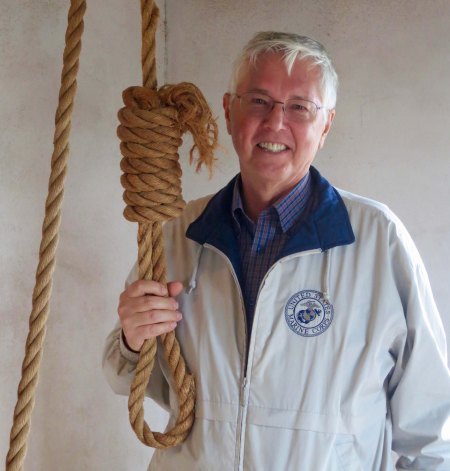
Eeyore rescues Bone from the hangman's noose in Tombstone, Arizona allowing him to continue his journeys around the world. Bone travelled with me on my bike trek.

Eeyore rescues Bone from the hangman’s noose in Tombstone, Arizona allowing him to continue his journeys around the world. Bone travelled with me on my bike trek.

Now that you have had an initial introduction of my journey, it’s time to introduce my travelling companions as Peggy and I cross the country in Quivera the Van retracing my 10,000 mile bike route. If you follow this blog, you know Peggy, of course. She is integral to this story, as she is to all of my blogs. Remember, I met her at the end of my bike trek. Sparks flew. She is the conclusion to this story… and the beginning of another.

I mentioned Eeyore in my first blog of this series. He was peering out the back window, his favorite location when we travel. He prefers looking backward instead of forward. He is a bit of a contrarian. It’s the jackass in him.

Everyone knows this lovable donkey who has trouble keeping track of his tail. He’s been travelling with us for ten years when we travel by van. Normally his life is rather calm. There have been a couple of exceptions, however. The first was the time the teachers kidnapped him from Peggy’s office when she was working as an elementary school principal. They demanded chocolate for ransom.  Peggy dearly loves her chocolate, however, and Eeyore was almost out of luck. He could still be hanging out at Olive Grove Elementary School while being abused (whoops sorry, meant loved) by first graders. Fortunately, Peggy finally gave in. It wasn’t like the teachers were demanding higher salaries…

Bone faces the gallows in Tombstone, Arizona. He'd been cheating at cards, hanging out with loose women, and robbed a bank.

Bone faces the gallows in Tombstone, Arizona. He’d been cheating at cards, hanging out with loose women, and robbing  banks.

The second time was scarier; he had to save Bone from the hangman’s gallows in Tombstone, Arizona. “Wait a minute,” you say. “Who and what is Bone?” Thanks for asking. Those of you who have been around my blog for longer that three years will know the answers. But for the rest of you, here’s the story. In the beginning of my blogging efforts, I had in mind writing a book called “Travels with Bone.” (It’s still coming.) So I developed a blog titled, The Peripatetic Bone. When I decided to write The Bush Devil Ate Sam about my Peace Corps’ experience I changed the blog to Traveling through Time and Place. Here is the very first paragraph from my very first blog.

This is it, the Peripatetic Bone’s blog. And no, I am not Bone. My name is Curtis Mekemson. My wife Peggy and I participate in, or one might say, facilitate, Bone’s wandering ways. Like the ubiquitous gnome, Bone shows up in some rather unique places. Burning Man is an example. Peripatetic means to wander about. It’s a good description for Bone (and me).

My friend Tom Lovering and I found Bone in 1977. He was hanging out half buried in snow in a patch of corn lilies along the Tahoe-Yosemite Trail south of Lake Tahoe. Tom and I had a game when we backpacked. If one of us found trash, the other person had to pack it out. I found Bone, declared he was trash, and Tom had to carry him— at least until he could sneak him back in my pack. Here is Bone’s perspective on being found:

I didn’t plan on seeing the world and becoming famous. Once I was part of a horse located just above the hoof. I had no freedom; I had no glory. Wherever the horse went I went also, a mere slave to his desires. During the summer this meant carrying greenhorn tourists into the backcountry of the mountains above Lake Tahoe. The added pounds gave me bone-jarring headaches. Then the horse died; I like to fantasize that a large bear with big teeth and sharp claws ate him.  Hopefully he ate the tourist as well.

Whatever happened, I was free to be me, Bone. Yes, that’s right, Bone is my name. A kindly coyote picked me up and carried me to a high meadow filled with Corn Lilies. It was there that I discovered my Zen-like nature as I meditated through the seasons. I was alone except for a mouse that came by and nibbled on me occasionally. That hurt. In fact, it interrupted my meditation and scarred me for life; you can still see teeth marks. I blame all of my subsequent bad behavior on that flea bitten miscreant.

My annoyance at the mouse, however, was minor in comparison to my anger at the large two-legged creature who yanked me from my meadow home and begin yelling I was trash as he ran down the trail in pursuit of another two-legged creature.  Can you imagine the insult? I had no way of knowing that this was the beginning of my world travels or that the two creatures, Curt Mekemson and Tom Lovering, would become my servants.

World travels indeed. Bone has now been in over 50 countries and all 50 states. He travelled with me on my 10,000-mile bike trip and with Tom in the back of a truck from the Sahara Desert to South Africa. He has wandered close to 200,000 miles with Peggy and me as we have explored North America. Other people have also carried Bone. He has been blessed by the Pope and attended a Bill Clinton Presidential press conference. “Excuse me, is that a gun in your pocket.” He has been on top of Mt. Kilimanjaro, at the base of Mt. Everest, and on top of Mt. Whitney. He has gone deep sea diving in the Pacific and boated up the Amazon. You get the idea. It’s only proper that he be along with Peggy, Eeyore and me on our present journey.

Bone is going to answer the ten most common questions people ask him in my next blog. After that, I will get back to my bike trip and the big white whale that scared the hell out of me.
Wyatt Earp arrests Bone in Tombstone. Doc Holiday checks him for weapons.

Wyatt Earp arrests Bone in Tombstone. Doc Holiday checks him for weapons.

Bone checks out Billy Clanton's grave on Boothill— thankful it wasn't him.

Bone checks out Billy Clanton’s grave on Boothill— thankful it wasn’t him.

A 10,000 Mile Bike Trek Begins with the First Pedal… Maybe

This would have been my first official stop sign on my bike trek. My first grade teacher, Mrs. Young, had lived across the road. She kicked me out for a year when she learned my mother had forged my birth certificate to get me out of the house.

The  first official stop sign on my bike trek. My first grade teacher, Mrs. Young, had lived across the road. She kicked me out for the year when she figured out my mother had forged my birth certificate. The cut off for first grade had been March 1st. I was born on the 3rd. It was a poor forgery. I was happy to return home. My mother, not so much.

“So, you are going out beyond the clouds this morning.” –Pop

I had planned to leave on my birthday, March 3. I liked the symbolism. But it was raining, and I had a few things left to do— like buy my bike. It wasn’t a big thing; I had owned several over the years. My first had been a one speed bike with coaster brakes and handle bars that would have made a laidback Hell’s Angel jealous. It was well-used. Some kid would have been proud to call it new back before World War II. My parents paid five bucks for it. The bike provided me with the freedom to zip around my home town and the surrounding countryside for several years until impending teenagehood suggested it wasn’t cool.

My Trek 520 cost a lot more. It was designed for touring. According to the company: “If you’re a committed touring cyclist looking for the utmost in comfort and durability to carry you to familiar destinations and unexplored vistas, 520 is your ride.” The ad went on to claim that the bike was “ultra-stable even when fully loaded.” Well, I was definitely headed for ‘unexplored vistas’ and ‘fully loaded’ for my trip meant close to 60 pounds of bike gear, camping equipment and books— plus Curt. It was a lot to ask of a bike.

A funny aside on Trek Bikes. The company once threatened to sue the American Lung Association for using the name “Bike Treks,” which was silly, to say the least. When I pointed out that I had trademarked the name two years before the company was created as The Sierra Trek, it became a question of who should be suing whom. The issue was quickly and quietly dropped.

I decided to begin and end my trip in Diamond Springs where I was raised, a small community 30 miles east of Sacramento on Highway 49. Here’s the opening paragraph in my bike journal:

3/10/89

The journey starts today, where so much of who I am started. That’s why I am here. That, and because my father is here and I wanted to spend some time with him.

As I wrote, Pop was out in the kitchen of his trailer meticulously preparing eggs and grumping because he hadn’t prepared everything the night before. At 84, he liked to have things just right. In fact, he had always wanted things to be done just right, maddenly so. Maybe it had come from his training as an electrician where he had once done something wrong and come in contact with a live, 11,000-volt high power line. Those type of lessons stick with you.

Pop in his 80s

Pop in his 80s

I’d been visiting and sleeping on his couch for the past three days. It had been a good visit, as we relived his youth, and mine. He’d been born back at the end of the horse and buggy age and the beginning of the horseless carriage era. He’d seen a lot, but his favorite times were still when he was growing up in Iowa. I had heard the story many, many times. It was a well warn groove in his brain, to be remembered when everything else was forgotten. He was functioning well for his age, however, even though he had suffered a minor stroke. I treasured our time together.

Finally, after breakfast, I loaded my four panniers and a day pack I would be carrying. Pop came out to wish me a safe journey and take photos. He always carried a camera and was quite disgusted I didn’t. It was one of three complaints I heard regularly. The other two were that I wasn’t happily married and making little Mekemsons (lots of them), and that I had strayed from my Christian upbringing. Of the three, I am still convinced that he believed not taking photos was my greatest sin.

A solid hug sent me coasting down the hill from his trailer in the Diamond Manor Mobile Home Park, a bit teary eyed. I couldn’t be sure he would be around when I returned. My first pedal rotation at the bottom of the hill stopped halfway. “Damn,” I thought, climbing off my bike and almost falling over. I was ever so glad that no one had been present to watch. The problem was immediately apparent. I’d put my panniers on backwards, not a great start. I righted the wrong and began again— the first pedal of 10,000 miles.

Thomas Wolfe said, “You can’t go home again.” He was right, of course. The 46-year old Curtis of 1989 was a world apart from the 6-year old Curtis of 1949. And both were different from the Curtis of today.  And yet you never totally escape from the home of your youth, and in ways, it always remains your ‘home.’ My first short day of bicycling was packed with memories. I’ll let photos tell the story. Pop would be tickled that Peggy and I are redriving the route— and even more pleased that we are carrying cameras.

I am rather amazed that the house I was raised in still stands, given that it's parts had been prebuilt foe a World War II army barracks. My room was on the far left.

I am rather amazed that the house I was raised in still stands, given that it was an early version of a manufactured home, prebuilt for a World War II army barracks. My room was on the far left.

Every few feet of bicycling brought back a memory. This sunken ground was once a cave that included the crystal clear springs that gave Diamond its name.

Every few feet of bicycling brought back a memory. This sunken ground off of Main Street was a cave when I grew up. It  included the crystal clear spring that gave Diamond its name. It had once provided water for Native Americans and later was a watering hole for 49ers passing through town. When a group of miners found a 25 pound gold nugget nearby, they decided to hang around and the town was founded.

Now it hosted a Tea Party sign. Thinking Tea party led me to think of Alice in Wonderland and I wondered if that was where the name had come from. The Mad Hatter tea party seemed to fit a lot of politics.

Now it hosted a Tea Party sign. Thinking tea party led me to wonder if the Boston Tea Party or the Mad Hatters Tea Party in Alice and Wonderland provided the inspiration for the name. A crazy hatter who had inhaled too many mercury fumes and a March Hare who ineffectively threw tea cups willy-nilly at anyone and everyone seems to be a great model for much of today’s politics.

As I made my way down main street, I came to this barber shop. I'd had my hair cut there in the 40s and 50s! Even further back in time, it had served as a one room school house.

As I made my way down main street, I came to this barber shop. I’d had my hair cut there in the 40s and 50s! Even further back in time, it had served as a one room school house.

The old Diamond Hotel is just across the road from the barber shop. It still serves good food. Now days, like many old establishments along historic Highway 49, it claims to be haunted. Ghosts are good for business.

The old Diamond Hotel is just across the road from the barber shop. It had served good food when I was growing up and still does. Now days, like many old establishments along historic Highway 49, it claims to be haunted. Ghosts are good for business.

The Graveyard: I could write a book about it. It was just across the alley outside our back yard and dominated many of my early memories. In the day time it was an elaborate play pen. At night it became the dreaded home of dead people and ghosts.

The Graveyard: I could write a book about it. It was just across the alley outside our back yard and dominated many of my early memories. In the day time it was an elaborate play pen. At night it became the dreaded home of dead people and ghosts.

Heavenly trees on the edge of a graveyard in Diamond Springs, CA

It was a wild place covered with Heavenly Trees like these that served to hide the tombstones when we were young. They still lurk on the edge of the Graveyard, waiting to reclaim it. I prefer the wild look to the manicured look.

This old Incense Cedar dominated the Graveyard. It was probably planted in the 1850s. it's lower limbs held a tree fort that Pop had built for my brother and me.

This old Incense Cedar dominated the Graveyard. It was probably planted in the 1850s. it’s lower limbs held a tree fort that Pop had built for my brother and me. He built it when he caught us trying to build a fort 60 feet up in the tree. Our big sport was racing each other to the top.

Flowers burst out all over the graveyard in spring, and provided many a bouquet for Mother, picked dutifully by me. This lilac bush was still blooming away.

Flowers burst out all over the graveyard in spring, and provided many a bouquet for Mother, picked dutifully by yours truly. This lilac bush is still blooming away.

Our alley didn't have a name at first. Then the County decided to name it Graveyard Alley. Mother gave Marshall and me our orders. "Make the sign disappear. Don't tell your father." We did. The County put up another sign. It disappeared. Finally, the County decided to namer it Georges Alley after the first man who lived on the alley. We liked him. The sign stayed.

Our alley didn’t have a name at first. Then the County decided to name it Graveyard Alley. Mother gave Marshall and me our orders. “I won’t live on Graveyard Alley. Make the sign disappear. Don’t tell your father.” We did. The County put up another sign. It disappeared. Finally, the County decided to name it Georges Alley after the man who built it. We liked George. The sign stayed.

This beautiful old gold rush era building is about a 100 yards away from our house.

This beautiful old gold rush era building is about a 100 yards away from our house. The school was a block beyond it.

Tony Pavy lived just outside of Diamond on the road to El Dorado. As I cycled past it, I was reminded of the time he threatened to shoot me with a shotgun.

Tony Pavy lived just outside of Diamond on the road to El Dorado. As I cycled past it, I was reminded of the time he threatened to shoot me with a shotgun. We’d been hunting squirrels near his property when a bullet ricocheted and took out his pig. “Get my gun, Mama. They shot my pig!” he had screamed. We figured he wasn’t in much of a mood for an explanation and hightailed it. When the sheriff caught up with us later we had a good alibi.

Poor Red is long since dead but his Bar-B-Q restaurant lives on in Eldorado, an historic eatery from the 1940s well-known throughout Northern California.

Poor Red is long since dead but his Bar-B-Q restaurant lives on, an historic eatery from the 1940s well-known throughout Northern California. I consumed many a rib and Golden Cadillac there. I forget the ingredients of Golden Cadillacs but I do remember they tasted wonderful and after two, you didn’t care what was in them. Reds is in the small town of El Dorado, two miles outside of Diamond. I had turned left on my bike there and began making my way south.

The foothills of California are beautiful in the springtime. Shortly after this Highway 49 began its steep, curvy descent to the Consumes.

The foothills of California are beautiful in the springtime. Shortly after this, Highway 49 begins its steep, curvy descent to the Consumes River. It was my first downhill.

I once organized a student strike so we could have a ditch day as seniors. I wasn't expelled and we got the day. We held our party on the Consumnes River a couple of miles upstream from this photo. I had stopped for lunch at a small greasy spoon restaurant along the river on my bike and was kept company by a cat and a drunk. "You are fucking crazy," he had told me when he learned of my journey.

I once organized a student strike so we could have a ditch day as seniors. I wasn’t expelled and we got the day. We held our party on the Consumnes River a couple of miles upstream from this photo. I had stopped for lunch at a small greasy spoon restaurant along the river on my bike trip and was kept company by a cat and a drunk. “You are fucking crazy,” the drunk had told me when he learned of my journey. Maybe.

This is an historic spot. I was on my first ever official date. Mom, boyfriend, and Paula had taken me with them to dinner in Sutter Creek. On the way back, boyfriend and Mom had climbed in the back and insisted I drive home. "But I just got my learner's permit last week," I pointed out. I was just beginning to gain confidence when I ran over the skunk here.

This is an historic spot dead skunk spot. I was on my first ever official date. Mom, boyfriend, and Paula had taken me with them to dinner in Sutter Creek. On the way back, boyfriend and Mom had climbed in the back and insisted I drive home. “But I just got my learner’s permit last week,” I pointed out. Didn’t matter. I was just beginning to gain confidence when I ran over the skunk.

I made it 18.3 days on day one and stopped at Old Dry Well Motel and Cafe in Dry Creek. My plan for the next day was to make it 30 miles! The world had other plans for me.

I made it 18.3 miles on day one and stopped at Old Well Motel and Cafe in Dry Creek. Old stories report that outlaws once buried thousands of dollars here. My plan for the next day was to make it 30 miles! The world had other plans…

A photo of the well.

A photo of the well. Another relic from the Gold Rush.

Peggy has volunteered to drive the whole trip so I can take photos and write notes. What a woman! Eeyore, another of our travel companions peers out the back window.

Peggy has volunteered to drive the whole trip so I can take photos and write notes. What a woman! Eeyore, another of our travel companions, peers out the back window. The world famous traveling Bone is seated up front.

NEXT BLOG: I will introduce Bone. You probably already know Eeyore.


Is Insanity a Requirement for Bicycling 10,000 miles?

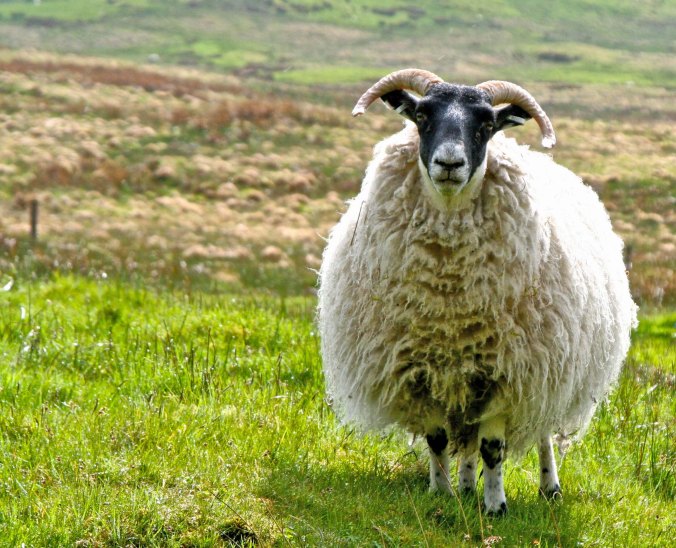
You can get lonely when you are out on the road. I'd moo at cattle along the way for entertainment. They always turned to look, and would often moo back.

You can get lonely when you are out on the road by yourself. I’d moo at cattle along the way for entertainment. They always turned to look, and would often moo back.

Bilbo’s advice: “It’s a dangerous business, Frodo, going out your door. You step onto the road, and if you don’t keep your feet, there’s no knowing where you might be swept off to.”

I was out of the saddle, climbing the steepest hill in Nova Scotia, and grumpy. A couple of friends from California had joined me on a bicycle trip around the province. They were sailing up the mountain and having a merry conversation while I could barely grunt. They were both college track coaches and strong, women athletes. But they hadn’t just bicycled across the US; in fact, they had hardly bicycled at all. What they had that I didn’t were gear clusters on their bikes that made mine look like a one speed. Eventually I made it to the top of the mountain and was greeted by two Cheshire Cat grins and a giggle. On the side of the road a bicyclist had painted a bicycle with the word “WHY?” stenciled next to it.  Having been left in the dust, I could only wonder…

Not many people decide to leave home and go on a six month, solo bike trek. In fact, not many people have the option or, I might add, the desire. But I didn’t have a wife, I didn’t have any children, and I had a solid job offer if I chose to return. I was ready for adventure.

This doesn’t mean that folks were urging me out the door. Three or four women were hoping I would stick around and change my marital status. (This was pre-Peggy.) The legislative advocate for the California Lung Association wanted me hang around and work on the implementation legislation for the tobacco tax initiative we had just passed. My sister Nancy was quite concerned about all of the terrible things that might happen to me out on the road. (My bother, Marshall, thought I should carry a pistol.) Etc.

There were good reasons for staying. They just weren’t as strong as my reasons for leaving. Here are three that I had noted in my journal way back then:

  1. The physical journey— I wanted the experience of travelling, seeing new things, and meeting new people. I love to wander. Going anywhere, anytime, excites me. I think it is genetic. I could have been an early explorer. I would be living in the outdoors, a plus for me, and seeing the US and Canada in a way that few people do. And finally, the trip would be good for me from a health perspective. I was 46 years old and in serious need of a tune up.
  2. An internal journey back in time— I wanted to know more about what drove me. I don’t handle stress well. It drives me bonkers. All too often it had led to depression and could become debilitating to the point where escape was the only solution. I’d run off to the woods to lick my wounds. Even doing things I was good at and enjoyed in time came to resemble a cage I was trapped in. By learning more about what drove me, possibly I could learn to be more in the driver’s seat.
  3. A quest— I am not particularly religious, but I do have a spiritual side. I pictured myself meditating for long stretches as I pedaled for thousands of miles along North America’s highways and byways. Who knows where it would lead me? I carried books like the Tao Te Ching and Bhagavad Gita for inspiration. A friend had even given me a copy of the New Testament.

A Bit on Preparation:

I joked in my last blog about preparing for my trip by increasing my beer consumption from one to two cans a night. There was a bit of truth to that. I did little (nothing) to prepare physically for the adventure. Unfortunately, I had learned from a long history of backpacking expeditions that I could get away with it. (For example: my backpacking trip into the Grand Canyon.) Once my body figures out there are no other options, it reluctantly gets in shape, whining the whole time.

I am a bit more anal about equipment. I would be bicycling for thousands of miles by myself, sometimes in remote regions with the nearest bike shop a hundred (or more) miles away. Even small towns are far apart in America’s great desert regions of the Southwest and up in the vast forest lands of northern Quebec. So I needed a good bike, and I needed to carry enough tools and parts to make repairs along the way. (At least until I could find a bike shop.) My friends in the bicycling business provided good recommendations. As for living outdoors, my backpacking experience made me something of an expert on what was needed to survive in almost any condition nature might throw at me. (The tornado was an exception.)

Do you have any idea how many remote, lonely roads there are in America and Canada. I found many of them on my bicycle. They did have a way of going on and on...

Do you have any idea how many remote, lonely roads there are in America and Canada? I found many of them on my bicycle. This one in Arizona went on and on.

Threatening skies along Route 66

Threatening skies suggest that traveling the interesting and historic Route 66 was about to get more interesting.

Was this rustic accommodation a chance for shelter?

Was this rustic accommodation a chance for shelter? In an emergency, almost anything served as ‘a port in the storm.’ I would end up hiding out from a tornado in a brick outhouse in Mississippi.

I spent hours studying maps and planning my route. It was a blast. Most people who travel a lot (including many who read this blog) will likely agree with me that planning is half the fun. My goals included avoiding cities, staying off of major highways, and visiting remote areas whenever possible. I was not interested in following someone else’s recommended bike route.  I prepared copies of my proposed route for friends and family but added a cautionary note: “This route is tentative. I may find myself out there making changes for any number of reasons.” The original length of the journey was 11, 309 miles. I made my first change at 28.6 miles.

And finally, a note on bicycling. There are bicyclists and there are “bicyclists.” Bicyclists are passionate about the sport. Whether they race, tour, or commute by bike, they talk the talk and wear the clothes. They love their bikes. They have a certain lean look. Most (but not all) think of bicycling as a communal sport. I’ve done a lot in bicycling. I commuted by bike for several years, organized Sacramento’s first conference on bike commuting, and was responsible for creating the American Lung Association’s bike trek program. I even led and rode on a number of 500-mile bike treks. But, at heart, I am a “bicyclist.” My bike is simply a means of getting from point a to point b, hopefully without any mechanical problems. Still, for those passionate bicyclists who want to follow me on my journey, I will confess that I talked with my bike, Blue, as I crossed the country. Maybe there is hope.

Serious bicyclists  wear bright clothes. They want to be seen. I bicycled through Death Valley on my trip. I found this jersey there a couple of weeks ago.

Serious bicyclists wear bright clothes. They want to be seen. I bicycled through Death Valley on my trip. I found this jersey there a couple of weeks ago.

I’ll close with a couple more photos to emphasize why a bit of insanity is valuable for long distance bike trips.

Big rigs traveling 60 miles per hour on narrow roads with no shoulders tended to elevate my heart rate, especially when they chose to come up behind me and honk their horns. (Most were quite courteous.)

Big rigs traveling 70 miles per hour on narrow roads with no shoulders tended to elevate my heart rate, especially when they chose to come up behind me and honk their horns. (Most were quite courteous.)

I ran into dogs that were about as big as this dinosaur and wanted to eat me.

I ran into dogs that were about as big as this dinosaur and wanted to eat me.

NEXT BLOG: Join me in Diamond Springs, Northern California as I climb on my bike, coast down my first hill, and discover I can’t pedal because I have put my panniers (bike bags) are on backwards.

A Ten Thousand Mile Bike Trip… Let the Journey Begin

28 years ago, after wrapping up my part in increasing California's tobacco tax, I decided to go on a 10,000 mile bike trip around North America. Peggy and I are now redrawing the route.

28 years ago, after wrapping up my part in increasing California’s tobacco tax, I decided to go on a 10,000 mile bike trip around North America. Peggy and I are now driving the route. Peggy first met me when I stepped off my bike in Sacramento. She said I looked svelte and seemed to appreciate my tight bicycling clothes. Having been by myself for six months, I immediately fell in love.

It had been an exciting night at the Proposition 99 Campaign Headquarters in Sacramento. The tobacco industry had just spent $25 million ($56 million in today’s dollars) trying to defeat our efforts to increase California’s tax on tobacco, which, up to that point, was more than it had spent on any single political campaign in its history. The industry regarded our efforts as the most serious threat it had ever faced, not because we were increasing the tax, but because we were proposing to spend a significant amount of money on prevention. It had hired some of the best political operatives in the nation, including Ronald Reagan’s former media director— and, it had run the kind of campaign you might expect from an industry that had made billions off of successfully marketing a deadly, highly addictive drug to children.

The prevention part of the equation had been my idea. If we succeeded, we would embark on one of the most extensive prevention program ever, anywhere in the world. The industry was right to be worried. And we were right to be nervous. As the full force of the industry’s campaign had come to fruition in the last week before the election, we had seen our once comfortable lead drop to .05%.

But the night was ours. Heroic efforts by our friends in the health and environmental communities, including my future sister-in-law, Jane Hagedorn, made the difference. Early returns showed us leading. Later returns showed that we had won. I gave a talk on the power of a small group to take on one of the world’s most powerful industries and win. I then led the group in a series of cheers as the TV camera’s rolled. I ended my night by consuming more alcohol than a health advocate should. Jane drove me home.

California’s health community went on to prove that prevention works. The state moved from having the second highest incidence of tobacco use in the nation to the second lowest. Five years ago the California Department of Health estimated that over one million lives and $70 billion in health care costs had been saved to date.

The Proposition 99 battle was won in 1988, over a quarter of century ago. Ancient history now— except it relates to the story I will be telling on this blog for the next 2-3 months. The campaign wrapped up an important chapter of my life, and it left me with a question: what would I do next? I decided to buy a bike and go on a solo, six-month, 10,000-mile bike ride around the US and Canada. It was a completely reasonable decision, right… kind of like taking on the tobacco industry. So I went out and did it.

And this brings us to the present. I earned a huge number of husband brownie points last year— billions of them. I spent lots of time with kids and grandkids, supported Peggy’s various efforts to improve our community, and did many manly chores around our property. The wife was impressed. She made a mistake. “Next year is yours, Curt,” she announced. “What would you like to do?” It was like a blank check. I got a wild look in my eye and (before she could reconsider), tossed out, “Take our van and follow the route of my North American bike tour… for starters.”

That’s the reason Peggy and I are sitting in a Big O Tire store now in Roswell, New Mexico while Quivera, our van, has some work done. I am sure a UFO is circling above us, the same UFO that caused us to have a blow-out last night.

Quivera, the Van. We put a sing on Quivera to encourage people to follow my blog. The blue bike on the outside is the bike I rode around North America.
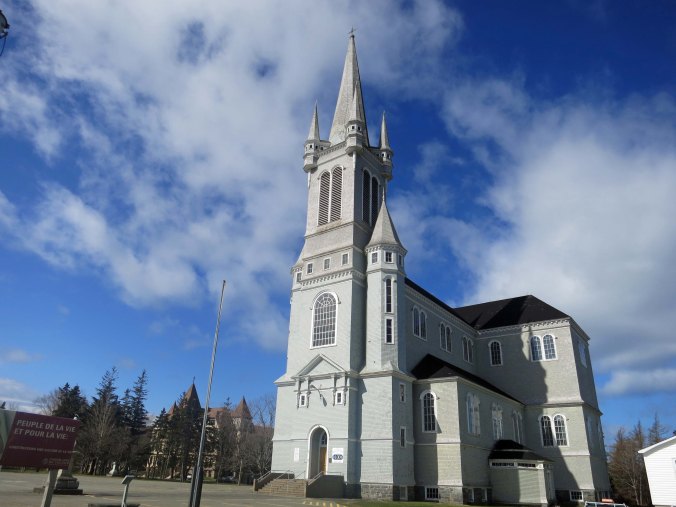
Quivera, the Van. We put a sign on Quivera to encourage people to follow my blog. The blue Trek bike (creatively named Blue) is the bike I rode around North America.
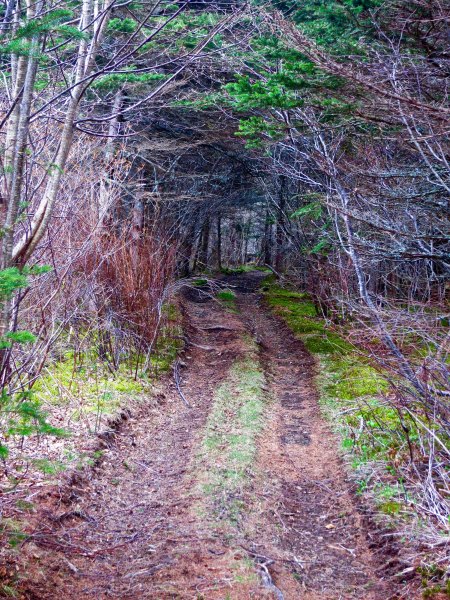
We were quite amused by the sink in the Big O Tire restroom.

We were quite amused by the sink in the Big O Tire restroom.

Even the toilet paper dispenser followed the theme.

Even the toilet paper dispenser followed the theme.

The staff at Big O was great. Putting new shocks on Quivera was a massive challenge. She is not mechanic-friendly. The mechanic on the left worked diligently. The front desk man helped us maintain our sense of humor. "Twenty more minutes" he told us several times.

The Roswell staff at Big O was great. Putting new shocks on Quivera was a massive challenge. She is not mechanic-friendly and objects to people working on her undercarriage. The mechanic on the left was one of three who worked diligently on her. (He is trying hard to smile.) The front desk manager helped us maintain our sense of humor. “Twenty more minutes” he told us numerous times.

Starting with my next blog, I will take you back to the beginning of my bike trek in Diamond Springs, California. I’ll talk more about my reasons for the trip and I will outline the extensive preparation it takes for such an adventure: I increased my nightly consumption of beer from one to two cans.

The blog will cover both my original journey and our present journey by van. For example, here’s what we have done in the past couple of days:

  • Visited a small town museum in Springerville, Arizona that included a Rembrandt among its treasures that could probably buy the town, or maybe the whole county.
  • Stopped off in Pie Town on the crest of the Rockies that is nationally famed for the pies it sells. The owner, who once gave me a free piece of pie, came out to have her photo taken with Peggy, me, Quivera and our bikes. (Crossing the Rockies was my first 100-mile day on the bike trip.)
  • Magically showed up at the annual open house for the Very Large Array of radio antenna/telescopes that have been featured in movies like Contact and Independence Day. Scientists from around the world compete for time on the radio telescopes. We were given a tour by a scientist who is looking back in time to the very beginning of the universe.
  • Contemplated the devastation created by nuclear bombs as we viewed the Trinity site where the first atom bomb ever was exploded.
  • Paid homage to Smokey the Bear by visiting his gravesite and singing his song. (Do you know it?)
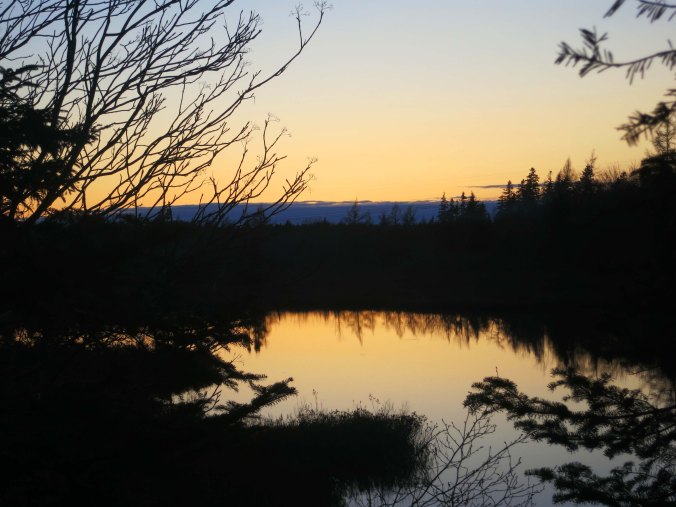
  • Walked the streets of Lincoln where Billy the Kid fought in the Lincoln County range wars of the early West.
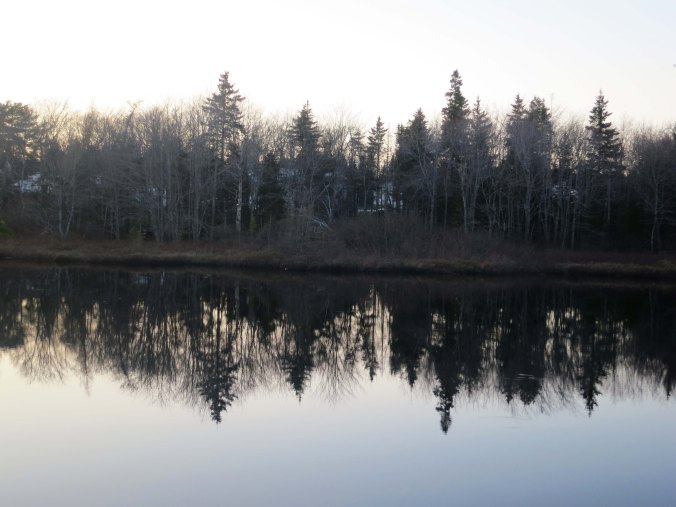
  • Kept a sharp eye out for UFOs as we drove in to Roswell.
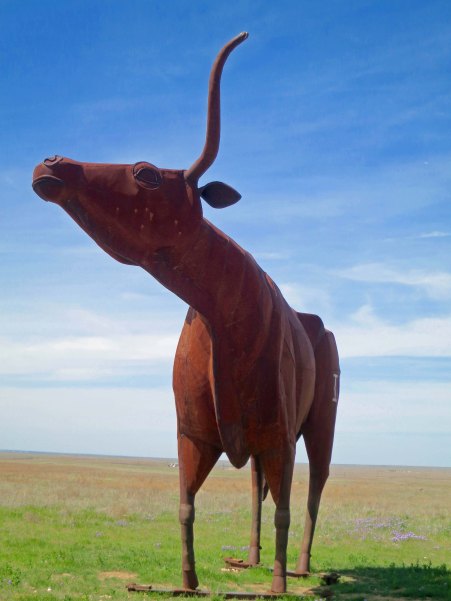
And that’s just two days. My challenge will not be in finding things to write about! This is a back roads journey through America and Canada, a Blue Highways Adventure. I’ll give more details on my next blog, but to get you started, here is a rough map of the journey I made by bike and we are now making by van. Please join us.

This is the route I followed through the US and Canada. I began and ended my trip in Northern California.

This is the route I followed through the US and Canada. I began and ended my trip in Northern California.