Just for the Halibut… Gone Fishing in Kodiak

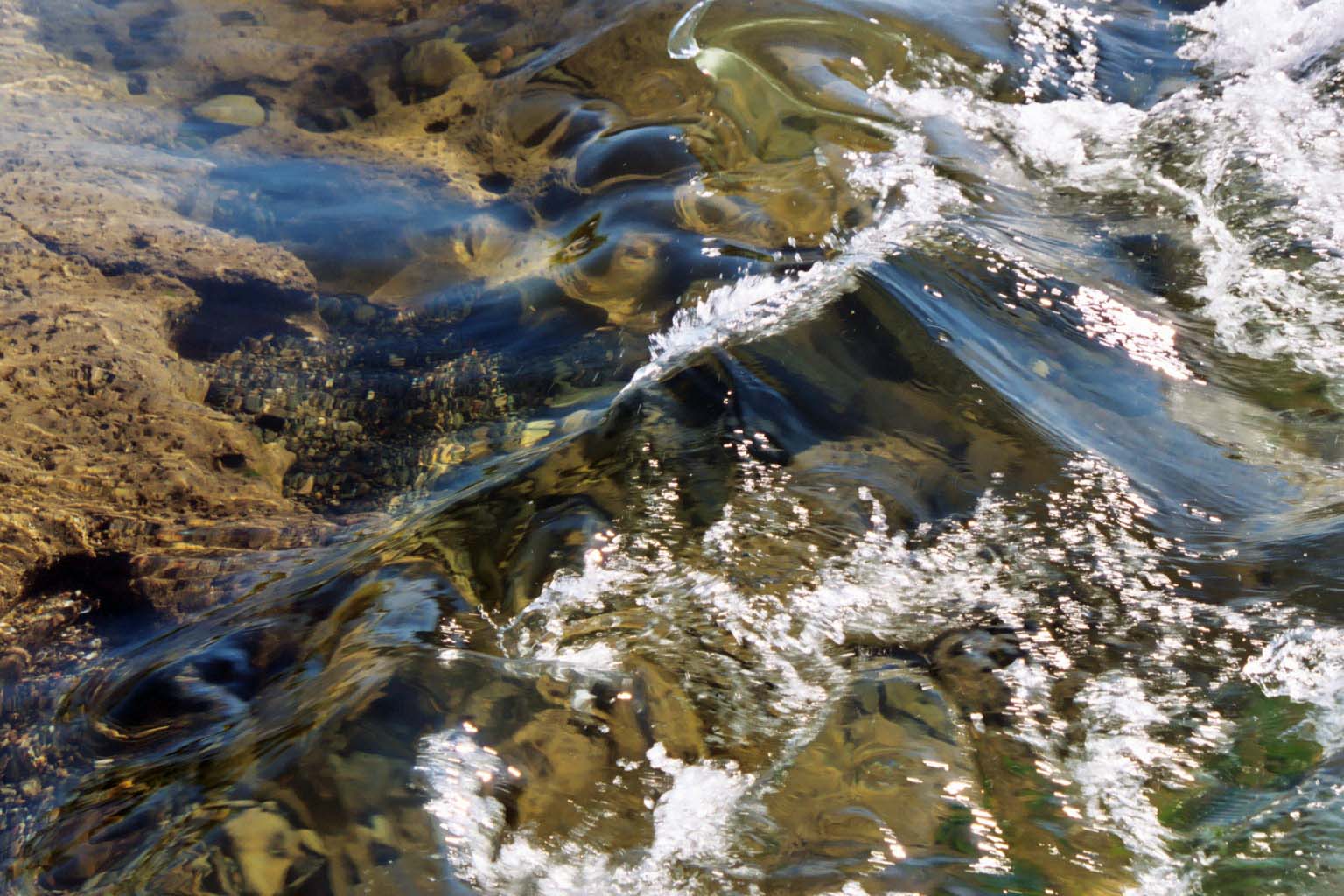
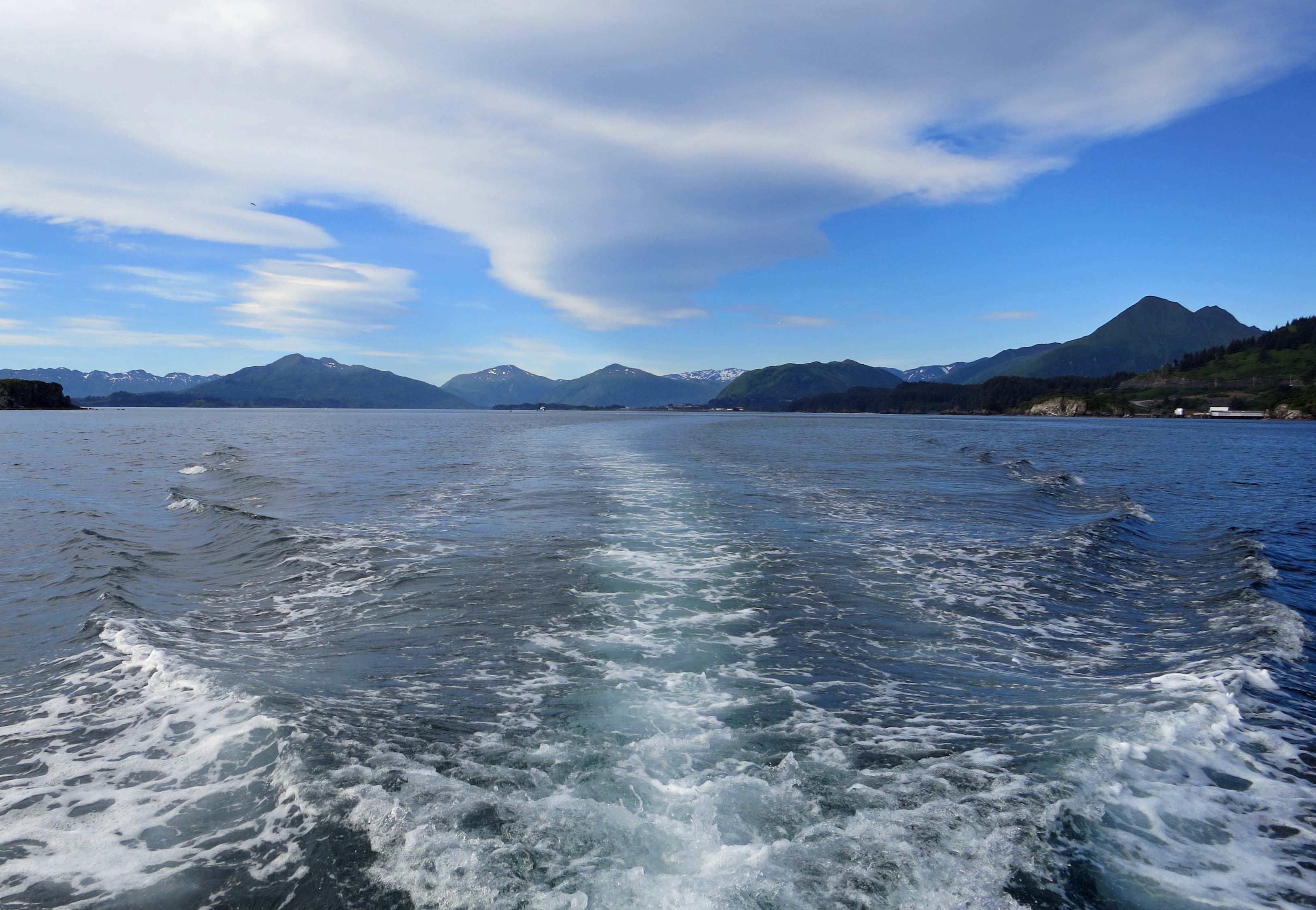
Boat wake in Chiniak Bay, Kodiak.

Leaving worries, Kodiak and a wake behind, we head out into Chiniak Bay for a day of halibut fishing.

Kodiak is about fishing. The Port of Kodiak is one the top three commercial fishing centers in the United States and the largest in Alaska. Sport fishing is also big. People come from around the world to try their luck. The odds are if you are in Kodiak for any amount of time, you’ll get hooked.

Kodiak, Alaska fishing harbor.

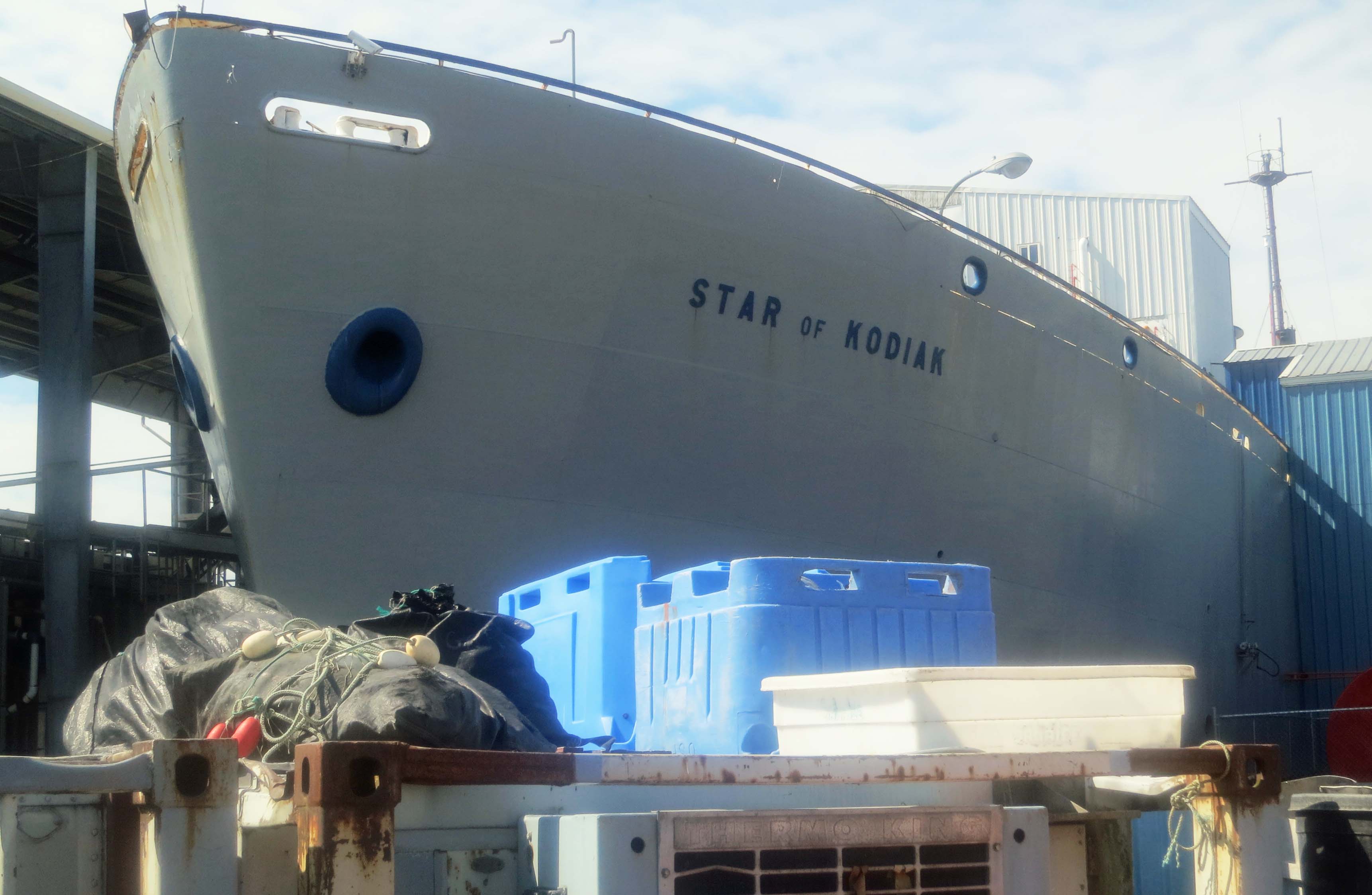
Kodiak Harbor is home to one of the largest fishing fleets in the United States.

Peggy poses with out youngest grandson, Cooper in front of the Harbor Masters office in Kodiak. The large fish is a sculpture made from trash collected from the ocean. Hopefully Cooper will grow up in a world with less trash.

Peggy poses with our youngest grandson, Cooper, in front of the Harbor Master’s office in Kodiak. The large fish is a sculpture made from trash collected from the ocean. Hopefully Cooper will grow up in a world with less trash.

Our son Tony caught the fishing bug. He grumbled when he left San Diego that all of his Coast Guard friends in Kodiak had become fishermen. He didn’t like to fish. Now, according to his wife, Cammie, he’s just like all of the other guys on the island. “Gee, honey, would you like to go for a nice romantic walk or go fishing?” Guess what…

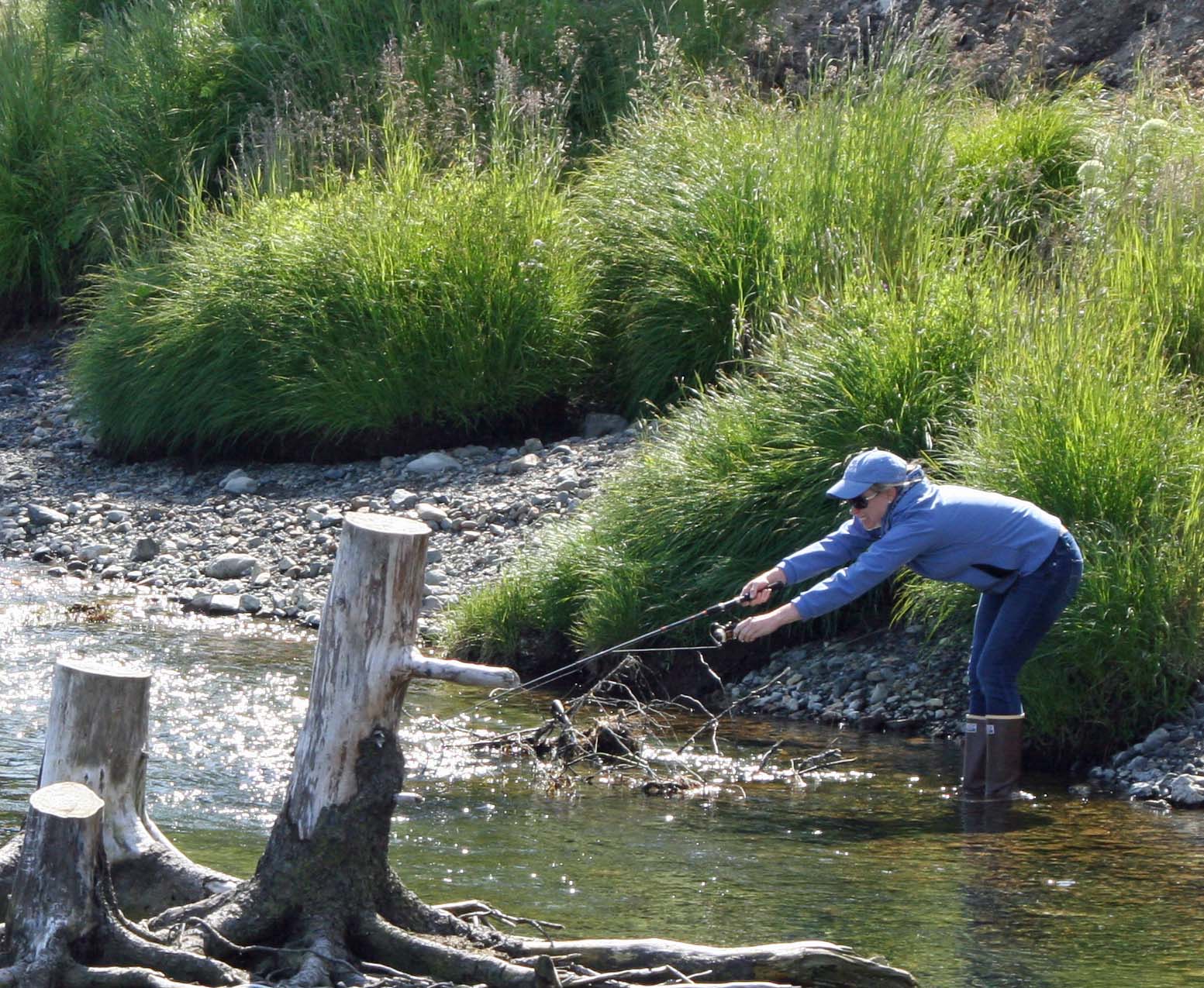
But Cammie is right there with him. She can walk out into the water in her hip waders and cast her line for salmon with the best of the guys.

Cammie demonstrates her salmon fishing skills.

Cammie demonstrates her salmon fishing skills.

Peggy and I certainly don’t qualify as fishermen. I had fished in my twenties for several years but that was a while ago. We won’t talk about how long. As for Peggy, she had fished off a dock in Lake Erie with a bobber as a child… twice. But the temptation to go fishing was too great. Off we went to buy our out-of-state fishing licenses. We were about to get our feet wet.

Our first adventure was to try our luck with halibut. Guess who caught the only one? It wasn’t Tony, Cammie or me.

Coast Guard Kodiak has a dock for small fishing boats on base  and makes rental boats available for Coasties. (Members of the Coast Guard)

Coast Guard Kodiak has a dock for small fishing boats on base and makes rental boats available for Coasties (Members of the Coast Guard).

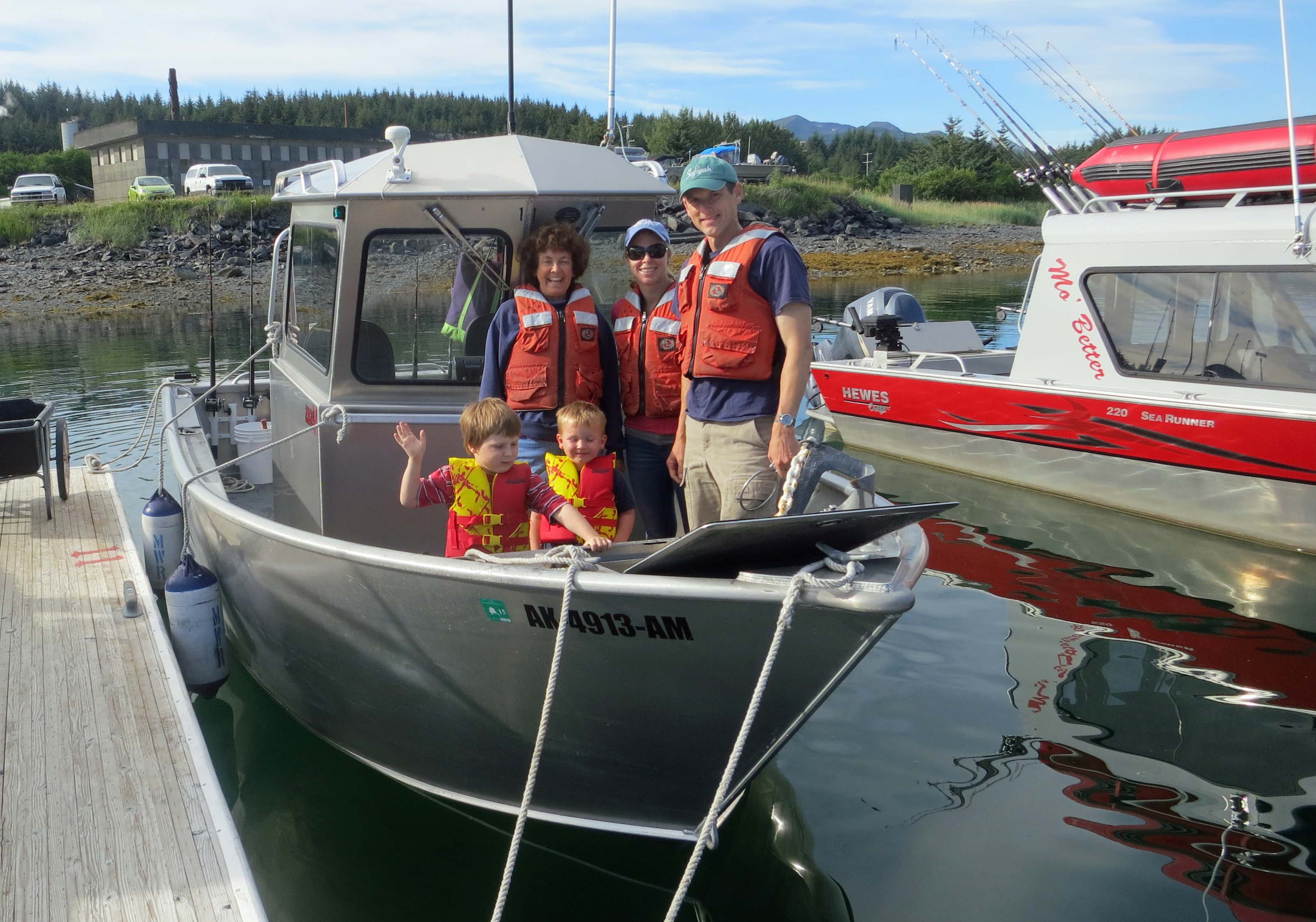
Our brave crew prepares to head out to sea on our Halibut fishing expedition. Connor, Chris and Tony are in the first row. Peggy and Cammie are in the second row.

Our brave crew prepares to head out to sea on our halibut fishing expedition. Connor, Chris and Tony are in the first row. Peggy and Cammie are in the second row.

Fishing in Kodiak, Alaska.

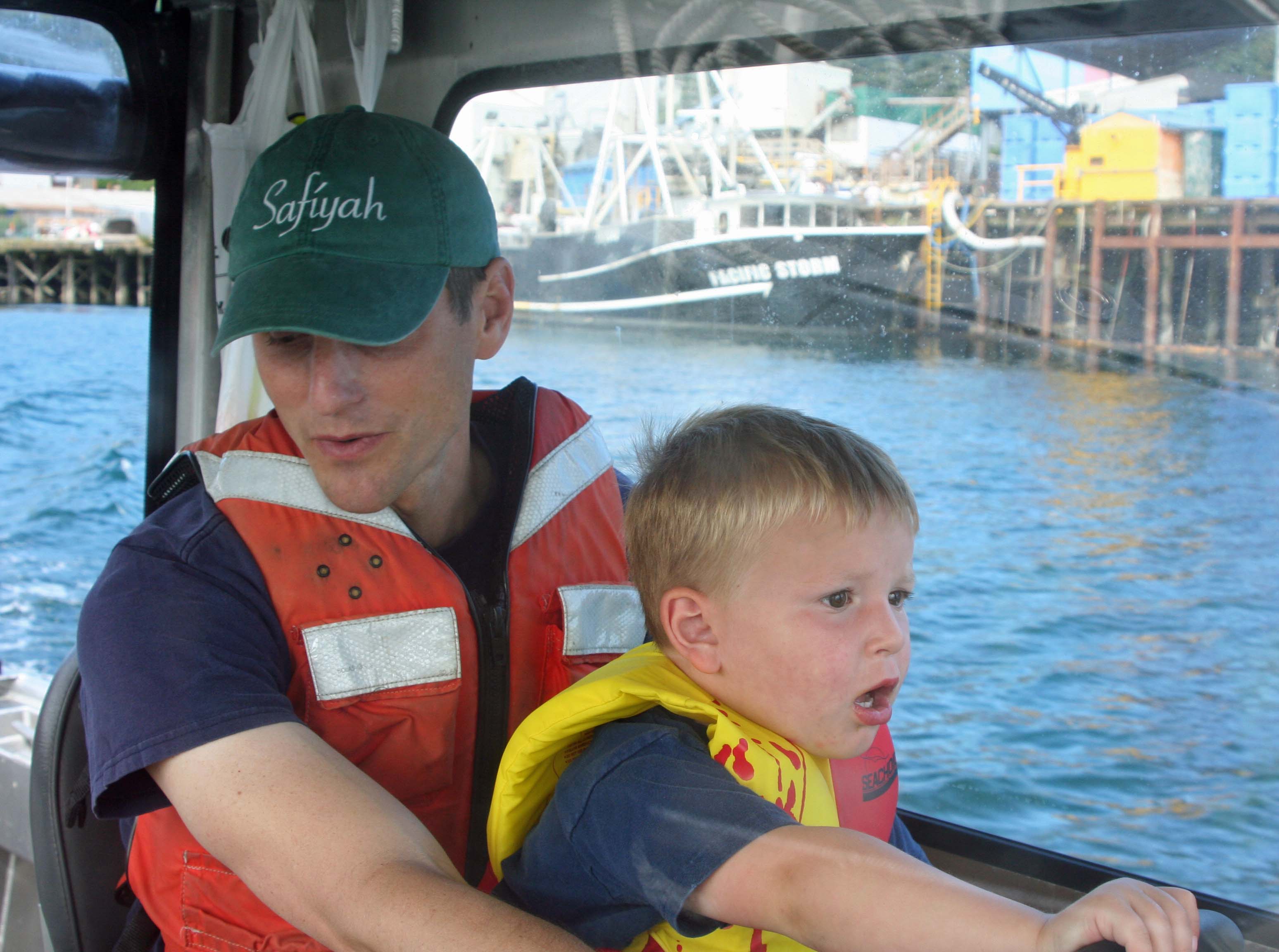
“Um, Dad, is that dock supposed to be there!?” Before we headed out to into the Bay, we tried our luck at catching herring for bait fish near the Kodiak docks. Three-year-old Chris, sitting in Tony’s lap and pretending to steer, apparently has concerns about where the boat is headed. (Photo by Peggy Mekemson)

Fishing in Chiniak Bay, Kodiak, Alaska.

Having no luck with the Herring, we headed out into Chiniak Bay to fish for halibut.

Having tossed out our anchor, Connor found time to play 'now you see me, now you don't' with me. The reflection was a bonus.

Connor found time to play ‘now you see me, now you don’t’ with me. The reflection was a bonus.

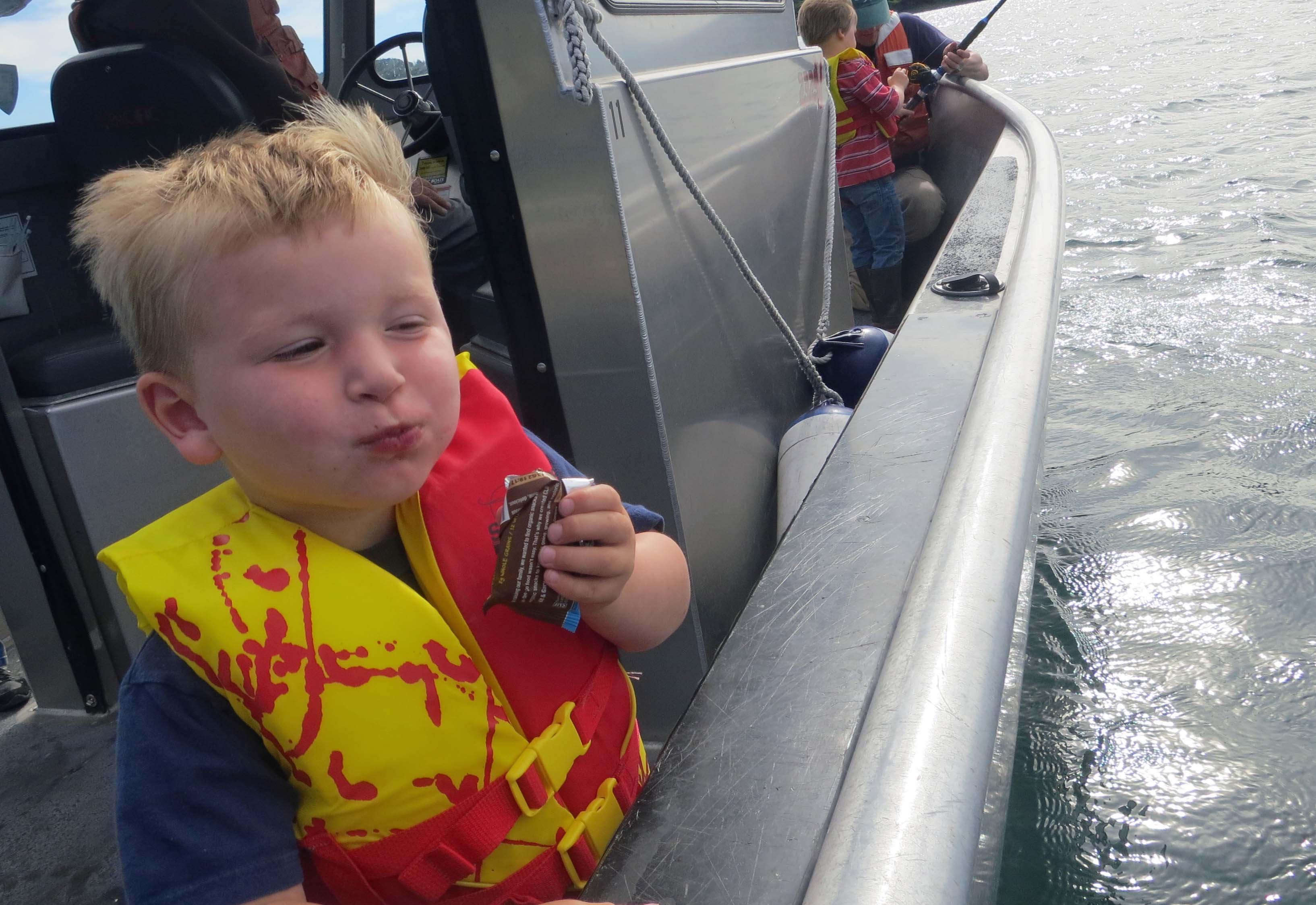
Chris enjoyed some kind of healthy snack, but given the expression of bliss on his face, I'm guessing that chocolate was involved.

Chris enjoyed some kind of healthy snack, but given the expression of bliss on his face, I’m guessing that chocolate was involved. (Photo by Cammie Lumpkin.)

Fishing in Chiniak Bay, Kodiak, Alaska.

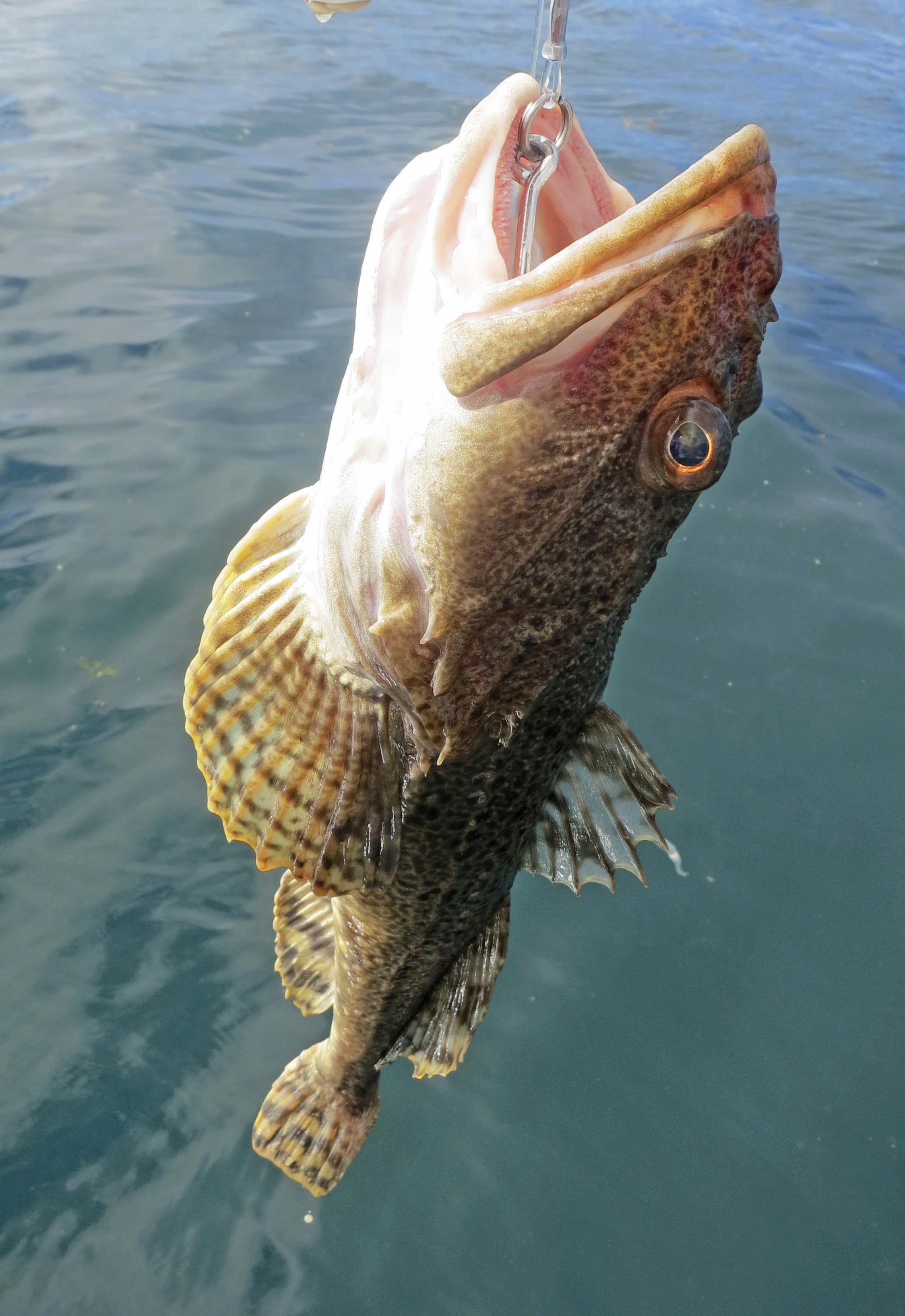
Cammie caught the first fish on our trip, a colorful rockfish. (Photo by Tony Lumpkin.)

Rockfish caught by Cammie Lumpkin off Kodiak Island.

A close up of the rockfish. “My what big eyes, you have.” Tony unhooked and released Cammie’s catch. (Photo by Tony Lumpkin.)

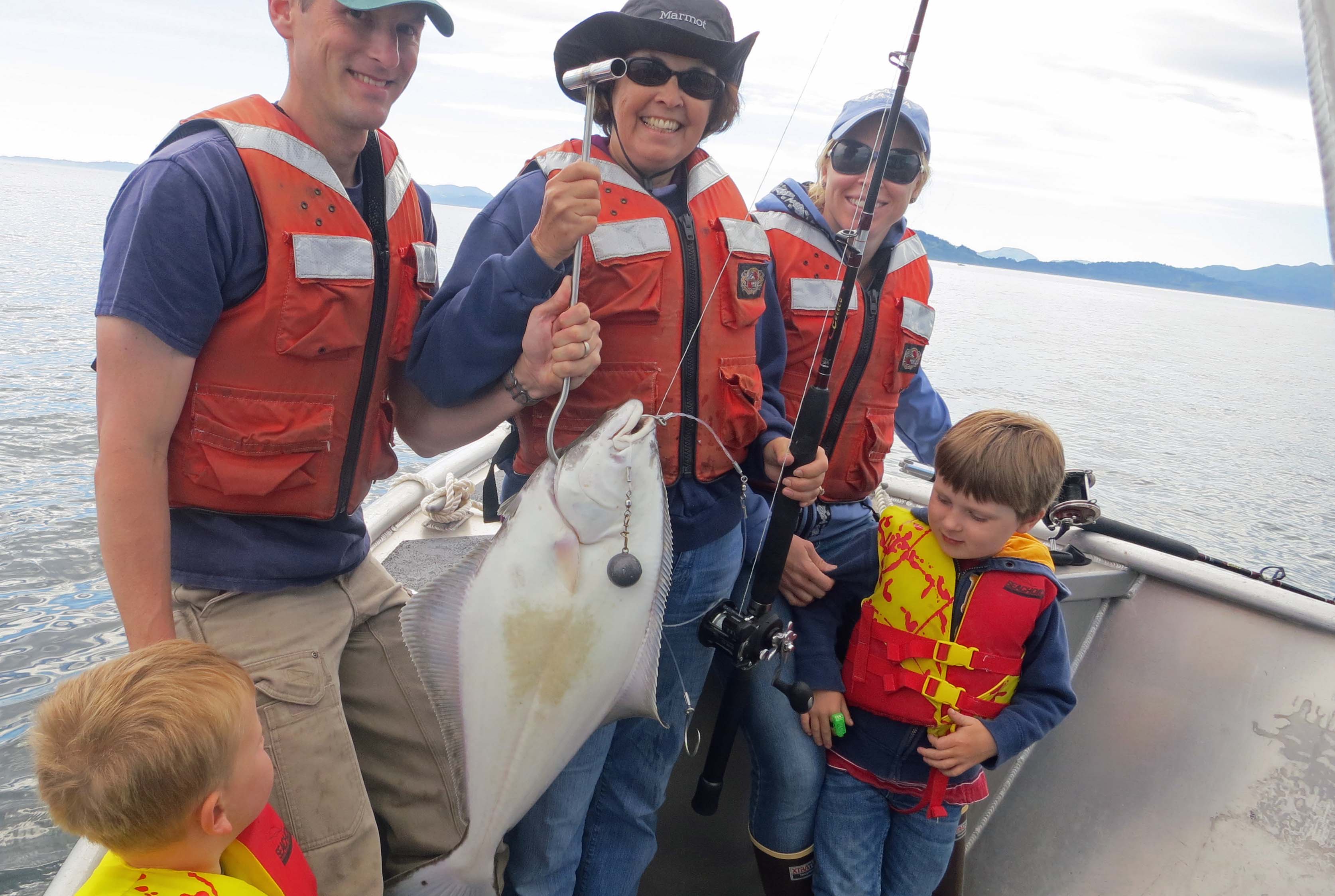
Peggy and I pose for our "official" halibut fishing photo. (Photo by Tony Lumpkin.)

Peggy and I pose for our “official” halibut fishing photo. (Photo by Tony Lumpkin.)

Fishing in Chiniak Bay off the coast of Kodiak, Alaska.

A second “official” photo.  I was leaning out to be in the picture. Had a large halibut chosen that moment to strike, I may have gone swimming. (Photo by Tony Lumpkin.)

Halibut fishing off the coast of Kodiak, Alaska.

Peggy caught our first, and only halibut, a 15 pounder– and had a smile to prove it.

Fishing for halibut in Chiniak Bay, Alaska.

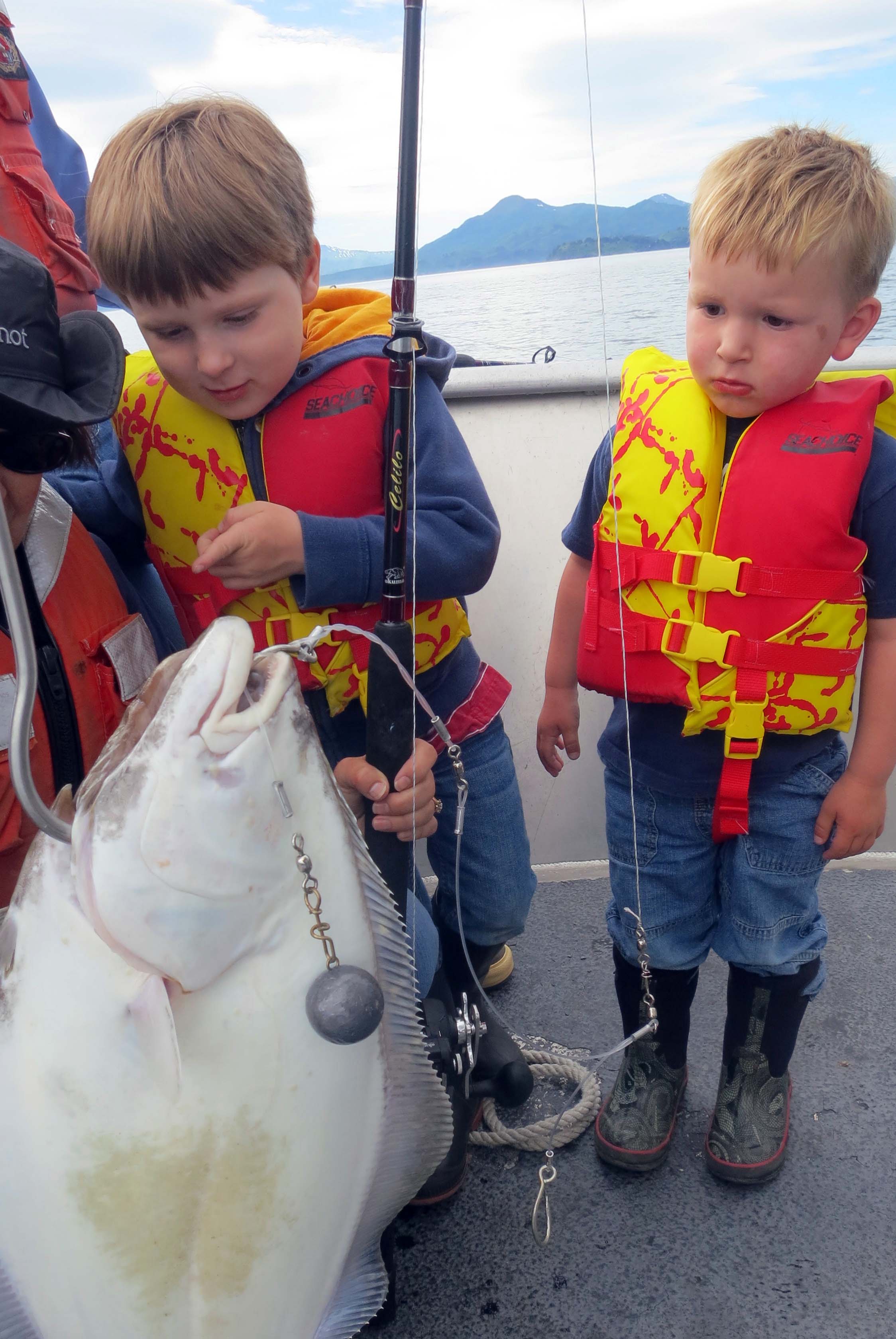
Here, the boys take a close look at the halibut. Connor appears quite curious about the fish’s strange eye arrangement while Chris keeps his distance.

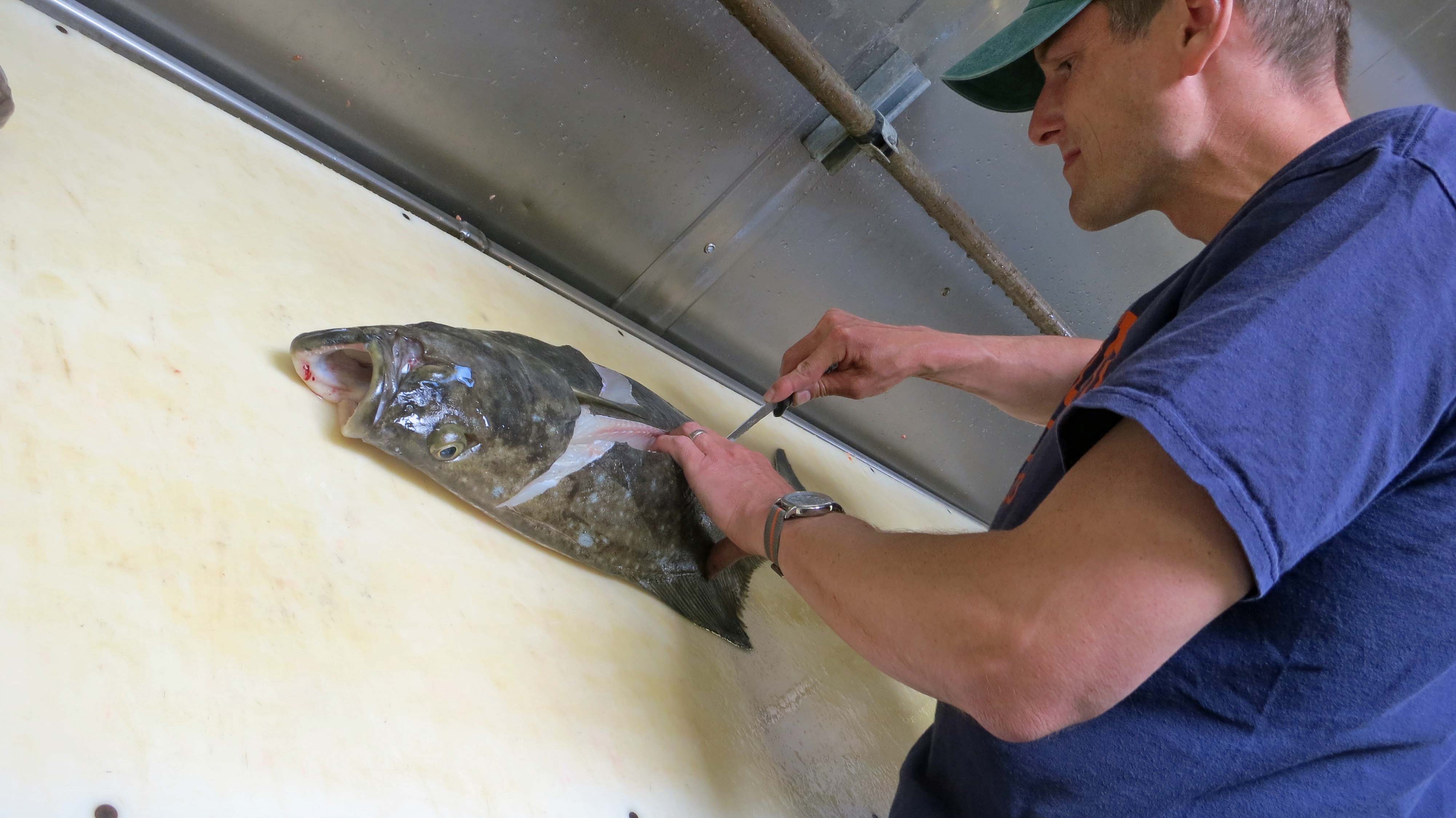
Tony has become quite expert at filleting fish. Here, he takes on the halibut. Halibut has always been my favorite fish. Nothing can beat one fresh off the boat.

Tony has become quite expert at filleting fish. Here, he takes on the halibut. Halibut has always been my favorite fish for eating and nothing can beat one fresh off the boat.

A note on photo credits: I always try to give credit to the person who took the photo. Where no name is mentioned, I took the picture. Peggy and I were passing our cameras around this time between ourselves, Tony and Cammie. I could have missed something.

NEXT BLOG: Having landed a halibut, we join the Kodiak Bears in fishing for salmon.

Flying Over Kodiak in an Antique Bomber… North to Alaska

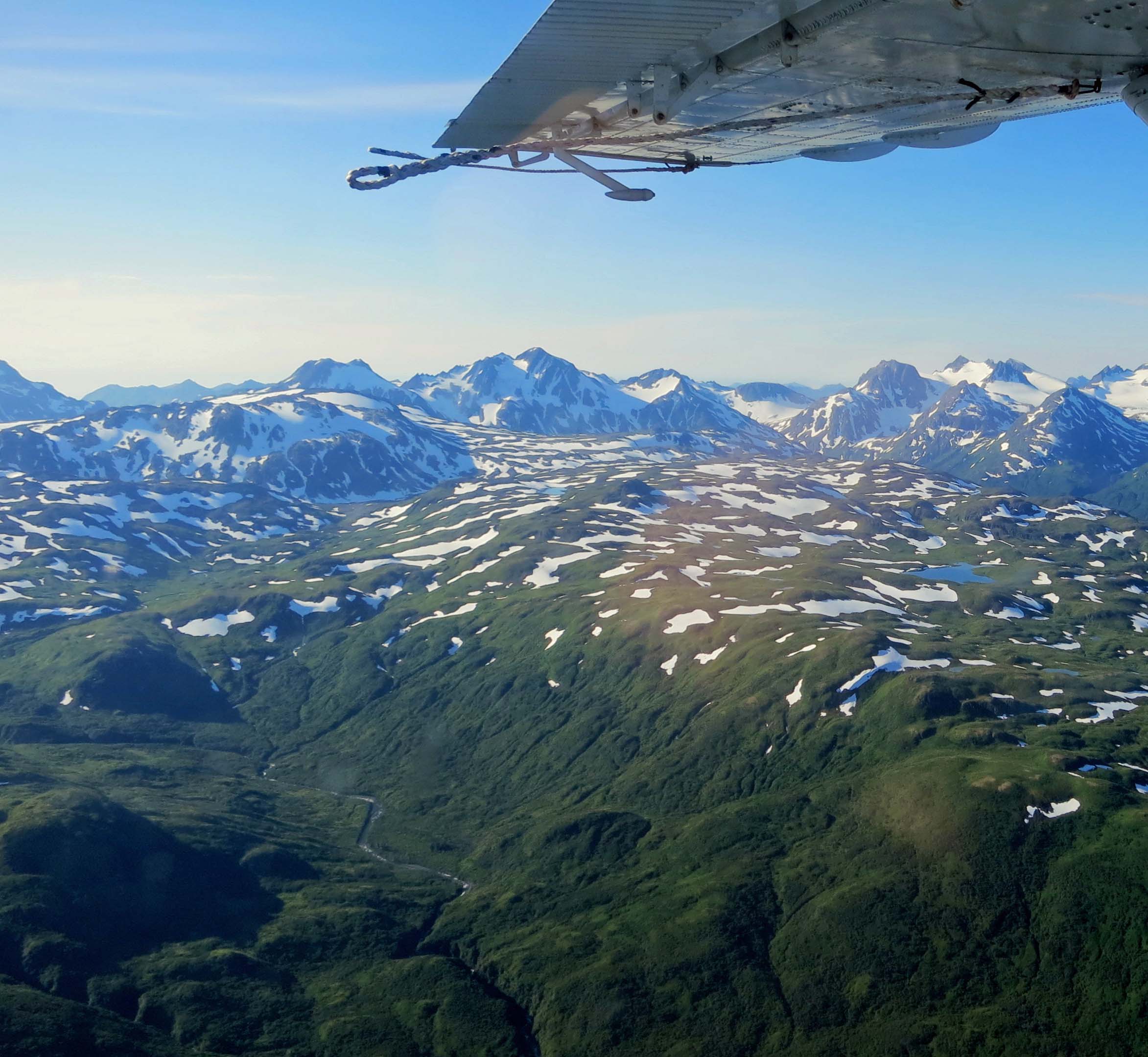
Kodiak is a beautiful island ranging (in the summer) from intensely green hills to glacier covered mountains. I took this photo out the window of our plane as we flew over the Island.

Kodiak is a beautiful island ranging (in the summer) from intensely green hills to glacier covered mountains. I took this photo out the window of our plane as we flew over the Island.

Kodiak refers to itself as the Emerald Isle, a title it borrowed from Ireland. Having driven through Ireland and flown over Kodiak, I understand. Our floatplane trip to watch Kodiak Bears on the Frazer River provided a great overview of the island. The first impression was one of pervasive greenness.  Soon, the green became dotted with snow fields and then glaciers; Kodiak is not Ireland.

Peggy captured just how green Kodiak can be... set off by patches of snow. (Photo by Peggy Mekemson)

Peggy captured just how green Kodiak can be… set off by patches of snow. (Photo by Peggy Mekemson)

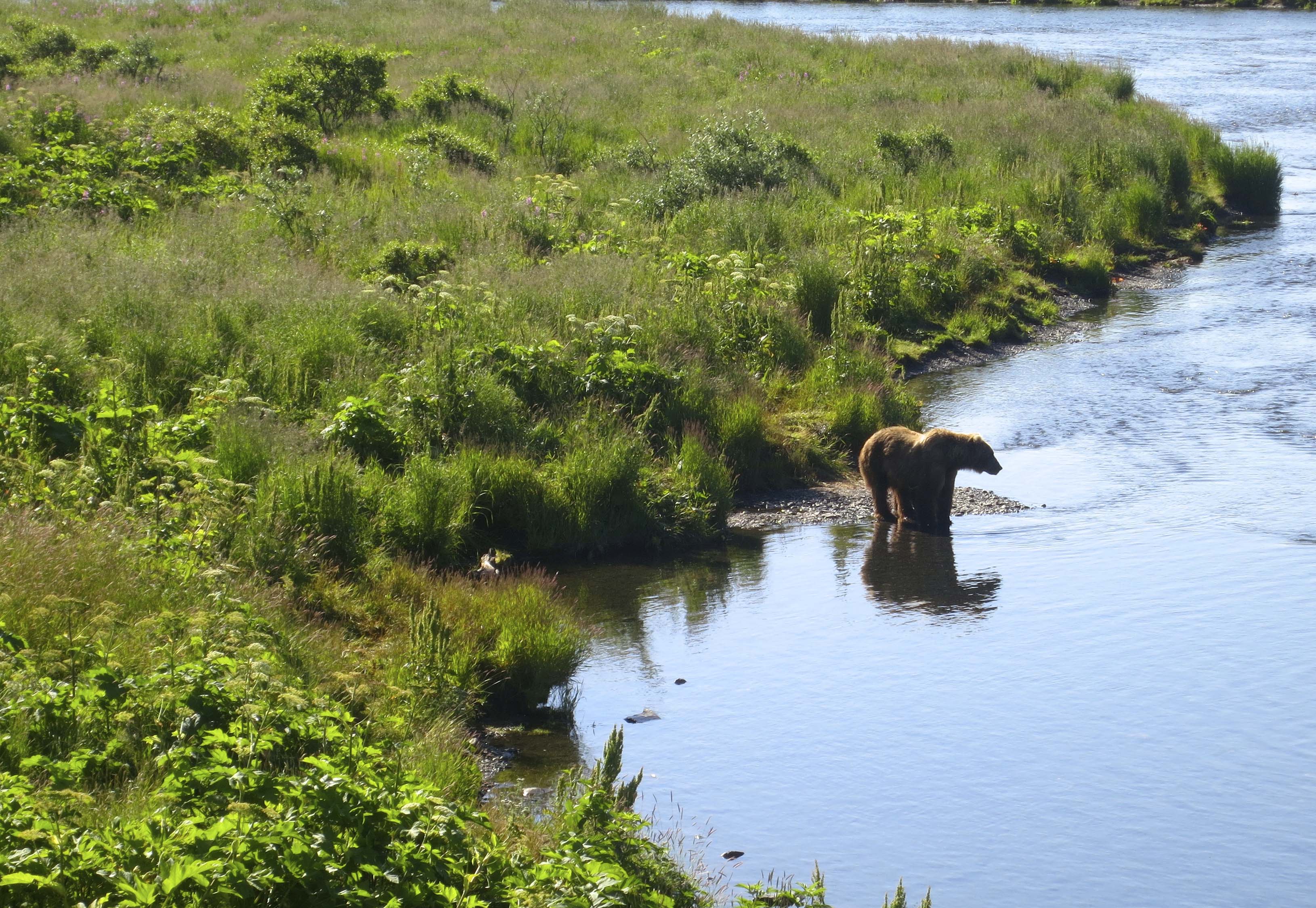
In American terms, Kodiak is a big Island. At 3500 square miles it is the second largest island in the US, second only to the island of Hawaii. Given that it has around 3500 Kodiak bears, there is an average of one bear per square mile. One was waiting for us when our plane landed in Frazer Lake. He came running toward us. We opted to stay on the plane until he disappeared. Later we saw him swimming across the lake.

The Kodiak Bear, a young male, made his way toward our plane. He was more interested in fish than he was us, but we stayed on the plane until he left.

The Kodiak Bear, a young male, made his way toward our plane. He was more interested in fish than he was us, but we stayed on the plane until he left.

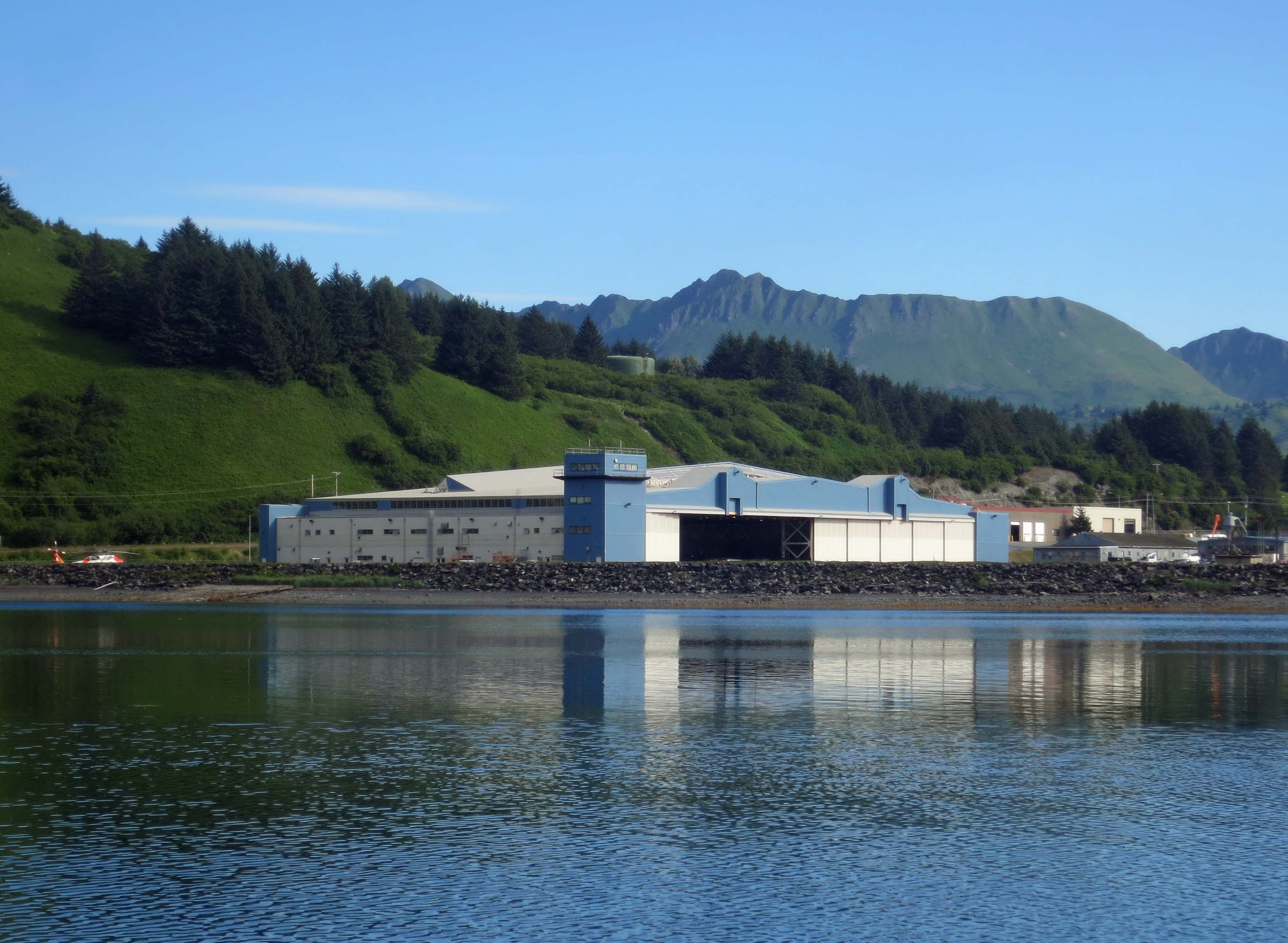
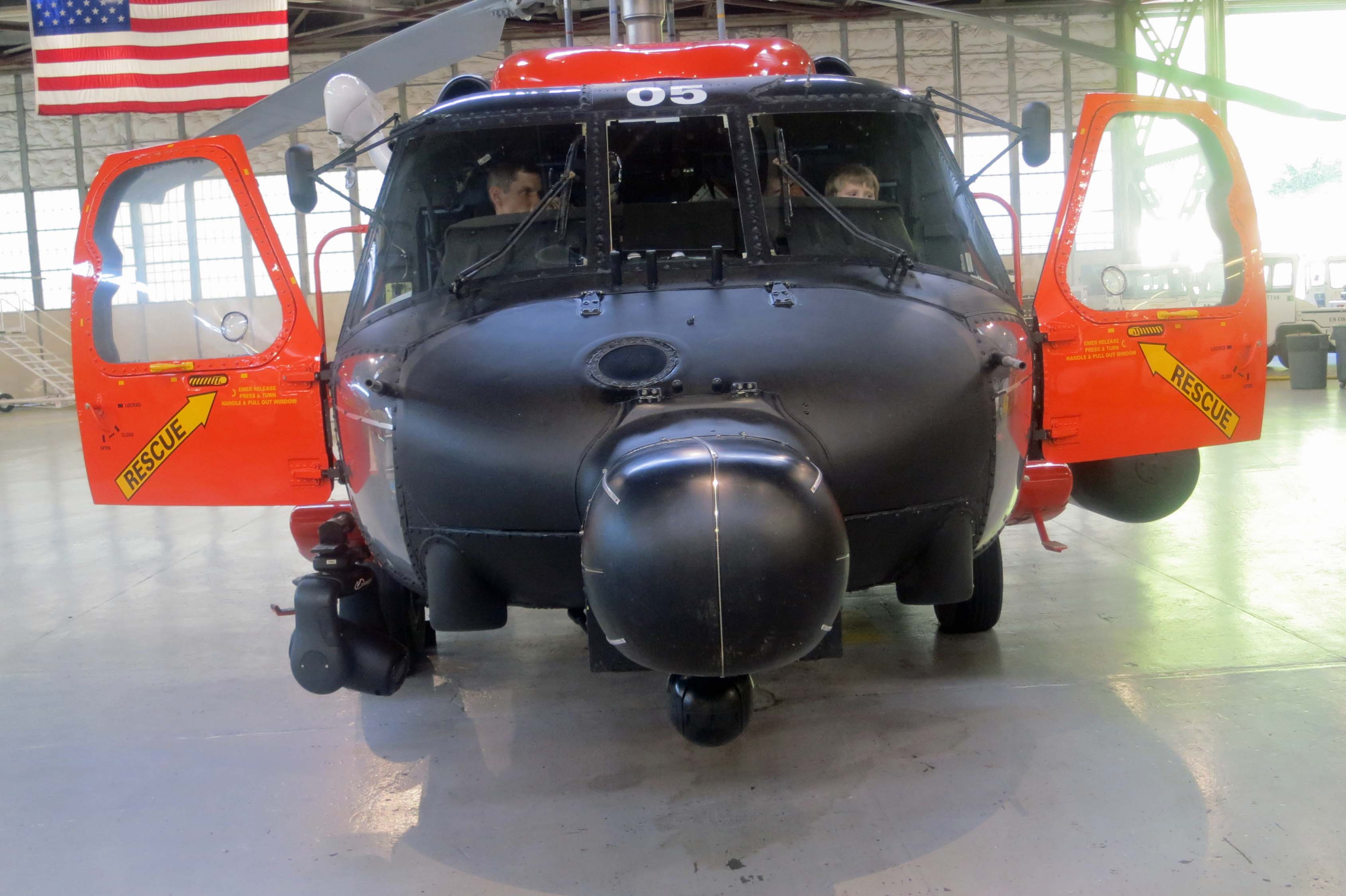
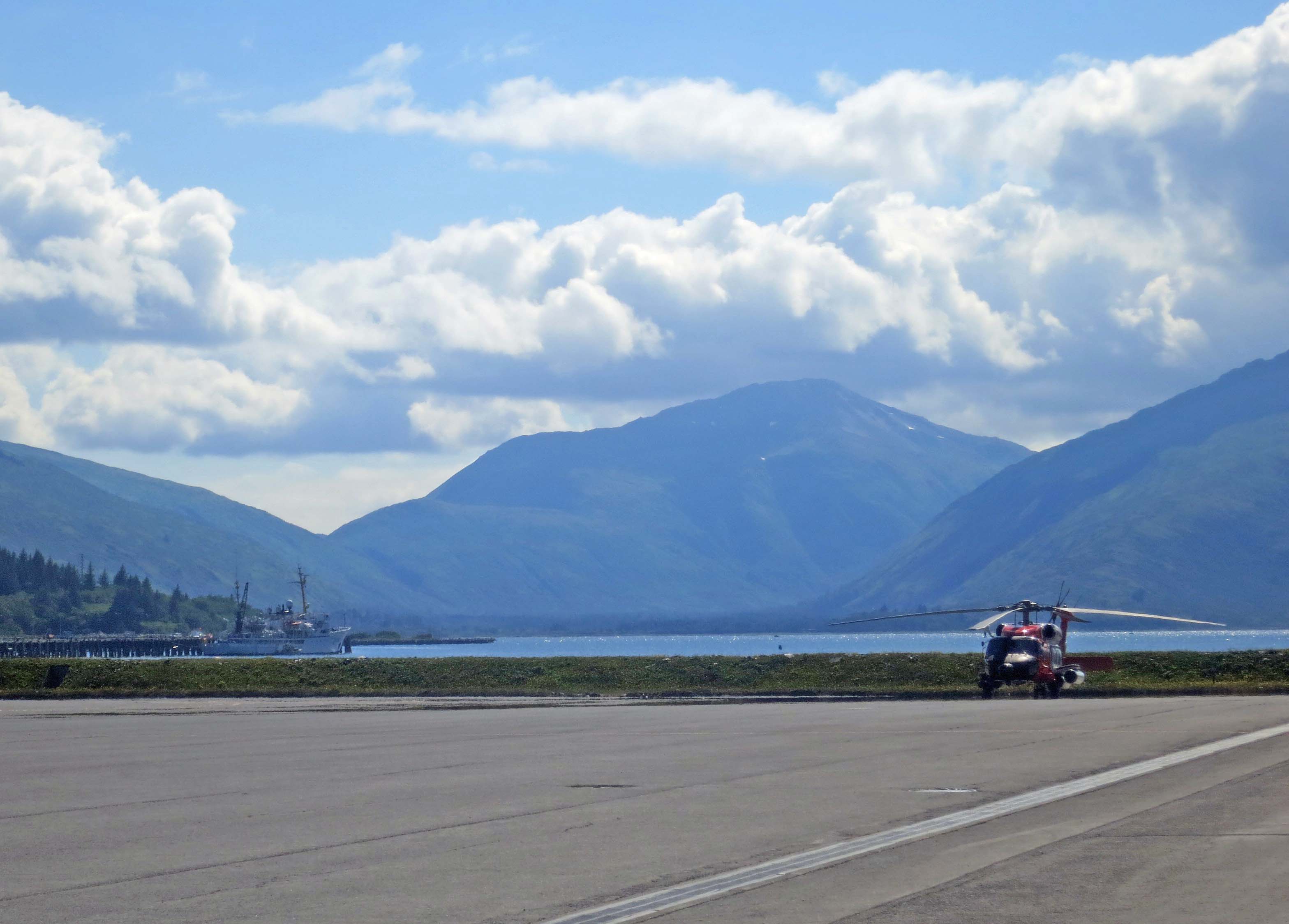
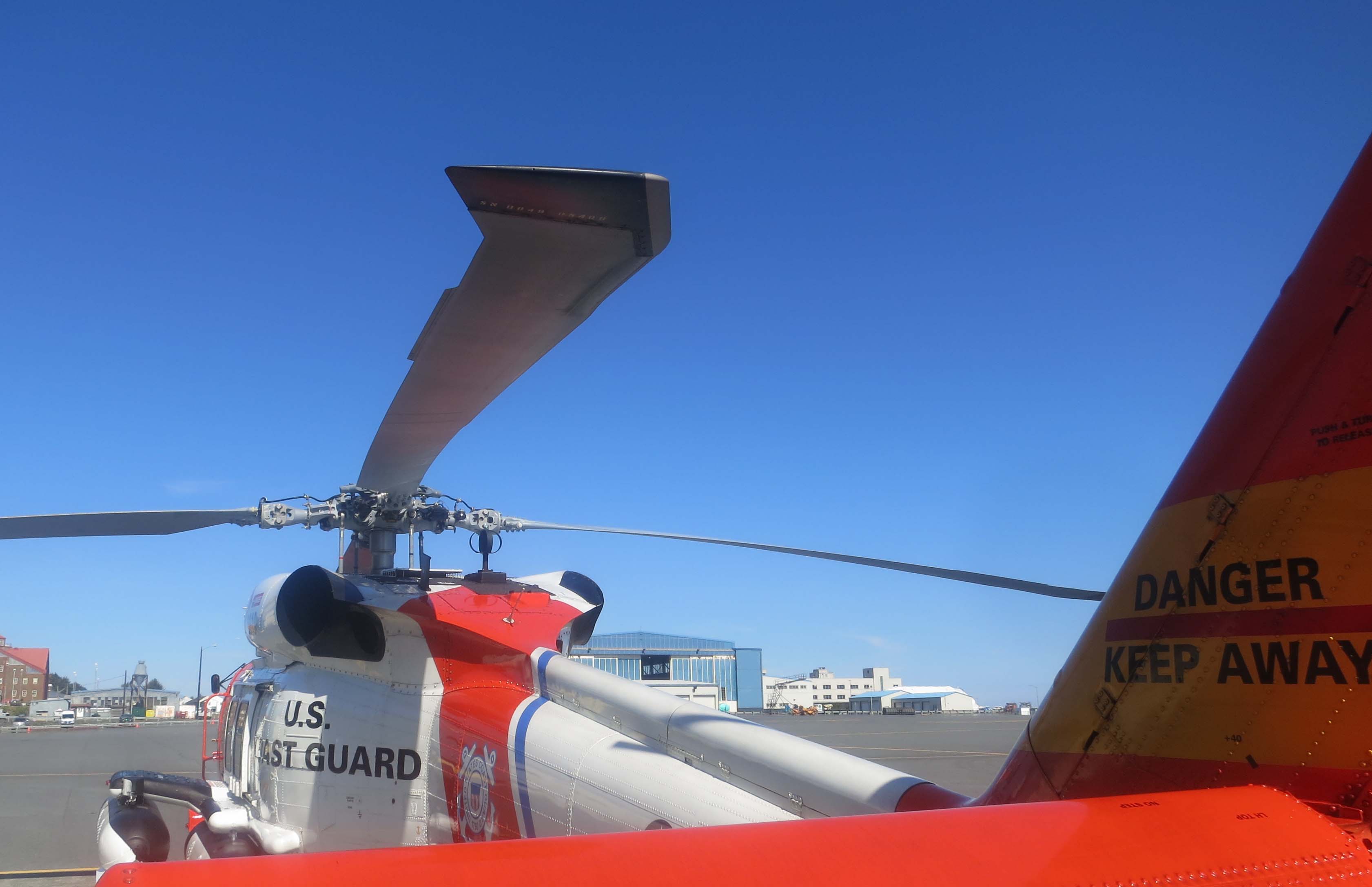
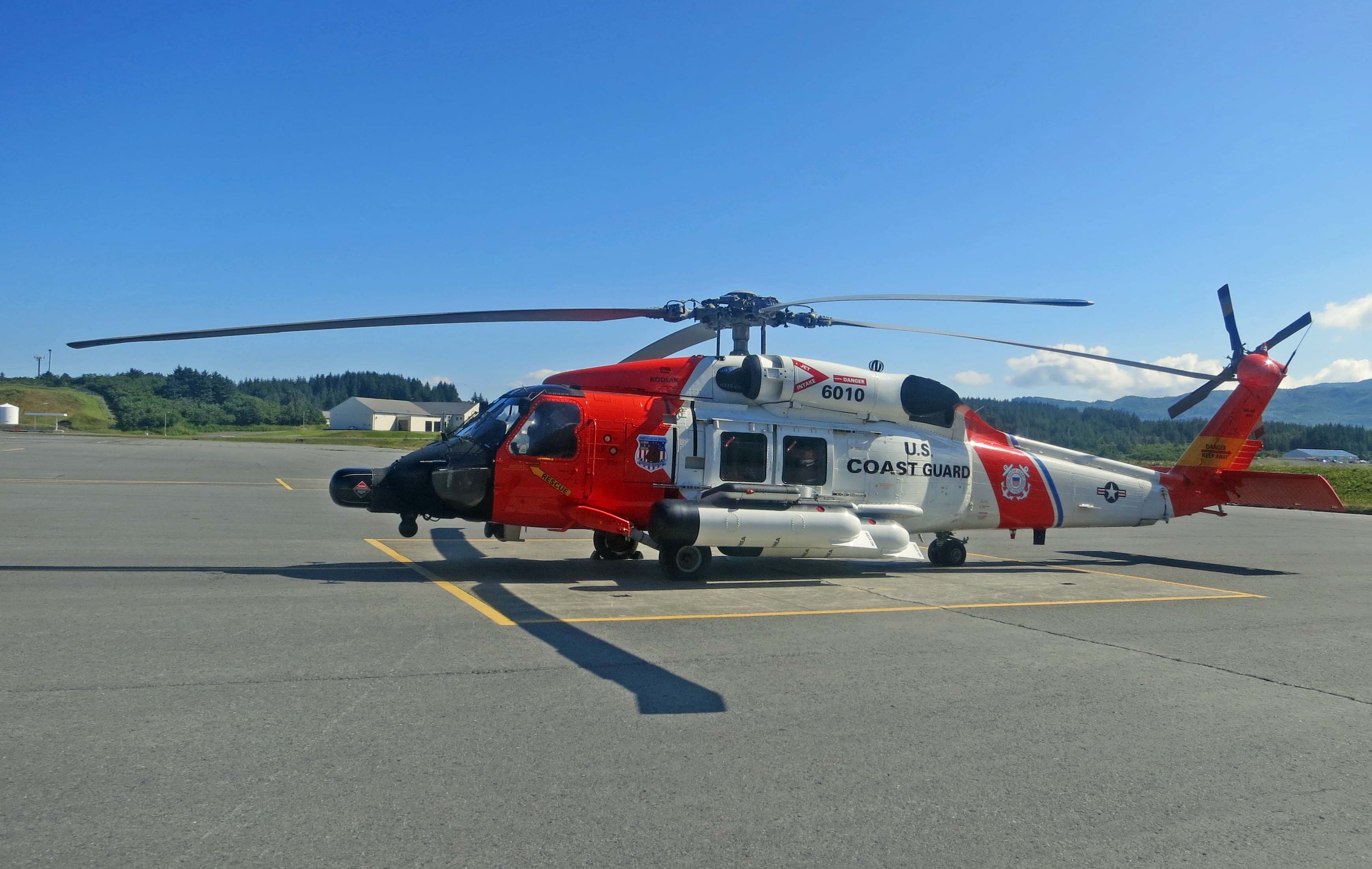
Our floatplane trip also provided us with some great views of the Kodiak Coast Guard Station where our son Tony flies H-60 Helicopters on missions rescuing everything from stranded fisherman to errant oil rigs. I’ll blog about the Coast Guard later.

Coast Guard Station on Kodiak Island.

A view of the Coast Guard station on Kodiak. We stayed at our son’s house on the facility. (Photo by Peggy Mekemson)

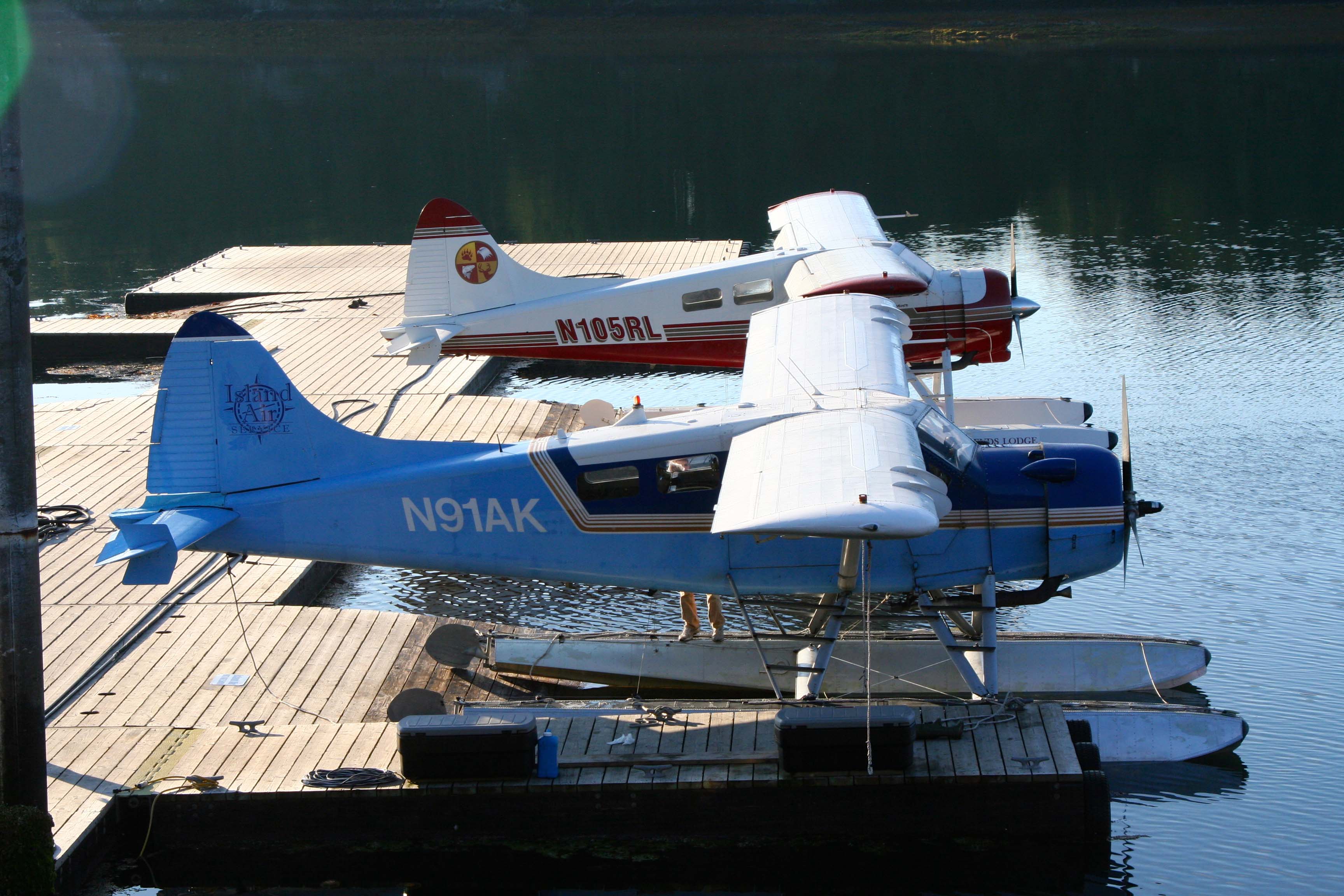
The floatplane was a 50-year-old plus de Havilland Beaver, which makes it not only old, but also something of a legend.  Ours, according to the pilot, had originally been designed to serve as a light bomber during the Korean War and still had bomb mounts on the wings. The Beaver found its true vocation serving as a bush plane in the far north, however. It has lots of STOL in pilot lingo, short takeoff and landing capability. And STOL is critical when your runway might be a riverbank or a small pond.

Beaver floatplane in Kodiak Alaska.

Our de Havilland Beaver floatplane was waiting for us when we arrived. (Photo by Peggy Mekemson)

A few weeks before our visit, Tony, his wife Cammie, and their children had toured Kodiak in one of these floatplanes.

A few weeks before our visit, Tony, his wife Cammie, and their children had toured Kodiak in one of these floatplanes.

The first floatplane I ever flew on had retractable wheels and took off from a regular airport. I somehow didn’t make the connection that we would be landing in a bay. The armrest probably still has my fingerprints embedded in it from when I thought we were crashing in the water. This time we took off from and landed in water. There was no confusion. Only the bear.
Another photo of Peggy's that captures both the green and ruggedness of Kodiak. We spotted mountain goats on some of the peaks.

Another photo of Peggy’s that captures both the green and ruggedness of Kodiak. We spotted mountain goats on some of the peaks.

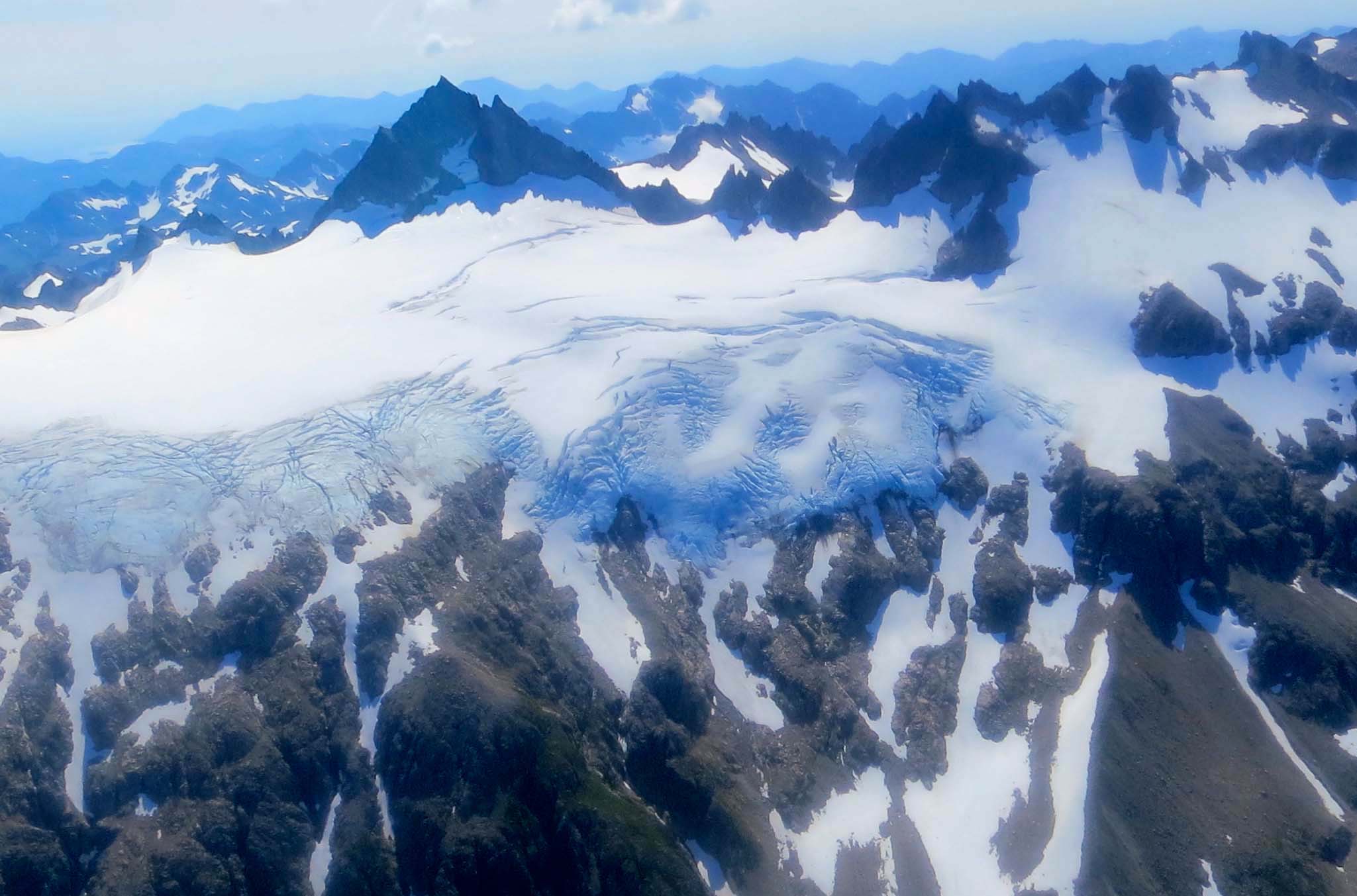
Kodiak, Alaska glacier

This, and the next three photos show the glaciers we found on Kodiak.

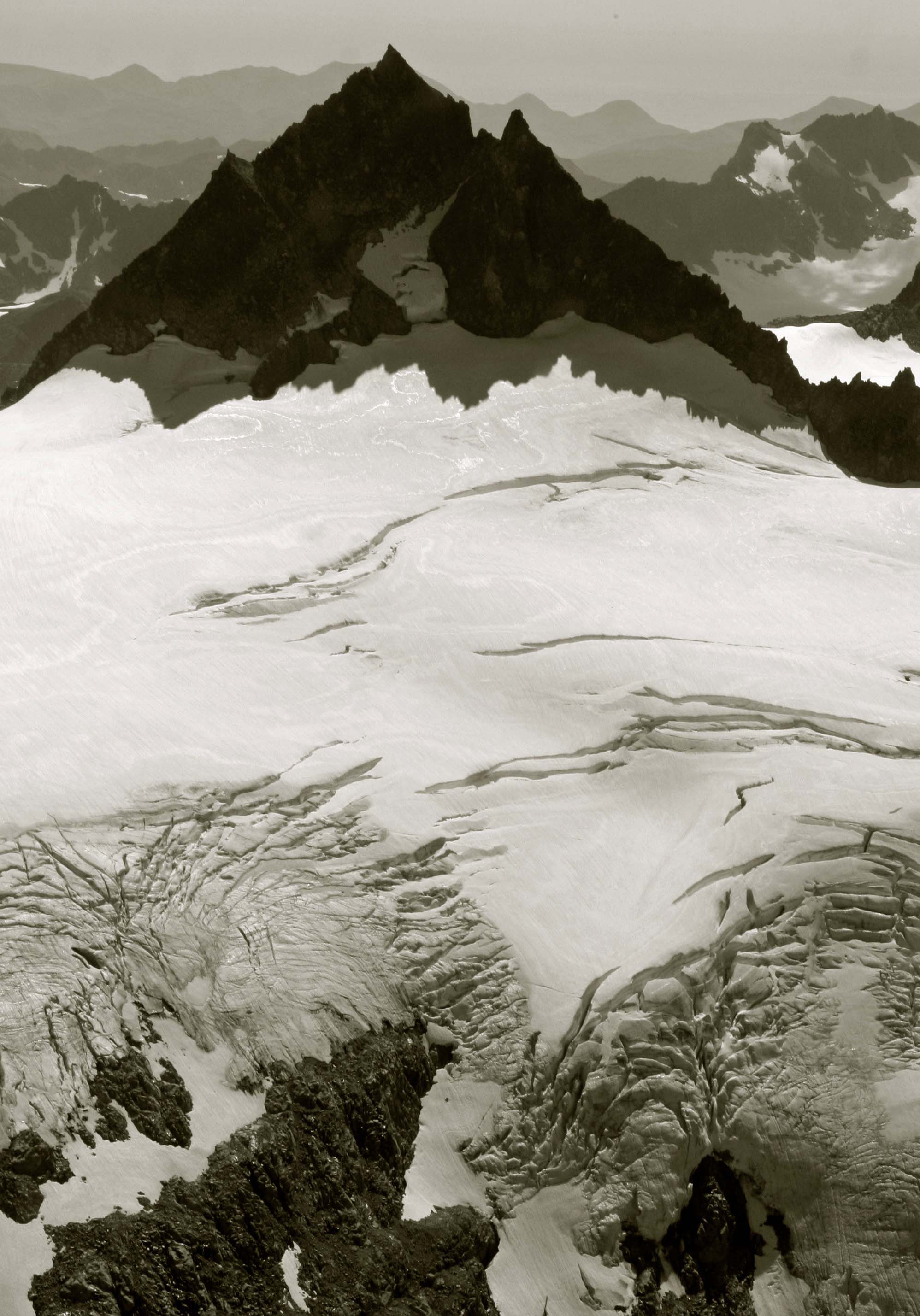
Kodiak, Alaska Glacier

Kodiak Island glacier. I thought this photo Peggy took would be best shown in black and white. (Photo by Peggy Mekemson)

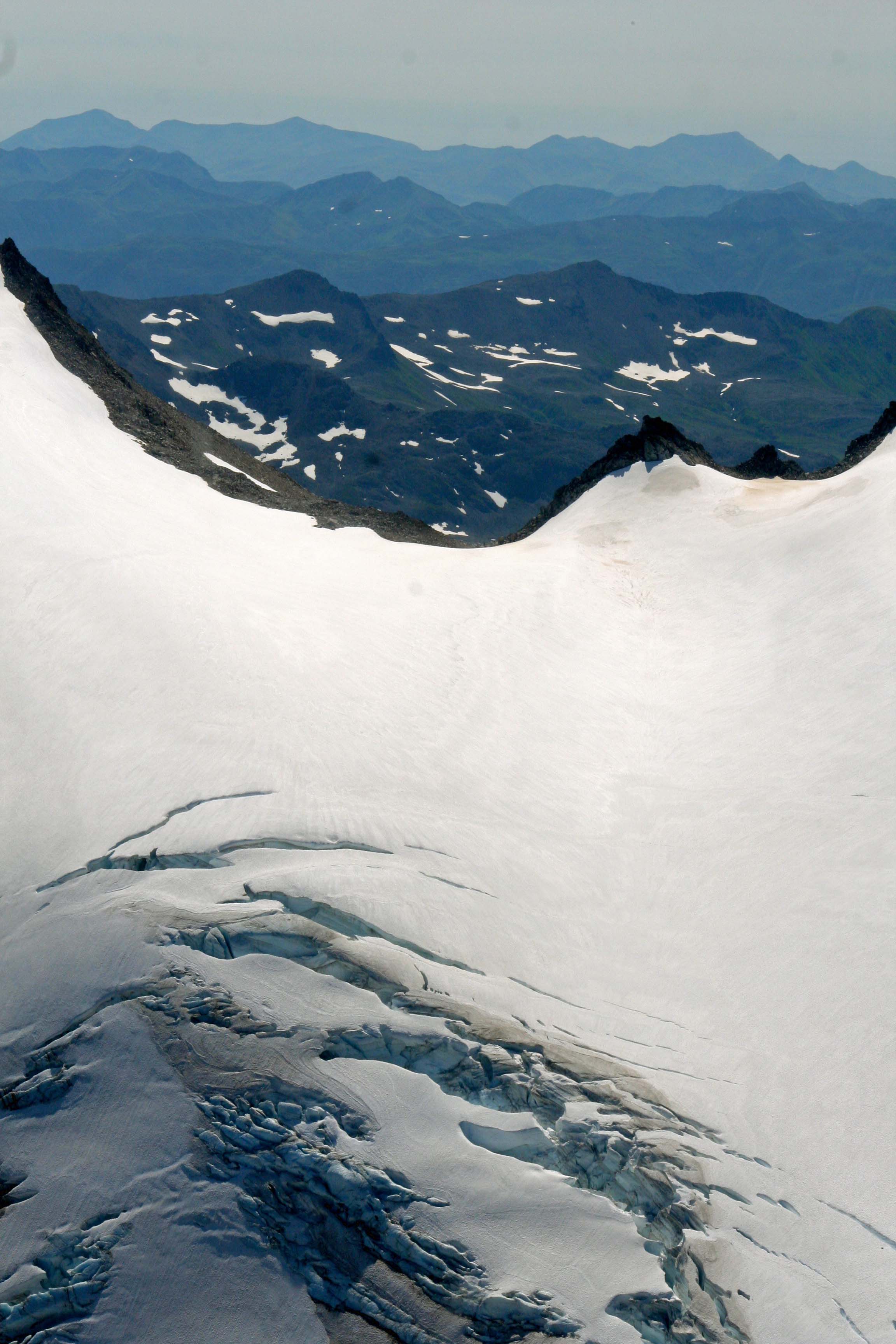
Kodiak Alaska glaciers.

I close with another glacier photo that I found almost mystical. (Photo by Peggy Mekemson)

And Then the Bear Had Me by the Head… Scary Bear Stories Part II

I took this photo of an Alaska Black Bear last week at the Alaska Wildlife Conservation Center. When I was leading backpack trips in Alaska in the 80s, a black bear bit through a sleeping bag into a forrest service ranger's leg.
I took this photo of an Alaska Black Bear two weeks ago at the Alaska Wildlife Conservation Center.

At the end of my last blog, I had backpacked 18 miles into Yosemite Valley to resupply the food bears had taken from me.

My intention was to stay in the Valley that night but it was a zoo, absolutely crawling with tourists. So one very tired Curt shouldered his pack and hiked five miles back over the 3000-foot cliffs into Little Yosemite Valley. I nodded off that night listening to backpackers yelling as bears methodically worked their campsites, wondering when my turn would come. It came all too soon.
I woke up to a bear emptying my backpack about five feet away from where I was sleeping. This brings me to another piece of Yosemite bear lore: always leave the pockets of your pack open. If you don’t, the bear will open them for you. It tends to be rather hard on backpacks.

Fortunately, my food was safely hanging from a cable and I had left my pack wide open. I watched with clinical interest as the bear shoved his head into the pack, pulled out an item, dropped it on the ground and then stuck his head back in the pack. By then I had enough and suggested rather loudly that the bear go elsewhere. After one more foray, he did. The only damage I suffered was bear slobber, all over everything. My old Basset Hound, Socrates, the world champion of slobberers, would have been jealous.

The next night I was leaving my camp for an evening walk when I met a bear coming to visit. I bent over and picked up a rock and he took off like a dog. And thus my summer went. By the time I had led two back-to-back hundred-mile trips into Yosemite, I had my fill of bears and they had had their fill of Trekker food. Fortunately, no more of it was mine. I considered myself an expert food hanger and bear chaser.

It was almost my demise.

At the end of the second Trek, my friend Jean, her sister Mary and her husband Tim joined me at Tuolumne Meadows to hike the John Muir Trail. We spent the night at the Tuolumne campground. I had eaten backpacking meals for two weeks so it was time for grilled steaks, a little bourbon and several cans of beer before hitting the trail again.

As the night progressed, I was feeling no pain and had lots of liquid bravery. So it wasn’t surprising when a bear came to visit our neighbors from Iowa, I was prepared to do battle. They had left their cooler out on the picnic table as an open invitation and the bear was leisurely opening it. The Iowans were hiding out in their camper, making nary a peep.

“HEY BEAR,” I yelled as I strode across the road, “GET OUT OF HERE!”

Well, Mr. Bear had found himself a cache of fresh food and wasn’t about to leave. He turned around, stood up on his hind legs, raised his front legs over his head and said “GRRRROWL!” He was one big fellow. Stone cold sobriety was instantaneous.

“OK bear, it’s all yours,” I mumbled as I scurried back across the road to my own camp and safety. “Eat all of the Iowan food you want. Heck, eat the Iowans.”

By this time though, 20 flashlights were shining down on the bear. Campers are packed into Tuolumne Meadows like tenement housing in a barrio and all of the neighbors were wondering if they were next. Thus disturbed, Mr. Bear went grumbling off over the hill, more than a little pissed to have his fine feast disturbed. You could almost make out in his growling, “I’ll be back.”

Of course the Iowans left their cooler out on the table. No way were they budging from their camper. I pictured them driving nonstop back to Des Moines the next day.

Finally things settled down. After another bourbon or two, we crawled into our sleeping bags. Tim and Mary disappeared in the security of their truck and Jean and I crashed on the ground.

Not surprising, there came a time when Jean had to visit the restroom. Beer will do that. Equally unsurprising the bourbon helped me sleep right through her getting up. But I did hear her come back. Except it wasn’t Jean I heard through my alcohol-induced grogginess; it was the bear coming back for revenge.

“GET OUT OF HERE!” I screamed with all of the passion I had used when I had awakened with the bear standing on me. Jean not knowing what to do grabbed me by the head and said, “Curt, it’s all right, it’s only me!” This was undoubtedly the right thing for her to do, except now the bear had me by the head. As you might imagine, my yells increased in volume geometrically.
Picture 20 flashlights shining down on this happy little domestic scene. If Mr. Bear had any thoughts of revisiting our area that night, he gave us wide berth afterwards.

NEXT BLOG: Back to Kodiak and our float plane trip over the island.

When Bears Behave like Bears: One Thousand Pounds of Entertainment… Part 3

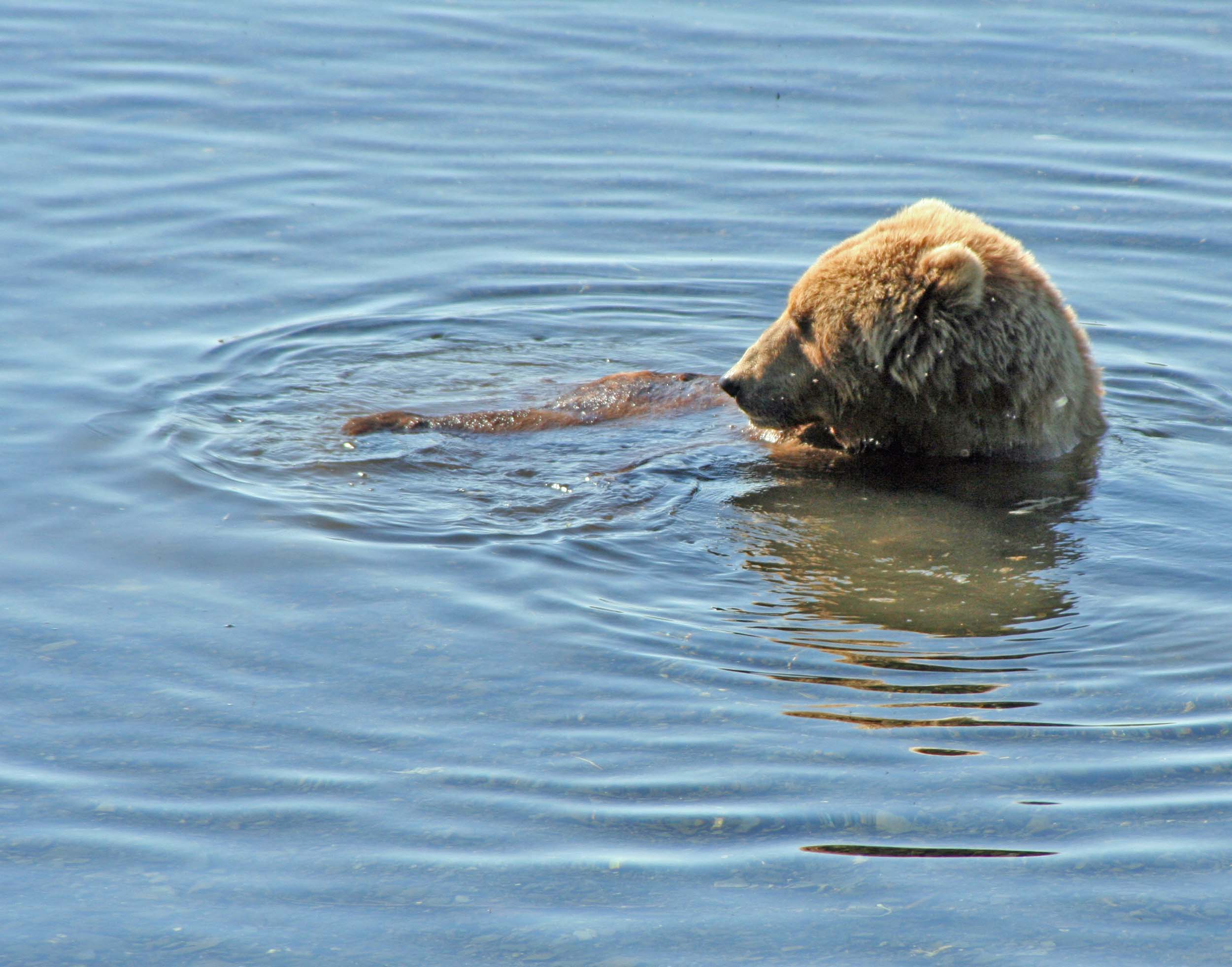
Kodiak Bear cooling off on the Frazer River.

There is nothing like a cool dip in the water on a hot summer day. This large Kodiak Bear plopped down in the Frazer River, obviously enjoying herself. Soon she had rolled over on her back. See below.

As I have noted before, Kodiak Bears are big animals with large teeth and sharp claws. They can be daunting, even scary. And they always deserve respect. When I found one fishing the same small stream we were fishing on the Chiniak Peninsula last week, I beat a hasty retreat, slowly. Running away would have suggested I was dinner, or at least something to play with. And bears play rough.

Bears attack people but these encounters are rare considering the number of people and bear encounters each year. On Kodiak Island there are some 14,000 people and around 3500 bears. Odds are if you spend any time at all outdoors, you will meet up with one of these magnificent creatures.

Over a thousand people per year make the trek out to the Kodiak Island’s best bear viewing spot, the Frazer River. As far as I know, no one has been eaten. A friend of mine who taught wilderness survival skills to the military used to tell his students if bears wanted to eat people, they would move in to town where there are a lot more people to eat. Mainly bears like to avoid people. We are scarier than they are.

The bears of Frazer River put on a great fish catching demonstration and the moms and cubs had a serious “ah” factor. But they also cooled off in the water, sat and watched the world go by, established who was boss, and enjoyed a good scratch. I found some of their behavior quite humorous.

Kodiak Bear cools off in the Frazer River.

Mom lays down on her back.

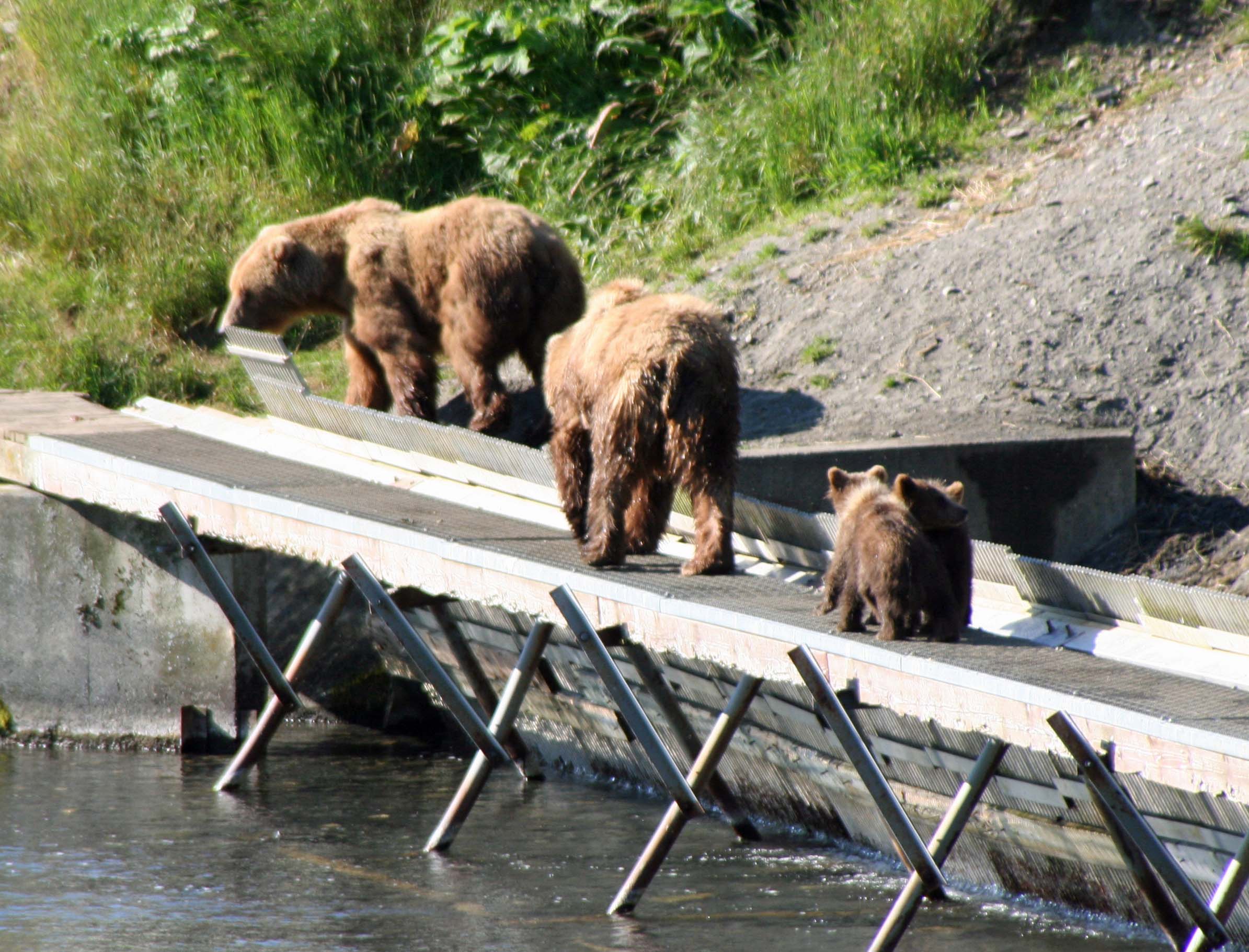
Kodiak Bear on the Frazer River Fish Pass.

I wasn’t about to tell this guy he had to stay off the Fish Pass. Check out the claws! 

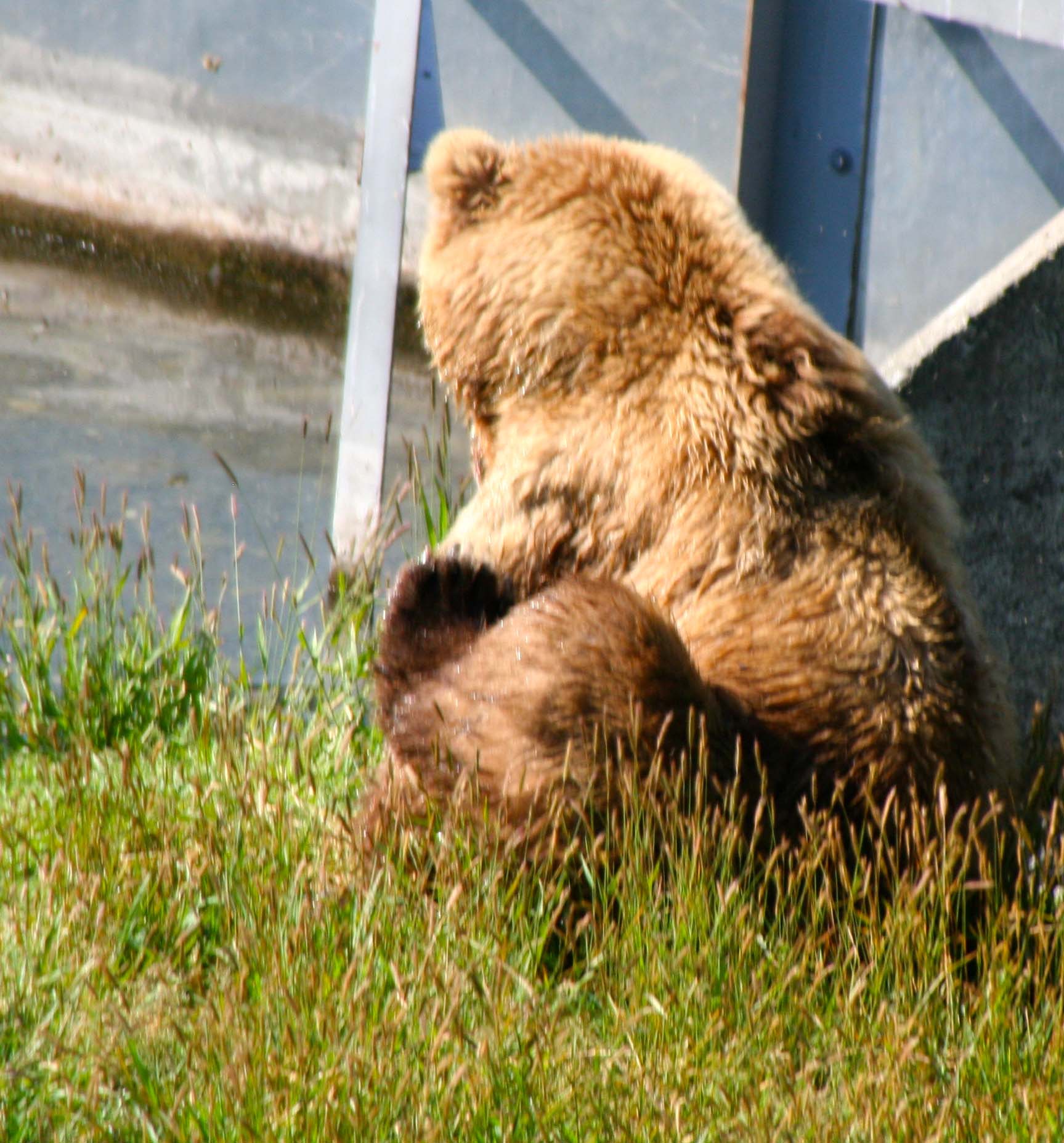
I also enjoyed this Kodiak Bear sitting in the grass and watching the action in the river.

I also enjoyed this Kodiak Bear sitting in the grass and watching the action in the river.

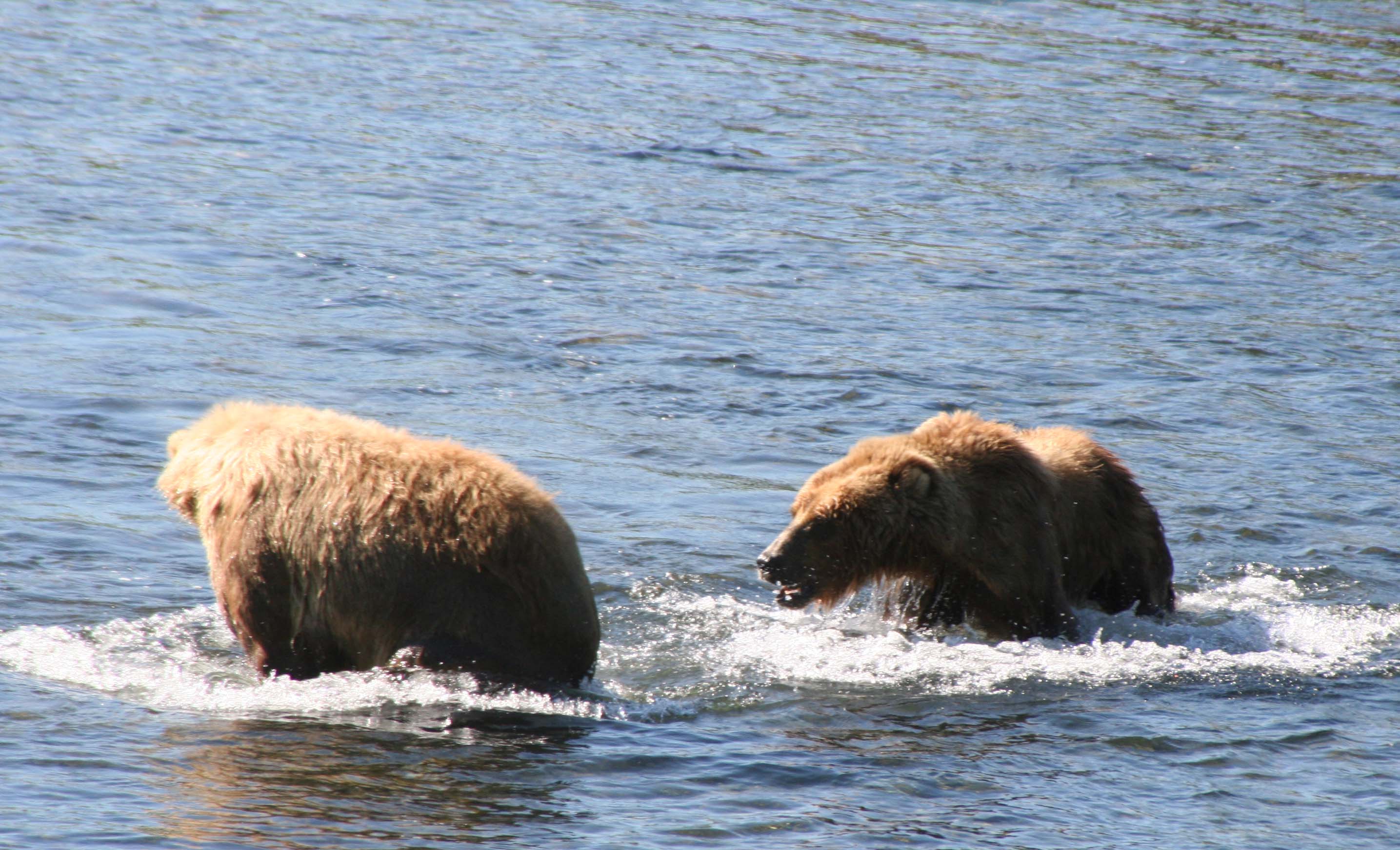
Kodiak bears tend to be solitary animals but do come together when abundant food is available.

Kodiak bears tend to be solitary animals but do come together when abundant food is available. These two seem to be pretending that the other bear is not present. Out of sight, out of mind.

While the Kodiak Bears are not territorial, arguments may ensue in close conditions. We could here the growling.

It didn’t work. We could hear the growling. We were glad that we weren’t the ones being growled at.

Kodiak Bear shows submission

Kodiak Bears have developed a number of postures and sounds to avoid conflict. The bear on the left has lowered his head in submission.

We also watched the mother bear drive off a large male to protect her cubs.

We also watched the mother bear drive off a large male to protect her cubs. (Photo by Peggy Mekemson)

Kodiak Bear salutes... or possibly scratches an itch.

Is this “I pledge allegiance,” or “Aw that feels good?” I’ll go with scratching an itch.

Lone kodiak Bear standing in the Frazer River on Kodiak Island.

In the last shot of our bear viewing trip, a lone Kodiak Bear fishes in the Frazer River.

NEXT BLOG: Flying over Kodiak Island in a float plane.

A Visit with the World’s Largest Bears… Part 1

Kodiak Bears in the Frazer River on Kodiak Island.
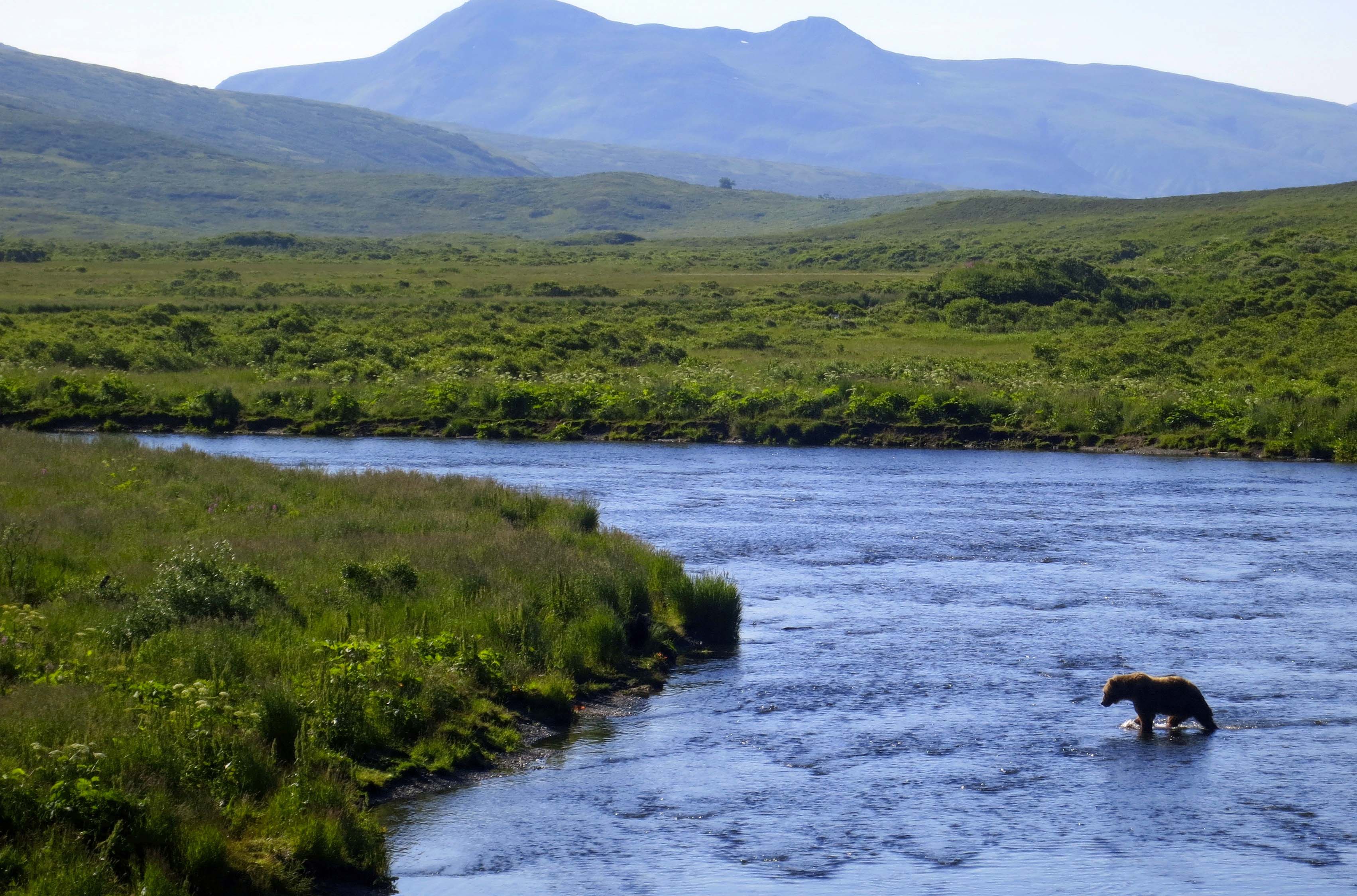
The beautiful Frazer River on Kodiak Island is home to some of the largest bears in the world.

The largest Kodiak Bears can tower up to ten feet when standing on their hind feet and weigh over 1500 pounds. With these stats, the brown bears of Kodiak Island are considered the largest bears in the world.

We were privileged this past week to spend a day watching them on the Frazer River, which flows out of Frazer Lake on the southern, uninhabited part of the island. We flew in by floatplane and then hiked for a quarter of a mile to a section of the river that had dropped several feet during Alaska’s massive 1964 earthquake. A fish ladder had been built to help the salmon over the section. The Kodiak Bears consider the area beneath the falls and ladder to be their personal fishing hole.

A Kodiak Bear prepares to go fishing on the Frazer River.

Our son Tony, who flies helicopters for the Coast Guard out of Kodiak, and his wife Cammie had arranged for the trip. We owe them big. It was a gorgeous day in a beautiful area and a number of bears were fishing for salmon. This is the first of three blogs I am going to do about the experience. Today I will feature moms and their cubs. Next I will focus on the bears fishing. I will finish with some fun photos of bears being bears.

Cubs are born in January or February while their mother is still hibernating in her cave. They then nurse for several months before emerging in June. They weigh approximately one pound when born. Cubs live with mom for three plus years before venturing out on their own. Bears have their first cubs around five years of age and continue to produce litters every four years or so into their twenties.

A mother Kodiak Bear checks on the welfare of her three cubs. The cubs were waiting for mom on a fish pass that led the salmon to the fish ladder.
A mother Kodiak Bear checks on the welfare of her three cubs. The cubs are standing on a fish pass that leads  salmon to the fish ladder. (Photo by Peggy Mekemson)
Here the three cubs are waiting patiently while mom fishes. They will lose their white collar in their second year.
Here the three cubs are waiting patiently while mom fishes. They will lose their white-collar in their second year. It is hard to believe that these little tykes will grow up and weigh over 1000 pounds. (Photo by Peggy Mekemson)
I liked this shot of mom and her parade. She had just chased off a male Kodiak Bear.
I liked this shot of mom and her parade. She had just chased off a male Kodiak Bear. (Photo by Peggy Mekemson)
A different Kodiak Bear mom touches noses with her cub. (Photo by Peggy Mekemson.)
Kodiak Cub next to  Frazer River  on Kodiak Island.
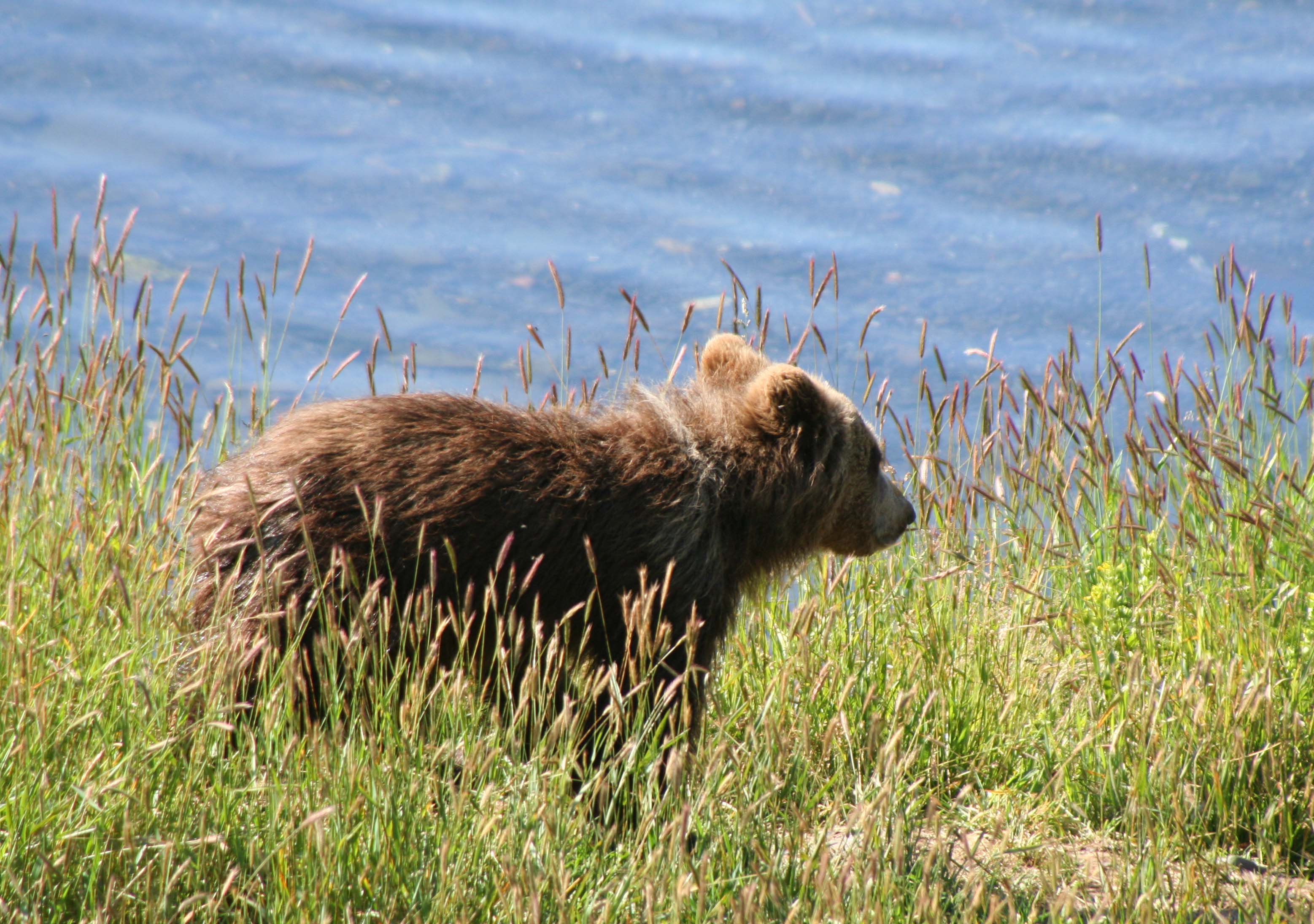
We watched this cub playing with its mom in high grass where we couldn’t get any photos although she was about ten yards away.
Kodiak cub stands on hind feet searching for mom fishing in the Frazer River on Kodiak Island.
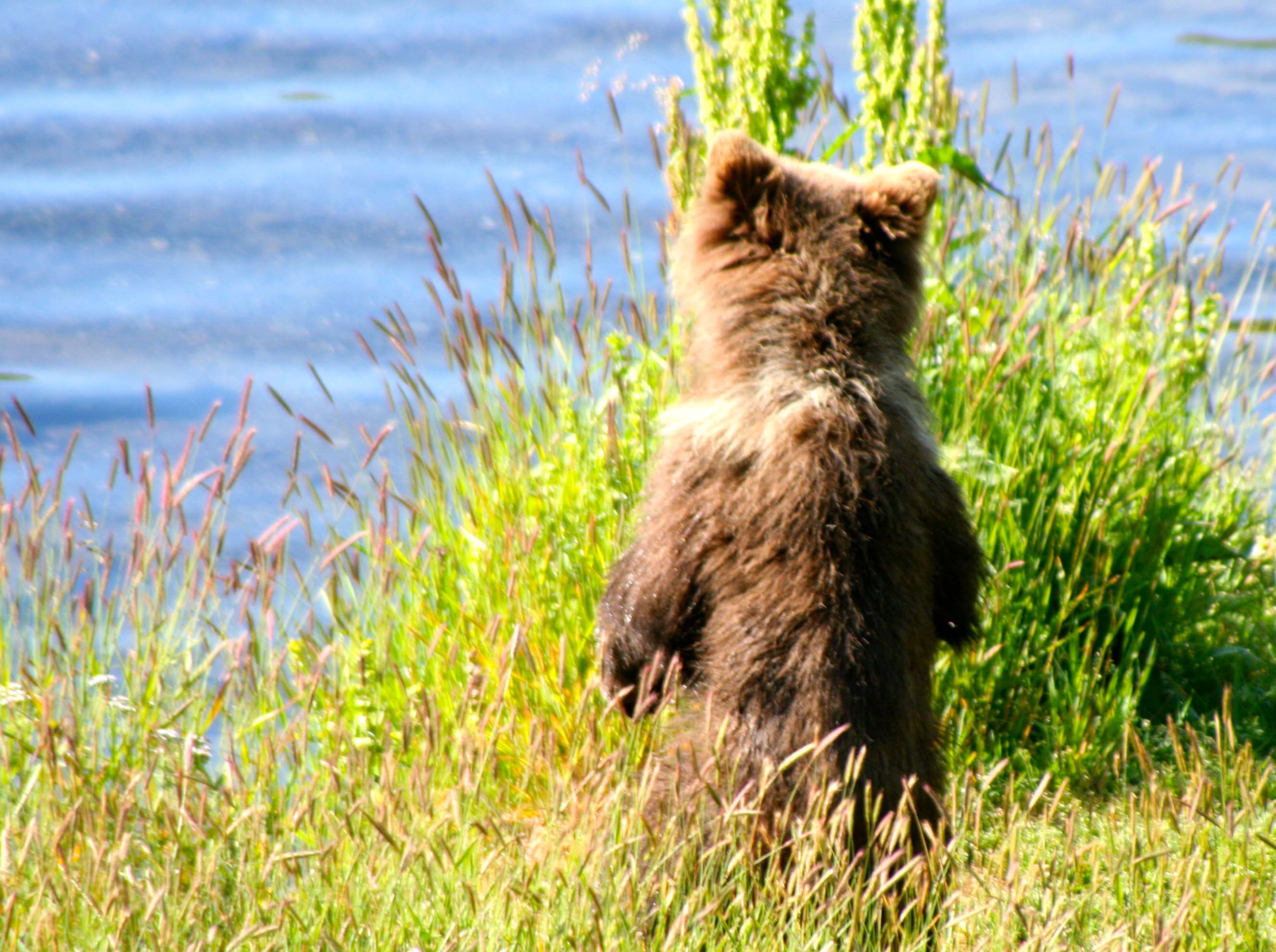
“Where did Mom go?” the little guy seems to be asking as he stands up on his hind feet and looks for her.
Kodiak cub watches its mother fish in the Frazer River on Kodiak Island.
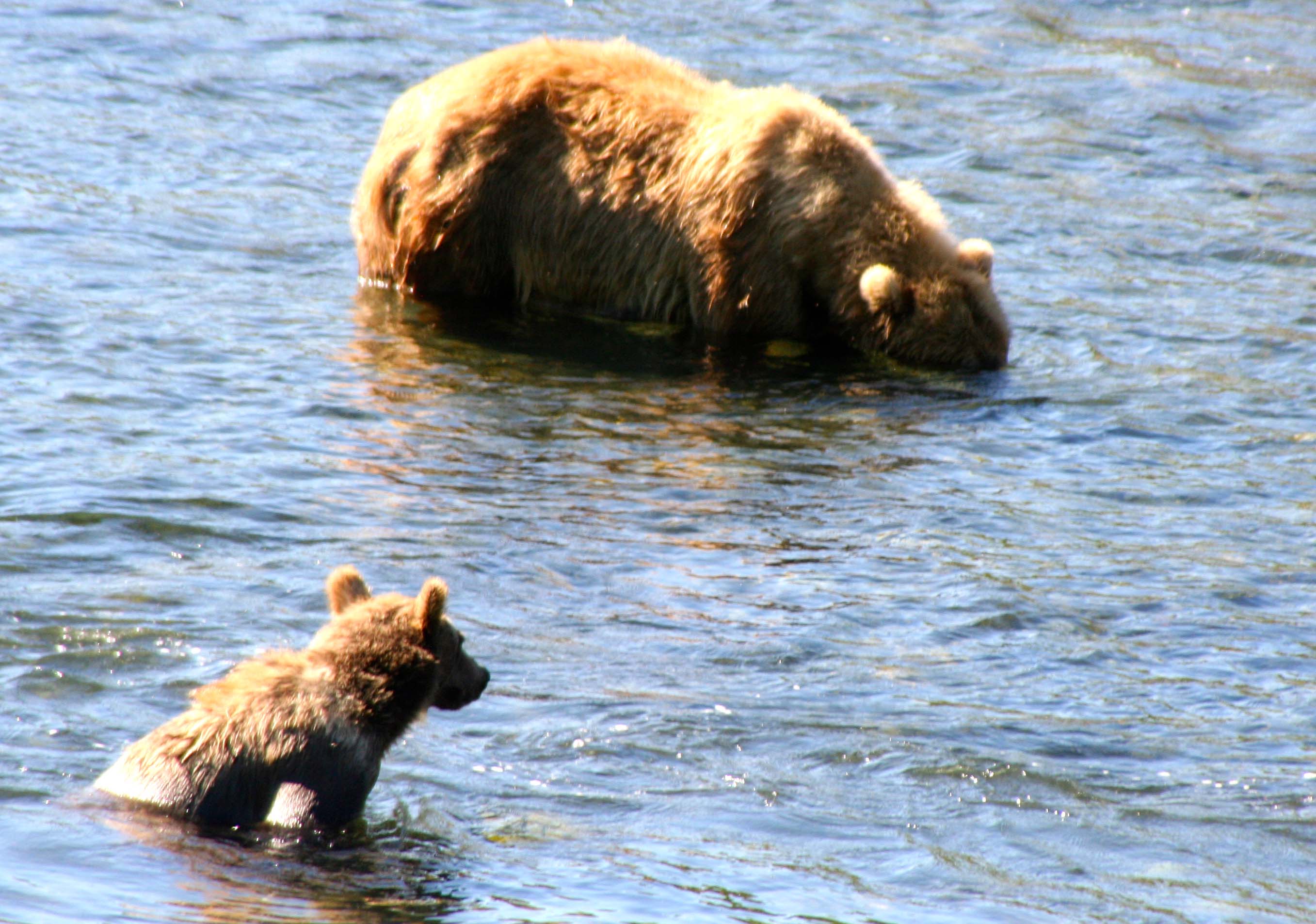
Momma Kodiak has her head buried in water searching for Salmon. Junior joined her for the show. “Catch a big one, Mom.”
Having caught a fish, Mom shares it with her cub.

NEXT BLOG: Peggy and I watch the Kodiak Bears on the Frazer River catch enough salmon to make the most skilled fisherman jealous.

Innocent Until Proven Guilty… North to Alaska

First Grade class at Diamond Springs Grade School in 1949.

Our first grade class at Diamond Springs Elementary School in California. Bob is second from the left in the bottom row. I am fourth from left in the upper row. Our tough looking teacher, Mrs. Young was charged with civilizing us.

Our friends Bob and Linda Bray, along with their ever-present dog, Sister, arrived around three bearing wine. They had parked their RV on our lower property and trudged up the steep hill to our home in 100 degree plus weather. I was still waxing Quivera the Van in preparation for the trip to Alaska.

I wiped the stinging sweat from my eyes and greeted them. The Brays were joining us on our adventure.

Bob and I have been hanging around together since first grade, which was a while ago. In the beginning, our friendship faced a serious obstacle. Bob’s mother had a rule: he was not to play with the Mekemson boys. We were Trouble spelled with a capital T.

Rightfully, or wrongfully, Marshall and I were blamed for most of  the bad things that went on around Diamond Springs. Who shot Tony Pavy’s pig, broke into Jimmy Pagoni’s wine cellar, went joyriding on Caldor’s rail car? It was the Mekemson boys, of course.

Most of the mischief I got into involved tagging along with my older brother. When he graduated to girls, my reputation made a miraculous recovery. I was, however, able to pull off one last coup and live up to Bertha Bray’s expectations. For some unfathomable reason, Bob’s parents bought him a Wham-o Slingshot.

I mean, how do you expect your son to resist temptation when you buy him a slingshot? The fact that I owned a Wham-o as well almost guaranteed trouble.

Bob and I agreed to meet for a clandestine hunting expedition. It had to be clandestine because I was still on Mrs. Bray’s ‘don’t invite’ list. Our only rule for the adventure was that anything that moved or didn’t move was a valid target.

Things were going great until we came upon the old abandoned bum’s shack that was just off the Southern Pacific railroad track about a quarter of a mile away from Bob’s home. Typical of such structures, it had been created out of anything that was available for free: old aluminum roofing, miscellaneous boards, an occasional nail, a thrown away mattress, etc. It had one crowning glory, a window.

Bob and I looked at each other and had a simultaneous thought. Out came our ammunition, a shiny new marble for Bob and several bee bees for me. We took careful aim, counted down, and let fly.

To this day, Bob claims he saw his marble harmlessly strike the windowsill while my bee bees were smashing the glass to smithereens. I of course saw Bob’s marble hit the window dead on while my bee bees formed a neat pattern around the edges. There was no doubt about it; we were both innocent.

The current occupant of the not abandoned home, who was washing dishes behind a willow bush in a small stream, saw something entirely different– two little boys smashing his pride and joy.

He let out a bellow of rage and came charging up the trail. Once again the Mekemson Gang, along with its newest recruit, was on the run. The good news is that we escaped. The bad news was that the bum/hobo/homeless person with a home recognized Bob and went straight to his house. Mrs. Bray’s worst fears had been realized.

The story didn’t end there. On the 50th anniversary of our starting the first grade together, Bob sent me a present for Christmas, a slingshot. Somewhere, I suspect Bertha Bray rolled over in her grave, or maybe she chuckled.

Bob and I today on the road north in Salem, Oregon.

Bob and I today on the road to Alaska.

Linda with the family dog, Sister.

Linda with the family dog, Sister.

Sister provides a head shot.

Heads or…

Sister provides a tail shot.

…tails.

Next Blog: The wonderful totem poles of the First Nation People.

A Tall Trees Tale: Shake Down Cruise to the Redwoods… North to Alaska

Moss covered tree in Redwoods National Park.

When we think of the Redwoods, it is usually about the giant Redwoods. But the Redwoods also have an incredible greenness that is long remembered.

A long trip, especially a long trip where services are few and far between, means you prefer not to have breakdowns along the way. I dutifully took Quivera in to the Ford Dealer and spent the usual obscene amount of money to increase my chances she would behave herself on the way to Alaska. The drive to Alaska isn’t as challenging as it once was (I made my first trip in 1986 over frozen dirt), but it is still challenging.

To further increase our chances of a worry-free trip, Peggy and I– along with our daughter and two grandkids, took Quivera on a shake down cruise to the Redwoods National Park in Northern California, about three hours away. We had introduced our son Tony’s kids to the Big Trees last summer and were eager to have Tasha’s children share the experience.

We dutifully took the kids to see the Big Tree. It is 304 feet tall (92.6 mtrs), 21.6 feet in diameter (6.6 mtrs) and 68 feet (20.7 mtrs) in circumference. The estimated age of the tree is 1500 years. Afterwards, Ethan and Cody along with our next-door neighbor’s son, William, went charging off to look for Ewoks and banana slugs. Star Wars was filmed nearby.

Big Tree in Redwoods National Park.

The eight year old Ethan on the left, our nine-year old next door neighbor William, and the five-year old Cody pose in front of the Big Tree in Redwoods National Park.

Big Tree at Redwoods National Park.

Looking up at the Big Tree. It is impossible not to feel awe.

A pair of giant trees in Redwoods National Park.

Of course Big Tree is just one out of hundreds of the giants found in Redwoods National Park.

Firn with rain drops in Redwoods National Park.

It had rained just before we started our visit and this fern was still holding rain drops.

Banana Slug at Redwoods National Park.

A bright yellow Banana Slug makes its way along the forest floor. The Banana Slug, BTW, is the school mascot for the University of California, Santa Cruz.

Redwoods National Park

Another view of how green it is at Redwoods National Park. I told the boys to look out for Ewoks. The boys are avid Star Wars fans. “You know Ewoks are make believe,” the five-year old Cody primly informed me. Darn. I thought they were real.

Redwoods National Park

The light grey clouds against the dark tees provided an interesting view looking up.

Leaves at Redwoods National Park.

I also liked this shot looking up at leaves.

Pacific Ocean

We also camped out on the Pacific Ocean. This is our daughter Natasha. The tracks you see were made by the boys, running back and forth between the ocean and their driftwood forts.

Harris State Beach Park

We spent our last night at Harris Beach State Park in Brookings, Oregon

Fog rolls in at Harris State Beach  near Brookings, Oregon.

The fog was rolling in when we packed up to leave. Quivera was ready to head north to Alaska.

NEXT BLOG: You’ll meet our traveling companions, Bob and Linda Bray. Bob and I have been hanging out together and causing mischief since the First Grade… a long time ago on a far and distant planet.

Living in 120 Square Feet… North to Alaska in Quivera the Van

Quivera at Great Basin National Park in Nevada.

Quivera, and her older sister, Xanadu, have travelled two hundred thousand miles exploring North America. This photo was taken  at Great Basin National Park.

As I write this blog, Peggy and I are preparing for a trip to Alaska. (Actually, when you read this we will be on our way.) Our itinerary includes driving north through Oregon, Washington, British Columbia and the Yukon Territory to Anchorage and back, a road trip of some 7600 miles that includes the Alaska Highway and travels through some of the world’s more remote and beautiful wilderness settings.

A key part of our preparation is making sure our van, Quivera, is ready to hit the road. She has already been to the doctor and had her check up followed by on a shake down cruise to the Redwoods. (When you return from a trip to the hospital, it’s important to make sure all of your organs are still working.) Next up she gets stuffed– oh, I mean packed. We have lists. Peggy handles the majority of this task. Each and everything has its place and she likes to know where each and everything is. Being the ever forgetful husband, I like her to know where each and everything is.

Our van, Quivera, has her own pad on the upper part of our property in Oregon.

At home in Oregon, Quivera has her own pad on the upper portion of our five acres. The ‘porch’ provides a great place to write. (The yellow lift helps level the van.)

White oaks in southern Oregon.

The view from the porch looking down toward our home through the white oaks. I often see the neighborhood fox that lives on our property working the hillside for gophers and other rodents. 

Black Tail buck in Southern Oregon just starting to regrow his antlers.

There are other distractions. Black Tail deer stop by frequently to make sure I am working. The buck in front was just starting to regrow his antlers when I took this photo in April.

Peggy loves the van– and that’s a good thing. Having a happy Peggy is very important, especially when you live in a 120 square foot house. I can stand in my office and do dishes. The bathroom and stove are two steps away. The living room, dining room, and bedroom are a distant four steps. (Speaking of Peggy, today, July 5th is her birthday. A proper celebration is required. She is required to make animal noises, which happens to be a family tradition from her side of the family. But more on that later…)

The view from my office toward Peggy's domain, four steps away.

The view from my office toward Peggy’s domain, four steps away. There is plenty of room to work on projects or lie back and read. The area also serves as our dining room and, at night, morphs into a king size bed. The kitchen is on the left, the bathroom on the right.

Looking toward my office from Peggy's perspective.

Looking toward my office from Peggy’s perspective. The passenger chair swivels around and is quite comfortable. Our TV/entertainment center is on the far right.

The kitchen: a two burner stove, the sink, and a refrigerator. What more do you need?  (grin)

The kitchen: a two burner stove, the sink, and a refrigerator. What more do you need? (grin)

Our grandsons call our home on wheels a Transformer. They are experts on the subject. For proof, they point out the button that turns the couch into a bed. It’s an innovation Peggy insisted on having and the kids insist on using. Up and down, up and down, up and down. Grandma has placed limits.

Pleasure Way, out of Saskatoon Canada, is the manufacturer of our 22 foot long RV. Twelve years ago we visited the plant and were given a tour by Mrs. Pleasure Way. She also gave us a jar of her homemade jam. The folks in Saskatoon are friendly; they also create a quality product. This is the second RV we have bought from the company.

We called the first van Xanadu and the second one Quivera. Both names reflect our wandering ways. Between the two RVs, we have explored 200,000 miles of North America’s highways and byways. Our total road time includes four years of dedicated travel and nine years of shorter trips.

“How do you live in such small space?” people often ask in wonder.

“You have to like each other, a lot,” I respond with a grin. And it’s true.

But there is much more. For one, wandering around North America is a grand adventure… a glorious road trip that most people only dream about. Our travels have taken us from Fairbanks,Alaska to Key West, Florida and almost everywhere in between. The journey has also enabled us to visit our far-flung kids and grandkids on a regular basis. For a while, before the Coast Guard transferred our son Tony from San Diego to Alaska, we had developed a 2000-mile commute route between southern California and Hendersonville, Tennessee.

Quivera and Eeyore  share a moment at Yosemite National Park.

Quivera and Eeyore  share a moment at Yosemite National Park.

Camping at Burning Man

Quivera and  horses hang out at Burning Man in the Nevada desert. The challenge at Burning Man is that white Playa dust gets in everything. Months later we are still cleaning it out of the van. Note: The horses have a hitching post. They also share the look that most of us have after seven days..

If things get too tight inside, we have the outdoors. Warm days mean we can spend as much time outside as we do in the van. Even on stormy days, we can amuse ourselves on the porch. Plus there are always bookstores, museums and restaurants to visit.

And it isn’t like we suffer. Quivera comes equipped with a microwave/confection oven, two burner stove, heater, air conditioner, TV and DVD, refrigerator, bathroom, two sinks, two tables, nine storage cabinets, a closet, five drawers, couch, recliner chair and a king size bed. There is even a shower if you are willing to sit on the toilet while you bathe. Peggy and I opt out for campground showers. The van operates off of electricity, battery, generator and propane. Two laptops, a Verizon phone and an Internet connection keep us in touch with the world.

Not all is rosy. Space is at a premium. Stopping to camp means shifting boxes from the back to the front. And there simply isn’t room for everything we want to take. Sacrifices have to be made. Some toys have to be left behind. At least with the advent of Kindles, we no longer have to carry a 100-book library.

NEXT BLOG: A tall tale where we do a shake down cruise to the beautiful Redwood National Forest of Northern California.

Forget Waldo. Where’s the Petroglyph? Three Rivers Petroglyph Site

Groups of petroglyphs found at Three Rivers Site, New Mexico.

Petroglyphs are often found in the same location. How many can you find in the above photo? My answer is at the bottom of the blog.

When you find one petroglyph, you will almost always find more, frequently on the same rock. There is a general rule of thumb that Peggy and I follow: The more you look, the more you will find. Sometimes the petroglyphs were created at the same time and were tied together. More often, individual glyphs are added over time– in some cases over a period stretching out for a thousand years. Or more. Why waste a good rock?

The search is endlessly fascinating because you never know what’s going to pop up, or where. You may find hastily sketched glyphs for hours and then come on someone’s masterpiece, hidden away in a rock crevice or high up on a cliff.

Today, I am going to finish off my blogs about the Three Rivers Petroglyph site in New Mexico with photos featuring groups of petroglyphs on the same rock or nearby rocks. See how many you can find and let your imagination run wild with what they mean.

Petroglyph grouping at Three Rivers Petroglyph site in southern New Mexico.

There may be even more petroglyphs here than in the first photograph. Check out the rock crevice behind the star. (Can you find the star? grin) I like the trail sneaking off over the rock on the right.

Petroglyph grouping at Thrre Rivers Petroglyph site in New Mexico.

Here’s where interpretation can be fun. From left to right: Is the frog/lizard sticking its tongue out to catch a fly on top of the rock? Then there is the upside down man figure with the feet of a windmill. Next to it is the glow in the dark, Datura yoyo followed by an impressive bear foot, or is it a scared guy with his hair sticking out? And what’s with the turkey foot in the face of the Thunderbird/eagle? Did you catch the bear foot on top of the rock at the right?

Petroglyph grouping at Three rivers Petroglyph site in southern New Mexico.

Hard to get more jumbled than this. Check out the lizard on the left with the X-ray eyes. Bottom left shows a guy shooting a bow and arrow. I like the Bighorn Sheep climbing the steep mountain.

Cloud, lightning and sun petroglyph at Three Rivers Petroglyph site in New Mexico.

I’ve included this rock art because of the interesting petroglyph in the middle. Think of it as a weather forecast: It’s partly cloudy with a chance of thunder storms. The cloud with lightning is fairly common. But this one has the sun peeking out behind.

Milky Way petroglyph at Three Rivers Petroglyph site in New Mexico.

I’ll conclude with what I am calling a starry, starry night with Van Gogh in mind. At first, I thought river, but the more I looked at it, I decided the little specks were stars and the stream was the Milky Way. Maybe, maybe not– but it seems a fitting image to end this series with. Oh yeah, I’m pretty sure the round object is a UFO.

BTW: I found 15 petroglyphs in the first photo.

NEXT BLOG: The journey to Alaska begins. First up I will introduce you to Quivera the Van– our faithful traveling companion. Question: Could you and a companion live in 120 square feet for four years?

Sheep Cults and Ancient Mazes… The Rock Art of Three Rivers

Petroglyph maze at Three Rivers Petroglyph site.

Set off by distant mountains, this petroglyph appears to be a maze.

It is fun to speculate on what petroglyphs mean. It can also be frustrating. What was the artist thinking when he created the above glyph? “This will make a nice blanket design.” Or how about, “Here is the path our ancestors followed to get out of the underworld.” Or, “Here’s a fun maze.” Or, “Like wow, that Datura is some serious dope.

The petroglyph is definitely a maze; follow the lines. Beyond this, speculation becomes iffy. The book by Alex Peterson, A Field Guide to Rock Symbols of the Greater Southwest, attempts to interpret the meaning of various petroglyphs. I’ve used him extensively. But Patterson provides a cover-all-contingencies disclaimer in the beginning of his book, “There is no proof that any of these meanings are correct.

For example, join Peggy in checking out the rock art below. It’s obviously an anthropomorph (human-like), given that it standing upright and has a head. The robe has various patterns or symbols on it and a fringe at the bottom. Patterson notes that similar characters appear again and again in rock art, that “they almost certainly represent the costumed principals of the sheep cult and may have been shamans.” Sheep cults and shamans– sounds intriguing, doesn’t it.

Peggy Mekemson checks out a petroglyph at Three Rivers Petroglyph site in southern New Mexico.

We often find petroglyphs carved on difficult to reach places. If it is difficult for us, imagine what it must have been like for the rock artist.

At least Peggy is looking at a human-like figure. So far in my blog, I have featured identifiable subjects including people, animals, birds, reptiles, insects and one splattered frog. Today I am going to present geometric figures. Patterson has interpretations for many of these symbols, but what about the petroglyph featured below? All I can think of is, “Okay, children, today you are going to practice making squares.”

Petroglyph of squares at Three Rivers Petroglyph site in southern New Mexico.

Plans for a subdivision?

One of the most common geometric symbols is the circle. There are circles within circles, crosses in circles, circles made of dots surrounding other circles, etc. Naturally the sun and the moon come to mind. Also ripples on water. Once again, Patterson suggests Datura may be involved. It seems that people have similar visions when they close their eyes while under the influence. Wouldn’t know.

Solid circles surrounded by a circle with dots at Three Rivers Petroglyph site. Possibly influenced by Datura use.

Almost everywhere we looked at Three Rivers Petroglyph site we found circles. Many had outer circles made up of dots.

Petroglyph circle with cross found at Three Rivers Petroglyph site.

A number of the circle also feature crosses of various types. This was one of the more intriguing.

Circle petroglyph with possible sun at Three Rivers Petroglyph site.

I also found this interesting. My first thought is the sun.

Large spiral circle at Three Rivers Petroglyph site in New Mexico.

This is the most impressive circle petroglyph Peggy and I found at Three Rivers. It is actually a spiral. Start at the center and work outward. Which brings me to…

Spiral petroglyph at Three Rivers Petroglyph site.

… this spiral, which led me to think a bout a spiral galaxy. Could the Jornada have been in contact with little green men from outer space. Naw…….

Petroglyph found at Three Rivers petroglyph site in southern New Mexico.

Various interpretations. One is about a four eyed insect standing manlike who is bitten on the testicles by a sidewinder rattlesnake, a fate which would make any guy’s eyes go buggy.

Some of the geometric patterns may be pottery or textile designs. Modern shops through out the South West feature pottery, blankets and other items made by Native Americans featuring similar motifs.

Geometric petroglyph found at Three Rivers Petroglyph site in southern New Mexico.

This repetition of pattern suggests a design that might be used for a blanket.


Geometric petroglyph at Three Rivers Petroglyph site.

Here’s another. This petroglyph might represent a butterfly.

Finally, we have petroglyphs that are almost map-like, featuring lakes, rivers, springs, hills and even farmlands.

Petroglyph found at Three Rivers Petroglyph site in New Mexico.

Who knows? Climb down the ladder to the crops at the bottom? (grin) Could the foot print on the right be saying “Walk this way?”

Three Rivers Petroglyph site rock art.

On of my favorites at Three Rivers. Peterson says the wavy lines represent water but what’s with the square eyes.

Horse petroglyph at Three Rivers Petroglyph site.

This captures it all: a cute horse with extended tail and big feet, Datura driven circles, and a simple pattern of squares. There is even a snake in the grass. Maybe that accounts for the horse’s stance.

NEXT BLOG: I will finish off the series on Three Rivers Petroglyph site with several collages of rock art. Petroglyphs are rarely found alone.