Bolinas: A Recluse Kind of Town… Pt. Reyes National Seashore

Mural of early Bolinas, California. Photo taken by Curtis Mekemson.

A mural depicting how Bolinas would have looked in the 50s. Not much has changed. The artist added a touch of humor with the blue surfboard the man in the brown sports coat is carrying.

Marin County had a problem. Its highway department would put up a sign on Highway 1 pointing west toward the town of Bolinas and the residents of the small coastal community would tear it down. Again and again. Located 30 miles north of San Francisco and just south of Pt. Reyes National Seashore, the town didn’t want anyone to know where it was; the town was a recluse.

Finally, out of frustration, Marin County held a vote: Did or did not the townspeople want the signs? They voted no. Today, nothing points toward the community. But a map or GPS will get you there.

I first made my way to Bolinas in the early 70s. Surfers, hippies, commune members, artists, writers and other alternative types called it home. I was running an environmental center in Sacramento at the time. Being ex-Berkeley and ex-Peace Corps, I more or less fit in. “I could live here,” I thought to myself.

The town was also known for its nude beach. I won’t incriminate myself other than to note that there are some places on the body it’s best not to get sunburned.

Ken, Leslie, Peggy and I made our way to Bolinas after we left Pierce Ranch. Other than a new park in the middle of town, I was happy to find that the community had changed little. The park, I was proudly informed by a shop owner, had been donated by one of the town’s billionaires. Big money had found its way to this small community, which is pretty much the story of Marin County. Extreme wealth and a laid back lifestyle go hand in hand. In Bolinas, VW Vans and BMW’s seemed to happily co-exist.

We wandered through town poking our heads in various shops and looking for a bookstore. It’s become a tradition whenever we travel. We love books and we like to support local bookstores. We found one on the edge of town next to the post office. It was quite unique; the owner was elsewhere and shoppers were invited to price their own selections. Seven suggested categories ranged from “unbelievably really great” for $20 to “ordinary” for a buck. It was possible (though not likely) that Peggy’s really great might be my ordinary. A small, metal box with a slot on top was set up for payment. A statue of the Virgin Mary fronted the box. I wasn’t sure whether she was there to say thank you or to haunt our conscience if we paid five bucks for a book we believed was worth ten.

Bolinas, California unique book pricing recommendations. Photo by Curtis Mekemson.

A sign with suggested prices for books in Bolinas, California that depended on your assessment of the book.

Bolinas Book Store photo by Curtis Mekemson.

Ken deposits $5 for a “great book” in the Virgin Mary box while Peggy, reflected in a mirror, looks on.

Bolinas, California  book store photo by  Curtis Mekemson.

I assume this was the missing owner’s office. I believe he painted the pictures.
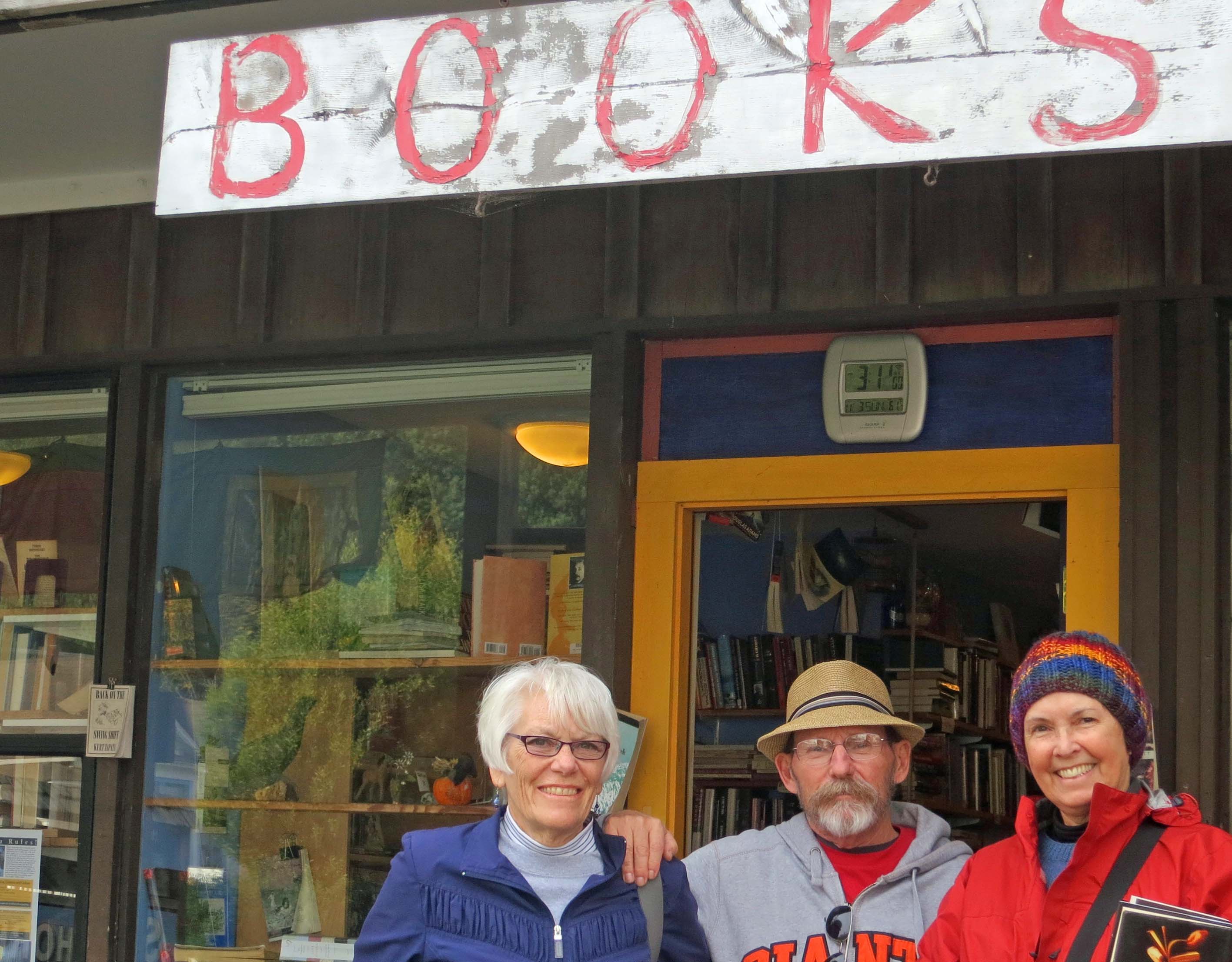
Leslie, Ken and Peggy stand in front of the Bolinas Bookstore named Books.

Leslie, Ken and Peggy stand in front of the Bolinas Bookstore named Books.

Our visit also included stopping off at a stuffed-to-the-ceiling antique store, admiring quaint houses that had been around since day one, taking photos of murals and visiting a small shop featuring incense, eastern music, and a Humpty-Dumpty Buddha.
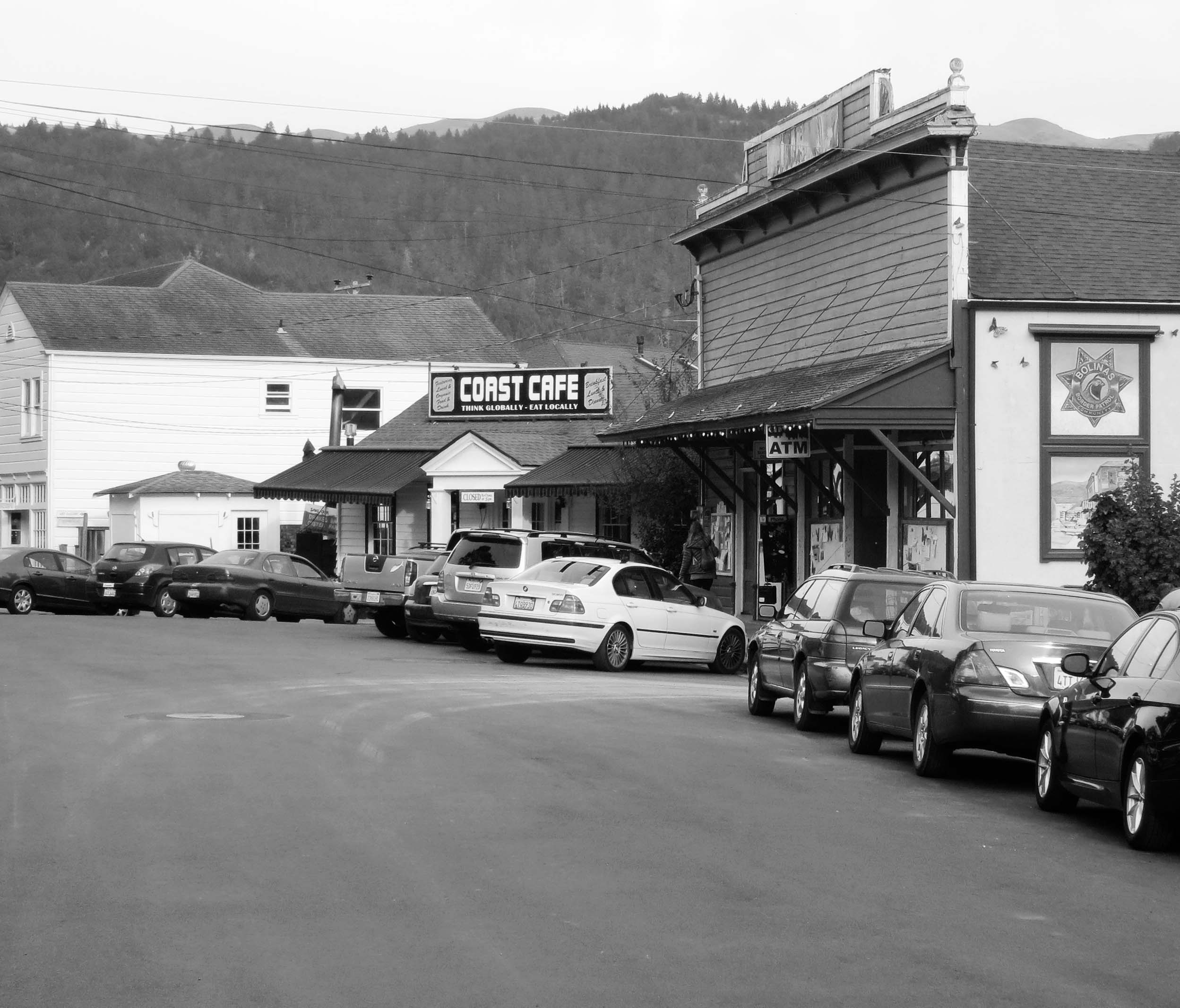
Photo of Bolinas California taken by Curtis Mekemson.

Bolinas today, which I did in black and white to give it a 70’s feeling. Take away the cars and the billboard building and you’ll find the Bolinas featured in the mural at the top of the post.
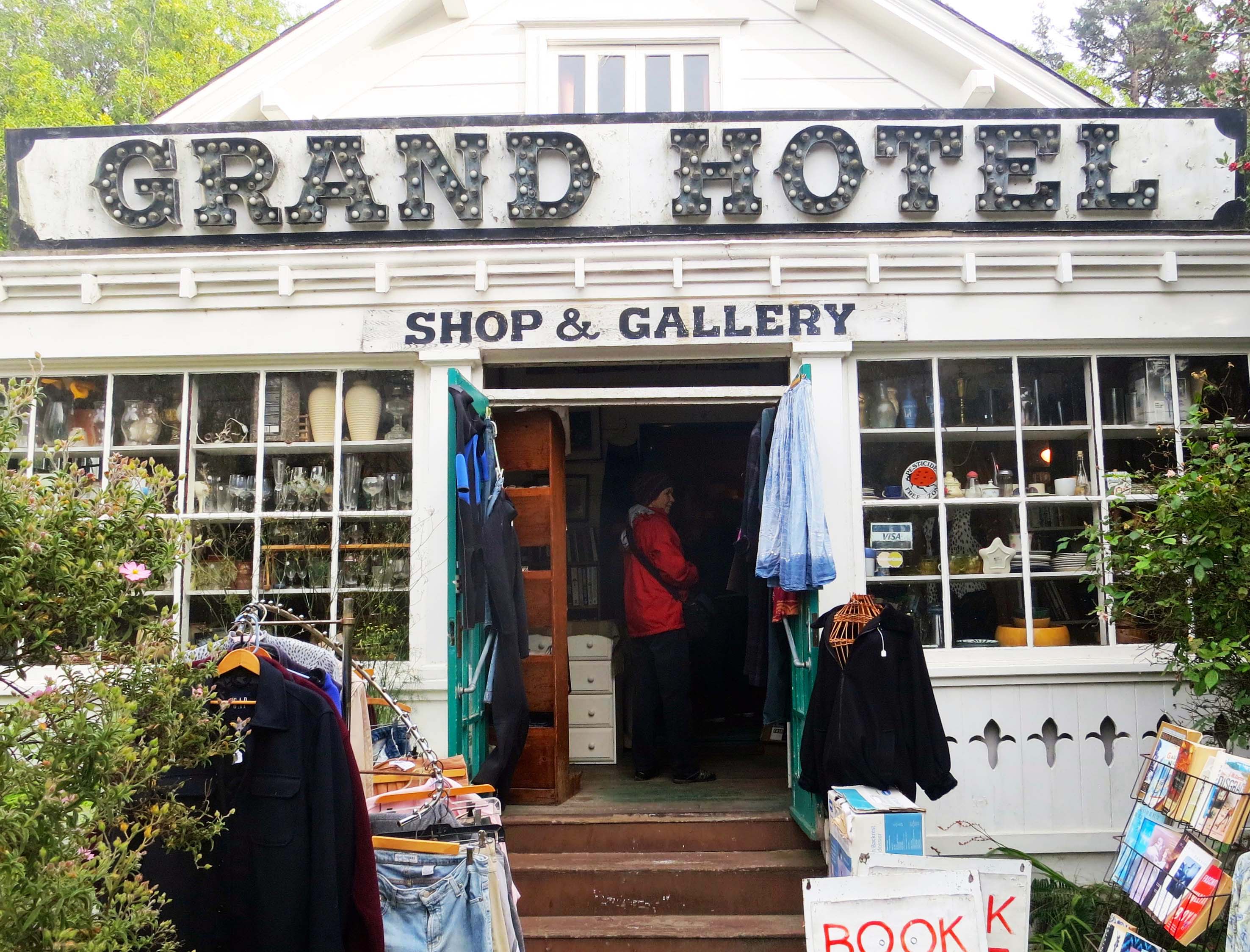
The Grand Hotel Shop and Gallery in Bolinas, California. Photo by Curtis Mekemson.

The Grand Hotel Shop and Gallery was stuffed top to bottom with antiques.
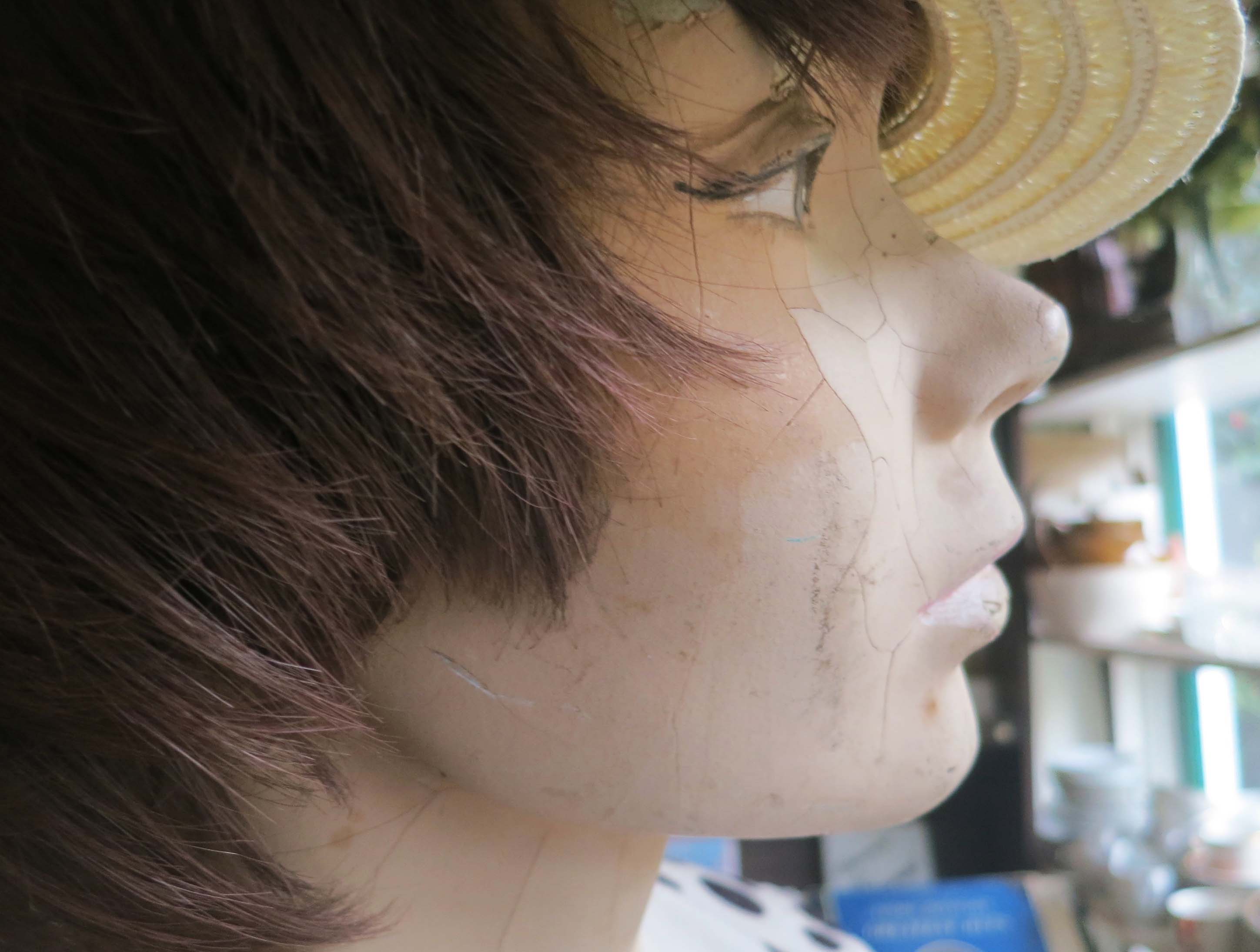
Mannequin in Bolinas, California. Photo by Curtis Mekemson.

I was intrigued with this aging mannequin I found looking out the window of the shop.
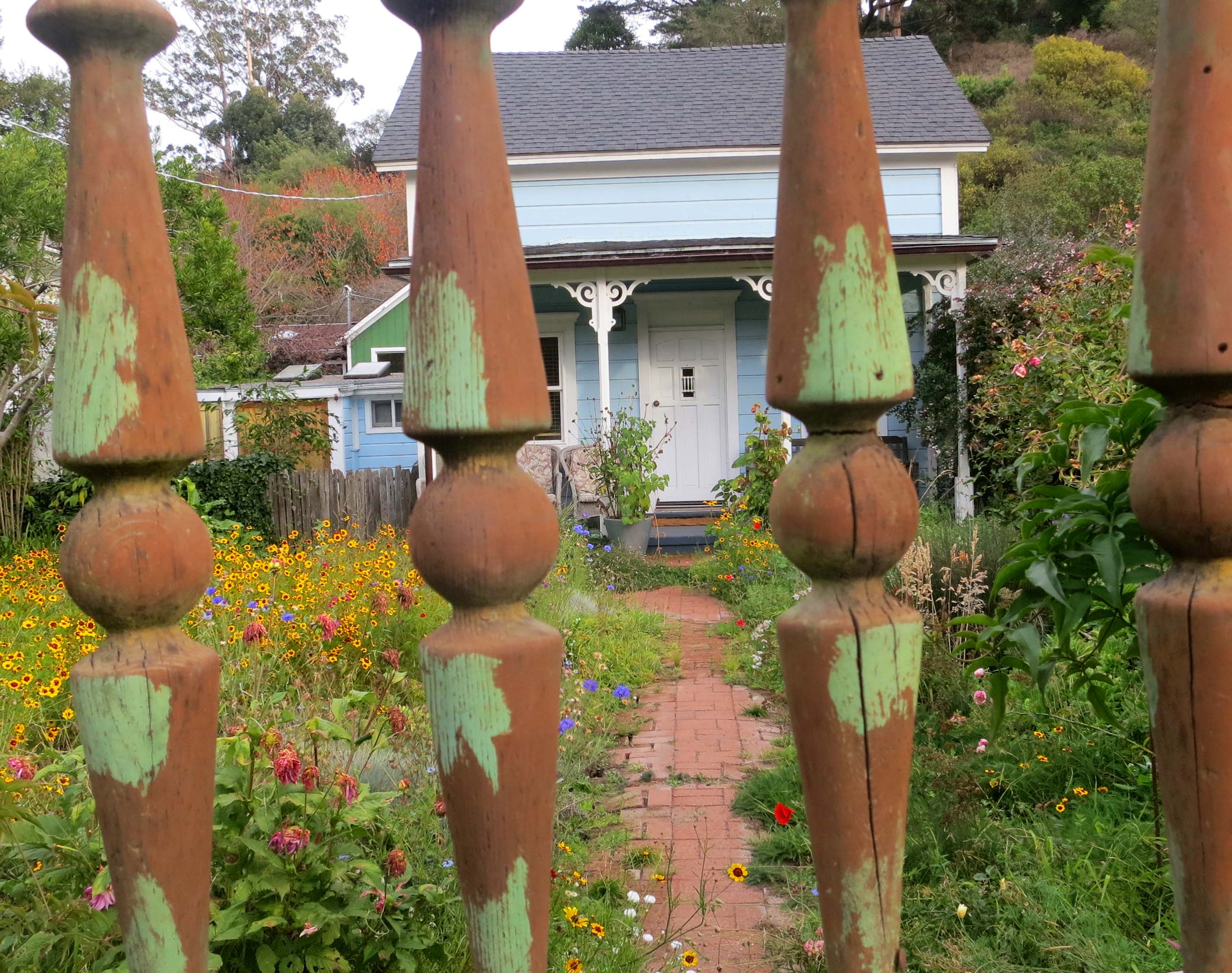
A home in the town of Bolinas, California. Photo by Curtis Mekemson.

The old homes in town have aged well.

Back in a hot-flash sign in Bolinas, California. Photo by Curtis Mekemson.

Incense, Eastern music, and this sign pulled us into a shop.
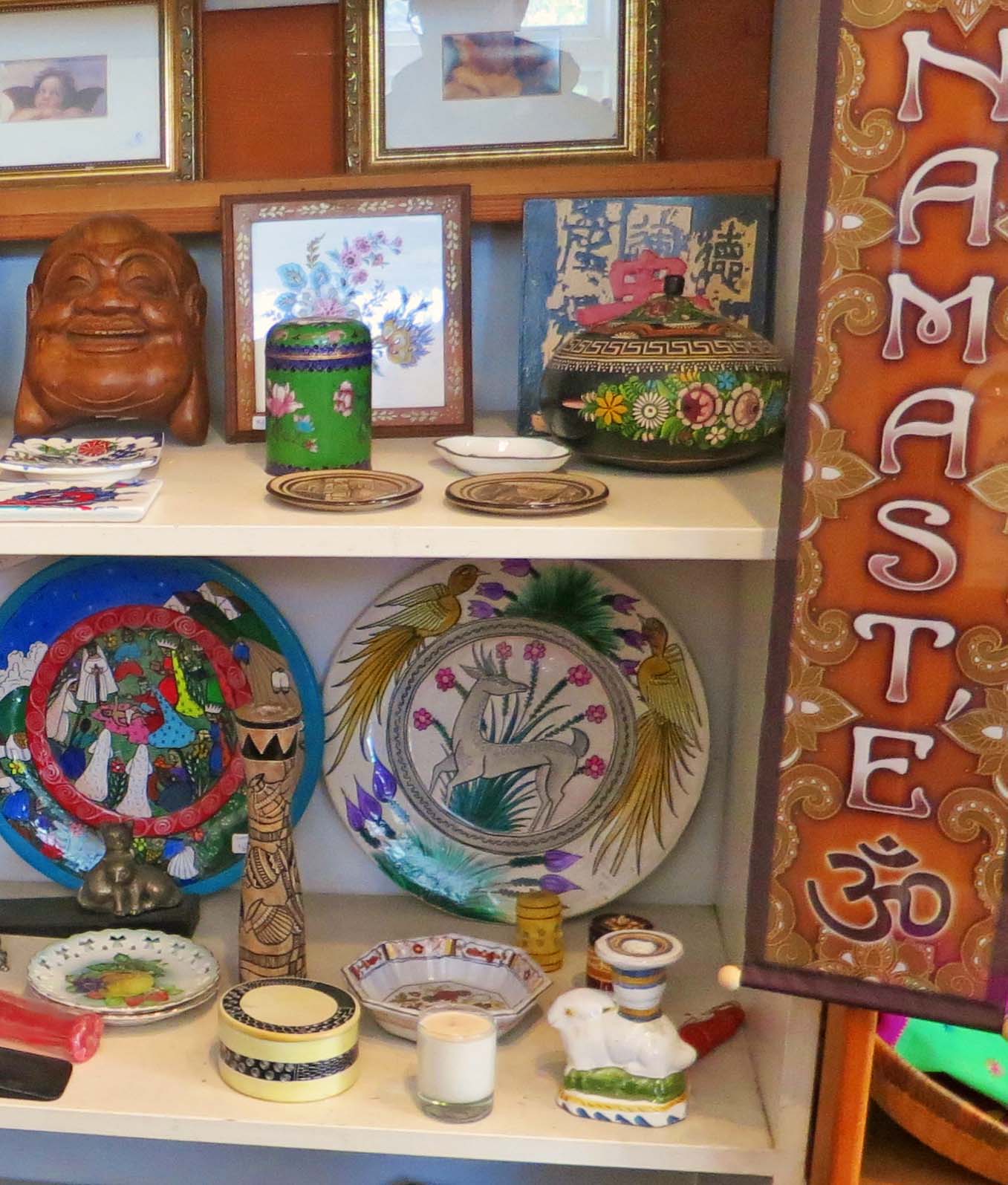
Eclectic Bolinas, California shop. Photo be Curtis Mekemson.

The laughing Buddha face on the upper left shelf made me think of Humpty Dumpty. The items in the shop were, um, eclectic…
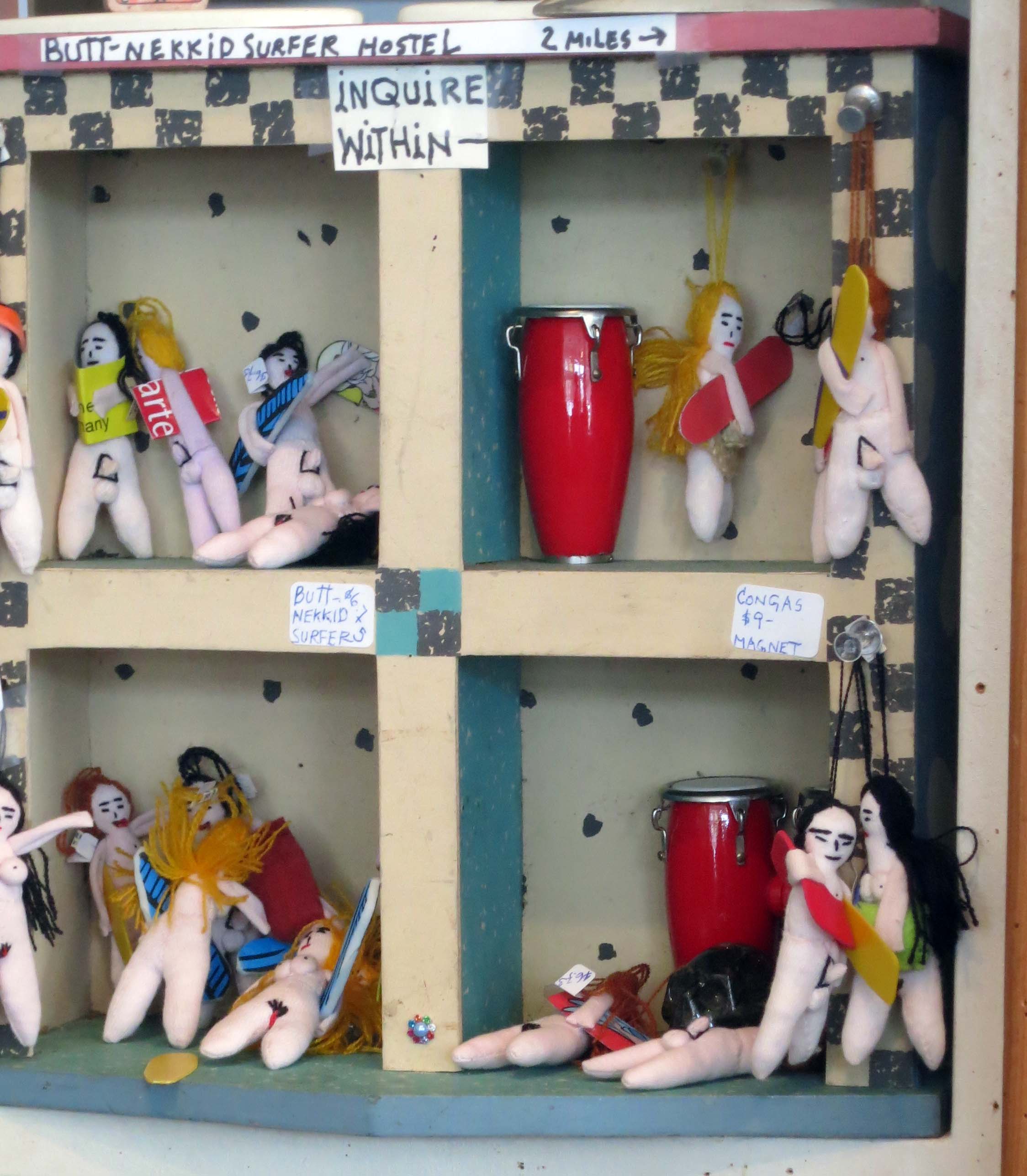
Inside of shop in Bolinas California. Photo by Curtis Mekemson.

Very eclectic.

Bolinas Shrine. Photo by Curtis Mekemson.

We found a shrine next door that the community had put up after 9/11.

Surf shop ad in Bolinas, California. Photo by Curtis Mekemson.

A Bolinas surf shop advertised using broken surf boards featuring Native American/First Nation art.

Halloween pumpkin in Bolinas California. Photo by Curtis Mekemson.

This pumpkin reminded me that Halloween had just passed…

2013 gas prices in Bolinas, California. Photo by Curtis Mekemson.

And this sign reminded me that we would be buying our gas elsewhere. This station matched what I was paying in the Yukon territory this summer.

NEXT POST: Peggy and I heading off to Mexico for three weeks. To fill in, I’ve decided to put up photos that Peggy and I have taken in America’s National Parks. We’ve made a point of visiting close to all of them. I’ll close out my Pt. Reyes’ series with a Bolinas mural that I think reflects the area: ocean, wilderness, and a touch of magic.
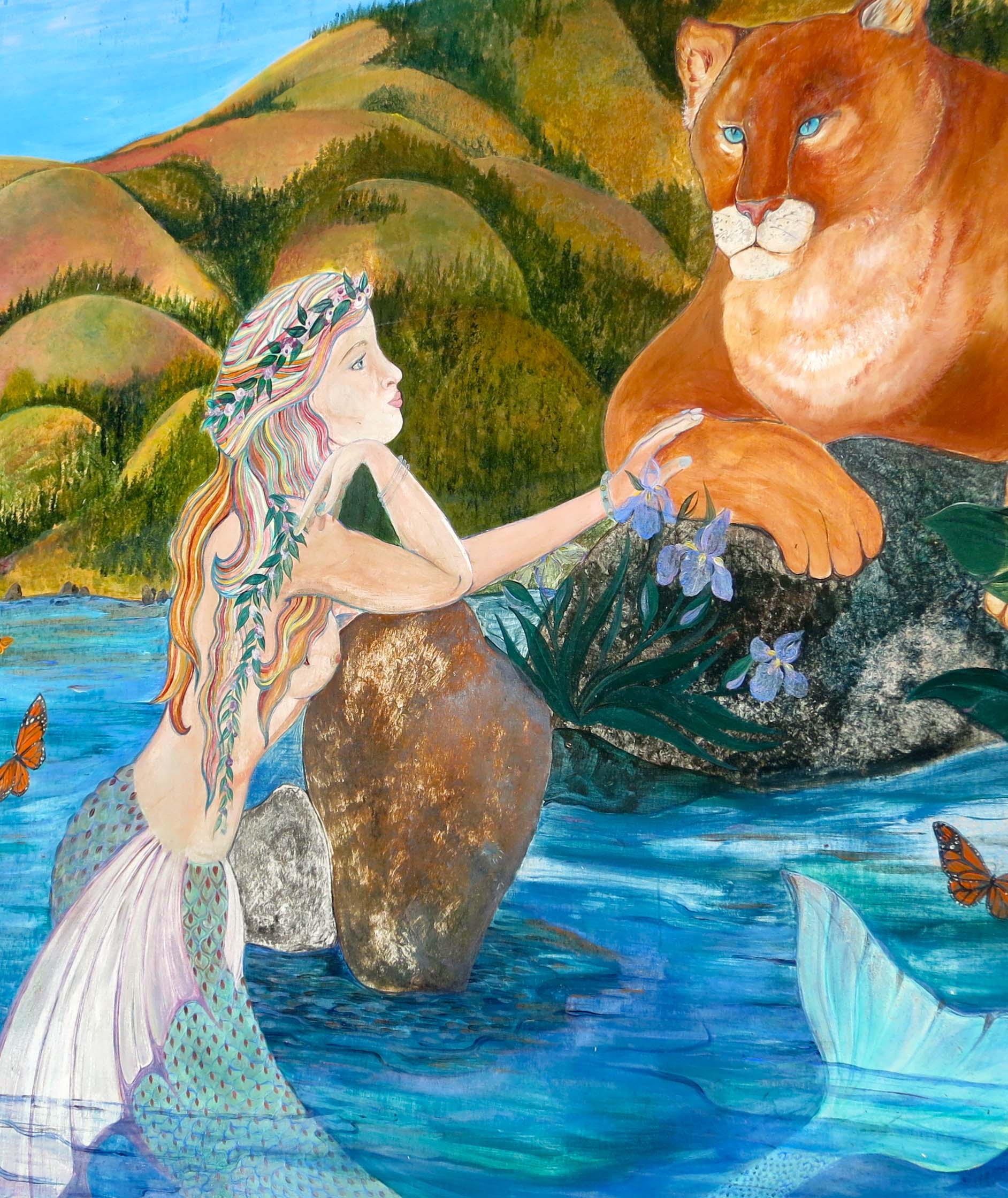
Mural of mountain lion and mermaid in Bolinas, California. Photo by Curtis Mekemson.

Tsunami Ship Becomes Fish Processing Plant… And Other Kodiak Stories

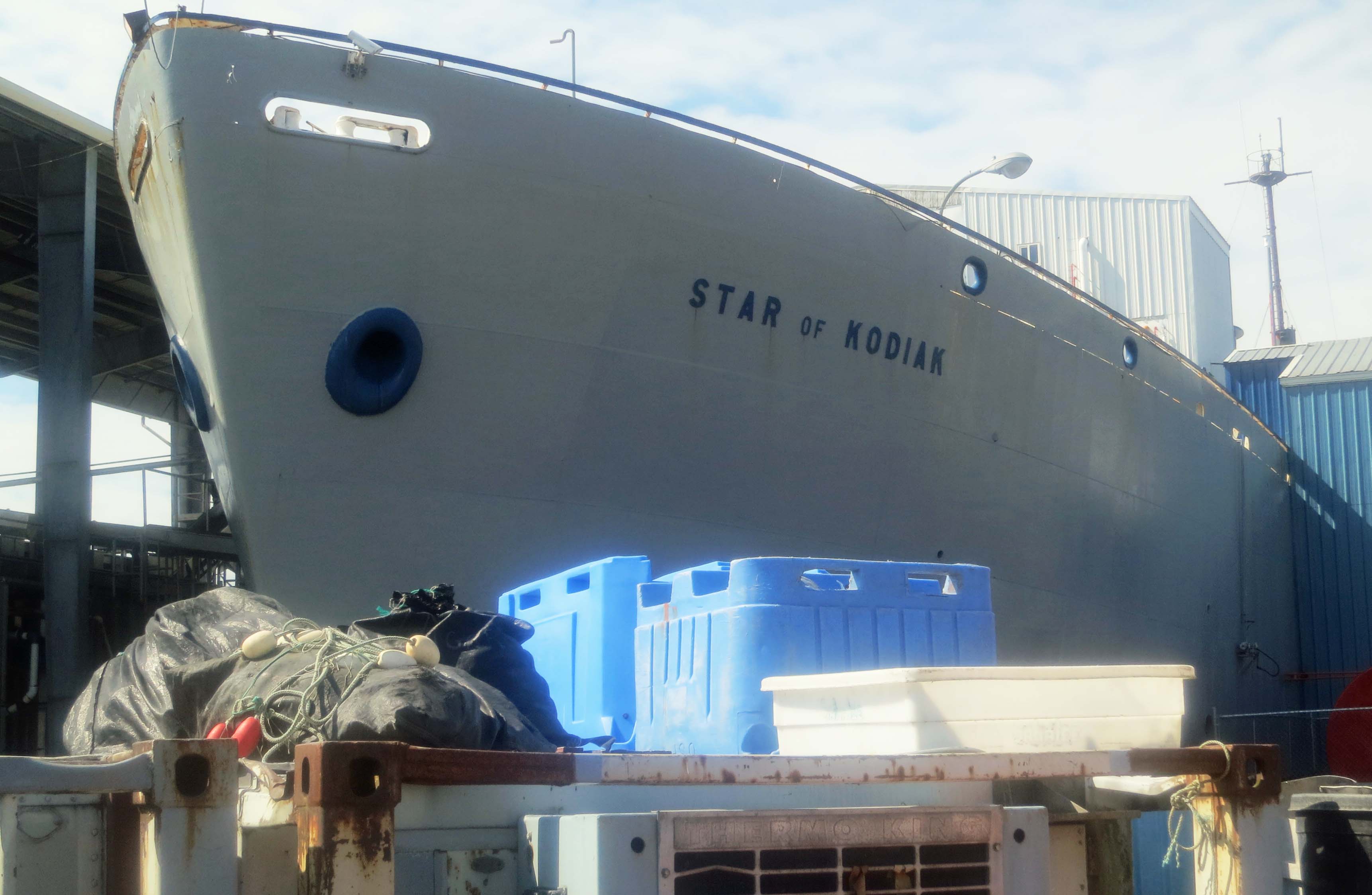
Star of Kodiak fish processing plant in Kodiak, Alaska.

This big ship is parked in downtown Kodiak where it has rested ever since the 1964 Alaska Tsunami tossed it up on shore. It was too big to throw back, so the enterprising residents turned it into a fish processing plant, a fate it has happily pursued ever since.

I don’t know about you, but Peggy and I take lots of photographs. I am sure our trip to Alaska will be in the neighborhood of 3500 if I ever get around to counting them. Darn digital– why take one photo when five will suffice? And then there is sorting, and selecting, and cropping, and making slight color adjustments, and…

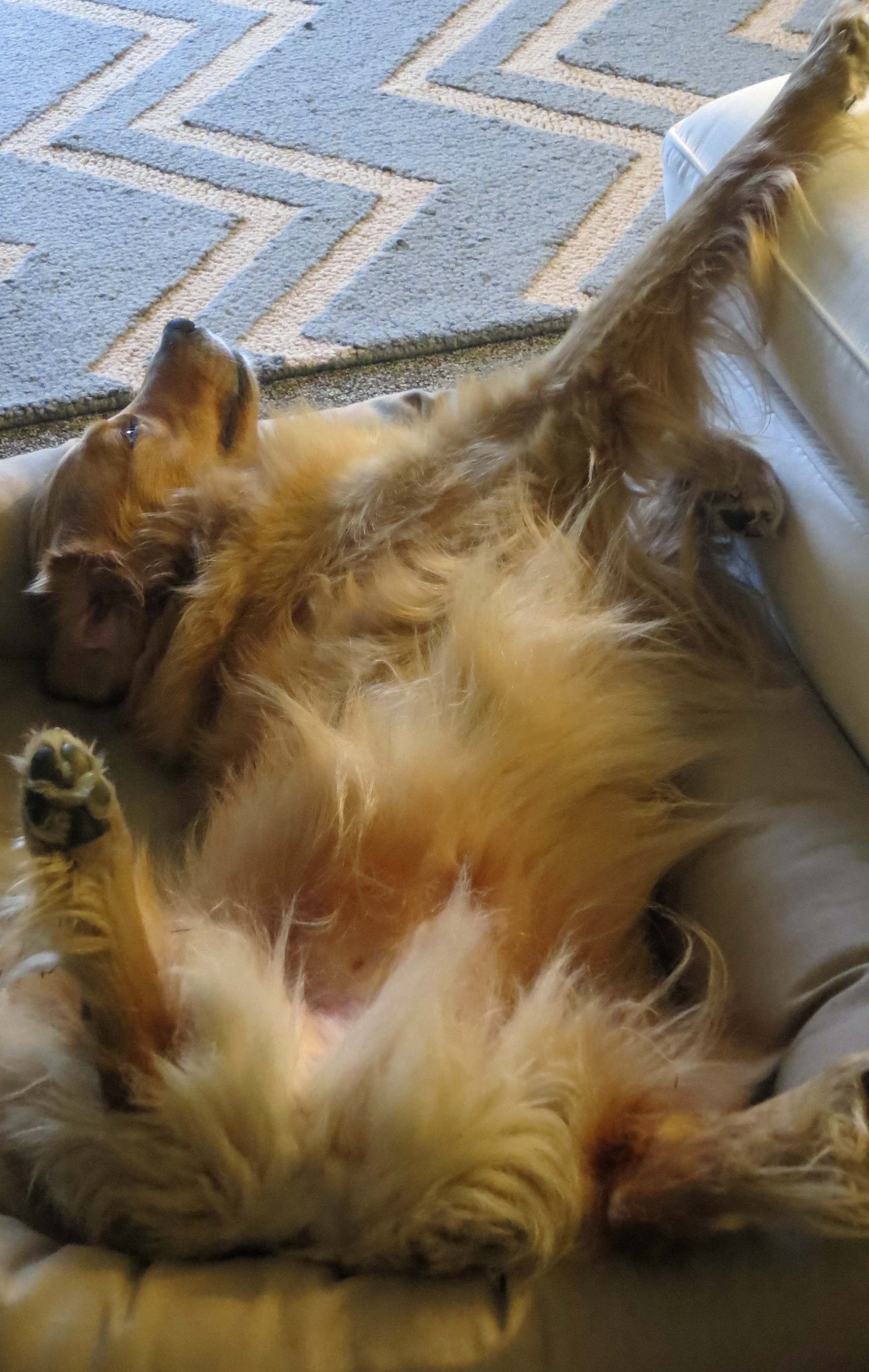
Ultimately, even with the most critical selection process, I end up with more than twice as many photos as I can use for a particular blog. Like where in the heck am I going to put the cute picture of the Golden Retriever lying on his back with his long legs stretched everywhere.

Fin is one happy Golden Retriever. This is one of his favorite sleeping poses.

Fin is one happy Golden Retriever. This is one of his favorite sleeping poses. Here he had his eyes open and was wondering if doggy decorum required him to move.

So this is my Kodiak wrap up where I will post some of the photos that got left out. I figure I will use about a third of the ones I’ve chosen. (grin)

Any clue what this is? It's the bone structure of a Grey Whale's head. The Kodiak Wildlife Refuge Museum has the whole skeleton.

Any clue what this is? It’s the head of a grey whale on display at the Kodiak Wildlife Refuge Museum.

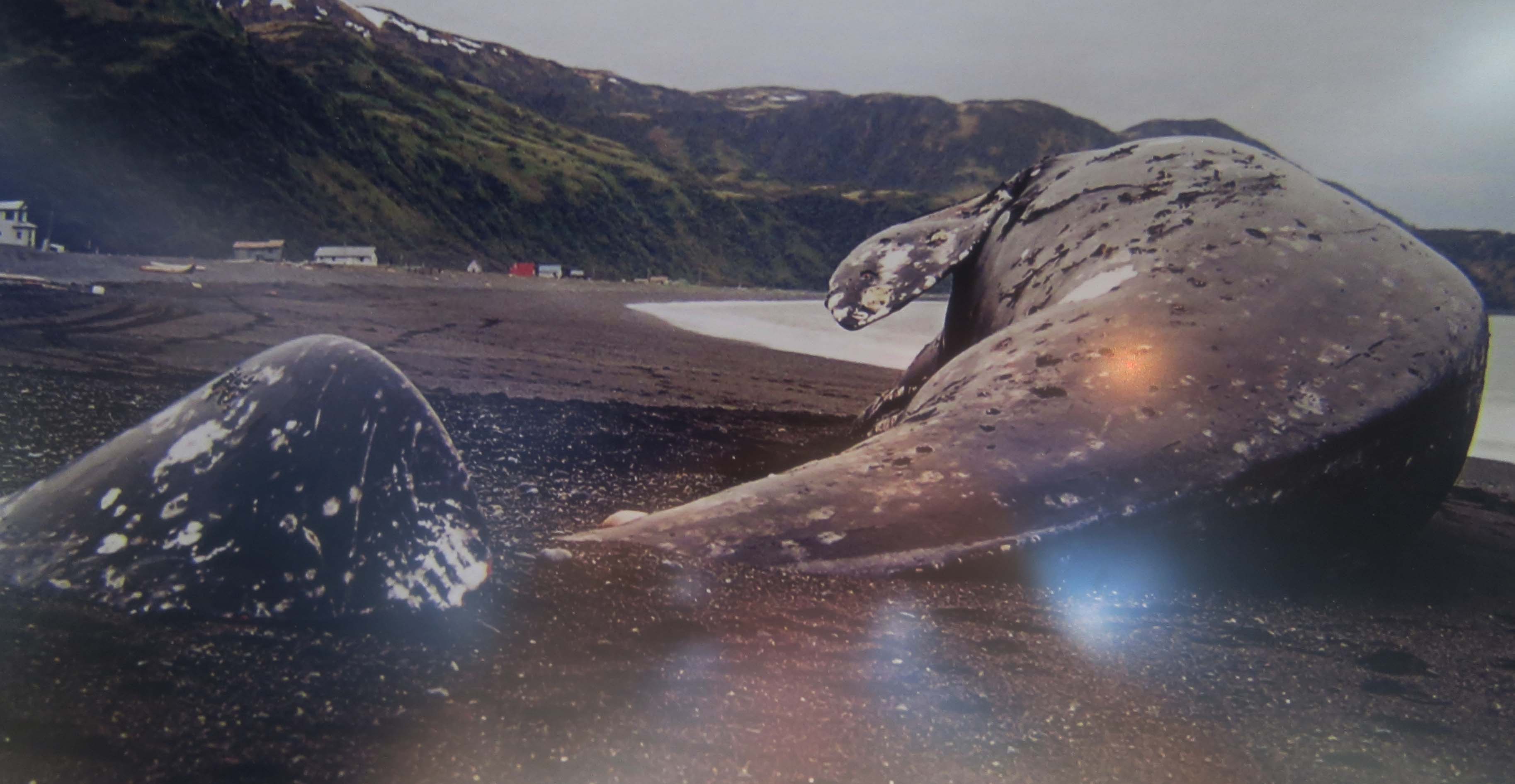
Here's the whale before he was buried, dug up and scraped. I assume the process took a strong constitution. The skeleton is quite impressive. We owe the folks who did the job.

Here’s the whale before he was buried, dug up and scraped. I assume the process took a strong constitution. The skeleton is quite impressive. We owe the folks who did the job.

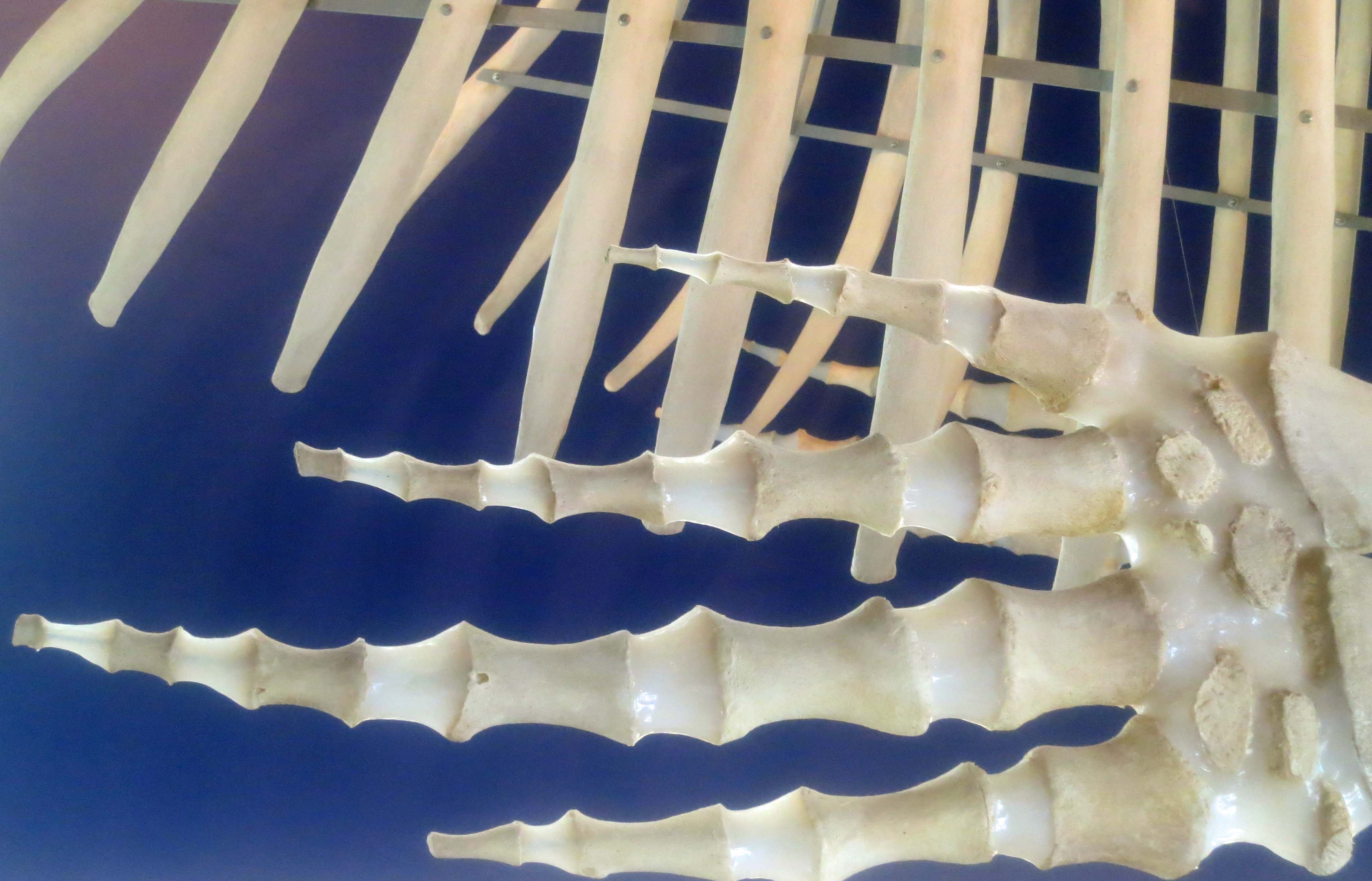
Grey Whales rib cage and hands, oh, I mean fins. Is there any question about a whale's mammal ancestry...

Grey Whales rib cage and hands, oh, I mean fins. It sure appears this guy may have once wandered on land.

Long before Americans made their way into the far north, the Russians were there... and still are, as this Russian Orthodox Church in Kodiak attests to.

Long before Americans made their way into the far north, the Russians were there… and still are, as this Russian Orthodox Church in Kodiak attests to.

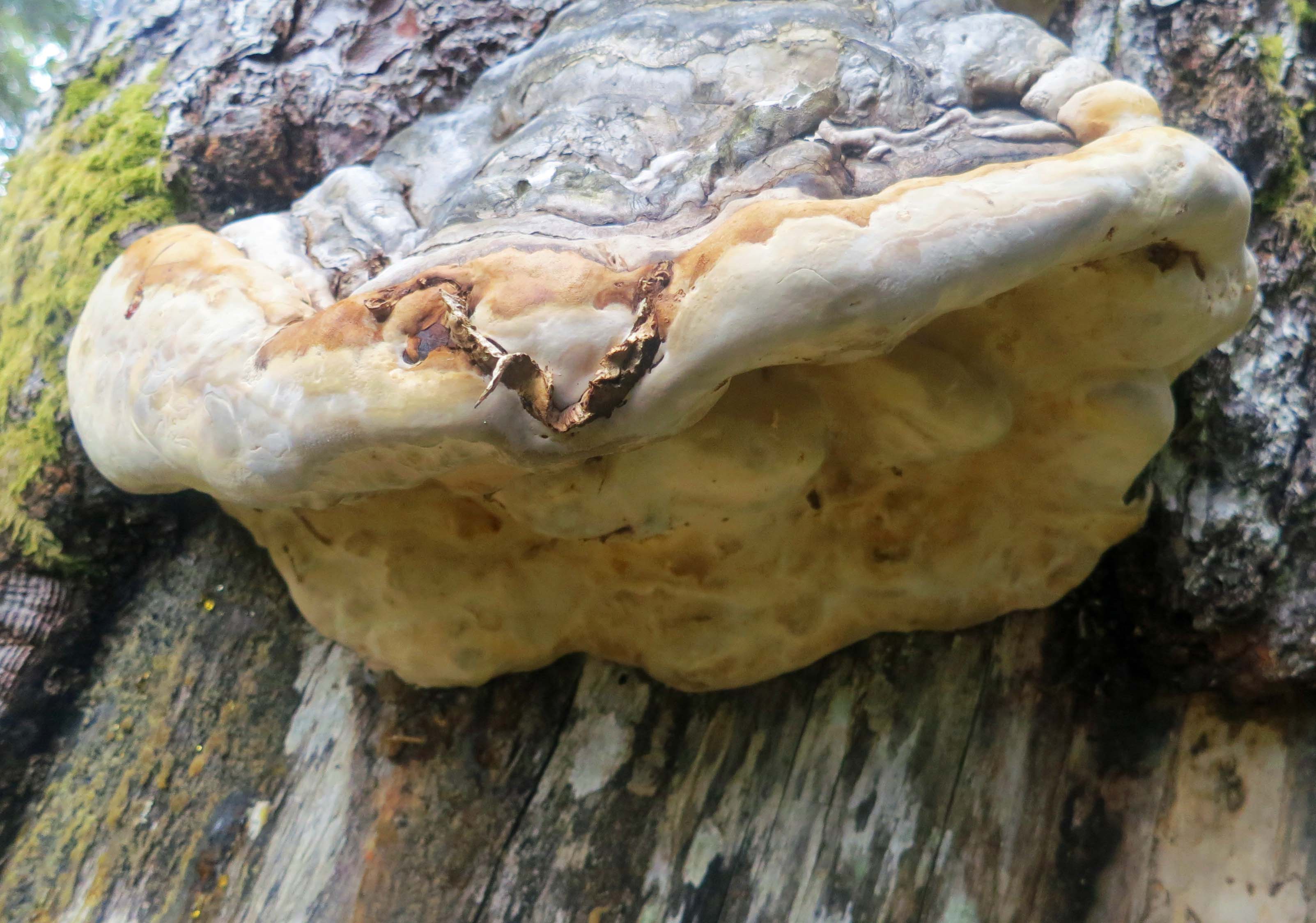
Kodiak has a number of great walks and we went on a couple of them between fishing expeditions. We found this shelf fungus on a tree along one of the trails. The locals call it bear bread. We came on another one that had been torn apart. Here Bear!

Kodiak has a number of great walks and we went on a couple of them between fishing expeditions. We found this shelf fungus on a tree along one of the trails. The locals call it bear bread. We came on another one that had been torn apart. Hello Bear!

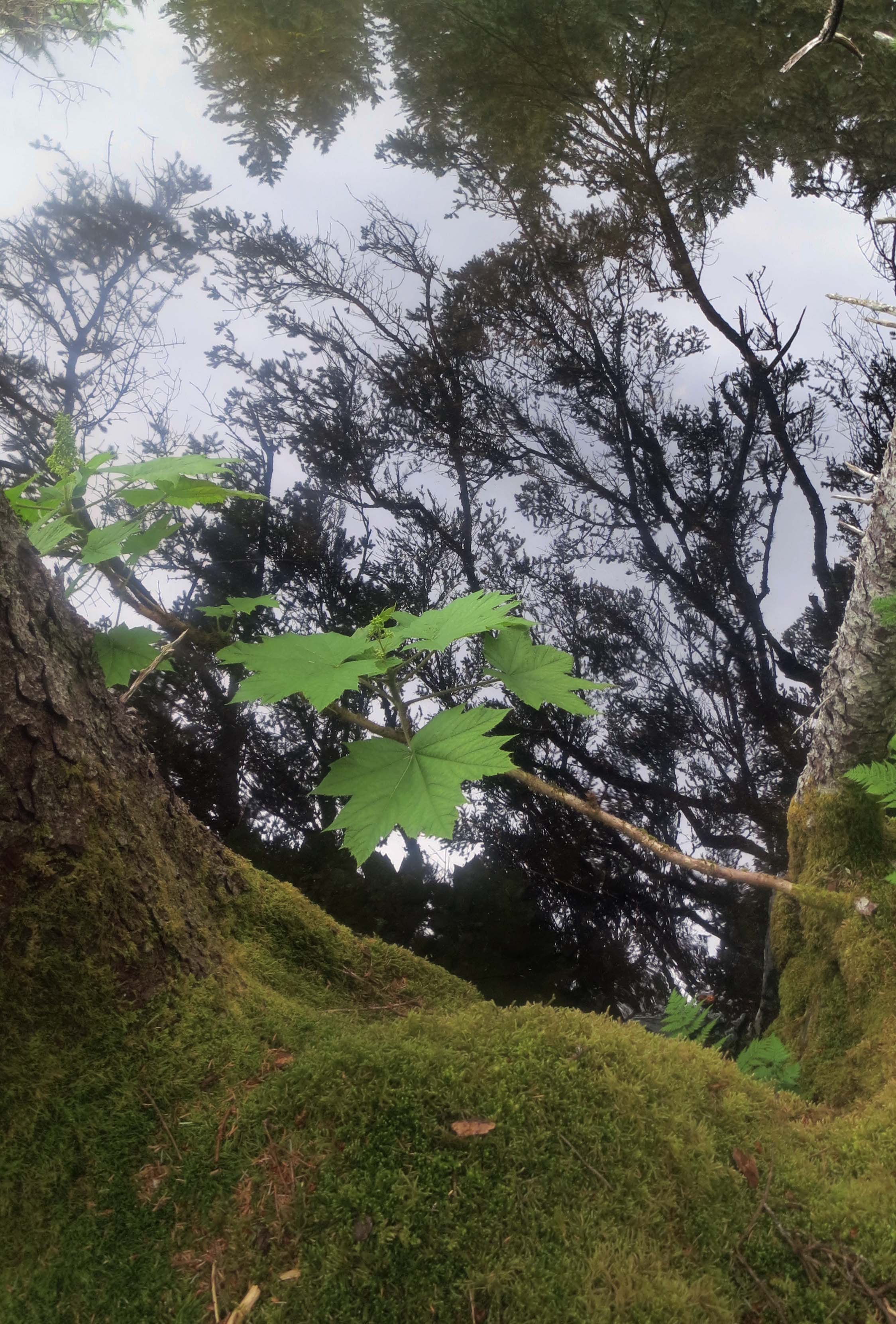
I found this lake reflection shot along the same trail. Moss covered trees and Devil's Club (the plant) also lined the trail.

I found this lake reflection shot along the same trail. Moss covered trees and Devil’s Club (the plant) also lined the route. You can’t see the thorns on the Devil’s Club, but I guarantee they are there having backpacked through them from time to time during the years I wandered Alaska’s back country.

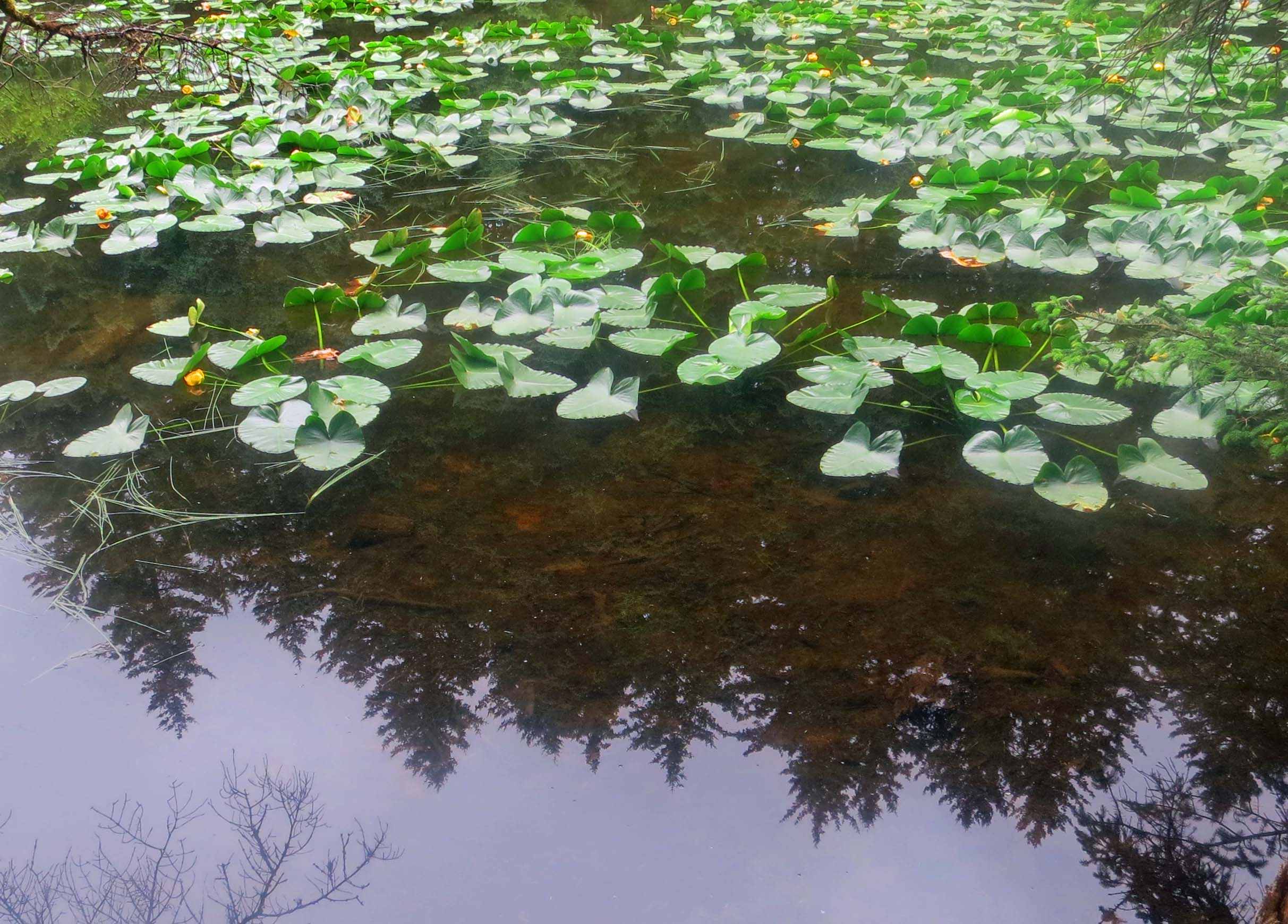
Yellow pond lilies in Kodiak, Alaska.

Another reflection shot on the same lake captured these yellow pond lilies.

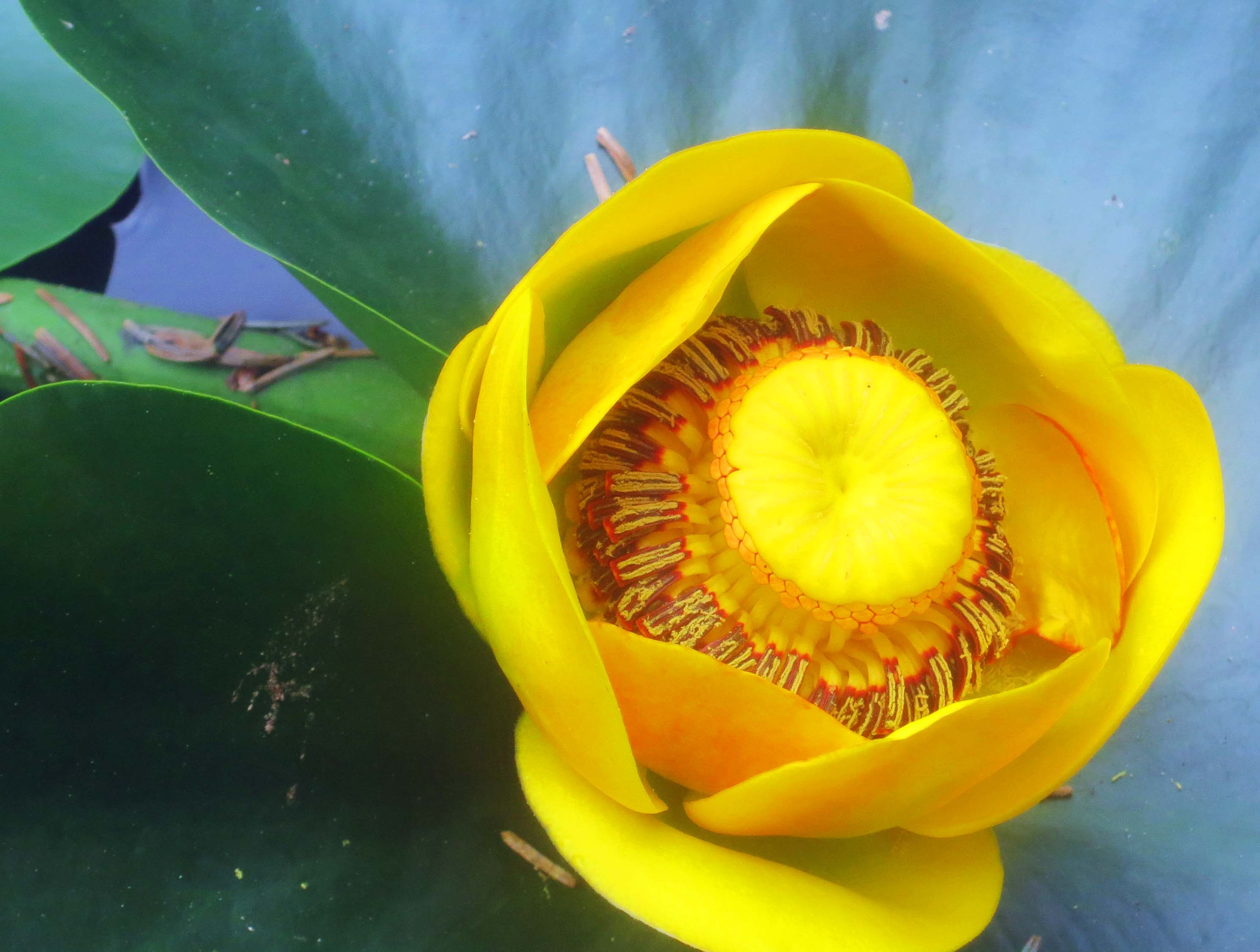
Yellow pond lily flower in Kodiak, Alaska.

Naturally, I had to take a close up of one of the pond lily flowers.

Pushki or Cow Parsnip in Alaska

I’d be remiss if I didn’t include a photo of what the locals called Pushki and I have always called Cow Parsnip. It is one of those plants that mothers are eager to keep their children out of since it can cause serious reactions on some people… including welts.

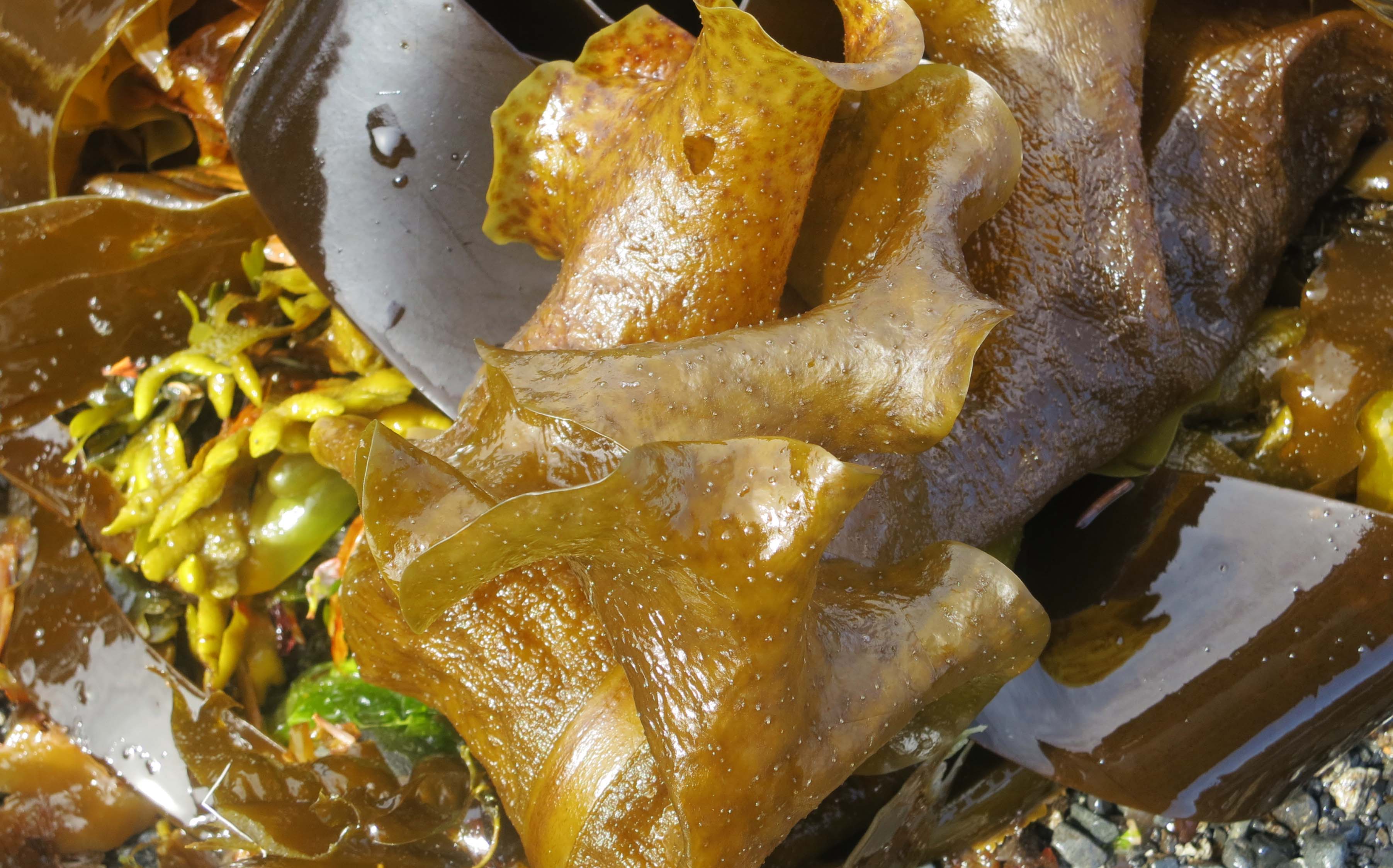
Another walk to us to the ocean and Pirate Booty Beach, a name our grandkids provided due to the treasures they found there. I considered this seaweed a treasure.

Another walk to us to the ocean and Pirate Booty Beach, a name our grandkids provided due to the treasures they found there. I considered this seaweed a treasure.

And these barnacles.

And these barnacles.

The boys thought these strange metallic sculptures were closer to pirate booty. Decades ago the area had been a dump. The ocean, time and waves had worked their wonders on what had once been cars.

The boys thought these strange metallic sculptures were closer to pirate booty. Decades ago the area had been a dump. The ocean, time and waves had worked their wonders on what had once been cars and other “useful” items.

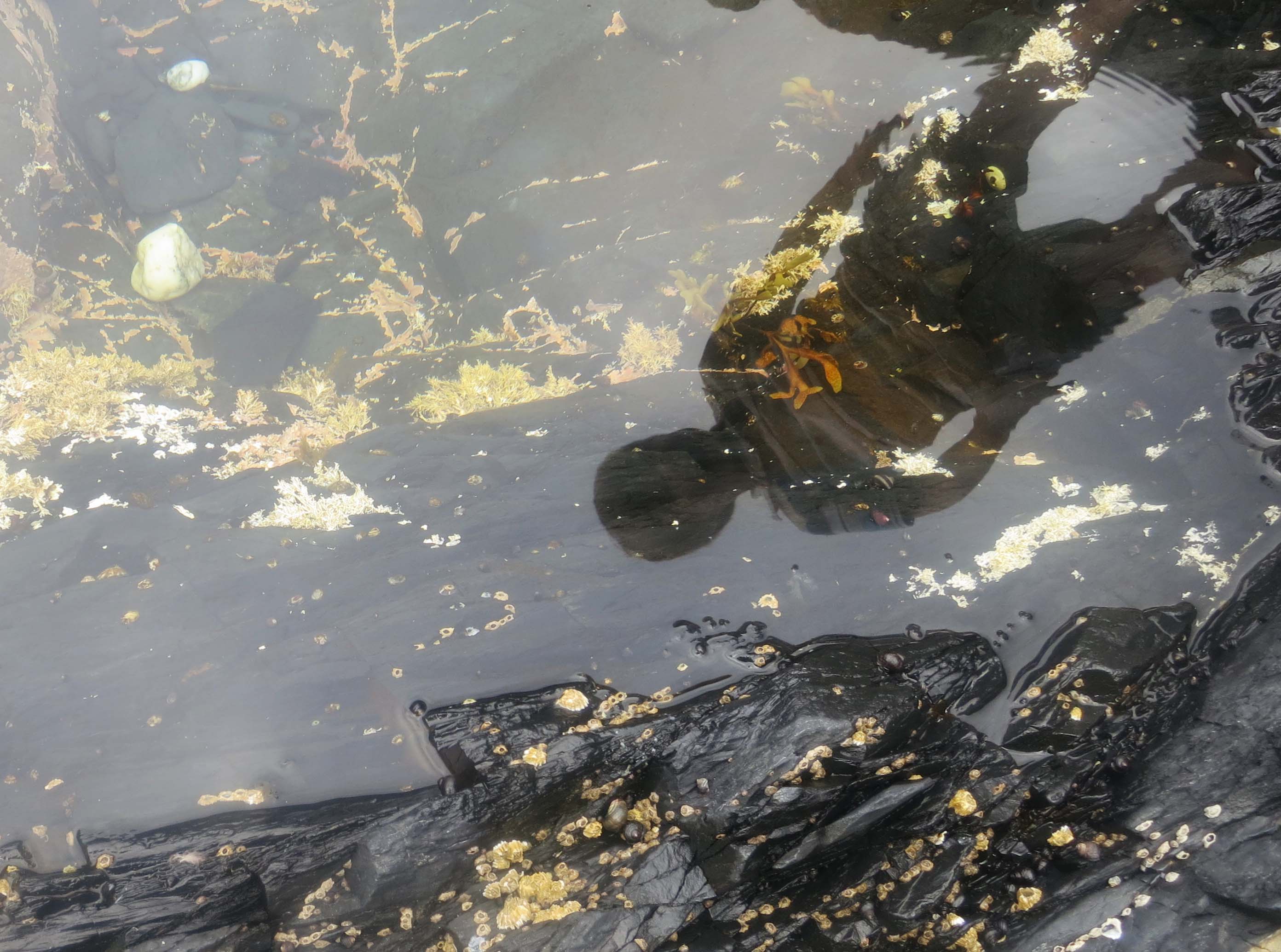
We all agreed that tide pools contained treasures. Our grandson Connor is reflected in this one.

We all agreed that tide pools contained treasures. Our grandson Connor is reflected in this one.

Grandson Cooper joined us on our walks. I loved the grin. (Photo by Peggy Mekemson.)

Grandson Cooper joined us on our walks. I loved the grin. (Photo by Peggy Mekemson.)

The hard work of hiking and fishing deserves its reward. In this case, it was a soft ice cream cone from McDs, half of which ended up on Chris's face.

The hard work of hiking and fishing deserves its reward. In this case, it was a soft ice cream cone from McDs, half of which ended up on Chris’s face. (Photo by Peggy Mekemson.)

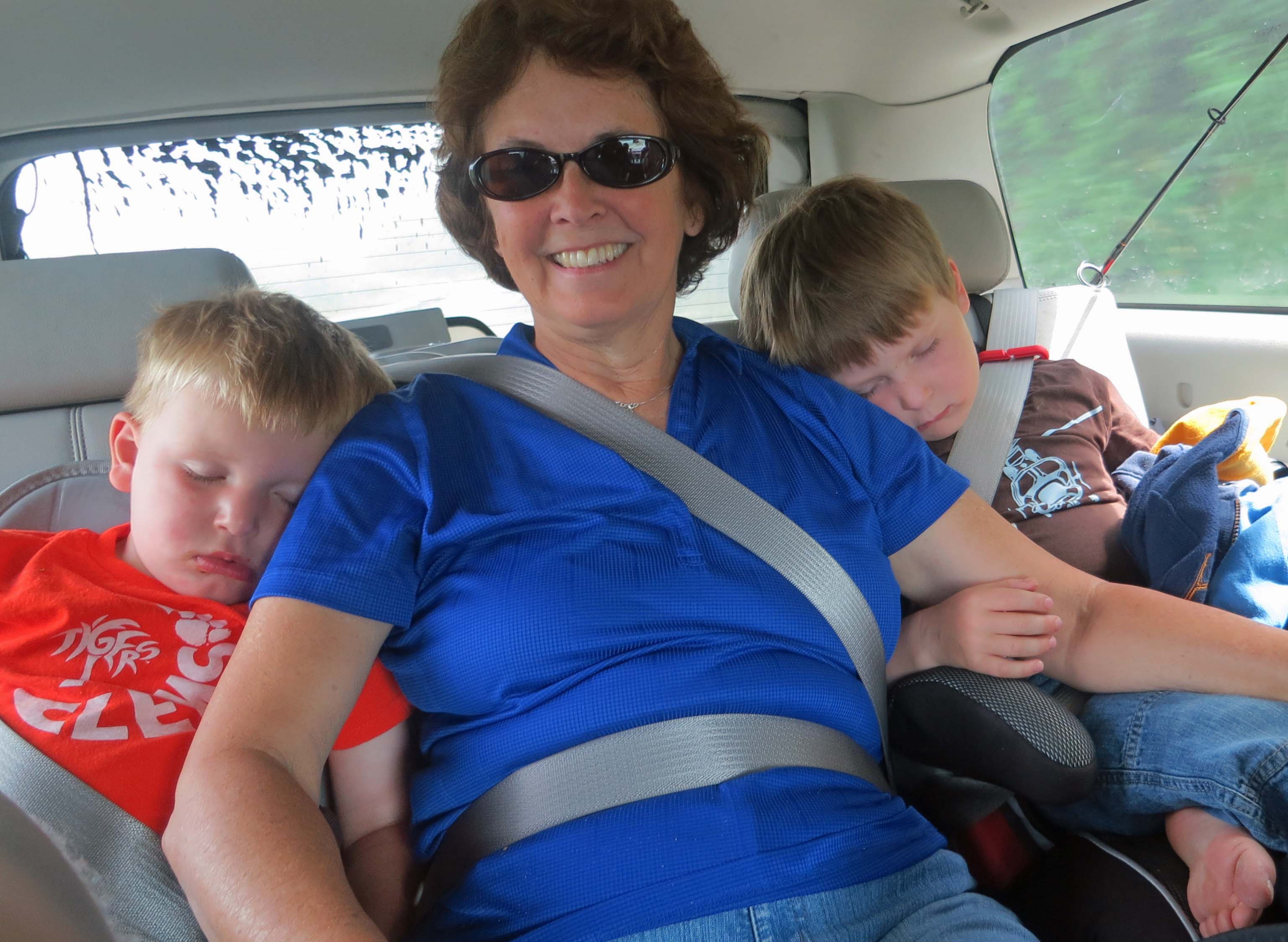
And there's the nap with Chris and Connor... two tired boys.

And there’s the nap with Chris and Connor… two tired boys.

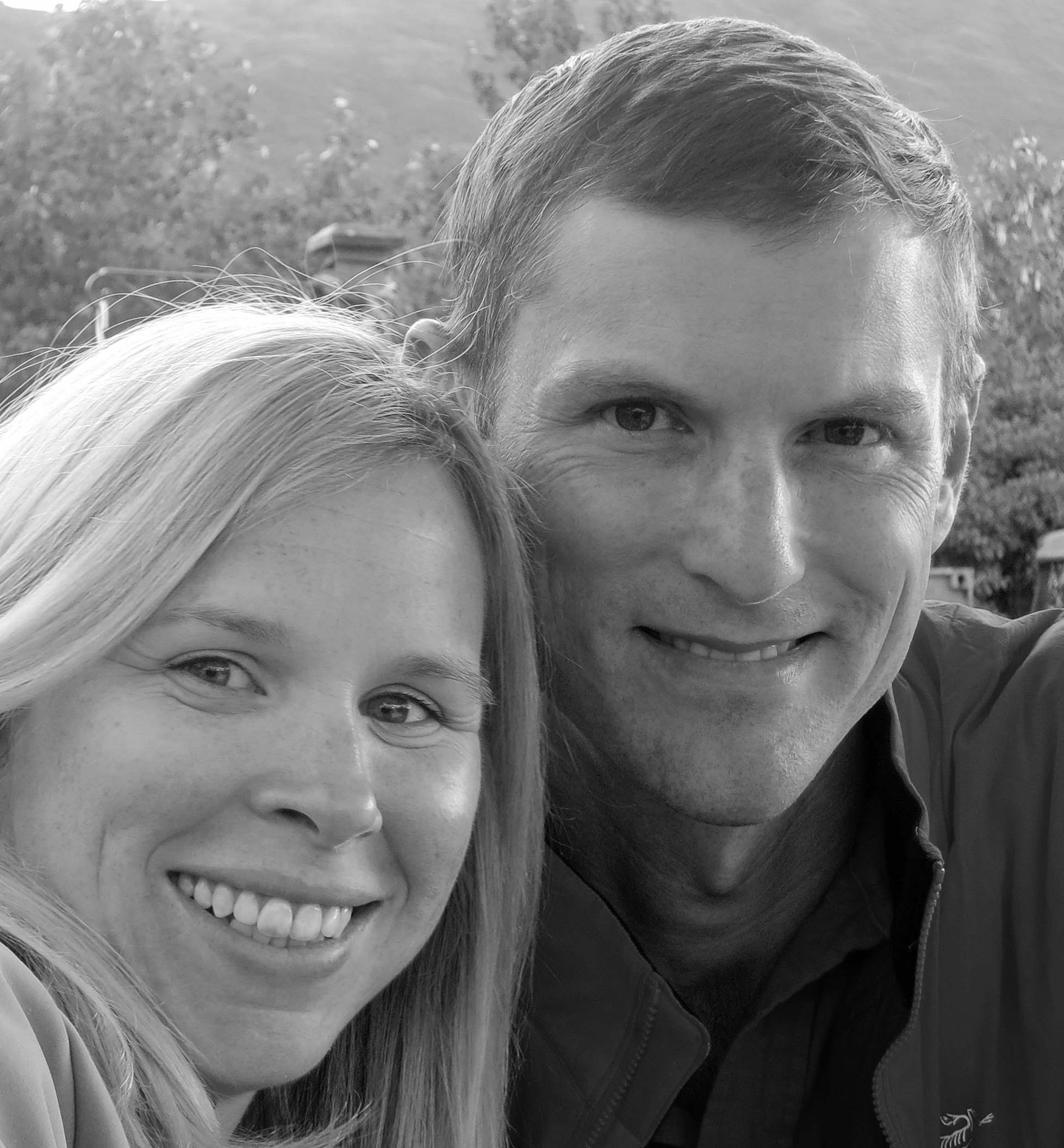
I'll close with this photo of Tony and Cammie with a great thanks to them for making our Kodiak adventure as special as it was.

I’ll close with this photo of Tony and Cammie with a great thanks to them for making our Kodiak adventure as special as it was.

NEXT BLOGS: We will interrupt our Alaska Adventure for a week as Peggy and I prepare for our annual trip to Burning Man in the remote Nevada Desert. The week we are in Burning Man without Internet access, I will pre-post three more Alaska Highway blogs. Afterwards I will share our 2013 Burning Man Adventures.


Responsible for 4 Million Square Miles… The Coast Guard on Kodiak Island


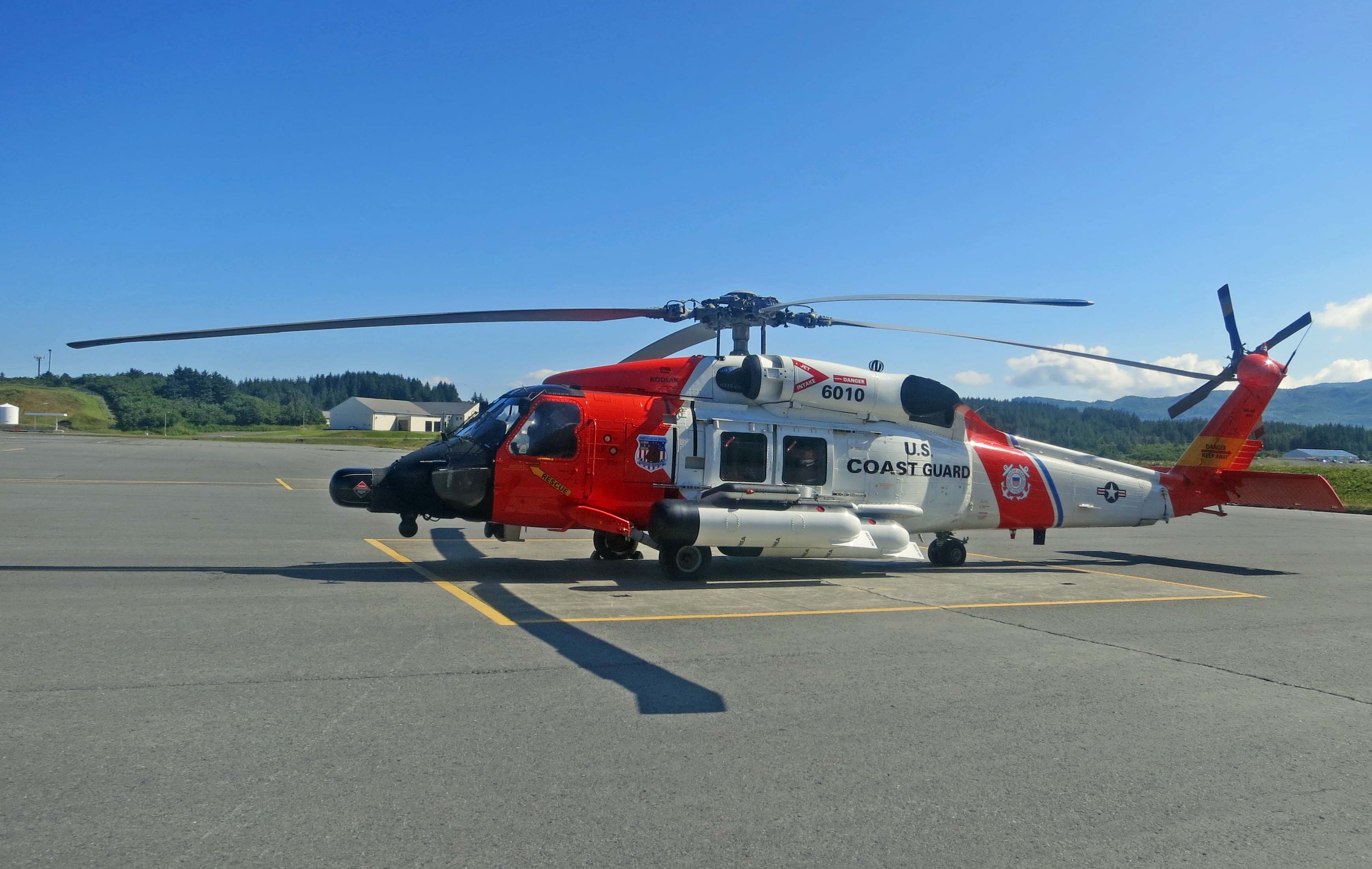
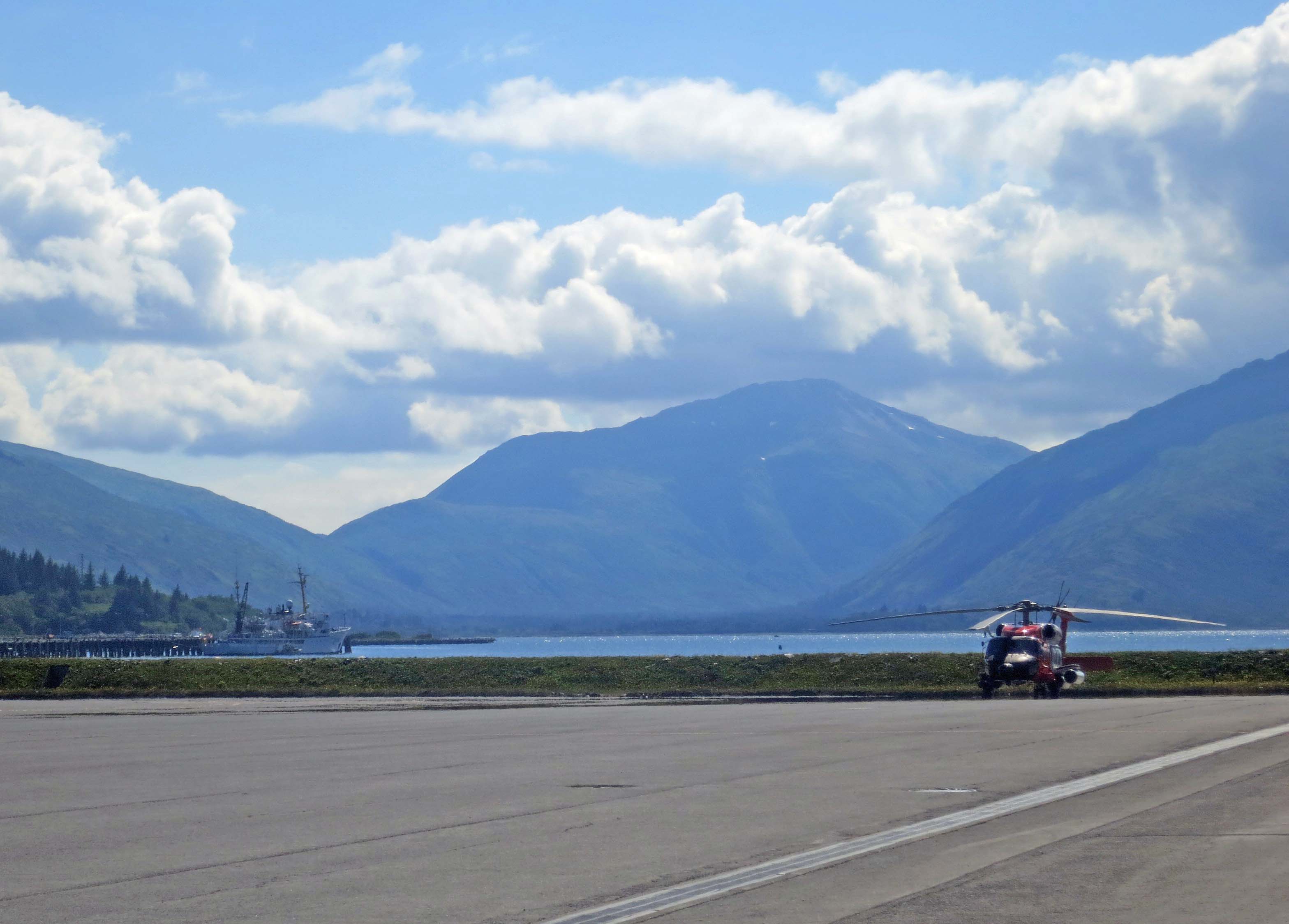
H-60 ready to fly at Coast Guard Station in Kodiak, Alaska.

An H-60 helicopter located on the Coast Guard Station on Kodiak Island is fueled up and ready to fly on a moment’s notice.

An H-60 Helicopter sits in front of the large helicopter repair and maintenance hangar at the Coast Guard station on Kodiak Island. It’s on ready alert, fueled up and prepared to take off at a moment’s notice. Whether it’s a fishing boat in distress, a lost hiker, a wandering oil rig, or a remote village medical emergency, the pilots, cutter crews, maintenance crews, and rescue specialists of the Coast Guard are available around the clock to perform their errands of mercy.

Another view of the flight ready H-60.

Another view of the flight ready H-60.

They also monitor commercial fishing, keep an eye out for environmental disasters such as oil spills, and perform routine maintenance on buoys and other marine navigational aids. It’s a big job, especially when you consider that the Kodiak station is responsible for some four million square miles.

It is also a challenging and dangerous job. If you have watched the Weather Channel series, Coast Guard Alaska, you are aware that Alaska has some of the most severe weather in the world and that the Coast Guard teams are expected to perform their rescue efforts in almost all weather conditions. Think of trying to rescue someone off of a moving boat in high waves with low visibility, high winds, extreme cold and driving rain.

Artistic rendition of H-60 rescue effort at sea.

I found this artistic rendition of an H-60 rescue effort on an information board at the Kodiak Harbor. The pilot is required to hold his helicopter in place under severe conditions while the rescue crew performs its exacting, dangerous job.

When we arrived in Kodiak, our son Tony had just completed his first year of a three-year assignment in Alaska as a Coast Guard pilot for the long-range H-60 helicopters. With three tours in Iraq as a Marine Helicopter pilot and several years of flying H-60s out of San Diego for the Coast Guard, he came to Alaska well qualified for his duties in Kodiak and at remote locations such as the island of St. Paul north of the Aleutian Archipelago.

In addition to their regular assignment to Kodiak, Coast Guard H-60 pilots are also assigned to remote areas for one to three week tours. In this photo, Tony flies his H-60 over the remote island of St. Paul north of the Aleutian Island chain halfway between Alaska and Siberia.

In addition to their regular assignment to Kodiak, Coast Guard H-60 pilots are also assigned to remote areas for one to three-week tours. In this photo, Tony flies his H-60 over the remote island of St. Paul north of the Aleutian Island chain halfway between Alaska and Siberia.

In addition to touring us around the island and taking us fishing, Tony gave us a tour of the base and the helicopter maintenance facility. Cammie and the boys came with us.

The Coast Guard Air Station on Kodiak rightly features a Kodiak Bear on its logo.

The Coast Guard Air Station on Kodiak prominently features a Kodiak Bear on its logo.

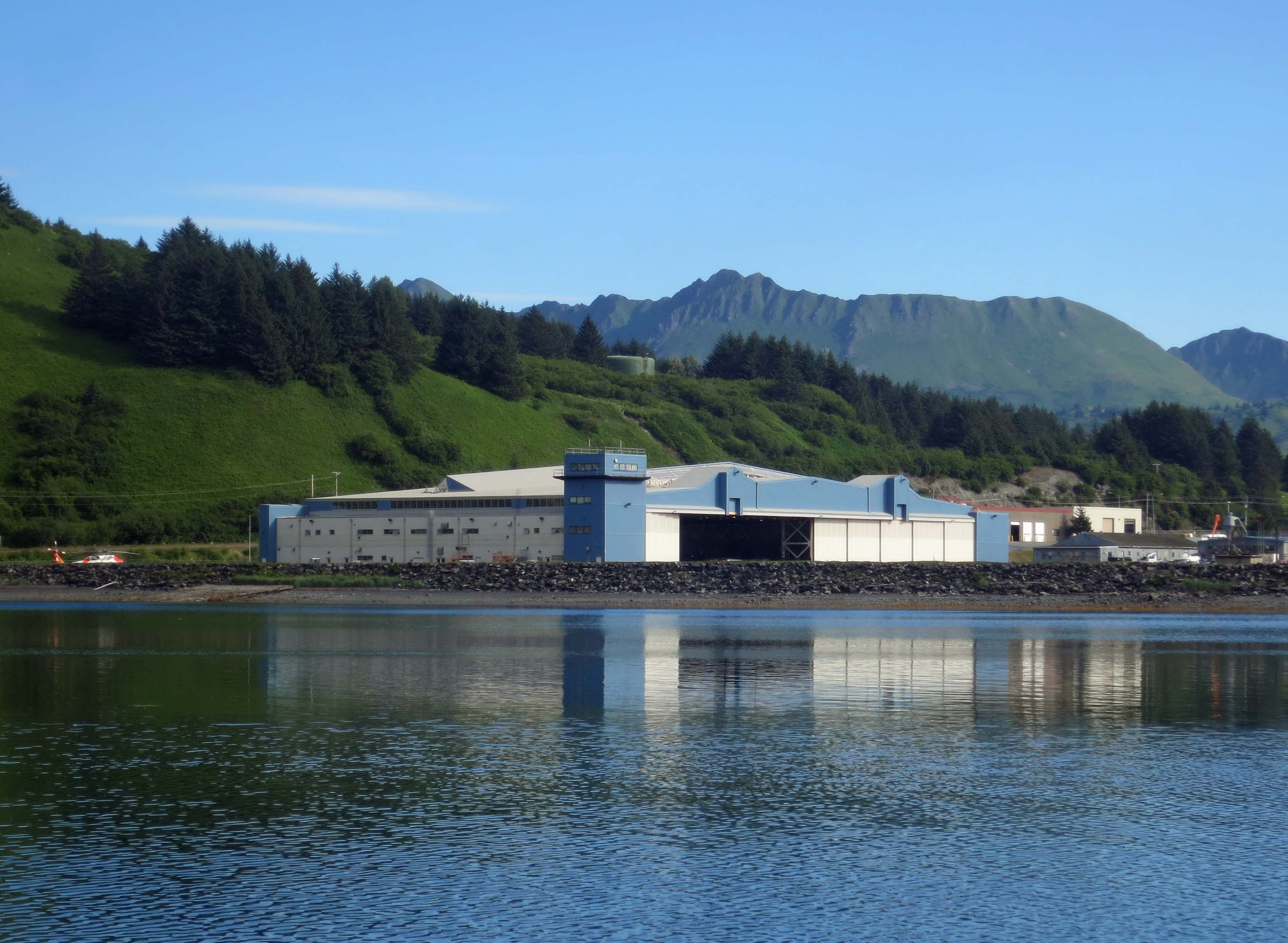
The Coast Guard's helicopter hangar/maintenance facility on Kodiak Island.

The Coast Guard’s helicopter hangar/maintenance facility on Kodiak Island. We took this photo from the water when we were on our way halibut fishing.

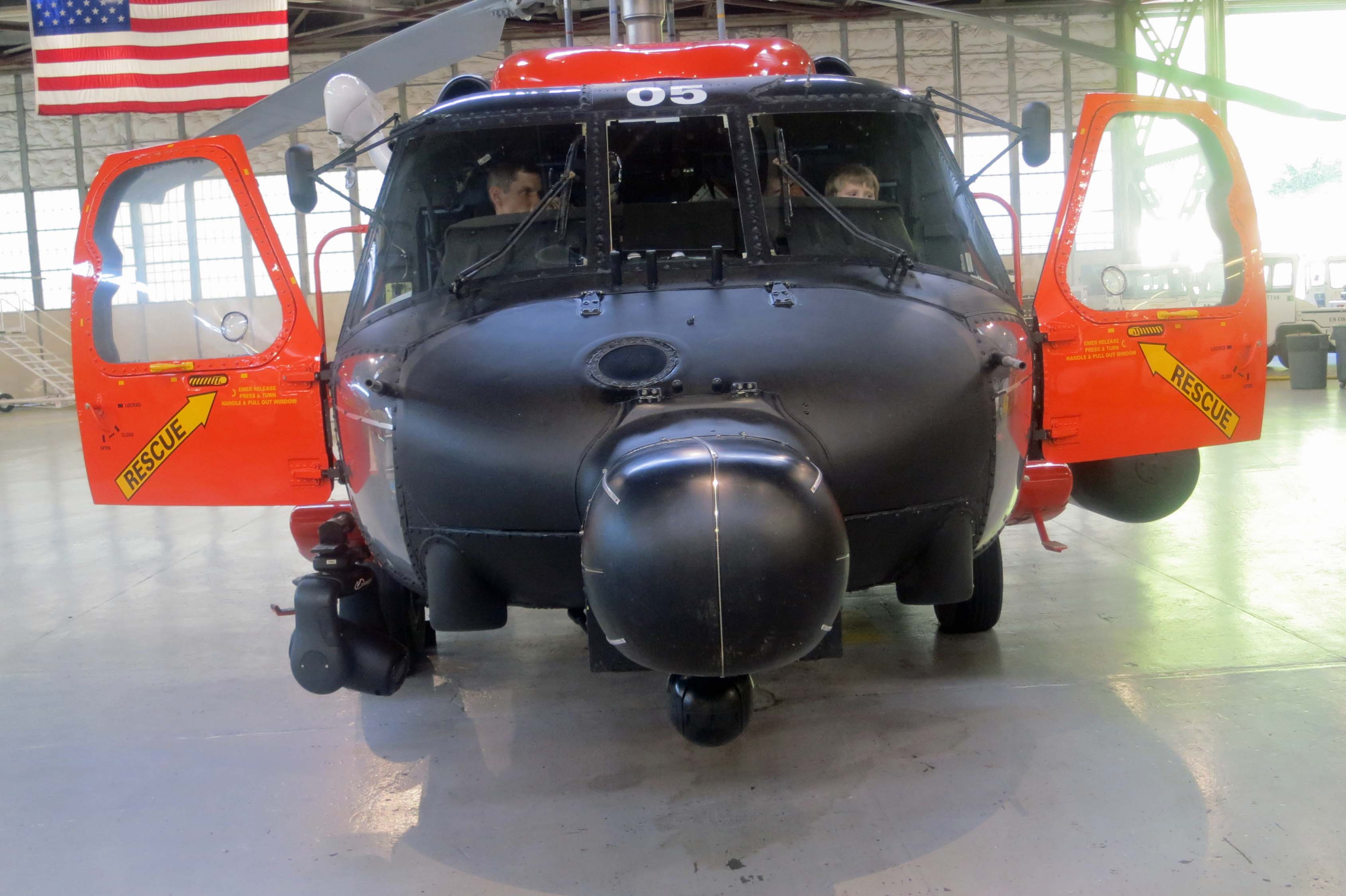
A front view of one of the Coast Guard's H-60s in the Hangar on Kodiak Island. Tony sits on the left in the picture while our grandson Connor sits on the right.

A front view of one of the Coast Guard’s H-60s in the Hangar on Kodiak Island. Tony sits on the left in the picture while our grandson Connor sits on the right in Peggy’s lap. 

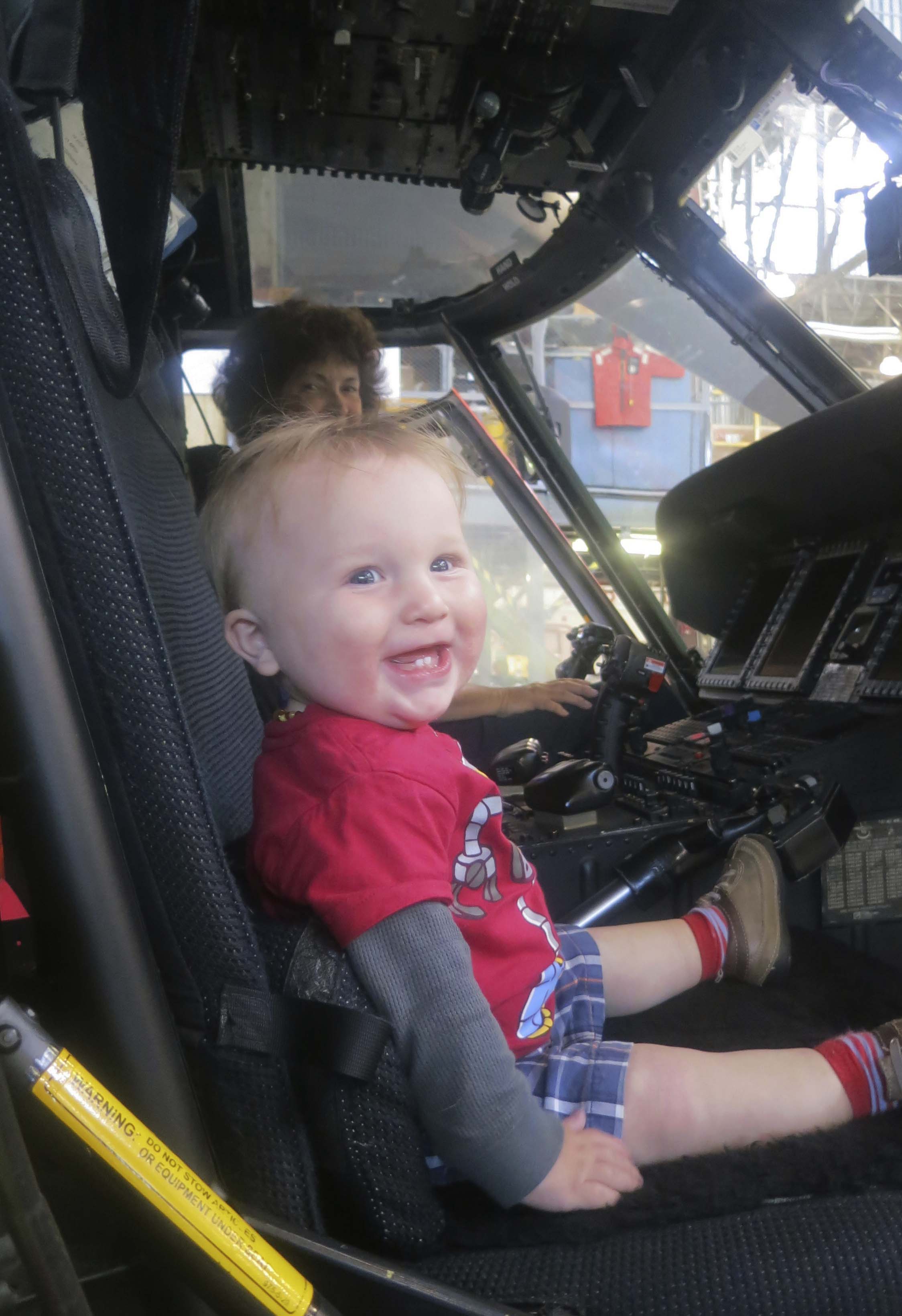
Our youngest grandson Chris gets to try out his dad's seat for size while Peggy looks on.

Our youngest grandson Chris gets to try out his dad’s seat for size in the H-60 while Peggy looks on.

The HH-65, a smaller short-range helicopter is designed to fly off of Coast Guard Cutters and accompanies them on their deployments.

The HH-65, a smaller short-range helicopter, is designed to fly off of Coast Guard Cutters and accompanies them on their deployments.

The fixed-wing C-130 also flies out of the Kodiak Air Station.

The fixed-wing C-130 also flies out of the Kodiak Air Station.

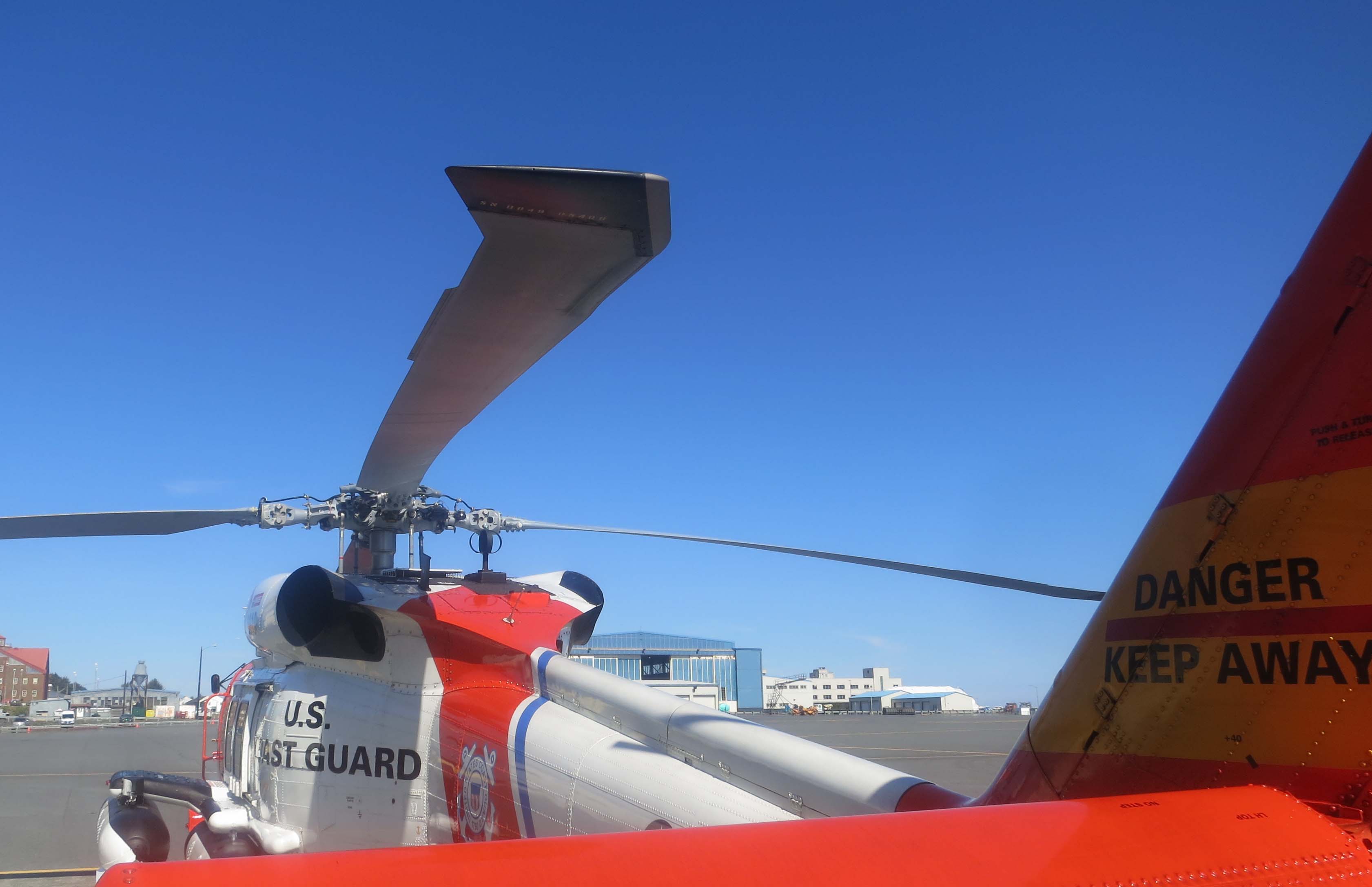
The H-60 shown above is featured here in its natural setting with the mountains of Kodiak Island forming the background.

A final view of the flight-ready H-60 is featured here with the mountains of Kodiak Island in the background.

NEXT BLOG: Some of my favorite Kodiak photographs.


Salmon Fishing with a Kodiak Bear… North to Alaska

Does it really matter whether you catch fish or not when this is your setting? Cape Chiniak, Kodiak.

Does it really matter whether you catch fish or not when this is your setting? Cape Chiniak, Kodiak.

The "old fishing hole" on the Chiniak River. We fished both the river and the ocean for pink salmon.

The “old fishing hole” on the Chiniak River. Not bad, huh?

I’d consumed far too much coffee, so I put down my fishing pole and walked over the hill to find a convenient tree. Instead, I found the neighborhood bear. He was dashing around in a small pool of water on the other side of the road doing what Kodiak Bears do best: chase salmon. He was far too occupied to have seen me so I slipped away. I didn’t want to surprise him. Bears don’t like surprises.

The Chiniak River flows under the road through this culvert. Salmon were plateful on both sides. While we were fishing downstream on this side of the culvert, the bear was fishing upstream.

The Chiniak River flows under the road through this culvert. Salmon were plentiful on both sides. While we were fishing downstream on this side of the culvert, the bear was fishing upstream.

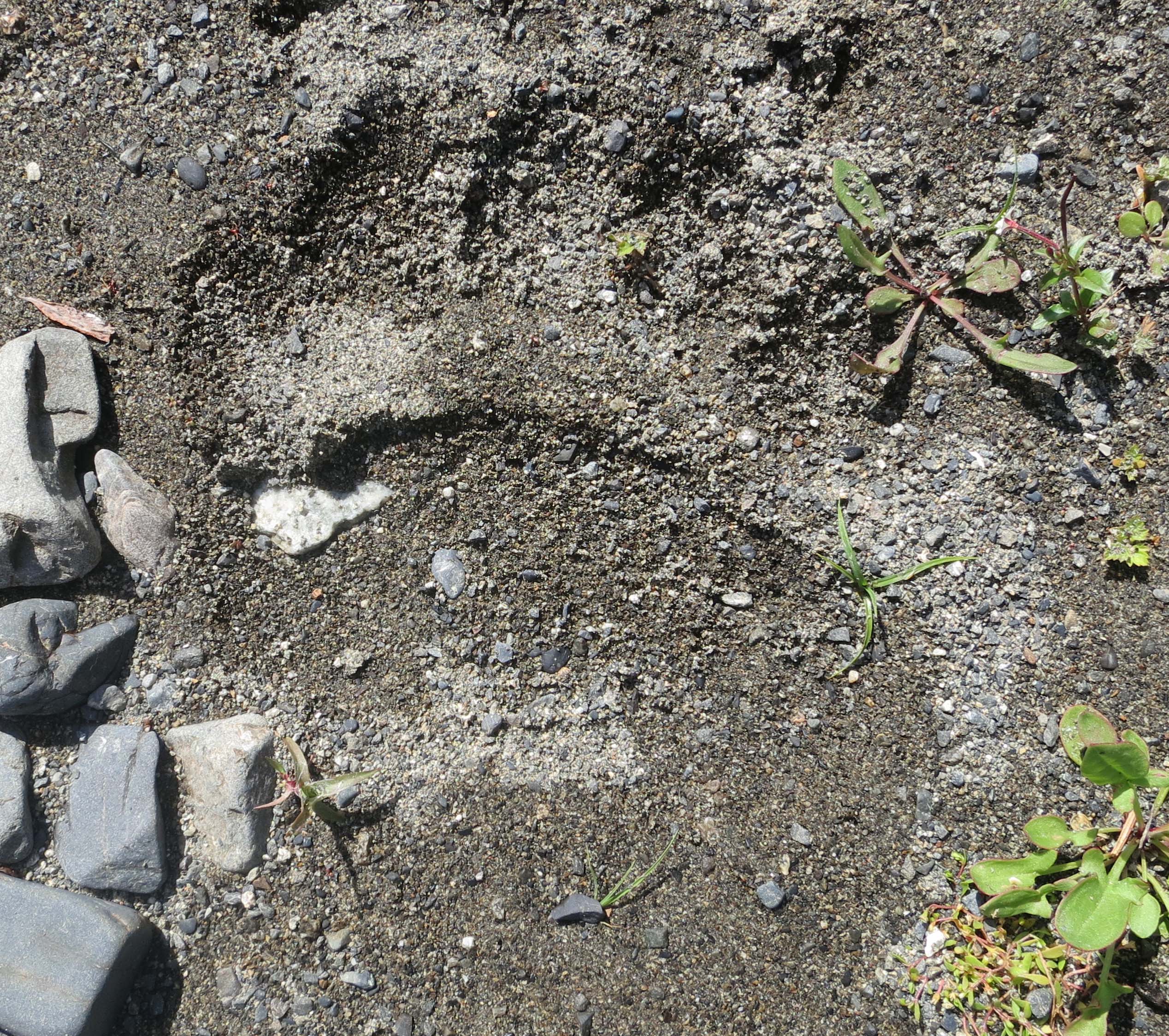
Kodiak Bear prints.

While I didn’t hang around to photograph the bear, I came back to capture his prints.

When I first came to Alaska in the 80s, many backpackers and hikers wore bells to let bears know they were in the area. My thinking was that cows wore bells and bears liked to eat cattle. I talked and sang a lot. “Ninety-nine Bottles of Beer on the Wall” was a favorite. One rendition gets you through a lot of bear country. Peggy and I still sing it when we come on a pile of fresh, steaming bear poop in the woods. The bigger the pile, the louder we sing.

This time I walked backed to where Tony was fishing and quietly gave him the news. I didn’t want to alarm the boys. More to the point, if the boys knew the bear was nearby, they would immediately want to go see him.

Tony came loaded for bear. He carried an air horn and pepper spray as his first line of defense. You are supposed to stand tall and make lots of noise if a bear finds you interesting. Tony is 6’2”. The air horn would supply the noise. When it comes time to use the pepper spray, the situation has deteriorated considerably. If all else fails, you are supposed to play dead… or shoot the bear. Tony is a nationally ranked pistol marksman. If push came to shove, my money would be on him.

Fortunately, the bear headed upstream. We were left on our own to catch salmon.

The natural setting on the end of the Chiniak Peninsula on Kodiak Island is beautiful and this was our second time there. The first time we had been quite successful and we were eager to for a repeat performance. It wasn’t to be.

The results from our first trip out to the Chiniak Peninsula.

The results from our first trip out to the Chiniak Peninsula.

There was an extreme low tide. Pink salmon in the hundreds lay just off the shore, eager for the high tide to send them swimming on their way up the Chiniak River to perform their age-old ritual of laying eggs and then passing on to salmon heaven, where I assume salmon food is plentiful and bears aren’t.

Our challenge was in catching, not snagging the salmon. They were so thick we kept hooking them before they went for our lures. I even brought a couple in by their tails. It was all fun, at least for us. We dutifully released the snagged salmon as required and watched them swim back into the bay. After we had caught and released 16 or so we decided it was time to pack it in and head home.

We’d go out to dinner. Grilled salmon could wait for another night.

Cape Chiniak, Kodiak, Alaska

Another view of Cape Chiniak. This was taken from just above where we were fishing.

Here fish, fishy, fishy. Cammie tries to entice a salmon by dangling a lure in front of its mouth.

Here fishy, fishy, fishy. Cammie tries to entice a salmon by dangling a lure in front of its mouth.

Fishing on the the Chiniak Peninsula.

Our youngest grandson Cooper provides Tony with advice on where to cast his lure.

Fishing on the Buskin River on Kodiak Island, Alaska.

Our luck changed on the Buskin River a couple of days later. Here, Peggy signals the number of fish she caught. Note: In my last blog I reported that Peggy had only been fishing as a child. I forgot she had gone salmon fishing with my brother-in-law, Jim. That explains why she caught five salmon and I only caught four. (grin)

Pink salmon caught on the Buskin River in Kodiak, Alaska.

We hold up our catch of the day on the Buskin. And yes, Tony did grill salmon that night.

NEXT BLOG: The Coast Guard on Kodiak

Just for the Halibut… Gone Fishing in Kodiak

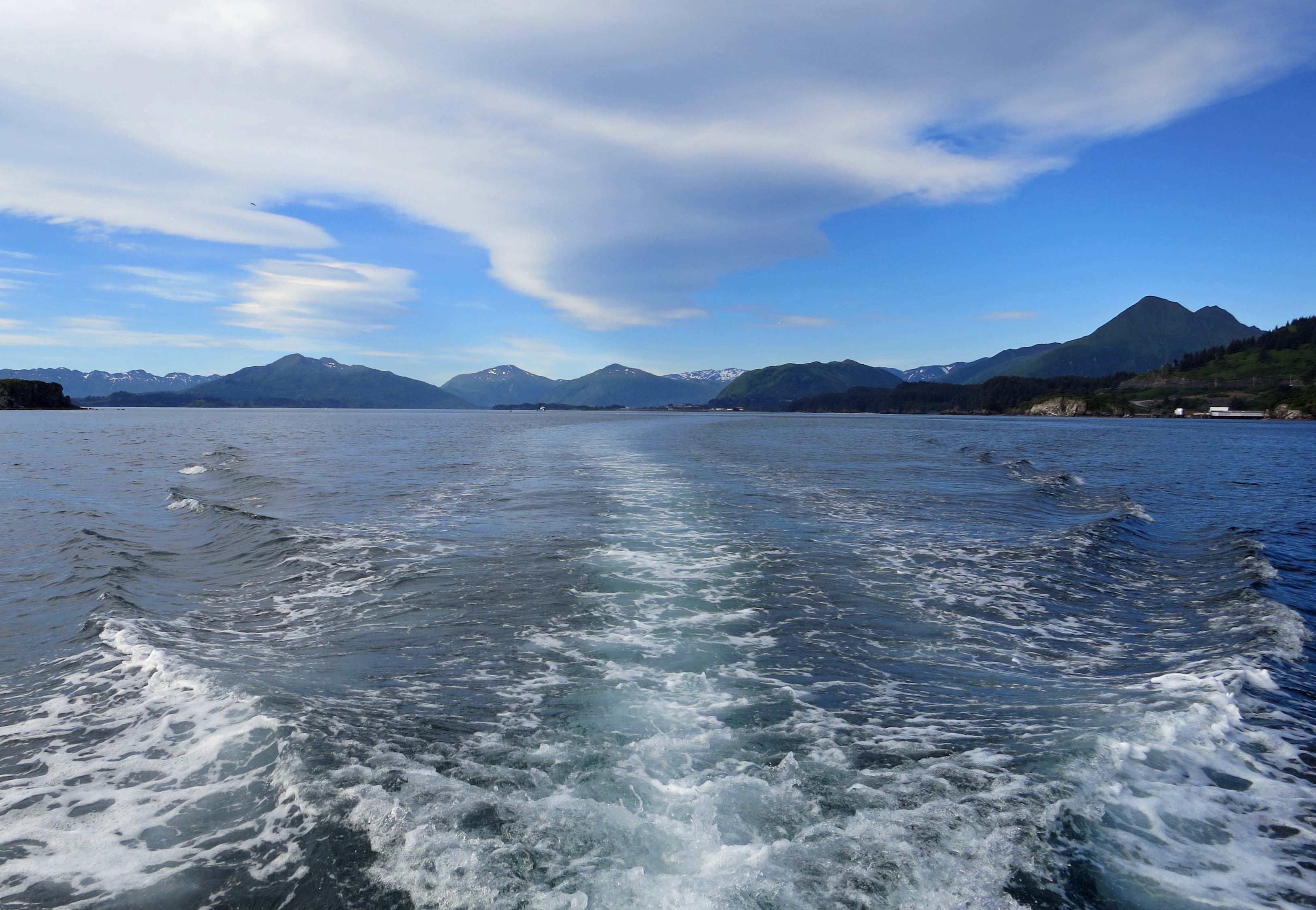
Boat wake in Chiniak Bay, Kodiak.

Leaving worries, Kodiak and a wake behind, we head out into Chiniak Bay for a day of halibut fishing.

Kodiak is about fishing. The Port of Kodiak is one the top three commercial fishing centers in the United States and the largest in Alaska. Sport fishing is also big. People come from around the world to try their luck. The odds are if you are in Kodiak for any amount of time, you’ll get hooked.

Kodiak, Alaska fishing harbor.

Kodiak Harbor is home to one of the largest fishing fleets in the United States.

Peggy poses with out youngest grandson, Cooper in front of the Harbor Masters office in Kodiak. The large fish is a sculpture made from trash collected from the ocean. Hopefully Cooper will grow up in a world with less trash.

Peggy poses with our youngest grandson, Cooper, in front of the Harbor Master’s office in Kodiak. The large fish is a sculpture made from trash collected from the ocean. Hopefully Cooper will grow up in a world with less trash.

Our son Tony caught the fishing bug. He grumbled when he left San Diego that all of his Coast Guard friends in Kodiak had become fishermen. He didn’t like to fish. Now, according to his wife, Cammie, he’s just like all of the other guys on the island. “Gee, honey, would you like to go for a nice romantic walk or go fishing?” Guess what…

But Cammie is right there with him. She can walk out into the water in her hip waders and cast her line for salmon with the best of the guys.

Cammie demonstrates her salmon fishing skills.

Cammie demonstrates her salmon fishing skills.

Peggy and I certainly don’t qualify as fishermen. I had fished in my twenties for several years but that was a while ago. We won’t talk about how long. As for Peggy, she had fished off a dock in Lake Erie with a bobber as a child… twice. But the temptation to go fishing was too great. Off we went to buy our out-of-state fishing licenses. We were about to get our feet wet.

Our first adventure was to try our luck with halibut. Guess who caught the only one? It wasn’t Tony, Cammie or me.

Coast Guard Kodiak has a dock for small fishing boats on base  and makes rental boats available for Coasties. (Members of the Coast Guard)

Coast Guard Kodiak has a dock for small fishing boats on base and makes rental boats available for Coasties (Members of the Coast Guard).

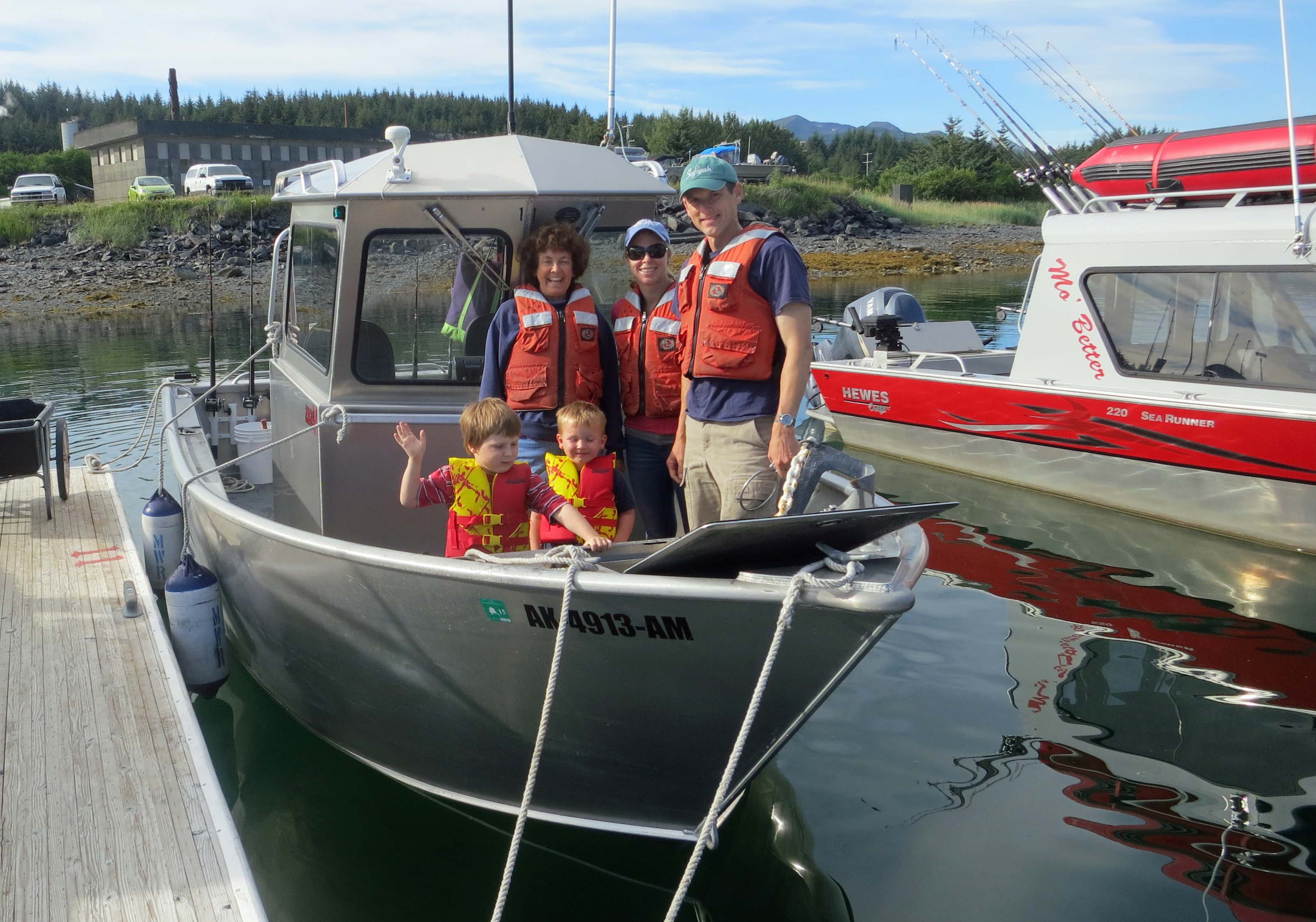
Our brave crew prepares to head out to sea on our Halibut fishing expedition. Connor, Chris and Tony are in the first row. Peggy and Cammie are in the second row.

Our brave crew prepares to head out to sea on our halibut fishing expedition. Connor, Chris and Tony are in the first row. Peggy and Cammie are in the second row.

Fishing in Kodiak, Alaska.

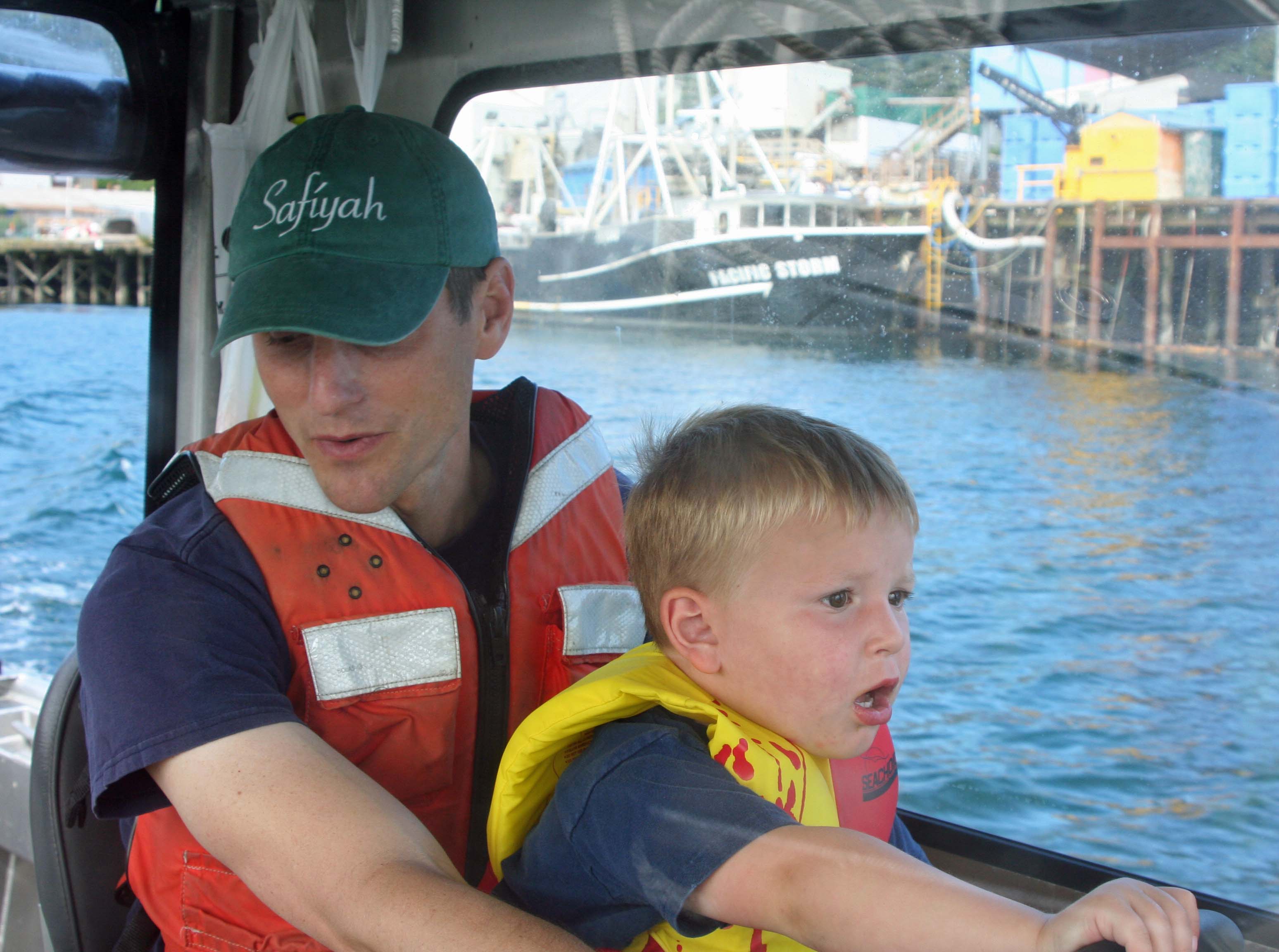
“Um, Dad, is that dock supposed to be there!?” Before we headed out to into the Bay, we tried our luck at catching herring for bait fish near the Kodiak docks. Three-year-old Chris, sitting in Tony’s lap and pretending to steer, apparently has concerns about where the boat is headed. (Photo by Peggy Mekemson)

Fishing in Chiniak Bay, Kodiak, Alaska.

Having no luck with the Herring, we headed out into Chiniak Bay to fish for halibut.

Having tossed out our anchor, Connor found time to play 'now you see me, now you don't' with me. The reflection was a bonus.

Connor found time to play ‘now you see me, now you don’t’ with me. The reflection was a bonus.

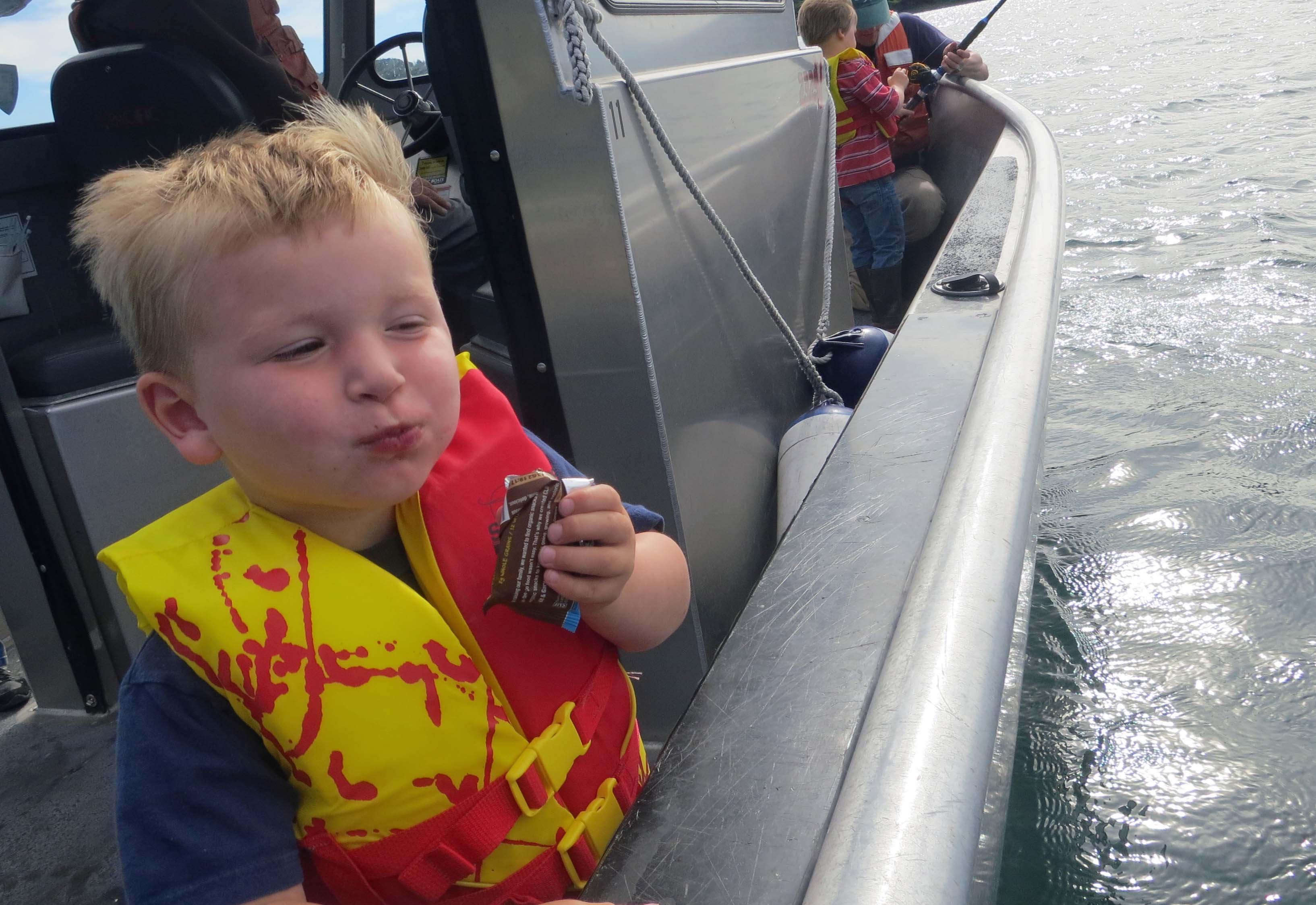
Chris enjoyed some kind of healthy snack, but given the expression of bliss on his face, I'm guessing that chocolate was involved.

Chris enjoyed some kind of healthy snack, but given the expression of bliss on his face, I’m guessing that chocolate was involved. (Photo by Cammie Lumpkin.)

Fishing in Chiniak Bay, Kodiak, Alaska.

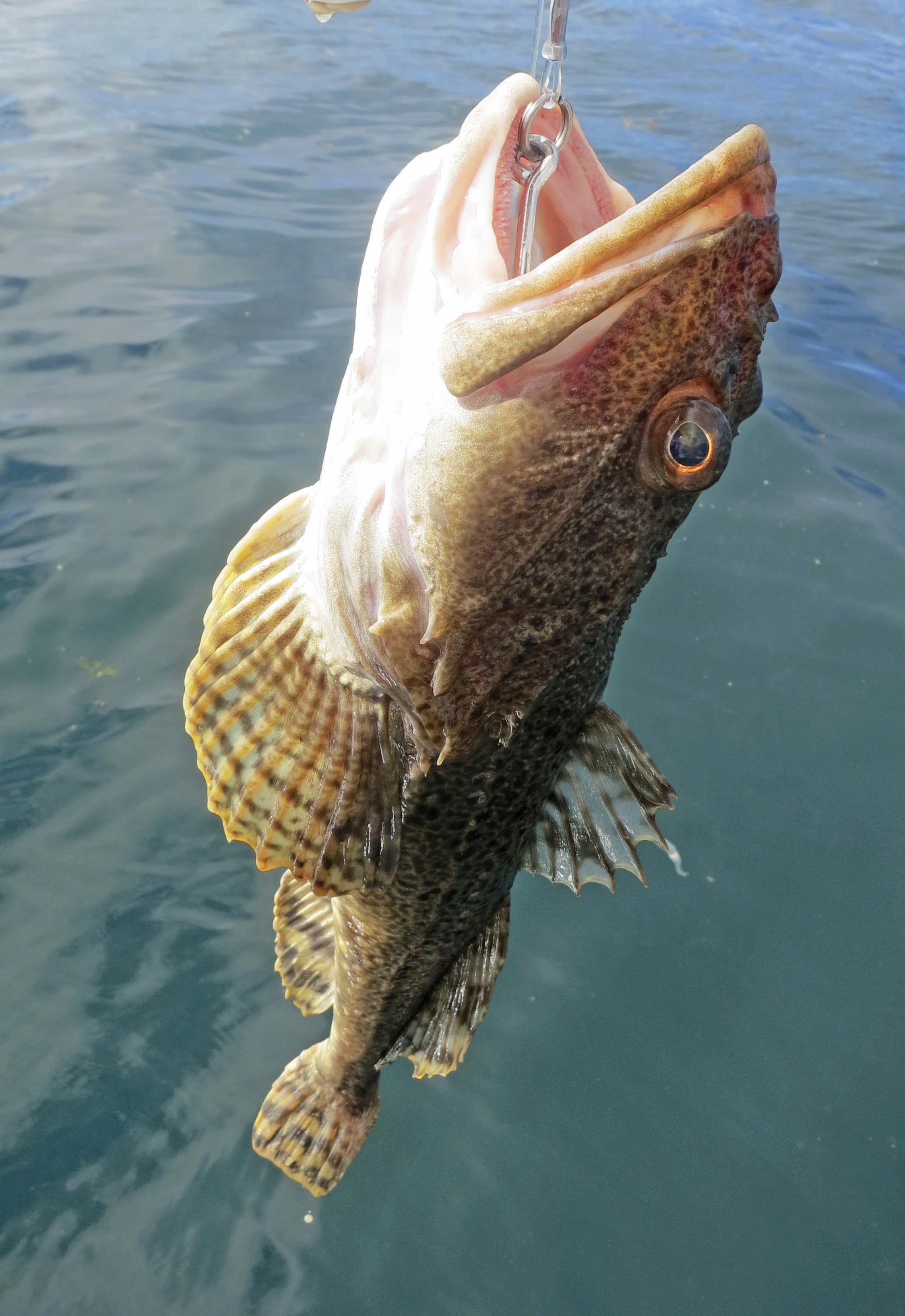
Cammie caught the first fish on our trip, a colorful rockfish. (Photo by Tony Lumpkin.)

Rockfish caught by Cammie Lumpkin off Kodiak Island.

A close up of the rockfish. “My what big eyes, you have.” Tony unhooked and released Cammie’s catch. (Photo by Tony Lumpkin.)

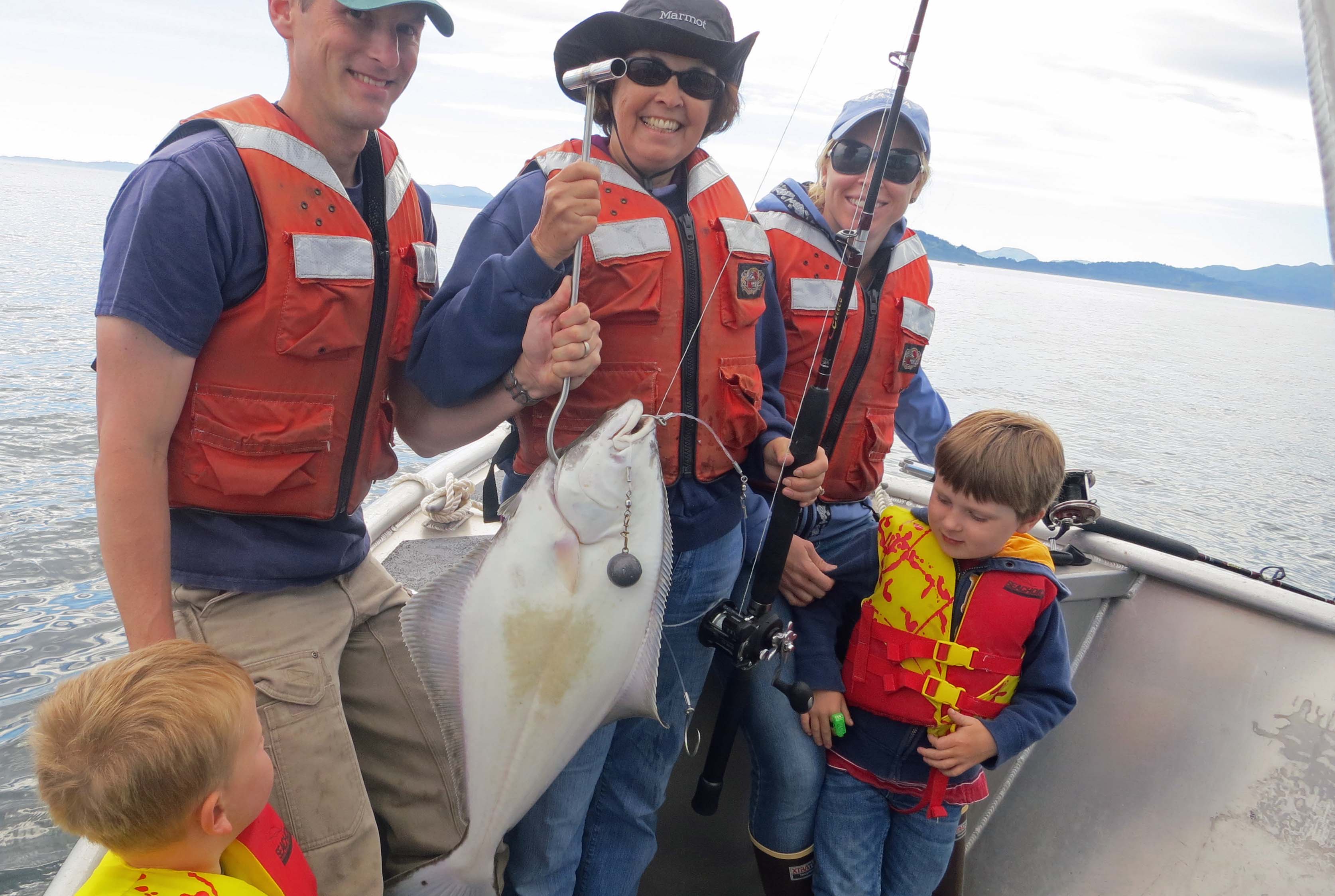
Peggy and I pose for our "official" halibut fishing photo. (Photo by Tony Lumpkin.)

Peggy and I pose for our “official” halibut fishing photo. (Photo by Tony Lumpkin.)

Fishing in Chiniak Bay off the coast of Kodiak, Alaska.

A second “official” photo.  I was leaning out to be in the picture. Had a large halibut chosen that moment to strike, I may have gone swimming. (Photo by Tony Lumpkin.)

Halibut fishing off the coast of Kodiak, Alaska.

Peggy caught our first, and only halibut, a 15 pounder– and had a smile to prove it.

Fishing for halibut in Chiniak Bay, Alaska.

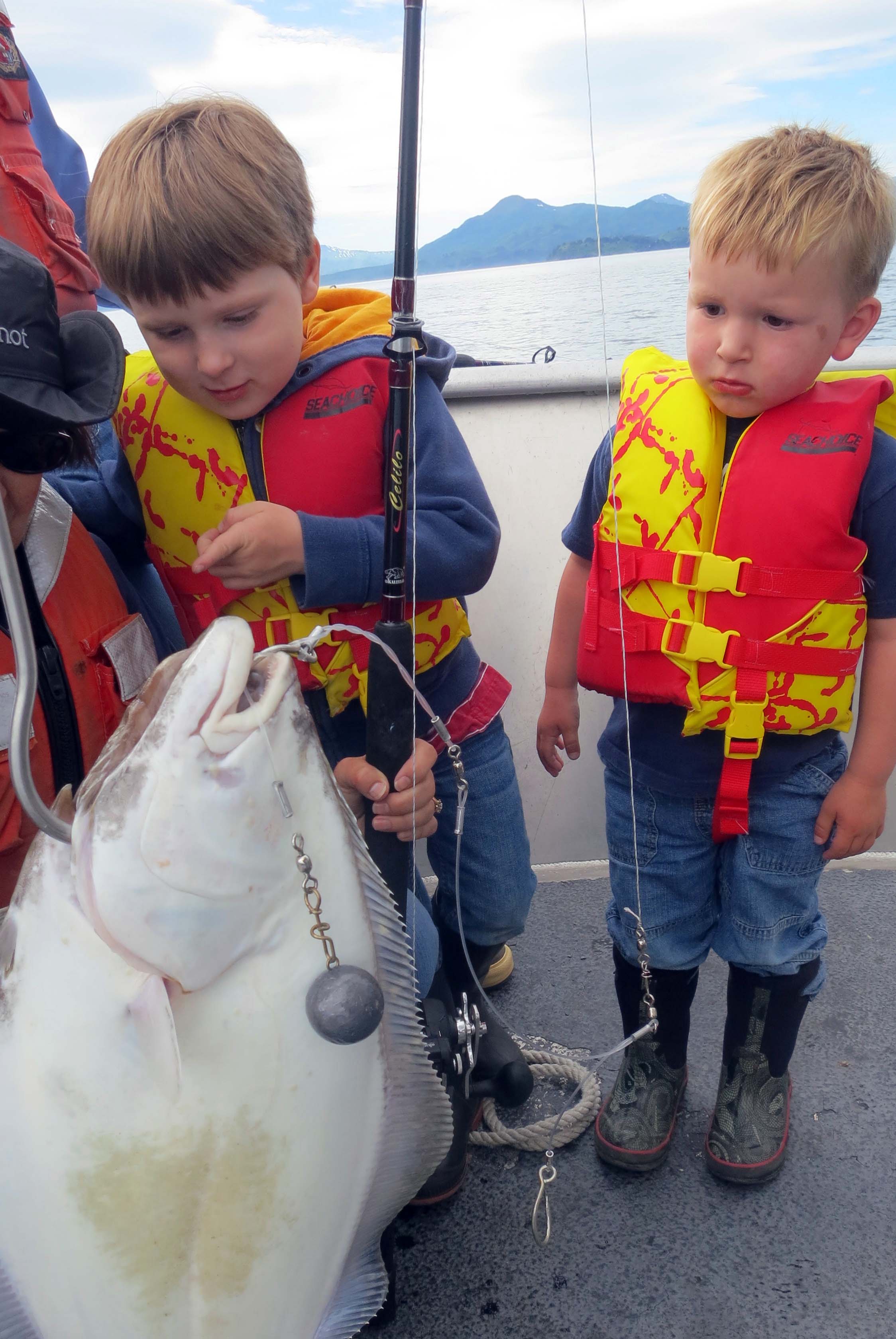
Here, the boys take a close look at the halibut. Connor appears quite curious about the fish’s strange eye arrangement while Chris keeps his distance.

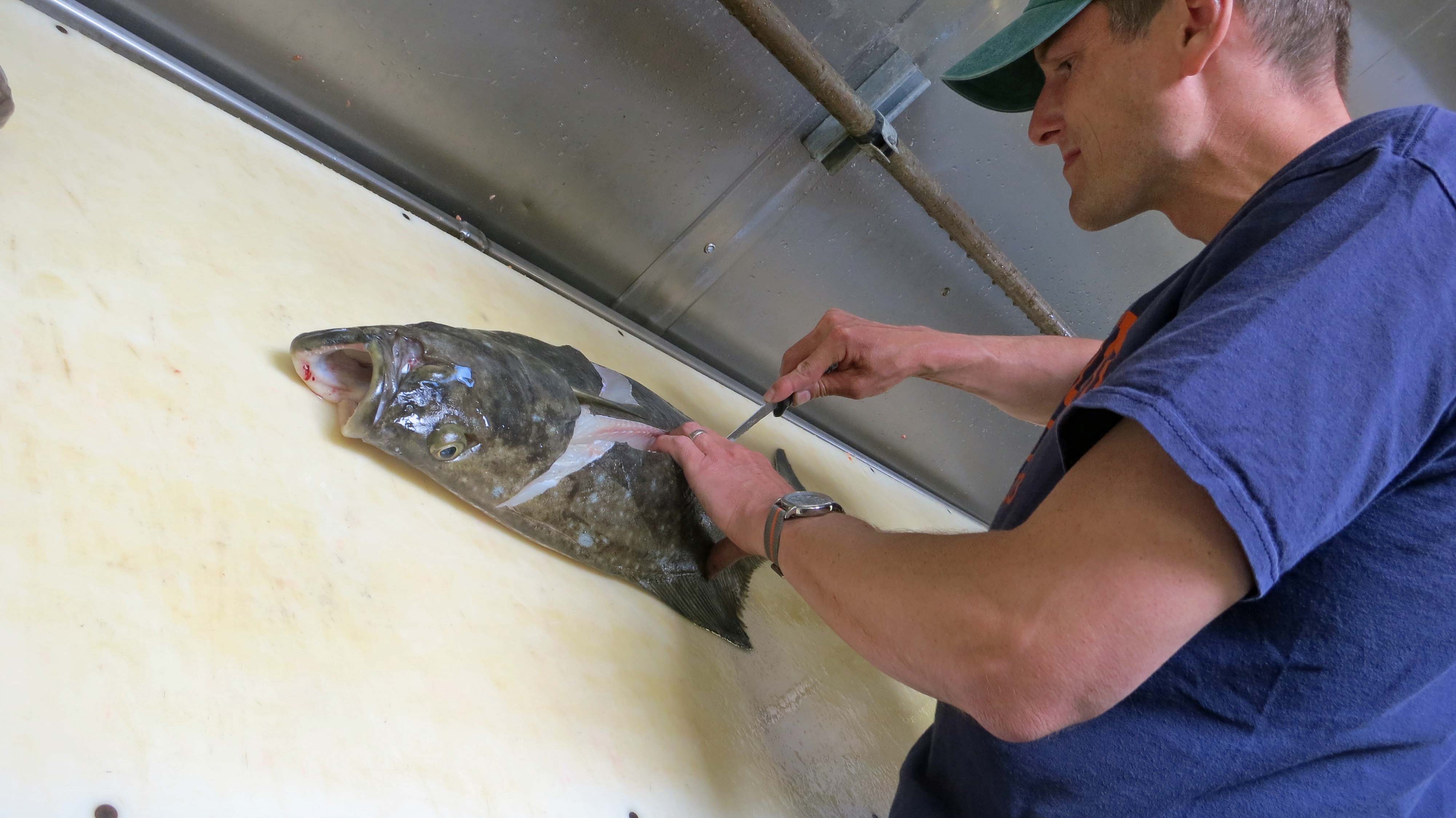
Tony has become quite expert at filleting fish. Here, he takes on the halibut. Halibut has always been my favorite fish. Nothing can beat one fresh off the boat.

Tony has become quite expert at filleting fish. Here, he takes on the halibut. Halibut has always been my favorite fish for eating and nothing can beat one fresh off the boat.

A note on photo credits: I always try to give credit to the person who took the photo. Where no name is mentioned, I took the picture. Peggy and I were passing our cameras around this time between ourselves, Tony and Cammie. I could have missed something.

NEXT BLOG: Having landed a halibut, we join the Kodiak Bears in fishing for salmon.

Flying Over Kodiak in an Antique Bomber… North to Alaska

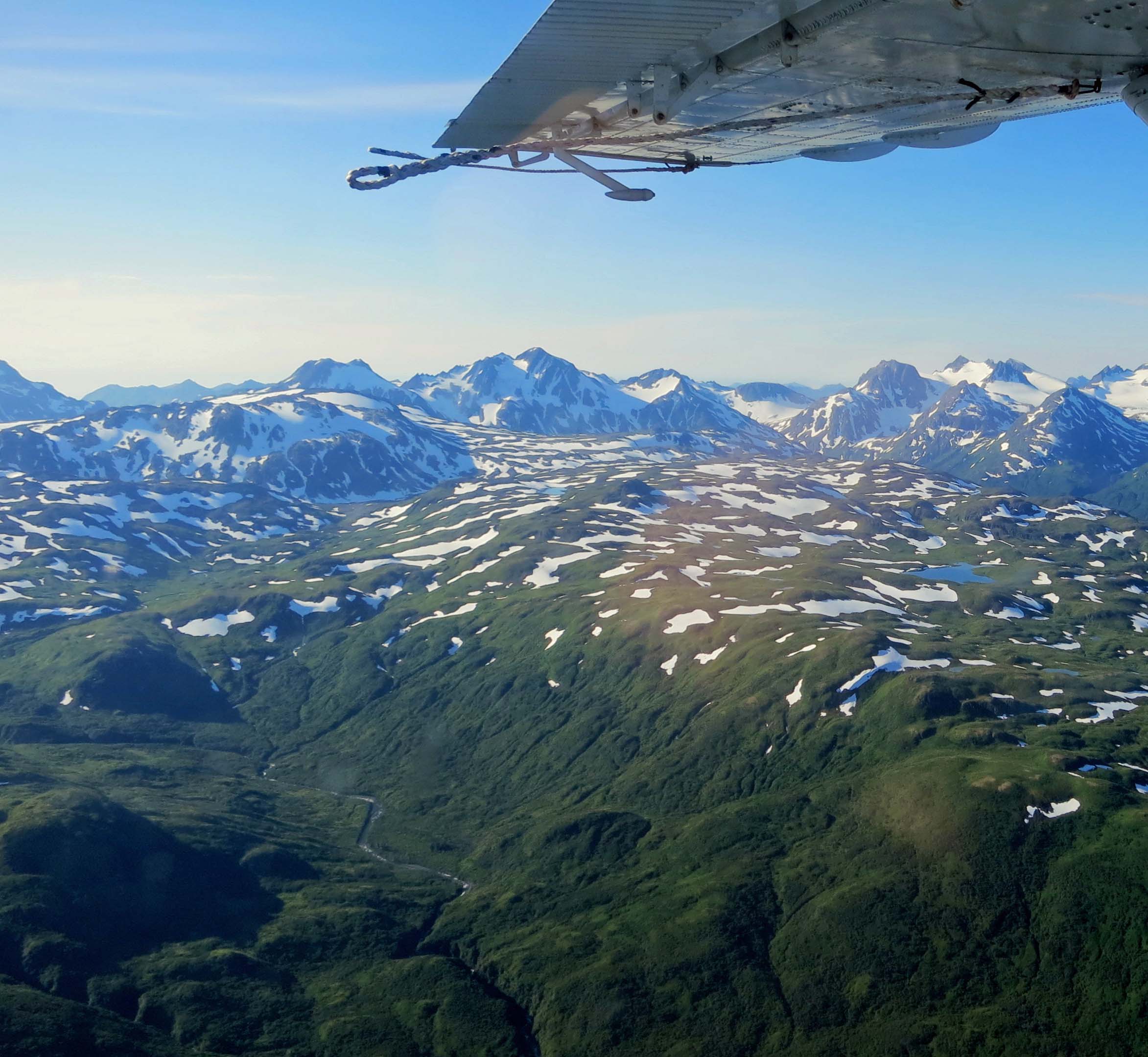
Kodiak is a beautiful island ranging (in the summer) from intensely green hills to glacier covered mountains. I took this photo out the window of our plane as we flew over the Island.

Kodiak is a beautiful island ranging (in the summer) from intensely green hills to glacier covered mountains. I took this photo out the window of our plane as we flew over the Island.

Kodiak refers to itself as the Emerald Isle, a title it borrowed from Ireland. Having driven through Ireland and flown over Kodiak, I understand. Our floatplane trip to watch Kodiak Bears on the Frazer River provided a great overview of the island. The first impression was one of pervasive greenness.  Soon, the green became dotted with snow fields and then glaciers; Kodiak is not Ireland.

Peggy captured just how green Kodiak can be... set off by patches of snow. (Photo by Peggy Mekemson)

Peggy captured just how green Kodiak can be… set off by patches of snow. (Photo by Peggy Mekemson)

In American terms, Kodiak is a big Island. At 3500 square miles it is the second largest island in the US, second only to the island of Hawaii. Given that it has around 3500 Kodiak bears, there is an average of one bear per square mile. One was waiting for us when our plane landed in Frazer Lake. He came running toward us. We opted to stay on the plane until he disappeared. Later we saw him swimming across the lake.

The Kodiak Bear, a young male, made his way toward our plane. He was more interested in fish than he was us, but we stayed on the plane until he left.

The Kodiak Bear, a young male, made his way toward our plane. He was more interested in fish than he was us, but we stayed on the plane until he left.

Our floatplane trip also provided us with some great views of the Kodiak Coast Guard Station where our son Tony flies H-60 Helicopters on missions rescuing everything from stranded fisherman to errant oil rigs. I’ll blog about the Coast Guard later.

Coast Guard Station on Kodiak Island.

A view of the Coast Guard station on Kodiak. We stayed at our son’s house on the facility. (Photo by Peggy Mekemson)

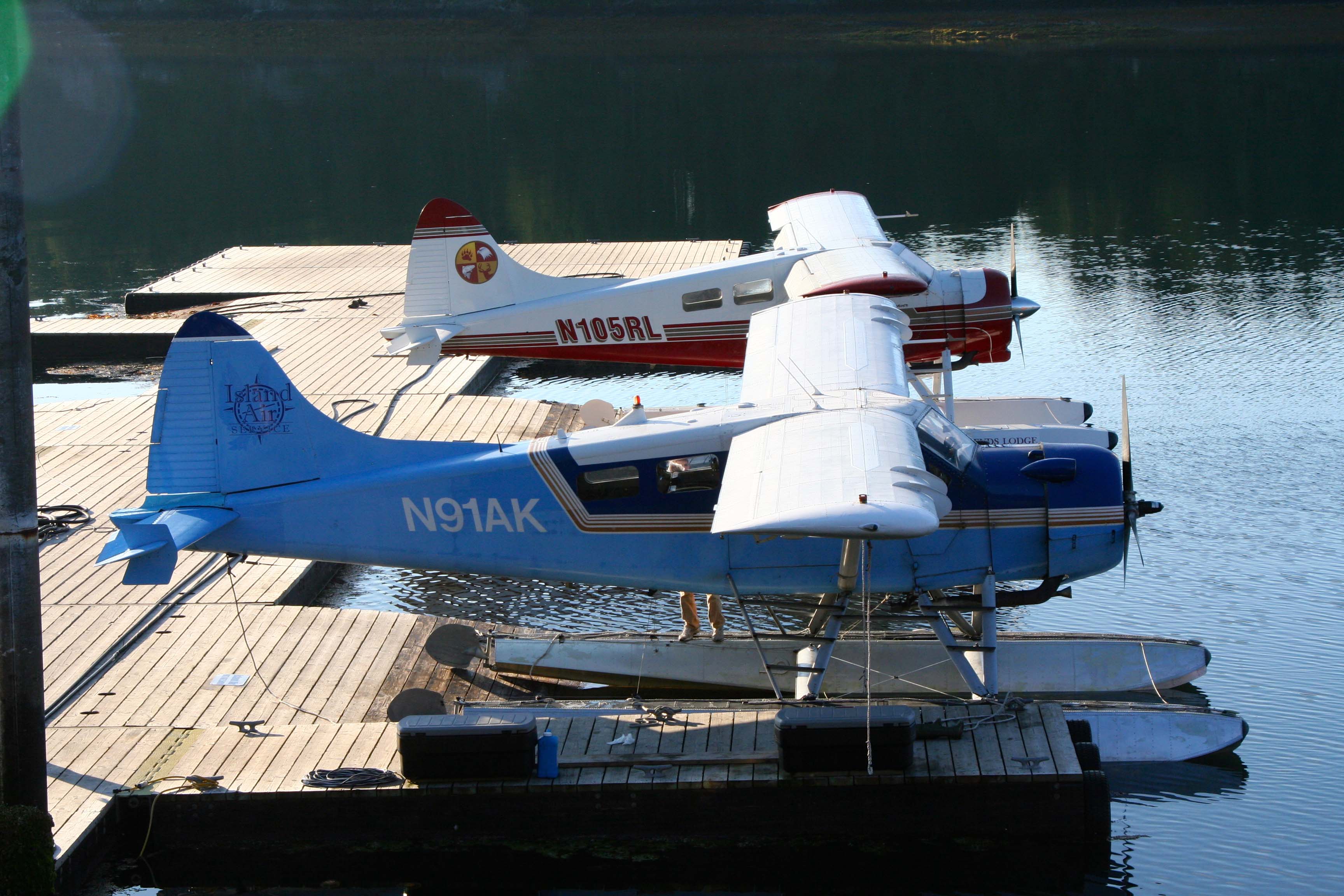
The floatplane was a 50-year-old plus de Havilland Beaver, which makes it not only old, but also something of a legend.  Ours, according to the pilot, had originally been designed to serve as a light bomber during the Korean War and still had bomb mounts on the wings. The Beaver found its true vocation serving as a bush plane in the far north, however. It has lots of STOL in pilot lingo, short takeoff and landing capability. And STOL is critical when your runway might be a riverbank or a small pond.

Beaver floatplane in Kodiak Alaska.

Our de Havilland Beaver floatplane was waiting for us when we arrived. (Photo by Peggy Mekemson)

A few weeks before our visit, Tony, his wife Cammie, and their children had toured Kodiak in one of these floatplanes.

A few weeks before our visit, Tony, his wife Cammie, and their children had toured Kodiak in one of these floatplanes.

The first floatplane I ever flew on had retractable wheels and took off from a regular airport. I somehow didn’t make the connection that we would be landing in a bay. The armrest probably still has my fingerprints embedded in it from when I thought we were crashing in the water. This time we took off from and landed in water. There was no confusion. Only the bear.

Another photo of Peggy's that captures both the green and ruggedness of Kodiak. We spotted mountain goats on some of the peaks.

Another photo of Peggy’s that captures both the green and ruggedness of Kodiak. We spotted mountain goats on some of the peaks.

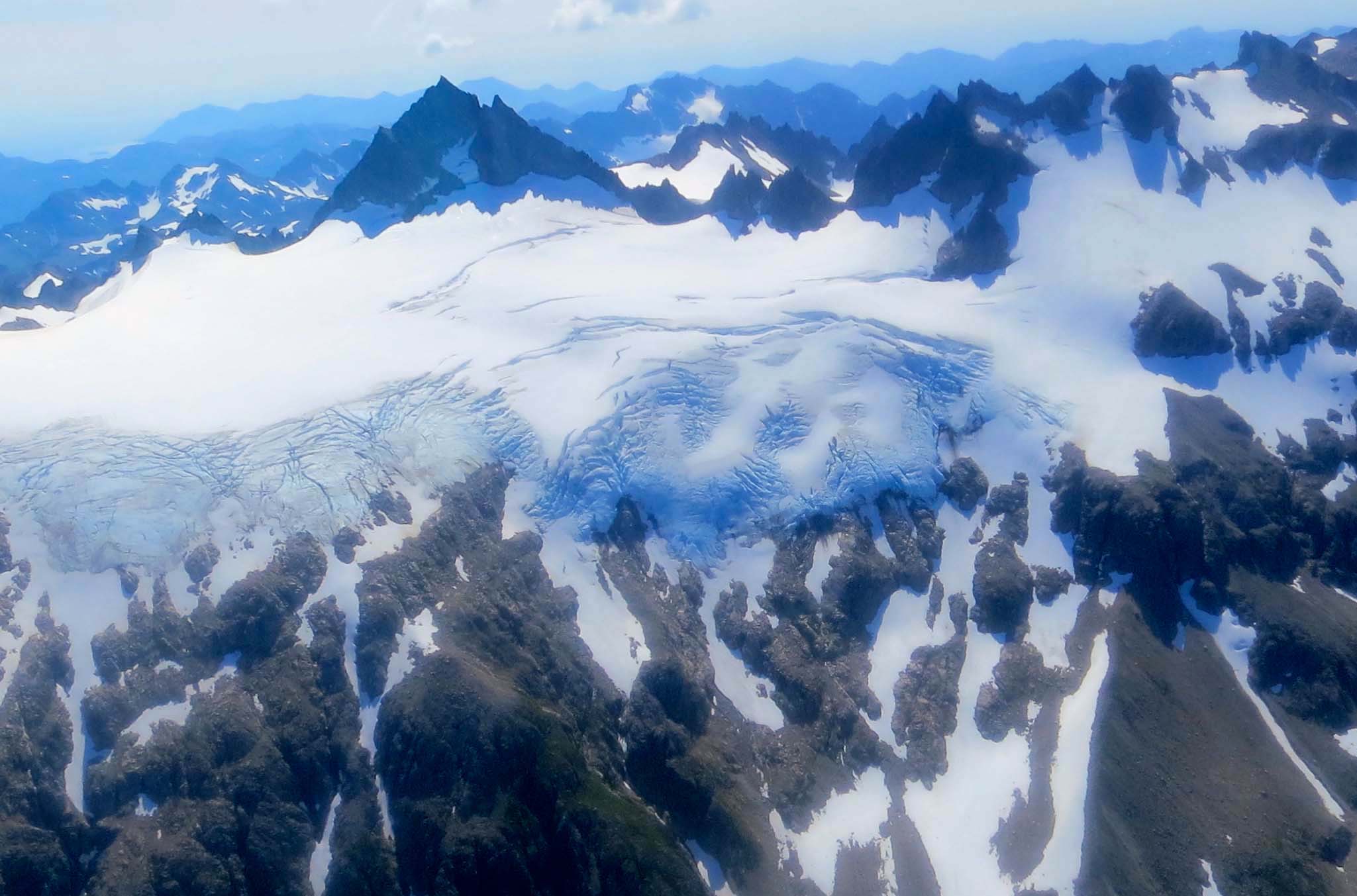
Kodiak, Alaska glacier

This, and the next three photos show the glaciers we found on Kodiak.

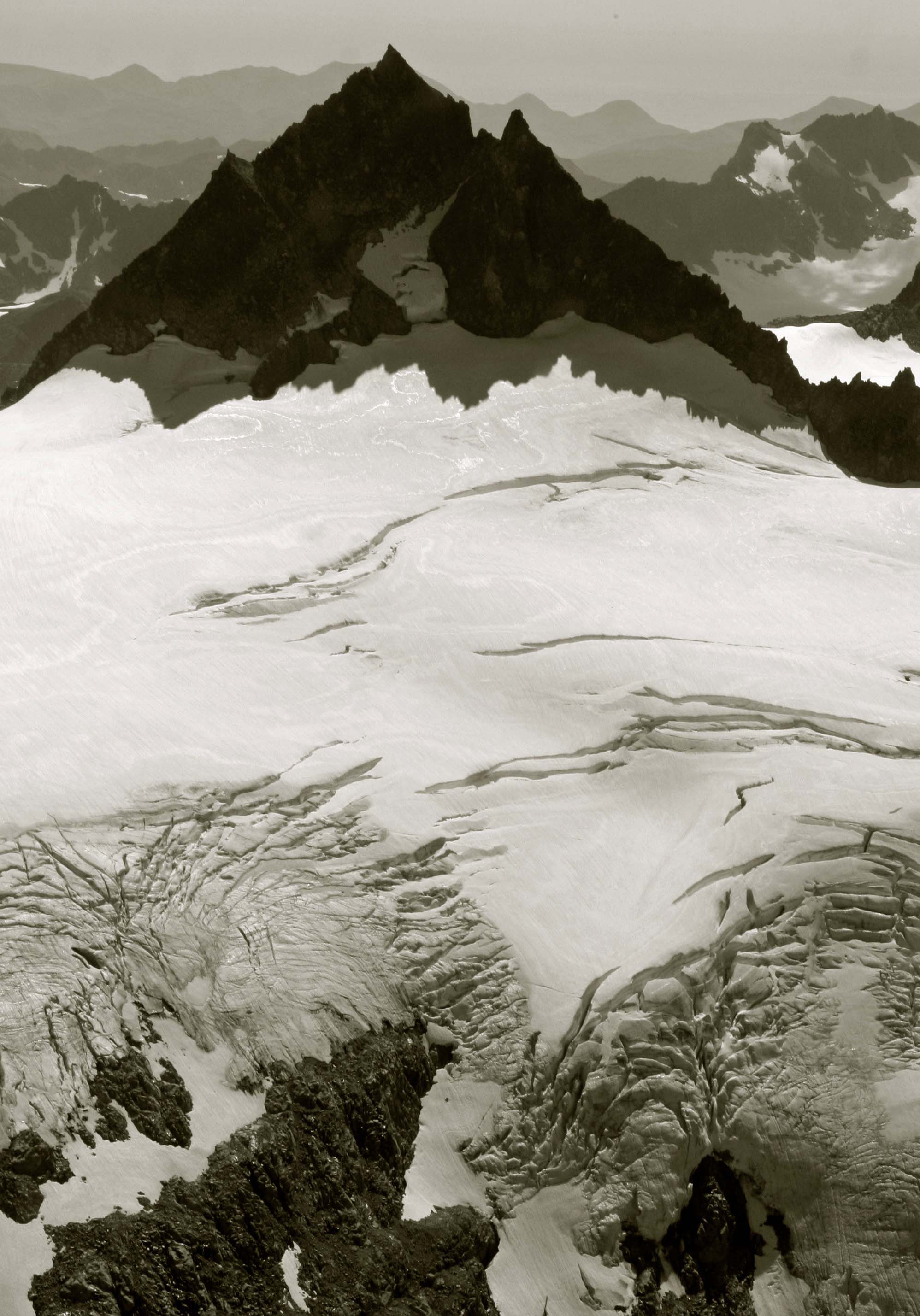
Kodiak, Alaska Glacier

Kodiak Island glacier. I thought this photo Peggy took would be best shown in black and white. (Photo by Peggy Mekemson)

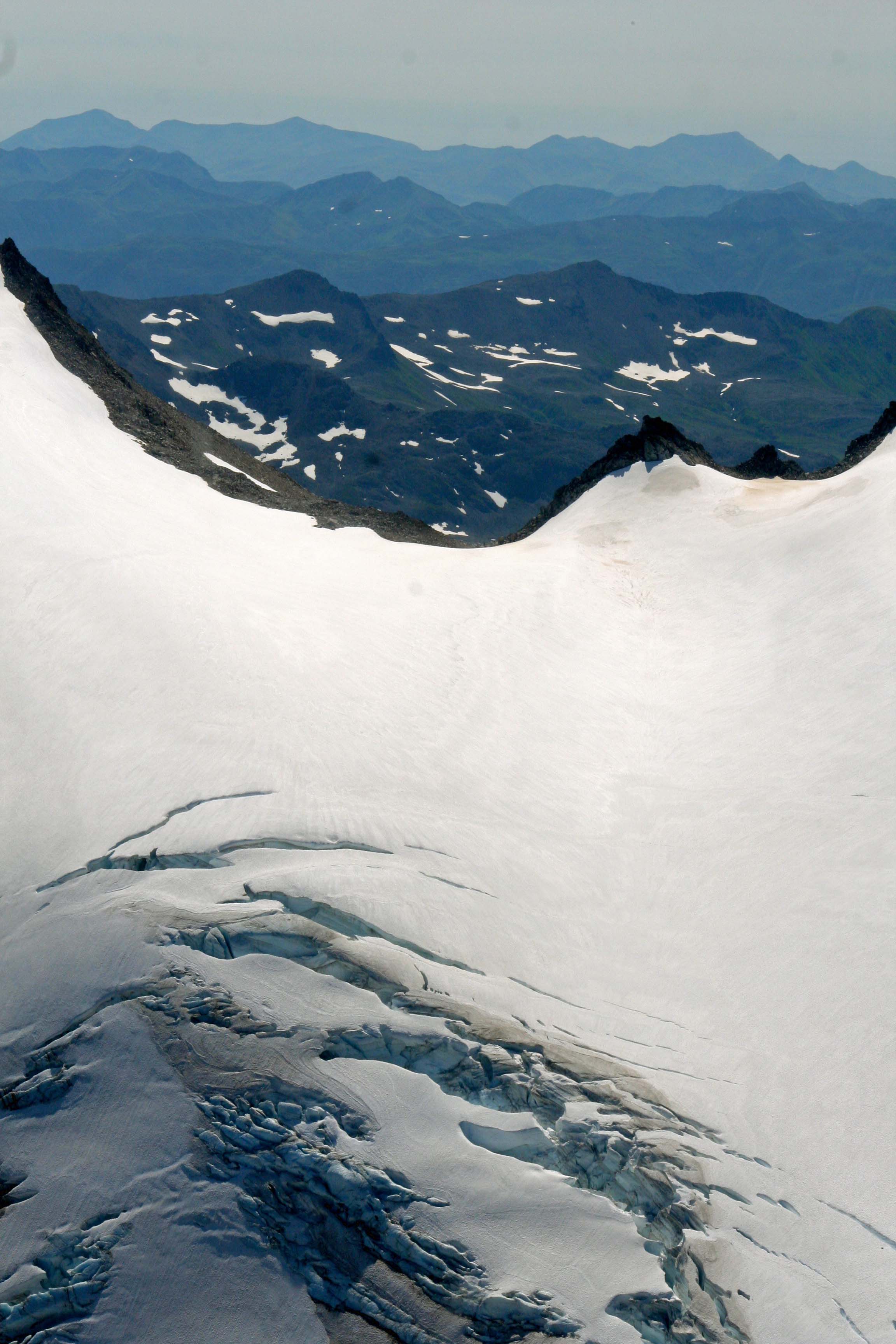
Kodiak Alaska glaciers.

I close with another glacier photo that I found almost mystical. (Photo by Peggy Mekemson)

And Then the Bear Had Me by the Head… Scary Bear Stories Part II

I took this photo of an Alaska Black Bear last week at the Alaska Wildlife Conservation Center. When I was leading backpack trips in Alaska in the 80s, a black bear bit through a sleeping bag into a forrest service ranger's leg.

I took this photo of an Alaska Black Bear two weeks ago at the Alaska Wildlife Conservation Center.

At the end of my last blog, I had backpacked 18 miles into Yosemite Valley to resupply the food bears had taken from me.

My intention was to stay in the Valley that night but it was a zoo, absolutely crawling with tourists. So one very tired Curt shouldered his pack and hiked five miles back over the 3000-foot cliffs into Little Yosemite Valley. I nodded off that night listening to backpackers yelling as bears methodically worked their campsites, wondering when my turn would come. It came all too soon.

I woke up to a bear emptying my backpack about five feet away from where I was sleeping. This brings me to another piece of Yosemite bear lore: always leave the pockets of your pack open. If you don’t, the bear will open them for you. It tends to be rather hard on backpacks.

Fortunately, my food was safely hanging from a cable and I had left my pack wide open. I watched with clinical interest as the bear shoved his head into the pack, pulled out an item, dropped it on the ground and then stuck his head back in the pack. By then I had enough and suggested rather loudly that the bear go elsewhere. After one more foray, he did. The only damage I suffered was bear slobber, all over everything. My old Basset Hound, Socrates, the world champion of slobberers, would have been jealous.

The next night I was leaving my camp for an evening walk when I met a bear coming to visit. I bent over and picked up a rock and he took off like a dog. And thus my summer went. By the time I had led two back-to-back hundred-mile trips into Yosemite, I had my fill of bears and they had had their fill of Trekker food. Fortunately, no more of it was mine. I considered myself an expert food hanger and bear chaser.

It was almost my demise.

At the end of the second Trek, my friend Jean, her sister Mary and her husband Tim joined me at Tuolumne Meadows to hike the John Muir Trail. We spent the night at the Tuolumne campground. I had eaten backpacking meals for two weeks so it was time for grilled steaks, a little bourbon and several cans of beer before hitting the trail again.

As the night progressed, I was feeling no pain and had lots of liquid bravery. So it wasn’t surprising when a bear came to visit our neighbors from Iowa, I was prepared to do battle. They had left their cooler out on the picnic table as an open invitation and the bear was leisurely opening it. The Iowans were hiding out in their camper, making nary a peep.

“HEY BEAR,” I yelled as I strode across the road, “GET OUT OF HERE!”

Well, Mr. Bear had found himself a cache of fresh food and wasn’t about to leave. He turned around, stood up on his hind legs, raised his front legs over his head and said “GRRRROWL!” He was one big fellow. Stone cold sobriety was instantaneous.

“OK bear, it’s all yours,” I mumbled as I scurried back across the road to my own camp and safety. “Eat all of the Iowan food you want. Heck, eat the Iowans.”

By this time though, 20 flashlights were shining down on the bear. Campers are packed into Tuolumne Meadows like tenement housing in a barrio and all of the neighbors were wondering if they were next. Thus disturbed, Mr. Bear went grumbling off over the hill, more than a little pissed to have his fine feast disturbed. You could almost make out in his growling, “I’ll be back.”

Of course the Iowans left their cooler out on the table. No way were they budging from their camper. I pictured them driving nonstop back to Des Moines the next day.

Finally things settled down. After another bourbon or two, we crawled into our sleeping bags. Tim and Mary disappeared in the security of their truck and Jean and I crashed on the ground.

Not surprising, there came a time when Jean had to visit the restroom. Beer will do that. Equally unsurprising the bourbon helped me sleep right through her getting up. But I did hear her come back. Except it wasn’t Jean I heard through my alcohol-induced grogginess; it was the bear coming back for revenge.

“GET OUT OF HERE!” I screamed with all of the passion I had used when I had awakened with the bear standing on me. Jean not knowing what to do grabbed me by the head and said, “Curt, it’s all right, it’s only me!” This was undoubtedly the right thing for her to do, except now the bear had me by the head. As you might imagine, my yells increased in volume geometrically.

Picture 20 flashlights shining down on this happy little domestic scene. If Mr. Bear had any thoughts of revisiting our area that night, he gave us wide berth afterwards.

NEXT BLOG: Back to Kodiak and our float plane trip over the island.

When Bears Behave like Bears: One Thousand Pounds of Entertainment… Part 3

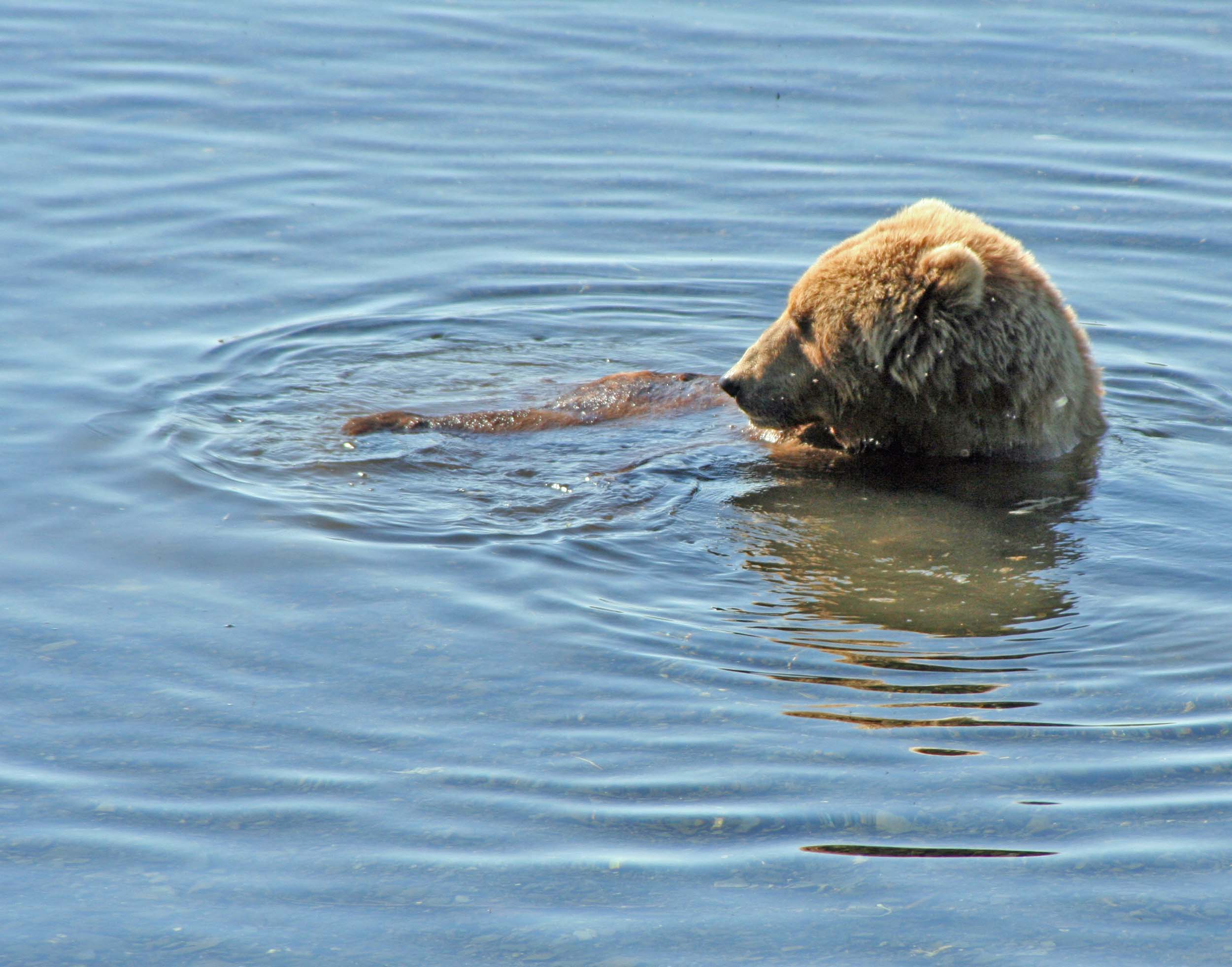
Kodiak Bear cooling off on the Frazer River.

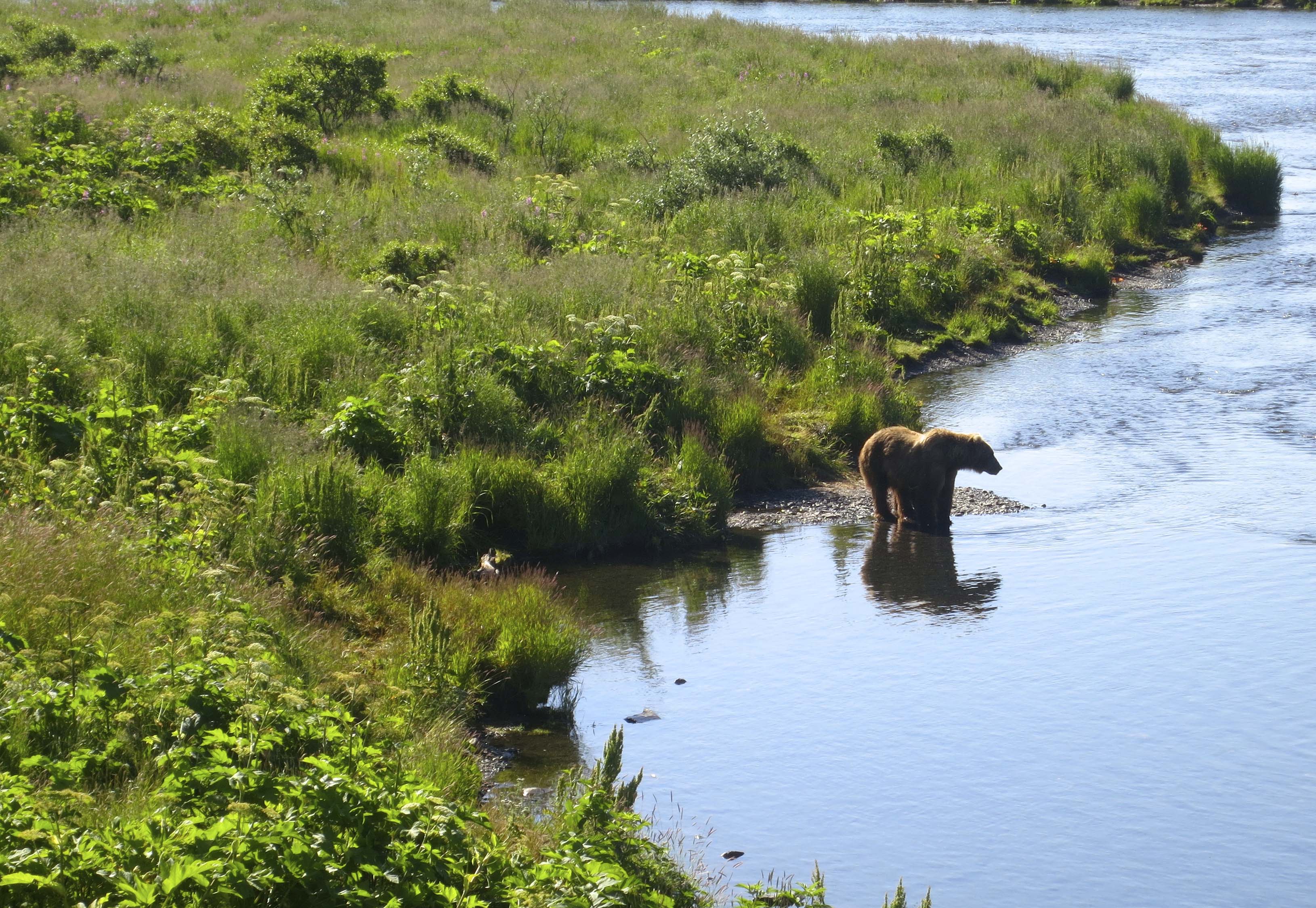
There is nothing like a cool dip in the water on a hot summer day. This large Kodiak Bear plopped down in the Frazer River, obviously enjoying herself. Soon she had rolled over on her back. See below.

As I have noted before, Kodiak Bears are big animals with large teeth and sharp claws. They can be daunting, even scary. And they always deserve respect. When I found one fishing the same small stream we were fishing on the Chiniak Peninsula last week, I beat a hasty retreat, slowly. Running away would have suggested I was dinner, or at least something to play with. And bears play rough.

Bears attack people but these encounters are rare considering the number of people and bear encounters each year. On Kodiak Island there are some 14,000 people and around 3500 bears. Odds are if you spend any time at all outdoors, you will meet up with one of these magnificent creatures.

Over a thousand people per year make the trek out to the Kodiak Island’s best bear viewing spot, the Frazer River. As far as I know, no one has been eaten. A friend of mine who taught wilderness survival skills to the military used to tell his students if bears wanted to eat people, they would move in to town where there are a lot more people to eat. Mainly bears like to avoid people. We are scarier than they are.

The bears of Frazer River put on a great fish catching demonstration and the moms and cubs had a serious “ah” factor. But they also cooled off in the water, sat and watched the world go by, established who was boss, and enjoyed a good scratch. I found some of their behavior quite humorous.

Kodiak Bear cools off in the Frazer River.

Mom lays down on her back.

Kodiak Bear on the Frazer River Fish Pass.

I wasn’t about to tell this guy he had to stay off the Fish Pass. Check out the claws! 

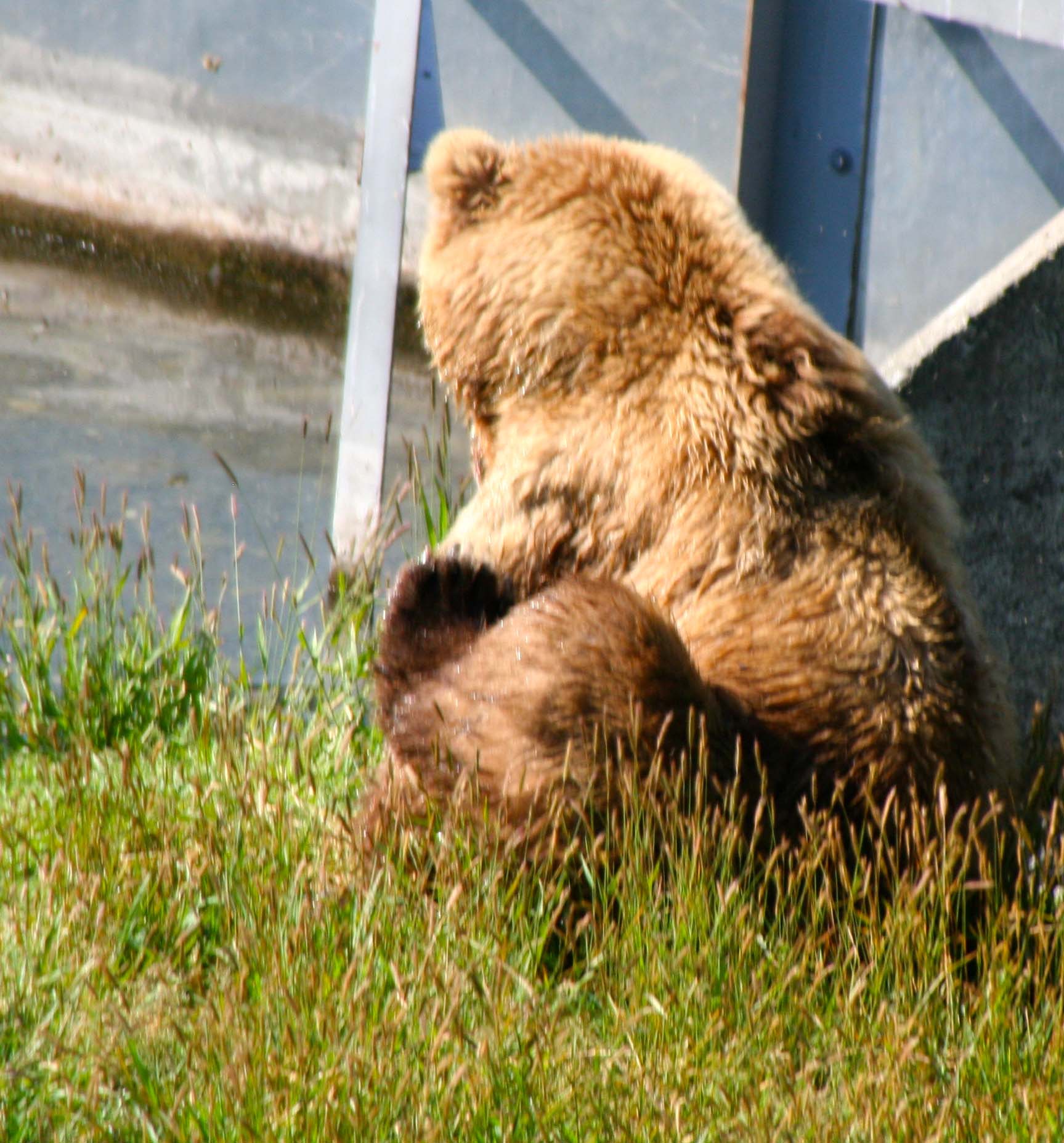
I also enjoyed this Kodiak Bear sitting in the grass and watching the action in the river.

I also enjoyed this Kodiak Bear sitting in the grass and watching the action in the river.

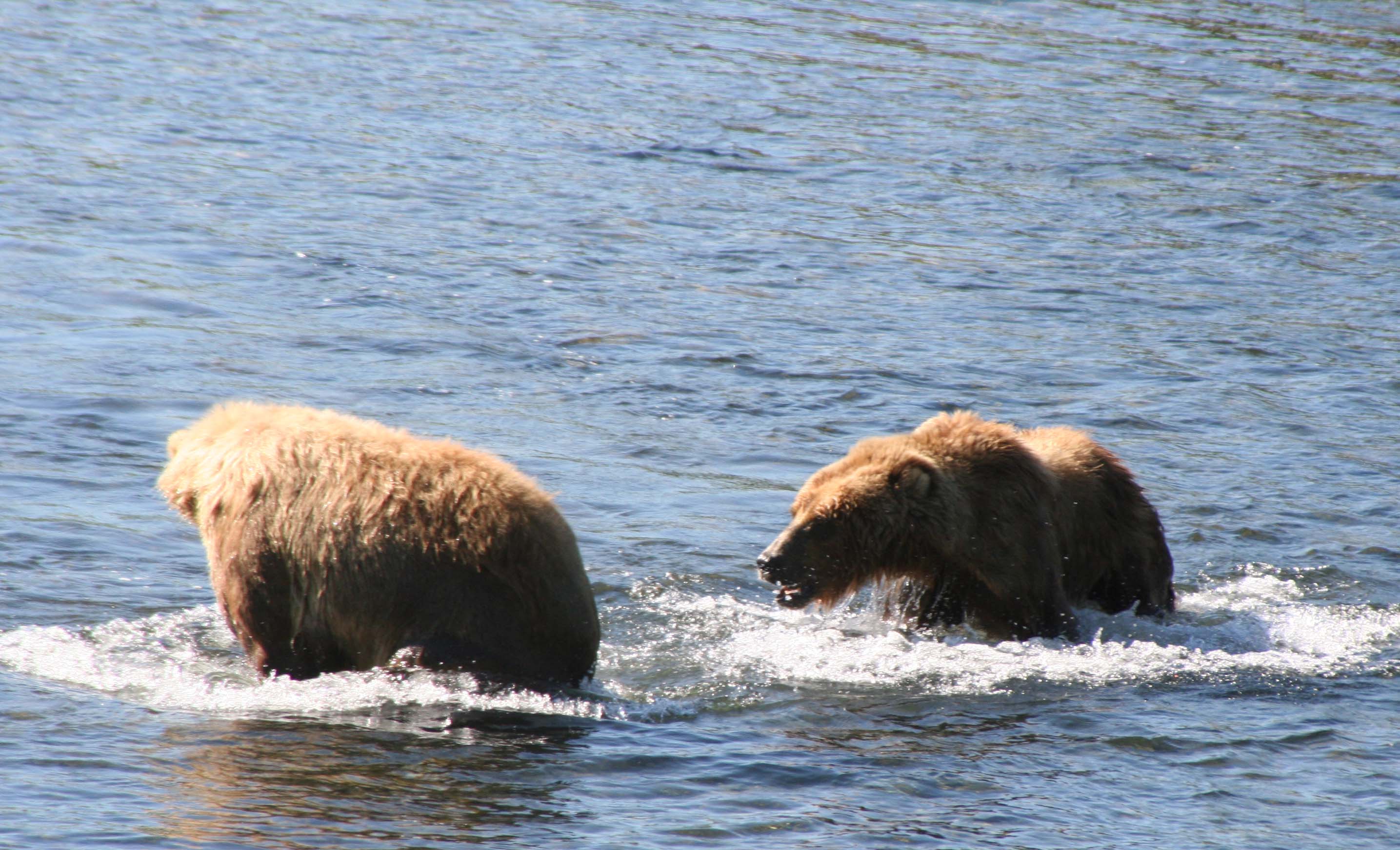
Kodiak bears tend to be solitary animals but do come together when abundant food is available.

Kodiak bears tend to be solitary animals but do come together when abundant food is available. These two seem to be pretending that the other bear is not present. Out of sight, out of mind.

While the Kodiak Bears are not territorial, arguments may ensue in close conditions. We could here the growling.

It didn’t work. We could hear the growling. We were glad that we weren’t the ones being growled at.

Kodiak Bear shows submission

Kodiak Bears have developed a number of postures and sounds to avoid conflict. The bear on the left has lowered his head in submission.

We also watched the mother bear drive off a large male to protect her cubs.

We also watched the mother bear drive off a large male to protect her cubs. (Photo by Peggy Mekemson)

Kodiak Bear salutes... or possibly scratches an itch.

Is this “I pledge allegiance,” or “Aw that feels good?” I’ll go with scratching an itch.

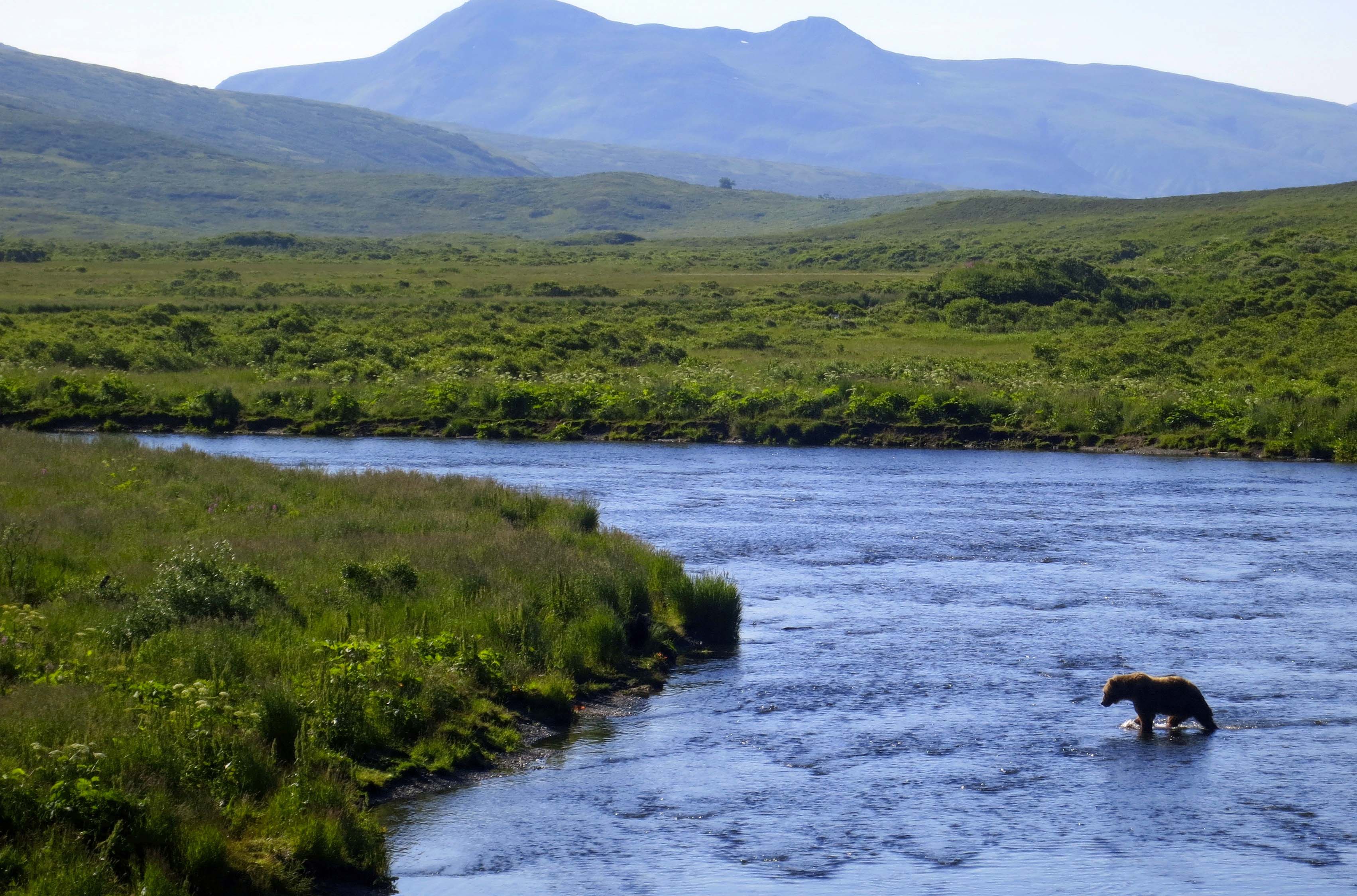
Lone kodiak Bear standing in the Frazer River on Kodiak Island.

In the last shot of our bear viewing trip, a lone Kodiak Bear fishes in the Frazer River.

NEXT BLOG: Flying over Kodiak Island in a float plane.

A Visit with the World’s Largest Bears… Part 1

Kodiak Bears in the Frazer River on Kodiak Island.

The beautiful Frazer River on Kodiak Island is home to some of the largest bears in the world.

The largest Kodiak Bears can tower up to ten feet when standing on their hind feet and weigh over 1500 pounds. With these stats, the brown bears of Kodiak Island are considered the largest bears in the world.

We were privileged this past week to spend a day watching them on the Frazer River, which flows out of Frazer Lake on the southern, uninhabited part of the island. We flew in by floatplane and then hiked for a quarter of a mile to a section of the river that had dropped several feet during Alaska’s massive 1964 earthquake. A fish ladder had been built to help the salmon over the section. The Kodiak Bears consider the area beneath the falls and ladder to be their personal fishing hole.

A Kodiak Bear prepares to go fishing on the Frazer River.

A Kodiak Bear prepares to go fishing on the Frazer River.

Our son Tony, who flies helicopters for the Coast Guard out of Kodiak, and his wife Cammie had arranged for the trip. We owe them big. It was a gorgeous day in a beautiful area and a number of bears were fishing for salmon. This is the first of three blogs I am going to do about the experience. Today I will feature moms and their cubs. Next I will focus on the bears fishing. I will finish with some fun photos of bears being bears.

Cubs are born in January or February while their mother is still hibernating in her cave. They then nurse for several months before emerging in June. They weigh approximately one pound when born. Cubs live with mom for three plus years before venturing out on their own. Bears have their first cubs around five years of age and continue to produce litters every four years or so into their twenties.

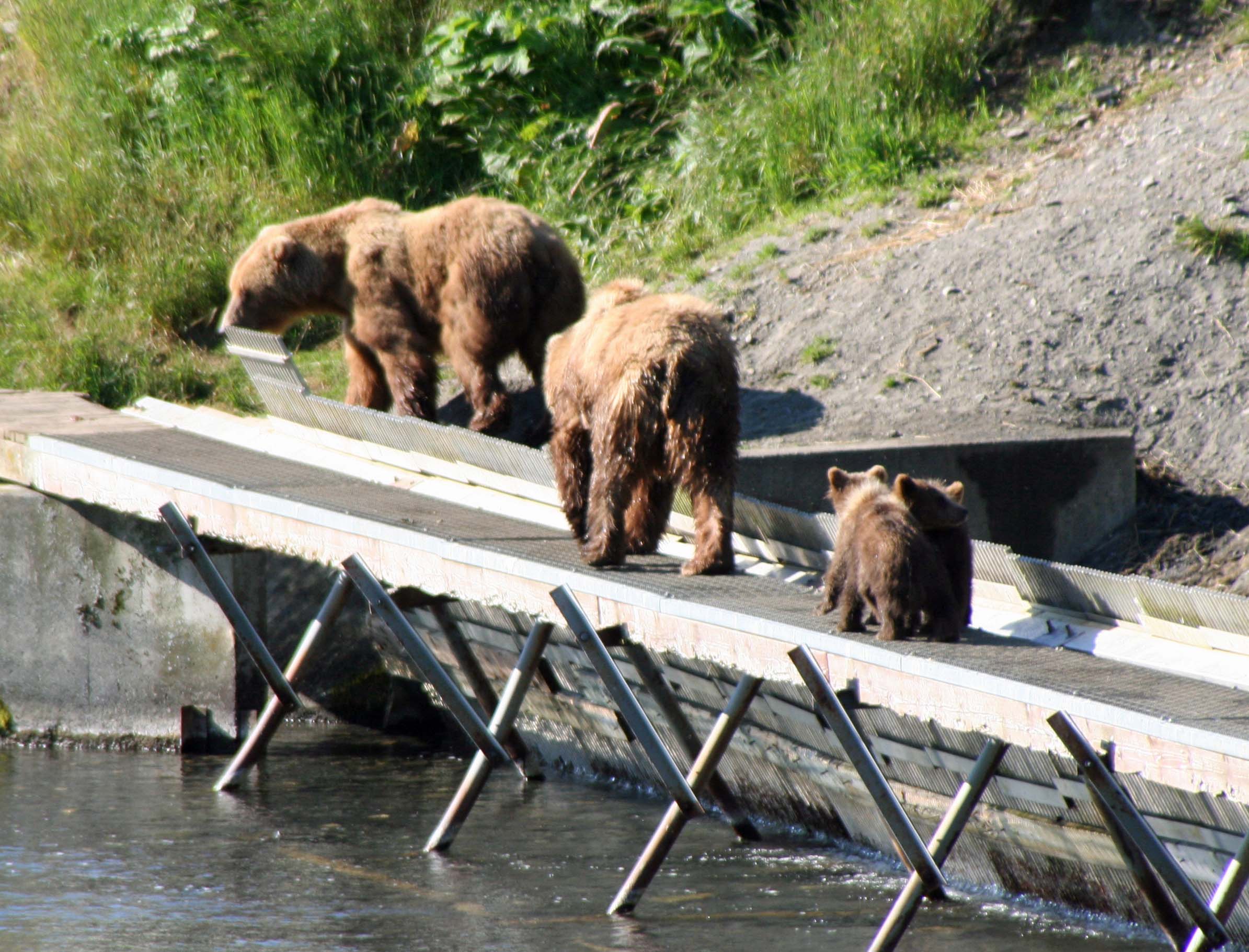
A mother Kodiak Bear checks on the welfare of her three cubs. The cubs were waiting for mom on a fish pass that led the salmon to the fish ladder.

A mother Kodiak Bear checks on the welfare of her three cubs. The cubs are standing on a fish pass that leads  salmon to the fish ladder. (Photo by Peggy Mekemson)

Here the three cubs are waiting patiently while mom fishes. They will lose their white collar in their second year.

Here the three cubs are waiting patiently while mom fishes. They will lose their white-collar in their second year. It is hard to believe that these little tykes will grow up and weigh over 1000 pounds. (Photo by Peggy Mekemson)

I liked this shot of mom and her parade. She had just chased off a male Kodiak Bear.

I liked this shot of mom and her parade. She had just chased off a male Kodiak Bear. (Photo by Peggy Mekemson)

A different Kodiak Bear mom touches noses with her cub. (Photo by Peggy Mekemson.)

A different Kodiak Bear mom touches noses with her cub. (Photo by Peggy Mekemson.)

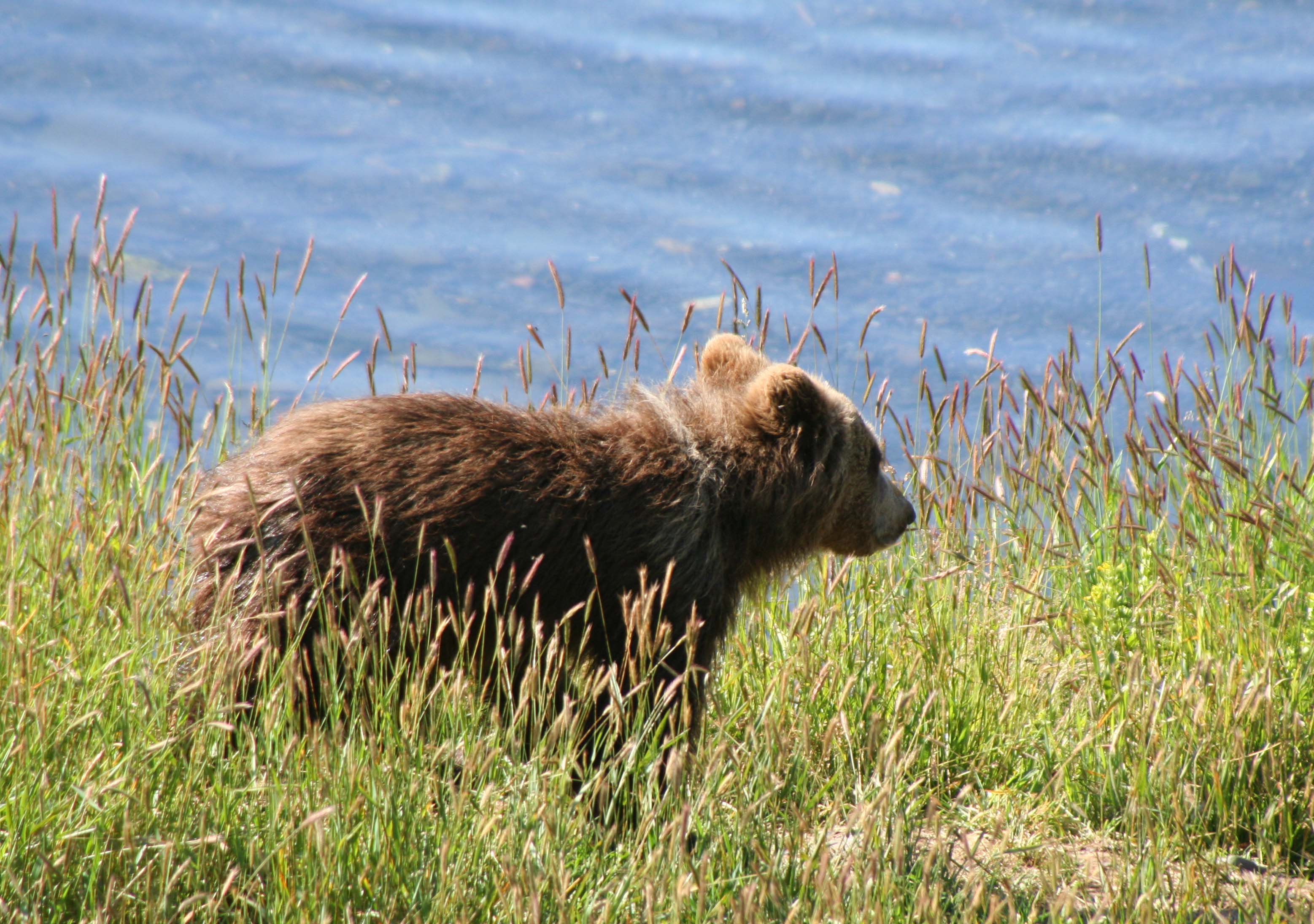
Kodiak Cub next to  Frazer River  on Kodiak Island.

We watched this cub playing with its mom in high grass where we couldn’t get any photos although she was about ten yards away.

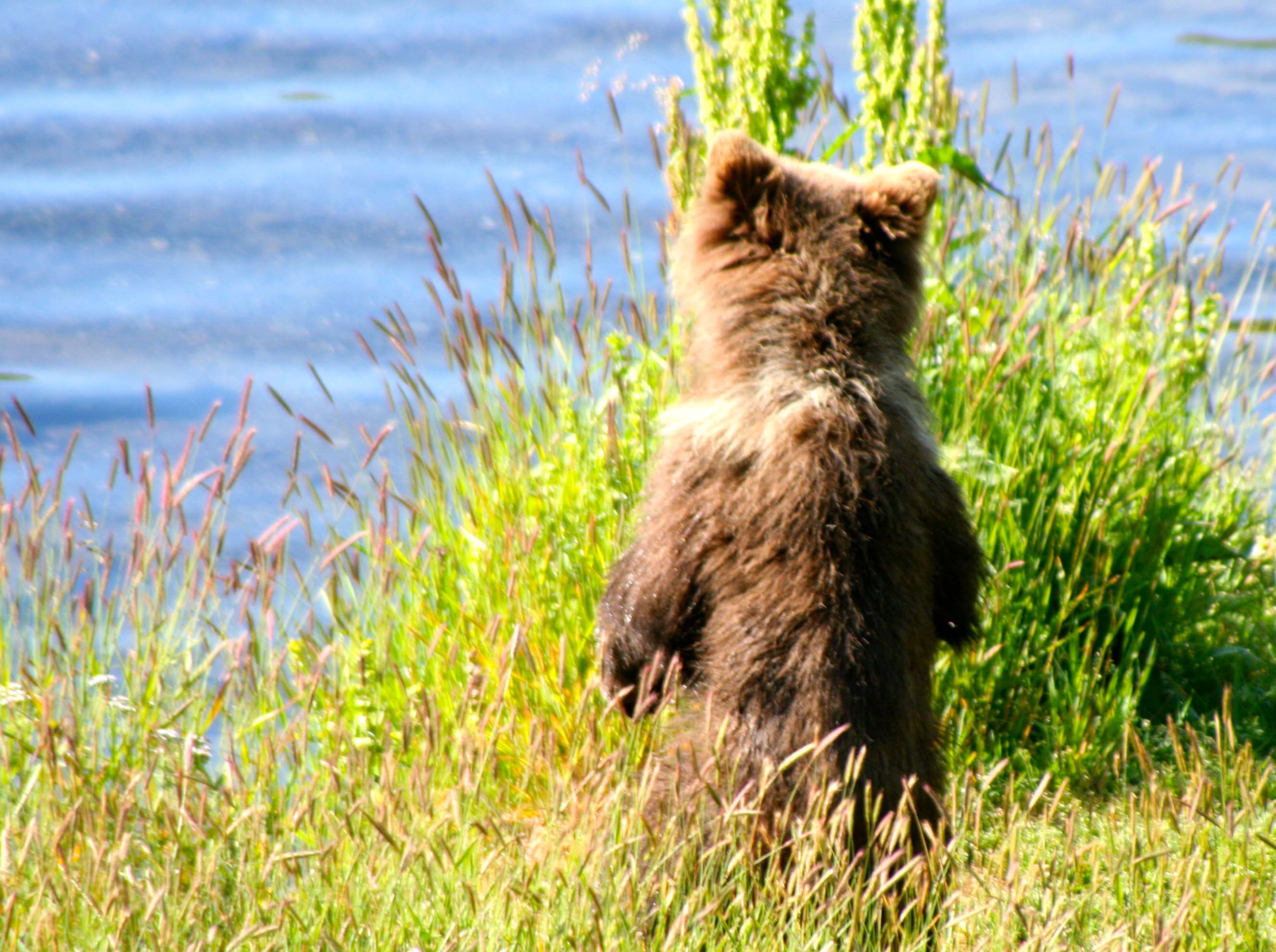
Kodiak cub stands on hind feet searching for mom fishing in the Frazer River on Kodiak Island.

“Where did Mom go?” the little guy seems to be asking as he stands up on his hind feet and looks for her.

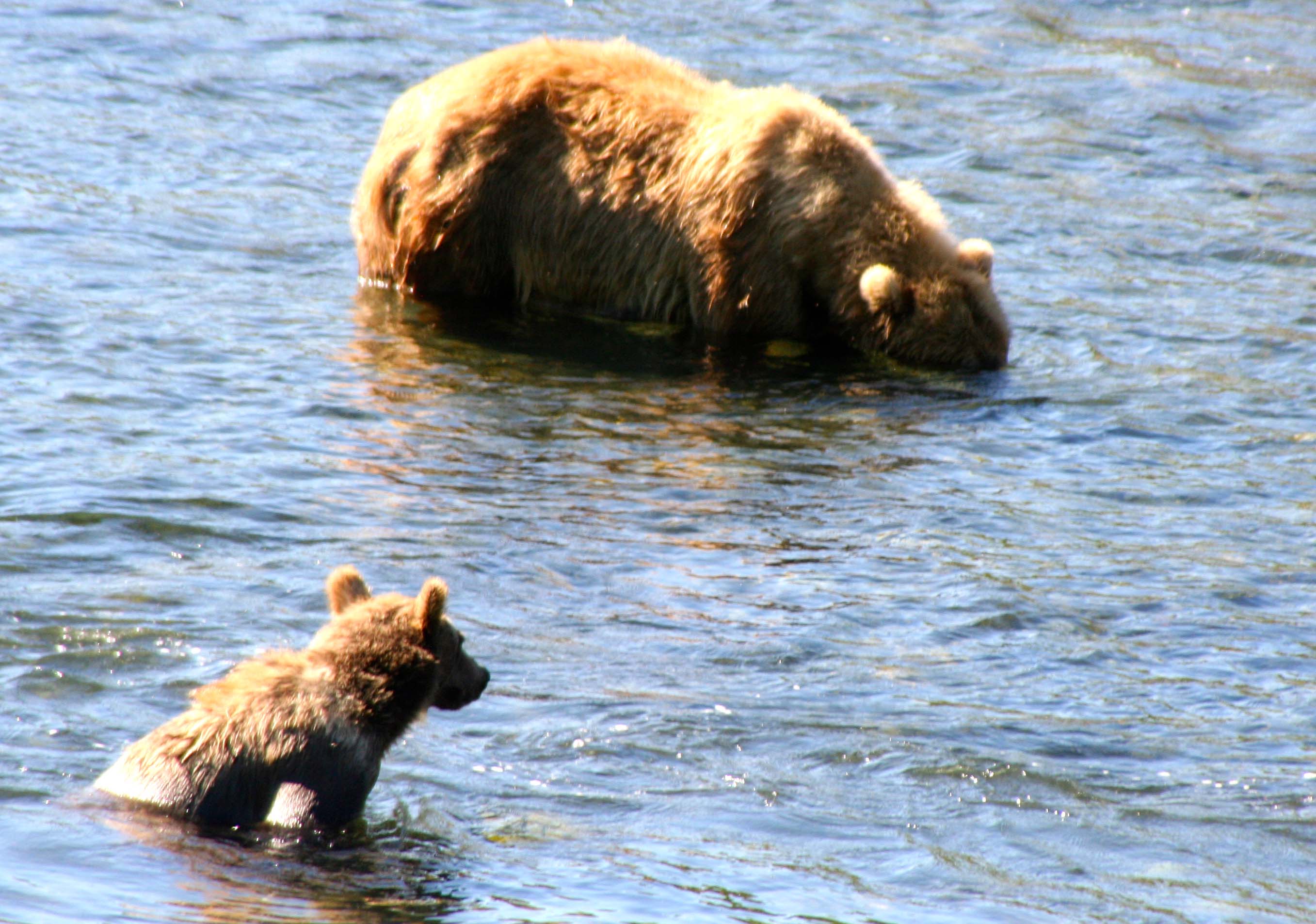
Kodiak cub watches its mother fish in the Frazer River on Kodiak Island.

Momma Kodiak has her head buried in water searching for Salmon. Junior joined her for the show. “Catch a big one, Mom.”

Having caught a fish, Mom shares it with her cub.

Having caught a fish, Mom shares it with her cub.

NEXT BLOG: Peggy and I watch the Kodiak Bears on the Frazer River catch enough salmon to make the most skilled fisherman jealous.

Innocent Until Proven Guilty… North to Alaska

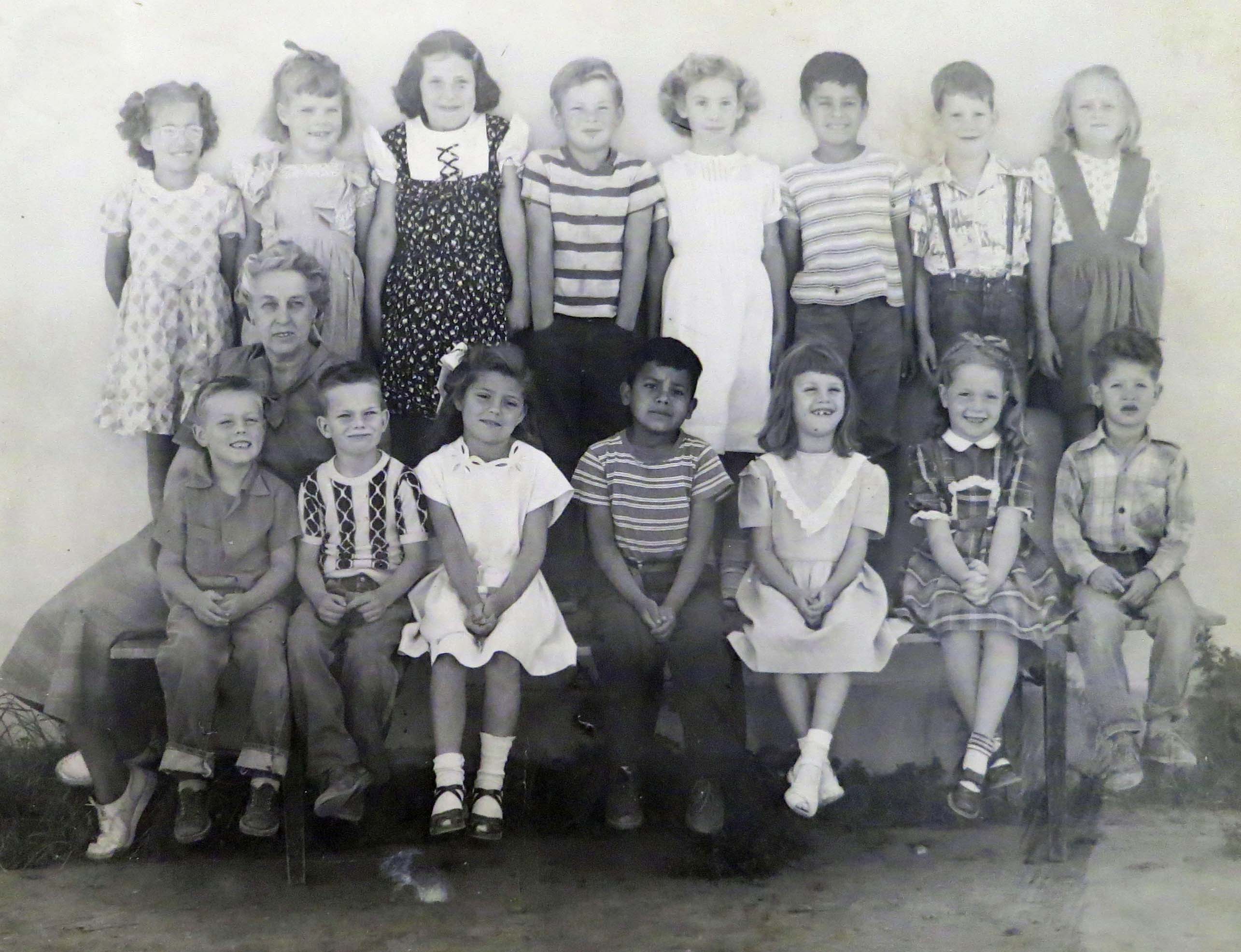
First Grade class at Diamond Springs Grade School in 1949.

Our first grade class at Diamond Springs Elementary School in California. Bob is second from the left in the bottom row. I am fourth from left in the upper row. Our tough looking teacher, Mrs. Young was charged with civilizing us.

Our friends Bob and Linda Bray, along with their ever-present dog, Sister, arrived around three bearing wine. They had parked their RV on our lower property and trudged up the steep hill to our home in 100 degree plus weather. I was still waxing Quivera the Van in preparation for the trip to Alaska.

I wiped the stinging sweat from my eyes and greeted them. The Brays were joining us on our adventure.

Bob and I have been hanging around together since first grade, which was a while ago. In the beginning, our friendship faced a serious obstacle. Bob’s mother had a rule: he was not to play with the Mekemson boys. We were Trouble spelled with a capital T.

Rightfully, or wrongfully, Marshall and I were blamed for most of  the bad things that went on around Diamond Springs. Who shot Tony Pavy’s pig, broke into Jimmy Pagoni’s wine cellar, went joyriding on Caldor’s rail car? It was the Mekemson boys, of course.

Most of the mischief I got into involved tagging along with my older brother. When he graduated to girls, my reputation made a miraculous recovery. I was, however, able to pull off one last coup and live up to Bertha Bray’s expectations. For some unfathomable reason, Bob’s parents bought him a Wham-o Slingshot.

I mean, how do you expect your son to resist temptation when you buy him a slingshot? The fact that I owned a Wham-o as well almost guaranteed trouble.

Bob and I agreed to meet for a clandestine hunting expedition. It had to be clandestine because I was still on Mrs. Bray’s ‘don’t invite’ list. Our only rule for the adventure was that anything that moved or didn’t move was a valid target.

Things were going great until we came upon the old abandoned bum’s shack that was just off the Southern Pacific railroad track about a quarter of a mile away from Bob’s home. Typical of such structures, it had been created out of anything that was available for free: old aluminum roofing, miscellaneous boards, an occasional nail, a thrown away mattress, etc. It had one crowning glory, a window.
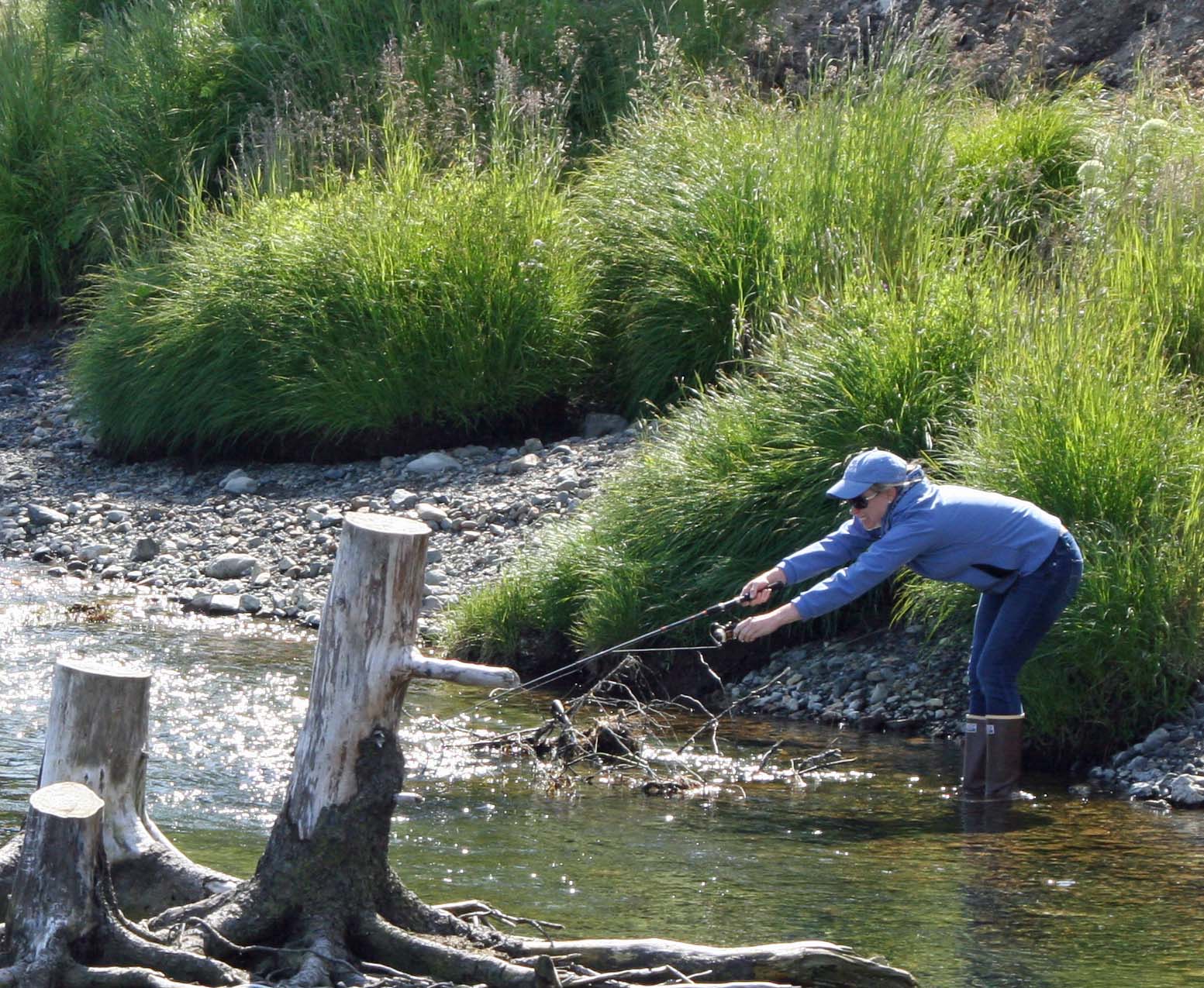
Bob and I looked at each other and had a simultaneous thought. Out came our ammunition, a shiny new marble for Bob and several bee bees for me. We took careful aim, counted down, and let fly.

To this day, Bob claims he saw his marble harmlessly strike the windowsill while my bee bees were smashing the glass to smithereens. I of course saw Bob’s marble hit the window dead on while my bee bees formed a neat pattern around the edges. There was no doubt about it; we were both innocent.

The current occupant of the not abandoned home, who was washing dishes behind a willow bush in a small stream, saw something entirely different– two little boys smashing his pride and joy.

He let out a bellow of rage and came charging up the trail. Once again the Mekemson Gang, along with its newest recruit, was on the run. The good news is that we escaped. The bad news was that the bum/hobo/homeless person with a home recognized Bob and went straight to his house. Mrs. Bray’s worst fears had been realized.

The story didn’t end there. On the 50th anniversary of our starting the first grade together, Bob sent me a present for Christmas, a slingshot. Somewhere, I suspect Bertha Bray rolled over in her grave, or maybe she chuckled.

Bob and I today on the road north in Salem, Oregon.

Bob and I today on the road to Alaska.

Linda with the family dog, Sister.

Linda with the family dog, Sister.

Sister provides a head shot.

Heads or…

Sister provides a tail shot.

…tails.

Next Blog: The wonderful totem poles of the First Nation People.