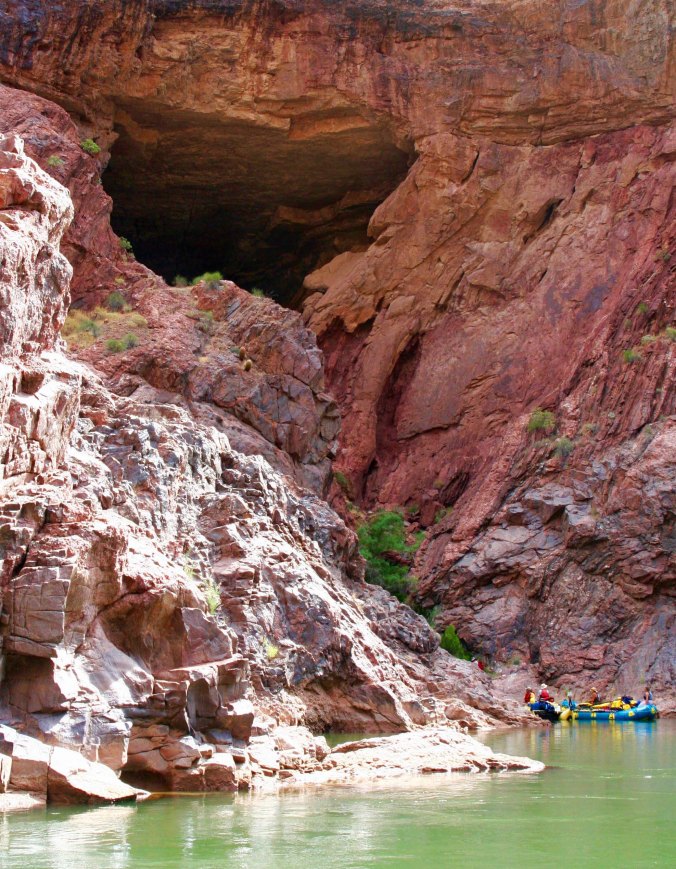
Beautiful Havasu Creek and the Infamous Lava Rapids… The Grand Canyon Series: Part 10

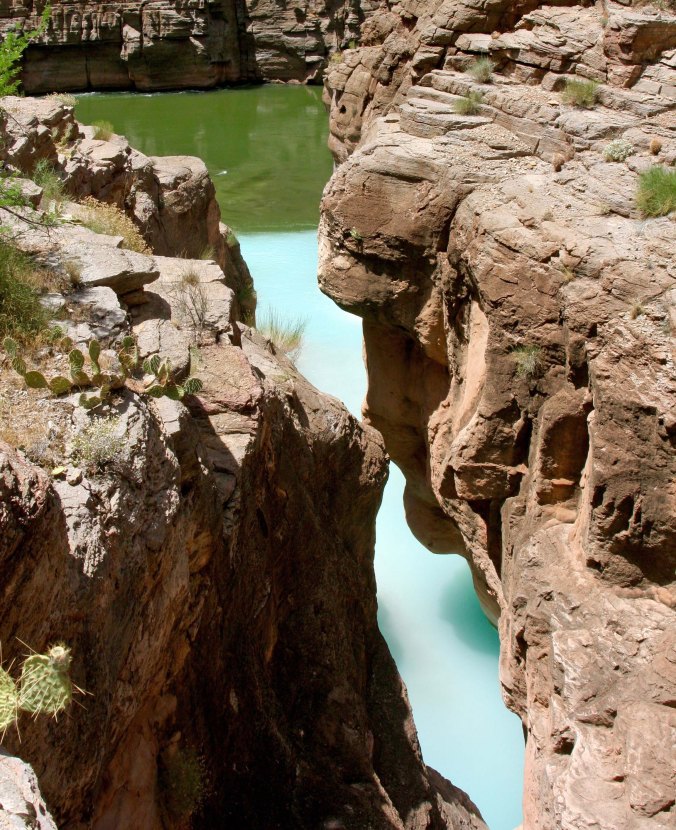
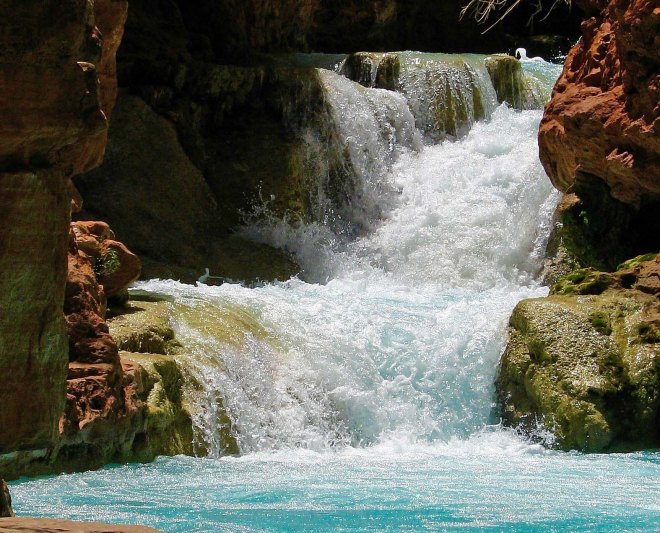
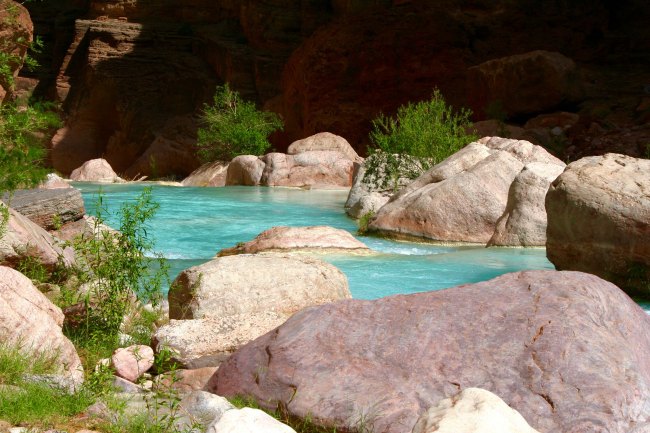
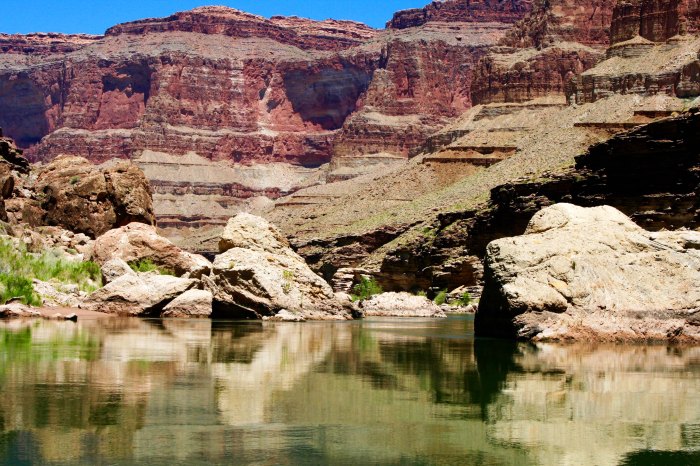
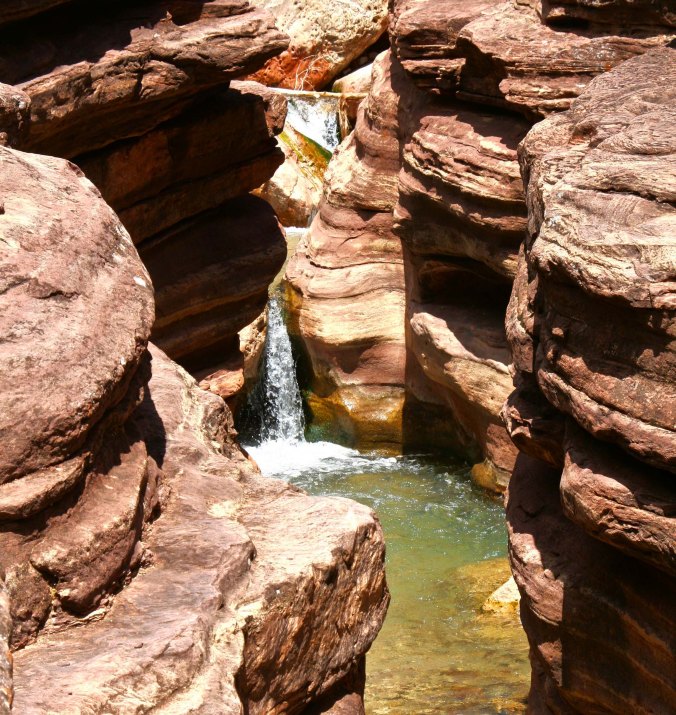
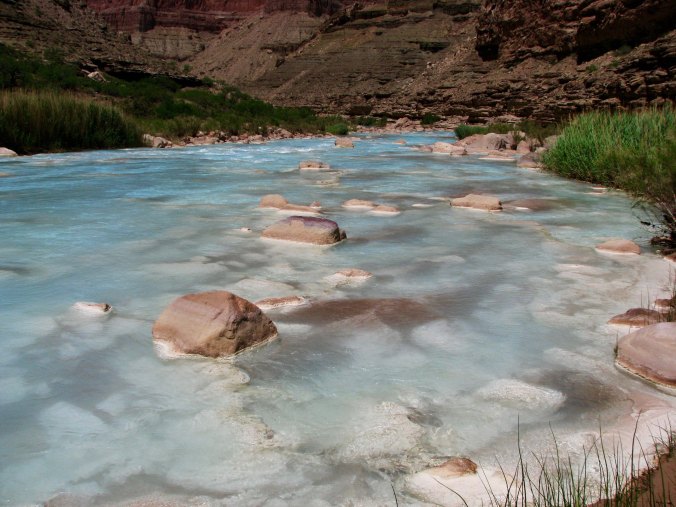
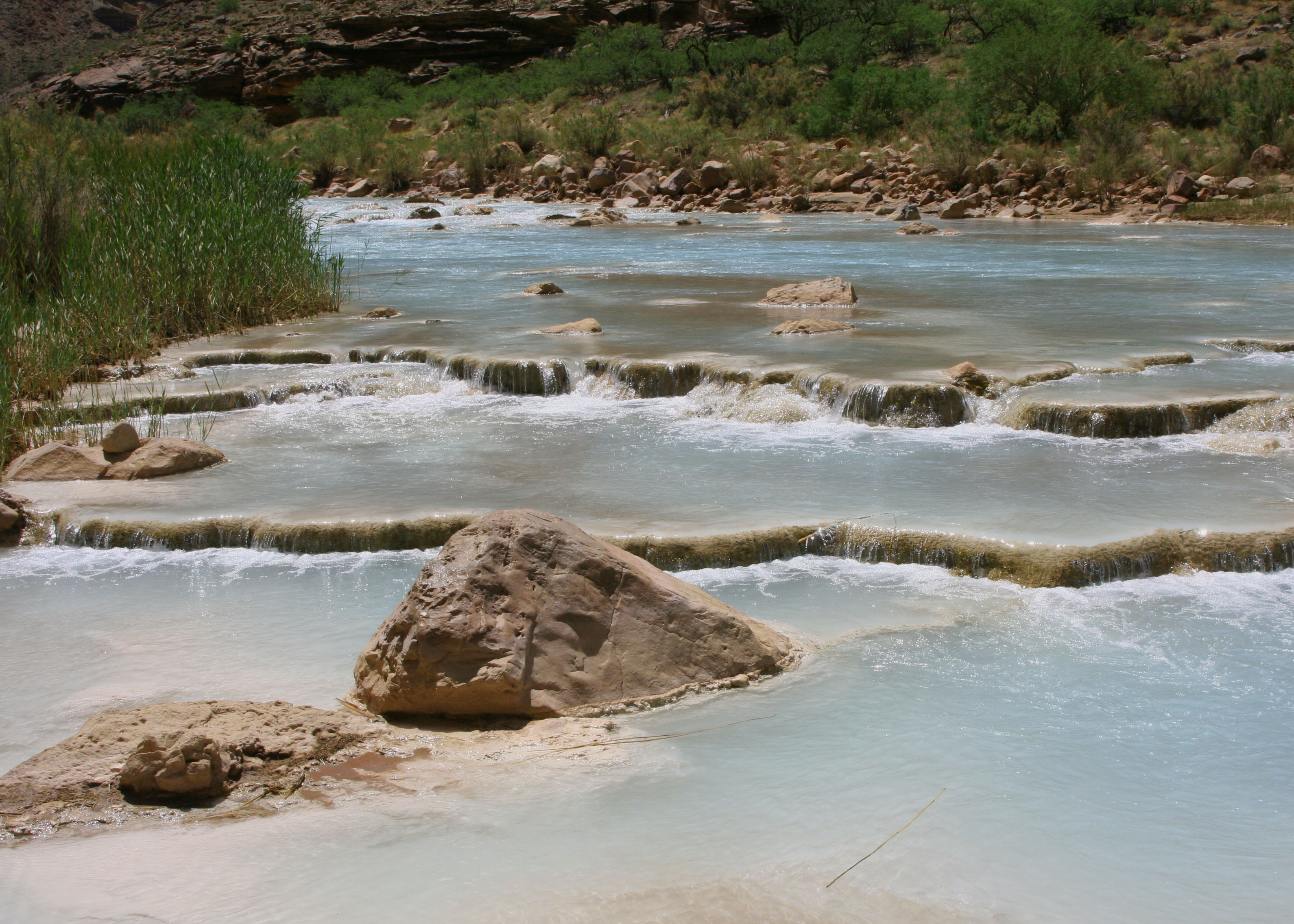
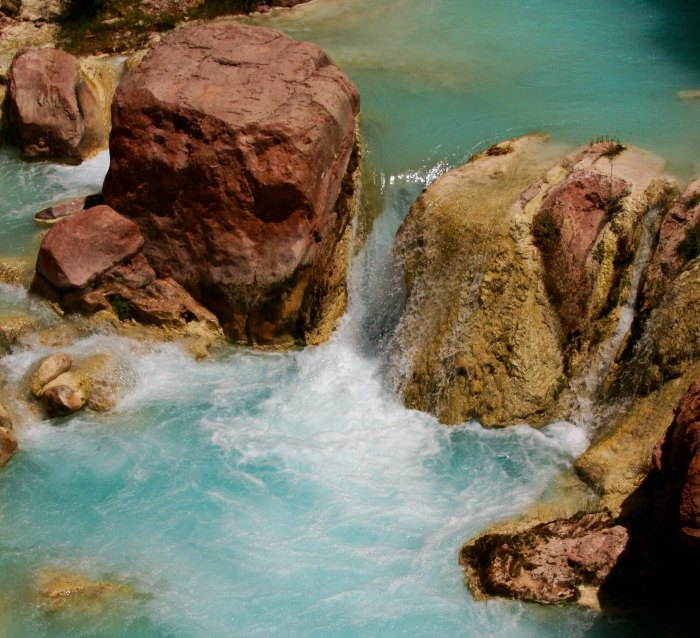
Havasu Creek with its travertine colored water.

I had been on Havasu Creek before. Our son, Tony, who was on a break between flying helicopters for the Marines and flying helicopters for the Coast Guard, was flying helicopters for a private company that offered tours over the Grand Canyon and into the small Indian village of Supai. The town, which is located inside the Canyon, sits next to Havasu Creek.

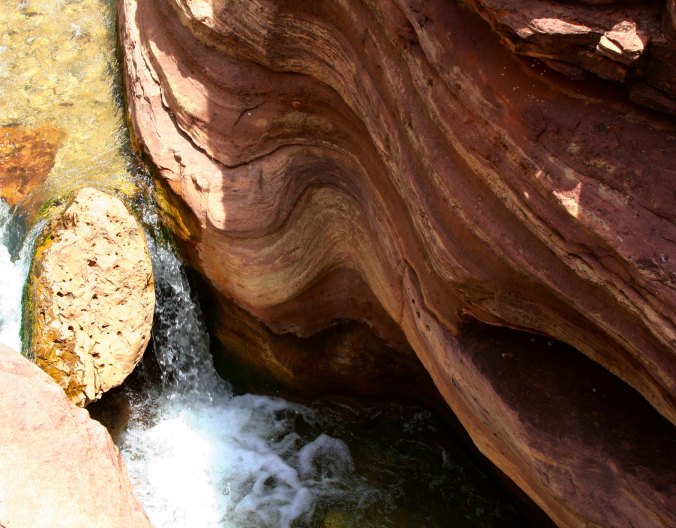
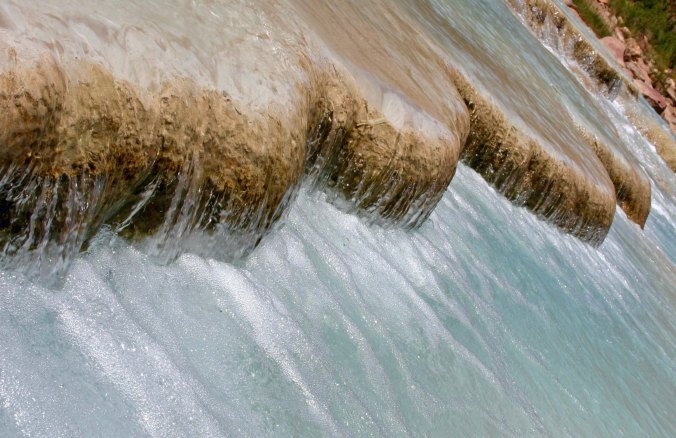
Tony had flown his wife Cammie, Peggy and me into Supai as a treat. He was playing the theme from Star Wars full blast as we dropped over the steep edge of the Canyon and begin our rapid descent! We were greeted by the beautiful blue-green water of Havasu Creek and its interesting travertine structures when we landed  A high concentration of calcium-carbonate is responsible for both the water’s color and the formations. The process of coating objects with lime is fast. Today’s downed limb in the creek may become next month’s travertine sculpture. Peggy and I were eager to see if the creek maintained its unusual color and interesting formations at its mouth where it flowed into the Colorado. As the following photos suggest, we were not disappointed.

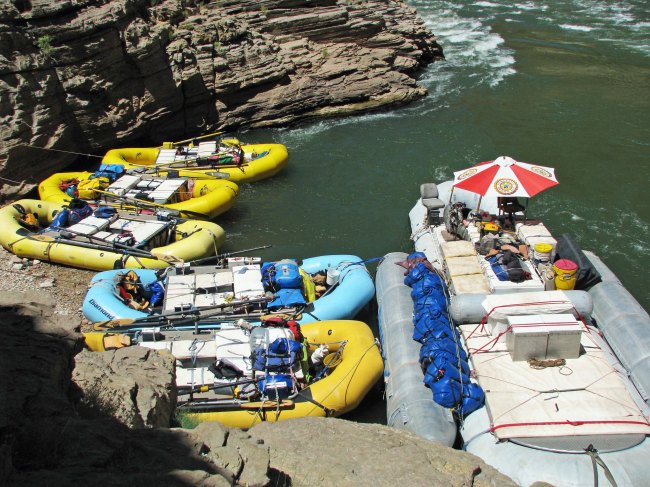
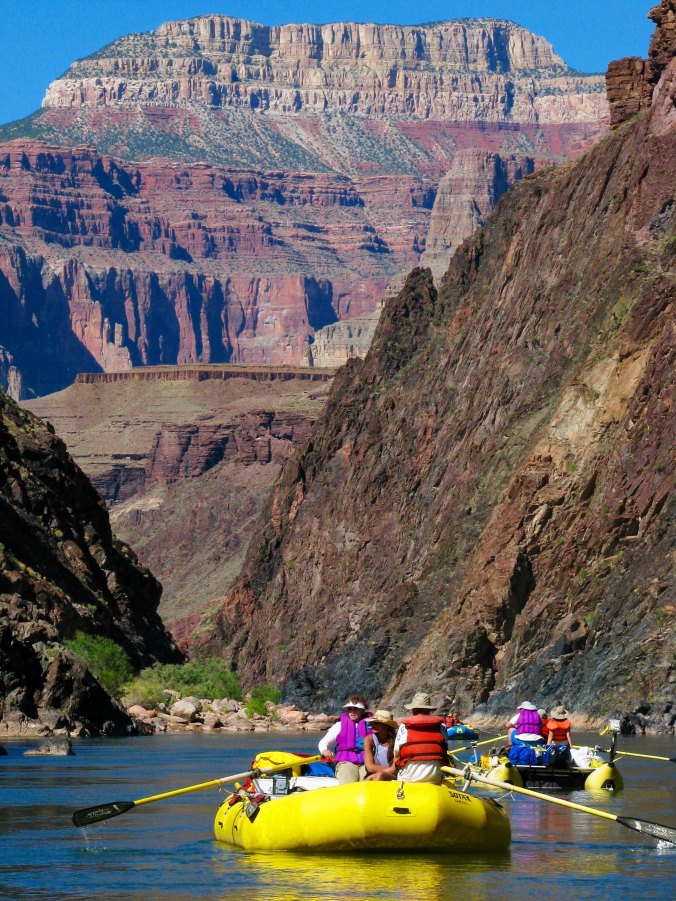
The mouth of Havasu Creek is a common stop for rafters in the Grand Canyon. Our rafts look small beside the large commercial tour boat.

We hiked over this from the mouth of the creek.

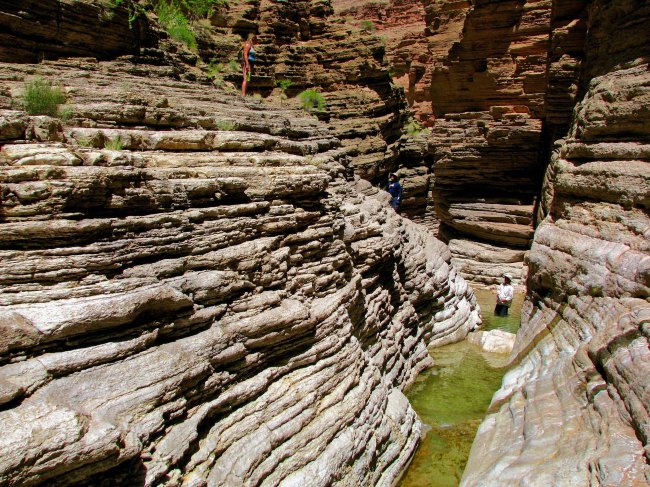
And were treated to views like these.


Don caught this lovely view. (Photo by Don Green.)

And Peggy took this one.

One of the things rafters do for entertainment on Havasu Creek is to damn it up using their rears…

And then, people scramble out of the way, creating a mini-flood! Beth was having a bit of trouble with the scramble part. She was holding onto Bone and didn’t have her hands free.

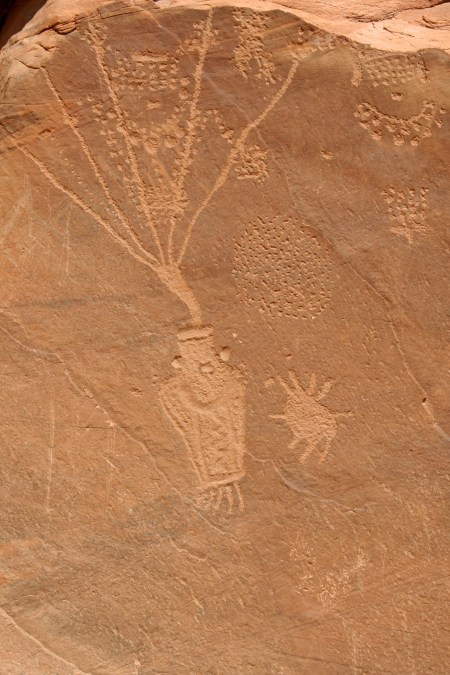
A pictograph, left behind by ancient Americans, caught the group’s attention. Maybe they used to grow people taller. (grin)

Lava Falls is labeled a 10 in the Grand Canyon’s system of scary, the highest rating given to any rapids along the Colorado. The river drops 37 feet over a few hundred yards and guarantees a quick, gut wrenching ride that seems to last forever and might very well throw you out of the raft. We had been worrying about it even before the trip. It is considered one of the top ten challenging rapids in the world by river runners. Our boatmen parked their rafts above the rapids and carefully scouted a route. We could see a huge, raft-sucking hole in the middle. It seemed that slipping by on the right  seemed the wisest choice. But what did we know. The river was going to do what the river was going to do. Steve agreed to carry us and away we went on our bucking raft… Ride ’em cowboy!

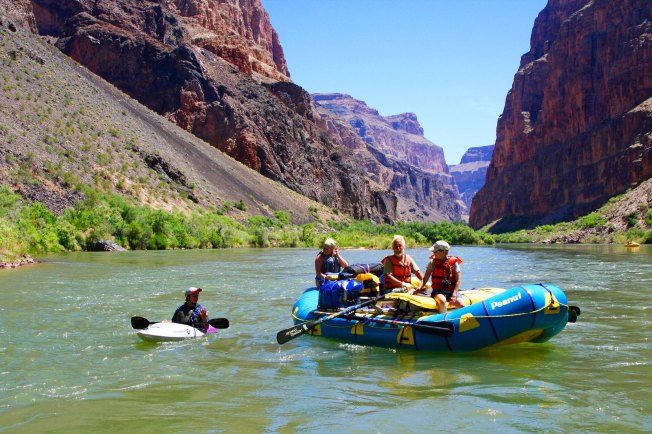
Back on the Colorado River, we headed for our appointment with Lava Falls. Eggin would be attempting the rapids in her kayak.

It was hard to imagine that Lava Falls was just around the bend. But we could hear its roar.

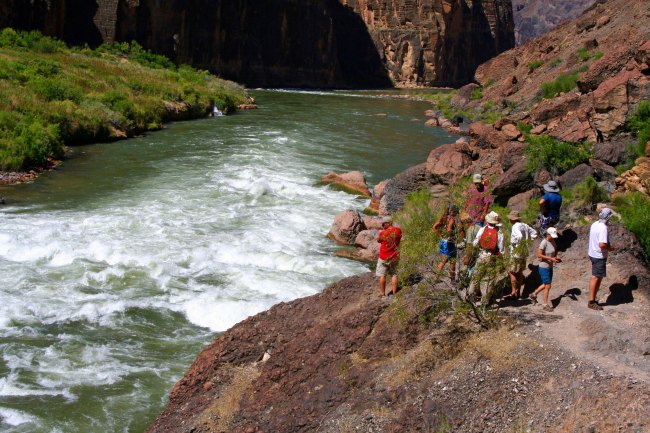
Everyone wanted a good view of the rapids.

They promised a quick but rough ride! Would that hole suck us in and tip over our raft?

With Steve at the oars, Peggy and I enter the infamous Lava Falls on the Colorado River, a perfect ten… that’s 10 as in rapids don’t get any more serious. Shortly after this we disappeared under the water! (Photo by Don Green)

Peggy and I are between the camera and the oars! Luckily we came out with our messy side up. (Photo by Don Green.)

Everybody made it through with the exception of Eggin, who managed to run the rapids upside down in her kayak. One of the boatman shot out to collect her and the kayak. Other than being a bit wet, she was fine. Meanwhile, her uncle, David Stalheim, had pulled over at Tequila Beach and was demonstrating why it was so named. If you manage to survive the rapids, you are expected to celebrate with a shot of tequila. Dave apparently wanted the whole bottle! The party continued after we reached camp…

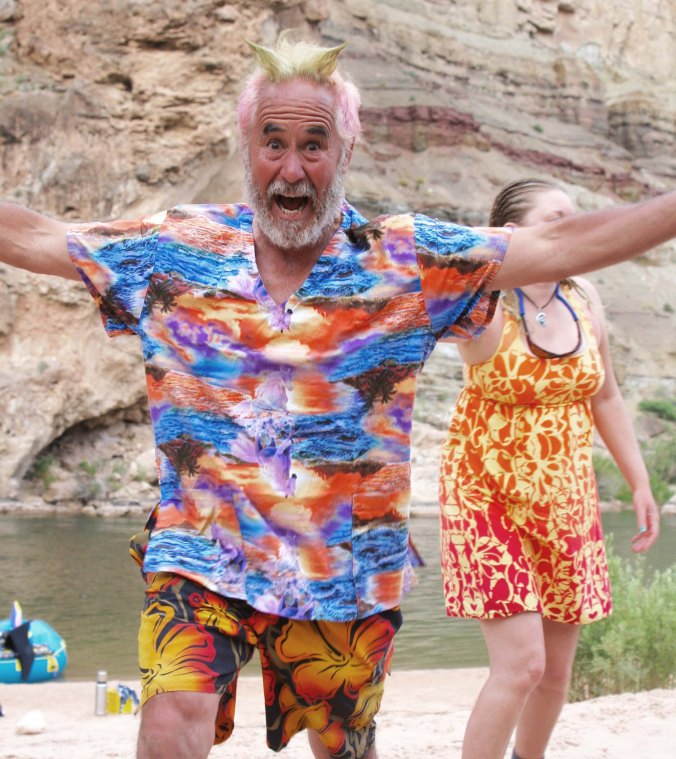
Don demonstrates how he was feeling after running Lava. It’s possible that the lid was on, but just  maybe. 

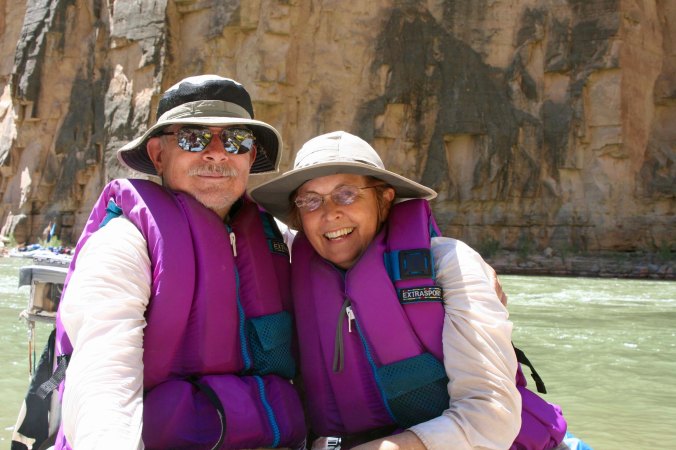
Peggy and I just looked happy. We needed a T-shirt that said we survived Lava Falls.

Jonas had decided to celebrate with a little quiet reading in the river…

Bone declared that the trip had scared the pee out of him…

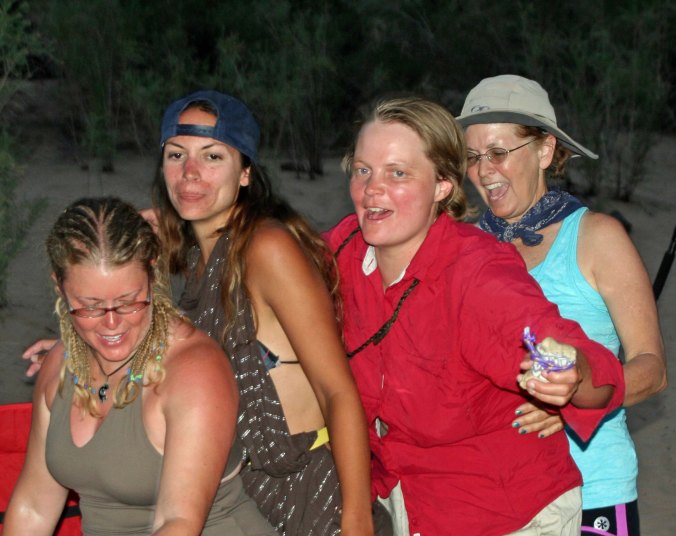
While Beth and Susan decided it was time to Party.

While Tom was just, um, Tom.

I will note that the party continued into the night and the natives were apparently having a heck of a good time!

WEDNESDAY’S Photo Essay POST: Flying over Kodiak Island. It was green enough to be Ireland before the glaciers started.

FRIDAY’S Blog a Book POST: Another in the MisAdventure series. Bob Bray and I are chased by a hobo and my mother chases fire trucks.

SaveSave

SaveSave

SaveSave

SaveSave

SaveSave

SaveSave

From the Canadian Border to Anchorage… Alaska Highways

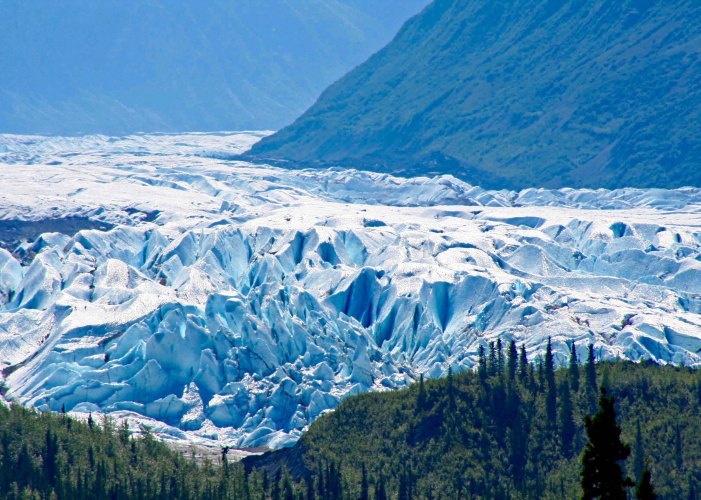
Matanuska Glacier is one of the sights along the road from the Canadian/Alaskan Border to Anchorage.

I lived in Alaska for three years between 1983-86. While the organization I was executive director of was in Anchorage, I wandered over much of the state, backpacking in numerous areas including Gates Of the Arctic National Park, kayaking in places like Prince William Sound and cross-country skiing, which included a trek into Denali National Park where we camped out in 30 (34 C) degrees below zero weather. You go to bed with your shoes and a hot water bottle! The beauty and wildness of the state is legendary. Yes, there are insects galore, big bears with sharp teeth, moose, and wolves. But they come with the territory.

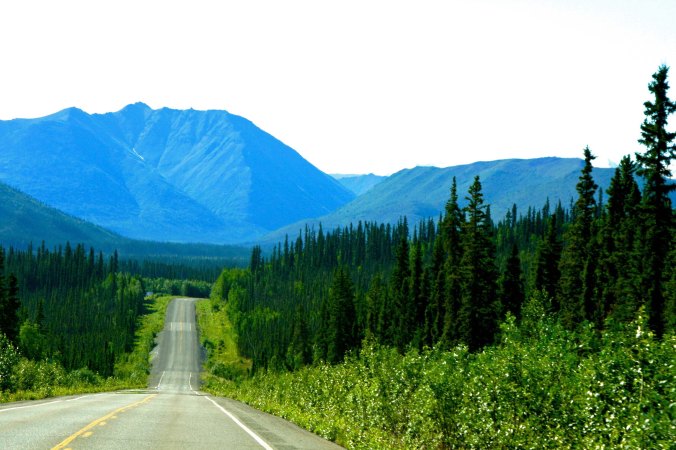
Our drive from the Canadian Border to Anchorage was much tamer, but the beauty was there, as you can see from the following photos.

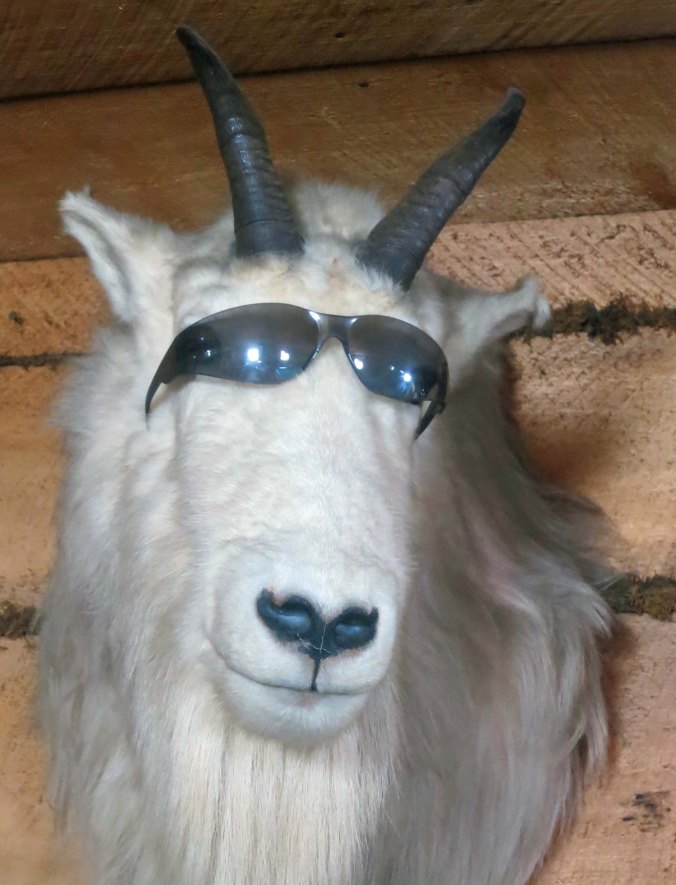
Speaking of wildlife, we spotted this beauty at the King Mountain Lodge. Can wildlife get much wilder?

Bright fields of fireweed contrasted with the darkness of black spruce along the road.

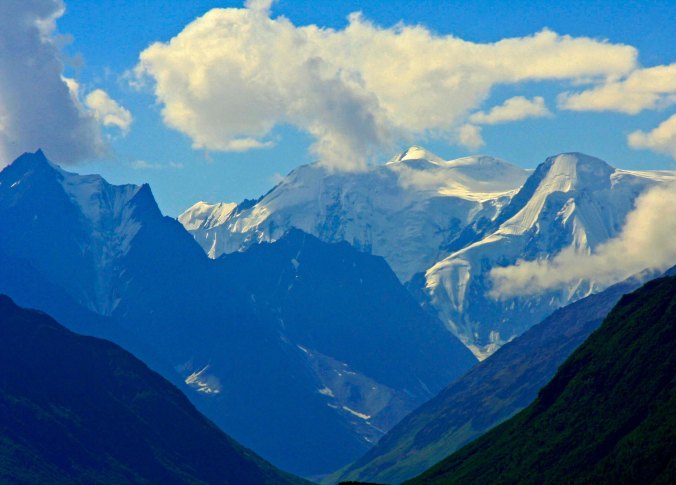
The road continued to wind among almost mystical mountains.

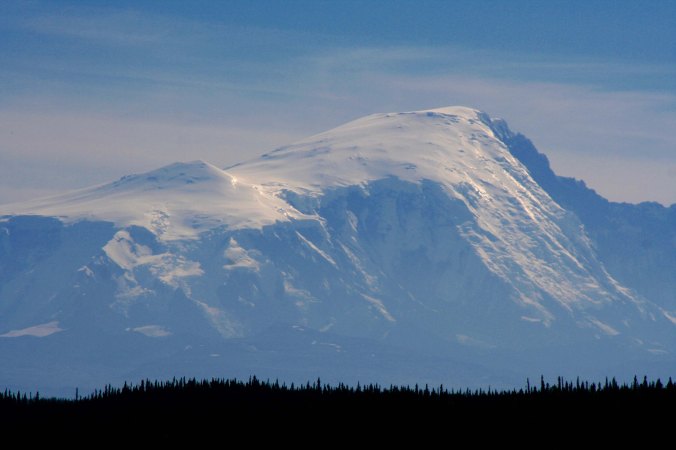
This mountain is part of Wrangle St. Elias National Park, one of the most remote and untamed national parks in the world.

This cache is a bit on the fancy side, more for tourists than keeping out the bears that want to raid your food supplies. But you get the idea.

More mountains…

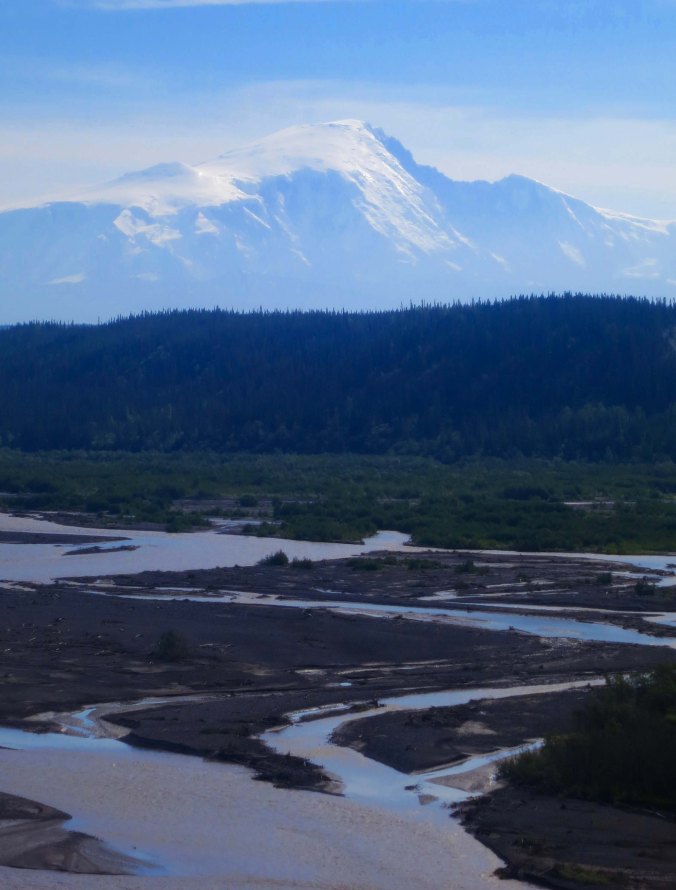
Glacial rivers are gray from the rock ground off of mountains.

Another view of Matanuska Glacier.

I really liked this view of mountains along the highway.

More mountains. These with a different look.

An appropriately painted house along the route.

The bar at King Mountain Lodge. Road houses were once common along the highway, and necessary to accommodate travelers who couldn’t travel long distances over the rough highways on a given day. Most were quite colorful, and often filled by interesting characters. King Mountain continues to provide an interesting place to stop.

Peggy found this motorcycle inside. The owner, seeing her interest, took her out for a spin.

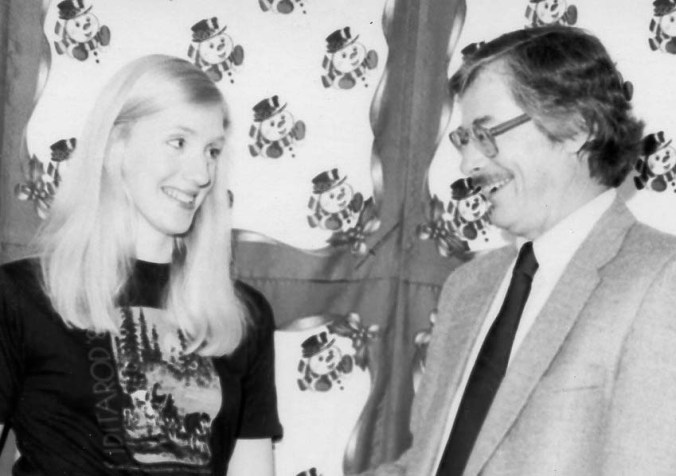
A photo of Libby Riddles was on the wall. Libby was the first woman to win the Iditarod, the world-famous sled dog race from Anchorage to Nome. And she did it while I was in Anchorage. I called her and asked if she would be spokesperson for my organization. She agreed. I picked her up at the airport where she had just returned from a photo-shoot with Vogue Magazine and we spent a couple of days together as we ran around to all of the local media.

A shot of Libby and me sharing a laugh in the mid-80s.

I found this lovely pond on the edge of the highway.

These are the mountains that backed up to my home in Anchorage. I could be up in them in 30 minutes and would often go on hikes after work. One of my trips was a 25-mile day hike where I came out in this canyon. It included crossing a fairly substantial glacial river where I had to save my hiking companion from being swept away.

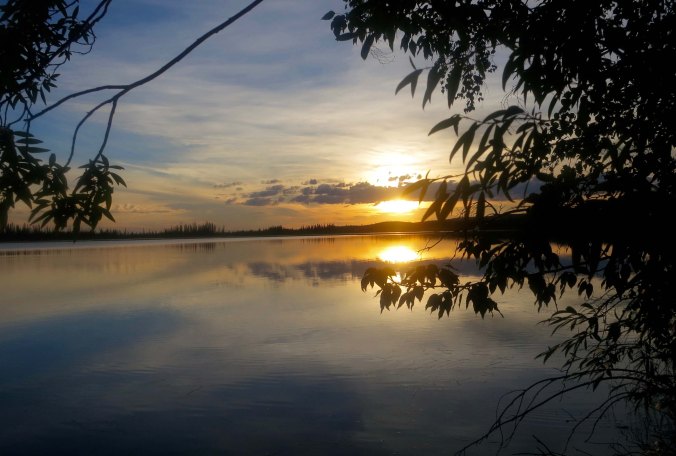
I’ll conclude with this sunset. In next Monday’s post I will take you off to the island of Kodiak for  a visit with brown bears!

FRIDAY’S POST: The Mekemson kids are at it again and a railroad detective shows up at out house to accuse my brother of dark deeds, which fortunately, he didn’t do.

MONDAY’S POST: We continue our 18 day trip by raft down the Colorado River through the Grand Canyon.

SaveSave

SaveSave

SaveSave

SaveSave

SaveSave

SaveSave

A Strange Cave Creature… Rafting through the Grand Canyon: Part 10

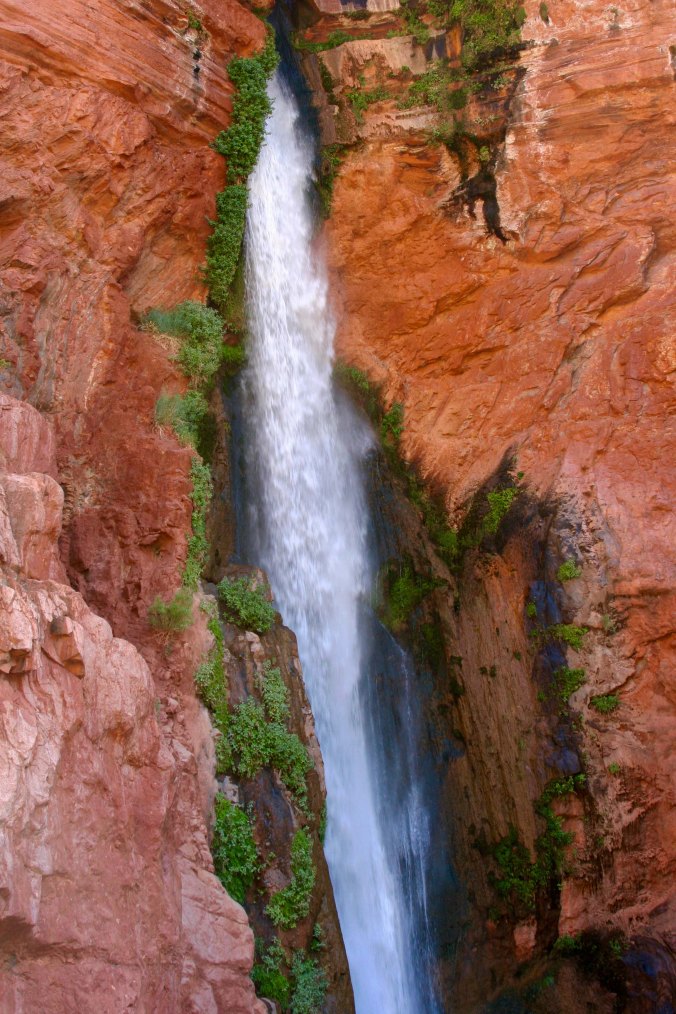
Peggy Mekemson at Deer Creek Falls in Grand Canyon

Peggy standing next to Deer Creek Falls in the Grand Canyon.


“It is especially cold in the rain tonight. The little canvas we have is rotten and useless; the rubber ponchos have all been lost; we have not a blanket apiece. We build a fire; but the rain, coming down in torrents, extinguishes it, and we sit up all night on the rocks, shivering…” From the diary of the one-armed John Wesley Powell on the night of August 17, 1869 during his epic exploration of the Grand Canyon.


Well, there are ADVENTURES and there are adventures. Today I will focus on our 8th, 9th and 10th days on the Colorado River. There are rapids, but nothing to write home about. In camp, the fabled heat of the Grand Canyon makes an appearance, so we put up a sun shelter and snooze. It’s a bit of a climb up to Christmas Tree Cave, maybe 10 minutes. We do, however find a very strange creature there, something that might give you nightmares. We stop to admire Deer Creek Falls and then climb up the Deer Creek Canyon, which is much more of a climb than it was to the cave, but a natural Jacuzzi greets us at the top. The water is cold. Things are tough, right? As I said, there are ADVENTURES and then there are adventures. (Grin.) I let photos tell today’s story.

We do run into rapids every few miles, but mainly the water is calm and beautiful. (Photo by Don Green.)

Rowing is a given, lots of it, but unless we are rowing against the wind or maneuvering through rapids, the river does much of the work.

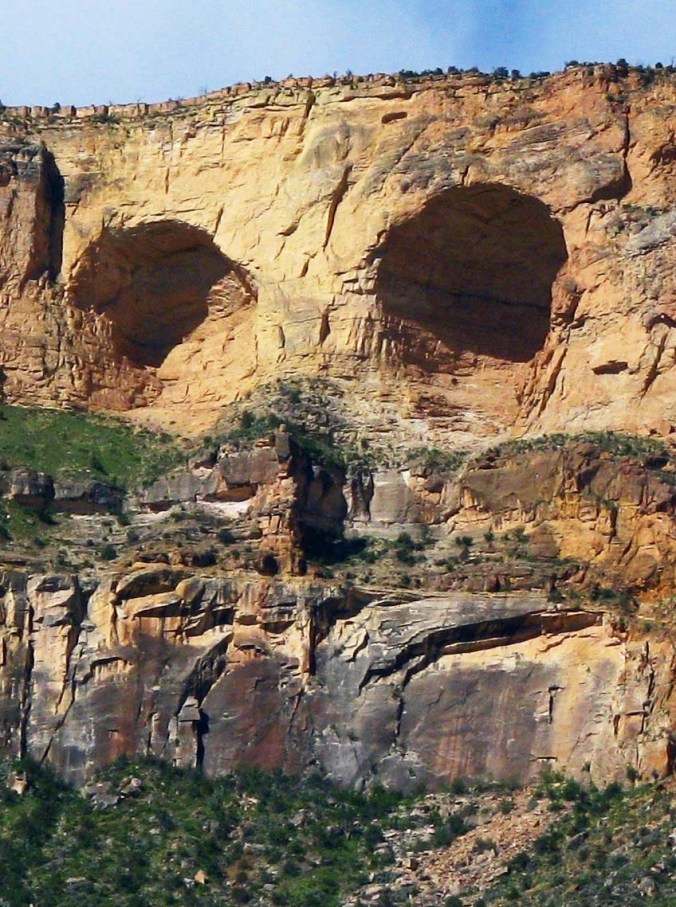
Don caught this interesting face along the way. (Photo by Don Green.)

Take a cold beer or two, add in a warm sun, comfy chairs, and shade, it’s time for a snooze.

With the trip half over, it’s time to check in on how we are faring. This is me…

And this is Peggy. I can only wonder how she does it.

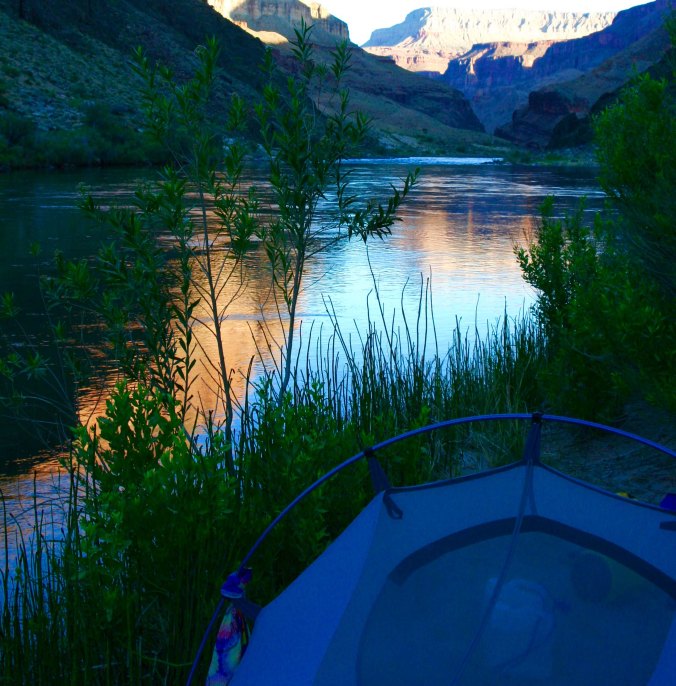
Our camp that evening…

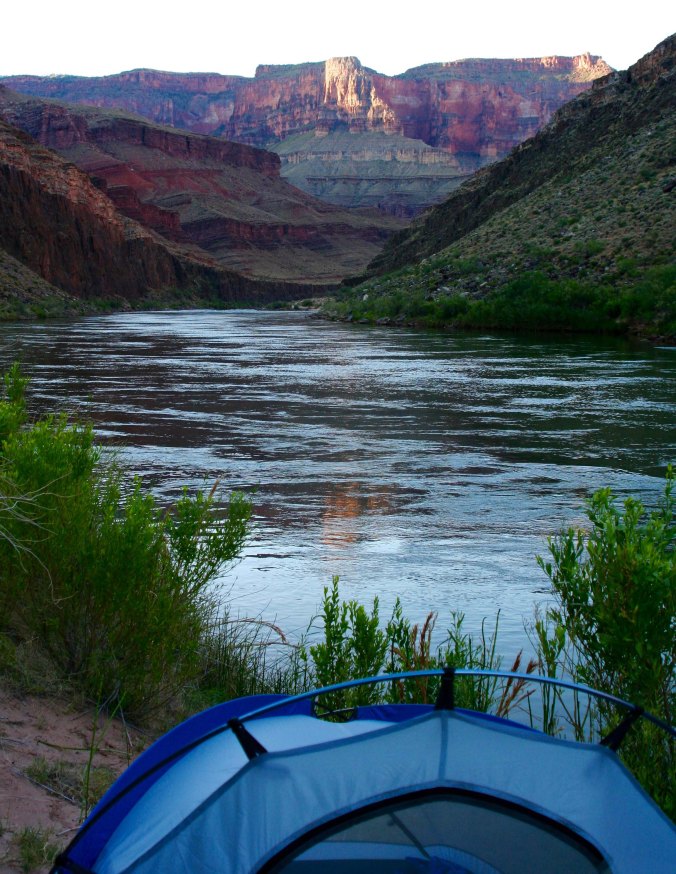
And in the early morning light.

Looking up at the entrance to Christmas Tree cave. The name derives from a crystalline structure that looks something like a Christmas tree.

Okay, imagine you are alone and making your way through a large, semi-dark cave when you suddenly come face to face with this cave troll. The Christmas Tree, BTW, is to the right of Tom.

I really like the perspective on the size of the cave in this photo that Peggy took.

Deer Creek Falls was a treat. Hiking up the Deer Creek trail provided more delights.

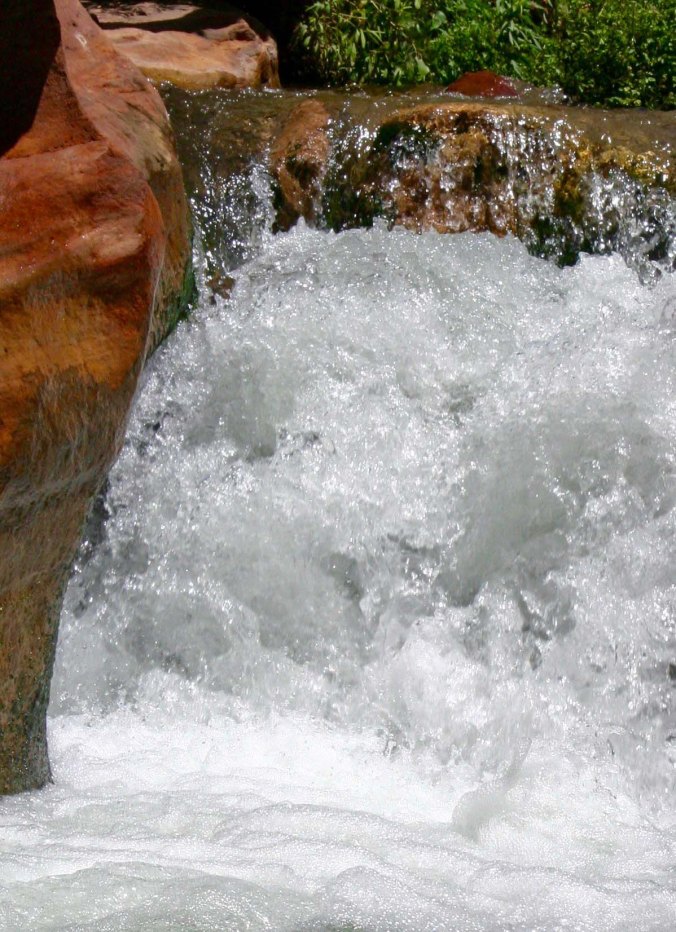
Like the natural Jacuzzi.

It was a tad cold.

Bone was probably the least bothered by the cold of any of us. Maybe it was his warm vest. Tom and Don make a hand off. Bone wanted to leap off on his own but we were afraid that the creek might carry him away!

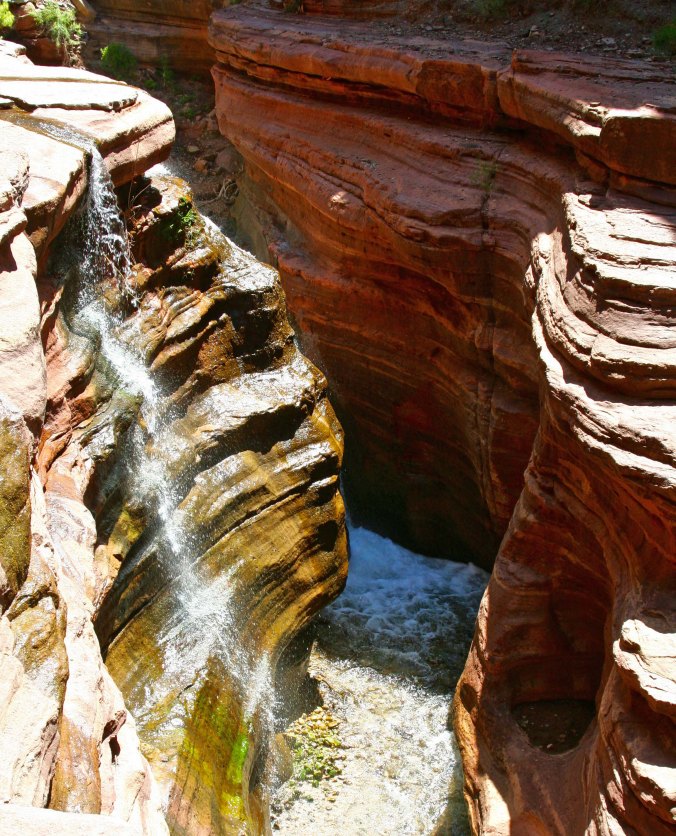
Deer Creek had cut its way into the soft sandstone, creating a min-Grand Canyon of its own.

Which led Peggy and me to take numerous photos.

Waterfalls along Deer Creek.

And another opportunity to rest. Check out the shade on the left.

Our final photo of the day. Looking down on the Colorado River from the Deer Creek trail.

WEDNESDAY’S POST: We arrive in Alaska on the Alaska Highway. Now we will be making our way from the Canadian Border to Anchorage. Be prepared for glaciers!

FRIDAY’S POST: The MisAdventure series. The railroad detective comes to visit. Were the Mekemson kids guilty of tearing apart a railroad trestle? Tune in on Friday.

SaveSave

SaveSave

SaveSave

SaveSave

SaveSave

SaveSave

SaveSave

SaveSave

There Is More than One Way to Skin a Mouse… Rafting through the Grand Canyon: Part 8

I took this photo just below the Tanner Rapids, which are seven miles below where we played in the Little Colorado River. While it looks similar to many other Grand Canyon photos included in this series, I was eager to get it. I had camped here once after backpacking down the Tanner Trail. My campsite was to the right of the small tree. Mousy had a nest under the tree…


I’ve just returned from playing for a week while celebrating my 75th birthday. So, I am a bit behind on writing posts and keeping up with comments and fellow bloggers. My apologies. It isn’t going to get much better. (grin) On Wednesday, Peggy and I fly back east to visit with our son and his family in Connecticut. We return from there just in time to fly to North Carolina and see our daughter and her family. After that, we will spend a month exploring several national parks in the southwest on foot.

Then it will be time for another Grand Adventure. I intend to walk out my backdoor in Southern Oregon and backpack 1000 miles to Mt. Whitney in California following the Pacific Crest and John Muir Trails. It’s a journey not many people make— especially 75-year-olds. “And what did you do this summer, Grandpa?” Going, of course, will depend on my doctor saying “Why not?” I hope to gain a book contract to write about the trip. Wish me luck on that one. I will be blogging much more about the trek in posts leading up to the adventure.

Since I played last week, I pulled up a previous post that is definitely relevant to the raft trip Peggy and I made down the Colorado with Tom and several other friends. When I left Alaska in 1986 and returned to California, I spent several months backpacking in the west. My first trip was into the Grand Canyon, a decision my body was not happy with! I had just spent the winter holed up in the Far North happily stuffing myself and drinking more beer than I should have…


Looking down from Lipan Point at the start of the Tanner Trail. Then sharp bend in the Colorado River... far away, is where I am heading. (The photos of the trail down I actually took several years later when I backpacked down with Peggy.)

Looking down into the Grand Canyon at the start of the Tanner Trail.  The curve you can see in the Colorado River is the Tanner Rapids, which is where we will be on our next section of our raft trip down the Colorado. Years before I rafted the Canyon I backpacked into it several times. Two of my trips were by the Tanner Trail, once by myself and once with Peggy.

“It’s not too late to make another decision,” my body told my mind as I hoisted my 60-pound pack and eyed the distant Colorado River. “There is a fine lodge with great food and even better beer 30 minutes away. It provides a fantastic view of the Grand Canyon. Much better than anything you will see on the insane hike.” “Shut up and walk,” my mind replied.

Tanner Trail dropped away under my feet as I made my first steps down the steep, poorly maintained path and descended through millions of years of earth history. About a half of a mile down, the trail disappeared, having been washed away by winter rains. “I told you so,” my body whispered loudly as I mentally and physically hugged the side of the Canyon and tentatively made my way around the washout with its thousand foot drop.

Although this photo is a little blurry and from another Grand Canyon trail, I included it because it provides a perspective on the trails into the Canyon that receive minimal attention from the Park service. Main tourist trails are like freeways in comparison.

Although this photo is a little blurry and from another non-maintained Grand Canyon trail, I included it because it provides a perspective on the trails into the Canyon that receive minimal attention from the Park Service. Main tourist trails are like freeways in comparison.

Steep drop offs are a common factor in all trails leading into the Grand Canyon. The first trails were created by Native Americans. Later miners, rustlers, and companies interested in promoting tourism would enhance the original trails and create new ones.

Steep drop offs are a common factor with all trails leading into the Grand Canyon. The first trails were created by Native Americans. Later miners, rustlers, and companies interested in promoting tourism would enhance the original trails and create new ones.

I am not sure when my legs started shaking. Given the stair-step nature of the trail and the weight on my back, not to mention an extra 20 pounds of winter fat, my downhill muscles were not having a lot of fun. Fortunately, Mother Nature provided a reprieve. The erosive forces of wind and water that have sculpted the mesas and canyon lands of the Southwest are less challenged by some types of rocks than others.

Somewhere between two and three miles down I came upon the gentle lower slopes of the Escalante and Cardenas Buttes, which allowed me to lollygag along and enjoy the scenery. I escaped from the sun beneath the shadow of a large rock, drank some of my precious water, nibbled on trail food, and took a brief nap. It would have made a good place to camp. Others had obviously taken advantage of the shade and flat surface, but the Colorado River was calling.

Ignoring the screams of my disgruntled body parts, I headed on. At mile five or so my idyllic stroll came to a dramatic halt as the trail dropped out of sight down what is known as the Red Wall. (It received this imaginative name because it is red and looks like a wall.) Some fifty million years, or 625,000 Curtis life spans, of shallow seas had patiently worked to deposit the lime that makes up its 500-foot sheer cliff. It is one of the most distinctive features of the Grand Canyon.

My trail guide recommended I store water before heading down so I could retrieve it when I was dying of thirst on the way out. I could see where people had scratched out exposed campsites here as an excuse to stop for the night. The accommodations weren’t much but the view was spectacular.

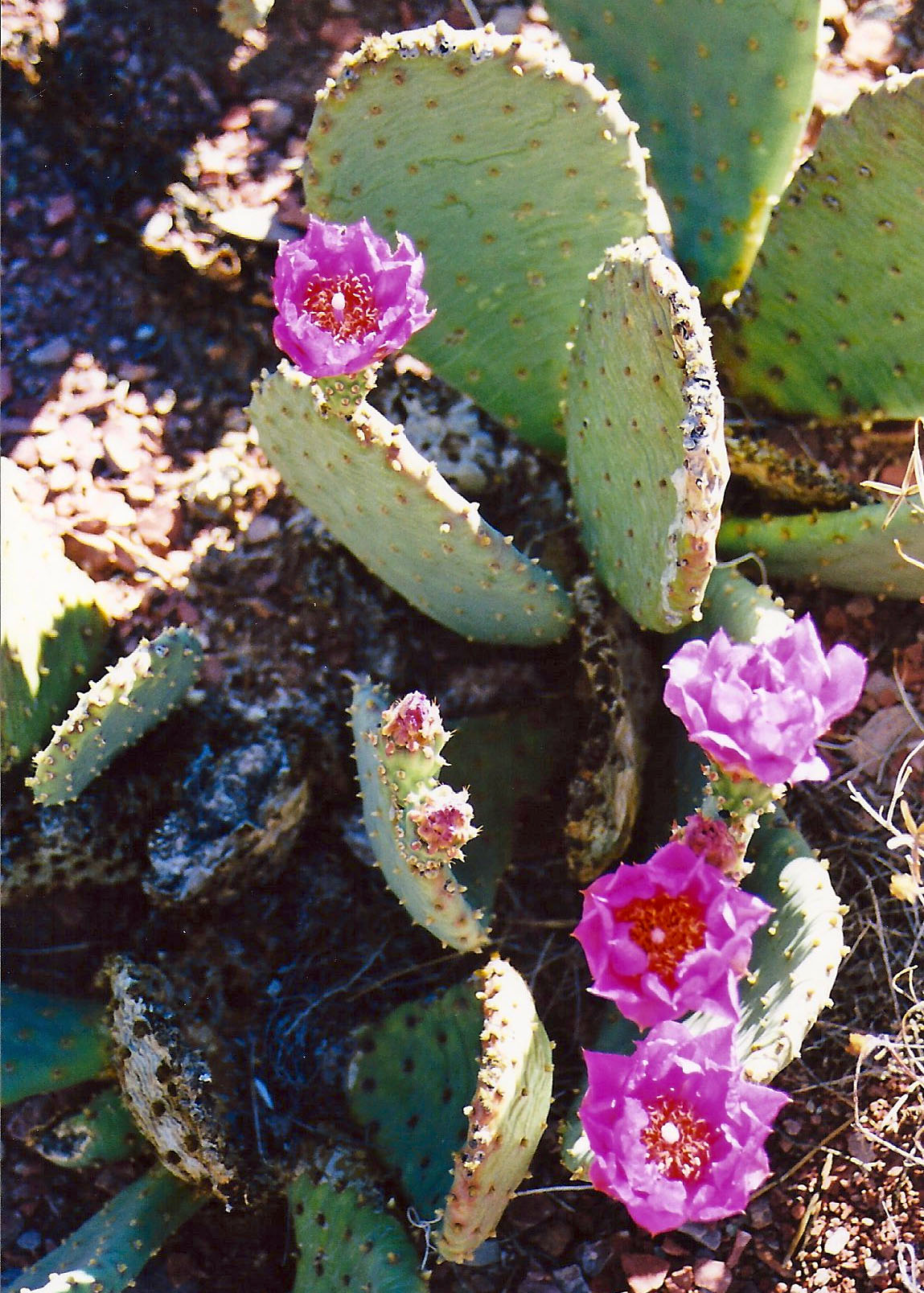
The rest of the five-mile/five month journey was something of a blur. (It was closer to five hours but time was moving very slowly.) I do remember a blooming prickly pear cactus. I grumbled at it for looking so cheerful. I also remember a long, gravelly slope toward the bottom. My downhill muscles had totally given out and the only way I could get down was to sidestep. I cackled insanely when I finally reached the bottom.

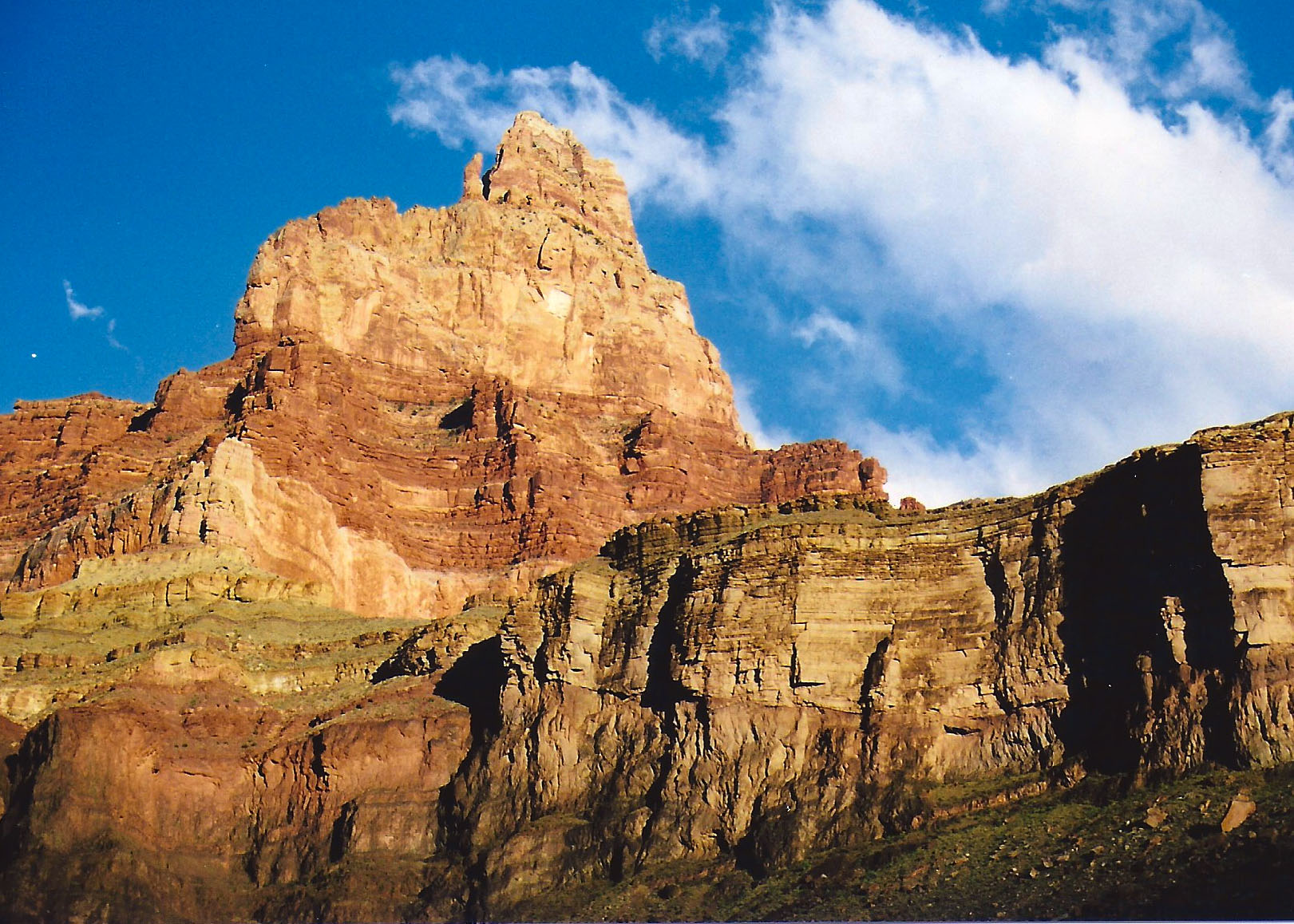
As tired as I was, I enjoyed the beauty of the inner Canyon.

I was so tired, I could hardly enjoy the beauty of the inner Canyon. (These photos are from a later trip I took down with Peggy. I waited until after she said “I do” before introducing her to the Tanner Trail. Otherwise she might have said “I don’t.”)

I smiled at the Prickly Pear Flowers on my way out of the Canyon that I had growled at coming in.

I growled at a prickly pear for looking so cheerful.

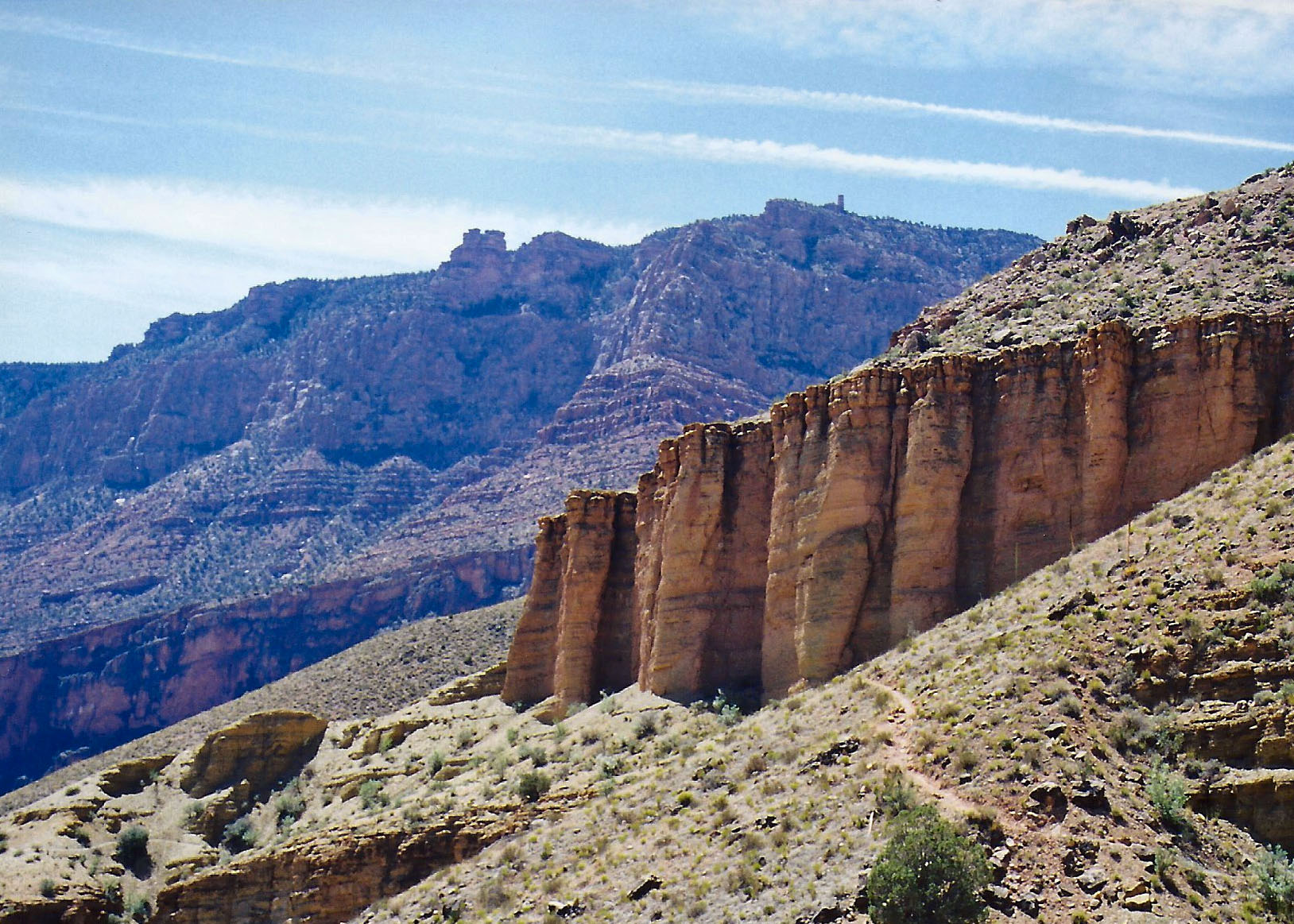
Looking back up the trail provided a perspective on how far I had come. The small, needle-like structure is Desert View Tower.

Looking back up the trail provided a perspective on how far I had come. The small, needle-like structure is Desert View Tower, about a mile away from the Tanner trailhead. You can see the trail on the right.

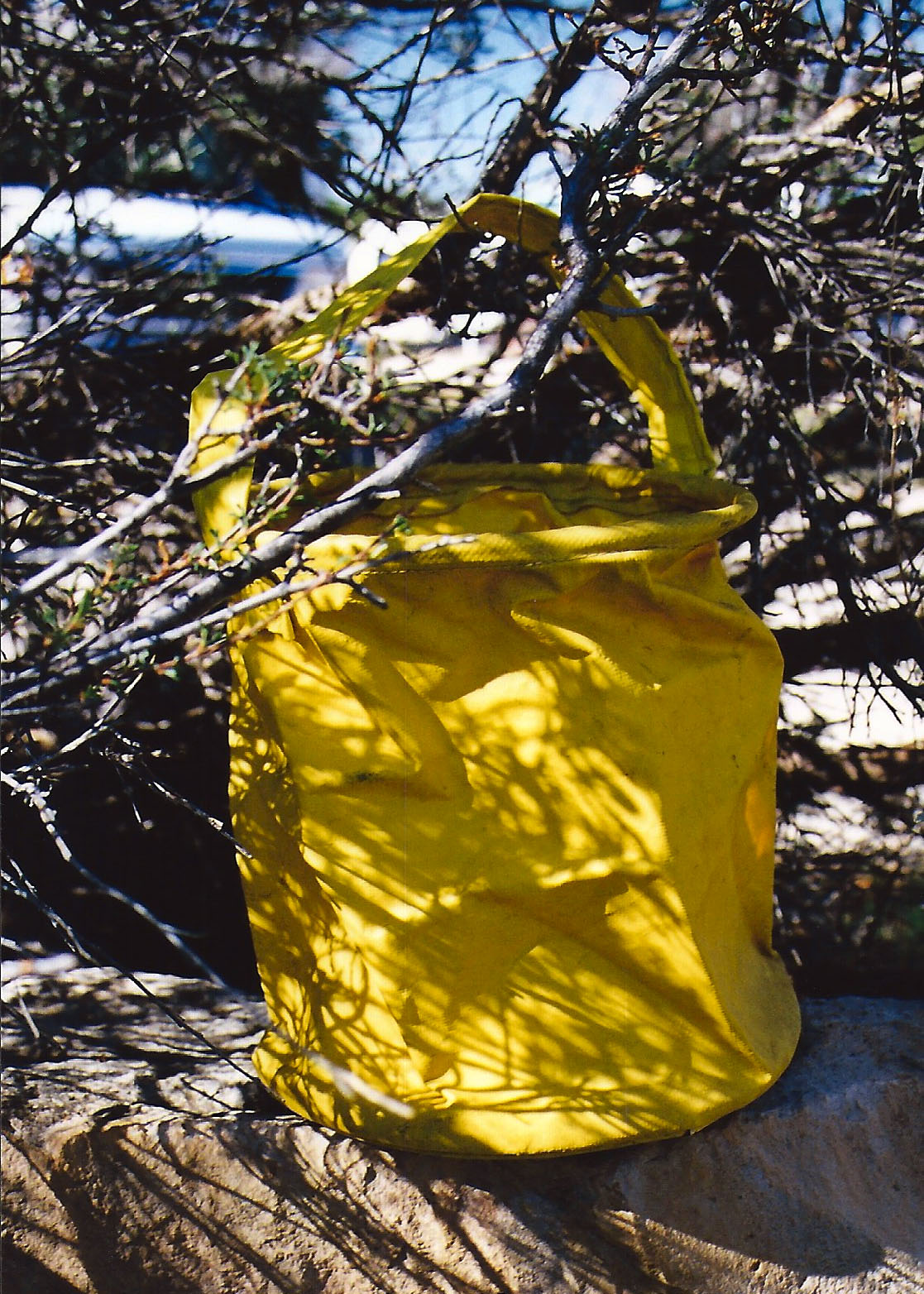
Setting up camp that night was simple. I threw out my ground cloth, Thermarest mattress, and sleeping bag on a sandy beach. Then I stumbled down to the river’s edge and retrieved a bucket of brown Colorado River water that appeared to be two parts liquid and one part mud. I could have waited for the mud to settle but used up a year of my water filter’s life to provide an instant two quarts of potable water.

My old yellow bucket, a veteran of dozens of backpacking adventures, holding Colorado River water. It retired after my second trip

My old yellow bucket, a veteran of dozens of backpacking adventures, holding Colorado River water. It retired after my second trip down the Tanner Trail.

All I had left to do was take care of my food. Since people camped here frequently, four-legged critters looked on backpackers as a major source of meals. I could almost here them yelling, “Dinnertime!” when I stumbled into sight. Not seeing a convenient limb to hang my food from, i.e. something I wouldn’t have to move more than 10 feet to find, I buried my food bag in the sand next to me. Theoretically, anything digging it up would wake me. Just the top was peeking out so I could find it in the morning.

As the sun went down, so did I. Faster than I could fall asleep, I heard myself snoring. I was brought back to full consciousness by the pitter-patter of tiny feet crossing over the top of me. A mouse was worrying the top of my food bag and going for the peanuts I had placed there to cover my more serious food.

“Hey Mousy,” I yelled, “Get away from my food!” My small companion of the night dashed back over me as if I were no more than a noisy obstacle between dinner and home. I was drifting off again when I once more felt the little feet. “The hell with it,” I thought in my semi-comatose state. How many peanuts could the mouse eat anyway?

The river water I had consumed the night before pulled me from my sleep. Predawn light bathed the Canyon in a gentle glow. I lay in my sleeping bag for several minutes and admired the vastness and beauty of my temporary home. The Canyon rim, my truck and the hoards of tourists were far away, existing in another world. My thoughts turned to my visitor of the previous evening.

I finished my last blog with a picture of the view across the Colorado River from my camp near Tanner Rapids. This and the photo below demonstrate how much colors change depending on the time of day.

The early morning view from my camp site near Tanner Rapids on the Colorado River.

Out of curiosity, I reached over for my food and extracted the bag of peanuts. A neat little hole had been chewed through the plastic but it appeared that most of my peanuts were present and accounted for. My small contribution had been well worth my solid sleep. I then looked over to the right to see if I could spot where the mouse had carried its treasure. Something on the edge of my ground cloth caught my eye. It was three inches long, grey, round and fuzzy.

It was Mousy’s tail!

Something had sat on the edge of my sleeping bag during the night and dined on peanut stuffed mouse. Thoughts of a coyote, or worse, using my ground cloth as a dinner table sent a shiver down my spine. I ate a peanut in honor of Mousy’s memory and threw a few over near his house in case he had left behind a family to feed. I also figured that the peanuts would serve as an offering to whatever Canyon spirits had sent the night predator on its way.

Then it was time to find a bush, cook up my morning gruel, and plan my day’s backpack trip up to the Little Colorado River. But my legs had another idea. They refused to move. I backpacked for about a hundred feet, set up camp in a small cave, and spent my day recovering while watching rafters yell their way through Tanner Rapids. I wondered what it might be like to raft down the Canyon…

Next Monday’s Post: I return to our raft trip down the Colorado.

WEDNESDAY’S POST: Driving on the Alaska Highway through the Yukon!

FRIDAY’S POST: It’s back to MisAdventures. It was almost a mantra in Diamond Springs where I grew up: If there was mischief in the town, the Mekemson Kids Did It.


SaveSave

SaveSave

SaveSave

SaveSave

SaveSave

Anasazi Ruins and the Hopi Entrance to Another World… Rafting the Colorado River through the Grand Canyon

Beautiful views like this along the Colorado River would have been lost if efforts in the 50s and 60s to dam the Grand Canyon had succeeded.

In our journey down the Colorado River today, we visit an ancient Native American granary that is located high up on the cliffs above the water, and stop off to play in the Little Colorado River.

Steve Van Dore and Jamie Wilson serve as our boatmen for the two days we are on the river travelling from our camp at Redbud Alcove (mile 39) to our camp at Upper Rattlesnake (mile 74). Jamie is a delight. First of all, he is funny and positive. Second, whenever a chore needs to be done, he is first in line. Finally, he is incredibly strong, which is a valuable asset when you get in a tight spot on the river. Jamie has his own business as a contractor in the Woodland/Davis area of California.

Jamie

Jamie Wilson

Peggy and I hitch a ride on Steve’s Cat. Not too many Colorado River boatmen are outfitted with sun umbrellas!

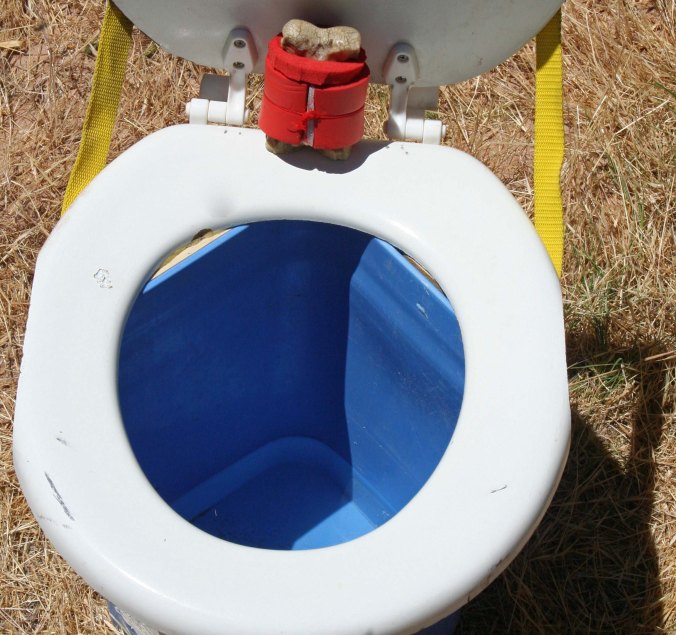
Steve, I’ve already introduced. Like Tom, he is an experienced Colorado River boatman and loves the Canyon. He is also a specialist. His catamaran is outfitted with groovers: large ammo cans that have been modified to serve as portable potties.  Before toilet seats were added as a convenience, you sat on the rim of the can. It left grooves in your behind— hence the name.

We are all given training in setting up, taking down, and using the groovers. One of the first chores in arriving camp is to find the perfect place for the port-a-pot: a secluded location with a view. One time I found myself sitting on the pot and waving at rafters as they went by. The site received an A for the view and a C for the seclusion.

Steve is very knowledgeable about the Grand Canyon and readily shares his knowledge. Almost immediately he points out a site that was once proposed for a dam that would have covered much of the upper Canyon’s beautiful scenery, geological wonders and archeological treasures with water.

A similar effort was planned for downstream. Fortunately, the Sierra Club was able to stop the dam from being built. Otherwise, one of the world’s greatest natural wonders would have been lost.

Views of the Grand Canyon along the Colorado River between Redbud Alcove and the Little Colorado.

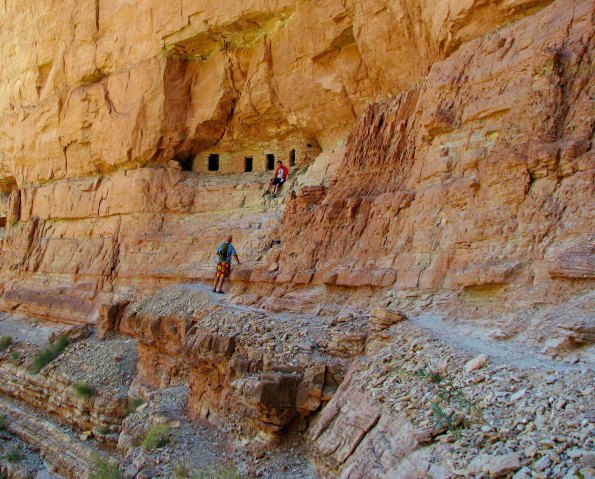
When we arrived at Nankoweap (mile 53), Steve pointed out the granaries used by the Anasazi Indians somewhere between 1000 and 1150 CE (Common Era) or AD, if you prefer. The granaries are located high up on the cliff for protection from animals and insects. Tom had scheduled a hike up and I willingly went along.  I was curious about the granaries and thought that there would be spectacular views from the cliff.

The climb was definitely worth it. Unfortunately, I sprained my knee on the way back down.

Our intrepid group hikes up the steep trail to the Granaries at Nankoweap in the Grand Canyon.

The granaries are located high up on the cliff.

They were  built by the Anasazi Indians between 1000 and 1150 CE.

Tom, Eggin and I next to the granary.

Looking down the Colorado River from the Nankoweap Granaries.

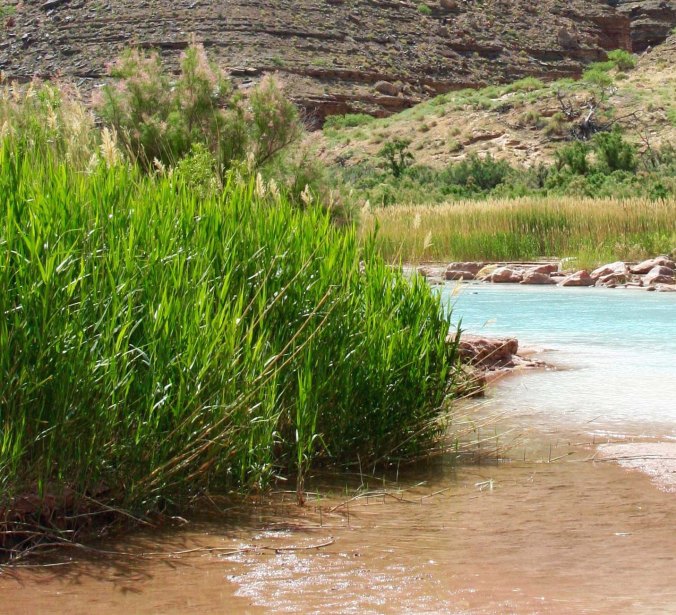
Jamie Wilson was our boatman on the fifth day. When we arrived at the Little Colorado River, it was time to play. The Little Colorado has two colors. First is a muddy reddish-brown. The River drains over 25,000 square miles. When it rains upriver, it carries tons of red topsoil.  The second color is a beautiful turquoise blue. When it doesn’t rain, much of the water comes from springs and is loaded with minerals that provide the color and very interesting deposits. We were fortunate to experience it without rain.

The entrance to the Little Colorado River.

Its almost surreal look. (Photo by Don Green.)

Looking up the Little Colorado River just above where if flows into the Colorado River. Note the mineral deposits.

A close up.

Vegetation on the Little Colorado.

A biologist was doing a study of the fish population in the Little Colorado and showed us this fellow.

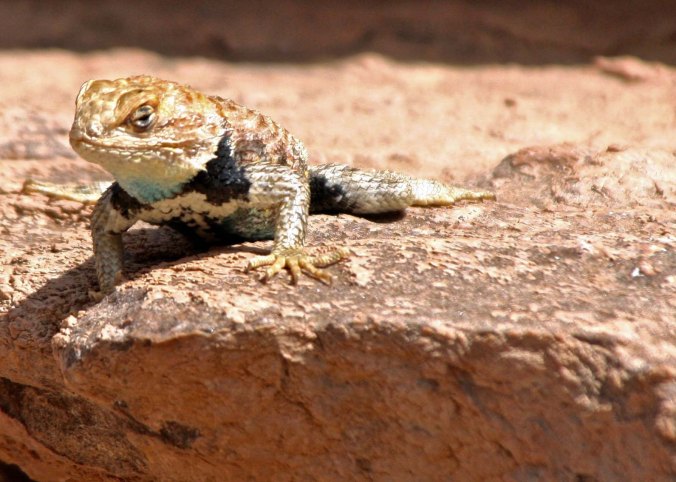
We also found a lizard as we were walking up the river. It looked smug.

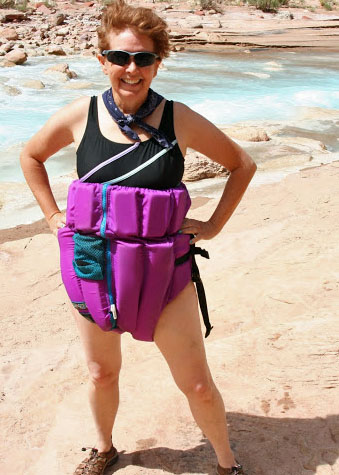
When we reached our destination, we donned our life vests upside down over our legs.  It looked like we had put on huge diapers. We were to float down the river feet first. After carrying out my photographer responsibilities, I too donned my diaper and jumped in. Just as I went over a small waterfall my life vest slipped down to my feet. My feet floated fine but my head bobbed along under the water. Breathing was not an option!

Peggy models the life vest diaper look. The latest in fashion statements.

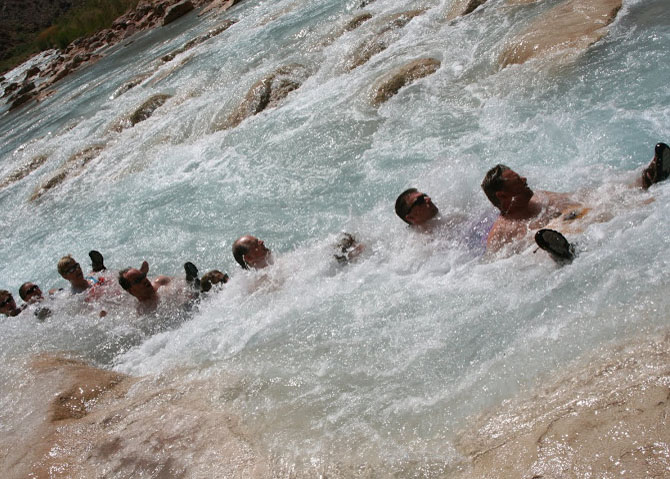
Hanging on to each other, the group formed a Conga Line—Little Colorado River style— and made its way through the rapids.

Tim Spann calmly floated over a small waterfall.

Peggy looked a little less in control…

And I looked totally out of control (actually I was), as my life vest slipped up around my feet and my head dipped under the water.

According to their mythology, the Hopi Indians came into this world through a cave, which is located just up the Little Colorado from where we were playing in the water. The legend states that this is the fourth world they have occupied. People had become bad in the previous three by doing things like being disobedient and having too much sex. The good were saved and moved up to the next world while the bad were left behind, or destroyed. Maybe their diapers slipped and they drowned.

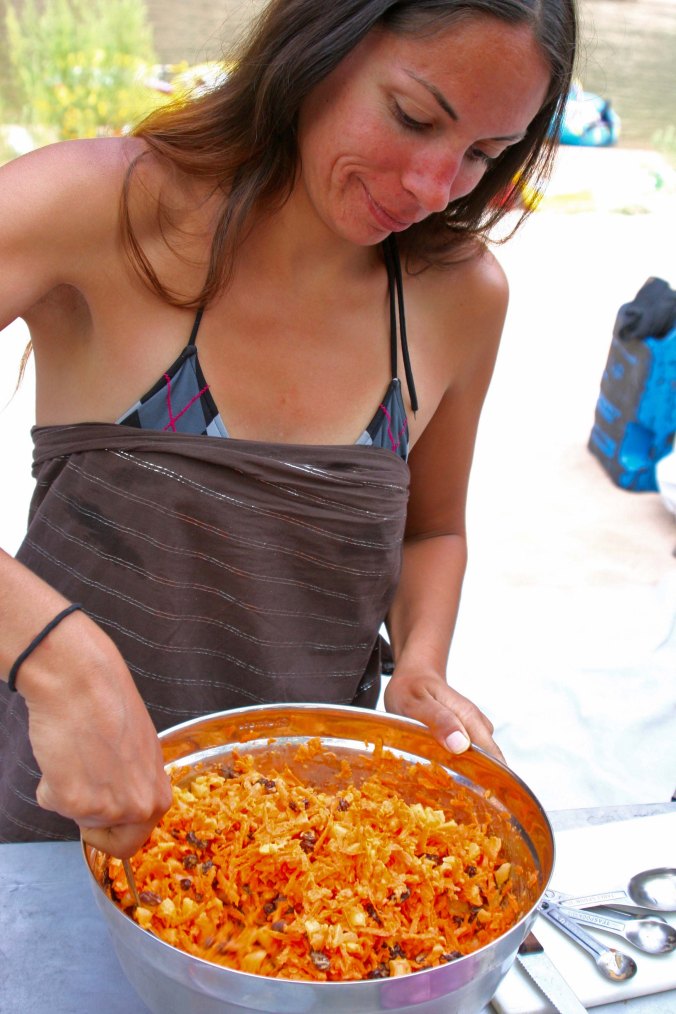
That night Theresa Mulder whipped up a delicious carrot and raisin salad. As I’ve noted, Tom had planned out an excellent menu for the trip and we ate very well. I also noted that Tom was something of a tyrant in the kitchen…

This is what you could expect if you didn’t cut the lettuce right. (grin) I decided to appoint myself to permanent groover duty and stay out of Tom’s kitchen.

I’ll close today’s post with some views of the sun setting from camp.

A different perspective…

Another view. Next Monday we will continue to make our way down the Colorado through the Grand Canyon.

Also TODAY: The photographic essay trip up the Alaska Highway continues.

FRIDAY’S POST: A chapter from book on my Peace Corps experience, The Bush Devil Ate Sam. How Rasputin the Cat beat out his sisters to become our cat.


SaveSave

SaveSave

SaveSave

SaveSave

SaveSave

SaveSave

SaveSave

SaveSave

SaveSave

SaveSave

SaveSave

SaveSave

SaveSave

Rowing Against the Wind… The Grand Canyon Series

Peggy captures Dave Stalheim and me as we begin our journey on the Colorado River through the Grand Canyon. Note my clean and shaved look. It’s the last time you will see it.


With thoughts of facing headwind gusts up to 60 MPH, we began our journey down the Colorado River through Grand Canyon National Park.

Peggy and I performed the ritual of asking a boatman if we could ride with him. It seems like a strange practice to me, designed to remind us who’s in charge. But we have entered the world where each boatman/woman is the captain of his or her ship, even if the ship is a 16-foot raft with two or three passengers.

“May I have permission to come aboard, sir?” Although it’s more like “Can we ride with you today?” It is courteous but I would prefer to be assigned and have the assignment changed each day.

The tradition is so old that it fades into history. Democracy is not an option on a raging sea or, for that matter, in the middle of a roaring rapid. When the captain yells jump, you jump.

Most boatmen are mellow people, however; good folks. There are few Captain Blighs. If they are slightly more than equal, it goes with the territory. We are committed to riding with each boatman. First up is David Stalheim. He makes his living as a city and county planner in Washington.

“I’ve been applying for a permit to go on the Colorado River for 15 years,” he tells us. Our ten-minute effort of obtaining a permit seems grossly unfair.

We push-off from shore, excited and nervous. The wind strikes immediately, like it was waiting in ambush. “Are we moving at all?” Dave asks plaintively.

An old rock road makes its way tortuously down from the canyon rim on river left. (Left and right are determined by direction of travel.) They are important for giving directions as in “There is a raft ripping rock on river right!” Since boatmen often row with their backs facing downriver, they appreciate such information.

Up until 1929, this is how travelers made their way to Lees Ferry. It would have been a bumpy ride.

The old road is how people once made their way to Lee’s Ferry, which was one of the few ways to cross the Colorado River between 1858 and 1929. The infamous Mormon, John Doyle Lee, established the Ferry. Brigham Young assigned him the job. Later, Lee was executed by firing squad for his role in the Mountain Meadow Massacre where Mormons and Paiute Indians murdered a wagon train of immigrants near St. George, Utah. For awhile, my brother and I thought some of our ancestors had been involved, had ended up dead. But it wasn’t so.

After fighting the wind for what seems like hours, we finally come to the Navajo Bridge, which replaced Lee’s Ferry in 1929. It towers some 467 feet above the river and reminds us that we are already miles behind our planned itinerary.

Navajo Bridge by Don Green

A view of the Navajo Bridge. The first is the old one and is now used as a walkway. The second is used by cars and other vehicles. (Photo by Don Green.)

Just beyond the bridge we catch our first glimpse of Coconino Sandstone. Its geologic history dates back some 250 million years when a huge desert covered the area and the world’s landmasses were all part of the large continent named Pangaea— before the divorce, before plate tectonics demanded that the continents go their own way.

During our journey down the river we will travel through over a billion years of the earth’s history.

The wind continues to beat against us as we make our way down the Colorado River. Only Dave’s strenuous effort at the oars keeps us from being blown up-stream. “Go that way,” I suggest and point down the river.

The group pulls in at a tiny beach in hopes our mini-hurricane will die down. It doesn’t. Dave develops blisters and I develop guilt. A manly man would offer to take over at the oars.

An option floats by. Dave’s niece, Megan Stalheim, is also one of our boatmen. Don Green, a retired Probate Judge out of Martinez, California, is sitting opposite her and pushing on the oars while she pulls. It inspires me. I join the push-pull brigade. Peggy also takes a turn.

The push-pull approach to rowing where Don Green was helping Megan. Peggy and I have been friends with Don for over two decades. He belongs to the same book club we do and joins us on our annual journey to Burning Man (as does Tom). Don is also quite generous in sharing his photos, which was particularly helpful on our first day since neither Peggy nor I took many.

Word passes back to us that Tom wants to scout Badger Creek Rapids. In boatman terminology this means figuring out the best way to get through without flipping. Badger isn’t a particularly big rapid for the Colorado, but it is our first. We are allowed to be nervous. It’s labeled a 4-6 out of 10 in the method used in the Grand Canyon for determining difficulty. Ten is reserved for only the most dangerous. Badger involves a 15 foot drop from the top to bottom.

Badger Creek Rapids by Don Green

Photo of Badger Creek Rapids by Don Green.

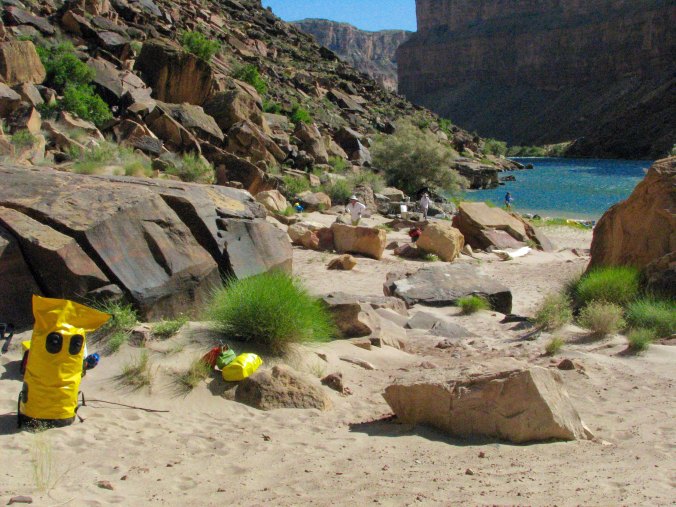
There is good news included in the message. We will stop for the night at Jackass Camp just below the rapids on the left. We’ve only gone 8 miles but are eager to escape the wind.

Dave is a cautious boatman. He takes his time to study Badger Creek Rapids from shore and then stands up in his raft for a second opinion as the river sucks us in. Time runs out. Icy waves splash over the boat and soak us. Our hands grasp the safety lines with a death grip as we are tossed about like leaves in the wind. Mere seconds become an eternity. And then it is over.

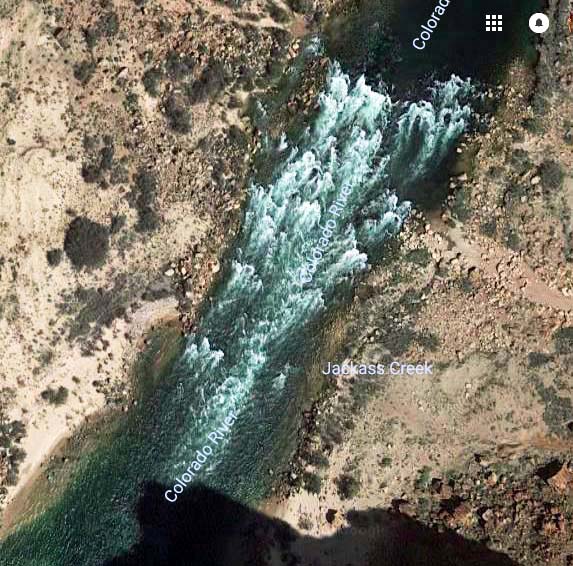
Badger Creek Rapids Google photo

The view from above using a Google photo. Our camp would be on the right (river left)  at the bottom of the photo, in the shade here. Our raft came out on the left (river right) side of the river.

“Quick, Curt, I need your help,” Dave shouts. We have come out of the rapids on the opposite side of the river from the camp. The powerful current is pushing us down stream. If we don’t get across we will be camping by ourselves. Adrenaline pumping, I jump up and push the oars with all my strength while Dave pulls. Ever so slowly the boat makes its way to camp.

Jackass campsite on Colorado River by Don Green

Not the world’s most attractive campsite. We scatter out to find places for our tents after emptying the boats. (Photo by Don Green.)

Jackass Camp Area by Don Green

Boats tethered at Jackass Camp. (Photo by Don Green.)

View from Jackass camp on Colorado River by Don Green

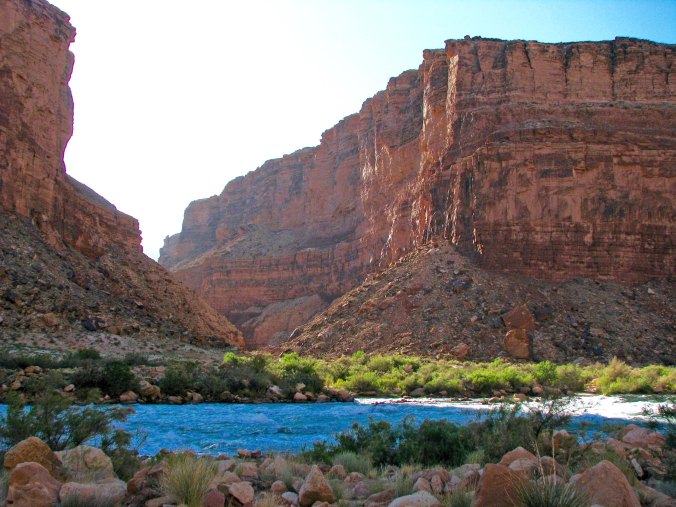
View from camp. (Photo by Don Green.)

Grand Canyon evening primrose by Don Green

I liked this primrose captured by Don the next morning…

Grand Canyon floers and tracks by Don Green

And found the tracks under it even more interesting. It’s like the lizard was sidestepping. Its tracks and tail trail can be seen coming down from the right. The hole on the right was made by an ant lion that uses the hole as a trap for insects. They fall in, can’t get out, and become lunch. Next Monday, we will continue our journey down the river.

WEDNESDAY’S Photo Essay POST: I begin my series on the Alaska Highway. We make our way to the start of the highway in Dawson Creek by traveling through British Columbia. Great wood carvings and dog agility trials entertain us along the way.

FRIDAY’S MisAdventures POST: I graduate from playing in the Graveyard to playing on a pond and discover a magical world.

MONDAY’S Grand Canyon Series POST: Beautiful waterfalls, a huge cavern, and ancient Native American ruins are featured.

Jackass campsite on Colorado River by Don GreenJackass campsite on Colorado River by Don GreenSaveSave

SaveSave

SaveSave

SaveSave

SaveSave

SaveSave

SaveSave

SaveSave

I Discover I Am No Longer 30, or 40, or 50, or even 60… Rafting Through the Grand Canyon: Part 4

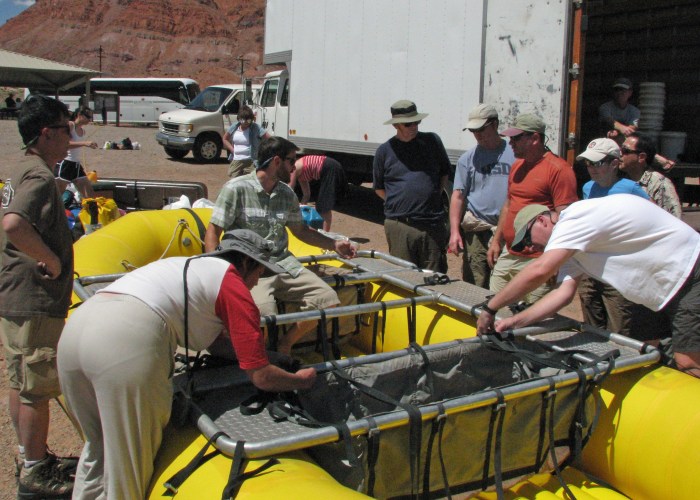
On a private trip down the Colorado through the Grand Canyon National Park, everyone pitches into help. Here we are learning to rig the rafts. Straps and more straps! The  aluminum frame provided stability for the raft and held the heavy food containers. (Photo by Don Green)


It was time to make the leap from life on the road to life on the river. Laptops, cell phones, good clothes and the other accoutrements of modern civilization were stuffed into bags and dumped into our transport van.

Plus I had to paint my toenails. It was a virgin experience. Grand Canyon boatmen are a superstitious bunch. Many believe their boats will flip if a person is on board with naked toes. And it’s true— boats have flipped under such circumstances. It makes no difference if the opposite is also true. Tom lectured me. “I will not let you on my boat unless your toenails are painted.” In addition to being obnoxious, he was serious. Peggy dutifully applied blue polish on four of my toes. Did this mean we would only half flip?

Two acres of paved boat ramp greeted us when we arrived at Lee’s Ferry, some 130 miles from Flagstaff. It is the take off point for trips down the Canyon and the only bridge across the river in some 700 miles. The Mormons originally discovered the potential for the crossing and sent John Lee to set up a ferry, which began operation in 1873. Brigham Young was also hiding Lee. He had been a key player in the Mountain Meadows Massacre where some 120 eastern emigrants had been murdered. A practicing polygamist, Lee and his wives ran the ferry up until his execution in 1877.

The transport van disgorged us as the gear truck made a quick turn around and backed down the ramp. Another private party was busy rigging boats. People, gear and boats were scattered everywhere.

From off to the right, a longhaired, 50-something man had emerged. I had thought 60’s hippie or possibly the model for a Harlequin Romance cover. The pirate flag on his boat suggested otherwise. A ‘roll your own’ cigarette dangled from his lips. It was Steve Van Dore, the last member of our group and a boatman out of Colorado.  No one in our group had met him, but he came highly recommended.
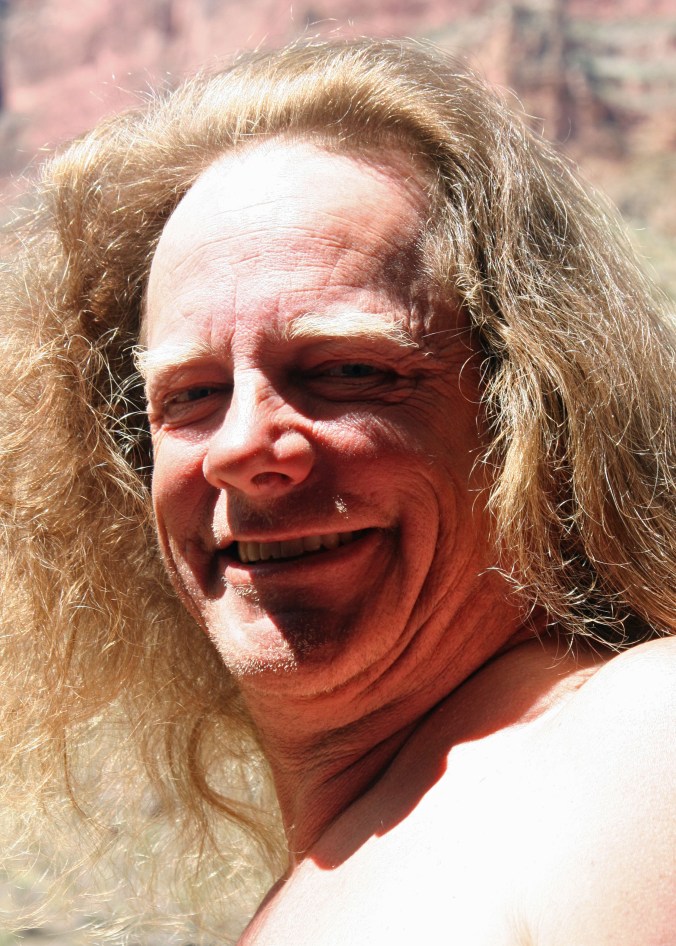
Steve, a week or two into the trip.

“Please let this be the truck driver,” Steve later admitted was his first thought when he met our green and purple haired trip leader. He also confided that Tom hadn’t told him we were a smoke-free group. “On the other hand,” Steve confessed, “I didn’t tell him I was on probation.” Somehow this balanced out in Steve’s mind. There was no time to become acquainted; we had work to do.

There is an unwritten 11th Commandment on private river trips: Thou Shall Do Your Share. No one is paid to pamper you. Not helping will lead to bad things, like banishment from the tribe. The truck we had loaded in Flagstaff demanded unloading. Everybody did everything. There were no assignments. Peggy and I became stevedores. Piles of beer and soda and wine and food and personal gear and ammo cans and hefty ice chests quickly accumulated around the truck. There was no shade and the desert sun beat down ferociously. It was sucked up by the black asphalt and thrown back at us. We slathered on sun block and gulped down water.

The rafts were unloaded last. Rigging them was technical but relatively easy, assuming of course that you knew what you were doing and were mechanically inclined. I made no such claims. Steve’s Cat (catamaran) was already set up and in the water, its pirate flag was flapping in the breeze. Our other four boats were self-bailing Sotar Rafts with aluminum frames. Tom owned his own, a blue 14 footer named Peanut after the Jeff Dunham character. The three we had rented were yellow, 16 feet long and nameless.
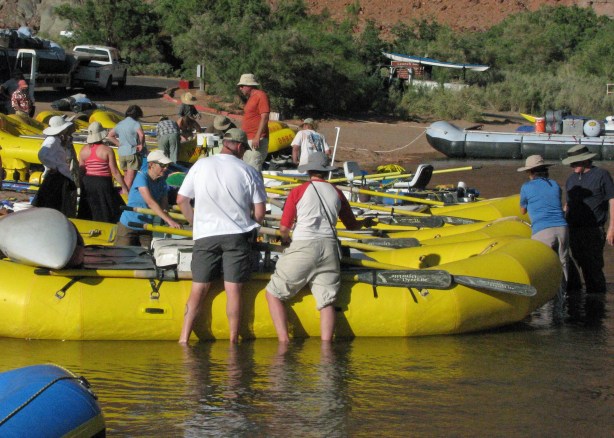
Work also required that we get our feet wet. (Photo by Don Green)

Tom was the last to rig his boat. It was approaching dusk when he finished— the end of a very long day. I hiked down the river to find a campsite for our group while the rest boated down. Peggy and I struggled to set up our new tent in 30 MPH winds. A van was coming to pick us up for dinner at a nearby restaurant and we were late.

The walls of the restaurant were covered with photos of rafts and rafters being trashed by massive rapids. I walked around and admired them with more than a little awe and trepidation. I would have preferred to see photos that emphasized the beauty of the Canyon, but this was a rafters’ hangout.

The wind storm had changed to a dust storm when we arrived back at camp. Finding our tent in the dark proved to be a challenge, and the tent provided little protection when we crawled in. I was reminded of Burning Man as the dust assailed my eyes, ears, nose and mouth. I pulled out a handkerchief to cover my face. Exhausted, I finally fell asleep with the wind ripping at our tent.

I had underestimated the amount of work involved. We were floating down a river, weren’t we? I was out of shape and had a generous belly. Peggy and I had been traveling extensively, mainly helping our kids with their babies. I’d been over-eating and under-exercising. I might have gotten away with it at 30, or 40, or 50— and had. But now I was 67, and my body had some serious words for me. Mainly unprintable. A few years earlier I had undertaken a much more difficult task, backpacking for 360 miles between Lake Tahoe and Mt. Whitney. But I knew how tough that was and had spent a few months hiking 5-10 miles per day before hitting the trail. Now my only excuse was ignorance. And that is not a very good excuse.

We were awakened at five a.m. the next morning, as we would be on every day of our trip. There was personal gear to pack, breakfast to prepare, and boats to load. Any thoughts of a leisurely trip down the river were dashed in the cold reality of the early morning’s light.

We also had a lecture on the Grand Canyon’s numerous rules by Ranger Peggy. Somewhere in the middle of rigging boats the previous day she had stopped by to check our equipment. Life vests had been dutifully piled up; stoves and bar-b-que were unpacked. Even the groovers, which I will describe later, stood at attention. You don’t mess with Ranger Peggy.

She knew Tom from other river trips and was amused by his hair-do. He introduced me as the permit holder. “Tom’s in charge,” I noted. The smile dropped from her face. “You are responsible,” she said icily. “I’ll try to keep Tom under control,” I replied meekly. Yeah, fat chance that.

Bells, whistles and alarms started going off in my head. I would face heavy fines if any of our party misbehaved.

Our second encounter with Ranger Peggy began after the boats were packed for our first day on the river. Tom started off with a discussion on river safety. Naturally we were required to wear our PFD’s (Personal Flotation Devices) any time we were on the boat.

Tom, with his interesting hairdo, and Ranger Peggy check their lists to see which of the many rules they have forgotten to inform us about.

What’s the first rule if you fall overboard: Hang onto the boat. What’s the second rule? “Hang onto the boat,” we chanted in unison. And so it went. Tom saw his wife, Beth, go flying by him the year before as he bounced through a rapid. He caught up with her down river.

If the raft flips, what do you do? Hang onto the boat! “Easier said than done,” I think.

“Your head is the best tool you have in an emergency,” Ranger Peggy lectured. Right. When the river grabs you, sucks you under the water, and beats you against a rock— stay cool.

For all of the concern about safety on the river, the Park Service seemed more concerned about our behavior on shore.

Over 20,000 people float down the river annually. And 20,000 people can do a lot of damage to a sensitive desert environment. Campsites are few and far between and the major ones may have to accommodate several thousand people over the year.

Picture this: 20,000 people pooping and peeing in your back yard without bathroom facilities. It isn’t pretty. So we pack out the poop. And we pee in the river…

Packing out poop makes sense. But peeing in the river, no way! I’d led wilderness trips for 36 years and for 36 years I’ve preached a thousand times you never, never pee in the water. Bathroom chores are carried out at least 100 yards away from water and preferably farther.

The first time I lined up with the guys, I could barely dribble out of dismay.

The rules went on and on. Mainly they had to do with leaving a pristine campsite and washing our hands. Normally, I am not a rules type of guy but most of what Ranger Peggy preached made sense. Sixteen people with diarrhea is, um, shitty.

And few things disturb me more than a trashy campsite in the wilderness. The least we could do was to leave our campsites sparkling clean.

Finally, we were ready to launch. Eighteen days and 279 miles of the Colorado River and Grand Canyon stretched out ahead. Ranger Peggy checked our IDs against her list. We were who we claimed to be. The boatmen strapped down the gear. It was time to climb aboard and Tom was anxious to get going.

The same up-canyon winds that whipped dust into our tent were threatening to create a Herculean task of rowing. Headwinds of up to 60 MPH were predicted.
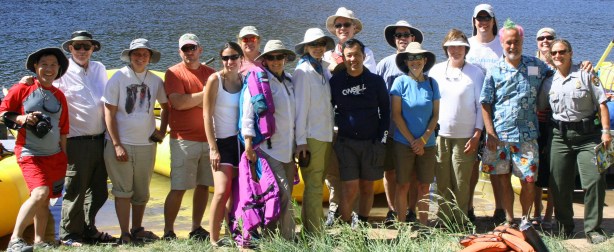
The group, ready to launch. Wife Peggy, as opposed to Ranger Peggy, is holding her and my purple PFDs. I’m second from the left, looking chunky.


WEDNESDAY’S POST: It’s back to the Amazon and monkey business. While Peggy gets the ‘good’ monkey, I get the ‘bad’ monkey.

FRIDAY’S POST: I learn a bit about cross cultural relations as a second grader— on a queen sized bed.

MONDAY’S POST: Fighting ferocious headwinds, we begin our journey through the Grand Canyon.


SaveSave

SaveSave

SaveSave

SaveSave

SaveSave

SaveSave

SaveSave
The One, the Only, the Interview with Bone….

Bone has been in many tough situations in his life; he can handle tough questions. Here he rests on top of a saguaro cactus in Arizona looking for border patrol agents. His lack of official papers, or even a birth certificate, can cause problems at times. President Trump has yet to tweet about him, however.


One of the more recent followers of this post, Gunta, was doing an Internet search on Tom Lovering a week or so ago when she came across this interview that Bone did— and laughed a lot. Again, many of you will have read this interview, but I am reposting it on behalf of the new folks who have joined my blog in the past year.


Q: Do you really talk? We’re speaking ethics here, Bone. Blogging is about transparency. That means honesty.

A. Are you crazy? Have you ever heard a bone talk? Of course I don’t talk. I just think out loud.

Q: Curt sometimes refers to you as he. Does this mean you are a male bone?

A. No. He makes assumptions, lot of them. He was showing me to a biologist at a writers’ conference and she suggested I have my DNA tested. “Just cut a small chip off of it,” she said nonchalantly. “You can determine its sex and breed.”

“Just cut a small chip off of it!Outrageous! I am not some it to have chips cut out of. Besides, I lead a rich fantasy life and have no desire to know whether I am male or female. Call me she, he, or Bone, but never it.

Um, I think Bone is definitely a male in this photo. –Curt

Q: You have travelled all over the world and met thousands of people. How do they usually react to you?

A. With befuddlement. You should have seen the look on the face of the customs agent in New Zealand who tried to seize me as ‘animal matter.’ But emotions run the gamut. There was a Japanese man who got off a tour bus at Yellowstone National Park and wanted to hold me for good luck. Soon there were 40 other Japanese handing me around, oohing, and taking photos. I was thrilled. On the opposite side, I know a woman who refuses to touch me, like I have cooties. “I don’t know where Bone has been,” she states primly. Not surprisingly, there is also jealousy. “I want to be you and travel the world,” a good friend in Sacramento told me.

Some people act like I have cooties. This woman almost dropped me and then washed her hands! –Bone

Her daughter, on the other hand, so to speak, understands proper bone etiquette and respect. –Bone

Q:  What is your favorite thing to do?

A. Visit graveyards; there are lots of old bones there. My favorite grave is Smokey Bear’s in Capitan, New Mexico. I once stood on his tombstone for ten minutes trying to communicate but all I could get was something about ‘growling and a prowling and a sniffing the air.’ A close second is the grave of Calamity Jane in Deadwood, South Dakota. What a woman! These are difficult choices, though, when you toss in the likes of Hemingway, Daniel Boone and Billy the Kid. On the light side I once visited Ben and Jerry’s graveyard of discarded ice cream flavors in Vermont. My spookiest experience was a visit to the Capela dos Ossos, the Chapel of Bones, in Evora, Portugal. Those folks definitely have a skeleton in their closet, lots of them.

Bone has a special fondness for unusual graves. Here he hangs out with Billy the Kid in New Mexico. Has he been in a shoot out? Is that blood on his vest?

Q: So, what’s your second most favorite?

A. Too hard; I am a dilettante dabbler, but here are a few.

  • Wandering, of course, anywhere and everywhere and by all modes: bikes, kayaks, rafts, skis, backpacks, sailboats, planes, helicopters, trains, cars, RVs, etc.
  • Visiting wild, remote and beautiful natural areas. I started life wandering the Sierra Nevada Mountains, John Muir’s Range of Light.
  • Seeking out the strange such as ghosts and aliens (I’ve been to Roswell four times).
  • Attending unique events like Burning Man but I also have a fondness for any type of fair.
  • Meeting weird people like Tom.

Bone backpacking on the John Muir Trail.

Tom being eaten by a bony desert monster.

Q: Speaking of Tom, he and Curt ‘discovered’ you in 1977 and you have wandered extensively with both. Which do you like best?

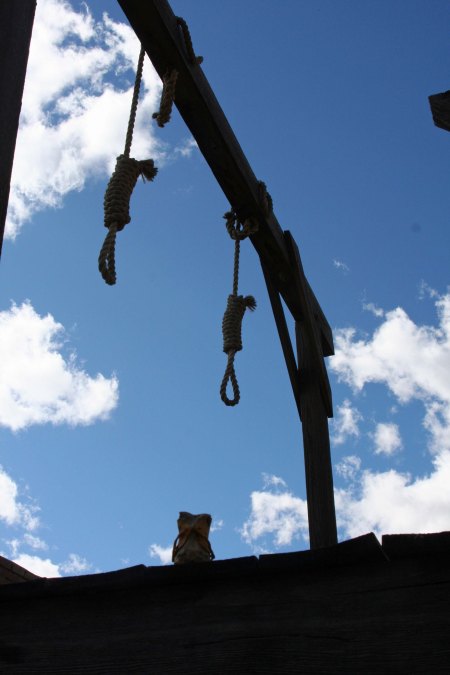
A. Eeyore, the jackass who can’t keep track of his tail. We’re traveling companions and he saved me from being strung up and buried on Boothill in Tombstone, Arizona. I’d robbed a bank, cheated at cards and hung out with women of questionable character. (This is what I mean by having a rich fantasy life. It’s also known as evasion.)

“I was in deep trouble in Tombstone. Wyatt Earp had arrested me for robbing a bank and Doc Holiday was checking me for weapons.”

“My life as Bone was in serious jeopardy.”

“Odds were I was going to end up on Boothill, along with Billy Clanton.”

“But then the ever brave Eeyore came to my rescue! I hopped on his back and we went riding off into the sunset while leaping over large rocks.”

Q: Which of your journeys has been most memorable?

A. I would have to say traveling the length of Africa in the back of a truck from the Sahara Desert in the north to Cape Town in the south. Almost falling off the back of a riverboat into a piranha infested section of the Amazon River would have to be a close second. I was perched on the back railing doing a photo shoot. And then, of course, there was the 10,000-mile bike trip.

“I was much smarter when I rafted down the Colorado. I wore a life jacket!”

“That didn’t protect me from pirates. The dreaded pirate Steve held a knife to my throat and demanded to know where I buried my treasure.”

Q: You are often seen scrambling over rocks in remote sections of the Southwestern United States. What’s that all about?

A. I’ve developed a fondness for Native American Rock art. It resonates with my bone-like nature. It’s also another excuse to go wandering around in the outdoors. Plus, some those places might be haunted and it is a great place to look for UFOs. Some of the petroglyphs look amazingly like aliens. Finally, wandering in the desert is known to be good for the soul. Ask the Prophets of yore.

“How can this guy and his strange dog not be aliens?”

“Here I am making tracks across White Sands National Monument in New Mexico. It’s a great place to watch out for UFOs.”

Q: Ah, being a born-again bone, do you have any insights into the great unknown?

A. Ommmmmmmmmmmmmmmmmmmmmmmmmmmmmmmmmmmm.

Q: Finally, and this may be a little sensitive, but do you always run around naked?

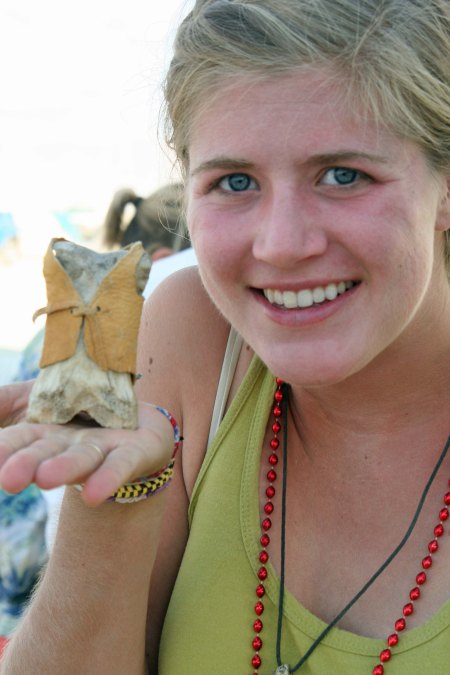
A. What kind of a question is that? Do you think I am uncivilized? For shame. I am the epitome of haute couture! A bow and arrow toting, card-carrying NRA member in Montana has designed and made me two leather vests. What’s more, an 80 plus year old woman in Kansas going on 20 with a crush on Johnny Depp and a room devoted to the Egyptian gods has made me a kilt and several other outfits. Then there is the horse woman actress in Ohio whose husband is an ex-secret service agent who has promised me an outfit and the artist head of a PR firm in the Bahamas who has promised me another. Face it; I am hot stuff, clothed or naked. I may take up a modeling career.

Rod Hilton fashions a new leather vest for bone.

“My Bahamian/Canadian friend makes me a new vest in the wilds of Montana.” 

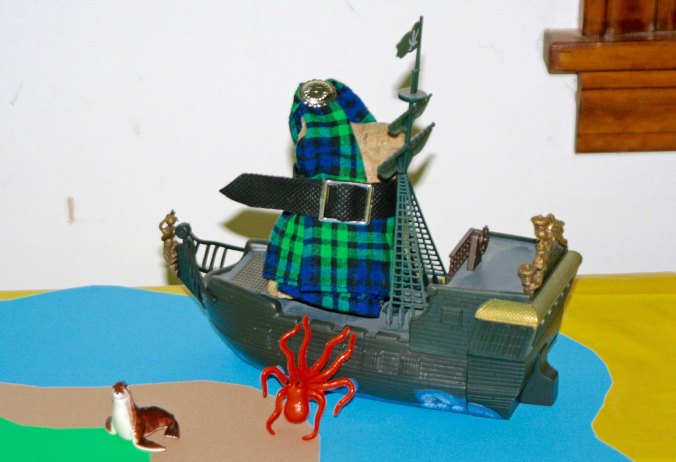
Bone, wearing his newly made kilt, fights off a ferocious sea monster in a scene straight out of ‘Pirates of the Caribbean.’

MONDAY’S POST: Back to the Grand Canyon.

The History of the Bone… Forty Years and Still Wandering

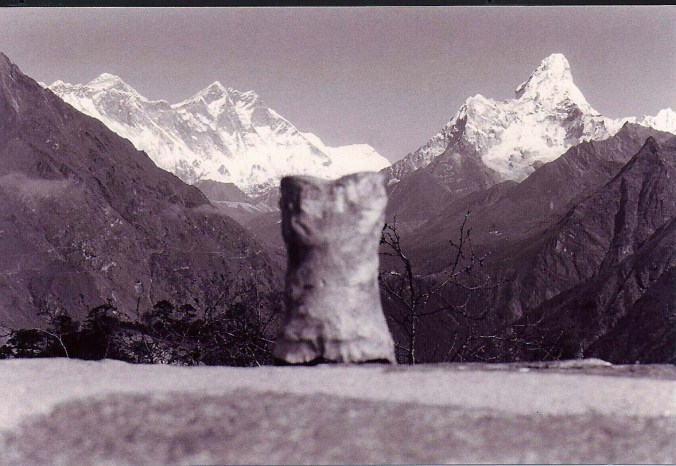
Bone has travelled twice to the base of Mt. Everest.

Since Bone played a prominent role in our raft trip down the Colorado River through the Grand Canyon, I decided to republish his history and an interview he did. This is mainly for the folks who follow my blog and aren’t familiar with his exploits. Many of you will have read today and tomorrow’s posts.

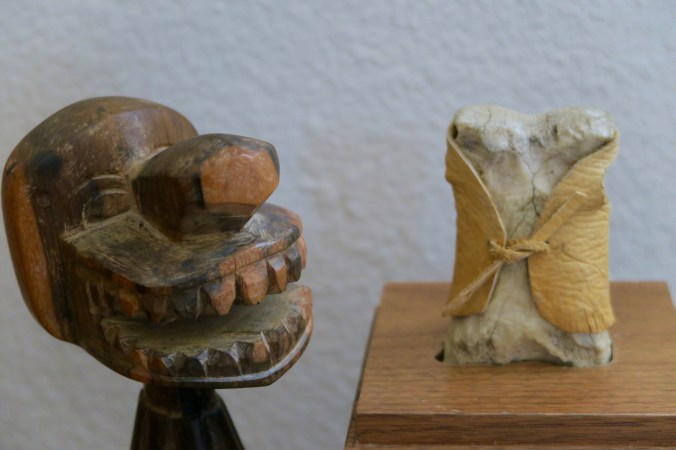
Sometime in the 1900s Bone started his life as part of a horse wandering through the Sierra Nevada Mountains. The horse was allegedly eaten by a bear. Bone ended up in a high mountain meadow practicing Zen and being nibbled on by a miscreant rodent.

1977: He was ‘discovered’ by two lost backpackers (Curt Mekemson and Tom Lovering) on the Tahoe Yosemite Trail above Lake Tahoe and launched his career of wandering the world.

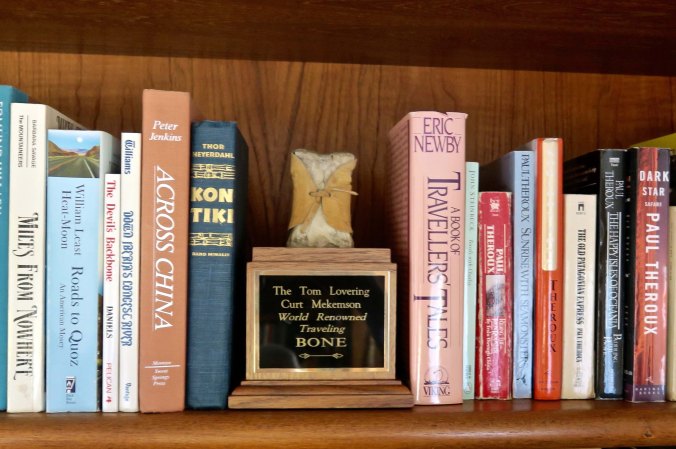
Normally, Bone likes to hang out in our library at home. His favorite section is travel.

He also has a fondness for George, the Bush Devil who is on the cover of my book, “The Bush Devil Ate Sam.” Here, the two of them share a laugh.

1980-81: Bone commenced his first World Tour with Tom.  He visited Asia including Japan, Hong Kong, Bombay, Delhi and Katmandu where he trekked to the base of Mt. Everest. He then wandered on to spend spring and summer in Europe stopping off in Greece, Spain, Portugal, France, Italy, Austria, Liechtenstein, Luxembourg, Germany, Belgium, England and Ireland. Getting cold, Bone headed south and hitched a ride in back of a truck through Algeria, Niger, Chad, Nigeria, Cameroon, Central African Republic, Zaire, Sudan, Kenya (where he crossed the Equator), Tanzania, Zambia, Zimbabwe, Botswana and South Africa. He signed on with Tom as crew of a sailboat in Cape Town and headed north to Mallorca, stopping off on the islands of St. Helena, Ascension, Cape Verde and Madeira. Back in Europe he explored his possible Viking roots in Sweden, Norway and Finland.

1983-86: Bone assumed Cheechako status and moved to Alaska with Curt where he was stalked by a grizzly bear on the Kenai Peninsula, explored Prince William Sound by kayak, learned to winter camp in 30 degree below zero weather while listening to wolves howl, backpacked in the Brooks Range north of the Arctic Circle, and discussed the finer points of eating salmon with Great Brown Bears in Katmai National Park. He escaped briefly to the warmer climate of Hawaii and participated in New Orleans Mardi Gras.

One look at this fellow and Bone decided that he wanted to be elsewhere.

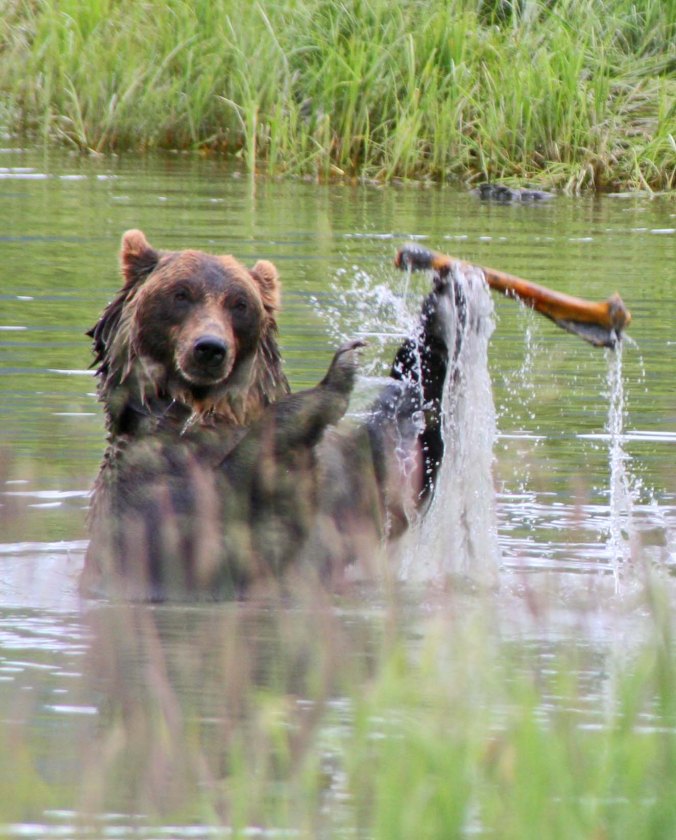
Alaska Brown Bear playing with moose bone.

The big guy was playing with a distant cousin of his.

1986: He backpacked the Western US for five months with Curt exploring the Grand Canyon, the Gila Wilderness of New Mexico, the Rockies, and the Wind River Mountains of Wyoming before returning to his beloved Sierras.

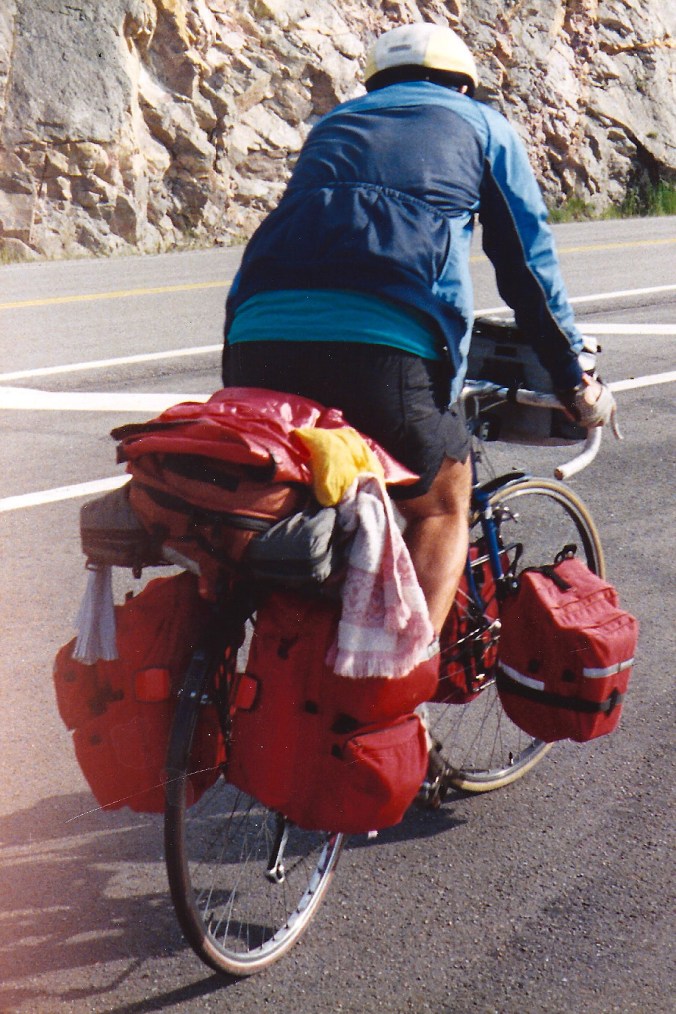
1989: Bone went on a six month 10,000-mile solo bike tour with Curt around North America visiting 18 states and 4 Canadian provinces. He ended his journey by meeting Peggy.

In the spring of 1989 I left Sacramento on my bike for a 10,000 mile solo trip around North America. Everything I would need to survive for six months on the road was packed on my bike, some 60 pounds of gear. It wasn’t totally solo. Bone was riding in my handle bar bag.

1990: The International Society of the BONE was formed at Senior Frogs in Mazatlan, Mexico, where Bone spent the afternoon being pickled in a pitcher of margaritas and being kissed by lovely senoritas.

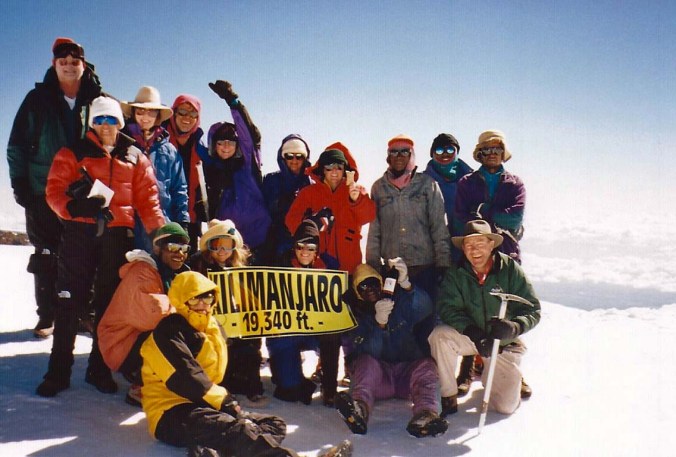
1991-97: Various members of International Society accompanied Bone on numerous adventures. Highlights included a White House Press Conference with Bill Clinton, being blessed by the Pope in St. Peter’s Square, visiting with Michelangelo’s David, going deep-sea diving in the South Pacific and Caribbean, doing a Jane Austin tour of England, and exploring the Yucatan Peninsula. A group adopted him as a good luck charm and took him back to visit the base of Mt. Everest one year and to climb Mt. Kilimanjaro another.

Bone loves high places. Here he is on top of Mt. Kilimanjaro in East Africa. (He’s with MJ, fourth from right, standing.)

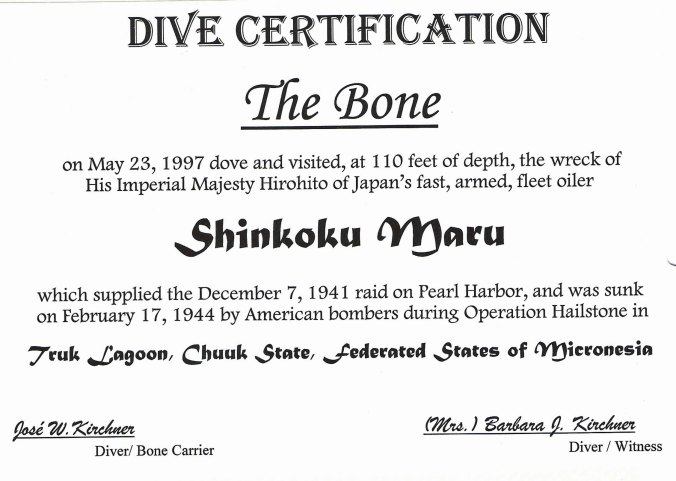
Bone went diving in the Pacific in 1997 with Jose and Barbara Kirchner, visiting a Japanese ship sunk during World War II and receiving his diving certificate.

1998-99: Bone embarked on 40,000-mile journey in the van, Xanadu, through the US, Canada and Mexico with Peggy and Curt, visiting over 30 National Parks, driving the Alaska and Baja Highways, checking out Smokey the Bear’s and Calamity Jane’s graves, kayaking in the Sea of Cortez, leaf peeping in Vermont, jetting to the Bahamas, pursuing flying saucers in Roswell, New Mexico, and completing his visits to all 50 states, etc. etc. etc.

Bone was quite impressed with the size of his ancient relatives. Here he rests on dinosaur toes at the Dinosaur National Monument Visitor Center.

2000-02: Bone journeys up the Amazon, returns to Europe, cruises to Belize, Cancun and the Cayman’s, and goes to New Zealand where a misguided customs agent tries to arrest and jail him as animal matter.

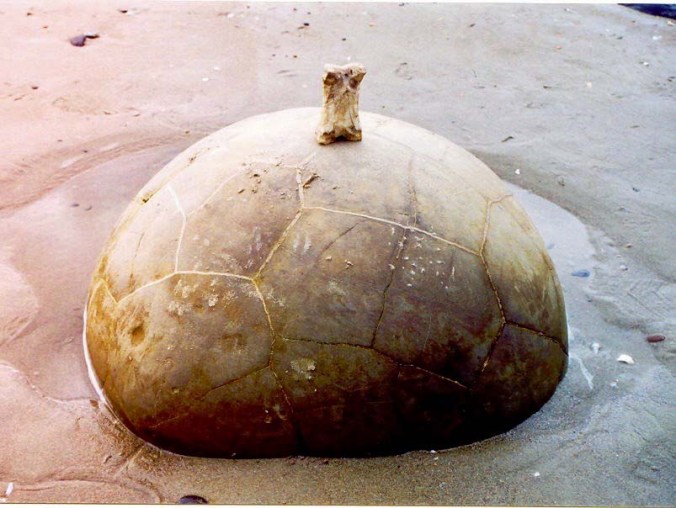
Peggy and I found this mudstone concretion in New Zealand on a South Island beach. Bone, who likes strange things, insisted on having his photo taken with it.

2003: Bone undertakes a 360-mile backpack trip in celebration of his discovery and Curt’s 60th birthday. They begin at Squaw Valley near Lake Tahoe and end by climbing Mt. Whitney. Various friends join them along the way.

Bone got a little high when he helped me celebrate my 60th birthday,  which isn’t surprising considering  he is a California bone.

2004: Bone visits Hemingway’s grave in Idaho, goes horseback riding with Australians and Bahamians in Montana, and makes his first pilgrimage to Burning Man in Nevada, a very Bone like type of place. He also jets off to Costa Rica.

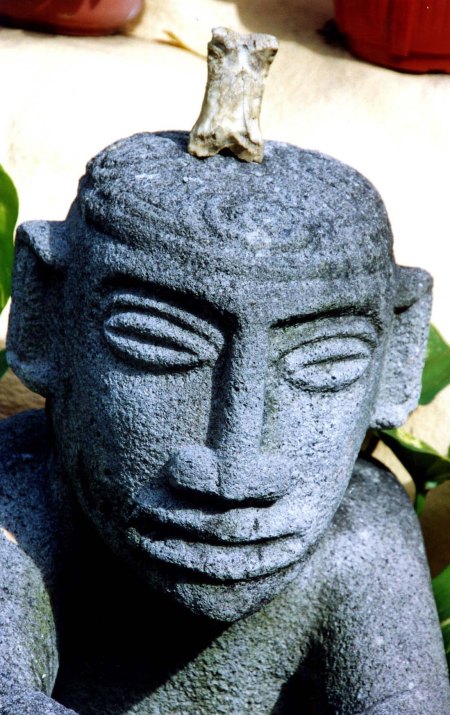
Bone has a love for anything ancient. Here, he perches on a Mayan sculpture in Costa Rica.

2005-2007: Bone returns to Burning Man twice and revisits Europe twice including special stopovers in Portugal, France, Holland, Germany, and Belgium. He also revisits Mexico.

2008 – 2011: Bone commences another exploration of North America. This time he travels in the van, Quivera, along with Curt, Peggy, and Eeyore the Jackass. His journey takes him over 75,000 miles of American Roads. In May of 2010 he helps Curt initiate his blog, and rafts 280 miles down the Colorado River through the Grand Canyon.

2012-2017: Bone goes into semi-retirement in Southern Oregon. Please note the semi, however. He continues the exploration of the West Coast ranging from Big Sur to Vancouver Island, where he kayaks for a week in search of Killer Whales. He wanders through England and Scotland helping Curt find his roots and spends a week traveling by Canal Boat. Later, he returns to Europe again, traveling through the Mediterranean visiting Turkey, Santorini and other Greek Islands, Dubrovnik, Venice, Rome, Pompeii, Florence, and Barcelona. He returns to Burning Man several times.  On one trip, he is married to the lovely Bonetta, who he met while exploring a swamp in Florida. Rumor has it that it was a shotgun wedding. This past year he traveled with Peggy and me on our 10,000 mile trip around North America retracing my bike route and with fellow blogger Crystal Truelove to visit with Native Americans of the Cherokee Nation in Oklahoma.

Burning Man is one of Bone’s all-time favorite activities.

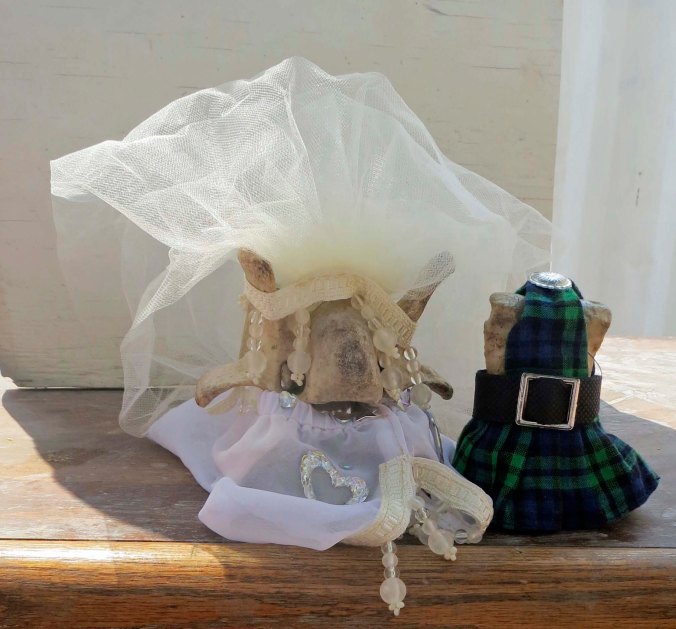
Bone and Big Nose Bonetta are married at Burning Man 2013. Bone’s kilt was made for him by an 80-plus year old woman from Kansas. Bonetta is wearing a designer wedding dress with very expensive plastic jewelry to match.

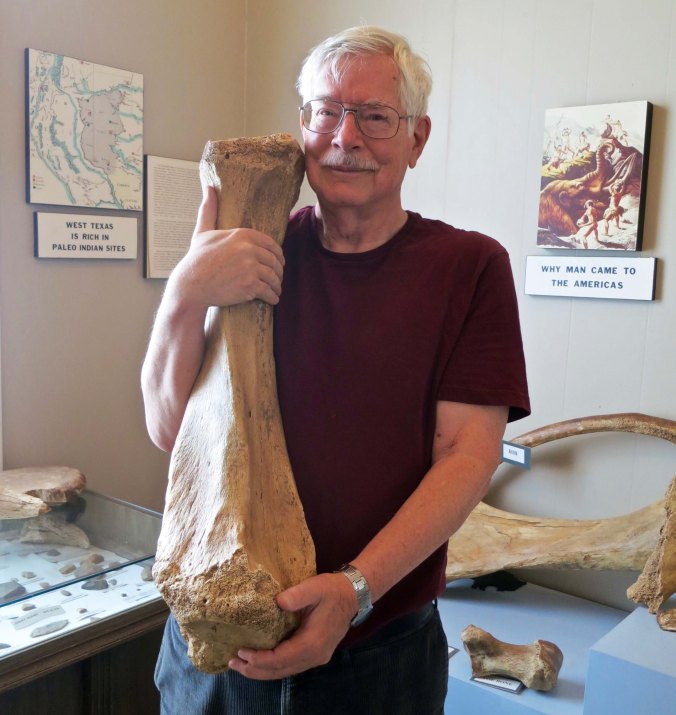
Bone got a wee bit jealous when I snuggled up to this mammoth of a bone when Peggy and I were re-visiting by van my 1999 10,000-mile bike trip last year.

TOMORROW’S POST: You won’t want to miss the interview with Bone!

SaveSave

SaveSave

Homeland Security Goes Searching for a Bomb… Rafting through the Grand Canyon: Part 3

Essential Grand Canyon supplies DG

All of my wilderness experiences have been motivated by a go-light philosophy when it comes to food, which makes sense if you carry it on your backs. River runners, on the other hand, have rafts to carry everything. Other rules apply. Extra pounds don’t matter. And if you are going to carry all of these oranges, you might as well carry some alcohol to mix with your orange juice. (Photo by Don Green.)


The fact that we were full-time travelers made our Grand Canyon trip easier. There was no house, mail, job, pet or the other factors of normal life to worry about. We just pointed our van toward Flagstaff and drove, stopping along the way at places like Arches and Bryce Canyon National Parks.

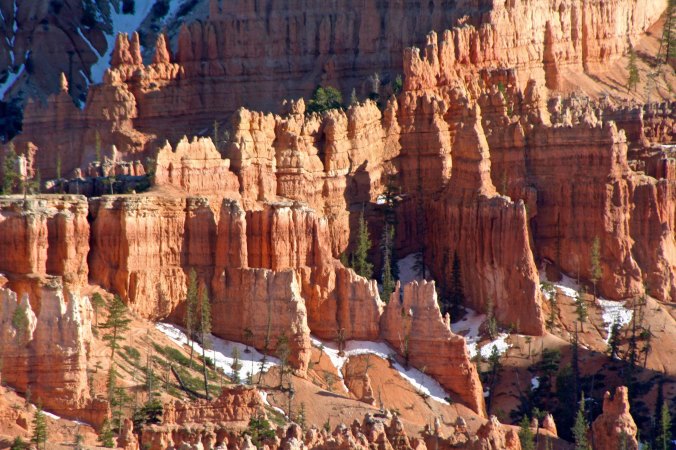
Bryce Canyon

While our fellow rafters were scurrying to wrap up business to prepare for our 18-day raft trip though the Grand Canyon, Peggy and I were visiting Nationals Parks in Utah. This is Bryce Canyon.

Bryce Canyon 1

Another view of Bryce.

Great adventures usually start with mundane tasks, as most of you know. For example, did you cancel the paper? Common sense, travel pundits, (and probably your mother) admonish you that devious burglars have nothing better to do than to cruise the streets looking for rolled newspapers in front of your home.

More importantly, what about the cat?

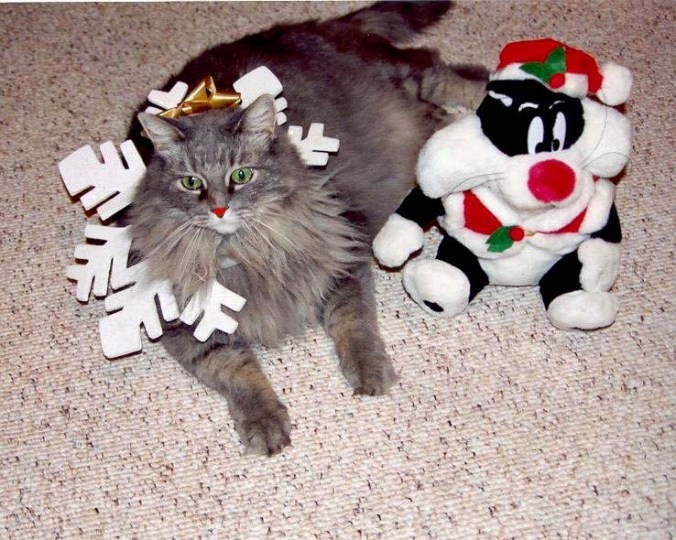
Once upon a time Peggy and I had a cat named FE. Vacations meant I would carefully measure out twice as much food and water as she could possibly eat or drink and four times the kitty litter she might use. The likelihood of her using our house as a litter box was much greater that the likelihood of her starving. As a reward for my thoughtfulness, she would shed enough fur in our absence to fill a dump truck. For weeks after we arrived home, she would also pad into our bedroom in the wee hours each night and meow loudly to make sure we hadn’t abandoned her again. Or possibly it was punishment…

FE and Sylvester dressed for Christmas

FE and her buddy, Sylvester, dressed for Christmas. Note FE’s Rudolph-red nose. I recall that a bit of photoshopping was required to get her ready for the Christmas letter.

We weren’t getting off scot-free on preparation for the river trip, however. In Flagstaff, we had food to worry about. Lots of it. Tom Lovering, his wife Beth and their friend Jamie Wilson arrived in Flagstaff three days in advance of our Colorado River trip. Their car was packed to the brim with empty ammo cans for things like cameras and huge ice chests for food. They were late.

The Department of Homeland Security had delayed their journey at Hoover Dam. The Agency is paranoid about mad bombers, rightfully so. And this was before the new bridge across the river had been completed; people still had to drive across the dam. A vehicle packed with C-4 could conceivably blow a big hole. Stern faced agents carrying guns were posted at each entrance. No smiling was allowed. Homeland Security’s normally low sense of humor (have you ever joked about a bomb during a security check at an airport) dropped to zero when the agents saw all the ammo cans Tom had packed in his vehicle. Rafters love these containers because they are waterproof and easily obtainable at Army Surplus stores. You can imagine what went through the minds of the agents. The whole car had to be unpacked and each ammo can carefully checked out.

Tom Lovering

This was the face that Tom greeted the Homeland Security agents with— furry but friendly. His looks were about to change…

Tom getting a do

Tom getting a ‘do’ in Flagstaff…

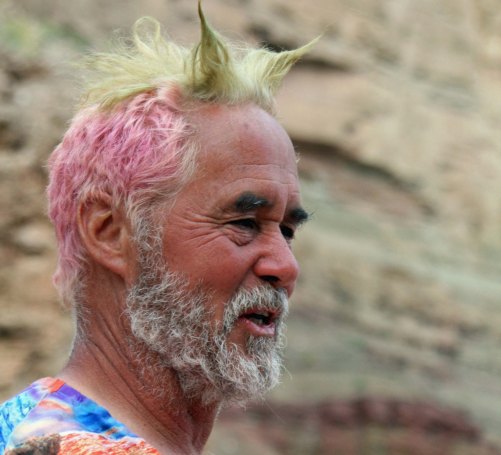
Tom Lovering with horns

What if Tom would have met the agents looking like this with green horns? We still might be waiting for him in Flagstaff.

Tom is even more paranoid about food than DHS is about terrorists. In addition to being a highly experienced rafter and trip leader, he’s an old restaurateur who had spent months planning the menu.  Each dish had been tested several times and quantities had been measured down to the teaspoon. Recipes were spelled out in minute detail. We would eat gourmet on the trip and cook it Tom’s way— or die. The options were clear.

Beth, Peggy and I were dispatched to Sam’s Club with marching orders. We filled seven large shopping carts with food. Think of it this way. There were 16 people going on an 18-day trip and eating three meals a day. This equaled 864 individual meals.

When we arrived back at the motel, Tom and Jamie had set up a staging area. Food needed to be organized by meal and day and then stuffed in the appropriate containers. The containers would then be assigned to rafts. It was important that we knew where to find the beer.

Large food containers for Grand Canyon trip

Large food chests waited for us when we got back to our motel. Each would be filled with food. Dry ice would be added to keep our food fresh for 18-days.

We still had to shop for perishables and more food was also coming from Sacramento. Our room, we discovered, was to be the recipient of most of the food. Apparently, it was written into the fine print of being ‘permit holder.’ There was barely space to sleep. Not that we slept much. Soon, we would be on the river! But first, Bone had to be appropriately dressed for his trip.

Supplies for Grand Canyon trip

We went to Safeway to purchase our perishable goods, and once more our small RV was filled to the brim.

Gear and food Grand Canyon trip

We discovered that the majority of the large food containers would be stowed in our room. With our own gear spread out on the bed, it was questionable if we would have room to sleep! Tom provides a perspective on the size of the ice chests. The yellow container is an ammunition can.

Bone in life vest

One of our final responsibilities was to make sure that Bone was adequately dressed for the trip in his PFD. Once, he almost fell off a boat in the piranha infested water of the Amazon. It would not do to lose him in the roaring rapids of the Colorado. Next Saturday and Sunday, I will provide background on Bone since he was an active participant on the river trip.

Loading truck for Grand Canyon trip DG

Finally, it was time to load our food and gear on this truck for transport down to Lee’s Ferry and the beginning of the trip. The truck was completely stuffed by the time we were finished. We were finally on our way! (Photo by Don Green.)


WEDNESDAY’S Photo Essay POST: A river boat trip on the Amazon River. The piranhas are biting and we bite back.

FRIDAY’S MisAdventure’s POST: There is nothing like reading to seduce you into becoming a wanderer.

MONDAY’S Travel Blog POST: We start our raft journey through the Grand Canyon with 30 MPH headwinds. So much for a peaceful (between rapids) float down the Colorado!


SaveSave

SaveSave
SaveSave