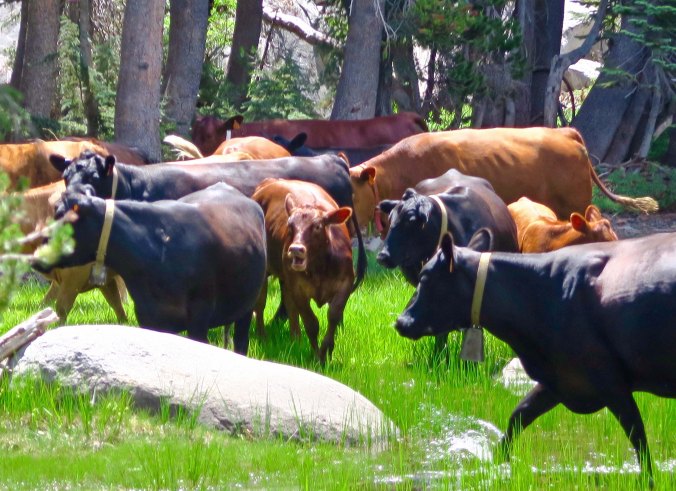
Cannibal Dogs, a Clean Cat, Witches and Other Murals… Burning Man 2017: Part 4

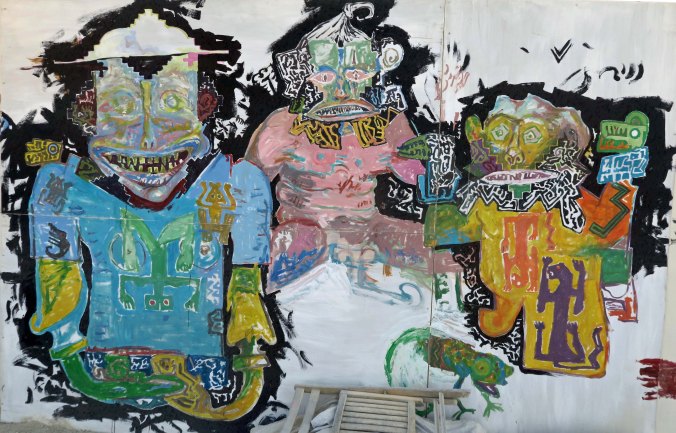
“Double, double, toil and trouble; Fire burn and caldron bubble.” Macbeth immediately came to mind when I saw these three lovelies on a mural in Black Rock City. This seemed to fit Burning Man’s 2017 theme, Radical Rituals. And why do witches come in threes so often?


Murals have been around for a while. Try 30,000 years. Those ancient cavemen and women painting on the dark walls of their caves in Europe had a message they wanted to pass on, as did the prehistoric artists of the Southwest pecking out their messages on rock 3000 years ago. In modern times, graffiti artists have used their spray cans to mark out their territories and declare “I was here,” irritating competing gangs and the public as well, which, I’m pretty sure, was the point.

Street art has become more sophisticated today, and more acceptable. Major cities and small towns alike want a piece of the action. You are as likely to see a mural in a small Midwestern town as you are in Paris, Moscow, Rio or New York. The best of the street artists have found fame, and even a bit of fortune.

Not surprising, street art has made it to Burning Man. Murals may show up anywhere in Black Rock City, but a special place is reserved for them on the back wall of the Center Camp Café. I always try to include a few in my review of Burning Man art because it is representative of the art form, and, more importantly, I am fond of murals. They often show up in my blogs when I travel, and, I might note, they often show up in the blogs of the people I follow.

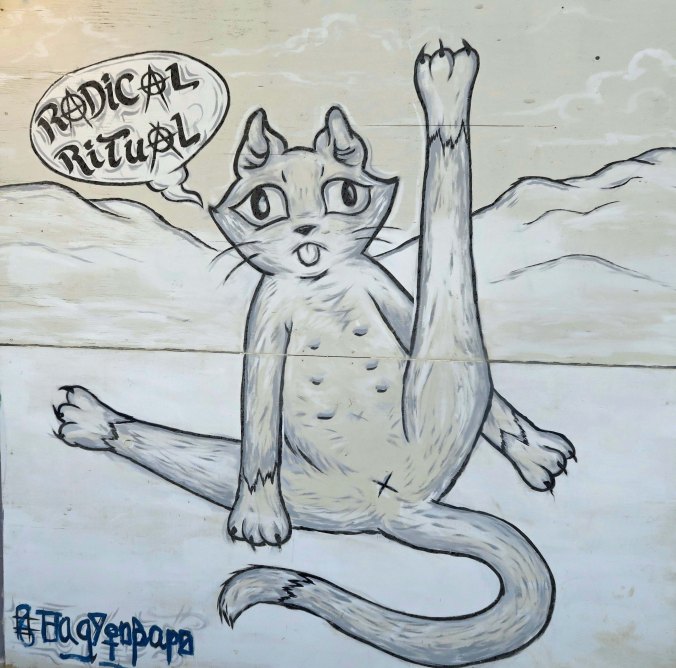
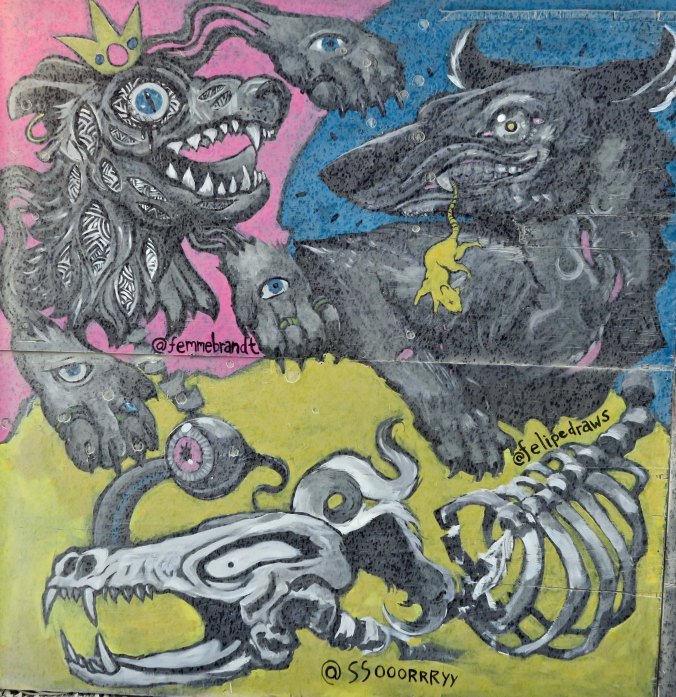
As you might imagine, Burning Man art can get a little weird. Take the cat below, for example. If you have a cat, you have noted their hygiene practices, and possibly even been a little embarrassed by them when the boss or the in-laws are over. But cats are cats, and, for all I know, they may do it on purpose during awkward moments. You might make your dog feel guilty about the practice, but never your cat. Speaking of dogs, they were featured on a mural as well.

Okay, this is a bit outrageous… But you have to admit, it is a cat ritual.

I may have seen this as a cartoon a long time ago in a New Yorker, but Karen Strauss’s mural on rituals made me laugh.

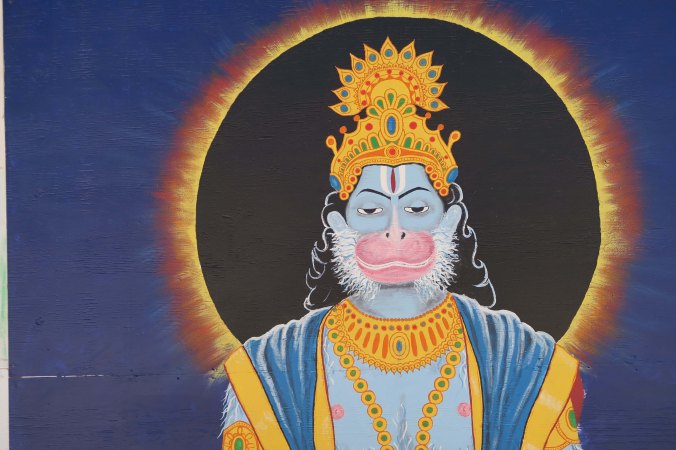
I can easily get lost on the Net when I try to find a particular Black Rock City mural artist. I never know where the search will take me, if anywhere. For example, Papa Witch caught my attention. I watched him work, found his monkey/ape charming, and was intrigued by how he signed his work.

Papa Witch, Chokae Kalekoa, paints the Monkey King on the wall behind the Center Camp Cafe at Burning Man.

I thought the Monkey King was quite regal.

My Papa Witch search eventually took me to Chokae Kalekoa, who was doing a fundraiser for a 2000-mile bike ride he was going on through the West. He declared, “The Conscious Relaxation that is achieved By Shutting my Monkey Mind, reveals a state of ok-ness that allows me to Mindfully Work, Artistically Create and Frolic to the best of my ability.” He taught meditation and promised, “I hereby pledge that on this 2000-mile odyssey bicycle ride, I will get 2000 people that I meet along the way to frolic and meditate with me.” He was shooting to raise $5,000. Darn, I thought, why didn’t I think of that for the 10,000-mile ride I did around North America. An equivalent amount would have been $25,000! But it wouldn’t have worked. I didn’t have the desire to frolic with 10,000 people, and I certainly didn’t have the stamina. Can you imagine frolicking with 100 people at the end of a 100-mile day on your bike?

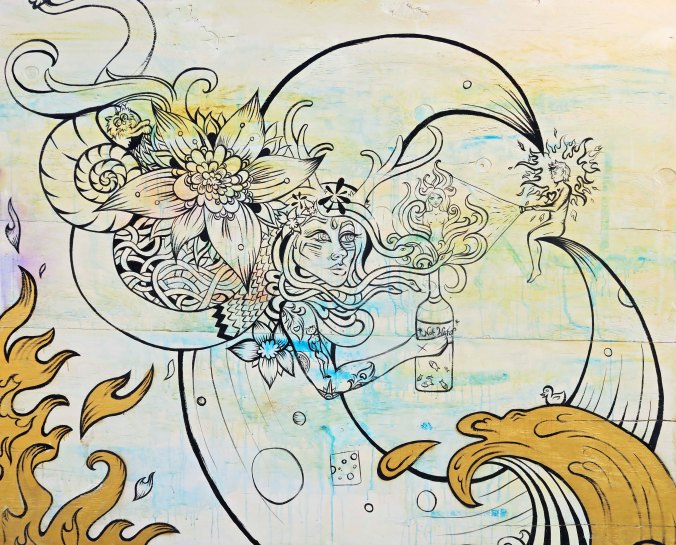
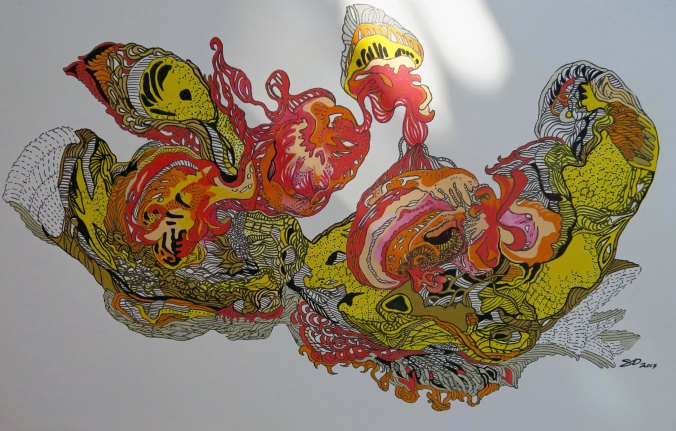
Like much art work, most of the murals leave the viewer to make up his own interpretation of what he is seeing. So, I have, liberally. My apologies to the artists in advance. They are certainly free to correct me. Do you have any unique interpretations you would like to add?

This mural was quite clear And meaningful. Not drinking water at Burning Man can get you in a heap of trouble.

This mural, right next to the drink water mural, made me chuckle again. The sign on the bottle says “Not Water.” Note the sleepy-eyed cat up above. I found three among the murals.

These mermaids included the third cat, and a flying saucer.

This is weird. I am sure that the symbols tell a story. One look at the teeth and I promptly named the mural, “Dentist’s Dream,” however.

Another strange one, but I liked it. Note the name, Femmebrandt. I called this one, “The Eyes Have It.”

Does this remind you of anything? I got stuck on GOP. How else are you supposed to interpret an elephant with wild orange hair. I’m pretty sure that isn’t what the artist had in mind, but…

I thought of global warming here, which may say more about how my mind works than the mural. But I saw the water lapping at the city and thought of poor Houston. Frogs aren’t doing very well with global warming either.

Another artist works on her mural. The post says, “It’s for all of us.”

Go with the flow.

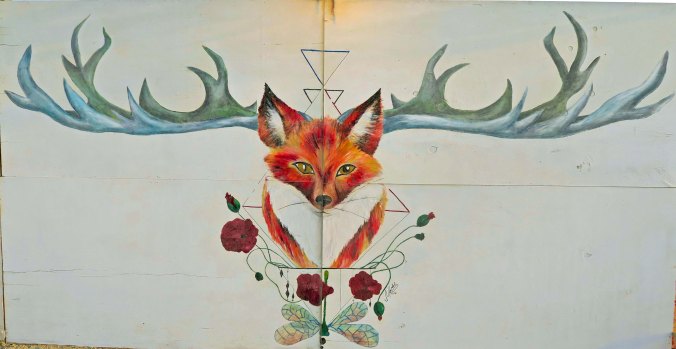
Daliesque, I am thinking. This fox had quite a rack.

And finally, bring it on!

NEXT POST: I wander around the outer edges of Burning Man.

SaveSave

SaveSave

SaveSave

SaveSave

A Giant Jellyfish and a 180,000 Penny Bear… Burning Man 2017: Part 3

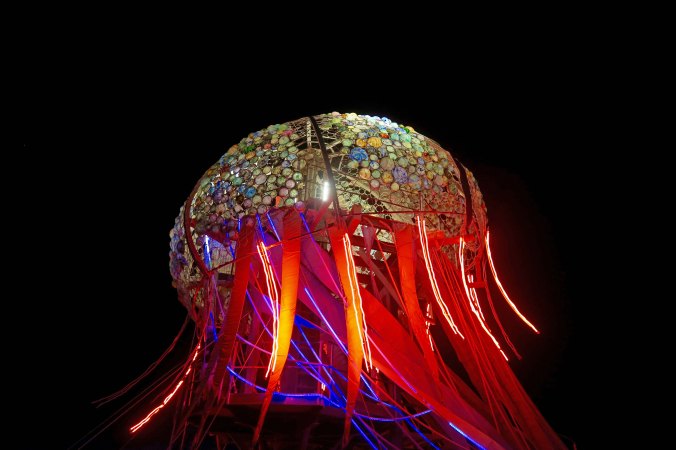
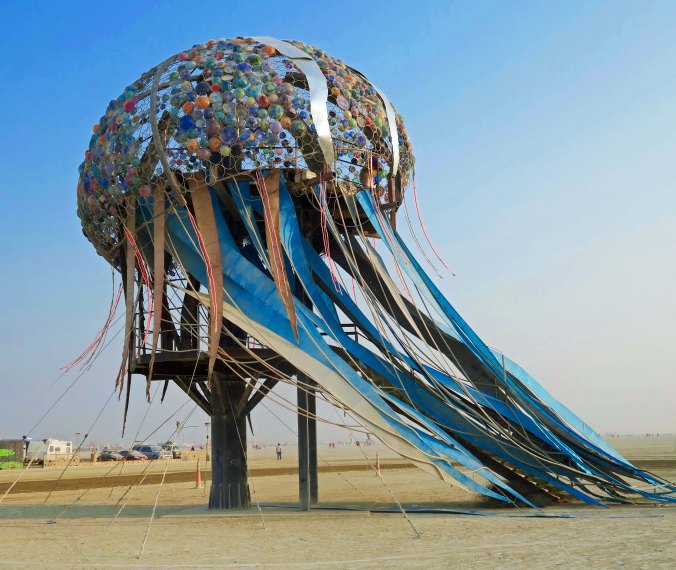
A giant jellyfish, created by the artist Peter Hazel, was located in front of the Center Camp Cafe at Burning Man this year.

I wasn’t all that surprised to find a forty-foot-tall jellyfish hanging out on the Playa. It was Burning Man, after all. Plus, I had seen pictures of it—I’d previewed the art I could expect to find in Black Rock City this year. Don’t get me wrong, I love surprises. There is magic in finding something you have never seen before, and can’t even imagine seeing. But my time was limited. I had three days: Thursday, Friday and Saturday. I was staying on Sunday as well, but artists start removing their art then. Or it has been burned. And I wanted to be sure I caught the major works. There were dozens of them scattered over the Playa, spread out as far as the eye could see.

Peter Hazel was a construction worker in tile and granite in another life. I imagine that he was a good one, that he took pride in his work, maybe even regarded it as art. But his world view shifted significantly a few years back when he made a trip to Barcelona and came in contact with the uniquely inspiring art of Antoni Gaudi. The world lost a talented contractor, and gained a talented artist.

I get it. Peggy and I were in Barcelona a few years back as well, maybe even around the same time Hazel was visiting. I wrote this for a post I published then:

Barcelona arrived in the Twentieth Century with its own brand of Art Nouveau, Modernisme. Combining whimsical and practical with a healthy dollop of nature, Barcelona’s artists and architects did a makeover of their city. Antoni Gaudi (1852-1926), the best known among the Modernistas, added a strong religious belief to his work and became the architect of Sagrada Familia, the Church of the Holy Family.

Started in 1883, the church continues to be a work in progress today. Like the towering cathedrals of the Gothic and Renaissance periods, it is a work of generations, and like the great cathedrals of Europe, is a masterpiece of art and architecture. Peggy, I, and our traveling companions walked inside and could only stare up in awe.

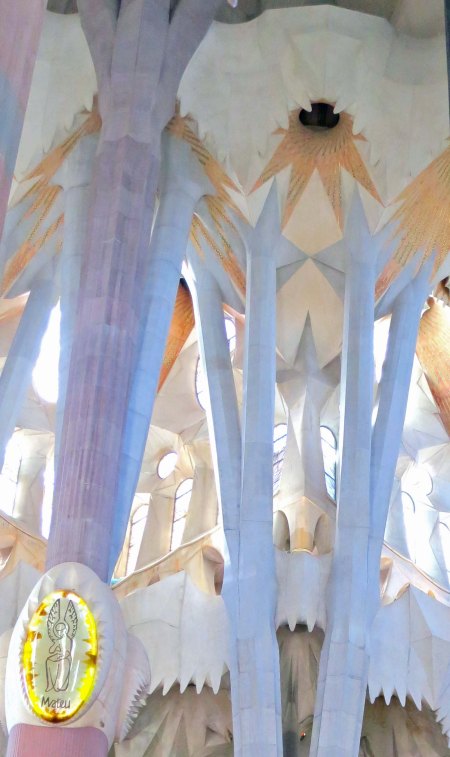
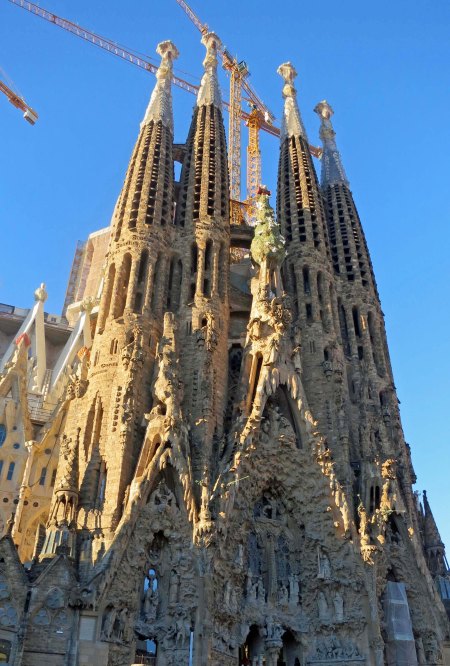
Here are a few photos Peggy and I took that illustrate why.

Looking up inside of Sagrada Familia in Barcelona.

Another view inside of Sagrada Familia designed by Antoni Gaudi.

An outside view of the Cathedral, which is still under construction.

The outer walls feature very modernistic looking sculptures like these.

The recent terrorist attack in Barcelona was recognized this year at Burning Man by this sign put up in the Temple by Burners from Barcelona.

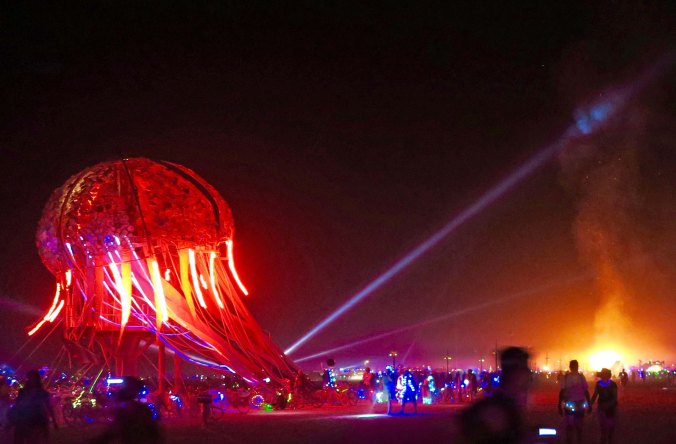
The forty-foot-tall, thirty-foot-wide jellyfish Peter created had a position of honor on the Playa. It stood in front of Center Camp in a direct line with the Man and the Temple. Each year, BMORG (the Burning Man Organization), selects an artist to place his or her work here. Almost always, the artist is someone who has had art at Burning Man before and has already impressed the organization and the participants with her/his creativity and talent. The jellyfish had an appropriate jellyfish-look from a distance. Up close, you could see that it was made up of small jellyfish, some 2000 of them, each one carefully placed in a large steel structure that had been built to accommodate them. Glass had been broken, reshaped, and fired to create the small jellyfish. Some eight kilns and a lot of volunteers were kept busy in the process. I followed a set of stairs up into the belly of the jellyfish and them climbed higher on a ladder so I could see how the work had been put together, and take advantage of the height to see out over Burning Man. I made the journey twice— once during the day and once at night.

Hazel’s Jellyfish during the day.

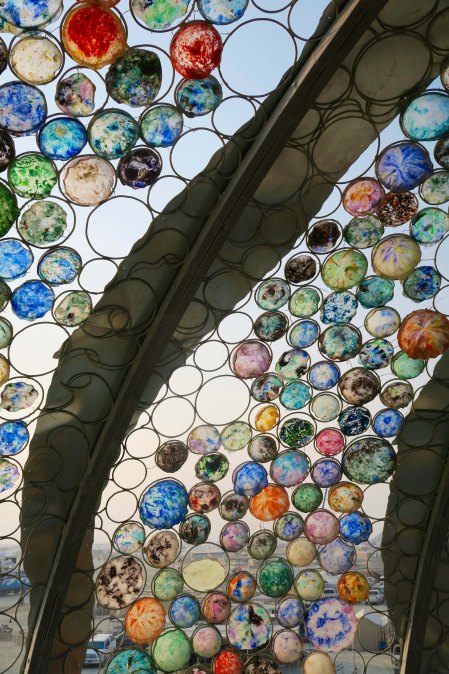
A view from inside of the small jellyfish, each one unique, that made up the skin on the large Jellyfish.

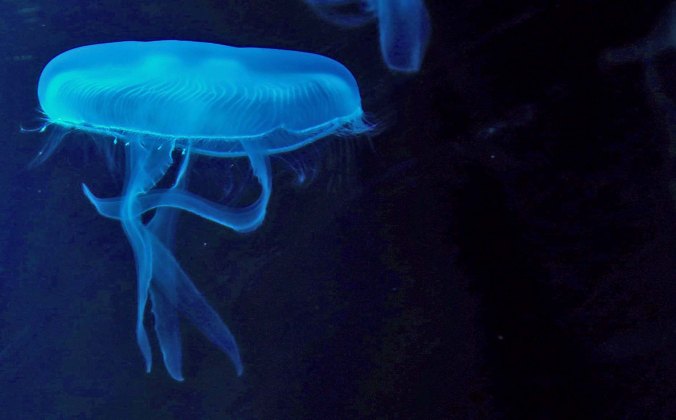
A small jellyfish I photographed at an aquarium in Charlotte, North Carolina earlier this year.

Looking back toward the Center Camp Cafe from up inside the Jellyfish during the day…

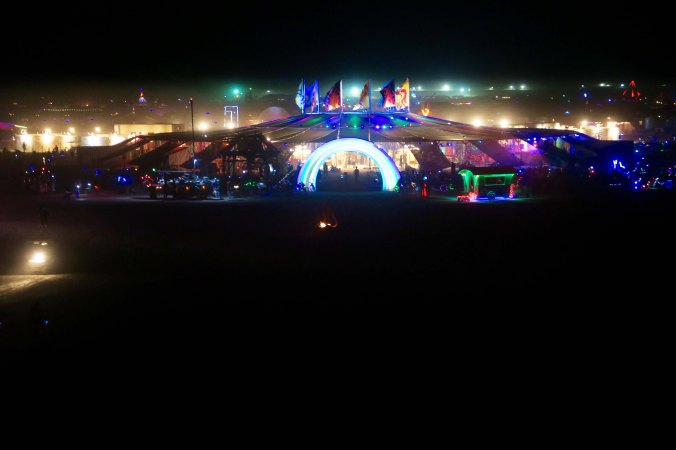
And at night.

Looking out toward the Man past the jellyfish on the night the Man burned.

Back in the 1800s, the challenge of creating animation was solved by a device known as a zoetrope. Slits were carved in a cylindrical device that contained still representatives of a bird in flight, a horse running, or some other action sequence. Several representations of the bird, horse, etc. would be included opposite each slit in a slightly different stage of movement. The cylinder was then turned rapidly with an individual looking through the slits as they passed by his eyes. The result was an illusion of motion.

A similar illusion was created when we were kids by having the illustrations drawn on separate pages of a small book. We would rapidly flip through the pages with the same results. You wouldn’t believe what Mickey and Minnie were up to. Bad mice! The books weren’t anything we wanted to take home to our parents. I don’t have a clue where they came from, but so much for the vaunted innocence and safety of the 1950s.

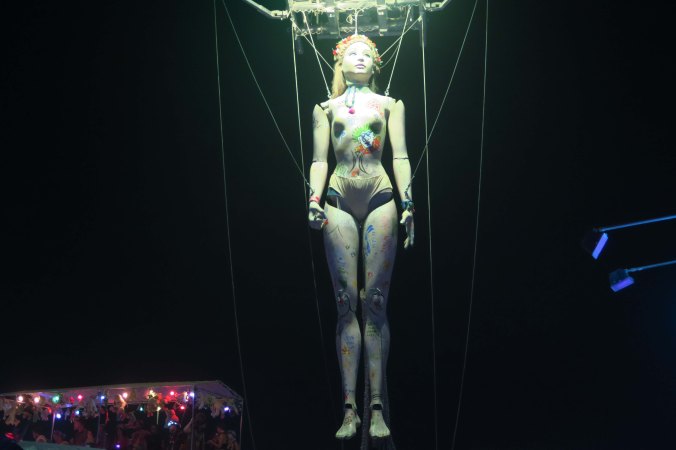
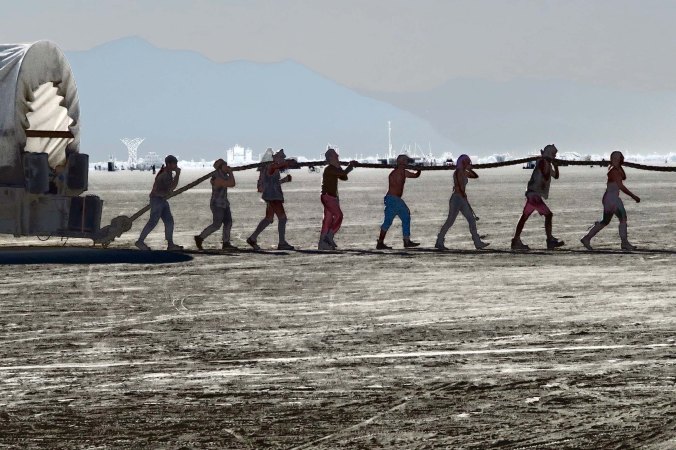
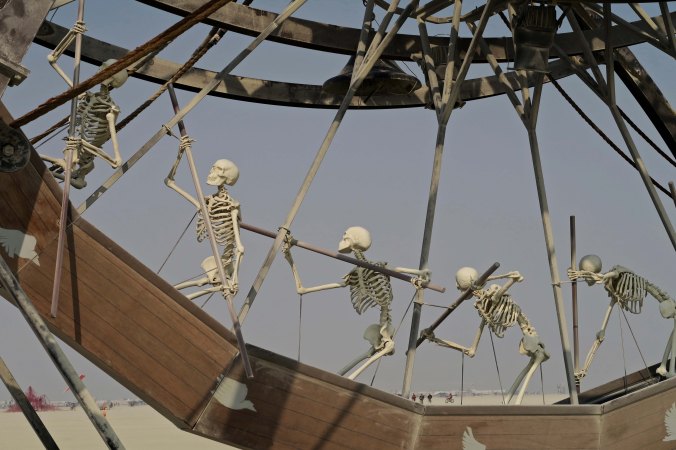
Peter Hudson’s creation, Charon, operating under the same principles as a zoetrope, rotated rapidly and created the illusion of movement— in this case, Charon rowing his boat across the River Styx. Ropes, hanging down from each side, were pulled by Burners in unison to make the sculpture rotate.

The Bay Area artist Peter Hudson, or “Hudzo,” as he bills himself, has taken the zoetrope idea to new heights by using life-size figures and strobe-like lights to achieve the movement effect. His works of art are interactive. People pulling ropes or riding bikes in unison cause the art piece to rotate and give the desired effect. He’s had several different works at Burning Man.

This year he returned to an earlier piece that featured Charon, the ferryman of Greek Mythology, who transported dead Greeks across the River Styx.  The Greeks would put a coin in the mouth of their dead loved ones to pay Charon. No coin, no transport! The poor were left to wander for a hundred years or so on the wrong side of the river. Once across, the dead would make their way past Cerberus, the three-headed dog, into Hades where they would exist forevermore as shades. Cerberus wasn’t there to keep them out; he was there to keep them in. And he was really good at it. If you’ve watched the Harry Potter series, you have a good idea of what a three-headed dog might look like— and how it might drool. My old Basset Hound Socrates didn’t have three heads, but he did have the drooling part down pat, especially if we were eating cheese. When he shook his head to clear the drool, it would slime all four walls of our small apartment… and us.

A close up of the skeletons. Note that each one is in a slightly different position. Charon as a skeleton is a fairly recent adaptation. Originally, he was depicted as a smelly old man.

I was out exploring in the Playa on Horse with No Name and had dismounted to check out some art when a Burner said to me, “Look this dragonfly just landed on my hand. It must be lost.” Indeed, a dragonfly had landed on the hand of the guy who looked like a long-time Burner. They come with a certain patina. I dutifully took a photo.

The dragonfly that came to visit Black Rock City.

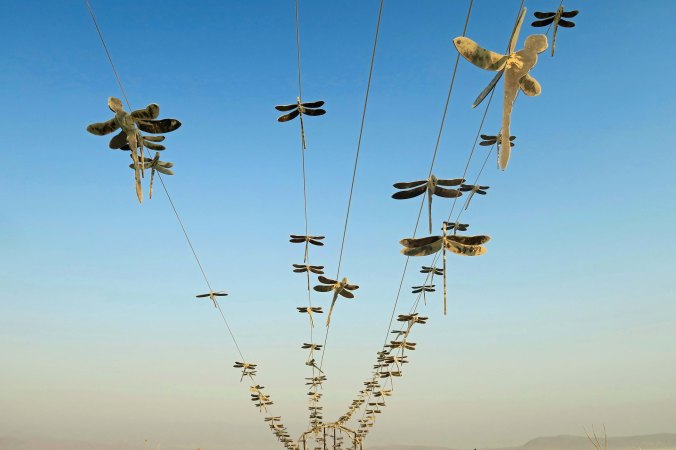
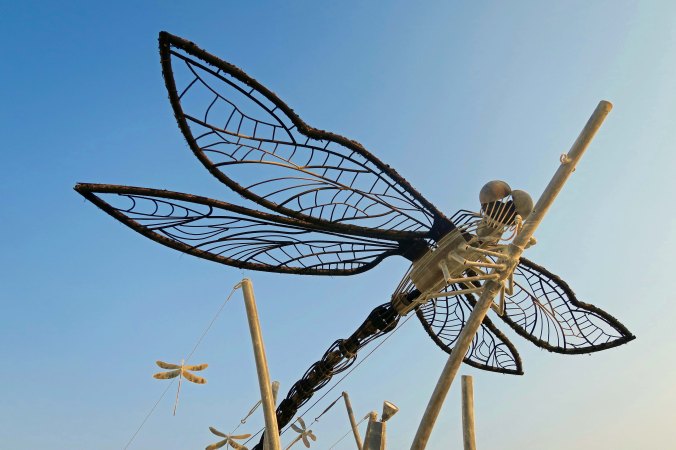
Maybe it was fate. Shortly afterwards I came on a sculpture of a large dragonfly at the head of a whole lot of little ones that were escaping from a bottle held up three, headless guys. Acolytes, I was informed. The piece, titled Flight of Illumination, was created by Iron Monkey Arts out of Seattle. The acolytes, so the story went, had gone their own way but learned that working together was better. “The world is cold and lonely when you are a self-centered dick,” the literature about the sculpture told me. So be it. We can all use a little illumination.

The acolytes release the dragonflies in the Flight of Illumination.

Who then flew across the sky…

Ending with this big fellow.

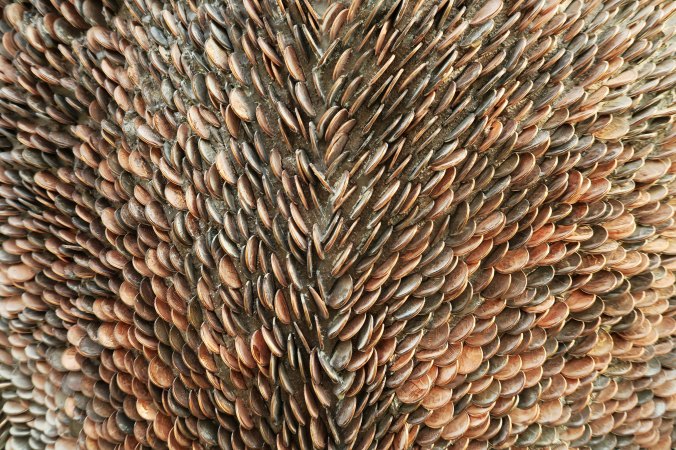
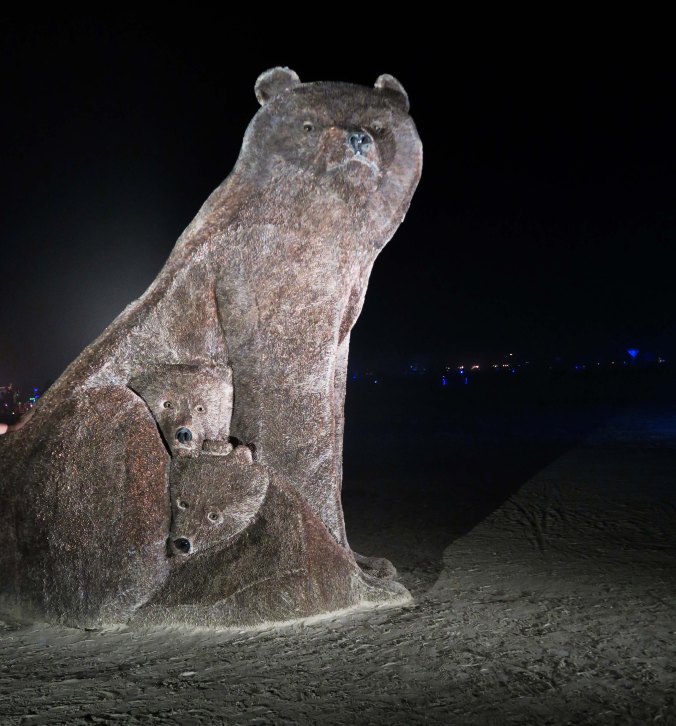
Bear with me here, for my final sculpture today. This one has to do with 180,000 pennies, attached as fur on (you guessed it) a giant bear known as Ursa Major. If you’ve been around my blog for a while, you may remember Penny the Canadian Goose from a couple of years ago covered with Canadian Pennies. This year, Lisa and Robert Ferguson out of Oakland, California, the creators of the goose, decided to go with a grizzly. The couple met and fell in love at Burning Man in 2008 and have been creating art for the event ever since.

A close up of the bear’s fur that is made out of pennies.

Ursa Major and her two cubs at night. I don’t think that you would want to mess with the mama.

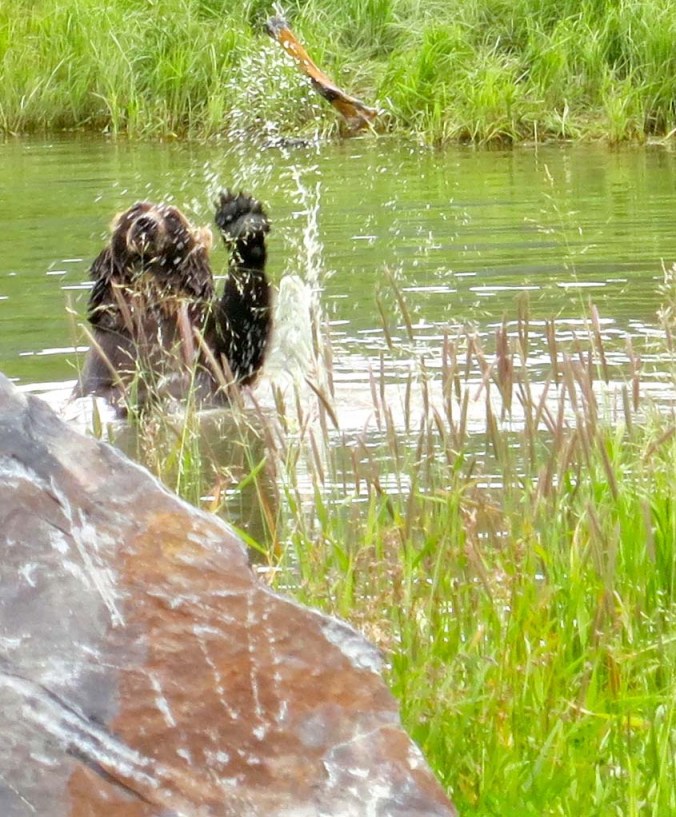
Alaskan Brown Bear

Just for fun, I thought I would finish this post with a picture Peggy took of a brown bear a couple of years ago in Alaska playing with a moose bone it had found by throwing it up in the air and catching it, again and again. Check out those claws!

NEXT POST: A look at some murals at Burning Man 2017. You won’t want to miss the cannibal weeny dogs.

SaveSave

SaveSave

SaveSave

SaveSave

SaveSave

SaveSave

SaveSave

I’ve Been Through the Desert on a Horse with No Name… Burning Man 2017: Part 2

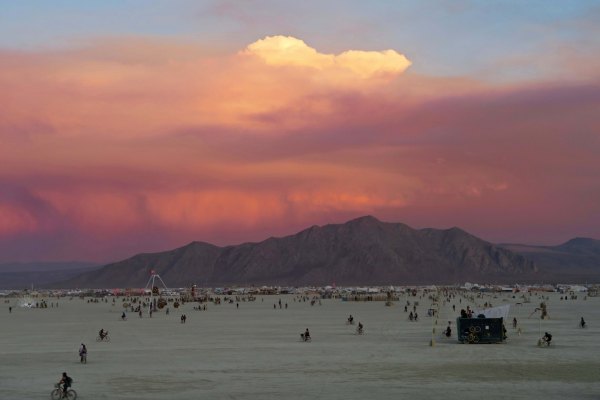
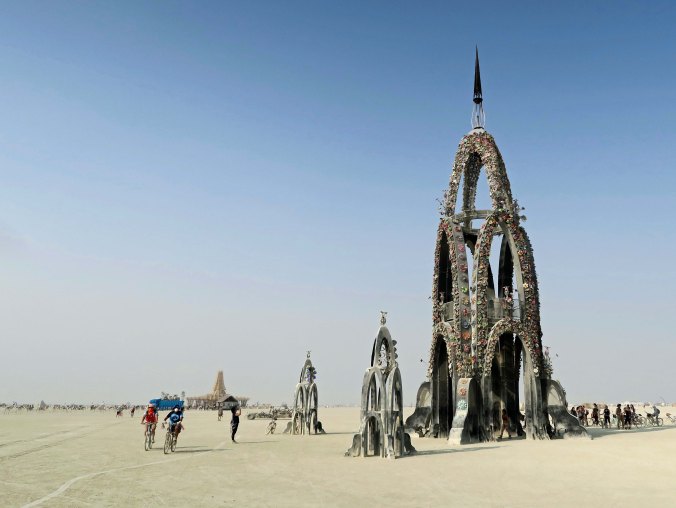
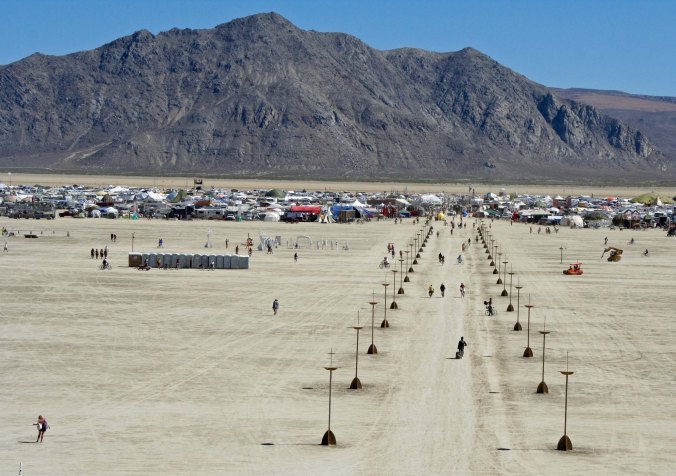
A bike is critical to traveling around the Playa and through Black Rock City. Distances are substantial, as this photo demonstrates. I took this photo from the Man. Looking the other direction would provide a similar scene.


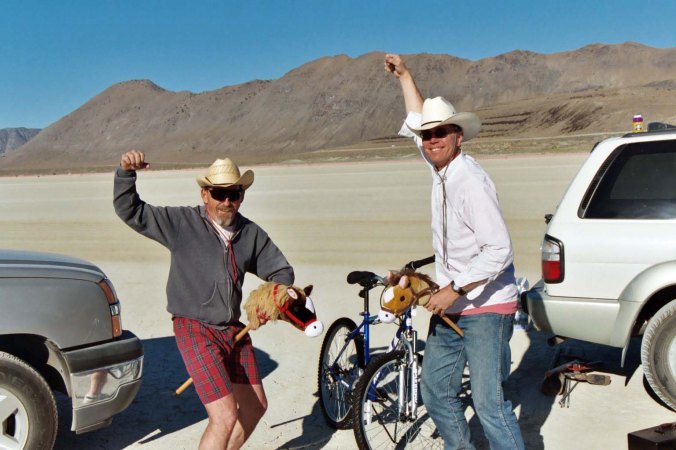
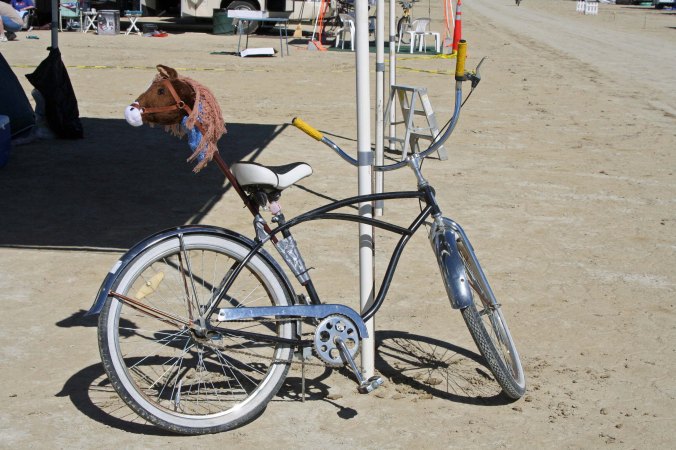
When I made my second trip to Burning Man in 2005, my friend Ken Lake brought along stick horses— the type that are popular with five-year-olds— to put on our bikes. They served as decorations and a way of quickly telling our bikes apart from the tens of thousands of others that reside in Black Rock City. If you pinched their ears, they went clippity clop, clippity clop, neigh, snort. Naturally, we had to name them.  Horse with No Name popped into my mind. I would be riding through the desert on my horse-bike, and I’ve always liked the song written by Dewey Bunnell. There’s more. Bunnell was inspired to create the haunting music by memories of his childhood travels through Arizona and New Mexico, a Salvador Dali painting of the desert, and a strange horse depicted by M.C. Escher. The fact that I am a fan of the Southwest, surreal art, and Escher was frosting on the cake.

Ken Lake, on the left, showed up with stick horses in 2005. Here, he and Don Green try out our new horses before attaching them to our bikes.

Horse with No Name is something of a contrarian and likes to see what is being him.

The seven squares miles covered by the event requires a bicycle, so I’ve been riding Horse with No Name on my trips to Burning Man ever since. I suspect I’ve put on several hundred miles during my 11 trips into the desert. The bikes have changed, and the stick horses have changed, but the name has remained.

As I’ve noted before, my primary reason for going is to see the art. It’s located everywhere. Even with a bike, it’s difficult to see it all— and I always miss pieces. This year, I had to skip the first four days because of forest fires threatening our home. I only had three days to cover what I normally do in seven. I was on the bike a lot. My tail was complaining loudly by Sunday. (For those of you who have been following the saga of the burning forest, we are out of the woods, so to speak. Level 1, 2, and 3 evacuation notices have been dropped.)

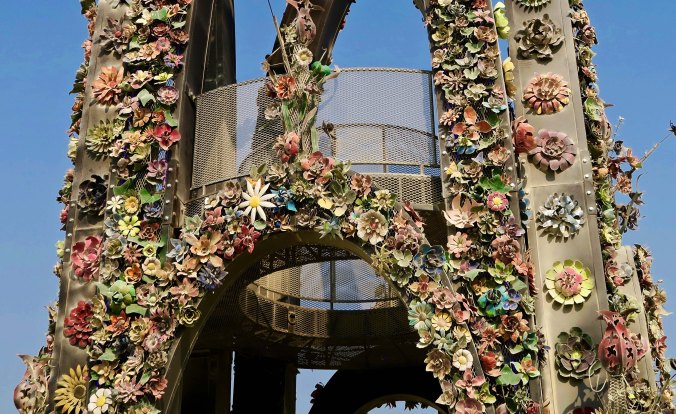
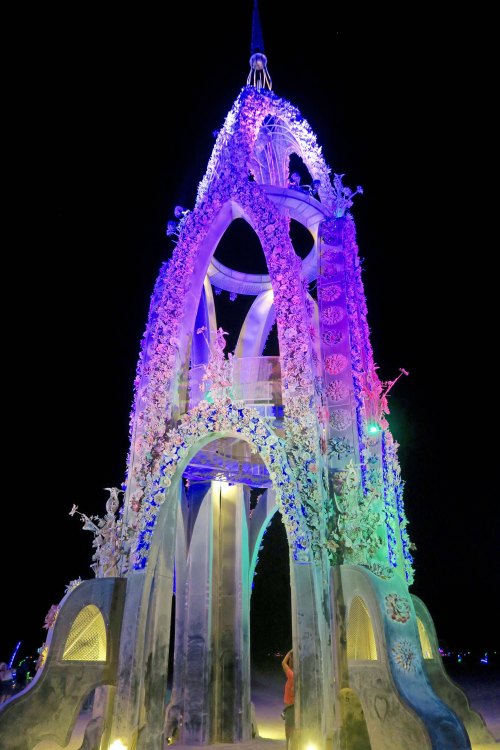
The art at Burning Man ranged from this 70 foot tall Flower Tree Temple…

To this very realistic looking tree that provided shade from the desert sun during the day and was beautifully lit up by night.

There are other things to do at Burning Man besides look at art, of course. For example, you can party 24/7 for a week if that’s your thing. Bars ‘gifting’ free booze are located on almost every corner. You can also dance the night away, or day. I saw people dancing country along the 6th street route I followed into Center Camp, and I could have gone elsewhere to learn to Tango, had I been so inclined. The most common music, however, is the type that goes thump, thump, thump in the night, industrial strength stuff. World renown DJs come to Burning Man to play it for free. The music will keep you awake if you allow it. I have a very loud, battery operated fan that serves as a wonderful noise maker in addition to keeping me cool, however. Let it thump away. (The secret of sleeping through the desert heat, BTW, is to wear a wet T-shirt and let evaporation do its thing. It also works for daytime naps. The fan speeds up the evaporation and makes it cooler.)

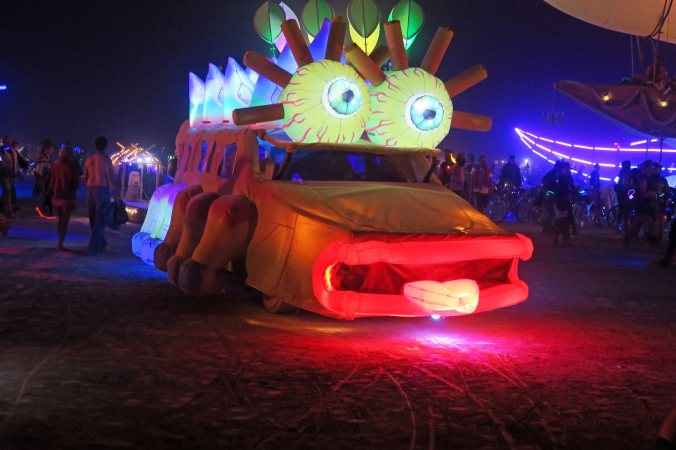
I thought that this mutant vehicle was an excellent example of what a Burner might look like after partying straight for seven days!

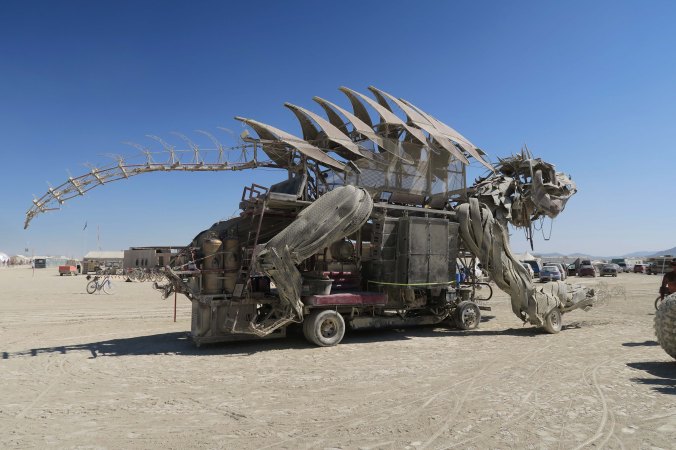
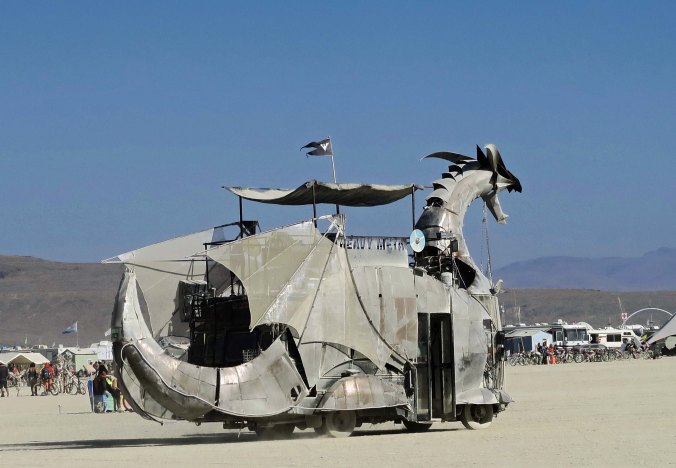
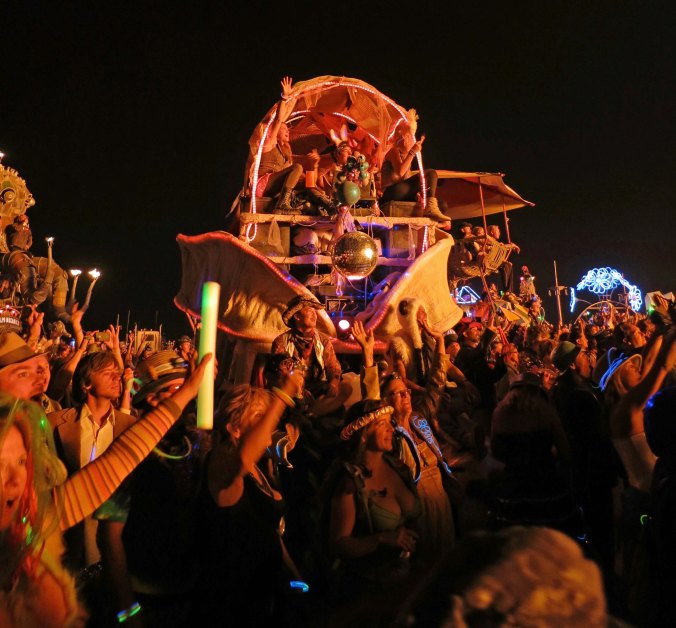
Always one of my favorite mutant vehicles, this large dragon was back again in 2017. Large speakers and industrial strength music guaranteed that people would be dancing around it whenever it stopped. Dancing is a 24/7 activity.

For those who wanted a slightly more challenging form of exercise, there was a marathon. Here a runner gets a high-five as he runs under the Man.

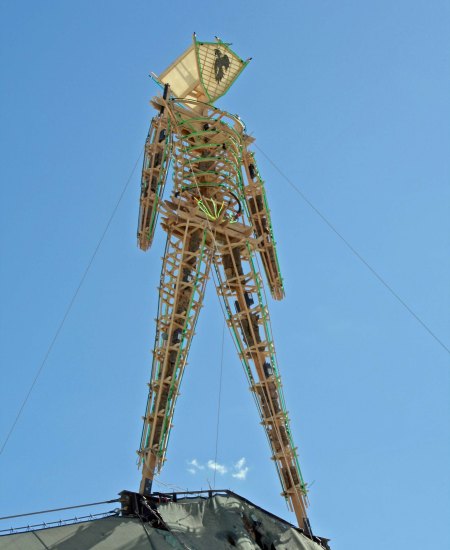
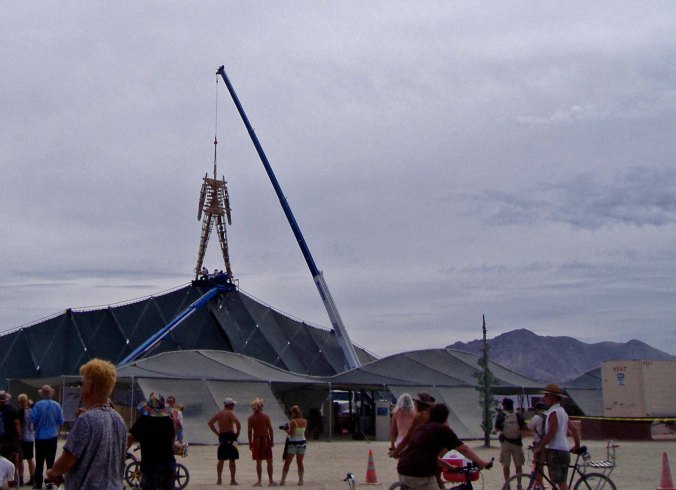
For the first time ever this year, the Man was enclosed in a structure.

Dozens of classes are offered for those who want to learn something new. They range from the ecology of the Black Rock Desert to sensuous massage: BYOM. (Bring your own mate.) You can also take a class in bondage. I’m normally too busy to be tied up for an hour, however. (grin) Many classes come with an Eastern/New Age twist such as meditation and Yoga: BYOM applies here as well. (Bring your own mat.)

Camp Mystic offers ongoing classes in Eastern thought.

There is entertainment galore. Twirling fire is big at Burning Man. As is creating magic with hula hoops. If you want to see something truly sensuous, watch a talented hula hooper. The Center Camp Café always has something going on, both planned and impromptu. One moment you might be listening to a lecture on physics and the next surrounded by several hundred large rabbits, or at least people wearing rabbit ears. But you can be anywhere in Black Rock City or out in the Playa and find entertainment.

The Center Camp Cafe is always a center of activity at Burning Man. This year it was set off by a rainbow arch.

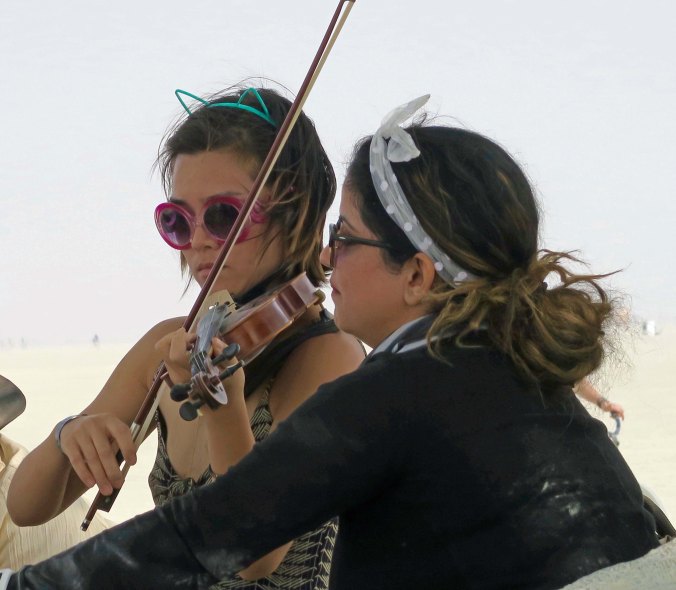
A story teller and a violinist were performing under the green tree shown above.The story teller was reciting a love story that could have come right out of Scheherazade. She would tell a part of the story in what I thought was Arabic or Persian and then translate it into English, accompanied by the violin.

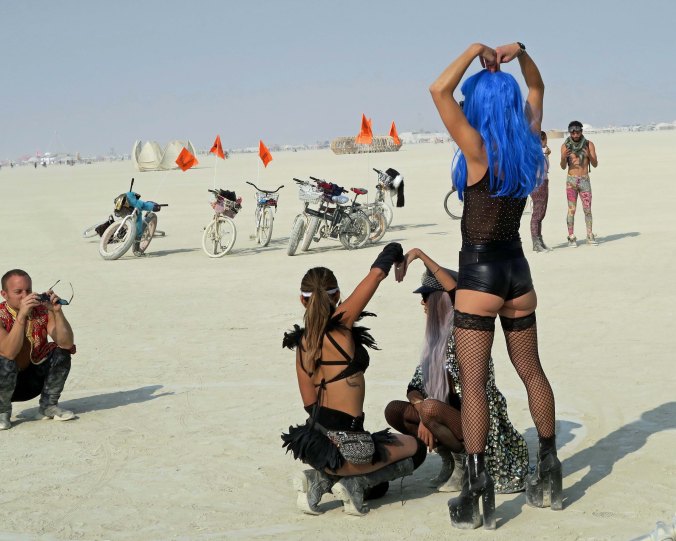
People watching is always big. Some folks develop elaborate costumes and almost everyone makes some effort to look different, even if it’s only putting on a tie-dye T-shirt. Scantily clad is a Burning Man trademark. While total nudity is rare, topless is not uncommon, for women as well as men.  I think of it as eye-candy. Staring is rude but appreciative glances are okay. You’d have to wear blinders not to notice and be a robot to not enjoy the views.

A costumed trio lines up for a photo at the Temple of Flowers.

A major reason people give for going to Burning Man is to share the experience with friends. Over the years I’ve always been accompanied by folks who are close to me, people who have joined me on backpacking and bicycling adventures as well as in fighting for environmental and health related causes. Some of them have been friends for decades. This year was an exception. Only one, Don Green, could make the event, and he bailed on Wednesday, the day I was driving in from Oregon. I was left alone. Not that I am overly worried about being alone. Remember I took off backpacking on two wilderness trips this summer by myself. Still, it felt a bit strange. Fortunately, a group from Nevada City, California camped next to my van and befriended me.

My Nevada City friends: Blaine, Ashley, Baley and Miriam.

“Curt, you have to join us for dinner,” Baley insisted. “We have way more food than we can possibly eat.” Blaine had already stuffed me with watermelon in the morning. Miriam had shown up with fresh pineapple and cookies in the afternoon and stayed to chat for an hour. Both her parents were Italian but she had been raised in Tahiti and Fiji. Now she was living in Brazil. She’d come to the US to trim marijuana buds for Blaine, who is a pot grower— a now legitimate profession in Washington, Oregon, California and Nevada. (Half of the traditional farmers along our road in the Applegate Valley have added marijuana as a crop, including the guy who had a large Trump sign on his property.)

They were cooking up a batch of ribs, tri-tip and sausages. Given that I had a hotdog waiting for me in the van, I quickly joined them! “You need to eat salad, too,” Ashley admonished me. She wanted to assure Peggy that I was eating my veggies in her absence. I gave each one a copy of my book on my Peace Corps experience in Africa as a thank you.

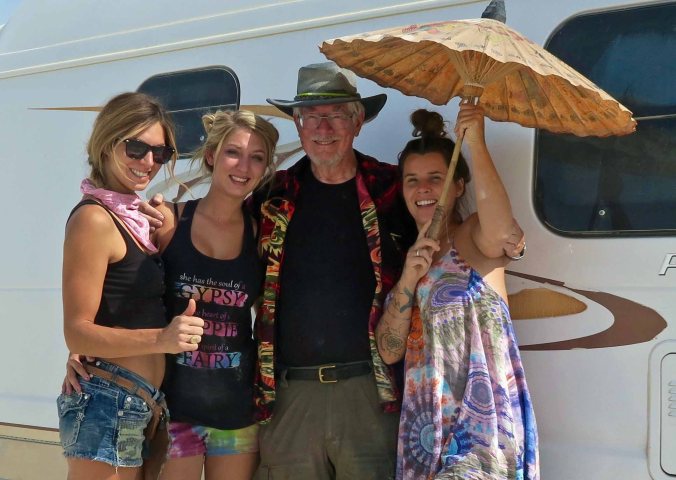
A final photo: The women line up with me next to my van.

SaveSave

SaveSave

SaveSave

SaveSave

SaveSave

SaveSave

A Journey to the Kingdom of Dust… Burning Man 2017: Part 1

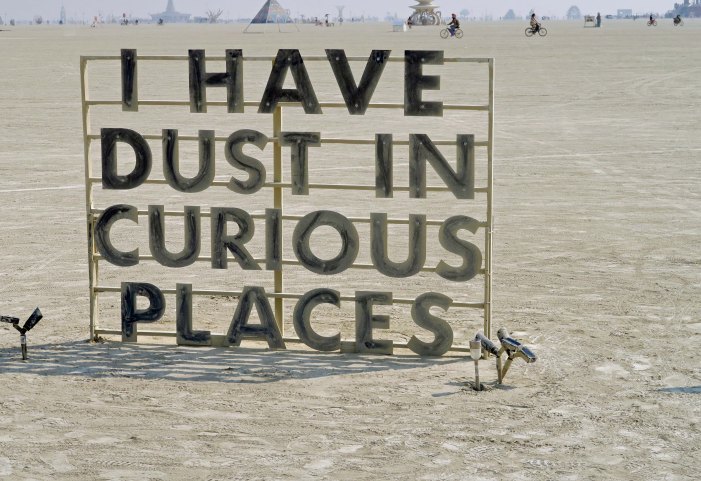
Truer words have rarely been spoken at Burning Man. I came across the sign on the Playa this year. After a major dust storm at Black Rock City, eyes, ears, nose, mouth and clothes are coated in dust! And everything else, as far as that goes.


Maybe I should title my post journey interruptus, since my first attempt at reaching Burning Man was squelched by the need to hurry home and pack up valuables in case our house was burned down by one of the forest fires raging near us in Southern Oregon.

By Wednesday, Peggy and I had done what we could to secure our home, made up our minds on what to take, and decided that escaping the smoke was our next priority. It was laying in thick, refusing to go away, limiting our vision, and, much worse, settling into our lungs. Peggy was heading to Sacramento to stay at her sister’s and visit with her 97-year-old mom. I would resume my journey to Burning Man.

We wished our house well. I wandered around inside saying goodbye to treasures— memories that dated back decades— and then went outside to wish the beautiful surrounding forest good luck. So far, the fires had been kind, cleaning out the debris under the trees while, for the most part, leaving the trees to prosper. Forest fires are a natural part of ecology, a natural means of keeping forests healthy. I suspect Smokey Bear would shed half his hair over this thought.

We gave each other a final hug and headed out for our different destinations.

Not to keep you in suspense, our house still stands. On Thursday, a week ago, the Level 1 alert went to a Level 2: “You should be packed up and out.” Neighbors reported on seeing the flames creep over the ridges and make their way down toward out homes. But so far, we haven’t received a Level 3, “Get out now!” message. The firefighters made a valiant effort at slowing down and stopping the fire’s advance with very limited resources. (Resources are limited because the whole West seems to be burning. Teams are moved rapidly from one fire to the next depending on needs.)

Back again in Southern Oregon after Burning Man 2017, my faithful horse and I were glad to find our house still standing. The horse, BTW, is affixed to my bike so I can find it in the middle of thousands of other bikes. The glow sticks help us to be seen at night. My beard, soon to be gone, is courtesy of my summer backpacking trips. Smoke from the fires still hangs in the sky. (Photo by Peggy Mekemson.)

My second effort at driving to Burning Man was more successful. I didn’t even stop in the small town of Cedarville where I had turned around the first time. The road makes its way south out of town down through Surprise Valley, which is a surprise because it has water, and then jogs east out into the Nevada desert on lonely Highway 447 toward Gerlach. I must have passed all of four cars on my 60 plus miles of driving through the Black Rock Desert. At Gerlach, a left jog on Highway 34 for eight miles took me out to the entrance road to Burning Man.

I swear that vehicles escaping from Black Rock City breathe a hefty sigh of relief when they finally reach Highway 147. I watched as a few came out, hit a bump, and exploded in dust, like a dog shaking off water. And then it was my turn to drive in over the dusty, bumpy, dirt road. Here’s the thing, it isn’t that long, maybe five miles, but it can take five hours to drive over during peak hours. Put in perspective, that’s about the same amount of time it took me to drive the 280 miles from Medford to Gerlach.

Almost everyone who attends Burning Man, from virgin to veteran, has a story to tell about the experience. There are several factors that can cause delays. The number of people entering or leaving in a given period is the primary one. Put several thousand people on the road at the same time and it can make driving over a LA freeway at rush hour seem positively delightful. BMORG, the Burning Man Organization, doesn’t help. It is so paranoid about someone slipping in without paying that every vehicle entering is searched from top to bottom. I had to get out and open the back door of my van (admittedly, there is room to store a bicycle pump or a very small midget) and then let the ticket checker in to look under my bed and in the bathroom. It took ten minutes. Multiply that by several thousand.

Speed limits make sense. It’s 10 miles per hour on the road in and 5 miles per hour in Black Rock City. There are numerous police around to enforce the law. Bumpy roads add their own speed limit. This year featured the mother of all washboards. I watched an RV in front of me bounce around like Jell-O during an earthquake.

The weather is always a factor. Massive dust storms are natural, and the vehicles whip up their own, given that the dust on the road is often several inches deep. Close to zero visibility is possible. More than once, I’ve driven from traffic cone to traffic cone hoping that they wouldn’t disappear altogether. Then I hoped the next one would appear beside me, and not under the tires of my van.

This is what the road into Black Rock City looks like during a heavy dust storm through my window. I’ve used this photo before. A car disappears and you can barely see the traffic cone on the lower left. Not fun. Fortunately, conditions were better this time.

Rain stops everything. The fine dust turns into a sticky clay that gloms on to vehicle tires, bike tires and shoes— inches thick. Vehicles are required to stop, and who would want to walk or bike in the stuff. Peggy and I once waited on our way in for three hours as the road dried out enough for people to drive over it. A massive party developed. People were dancing on top of RVs and entertainers were performing on the road. Garbage bags tied over feet provided a solution for those who chose to walk around. We had good books to read, which we always carry, just in case.

I hate to mention this, but a Nevada forest fire helped me on the way in this year. It actually blocked traffic on Highway 147 from Interstate 80, which is the main way into Burning Man. I could see the clouds of smoke roiling up in the distance. With minimal traffic, it only took an hour and a half to reach Black Rock City!

The wind was whipping up a dust storm when I arrived. My lungs started screaming at me. I had just subjected them to a week of smoke in Oregon and now they had to deal with Playa dust. They were not happy. I grabbed the first vacant space I found, which was at 6th and L and then took out my camera to photograph the disappearing camp next to me. I had arrived at the Kingdom of Dust.

My location in Black Rock City this year is shown by the yellow dot. I was on the farthest road out.

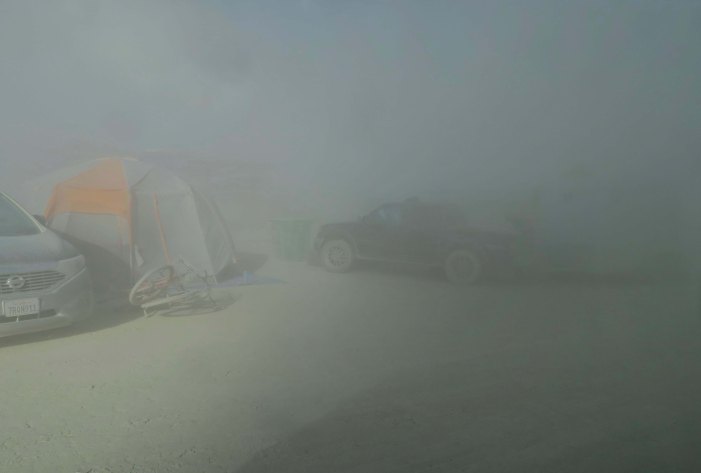
Shortly after I arrived at Burning Man 2017, the camp next to me began to disappear in a cloud of dust. This is around 3:30 in the afternoon.


NEXT POST: Some general observations on Burning Man 2017… and lots of photos.

SaveSave

SaveSave

SaveSave

SaveSave

SaveSave

SaveSave

SaveSave

From Baker Beach to the Black Rock Desert… The Fiery Journey of Burning Man’s Man

The Man at Burning Man burns in 2012. A few remaining fireworks fall from the sky.


One of the first things I do at Burning Man each year is head out to the Playa to visit the Man. It’s a way of paying homage. Given that the annual event in the Black Rock Desert of Nevada wouldn’t exist without the Man and his appointment with fire, my ‘pilgrimage’ seems appropriate. Here’s what I wrote a few years back on Burning Man’s beginnings in San Francisco:

A striking sight of the Golden Gate Bridge dominates the view from Baker Beach in San Francisco. It’s a romantic spot, a popular place to get married. Folks also get naked; it’s a nude beach. It was here that Larry Harvey and his friend Jerry James decided to host a bonfire in honor of the summer solstice in 1986. As to why they chose a nine-foot wooden effigy of a man (and his dog) to burn, Harvey remains mysteriously mum. Whatever the reason, it was out of the flames that Burning Man was born. Larry and his friends had such a great time they vowed to come back the next year with a bigger Man.

By 1990 the Man had grown to 40 feet tall and word of mouth had guaranteed that a sizable crowd was present for the solstice bonfire on Baker Beach. It wasn’t to be. Golden Gate Park police had decided that burning the Man posed a fire hazard to the Park and City. A single Park Ranger rolled in on a motorbike and said no go. You can’t be too careful, right? Fires were raging across Southern California.

The Man was taken apart and returned to the vacant lot he called home. The people who had come to watch the burn were angry. This might have marked the end of Burning Man, except for a bit of synchronicity. The Man had caught the attention of a group in San Francisco known as the Cacophony Society, an organization that specialized in outrageous pranks and strange outings known as zone trips. Several of its members, including co-founder John Law, suggested to Larry that the place to burn the Man was in the remote Black Rock Desert of Northern Nevada. It would make an ideal zone trip— far out in the language of the 60’s. A Ryder Truck was rented for the Labor Day weekend and stuffed with the man plus personal gear. Cars were loaded with people and some 80-100 Burners headed off into the desert. A tradition was born.

Today’s Burning Man is tame in comparison to the early years on the Playa. In the beginning, people camped wherever and drove when, where, and as fast as they wanted. Admission was free, open to anyone who wanted to make the drive up (primarily people from the Bay Area). At times, the event took on the guise of a shooting gallery. Running in and out of fire became a sport, particularly popular to those who were drunk or drugged out of their minds. Once again, Burning Man could have easily ended, but Larry and the others who founded the event had a broader vision and the event evolved, instead. By the late 90s, rules had been developed to make the event safer. Elements of its art, environmental, social and spiritual culture had begun to develop. When I first arrived in 2004, Burning Man had more or less become the event it is now, minus 35,000 people.

This year, 32 years after the first Man first burned on Baker Beach, some 70,000 people from the US and around the world will make the journey into the desert for the week-plus of craziness starting on August 27th and ending September 3. On Saturday evening, September 2, most of these Burners will make their way out onto the Playa and form a huge circle around the Man. The majority will either walk or bike, but many will also journey out in mutant vehicles that form their own large circle where they blast out music and fire. As night settles in, hundreds of fire dancers will perform their fiery art in the center of the circle followed by a solemn procession to set the man on fire, which also kicks off a massive fireworks display. Sometimes the Man burns quickly as he has been prepped to do, other times it seems to go on and on. Regardless, almost everyone stays until the sculpture comes crashing down, creating one of those moments of silence, which is so rare at Burning Man, followed by a very loud celebration.

It’s impossible to get the full sense of the event without being there, but photos help. I will start with several pictures I have taken of the Man over the years and then move on to the burn.

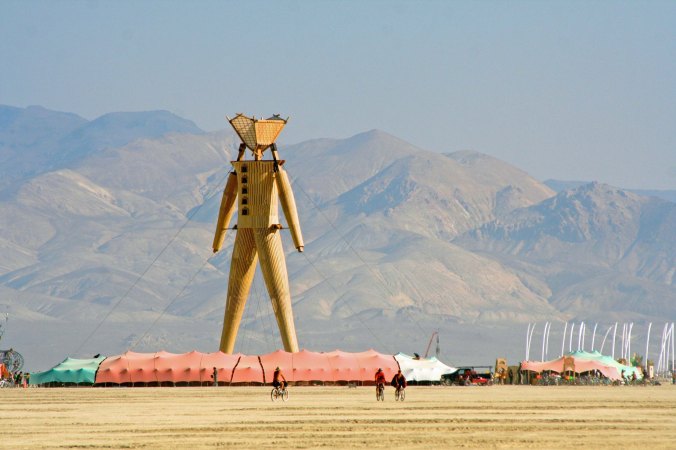
The Man begins his week located at the center of the Playa. While his look remains more or less the same, his base changes each year depending on the theme for the year. I took this photo in 2006.

In 2007, the Man burned twice— the first time in the early hours of the morning by a rogue Burner. I had actually missed the act of vandalism by only a half hour. Note the Phoenix on the face, like the mythological bird, he was able to rise again.

BMORG, the Burning Man organization was able to put together another Man in San Francisco and get him back to the desert in time for his Saturday burn. Here, he is being placed on his pedestal, still headless. (Photo by our friend Ken Lake.)

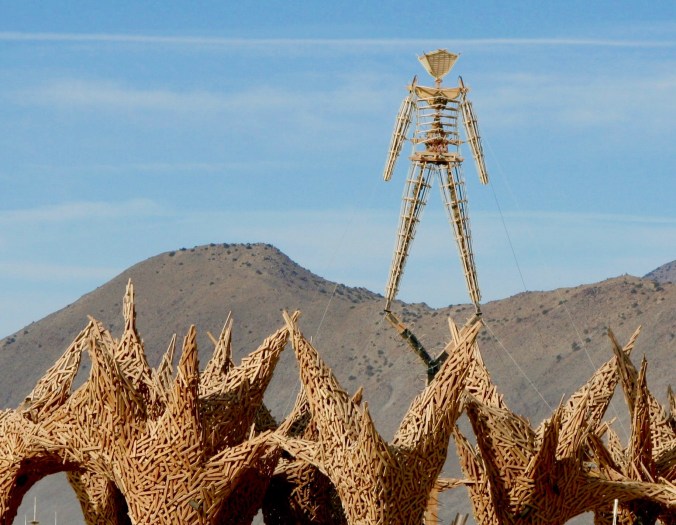
One of my favorite bases was this one from 2009.

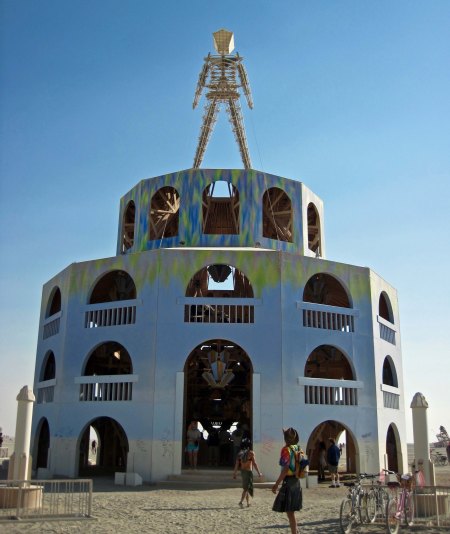
In 2010, the Man came with gargoyles, like a European cathedral. In this photo they are still working on the base. It isn’t unusual for finishing touches to be added at the beginning of the week. The steps up to the fourth level provided Burners with an opportunity to look out over Black Rock City, the Playa and the surrounding mountains.

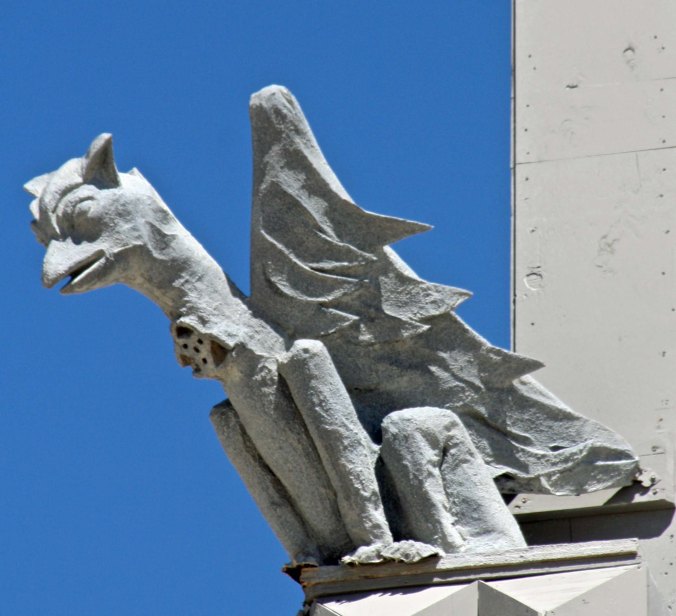
One of the gargoyles I photographed when I reached the top.

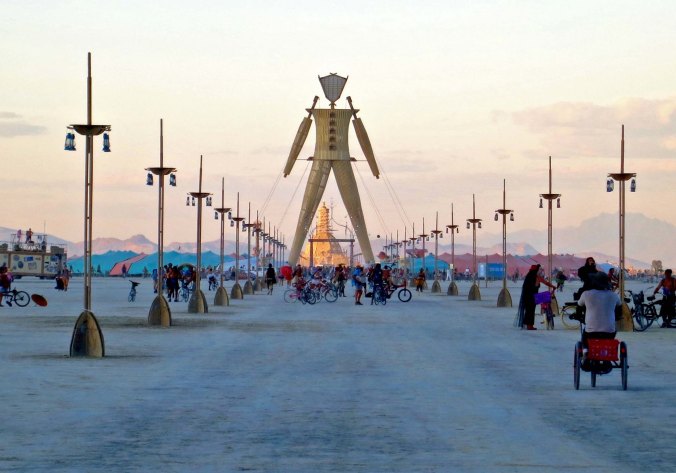
Three main roads lead out from Black Rock City to the Man. This one was from Center Camp. Lanterns are hung from the poles at night. The 2012 base was one of the largest.
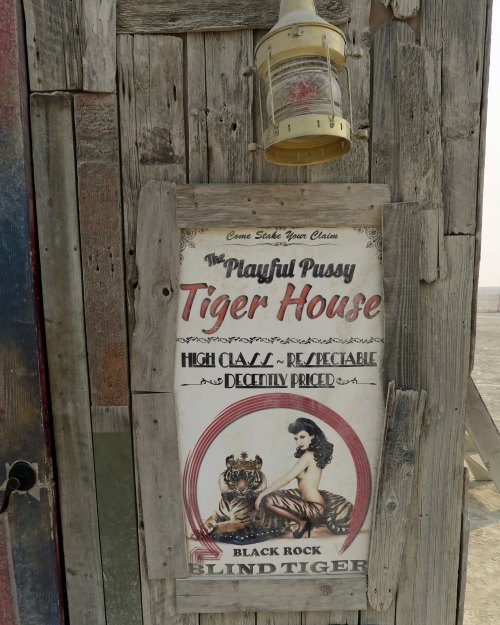
A close up.

What the structure inside the base of the 2012 Man looked like. No nails were used in putting it together.

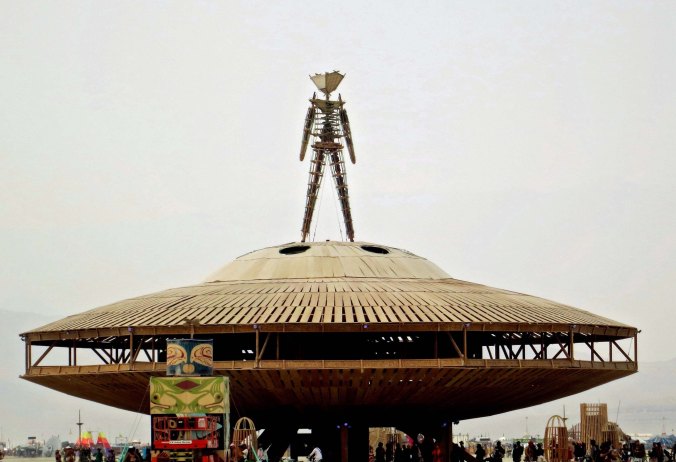
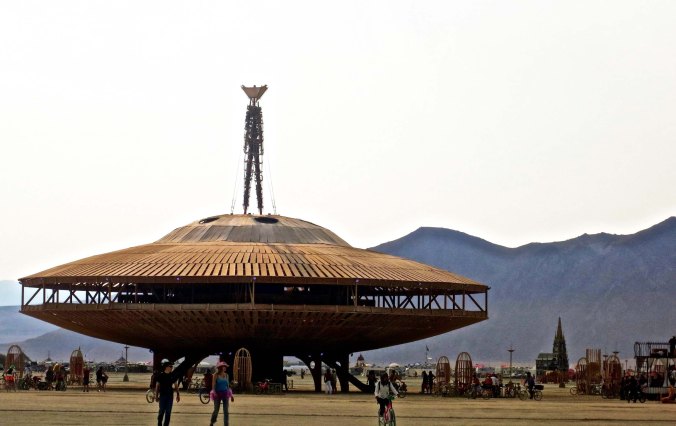
A flying saucer provided the base in 2013.

The Man’s head had been altered to have an alien appearance..

The man was fleshed out, so to speak, in 2014. The Temple, lit up by the sun, can be seen through the Man’s legs. Each year, Center Camp, the Man and the Temple are lined up.

Part of Burning Man’s appeal is the magnificent mountains of the Black Rock Desert that surround the event.

I liked this shot of the 2014 Man’s face lit up by the sun.

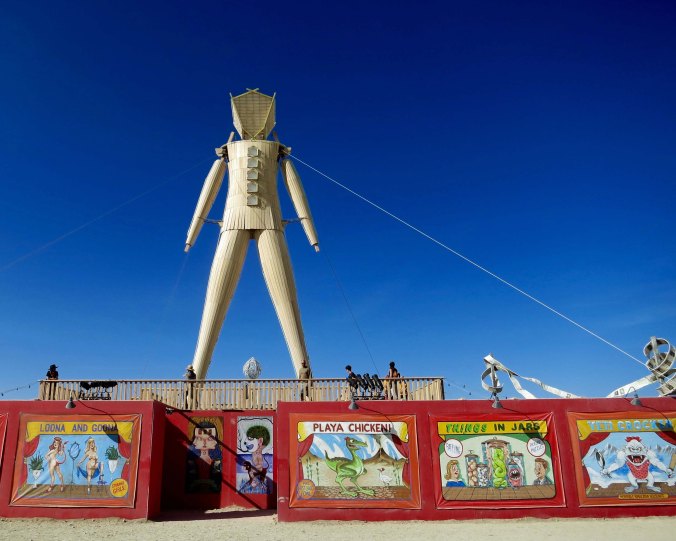
The 2015 Man was perched on top of a maze covered with side-show circus posters reflecting the year’s theme.

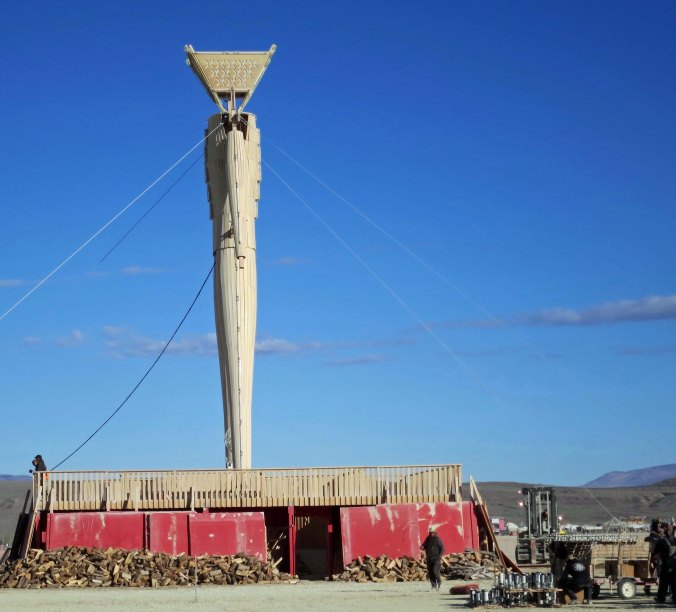
And now we come to the 2015 Man being prepped for Burn Night. It’s Saturday. The art work has been removed and the firewood piled high. Entrance into the area has been closed off.

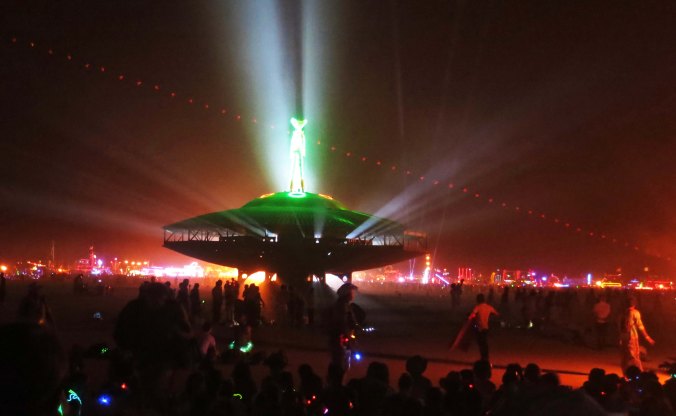
On burn night almost everyone in Black Rock City gathers around the Man. The Man on top of its flying saucer base in 2013 is looking even more ET-like. Lighting has been added to help create the effect.

Fireworks and arms raised means the Man is about to burn!

The 2014 Man goes up in flames. (Photo by Don Green.)

This shot of the base of the 2012 Man captured the intensity of the fire well. You can almost feel the heat!

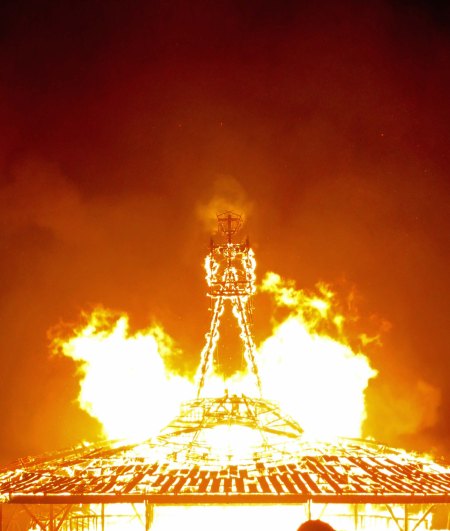
The Man is standing on his ‘last legs’ here. He and his flying saucer teeter on the edge of falling into the fire.

Burners celebrate as the Man falls. Mutant vehicles provide prime seating for the event.

The morning after: Burners use glowing embers from the night’s Burn to roast a lamb. Life goes on. The Man will rise again the next year.

This completes my series on Burning Man for now. I may do a couple more posts before I head off to Black Rock City again on August 26. In September and October I’ll post the results of my 2017 adventure!

NEXT POSTS:

Big Sur with its iconic bridges, beautiful coastline, and a bit of history.

I encounter a 70s terrorist group in the Sierra Nevada Mountains.

A new series: The fascinating, ancient rock art of the Western United States.


So, You Want to Become a Billionaire… Maybe You Should Go to Burning Man

Burning Man appeals to a wide range of ages and these young women with their floppy ears are on the lower end of the spectrum. Children are rare at the event. Only 1.3% of participants are under 20.


I’ve been perusing the 2016 Burning Man census. The organization makes a serious effort to know who comes to Black Rock City each year and I am always curious about the results. Today I will share some of the data. It may surprise you. I will also post photos that Don Green and I took of Burners who attended the 2015 event. (I didn’t make it last year.) In addition to providing a small sample of participants, the pictures demonstrate another aspect of Burning Man’s creativity: costumes.

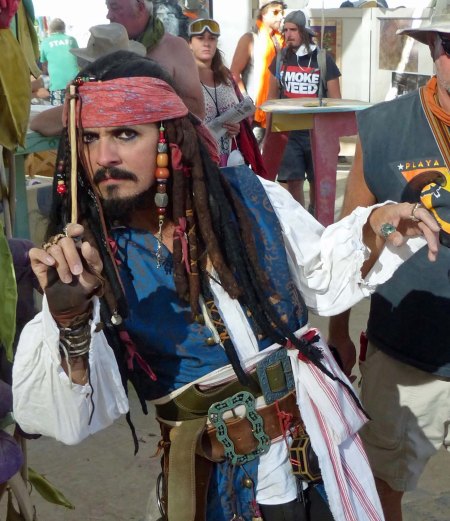
Costumes are an important part of individual creativity at Burning Man. Captain Jack, for example, looked a lot like Johnny Depp. Maybe he was. Hollywood has discovered Burning Man. (Photo by Don Green.)

Before starting, however, I want to summarize a news story that NBC ran in February. It’s relevant.

In 2001 Google was searching for a new CEO. While Larry Page and Sergey Brin had taken Google to dizzying heights in five years, its board had decided that the 20-something entrepreneurs needed an older, more steady hand around to help run the ever-growing company. A massive search had been undertaken using a variety of metrics ranging from education, to experience, to the ability to crack MENSA-like brain tests— all to no avail. As Brin would tell the press, “Larry and I managed to alienate fifty of the top executives in Silicon Valley.”

There were mountains of talent available in the Valley, but Google needed a special mix that could bring an element of discipline to the company without reigning in the genius and unique approach to work that are the secrets to its success.

My son-in-law, Clay, works for Google in Charlotte, North Carolina and I’ve been to his office. The visit provided an insight into how Google works. All employees, regardless of position, share a common space where both individual contribution and group participation are encouraged and inspired. Creative ideas and problems are thrown into the hopper and anyone with suggestions from throughout the Google world is invited to participate, from the newest employee up to Larry and Sergey. There is a constant flow of action and reaction. It seems like a recipe for chaos; instead, it has proven to be a key to the company’s ongoing success.

When Clay returned to his office after a trip he had made just before Christmas, he found that every object on his desk, including his computer screen, had been wrapped in Christmas paper. It’s the type of hijinks you can expect at Google, where play is taken seriously.

The challenge that Larry and Sergey faced was finding someone who fit in. They decided that desperate measures were necessary to finalize their decision. When they discovered that one of their top candidates, Eric Schmidt, a Berkeley PhD computer scientist from Sun Microsystems had been to Burning Man, they modified their rankings to bring him back in for another interview. Here’s the thing: Brin and Page loved the creative, communal chaos of the event. Their office building in Silicon Valley was filled with photos of employees who had been to Black Rock City and were decked out in Burner costumes doing Burner things, like twirling fire. Each year, Google provided a free shuttle from the Bay Area to its participants who wanted to go. Google’s first Google Doodle was a stick figure of the Man, the symbol for Burning Man.

Page and Brin were a mere two years away from leaving their Stanford dorm room and founding Google when they headed off to the Nevada desert for their first trip to Burning Man in 1998. To let people know that they were out of the office and had gone to the event, they put the stick figure of the Man behind the company’s name, thus creating their first Google Doodle.

They liked what Schmidt had to say and decided to give him the acid test: they would take him to Burning Man with them and see how he reacted. How would he handle the heat, the noise, the dust, and the 24/7 activity? Would he fit in and become part of the team? Would he go with the flow and contribute? Or would he withdraw into himself? The rest, as they say, is history. Eric passed the test and became CEO of Goggle. The company at the time was worth somewhere in the neighborhood of $100 million. In 2011, when Larry resumed his role as CEO, the company was worth around $40 billion.  Today, Larry and Sergey are listed among the world’s richest people. And Schmidt? He, too, has become a billionaire. Not bad for a group of Burners.

So, what about the rest of us, the ones who don’t qualify as the one percent of one percenters.

The majority of folks who attend Burning Man aren’t exactly poor. In 2016, the average income for all participants was $60,000. 29.5% had an income of between $50,000 and $100,000 while 24% made between $100,000 and $300,000. 3.4% made over $300,000, up from 2.3% in 2013. The education level and age of Burners reflects the income. 74% had a bachelor’s degree or higher. The median age was 34. Only 1.3% of Burners were under 20 while 32% were over 39.


It isn’t unusual at all to find people in their 50s and 60s, and even 70s, attending Burning Man. (Photo by Don Green.)

This fellow had been around long enough to grow a fine set of horns.

39% of the participants in 2016 were virgin Burners, first timers. Only 13% have been more than 8 times, which, at 10 times, happens to be the category I fit in. Not sure what that makes me. Maybe my synapses are covered in Playa dust; I wouldn’t be surprised. I’ve certainly had enough up my nose and in my eyes and ears.

Men outnumber women by 56.8% to 41.4%, leaving a couple of percentage points for ‘other.’ I was amused that the census listed its gender figures under current gender— like it might change at any moment. Ethnicity-wise, close to 80% are white. 20% 0f Burners come from countries other than the US. Within the US, 48.5% of the participants came from California, which isn’t particularly surprising given its proximity and population size. It is a bit more curious that the number two state was New York with over 8%, given that New York City is some 2700 miles from Black Rock City via Interstate 80.

Men outnumber women but it isn’t really obvious at Burning Man. This Burner’s costume was his tattoos.

I discovered this woman with her smile writing at the Center Camp Cafe, an activity that I like to pursue. It is fun to sit there and watch the world flow by while making an occasional note.

This man intrigued me. Although my photo wasn’t as clear as I like, I couldn’t resist including him with my galley of Burners.

My sense is that the diversity of people attending Burning Man has been increasing, but it has been a slow process. (Photo by Don Green.)

The most interesting figures to me are those that relate why people decide to run off to the desert and play in the dirt for a week. Participants were asked to check the reason or reasons they came to Burning Man from a prepared list. I was pleased to see that my reason— wanting to see and experience the art—was marked by 62.5% of the participants, the highest percentage received. Next up was to be with friends or to share an experience with like-minded people. 44% said they wanted to experience freedom and play. Considering you can wander wherever and do whatever— assuming you aren’t doing any harm to another person or the environment— that’s a lot of freedom! Go ahead and parade around naked if that has been your deepest desire forever. You’ll have company. 28% wanted to escape the world for a week. (That number may go up significantly this year.) Contrary to what many people think about Burning Man, only 3.7% said they came to consume intoxicants. But then, would you claim that if it were your reason? 21.6 % mentioned spirituality among their reasons for attending. I discussed the spiritual factor in my post on Burning Man’s temples. While only 6.1% of Burners marked that they belonged to a specific religion, 46.5% in 2016 claimed they were spiritual.

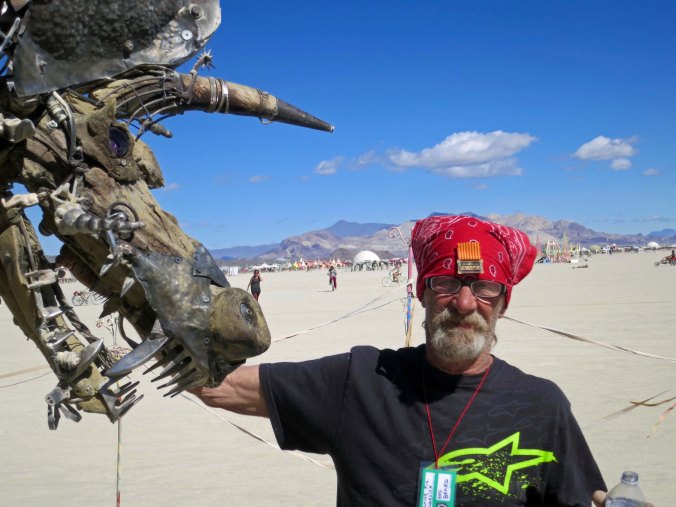
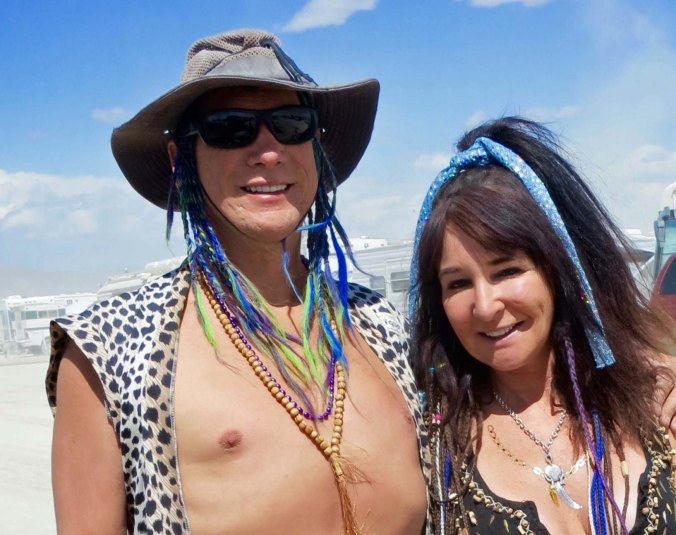
Enjoying and appreciating art is a major reason why people go to Burning Man. Creating art is another reason. This man was standing next to a dragon sculpture he had made out of recycled and repurposed materials.

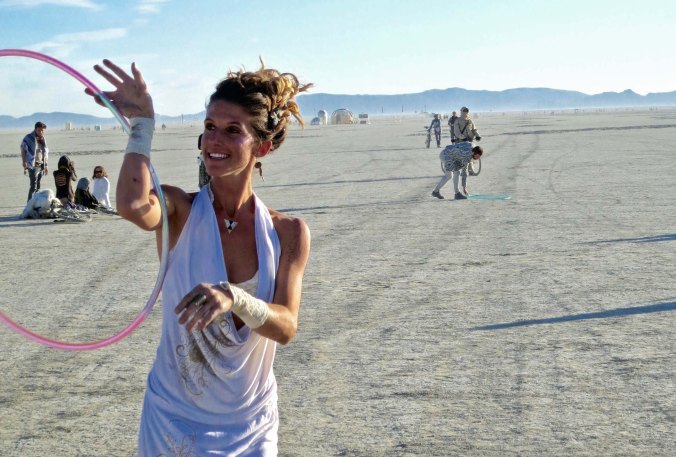
People also come to watch and participate in performance art. Hula Hoops have always been popular at the event, as is fire twirling.

The opportunity to share the Burning Man experience with friends is one of the top reasons people give for going to the event. (Photo by Don Green.)

Couples are common.

These folks were just down from where we camped and were busily giving away oranges. They told me that they had a large orange tree in their back yard in Southern California that they harvested each year just before coming to Burning Man.

This skinny pair was glad to pose for both Don and me.

Over 20% of Burners listed that they attended Burning Man seeking a spiritual experience. A visit to the Temple at any time of the day or night confirms this.

Enough on figures! If you’ve managed to make it this far, congratulations. On the other hand, if you want to learn more, check out the 2016 Burning Man Census data here. My thanks to the Burning Man volunteers who worked so hard to gather and analyze this data.

A few more photos of the people of Burning Man.

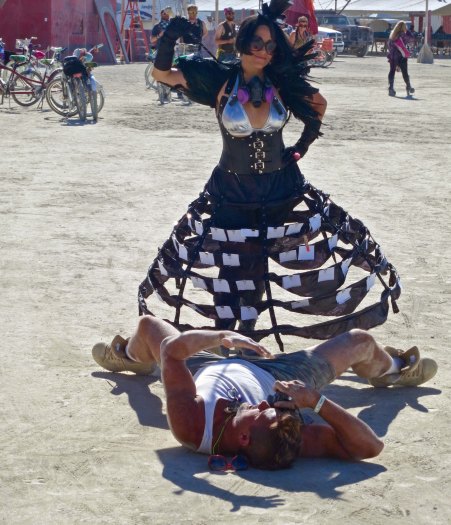
Costumes are important, and expected at Burning Man. Some photographers will go to any extreme to get pictures. Wait, is that a whip?!

One of my favorites. This man works for Burning Man’s Department of Public Works and helps build the city.

Dapper.

Cute smile.

Green feather.

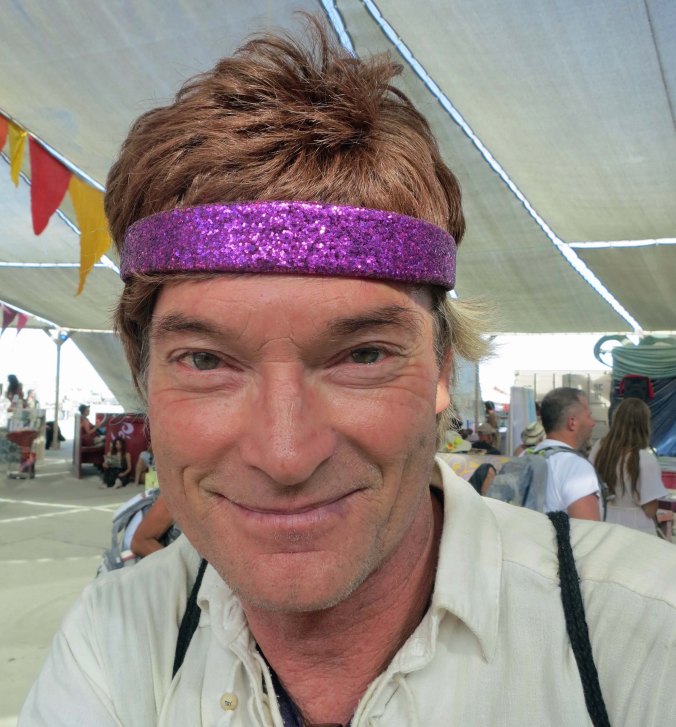
And how could you resist this smile? He gave me a CD from his band.

NEXT BLOG: Back to Pt. Lobos on the Central California Coast.


This Place Called Black Rock City… Burning Man

Imagine, if you will, having enough port-a-potties to accommodate 70,000 people. It’s one of many issues Burning Man has to deal with in planning Black Rock City.


I always like to include a post on Black Rock City when I am blogging about Burning Man to give readers a view of how everything fits together. Obviously, you can’t throw up a city for 70,000 people in the desert without some serious planning. Think of it this way: For the one week of its existence, Black Rock City is the third largest city in Nevada— only Las Vegas and Reno are larger.

It all starts with locating where the Man will be placed out in the Black Rock Desert a few miles east of the small, northern Nevada town of Gerlach. A ceremonial spike is driven into the ground to mark the placement.  Everything else including the Temple, Center Camp, the surrounding fence and Black Rock City evolve from there. Official Burning Man structures and major camps are built before the event. Sort of. It is not unusual to arrive on Sunday with work still being done on the Man, the Temple, Center Camp, etc.

Black Rock City is laid out in a semi-circle as shown on the 2016 map below. The circular roads are given names based on the annual theme and are in alphabetical order. For example, the 2016 theme was Da Vinci’s Workshop. The road names were Arno, Botticelli, Cosimo, Donatello, Effigiare (Italian: to portray), Florin, Guild, High Renaissance, Italic, Justice, Knowledge, and Lorenzo. The main road that separates Black Rock City from the Playa is always the Esplanade. Roads that cut across the circular roads are numbered clockwise and lead out to the Man.

The large circle on the bottom is Center Camp, the middle circle the Man, and the upper circle the Temple. Both the Man and the Temple are located on the Playa, which continues out to the fence. Shaded areas are for assigned, organized camps; non-shaded areas for everyone else. Space in the non-shaded areas is on a first come, first serve basis and you can have as much as you need for your camp, assuming you come in early— there seems like a lot of space in the beginning. By the end of the week, everything is packed! The total area encompassed within the fence including Black Rock City and the Playa is approximately seven square miles.

The official Burning Man map of Black Rock City for 2016.

The following photos provide a glimpse into what it is like to live in Black Rock City.

If you come in early on Sunday, you feel like you have a lot of space. We always mark out our site with rope and reflectors.

Things fill up rapidly as the week progresses. Quivera, our van, marks one end of our camp. Our goal is to be somewhere between 5:00 and 6:00 on H or I.

By Friday, there is no room left. If you haven’t clearly marked your area, you will have guests!

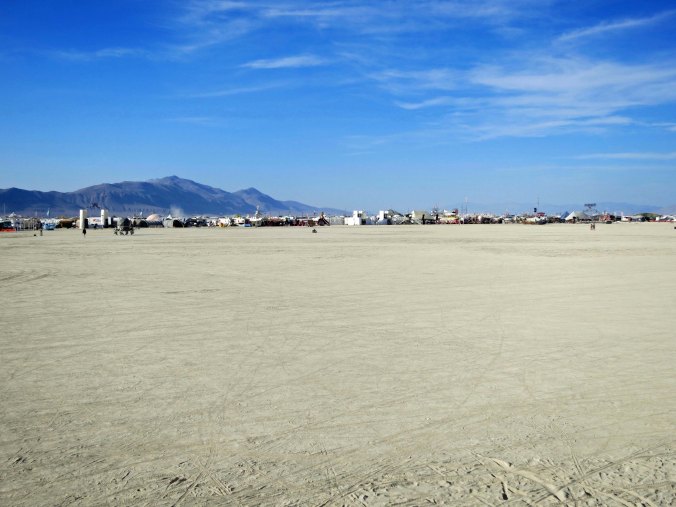
If things feel too crowded, you can always bike out onto the Playa where the Man, the Temple and many of the major art pieces are located.

If things are still too crowded, you can head out farther…

And farther…

And farther. By now you are out in what is known as the Deep Playa.

This is where you come to the fence that limits further exploration of the desert. Actually, during a dust storm when visibility is close to zero, it is good to have the fence available to keep you from wandering off. There is a vast amount of space to get lost in.

Burning Man is serious about Burners staying inside the fence. Part of this is for safety and part of it is to keep people from sneaking in for free. When I crossed the fence for a photo-op, a BM truck came speeding over to where I was.

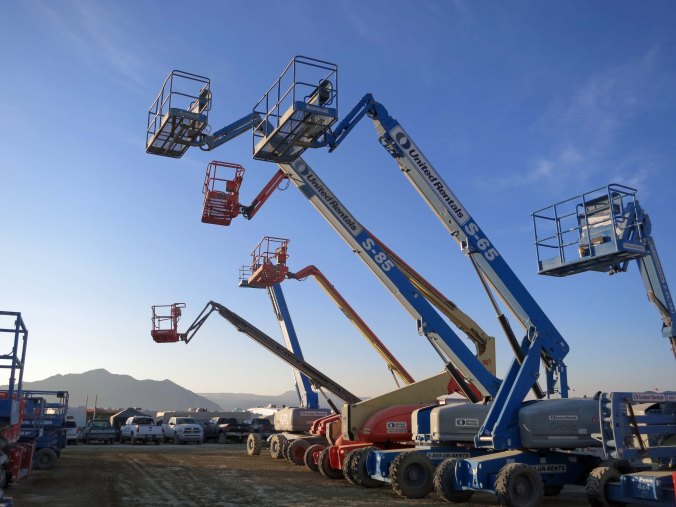
A substantial infrastructure is required to operate the event. These lifts are located in the Public Works Department lot.

Safety is always a concern. Burning Man has its own safety officers know as the Black Rock Rangers. Of course there are also numerous local, state, and federal law officers present. There is also an extensive emergency medical operation.

Lamps are lit at night to help Burners find their way. The lamp lighters are volunteers who have their own camp.

Providing ice for Burners to keep their food (and beer) cold is also a major operation run by volunteers. A recruitment poster urges Burners to sign up. Ice is one of the very few things you can purchase in Black Rock City.

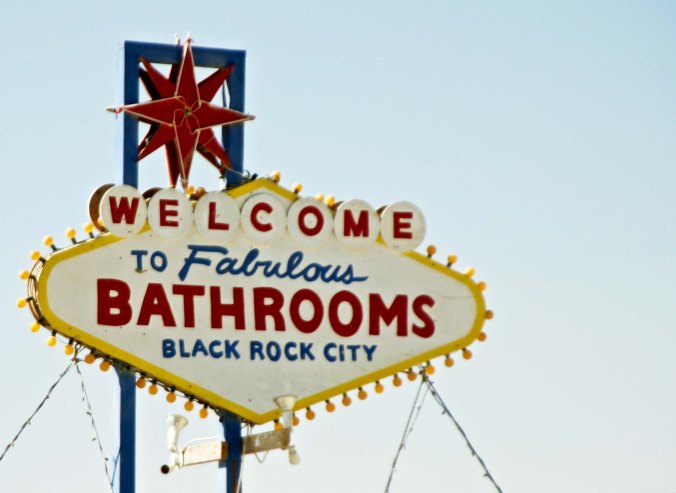
The tongue in cheek sign at the top of the post refers to the numerous banks of port-a-potties found throughout Black Rock City and out on the Playa. An army of trucks is constantly servicing the outhouses. (Photo by Don Green.)

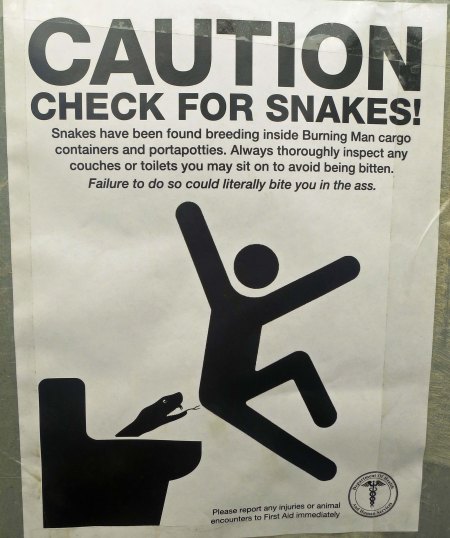
I found this in one of the toilets.  I imagine that this sign had some city folks checking. (grin)

Sand spiders are more dangerous.

Heat, wind, and dust storms are a part of life at Burning Man. It can also rain.

This photo was taken a few minutes after the above photo. The storm has arrived!

While it is important to be prepared for the heat and dust storms, there is also great beauty and good weather at Burning Man.

Looking out from our camp at the sunset.

And a rainbow.

If things get too rough out in the desert, you can always stop and have a beer.

Next Blog:  Some really cute seals and the beautiful Pt. Lobos nature reserve near Carmel.

Theme Camps and the Tribes of Burning Man… The Burning Man Series

The 2015 Art Theme at Burning Man was “Carnival of Mirrors.” The Kostume Kult Tribe out of New York responded by building this camp on the Esplanade, Black Rock City’s main street. Here’s how the tribe describes itself: “The  Kostume Kult  arts collective is a volunteer-led, non-profit community organization supporting interactive arts, costuming, street theater and absurdist fun while bringing wonderful people together.”


Tribes and theme camps are an essential part of part of Burning Man. Tribes are basically a group of people who decide to hang out and camp together. They can come together through friendship, a common interest, or geographical location. Some number in the hundreds and have a sophisticated structure with year around planning. Others consist of a few people who more or less show up and camp together with minimal arrangements. My tribe, the Horse-Bone Tribe, resembles the latter. The increasing difficulty of obtaining tickets and the spiraling cost of attending has played havoc with smaller tribes, including ours. I may be the tribe this year. It’s a good thing I have multiple personalities. Bone will keep me company.

The larger the tribe, the more elaborate the camp. And some can be quite impressive, as today’s photos show. They help create Burning Man’s unique atmosphere. Many larger tribes also support mutant vehicles and all participate in Burning Man’s gifting society by offering some type of free service including entertainment, classes, alcohol, food, costumes, bike repair, etc. The list goes on.
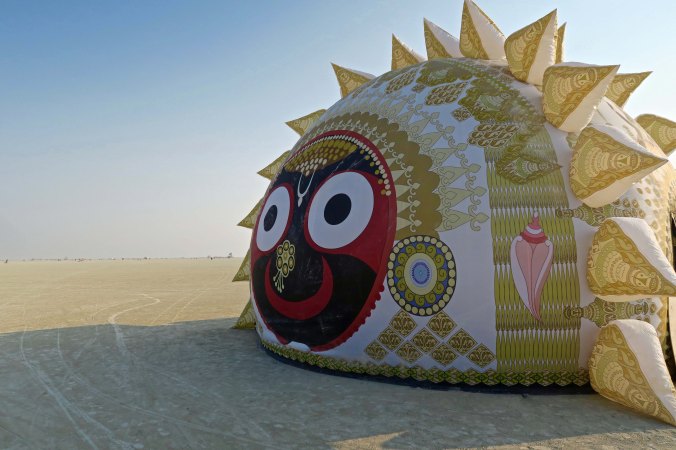
Each year, Burning Man has an art theme. This year’s is Radical Ritual. According to Burning Man: “In 2017, we will invite participants to create interactive rites, ritual processions, elaborate images, shrines, icons, temples, and visions.” That’s a lot of room for creativity, and mischief. My camera will be busy. Both artists and tribes use the theme for inspiration, although it is not required. The photo of the Kostume Kult Tribes camp at the top of this post is an example.

Following are a few examples taken from different years of major camps built in Black Rock City by tribes to reflect the year’s theme or the tribe’s particular vision.

Searching for massage, raw food, ambient trance, native wisdom or numerous other paths to spiritual enlightenment, the Sacred Spaces Village offers it all— plus a really gorgeous structure.

Looking up from inside the Sacred Spaces Village.

The folks from Silicon Valley have been creating a village at Burning Man for many years. Don’t be surprised to find the billionaire founders of such companies as Google hanging out here. The camp is large enough that it needs its own map. Smaller groups within the overall village sponsor the different areas and provide different opportunities for Burners. For example, if you want to sample various types of sauerkraut, you could check in at Pickle Me Elmo.

A number of the larger camps at Burning Man are music venues. One of these is Ooligan Alley with its 747 cockpit serving as the DJ booth. The sound equipment for this camp alone is worth several hundreds of thousands of dollars.

Celtic Chaos is another major music venue. I was amused to read that its motto is “Bringing a little more mayhem to the universe.”

The French Quarter at Burning Man brought to Black Rock City by Burners from New Orleans has always been one of my favorite camps. Great coffee and pastries can be found here, along with New Orleans Jazz.

Burners from Kentucky sponsored the KFC camp which featured fried baloney on white bread and a shot of bourbon. I stopped by for breakfast and the Colonel waved at me.

The Alternative Energy Village is the place to go if you want to learn more about alternative energy or even live off the grid. No generators are allowed in the camp.

This ‘Firehouse’ was created by the Do More Now tribe out of Seattle. Its objective is “empowering participants to challenge themselves by coming together to create innovative and playful spaces that enable and encourage the creation of art, performance and community activities. In other words – we create possibility!” It is a goal that could be applied to many of the camps at Burning Man.

I’ll conclude with this rather dreamy creation, which I have always found appealing because of its focus on white and its use of balloons. Also, check out the white mutant vehicle on the right. Unfortunately, I don’t know which tribe sponsored this camp.
NEXT BLOGS:

I’ll be taking a blog break to wander the Central Coast of California for the next couple of weeks. See you back here afterwards!
From the Sublime to the Weird… Burning Man Murals and Paintings

T-Rex looking for dinner at Burning Man back when the playa was an ocean.

As you might expect, mural art and paintings at Burning Man reflect the event. Much of the art has a mystic feel about it with both Eastern and Western influences. Surrealism also seems to have found a home at Burning Man. Then there is the fun— bordering on strange— art that always appeals to my sense of weird. Following are examples of what I see as I ride my bike or walk around Black Rock City and out in the Playa.

I am going to start with what I call Chakra art that takes its inspiration from Eastern mysticism. A Chakra, simply put, represents seven levels of awareness or spiritual power in the human body that work their way up your spine starting with basic urges and ending with higher consciousness. Meditation is the primary tool that mystics use to reach the higher levels.

Chakra art doesn’t get much clearer than this. Beyond the primary chakra points are a multitude of secondary points. This fellow also comes with an aura.

Maybe you can even get high enough to earn a halo. This one features several languages.

An eagle and a buzzard have arrived here.

This mural portrays a woman meditating. Off to the left is a chakra.

Mandalas are aids in meditation. I feel like this one could take me into infinity.

Of course there is much more to eastern mysticism and myths than meditation and chakras. Traveling farther east to China, we have this magnificent dragon.

What I call Nature art focuses on our deep connection with all life on earth and has a more Western/shamanistic feel to it that is more reflective of what we find in Native American, First Nation, and South American native traditions, as well as other animistic cultures throughout the world.

A shaman sits in a meditative pose while jaguars peer out of the jungle and a snake circles his body. I was amused to see that he is wearing a watch.

This painting also makes me think Shaman.

I am fascinated with the art at Burning Man that combines people and the natural world.

Another example.

How about this for a hair do?

This woman is morphing into an owl, or vis-versa.

Bird eyes.

A touch of green.

The tree of life and death with the left side representing nature and the right side our industrial civilization (sort of like a page out of Dante’s Inferno).

Surrealism is, well, Daliesque.

Mr. Surreal, himself.

A surreal landscape featuring Burning Man founders, I believe, along with several Burning Man icons such as El Pulpo Mechanico looming in the background.

A surreal dragonfly.

And a sort of surreal painting featuring lips, a red candelabra, light fixtures and speakers as UFOs, and apparently people worshipping all of the above.

I will conclude with several paintings/murals that fit my description of fun, funky, and possibly weird.

This mural should easily qualify as weird.

As does this painting of ‘children’ playing.

Peggy stands next to a giant rabbit. One of the events at Burning Man includes a thousand or more people dressing up like rabbits and parading around Black Rock City.

How about ostriches with people heads?

One year Burning Man had a circus theme that led to the creation of all kinds of strange circus art.

My favorite from the circus art.

The fish were fun, especially the one on the right with the teeth.

This was strange…

As was this beetle.

I’ll conclude with another favorite of mine: a 3-D Bossy.

NEXT BLOGS:

Monday: It’s back to the Oregon coast to visit a cave filled with sea lions, plus another lighthouse.

Wednesday: Bone is found and a rattlesnake threatens to bite me on the butt.

Friday: Burners and their costumes at Burning Man.


A Church Trap, a Temple for Timothy Leary’s Ashes, and other Unique Burning Man Buildings

The Church Trap was amusing, and possibly a wee bit scary. Scrolls of music are emerging from the windows, roof and steeple.


Did you ever try to catch birds as a kid using a box held up by a stick? Being a curious little boy with dreams of being a mountain man, I did. I baited the trap with birdseed stolen from Budgie, our parakeet, and tied a long string to the stick. When some innocent sparrows followed the trail of seeds into the trap, I yanked on the string and the box fell down, capturing the birds. After announcing my great accomplishment to the world, or at least my mother, I let them go— a bit beat up but wiser.

I had totally forgotten the experience until I discovered the Church Trap at Burning Man in 2013. It was set up the same way. A full-sized church had been raised up on one end with a 4×4 stick ‘holding’ it up. A rope was attached to the stick. Scrolls of paper with religious songs printed on them had been attached to an organ within the church. They poked out the windows, roof and steeple, symbolic of music (bait) emerging from the church to attract people passing by.

The church was solidly set in the ground. It was not about to be pulled down. Had it, however, a lot of burners would have been caught. People stopped by for weddings, to play the organ, and to give sermons from the pulpit.

The Church Trap was one of many unique buildings built on the Playa in 2013 to entertain and engage participants. The next year I found myself checking out the Temple of Confession where Susan Sarandon had placed ashes of LSD guru Timothy Leary. I am featuring the temple in my photo essay today along with several other buildings that have captured my interest and/or amused me.

The Temple of Confession was covered in photographs…

They were very creative, but strange, including this three-breasted woman with a dress of skulls.

The Temple of Confession at night.

This rather impressive goat, along with a confessional, a photo of Timothy Leary, and a portion of ashes from his cremation were found inside.

Eyes like this one that included peepholes were also found in the temple. Naturally, I had to look.

This is what I saw. It spoke to the incredible detail, and surprises, built into so much Burning Man art.

This is the Temple of Photos produced for an earlier Burning Man. Both of the temples were burned.

The Prairie Wind Chapel came with a windmill. Like the Church Trap, it had an organ and hosted weddings for people who wanted to get married at Burning Man.

I was attracted to the Mazu Temple because of its dragons and other mythical creatures. Its large lotus was also rather spectacular. A group from Taiwan brought this temple to Burning Man. It was also burned.

A close up of one of the dragons. The lanterns were lit at night and the dragon breathed fire.

This multi-eyed demon was on one of the side pillars of the Mazu Temple.

And how about a real movie theater out in the deep playa. You could even attend movies there and get popcorn, but I think show time started around 1:00 a.m.

Occasionally, several buildings are included together. Wall Street was built at Burning Man right about the time America was suffering the severe economic crisis that had been brought on by corporate and individual greed.

Here’s the Wall Street Bull backed up by the Bank of UnAmerica. 

A graffiti artist urges people to dream on Wall Street’s main building. I am sure, by now, that you realize that the whole complex was doomed to go up in flames.

Speaking of dreams, the Life Cube Project at Burning Man encouraged people to write their dreams and goals on a sheet of paper and insert them into a slot in the building, with the idea that your dreams and goals are a step closer to realization if you commit them to writing.

The back of the Life Cube building was decorated with art.

I’ll use this close-up to conclude today’s post. Do you have a favorite among the buildings I featured today?

NEXT BLOGS:

Monday: I’ll finish up my look at Bandon, Oregon with a trip that Peggy and I made out to the Coquille Lighthouse.

Wednesday: Part II of the backpacking trip that led to Bone’s discovery. Remember, it features a raging river and kamikaze mosquitoes.

Friday: The murals of Burning Man and other paintings that may have you scratching your head.