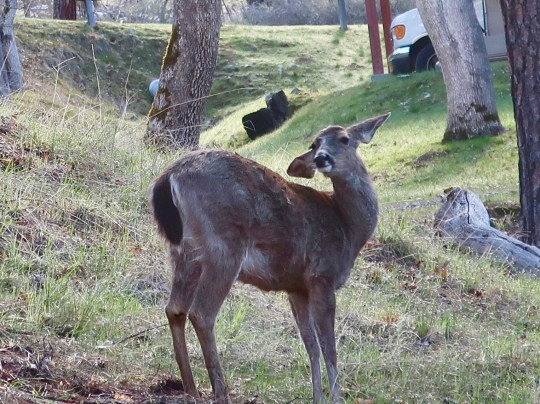
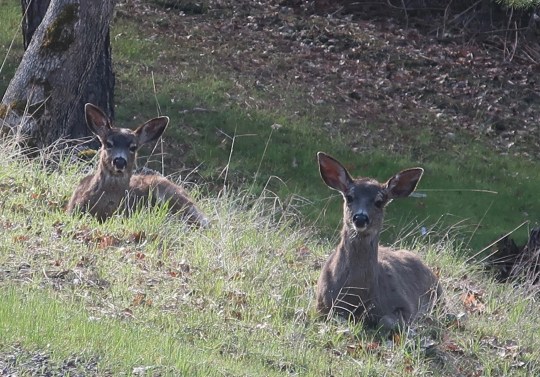
I was walking up to my writing place on the edge of the national forest when I ran into Floppy. “You are looking a little pregnant, Girl” I told her. She gave me the look and laid back her ears. “There is no such thing as being a little pregnant, Curt” she said primly in deer language. And she should know. She’s been dropping babies on our property for the past several years. Her two teenagers were hanging out in the grass 10-yards away. Floppy has been urging them to leave home lately. I saw one dashing down the hill yesterday with Floppy hot on its heels. This isn’t cruelty; it’s normal doe behavior. Floppy is about to have her fawn and the teenagers hanging around will give away its hiding spot to any number of predators.
I have several writing places around our property. In general, all that is required is a flat spot and a comfortable chair. And a view. Inclement weather normally calls for a more protected environment, preferably with heat. Thermometer-busting heat also sends me scurrying inside. This time with air-conditioning. I’m such a wimp. But the view is still required. As I mentioned on Friday, the variety has proven particularly valuable in the Age of Coronavirus. It helps counter the stir-crazy feeling of isolation.
It can’t decide whether to rain, or snow this morning. Blue skies are predicted for this afternoon and seventy-degree weather later in the week. It’s spring! I started writing this morning at 5:30 in the living room and then moved back to the bedroom at 7:00. Peggy, on occasion (2-3 times a week), likes to be served breakfast in bed. Who doesn’t? And she likes company. Nine a.m. is our limit for getting up and about, however, and I have now landed in the library.
My living room view, assuming of course that the sun has come up. The Red Buttes are looking a little wintry today.My bedroom writing location. Peggy has already vacated the premises but she returned to take the photo. The gorgeous quilt is one she made.The view from the bed.
Today I am going to take you on a tour of my favorite outside spots. I’ll start from the top and work down.
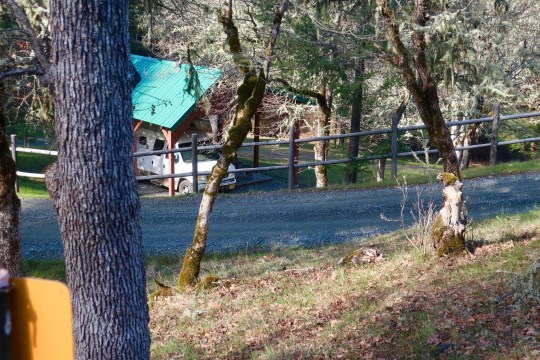
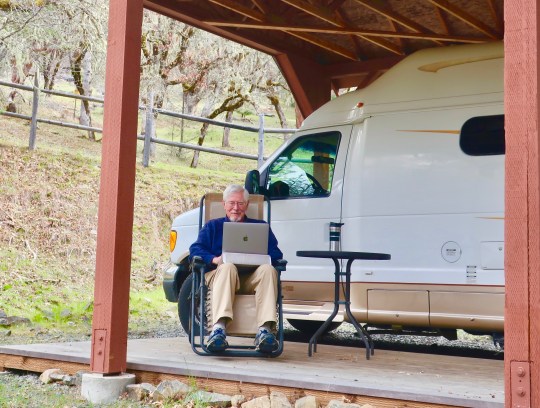
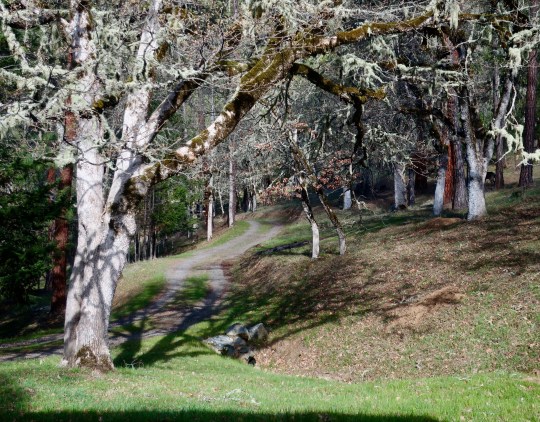
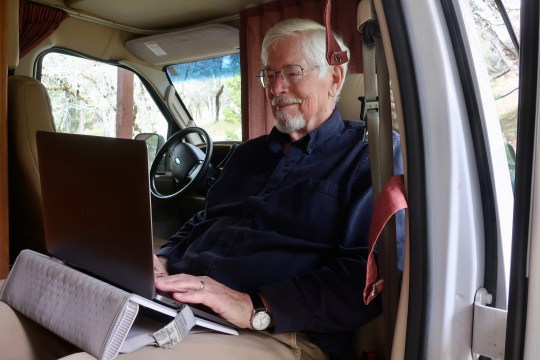
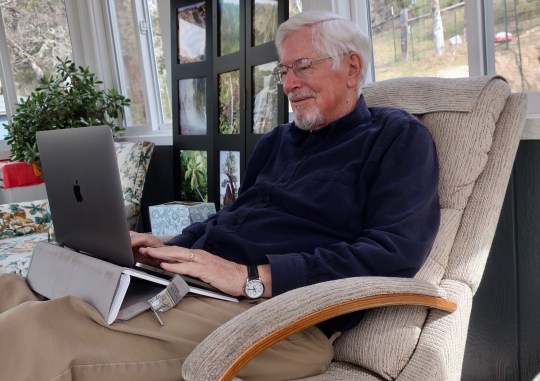
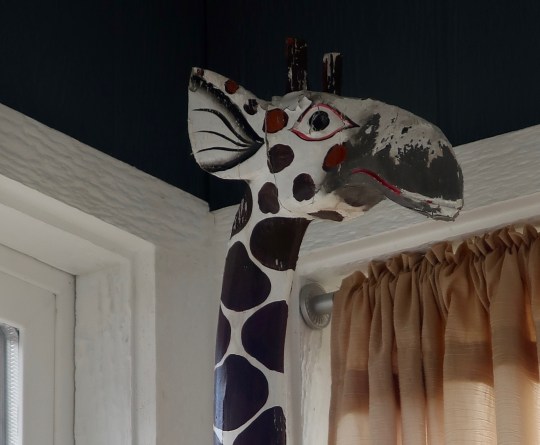
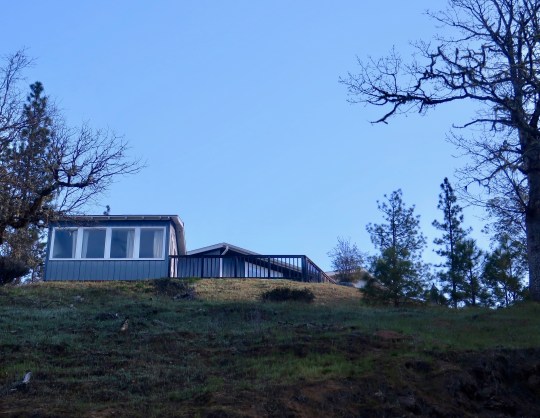
Quivera the Van’s home in the pole barn makes an excellent writing space. It is both protected and outside. It also sits on the edge of the Rogue River-Siskiyou National Forest. I took this photo from the national forest sign that marks the edge of our property.Peggy took this photo of me working in my comfy chair.A view down our road from my writing chair.Another advantage of the pole barn is that Quivera provides an even more protected place to write. She also comes with a stove for making coffee or tea and a restroom. This, BTW, is my writing place when we travel in the van.My next writing place is down the hill and sits on the edge of our canyon. The round object is my Weber smoker. It’s a good place to write and watch baby-back ribs smoke. The three handprints were put on the shed by our grandsons Ethan and Cody plus our neighbor William when they helped paint the shed a few years ago. The coffee table is our old safe re-purposed. And no, it is not stuffed with cash!While Peggy was taking my photo, one of the kids showed up to check out what we were doing. It even came with a teenager mohawk! (Actually it is shedding its winter coat.)Here I am writing on our patio. The table is covered with a large patio umbrella that works as a sunshade. We find bats sleeping in the folds of the umbrella on occasion when we open it. Eventually, they fly off. Our back porch also comes with a writing chair. The window is the library window that provides my view of the backyard. The extra chair is for visitors. My Weber grill is much smaller than the one that used to live in its space. A very large bear came up on our porch and tipped it over on a dark night. It made a big bang.I have no problem filling the visitor’s chair.While most of my views from the porch are the same as the library, I can check out the side hill with its white oaks (the deer like to lie up there and chew their cuds).Or look up the hill behind Quivera where Peggy and I do much of our hiking. It’s a great escape and exercise as we hang out at home. It’s a lot higher than this photo implies— about a thousand feet!I can also admire the beautiful madrone that stands next to the porch and provides welcome shade in the summer. Deer like to sleep at its base.And finally, there is our sunroom, lit up here by the early morning sun.Except on hot days, it is always a prime location to write.The views are always great, but a storm adds drama.If I need a break, I can talk to the giraffe…Or if I am suffering from a particularly bad case of writer’s block, watch Peggy’s sunflowers grow.I’ll conclude with a final photo of the sunroom. Romantic, eh? I caught the picture when I was rolling our garbage can down to the road! Oh yeah, one final thing. Thats not a squirrel up on the roof. It’s the top of a tree on the other side.
WEDNESDAY’S POST: It’s off to Athens as part of my armchair series.
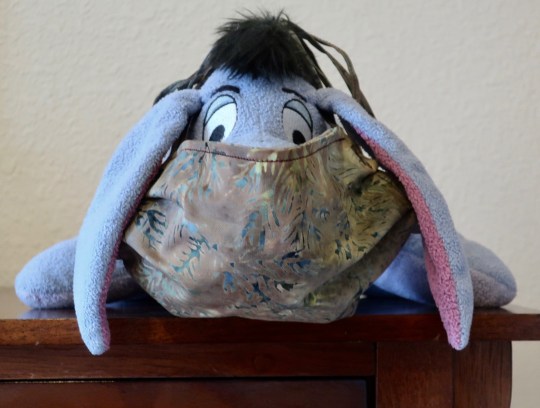
Eeyore dons a face mask for a trip to the grocery store. He’s out of carrots.
Word-smiths are able to handle seclusion better than most people. Self-isolation provides writers with the focus needed to craft sentences. At least that’s true for me. The smallest interruption in the middle of a creative moment and zap— it’s gone. And boy is it grumpy about coming back! Of course, life is full of interruptions. The phone rings. More often than not, it’s a spam call. I have won a free cruise. All I have to do is buy a time-share. Woohoo.
More common, Peggy has something to share. Nothing unusual about that. As a husband and friend, it is my duty to listen and respond— in a positive way. I think she wrote that into our wedding vows. We’ve been happily married for 28 years, so I guess I’ve passed that test. And vice-versa. But Peggy is also sensitive to my needs as a writer. She made me a small hanging quilt with two sides. The side with books on it means I am writing. It’s quiet time. She walks by and smiles at me while pretending to zip her mouth. The little devil. Or plants a quick, quiet kiss on my lips. No way I can object to that. Or brings me a cookie still hot from the oven. Now she just walked out to fit me for a coronavirus mask she is sewing. But, for the most part, she honors the sign.
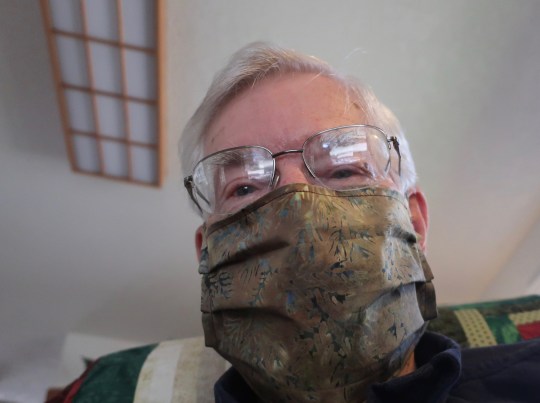
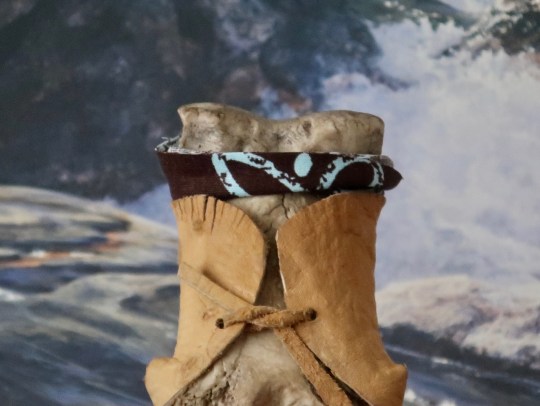
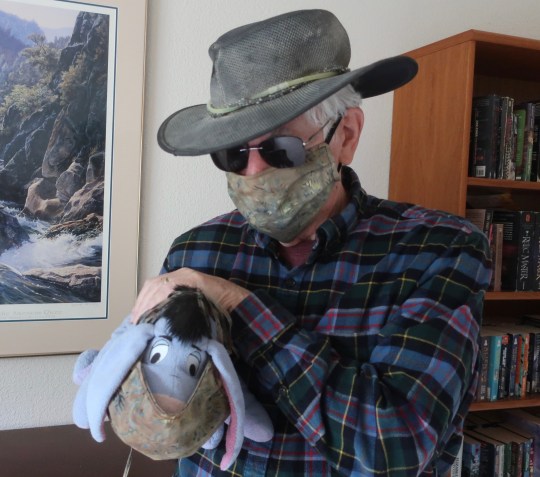
I asked Peggy if I could take a photo of demonstrating the smile and the zip. She held up a book, Mission to Civilize. I think she was referring to her efforts to civilize me, a 30-year effort with few results to date. “I have more time, now,” she said. Should I be worried? Hmmmm.Here’s the mask that she sewed for me. Our county now requires wearing masks when we are out in public. It reminded me of wearing dust masks at Burning Man…Which led me to grab my Burning Man hat and shades. I’m ready for the Playa. Whoops, it’s been cancelled. In case you are curious about how serious Peggy is about this mask business, she even made one for our elephant. They have big trunks, right. Think big sneezes!Suddenly, we hear a squeak from the book case. It’s Bone, self-isolating in his Bone Cave, demanding that Peggy make him a face mask, too.Of course Peggy does. Bone requests that I take his picture with some rapids in his background to remind him of the 43 years he has travelled the world before coronavirus. For those of you not familiar with Bone, I’ve placed the Bone Interview in my pages above. And added a question about Covid-19. His answer isn’t for tender ears.Eeyore goes into a tizzy when the pandemic is mentioned. It’s worse than misplacing his tail. Here I give him a little TLC. Or maybe he is giving me the TLC?
I turn the quilt over when I am not writing as my part of the bargain. There are lots of things I do related to working on my blogs or books that don’t require the same concentration. Doing research and processing photos are two examples. Interruptions are okay, even welcome. Except for spam calls. I particularly like the kisses and warm cookies.
“Darn, Curt has his writing sign up. I have to be quiet. Maybe if I bring him a warm cookie…”“Yay! Curt’s turned the sign around. Now where’s my list of 25 things I need to talk about.”
Like many writers, I discovered that I can also work in coffee houses. In fact, I like to. The noise of people talking becomes background, a form of white noise. It’s a way I can have human companionship while still being able to focus on writing. Plus, it gets me out of the house. When I lived in Sacramento, I would start my day with a 5-mile hike along the American River and then head for one of my favorite coffee houses for a couple of hours of uninterrupted writing. And then move on to another, and another.
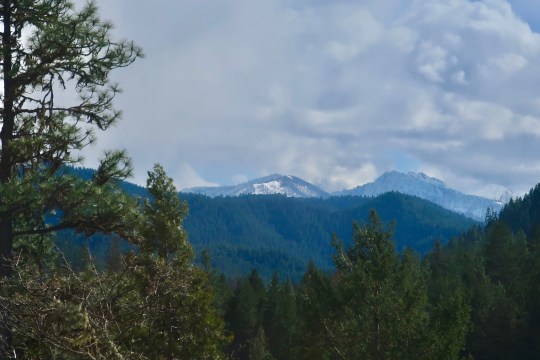
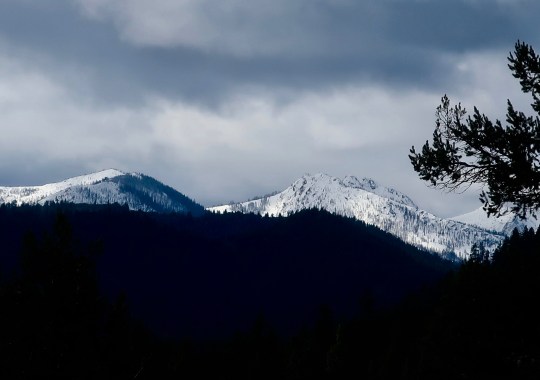
It’s not so easy now. We live 30 miles from town, on the edge of being off-the-grid. Try as I might, it is really hard to justify making a 60-mile round trip into Medford so I can spend a couple of hours writing, or even several hours. Coronavirus has eliminated even that option. I make do here. It’s not hard. As most of you know, Peggy and I live on a beautifully wooded five acres with the Applegate River on one side and the Rogue River-Siskiyou National Forest on the other. Views of the Red Buttes, still covered in snow, dominate our views out the front. It’s a great place to write— or hide out from Covid-19.
My primary writing space is the library. I am surrounded by books and reminders of our travels for inspiration. The major attraction, however, is my window on nature. My chair turns so I can either stare at books or check the action outside. Right now, a pair of rosy finches are pecking it out over who gets first right to the bird feeder while two grey squirrels are chasing each other around and around a tree trunk. Love is in the air.
Few things give Peggy and me more comfort than books. They are even more important now.Our library is also filled with memories of our travels. This hanging is from Alaska. Peggy found the quilt hanging kit in a quilting shop in Anchorage.The view out our library window.
The downside here is that nature itself serves as an interruption! And the woodland creatures don’t give a hoot which way my quilt is facing. Of course, I can turn around or look down, but how do you ignore a deer looking in the window, or bringing a fawn by, or a pair of bucks fighting over who gets the doe. Or a whole herd coming by while I am working on this post…
Are you in there? Are you okay? Where’s my apple?She’s mine!“So this is what happens when I do that! I’m outta here…” The fawns are so tiny when their moms first bring them by.The deer really cooperated when I was working on this post. The whole herd showed up when they heard they could get their photo on the blog. They are admittedly looking a bit scruffy. This is the time of the year when they shed their winter coats.
The creature that wins the trophy for the most flagrant violation of my quiet time is a male flicker. These large members of the woodpecker family would normally win their lady loves by holding drumming contests on hollow logs. He who drums loudest wins fair maiden’s heart. You know how that goes. One particularly large fellow has discovered that drumming on our vents creates a noise louder than the loudest log. To us it sounds like someone is using a jackhammer on our roof. And the ladies gather round. It doesn’t matter how many times I’ve discussed his obnoxious behavior with him— or lobbed pebbles in his direction— it’s rat-a-tat-tat, rat-a-tat-tat. Over and over again.
But even here with all the beauty and wildlife to amuse me, I get restless. The need to wander is buried deep in my soul. Fortunately, there is a temporary solution. I’ve designated a number of different locations inside and outside as writing spaces. When I get itchy feet, I move between them. And that, my friends, will be the subject of Monday’s blog.
Me, self-isolating.And finally. There has been a lot of confusion about how best to test for coronavirus on the national level, in case you haven’t noticed. This isn’t the way.
Darn, I thought to myself as I checked my blogs for Santorini. I’ve done a lot on the island. I can’t seem to help myself— it is so beautiful and unique. I really thought about doing something different today, but I had promised Santorini. Plus, as noted, I can’t resist. When I found a post on the churches I had done in 2013, I decided to put it up in hopes that there might be a few photos I haven’t shared on my blog four or five times. 🙂Still, even if you have seen these, they are always worthy of seeing again!
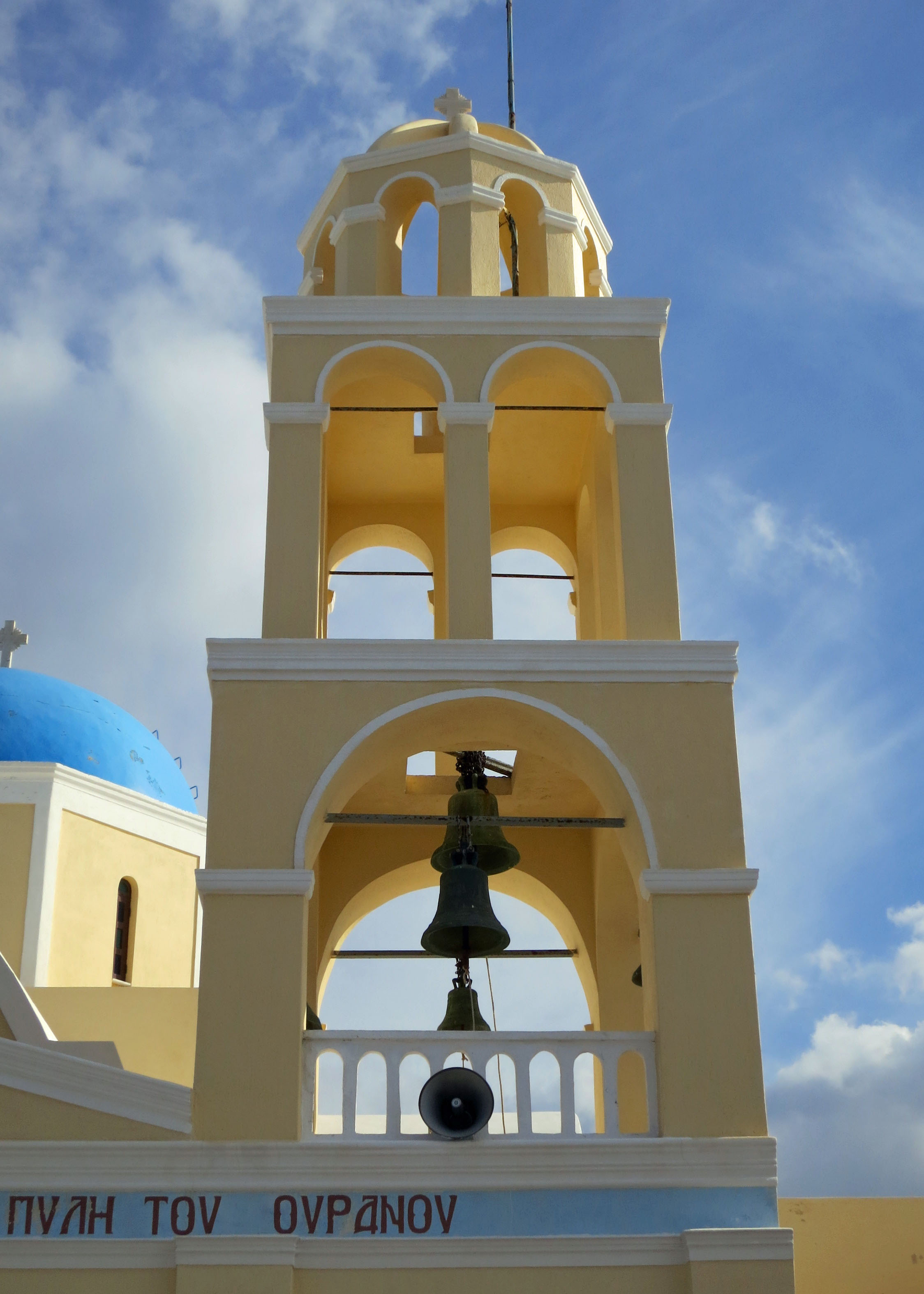
The Church of St. George in Oia, Santorini. Most, but not all of Santorini’s churches featured a blue dome.
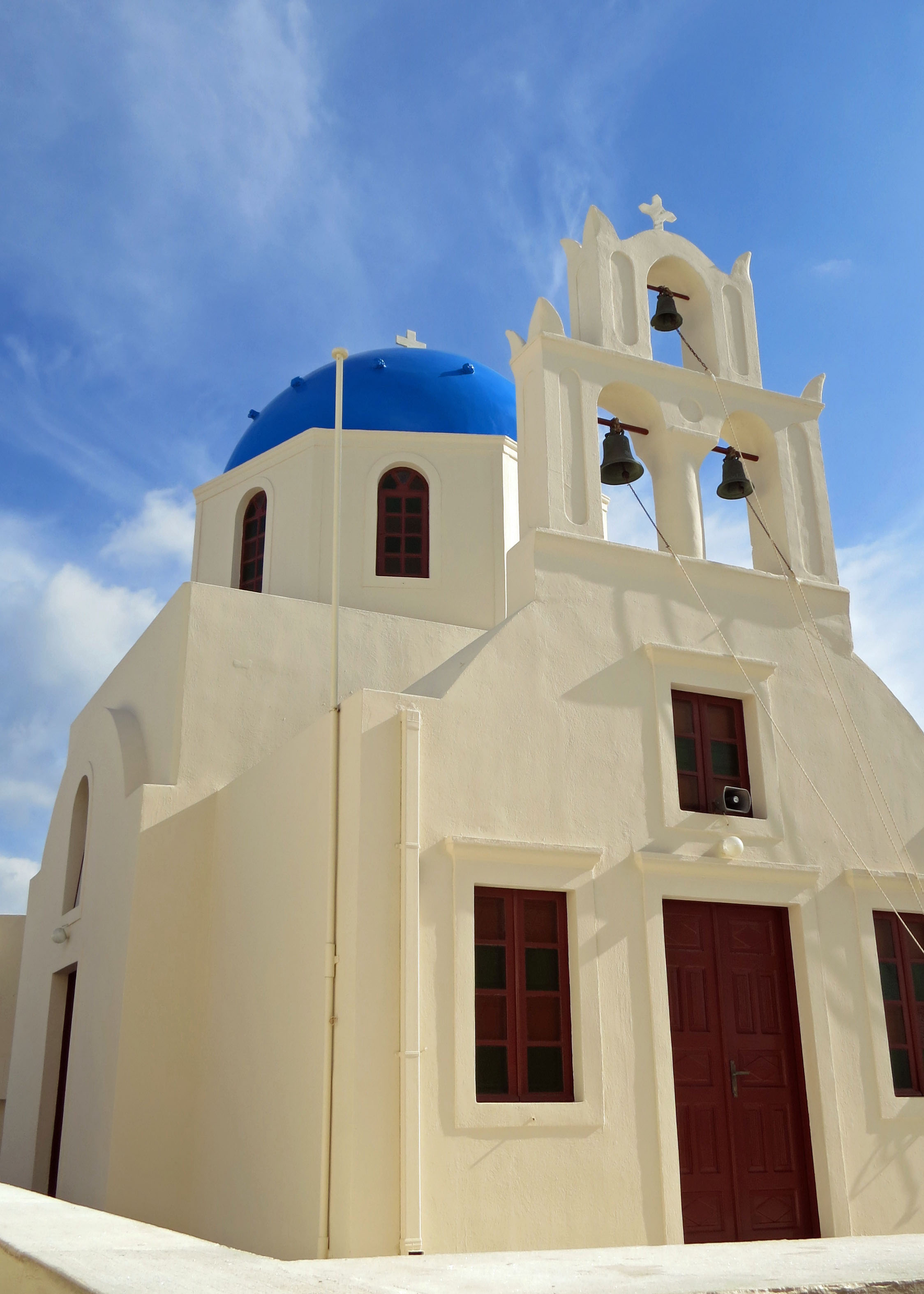
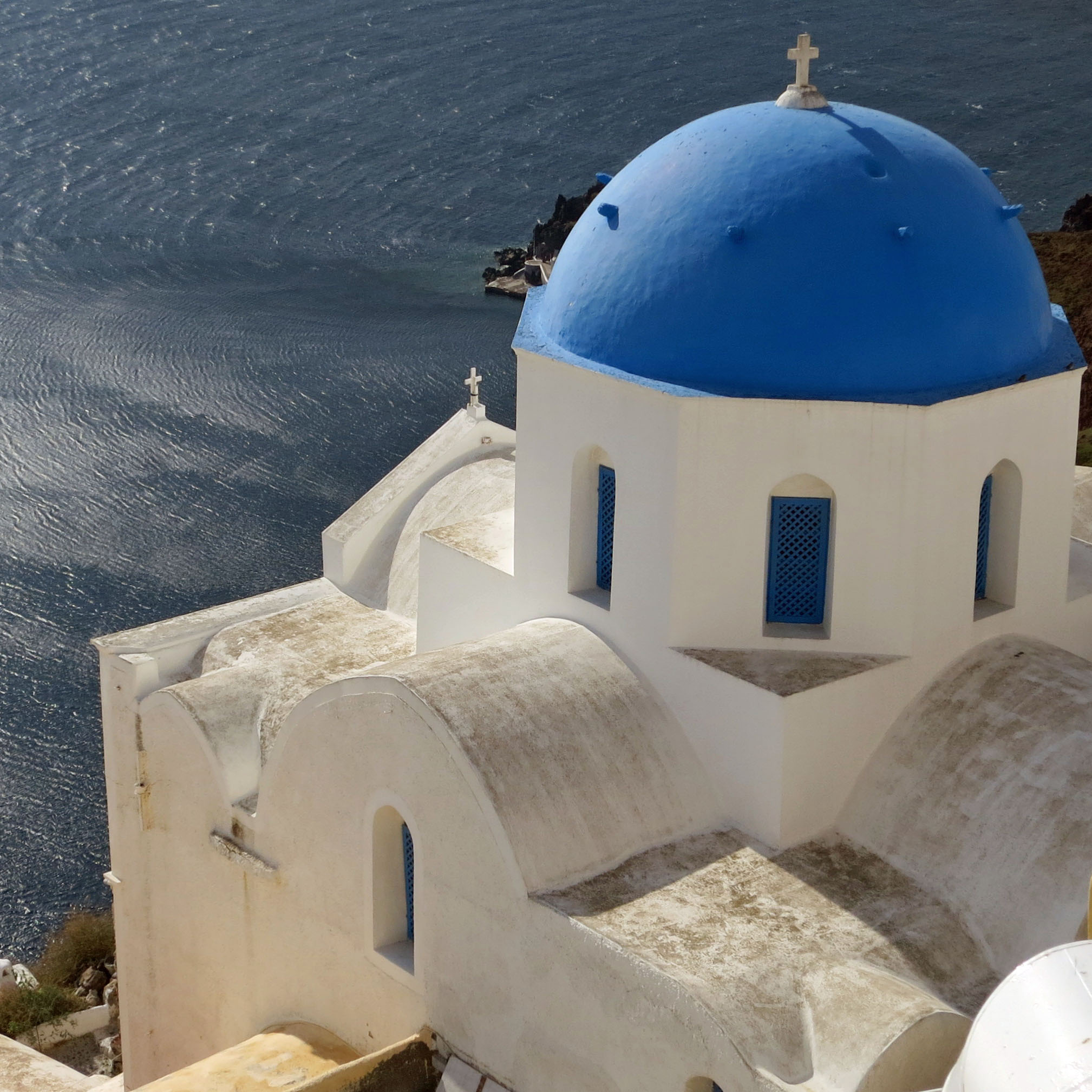
Europe is filled with great churches that are known as much for their art and architecture as they are for religion. Our cruise through the Mediterranean would take us to some of the world’s most renowned cathedrals. While the churches on the Greek Island of Santorini are no match for the splendor of what you find in Venice, Rome or Florence, they have a subtle beauty and uniqueness of their own. The following photos are meant to capture something of their beauty.
This is a close up of the bell tower on the Church of St. George in Oia, Santorini. The bell towers throughout the town were as unique as the churches.
I found this church with its white rocks surreal.
A view of the same church seen in the photo above from behind.
This church provided an interesting backdrop for the homes in front. I also liked the fun play of light and shadow.
The Church of Panagia provides a gateway into Oia on Santorini. Once again, dramatic clouds added interest to our day of photography. (Photograph by Peggy Mekemson)
The bell tower of the Church of Panagia in Oia, Santorini.
Another of Santorini’s uniquely beautiful churches.
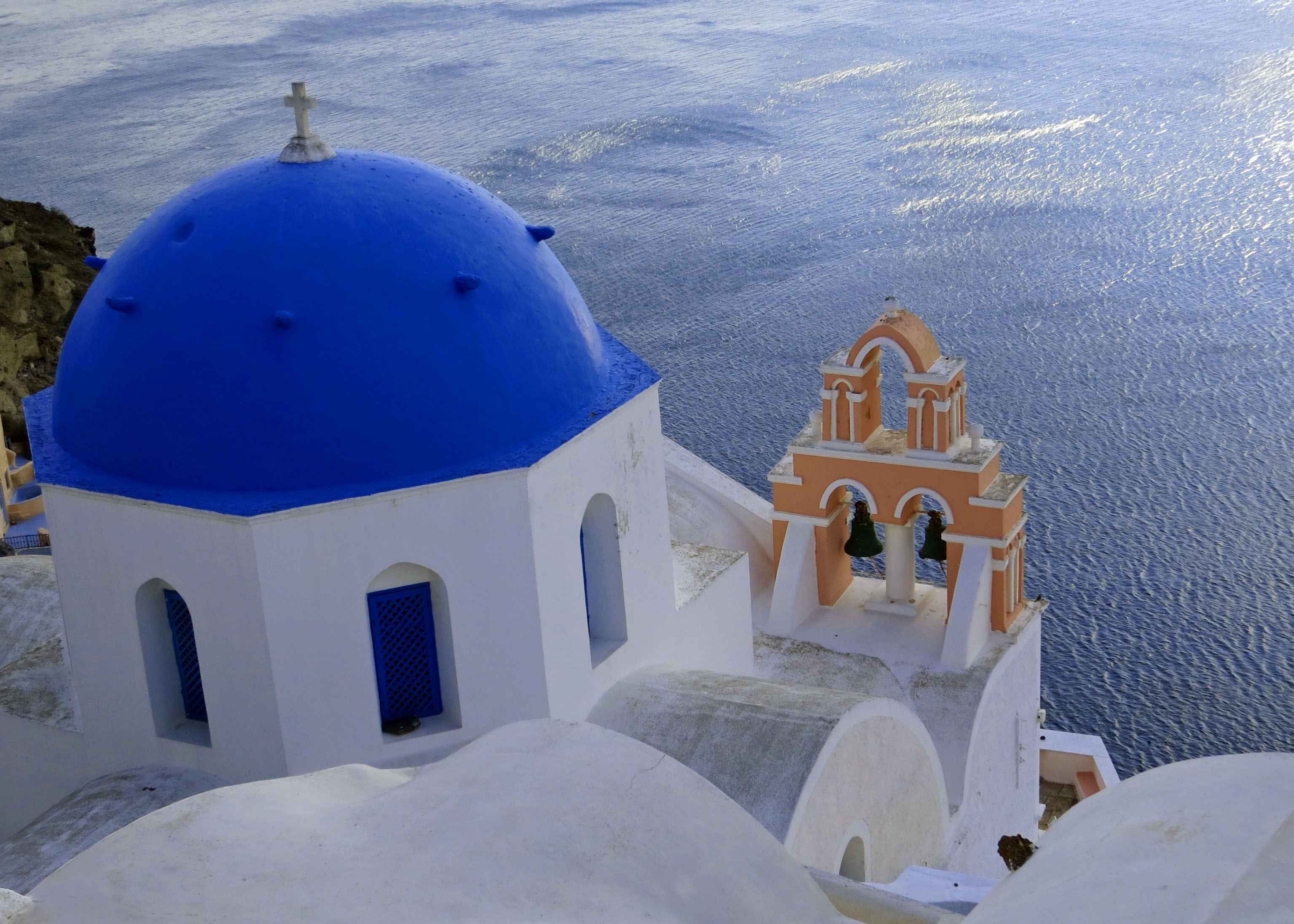
I like this church on Santorini because of its almost sensuous lines. Can a church be sensuous? Having the Mediterranean for a backdrop didn’t hurt either.
This is another perspective on the Santorini church shown above featuring its salmon colored bell tower.
My concluding photo on the beautiful and unique churches found on the Greek island of Santorini.
FRIDAY’S BLOG: Assuming the weather cooperates, I thought it would be fun to share my seven different offices on the property. If I am feeling the least bit stir crazy during the lock down, I move! (Grin.)
Peggy and I are continuing to self-isolate ourselves, as are so many of you. Medford, Oregon, the medium sized town where we do most of our shopping, is on the edge of becoming a coronavirus hotspot. (Nowhere is safe.) We have zero desire to go there and have enough food— and wine— that we don’t have to for a couple of weeks. I even have older blogs to repurpose. (Grin.) Something like 900. I’ve been blogging for 10 years. Last week I re-posted a blog on the Greek island of Corfu. Today is Mykonos. Stay safe.
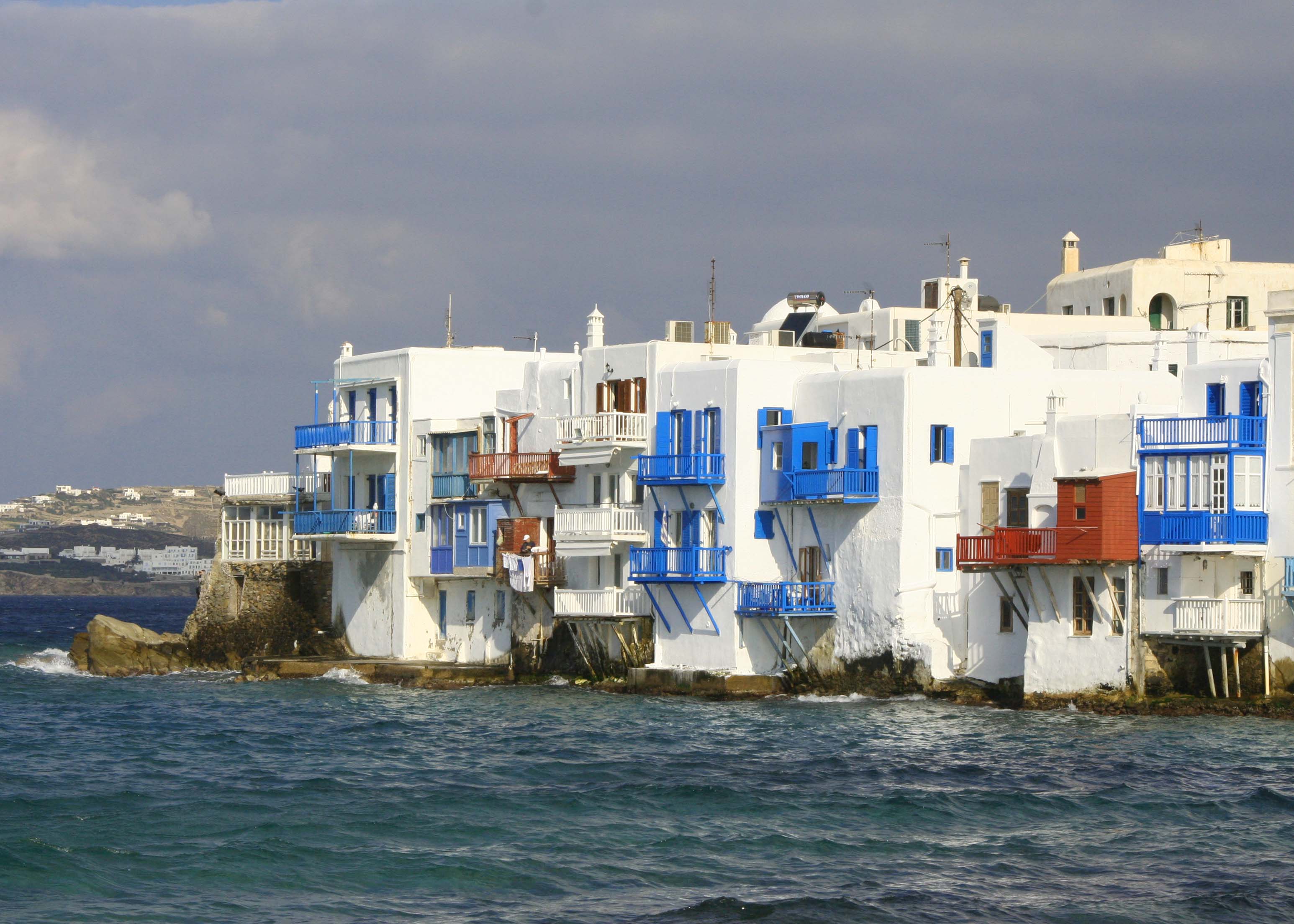
The area known as Little Venice is one of many charming sites on Mykonos. (Photo by Peggy Mekemson)
The maze-like town of Mykonos (Chora) was designed to discourage invasion. It was easy for invaders to get lost in the narrow, winding streets that ran into other narrow, winding streets that ran into other narrow, winding streets.
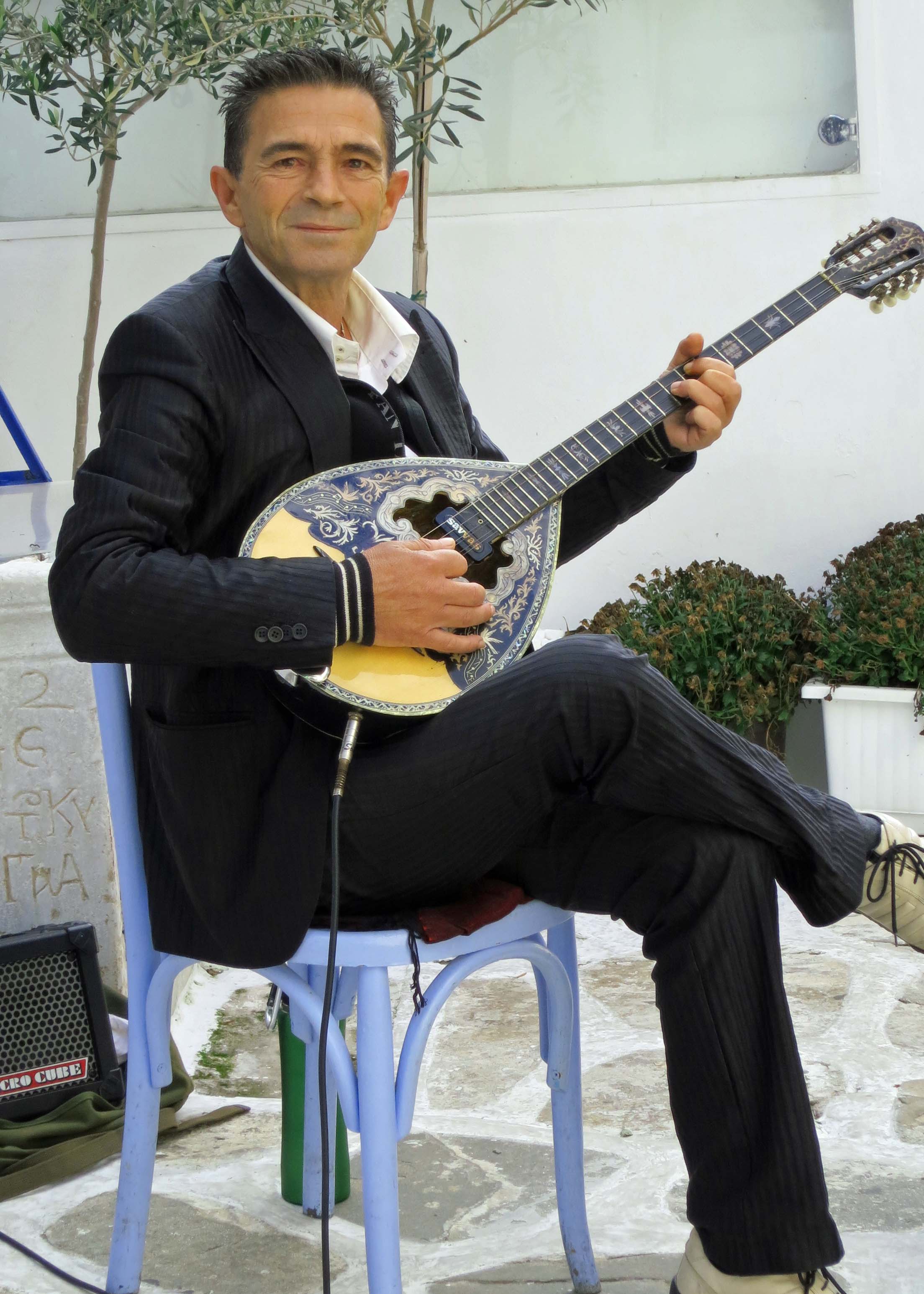
Modern day invaders, otherwise known as tourists, also find it easy to get lost. But that’s half the fun. Except for finding a restroom when you really, really need it, there is no danger. You can easily spend an hour or several wandering along the town’s crooked roads and paths. There are beautiful white buildings slathered in stucco to admire, shops to explore, and cats to photograph. You may even find a Greek musician playing the bouzouki, a mandolin-like instrument that produces what most people think of as Greek music. Picture Zorba dancing.
White is the common color for buildings on Mykonos, Santorini and other islands of the Cyclades in the Aegean Sea.
One of the main streets in Mykonos. This road is freeway size in comparison to most routes through the town.
Routes through Mykonos are much more likely to look like this. Note the blue trim used to add color to windows and doors.
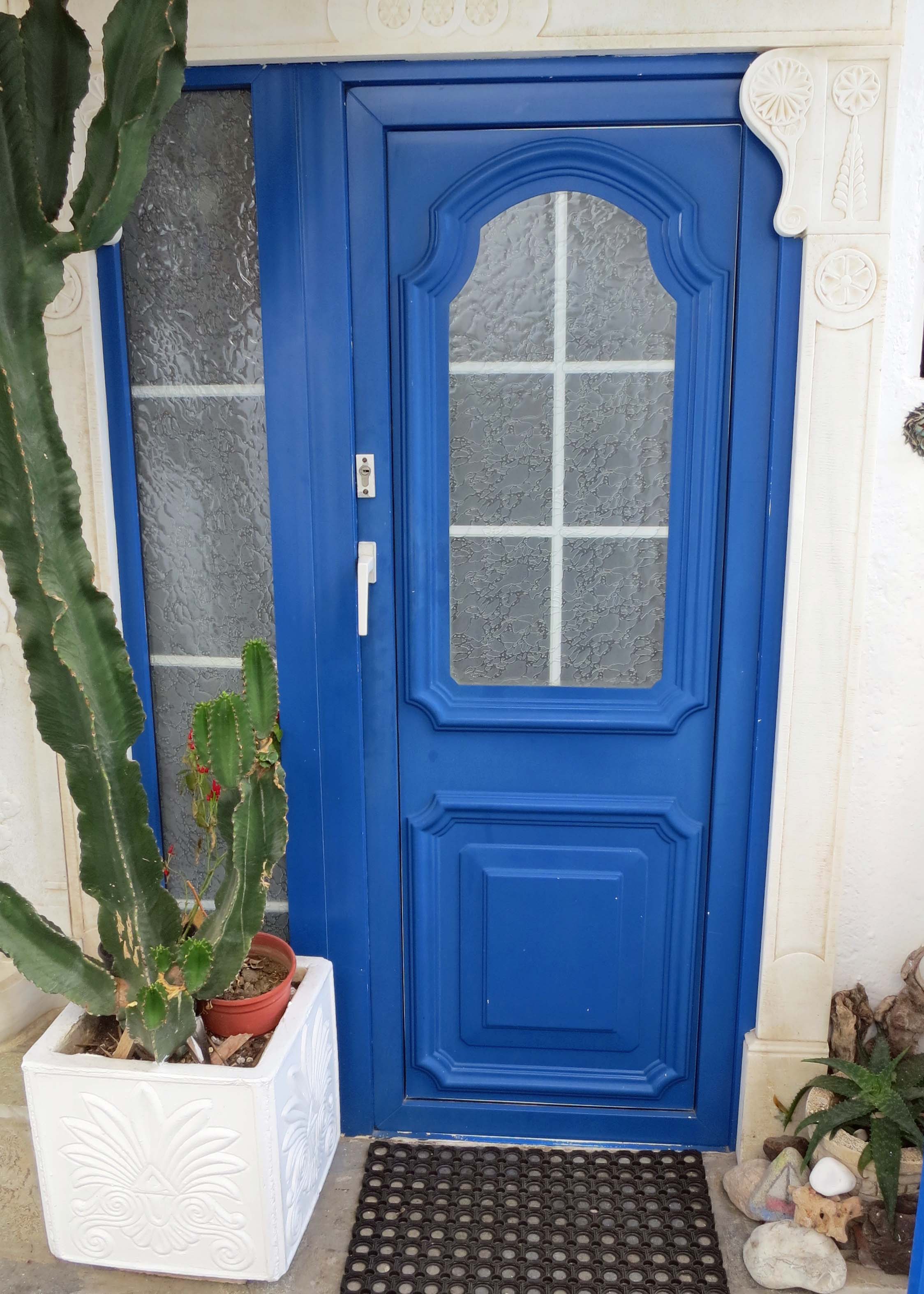
This blue Mykonos door is decorated by a cactus.
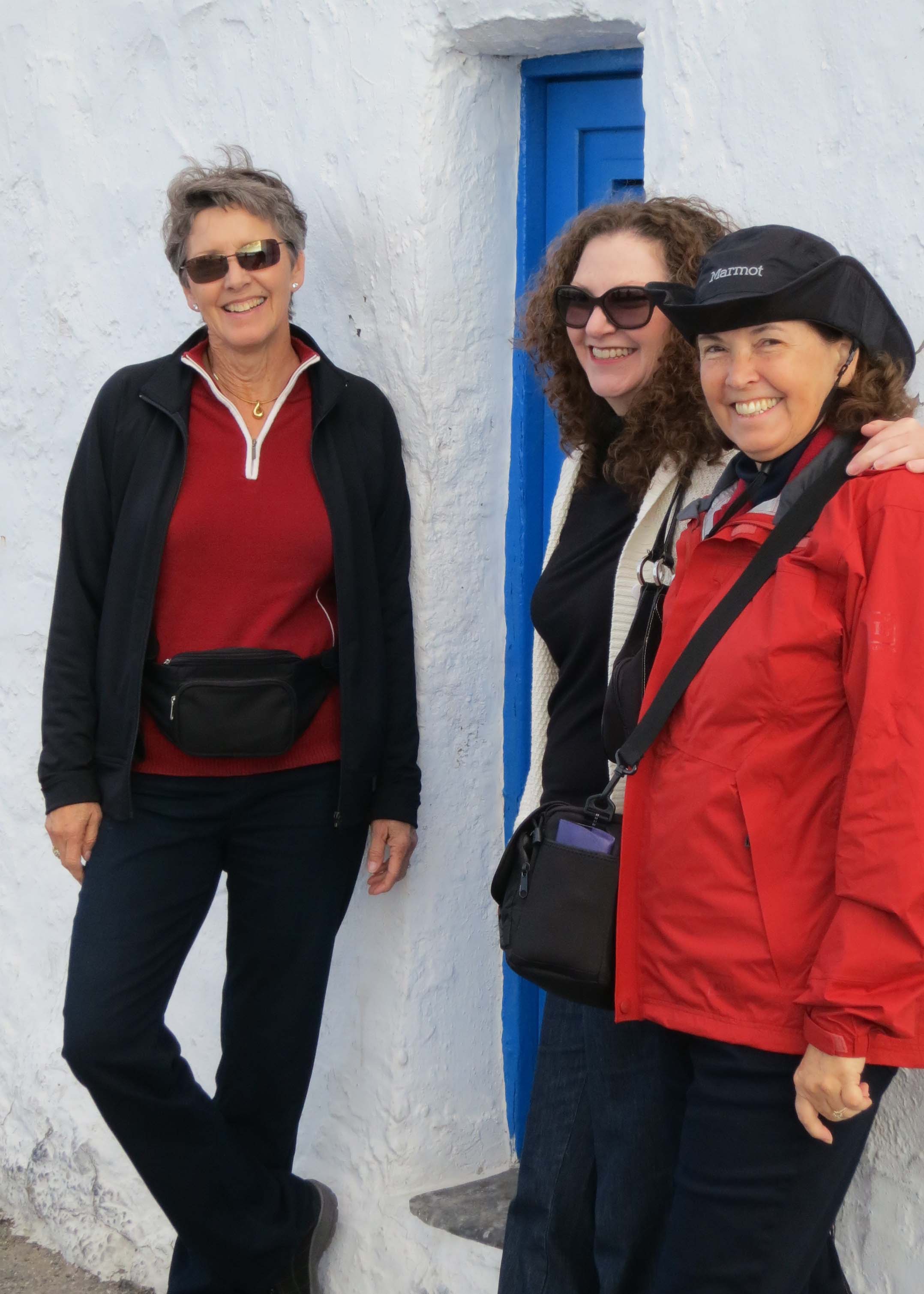
My wife Peggy on the right and two of our traveling companions, Kathi and Frances stand in front of another blue door.
Bougainvillea seems to be the flower of choice in Mykonos.
A street musician entertained us by playing his bouzouki…
And a cat confiscated a cafe chair for its midday snooze.
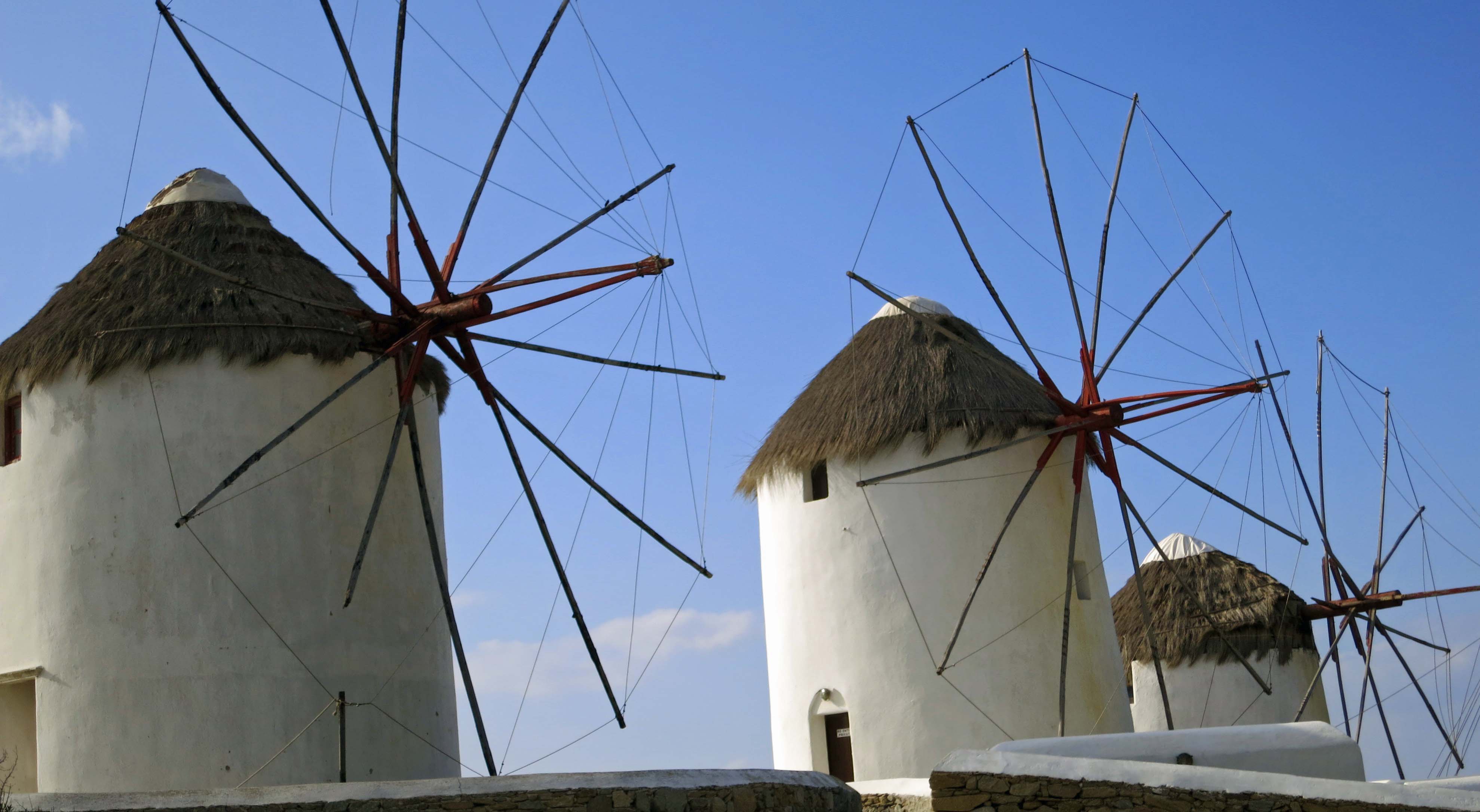
We managed to get both lost and separated. There was no hope of finding each other in the labyrinth, but fortunately we had a plan. We would meet at the island’s famous windmills. Long since retired, five of them remain hunkered down on a ridge south of town. Mykonos is noted for its winds. The locals even have names for them based on their intensity: bell-ringer, chair thrower, and knock you off your horse. We experienced a brief example of chair thrower but fortunately missed knock you off your horse.
The windmills used cloth sails to capture the winds and run mills for grinding grain. Local bakeries then turned the grain into sea biscuits, aka hardtack, which is flour and water baked several times into a consistency of hardness just this side of rock. The value of sea biscuits is they are basically indestructible. Before modern refrigeration, they were used on long sea voyages. Throw in a lime plus a generous dollop of rum and it was dinner. Producing these ‘delicacies’ was the island’s main industry.
One of the windmills of Mykonos. Dark clouds brought brief rain and a “chair thrower” wind. (Photo by Peggy Mekemson)
Three of the five windmills.
Following the coastline back into town we came upon Little Venice (pictured above), a community where sea captains of yore built mini-mansions perched on the ocean edge. Since it neither looks like Venice nor has canals, my thoughts are its name is derived from its proximity to water. Either that or a real estate agent was involved. The community is quite colorful, however. I’d be glad to call it home.
Mykonos has some 70 churches to meet the needs of its 7000 residents, which seems like a lot. I am reminded of the number of Baptist churches found in the rural South of the United States. When I was traveling through East Texas on my bicycle in 1989, I estimated there was one for each family. The Mykonosians had a unique use for their churches, however. They enshrined the bones of their dead relatives in the walls. I doubt the Baptists do this but it might give new meaning to the old saying, “the family that prays together, stays together.”
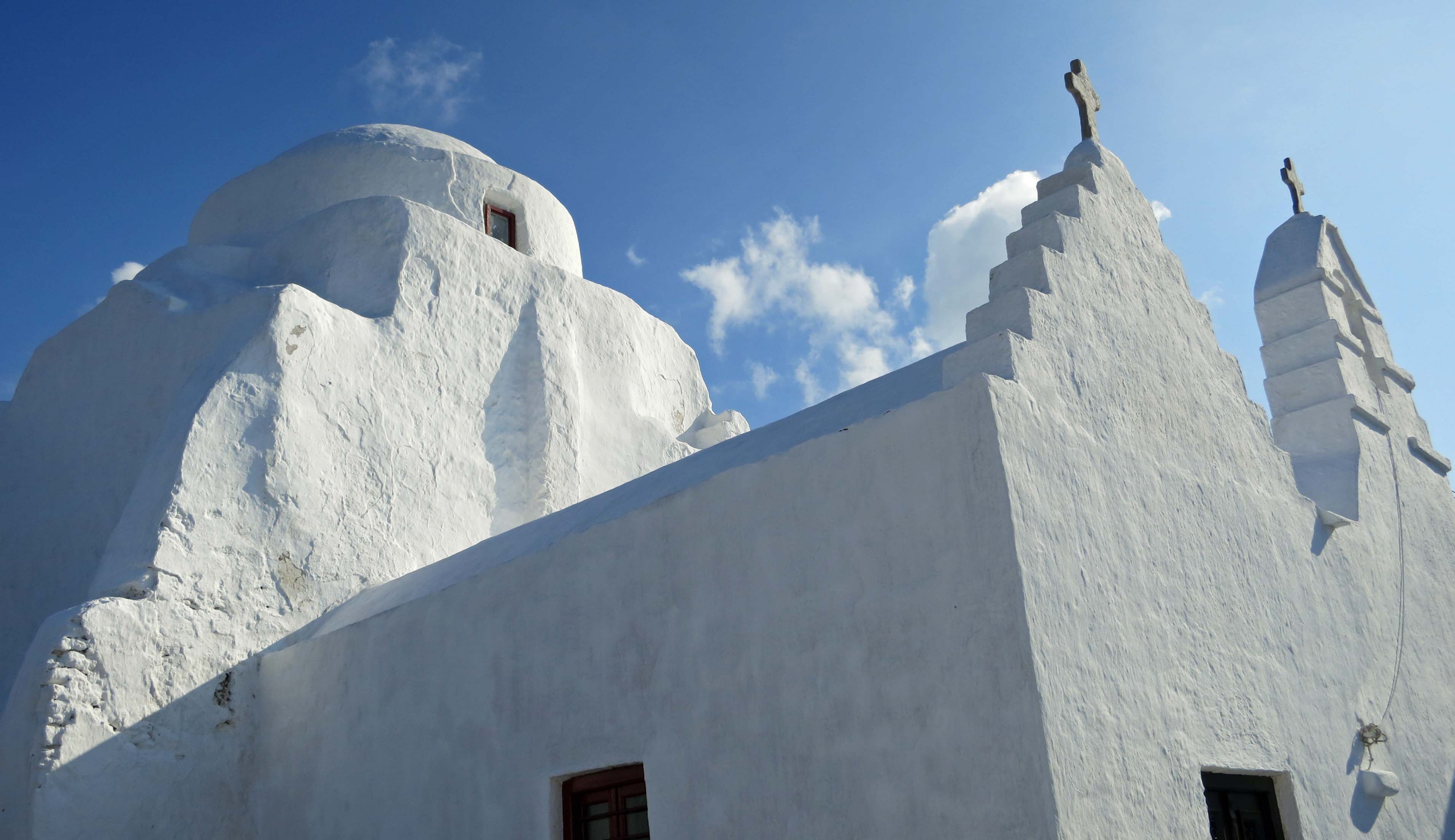
Scrunched between Little Venice and the harbor is the Church of Panagia Paraportiani, the most unusual church on the Mykonos. Once upon a time five different chapels existed side by side. Then they morphed together into what has become one of the most photographed sites on the island, with reason. We contributed our share of picture-taking.
The Church of Paraportiani of Mykonos.
Another view of the church.
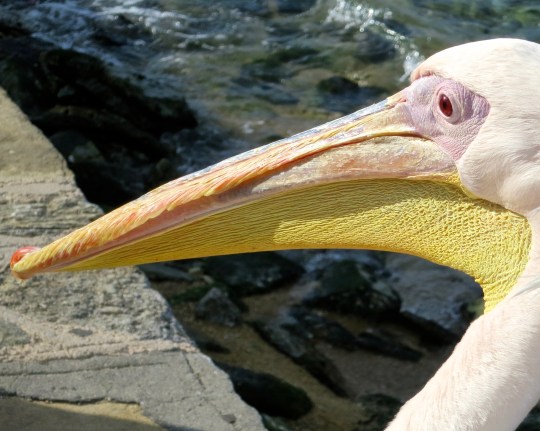
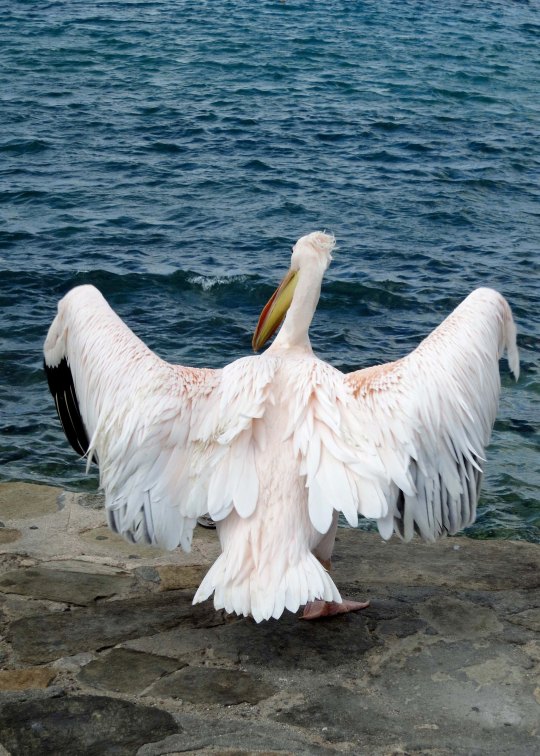
The small harbor area of Mykonos definitely fits the description of picturesque. It was our last stop (except for lunch) on our way back to the ship. That’s where we met Petros the Pelican.
We have this photo of Petros on our living room wall.Petros playing ghost? Or possibly drying his wings cormorant style.
Unfortunately, it was Sunday and the local fishermen had taken the day off. We satisfied ourselves with admiring the boats. The area also features a small beach that would be crammed with sun worshippers in the summer. Now all it featured was golden sand and blue sea.
Idle fishing boats in the Mykonos harbor.
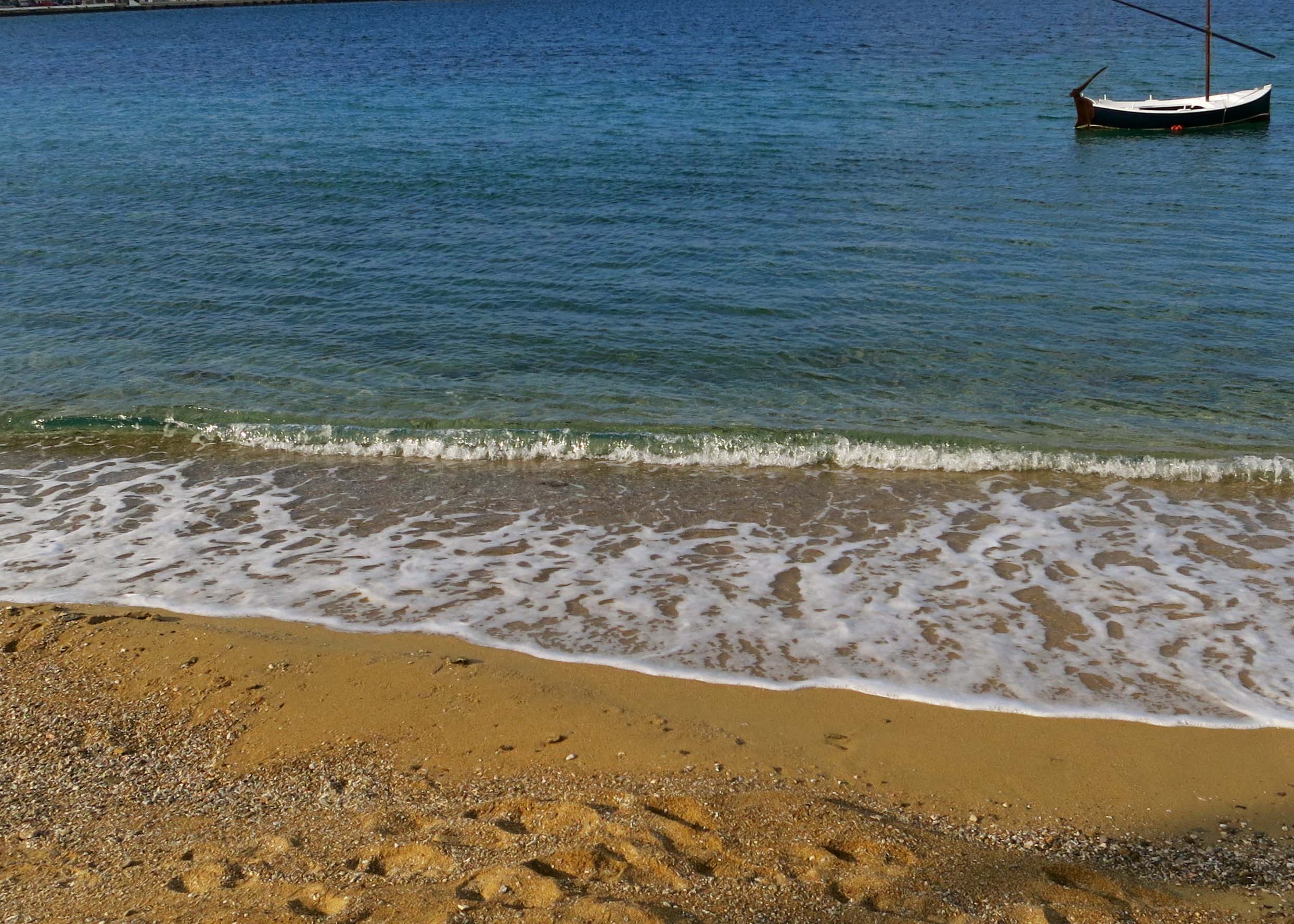
The golden sands and blue waters of the Aegean Sea of the small beach in Mykonos is a good place to end this post..
WEDNESDAY’S BLOG: Santorini. I’ve posted on this more recently but this beautiful island is always worth revisiting.
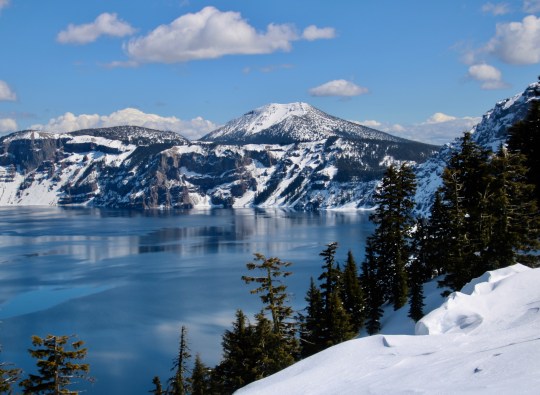
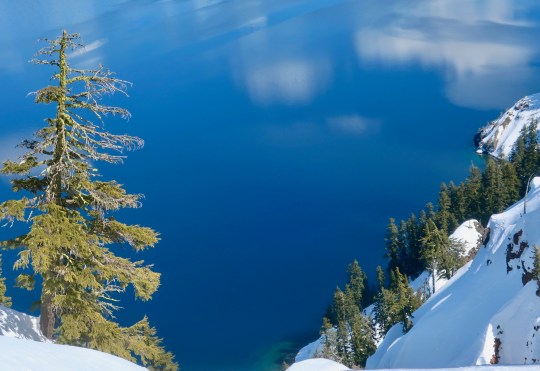
Crater Lake National Park is renowned for its beauty and the deep blue color of its water. It has an icy blue look here. Peggy took this photo from the Rim Village. Scott Mountain dominates in the distance. (Photo by Peggy Mekemson.)
The massive, 12-mile-high Mt. Mazama blew its top 7000 years ago. Local Native American legend claims that it had gone to war with Mt. Shasta, a hundred miles to the south. Mazama lost. It wasn’t that the massive explosion used up all of its bullets, aka lava. The problem was that using the magma emptied out the large chamber beneath the mountain and the weight of the Mazama brought it crashing down into the empty chamber, leaving behind a large crater or caldera to use the technical term. The caldera filled with water and voila! Crater Lake was born.
A photo I took of Mt. Shasta. Had Mt. Mazuma survived its explosion of 7,000 years ago, it may have looked something like this.
Peggy and I visited the National Park a week ago. It’s about a 2 ½ hour drive from our house. We drove up by ourselves and were careful to keep the virus-safe distance from the relatively few other people who were visiting. One individual insisted on invading our space, however…
This fellow apparently thought sniffing my shoe was more important than maintaining the 6 feet recommended to avoid coronavirus. “What are you thinking, guy?” I asked. “It’s a girl,” Peggy informed me. “She’s wearing pink.”
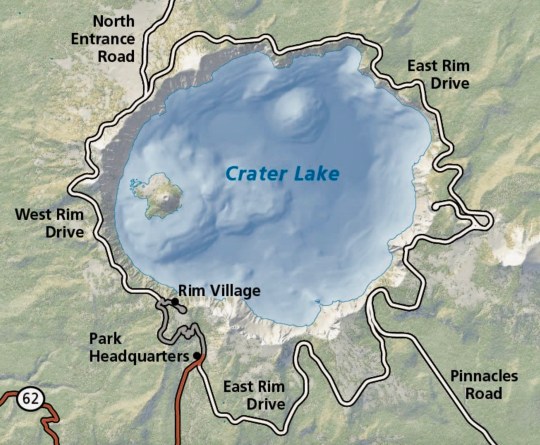
We had visited Crater Lake twice last summer and were eager to see it in the winter covered with snow. We were really glad we did. For one, it was as beautiful as we had expected it would be— and, two, the park closed on Tuesday because of coronavirus. The odds are that it will be closed until long after the snow melts. Here’s a map and some of the photos that Peggy and I took.
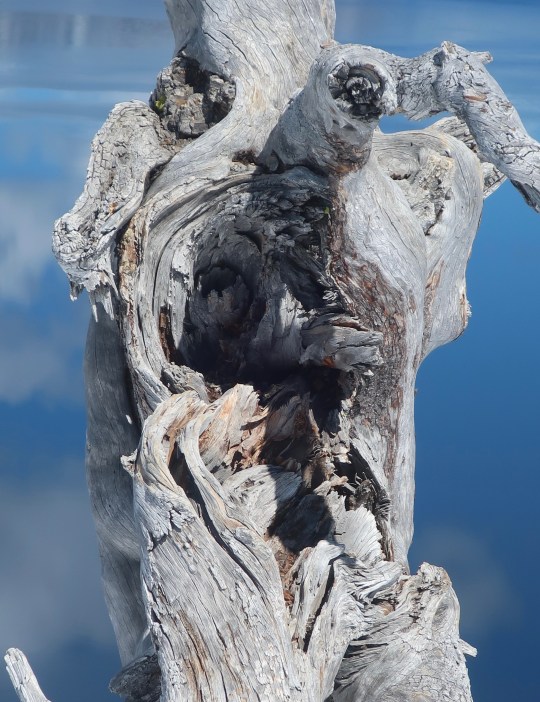
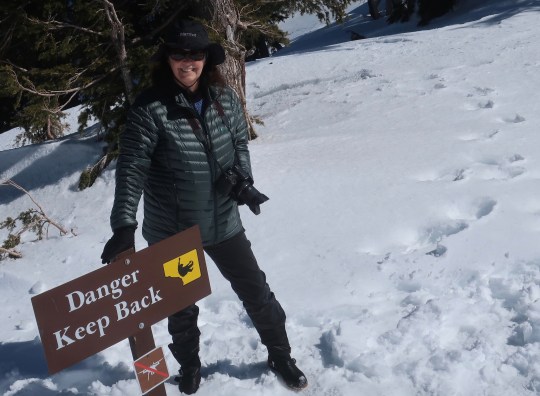
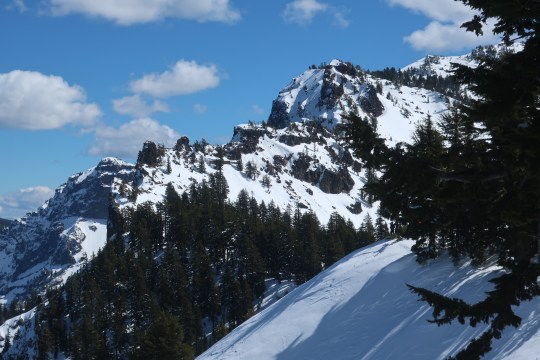
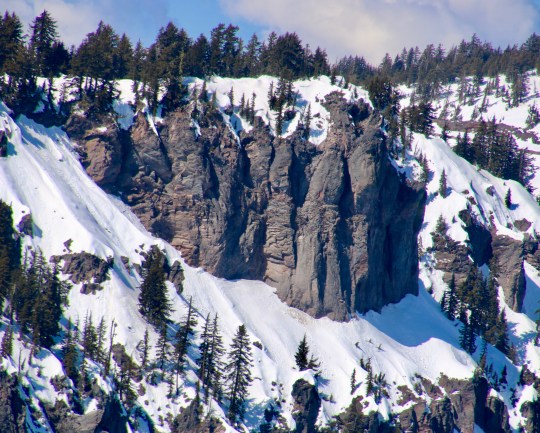
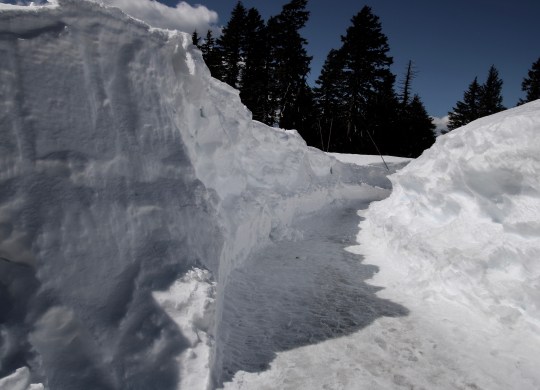
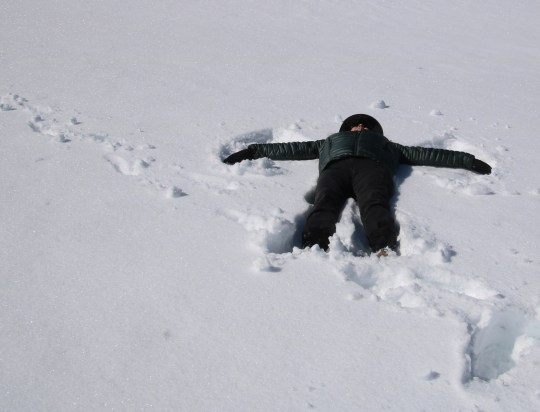
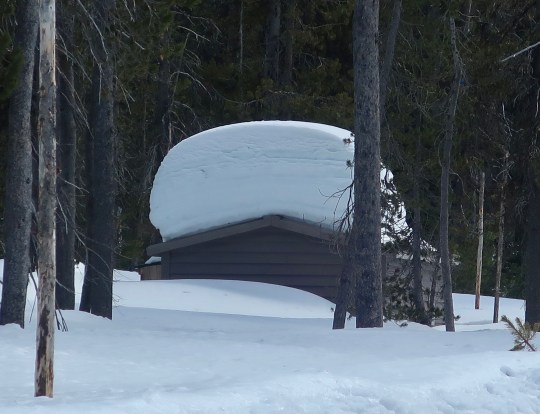
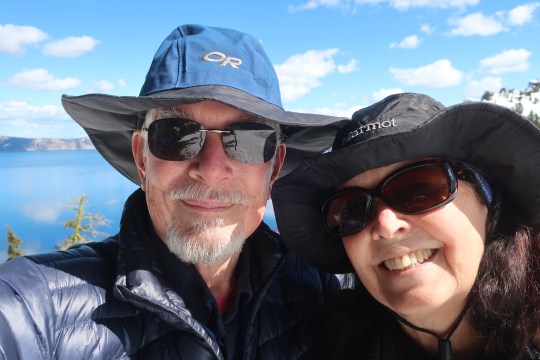
This National Park map provides an overview of the lake. Peggy and I were at Rim Village. The road around the lake is closed in winter and doesn’t open again until sometime in the summer. Wizard Mountain is on the left. The sheer cliffs around the lake are obvious. The lake is 1978 feet deep at its deepest spot. It is 6.2 by 4.5 miles across.I’ve never met a tree stump I didn’t want to photograph. Let me put this one into perspective…Wizard Island provided a backdrop. Llao Rock, named after the Klamath Indian god of the underworld rears up behind the island. The deep blue water reflects both Wizard Island and the clouds above the lake.A close up of Wizard Island. It is actually a small volcano that rose up from the lake’s floor. You can visit it by boat if you are willing to walk the thousand feet to the water. Afterwards, you get to hike the thousand feet back up. (Photo by Peggy Mekemson.)Other than the one trail, it’s a long way to fall to get to the lake and there are plenty of signs to warn you. The smaller sign forbids the use of drones.This photo gives a perspective on the steep drop.The cliffs as seen looking across the lake. I liked the impressionist-like reflection. (Photo by Peggy Mekemson.)Impressive rock formations surround Crater Lake. This one is located south of the Rim Village. I believe it is Garfield Peak.These were on the opposite side of the lake above Wizard Island. (Photo by Peggy Mekemson.)This is the trail that took us from the parking lot into the Rim Village overlook. (Photo by Peggy Mekemson.)Peggy points out the depth of the snow.This photo of two of the buildings at the Crater Lake Rim Village also provide a look at the depth of the snow. The trail leads over to the lakes rim. I rendered the photo in black and white. Peggy captured two fun photos of the roof. (Photo by Peggy Mekemson.)And the left edge of the building. (Photo by Peggy Mekemson.)All of the snow demanded a snow angel and I volunteered Peggy.It came out three dimensional! Peggy thought it was a bit spooky. Something took a big chunk out of her side. (It was from her knee getting up.)As always, we wandered around taking random photos. One of mine included this tree with its bone-colored limbs.Peggy caught these backpackers on snowshoes.Speaking of backpackers, the Pacific Crest Trail runs through the park. We didn’t see any through hikers, which wasn’t surprising. This is the restroom at the trailhead! Peggy and I will likely backpack through the park starting here this coming summer.I’ll conclude today’s post with a selfie of Peggy and me at the Lake’s edge— our last visit before lockdown. 🙂
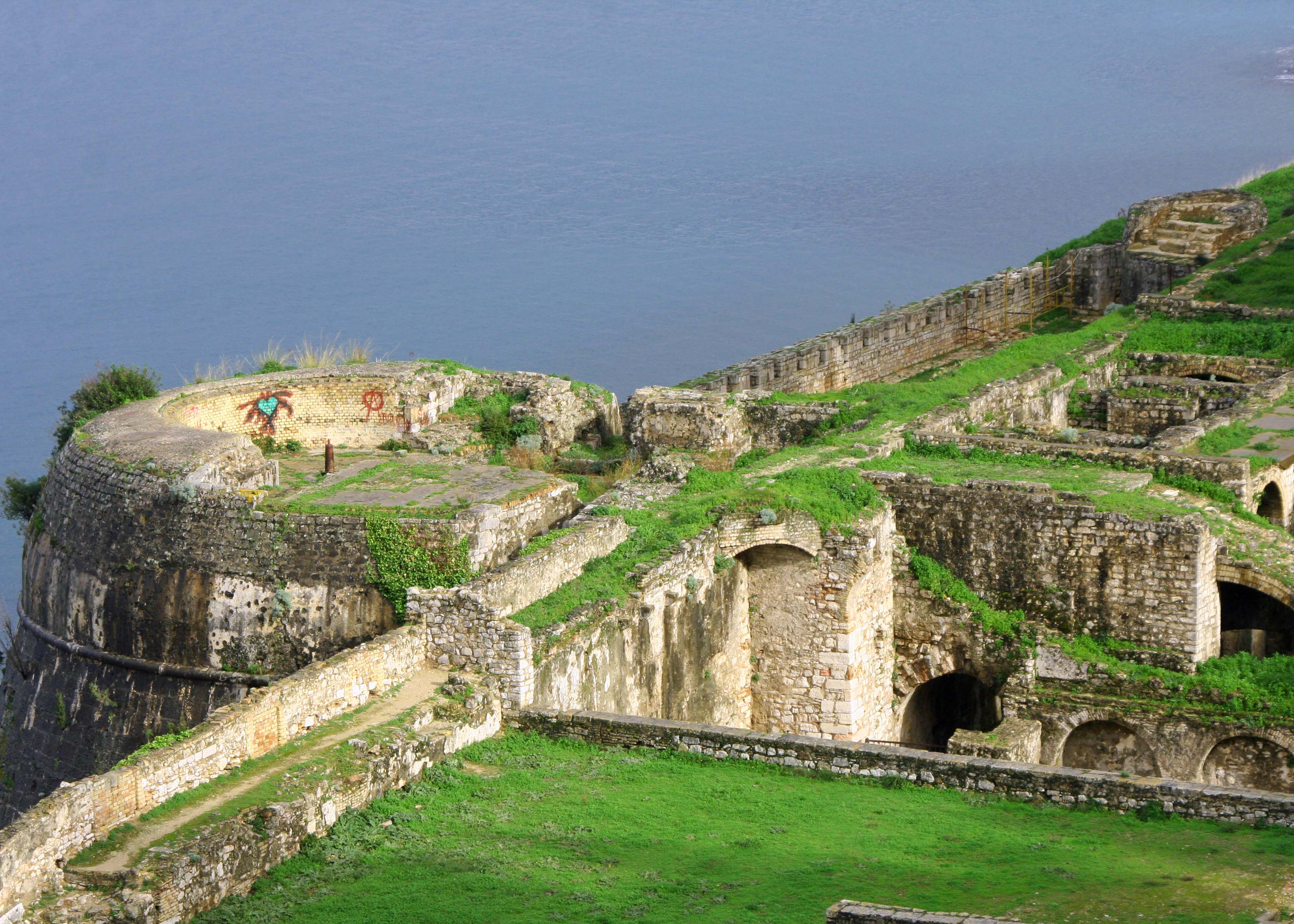
A view of Corfu on a misty day with its multi-colored buildings and tree covered hills. I took this photo looking down from the Old Fortress.
Seven years ago, Peggy and I made a trip to Europe and cruised the Mediterranean along with her brother John, his wife Frances, and two of their friends Lee and Kathi. Now that our wings are clipped due to coronavirus, I decided a little armchair travel might help satisfy my thwarted desire to travel. Instead of ‘wandering through time and place,’ I am wandering in place. You are invited along…
“The sea is high again today, with a thrilling flush of wind. In the midst of winter you can feel the inventions of spring.” Lawrence Durrell
I was visiting the Pioneer Bookstore in Placerville when I was first introduced to Lawrence Durrell and the Greek Island of Corfu. The bookstore was a favorite hangout of mine during my senior year in high school in 1960 and George Yohalem, the owner, had become a mentor, helping guide my 17-year-old mind to a number of good books. He and his wife Betty had retired to the foothills of California after long careers in Hollywood where George had worked as a screenwriter and she as an actress.
I had picked up a new book that had just arrived and read the first couple of pages. Since it looked interesting, I carried it over to George for advice. “It’s quite good,” he had told me, “but don’t tell your mother that I recommended it.” That caught my attention.
The book was “Justine” by Lawrence Durrell. The quote above is the first line in the book and Durrell is describing Corfu. He had lived there from 1935-40 and fallen in love with the island. “Justine” became one of my first ventures into serious literature and definitely my first venture into erotic literature— thus George’s admonition. The book transfixed me, not so much by the sex (well, maybe a little), but by the sheer mastery of the language and the sense of the exotic. I was picked up and dropped into Corfu and then Alexandria… the main setting for “Justine” and the other three books in the Alexandria Quartet. It was magic.
Durrell wasn’t the only author to find Corfu a touch exotic. Homer had the ship wrecked Odysseus land on the island during his long journey and Shakespeare used it for the setting of Prospero’s magical realm in The Tempest. In Corfu’s long history Corinthians, Romans, Venetians, French and English had occupied the island as a gateway to both the East and West. At one point, the feared pirate Barbarossa laid siege to Corfu and succeeded in enslaving a substantial portion of its population.
Corfu’s location in the Ionian Sea sets it apart from its Greek cousins Santorini and Mykonos in the Aegean Sea. We found no more sparkling white washed buildings perched on treeless terrain. Corfu is an island covered with over a million olive trees and its buildings are multi-hued with a well-lived-in look. Two massive forts serve as bookends for its main town, also known as Corfu. We wandered through its winding narrow streets, visited an Asian museum housed in a colonial British mansion, checked out a Greek Orthodox Church, and climbed the steep hill to the top of the Old Fortress overlooking the town.
The most magical place for me in Corfu was the Old Fortress. I was fortunate to capture Kathi’s silhouette as she walked through the tunnel entrance. Dating back to ancient times, the Venetians updated the fortress in the Fourteenth Century.
I loved how the fort seems to be an organic part of the hill.
This photo and the next, both by Peggy, also capture the ancient feel of the fortress.
This room probably served as a gun placement in the fort. The clock tower peaks out on the right. (Photo by Peggy Mekemson)
The clock tower. The sky provided a dramatic backdrop.
A final view of the Old Fort looking Irish green. (Photo by Peggy Mekemson)
A Corfu street scene. Once again we enjoyed the narrow, car-free streets as we did time and again in Europe. Peggy’s brother John and his wife Frances are walking in front of us.
Another view of Corfu buildings with their shutters and balconies.
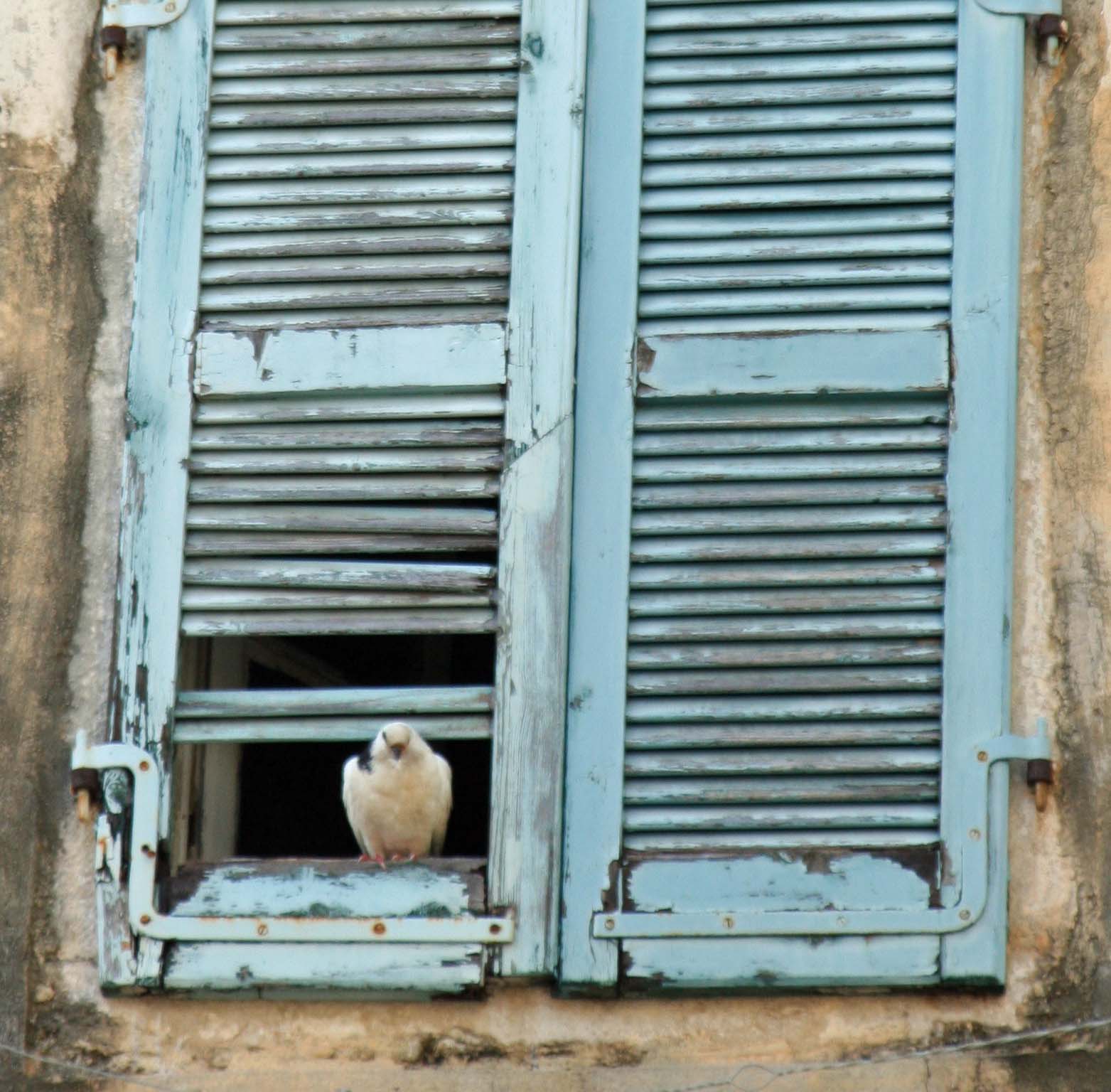
Peggy found this pigeon hanging out on the broken shutters of an abandoned building.
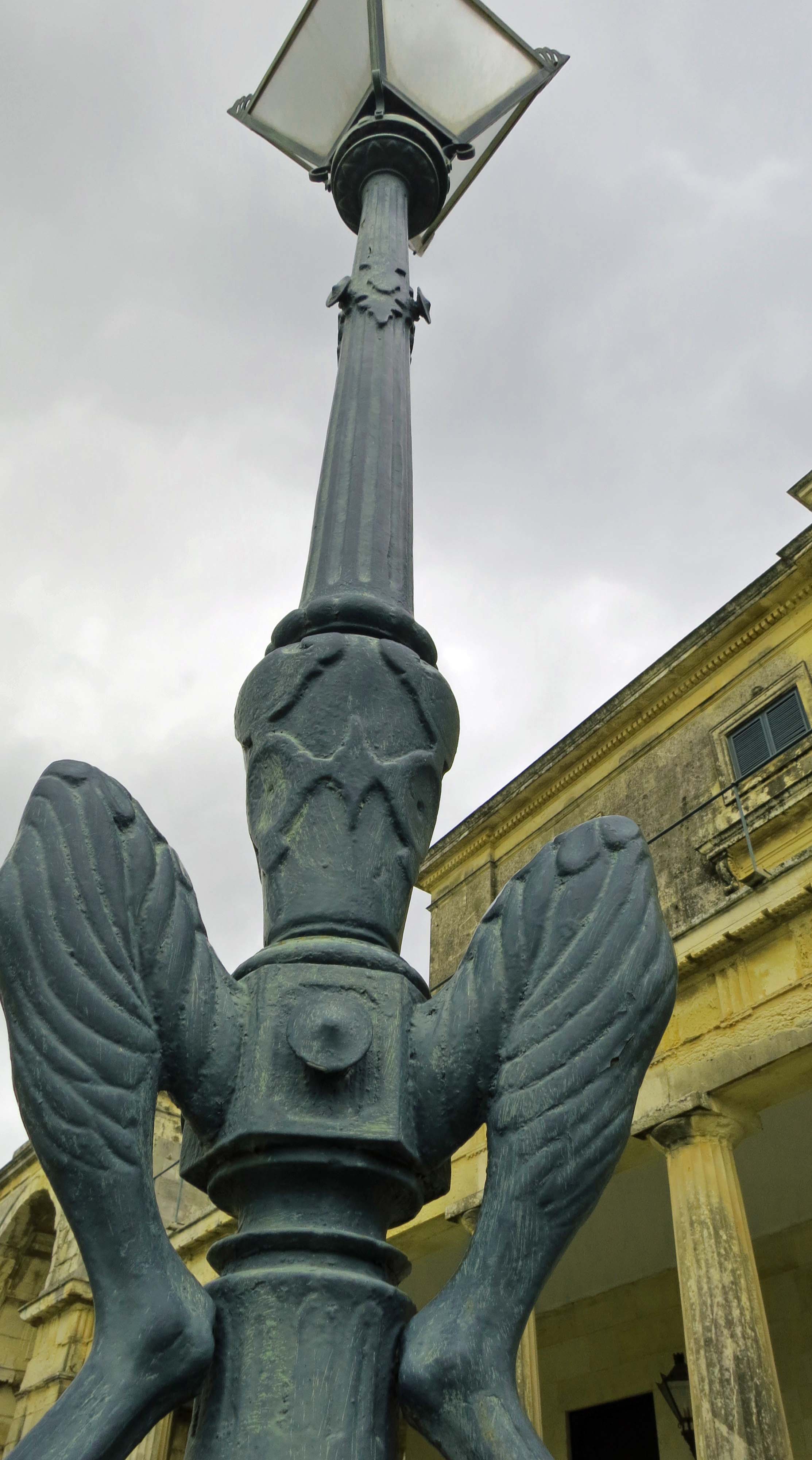
Lamp posts don’t get much more strange than the one we found outside of Corfu’s Asian Museum located in an old British mansion. Does it qualify as art, or just weird?
The Asian Museum, BTW, includes an excellent collection of art, as represented by this painting.
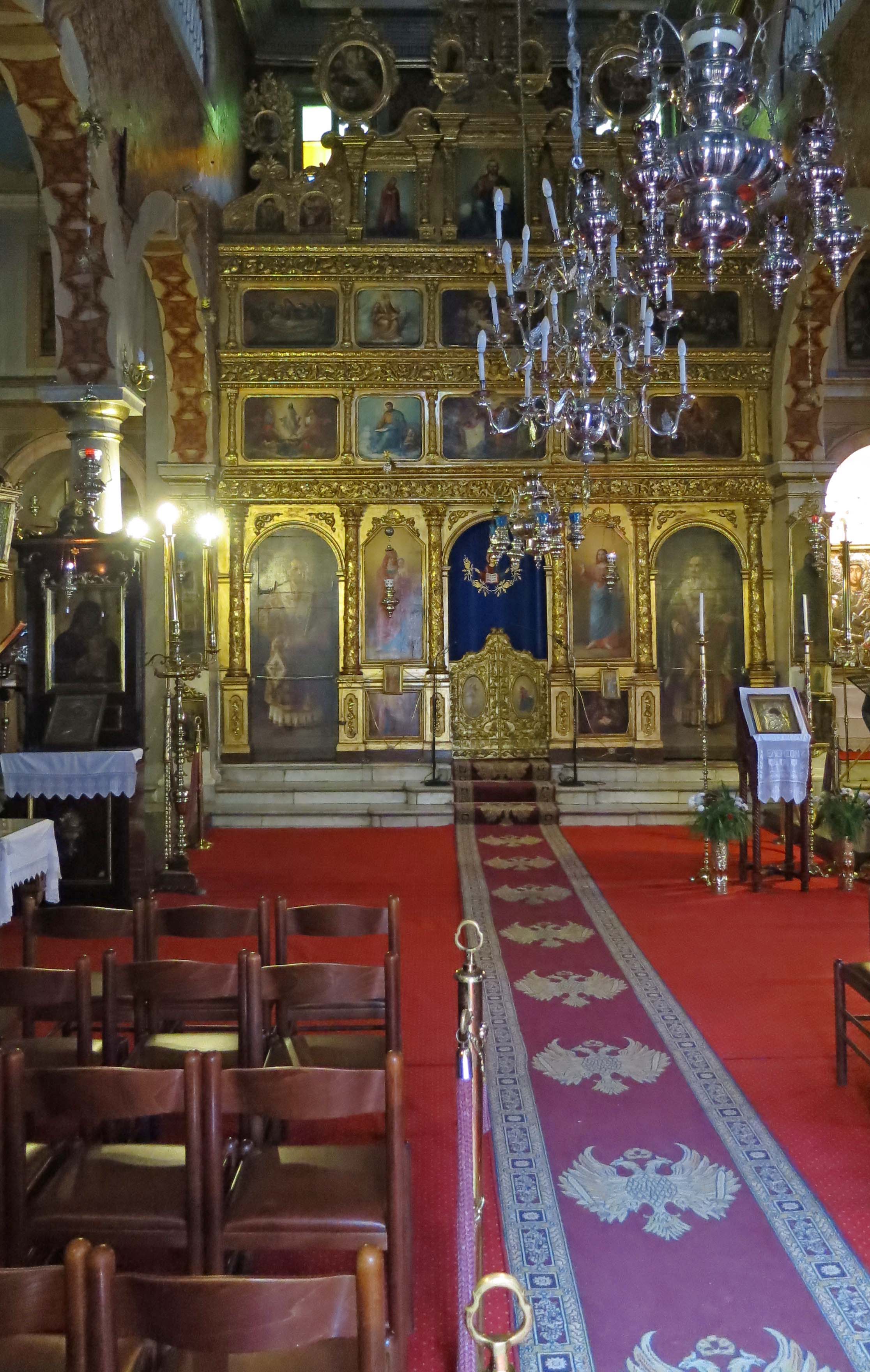
Part of the adventure in travel is experiencing new sites and cultures. This was a beautiful Greek Orthodox Church we wandered into.
There are some things that I am almost guaranteed to photograph when I travel…
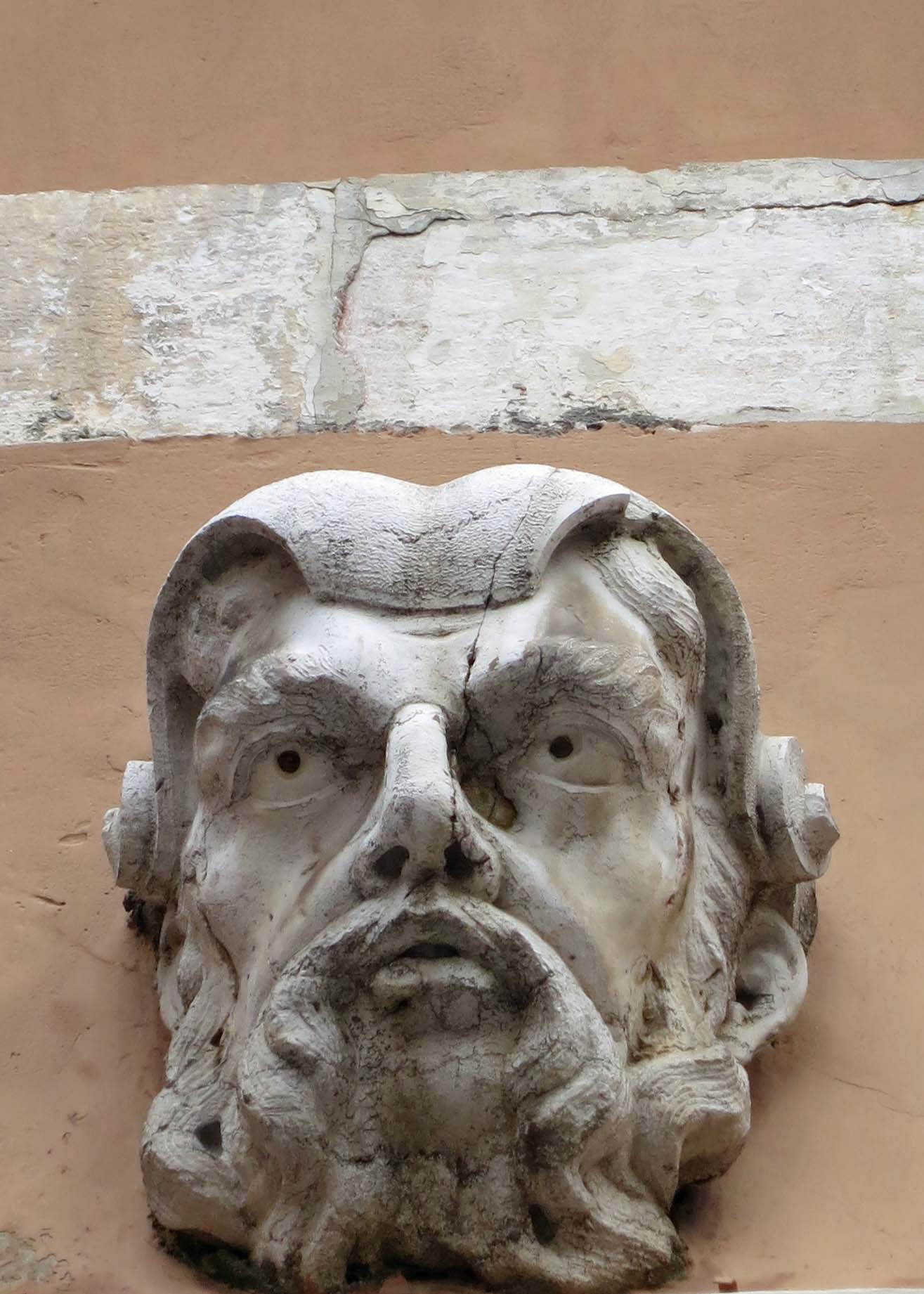
Gargoyles…
Colorful fruit markets…
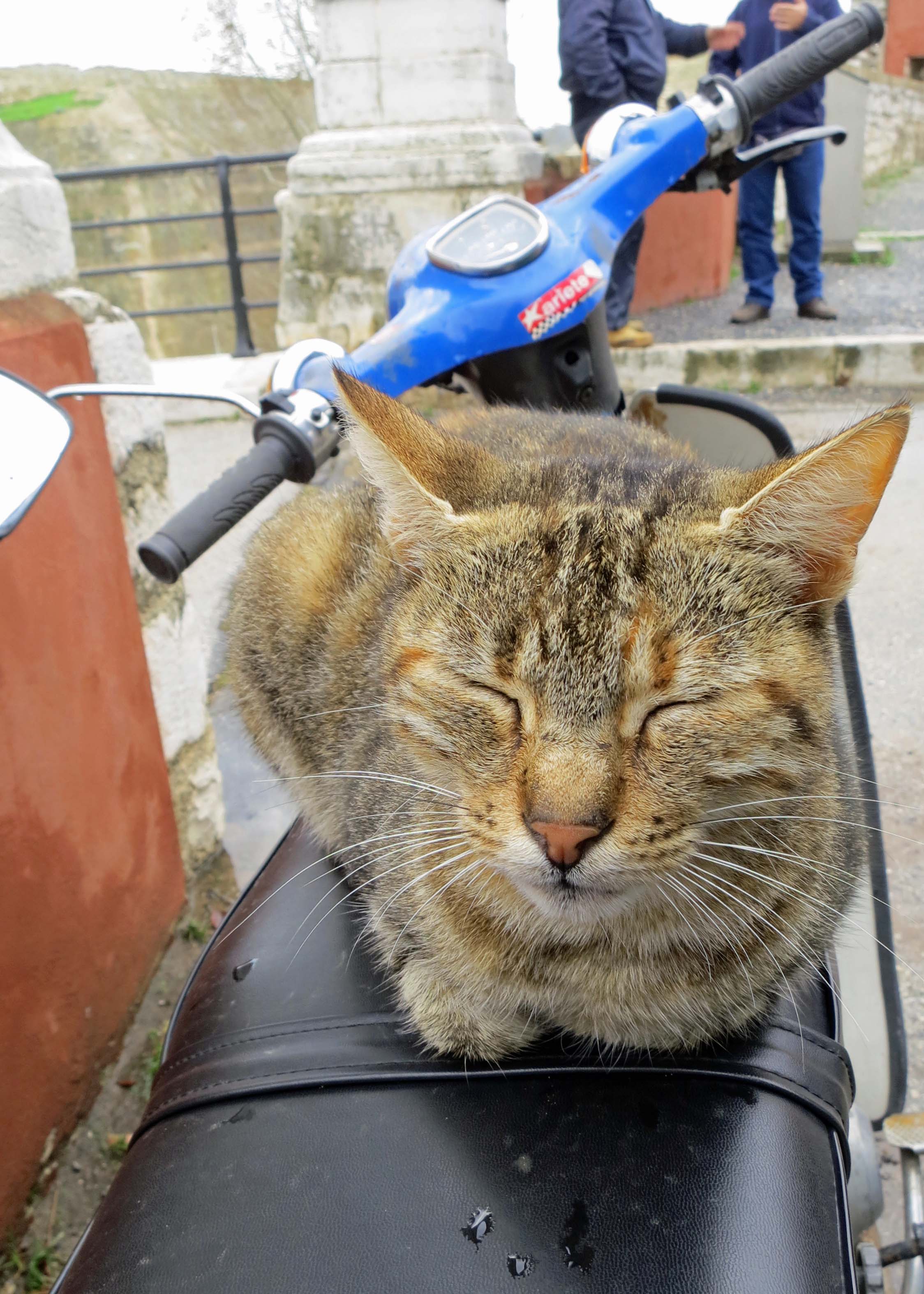
And animals… I caught this kitty sleeping on the seat of a motor bike catching some rays at the entrance to the Old Fortress. She may be a new definition of contentment. It’s a good place to wrap up today’s post.
FRIDAY’S POST: We made it up to Crater Lake National Park last week, practicing social distancing the whole way. Snow added to its natural beauty.
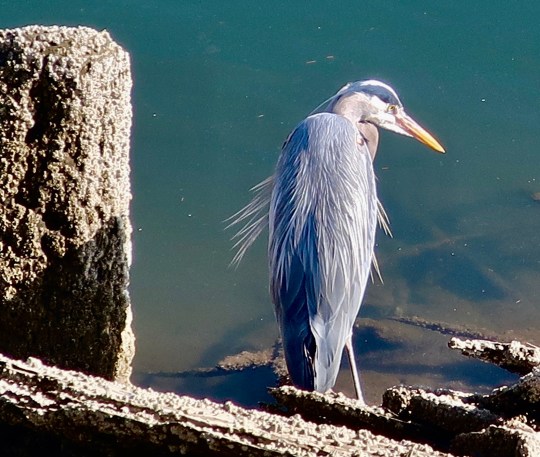
A great blue heron eyed me suspiciously when I took its photo in Florence, Oregon. Peggy and I had gone over to the coast for my birthday three weeks ago. The town has several excellent restaurants and we had made it a point to visit several. They are closed now. Coronavirus has arrived. The world has changed.
This coming Thursday we were flying out to Fort Lauderdale in Florida to climb on a cruise ship that was going to take us through the Panama Canal. There were to be stops along the way in Costa Rica, Columbia, Nicaragua and Mexico. Peggy was super excited. She had lived in Panama in the late 70s BC. (The BC here stands for Before Curt. DC is During Curt. We are hoping to avoid the AC.) She wanted to see her old home at Fort Amador, to revisit where her daughter Tasha was born, and visit the Canal again.
I was equally excited. Just watching Peggy would have been enough. But Panama, Columbia and Nicaragua were new countries for me and I am always up for seeing new places. Cartagena has been on my bucket list for a long time. I figured I would get enough blog material to last up until summer! But it wasn’t to be.
We watched nervously as coronavirus made its way from China into other countries. Given the nature of the disease and its rapid spread, the President’s words that we had only 15 cases in the US that would soon number zero rang hollow. It seemed to us like it was time to gear up and get ready, not play down the danger. It was hardly rocket science, or so it seemed to us.
Nothing focused our concern more about the trip than people being stranded on cruise ships with a highly contagious disease. Countries were refusing to let them land. Reluctantly and sadly, we came to the conclusion that the trip wasn’t worth the risk and cancelled. A few days later Princess Cruise Lines cancelled all of its cruises. That’s how fast this pandemic has developed.
As my post goes up this morning, I expect that our Governor, Kate Brown, will issue the same stay-home order for Oregon that our neighbors in Washington to the north and California to the south have. Our trips into town will be limited to quick in and outs to buy groceries and other necessities. (And no, we aren’t hoarding toilet paper.) We will practice the same social/physical distancing and hand washing/use of sanitizers that people throughout the world now find themselves doing. And we will try ever so hard to avoid touching our faces. The mere thought of it makes my nose itch.
We are lucky in that we live on five acres out in the boonies with our property backed up to a million acres of national forest. Social/physical distancing doesn’t get any easier. Our property is excited that we are going to be around to give it more attention than in normally receives— and the star thistle is bummed that I will be around to yank it out by the roots. It’s a nasty plant that spreads rapidly like coronavirus, kills off native plants, and sucks up precious groundwater. I’ll probably do a blog on it. Woohoo. Also on my to-do list: go looking for Bigfoot. There’s a reason why the world’s only Bigfoot trap is located three miles from our house. And I may go searching for gold. Why not. An old gold mine is located a few hundred yards behind our house up in the forest. Maybe Bigfoot hangs out there. I’ll let you know.
And speaking of blogging, it is hard to imagine a more positive activity in these perilous times we are facing. For one, it is the ultimate in social/physical distancing. Two, it keeps me occupied. And three, most importantly, it allows for safe social interaction with a number of people I have come to consider as close, Internet friends over the past several years. So keep blogging, stay safe, and don’t scratch your nose.
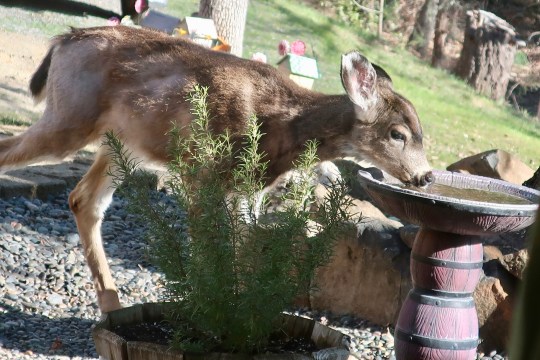
As I was writing about Bigfoot, this teenage doe slipped in and started drinking out of our birdbath. I grabbed my camera. Wildlife is an important part of our entertainment here. I’ll be blogging about it as well. We should soon have fawns. And then there is the flicker, a large woodpecker that has decided the best way to call his love is to pound on our roof vents. It sounds like a jackhammer. We’ve had a number of discussions but it seems that nothing can get in the way of true love. And finally, I’ll conclude with this butterfly hugging a flower, or so it seemed. A nice message. Take care.
NEXT POSTS: Still thinking about Wednesday. I may take you back to my journey down the Pacific Crest Trail, or off to Europe. Since travel is out, I have plenty of posts to remind me us of the how fun, interesting, and exciting travel there can be. Friday will be special. Peggy and I just made a trip up to Crater Lake National Park to see what it looks like in the winter. One word comes to mind: beautiful.
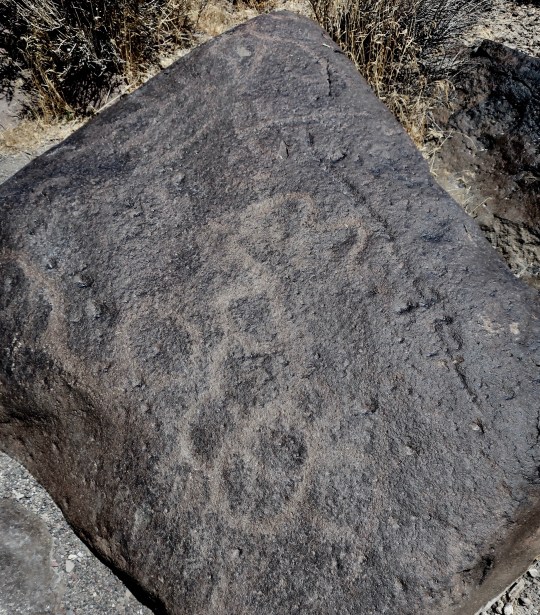
Are these vacant eyes staring at you from the ancient past? Probably not since these two 7,000 year old pecked indentations are merely two out of many that cover a rock at the Grimes Point Archeological Area.
I took a detour on my trip down Highway 395 from Reno to Mt. Whitney last summer to drive east on Highway 50 to the town of Fallon, Nevada. I was excited to visit the Grimes Point Archeological Area with its ancient rock art five miles east of the town. They represent some of the oldest petroglyphs in America. The oldest are located approximately 60 miles away at Pyramid Lake.
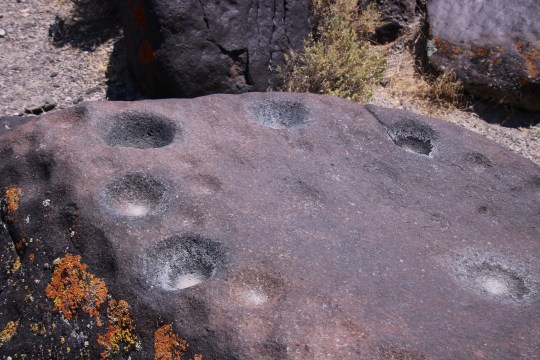
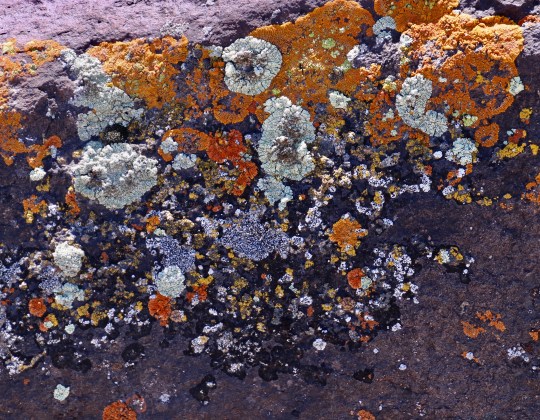
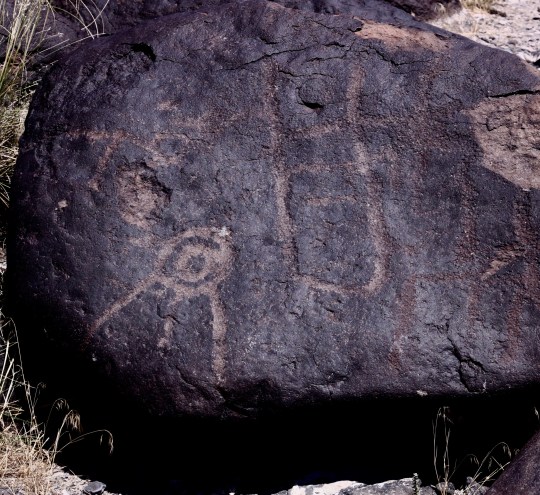
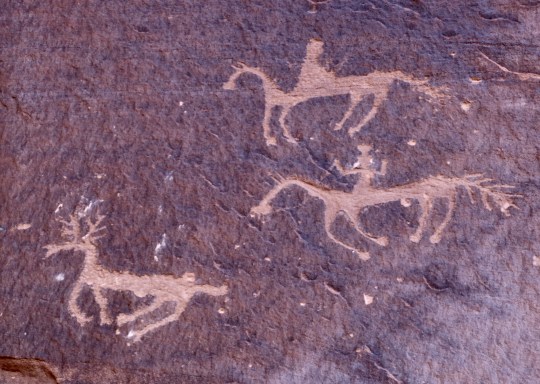
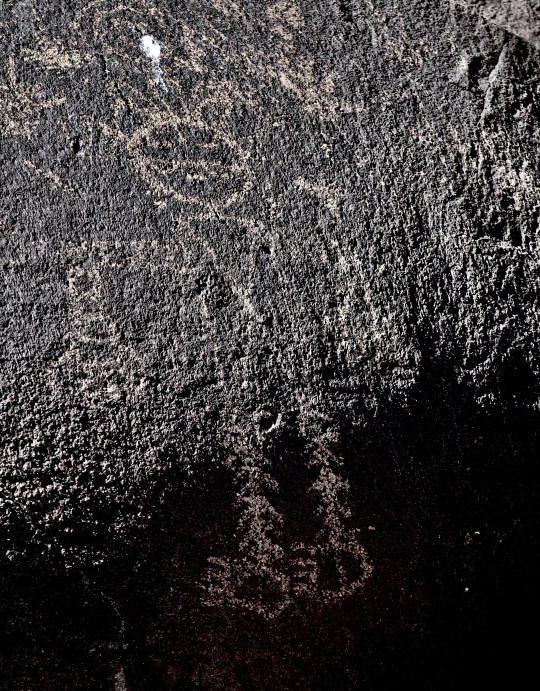
This sign greeted me at the entrance to the site. The strange lines on the left represent one of the petroglyphs found at the site.Highway 50 stretching off into the east from Grimes Point across Nevada claims to be the loneliest road in the US. The grooves you see on the right are to wake up motorists who fall asleep while driving the road.The circles and wavy lines represent some of the oldest petroglyphs found at the site. Rock art is made by using a rock to peck away the dark, desert varnish that covers rocks exposing the lighter colors underneath. You’ve seen many examples on my posts over the last three weeks. These petroglyphs are almost the color of the rock, which means that the desert varnish has had time to cover the rock art, literally thousands of years.This is another example of pits, this time with grooves connecting them. It almost appears to be horns on a steer-like head, but who knows. One of the pit covered rocks. Peggy and I found similar petroglyphs on the Big Island of Hawaii. Information at that site said that the pits had been used to place umbilical cords in.This is what the countryside looks like at Grimes Point. A pickup hauling a trailer can be seen on Highway 50. Having ridden my bike across Nevada on my 10,000 mile bicycle trek and driven across the state numerous times, I can attest to its lonely, wide-open spaces. No problem with social-distancing out here!Lichens added some fun color to the rocks.There were some discernible figures such as this leaping or dancing stick figure. Is it “Come to me sweetie,” or “Gads, look at the size of that snake!”I wonder if this asterisk-like petroglyph represents the sun.Those with an overactive imagination might see a UFO landing!The most mysterious to me was this horse-like figure. Horses went extinct in North America around 11,000 BCE and weren’t reintroduced until the 1500s CE. Petroglyphs at nearby Pyramid Lake date back to 10,000-14,000 BCE, however, so horses could have been around then. Maybe we are looking at a dog, coyote or wolf. Or maybe none-of-the-above. Here we have a much more recent petroglyph from Canyon de Chelly showing Navajo hunters in pursuit of a deer. Note how light the petroglyphs are in comparison to Grimes Point.I’ll close my coverage of Grimes Point with another pit covered rock. We can only wonder why.
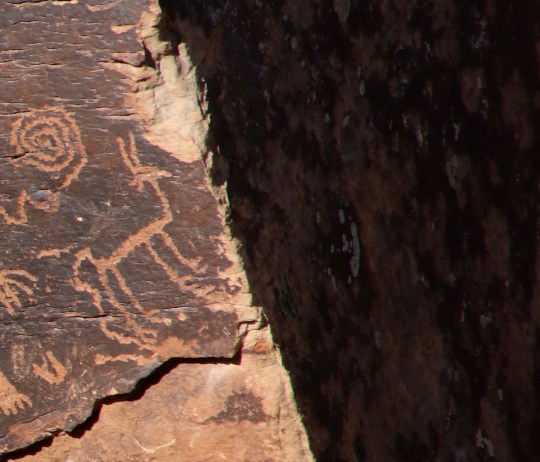
I’ve enjoyed sharing petroglyphs with you. I can guarantee there will be more if for no other reason than the fact that Peggy and I enjoy them and are always searching for new sites. There are thousands throughout the Western United States. I can’t resist a few more from the Petrified Wood National Park and Canyon de Chelly National Monument.
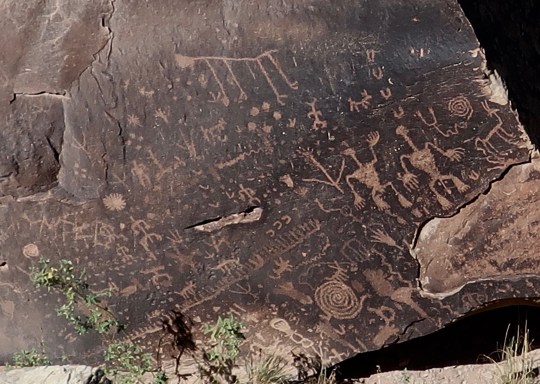
This interesting collection of petroglyphs is from Canyon de Chelly. Check out the top. You’ve heard of having your ducks in a row? So, apparently, did the early Americans…But how about having your turkeys in a row? These are pictographs at Canyon de Chelly, painted instead of pecked. The figure on the far right is Kokopelli playing his flute. The ‘newspaper rock’ in Petrified Wood National Park is one of my favorites. Check out the figure to the right of the nudes. Could it be? Is it possible… Yes! It’s Wile-e-Coyote! That does it for the day. Grin.
NEXT POST: I’ll take you on a visit to Crater Lake National Park.
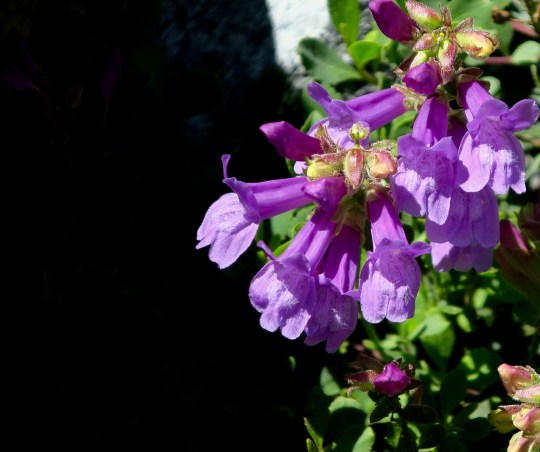
Penstemon. One of at least a hundred beautiful flowers I photographed on my 750- mile hike down the PCT two summers ago.
Hiking the Pacific Crest Trail is serious business for those who decide to backpack the 2650 miles from Mexico to Canada in one season. Think of it as hiking a 26-mile-marathon each day while carrying your food, water and camping gear on your back over mountains, across deserts, through snow, and every imaginable kind of weather. As such, it is not an exercise in wilderness appreciation; it’s an exercise in human endurance. It is one of the toughest, most grueling physical challenges in the world. People involved in can be forgiven if they don’t have time to stop and smell the flowers.
This isn’t to say they don’t have an appreciation for the incredibly beautiful country they are hiking through. It’s impossible not to. But this appreciation is limited. When Peggy and I were backpacking through the Three Sisters Wilderness of Oregon as part of my 750 mile trip, we met Big Red, a giant of a man who summarized it well. “I’ll camp on a beautiful lake,” he said, “and I’ll think, ‘Wow! I would love to spend a few days here.’ But I can’t. I have to get up the next morning in the dark and be on the trail by dawn. Otherwise I’ll never finish.”
I felt the pressure myself, even though I was moving along at around 15 miles a day. At 75, my shorter days were the equivalent of the longer days being hiked by the 20-40 year olds. I was glad I had my camera along and was committed to recording my journey with digital photos. It forced me to stop and smell the flowers— and to admire the beauty of my surroundings. Plus it was one hell of an excuse for a break even though I rarely allowed myself more than a minute or so to capture a subject and had mastered taking my camera out and putting it away while walking. (Okay, some subjects required 15-30 minutes!)
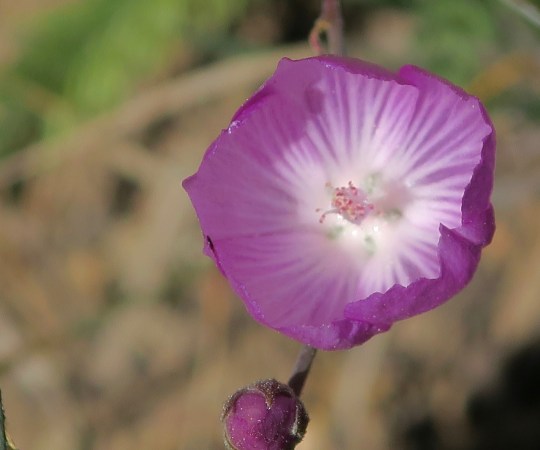
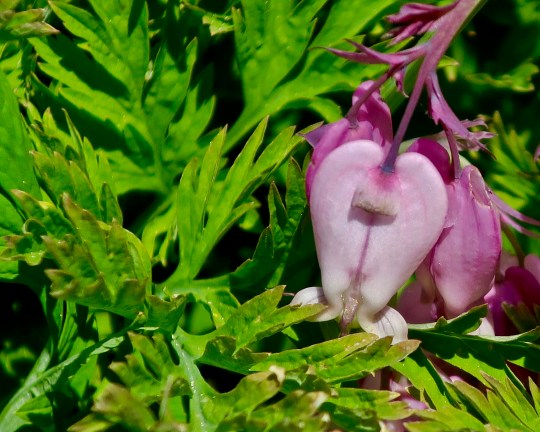
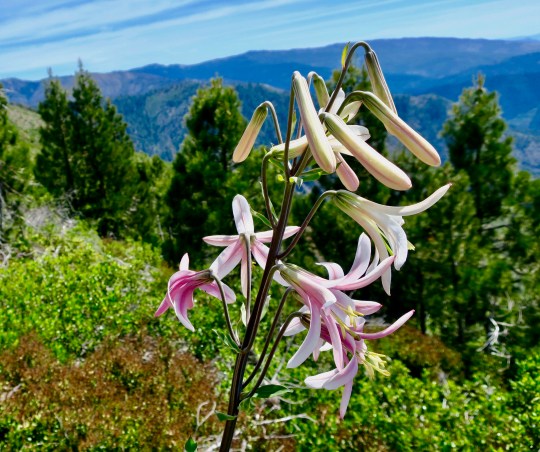
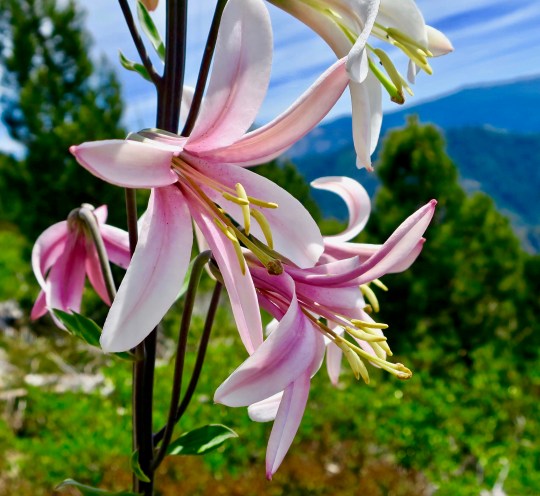
The flowers along the trail were gorgeous. I shared some of these when I blogged about the journey. I’ll be sharing more over the next few weeks as I use my photo-essay Wednesdays to feature pictures from the PCT. Enjoy.
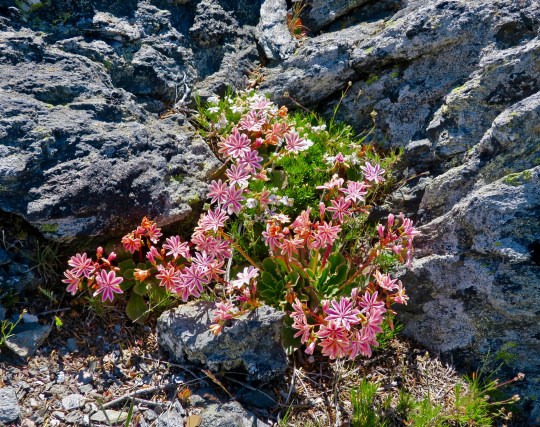
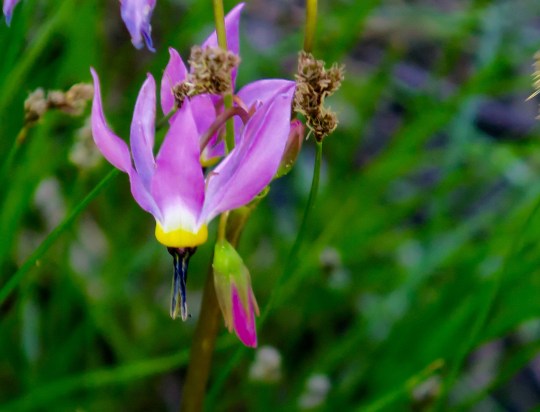
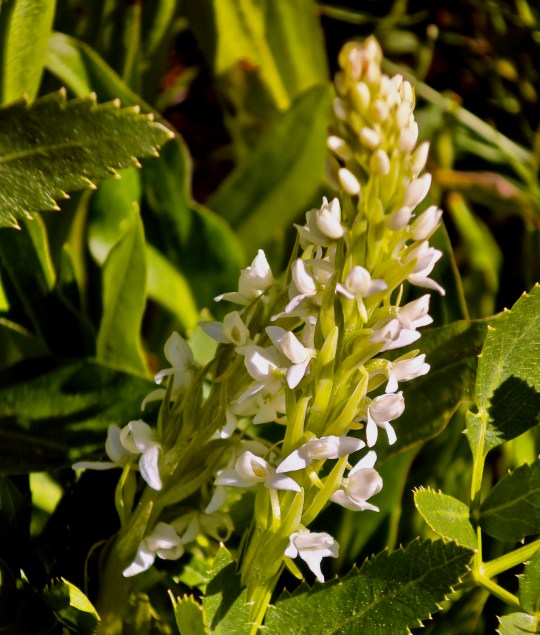
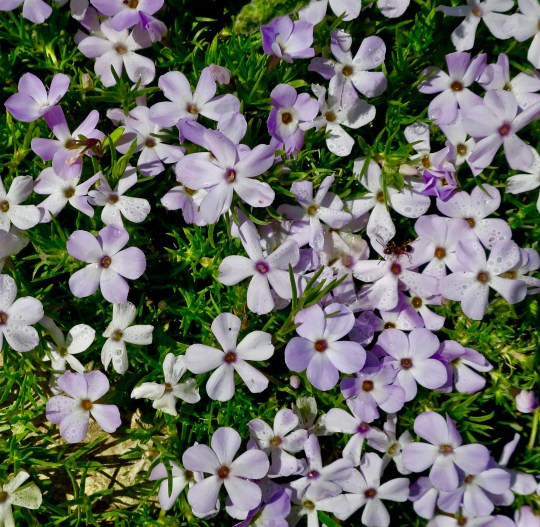
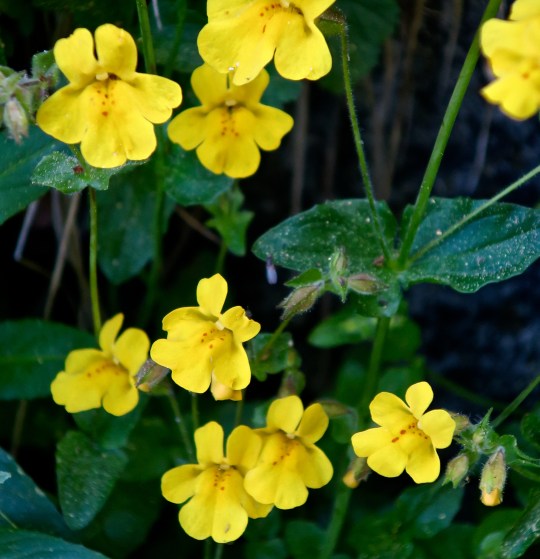
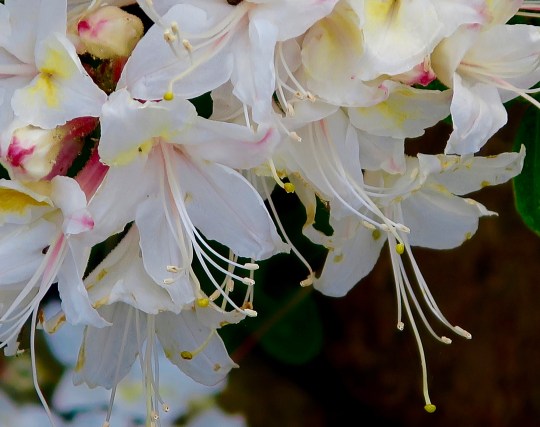
Yellow leafed irisWild hollyhockWestern bleeding heartClose up of Western bleeding heart flower.Washington lilyClose up of Washington lily.WallflowerSiskiyou lewisiaShooting star flowerRein orchidPhloxPaintbrushMonkshoodMonkey flowersAzaleas
FRIDAY’S POST: My final rock art post for now featuring petroglyphs from Monument Valley, Canyon de Chelly, Petrified Forest National Park and northern Nevada.
A note to our blogging friends: As the world reels from the Coronavirus,Peggy and I want to wish each of you the best in making it through this world-wide pandemic, the likes of which we have never experienced.Our travel plans, like yours, have been put on hold as we hunker down at our Oregon home, avoid as much social contact as possible, and wait for the worst to pass. Assuming we are able to avoid the virus, I will continue to blog, possibly relying on older materials. In the meantime, be careful and be safe. Curt and Peggy
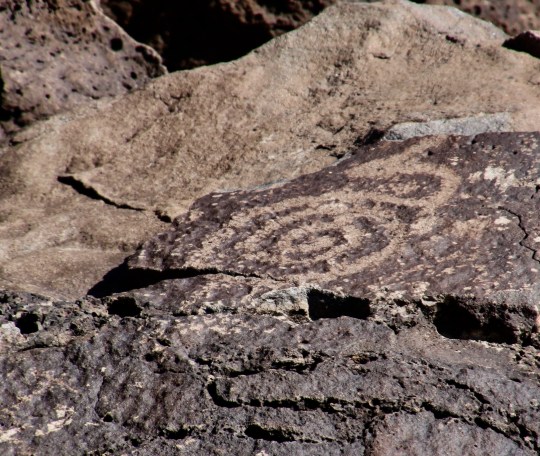
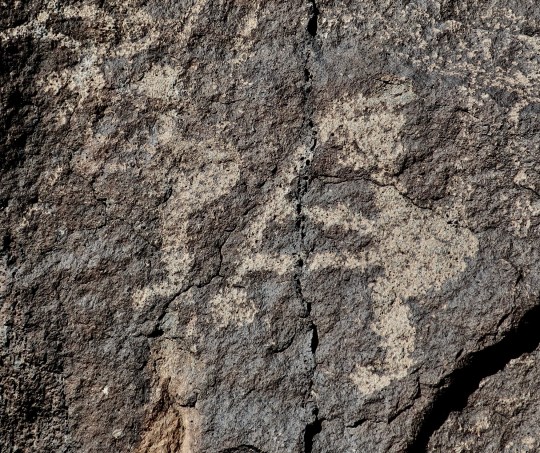
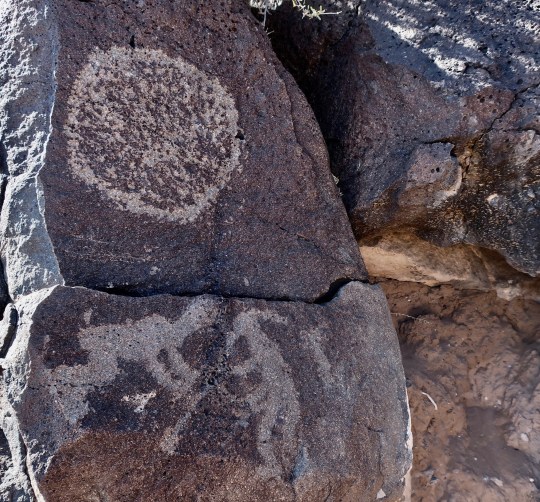
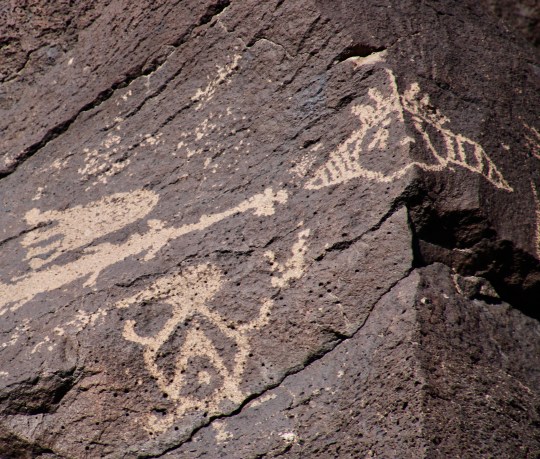
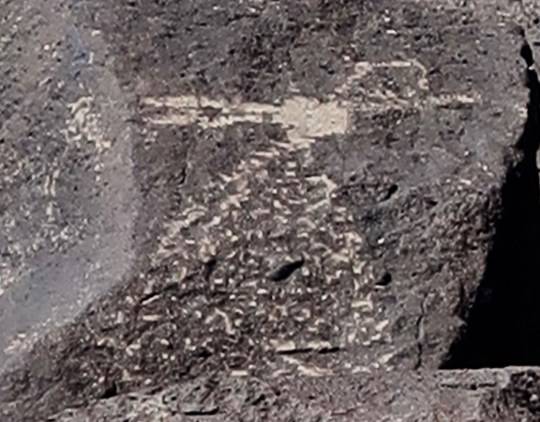
You might not believe it from this photo, but the Petroglyph National Monument is located minutes away from Albuquerque, New Mexico. Petroglyphs are found throughout these rocks along some 17 miles of this volcanic escarpment. The blips you can see on the horizon are small volcanos. (Photo by Peggy Mekemson.)This is a photo I took at the beginning of the escarpment. Suburbs literally back up to the National Monument. Downtown Albuquerque can be seen in the distance.
Peggy and I parked Quivera in a small parking lot for the Petroglyph National Monument that we found behind a fast food restaurant. Fifty yards up the trail we began to find petroglyphs. Archeologists believe that there are around 25,000 in the 17 miles.
The rock I am standing next to provides an idea of just how concentrated the petroglyphs can be at the Monument as well as providing a perspective on their size. The grumpy looking circular guy on the left is the god of death. He will return in Friday’s post. Scary huh. (Photo by Peggy Mekemson.)
It is estimated that the majority of the petroglyphs were carved between 1300 and 1680 CE by ancestors of present day Pueblo people, but some of the petroglyphs have been dated back to over 2000 years ago. Many of the petroglyphs we found at the Monument are similar to others we’ve found throughout the Southwest. For example, does the following rock art look familiar?
I named a similar petroglyph that we found at Three Rivers Cat Woman. I thought it was interesting on how this rock art was created on a rounded surface. (Photo by Peggy Mekemson.)Surprise! Check out the feet. My ‘cat woman’ has the paws of a badger. You also met up with the Horned Serpent on my post about snakes at Three Rivers’ petroglyph site. Here he is coiled up. I alway assume rattlesnakes mean business when I find them coiled up with their tails rattling at 50 times per second and ready to strike. Experts claim that the snake can only strike about half the length of its body. Assuming you know the length of the body, you can determine how close you can get. I always leave an extra ten feet for margin of error. (Grin)
Peggy and I visited the site at absolutely the wrong time for photography: high noon. (Being the old hands we are with our cameras, you think we would know better.) As a result, a number of the photos like cat/badger woman aren’t as clear as we like— even with photo processing.
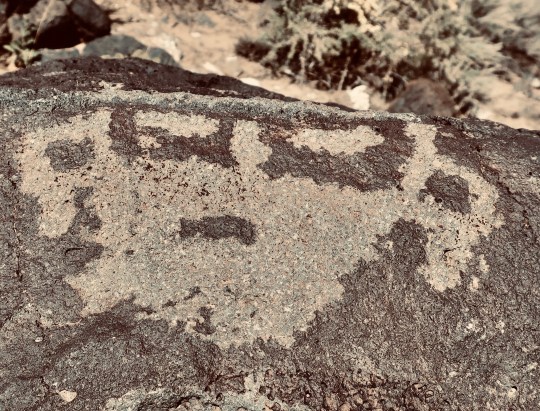
Headwear is important in petroglyphs.Speaking of headdresses, check out the one on this petroglyph. (Photo by Peggy Mekemson.)Here is probably the most recognized character in petroglyphs across the Southwest, Kokopelli and his seductive flute. A second Kokopelli plays away in front.It appears to me that Kokopelli is playing a duet here under a full moon.I was amused by this fellow with shaky legs. Reminds me of a time I hiked into the Grand Canyon when I was a bit on the pudgy side. That’s what my legs were doing by the time I reached the bottom.If people want a ring in their nose or their bellybutton, it’s their business. Why not. But it’s not for me. No thanks. But how about an arrow in your nose like this guy sports. Ouch! (Photo by Peggy Mekemson.)My first thought on seeing this was Big Bird. (Photo by Peggy Mekemson.)But a closer inspection showed Big Bird’s head was actually a face. And not a happy one. The line you see coming down from the right eye probably represents crying.Having dealt with the Big Bird that wasn’t, here are a few more animal petroglyphs that may or may not be what they seem. This rock art receives my nomination for the strangest. I’d say anteater on the bottom, if they made their way that far north. On top, a really wild guess would be a horned serpent hitching a ride.Check out the petroglyph on the left. If an anteater making its way north seems strange, you really have to wonder about an alligator in the deserts of the Southwest. Maybe it’s a fat lizard. I also liked the caterpillar dog on the right.Another large bird with a very big bill, or something. Doggie? Or does that long nose suggest another anteater?Your basic dog or coyote… Maybe.I’ll close today with this dramatic mask, including ear rings.
WEDNESDAY’S POST: Flowers of the Pacific Crest Trail.


































































 Wandering through Time and Place