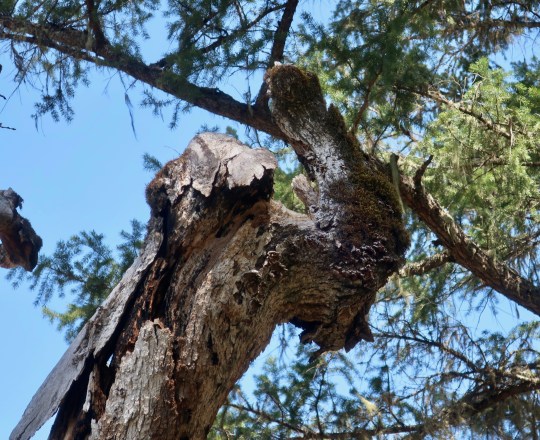
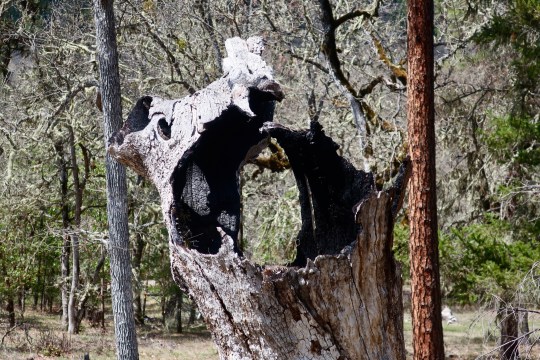
From the beginning we declared this the Hobbit Tree. Look carefully and you can see Smaug sweeping out of the sky on a mission of vengeance.
Peggy and I continue to shelter in place and find ways of entertaining ourselves. One is to go for extended walks around our five acres and in the Rogue River-Siskiyou National Forest that abuts our property. Naturally, I carry my camera on these daily excursions and look for things of interest. I’ve done several posts on these ‘walks on the wild side’ over the last ten years. It’s time for another one.
Walking is one way that many of us are dealing with our extended home-stays. One doesn’t have to live next to a national forest. A local park that is still open, the neighborhood— almost anywhere that is safe— works. It gets us out of the house and it’s great exercise. Looking for things of interest adds to the fun. Peggy, for example, is infinitely curious about what the neighbors are up to. She is constantly urging me to go on detours to find out.
As I was going through my photos last week for this blog, I decided I had enough material for three posts. It’s all about weird trees today. On Wednesday I’ll feature the spring flowers that Peggy and I have found over the past few weeks, including one on the endangered species list. Friday will be pure nature as in who is doing what. For example is a bear living in the bear cave? Peggy makes me throw rocks into the cave to check before we venture in. I’m pretty sure that all that will do is irritate the bear, but I accommodate her wish. And I am sure you will want to help us figure out whether a cougar, bobcat, or coyote left the scat (poop) we found full of hair. How could you not?
But first the trees. A few years ago I decided to do a inventory of what trees grow on our property. White oaks were the most common. I counted over a hundred. For the most part, these are handsome representatives of the tree world— standing tall while providing shade in the summer and a plethora of acorns in the fall. Just about everyone joins in the harvest, or so it seems: deer, tree squirrels, ground squirrels, turkeys, bears, etc. We watch the deer play human and stand on hind legs to reach beyond where their imagination normally takes them. Ground squirrels leave the ground and can be seen precariously perched in the highest branches while they madly chomp away with sharp incisors to free acorns before the acorn woodpeckers arrive.
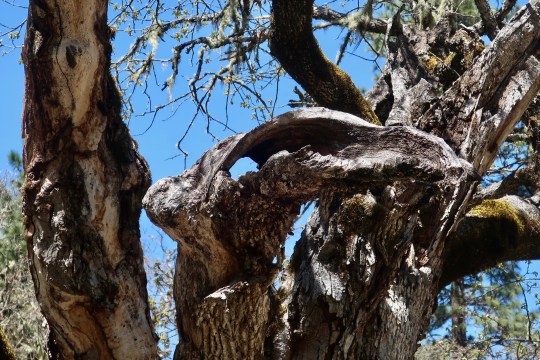
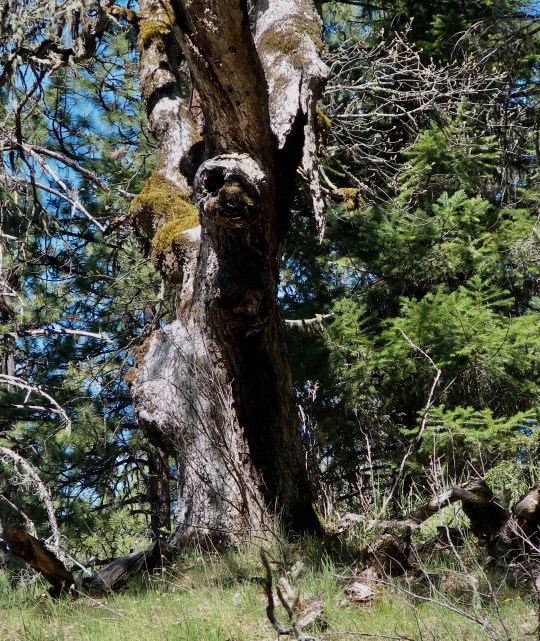
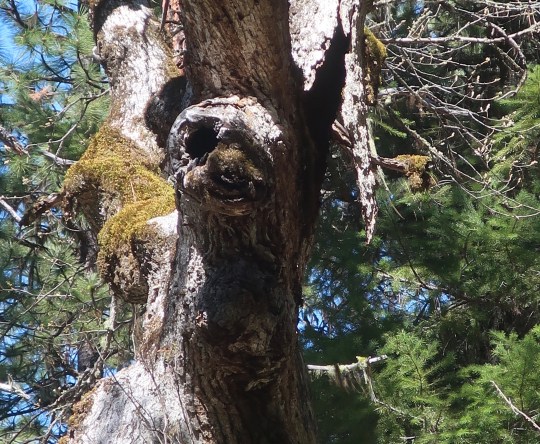
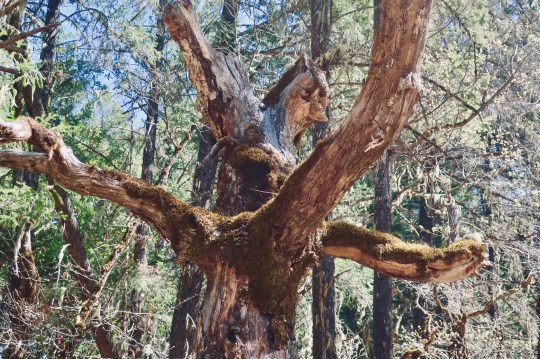
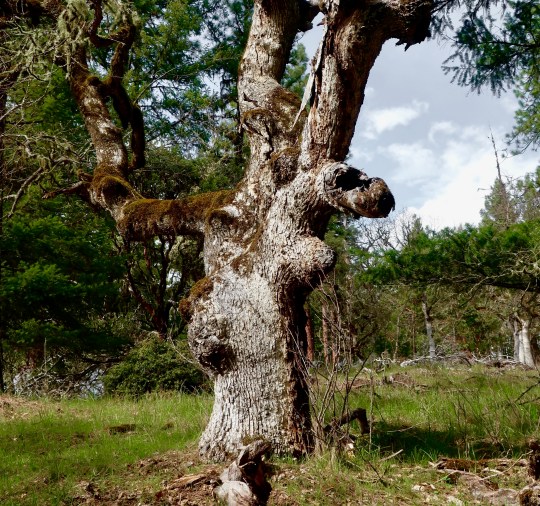
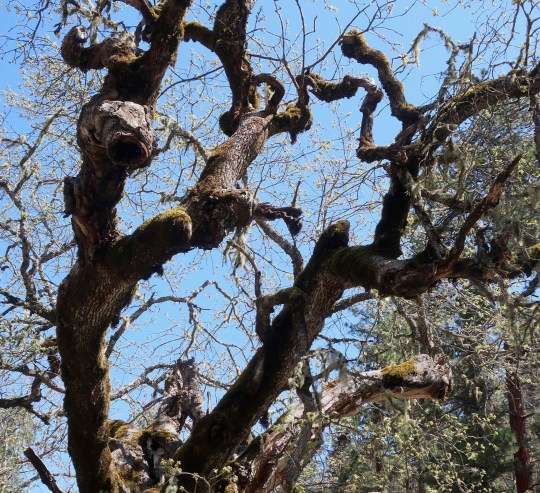
But not all of the white oaks stand proud and tall. Some are stubby and twisted, and ancient— almost scary. A little horror music please. They look like they could easily fit into your favorite scary flick, or a fantasy movie, or a nightmare. My post on last Friday where I featured gargoyles from Dubrovnik made me think of them. Here are some of our favorites:
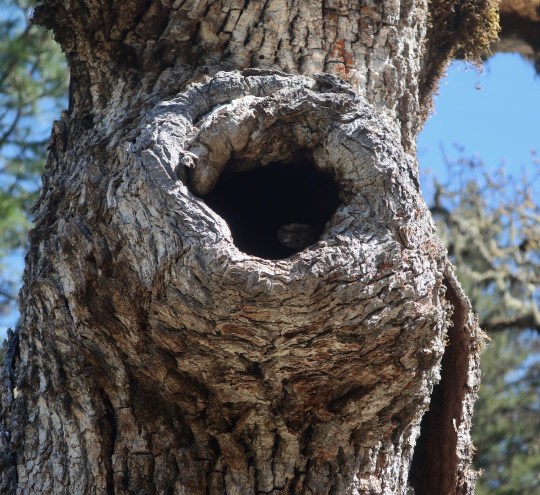
Smaug stares down at us from the Hobbit tree.This is the Evil Seal tree, definitely resembling a gargoyle.Here’s a close up, complete with vacant eye socket and a grinning, tooth-filled mouth. “Come closer, my dear. Let me whisper in your ear.” Chomp.This eyeless buck with its twisted horns also borders on evil. I may cover the nose in red come next Christmas. And here is where the werewolf hangs out on the upper right. I’m sure we hear him howling on moonless nights.Maybe not so scary, but still… the elephant. Interesting eyebrow, or is that a cap.The Brain!A gaping maw. It would take a brave (or foolish) person to stick her hand into it! “You first,” Peggy suggested.A great tree to be perched on the edge of a graveyard in a horror movie. The snake-like creature coming out of the tree is preparing to strike.Why am I thinking Voldemort?An even better graveyard tree! Perfect for a dark and stormy night.And finally, I will leave you with this lovely creature born out of fire. Make what you will out of it!
Today, I am continuing to dig back into my Word Press archives by looking at gargoyles.I have a weakness for them. While they are said to scare away evil spirits, they attract me. What can I say? As for the various body parts of saints, you will find them scattered in Catholic churches throughout Europe. One can only wonder… Anyway, Gargoyles and a sacred finger are the subject of today’s armchair travel as I wrap up my posts on Dubrovnik.
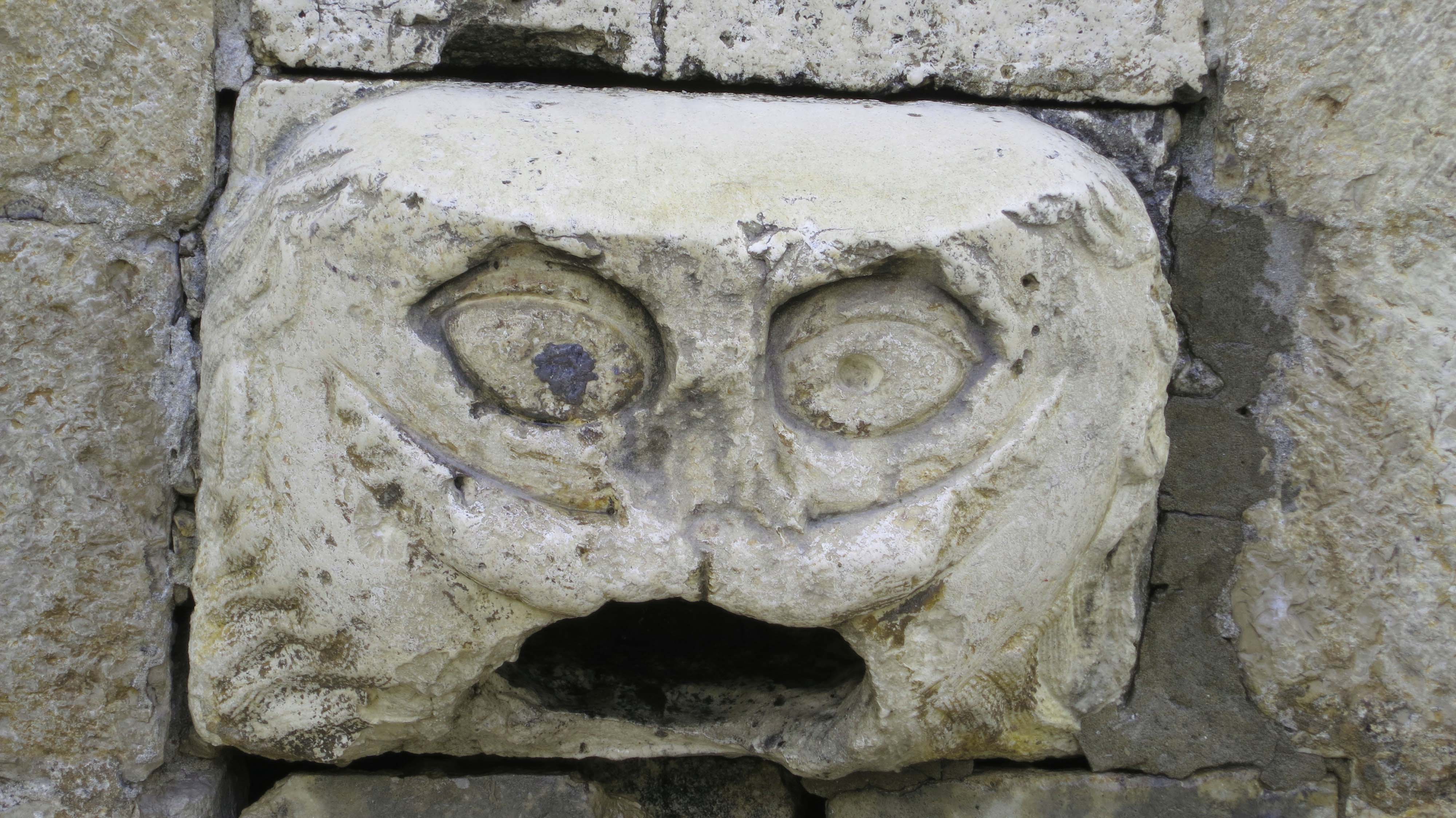
I found this marvelous gargoyle about a foot off the Stradun connected to the Franciscan Monastery in Dubrovnik, Croatia. Check out the great mustache!
Weird amuses me— and few things are more weird than a gargoyle. During the middle ages, no decent cathedral would be caught without them. In addition to piping water away from the building, they served as reminders to the faithful that evil lurked in the world, an evil that could only be overcome by attending church and donating money. Their cousins, grotesques, were also found on churches. Equally ugly and portentous, they didn’t carry water.
Whenever I get near a gargoyle or grotesque, I can’t help myself; I have to take its photo. Fortunately, Peggy feels the same way.
Peggy caught this Dubrovnik gargoyle. Possibly it represents one of the winds.
I took this closeup of the Dubrovnik gargoyle Peggy photographed above. Note the water dribbling down its chin. I don’t know about you, but I always find it interesting to try different perspectives when I am photographing something.
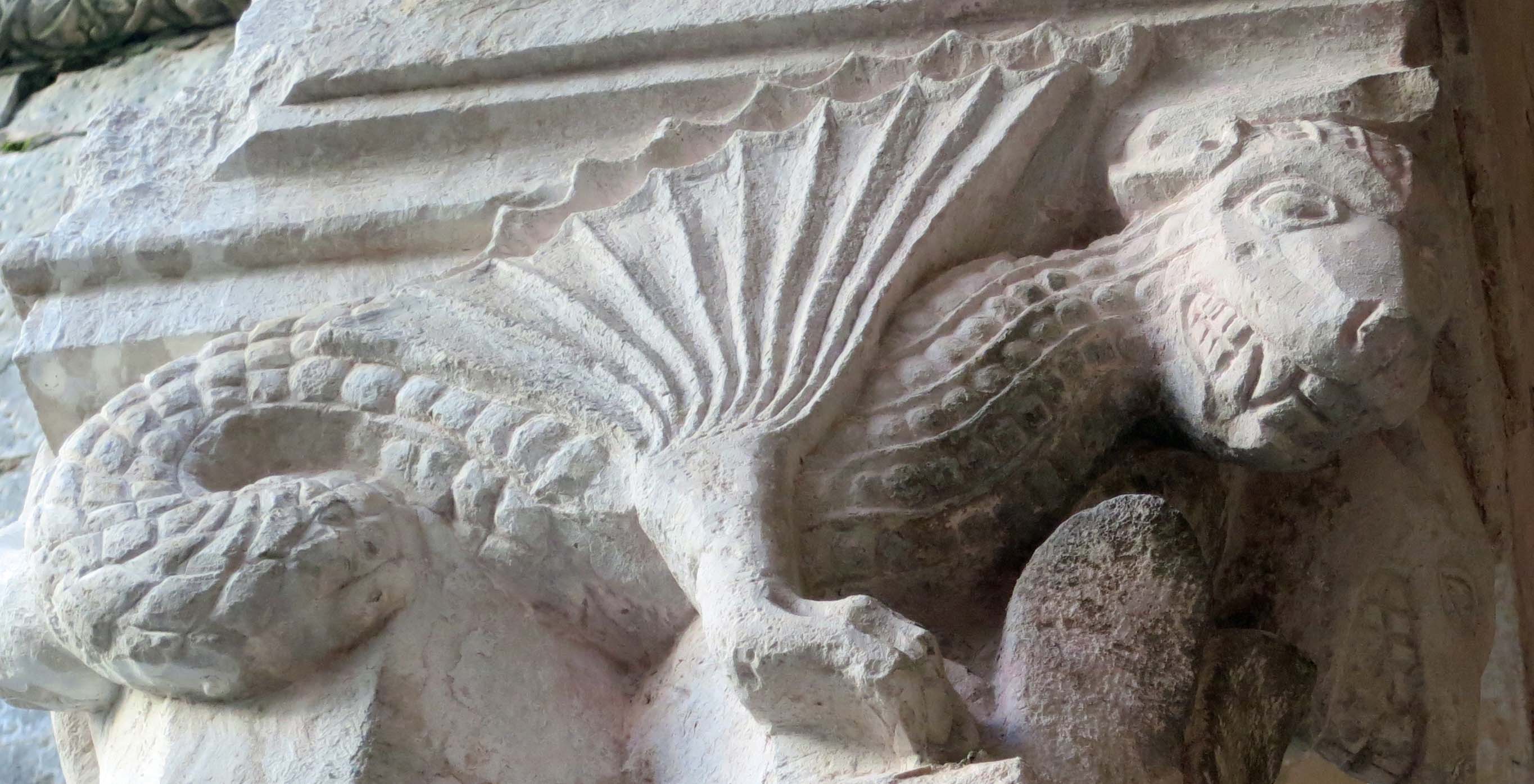
We found examples of grotesques in the cloister of the Franciscan Monastery of Dubrovnik on top of columns. (Photo by Peggy Mekemson)
Dragons were a popular subject for both gargoyles and grotesques. What could be more scary. We found this specimen with his fine set of choppers in the Franciscan Monastery.
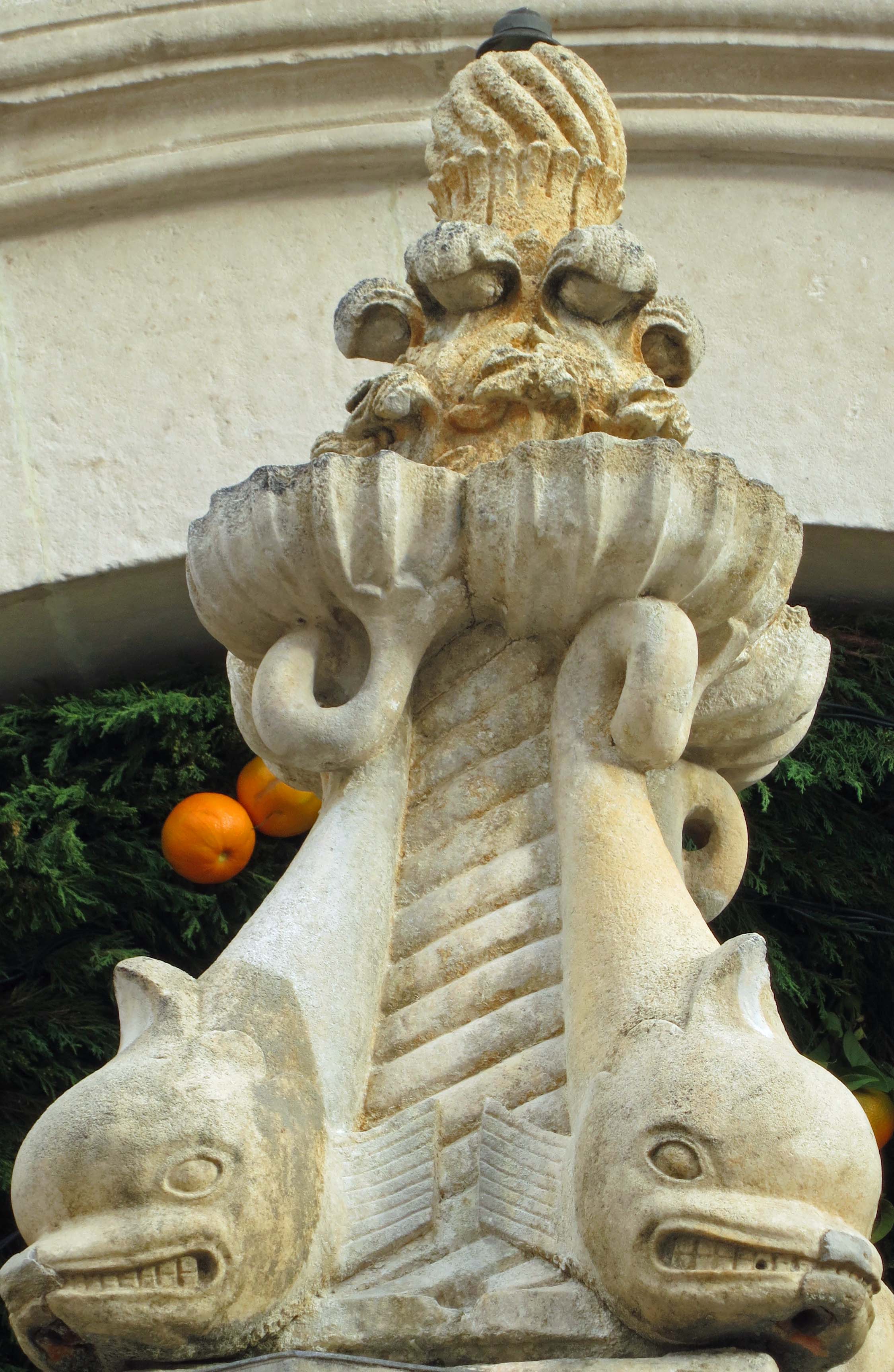
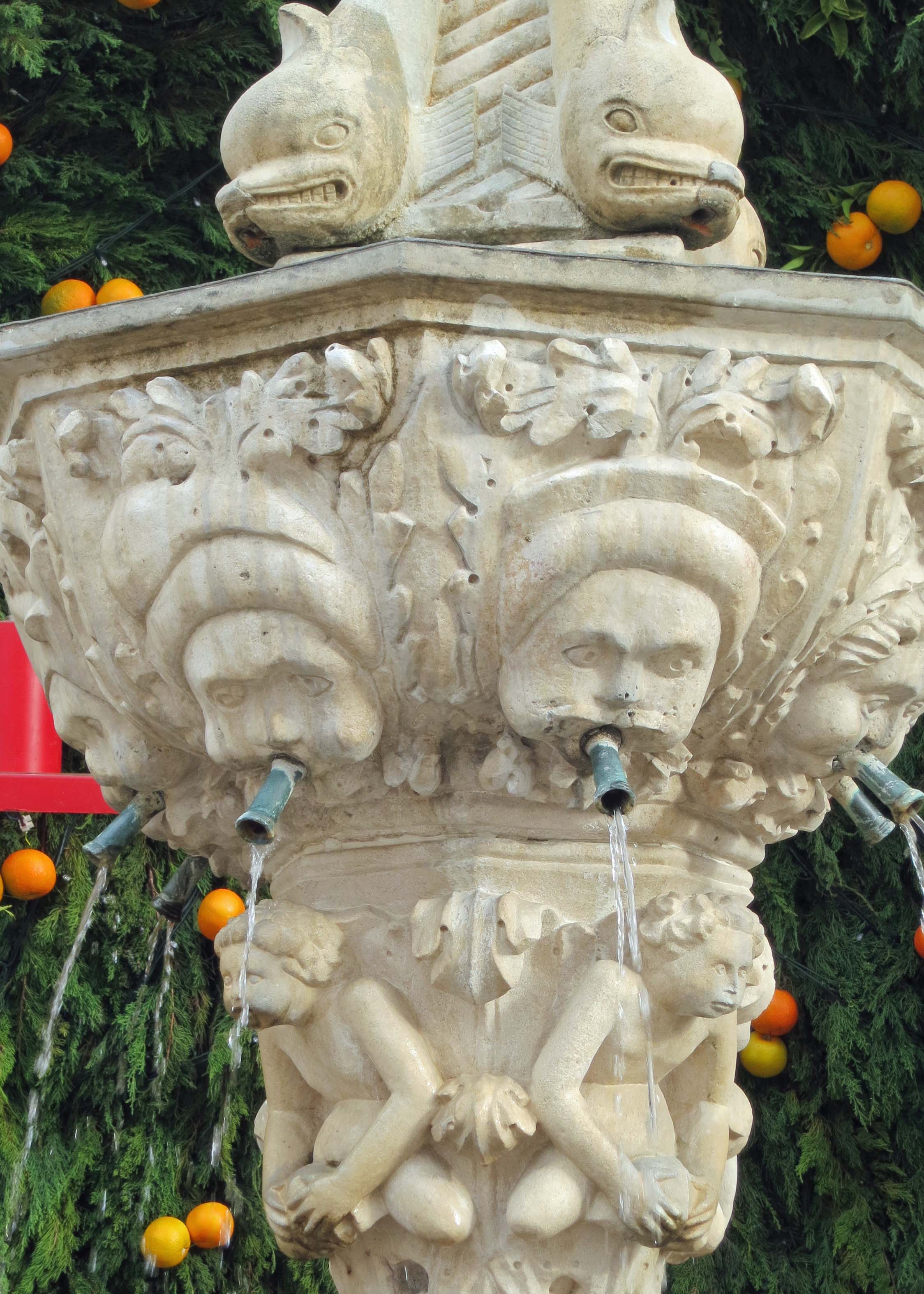
I have also found that fountains in Europe often host strange-looking beings. While the wealthy in pre-modern times might have water piped into their homes, the common folks obtained their water from community fountains. Dubrovnik built an aqueduct system in the mid 1400s to bring water to the city and then located two public fountains on the Stradun: big Onofrio’s Fountain located near the Pile Gate and little Onofrio’s Fountain found next to the clock tower in Lutz Square.
The top of little Onofrio’s Fountain with its ferocious looking fish. The fountain is located near the clock tower in Dubrovnik, Croatia. If I caught something like this, I’d be cutting my line!
Another view of little Onofrio’s Fountain. The oranges, BTW, were part of Dubrovnik’s Christmas decorations.
Big Onofrio’s Fountain located near the Pile Gate had 16 sides and each side featured a different mask with a spout coming out of its mouth. This was a cow mask. Or maybe it was a bull.
Something I find even stranger than gargoyles, grotesques, or fountain inhabitants are relics— bits and pieces of saints or other holy items kept around in reliquaries as items of worship. Pieces of the Cross are a common example. I once read that selling pieces of the cross was a thriving business during the Middle Ages. Scam comes to mind. The Dubrovnik Cathedral has a particularly impressive set of relics including a requisite piece of the Cross, Baby Jesus’ swaddling clothes, and various body parts of St. Blaise.
All of these items are reputedly capable of performing miracles and it is something of a miracle they exist. How they were obtained is usually rooted in the murky past. Pieces of the swaddling clothes were provided to women having difficult births. No matter how many pieces were cut out of the cloth, so it is said, the cloth returned to its original form.
I came across St. Luke’s finger in the small museum found in the Franciscan Monastery in Dubrovnik. The finger is encased in a gold reliquary. I know people take these items seriously and believe they have miraculous powers, but I find them on the far side of strange. I would almost bet that it cost the monastery an arm and a leg to get the finger.
NEXT POST: You want gargoyles? Wait until you see the white oak trees on our property and in the national forest behind us. These trees would fit right into “Lord of the Rings” or most other fantasies— or horror movies. My theory is that they will scare the heck out of the coronavirus if it comes around. Remember how the gargoyles were supposed to scare the evil spirits away from medieval cathedrals in Europe? I bet that they were recruited to frighten the plague as well! I know better, but it is fun to contemplate. And I find the trees interesting and amusing as opposed to scary. (At least during the day.)
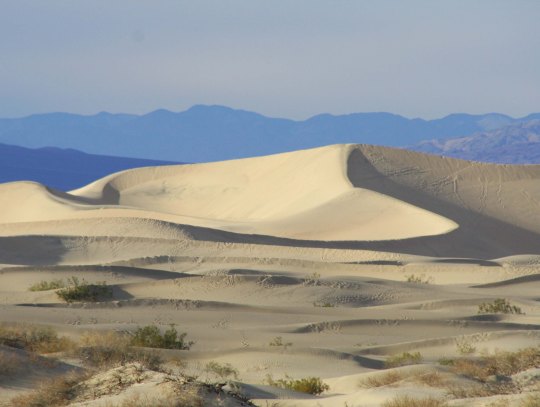
The world is full of incredible beauty that is worthy of our love and protection. These are sand dunes in Death Valley National Park.
I was recruiting for Peace Corps on the Davis Campus of the University of California on April 22, 1970, 50 years ago. For those of you not familiar with the date, it was Earth Day I. At the time, I was running the Peace Corps’ Public Affairs office for Northern California and Nevada out of Sacramento. Curiosity pulled me away from my recruiting duties to check out the event.
UC Davis puts on great fairs. It probably has to do with an event it calls Picnic Day, a rite of spring with roots as deep as humankind. The birds are singing, flowers are blooming, and the snow is melting in the mountains; let’s have a party! All of the departments become involved, put on shows, put up displays, and do silly things.
The flowers were blooming.
Earth Day at Davis was similar, but it incorporated a vitally important message.
Somehow we had forgotten where we had come from in our rush toward progress and the good life— and in the desire to maximize profits. As a result, we were chopping down our forests, polluting our streams, poisoning our air, destroying our last remaining wilderness areas, and saying goodbye forever to innumerable species whose only evolutionary mistake was to get in our way.
We had forgotten that birds can make music as beautifully as any symphony, that peace and balance can be found in the wilderness, and that somehow, in some yet unfathomable way, our fate might be tied to that of the pup fish. It seemed okay that the last brown pelican was about to fly off into the sunset forever so we could squeeze one more bushel of wheat from our crops, and that it was appropriate for the great redwoods, silent sentinels who had maintained their vigilance for over 4000 years, to die for our patio with a lifespan of 20-30 years.
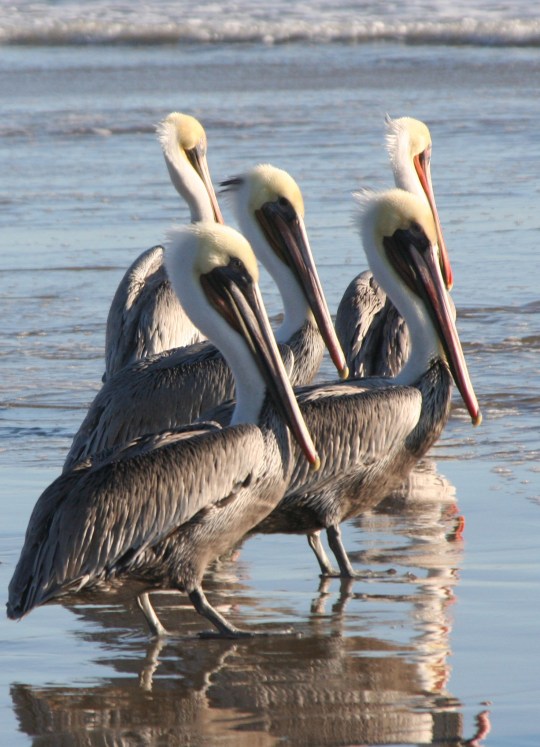
Brown pelicans, once near extinction because of DDT used on crops, have made a dramatic comeback since the use of DDT was banned. I took this photo south of Santa Barbara, California.
Rachel Carson, in her landmark book Silent Spring, had sounded a clarion call to a Holy Crusade: saving the earth. Others, too, were raising the alarm. Earth Day I was an expression of growing concern. Its message struck a deep chord with me. The years I had spent wandering in the woods while growing up, my exploration of the rainforest around Gbarnga, Liberia during my Peace Corps assignment, and my hiking in the wilderness as a backpacker, all came together in a desire to join the environmental movement and help protect the wilderness I had come to love.
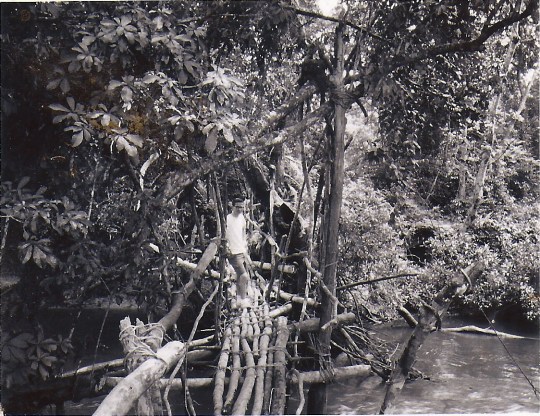
Some of my happiest moments as a Peace Corps Volunteer in West Africa were spent exploring the rain forest surrounding where I lived.
I wandered between booths on campus, talking to the representatives of various organizations and picking up materials. There was information about the redwoods, over-population, water and air pollution, land-use planning, mass transit and the protection of valuable farm lands. I learned about all the species that had become extinct because of our activities— and that many more were threatened.
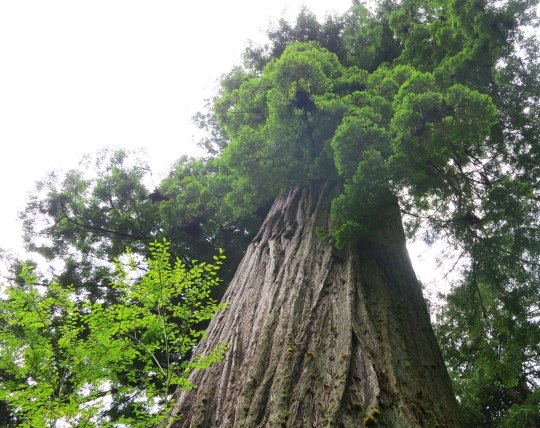
How could one not feel awe when confronted by giant redwoods in their cathedral like setting at Redwood National Park. It seemed terribly wrong to me that the life of a 2000 plus year old giant should be ended with a chainsaw to meet our short-termed demand for wood products.
I went home that night inspired, concerned, and more than a little frightened about what we were doing to our planet— the only home we have. Three weeks later, I had left the Peace Corps and become Executive Director of Sacramento’s first Ecology Education/Environmental Action Center, working 50-60 hours a week for one hundred dollars a month. I would continue to devote a significant amount of my time to supporting environmental causes for the next 20 years of my life, working beside some of the most dedicated, selfless and talented individuals I have ever known.
Our efforts, and those of hundreds, even thousands of others, made a difference. The majority of people in the US as well as in numerous other countries around the world became convinced that protecting the environment was a worthwhile endeavor. Air pollution was reduced, waterways were cleaned up, wilderness areas were saved, and a number of endangered species were brought back from near extinction. Once again, eagles soared, buffalos roamed and wolves howled.
But the progress has never been easy and the war is far from won. Nothing represents this better than our present battle against global warming, a reality that was dramatically brought home to me two years ago as I hiked down the Pacific Crest Trail dodging huge fires in Oregon and California. A drought created by climate change had killed millions of trees and those trees were burning.
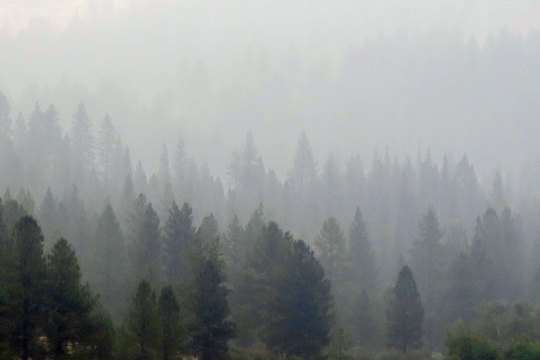
The massive Carr Fire near Redding sent fire tornadoes shooting into the air, reduced visibility to close to zero, and filled the air with choking smoke for hundreds of square miles. This was the view I faced on the PCT near Chester, California.
The 50th Anniversary of Earth Day 1 is an excellent time to take stock of where we are in our efforts to protect the environment. The news is not good. Over the past three years we have seen our national government withdraw from international efforts to combat global warming, eliminate many of the protections that we have fought so hard to put in place over the last 50 years, back away from using science designed to measure the impact of pollution, and systematically dismantle the EPA. Continuing down this path will once again lead to air filled with pollution, waterways poisoned, wilderness areas eliminated, and species exterminated. This isn’t an exaggeration; it is reality.
But it doesn’t have to be. The time to renew our commitment to the environment is today. Each of us can take action on the personal level to reduce our negative impact on the environment, support positive efforts on the local, state, national and world level, and insist that our political leaders do the same. The future of our children, grandchildren and future generations depend on it.
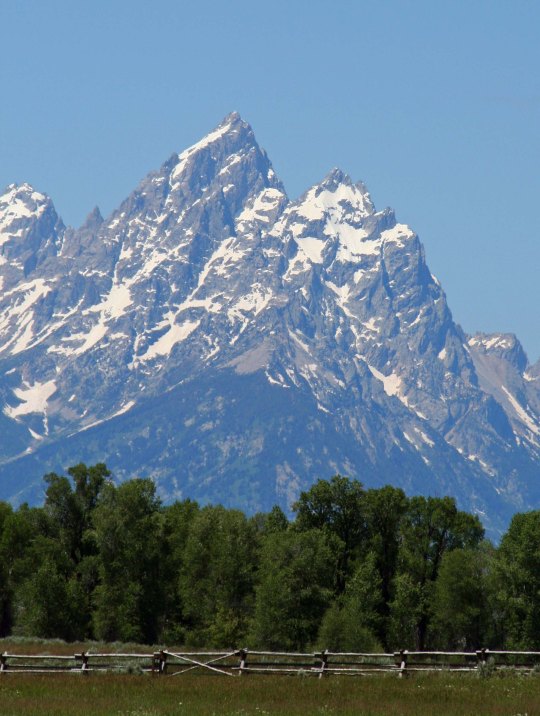
A final reminder of the beauty that exists in our world. This are the Grand Tetons. Happy Earth Day. May we have 50 more!
In this armchair travel post, Peggy and I walk the streets of Dubrovnik reliving our 2013 visit. We were there off-season a few weeks before Christmas, happily putting up with rainy weather to avoid the crowds of tourists!
The Stradun, Dubrovnik’s main thoroughfare, wet after a rain storm.
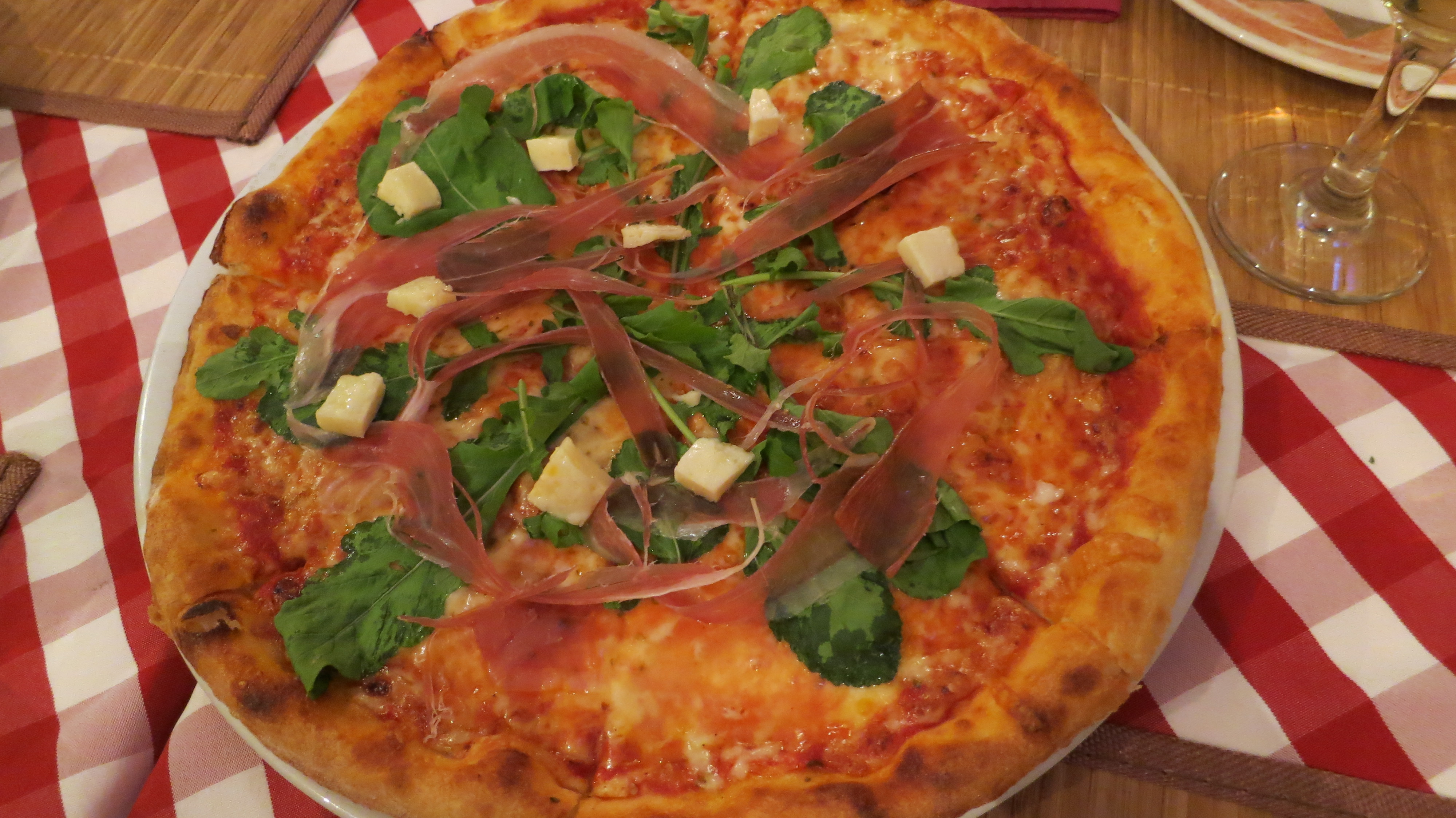
Luck was with us— the rain held off while we were on the walls of Dubrovnik and waited for us to descend to the Stradun, the city’s main thoroughfare. Lunch and pizza occupied most of the downpour. Afterwards we were treated to shiny, wet streets.
Our pizza, Croatian style.
In its first life the Stradun had been a winding canal separating Dubrovnik’s Roman and Slav populations. The canal was filled in during the Eleventh Century and brought the two populations together. A devastating earthquake took out most of the town in 1667 and Dubrovnik rebuilt the road to its present straight alignment.
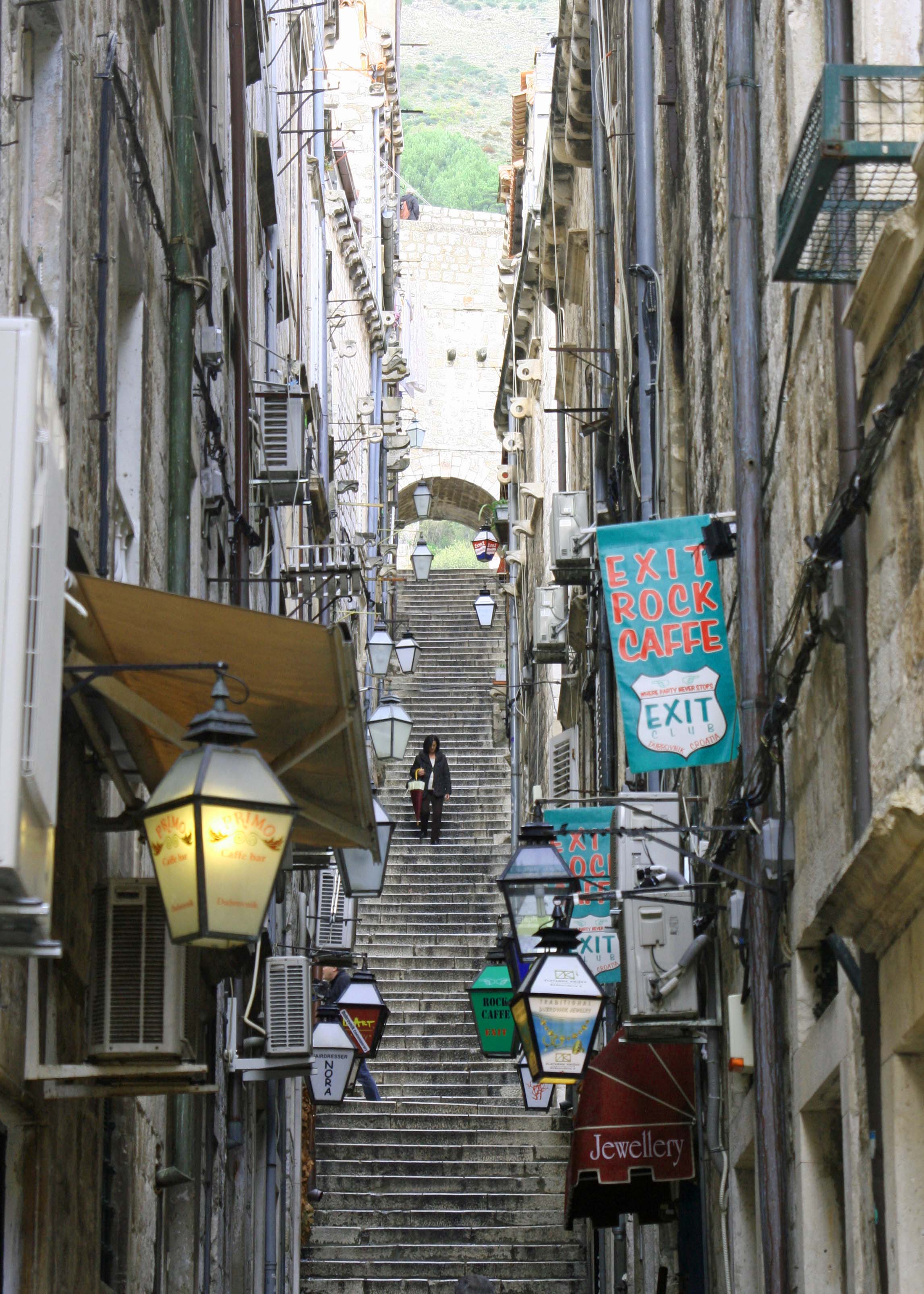
Narrow pedestrian ways shoot off in both directions from the Stradun and invite exploration. Plazas anchor both ends of the street. Since we arrived in December, Dubrovnik was preparing for the holidays. Two Christmas trees competed for our attention in Luza Square. I found one outlined by a window in the old Customs House to be particularly dramatic.
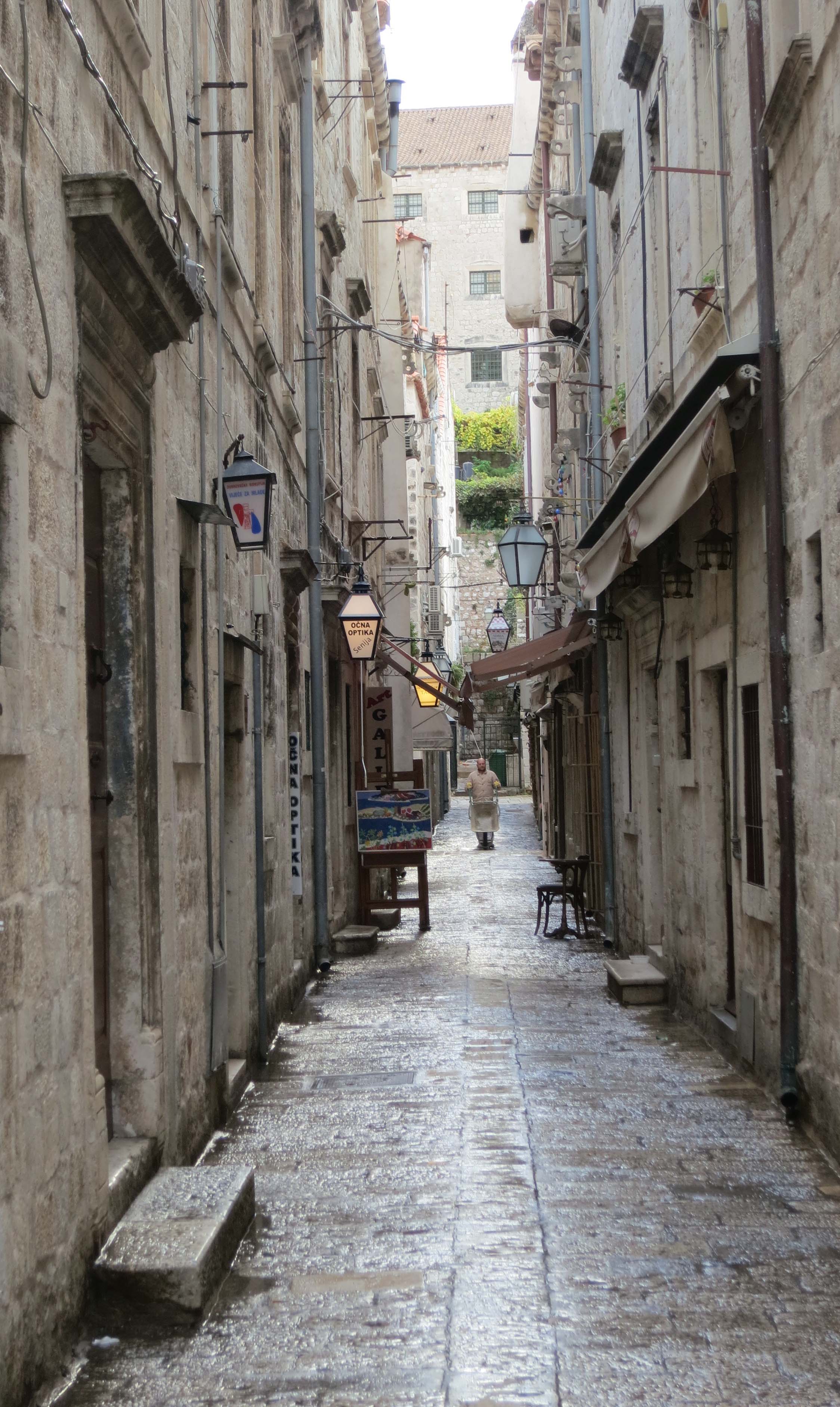
Walkways such as this and the one below branch off from the Stradun in Dubrovnik, Croatia and invite exploration.
Dubrovnik walkway. No crowd here.
With Christmas coming, the city was decorated to celebrate. Here, a Christmas tree is gracefully outlined by a window in Sponza Palace, the old custom-house.
Another photo of Sponza Palace, the Christmas Tree and Dubrovnik’s clock tower.
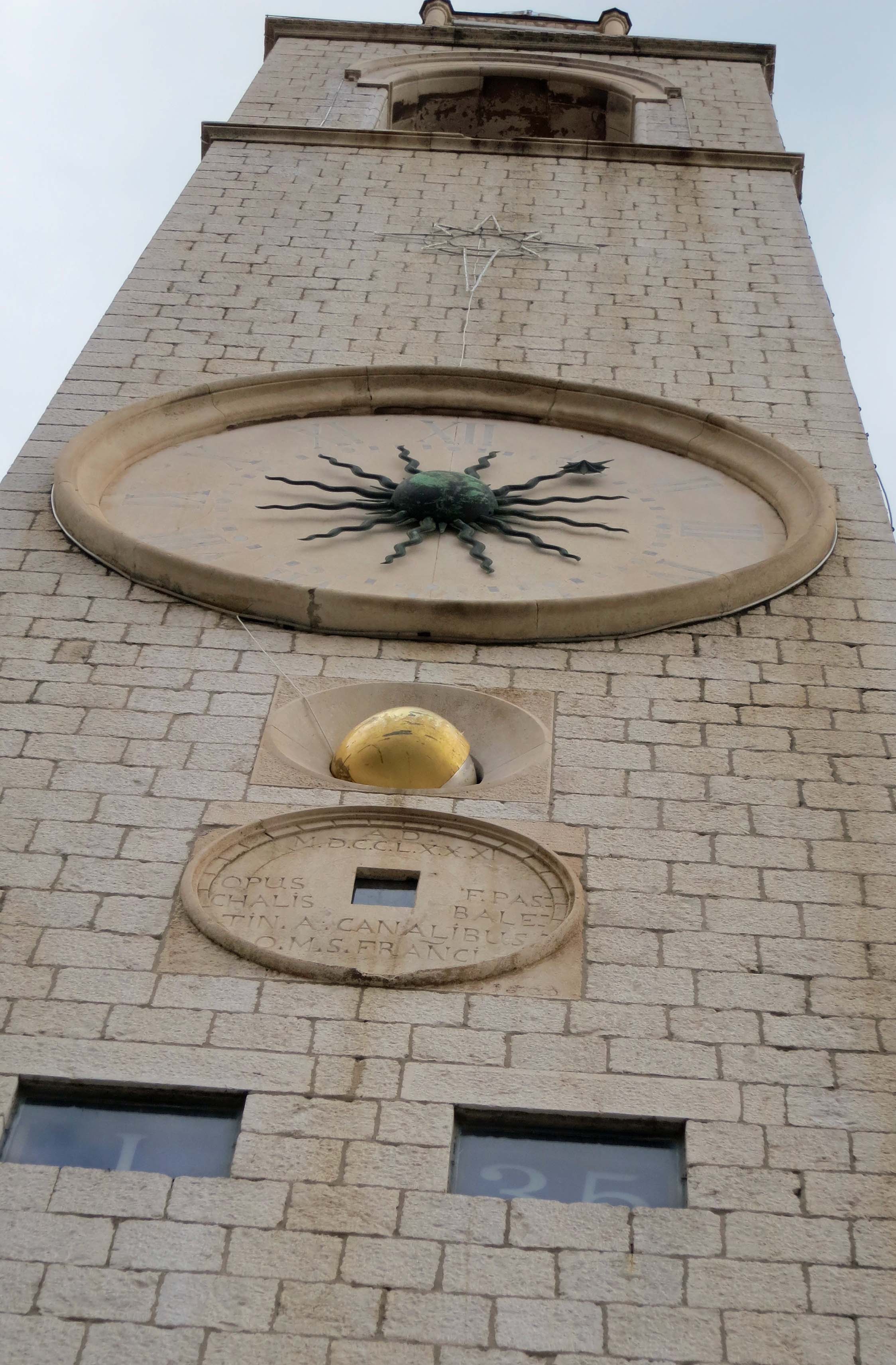
The town’s bell tower and clock, St. Blaise’s Church and Orlando’s Column and are also prominent features of Luza Square. Both St. Blaise and Orlando symbolize Dubrovnik’s fierce sense of independence.
A close up of the Dubrovnik clock tower. A digital clock at the bottom adds a touch of modernization.
St. Blaise was an early third century Christian Martyr from Armenia who was so holy that wild animals were said to drop by his cave for a blessing. The Romans used steel combs to flay off his skin and then beheaded him. Since the combs resembled those used for carding wool, Blaise became the Patron Saint of the wool trade. Go figure.
He earned the everlasting gratitude of Dubrovnik by appearing in a vision to a local priest to warn of an imminent invasion by the Venetians in 971. Ever since, the locals have loved St. Blaise and disliked Venice. They celebrate his birthday by parading various parts of his body through the city on February 3.
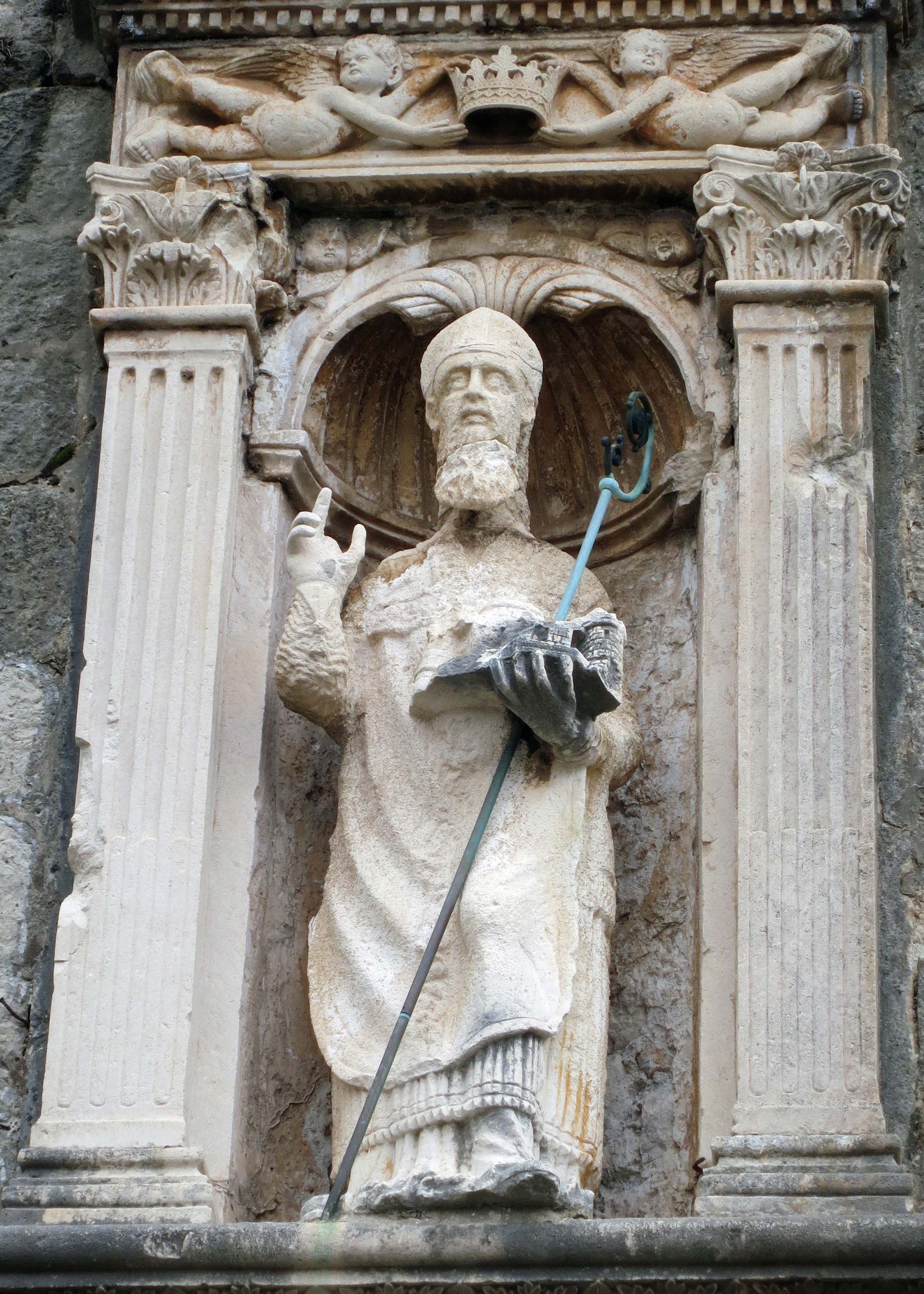
St. Blaise, the Patron Saint of Dubrovnik, holds a model of the city in his hand. This particular statue is found in the Pile Gate at one of the city’s main entrances. (Photo by Peggy Mekemson)
Orlando is known as the legendary knight Roland in Northern Europe. The story is that he rescued Dubrovnik from a siege by the Saracens in the Eighth Century. The fact that the dates of Roland’s life don’t match those of Orlando doesn’t seem to matter. He wasn’t from Venice. Also of note— his arm was used as the standard measure of cloth in Dubrovnik.
The Orlando column in Luza Square. (Photo by Peggy Mekemson.)
The Pile Gate, Franciscan Monastery, and Onofrio’s Fountain are located at the other end of the Stradun. The fountain is a subject of my next blog. The Monastery houses a peaceful cloister and a small but interesting museum that features a pharmacy that opened in 1317— and St. Luke’s finger.
The Franciscan Monastery in Dubrovnik caught in the sunlight.
In 1317 the Franciscans opened one of the first pharmacies in Europe as part of their commitment to provide medical care.
NEXT POST: I’ll conclude our visit to Dubrovnik by looking at gargoyles, St. Luke’s finger, and other oddities that caught my attention.
Continuing my armchair series on Dubrovnik, Peggy and I look down from the walls into the city providing a view of its colorful red roofs. Enjoy.
One of my favorite views into Dubrovnik, this one features the Church of St. Blaise on the right with its statue of the saint holding a model of the city. There was nothing blasé about Blaise, he was martyred for refusing to worship pagan gods and liked to preach to wolves and bears. Note the mechanical bell-ringer in the steeple on the left.
Walking the medieval walls that surround Dubrovnik provides a bird’s eye view across the roofs and down into the city. And what a view it is. Red tile roofs, narrow walkways, and imposing churches invite the visitor to pause and admire the unusual beauty of this town perched on cliffs above the Adriatic Sea.
Twenty years ago most of this beauty was destroyed as Yugoslavia lobbed shells into the city from surrounding hills. Dubrovnik held out, Croatian troops lifted the siege, and the residents proudly rebuilt their city. Today the only reminders of the siege are a few ruins that have yet to be rebuilt and bright red tiles that have yet to mellow with age.
Today’s blog is best reflected through photographs that Peggy and I took.
Looking down on Dubrovnik is like looking down on a sea of red. This photo is taken from Minceta Tower, the highest point on the wall. The Adriatic stretches across the top and the city’s port is on the top left.
This view of red tile roofs and cloudy skies features Dubrovnik’s Cathedral on the left. (Photo by Peggy Mekemson)
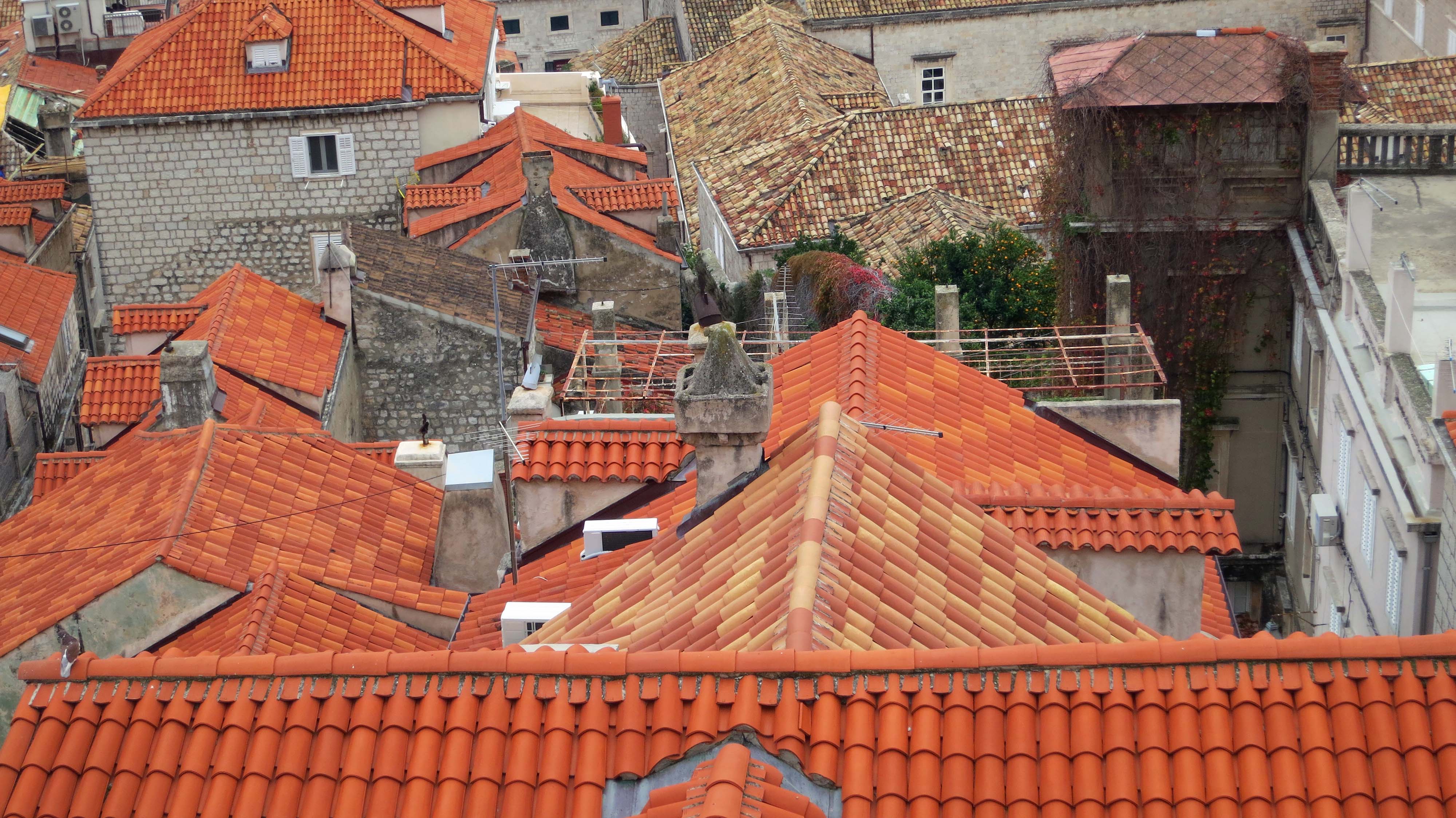
The contrast between new and older tiles is captured here. Many of the newer tiles represent repairs made after the siege of Dubrovnik in 2000-2001. The trellis in the middle covers a garden. Many are found throughout the city nestled between buildings.
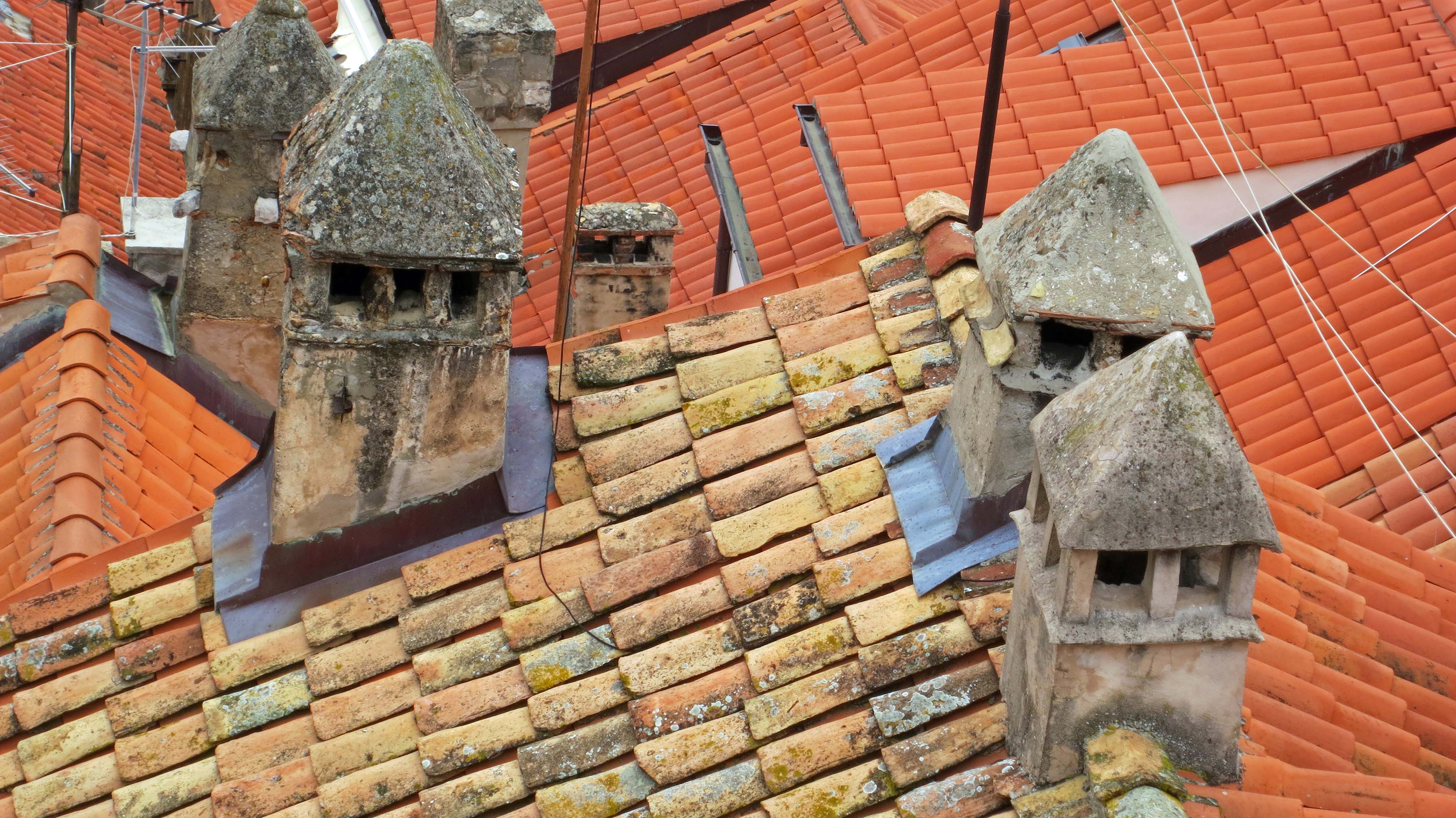
Another view of old and newer tiles in Dubrovnik. This one features chimneys.
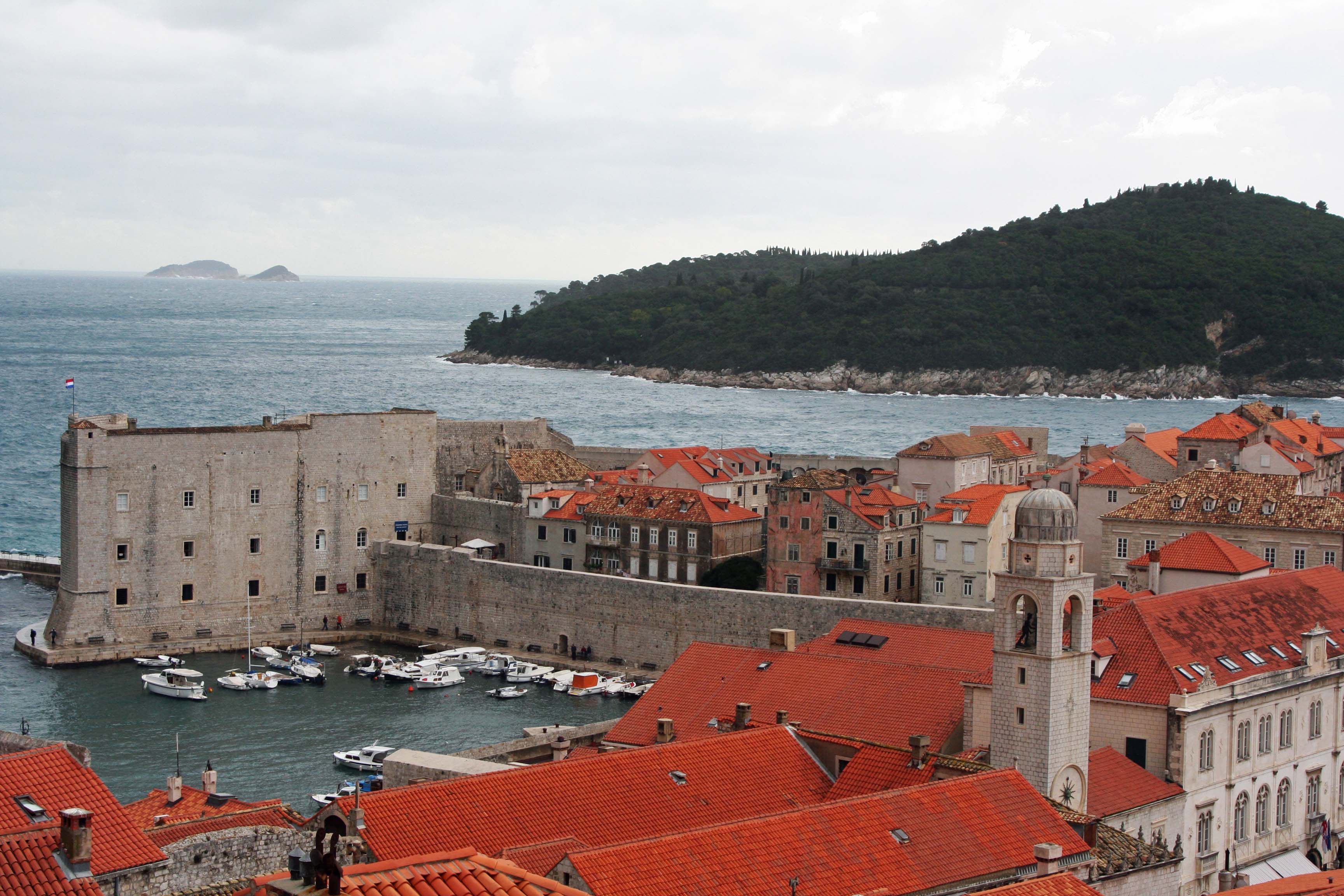
A view looking down on Dubrovnik’s port and St. John’s fortress (now an aquarium and museum) that guarded the harbor against Venetian invasion during the Middle Ages. The town’s clock tower is on the right. Lokrum Island is at the top of the picture. (Photo by Peggy Mekemson)
Peggy’s view of an abandoned building.
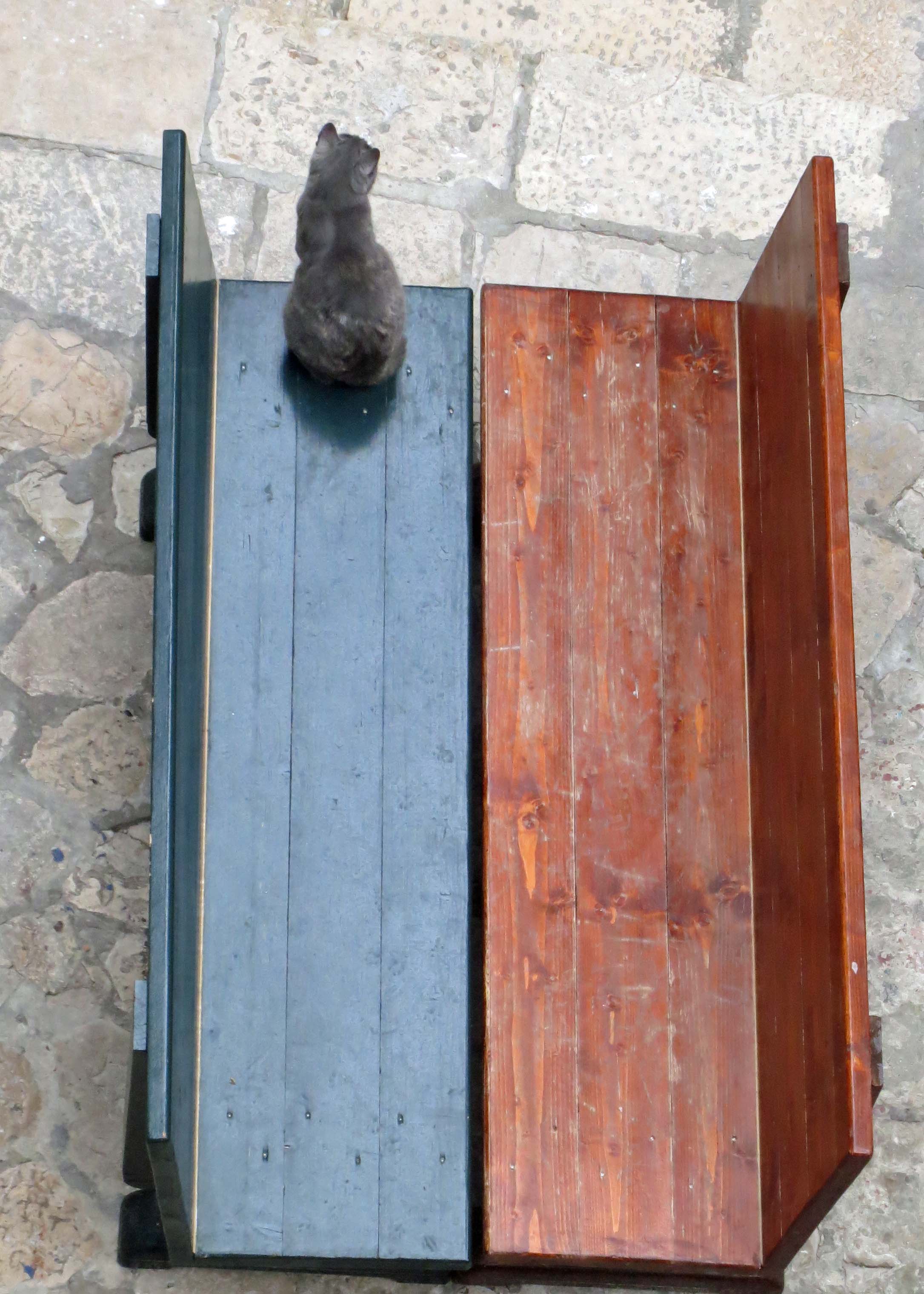
My obligatory cat photo from Dubrovnik. I loved the contrast between the cat and the two benches that had been shoved together.
A long view down the Stradun (Dubrovnik’s main street) looking toward the clock tower. The Franciscan Monastery is on the left.
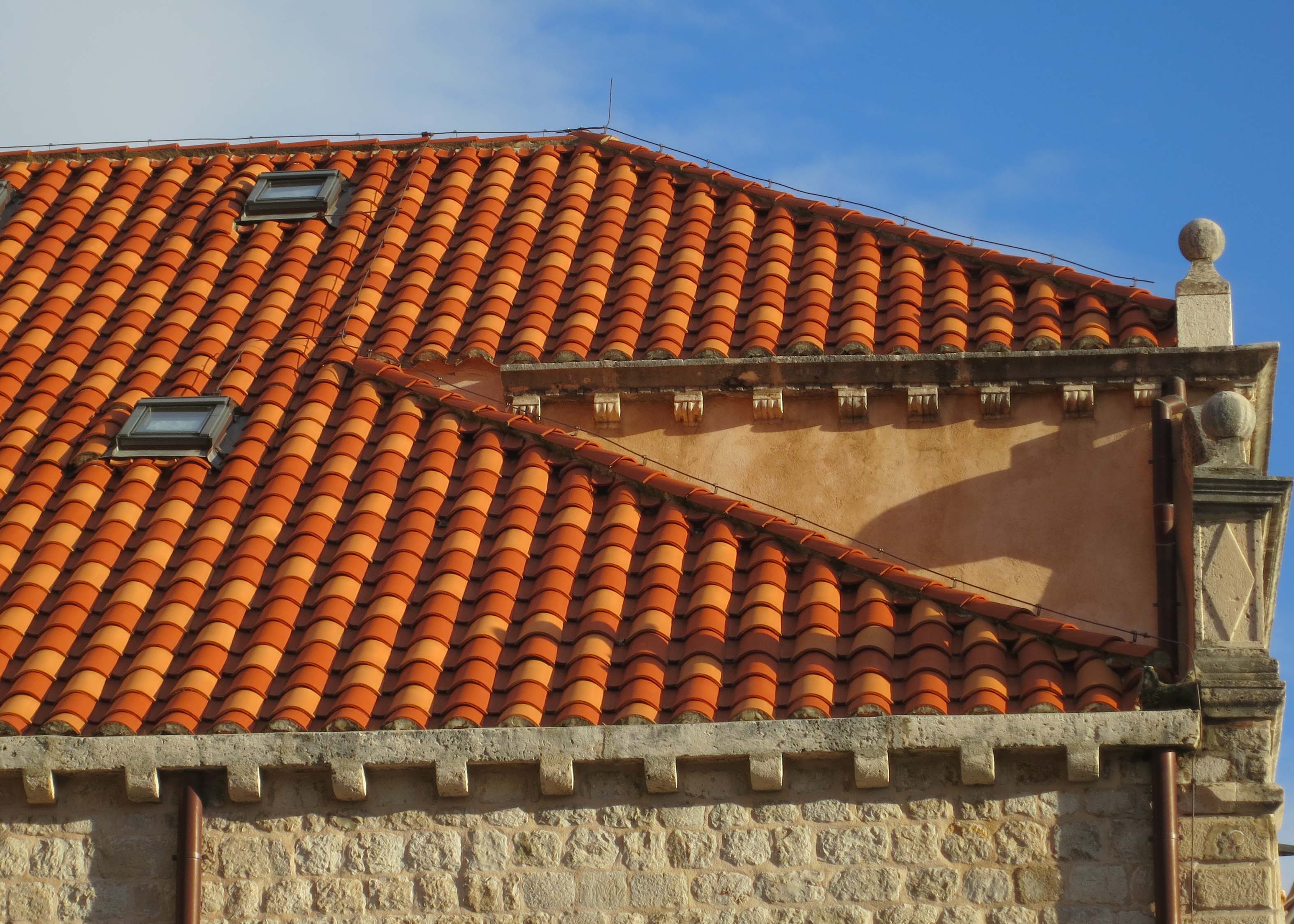
I like this photo because it shows what Dubrovnik’s red tile roofs look like in the sunlight!
A final view of Dubrovnik taken from the walls. This photo was shot through a window of one of the city’s many guard towers. I thought it made a rather nice frame.
NEXT BLOG: We climb down from the walls surrounding Dubrovnik and walk through the city.
I am continuing my armchair series today and for the next for the next three posts as I revisit the fabulous walled city of Dubrovnik on the Adriatic Coast. Many of my followers will have visited this city. For you, let the memories begin, as they are for Peggy and me. If you haven’t been there, I suggest it would be a great reward for the self-isolation you have practiced during the battle against Covid-19. Start dreaming. The pandemic will pass.
The walled city of Dubrovnik is known as the Pearl of the Adriatic. The walls around the city are listed as a World Heritage Site. The Adriatic Sea is at the top of the photo.
OK, I’m in love. This walled city of Croatia on the Adriatic Sea is gorgeous. Once upon a time Dubrovnik was a major sea power in the Mediterranean Sea. At another time, it was the first nation in the world to provide official recognition for the fledgling United States of America fighting for independence.
As recently as 1991 it was under a devastating siege by Yugoslavian forces that laid waste to much of the city’s renowned beauty. Today it has rebuilt most of what was destroyed.
This is one of four blogs I did on Dubrovnik in 2013 and am reposting on my Armchair Series. First up is a look at magnificent medieval wall that surrounds the city and provides visitors with outstanding views of the Adriatic Sea and surrounding country. Second I will turn inward and look down from the walls on the city and its colorful tiled roofs. Third we will visit the city from street level. Finally, I want to feature some intriguing gargoyles we found in Dubrovnik. (Have I used enough superlatives?)
Any visit to Dubrovnik should include a walk around the mile plus (6,360 feet) wall that surrounds and protects the city. Considered to be one of the great fortification systems of the Middle Ages, the walls were named a World Heritage site in 1979. Reaching a maximum height of 82 feet, the walls were never breached during the 12th through the 17th century— providing five hundred years of peace and prosperity for the residents.
A fast walker can easily do the walk in an hour or so but plan on a more leisurely 2-3 hour stroll. You’ll need the extra time for photography, or just staring in awe.
This photo of the walls was taken from Minceta Tower, the highest spot on the walls. (Photo by Peggy Mekemson)
Here’s a perspective on why enemies would have thought twice— or maybe a dozen times— before attacking Dubrovnik.
If the walls weren’t enough to discourage an invasion of Dubrovnik, the Fort of St. Lawrence stood on the opposite peninsula. BTW, is it just my imagination (admittedly wild) or does the fort look like it is resting on the back of a turtle? (Photo by Peggy Mekemson)
Another view of the Fort of St. Lawrence in Dubrovnik. It was a stormy day as shown by the waves from the Adriatic Sea breaking on the rocks.
This photo looks up toward Minceta Tower, the highest point on the walls of Dubrovnik. The flag of Croatia is seen on the left.
Another perspective on the wall protecting Dubrovnik.
A cannon’s-eye-view looking out from the walls of Dubrovnik.
I liked this photo by Peggy with its dark sky, grey wall and red roof.
A statue of St. Blaise, the Patron Saint of Dubrovnik, looks out on the Adriatic Sea and protects the city from harm. (Photo by Peggy Mekemson)
A final view of Dubrovnik wall. (Photo by Peggy Mekemson)
NEXT BLOG: A journey around the walls of Dubrovnik looking down into the city.
When I was a child, I used to believe in the Easter Bunny who hopped around delivering brightly colored eggs to children all over the world. He was like Santa, magical, but he didn’t have a sleigh and flying reindeer. So he had to be very, very fast. I believed that he was a jackrabbit, which happened to be the fastest bunny I knew. So what if he was a hare.
The bunny would need long legs and a streamlined body like these two jackrabbits that showed up in our back yard a few months ago.I mean, how in the heck could a fat, contented fellow like this make it around the world in one day? Furthermore, why would he want to?It’s much nicer to sit around munching green stuff and sleeping in the sun.Any suggestion that he slim down and start exercising would get you the ‘look.’He might even become a bad bunny. An no, no, no— you wouldn’t want that.
As an adult, I sadly gave up the idea of one Easter Bunny. It would take hundreds, thousands even millions of bunnies to make all the deliveries. But why not. Given the proclivity of bunnies to make other bunnies, lots of other bunnies, it is completely feasible. So I now believe in bunnies, bunnies everywhere. I even found one of their bunny production facilities. A few years ago I was traveling up the Northcoast of Oregon and came to the town of Tillamook. You may know it for its cheese, or even better yet, its ice cream.
I pulled into an RV campground and found enough bunnies to easily handle the city and surrounding countryside on Easter. I also noticed bunnies chasing each other around. I stopped one and asked one what was going on. “Are you blind,” he asked in amazement. “We are making more bunnies so the old fat bunnies can retire. They get nasty if they have to work too hard.” Oh,” I had replied.
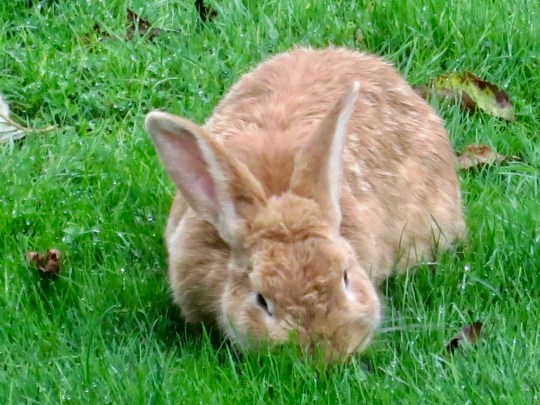
Everywhere I looked in the yard I saw bunnies.A young bunny was chowing down on grass so it could grow up and be an Easter Bunny.She stopped long enough to allow me to take her photo. “Aren’t I pretty,” she noted. And yes, it’s true. Girl bunnies have an equal opportunity to grow up and become Easter Bunnies.
NEXT POST: It’s another arm chair travel day as I head off to the lovely city of Dubrovnik.
Rasputin the Cat hosting rhinoceros beetles in Liberia, Africa circa 1966.
It’s that time of the year when chickens lay brightly colored eggs and bunny rabbits hide them for children to find. It’s an Easter tradition that is even more important this year when children (and their parents) can use a little old-fashioned fun. By rights, I should have a chicken, egg, and bunny story to tell. But I don’t. I do, however, have a cat and rooster story. It will have to do. Join me as I travel back in time to when I was a Peace Corps Volunteer in West Africa and Rasputin the Cat and the Cockle Doodle Rooster hatched a plot to wake me up early every morning. (I adapted this story from my book, “The Bush Devil Ate Sam.”)
Jo Ann, my first wife, and I raised Rasputin from a kitten. He had grown into one fine cat, or sweet meat as my students said. They’d tease me by coming by and pinching him to see how fat he had become. Then they would stand around discussing whether he was ready for the stew pot.
Rasputin’s primary entertainment was stalking dogs. You knew when he was at work because the neighborhood dogs carefully avoided the tall clumps of grass where he liked to hide. He was particularly obnoxious when it was windy. He would hide up-wind and make it more difficult for the dogs to sniff him out. I felt for the poor dog that came too close.
A streak of yellow and a yip of surprise proclaimed his attack. What made his behavior particularly strange was that he came at the dogs on his two hind legs, walking upright. This allowed both front legs to be used as slashing weapons. It was the wise dog that steered clear.
His other form of entertainment was more cat like. He liked the girls. Each night he would ask to go out around 10 and we wouldn’t seen him until the next morning. I was fine with this. Who was I to get in the way of true love? I was less tolerant of his returning around 5:30 and insisting that I let him in. He did this by practicing his operatic meows under our bedroom window.
Since no amount of suggesting that he should change his behavior discouraged him, I jumped out of bed one morning and chased him across the yard. This got Jo Ann excited. Our cat was going “to run away and never come back.” She may have also been concerned about the neighbor’s reaction to my charging out of the house naked. That type of thing bothered her. I promised to repent and assured her that the cat would be back in time for dinner. He was.
There were occasions when Rasputin’s tomcatting kept him out beyond his normal 5:30 appearance. I’m convinced that he made a deal with the rooster next door to wake us in his absence. I didn’t make this correlation until the rooster crowed directly under our window one morning at 5:30. Even then I thought it was just a coincidence until the rooster repeated himself the next day.
It wasn’t just the crowing that irritated me; it was the nature of the crow. American and European roosters go cock-a-doodle-do. Even urban children know this because that’s how it is spelled out in books. Liberian roosters go cock-a-doodle— and stop. You are constantly waiting for the other ‘do’ to drop.
“This crowing under our window,” I thought to myself, “has to be nipped in the bud.”
That evening I filled a bucket with water and put it next to my bed. Sure enough, at 5:30 the next morning there he was: “COCK-A-DOODLE!” I jumped up, grabbed my bucket, and threw the water out the window on the unsuspecting fowl. “Squawk!” I heard as one very wet and irritated rooster headed home as fast as his little rooster legs could carry him.
“Chicken,” I yelled out after his departing body. “And that,” I said to Jo Ann, “should be the end of this particular problem.”
I was inspired though. Cats don’t think much of getting wet either. What if I kept a bucket of water next to the bed and dumped it on Rasputin the next time he woke us up at 5:30. Jo couldn’t even blame me for running outside naked. With warm thoughts of having solved two problems with one bucket, I went to bed that night loaded for cat, so to speak.
“COCK-A-DOODLE” roared the rooster outside our window promptly at 5:30.
“Damn,” I thought, “that boy is one slow learner.”
I fell out of bed, grabbed the bucket and dashed for the window. There was no rooster there. I looked up and spotted him about 20 feet away running full tilt. He had slipped up on us, crowed and taken off! My opinion of the rooster took a paradigm leap. Here was one worthy opponent. The question was how to respond.
It took me a couple of days of devious thinking to arrive at a solution. What would happen if I recorded the rooster on a tape recorder and then played it back? I had a small tape recorder that I used for exchanging letters with my dad so I set myself the task of capturing the rooster’s fowl language. Since he had an extensive harem he liked to crow about, it wasn’t long before I had a dozen or so cock-a-doodles on tape. I rewound the recorder, cranked up the volume and set it up next to our front screen door.
The results were hilarious. Within seconds the rooster was on our porch, jumping up and down and screaming ‘cock-a-doodle.’ There was a rooster inside of our house that had invaded his territory and he was going to tear him apart, feather-by-feather. Laughing I picked up the recorder, rewound it, carried to the back screen door, and hit the play button.
“Cock-a-doodle, cock-a-doodle, cock-a-doodle,” I could hear the rooster as he roared around to the back of house to get at his implacable foe. Back and forth I went, front to back, back to front. And around and around the house the rooster went, flinging out his challenges.
Finally, having laughed myself to exhaustion, I took pity on my feathered friend and shut the recorder off. This just about concludes the rooster story, but not quite.
One Friday evening, Jo and I had been celebrating the end of another week of teaching with gin and tonics until the wee hours when we decided to see how the rooster would respond to his nemesis at one o’clock in the morning. Considering our 5:30 am wakeup calls, we felt there was a certain amount of justice in the experiment. I set it up the recorder and played a “Cock-a-doodle.”
“COCK-A-DOODLE?!” was the immediate response. No challenge was to go unanswered. “Cock-a-doodle” we heard as roosters from the Superintendent’s compound checked in. “Cock-a-doodle, cock-a-doodle” we heard in the distance as town roosters rose to the challenge. Soon every rooster in Gbarnga was awake, and probably every resident.
We decided to keep our early morning rooster-arousing episode to ourselves.
Hope you enjoyed the tale. There are several more about Rasputin in the book. A very Happy Easter to each of you from Peggy and me. Be safe and stay healthy!
I continue my exploration of Athens today as part of my armchair travel series, dipping back into my hundreds of archived posts. You will learn what gave Zeus a splitting headache. Hint: It wasn’t Covid-19.
The massive Temple of Zeus located near the base of the Acropolis.
We like our gods to have a touch of humanity. The Greek gods had more than their share. They would party on Olympus, chase after the opposite sex, and constantly intervene in human affairs. They could be jealous, revengeful and petty but they could also be generous and protective. It was good to have one on your side.
The replica of the Parthenon in Nashville, Tennessee has a fully sized model of what the statue of Athena located in the historic Parthenon may have looked like. I think the spear alone would have given Zeus a headache.
Each Greek city-state would choose a god to be its special protector. With Athens, it was Athena. Both the Parthenon and the Erechtheion on the Acropolis (featured on my last blog) were built in her honor. Athena, according to Greek mythology, sprang fully grown and armed from the head of Zeus. Not surprisingly, Zeus had a massive headache prior to her birth. You might call it a splitting headache. His son, Hephaestus, god of the forge and blacksmiths, took his mighty chisel and split opened Zeus’s head, thus releasing Athena and relieving Zeus.
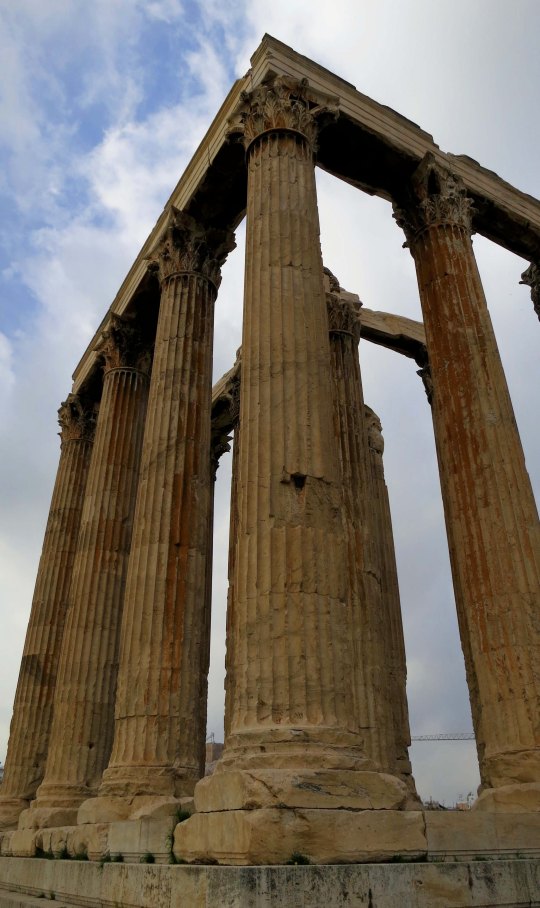
Zeus was also honored in Athens with a massive temple located near the base of the Acropolis. In addition to being the king of the gods and father of Athena, he was a notorious womanizer. He married his sister Hera, who was constantly trying to thwart his womanizing ways. One of Zeus’s more famous trysts was with the renowned beauty Leda. Zeus seduced her in the guise of a swan, so the story goes. It was a favorite subject of Renaissance Painters. One result of the seduction was that Leda went home and laid an egg, from which the even more beautiful Helen of Troy was hatched.
Our guides took us to see the Zeus temple and then on to visit site of the 2004 Summer Olympics. We stopped off to watch the changing of the guards in front of the Prime Minister’s official seat of government and hurried on to a very expensive restaurant that our guides had selected. I assume they received a handsome kickback. Sadly, our time was running out and we returned to the ship. Other sites would have to wait for another time.
A side view of the Temple of Zeus in Athens looking grey against grey skies.
Another photo of the Zeus Temple in Athens. This one features the upper part of the columns with their tops decorated in the Corinthian style.
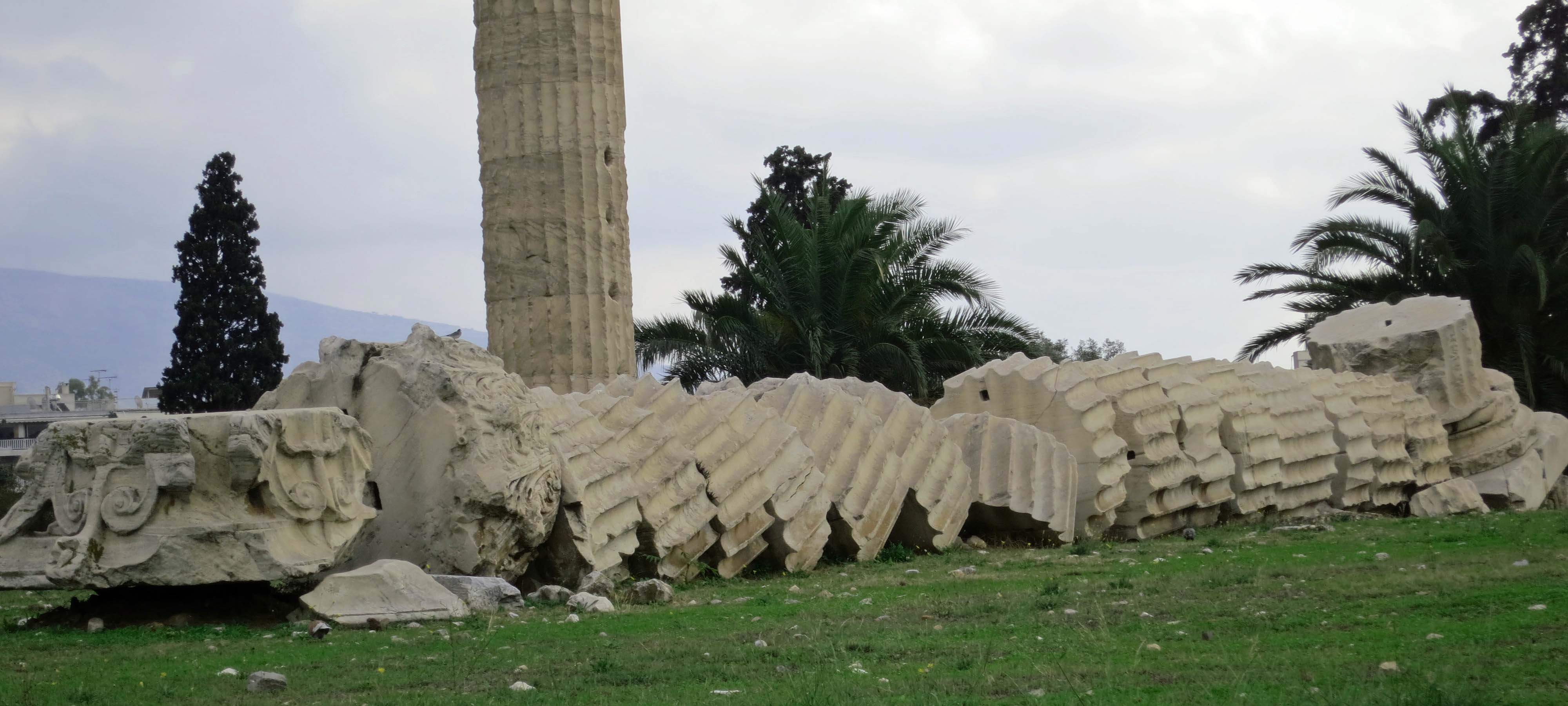
In 1852 a storm topped one of the massive columns from the Temple of Zeus and it has remained there ever since.
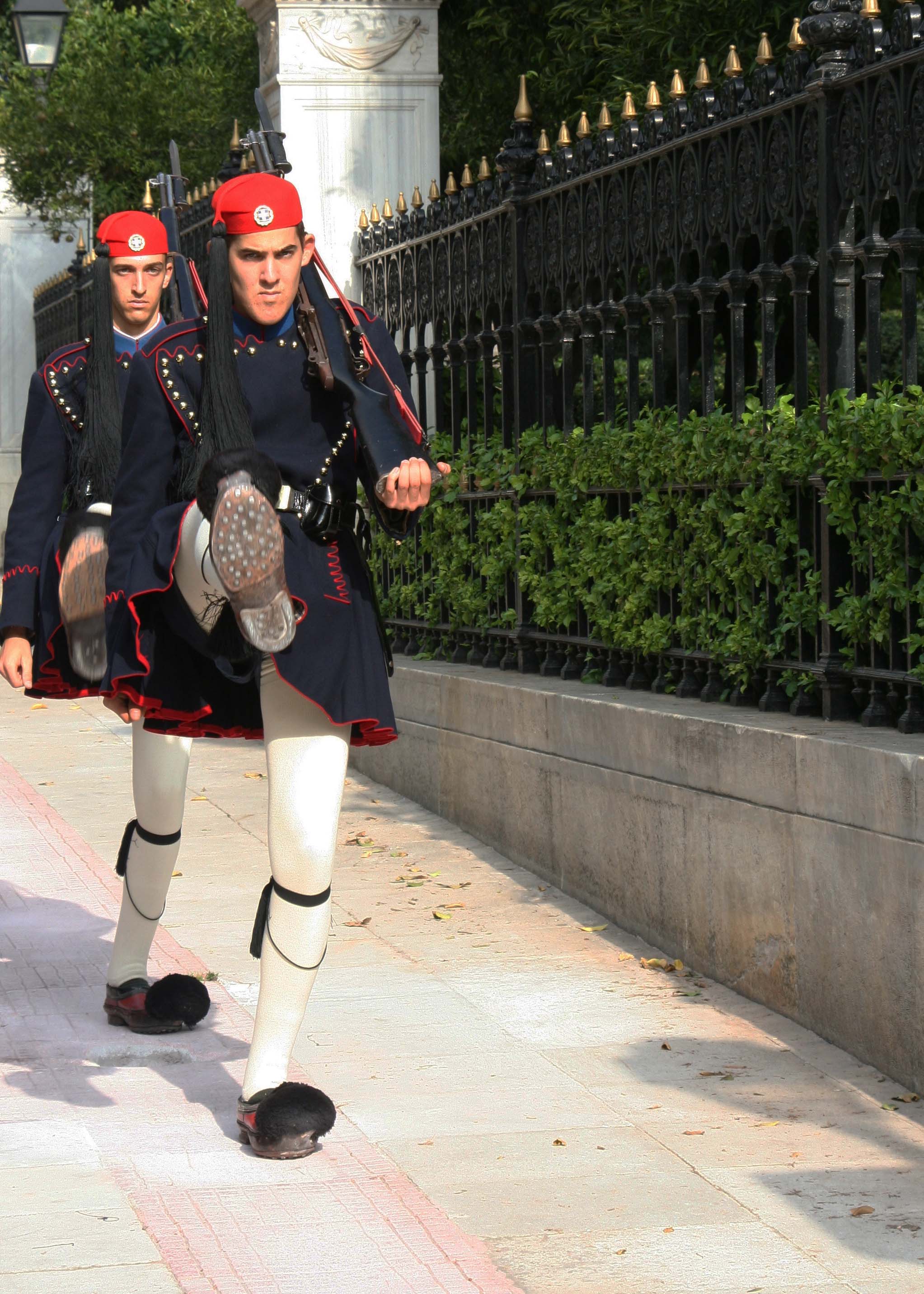
We watched as guards high stepped their way through the Changing of the Guards at the Prime Minister’s seat of government. (Photo by Peggy Mekemson)
I found the choice of shoes, um, interesting. At least the guards were guaranteed warm toes on a cold night.
The site of the 2004 Summer Olympics in Athens features a statue of a discus thrower winding up to throw.
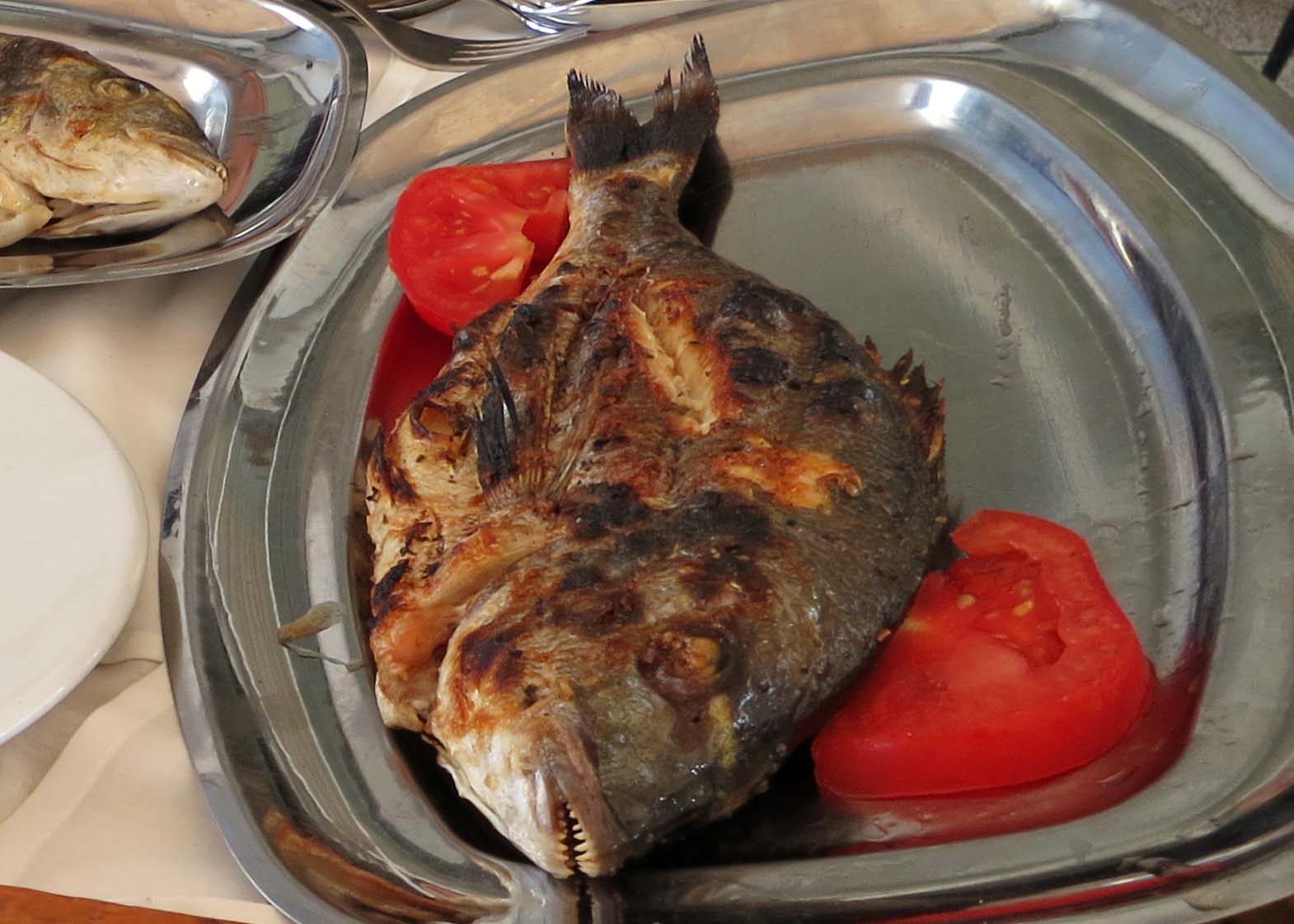
One of several courses from our expensive Greek lunch.
Peggy and I and pose with our two Greek guides. As I recall, their cousins owned the restaurant.
On Monday I will feature ten activities to keep away the blues during home-sheltering. They may not all be for you— such as capturing ground squirrels or searching for trees that might fit into Lord of the Rings or some other fantasy. (We have a whole forest of them.) Other’s might strike a chord. For example, most parents are now learning a lot more about home-schooling than they ever wanted to learn. But how about home-schooling for adults?
The Acropolis with its graceful Parthenon shown above is probably the wold’s most famous historic site.
I continue to reach back into my archives today to provide more armchair adventures as the world reels under the coronavirus pandemic. Like you, Peggy and I are ‘sheltering at home’ while reliving past travel experiences and dreaming of future ones. They will come.
Athens was grumpy. Several years of extravagant spending by the Greek government and its citizens had come home to roost. The European Union had required steep austerity measures in Greece as the price of a pulling the nation back from the brink of fiscal chaos. Nothing was spared from spending cuts including social services, wages and pensions. A massive influx of impoverished immigrants and a nascent neo-Nazi movement added to the country’s woes. Everyone was expected to make sacrifices to help solve the crisis.
Since sacrifices are best made by someone else, there had been massive strikes and violence in the country.
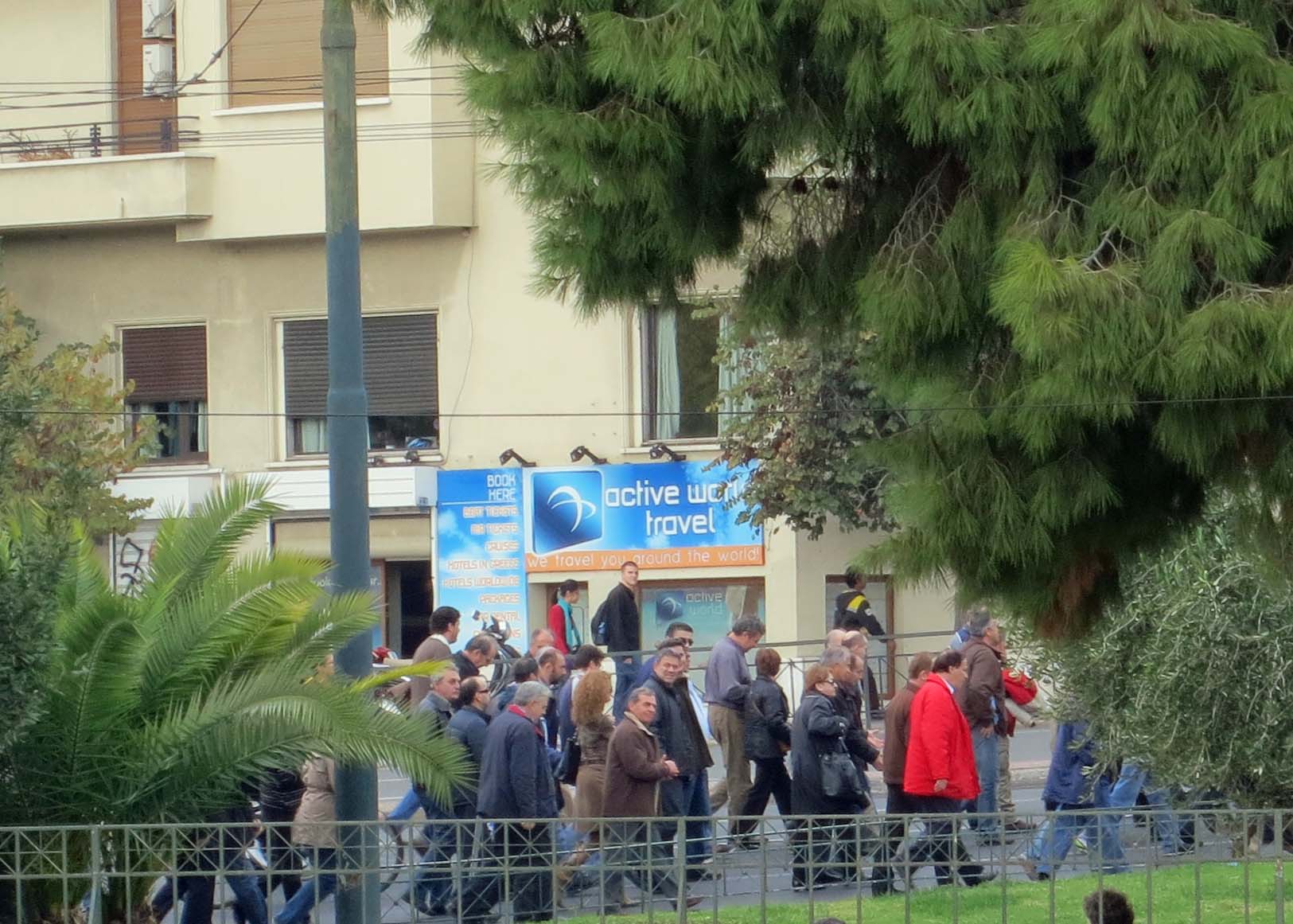
Standing near the Temple of Zeus, we watched as yet another group of protestors hit the streets of Athens.
We didn’t know what to expect but had decided to see Athens on our own. Tours offered by the cruise line are very expensive. They help assure a healthy profit margin. There is little encouragement for independent exploration. No handy-dandy sheets are handed out saying this is what you should do if you want to see such and such on your own.
Normally our self-guided tours worked great but Athens proved to be challenging.
From the moment we stepped off the ship, taxi drivers offering tours inundated us. Tourism had dropped with the fiscal crisis and was dropping even farther with the end of the tourist season. The air of desperation turned to rudeness when it was discovered we were planning to use public transit. Finding the right bus stop and the right bus turned out difficult, however. When we finally did find the bus, it was leaving. Out of frustration I turned to a taxi driver. We were able to hire two taxis for an all day tour for the six of us that was substantially less than the cruise tours.
Was it worth all the hassle? Absolutely.
Much of who we are in the West evolved from what happened in the City State of Athens between 500 and 350 BC. We visited the cradle of democracy and walked where Socrates and Plato had walked. We climbed up the Acropolis and admired the Parthenon and other buildings that have been a major inspiration for Western architecture for 2000 years. We watched the changing of the guard at the Prime Minister’s residence, visited the site of the Athens 2004 Summer Olympics, and concluded our tour with an expensive but excellent Greek meal.
If you are a history buff, as I am, having your photo taken with the Parthenon as a backdrop is a true privilege. (Photo by Peggy Mekemson)
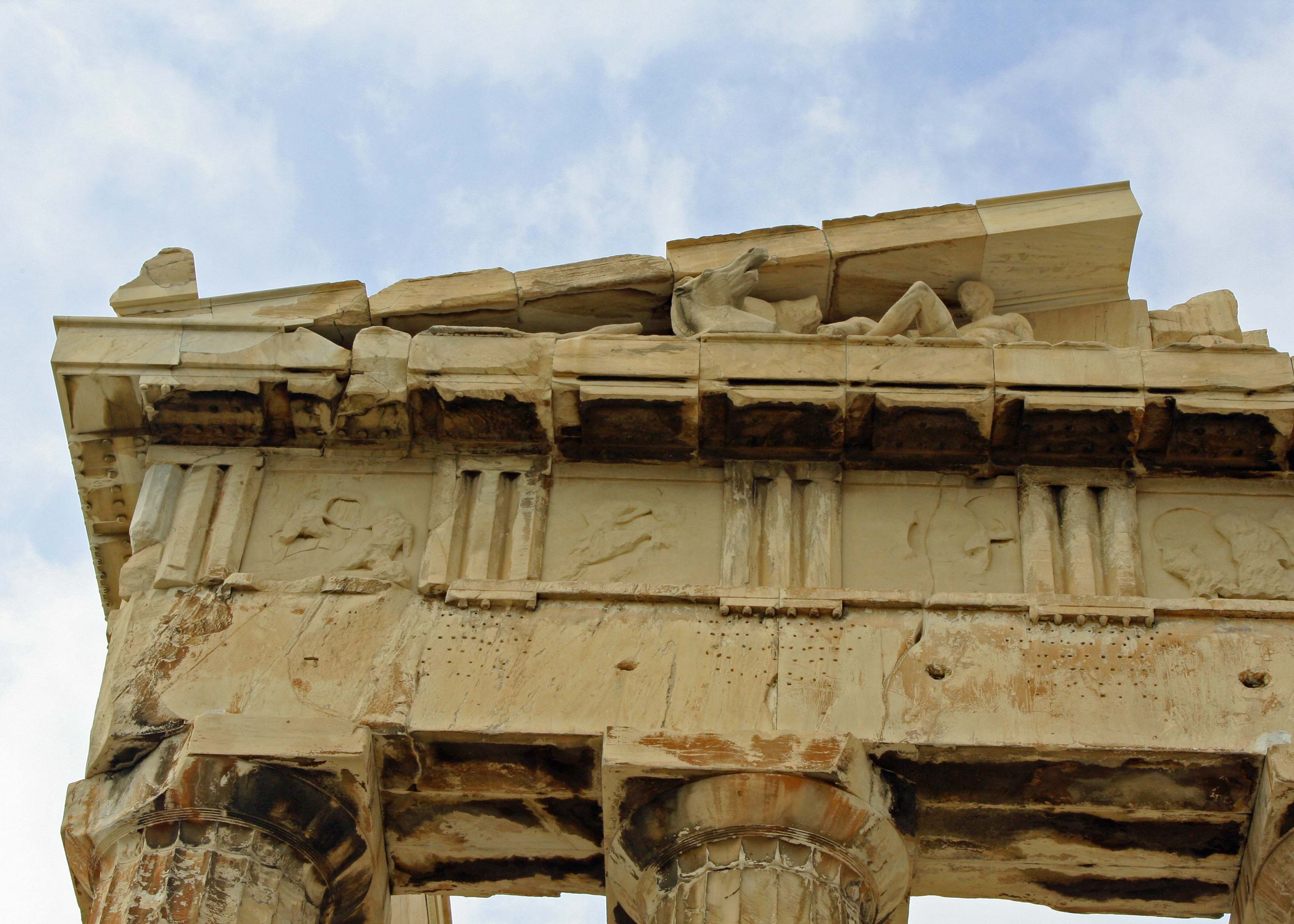
A close up of the corner shown behind me above features one of the few statues that remain of many that once decorated the Parthenon. (Many can be found in the British Museum.)
Extensive renovation work was being done on the Parthenon, as well as other buildings on the Acropolis. ( Photo by Peggy Mekemson)
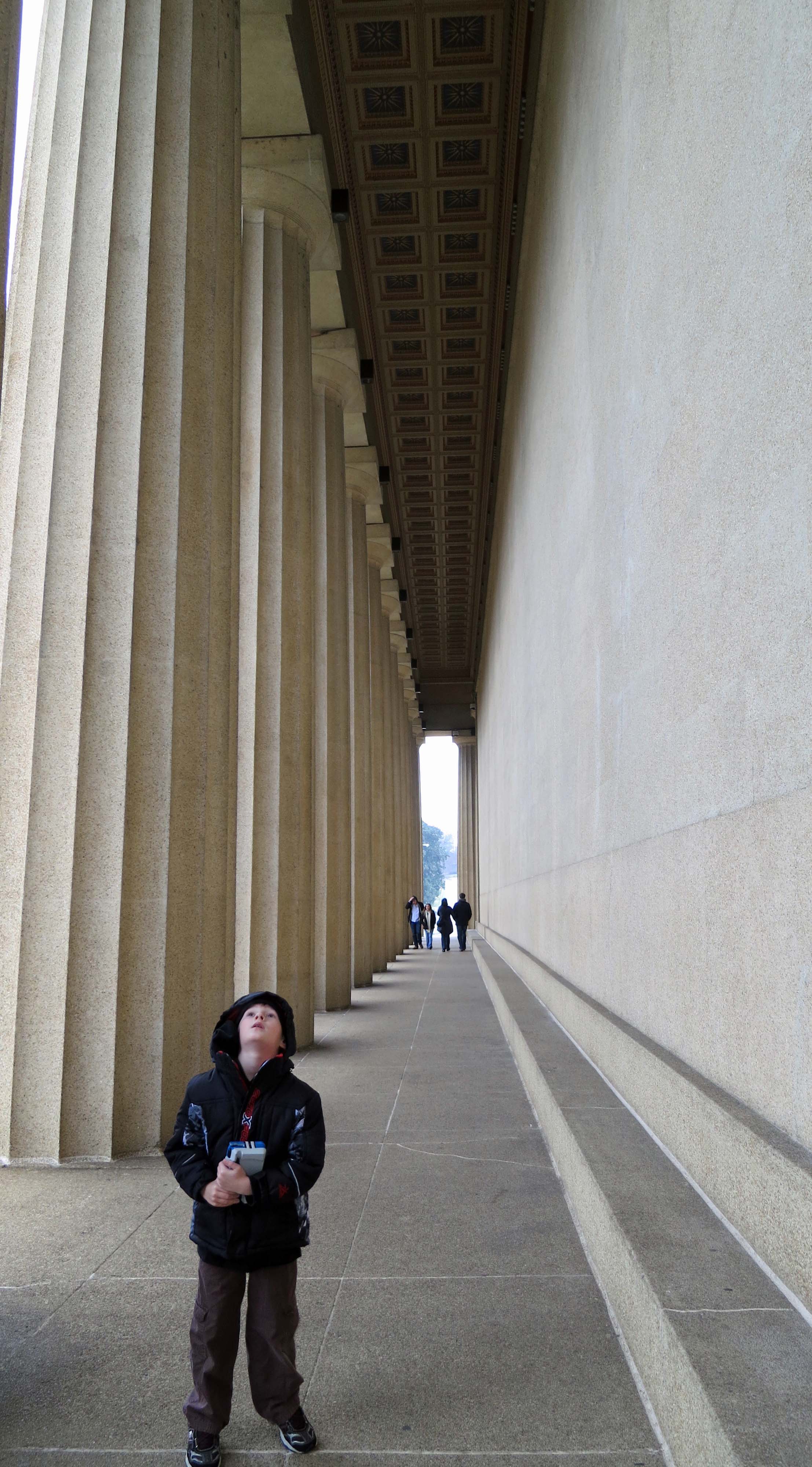
A full-scale replica of the Parthenon as it would have looked like originally can be found in Nashville, Tennessee. We stopped by to check it out after our Mediterranean tour while visiting with our daughter Natasha and her family.
My grandson Ethan provided an interesting perspective in this Nashville photo on the original size of the Parthenon.
Another impressive building on the Acropolis is the Erechtheion. An olive tree decorates the front of the building.
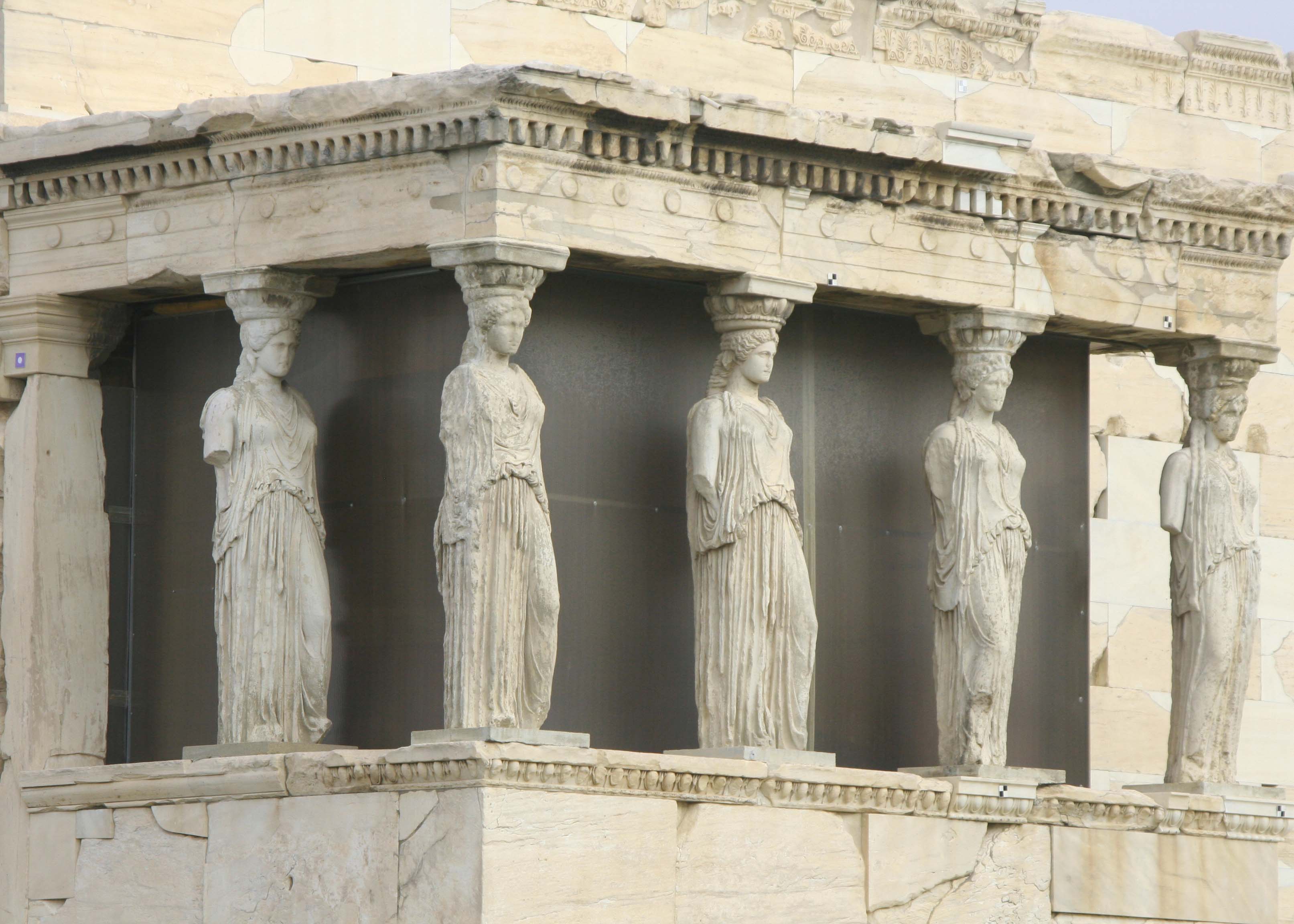
The Erechtheion includes the Porch of the Caryatids, lovely Greek maidens who served as graceful columns. (Photo by Peggy Mekemson)
A close up of the Erechtheion, windows, and an olive tree representing Athena’s gift to Athens.
This is a shot looking upward at the end of the Erechtheion opposite the Porch of the Caryatids.
A final view: The Temple of Nike on the Acropolis.
On Friday we will return to Athens and discover what gave Zeus his horrendous headache.
































 Wandering through Time and Place