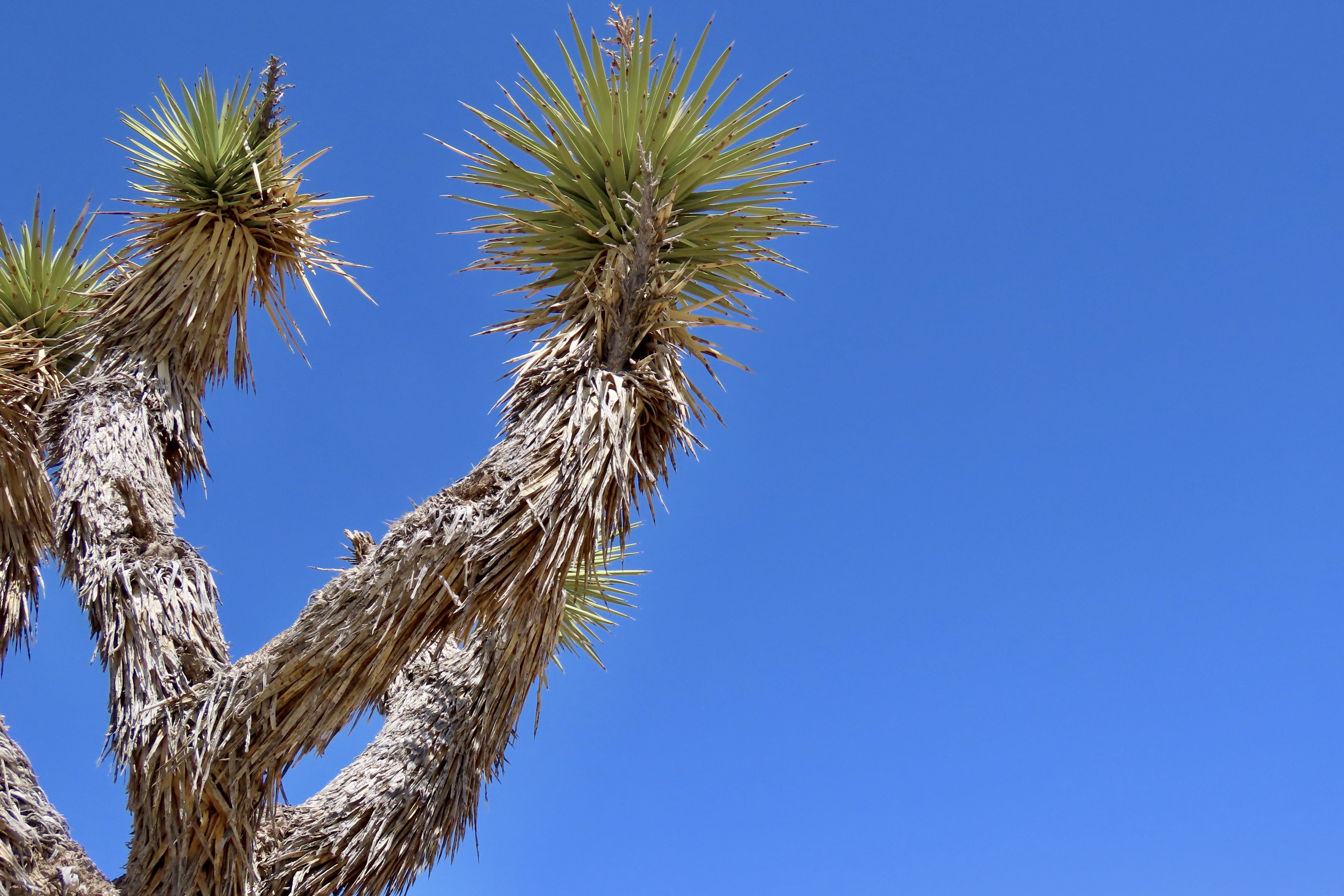
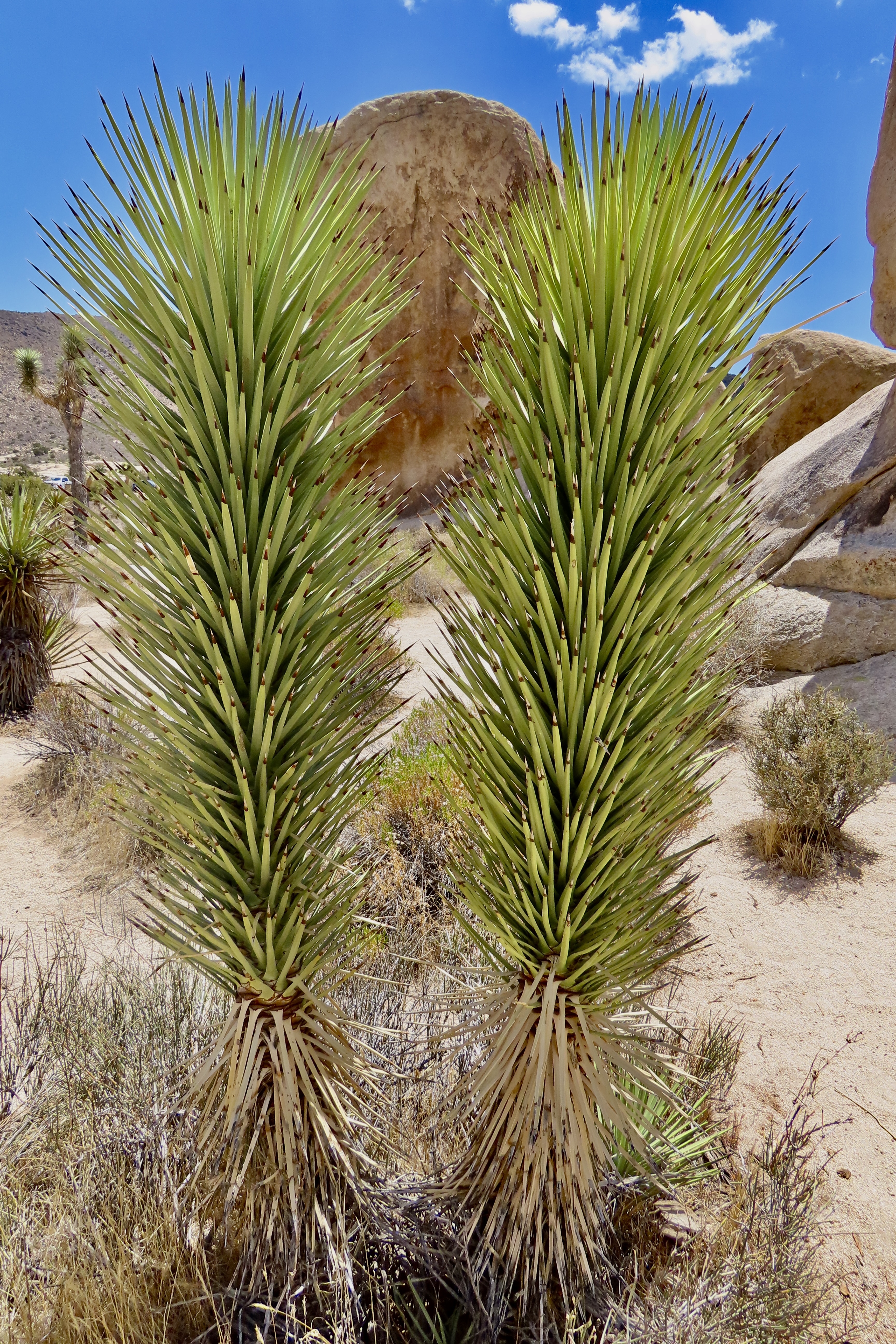
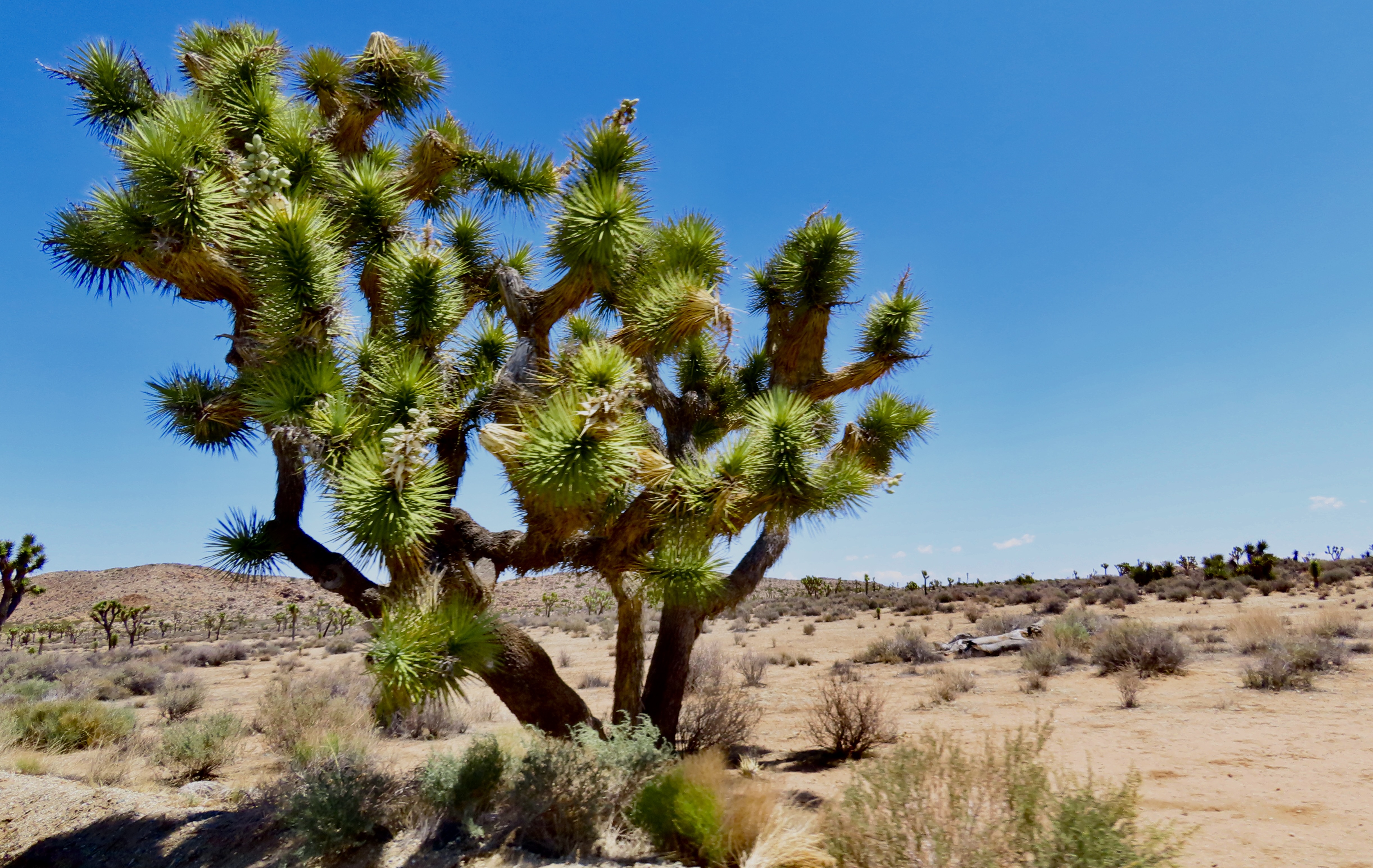
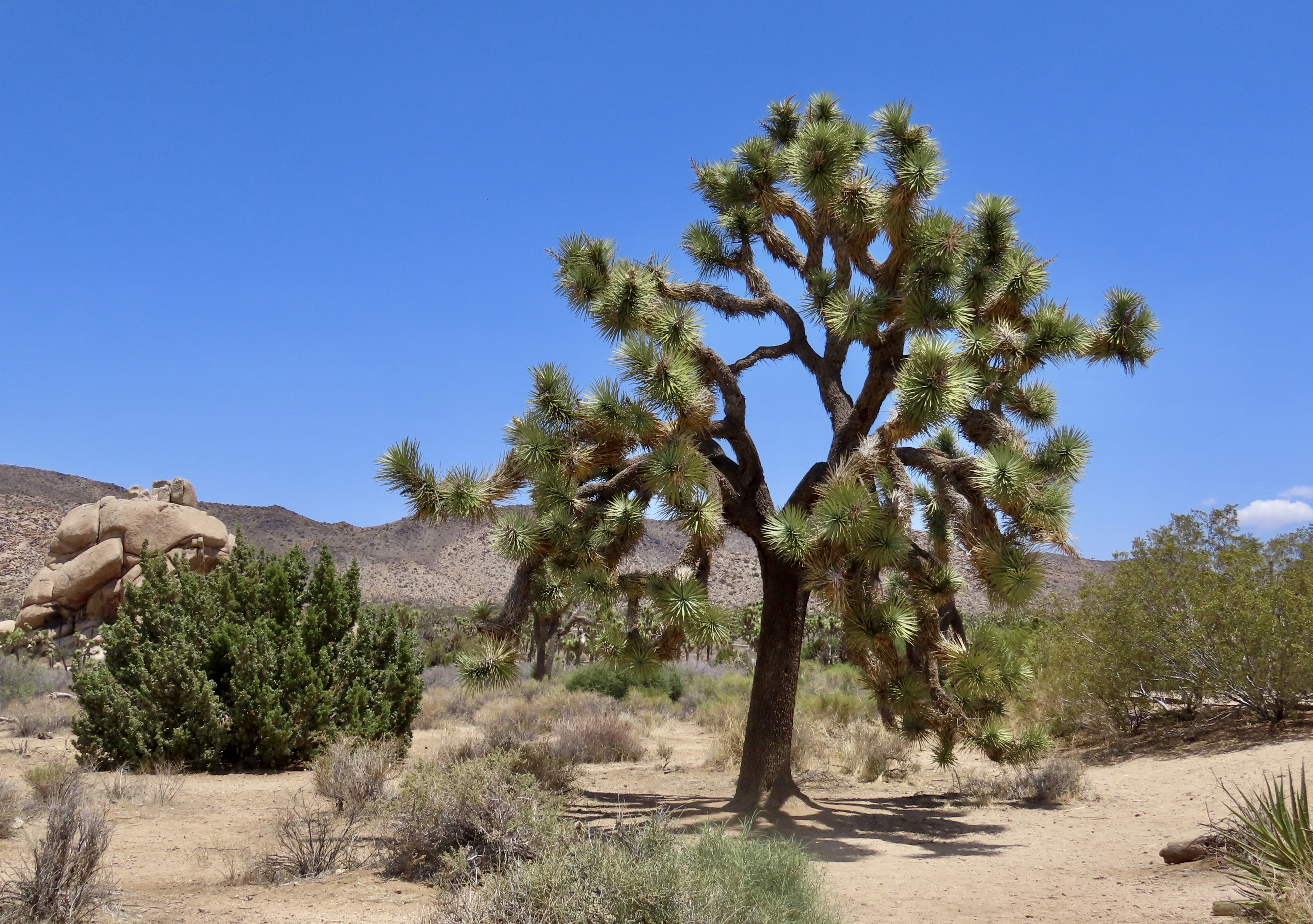
Joshua trees are a bit strange as trees go. They are actually monocots, more closely related to grass than trees. If that seems weird, up until recently they were thought to be lilies, related to onions and other members of the family. The park sign still claims the relationship.
As much as the trees are worth blogging about, we found the rocks of the park even more intriguing.
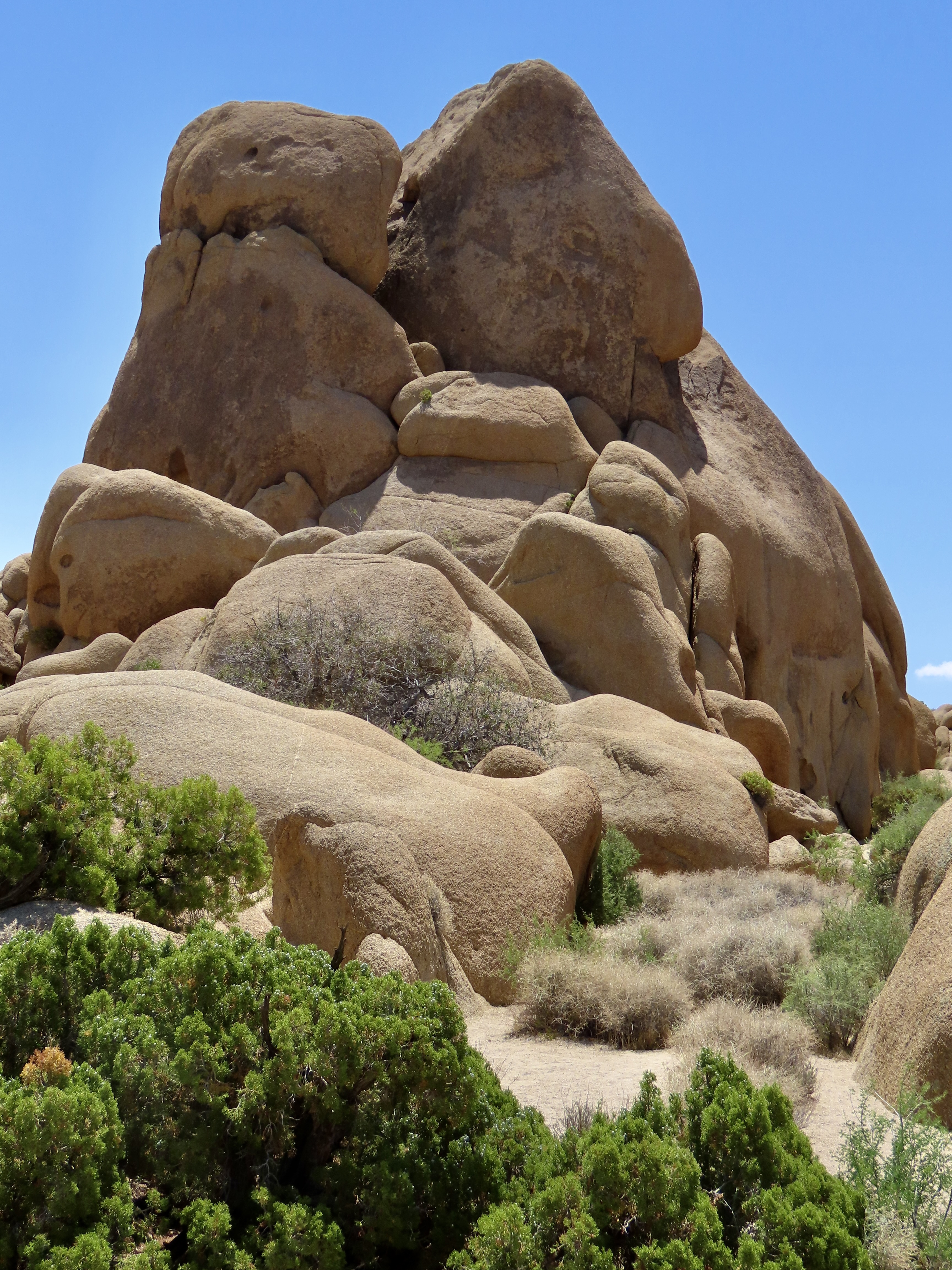
Massive piles of monzogranite boulders reach for the sky in the park. Originating far under the ground as lava oozing up from the earth’s mantle some 80-100 million years ago, the lava cooled and hardened into a batholith of granite. Nature in the form of earthquakes and water cracked it into rectangular blocks while mountain raising and erosion brought it to the surface. Along the way, erosion also wore the rectangular blocks into the massive rounded boulders that visitors admire today.
This was our second visit to the park. Peggy and I spent a whole day driving 30 miles through the northern portion of it. We stopped a lot.
An information board at the beginning of the park, made the following observation: “Look around you. Perhaps you see a stark land that nature never got around to finishing. Or you may see potential mineral wealth, defense testing grounds, alternative energy sources, or a vast recreational playground. Or maybe you see the desert for what it is— a diverse, thriving, ecosystem.”
I would add that deserts are a place of rare beauty and endless fascination, the equivalent of any of the other natural wonders we find in the world.
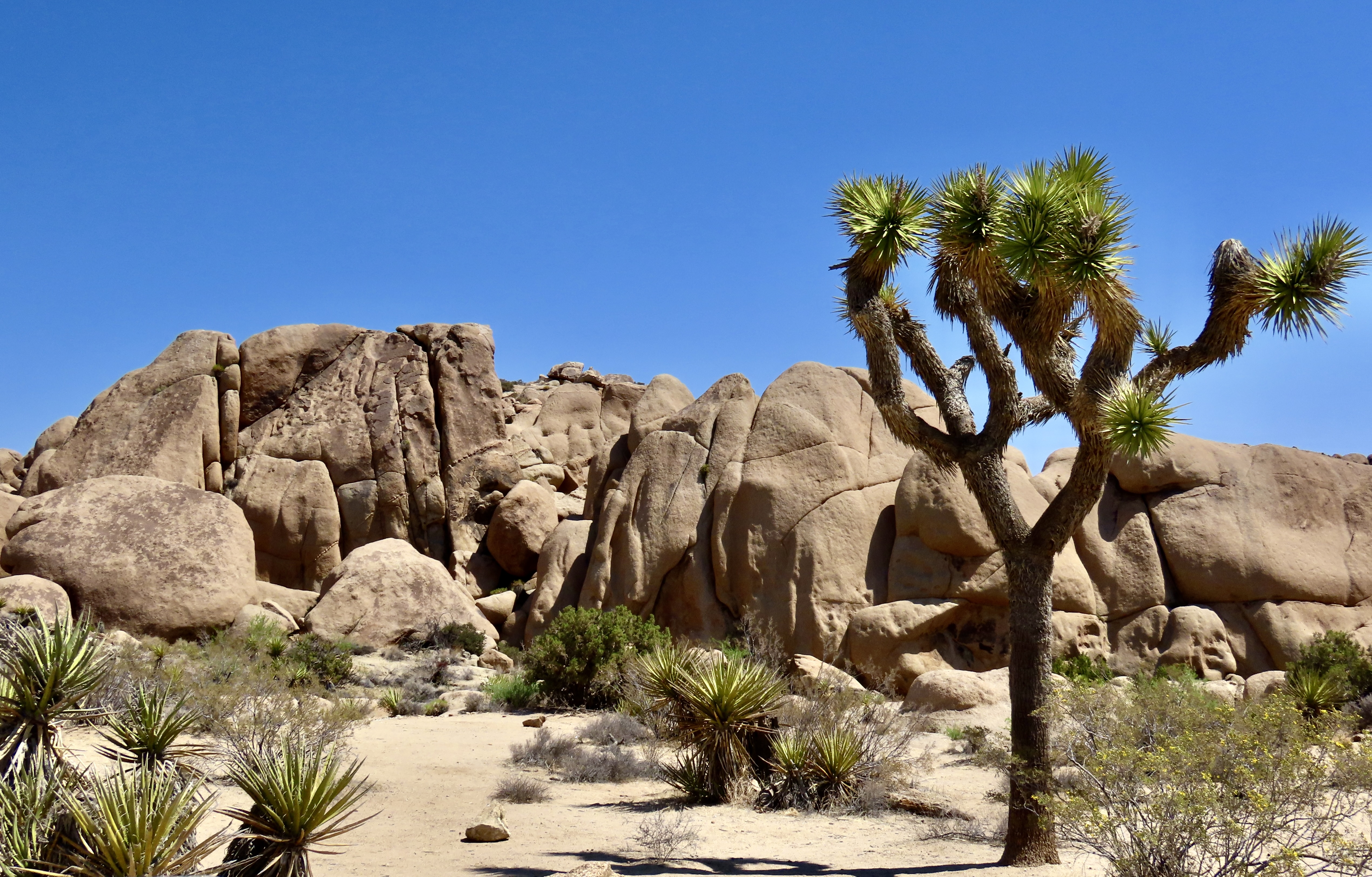
A quote from Edward Abbey was also included on the board: “It seems to me that the strangeness and wonder of existence are emphasized here, in the desert, by the comparative sparsity of the flora and fauna: life not crowded upon life, with a generous gift of space for each herb and bush and tree, each stem of grass, so that the living organism stands out bold and brave and vivid against the lifeless sand and barren rock.
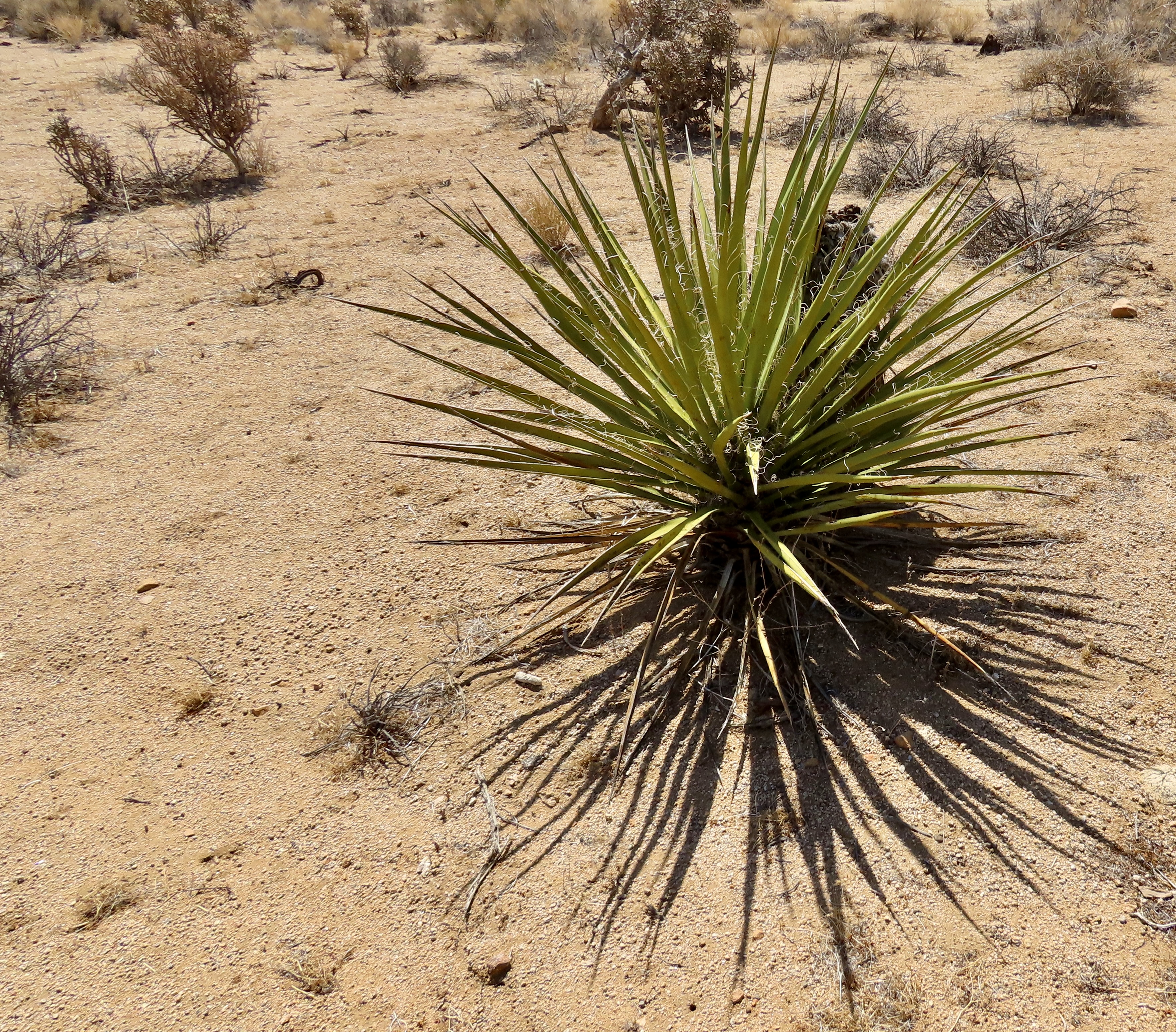
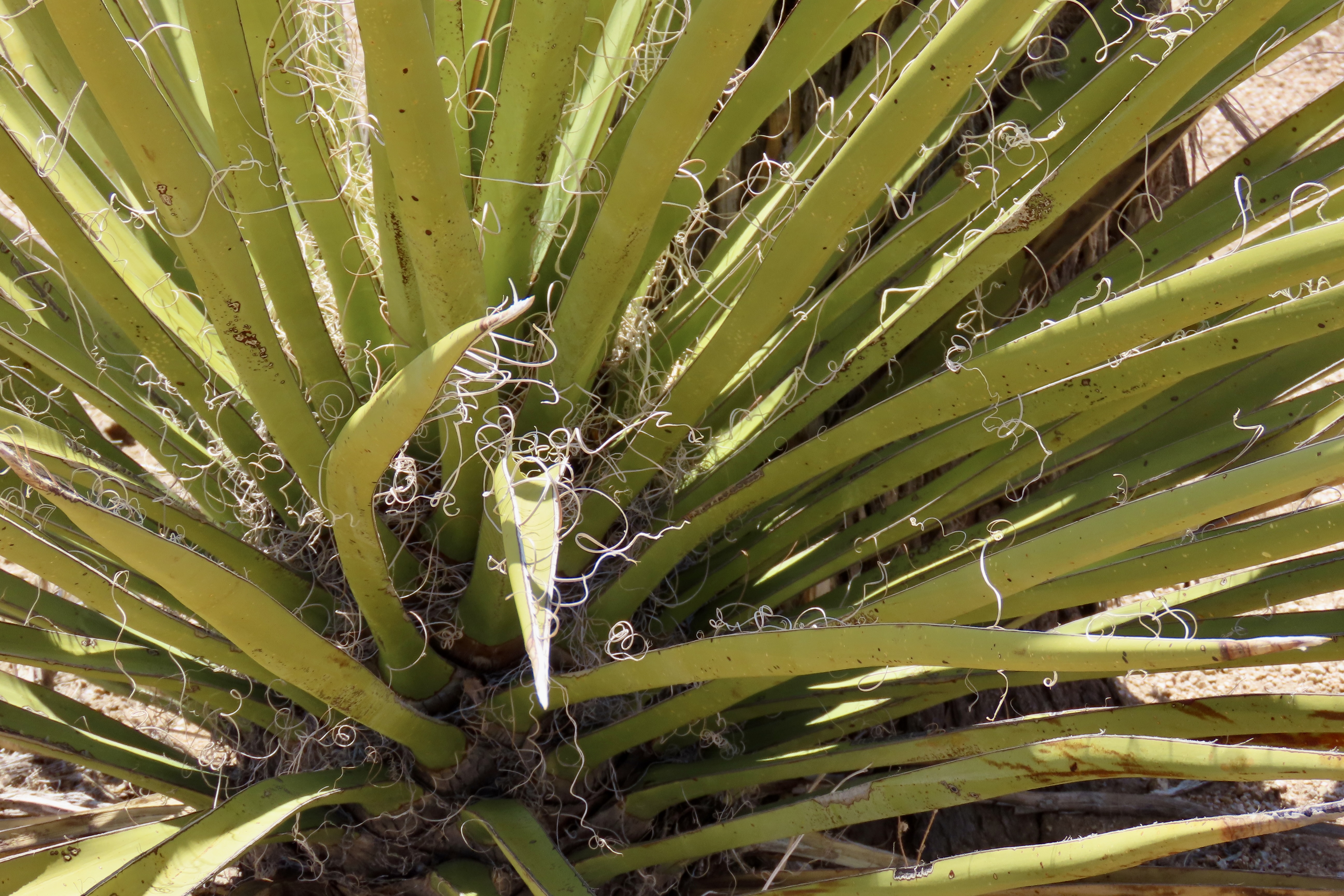
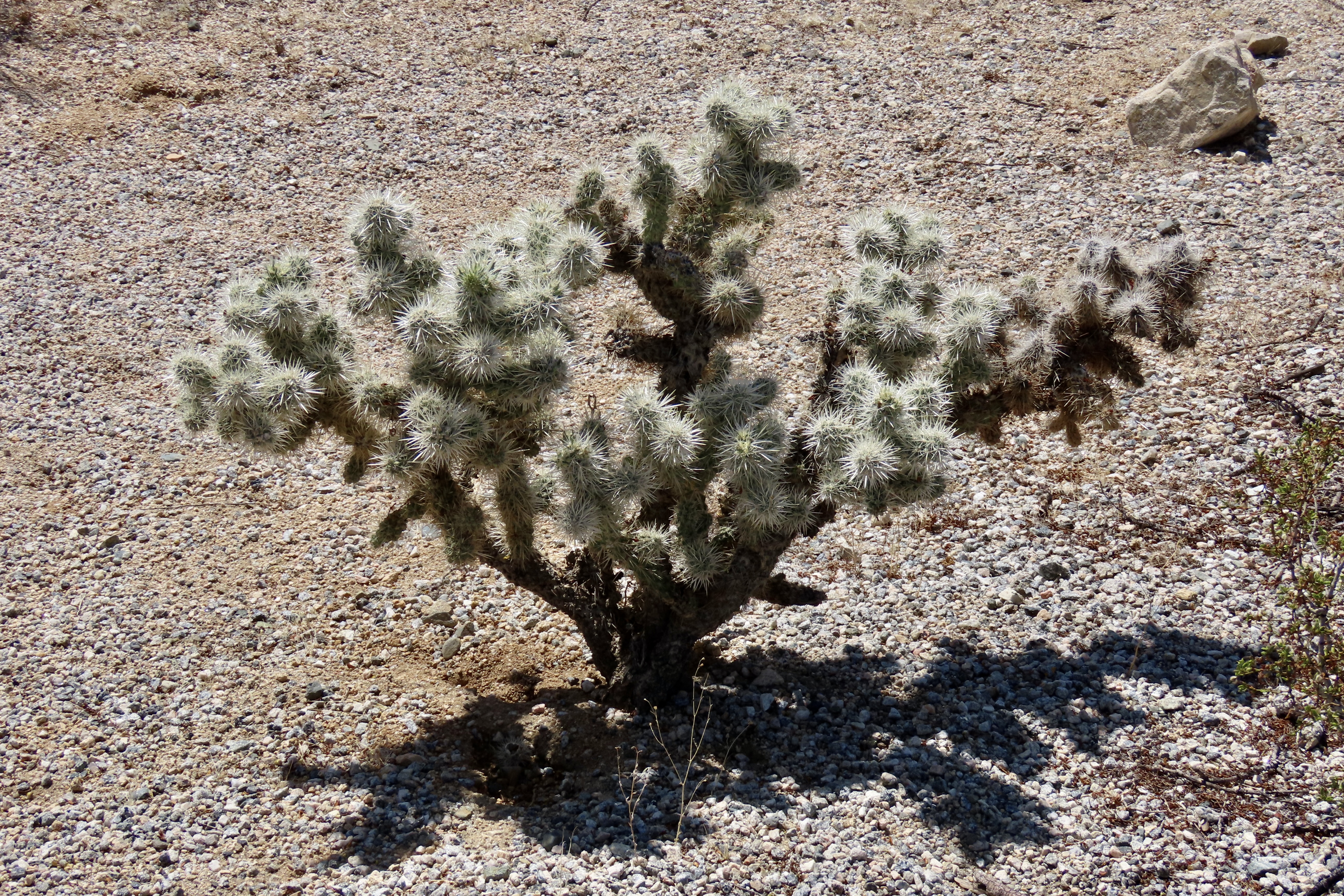
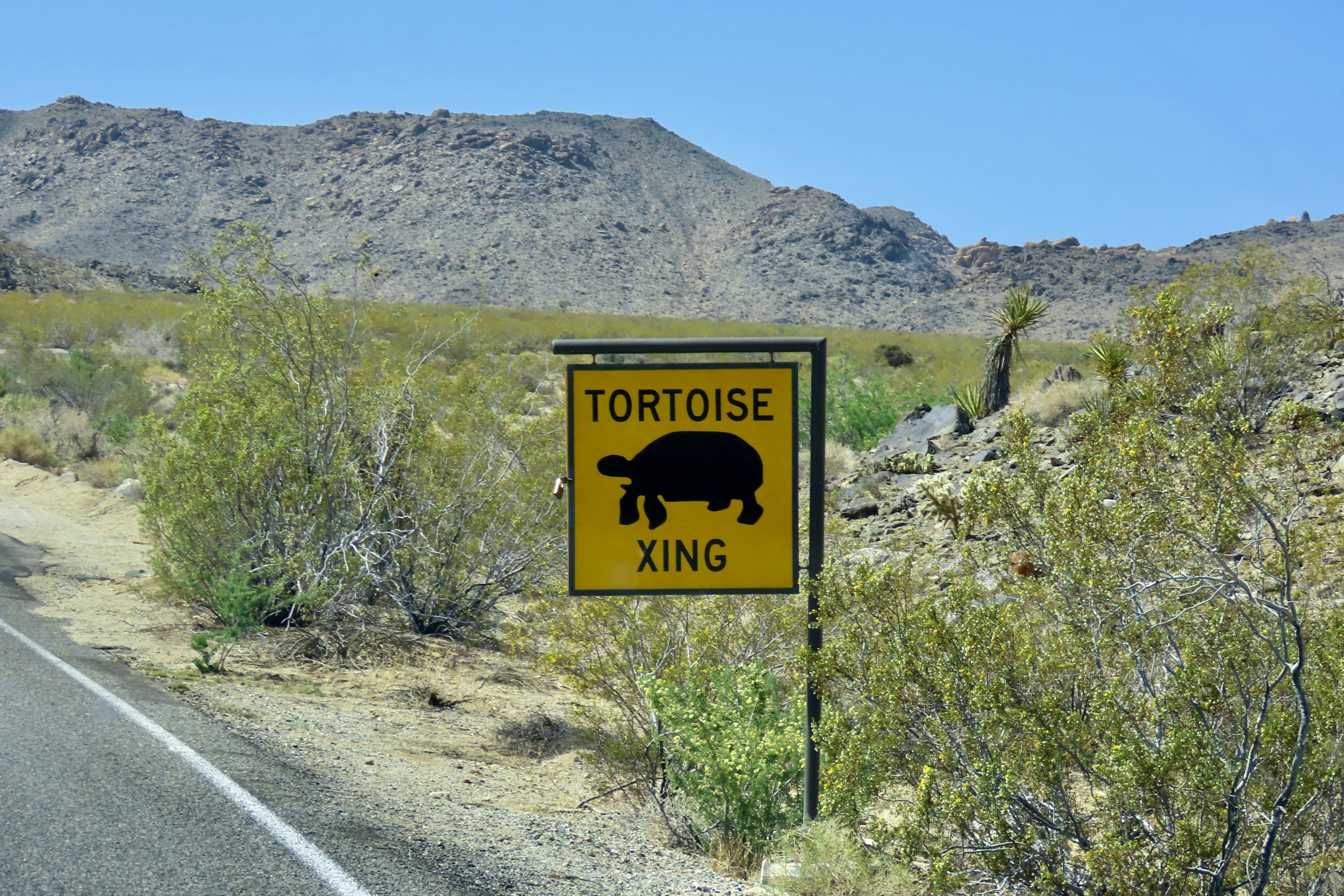
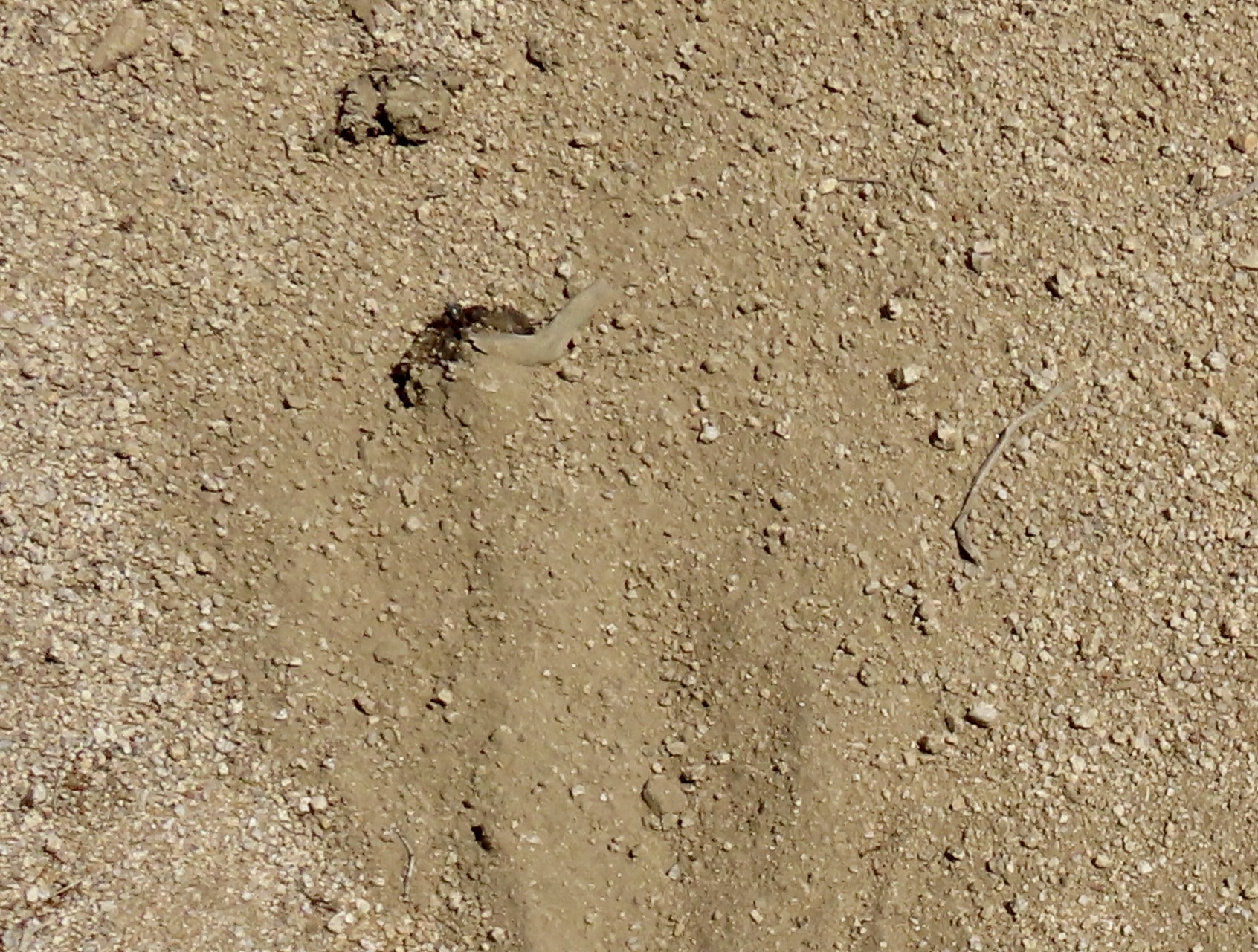
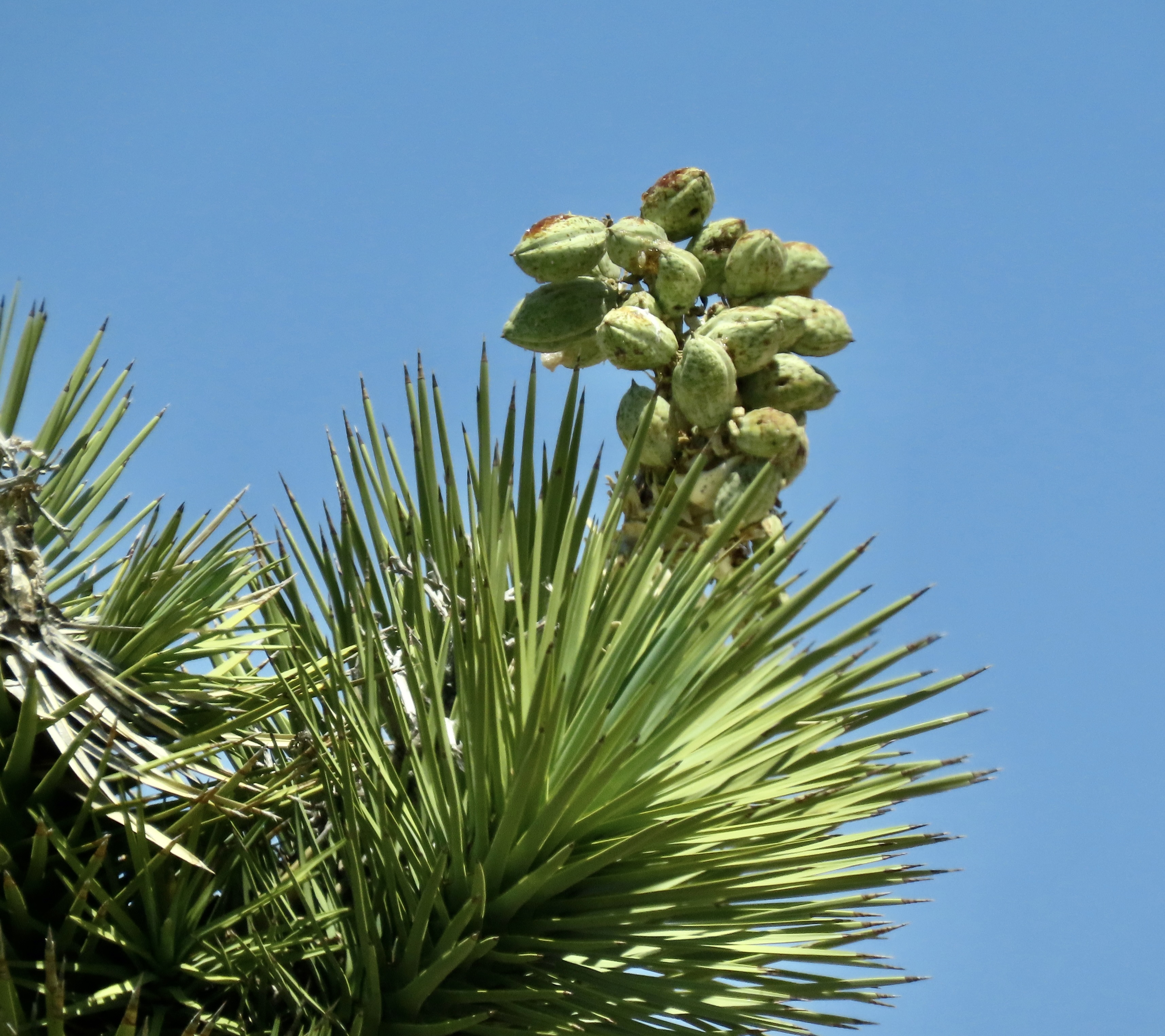
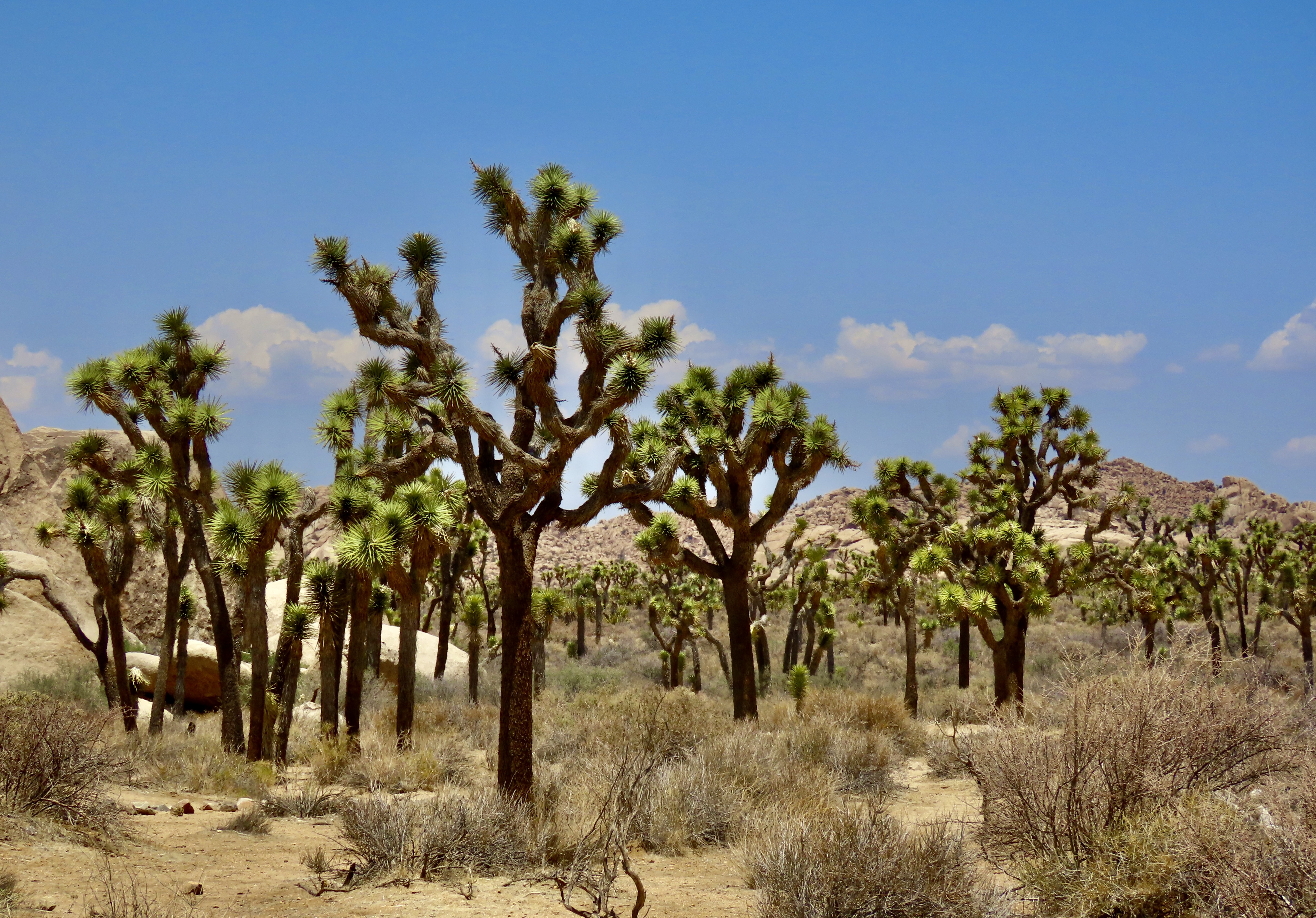
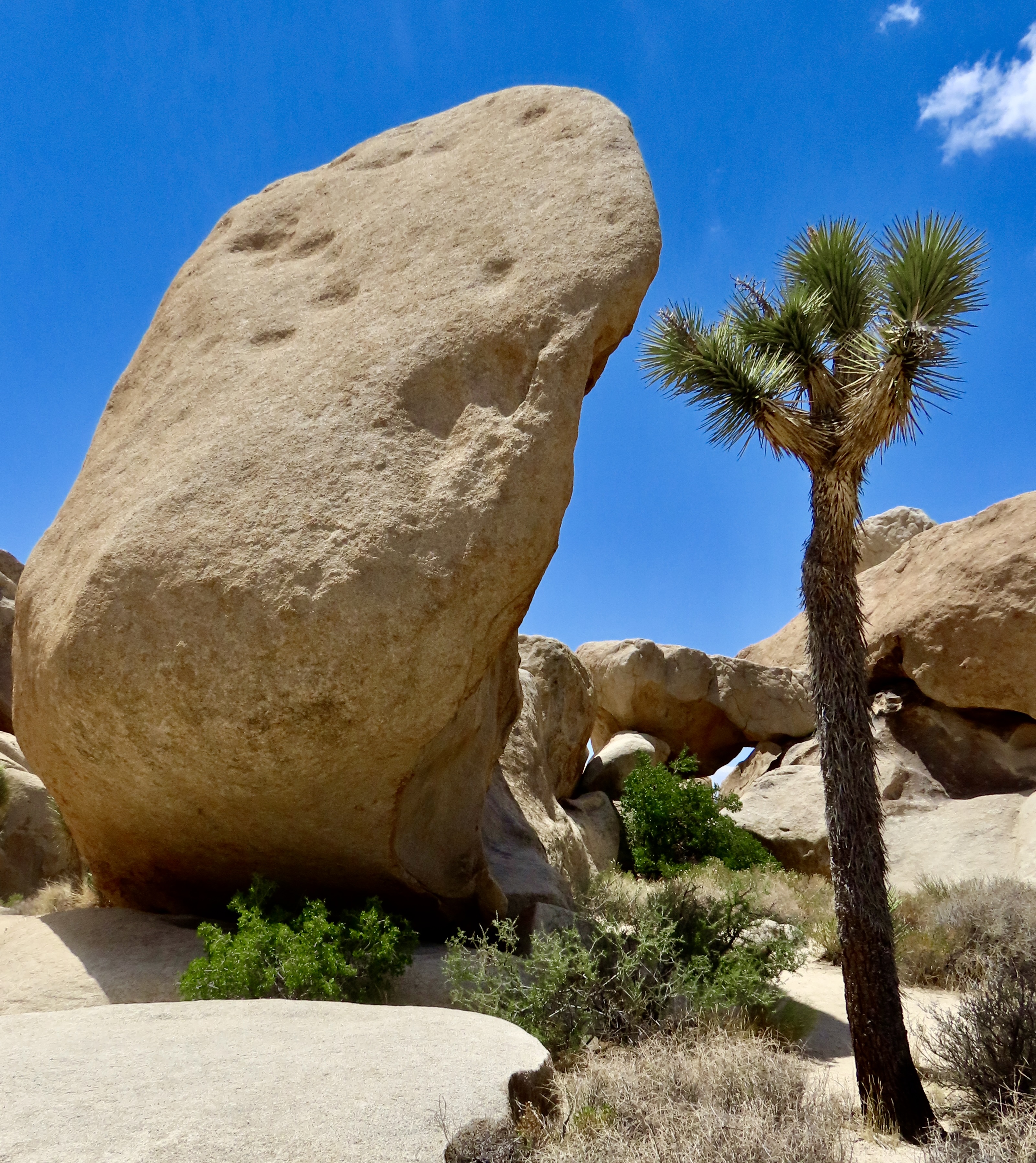
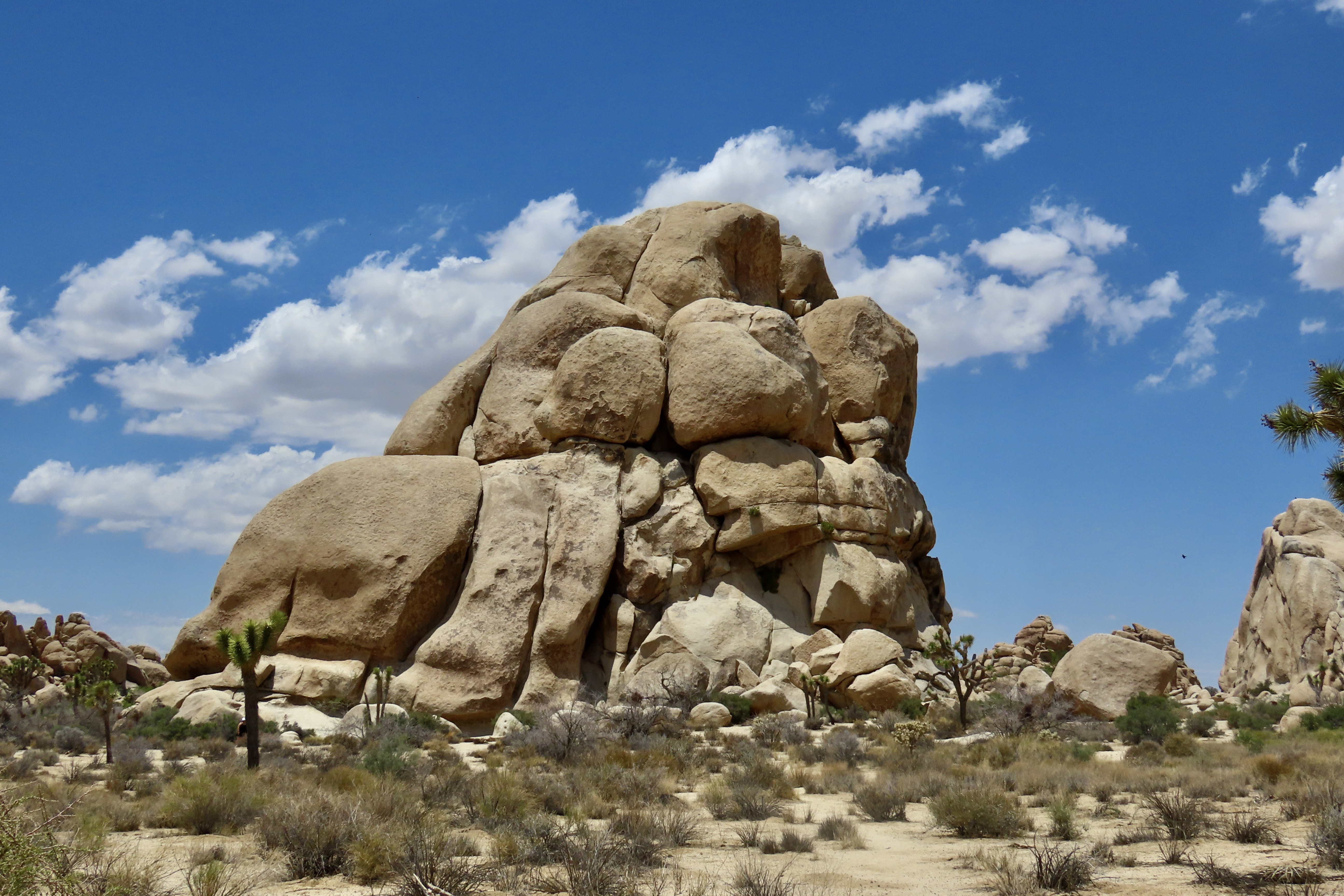
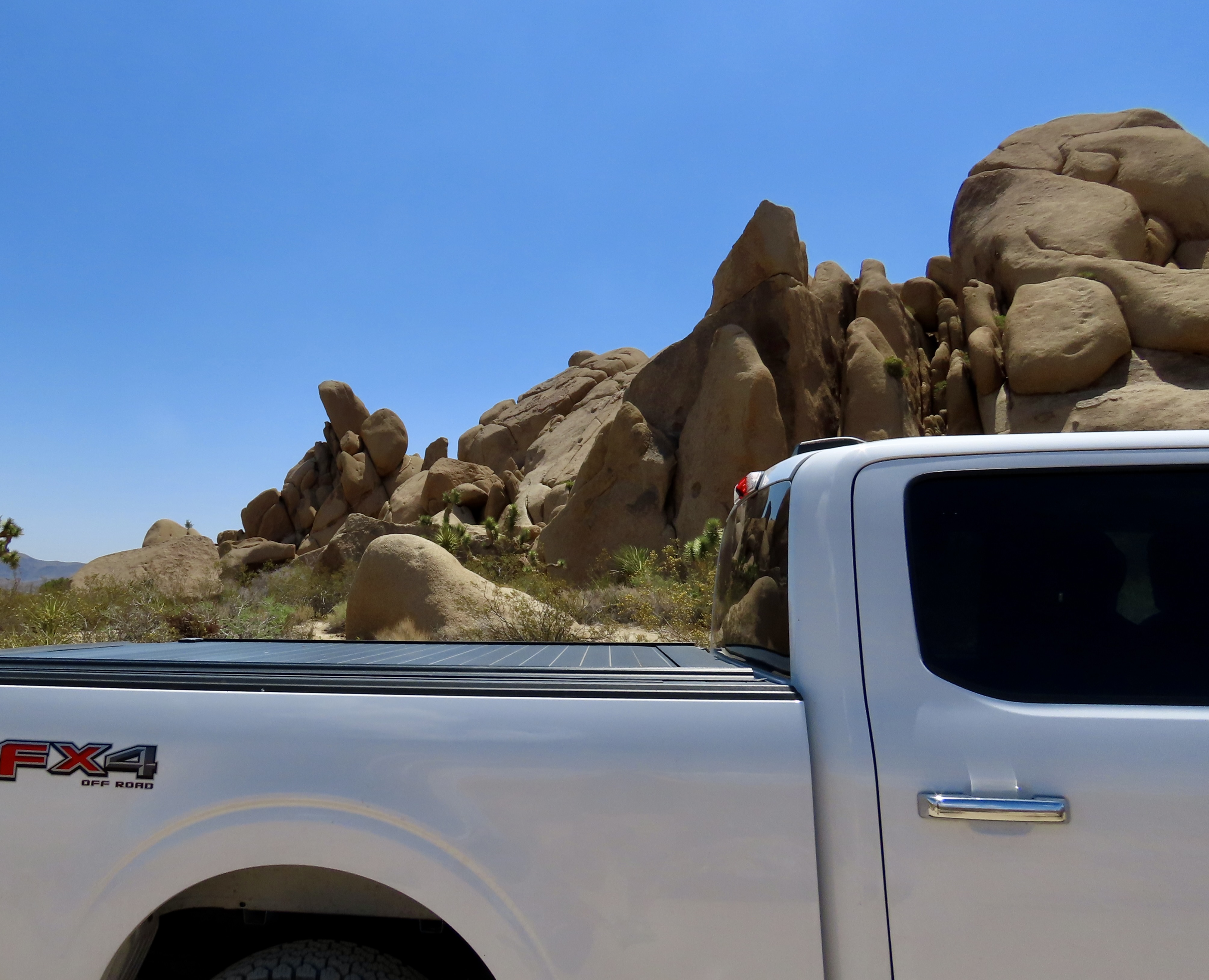
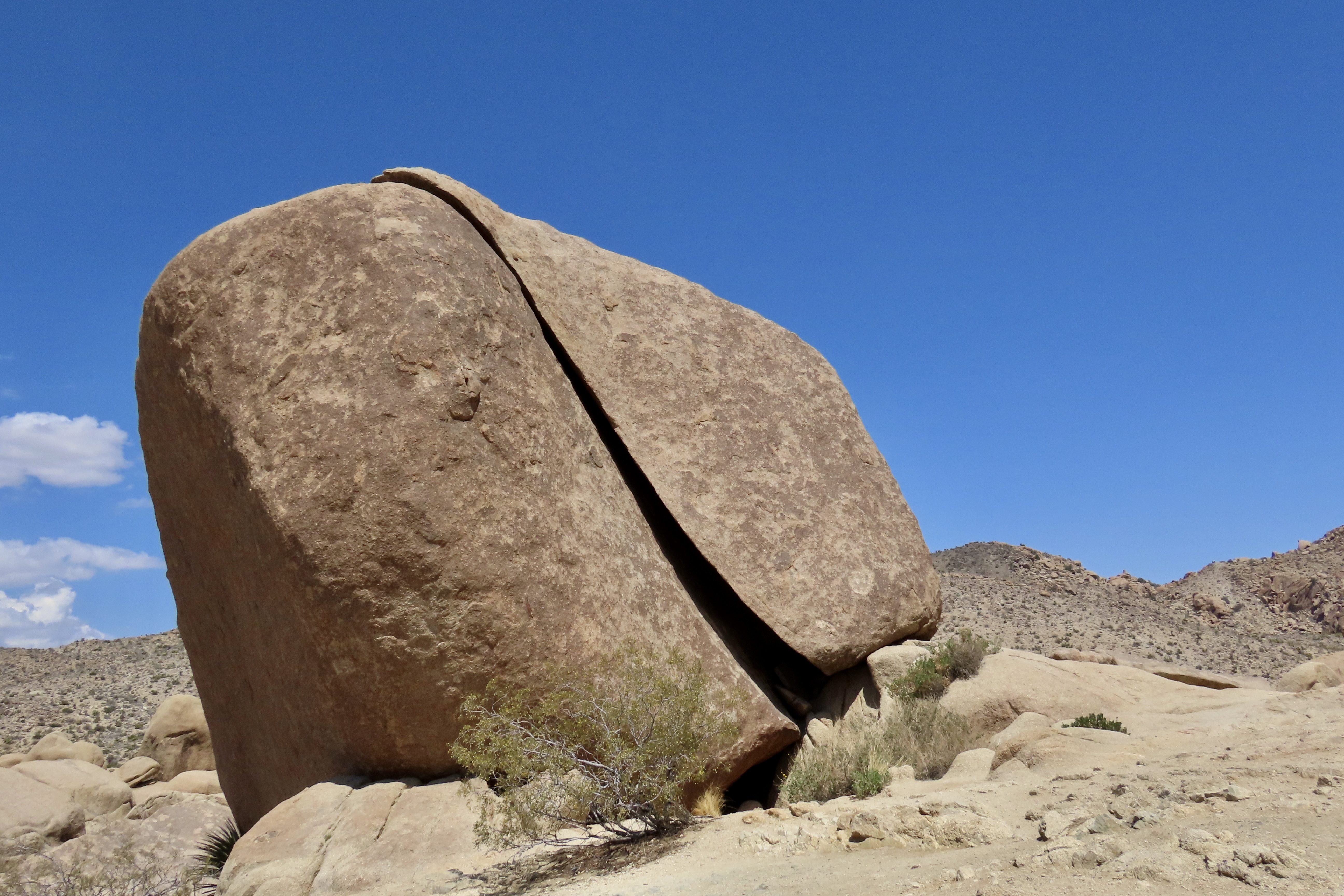
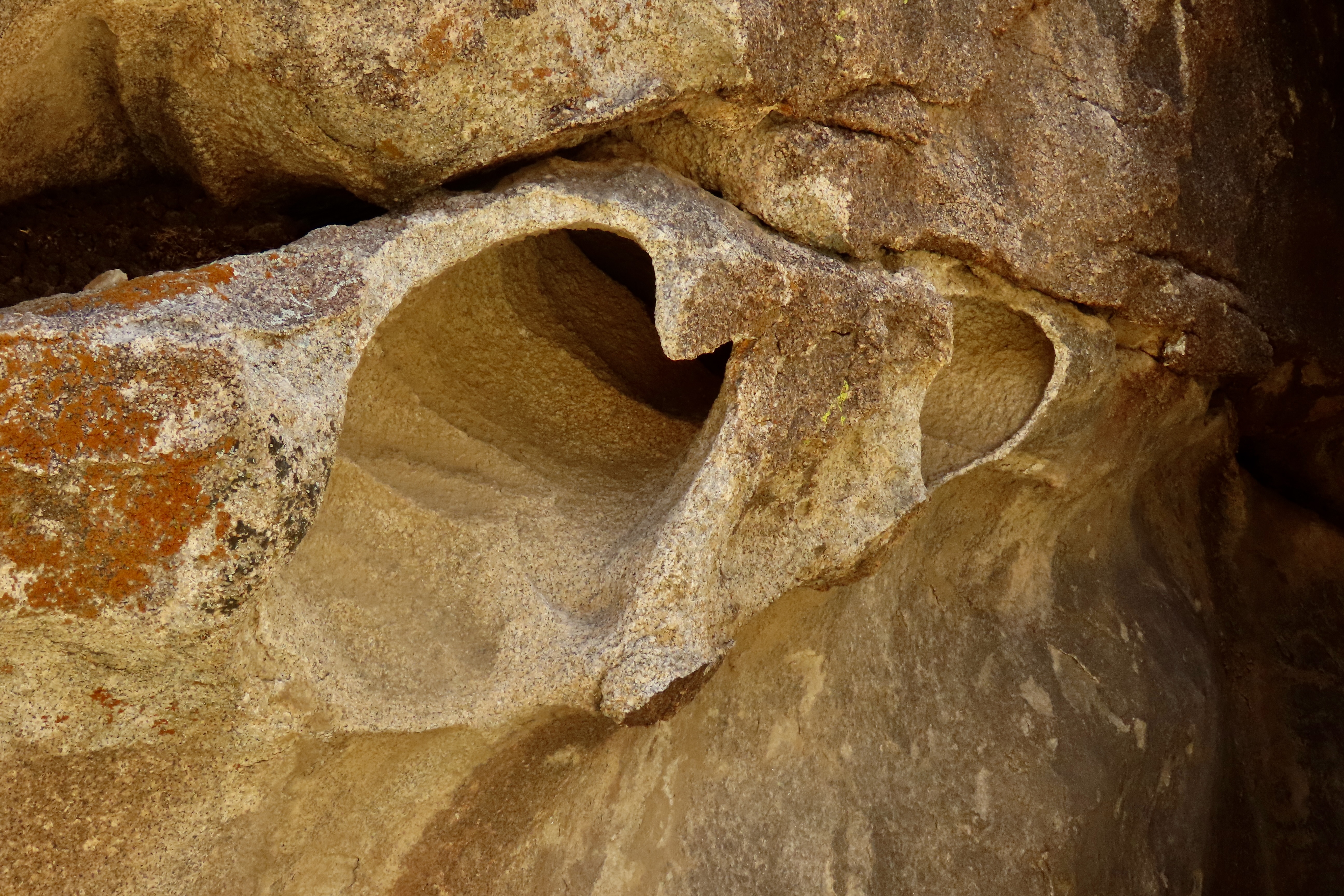
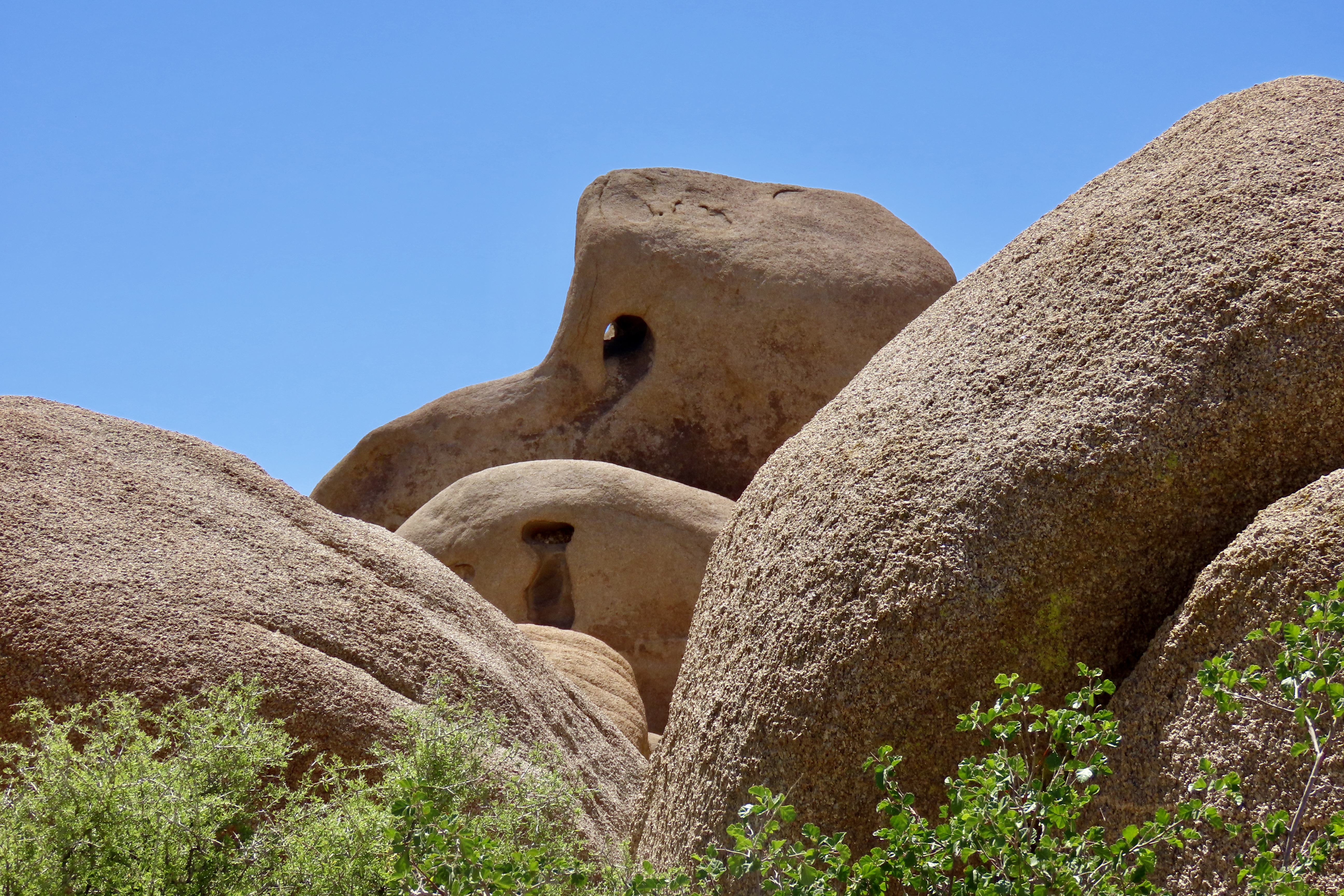
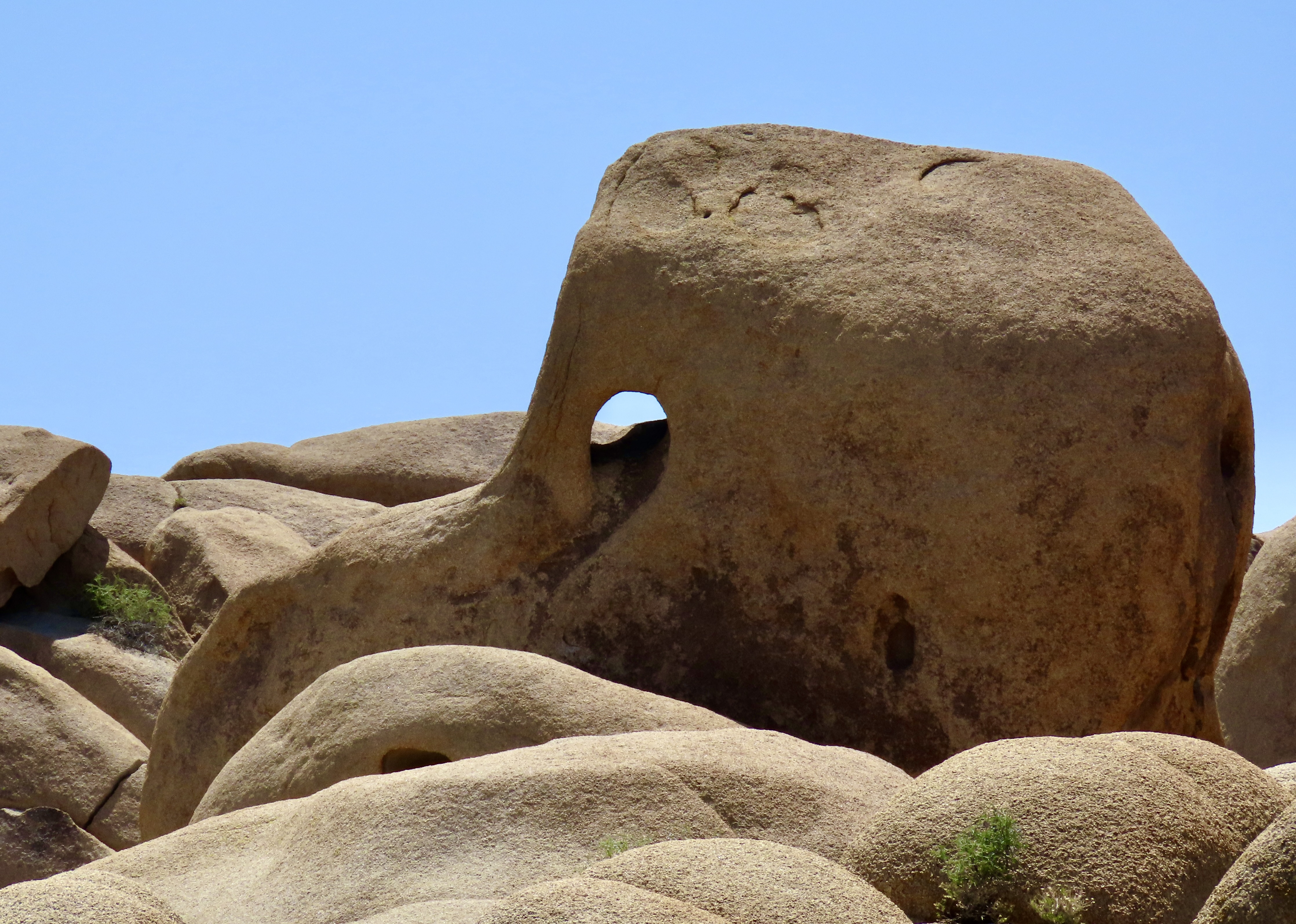
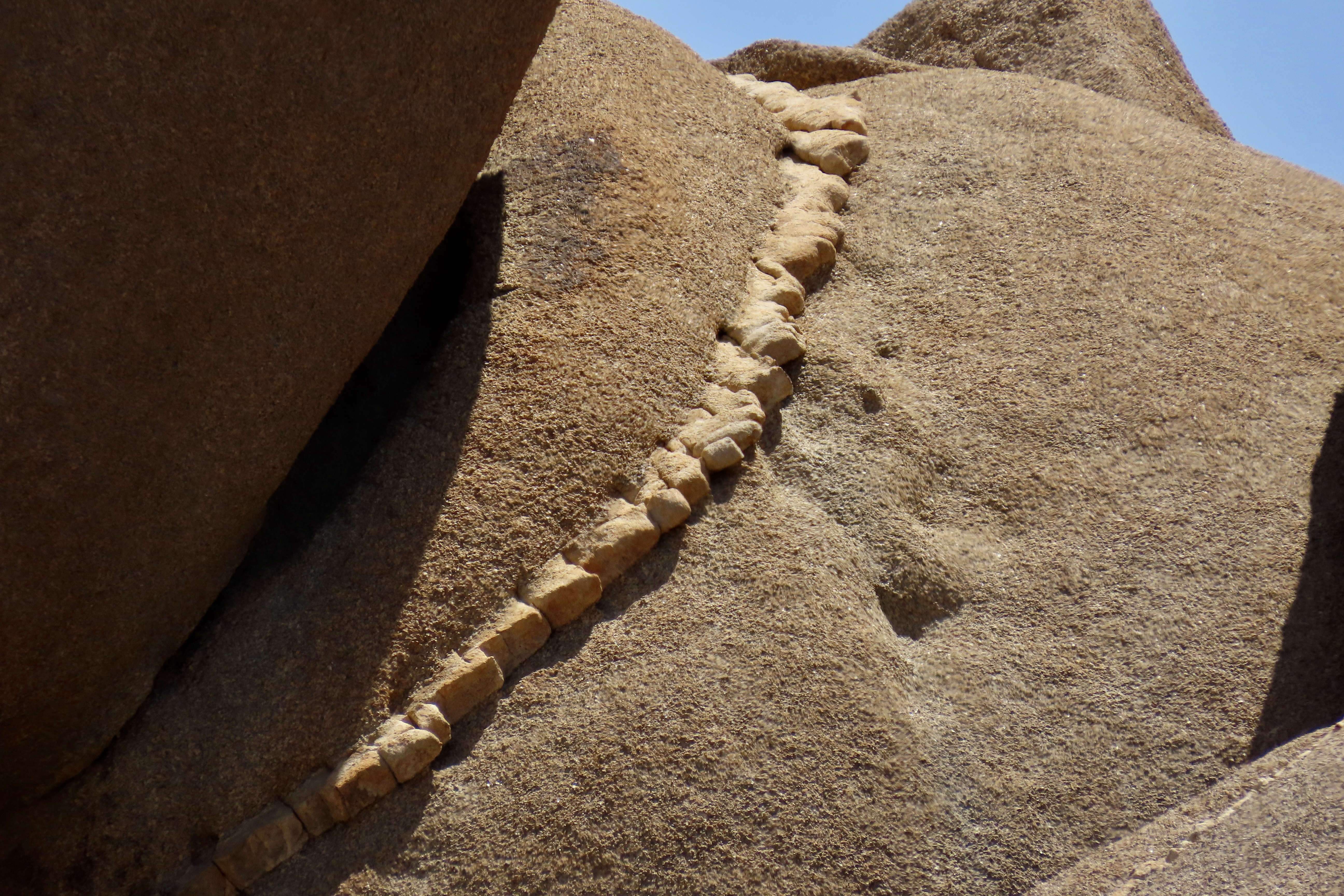
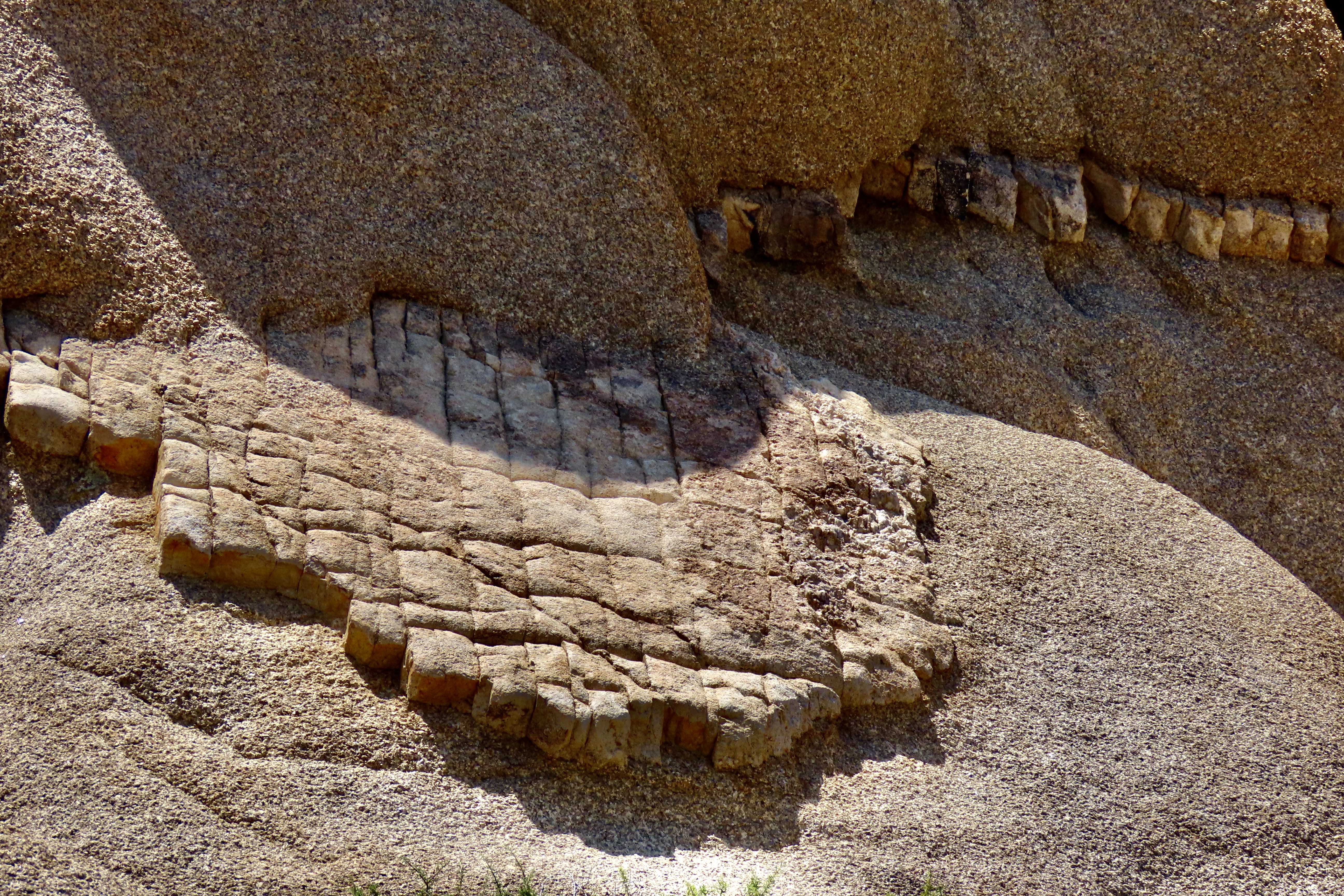
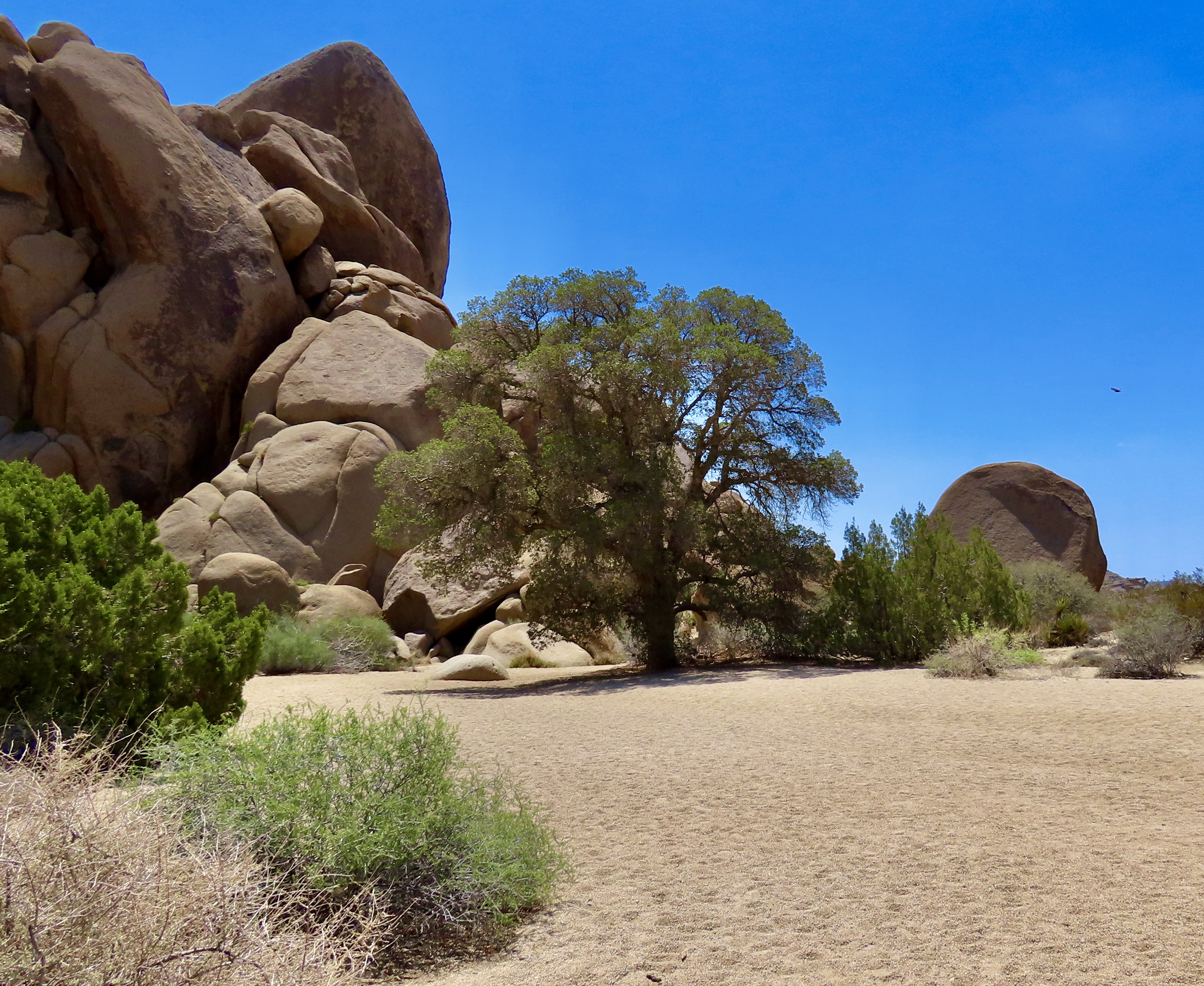
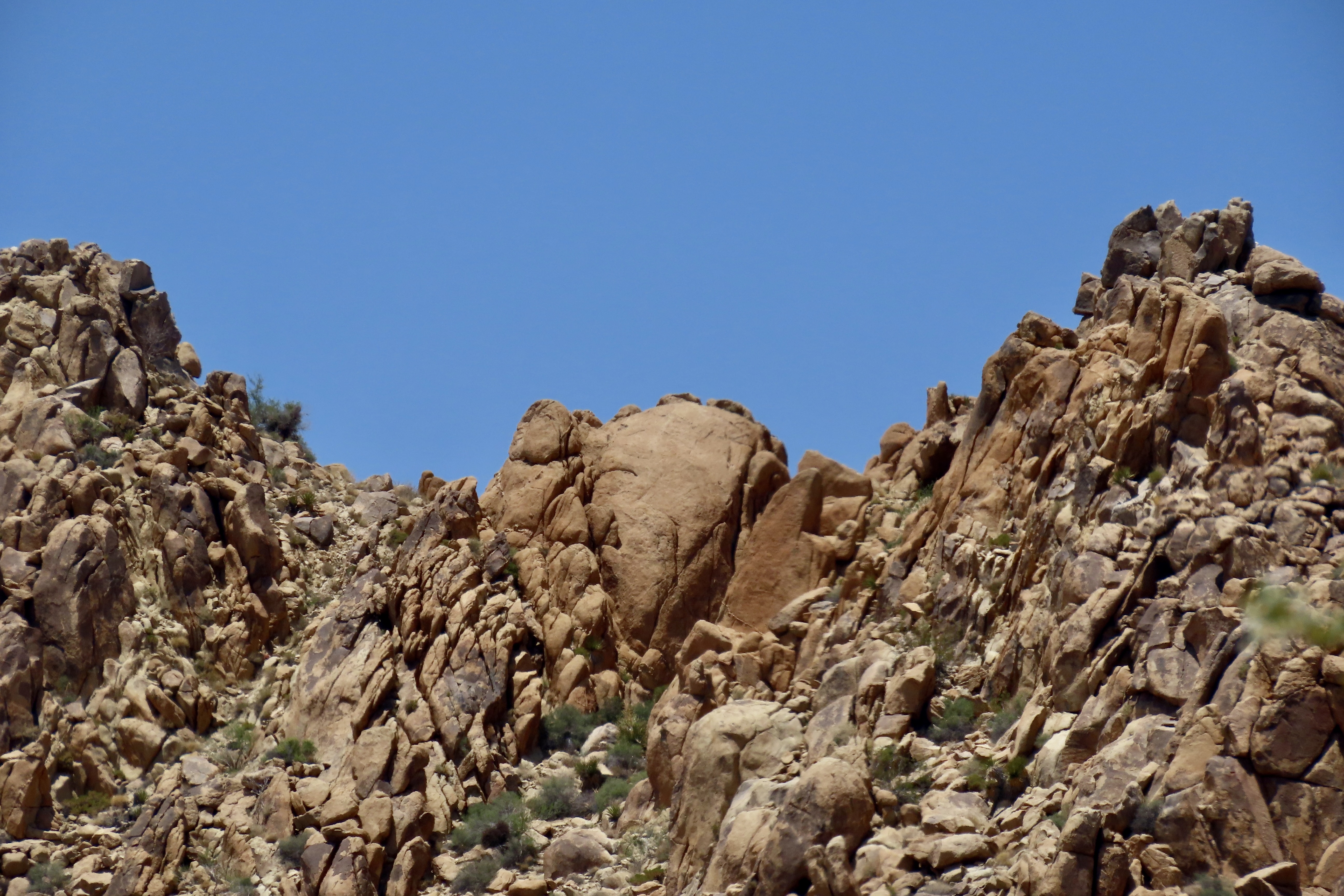
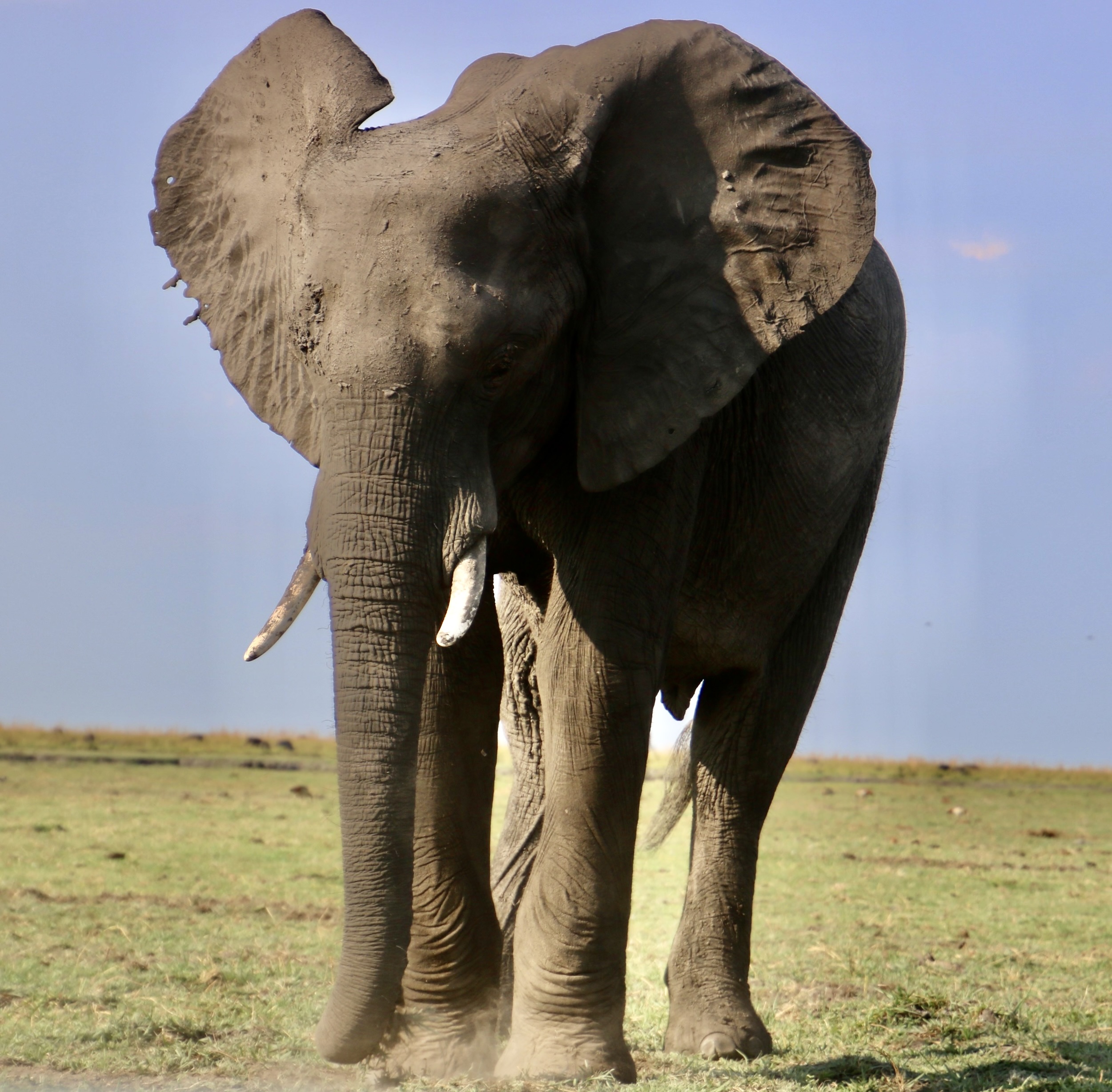
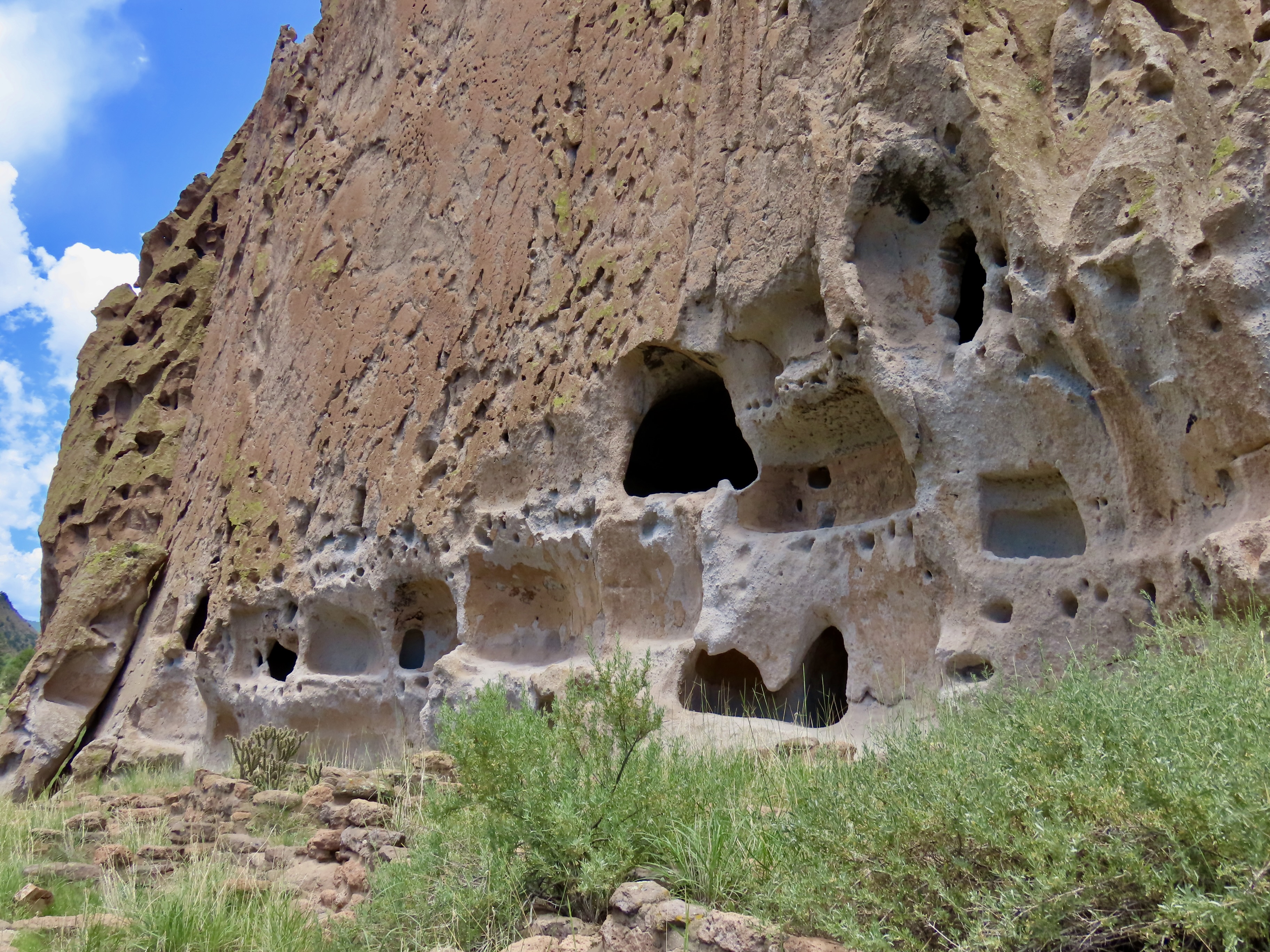
This single Joshua tree and sparce plant life backed up by a massive rock monument emphasize what Abby had to say.A yucca claimed its space on the desert floor.It featured curlicue fibers peeling off the edges. They are common to yuccas.Also claiming its space was a cholla and its shadow backlit by the sun. As untouchable as they appear, we found birds nesting in them throughout the Southwest. What spelled danger for most animals (including us), proved to be a safe haven for Curved Bill Thrashers and Cactus Wrens.This tortoise crossing sign reminded us of how much plants and animals that call desert home have adapted to life in an extreme hot, dry climate. Tortoises, for example, are experts at getting water from plants and conserving what water they get. When water is in short supply, they excrete their urine in a toothpaste-like form and hang on to the water! On a more prosaic note, I wondered how fast they can move. They are turtles after all. I learned that Bertie the Tortoise holds the Guinness record of .6 of a mile per hour. I also learned what a group of turtles are called: A creep. You can challenge your friends with this one.Careful observation informed us of other desert inhabitants. Something had scratched the ground here. But who— and what for. I noticed something partially buried at the end of the scratch and looked closer…It was fresh scat filled with berries. When one thinks of buried scat, the first thought that normally comes to mind is a cat, right? That led me to think bobcat. While they are mainly carnivorous, they won’t pass up berries if their favorite food isn’t on the menu. With that in mind, we left thinking it was probably a bobcat that had passed by the night before. That may be older cat-scat just above it. If so, the bobcat was likely marking its territory.Legend has it that the Mormons making their way through the desert named Joshua Trees after the Biblical Joshua who ‘lifted his arms’ to guide the Israelites. These youngsters ‘raising the arms’ may be sprouting from a fallen tree.The usual form of propagation is from seeds, however. We saw several Joshua trees sporting seed pods. A freeze is required for the tree to bloom and produce seeds. (Because of the requirement, global warming may endanger the plant. Forest fires have also taken a toll.)Seed pods. There is one more requirement: Yucca moths. The tiny, rice-sized insects are the trees sole pollinators and the trees flowers are the sole hosts for yucca moth eggs and caterpillars, thus forming an evolutionary, symbiotic relationship.While most Joshua trees seem rather skimpy, this one was a beauty. The trees normally grow to be around 40 feet tall and live around 150 years. Giants can top out at over 50 feet and live to be 300. Lacking tree rings, however, age is extremely difficult to determine. Some may be much older.A forest of Joshua trees.And now, on to the rocks. This skinny Joshua tree and massive rock seem to be having a conversation.The most impressive pile of boulders we saw.For fun, we took a photo of our truck, Iorek, in front of a rock pile. (Iorek is named after the Polar Bear in The Golden Compass. Our travel trailer is named Serafina, after the witch in the movie.) It wasn’t until I was putting together today’s post that I noticed the rock reflection in rear window. What a great optical illusion. It appears to be coming out of the window.This split rock was the most unusual stand-alone rock we saw. Holes in the rocks led to some interesting photo ops.Peggy playing around. Had she been 70 years younger, I can guarantee she would had been crawling through. In fact, there was no guarantee she wouldn’t at 75!We thought, “bird.”Close up. Snoopy’s friend Woodstock, perhaps.A necklace of rock cutting through the granite caught our attention. It was formed after the monzogranite formed and developed cracks. A subsequent flow of molten rock consisting of a mixture of quartz and potassium minerals were forced into the cracks and cooled as lighter colored rocks. When the rocks were exposed at the surface, they broke into blocks somewhat uniform in structure.As the granite eroded away, it left the harder dike rock on the surface.Nearby, a lone oak added a touch of beauty. We were surprised to find it here where Joshua trees dominate the landscape.We were also surprised to find an elephant. Grin. Can you spot its image? An elephant from our safari trip to Southern Africa two years ago. This is a good place to wrap up this blog. Next up: Bandelier NationalMonument in New Mexico.To the Ancestral Puebloans, this was home sweet home.
I always love your posts but this one…the rocks are incredible and look like something H.P. Lovecraft would have written about! And love the Edward Abbey saying. What a magnificent trip! My home front is still lacking an elevator after two months and climbing up to my 4th apartment in the sky, my knees have finally given notice. May have to make that trip to the Kaiser home that sustains my aging self! Love to you both!
You are right, the rocks were so much fun. I took lots of photos. It was a challenge to pick the ones I used!
Sorry about the stairs, Wendy. Four sets are a lot to maneuver over. Nothing wrong with a good home, however. Peggy’s parents had a number of good years after they moved to one.
Always, Steve. Peggy tells me that you and Carol are now in norther Australia. Another blogging friend of mine is wandering there now as well, Leggy Peggy.
Peggy’s brother just spent a couple of weeks wandering in Australia.
Traveling in far north Australia and out of touch sounds great to me right about now.
I’m sure you will Diana, given your success at visiting interesting wild and historical places so far. Speaking of which, I just did my post on Bandelier.
Oh yay! I’m a few days behind with my blog reading, but I look forward to reading it soon.
What outstanding photos. I also appreciate the greater knowledge of Joshua Trees! I learned so much in this post. I had no idea how truly special they are, requiring such specific weather and specific pollination – no wonder they are rare, and how careful we must be to protect them. Your eye for things in rocks never ceases to delight. It’s good to hear from you and I trust you both have had a great summer. Pedro and I send our love.
And Peggy and I send our love right back to you and Pedro, Crystal. Thanks on the photos. The trees and rocks demanded that their pictures be taken! We had a great summer. But how could we not, wandering the Southwest, as we did. We were at the Renaissance Festival in Maryland on Sunday, and, as promised, thought of you.
Beautiful post, thank you. I really enjoyed spending time with your photos and words and those blue skies are stunning. I do see the elephant’s image. It’s fun to find these things in nature. 😊
Of all the places in the west and southwest you’ve posted about, this is the one that most appeals to me. I have friends living in Lake Elsinore now who’ve offered an open invitation; they’re only two hours or less away from Joshua Tree, so if I ever win the lottery and can afford a trip to California, this would be first on my list. The combination of rocks and plant life is unbelievably appealing.
Wow, that covers a lot of places, Linda. There aren’t too many in the southwest and west we haven’t posted about. That makes it special, indeed. I hope you get to see it some time.
My son Tony and his wife Cammie were married in Temecula, not all that far from Lake Elsinore. Tony was stationed at 29 Palms at the marine base when he was serving in the marines. We met him there once when he returned from Iraq. That was our introduction to Joshua Tree.
Joshua trees always make me think of Dr. Seuss’s truffula trees. And to think that they’re related to grass, lilies, and onions, only makes them the stranger. Lol. That was interesting that they need freezing weather to form seeds. I hope they don’t become another victim of climate change.
This park is on my list of places to visit. Great photos, and who doesn’t love rocks? Thanks for the tour!
Wonderful ‘trees,’ no doubt about it, D. Peggy and I were so glad to revisit the area. I like the reference to Dr. Seuss. I looked them up to refresh my memory and relearned they smell like butterfly milk. Grin.
There is a real concern that they will be endangered because of global warming.
Finally, I would certainly say the area rocks! Thanks.
What great captures of the rocks and the trees you captured, Curt. I love Joshua Tree National Park but I haven’t seen the contrasts as beautiful as yours even in person. Truly amazing and the photos of Peggy through the holes are amazing! 🙌🏽


 Wandering through Time and Place
Great pictures Curt.
Thanks, Andrew.
I always love your posts but this one…the rocks are incredible and look like something H.P. Lovecraft would have written about! And love the Edward Abbey saying. What a magnificent trip! My home front is still lacking an elevator after two months and climbing up to my 4th apartment in the sky, my knees have finally given notice. May have to make that trip to the Kaiser home that sustains my aging self! Love to you both!
You are right, the rocks were so much fun. I took lots of photos. It was a challenge to pick the ones I used!
Sorry about the stairs, Wendy. Four sets are a lot to maneuver over. Nothing wrong with a good home, however. Peggy’s parents had a number of good years after they moved to one.
thanks for the great photos and commentary!
Always, Steve. Peggy tells me that you and Carol are now in norther Australia. Another blogging friend of mine is wandering there now as well, Leggy Peggy.
We were lucky enough to visit about six years ago. We’re travelling again in far north Australia. Out of touch a lot. Back late September.
Peggy’s brother just spent a couple of weeks wandering in Australia.
Traveling in far north Australia and out of touch sounds great to me right about now.
I did always wonder why they were called Joshua trees. I’ve never been to this park but really hope to make it there one day.
I’m sure you will Diana, given your success at visiting interesting wild and historical places so far. Speaking of which, I just did my post on Bandelier.
Oh yay! I’m a few days behind with my blog reading, but I look forward to reading it soon.
What outstanding photos. I also appreciate the greater knowledge of Joshua Trees! I learned so much in this post. I had no idea how truly special they are, requiring such specific weather and specific pollination – no wonder they are rare, and how careful we must be to protect them. Your eye for things in rocks never ceases to delight. It’s good to hear from you and I trust you both have had a great summer. Pedro and I send our love.
And Peggy and I send our love right back to you and Pedro, Crystal. Thanks on the photos. The trees and rocks demanded that their pictures be taken! We had a great summer. But how could we not, wandering the Southwest, as we did. We were at the Renaissance Festival in Maryland on Sunday, and, as promised, thought of you.
Also, Tony did a very interesting podcast on his time in Iraq and the Coast Guard you might enjoy. You can find it at Hangar Z Ep 282
Oh, thank you!
Beautiful post, thank you. I really enjoyed spending time with your photos and words and those blue skies are stunning. I do see the elephant’s image. It’s fun to find these things in nature. 😊
Thank’s Michele. Peggy and I are always seeing images in rocks, in addition to admiring their beauty. Grin. The elephant popped right out!
😃👍🏻
Of all the places in the west and southwest you’ve posted about, this is the one that most appeals to me. I have friends living in Lake Elsinore now who’ve offered an open invitation; they’re only two hours or less away from Joshua Tree, so if I ever win the lottery and can afford a trip to California, this would be first on my list. The combination of rocks and plant life is unbelievably appealing.
Wow, that covers a lot of places, Linda. There aren’t too many in the southwest and west we haven’t posted about. That makes it special, indeed. I hope you get to see it some time.
My son Tony and his wife Cammie were married in Temecula, not all that far from Lake Elsinore. Tony was stationed at 29 Palms at the marine base when he was serving in the marines. We met him there once when he returned from Iraq. That was our introduction to Joshua Tree.
Joshua trees always make me think of Dr. Seuss’s truffula trees. And to think that they’re related to grass, lilies, and onions, only makes them the stranger. Lol. That was interesting that they need freezing weather to form seeds. I hope they don’t become another victim of climate change.
This park is on my list of places to visit. Great photos, and who doesn’t love rocks? Thanks for the tour!
Wonderful ‘trees,’ no doubt about it, D. Peggy and I were so glad to revisit the area. I like the reference to Dr. Seuss. I looked them up to refresh my memory and relearned they smell like butterfly milk. Grin.
There is a real concern that they will be endangered because of global warming.
Finally, I would certainly say the area rocks! Thanks.
🙂
What great captures of the rocks and the trees you captured, Curt. I love Joshua Tree National Park but I haven’t seen the contrasts as beautiful as yours even in person. Truly amazing and the photos of Peggy through the holes are amazing! 🙌🏽
Thanks Cindy. We’d only been to Joshua Tree once before and were definitely impressed. As for Peggy, she’s my model. Grin.