Canyon de Chelly (pronounced shay) is famous for its spectacular canyon views and ancient history. Today, the national monument is jointly operated by the Navajo Nation (who owns the land) and the US Government.
Peggy and I have visited Canyon de Chelly twice, first in 2019 in October and then this year in June. In 2019 we drove the South and North Rim roads and then explored the inner canyon. The two roads are open for anyone to drive. The tour of the inner canyon requires that visitors have a Navajo Guide along. Our friends Tom and Lita from Sacramento joined us in June where we did the inner canyon tour but, unfortunately, didn’t have time for the rim drives. I’ve opted to use photos from both visits.
We are going to feature the scenic side of the canyon today. Next week, we will look at the canyon’s ancient history in terms of pueblos that the Ancestral Puebloans built in the canyon and petroglyphs and pictographs from both the Puebloan and Navajo time periods. I also want to discuss the Long Walk where Navajo were forced to abandon their homelands to settlers pouring in from the eastern US. It’s the type of story that President Trump is now trying to ban from national parks and monuments because it detracts from his concept of a great America.
But first, the beauty.
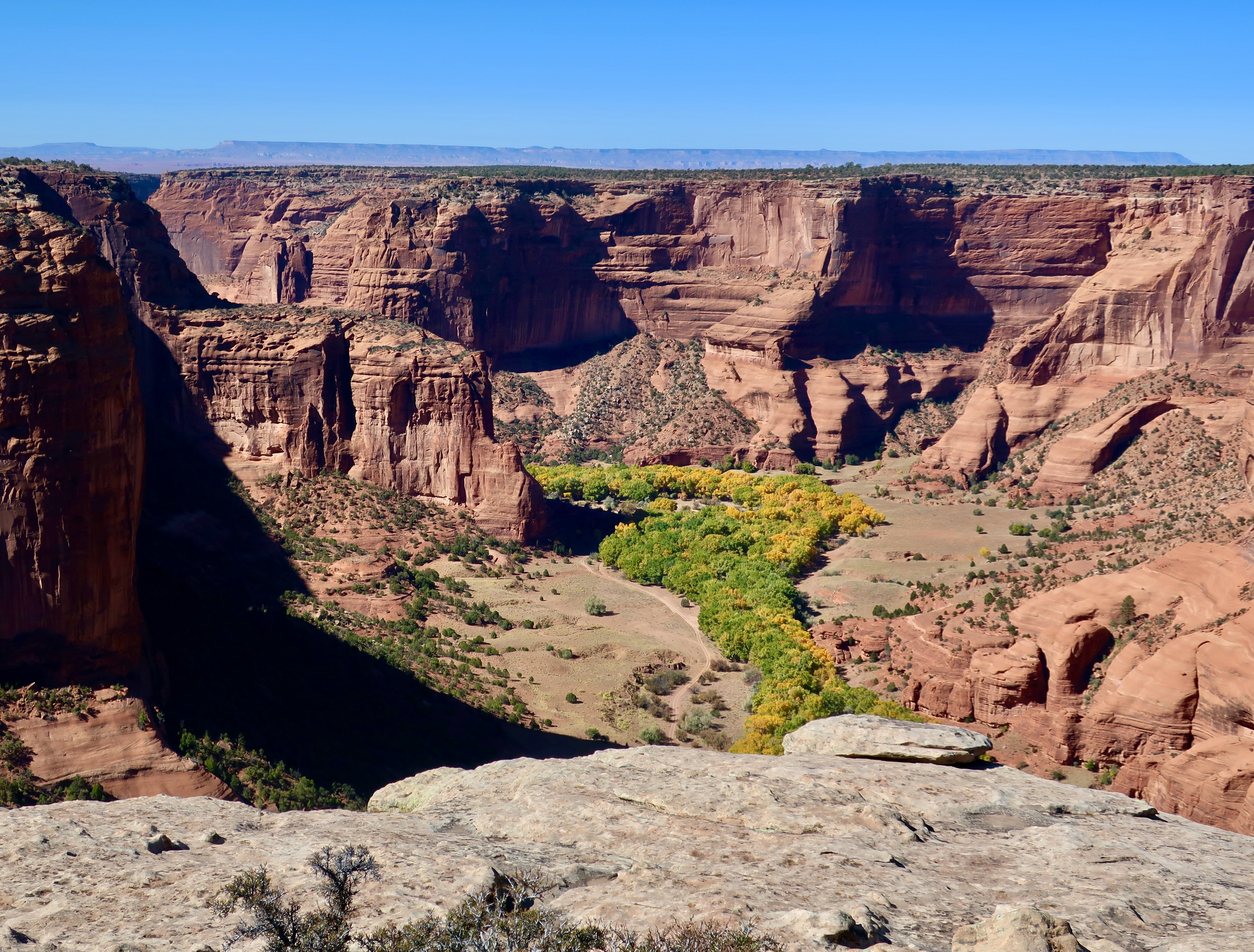
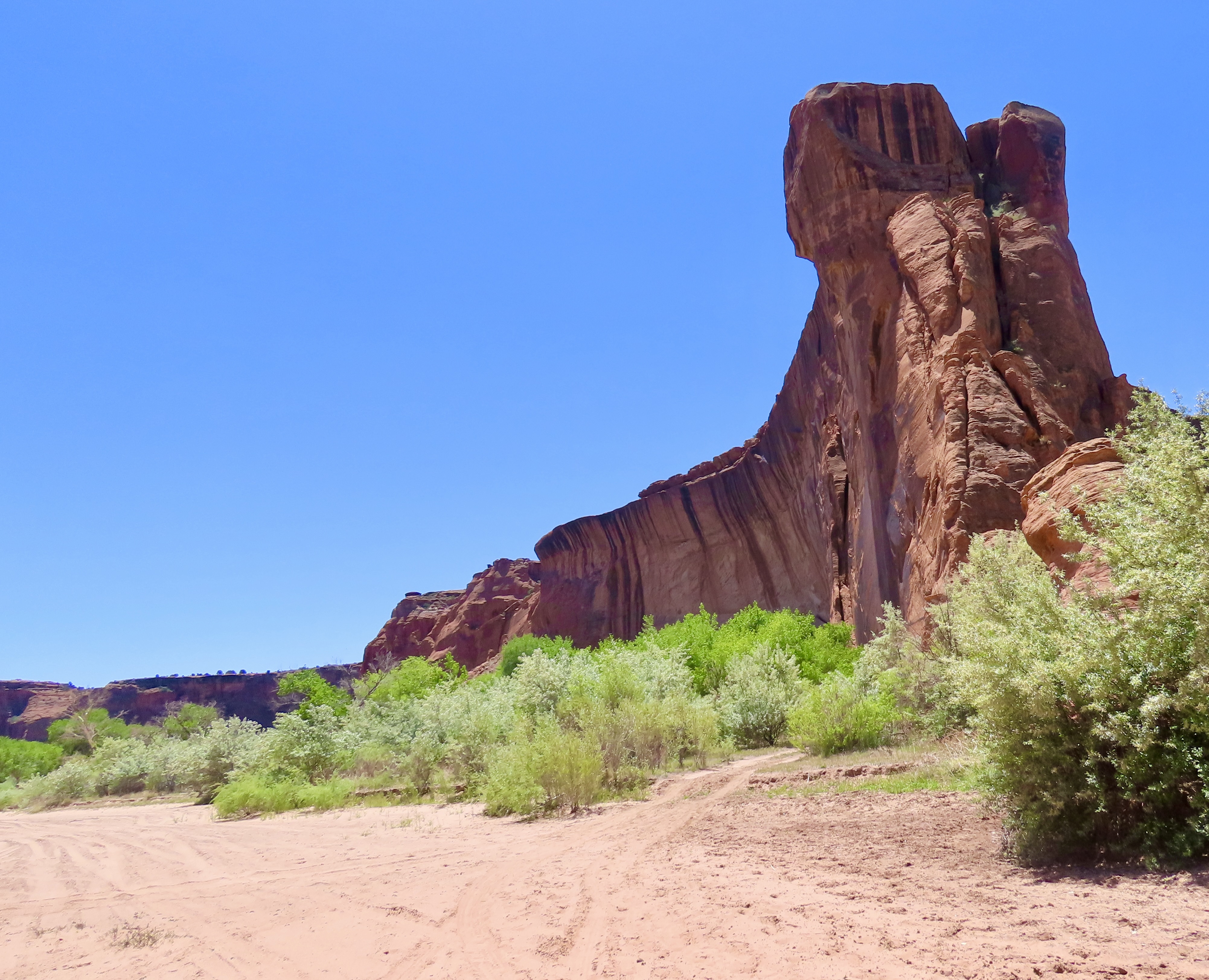
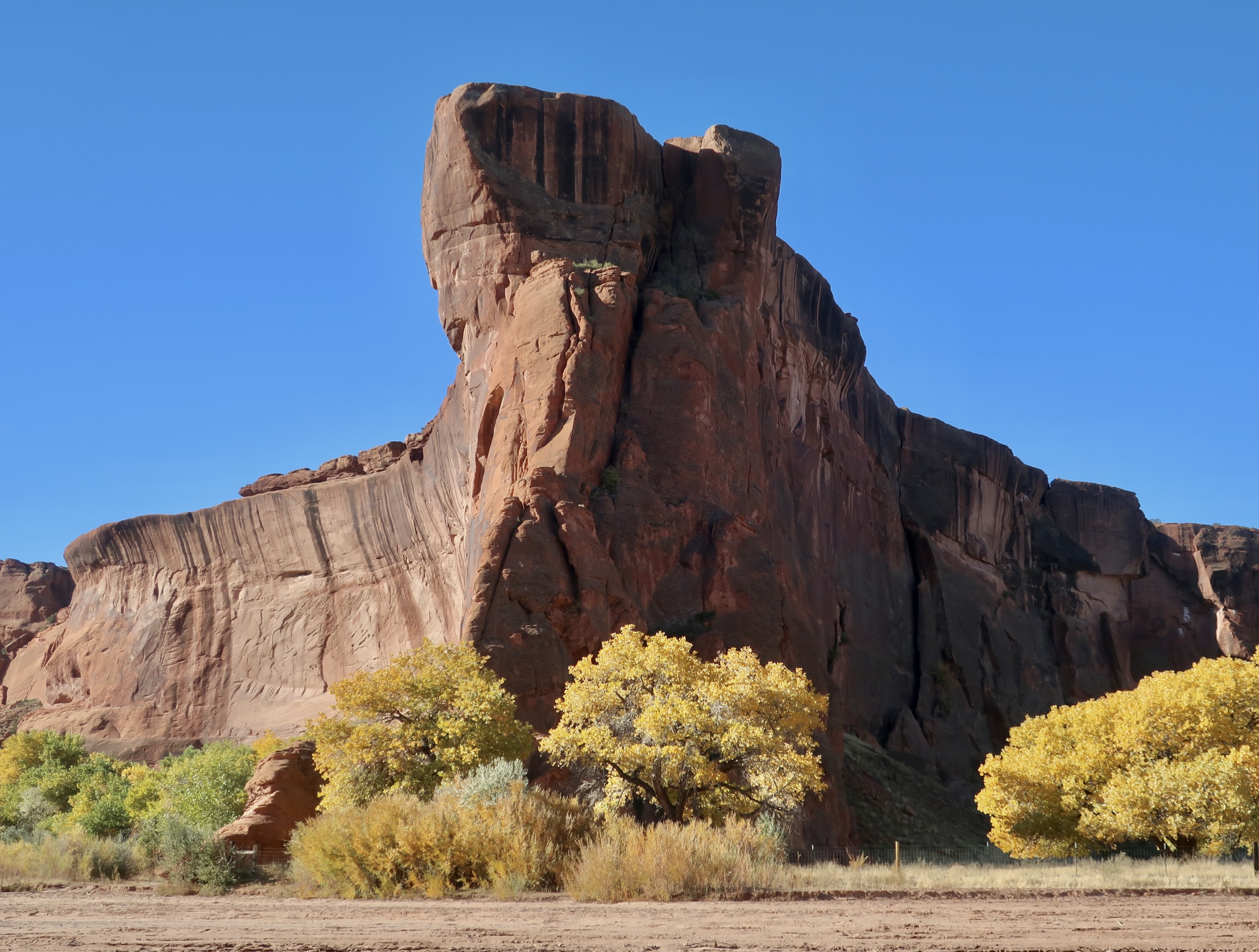
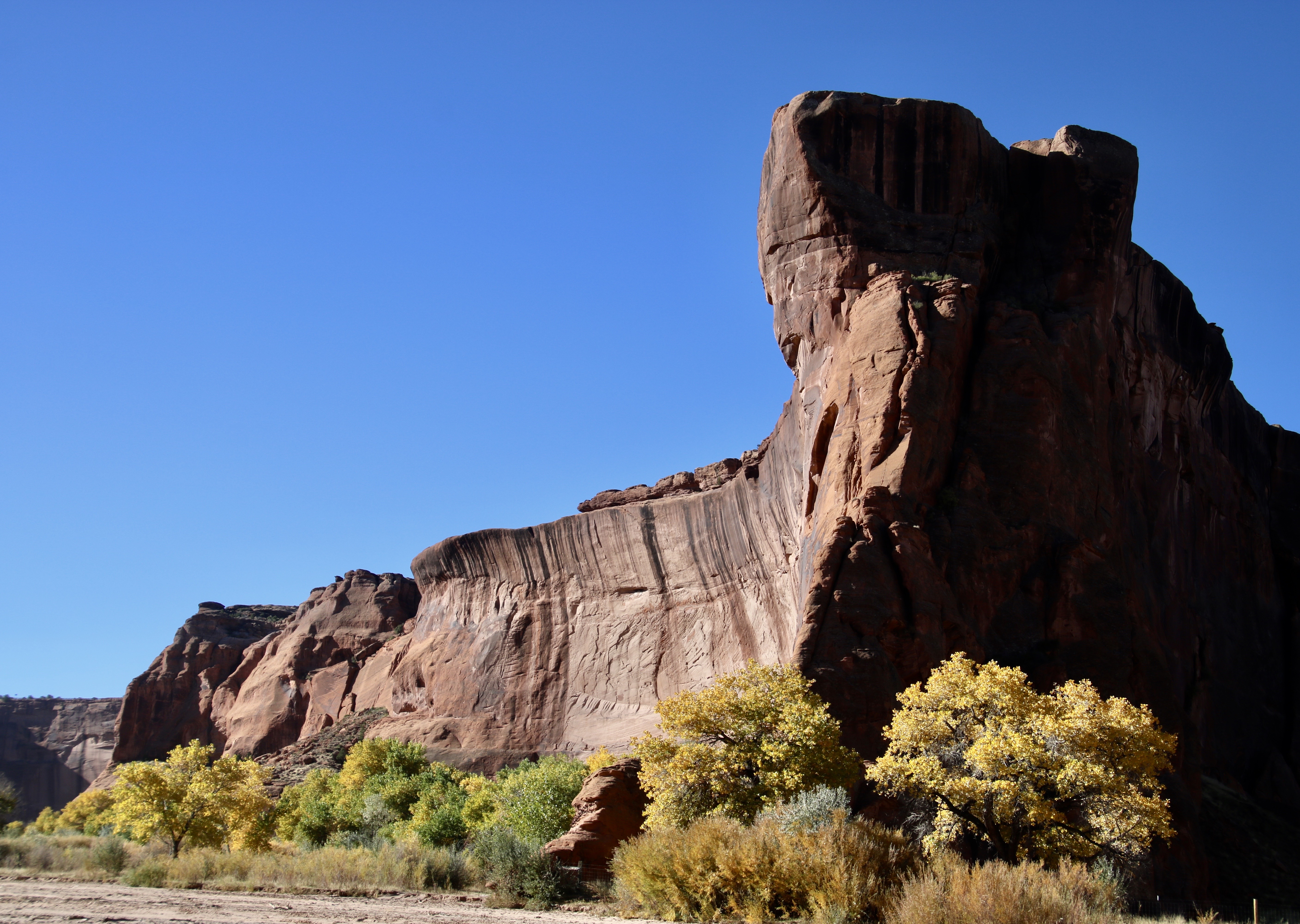
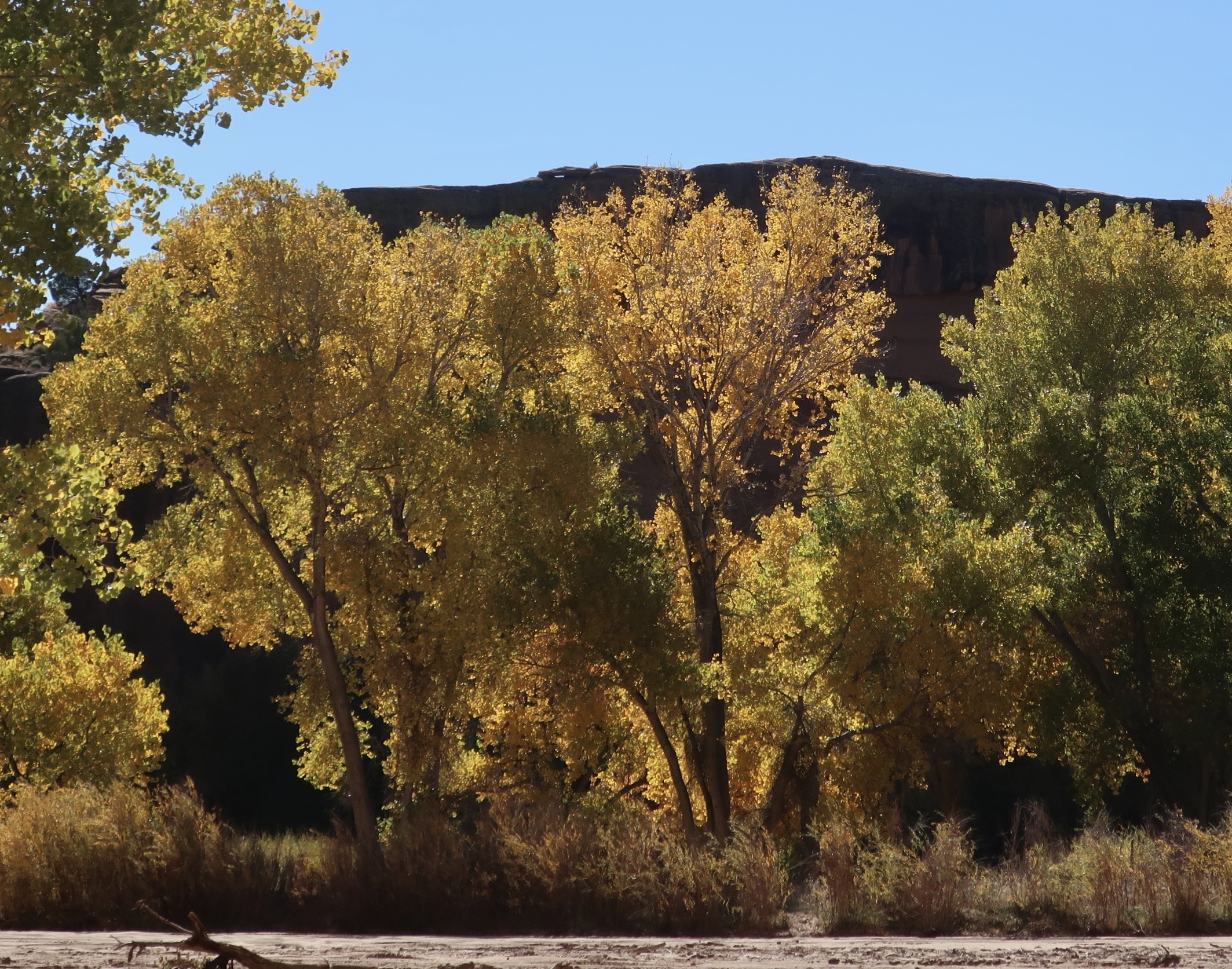
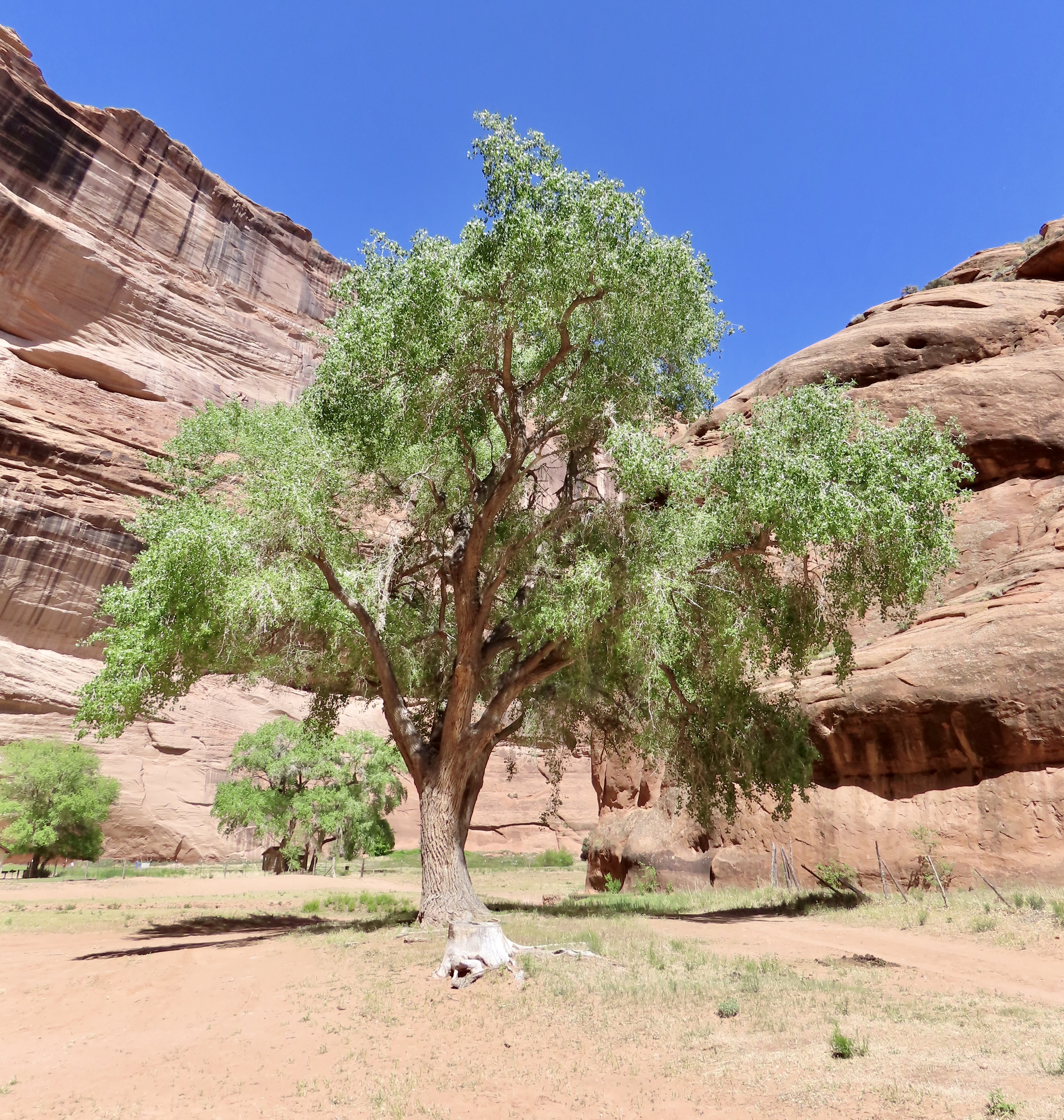
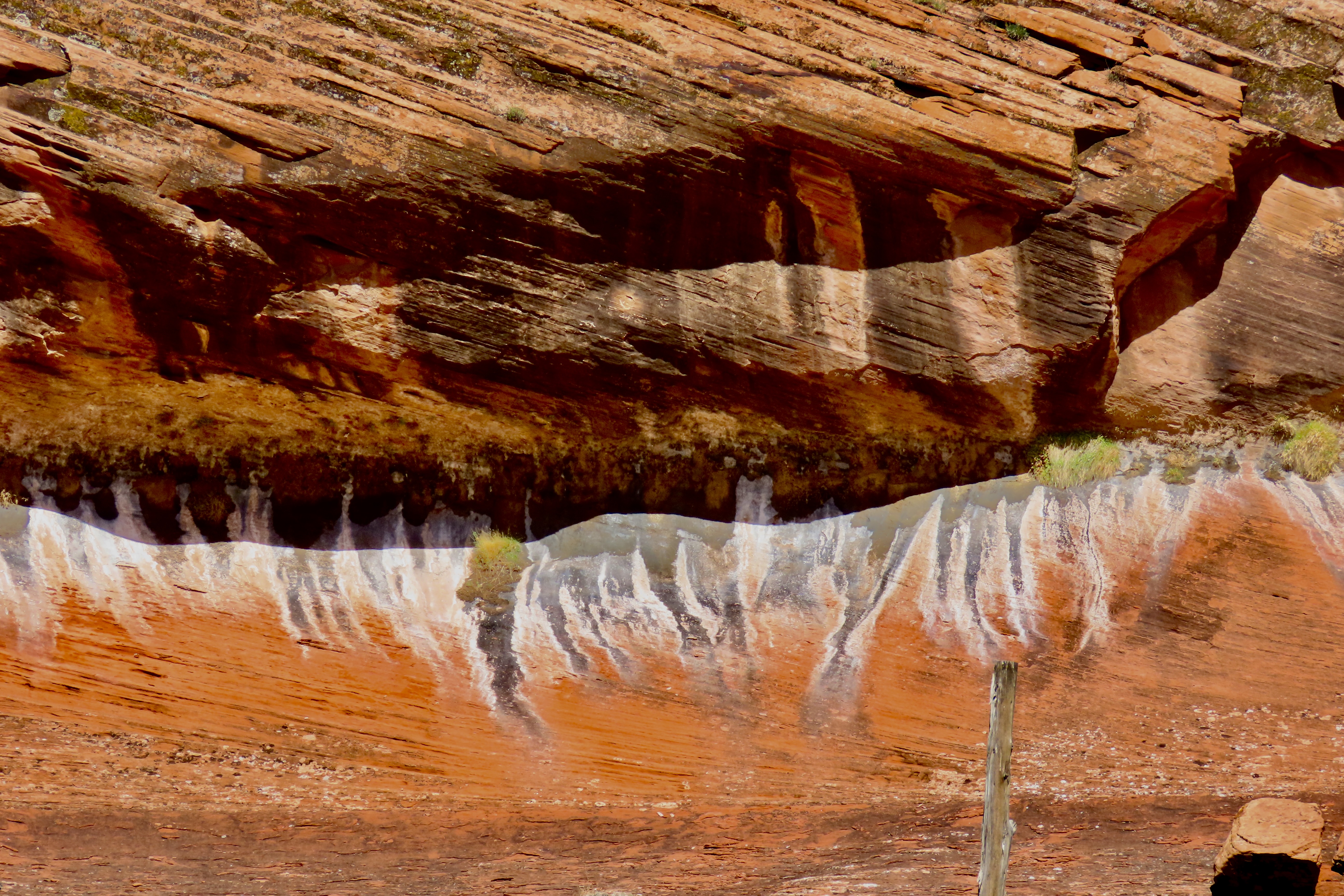
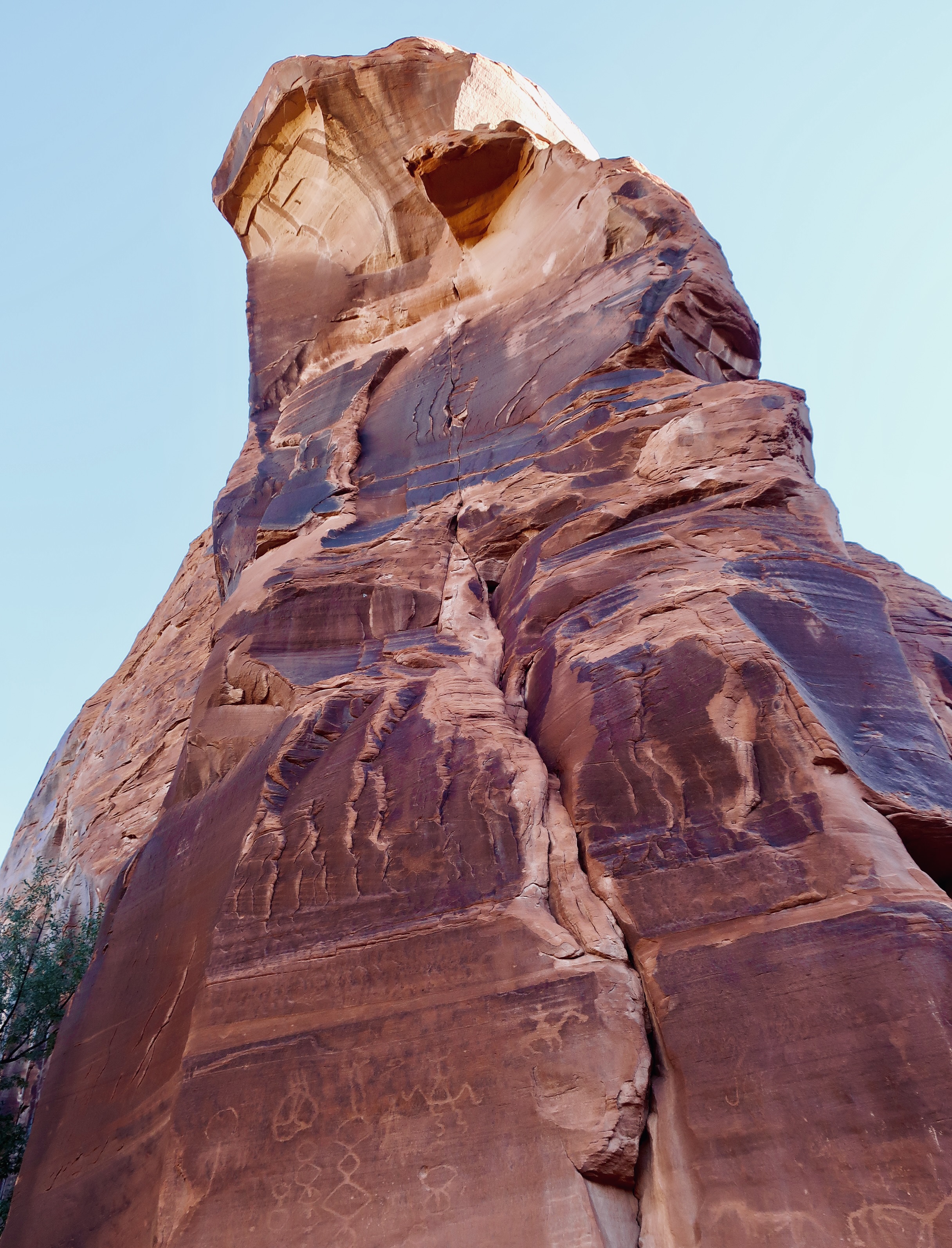
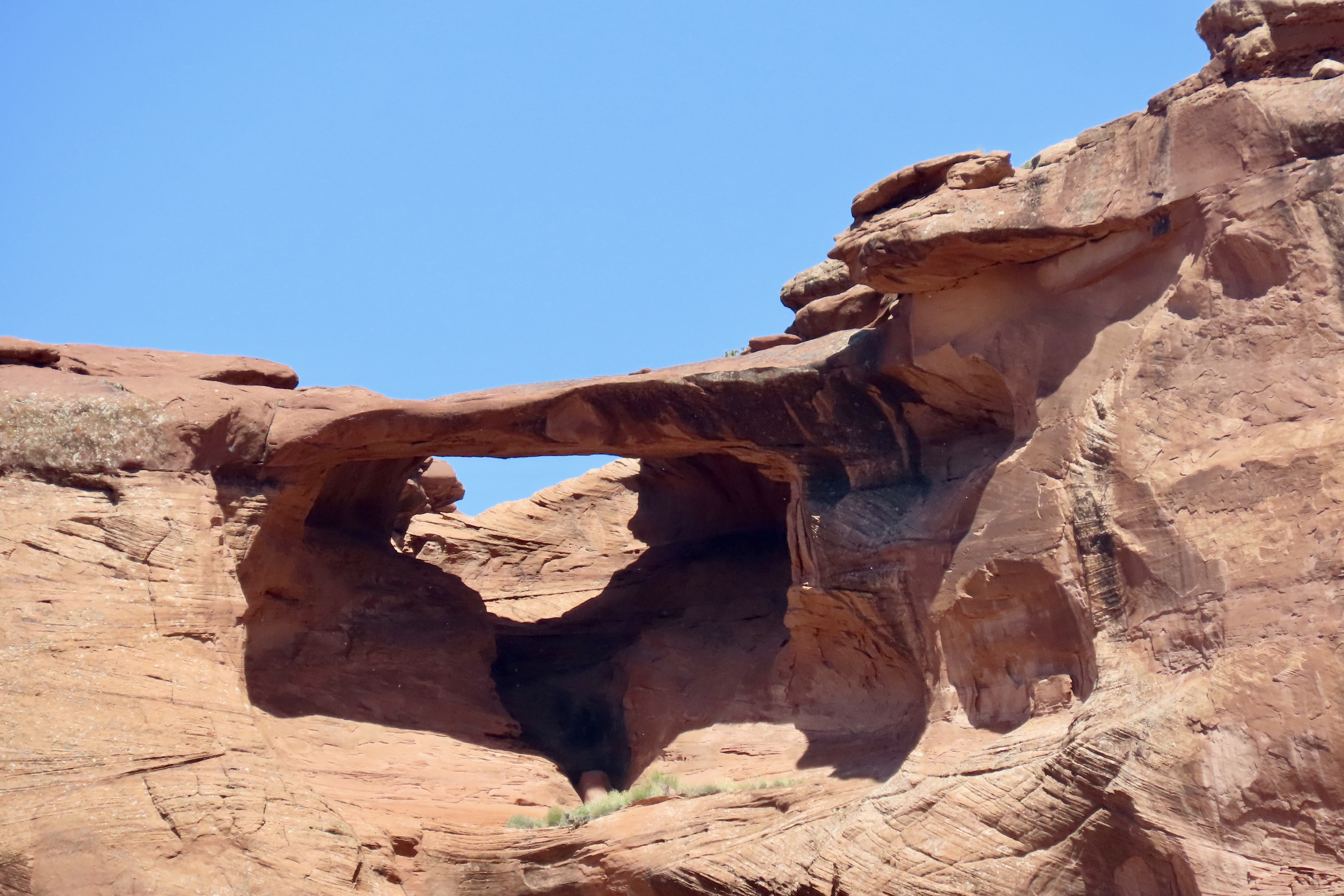
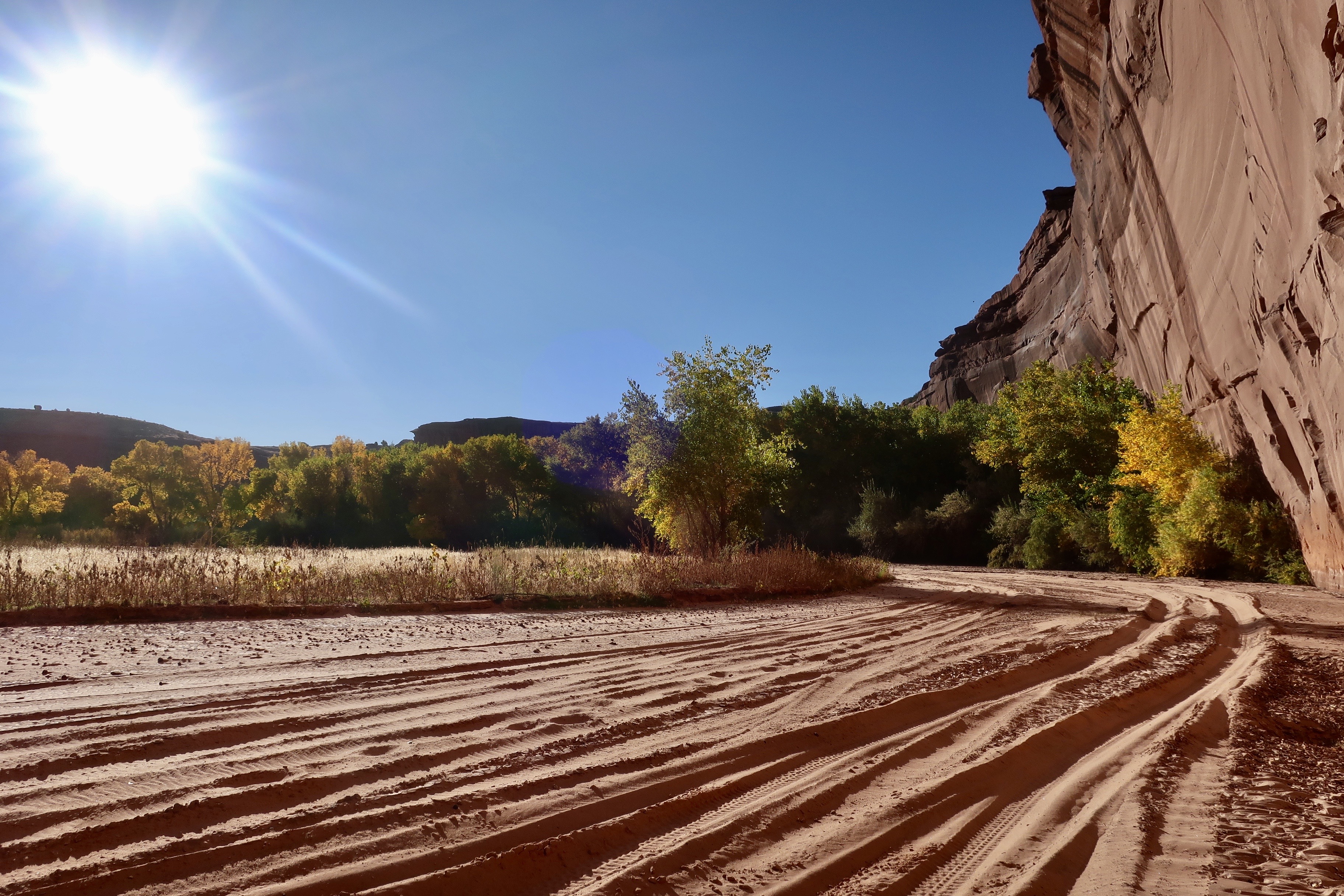
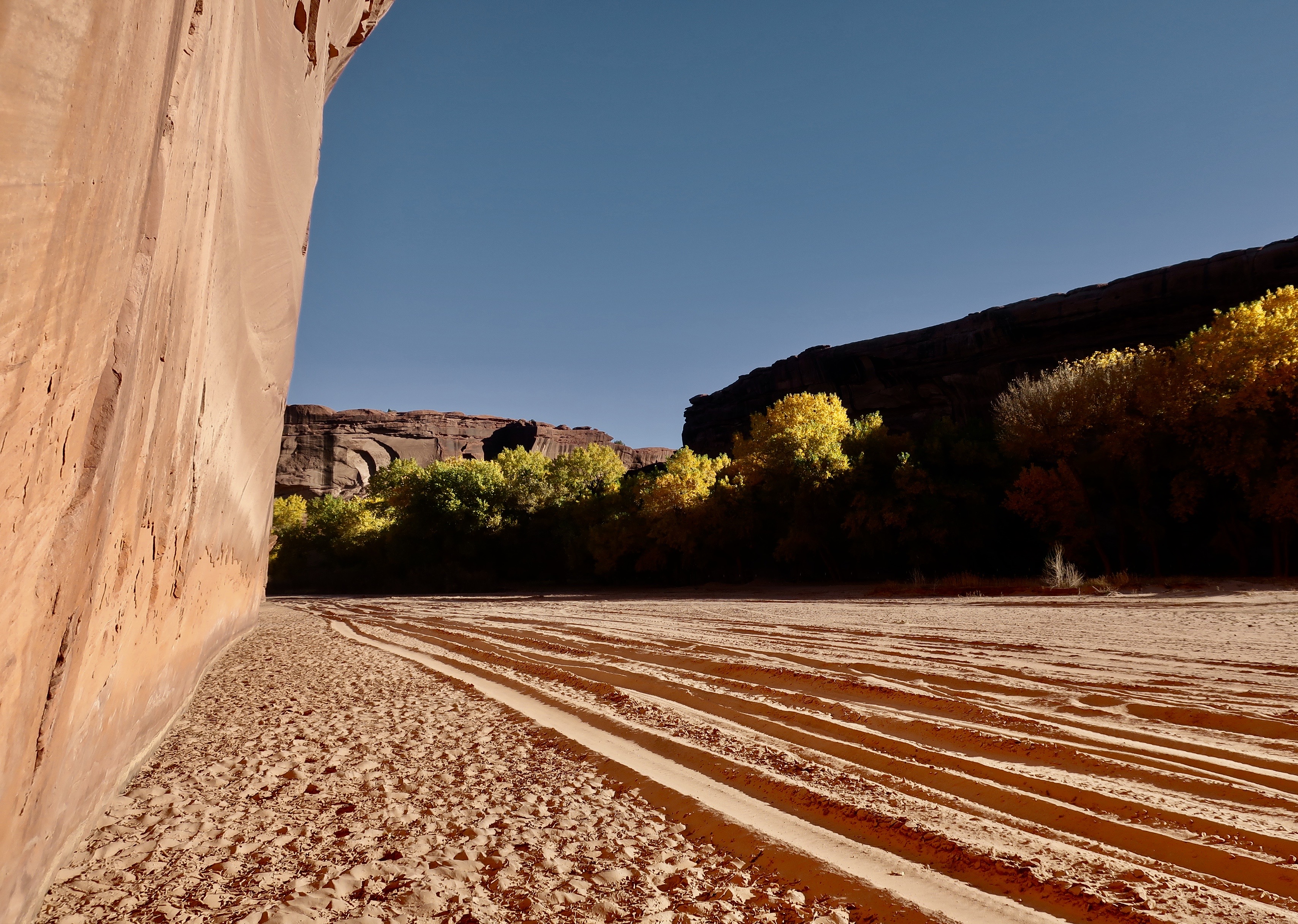
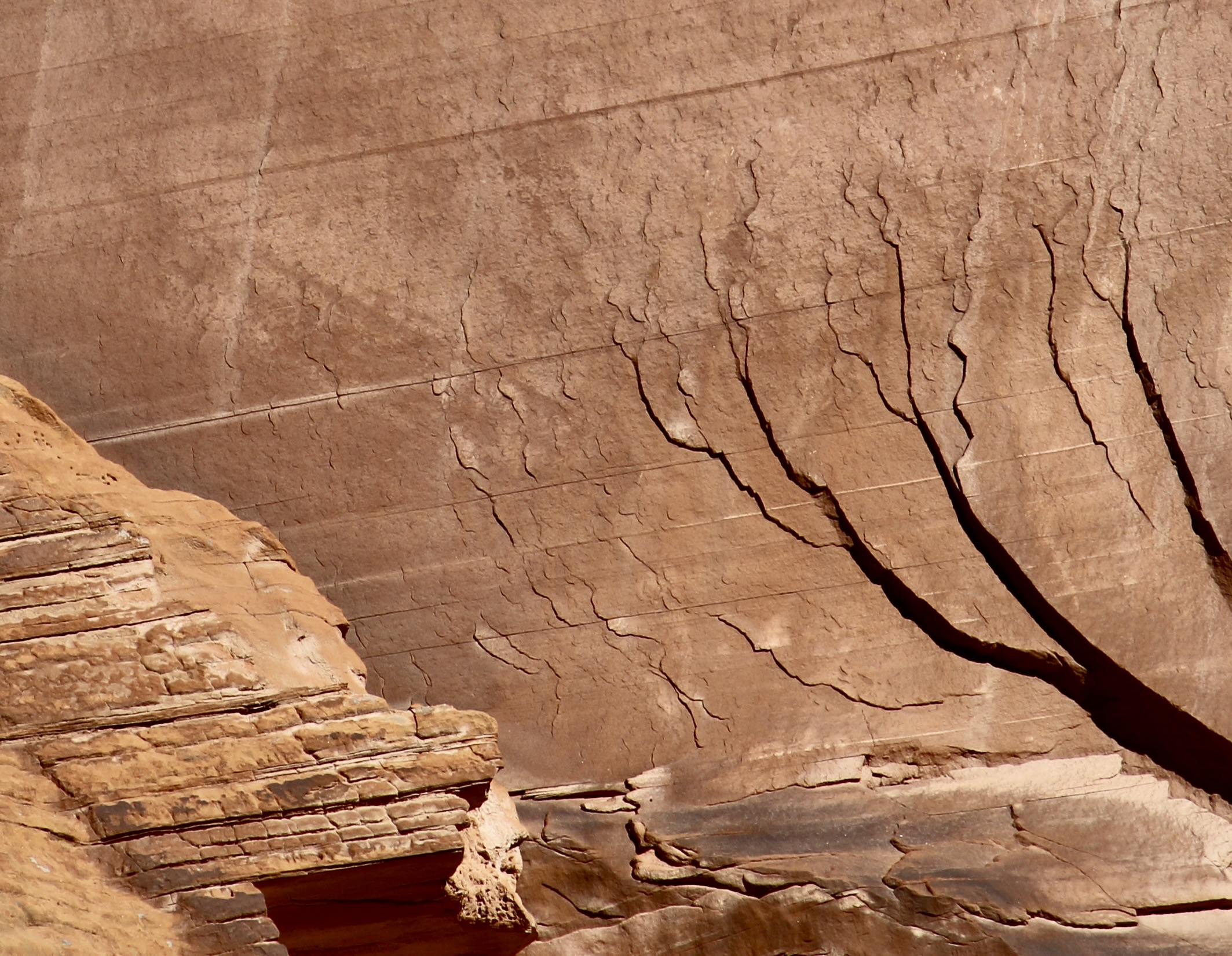
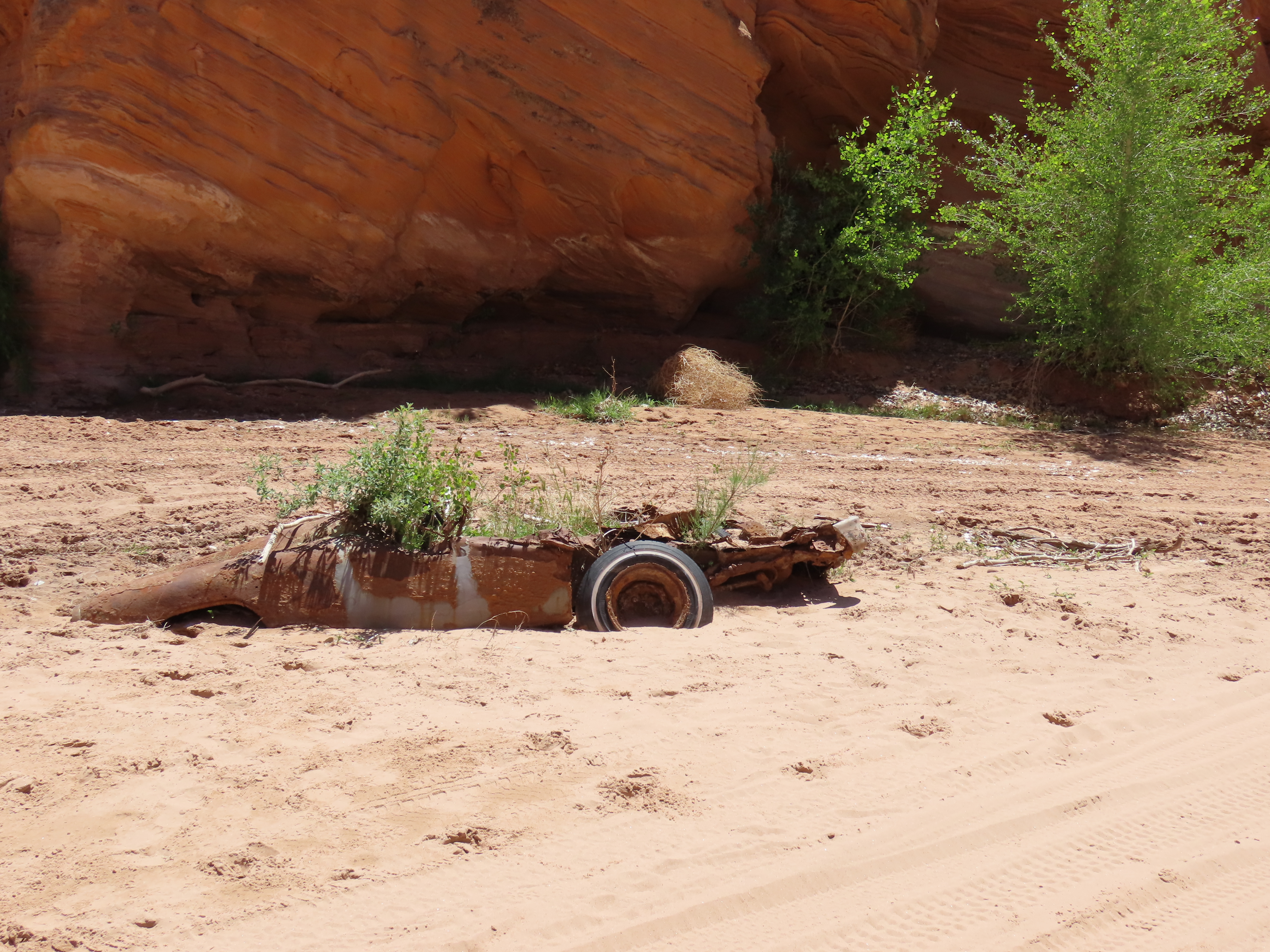
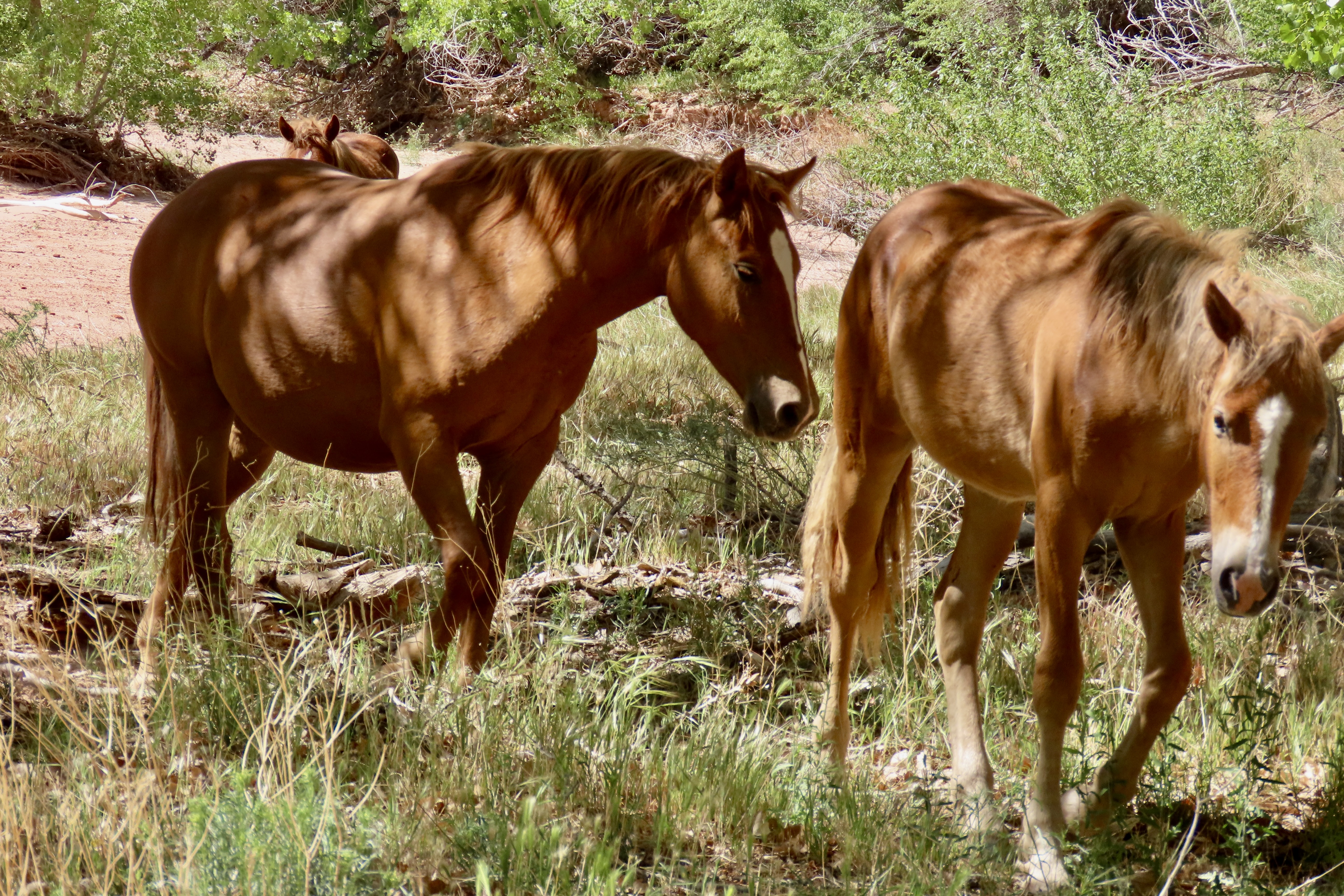
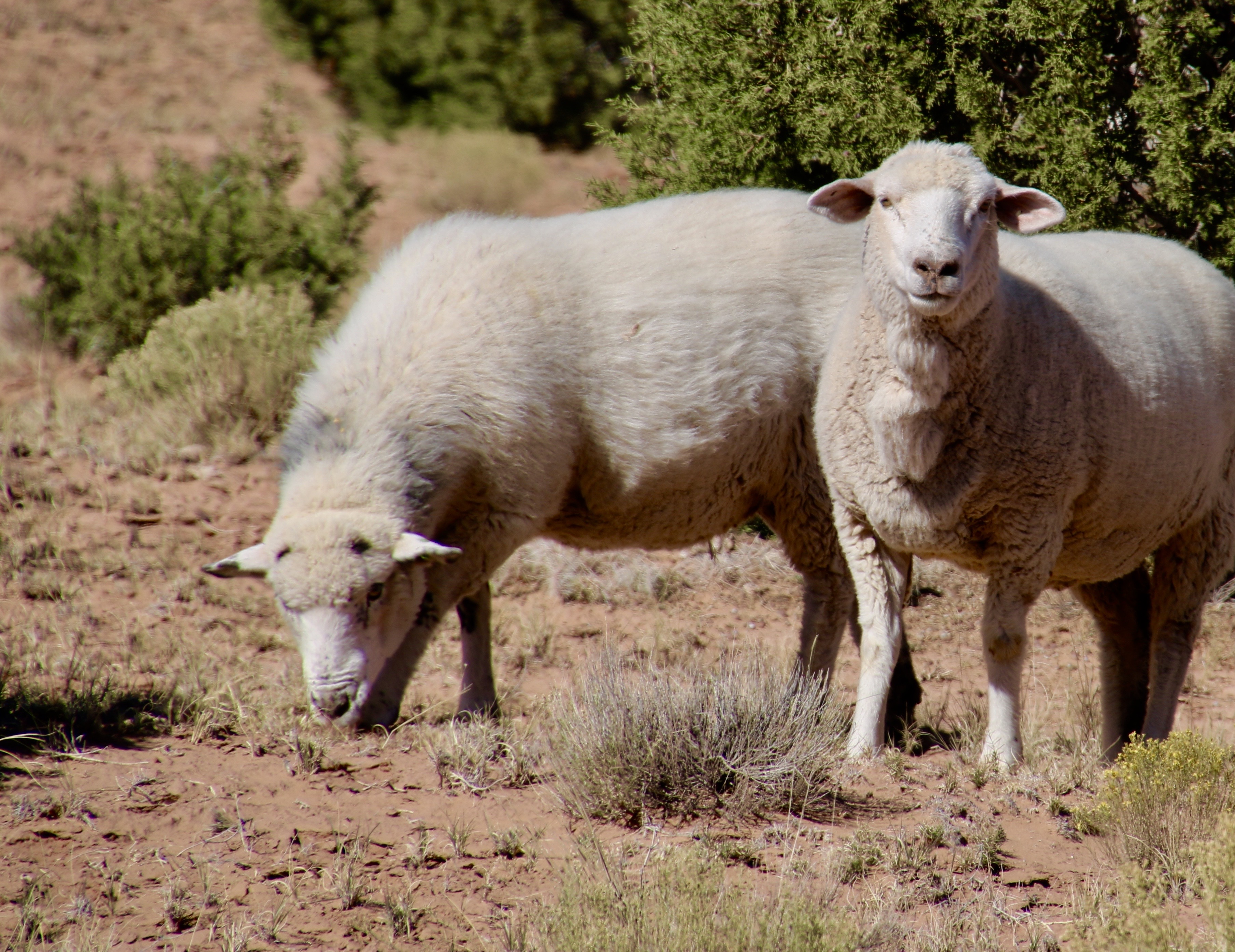
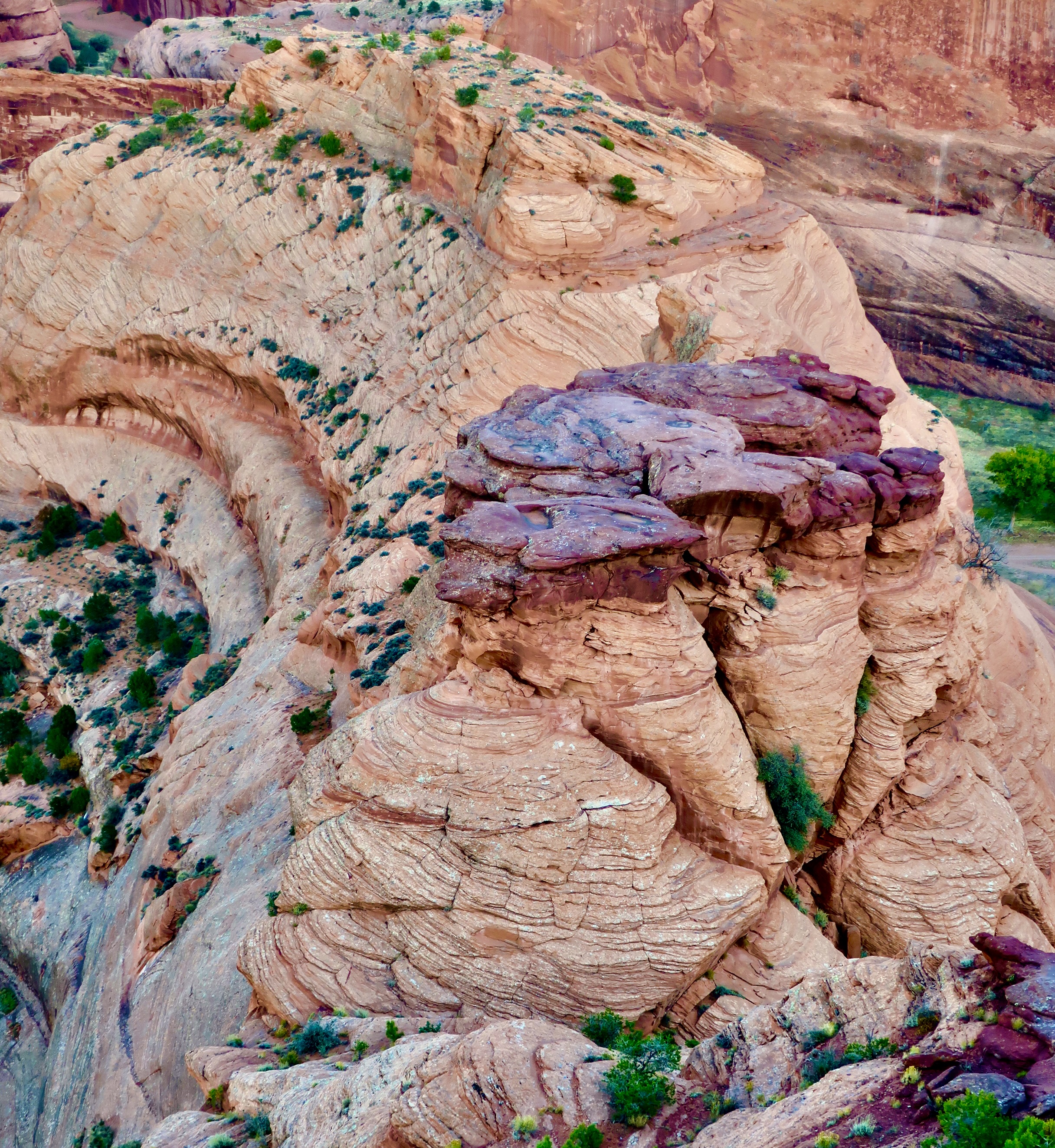
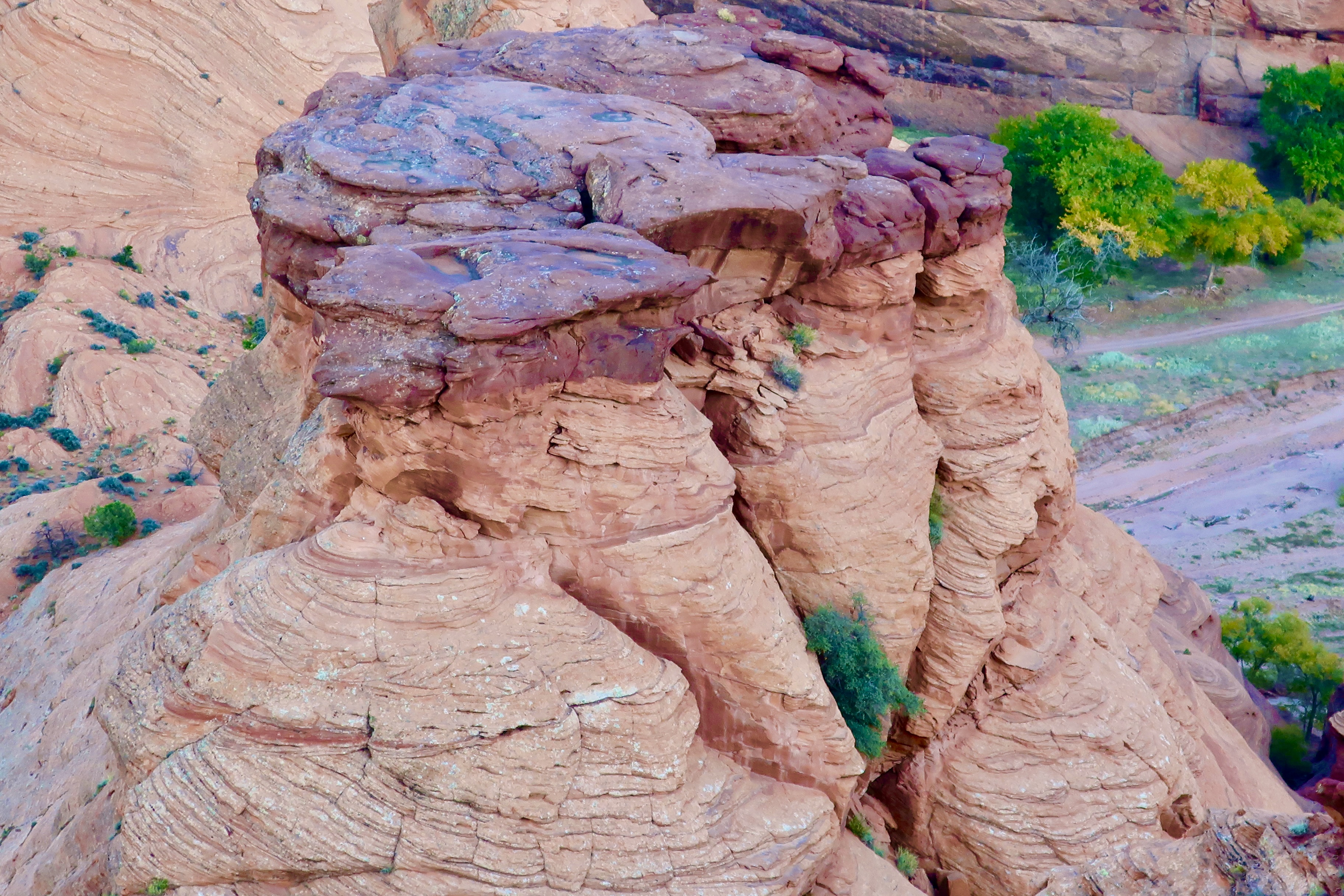
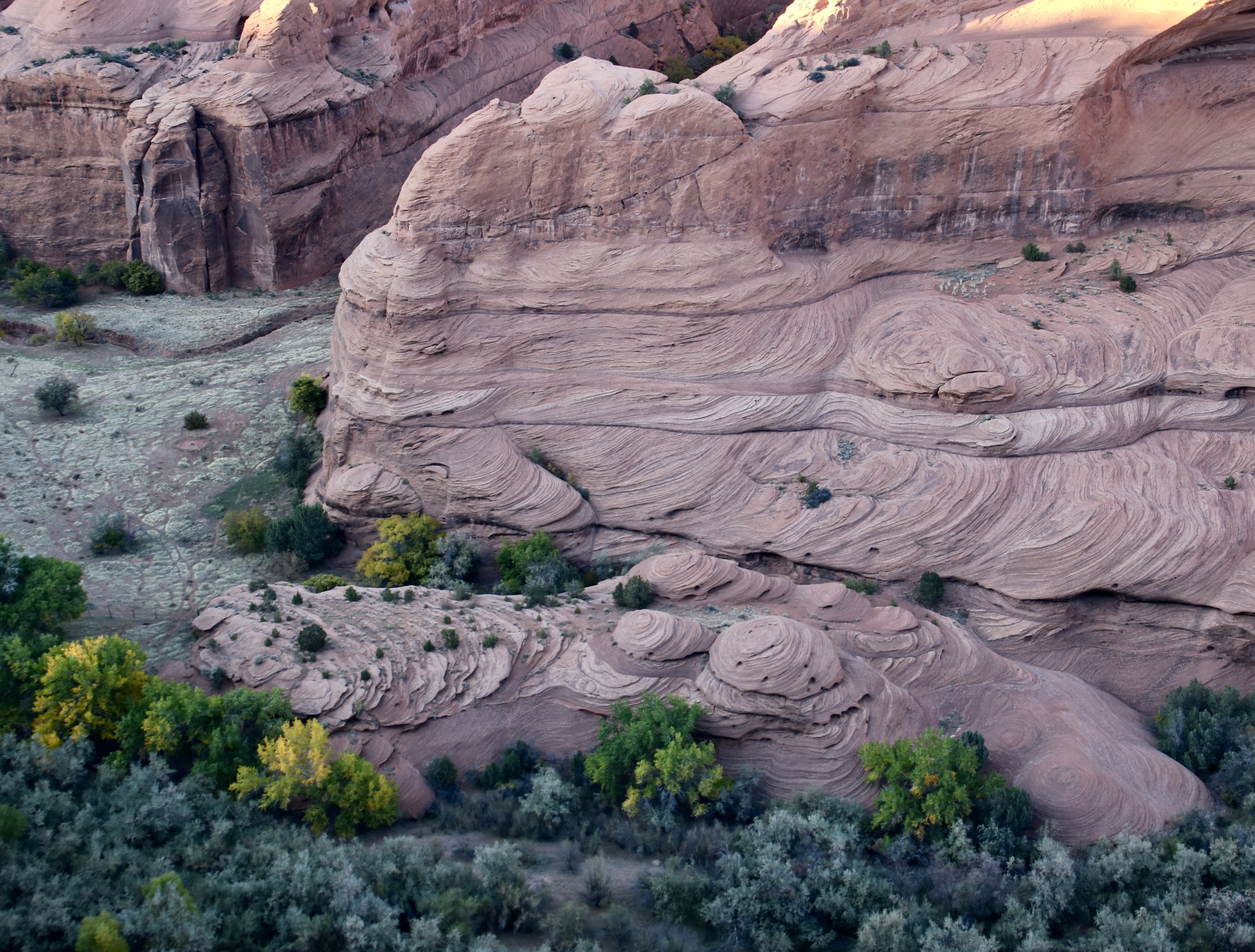
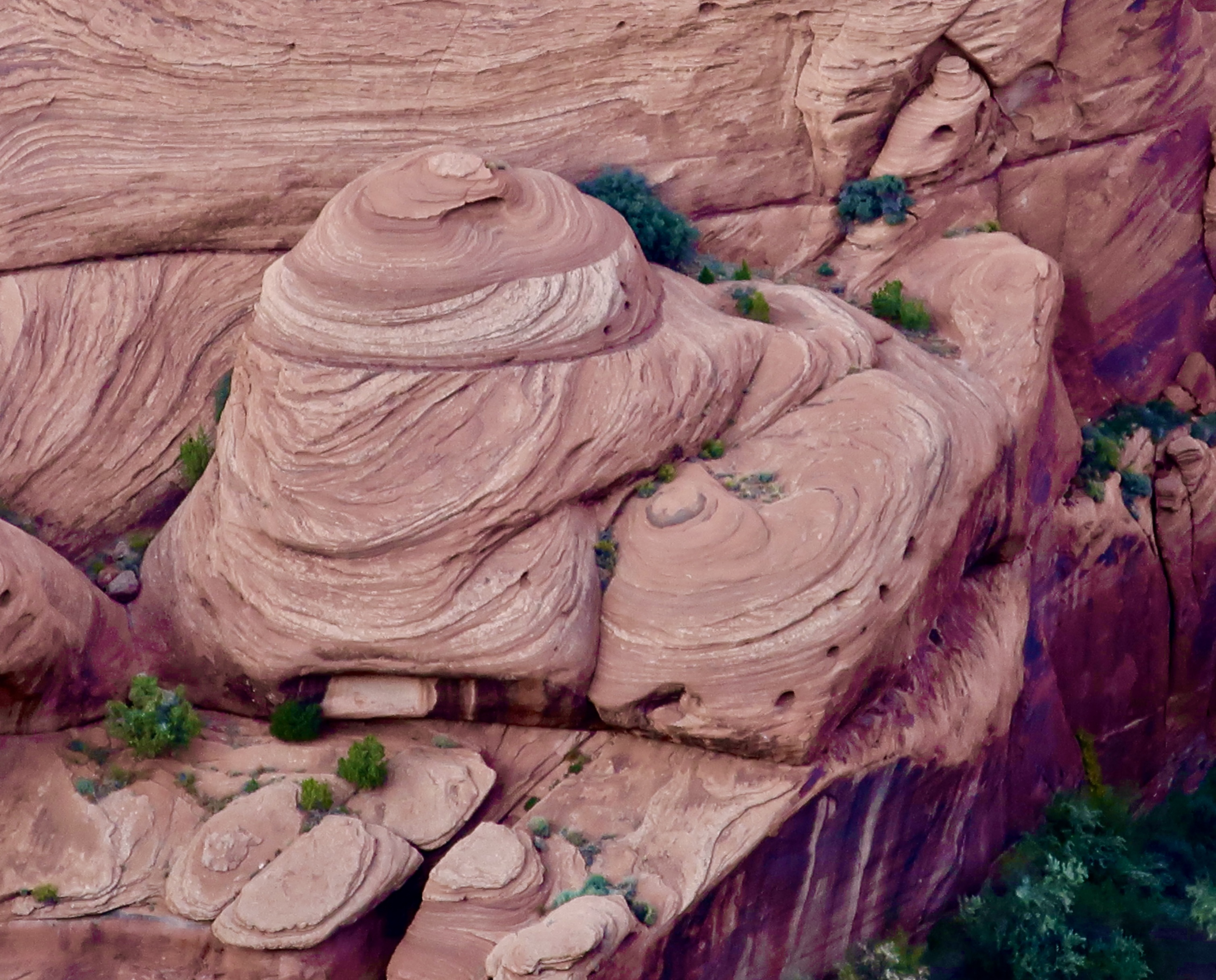
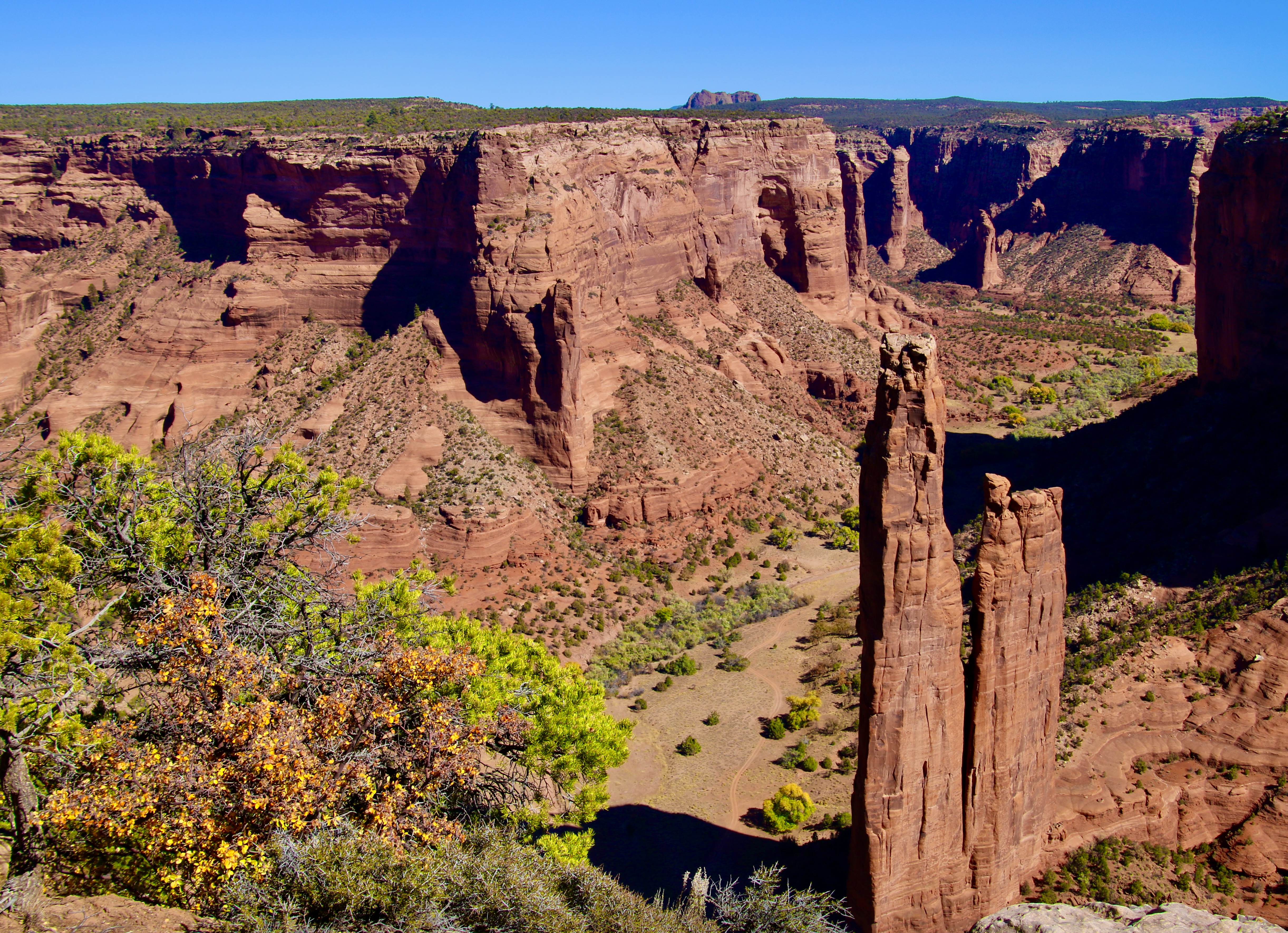
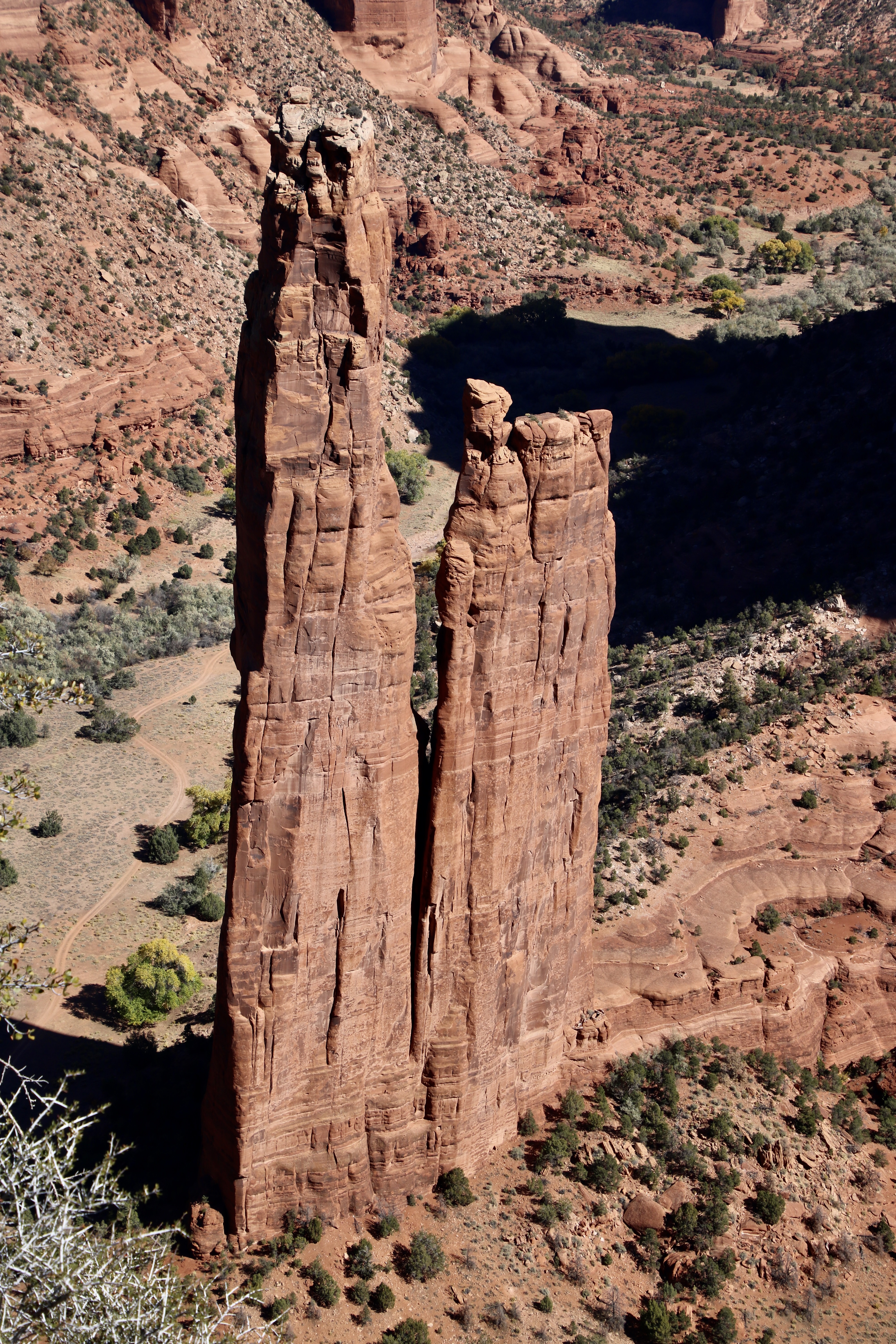
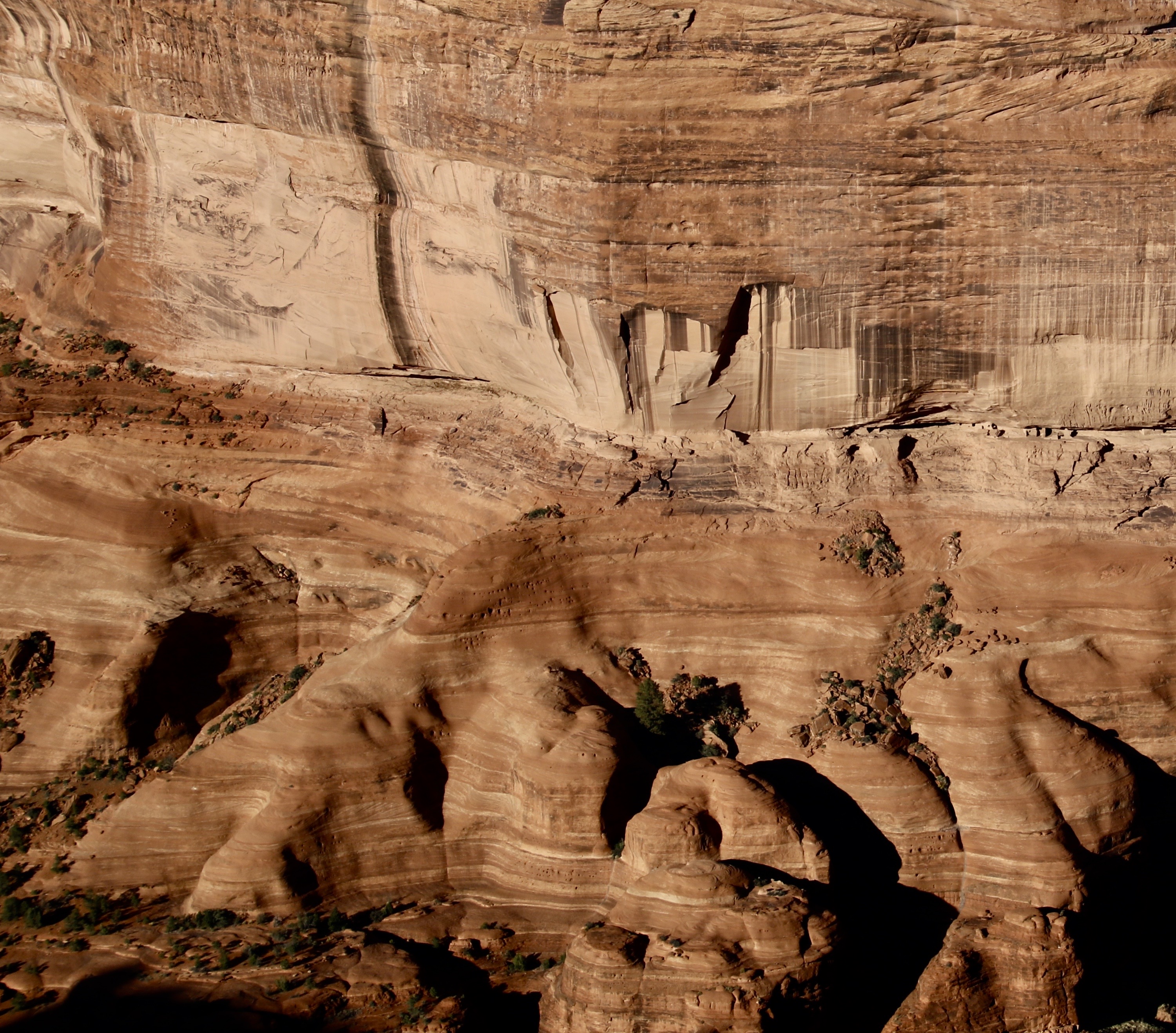
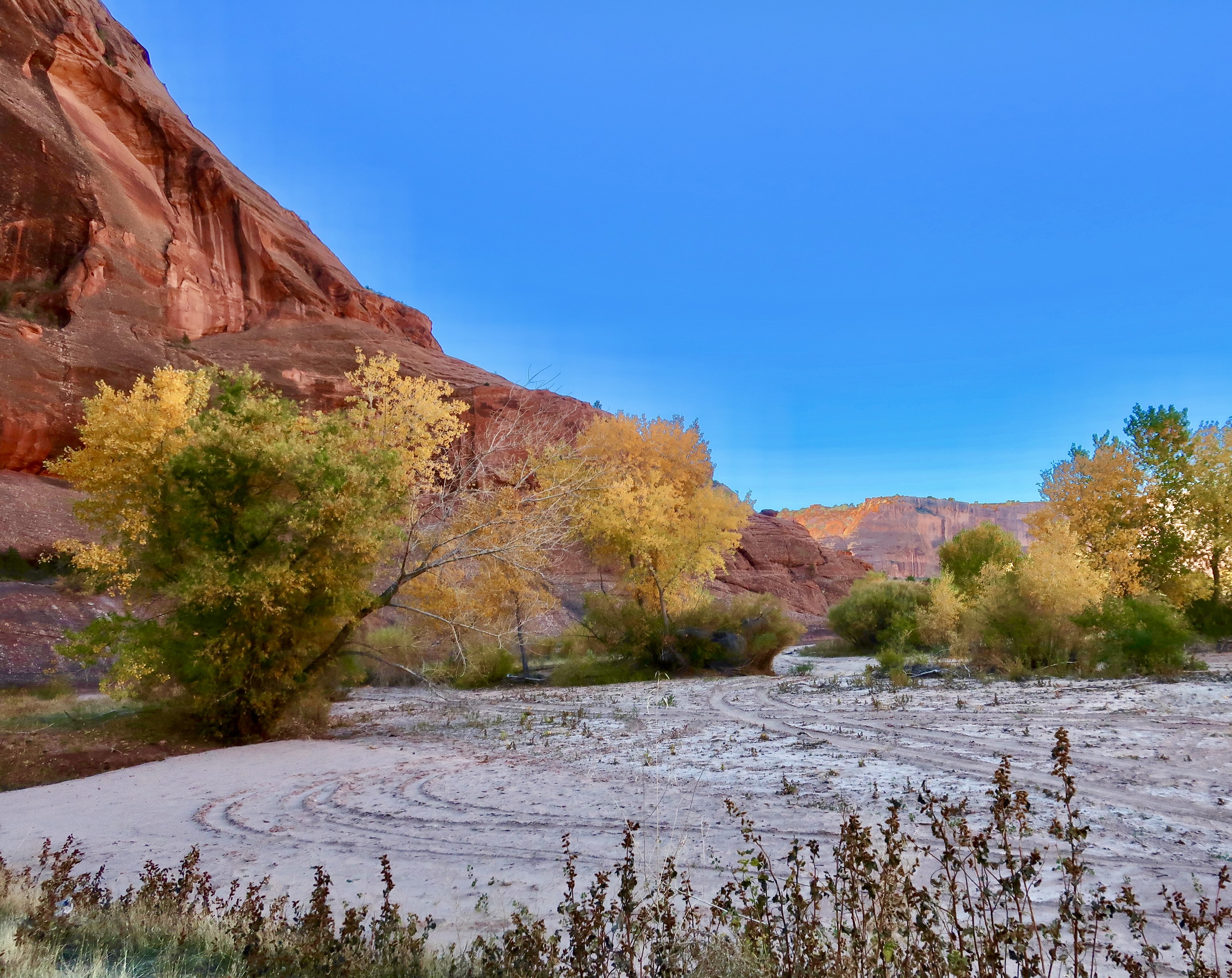
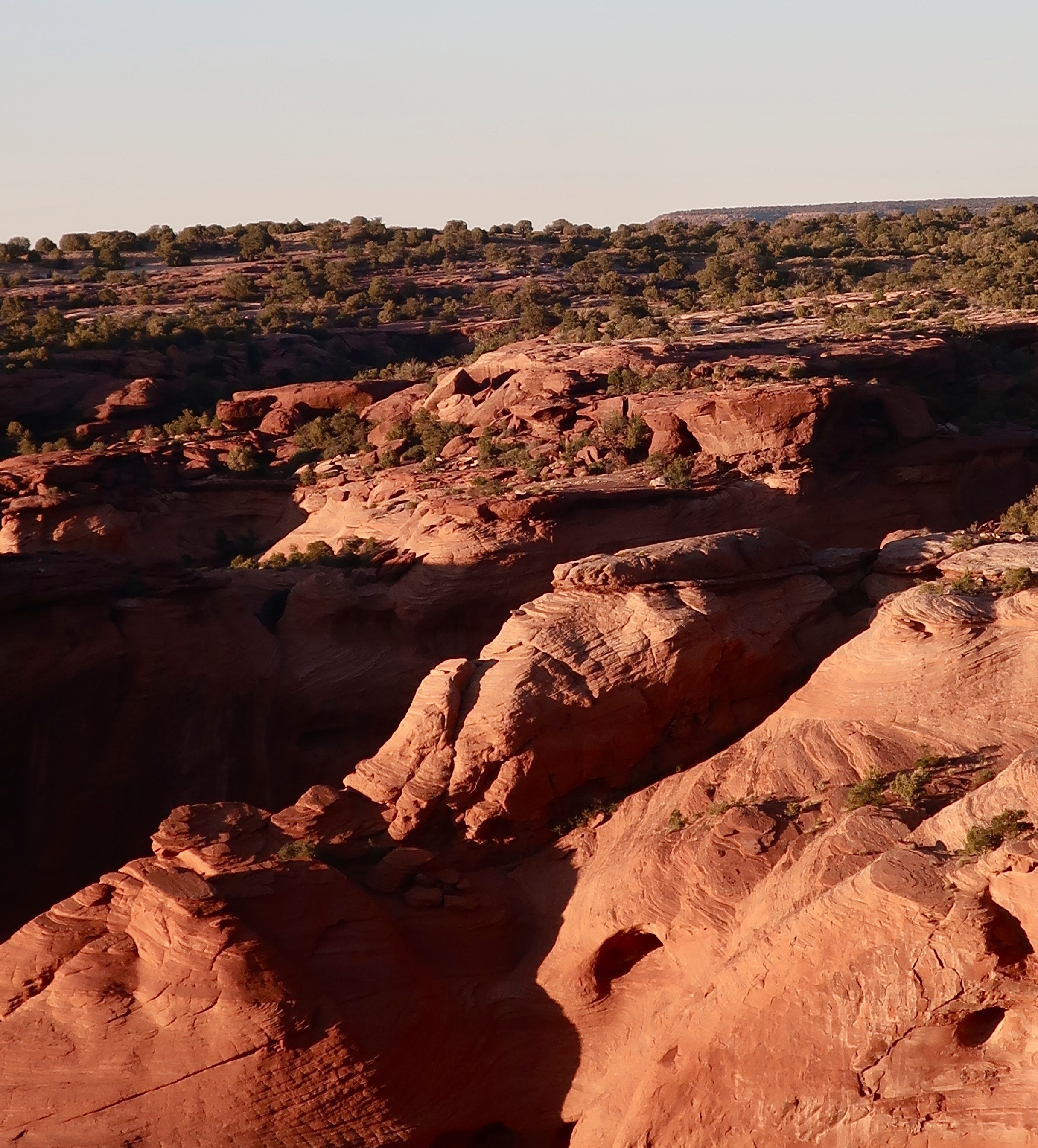
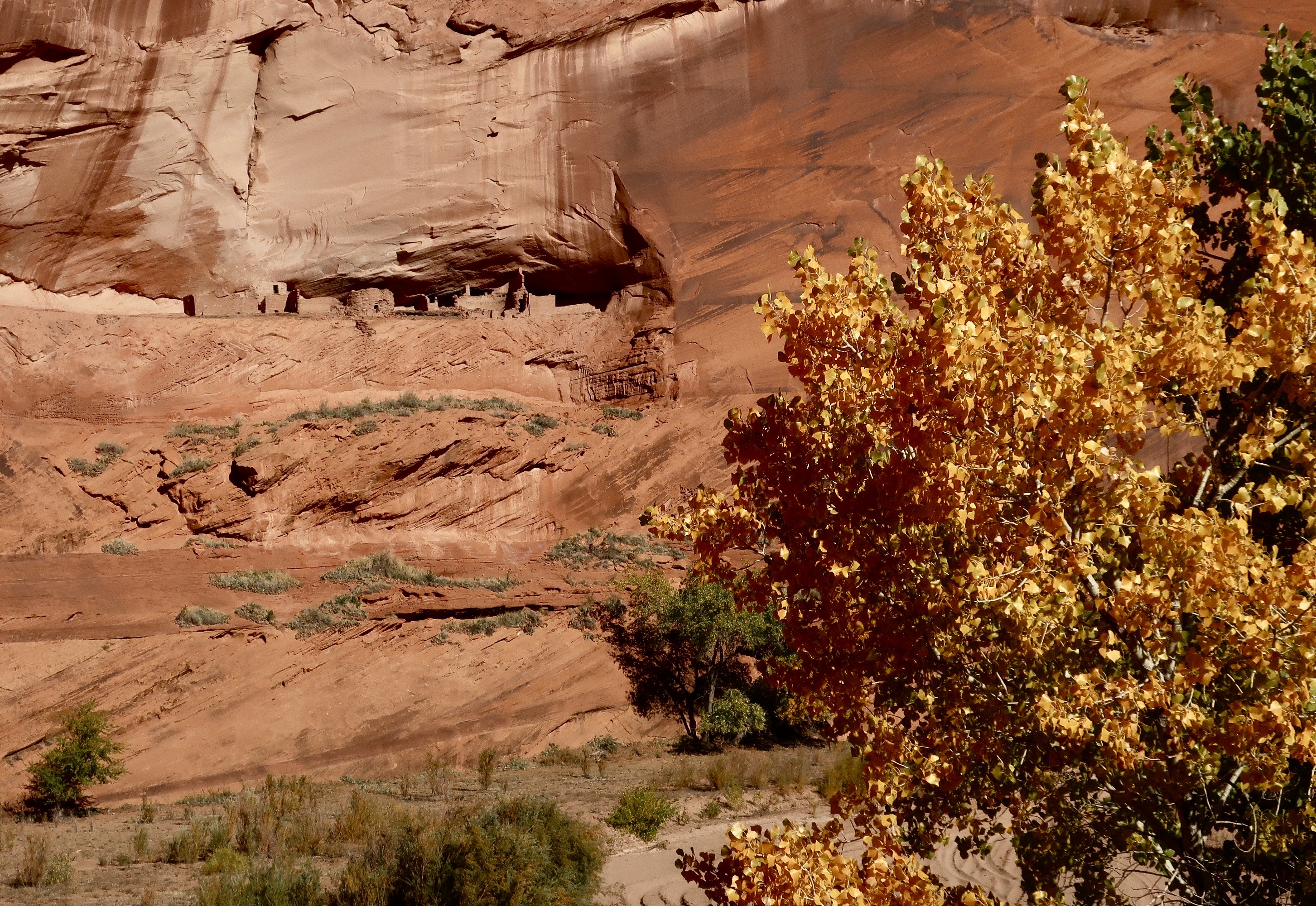
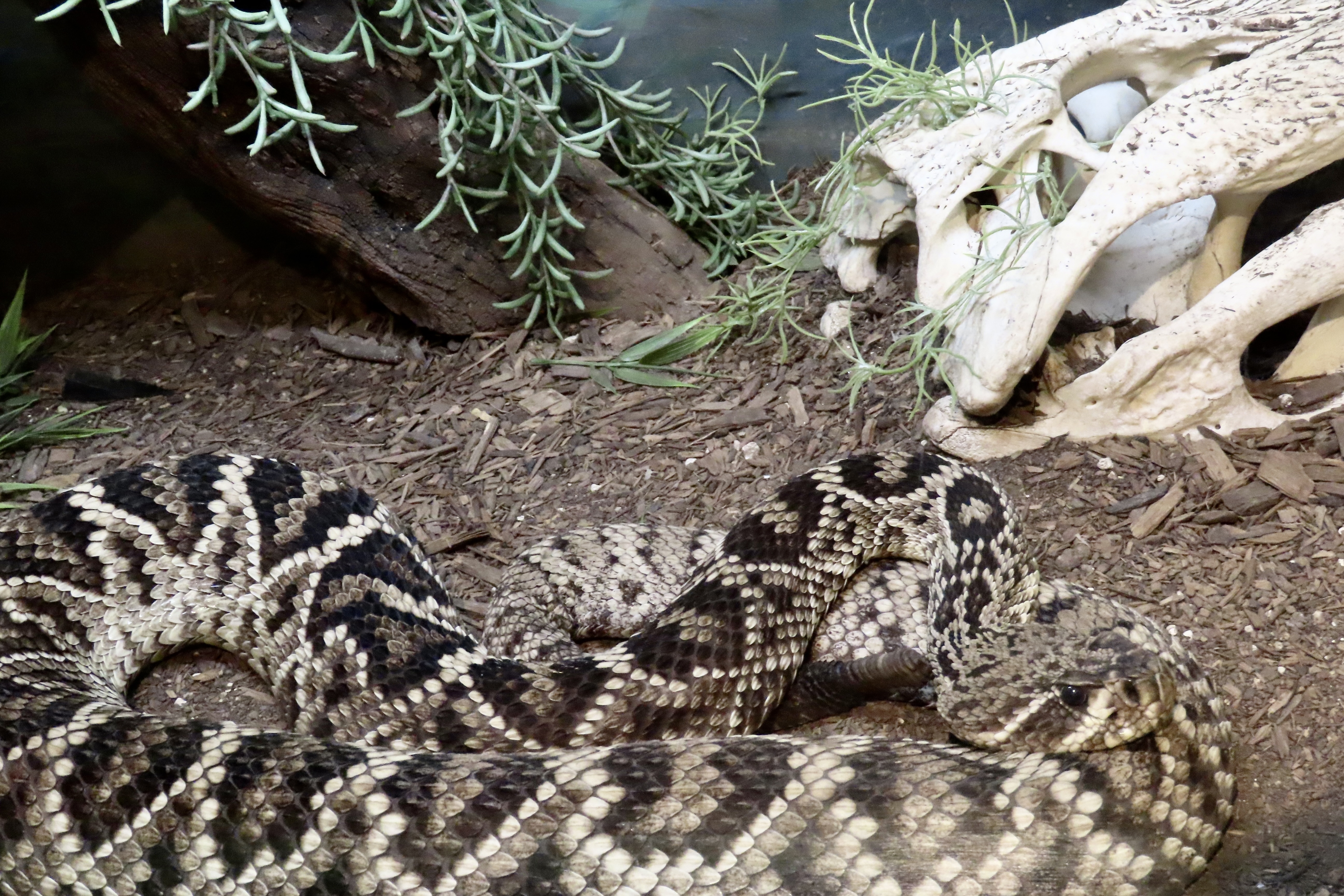
We admired this prominent landmark from inside the canyon in both the summer and fall. First summer…The long view. Not bad, huh.And now for fall.Both summer and fall were beautiful. Do you have a preference? I confess to being taken more by the contrast created by the fall foliage, but it’s close.Fall doesn’t get much more colorful than this.I thought green fit this tree well, however. The stripes on the wall are created by minerals left behind by flowing water.Here, they ‘painted’ an unusual picture worthy of a modern art gallery.This was one of many rock monuments found in the canyon. Note the petroglyphs on the bottom. It is no surprise that the Navajos and Ancestral Puebloans selected this dramatic rock as a canvas. Looking up provided this view of an arch.At first, I felt that the tracks left by all of the visitors took away from the beauty. There were bunches. But then I found the shadows created by the sun made them photogenic. Four wheel drive was essential.Another example.Rocks breaking off the walls add to the beauty and mystique of the canyon. It takes little imagine to turn these into a tree.Speaking of imagination, mine turned this old car into an alligator disguised as a flower box lurking in wait for a tourist dinner. ( Admittedly, my imagination can be a bit wild at times.)Navajos live and farm in the canyon. Some offer horse rides. Our guide on the fall trip raised horses and rented them out for Western’s. He had also performed in some of the movies.The Navajo raise sheep up on the rim of the canyon.Driving the south and north rim roads of Canyon de Chelly provides a totally different perspective on the canyon and its amazing rock formations.Close up.There was no end to the variety of patterns in the rock.Sometimes it looked as if the rock was melting.The most recognizable monument in Canyon de Chelly is Spider Rock, a 750 foot (230 m) spire that is said to be the home of Spider Woman, an important figure to several different Native American tribes. To the Navajo, she is a helper and protector. It’s also said that they tell their children that she will catch them in her web and eat them if they are bad. Way to go Spider Woman. Grin. You can see one of the canyon’s roads working its way up the canyon. A close up of Spider rock.More of the canyons interesting rocks lit up by the late afternoon sun.A last view of the inner canyon in fall.We’ll wrap this post up with a photo of sunset from the canyon rim. Our next post will be on the pueblos and petroglyphs of Canyon de Chelly. I may, however slip in a quick post on one of my favorite subjects: Rattlesnakes.
36 thoughts on “Canyon de Chelly National Monument: Beauty, Culture, and History… Part 1”
As always, Curt, you make beautiful photos.
In spring 1998, we hired a native guide. When we got to where the roads separated north and south, I asked him which way to go and he said, “straight ahead.” As we drove into the river, he told us we were the first of the day, the sandbars shifted during the night, he couldn’t guarantee we wouldn’t get stuck and that it would cost us $50 to get towed out. I drove on getting more and more nervous as water came up to the axels. Finally, he took pity and asked if I would like him to drive; I did. It was as spectacular as you show and clearly a very memorable experience.
I can imagine how much ‘fun’ you had driving, Ray. Reminds me of our getting out of Burning Man two years ago where Peggy and I were allowed to escape a day early. It was truly touch and go the whole way but we made it out in 30 minutes. The next day it was taking 12-14 hours.
Sounds like your challenge only added to your experience!
(I thought I had responded, Ray, but my WP isn’t showing it. Anyway, if you get two, my apologies.)
In spring 1998, we hired a native guide. When we got to where the roads separated north and south, I asked him which way to go and he said, “straight ahead.” As we drove into the river, he told us we were the first of the day, the sandbars shifted during the night, he couldn’t guarantee we wouldn’t get stuck and that it would cost us $50 to get towed out. I drove on getting more and more nervous as water came up to the axels. Finally, he took pity and asked if I would like him to drive; I did. It was as spectacular as you show and clearly a very memorable experience.
I can certainly imagine getting nervous with the rains, Ray. They must have added another layer of beauty, however. 50$ bucks in 1998? Imagine what it would be now. Thanks for sharing your experience. We traveled both times in vehicles owned by the guides.
A beautiful spot, Curt. These are some of the most naturally “artistic” rocks I’ve seen. The natural coloring and cracks are museum-worthy indeed. The views from the rim are so dramatic. It’s wonderful to know, also, that the canyon still provides a livelihood for the Navajo who live there. Thanks for sharing your adventure there, and I’m looking forward to your take on rattlesnakes. Hehe.
Hi D. Yes Canyon de Chelly is a special place, a natural wonder for sure— with a long history of human occupation. It’s also a photographer’s dream. Our cameras were very busy! Rattlesnakes are up now…
How amazing all the rock formations are! I really like the fact that you must have a Native American to accompany you because it would, I think, give so much more clarity to what you are viewing. And the lone green tree with the once upon a time ripples of water behind it. I enjoy fall much more than summer and so it’s wonderful to see the colors! Also admire the rattler but certainly have respect for it! Love to you and Peggy!
Rock formations are one of the primary reasons for our love of the Southwest, Wendy. There are so many to see and admire! Everywhere. Sounds like your favorite time to visit would be the fall as well! Poisonous snakes have a way of demanding respect. That’s for sure. Thanks, Wendy.
Thanks for this tour of the stunning Canyon de Chelly, Curt. Great photos of the rock formations, petroglyphs, blue skies and the handsome rattlesnake.
Nature has created some most unusual rock formations. When you saw rocks melting, I saw a strawberry/vanilla bowl of ice cream. lol But I can do without the snakes.
The Southwest has so many sandstone marvels and you have offered us several in these wondrous pics of Canyon de Chelly. Thanks again, though I could hAve done without the rattlesnake. Lifelong aversion, sadly. Be well.
There is so much beauty throughout the Southwest. Peggy and I have never tired of revisiting the area. As for snakes, It’s really hard to get over an aversion to them. I thinks it’s instinctual.
We did one of the rim drives in 2010, right after a rain storm. A once in our lifetime thing to see the water cascading off the cliffs.
I followed a blogger for a while who bashed Biden about as often as you bash Trump. Mike Rowe (of Dirty Jobs fame) was asked why he did not take political sides. He said he simply chose not to dilute the power of his stories by alienating half his audience.
From what I have read, this issue has another side. Western states (where most of these ‘public lands’ are) want control of certain federal lands. Apparently the parcels in question are not designated as national parks or monuments. (Did you know that 85% of Nevada is owned by the Federal Government?) Utah wants to be able to reopen roads and campgrounds that were closed by the feds. Idaho wants to own the fed land, lease it for timber, grazing, and mining — just like the feds do, and reinvest that revenue in Idaho.
Each of my posts have been based on actual proposals out of Washington by the administration.
On another note, It’s difficult to assess exactly what the west wants. Mike Lee’s proposal to sell off 50-75% of BLM lands pulled his proposal out of the Presidents budget bill because of Republican opposition.
I thought the most telling statement was one I included in my blog from one of the Presidents staunchest Western supporters:
“Betting on those dynamics was a profound misreading of Trump-era conservatism, said Christopher Rufo, a right-wing culture warrior in Washington state who campaigned against the sell-off, which he described as a vestige of libertarianism that today is waning among Republicans.
“Pre-2016, you’d have the small government argument against a kind of federal domination over the land, but Trump and MAGA is a nationalist movement,” he said. “I think many conservatives are now reassessing these questions, and many of us in the West understand that part of a great nation is the preservation of its natural beauty.”
What the western states want is probably similar to what we want in western Canada – the ability to decide what is best for our land, resources and people without the dictates of a remote federal government that runs on what is best for them politically when the next election comes around.
An ongoing battle for sure. In all sorts of ways.
Hi Curt and Peggy,
Hi Curt and Peggy, I love your posts and do so hope they inspire us to actively support the continuance of national land holdings and not have them sold off to the rich. Years ago my son, Brandon, and I took a horseback trip through the inner canyon with a Navajo guide. (Your lovely photo of the shadow-brindled horses made me think of this.) At one point in the dry stream bed the guide dug a hole with his hands down to water. This pointed out to us the local knowledge that holds valuable secrets to those who live there. So much more inspiring than a ridge line of McMansions.
So good to hear from you David and Susan. We had a great time wandering the Southwest and visiting beautiful places like Canyon de Chelly.
Remembering your comments on Chaco National Monument, we tried to get there as well. Unfortunately, the day we set aside to go there it was raining and the ranger told us the roads were closed. We went to Bandelier National Monument instead which we hadn’t been to before either and found it well-worth the trip.
You are absolutely right that we don’t need McMansions combined with land speculators taking over our public lands.
So what are the two of you up to now? Back in Alaska? Or elsewhere?
Wow these photos are spectacular with tracks and all and the Spider-woman story. Gosh I wish I knew that one, I could have used it on my kids… lol. Your photos are amazing Curt. This sounds like one i should see soon with history being wiped out by the Trump mongers. Can you give me your top 5 I should see NOW? I can hit on in Sept and then do tell if it will get too late with rains coming after that. I need to get on this! The colors are exquisite! 🙏🏼💗
Canyon de Chelly for sure, Cindy. I just posted on the Petrified Forest. Also great. Both are within easy driving distance of each other. And the list of National Parks that are incredible in the Southwest just goes on and on. Two weeks or even better a month would let you see most of them. I assume you’ve seen the Grand Canyon, but Zion, Bryce, Arches Capitol Reef, and Canyonlands can all be seen in a circular tour. 😀

 Wandering through Time and Place
As always, Curt, you make beautiful photos.
In spring 1998, we hired a native guide. When we got to where the roads separated north and south, I asked him which way to go and he said, “straight ahead.” As we drove into the river, he told us we were the first of the day, the sandbars shifted during the night, he couldn’t guarantee we wouldn’t get stuck and that it would cost us $50 to get towed out. I drove on getting more and more nervous as water came up to the axels. Finally, he took pity and asked if I would like him to drive; I did. It was as spectacular as you show and clearly a very memorable experience.
I can imagine how much ‘fun’ you had driving, Ray. Reminds me of our getting out of Burning Man two years ago where Peggy and I were allowed to escape a day early. It was truly touch and go the whole way but we made it out in 30 minutes. The next day it was taking 12-14 hours.
Sounds like your challenge only added to your experience!
(I thought I had responded, Ray, but my WP isn’t showing it. Anyway, if you get two, my apologies.)
As always, Curt, you make beautiful photos.
In spring 1998, we hired a native guide. When we got to where the roads separated north and south, I asked him which way to go and he said, “straight ahead.” As we drove into the river, he told us we were the first of the day, the sandbars shifted during the night, he couldn’t guarantee we wouldn’t get stuck and that it would cost us $50 to get towed out. I drove on getting more and more nervous as water came up to the axels. Finally, he took pity and asked if I would like him to drive; I did. It was as spectacular as you show and clearly a very memorable experience.
I can certainly imagine getting nervous with the rains, Ray. They must have added another layer of beauty, however. 50$ bucks in 1998? Imagine what it would be now. Thanks for sharing your experience. We traveled both times in vehicles owned by the guides.
You did respond. And somehow it showed I made the same comment twice. Maybe I was the problem. 🤔😊
Not a problem, Ray. An opportunity. 😊
Curt, thank you for showing us the beauty of this canyon with your wonderful photos. Somehow we missed this park when we were traveling in Arizona.
Thanks, Beth. There are so many places to see in Arizona, missing one is certainly understandable. If you get back that way, however… 😁
Beautiful place.
Thanks, David. It is indeed.
A beautiful spot, Curt. These are some of the most naturally “artistic” rocks I’ve seen. The natural coloring and cracks are museum-worthy indeed. The views from the rim are so dramatic. It’s wonderful to know, also, that the canyon still provides a livelihood for the Navajo who live there. Thanks for sharing your adventure there, and I’m looking forward to your take on rattlesnakes. Hehe.
Hi D. Yes Canyon de Chelly is a special place, a natural wonder for sure— with a long history of human occupation. It’s also a photographer’s dream. Our cameras were very busy! Rattlesnakes are up now…
Heading Over!
How amazing all the rock formations are! I really like the fact that you must have a Native American to accompany you because it would, I think, give so much more clarity to what you are viewing. And the lone green tree with the once upon a time ripples of water behind it. I enjoy fall much more than summer and so it’s wonderful to see the colors! Also admire the rattler but certainly have respect for it! Love to you and Peggy!
Rock formations are one of the primary reasons for our love of the Southwest, Wendy. There are so many to see and admire! Everywhere. Sounds like your favorite time to visit would be the fall as well! Poisonous snakes have a way of demanding respect. That’s for sure. Thanks, Wendy.
Thanks for this tour of the stunning Canyon de Chelly, Curt. Great photos of the rock formations, petroglyphs, blue skies and the handsome rattlesnake.
Glad you enjoyed it, Jet. And that rattlesnake was handsome! I’m not sure everyone will agree with us, however. Grin.
Nature has created some most unusual rock formations. When you saw rocks melting, I saw a strawberry/vanilla bowl of ice cream. lol But I can do without the snakes.
Admittedly, I thought of ice cream as well, G. 😁As for the snakes, I remember how you feel about them. They are up today for your enjoyment. Grin.
Oh gee, thanks buddy.
Any time, G.
Hi Curt,
The Southwest has so many sandstone marvels and you have offered us several in these wondrous pics of Canyon de Chelly. Thanks again, though I could hAve done without the rattlesnake. Lifelong aversion, sadly. Be well.
There is so much beauty throughout the Southwest. Peggy and I have never tired of revisiting the area. As for snakes, It’s really hard to get over an aversion to them. I thinks it’s instinctual.
Excellent photos – as usual!
We did one of the rim drives in 2010, right after a rain storm. A once in our lifetime thing to see the water cascading off the cliffs.
I followed a blogger for a while who bashed Biden about as often as you bash Trump. Mike Rowe (of Dirty Jobs fame) was asked why he did not take political sides. He said he simply chose not to dilute the power of his stories by alienating half his audience.
Thanks on the photos. I can imagine the beauty of the water flowing off the cliffs.
Actually, I’d ‘bash’ anyone who tries to sell off our public lands. I’d be an equal-opportunity basher. Grin.
From what I have read, this issue has another side. Western states (where most of these ‘public lands’ are) want control of certain federal lands. Apparently the parcels in question are not designated as national parks or monuments. (Did you know that 85% of Nevada is owned by the Federal Government?) Utah wants to be able to reopen roads and campgrounds that were closed by the feds. Idaho wants to own the fed land, lease it for timber, grazing, and mining — just like the feds do, and reinvest that revenue in Idaho.
Each of my posts have been based on actual proposals out of Washington by the administration.
On another note, It’s difficult to assess exactly what the west wants. Mike Lee’s proposal to sell off 50-75% of BLM lands pulled his proposal out of the Presidents budget bill because of Republican opposition.
I thought the most telling statement was one I included in my blog from one of the Presidents staunchest Western supporters:
“Betting on those dynamics was a profound misreading of Trump-era conservatism, said Christopher Rufo, a right-wing culture warrior in Washington state who campaigned against the sell-off, which he described as a vestige of libertarianism that today is waning among Republicans.
“Pre-2016, you’d have the small government argument against a kind of federal domination over the land, but Trump and MAGA is a nationalist movement,” he said. “I think many conservatives are now reassessing these questions, and many of us in the West understand that part of a great nation is the preservation of its natural beauty.”
What the western states want is probably similar to what we want in western Canada – the ability to decide what is best for our land, resources and people without the dictates of a remote federal government that runs on what is best for them politically when the next election comes around.
An ongoing battle for sure. In all sorts of ways.
Hi Curt and Peggy,
Hi Curt and Peggy, I love your posts and do so hope they inspire us to actively support the continuance of national land holdings and not have them sold off to the rich. Years ago my son, Brandon, and I took a horseback trip through the inner canyon with a Navajo guide. (Your lovely photo of the shadow-brindled horses made me think of this.) At one point in the dry stream bed the guide dug a hole with his hands down to water. This pointed out to us the local knowledge that holds valuable secrets to those who live there. So much more inspiring than a ridge line of McMansions.
David and Susan
So good to hear from you David and Susan. We had a great time wandering the Southwest and visiting beautiful places like Canyon de Chelly.
Remembering your comments on Chaco National Monument, we tried to get there as well. Unfortunately, the day we set aside to go there it was raining and the ranger told us the roads were closed. We went to Bandelier National Monument instead which we hadn’t been to before either and found it well-worth the trip.
You are absolutely right that we don’t need McMansions combined with land speculators taking over our public lands.
So what are the two of you up to now? Back in Alaska? Or elsewhere?
Breathtaking photos. Thanks for taking me there.
Glad to have you along, as always, Peggy.
Wow these photos are spectacular with tracks and all and the Spider-woman story. Gosh I wish I knew that one, I could have used it on my kids… lol. Your photos are amazing Curt. This sounds like one i should see soon with history being wiped out by the Trump mongers. Can you give me your top 5 I should see NOW? I can hit on in Sept and then do tell if it will get too late with rains coming after that. I need to get on this! The colors are exquisite! 🙏🏼💗
Canyon de Chelly for sure, Cindy. I just posted on the Petrified Forest. Also great. Both are within easy driving distance of each other. And the list of National Parks that are incredible in the Southwest just goes on and on. Two weeks or even better a month would let you see most of them. I assume you’ve seen the Grand Canyon, but Zion, Bryce, Arches Capitol Reef, and Canyonlands can all be seen in a circular tour. 😀