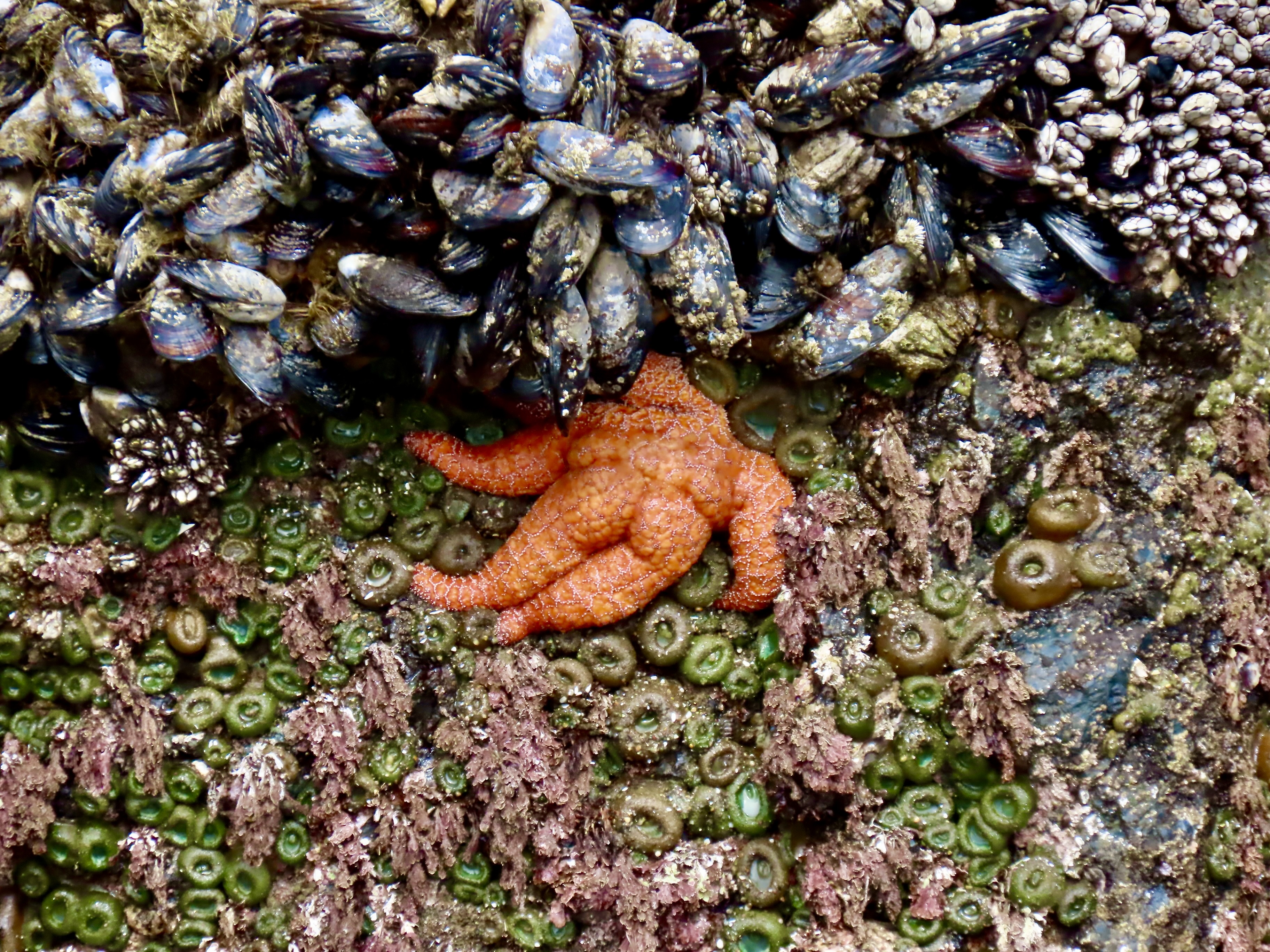
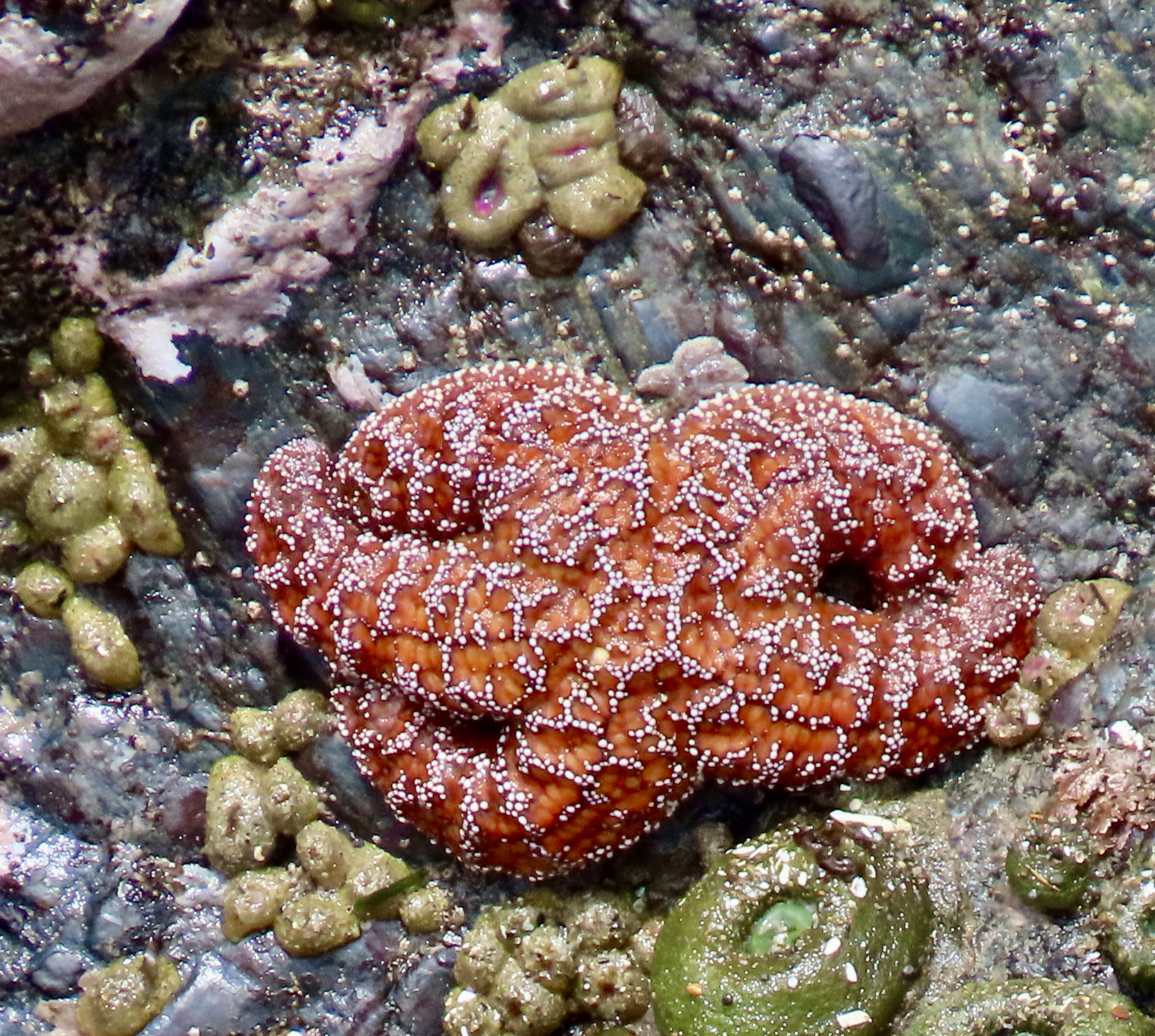
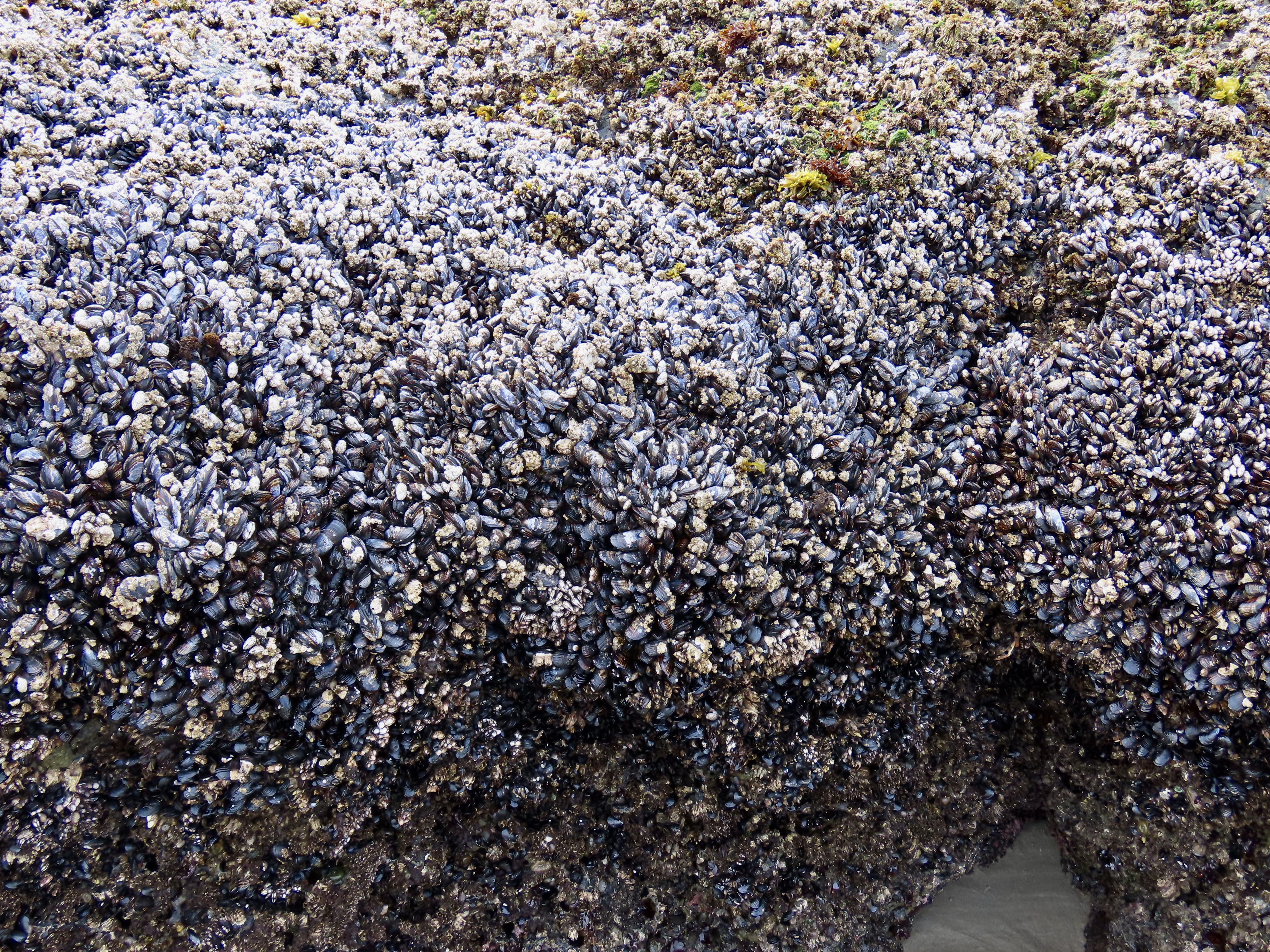
“Curt, you have to see this,” Peggy called, tearing me away from taking a photo of 3452 mussels. It was a human shaped sea star nestled in among anemones, mussels, and goose neck barnacles. There was no doubt about it. She had found the Star of Devil’s Kitchen!
Peggy and I love to futz around in tide pools. There are always amazing things to see and unending drama. It’s a who eats who world. So far on our trip up the coast we had missed the opportunity. We were feeling deprived. Low tides had either been too early or too late. Bandon’s was perfect. We headed out to Devil’s Kitchen, a spot we had visited before. I had forgotten how the area got its name and did a search. Lo and behold, Google sent me straight to an earlier blog of mine. So I am going to quote the ‘expert,’ me: “It has to do with the cold waters of the ocean bringing a rich brew of nutrients to the surface that are eaten by plankton, that are eaten by small fish, that are eaten by bigger fish, that are eaten by still bigger fish, that are eaten by seals, sea lions, otters, and a whole host of seabirds, not to mention people and anything else that can sink their teeth into them.” Welcome to the feast.
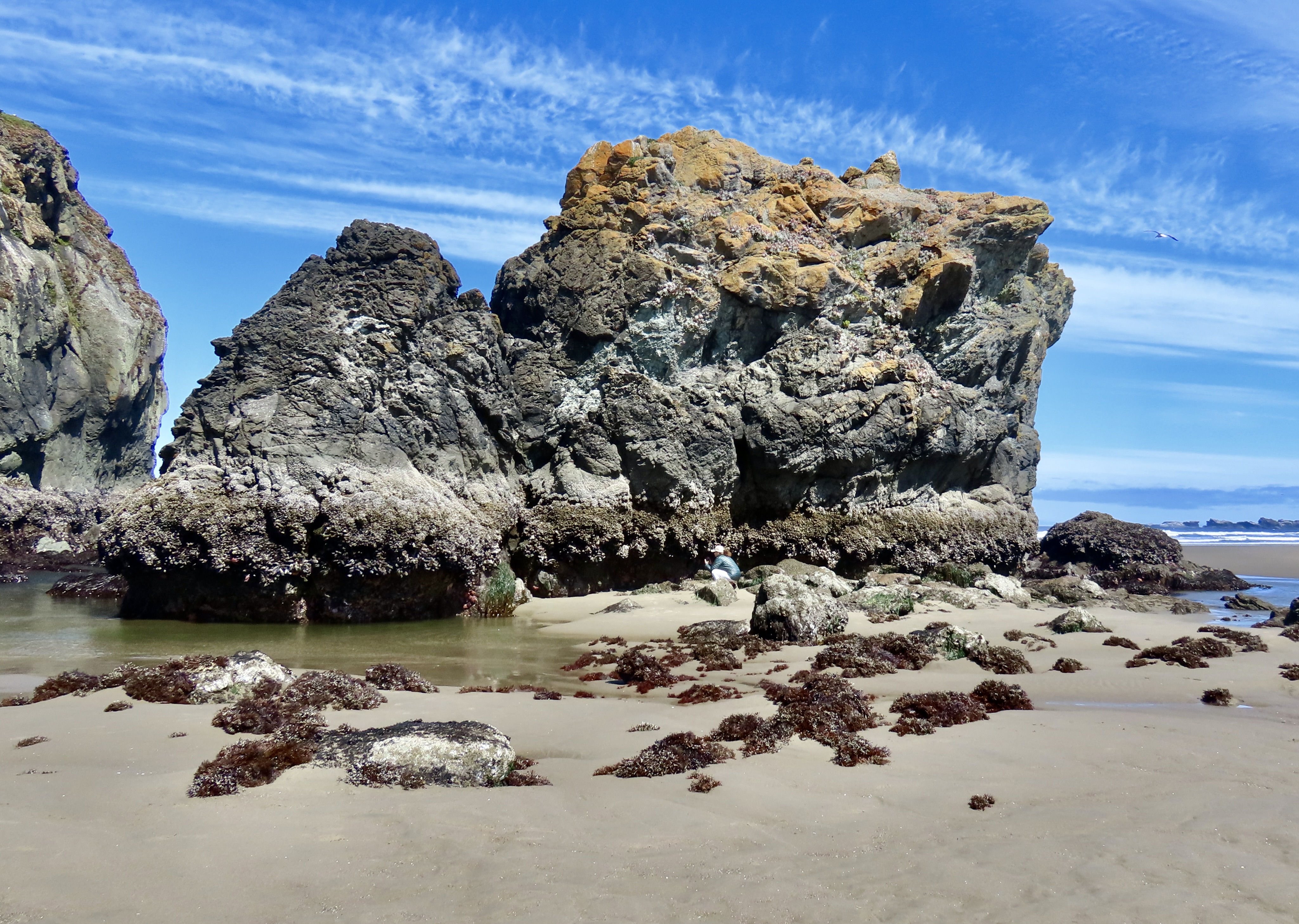
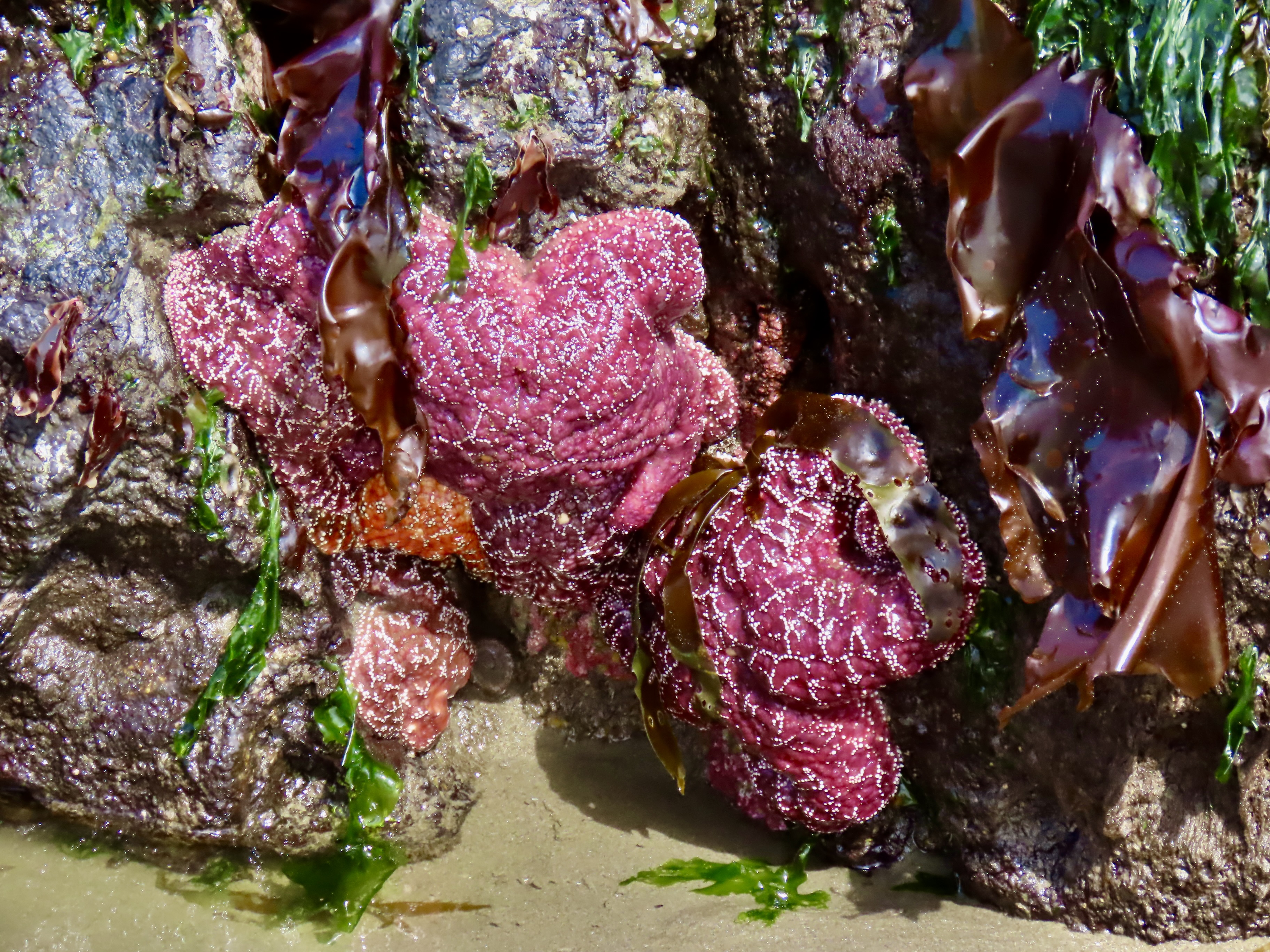
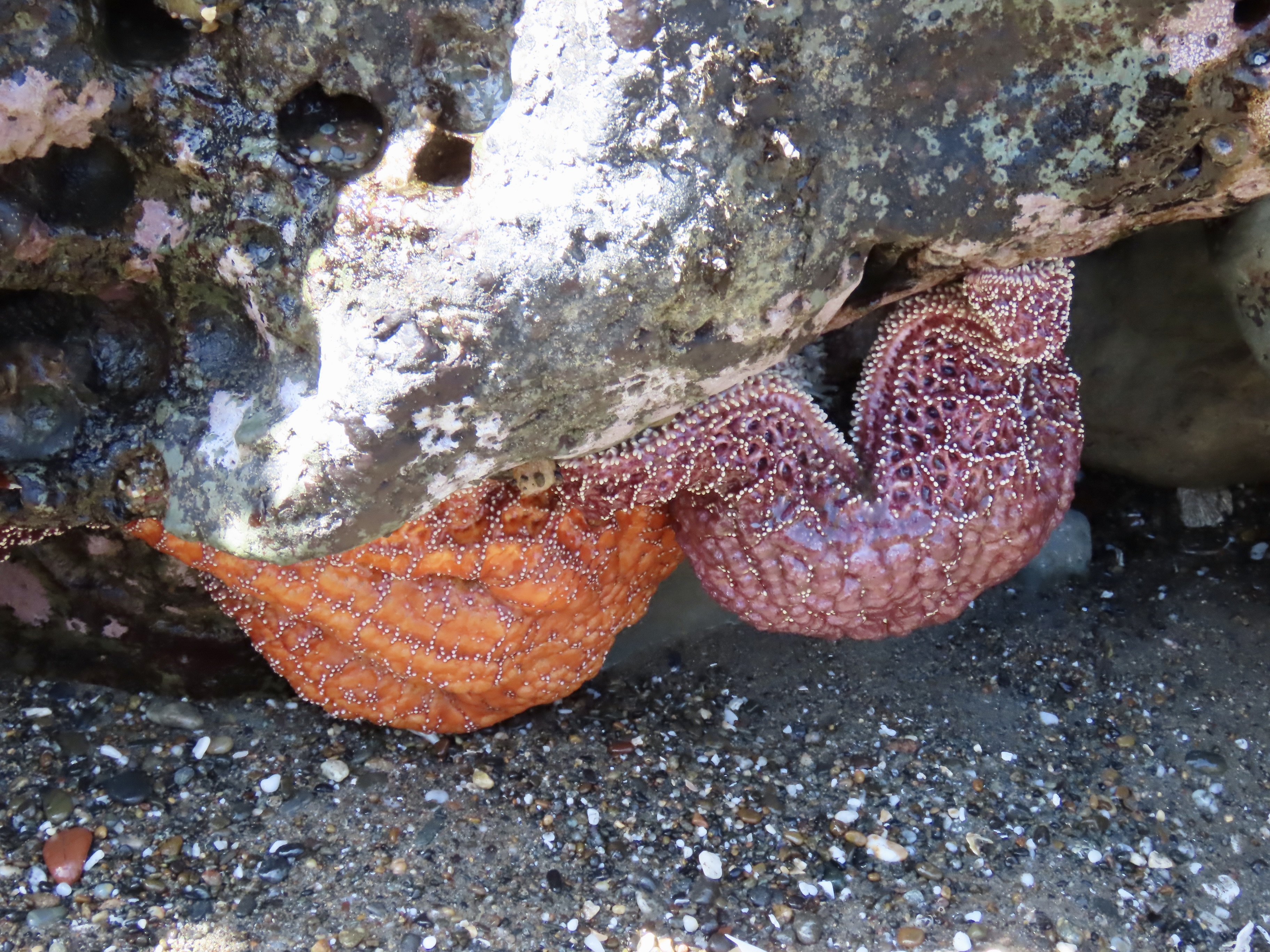
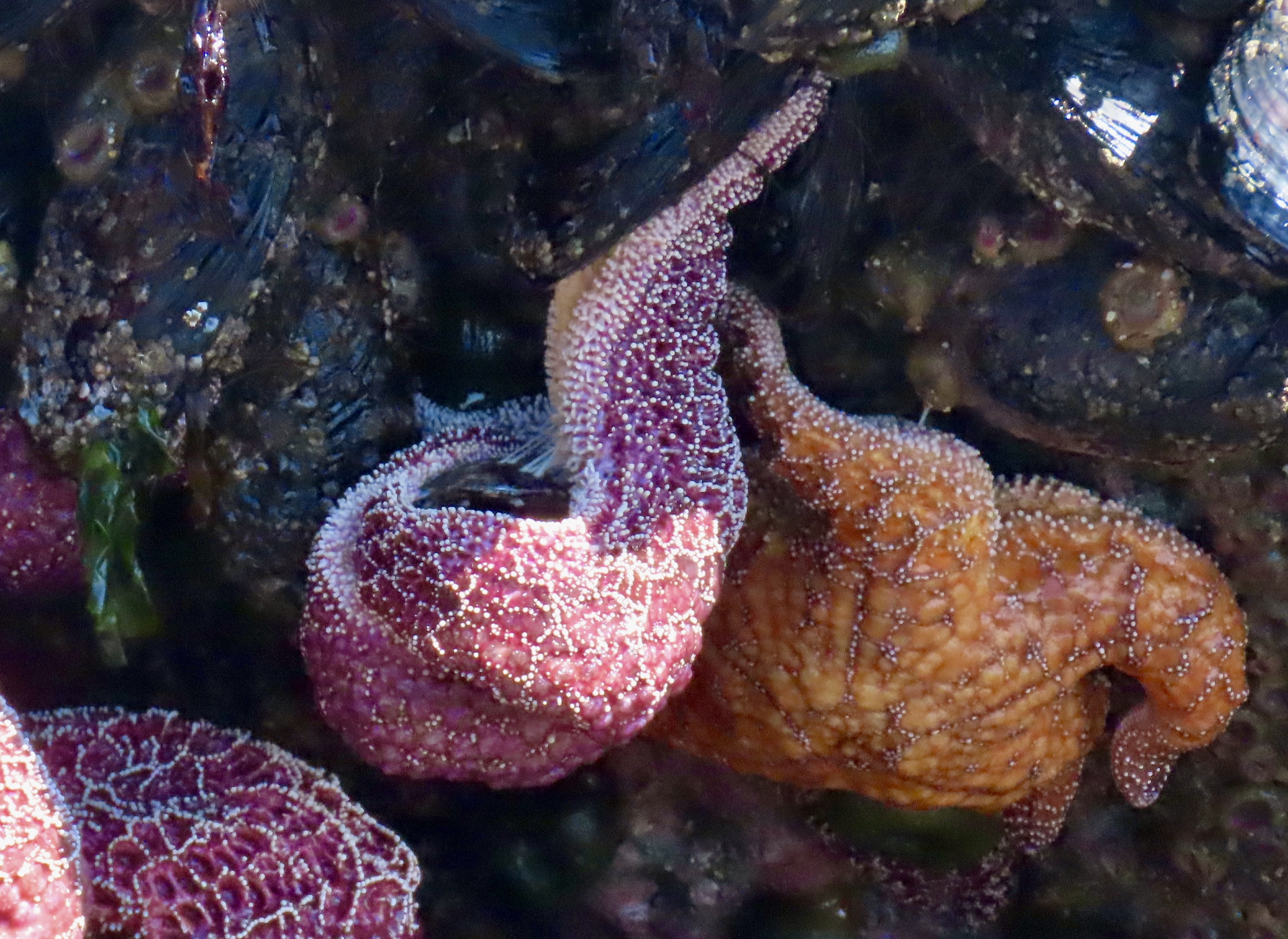
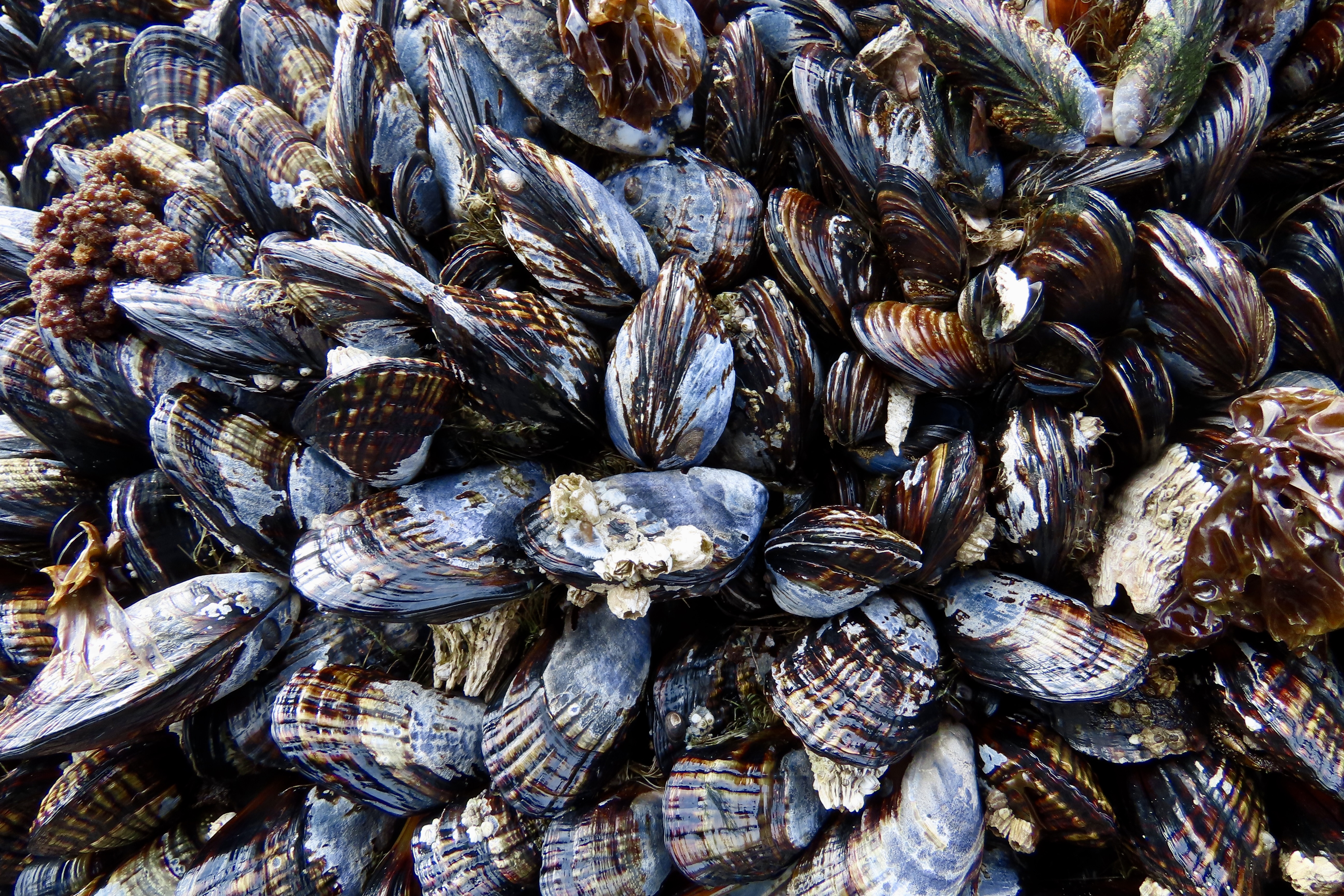
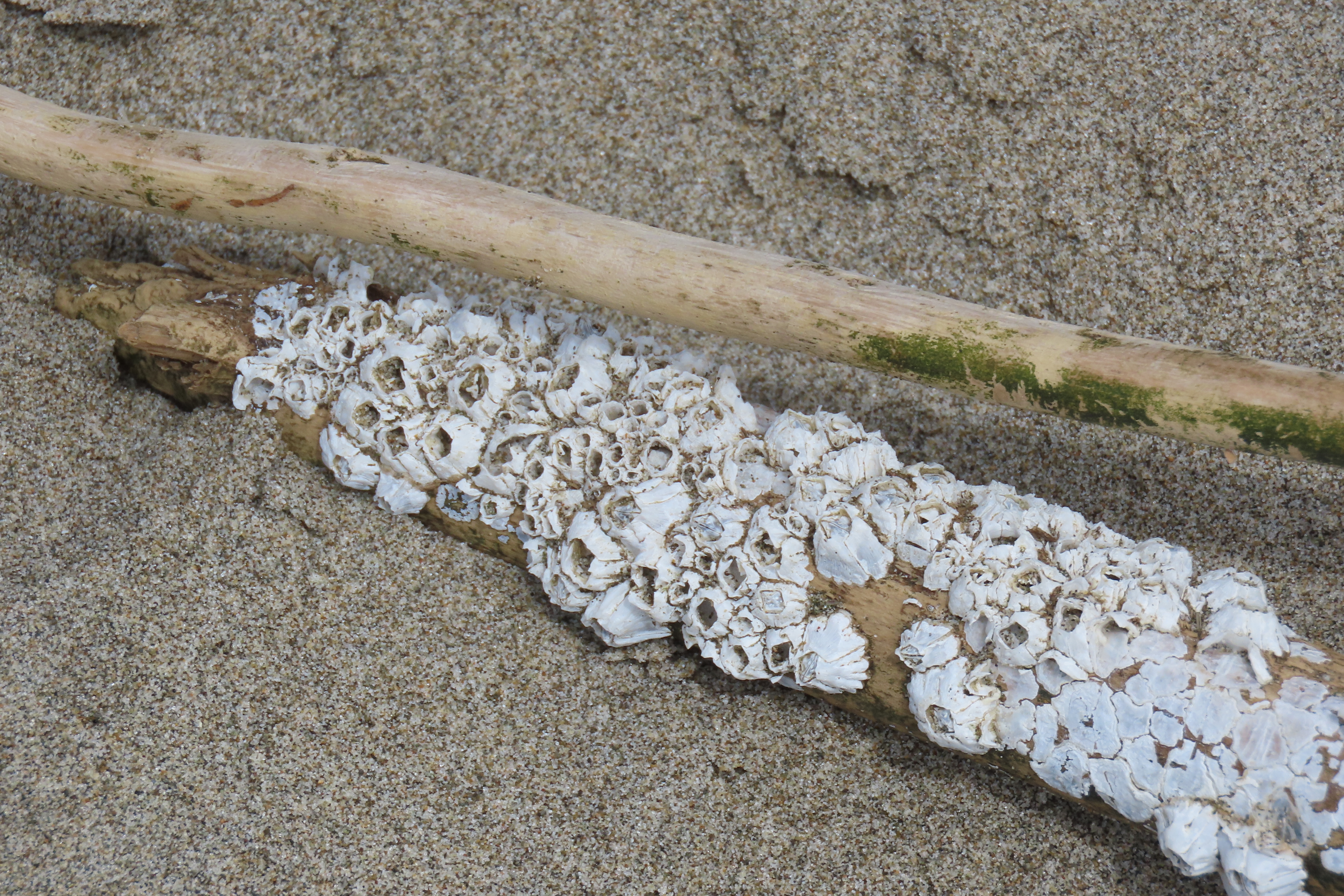
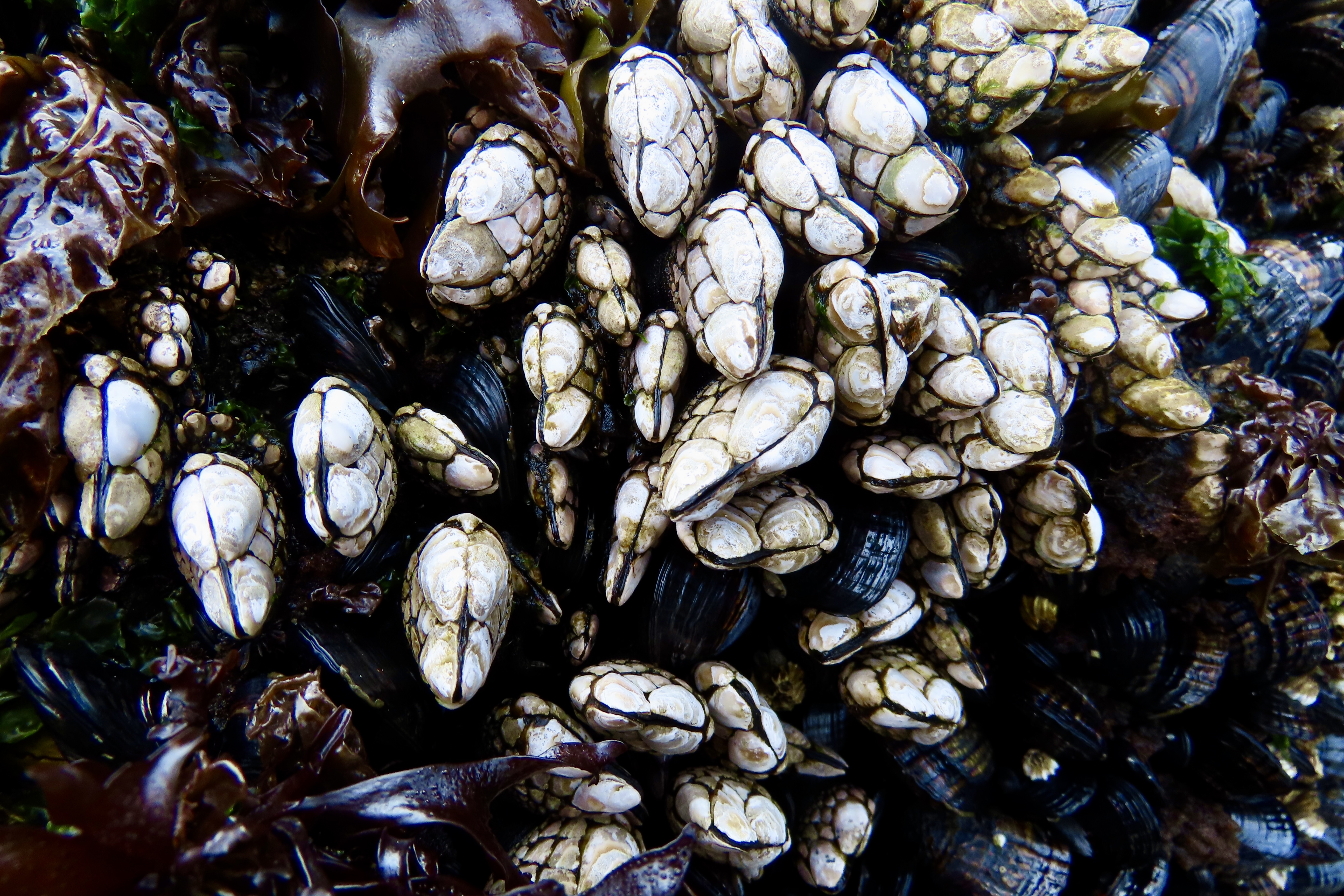
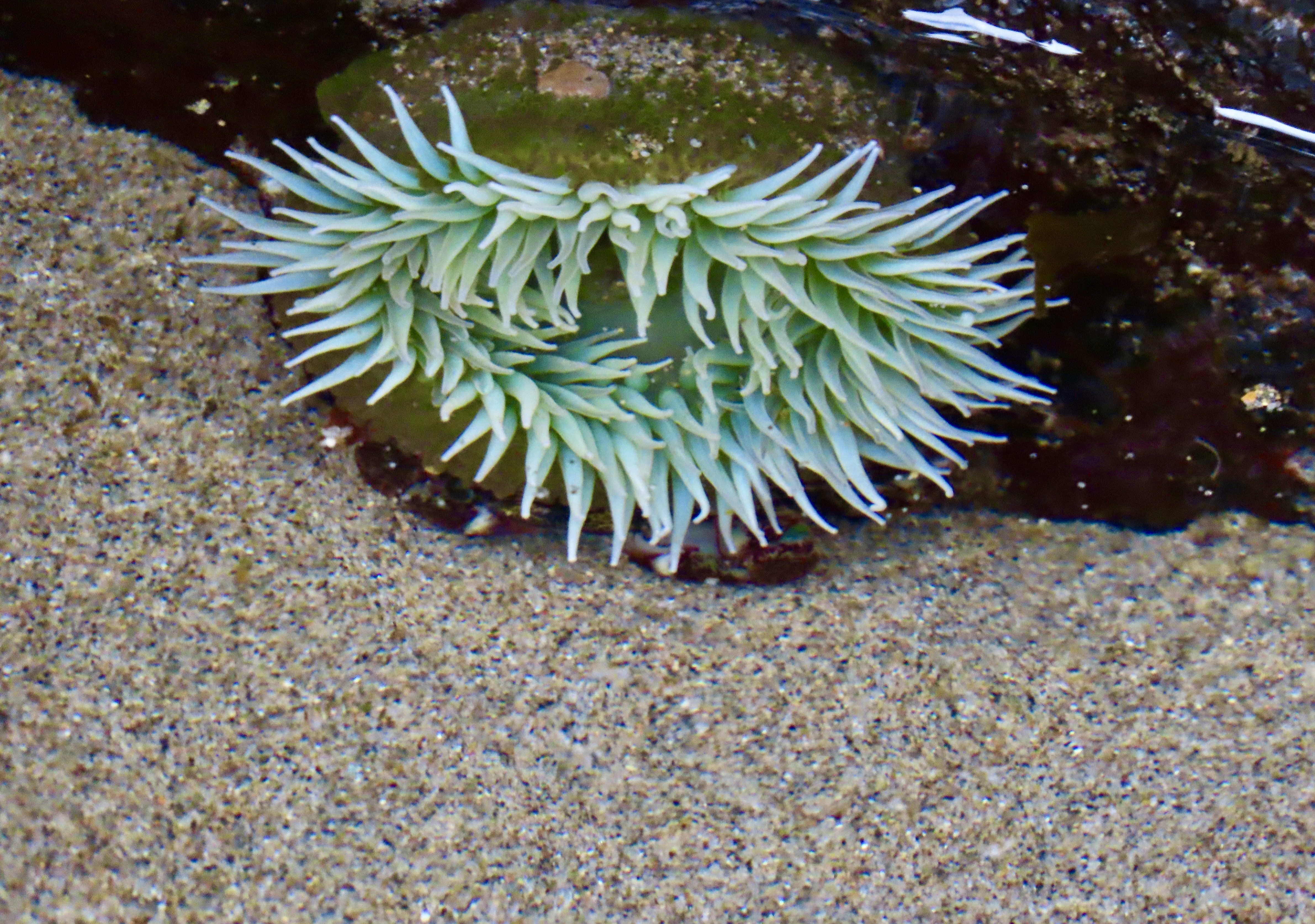
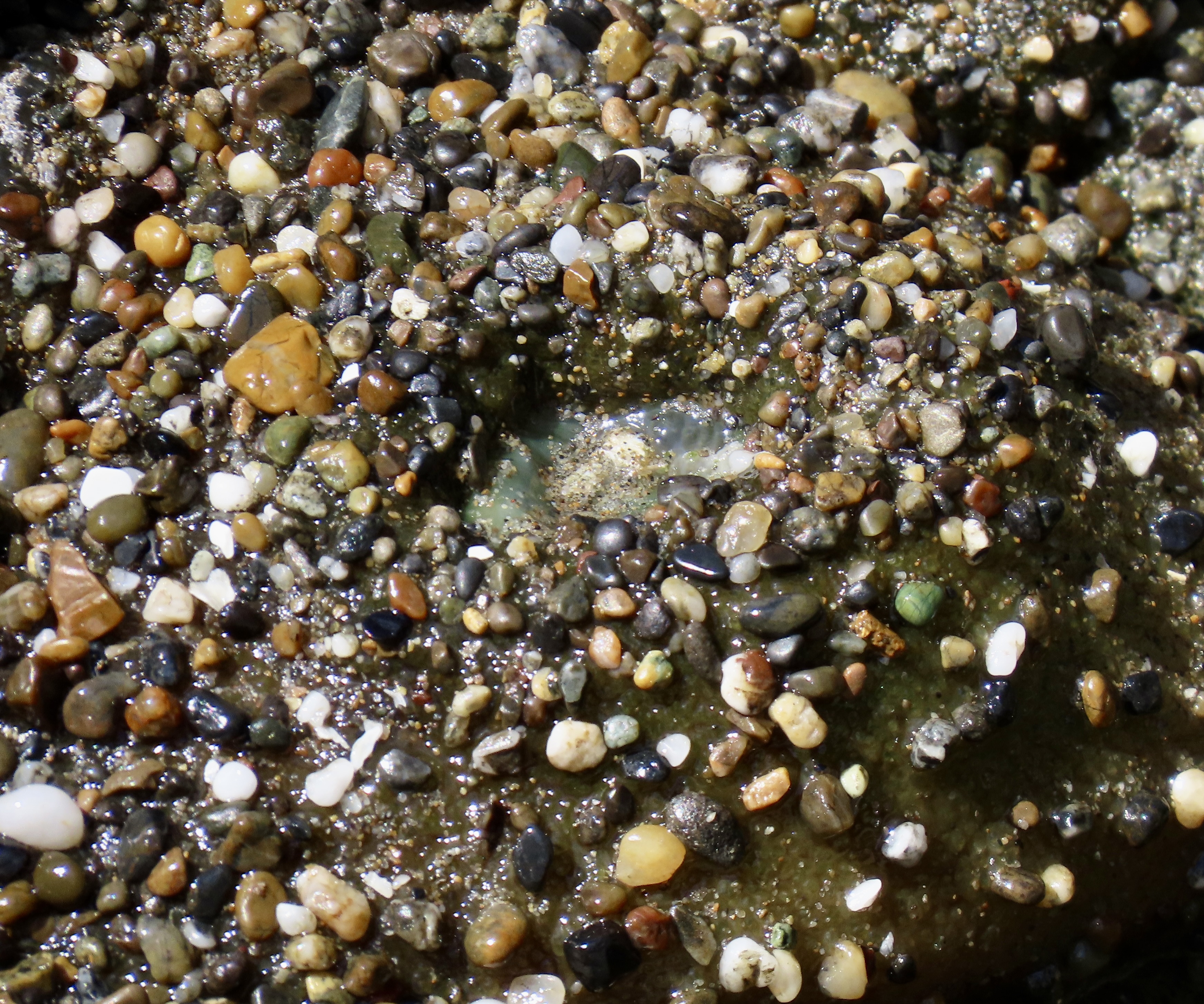
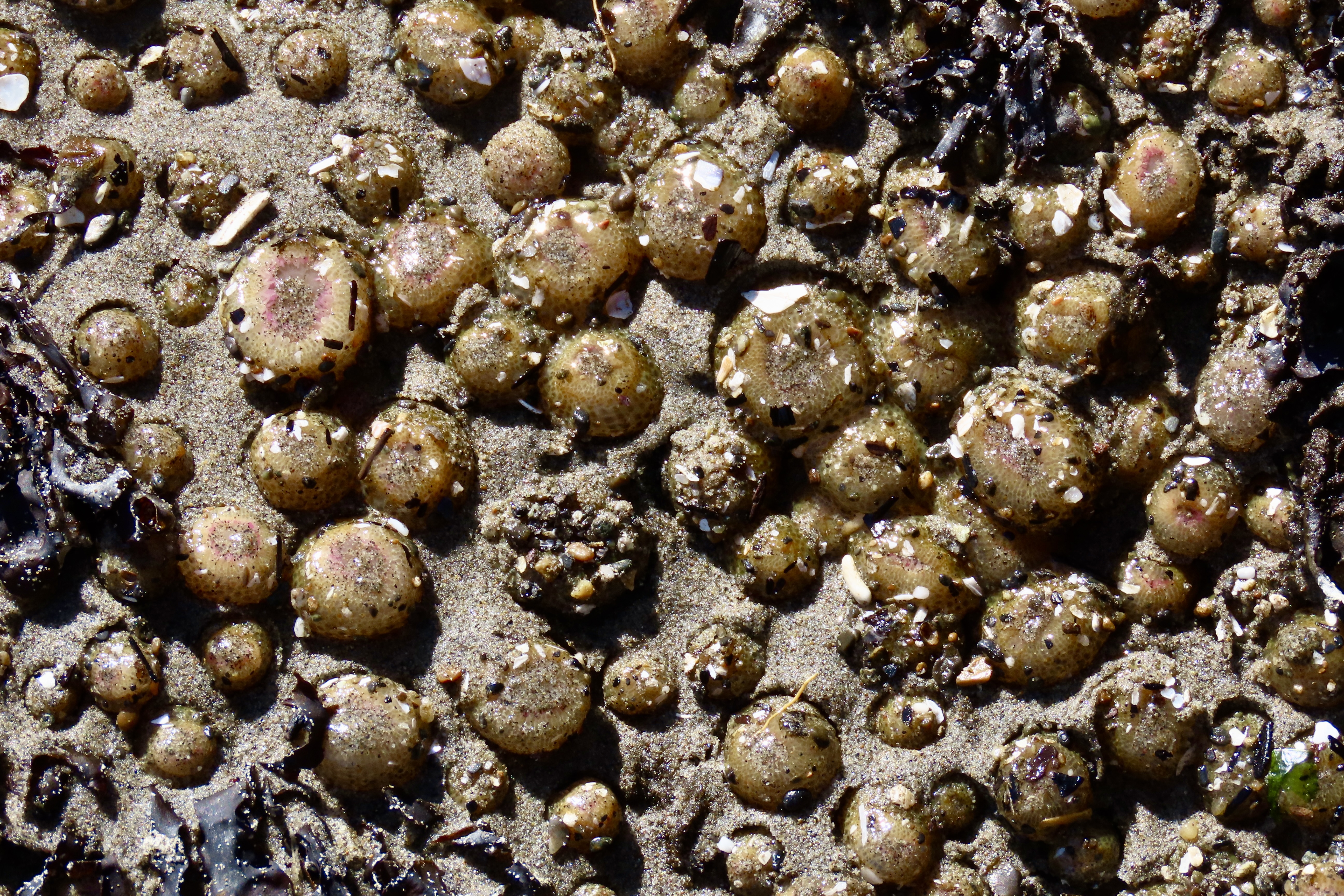
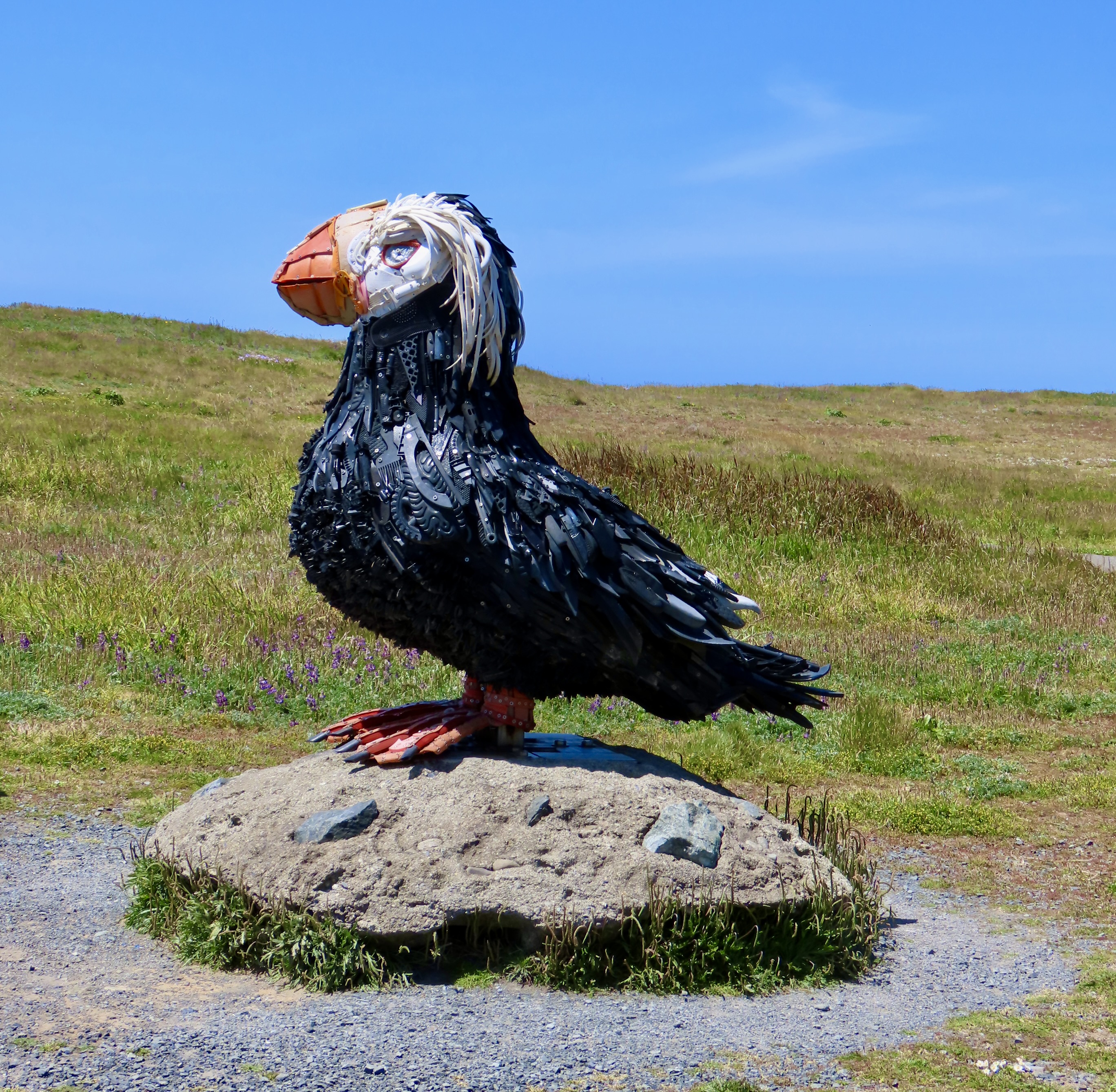
This large sea stack was our goal. Look close and you can see Peggy checking out sea stars. People usually call them star fish, but, as my guide to Pacific Coast Tide Pools notes: They are not fish. They are echinoderms. Others include sea urchins and sand dollars.She was was taking a photo to show the abundance of sea life that lives between low and high tides when she spotted the Star.There were no lack of sea stars to be found at the base of the sea stack!While there are several types of sea stars, the most common are ochre sea stars that come in colors ranging from purplish to orange. Living up to their ‘most common’ designation, they are what we found at Devil’s Kitchen.Sea stars come with five arms. Its eyes, which sense light and dark, are located on the tips of its arms. The light colored spot close to the very top is where the star pulls in water to operate its vascular system that pretty much runs everything.One of which is its hundreds to thousands of little tube ‘feet.’ Here it has attached them to a mussel, its favorite food, in hopes of prying the two half shells apart with its arms. It isn’t easy, given that mussels don’t like to be eaten and can close their shells really tight. It may take hours. When the sea star succeeds, it extends its stomach inside out through its mouth into the opening where it digests the mussel and then pulls its stomach back in through its mouth. Dinner.Another example. You can see the tube feet extended here, pulling on the shell. Once the feet are stuck to the surface of the shell, they remain stuck. A sea star will eat around 40 mussels a year.They are not an endangered species…Whatever the creature is down on the left hand corner, it seems to be sliming a mussel. The mussel in the middle is hosting several barnacles. Home sweet home.A large acorn barnacle dominates this photo. The tide is out and its door is closed to seal water in to protect it from drying out until the tide comes back in. Then it throws open its door and six pairs of feathery appendages pop out and start waving around to gather food. Barnacles attach to almost any convenient surface including rocks, mussels, wharves, and ships. And it seems, sticks. The strong cement they use will still be holding the barnacle in place long after it has died.These are goose neck barnacles so named because early Europeans thought they looked like geese. Modern day Europeans regard them as a delicacy, a plate full can cost upward to 100 Euros, over 100 hundred dollars in the US. They were generously found throughout the mussels. I couldn’t help but wonder how many thousands of dollars worth. It was illegal to gather them at the park, however.This is a giant green sea anemone. It is a cnidarian, meaning it has stinging tentacles, like jelly fish and corals. Small creatures beware! Paralyzed by the stingers, the prey is swept into the anemones mouth which is located in the middle of the tentacles. The mouth comes with a two-for-one. it also serves as the anus. Hmmm. Peggy noted another interesting thing about the anemone. A crab was hiding under it! Note the distinctive colorful legs that are tucked in. When Peggy first spotted the legs sticking out, she thought “big spider” and aimed the camera. Of course, they disappeared!Some sea anemones had covered themselves in small rocks…A close up. Note how tight it has shut down its opening to protect it from drying out.These little fellows are aggregating anemones. Basically, they are exact copies of each other. They stretch out until they split in half creating two anemones which then also split forming large colonies. The colony continues to grow until it runs out of food or space. Or until it runs into another colony. Then they go to war with specialized tentacles full of nematocysts (stingers). To avoid conflict, they sometimes declare a neutral zone! That’s it for today. Next post: We will focus in on some of Brandon’s unique art.This puffin was created from trash gathered off of the local beaches.
I’ve yet to experience a tide pool like these — what a rich environment! I laughed at that first sea star that Peggy found. Human-shaped, indeed, with a good bit of junk in the trunk!
The trashy puffin is neat. There’s a shark made from trash down at the Artist Boat on Galveston Island. I think I remember that the trash came from Oregon beaches; I’ll have to check the next time I’m down there. Apparently there’s a nation-wide project to create such art, as a way of educating about the need to eliminate the trash before it ends up as art.
Hi Curt and Peggy… yeah I’ve gone missing at my blog. Looks like you’ve been in or near my neighborhood. If you’re still near Bandon, might I suggest a stop at https://www.reupit.art/ On 101 just south of Bandon.
It’s a new endeavor by the same lady who did the washed ashore project (MANY years ago)… she has upgraded to using stuff from landfills and she has a absolutely MARVELOUS Phoenix made from the most amazing collection of trash…… (getting it before it reaches the beaches).
I would highly a stop there if you can.
It’s so good to see the sea stars recovering. We thought they had all died off from some wasting disease. We haven’t been doing tide pool lately, so I’m encouraged to think they are making a return.
By the way….. IF I can work up the ambition perhaps I’ll make an exception and put together a post about the Phoenix rising from the trash pile……. it’s a very impressive work of Art. (Angela the original creator of the Washed Ashore project and the Puffin is a whole lot of fun to visit.)
Wow, I certainly would have, Gunta, but we had already travelled on. We are near Tillamook now. Please do the Phoenix. I’d love to see it. Thanks. And you have been missed.
I do miss posts now. There just isn’t time to read blogs every day. Every few days I play catch up.
Tide pools can entertain us for hours, can’t they? I enjoyed the photos, Curt, and the little biology lessons too. I didn’t know about the aggregating anemones that “stretch out until they split in half.” Wow. When I started scuba diving, I had the strong sensation that I was on a totally different planet. And I was! Great post, my friend.
Thanks, D. And I like your description. It definitely feels like one has entered a different world, maybe even universe. We usually hang out until the incoming tide chases us out. 🤪
Running from the rising tide is part of the fun too. 🙂
Yes it is. Laughing. I actually got caught once I was so engaged.
Looks like a terrific tide pool excursion. It’s very encouraging to see so many sea stars. At one point it looked like they’d all be wiped out by sea star wasting disease. Perhaps there’s hope…
From what I have read, Dave, they bounced back fairly well once their numbers were so few there wasn’t anyone around to pass the disease on to. I remember being out a few years ago when it was at its height.
” it extends its stomach inside out through its mouth into the opening where it digests the mussel and then pulls its stomach back in through its mouth.” This functionality is new information for me and it’s horrifying in the most wonderful and fascinating way! It brings to mind creatures from the Lord of the Rings! The gooseneck barnacles always look like dragon scales to me. ….maybe I’m just in a medieval fantasy frame of mind most of the time, ha ha.
All that about aggregating anemones was new to me also. What a great post, Curt.
Wow, eureka found with those starfish, muscles, anemone’s and giant green sea anemone, Curt with such a plethora of education. Nature is so fascinating in how it survives, protects itself and learns how to adapt. I can’t imagine for the life of me how the SF gets the muscle open unless it has steam coming from it’s stomach or a switch blade. Those are near impossible to open and the work to eat just one. However it turns it’s stomach out to eat it.. mine is turning upside down just hearing it. ha.
Looking forward to the art but now we just arrive in Ashland! Such a beautiful ride with a pit stop at Dunsmuir and Shasta.. Sooooo wonderful!!!💗
Nature is both wondrous and mysterious, Cindy. Endlessly fascinating. Did the weather cooperate and give you a good view of Mt. Shasta on your way up. Should still be snow covered. One of the most beautiful mountains in the world! I climbed it once.
Enjoy Ashland. Also make a trip over to Jacksonville. Always worth a visit. Go up the hill and you will be in the beautiful Applegate Vallet.




 Wandering through Time and Place
Your photos continue to be fabulous!
Thanks, John. And I must add that Peggy is making very good use of the new camera I bought her, exactly like mine, when we got back from Africa.
I’ve yet to experience a tide pool like these — what a rich environment! I laughed at that first sea star that Peggy found. Human-shaped, indeed, with a good bit of junk in the trunk!
The trashy puffin is neat. There’s a shark made from trash down at the Artist Boat on Galveston Island. I think I remember that the trash came from Oregon beaches; I’ll have to check the next time I’m down there. Apparently there’s a nation-wide project to create such art, as a way of educating about the need to eliminate the trash before it ends up as art.
Laughing. Lots of junk.
The same people might have done the work. I know their art was shipped nation, even worldwide.
Love the pictures! The puffin is really remarkable! And…your sky was perfect!
Thanks, Wendy. A fish will join the puffin in my next post, plus some fantastic sand art.
Hi Curt and Peggy… yeah I’ve gone missing at my blog. Looks like you’ve been in or near my neighborhood. If you’re still near Bandon, might I suggest a stop at https://www.reupit.art/ On 101 just south of Bandon.
It’s a new endeavor by the same lady who did the washed ashore project (MANY years ago)… she has upgraded to using stuff from landfills and she has a absolutely MARVELOUS Phoenix made from the most amazing collection of trash…… (getting it before it reaches the beaches).
I would highly a stop there if you can.
It’s so good to see the sea stars recovering. We thought they had all died off from some wasting disease. We haven’t been doing tide pool lately, so I’m encouraged to think they are making a return.
By the way….. IF I can work up the ambition perhaps I’ll make an exception and put together a post about the Phoenix rising from the trash pile……. it’s a very impressive work of Art. (Angela the original creator of the Washed Ashore project and the Puffin is a whole lot of fun to visit.)
Wow, I certainly would have, Gunta, but we had already travelled on. We are near Tillamook now. Please do the Phoenix. I’d love to see it. Thanks. And you have been missed.
I do miss posts now. There just isn’t time to read blogs every day. Every few days I play catch up.
Wow, I learned a lot about life in the tide pool from this post! Thanks for your beautiful images and facts. I love that puffin!
Thanks. Appreciated! The puffin will be back, along with a trash fish.
The creatures of your tide pools are certainly more colorful than those I’ve ever seen! Good to know that garbage went to good use for the puffin!
The amount of life crammed in is mind-blowing, G. More garbage put to good use coming up! 😄
Tide pools are filled with wonder. The puffin is a magnificent use of trash.
Indeed, Peggy. There was also a trash fish. I’ll provided some close ups in my next post.
Wow, there’s a totally new world out there.. lovely💜
And one well worth exploring, Christie. Thanks.
Tide pools can entertain us for hours, can’t they? I enjoyed the photos, Curt, and the little biology lessons too. I didn’t know about the aggregating anemones that “stretch out until they split in half.” Wow. When I started scuba diving, I had the strong sensation that I was on a totally different planet. And I was! Great post, my friend.
Thanks, D. And I like your description. It definitely feels like one has entered a different world, maybe even universe. We usually hang out until the incoming tide chases us out. 🤪
Running from the rising tide is part of the fun too. 🙂
Yes it is. Laughing. I actually got caught once I was so engaged.
Looks like a terrific tide pool excursion. It’s very encouraging to see so many sea stars. At one point it looked like they’d all be wiped out by sea star wasting disease. Perhaps there’s hope…
From what I have read, Dave, they bounced back fairly well once their numbers were so few there wasn’t anyone around to pass the disease on to. I remember being out a few years ago when it was at its height.
” it extends its stomach inside out through its mouth into the opening where it digests the mussel and then pulls its stomach back in through its mouth.” This functionality is new information for me and it’s horrifying in the most wonderful and fascinating way! It brings to mind creatures from the Lord of the Rings! The gooseneck barnacles always look like dragon scales to me. ….maybe I’m just in a medieval fantasy frame of mind most of the time, ha ha.
All that about aggregating anemones was new to me also. What a great post, Curt.
Just “maybe,” Crystal?
Imagine if we had to eat the same way a sea star does? Certainly save on silverware to wash. LOL
Thanks!
ok, maybe more than maybe
I too love tide pools, but had no idea there was so much going on! Thanks for the nature lesson!
Alison
And I just touched on a small part of it, Alison!
Wow, eureka found with those starfish, muscles, anemone’s and giant green sea anemone, Curt with such a plethora of education. Nature is so fascinating in how it survives, protects itself and learns how to adapt. I can’t imagine for the life of me how the SF gets the muscle open unless it has steam coming from it’s stomach or a switch blade. Those are near impossible to open and the work to eat just one. However it turns it’s stomach out to eat it.. mine is turning upside down just hearing it. ha.
Looking forward to the art but now we just arrive in Ashland! Such a beautiful ride with a pit stop at Dunsmuir and Shasta.. Sooooo wonderful!!!💗
Nature is both wondrous and mysterious, Cindy. Endlessly fascinating. Did the weather cooperate and give you a good view of Mt. Shasta on your way up. Should still be snow covered. One of the most beautiful mountains in the world! I climbed it once.
Enjoy Ashland. Also make a trip over to Jacksonville. Always worth a visit. Go up the hill and you will be in the beautiful Applegate Vallet.
Orange
Orange it is. Grin.