Hiring the Family Pets to Scare Away the Ghosts…

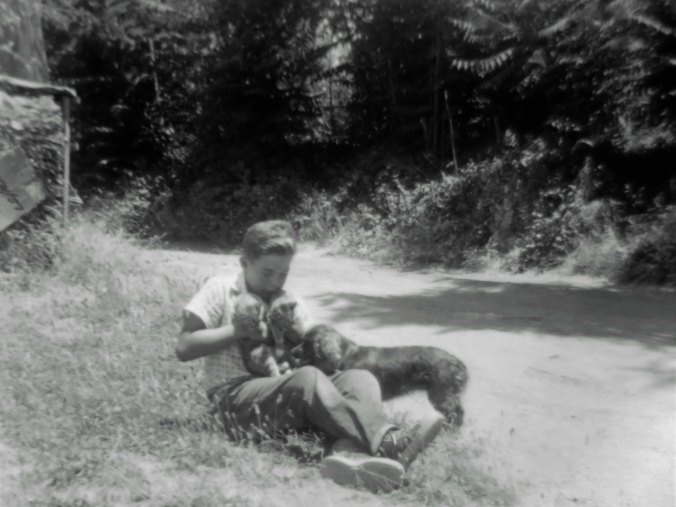
Curt Mekemson and pets

The Graveyard was just across the alley from our house. As usual, I am occupied with some of the our family pets.


Each summer I slept in our back yard. I would move out as soon as school was over and stay until school started, or longer if parents and weather permitted. At first I slept on the ground in a cheap cotton sleeping bag. The ground was hard, the nights cool, and the mosquitoes persistent, but these were minor drawbacks. I was free. If I had to pee, I’d climb out of bed and find the nearest bush. If I woke up thirsty, a convenient garden hose provided water. I would go to sleep watching the stars and listening to a giant bullfrog croak away in the ditch in front of our house. I would wake to cool morning air and chirping robins.

Life was good. And then it got better. The grandparents bought me a real bed— a wood framed, steel spring army cot complete with mattress.
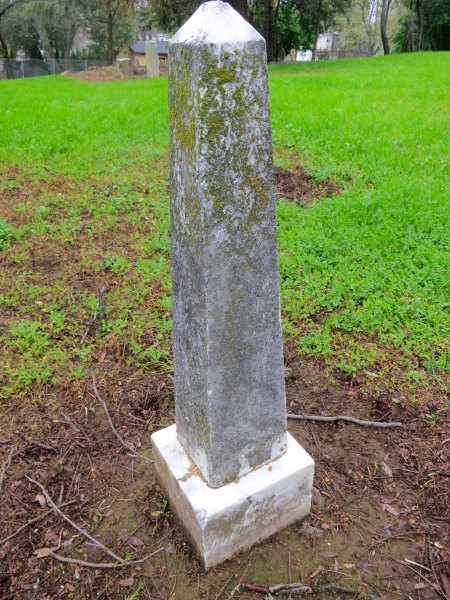
Graveyard ghost

The thing about graveyards is that dead people are buried there. This seemingly innocent tombstone was once hidden among the heavenly trees that turned the Graveyard into a jungle. Except it wasn’t totally hidden. I could see it from our backyard at night. It was, um, ghostly.

My paradise was marred by one thing, the Graveyard. It was always there on the edge of my sight.  White tombstones glared at me. As hard as I would pretend, the cemetery and its frightful inhabitants would not go away. So, I developed an elaborate set of defenses. The simplest was to sleep facing the opposite direction or to hide under the covers, ostrich like. A more sophisticated approach was to locate the bed where I couldn’t see the Graveyard.  Our seasoned cars worked in a pinch, but they weren’t large enough. Bits and pieces of the Graveyard would creep around their sides, peek over their tops and slink under their bottoms. A trellis built by my father was much better. Its luxurious growth of honeysuckle created the perfect Graveyard screen. I set up a permanent residence behind it.
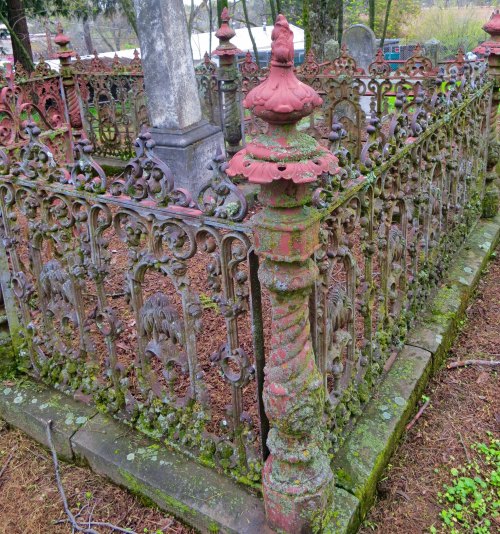
House next to graveyard

These were more tombstones I could see from our house, whose roof can be seen in the back of the photo.

But even the trellis wasn’t enough to calm my imagination. I decided to hire protection. It came in the form of various family pets. Their job was to chase the ghosts away. Payment was made by allowing them to sleep on my bed. Apparently, the scheme worked. At least no ghosts attacked me during the years I slept outside.

The downside was I didn’t have much room. Two dogs, three cats, and me on a one-person army cot constituted a menagerie, or a zoo, if you counted the fleas. It was difficult to move. At first, I was very careful not to disturb my sleeping companions. I became a circus contortionist frozen in place with body parts pointed in every direction. If this meant a restless night, so be it. It was a small price to pay for keeping the ghosts at bay.

Gradually, my attitude changed. I grew larger, the bed space shrank, and animals started sleeping on top of me. Meanwhile, the ghosts, who tend to hassle little people more than they do big people, became less a threat. Therefore, I needed less protection. Neither of these factors led to the final banning of the animal kingdom, however. It was the shameless shenanigans of Demon and Pat.

Demon, the alpha family cat, was as black as the darkest night. As such, she was appropriately named and attired for graveyard duty. In fact, she spent a good deal of her life there stalking mice, lizards, birds and anything else she could get her claws into with impunity. Captured prey would then be brought home for approval. My job was to dispose of the half-eaten carcasses. Depopulating the Graveyard was not Demon’s claim to fame, however; motherhood was. She had kittens often and everywhere. I suspect that half of the cats living in El Dorado County today can trace their lineage back to her.

Two instances of kitten production bring back vivid memories. The first took place on the living room floor. Demon was a young cat at that time and a neophyte at motherhood. Her impending delivery was quite apparent from her large belly and ceaseless exploration of clothes hampers, cupboards and other dark places.

With high hopes of avoiding a misplaced litter of kittens, Mother arranged her bedroom closet as a maternity ward. Several times each day it was my duty to show Demon her new home. I would carefully pick up the very pregnant cat, carry her to the closet, and deposit her in a box filled with well-used clothes. Demon didn’t buy the program.  It seems my bedside manner was faulty. She would climb out of the box, give me a glare, and stalk out of the bedroom.

When the joyous day finally arrived, I was home alone.  Demon was practicing her would-be mother waddle walk across the living room when she suddenly stopped, squawked and squatted. Neither she nor I was ready for what followed. After all, how prepared can a young kid and a first-time mother be for birth? In a massive surprise to both of us, a tiny black bundle of fur emerged from Demon’s undercarriage. Surging emotions paralyzed my seven-year old mind. One thought stood out, the closet! If Demon hadn’t memorized her delivery lessons, I had.

I jumped across the room, grabbed Demon by the nape of the neck, and raced for Mother’s bedroom. As fast as I ran, it wasn’t fast enough. In the middle of the kitchen the new arrival completed its journey and was heading for a crash landing. Somewhere, somehow between Demon and the floor, I caught a warm, wet ball of fur in my free hand. After that, the memory fades. I know the three of us made it to the closet. Demon accepted her new home and four more kittens followed the first, although in a less dramatic way. The population explosion was underway.

We have to fast-forward several years to Demon’s next memorable delivery. This one was outside and led to the bed-pet-ban. But first I need to relay how Pat the Greyhound set the stage. She joined our family as a stray. For weeks, Mother had watched this large, starving dog wander the countryside and survive by catching rabbits and squirrels. One day she stopped the car, opened the door and invited Pat home for a meal.
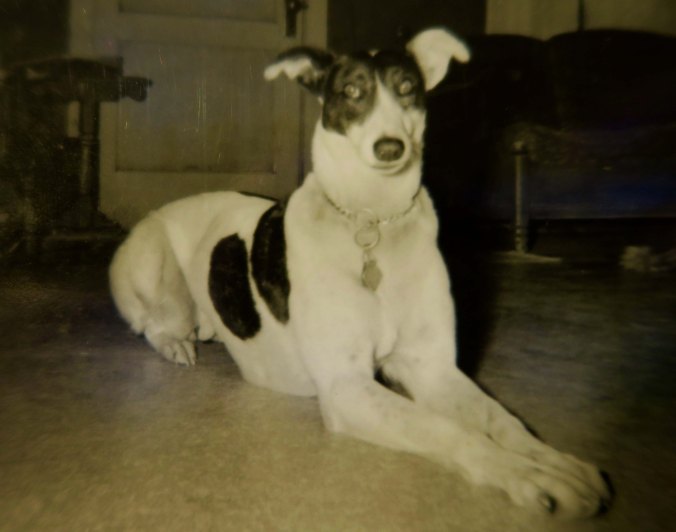
Pat the Greyhound

Pat looking regal.

“Oh, it is just until she gains a little weight,” Mother explained to one very disgruntled Pop. Later it became, “Oh, but it would break Curt’s heart if we had to give her away.” Mother was a master at manipulation. Pat, who I named after the local Greyhound bus driver, had found a home. Like all of our pets, she lived outside. It was Pop’s rule; pets were limited to daytime visitation rights only. The pregnant Demon had been an exception imposed by Mother. Since there were no leash laws, Pat was free to come and go as she pleased. Mainly she chose to hang around with her food dish in sight. For a dog that had lived out in the wild, she had impeccable manners. Thus I was surprised when she joined Demon in abusing her bed rights, but that’s a tale for next Friday’s post…

MONDAY’S POST: It’s back to the central coast of Washington where global warming makes a point

WEDNESDAY’S POST: A photographic essay on Scotland

FRIDAY’S POST: The animal kingdom is banned from my bed

SaveSave

Want a Small House— Think Narrowboat… A Trip on the Trent and Mersey Canal: Part 2

Swan in black and white on Trent and Mersey Canal

Graceful swans share the Trent and Mersey Canal with narrowboats. I decided to render this fellow in black and white to emphasize its feathers and show how swans tuck their wings over their backs.


This is my second post on the Trent and Mersey Canal. My first post took us from Sawley to Burton upon Trent. In today’s post, Peggy and I, along with her sister and brother-in-law, Jane and Jim Hagedorn, visit Burton on Trent and return to Sawley. 


Josiah Wedgewood’s concern about his pottery was a driving force behind the building of the Trent and Mersey Canal in the 1770s. Too many of his fine dishes were being broken when they were transported over the bumpy, rough roads of the time. A canal would provide for smooth sailing, or, at least smooth boating, and every industrialist wanted one to connect his plant with growing markets. For a brief period of time in the early industrial revolution, canals were the in-thing. Hundreds were built throughout England and Europe— as well as in the youthful United States.

Jilly Dee Narrowboat

This painting on the Jilly-Dee narrowboat spoke of earlier times on the canals when manufactured goods were carried on barges towed by horses and mules.

The painting reminded me of Erie Canal in New York state and one of the first songs I learned in elementary school. Here it is:

I’ve got a mule and her name is Sal
Fifteen miles on the Erie Canal
She’s a good old worker and a good old pal
Fifteen miles on the Erie Canal
We hauled some barges in our day
Filled with lumber, coal and hay
We know every inch of the way
From Albany to Buffalo

Low bridge, everybody down
Low bridge, we’re coming to a town
You’ll always know your neighbor
And you’ll always know your pal
If you ever navigated on the Erie Canal.

It was one of my favorite tunes, right up there with Old Dog Tray. I was particularly enamored with the idea of having a mule as a pal.

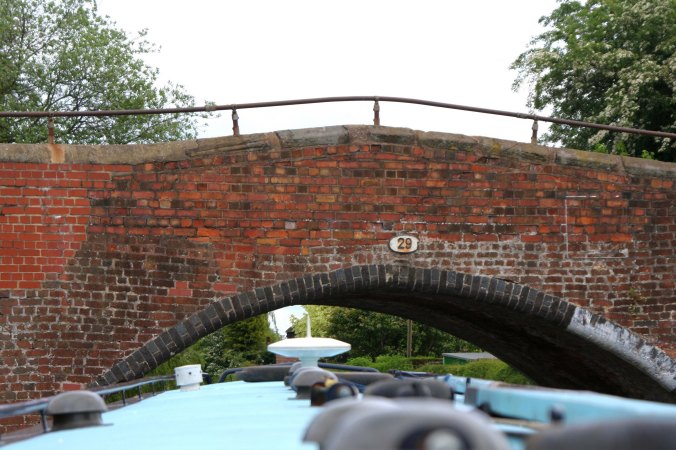
We passed under several low bridges during our trip, but none made us duck. Fortunately, our journey didn’t involve any of the long, low tunnels located on other parts of England’s canal system. I read that the earliest tunnel on the Trent and Mersey Canal was so low that the boatmen would lay down on their backs and push the boat through with their feet, using the top of the tunnel for leverage— for a mile! The mere thought of this sent claustrophobic twinges through my body!

Low Bridge on Trent and Mersey Canal

“Low bridge, everybody down!”

Railroads and modern highways made canals obsolete for transporting goods and would have spelled their doom except for the interest of historians, hobbyists, and the recreational industry starting in the 1950s. Recreation is booming today and numerous people have also discovered that narrowboats can provide the ultimate in an inexpensive, small house lifestyle for those with a gypsy nature. Sounds good to me. Most of these homes are uniquely decorated and come with interesting names like Belly Button, Idunno, and In the Mood. Others, such as Nomad Dreams, Sacagawea, and Gone Roaming, suggested the wandering nature of their owners.

Belly Button narrowboat on Trent and Mersey Canal

Narrowboats that people use for homes are often gaily painted and uniquely named!

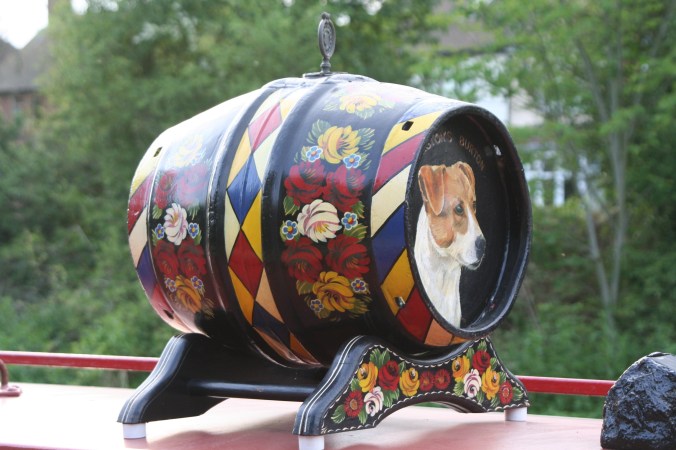
Narrow boat dog on barrel on Trent and Mercy Canal

One of the boats had this painted barrel sitting on top…

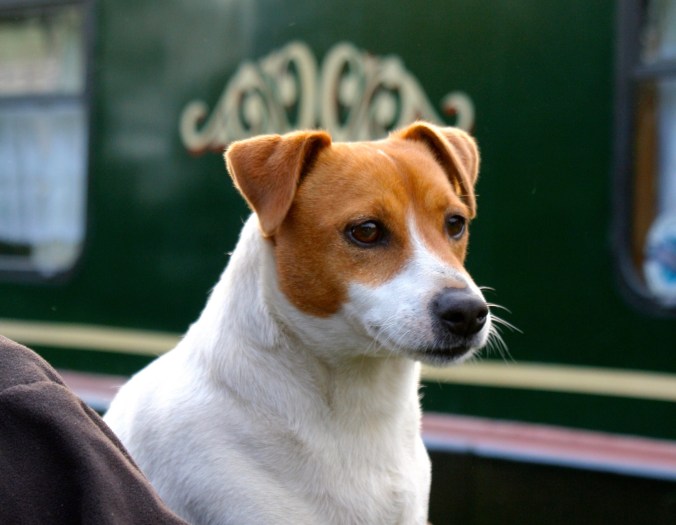
Narrowboat dog on Trent and Mercy Canal

And then we spotted the model!

Peggy, Jim, Jane and I explored Burton upon Trent, spent the night, and then began our journey back on the Trent and Mersey Canal to the Sawley Marina. Once again, we enjoyed the challenge of piloting our 65-foot boat around obstacles and through locks, while appreciating the beauty and peace of the British countryside. Our most exciting moment was when Jim decided to park our boat up on the bank…

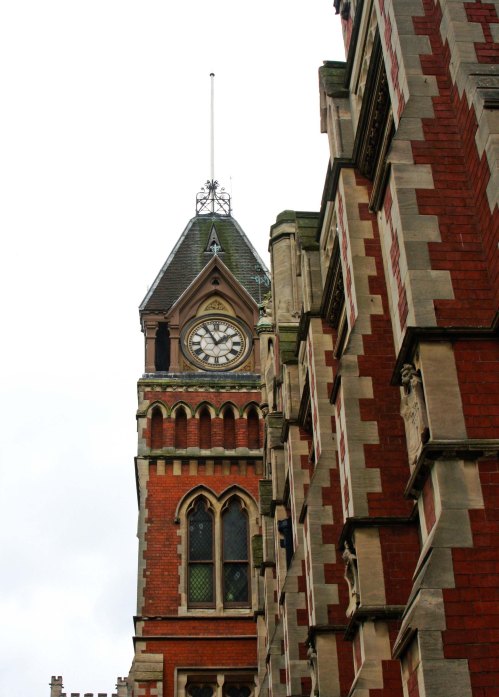
View near St. Pauls in Burton upon Trent

We wandered around admiring buildings in Burton.

Gargoyle on St. Paul's church in Burton on Trent

And found this gargoyle with its tongue sticking out at St. Paul’s Church.

Row houses and chimneys in Burton upon the Trent

Row houses, chimneys and threatening skies provided a photo-op…

Marston's brewery in Burton upon Trent

Marston’s original brewery is located in Burton on Trent and has been a longterm mainstay of the city’s economy. I went onto Marston’s website and found this quote: “No Marston’s, no beer, no beer, no Burton.”

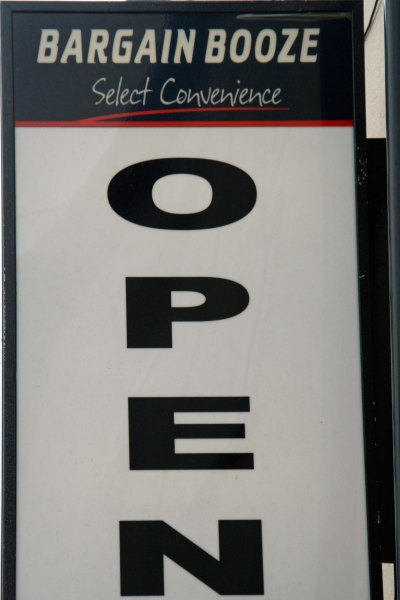
Bargain booze in Burton upon Trent

Of course beer wasn’t the only alcohol available…

Carved kingfisher sculpture with fish in Burton upon Trent

Walking back to the canal, we were reminded by this carved kingfisher of the birds that make the canal their home.

Swan profile on Trent and Mersey Canal

Including swans and their Canadian Geese cousins.

Mallard moves along on Trent and Mersey Canal

A mallard moved along on some important mission…

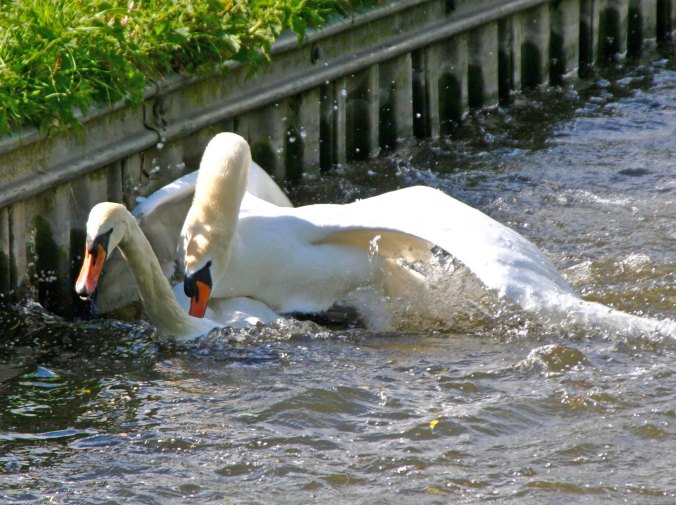
Swans mating on Trent and Mersey Canal

While a pair of swans decided to make babies.

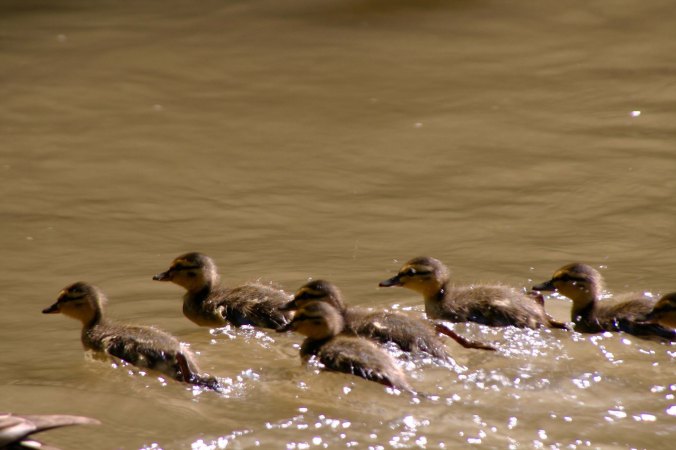
Baby ducks on Trent and Mersey Canal

Of which the mallards had already contributed a substantial number. There was no lack of baby ducks on our trip back…

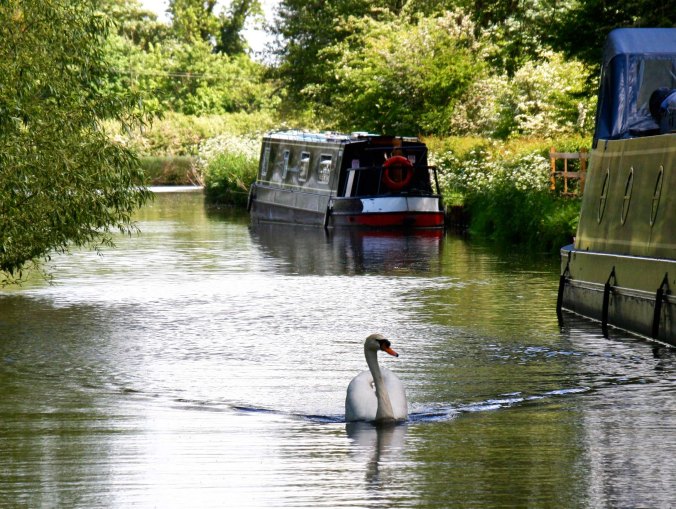
Swan and narrowboats on Trent and Mersey Canal

Or swans.

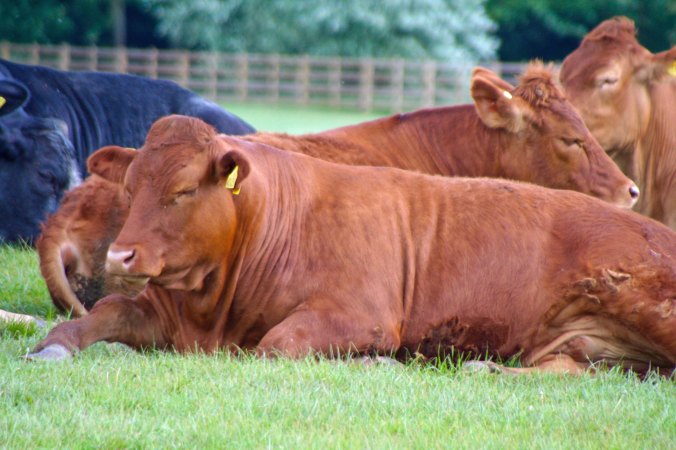
Resting cattle along Trent and Mersey Canal

Cattle enjoyed a moment of sun…

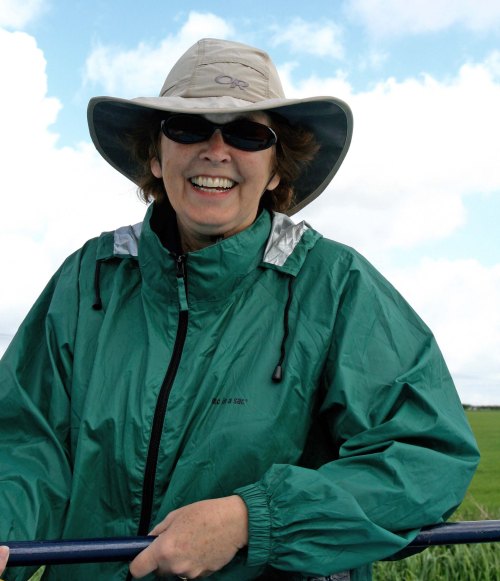
Peggy Mekemson enjoying sunshine on Trent and Mersey Canal

As did Peggy!

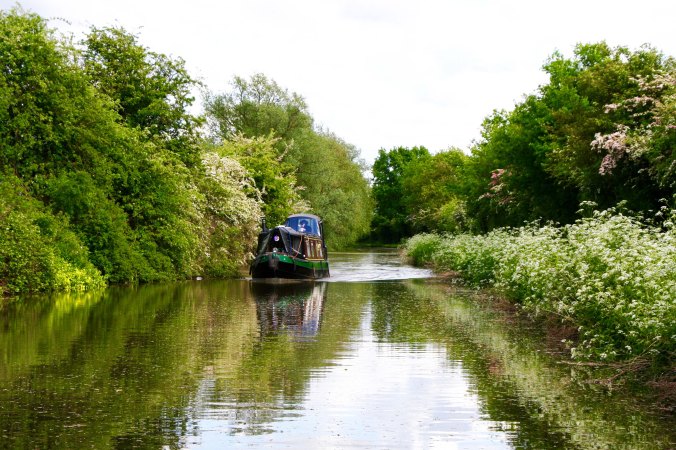
Scenic view along Trent and Mersey Canal

We all continued to enjoy the scenery and serenity along the Trent and Mersey.

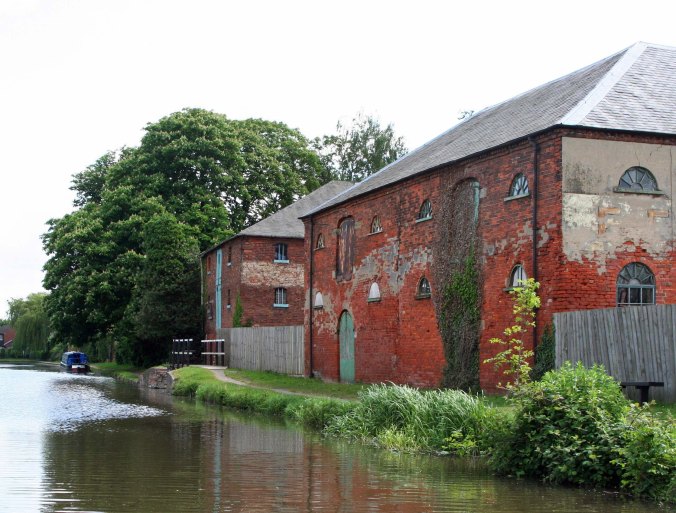
Buildings along Trent and Mersey Canal

Including the buildings.

Narrowboat with rain cover on Trent and Mersey Canal

And other narrowboats. This boater had created a canvas pilot house as protection from the elements. There were occasions when we were envious.

Poling narrowboat off shore on Trent and Mersey Canal

Our progress was delayed when Jim decided to park us on the bank. That’s when we really learned just how heavy our boat was.

Double-wide lock on Trent and Mersey Canal

Locks continued to slow us down as well. This was a double-wide. Just barely.

Church near Sawley Marina

When we spotted this steeple, we knew that we were close to home.

Sawley Marina

And thus we arrived.

Intrepid narrowboat crew in Burton on Trent and Mersey Canal

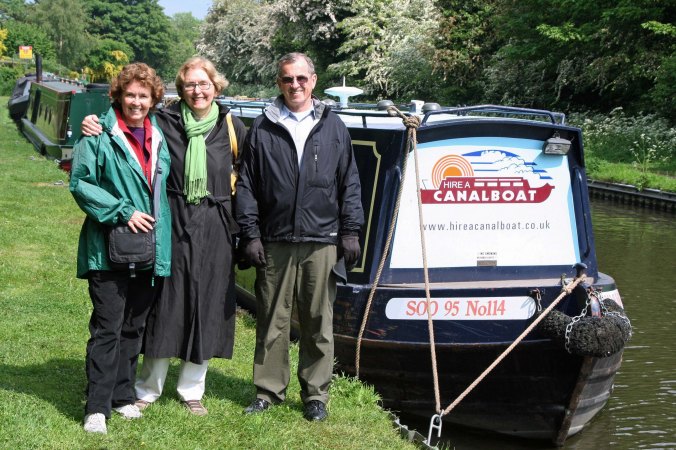
A final shot of Peggy, Jane, Jim and our moored boat.


SATURDAY’S POST: It’s back to blogging my book on MisAdventures. This time I hire the family pets to protect me from the dangerous ghosts that live in the graveyard next to my childhood home.

MONDAY’S POST: Peggy and I return to our before-Christmas adventure along Washington’s coast.

WEDNESDAY’S POST: A photograph essay on Scotland, which is where we went after our narrowboat trip.


Piloting a 60-foot long, 6-foot wide Narrowboat along England’s Trent and Mersey Canal: Part 1


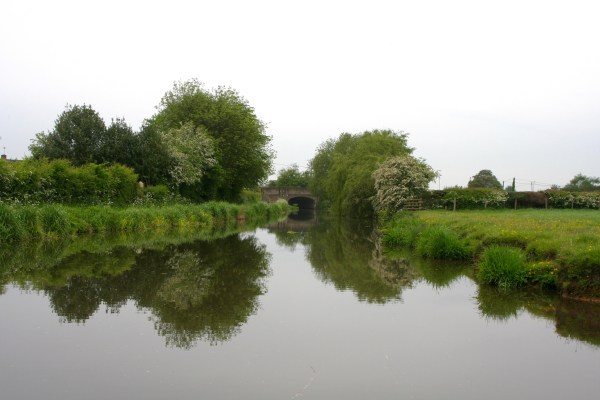
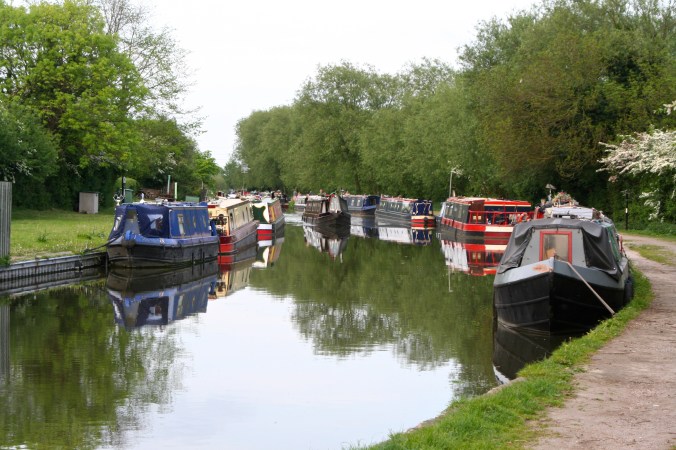
Scenic reflection shot along Trent and Mercy Canal

Operating a narrowboat along Britain’s scenic Trent and Mersey Canal became a bucket list item for us as soon as we learned about the possibility.

To call me a boat person would be a very serious misnomer. Backpacker definitely— that’s where my true passion lies. It gets me into the wilderness. But boating, as a general rule, is something I’ve done little of. There are exceptions.

Peggy and I have boated up the Amazon, rafted down the Colorado River through the Grand Canyon, and kayaked in numerous places throughout North America. I’ve canoed across the Kenai Peninsula of Alaska and down the Sacramento River of California. Peggy and I have even cruised the Mediterranean and crossed the Atlantic. And I’ve tried my hand at fishing for marlin off the coast of Mexico. Mainly, I see boats like I do bicycles, however: as a way of getting me to places I want to see. Bicycling or boating as sports in themselves have little appeal to me.

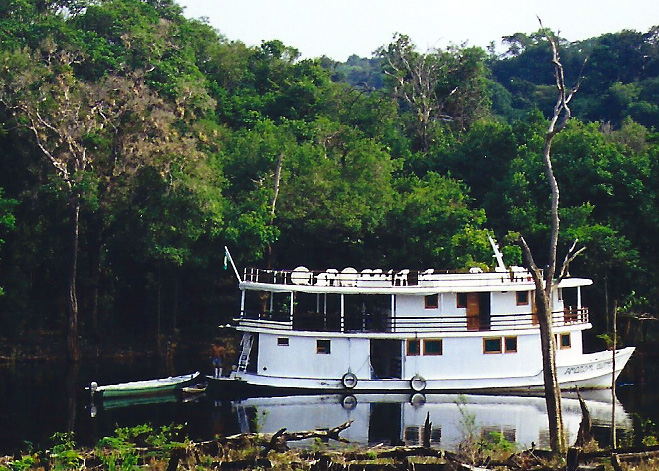
Our boat, the Amazon Clipper, docked for the evening deep in the rainforest on the Rio Negro River, Brazil.

Peggy and I enter the infamous Lava Falls on the Colorado River, a perfect ten… that’s 10 as in rapids don’t get any more serious. Shortly after that the boat, our boatman Steve, Peggy and I disappeared under the water. Happily, we resurfaced. (Photo by Don Green)

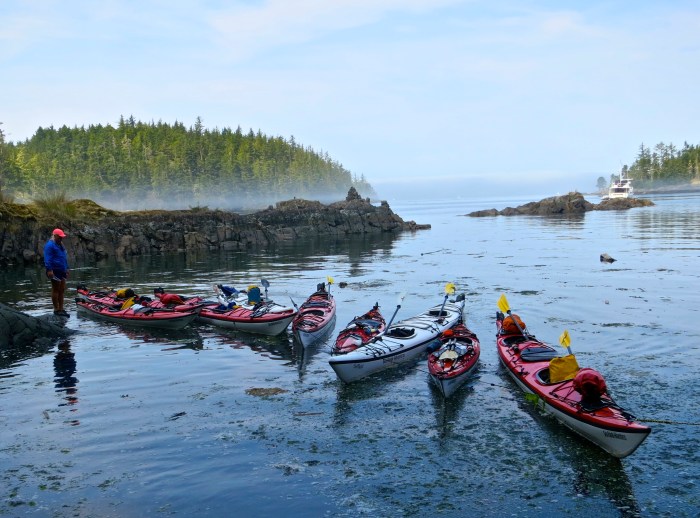
Sea Kayak Adventure kayaks roped together in small inlet on Hanson Island. Photo by Curtis Mekemson.

I took this photo of our kayaks off of Vancouver Island while we were at lunch. The kayaks were roped together so they wouldn’t run away.

Given my mixed feelings about boating, I found myself surprised that I enjoyed piloting a narrow-boat along England’s Trent and Mersey Canal. There was something about making the 60-foot long, 6-foot wide boat go where it was supposed to, including into boat-wide locks, that I found both challenging and gratifying. It helped that we were only traveling 3-4 miles per hour (4.8-6.4 k)! Peggy and I had invited her sister Jane and brother-in-law Jim along with us on the 2011 adventure. While Jim and I took turns at the helm, Peggy and Jane operated the locks.

Instructions for piloting the boat and working the locks were provided when we arrived. Peggy reminded me that we had less than an hour of instruction before being turned loose with out 60-foot long, several ton vessel. I can only imagine how experienced boat people along the Trent and Mersey Canal view newbies coming out of the marina. Peggy and Jane’s lesson on operating the locks was more like 15 minutes! But we did have instruction sheets.

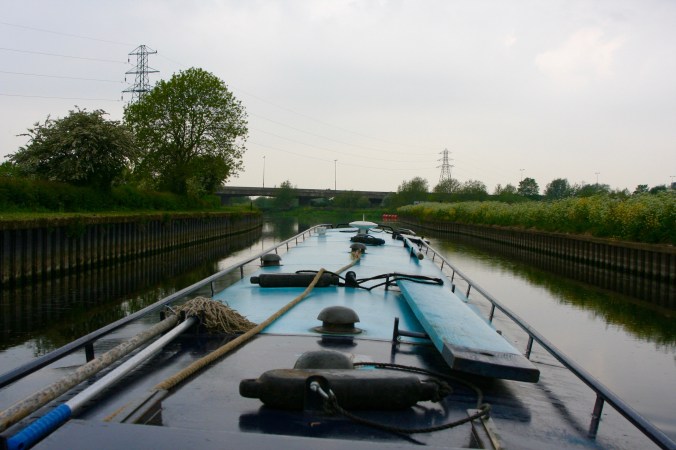
What it looks like from the helm of a narrowboat

This is what our boat looked like from the helm. Let’s just say that I was more than a little nervous when I took my first turn.

Jim researching our Trent and Mercey Canal trip

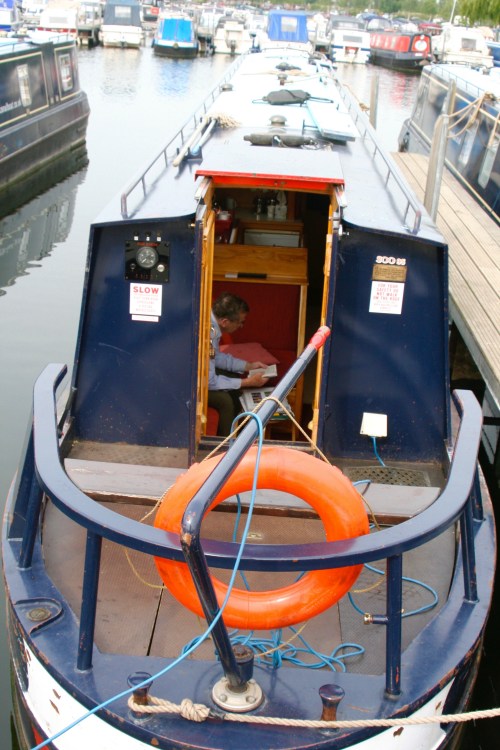
Jim, who never admits to being nervous about anything, studied the manual, or maybe he was reviewing our trip.

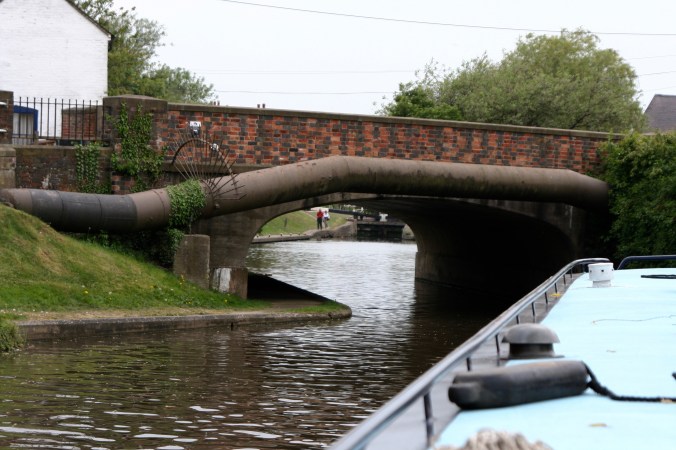
Piloting narrowboat under bridge on Trent and Mercy Canal

The challenges we would face included maneuvering our 60-foot vessel around sharp corners under low bridges…

Piloting boat into lock on Trent and Mercy Canal

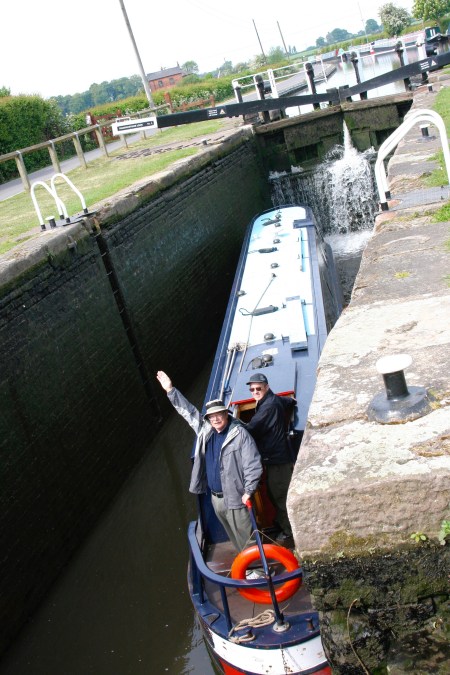
And piloting the boat into narrow locks, some of which were hardly wider than the boat. In fact, the width of the locks was the reason for creating the narrowboats. It was even more challenging when you had to slip into a lock of this width with another narrowboat while pretending to know what you were doing!

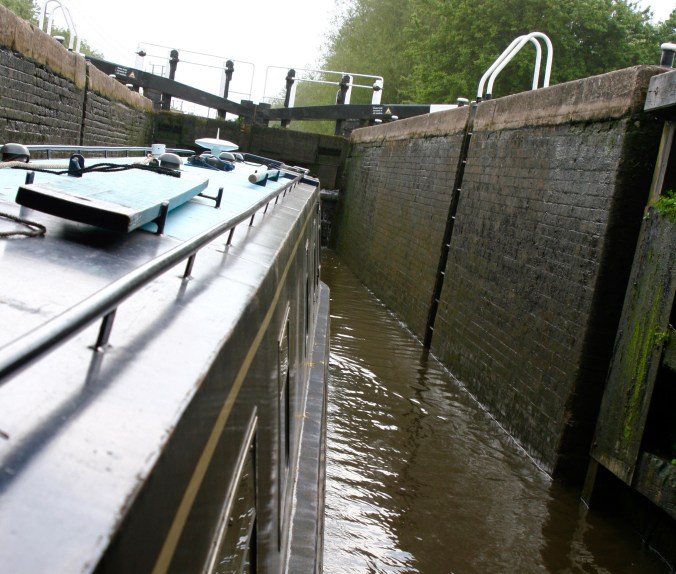
Narrowboat in lock on Trent and Mercy Canal

Fortunately, being perfectly straight wasn’t necessarily required when we had the lock all to ourselves! Water flowing in will raise our boat to the level of the upstream canal.

Peggy works lock gates on Trent and Mercy Canal

While we were mastering entering and exiting the locks, Peggy and Jane were mastering opening and closing them. Fortunately, some helpful veterans were present the first time our companions were faced with the chore.

Jane Hagedorn works lock gates on Trent and Mercy Canal

Piloting around boat on Trent and Mercy Canal

Passing other boats could be challenging when the canal was particularly narrow.

Piloting past moored boats while metting another boat on Trent and Mercy Canal

Now, picture meeting another boat when both sides of the canal are filled with moored narrowboats!

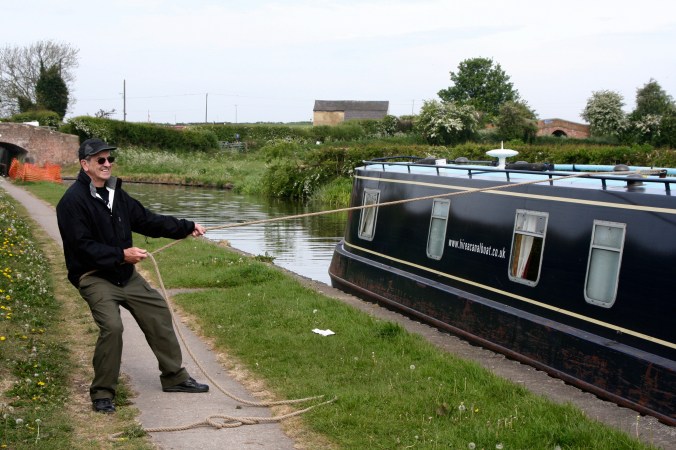
Mooring narrow boat

Another skill we had to master was mooring the boats when we stopped for the night or at a local attraction— such as a pub. Camping was free along the Trent and Mersey Canal.

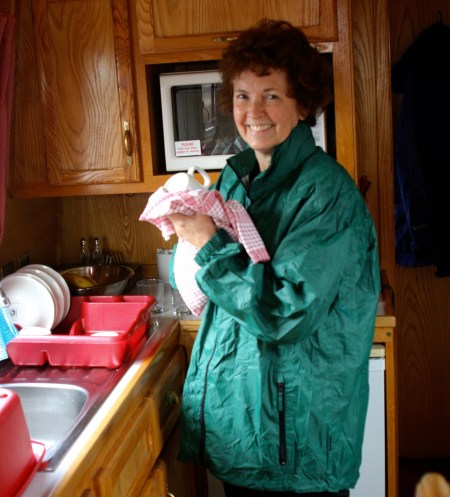
Peggy doing dishes in our tiny galley

We lived on the boat, which came with a small galley, sitting room, and bathroom.

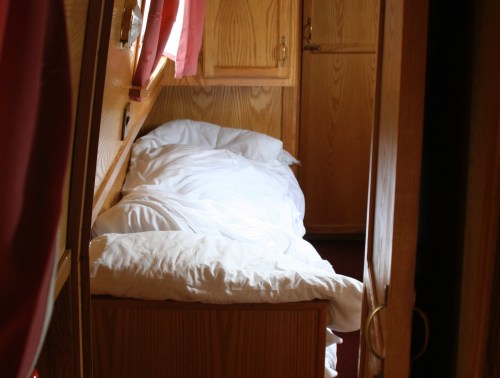
Single bed on a narrowboat
While the master bedroom had a small double bed, the other beds were barely wide enough to sleep on.

The Sawley Marina is located close to Nottingham and borders on the shires of Nottinghamshire, Leicestershire and Derbyshire. (Being close to Nottingham took me back to my childhood days and tales of Robin Hood.) Our objective was to follow the Trent and Mersey Canal to Burton upon Trent and return, a short distance of 34 miles (54.7k). The literature said we could make the trip in a leisurely three days. We chose a more leisurely six. How else could we check out all of the pubs and fine English ale along the way?

Enjoying pub along Trent and Mercy Canal

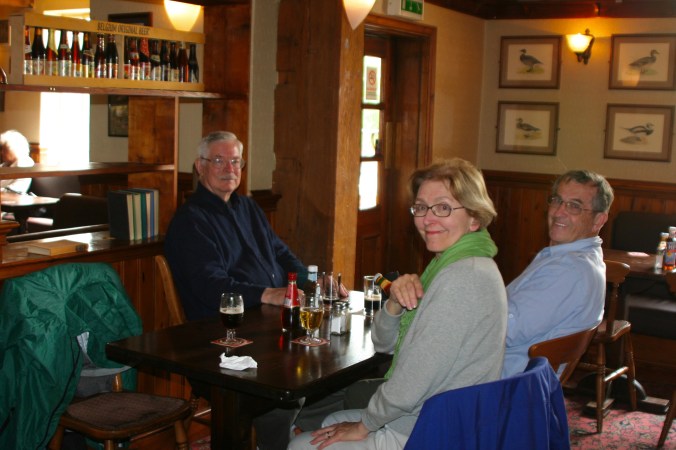
Jim, Jane and I enjoy one of the several pubs along the Canal while Peggy took the photo.

In addition to piloting the boat and checking out the pubs, there was a generous dose of bucolic beauty to enjoy along the way— as one might expect in Britain’s Midlands. Graceful swans, lots of ducks, and lazy cattle provided entertainment while walks through small villages and the larger town of Burton upon Trent gave us breaks from boating.

Direction sign on Trent and Mercy Canal

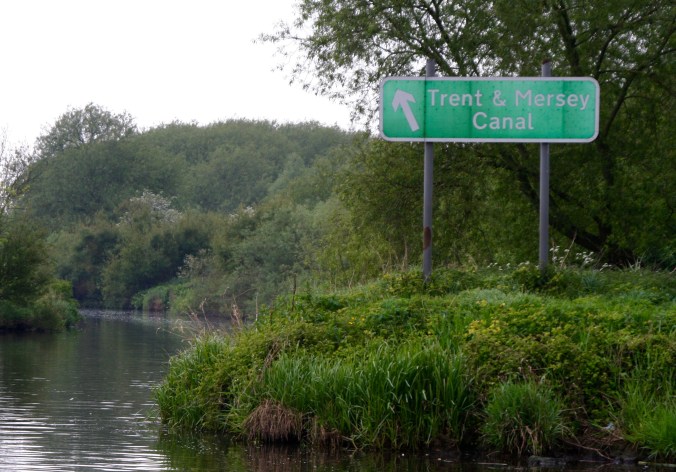
A sign takes us onto the Canal proper.

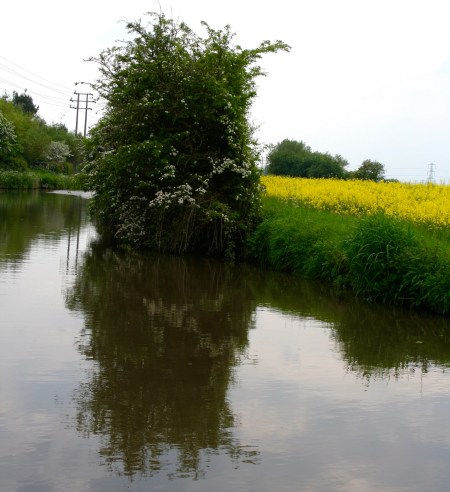
Scenic flowering tree and mustard along the Trent and Mercy Canal

There was considerable beauty along the canal and traveling at three miles per hour, we had plenty of time to enjoy it.

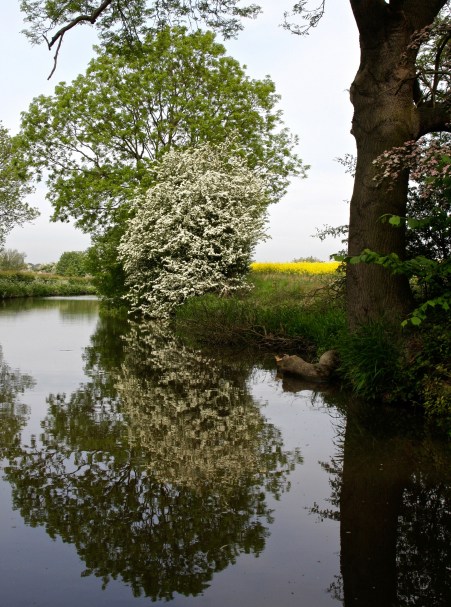
Scenic view with flowering tree along Trent and Mercy Canal

Since it was May, everything seemed to be in bloom.

Building along Trent and Mercy Canal

Numerous buildings along the way added interest and color.

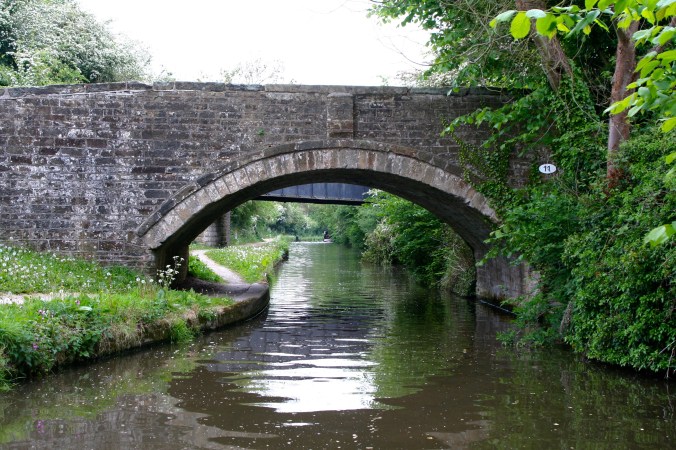
Bridge number 11 on the Trent and Mercey Canal

Bridges also provided variety. Each one seemed different. Numbers on the bridges told us where we were.

Bridge number 13 on the Trent and Mercy Canal

The bridges also added to the beauty.

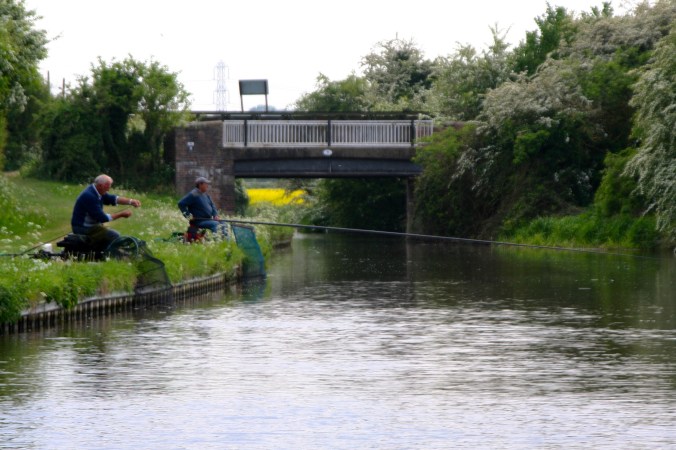
Fishing on Trent and Mercy Canal

This one included guys fishing. Check out the length of the poles!

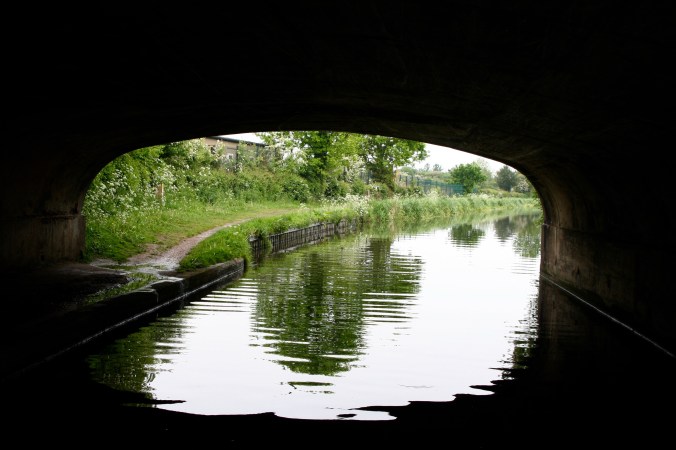
Scenic view from under bridge on Trent and Mercy Canal

Coming out from under a bridge.

Swan and reflection on Trent and Mercy Canal

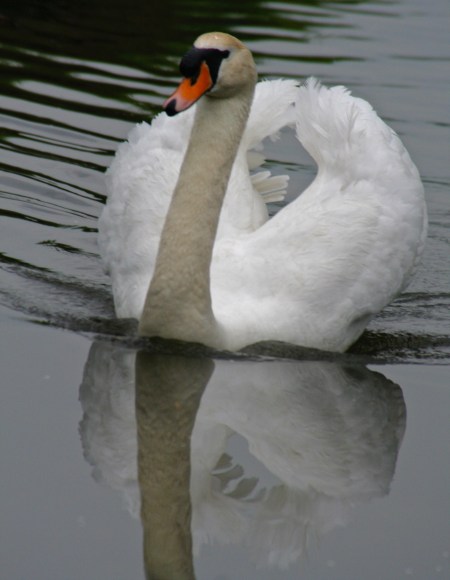
Swans, ducks and other birds provided entertainment. I liked the reflection here.

Swan nesting on Trent and Mercey Canal

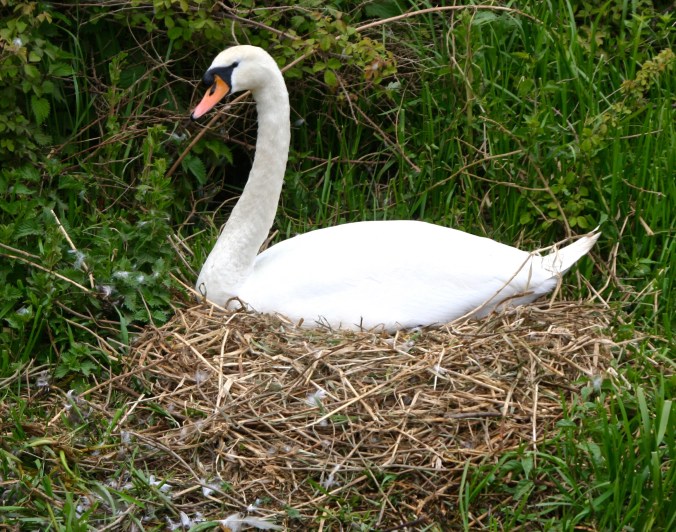
Nesting.

Swan chows down on Trent and Mercy Canal

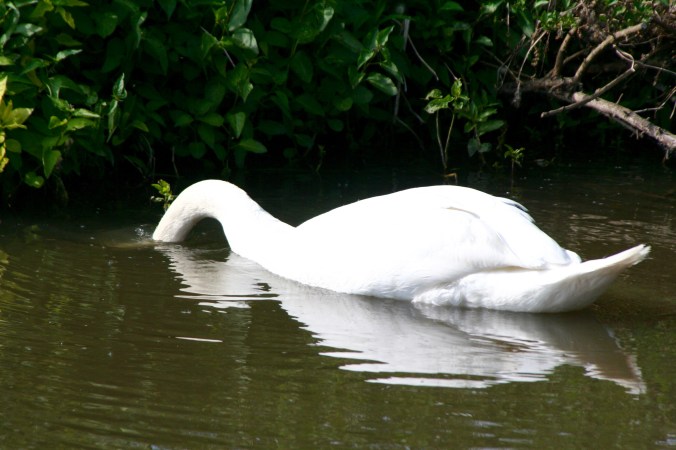
And chowing down!

Mallard hen and chicks on Trent and Mercy Canal

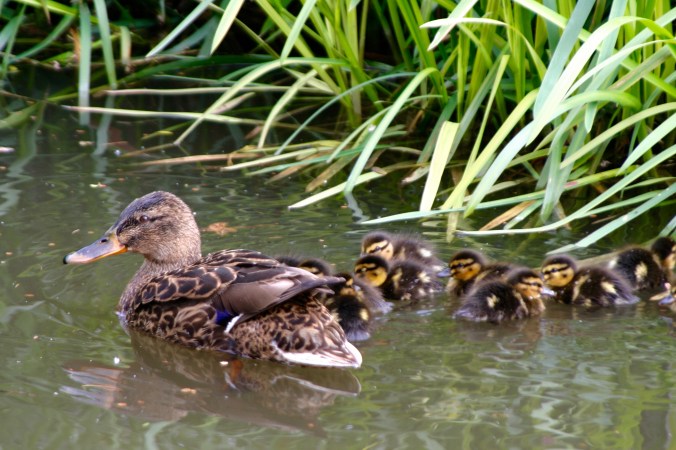
I’ll conclude today with this mallard hen and her chicks.

I will be posting more photos of our narrow-boat tour on Thursday. Saturday I will return to blogging my book on MisAdventures with a story of how I hired our family pets to protect me from the fearsome ghosts that lived next to our house when I was a child.

2017 in Review… What a Year!

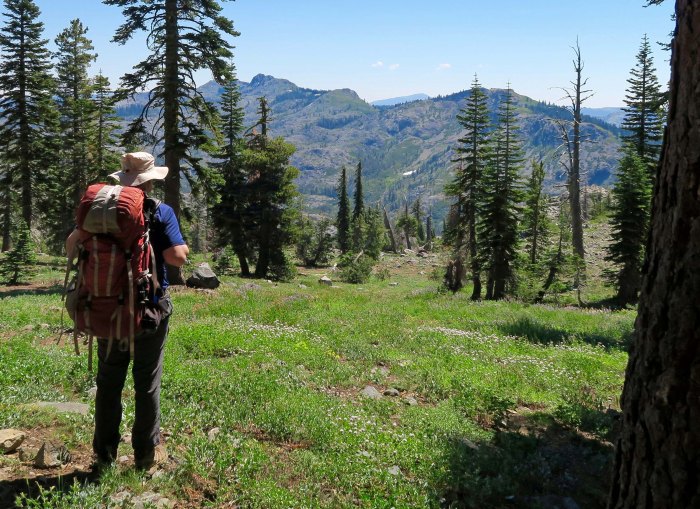
Heading off into the wilderness on one of my five backpacking trips in 2017.


I always approach the new year in a reflective mood that is divided between looking back and looking forward. This past year has been a tough one for the US, one of the toughest that I can remember. The turmoil has made me want to run off to the ocean, or the mountains, or the desert, or the rainforests— anywhere that the constant blare of modern media and Washington tweets is missing or limited. But then, I always want to run off to the mountains, the ocean and the desert. The wilderness serves as a second home for me— a place to think, a place to heal, and a place to play.

Living out in the woods, as Peggy and I do, also helps!

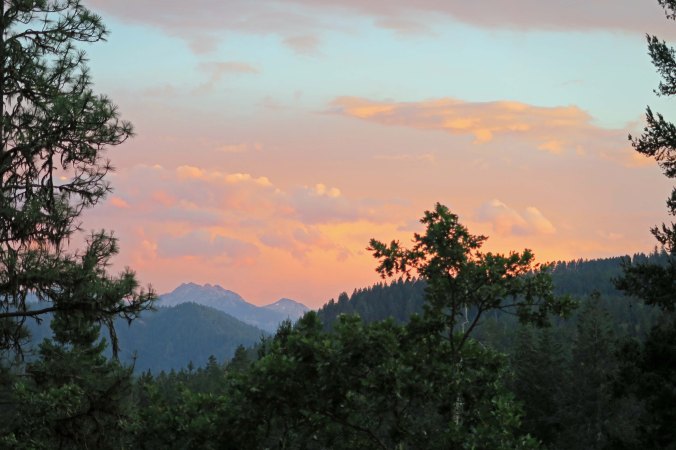
Sunset view from Mekemson patio on Upper Applegate River

A view of the sun setting in the west from our patio reminds me of beauty in our world, but also of the million-plus acres of forest lands and wilderness that surround us.

Applegate River

The Applegate River that runs in front of our house is quiet and peaceful in the summer, but can become a raging torrent in the winter. It is beautiful in all conditions, and the sound of its flowing waters always soothes.

Madrone tree in Mekemson back yard

Nothing marks the change of time like the changing of seasons. This large madrone that lives in our backyard and provides coveted shade in the summer, shows its winter face here.

spring at home

In the spring, our world turns green. Over 100 white oaks provide homes for animals as well as shade. In fall, their acorns provide food for squirrels, deer, turkeys and bears.

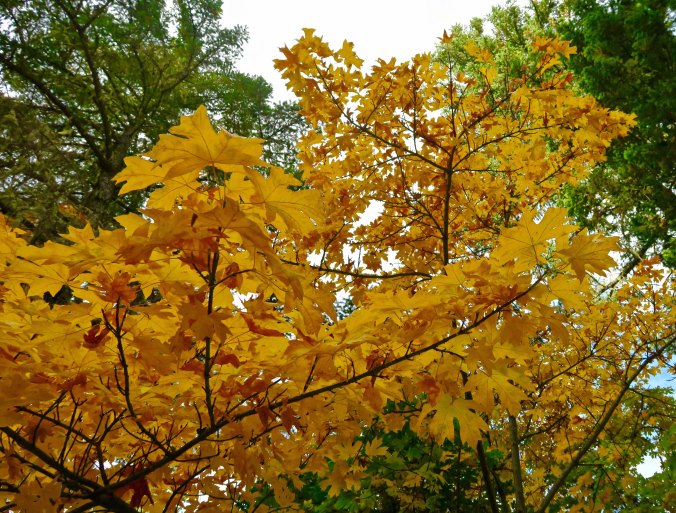
Fall at home

Fall always adds its splash of color, as it does with this Big Leaf Maple.

Ground squirrel with attitude

The wildlife that considers our property home provides constant entertainment and education. This ground squirrel had just managed to steal a cheek full of sunflower seeds from the bird feeder and had zero tolerance for my lecture.

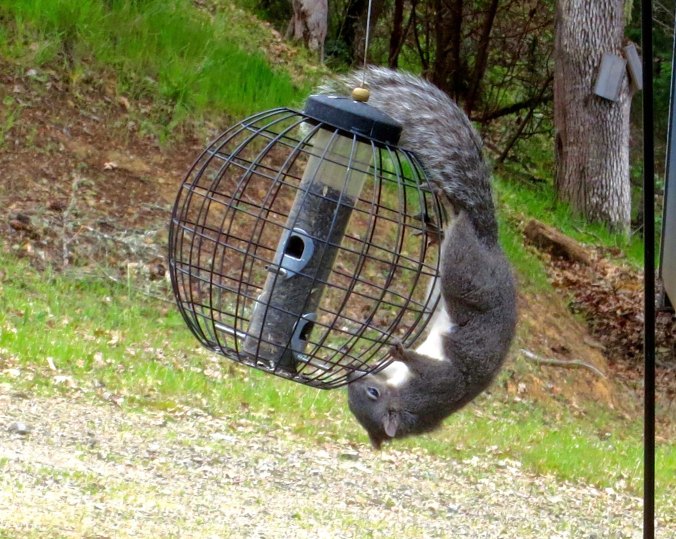
Squirrel on birdfeeder

And this grey squirrel is trying to repeat its success. “Let’s see, if I rock this thing hard enough…”

Blacktail deer in Mekemson yard on upper Applegate River

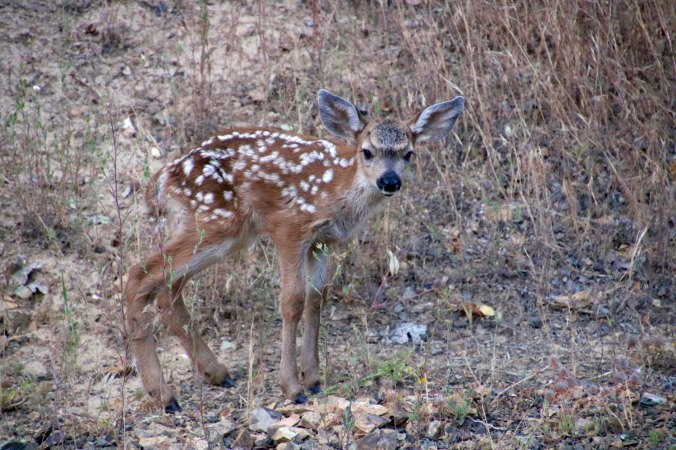
The local deer herd provides us with an inside view of their lives, from birth to death.  The herd has scattered now. Wisely so. There is a cougar hanging out on our property and in the national forest land behind us. I haven’t seen it yet, but I have seen its scat in our back yard— and it is full of deer hair!

Fawn on our property

The cougar will move on, however. The deer will return. And the does will bring their children by for visits, as they always do. Life in its endless cycles will repeat itself.

Given my desire to escape this past year, it’s not surprising that the majority of my posts have revolved around trips to the ocean, mountains and deserts. That and Burning Man, which may be the ultimate escape to an alternative universe. Here are some photos that reflect our travels in 2017.

I’ll start with the ocean which includes trips I made on my own and trips the two of us did. Altogether, we covered some 1000 miles of coast between Big Sur, California and Forks, Washington.

Big Sur Coast

In the spring I made my way down to the Big Sur/Carmel/Monterey area while Peggy was playing Grandmother. This is the Big Sur coast.

Iconic Big Sur Bridge

An iconic Big Sur Bridge.

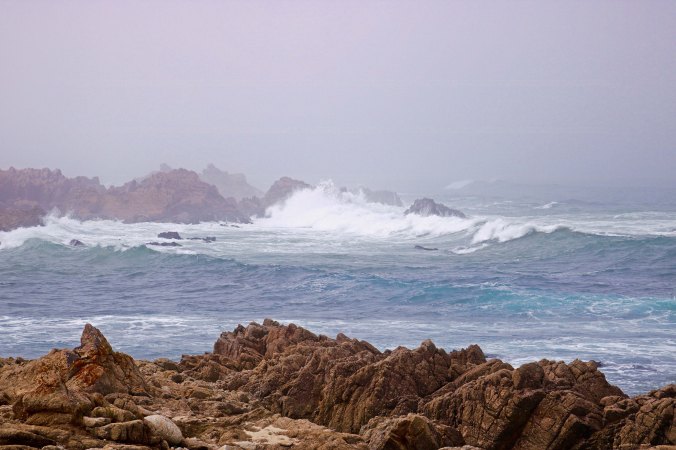
Ocean on 17 Mile Drive

The coast along Monterey’s 17 Mile Drive.

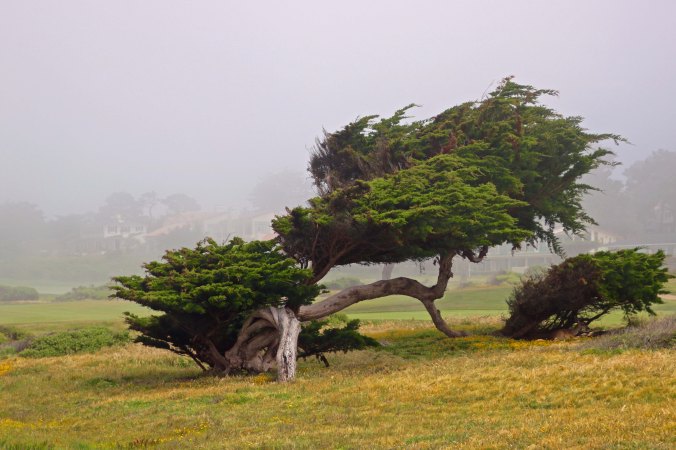
Cypress on 17 Mile Drive

A Monterey Cypress located on one of several world-famous golf courses found along Monterey’s 17 Mile Drive.

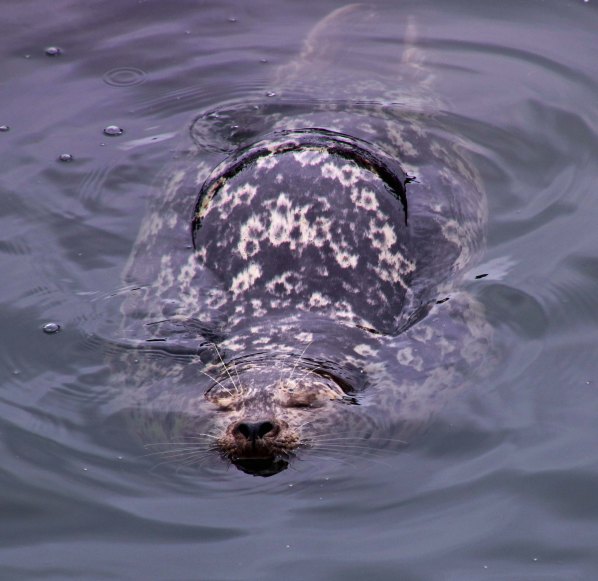
Seal at Point Lobos

A contented seal I found at Point Lobos just south of Carmel.

Bigfoot rock at Bandon, Oregon

Peggy and I found this marvelous rock on the beach just south of Bandon, Oregon. Note the toes. They stood about as high as Peggy. I called it Bigfoot, of course.

Face Rock at bandon Beach

We were also impressed with what is known as Face Rock. You can see the chin, mouth, nose and eyes on the right.

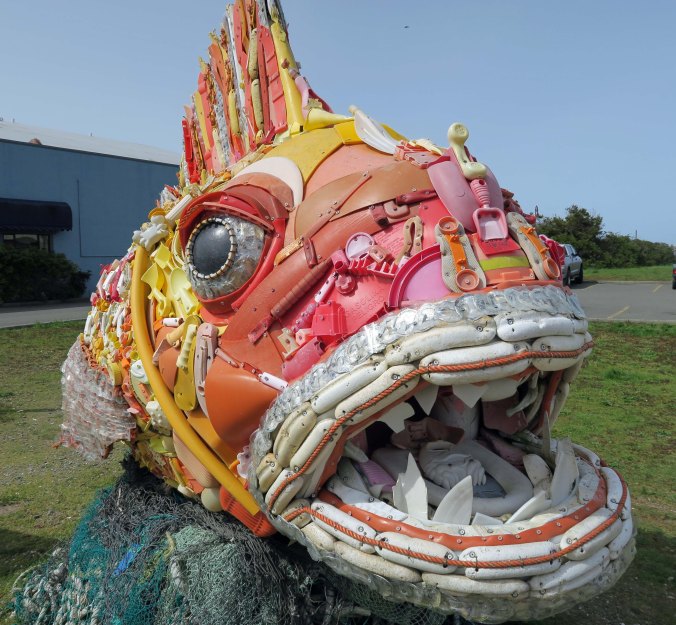
Ocean trash fish at Bandon, Oregon

This marvelous fish sculpture in Bandon had been created out of trash collected along the local beach.

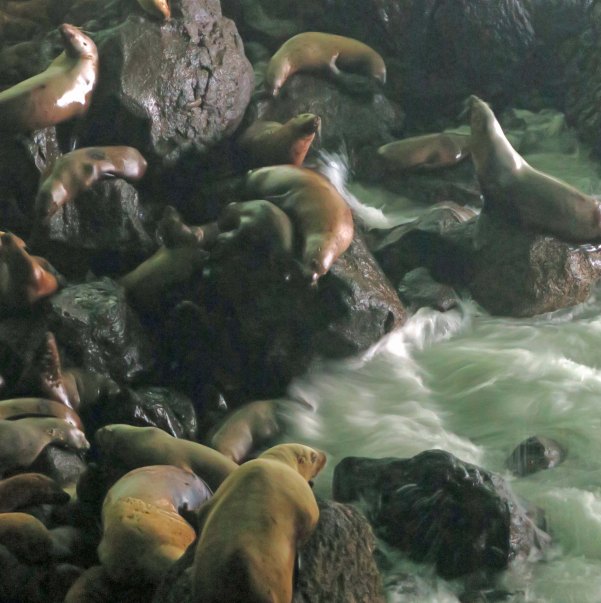
Seal Cave near Florence, Oregon

I found these seals located in Seal Cave just above Florence, Oregon.

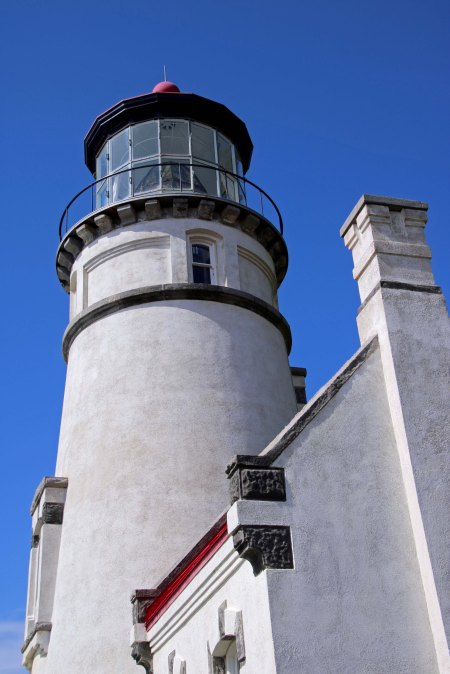
Heceta Head Lighthouse

And the beautiful Heceta Head Lighthouse a couple of miles away.

Sea serpent at Rockaway Beach

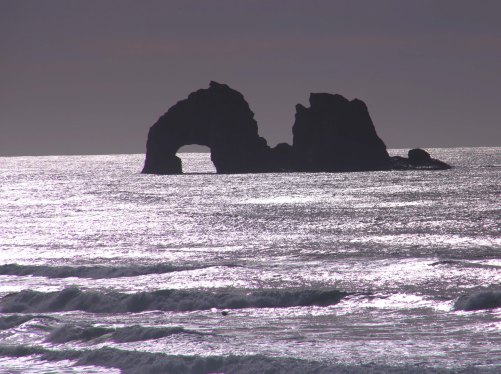
Our trip before Christmas took us up to Rockaway Beach where we found a pair of rocks that reminded me of the Loch Ness Monster, Nessie.

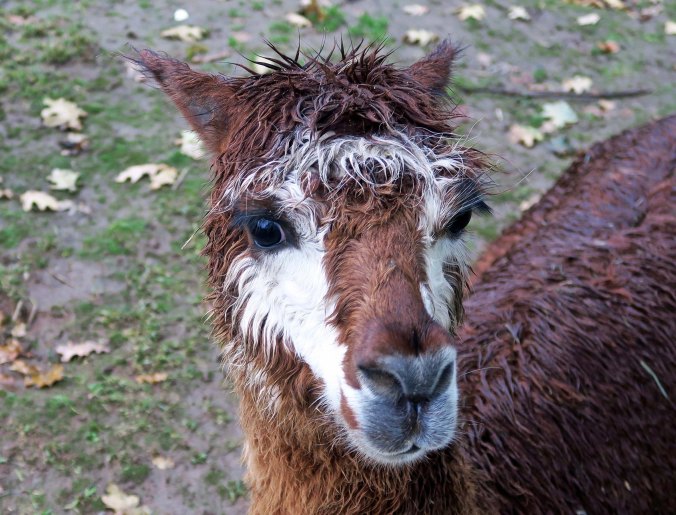
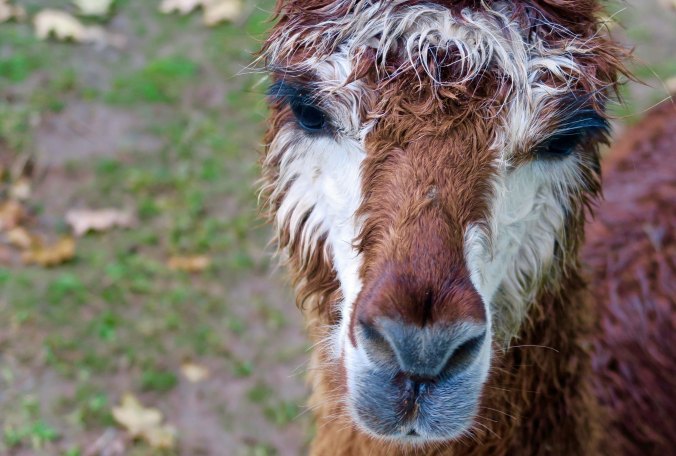
Alpaca near Tillamook, Oregon

And this cutie near Tillamook.

Peggy Mekemson at Copalis Beach

We stayed at Copalis Beach in Washington where Peggy went for a walk on the beach at sunset.

The ultimate in escaping the noise and busyness of the world is backpacking. There are no phones, or TVs, or newspapers, or Internet.  Not surprising, I went out five times. Twice by myself, twice with Peggy, and once with Peggy, our daughter Tasha, and our two grandkids, Ethan and Cody. We backpacked in the Siskiyou Mountains near where we live and in the Sierra Nevada Mountains east of Sacramento, an area I have wandered in for 50 years.

Oregon stream

One of the streams we camped on in the Siskiyou Mountains.

Peggy's Lake

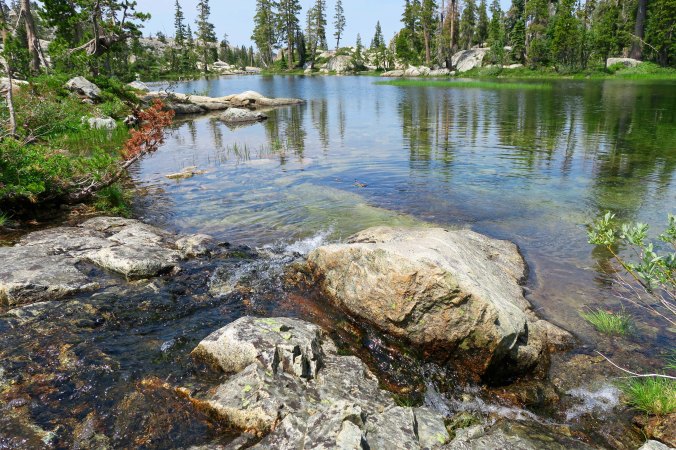
I found this lovely little un-named lake when I was hiking off trail in the Sierras and promptly gave it a name: Peggy’s Lake.

Black Buttes

The Black Buttes east of Interstate 80 looking golden.

Five Lakes Basin

I’ve had a number of trout dinners from this lake over the years.

Thunderheads at Glacier Lake in Five Lakes Basin

Thunderheads. Rain, hail and lightning storms added excitement to our trips.

Family backpacking

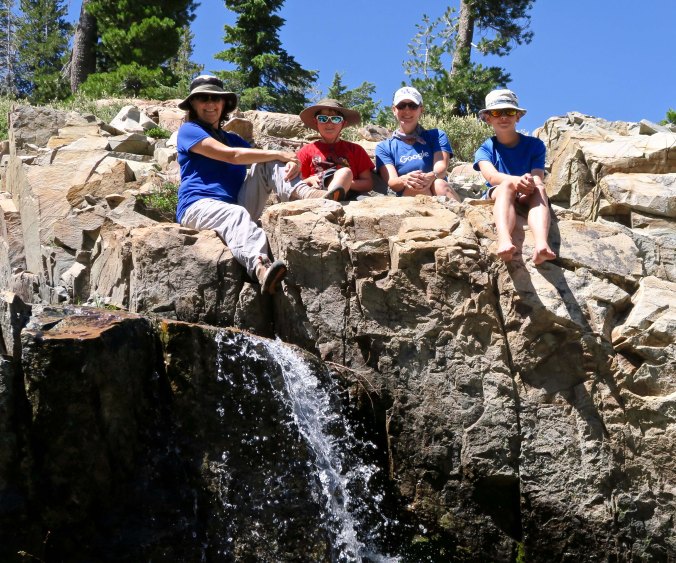
My trail companions: Peggy, Cody, Tasha and Ethan.

And of course we traveled elsewhere. Two of our trips involved returning to the desert. Peggy and I journeyed down through the Sacramento Valley and into southern Nevada where we visited the Valley of Fire State Park. I made my way back to Burning Man in the remote Black Rock Desert of Northern Nevada.

Mt. Shasta

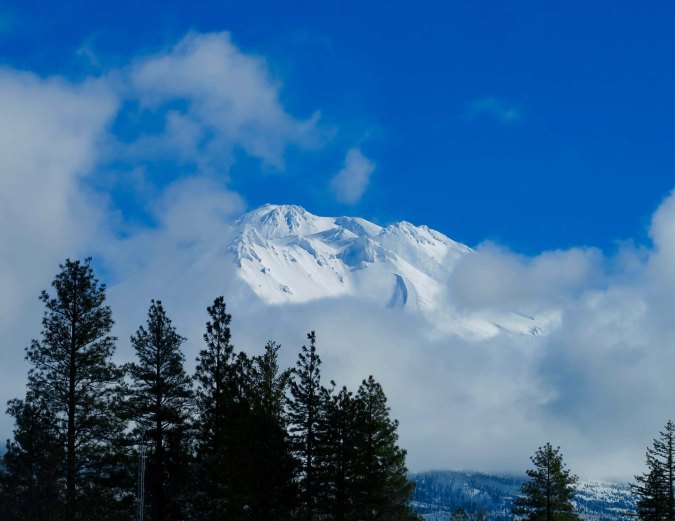
We always travel somewhere on my birthday, usually with our friends Ken and Leslie Lake. This year took us down past Mt. Shasta still wearing its winter coat…

California's Central Valley

Through California’s Central Valley looking very spring-like.

Rock sculpture in Valley of Fire State Park

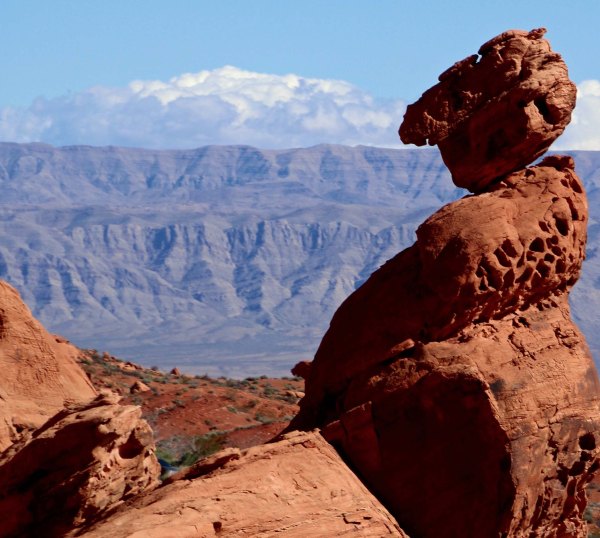
And into southern Nevada’s very dry Valley of Fire State Park…

Arch at Valley of Fire State Park

Which included this small but colorful arch.

Tony's promotion

Summer took us across the USA to Charleston, South Carolina where we celebrated our son’s promotion to Lieutenant Commander in the Coast Guard. His wife, Cammie, and boys Chris, Connor and Cooper help add his new rank.

Man at Burning Man 2017

I returned to Burning Man…

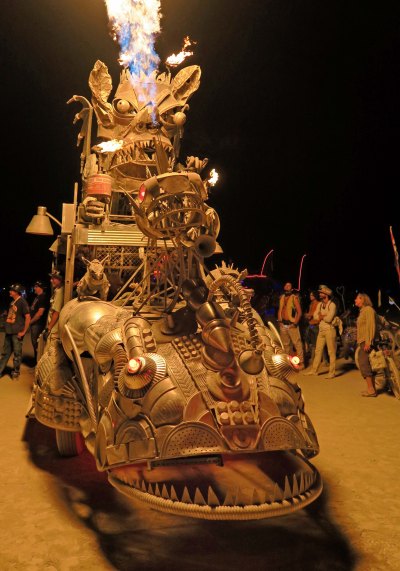
Rabid Express at Burning Man 2017

Where I found this marvellous mutant vehicle known as Rabid Transit.

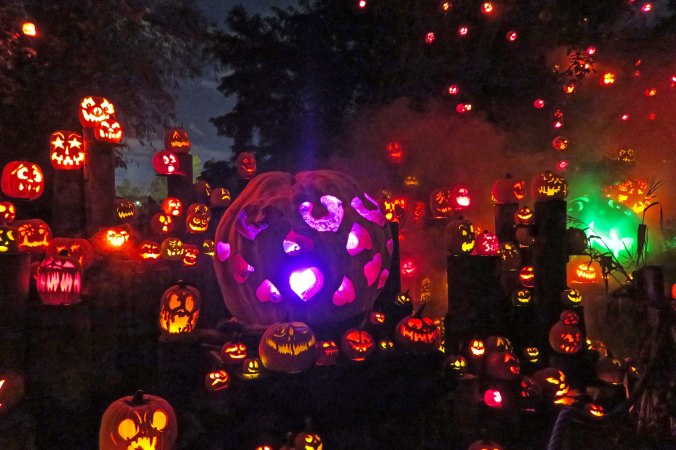
Pumpkin carving festival in Rhode Island

October found us back East again where we attended a pumpkin carving spectacular in Providence, Rhode Island.

Did I succeed in escaping the world of political turmoil? Not quite. And neither would I want to. I spent my life working as a community advocate with non-profit organizations on environmental and public health issues. Time and again, I have seen that concerned people can, and do make a positive difference.

Ultimately, I am an optimist. The majority of the people in the US believe that our nation should serve as a positive force in the world, want to breathe clean air and drink clean water, think that neither sex, age, ethnicity, religion, or sexual preference should be a limiting factor in determining what a person might become or contribute, believe that there is value in protecting the wild, beautiful and historic areas of the world, support a more equitable distribution of wealth, want to reduce violence, and believe that affordable health care and education should be available to all.

It is my hope for this country that leaders (be they Republicans, or Democrats, or Independents) will step forward with the vision to heal the nation and move it toward the point where it reflects what the majority of Americans support— and hope for. Likewise, I have a similar hope for the world. While I realize that this sounds naïve (and I’ve been around the block enough times to know), I also believe that we live in a rapidly changing world with great promise but even greater danger. If we are to achieve the promise and avoid the danger, which may include our very survival, we must learn to work together much more effectively for the good of all as opposed to the few. We all have a stake in the outcome, as do our children, grandchildren and future generations.

I have both enjoyed and learned from the people I follow on Word Press this past year as you have taken me along on your travels, adventures, and personal journeys through life. Even more, I have enjoyed the friendships we have created. My thanks to you— and to everyone who stops by to visit my blog.

Peggy and I wish each of you and your families a happy and healthy 2018.

They Had a Conference on Bigfoot and I Missed It… Darn!

Peggy Mekemson holds hands with large Sasquatch

Peggy holds hands with a very big Bigfoot/Sasquatch in Ocean City, Washington. BTW… Is that an SST being followed by a flying saucer up in the sky? (I think the SST was honking.)


You don’t have to know much about me to know that I am a Bigfoot/Sasquatch fan. How could I not be, having the world’s only Bigfoot trap about three miles away from where Peggy and I live? People seriously thought they might catch the big fellow, or his wife, or the kids back in the 70s. They even hired an old miner to keep an eye on the trap, outfitting him with a tranquilizer gun and a very large set of handcuffs. The fact that they never caught him may be a comment on his existence— or the fact that he was a lot smarter than the people trying to catch him. Or maybe Bigfoot is a vegetarian and wanted nothing to do with the large hunk of well-aged beef they baited the trap with— unlike the bear they did catch.

The world’s only Bigfoot trap is located about three miles from where we live. The doors have long since been welded shut and local high school students have added graffiti.

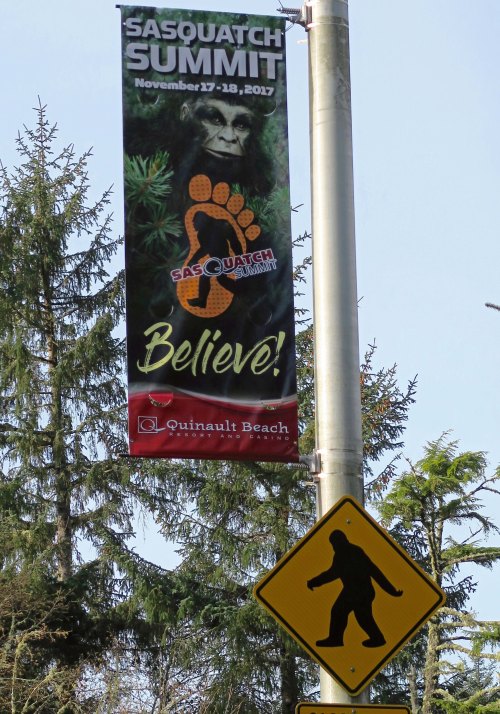
When Peggy and I traveled up to the central Washington coast a few weeks ago, you can imagine my consternation when I discovered that I had just missed a conference on Sasquatch. I’ve attended lectures before, our Genealogical Society hosted one, but never a whole conference. The Washington event even included a bona fide scientist or two. Posters, signs, and a billboard announced the ‘Sasquatch Summit.’ It would have made a fun post.

Sasquatch Summit Billboard

A billboard…

Bigfoot crossing sign

One road sign announces the conference while another warns drivers to watch out for Bigfoot crossing the road.

Sasquatch Conference poster

A poster provides details.

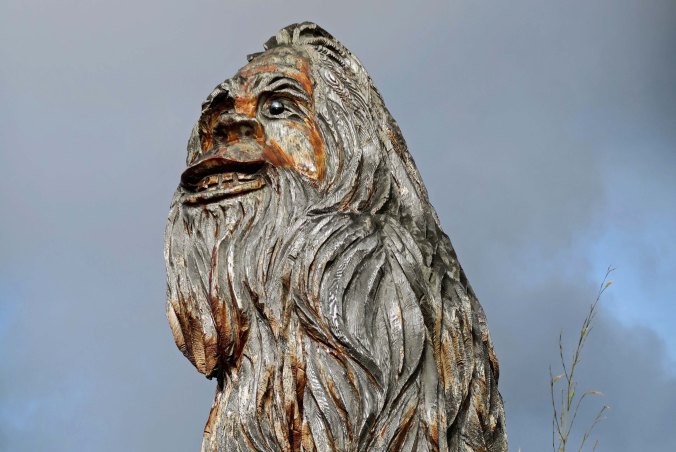
My dismay was countered somewhat by the fact that Bigfoot was a commercial success in the area. It seemed like everyone in the communities of Ocean Shores, Ocean City and Copalis wanted in on the action. Motels, resorts and a pub used him to advertise. The area, like many along the coast from California to Washington, is also into wood carving as an occupation. For a few hundred bucks, we could have had our own Sasquatch to bring home.

Large sasquatch 1

A close up of Peggy’s friend.

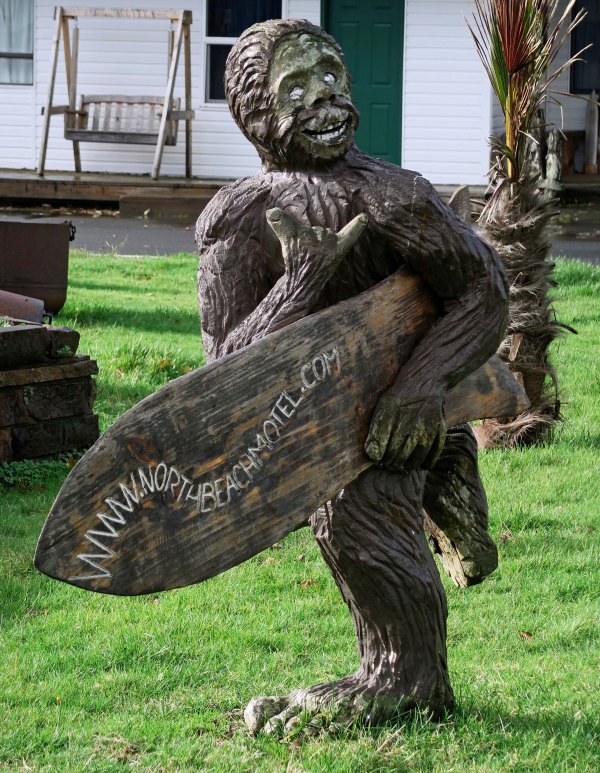
Surfing Sasquatch flashes hang loose symbol

A local motel featured Bigfoot and his buddy Bigfoot running with a surfboard while flashing the ‘hang loose’ sign.

Bigfoot surfing

Buddy Bigfoot.

Sasquatch hangs out with carved heron

The Ocean City Market, which focuses on wood carving, featured Peggy’s Bigfoot as a marketing tool and had this smaller one for sale.

Fu Manchu Sasquatch

We also found this fellow sporting a Fu Manchu mustache.

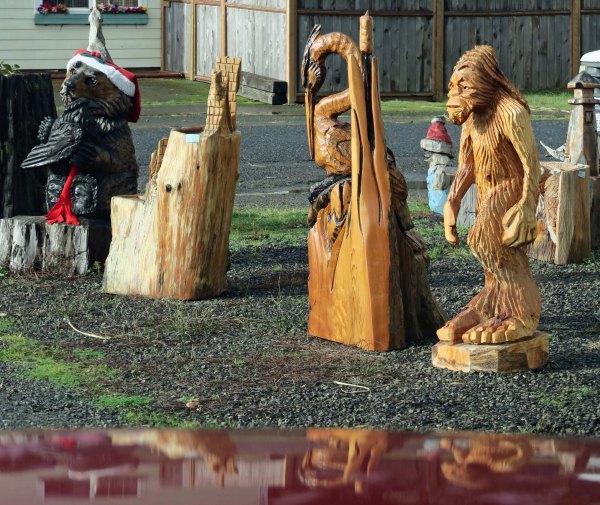
This guy up the road looked a bit more primitive.

I was looking into a puddle when I caught this reflection of Bigfoot staring back at me.

Sasquatch at Green Lantern Pub in Copalis, Wa

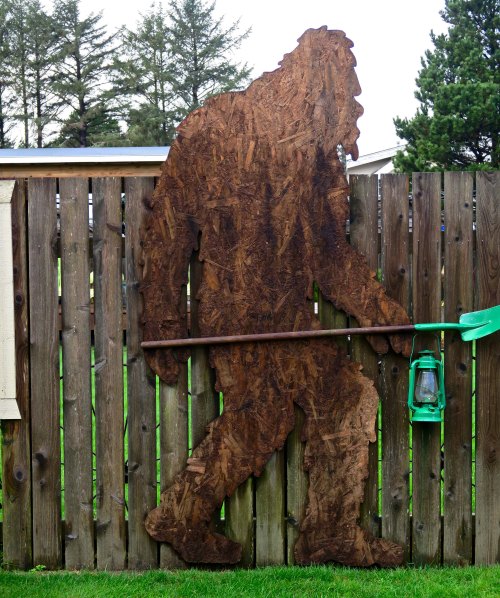
The Sasquatch at the Green Lantern Pub was outfitted with a clam digging shovel and a green lantern.

Green Lantern Pub BLT in Corpalis, WA

The pub featured this Bigfoot sized BLT…

BLT at Green Lantern Pub, Copalis

…that I had to sample. I don’t think eating another one is included in my New Year’s resolutions for 2018!

Women's restroom at Green lantern Pub, Copalis

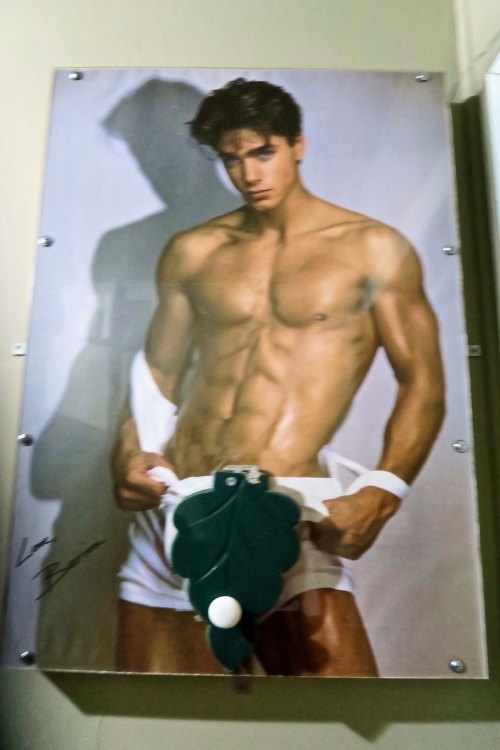
And the women’s restroom at the pub featured this guy, who apparently wasn’t known for his big feet. Peggy, who is infinitely curious, just had to raise the fig leaf, not knowing that a buzzer was going to go off in the pub when she did! So, assuming you didn’t know about the buzzer, how many of you are as curious as Peggy?


THURSDAY’S POST: The flowers of England’s Chatsworth House.

SATURDAY’S POST: 2017 in Review

TUESDAY’S POST: Wandering around the central coast of Washington

Rudolph Left a Present…


Rudolph's kids

Who’s your daddy?


I always think that Christmas letters deserve a little humor. Here’s how I started out this year’s:

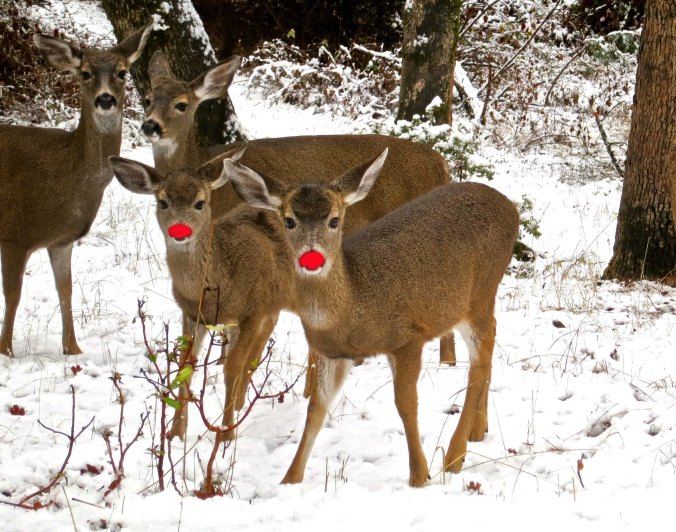
Santa Claus is threatening to stay at the North Pole this year. Apparently, we’ve been naughty. We’re not high on his brotherly love charts. But the jolly old elf is the forgiving type. He’s seen a lot during the last thousand or so years he’s been practicing his trade. The good times come and go. Regardless, I’m pretty sure he will be here at our house. Not that we’ve behaved so well (“Speak for yourself,” Peggy says), but his reindeer have developed a thing for the does that hang out on our property. Dasher, Dancer, Prancer, Vixen, Comet, Cupid, Donner and Blitzen will be by— with or without Santa. And Rudolph will be here with or without any of them! He is particularly enamored with one of our beautiful brown-eyed girls. Apparently, it’s mutual. It will be interesting to see if any of next year’s kids can fly, or have shiny red noses.

Okay, okay. Peggy just pointed out I am being bad again and may very well end up with lumps of coal in my stockings. “Santa’s tolerance only goes so far,” she warns! To forego that possibility, I’ll leave you with some photos from our winter wonderland we’ve taken over the last few years.

Mekemson property on Upper Applegate.

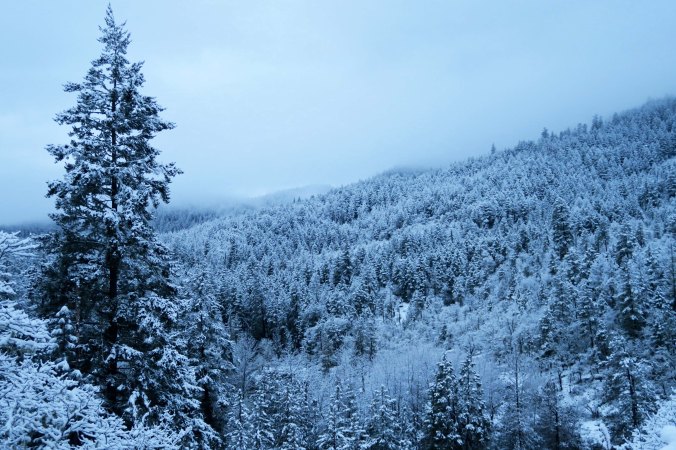
This is the view from our front window when it snows.

The road to the Mekemson home in winter

The road down to our home.

Douglas fir at Mekemson home in snow storm

One of the Douglas Firs in a snow storm.

Two Ponderosa Pines in snow storm

Two of our Ponderosa Pines.

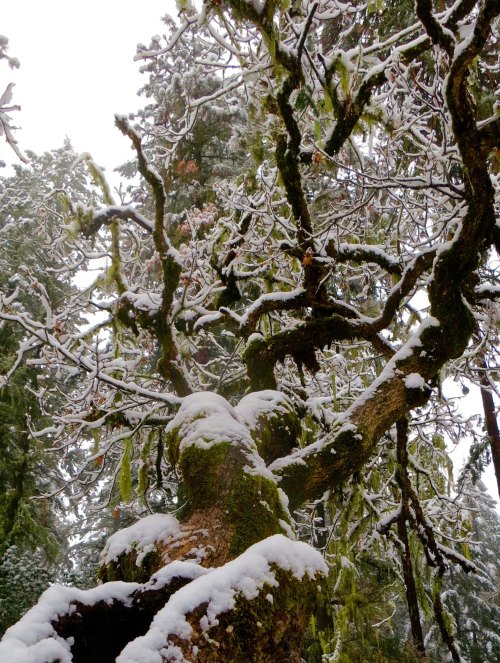
White oak limb in snowstorm at Mekemson home in Oregon

A white oak.

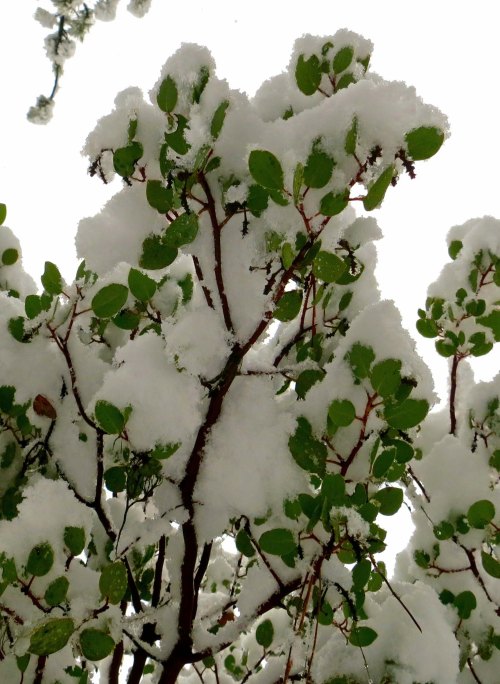
Manzanita in snowstorm

A manzanita bush.

Douglas fir and white oak in snow

The national forest that is in back of our property.

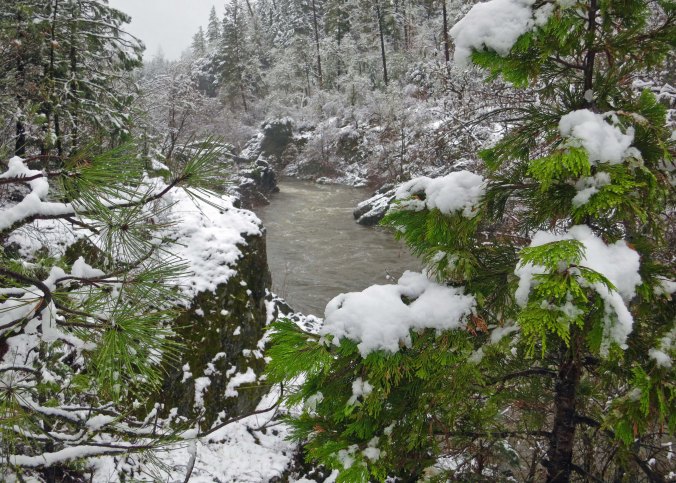
Applegate River in snow storm

And the Applegate River that runs in front.

WE WOULD LIKE TO WISH EACH OF YOU AND YOUR FAMILIES THE VERY BEST OF HOLIDAYS THIS YEAR AND A HAPPY AND HEALTHY NEW YEAR. 

Curt and Peggy


SaveSave

SaveSave

SaveSave

SaveSave

SaveSave

A Ghostly Playground… Blogging My Book on MisAdventures: Part 2

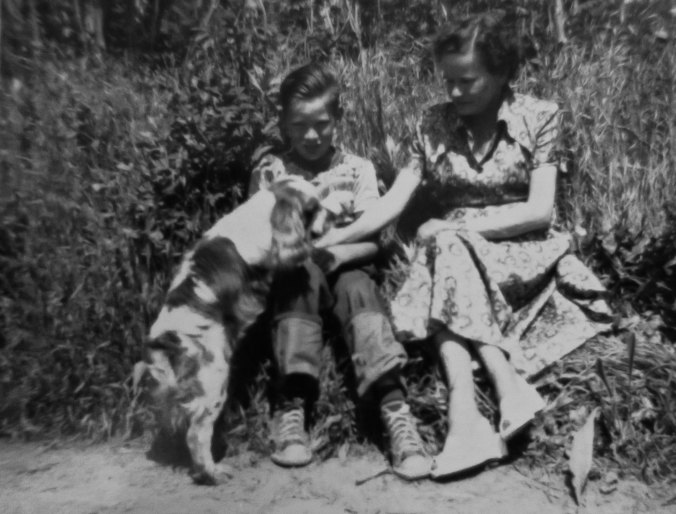
My mother and I sitting on the edge of the Graveyard with my Cocker Spaniel, Tickle. I am slightly older here than I would have been in the Graveyard story below. But check out those pants cuffs. Was my mother planning for my future growth or what?


Today marks my second entry in blogging my book on “MisAdventures.” In my last subchapter, I was prepared to begin my wandering ways by leaving our backyard and venturing into the graveyard next door, which I normally capitalize as Graveyard since it was a special place during my growing up years. If you have been reading my blog for a while, it’s likely you have read today’s tale.  I like to include it in my Halloween stories. 

The Graveyard was out the backdoor and across the alley. We lived with its ghostly white reminders of our mortality day and night. Ancient tombstones with fading epitaphs whispered of those who had come to seek their fortune in California’s Gold Rush and stayed for eternity. Time had given their resting place a sense of permanence and even peace. But not all of the graves were old. Occasionally a fresh body was planted on the opposite side of the cemetery. I stayed far away; the newly dead are restless.

At some time in the past, Heavenly Trees, an import from China, had been planted to shade aging bones. They behaved like weeds. Chop them down and they sprang back up twice as thick. Since clearing the trees provided Diamond Springs Boy Scout Troop 95 with a community project every few years, they retaliated by forming a visually impenetrable mass of green in summer and an army of sticks in winter. Trailing Myrtle, a cover plant with Jurassic aspirations, hid the ground in deep, leafy foliage.

During the day, it took little imagination to change this lush growth into a jungle playground populated with ferocious tigers, bone crushing boas, and half-starved cannibals. My brother Marshall and I considered the Graveyard an extension of our backyard. Since it was within easy calling distance of the house, our parents apparently had a similar perspective. Or maybe, it was out of sight out of mind. The skinny Heavenly Trees made great spears for fending off the beasts and for throwing at each other, at least they did until we put one through Lee Kinser’s hand. Neither Lee nor his parents were happy. Spear throwing was crossed off our play schedule. We turned to hurling black walnuts at each other instead. They grew in abundance on the trees in our front yard. Plus, we could toss them at passing cars on Highway 49. The first set of screeching brakes brought that activity to a halt.

Night was different in the Graveyard; it became a place of mystery and danger. Dead people abandoned their underground chambers and slithered up through the ground. A local test of boyhood bravery was to go into the Graveyard after dark and walk over myrtle-hidden graves, taunting the inhabitants. Slight depressions announced where they lived. Marshall persuaded me to accompany him there on a moonless night. I entered with foreboding: fearing the dark, fearing the tombstones and fearing the ghosts. Half way through I heard a muzzled sound. Someone, or thing, was stalking us.

“Hey Marsh, what was that?” I whispered urgently.

“Your imagination, Curt,” was the disdainful reply.

Crunch!  Something was behind a tombstone and it was not my imagination. Marshall heard it too. We went crashing out of the Graveyard with the creature of the night in swift pursuit, wagging his tail.

“I knew it was Tickle all of the time,” Marsh claimed. Yeah, sure you did.

By the time I was six, I was venturing into the Graveyard on my own. One of my first memories was spying on Mr. Fitzgerald, a neighbor who lived across the alley. He’s dead now— and has been for decades— but at the time he was a bent old man who liked to putter around outside. A Black Locust tree, perched on the edge of the Graveyard, provided an excellent lookout to watch him while he worked. One particular incident stands out in my mind. I had climbed into the Black Locust tree and was staring down into his yard. It was a fall day and dark clouds heavy with rain were marching in from the Pacific while distant thunder announced their approach. A stiff, cool breeze had sent yellow leaves dancing across the ground.
Mr. Fitzgerald wore a heavy coat to fight off the chill. I watched him shuffle around in his backyard as he sharpened his axe on a foot operated grinding wheel and then chopped kindling on an old oak stump.  When he had painfully bent down to pick up the pieces and carry them into his woodshed, I had scrambled down from the tree so I could continue to spy on him though a knothole. I must have made some noise, or maybe I blocked the sunlight from streaming into the shed. He stopped stacking wood and stared intently at where I was, as though he could see through the weathered boards. It frightened me.

I took off like a spooked rabbit and disappeared into the safety of our house. Mr. Fitzgerald was intriguing, but his age and frailty spoke of death.

MONDAY’S POST: I visit the land of vampires and werewolves on the Washington coast.

WEDNESDAY’S POST: It’s back to the beautiful Island of Santorini on another photographic essay.

FRIDAY’S POST: Happy Holidays

SaveSave

SaveSave

SaveSave

SaveSave

SaveSave

A Cow Has Four Stomachs and Other Tales from the Pacific Northwest

Cow T-shirt at Tillamook Cheese Factory

Raising cattle to produce dairy products is big business in the Tillamook area. Peggy and I found this T-shirt at the Tillamook Cheese Factory.


I am going to get to the cows and their four stomachs, but first I want to cover our stay at Rockaway Beach, which is about 15 miles north of Tillamook on Highway 101. Our suite looked out on the ocean. We could watch the waves roll in and hear the continuous roar of the ocean. Wintry skies brought rain but the clouds were also great for beautiful sunsets. We headed out whenever there was a break in the weather, and even when there wasn’t. We walked the beach, visited local shops, and ate out at the town’s restaurants. Thanksgiving dinner was at Grumpy’s and Mrs. Grumpy hovered over us to make sure we ate our veggies. How much more down-home can you get? The complete meal, which included all of the Thanksgiving favorites, cost a whopping 12 bucks. “I want it to be affordable for everyone,” Mrs. Grumpy primly informed us.

Gentle waves roll in at Rockaway Beach, Or P

The ocean was shallow and produced a long line of waves that created a roar as opposed to the sound of single waves crashing.

Sunset over Rockaway Beach on the Oregon Coast near Tillamook.

We were treated to several beautiful sunsets looking out from our suite at Rockaway Beach. (Photo by Peggy Mekemson.)

Small shops had the usual touristy stuff found in coastal tourist shops everywhere. “Go to Flamingo Jims,” we were urged. As to why it was named Flamingo in an area where the tropical bird would freeze, I didn’t have a clue. But we went. And we weren’t disappointed; it was filled to the brim with cheap souvenirs. We wandered around and checked out T-shirts, mermaids and sea shells. We could have bought a sand dollar for a dollar, but Peggy prefers to find her own. I was reminded of this old tongue twister. Try saying it as fast as you can without a mistake.

She sells sea shells by the sea shore.
The shells she sells are surely seashells.
So if she sells shells on the seashore,
I’m sure she sells seashore shells.

Seashells for sell at Flamingo Jim's in Rockaway Beach, Oregon.

Any good tourist souvenir shop on the ocean has seashells to sell.

Mermaids for sell at Rockaway Beach in Oregon

And mermaids. A twist for the Northwest is Bigfoot(s), or is that Bigfeet? You can see some up in the righthand corner.

The beach seemed to go on forever. One end was dominated by the sea rocks that Rockaway Beach is famous for; the other by a forest covered mountain. If you look at the rocks from the right angle, they make an excellent sea dragon. Welcome to Oregon, Nessie! A creek divided the beach about halfway along. Sea gulls patrolled the waterfront, checking out both the ocean and tourists for possible food. A small boy threw out a couple of pieces of bread and was suddenly surrounded by 50 of the birds, in seconds! They seemed to materialize out of nowhere. How do they do that?

Rockaway Beach Oregon Beach

Looking north up the beach at Rockaway. Our suite was on the second floor of the building on the right. Our footprints lead down to where we took the photo. (Photo by Peggy Mekemson.)

The rocks of Rockaway beach photographed by Curtis Mekemson.

The sole rocks of Rockaway Beach look very much like a sea serpent with its head under water searching for tasty fish. (Photo by Peggy Mekemson.)

creek that divides Rockaway Beach, Oregon

A creek flowing across Rockaway Beach limited how far we could hike south.

A seagull steps out at Rockaway Beach, Or

A seagull steps out on his gull-friend at Rockaway Beach.

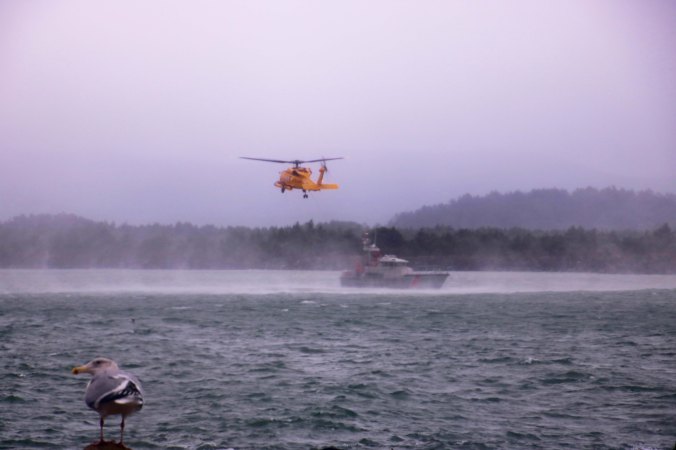
When we ran out of things to do in Rockaway, we drove 15-miles south to Tillamook. I’ve already done posts on Cape Meares, Munson Creek Falls, and some very wet alpacas. On our way, we decided to check out a small county park in Barview and found the Coast Guard practicing air to sea rescue missions by helicopter, which is what our son Tony does.

Seagull stops to watch Coast Guard practice rescues

And here, a seagull joins us in watching the Coast Guard practice rescue operations at Barview, just north of Tillamook.

Practice rescue mission by the Coast Guard

Part of this practice included dropping a man down on to a rocking boat to help in a rescue effort, which was a operation our son was involved with several times while flying  helicopters over rough Alaska waters.

In Tillamook, it is almost required that people stop off at Tillamook Cheese and Ice Cream factory. The cheese is good and can be found throughout the US, but the ice cream is to die for. Our refrigerator is always stocked with a half-gallon.  I should probably weigh 300 pounds but we limit our consumption to Date Night, which falls on Wednesday, as it has for the past 27 years.

Welcome to Tillamook Cheese Factory

The visitor’s center at the Tillamook Cheese Factory included a number of exhibits on the dairy industry, from beginning…

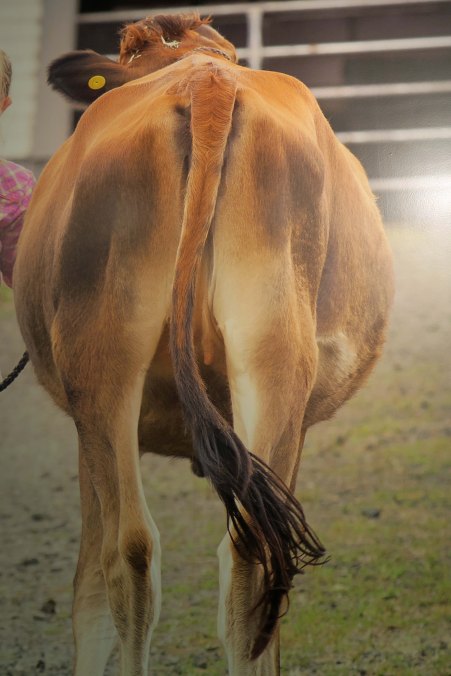
Rear view rear at Tillamook Cheese Factory

…To the end.

cow stomach

I was particularly interested to learn that a cow has four stomachs, which were two more than I was aware of. I also learned that when a cow chews its cud it’s know an ruminating, is case you ever wondered about where the word came from. So, next time you find yourself ruminating, you might want to break out some gum.

When we were out and about and lost, we also came on the Latimer Quilt and Textile Museum where I found the alpacas. Peggy’s love of quilting demanded a visit. We found numerous quilts, a doll collection, looms, and a lot of history.

Alpaca photo in Tillamook, Oregon by Curtis Mekemson.

You will probably remember the alpacas. Check out the blue eyelashes on this gal.

Quilts at Latimer Quilt and Textile Center

As might be expected, the Latimer Quilt and Textile Center was filled with quilts. The Center was preparing for a big sale. These are more traditional quilts.

Quilt at Latimer Quilt and Textile Center in Tillamook, Or

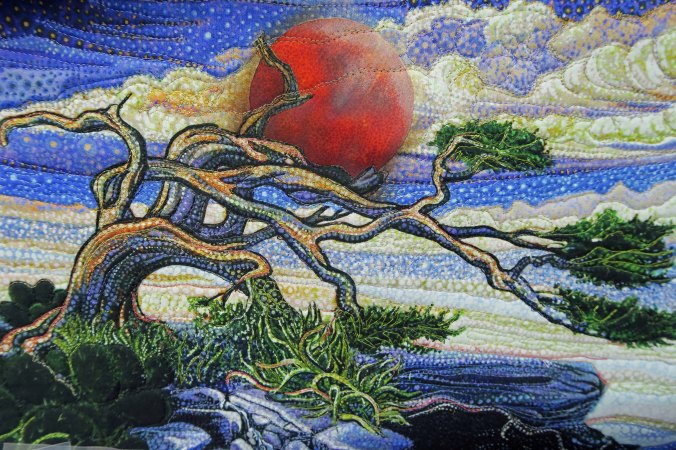
And this one a more modern version.

Interesting dress at Latimer Quilt and Textile Center

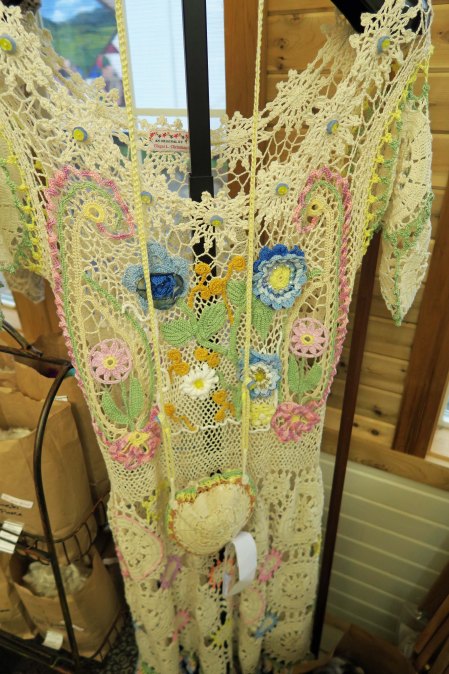
A number of other textile products were offered as well, including this dress. We assumed something would be worn under it, but possibly not at Burning Man.

Looms at Latimer Quilt and Textile Center

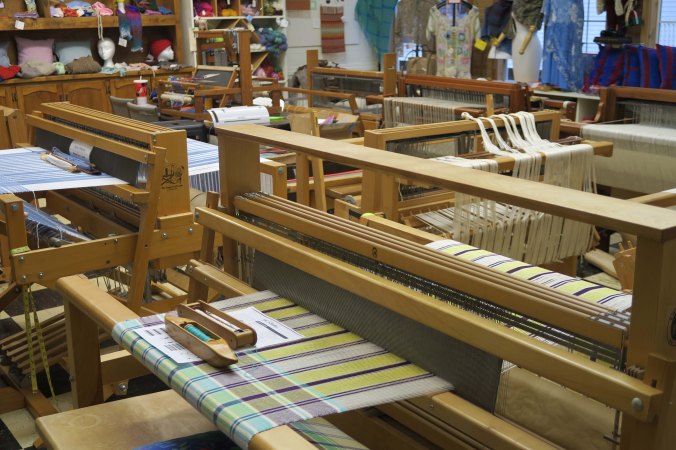
A number of looms were available for weaving.

Doll at quilt shop

There was even an extensive doll collection. I picked this one out for her reading material. 

Peggy Mekemson quilt

I’ll conclude today’s post with this gorgeous quilt that Peggy made for our bed using a vintage Singer Featherweight sewing machine that her grandmother bought in 1933.


WEDNESDAY’S PHOTO POST: Join Peggy and me as we explore the Greek island of Santorini.

SaveSave

SaveSave

SaveSave

First Grade Flunkee… Blogging the MisAdventures Book


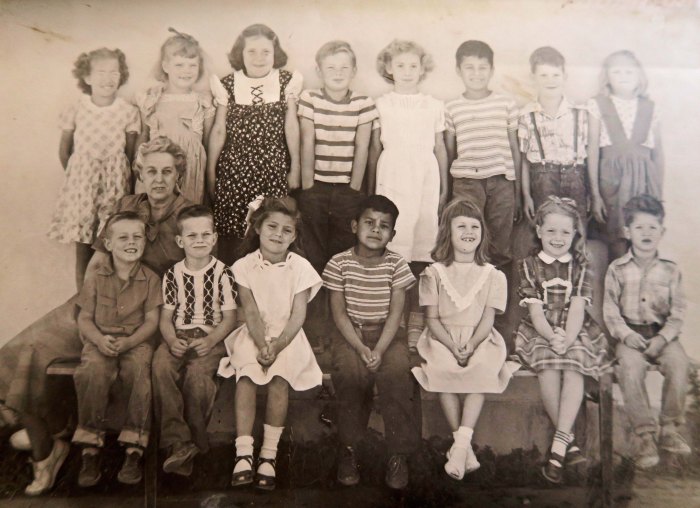
After being kicked out of the first grade for a year, I was given a second chance. This is my class photo. I am fourth from the left in the top row with my hands in my pocket. Don’t I look sweet and innocent?


This begins a series of tales that may or may not make it into my book on MisAdventures. My goal is to post one tale on each Friday until the book is concluded. For the most part, these stories stand alone. They are in the early stages of editing. Several of these tales will have been included in earlier posts. I apologize in advance for the language, but I had an extensive vocabulary of swear words as a youth.


I can still hear the clanking treads and feel the bite of the blade as my D-8 dug into the side of the steep hill. Dirt and rocks tumbled over the edge, crashing into the canyon below. I was working alone, cutting a logging road across mountainous terrain. The hot September summer sun was beating down; my body was drenched in sweat and covered in dirt. And then it happened. A portion of the cliff gave away— and the bulldozer went tumbling off the edge.

“Oh, fuck!” I had yelled.

It was a wonderful word, one that I had learned from my seven-year old brother. I didn’t have a clue what it meant, but it was deliciously bad and had an amazing effect on adults. At five years of age, I was too young to be operating a bulldozer by myself out in our backyard, even if it was only five-inches long and the road I was cutting was along the edge of our compost pit. But my mother wasn’t the hovering type; she drank a lot. Empty wine bottles had a way of mysteriously appearing under her bed and in the clothes’ hamper that hid out in the closet.
I wasn’t totally alone. Coaly, our black Cocker Spaniel, was assigned babysitting duty.  At “fuck!” she wagged her tail and barked into our compost pit where the toy had fallen.
“Go get the bulldozer, girl” I urged. She gave me a ‘go get it yourself’ look. She wasn’t the ideal little-boy companion. The gray hair around her nose and aching joints spoke to her advanced years.  She had little tolerance for my youthful pranks. Healing scars on my foot reflected how little. It was my job to feed the pets. I’d open a can of Bonnie dog food on both ends, push it out with one of the lids, and then use the lid to divide it up. The smell still lingers in my brain. Coaly got half, and each of our cats— the black Demon and the white MC— got a quarter.

That summer I had discovered that Coaly growled ferociously if I messed with her share. I fed the animals outside on paper towel plates.  I always went barefoot in the summer and it was easy to reach over with my big toe and slide their food away. I quickly learned to leave the cats with their lightning fast claws alone. But Coaly was all growls and no bite. At least she was until she sank her teeth into my foot. I ended up in the ER with a tetanus shot, stitches and zero sympathy. Coaly ended up gobbling her dinners in peace.

At the time of the bulldozer incident, I had been granted a reprieve from school, or, to put it bluntly, I had been kicked out of the first grade— for a year. My mother was not happy. She had been eager to get me out of the house. Make that desperate. The evidence is irrefutable. California had a rule then that five-year-olds could go to the first grade if they turned six on or before March 1 of the following year. There was no such thing as kindergarten, at least in Diamond Springs. Since my birthday was on March 3, I missed the deadline by two days. Darn. Mother’s reaction was more colorful. She made a command decision. Forty-eight hours were not going to stand in the way of her little boy’s education, or her freedom. So, she changed my birth certificate.  March 3 was erased and March 1 entered. I was bathed, dressed and shipped out, not the least bit aware that I had matured by two days. I think I recall hearing music and dancing as I left for school.

Things weren’t so rosy at school. The other kids were all older, bigger, and more coordinated. For example, one of the boys could draw a great horse. It came with four legs, a tail, a head and a flowing mane. Mine came with unrecognizable squiggles. It was hard to tell whether my objective was to draw a tarantula or a snake with legs, but the world’s wildest imagination on the world’s most potent drug wouldn’t have classified the picture as a horse. It was not refrigerator art. The whole exercise created big-time trauma.

This negative experience was compounded by the exercise of learning to print within lines. Forget that. If my letter came anywhere close to resembling a letter, any letter, I was happy. The teacher was more critical.

“Curtis, I asked you to make Bs, and here you are printing Zs.”

“So what’s your point?” was not an acceptable response. Mrs. Young was suspicious and that suspicion increased each day I was in school. She was a tough old coot who had been teaching first grade for decades. She knew first graders and I wasn’t one. As for the birth certificate, Mother’s forgery was in no danger of winning a blue ribbon at the county fair. I still have the original for proof. After a few weeks, Mrs. Young sent off to Oregon for a copy. I remember her calling me up to her desk on the day it arrived. (You don’t forget things like this, or at least I don’t.)

“Curtis” she explained, “you have a choice. You can either go home now or you can go home after lunch. But either way, you are going home and can’t come back until next year.”

Just like that I was a reject, a first grade flunkee.

Mrs. Young couldn’t have made it any clearer; Mother was going to get her little boomerang back. This was okay by me, if not by her. Playing out in the backyard was infinitely more fun than competing in ‘Scribble the Horse.’ I did decide to stay the day. Mrs. Young was reading about Goldilocks to us after lunch and I wanted to learn if the bears ate her.

It would have been interesting to listen in on the conversation that took place between Mother and Mrs. Young, or even more so between my mother and father, or Pop, as he was known to us. I’ve often wondered if he participated in the forgery or even knew about the March 1 rule. I doubt it. He was not the parent frantic to get me out of the house during the day.  (Had it been in the evening, the jury might still be out.) But I wasn’t privy to those high-level discussions. My job, which I took quite seriously, was to enjoy the reprieve. I was about to begin my wandering ways. Mother’s alcoholism was my freedom. The Graveyard was waiting.

SaveSave

SaveSave

SaveSave

SaveSave

The Highest Waterfalls on the Oregon Coast: Munson Creek Falls

Munson Creek Falls near Tillamook, Oregon. Photo by Curtis Mekemson.

The upper section of Munson Creek Falls.

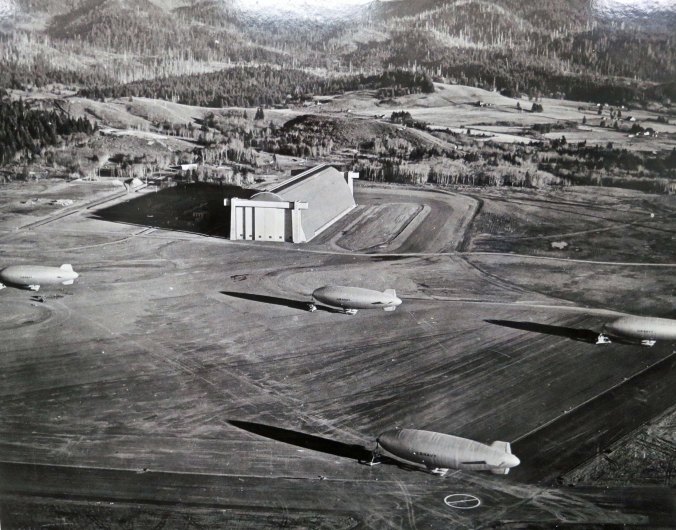
Peggy has been lobbying for a tour of Oregon waterfalls for quite a while. So, when I read that Munson Creek Falls was near Tillamook, I knew we would have to pay a visit on our recent trip to the coast. We drove over to Tillamook from Rockaway Beach where we were staying and then south for seven miles following Highway 101. Along the way, we passed the giant blimp hangar built during World War II that now serves as an air museum. I visited the hangar a couple of years ago when I was passing through the area. Close to the turnoff, we also passed the campground where I had stayed. At the time, I wasn’t aware of the falls— I’d been too busy counting rabbits.

A view of the blimp hangar during World War II. The blimps were used for spotting Japanese submarines off the coast. (Photo from Tillamook Air Museum.)

The Tillamook Air Museum shown here, served as a blimp hangar during World War II.

A photograph of the Air Museum I took on my previous visit. The airplane in front is known as a guppy. The house provides a perspective on size.

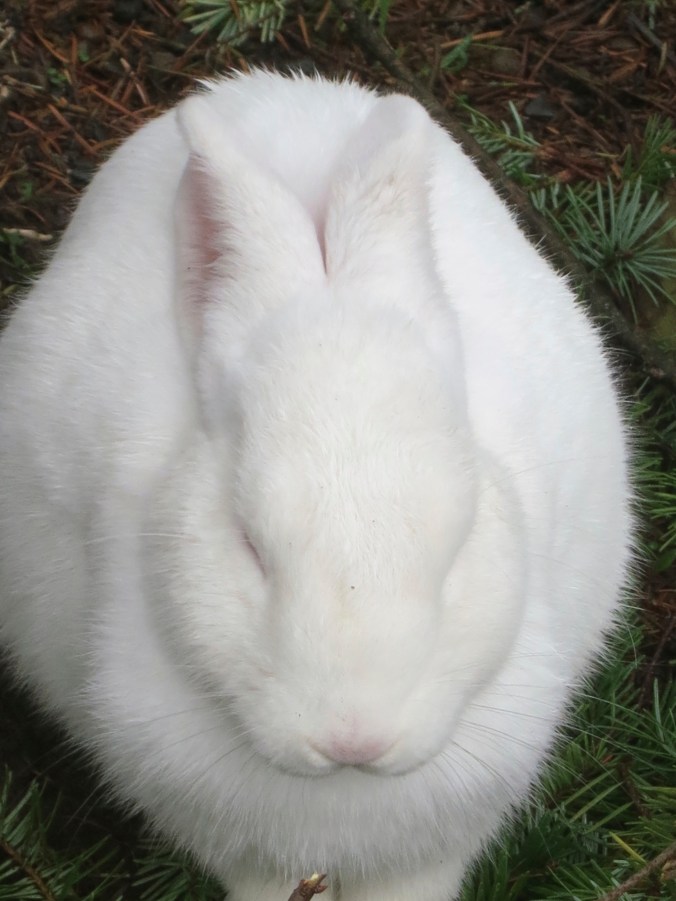
White rabbit near Tillamook, Oregon. Photo by Curtis Mekemson.

This lovely creature was one of over a hundred rabbits wandering around freely at Pleasant Valley Campground near the exit to Munson Creek Falls.

A sign along 101 told us to turn inland for the falls. We followed a narrow, pothole filled road that became narrower as we went, making it more difficult to dodge the potholes that were simultaneously becoming deeper and more numerous! The short three and a half miles felt like twenty. We finally reached the parking lot, however, and discovered that we had entered a rainforest. Trees covered in moss gave a magical feel to the area.  An easy, quarter of a mile trail led off toward the falls. More moss-covered trees and rocks, the dashing Munson Creek, brightly colored fallen leaves, mushrooms and ferns lined the trail.

Moos covered tree along path to Munson Creek Falls. Photo by Curtis Mekemson.

Moss covered trees gave a magical feeling to the path leading to the falls.

Hanging moss at Munson Creek Falls near Tillamook, Oregon.

A close up of the hanging moss. (Photo by Peggy Mekemson.)

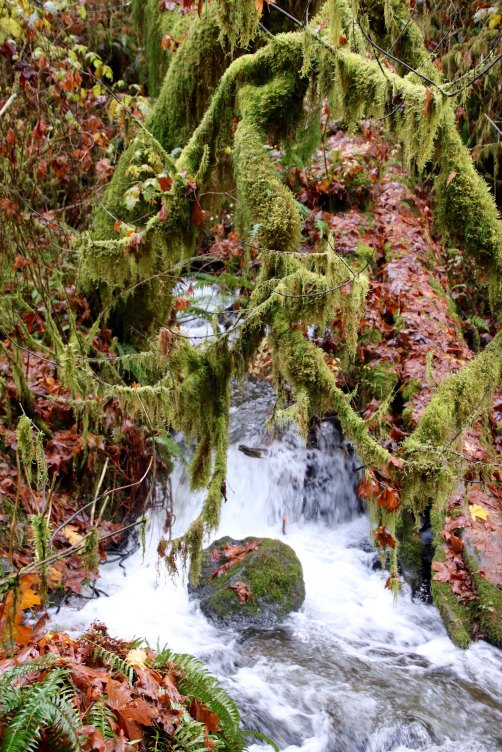
Moss draped across branch along trail to Munson Creek Falls on the north coast of Oregon.

And another. (Photo by Peggy Mekemson.)

Fall leaves along trail to Munson Creek Falls near Tillamook, Oregon. Photo by Curtis Mekemson.

The damp conditions added to the colors of the leaves that had fallen along the trail.

Fallen leaves along trail to Munson Creek Falls near Tillamook, Oregon.

A close up. This is from a Big Leaf Maple tree. (Photo by Peggy Mekemson.)

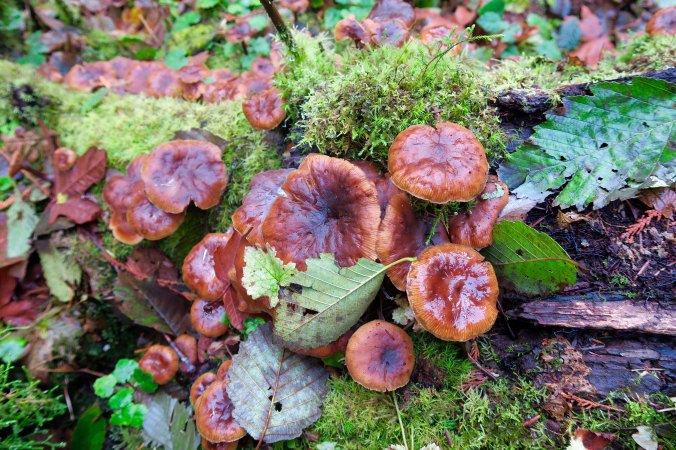
Mushrooms along the trail to Munson Creek Falls off of Highway 101 in northern Oregon.

These reddish mushrooms caught my eye.

Munson Creek near Munson Creek Falls on north coast of Oregon.

Munson Creek dashed along beside the trail, keeping us company. (Photo by Peggy Mekemson.)

Moss covered rock in Munson Creek near Munson Creek Falls on north Oregon Coast. (Photo by Curtis Mekemson.)

A moss-covered rock decorated with fall leaves sat in the middle of the creek.

Moss, ferns and leaves on a tree near Munson Creek Falls near Tillamook, Oregon. Photo by Curtis Mekemson.

Moss, ferns and fallen leaves on a tree had a Christmas look.

Trail to Munson Creek Falls near Tillamook, Oregon. (Photo by Curtis Mekemson.)

A view of the trail.

Our first view of the falls assured us that we had made the right decision to make the trip. Water shot out from the top and tumbled some 319 feet to the bottom, making Munson Creek Falls the highest on the Oregon coat. Halfway down a log jam gave testimony to the power of the stream. The rainforest provided a dramatic backdrop. We wandered around seeking various vantage points to appreciate the beauty, and finally, being satiated, hiked back to the parking lot. The drive out went much faster, or so it seemed.

Munson Creek falls in the coastal mountains near Tillamook, Oregon. Photo by Curtis Mekemson.

The 319 foot tall falls. The log jam with its large logs spoke to the power of the creek. I also like the moss-covered tree to the right.

Photo by Peggy Mekemson of Munson Creek Falls near Tillamook, Oregon.

A final look at the falls above the log jam. (Photo by Peggy Mekemson.)


Photos: Most of the photos I use on this blog are taken by either Peggy or me. Photos without attribution are taken by me. I always note any other sources such as the Air Museum above.

NEXT POSTS: Almost everyone I know who tries to maintain a blog while writing books runs into a challenge with time. There isn’t enough. Solutions range from dropping out of the blogosphere for a while to limiting blogs. I am going to try something else for the next month. If it doesn’t work, I’ll have to a move to a more dramatic solution. Here’s what I am going to try: On Mondays I will do my usual travel blog; on Wednesdays I will put up photos from my collection of 76,000; on Fridays, I am going to blog my book on MisAdventures. The theory is that this will allow me most of the week to work on the book. We’ll see.

WEDNESDAY: We will drop down to the South Island of New Zealand and visit the beautiful Milford Sound.


SaveSaveSaveSave

SaveSave

SaveSave

SaveSave

SaveSaveSaveSave

SaveSaveSaveSave

SaveSave

SaveSave