Today, our full time RV adventure of exploring North America takes us to Zion National Parkin Utah.
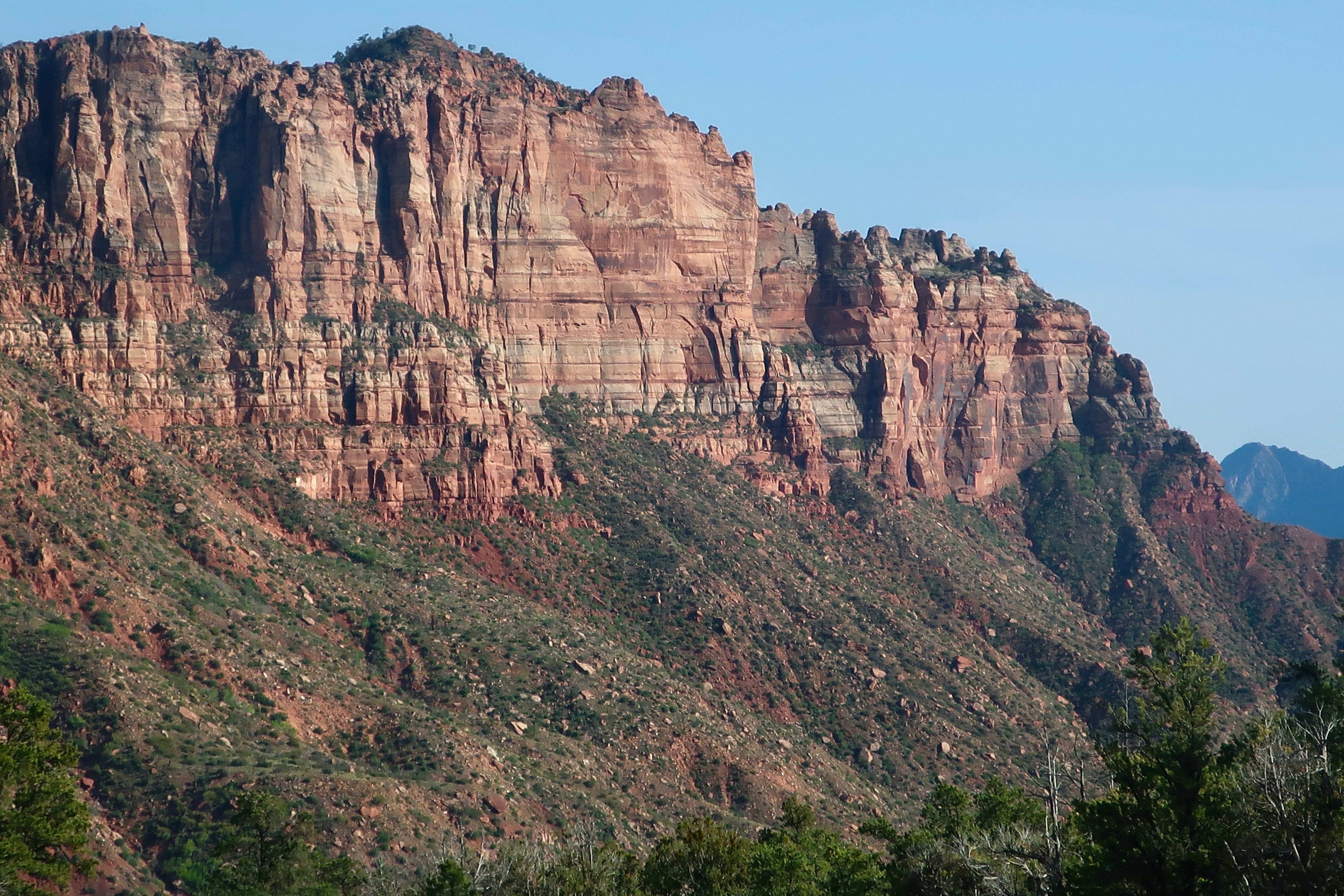
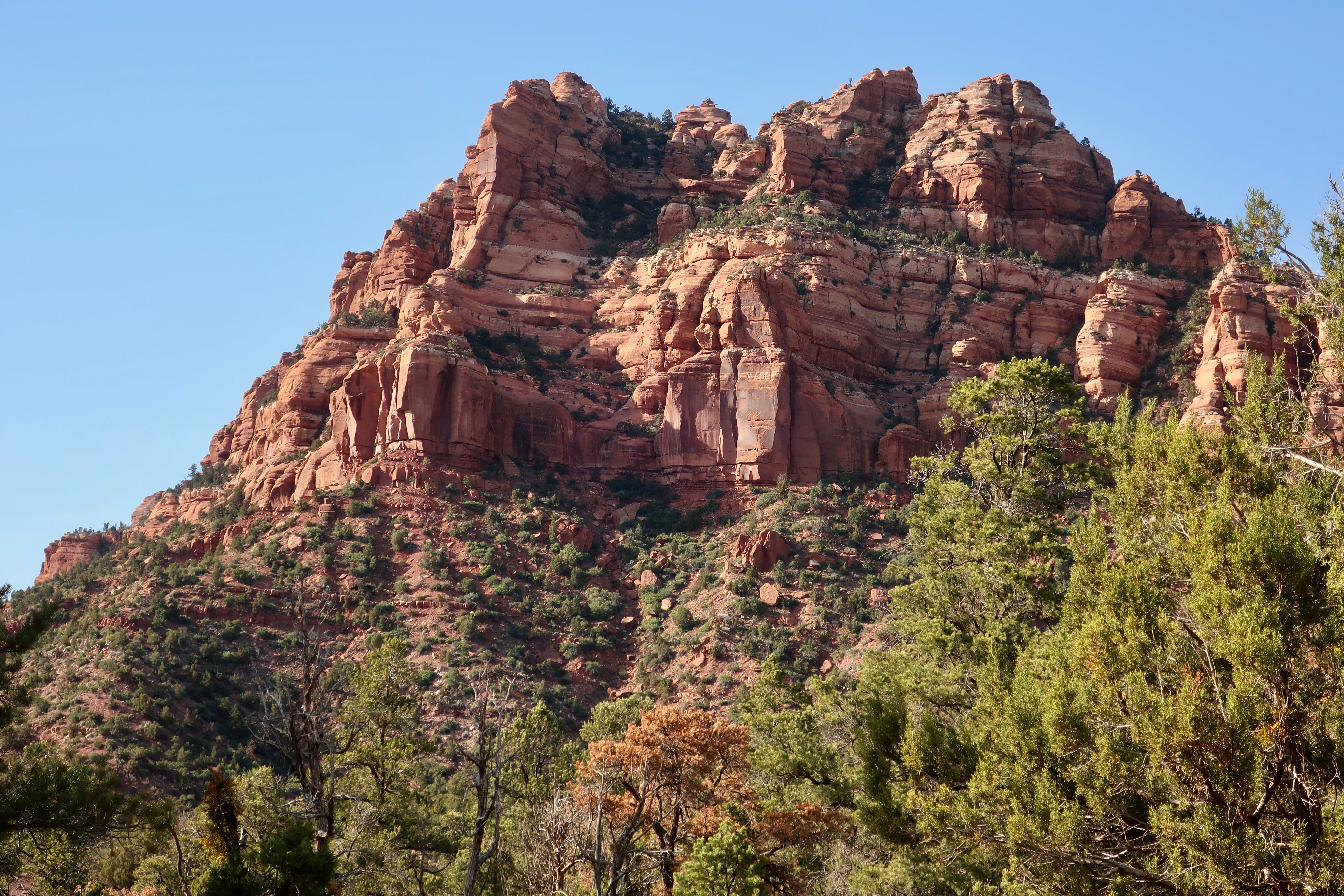
This was one of many delightful monuments Peggy and I found when we explored Kolob Terrace in Zion National Park. Note the lack of traffic!
Peggy was reading an article in the Washington Post a few days ago on Zion National Park. Bring your patience, the article urged. Over 5 million people are projected to visit in 2022. The majority will be from April through September. Expect massive crowds if it is on your vacation itinerary. Parking spots will be difficult to find. Shuttles will be full. There will be long lines to get in, long lines at the restrooms, long lines to visit major sites, and long lines to get food. Finding a place to stay in or near the park will be close to impossible unless you already have a reservation— or get lucky.
It’s my idea of a nightmare.
Peggy and I were fortunate to arrive in late April for our visit. But even then, the crowds in the canyon exceeded my ideal by a factor of 10, or is that 100. Grin. I’ll tell that story at the end of my series on Zion. (Spoiler alert: it was still worth it.) But, for now, I am going to let you in on a little secret, there is more to Zion National Park than Zion Canyon. A lot more. And much of it matches and may even surpass the canyon in beauty. Peggy and I are going to take you on three short road trips to various sections in the park outside of the canyon to prove our point: Kolob Terrace, Kolob Canyon, and the east side of the park. Plus a ghost town.
I am going to start with the Kolob Terrace. Peggy and I were staying at an RV campground on the Virgin River in the small town of the same name 14 miles from the canyon. The road into the terrace was less than a mile from where we were camped. We drove up it for 15 miles before turning around, stopping frequently on both our way up and back. We met a dozen cars along the way. There may have been 30 parked at the various trailheads and overlooks. Compare that with the 14,000 or more people who were exploring the canyon on that day! Following are the photos Peggy and I took. I am going to divide them into three posts since there are too many for one. (Note: I take five times as many photos as Peggy. :))
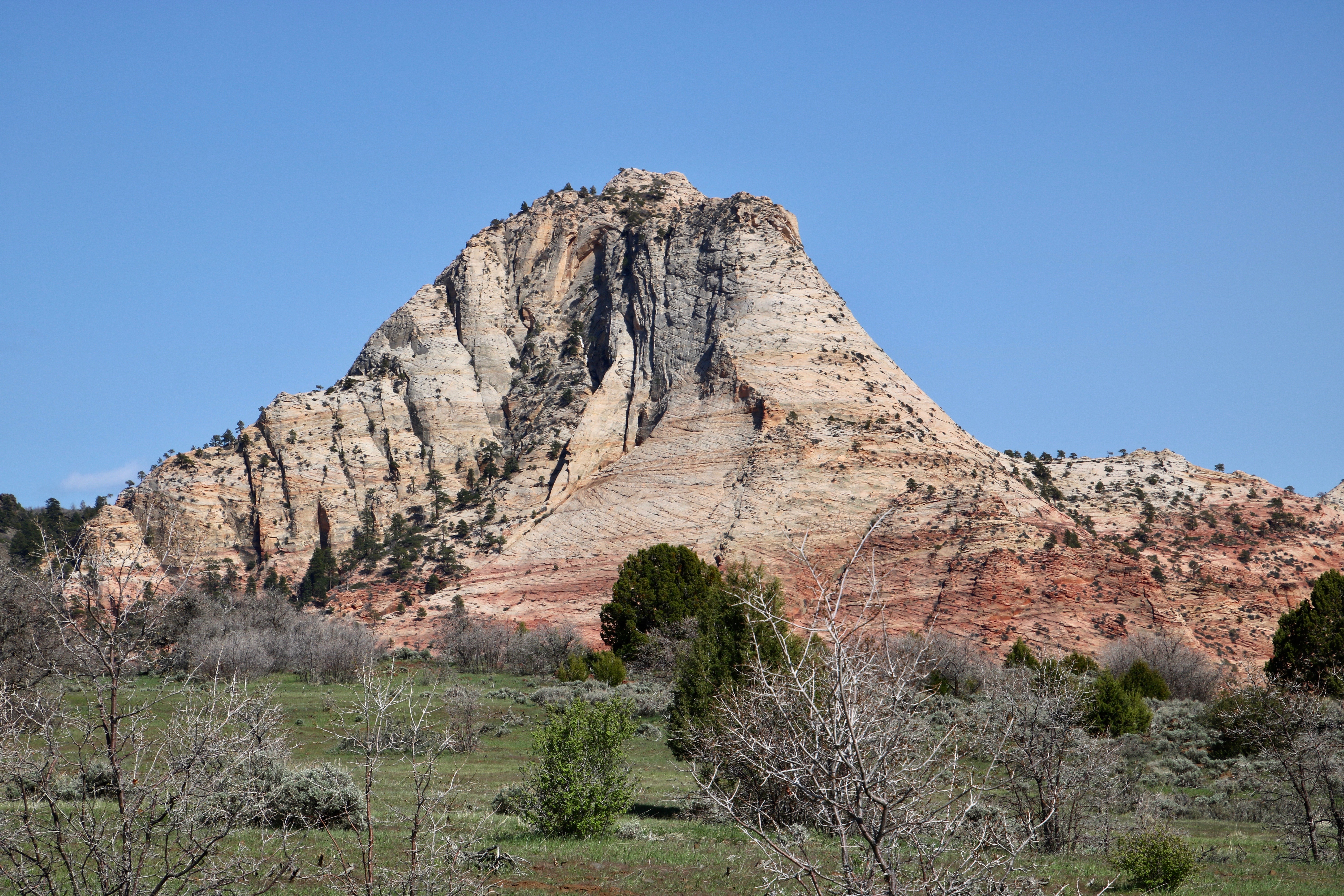
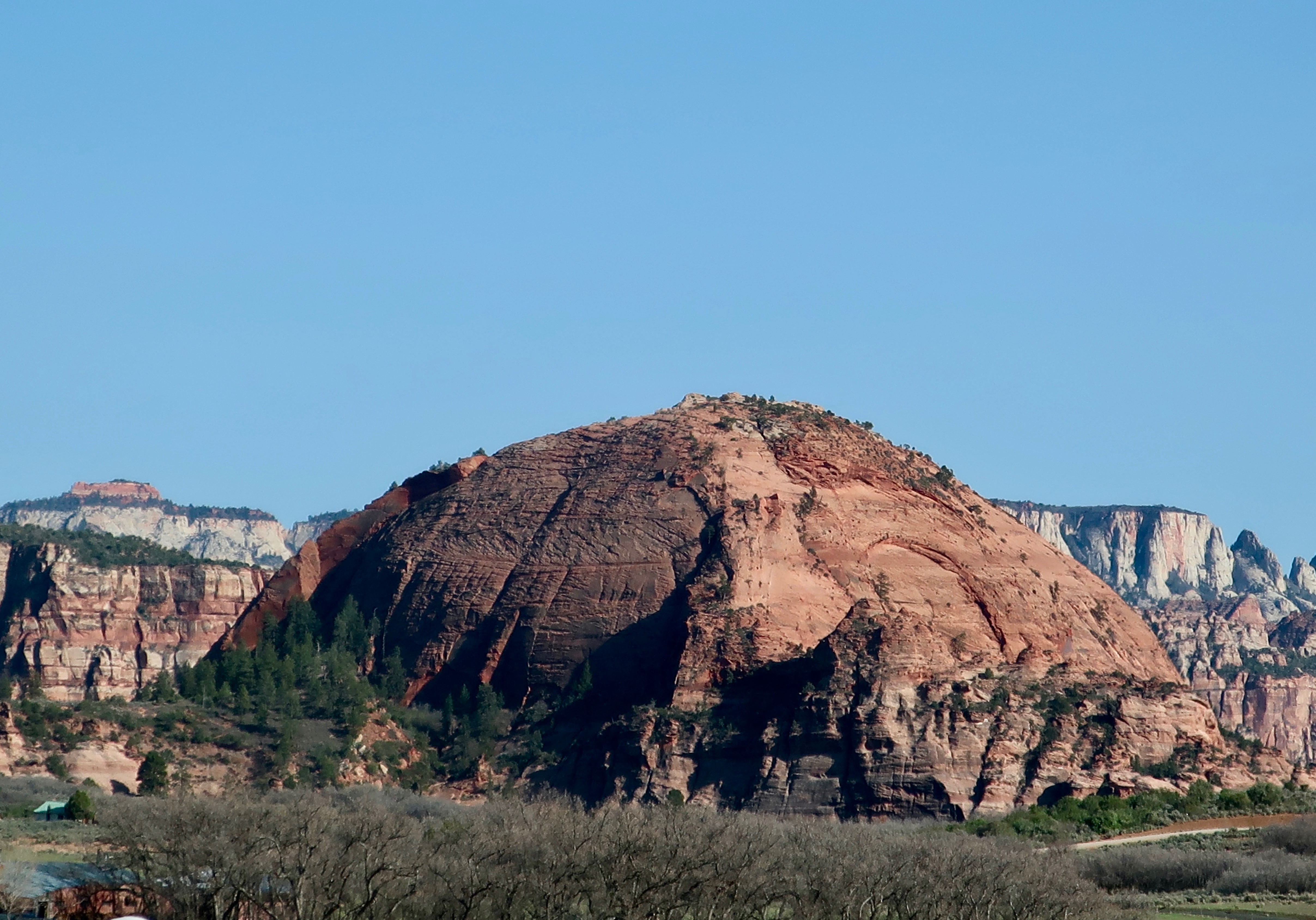
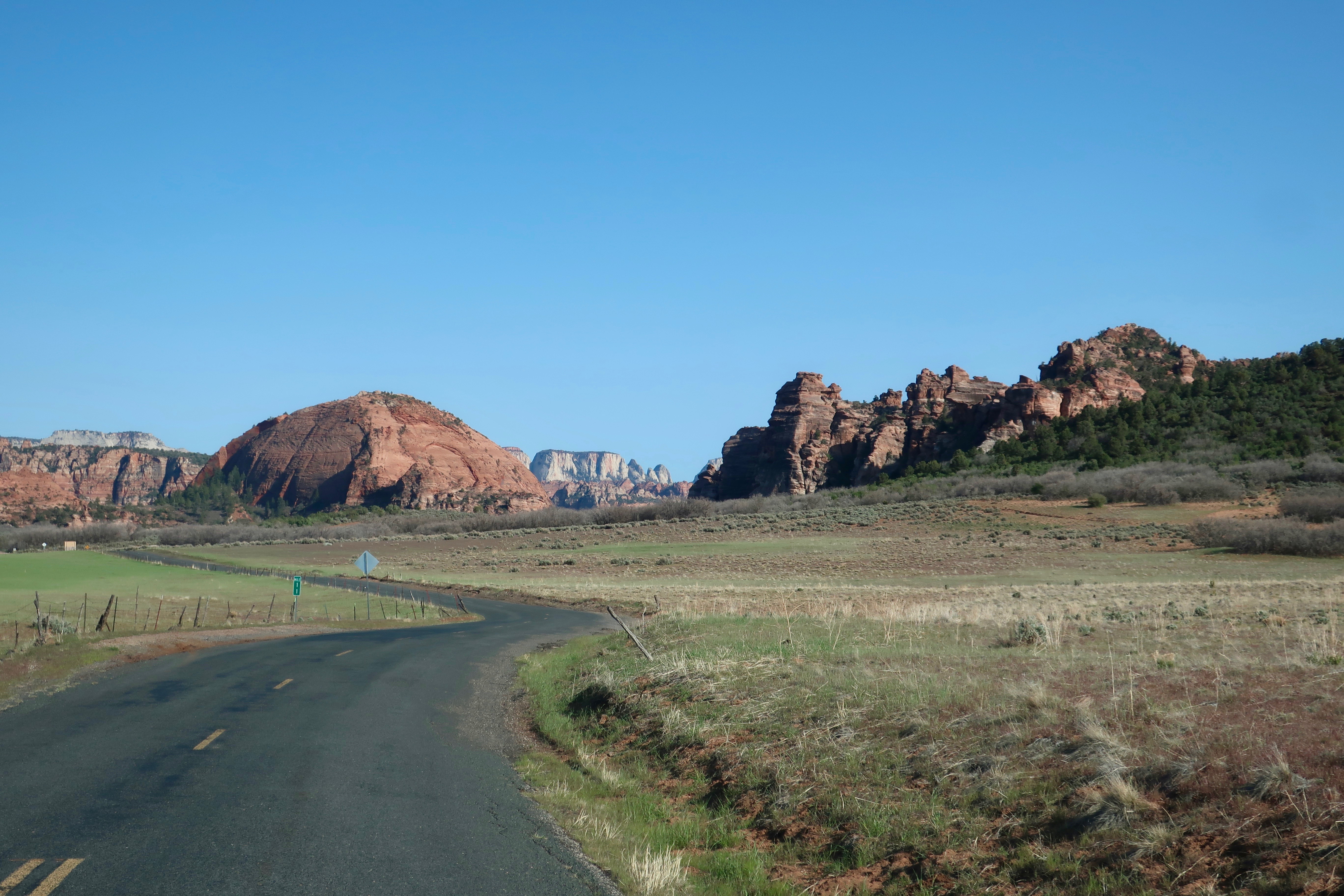
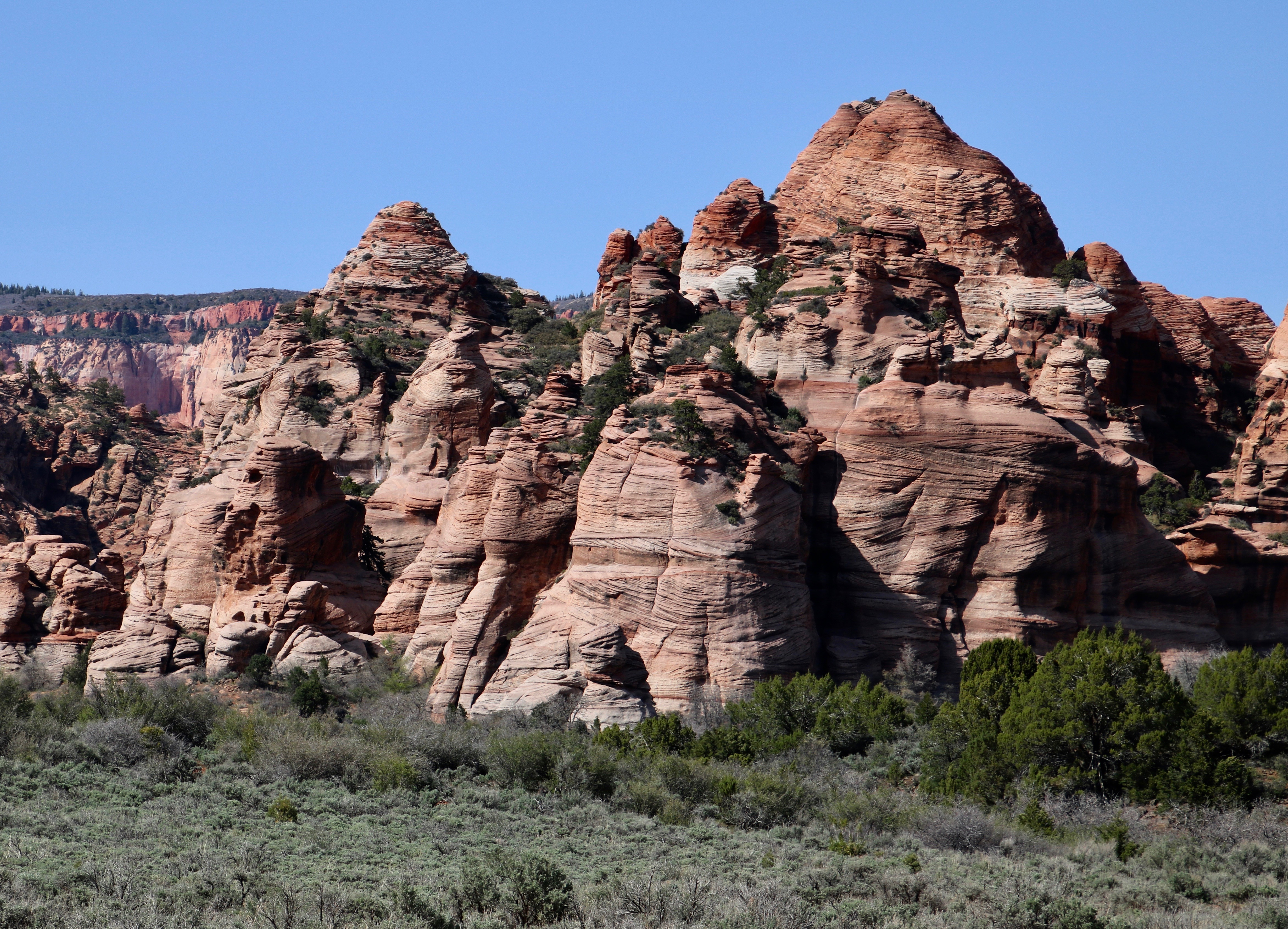
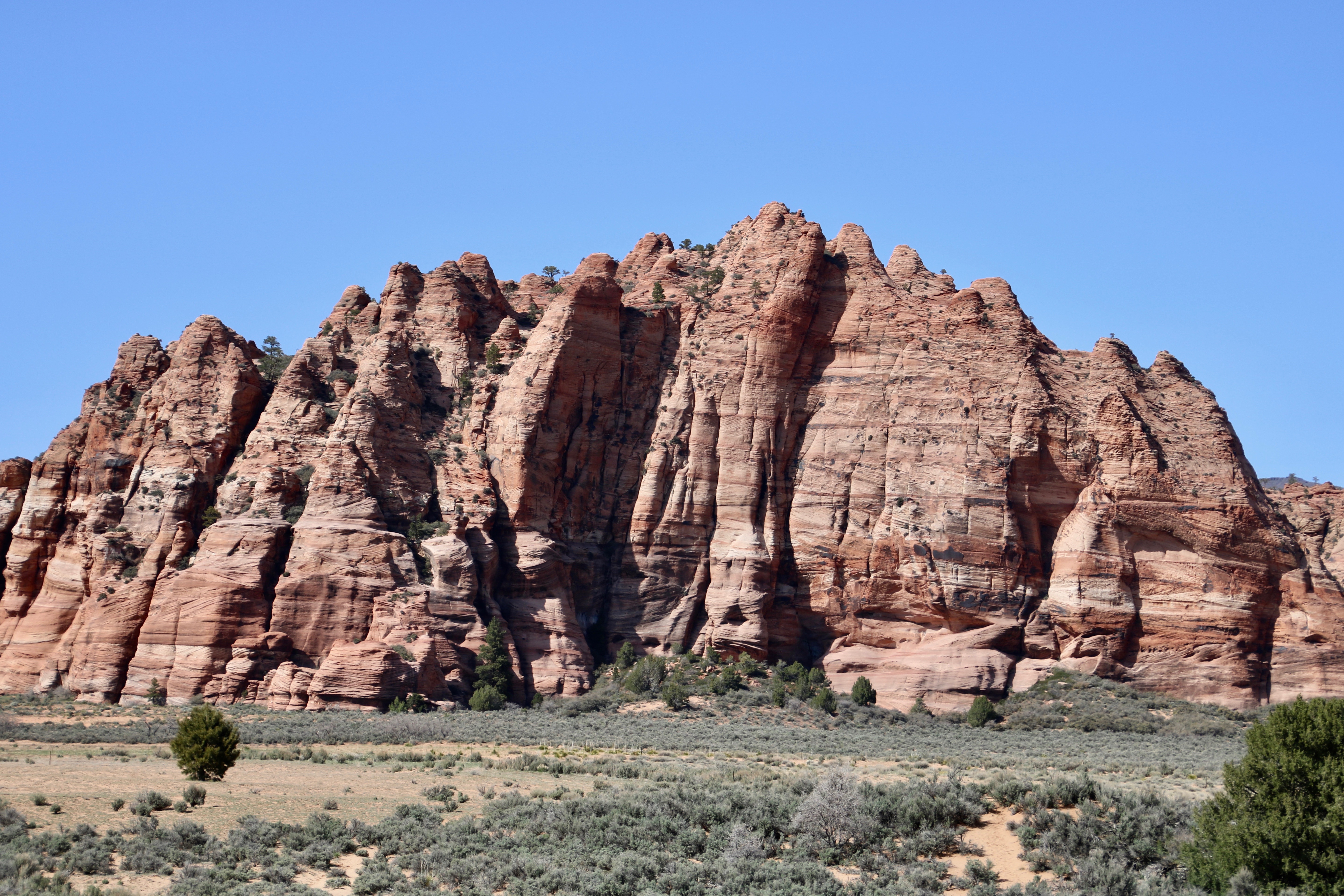
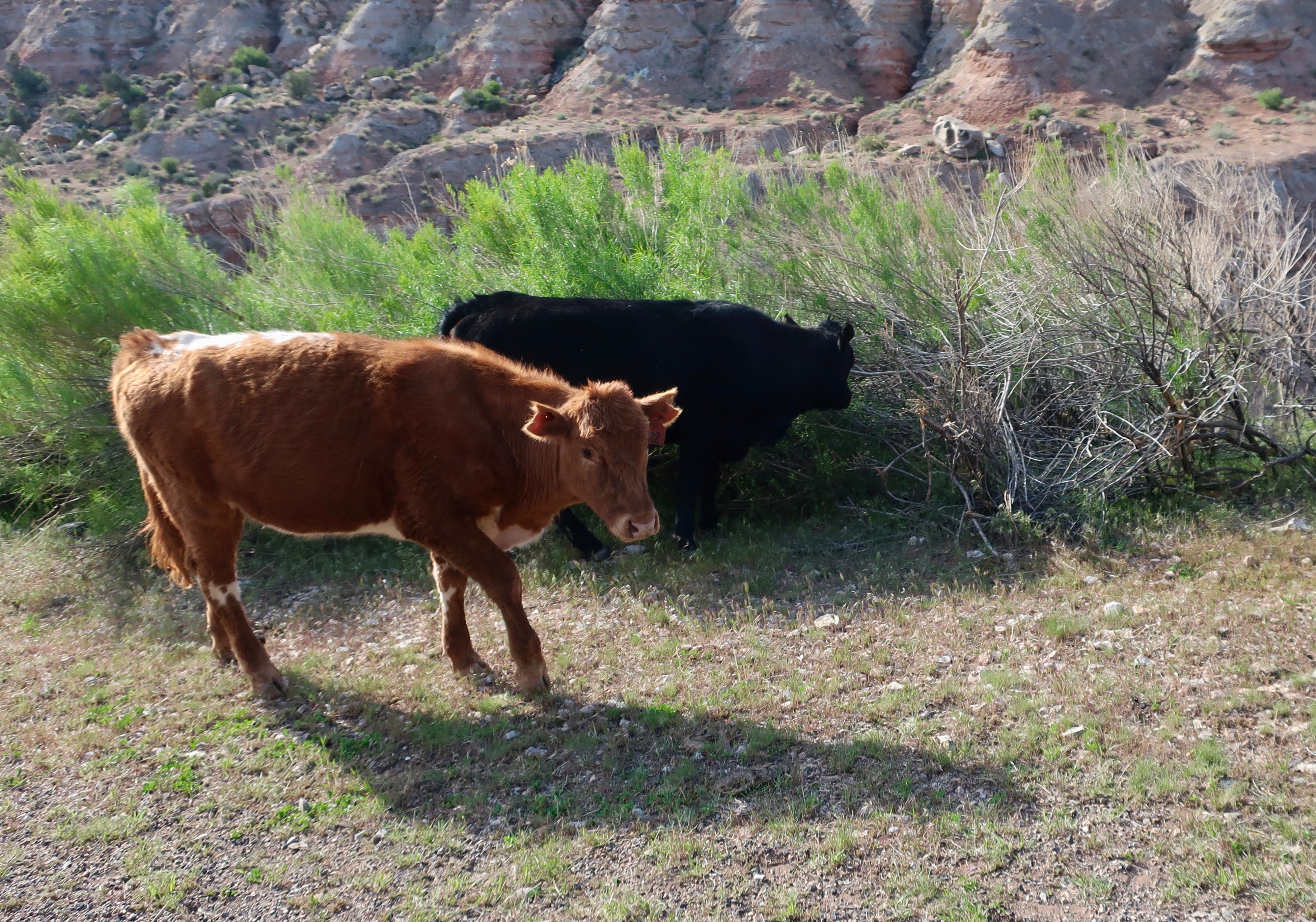
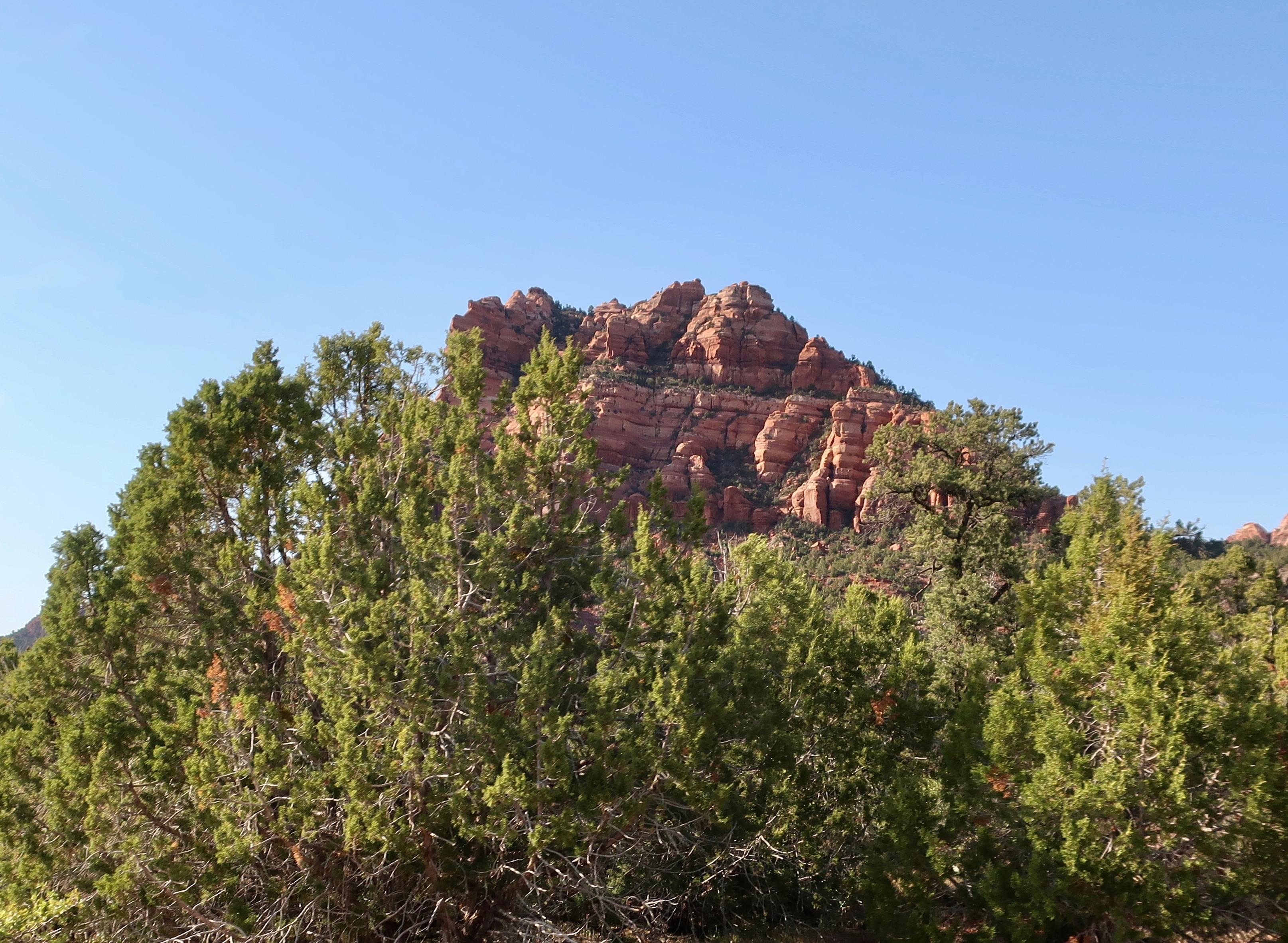
The beginning of our journey up to Kolob Terrace. It was obvious from our initial view that we were going to enjoy the ‘detour’ from Zion Canyon.I think this striking monument was Peggy’s favorite. (Photo by Peggy Mekemson.)She even took more than one photo! I always think that things like the trees in the left foreground add interest and help draw viewer’s eyes into the picture. (Photo by Peggy Mekemson.)I took at least six of this monument on Kolob Terrace featured at the top of the post! Most of the rock structures in Zion are made from sandstone, which, on its own, tends to be white. Like I mentioned in my Death Valley posts, it is oxidized iron that leads to the reds, oranges and pinks.This distant road shot gives an idea of the numerous shapes and colors of the various monuments on Kolob Terrace.Here’s an example of the variety of shapes. I always think of these rock formations as a fairy community, or maybe a troll town. (Photo by Peggy Mekemson.)Sheer cliffs like these found in Kolob Terrace will eventually be eroded by the forces of water, ice, wind and gravity. Different types of rocks erode at different speeds leading to the wonderful shapes found throughout Utah and the Southwest. Note the extensive talus slopes seen beneath the cliff.This distant formation provides an example of the erosive forces at work.A closer view of the same formation. the layer of rock on top is eroding faster than the layer beneath it. like the triangular face of the rock.This massive formation in Kolob Terrace shows a rounded character to the erosion. (Photo by Peggy Mekemson.)The Kolob Terrace road runs through national park and private land. Signs warn that you might find cattle along the way. We did. They had the grace or good sense to stay on the side of the road. I’ll conclude today’s post with a shy rock formation that is hiding among the trees….Caught it. On Friday, Peggy and I will continue to explore the beauty of the Kolob Terrace section of Zion National Park.
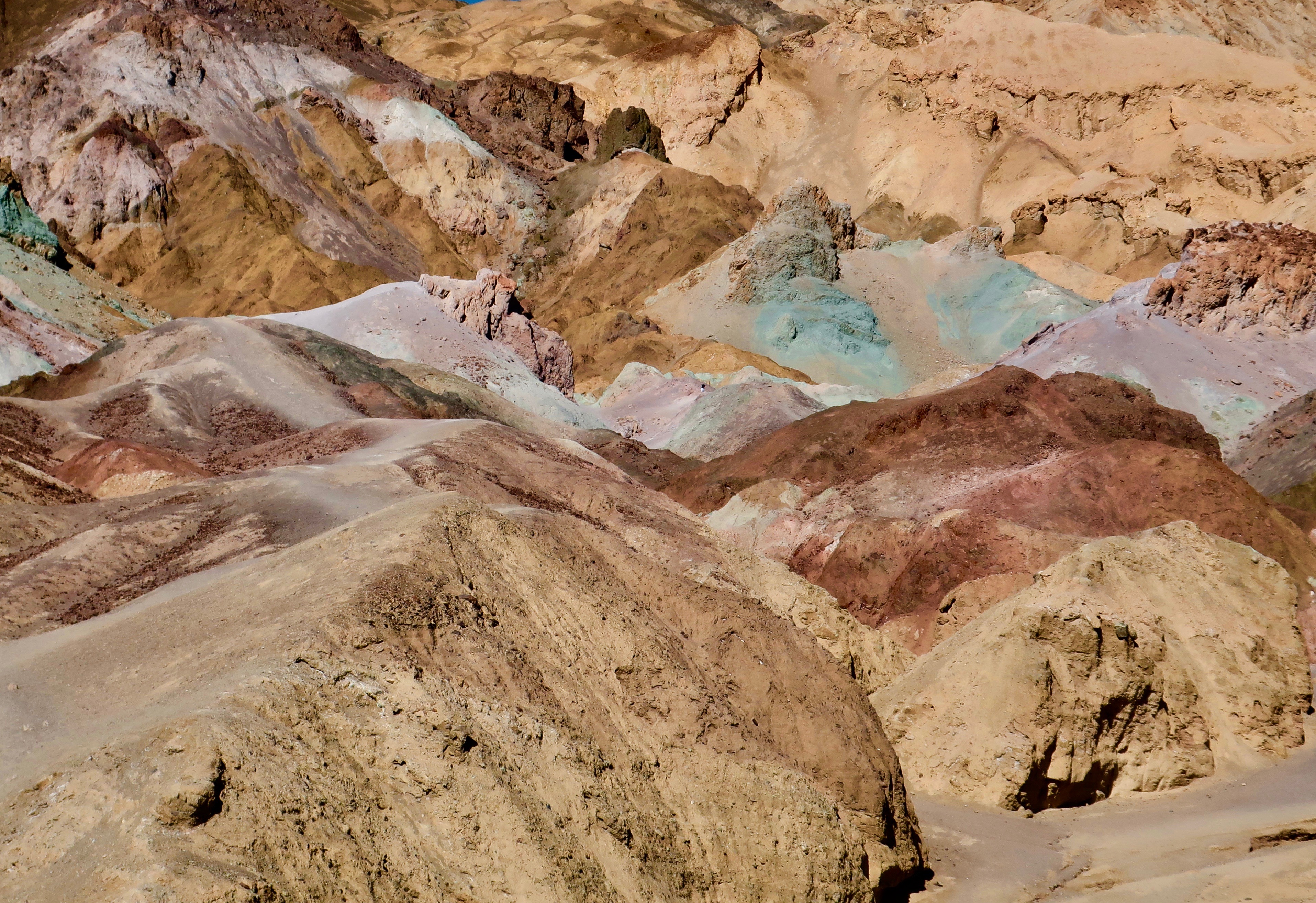
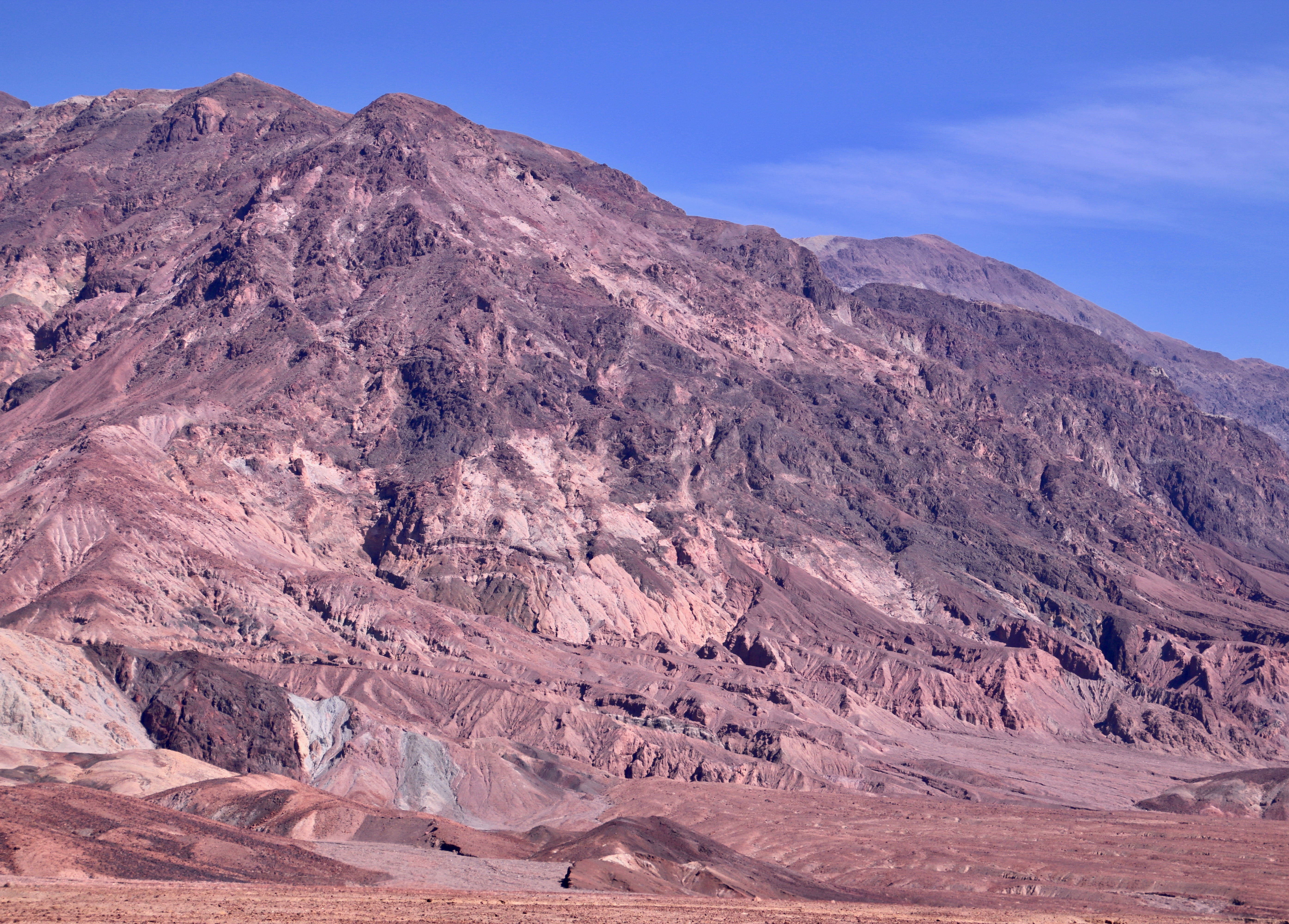
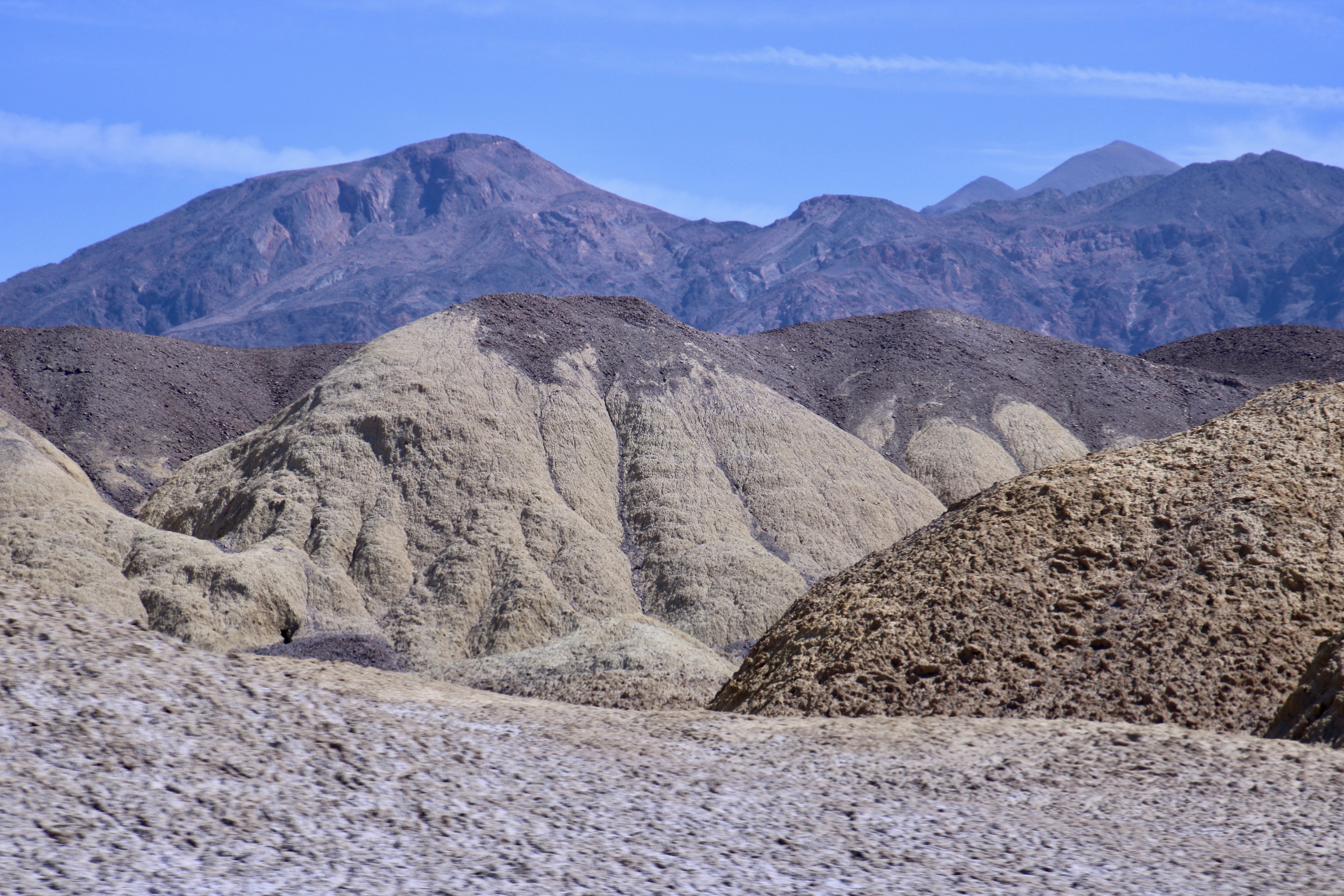
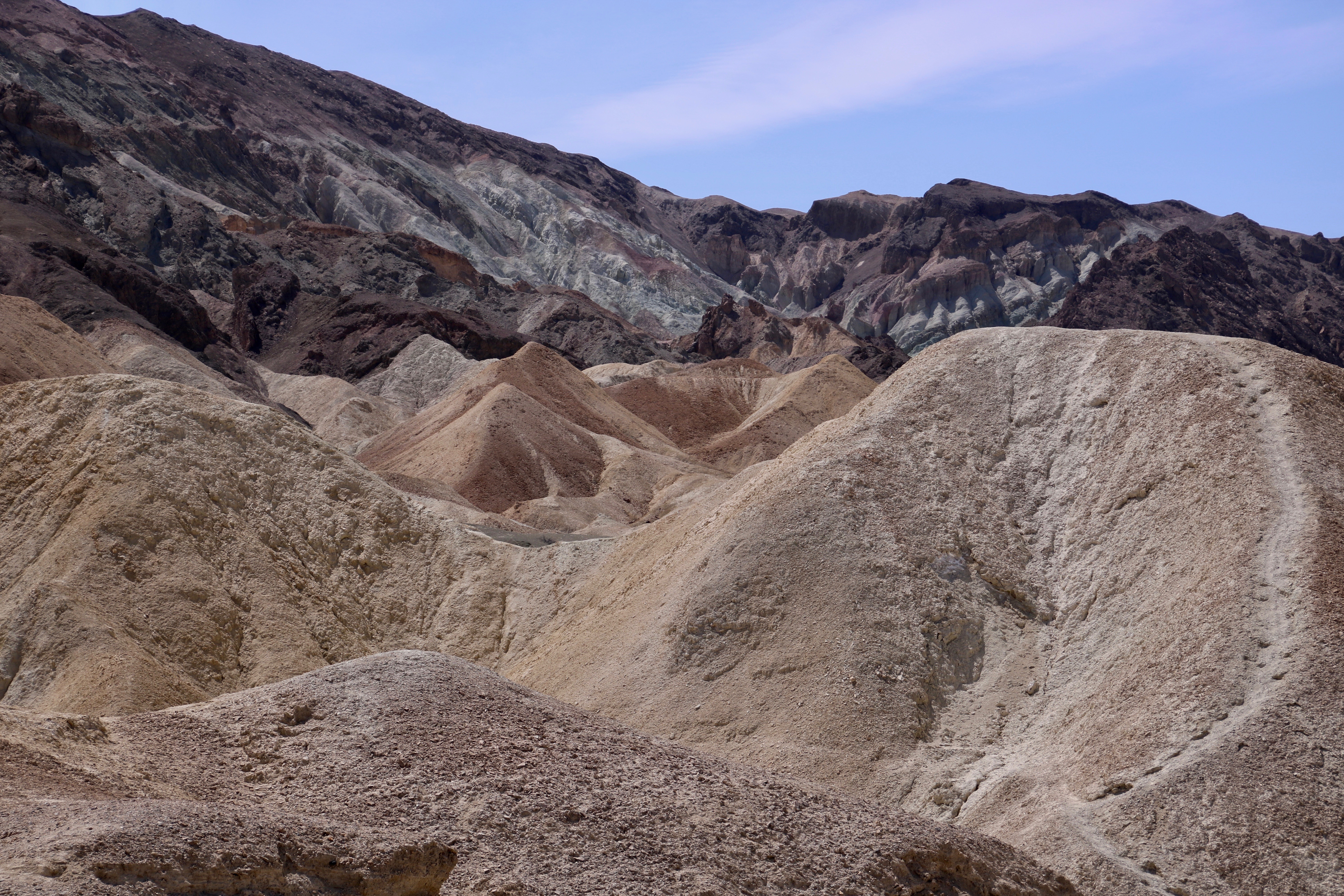
The rocks at Death Valley’s Artist’s Palette are world famous for their color.
Geology is up close and personal at Death Valley. The Valley floor and sides, stripped free of most vegetation, can’t help but show their true colors. The most colorful place to check out these colors is along the paved one-way Artist’s Palette’s drive, which is near the Devil’s Golf Course, Gold Canyon, and Bad Water basin, other treasures of the Valley.
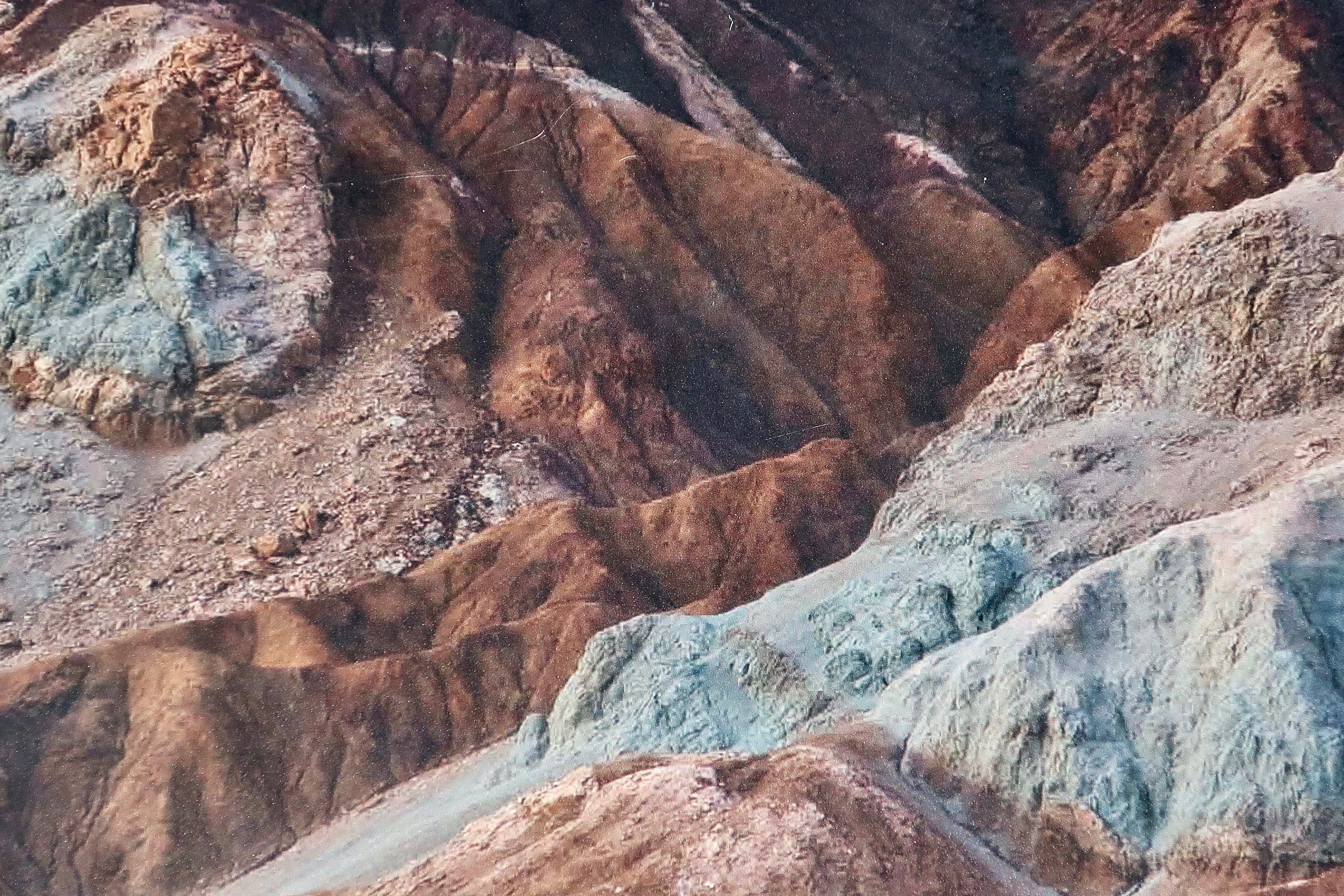
The colors you see are the result of oxidation of various metals. One example of oxidation that everyone is familiar with is the formation of rust on iron. Along Artist’s Drive, iron compounds create the red, pink and yellow you see. Mica derived from tuff, produces the green. Manganese produces the purple. (Tuff is a light, porous rock created from volcanic ash.)
A close up of the rocks at Artist’s Palette.
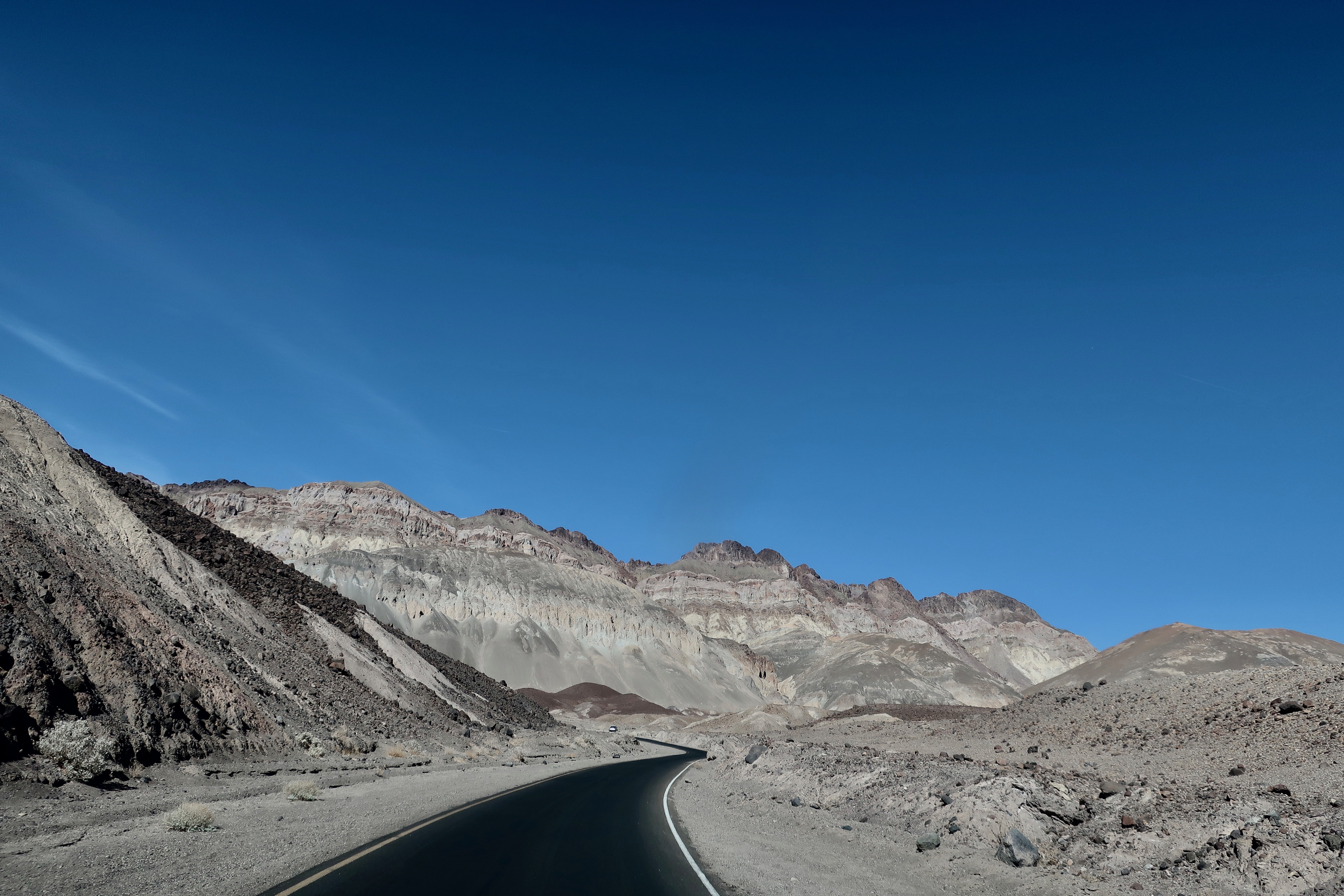
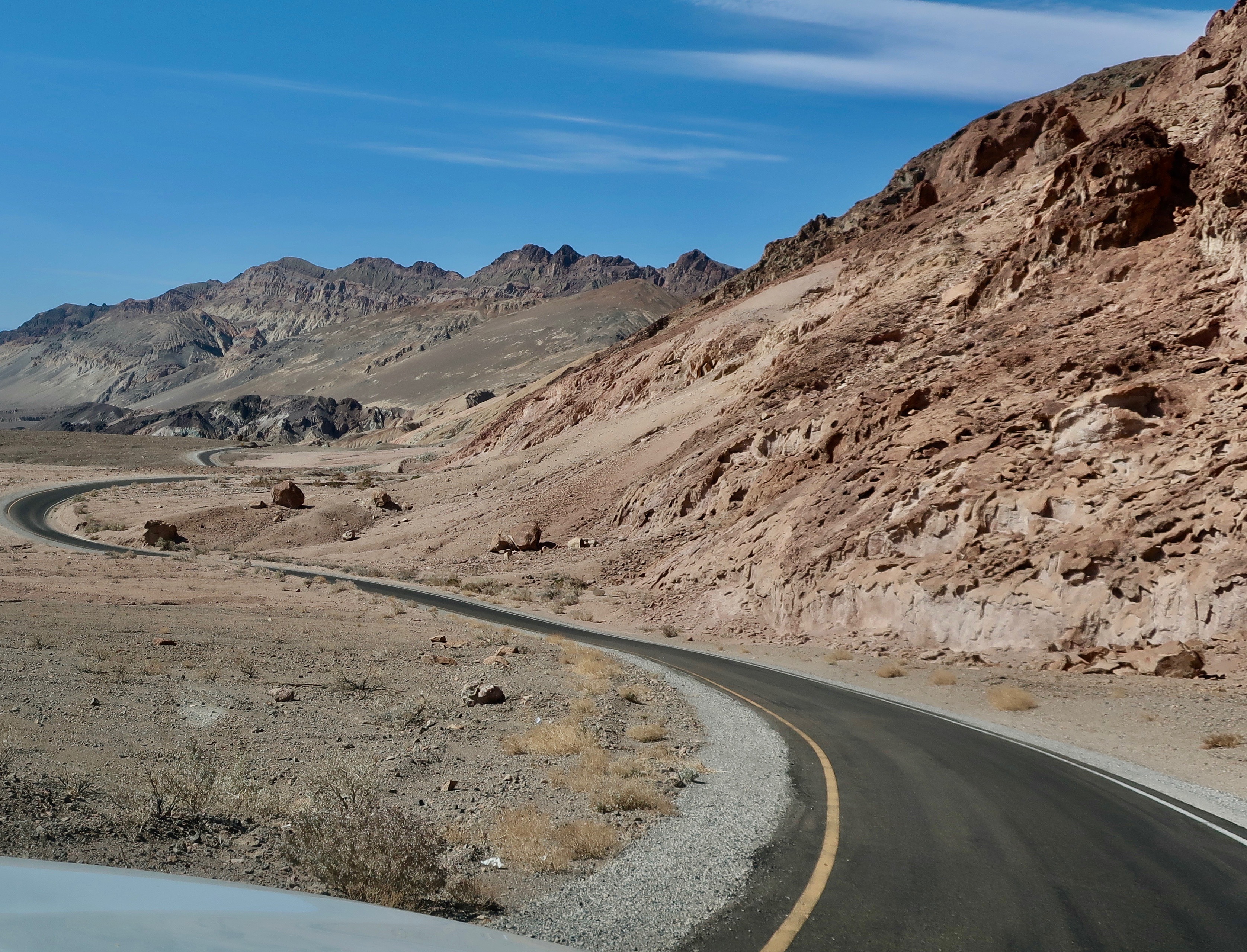
While visiting the Artist’s Palette overlook is the objective, the drive itself is worth the trip. I took the following photos while Peggy was driving. (It was her turn.) In addition to the scenery, there were fun curves and roller coaster ups and downs!
Road shot one.Road shot two.Road shot number three featuring the nose of Iorek the truck.
Of course the fun road also has beautiful scenery along it. Artist’s Palate has hardly cornered the market on color, as Peggy’s photos demonstrate.
Photo by Peggy Mekemson.Photo by Peggy Mekemson.Photo by Peggy Mekemson.
Now, let’s get back to the question raised in the Headline: Assuming an artist is in Death Valley has a full palette of colors, which one would he choose to paint a pupfish in love? Enquiring minds want to know.
But first, some background. You’ve probably heard of pupfish. There are several species scattered in locations around the National Park. Once upon a time they were happy residents of a huge lake that filled Death Valley. Lake Manly was a result of the Glacial Age. When the glaciers retreated to the far north and mountain tops 10,000 years ago, the lake was left to dry up and the pupfish were left scrambling for any remaining bits of water left, like individual springs. Lack of any contact created a number of subspecies.
The ones I will feature today live in Salt Creek. Their much more famous cousins live outside of the the Valley proper in what is known as Devil’s Hole, a 430 foot deep hole in the ground filled with water. What makes them so famous is that they are a critically endangered species. Today, there are less than 100 left. There were more in the 1960s but even then they were rare enough to be declared an endangered species, one of the first species to be so, seven years before the bipartisan passage of the Endangered Species Act of 1973.
Environmentalists the world over were ecstatic. The business people not so much. Nearby ranchers were limited in how much water they could pump out of the ground and developers in what land they could sell. Profits would be reduced. All that to save a tiny fish from extinction. A “Kill the Pupfish,” “Save the Pupfish” bumper sticker war ensued. National headlines were created and people across the country became aware of the pupfish. It is still a symbol of the ongoing battle between those who see objects primarily in terms of money and those who see them primarily in terms of inherent value. Being a lifelong environmentalist, I come down on the side of the pupfish, but I feel empathy for those whose livelihood was impacted.
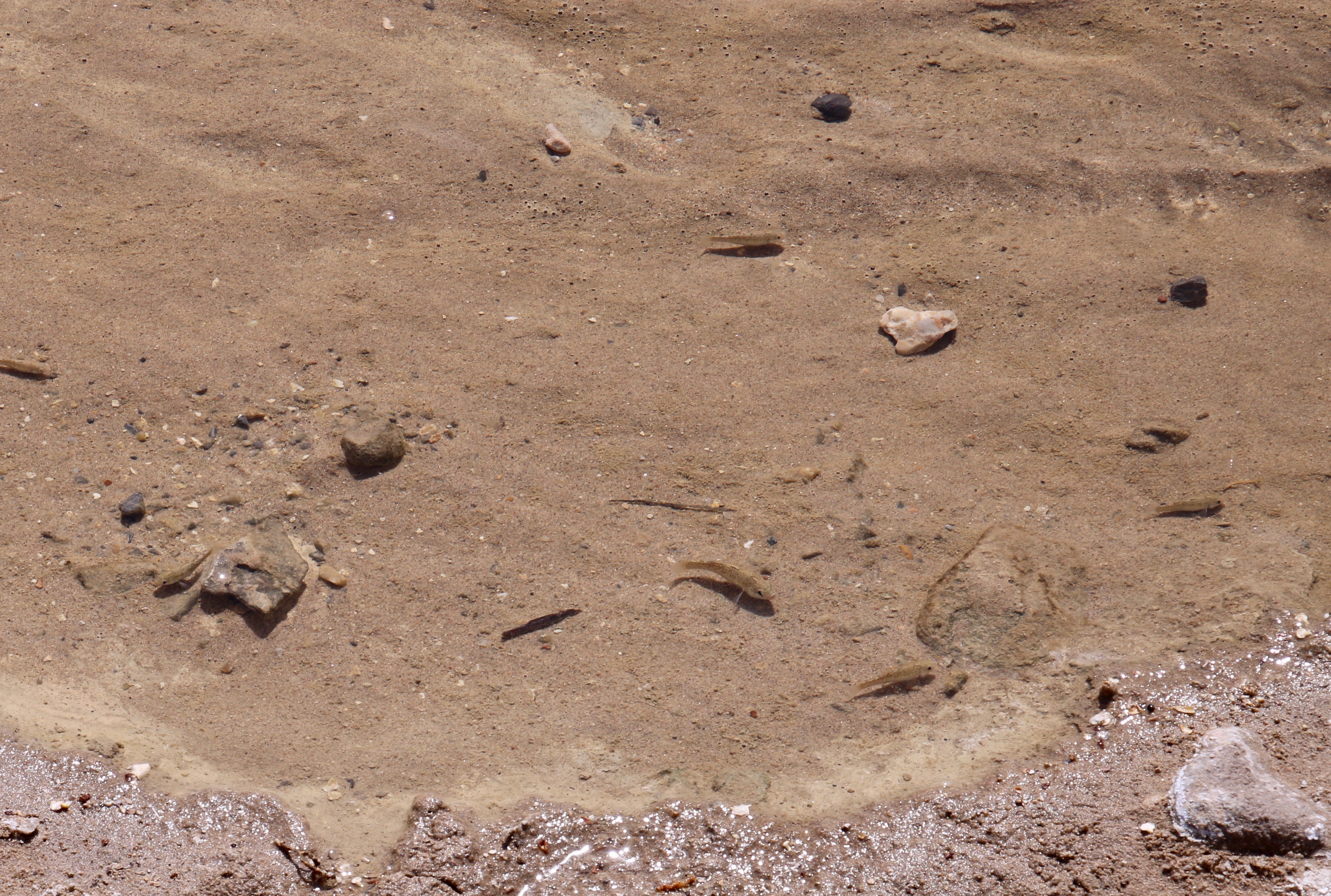
Now join Peggy and me as we go in search of the ‘illusive’ pupfish of salt creek, whose males turn bright blue when they are in love, or is that lust. Either way, I’m glad that isn’t an infliction of human males.
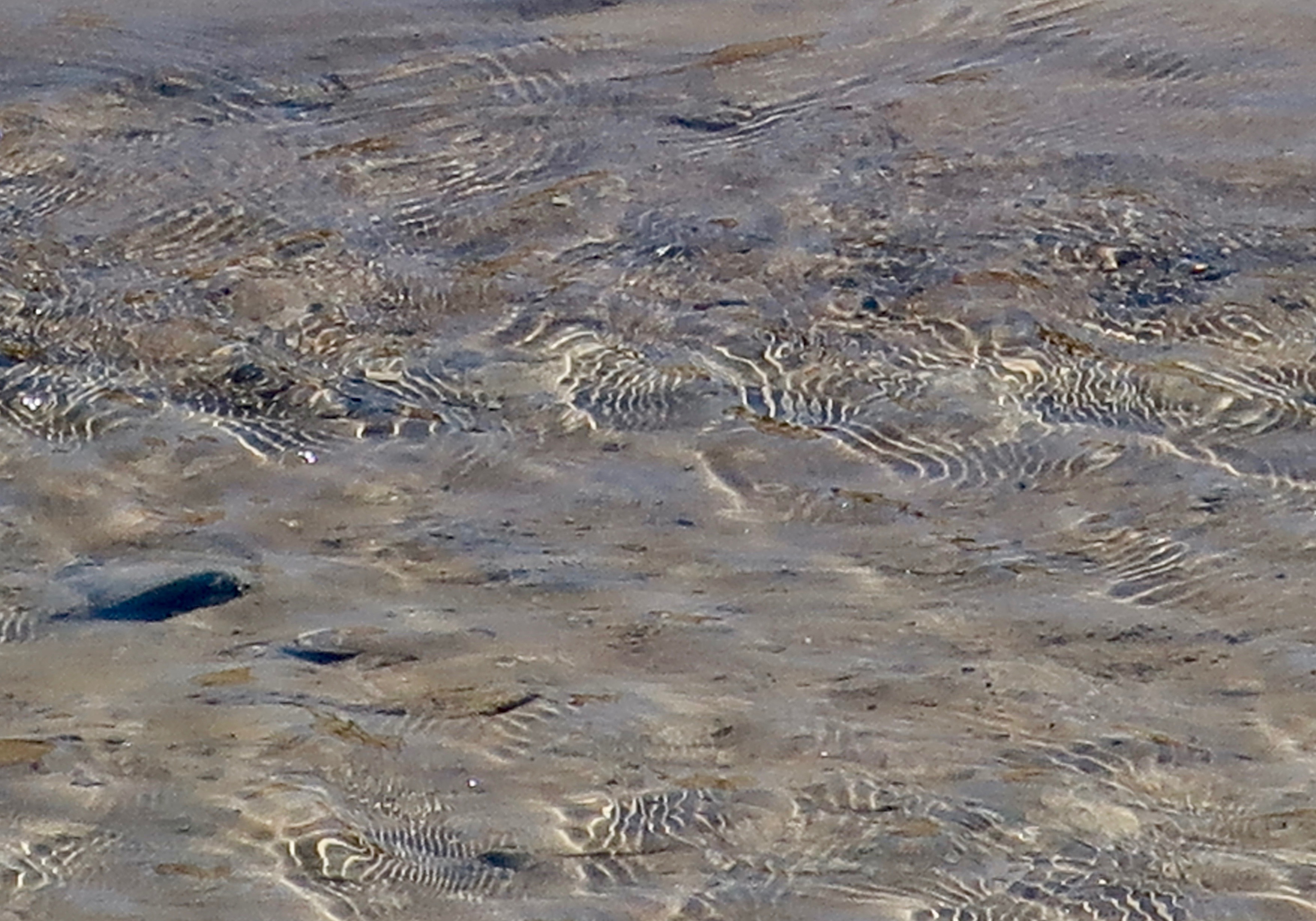
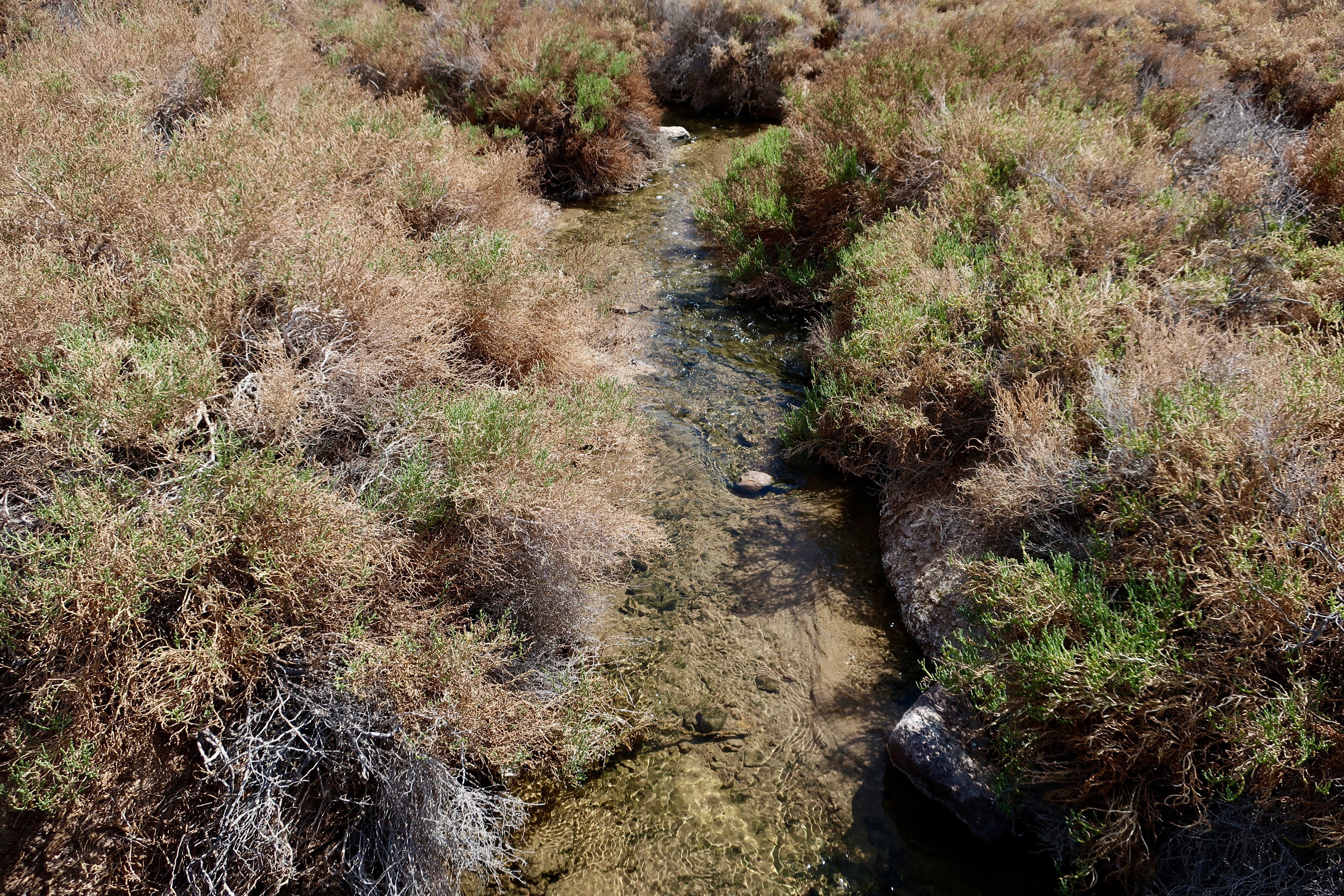
A road sign some 15 minutes west of the Furnace Creek Visitor’s Center points you down a short, but bumpy dirt road to Salt Creek. The first thing you notice is that there is indeed a creek, which is a rare site in Death Valley. We were lucky to be there in April when it was still flowing. The second thing we noticed was that a well-built board walk followed along the creek.We eagerly set out with our eyes pealed on the water, searching. (Photo by Peggy Mekemson.)No fish here. But I enjoyed the dapples of bright sunlight…Again, no fish. I was stuck with admiring the ripple patterns caught by the sun. But where were the pupfish?Again, nice riparian habitat, but for what. And then…There they were. Busy male pupfish protecting their territory and looking for love! They didn’t appear blue to us, however. Maybe they weren’t ready for prime time. (Photo by Peggy Mekemson.)Right next to it was a pool absolutely teeming with the little fellows. Apparently they hadn’t received the message about being endangered. We learned that the word prolific hardly fit when describing the baby producing capacity of the females. And the males were more than willing to do their share. The literature used the word ‘millions’ when describing a season’s production. Unfortunately, when the creek dries up most of these offspring are lost. Only those that live near the spring in year around water survive— and wait for the next year so they can one again start their frenzy of propagating. (Photo buy Peggy Mekemson.)An information panel gave an artist’s rendition of a happy couple. “But where’s the blue?” went dashing through my head. Remember the old “Where’s the beef?” commercials. Okay, I admit that there is some blue, and it is on the male. The panel described the mating process. And it isn’t even R-rated. A female arrives in the males territory, swims over to him, and snuggles up to his side. They start shivering in anticipation, and zoom, she’s pregnant. Just like that. I’d say something about being premature but apparently, that’s how it’s done. “Was it good for you, honey?”
When you watch pupfish for a while they appear to be playful, dashing around, chasing each other, and plowing up the dirt with their noses. That’s where they get the name pupfish. We wished this year’s crop good luck and I took a final photo of the creek as we headed off for out next adventure: exploring Mosaic Canyon, which will be our next post.
Water is precious in the desert and the pupfish is only one of a number of animals and birds that take advantage of Salt Creek as is makes its way out into the desert to disappear into the sand.
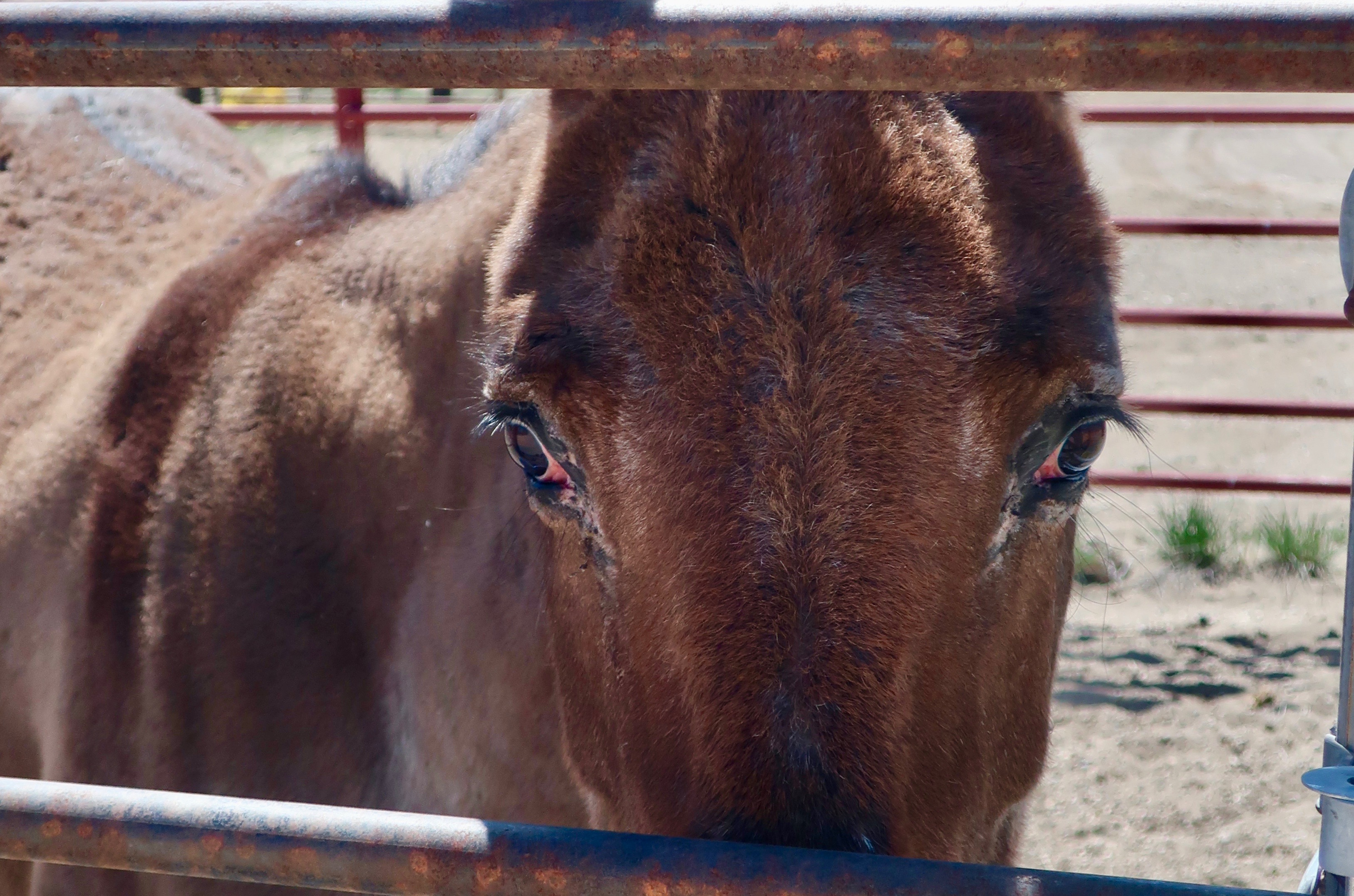
Who’s smarter? This girl with her wild eyes and gorgeous eyelids…Or this fellow with a large nose and impressive nose hairs?
Or, the question going through your mind might be, “Why in the heck is Curt asking this question when his post is on Death Valley?”
Well, it started when I was doing research on Death Valley’s well-know, historic 20 Mule Team. Given that I am featuring the 20 Mule Canyon on my post today, I wanted to provide some background information, which I will. But the first thing I learned (or relearned) was that it wasn’t a 20 mule team that was used to haul borax out of Death Valley from 1893-96. It actually consisted of 18 mules and 2 horses. All of the animals had very specific tasks. Some required more intelligence than others.
Luckily for me, the town just up the road from where we camped near Bryce Canyon (Tropic) had a Mules Days event going on and there was a horse corral just across the road from us in Cannonville. I was able to persuade a mule and a horse to pose for me.
There is a ton of information on the twenty mule teams. This may seem like a lot until you take into consideration that the 18 mules and 2 horses were actually hauling close to 9 tons of Borax at a time out of Death Valley in temperatures that sometimes exceeded a 100 degrees F. (Operations were halted over the hot summer months.) They started their epic journey from the Harmony Borax Works near Furnace Creek and traveled for 165 miles over primitive roads to the railhead near Mohave. As you might imagine, it was quite the challenge. It required close to a heroic effort on the part of the mules, the horses and the muleskinners. Millions of dollars could be made if the venture was successful, however, and it was. Borax has lots of uses.
Still, all of this would be a mere note in the history books except for a couple of factors. One, Borax Soap featured the mules in a very extensive advertising campaign. The second was the radio and TV program, Death Valley Days. For those of you who are old enough to remember the 50s and 60s TV show, you may also remember that Ronald Reagan hosted the show in the mid 60s just before he jumped into his campaign for California Governor.
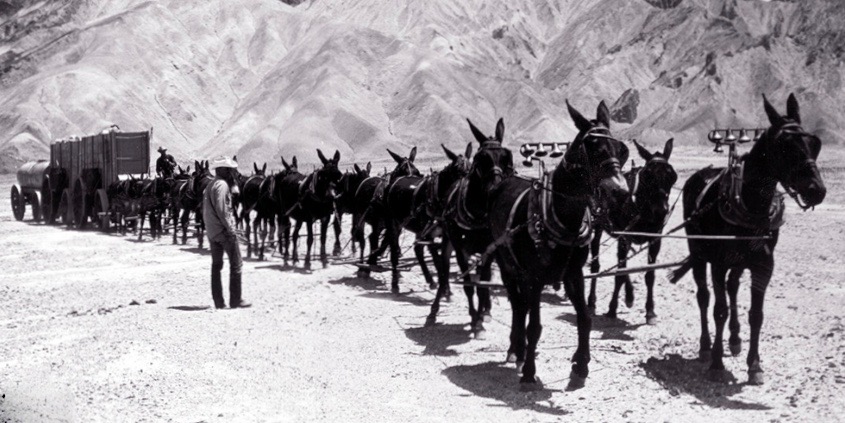
I think this 20 mule team traveling through 20 Mule Canyon is a team that Borax Soap used to promote its product. The photo is from the US Borax’s Visitor Center in Boron, which is well worth a stop. The two large wagons were for hauling the borax. The last wagon contained water for the mules since water holes were few and far between on the long, dry 10-day journey— and it was very thirsty work. The man at the back of the line is riding one of the two horses. The two lead mules, both female, have bells. This historic photo provides a good perspective on just how big the wagons were. The large wheel is seven feet tall. The man on the left is the muleskinner who was in charge. On his right was his swamper who carried out a number of supportive jobs including handling a back up brake to be used if the wagon decided to run away going down hill.The muleskinner earned $4 per day, his swamper, $2, and the Chinese laborers who did the hardest work of digging out the borax, $1.25
I found a rather amusing, imaginary discussion with a muleskinner on the Death Valley National Park site. The greatest challenge he noted was in getting around corners. He used a diagram to describe the operation. An 80 foot chain connects the lead mules to the wagon.
Here’s what he had to say about the process: “Now I’ll tell you just how smart my mules is: it’s one thing drivin’ along a straight road; it’s a whole nother thing turnin’ corners on a mountain pass. My 2 lead mules, both mares, are about 80 feet ahead of me–so far away I can’t even begin to use my 9-foot long whip on ‘em. I’ve been known to throw pebbles at ‘em to get their attention. Aim’s good too. Back to gettin’ around corners. The next 5 pairs of mules are my “swing teams”, they ain’t real smart, they just know their names and what ‘pull’ and ‘stop’ means. Now the next 3 sets of mules behind the swings are my “pointers”. These mules are trained special to jump over that 80-foot chain and side-step away from the curve to keep that chain tight and my wagons goin’ ‘round that corner right. Next comes the 2 big horses. They’re strong enough to start my wagons rollin’, but that’s all they’re good for. A dumb mule (and I ain’t seen one yet) is a whole lot smarter than a smart horse.”
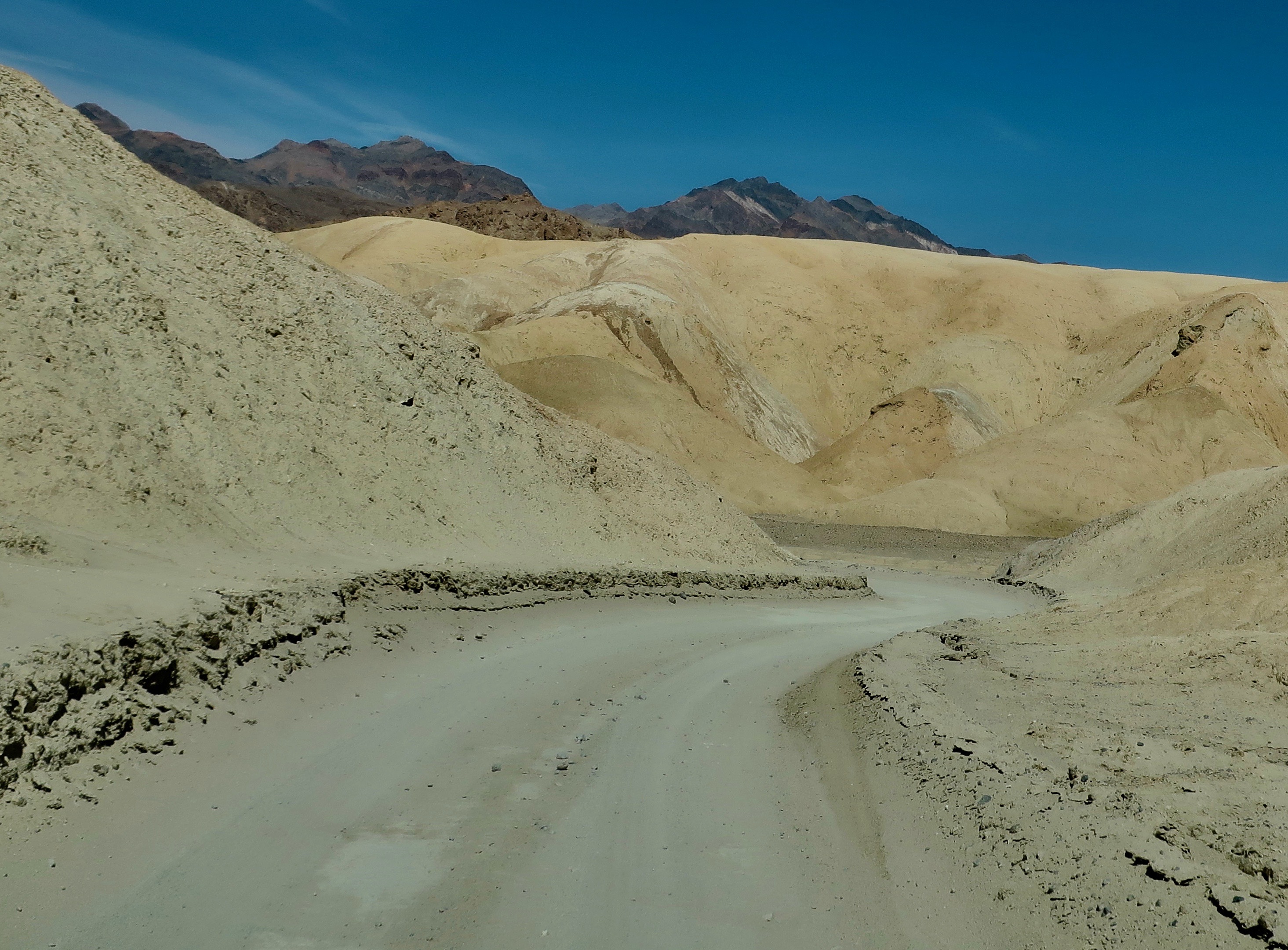
So, there you have it— which animal is smarter. At least from the perspective of a muleskinner. I’ll allow that a horse lover might have a different point of view. Grin. And now, it’s time to get away from all of the words and take you through 20 Mule Canyon in photos. The canyon starts no more than a mile above Zabriskie Point. And even though the road is dirt, cars with two wheel drive seem to handle it easily.
The dirt road.Photo by Peggy Mekemson.Photo by Peggy Mekemson.Photo by Peggy Mekemson.Peggy caught a photo of me hiking up a trail. There are a number of stops along the road where you can get out, stretch your legs and take photos, if you want. I captured this photo of Peggy Woohoo! And the next two photos.I’ll conclude today with this photo of a very colorful place along the road. The colors are created by the oxidation of minerals/metals. I cover which metals cause which colors in my next post. It will be on the even more colorful drive to the Artists Palette. I am going to feature pup fish as well. (Photo by Peggy Mekemson.)
To bring you up to date, Peggy and I have now spent a week in Zion Canyon National Park and a week in Bryce. We are now in the small, but fun community of Kanab, perched on the border between Utah and Arizona. Here’s a photo we took last week to give you a view of things to come.
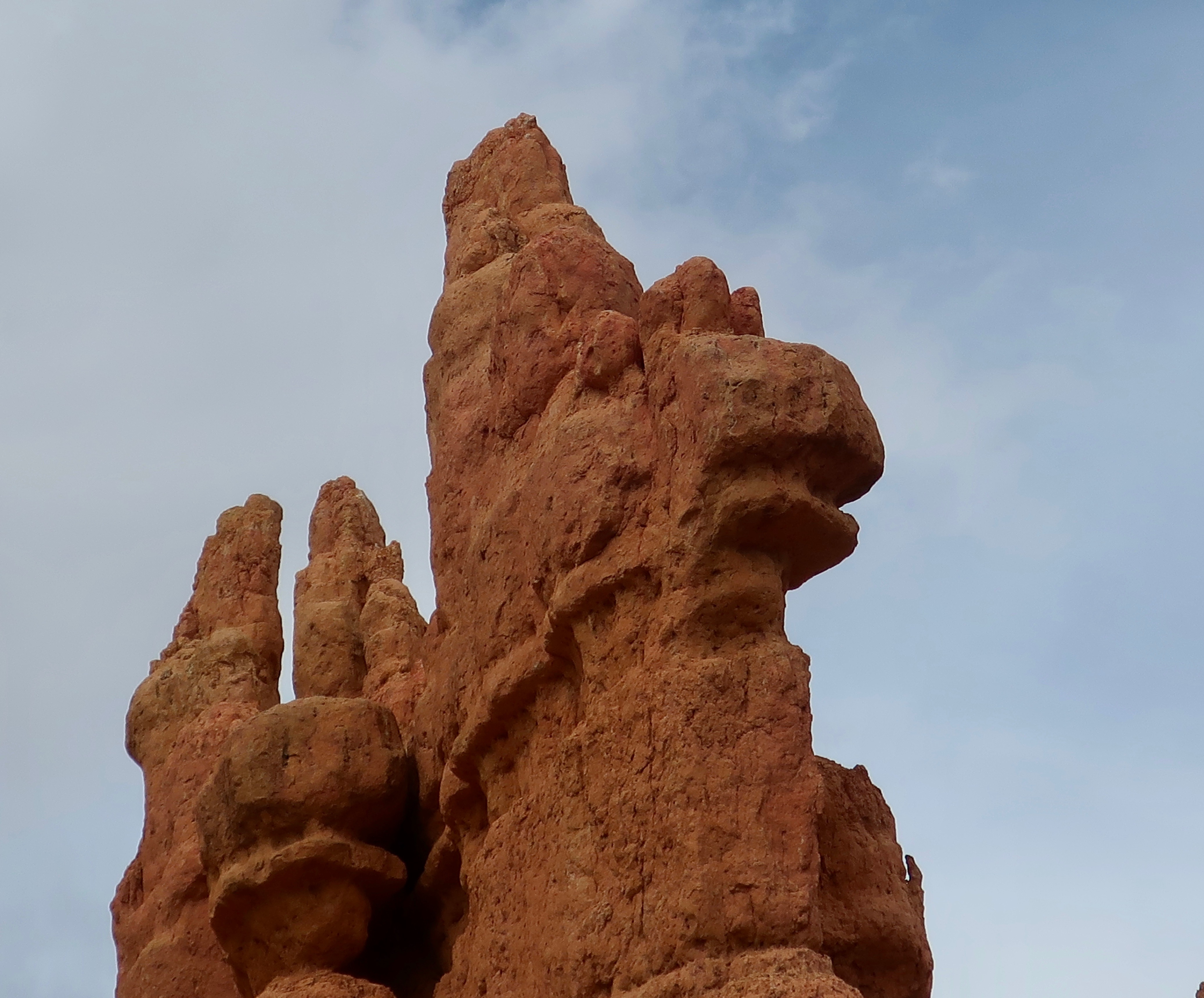
A pair of hoodoos we found near Bryce Canyon. The name hoodoo is derived from a Paiute Indian name meaning scary. I think I can see why.
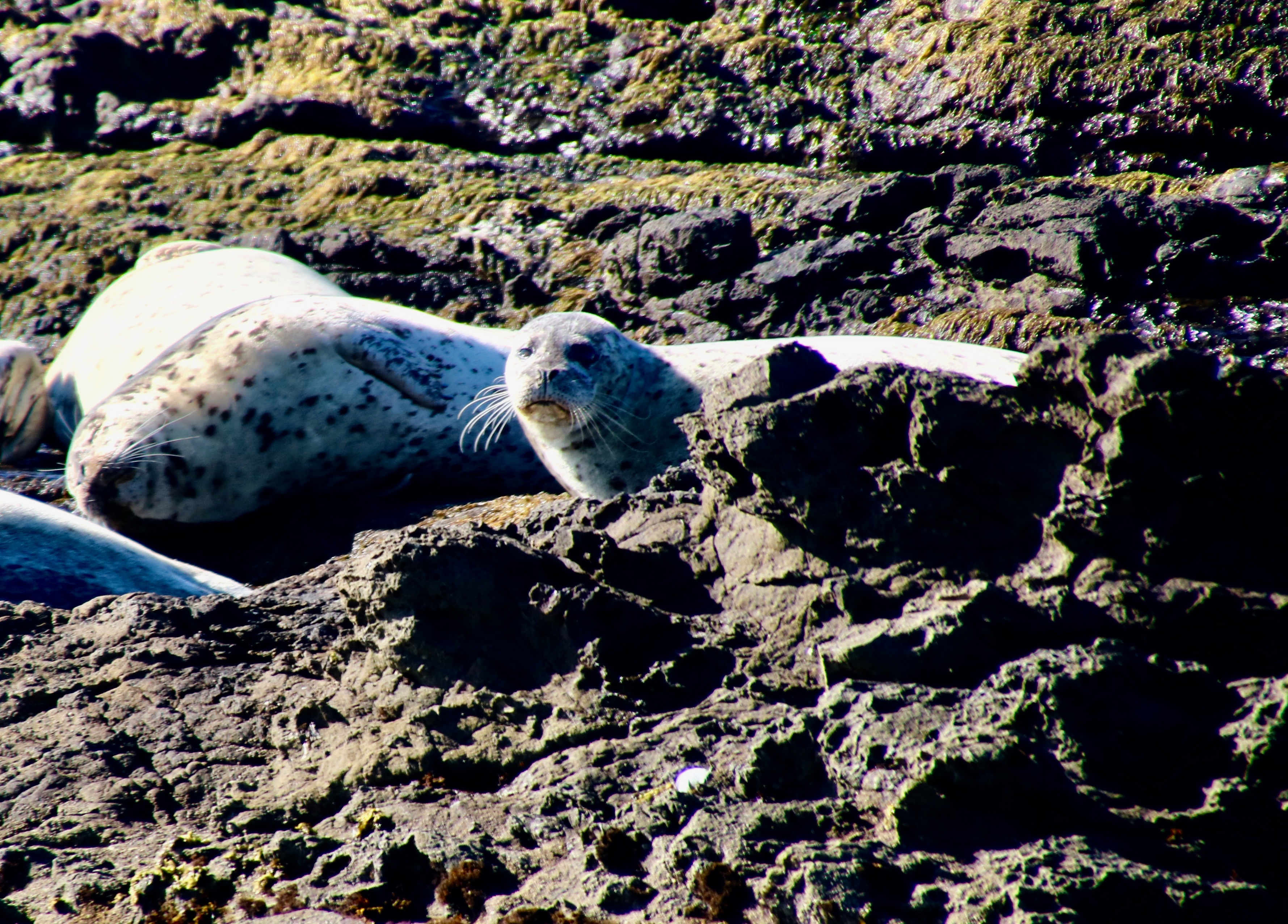
Peggy and I were ‘getting the look’ when she snapped this photo at MacKerricher State Park just north of Fort Brag, California. The concern the seal had was whether we would come closer and disturb his snooze in the warm sun, i.e. would he have to get up and jump in the icy ocean? The answer was ‘of course not.’ I’m not happy when someone disturbs my afternoon siesta. So why should I disturb his. You know, “do unto others…”
This is the last post from our not-so-recent trip to the North Coast of California last November. Tempus Fugit. Indeed. My posts have been so rare lately they are close to being put on the endangered species list. But more on that later. MacKerricher State Park begins 3 miles north of Fort Bragg, California and continues for 9 miles up the coast. It features a wide variety of habitats ranging from sandy beaches to rocky headlands. There are tide pools, wetlands, a fresh water lake, and even a sea-glass beach. The ocean took an ugly dump and ground the glass up into attractive baubles that people like to collect. Our daughter-in-law Cammie used to turn sea glass she gathered in Alaska into beautiful jewelry.
We were at the park for a couple of hours and only walked a mile or two along the 9 mile beach. We were impressed, however. The area deserves much more of our time. I’ll let the photos that Peggy and I took speak for it. I included some of the these in an earlier post.
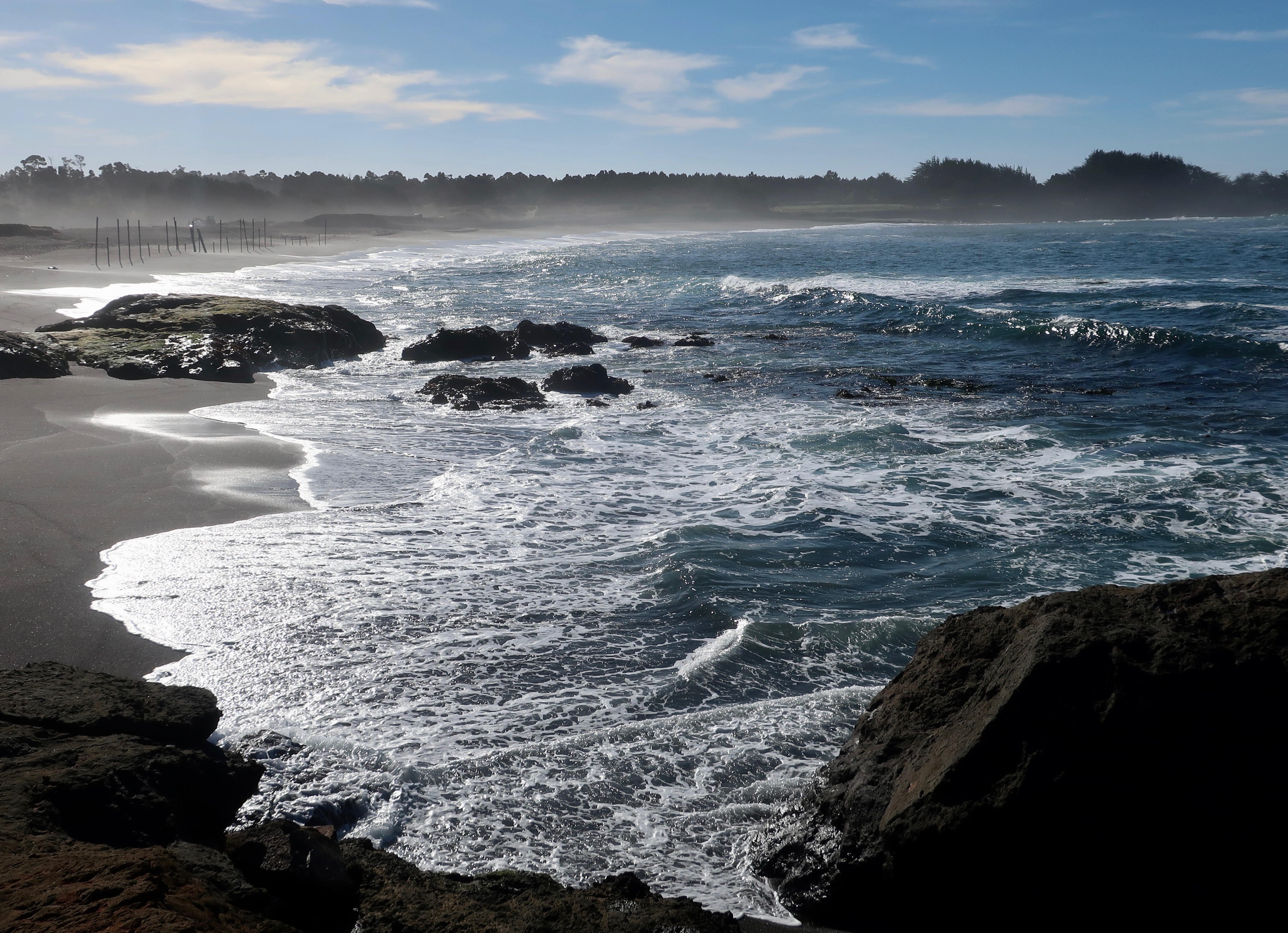
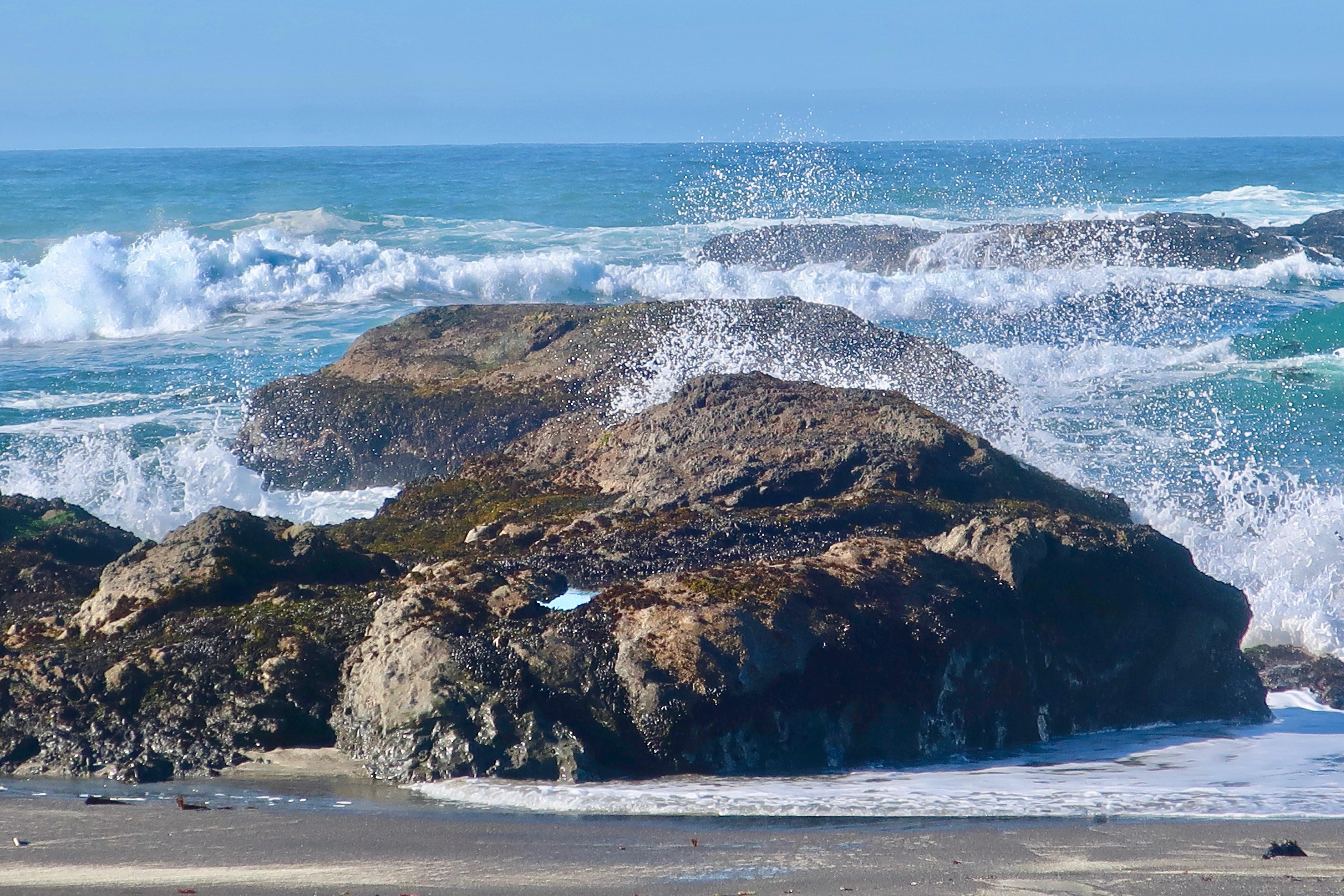
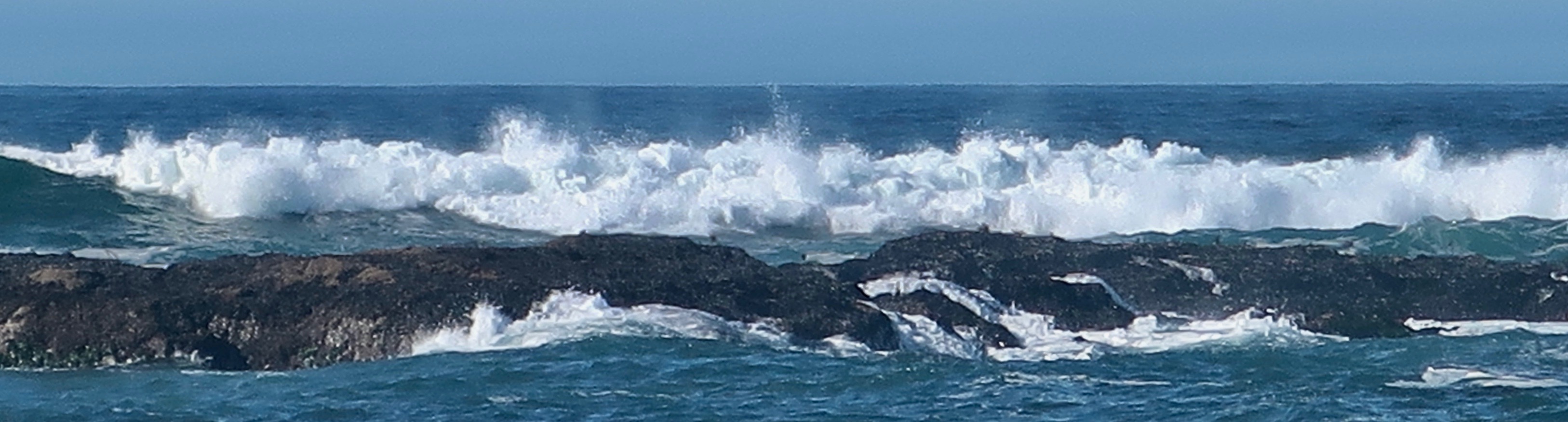
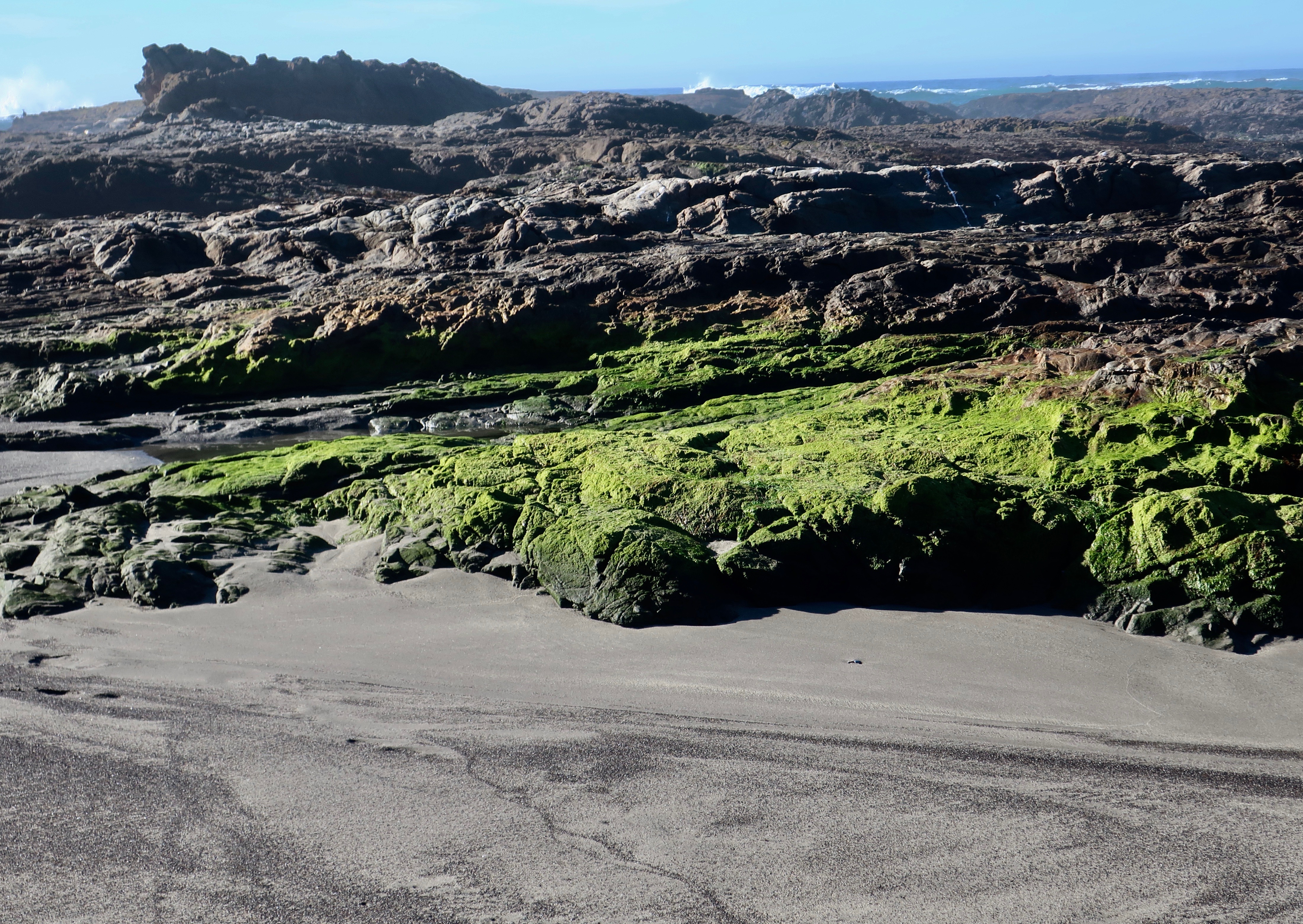
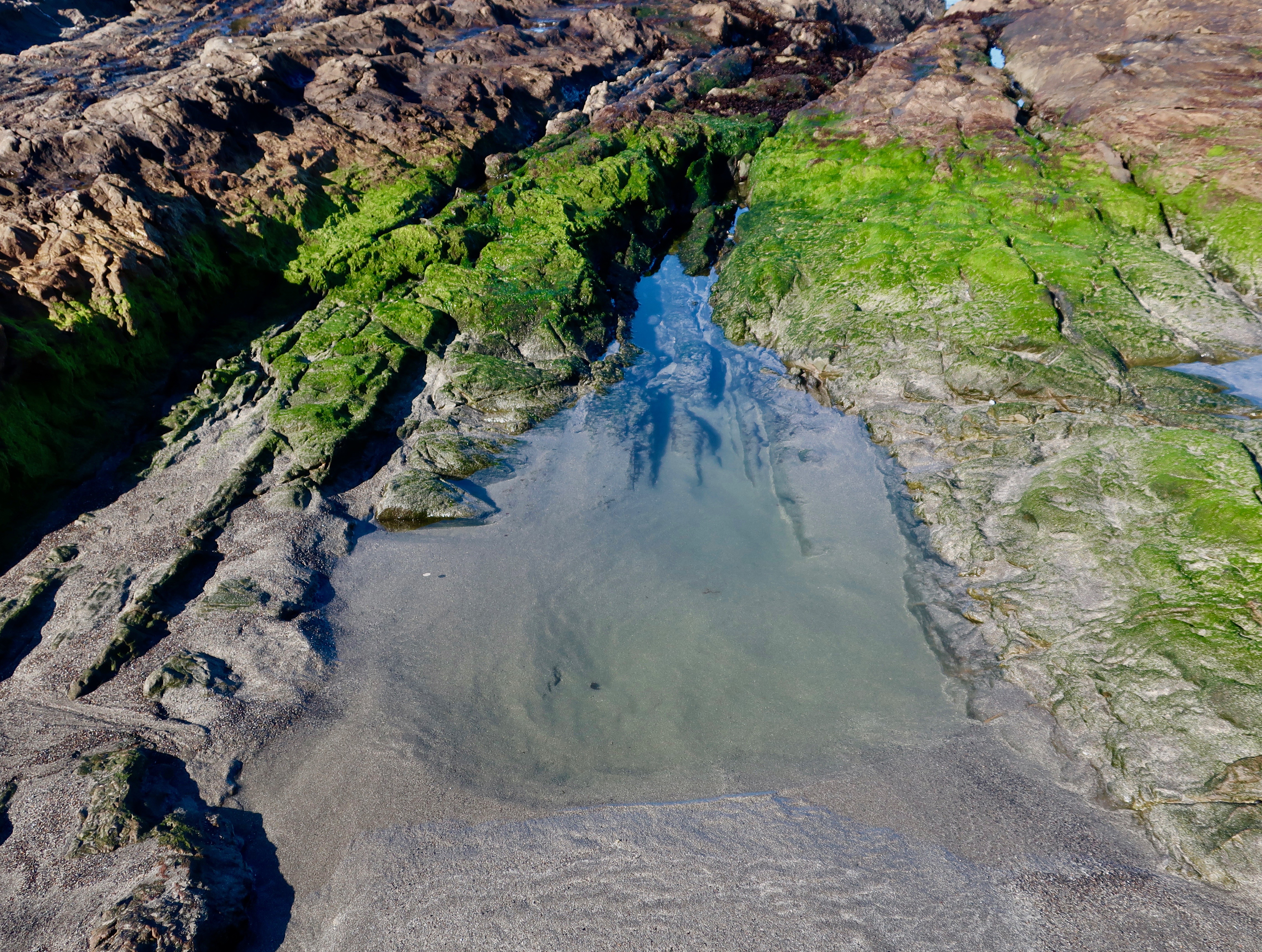
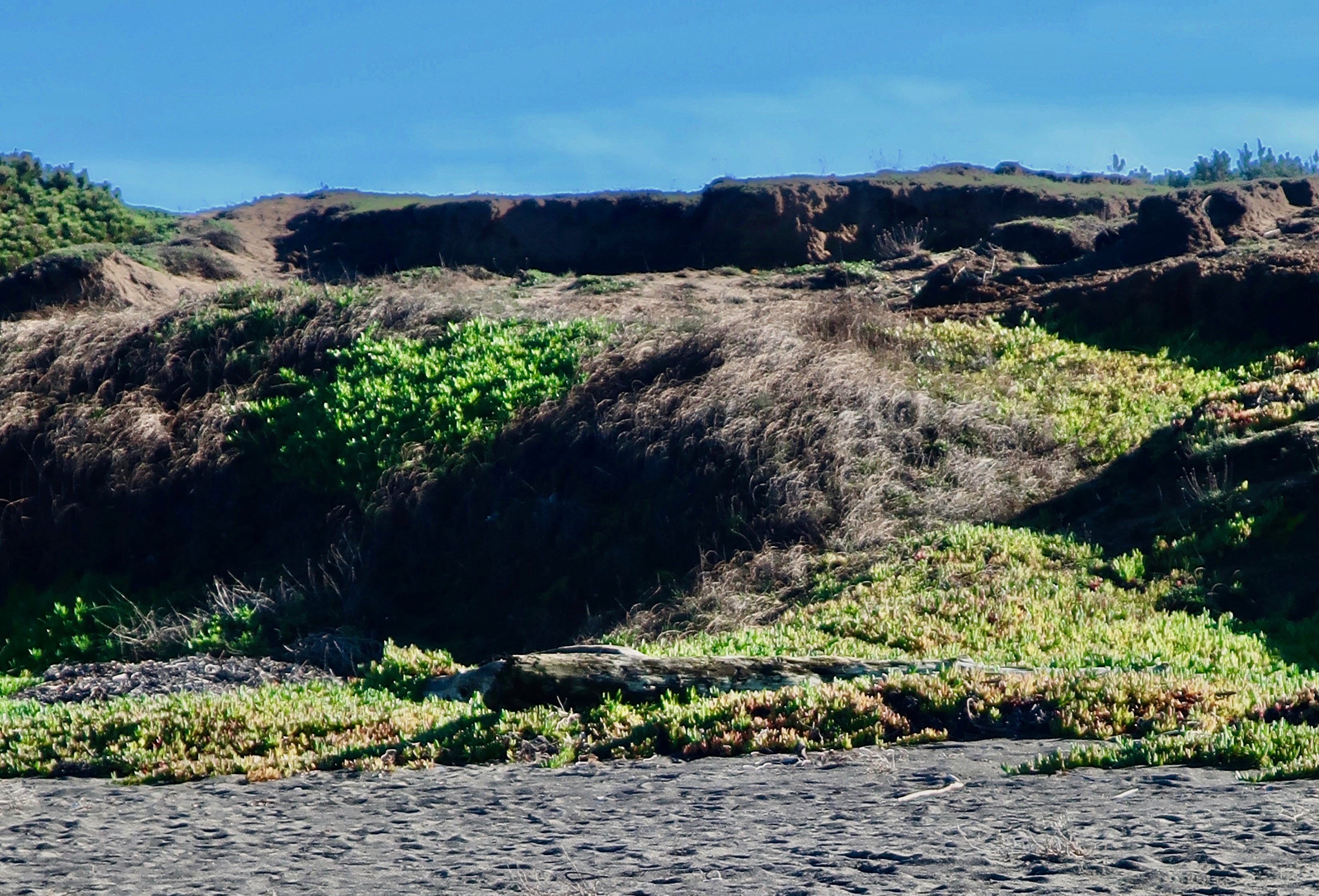
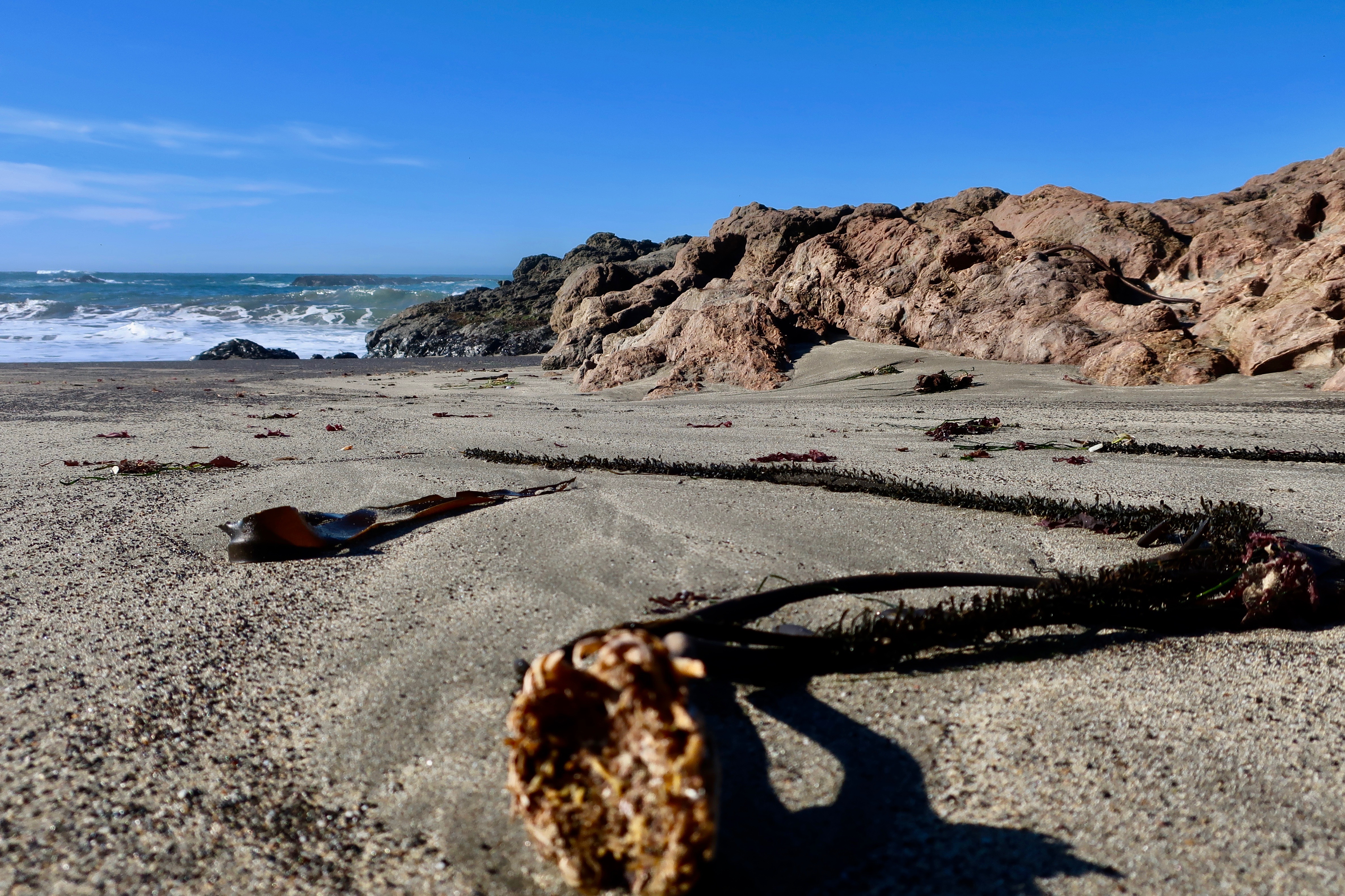
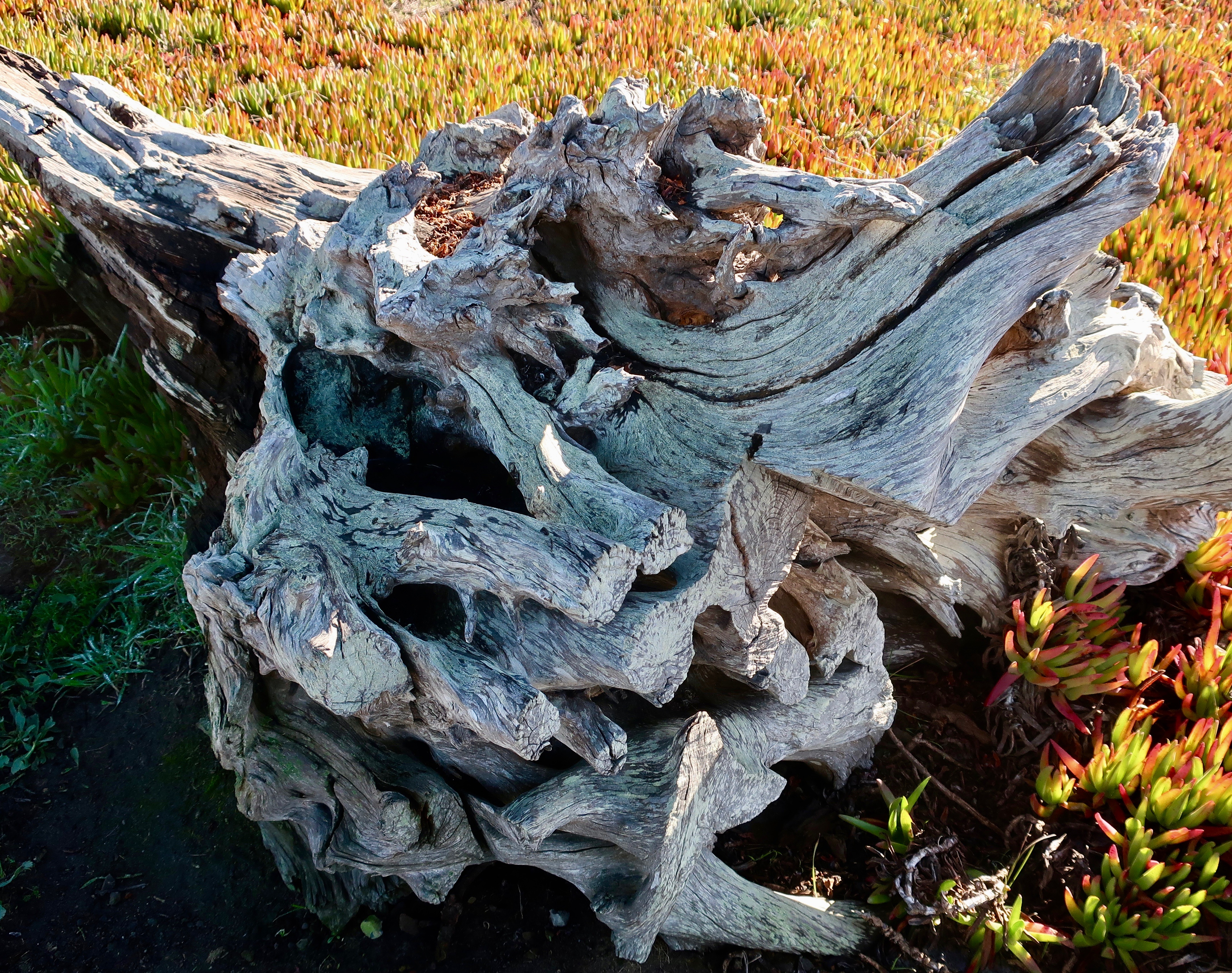
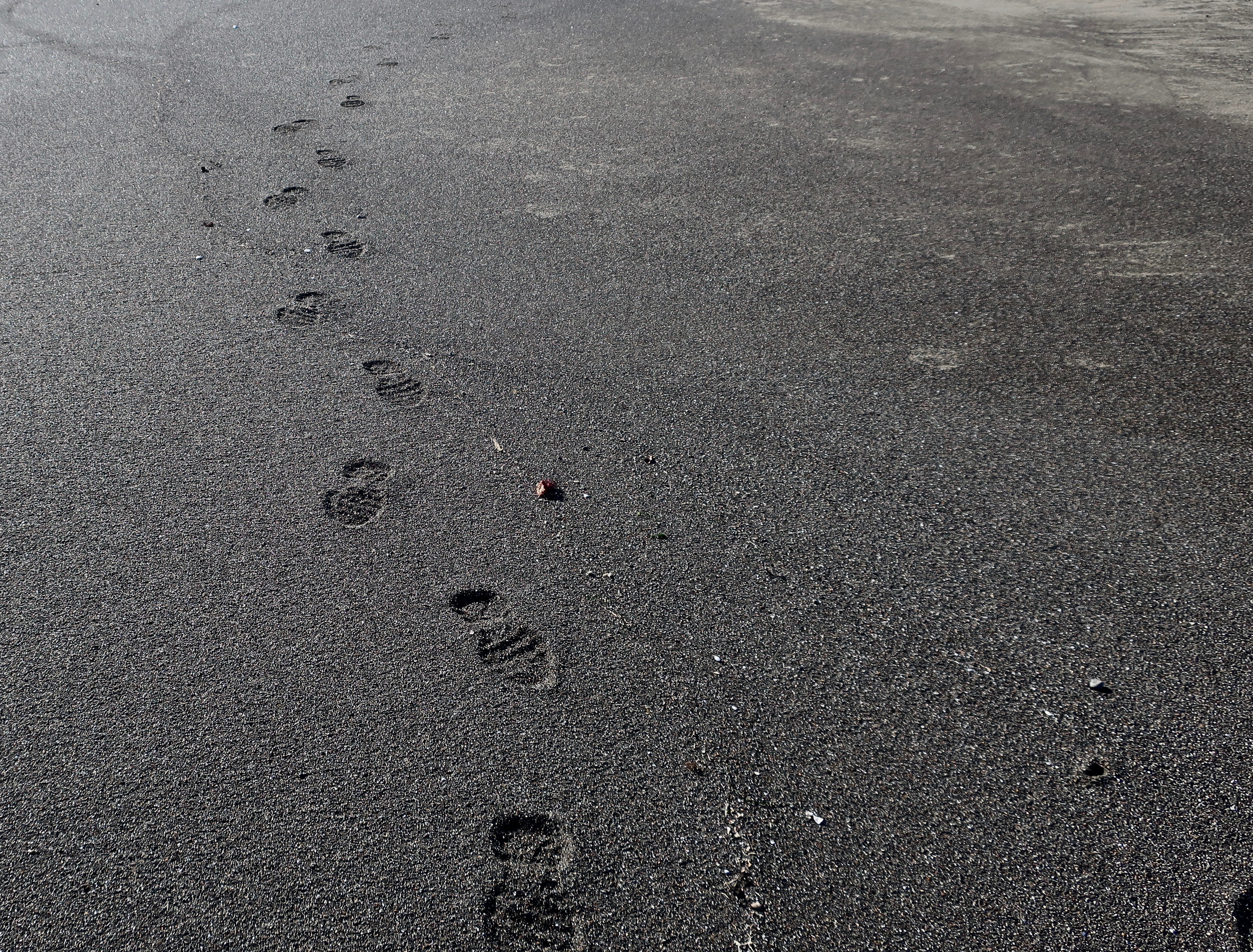
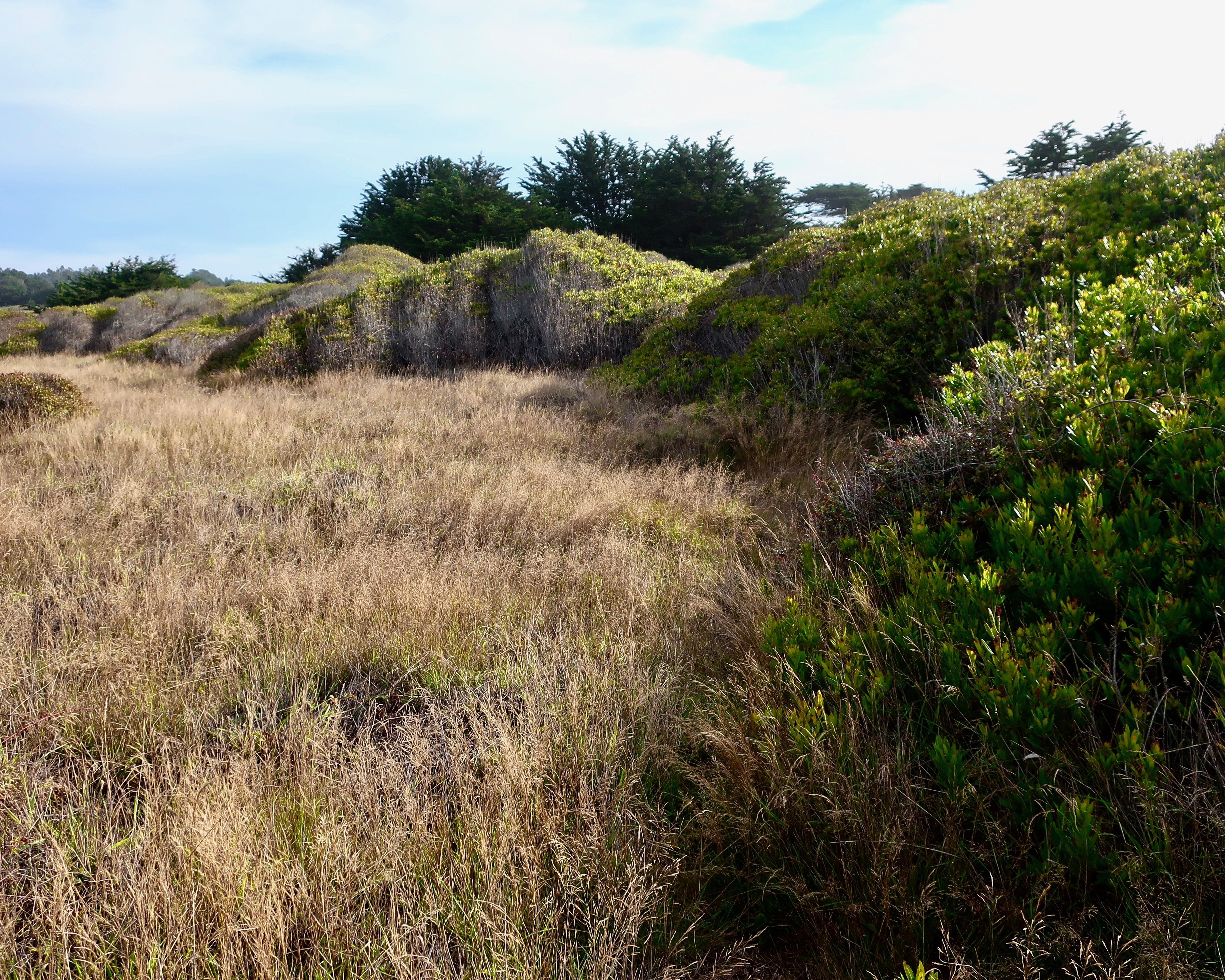
Looking south and capturing the sun reflecting off of the incoming tide.There was plenty of action as the waves rolled in.The bright green moss captured our attention…As did this tide pool outlined in greenThe ever-present ice plants continued the green-theme as they climbed up the ancient sand dunes in their unceasing effort to replace native plants. And be pretty.Plus there was seaweed to admire and wonder about. I’m thinking that this would make a great whip for the Devil.I wondered why someone had trimmed the roots off of this gorgeous driftwood.All too soon, it was time for us to leave. For a brief moment, my footprints were captured by the sand before the next wave rolled in. I was amused to see how they wandered, never traveling in a straight line, always willing to detour toward anything that was of interest, always ready for a new adventure— wherever it might lead. Like Peggy and I are. And that’s my next subject.
MOVING ON
As you may recall, Peggy and I are preparing to hit the road full-time in mid to late March. That’s one reason why my posts have been so few and far between. But there is more. We are also selling our house and moving East. Our daughter has an empty apartment in Virginia that we will be using for our base as we travel North America. She and her husband Clay have been lobbying for years that we should move closer to them. The apartment is small, however. We are using it as a reason to seriously downsize. It’s called donate, give away and toss. If we haven’t touched something in a couple of years, it goes. (Books and heirlooms are the exception— and even they are subject to scrutiny.) A moving pod sits outside our backdoor to collect what remains. In a few weeks it will arrive on our kid’s doorstep. We’ll take three months to get there.
We will miss our cozy home with its great views and entertaining wildlife. No doubt about it. Living out in the woods had always been a dream of mine. But it is time to move on. I turn 79 in a couple of weeks. While not necessarily old (from my perspective), it is definitely not young. My sense of humor on doing all of the work involved in maintaining five acres isn’t what it once was. And, there are more serious reminders of our age: the passing of family members and friends.
My sister died a couple of weeks ago, leaving me with a thousand happy memories and a large blank spot. She was my first baby sitter and forever friend. While we didn’t see each other often, we were always close. You may recall the posts I did on our annual pumpkin carving contests. They started in the late 90s and went on for 15 years. And you may also remember my blog on Nancy Jo and the Attack of the Graveyard Ghost, a prank my brother Marshall and I played on her when we were kids. Marsh passed away couple of years ago while staying in his RV at our house. I was with him when he died. I am now the last living member of our family. It’s a strange feeling.
A number of friends have passed on as well over the past few years. I attended a memorial/life celebration in Sacramento last weekend for one of my early backpacking Trekkers, Don Augustine. I first met Don in 1981 when he went on a hundred mile trek I was leading through the Sierras. It was a tough year with lots of snow still on the ground. I was kicking footsteps in it over a steep pass leading into the Granite Chief Wilderness when he hustled up to where I was working and offered to help. He would continue to offer a hand whenever needed for the next 40 years as both a trekker and as a volunteer. His generosity was close to legendary. His specialty was encouraging newbies as they struggled to meet the challenges of long distance backpacking and bicycling. I told a story about it to the some 200 people who had gathered to wish Don goodbye.
At the time, I had gone to Alaska as the Executive Director of the Alaska Lung Association. Don and a couple of other good friends had come up to join me on a backpacking trek I was leading across the Alaska Range. We had a particularly difficult young woman along who was always last getting into camp and whined a lot. It was the unpleasant job of our trail sweep/rear guard to walk with her and bring her in. I took my turn and by the end of the day my patience was running thin. That’s when she threw her pack on the ground and declared, “I am not going another step. I am camping right here!” I responded, “Do you see that hill crest? “Yes,” she pouted. It was maybe a quarter of a mile away. “The Trekkers are setting up camp on the other side. We can be there in 15 minutes.” “I don’t care,” she answered. “Okay,” I said, “pull out your whistle.” (We required that all of our trekkers carry one.) “I have to hike over the hill and check on the group. I saw a grizzly bear about a mile back. If you see him heading your way, blow loudly on your whistle three times and I’ll come back.” She was up in a flash, had thrown her pack on, and was leading me over the hill at a hefty pace.
I took Don aside in camp and asked if he couldn’t use a bit of his magic on the young woman. “I’ve got you covered, Curt,” he said. “I’ve got candy.” He reached into his pack and pulled out a gallon ziplock filled to the brim. (There were reasons why Don always had the heaviest pack in the group.) And Don was right. On being introduced to Don’s ziplock and his charm, the girl’s attitude improved immensely and she started hiking faster to keep up with him and his candy. It was a much better solution than my making up grizzly bear stories.
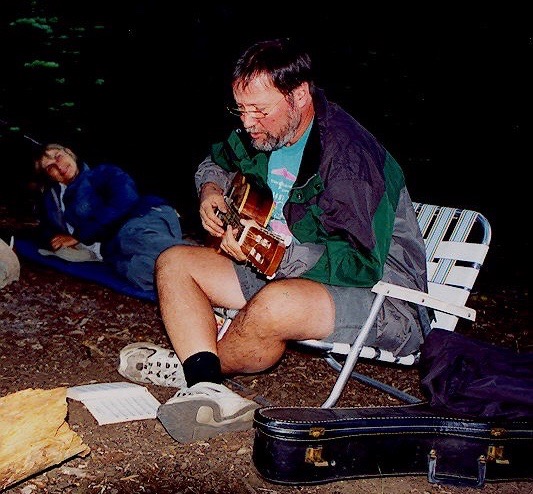
Don playing his guitar on one of our Sierra Treks. He often carried his guitar and the camp chair he is seated in. And Pop Tarts. Nancy Pape, lying down and listening, was also at the memorial.
It’s always hard to lose a family member or friend, and even more so when he or she has been close. It is like closing a chapter in your life— the laughter and good times, the tears, the adventures and so much more. But it is also an important reminder that life is short, whether you are 79 or 29. Life should be lived to the fullest whatever your age. Peggy and I believe this totally. That’s why we moved to Oregon and that’s why we are now moving on now, doing what we love to do, wandering to our hearts content. Until it is time to do something else.
We will be sharing our adventures on this blog. As always, you are invited to join us. We hope you do.
My next post on Friday will be different: It will serve as a detailed description of our house, property and the surrounding region for those who may be interested in having their own ‘home in the woods.’ –Curt and Peggy
Most people love lighthouses. And what’s not to love? They are usually found in beautiful locations, feature attractive buildings, and include an element of romance. Their location is part of the romance, but even more so, I find the life of lighthouse keepers romantic. I picture them living on the edge of the ocean, facing ferocious storms with towering waves, and working heroically to save lives in areas that are often remote, far removed from the lives most of us lead. While such a life might not seem attractive to most, I like remote. I’m not so sure about the long hours, repetitious work, and being tethered to a 24/7 job.
I’ll never have the opportunity to find out, however.
The possibility of being a lighthouse keeper in the US today is close to zero. Of the 700 lighthouses presently functioning in the country, only one has a lighthouse keeper. It is located on Little Brewster Island overlooking Boston Harbor and has been in operation since being repaired after the British blew it up during the Revolutionary War. It had originally been built in 1716 on a pile of rubble stone with candles providing the light.
The rest of America’s lighthouses have become automated. When our son, Tony, was flying helicopters for the Coast Guard off of Kodiak Island in Alaska, one of his jobs was servicing the lighthouse in Cordova. As I recall, the salmon fishing was great in the area. He loved the assignment. And we benefited at Christmas with yummy halibut and salmon. (BTW… this past week he was flying a helicopter over Antartica in his new job.)
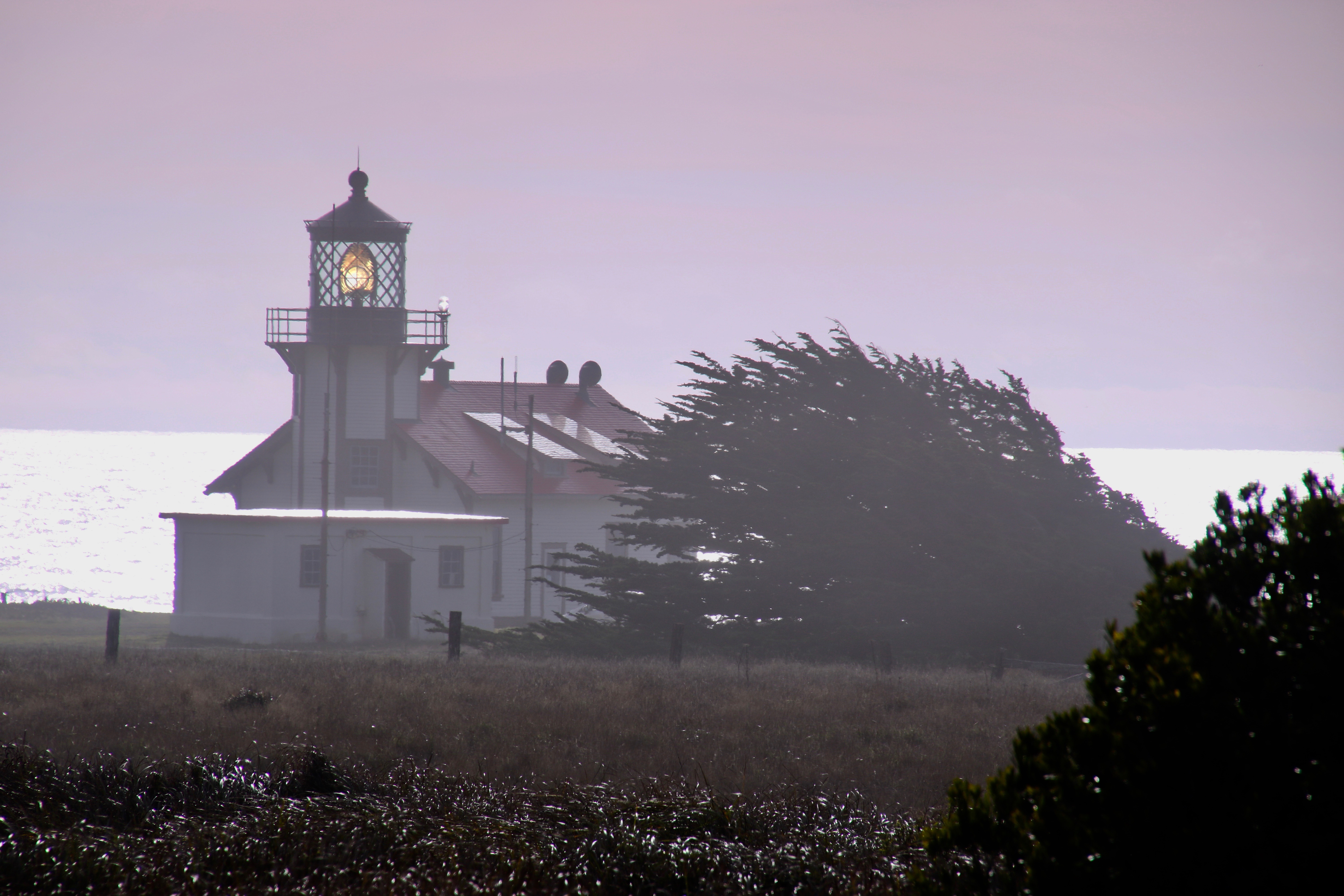
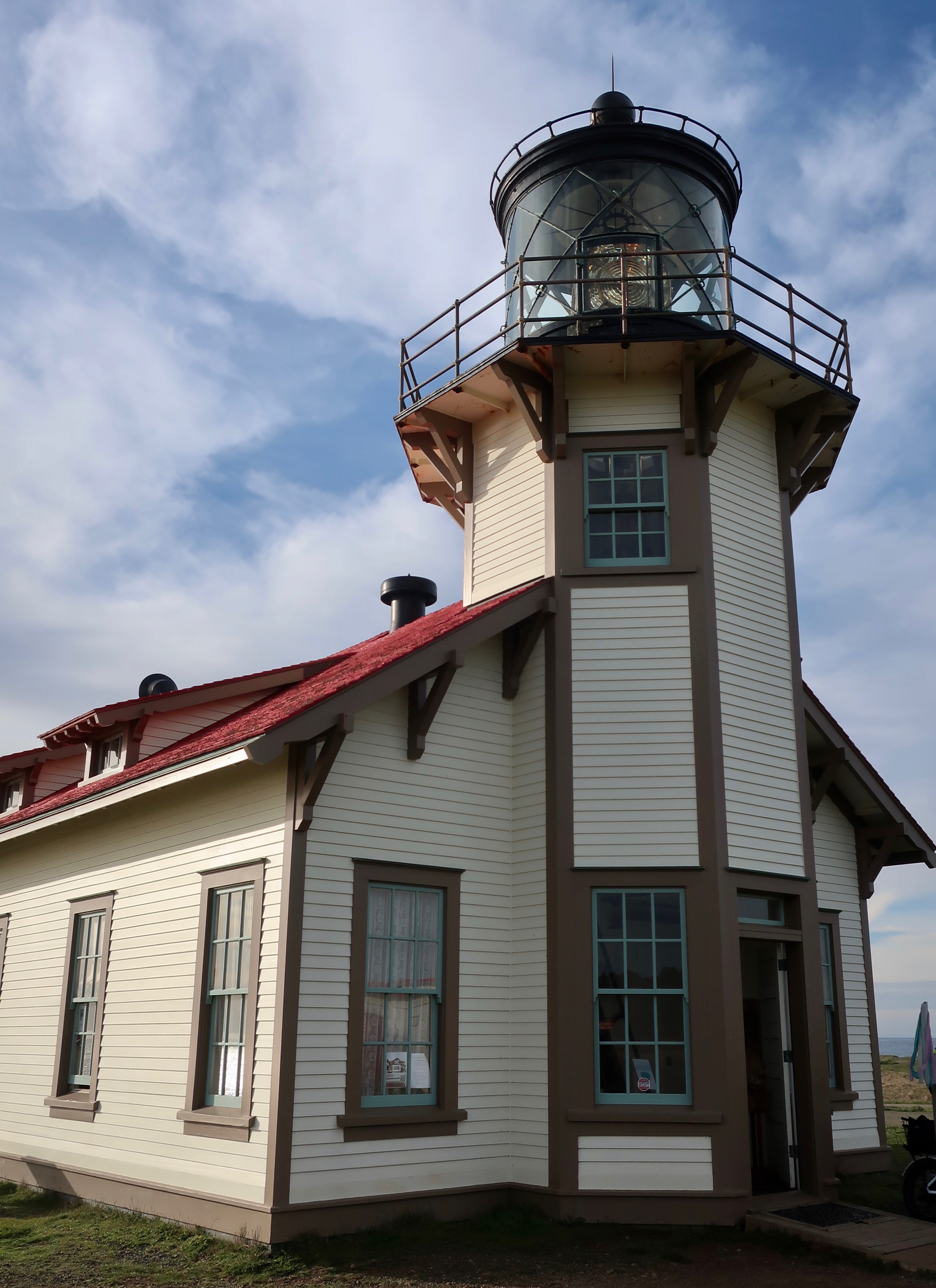
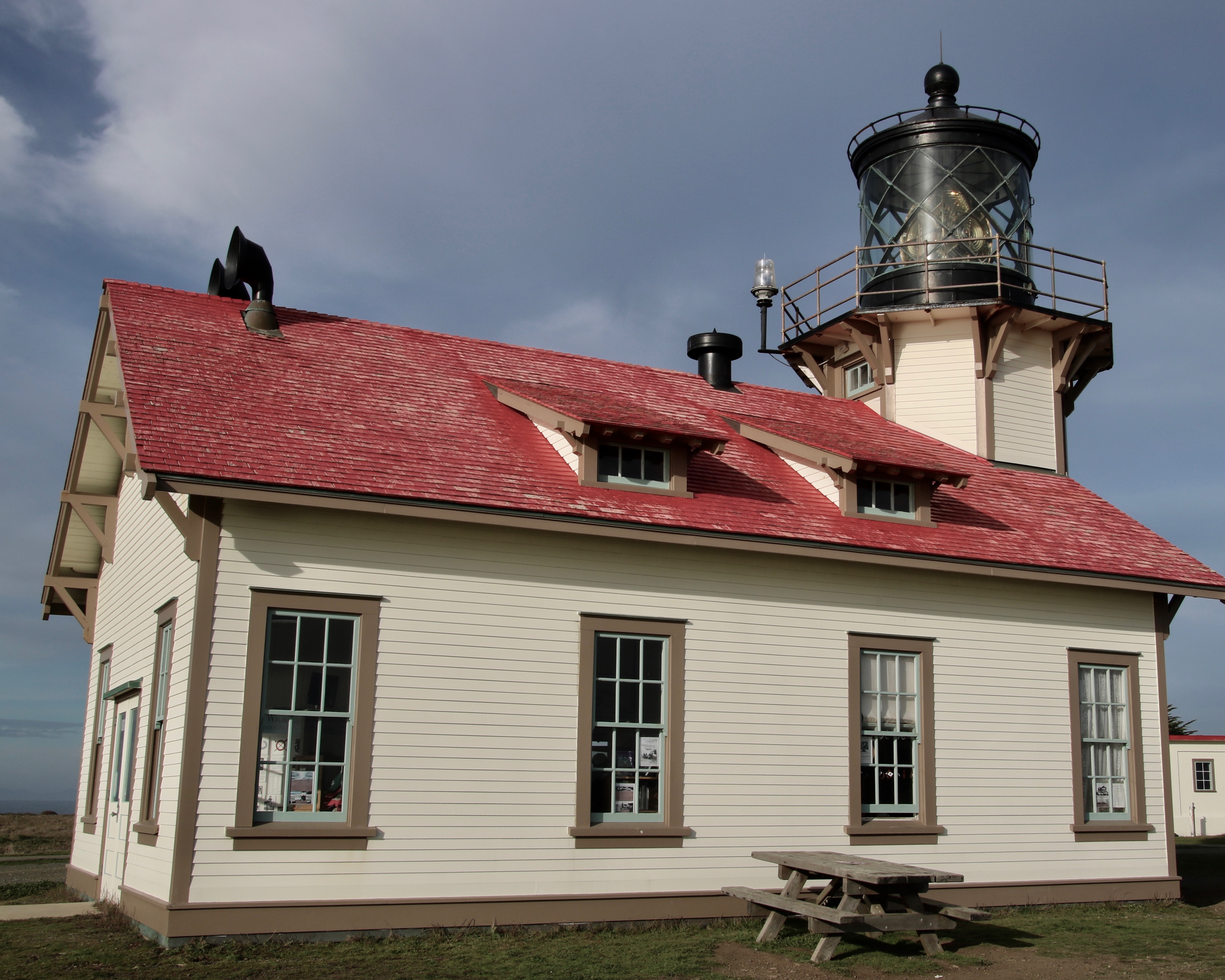
Today, many of the original lighthouses have been turned into museums. That’s the situation with the Point Cabrillo Lighthouse which is now part of the California State Park system. The lighthouse got its official start with a party in 1909. The head lighthouse keeper invited all of the neighbors within a mile over for its official opening at midnight. It was a pea soup night with the fog so thick that the light couldn’t escape. That wasn’t a problem for the loud new fog horns that started blasting out their warning on the dot at 12, probably waking up everyone who lived further away and wasn’t invited to the party. The lighthouse operated happily until 1961 when one of the towering waves I mentioned above rolled over the top. The third order Fresnel lens wasn’t damaged, however, and the lighthouse was returned to working order until 1973 when the US Coast Guard replaced it with a rotating beacon on a metal stand and the original lens was covered.
It was volunteers that brought the lighthouse back to life. With permission from the state and approval from the Coast Guard, they rebuilt the lighthouse and other structures including the homes of the lighthouse keeper and the assistant back to their 1930 condition when electricity was brought in. The Fresnel lens was cleaned, updated, and returned to service, being one of 70 that still operate in the US.
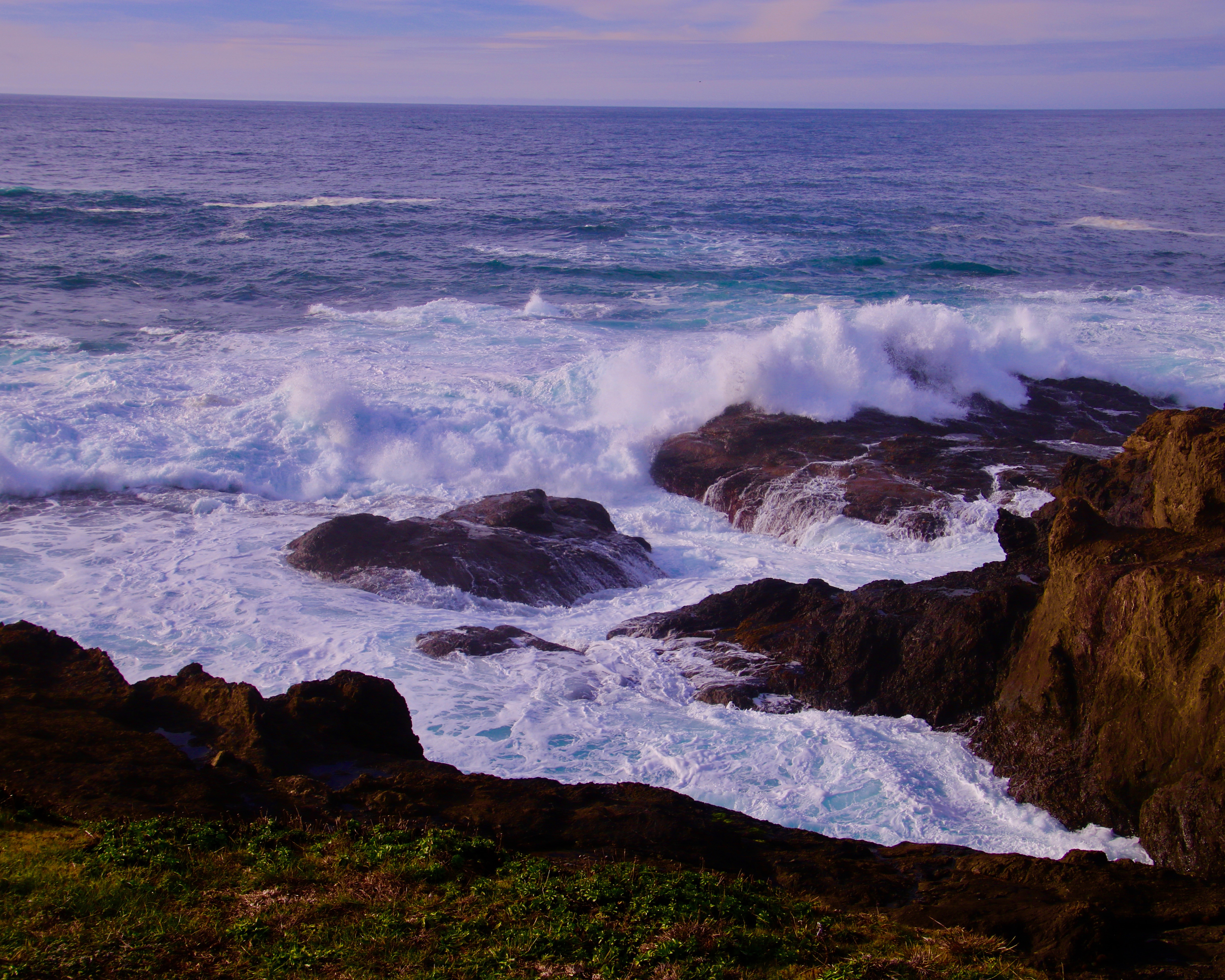
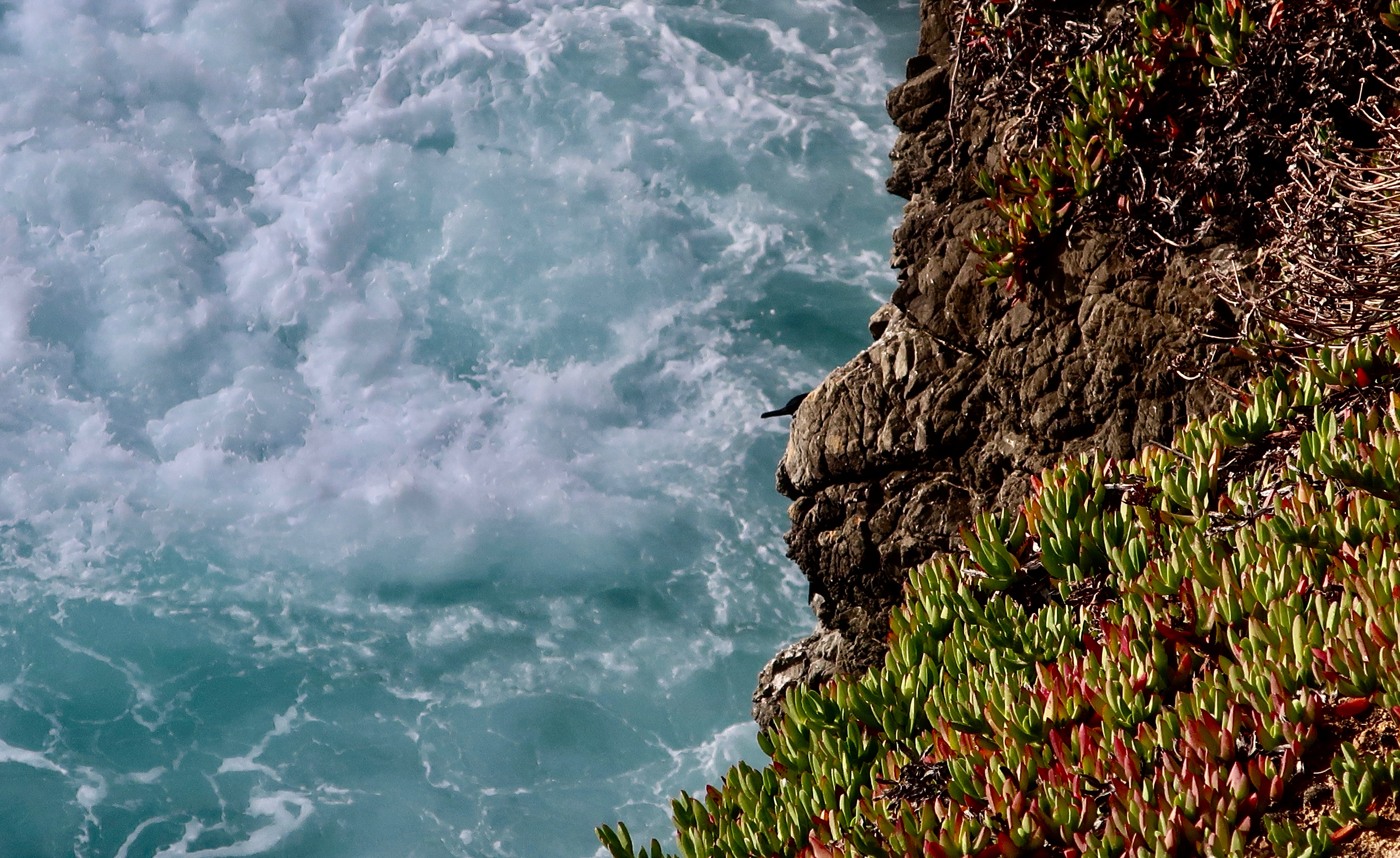
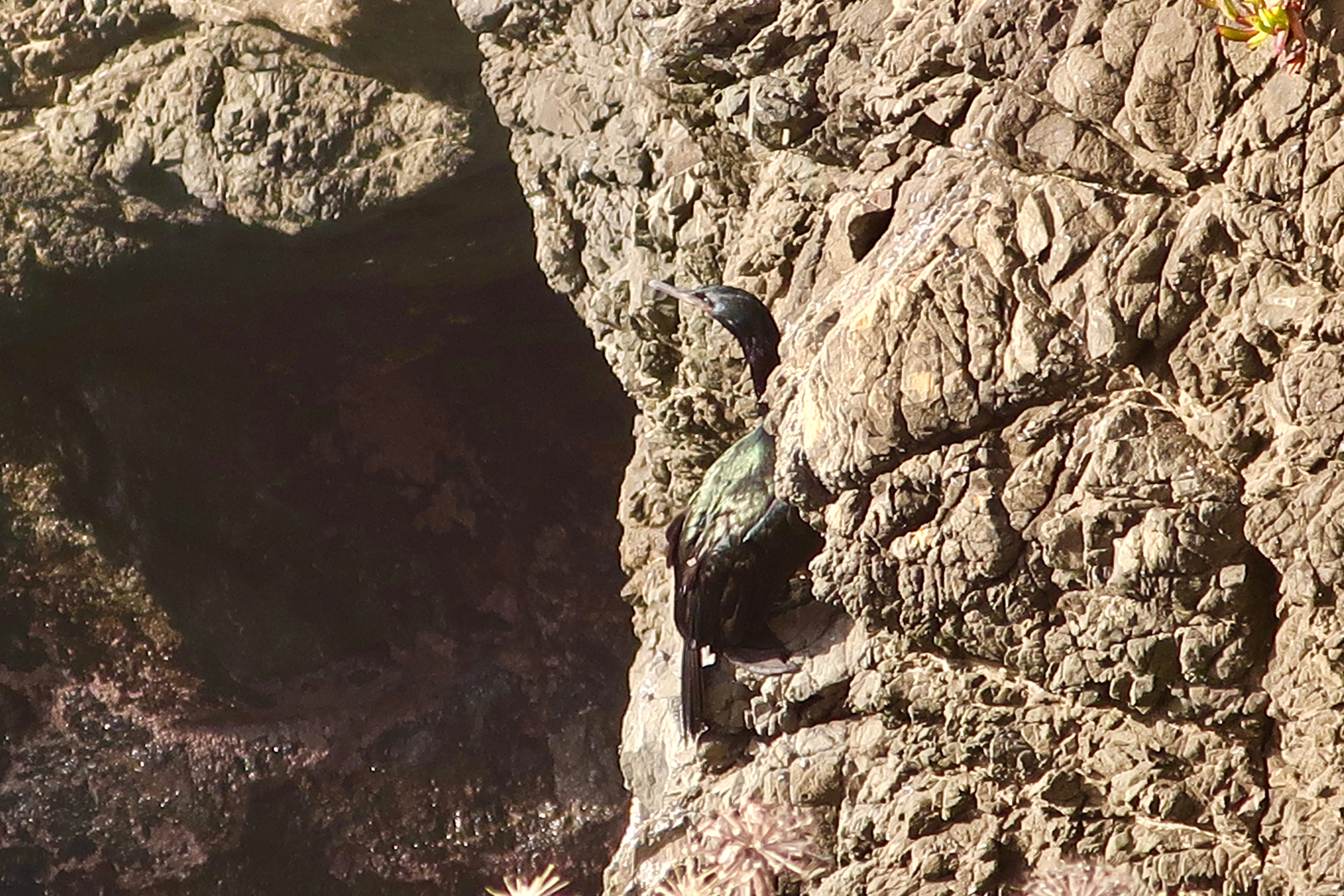
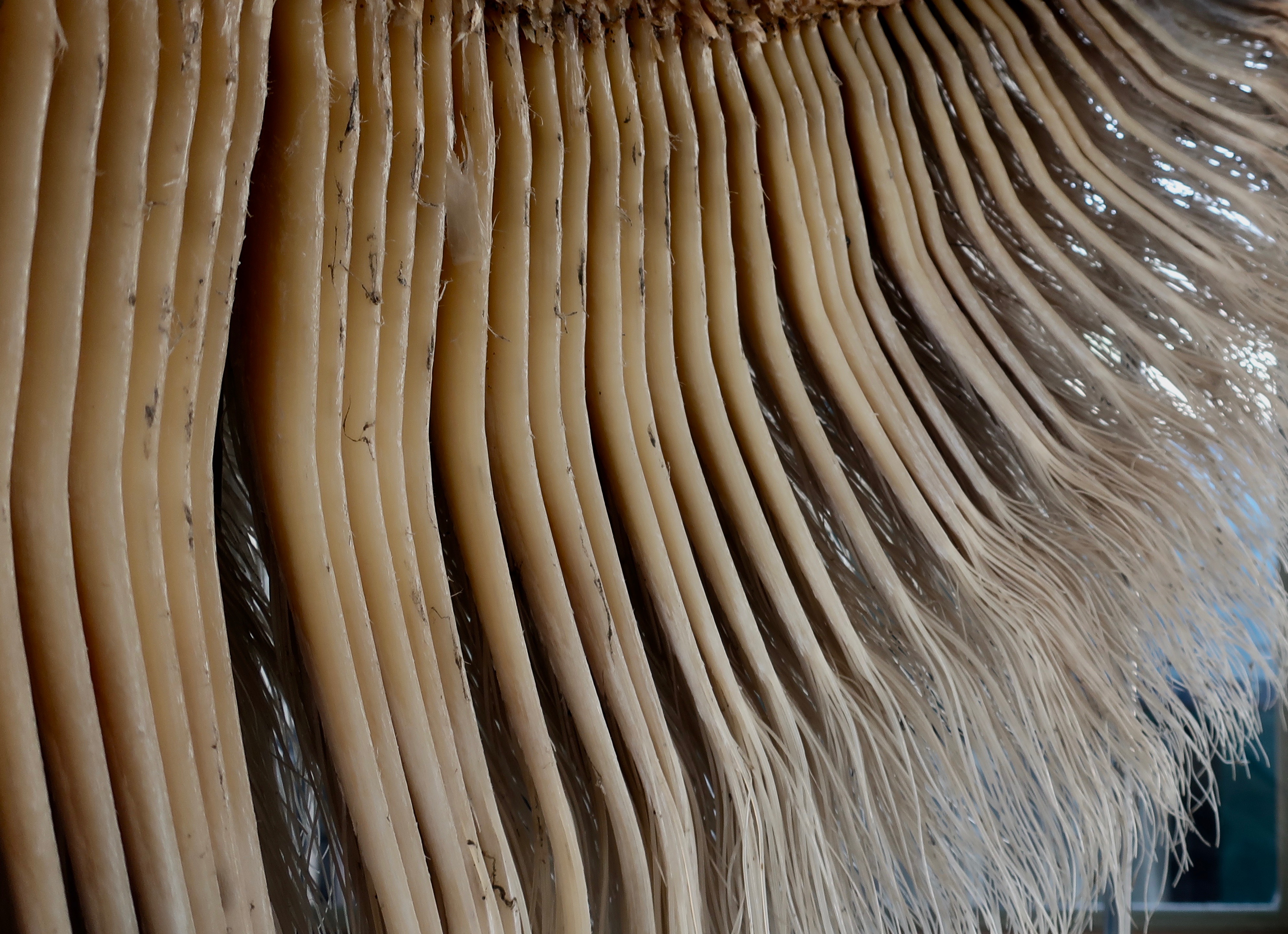
An attractive trail leads from the right side of the parking lot to the Lighthouse. You can also hike the road, but why would you? This is a view of wind-sculpted brush along the way.Our first view of the Lighthouse. A bit of morning fog still hung over it. The Fresnel lens was shining. (Photo by Peggy Mekemson.)It didn’t last long. A few minutes later the sun came out and burned the fog away. (Photo by Peggy Mekemson.)The trail took us over to the ocean on our way to the Lighthouse. Sun lit up the waves.The Pacific Ocean crashed into an inlet. Can you spot the Cormorant?It was hiding down among the rocks. (Photo by Peggy Mekemson.)We wandered around the lighthouse, admiring it.A side view included the fog horns located on the back. (Photo by Peggy Mekemson.)Peggy focused in on the lens. It can be seen 22 nautical miles out to sea. The third order Fresnel lens is made up of four panels which contain 90 lead glass prisms and weighs 6800 pounds. It is maintained by the volunteer Point Cabrillo Lighthouse Keepers’ Association. (Photo by Peggy Mekemson.)We entered the small store and museum at the lighthouse and found this. Do you know what it is? It is whale baleen that whales use to strain their food out of ocean water.We followed the road out since it led by the attractively refurbished lighthouse keepers’ homes. One serves as a museum. Visitors can rent the other for an overnight stay.
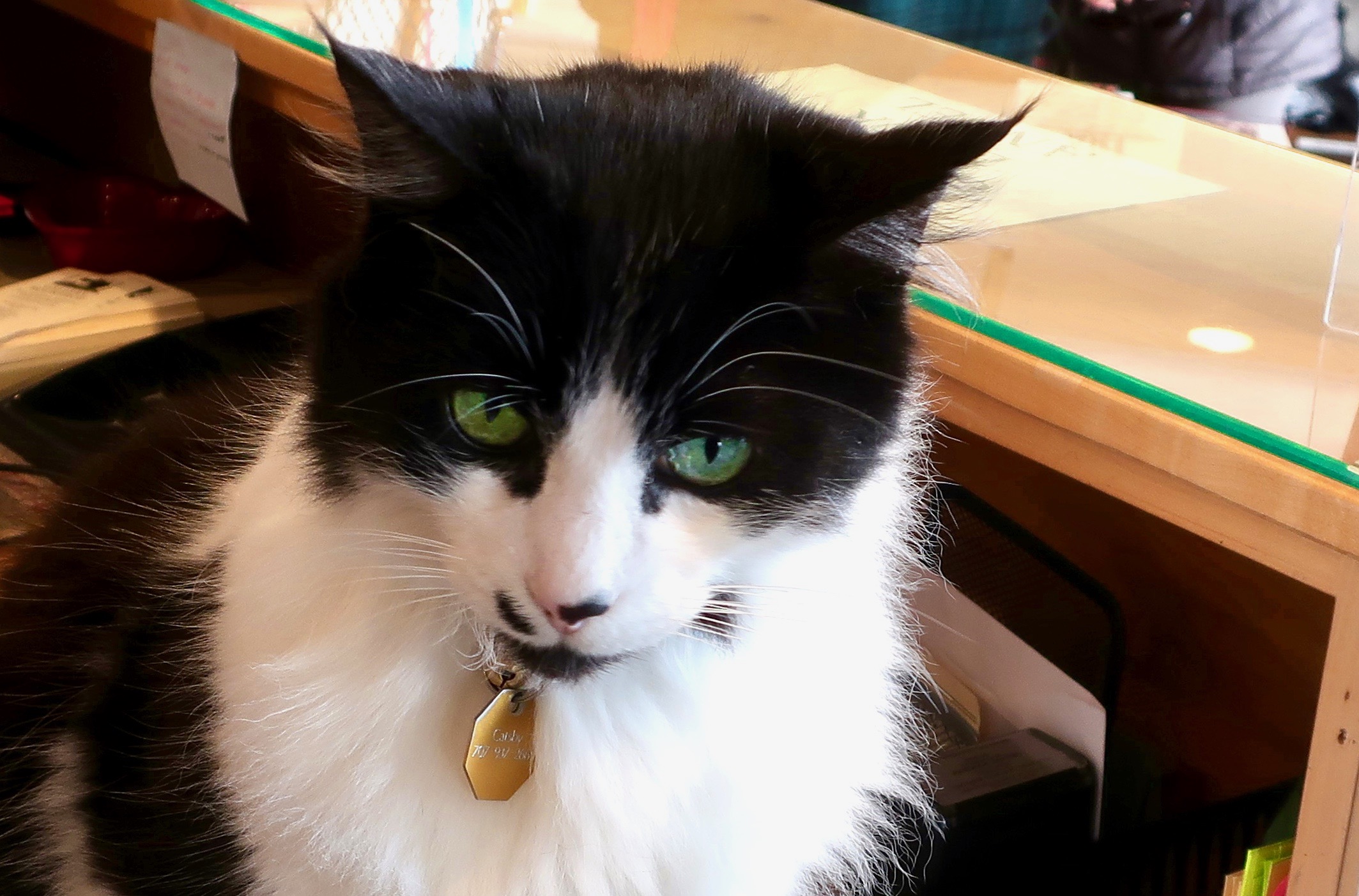
And this brings us to the bookstore cat. The attractive, historic town of Mendocino is located a mile and a half south of Point Cabrillo. It is another one of our favorite coastal towns. One of the reasons is its excellent bookstore: The Gallery Bookshop. The store’s logo is a cat reading a book. We went there to buy books, meet friends, and visit with the cat.
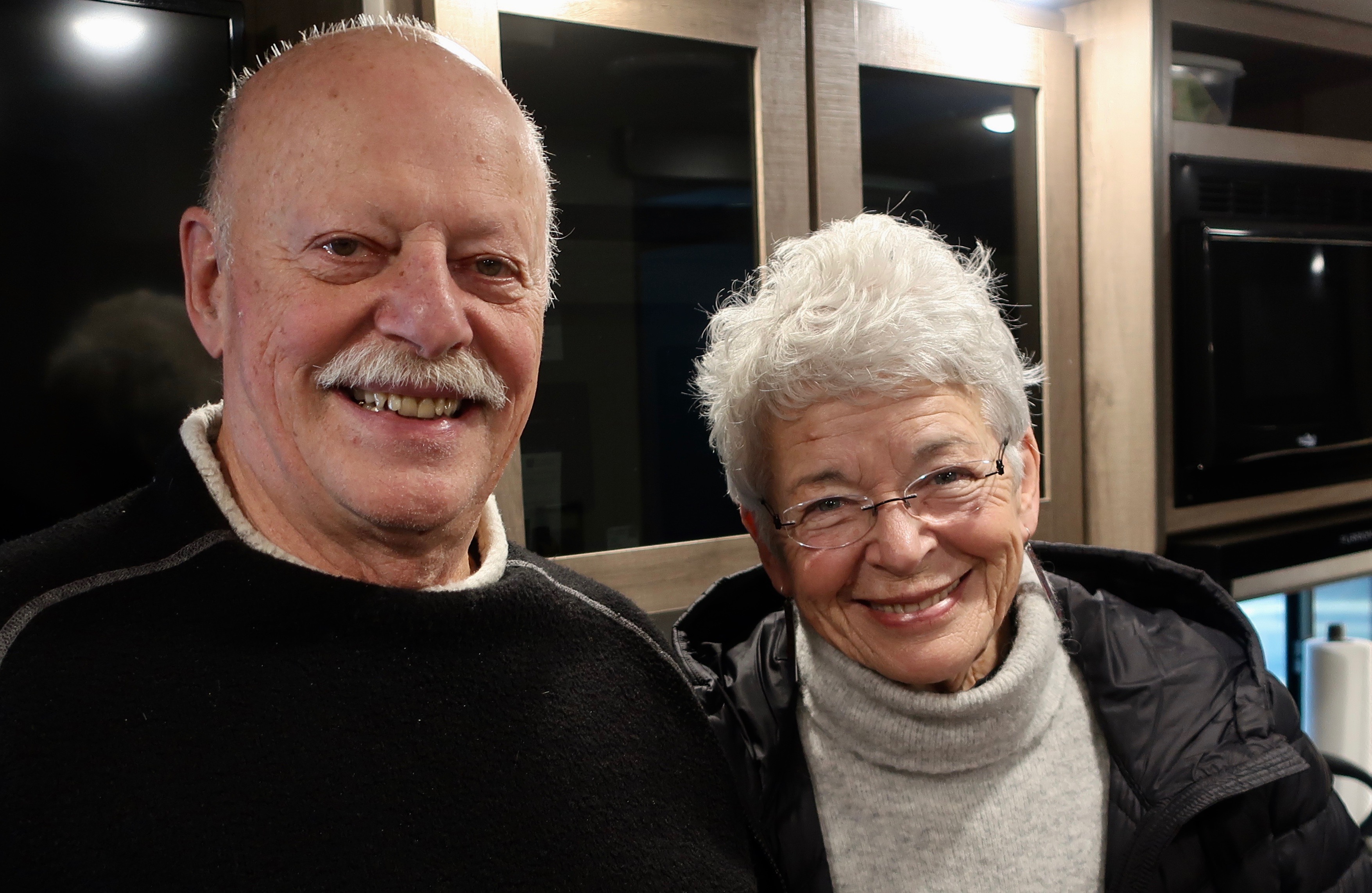
Every nook and cranny of the bookstore is filled with quality books. We could spend hours there.The owner’s philosophy was posted in the window…We hadn’t seen our friend David McElroy for quite some time. David is an Alaska bush pilot and a talented poet, a combination that has always fascinated me. He was traveling with his friend Susan, who among her many accomplishments, had been the first director of the Nature Conservancy in Alaska. They originally met in 1979 when Susan had hired David to fly her while she filmed the Iditarod, the first film of the event to ever be televised nationally. They met again after David’s wife of many years (and one of Peggy’s best friends from high school, Edith Barrowclough) passed away from cancer. Susan and David were on their way to Paris and then Portugal for a few months. This sign greeted us at the bookstore door. Catsby was sitting on the counter next to the cash register when I snapped his photo.
As I have noted before when I have blogged about my favorite independent bookstores, many of them have cats. I think that they all should. Here’s what the Gallery Bookshop’s website has to say about Catsby:
“The Great Catsby joined Gallery Bookshop in the fall of 2012. He was seen wandering on the streets of a neighboring town, darting in and out of businesses. One day, he found a car with an open window and hitchhiked (without the driver’s knowledge) to the village of Mendocino. There, he was picked up by a friend of the bookshop and offered the job of bookstore cat. His duties include sleeping atop card racks, greeting dogs with a glare and a flick of his tail, and occasionally allowing customers to scratch him behind the ears. He can usually be found sitting in the window, warming himself in a patch of sunlight.”
That does it for today. My next post will be on MacKerricher State Park, which is located just north of Fort Bragg. I should note: When I find time to do it. Our life continues to be insane as we rush into creating a new lifestyle for ourselves. More on that after the post on MacKerricher.
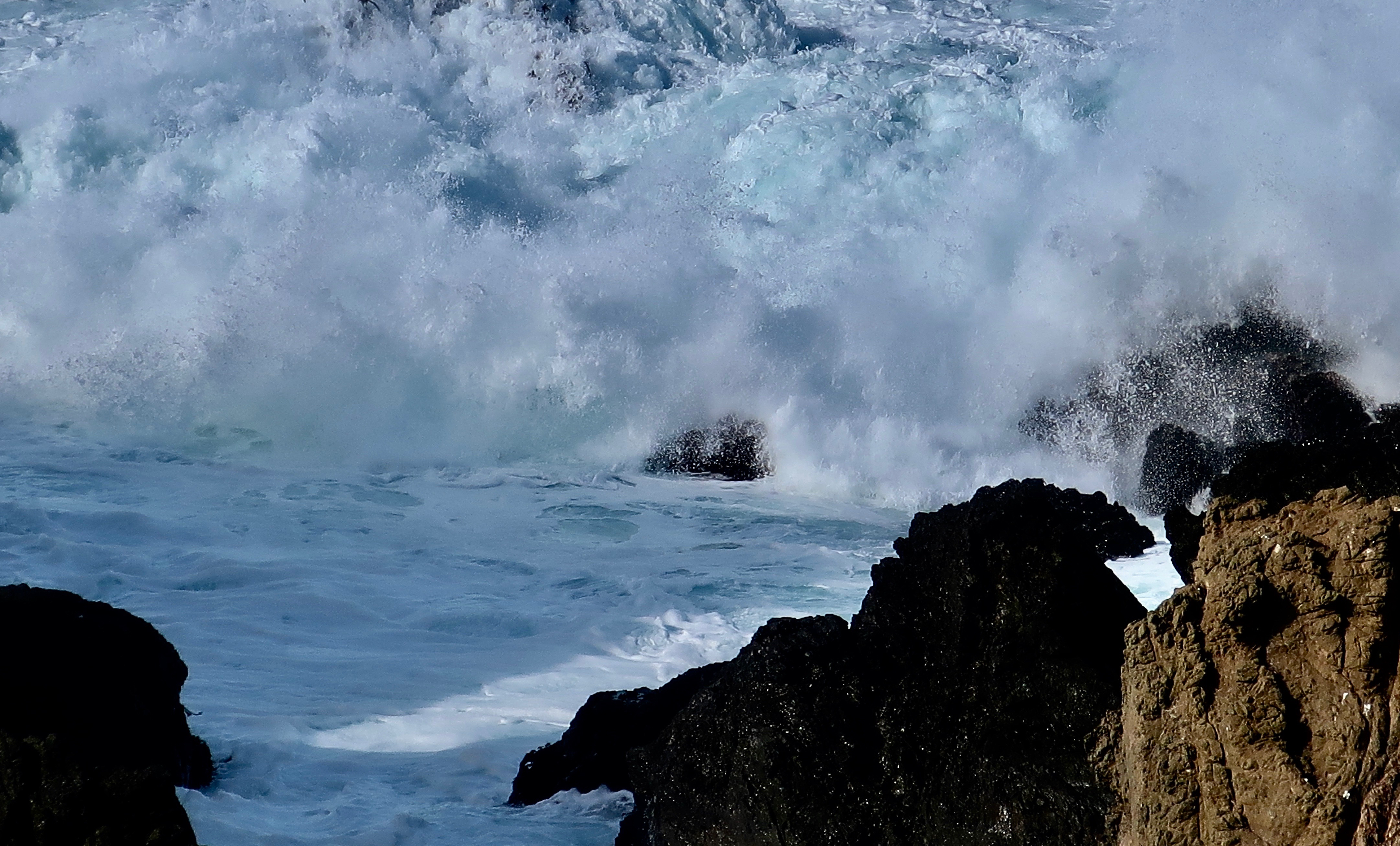
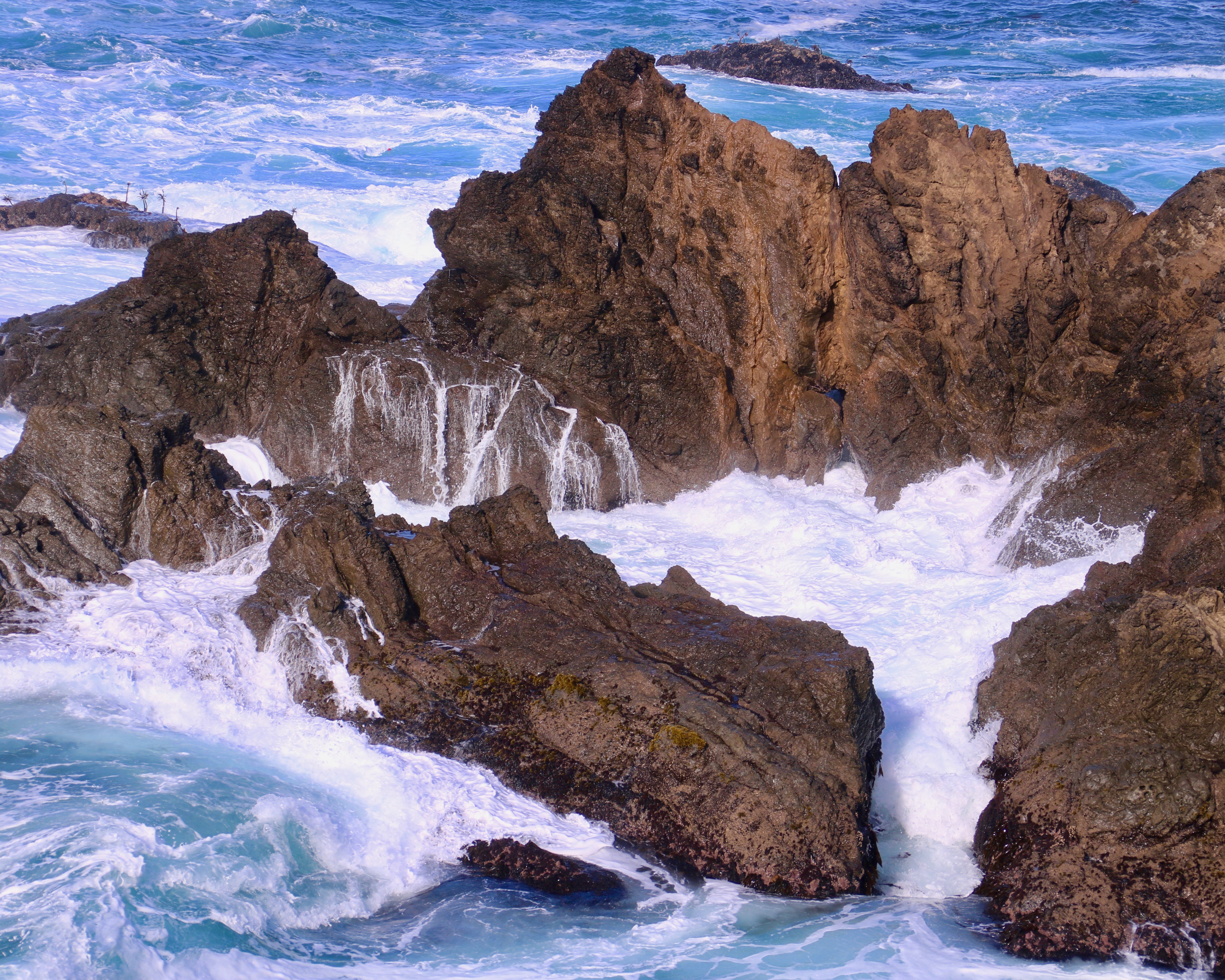
I see a massive wave like this and I remember the wise advice of old sailors: Never turn your back to the ocean. Even now when I look at this photo, I think, run! Fortunately, I was happily ensconced on a high cliff at Pomo Bluff when this big fellow came rolling in.
I laughed when I read the information sign posted up on Pomo Bluff in Fort Bragg. Sailors, fisherman, and other boaters of yore making their way out of Noyo Harbor would go out on the overlook to check how the Pacific Ocean was behaving. It could be calm and welcoming or it could be ferocious and dangerous. Checking was an opportunity to chicken out, to remember there was a cold beer that required quaffing at the local pub. Thus the name. Modern technology and weather forecasting have reduced the need to do a visual check.
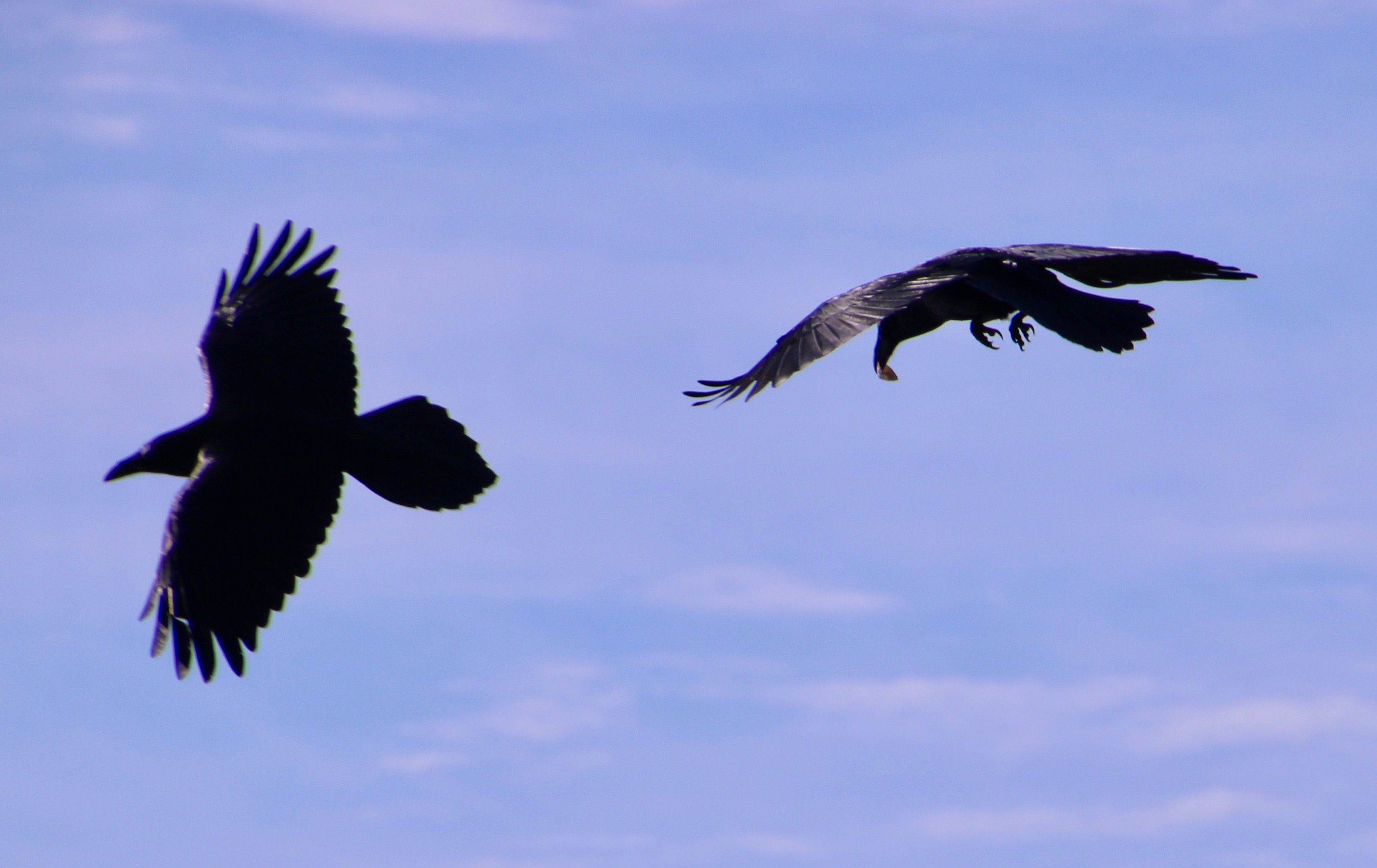
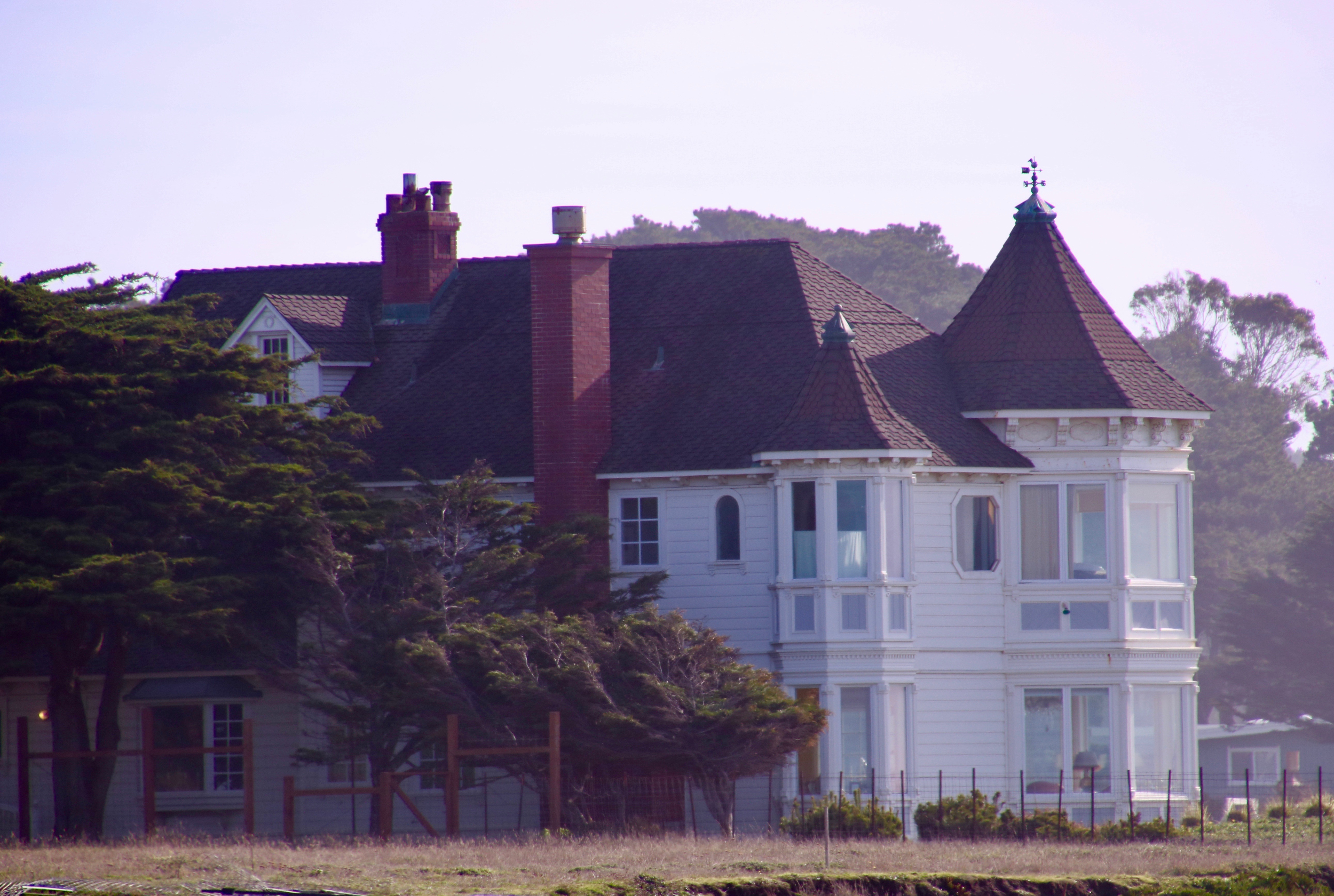
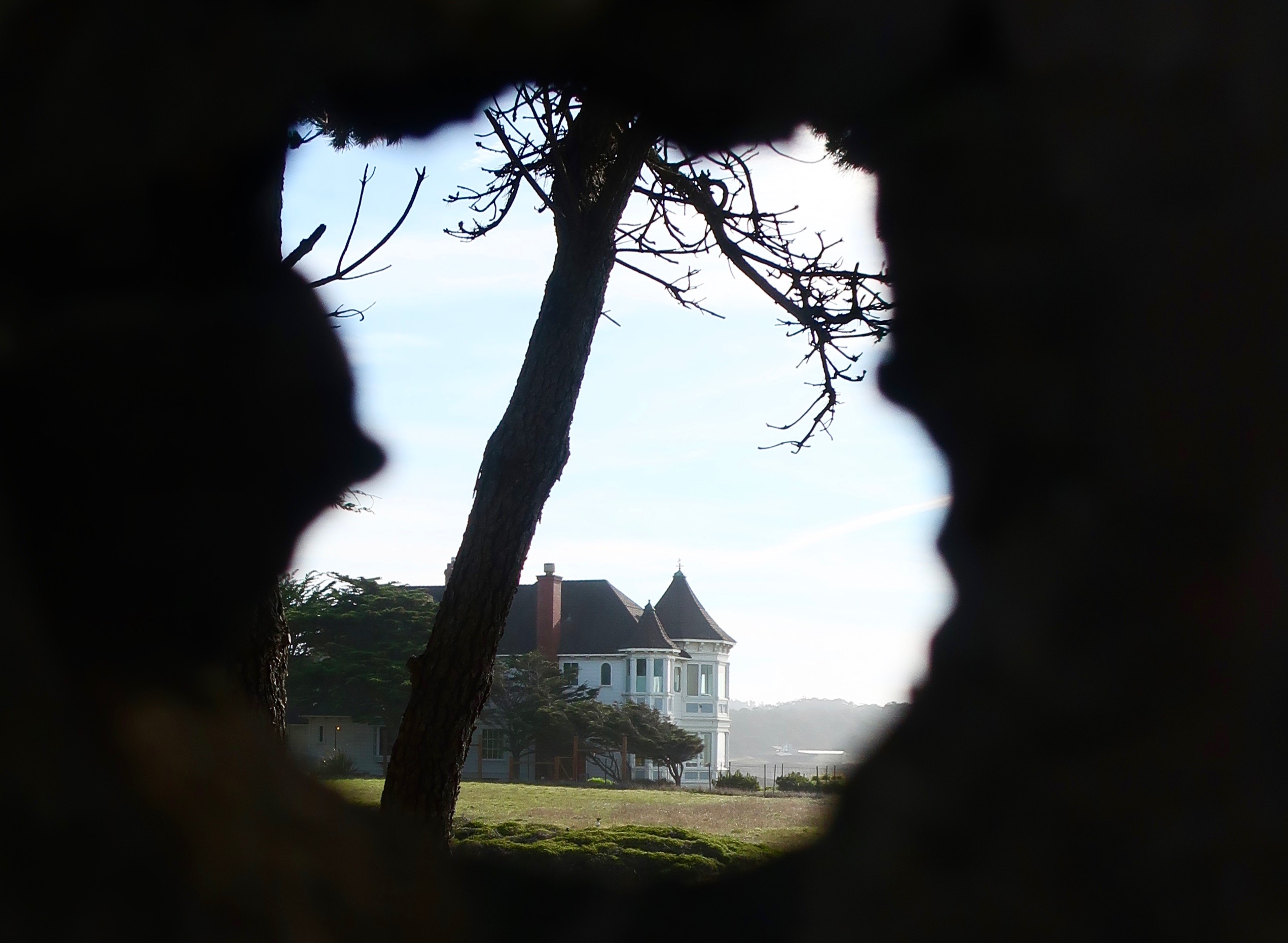
We wandered around on the Bluff, admiring the ocean, checking out ice plants, watching rowdy crows, and wondering who owned the mansion hidden behind a tall fence.
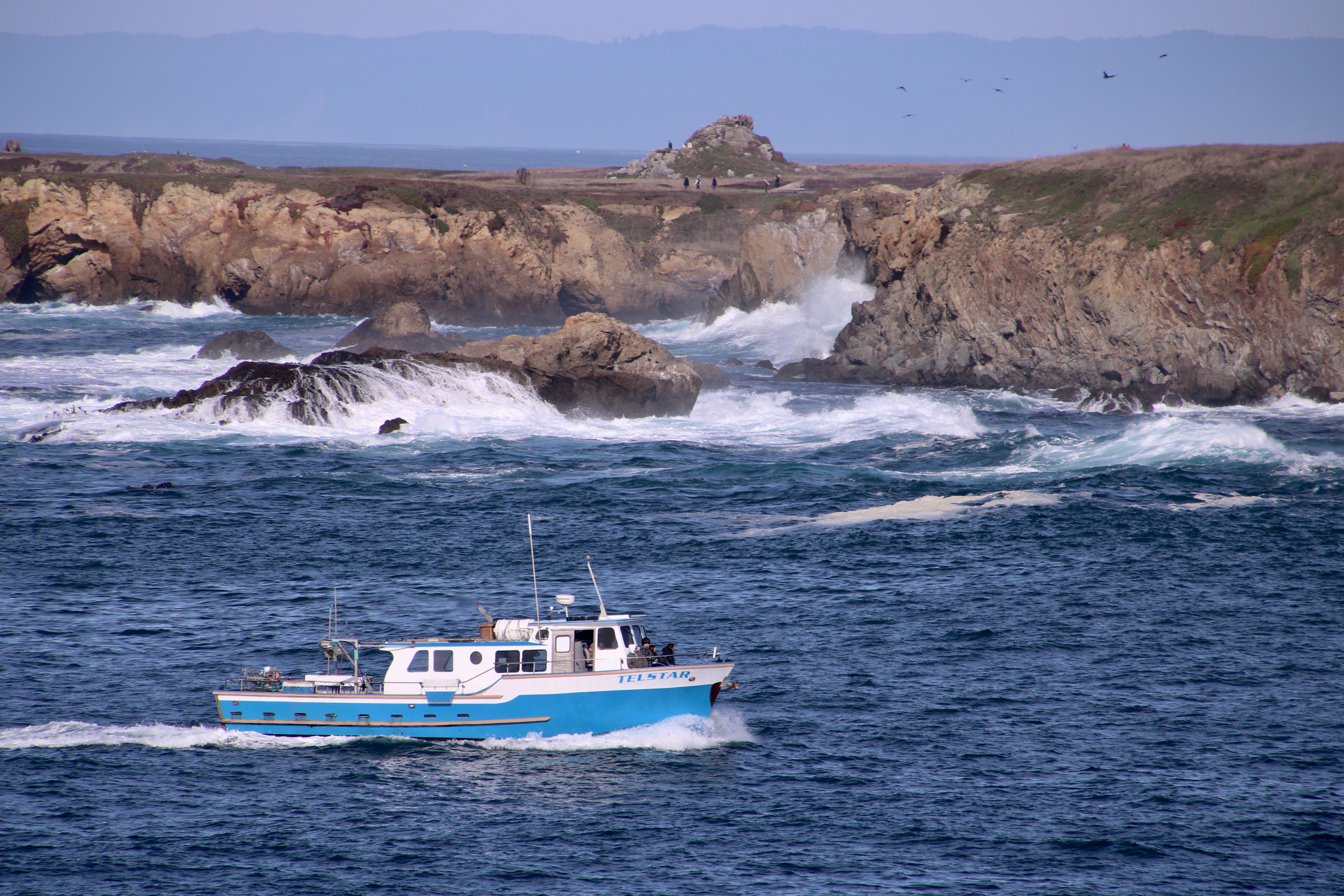
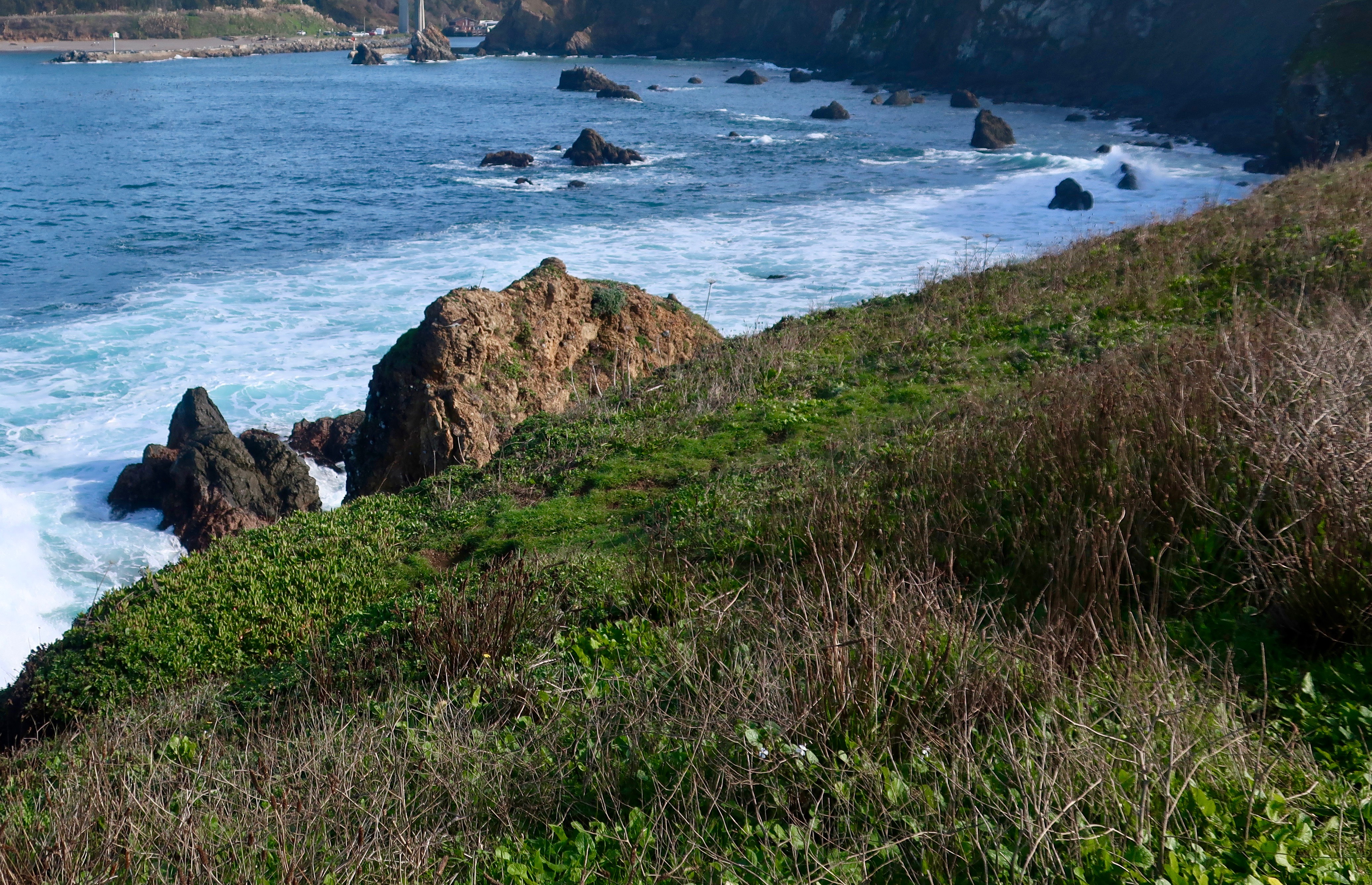
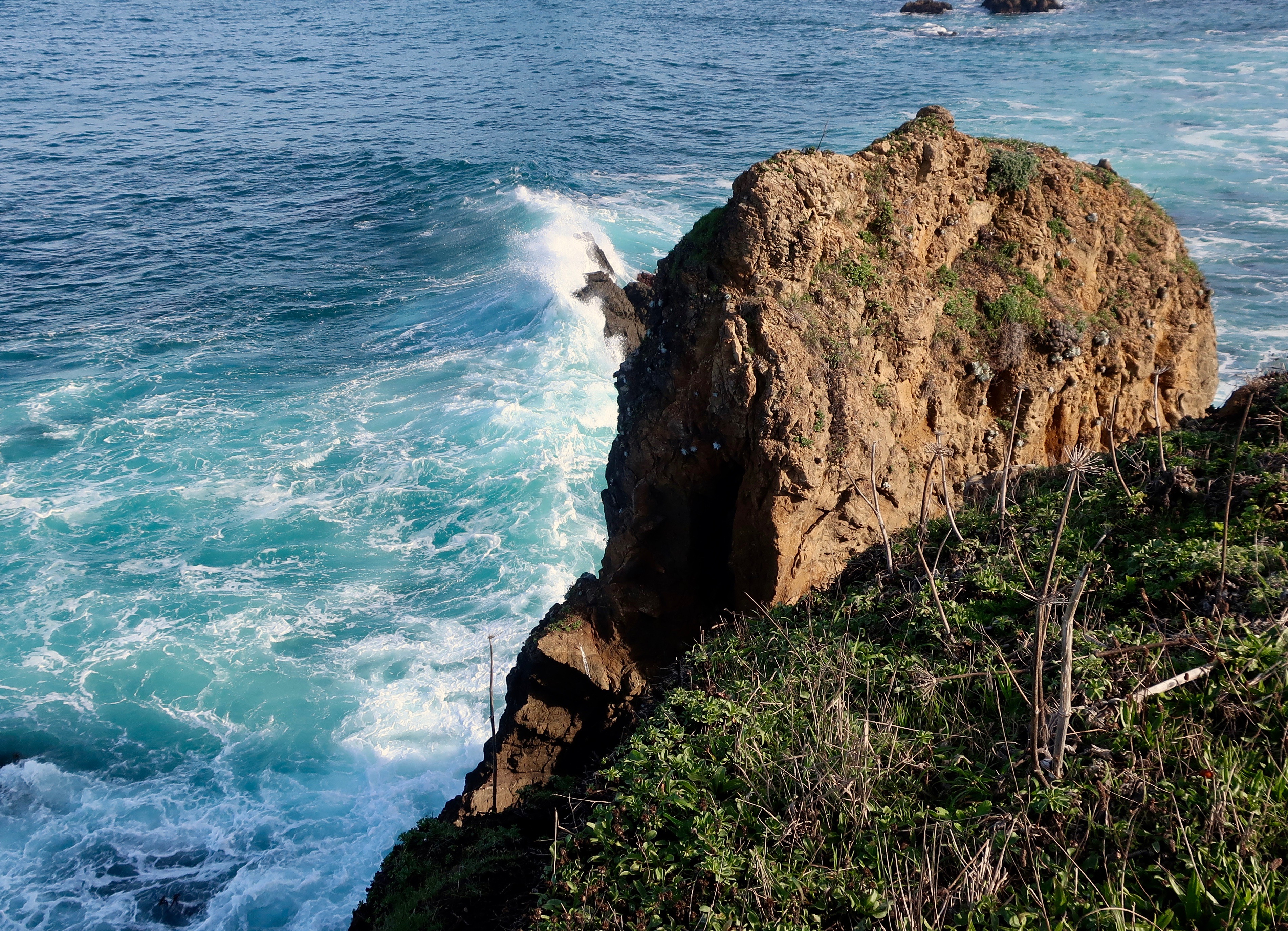
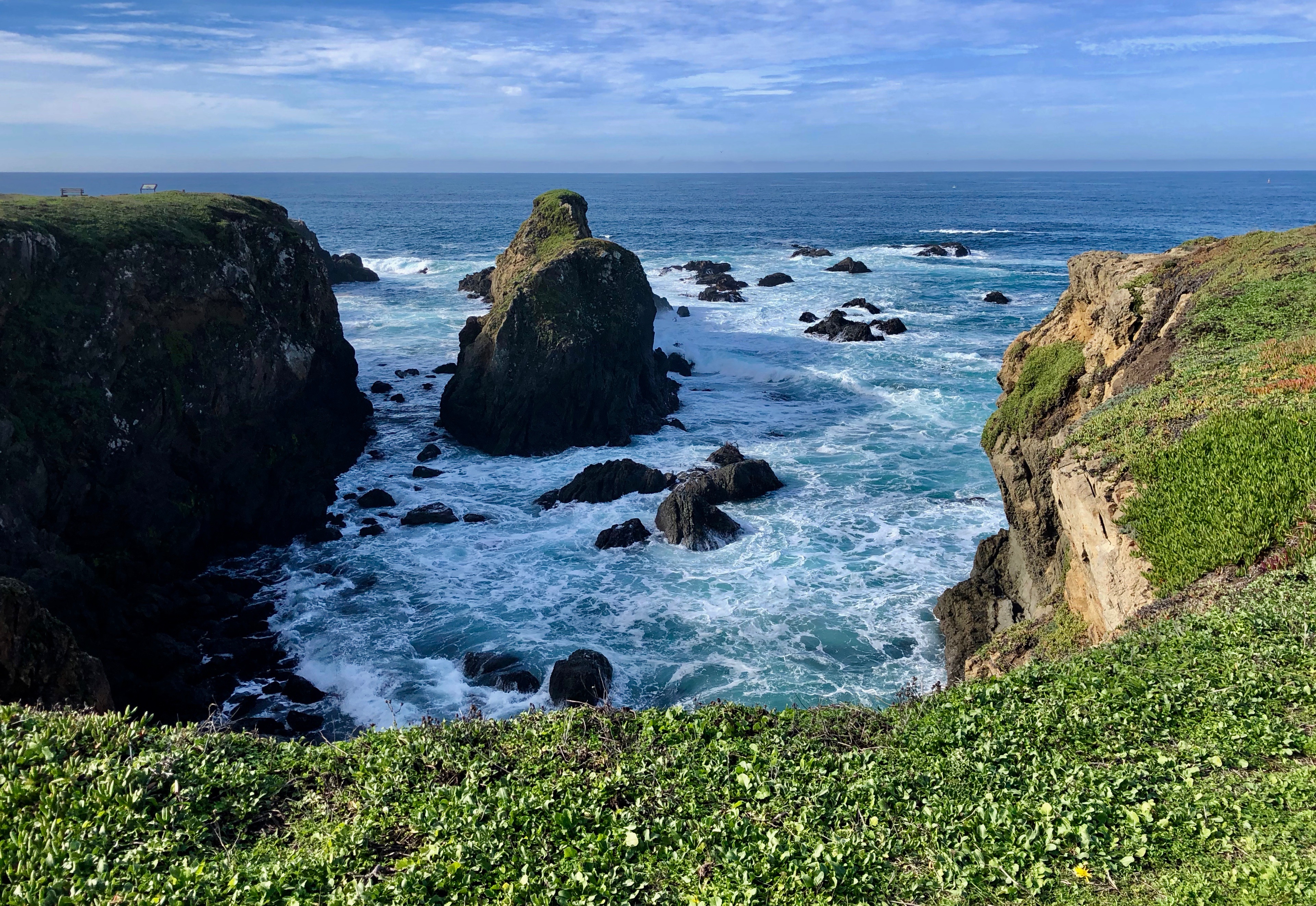
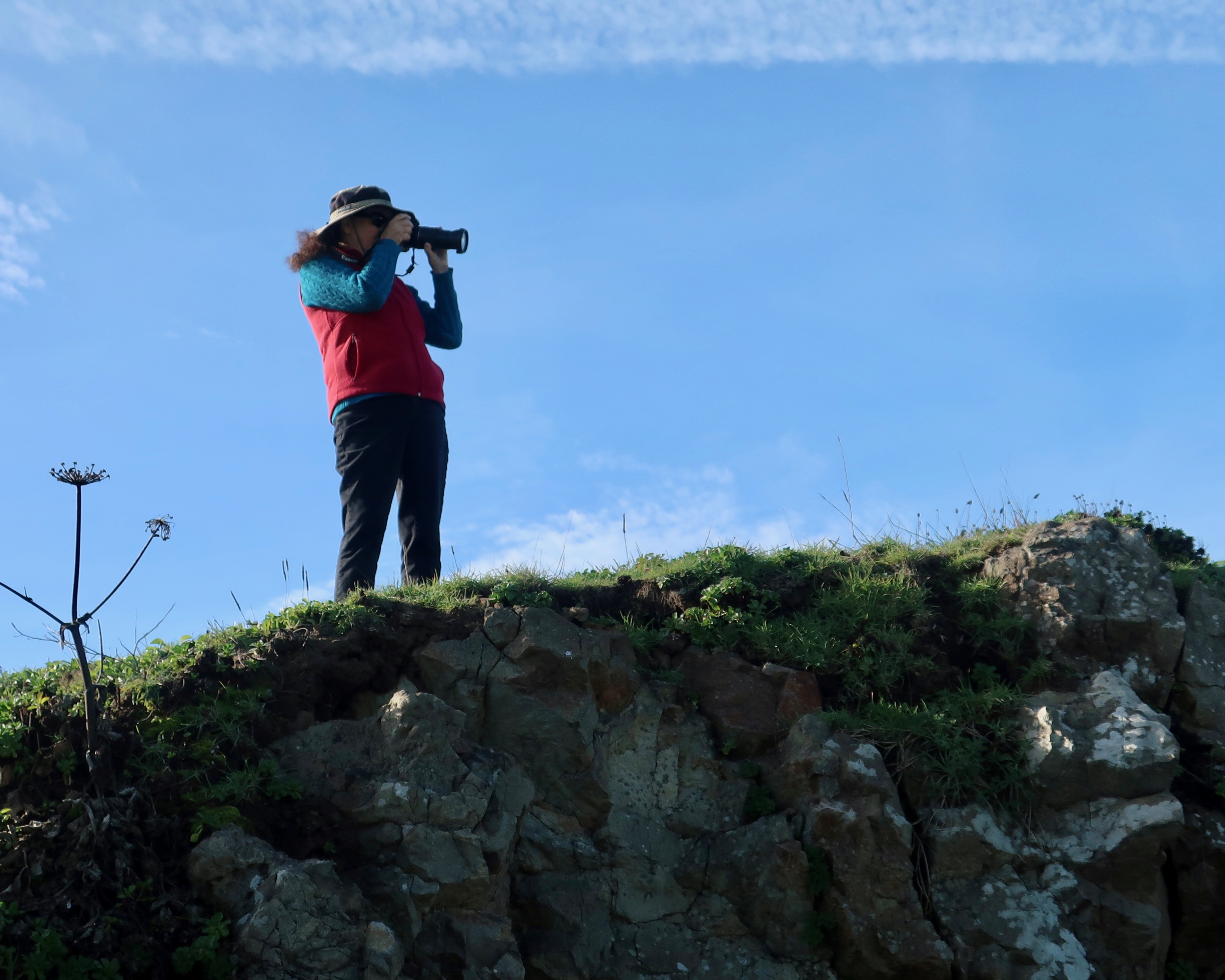
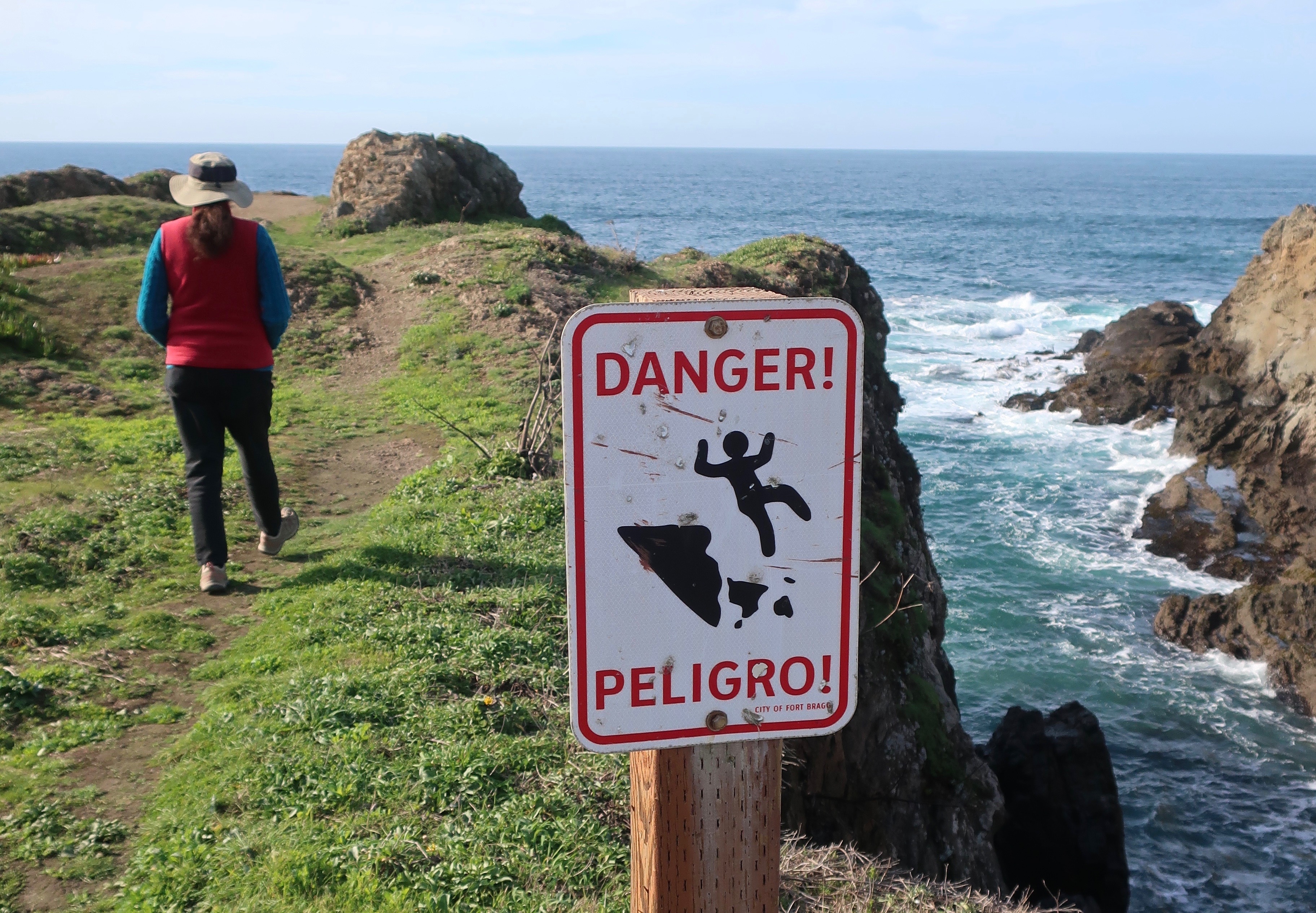
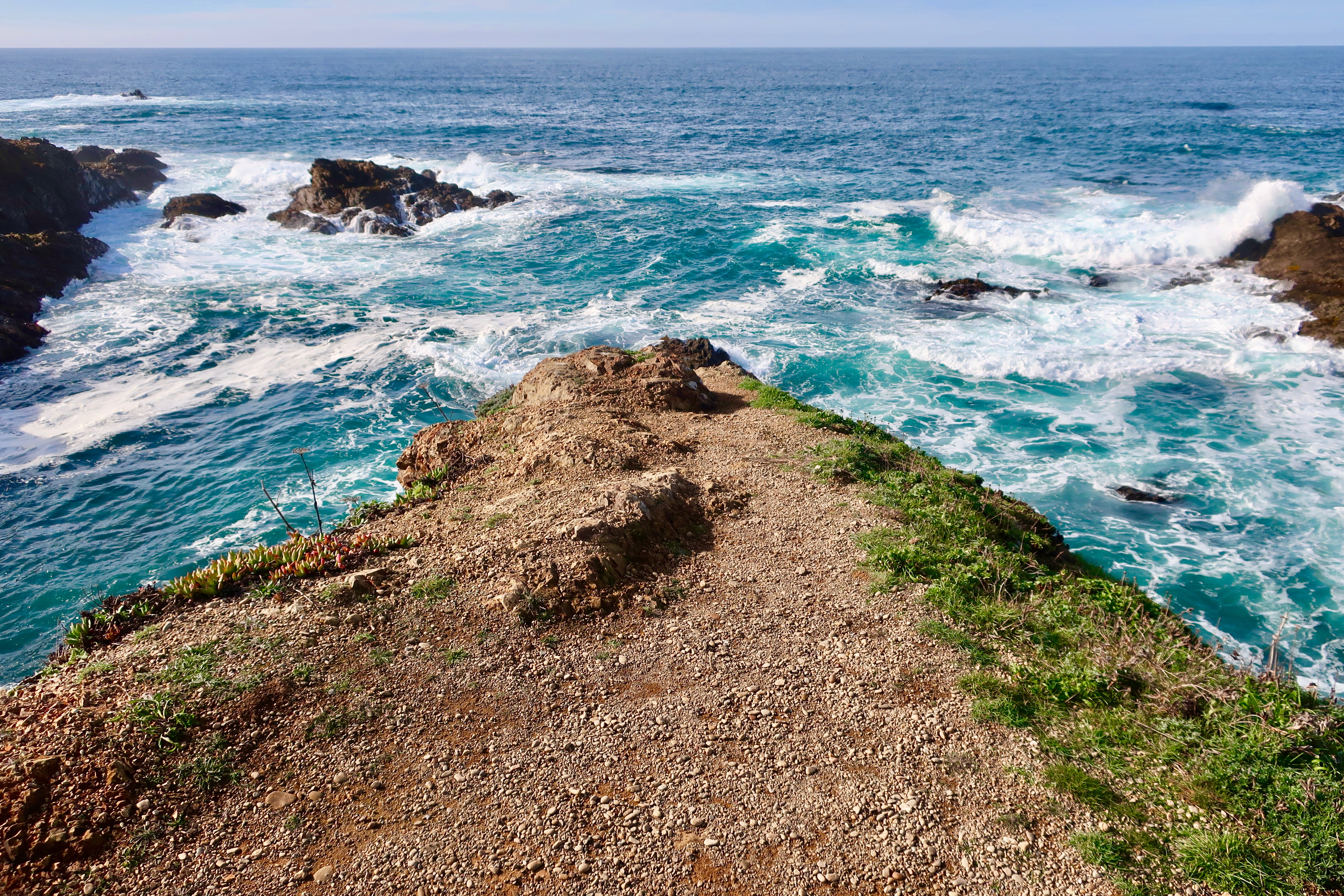
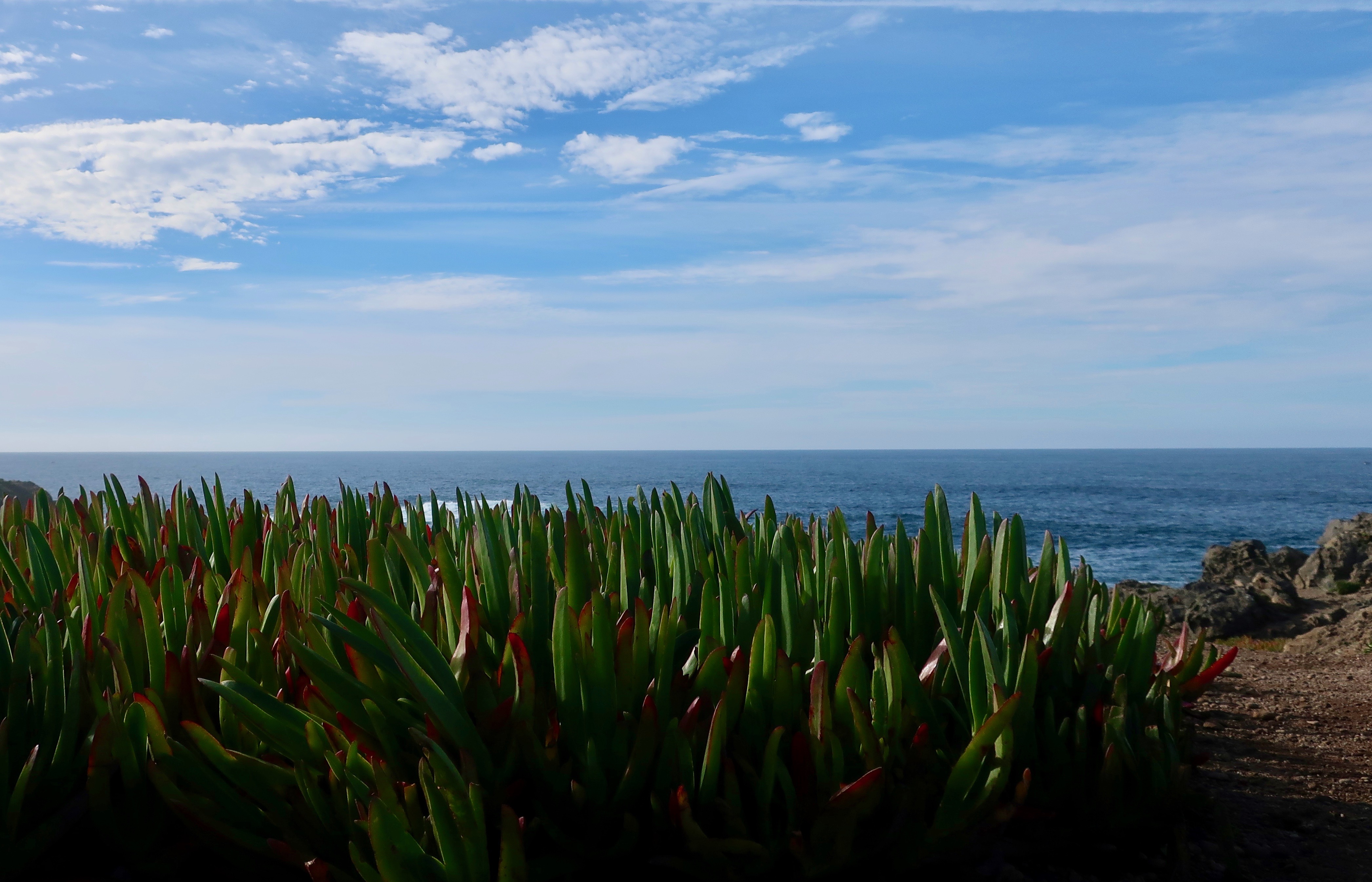
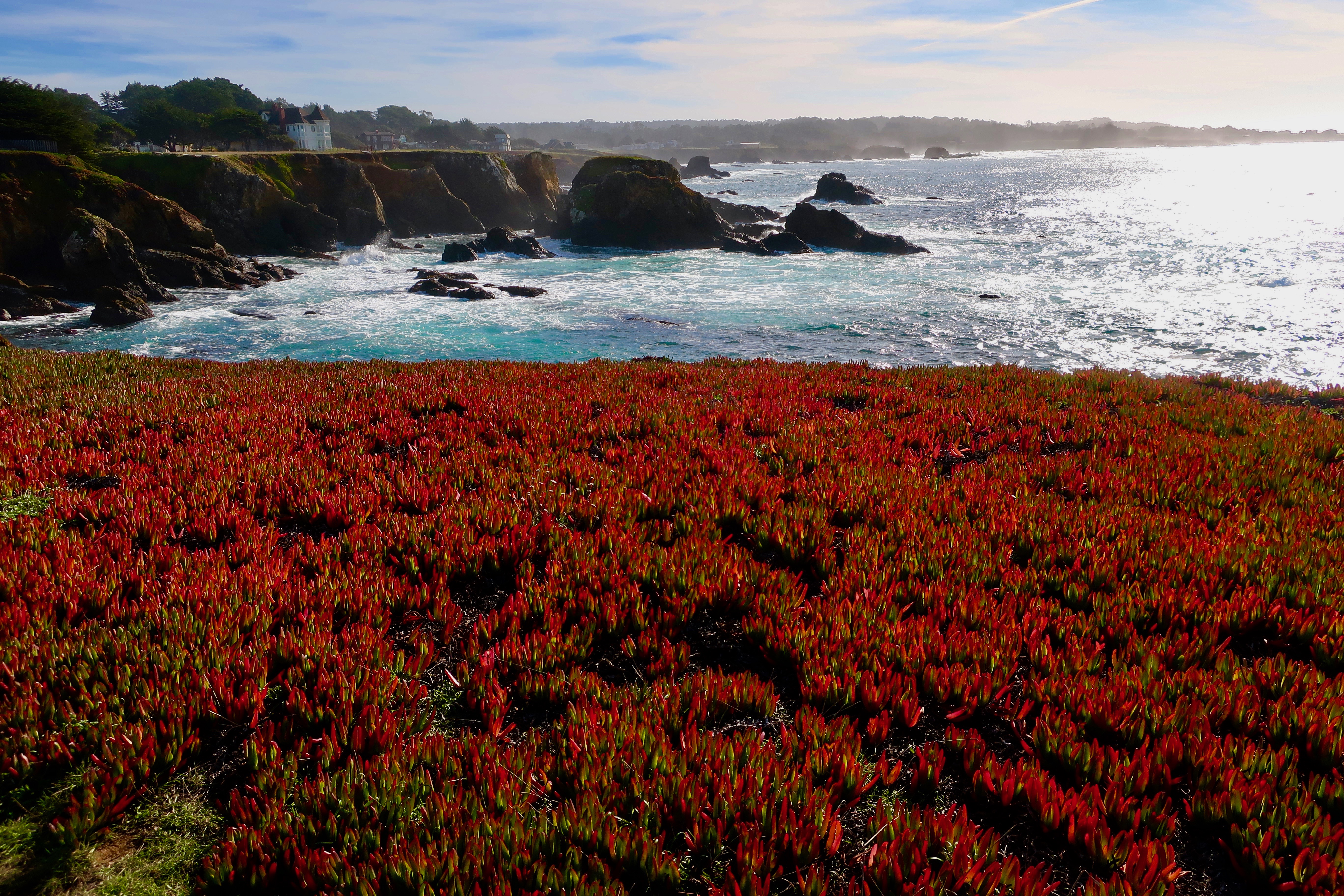
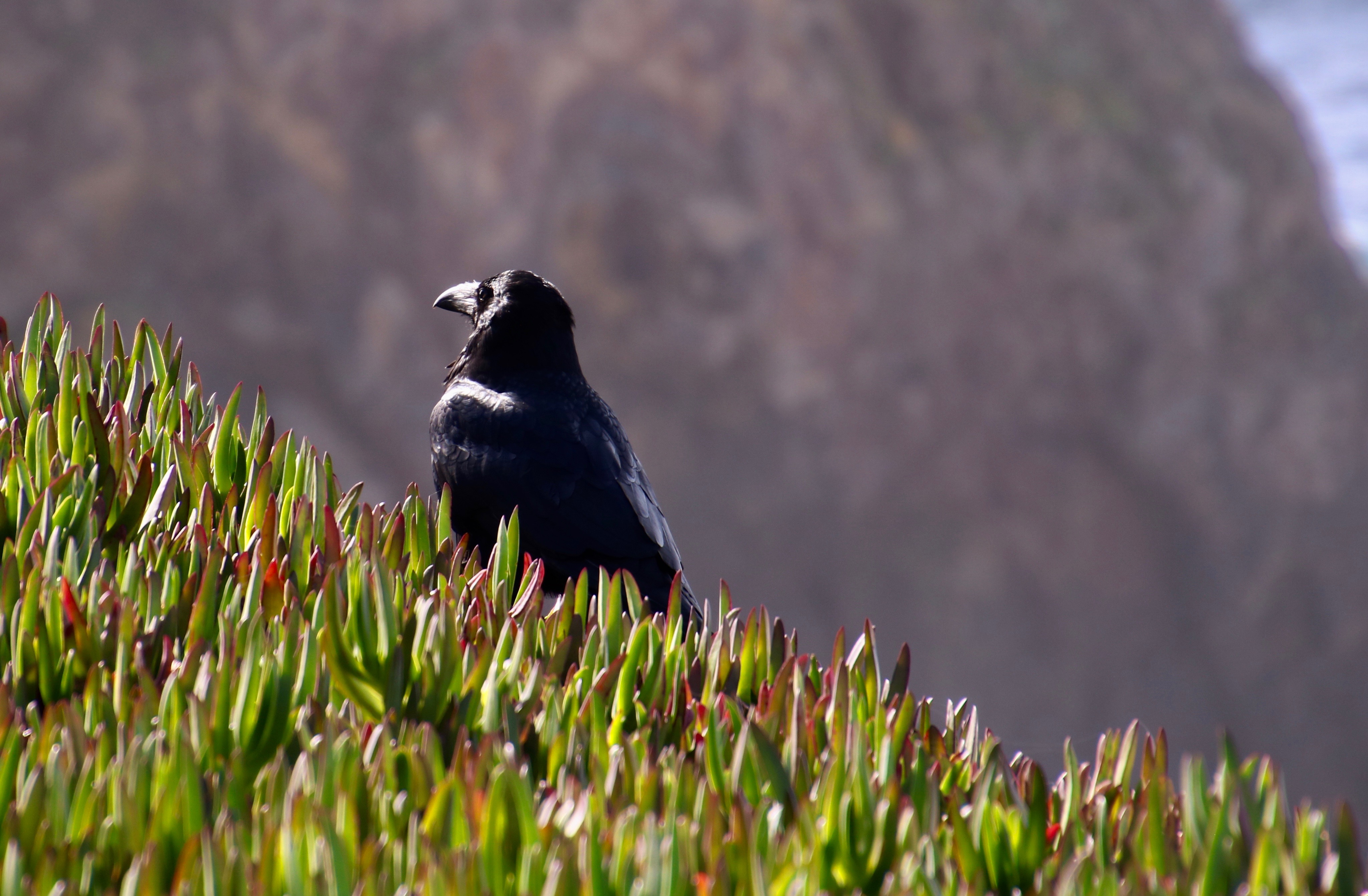
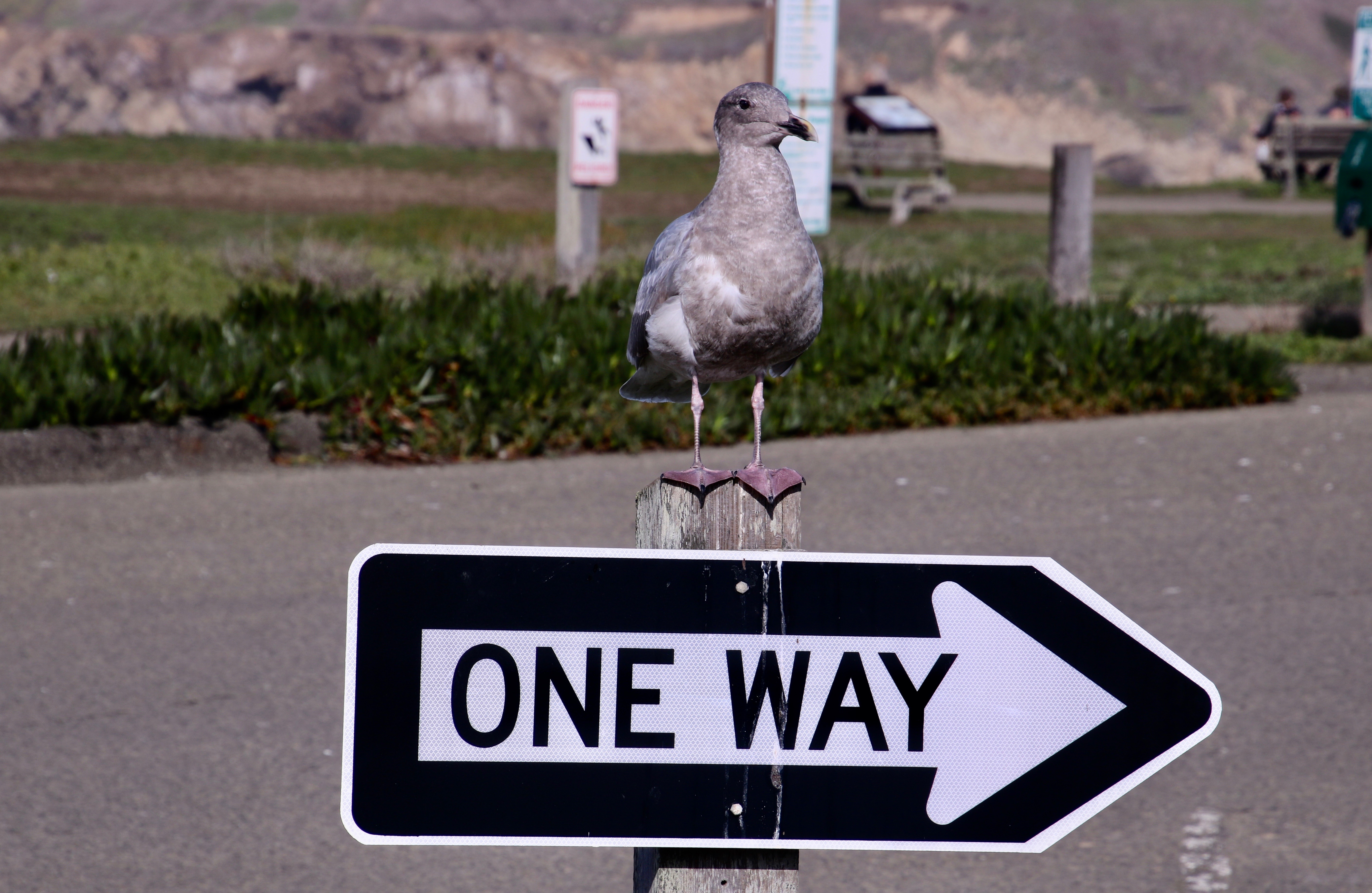
In spite of the big waves, it was a beautiful day on the ocean. We watched as the charter boat, the Telstar, made its way back into Noyo Harbor. It’s available for sport fishing and whale watching. Apparently some folks had been out to try their luck. We didn’t wonder about what they caught or saw, we wondered how their stomachs had tolerated the rolling sea. (Photo by Peggy Mekemson.)Looking back toward the entry into the protected Noyo Harbor.A close up of the sea stack seen above.Looking out to sea from Pomo Bluff. Go far enough and you will end up in Asia.Peggy captures a photo.And then goes in search of another. The sign is a common one along the coast, warning of the dire consequences of getting too close to a cliff’s sheer drop. But does this woman casually strolling along seem worried?How can one resist when the best photos are often on the edge?Such as this. (Photo by Peggy Mekemson.)Ice plants provide an attractive foreground for photos on the coast. But there is a problem. It is an invasive species that replaces native plants.I was surprised to find that the ice plant had adopted fall colors, something that I had never noticed before.This crow took a break from its aerial display of chasing other crows to steal their food, to rest among the ice plants.Peggy captured one carrying something delectable, like a long dead snail. (Photo by Peggy Mekemson.)From her perch out on the point, Peggy was also able to catch a photo of this mansion. Otherwise, it was hidden behind a tall fence.So I took a photo of it through a knothole.A seagull showed us the way. I liked its feet. (Photo by Peggy Mekemson.)And finally we came to the end. It was time to head on to our next adventure and my next post: The Point Cabrillo Lighthouse.
The cows had a hungry look in their eyes. We were thankful they were vegetarians.
Peggy and I had decided to revisit an old favorite of ours, the Palomarin Trail that enters Pt. Reyes National Seashore from the south. We had driven down to Bolinas and were on our way out the narrow, pothole-filled road that leads to the trailhead when we saw a series of poles, lined up like they were standing at attention in ranks. I knew immediately what they were.
The poles were part of the historic Marconi wireless radio station near Bolinas. At one point, they had been connected by wires.
In 1914, decades before the likes of Elon Musk and his techie cohorts started working on worldwide wireless technology, Guglielmo Marconi, the inventor of the wireless radio, had built a huge, wireless radio station near Bolinas to send Morse Code messages flying across the Pacific Ocean, setting up the first-ever communication system between ships at sea and land. A small parking lot was connected to a walking trail that wound its way past the historic poles and toward the ocean. We were easily diverted from our original intent of hiking the Palomarin Trail.
The pole-filled field was doing double-duty as a cow pasture and a herd of cattle insisted on checking us out— up close and personal. It was lunch time and they may have thought we were sneaking alfalfa past them. The Morse Code in the title, BTW, spells C -.-. O —, W .–, in case you were wondering. And boy, that takes me back to my Boy Scout days in the 50s when memorizing Morse Code was essential to working your way up through the ranks.
We checked out the poles, talked with the cattle, and had a pleasant walk out to the coast with both Peggy and me taking photos.
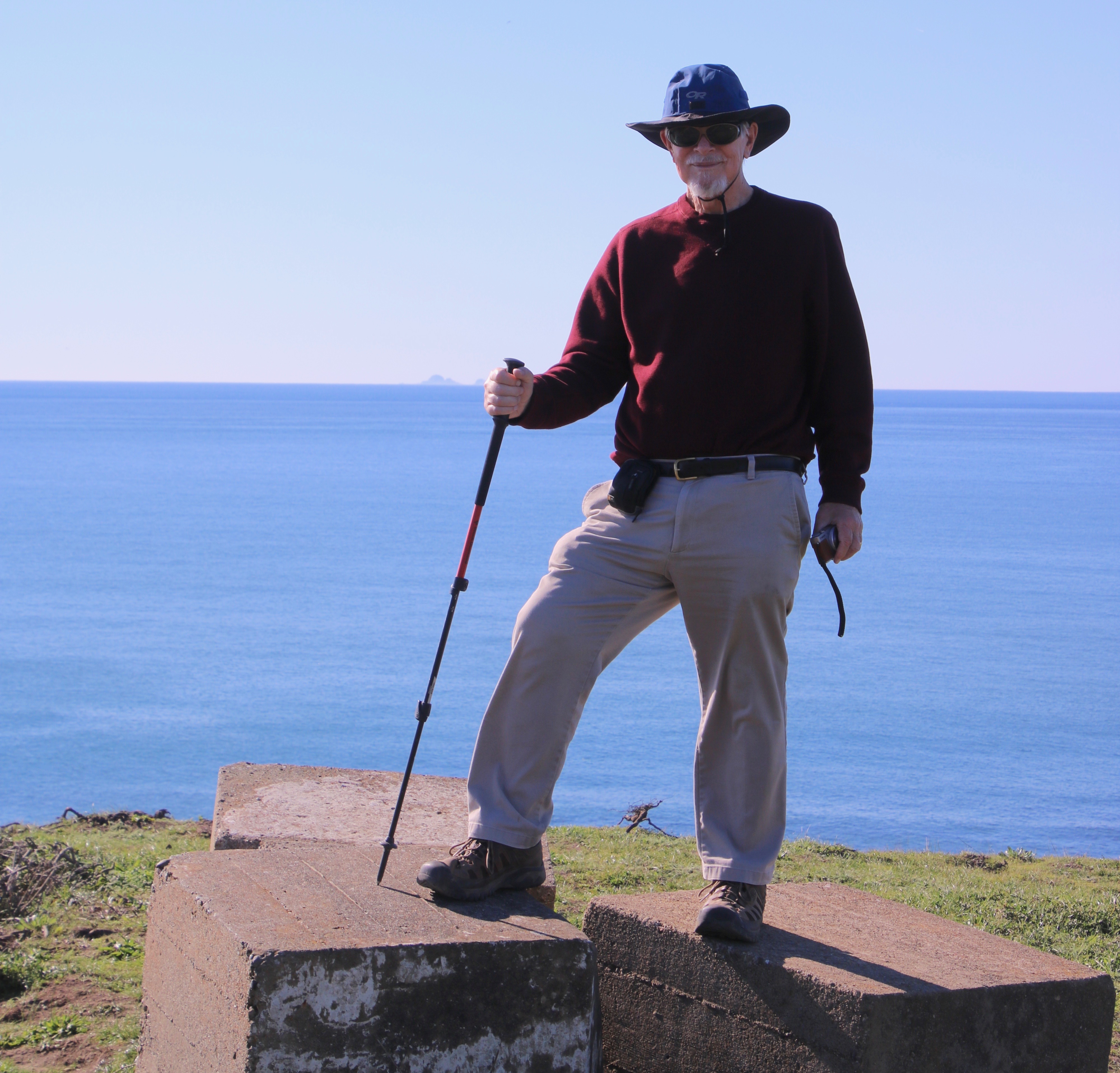
Not quite Mt. Everest, but I was still willing to pose for Peggy. We found large cement blocks throughout the area. At first, I though they might have been part of the coastal fortifications the US built along the Pacific Coast in WW II. Then we decided they were used to anchor the poles and wires. (Photo by Peggy Mekemson.)A whole herd of cattle was lined up along the road. They remained on the road, not budging as we walked by.I thought this young fellow munching on grass was quite handsome.Peggy stopped to admire a lone tree on our walk. The brush had a soft, welcoming look to it. But looks can be deceiving!It was close to impenetrable. As we approached the coast, the Pacific Ocean stretched off into the distance. The Farallon Islands can be seen as bumps on the horizon. They were once known at ‘The Devil’s Teeth’ for their ability to rip the bottoms out of sailing ships. In the 1800s, millions of birds’ eggs were taken from the islands to feed San Francisco’s growing population. Today the islands are a designated wilderness area and are part of a marine sanctuary. The birds no longer have to worry about their babies being stolen. Looking north, we saw some of the towering cliffs found along the Pt. Reyes National Seashore. Sir Frances Drake, the renowned English hero and buccaneer (fancy name for pirate), apparently admired these cliffs on his visit to the area in 1579. (Photo by Peggy Mekemson.)Looking south we could see the giant Sutro Tower that dominates the San Francisco skyline. Herb Caen, the well known and beloved columnist of the San Francisco Chronicle, once described the tower as a “giant erector” that was stalking and planning to eat the Golden Gate Bridge. I read Caen religiously when I was growing up. It was back when newspapers still had a sense of humor, before they adopted their Doomsday, Penny Henny view of the world. (Photo by Peggy Mekemson.)
Afterwards, we stopped off in Bolinas for lunch. It’s another favorite coastal town of mine. One reason is the fact that the locals refuse to have signs leading into the town from Highway 1 for tourists to follow. Whenever Cal Trans puts one up, it’s torn down. I think that Cal Trans has finally given up. At least I didn’t see any signs. It has always been a fun, quirky town with its own unique cast of characters. Last time when Peggy and I visited with our friends Ken and Leslie Lake, we came on a bookstore without staff. A sign said “Take any book you want and leave whatever you think the book is worth to you in the cash box.” It was a very Bolinas type of thing.
While I’m on Bolinas stories, I’ll mention that it was also the site of my first ‘Hippie’ experience. I’d stopped in the town in 1968/69 and decided to do a little sunbathing on its infamous nude beach, which I had read about in the San Francisco Chronicle. It was a time before Google listed “The Best Nude Beaches in Marin County,” a time when the Protestant ethic still reigned supreme among America’s middle class. I confess I was a little nervous about getting naked, but it was the sunburn that left a lasting memory!
A sign of the times in Bolinas. As we were walking through the town in search of lunch, we came across a car with a ladder on top that included a sign that set me to laughing. I could identify with it.
Having featured cattle today, it is only right that I should feature a horse as well. It’s a requirement of the Old West. The day after our Bolinas walk found Peggy and I hoofing it along the Bear Valley Trail. It connects the Visitor’s Center with the ocean in an 8-mile round trip. We were feeling our oats, so to speak, when we came across a pair of real hoofers, i.e. horses. A woman was walking one and stopped to chat. As it turns out the horses were part of ‘San Francisco’s Finest.’ It was a police horse, a proud member of the mounted patrol that can often be found patrolling Golden Gate Park. They’ve been at it continuously since 1864. The horses were out for a play day on the Bear Valley Trail.
Peggy, who likes horses, insisted on snuggling up to it and I dutifully snapped a photo on our iPhone. I, on the other hand, am not a horse person. It isn’t their size, their looks, or their personality, all of which I find pleasing. It’s their smell, and the fact that they often leave prodigious piles of poop along hiking trails. Have you ever seen a sign that says “Clean up after your horse?” I’m not sure what it is about their smell, but it clings to you. I wonder if cowgirls and cowboys think of it as perfume?
Peggy snuggles up with the horse along the Bear Valley trail.
That does it for today. I’ll wrap up our recent visit to Pt. Reyes in my next post. Then it will be off to Fort Bragg and Mendocino.
As I mentioned in my last regular post of the summer, I will post a blog on occasion when something catches my attention. The UFO report due out in a week or two definitely fits the definition.
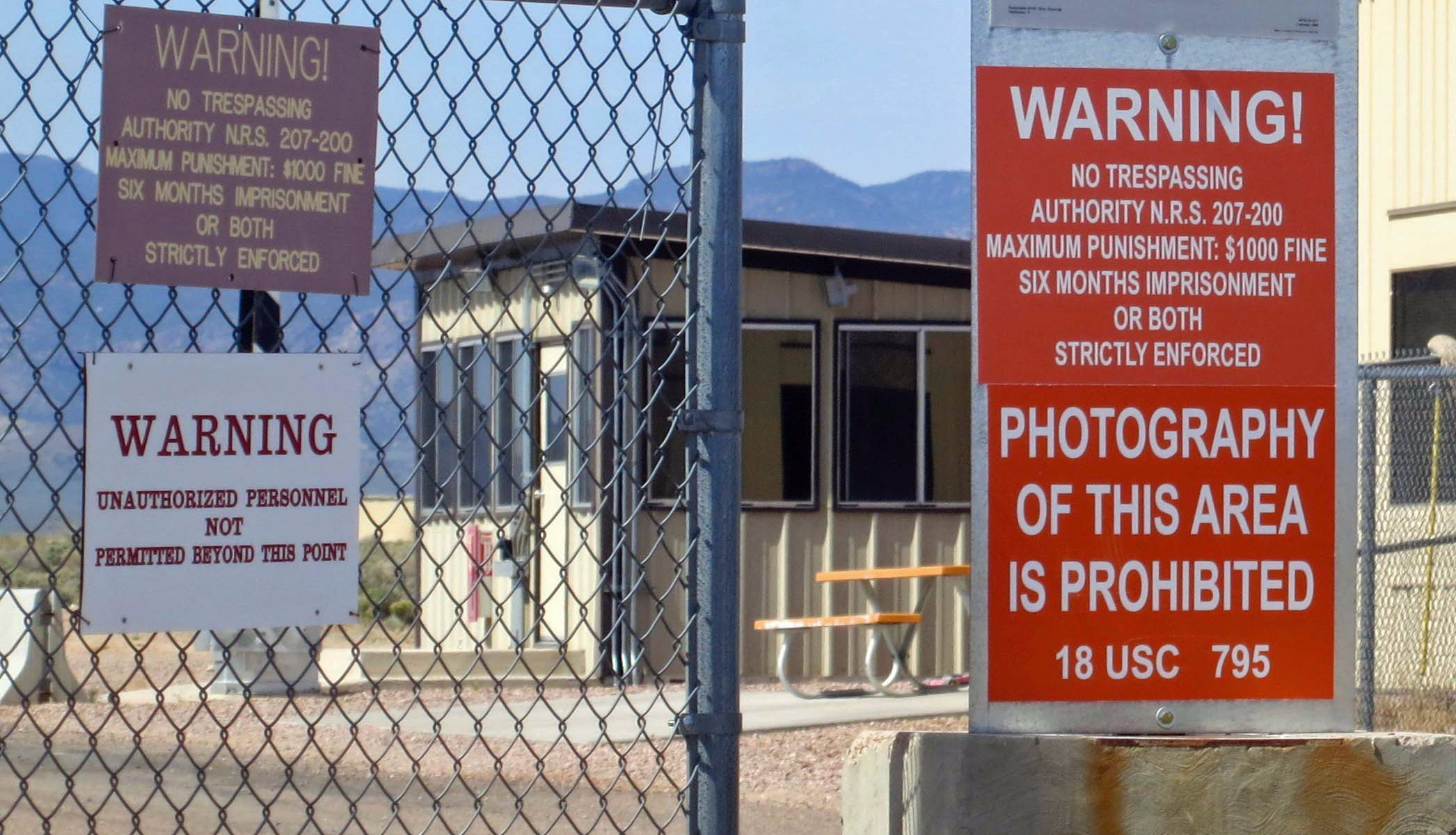
My interest in UFOs has kept my eyes focused on the skies ever since I saw one in 1968. It has also taken Peggy and me to interesting places— like Area 51, shown above in a remote section of Nevada desert. Naturally, I couldn’t resist taking a photo of the sign. Nobody rushed out to arrest us. Wait, is a Man in Black armed with a neuralyzer knocking on my door?
It’s almost impossible to believe.
I’m not talking about UFOs, which I find easy to believe. I’m talking about Republicans and Democrats agreeing on something. At this point in our history, it seems like the possibility of UFOs zipping through the skies of the world is much higher than the possibility of Republican and Democrats working together in the public interest. (Hopefully, I’m wrong.)
And now, both Democrats and Republicans are speaking out about the need to crank up our intelligence on Unidentified Flying Objects (UFOs), or Unidentified Aerial Phenomena (UAPs), to use the modern term. Obama, Trump, and Biden all agree. As do Adam Schiff and Marco Rubio. A report is scheduled to be released this month that will detail what we know, or at least what the government is willing to share with us.
Leaks have suggested that the report will admit that not all UAPs can be explained away with the usual claims that they are the result of some type of natural phenomena or an over-active imagination. The fact that many of the sightings have come from military pilots makes such claims particularly difficult to maintain. These folks hardly fit the definition of delusional eccentrics. One pilot noted that sightings have been reported almost daily for the past two years— often around military installations. No wonder the government is excited.
So far, America’s political leadership seems focused on the possibility that another government may have developed a technology far superior to anything the US has— at least publicly. It’s more palatable than admitting to the existence of extra-terrestrials from outer space (or Earth). And also easier to obtain funds for. The first hypothesis is merely scary. The second is mind-boggling and will forever change our perspective on who we are.
I doubt the viability of the ‘other government’ scenario. For one, can you imagine how difficult it would be to keep such a secret? Then there is the temptation to exploit such technology to gain political advantage. It’s hard to imagine any modern nation failing to do so. And finally, we are talking about a technology that would have been available for over 80 years given modern day sightings. And probably much longer.
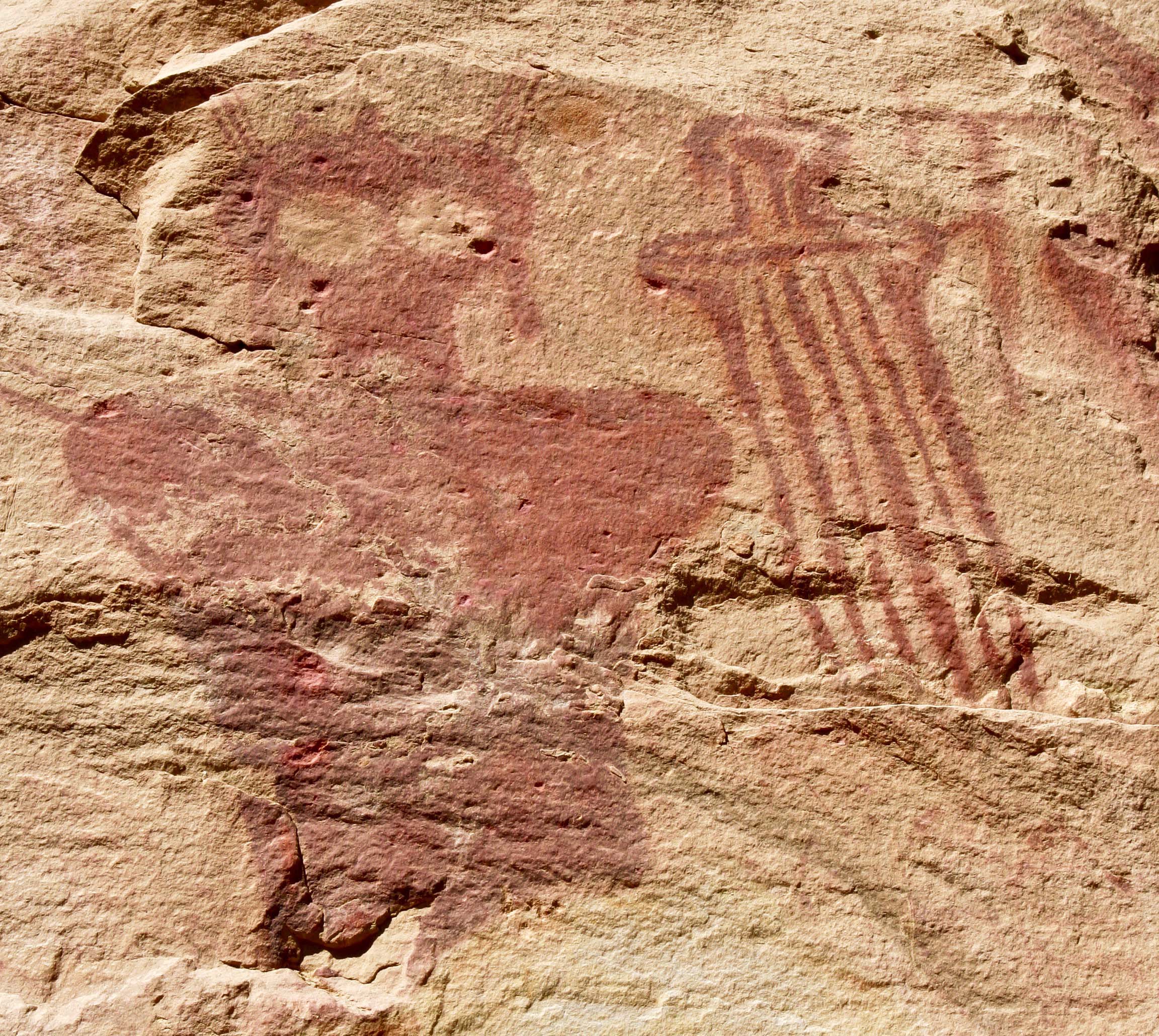
The 2000-6,000 year old pictographs at Sego Canyon in Utah are among the strangest I have ever seen. Admittedly, such visions may be drug induced as part of a shamanistic ritual, but I have often thought of their other-worldly, alien appearance. And could the object to the right be a flying saucer?I love this cartoon from the Roswell, New Mexico UFO museum.
Our present day governmental efforts to get a handle on what’s out there, date back 14 years when Harry Reid, (D. Nevada and then Senate Majority Leader), persuaded two colleagues, Ted Stevens, (R. Alaska) and Daniel Inouye (D. Hawaii) to join him in sponsoring a bill that would dedicate $22 million to assessing whether UFOs posed a threat. Reid said it took him about ten minutes to persuade the two to go along with him. Stevens, who claimed to have seen a UFO when he was a pilot during WWII, signed on at once.
Assuming the existence of aliens for a moment, three questions come to mind: Who and/or what are they, where do they come from, and what are their intentions regarding humanity? Our initial vision of bi-pedal greenish creatures with big eyes is based on original claims of the Roswell crash of 1946 which may— or may not— have happened. (If you want to watch a hilarious but R-rated view of the crash, check out the movie, Paul.)
The where raises an interesting question. If they are frequent visitors from another galaxy, then their technology has taken a quantum, faster than light leap. Or maybe they use worm holes in space. Or come from a parallel universe. All are popular subjects of science fiction and modern speculative physics. Or maybe they operate from a base on earth. I could see a mother ship dropping them off eons ago and urging them to observe evolving species, particularly the one that liked to go around bashing each other’s brains with large clubs.
The intentions question may turn out to be the most important. As far as we know, the aliens have taken a hands off approach, monitoring but not interfering in our evolutionary and technological development. Why? Is there some kind of Star Trek ethic of not interfering with primitive societies. Or are they making a determination about our behavior. Are we intelligent beings who should be welcomed into the galactic community at some point in the future? Or are we a nasty virus that poses a threat to the Universe and needs to be destroyed? Apparently, the jury is still out. Do they see us on the edge of self-destruction and foresee a need to step in and alter our path? Their focus on military installations suggests a concern on what damage we might cause in outer space or what damage we might do to each other. Or what if they are scouts, preparing for a future invasion. Lots of questions and no real answers. Yet.
As for my sighting of a UFO in the fall of 1968, I was in Sacramento at the time. I had just returned from my stint as a Peace Corps Volunteer in Africa and a Peace Corps recruiter in the South. I had moved to Sacramento to open a Peace Corps Public Affairs office for Northern California and Northern Nevada. One evening, I stepped outside my apartment on La Riviera Drive next to the American River when a round, saucer shaped object caught my attention. It disappeared into a cloud. Before I could think of the implications, the object came out of the cloud going in another direction, accelerated and quickly disappeared from view. The UFO was not something fuzzy I saw in the distance on a dark night when I had been indulging in a hallucinogenic drug. It was still light out and my view was crystal clear. There was no doubt in my mind as to what I had seen. And I have never doubted the existence of UFOs since.
Are aliens and UFO/UAPs for real? I found this charming character in a diorama at the Roswell UFO Museum.
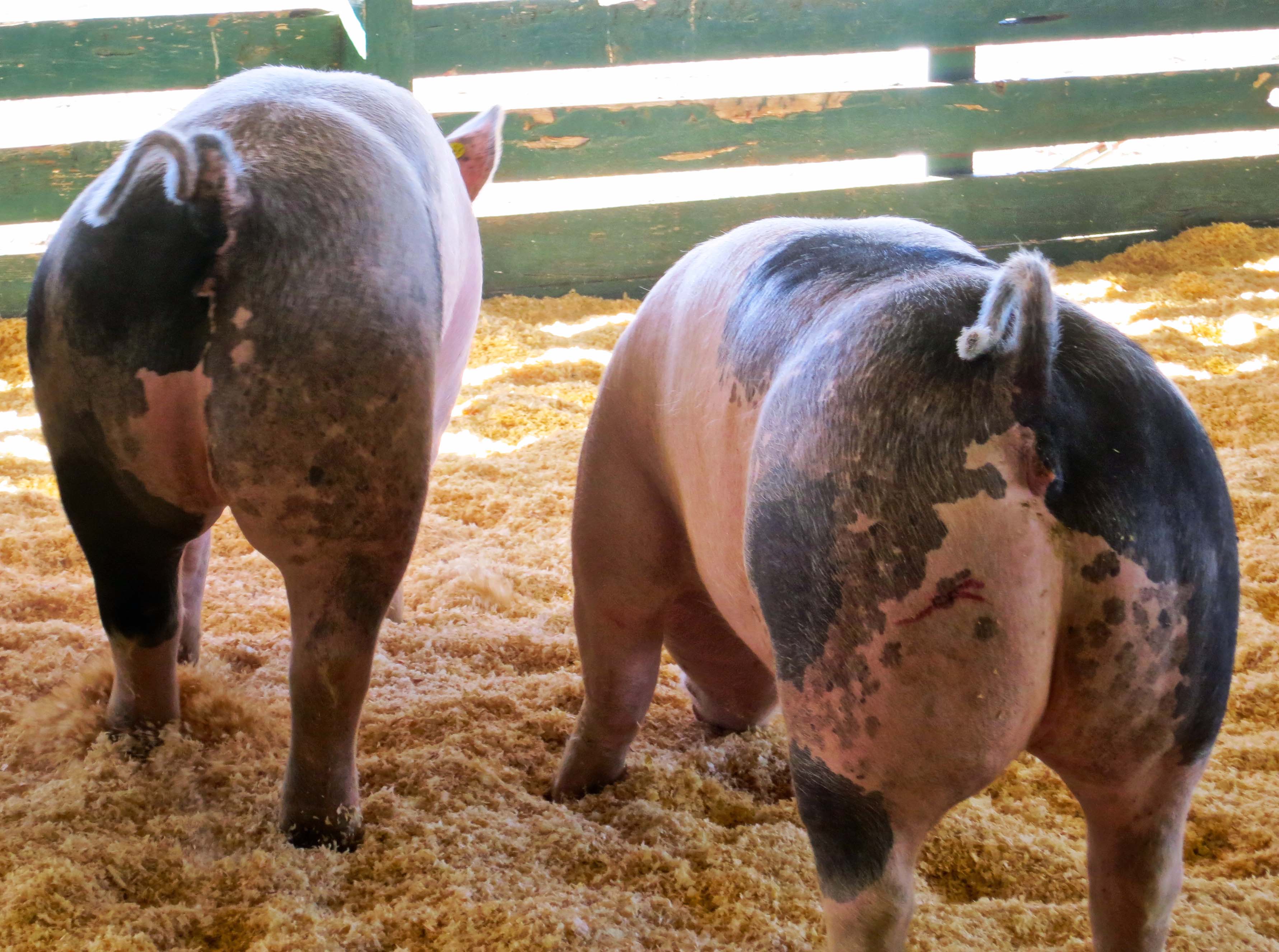
I’ve always been a fan of pigs. Whenever I go to a County or State Fair, I make a beeline for the livestock barns, mainly to see the pigs and the goats. I found this handsome pair hamming it up at a small county fair in Cedarville, California when I was on my way to Burning Man one year. Normally I take photos of their faces and snouts, but I couldn’t resist the kinky little tails.
Like the gunslingers of the Old West, our reputations far exceeded the reality of our actions. Take Tony Pavy’s pig for example. Tony had a large pond with bullfrogs, a hundred or so acres of scrubland, and a wooded hillside that housed a number of gray squirrels. He also had an attitude similar to Jimmy Pagonni’s: Children were not to be heard or seen, especially on his property. As with Pagonni, we didn’t allow Pavy to keep us from our appointed rounds. We would slip in at night to harvest his bullfrogs and during the day to bring down a squirrel. Tony had a very effective way of getting rid of us. In a very loud voice he would yell, “Mama, get my gun!” and we would streak out of there.
A couple of friends and I were hunting for the squirrels on his hillside when the unfortunate incident with the pig took place. But before I tell the story, I need to digress and provide some background information.
Growing up in Diamond in the 50s meant having a gun and shooting things. At least it did if you were a boy. We graduated from BB guns and 22s to deer rifles and shotguns. Obtaining your first rifle was an experience similar in importance to obtaining your driver’s license, except you could get one a lot earlier. Before we were allowed to hunt, however, certain rules were pounded into our heads. We had to take a course sponsored by the National Rifle Association. These were the years when the NRA’s primary concern was about hunting and hunter safety. They also sponsored marksmanship competitions for improving skills. Ten years after I got my license Peggy won the NRA’s National Pistol competition for youth.
I didn’t become one of America’s premier marksmen, but I did learn it is important to know what you were shooting. This might seem obvious, but flatlanders out of Sacramento often had trouble making the distinction between a cow and a deer. Of a much more serious nature, every year or so one would mistake another hunter for a deer. Wear red hats and bright clothes, we were taught. There were other things we weren’t supposed to shoot as well. People’s houses for example. Robins were also high on the list. They ate their weight daily in bugs. It was okay to shoot ‘vermin’ such as ground squirrels, jackrabbits, coyotes and the scrub jays that pecked away at pears. In fact there was a bounty on jays, $.25 per head.
My usual preference was for watching wildlife, not killing it. I made an exception for gray squirrels. The thrill of the hunt combined with my appetite for a delicious squirrel and dumpling stew my mother whipped up overcame any reservations I had. All of which brings me back to the pig.
Gray squirrels have about the same appreciation for being shot that you or I might. To avoid this unhappy circumstance, they take off leaping through the trees. The one we had marked for dinner was jumping from limb to limb in a live oak tree on the hill above Pavy’s with all three of us shooting at it when we heard a bellow from the barnyard.
“Mama, get my gun! They shot my pig! They shot my pig! Hurry, Mama!”
I don’t know how fast Mama moved but we flew. By the time Ernie Carlson, the County Sheriff, caught up with us we were far away from Pavy’s and about as innocent as newborn piglets.
“Excuse me, boys,” the Sheriff remarked when he pulled over in his car and rolled down his window, “I don’t suppose you know anything about Tony Pavy’s pig being shot.”
“No, sir,” we replied respectfully in unison. We had rehearsed. Besides, we were technically correct. We hadn’t shot Pavy’s pig; we hadn’t even shot the squirrel. It was a ricocheting bullet that did in the pig.
Ernie looked at us dubiously.
“Pavy described three kids that fit your description,” the Sheriff said as he continued to build pressure, hoping that one of us would break. Boy, had we heard that one before.
“We’ve been out in back of Ot Jones pond,” I argued indignantly. And we had been. So what if we had arrived there out of breath.
“Well, you kids behave yourselves,” the Sheriff said with an ominous I know you’re lying tone. We breathed a joint sigh of relief as he rolled up his window and drove off. Once more we had avoided a fate we probably deserved. I suspect now that Ernie was not one hundred percent dedicated to finding the alleged pig murderers. Tony was not universally loved in the community for several reasons, of which regularly threatening to shoot kids was only one.
For example, my father did some electrical work for him once for free. As he was leaving, Tony asked, “Would you like one of my geese for dinner?”
“Sure,” Pop had replied, assuming Pavy was offering it as thanks for his four hours of work.
“Good,” Tony had replied, “that will be five dollars.” Pop was more than a little irritated. He had a hearty laugh years later when I told him about our adventure with the pig. I wisely avoided telling him at the time, however. His perspective on our miscreant behavior softened substantially with distance and age.
Those Lazy Hazy Days of Summer
“Roll out those lazy, hazy days of summer,” Nat King Cole sang in 1963. It was the adult version of what the kids of earlier years uttered when they escaped from school for the summer, “No more pencils, no more books, No more teachers, dirty looks.” Actually I liked school and my teachers, and I loved books, but the appeal of having a whole summer ahead with minimal responsibility and maximum play was close to magical. Since I have been writing about my childhood, it’s hard not to feel a bit nostalgic for those days. As Thomas Wolfe wrote, “You can’t go home again,” however, and he’s right. The idyllic view of our childhood that many of us have doesn’t quite match the reality. It’s human nature to forget the bad and remember the happy, which is a good thing.
But none of this means that we can’t on occasion escape from whatever keeps our feet tethered to the ground and our nose to the grindstone, allowing ourselves to play more and pursue other things we find of interest. I am something of a master at this, having engineered escapes all of my adult life every few years from three months to three years. These escapes have enabled me the wander through the South Pacific, go on a six-month bicycle trip, take two, three month breaks for backpacking, spend three years wandering North America in a small RV, etc. Fortunately, my good buddy of the last 30 years has been more than willing to join me in these escapes.
Anyway, it’s time for another 3–4 month break. This one won’t be major. I only plan to cut back on some of my regular activities to free up time for other activities.
One of these is blogging, which I have now been doing for 11 years. I don’t plan on quitting the blogosphere, only cutting back and writing when I am inspired to do so, like when Big Foot or baby deer show up on our door step, for example. I’ll also be touching base with my blogging friends from time to time over the summer. I should be back to a regular schedule this fall. I realize that it is disconcerting when blogging friends up and disappear, so I wanted to let you know what’s up. Have a great summer, and here’s to being able to travel again. –Curt
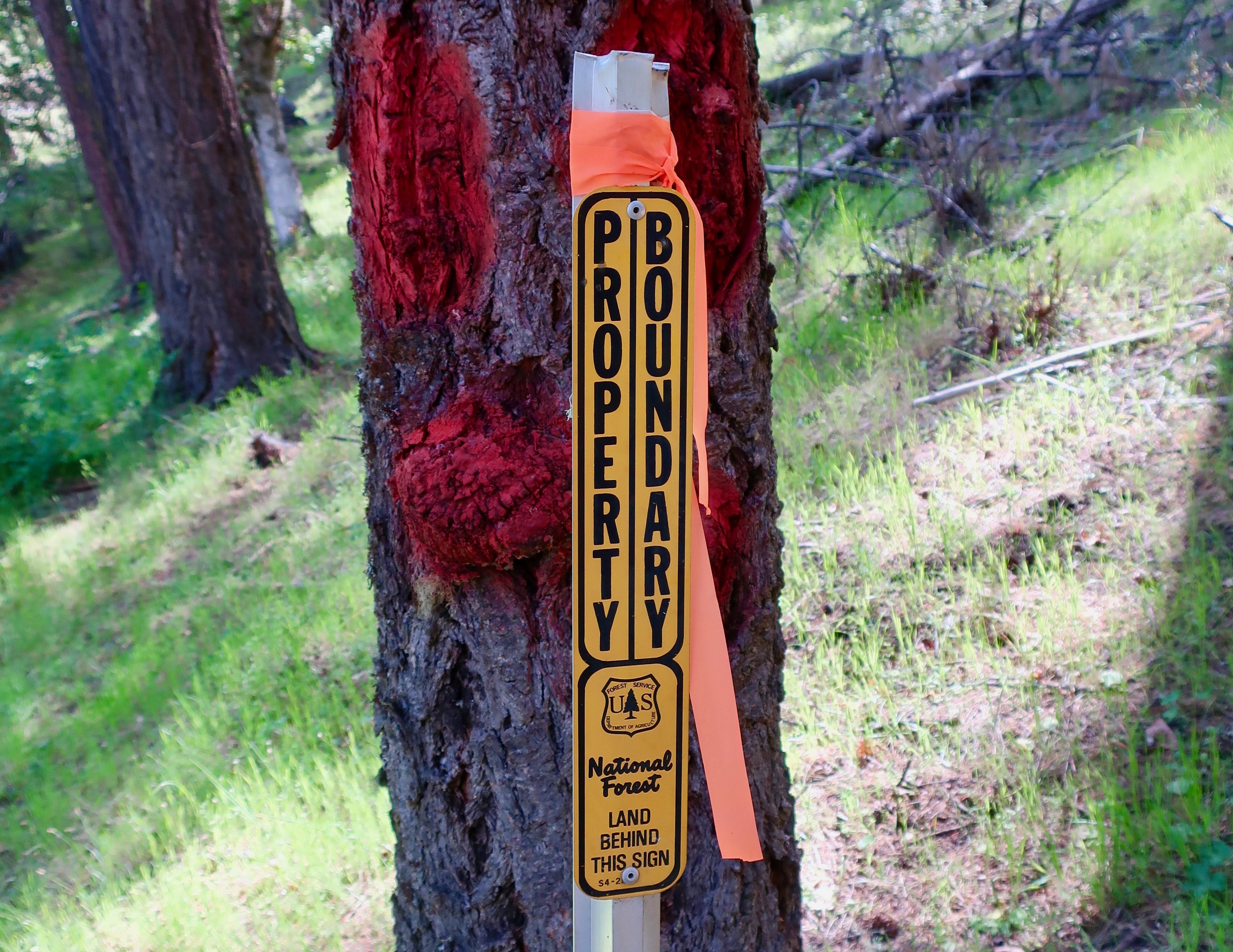
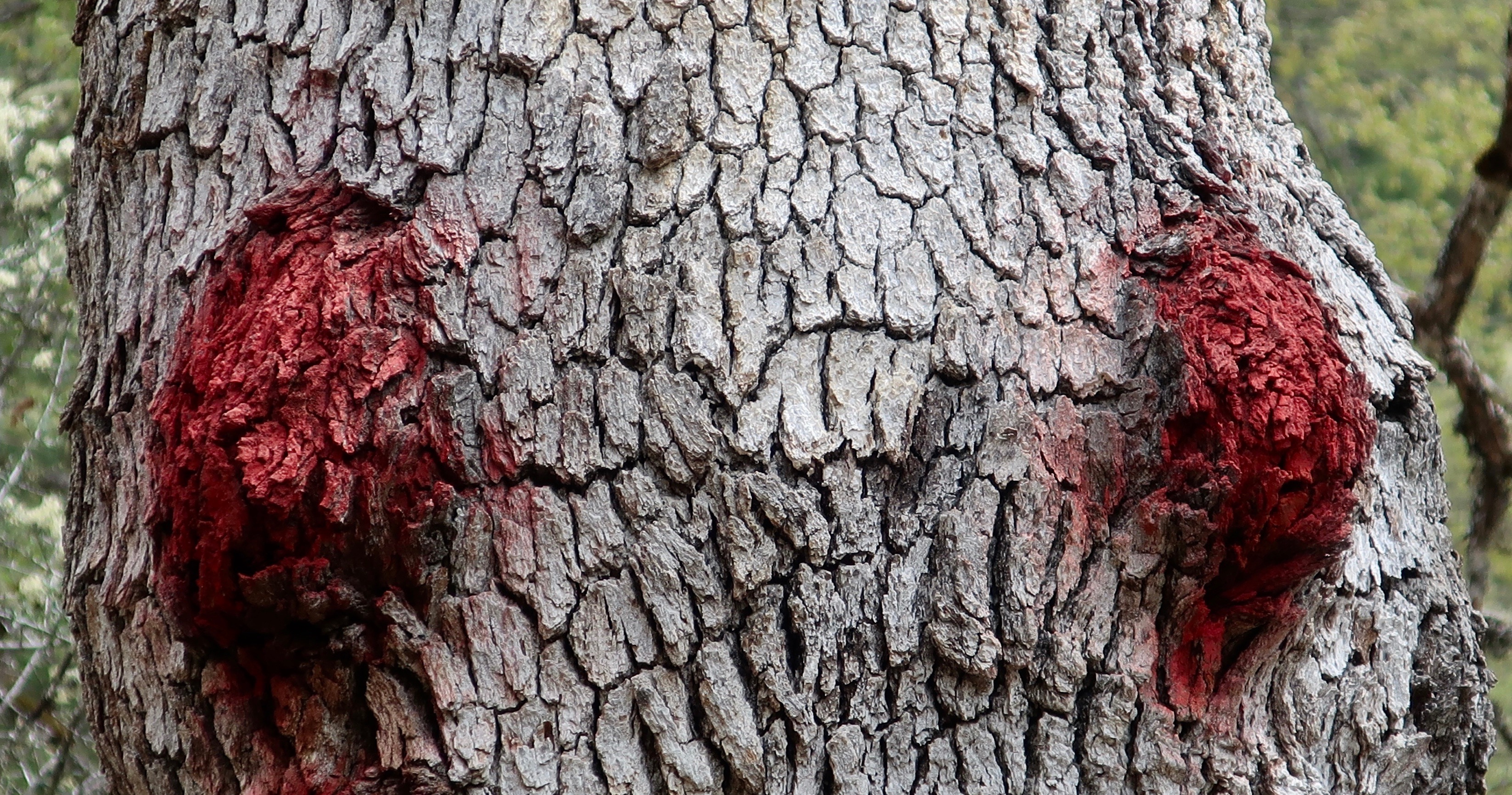
Our property backs up to the Rogue River Siskiyou National Forest which in turn shares a boundary with the Klamath National Forest. Together, they include well over a million acres of wilderness! We love it. As do the deer, bears, cougars, foxes, coyotes, etc. We even had a wolf pass through a couple of years ago. This sign marks the boundary between our property and the National Forest. It also marks the beginning of our trail. Surveyors came through a few months ago to check out the National Forest boundary. They moved signs and marked trees in red paint. Peggy thought that maybe they were having a little too much fun.
I wonder why.
For quite some time, we have been making a detour into the forest as part of our daily mailbox walk. It adds an extra mile to our exercise. Plus it is just plain fun. The problem is that the hike only works for late fall, winter and early spring. Otherwise, we are dealing with poison oak, ticks, and little burrs. No one wants poison oak, the ticks may carry Lyme disease, and the burrs are just plain nasty. We come home with dozens in our socks and they are very difficult to remove. Inevitably we miss a few and they end up in our laundry. For some reason, they are attracted to our underwear, mainly Peggy’s. But you can bet I feel the pain…
This spring, I decided to create a trail through the forest that would allow us year round access. It would be poison oak and burr free. Plus we would be much less likely to get ticks. They tend to hang out in bushes and brush off on innocent animals, people and maybe Big Foot, who, legend has it, likes to hang out in our neck of the woods.
I wouldn’t be starting the trail from scratch. Mainly I would be reclaiming and expanding on old miners’ trails and deer paths. My goal, as always, was to have minimum impact, which was pretty much guaranteed since my tools were a rake, mattock, and lopper. I call the lopper, Cindy. You may need to be of a certain age to get that. I tell Peggy that Cindy and I are going up on the mountain to have a little fun. She doesn’t worry; she just snorts. “Wear your gloves, honey.”
I was worried on my first day of trail making. It was two days after the cougar ran across our deck and the morning after our neighbor Bryan had his scary night-time encounter. There was a significant chance that it was still hanging around where I was working. The deer herd was out and came down to watch me work, however. They high-tail it when they are on the menu. Maybe they figured as long as I was there, the cougar wouldn’t be. I hoped they were right in their assumptions. If not, I would wish them good luck as I did my own high-tailing-it act. (Suggestion: Never take off running when you see a cougar. It confirms you are food and fun to chase. Stand tall, look the cougar in the eye, speak to it firmly, “Bad Kitty,” and slowly back away. I’m serious.)
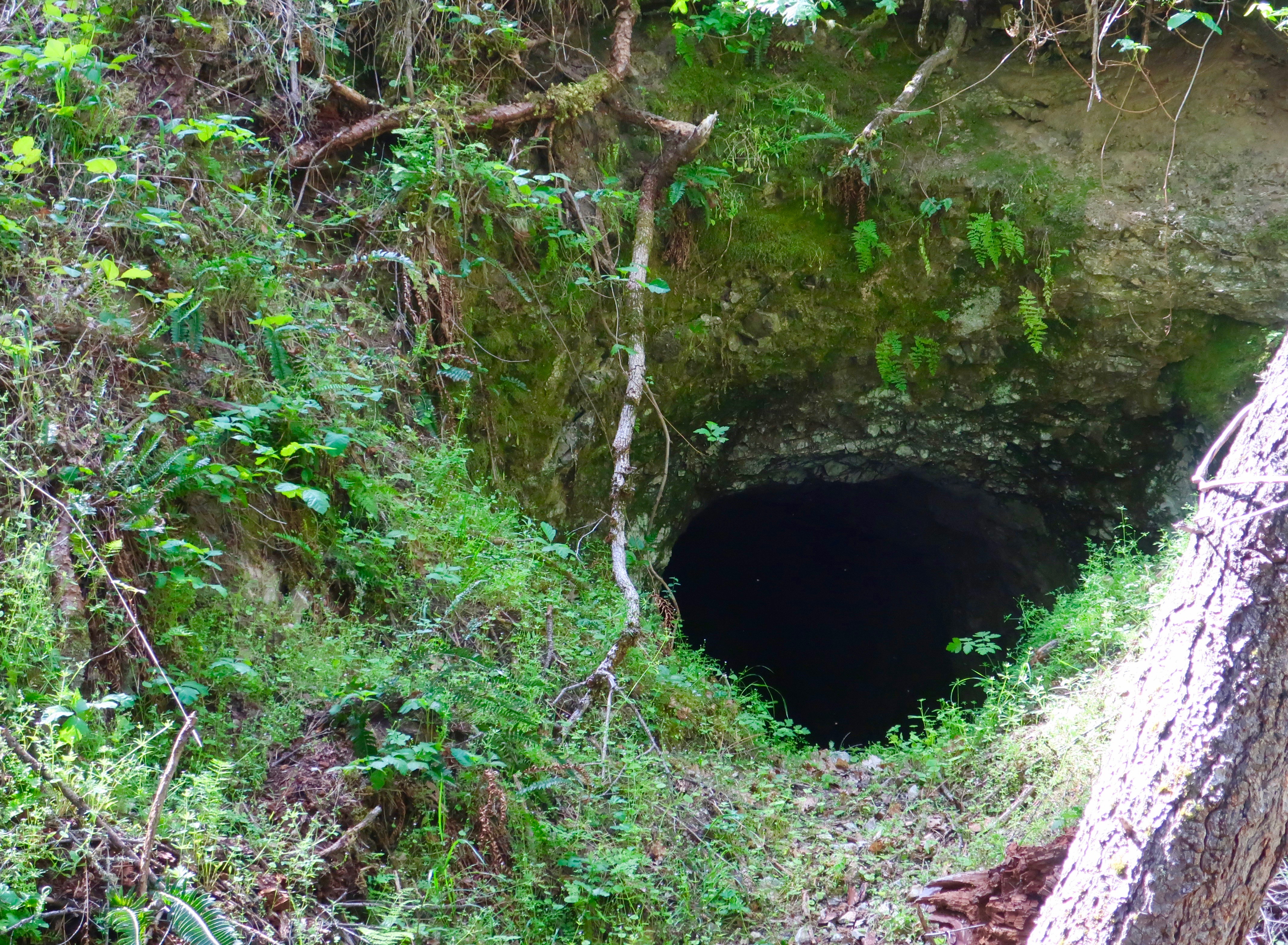
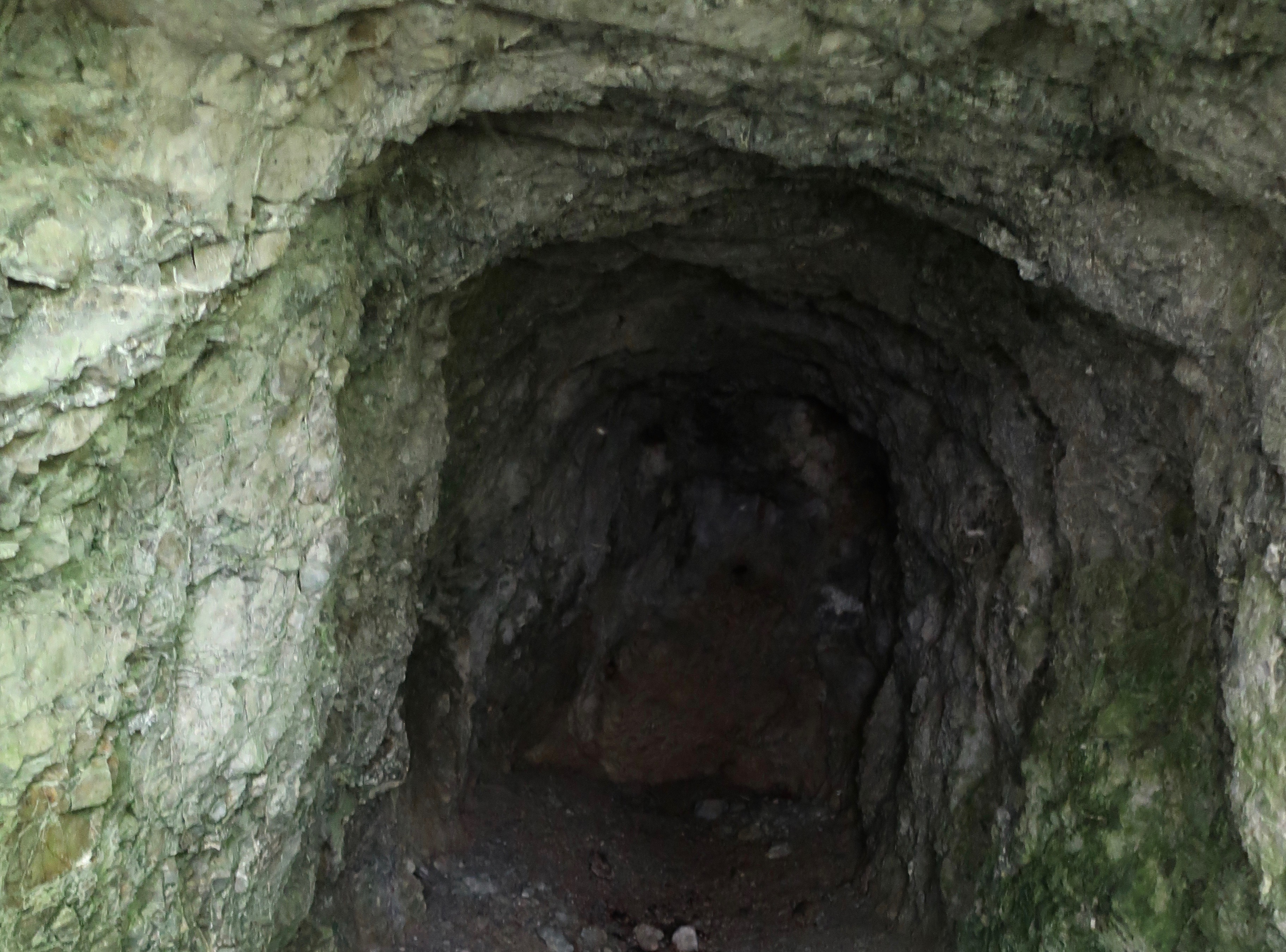
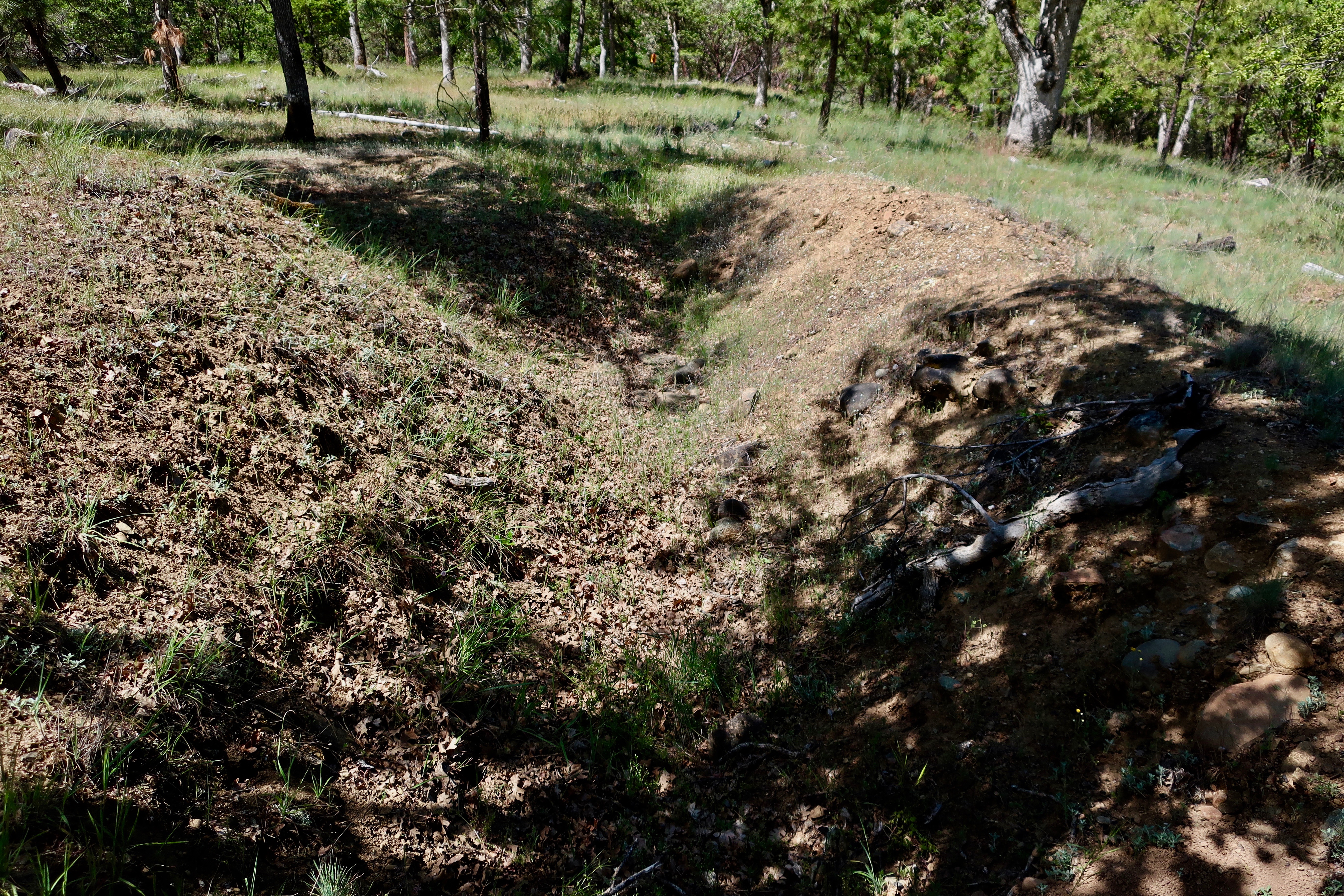
In addition to being a pleasant stroll through the forest, the trail incorporates a bit of history. Miners came searching for gold during the 1920s and 30s. There are old sites for at least seven cabins, a cave, a wood stove, remnants of an old auto, and test holes that they dug following a quartz vein in hopes of striking it rich. They would dig down, find the quartz, shove a dynamite stick in, blow it up, and then check out the results. The test holes come down off the mountain and run right across our property. It could be we are sitting on a fortune. Ha.
Peggy and I have found seven flat spaces like this that were likely the sites of miners’ cabins. When they left, they must have taken the lumber and tin roof with them. We did find one section of tin roof and lots of old #10 cans.
This cave, dug by the miners is right off the trail.
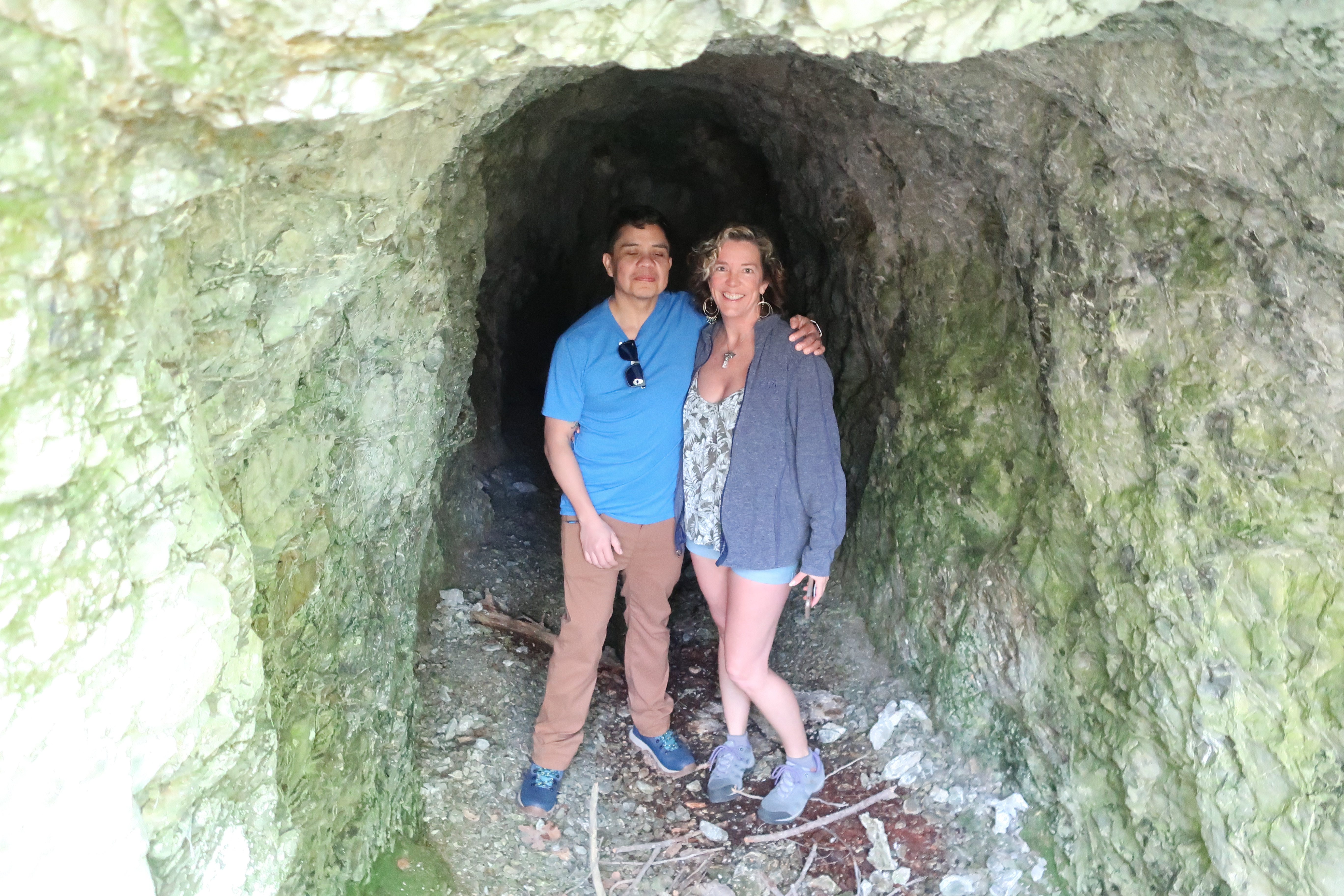
A look inside the cave. We didn’t find any gold, but there were bats. Peggy and I call it the Bear Cave. It’s partly to entertain our grandkids but once, during the winter, Peggy and I found bear tracks leading toward it through the snow. I wanted to check it out. My buddy, not so much.
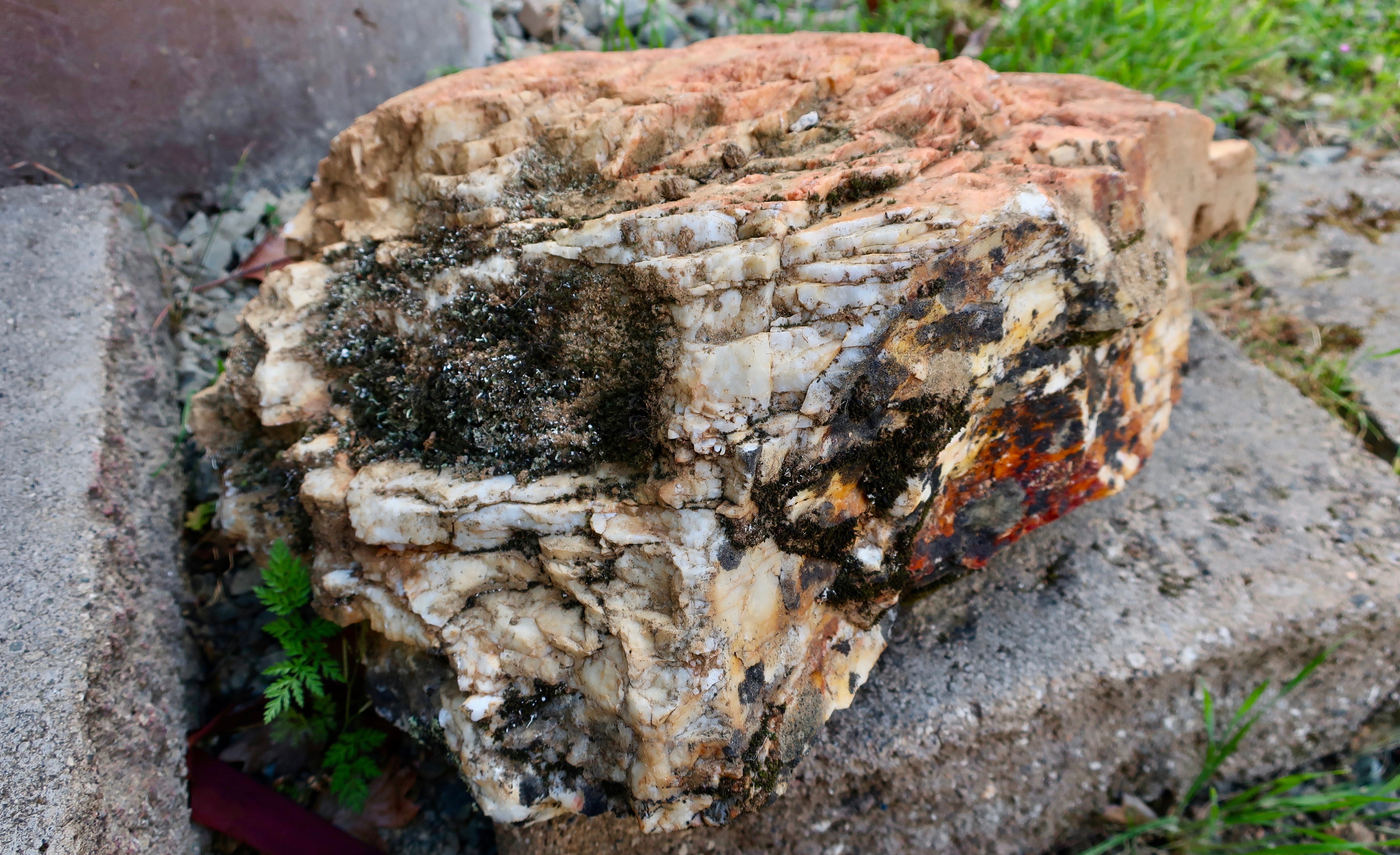
This is one of the test holes the miners dug that extend down onto our property. This one was surrounded by pieces of quartz that Peggy harvested for our yard.
This was one of the rocks that Peggy chose. The biggest. I swear it weighed at least 100 pounds. My back survived but my feet hurt the next day from being driven into the ground. I earned extra husband credits but no gold.
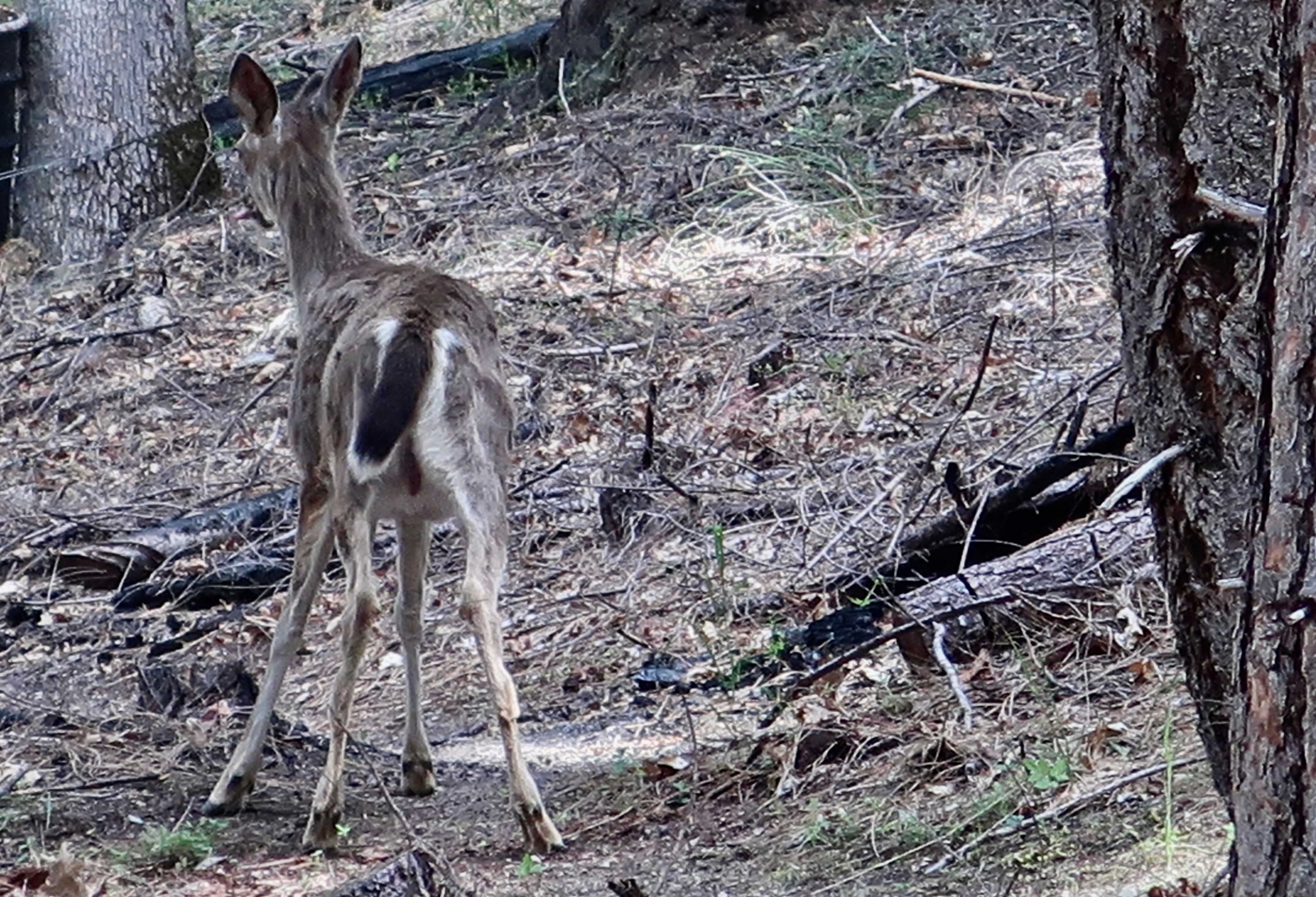
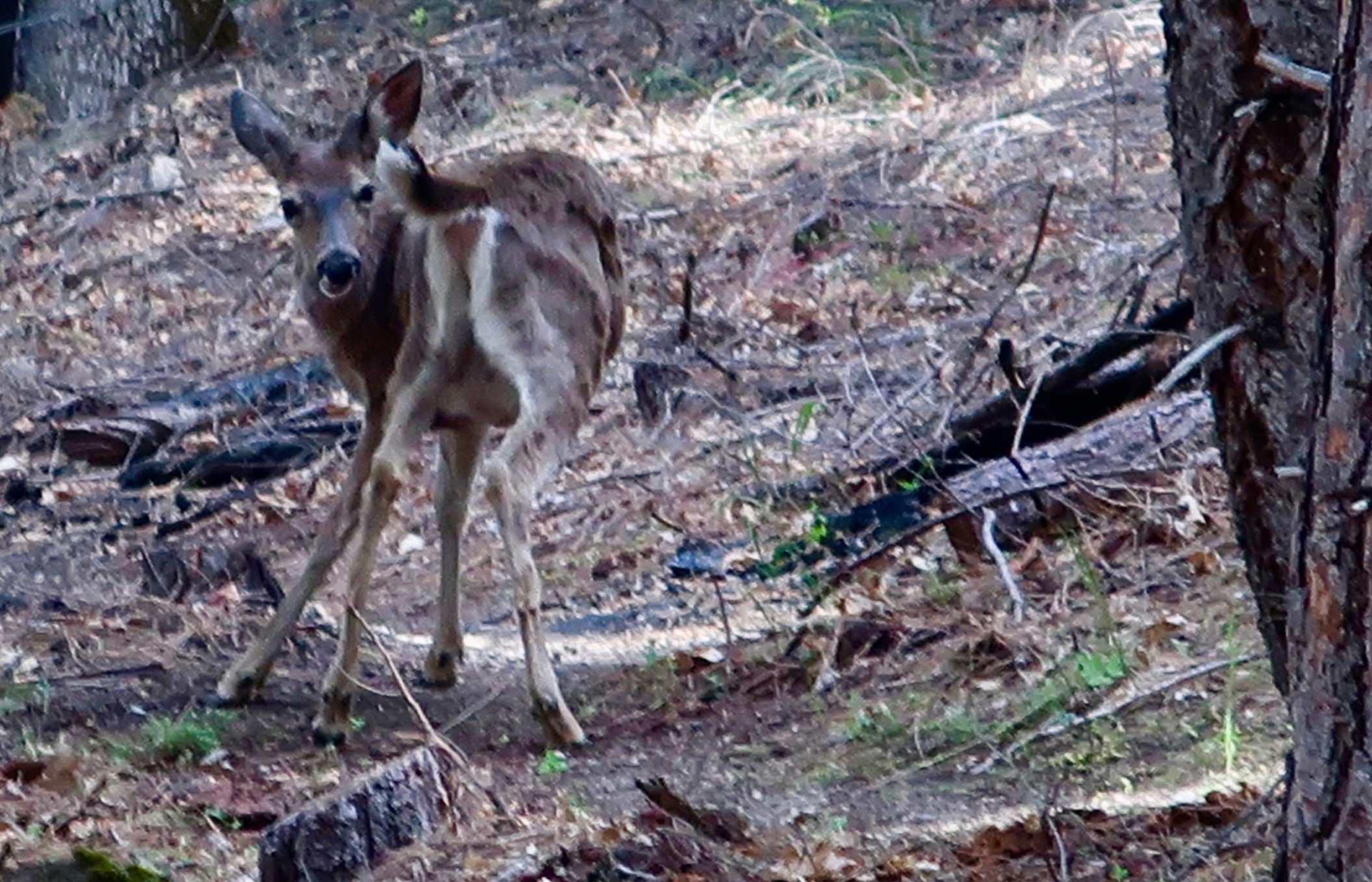
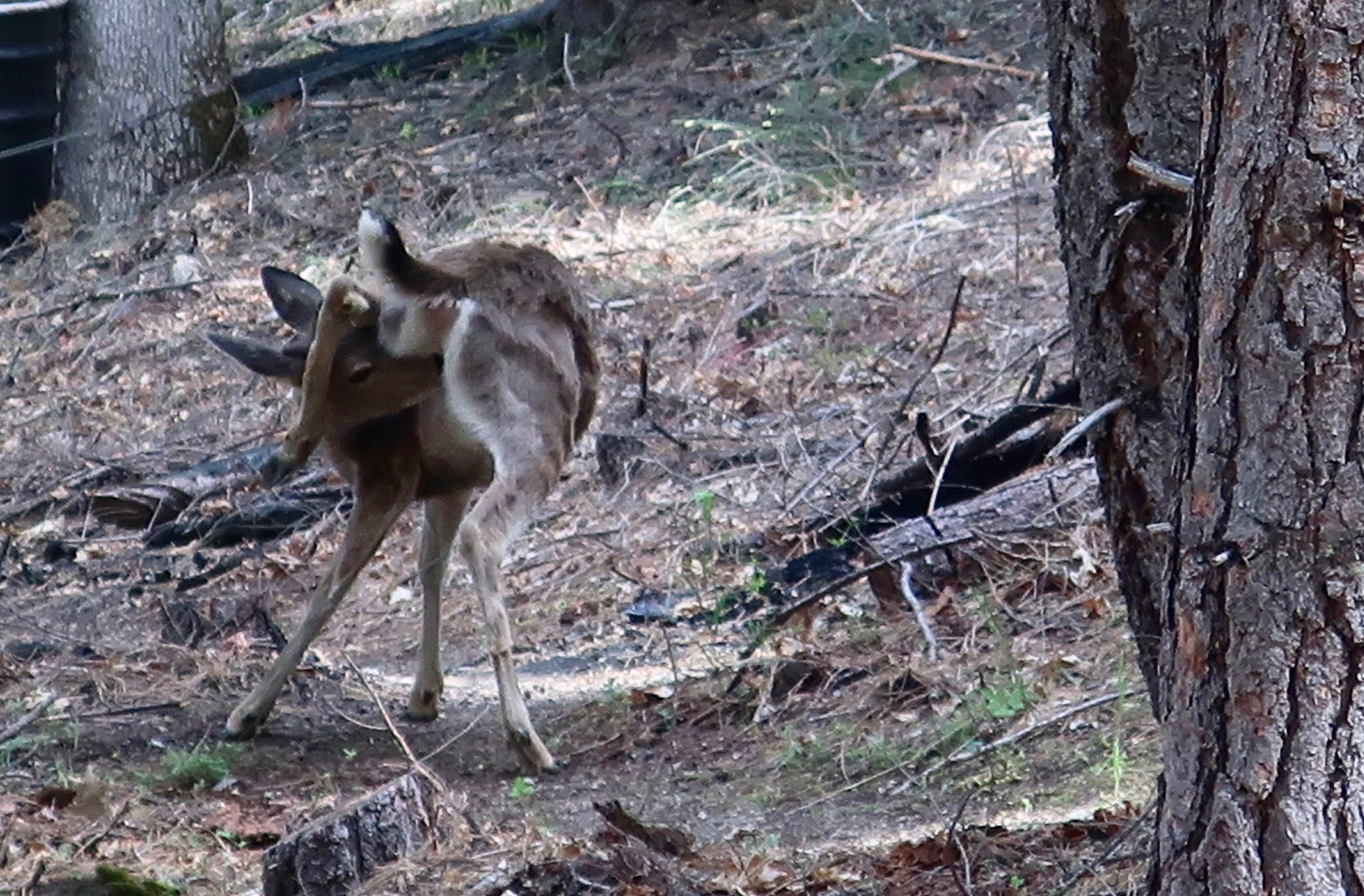
Wildlife has adopted the trail for their own use. We’ve found cougar, coyote and fox scat along it as well as deer. And I even found deer sleeping on it. Then there was the young buck who seemed to be having some problem…
I was hiking up the trail when a young buck started behaving strangely in front of me. This isn’t the most graceful pose. I am always amazed at how streamlined, almost fragile the legs look.
Uh-oh. Have you ever had one of those itches that is just impossible to scratch— at least in public?
Whoops.
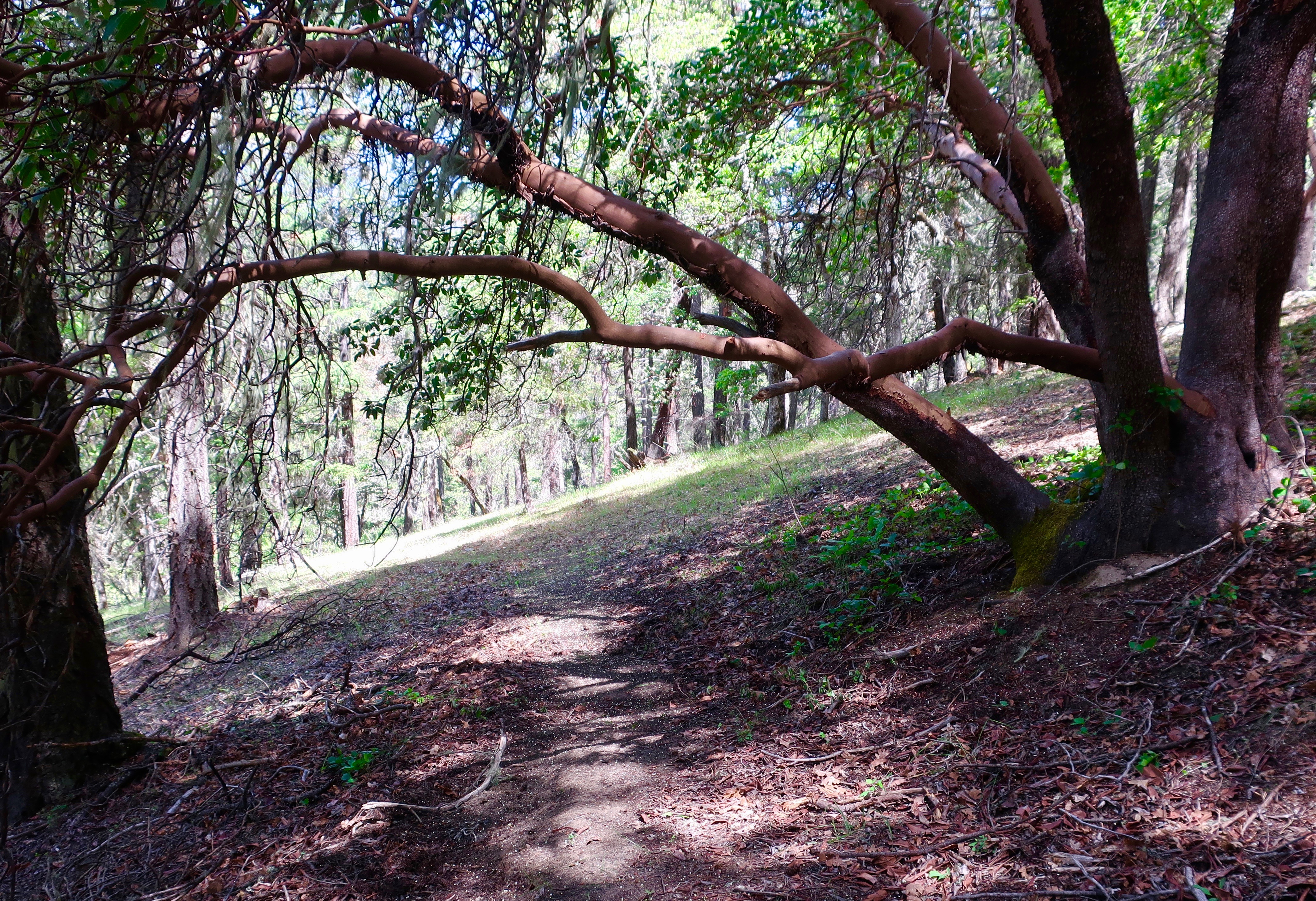
In addition to miners’ history and wildlife, attractive trees and flowers are found along the trail as it winds its way through the forest.
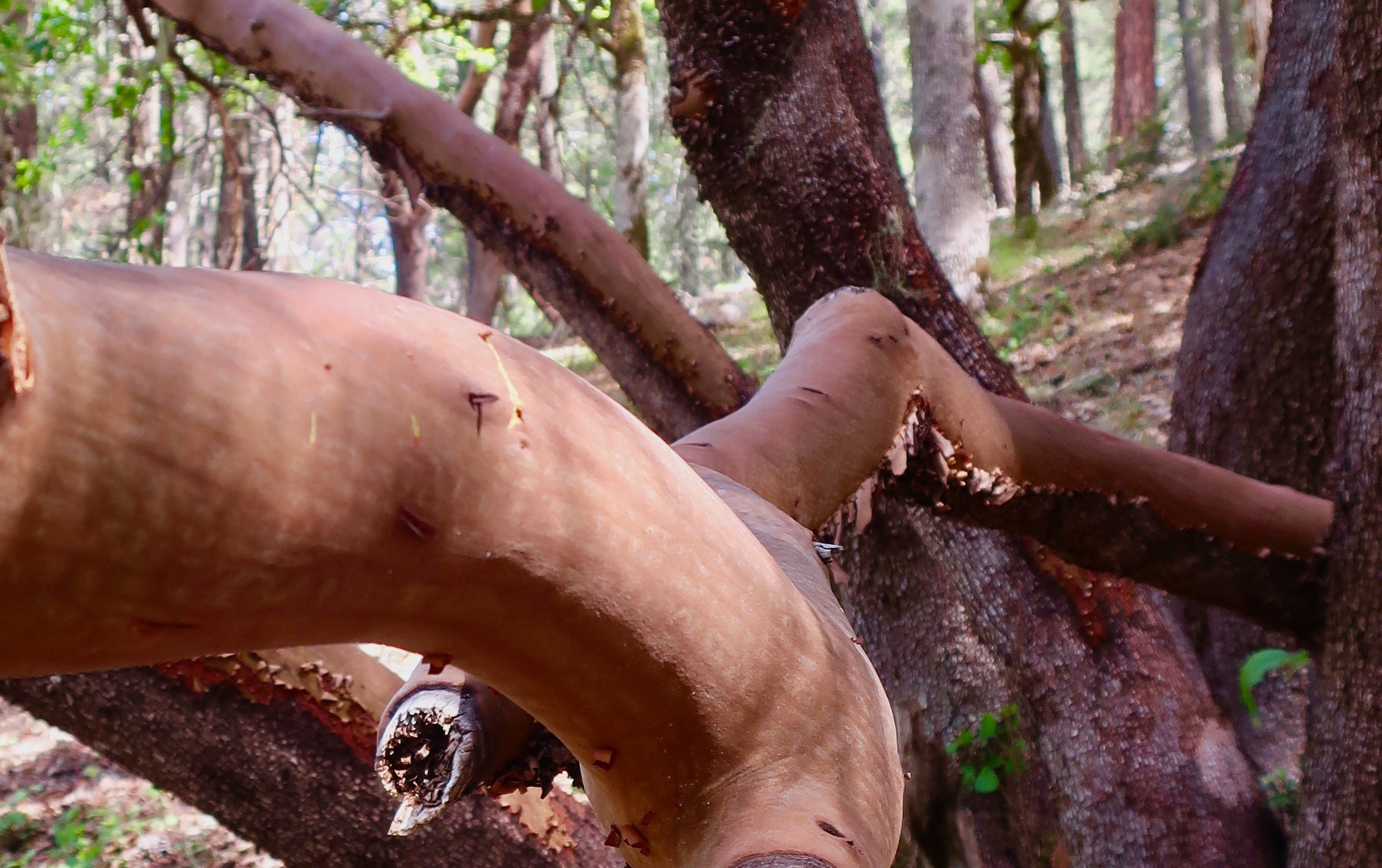
Low bridge, everybody down! This madrone crosses over our trail, low enough to bump your head on. Especially if you are wearing a hat that blocks its view and are looking down for poison oak to remove.
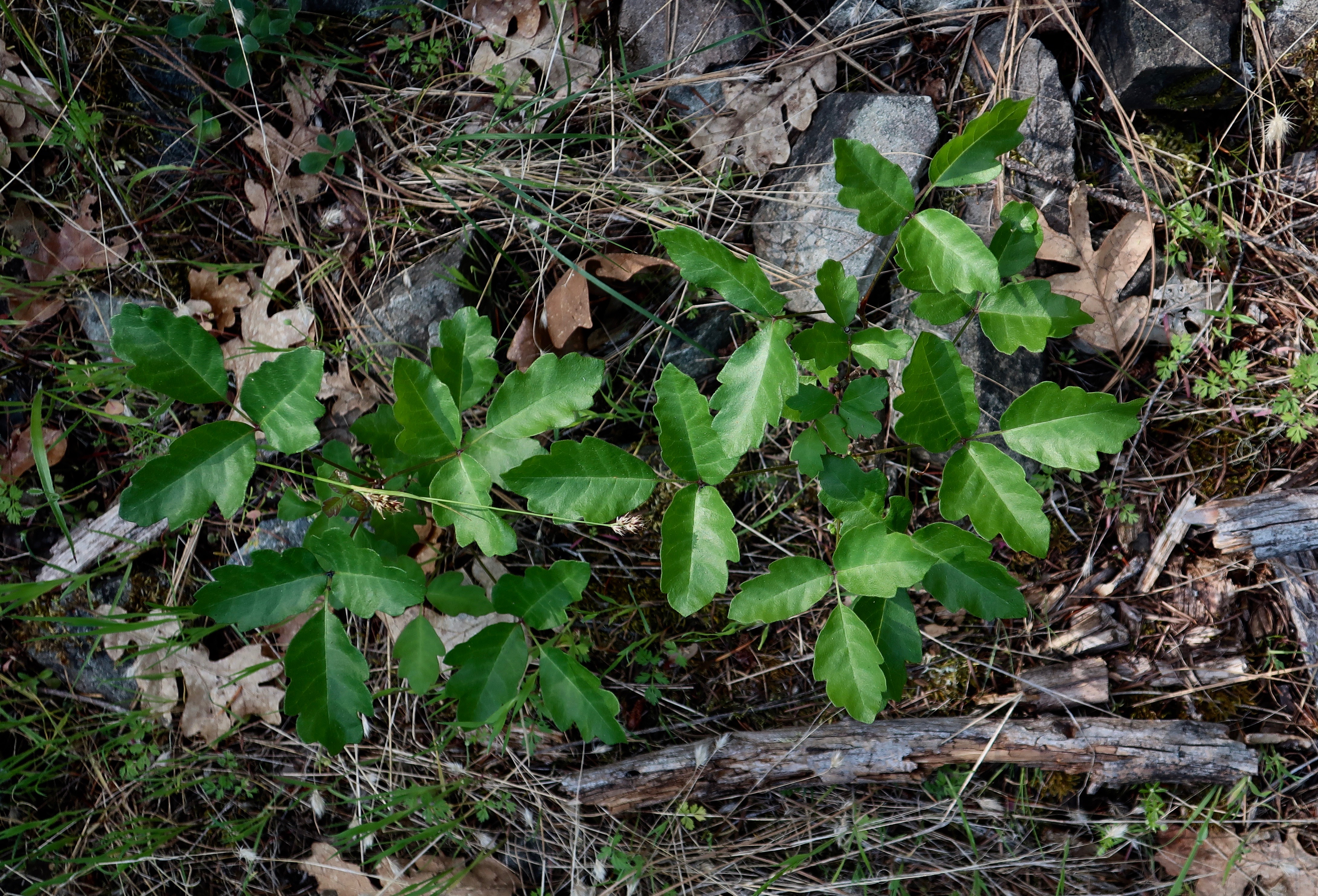
The culprit that caused me to bump my head: Poison oak. Its three leaf arrangement is the give away.
I rather like the limb, so it will continue to bump the heads of unwary trail users. Hopefully not mine again.
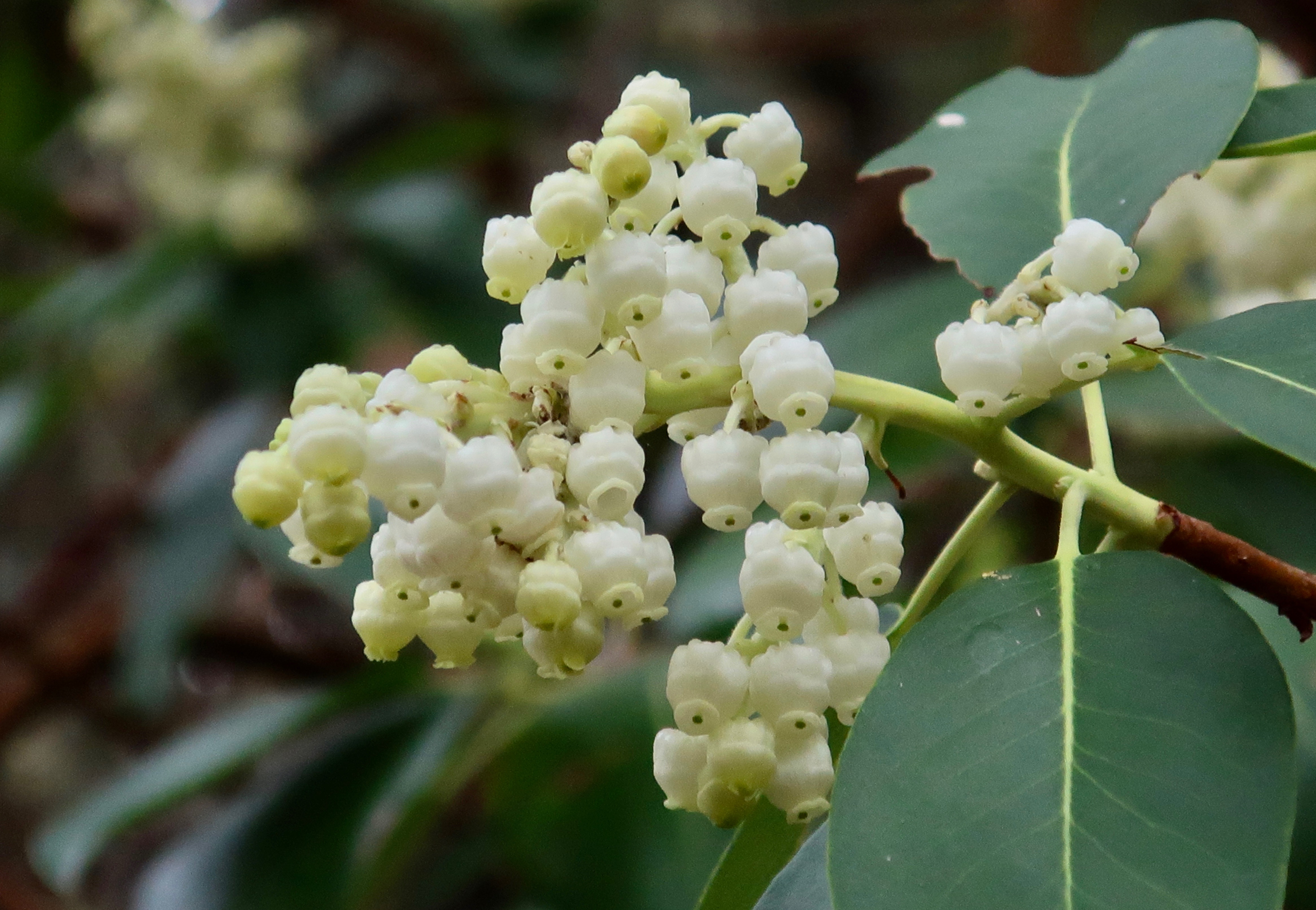
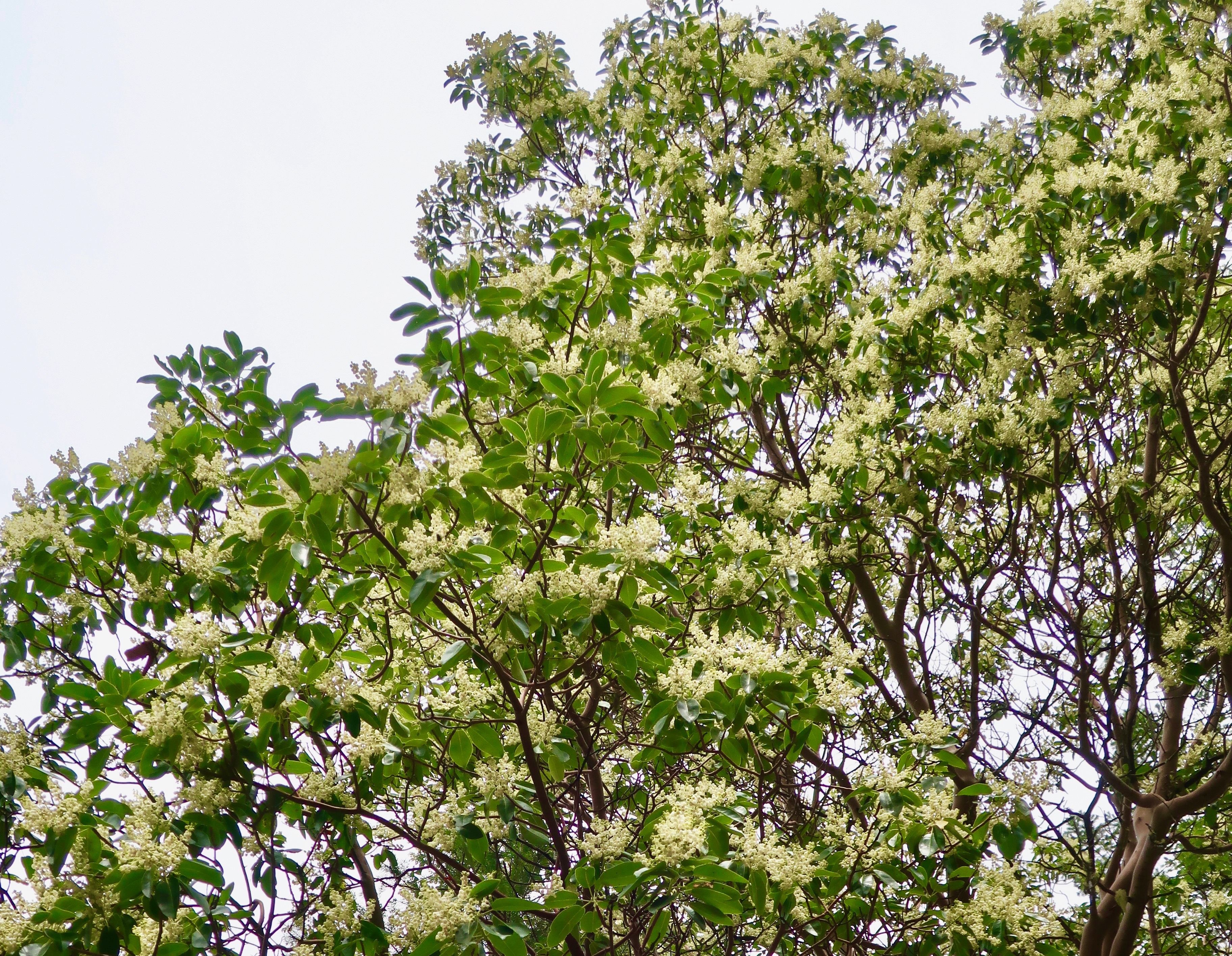
The madrone trees have bloomed along the trail, making them easy to spot in the surrounding forests
The madrones (Arbutus menziesii) are finishing up now, but they were still in full bloom when I took this photo. I might add that they have a sweet, attractive smell that greets us when we step out our door.
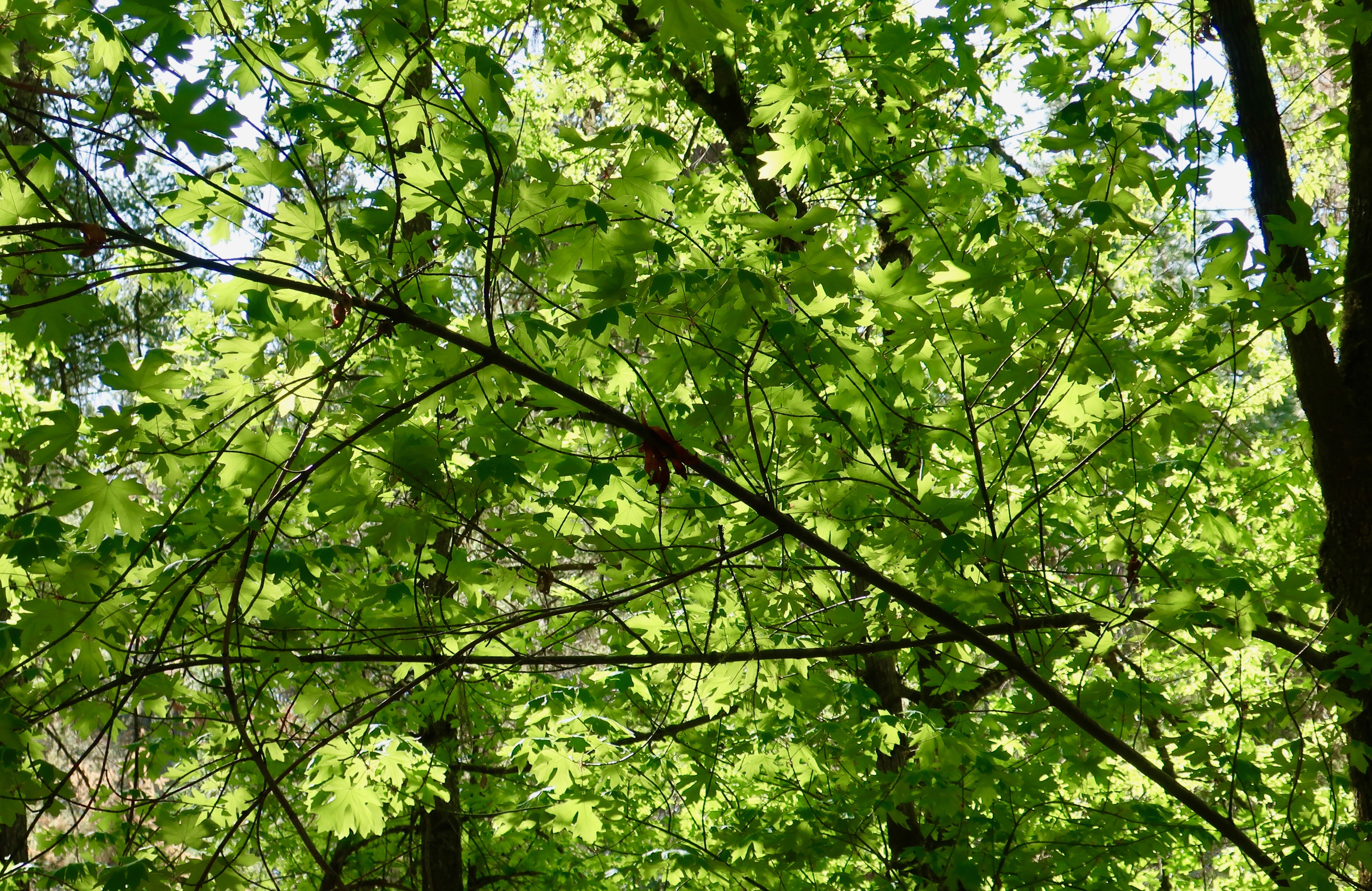
The trail wanders under an Oregon big leaf maple.
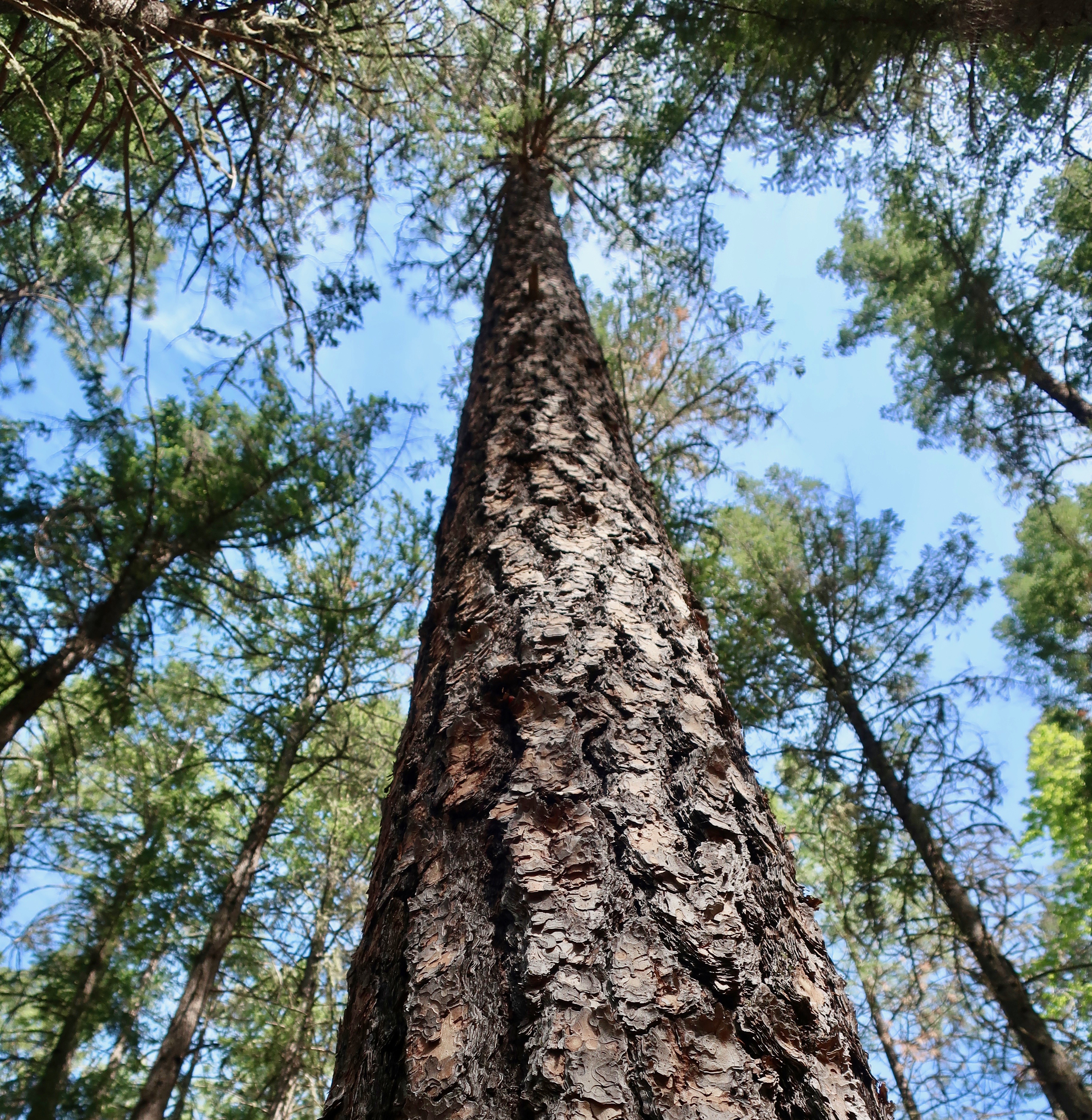
Among towering pines…
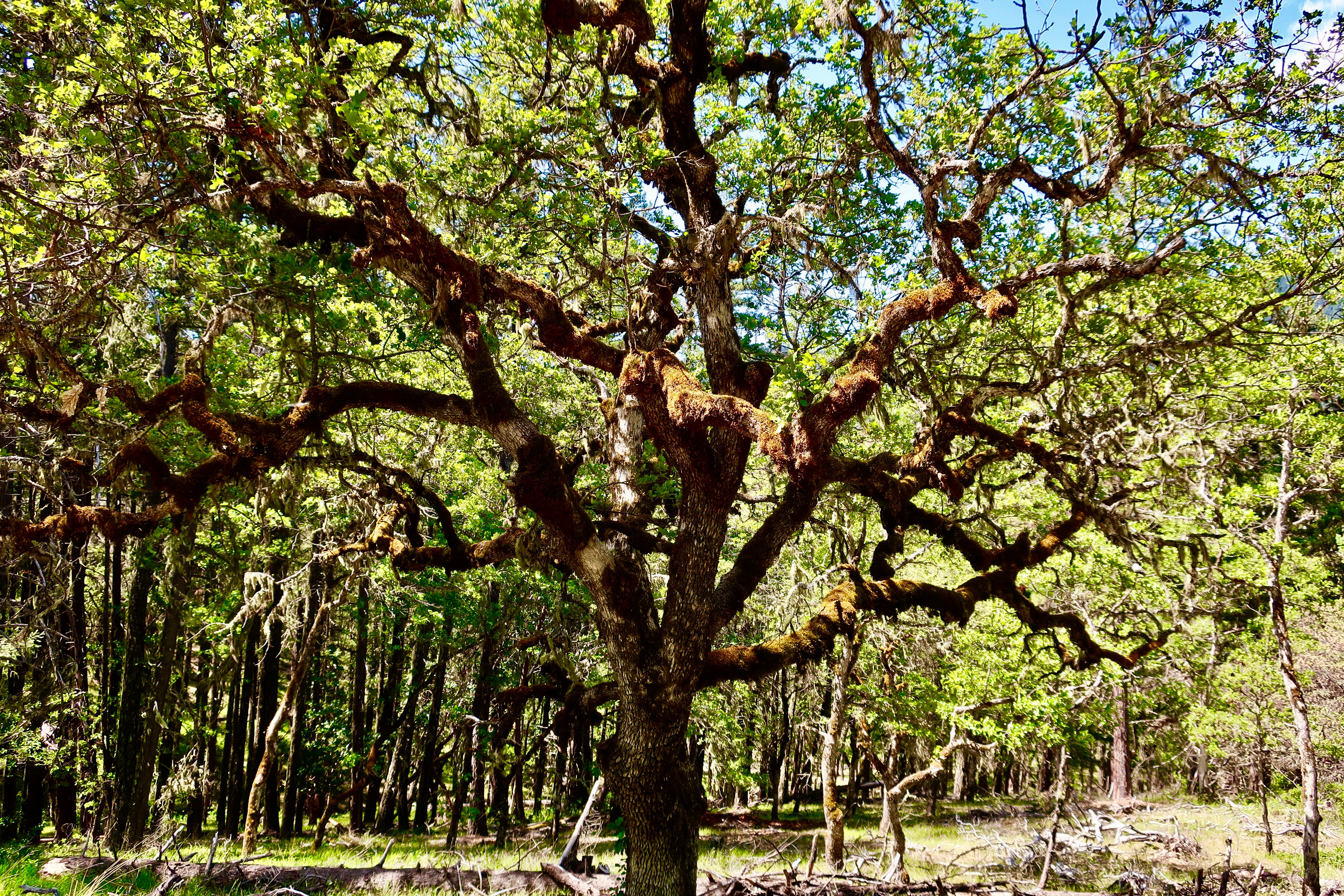
And past numerous white oaks with their wonderful gnarly limbs.
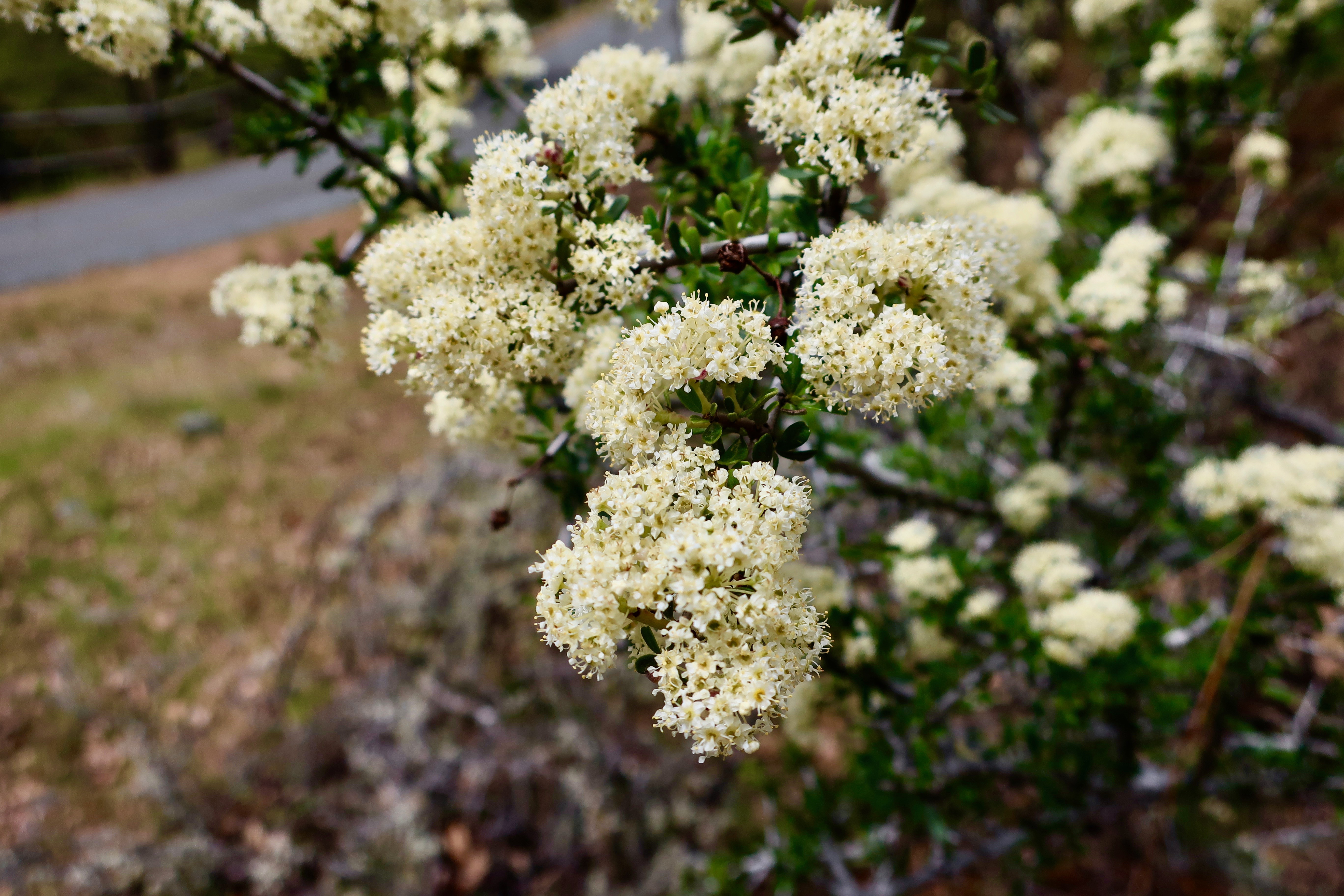
The trail also passes by buck brush, which was blooming this spring and also has a distinctive sweet smell.
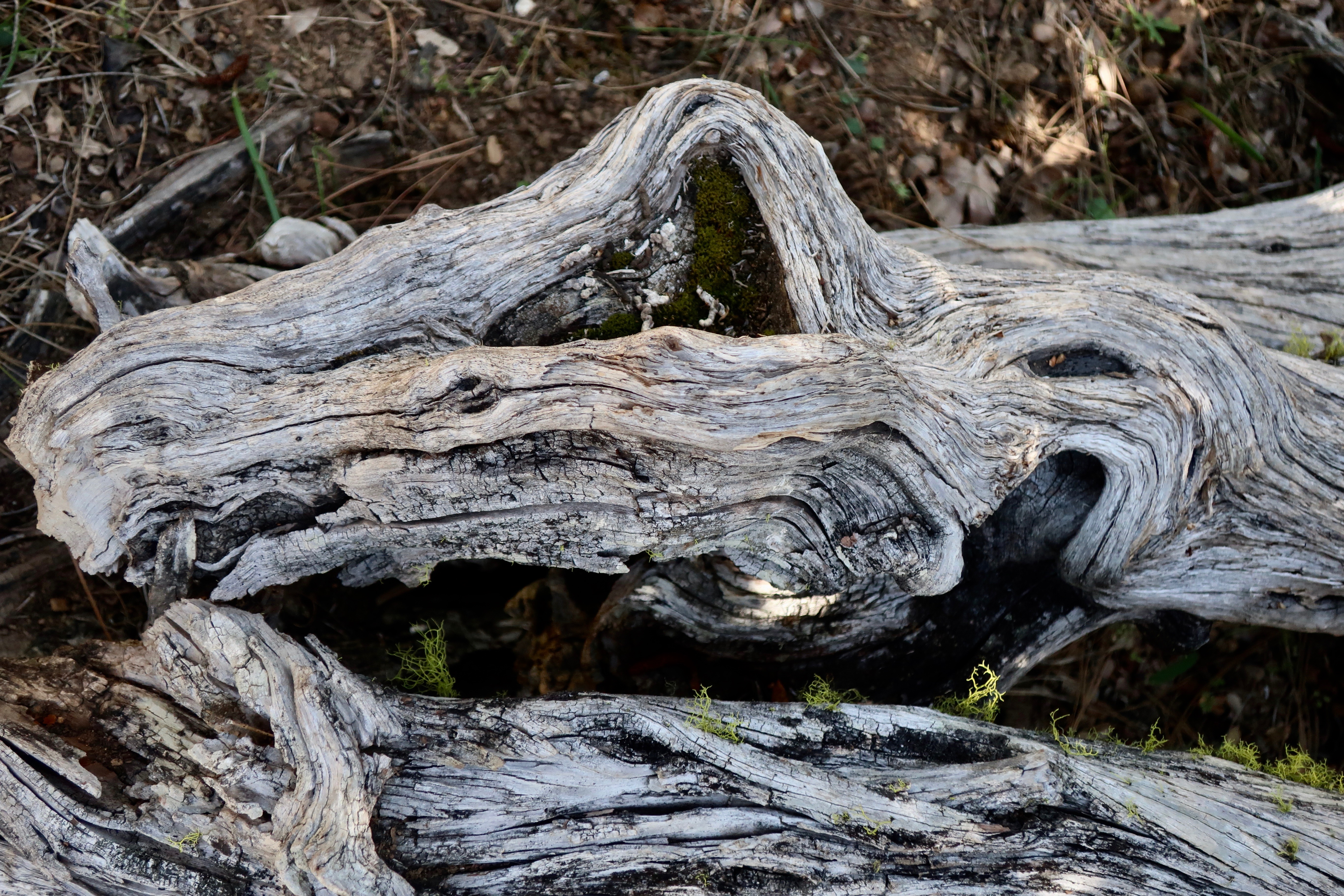
I photograph manzanita as much for its dead limbs as I do its live ones. This trunk reminded me of the alligators found along the Gulf Coast!
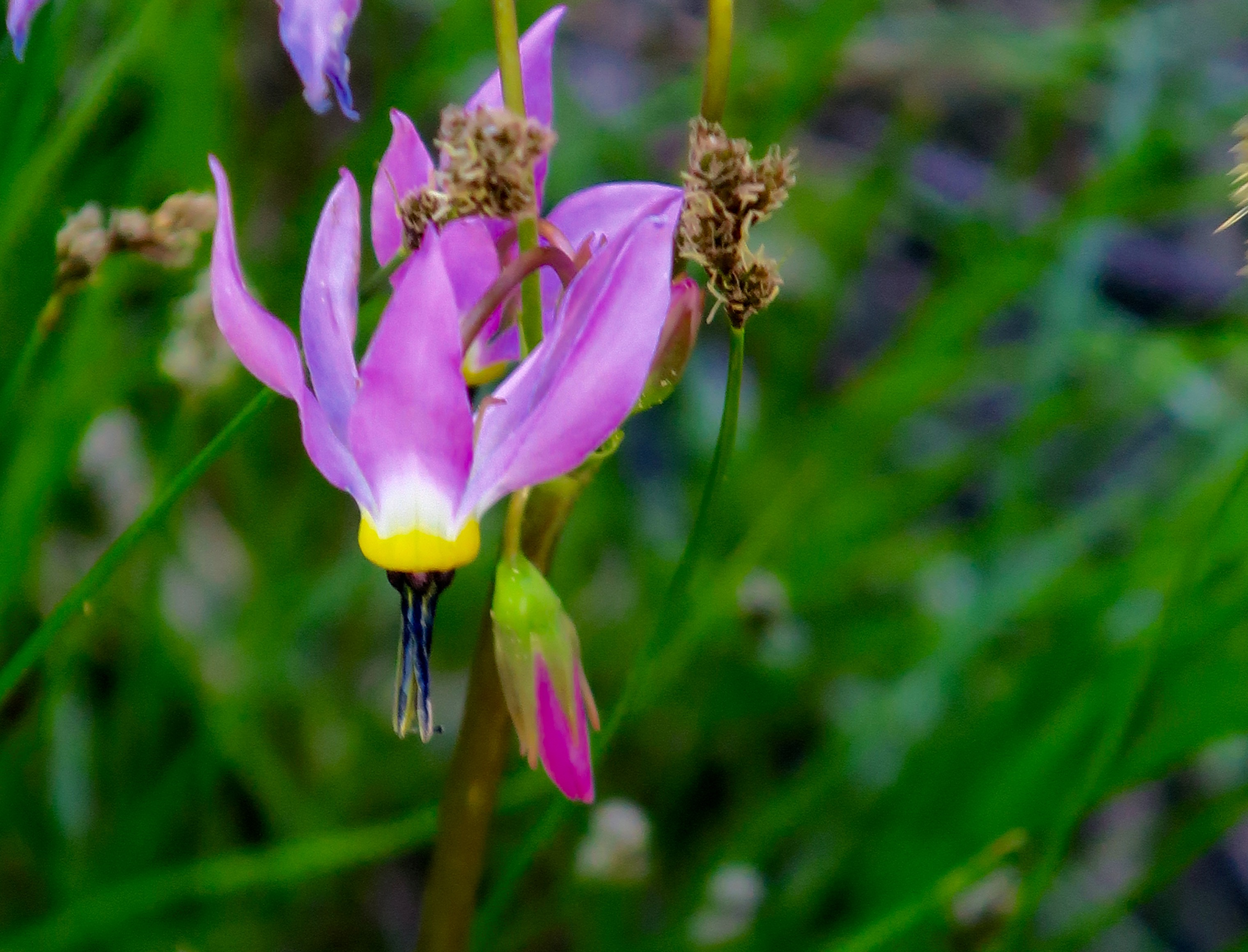
The flowers start blooming in March. They are rarely in profusion except for shooting stars (Dodecatheon meadia)which are one of the first flowers to bloom. About the time one flower ends its season, another pops up.
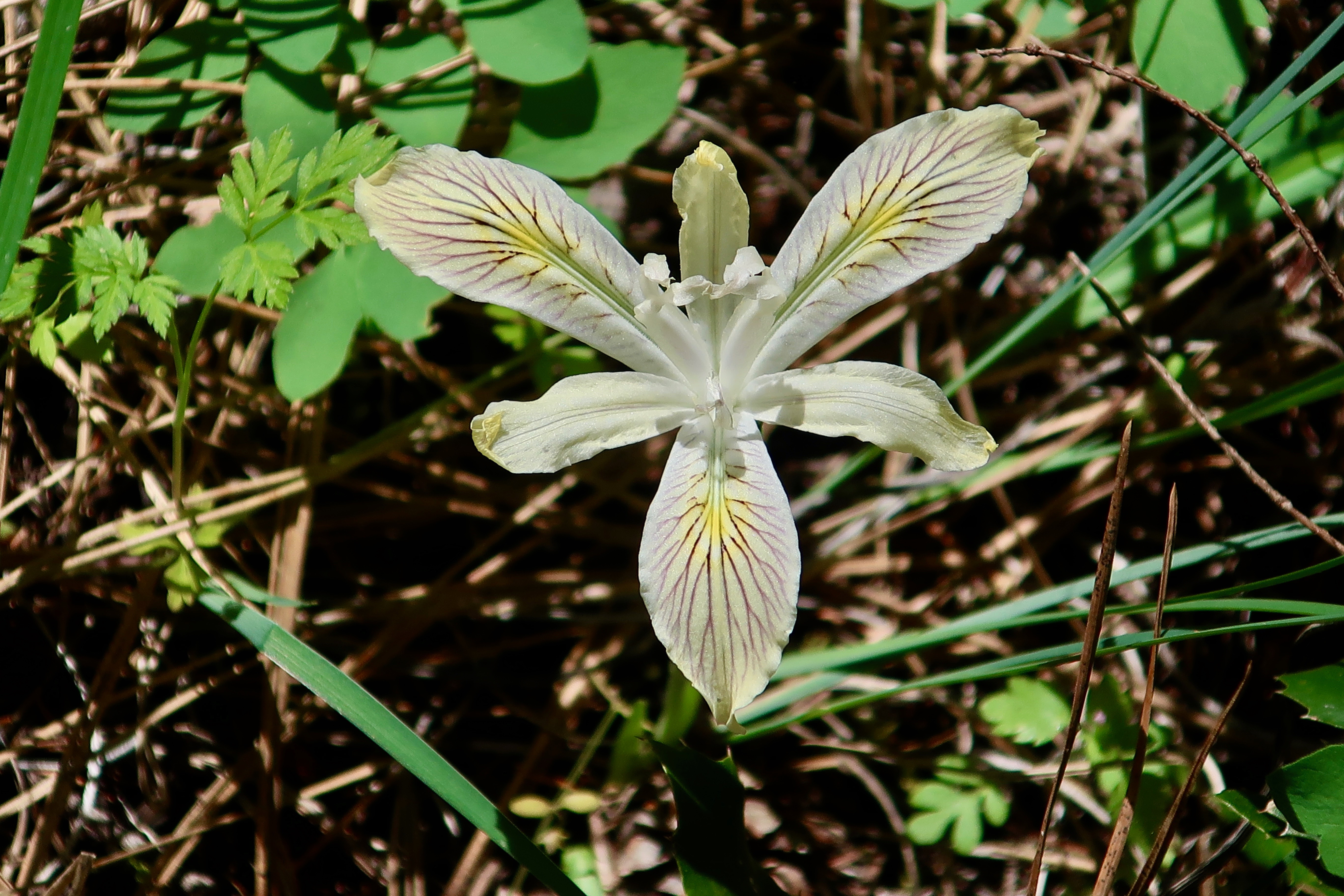
Last week, I showed you some of the gorgeous irises that Peggy grows. Wild irises, possibly not so glamorous but still pretty, grow along the trail. This is yellow leaf iris (Iris chrysophylla).
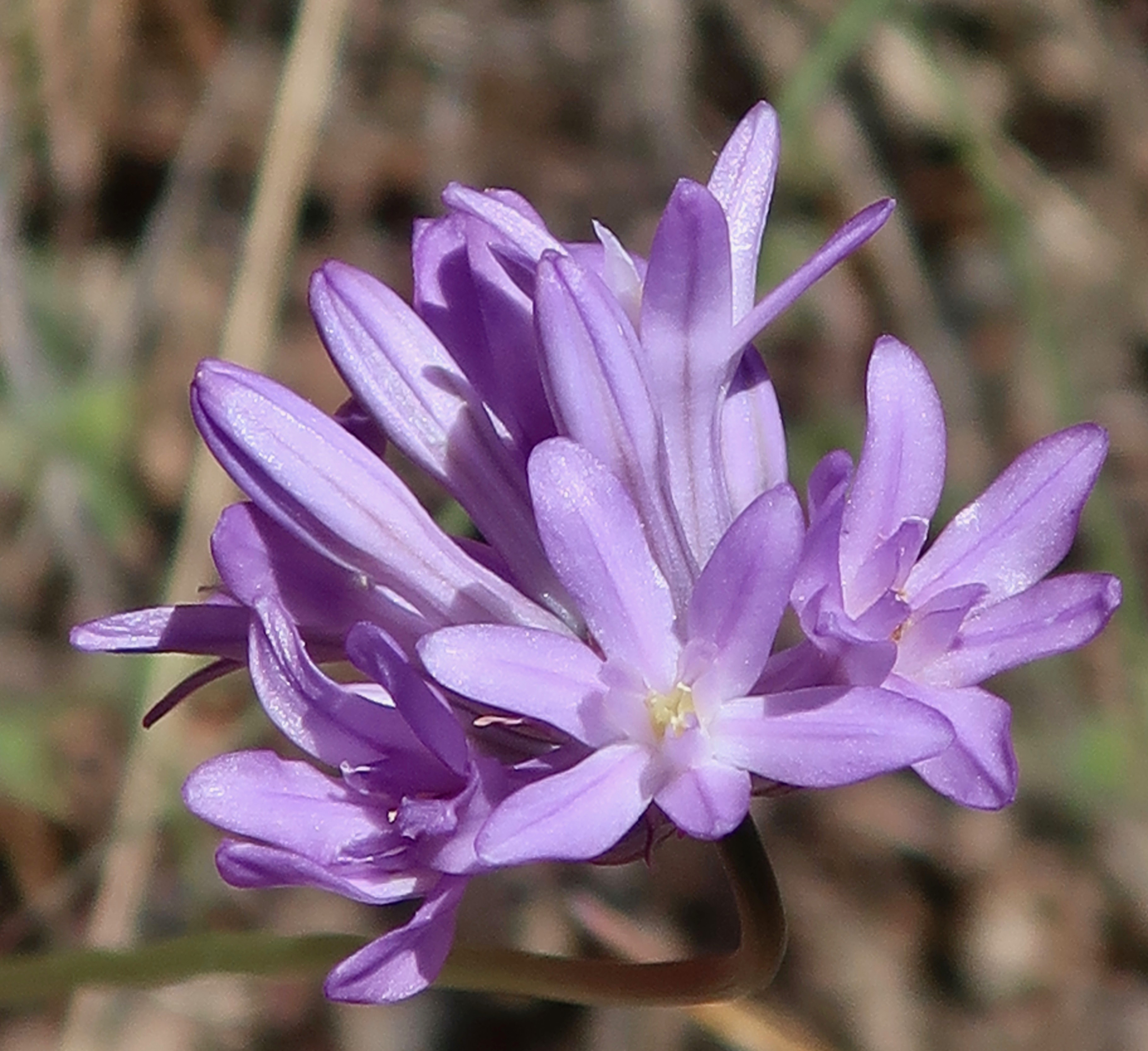
Blue dicks (Dichelostemma capitatum), a lovely flower that had our book club gigging over its name, have come out in the last month.
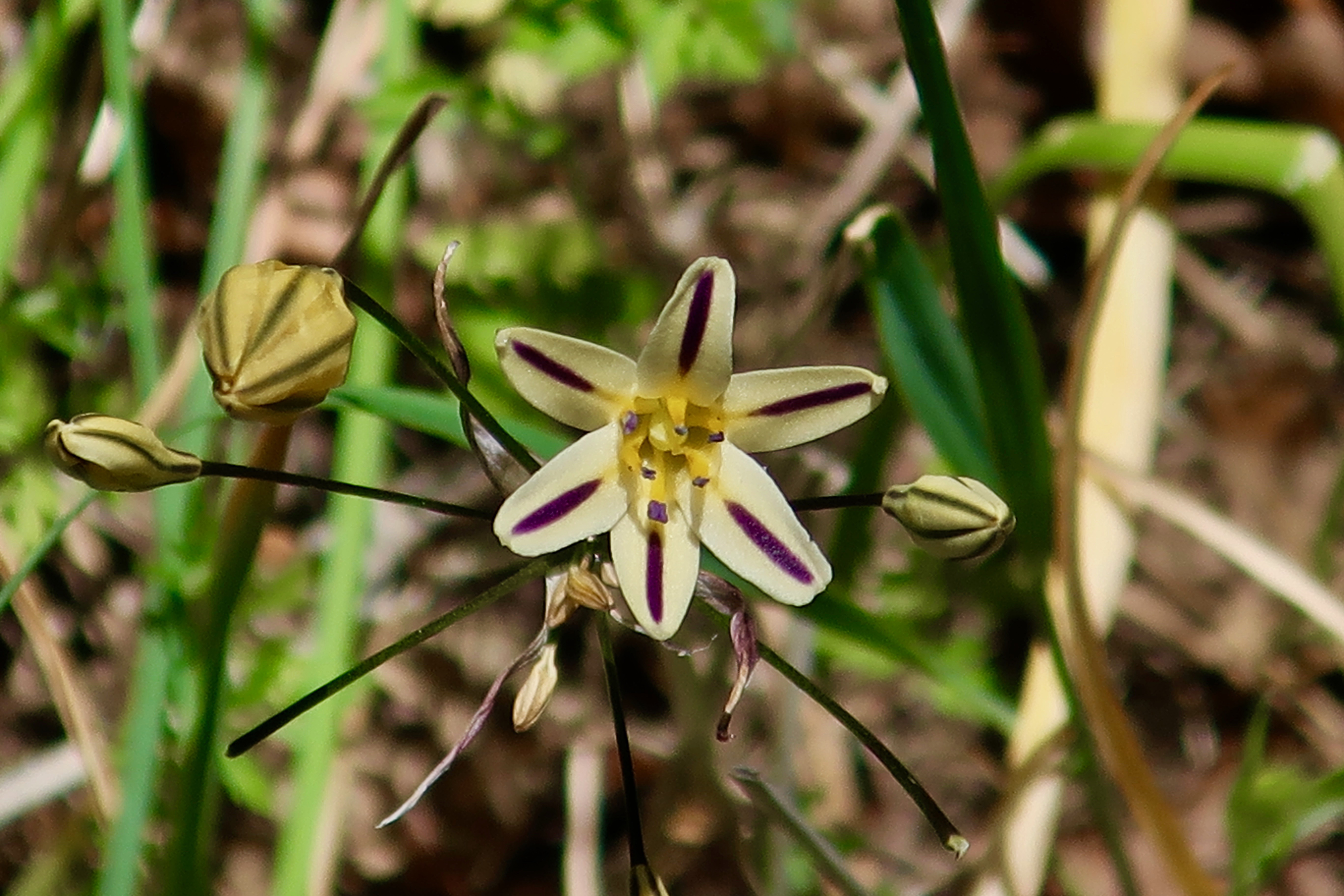
I thought that the latest addition to our flower family was pretty face Brodiaea, but now I think it may be a rare Triteleia crocea, a closely related species that only grows in our area.
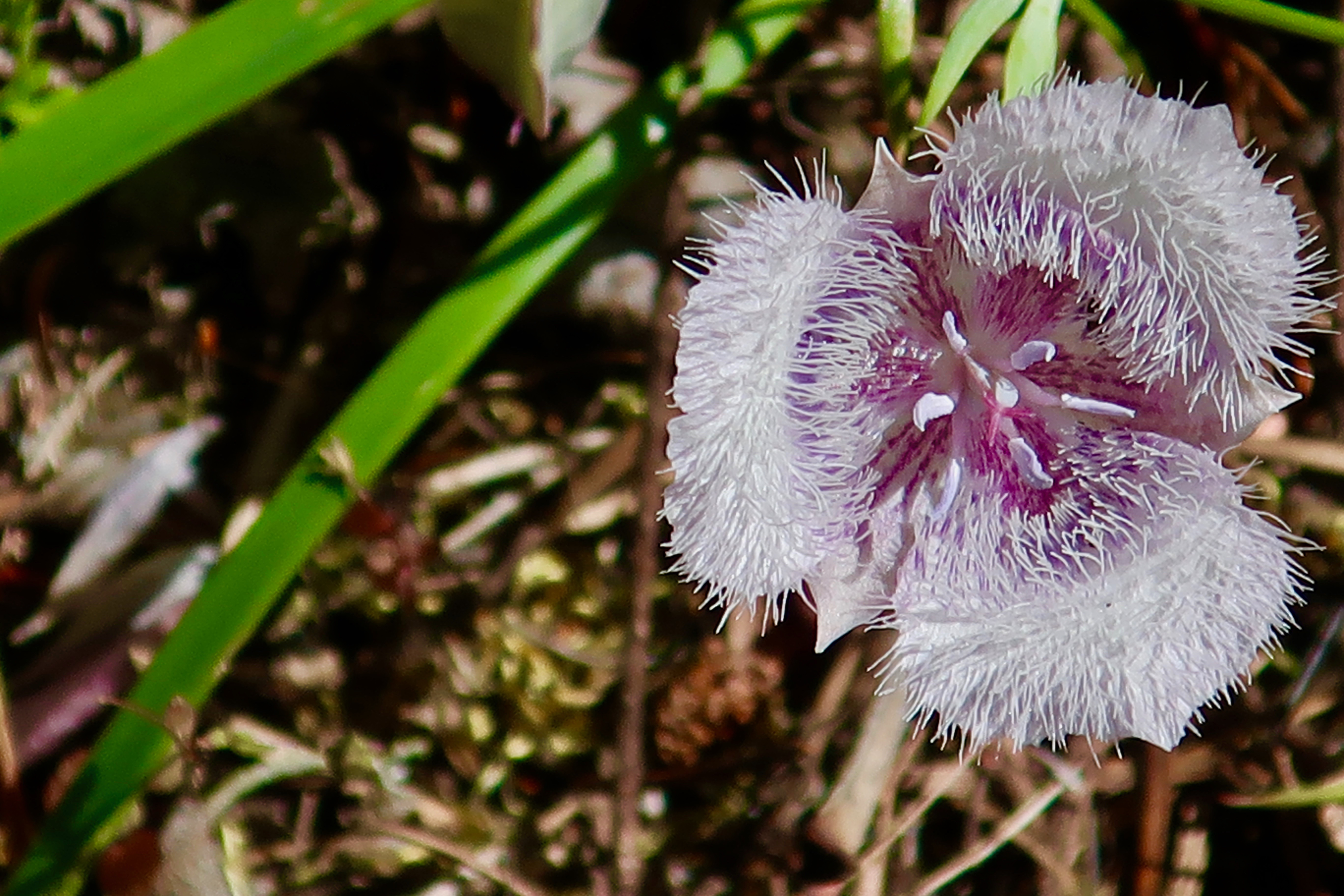
I’ll wrap this blog up today with my favorite flower, Calochortus elegans. Its common name is elegant cat’s ear. If you have ever owned a kitty, I’m sure you can see why.
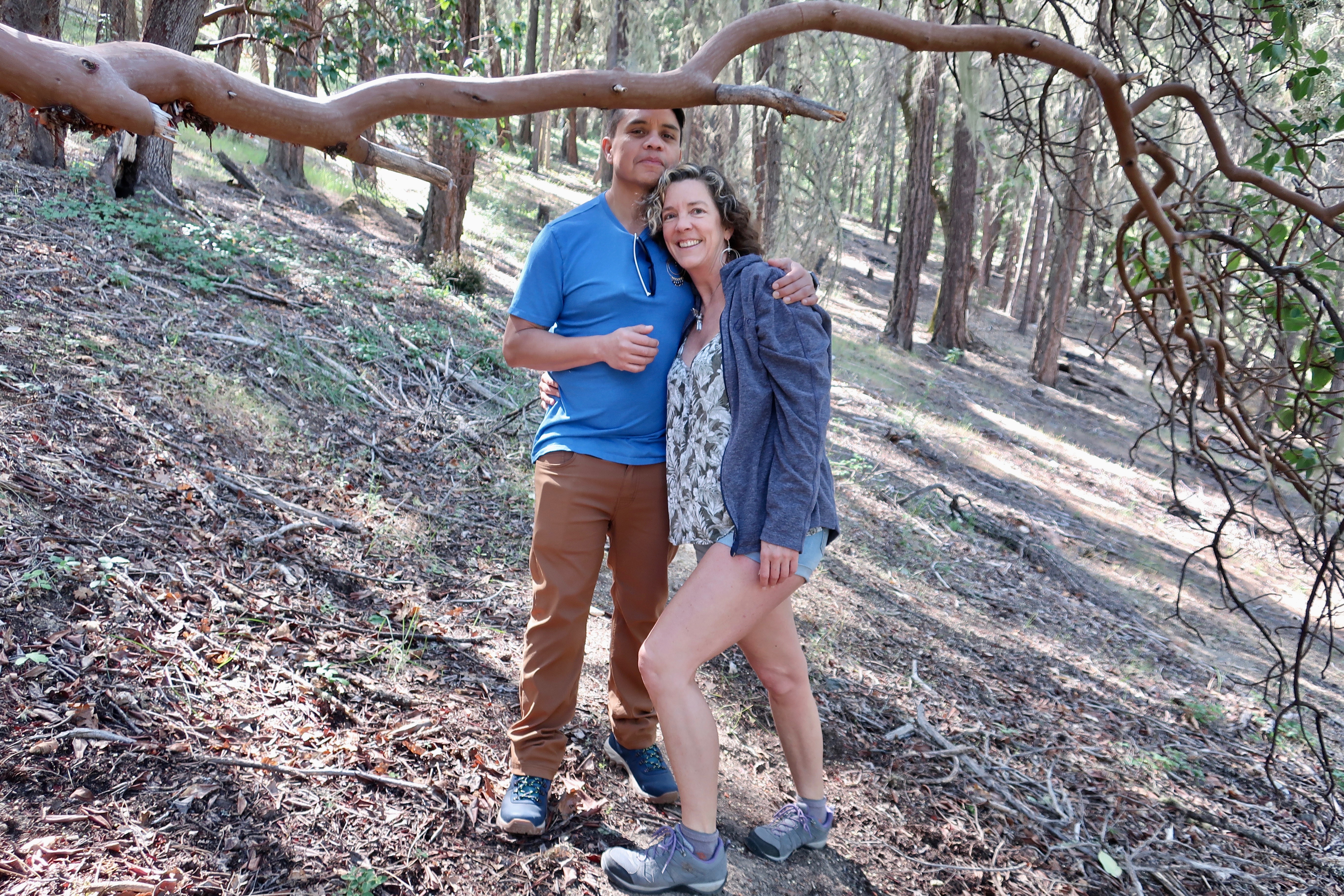
My blogging friend Crystal Trulove from Conscious Engagement and her buddy Pedro are visiting today and went out for a walk on the trail. Here are photos of them along the trail and in the Bear Cave taken by Peggy.
MONDAY’S POST: I’ve promised to tell you who shot Pavy’s pig, and I will. But I also want to discuss our summer blogging schedule, which will be slim at best. Peggy and I are taking a break to pursue some other interests. We intend to be back with a regular schedule in the fall. And I will continue to check in on you occasionally over the summer. The friendships we have formed are valuable.