The Banning of the Ghost Guard…The Shameless Shenanigans of Pat and Demon

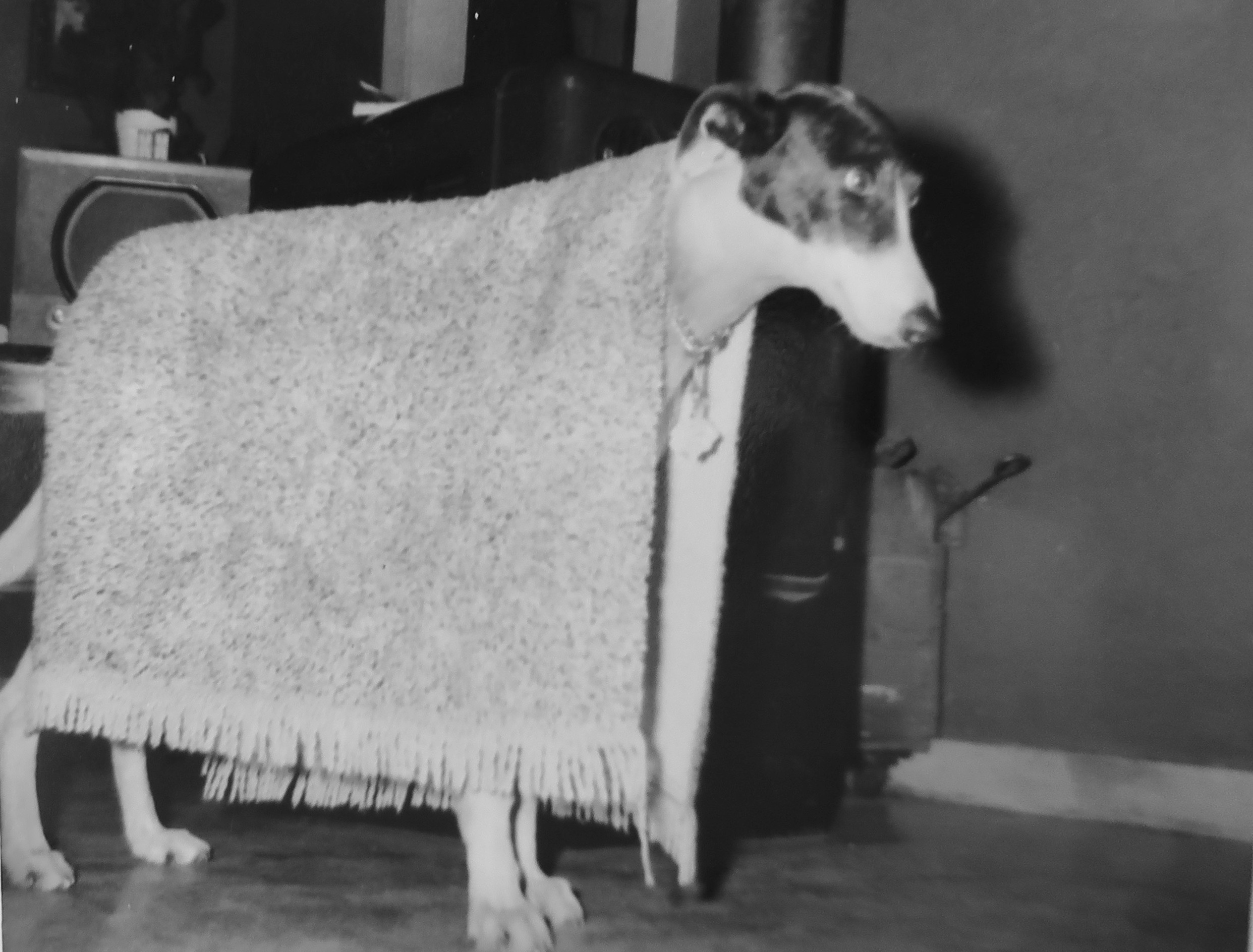
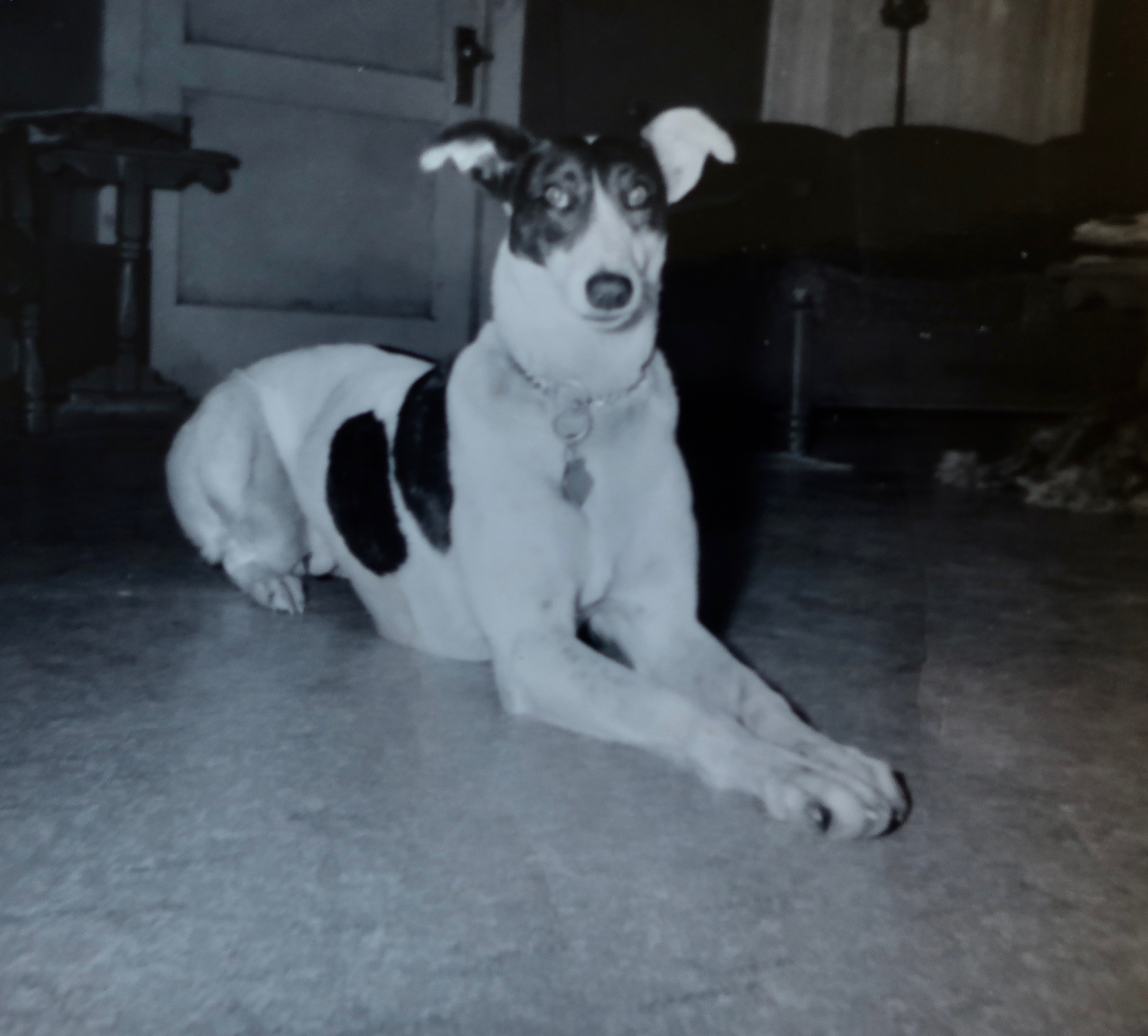
Poor Pat. Living with me did have its drawbacks, especially when I had a camera in hand. Being a rescue dog, however, she was eternally grateful and willing to pose for me. Reluctantly. Behind her is the wood stove we used for heat and, above Pat’s tail, our first TV. It was a while ago. Grin.

Pat the Greyhound set the stage for the banning of the Ghost Guard from my bed.

The night of the skunk was an exception to Pat’s normal stay-at-home routine. As usual, I had crawled into bed with an assortment of animals. That evening, it was minus Pat. Good, she took up a lot of room. Somewhere around midnight, I half way awoke as she hopped up on the bed, completed three dog turns, and snuggled down. Consciousness made a quantum leap as my nose was assailed by an unmistakable perfume.

“Seems we have a skunk visiting,” I told Pat and reached down to scratch her head. The fur was moist. As I pulled my hand back, the skunk suddenly got much closer. Now, I was totally awake. Ms. Greyhound had been bullying the wrong pussycat. It was a night to sleep inside. In fact, Marshall had a roommate for several days. I don’t know how many times I washed that hand but I do know that the bedding was tossed and Pat learned what a tomato juice bath was. When I finally made it back outside, the animals were put on notice: One more problem and off they went. 

Then Demon the Black Cat made her contribution.

She was well into middle age by this time and there had been no pause in kitten production. This was a time before spaying became common. Every few months, Demon shelled out another litter. She had long since finished overpopulating Diamond and was working on surrounding communities. We were teetering on becoming known as the Cat Family of Diamond Springs. My father reverted to drastic measures. Demon was not pleased. She started hiding her kittens and became a master at subterfuge. If someone tried to follow her, she would stop and nonchalantly give herself a bath, her whole body, one lick at a time. Then she would wander off in the opposite direction.

Mother paid me in cookies to track Demon down. When the Graveyard was her destination, I had a flat tombstone I would stand on as a lookout. There was an added advantage; Demon didn’t check for people perched on tombstones. Who would? Eventually, the missing litter would be discovered. I felt like Daniel Boone.

Demon’s special home delivery took place the same summer Pat had her close encounter with the skunk. As noted earlier, my attitude about bed companions had become testy. I wasn’t above rolling over quickly to see how many I could dislodge. A really good roll would net three or four. Sleeping with me was like living on the San Andreas Fault.

I did feel guilt over routing Demon. Once again, she was pregnant. I watched her balloon out. By this time, I was a veteran of the birthing process and found it interesting rather than troublesome. One night I had awakened to Pat howling, found that she was delivering puppies, and sat up with her through the process. Another time I had gone out with Tom Murphy, our grocer, and assisted in the delivery of a calf that wanted to come out the wrong way. It was messy, up to the elbow work. Remember the coke I stole from his store on my 5 AM walk home from Rudy and Robert’s? Tom was repaid many tines over.

I really didn’t expect to be around for the arrival of Demon’s kittens. That would take place in some hidden nook. One should never make assumptions. 

It started as a normal night. Roll over, kick the animals off, and go to sleep. Wake up and repeat the process. It was not a normal morning. I woke up with wet feet.  

“What the heck!” I exclaimed as I sat up quickly, dislodging Pat in the process. Demon looked innocently back at me from the foot of the bed. Okay, nothing suggested why my feet were wet. Then I noticed movement. Demon was not alone. Several little black clones were lined up for breakfast. Demon had delivered her litter on the bed and my feet were awash in afterbirth.

That did it.  My bed was not a home for wayward dogs who encountered the business end of skunks and it certainly wasn’t designed as a maternity ward for unwed cats. I bought a water pistol and initiated a campaign of terror. Any four-legged critter on the bed became fair game. The cats learned quickly; getting shot with a water pistol was not their idea of a proper bath. The dogs were more resistant. Usually it took several squirts and then I would get the look: big brown eyes accusing me of dark deeds. But I was tough and my canine companions eventually vacated the premises as well.

As soon as I fell asleep, however, the whole menagerie, fleas and all, would quietly slip back up on the bed.

NEXT POST:

Blog a Book Wednesday… From “The Bush Devil Ate Sam” : A student revolution with world-wide implications was about to begin at Berkeley. As a student on campus it would have a dramatic impact on my world view and be an important factor in my joining the Peace Corps. I discuss how I gradually became involved and provide background information.

The Magnificent Sea Stacks of Harrison Beach… Marvels of Erosion

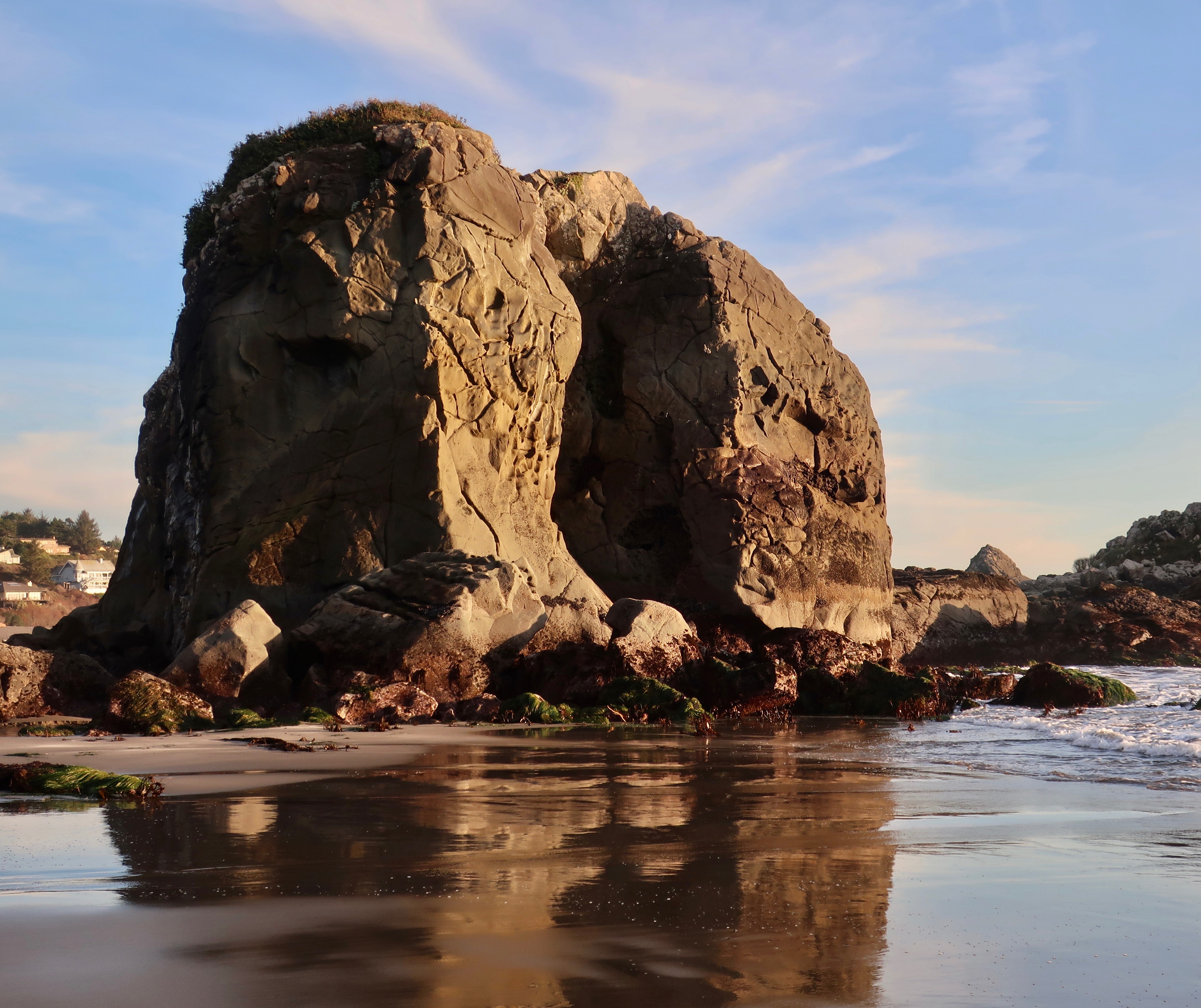
Once, these two magnificent sea stacks would have been part of the coast. Erosion made them part of the ocean. The evening sun was bathing them in a gentle glow.

I am continuing the exploration of the Oregon Coast on my Friday travel blog. This is part of the Harris Beach series. So far, Peggy and I have given you a tour of the tide pools teeming with interesting sea life. Today I will focus on the sea stacks that adorn the coast. Harris Beach State Park is located next to the town of Brookings, which is just north of the California border. The following photos are taken by both Peggy and me.

Goat (or Bird Island) at Harris Beach SP near Brookings is the largest Island on the Oregon Coast. According to the Audubon Society it is an IBA, an Important Bird Area. And it is. Over 100,000 birds nest there annually, including tufted puffins, a bird I more closely associate with my years of living in Alaska. The island is off-limits to people.
This massive sea stack appeared to have a face looking out toward sea. The rock base made me think of a many legged creature.
A closer view.
The reflection caught our attention here.
Peggy and I wandered among these rocks checking out tide pools.
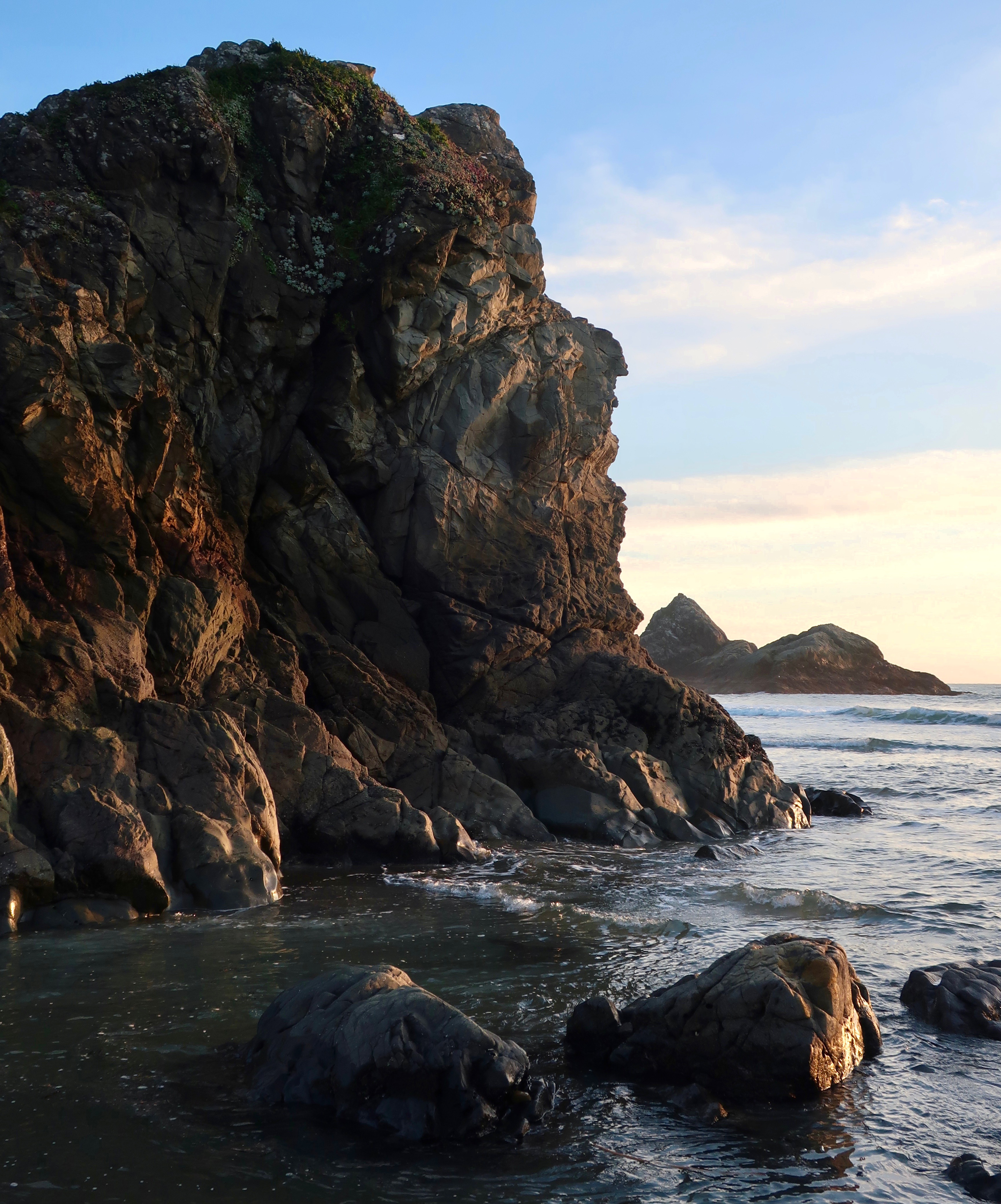
Later in the day, the tide started coming in. It was time to stop playing in tide pools and start thinking about the sunset.
More color here.
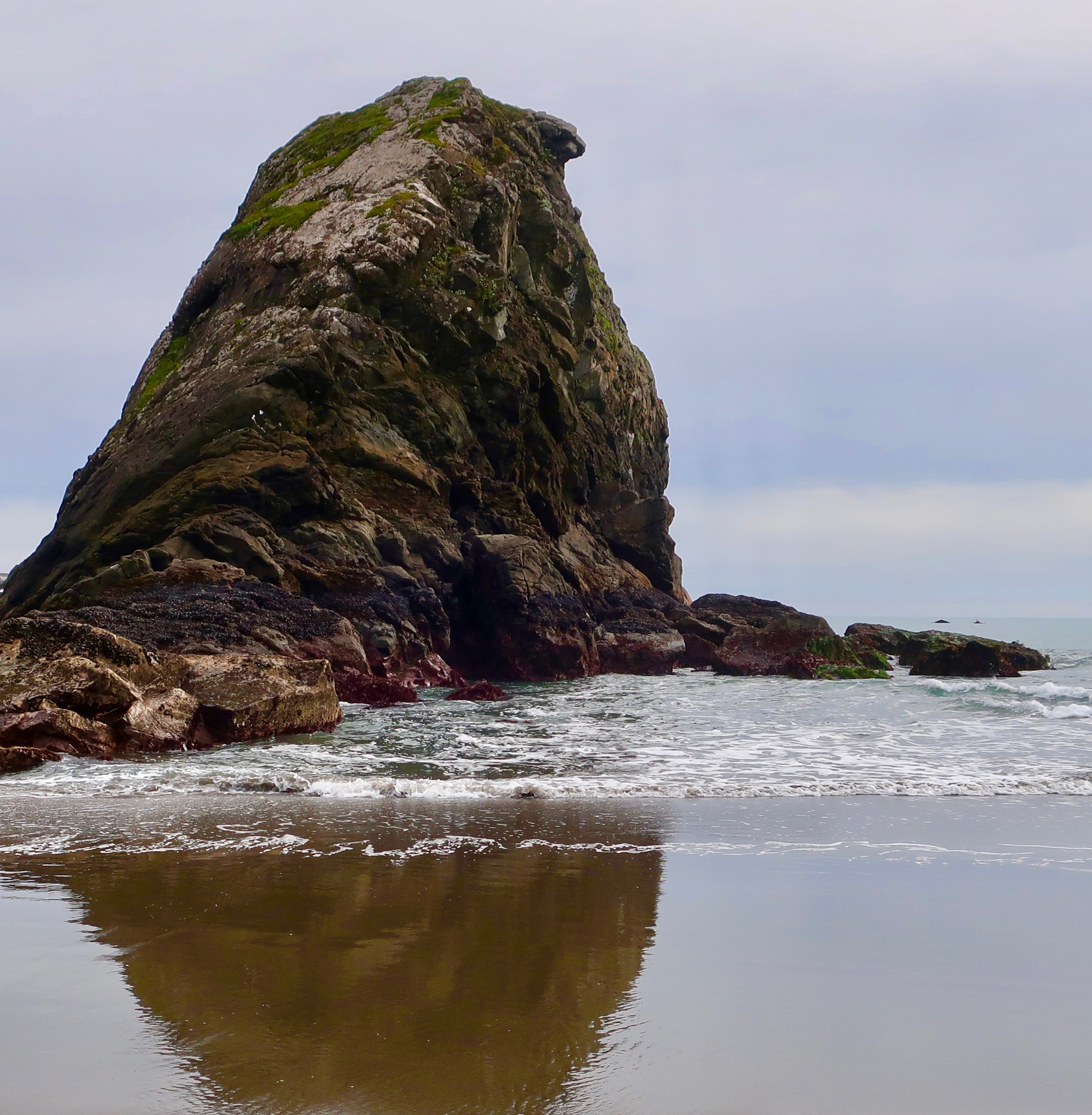
I’ll conclude with this sea stack which was smaller but also colorful. My travel blog next Friday will include human-size rocks, an impressive hole in one of the sea stacks, and drift wood.

NEXT POST:

Monday’s Blog-a-Book Post… From “It’s 4 AM and a Bear Is Standing on Top of Me” : The shameless shenanigans of Pat the Greyhound and Demon the Black Cat get them fired from ghost guard duty.

The Go-To Ghost Guard: Demon and Pat

Pat the Greyhound looking quite elegant. You can see why she would take up a lot of space on a one person army cot. I named her after the driver of the local Greyhound Bus.

In my last blog-a-book post from “It’s 4 AM and a Bear Is Standing on Top of Me,” I related how I moved outside during the summer and hired the family pets to protect me from the ghosts that lived across the alley from us in the jungle-like graveyard. While several animals participated in this critically important duty, two stood out for their steadfast commitment: Demon the Black Cat and Pat the Stray Greyhound.

Demon, the alpha family cat, was as black as the darkest night. As such, she was appropriately named and attired for graveyard duty. In fact, she spent a good deal of her life there, stalking mice, lizards, birds and anything else she could get her claws into with impunity. Captured prey would then be brought home for approval. My job was to dispose of the half-eaten carcasses. I would sometimes tie a string around the dead animals and drag them around the yard, giving Demon more play time. (Okay, I was a bit weird, but I received high marks from the cat.) Depopulating the Graveyard was not Demon’s claim to fame, however; motherhood was. She had kittens often and everywhere. I suspect that half of the cats living in El Dorado County today can trace their lineage back to her.

Demon was well colored and named for graveyard duty. I think her claws were about to reach out and scratch the photographer, me.

Two instances of kitten production bring back vivid memories. The first took place on the living room floor. Demon was a young cat at that time and a neophyte at motherhood. Her impending delivery was quite apparent from her large belly and ceaseless exploration of clothes hampers, cupboards and other dark places. 

With high hopes of avoiding a misplaced litter, Mother arranged her bedroom closet as a maternity ward. Several times each day it was my duty to show Demon her new home. I would carefully pick up the very pregnant cat, carry her to the closet, and deposit her in a box filled with well-used clothes. Demon didn’t buy the program.  It seems my bedside manner was faulty. She would climb out of the box, glare at me, and stalk out of the bedroom.

When the joyous day finally arrived, I was home alone.  Demon was practicing her would-be-mother waddle-walk across the living room when she suddenly stopped, squawked and squatted. Neither she nor I was ready for what followed. After all, how prepared can a young kid and a first-time mother be for birth? In a massive surprise to both of us, a tiny black bundle of fur emerged from Demon’s undercarriage. Surging emotions paralyzed my seven-year-old mind. One thought stood out, the closet! If Demon hadn’t memorized her delivery lessons, I had.

I jumped across the room, grabbed Demon by the nape of the neck, and raced for Mother’s bedroom. As fast as I ran, it wasn’t fast enough. In the middle of the kitchen, the new arrival completed its journey and was heading for a crash landing. Somewhere, somehow between Demon and the floor, I caught a warm, wet ball of fur in my free hand. After that, the memory fades. I know the three of us made it to the closet. 

Demon accepted her new home and four more kittens followed the first, although in a less dramatic way. The population explosion was underway. I’ll cover Demon’s other memorable kitten delivery in my post next Monday. It, too, was forever etched in to my mind.

Pat the Greyhound joined our family as a stray. For weeks, Mother had watched this large, starving dog wander the countryside catching jack rabbits and ground squirrels for food. One day she stopped the car, opened the door and invited Pat home for a meal.

“Oh, it is just until she gains a little weight,” Mother explained to one very disgruntled Pop. He already believed the size of our pet menagerie was far too large. People were known to drop off unwanted cats in front of our house knowing that they would find a home. As Pat put on the pounds, Mother modified her strategy. “Oh, but it would break Curt’s heart if we had to give her away.” She was a master at manipulation. Pat, who I named after the local Greyhound bus driver, had become my dog. 

Like all of our pets, she lived outside. It was Pop’s rule; pets were limited to daytime visitation rights only. Demon had been an exception imposed by Mother. Since there were no leash laws, Pat was free to come and go as she pleased. Mainly she chose to hang around with her food dish in sight. 

In next Monday’s post, I tell the story of how the shenanigans of Pat and Demon led to the Ghost Guard being kicked off my bed. 

NEXT POSTS

Wednesday’s Blog-a-Book Post from “The Bush Devil Ate Sam”: Life at Berkeley gets complicated…

Friday’s Travel Blog: The dramatic sea stacks at Harris Beach State Park including the largest island off the Oregon coast and an intriguing hole in a rock. 

Berkeley… We Are Not In Diamond Springs Anymore Toto

I transferred from Sierra College to Berkeley in 1963. Here I am looking proud in my UC sweatshirt.

My wandering off to Berkeley in the fall of 1963 introduced me to a totally different world compared to my childhood home of Diamond Springs with its population of 750 and nearby Placerville with a population of 4,000. Sierra College got me out of the sticks, but just barely. I rode a school bus there and the kids came from small rural communities not much different from Diamond and Placerville.

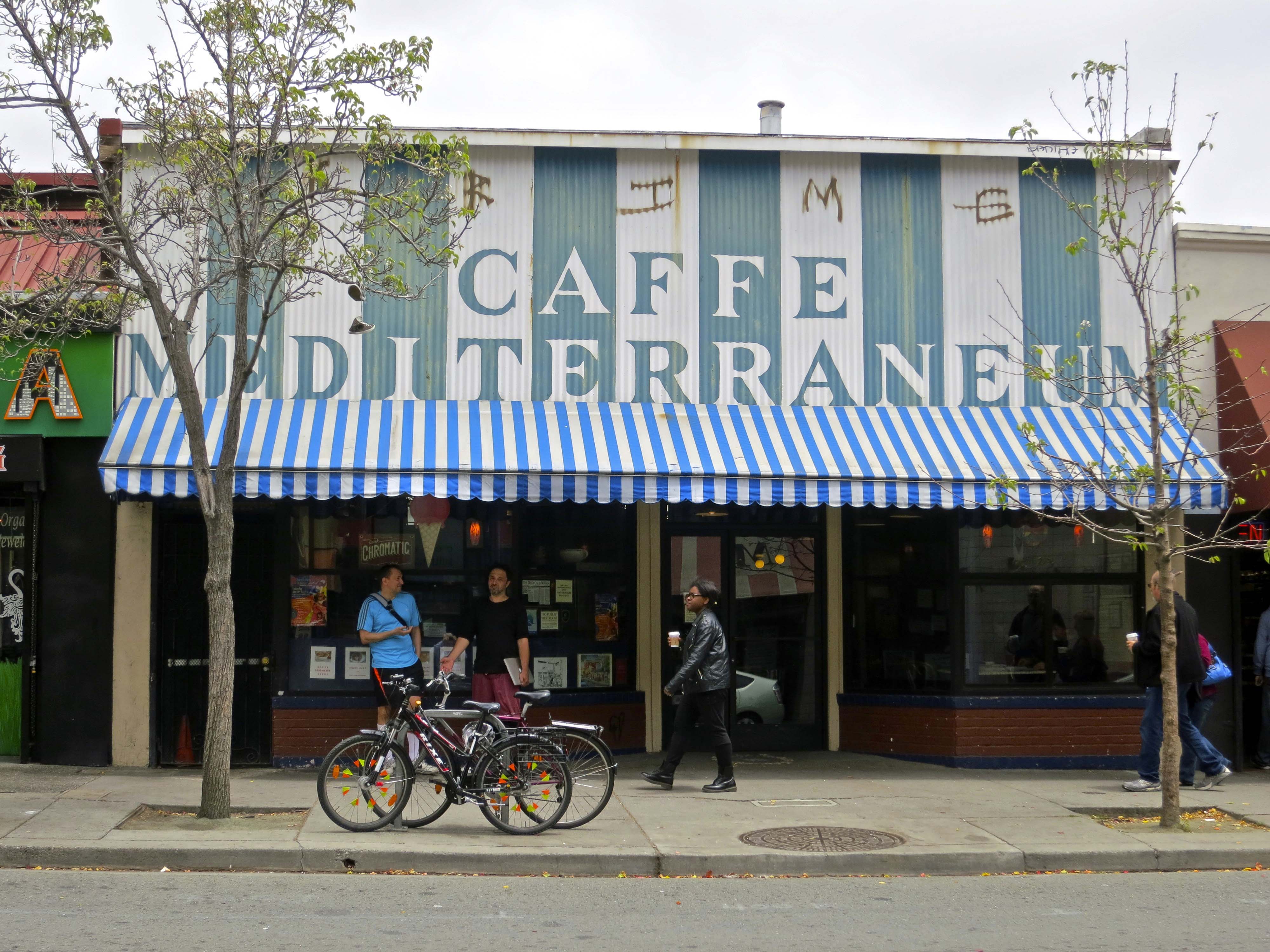
Telegraph Avenue became my Mecca at Berkeley. Exotic smells emanated from a dozen different ethnic restaurants, while numerous languages assaulted my ears. I quickly discovered the Café Mediterraneum. In an era before Starbucks made coffee houses safe for middleclass America, Café Med was an original. It was a microcosm of Berkeley, filled with offbeat characters, esoteric discussions and great coffee. I became addicted to both the cappuccino and the atmosphere. I would grab my coffee and climb the narrow wooden stairs in back for a coveted balcony seat where I would watch the ebb and flow of the city’s unique flotsam. 

Cafe Mediterraneum as it looked on my last visit a few years ago.

A quick jaunt across Telegraph produced another treasure, Cody’s Bookstore. Started on a shoestring by the Cody family in the 50s, it had become one of America’s premier bookstores by the mid-sixties. I saved my explorations for Saturdays when there was time to indulge my passion for books. I would disappear inside and become lost to everything except the next title.

I was equally fascinated by the ever-changing kaleidoscope of soapbox oratory provided at the south entrance to the campus on the corner of Bancroft and Telegraph. During any given hour, a dozen speakers could be found there espousing as many causes. I considered it high entertainment and would sit on the steps of the Student Union and listen during breaks from my studies. Over one lunch period, I reported in a letter home, I listened to a student who had spent her summer working in the South registering voters, a black South African talking about apartheid, a socialist railing against the evils of capitalism, a capitalist railing against the evils of socialism and a Bible thumper detailing out the many paths Berkeley students were following to hell. Apparently, there were too many to count.

Many of the speakers urged that there was more to college life than studies, football and parties. Change was in the wind and we should be part of it. Work for fair housing in Berkeley; oppose the unfair hiring practices at Safeway; picket the Oakland Tribune, sign up to help in Goldwater’s political campaign. Join CORE, SNCC, SLATE, SDS, YAF or a world of other acronyms. I struggled to take it all in, absorb it through my pores. It certainly wasn’t Kansas, Toto, nor was it Diamond Springs, Placerville or Sierra College.

To simplify my first year, I opted to live in a college dorm. I would have a room, a bed and regular meals. The University assigned me to Priestly Hall, which was ideally located a block away from campus and a block away from Telegraph Avenue. Three other dorms, one for men and two for women, comprised our corner of the universe. Co-ed living accommodations were still in the future. Strict House Mothers existed to enforce the rules and protect their charges. Women were only allowed on the first floor of the men’s residence hall. Slipping one up to your room was an expellable offense.

Each dorm was nine stories high, brand-new and exactly the same as the others. One of the grad students responsible for our well-being immediately dubbed them monstrosities of oblivion. My sixth-floor room came complete with a roommate, Clifford Marks. Cliff was a slightly built young man with bright red hair, freckles and a mischievous personality. Later, we would share an apartment. Like me, he was a political science major. Eventually, he too would join the Peace Corps.

For entertainment, we could watch the antics of the girls in the dorm directly across from us. If we were lucky, they might wave. One evening a pair of roommates pulled their shade, set up a lamp between them and the window. And undressed. Slowly. It was a surprise our building didn’t fall over, given that every guy in the dorm was glued to the windows on the women’s dorm side.

But all of these were the lighter side of Berkeley and college life. I was soon to learn how serious academics were at UC— and that a revolution was brewing. I’ll continue my story next Wednesday.

Friday’s Travel Blog Post: I finish off Peggy’s and my exploration of the tide pools of Harris Beach, Oregon. The shells of turban snails provide dandy homes for hermit crabs, limpets are masters of creating a vacuum, barnacles suggest why keel-hauling might make walking the plank seem like a stroll in the park, and we find acres of grass growing where we only expected seaweed.

How to Keep Ghosts at Bay… Blogging a Book

We tend to think of ‘wilderness’ as wild, remote lands. In truth, you can find a bit of wilderness in your back yard or a community park if you are willing to sit quietly and let nature come to life. This is another tale from the book I am blogging: “It’s 4 AM and a Bear Is Standing on Top of me.”

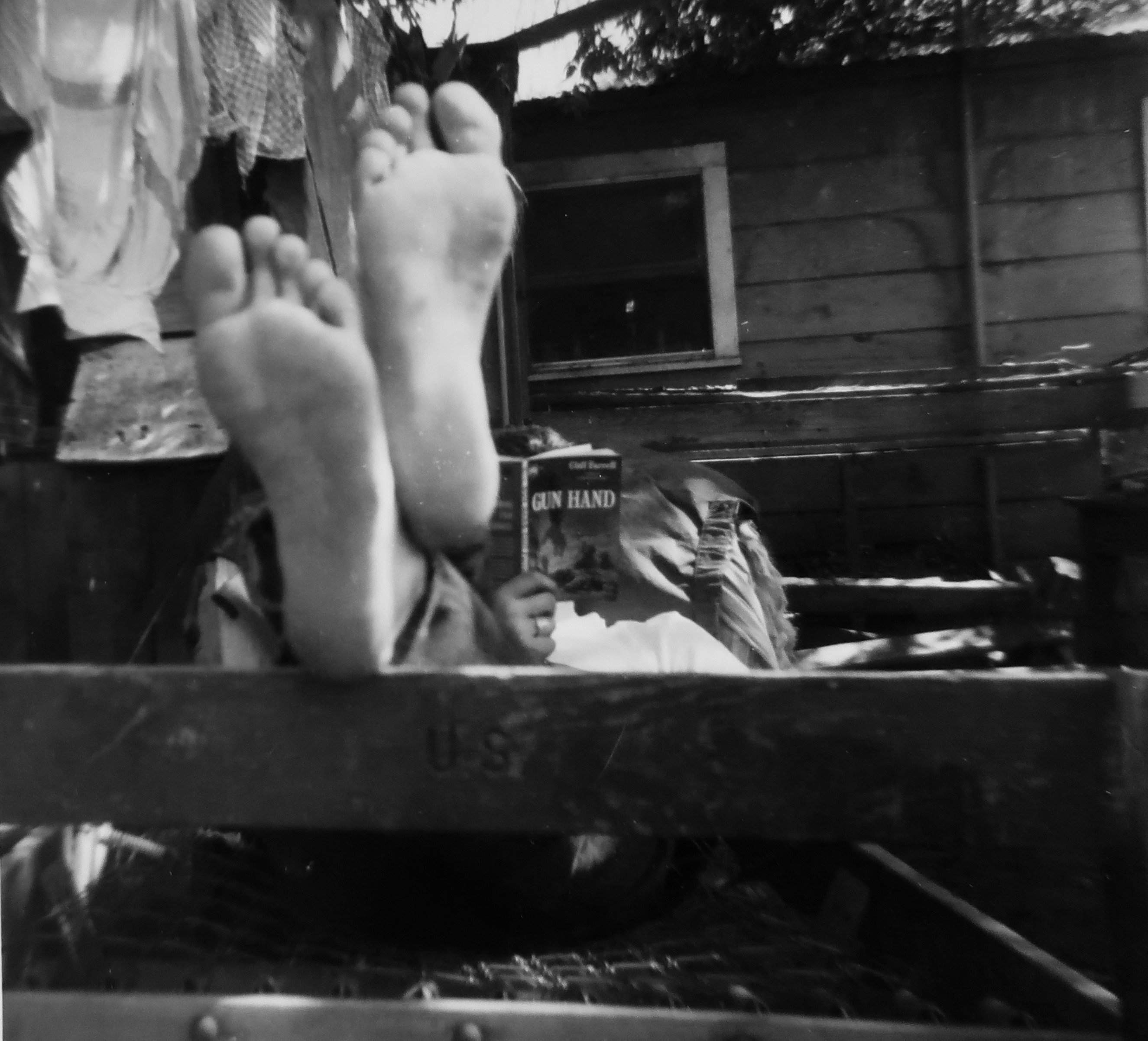
I started sleeping outside in elementary school and would continue to for years. Here I am on a summer afternoon reading a Western. If you look closely, you can see US Army stamped on the back of the cot. It was of World War II vintage. My mother thought it was humorous to emphasize my big feet in her photo.

Between the third and fourth grade, I discovered a new way to enjoy nature. I moved my bedroom outdoors. It was partially to avoid sharing a room with Marshall and partially to escape my father’s house-shaking snores. But the real reason was that I loved being outdoors. I would move out as soon as school was over and stay until school started, or longer, if weather permitted.

At first, I slept on the ground in a cheap cotton sleeping bag. The ground was hard, the nights cool and the mosquitoes persistent, but these were minor drawbacks. I was free. If I had to pee, I’d climb out of the sleeping bag and find the nearest bush. If I woke up thirsty, a convenient garden hose was nearby. I would go to sleep watching the stars and listening to a giant bullfrog that lived in the ditch in front of our house. I would wake to cool morning air and chirping robins. Life was good. And then it got better. My grandparents bought me a real bed— a wood framed, steel spring army cot complete with mattress. I think that they may have been disturbed that their grandson lived outside and slept on the ground.

My paradise was marred by one thing, the Graveyard. It was always there on the edge of my sight.  White tombstones glared at me. As hard as I would pretend, the cemetery and its frightful inhabitants would not go away. So, I developed an elaborate set of defenses. The simplest was to sleep facing the opposite direction or to hide under the covers, ostrich like. A more sophisticated approach was to locate the bed where I couldn’t see the Graveyard.  Our well-seasoned cars worked in a pinch, but they weren’t quite large enough. Bits and pieces of the Graveyard would creep around their sides, peek over their tops and slink under their bottoms. A trellis built by my father, Pop, was much better. Its luxurious growth of honeysuckle created the perfect Graveyard screen. I set up a permanent residence behind it.

But even the trellis wasn’t enough to calm my imagination. I decided to hire protection. It came in the form of various family pets. Their job was to chase the ghosts away. Payment was made by allowing them to sleep on my bed. Apparently, the scheme worked. At least no ghosts attacked me during the years I slept outside. 

One of the family pets I hired for protection from ghosts. It’s hard to imagine that a ghost would find a fat cocker spaniel named Happy that liked to roll over on her back and get her tummy rubbed much of a threat.

The downside was I didn’t have much room. Two dogs, three cats, and me on a one-person army cot constituted a menagerie, or a zoo, if you counted the fleas. It was difficult to move. At first, I was very careful not to disturb my sleeping companions. I became a circus contortionist, frozen in place with body parts pointed in every direction. If this meant a restless night, so be it. It was a small price to pay for keeping the ghosts at bay.

Gradually, my attitude changed. I grew larger, the bed space shrank, and animals started sleeping on top of me. Meanwhile, the ghosts, who tend to hassle little people more than they do big people, became less of a threat. Therefore, I needed less protection. Neither of these factors led to the final banning of the animal kingdom, however. It was the shameless shenanigans of Demon the Cat and Pat the Greyhound that I will write about next Monday.

NEXT POSTS:

Blog-a-Book Wednesday… “The Bush Devil Ate Sam”: I’m off to UC Berkeley where a world-wide student revolution is about to take place. I find myself a lone voice in student government advocating for the right of students to participate in Civil Right’s demonstrations.

Travel Blog Friday… I’ve introduced you to the star fish and sea anemones that reside in the tide pools at Harris Beach State Park. Next I will feature the other denizens that Peggy and I found.
Sea Anemones Go to War… Harris Beach State Park

It’s the first day of spring here in the Applegate River Valley, and behaving like it. I watched two male flickers (woodpeckers) strutting their stuff this morning for a female while she studiously ignored them by pecking at the ground. One very pregnant doe was busy chasing off her twins from last year. She’ll soon have a new fawn— or fawns— to take care of. And, the swallows have arrived back in our neighborhood. Their aerial performances are truly amazing. Before long, they will start checking out our oak trees and bird houses for possible nesting sites. 

The first of our daffodils have burst into bright yellow blooms, shooting stars are covering the hillsides, and irises are popping up everywhere. Peggy and her sister Jane dug up our iris bed last year to separate the bulbs that were crowding each other out. Peggy discovered that there were more than she could possibly plant, so she started stuffing the extras into gopher holes and covering them— like you might sweep dirt under a rug. Well, that’s what I thought. The gophers will have a feast. I couldn’t have been more wrong. Each hole is now proudly sporting its own iris and Peggy is giving me an “I told you so” look.

And what else happened this morning? There was snow, rain and sunshine. Sometimes simultaneously. Spring has arrived for sure.

Meanwhile, I have a nasty cold. “We don’t likes it,” as Gollum of Hobbit fame would say. I have a box of Kleenex on one side and a paper bag on the other. I feel like I am an essential part of an assembly line for creating dirty tissues. Pull a Kleenex out of the box, sneeze into it, and stuff it in the bag. Repeat. I filled two bags yesterday. I’d be worried in this age of Covid, but my sniffer is working fine, I don’t have a fever, and Peggy and I had our second dose of Moderna in February. 

I was totally out of it yesterday and the day before. Instead of writing, I read a 400-page fantasy novel about a reluctant hero, a kick-ass princess, a unicorn without a horn, and a dragon that collected butterflies instead of virgins and gold. It was just what the doctor ordered. I’m almost human today, which is why I am back to blogging. Today I am returning to the tide pools of Harris Beach for a look at sea anemones.

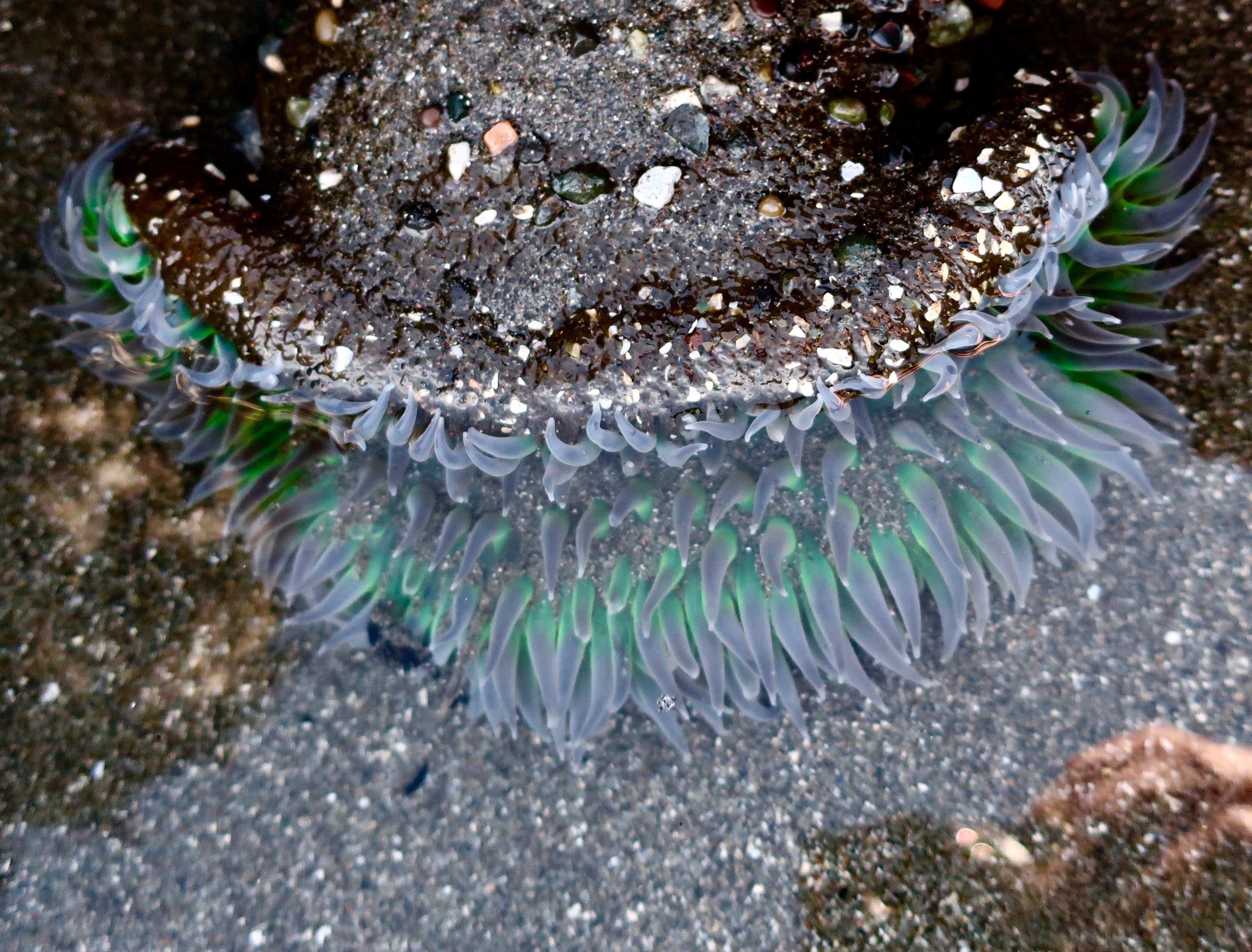
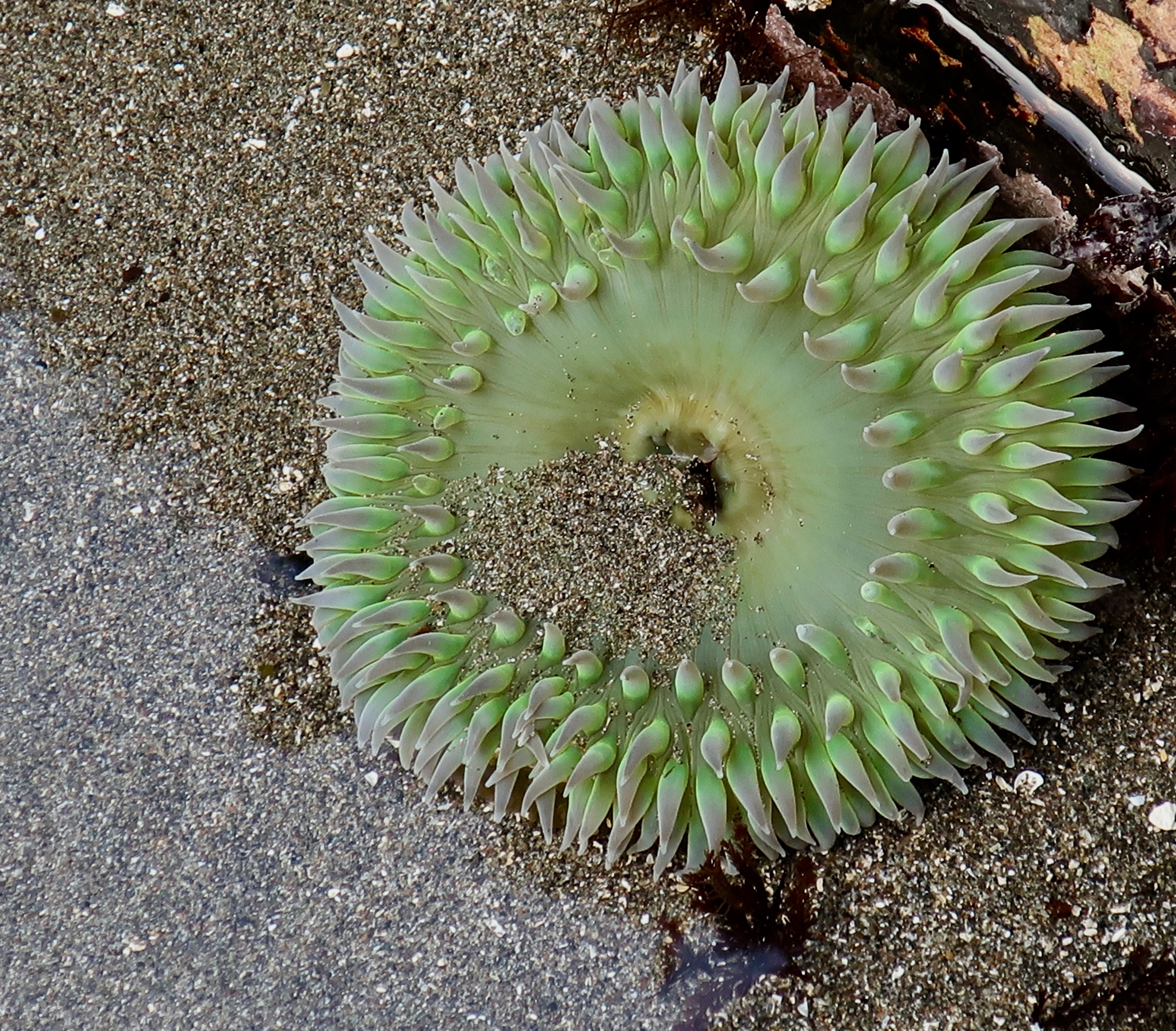
The sea anemones at Harris Beach come in a variety of shapes and sizes. This was one of the larger ones we found, a giant, green sea anemone or Anthopleura xanthogrammica, if you want to be scientifically correct.
A more typical view. The tentacles are covered in stinging cells that the anemone throws into small prey like a harpoon. Once the poison has done its job, the anemone then uses its tentacles to work its prey into the gaping mouth seen in the center. When the feast is over it jets the leftovers out its mouth that has conveniently become an anus. I wonder if the anemone then gargles with sea water. The anemones stinging cells are more or less harmless to humans. How do I know this? I petted a few in my youth. The anemones don’t seem to like it; they immediately close up shop, like the anemones below.
A few of the big guys hanging out together at low tide. Anemones close up when exposed to air as a way to protect their tentacles. A small, dark fish is lurking in the remaining water. Some small fish seem to have a symbiotic relationship with anemones and swim among the tentacles, free of worry. Predators beware.
I found this interesting. A number to the anemones were covered in brightly colored pieces of rocks and shells. Scientists speculate that this serves as a natural sunblock when the anemone is exposed to air at low tide. I was curious about how they go about gathering and affixing their collection but couldn’t find anything about it.
Some smaller sea anemones live in colonies as seen here. These are clones of each other except they differentiate into scouts, warriors and moms. When two colonies meet, they go to war. It’s the scouts job to find new territory for the colony as it expands. When they come on another colony, the warriors take over by whaling away at each other with their tentacles. The ‘moms’ stay in the middle out of harm’s way. Next Friday, I’ll cover the other sealife we found in the tide pools.

NEXT POST:

Monday’s Blog-a-Book Post… “It’s 4 AM and a Bear Is Standing on Top of Me”: I move outside to commune with nature in the summer but the ghosts continue to haunt our backyard. I hire the family pets for protection. They charge a high fee.

Held at Gunpoint: Training for Berkeley, and the Peace Corps… Part 2

In my last blog-a-book story from “The Bush Devil Ate Sam,” I introduced the tale about getting caught in a laundry takeover by armed men in South Lake Tahoe, California where I was working at the time. Today, I will conclude that story.

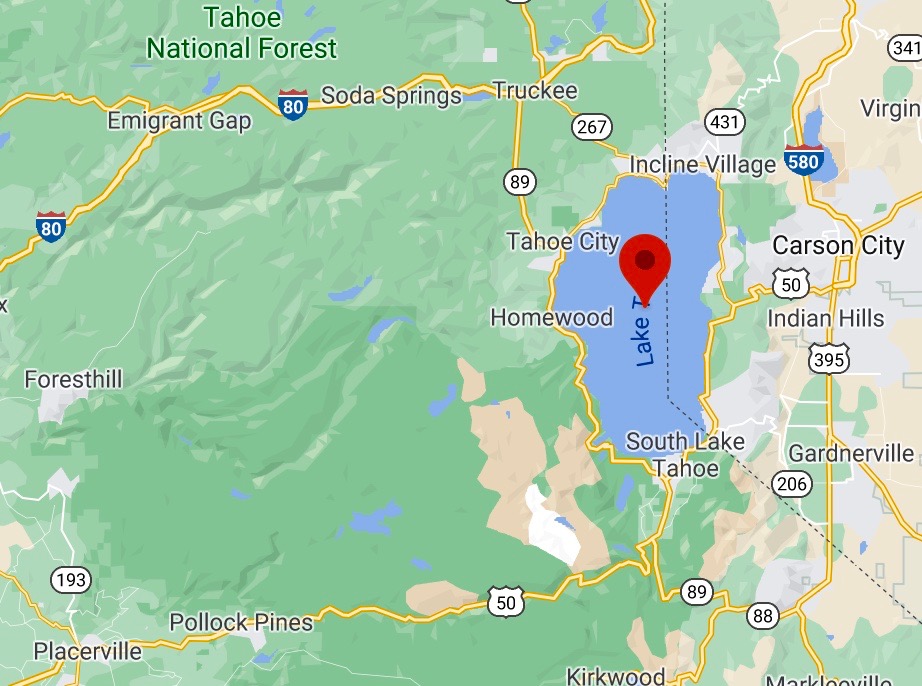
Surrounded by the Sierra Nevada Mountain Range and noted for its clear blue water, Lake Tahoe is one of the top resort areas in the world. The laundry I worked at was located in South Lake Tahoe. This map also shows the route I followed from Placerville to the Lake along Highway 50. Three years ago, I hiked from I-80 to Highway 50 through the mountains as part of the 750 miles I backpacked to celebrate my 75th Birthday.

My humdrum, ant-like existence of delivering linens to the motels of South Lake Tahoe came to a dramatic end the morning I heard the roar of laundry trucks firing up an hour before they were supposed to. I threw on my clothes, sidestepped the gunman guarding my door and jumped into my car. The guard immediately repositioned himself as a hood ornament and looked threatening. Guys with guns can do that.

“Don’t be worried, Curt,” a familiar voice told me.

“Right,” I thought as I checked out the tough looking goon. I turned my head and spotted Woody, our lead driver. “What in the hell is going on?” I demanded.

“We’ve taken over the laundry,” Woody replied casually. 

The next question followed naturally: Who in the hell constituted we? Woody had an answer for that, too.

“I work for the people that Douvres screwed when he took the laundry back,” he told me. “We’re here legally. These armed men are professional security guards we hired to protect our interests.” Apparently Woody had been quietly arranging a coup while taking Roger’s money.  

“I am leaving now,” I informed Woody.

“I don’t think so,” Woody replied. “Relax, it will all be over in a few hours and you can go to work for us.”

I was beginning to feel like I had been caught up in a B-grade movie. 

“Woody, you are not going to shoot me,” I said with a lot more confidence than I felt. “Tell the man to get out of my way.” I was irritated to the point of irrationality. I turned on the car and started rolling forward. At the last possible moment, when it was clear that I intended to keep going, Woody motioned for his man to move. I was glad they couldn’t hear my sigh of relief over the sound of the engine.

Once away from the laundry, I shoved the gas pedal down and made a dash for Cefalu’s house. I knocked on the door of the dark house and was surprised to find Roger open it in his pajamas. He’d come up the night before.

“What’s wrong, Curt,” he said sounding a little alarmed. Obviously, I wouldn’t show up at 6:30 a.m. to wish him good morning.

“Your laundry has been taken over by armed men,” I blurted out and then quickly filled in the details. Roger responded with an incredibly imaginative stream of swearwords. He grabbed his jacket, yelled for his daughter to call the sheriff and told me to jump in his truck. There are three red lights between where Cefalu lived and the laundry. We ran them all. Our truck screeched to a halt in front of the office and Roger jumped out with me close behind.

Fine, I thought to myself. I just escaped from this place and here I am back providing muscle back up for an angry man who is probably going to pop someone in the nose and get us both shot. Fortunately, there were a lot of words before any action, and the Sheriff’s deputy showed up with siren blasting. It would all be settled in court. I was still in one piece and my experience at facing armed men would make a good story. I had no clue at the time that it would also help prepare me for facing men with guns as a student at Berkeley and as a Peace Corps Volunteer in Africa.

Roger and John were successful at winning the court battle but things continued to be crazy at the laundry. I returned to my more peaceful job of driving a laundry truck between Placerville and Lake Tahoe. All’s well that ends well, but the insanity of the laundry takeover was about to be replaced by the insanity of being at Berkeley in the 1960s when the University was at the center of a world-wide student rebellion. Join me next Wednesday as I head off to UC.

NEXT BLOGS

Friday’s Travel Blog Post: The sea anenomes are marching off to war at Harris Beach on Oregon’s coast plus other fascinating creatures that hang out in the tide pools of the Pacific Northwest.

On a Pitch-Black Night, Something Stalked Us in the Graveyard…

A bit older than five, I find that the Graveyard next to where I was raised no longer holds the terror it did for me as a child. Plus they have cut down all of the heavenly trees and ripped out the myrtle. It is no longer a jungle playground for local kids. What’s the fun in that?

My first ‘wilderness’ was the Graveyard. It was out the backdoor and across the alley. We lived with its ghostly white reminders of our mortality day and night. Ancient tombstones with fading epitaphs whispered of those who had come to seek their fortune in California’s Gold Rush and stayed for eternity. Time had given their resting place a sense of permanence and even peace. But not all of the graves were old. Occasionally a fresh body was planted on the opposite side of the cemetery. I stayed far away; the newly dead are restless.

At some time in the past, heavenly trees, an import from China, had been planted to shade aging bones. They behaved like weeds. Chop them down and they sprang back up, twice as thick. Since clearing the trees provided Diamond Springs Boy Scout Troop 95 with a community project every few years, the trees retaliated by forming a visually impenetrable mass of green in summer and an army of sticks in winter. Trailing Myrtle, a cover plant with Jurassic aspirations, hid the ground in deep, leafy foliage. 

The thick growing heavenly trees and trailing myrtle gave the Graveyard the appearance of a jungle when I was growing up. Compare this with the photo above!

During the day, it took little imagination to change this lush growth into a jungle playground populated with ferocious tigers, bone crushing boas, and half-starved cannibals. My brother Marshall and I considered the Graveyard an extension of our backyard. Since it was within easy calling distance of the house, our parents had a similar perspective. Either that or they were glad to get rid of us. The skinny heavenly trees made great spears for fending off the beasts, or throwing at each other. At least they did until we put one through a playmate’s hand. Neither he nor his parents were happy. Spear throwing was crossed off our play schedule. We turned to hurling black walnuts at each other instead. They grew in abundance on the trees in our front yard. Plus, we could toss them at passing cars on Highway 49. Screeching brakes and one really pissed-off guy brought that activity to a halt.

Night was different in the Graveyard— it became a place of mystery and danger. Dead people abandoned their underground chambers and slithered up through the ground. A local test of boyhood bravery was to go into the Graveyard after dark and walk over myrtle-hidden graves, taunting the inhabitants. Slight depressions announced where they lived. Marshall persuaded me to accompany him there on a moonless night. I entered with foreboding: fearing the dark, fearing the tombstones and fearing the ghosts. Halfway through I heard a muzzled sound. Someone, or thing, was stalking us.

“Hey Marsh, what was that?” I whispered urgently.

“Your imagination, Curt,” was the disdainful reply.

Crunch!  Something was behind a tombstone and it was not my imagination. Marshall heard it too. We went crashing out of the Graveyard with the creature of the night in swift pursuit, wagging her tail.

“I knew it was the dog all of the time,” Marsh claimed. Yeah, sure you did.

By the time I was five, I had made my first tentative trips into the Graveyard. One of my early memories was spying on Mr. Fitzgerald, a neighbor who lived across the alley. He’s dead now— and has been for decades— but at the time he was a bent old man who liked to putter around outside. A black locust tree perched on the edge of the Graveyard provided an excellent lookout to watch him while he worked. One particular incident stands out in my mind. I had climbed into the tree and was staring down into his yard. It was a fall day. Dark clouds heavy with rain were marching in from the Pacific while distant thunder announced their approach. A stiff, cool breeze had sent yellow leaves dancing across the ground.  

Mr. Fitzgerald wore a heavy coat to fight off the chill. I watched him shuffle around in his backyard as he sharpened his axe on a foot operated grinding wheel and then chopped kindling on an oak stump.  When he had painfully bent down to pick up the pieces and carry them into his woodshed, I had scrambled down from the tree so I could continue to spy on him though a knothole. I must have made some noise, or maybe I blocked the sunlight from streaming into the shed. He stopped stacking wood and stared intently at where I was, as though he could see through the weathered boards. It frightened me.

I took off like a spooked rabbit and disappeared into the safety of our house. Mr. Fitzgerald was intriguing, but his age and frailty spoke of death— and the dead people who lived in the Graveyard. 

I will continue my tales of the Graveyard next Monday and relate how I moved outside to sleep under the stars in the summer. Unfortunately, the ghost continued to hassle me and I was forced to hire the family pets for protection.

NEXT POSTS

Blog-a-Book Wednesday…”The Bush Devil Ate Sam”: I complete my story on the laundry takeover at South Lake Tahoe where I was held at gunpoint. I drive my 54 Chevy toward the man holding a rifle who is standing in front of the car. Will he shoot me or get out of the way? That’s the question.

Travel Blog Friday... I return to my series on Oregon’s Harris Beach State Park where Peggy and I continue our exploration of tide pools.

The Charming Elephant Seals of Pt. Reyes National Seashore

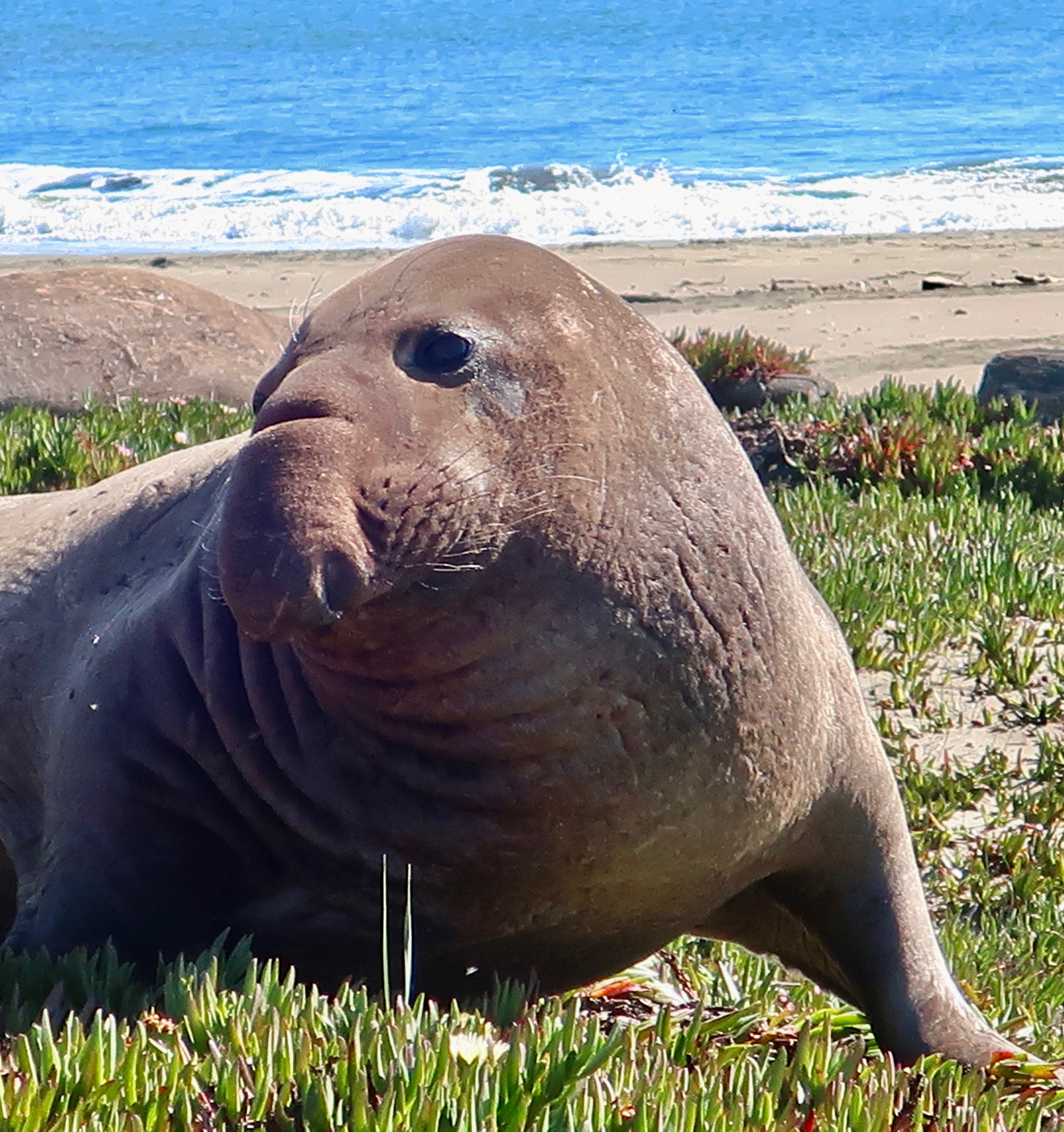
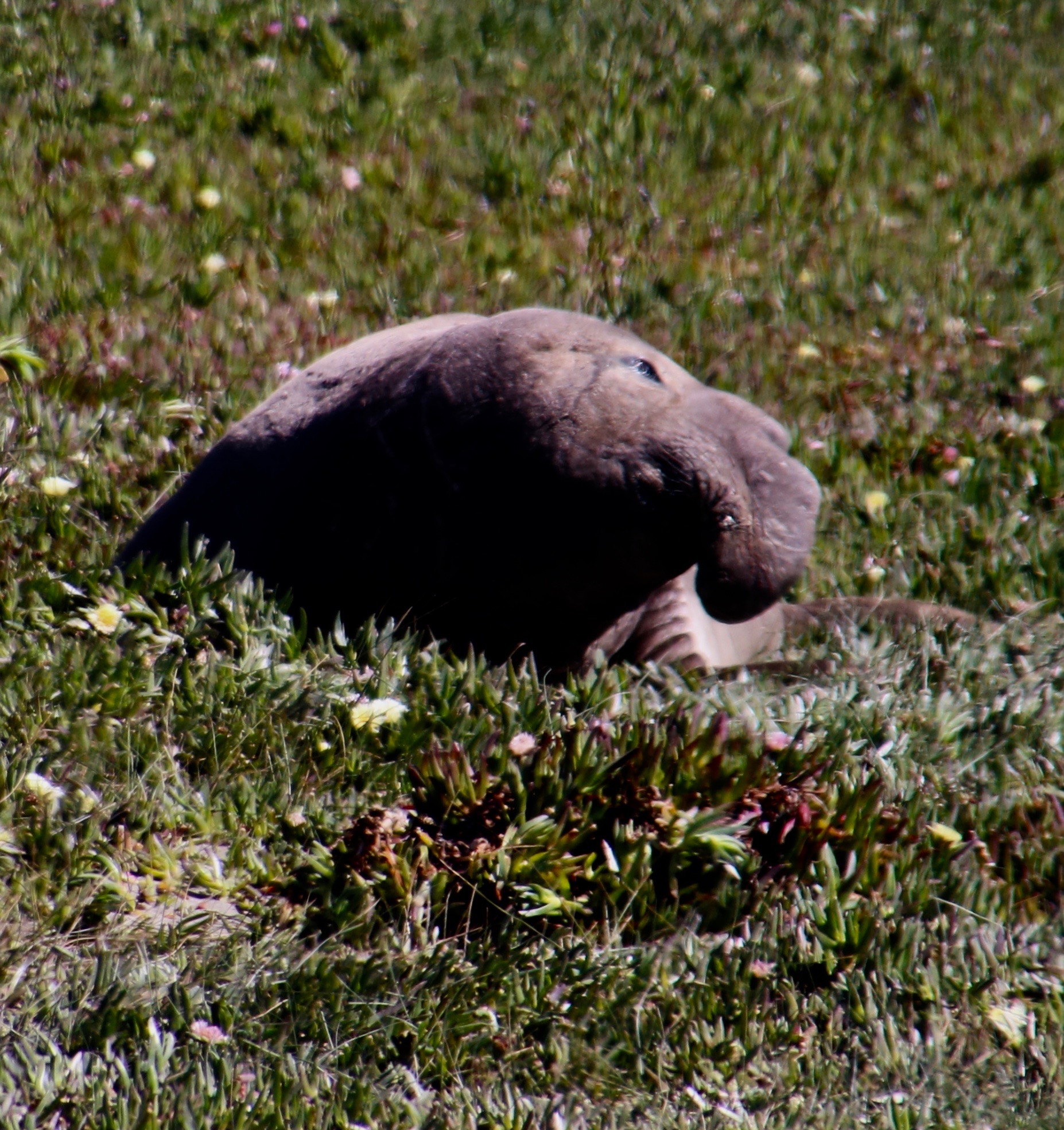
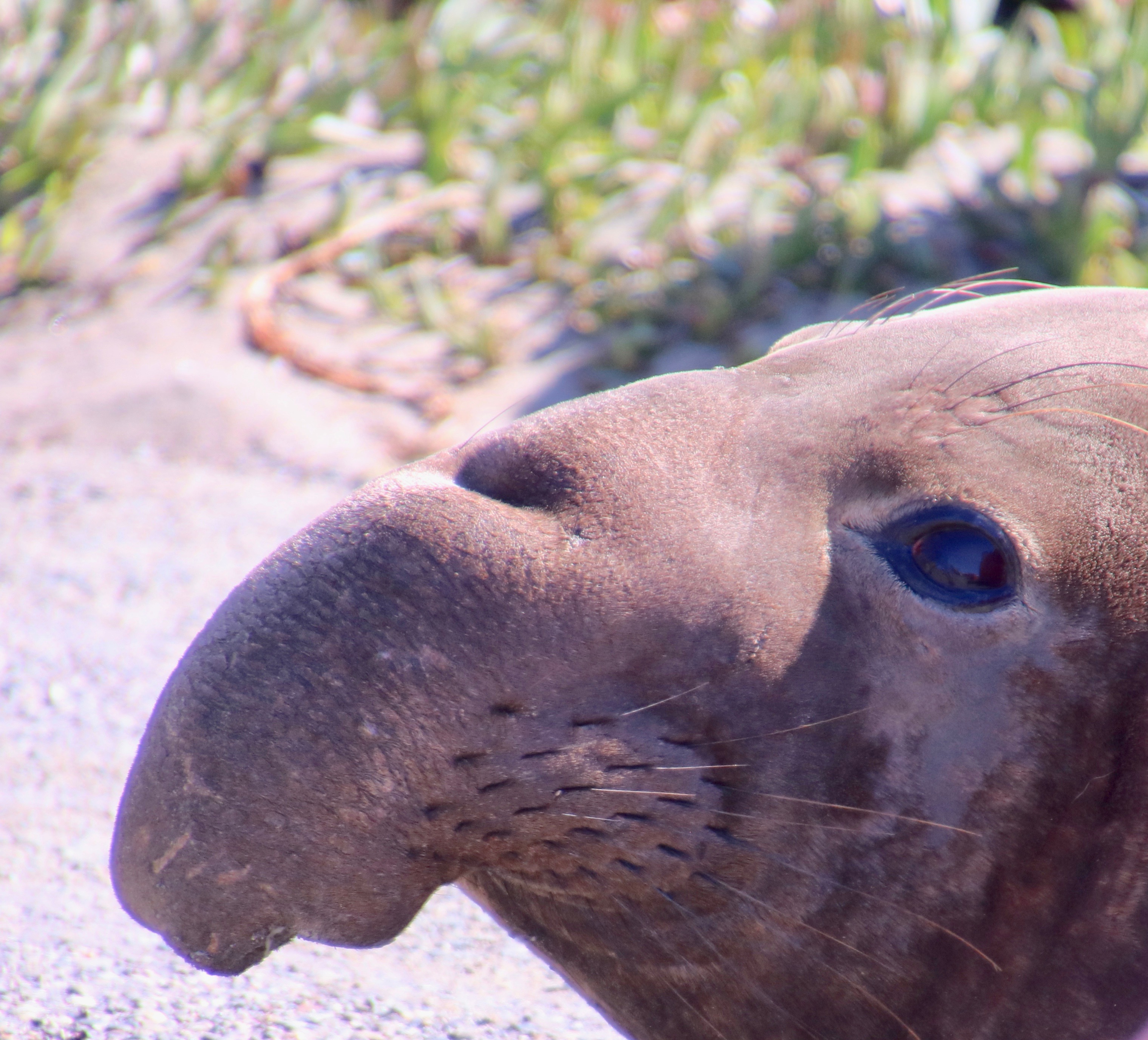
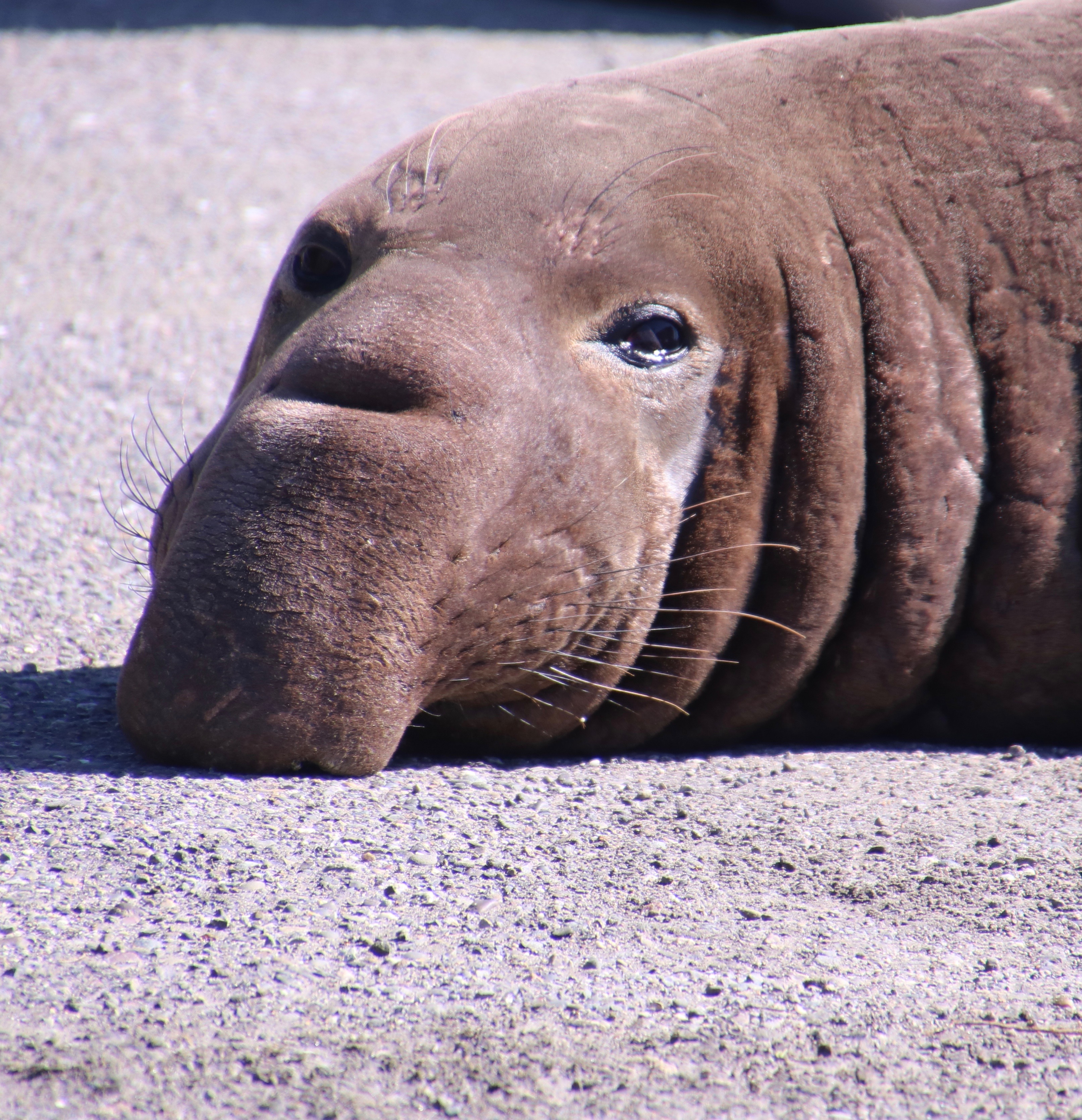
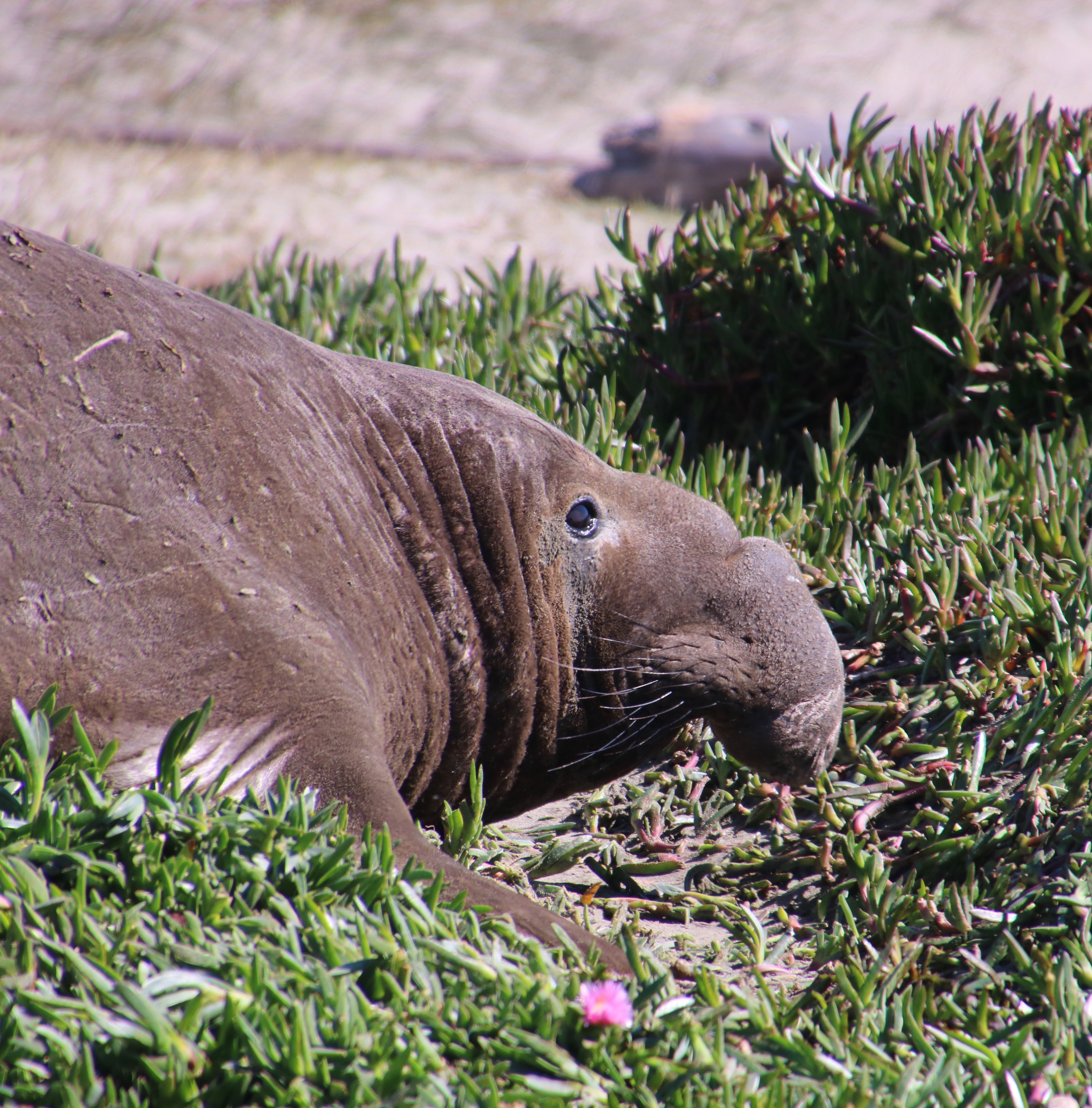
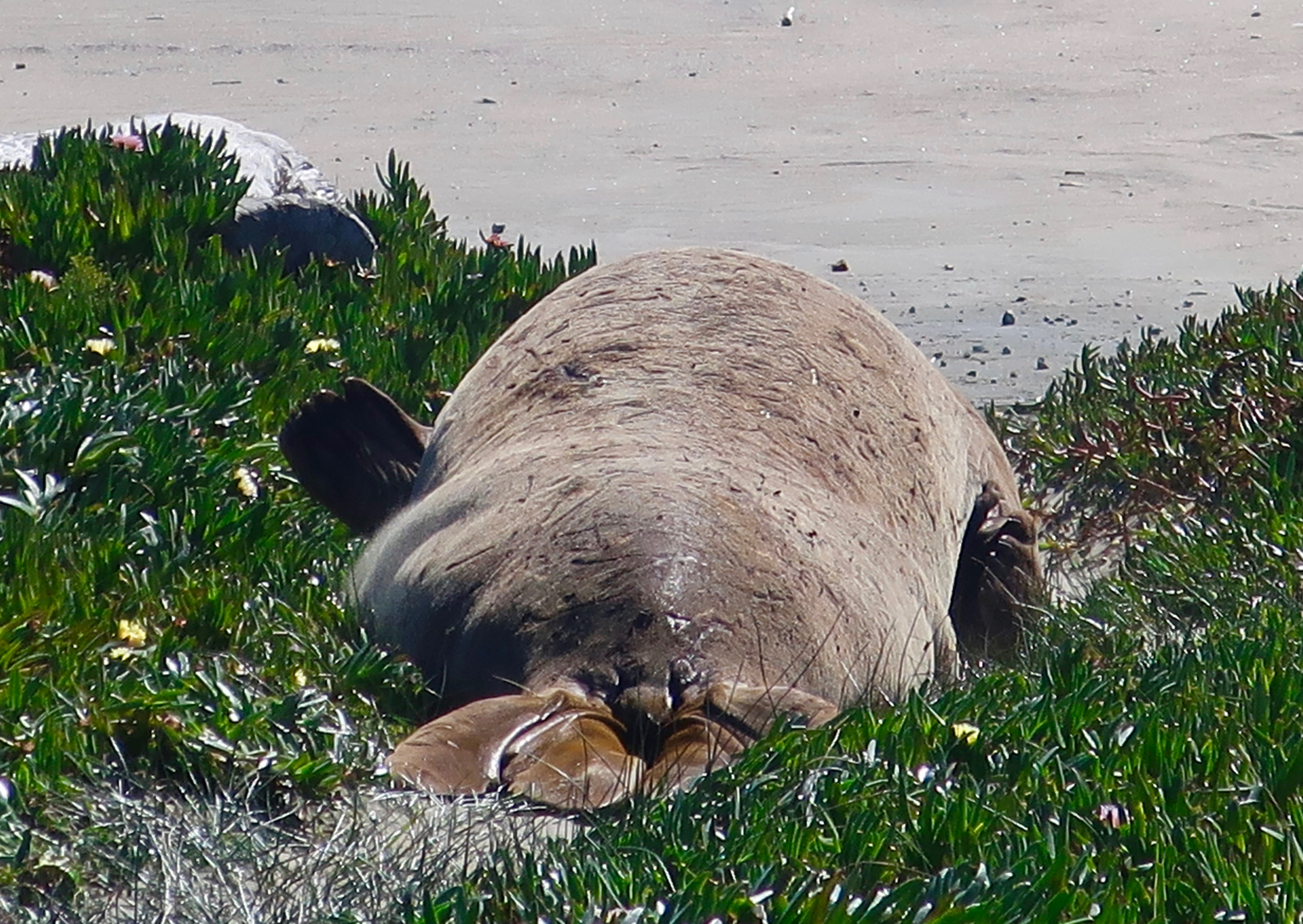
Elephant seals have the look of an animal put together by a committee. It gives them a certain charm. We found this large fellow with his pronounced proboscis at Drake’s Beach. He’d come ashore at Pt. Reyes National Seashore looking for love.

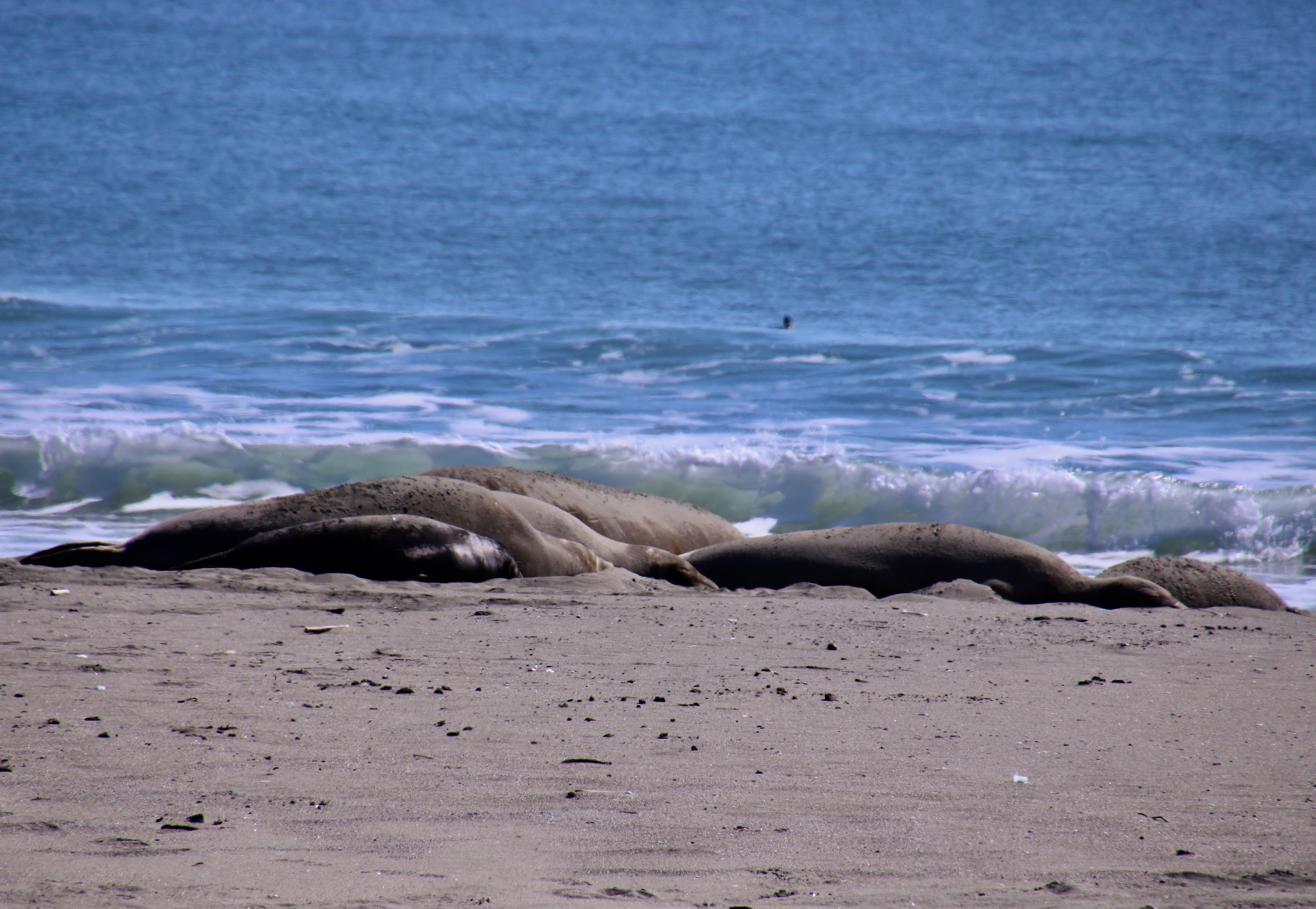
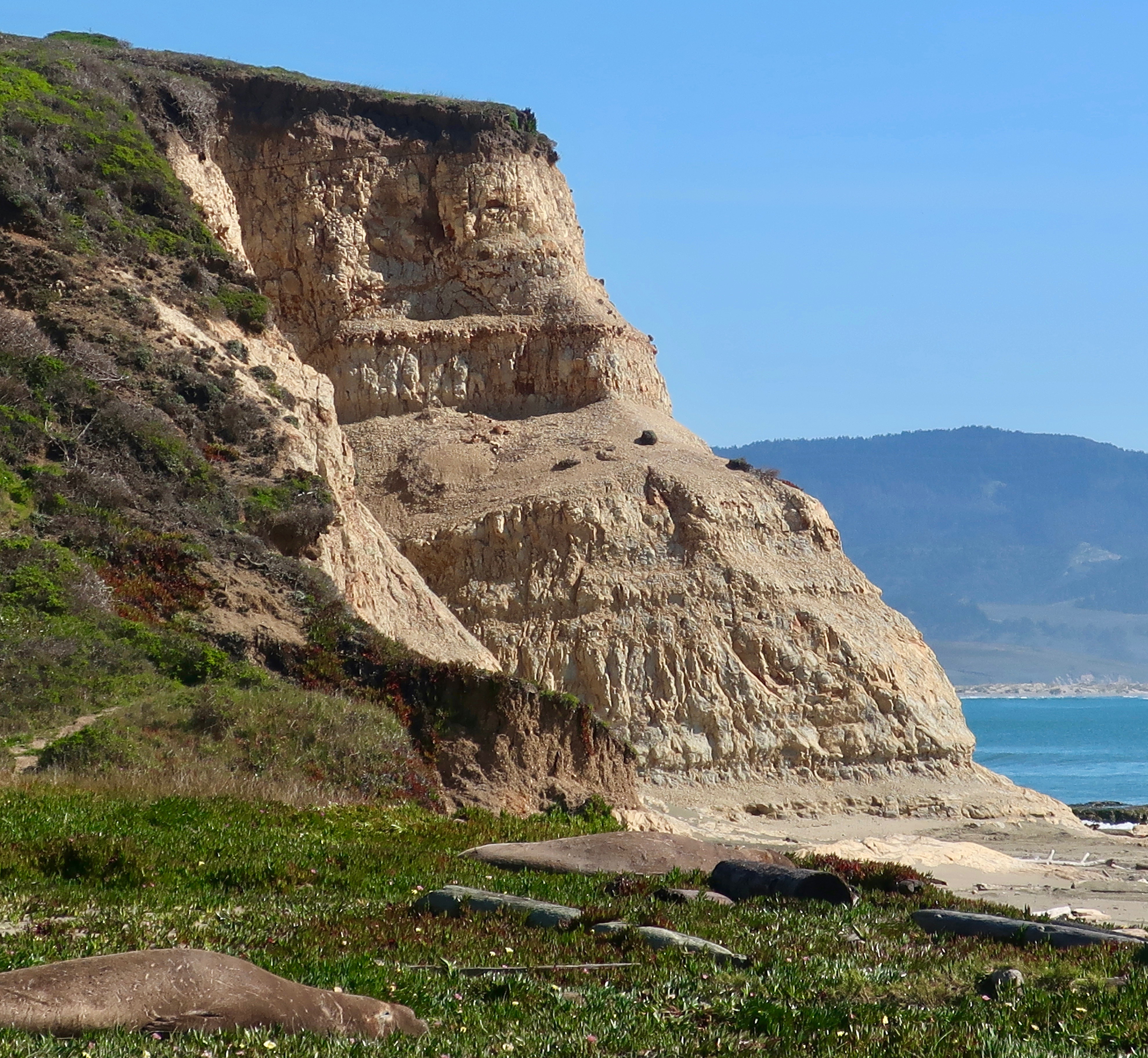
Pt. Reyes National Seashore is located some 30 miles north of San Francisco. Peggy and I went there last week to celebrate my birthday. It’s been a go-to place for me since the 60s. In addition to spectacular scenery, great hikes, yummy food, and one of the best small bookstores I’ve ever been in, we were entertained by the wildlife: tule elk, a pair of sushi eating coyotes, and elephant seals (plus some cows).  Today, I want to do a teaser on our trip by featuring the elephant seals. I’ll get back to the rest after I finish my Harris Beach series. 

Elephant seals are amazing creatures that spend up to 80% of their lives at sea— 90 % of it underwater!  If that doesn’t seem remarkable enough, consider this: their normal dives for food range between 1000 and 2000 feet deep (305 to 610 meters). They can dive for up to an hour and a half before returning to the surface for three to five minutes of breathing. Semi-annual feeding binges take the males on a 13,000-mile roundtrip journey to the Aleutian Islands and females on a 11,000-mile roundtrip into the North Pacific.

They were absent from Pt. Reyes for 150 years. In fact, they were close to absent forever. Like whales, they came close to being hunted to extinction for their oil. Processing the blubber from one bull can produce up to 25 gallons. They were saved because the Mexico and the US banned hunting them in the 1920s. Gradually, they have returned to their old breeding grounds. When I first started visiting Pt. Reyes in the 60s, they were unheard of in the area. Today there are over 3000 that return annually to breed.

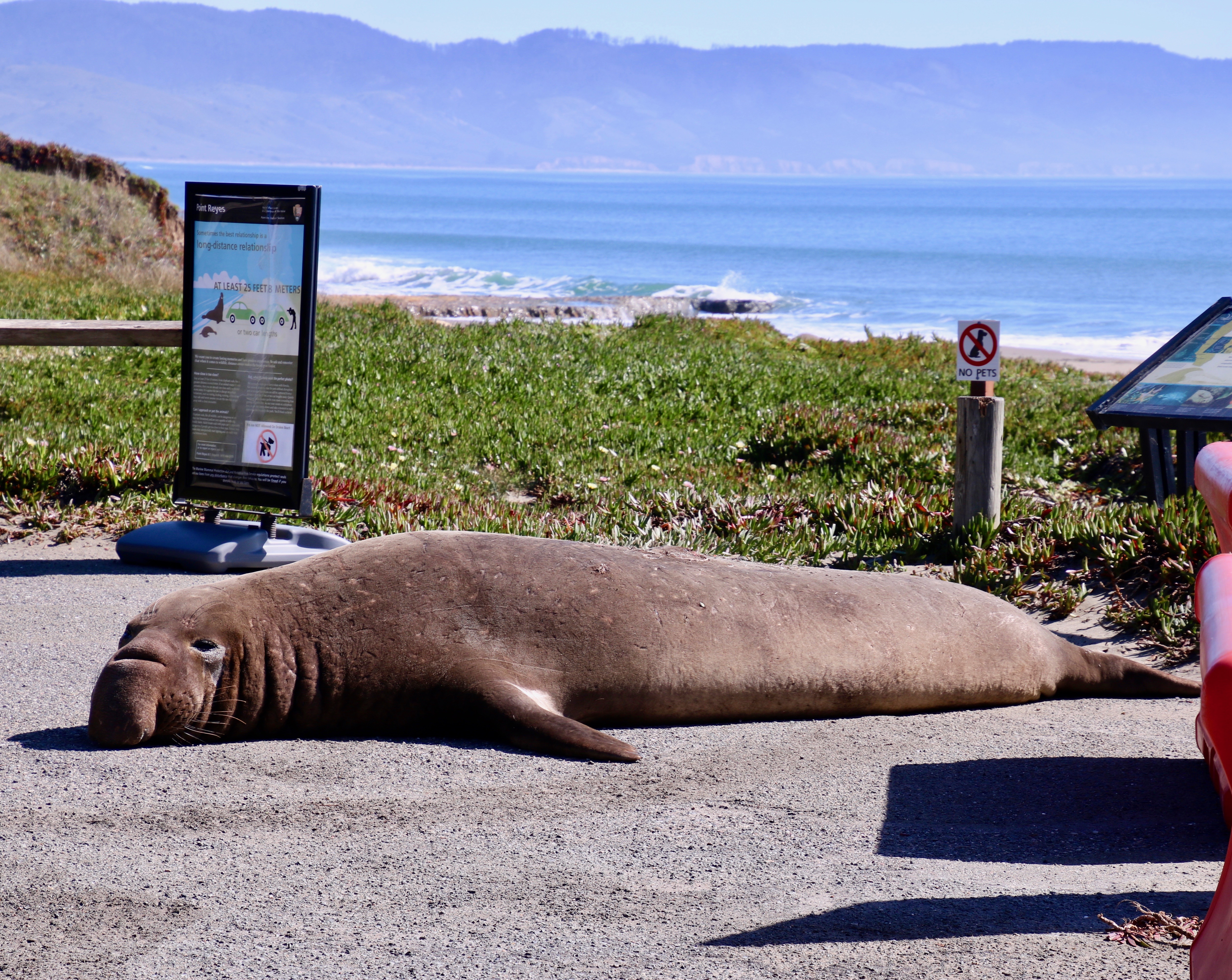
The Park Service had set up a barrier to separate the seals from the people who had come to admire them at Drake’s Beach. Those closest to the barrier were bulls. You can tell by their size and uniquely shaped noses. One had crossed the barrier and was worrying the rangers. “He’s escaping from the other bulls,” a ranger explained. Maybe.

This large bull had crossed through the barriers at Drakes Beach and was pointed toward the snack bar. (Photo by Peggy Mekemson.)

A little girl next to me exclaimed, “I think he is heading to the snack bar to get fish sticks!”

“I’d bet on ice cream,” I responded. “Look at how big he is.” The girl looked at me dubiously. “Fish sticks” she insisted.

Peggy and I spent an hour watching these wonderful creations of nature who are so competent at sea and ungainly on land. They move like an inchworm, using their dorsal flippers to pull their front half forward and then using their rear flippers to push the rest of their body along like a rolling wave. Imagine moving several tons of fat. The ones we watched would make two or three of these moves and then collapse to rest.

Given their trunk-like noses and appealing eyes, Peggy and I were particularly attracted to the looks on their faces.

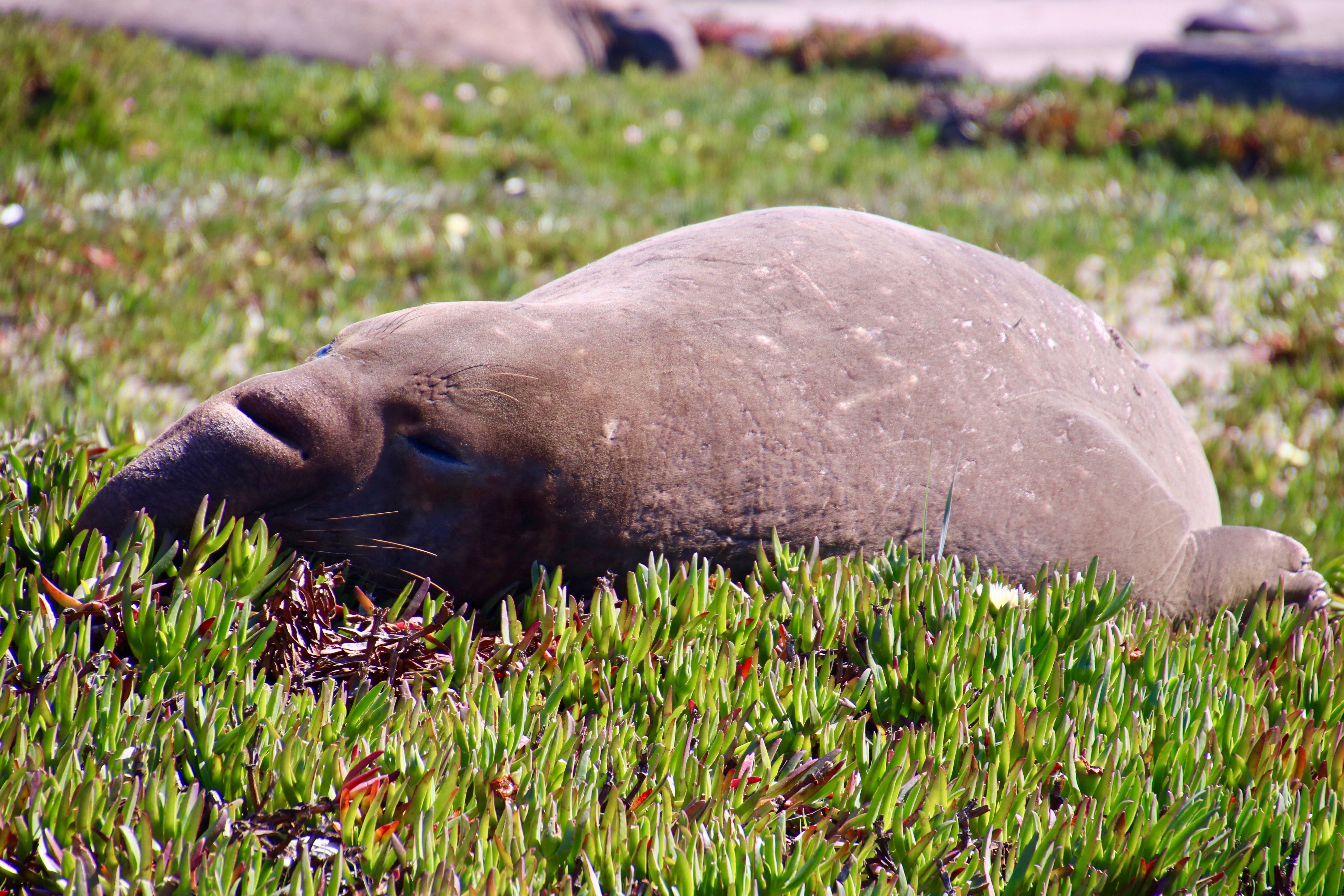
Is this fellow being coy?
Check out the big brown eyes! The size of the eyes helps the elephant seal see in the dark depths of the ocean. The whiskers apparently help as well in the search for food. He had lifted his head to check us out. (Photo by Peggy Mekemson.)
And then returned to his resting position. (Photo by Peggy Mekemson.)
A side glance. (Photo by Peggy Mekemson.)
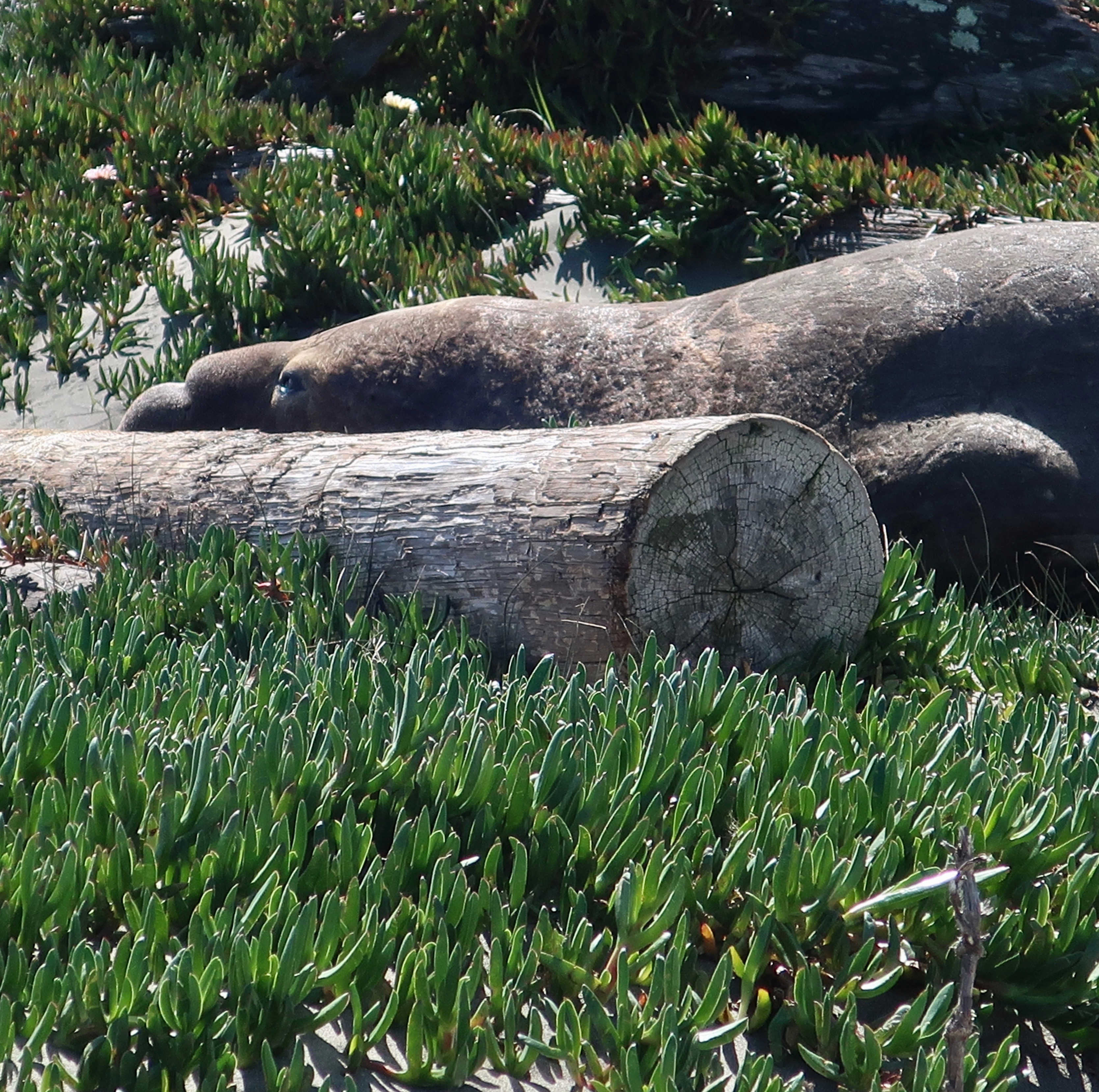
A bit shy, perhaps. Maybe he thought that the log was hiding him.
Size matters. (Photo by Peggy Mekemson.)
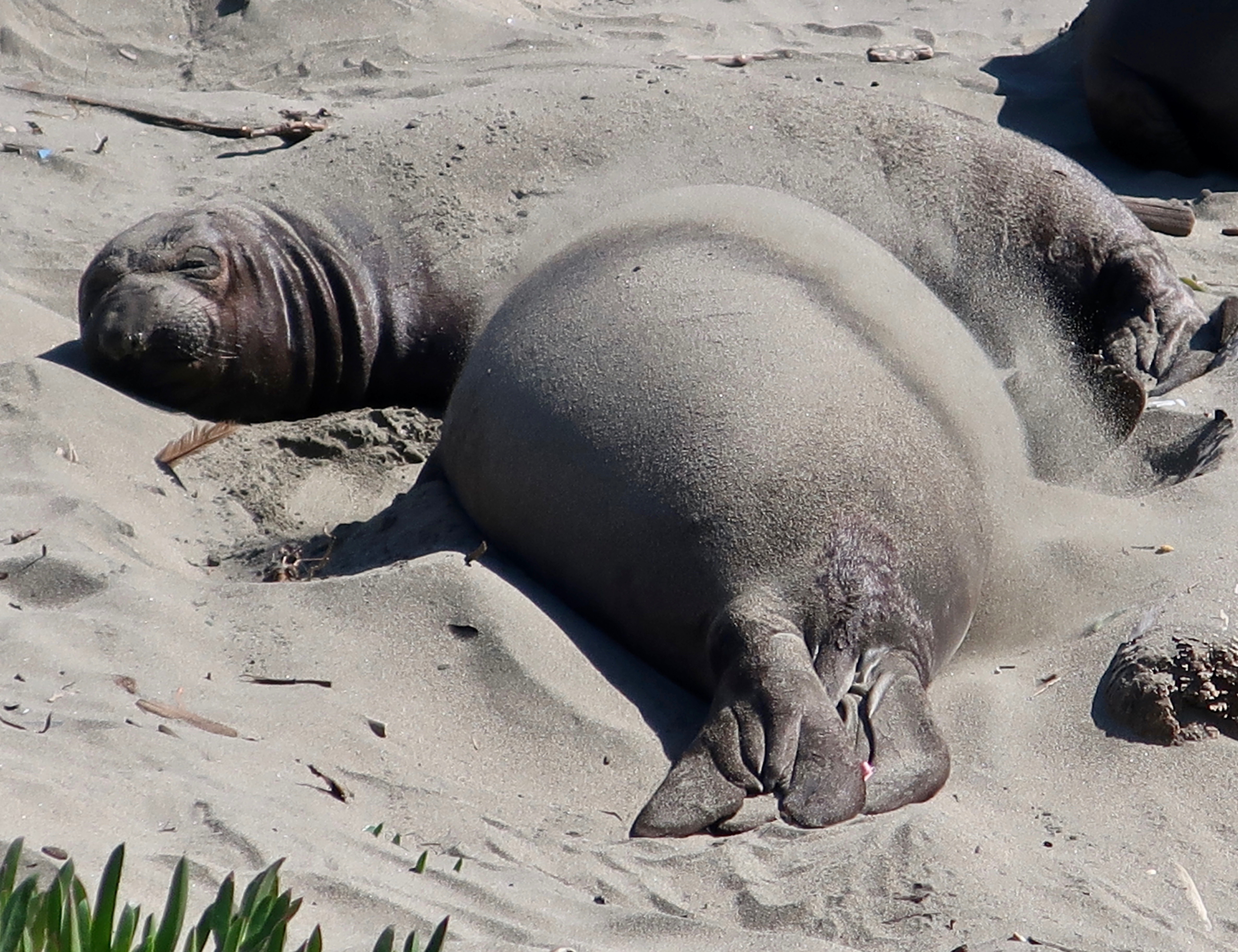
This was interesting. The skin of the elephant seals is sensitive to the sun. They cope by throwing sand over their bodies with their flippers, as seen in this photo.
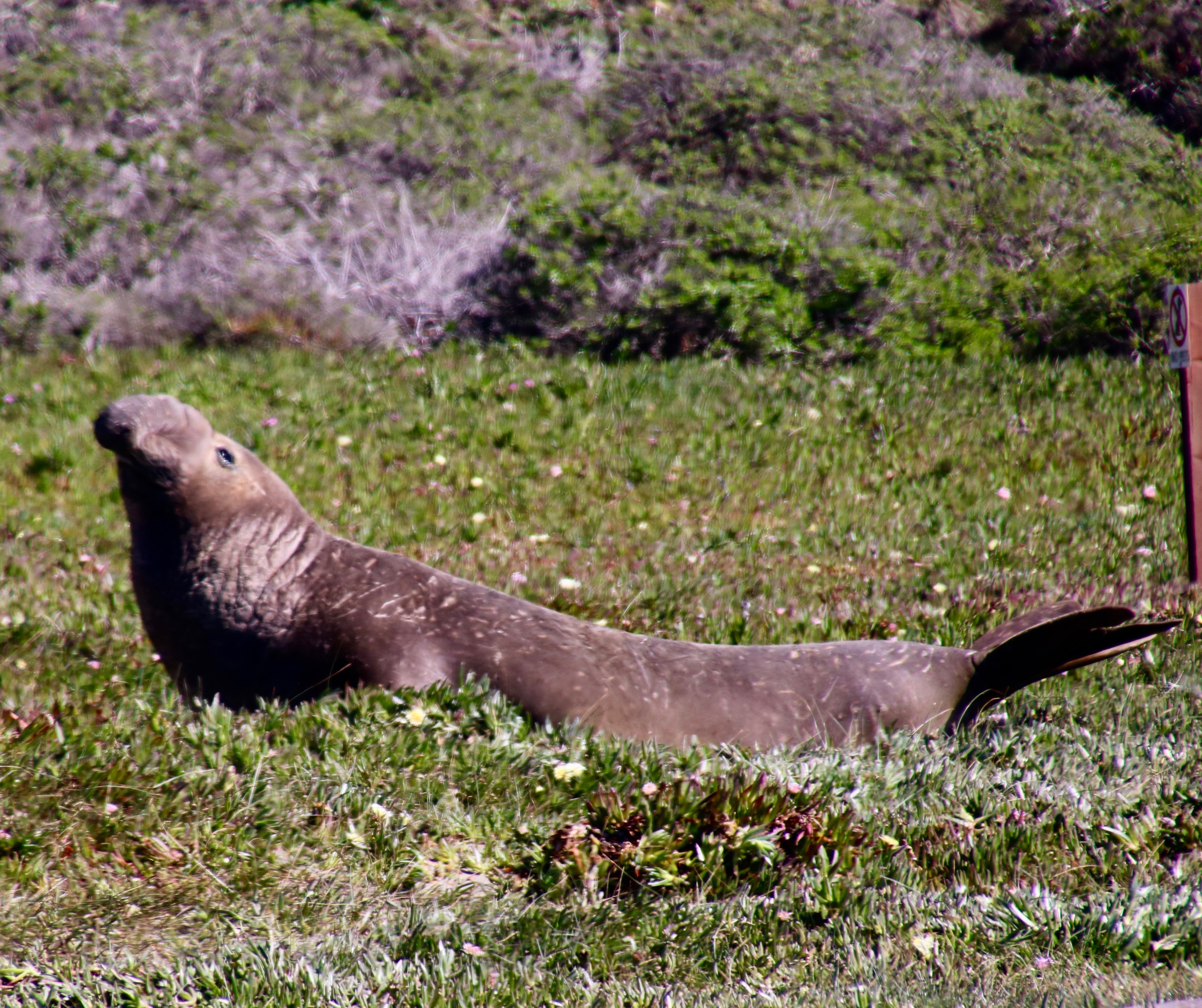
Sometimes a little stretch really feels good! (Photo by Peggy Mekemson.)
Peggy caught some of the girls sunbathing out near the ocean…
Drake’s Bay was named for Sir Francis Drake who reputedly visited the area in 1759. There’s another bull on the left— looking sluggish.
I’ll conclude today with this elephant seal that was making its way back toward the ocean. I decided he was waving goodbye with his flipper. I’ll return to the tide pools of Harris Beach in Oregon next week. Are you aware that groups of sea anemones go to war with each other?

NEXT POSTS:

Monday’s Blog-a-Book… “It’s 4 AM and a Bear Is Standing on Top of Me”: I move outside in the summer to enjoy nature but hire the family’s dogs and cats to protect me from the ghosts.

Wednesday’s Blog-a-Book… “The Bush Devil Ate Sam”: Held at gunpoint, I consider the odds of running over the gunman versus getting shot.