A Beautiful Lake, Fires and Trees… The PCT though Mt. Lassen National Park

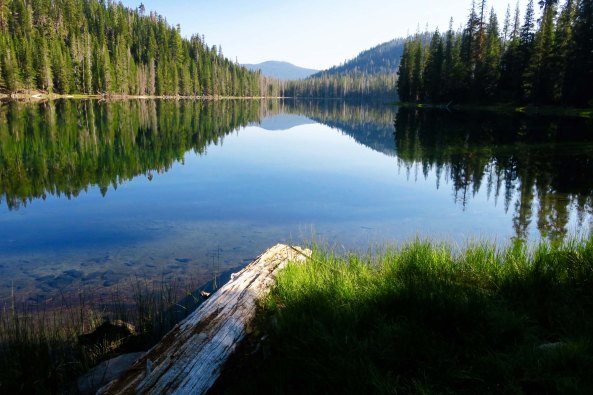
Hiking the PCT is tough, no question about it. But the rewards are numerous. Lower Twin Lake was one such reward. I camped beside it on my hike through Mt. Lassen National Park.

Today, I continue my ramble along the PCT. This time I will finish off my hike through Mt. Lassen National Park. I’ve been posting on our recent trip to Puerto Vallarta. There’s plenty more there, and lots left on the PCT. I intend to continue to mix my posts to provide a variety. And, of course, I am hard at work on my book about this past summer’s adventures and other tales from my 50 years of backpacking. My goal is to have something in hand when I attend the San Francisco Writer’s Conference in mid-February. 

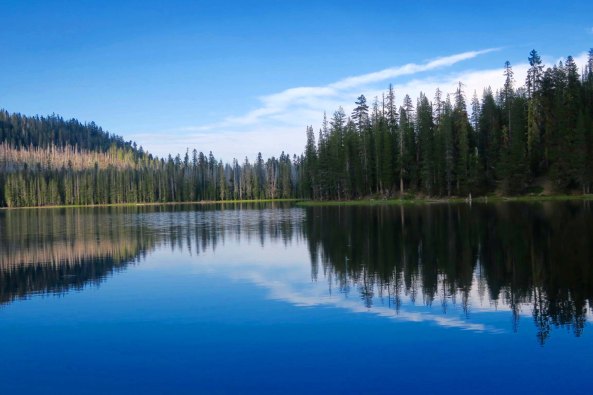
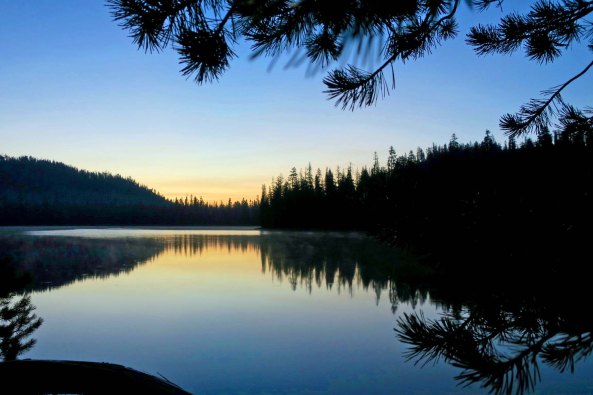
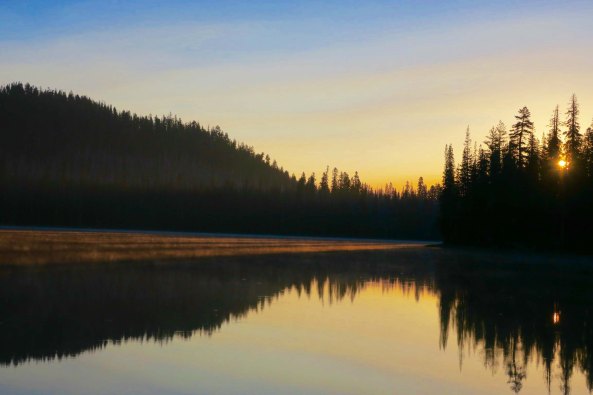
Lower Twin Lake was one of those places you don’t want to leave. I was fortunate to arrive in the afternoon and experience its evening and morning beauty before having to hike on. 

Late afternoon. I came back to camp after this photo and found a chickaree sitting on my journal. I suspect he was more interested in my food than in reading what I had to say. He scurried up a tree and proceeded to scold me for interfering with his search.
Early morning.
The sun comes up. Note the mist rising off the lake where the sun was hitting it. I felt it was almost magical.

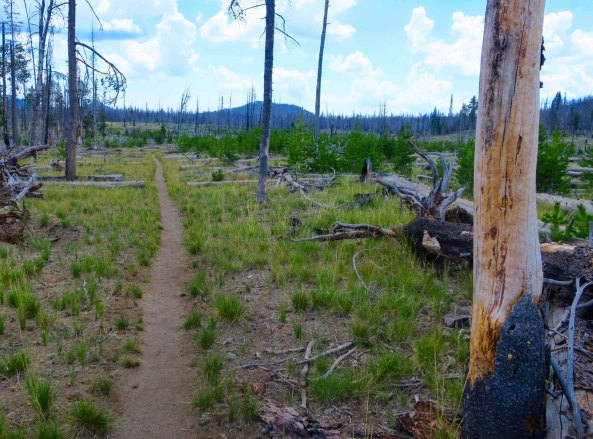
Forest fires had devastated the east side of the park and I hiked for miles through the burned out area, which isn’t unusual for the PCT in these times. Global warming and draught has taken its toll on the west from California, through Oregon and on into Washington, making forests vulnerable. The horrendous Campfire that just caused so much loss of life and property in Paradise, California is one more example. 

Mile after mile of land looked like this on the east side of the park. Not all is bad news, however. Nature is powerful and new growth is beginning to cover the area. This growth supports a substantial wildlife population.
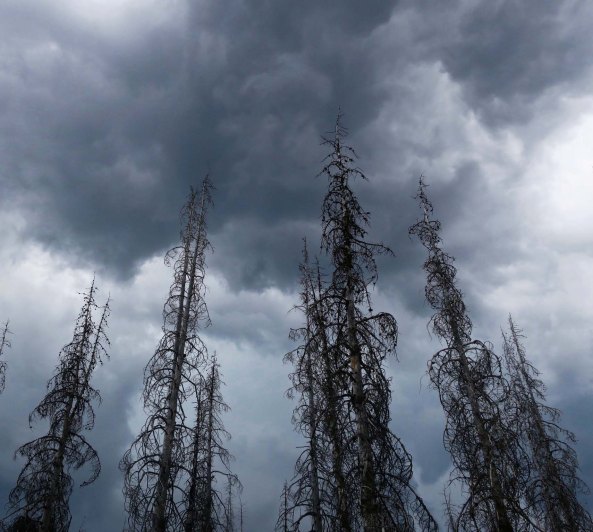
I found this scene beautiful in a threatening sort of way. Dark thunder clouds hovered above drought killed trees. Thunder was rolling across the sky and lightning was striking a nearby mountain. I counted, 1001, 1002…Reaching 1007 means the lightning is a mile away. Once I barely made it through 1001. There is good reason to fear being hit by lightning. There is even more reason to fear that it may cause a fire. These trees would light up like kindling.
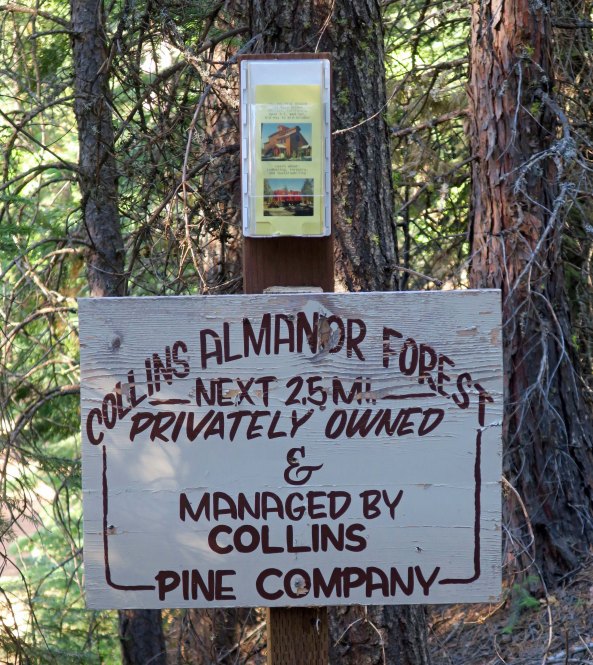
I often here the argument that thinning the trees, i.e. logging, is the solution to forest fires. Mainly it is used as an excuse for more logging. But the Collins Pine Company may actually have a solution. For one, it is committed to selective cutting, leaving a  healthy forest filled with a variety of trees. It also cleans out dead debris lying on the ground and uses the wood to create energy. The debris under the trees is one of the major reasons for devastating forest fires. A group of 50 or so forestry students from the University of California was in the area studying the company’s forest management practices when I hiked through.

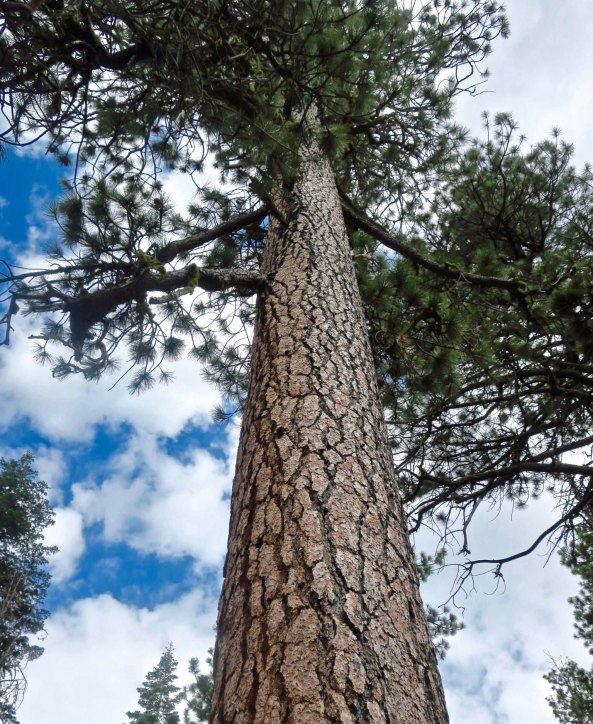
I love trees. Who doesn’t. Here are some of the beauties I found on my backpack trip through Lassen.

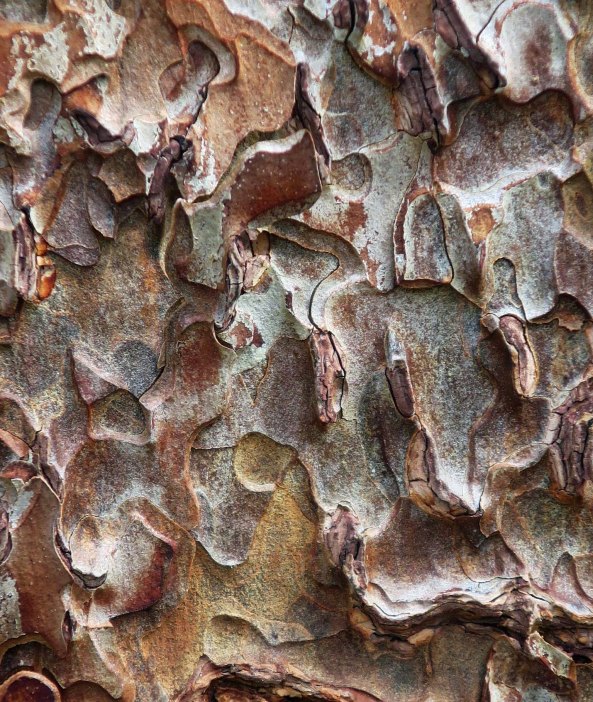
I had lunch under this magnificent Jeffrey Pine.
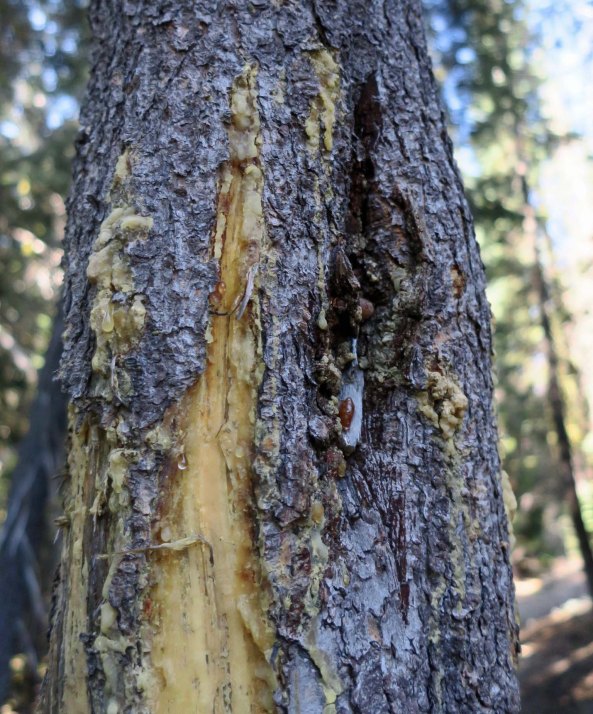
It’s bark resembles puzzle pieces. If you put your nose next to the bark on a warm day, you will be rewarded with a delightful smell of vanilla, or possibly pineapple.
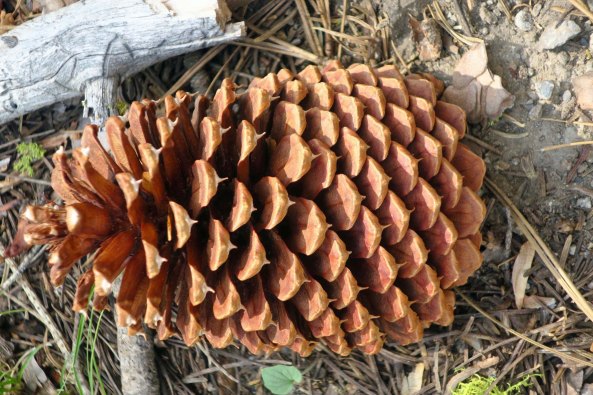
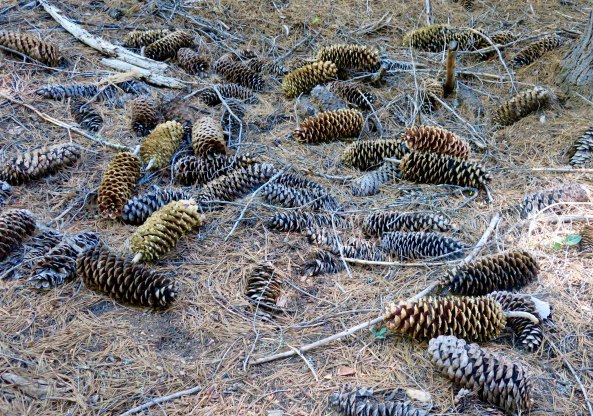
This is one of its gorgeous cones. An easy way to tell the difference between a Jeffrey Pine and a Ponderosa pine is you can pick up a Jeffrey pinecone without pricking you hand. Not so with a Ponderosa pinecone.
The king of pinecones grows on the the sugar pine. Some of these giants were approaching 20 inches in length. You don’t want to be standing under a sugar pine when a squirrel is harvesting its cones! Pine nuts from a sugar pine are delicious, however, and easily cracked. Ask the squirrel.
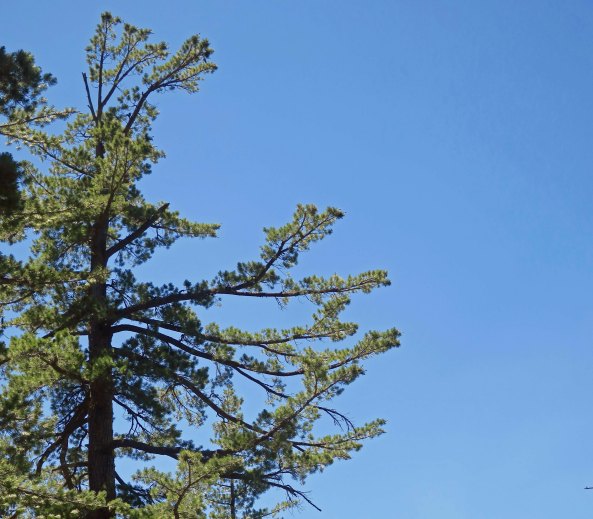
Sugar pines reach high into the sky and have wonderfully wild limbs.
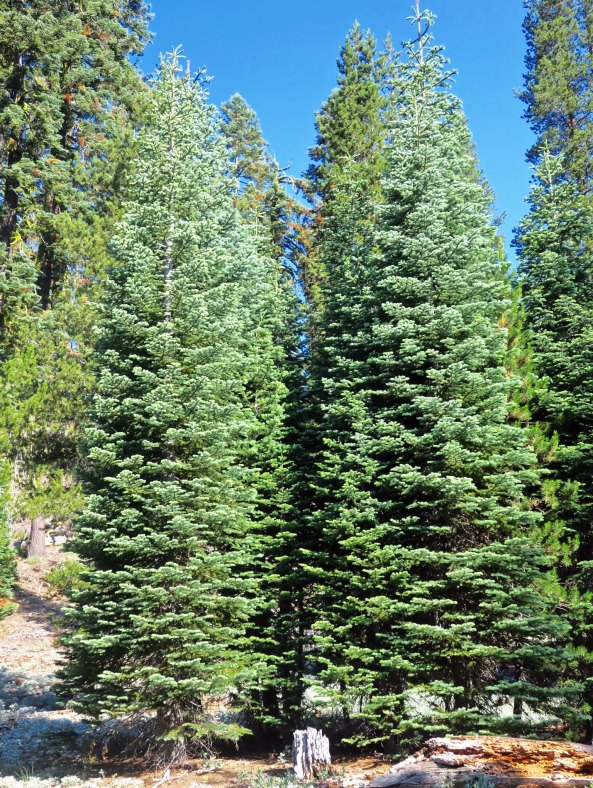
Unlike these two fir trees that were practicing close to perfect symmetry.
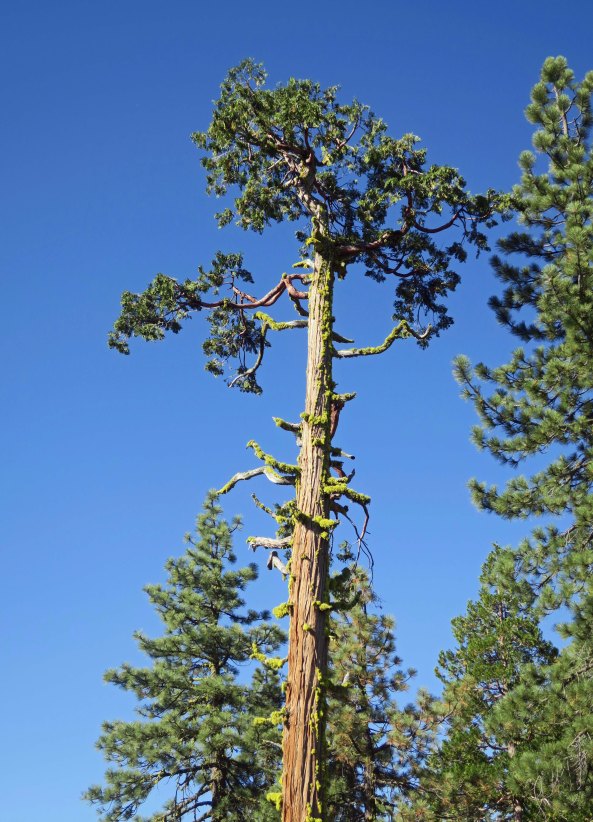
Cedars also provide forest giants.
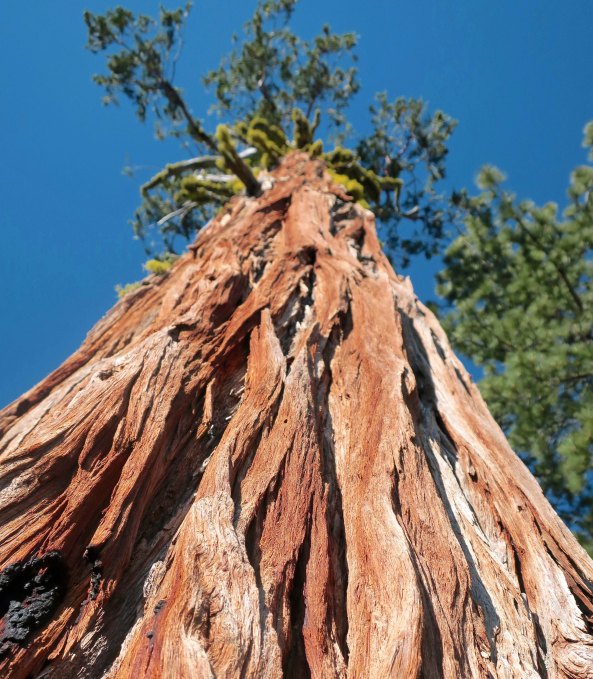
Here’s a view looking up at the same tree. 

I met lots of through hikers in Lassen Park. The halfway point between Mexico and Canada is just south of the park. Hikers needed to be in the area or through it when I was there if they hoped to complete their hike during the 2018 season.

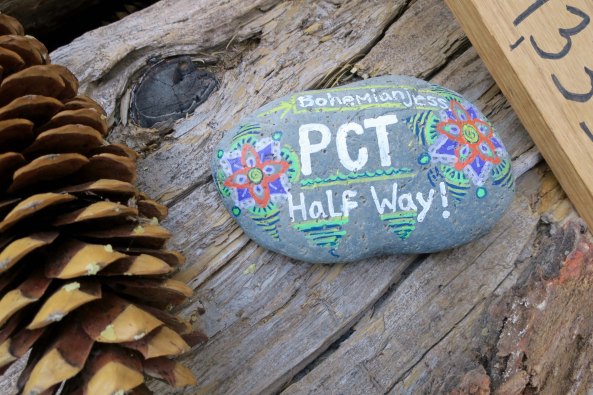
A stone left behind by Bohemian Jess near the town of Chester marked the halfway point on the PCT.
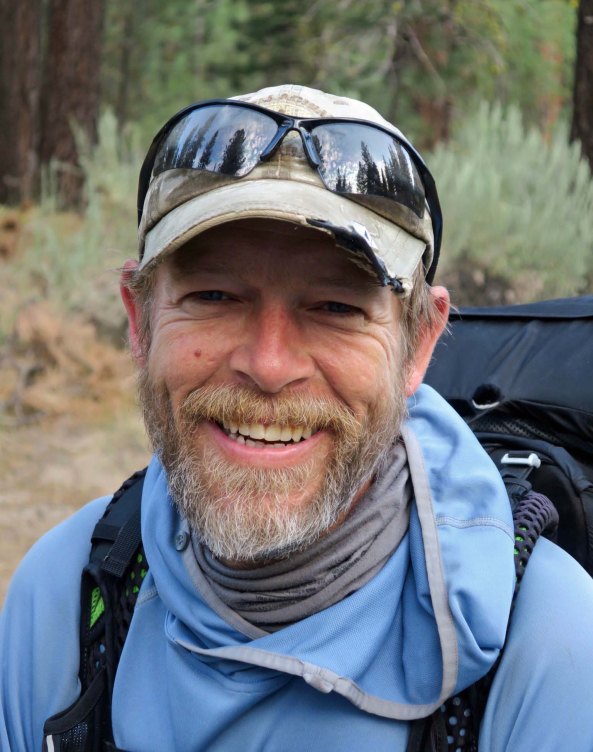
I met Hillbilly when Peggy dropped me off at the trailhead. She enticed him over with an apple. He lived in North Carolina near the Appalachian Mountains that gave birth to the hillbilly name, but he was far from being one. His name was Bill and he lived in Chapel Hill. Thus the name. He owned a company that installed solar farms. Bill had already hiked the Appalachian and Colorado Mountain Trails. Like me, he preferred to camp alone, away from the noise and partying of younger hikers.
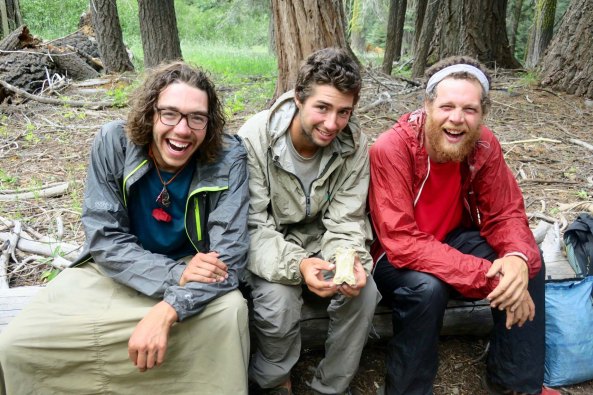
There was no chance of escaping from trekkers at Boundary Springs. (So named because it is located on the southern boundary of the Park.) It was a major source of water. These three camped next to me, so Bone came out to visit with them. They were quite amused. From left to right their trail names were Too Slippery, Bottomless, and Bodhi. Slippery and Bottomless were friends from Truckee, CA. Bodhi was a meditating type of fellow.
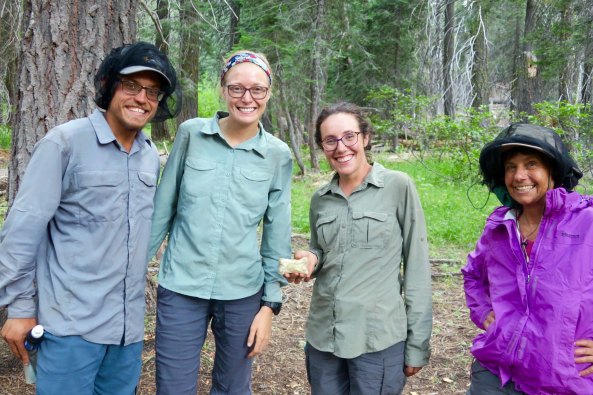
Shrek, Pepper, Bessie (the cow) and Chewy were also camped within about 30 feet. So, Bone had to visit them as well. I’d found Chewy looking for a lake where there wasn’t one, even though her map and a ranger had said there was. She had followed me down to the spring to get water.

Here are a few other photos to wrap up my trip through this section of the PCT.

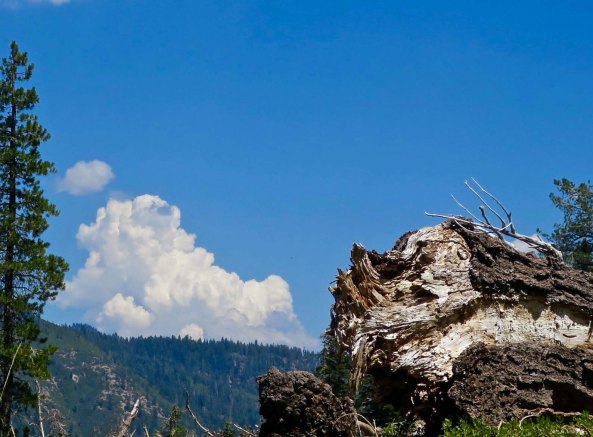
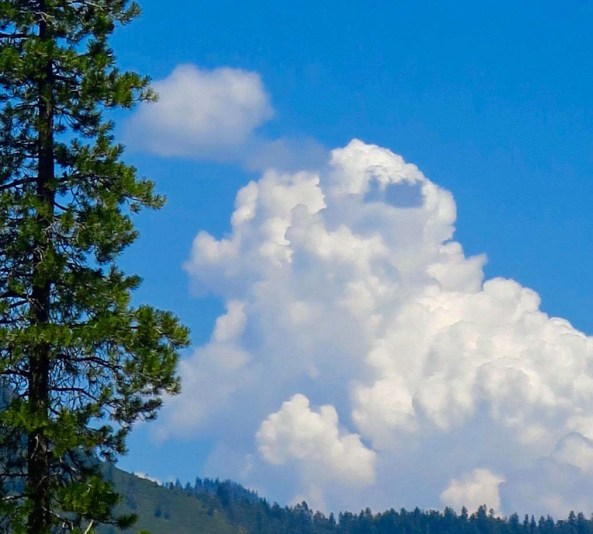
A snag and a thunderhead.
A closer look at the thunderhead.
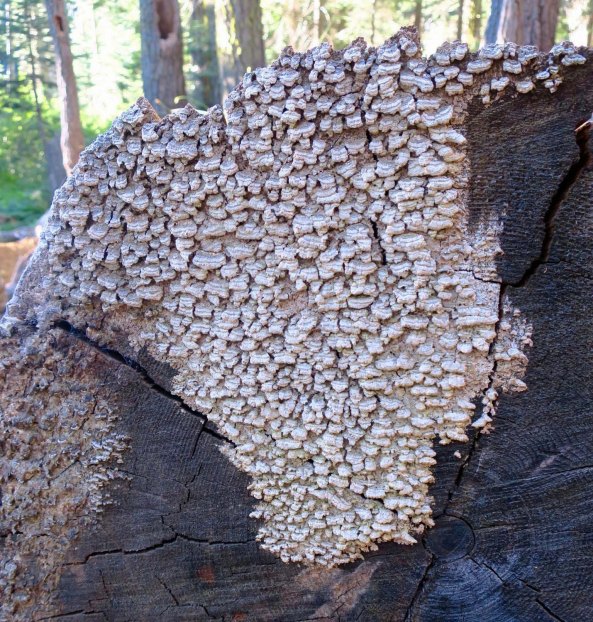
I found this fungus growing on a sawed log interesting.
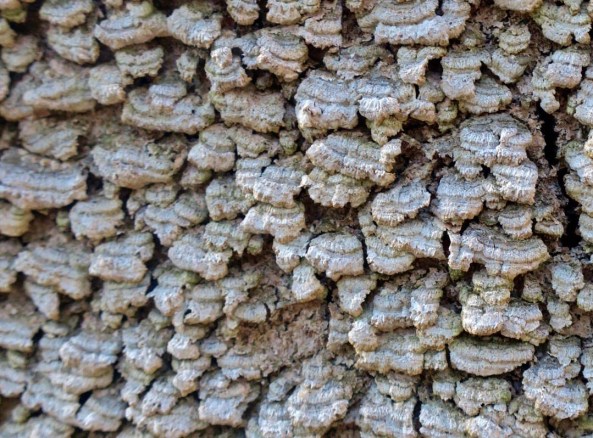
What the fungus looked like up close.
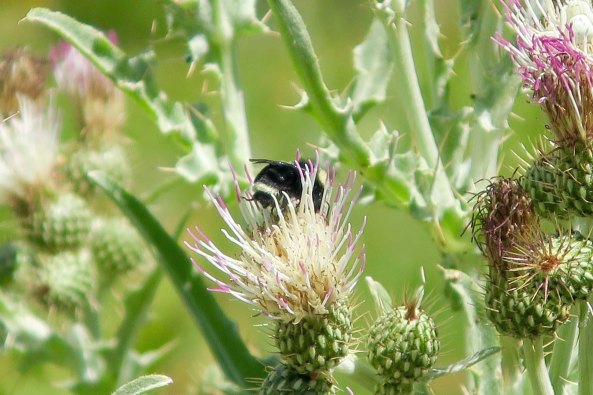
A bee hung out among some thistles.
A bear left his claw sign for me to see…
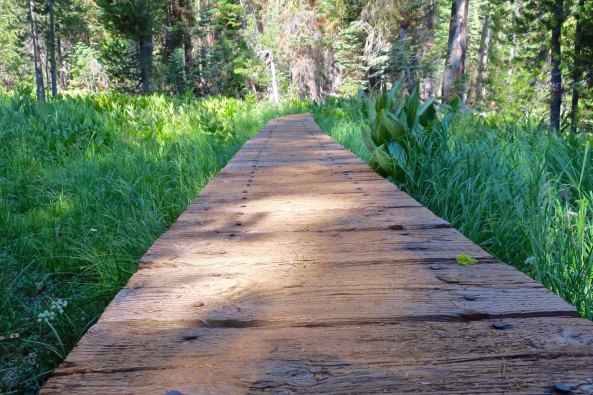
You know you are in a National or State Park when walkways are built across swampy areas.
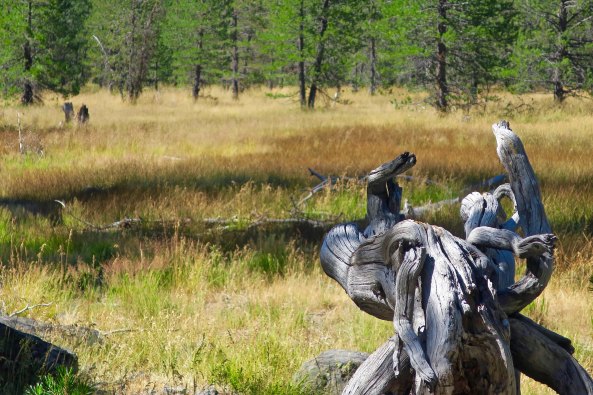
This meadow reminded me that summer was nearing its end. So I will stop here for the day.

NEXT POST: A very strange pelican. And some iguanas.

Weird Things— and Unique Furniture… The Furniture Mart Of Puerto Vallarta

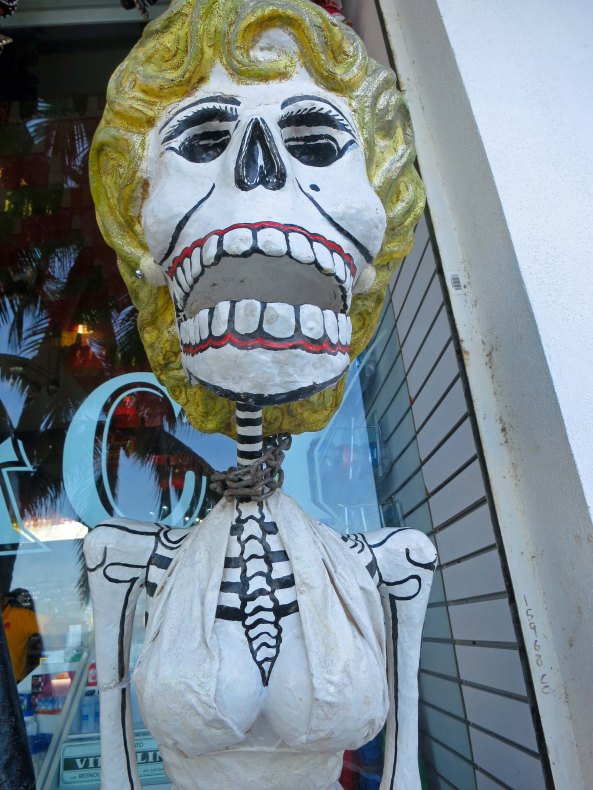
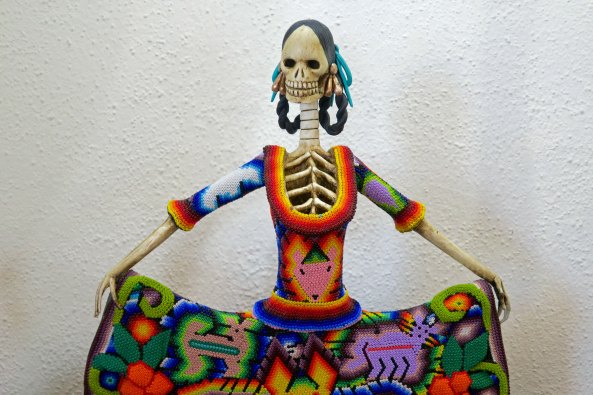
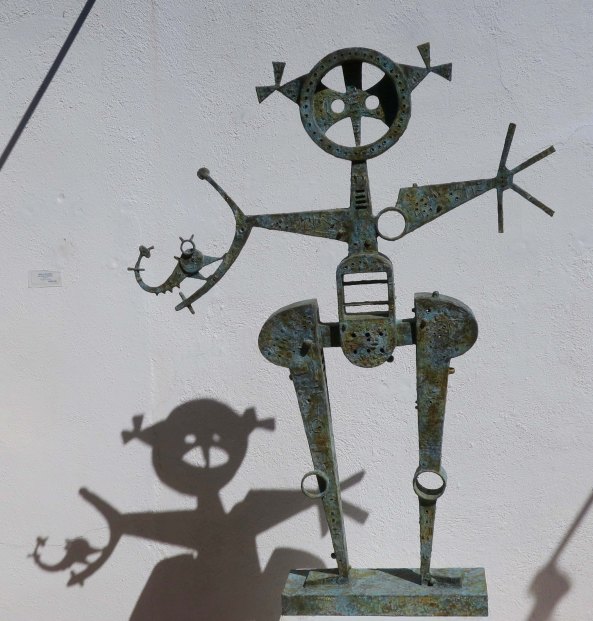
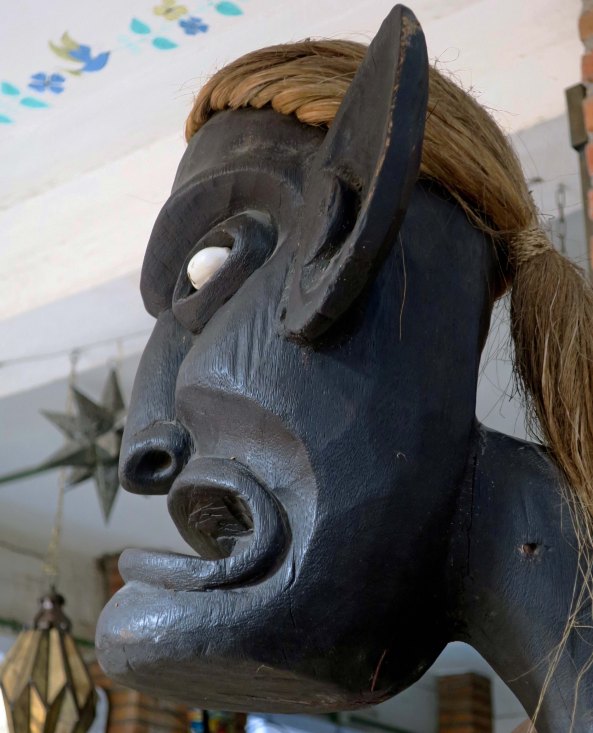
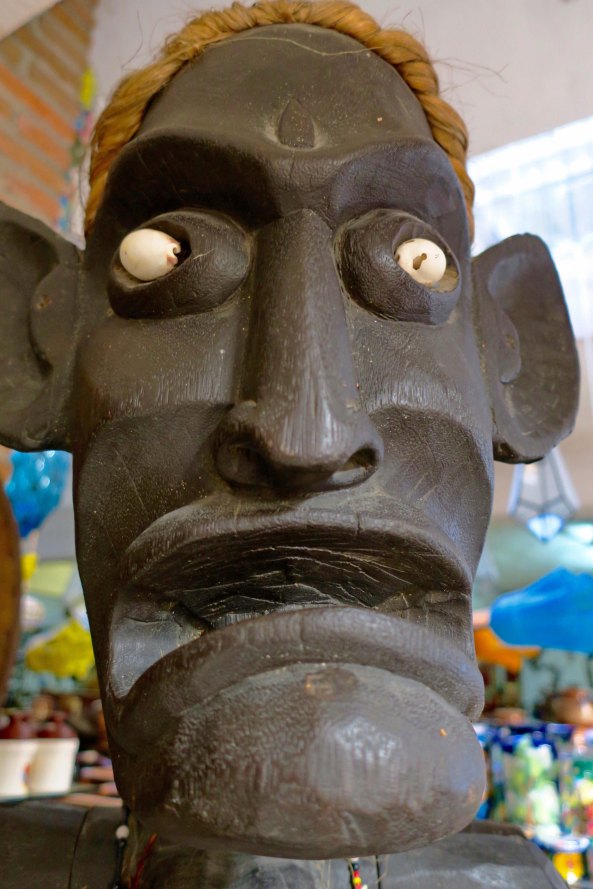
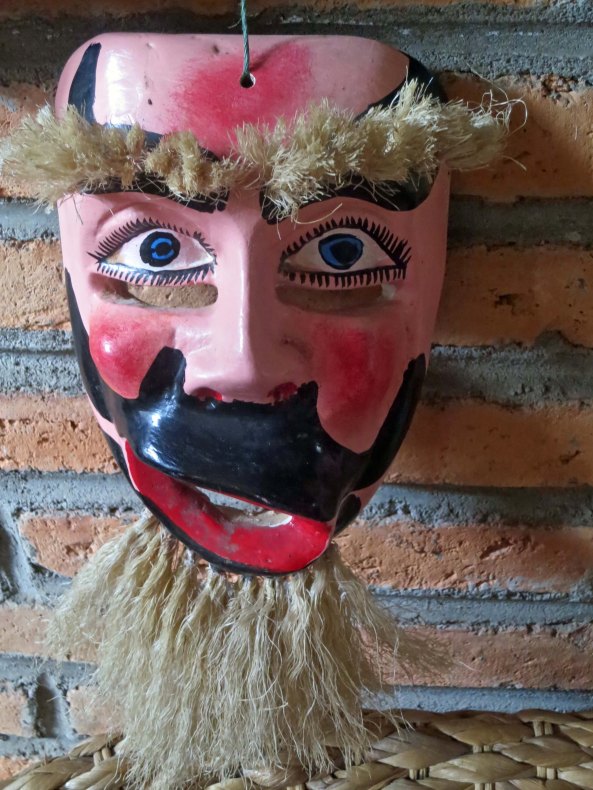
I promised some weird things I found at the Furniture Mart in Puerto Vallarta. I think this guy qualifies. Maybe his weirdness  goes along with having fake, orangish hair. (grin)

Peggy and I have now returned from our trip to Puerto Vallarta. It’s always a good source for blog material. Today, I am going to wrap up our visit to the Furniture Mart, which was right across the street from our hotel. Later I will have several more blogs on PV’s burgeoning art scene as well as get back to a couple of my favorite animals: pelicans and iguanas.  I was amused by both the weird things and unique furniture at the Mart. Enjoy. (Note: Some of these photos came from an earlier visit in 2015.)

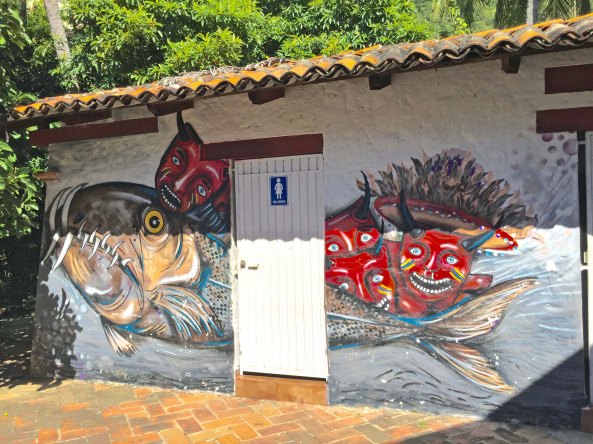
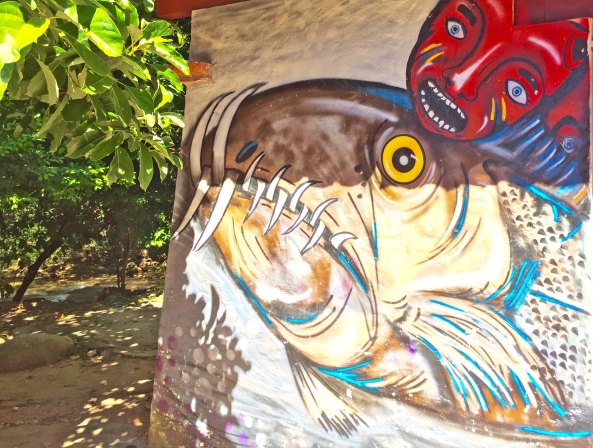
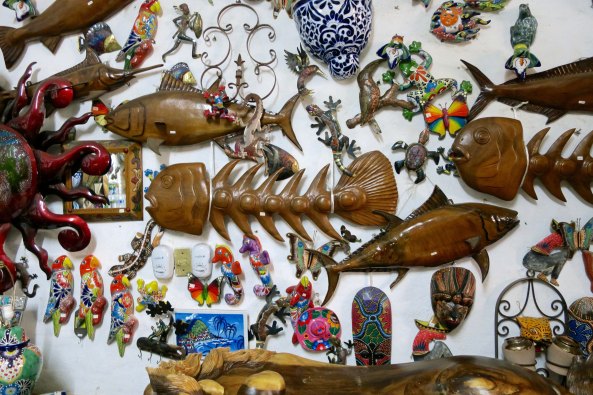
Do you think that the Furniture Mart could have hung more things on its walls? And do you find the bony fish as amusing as I did?
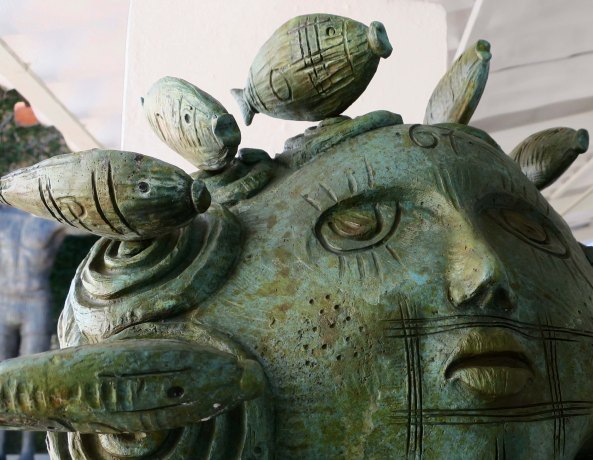
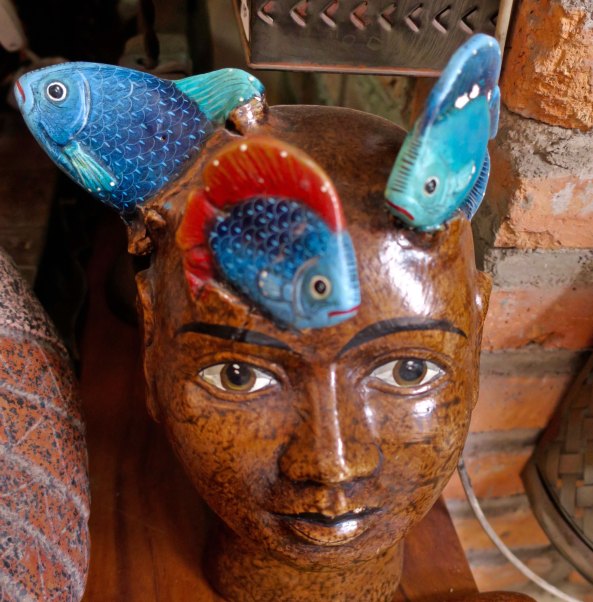
Speaking of fish, I suspect these  gave this guy a horrendous headache. I’m pretty sure there is a myth here, but I don’t know it.
Here’s a front view of the fellow I introduced at the top of the post. He’s still scary.
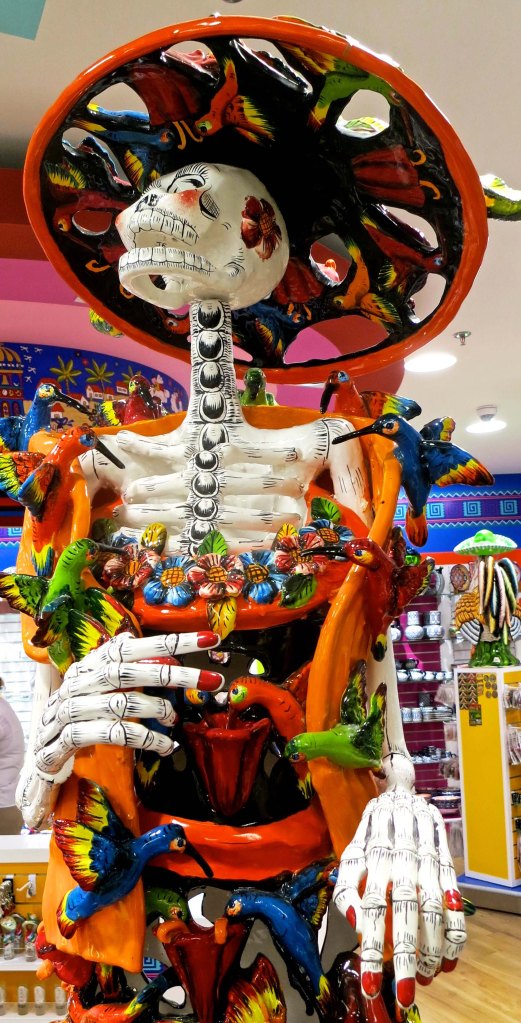
Not so scary, but still not someone you would want to meet on a dark night. Check out the eyes. The teeth remind me of piranha that Peggy and I caught on the Amazon River— and ate. 
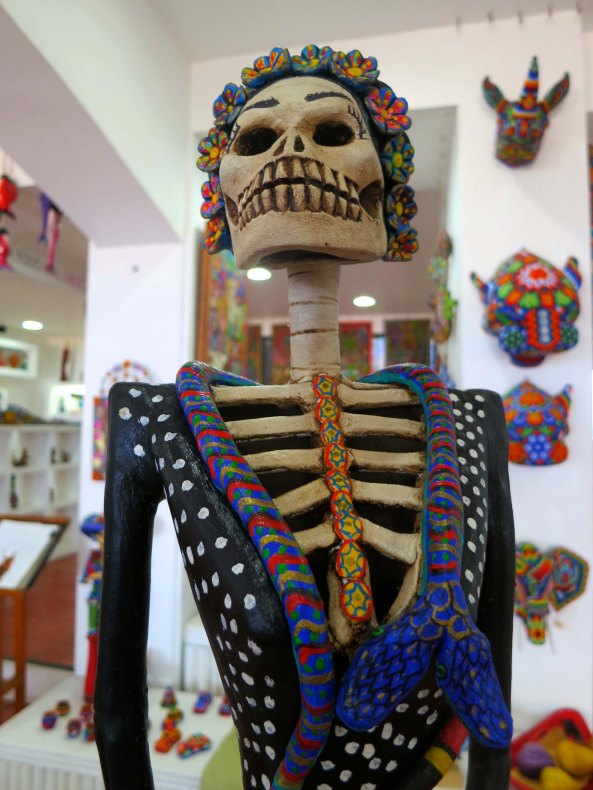
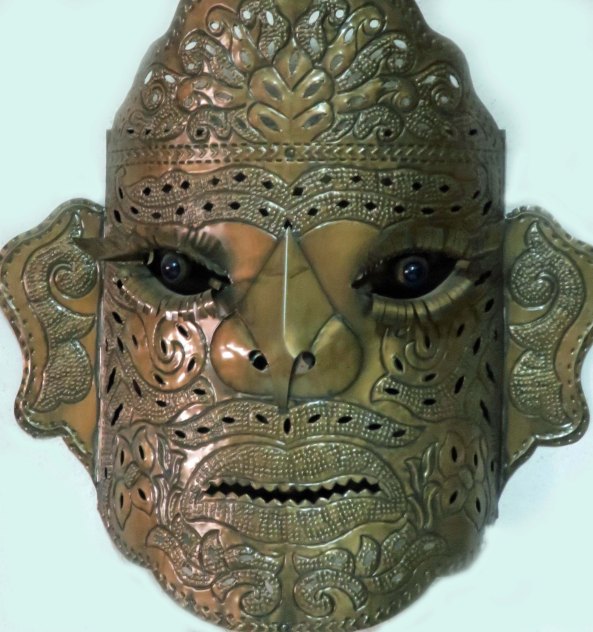
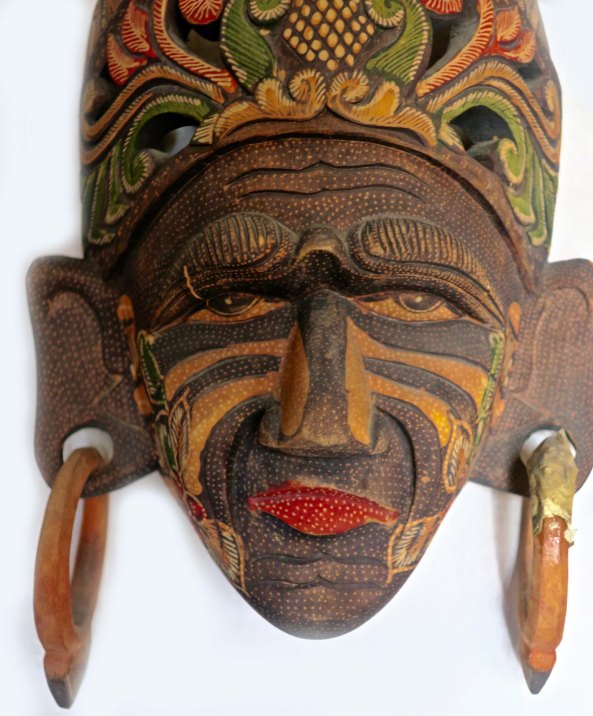
I found these masks more intriguing than frightening. The blood shot eyes suggest a long night of partying.
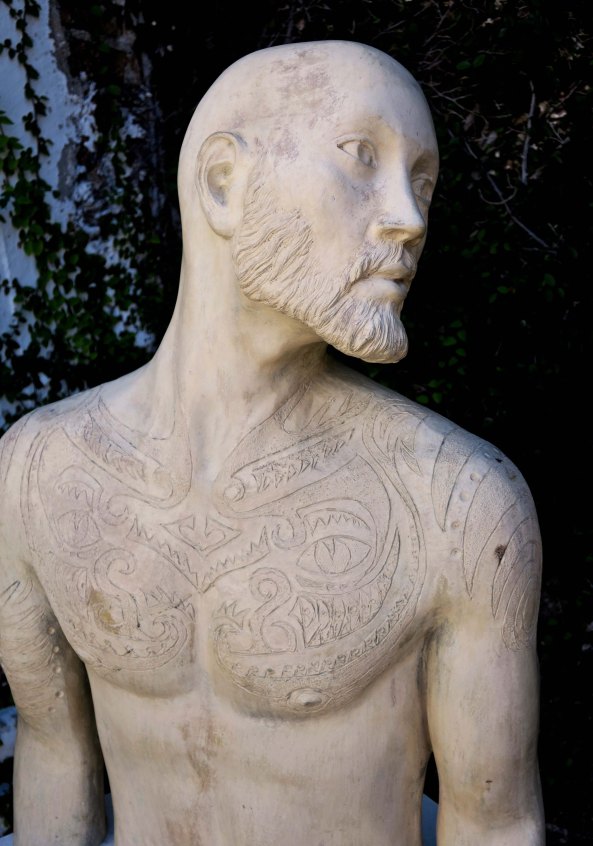
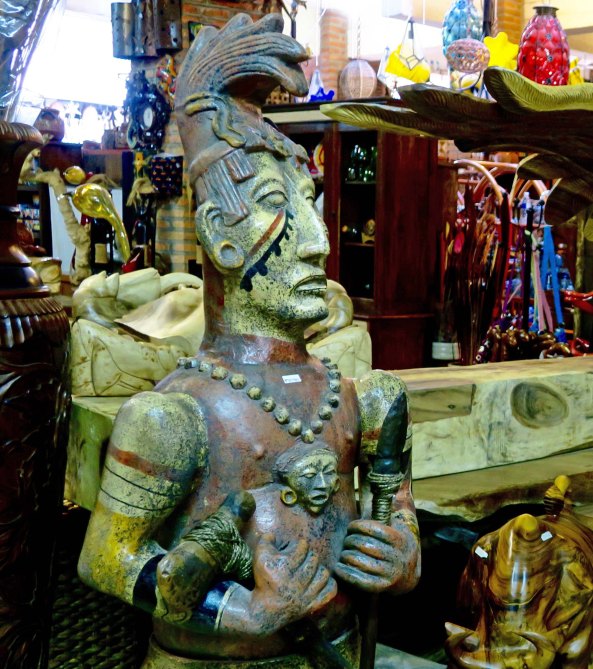
I think that this is a Mayan warrior. There were several life-size sculptures like this scattered throughout the store. Is he holding a monkey or a baby?
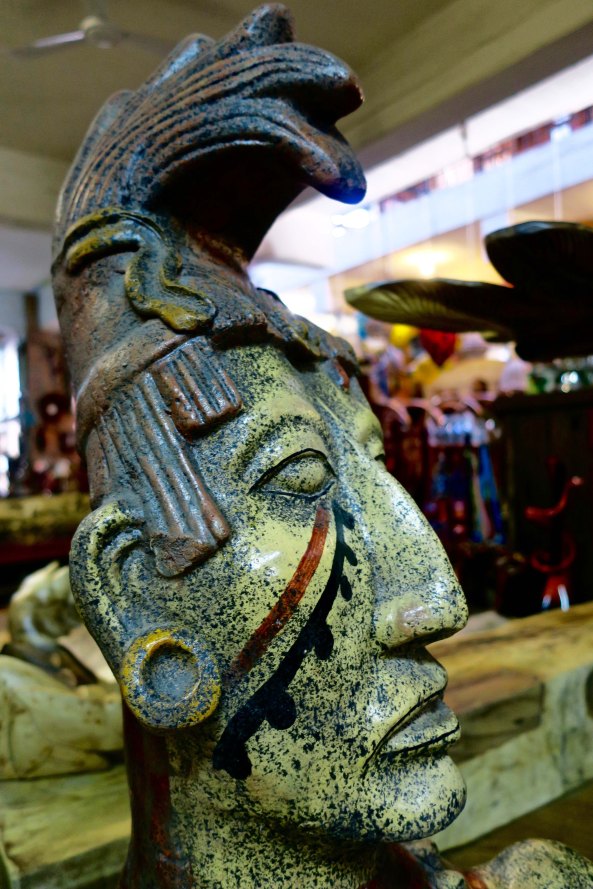
A close-up of his head.
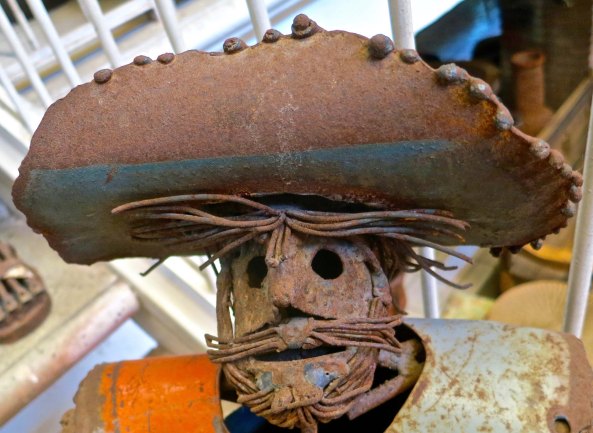
Senior Metal Head had wild hair and a wiry mustache.
But his eyebrows and beard were no match for Senior Rope Hair.
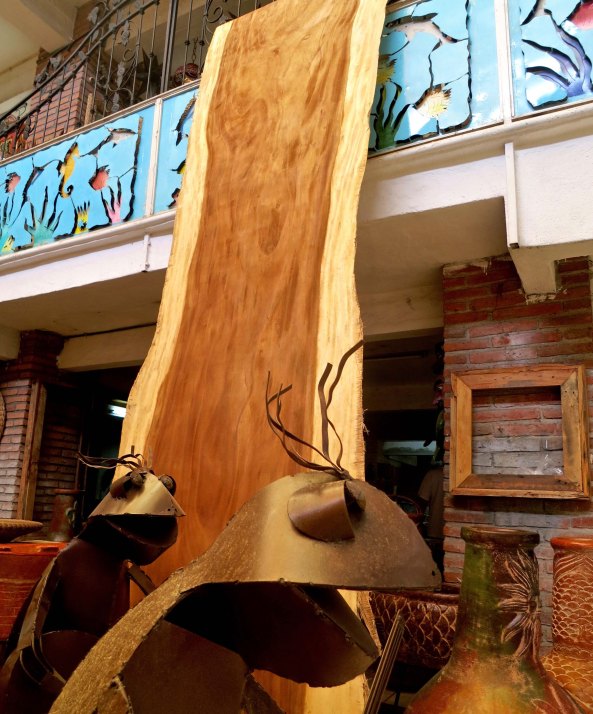
As one might imagine, you can find a lot of furniture in a Furniture Mart. This 20 foot table cut from a single log is an example. It appears that the two frogs were impressed.
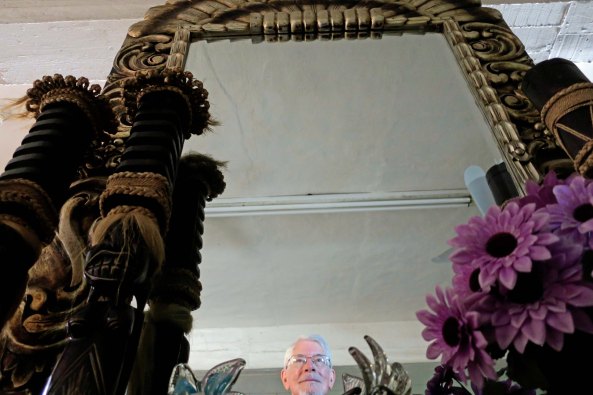
I decided that a large mirror would serve for a selfie. I look appropriately small.
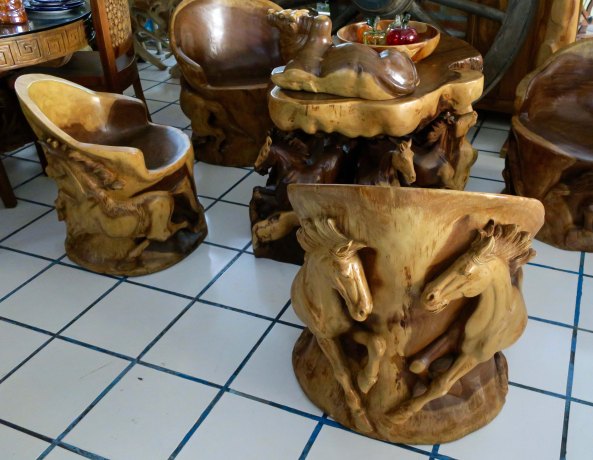
How about carved wild horses for a table and chairs?
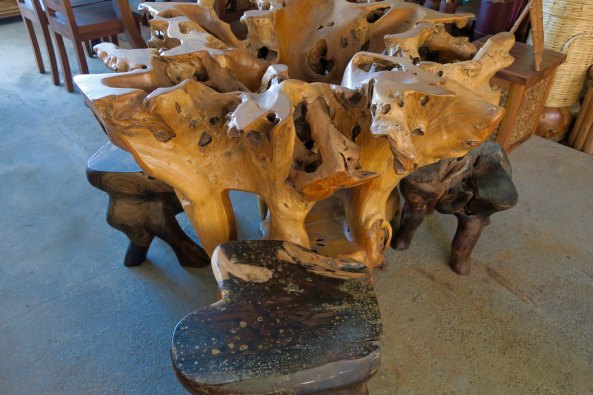
This table was made by cutting through roots of a large tree root. It will be covered with a glass top, I assume.
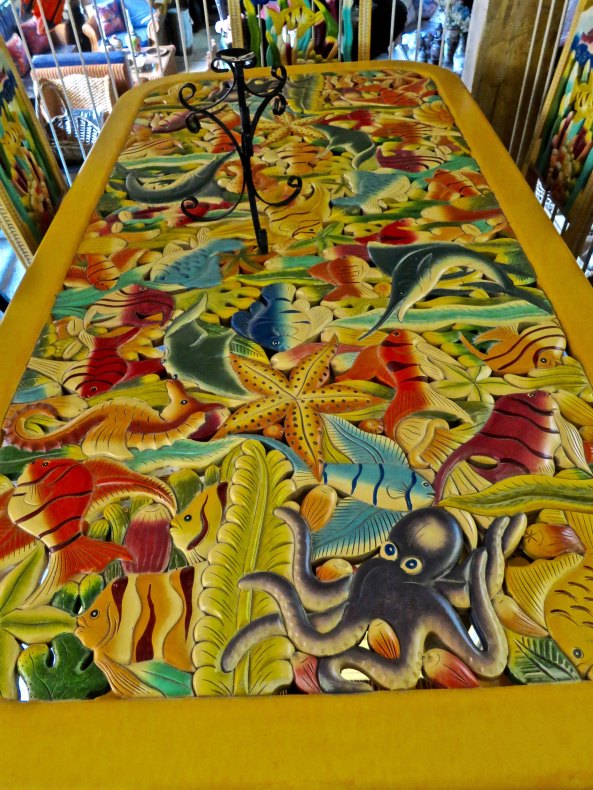
This table featured a colorful, carved ocean scene.
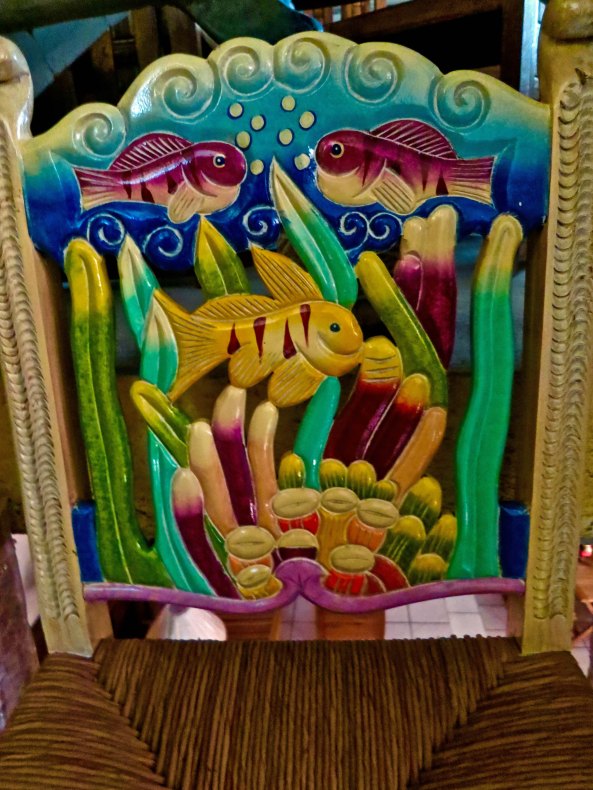
Matched by the chairs.
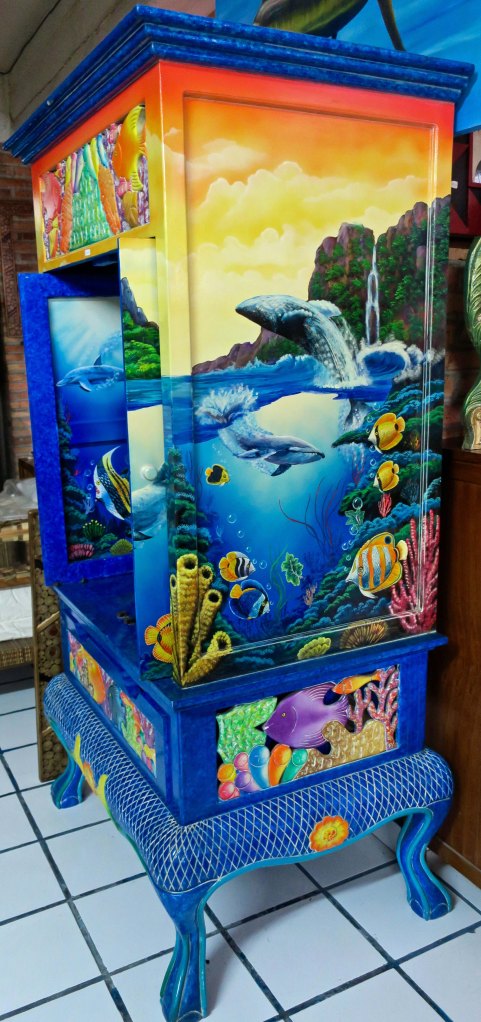
This cabinet, featuring a painted ocean scene, was also quite impressive.
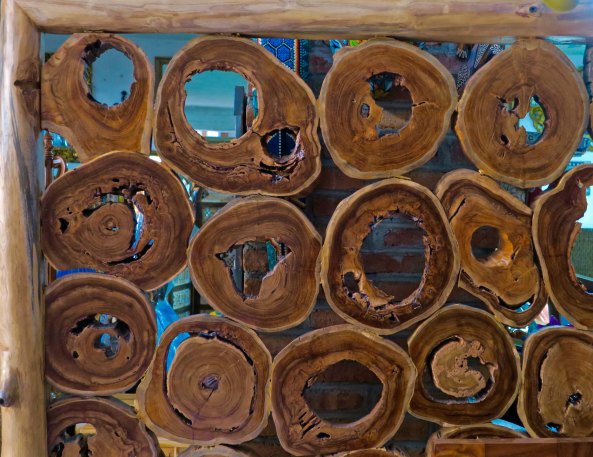
A room divider…
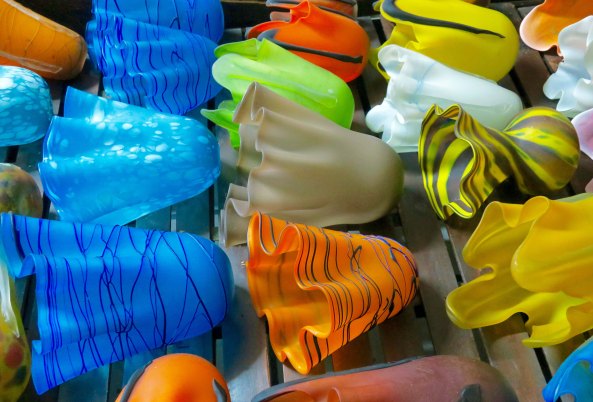
As I mentioned in a previous post, the Furniture Mart is a family affair. 85-year-old Grandpa makes these attractive glass lamp-shades.
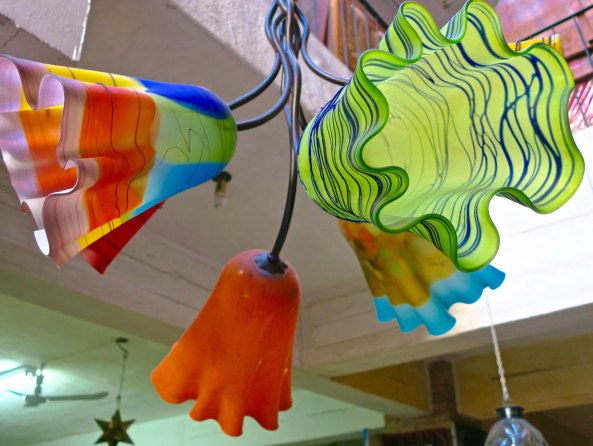
I’ll conclude with an example of the lamp shades being used in a chandelier. My next post on PV will include pelicans and iguanas, but first it will be back to my hike down the PCT.

NEXT POST: A beautiful lake in Lassen National Park along the Pacific Crest Trail, plus Bone makes some new friends.

Furniture Mart or Zoo or??? … The Art of Puerto Vallarta

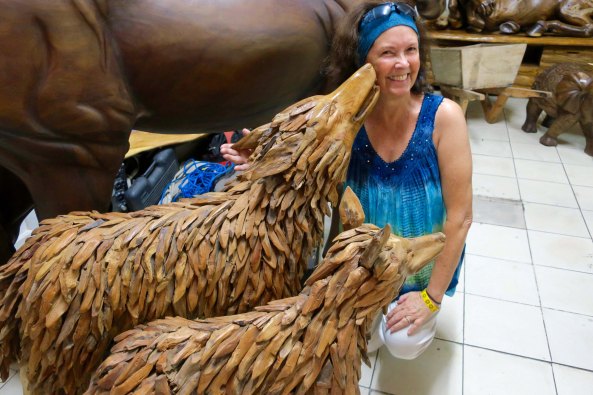
A friendly wolf licks Peggy’s face at the Furniture Mart in Puerto Vallarta.

Peggy and I have been coming to Puerto Vallarta, Mexico for a long time, long enough to see the lovely two and three story hotels along the north beach replaced by would-be sky scrapers that encroach on more and more beach.

We always stay at the Krystal Hotel, which is located along the main road between the airport and downtown. Years ago, we bought a time share here. It’s not something you do as an investment, regardless of how fast the sales people talk or whip out figures that you are not allowed to take away and study. In fact, there are much less expensive ways to see Mexico. Forget what we paid originally, the ever-increasing maintenance fees alone would easily cover an annual visit to PV, or anywhere else in Mexico.

But Peggy and I like the staff, our villa comes with a swimming pool, and we have fallen in love with Puerto Vallarta: its art, great dining, tropical sunsets, friendly people and amazing wildlife. There is even a taste of more traditional Mexico once you escape from the popular tourist areas.

I’ve blogged a fair amount about the town, more than I remember. I laughed a couple of days ago when I was doing Google research on PV’s public art, came across a promising heading, clicked on it, and landed on my blog.  

I’ve even blogged about the furniture store directly across the road from the Krystal. And I am going to blog about it again— today. I can pretty much guarantee that it is unlike any furniture store you have ever seen. It all started as a failed restaurant. Peggy and I ate there once upon a time.The food was good but the customers were scarce.

The family scurried about,searching for some other way to make a living and decided to make furniture.They also decided to sell art decorations for the home, everything from cute little ceramic frogs to giant metal rhinos. Collecting unusual items became something of a passion.

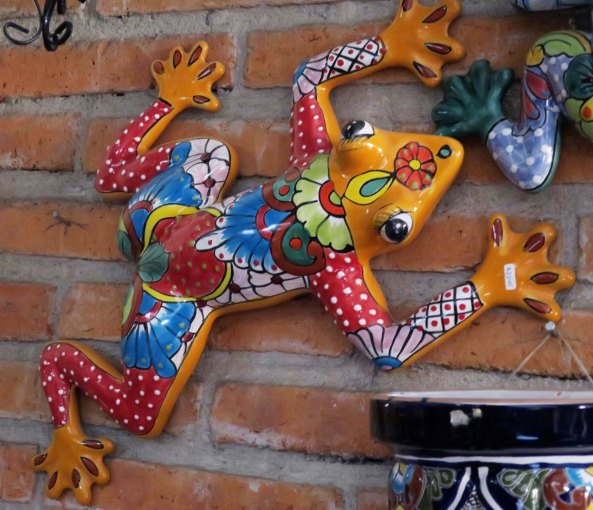
There must be hundreds of ceramic frogs hanging out at the Furniture Mart. This one is a cutie, complete with eyelashes.
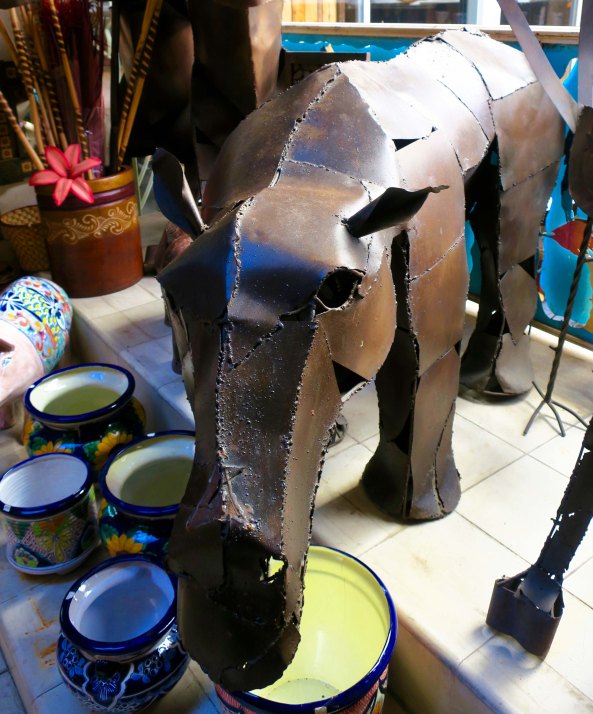
Contrast it with a full sized metal rhino!

The three, or four, or maybe five story structure feels like an Escher painting where you meet yourself coming and going. It is crammed full of art, wood carvings, pottery, strange statues, masks, and Mexican knick-knacks galore, as well as very unique furniture. There are thousands of items. The family of Carlos Paez Coronado describes their building as the Furniture Mart, the largest store of its type in Mexico, and a museum.

We visited this time with Peggy’s sister Jane and her husband Jim who were staying at our villa with us for a week. Jane loves ceramic plates and has dozens of them. We knew she would like the store. Senior Pepe greeted us and assured us that if we bought any item costing a few grand and weighing who knows how many pounds, he would personally deliver it to our doorsteps in Oregon or Sacramento. (Anyone need a 20-foot-long table?) He and his brother fill up a truck with purchased items and make an annual trip across the border. We disappointed Pepe on the mucho grande sale, but Jane almost bought enough plates to make up for it.

I have enough fun wandering through the Furniture Mart that I am going to do three posts on it: One on the wonderfully wild (and tame animals), one on the pottery, and one on the furniture and weird things. Today it is all about animals!

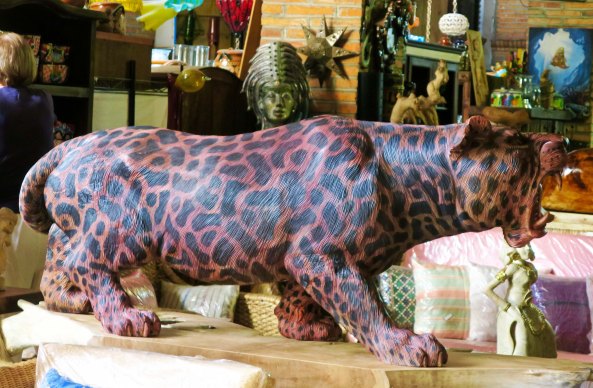
A ferocious jaguar stalking across the floor.
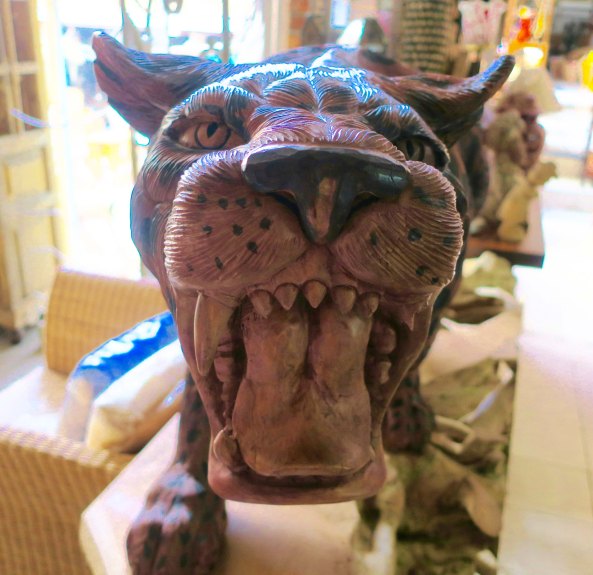
With big teeth.
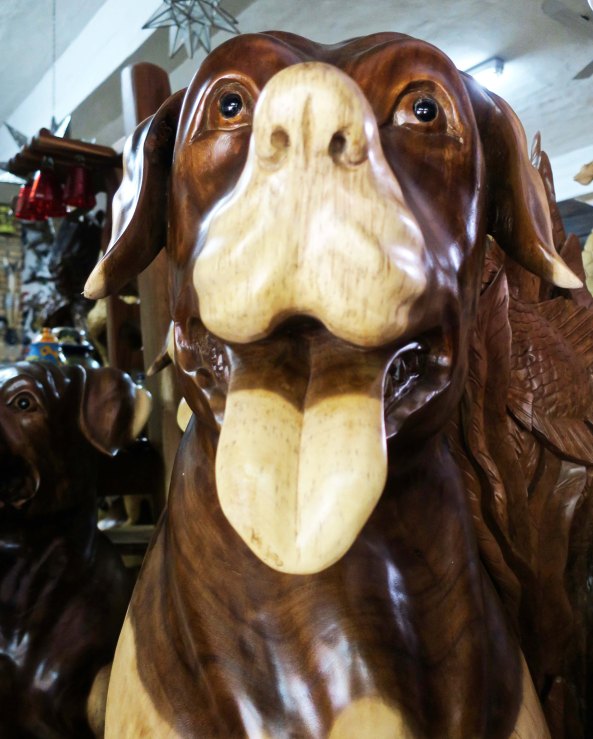
A friendly dog…
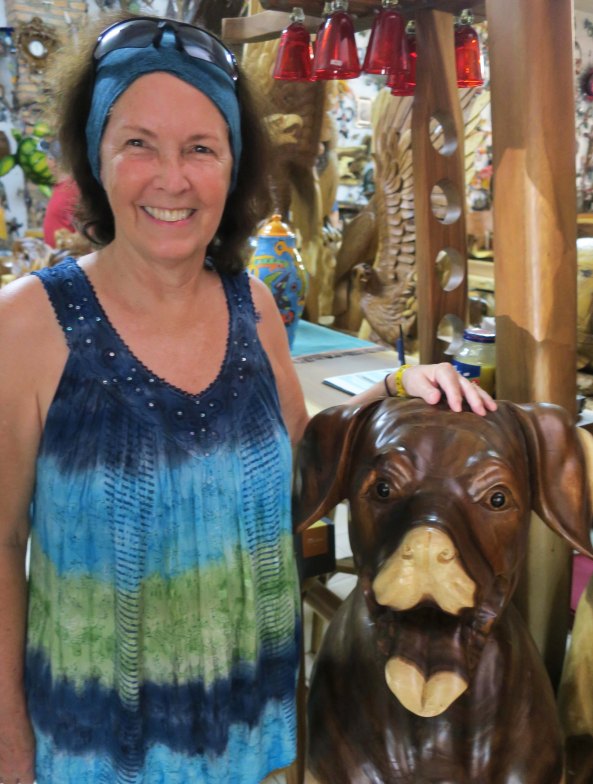
That Peggy pets.
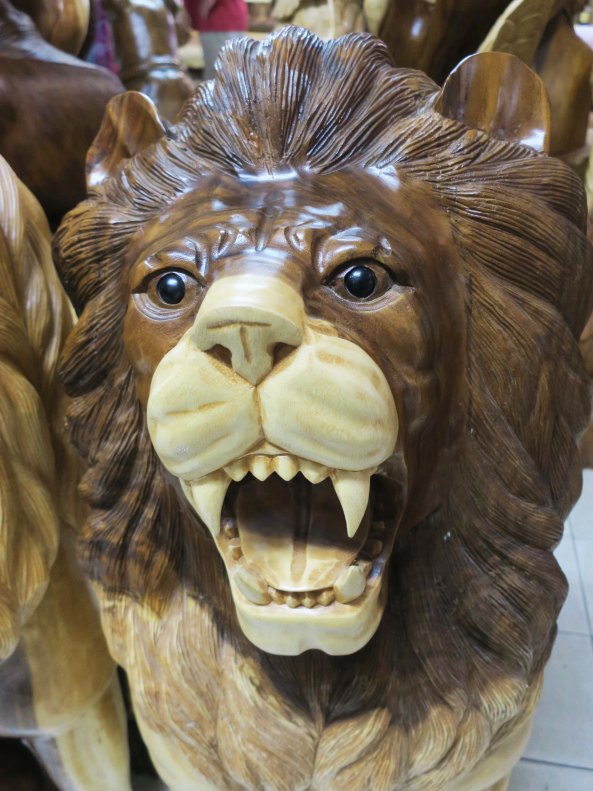
A toothy lion.
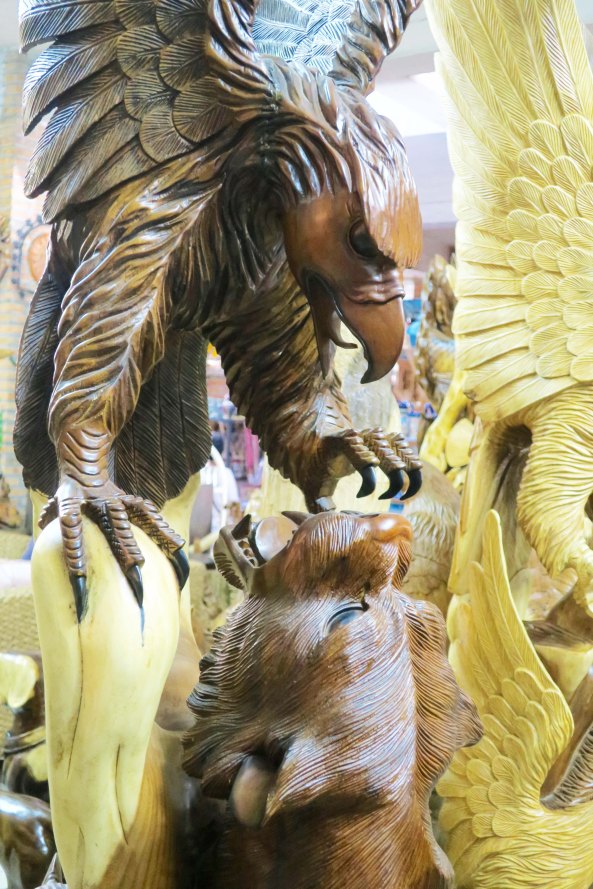
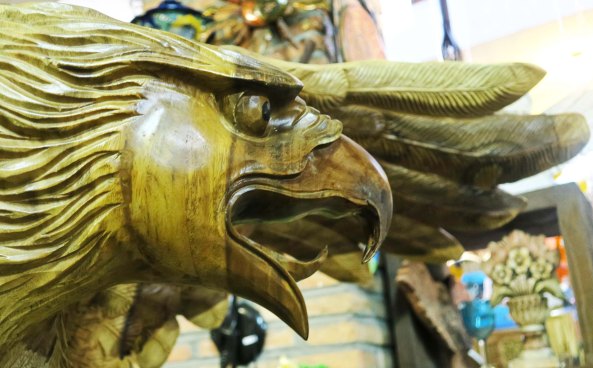
An eagle and a jaguar have a discussion about which is most ferocious.
Given this eagle, I’d say a toss-up.
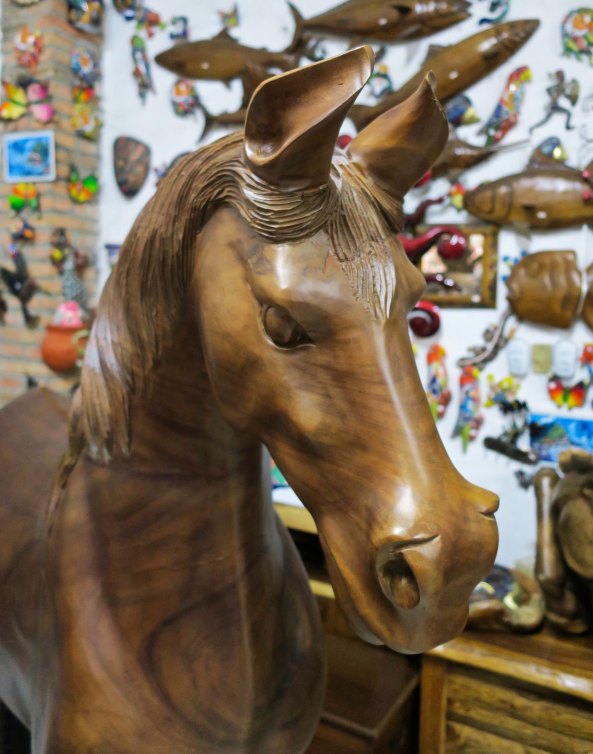
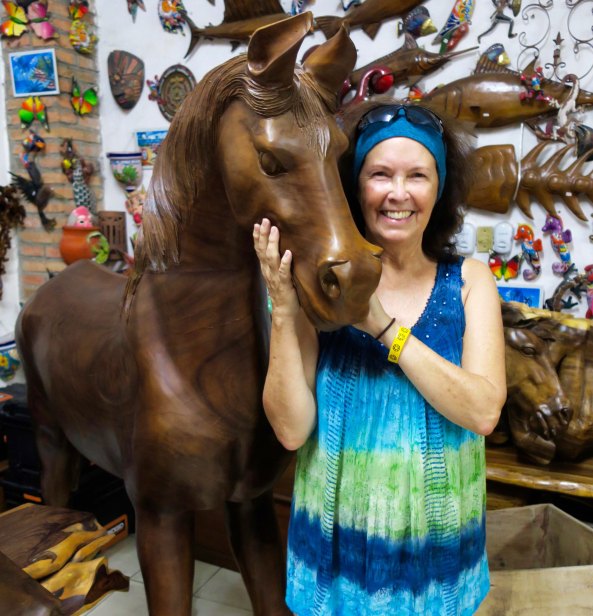
A realistic carved horse…
That Peggy befriends.
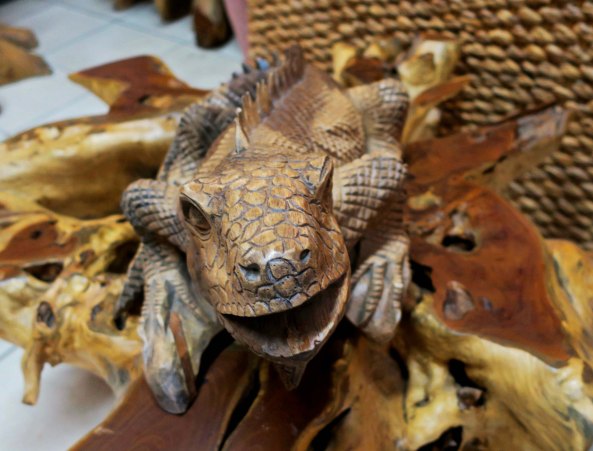
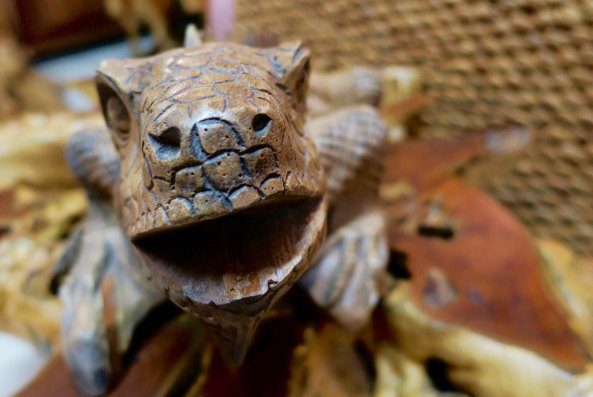
Puerto Vallarta’s favorite lizard: The iguana. I’ll be doing a post on these big fellows.
Head shot!
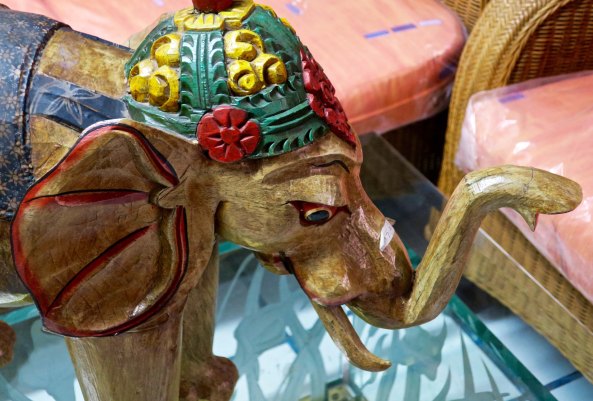
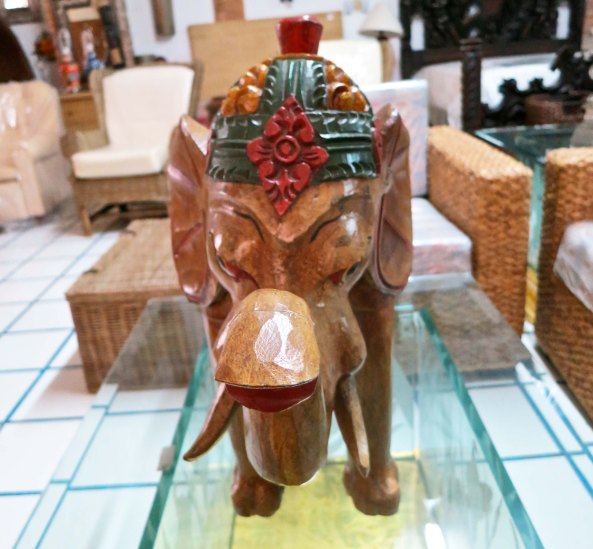
A turbaned elephant…
A trumpeting trunk.
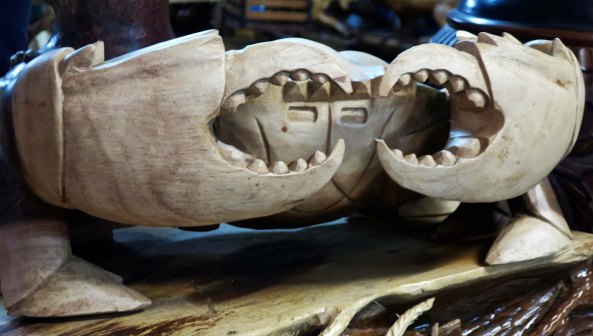
A crabby crab.
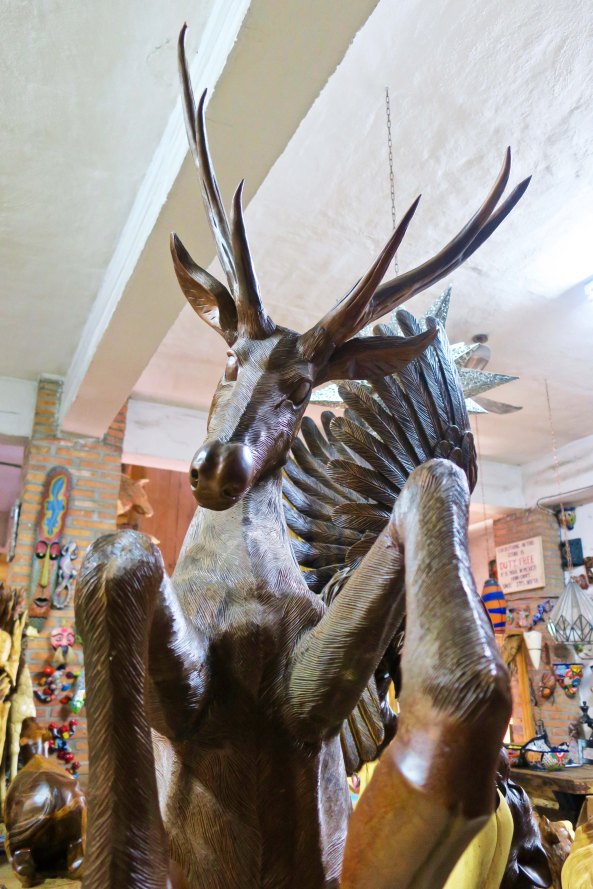
A fighting stag displays its hooves.
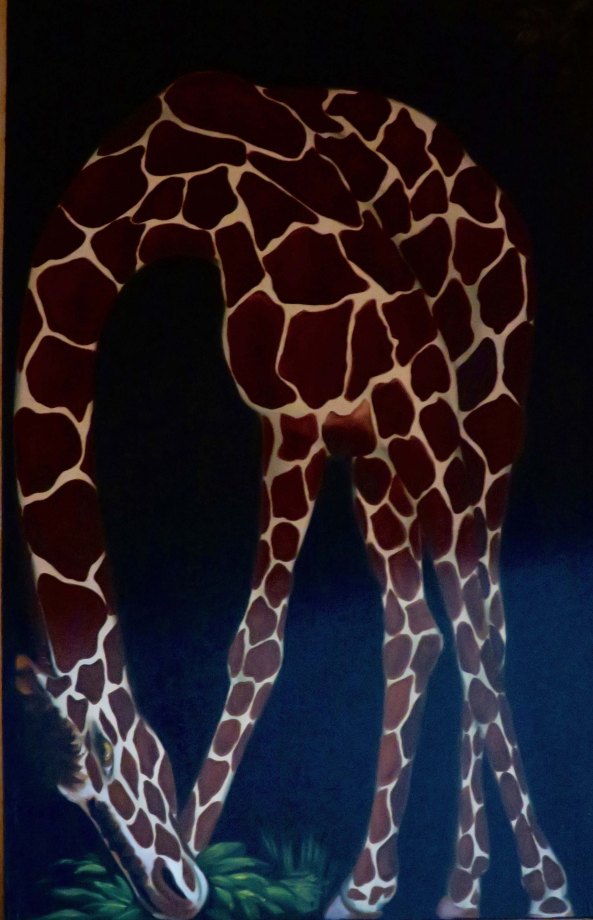
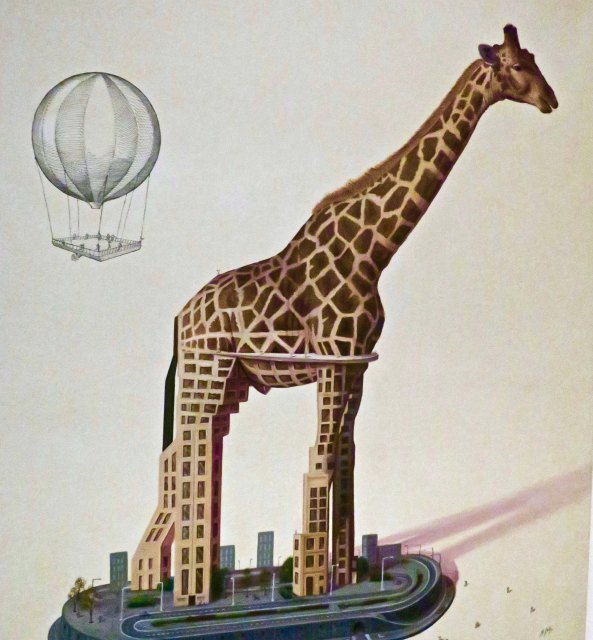
I’ll conclude my exploration of the Furniture Mart today with this striking painting of a giraffe. Next up on the Mart will be ceramics ranging from pigs to plates.

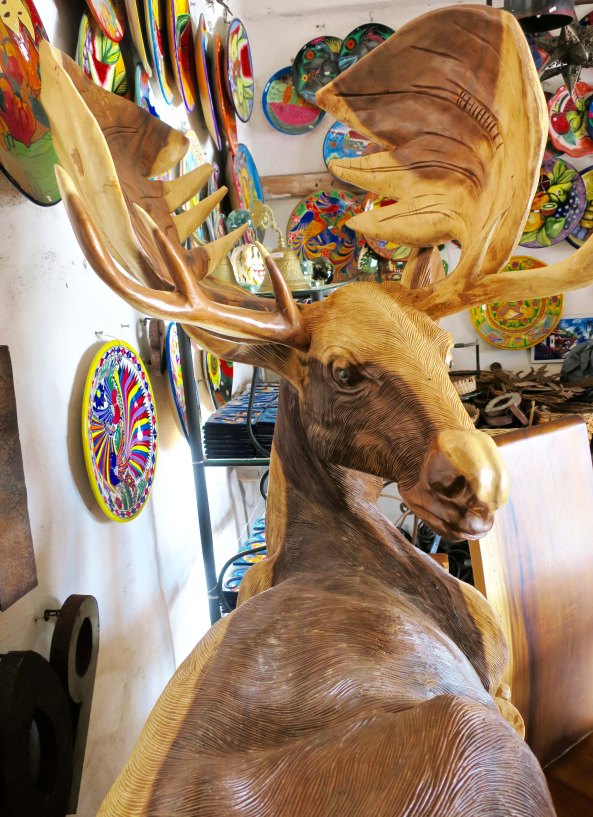
It’s Turkey Day here in Puerto Vallarta, so Peggy and I will be heading out for a traditional Thanksgiving dinner. Several restaurants cater to the day. But I couldn’t find a turkey to represent the holiday…

So, a moose will have to do!

HAPPY THANKSGIVING to all of our Internet friends! –Curt and Peggy. 

The Natchez Trace: A Bicyclist’s Paradise… The 10,000 Mile North American Bicycle Tour

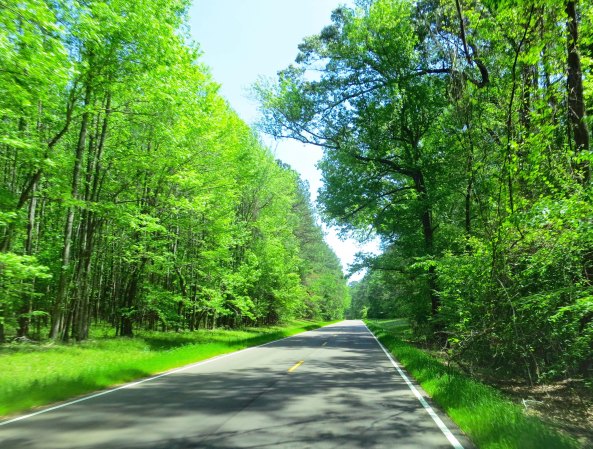
The Natchez Trace between Natchez and Jackson Mississippi.

I don’t think there is a place along the Natchez Trace that isn’t beautiful. I traveled on it for 370 miles of its 450 mile length.

This is my fourth post introducing new followers to the type of tales they can find in my blog. Way back in 1989, I did a solo 10,000 mile bicycle tour of North America. While the journey predated blogging, Peggy and I retraced my route three years ago. Traveling out of California, we crossed the US following a southern route, went up the east coast into Canada, headed back west through Canada to Minnesota, and then finished our tour following a northern route back to California. This is a chance to visit much of North America and hear tales about my bike trek. Want more: Here’s a post from Canada. Scroll forward or backward for the rest of the story:  https://wandering-through-time-and-place.com/2016/09/28/

A large, yellow mutt came wagging his way into my camp. I’d unpacked my gear, set up my tent, and taken off my shoes and socks. My toes were celebrating their freedom.

“Well hello big fellow,” I said to the dog, glad for the company. He sat down beside me and worked his head under my hand, demanding that I scratch behind his ears. Then I was required to pet the rest of him. I had just worked my way down to his tail when he rolled over and insisted on equal treatment for his tummy.

I provided an initial scratch but my coffee water had started boiling. “Priorities,” I told him, “the petting zoo is closed.” Apparently this meant it was play time. He leapt up, grabbed one of my socks, and bounced off about 15 feet.  “Hey! Bring that back,” I urged. Fat chance. He put the sock down, backed off a couple of feet, and started barking.

I finished pouring the hot water into my coffee filter and got up, tiredly, to retrieve my sock. It had been an 80-mile day and I really didn’t want to play ‘chase the dog around the yard.’ I pretended that I didn’t care, that I wasn’t going for the sock, and that I was terribly interested in a large bullfrog that had taken up residence in the swimming pool. The pool hadn’t been cleaned since the previous summer. It made a great pond.

The dog didn’t buy it. He dashed in, grabbed the sock and ran off across the yard. “Okay, you win,” I declared while picking up a stick. “How about a game of chase the stick?” The dog cocked his head and increased his wags per second. I tossed the stick and off he dashed, leaving my sock behind. I quickly bare-footed it across the lawn and grabbed my sock.

“Ha, ha, Mr. Dog,” I called after him while waving the sock about enticingly. To compensate my new friend for his loss, I played tug-of-war with the stick. We growled at each other appropriately, all in good fun.

It was early to bed. I had completed my trip from Alexandria by biking through the city of Natchez and was now camped about a mile from the beginning of the Natchez Trace.  I was eager to get up the next morning and start my 370-mile journey up the fabled Parkway through Mississippi and Alabama into Tennessee. As I zipped up my tent, the big yellow mutt did three dog turns outside the door and plopped down, making me wonder where his home was. I was hardly in a position to adopt a pet. Besides, he was well fed and wearing a dog tag.

My last memory before going to sleep was of the bullfrog singing to his lady-love. “Chug-a-rum, chug-a-rum, chug-a-rum.”
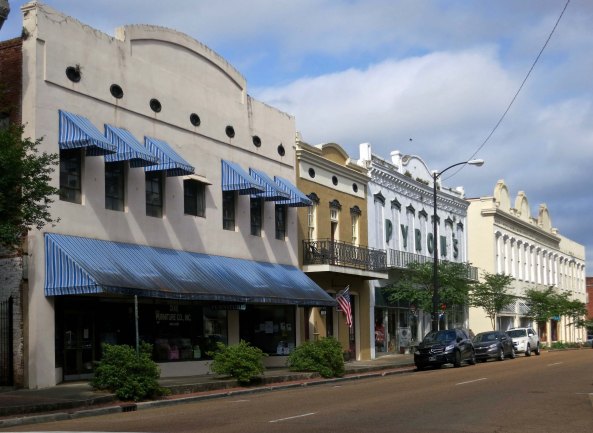
Downtown Natchez, Mississippi.

Peggy and I drove through Natchez on a Sunday morning and pretty much had the historic section of the downtown to ourselves.
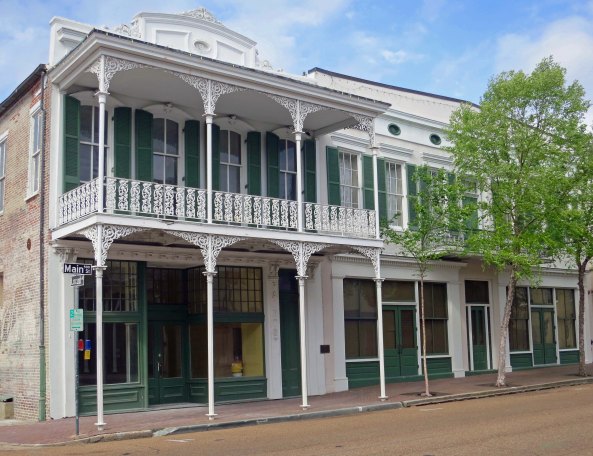
Historic building with balcony in Natchez, Mississippi.

This historic building in Natchez came with an attractive balcony.
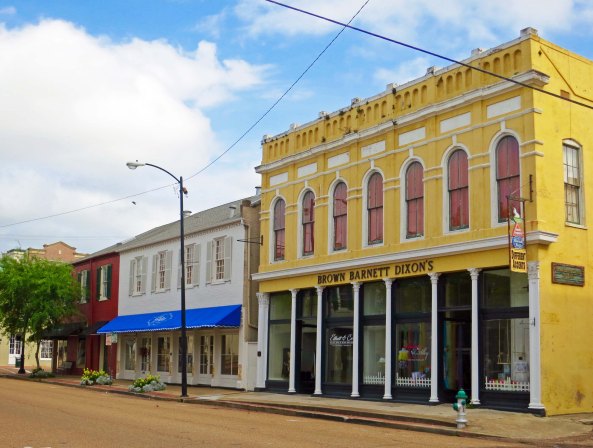
Downtown Natchez, Mississippi on a quiet Sunday.

The colors captured my attention here.
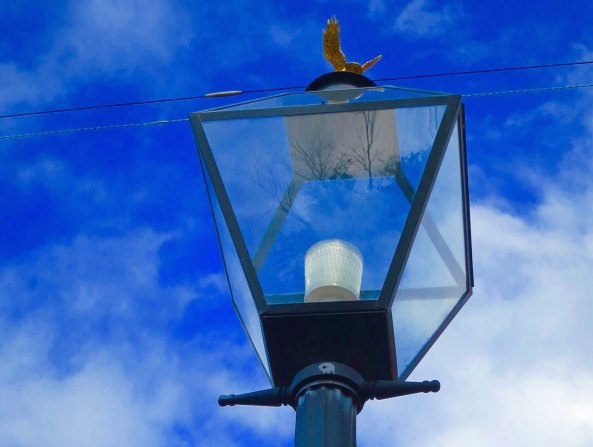
Old lamp posts adorn the historic part of Natchez.
Old lamp posts adorn the historic part of Natchez.

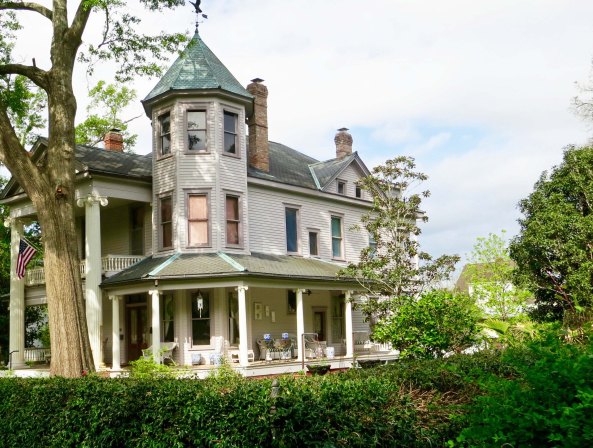
The city is known for its antebellum mansions.
The city is known for its antebellum mansions.

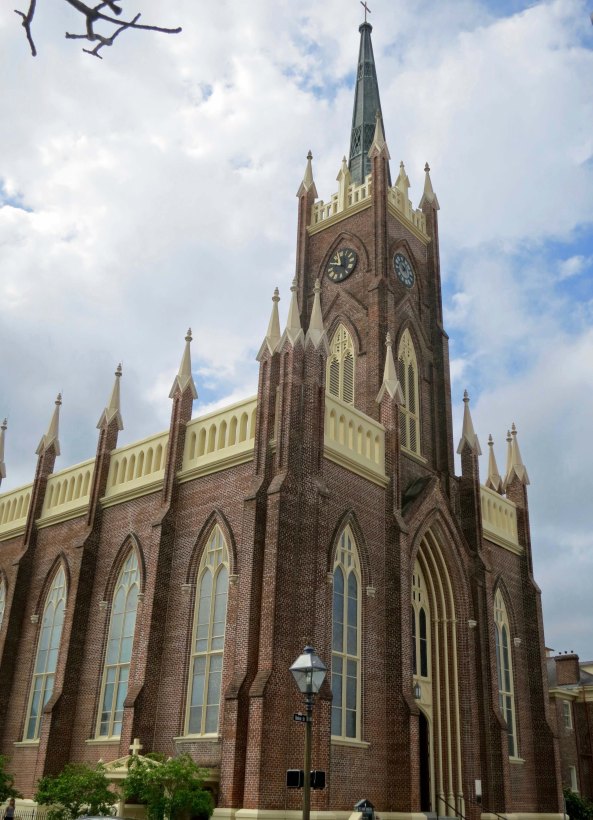
St. Mary's Catholic Church in downtown Natchez, Mississippi.

St. Mary’s Catholic Church was busy with its Sunday service so I didn’t go inside.
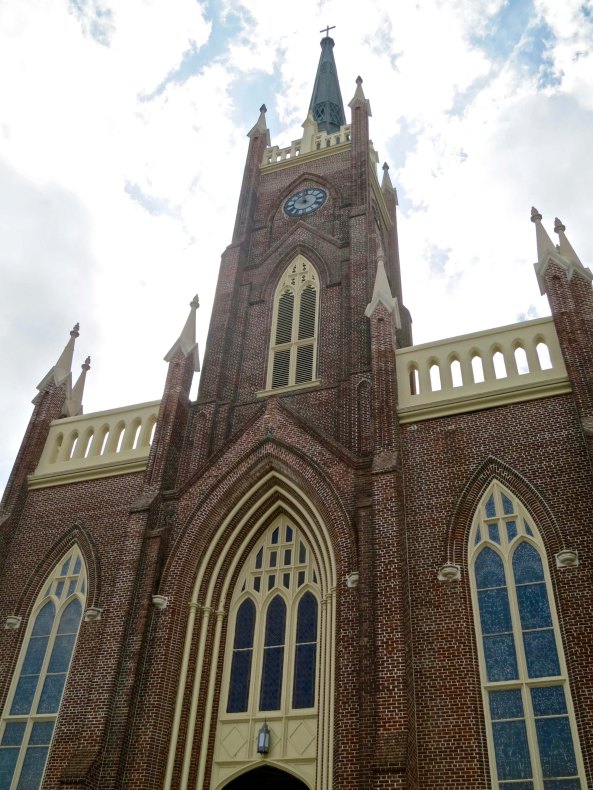
St. Mary's Catholic Church is located in downtown Natchez, Mississippi.

It was quite impressive from the outside, however.

Natchez has an interesting history. Once the site of a major Native American village, its initial contact with Europeans goes all the way back to Hernando de Soto in the mid 1500s. He wandered through the area searching for gold to steal, the primary occupation of Spanish Conquistadores. By the 1700s the French had entered the area followed by the British, the Spanish again, and finally, in 1795, the Americans. Native groups in the region included the Natchez, Chickasaw, Yazoo, Cherokee, and Creek, as well as the Choctaw further to the north.

As for the Natchez Trace, its beginning goes back 10,000 years and was probably tied to buffalo travelling along ridges doing buffalo things. Since these broad, heavy animals make good trails (think of them as early day bulldozers), Native Americans were soon using the routes for trade and travel between large communities.

The next stage in the Trace’s evolution was brought about by river trade in the late 1700s and early 1800s. Kaintucks, boatmen from the Ohio and Mississippi River Valleys, loaded flatboats with merchandise and paddled downstream to Natchez or New Orleans where they made handsome profits for their goods. The challenge was that you don’t row a boat up the mighty Mississippi. The boatmen had to hike or ride horses home. They sold their boats as lumber and made their way back to Nashville via the Natchez Trace

It was an adventure. There is a reason why the Trace became known as The Devil’s Backbone. It was crawling with highway men eager to separate the Kaintucks from their newly earned wealth. And that assumes that they could even get their money out of Natchez where cheap whiskey cost a fortune, hot love was based on cold cash, and cut-throats came by the bushel.

The development of steamboats in the 1820s changed things dramatically. These boats with their large, steam-driven paddle wheels could travel upriver. Boatman no longer had to hike or ride horses back to Nashville while fighting off thieves.  Gradually, people stopped using the Trace and it faded from memory.  But not totally.

In 1903, the Mississippi chapter of the Daughters of the American Revolution took on a project of placing markers along the original route. In 1918 the precursor to the Natchez Trace Association was created with the rallying cry of “Pave the Trace!” Work on the Parkway was started in 1937 and in 1938 it became a unit of the National Park system.

When I rode my bike out of Natchez in the spring of 1989, the Trace was mainly complete and had become something of a bicyclists’ paradise. (Today it is considered one of the top ten bike rides in America.)   To start with, there was no commercial traffic. No 18 wheelers would be whizzing by me. Nor were there any commercial properties or billboards, just lots of beautiful woods and small farms. Campgrounds and restrooms were located conveniently along the way.  Frequent rest stops featured local history. I was free to ride along and enjoy the scenery.

But I did have two responsibilities. The first was to persuade the large, yellow mutt that he wasn’t going with me. It started with a discussion in camp that I thought he had understood. Where I was going was dangerous for doggies. It was dangerous enough for me. About a mile from camp I chanced to look back, there he was, about 50 yards back. I stopped and waited for him to catch up, all a waggle. “No!” I said forcefully. “You cannot go. Go Home!” The tail stopped wagging. Two sad brown eyes accused me of horrendous deeds. Ever so slowly, he turned around and started back, tail between his legs. I felt terrible.

The second chore was more pleasant— rescuing baby turtles. Bunches were migrating across the Trace outside of Natchez. Each time I came on a crowd, I would stop, climb off my bike, and give the little tykes a lift across the pavement. I knew that there would be more coming along behind but I must have transported at least a hundred,undoubtedly saving them from being run over.

Following are several photos of the Trace from Natchez to Jackson, Mississippi that I took during the route review Peggy and I did this past spring.  In my next blog we will make a slight detour to the town of Philadelphia, Mississippi where a good friend lives and then head up the Trace to Tupelo and visit with Elvis.
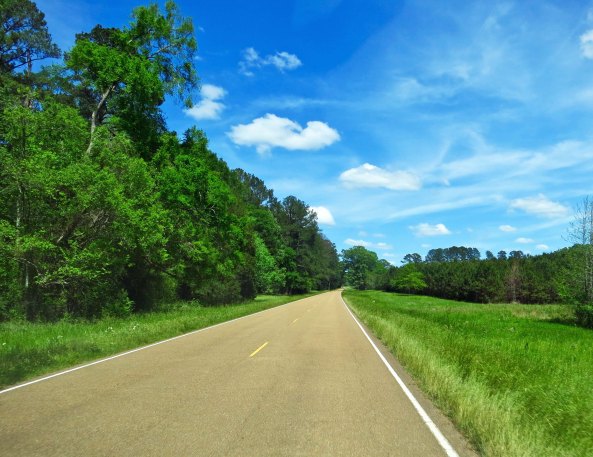
Views along the Trace were constantly changing from being forested to open.
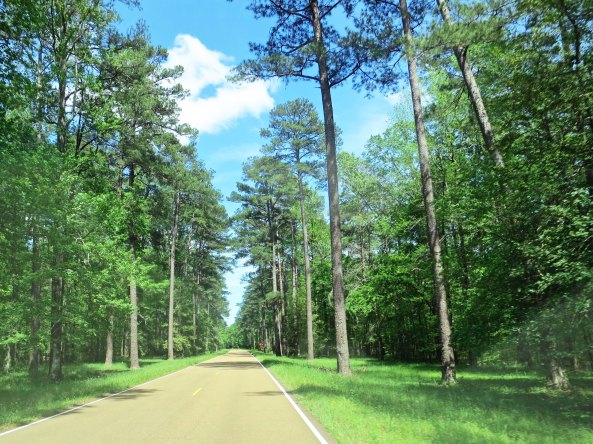
Views along the Trace were constantly changing from being forested to open.

Pine trees became common around Jackson, Mississippi.
Pine trees became common around Jackson, Mississippi.

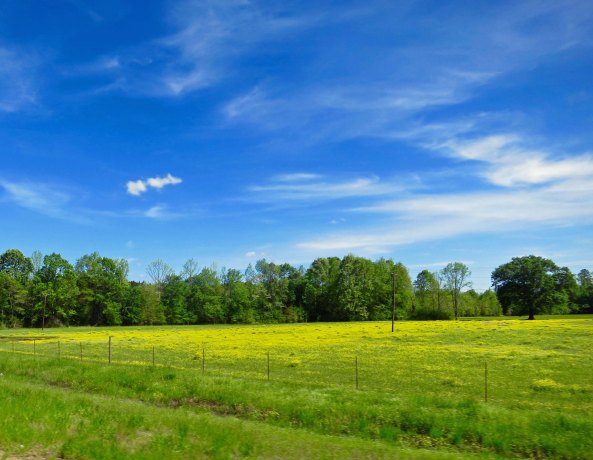
Rich farmlands border some of the Trace.
Rich farmlands border some of the Trace.

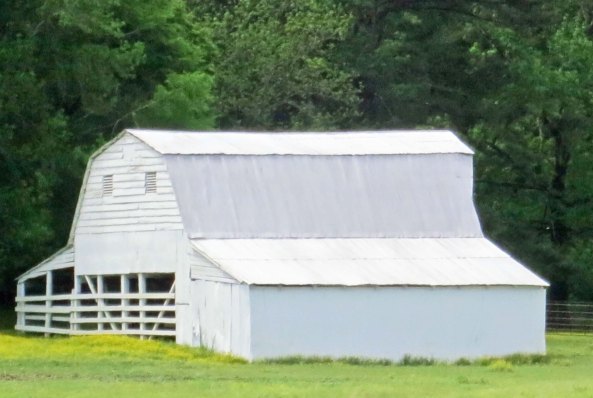
There are a number of barns.
There are a number of barns.

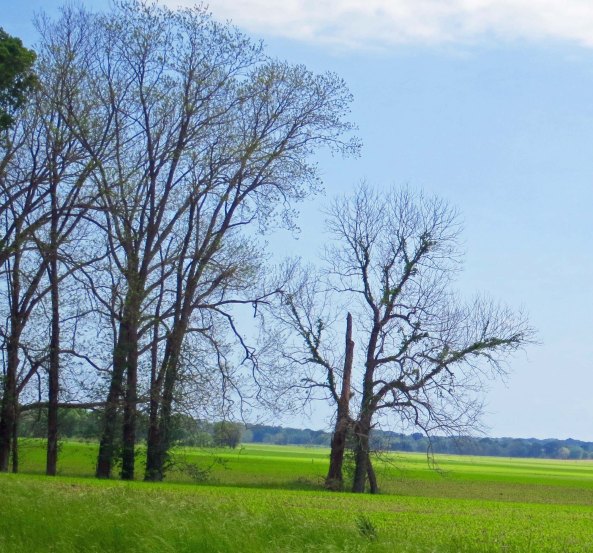
These trees had yet to leaf out.

These trees were just beginning to leaf out. I enjoyed the silhouettes they created.
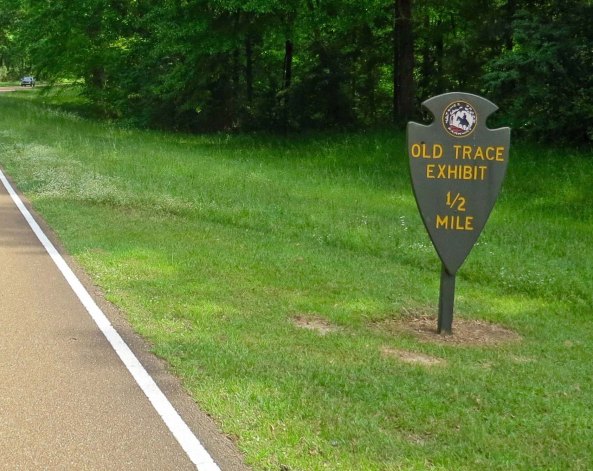
Numerous exhibits featuring the history of the Trace provide interesting breaks along the way.
Numerous exhibits featuring the history of the Trace provide interesting breaks along the way.

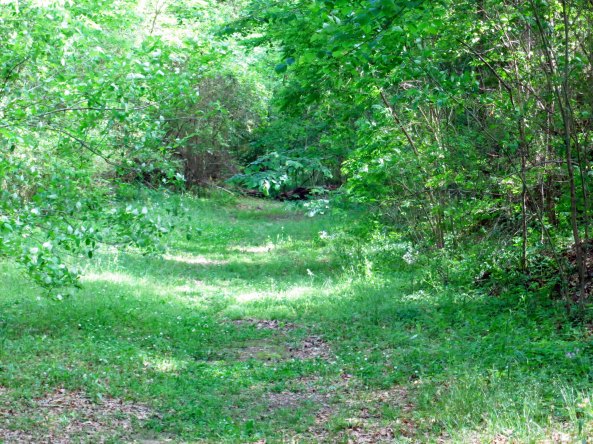
A number of the stops, like this one, include original sections of the trail.
A number of the stops, like this one, include original sections of the trail.

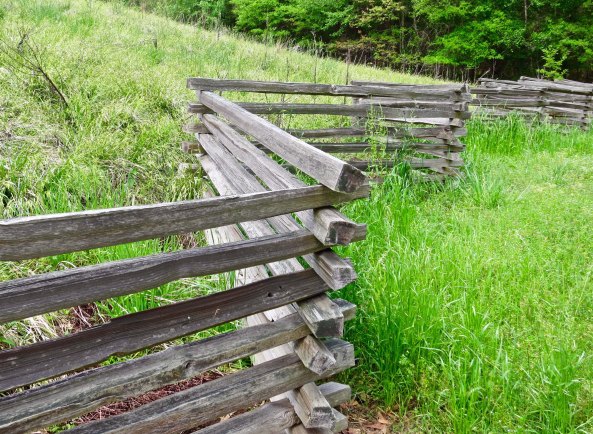
The Park has also rebuilt traditional fences that the pioneers who lived along the Trace would have built.

The Park has also rebuilt traditional fences similar to ones that the pioneers who lived along the Trace would have built.
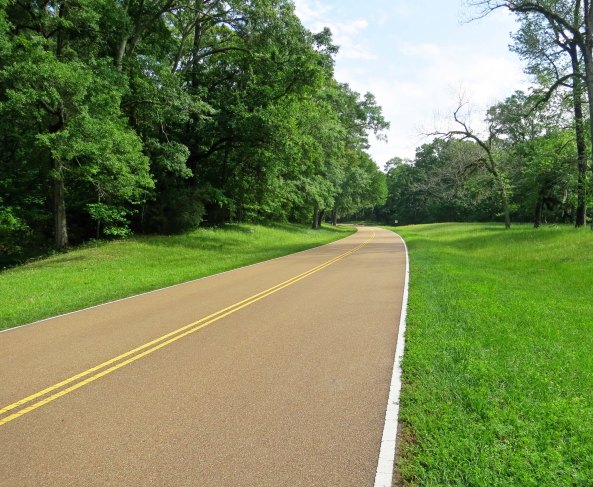
A final view of the Trace for today. Many more will be included in my next three blogs.

A final view of the Trace for today. Many more will be included in my next three blogs.


The Beautiful Temples of Black Rock City… A Burning Man Experience

This is the Temple of Promise from Burning Man 2015, a simple and beautiful structure designed to capture the early morning sun.


This is the second in my series of introducing new followers to the type of posts they can expect to find on my blog. Since I’ve been going to Burning Man since 2004, there are numerous posts on the annual event that takes place annually in the Nevada desert. Over the years, my primary focus has been on the art, but I touch on all aspects of the event. Here, I take a look at the beautiful temples that are built each year and then burned at the end of the event. If you would like to see more of my posts on this unique extravaganza, go to mu Burning Man category on the right, click on it, and scroll down. Enjoy!

Census figures from Burning Man show that 71% of the participants claim to have no formal religious affiliation. Given this, it might seem strange that a temple is one of the major structures built in Black Rock City each year. But there is another factor at work here; over 50% of Burners claim that they are spiritual. While they may not adhere to any particular religious doctrine, they believe that they are part of a whole that is beyond any individual’s existence. Or, at least, that’s how I interpret being spiritual. It’s how I feel.

Whatever Burners believe, there is no doubt that visiting the temple can be a spiritual experience. In addition to being a place of beauty, as I hope the photos in this post show, the Temple is a place where 10,000’s of messages are left honoring loved ones who have passed on, asking forgiveness and expressing thanks. At the end of the week, the Temple is burned and the messages drift off into the air or, the Heavens if you prefer, giving a sense of peace to those who have left them.

Part of a larger structure, this temple was built in 2007 and was known as the Temple of Forgiveness.

This was the 2008 Temple. (Photo by Ken Lake.)

The curving wood on top of the Fire of Fires Temple reflected flames shooting into the sky. Note the intricate detail on the side panels.

A close up.

The Fire of Fires Temple at night. (Photo by Don Green.)

The Temple of Flux represented the constant change we experience in life. It can be seen as waves or as sand dunes. This photo was taken from the Man. The Center Camp Cafe, the Man, and the Temple are always in a direct line. The buildings on the other side represented a city.

Tom likes to get up early in the morning for his photography. He captured this photo of the Temple of Juno at sunrise. (Photo by Tom Lovering.)

Here’s another. (Photo by Tom Lovering.)

A later photo by me showing detail of the Temple of Juno.

The Temple of Whollyness resembled a Pyramid.

This large stone structure was inside the Temple of Whollyness.

The Temple of Grace was built for the 2014 Burning Man.

I liked this shot I caught of its spire under butter milk skies.

The Temple of Grace at night. (Photo by Don Green.)

Another photo of the Temple of Promise. I had taken Tom’s advice and rolled out early to capture these photos.

As the sun came up, Burners grabbed each other’s hands and formed a large circle around the Temple. The act was totally spontaneous.

A black and white I created.

Inside the Temple.

As I mentioned, thousands of messages are placed on the walls. By Saturday, there is little room to write on left within reach.

I found this message left behind honoring Uno Hogan quite touching. I think you will as well. It is quite typical of messages found in the temple.

And this message humorous but sincerely meant!

The Temples are always burned on Sunday night, the last night at Burning Man, in a solemn and moving ceremony with the thousands of messages sent skyward. This is the Temple of Juno.

A note on the photographers: All photos that I include in the Burning Man blogs are taken by Peggy, me, or members of the Horse Bone Tribe— all close friends who have traveled and adventured with us down through the years.

NEXT BLOGS:

Monday: Back to Bandon on the coast of Oregon.

Wednesday: I begin my story of how Bone was found.

Friday: I continue my exploration of the unique and beautiful structures at Burning Man.


Kayaking among the Orcas/Killer Whales of British Columbia…

Kayaks belonging to the Sea Kayak Adventure group in the waters of Johnstone Strait, northeastern Vancouver Island.

Our sea kayaks wait patiently for us as we have lunch in a cove off of Johnstone Strait.

This is the first of my series of ‘oldies’ I am reposting from my archives to give new followers a taste of what they can expect to find on my blog. Peggy  and I made a trip to Vancouver Island, British Columbia in 2014 to go kayaking among the orca whales. The next post in the series can be found here:  https://wandering-through-time-and-place.com/2014/10/30/

I was nervous as we drove into the town of Port McNeill on the northeast shore of Vancouver Island in August. Peggy and I had signed up for a six-day sea kayak tour out of Telegraph Cove with Sea Kayak Adventures.We would be searching for orcas, which are also known as killer whales—as our son Tony, the Alaska Coast Guard pilot, reminded us. A little Jaws music, perhaps?

This orca was on display at the Whale Museum in Grove. I named him Smiley and addressed him as sir.

This orca skeleton was on display at the Whale Interpretive Center in Telegraph Grove. I named him Smiley and addressed him as sir.

“Okay, Curt, what have you gotten yourself into this time?” was bouncing around in my skull like a kangaroo on steroids. It’s a question I ask myself often.

I wasn’t nervous about the whales, however. I’ve spent my life communing with nature. Besides, these particular giants are gentle, relatively speaking; they get fat off the salmon in Johnstone Strait. They don’t need to eat people. But sea kayaking would be a first for me. The old dog had to learn new tricks, and that is always a reason to get excitable. Fortunately, Peggy and I had played around a fair amount with inflatable kayaks. We had even ventured out on challenging multi-day lake trips into remote areas such as Prince Albert National Park in Saskatchewan and Voyageurs National Park in Minnesota. So how hard could it be?

Aren't I pretty? There was no way I was going to make this skirt look good. (Photo by Peggy Mekemson.)

Aren’t I pretty? No? Maybe I wasn’t meant to wear a skirt. This skirt is designed to fit snugly over the cockpit of the kayak and keep out the water.  It’s so snug that you really have to stretch it to fit, which isn’t easy— particularly around the back. My skirt and I had several discussions while I was learning how to make it behave. It learned new words. Ask Peggy. (Photo by Peggy Mekemson.)

I confess I was more nervous about the idea of being on a tour. I am not much of a tour group person. This is a strange statement coming from someone who spent over a quarter of a century leading backpacking and bicycle fundraising treks for the American Lung Association. But the truth is— I am an independent cuss. I like to go where I want to go and stop when I want to stop. On an organized tour, I would be expected, even required, to adhere to the group schedule and itinerary. This isn’t a complaint. It has to be that way on group outings. Common sense and liability demand it.

And then there were the people. We’d be living closely with these folks for six days under potentially trying conditions. What would our guides be like? How about our fellow tour group members? Would we get along well? Would they be strange— even stranger than I am?
"Could I interest you in a cracker?" The tour promo promised good food, but it failed to mention the presentation. This is Nick, one of our three group leaders.
“Could I interest you in a cracker?” The tour promo promised good food, but it failed to mention the presentation. This is Nick from New Brunswick, one of our three group leaders. Note the sprig artfully shoved into the cheese.

Quy, another of our guides, is a gentle soul who in his other life works as a computer geek in Vancouver. So what is he doing with this knife?

Quy, another of our guides, is a gentle soul who in his other life works as a computer geek in Vancouver. So what is he doing with this knife?

Julia, our third guide and assigned trip leader, may use Quy's knife on me for this photo of her toes, but I couldn't help myself. And no, I don't have a foot fetish. My fascination was that these bare toes could run over sharp rocks. The last time I had feet that tough I was ten years old.

Julia, our third guide and assigned trip leader, hails from Germany and is quite charming. She may use Quy’s knife on me for this photo of her toes, but I couldn’t help myself. And no, I don’t have a foot fetish. My fascination with her toes was that they could run over anything, including  rocks. The last time I had feet that tough, I was ten years old.

And how about our fellow travelers? David is a psychologist out of LA. How much more strange can you get?

And how about our fellow travelers? David is a psychologist out of LA. How much stranger can you get than creating this mustache? Well maybe someone who kisses fish…

Well, maybe someone who kisses fish??? "But he was so beautiful," Lindy told me. He was dinner, Lindy,. Dinner.

“But he was so beautiful,” Lindy told me. He was dinner, Lindy. Dinner.

Regardless of how nervous I felt, the trip was simply too much of an opportunity to pass up. Like how could I not go on a sea kayaking adventure out among the orcas in beautiful British Columbia? As for Peggy, she is always up for adventure. When our friends Edie and David from Anchorage, Alaska called and asked if we would be interested in going, we gave a resounding yes. It turned out to be great decision. The guides, our fellow tour group members, and the incredible views were delightful. Even the orcas cooperated.

Today marks the beginning of my series on the trip. I’ll start by exploring the quaint town of Port McNeill. In my next post, we will climb in our kayaks and push-off from Telegraph Cove. The orcas are waiting. Let the adventure begin.

Harbor in Port McNeill on northeastern Vancouver Island. Photo by Curtis Mekemson.

While the main source of employment for the people of Port McNeill is the timber industry, the town also has a charming harbor. Note the yacht in the background. It had its own helicopter.

I loved this guys sense of humor.

In case anyone was wondering. I loved this guy’s sense of humor.

Dolphin statue at Port McNeil on Vancouver Island, British Columbia.

Peggy, David and Edie pose in front of a dolphin statue that faces the harbor. Edie went to high school with Peggy in Ohio and runs a tax accounting firm in Anchorage. David is an Alaskan bush pilot who works on the North Slope, and is a published poet.

You are looking at Port McNeill's pride and joy: the worlds largest burl. Can you imagine this thing growing on a tree? (Photo by Peggy Mekemson.)

You are looking at Port McNeill’s pride and joy: the worlds largest burl. Can you imagine this thing growing on a tree? (Photo by Peggy Mekemson.)

Wicked Campers is now providing inexpensive travel vans and raucous humor in a number of countries.

Tourism is also an important industry for Port McNeill. Wicked Campers caught my attention. The company provides inexpensive travel vans and its raucous brand of  advertising in a number of countries.

We were also amused by Port McNeill's unique way of fund raising where bras are decorated and then auctioned off. Which of the following three would you vote for?

We were also amused by Port McNeill’s unique way of fund-raising where bras are decorated and then auctioned off. Which of the following three would you choose?

Given the ears, I am thinking Mickey Mouse was the inspiration.

Given the ears, I am thinking Minnie Mouse was the inspiration.

Bat woman?

Bat woman? Great eyes.

Dream catcher. Ouch.

Dream catcher? Ouch. This one would leave an impression.

Flowers at Port McNeill on Vancouver Island. photo by Curtis Mekemson.

The flower shop that featured the bras was closed so I couldn’t get inside to photo more of the entries. I did capture this petunia on the outside, however.

Mist in trees on Vancouver Island sea kayak trip. Photo by Curtis Mekemson.

Mist in the trees. A final photo to whet your appetite. Let the adventure begin.

Mt. Lassen National Park— A Spooky Kind of Place along the PCT… Happy Halloween

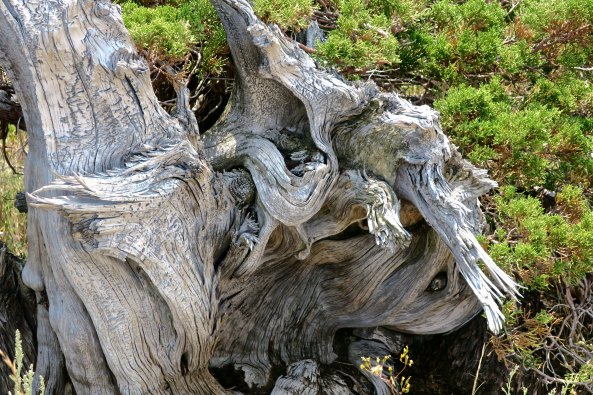
What’s more scary than a spooky face staring at you from the ground? Imagine your flashlight picking this up at night when you are out in the woods alone? For the more scientifically inclined among you, this is a manzanita root.

I hardly imagined that backpacking through Mt. Lassen National Park on my hike down the Pacific Coast Trail this summer would provide me with inspiration for my annual Halloween post— but I had never had an up-close-and-personal encounter with manzanita roots. Trail crews, rerouting the PCT as it approached the Park from the north, had dug up the roots and left them beside the path. 

I often include photos of faces from nature in my blog. And most of these are a bit on the strange side. (“Like you,” I am sure my wife Peggy would point out.) Maybe. My imagination works overtime when I am out in the woods and I can’t resist pulling out my camera when I spot eyes staring back at me from trees, rocks and clouds. They appeal to the animist in me. Plus they are an excuse to stop on long, tough hiking days.

In addition to the roots, I’ve included a couple of other photos from Lassen with Halloween potential and a few other ‘faces’ from my three month backpack trip. Some of these I have included before. Enjoy!

Imagine, if you will, clawed fingers reaching up from the grave, ready to grab unsuspecting hikers.
Dark, vacant eyes staring at you are stock in trade for horror film flicks.
More eyes. Maybe the skull of that silent killer of the night: The owl.
Scrooge McDuck’s nemesis, the ghost duck of Halloween past.

Dead trees are also mood setters for Halloween and horror movies. Here are a couple of many I captured in Lassen.

A lone. dead tree standing on the horizon with grasping fingers is an excellent place to plant a grave.
Scary music, dark, threatening skies, and dead trees: a perfect combination for Halloween night. What monster lurks in the shadows, prepared to leap out from behind a tree, and carry you off to a world filled with zombies and blood thirsty vampires.

And to conclude today’s post for Halloween, a few photos from other faces along the trail, some of which I have included before.

A large eye and a silent scream suggests I frightened this woodland creature peering out at me while half hidden. Am I that scary?
Not so scary but somehow threatening.
And finally, this rather grotesque character with his pointed head, dark eyes, skinny nose and large jowls. Vey scary indeed!

HAPPY HALLOWEEN FROM PEGGY AND ME.

Next Post: Back to hiking through Lassen National Park on the PCT. 

Fall Colors at Lithia Park in Southern Oregon… and the BSBC

In Southern Oregon, it is hard to beat Ashland’s Lithia Park for fall colors. 

It’s that time when I like to do a post on the fall colors around our home in Southern Oregon. This year, Peggy and I, along with members of the Bigger Sacramento Book Club, drove over to Lithia Park in Ashland for a picnic.

The Bigger Sacramento Book Club at Lithia Park.

The BSBC was created in the late 80s by my friend Ken Lake and was soon composed of five couples. The same couples belong today but ‘Bigger Sacramento’ now includes Southern Oregon, the Bay Area, and France as well as Sacramento! This year marks our 30th Anniversary. Each fall, the BSBC visits our house for a three day retreat. 

We chose to visit Ashland because our book, Meet Your Baker by Ellie Alexander, is based in the town. Lithia Park, it turns out, was awash in fall colors. After lunch, we walked into town to visit the Mix Bakery in honor of the book and wandered up to the Bloomsbury Bookstore, which is always a delight and makes a pleasant outing for a book club. 

The Duck Pond backs up to the outdoor theater for Ashland’s world famous Shakespeare Festival. The roof can be seen through brightly colored trees.
Reflected fall colors surrounded this duck crossing the pond like an Impressionist painting. Monet would have been jealous.
I think the majority of trees in the park must have been chosen for their fall colors as the following photos illustrate.
A bridge across Lithia Creek.
Looking down into the creek.
The Mix Bakery was used by Ellie Alexander as the model for her Ashland Bakery in her series. I found the reflections in the window fun. 
Mouth watering goodies are found inside…
Along with fresh bread.
The town, as well as Lithia Park, was filled with fall color
Walking up to the Bloomsbury Bookstore took us past the iconic Ashland Hotel, which hosts an annual chocolate festival guaranteed to get Peggy excited.
Walking past a store window, I spotted this cat, apparently fascinated with an insect that had landed on the window…
Which provided the opportunity for this close-up.
I’ll close today with a photo from our front yard. Our white oaks don’t have quite the color of the trees in Lithia park, but they are definitely looking like fall.

NEXT POST: It’s back to my hike down the PCT and a stroll through Lassen National Park.

Backpacking up Mountains in 100 Degree Plus Weather from Castle Crags to Burney Falls on the PCT

I thought a lot about the cool water of Burney Falls as I backpacked the second half of my trip from Castle Crags to the falls. Temperatures were in the 90s and then surpassed 100! (Photo by Peggy Mekemson.)

The Pacific Crest Trail from Castle Crags to Burney Falls is known for being hot in the summer. I was hoping to avoid such weather. No such luck. At least it waited until my last three days to break 100 F (37.7 C). Then it became a scorcher. Many through-hikers chose to hike early in the morning and late in the evening, hiding out during the hot part of the day. But I trudged on. I needed full days to make it out when I told Peggy I would. Following are a few photos from the trail. 

Having climbed 10-12 miles to get out of the McCloud River Canyon, I was treated to views of Grizzly Peak. Billowing cumulous clouds spoke of the coming heat.
Similar clouds were hanging over Mt. Shasta. This would be one of my last views of the spectacular mountain. I had been enjoying it and photographing it since I had began my trek at Mt. Ashland.
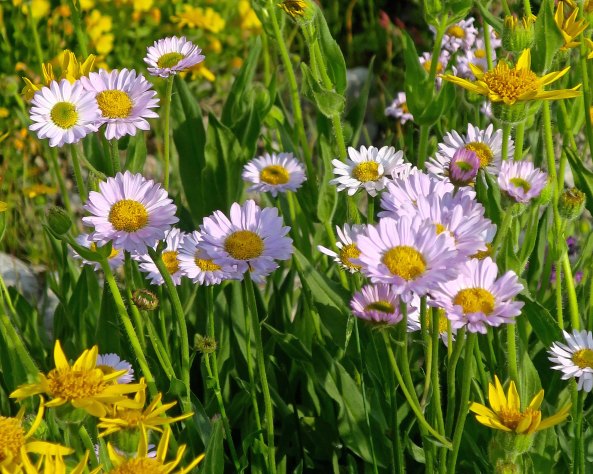
Appropriately, I found some Shasta Daisies beside the trail.
Much of my time over the next three days would be spent hiking ridges with great views into the canyons. This is Devil’s Canyon. My guess is that the person who named it tried to hike out on a 110 degree F day. Don’t let the pretty trees fool you; it’s Dante’s Inferno! (grin)
I was now hiking through the volcanic Cascade Mountain Range that runs from Northern California to the Canadian Border. I would be treated to numerous views of volcanic landscapes, such as this eroded lava.
I was intrigued by these volcanic rocks that were outlined on the ridge.
And these. They looked like a small village.
A fir tree helped set this rock off.
Flowers, such as this Indian Paint Brush, helped take my mind off the heat and long days.
As did  this striking fellow.
I also found some strange manzanita roots to entertain myself with. (There will be a lot more in my next post on Lassen National Park.)
As always, there were interesting through-hikers to stop and chat with. This couple, Smile and Hamster, had found a phone signal and were signing up for fall college courses in Germany.
I’ve already introduced Popcorn! with an exclamation point the end of her trail name. She’s the one who suggested to me that rubbing pine needles all over your clothes made a great deodorant. 
Patch was carrying a message from Peggy, letting me know that she had changed the location where she would meet me. Peggy had bribed him with food. (grin) 12 more through hikers would give me the same message. Peggy was making sure I wouldn’t miss her!
On the third day, I concluded my 15 miles by 2 PM. Peggy was waiting and had as many tales to tell as I did. That evening she shared the photos that she had taken, including this one of Burney Falls. I’ll conclude here. My next post will take us into Lassen National Park.

On Being Exhausted… Hiking along the PCT at 75 between Castle Crags and Burney Falls

We rarely stress about water in our everyday life. If we are thirsty, the nearest faucet is usually a few steps away. It becomes a precious commodity along the PCT, however, where your next source may be 15 miles down the trail and what you have to drink is what you carry. This welcome sight is Squaw Valley Creek, which was my destination on day one out of Castle Crags. I didn’t make it.
Although I am now off the trail and happily settled into our home in Southern Oregon, I have several more posts to put up on my backpack trip this summer. Today, I am covering the first half of my trip between Castle Crags and Burney Falls.
Peggy waved goodbye to me as I started up the PCT east of Castle Crags. I had spent two days in the Dunsmuir area happily stuffing myself and it was time for me to hit the trail again. She was less nervous than she had been in the beginning when her 75-year old husband disappeared into the woods for a week. “If you don’t come out on time, I am coming in after you,” she had declared ferociously. But each time, I had hiked out more or less when and where I said I would after backpacking 70-100 miles. Still…
I knew I had a significant climb ahead. I’d dropped several thousand feet coming down from the Trinity Alps to Interstate 5 and now I had to regain altitude. I also knew that there was limited water along the way, which is par for the course on the PCT. The trail was shaded and well-graded, however, so I started off at a decent pace. I met a fellow out walking a big shaggy dog that wagged his tale vociferously at me and then a number of through hikers hurrying north toward Canada. Or maybe they were hurrying for the good food, cold beer and hot showers that Dunsmuir promised. I suspected the latter.

At one point, I found a number of pinecones beside the trail that had been carefully organized to spell out 1500. Curiosity brought out my camera, and then I realized that the 1500 represented the number of miles that the PCTers had hiked from the Mexican Border. I would have been arranging pinecones too! The hikers were a couple of hundred miles past the half way point. It was all downhill, uphill, downhill, uphill, downhill, uphill from here on. You get the point. Which brings me back to my own uphill climb.

I had determined that these pinecones represented how far through hikers had traveled since the Mexican Border.
Not far beyond the pinecones, I came on a tree with another type of marker, this one represented time. Someone, probably the rangers from Castle Crags State Park, had counted the rings in a tree all the way back to 1765. This tree was a baby when the American Revolution was still brewing and when my Mekemson ancestors had only been in the country for 10 years.

After about three hours, I began to run low on energy. This wasn’t surprising considering my age, but it seemed to come sooner and go deeper than usual. It was like I had been hit by the proverbial ton of bricks and I was carrying them all in my backpack. I shifted into granny gear and dug into my mental reserves. “Ok, left leg, move! Good job.” It helped for a while, but Squaw Creek was still several miles away.  I loaded up with five liters of water at Bear Creek. I certainly didn’t need the extra 11 pounds, but a vision of dry-camping on top of the Girard Ridge had insidiously inserted itself into my brain. My map showed that an old, abandoned road provided a flat space.

Eventually I arrived and futzed around for an hour finding the best campsite, setting up my camp, and cooking my dinner. I am not the fastest person in the woods when it comes to camp chores, and being exhausted didn’t help. I’ve already told the story of falling asleep when I was cooking dinner. It was scary. My super-hot, MSR propane stove could have turned the kindling dry forest into a conflagration within minutes had I knocked it over. Three major forest fires that happened afterwards in July and August within 50 miles of where I was camped highlighted the potential danger. They ended up burning over 300,000 acres, and one, the Carr Fire, was one of the worst in California history. I would breathe its smoke for weeks.

I vowed to go to bed as soon as I had done my dishes, reviewed my photos from the day, and completed my journal. But first I had to find a tree, a big one. Nature demanded it. This required getting up, a fact my body was not happy about. It had settled into not-moving. I rolled over onto my knees and pushed up with my arms, glad that no one was around to witness the effort. I wandered through a campsite I had rejected and followed a trail up the hill behind it to find the perfect place for my business. Location, location, location as they say in the real estate business. I like guaranteed privacy and a view. Walking back, I was surprised to discover that a through-hiker had settled into my rejected campsite, unpacked, set up his tent and was boiling water for dinner. “How in the heck did he do this?” I declared to myself. I would have been lucky to unpack in the same amount of time. But, in fairness to myself, I had taken longer than normal up on the hill.

I had found my ‘perfect place’ and dug my cat hole only to discover I was 10 feet away from the trail. Not good. A bird’s eye view of Curt’s naked butt does not meet my definition of privacy. So, whining a bit, I went in search of another location. This time I found a slight hill with a good view. I was unbuckling my belt when a thought crossed my mind. My ‘hill’ was a mound about six feet long and three feet across. It bore a striking resemblance to a grave! Now, I am not overly suspicious, but pooping on a dead person’s home almost guarantees a haunting, a spectral visit in the dark night, if such things exist. And I had met a couple of ghosts in my life. There was no whining this time. Faster than a ghoul can say boo, I had apologized and was 50 yards away digging another hole.

My next day wasn’t much different than the first. My reserves were so low I didn’t bounce back. I still struggled with the uphills and ended up dry camping again. The third day, I added struggling with the flats and downhills as well. I got up early with thoughts of making up for lost time. It wasn’t to be. I arrived at Ash Creek camp on the McCloud River around 10 a.m. and decided that was it for the day. Hiking farther involved a ten-mile climb. It’s a good thing Peggy wasn’t around. I might have bailed for the week. Fortunately, my 22-hour layover provided enough time for my body to recover. I managed the 10-mile uphill climb to Deer Springs in good shape and even stayed awake through dinner! But my dawdling meant that I had 45 miles to hike in the next three days. That’s a story for my next post. Here are photos from my first four days. Enjoy. Tired or not, there was still a lot of beauty along the route.

Hiking along the high ridges of the PCT may mean a lack of water, but it provides terrific views— both of where you are going and where you have been. This is Castle Crags that I had just hiked down with my nephew, Jay.
A closer look at Castle Crags.
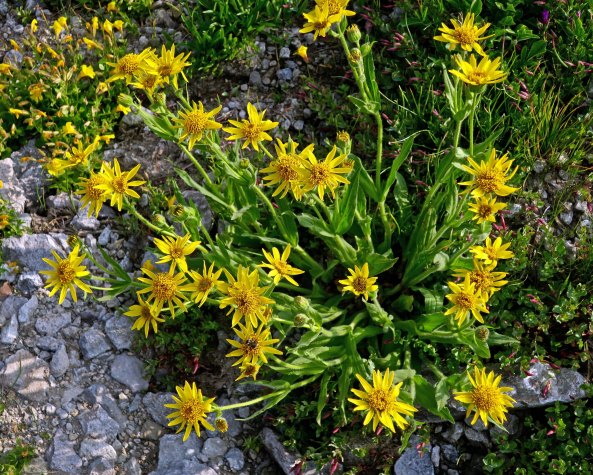
I am ever so grateful for the wildflowers like this pine drop that entertained me throughout my journey regardless of how tired I was.
What the wildlife had been up to also entertained me. For example, who had chomped down on this bird and left its feathers behind.
But to a thirsty guy, nothing could quite matches up to the beauty of flowing water. These are small rapids along Squaw Valley creek.
I was fascinated by the large umbrella plants growing along the stream.
Another photo of umbrella plants…
And a final— looking more umbrella-like.
Rock sculptures along the trail are guaranteed to make me pause. This was just above the McCloud River.
The McCloud River and Ash Creek camp provided a welcome respite from hiking for me.
Looking downstream on the McCloud River from a footbridge that was a few yards away from where I was camped.
Hiking up toward Deer Springs after my stay at Ash Creek, I saw a junco fly out of a grassy area. Closer inspection revealed its nest and three babies.
A closer view showed that the baby birds that were filling up the nest and still lacking in feathers.
I liked these heart shaped leaves. Peggy had also taken photos of them in Castle Crag State Park.
This large cedar had been hollowed out by fire. I was surprised that it was still standing.
Especially given its size.
This doe appropriately greeted me when I arrived at Deer Creek Spring. After I rinsed out some clothes and hung them up behind my tent, she repeatedly came over to check them out. It became annoying when she woke me up. I went out around 10 p.m. and retrieved them. They might have been missing in the morning!
I found the butterflies flying around and landing on my pack and gear more interesting than the curious deer. Check out the orange eyes on this one!
I’ll conclude today’s post with these brave souls who were willing to check out my boots. There is no way I would have gotten near those socks. They were banished outside my tent at night.

NEXT POST: I finish my journey to Burney Falls where Peggy has been hanging out taking photos of the falls and bribing through-hikers with food and beer to carry messages to me.