Chapter 13: You Are Late, Mrs. Tubman… Peace Corps Tales

Welcome to “The Dead Chicken Dance and Other Peace Corps Tales.” I am presently on a two month tour of the Mediterranean and other areas so I thought I would fill my blog space with one of the greatest adventures I have ever undertaken: a two-year tour as a Peace Corps Volunteer in Liberia, West Africa. Every two days I will post a new story in book format.

When I have finished, I will publish the book digitally and in print.


Peace Corps Volunteer Phil Weisberg looking serious in Gbarnga, Liberia where he served as a Volunteer 1964-65.

Our life became routine, if you consider living without electricity or running water and parking your butt in a cockroach occupied outhouse as routine.

Morning started with a quick bowl of cereal topped off by a mixture of water and Milkman powder. Drinking the stuff involved an acquired taste I never acquired but fresh milk came with a question mark. Louis Pasteur had not made it to Gbarnga.

Water was equally scary. Amoebic dysentery is a common third world ailment that attacks your intestines with shock and awe. Think of it as Montezuma’s Revenge times ten. Peace Corps provided a ceramic filter and the Peace Corps doctor provided endless warnings. Paranoia ran rampant in our household. We boiled our water for ten minutes and then filtered it, even when it came straight from the rain barrel.

By 8:00 our screen door slammed behind us as we made our daily trek to Massaquoi and teaching. At least I hoped that was what I was doing. Nobody nominated me for teacher of the year but I was feeling less nervous about the job. In Peace Corps, you take your victories where you find them. I liked my students, followed the curriculum and tolerated the subject matter.

“Here comes Jane. She looks mad. Run Dick run.” did not get me excited. Neither did two plus three equals five or “Let’s see if you can print an A.”

On the other hand, the Liberian teachers at our school were getting by with a high school education. Between taking care of their families, illness and ‘don’t want to’ they were often absent. Pay was $40 per month without benefits. Like all government workers, they were required to ‘contribute’ one month of their annual salary to the True Whig Party. In fact, loyalty to the Party was more important than loyalty to the job.

Sadly, no Teacher meant no teaching. Substitutes were nonexistent. The kids were left to get by on their own, which they did like kids anywhere: laughing, yelling, fighting, playing games, and disrupting other classrooms. Sometimes, out of frustration, I would walk into an unsupervised classroom and be rewarded with instant silence. It lasted until I walked out the door.

Occasionally we escaped from our jobs. The students would be called out to join a work party, there would be a national holiday or an important politician would come to town.

Work parties involved beating the jungle back from the school. It lurked around the edges, eager to regain lost territory. All of the students were required to participate in chopping and hauling. We were expected to supervise.

The older boys wielded machetes. My 22-year old second grader, John, challenged me to a tree-cutting contest. It was a small tree, limb size. Naturally the whole class and half the school gathered around. I good-naturedly took the machete, sent a prayer to the forest spirits that I wouldn’t chop off my leg, and whacked downward with all my strength. Maybe, just maybe, I cut a third of a way into the sapling. The machete became stuck, like it was super glued to the tree. The kids broke out in laughter.

“Your turn,” I said to John, leaving the offending tool buried. He grabbed the handle, yanked the blade out, and swung the machete in one easy motion. The tree came crashing down. I told John he was now in charge of class discipline. The kids laughed again, but not so hard. Maybe I was serious.

Holidays normally celebrated some important event in Americo-Liberian history, like Matilda Newport mowing down Tribal Liberians with a canon. We shared the tribal perspective on the event but appreciated the day off.

When President Tubman or Vice President Tolbert came to town, school children were expected to line the streets and cheer. It was part of the National Unification Program. Tubman was the charismatic “father” of his nation, the big daddy. Teachers were expected to be there as well. And they were. It’s not smart to irritate your meal ticket.

Our presence was urged but not required. Most Volunteers opted out of the important politician parade. Part of it was because of irritation with the government but the main reason was that the politicians were never on time. Often the luminary was two or three hours late and it was pouring down rain, which it did half of the time, or the sun was boiling hot, which it did the other half.

One of our fellow Peace Corps teachers in Gbarnga, Phil Weisberg, took a different approach. He was a tall, gangly Volunteer who looked like he had recently lost something of profound value. He was a serious man who rarely laughed.

I remember three other things about him. One, he was in love with Barbara Streisand. He had all of her albums and would listen to her for hours on his battery driven record player.

Two, he instituted his own welfare system for needy Liberian kids. He would hire one kid to dig a hole in his backyard and a second to fill it in. Sam thought it was quite funny and laughed when he told us the story.

Three, if his students had to wait in the sun or rain for politicians, he was going to be there, suffering along with them.

Once, when he was waiting in the hot sun for the President’s wife, Phil decided to demonstrate his displeasure. He penned a sign that informed Mrs. Tubman, “You are Late.” Two hours later her motorcade tooled in to Gbarnga. Phil hoisted his sign and waved it at the First Lady’s limousine.

The protest lived as long as it took the security police to grab him. One didn’t mess with the President’s wife. One did not protest against the government.

After he had sufficient time to consider his crime, Mrs. Tubman directed the police to release him. For punishment Phil was transferred to Monrovia to teach Americo-Liberian children at a Methodist school. Several Peace Corps staff wanted to send him home… Phil’s antics made their jobs more difficult, but Liberia’s Peace Corps Director, William Wilson, supported him. Eventually, he returned to his teaching job in Gbarnga.

When Phil’s term expired he left his record player and collection with us, minus Barbara. It did include a great selection of the Kingston Trio, however. Sam spent his spare time getting Charlie off the MTA and Tom Dooley hung.

The Tragedy of Liberia

Bob and Gerry Branch invited us to stay at their apartment in Monrovia while JoAnn and I were ‘trained.’ In this photo, Bob watches a funeral parade outside his window while Jo looks at the camera.

(At the end of the last blog, my ex-wife and I found ourselves stranded in New York City because we had mistakenly flown to JFK one day late and missed our flight to Africa. In this blog, we reach our destination.)

We made it to the right terminal on the right day and at the right time. In fact, absolute paranoia insisted we be three hours early. We watched lots of planes take off and land.

Finally, we found ourselves flying across a rough Atlantic. To quote Snoopy, “it was a dark and stormy night.” Lighting danced between the clouds as we struggled to deplete the airplane’s complimentary booze supply. We toasted the fact we had made it, we toasted Liberia, we toasted Jo’s mom for her hundred dollars and we toasted toasting.

I finally managed to fall asleep and only awakened when the pilot announced good morning. Jo and I scrambled to look down and were met by a vast sea of green broken occasionally by small clearings filled with round huts. Tropical Africa!

There was brief stopover in Dakar where French-speaking Senegalese served warm coke and ginger snaps for breakfast. It’s the type of meal you really should forget but never do.

An hour later we were dropping in to Robert’s Field, Liberia’s International Airport. A stewardess wrenched open the door admitting a sudden blast of heat and humidity. Luckily, roaming the streets of New York City in August had prepared us. What we weren’t prepared for was the view.

Striding across the tarmac to greet us was my old friend Morris Carpenter from community college days in California. He had joined the Peace Corps the year before and been assigned to Liberia. By some quirk of fate we had been assigned to the same country and would end up living closer together than we had in California.

All grins, we tumbled into each other. I couldn’t resist saying, “Dr. Livingston, I presume.”

Morris, as he put it, had been camped out on the Peace Corp’s Director’s desk in Monrovia for a month seeking a change in assignment when our arrival was announced. He quickly volunteered to pick us up. The Director, recognizing the opportunity for Morris-free time, had agreed even faster.

On our way into Monrovia, Morris filled us in on life in the Peace Corps as ‘it really was.’ One year of living in Liberia had coated his youthful idealism with a thin veneer of cynicism. There were good reasons.

Liberia was a country that had been born and nurtured in paranoia. Its origins dated back to the early 1800’s when slaves were being freed in the New England and there was a growing concern about the expanding population of free black people. While most Northerners accepted that slavery was wrong, few were willing to accept their freed slaves as equals.

In the South, where slaves outnumbered their owners, fear replaced concern. Insurrection was a real possibility. Henry Clay, Andrew Jackson, Daniel Webster and a number of other prominent Americans proposed a solution: ship freed African-Americans back to Africa. The American Colonization Society was founded and a portion of the west coast of Africa purchased. Approximately 11,000 freed slaves eventually shipped out.

Life was bleak and dangerous at first. The natives weren’t overly happy at seeing their long-lost cousins appropriate tribal lands and the Americo-Liberians (ALs) constituted a very small percentage of the total population.

The ALs had learned their US lessons well though and soon established themselves as the ruling elite. They took control of the government, education, and military. The natives were regarded as second-class citizens.

Power and privilege were the results but it was power and privilege accompanied by an underlying fear that the majority native population would rise up in revolt. This in turn led to a siege mentality and paranoia somewhat similar in nature to that felt by the white minorities in the Southern United States prior to the Civil War. I would see and experience several examples of this paranoia during my stay.

Close economic and political ties were maintained with the US over the years. Starting in 1926 Firestone entered the country and eventually cut down vast swathes of rainforest to plant rubber trees. As we drove by a rubber tree plantation on our way to Monrovia, Morris explained that the industry was now suffering from labor problems that the military had been called in to quash. Apparently workers were striking to earn twenty-five cents an hour.

On an outward level, there were a number of similarities between the United States and Liberia. English was the national language, the currency of the country was well-used American Dollars, and the flag was red white and blue complete with eleven stripes and one star. Upon arrival we even learned that the commanding general of the Liberian army was named George Washington. Not surprisingly, the government and the judiciary system were patterned after the American system.

In reality the government was a one party state controlled by the Americo-Liberians and whatever justice existed was heavily weighted toward keeping them in power. While change was underway when we arrived, it was too little and too late.

The failure to educate and bring large numbers of tribal Liberians into the economic and political system from the beginning was one of the major factors leading to the tragedy that Liberia would suffer over the next three decades. Americo-Liberians, tribal Liberians and the country would suffer terribly due to this negligence.

Morris dutifully dropped us of at Peace Corps headquarters to begin our orientation and take care of miscellaneous bureaucratic chores. While we had been playing at the World’s Fair, our fellow volunteers had been sweltering through hours of meetings. Now it was our turn.

Another married couple from Group VI, Bob and Gerry Branch, generously agreed to host our stay. They lived in a second floor apartment that overlooked one of Monrovia’s main streets. It provided a birds-eye view of life in the city.

Monrovia was overflowing with impoverished young people living in crowded tin shacks.

Monrovia was bursting at the seams with impoverished young people escaping from rural areas. Tin shacks fought for space as extended families struggled to find shelter from tropical downpours. Taxi and money-bus drivers, using their horns for brakes, filled the air with unceasing noise while the barking and growling of mangy dogs filled in around the edges. Evening air was tainted with the unique smell of cooked palm oil, smoke and moldering garbage.

Of course it wasn’t all bleak, assuming one had money. Monrovia had several good restaurants, a modern movie theater, an air-conditioned supermarket and a large paperback bookstore, all of which we came to appreciate over the next two years. Most Americo-Liberians did quite well. President Tubman lived in an impressive mansion on the outskirts of the city.

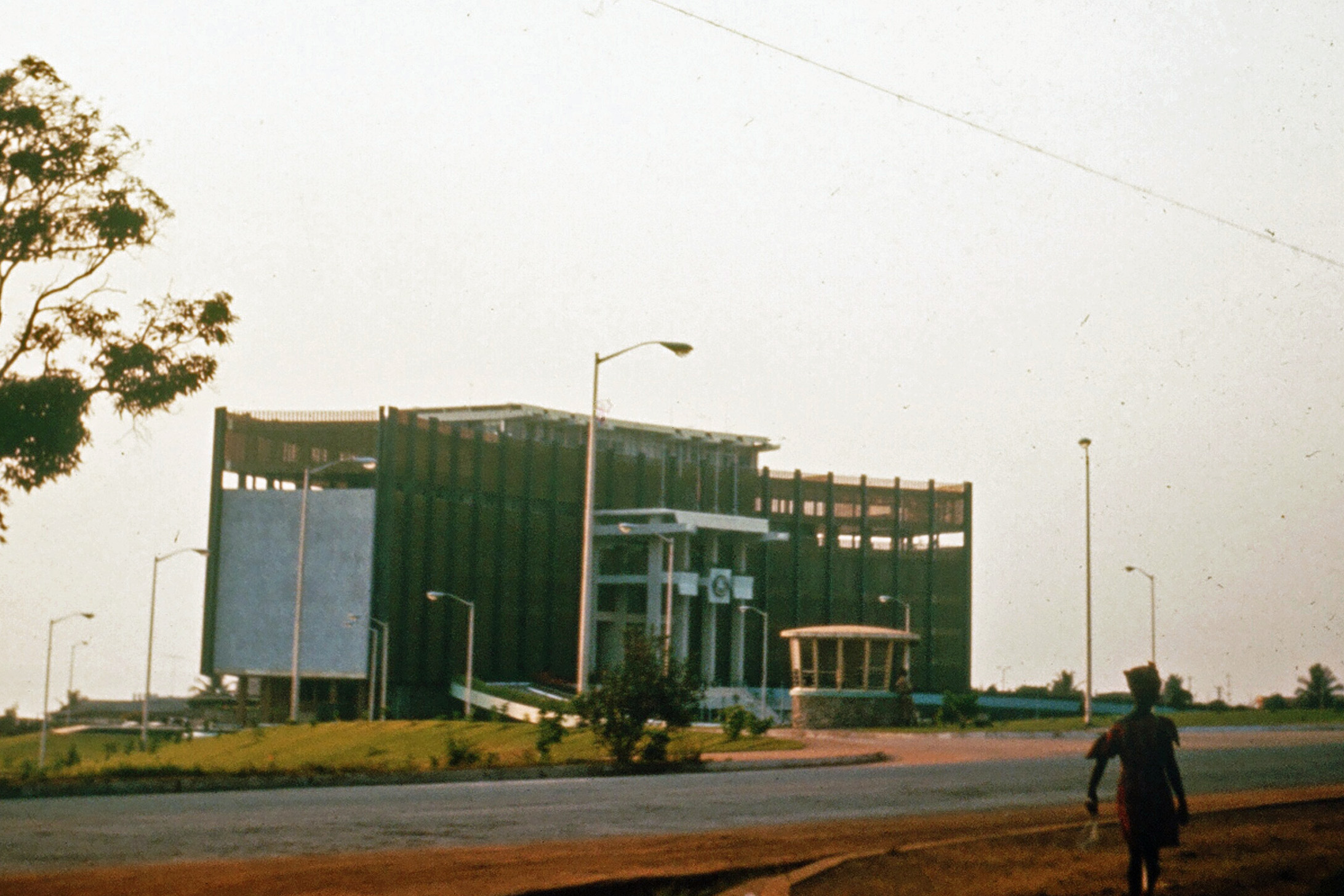
President Tubmans Mansion in 1966.

For our part, we were quite relieved to learn that our assignment wasn’t in Monrovia. Originally, we had been assigned to an elementary school down the coast in Buchanan. It was supposed to be a plum assignment so naturally another couple grabbed it when we failed to turn up.

We were left with their jobs; Jo would teach first grade and I would teach second in the upcountry town of Gbarnga. (Upcountry was anywhere inland.) Apparently this was our punishment for partying too long in Auburn. So be it…

(Note… in my March 3 blog I reported on how Phil Weisberg was arrested for holding up a sign criticizing Mrs. Tubman. Phil has since responded that he wasn’t arrested but was seized by security agents and later released.)

Treason

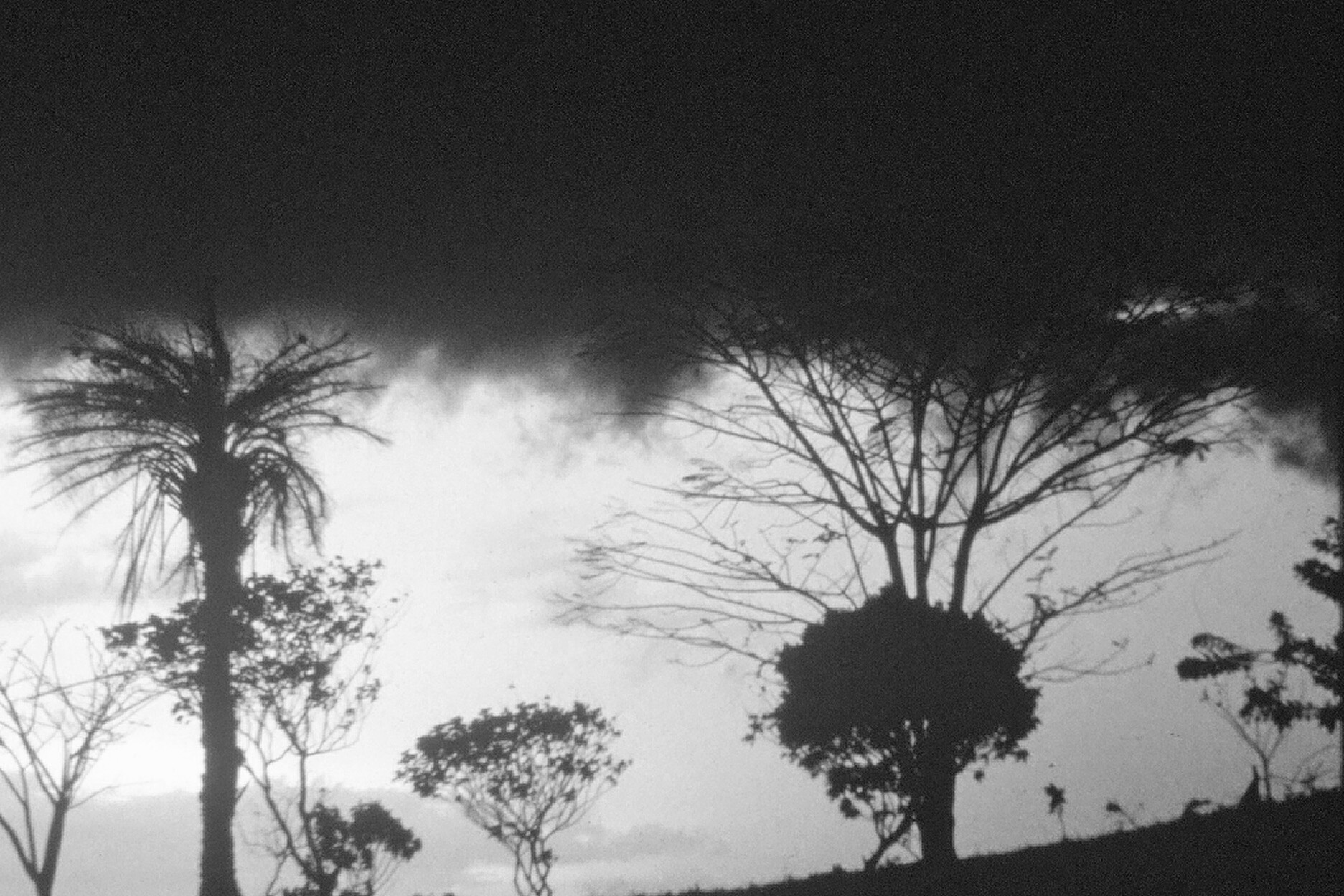
Gathering storm clouds over Liberia. I took this photo from my front porch in 1967. Looking back, it symbolizes for me the gathering political storm that would tear Liberia apart in the 70s, 80s and 90s.

Our job as teachers was to help bring Liberia’s tribal population into the twentieth century.

It was something of a first for the Country considering Americo-Liberians had worked hard for over a century to keep the tribal population in the darkest of the Dark Continent. Americo-Liberians were the descendents of freed slaves who had returned to Africa in the 1800s. They had promptly established themselves as the ruling elite.

It was a position they wished to maintain.

The times ‘they were a changing’ though. Independence was sweeping through Africa as one country after another threw off its colonial chains. Liberia’s tribal peoples were aware of what was happening in the world around them and the natives were getting restless.

The challenge to William Shadrach Tubman, who had been President since 1943, was to convince the tribal people they were getting a good deal, hold together a disparate people, make a show of it internationally, and still protect the privileges of the Americo-Liberians. Achieving the latter while moving forward on the first three was close to impossible.

It required an incredible balancing act at which Tubman was a master. The recipe for success involved one part substance, five parts fancy footwork and ten parts paranoia. The paranoia evolved from the fear that the tribal Liberians would take the process seriously and demand an equivalent portion or, God forbid, all of the goodies. Or possibly the nation would shatter apart.

As long as we behaved ourselves, we were part of the substance. The Liberian government made it quite clear that there would be grave consequences for anyone caught challenging the supremacy of the True Whig Party. For Liberians, the grave consequences could literally mean a hole in the ground. For us, it was a one-way ticket out of the country.

Don’t bother with stopping at Go or collecting $120 (our monthly salary).

Phil Weisberg in our back yard. Virgin tropical rainforest provides the backdrop.

One of our fellow Peace Corps Volunteers in Gbarnga, Phil Weisberg, actually tested the government’s resolve just prior to our arrival. Phil was a tall, gangly PCV who always looked like he had recently lost something of profound value.

He became upset whenever President Tubman or Vice President Tolbert came to Gbarnga and all of the school children in town were required to stand beside the road and cheer.

It didn’t matter if the luminary was one or two hours late, which he often was, or if it was pouring down rain, which it did half of the time, or if the sun was boiling hot, which it did the other half; the kids were expected to be there.

Teachers were required to go along. While most of the Volunteers managed to find something else to do, Phil’s personality was such that if his kids had to suffer he was going to be right out there suffering with them.

One day he found himself waiting an hour in the hot sun for the President’s wife and decided to protest. He did so by penning a sign that said in the best Liberian English, “MRS. TUBMAN, YOU ARE TOO LATE!”

Two hours later when her motorcade came tooling in to Gbarnga, Phil held up his sign and waved it about. Minutes later he found himself arrested and thrown into jail. This was not a piddling little kick your ass out of the country offense. One didn’t mess with the President’s wife.

Luckily Phil had the power of the American government behind him. Diplomatic maneuvering plus a personally written apology earned him a get out of jail free card. He was even allowed to stay in the country and finish up his term, provided of course he behaved.

I understood why Phil got in trouble. Waving a sign around criticizing the Presidents wife was not how to win friends and influence people among the Americo-Liberians. We all knew that the government was paranoid. Just how paranoid, I was to soon find out.

Peace Corps teachers were required to undertake a project during their first school vacation in Liberia. Given my experience at the elementary school, I decided do away with Dick, Jane and Spot and write a second grade reader. Why shouldn’t Liberian children have their own readers that reflected their own culture? Peace Corps agreed.

I jumped in. There were teaching guides to review, people to interview, folk tales to gather, and stories to write, rewrite and finish in one syllable English.

Eventually I finished the reader and shipped it off to Monrovia. Peace Corps was excited about the book and assigned an editor and illustrator to work with me. I would soon be a published author. Not. WAWA (a term coined by experienced African hands that stood for West Africa Wins Again) struck.

The book wouldn’t be published at all.

I had made the mistake of assuming the government would support a reader that featured Liberian children and African Folk Tales instead of Dick, Jane and Spot. What I had failed to understand was just how paranoid the Americo-Liberians were about maintaining power.

Apparently the book was a highly subversive tract and I was a dangerous radical. Liberian children would learn about their native heritage and rebel. Another misstep and I would be booted out of the country… or worse.

My next criminal activity was to organize a student government at Gboveh High School where I was taught African and World History. I decided the exercise would help our students prepare for the future and give them skills they would need in helping to govern their country.

Everyone, including students, teachers and Mr. Bonal, agreed. We pulled together interested students, worked through developing by-laws and set up elections.

Then the kids decided they would organize and run for office on party tickets. Why not? It sounded like fun. To provide identification for each ticket, they adopted names. It never entered my mind that this gesture would strike terror in the hearts of Americo-Liberians.

Within 24 hours we had been accused by the Superintendent (governor) of Bong County of setting up competing political parties to the Government’s True Whig Party. Student leaders were told to cease and desist or they would be arrested and thrown in jail.

I was told indirectly that I should start packing my bags.

So we eliminated the tickets and names. We were then allowed to proceed but I have no doubt we were closely monitored. I couldn’t help but wonder which of my students or fellow faculty members reported regularly to the Superintendent on my treasonable behavior.

The senior class. Yes, there were only five students in the class! Mamadee Wattee, standing on my right with a brown shirt and tie, was the student body president. He is also featured in my blog about the Lightning Man. Later he would move to the US and become an elementary school principal.