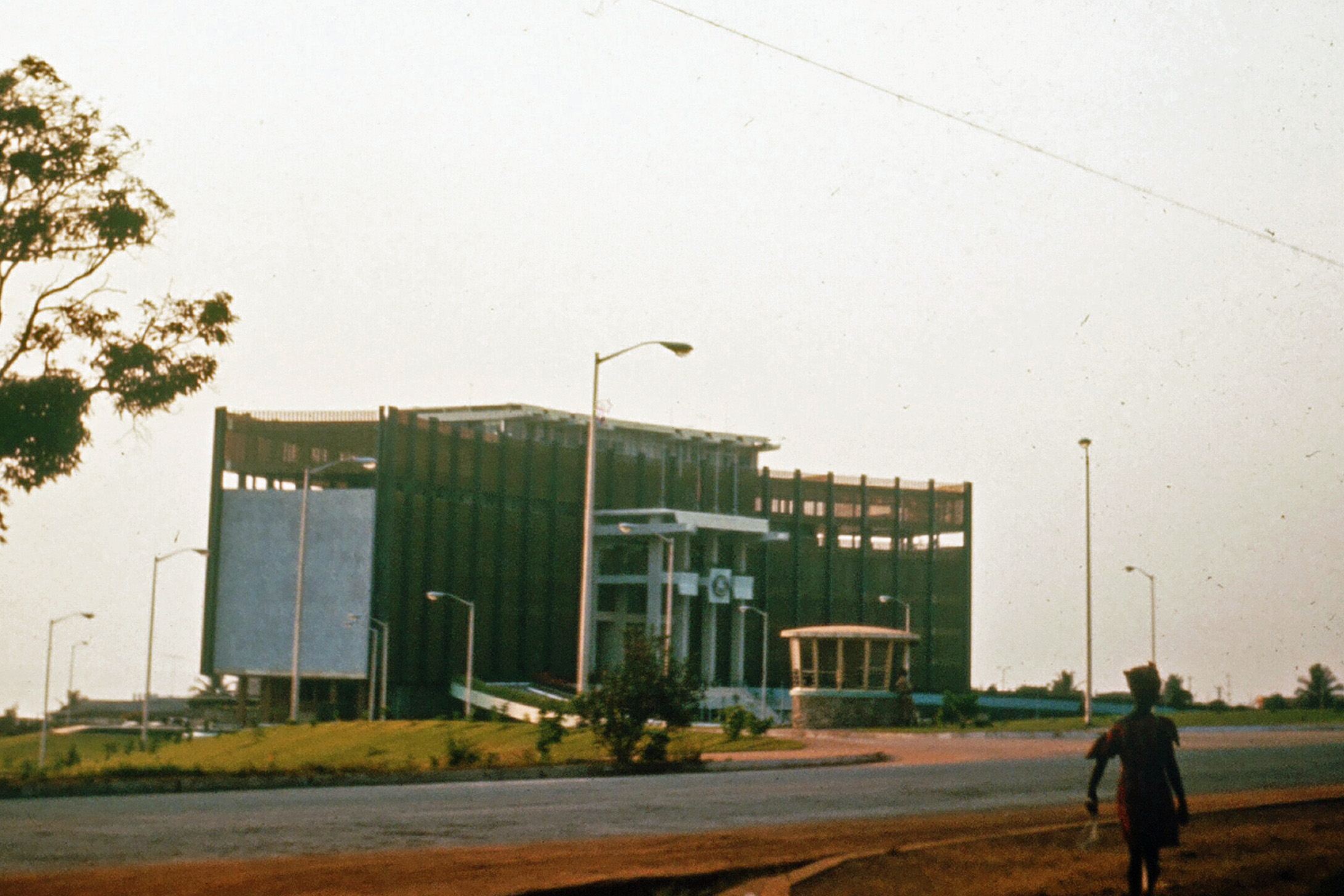
Chapter 12: Good Morning Teacha… Peace Corps Tales

Welcome to “The Dead Chicken Dance and Other Peace Corps Tales.” I am presently on a two month tour of the Mediterranean and other areas so I thought I would fill my blog space with one of the greatest adventures I have ever undertaken: a two-year tour as a Peace Corps Volunteer in Liberia, West Africa. Every two days I will post a new story in book format.

When I have finished, I will publish the book digitally and in print.

Palm trees peek over the roof of NV Massaquoi Elementary School in Gbarnga, Liberia while storm clouds gather. Jo and students stand out front in this 1965 photo.

I put on my coat and tie and shined my shoes. Jo donned her best dress. Kids were streaming by our house and staring through the screens, hoping for a glance at the new teachers.

Jo and I smiled at each other, took a deep breath, and walked out the door.

The air was warm and thick with humidity. Towering cumulus clouds filled the sky. Distant thunder rumbled. Rain was coming. We turned left on the red dirt road and joined the parade of students who glanced shyly at us. NV Massaquoi Elementary School waited.

It wasn’t far, maybe a half of mile, just far enough to get sweaty. Lush growth lined the road… green, dense, impenetrable, alive with buzzing, biting insects. The school sat off to the right in a clearing that been hacked out of the jungle.

Four classrooms faced the road while two more faced inward forming an elongated U. Cement blocks painted blue sat on top of cement blocks painted brown. Palm trees peeked over the zinc roof. Shuttered windows and closed doors completed the simple structure. A flagpole with Liberia’s red, white and blue flag was planted exactly in the center of the yard.

Students and teachers milled about as we approached. All eyes were on us, two white people in a sea of black. A man broke free from the crowd and approached. It was the Principal. We smiled and shook hands and he pointed out our classrooms. The orientation was over. And so was the gathering.

Students and teachers moved toward their rooms. Jo Ann wished me good luck and stalked off to her first grade with a look of determination. I walked toward my second grade with a look of bemusement.

“Good Morning Teacha” thirty bright and shiny faces shouted in unison as I entered.

It was scary, scarier than the big burly policeman who had guarded the door to the Administration building at Berkeley. I was expected to entertain and actually teach these kids something over the next couple of years.

“How?” bounced around in my skull and jumped down to my stomach.

I had a total of two months training at San Francisco State on educational theory. I didn’t have a clue about managing a classroom of second graders or teaching reading and writing and arithmetic. The last time I had been in a second grade, I was seven years old. My brief stint at student teaching a third grade in was helpful. But ‘brief’ is the critical word here.

And how did a classroom full of middle class kids in South San Francisco relate to a classroom of tribal Africans in Gbarnga, Liberia?

My students came from another world: one where spirits lived in trees, ghosts were dangerous, lightning strikes could be controlled, birds were meat-flying, homes were made of mud, live termites were considered a delicacy, and tribal justice was determined with a red-hot machete.

“Good morning students” I replied and smiled. Look confidant, I urged myself. Take control. It became my mantra.

I walked up to the blackboard and wrote Mr. Mekemson. The silence of the room was broken by the squeakiness of the chalk. I introduced myself, pronounced my name and had them pronounce it… several times. They laughed.

“I am from California,” I explained and noticed a slight recognition. Hollywood was there. “It’s a long way off.” I sketched a map of North America, Africa and the Atlantic Ocean with X’s for California and Liberia. Then I drew a great circle route with Diamond Springs on one end and Gbarnga on the other. I added a large jet plane with me looking out the window.

It was my first geography lesson. Of course it was incomprehensible. The kids had never seen a map. The only distance they understood was one they could walk. Jet airplanes were rare tiny specks in the sky.

But they liked the picture of me looking out the airplane’s window.

“OK, it’s your turn. I want you to tell me your name, your age and what tribe you belong to.” I could sense Americo-Liberians in Monrovia frowning. We were supposed to be moving away from tribalism and toward national unity. My students weren’t there yet.  They were Kpelle or Mano or Bassa or one of several other ethnic groups first and Liberian second, a distant second.

The majority of my students were Kpelle. It was the largest tribe in Liberia and Gbarnga was in the heart of Kpelle country. But there were also several other ethnic groups. English was the common language that was supposed to bind them together. Tribal dialects were not allowed in the classroom.

I quickly learned English meant Pidgin English spoken with a deep Liberian accent. At first, it seemed like a foreign language.

For example, you might say to me, “I have to go down town for about twenty minutes. I promise I won’t be gone long. Please wait for me.” My students would say, “Wait small, I go come.” “Small,” I, might add, in Liberian time could mean a few hours.

One idiom I learned quickly was, “Teacha, I have to serve nature.”  That meant, “May I have your permission to use the restroom?” Actually it was permission to use the outhouse or just as likely the ‘bush’ or even the side of the building. One day I looked up and saw one of my male students standing outside and listening to me through the window. I saw a slight shake of his shoulder and realized he was peeing on the wall. I admired his dedication but discouraged the practice.

Another challenge I faced was age difference. My youngest student was a decent second grade age of seven. The oldest was 22, my age, and a heck of a lot tougher. Several were middle school age and had middle school attitudes.

Books created a different problem; for the most part, there weren’t any. What we did have for reading were vintage 1950 California readers complete with Dick, Jane and Spot. I suspect I should have been grateful for anything but it was difficult for tribal kids to identify with big white houses, white picket fences and little white kids.

As for Spot, he bore a striking resemblance to food. Later, when I had a cat, my students would tease me by pinching him and saying, “Oh, Mr. Mekemson, what fine meat.”

The room reflected the simplicity of the building. Shutters covered windows without glass and without screens. Open shutters provided air conditioning. Bugs were free to come and go. Closed shutters kept heat in and tropical deluges out. The only audio-visual aid available was my writing on the blackboard.

Eventually we got through introductions, seat assignments and the other chores inherent in the first day of class. It was time to teach. I broke out Spot.

Somehow I managed to struggle through that first day. There was a curriculum to follow. More importantly, Jo Ann I had taken over from the two Volunteers who had lived in our house. Unlike us, they were experienced teachers. The kids had benefitted from their expertise.

Back at home after school, Jo had a story to tell.

“I was reading the Owl and the Pussy Cat out loud when one of my first graders broke in and said, ‘Oh, Mrs. Mekemson, you shouldn’t say that!’ The whole class broke out in laughter.”

“I asked them what they were talking about. They clammed up. All I could get was nervous giggles.”

“After school I related the story to one of the Liberian teachers and asked if she had any idea what the kids were talking about. She clammed up as well but I pushed her.”

“You were reading about a pussy, Mrs. Mekemson.” The woman managed to stutter. “You know a woman’s down under.”

How in the world her first graders who could barely speak English had picked up this particular meaning of pussy, we didn’t have a clue.

Chapter 11: My Name Is Captain Die… Peace Corps Tales

Welcome to “The Dead Chicken Dance and Other Peace Corps Tales.” I am presently on a two month tour of the Mediterranean and other areas so I thought I would fill my blog space with one of the greatest adventures I have ever undertaken: a two-year tour as a Peace Corps Volunteer in Liberia, West Africa. Every two days I will post a new story in book format.

When I have finished, I will publish the book digitally and in print.

Young kids were always curious about how Peace Corps Volunteers lived. The smallest girl in this photo (third from right) was about the size of the girl who kept her nose glued to our screen door. This group insisted that we take their “picha.” 

In my last post, I ended up with Crazy Flumo wrapped around my ankles while his compatriots rooted him on.

Fortunately, my adventures for the day were over. I bought kerosene, found a bug poison so potent it was outlawed it in the US and discovered such fine culinary treats as canned beef from Argentina and Club Beer, the national brew.

Jo Ann and Sam beat back the bug-a-bug and arrived at an uneasy truce with the cockroaches. They would limit their forays until after we had gone to bed and stay out of our bedroom. In return, we would only kill those we could reasonably stomp without tearing our house down.

For a while, I maintained a squashed cockroach account on a paper I taped to the door. Somewhere around 70, I gave up.

I have a grudging respect for cockroaches. To start with, they have a bit of seniority over man, some 300 million years worth. Back before dinosaurs roamed the earth, cockroaches were hiding out in all of the nooks and crannies and they will probably be around long after humankind has gone the way of the big lizards. There are reportedly somewhere between 3500 and 4000 species crawling around and each one has a shot at survival.

Compare that with our odds.

Anyway, there we were… one happy little family, cockroaches and all. Jo and I were about to begin our career as elementary school teachers. Captain Die got to us first.

Captain Die was a well digger who was said to have spent too much time in dark holes. Our well was one of his jobs. He had dug it for our predecessors, two female Volunteers. Afterwards, he began stopping by to visit the women and bum cigarettes.

Therefore, it was no surprise when he appeared on our doorstep shortly after we moved in. His introduction was unique.

“Hello, my name is Captain Die. My name is Captain Die because I am going to die some day. This is my dog, Rover. Roll over Rover. Give me a cigarette.” Rover, who was a big ugly dog of indeterminate parenthood, dutifully rolled over.

It made quite an impression.

We explained to Captain Die that neither of us smoked but invited him in to share some ice tea we had just brewed. We gave the Captain a glass and he took a huge swallow. I have no idea what he thought he was getting but it wasn’t Lipton’s. He thought we were trying to poison him.

A look of terror crossed his face and he spat the ice tea out in a forceful spray that covered half the kitchen and us. Dripping wet, we found ourselves caught between concern, laughter and dismay. The Captain marched out of our house in disgust with Rover close behind.

In addition to having found our predecessors an excellent supply of tobacco, Captain Die was quite taken with one of them.  While the story may have been apocryphal, we were told he appeared at the door when Maryanne’s parents were visiting from the States. Captain Die was a man on a mission.  He was going to request Maryanne’s hand in marriage.

I’ve always imagined the scene as follows.

Maryanne’s parents are sitting in the living room on the Salvation Army chairs making a game attempt at hiding their culture shock when this big black man and his ugly dog appear at the screen door.

Maryanne jumps up and says, “Oh Mom and Dad, I would like you to meet my friend, Captain Die.” Mom and Dad, brainwashed by Emily Post, and wishing to appear nonchalant, quickly stand up with strained smiles on their faces.

Captain Die grabs Dad’s hand and tries to snap his finger at the same time proclaiming, “Hello, my name is Captain Die. My name is Captain Die because I am going to die some day. This is my dog Rover. Roll over Rover. Give me your daughter.”

No one told me how Maryanne’s parents responded to the good Captain’s offer so I will leave the ending up to the reader’s imagination. I can report that Maryanne was not whisked out of the country by her mom and dad.

In addition to the certifiable types who found PCVs an easy target, there were a lot of folks who were just plain curious about how we lived. One little girl would have put a cat to shame. I never could figure out where she came from.

She would stand on our porch with her nose pressed against the screen door and stare at us for what seemed like hours. After a while it would become disconcerting and I’d suggest she go home. She would disappear but then I’d look up and there she’d be again, little nose pressed flat.

Finally, deciding more drastic measures were called for, I picked up my favorite folding chair and plopped it down a foot from the door. Then I sat down and initiated a stare back campaign. I lowered my head and moved forward until I was even with her head and about five inches away. The little nose slowly moved backward, suddenly turned around and took off at a fast gallop.

After that she watched the weird people from across the street.

Next post: We begin our assignment as elementary school teachers.

Chapter 10: Crazy Flumo Shakes My Hand and Ankles… Peace Corps Tales

Welcome to “The Dead Chicken Dance and Other Peace Corps Tales.” I am presently on a two month tour of the Mediterranean and other areas so I thought I would fill my blog space with one of the greatest adventures I have ever undertaken: a two-year tour as a Peace Corps Volunteer in Liberia, West Africa. Every two days I will post a new story in book format.

When I have finished, I will publish the stories digitally and in print.

A typical Liberian shop on Gbarnga, Liberia’s main street circa 1965-66. Note the crocodile’s skin with its tail dragging in the dirt..

In my last post, we went to bed without food, water or light in our new home in Gbarnga, Liberia. Drums and screams filled the darkness with sound.

A new day did manage to happen, as they always do. Jo Ann and I promised to make it a good one. Her job was to mount a ferocious counter offensive on the bug-a-bugs and cockroaches. Sam was coming early with a broom.

My job was to walk the quarter-mile to town, buy five gallons of kerosene, find the most toxic bug spray known to humankind, and scavenge anything available that resembled food.

I added alcohol to the list.

But first I needed to replace the malarial pond residing in our front room. I grabbed the offending bucket and tossed the stagnant water onto a plant. “Waste not; want not,” my mother would have urged even though it was in the middle of Liberia’s rainy season and the plant had already received half of its annual 170 inches of rain.

Now I was ready to tackle the well.  My family had one when I was growing up. It came with a cover, a high-pitched whirring pump, and a holding tank. Except for power outages, we could depend on it to magically deliver water day in and day out.

Our well in Gbarnga was an unprotected hole in the ground waiting for someone to fall in. Next to it I found a frayed rope. I tied it to the bucket’s handle using a Boy Scout bowline. Then, making sure I had a firm hold on the end of the rope, I tossed the bucket into the dark hole. Kersplash! I gave it a shake so it would tip over and fill.

A five-gallon bucket of water weighs 43 pounds. By the time I yanked it over the edge, I had a new appreciation for modern technology… and for the Volunteer who had left the original bucket in our house.

I delivered my burden to Jo and started for town. Half of Gbarnga was standing along the road staring at me. I smiled and waved a lot, like a princess on parade. They smiled and waved back.

Soon I came to the town’s main street. Open-air shops lined the dirt road on both sides. At first, they looked the same: white washed walls, red tin roofs, dark interiors, and faces staring out from inside. Then I begin noticing differences.

Several were fronted with crumbling cement steps that had long since given up any hope of connecting to the eroded street. One featured a crocodile skin nailed to the front post, its tail dragging in the dirt. Another had brightly colored shirts and shorts strung up like Christmas ornaments. Two or three were obviously makeshift bars, no more than holes in the wall with planks doing the honors. An ancient Liberian ‘Ma’ came staggering out of one with a half-pint bottle of gin clutched in her hand. She noticed me, hoisted her bottle in a toast, and took a swig.

A few shops were larger and resembled country stores filled with the minutia of daily life. Pale-faced Lebanese leased the shops. Lebanese made up the majority of Liberia’s middle class but were not allowed to own property. I was headed for a shop that Sam had recommended.

A group of men stood idly in front of the store. Had folks known I was coming, I would have sworn it was a reception committee. It’s show time went reverberating around my skull. I put on my best Peace Corps smile. One of the men stepped forward to greet me. He was barefoot and wore a tattered shirt, tattered shorts and a big grin. His hand shot out.

This is it, I thought, my first official Liberian handshake. We had started practicing in San Francisco. The shake begins as a normal handshake but ends with you snapping each other’s fingers. An audible snap signifies success. It isn’t easy at first. If the person is really happy to see you, he may go through the process two or three times.

(About the time the snap becomes second nature, it’s time to go home. Then you have to unlearn the process. Your American friends look at you strangely when you snap their fingers. At least my conservative Republican father-in-law did. But back to Africa.)

We shook; our hands parted. Snap! It worked. All of the men beamed and I beamed back. Their official greeter grabbed my hand again. Snap! Another success and more beaming. And again. Then a fourth time.  Nobody had mentioned four times to me and this time the guy wouldn’t let go. The men were laughing out loud now.

My hundred-watt smile became a twenty-watt grimace as I politely tried to retrieve my hand. No luck. I steeled myself, gave up any pretense of being polite and yanked. My hand pulled free and I breathed a huge sigh of relief. It lasted as long as it took the guy to drop to the ground and wrap his arms around my ankles. By now the other men were all but rolling the street.

I had become prime time entertainment, the George Custer of Gbarnga.

I might still be there if the cavalry hadn’t arrived.

It came in the form of a handsome Liberian man in a well-tailored suit. He appeared on the scene and gave Flumo a healthy kick in the butt. Flumo let go.

“Hi, I am Daniel Goe, Vice Principal at Gboveh High School. Welcome to Gbarnga.” he introduced himself.

We shook hands in the old-fashioned way as Daniel explained that the man who had his arms wrapped around me was known throughout the Country as Crazy Flumo. I wasn’t the only person to receive his attention. Once, Daniel told me, Flumo had thrown himself down in front of Vice President Tolbert’s car and wouldn’t move until the VP climbed out and gave him five dollars.

I later learned that a tall Texan Peace Corps Volunteer had walked several yards down the main street of Gbarnga with Flumo tenaciously attached to one leg. I’d gotten off easy. Having met one of Gbarnga’s true characters, I was about to meet another.

Next post: Captain Die, our well digger, stops by and introduces himself… “My name is Captain Die because I am going to die someday.”

Chapter 9: The Levitating Squat Routine… Peace Corps Tales

Welcome to “The Dead Chicken Dance and Other Peace Corps Tales.” I am presently on a two month tour of the Mediterranean and other areas so I thought I would fill my blog space with one of the greatest adventures I have ever undertaken: a two-year tour as a Peace Corps Volunteer in Liberia, West Africa. Every two days I will post a new story in book format.

When I have finished, I will publish the book digitally and in print.

Termites, or bug-a-bugs as the Liberians called them, created large mounds such as this one throughout the rainforest.

In my last post, Jo Ann and I travelled upcountry to Gbarnga, Liberia and our Peace Corps assignment. Arriving after dark at our new home, we opened the door to find the house swarming with life.

“Lots of bug-a-bug and cockroaches,” Sam observed as we peered in at the chaos.

Sure enough, our flashlight revealed that the writhing floor was a multitude of three-inch African cockroaches scurrying every which way. The tunnels climbing the walls had been sculpted by termites, or bug-a-bug as the Liberians colorfully named them. The tomb-like odor was how a house normally smelled in the tropics when left vacant for a few weeks.

Bob’s proudly drawn bucket of water sat carefully placed in the middle of the living room. Warm thoughts of veteran Peace Corps Volunteers taking care of the new kids temporarily blocked our darker visions.

I directed the flashlight into the bucket. A thick layer of scum reflected the light as a complete ecosystem came to life. Somewhere in the house a malaria-bearing mommy mosquito was extremely proud of her progeny. Hundreds of little wigglers broke the surface, virtually guaranteeing the continuation of the family line for a thousand years.

“Can you imagine what this would have been like if the Volunteers hadn’t cleaned?” I chuckled nervously, making a weak attempt at humor. Jo Ann recognized it for what it was worth and ignored me. I had the uncharitable thought that cleaning our house out had meant removing the furniture.

“Let’s tour our new home.” Again silence, but at least Jo Ann followed me. I had the flashlight. The bedroom was first. A fist-sized crab like spider went scurrying sidewise across the wall. Splat! One problem was eliminated. I hoped that its aunts, uncles, brothers and sisters weren’t the vengeful type.

Our bed was a moldy mattress shoved into the corner. It smelled suspiciously like the house.

“Hey, our first furniture,” I noted, still trying to get a laugh. This time I was rewarded with a weak smile.

Next we came to the kitchen. There was no chance it would show up in Sunset Magazine.  A kerosene lantern, kerosene stove and kerosene refrigerator filled the space. But there was no kerosene.

My thoughts returned to the PCVs and what they might have done. I envisioned the refrigerator running and full of cold beer. Then I just envisioned the beer. It didn’t have to be cold, just plentiful. But there wasn’t any beer, there wasn’t any light, there wasn’t any drinkable water and there wasn’t any food. It promised to be a long night.

“I need to visit the outhouse,” Jo Ann announced. My bladder gave an empathetic twinge. Our last pee stop had been in Monrovia. The three of us trooped outside. Jo took the flashlight and disappeared into the rickety one holer.

“Curtis!” she yelled. I yanked open the door and prepared to be heroic. Jo Ann was standing inside with a wild look on her face. The flashlight was shining down into the hole. Thousands of little eyes stared back at us.

“Lots of cockroaches,” Sam noted. He was beginning to sound repetitious.

That was the night that Jo Ann mastered her famous levitating squat routine. Cockroaches used your butt as a runway when you sat on the toilet. Jo solved the problem by positioning herself about five inches up in the air. I am not sure how she managed this Yoga feat but her rear never touched an outhouse seat during the two years we were in Africa.

I used a different approach. A loud stomp on the floor sent the cockroaches scurrying downward. The trick was to escape before they came back up. My habit of reading in the bathroom was sacrificed to the cause.

There wasn’t much left to do but send Sam on his way and try to get some sleep. We retired to our bedroom and I scrutinized the walls to see if any new monster crab spiders had appeared. They hadn’t. Word of their truncated life span had gotten around.

I then beat the bed for several minutes with the sincere hope of persuading any other unwanted guests to hit the road.

I also leaned the rest of our furniture, three well-used Salvation Army type folding chairs, against each of the screened windows. Veteran Peace Corps Volunteers had warned us that rogues, i.e. burglars, loved to rob green Volunteers on their first few days in town. The chairs would serve as a primitive burglar alarm. My theory was that jiggling the window would knock over the chair and scare away the rogue. It was guaranteed to scare the hell out of us.

Finally it was time to crawl in. We left our clothes on. Jo Ann, by this point, had reached a high level of unhappiness. I was glad there were no handy airplanes around. There was a story about a Volunteer who had landed at Robert’s Field Airport, taken one look and climbed back on the plane. My perspective on the evening was that things had been bad enough they were bound to get better.

That’s when the drums and screaming started.

No one had told us that a Kpelle funeral was like an Irish wake.

Mourners stayed up all night pounding on drums, wailing and drinking lots of cane juice, a concoction similar in nature to moonshine. It was important that the dead be sent off properly. Otherwise the spirit of the dead person would become irritated, hang around and do all sorts of bad stuff.

Of course we knew nothing about any of this. All we knew was that people were beating on drums and screaming. It was time to circle the wagons. Eventually I went to sleep; I don’t think Jo ever did.

Next post: We wage war on the bug-a-bug and I have an encounter with Crazy Flumo.

Chapter 8: Armies of the Night… Peace Corps Tales

Welcome to “The Dead Chicken Dance and Other Peace Corps Tales.” I am presently on a two month tour of the Mediterranean and other areas so I thought I would fill my blog space with one of the greatest adventures I have ever undertaken: a two-year tour as a Peace Corps Volunteer in Liberia, West Africa. Every two days I will post a new story in book format.

When I have finished, I will publish the book digitally and in print.

A view of Monrovia from Bob and Gerry Branch’s apartment.

Bob and Gerry Branch, friends from training in San Francisco, generously agreed to host our stay in Monrovia. They lived in a second floor apartment that overlooked a busy Monrovia street. It provided a birds-eye view of life in the city.

Monrovia was bursting at the seams with young people escaping from rural areas. The poverty was intense. Tin shacks fought for space as extended families struggled to find shelter from tropical downpours. Taxi and money-bus drivers used their horns for brakes and competed with barking mongrels in creating unceasing noise. Evening air was tainted with the unique smell of cooked palm oil, smoke and moldering garbage.

On the plus side, Monrovia had several good restaurants, a modern movie theater, an air-conditioned supermarket and a large paperback bookstore, all of which we came to appreciate over the next two years.

Most Americo-Liberians did quite well and the top families lived in luxury. They owned mansions in Monrovia and large farms Upcountry. Many had second homes overseas. Their children went to college in Europe and America and dressed in the latest fashions. President Tubman’s official residence, located on the edge of town, cost the Liberian people $15 million. This was approximately half of Liberia’s total government budget the year it was built.

We were quite relieved to learn that our teaching jobs weren’t in Monrovia. Originally, we had been assigned to an elementary school down the coast in Buchanan. It was supposed to be a plum location complete with golden beaches and palm trees swaying in the breeze. The Director told us our top rating in training had earned us the assignment. The rating was news to us.

Naturally another couple grabbed it when we failed to turn up on time. We were left with their jobs; Jo would teach first grade and I would teach second in the upcountry town of Gbarnga. Apparently this was our punishment for partying too long in Auburn.

Gbarnga was a long 120 miles out of Monrovia on the nation’s primary dirt road. With a population approaching 5000, it was Liberia’s largest upcountry town and the center of government for Bong County.

We were eager to get there and escaped from Monrovia as soon as the Director said go. Wellington Sirleaf, the Peace Corps’ driver, carted our minimal belongings and us up to our new home. We arrived in Gbarnga just before dark… tired, hungry, and nervous.

Our feelings ran the gamut from “wow, we are finally here” to “what in the heck we have gotten ourselves into?”

What Gbarnga had that other upcountry sights lacked, however, was an official Peace Corps staff person, Bob Cohen, and an official Peace Corps doctor, Less Cohen (not related). I assumed this would make our life officially easier. Sirleaf took us straight to Bob’s trailer. It was located on a well-maintained USAID (United States for International Development) compound. Bob came out to greet us.

Bob Cohen and Les Cohen (not related). Bob was our upcountry Peace Corps Representative and Les was the Peace Corps Doctor.

“Welcome to Gbarnga,” he said. “Your house is located across town.”

Using mental telepathy, I beamed at him, “Invite us in for dinner. It’s the proper thing to do.”

“The Volunteers had a work party and cleaned your house last week,” he went on, oblivious to my sendings. I urged Jo Ann to look hungry. “And, they even drew you a bucket of water.”

This seemed to impress Bob, so I mumbled something like, “They shouldn’t have.”

“Wellington will drive you over so you can get settled in. Enjoy your evening.” And with that, Bob returned to his trailer. I pictured his filet mignon getting cold.

There was one more stop before we got there. This time it was to see Shirley Penchef, another Peace Corps Volunteer. She was waiting at her house with a young Liberian of the Kpelle tribe and a surprise. It wasn’t food.

“This is Sam,” she bubbled (Shirley always bubbled). “Sam is so excited you are here! He has been waiting weeks for you! He is going to be your houseboy!”

Jo and I were speechless. We had talked about the possibility; it was common practice among PCVs. A young Liberian would help with chores, earn spending money, and often eat with the volunteer. Both the Liberian and the PCV gained from the experience. We recognized the value of the arrangement but had decided that having a houseboy didn’t fit the Peace Corps image.

I mean how do you tell the folks back home you are roughing it out here in the jungle and doing ‘good’ while someone cooks your dinner, washes your clothes, and cuts your grass?

On the other hand, how do you tell a woman who talks in exclamation points and a 13-year old boy who is grinning from ear to ear that you don’t want what they are selling?

“Uh, gee, uh, well, why doesn’t Sam help us get settled in and then we’ll see,” we managed to stutter. It was one of the better decisions we were to make in Liberia.

“It’s time to go,” Wellington announced impatiently. I surmised that a delicious plate of hot Liberian food was waiting for him somewhere in Gbarnga as soon as he could lose us. Sam, Jo Ann and I climbed in the jeep, waved goodbye to Shirley, and went bouncing off down the road.

I don’t want to be melodramatic about the introduction to our new home but a little horror movie music might be appropriate. The sun had just set when we arrived. In the tropics, that’s like someone turned off the lights on a dark night. Twilight doesn’t exist.  Fortunately we had a flashlight.

Outward appearances weren’t bad. Our new home was a typical Liberian town house. Two sets of closed shutters and a door stared out at us. A zinc roof capped the whitewashed walls. Off to the left was a hole in the ground that Sam informed us was our well. Peeking out from behind on the right was the outhouse. All in all, it was pretty much what we expected.

A day time view of the house with me standing on the left.

Then we opened the door.

It was a full-scale Armies of the Night scene straight out of Hollywood: the type of scene Bella Lugosi drooled over. Our noses were assailed with the scent of something that had been entombed for a thousand years. The floor writhed with life. Hundreds of small tunnels etched their way up the walls. I jumped back a foot. Jo Ann qualified for the Olympics.

Sam laughed…

Next post: We learn about what lives in our house; Jo Ann masters the levitating squat routine; and drums and screams make for a restless night.

Chapter 7: Liberia, A Nation Born and Nurtured in Paranoia… Peace Corps Tales

Welcome to “The Dead Chicken Dance and Other Peace Corps Tales.” I am presently on a two month tour of the Mediterranean and other areas so I thought I would fill my blog space with one of the greatest adventures I have ever undertaken: a two-year tour as a Peace Corps Volunteer in Liberia, West Africa. Every two days I will post a new story in book format.

When I have finished, I will publish the book digitally and in print.

President Tubman’s Mansion circa 1965. A small elite of wealthy Americo-Liberians ruled Liberia from its founding.

Liberia was born and nurtured in paranoia. Its birth took place in the US during the early 1800’s. The number of free black people was growing rapidly in the North. Yankees saw this growth as an issue of assimilation and competition.

Southerner slave owners saw it as a dangerous threat.

The existence of free blacks encouraged their slaves to think of freedom. Insurrection was a real possibility and that possibility generated deep paranoia in the minds of slave owners. Visions of being killed haunted their dreams.

Various solutions were suggested including the creation of a new state in the US strictly for free black people. Louisiana was named as one possibility. Carving a state out of western territories was another proposal. Henry Clay, Andrew Jackson, Daniel Webster and a number of other prominent Americans offered a different solution: ship free African-Americans back to Africa.

The idea was greeted with enthusiasm. Northern humanists believed that free blacks would be more successful in Africa. Southern slave owners felt that removing free blacks from the continent would eliminate their influence. Powerful Christian groups added their support.  A foothold in Africa was an opportunity to save millions of ‘heathen’ souls.

Free blacks were not asked for their opinion.

In 1816 the American Colonization Society (ACS) was founded and by 1820 the first group of 88 African Americans and three white ACS agents sailed to Liberia on the ship Elizabeth.

Life was bleak and dangerous at first. The tribal people were not happy at seeing the intruders take over the region and the Americo-Liberians (ALs), as they came to be known, constituted a very small percentage of the total population. Many died from disease. The new Liberians had long since lost their immunity to tropical bugs.

Purchasing land for the colony from the reluctant tribes was not easy. Gunboat diplomacy solved the problem. Lieutenant Robert Stockton of the US Navy persuaded a local tribal chief, King Peter, to sell the area that would become Monrovia. He pointed a gun at the Chief’s head.

Further territory was added by Stockton’s successor, Jehudi Ashmun, using similar methods. In 1825 he persuaded King Peter and other tribal chiefs to sell prime real estate along the coast for 500 bars of tobacco, three barrels of rum, five casks of gun powder, five umbrellas and miscellaneous other trinkets.

In 1847 Americo-Liberians declared their independence from the American Colonization Society and Liberia became the first independent black republic in Africa.

Only a tiny portion of America’s black population, some 17,000, emigrated from the US to Liberia. African Americans had lived in the US since early colonial times. Their culture was that of their white counterparts, not their distant cousins in Africa. They had fought in America’s wars and helped build the nation.  The United States was their home.

Africans freed from slave ships and a small contingency of blacks from Barbados supplemented the Americo-Liberian population.

The history of Liberia is the history of the relationship between Americo-Liberians and the tribal people. The ALs had learned their lessons well in America. They quickly set themselves up as the ruling class. Tight controls were established over the government, military, education, media and economic opportunity.

Tribal Liberians were regarded and treated as second-class citizens and possibly even slaves. In 1929 the League of Nations instigated an investigation into the use of forced labor on the Spanish Island of Fernando Po. Liberian soldiers were used in raids on tribal villages to obtain workers. High government officials were involved. There were rumors that Liberia’s President Charles King, and Vice President Allan Yancey participated in the scheme.

Whether King was involved or not, there is no doubt he was corrupt. The 1982 Guinness Book of World Records listed his 1927 election as the most corrupt in history. King received 234,000 votes from Liberia’s 15,000 registered voters.

Fernando Po represented the tip of a large iceberg. Tribal people were expected to provide free labor for public projects such as road building. They were also expected to provide an inexpensive to free source of labor for the large Upcountry farms of Americo-Liberians. Tribal chiefs also benefitted, as did a Major American corporation.

In 1926 Liberia provided Firestone Tire and Rubber Company with a 99-year, one million acre concession to grow rubber trees. There was to be an exemption on all present and future taxes and the government guaranteed a cheap labor supply… even if soldiers had to recruit it. During my time in Liberia, Firestone workers would go on strike to earn $.25 per hour.

Power and privilege were the results of the policies of the Americo-Liberian government. But it was power and privilege accompanied by an underlying fear that the majority native population would rise up in revolt. This in turn led to a siege mentality similar in nature to that felt by the white slave owners in the Southern United States, which is ironic, to say the least.

When Jo Ann and I arrived in August of 1965, the role of the Peace Corps was to help bring Liberia’s tribal population into the twentieth century. It was a first for the country, considering that Americo-Liberians had worked so hard for so long to keep the tribal population under tight control.

The times ‘they were a changing’ however, as Bob Dylan sang. Independence was sweeping through the continent as one country after another threw off its colonial chains. Liberia’s tribal people’s were aware of what was happening in the world around them and the natives were getting restless.

On an outward level, we found a number of similarities between the United States and Liberia. English was the national language, the currency of the country was well-used American Dollars, and the flag was red white and blue complete with eleven stripes and one star. We even learned that the commanding general of the Liberian army was named George Washington. Government and judiciary were patterned after the American system.

In reality, Liberia was a one party state. The government was controlled by the True Whig Party, which in turn was controlled by Americo-Liberians. What justice existed was heavily weighted toward keeping the ALs in power.

The challenge to William Shradrack Tubman, who had been President since 1943, was to convince the tribal people they were getting a good deal, make a show of it internationally, and still protect the privileges of the Americo-Liberians.

It required an incredible balancing act at which Tubman was a master. The recipe for success involved one part substance, five parts fancy footwork, and ten parts paranoia. The paranoia evolved from the fear that the tribal Liberians would take the process seriously and demand their share or, God forbid, all of the goodies.

As long as Peace Corps Volunteers behaved themselves, they were part of the substance. The Liberian government made it quite clear that there would be serious consequences for anyone caught challenging the supremacy of the Americo-Liberians and the True Whig Party. For Liberians, the serious consequences could mean jail… or worse. For us, it was a one-way ticket out of the country.

I would find myself on the edge of being shipped out, twice.

Chapter 6: Dr. Livingston, I Presume… Peace Corps Tales

Welcome to “The Dead Chicken Dance and Other Peace Corps Tales.” I am presently on a two month tour of the Mediterranean and other areas so I thought I would fill my blog space with one of the greatest adventures I have ever undertaken: a two-year tour as a Peace Corps Volunteer in Liberia, West Africa. Every two days I will post a new story in book format.

When I have finished, I will publish the book digitally and in print.

My friend Morris Carpenter at home in Mississippi… some 45 years after he welcomed us to Liberia.

We made it to the right terminal on the right day and at the right time. In fact, our paranoia insisted we be four hours early. We watched lots of planes take off and land.

Finally, we found ourselves flying over a rough Atlantic. To quote Snoopy, “it was a dark and stormy night.” Lighting danced between the clouds as we struggled to deplete the airplane’s complimentary booze supply. We toasted each other, we toasted the fact we had made it, and we toasted Liberia.

“Good morning.” The pilot’s speaker driven voice woke me from my booze-induced sleep. Jo and I scrambled to look down and were met by a vast sea of green broken occasionally by small clearings filled with round huts. Tropical Africa!

There was brief stopover in Dakar; French-speaking Senegalese served warm coke and stale ginger snaps for breakfast. It’s the type of meal you really should forget but never do. Two hours later we dropped into Robert’s Field, Liberia’s International Airport. The stewardesses wrenched open the door admitting a sudden blast of heat and humidity. Roaming the streets of New York City in August had prepared us for the weather but not the view.

Striding across the tarmac to greet us was my old friend Morris Carpenter. He and I had been in student government together at Sierra College near Sacramento.

Morris was a year ahead of me and transferred to Chico State College at the end of my freshman year. We remained close friends via long, handwritten letters. During his senior year he joined the Peace Corps and was assigned to Liberia. His letters from Africa were part of my inspiration for joining. Little did I dream that Jo Ann and I would end up in the same country.

All grins, we tumbled into each other. I couldn’t resist saying, “Dr. Livingston, I presume.”

Morris, as he put it, had been camped out on the Peace Corp’s Director’s desk in Monrovia for a month seeking a change in assignment when our arrival was announced. He quickly volunteered to pick us up. The Director, recognizing an opportunity for Morris-free time, had agreed even faster.

On our way into Monrovia, Morris filled us in on life in the Peace Corps as ‘it really was.’ One year of living in Liberia had coated his youthful idealism with a thin veneer of cynicism.

His first assignment had been as an elementary school teacher on Bushrod Island located next to Monrovia. That career came to a crashing halt. He caught the Principal squeezing hot pepper juice into a young girl’s eyes. Whippings were common in Liberian schools but the fiery liquid was over the edge. He grabbed the Principal’s arm.

“You are a ‘small’ woman,” he angrily accused her, which is a major insult in Liberia. As it turned out, the Principal was a cousin to one of Liberia’s ruling elite, which made her a ‘big’ woman. Morris was booted out of the school within 24 hours.

Peace Corps staff was sympathetic but powerless. They found Morris employment as a Public Administration Volunteer in the Liberia Department of Education where he spent a frustrating six months attempting to establish a modern filing system. It didn’t happen. The Department served mainly as an income producing opportunity for the relatives of prominent politicians. Finding files was not a required skill set.

“I couldn’t get past ABC.” Morris grumbled. He was much more successful at his night job: locating Monrovia’s best bars and bar maids. It was time to move on.

Morris requested a rural Up-country assignment. And he got it. Peace Corps found him a job teaching at an elementary school in the small village of Yopea. It was about as rural as Peace Corps assignments went in Liberia. Getting there involved driving 130 miles Upcountry on Liberia’s main dirt road and then following a small dirt track for 20 miles to the tiny village of twelve huts, a two-room school, and a Care kitchen.

He shared teaching responsibilities with the Principal. His job was to teach the fourth, fifth and six grades. Students came from surrounding farms as well as the village. Life was much quieter and more productive than it had been in Monrovia.

If it became too quiet, he escaped to Monrovia and its bright lights on his Honda Motorcycle. Morris told us he would have been happy to finish off his Peace Corps experience in Yopea. “I liked the Principal, enjoyed the kids and built a basketball court.”

He didn’t, however, like the Volunteer that Peace Corps assigned to work with him a few months later.  JCC was a fundamentalist from Tennessee who considered it his responsibility to convert the ‘heathen’ Liberians. This may have been appropriate behavior for a missionary but it was inappropriate for a Peace Corps Volunteer.

The dislike was mutual. JCC did not approve of Morris’s lifestyle. Adding fuel to the fire, Peace Corps required that the two share a house. The close proximity didn’t work. Morris wanted a divorce. “He was just too goofy.”

Morris hopped on his Honda and zipped in to Gbarnga to meet with Peace Corps’ Upcountry rep, Bob Cohen. “I want JCC out of my village,” Morris demanded. Bob told him that it was only a personality clash. “Go back to work.” Morris went back to Yopea all right, but he packed his bags and headed for Monrovia.

“Either find me a new assignment of send me home,” he told the Liberia Peace Corps Director.

And that’s where we came into the picture.

Morris dutifully dropped us off at Peace Corps headquarters in Monrovia to begin our in-country orientation and take care of miscellaneous bureaucratic chores. While Jo Ann and I had been playing at the World’s Fair, our fellow volunteers were sweltering through hours of meetings. Now it was our turn.

Chapter 5: Left Behind and Very Alone in NYC… Peace Corps Tales

Welcome to “The Dead Chicken Dance and Other Peace Corps Tales.” I am presently on a two month tour of the Mediterranean and other areas so I thought I would fill my blog space with one of the greatest adventures I have ever undertaken: a two-year tour as a Peace Corps Volunteer in Liberia, West Africa. Every two days I will post a new story in book format.

When I have finished, I will publish the book digitally and in print.

Jo Ann poses at the 1964/65 New York World’s Fair. Like the ancient dinosaurs, our Peace Corps group had disappeared.

Now we were disembarking at JFK in New York City, two country kids who had traveled a long way from Diamond Springs and Auburn California. All we had to do was check in at the Pan Am desk, grab a bite to eat, and catch our trans-Atlantic flight to Africa.

Ah that life should be so simple. Oh we managed to find the Pan Am desk all right, but no one was there.

“Excuse me, could you tell me where the Liberia Peace Corps group is?” I asked a harried attendant.

“I don’t have any idea,” was the brusque reply.

Have you ever had the sinking feeling that you have blown something critically important? It starts with the hair on your head and works its way downward to your toes. Every part of your body jumps in to let you know you aren’t nearly as smart as you imagine you are. It’s the stomach that serves as the real messenger, however, and mine was rolling like the Atlantic in a hurricane.

“Check the instructions again, Curt,” the voice of reason standing beside me directed. Good idea.

“Well, it says right here we are supposed to be at the Pan Am desk no later than 5 PM.” It was only 4. My stomach calmed down to a respectable jet engine rumble. “Let’s have a bite and check back.” I suggested, working hard to be the man.

Five PM came and no one, nothing, nada; it was serious panic time. “Wait here Jo in case anyone comes. I’ll go check the instructions one more time.”

We had stuffed our bags in a drop-a-quarter-in-the-slot storage locker while we ate. I freed my shoulder bag from captivity and reread the instructions. Yes, we were in the right place at the right time. Then there it was, the answer, staring at me in black and white. “You will fly to New York on August 7th.”

It was the 8th.

Damn! I slowly climbed back up the stairs.

“I’ve found them Jo Ann.” A look of relief and the beginning of a smile crossed her face.

“Where are they?”

“In Liberia.”

Let me say this about the two of us; we were both stubborn as mules when we thought we were right. This could create problems when we disagreed but the potential for disaster was miniscule in comparison to when we both agreed we were right and we weren’t. Reality didn’t matter and certainly a little date on a piece of paper we had each read a dozen times wasn’t going to deter us.

The 7th was our going away party in Auburn, period. While we were kicking up our heels and smelling the honeysuckle, our compatriots were crossing the Atlantic to Africa. Now we were left behind, very alone and stuck in New York City.

“What are we going to do?” Jo asked in a shaky voice. The only thing that came to my mind was a double vodka anything.

It was probably a good thing United Airlines let us on the airplane in San Francisco without noticing our tickets were one day out of date. Had we called Washington from home, the Peace Corps may have been tempted to say, “Why don’t you just stay there.”

The representative sounded amused when we called the emergency number in Washington after our visit to the bar. “Did we have enough money to get through until tomorrow?” Yes. Jo Ann’s mom had insisted we take an extra hundred dollars in cash from her. “OK, call this number in the morning.”

We decided to sleep in the airport to save our scant resources. It was a resolution with a short lifespan. I had one extremely unhappy young wife on my hands and my sleeping habits were unwilling to accommodate a deserted airport lounge.

Somewhere around midnight I said, “Look, Jo, I am going to see if a cab driver will help us find a hotel we can afford.”

The first guy in line was a grizzled old character in a taxi of similar vintage. I told him our story. He studied me for a moment and then said, “Go get your wife and I’ll find somewhere for you.

A more cynical observer might note we were lambs waiting to be fleeced but what followed was one of those minor events that speak so loudly for the positive side of human nature. The taxi driver took care of us. He reached across the cab, turned off his meter and then drove to three different hotels. At each one he got out, went inside and talked to the manager. At the third one he came out and announced he had found our lodging.

“This place isn’t fancy,” he reported, “but it is clean, safe and affordable.” Affordable turned out to be dirt-cheap. To this day I am sure the cab driver finessed a deal for us. Two very exhausted puppies fell into bed and deep sleep.

The Peace Corps representative we talked to the next morning wasn’t nearly as friendly as the one the night before but at least he didn’t tell us we had to go home. A commercial flight to Liberia would be leaving in three days.

“Could we hang out in New York? Did he need to send us some money? Could we follow directions?”

Yes we could hang out; no, they didn’t need to send money, and yes we could find our way to the proper airline at the correct time on the right day. Jo and I visited the New York World’s Fair, checked out the City and considered the three days as an extension of our all too short honeymoon.

As the old saying goes, all is well that ends well.

Chapter 4: The Dead Chicken Dance… Peace Corps Tales

Welcome to “The Dead Chicken Dance and Other Peace Corps Tales.” I am presently on a two month tour of the Mediterranean and other areas so I thought I would fill my blog space with one of the greatest adventures I have ever undertaken: a two-year tour as a Peace Corps Volunteer in Liberia, West Africa. Every two days I will post a new story in book format.

When I have finished, I will publish the book digitally and in print.

The Sierra Nevada Mountains about 20 miles south of where we did our training and at a slightly higher elevation.

Graduation from Berkeley, marriage in Auburn, a three-day honeymoon in Monterey, and reporting for Liberia VI Peace Corps training at San Francisco State College transpired in one whirlwind week.

My best man, Frank Martin, played his role superbly… from hosting the bachelor party at the Diamond Springs Hotel to making sure our escape car was appropriately decorated.

Frank grew up with me in Diamond Springs, California. We also attended Sierra College together. Somewhere along the line he discovered he was gay. Later on, he and his partner Hank would host several elegant but offbeat anniversary parties for us at their home on Clay Street in San Francisco.

Given our three-day honeymoon, Jo and I figured we would hold the record for newlyweds arriving at Peace Corps training. But we didn’t. One couple spent their honeymoon night flying out to the San Francisco State.

“Gee, Hon, let’s check out the airplane’s toilet again.”

Upon arrival, the married couples were crammed into one wing of Merced Hall, a student dormitory. Tiny rooms, paper-thin walls and a communal bathroom became our new home. We soon knew a lot about each other.

Peace Corps staff wanted to know even more; Beebo the psychologist was assigned to follow us around and take notes. First, however, they pumped us full of gamma globulin and explained deselection. Our job was to decide whether Peace Corps was something we really wanted to do. Their job was to provide stress to help make the decision. Initially this came in the form of a SF State football coach hired to shape us up.

“Okay you guys, let’s see how fast you can run up and down the stadium steps five times!” I hadn’t liked that particular sport during my brief football career in high school and still didn’t.

Beyond mini-boot camp, our time was filled with attending classes designed to teach us about Liberia and elementary school education. We were even given a stint at practice teaching in South San Francisco. There wasn’t much for Beebo to write about.

In case Peace Corps missed anything, we were given a battery of psychological tests to probe our miscellaneous neuroses. These were followed by in-depth interviews. “Answer honestly. Say the first thing that pops into your mind.” Yeah, sure I will.

A few people did wash out and were whisked away. Naturally it was a topic of conversation. What had they done wrong? Were we next?

The true stress test was supposed to be a camping trip up in the Sierras. This may have been true for the kids straight out of the Bronx who had rarely seen stars much less slept out in the woods but Jo and I considered it a vacation. We had been raised in the foothills of the Sierras and were going home.

The ante was upped when the camp leader arrived the first night.

“Here’s dinner,” he announced casually as he unloaded a crate of live chickens from the back of his pickup. They clucked a greeting.

Fortunately, I had chopped off a few chicken heads in my youth and knew about such things as chicken plucking and gutting. I couldn’t appear too eager in the chopping department, though. Beebo might write something like “displays obvious psychopathic tendencies.”

“Close the door, lock and latch it, here comes Curt with a brand new hatchet!”

My chicken spurted blood from its neck and performed a jerky little death dance, turning the city boys and girls a chalky white. Their appetites made a quick exit in pursuit of their color when I reached inside a still warm Henny Penny to yank out her slippery innards. It seemed that my fellow trainees were lacking in intestinal fortitude. If so, it was fine with me; I got more chicken.

Beebo’s biggest day came when we faced the wilderness obstacle course. Our first challenge was to cross a bouncy rope bridge over a deep gorge. Beebo stood nearby scratching away on his pad. We then rappelled down a cliff… scratch, scratch, scratch. Our every move was to be scrutinized and subjected to psychological analysis. We rebelled.

“Beebo, you’ve been following us around and taking notes for two months. Now it’s your turn. See that cliff. Climb down it.”

“Uh, no.”

“Beebo, you don’t understand,” we were laughing, “you have to take your turn.”

Reluctantly, very reluctantly, Beebo agreed. About half way down he froze and became glued to rock with all of the tenacity of a tick on a hound. We tried to talk him down and we tried to talk him up. We even tried talking him sideways. Nothing worked. Finally we climbed up and hauled him down. Note taking was finished. We wrapped up our wilderness week and our training was complete. Jo Ann and I took the oath and became official Peace Corps Volunteers.

We were allowed one week at home to complete any unfinished business before flying to New York City and reporting to the Pan Am desk at JFK. Since there wasn’t much to do, Jo and I relaxed and recovered from our tumultuous year that had begun ever so long ago with the Free Speech Movement at Berkeley.

We wrapped up our brief visit with a going away party in Jo Ann’s back yard in Auburn. Surrounded by friends and family, we talked into the night. It was one of those perfect summer evenings that California is famous for, complete with a warm breeze tainted with a hint of honeysuckle flowers.

Chapter 3: Sargent Shriver Comes to Berkeley Looking for Unreasonable People… Peace Corps Tales


Welcome to “The Dead Chicken Dance and Other Peace Corps Tales.” I am presently on a two month tour of the Mediterranean and other areas so I thought I would fill my blog space with one of the greatest adventures I have ever undertaken: a two-year tour as a Peace Corps Volunteer in Liberia, West Africa. Every two days I will post a new story in book format.

When I have finished, I will publish the book digitally and in print.

 The day before Cliff sent me scurrying after the errant urinalysis, Sargent Shriver arrived on campus.  I, along with several thousand other students, flocked to hear him speak.

Three months before I was to enter Peace Corps training for Liberia, Sargent Shriver came to the Berkeley Campus and gave an insightful speech into what it meant to be a Peace Corps Volunteer. (Google photo)

John Kennedy recruited his brother-in-law in 1961 to set up and then head the Peace Corps. “If it flops,” Kennedy had said, “it will be easier to fire a relative than a political friend.” He gave Shriver one month to create the organization.

By 1965 when I joined the Peace Corps, Kennedy had been assassinated and the Peace Corps had become one of the more successful foreign relation programs in US history.

Shriver’s appearance on campus was an important event at Berkeley. In addition to heading up the Peace Corps, he still carried the aura of the Kennedy years. The University was also important to Shriver. We had provided more Volunteers than any other college in the nation

“First of all, I am in favor of free speech,” he began. “Even the initials FSM don’t scare me. Back in Washington my enemies say they stand for “Fire Shriver Monday.” But LBJ says they stand for “Find Shriver Money.”

He captured us. Berkeley’s Free Speech Movement (FSM) had dominated our lives. Times had been serious, even dangerous. We were ready to laugh.

“But here on campus,” he went on, “I want to talk about today’s challenge to the young, to the American university student of the 60s… of what I think might be called a “free service movement.”

Shriver then used a quote from Bob Rupley, a 1962 Berkeley graduate and Peace Corps Volunteer, to describe what he felt the essence of the Peace Corps was:

“Apathy, ignorance and disorganization are the things we want to eliminate… in all areas in which we work. Clearly no Volunteer can hope for absolute success, nor can he even expect limited success to come easily. Clearly, the Peace Corps is not the responsibility of every American. And it shouldn’t be! In many ways, the life of a Volunteer who sincerely seeks to effect progress is miserable.”

Three weeks after making this statement Rupley was shot to death in Caracas, Venezuela while he was working as Peace Corps staff.

Shriver told us the Peace Corps was looking for unreasonable men and women. Reasonable people accept the status quo. Unreasonable people seek to change it.

We were noted for being unreasonable at Berkeley.

Six months earlier the UC Berkeley Administration had declared that the Bancroft-Telegraph Free Speech area was closed and that there would be no more on-campus organization of Civil Rights demonstrations in the Bay Area.

The success of these demonstrations had upset powerful right-wing forces in California.  Telephone lines burned between the UC Administration, Sacramento and Washington DC. Free speech and the right to support off campus political efforts were sacrificed.

Student organizers reacted immediately. They said no.

Some, like Mario Savio, had walked the streets of the South registering black voters and risking their lives to do so. In the summer of 1964 three of their colleagues had been killed and buried under an earthen dam near Philadelphia, Mississippi.

Many had been introduced to political activism four years earlier in the anti-HUAC demonstrations in San Francisco where the police had used fire hoses to wash protestors down the steps of City Hall. Most had participated in numerous protests against racial discrimination in the Bay Area since. (HUAC was the House Un-American Activities Committee, a hold over from the McCarthy era.)

Free Speech Movement organizers understood the value of demonstrations and media coverage. They had become masters at community organization and were focused in their vision to the degree they were willing to face police and be arrested for their beliefs.

The result was a series of confrontations that ended with the massive sit-in at Sproul Hall and the arrest of 800 students in early December. While I hadn’t served as a leader of FSM or been arrested, I empathized strongly with its objectives and had participated in many of the demonstrations. I even spent several hours in the Sproul Hall sit-in.

Heart pounding, I had waited in line and then stood up on the Dean’s desk in my socks and talked of rights and responsibilities. It was our right to oppose racism; it was our responsibility to do so.

Out in the hall, a group of students sat on the floor… surrounding Joan Baez and singing protest songs. I sat down and joined in. “We shall overcome some day…” I was part of something, something much larger than myself.

In the end, we won. Our freedom of speech, our freedom to organize, and our freedom to participate in the critical issue of the day were returned. While we were still a part of the future so popular with commencement speakers, we were also a part of the now, helping to shape that future.

“You have demonstrated your leadership in the generation of the ‘6os,’ the generation that will not take ‘yes’ for an answer, which has shown an unwillingness to accept the pat answers of society… either in Berkeley, in Selma or in Caracas, Venezuela,” Shriver noted.

“Once in every generation fundamentals are challenged and the entire fabric of our life is taken apart seam by seam and reconstructed…. Such a time is now again at hand and it is clear that many of you are unreasonable men (and women), restless, questioning, challenging, taking nothing for granted.”

We had not forfeited our rights at Berkeley, nor had we, according to Shriver, forfeited our claim to a fellowship with the Peace Corps. And this, at least in part, was why I had been accepted as a Volunteer. Participation in the Free Speech Movement was regarded as a plus, not a minus.

But the time had come to move beyond protest. Shriver concluded his talk with a ringing call for service.

“We ask all of you who have taken what you have learned about our society and tried to make it live, to join us in the politics of service, to demonstrate by doing, to the poor and the forgotten of villages and slums in America and the world, what you have learned of Democracy and freedom and equality. The times demand no less.”

“It is time not just to speak, but to serve.”