







I’ve blogged about Bandon before. And will undoubtedly do so again. The coast with its crashing waves and towering rock sculptures calls to us. And the town is charming. It comes with good restaurants, fun art, cranberries, cheese, and a bookstore—no town should be without one. While Winter River Books is small and doesn’t include a book-store cat, it is well-stocked for its size.
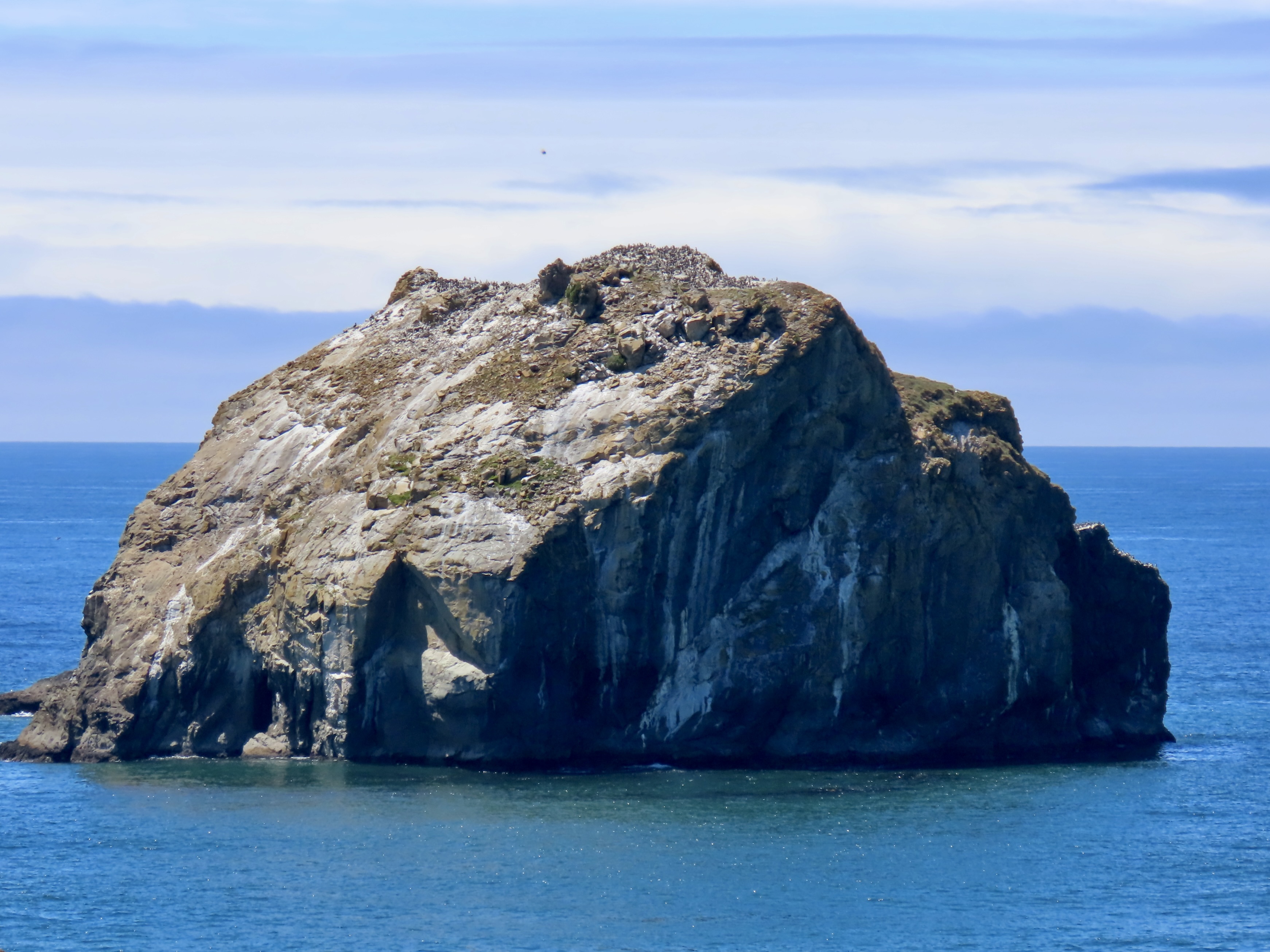
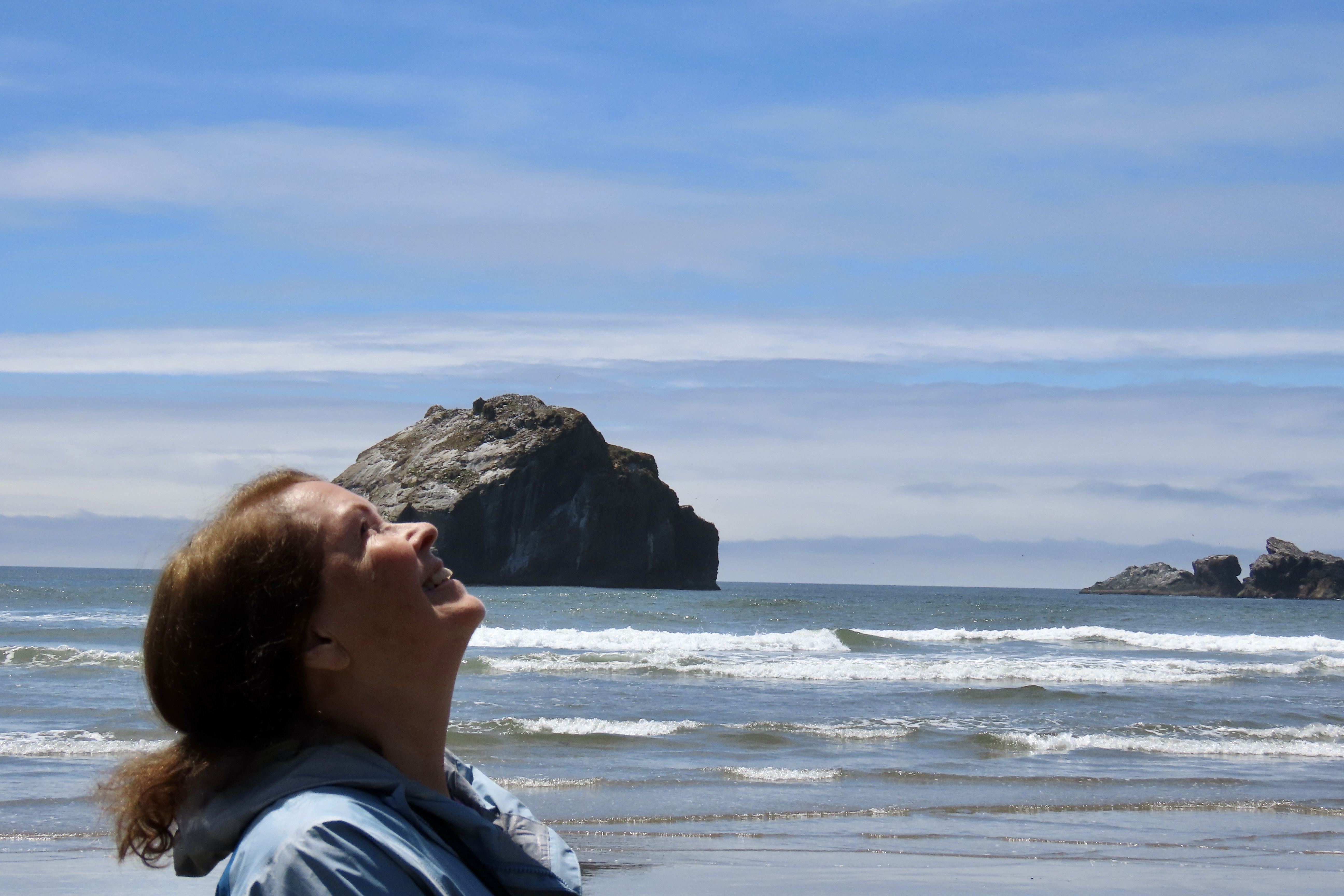
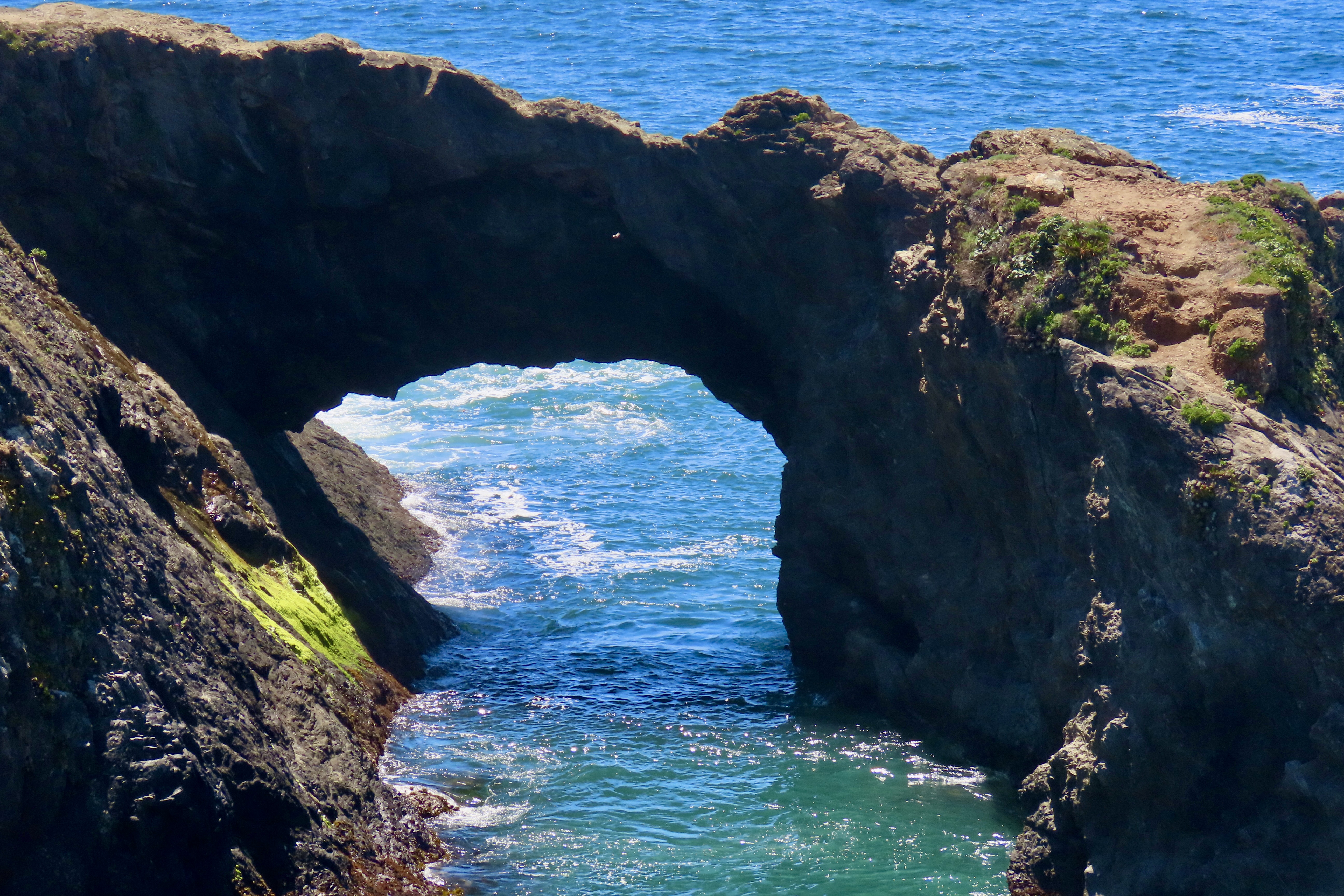
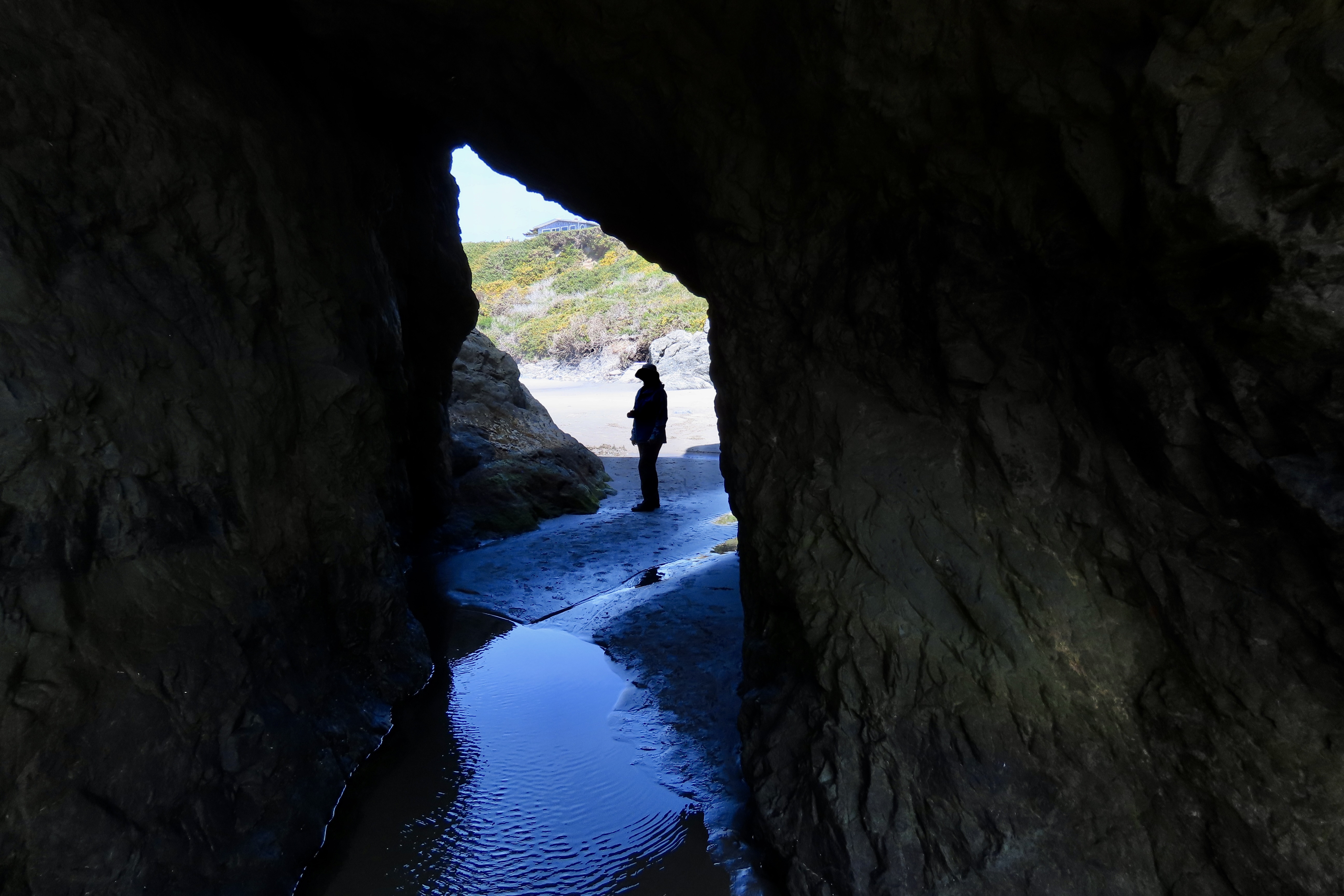
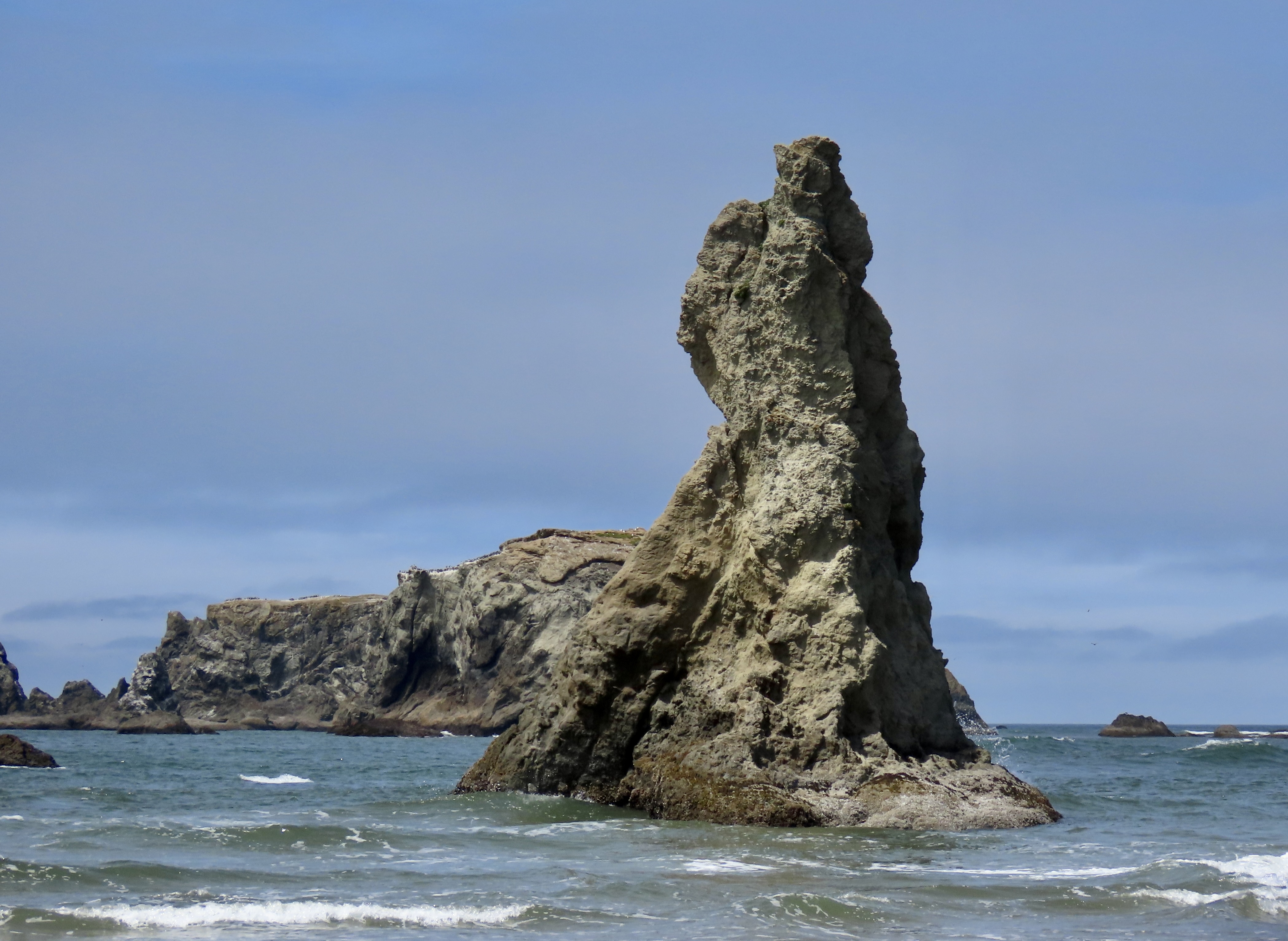
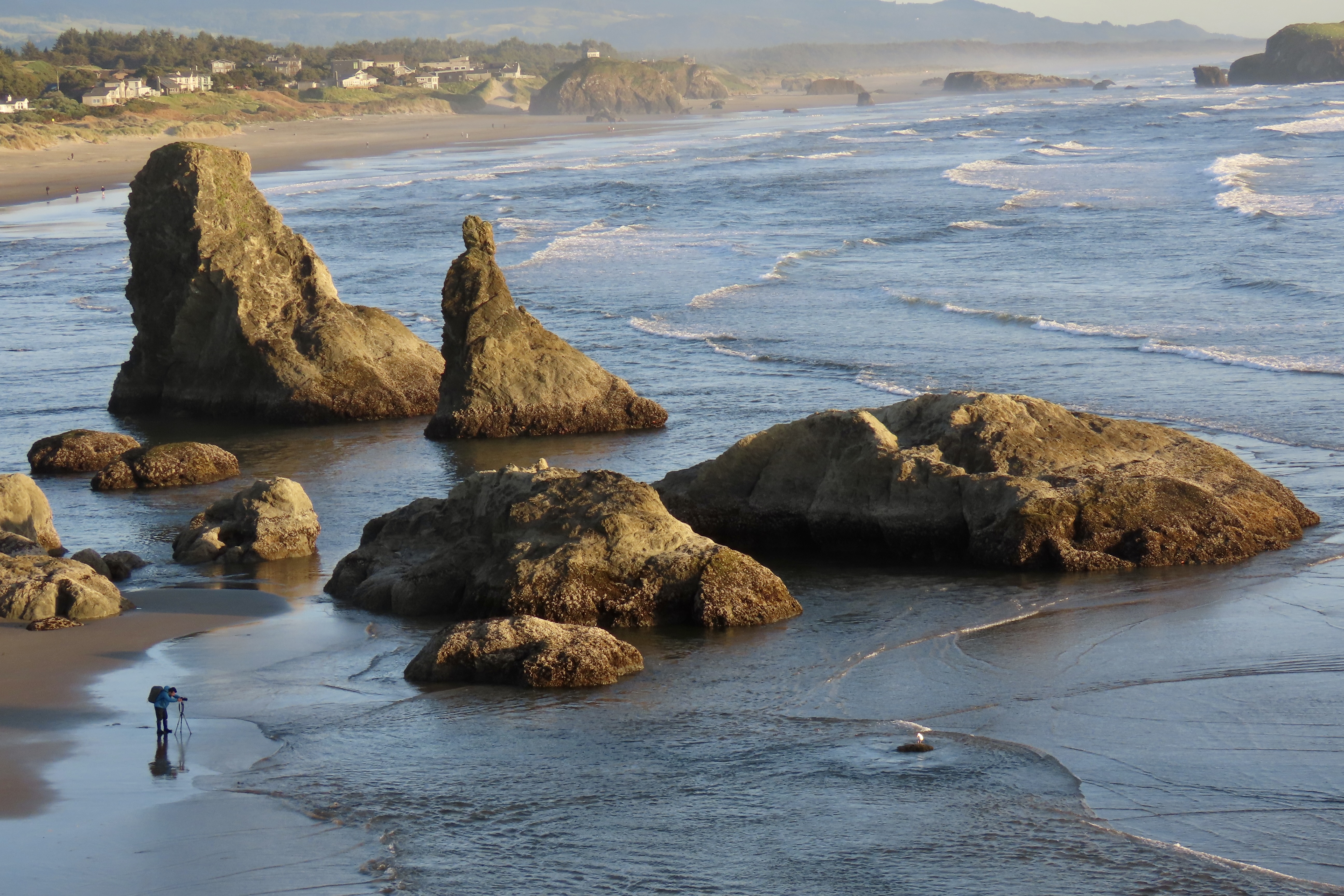
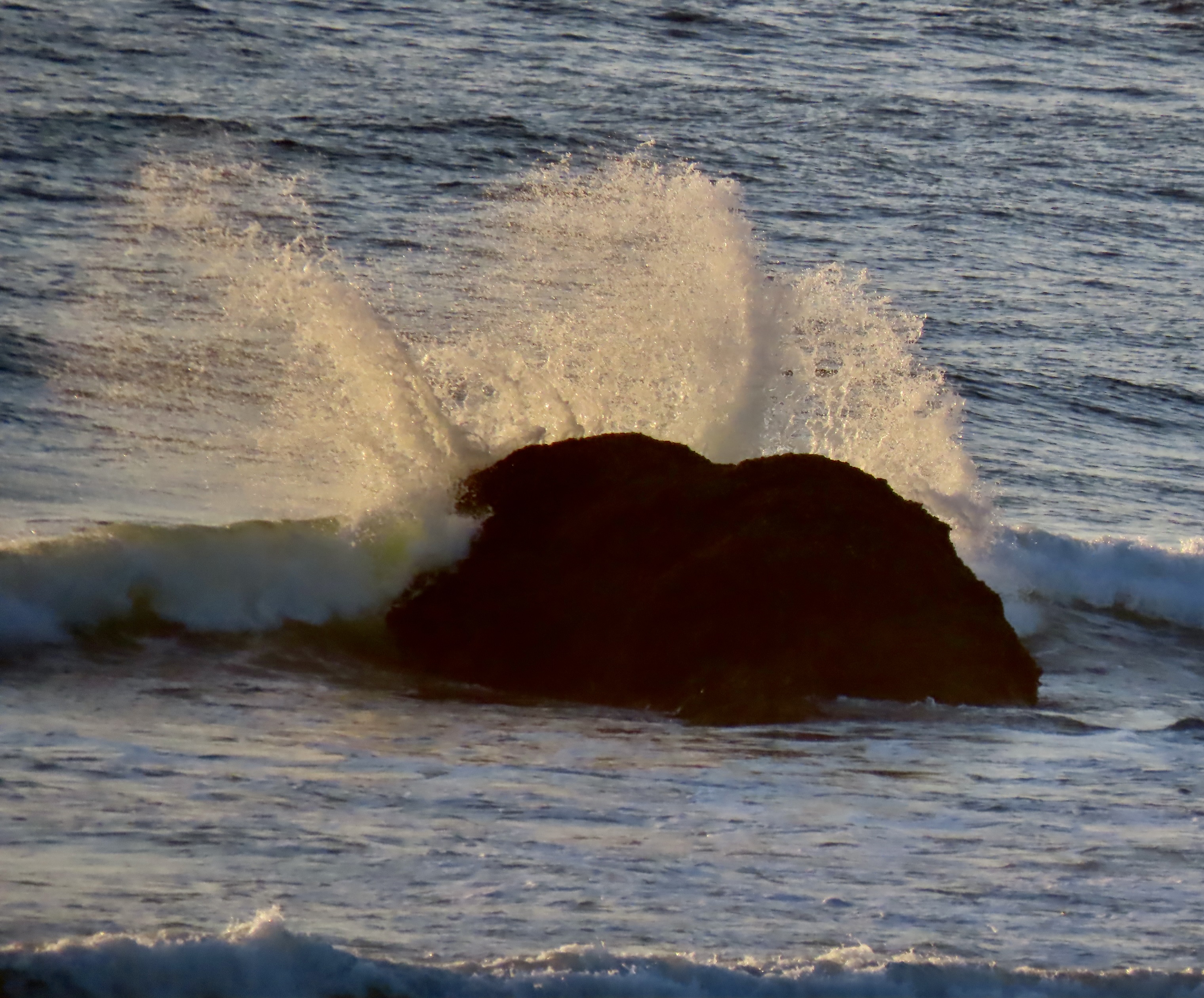
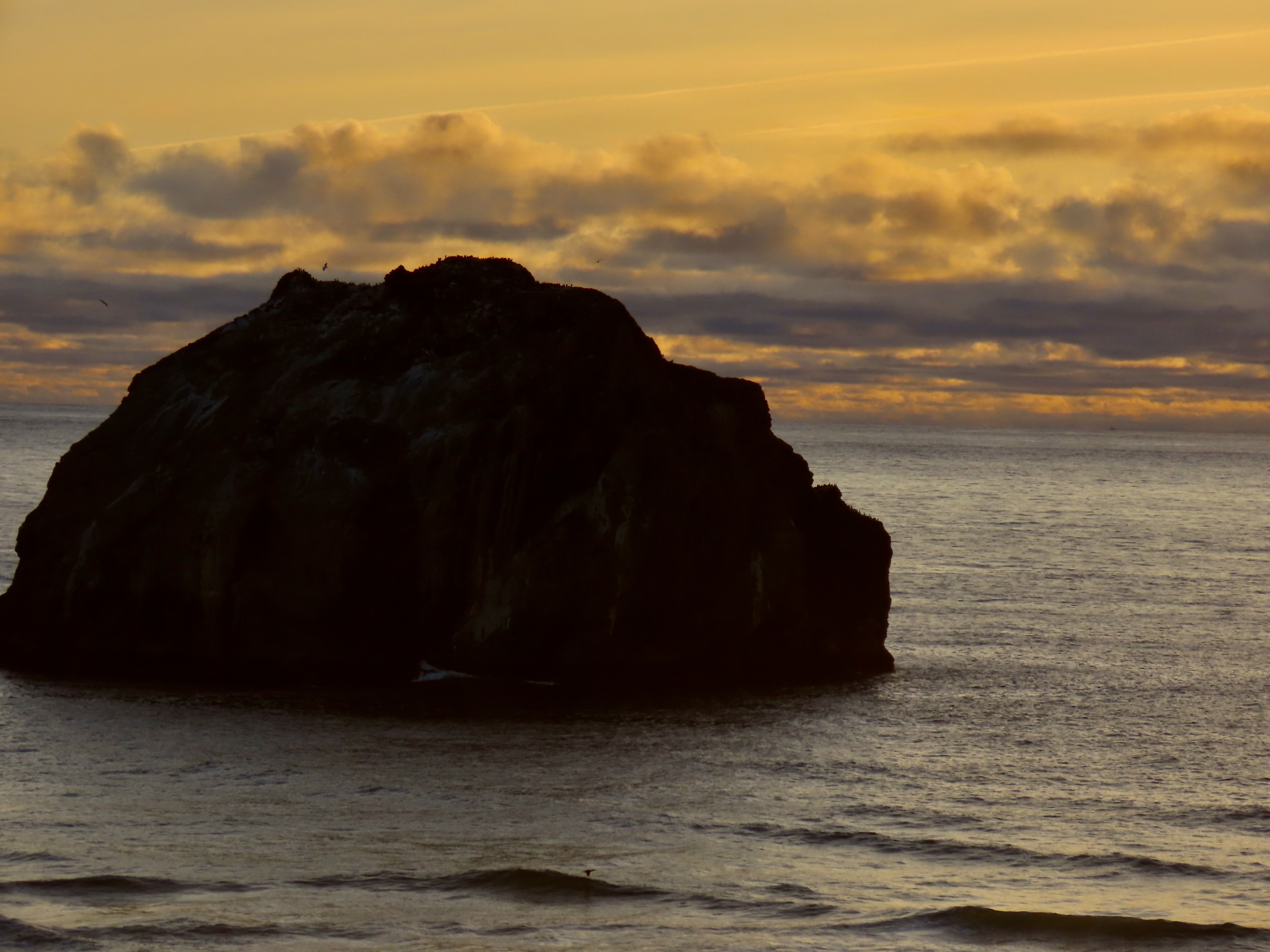
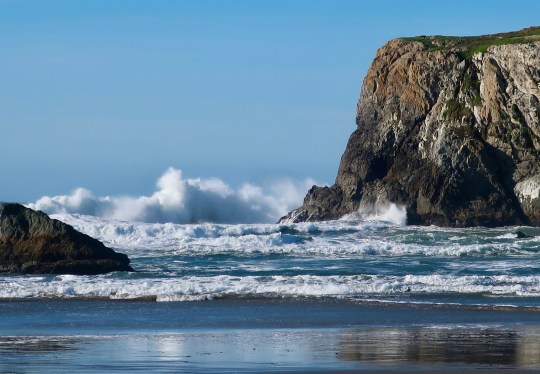
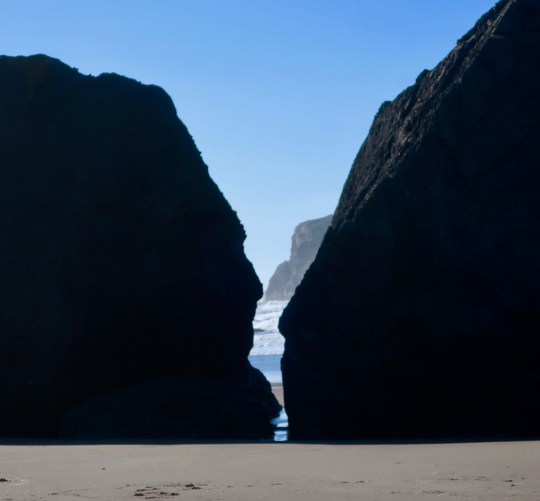
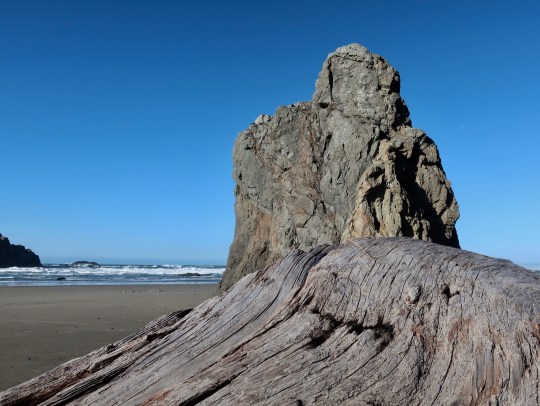
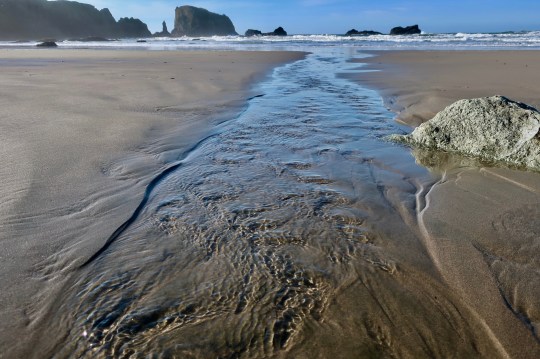
I am going to do three posts on Bandon this time. The first is on art in Bandon. Next will be the Devil’s Kitchen State Park. There are interesting houses hanging out on the cliff, sea stacks, and forts made of driftwood. I am also going to take a look at what the recent storm tossed up, mainly kelp, piles and piles of it, plus a bouquet of sea palms for Peggy. I’ll conclude the series with a visit to Face Rock State Park and its famous name sake. While there, I will include a number of other sea stacks/rock sculptures that we admire and can never get enough of. As always, our cameras were quite busy!
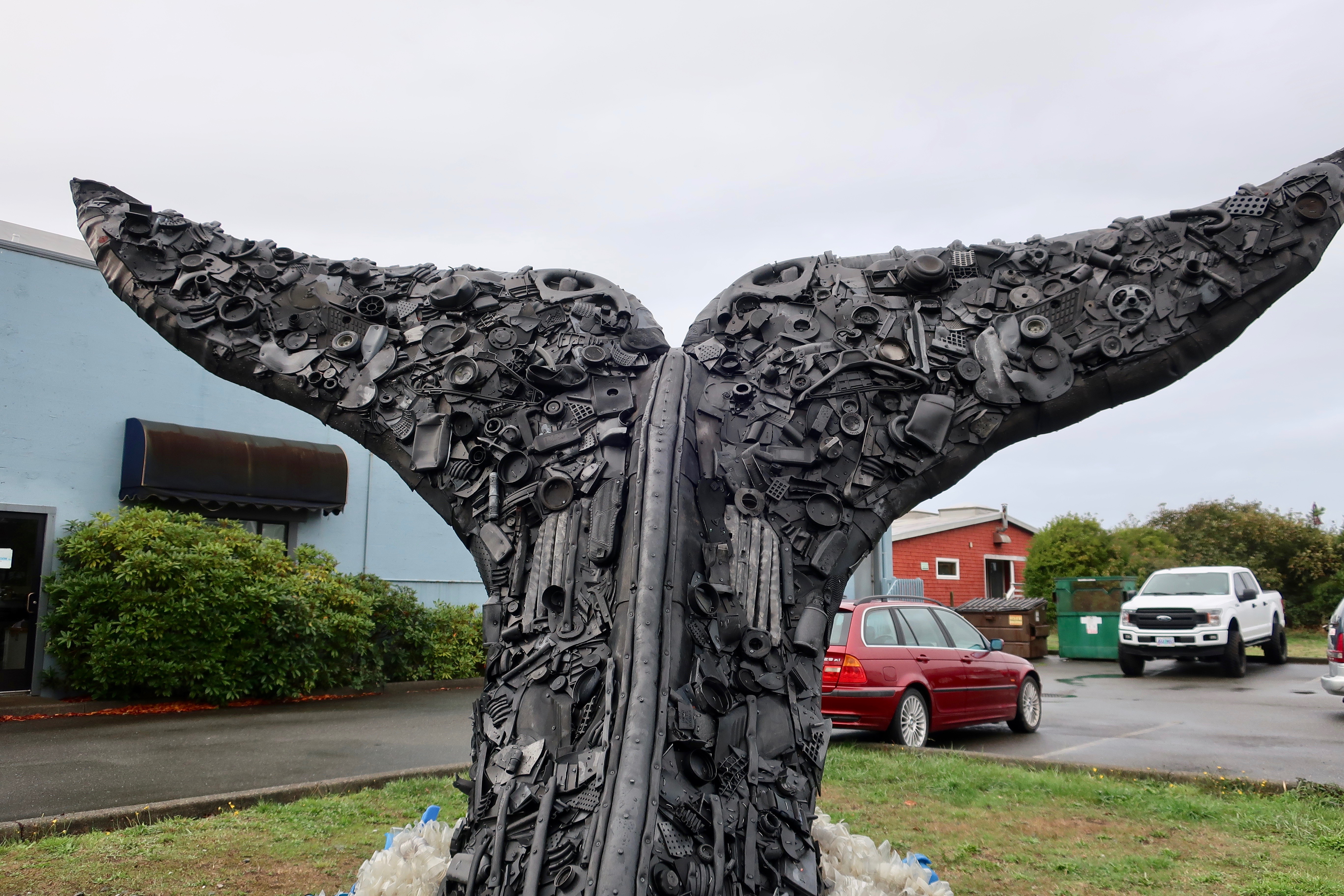
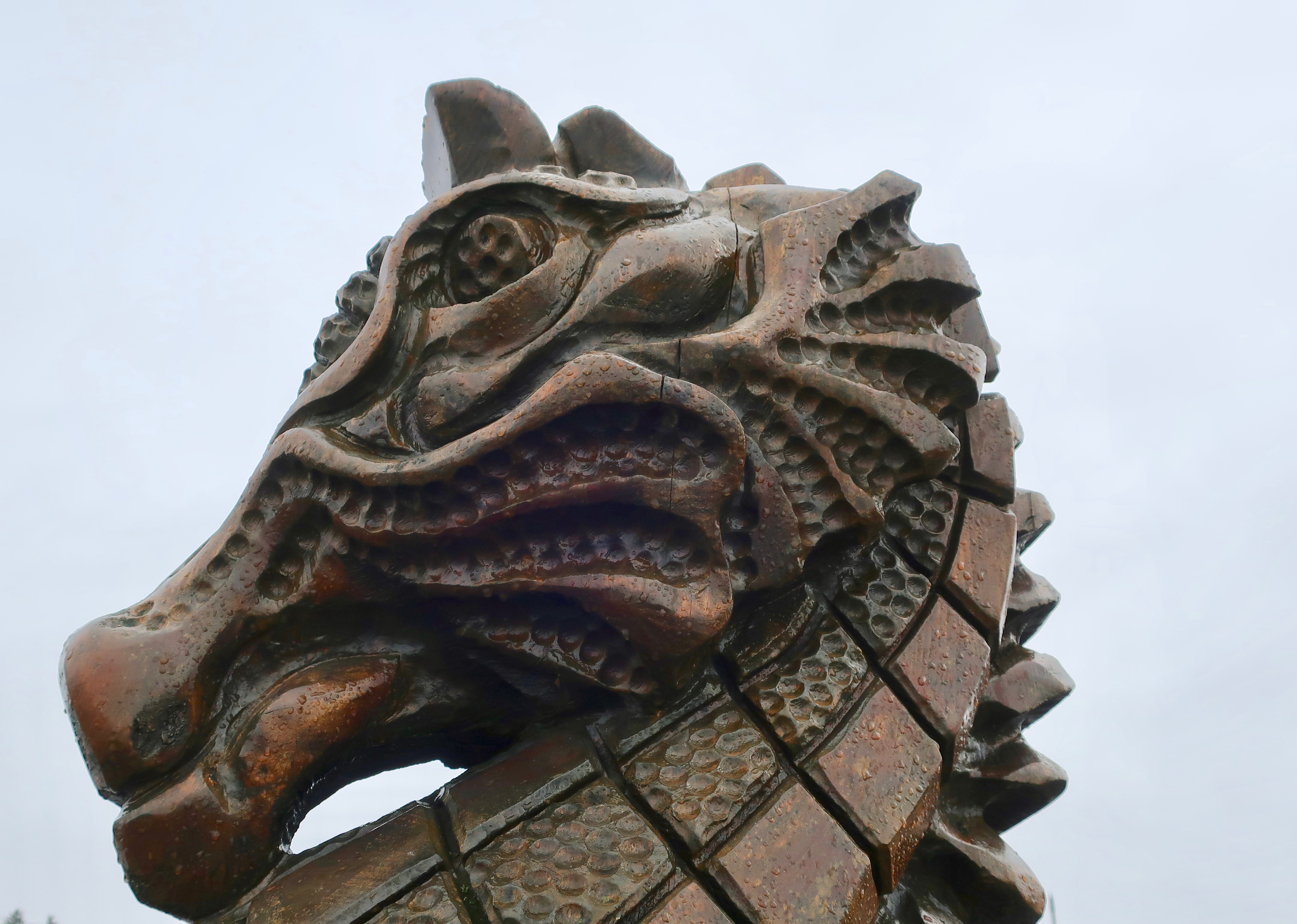
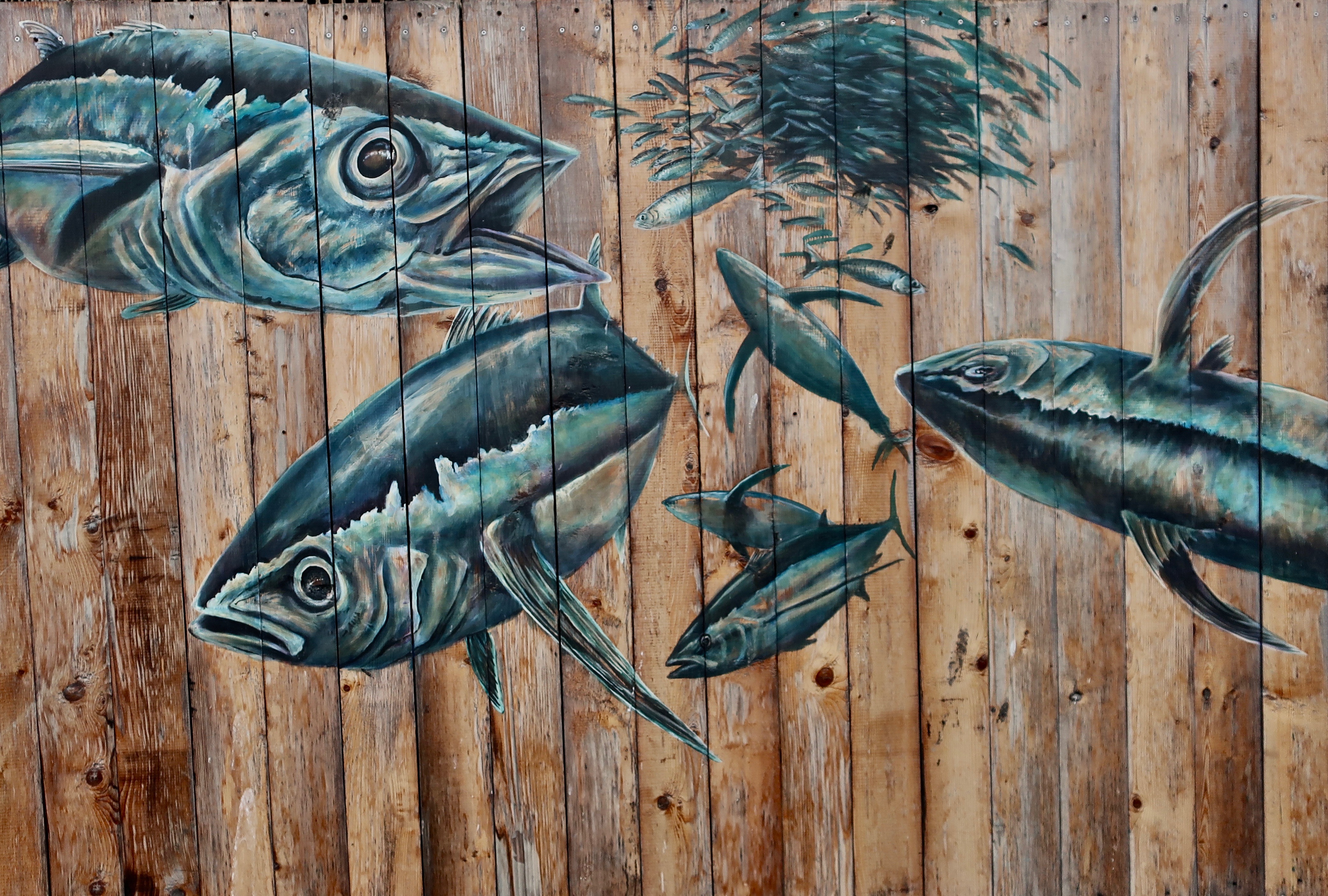
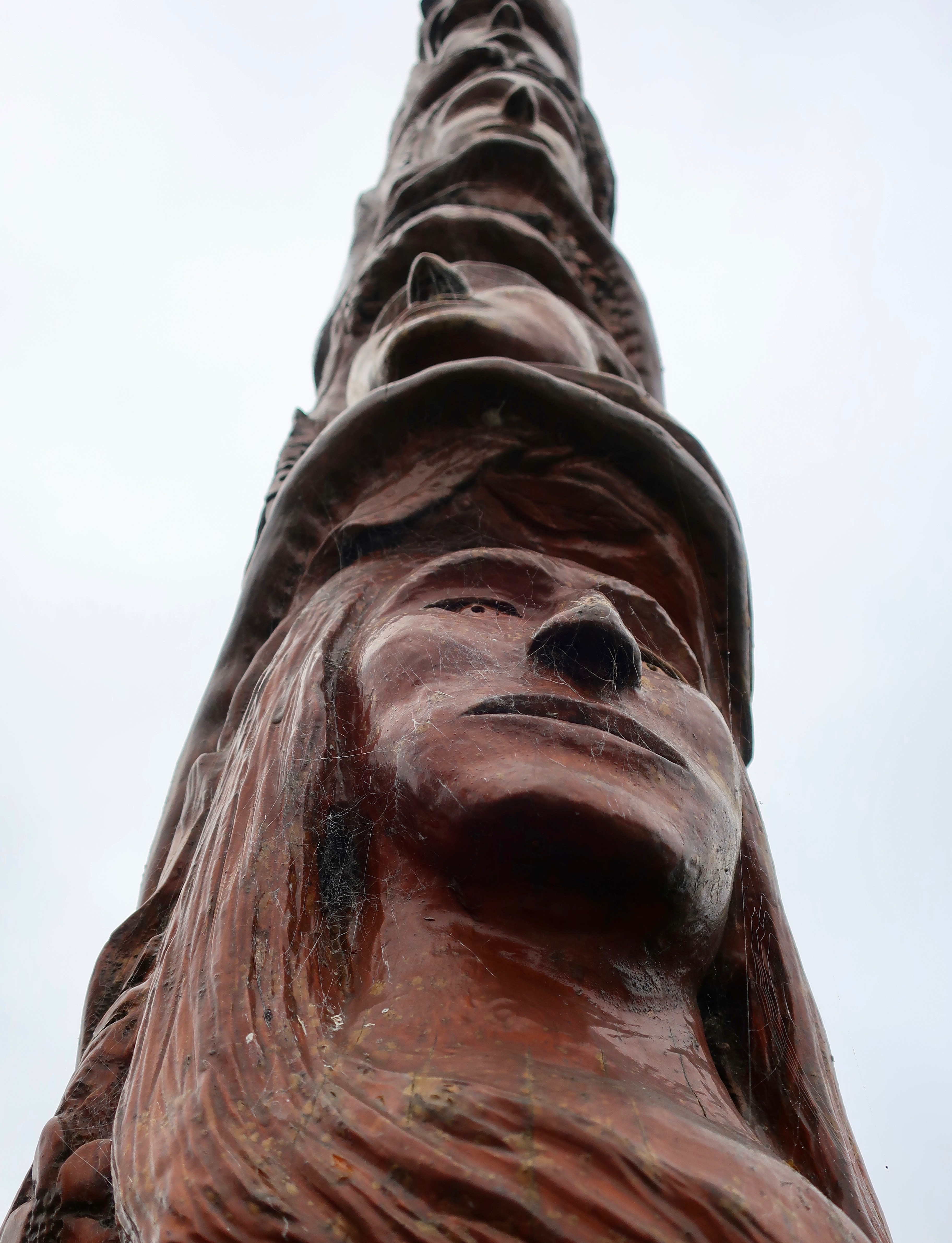
The art of Bandon: Not surprisingly, it comes with an ocean emphasis.





NEXT POST: Peggy and I visit the Devil’s Kitchen State Park where the ocean crashes against the rocks, interesting homes hang out on the cliffs, forts are made of driftwood, and storm-fared kelp is tossed up on the shore.

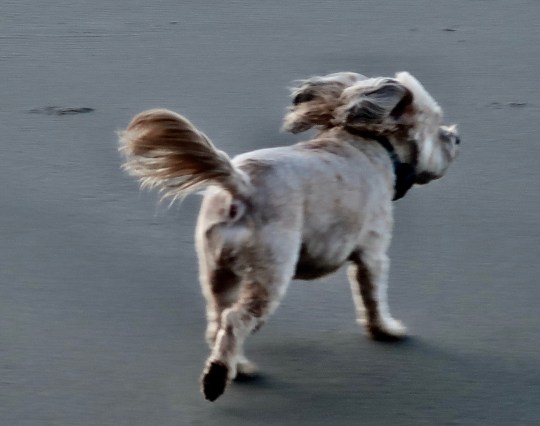
I was up on a cliff studying one of Washed Ashore’s sculptures made out of ocean trash when I heard the statement. It was a classic. The perfect senior moment! “Excuse me ma’am,” the young woman called, “do you know there is no dog on your leash?” I turned quickly. At 76 going on 77, I take notes on such incidents for future reference. Yes indeed, a bent, elderly woman was walking down the pathway holding a leash that was strung out behind her— without the dog. She turned, glared at the leash, muttered something, and stared back down the trail like Clint Eastwood on steroids. There came Fido (the name has been changed to protect the innocent), who was equally old in dog years, about 30 feet down the path, tottering along with no obvious desire to catch up. I could almost hear him chanting “Free at last, free at last,” as he stopped to smell the dog pee and dream of his puppyhood days.
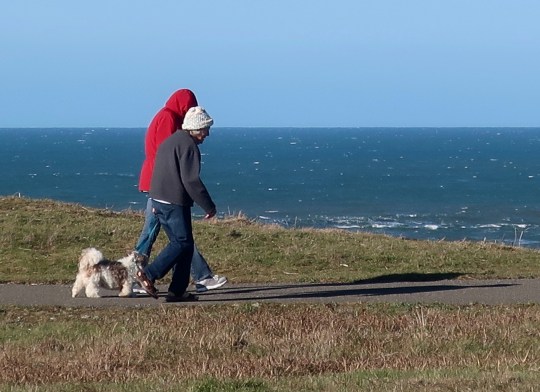
With the help of the young woman, Fido was soon recollared and the three went on their way. As did I. But I wanted to write down the story down before it wandered off like Fido. And since I was still hanging around Bandon, I decided to show you more rocks today instead of the American River flowers I promised. I am sure you are excited. Plus, Friday is Valentine’s Day, the perfect day for flowers.





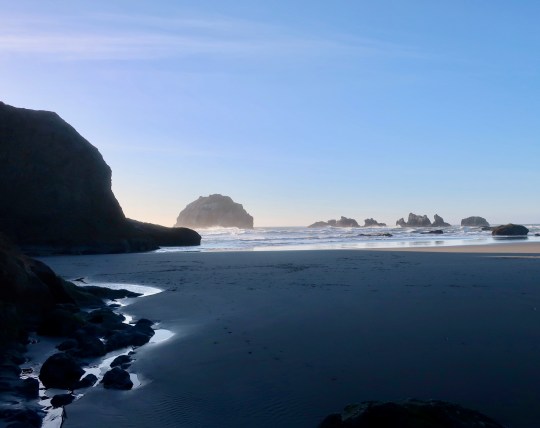

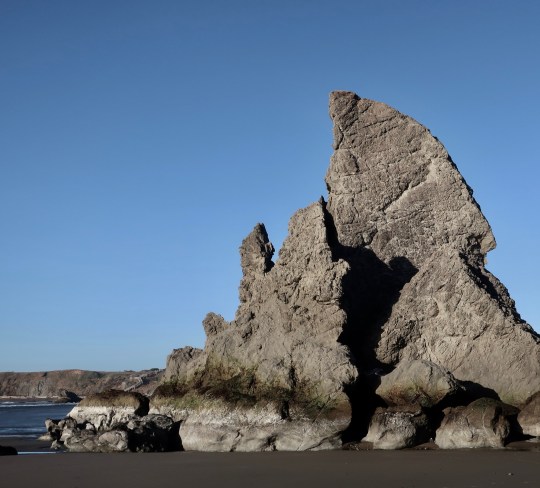
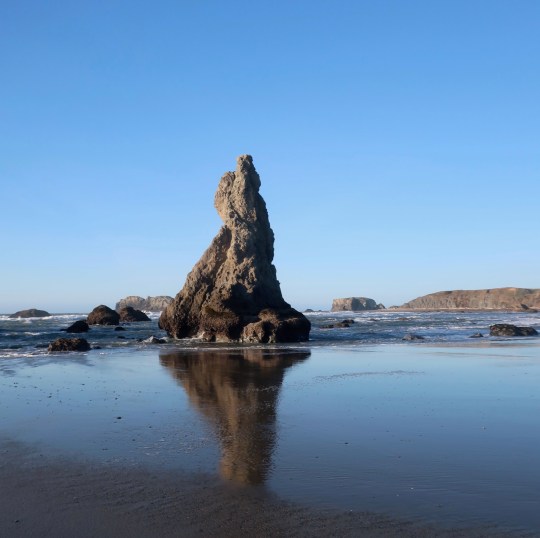
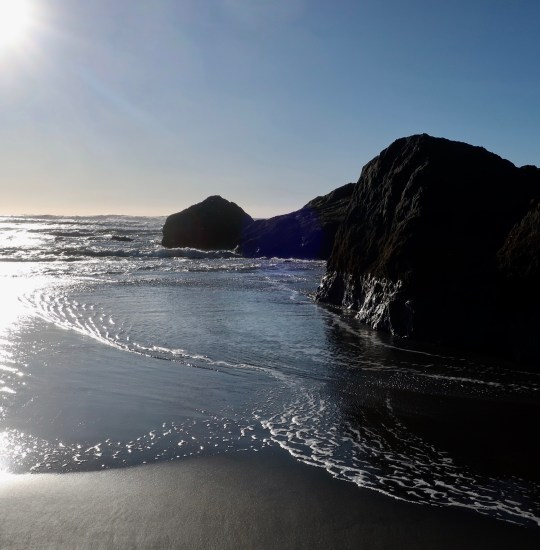
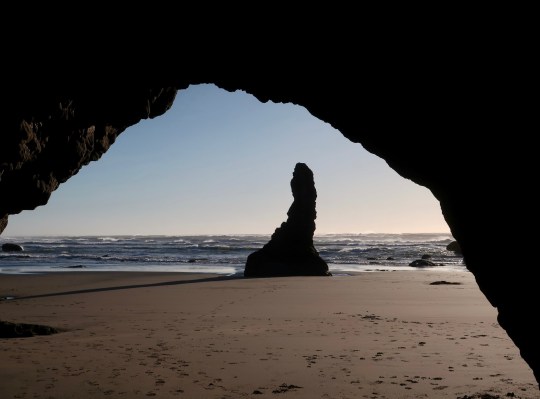
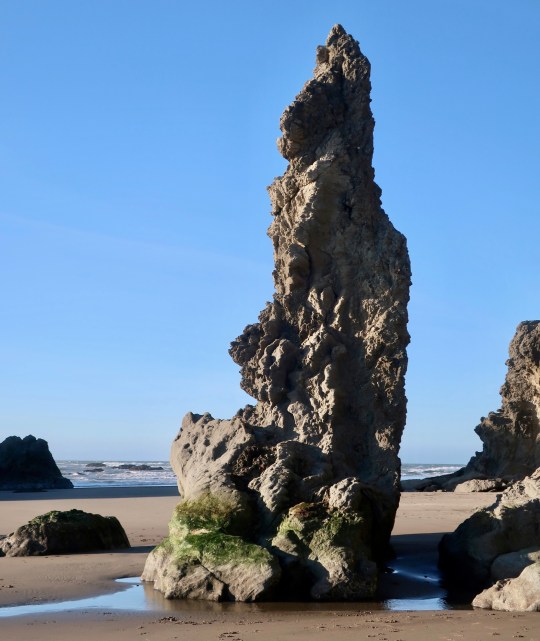
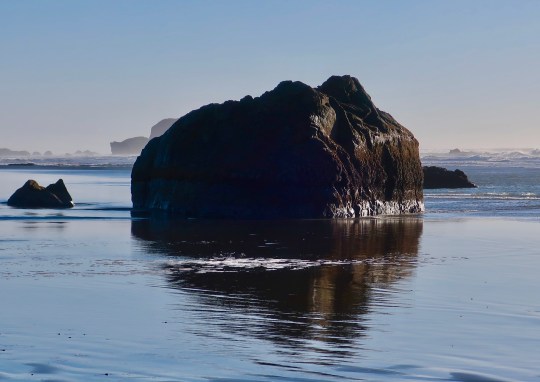


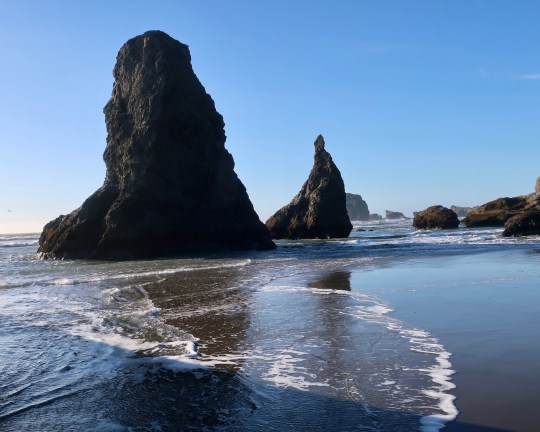
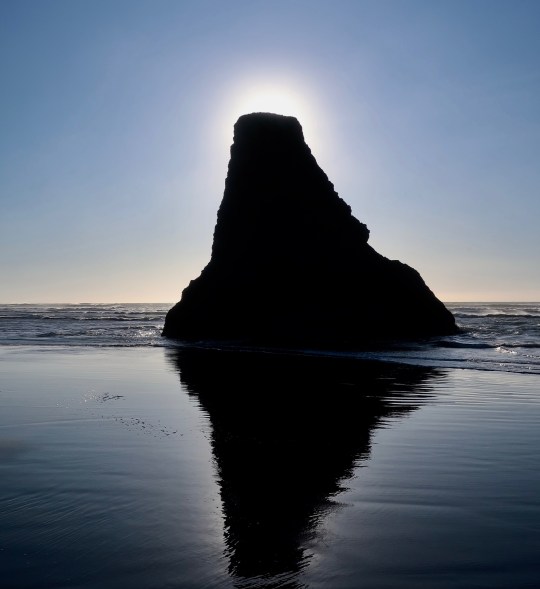

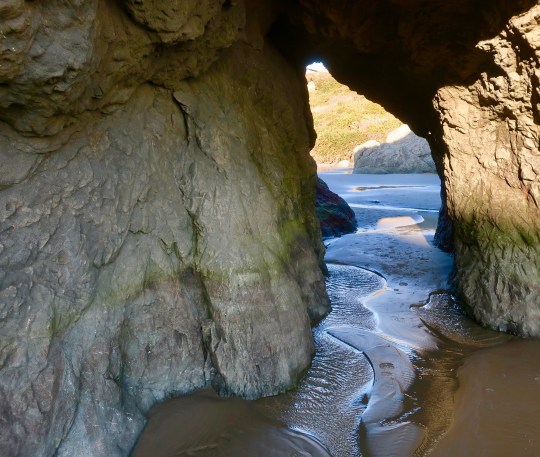
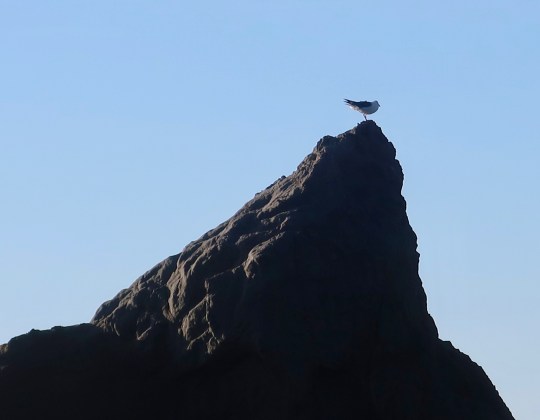

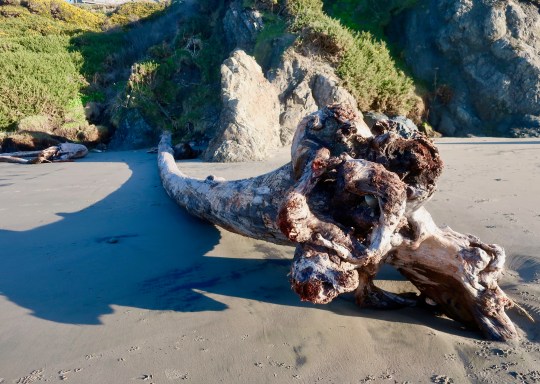
NEXT POSTS: I promise flowers for Valentine’s Day. On Monday we will visit the Devil’s Kitchen. Scary? We’ll see.

I dropped Peggy at the airport in Medford on Friday. She’s off to spend a couple of weeks in Virginia on grandkid duty while their parents make a quick escape to Mexico. “Please come Mom,” Tasha had requested while Clay had sent her first-class tickets. Hard to ignore that appeal. I was invited as well, but having just spent Christmas and New Year’s back east, I opted for a solo trip in Quivera the RV over to the Oregon Coast with plans for making my way south to Redwood National Park in Northern California.
That’s what I am up to now as I put this post together. I decided what better time to write about our coming travel/blogging plans for the year than when I am out traveling. I’ve just spent the past three days in the small coastal town of Bandon, which has some of the most impressive rock formations on the Oregon Coast. They make up several of the photos for today’s blog.
Travel-wise, we have a full year planned. 2020 started with our trip home on Amtrak from Washington DC, which I’ve already blogged about. This is trip number two. (Although it’s sans-Peggy, I’m counting it.) In late March, we are taking off for a 16-day cruise focusing on the Panama Canal. Peggy lived down there in 70’s for a while in her life before Curt. It is where Tasha was born. She has been wanting to get back there for a very long time. When I mentioned the possibility of the cruise, she jumped on it. Peggy’s sister Jane and her husband Jim are going along. In addition to Panama, we’ll be making stops in Costa Rica, Columbia, Nicaragua and Mexico.
We plan to kick off our backpacking season with a 40-mile trip down the Rogue River trail. It is beautiful in spring and makes an ideal beginning of the season hike. Peggy turns 70 this year and wants to make sure she celebrates properly. She also wants to explore more of the Pacific Crest trail through Oregon this summer as well. I’ll plan a 70-mile trip to go along with her years and my 77. We also have a 7-day kayak trip planned.
The biggie in celebrating her 70th, however, is a 7-day Rhine River Cruise from Amsterdam to Bern. We’ve invited our children and grandchildren along and, needless to say, they are excited. We will be in the middle of our trip when Peggy has her birthday on July 5th. Afterward, we will pop over to France to spend several days with Peg’s brother John and his wife, Frances.
We have tentative plans to return to Burning Man this fall. That, of course, depends on our ability to get tickets in the BM lottery, never a sure thing. Throw in the fact that we will be in the middle of the Panama Canal with iffy internet connections when the lottery takes place, I am not optimistic.
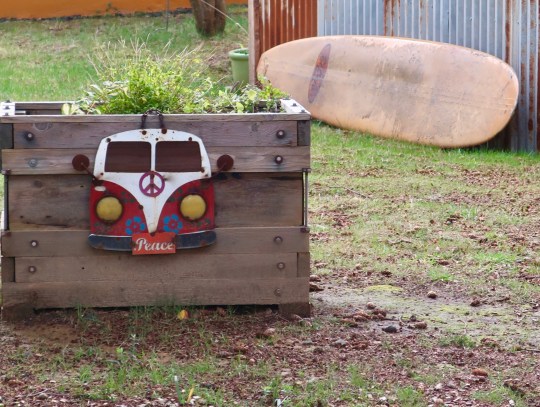
Peggy is off on another cruise in September, this time with her sister Jane from San Francisco up to Victoria, BC, a girls’ trip. I’ll take advantage of it to drive Quivera south down through Santa Cruz, Monterrey, Carmel and Big Sur. I love that area and have been escaping down there since the 60s and 70s, when I used to camp out along the road in my VW van. It’s as close as I ever got to being a hippie.



October will be time to jump in Quivera and do another month-long exploration of the Southwest. This time we want to include Death Valley NP, the North Rim of the Grand Canyon, Zion NP, Bryce NP, Capitol Reef NP, Canyonlands NP, and Arches NP. (This may be news to Peggy, grin.) After that we will be traveling east to spend the holidays with our kids. We are contemplating using Amtrak again, following different routes. Does that sound like enough for the year? Do you think I will have adequate material to blog about? Heck, I still have lots from last year? I never seem to catch up. Do you? And then there is the book I am writing…
I’ll conclude with a note of parental pride, if I may. Our son Tony just received the Coast Guard’s second highest award for coordinating the massive rescue effort the Coast Guard undertook in the Bahamas during Hurricane Dorian. The storm was a devastating category five hurricane with record-setting winds of up 175 mph. He and his fellow Coast Guard helicopter pilots spent 5-days more or less without sleep on the ground and up in the very dangerous air. The Commander of the Coast Guard and the Secretary of Homeland Security awarded Tony with the medal.






NEXT POST: It will be time for my Wednesday Photograph Essay. This time it will be mainly flowers I photographed along the American River Parkway in Sacramento, California.
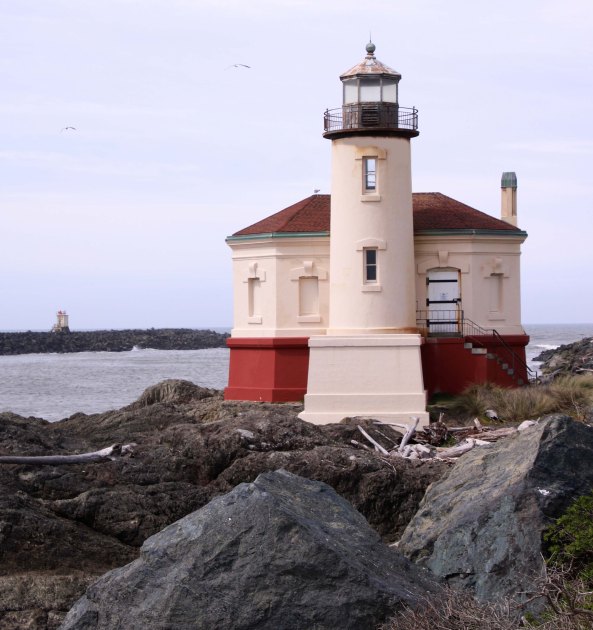
The Coquille Lighthouse sits on a point jutting out into the Coquille River opposite of Bandon, Oregon. Its replacement, an automated beacon, can be seen on the left across the river on the South Jetty. A glimpse of the Pacific Ocean appears on the right. (Photo by Peggy Mekemson.)
I am sure that there are people who drive by lighthouses never noticing their existence. I am not one. There is something romantic about them that pulls me in. Maybe it is their historic role: saving mariners from crashing into rocky shoals and other shoreline hazards. Or maybe it is their isolation and the thought of a lighthouse keeper’s lonely life. Having a bit of hermit in me, I can easily envision such a life-style, assuming, of course, that I have my good buddy and a boatload of books along. Or possibly it’s their setting along dramatic ocean and lake shorelines. Rocky shorelines offer beauty as well as hazards.
The history of the Coquille River Lighthouse was closely tied to the logging industry. Early lumber barons wanted to get at the virgin forests located along the Coquille River. Access was relatively easy, assuming ships could cross the hazardous bar located at the mouth of the river next to Bandon. A jetty was built out into the ocean, which led to the creation of a deep channel. The lighthouse was built to guide ships along this channel. The 1890 funding proposal stated:
“A light of the fourth order with a fog-signal, at this point, would enable vessels bound into the river to hold on close to the bar during the night so that they would be in a position to cross at the next high water. The light would also serve as a coast light and would be of much service to vessels bound up and down the river.”
“A light of the fourth order,” refers to the type of the Fresnel lens used in the lighthouse. Fresnel lens are made up of multiple lens arranged in concentric circles around the light source. If you’ve been in a lighthouse, you will have likely seen one. They range in size from the first to the sixth order. Fourth order Fresnel lights could normally be seen for 15 miles out to sea and were commonly used to guide mariners into harbor mouths.

A Fresnel lens of the sixth order on display at the Columbia River Maritime Museum in Astoria, Oregon. This light could be seen for about five miles and would be used in harbors and along rivers.
Funding was approved by Congress and the lighthouse was functioning by the mid-1890s. It was operated up until 1939 when the Coast Guard took it over and determined that a less expensive, automated beacon placed on the end of the Bandon South Jetty would work as well. The abandoned lighthouse was neglected up until 1976 when it was taken over by the state of Oregon as part of Bullard’s Beach State Park. A joint effort by the state and the Army Corps of Engineers restored the lighthouse as an historic attraction. Various efforts since have maintained it, much to the enjoyment of thousands of visitors— including us.
Peggy and I stayed at the state park while we were visiting Bandon and used one of our mornings to go over and check out the Coquille Lighthouse, North Jetty and Bullard’s Beach. The following photos record our visit.
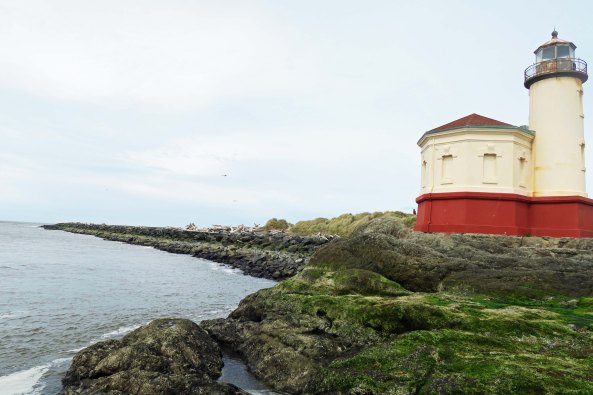
Peggy and I walked around the lighthouse to capture photos from various angles. I took this from the river’s edge. Low tide enabled me to shoot from below the tide line. The North Jetty stretches off to the left.

Peggy caught this close up.
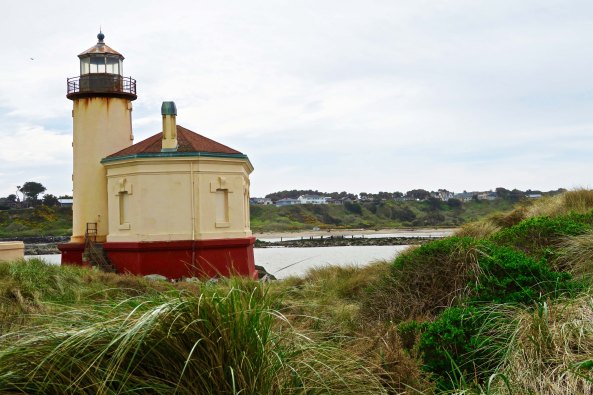
And I took this picture looking over sea grass. Parts of Bandon can be seen across the river. We were on our way to walk out the North Jetty.

One of the first things that struck me about the jetty was the amount of driftwood piled up along it. This reflects the power of the ocean. It also warns that you wouldn’t want to be anywhere near the jetty in a storm.

Peggy posed for me in front of this large stump on top of the jetty, a remnant of logging up the river and along the coast.

I returned the favor posing for Peggy out toward the end of the jetty. A wave can be seen breaking over the end. And this is at low tide! We stayed far back. I would bet that people have been swept off of here while trying to photograph winter waves. (Photo by Peggy Mekemson.)

I appreciated the sea gulls adding a touch of sea life to my photo. One wave hits the end of the jetty while another rolls in. Watch out for the ninth!

A pair of seals with their big dark eyes swam along the side of the jetty and checked us out. (Photo by Peggy Mekemson.)

A view north from the jetty along Bullard’s Beach shows again how much driftwood (drift logs?) is brought in by winter storms.
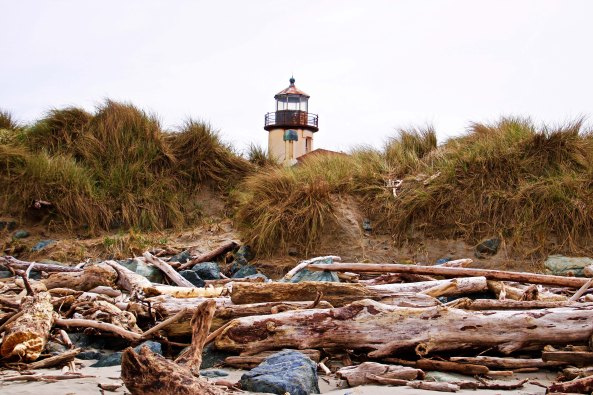
Peggy took this shot looking up from Bullard’s Beach toward the lighthouse.

And this photo of a fort someone had built taking advantage of the driftwood. You can imagine the amount of fun kids would have building and playing in such a fort. Adults too. (Photo by Peggy Mekemson.)
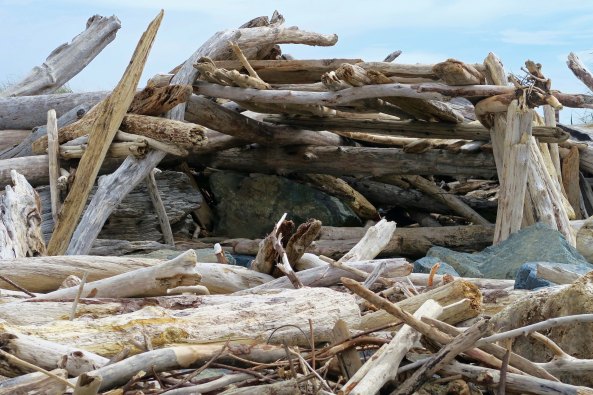
I added a close up.
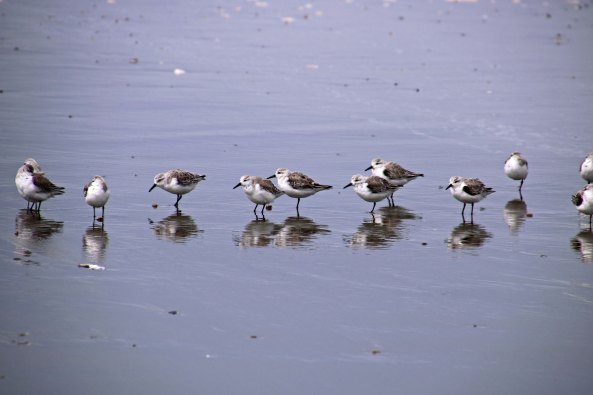
Walking along the beach we found a flock of Sanderlings. These small shorebirds are a delight to watch as they charge in unison along the beach following the tide as it rises and falls in search of delectable bugs. I liked the reflection provided by the receding water. (Photo by Peggy Mekemson.)
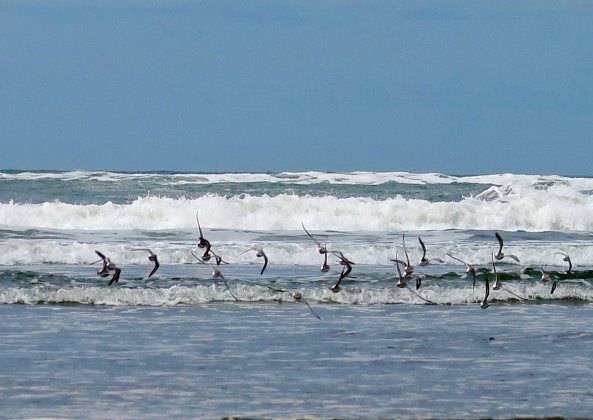
Get too close and off they fly, whirling in unison as they head a few yards up the beach to continue their endless search for dinner.

I’ll close today with this final shot of the coastal land that backs up to Bullard’s Beach.
NEXT BLOGS:
Wednesday: While Bone waits to be found, we continue our backpack trip down the Tahoe-Yosemite Trail— finding our way through deep snow, crossing a raging river, and running from kamikaze mosquitoes.
Friday: Murals and other wild/weird art of Burning Man.
Monday: I travel north up Oregon’s coast and explore a cave filled with lions, sea lions that is.
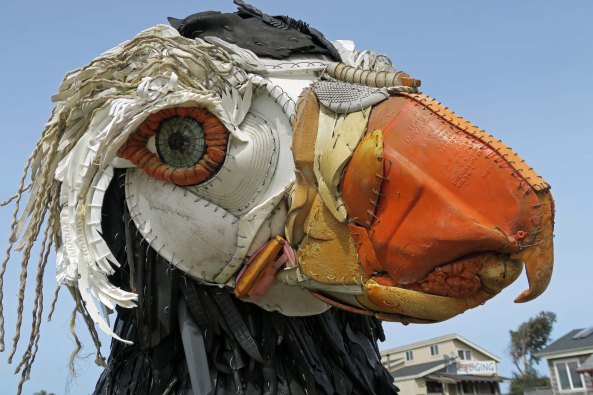
Trash gathered along the coastline near Bandon, Oregon is turned into art by the nonprofit organization, Washed Ashore. In this case, the artists have created a puffin.
Here’s something to think about:
A study carried out by the World Economic Forum and Ellen MacArthur Foundation predicts that the plastic we are dumping into the ocean will weigh more than the fish in a short 30 years. While most of this plastic circles the ocean as sludge following currents known as gyres, a significant amount washes up on our beaches creating hazards for wildlife and visual pollution for the rest of us. Even the most pristine locations fall victim to this onslaught.
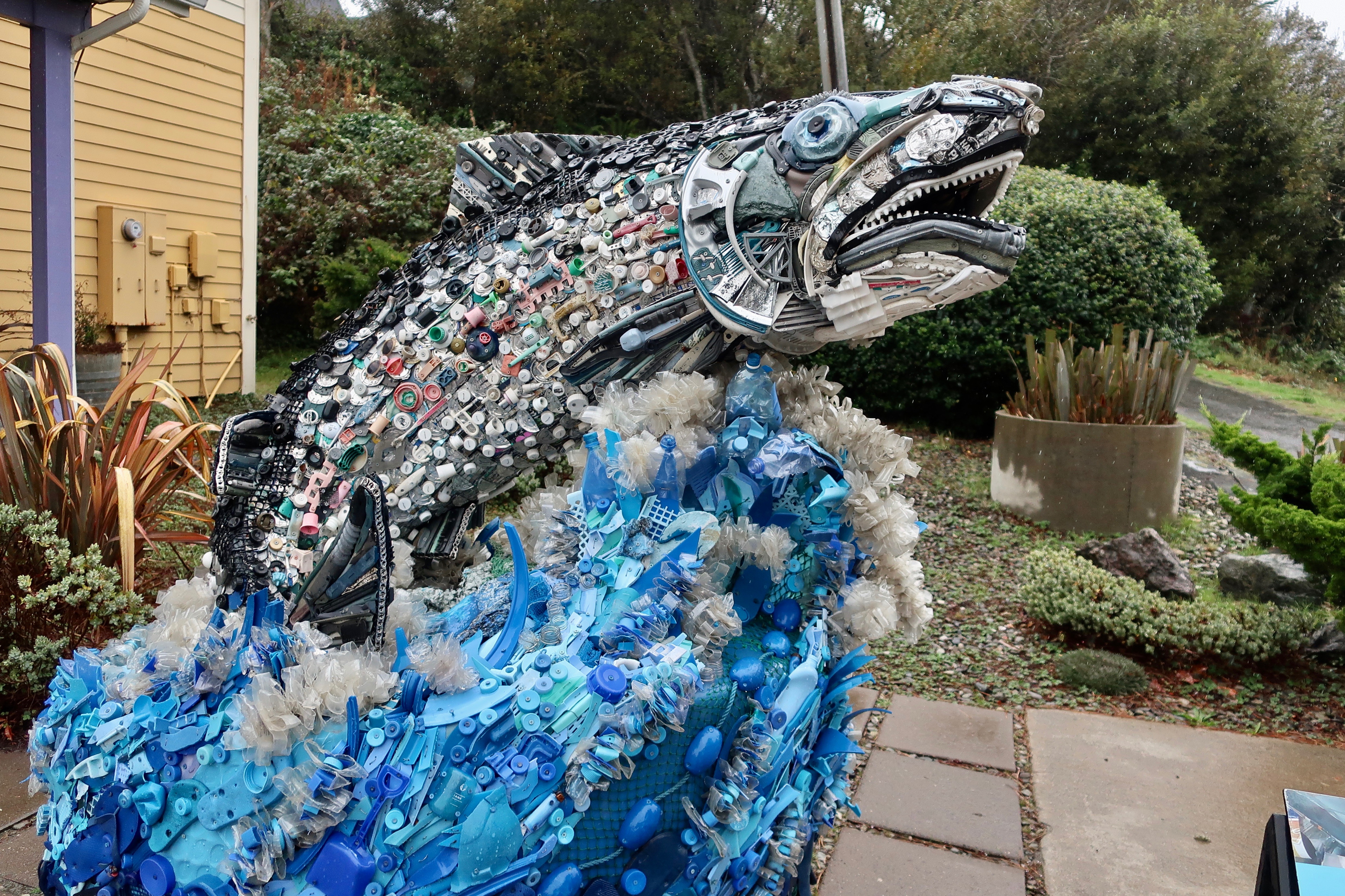
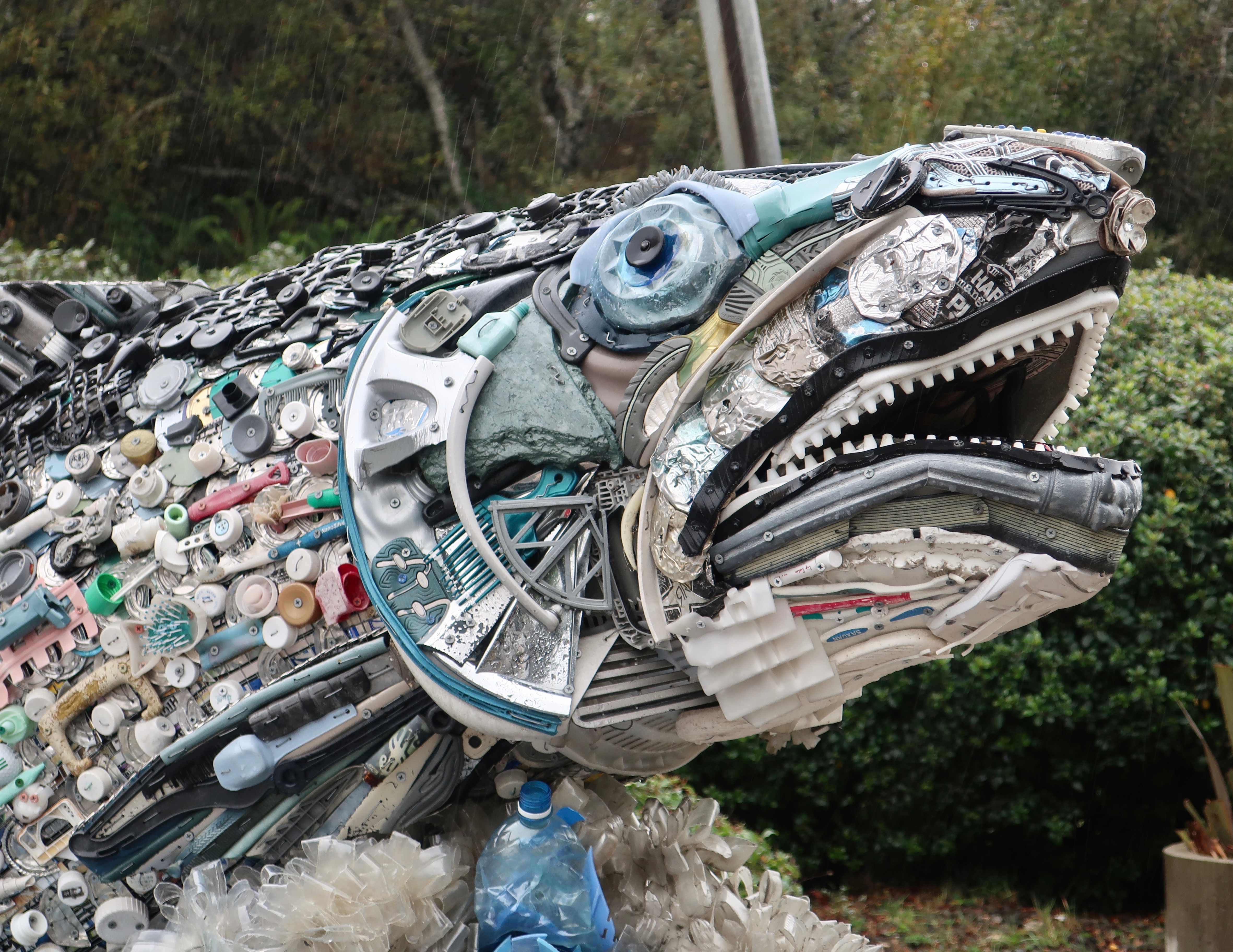
When Peggy and I drove into the small town of Bandon on the coast of Oregon two weeks ago, we spotted several colorful sculptures of marine life that immediately caught out attention. On closer inspection, we found out they were made out of trash collected from the local beaches and turned into sculptures by a local organization named Washed Ashore.
The non-profit is the creation of Bandon artist Angela Haseltine Pozzi who decided to do something about the pollution that was cluttering local beaches in 2010 and begin turning the trash into art.
“First you just want people to stop and look at the art,” Angela noted. “And then you want to have them stop and think about the problem.”
It certainly worked with us.
Today, hundreds of volunteers join with Angela and her staff in creating sculptures that travel the country and even the world creating awareness about our use of the oceans as a garbage dump. Last year, a number of Washed Ashore’s sea creatures even made it to the Smithsonian National Zoo in Washington DC.
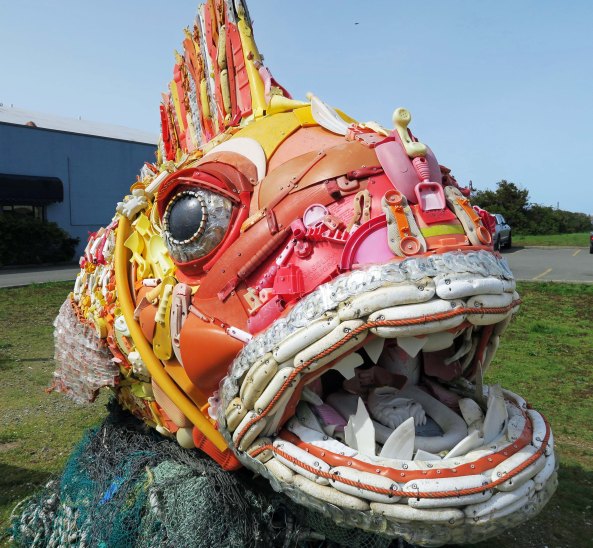
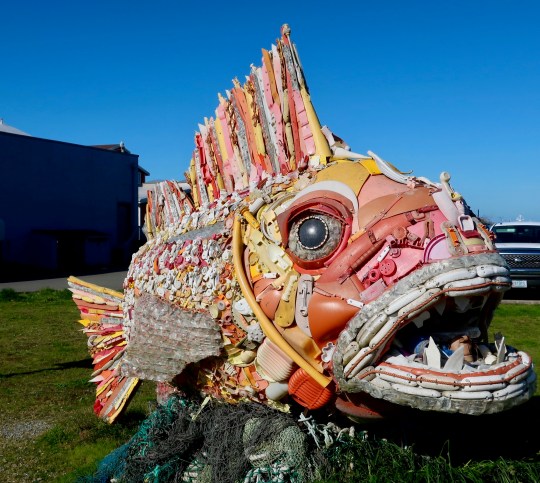
This delightful fish is another example of Washed Ashore’s artistic endeavors. Note the old phone on the fish’s nose right above the child’s sand shovel.

Here is the puffin featured at the beginning of the post…

And this is a view of tide pool life created from trash.
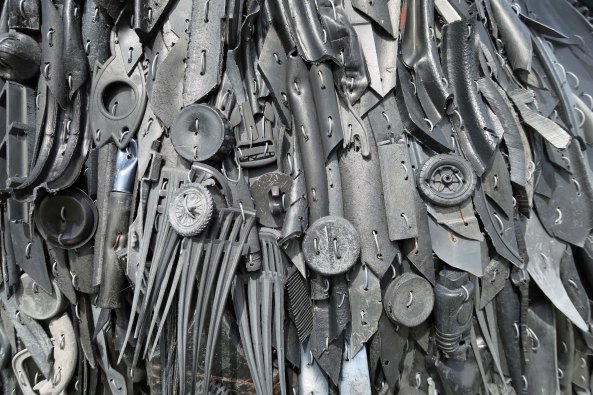
A closeup of the feathers on the puffin’s chest.

A head on view of the fish with it’s scary teeth and trashy mouth.
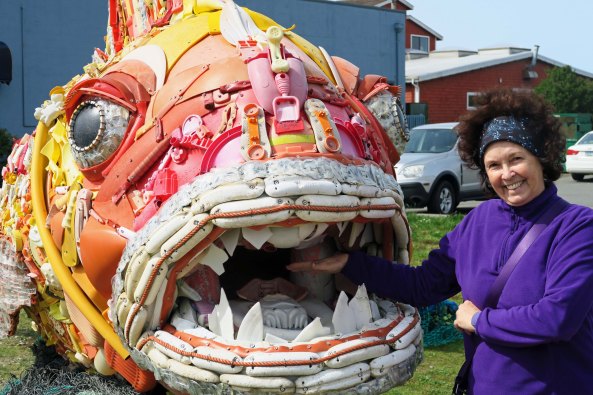
Peggy, who always makes sure that her trash is properly disposed of and recycled, can stick her hand in the fish’s mouth without any fear of retribution.
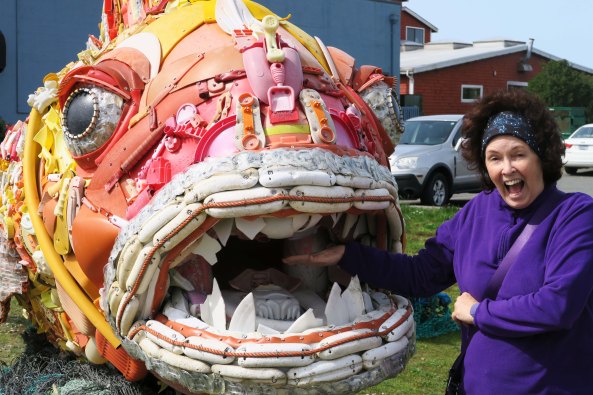
But here’s what it might be like if she dumped her trash in the ocean! (She really is a good sport when serving as a model. “Look like it is biting you,” I had told her.)
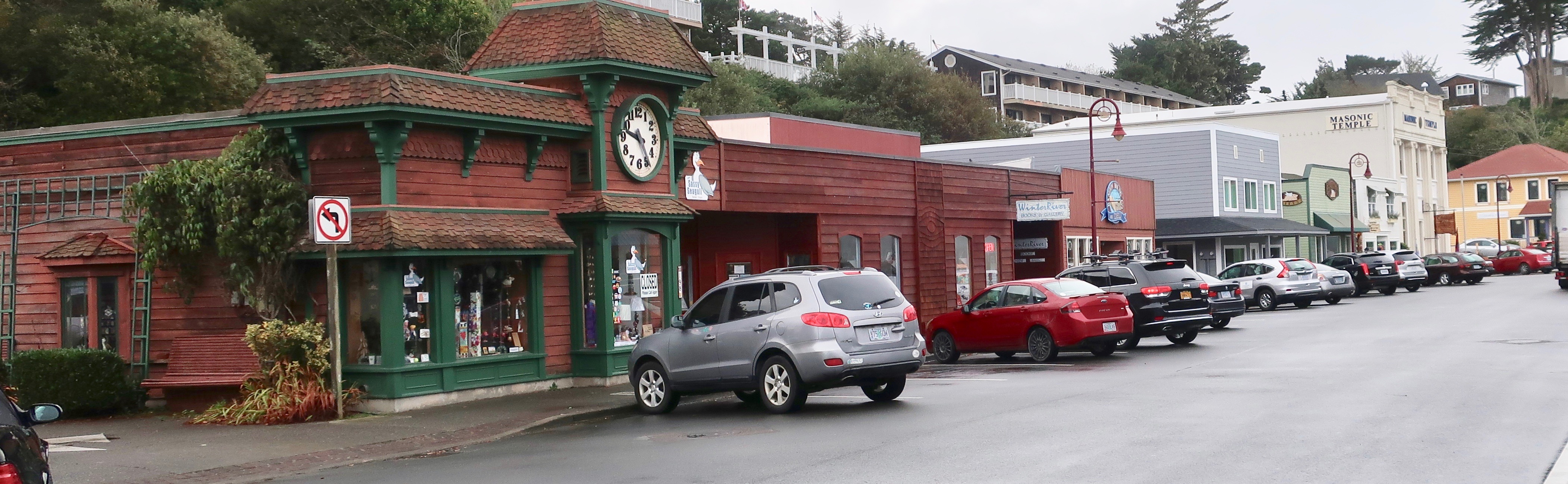
Most towns along the Oregon coast spread out along Highway 101 like strip malls and feature the same motels, gas stations and fast food joints you can expect to find anywhere else in the US. Peggy and I have discovered, however, that most of these small communities also had the foresight to save their historic districts. These in turn have become attractions for tourists, a source of important jobs and dollars.
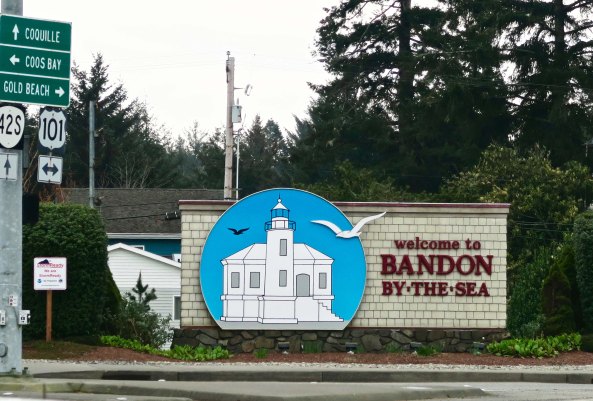
Bandon welcomes visitors and provides activities that range from walking on its beautiful beaches, to shopping and eating in town, to playing golf on some of Oregon’s finest golf courses.
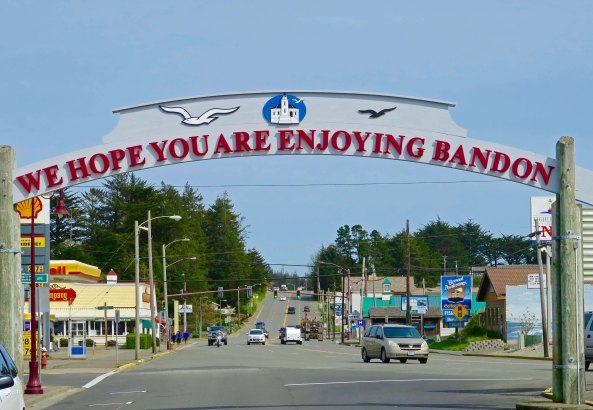
The other side of this sign over Bandon’s main street welcomes you to Old Town. This side looks out on busy Highway 101 from the historic district.
Such is the case with Bandon. Peggy and I wandered around Old Town and did our bit for the local economy. We bought books in a fun little bookstore, nibbled our way through a chocolate store, and quaffed a couple of pints of Guinness at an Irish pub. We even checked out a store that is dedicated to producing and selling candy made with cranberries. It turns out that Bandon grows over 90% of Oregon’s cranberry crop and 5% of the nation’s!
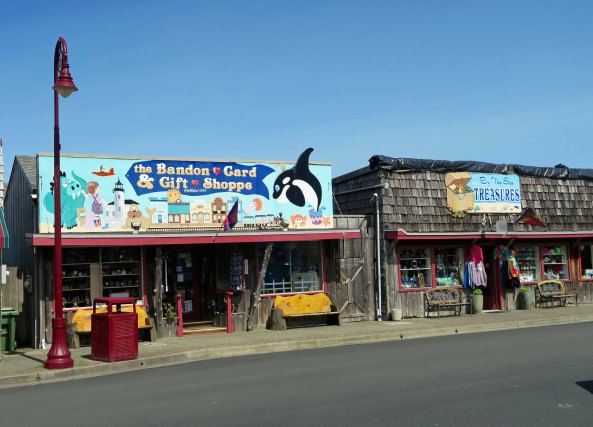
I would describe the Old Town area as fun and funky. The nature of the original town has been preserved without pretensions.

As you might imagine, the town’s access to the ocean guarantees an abundance of fresh seafood. I liked the sense of humor reflected by the fish.
An attractive boardwalk featuring several works of art fronts the Coquille River and forms the northern border to Old Town. We concluded our visit to Bandon by strolling along the walkway, checking out the marina, and admiring the art.
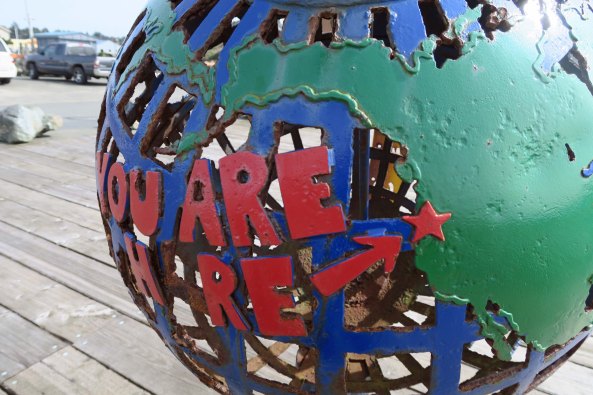
A world globe we found on Brandon’s Boardwalk conveniently located where we were.
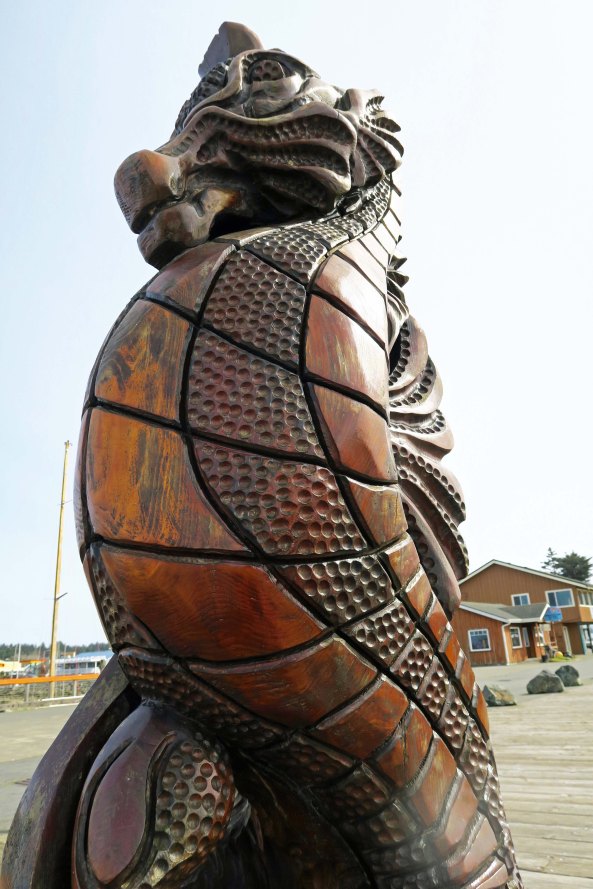
A regal seahorse checked us out…

A carved turtle grinned at us…
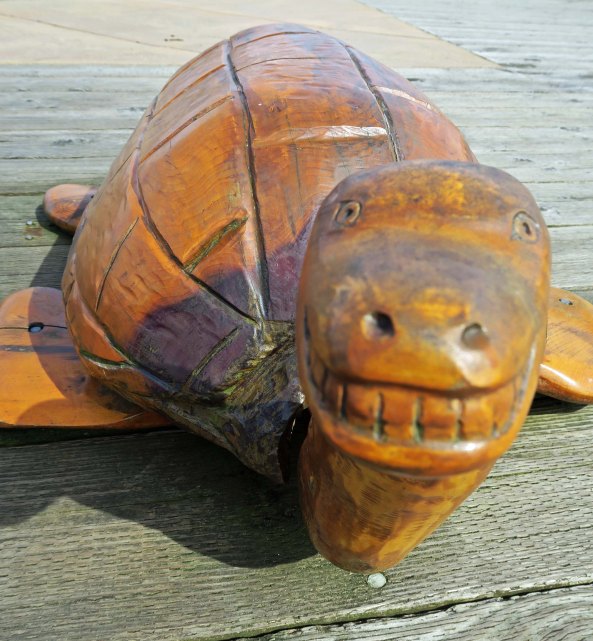
And led me to focus in on its smile.

A friendly harbor seal…
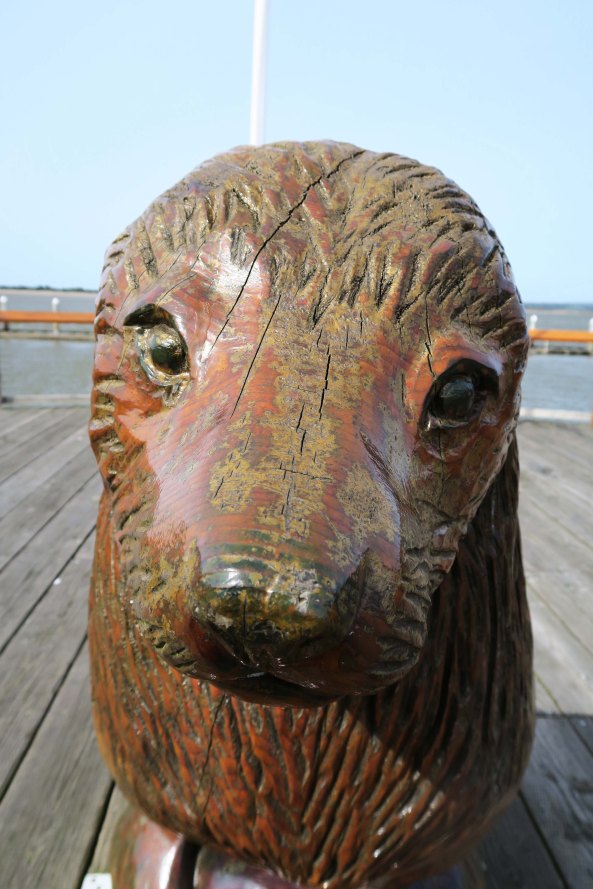
Gave us a look that seemed to say, “Feed me a fish, please.”
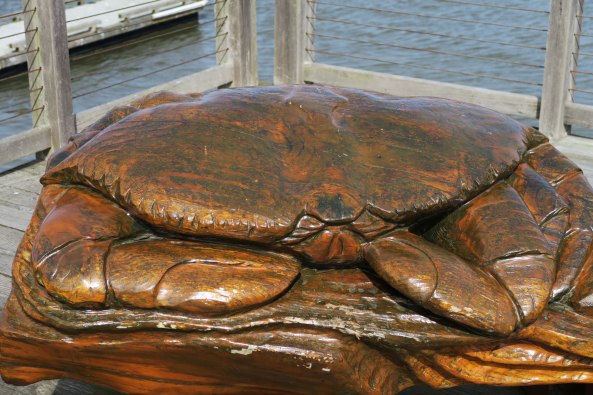
And a crab did what crabs do so well— look crabby.
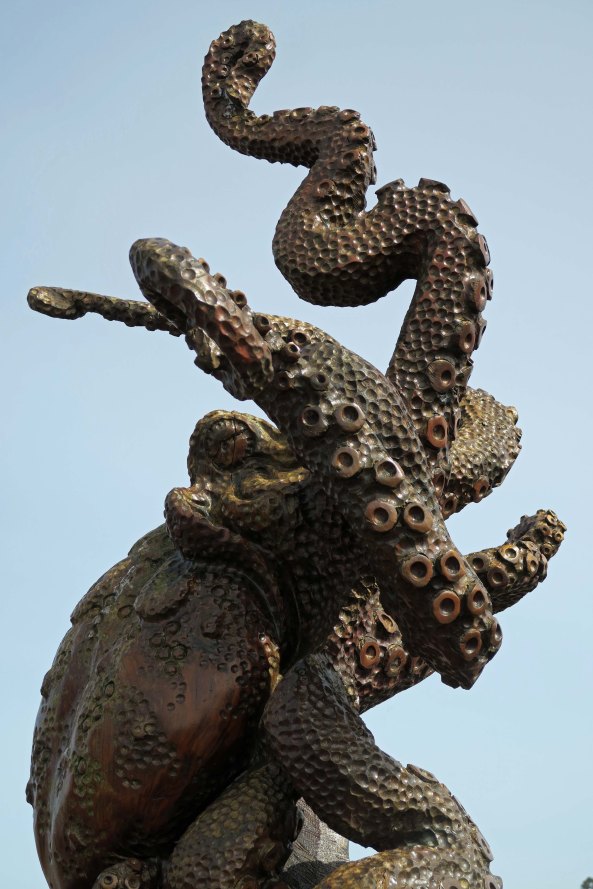
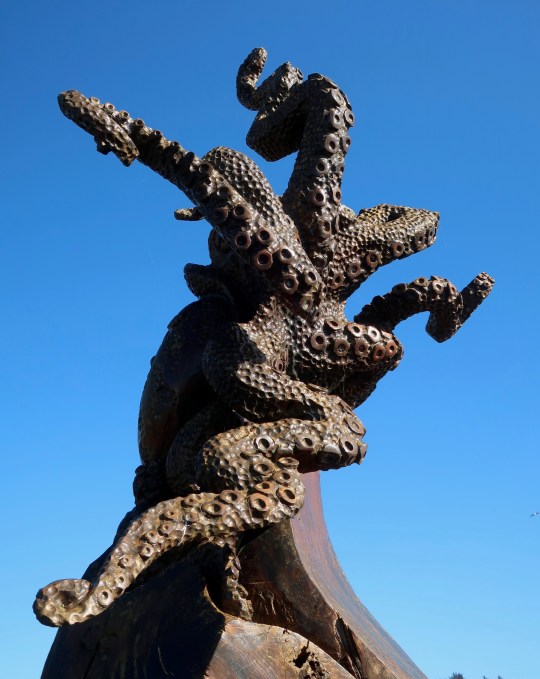
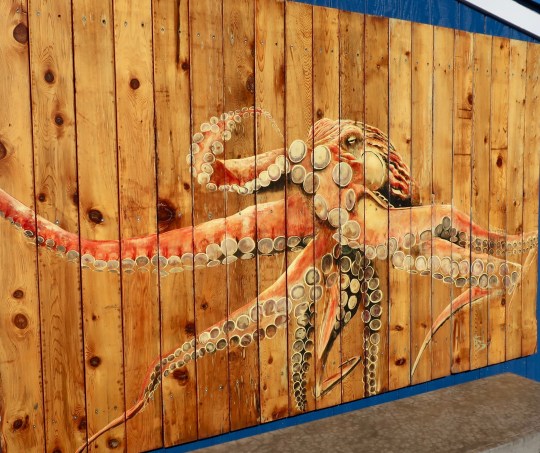
My favorite, however, was this octopus. I took several shots.
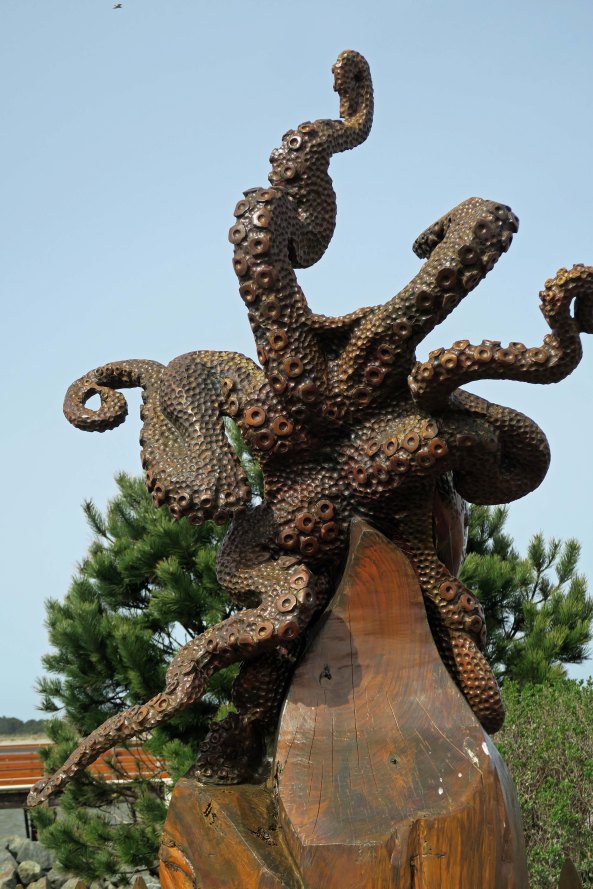

Back lit by the sun, he looked a little scary, like something out of 20,000 Leagues Under the Sea.

I decided to use my last photo to introduce my next post on Bandon (next Monday). Peggy and I will cross the Coquille River to check out this lighthouse and the ocean beach next to it. We are looking at the lighthouse from Bandon’s Boardwalk.
NEXT POSTS:
Wednesday: I begin a three-part series that focuses on a backpack trip near Lake Tahoe where we found Bone.
Friday: I will continue my photo essays on the art of Burning Man.
Monday: I’ll wrap up the Bandon, Oregon series with a trip to the Coquille Lighthouse and the surrounding area.
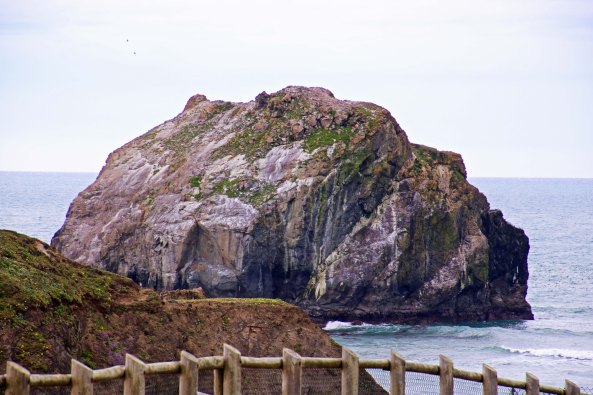
The face of the Indian maiden is clearly seen here in the rock. If you start on the right you can see her chin, mouth, nose and eye. (Photo by Peggy Mekemson.)
Peggy and I have driven through the town of Bandon several times without stopping on our journeys up and down the Oregon Coast. We decided to correct that oversight this past week. I had googled the small town along Highway 101. Photos of striking rock sculptures at the Face Rock State Scenic Viewpoint were included on the site. That alone would have demanded a visit. But there was also the town of Bandon, Bullard Beach State Park, and the Coquille River Lighthouse to explore. Today, I will feature the scenic viewpoint. Next Monday I’ll focus on the town, park and lighthouse.
There’s a native American legend that goes along with Face Rock. It has to do with an evil spirit, a lovely maiden, and her favorite pets. The Indian maiden, Ewauna, had come with her father, Chief Siskiyou, to visit with several chiefs along the coast. In honor of the occasion, a great potlatch was thrown. After everyone had eaten far more bear and salmon than he or she should have and stumbled off to bed, Ewauna decided to go for a swim in the ocean, even though she had been warned not to. The evil spirit Seatka lived in the ocean and had a thing for fair maidens. Naturally, he captured Ewauna along with her dog, cat, and kittens. You can still see them today down among the rocks.

Another view of the maiden, Ewauna. This one taken at sea level. (Photo by Peggy Mekemson.)
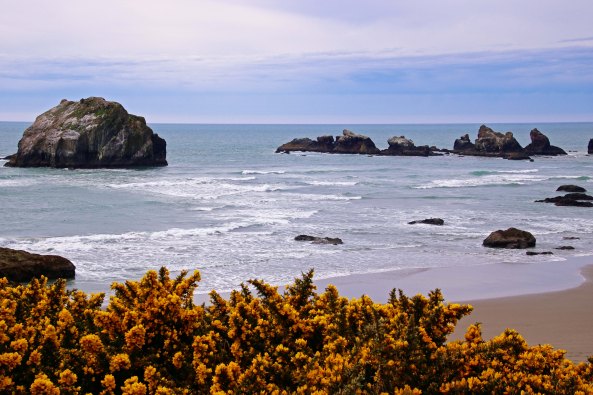
The maiden with her cat and kittens off to the right. (Photo by Peggy Mekemson.)
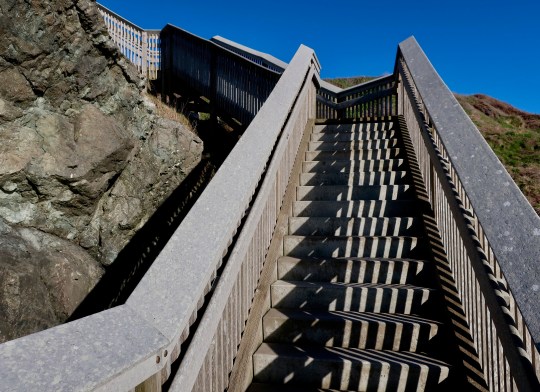
We were lucky to visit the scenic viewpoint at low tide, so we followed a wooden stairway down to the beach, wandered around among the rock sculptures, explored some caves, and admired the general beauty of the area.

Stairs led us down to the beach. (Photo by Peggy Mekemson.)
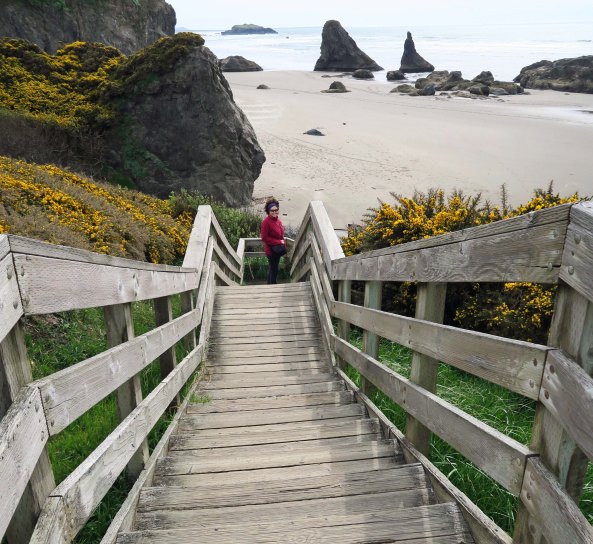
I caught a photo of Peggy making her way down the stairs. Marvelous rock sculptures were waiting for us.

A small stream crossed the path at the bottom of the stairways.
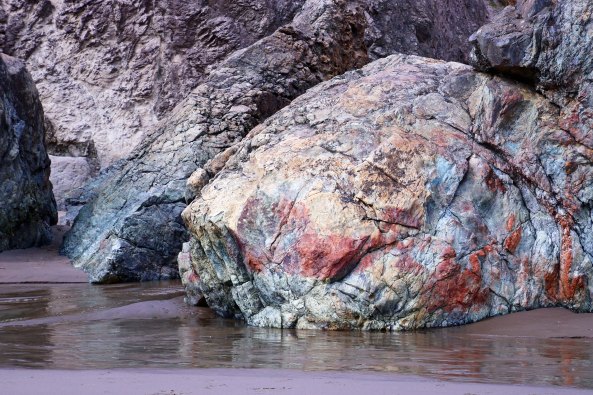
Peggy caught it coming out on the other side of the colorful rocks. (Photo by Peggy Mekemson.)

And I captured a broader perspective.

I promptly name this rock Elf.

Peggy took this for perspective.
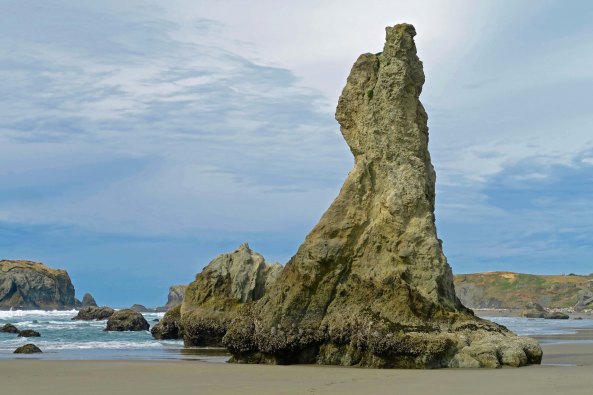
Another towering giant caught our attention. I named it Bigfoot.

Peggy and Bigfoot’s toes.
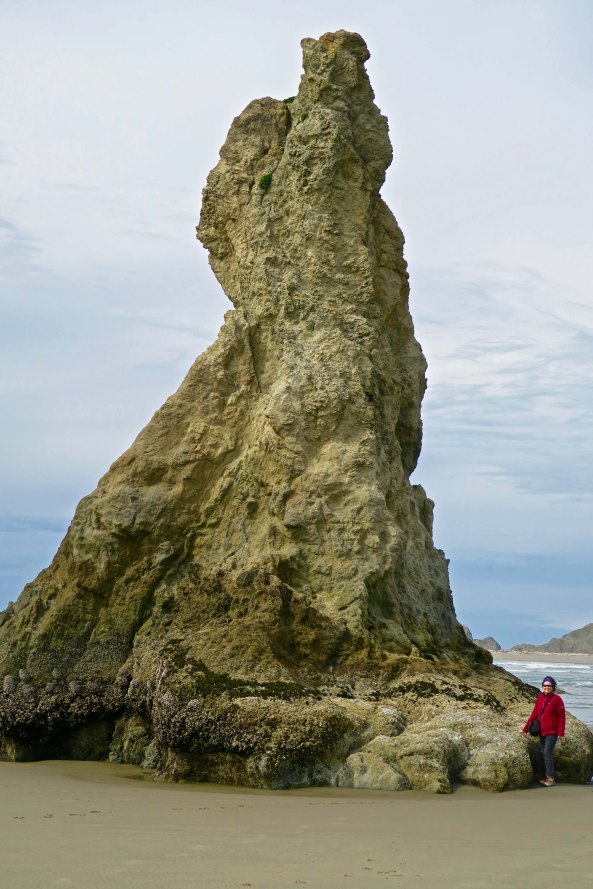
This photo provides a Peggy perspective on Bigfoot’s big foot.
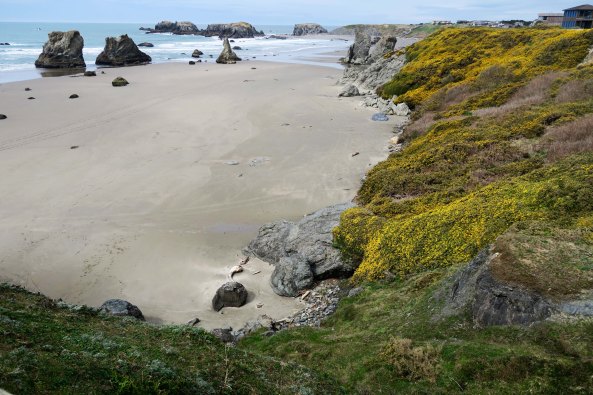
A distant view of Bigfoot looking small— and other rocks— from the scenic viewpoint.

These cliffs rose up dramatically behind the beach.

A pair of eye-like caves had been cut into the cliffs by the pounding waves. I was pretty sure that there would be pirate booty in them. (Photo by Peggy Mekemson.)

One of the caves was filled with rocks. I was tempted to dig.
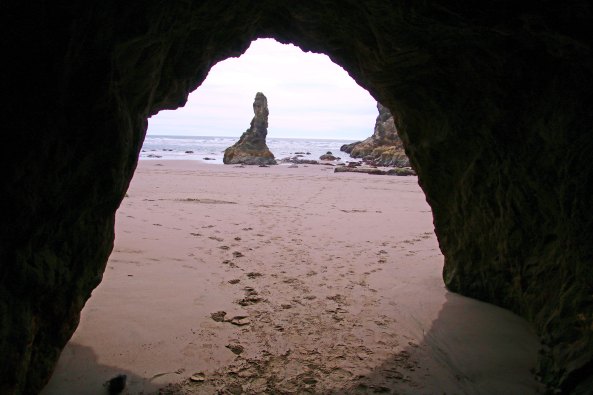
A view out from inside the cave. We hadn’t been alone in checking out the cave. (Photo by Peggy Mekemson.)

The same rock looking down from the viewpoint.

Looking up at the rock from below.

The other cave provided a view through the rock cliff. (Photo by Peggy Mekemson.)

Another view. The yellow plant seen on the other side is gorse. (Photo by Peggy Mekemson.)
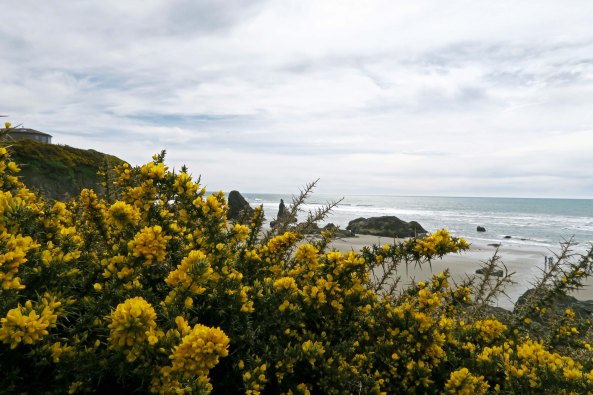
George Bennet, the founder of Bandon, brought the thorny gorse with him when he came from the town of Bandon, Ireland in 1873. He saw it as a touch of home. Local Oregonians view it as an invasive plant that crowds out native plants.

It does have a certain beauty, but don’t try to hike through its thorns. The cave comes through the cliff on the right.

Another view.

There were many more rocks to keep us entertained. (Photo by Peggy Mekemson.)
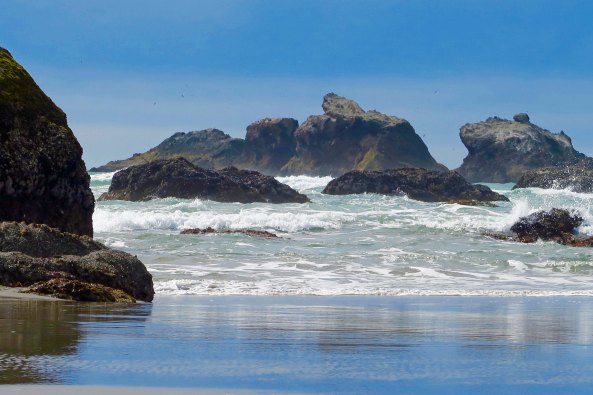
The cat and kittens looked a little more riled up here as the tide began to roll in. (And no, the cat and kittens aren’t obvious to me, either.)
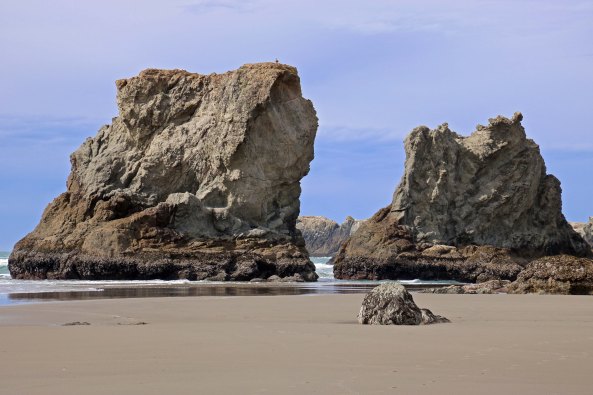
Peggy caught the tide slipping in between thesis giants. Can you spot the misplaced Canadian Goose on top of the rock on the left? It flew off honking. (Photo by Peggy Mekemson.)

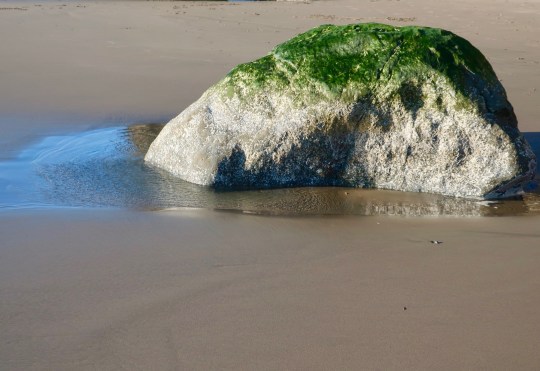
I photographed the tide edging around this rock. The bottom of the rock, BTW, is packed with sea life.
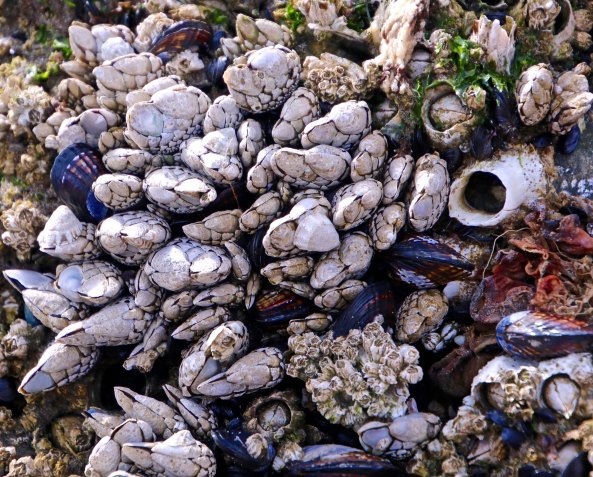
Peggy’s close up shows goose neck barnacles, regular barnacles and mussels. Every inch is filled!
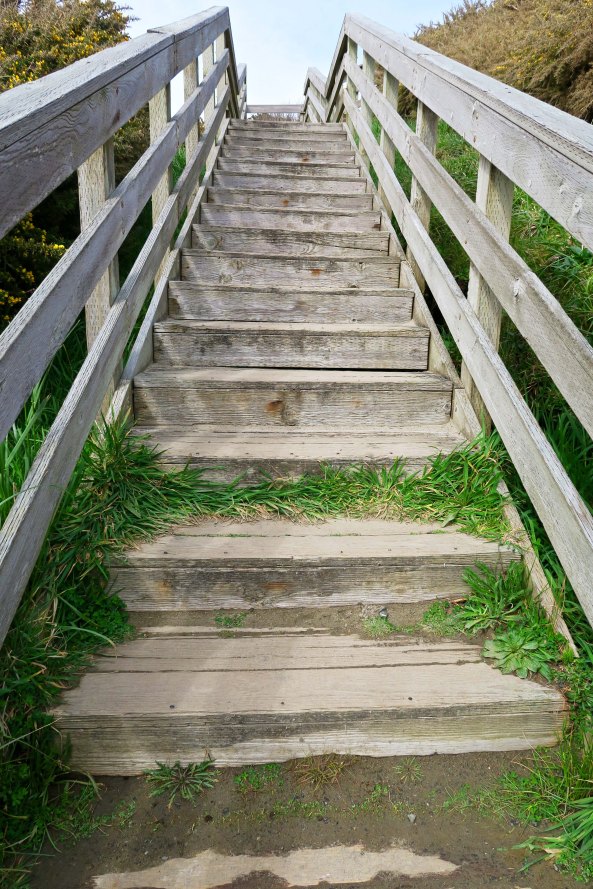
Our exploration complete, it was time to head back up the stairs.
NEXT BLOGS:
Wednesday: The interview with Bone!
Friday: The beautiful temples of Burning Man.
Monday: It’s back to Bandon, Oregon.
 Wandering through Time and Place