Into the Red Butte Wilderness… Backpacking at 71

Old Growth Cedar in Red Buttes Wilderness of Northern California and Southern Oregon.

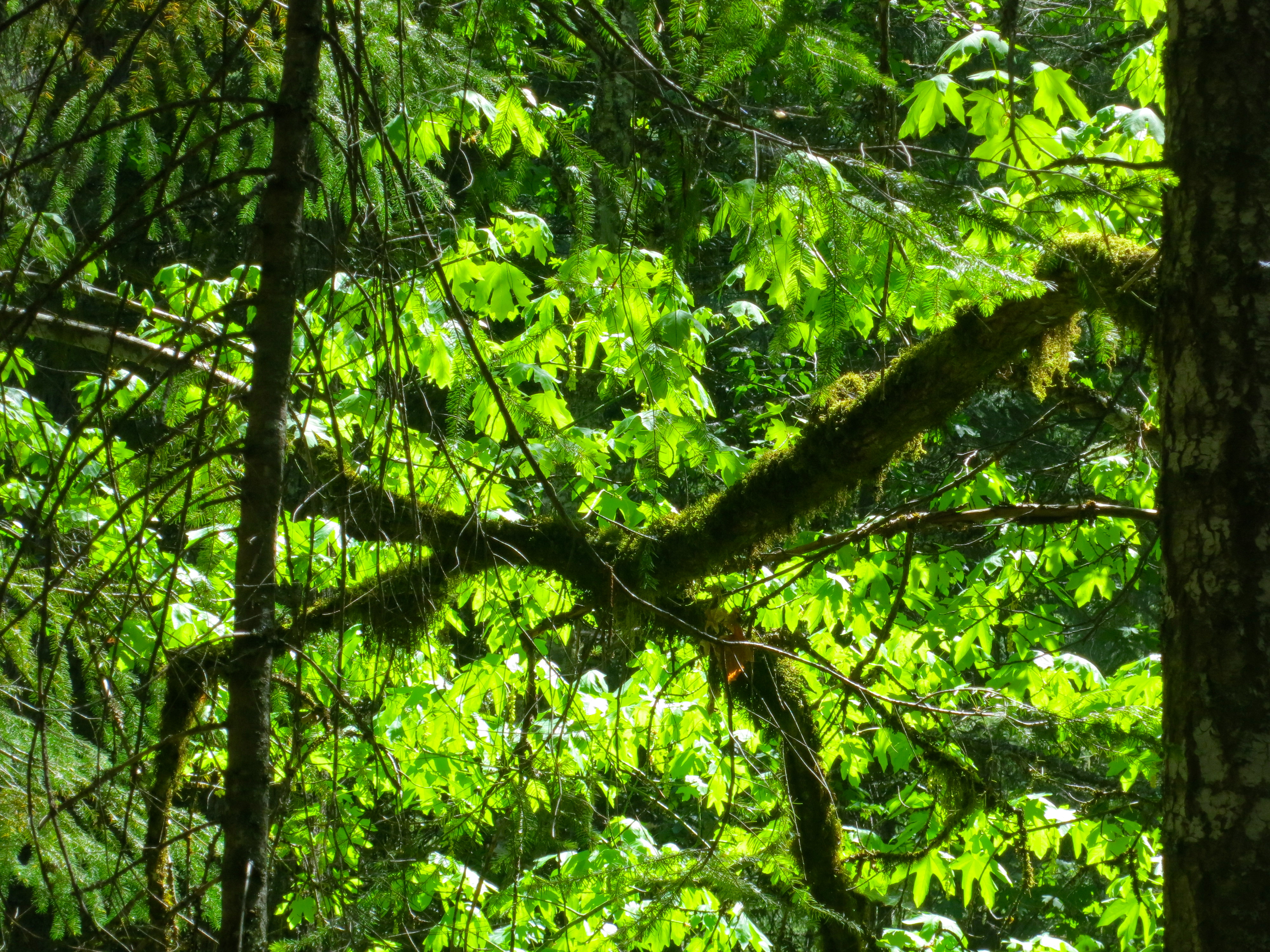
There is much to be impressed with in the Red Buttes Wilderness, including magnificent old growth trees such as this cedar.

I know a bit about backpacking (mild understatement). A few years back, in 1974 to be exact, I was working as the Executive Director of the American Lung Association in Sacramento. The organization needed a new source of funding; I needed an excuse to play in the woods. So I combined the two. I proposed to my Board of Directors that I lead a nine-day, hundred mile backpack trip across the Sierra Nevada Mountain Range with the participants raising money to fight lung disease.

So what if my longest backpack trip ever had been 30 miles.

“You are crazy,” the board said. “You are crazy,” my friend in the backpacking industry said. It was like I had inherited a parrot.

And they were right. The only point they missed was just how crazy. Sixty-one people aged 11-71 showed up– many who had never worn a backpack in their lives. One immediately claimed she was a witch and would be over to bite me in the middle of the night. And how was I to know that my co-leader had participated in burning down a bank in Santa Barbara, or that my go-to guy in emergencies was a Columbian drug runner, or that the big fellow who got me through the toughest days was an explosive experts on the lam from the IRS. You can’t make these things up, folks! But this is a story for later this summer. It’s one you won’t want to miss.

Lets just say by the time I walked into the foothill town of Auburn, California nine days later on deeply blistered feet in 104-degree weather, I had persuaded myself that the money raised from Christmas Seals was more than adequate to support our organization, forever.

But then a strange thing happened. These people who I had almost killed and who had come close to killing me, started coming up one by one and demanding to know where we were going next year. I heard things ranging from, “This was the greatest experience in my life” to “I have lots of ideas for fundraising.” It took them several months to persuade me…

But persuade me they did. I would go on to add bike treks in Sacramento and eventually take the program nationwide where I became the national trek consultant for the American Lung Association. Millions of dollars were raised to prevent lung disease and thousands of people were introduced to long distant backpacking and bicycling as a result. More importantly, from my perspective, I got to play in the woods. For 30 years, I spent a part of each summer leading wilderness expeditions. And when I wasn’t leading treks, I was off backpacking by myself or with friends.

Founder of the American Lung Association Trek Program, Curtis Mekemson.

A much younger me gracing the front of the American Lung Association’s National Bulletin in my role as founder of ALA’s Trek Program.

Sadly, my last backpacking trip was seven years ago. Life happens, right? Peggy and I bought a small RV and decided to wander North America for three years; our kids started producing grand babies; we bought our property in Oregon and travelled to Europe and Alaska. I took up blogging and decided to write a book.

It was all good, but I missed backpacking– a lot. And there’s this thing. Our home looks out on the beautiful Red Buttes of the Siskiyou Mountains of Southern Oregon and Northern California. The mountains spoke to me, over and over and over. Finally I could no longer ignore their call. Peggy and I decided to hit the trail. So last week, we did.

Red Butte mountains of the Siskiyou Range.

The Red Butte Mountains as they appear from our house in spring through the lens of our camera. How could we not set out to explore them?

We planned a short trip: three days and 14 miles. It was to be something of a test to see how well we would do. After all, we had aged seven years. At 71, I couldn’t expect my body to behave the same way it had at 21, or 31, or 41, or 51, or 61. And even Peggy, a young woman of 64, was nervous.

I immediately pulled out maps and begin planning a route. I was like a little kid on Christmas morning (or Peggy at the chocolate store in Central Point). Had I been a dog, I would have been wagging my tail like my basset hound, Socrates, used to at the sight of a hotdog.

This forest service map shows the location of the Red Buttes Wilderness. The X marks the approximate location of our home.

This forest service map shows the location of the Red Buttes Wilderness. The X marks the approximate location of our home.

I planned out our route on a US Forest Service Topo Map. We followed the Butte Creek Trail to Azalea Lake.

I planned out our route on a US Forest Service Topo Map. We followed the Butte Creek Trail to Azalea Lake. I wrote in the small, circled numbers which I will refer back to.

A close up of the map shows the beginning of our hike. "T" marks the trailhead where we parked the truck. Topo lines reflect the steepness of the trail. The closer together, the steeper!

A close up of the map shows the beginning of our hike. “T” marks the trailhead where we parked the truck. Topo lines reflect the steepness of the trail. The closer together, the steeper! We started by hiking down into the canyon following the well switch backed trail. Down in the beginning, meant up in the ending. (grin)

Next came the gear. It was hiding out on shelves, in drawers, and long ago packed boxes. Would my MSR white gas stove still cook? Would the Katadyn Filter still pump safe water? And possibly even more important, would our Therm-A-Rest air mattresses still be filled with air in the morning? When you are disappearing into the backcountry, you can’t be too careful.
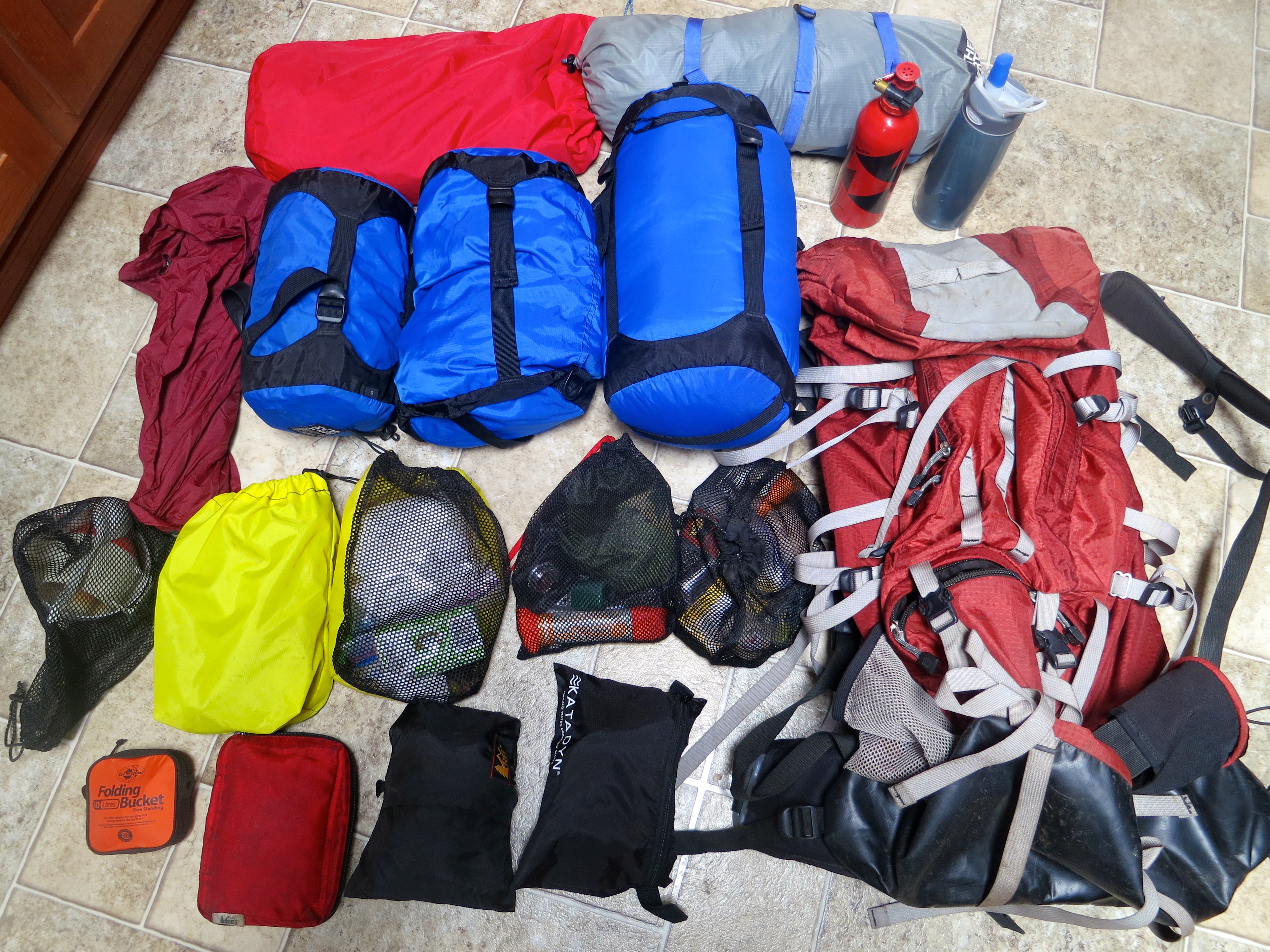
Here's my gear and backpack. The larger bags are tent, sleeping bag and pad, food, and clothes. Smaller bags are organized according to function: kitchen, bathroom, first aid, etc.

Here’s my gear and backpack. The larger bags are tent, sleeping bag and pad, food, and clothes. Smaller bags are organized according to function: kitchen, bathroom, first aid, etc. Total weight with food, fuel and water: 35 pounds.

Go light is the mantra of anyone who carries his house on his back. Fortunately, the backpacking industry is constantly developing lighter equipment, such as this fully functional folding bucket.

Go light is the mantra of anyone who carries his house on his back. Fortunately, the backpacking industry is constantly developing lighter equipment, such as this fully functional folding bucket.

There was the inevitable last-minute trip to REI. And Peggy and I even drove up to check out the trailhead on Mother’s Day. (Now, before all of you moms get excited, she got breakfast in bed first and we took a picnic lunch that we ate on a grassy knoll with a grand view. Peggy even managed to spot a hungry mountain lion disappearing into the forest. Maybe it was coming to join us for lunch. What more could a mom ask for?)
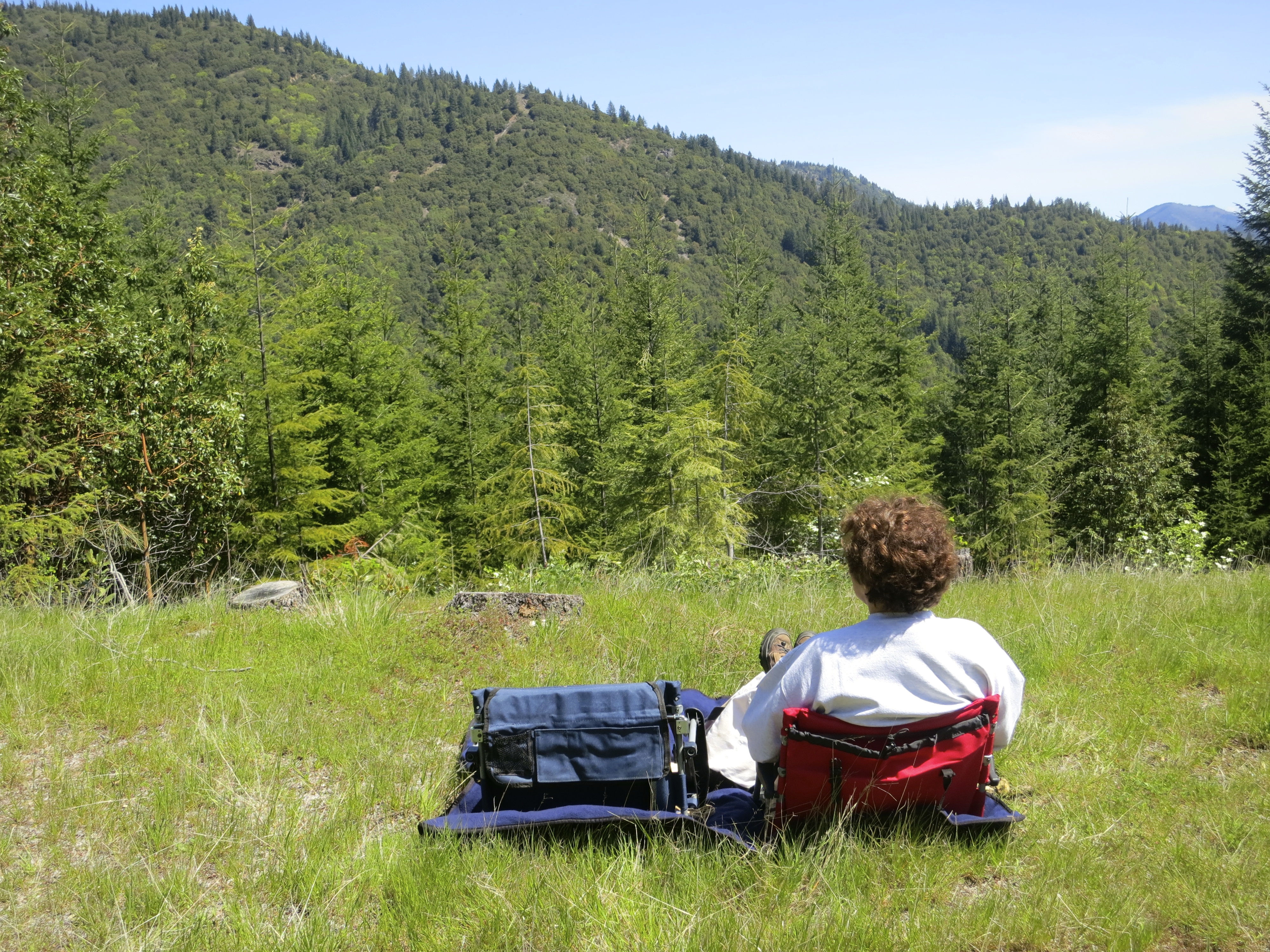
Peggy enjoying her Mother's Day Picnic. We saw the mountain lion a couple of hundred yards down the road on our way out.

Peggy enjoying her Mother’s Day Picnic. We saw the mountain lion a couple of hundred yards down the road on our way out.

And how was the trip? Forget for the moment that it was cold and rained much of the time. Forget that we were dead tired and went to bed at 7:00 PM. Forget that the trail came close to disappearing in the brush and we spent a fair amount of energy crawling over and around downed trees that blocked the trail. And forget about the noise we heard in the middle of the night that sounded like Bigfoot pounding on a tree trunk with a large limb. And why should you forget? I just got out my thesaurus. The trip was wonderful, beautiful, invigorating, marvelous, educational, and stunning. We laughed our way through the whole adventure.

I’ll let our photos tell the story.
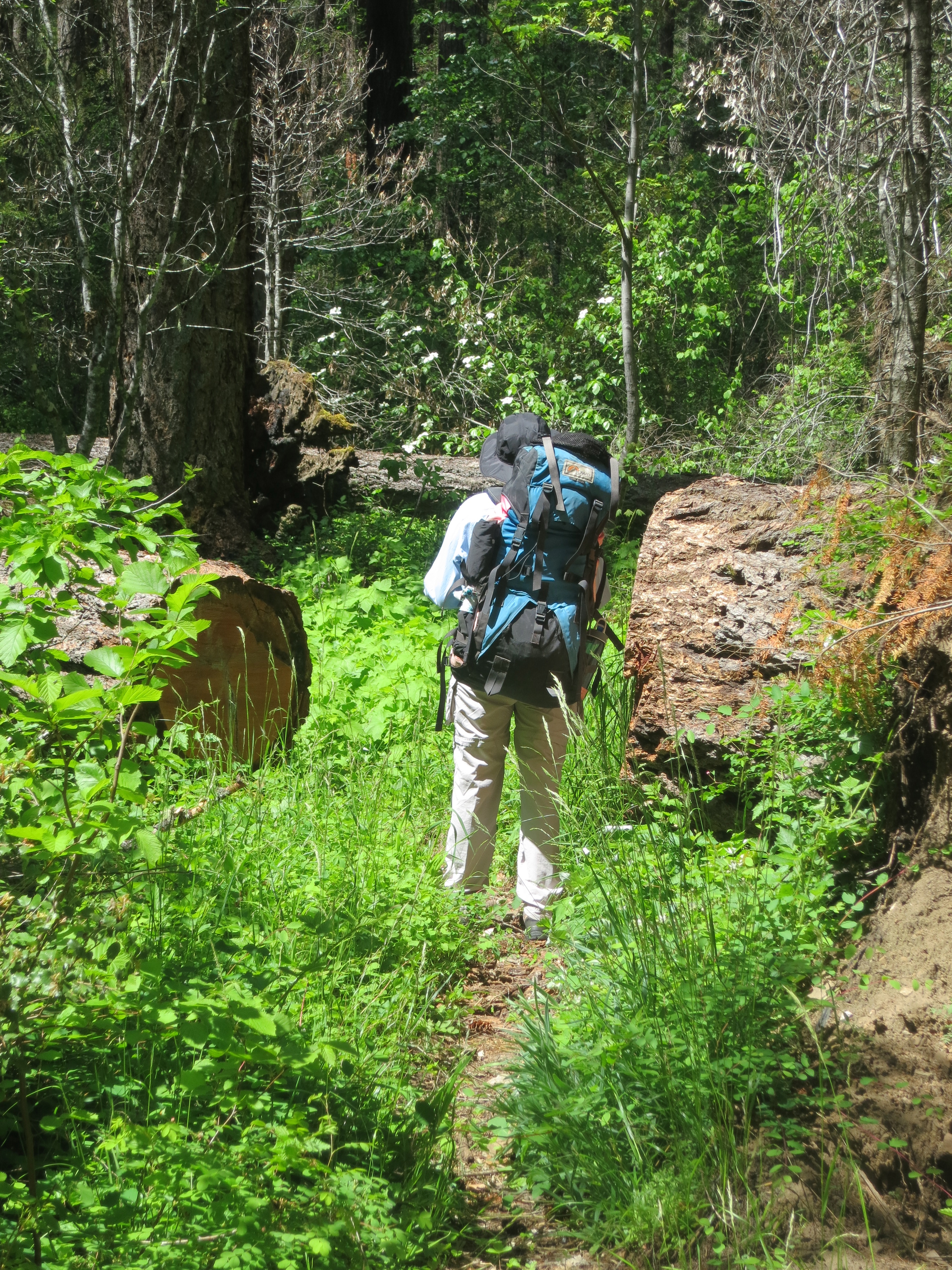
Butte Creek trail in the Red Butte Wilderness.

After following switch backs down the dry mountain side, we came upon the verdant canyon of the Butte Fork of the Applegate River with its almost rainforest feel. (This and the following three photos are located near #1 on the map.)
Butte Creek trail in the Red Buttes Wilderness.

In 2012 the Ft. Goff fire had swept through the area. While the forest was relatively unharmed, some large trees had fallen across the trail and since been cleared to make way for hikers.
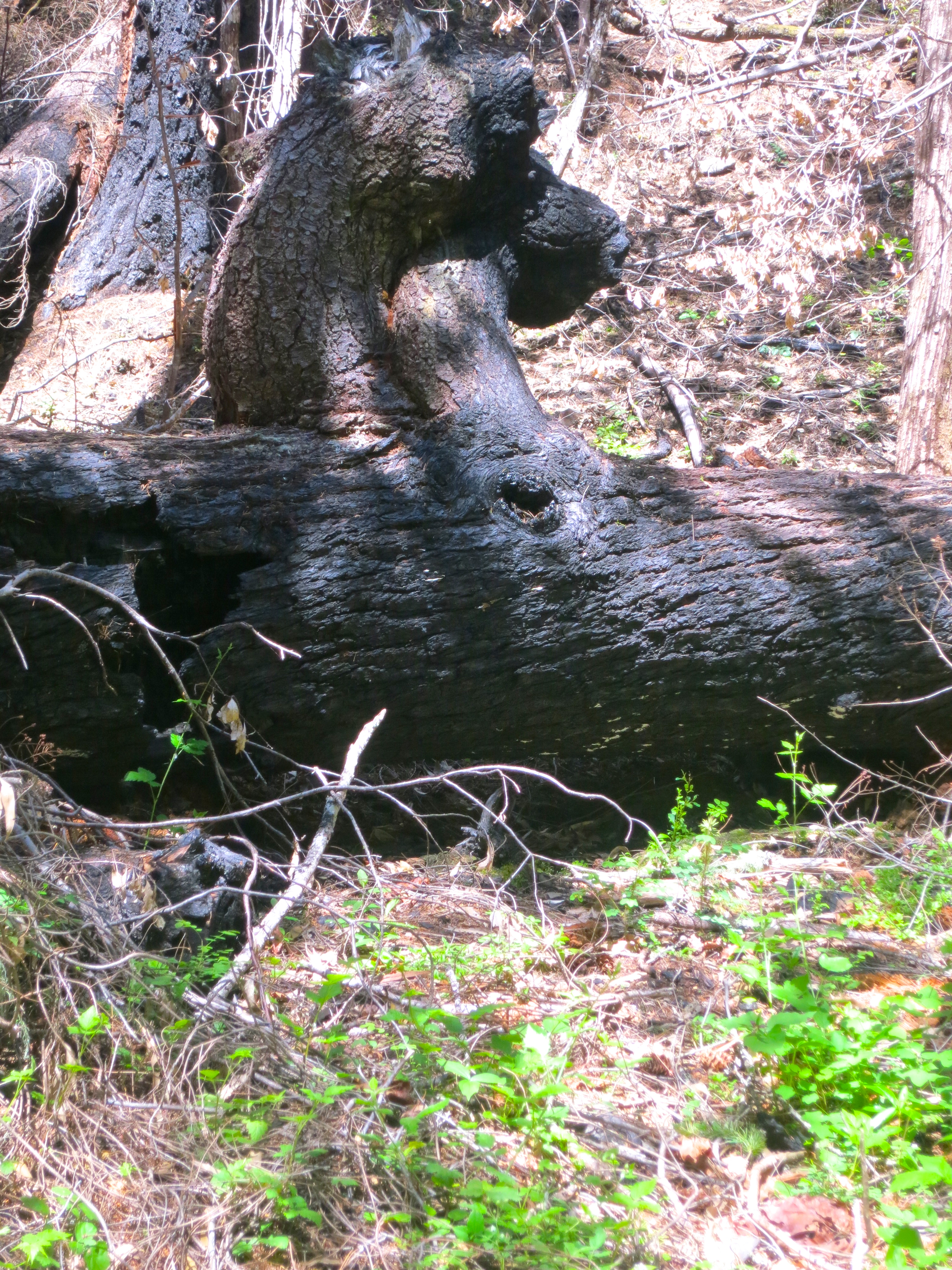
Smokey the Bear tree in the Red Buttes Wilderness.

We loved this tree poking its limb up in the middle of the fire area. Peggy at first saw a unicorn but I saw Smokey the Bear… reminding people to be careful with fire.

Horsetail fern growing in the Red Butte Wilderness.

We found this horse-tail fern growing in the canyon. Pioneers reputedly used this plant for scrubbing out pans.

CCC Cabin in the Red Buttes Wilderness area of Northern California and Southern Oregon.

An old cabin made out of red cedar shakes was built by the Civilian Conservation Corps in the 30s and then used by the forest service for storing fire fighting tools. (Located at #2 on the map.)

Roof of cedar shake cabin in Red Butte Wilderness area.

The hand-hewn cedar shake roof.

Chinquapin forest in Red Butte Wilderness.

Not far above the cabin, we came across a chinquapin forest. I had seen chinquapin bushes but never trees.

Chinquapin nuts, encased in these spine covered shells, are apparently quite tasty.

Chinquapin nuts, encased in these spine covered outer shells, are apparently quite tasty.

Flowering dogwood in the Red Butte Wilderness.

The trail at this elevation also featured beautiful flowering dogwood.
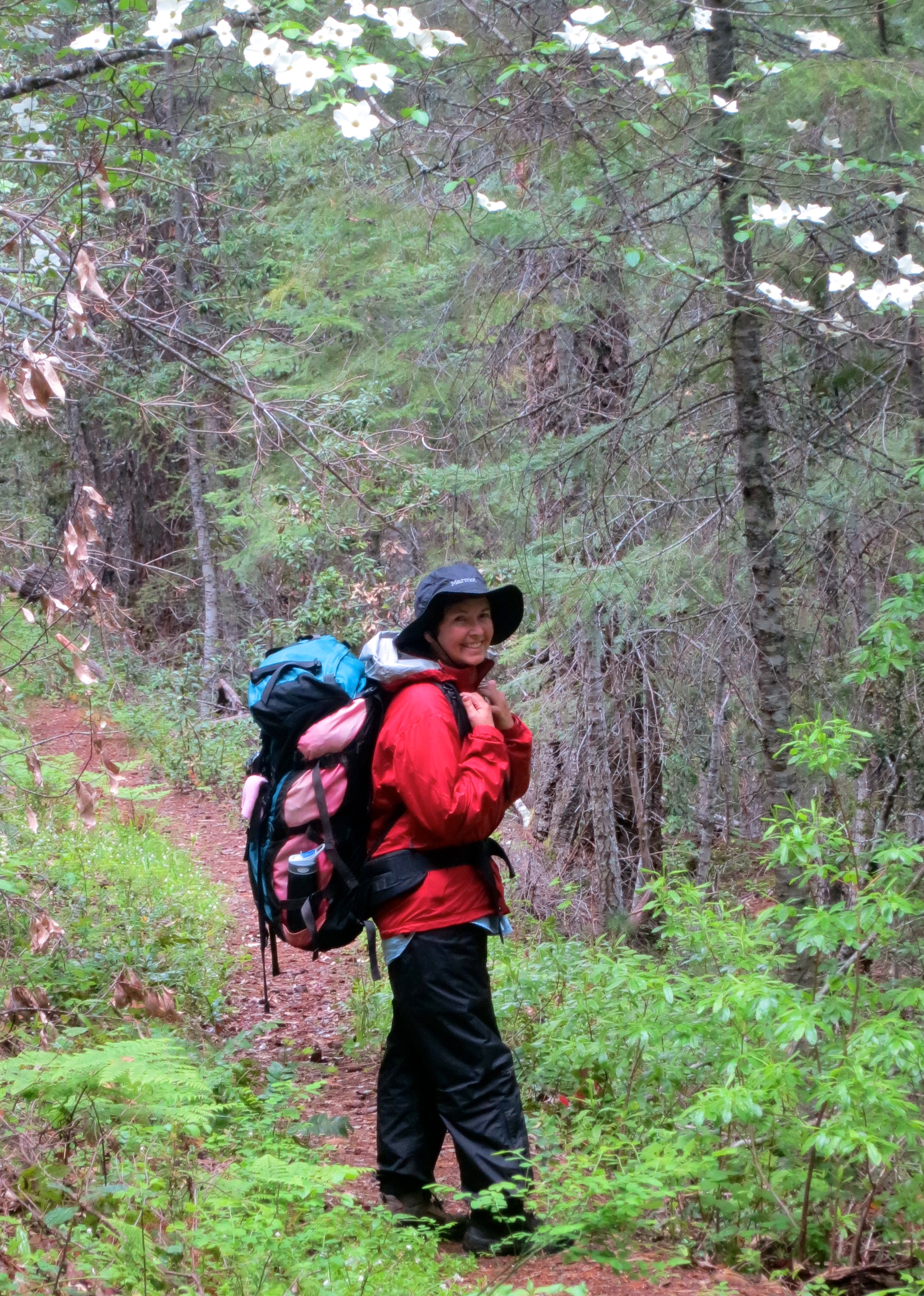
Peggy Mekemson hikes along the Butte Fork Trail through the Red Buttes Wilderness of Northern California.

Here, Peggy poses under a bower of it. I was going to point out that her pack weighed 32.5 pounds. She quickly corrected me. It was 32.8 pounds.
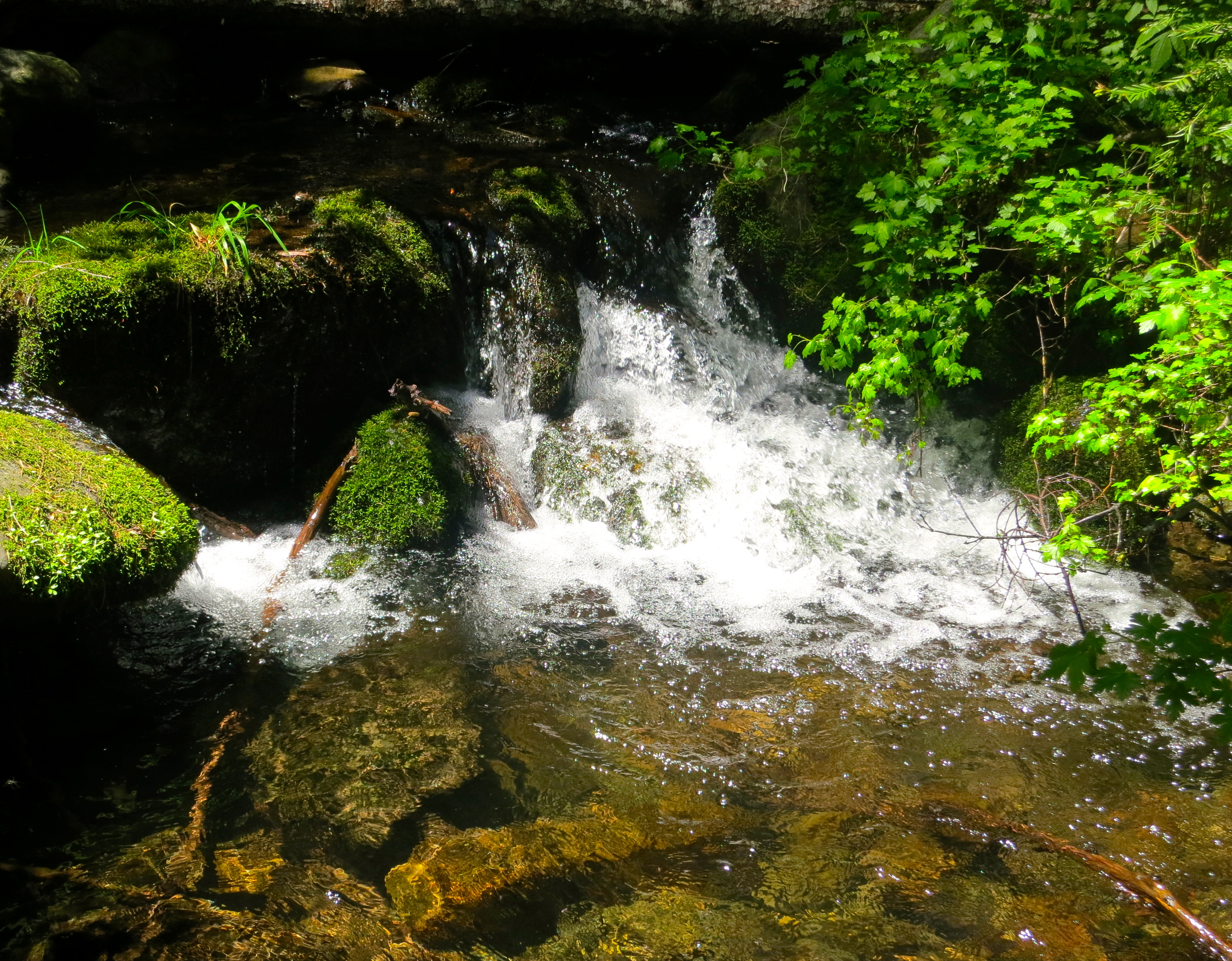
Small creek in Red Butte Wilderness area.

We had been hiking across dry slopes for quite some time. It was getting late, we were tired, and I was beginning to feel a bit of a grump coming on when we heard this creek. “I hear camp,” I told Peggy. (#3 on the map)

Camping out in the Red Buttes Wilderness.

There was barely room for our small North Face tent. But it was home. (Shortly after this photo it started raining.)

Old growth forest in the Red Buttes Wilderness.

This was our view looking up from our campsite. The Red Butte Wilderness includes some of the most impressive old growth forest I have ever seen including pine, fir and cedar trees.

Massive sugar pine tree in the Red Buttes Wilderness.

Peggy caught me standing next to one of the massive sugar pines. (Photo By Peggy Mekemson.)

Gravesite in Red Butte Wilderness.

This beautiful mound of rocks is found on my map at # 4. It’s a grave for three people buried here by family members after their plane crashed on July 28, 1945.

Burial site of airplane crash victims in Red Butte Wilderness.

The grave marker shows that Sylvan Gosliner, Ruby May Gosliner and Alma Virgie Pratt are buried here. Remnants of the plane can still be found in the canyon below.

Tree torn apart for bugs in Red Butte Wilderness.

Someone had a grand time ripping this rotting tree apart for it bugs. Was it a bear? Or how about Bigfoot? We found a large pile of scat (poop) nearby.

Cedar Grove in the Red Buttes Wilderness.

Cedar Grove is aptly named for its magnificent cedars. (Found at #5 on the map.)

Corn Lilies in red Butte Wilderness.

We also found corn lilies growing nearby in a meadow where the Goff Trail joins the Butte Fork Trail.

Trillium growing in Red Buttes Wilderness.

As we did this trillium.

Tree blaze carved into a cedar tree in the Red Buttes Wilderness.

Ever hear the phrase, “Where in the blazes are we?” Foresters, cowboys and other outdoors people used to mark their trails by cutting out this symbol in a tree, which is known as a blaze. I’ve followed them through forests from Maine to Alaska, often over trails that have long since grown over.

Curt Mekemson backpacking in the Red Butte Wilderness.

It was a tad wet in the cedars, as this photo by Peggy demonstrates.  The bottle on the left is filled with wine, BTW. It helps assure that Peggy will follow me up the mountain. (grin)

Peggy Mekemson stands on trail in Red Buttes Wilderness.

The trail between the cedars and Lake Azalea almost disappeared on one occasion. Peggy is standing on it.
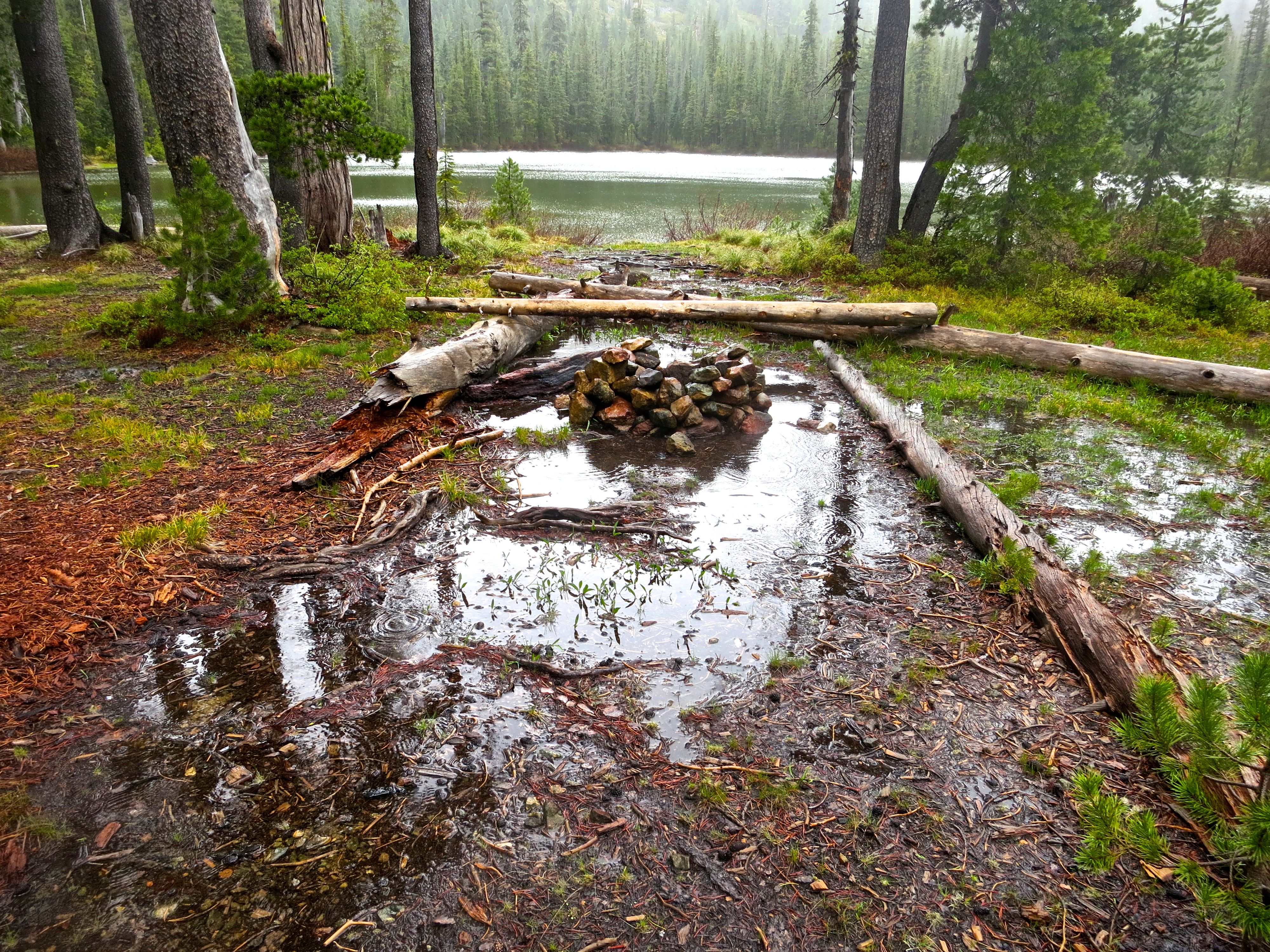
Azalea Lake in Red Buttes Wilderness.

We finally reached Azalea Lake. Have I mentioned it was wet out?

Curtis Mekemson camping in the Red Buttes Wilderness.

We found a drier, more protected camp farther away from the lake and settled in. I’ve carried the coffee cup backpacking for 45 years. Once it spent the winter buried under 20 feet of snow. (Photo by Peggy Mekemson.)

Azalea Lake in the Red Buttes Wilderness.

The sun rewarded our trip the next morning by providing a lovely view of Lake Azalea. It was time to pack up and head back for civilization.

Curtis and Peggy Mekemson in Red Buttes Wilderness.

Selfie of two happy campers at trails end who have seen some beautiful country and proven to themselves that they can still put on backpacks and disappear into the wilderness.


Race: It Matters, Part 14

Okay, this is a slightly strange title for a blog by me, so it deserves some background. I’ve reblogged this from Holistic Journey. The feisty Diana loves to take on social issues and is one of my favorite bloggers. Lately she has been taking on the issue of race by asking her followers from around the world to respond to a series of questions. Today is my turn. D starts by asking us to define our race. You will learn a little more about me, but more importantly, I share my views on this important issue that never seems to go away.

Holistic Wayfarer's avatarA Holistic Journey

1 Whitney 1) How do you define yourself racially or ethnically and why is it important to you?

An analysis of my DNA by Ancestry.com shows that my ancestors came from Western Europe, Ireland, Scandinavia and Spain, which makes me about as Caucasian as one can be.  I find my ethnicity interesting from a historical perspective. On a personal level, I believe who we are as individuals is much more important than our ethnicity.

2) Where do you live? If you have ever moved, whether to another city or the other side of the world, please tell us when and where, and the ways the cultural differences between the places shaped or made you think about your identity.

I live in Southern Oregon – northwestern United States – surrounded by national forests. I was raised in a small, rural town in Northern California. My first move was to University of California, Berkeley…

View original post 1,494 more words

The Morris Burner Hotel in Reno… Where Each Room Is a Work of Art

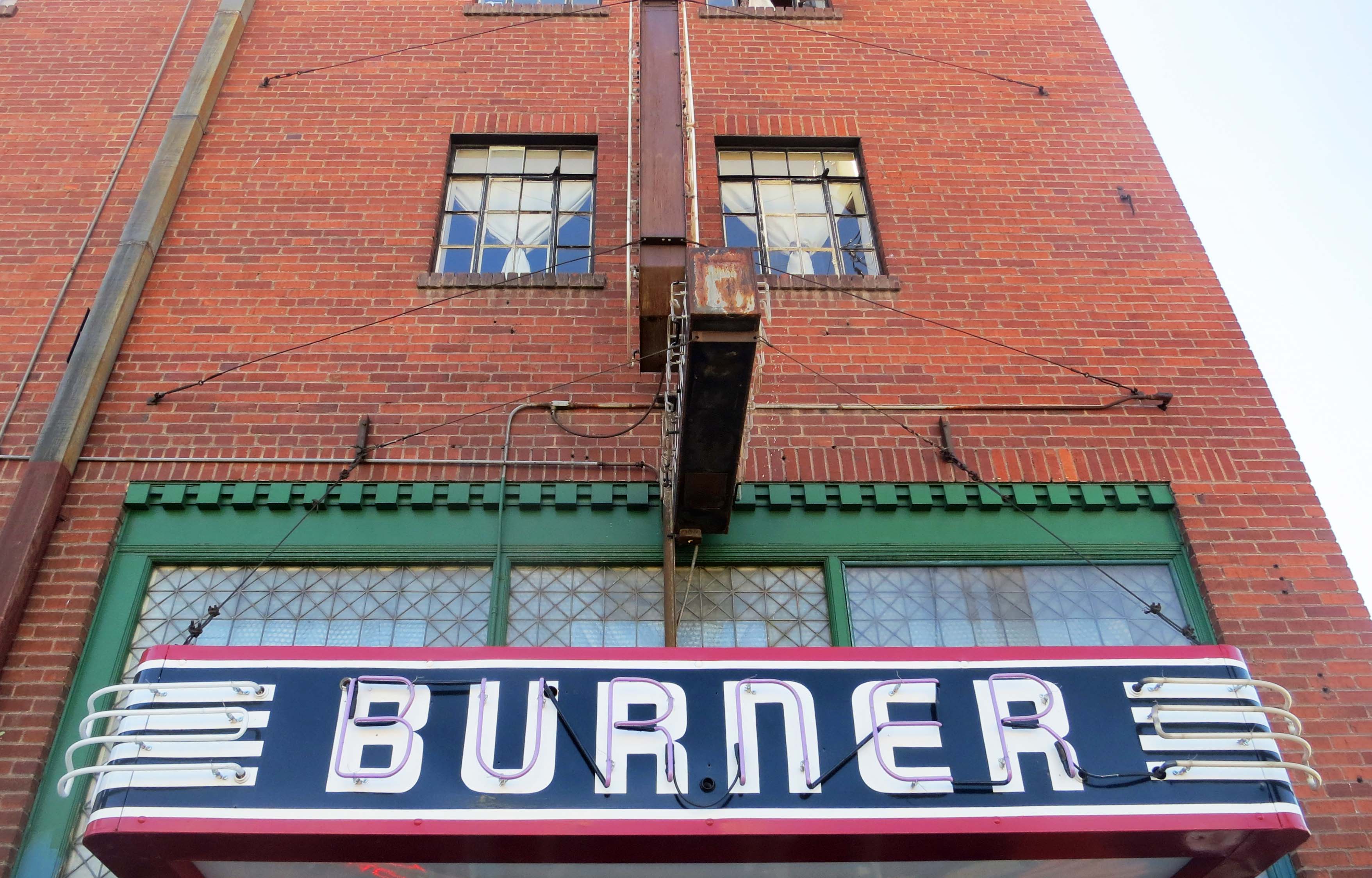
The old Morris Hotel in Reno, Nevada has now been renovated as the Morris Burner Hotel and will provide rooms for Burners on their way to Burning Man in August and people interested in art and the event year round.

The old Morris Hotel in Reno, Nevada has now been renovated as the Morris Burner Hotel and will provide rooms to people on their way to Burning Man in August and people interested in art and the event year round.

I’ve always liked Reno. As far back as I can remember the city has defined itself as the Biggest Little City in the World. It has also been known for its gambling, quick marriages and quicker divorces. My parents were married in the town. For years they teased me about my legitimacy. It probably scarred me for life. But I have the marriage certificate. It looks legit whether I am or not.

I personally became acquainted with Reno when I ran Peace Corp’s public affairs and recruitment program for Northern California and Nevada in the late 60s. The University of Nevada at Reno was one of the campuses where I recruited. I made the trip over the mountains two or three times a year. Those were the days when slot machines were still known as one-armed bandits and the mafia still thrived in Las Vegas– and probably Reno. I did my bit by contributing to the mob and Nevada’s economy but had little luck in persuading young Nevadans to leave the state, much less the country.

Reno is an event-oriented place. The city thrives on antique car shows, rib cook-offs, rodeos, Harley Motorcycle invasions, festivals, and innumerable races including hot air balloons, bicycles, airplanes and kayaks (the Truckee River flows through the middle of the city). Tourism is the lifeblood of the city. Recently, the Chamber of Commerce has added another major event to its things to do list: Burning Man. Each year tens of thousands of Burners pass through Reno on their annual pilgrimage to the Black Rock desert. Apparently they give the local economy a substantial boost.

The influence goes beyond economic to cultural. Reno has a thriving Burner community that brings it enthusiasm for Burning Man back to the city. The most unique contribution, from my perspective, is the Morris Burner Hotel. I read about it recently in Jack Rabbit Speaks, the Burning Man newsletter, and decided that Peggy and I had to add the hotel to our list of stops on our recent three-week journey through Nevada. As you probably know, I am a fan of Burning Man, having gone back regularly since my first visit in 2004. I’ve blogged about my experiences for the past four years. In fact, WordPress gave me its Freshly Pressed designation for my articles on the event.

The 80-year old Morris Hotel in downtown Reno is now the Morris Burner Hotel.

The 80-year old Morris Hotel in downtown Reno is now the Morris Burner Hotel.

The Morris Burner Hotel, according to its mission statement “is a Burning Man inspired housing facility and community space, dedicated to building community, fostering the arts, and helping to educate people in the Burning Man ethos. It is a place to share, create, participate, and build relationships.” The inspiration behind its creation is Jim Gibson, or Jungle Jim, as he is known in Black Rock City. (Most Burners have nicknames.)

Jim is an engineer who spent over 40 years in the microelectronics business, co-founded three companies, owns three patents, and, in 2007, was named Entrepreneur of the Year for Northern Nevada. In 2008 he retired and went to Burning Man. It changed his life. His purchase and renovation of the Morris Hotel is an example.

The hotel was built in 1931 along Historic Route 40, the Lincoln Highway, that ran through downtown Reno and on across the country. In its heyday, the Morris would have been a proud establishment, but over the years the neighborhood and the hotel had declined. As one of the Burners who worked on the hotel’s renovation noted, “It needed a bath something terrible… it was spine chilling disgusting.” A great introductory video on the hotel by Liz Margerum, photographer and videographer for the Reno Gazette Journal, captures workers wearing gas masks as they removed aged carpets.

Historic neon sign advertising Abby's Bar in Reno, Nevada.

Abby’s Bar is located next to the Morris Burner Hotel and is advertised with this sign of a bygone era when Historic Highway 40 was one of Americas major cross-country roads.

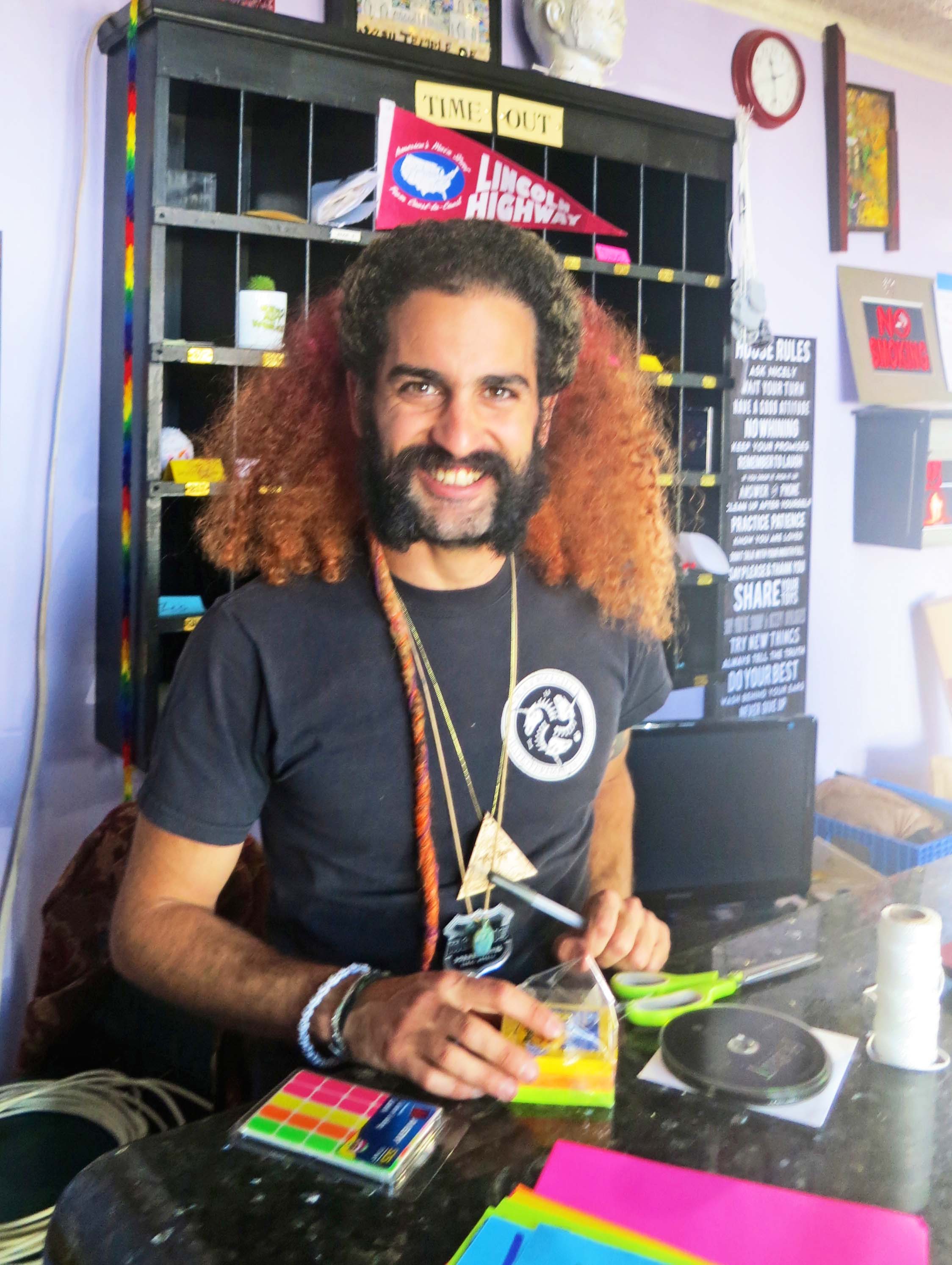
The hotel was still not open when I stopped to visit but I rang the doorbell and was greeted by Alon Vision Bar. Vision is Alon’s Burning Man name, and it fits. A former member of the Israel Navy who holds a degree in Business and Economics, he has a goal of bringing the Burning Man principle of community building home to his war-afflicted land. He is prepared to devote his life to efforts aimed at bringing peace to the Middle East.

Vision, seen here in the lobby of the Morris, greeted me with a smile.

Vision, seen here in the lobby of the Morris, greeted me with a smile. Note the “House Rules” on the right. They are pretty much what one would expect to find in a Burning Man establishment.

The House Rules at the Morris Burner Hotel. No whining and remember to laugh.

The “House Rules” at the Morris Burner Hotel. No whining and remember to laugh. I particularly like “Share Your Toys.” Guests at the hotel will be expected to clean their own rooms and help in preparing meals. Sounds like Black Rock City to me.

But for now, Vision is serving as manager of this rather unique hotel. He provided me with a tour of the guest rooms. Each one has a separate theme and has become a project for individual artists. Walls, ceilings, floors and even furniture serve as the ‘canvas.’ Sculptures add to the ambience. Halls, lobby, dining room, and restrooms also serve as space for artistic works. Outside, a large patio is being designed to accommodate performances. The whole hotel is an art work in progress.

Guest room in the Morris Burner Hotel in Reno, Nevada.

Each guest room will have a different art theme. This is the Goddess Room done by artist Carole Ann Ricketts.

Guest room featuring art at Morris Burner Hotel in Reno.

Almost everything is fair game in the rooms for artists as long as safety is taken into consideration. Note the incorporation of the night stand into they painting. And down the rabbit hole we go.

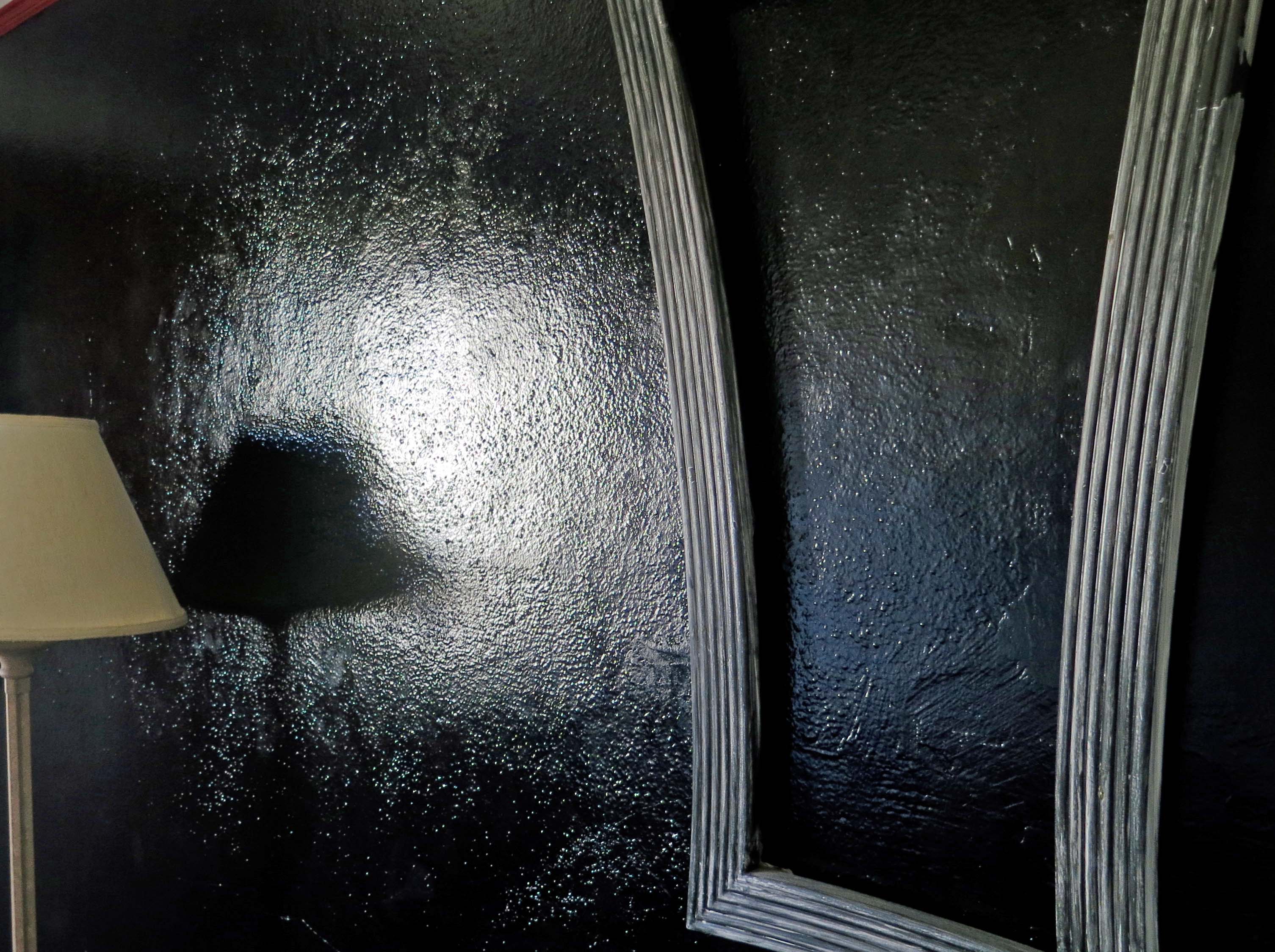
A room at the Morris Burner Hotel in Reno, Nevada.

This frame on the wall may give a new meaning to the ‘dark arts.’

This brightly decorated room at the Morris included a painting of the hotel.

This brightly decorated room at the Morris, the Cuban Gangster Room, included a painting of the hotel.

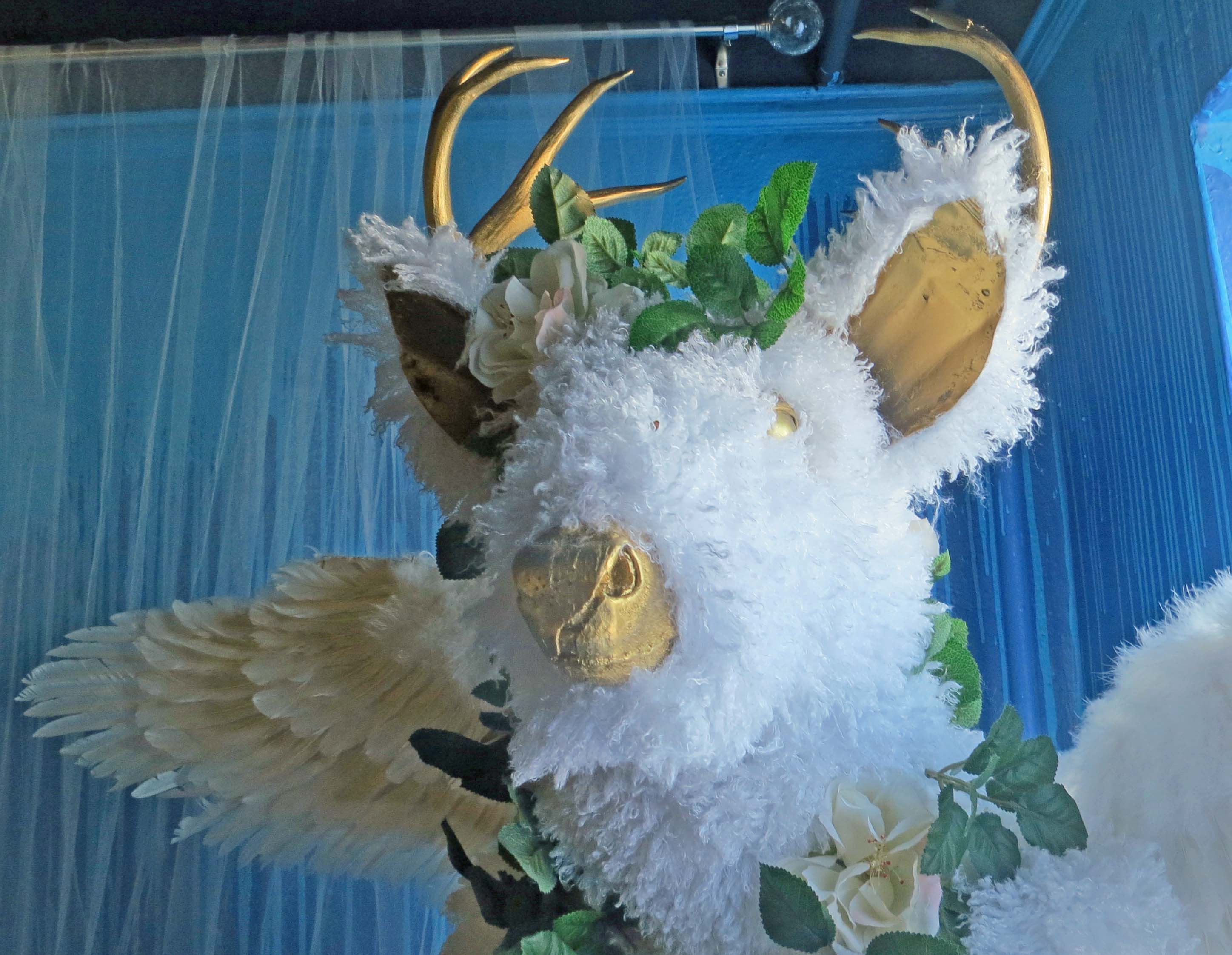
Enchanted Forest Room at Morris Burner Hotel in Reno, Nevada.

Rooms also incorporate sculpture. This “Enchanted Forest” deer god was created by Heather Lee Jones. It could be straight out of Greek Mythology.

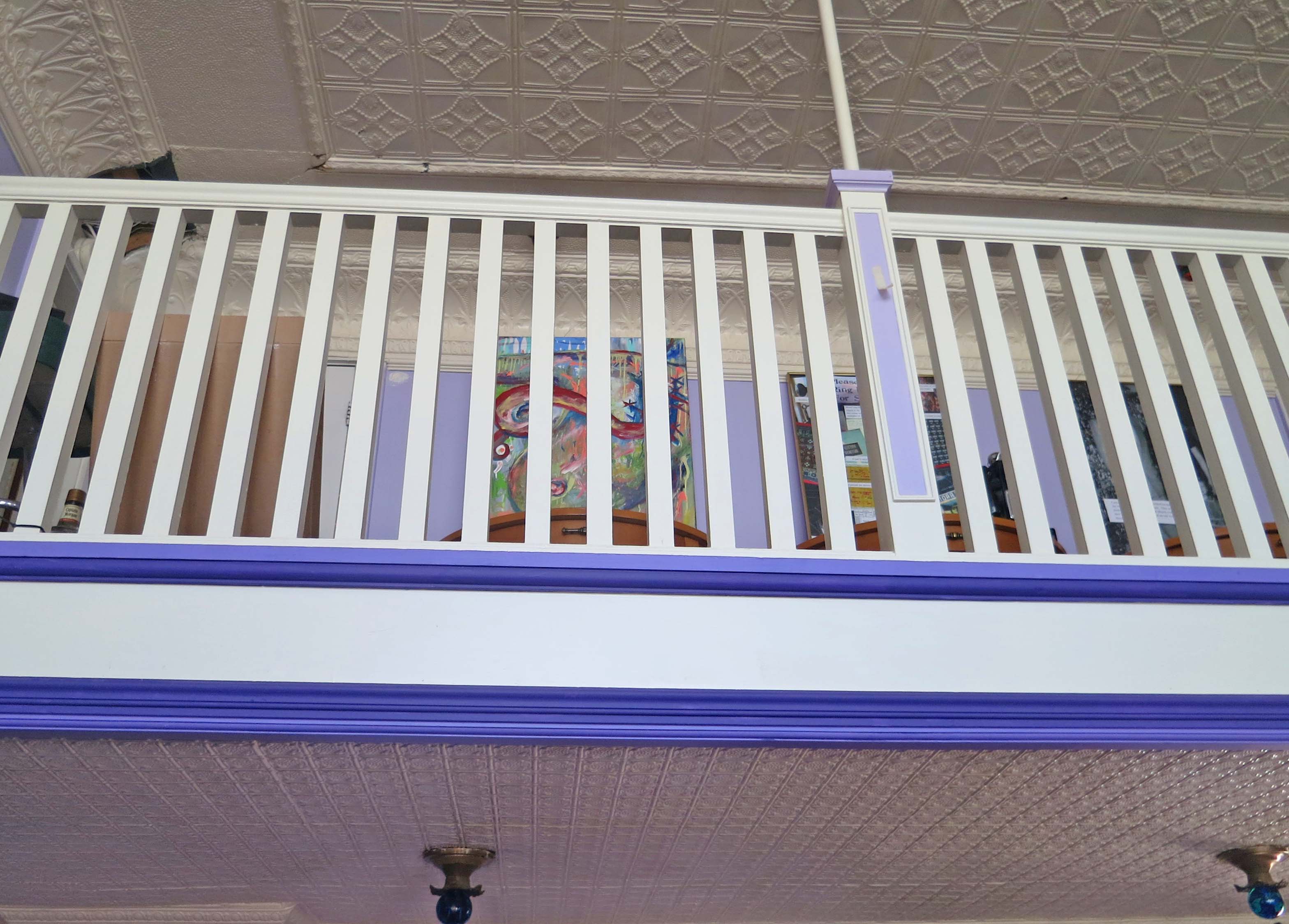
Balcony at Morris Burner Hotel in Reno.

The whole hotel is an art work in progress. This photo is taken from the lobby looking up at the balcony. Art can be seen through the railing. Also note the ceiling.
Burning Man symbol hanging in lobby of Morris Burner Hotel in Reno Nevada.

There is no doubt about the Burning Man connection. This immediately recognizable symbol of “The Man” hangs in the lobby.

The City of Reno is very supportive of Gibson’s renovation of the Morris. The hotel is located in a run down area of 4th street three blocks from downtown. Its presence is encouraging other businesses to locate nearby and is leading to a gradual transformation of the area. The crime rate is already way down. Peggy and I look forward to the time we can return as guests.
NEXT BLOG: We visit the town of Hawthorne, Nevada, which is where military ordinance goes when it retires. A very interesting museum provides insight into the town’s past. After that it is on to Area 51 and ET…

As this blog goes to press, Peggy and I are off backpacking in the Red Buttes Wilderness, home to bears, cougars, old growth forests and possibly a wolf or two. (Or-7 and his girlfriend are wandering around somewhere in our county.) There have also been several (unsubstantiated) sightings of Bigfoot in the area. We have a camera along. If we see one, you’ll be the first to know. (Grin.) The Red Buttes Wilderness is located on the border of Oregon and California 14 miles from our home.

On a related note, I did a guest blog this week on how I celebrated my 60th birthday by backpacking over 300 miles from Squaw Valley to Mt. Whitney following the crest of the Sierra Nevada Mountains. Check it out here if you are interested.

A Magnificent Mountain and Stunning Waterfalls: Mt. Shasta and Burney Falls

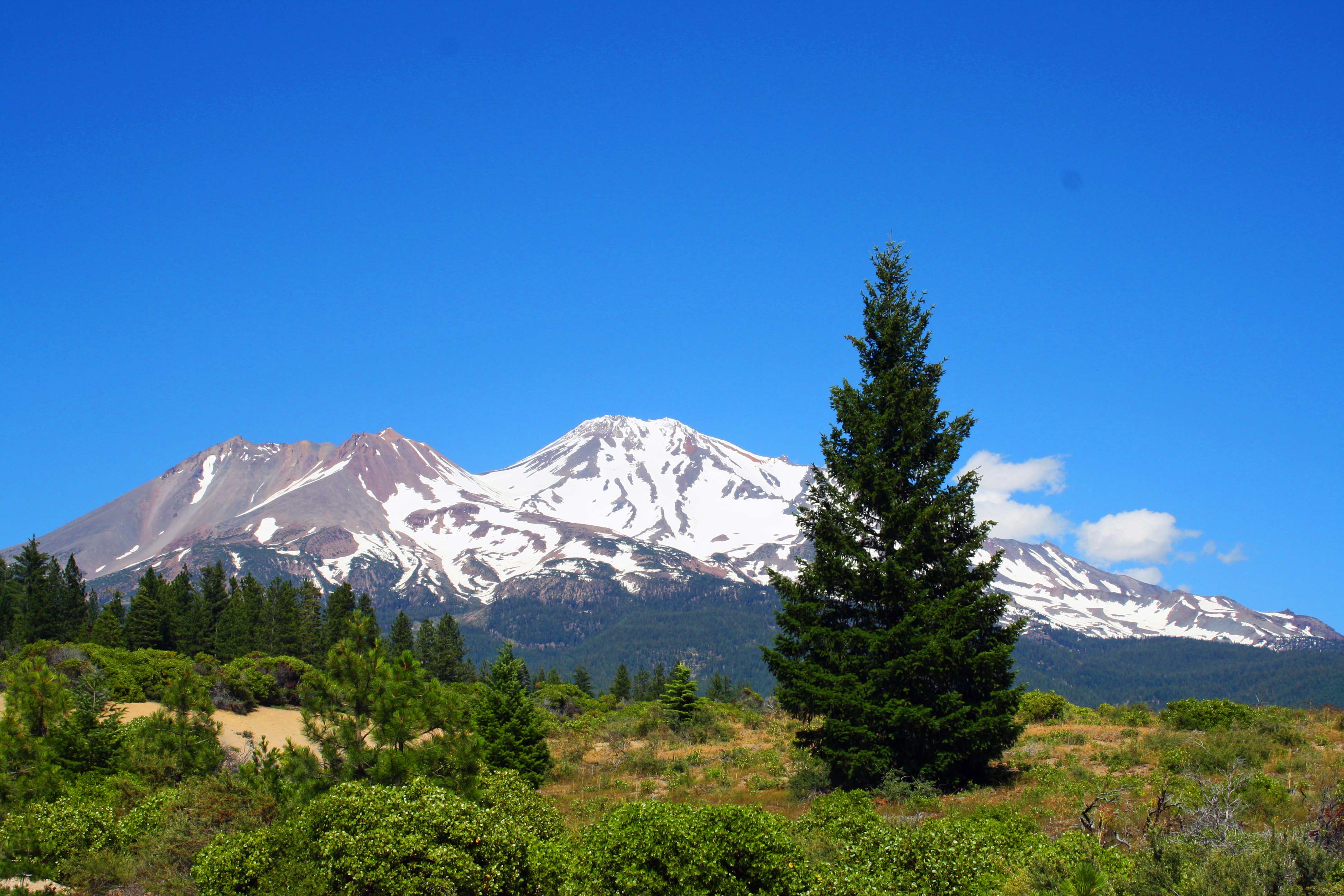
Mt. Shasta is one of the world's most beautiful mountains. Driving up I-5 through Northern California on a clear day presents this view.

Mt. Shasta is one of the world’s most beautiful mountains. Driving up I-5 through Northern California on a clear day presents this view.

California is jam-packed with world-class natural wonders. One immediately thinks of places like the Redwoods, Yosemite, and Death Valley. But there is ever so much more. Two gems in the northern part of the state are Mt. Shasta and Burney Falls. Our trip into Nevada three weeks ago took Peggy and me past both.

Mt. Shasta has been part of my world for decades. I first became aware of it as a child when my parents followed historic Highway 99 north from our home in the Sierra Nevada foothills to visit with my Dad’s parents in Ashland, Oregon. Over the years since, I’ve made dozens trips up and down Interstate 5. The beauty of the mountain has never ceased to awe me.

Mt. Shasta in Northern California.

Following different roads around the mountain presents different perspectives. This shot is from Highway 97, on the north side. You can clearly see that the mountain is made up of more than one volcano.

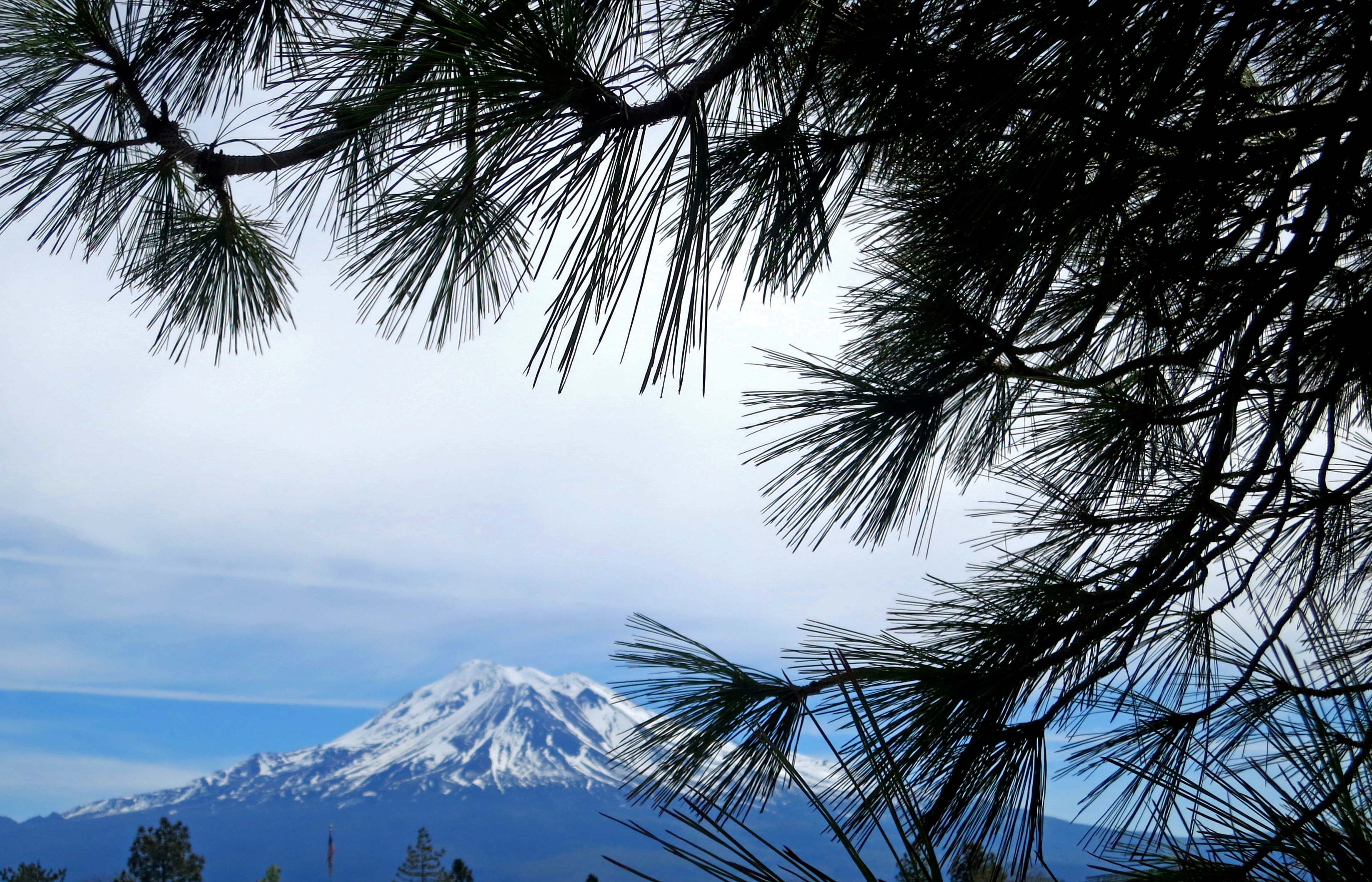
Mt. Shasta photo.

This photo is taken from a rest stop on I-5 west of Mt. Shasta

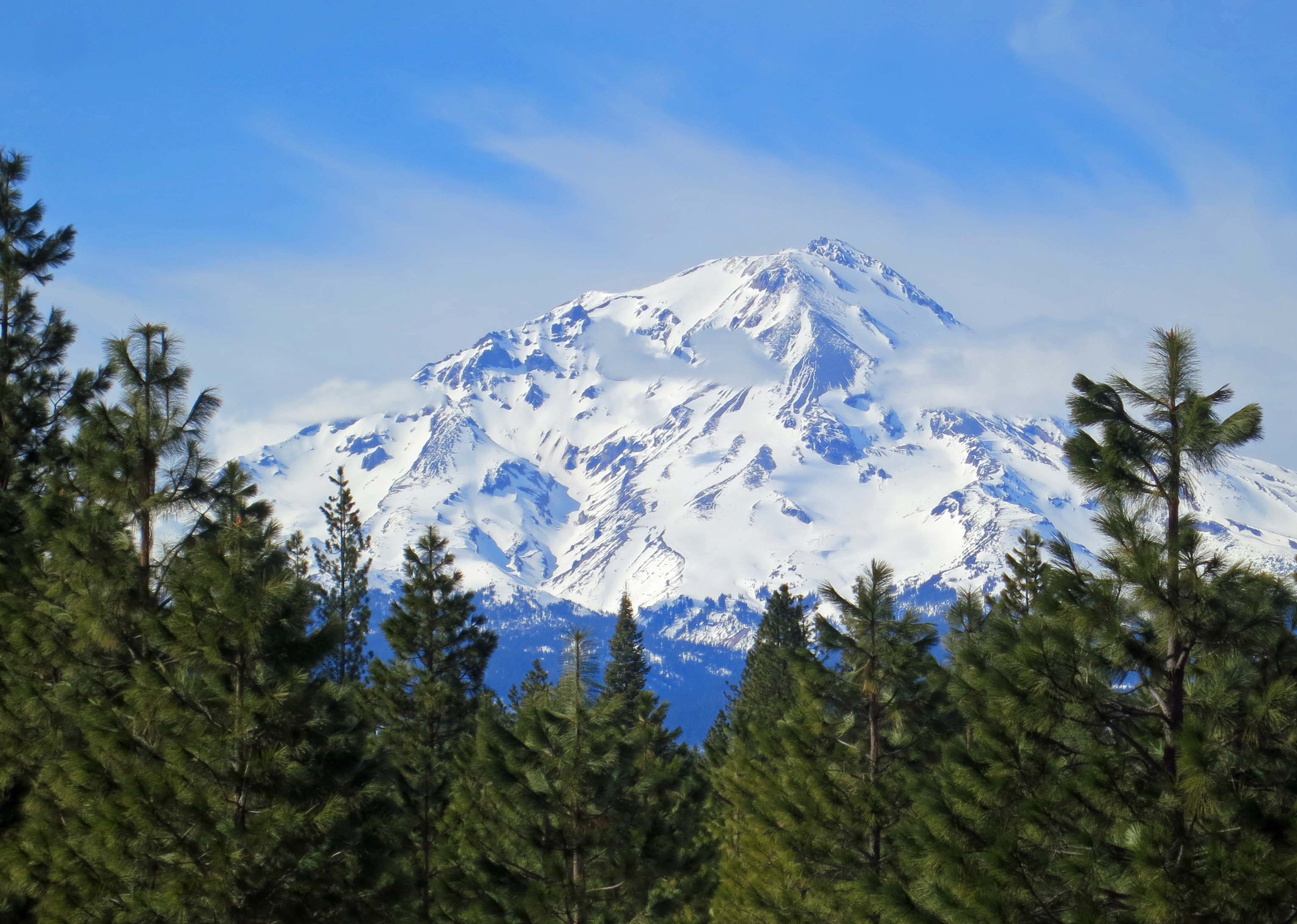
Picture of Mt. Shasta from Highway 89.

And finally, I took this picture south of the mountain on Highway 89.

The 14,162-foot volcanic peak dominates California’s more remote far north and, along with Mt. Lassen, serves as the southern anchor to the series of volcanoes that make up the Cascade Mountains of the Northwest.

In 1980, I was honored to climb Shasta with Orvis Agee, possibly the oldest man to ever climb the mountain. In 1974, the 71-year-old Orvis had persuaded me that he could handle a hundred mile backpack trip I was planning by informing me he had climbed Mt. Shasta three times the previous year. He made his last ascent up the mountain in 1988 at 85. It marked his 30th trip to the top. Two years later, in 1990, he did a 60-mile journey through the Granite Chief and Desolation Wildernesses west of Lake Tahoe with Peggy, me and other friends. He was still going strong at 87.

“Not bad for a guy who is just a bunch of bones held together by rubber bands,” Orvis told Jenny Coyle when she interviewed him for her book on Mt. Shasta.

Not surprisingly, Mt. Shasta plays a prominent role in the mythology of Native Americans who have lived in the area for thousands of years. On a somewhat stranger note, it is supposedly the home away from home of Lemurians who are said to live in a cave complex beneath the mountain and are occasionally seen walking on the surface. Lemuria was an Asian equivalent of Atlantis in that it too was considered a cradle of civilization that sank beneath the ocean. I don’t have a clue as to why the Lemurians chose to live on Shasta. And no, I haven’t seen any.

Located on California’s Highway 89, Burney Falls are even more remote than Mt. Shasta. Peggy and I had driven by the location several times but never stopped. If you are anywhere near, don’t make the same mistake. Our niece, Christina Dallen, had stopped by the falls after visiting with us and posted a photo on Facebook. It inspired us.

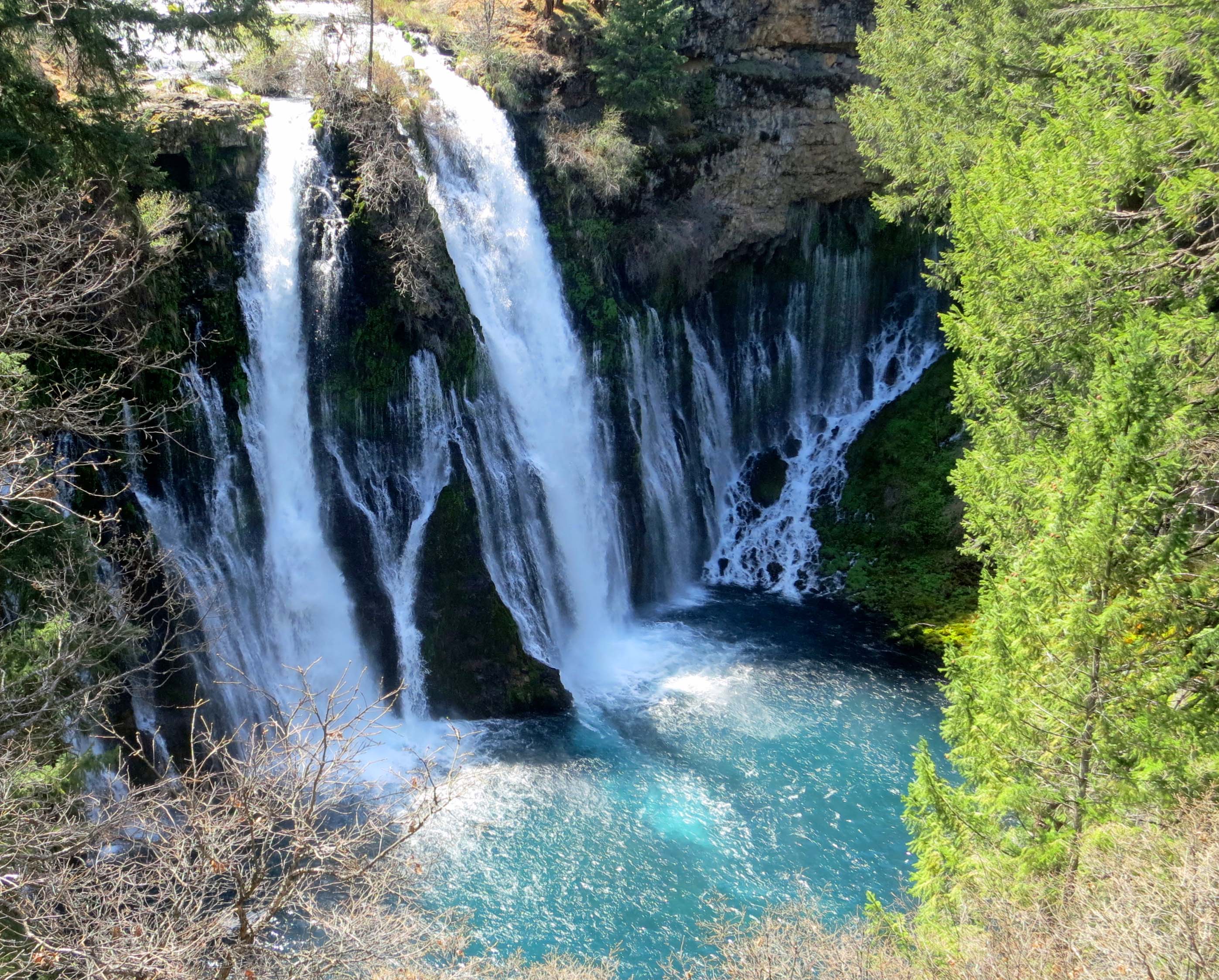
“Bully!” Theodore Roosevelt was said to utter when he saw the falls and declared them the eighth wonder of the world. They were declared a National Landmark in 1984. The following photos provide a glimpse as to why.

Burney Falls in Northern California. Photo by Curtis Mekemson.

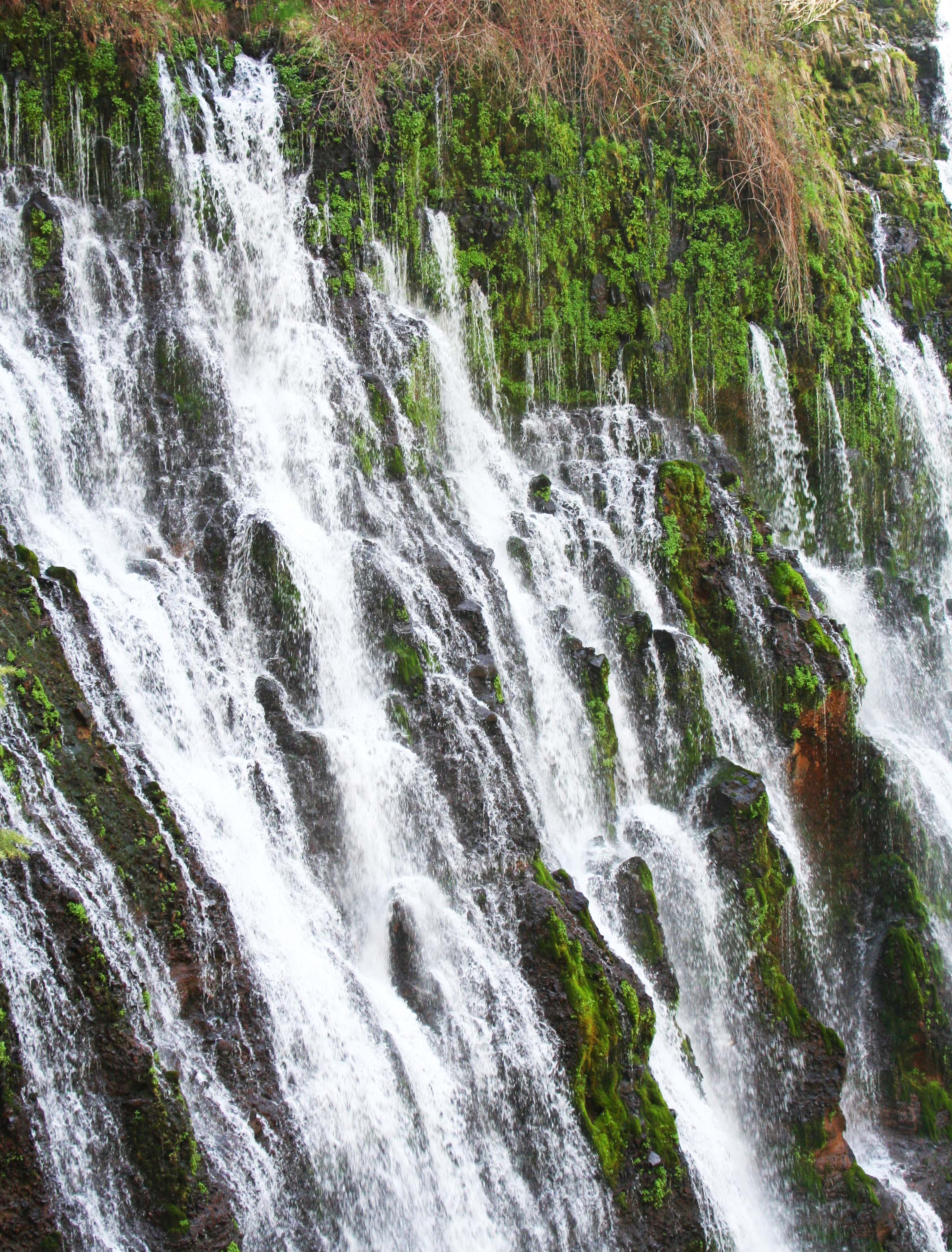
Burney Falls are located at McArthur-Burney State Park. Note how the falls originate out of various layers of rock as well as flowing over the top.

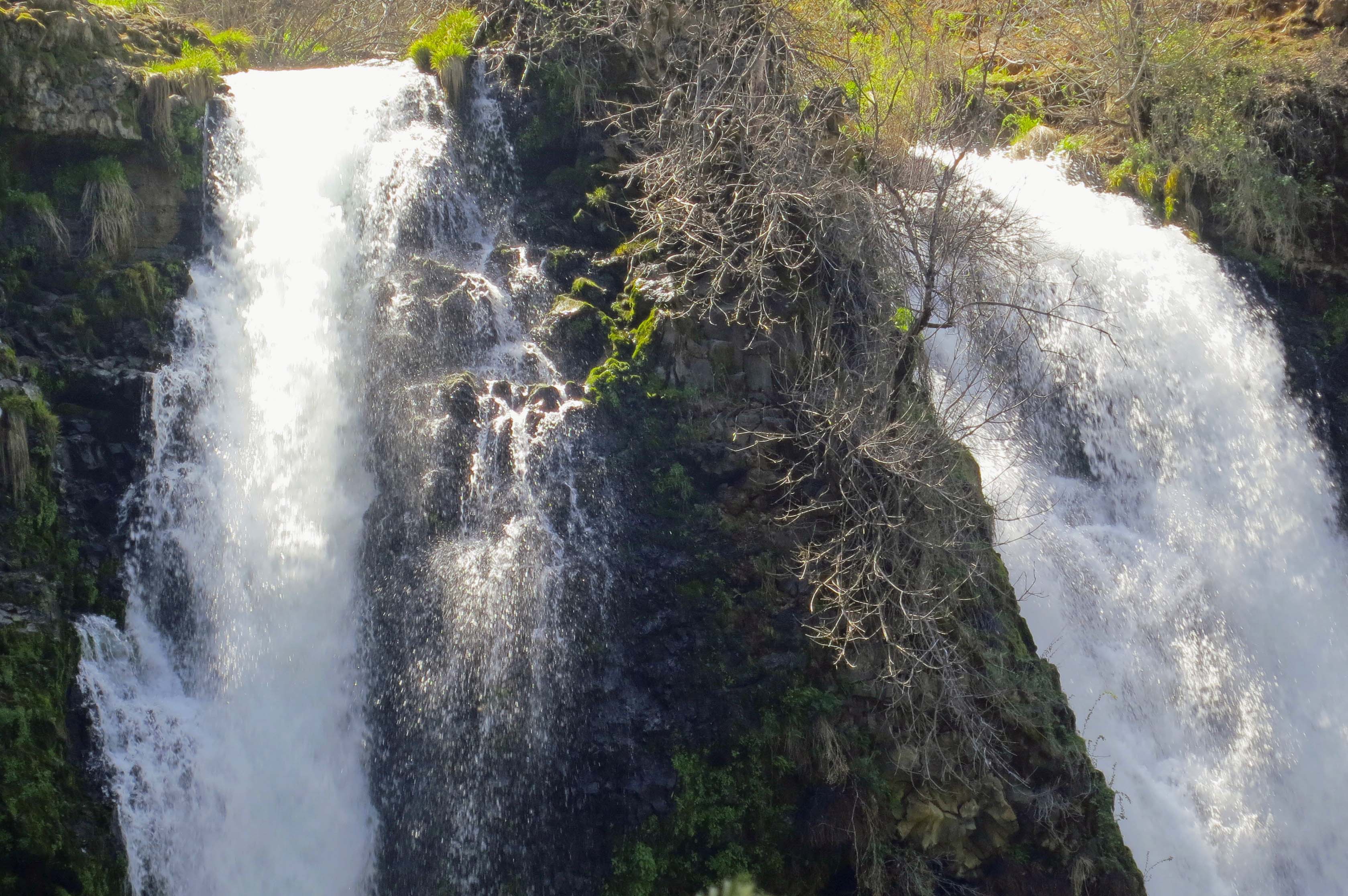
Burney Falls photo.

Here, the falls roar over the top.

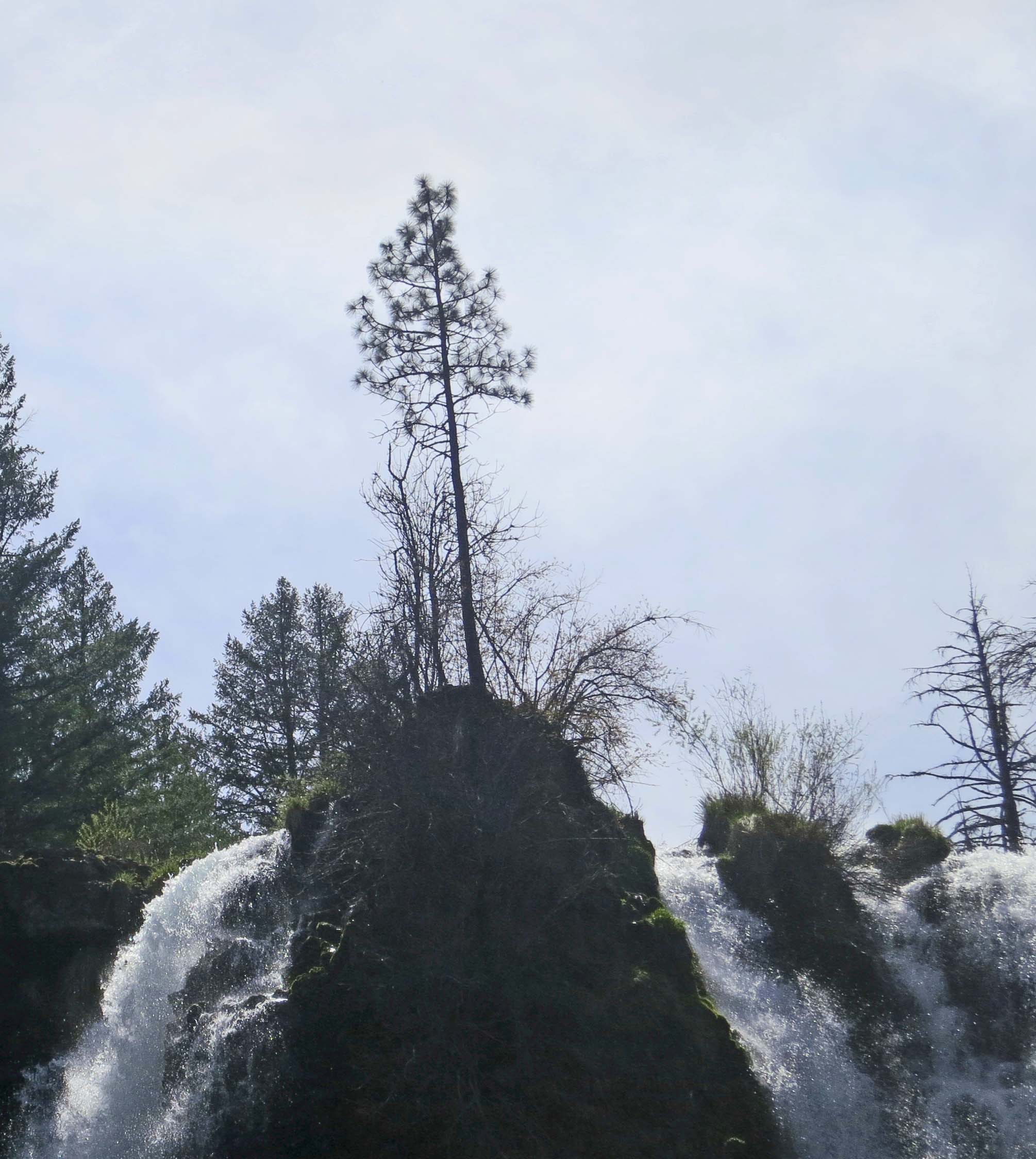
Ponderosa Pine tree and Burney Falls in Northern California.

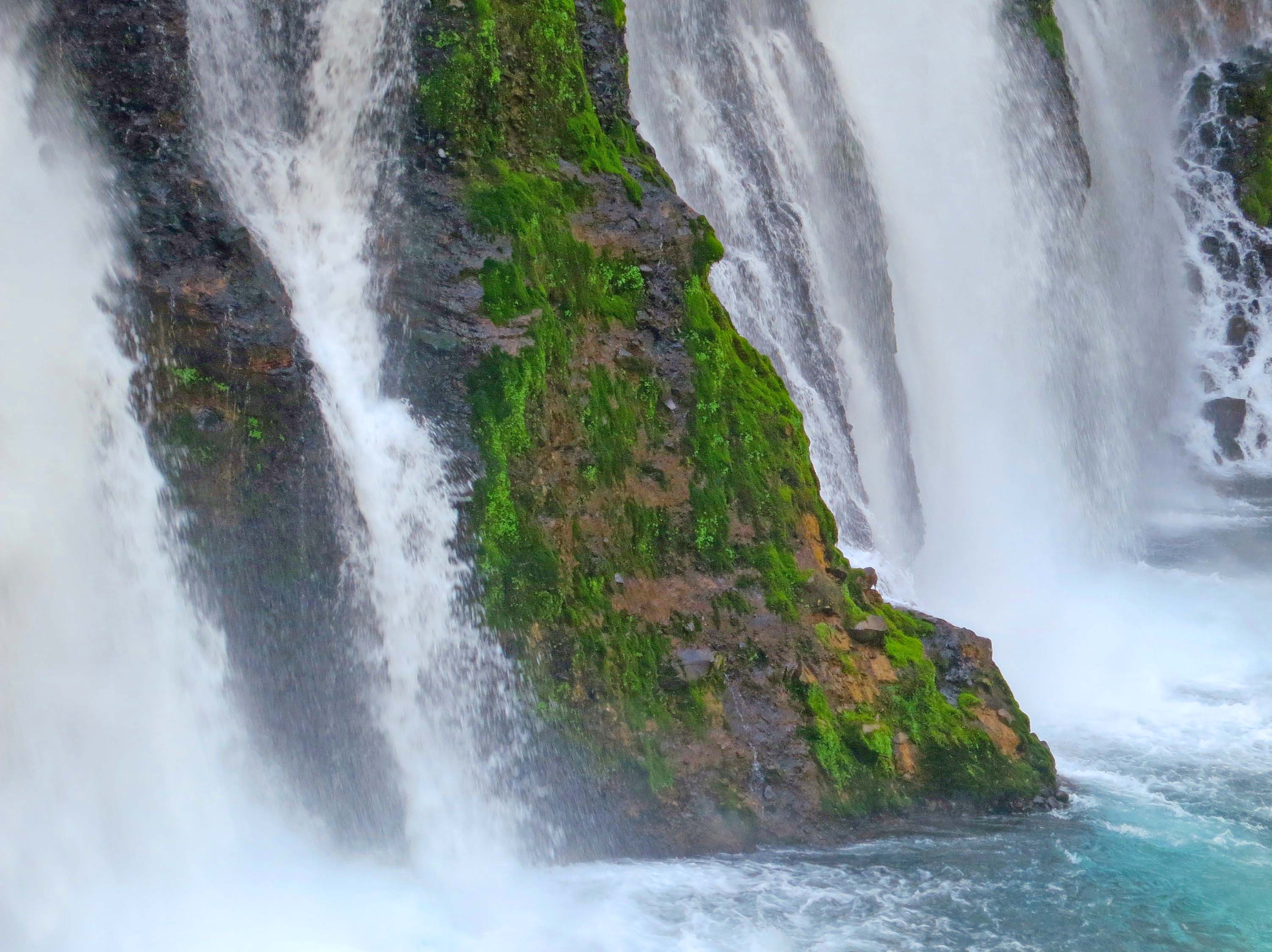
A lone Ponderosa Pine grows between the two channels.

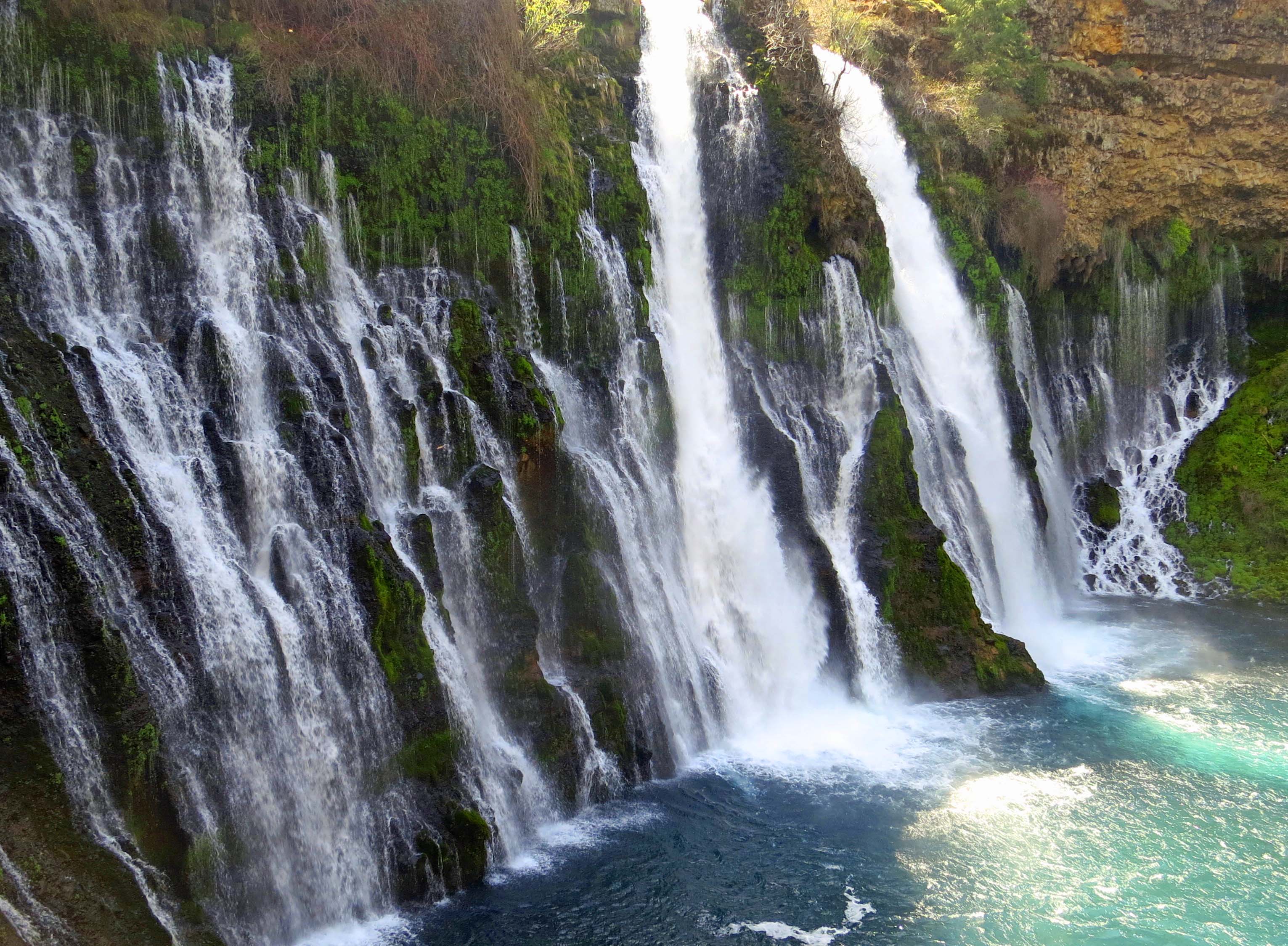
Water comes out from layers of rocks as well as over the top at Burney Falls.

The water shooting out from the rocks provides an almost etherial quality to the falls.

Burney Falls Northern California photo by Peggy Mekemson.

A close-up of the water emerging from the rocks. (Photo by Peggy Mekemson.)

Photo by Peggy Mekemson of Burney Falls in Northern California.

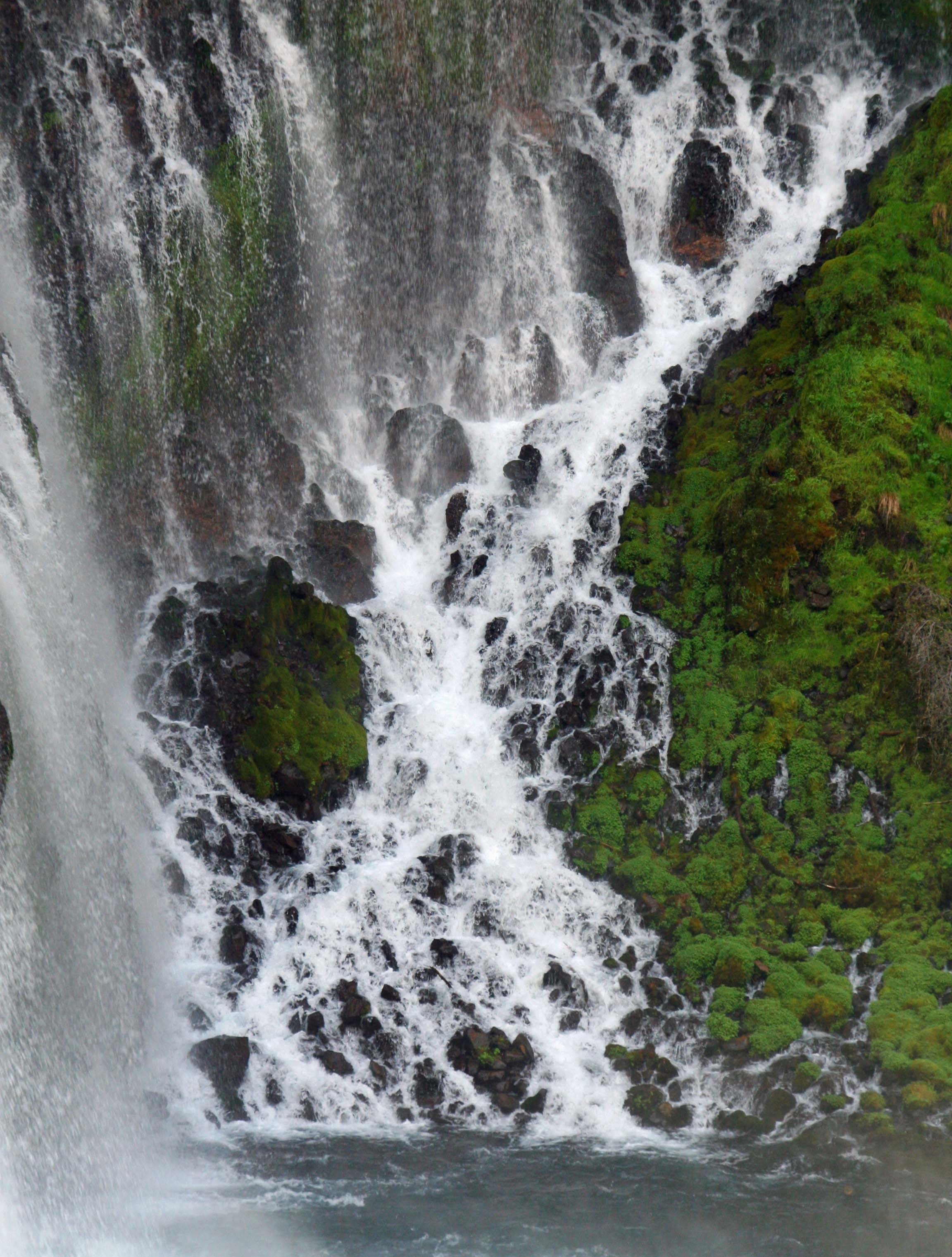
Peggy captured the braided quality of the falls on the right. (Photo by Peggy Mekemson.)

Water from Burney Falls crashes into the river.

A final shot catching the water crashing into the river.

NEXT BLOG: What if you could hire a different talented artist to paint each room of your house? The results would be fascinating. That is exactly what is happening at a hotel in Reno that takes its inspiration from Burning Man. I visit the hotel in my next blog.

There’s This Bigfoot Trap Near Our House…


Bigfoot trap found above Applegate Lake in Southern Oregon.

The world’s only known Bigfoot trap. (Photo by Peggy Mekemson.)

I’ve blogged about Bigfoot before. How could I not when the world’s only known Bigfoot trap is four miles from our home on the Applegate River in Southern Oregon?

My wife Peggy and I went out and revisited the trap just before we took off for Nevada three weeks ago. Since we were heading out to explore ghost towns, the Extraterrestrial Highway, Area 51, Death Valley and Las Vegas, I figured that searching for Bigfoot would put us in the right frame of mind.

We added looking for morel mushrooms as part of our Big Foot hike. They reputedly grow in the area. From my experience so far, however, I am beginning to believe they are even more difficult to find than the Big Hairy Guy and UFOs combined. Our carpenter, who was building us a pole barn while we were in Nevada, assured me of the morel’s existence. He had found one so big it was featured in the local newspaper and on Paul Harvey. “Morels yes, Bigfoot no,” he told us.

Our carpenter, Larry Baleau, shows off the huge morel mushroom he found while out identifying wildflowers.  (Photo by Bob Pennell of the Medford Tribune.)

Our carpenter, Larry Belau, shows off the huge morel mushroom he found while out identifying wildflowers. (Photo by Bob Pennell of the Medford Tribune.)

I am not quite so emphatic about Bigfoot’s existence. Our front window looks out on Bigfoot Country. There have been a number of reported “sightings” over the years. One led to the building of the Bigfoot trap.

It isn't hard to imagine Bigfoot prowling around in the forest when you look out our front window on a misty morning.

It isn’t hard to imagine Bigfoot prowling around in the forest when you look out our front window on a misty morning.

It all started when Perry Lovel, a miner living on the Applegate River, discovered 18-inch long human-like tracks in his garden that were six feet apart. His tale captured the imagination of Ron Olsen, a filmmaker from Eugene who headed up an organization known as the North American Wildlife Research Team. Ron decided to catch Bigfoot– allegedly for scientific purposes. I suspect he had other motivation as well. Imagine owning the rights to the movie?

This image of a big foot appropriately marks the beginning of the Bigfoot trail.

This image of a big foot appropriately marks the beginning of the Bigfoot trail. It is proof that the US Forest Service has a sense of humor.

Anyway, Ron and his group built a sturdy 10 by 10 foot box trap located a mile or so above Perry’s garden. A raised, heavy steel gate was added to provide Bigfoot with access to the trap. Meat was then placed inside and connected to a lever that released the gate, which came crashing down with all the subtlety of a guillotine.

Bigfoot trap door.

Looking up at the heavy trapdoor that was supposed to capture Bigfoot.

Ron then built a ramshackle cabin a couple of hundred yards down the hill and hired a miner to hang out and monitor the trap. He was given a tranquilizer gun and a very large pair of handcuffs. You get the picture. I assume the miner also stocked in a year’s supply of booze. Make that a six-year supply, since that is how long the trap was maintained.

Remains of cabin where miner lived who was supposed to tranquilize Bigfoot if he was caught in the Bigfoot trap in southern Oregon.

All that remains of the miner’s cabin is a pile of old boards, limbs and tar paper.

But was the effort successful? In a way, yes. The miner actually captured two grumpy bears who were under the mistaken impression they were getting a free lunch, not realizing there is no such thing. But Bigfoot didn’t take the bait. Here are my thoughts on why.

The only way they might have captured Bigfoot was if he were rolling around on the ground laughing so hard he couldn’t escape. If he exists, this larger than life character is far too intelligent to get caught in anything as obvious as the trap that Ron built. Otherwise there would be much more definitive proof of his existence beyond a few photos of dark blurs disappearing into the woods.

Since I was about to visit Area 51 in Nevada, I had a final whimsical thought: maybe Bigfoot is an alien. That would explain lots of things. (Grin) We didn’t find Bigfoot, and we didn’t find any morel mushrooms, but there were other strange things along the way…

Selfie of Curtis Mekemson.

What’s more strange than me taking a selfie?

Ferns growing near Applegate River in Southern Oregon.

And how about these alien looking plants. Actually, they are young ferns. (Photo by Peggy Mekemson.)

Shelf mushroom found near Applegate Lake in Southern Oregon.

We didn’t find any morels, but I did find this shelf mushroom growing on a dead tree.

My greatest find: as Peggy and I were hiking out from the Bigfoot trap, I found this image staring out at me from the bark on a Madrone tree. I'm thinking maybe Bigfoot had his own approach to taking a selfie.

My greatest find: as Peggy and I were hiking out from the Bigfoot trap, I found this image staring out at me from the bark on a Madrone tree. Maybe Bigfoot has his own approach to taking a selfie.

NEXT BLOG: The journey to Nevada begins and we admire the mystical and majestic Mt. Shasta and stop off at beautiful Burney Falls.

Painted Rocks Petroglyph Site of Southern Arizona… Nice Doggy

Petroglyph at Painted Rock Petroglyph Site in Southern Arizona. Photo by Curtis Mekemson.

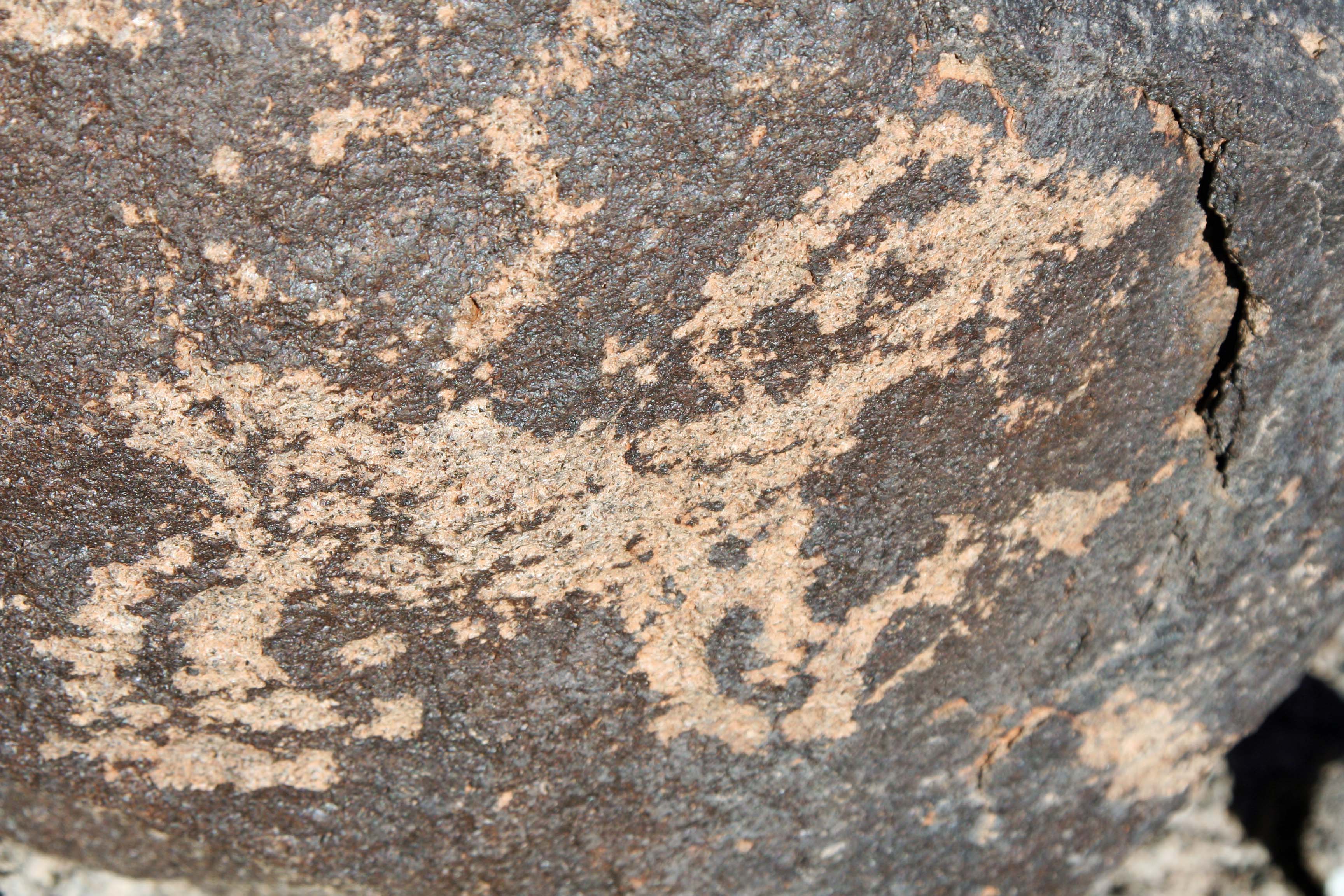
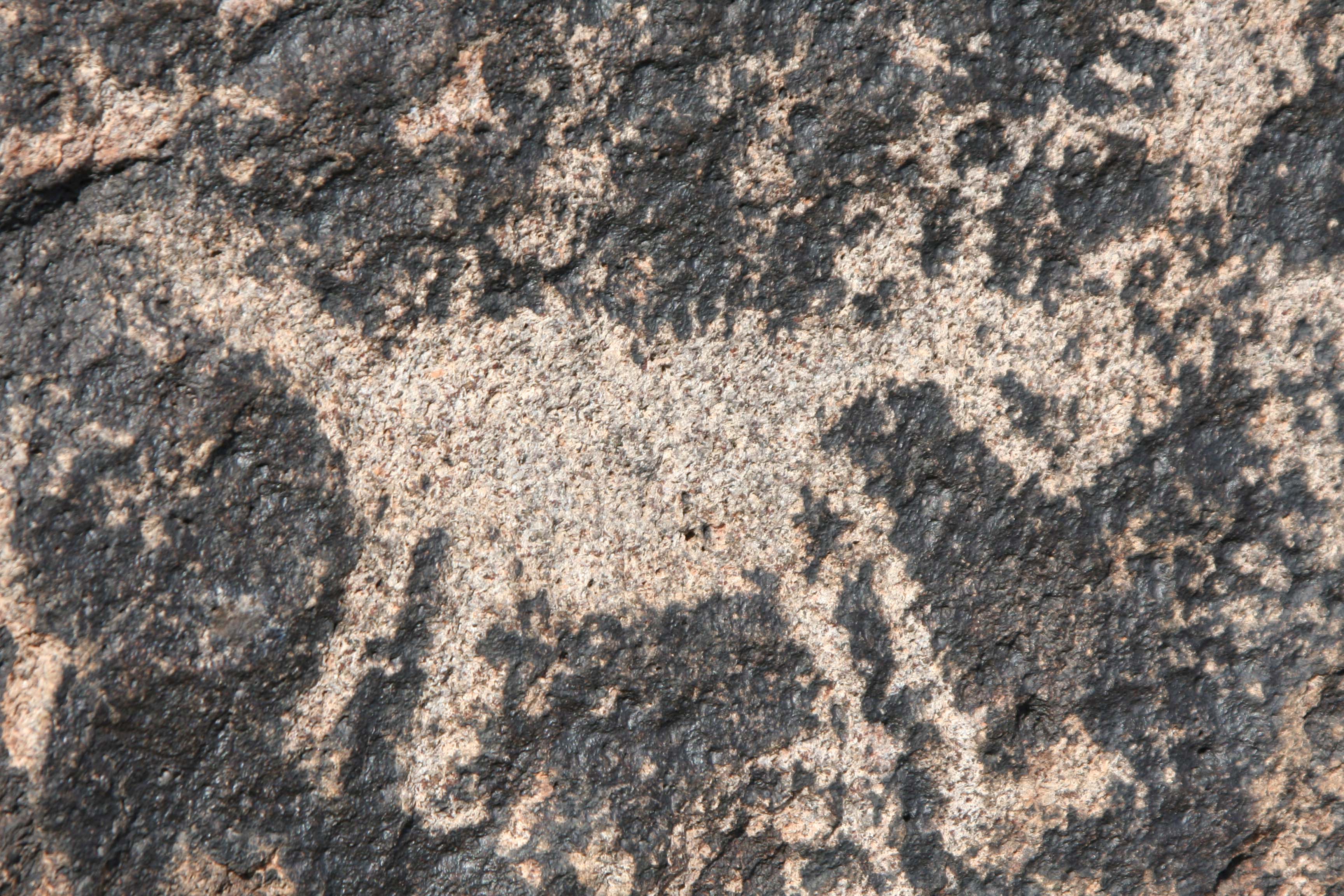
My sister had a Jack Terrier named Jack  that looked a lot like this petroglyph, except for floppy ears. And this is how I was greeted when I visited. Bounce, bounce, bounce. I like to speculate that ancient Native American artists created petroglyphs  just for fun on occasion. This might be a candidate.

Anyone who wanders the Southwest and comes across petroglyphs wonders about their origins and what they mean. Some seem so clear: a mountain sheep, a man on a horse, a rattlesnake, a coyote, a hand. While others are more remote: wiggly lines, alien looking figures, concentric circles, and galaxy-like spirals for example.

Petroglyph of a hand found at Painted Rocks Petroglyph Site in southern Arizona.

No question about this petroglyph of a hand.

Scorpion petroglyph found at Painted Rock Petroglyph Site in southern Arizona.

Or this scorpion with its stinger, a common bane of the Southwest.

Chain petroglyph from Painted Rocks Petroglyph Site in southern Arizona.

But what does this chain represent? My first thought: it was the path of a beetle that had sipped too much tequila. The information plaque told me that the more abstract designs represented the archaic cultures which would make this petroglyph over 2000 years old! (This certainly impressed me but one of my followers from Australia reminded me that Australian aboriginal rock art dates back 50,000 years.)

The grid on this rock is another example of archaic petroglyphs. There is some suggestion that the grid represents a rough map and the dots represent where people lived.

The grid on this rock is another example of archaic petroglyphs. There is some suggestion that the grid represents a rough map and the dots represent where people lived.

Experts say we can’t be sure about the meaning of petroglyphs. Some were created thousands of years ago and even the more recent can be several hundred years old. Since there were no written languages among the southwestern cultures of the time, we are left to speculate. Descendants of the ancient peoples provide our best clues. The Hopi, Navajo and other natives of the Southwest look backwards in time from their unique cultural perspectives and provide insights.

Certainly some petroglyphs have spiritual significance. Shamans would take drug-enhanced journeys into other worlds to learn the secrets of nature and gain control over natural elements. Some petroglyphs reflect these journeys and show the beings encountered along the way. (Either that or little green men were frequent visitors.) Shamans of the Huichol culture in western Mexico follow a similar path today.

Huichol work of art representing the journey to gather Peyote. Photo by Curtis Mekemson.

Peggy and I bought this Huichol yarn art painting several years ago in Mexico. The Huichol are a native people who live in the Sierra Madre Mountains of Mexico and practice a lifestyle similar to that of their ancestors. Their art represents visions their Shamans have on their mystical, peyote induced journeys. This piece represents the tribes annual journey to gather more peyote for more visions.

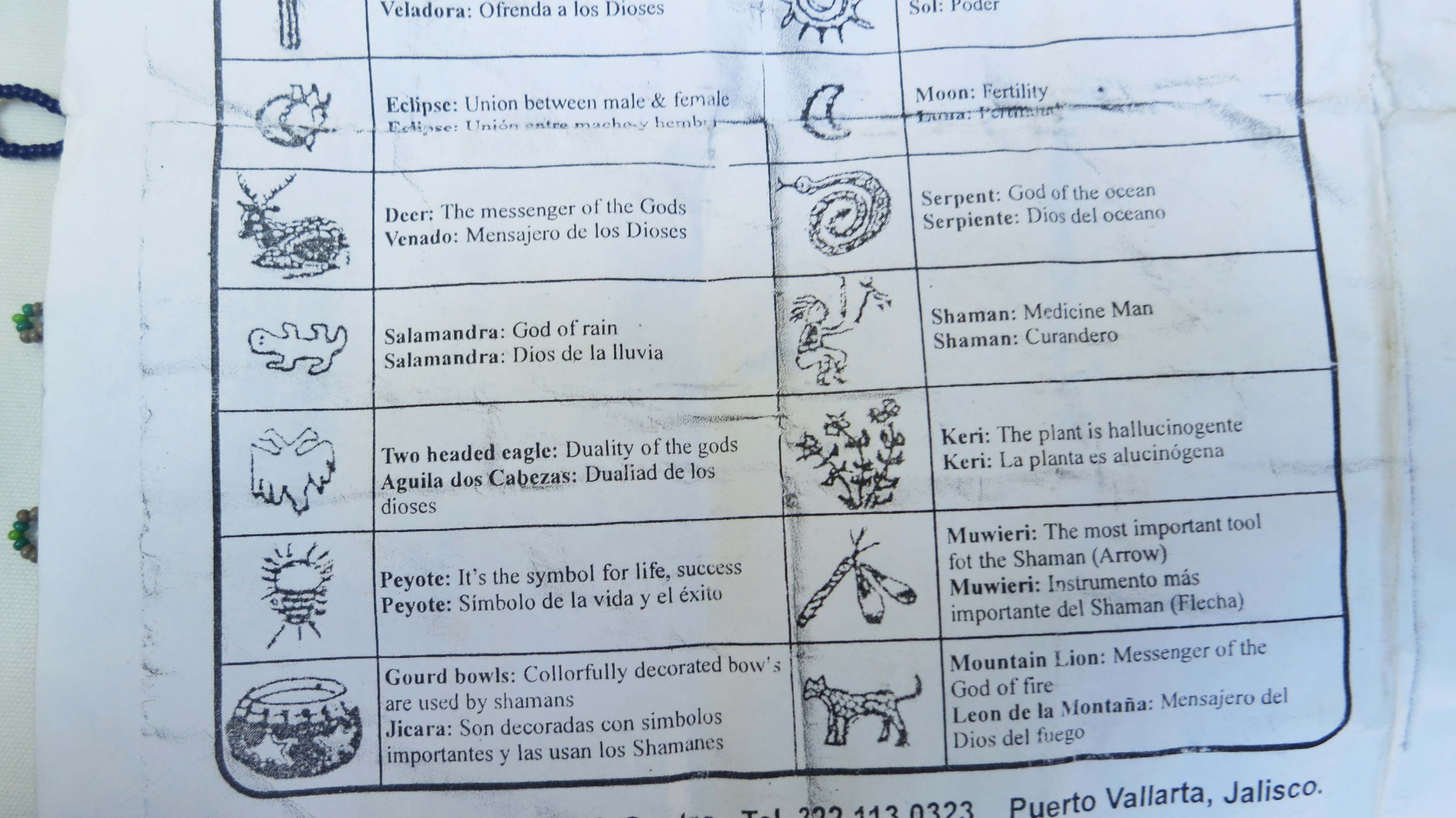
This sheet, conveniently provided by the Huichol man who sold us art, provides interpretations for some of the figures. The deer, for example, are messengers of the gods. People of the Huichol culture immediately recognize them as such whenever they are included in a painting. Early  Christian artists provided similar types of symbolism for their non-reading flocks. A head on a platter meant St. John the Baptist, for example. We can assume that the rock art of the Southwest also incorporated commonly recognized symbols.

This sheet, conveniently provided by the Huichol man who sold us art, provides interpretations for some of the figures. The deer, for example, are messengers of the gods. People of the Huichol culture immediately recognize them as such whenever they are included in a painting. Early Christian artists provided similar types of symbolism for their non-reading flocks. We can assume that the rock art of the Southwest was also highly symbolic.

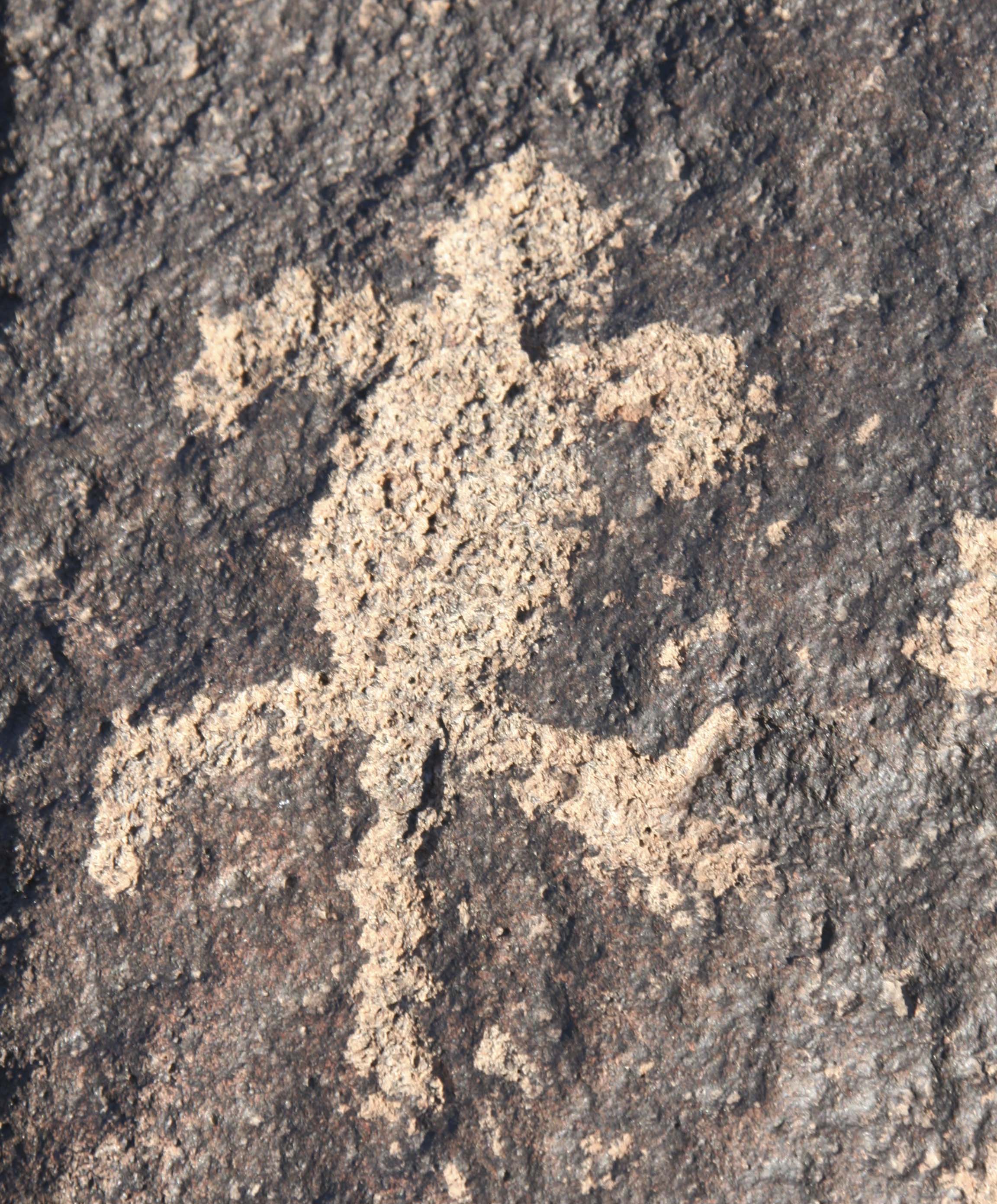
Peggy and I photographed this petroglyph I call carrot top in Dinosaur National Monument. It is very likely it represents a shamanistic vision.

Peggy and I photographed this petroglyph I call Carrot Top and his dog in Dinosaur National Monument. It is very likely it represents a shamanistic vision. It would also make a great alien, however. Note the little legs.

Clan names, common animals, and important food sources like corn are common. Some may have even served as maps showing the layout of a village or where to find a spring.   And maybe some were created for the sheer joy of creation, pounded out by an early Michelangelo of the desert carving in stone. I am hitting a 9.99 on the speculation meter here, but I like to think the artist that created the dog/coyote (or possibly horse) featured at the beginning of the post was having fun.

Man on horse petroglyph from Painted Rock Petroglyph Site in Southern Arizona.

Petroglyphs are difficult to date but one thing is for sure: if you find a man riding a horse, it had to take place after Spaniards first introduced modern horses to North America in the 1500s.

Petroglyph of mountain sheep found at Painted Rocks Petroglyph Site in southern Arizona.

Big Horn sheep were common in the early Southwest, so it isn’t surprising that petroglyphs representing Big Horns are found at Painted Rock Petroglyph Site and at most other sites we have visited.

Big Horn Sheep photo by Curtis Mekemson.

I caught this family of wild Big Horn Sheep grazing in a public park near Hoover Dam. I considered the Jack Rabbit a bonus. Obviously, I was not their major concern.

Petroglyph of Mountain Sheep found at Painted Rocks Petroglyph Site in Southern Arizona.

The belly on this Big Horn Sheep suggests to me that this was one pregnant lady.

Elk petroglyphs in Painted Rock Petroglyph Site in Southern Arizona.

I thought these were deer at first but their large horns may suggest they are elk.

Petroglyph of a lizard found at Painted Rock Petroglyph Site in Southern Arizona.

Another common petroglyph found throughout the Southwest is that of the lizard.

Tortoise petroglyph at Painted Rocks Petroglyph Site.

I am going with tortoise on this one. It’s another petroglyph that makes me smile.

This petroglyph of a dog looks even more like Jack. He has floppy ears and is barking. (grin) So I'll end the post here.

This petroglyph of a dog/coyote/horse looks even more like Jack. He has floppy ears and is barking. (grin) So I’ll end the post here.

NEXT BLOGS: Peggy and I are heading out tomorrow for the remote corners of Nevada where there may or may not be Internet service. I’ll be gathering material for some fun blogs plus I want to finish up the last details on my book. So, I’ve decided to put my blog activities on hold for three weeks. See you all at the beginning of May with stories on the ET Highway, Area 51, Ghost Towns, and more! Plus I’ll be back checking in on your fun and interesting posts. –Curt


Painted Rock Petroglyph Site… Voices from the Ancient Past: Part I

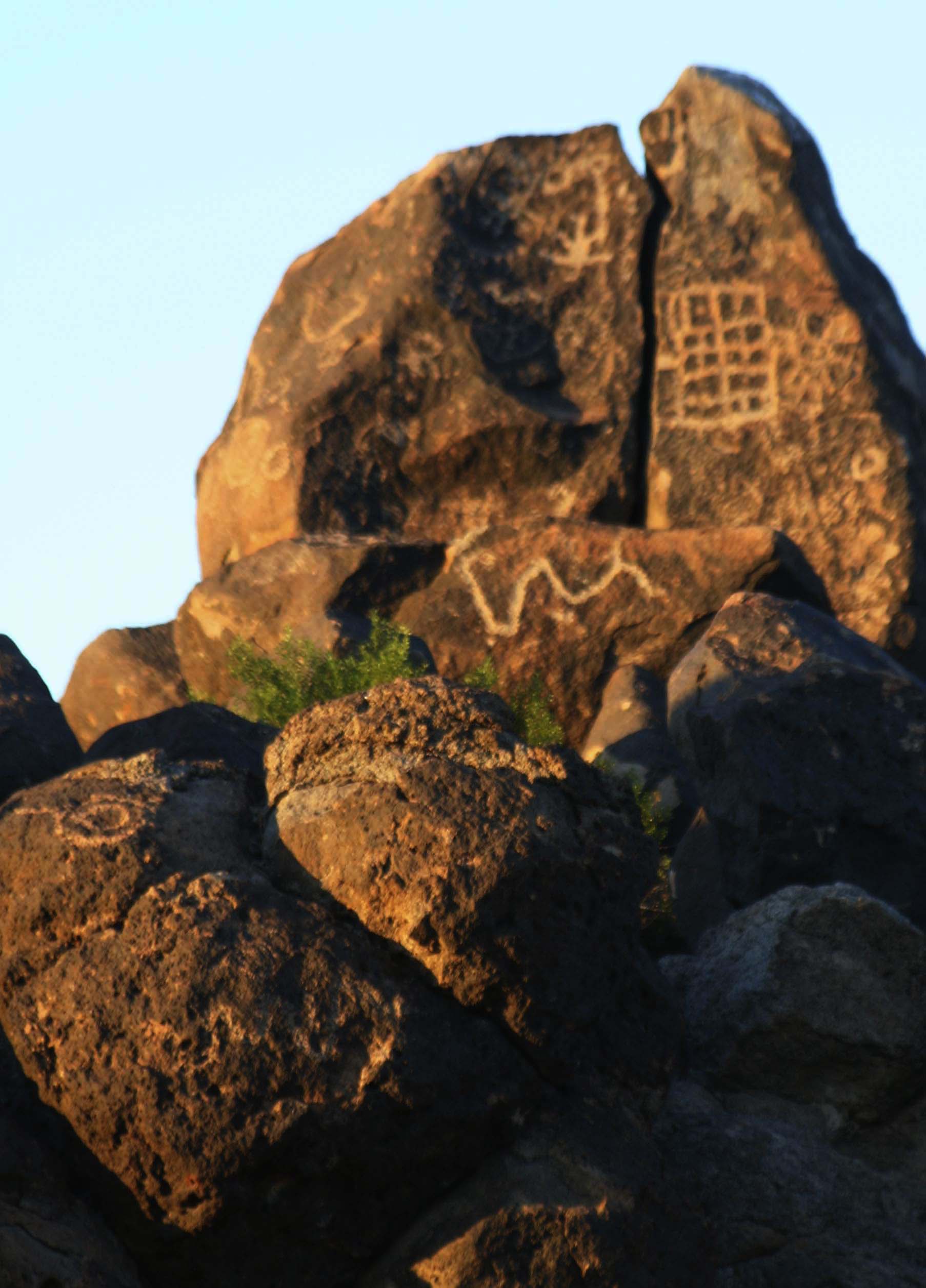
The rocks at Painted Rock Petroglyph Site in Southern Arizona are covered with petroglyphs as shown in this photo with Peggy.

The rocks at Painted Rock Petroglyph Site in Southern Arizona are covered with hundreds of petroglyphs, as shown in this photo with Peggy. Some my be several thousand years old.

Peggy and I had just been through one of those checkpoints that make Arizona so endearing to visitors: armed men with guns and dogs and x-ray machines had slowed us to a crawl as men stared, dogs sniffed and x-rays probed. It was for our own good. Yeah, right.

Having survived yet another checkpoint on our way to Organ Pipe Cactus National Monument, I stepped on the gas and almost missed it. A small brown BLM sign on Interstate 8 announced we were passing the Painted Rock Petroglyph Site. At 70 plus miles per hour all that registered in my mind was petroglyph. “Whoa Quivera,” I said to our van who has little humor about stopping quickly at 20, much less 70.

Peggy and I are big petroglyph fans, having visited and blogged about several sites in the Southwestern US. This one was new to us– and now it was fading into the distance. America’s freeway system has little forgiveness for missed turns. Should we go on? No, the answer came easily. We decided that Organ Pipe could wait.

We soon found a place to turn around. After driving a few miles off the freeway, we arrived at the site. And were greeted by a large pile of rocks, flat ground, and a lonely saguaro. So much for this detour I thought– until Peggy pointed out that the rocks were covered from top to bottom with petroglyphs. A command decision was made. We would spend the night at the BLM campground.

We arrived at Painted Rock Petroglyph Site in southern Arizona and found a large pile of volcanic rocks stacked up on the flat desert floor. Only when we got closer did we realize that the rocks were covered with Petroglyphs.

We arrived at Painted Rock Petroglyph Site in southern Arizona and found a large pile of volcanic rocks stacked up on the flat desert floor. Only when we got closer did we realize that the rocks were covered with Petroglyphs.

Painted Rock Petroglyph Site in Southern Arizona

The closer we got to the rocks, the more petroglyphs we could see.

Rock covered with petroglyphs at Painted Rock Petroglyph Site in southern Arizona.

Some, such as this rock Peggy is standing next to, were totally covered. Internet sites claim there are around 900 petroglyphs at Painted Rock. I would argue there must be more judging from this rock.

A sign nearby informed us that Native Americans had occupied the region for over 9000 years. (How much more native can you get?) Hunting and gathering peoples had lived in the area from approximately 7500 BC up until around 1 AD. A group, known as the Hohokam, had come afterwards and occupied the region up until the 1400s. Both cultures were represented by petroglyphs found at the site. We could almost hear their voices from the ancient past whispering to us.

Staying over night allowed us to capture the petroglyphs in different light.

Staying over night allowed us to capture the petroglyphs in different light.

Petroglyphs at Painted Rock Petroglyph Site.

In my next blog I’ll feature individual petroglyphs and discuss what we (assume) to know about their meanings. Meanwhile, I’ll finish today’s post off with photos of the saguaro cactus that dominated the site.

Saguaro cactus found at Painted Rock Petroglyph Site in Southern Arizona.

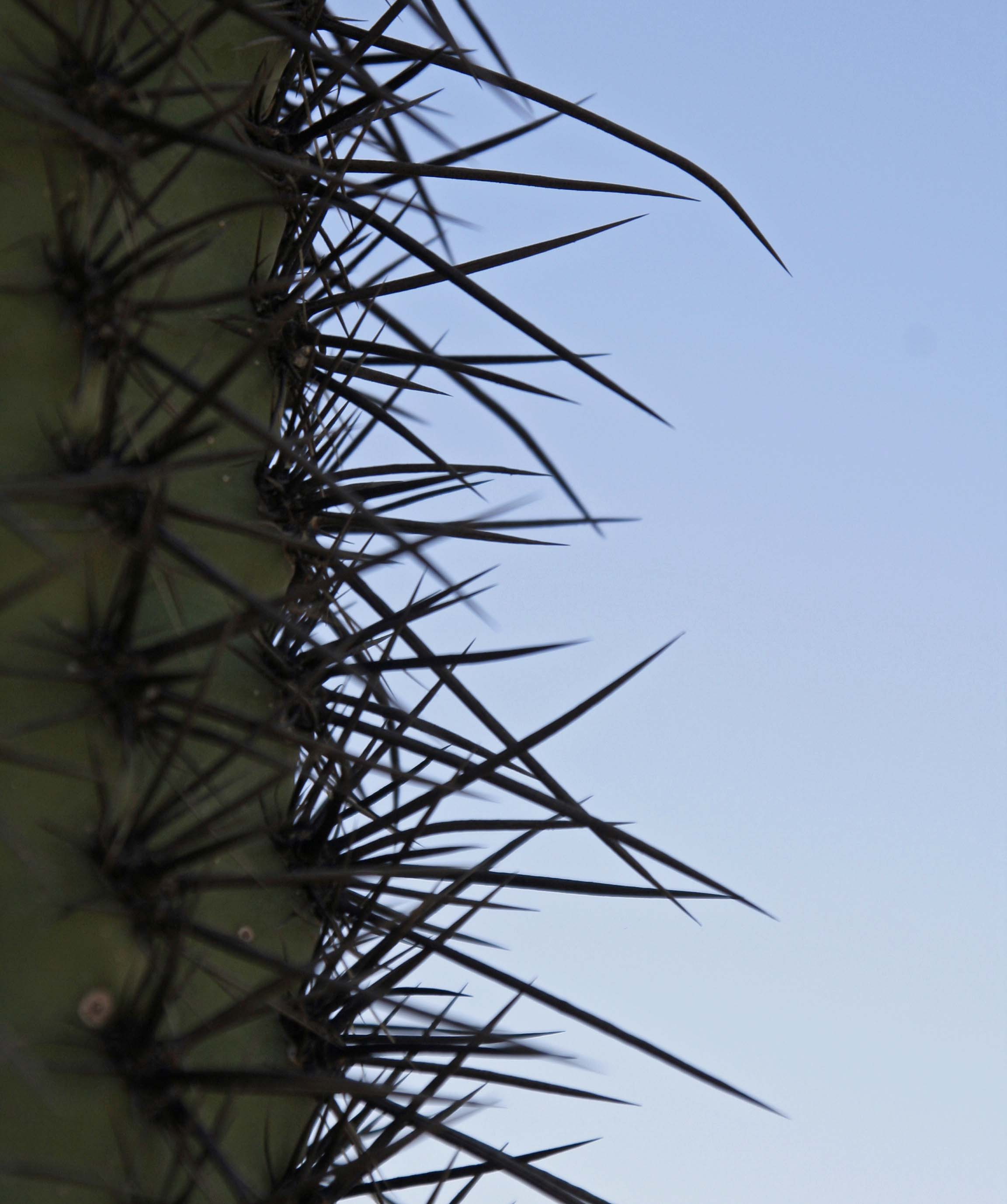
This saguaro may be a youngster since it had yet to grown any arms. Youngster is relative meaning 50-75 years old. Check out the spines…

Here's a close up.

Here’s a close up of why snuggling up to a saguaro is a bad idea.

Setting sun outlines Saguaro Cactus at Painted Rock Petroglyph Site in southern Arizona. Photo by Curtis Mekemson.

The setting sun outlined the Saguaro.


A Devilishly Hard Decision… The Title to My Peace Corps Africa Book

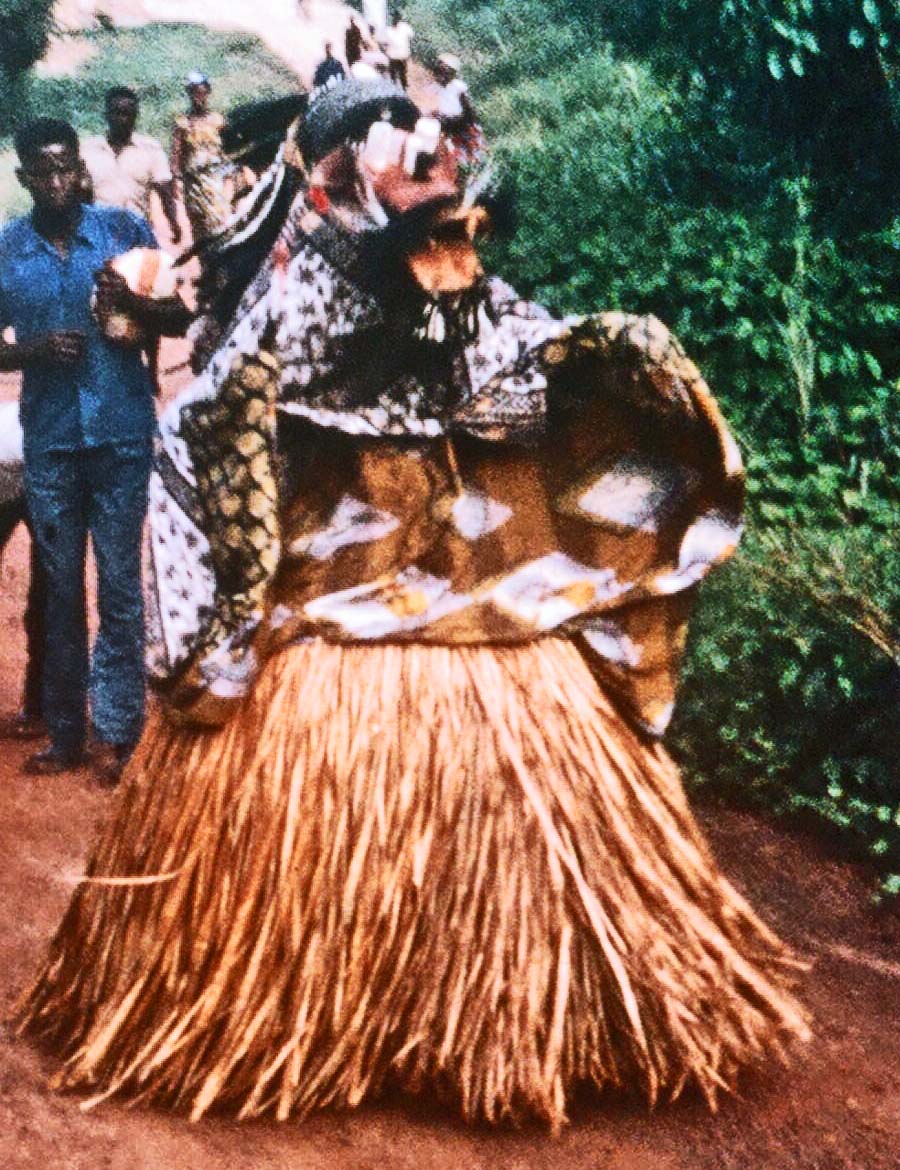
Pat hay stack and part voodoo nightmare, a Liberian Bush Devil shuffles through the dirt toward me.

A fading photo from 1967 captures a Liberian Bush Devil, part hay stack and part voodoo nightmare, as it shuffles toward me through the red laterite dirt.

So, I’ve been struggling with the title of the book about my experience as a Peace Corps Volunteer in Liberia, West Africa. As part of the process, I asked for help from my fellow bloggers and friends.

Step one included developing four options and providing backstories. Step two involved reviewing and summarizing the input.

Now it’s my turn.

I have two objectives for my title. First, it needs to be catchy. Unless people are familiar with an author or have recommendations from a trusted source (friend, author they enjoy, media), the first thing that leads them to choose a book is its title.

Second, the title needs to reflect my Peace Corps Africa experience.

For example, on the one level, The Dead Chicken Dance is about cutting the head off a chicken and watching it dance– slightly unusual and a little macabre. As such, the title might gain attention. But there was more. Early Peace Corps was struggling with how to prepare people to jump into another culture that was totally foreign to them. Killing, gutting, and plucking a chicken was guaranteed to provide trainees with a challenging experience that few of them had ever had but might face as a Volunteer. It’s a long ways between buying a pasty white, pre-packaged chicken in the grocery store and picking up a hatchet to cut the head off a feathered, clucking Henny Penny.

The Bush Devil Ate Sam and The Lightning Man Strikes Again reflected two aspects of African culture that were quite real to tribal Liberians. Both of these titles were designed to capture attention, but they also represented the dramatically dissimilar world that tribal Liberians existed in. Understanding Liberia, in fact understanding much of Africa, depends upon recognizing these differences.

How Boy the Bad Dog Ended Up in Soup represents a sharp break from our Western dog-centric world… of which I am very much a part. Dogs were a legitimate food source in Liberia. Students would tease me by coming by and pinching my cat, Rasputin. “Sweet meat, Mr. Mekemson” they would say while smacking their lips. They were cautious, however. Rasputin could take care of himself: “Pinch me once and I’ll squawk a warning. Pinch me twice and I’ll take off your finger.” As with each of my other titles,  there was more to the story with Boy than a gastronomical challenge.  It went beyond scary that soldiers would show up at my house in the middle of the night solely because the dog had eaten a guinea fowl.  It was strange with a strangeness that I would think of more than once when Liberia fell into the tragedy of its civil wars.

As I noted when I summarized the responses on titles, each title received strong support but Boy received the fewest ‘votes.’ Part of this may because we are so dog centric. As one blogger observed, the title might turn people off. I get that.

Support for the other three titles was evenly split. For me, it finally came down to either the Bush Devil or the Lightning Man. The Dead Chicken relayed an insight into early Peace Corps and cross-cultural challenges, but the other two did more to capture the Africa experience. Tossing a mental coin, I’m going with the Bush Devil. As my blogging friends James and Terri Gallivance, who have lived in Africa, noted: “We’re voting for The Bush Devil Ate Sam because we feel it embraces the mystery that is Africa.” The mystery that is Africa seems like a good place to start.

On a more prosaic level, I am adding “And Other Peace Corps Tales of West Africa” as a subtitle because it is important to have both Peace Corps and Africa included. Next up: the cover. As soon as I develop examples, I’ll post them.

NEXT BLOGs: Peggy and I will soon be heading into Nevada where I have several posts I am thinking about including 1) an art hotel in Reno created by Burners from Burning Man, 2) the remote town of Hawthorn with its history of being America’s primary ordnance depot (bunkers fill the desert), 3) the Extraterrestrial Highway and Area 51– subject of more conspiracy theories than there are people in Nevada, 4) Death Valley in the spring, 4) the Valley of Fire, 5) Red Rock Canyon, and 6) Las Vegas being Las Vegas. BUT, IN THE MEANTIME, I will post on another of my favorite petroglyph sites, Painted Rocks out of Yuma Arizona. I think I will also revisit the actual Big Foot trap about three miles from my home and see if Bigfoot is hanging out there. (It sort of goes along with the ET Highway.)

Ghost Bird… An Unusual Photo

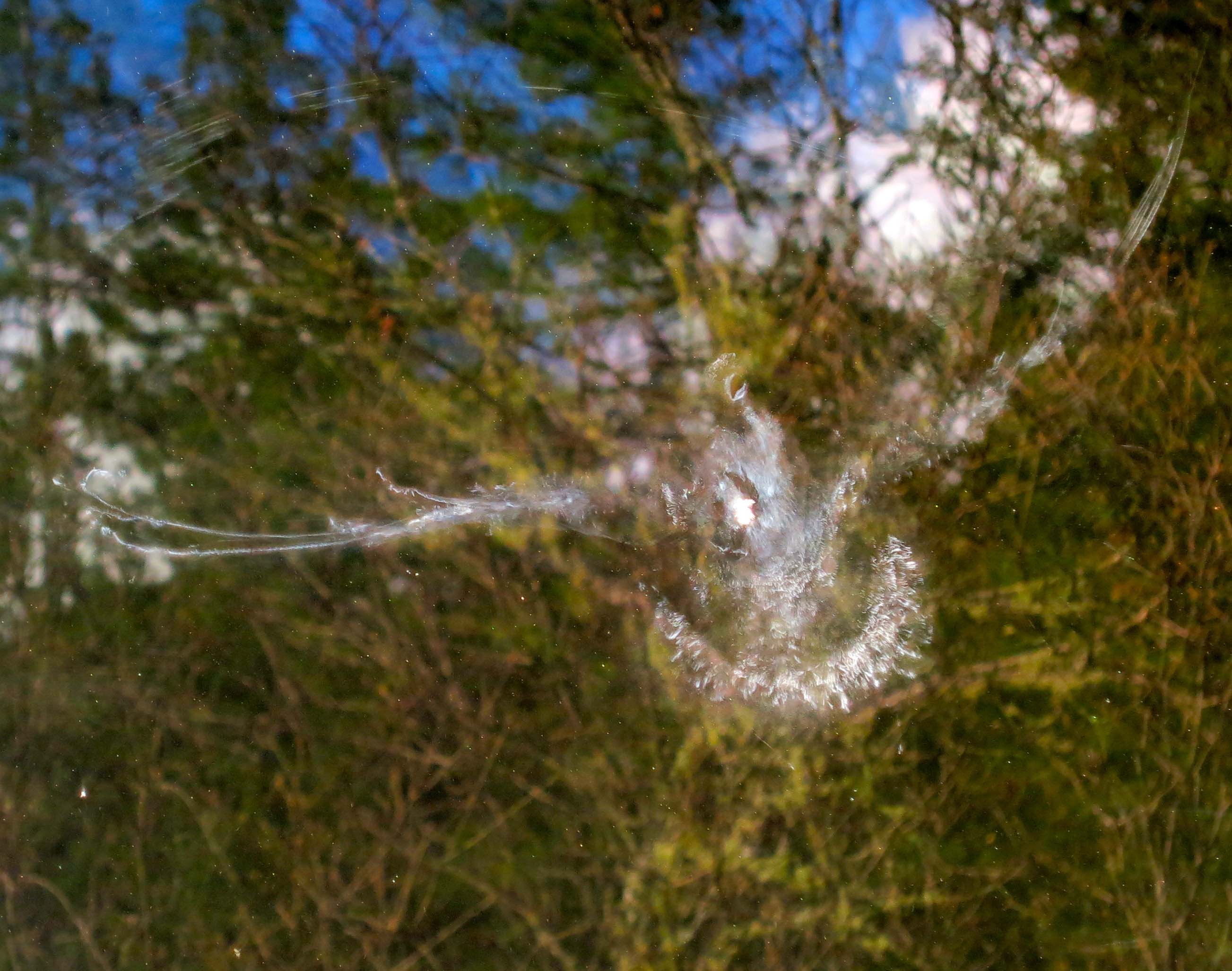
Mourning dove leaves ghost-like impression on window. Photo by Curtis Mekemson.

A crash-landing Mourning Dove left its impression on a window of our home on the Applegate River in Southern Oregon. It looks like a ghost bird hovering outside.

“This can’t be good,” Peggy commented from her office. I suspected that the deer were chowing down on her flowers and walked in to watch. Instead, neatly imprinted on her window, was the image of a bird with a 16-inch wingspan. It looked like a ghost. The Mourning Doves now had something to mourn about. One of them had taken a beak-dive into our window. I grabbed my camera– like what else was there to do– and recorded the crash landing from inside and outside of the house.

Black tail deer visits the Mekemson house in Southern Oregon. Photo by Curtis Mekemson.

What I expected to see– a hungry black tail deer lusting after Peggy’s flowers.

Impression left by dove after crashing into a window. Photo by Curtis Mekemson.

What I saw instead. I took this photo from the outside looking in with our trees being reflected in the window. Note the eye. Eerie, isn’t it?

I fully expected to find one very dead birdie on the ground, but none was to be found. Peggy and I are hoping that the dove picked itself up after the incident and flew off, a wiser bird with a headache.

Since I decided to put up a blog between blogs today, here are a few more photos from yesterday that I took while Peg and I hiked a section of the Sterling Mine Ditch Trail. The trail follows an historic 26-mile ditch that was built in 1870s to carry water to Sterling’s hydraulic mining operation outside of Jacksonville, Oregon. Its relatively flat nature makes it an excellent beginning of the season trail. Backpacking season is coming soon and Peggy and I have to get in shape! In the next couple of months we hope to explore the Red Butte mountains that look down on our home and I have a 40-mile hike along the Rogue River planned.

Peggy and I have looked out on the Red Buttes since we moved here three years ago. Now it is time to meet them up-close and personal. Recent snows may delay our backpacking trip.

Peggy and I have looked out on the Red Buttes since we moved here three years ago. Now it is time to meet them up-close and personal. Recent snows may delay our backpacking trip.

Peggy will be floating down the Rogue River in late May with our friends Tom and Beth Lovering. Since I need the exercise, I am going to hike the 40-mile backpacking trail that follows the river. (Photo by Peggy Mekemson)

Peggy will be rafting down the Rogue River in late May with our friends Tom and Beth Lovering. Since I need the exercise, I am going to hike the 40-mile backpacking trail that follows the river. (Photo by Peggy Mekemson)

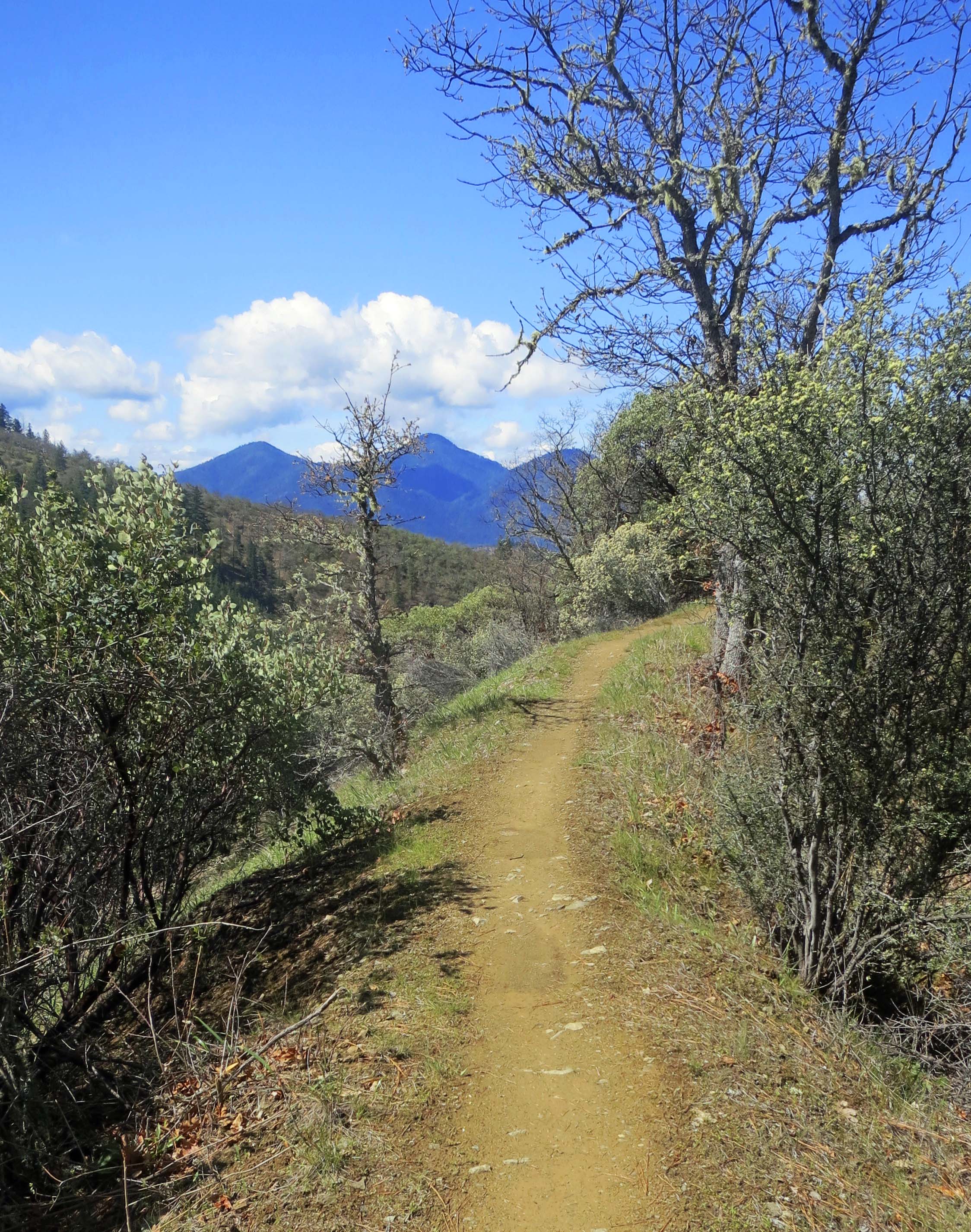
Photo of the Sterling Mine Ditch Trail in Southern Oregon taken by Curtis Mekemson.

The historic 26-mile Sterling Mine Ditch Trail wanders through a variety of terrains ranging from dry, brush covered slopes to cool, pine and madrone filled valleys.

Shooting Stars found along the Sterling Mine Ditch Trail in Southern Oregon.

Early spring flowers, including Shooting Stars, added color along the trail.

Oregon Grape flower found along the Sterling Mine Ditch Trail in Southern Oregon.

We also found this impressive Oregon Grape flower, which happens to be the state flower of Oregon. Later in the summer these flowers turn into berries that wildlife find quite tasty and supposedly make good jelly.

Old tree stump along the Sterling Mine Ditch Trail in Southern Oregon.

A rotting tree stump caught our attention for a moment. You can see tunnels left by insects as they feasted off of the wood.

A vine-twisted madrone tree found on the Sterling Mine Ditch Trail.

Our most interesting find of the day. Peggy and I love Madrone trees and their silky, almost sensuous bark. But we have never seen one twisted like this. Close inspection showed that it had been caused by a vine that had worked its way up the tree.

NEXT BLOG: My choice for the title of the book on my Peace Corps experience.

The Dead Chicken, the Bush Devil, the Lighting Man, and the Bad Dog

Gbarnga, Liberia where I served as a Peace Corps Volunteer from 1965-67. The photo was taken at that time.

Gbarnga, Liberia where I served as a Peace Corps Volunteer from 1965-67. The photo was taken at that time.

A dead chicken, a bush devil, a lightning man, and a bad dog walk into a bar… Just kidding.

Last week I asked for help from my blog followers, Facebook friends, and members of my book club to help choose a title for the book on my Africa Peace Corps experience. The choices were:

  • The Dead Chicken Dance
  • The Bush Devil Ate Sam
  • The Lightning Man Strikes Again
  • How Boy the Bad Dog Ended Up in Soup

Each title also included a subtitle connecting the book to Africa and the Peace Corps.

The input was great and there were many thoughtful comments on the various choices. There were also more general suggestions such as put the titles in the active voice and make them shorter. An example of the former is The Dead Chicken Dance might become The Dead Chicken Dances or Dead Chicken Dancing. In the latter, How Boy the Bad Dog Ended Up in Soup might be retitled Bad Dog Soup.

Here’s a pie chart that shows how people responded:

Book titles

What seems clear here is that the Bad Dog was not good. But let me note, Boy did have some strong support. Alison and Don felt the title had a “good hook to it.” And Kocart said, “Boy the Bad Dog. Of Course.” Naturally. Linda at Shoreacres, who lived in Liberia, made the interesting comment, “Boy the Bad Dog certainly evokes all of the collections of African folk tales that are out there.” On the con side, The Writing Waters Blog observed that the title might be “too much for this dog loving country.”

Pull Boy out of the pie and what we have left is close to a dead heat. The titles are running nose-to-nose. The dead chicken garnered 30% of the vote, the Bush Devil 33% and the Lightning Man 28%. It isn’t what I would call a clear mandate. (Grin) So how about the very thoughtful comments? Maybe they are too thoughtful! Strong arguments were made for each title. I found myself nodding, ‘that’s right’ over and over as first one title and then another worked its way to the top.

Some of the comments:

“The Dead Chicken Dance hands down. I would pick it up and look at it. That’s as good of a title as “Getting Stoned With Savages…” which was a damn good book!”

“The Dead Chicken Dance is my favorite…. A touch grisly plus touch of the familiar plus invitation to dance equals enigmatic… Strong short and sure of itself like The Ballad of the Sad Cafe, The Joy Luck Club, The Kite Runner.”

I would use the Dead Chicken Dance, but I’d change it from “The Dead Chicken Dance” to “Watching a Dead Chicken Dance.”

Personally, I like The Dead Chicken Dance best. They’re all catchy, but for some reason, this one jumped out at me most. My second choice would be The Bush Devil Ate Sam. In fact, now that I see them both side-by-side, I like them equally. Oh, boy, that wasn’t much of a help, was it? 🙂

“The Bush Devil Ate Sam” is definitely my favorite; short, catchy, intriguing, and feels more encompassing of a collection of African stories than the others…

“I am leaning toward the Bush Devil Ate Sam as I have met Sam, a doctor trained in the American University system, highly educated, yet “marked” by his right of passage to manhood.”

“ (The Bush Devil Ate Sam) is the most cogent, the most compelling.”

“Curt, these titles are all great and we love the stories behind them. We’re voting for The Bush Devil Ate Sam because we feel it embraces the mystery that is Africa…”

“Personally, the one that would make me pick up the book first would be “The Bush Devil Ate Sam.”  It has three things: something exotic (the bush devil), something familiar (the name Sam being a sedate, western-sounding name makes it more familiar and less threatening), and the mystery of how the two came together – you can be pretty sure something called a bush devil didn’t literally eat Sam, so what is this really about?  Of all of your proposed titles, it was the one that made me most want to find out the story behind it.”

“ …the one that was most immediately appealing was the Lightning Man Strikes Again and the most intriguing was The Bush Devil Ate Sam.”

“I read all of the stories to the boys and there was a unanimous vote for The Lightning Man Strikes Again. Very catchy and a fun story!” (The grandkids check in.)

“I loved all the stories but my favorite title is The Lightning Man Strikes Again. I usually choose books by the title and I’d pick that one up just because of the sound of it. Lightning is fascinating anyway and the title sounds interesting and humorous, which goes perfectly with those stories. I’ve always wanted to join the Peace Corps and can’t wait to read this now.”

“The Lightning Man Strikes Again: I like it because it has a double entendre..Is it about someone else or are you the lightning man helping to bring change to Africa… 
Can’t wait to read your follow up post!”

“Love The Lightning Man Strikes Again – can just feel the dread the Lightning Man induced. Do let us know when you make your choice.”

“The problem is that ALL the titles are intriguing; they all entice the reader to want to read the stories.  But, if forced to choose, I would go with the lightning man.  I’m not quite sure, maybe because it relates so directly with superstition and myth.”

Life's about choices, right. It may be about the title of a book or it may be about which piece of monkey meat you are going to buy.

Life’s about choices, right. It may be about the title of a book or it may be about which piece of monkey meat you are going to buy. The lady selling the meat held up a little head and said, “Very tasty.”

So… these are some of the thoughts you have shared. They represent views from people with widely varying backgrounds… including writers, the under ten crowd, and folks who have lived in Africa. Do you see my dilemma? Thanks so much for taking the time to participate. It means a lot.

NEXT BLOG: My choice and the reasons behind it. (Yes folks, I am going to drag this out for one more blog.)