Astoria, Oregon… Where the Columbia River and the Pacific Ocean Meet

A rainbow hangs over the mouth of the Colombia River and ships that are waiting their turn to head out into the Pacific. Special pilots are brought on board to navigate the treacherous waters, now looking quite calm.


I visited Astoria a while ago and didn’t get around to writing about it. Since Peggy and I are now off playing on the Oregon coast, I decided today would be a good day for featuring this city that sits on the edge of the Colombia River.


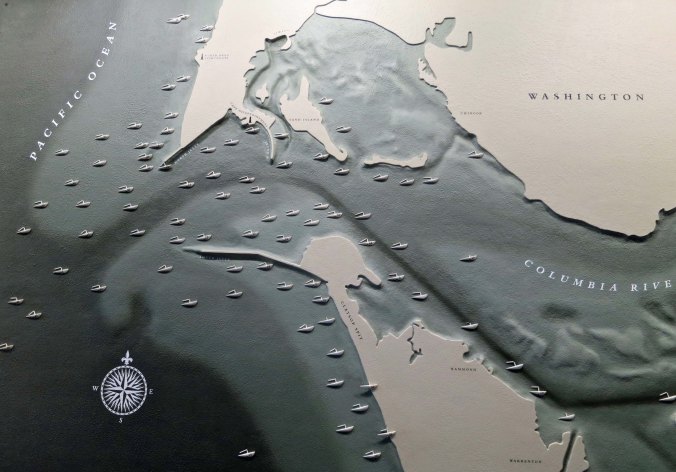
The area off of Astoria, Oregon, where the Columbia River flows into the Pacific Ocean, is called the Graveyard of the Pacific. A combination of high seas with 40-foot waves, shallow, shifting sand bars, and the mighty Columbia River have sent some 2000 boats to their watery demise since 1792. It is considered one of the most dangerous navigation passages in the world.

This map, which is located in the Columbia Maritime Museum, shows where some of the shipwrecks can be found.

It’s no wonder that  you are greeted by a sign that proclaims Astoria is an Official Coast Guard City when you enter the community. The town is grateful that the organization is there when someone needs to be pulled out of the turbulent water. A dramatic, full-sized diorama of a Coast Guard rescue effort is featured at the Maritime Museum.

Astoria wears its Coast Guard connection proudly.

A full size diorama of a Coast Guard rescue effort is on display at the Columbia Maritime Museum.

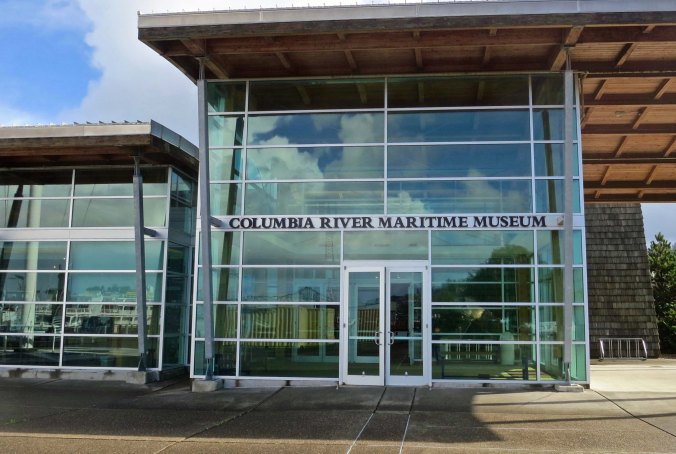
A photo featuring the front of the Columbia Maritime Museum. I liked the way the glass reflected the clouds.

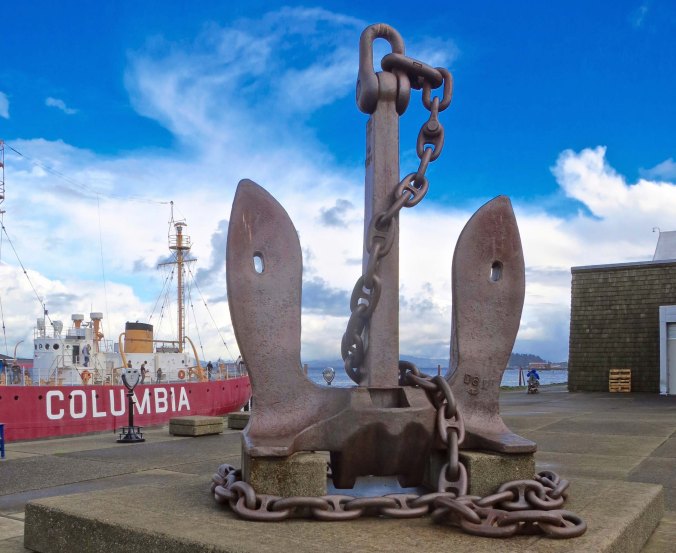
I thought that this anchor that sits out in front of the museum, is an apt symbol for both the museum and the city. The lightship Colombia is seen in the background.

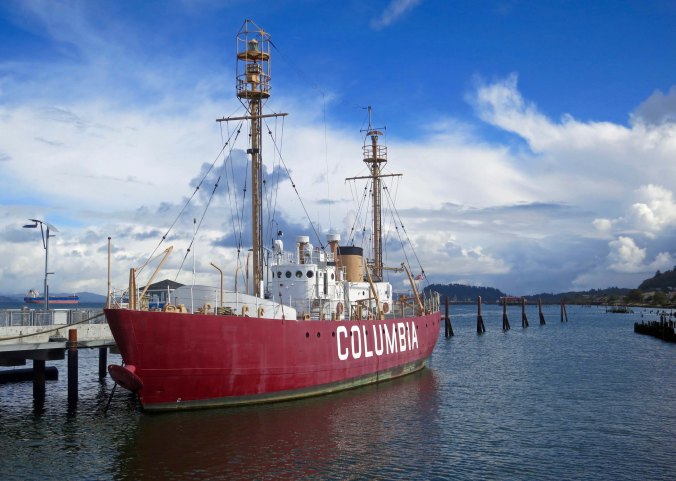
In the days before modern navigation equipment, the lightship Columbia served as an offshore lighthouse, aiding ships entering and leaving the Colombia River. The lightship maintained its position for weeks at a time and stocked in 12 tons of food, 13,000 gallons of fresh water and 47,000 gallons of fuel.

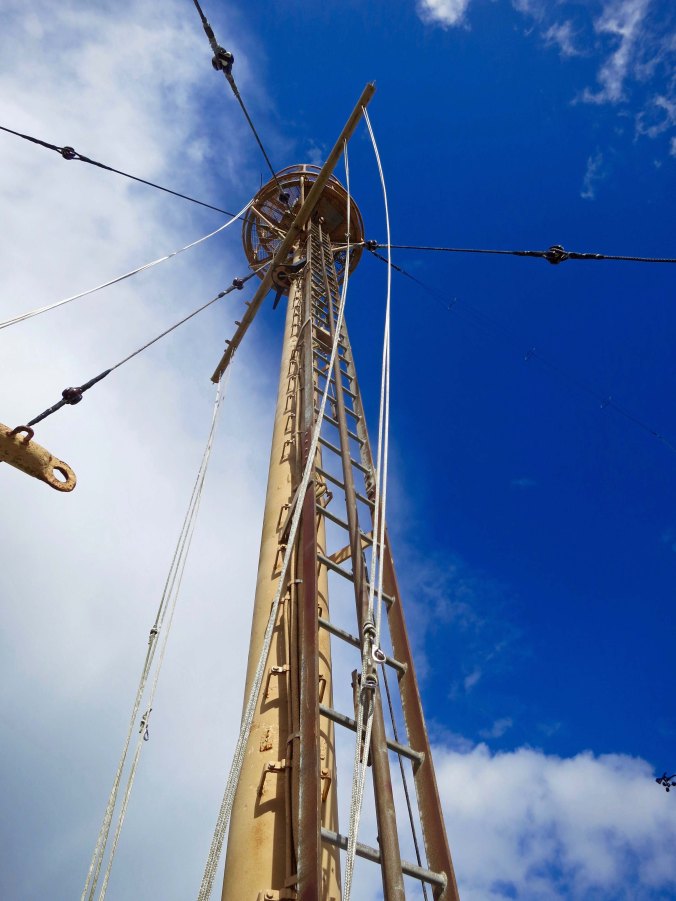
This crows nest mast on the Columbia was used for powerful lights and foghorns as well as observation.

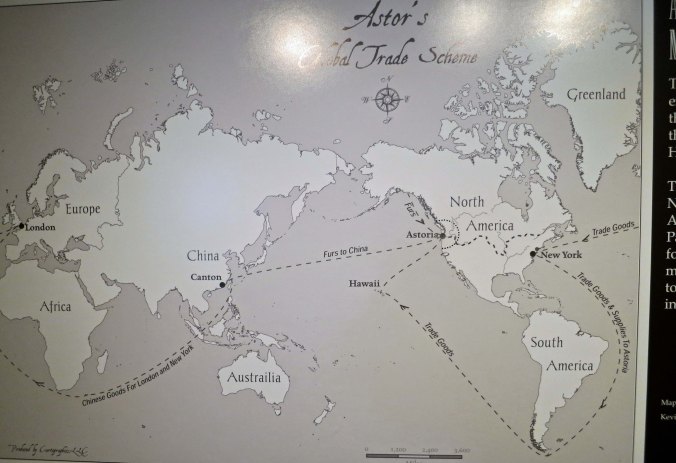
Astoria’s connection with the fledging United States dates all the way back to the Lewis and Clark expedition. The explorers sent out by Thomas Jefferson spent the 1805-6 winter in the area and built Fort Clatsop for shelter and protection. John Jacob Astor, who gave the city its name, followed up by building a fur trading post there in 1811 that became the first permanent settlement the US had on the west coast. Both the Lewis and Clark expedition and Astor’s post helped in the debate with England over who owned the land.

This map from the museum shows Astor’s trading routes.

Traveling by sailboat through the world’s oceans was hazardous. An early fear of sailors was having encounters with sea monsters. I found this illustration of a Kraken in the museum and laughed. If you are familiar with Pirates of the Caribbean, you will recognize it.

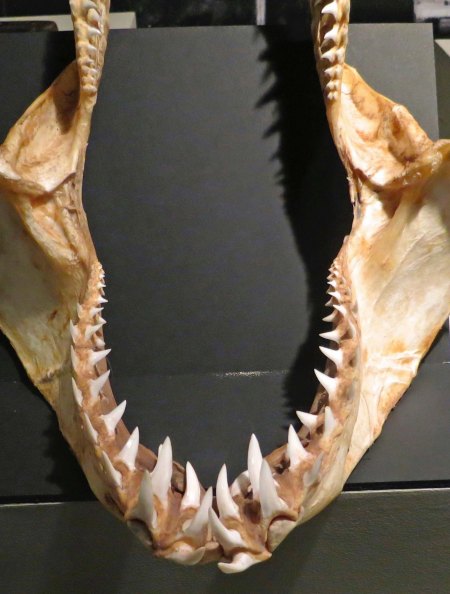
Now here is something more real to worry about! I also found this shark jaw and teeth in the museum.

Logging and fishing followed fur trading as the mainstay of the area’s economy. By the mid-1800s, fisherman from around the world called Astoria home. Only 13 percent were born in the US. The majority came from the North Atlantic countries where over-fishing had caused the fishing industry to collapse, a fate that would eventually befall Astoria. A major canning industry that grew up to process the fish also faded when the fish ran out. The canning industry employees were mainly Chinese immigrants. An educational display in the Maritime Museum notes that the most efficient of the Chinese workers could clean a 45-pound salmon in 45 seconds and up to 1700 fish in a standard 11-hour work day.

An ad photo for the Bumble Bee salmon cannery. The bee has a fishing pole.

I suspect that these pilings once supported several thriving canneries..

Now they support a thriving seagull population.

With the boomtown days of fur hunting, logging, and fishing behind it, Astoria has turned to tourists to help support its economy. Nearby Portland  (100 miles away) helps assure a continuing supply, as does the almost constant flow of tourist traffic up the Oregon coast in the summer. The museum, historic sites, fun shops, and several restaurants help meet the needs of visitors.

Downtown Astoria has preserved several historic buildings that add to its ambience.

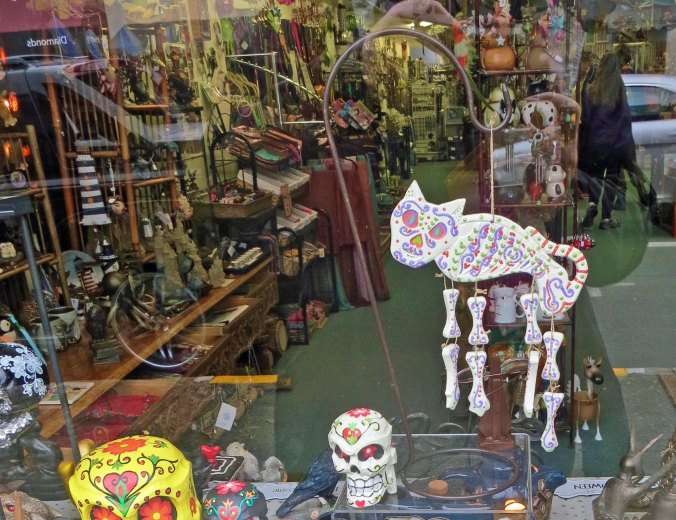
This shop was packed to the gills with tourist merchandise. Nice kitty. I think you are probably a Mexican immigrant, however, and I doubt you have papers. Watch out.

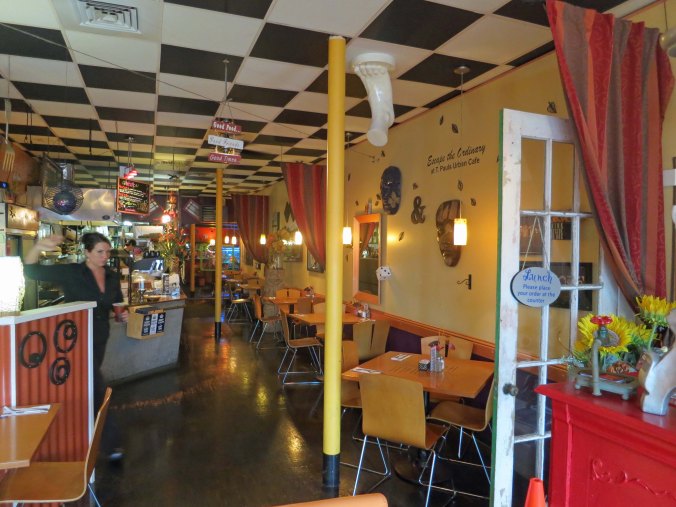
T. Pauls has an eclectic menu and a foot on the ceiling. I ate under the foot.

It seems only appropriate that I wrap up this post with an old piling and the rainbow across the Columbia River.

Wednesday’s Blog: You are going to meet the world-famous Traveling Bone.

On Friday we will return to Burning Man.


Ten Major Art Installations from Burning Man’s History

The Big Rig Jig was made up of two oil tanker trucks, taken apart and put back together.

I’ll be journeying to Burning Man alone this year. I obtained my ticket in February. Peggy joined the long queue for tickets on Wednesday, all to no avail. When she was finally moved to the ticket purchase site, the message was that all 30,000 tickets had been sold out. (The other 40,000 tickets are distributed in other ways.) Neither are other members of the Horse Bone Tribe going this year. So, it’s back to me, like it was in 2004, when I went by myself except for my friend Ken Lake. I’ll miss my friends, especially Peggy, but I am okay with going alone. I can easily spend eight days exploring and photographing the art.

Today I am featuring ten of the major art installations I have enjoyed the most over the years. This doesn’t include buildings like the temples, which will have their own posts. Since I missed four years when I was off wandering or had ended up on the wrong end of the Burning Man ticket circus, there are undoubtedly other pieces I would include.  Also, I already included a post on the 40 to 60-foot-tall sculptures of women that are definitely among my favorites.

Another view of the Big Rig Jig. I felt a bit nervous standing underneath it.

Often the major art installations are tied into Burning Man’s Theme for the year. In 2007 the theme was “The Green Man,” which had an environmental emphasis. The Big Rig Jig tied into the impact of oil.

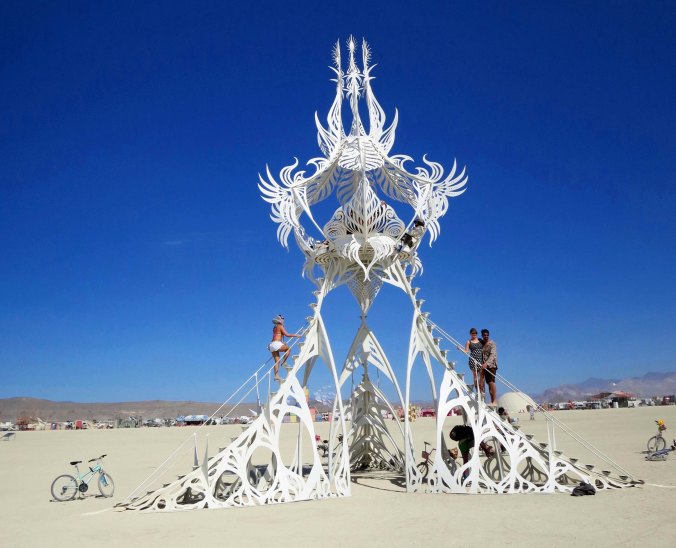
I’ve always considered this intricate white tower beautiful.

A close up of the top.

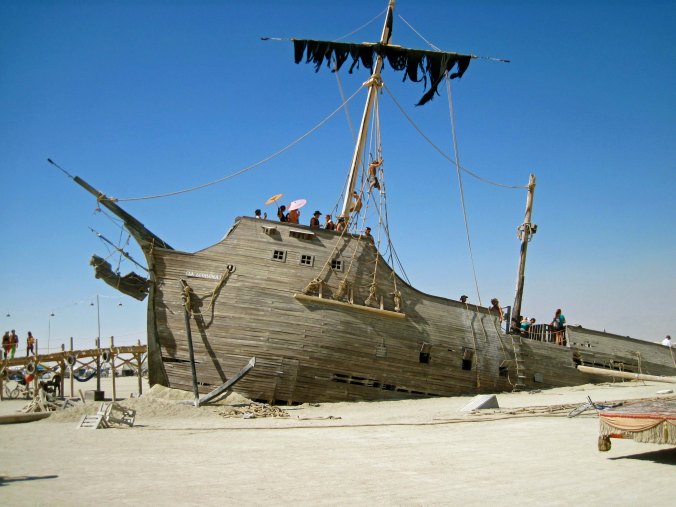
This massive sailing ship appeared to be sinking into the Playa.

A front view of the sailing ship. I thought that the detail was incredible. The ship was built in Reno.

As is often the case at Burning Man, what was inside the art piece was also fun and interesting. I like the stylish hat.

Dragons are common at Burning Man. This one, protecting its egg, is my favorite.

I don’t think I would be tempted to harm its baby.

Especially at night.

Buck Rogers would have been happy with this rocket ship. Peggy provides perspective.

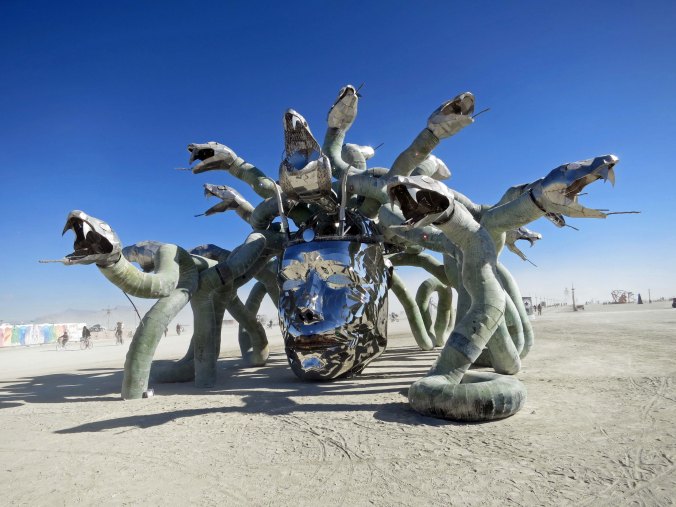
Medusa with her snaky hair was one of the most unusual sculptures at Burning Man.

Her wiggly hairdo from the back.

And at night.

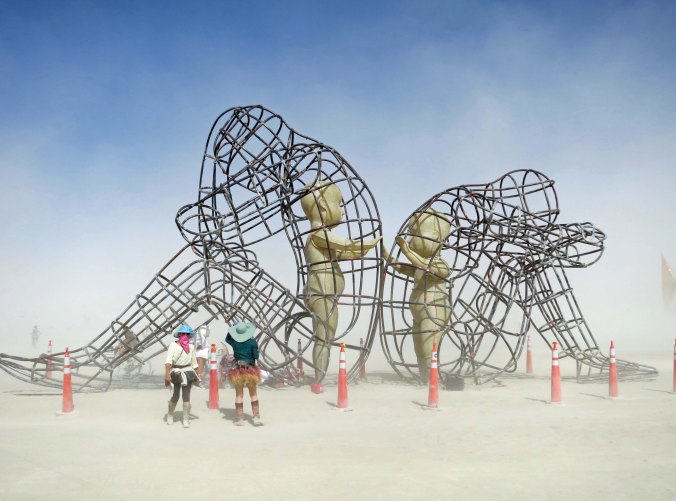
The inner children of these two estranged adults reach out to each other.

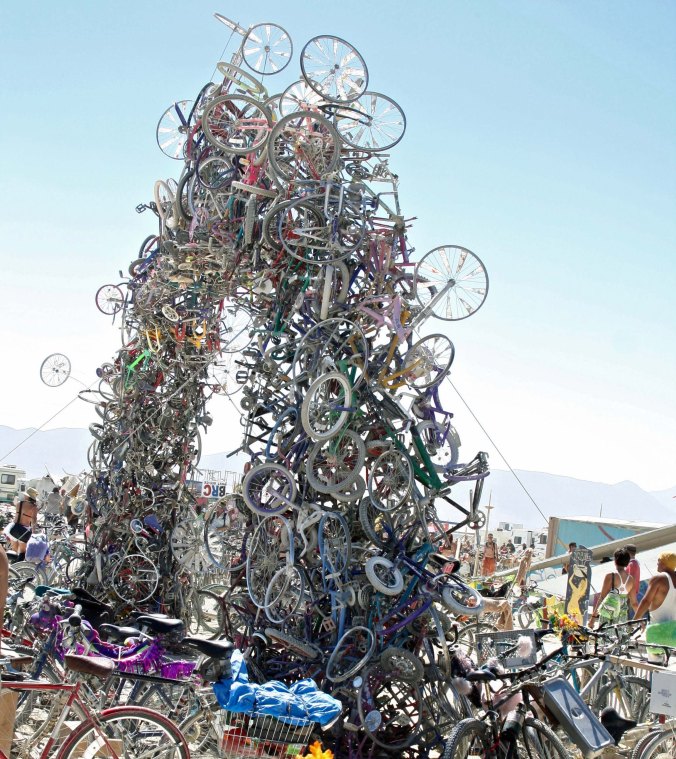
I have always liked this bike sculpture that was located in front of the Center Camp Cafe because of the significance of bikes for transportation at Burning Man.

The top of the heap, so to speak.

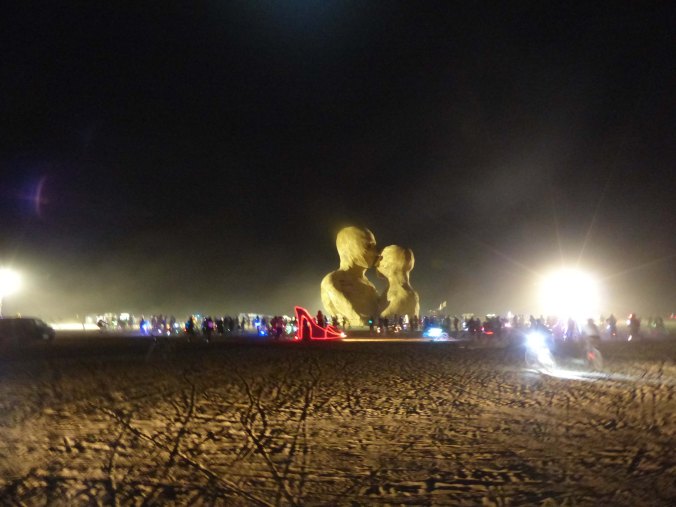
This giant couple embraced. The Man looks on from the left.

A close up.

This art was located in the head of one of the sculptures.

At night.  A red, high-heel mutant vehicle is in the foreground. (Photo by Don Green.)

A coyote raises its head to howl. (Photo by Tome Lovering.)

A tail view of the coyote.

I chose the coyote at night for my last photo today. The two bright lights on his head are from headlamps of people climbing the sculpture.

NEXT BLOGS:

Monday: Back to the Oregon coast with a visit to the town of Astoria on the mouth of the Columbia River.

Wednesday: I’ve often mentioned the Horse Bone Tribe and Camp at Burning Man. This is the story of the horse bone, or Bone, as he prefers to be known.

Friday: A continuation of my Burning Man art series with a final look at sculptures.

All’s Well that Ends (grin)… The Sierra Trek Series

Treks have always been about adventure. In addition to the physical and mental challenge, there is a more important element of experiencing nature on a very personal level, both the beauty and the wonder. Imagine, for example, coming on this Aspen that bears have climbed and used as a marking tree to establish their territory.

This is my last post on the first Sierra Trek series. Last week left us in the American River Canyon, waiting while the US Bureau of Reclamation blasted rocks off the hill sides in preparation for building the Auburn Dam. (The discovery of an earthquake fault zone under the dam would lead to its not being built.) Today I will take us on into Auburn, California where the 100 mile backpack trip ended.

As in the previous posts, I have selected photos from other Treks since I don’t have any from the first. There are several other areas in California I would lead Treks besides the Sierras. These photos are from the Trinity Alps. 

Another photo of a bear tree in the Trinity Alps of California. And yes, those are claw marks.

Early the next morning we had an important decision to make: whether to wade across the American River in water up to our belly buttons and then follow the river or climb up and along the steep canyon following alternative trails. I let the Trekkers vote and they voted to cross the river. One woman was deathly afraid, however, and broke down in hysterics. She was the same person who had, at first, refused to ride the Squaw Valley tram. We offered to carry all of her gear and even carry her, all to no avail. Finally, I decided we would all hike the canyon route. I was not about to split our group again. (It was the only time in my years of leading Treks that I ever allowed participants to vote while on the trail. Treks, I decided, were not a democracy.)

This shot of the Trinity Alps provides a great perspective on why the mountain range was given its name. (Photo by Peggy Mekemson.)

A view from farther away. These are rugged mountains that provide challenging, beautiful backpacking opportunities.

Our last night was fifty-fifty on the plus and minus scale. On the plus side, I knew that we had succeeded. Our Trekkers, except for the two or three who were now riding in the jeep, had made it— survived if you will. We had managed to solve each of the crises we had faced along the trail. I could say goodbye to the Trekkers the next day knowing that I had put everything I had into getting them through the nine days. On the minus side, Steve had taken a few of the ‘cool’ Trekkers to camp away from the main group. I hated seeing this, it was a really bad decision, but it was already a done deal by the time I came into camp as rear guard. I could have hiked up the canyon and insisted the group rejoin us, but I just didn’t have the energy to do it, physically or mentally.

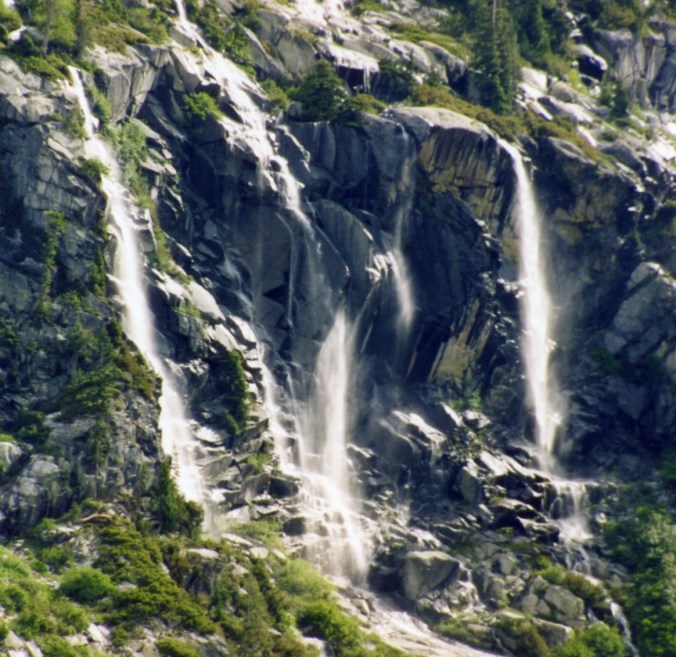
The Trinity Alps includes a number of impressive waterfalls.

Another…

And another.

Sunday, we hiked into Auburn Fairgrounds as a group with the Trekkers in high spirits, singing the Ham Cheddarton song. They had a bar-b-que chicken feast to look forward to and then they were going home— home to hot showers, clean clothes and loved ones. They had enough tales to fill the next week and possibly their lifetime. As we approached the fairgrounds, our Auburn volunteers and several Board members were there to cheer our arrival.

I didn’t know how things would end. At best, I hoped our Trekkers would recognize that even though we had made enough mistakes to fill a book (or at least a long chapter), we had tried as hard as we humanly could to rectify them. And I had learned, boy had I learned. Mainly, I felt relief. I was going back to focus on our mail fundraising campaigns with a vengeance.

What took me by surprise was the response as Trekkers started to leave.

“Thanks, Curt, for the most incredible experience in my life. Where are we going next year?”

“You and Steve were great, Curt. I would like to help with next year’s planning.”

And on and on. People were excited about their experience. It was one of the most difficult things that they had ever done, and they had succeeded. They left feeling better about themselves, and that feeling translated over to us and the Lung Association. Instead of the negative comments I expected, and in some ways deserved, we were getting rave reviews. While not everyone was eager for next year’s adventure, most were asking, even demanding that we repeat it.

I left that day not quite convinced but leaning toward doing another Trek. One thing was for sure, my experience had matched that of the Trekkers. The event had been one of the most difficult things I had done in my life from both a physical and mental perspective. I came out of the Trek with a new confidence in myself and a new understanding of what I was capable of accomplishing— and an increased love of the wilderness.

One final amusing note: that night as I took my first shower in nine days, I reached around behind me to wash my fanny and it wasn’t there. It had disappeared. Between the trail review work, my trauma with Jo, and the Trek, I had lost 20 pounds in two weeks.

This is Sapphire Lake, one of a series of high alpine lakes in the Trinity Alps.

A reflection shot along a trail climbing up into the mountains.

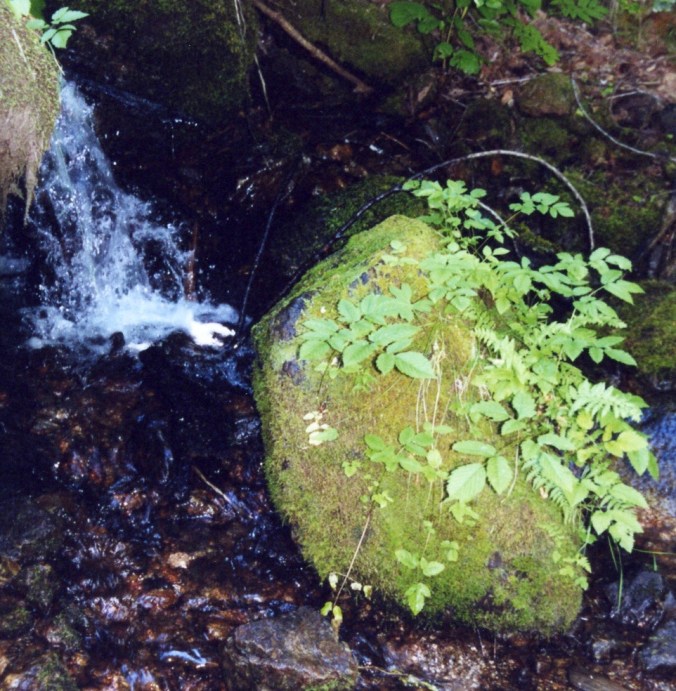
Peggy caught this luscious scene along a small creek where we refilled our water bottles. (Photo by Peggy Mekemson.)

While this rock caught my attention.

I am the fan of the small as well as the large when out in the woods. This is a shelf fungus.

A dandelion. Have you ever picked one of these and blew on it to watch the seeds go flying off?

And a butterfly on a Leopard Lillie.

EPILOGUE

The Sierra Trek turned out to be a success. We hadn’t raised a lot of money on our adventure, but special events rarely do the first time. What we had raised in abundance were new volunteers, the life blood of volunteer organizations. These were people who, because of their Trek experience, would develop a deep commitment to our organization.

I had several ideas on how to increase our returns and reduce our risks. In the future, we would set a pledge minimum and charge a registration fee. I would also set an age limit of 18 unless the minor was accompanied by a responsible adult. There would be no more 11-year-olds wandering in the woods by themselves. This wasn’t a negative comment on the Mouseketeers, they had been great, but the nature of the Trek made it much more of an adult kind of event. I would also limit group size to 20, and eventually 15, making the event much more manageable and reducing its environmental impact. And finally, our veterans would become the backbone of the program, providing advice and help in planning, organizing, and leading Treks.

From a personal perspective, my “far-out excuse for escaping to the woods” succeeded beyond my wildest hopes. I happily spent the next 25 years of my life leading wilderness adventures. When I worked it right, I could spend most of my summers out in the woods, especially when I supplemented official Lung events with personal outings. Treks also became an important annual event for many of the participants. Eighteen years after I had told Orvis he might be too old to Trek, he was still backpacking. He did his last trip with us when he was 88 years old. Altogether, he had raised the organization well over $100,000. That Trek also happened to be Peggy’s first long distance backpack experience. “How can I complain with Orvis out here?” she had told me with a grin, and hiked up another mountain.

I went on to create bike treks, winter treks, and canoe treks. I also pushed the Trek Program nationwide with the American Lung Association, persuading the organization that the events were valid fundraisers, and becoming the national consultant on Treks. For a while, Treks became one of the top special events for ALA. Charlie had been right that night we had laid our sleeping bags out under the stars at our Last Chance campground and he had declared: “What an experience. I can’t believe I am out here. Someday, people will be doing these Treks all over the nation!”

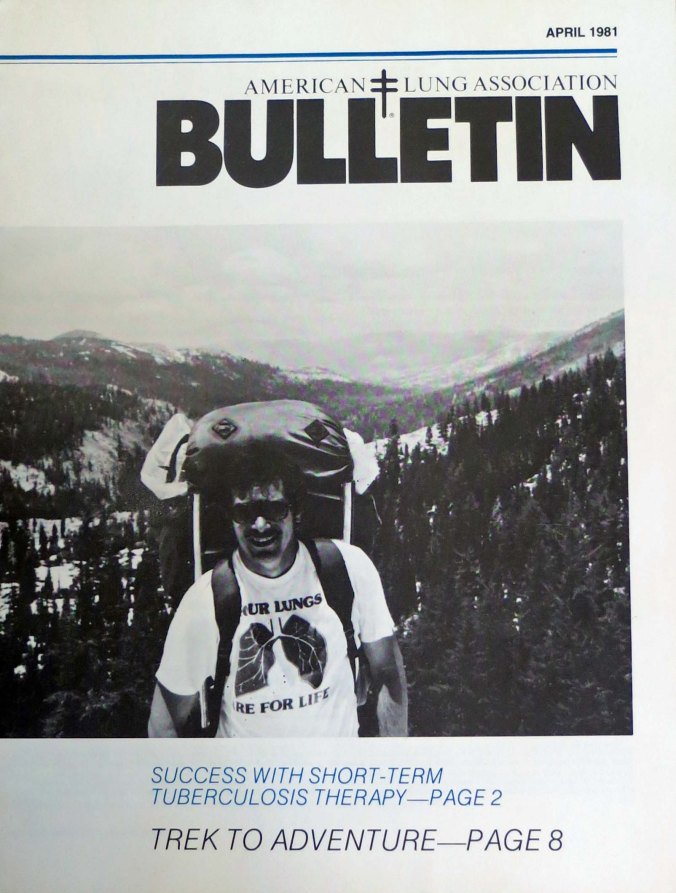
Having created the Sierra Trek in 1974, I had turned trekking into a national fund-raising  event for the American Lung Association by 1981. This is a photo of me on the cover of the American Lung Association’s national magazine.

If Someone Steals your Spouse or Cow, Who Do You Call? The Lightning Man!

The Bush Devil is a powerful figure within traditional Liberian Culture. This is a Bush Devil of the Grebo Tribe that visited a Peace Corps Haight-Ashbury Party Liberia circa 1967.


I was in serious need of inspiration over the weekend when it came to today’s post. I had a bad case of blogger’s block. And then I was hit by a thought— why not throw in a chapter from my book. Other than the promo I run in the upper right hand corner, it’s been a long time since I’ve done anything with “The Bush Devil Ate Sam” on this blog. If you are new to The Bush Devil Ate Sam and enjoy this chapter, the book is available on Amazon.


Sam, the young man who worked for us in Liberia, was enamored with western culture. It fired his imagination. He spent hours listening to the Kingston Trio get Charlie off the MTA and dove into peanut butter and jelly sandwiches like a frog dives into water. Still, for all of his excitement about things modern, ancient African was an integral part of who he was. He had the scars to prove it. They marched down his chest in two neat rows.

“How did you get those,” Jo (my former wife) asked with ten percent concern and ninety percent curiosity.

“I can’t tell you,” Sam replied with obvious nervousness as Jo’s eyebrows rose. “But I can tell Mr. Mekemson.”

Aha, I thought, Sam and I belong to the same organization, the Men’s Club! Actually, Sam belonged to a very exclusive men’s organization, the Poro Society, which I wasn’t allowed to join. Its functions were to pass on tribal traditions, teach useful skills, and keep errant tribe members in line. Everything about the organization was hush-hush. Tribal members who revealed secrets could be banned and even executed.

Political power on the local level was closely tied to membership in the Poro Society. On the national level, President Tubman assumed leadership of all Poro Societies in Liberia. Tribal women had a similar secret organization called the Sande Society, which prepared young women for adulthood and marriage. A controversial aspect of the Sande initiation ceremony was female genital mutilation— cutting off the clitoris.

Sam got off easy.

He had been to Bush School the previous summer and learned how to be a good Kpelle man. Graduation to adulthood consisted of an all-consuming encounter with the Poro Society’s Bush Devil. It ate him— metaphorically speaking. Sam was consumed as a child and spit out as a man. The scarification marks had been left by the devil’s ‘teeth.’ It seemed like a tough way to achieve adulthood, but at least it was fast and definitive.

The Bush Devil was a very important tribal figure who was part religious leader, part cultural cop and part political hack. Non-Kpelle types weren’t allowed to see him. When the Devil came to visit outlying villages, a frontman preceded him and ran circles around the local Peace Corps Volunteer’s house while blowing a whistle. The Volunteer was expected to go inside, shut the door, close the shutters and stay there. No peeking.

We did get to see a Grebo Devil once. The Grebo Tribe was less secretive, or at least more mercenary. Some Peace Corps Volunteers had hired the local Devil for a Haight-Ashbury style African party. It was, after all, 1967, the “summer of love” in San Francisco and the “Dawning of the Age of Aquarius.” Along with several other Volunteers, we hired a money bus to get to the party. Had we been thinking, we would have painted the bus with Day-Glo, like Ken Kesey’s bus, Further.

The Devil was all decked out in his regalia. His persona was somewhere between a voodoo nightmare and walking haystack. Grebo men scurried in front of him with brooms, clearing his path and grunting a lot. We stayed out of the way and took pictures.

Another area where Sam showed his tribal side was his fear of the newly dead. A person’s spirit was considered particularly powerful and dangerous right after he or she died. Later, the spirit would move away into the bush and fade. But first it had to be tamed with appropriate mourning, an all-night bash. One didn’t take chances. When Sam worked late for us after someone had died, he would borrow a knife and a flashlight in case he had to fight off the malevolent ghost on his way home. I had grown up next to a graveyard and was sympathetic with his concern.

Juju, or African witch doctor medicine, was another area where African reality varied from modern Western reality. Late one evening, in the middle of a tropical downpour, one of my high school students appeared on our doorstep very wet and very frightened. Mamadee Wattee was running for student body president. His opponent had purchased ‘medicine’ from a Juju man to make him sick.

It was serious business; people were known to die in similar circumstances. Had the opposition slandered Mamadee or stuffed the ballot box, I could have helped, but countering a magic potion wasn’t taught at Berkeley, at least not officially. I took the issue to Mr. Bonal, the high school principal, and he dealt with it. Mamadee stayed well and won the election.

The use of Juju medicine represents the darker side of tribal culture. Human body parts derived from ritual human sacrifice are reputed to be particularly effective in creating potions. Cannibalism may be involved. On the lighter side, my students once obtained a less potent ‘medicine’ and buried it under the goal post on the football (soccer) field with the belief that it would cause the other team to miss goals. Apparently, it wasn’t potent enough; the other team won.

Mamadee was also the reason behind our introduction to the Lightning Man. When Jo and I went on vacation to East Africa, we left Mamadee with $50 to buy a 50-gallon drum of kerosene. When we returned, there was neither kerosene nor $50, but Mamadee was sitting on our doorstep. Someone had stolen the money and Mamadee was extremely upset. Fifty dollars represented a month’s income for a Kpelle farmer. Mamadee’s father, a chief of the Kpelle tribe, was even more upset and wanted to assure us that his son had nothing to do with the missing fortune. It was a matter of honor. He offered to have Mamadee submit to the Lightning Man to prove his innocence.

The Lightning Man had a unique power; he could make lighting strike whoever was guilty of a crime. If someone stole your cow or your spouse, zap! Since we were in the tropics, there was lots of lightning. Whenever anyone was struck, people would shake their heads knowingly. Another bad guy had been cooked; justice had been served.

We didn’t believe Mamadee had taken the money, and even if he had, we certainly didn’t want him fried, or even singed. We passed on the offer. The Chief insisted on giving us $50 to replace the stolen money.

Another Liberian Peace Corps Volunteer in a similar situation chose a different path. Here’s how the story was told to us. The Volunteer had just purchased a brand new $70 radio so he could listen to the BBC and keep track of what was happening in the world. The money represented close to half of the Volunteer’s monthly income. He had owned his new toy for two days when it disappeared.

“I am going to get my radio back,” he announced to anyone who would listen and then walked into the village where he quickly gathered some of his students to take him to the Lightning Man. Off he and half the town went, winding through the rainforest to the Lighting Man’s hut. The Volunteer took out five dollars and gave it to the Lighting Man. (Lighting Men have to eat, too.)

“I want you to make lighting strike whoever stole my radio,” he said.

The Volunteer and his substantial entourage then returned home. By this time, everyone in the village knew about the trip, including, undoubtedly, the person who had stolen the radio.

That night, there was a tremendous thunder and lightning storm. Ignoring for the moment that it was in the middle of the rainy season and there were always tremendous thunder and lightning storms, place yourself in the shoes of the thief who believed in the Lightning Man’s power. Each clap of thunder would have been shouting his name.

In the morning, the Volunteer got up, had breakfast and went out on his porch. There was his radio.

NEXT BLOGS:

Wednesday: I wrap up the Sierra Trek series.

Friday: A look at several major art installations at Burning Man.

Monday: Astoria: A return to the Oregon Coast.

From a Giant Rabbit to The Old Woman’s Shoe… More Whimsical and Weird Sculptures of Burning Man

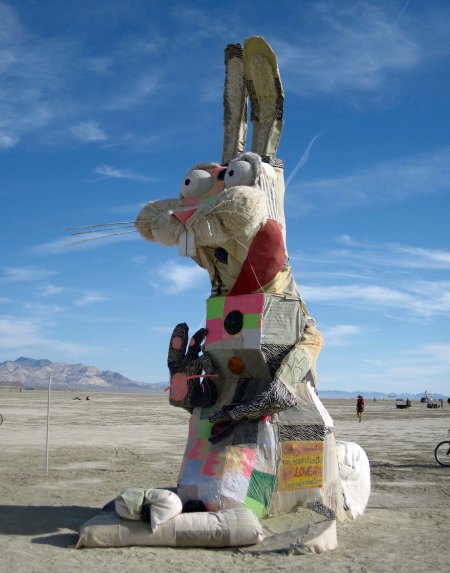
This huge rabbit out on the Playa had a message of love, transformation and living in the present. After staring at it for a moment, I thought it might also be a lesson in watching which brownies you eat at Burning Man. (Photo by Tom Lovering.)

I am going to wrap up my posts on whimsical and weird sculptures at Burning Man with something of a hodgepodge today. Bugs Bunny is a good place to start. I had looked at this sculpture from several angles before the rabbit made its sudden and obvious appearance. And I am pretty sure that is what the artist meant to happen. The big Alice in Wonderland type rabbit at the top was much less subtle!

I was thinking that this was a random, modern art kind of wood sculpture as I walked around it at Burning Man…

And then I came to this view and thought immediately of the ‘wascally wabbit,’ Bugs Bunny. For those of you not up on your cartoon history, “wascally wabbit’ is what Elmer Fudd called Bugs,

Our friend Tom Lovering took the photo of the zonked out rabbit at the top of the post. Here Tom is snuggling up to a Playa dinosaur. The look on Dino’s face is what led me to include it here with my whimsical and weird photos. It’s kind of the look of a puppy after it has puddled on your floor.

The dinosaur.

The bone tree has been around Burning Man for as long as I have, I think. At least I can never remember not seeing it since I first started in 2004. It lives at First Camp where most of the original organizers of the event hang out. The combination of skulls and bones place it in my weird category. Liking weird, it has always been a favorite of mine.

The Bone Tree at Burning Man is a regular at the event.

Here’s a close up.

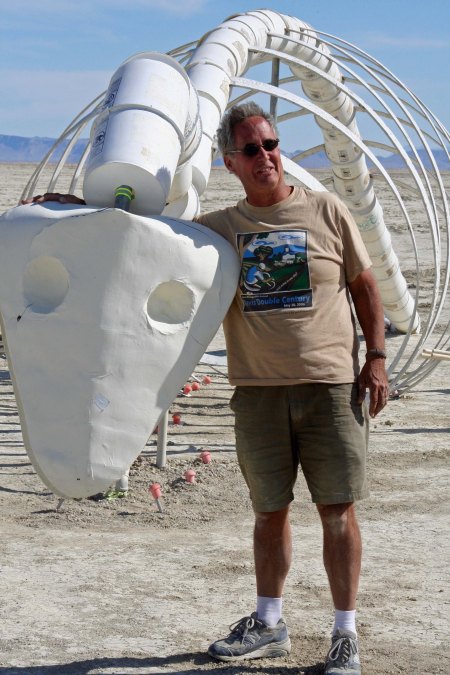
The Bone Tree comes with its own set of wheels so it can move around.

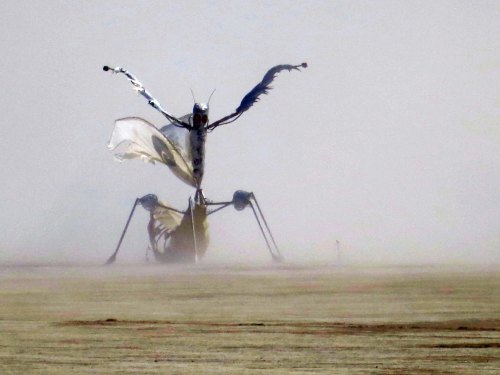
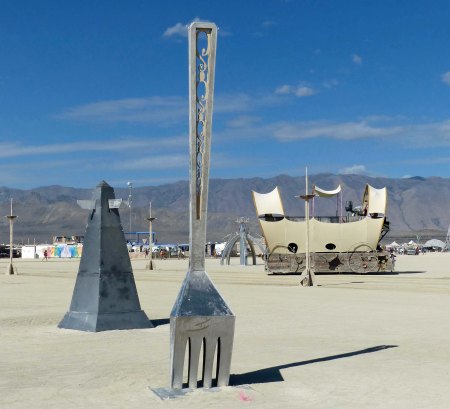
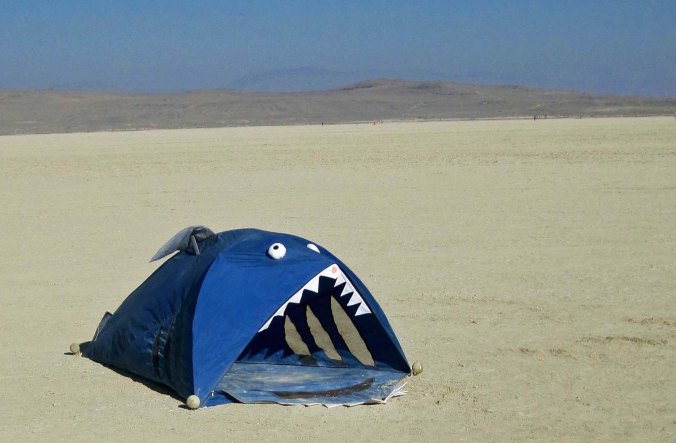
The old woman’s shoe, a fork of cork, an excitable mantis, metal devils, giant specks, and a couple of toothy sculptures finish out my selection for today.

“There was an old woman who lived in a shoe. She had so many children she didn’t no what to do.” I like to add ‘obviously.’ How would you like to have that guy outside your window? I’d be dialing 911!

Another view of the shoe.

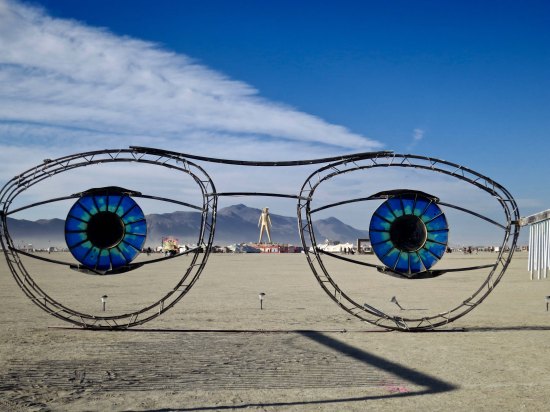
I thought these glasses with their blue eyes made an interesting sculpture. The Man can be seen in the distance.

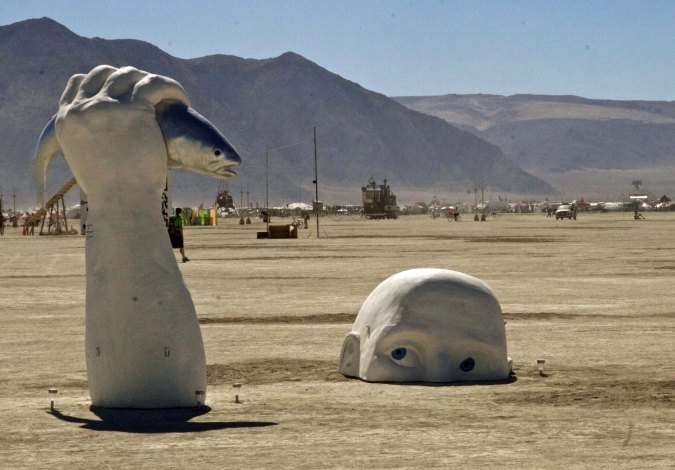
Does this fellow with his fish strike you as weird?

Metal devils seem to be a thing at Burning Man. The teeth are marvelous.

I was always pleased with the way I caught this fellow with his red background, especially the way it shows through his right eye. Evil!

And then there was this scary praying mantis that appeared out of a dust storm.

Its front legs are something else! I don’t think you would want a hug.

Okay, this is fun. It wouldn’t be nearly as much if you didn’t know that the fabulous bathrooms are porta-potties, which can be far from fabulous!

Have you ever seen a cork fork?

How about a fork in the road?

Definitely weird.

This little shark that found a home way out on the Playa just had to make it into this collection. I’ll close with it.

Have Aliens Landed at Burning Man?

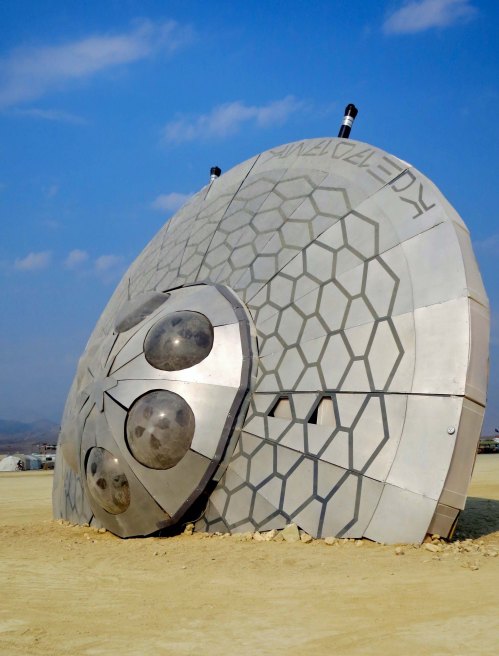
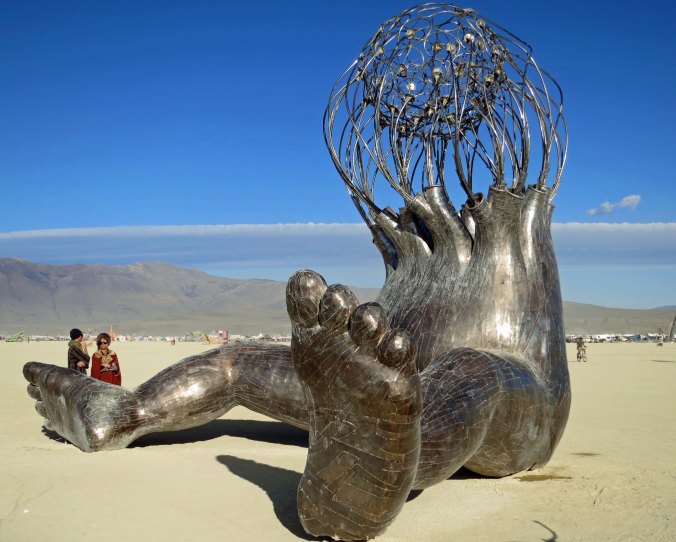
What better evidence could there be than a crashed UFO on the Playa that aliens are carefully monitoring Burning Man?


I am continuing my exploration of the humorous, whimsical and weird sculptures of Burning Man today and tomorrow. Today I want to focus on possible alien influence…


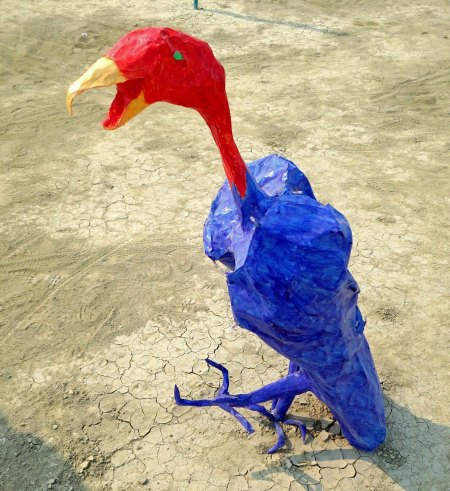
I saw a flying saucer once, so it is not surprising that I would assume this buzzard that I am petting came from outer space. (Photo by Peggy Mekemson.)

One of my blogging friends from Canada wonders what aliens from a UFO might think if they landed at Burning Man.  Would they feel right at home? Would anyone even recognize them? (Well here’s a secret, Sue, a top-secret, a ‘for the President’s eyes only’ type secret. They already have! Don’t tell anyone, however. There is dire punishment. You will be forced to cross the border and live at the White House.)

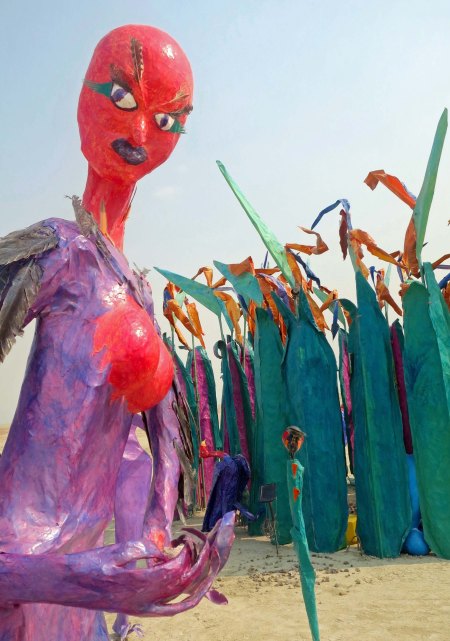
My post today features irrefutable proof of aliens at Burning Man. There are orange aliens and blue aliens and buzzard aliens. There are Burners who may or may not be aliens. Who would know? There are flying saucers and baby aliens and monster aliens. There are even alien robots. But most frightening of all, the most horrifying thing, is the alien BLOB.

And all of this is true, I swear. Or is that fake true?

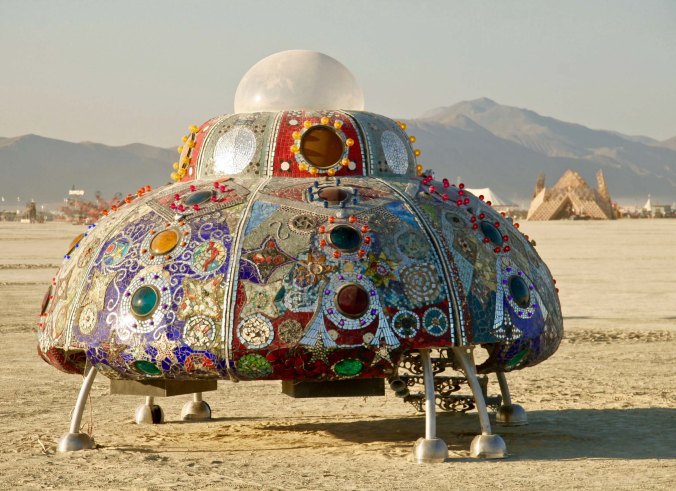
If further proof of alien presence at Burning Man is needed, consider this UFO. Before landing at Burning Man, it was seen in the Bay Area, and just about everyone knows that the Silicon Valley is under alien influence, not to mention UC Berkeley.

Alien robots are often found out in the Playa and in Black Rock City.

I wandered into a tent and was met by this fellow. Note the eyes on this fellow and on the guy above…

Now check out these eyes! This alien cycled into our camp and demanded a cold beer.

This monster robot and his alien dog (photo left) hung out in front of the Center Camp Cafe.

Who could ever deny that this monster came from another galaxy.

Or this alien baby?

Its mama, a famous ballet dancer on her planet, had stopped off at Burning Man several years earlier. She must have left an egg.

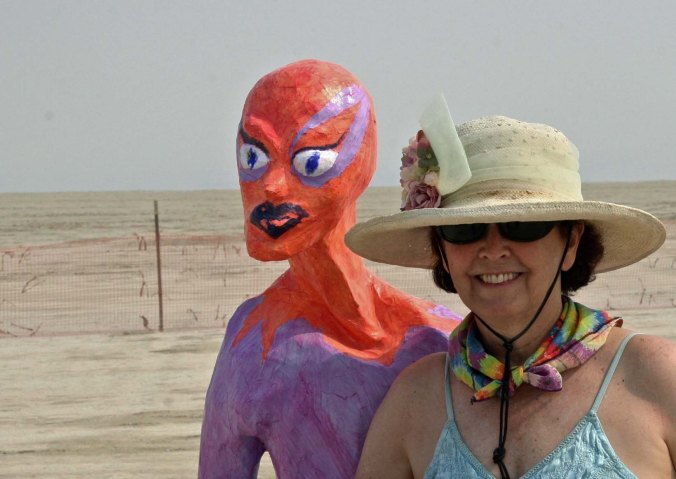
Peggy snuggled up with this orange alien for a photo. The fence in the background tells you that you have arrived at the Outer Limits of Burning Man, where you would expect aliens to hang out.

Sure enough, we soon found their camp.

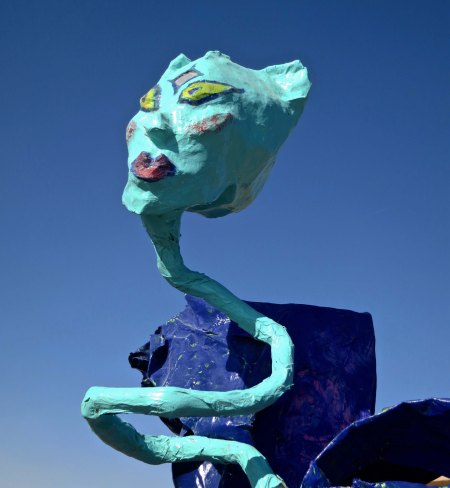
An alien cat…

And the alien buzzard I stopped to pet.

As for Burners (the inhabitants at Burning Man) it’s hard to tell who might be an alien. I figured this guy definitely had alien blood. Either that or he had just stuck his finger in a light socket.

There is no doubt about this purple man. It is rare that the aliens are so obvious.

Another obvious alien. This one had six limbs, two from her torso and four from her head.

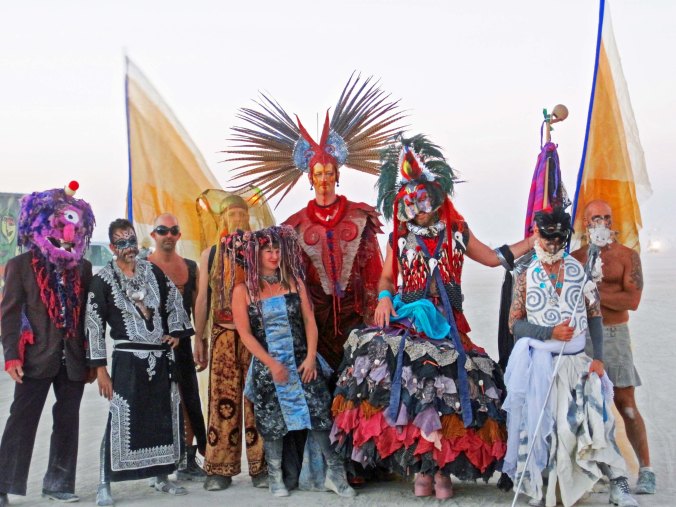
And don’t you just know that there have to be aliens in this group. The one on the left with his wild hair, limited vision, and small hands seemed the most suspicious to me.

And for my final proof, I submit this blob we found out on the playa one day. I am pretty sure that it is dedicated to reproduction and world domination.

Here’s a close up for my last photo of the day.

Tomorrow’s Blog: Another post on the humorous, whimsical and weird  sculptures of Burning Man.


A Big Bosomed Bee, Curious Cats, and Other Whimsical Art of Burning Man

I came across these cats a few years back way out on the Playa, about as far as you can get from Black Rock City and still be in the area fenced off for Burning Man. They definitely meet my description for whimsical.


It’s photo Friday for me where I put out a blog that is long on photography and short (or at least shorter) on words. I’ve been concentrating on Burning Man the past several weeks and will continue for a few more. I have my ticket for 2017 so I am excited. Hopefully next week, we will get a ticket for Peggy as well.


It isn’t just anywhere you would expect to find a big bosomed bee. But then again, you never know what to expect at Burning Man. Someone must have had a lot of fun crocheting the bra.


Having tackled the giant women of Burning Man, I’ve been thinking about what to feature next on Burning Man sculptures. Like mutant vehicles, there are so many it is difficult to choose and even harder to organize. I started by going through my photo library and picking out a few I thought might be of interest. That got me down to 1500. I think you can see my problem. “Okay, Curt, focus!” I admonished as I scrolled through the 1500 photos for the third time.

There are categories, sort of. They are totally arbitrary and from my perspective. But it’s a start. So today, I am going to feature what I find humorous, whimsical and weird, recognizing that the three are often combined in my mind. There are enough here that I will be presenting more over the weekend.

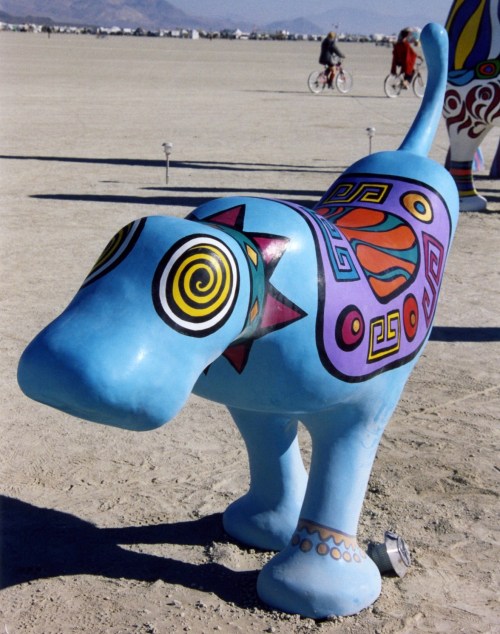
Dogs aren’t allowed at Burning Man, but they made an exception for this fellow in 2006.

My friend Ken decided that the dog was large enough to ride, but was a little confused as to the direction. Meanwhile, the dog’s family looked on, including…

Mr. Big Bottom…

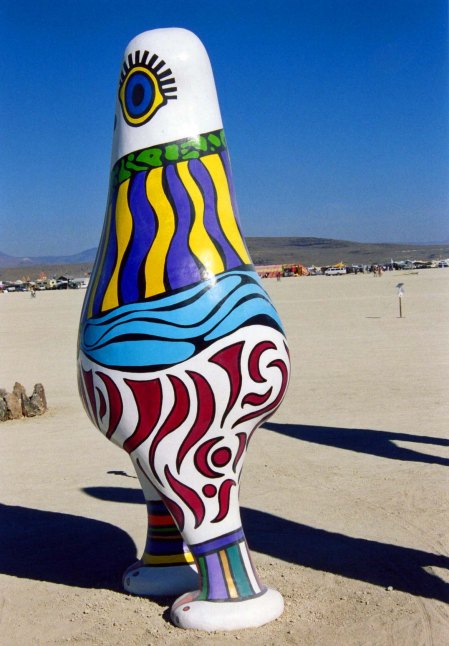
Miss Short Legs…

And Miss Long Legs.

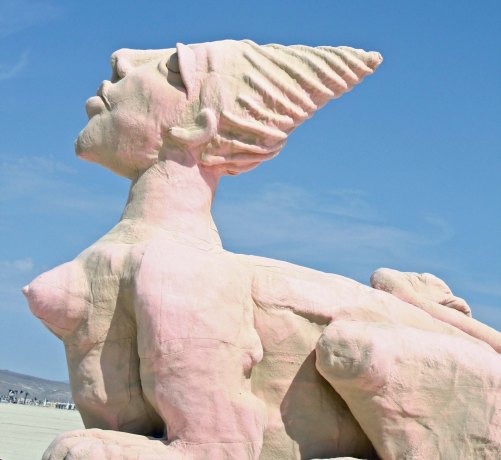
Pucker up…

And meet a suave Sphinx.

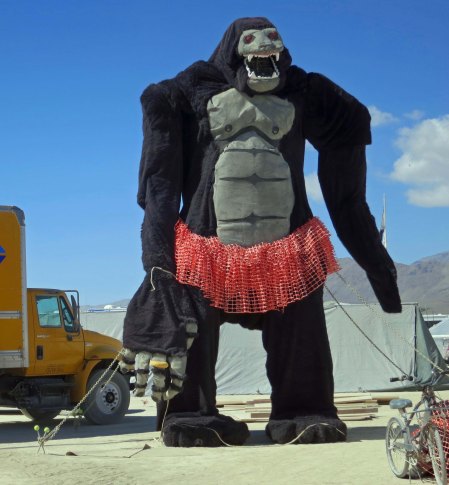
Ready for a little monkey business?

Or maybe some big monkey business? All dressed up in his pink tutu, Kong is ready to go out on the town.

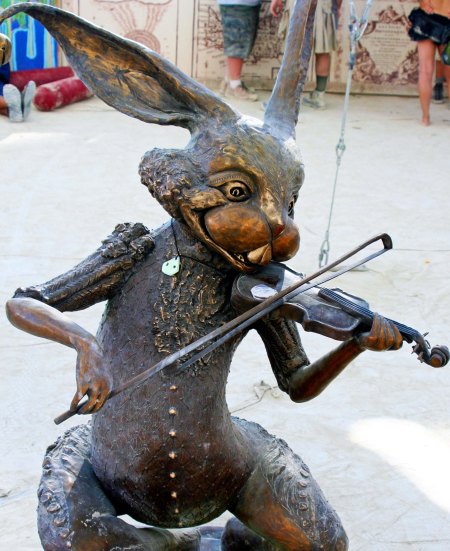
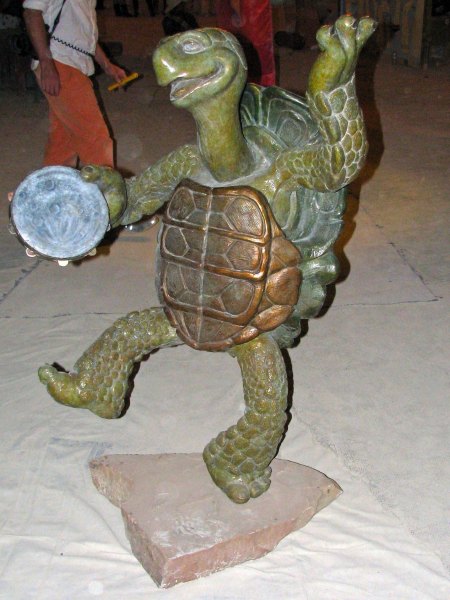
Do you want to dance?

The sound man is ready…

With his necklace of speakers.

The hare will fiddle… (Photo by our friend Don Green.)

And the turtle will dance with you. (Photo by Don Green.)

Tomorrow’s Blog: More humorous, whimsical, and weird Burning Man sculptures.


A Shoplifter, the Sheriff, and Dynamite… The Sierra Trek Series

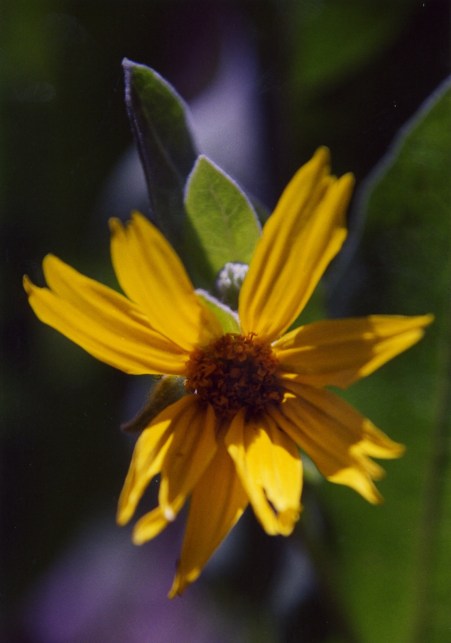
Tiger and Leopard Lilies are among the most beautiful flowers found in the Sierras and other California mountain ranges.


I’d actually had two good days on the Trek and we had put another 25 miles behind us. I was beginning to feel good, allowing myself an optimistic thought, or two. Foolish fellow. But we had passed the halfway mark. We were on our way home!

Today’s photos reflect some of the colorful  flowers that brighten our way as we hike through the Sierra Nevada Mountains.


Mule Ear flowers can fill dryer slopes.


On day six, we hiked into Foresthill, a small community 20 miles above Auburn. It was a long, hot, dusty, 15-mile hike in and out of steep river canyons with temperatures soaring over 100°F (37.7°C). Along the way we passed through Michigan Bluff, which had once been an important gold rush community. Leland Stanford got his start here, running a grocery store for miners. It was a much surer way of striking it rich than gold panning. For example, eggs cost $3 apiece. Expensive huh? Taking inflation into consideration, the price would shoot up to $80 today.

Stanford continued to prove his smarts. His future included becoming one of the Big Four in building the Transcontinental Railroad, serving as the Governor of California and a US Senator, and giving Stanford University its name.

Monkey Flowers are always a favorite of mine and are usually found near streams. You can enjoy their beauty while refilling your water bottle.

In Foresthill, we had arranged to stay in the little city park that came with a swimming pool. Given the excessive heat of the day, it was something to look forward to. I certainly did. But my plunge into the refreshing water was not to be.

First I had to make sure we could find our way out of town and back onto the trail the next morning. We were now into the territory that Steve and I hadn’t reviewed— me because I was off on Vancouver Island deciding on my future with Jo Ann, and Steve because who knows why. I hiked out of town for a mile or so down the road until I found the trail and then followed it for another half mile. It seemed well-marked, so I said a little prayer to the trail gods and headed back toward camp. It would be Steve’s job to lead the next day. He would have to deal with any surprises.

Shooting Stars are one of the early flowers, coming up soon after snow has melted. They are all over our property now.

Back in camp, the situation quickly made me wish I had just kept hiking. Charlie made a beeline for me. My always dependable backup, ex ice hockey player, ex-bomb de-fuser and IRS dodger looked like he was about to break down and cry.

“Someone stole my Grandfather’s watch,” he blurted out.

It was a valuable family heirloom, precious to him. I did what I could to console Charlie and headed over to the pool to ask around. None of my Trekkers had seen anything suspicious or had even seen Charlie’s watch. I had a hard time imagining any of them stealing it. He had done everything possible to help them down the trail. There were other folks at the pool, however. Fortunately, as I recall, Charlie found the watch at his campsite, where he had left it.

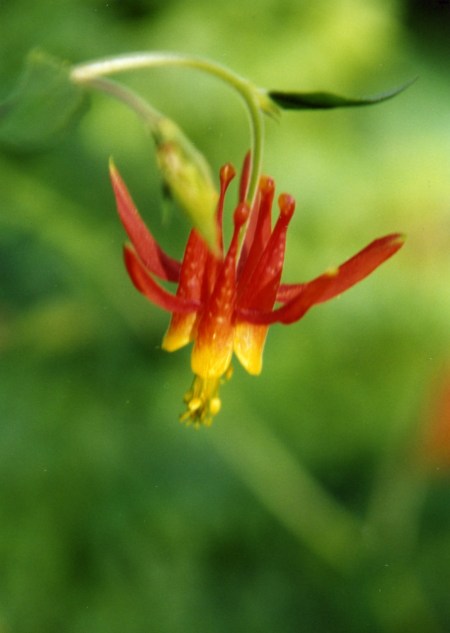
Columbine with its unique shape.

My next challenge was Lose Yourself Dick, the forty something school teacher who had wandered off on his own. He had tackled his ample supply of snake bite medicine and was feeling no pain. In fact, he was challenging all of the teenage boys to wrestle him or at least jump on his stomach. I was sorely tempted to join the latter activity. He had also discovered a flagpole he insisted on climbing. I reasoned with him as best I could, but even when he was sober persuading Dick not to do something was close to impossible. I had just completed my highly ineffective effort when a Sheriff’s car came cruising in to camp. I walked over. One of our Trekkers was sitting in the back seat.

The Mariposa Lily is another member of the lily family. Its bulb was eaten by Native Americans and early pioneers.

“Can I help you?” I asked politely.

“Yes,” the Deputy Sheriff had responded, “I need to talk with the person in charge.”

I had another of those gut-wrenching feelings. Just three more days, I thought. Just get me through three more days. I desperately wanted to tell the deputy that the man in charge had checked out and gone home or was still on the trail.

“You’ve found him,” I said, putting on a brave smile.

“We just caught this young woman shoplifting,” the deputy reported in his official lawman voice.

“Shit!” I thought. But I said, “Okay, what do I need to do about it?” My unhappiness and resignation must have shown.

“Nothing this time,” he replied. “Because she is raising money for the American Lung Association, we are going to let her off with a warning.”

And me as well, I read into his statement. “I am sorry, Curt,” she had apologized and I had just sighed.

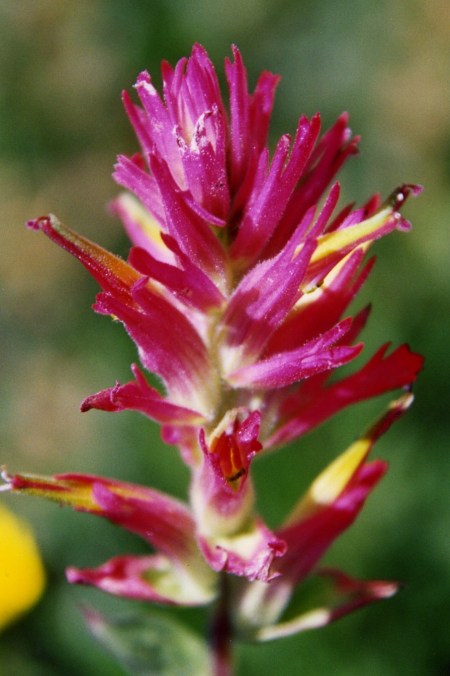
Indian Paintbrush is a colorful and common flower of the West.

Could anything else go wrong? Of course it could and likely would. I escaped by leaving camp when Steve came in and wandered off to a restaurant in town where I wasn’t likely to find any Trekkers. I drowned my sorrows in a large steak and a couple of well-earned beers. I seriously considered drinking more but I let my commitment to getting the Trekkers back to Sacramento in one piece over-rule my temporary insanity, which was demanding a six-pack.

Fleabane is the unusual name for this many petaled flower.

We rolled our Trekkers out of Foresthill early the next morning. I breathed a sigh of relief as I followed the last one past the city limits. Once again, Steve was leading and I was playing rear guard.

Fortunately, we had a short day. I had quickly discovered that being trail leader was a lot more fun than being rear guard. For one thing, you tended to get into camp a couple of hours earlier. For another, you weren’t constantly being bombarded by the question, “How much farther?” I had begun to respond with a stock answer, “Oh, it’s about twenty miles,” and had found that Trekkers stopped asking. If they persisted, my next response was, “It’s all up hill.”

Steve told me he had been moving some of the slowest Trekkers down the trail by telling them rattlesnake and bear stories and then walking on ahead. He said people made a real effort to keep up. Years later I would use the same technique in Alaska  with grizzlies. I suspect that neither of us would have qualified for the Boy Scout Leader Seal of Approval. Or even the Sierra Club’s.

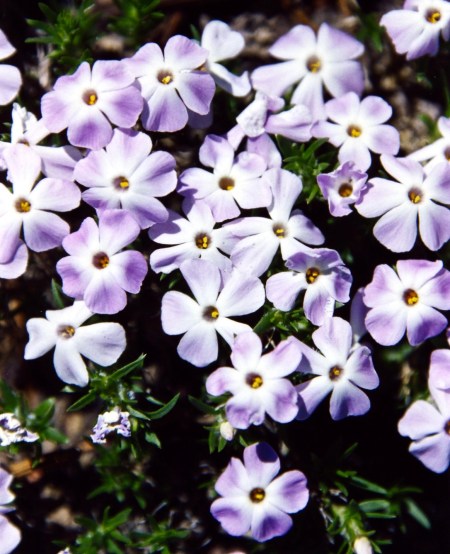
Phlox hug the ground and add a real splash of color.

Around three, I came on Steve and our Trekkers milling about a closed gate. A vehicle was parked behind the gate and two official looking people were leaning against the vehicle. I was about to learn that we were paying the price for not reviewing the final section of the trail.

“What’s up Steve?” I asked, wondering if we had managed to do something else to bring officialdom down on our heads.

“No problem,” Steve said, “they are just blasting with dynamite in the canyon.”

His words were punctuated by a rumbling sound. The guards were blocking the road so big rocks wouldn’t come rolling down on people using the canyon trails. It sounded like a good idea. In 1974, plans were underway for building the Auburn Dam and flooding another section of the beautiful American River. Land speculators were greedily selling property along the future edge of the lake. Later, building or not building the dam became one of the most contentious environmental issues in Northern California. The dam still isn’t built, and will likely never be.

“Um, how long do they plan on continuing to blast?” I asked. I pictured our Trek coming to an abrupt end. It wasn’t a totally unpleasant thought.

“We are in luck,” Steve reported. “They are just closing down their operations and won’t resume until Monday.”

Since it was Friday afternoon and we would be out of the canyon by Sunday, I had to agree. It was refreshing to see luck lean our way, although it made me nervous. That night we celebrated the winding down of our adventure by feeding our Trekkers steak and fresh salad. The feast went off without a hitch except it was amusing to see the Trekkers eat steaks out of bowls with spoons. (Forks, knives and plates normally get left behind when backpacking.) Fingers became the primary eating utensil. It wasn’t pretty, but no one seemed to mind. Civilization had definitely taken several steps backward. Everyone went to bed happy, including me.

The Sierra Thistle can be a little prickly.

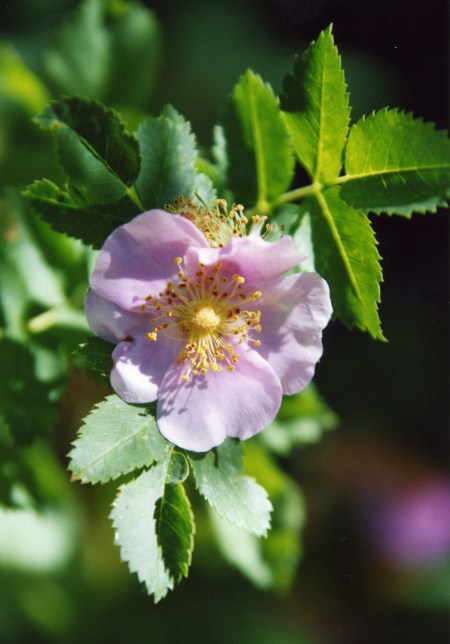
I’ll close today with a wild rose.

NEXT BLOGS:

Friday: You are in for a treat. Lots and lots of fun and unique Burning Man sculptures.

Monday: Still thinking about it.

Wednesday: The final Sierra Trek blog.

Something Fishy… The Sealife Aquarium in Charlotte, North Carolina

We met this handsome Nautilus at the Sealife Aquarium in Charlotte, N.C.

I wasn’t expecting much from the Sealife Aquarium in Charlotte, North Carolina. It wasn’t because it was in Charlotte. After all, I had already been to the city’s small but impressive aviation museum that housed the plane that Captain Sully landed on the Hudson River. No, my prejudice was based on the fact that the aquarium was located in a shopping mall. I also had a slight bit of snobbishness because my go-to place for watching sea life up-close-and-personal is the Monterey Bay Aquarium in California, recognized as one of the world’s best.

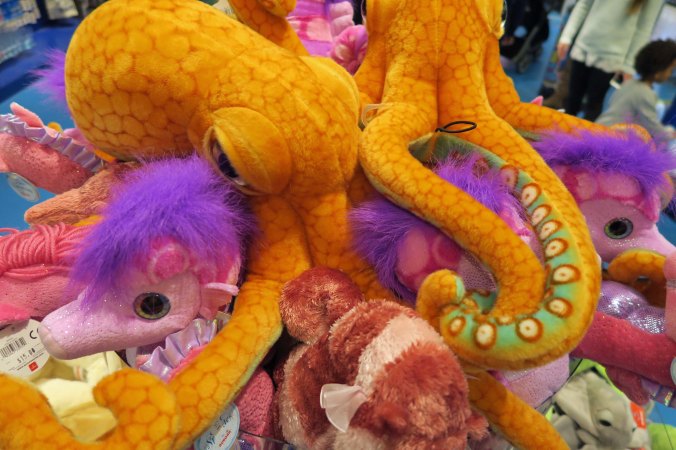
I did expect that the gift shop at the aquarium with its shopping center location would be packed with sea life made for snuggling.

Like how can you resist these eyes?

I am pretty sure that this octopus had a thing for seahorses.

None of this mattered, however. Peggy and I were on an outing with our grandkids Ethan and Cody, our daughter Tasha and her husband Clay. The aquarium was simply an excuse, something that the kids would probably get a kick out of. When I was their age, chasing crawdads in Webber Creek for our cookpot at home was about as exciting as life got. The little buggers had tiny claws that could pinch. They’d zip under rocks backwards so their weapons were facing out. I was cautious. Who knows what my reaction might have been had I come face to face with an actual shark.

Ethan and I share a moment in front of the major aquarium while a small shark and other fish swim by. (Photo by Peggy Mekemson.)

Our daughter Tasha with Cody. (Photo by Peggy Mekemson.)

The whole family (Cody, Peggy, Tasha, Clay and Ethan) poses in this ‘under sea’ shot.

Some Jaws music please. While Webber Creek had its share of crawdads, trout, and suckers, there were no sharks like this one at the aquarium. Had there been, I expect some of our old swimming holes wouldn’t have been old swimming holes.

So, I was surprised when we entered the museum. It wasn’t the Monterey Bay Aquarium, but it was pretty darn good. The display tanks were well done, the sea life plenteous, and the educational materials informative. I had as much fun as Ethan and Cody. I was also impressed that the aquarium had a strong conservation/environmental-action element to it. Here are a few of the sea creatures we met and enjoyed:

Peggy caught this Lionfish. It’s easy to see why it is a popular fish in home aquariums.

Here’s my shot of the lion fish. An old anchor cuts across the right of the photo.

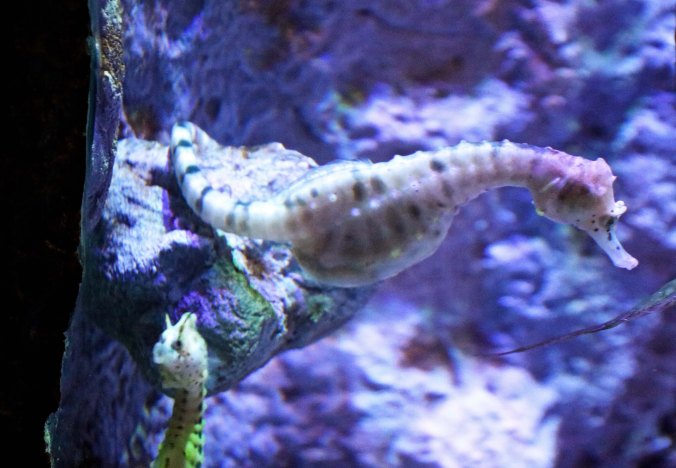
I didn’t know that seahorses had freckles. They always look pregnant to me. The one on the lower left looks like it is puckering up for a kiss. (Photo by Peggy Mekemson.)

I like the way seahorses are always wrapping their tails around something, including each other. Question: Are several seahorses known as a herd like horses or a school like fish?

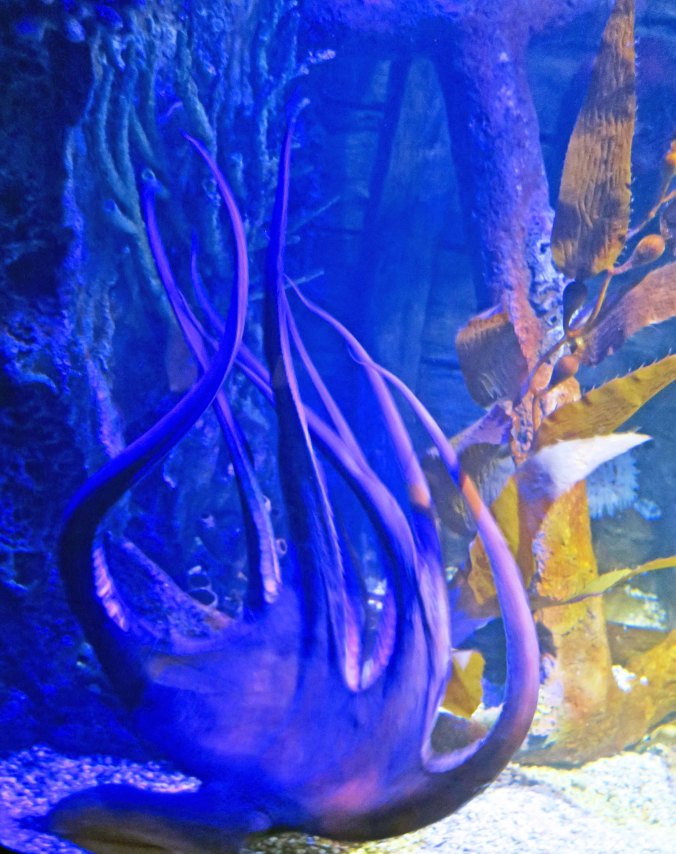
Weird. This appears to be an octopus that Peggy photographed. Maybe it flies.

My own octopus was a little weird as well. It appears to be doing a face plant.

I was really impressed with the colorful, ocean-like setting of the aquarium. An angel fish, fins aflutter, checks me out.

This spiny lobster did not meet my definition of what lobsters should look like. Where are the big, edible claws? When I looked this up, I also learned that our crawdads were in the lobster family! No wonder their tiny tails tasted so sweet.

This common sea-snail also goes by the name of marine gastropod. I wonder if it prefers the fancier name? Anybody who has played in tide pools knows that hermit crabs love to borrow these shells for their homes, preferably once the snail has vacated the premises.

A stingray with its potent, poisonous tail. The general rule is that if you leave them alone, they are happy to leave you alone. You don’t want to step on one however.

Nor do you want to mess with this fellow, a moray eel. Divers feed them on occasion. Not smart. They also lose their fingers on occasion. It’s like feeding a hotdog to a bear. Also not smart. Where does the hotdog end and the fingers begin?

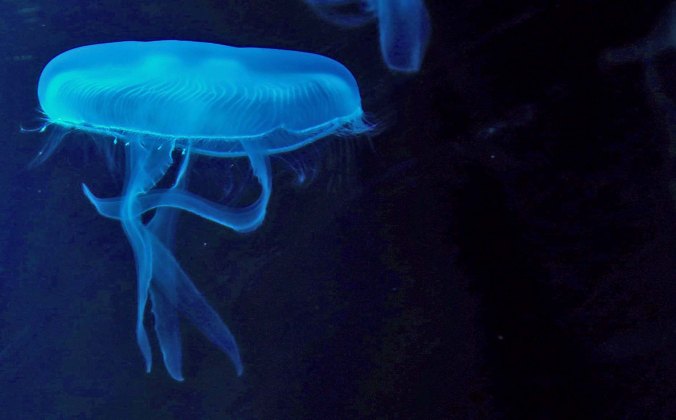
Many aquariums have learned the magic of adding jellyfish tanks and adding colored lights for effects.

As beautiful as they are, they also pack quite a wallop if you manage to come in contact, a lesson I sadly learned when I was swimming in the Indian Ocean off the coast of East Africa.

I’ll conclude our visit to the Sealife Aquarium in Charlotte with these beauties.


NEXT BLOG: The next to the last installment of my Sierra Trek Series. As we enter the foothills on our backpack trip across the Sierra Nevada Mountain Range, temperatures climb above 100 and one of my participants decides to go shoplifting in the foothill town of Foresthill. Hello Sheriff!


A Tiger and Headhunters: Flying Across the Hump… Part 3 of 3

The plane John Dallen was flying across the Hump in World War II crashed in Manipur and John walked out.

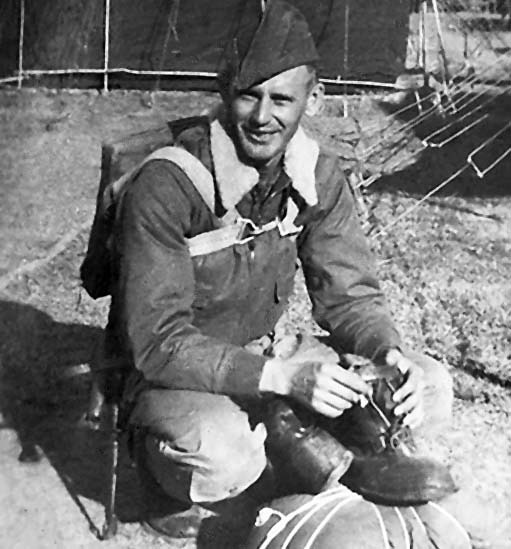
This photo was taken of John immediately after he walked out of the jungle when his plane crashed while he was flying the Hump in World War II. He is holding the boots he wore. His parachute pack is in front.


This is my final post on Peggy’s dad, John Dallen, when he was forced to bail out into Burma jungle when returning from a flight into China across the Himalayan Mountains. 


“The conditions were at their worst—raining, pitch black and over territory regarded as plenty rugged. I landed in a jungle so dense that I couldn’t even move. The only sensible thing to do was to pull part of the parachute over me and try to catch some sleep.”

John Dallen in a letter to his wife Helen on February 18, 1945— eight days after he had parachuted out of his damaged C-109 over an Indian jungle when flying the Hump in World War II.

Saturday, February 10, 1945

I left John in my last post as he jumped into the pitch-black night and watched his plane erupt in flames as it went down. Below him was a jungle he couldn’t see. “I had no idea of what I was jumping into,” he reported to his niece Jennifer Hagedorn Mikacich in an oral history. “I hit one layer of the jungle, and then a second, and then a third— crashing through each one and hit the ground hard.” John was battered and bruised but not seriously injured. It was close to midnight.

Catching his breath, and I suspect calming what had to be raw nerves, he pulled out his 45 caliber pistol and fired it into air. John was hoping for a response from his crew members; there was nothing. They had either landed too far away or couldn’t respond. They might be hanging in a tree 100-feet off the ground.

Caught in undergrowth so thick he could barely move, he gathered his parachute around him to stay as dry as possible and tried “to catch some sleep.” At some point in the night he heard a tiger cough.

“Weren’t you afraid, Grandpa?” Jennifer asked.

“I was uneasy,” he confessed some 40 years afterwards. This was Bengal Tiger country and the big males could weigh over 500 pounds and be up 10 feet long. A few, usually older ones who had difficulty catching prey, turned into man-eaters. John had actually seen a record size Bengal Tiger that had been killed because it had been preying on livestock. I’m sure he pictured it in his mind when the tiger coughed.

But John had other concerns as well. The plane had crashed near Nagaland and the Naga were renowned as headhunters. Hump pilots dreaded landing in their territory. The army manual for jungle survival in World War II stated that there were only two areas in Asia where soldiers had to worry about natives: “in New Guinea and certain parts of Burma.” He was quite close to those “certain parts of Burma.” In fact the Naga had a significant presence in the state of Manipur, where his plane had gone down.

Ursula Bower, a pioneering anthropologist in the Naga Hills who became a guerrilla fighter against the Japanese in World War II, noted, “most villages had a skull house and each man in the village was expected to contribute to the collection… There is nothing more glorious for a Naga than victory in battle and bringing home the severed head of an enemy.” Men who failed, she noted, were known as cows. Head hunting by the Naga would continue up until the 1970s and possibly even 80s. John was wise to worry about keeping his head.

A third concern of John’s was that local villagers might turn him over to the Japanese. The US offered rewards to natives who helped downed crews get back to American bases, but the Japanese had a similar program. John might believe he was being led to safety when actually he was being led into a trap.

Sunday, February 11, 1945

All of these thoughts were going through John’s mind the next morning when he awoke at first light and made a pack out of his parachute to carry his Army-issued jungle survival kit. It contained, among other things, water purification tablets, anti-malaria pills, and sulfonamide, the first of the ‘miracle’ drugs discovered that fought bacterial infection. John would use all three. Other standard items in the kit included matches, a compass, a signaling mirror, bouillon/tea, and even fishing gear.

John knew he had to travel west to find US bases and safety. The Japanese were to the east, the Naga to the north, and more jungle to the south. Travelling west was a challenge, however. There are no landmarks in a jungle, only trees and more trees. It is easy to end up traveling in circles. Fortunately, John had a compass and the sun to serve as guides. He also had Boy Scout training, which he would credit later with helping him find his way.

“Part the jungle, don’t push it,” the Army’s World War II jungle survival manual urged. “Keep your head up and your chin in. Try to follow a stream downstream, and try as far as possible to stick to natural trails, or native trails. Don’t try to break your way through.” The best trails, apparently, were elephant trails, jungle freeways three to four feet wide.

John followed the advice— sort of. “I hacked my way through the mess for several hours.” It would have been excruciatingly slow going; especially since the only thing he had to hack with were his hands. The jungle was close to impenetrable. Numerous scratches on his face and hands joined his bruises from the night before. Eventually, he found an animal path that led him to a trail that showed human footprints. And the trail led to a small village.

The natives looked quite “primitive,” and dangerous. Armed with machetes, they were dressed only in loincloths. Animal tusks and silver jewelry adorned their ears and body. It seemed, however, that they were friendly. John could keep his head. While none of them spoke English, “A native boy kept pointing in a general direction, which I assumed was the direction for me to follow. He led the way and I gradually picked up quite a following of natives.”

After passing through several small villages, John and his parade came to a village of about 75 inhabitants, where a surprise was waiting: one very excited and worried, co-pilot, Ronald Anderson. “Ron was a big guy, an ex-football player,” John reported. But he hadn’t had John’s luck. His parachute had become entangled in a tree and Ron had to cut himself free, leaving the parachute with its survival kit hanging high above his head. He was genuinely shaken up. Like John, he was battered, bruised and scratched, but he had no serious injuries.

The villagers took John and Ronald to the village headman. Fortunately, a villager was found who could speak some English. Food was generously offered, but John had no idea of what he might be eating; he stuck to bananas and rice. It seems that Ron was equally conservative. That night they slept on sleeping mats next to the headman. Somewhat humorously, John reported in his letter to Helen, “This type of sleeping is ideal for the figure, and even I was sore all over the next morning.”

Monday, February 12, 1945

The headman offered to guide John and Ron on to another village and John woke up early, eager to get started. But he didn’t dare get up.

“I had to pretend sleep because the women of the household were preparing their food in the same room where we were. There are castes in India where the women cannot associate with the men—-especially outsiders— and had I shown signs of awakening, they would have left the room. Eventually they finished and we got up at which time we were offered more rice and the native tea. It is made from a spiced leaf and the liquid content is mostly goat’s milk. I did not touch the rice that morning but did finish the banana from the previous day.” He didn’t report on whether he drank the tea, but he must have been ravenous. At six-foot-two and 150 pounds, John was a skinny guy without an ounce of fat.

When they finally hit the trail, it immediately disappeared into the jungle. They were forced to hike cross-country. Adding to the difficulty of the route, it started to rain again. “We waded down streams for miles and crawled up and down practically impossible hills. Several times we heard planes overhead, but could make no attempt to signal to them because of the thick jungle vegetation overhead.”

(By 1945, sophisticated search and rescue efforts were under way, but the majority of crews that survived crashes still walked out on their own. Many airmen shared John’s experience. During the first three months of 1945 alone, 92 planes crashed while flying the Hump.)

A small village provided a lunch of two hard-boiled eggs. Afterwards, their guides were reluctant to start again. So was John’s co-pilot. The difficult route had begun to wear on him. “Here’s where that Infantry training paid everlasting dividends,” John observed. He was pushing hard, and he was a fast hiker.

“Several times I thought of pulling out my pistol and shooting him.” Ron claimed after they had returned to base.

They arrived at their next destination just at dusk and made a meal of “tea, oranges, bananas, eggs and even cigarettes, such as they were.” The natives were eager to help and would not accept any payment. They were “curious about our complexion, clothes and equipment.” John was amused when a few of the natives tried to break strands from the parachute with their hands. “The look of surprise on their faces was something to see.”

John had even more powerful magic. He was taken to a man whom a tiger had mauled. He treated the wound with sulfonamide. Gangrene had set in, however. John doubted the medicine would do much good, but the villagers were grateful for his effort.

Tuesday, February 13, 1945

“The day’s trip was a repetition of the previous day, possibly a little harder since our muscles were already sore,” John wrote to Helen. At noon they arrived at a village where they met the first and only native “who did not cooperate with us wholeheartedly.” The man had an “extremely mercenary attitude” and wanted to be paid for help. Obviously John and Ron were getting close to civilization.

That night they arrived at a village that was an outpost of the Indian police but the two police officials were away. A young Moslem merchant invited them to his home and fed them nuts and dates while they had “quite the gabfest on India and the British.” They slept that night in the jail under mosquito netting the merchant had loaned them.

Wednesday, February 14, 1945 (I wonder if John realized it was Valentine’s Day?)

The young Moslem provided John and his co-pilot with breakfast the next morning and John provided their host with Atabrine tablets for an attack of malaria he was suffering from. Their host also had another request. Since “most of the natives had never seen a pistol or seen it operate, he asked us to fire a few rounds. When both of us opened up at rapid fire, half of the villagers ran away in alarm— It even frightened our friend.”

With an option of continuing the trip by boat or walking, John chose walking since it would get them out faster. Travelling over relatively flat ground, they hiked 16 miles in 5 hours and arrived at a village where a sub-inspector of police was stationed. A telegraph line ran out of the village and John was able to send a telegram to his CO that he and his co-pilot were alive and well.

Their host that night provided them with their first bath since their ordeal started: “out of a pail of course, but at least the water was hot.” He also offered “some food other than the fruit prepared in a manner we could eat… He had cauliflower tips French fried crisp in butter that was exceptionally good.” John urged Helen to cook some up for herself.

That evening they ended up with a long discussion about India and her problems. “Our British allies ears would burn had they heard some of the opinions expressed about them.” John noted.   After eating again, they ‘hit the sack’. “Our host proved that snoring is a universal custom.”

Thursday, February 15, 1945

The trip the next morning had a twist. They rode on an elephant. “I believe it was the hardest part of the trip,” John whined to Helen. “The animal is rather broad-beamed as you can imagine and even my legs couldn’t quite make the spread.” He jokingly reported in his oral interview with Jennifer that he was “worried for his manhood.”

An English tea plantation was waiting for him at the end of the journey, however. John found it “remarkable to find a veritable mansion stuck in this wilderness.” A drink was immediately placed in his hand and a meal ordered. “The house was spotless with beautiful furniture and silverware all around. There were acres of lawn, flowerbeds and even a stable of polo ponies. The servants were perfectly trained and dressed as if from a scene in Arabian Nights.”

Even more welcoming, after they had washed up and eaten, the plantation manager gave them a ride in his truck to the nearby airbase of Shamshernagar. The ordeal had ended.

John’s first acts were to borrow some clean clothes and have a hot shower. After “a meal of real American food and not a few drinks under my belt, I dropped you a line which I certainly hope reached you in the fastest possible time.”

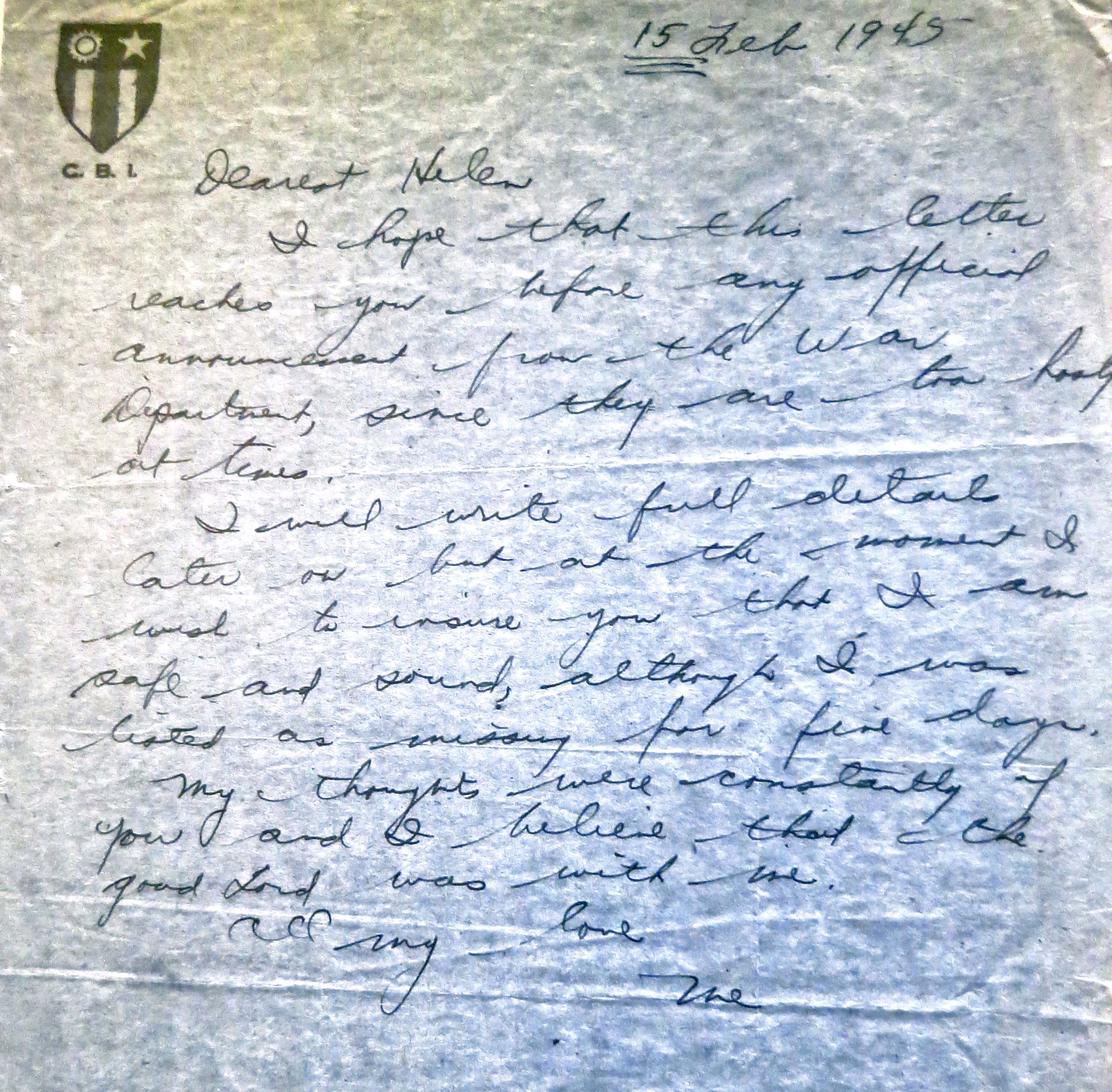
The letter tag John wrote to Helen immediately after walking out from the airplane crash.

The letter that John wrote to Helen immediately after walking out from the airplane crash. He had hoped that the letter would reach her before the telegram announcing that he was missing in action. It didn’t.

On returning to his base at Kurmitola, John learned that “the rest of my crew turned up a few days later after having a much easier time of it. They landed on a mountainside and had practically a road all the way to a base. As a matter of fact the last few days were a lark to them, having spent them at a most hospitable tea planter’s estate. Personal servants, meals in bed, etc. I could kick myself for having worried about them so much.”

John was given a week’s R&R in Ceylon and then returned to his flying duties. He would fly 55 more missions across the Hump. On July 26 he transferred to Tezgaon (now in Bangladesh). Every flight from that point on was in a C-54. His last flights were on September 26, 1945 from Shanghai to Liuchow to Tezgaon, piloting a C-54 for seven hours of daylight flying, four of nighttime flying, with two hours on instruments. He had logged 2788 hours since his first student flight.

I would like to conclude with a special thank you to John’s son, John Dallen Jr., our son, Tony Lumpkin, and my friend Mike Sweeney for helping in the research for my three blogs on the Hump pilots.
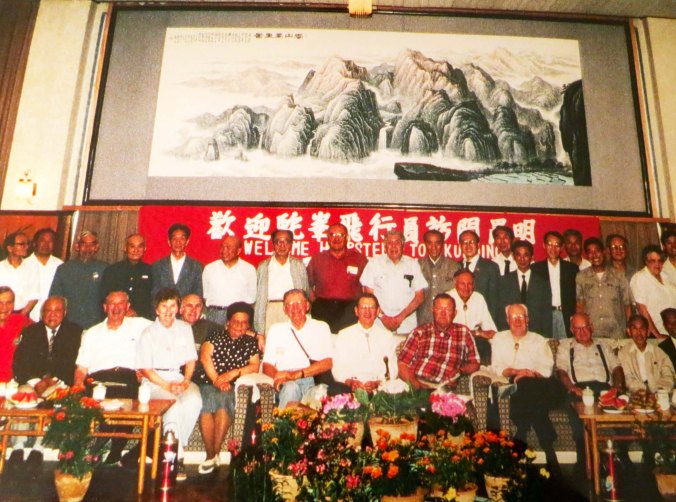
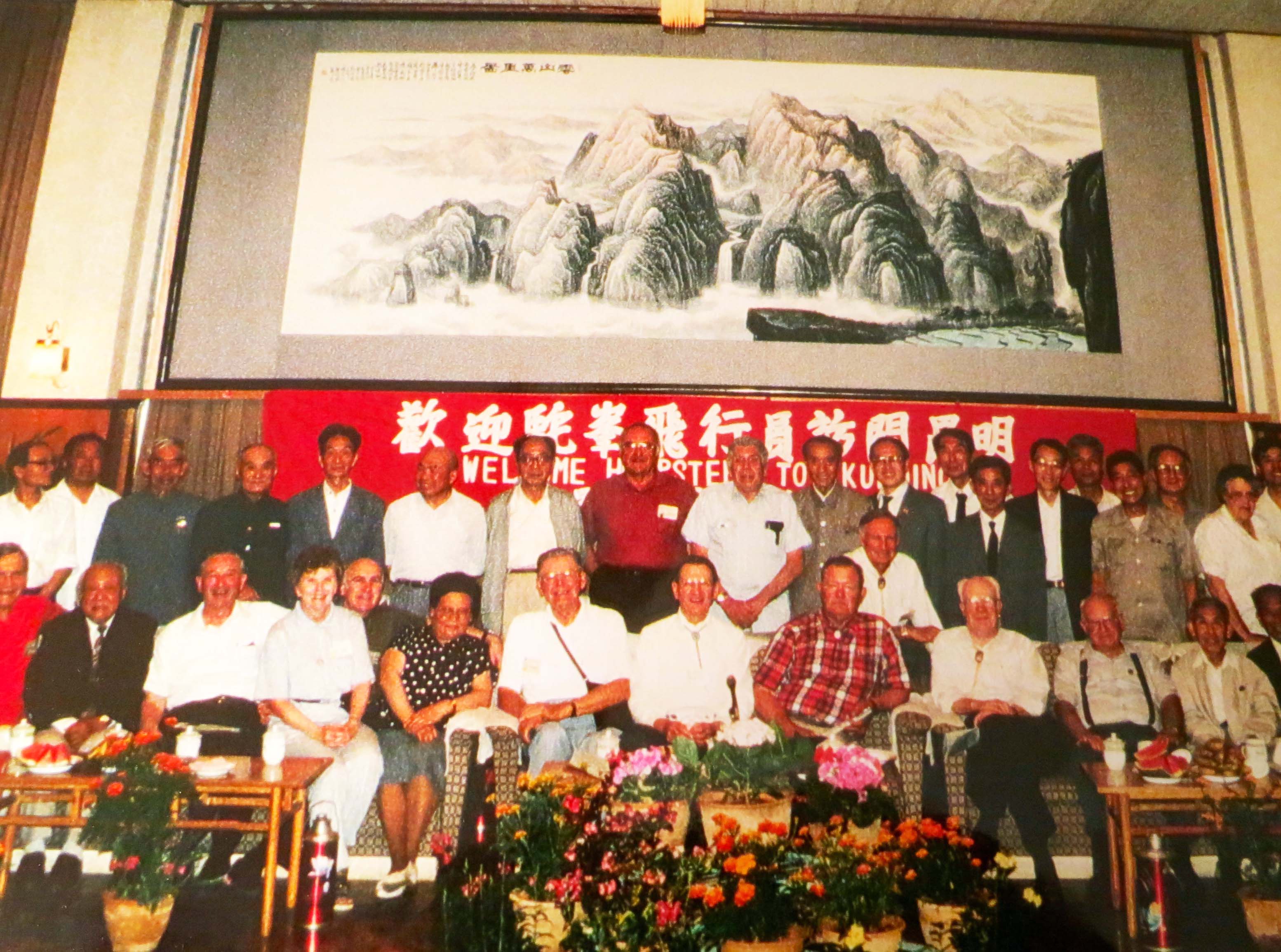
Hump pilots from World War II being honored in China in 1996.

In 1996 China invited Hump pilots and crews back to China to honor their World War II efforts and establish a memorial in Kunming. John is in the middle of the lower row next to the woman with the dark blouse.
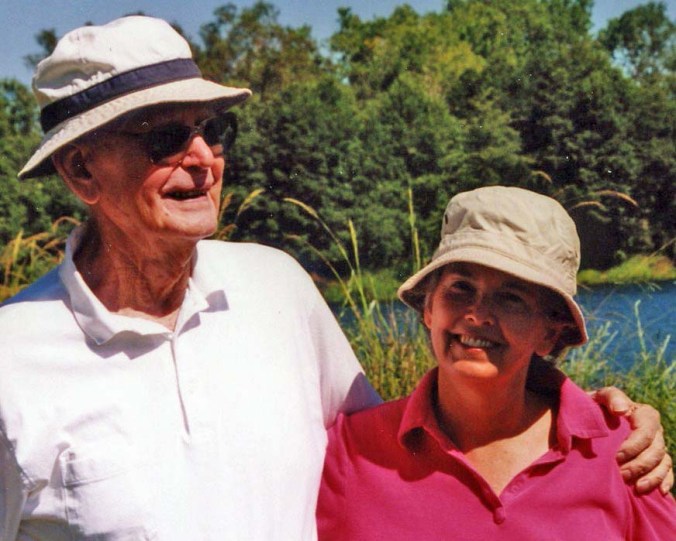
John and Peggy on the American River in 2006. Every Wednesday, I was privileged to pick John up and take him for a walk on the river. Even in his late 80's, he still loved to hike.

John and Peggy on the American River in Sacramento in 2006. Every Wednesday, I was privileged to pick John up and take him for a walk on the river. Even in his late 80’s, he still loved to hike.