A Genuine Fake Watch: Kusadasi, Turkey… Armchair Travel

Fake has taken on an interesting connotation today that has little to do with its original meaning. When Peggy and I visited Turkey in 2013 it was a different era, however. We were amused when a store was offering genuine fake watches at a price that matched. I almost bought one because of the honesty, which I’m sure was the idea. On Wednesday, we visited the impressive ruins of Ephesus. Today I will take you to Kusadasi, the land of expensive rugs and real fakes as I continue to dig into my archived blogs for armchair travel in the time of Covid-19.

Dozens of Turkish rugs were scattered on the floor in Kusadasi, Turkey, thrown out in a frenzy of encouraging us to buy.

The rugs were flying, quite literally, and landing on the floor in front of us. Twenty minutes earlier they had been neatly rolled up at the back of the room. Now five Turkish rug salesmen were expertly flipping them out onto the floor, a new one every ten seconds. We had been wined; we had been dined; we had been educated. Now the final push was on, the push to get us alone in a room where more multi-thousand dollar rugs would be thrown at us in hopes we would eagerly pull out our credit card with the highest limit.

Part of the show was an interesting demonstration on how carpets are made. Hundreds of hours are involved.
Part of the show was an interesting demonstration in the craft of carpet weaving. Fine rugs can take over a year to complete.

Peggy was ready. The falling rugs had hypnotized her. Her eyes were glazing over and she was levitating out of her seat as a handsome dark-eyed Turk wooed her with fine words. The last time I had seen that look we had ended up with a timeshare in Mexico. This time I was fortified, however. When the salesmen was passing out drinks to soften us up, I was one of two from our tour group of 30 who ordered arak or raki, the unsweetened Middle-Eastern anise drink with the smell of turpentine and the kick of a mule.

I admit the rugs were beautiful works of art, but I was arak strong. Our cabin in the woods of Southern Oregon did not need a Turkish carpet. “I’m sorry,” Peggy explained to her new best friend. “My husband doesn’t want a rug.” I was truly the bad guy in this scenario and the salesman gave me the look to prove it before he sidled off to corner another victim… oops, I mean client.

Buying a rug in Kusadasi is reputedly the quintessential Turkish experience and a whole industry is set up to make sure you do. The cruise industry is a major partner in this endeavor. Lectures on bargaining and quality are given on board the ship before arrival. Lists are provided of safe, preferred shops (i.e. those that share their profit with the ship). Our tour guide hurried us through ancient Ephesus sergeant-like to make sure we would make it to the shop on time. Tours are tightly scheduled. Each tourist needs the opportunity to buy a carpet.  Everyone profits. For the cruise ship this can mean a 50-60 percent kickback.

I hurried Peggy out with the promise of lunch and the opportunity to buy presents for the grandkids. Her brother John and his wife Frances stayed to buy a carpet, however, and ended up with two. Later we celebrated with them in their rambling Texas home as they rolled their children’s inheritance out on the floor.

Dozens of small shops were located in a modern Turkey bazaar near the port. It was touristy but fun. Since we were one of the last ships of the season, we found true bargains.
Dozens of small shops were located in a modern Turkish bazaar near the port. It was touristy but fun. Since we were one of the last ships of the season, Peggy found numerous bargains to make up for carpet we didn’t buy.
I was amused by this shop that offered genuinely fake watches... truth in advertising.
Truth in advertising. (grin)
As we wandered through the shops of Kusadasi I was attracted by the rich colors.
As we wandered through the shops of Kusadasi, I was attracted by the wealth of colors.
This plate was another example of the rich colors found in the shops of Kusadasi.
This plate closeup is another example of the rich colors, intricate patterns, and fine craftsmanship found in the shops of Kusadasi.
Francis unrolls John and her new silk carpet in their Texas home.
Frances eagerly unrolls John’s and her new silk carpet in their Texas home.
A closer look at the carpet. It really is beautiful and John assured me they bargained for a good price.
A closer look at the family heirloom. It really is beautiful and John assures me they bargained for a good price.

MONDAY’S POST: We are off to Venice where we walk on water.

An Incredible Library, a Regal Cat, and Powerful Women: Ephesus… Armchair Travel

I am adding to my armchair travel series today as Peggy and I continue to shelter at home hiding out from Covid-19. For today’s post I went traveling back in time through my blog archives and landed in the ancient Graeco-Roman of Ephesus, Turkey. It is located across the Aegean Sea from Athens. Peggy and I traveled there in 2013 along with her brother John Dallen, his wife Frances, and their/our friends Lee and Kathy Saage.

The Greek Goddess Nike, with wings all aflutter, hands over the wreath of Victory to Rome... which is appropriate since Rome took over the Greek city and turned it into the second largest city in the Roman Empire.
The Greek Goddess Nike, with wings all aflutter, hands over the wreath of Victory to Rome, which is appropriate since Rome took over Greek Ephesus and turned it into the second largest city in the Roman Empire. Note the muscular arms. Not even iron-pumping Arnold Schwarzenegger would mess with this woman.

Artemis, The Greek Goddess of the hunt, chastity, virginity and fertility was big in Ephesus. (Somehow, being the Goddess of chastity and virginity— while also being the Goddess of Fertility— doesn’t compute.) Her temple, built in the sixth century BC, was considered one of the Seven Wonders of the Ancient World. Each May, the local Greeks would honor her with a Festival of Roses, which brings Mother’s Day to mind. As part of the festival they would sacrifice a number of bulls to encourage fertility. Modern time Mother’s Day has dropped this part of the ceremony.

Artemis wearing her vest of Bull's testicles. Other statues suggest that the bulb-like objects are breasts.
Artemis is looking rather weird, to say the least. She looks like she is offering a hug. If so, I pass.

Artemis is only a part of the Ephesus’ family of powerful women. Before the Greek Goddess Artemis became top female in the area, the Hittite mother-goddess Kubaba and the Anatolian goddess Cybele had reigned supreme. Amazons, the large warrior women who thought of men mainly as a source for making baby girls, were also known to frequent the region.

Following Artemis, the Virgin Mary was reputed to have spent her last days in Ephesus. A German mystic dreamed it and there is some historical support. Various modern Catholic Popes have backed up the supposition and Pope John Paul II declared the site where she supposedly died to be a shrine for Christian pilgrimages. Muslims, who call her Mother Mary, also make pilgrimages to the area. It stands on a hill above Ephesus.

Ephesus is located on the western coast of modern-day Turkey. We took a tour bus out to the site with a very talkative tour guide who shared with us that Santa Claus originated in Turkey, as well as a number of facts about Ephesus. The city had been an important part of Ionian Greece and included such luminaries as the Greek philosopher Heraclitus.  In case you’ve forgotten your philosophers, Heraclitus, whose nickname was the Obscure, claimed that only change is permanent. “You never step in the same river twice,” he said.

This was certainly true of the Meander River. Ephesus was located on its banks and the curvy waterway kept moving to new locations, forcing Ephesus to move. And yes, the Meander River happens to be where our word meander comes from. I am rather fond of meandering.

It was the Romans who brought Ephesus to its height around 100 AD with a population of over 250,000, making Ephesus the second largest city in the Roman Empire. Most of the ruins featured below came from that period.

The iconic ionic Greek column with its simple scroll like top is said to have originated in Ephesus.
The iconic Ionic Greek column with its simple scroll like top is said to have originated in Ephesus.
This handsome Ephesus cat conveniently sat in front of another Ionic column.
This handsome, regal-looking Ephesus cat conveniently posed for me in front of another Ionic column.
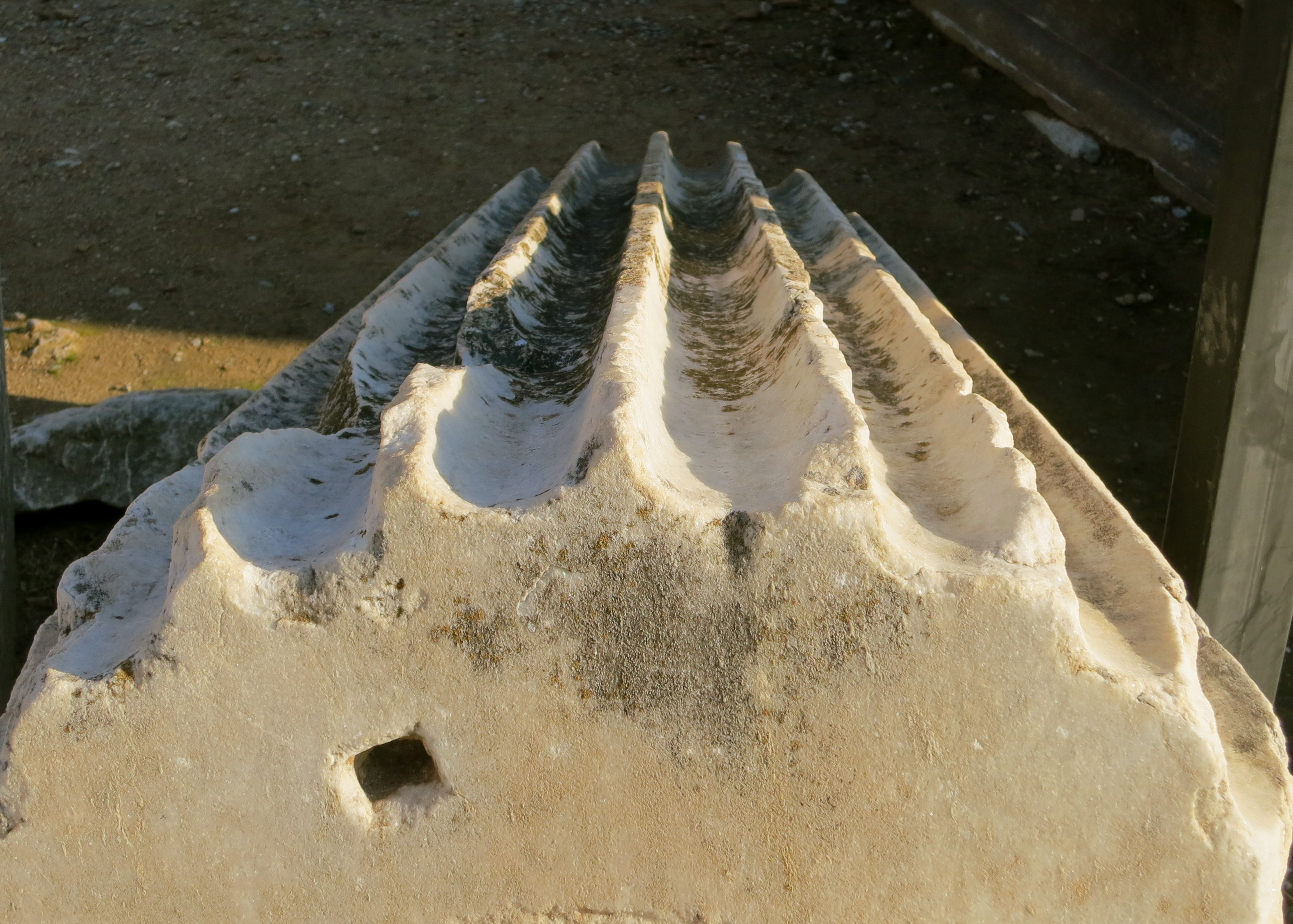
Greek and Roman columns, BTW, did not come in one long section. They came in chunks like this column and were then put together.
The most impressive use of columns among the existing ruins of Ephesus is in the beautiful Library of Celsus, which happened to be the third largest library in the ancient world and contained over 12,000 books.
The most impressive use of columns among the existing ruins of Ephesus is in the beautiful Library of Celsus, which happened to be the third largest library in the ancient world and contained over 12,000 books. People provide perspective on size.
I took this photo while standing in front of the library and shooting upward. To provide a size perspective, the column on the left is 40 feet tall.
I took this photo while standing in front of the Library of Celsus and shooting upward. The column on the left is 40 feet tall.
The Library of Celsus used Corinthian Columns shown here as opposed to the Ionic columns shown above column show.
The Library of Celsus used ‘leafy’ Corinthian columns shown here as opposed to the Ionic columns shown above.
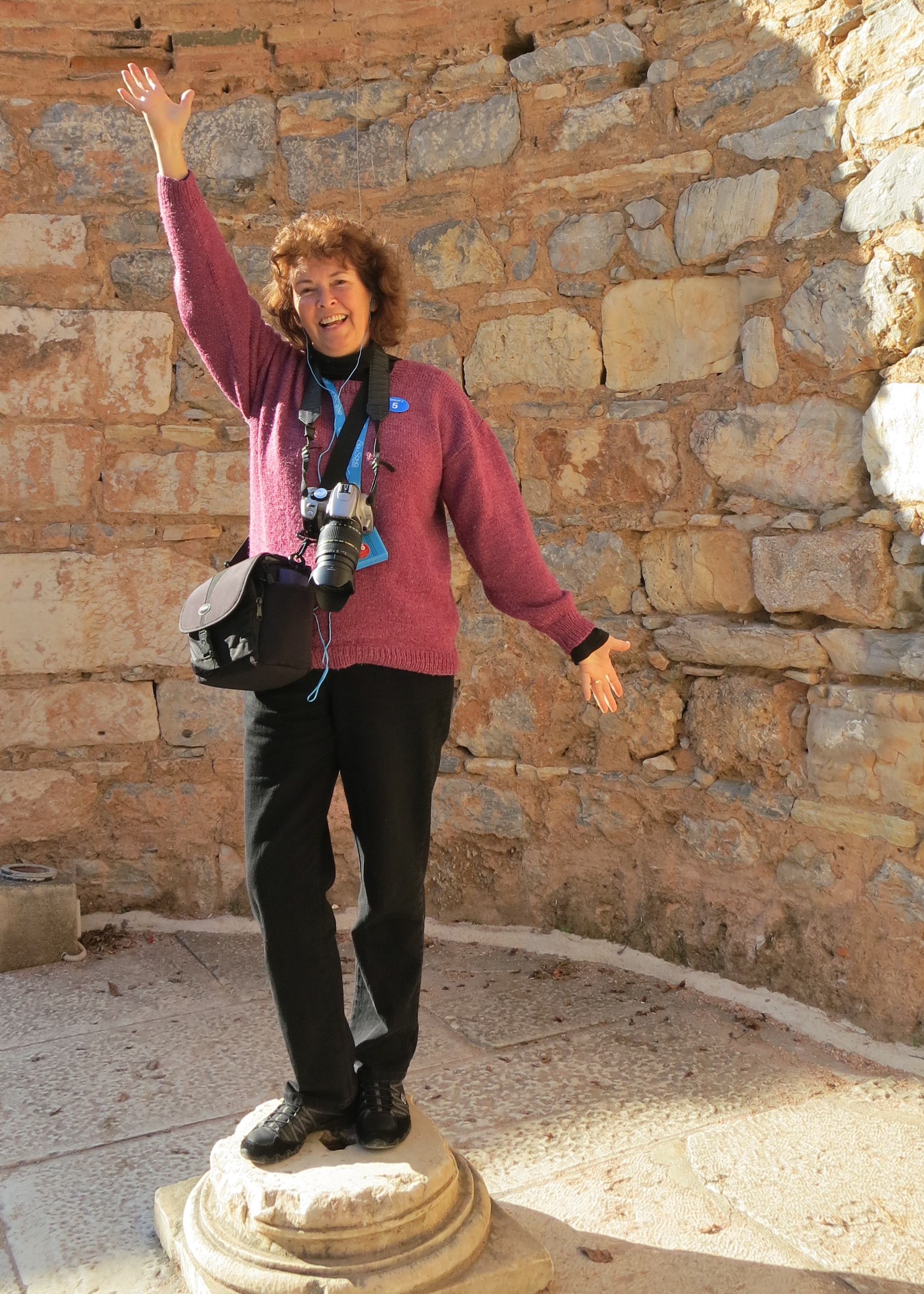
My wife Peggy, another powerful woman, poses on a pedestal inside the Library of Celsus that may have once accommodated the Greek goddess Athena. I didn't tell Peggy she was dancing on the grave of Celsus.
Peggy, another powerful woman, poses on a pedestal inside the Library of Celsus that may have once accommodated the Greek goddess Athena. I didn’t tell Peggy she was dancing on the grave of Celsus.
Unless you were wealthy in Ephesus, you used the common toilets shown here where you could line up with your friends and discuss the day's news while taking care of business. The men's toilet house could accommodate up to 40 people at once.
Unless you were wealthy in Ephesus, you used the common toilets shown here where you could line up with your buddies and discuss the day’s news while taking care of business. The men’s toilet house could accommodate up to 40 people at once. Water flowed constantly under the toilets to remove wastes and deposit them in the Meander River.
Speaking of plumbing, these clay pipes ran underneath the city of Ephesus and provided a sophisticated means of supplying water.
Speaking of plumbing, these clay pipes ran underneath the city of Ephesus and provided a sophisticated means of supplying water as well as removing wastes.
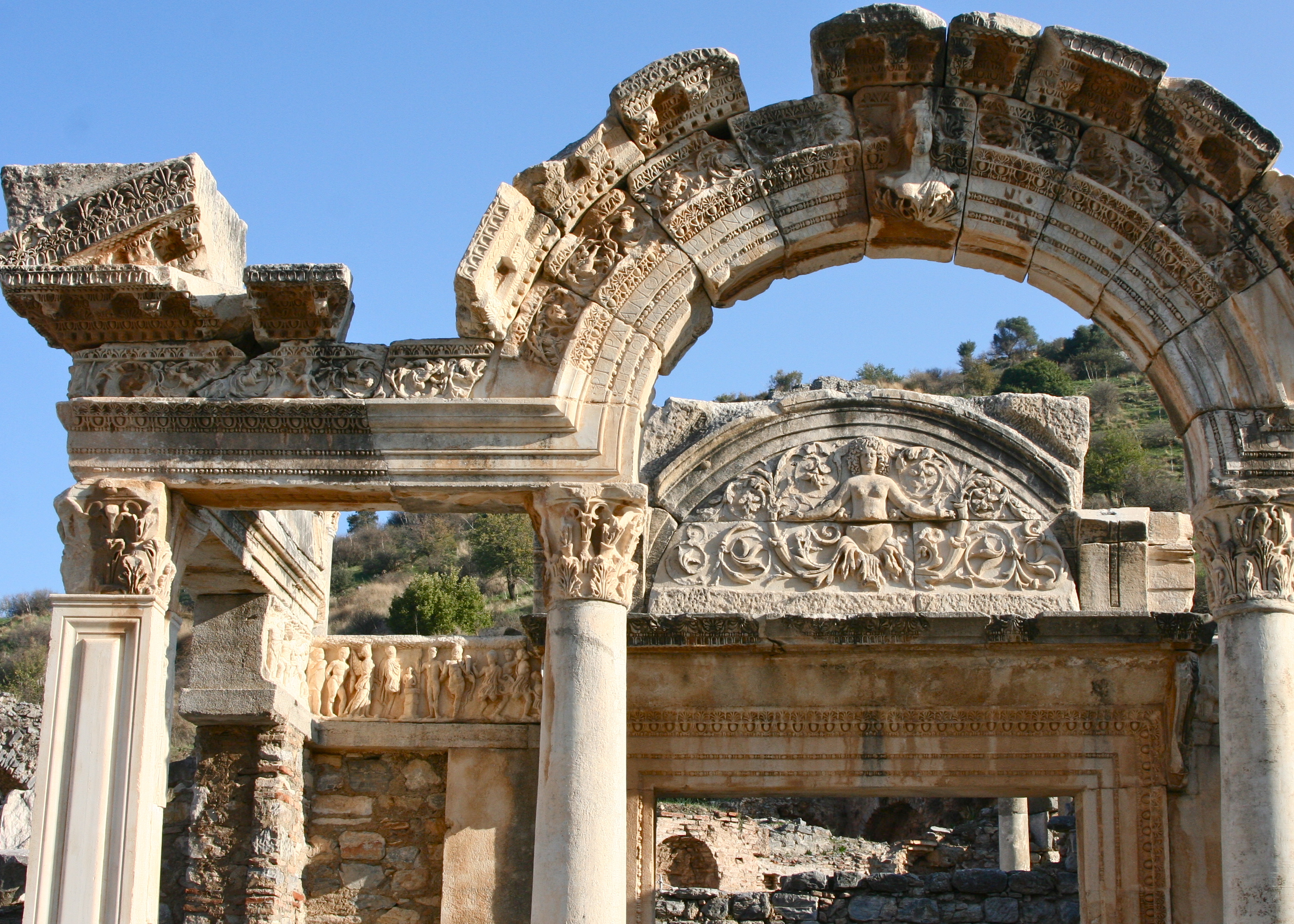
This is Hadrian's Temple. Hadrian () was one of the greatest of Roman emperors and was known for his building projects, the most famous being Hadrian's Wall in England. Hadrian loved everything Greek including the young man, Antinous, featured on the front arch. The woman featured on the second arch was likely Medusa, whose hair was made of writhing snakes and whose look could turn a man to stone. How much more powerful can you get?
This is Hadrian’s Temple. Hadrian (76-138 AD), one of the greatest of Roman emperors, was known for his building projects, the most famous being Hadrian’s Wall in England. Hadrian loved everything Greek— including the young man, Antinous. The woman shown on the second arch was likely Medusa, whose hair was made of writhing snakes and whose mere glance could turn a man to stone. How much more powerful can you get? (Photo by Peggy Mekemson)
Walk this way boys. Sailors arrived in Ephesus from all over the Mediterranean and not too many could read or write. Our guide told us this was and advertisement for the local brothel that provided a convenient map.
Sailors arrived in Ephesus from all over the Mediterranean and not many could read or write. Our guide told us this was a visual aid for finding the local brothel. Walk this way.
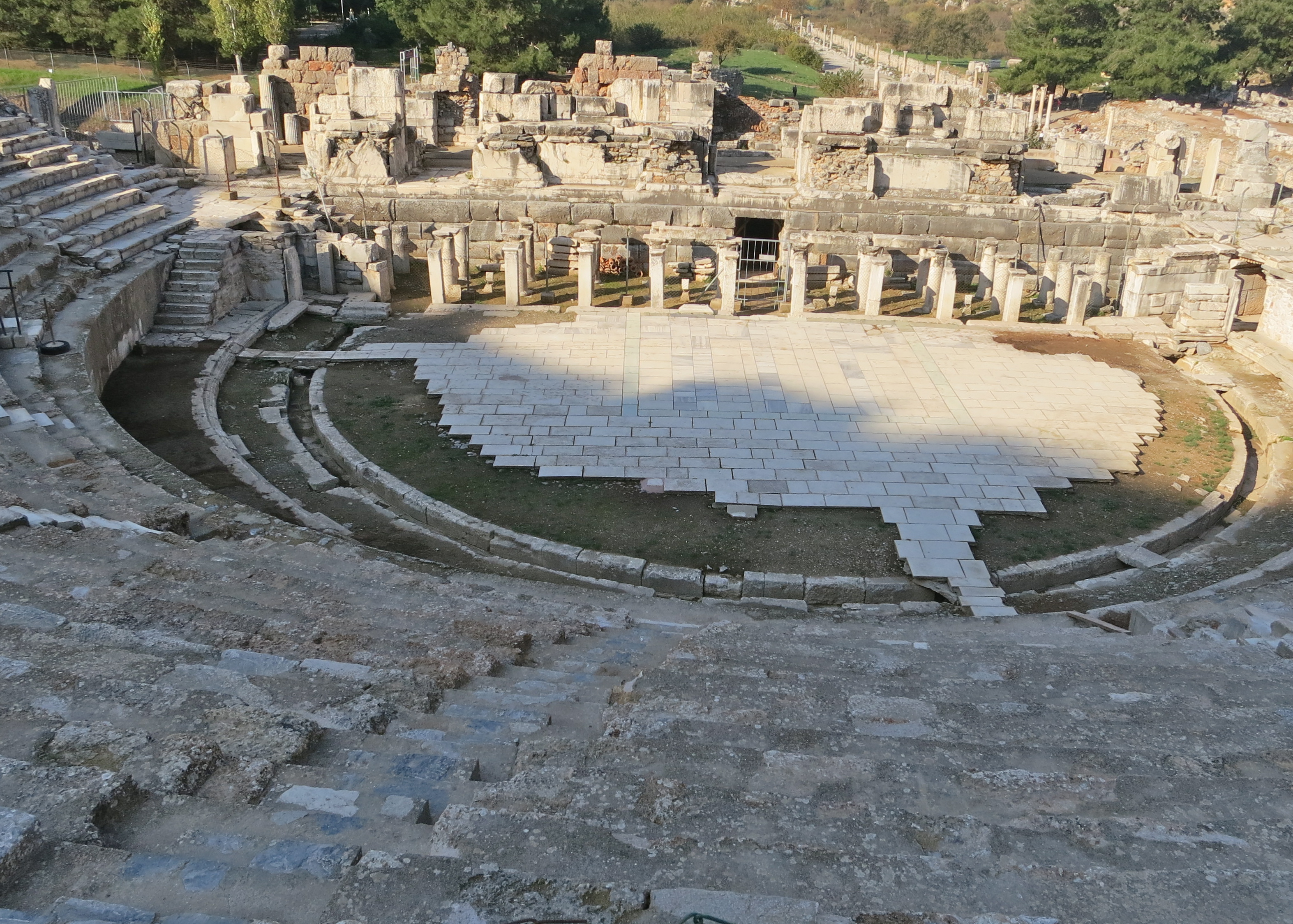
The Great Theater of Ephesus provided seating for 25,000 people. Acoustics are excellent. Modern performers have included Sting and Diana Ross.
The Great Theater of Ephesus provided seating for 25,000 people. Acoustics are excellent. Modern performers have included Sting and Diana Ross. Ancient performers included St. Paul, who apparently caused a riot.
It's showtime! Peggy and I, John and Francis Dallen and Lee Saage are ready for the gladiators.
It’s showtime! Peggy and I, John and Francis Dallen and Lee Saage are ready. Bring on the gladiators. (Photo by Kathy Saage.)

NEXT BLOG: Since we are in Turkey, my next post will explore the city of Kusadasi, where Peggy lusts after a Turkish rug and her brother buys two.

Help! Let Me Out… Keeping Sane in the Time of Covid-19

Peggy and I have found a number of ways to maintain our sanity and sense of humor in this time of Coronavirus. I will share a few today. We laugh a lot. If that doesn’t work, there is always wine!

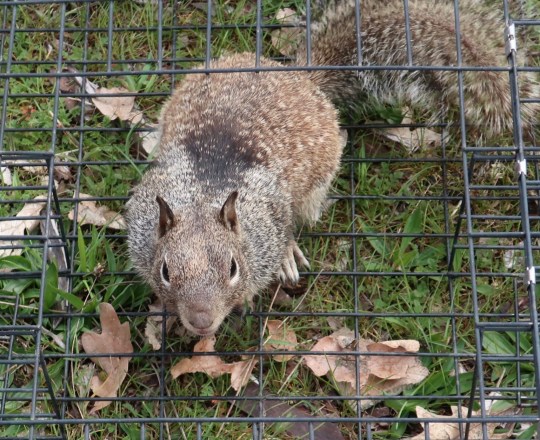
Help, let me out!

Number 1: Catching ground squirrels. In the world of dastardly rodents, few are more dastard than the ground squirrels. We have a catch and release program. Of course these criminally inclined rodents steal birdseed, but that isn’t what gets them banned. They can chomp though a garden faster than Superman can leap a tall building. And even worse, they see nothing wrong with climbing up in our vehicles and chewing on wires! “Some fun,” they think.

Plus they have an attitude. I spotted this fellow a couple of years ago sitting on our deck banister munching sunflower seeds. When I politely asked him if he had been over at the bird feeder, he gave me the paw.
And they lie. “I have never stolen your sun flower seeds,” this one claimed. “I am the greatest ground squirrel alive. The tree squirrels did it!” I pointed out to him that he had at least 40 seeds stuffed into his cheeks. “That’s not true,” he proclaimed. “Fake news!”
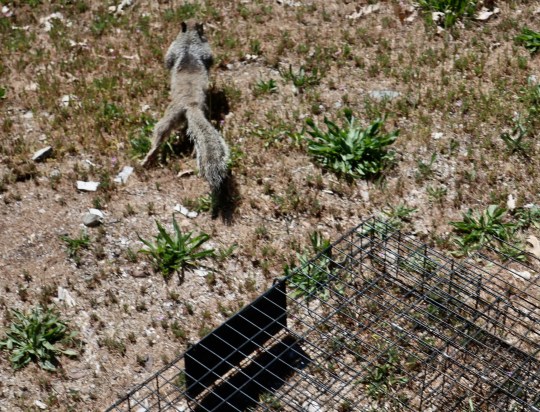
Jail break! We turn the squirrels loose in the forest across the river where there are no sun flower seeds, no gardens and no engine wires to chew on. Squirrels have to make a living the old fashioned way— eating grass. BTW: You would not want to go up against this guy in the five yard dash. “Free at last!” I heard him exclaim as he disappeared into the blackberries. I wished him good luck in his new life.
Squirrely advice to their Chief. Courtesy of my T-shirt. Note the cheeks. (Grin)

Number 2: Learning about nature. We took you on a nature walk in our last post, so there is no need to dwell on it here. I did want to share one more thing, however: How to spot deer beds. I’m pretty sure it is a critical skill.

This is what a deer bed looks like in the woods. Not much, you say. They scratch out a hole for themselves by moving dirt around with their hooves. It takes a minute or so. Once you learn to spot them, they are fairly obvious. Even more obvious…
Here’s what a deer bed looks like at our house. BTW, I’m not sure you can get more pregnant that Floppy. She has been restless the past two days. I suspect she will have her fawn within the next week. The bed has been in constant use since we moved here ten years ago.
Buckus leapus, who shows promise of being at least a three-pointer, made his own bed. When I suggested that he not rearrange our rocks, he gave me the look, but proceeded to lie down. And aren’t those legs gorgeous! “Great for jumping over the barriers you put up to keep me out of the garden,” he muttered to himself.

Number 3: Working puzzles. While lots of businesses have suffered during this pandemic, I can pretty well guarantee it hasn’t been the puzzle industry. It there is one item hotter than toilet paper, it’s puzzles. Peggy is the addict in our family. I’ll put in a piece on occasion, but mainly to show support. She sits down and there isn’t a peep for an hour. If she disappears, the first place I look is the puzzle table.

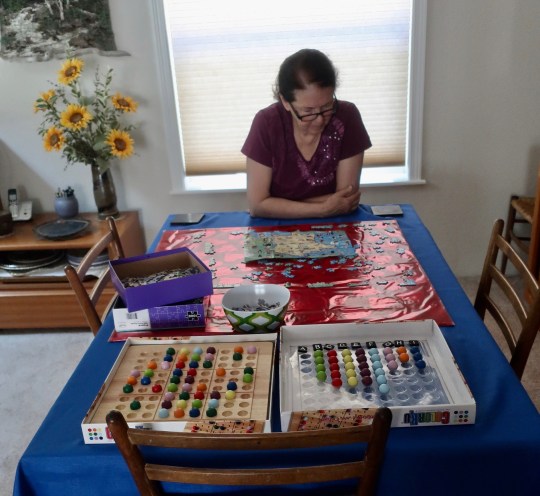
Peggy lost to the world. Our dining room table was drafted into service for the duration. The puzzle in front is a colored marble seduko that our friends Tom and Lita sent us. I play this one but Peggy is a whiz. She finishes a square and five minutes later calls out, “Done!” Tom suggested we compete. Ha!
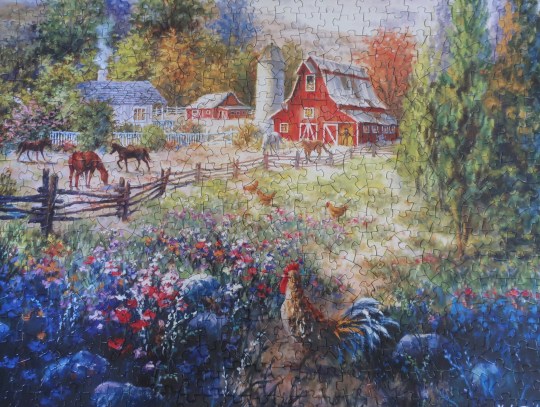
She has completed a lot of puzzles, each one with its different challenges. With this one, it was the head of the rooster.
She did this puzzle to honor our canceled trip to Europe this summer.
Of all the puzzles, this was by far the toughest. I heard lots of complaints coming from the puzzle room. Peggy even threatened the puzzle by telling it she was going to tear it apart and put it back in the puzzle box.
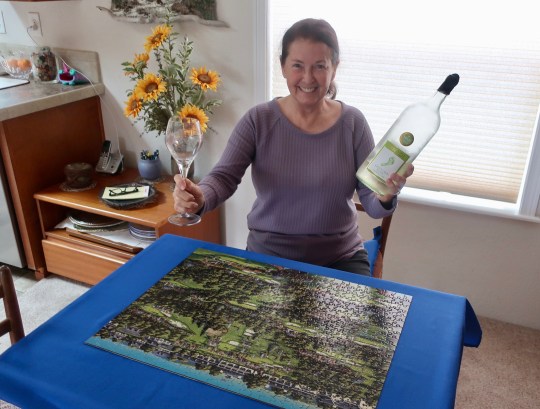
But, with a little help from a friend, she finished it! And then, of course, she needed a glass to celebrate.

Number 4: Watching flowers grow. Our flowers are deliriously happy. Normally, they just get started and off we go on another adventure. They would turn us into the SPCP, the Society for the Prevention of Cruelty to Plants— if we gave them access to a phone. Not this year. I’ve put in 10 new trellises and moved at least 11.32 tons of dirt and rock— as least it seems like it. I’m the muscle in this operation. Peggy is the gardener. She is out every day futzing with her babies: planting them, talking to them, and watering them. We both work at trying to keep Buckus leapus out.

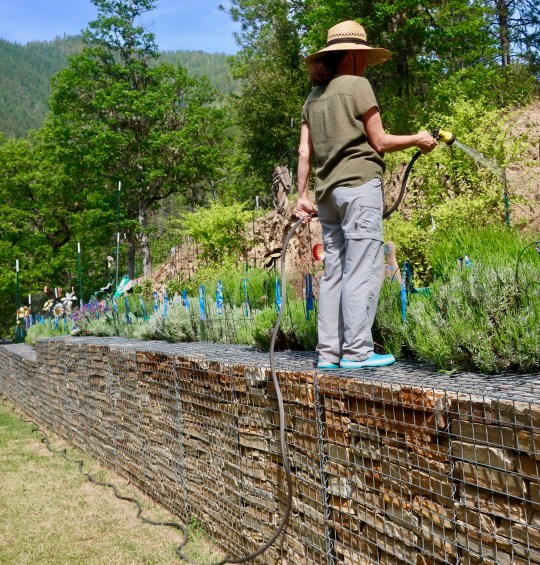
Peggy standing on top of our Gabion Cage deer barrier giving plants an extra shot of water.
Remember when I posted about sitting in the sunroom and watching sunflower plants grow while I was writing…
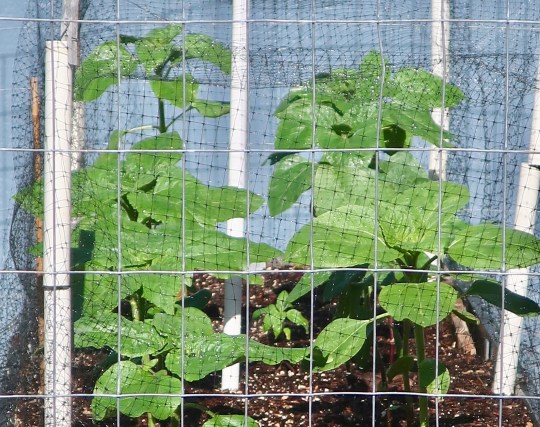
Here’s what they look like now. Happy plants! The barriers on barriers are to keep the ground squirrels and the birds out.
Lots and lots of happy plants. This is the first of the lavender. Soon it will be blooming all around our house with thousands of bees and butterflies to keep it company.
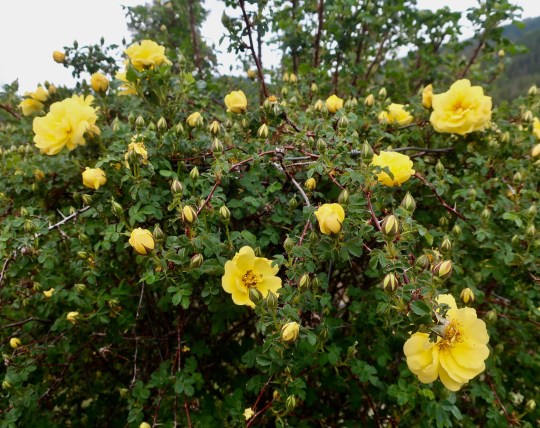
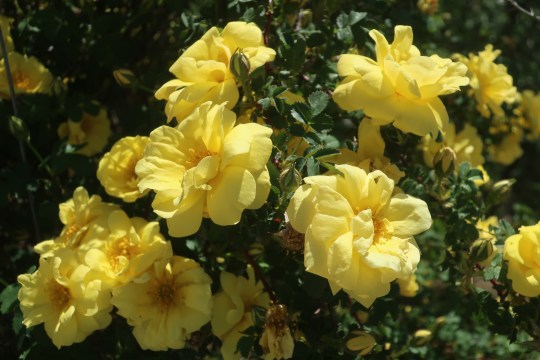
And of course our pioneer rose which now has more flowers than I can count.
I’ve been learning more about this rose since my last post. It is deeply connected to our local history and worth a post on its own. And it is rooted in the history of the west. Another name it goes by is the Yellow Rose of Texas!

The four activities listed above are only the beginning of how we have maintained our sanity and sense of humor during the age of coronavirus. Here are a few other things we do while ‘sheltering at home.’

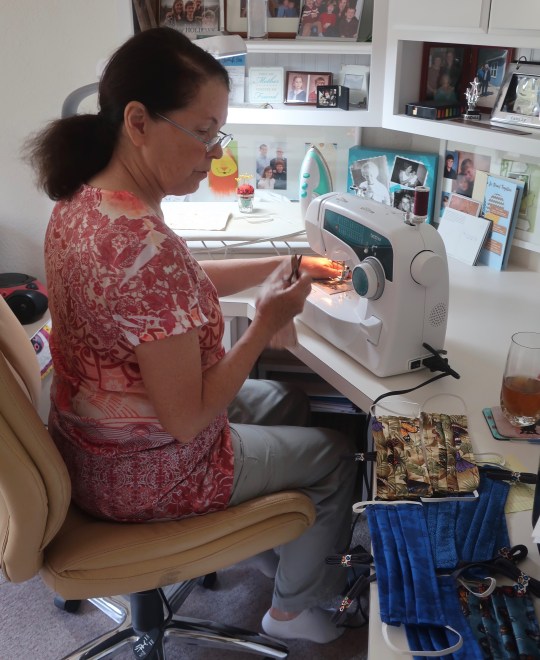
Peggy makes masks. Lots of them— enough to outfit us, our kids and grandkids, and her brother, sister and spouses.
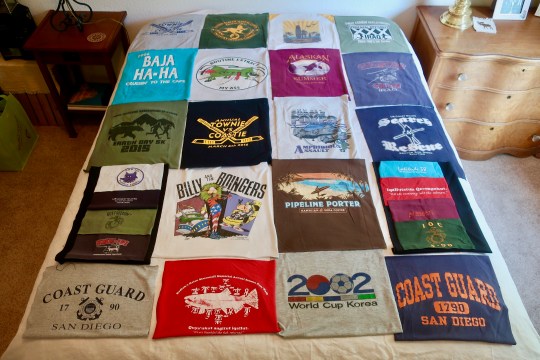
And quilts. Our son Tony sent us some of his favorite T-shirts for Peggy to turn into a quilt. She is making another one for our son-in-law Clay that features tractors and barns.
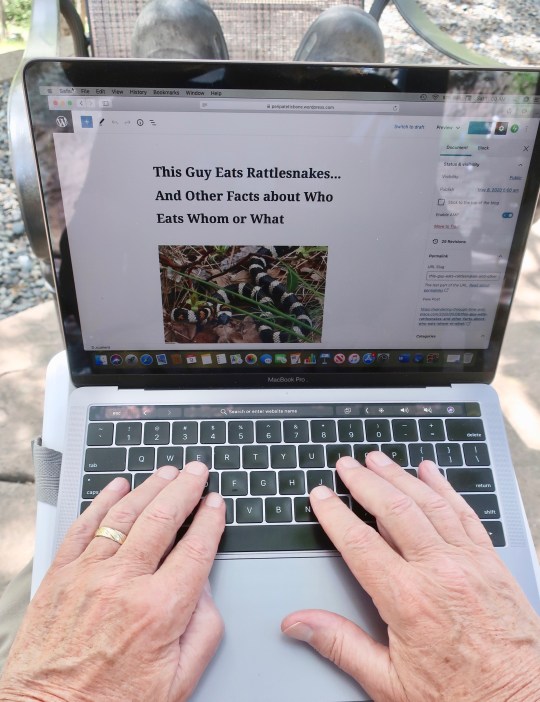
I blog. Sometimes it feels like a full time job! Those are my crocks peaking over the top of the screen.
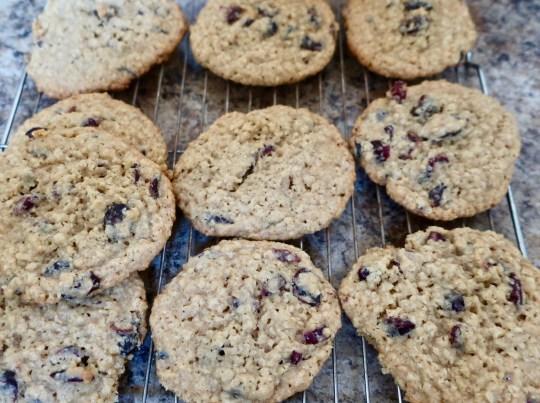
Peggy bakes oatmeal-cranberry cookies. Healthy, right! My job is to test them right after they come out of the oven. I know… it’s hard work but somebody has to do it.
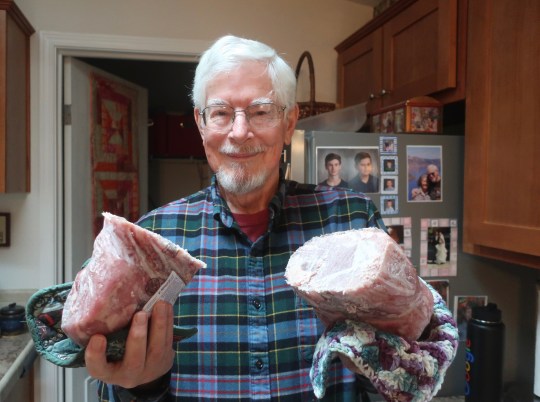
And I make sure the freezer is full. This is a pork roast I cut in two. I turned the first half into a rather tasty lima bean soup. The other half is waiting for me to turn it into pulled pork.
Peggy is kept busy sending and receiving Marco Polos from our kids and grandkids.
Both Peggy and I are avid readers. This is what I am working through in non-fiction. I always try to include science, history, current events, something for the soul, and a book on writing. My fiction is sci-fi and fantasy. I am totally about escapism! Especially now. Peggy loves mysteries.
It feels like a thousand years ago when Peggy and I were at Crater Lake, our last adventure out. And yet, it was only March 20th. Like all of you, we are eager to hit the road again. But we will wait until it is relatively safe. To do otherwise will endanger our lives and those of others. Stay healthy, and stay sane.
The Last Word. This ground squirrel was about to escape into the forest. But before he did, he stopped, looked up me, and growled, “Come just a little closer so I can bite you.'”

This Guy Eats Rattlesnakes… And Other Facts about Who Eats Whom or What

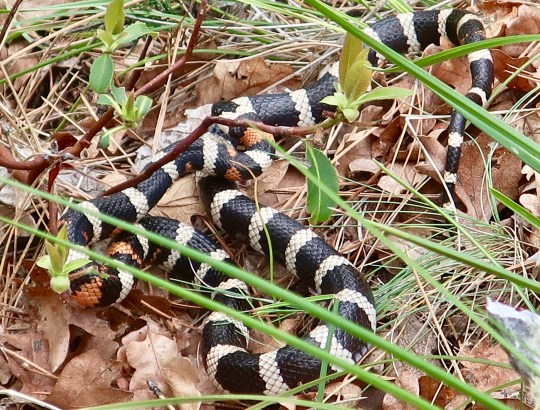
Peggy and I hiked up the mountain behind our house in search of cougars and bears, and came upon this colorful California kingsnake. It cooperated with a striking pose, so to speak. We had been following along behind it as it slithered along for about 20 feet. I think the pose was meant to say, “Go away!” When that didn’t work, it hid his head.

I’ve eaten rattlesnake but it has never been a part of my regular diet. Nor do I eat rattlesnakes whole or squeeze them to death. The California kingsnake regards this as normal behavior. They are said to have the strongest constriction power of any snake of similar size and can eat another snake almost as big as they are. (You wouldn’t want to meet one the size of a boa.) I assume they also use this ability on the other prey they like to eat including rodents, birds, lizards, and frogs. One valuable attribute that they have in relation to eating rattlesnakes is that they are more or less immune to the venom. A final tidbit I picked up in my research: The guys win their lady’s love by vibrating rapidly. I wonder if this leads to a shaky relationship.

The kingsnake stretched out to about 4 feet. They can grow up to six. Imagine this fellow swallowing a 2-3 foot rattlesnake! We followed along at a respectful distance.

We weren’t looking for the snake. Peggy and I had hiked up the mountain to check out some possible cougar scat (poop) and see if anyone was home at the bear cave. We were also looking for other signs of wildlife and anything else that caught our fancy— like the weird trees and pretty flowers I have already shared. I am sure that you are thinking now, “Oh joy, Curt is going the share poop with us.” And you are right.

But first the bear cave. It isn’t that we have ever found a bear in it. But it looks like a bear should live there and we found bear tracks in the snow heading toward the cave this past winter. As you may recall, Peggy refused to walk over with me to check it out. This time we found fresh bear scat on a trail up the mountain nearby and Peggy immediate burst into song, The bear went over the mountain. I told her it was wishful thinking, that maybe the bear had come down the mountain. None-the-less, we checked out the cave and no one was home. Peggy insisted that I throw rocks inside just to make sure. I’ve never quite understood the logic of this. If I were a bear and got awakened from a deep sleep by a rock, I’d be grumpy. I’d come roaring out of the cave wanting to bite someone.

The ‘bear’ cave looking dark and ominous. It’s actually an old gold mine. Our neighbor, Mooey, who is a part time gold miner, cut a trail up to the cave. “I always throw rocks into it.” he told us.”

And now for the scat. Our fascination with it may have you scratching your head why— especially if you have a dog or a baby. The fact is, if you are interested in what animals are visiting your neighborhood or live in the wild areas you visit, scat is an important clue, and sometimes the only clue. Many animals are nocturnal and others have figured out that the less people know about their presence, the better off they are. Cougars fit into the latter category.

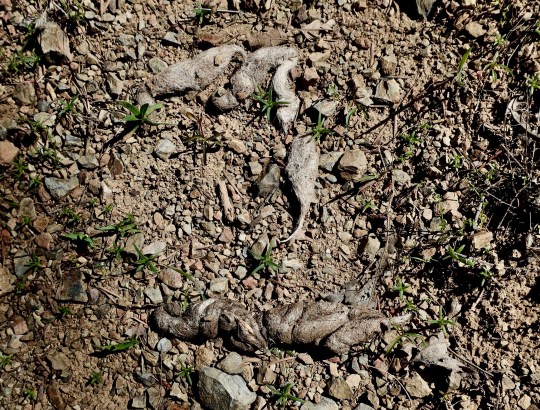
We were hiking up the hill when we came on this scat. Just looking at it we learned two things. One, it was a carnivore. Two, it was likely left by different animals at different times. The color suggests the different times. The scat on top is older. It also appears that the scat on the bottom was left by a larger animal.
Check out the fur? This was definitely a meat-eater. I think the fur is from a deer.
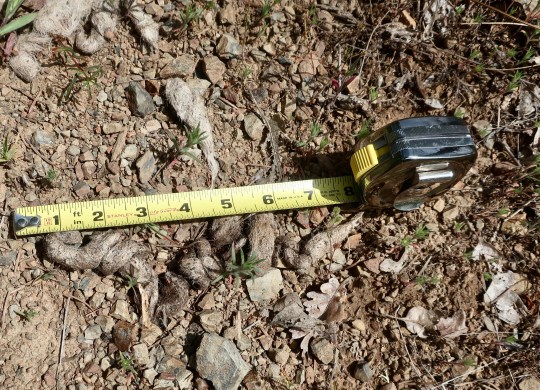
The lower scat was about 7 inches in length. The upper closer to 4. (And doesn’t everyone carry a tape in his pocket to measure scat?)

So what are we looking at. Given who lives in our area, I would say either a cougar, a coyote or a bob cat. The size, especially of the lower scat, suggests cougar. If it’s deer fur, as it appears to be, it is one more clue suggesting a cougar. On Wednesday we were hiking up another trail near our house, the Mule Mountain Trail, and definitely came across cougar scat.

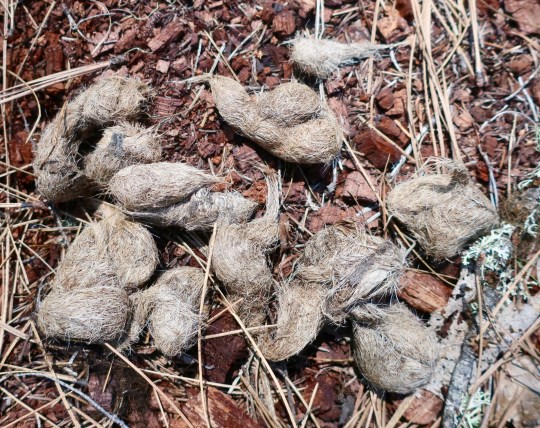
This scat was larger and chunkier— definitely cougar. Once more, the fur looks like deer.
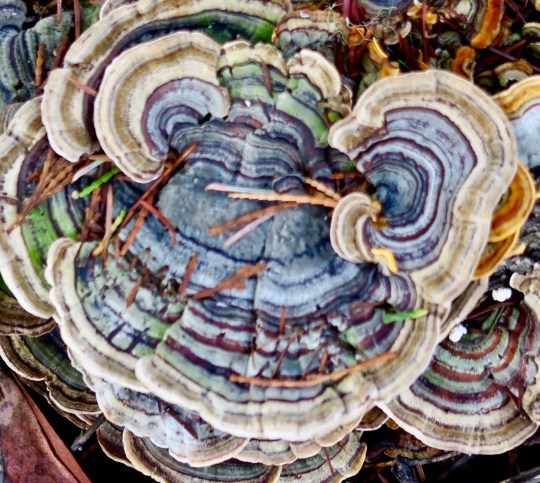
But enough on poop. This shelf fungus seems to have an opinion on the subject.
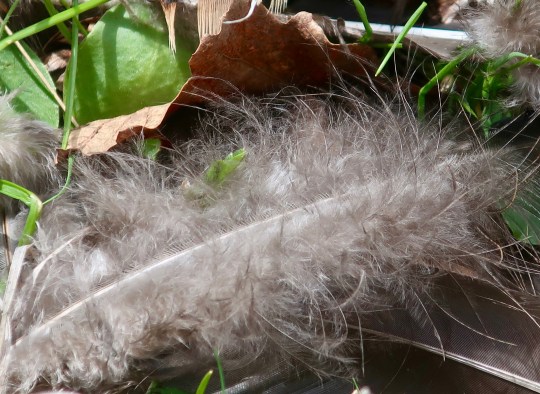
Turkey was also the menu out in the woods. The feathers suggest a real feast. There were enough for at least two turkeys. Once again, the cougar, the bob cat, or the coyote was at work. Or maybe two of them.
These are turkey tail feathers…
And this feather make me think of my down sleeping bag!
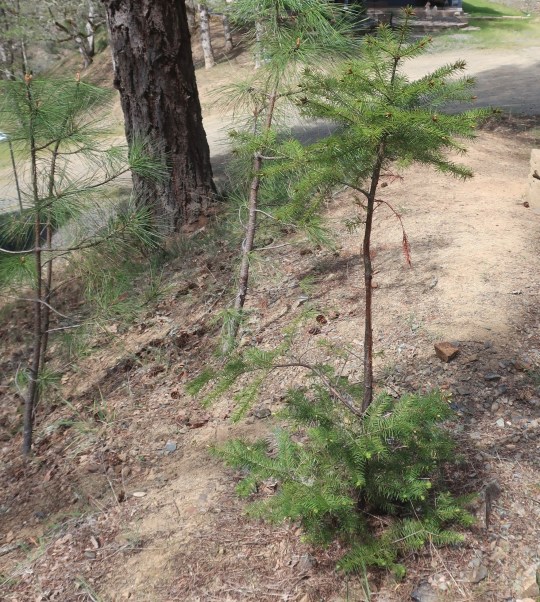
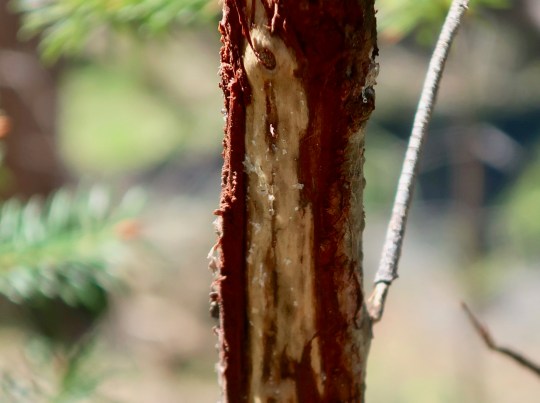
Let’s hear it for the herbivores. Someone stripped this poor little Douglas fir, leaving a top and a bottom and nothing in between.
Ouch. Nothing like being flayed. I’d say a porcupine is the likely culprit. A buck might do this to remove velvet from his antlers, but it is still too early. Last year one of them did in our hammock. It is also possible that a deer did this for lunch, yanking off the tender young needles of the tree with the bark following— all down the hatch!
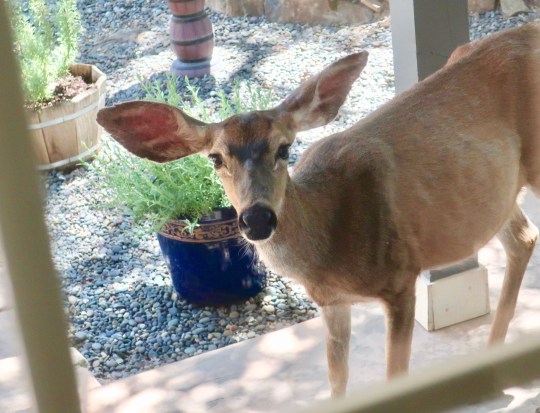
“You blame us for everything!” I had just written the caption for the photo above when Floppy appeared and stared accusingly at me through the window. It’s not true. I also blame the ground squirrels around here. As you will discover in my next post.
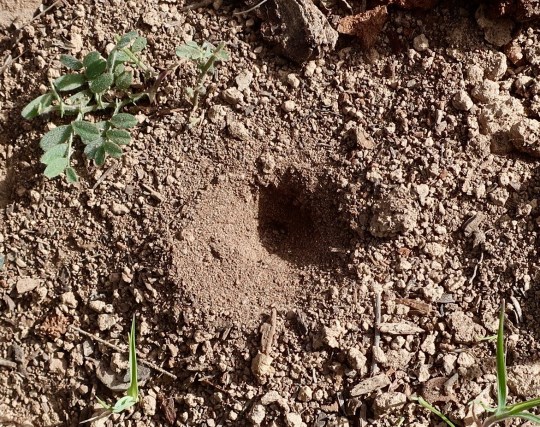
Here’s an interesting bit of nature. The insect that made this hole is an antlion, a ferocious little bug that digs the holes to trap ants. It sits in the bottom and waits for someone to fall in and then kicks up dirt on a potential victim to speed up the process. It’s a slippery slope, almost impossible to escape from. I am reminded of the monster in Star Wars that Jabba the Hut hoped would eat Luke, Hans and Chewy.
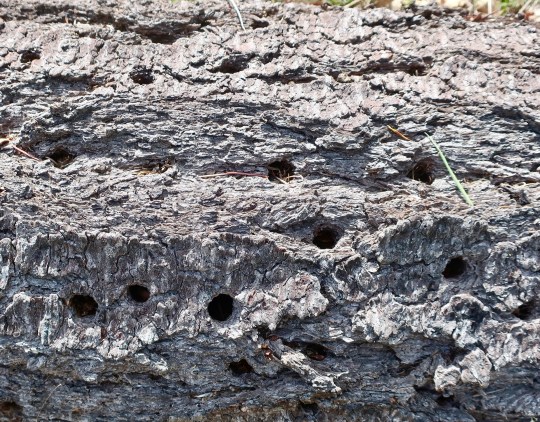
Any idea who did this? You are looking at an acorn tree. The birds that drilled these holes are acorn woodpeckers. There can be thousands of such hole in a single tree filled with acorns. Usually they all belong to the same commune of woodpeckers that live together as a family, interbreed, raise the kids jointly and maintain the tree. My commune friends from the 60s and 70s would consider them soulmates.
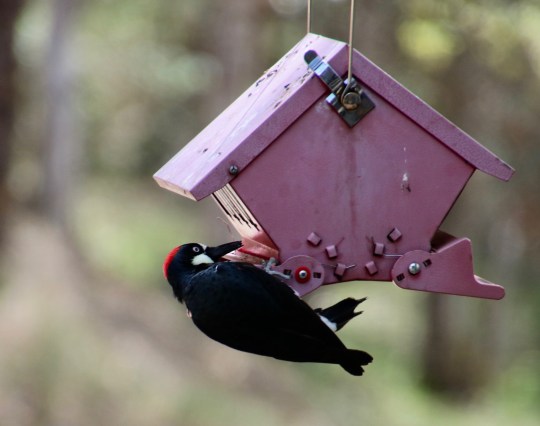
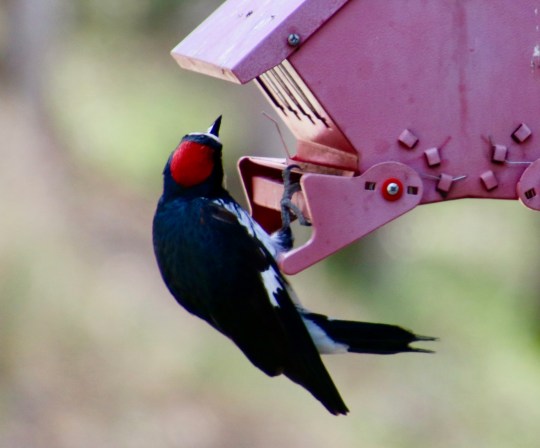
Acorn woodpeckers also like sunflowers! Check out the clown face on this one.
The red cap is definitive of the acorn woodpecker. This is a female. The red goes down to the white forehead on the male.
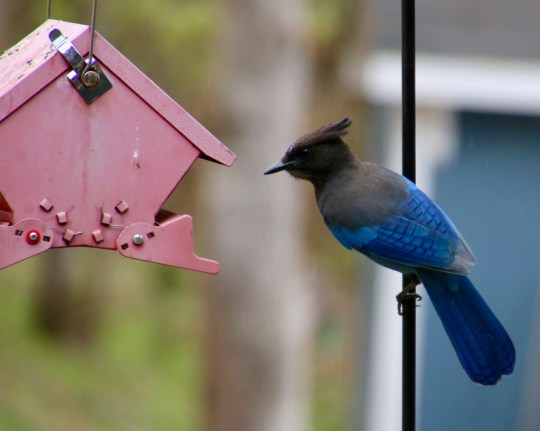
Steller jays also love sunflower seeds, but it’s a reach…
They flap their lower wing to maintain balance. They’d be ruler of the bird feeder if it wasn’t for the acorn woodpeckers. No one wants to get in a fight with someone who can peck holes in wood!
Over ten species of birds are regular visitors to the birdfeeder and provide endless entertainment. These are mainly goldfinches waiting for their turn.
I’ll close today with a final photo of the kingsnake. I looked down and its head was missing! At first I thought he was in the process of slithering off. But he remained still. Later, I read that kingsnakes sometimes hide their heads when in danger. It hardly seems like appropriate behavior for somebody who eats rattlesnakes!

NEXT POST: Other ways we’ve been amusing ourselves in the Age of Coronavirus

Kayaking Escape: … Armchair Travel in the Time of Covid-19

I ran out of time to do today’s post on our hike up into the Rogue River-Siskiyou National Forest behind our house in search of bears, cougars and snakes. Oh my. The best laid plans of mice and moose— you know how that goes. There were chores to do. So, I decided to pull a post from 2014 I did on kayaking a small lake that’s about 8-miles from our home. I’ve blogged on Squaw Lake since. You may have seen photos but each trip is different. It is quite beautiful. Enjoy.

Kayaking on Squaw Lake, Oregon. Photo by Curtis Mekemson.
Peggy paddling our inflatable Innova Kayak on Little Squaw Lake. (Her hair has grown like umpteen inches since— grin.)

Since Squaw Lake is only a few mile from our home, we can easily head up there when we have a couple of hours to spare.

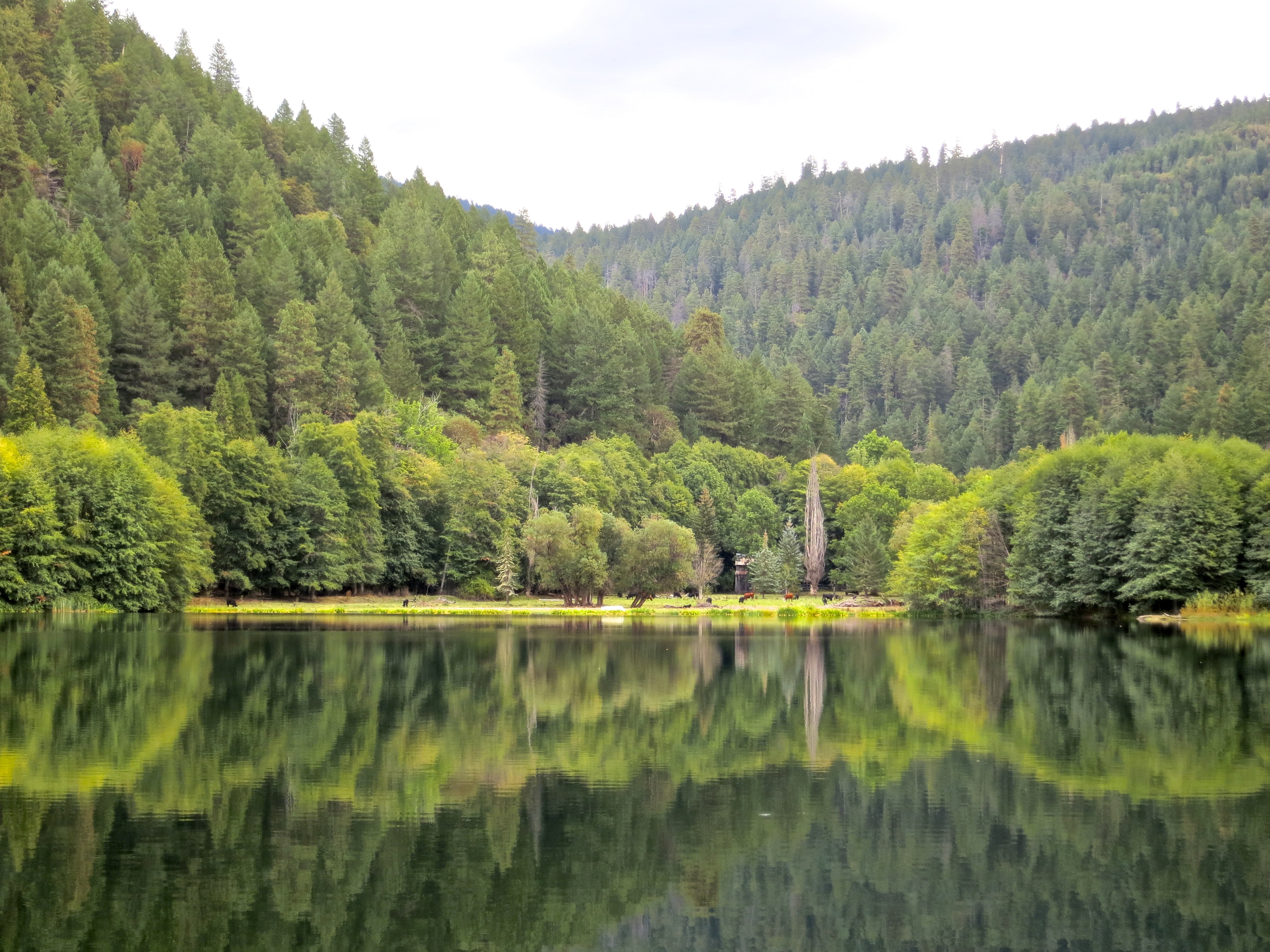
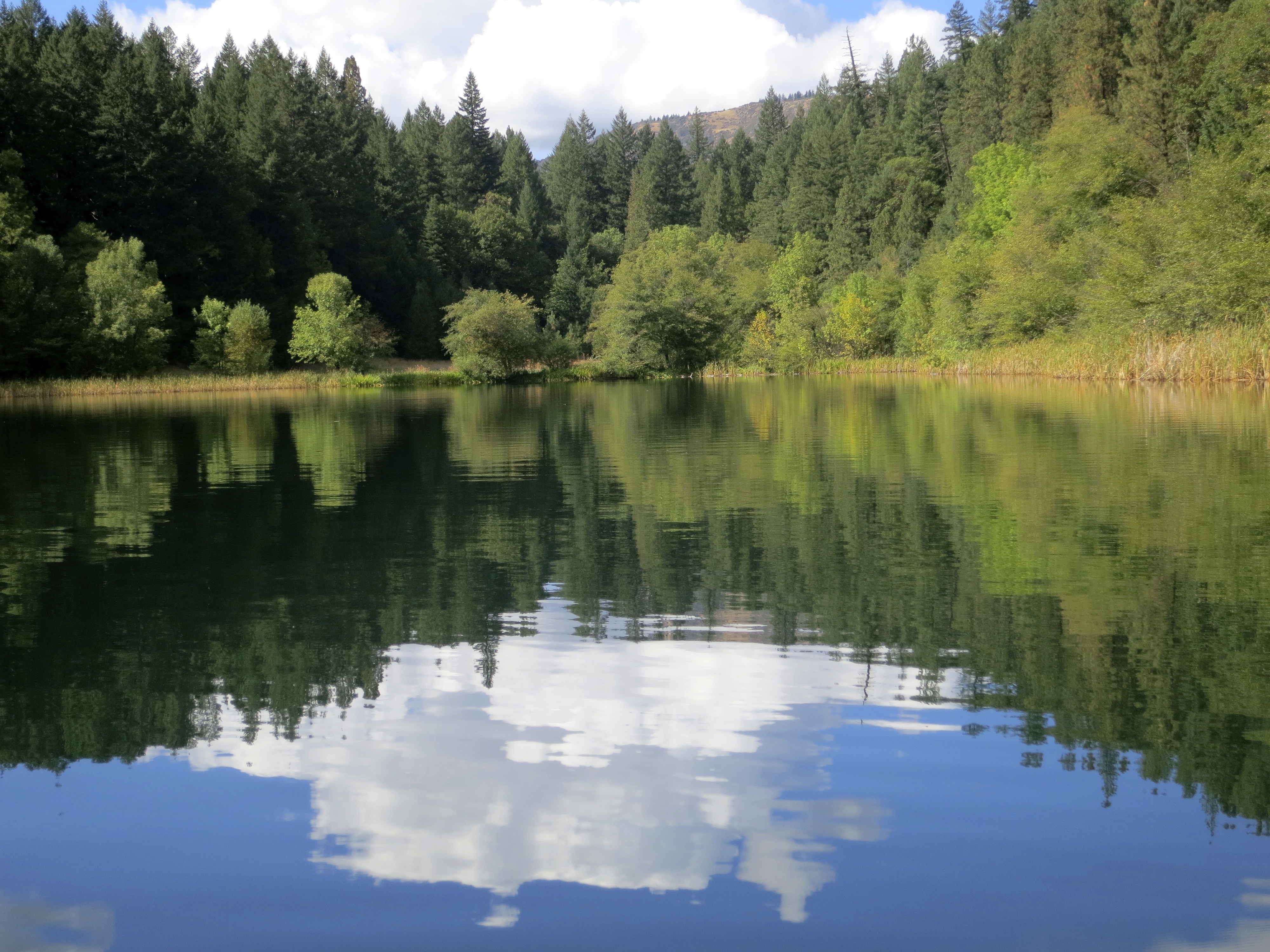
Reflection shot on Squaw Lake in southern Oregon.
Paddling under cloudy skies, we thought it might rain.
Kayaking on the small Squaw Lake in southern Oregon provides beautiful refection shots. Photo by Curtis Mekemson
But then the sun came out, allowing for this very green reflection shot.
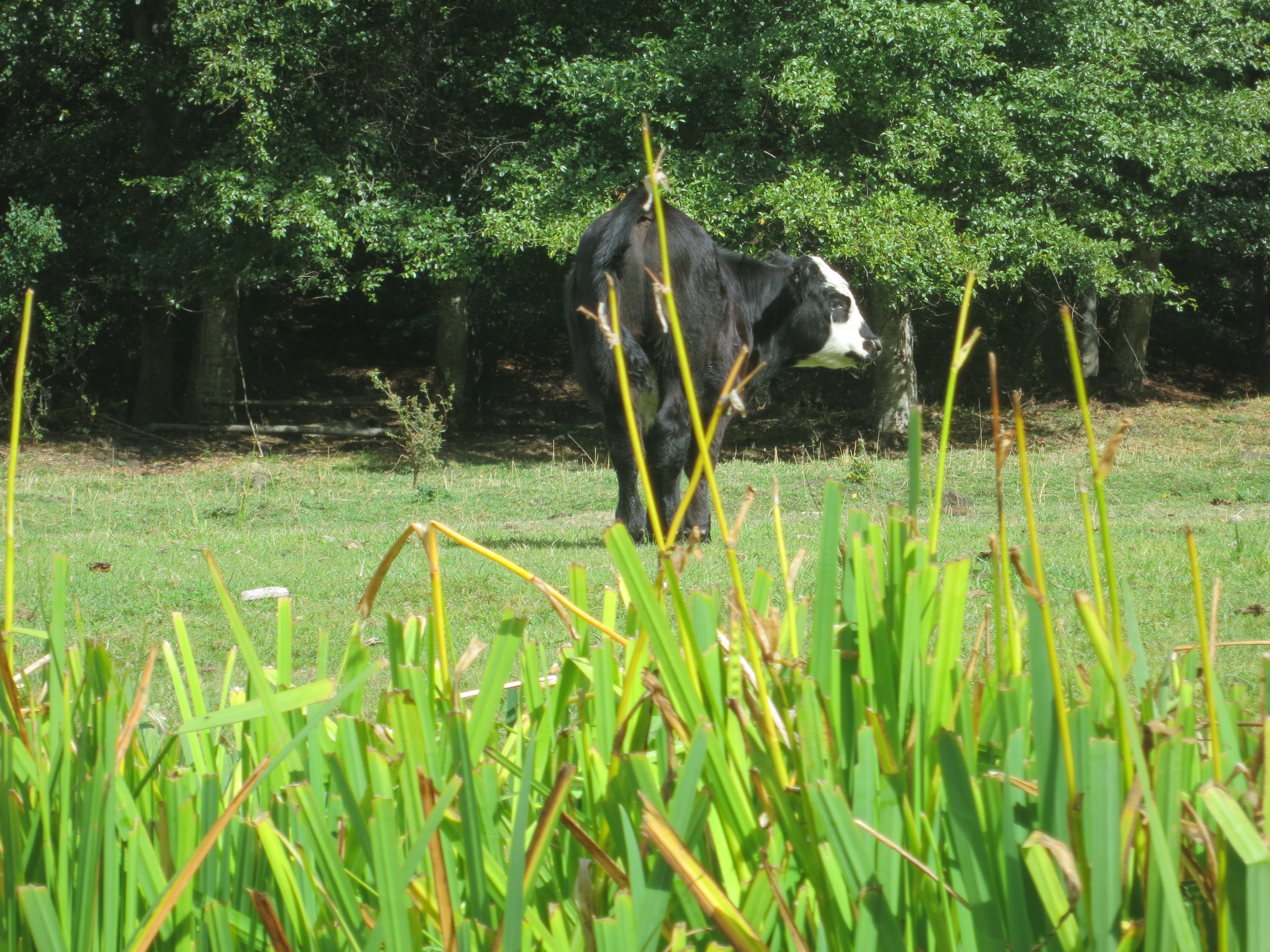
Young steer next to Squaw Lake in Southern Oregon. Photo by Curtis Mekemson.
We kayaked up to the end of the lake and caught this photo of a young steer, who also seemed happy to see the sun.
Cumulous clouds dominate the horizon at Squaw Lake in southern Oregon.
Towering cumulus clouds dominated the horizon and spoke of a later thunder and lightning storm. We would be off the lake by then. Peggy and I have been caught out on much larger lakes during storms. Dangerous. Once, in Prince Albert National Park north of Saskatoon, Canada, we barely made it back to shore.
Cumulous clouds reflected in Squaw Lake of Southern Oregon near Applegate Lake. Photo by Curtis Mekemson.
The clouds were reflected in the lake.
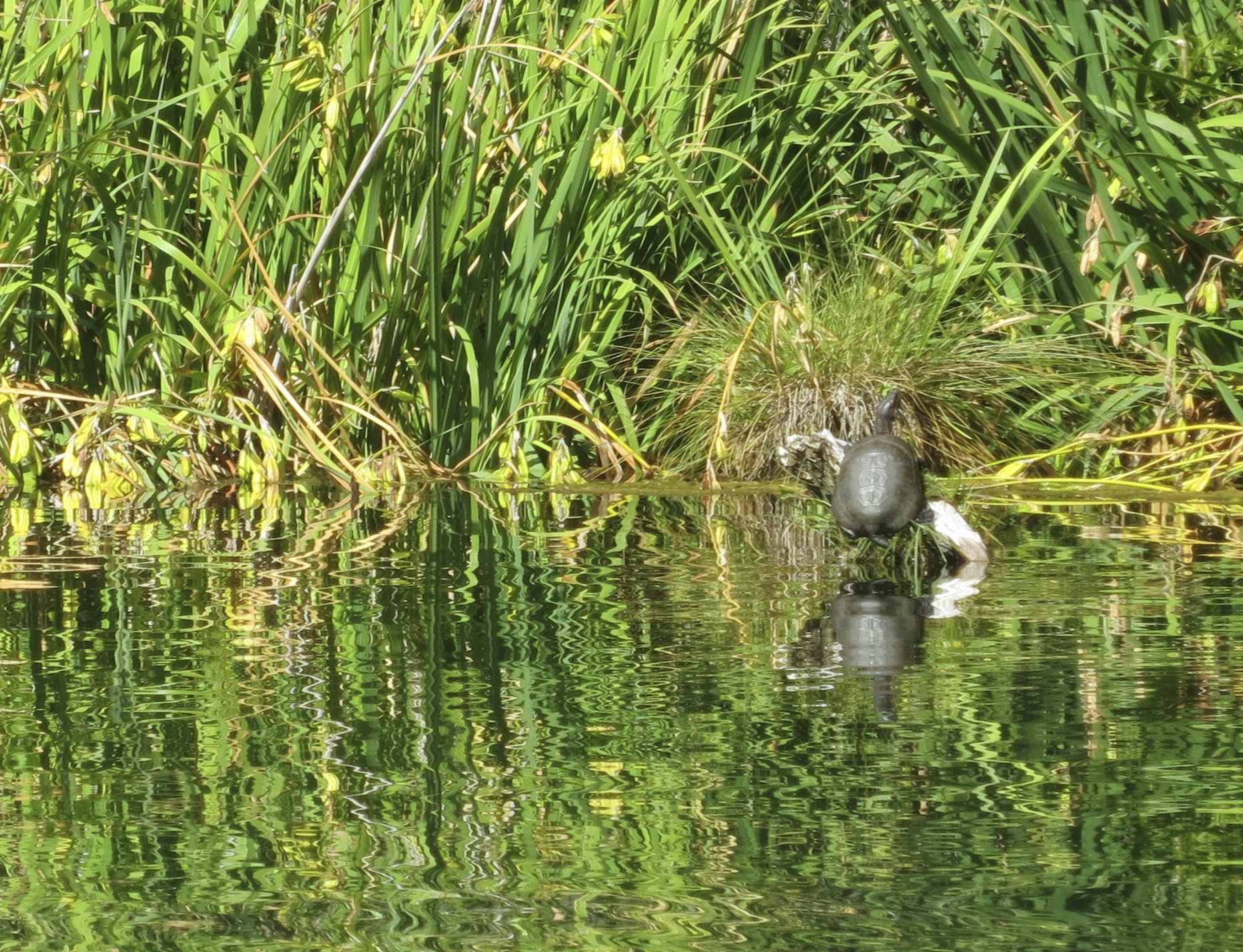
Turtle sunning on Squaw Lake in Southern Oregon near the California border. Photo by Curtis Mekemson.
A curious turtle, blending into the green, checked us out.
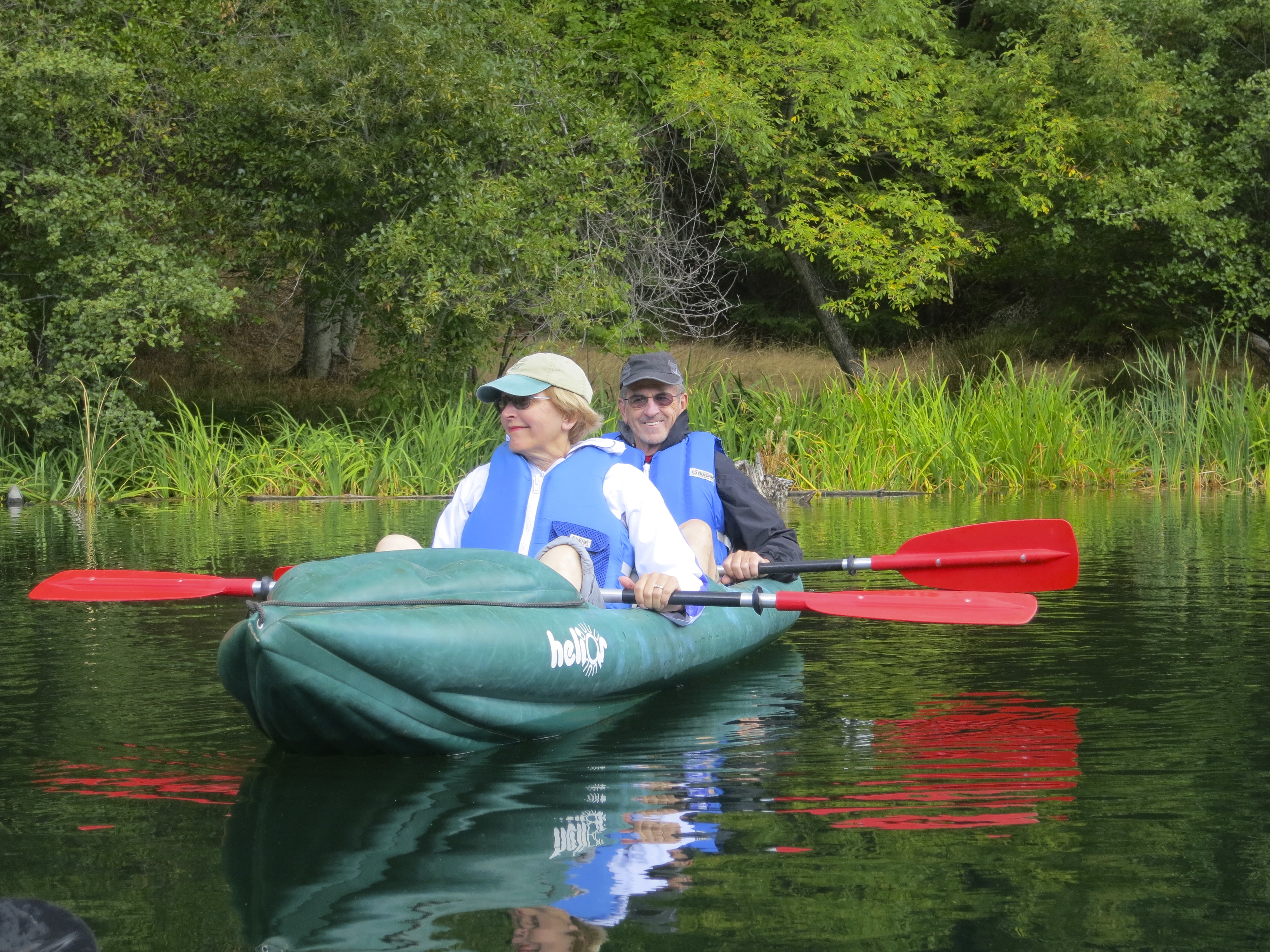
Jane and Jim Hagedorn kayaking on Squaw Lake in Southern Oregon. Photo by Curtis Mekemson.
Peggy’s sister, Jane Hagedorn and her husband Jim, joined us. We often take friends and family up to Squaw Lake. Its small size make it an ideal location for beginning kayakers.
Photo of Squaw Lake in Southern Oregon. Photo by Curtis Mekemson.
A final photo capturing the beauty and peace of the lake. Ripples from a fish that had just jumped are on the lower right.

I don’t know if you kayak, but it is hard to find a more peaceful experience than kayaking on Squaw Lake. We hope to be back there soon. (Look for another post!) We are also planning a trip to Klamath Lake where you can follow ancient trails through the tules once used by Native Americans. That, plus the fact that large numbers of water fowl stop there in the spring and fall, makes it another favorite of ours. And finally, if you are ever in our neck of the woods, we would be glad to take you kayaking on Squaw Lake.

FRIDAY’S POST: The blog on our trip up the mountain, assuming I’m not distracted again!

Deer Antics that Amuse Us in the Time of Coronavirus… Or Any Time

I am continuing my exploration of the wild side of our property and the surrounding forest by looking at deer behavior today. While I am not sure that it is amusing to the deer, it is amusing to us, except of course, when it involves their eating Peggy’s carefully grown plants. We try to maintain a sense of humor about that. Watching the deer, and all of the wildlife around our property, is also an education. That’s half the fun.

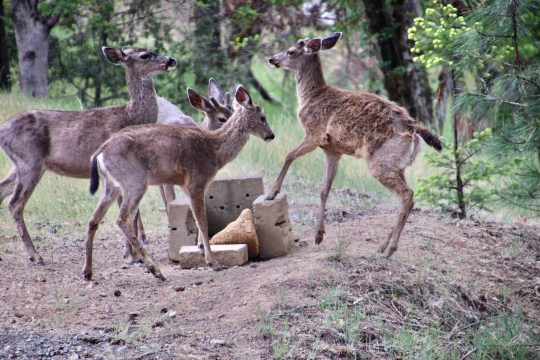
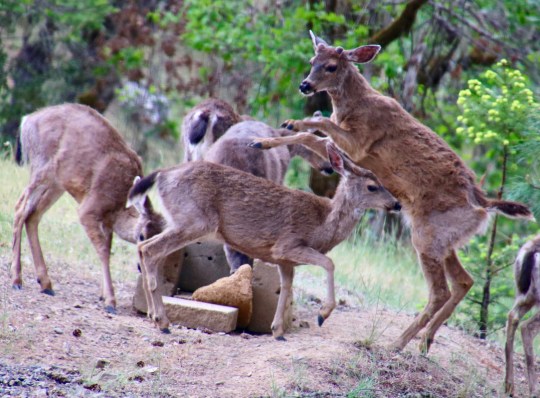
“Okay, guys. Listen up. I am king here. As long as you remember that I eat first, we’ll all get along fine.” Not everyone agreed.

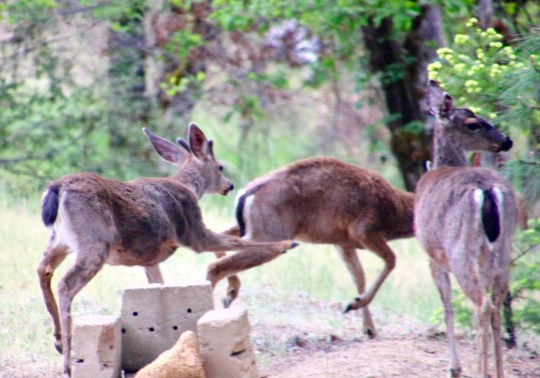
A buck is up at the deer block having a discussion about his right to eat first. It isn’t so much about eating as it is about dominance. If everyone agrees, he will have a few bites and be on his way. And then someone else will have the discussion. It works it way downward. This time, a teenage buck was chased off— rather dramatically. But it doesn’t end there. Buck number one is sent packing by buck number three, who has bigger antlers. Size matters.

“I warned you. Now you pay.” Note how other deer slip in to grab a bite while the confrontation is taking place.
“Not so fast. You may be larger but I have bigger antlers!” Ah, the agony of defeat when the small guy kicks your tail.

I’ve watched a scene unfold several times where the dominant deer chases away the next deer in line, who immediately goes over and kicks the next deer, who goes over and kicks the next one, etc. until there isn’t anybody left to kick. The confrontations are rarely violent. They often end with a gentle tap— as long as the other deer gets the idea. Sometimes there is no confrontation at all, especially among families. And everyone lets fawns eat their fill.

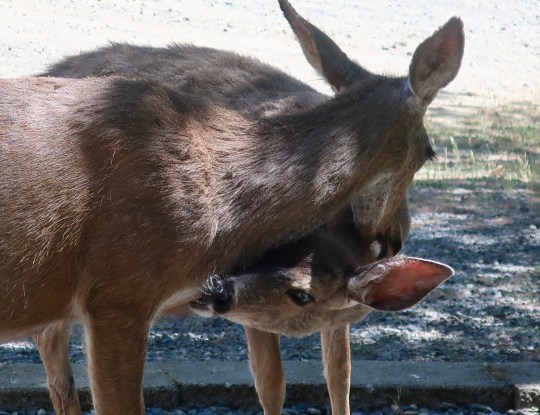
“I’ll scratch behind your ear if you will get my neck.” Grooming is one way deer families build and maintain ties. It starts with moms and fawns and continues even after the kids are fully grown.
This short video captures the deer grooming each other. I found it humorous. Peggy said “so much for social distancing.”

Peggy and I usually don’t put up a deer block. We prefer that the deer behave like deer and eat plants. (As long as they aren’t ours.) But I do put up one when the moms are in their last stages of pregnancy. My reason/excuse is that it helps supplement their diet. But I confess, I like the fact that it encourages the moms to bring their kids by, not to mention all the action we get to see.

Not much action here. One of the extended deer families is having an afternoon snooze with the deer block only a few feet away. Every once in a while, one stands up for a nibble.
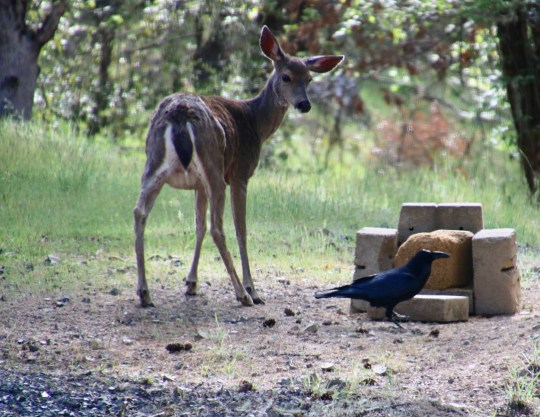
Other animals and birds also like the deer blocks including ground squirrels, jays, turkeys, and acorn woodpeckers. In this particular instance, a raven has come to visit. It’s the first one I have ever seen on our property. Judging from Momma-to-be’s reaction, it is the first time she has ever seen one either! Her expression says, “Who and what are you? And what do you intend to do with my deer block?”
“Eat!” appears to be the answer. “And if you don’t like it, I’d suggest you bounce on down the canyon!” Momma deer didn’t buy it.

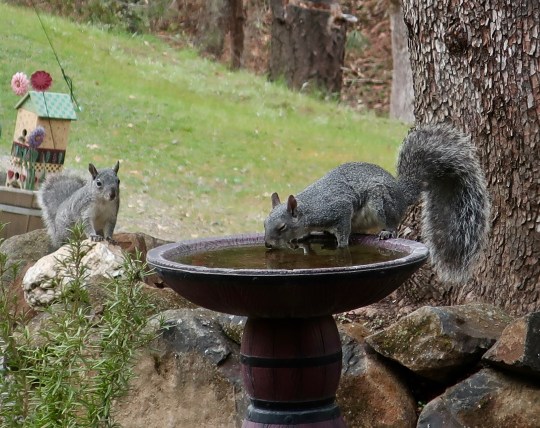
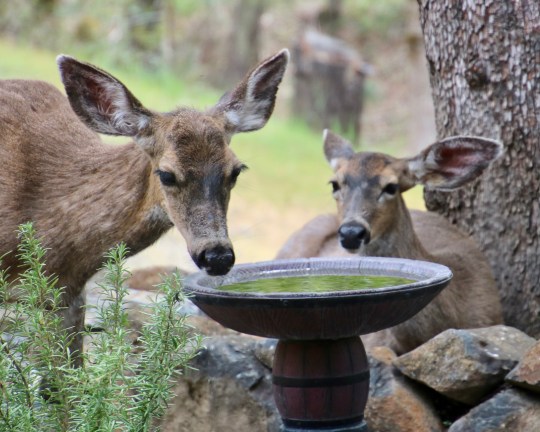
While the deer block is only up for a few weeks, our bird bath is open for business 24/7 year round. I’ve never seen a bird bathe in it (maybe we have dirty birds), but just about everyone stops by for a drink.

A gray squirrel slurps up water while its companion looks on…
And then joins in.
Although there is a natural spring down in the canyon, the deer seem to prefer the bird bath. We’ve learned that one deer can drink a lot.
And two drink a lot more. Peggy and I are constantly refilling the ‘spring.’
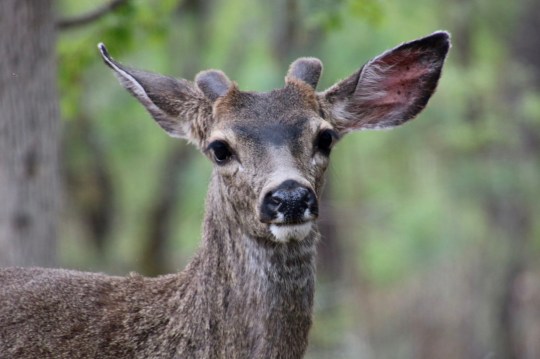
Let me introduce Young Buck. His antlers are just beginning their growth spurt.
He’s a handsome fellow.
And a bit full of himself. If he looks like trouble, that’s because he is. Consider the following:
We work hard to keep the deer away from our plants. One solution is planting things they don’t like. The poppies I featured last week are an example. Lavender is another. Our garden has a ten-foot high fence around it! And this is what I call the Maginot Line of deer barriers. Peggy and I built these Gabion cages several years ago. No deer had ever leapt over them. That is until…
…Young Buck. He jumped over the Gabion cage barrier, scrambled over the cement block wall behind it, sampled the newly plated honeysuckle and leapt over the seven foot dirt wall beyond that. Three times. The last time I had a discussion with him on how delicious venison stew is. Peggy and I also added another small fence. So far, he hasn’t jumped over again. But with him, there aren’t any guarantees. The other deer just stand around and watch in awe, waiting to see what happens. Normally lots of yelling, “BAD DEER!”
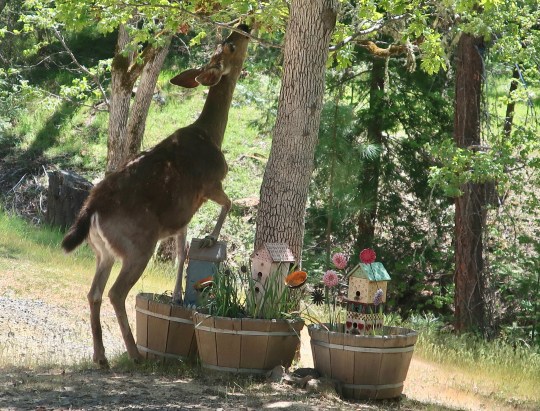
Having shown a bad deer, I’ll conclude today’s post by showing a good one eating Mekemson-approved deer food, young oak leaves. The problem here is that the deer was using one of Peggy’s planter villages as a ladder. She had been wondering why her houses and elves kept ending up on the ground!

NEXT POST: More wilderness encounters and lore. Peggy and I hike up the mountain looking for cougars and bears and snakes while a small bird feeder provides more entertainment than either the deer block or the bird bath spring. It’s the law of the jungle out there!

From Elegant Cat’s Ear to Hound’s Tongue: 10 Southern Oregon Wild Flowers— Plus a Rose Bush

Today, Peggy and I continue our ‘walks on the wild side,’ which are a primary form of entertainment for us while sheltering at home. Our local spring wildflowers provide the focus but I couldn’t help adding the rosebush that came across America in a wagon train.

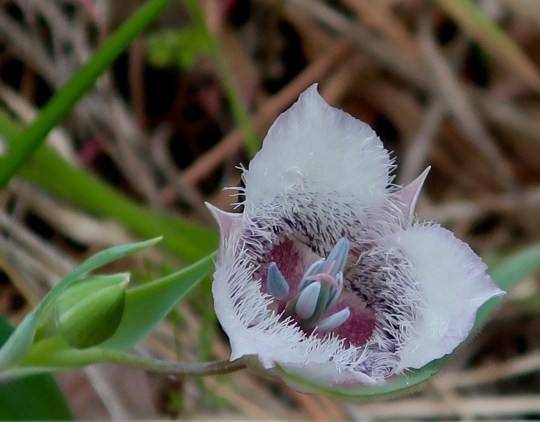
Calochortus elegans lily, or as more commonly known, elegant cat’s ear. It’s easy to see how this fuzzy fellow earned its common name. It is closely related to an old friend of mine, the Mariposa lily of the Sierra Nevada’s.

Our common names for flowers are often amusing. Hound’s tongue and elegant cat’s ear certainly are. But they can also be confusing. For example, one of the flowers I will feature today is Oregon grape. It isn’t the plants only common names, however. I found one list that included holly-leaf barberry, mountain grape, Oregon grape holly, Oregon barberry, blue barberry, creeping barberry, holly barberry, holly-leaved Berberis, holly Mahonia, Mahonia, Mahonie, scraperoot, trailing Mahonia, Uva de Oregon, Vigne de l’Oregon and water-holly— in addition to Oregon grape— for a total of 18 different names! Probably the best physical description is Oregon grape holly, but the plant is neither a grape or a holly. Nor is it found only in Oregon. It’s easy to see why botanists depend upon the plants scientific name, Mahonia aquifolium. Or is that Berberis aquifolium? (Grin) There even seems to be some debate over its scientific name!

These bright yellow flowers of Mahonia aquifolium or Oregon grape will eventually turn into blue grape-like berries. The leaves have a distinct holly-like look.
Regardless of its name, Oregon’s state flower is quite beautiful. It’s also known for its healing properties. Native Americans used it for stomach trouble, hemorrhages, and tuberculosis as well as a number of other ailments. Modern herbalists have also found it useful.

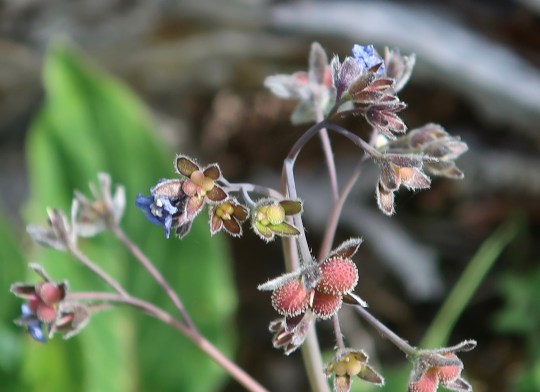
I started out mis-identifying hound’s tongue. I thought it was a forget-me-not— lots of pretty little blue flowers lighting up the day. I even had an old rant of mine prepared for today’s post. Legend has it that someone in Europe fell off a cliff or drowned in a river while clutching the flowers. His final act was to throw throw them to his lover while yelling, “Forget me not!” My experience with the plant is that when it goes to seed, all of its pretty little flowers turn into hundreds of obnoxious burrs that end up on your pants, socks and shoe laces! They are extremely hard to brush off and leave numerous stickers in your hands. Once you have had this experience, you never forget the plant.

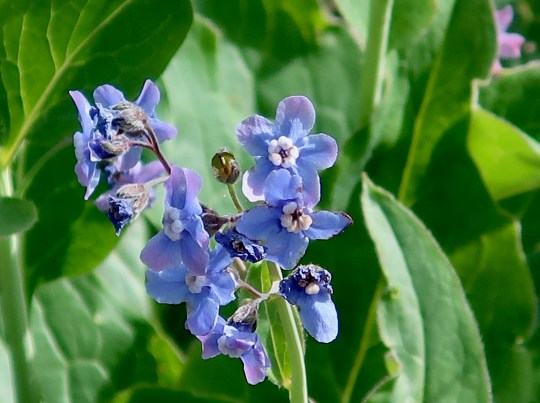
My apologies to hound’s tongue (Adelinia grande), who apparently only wanted to lick me. (Kidding on the latter.) It gets its common name from its leaves that are said to look like a hound’s tongue. They can be found along the west coast of North America from British Columbia to California.

The small blue flowers reminded me of forget-me-nots but the prominent white center and leaves said it was another plant. As to whether the leaves look like a hound’s tongue, they certainly don’t look like the tongue of Socrates the Basset Hound who hung out with me for several years.
The white center of the flower turns into prickly nutlets that look suspiciously like they might also stick to you..

And now, for the rest of the flowers:

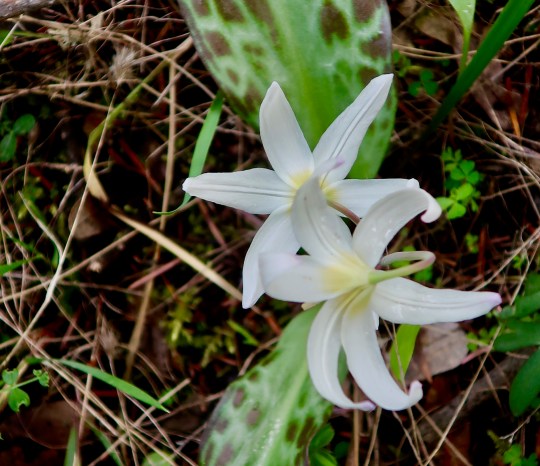
This beauty is a lemon fawn lily (Erythronium citrinum). We normally only have a couple of weeks to catch it blooming
Another view.
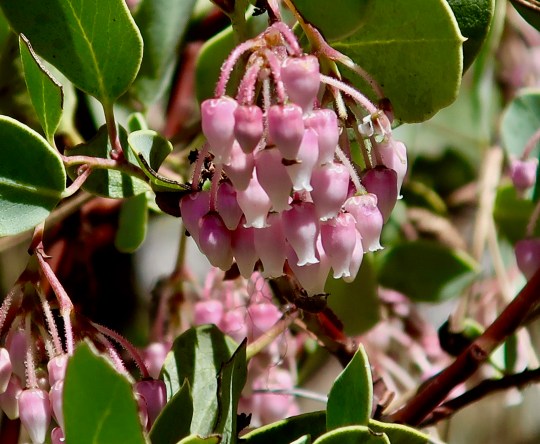
I grew up with these, white leaf manzanita flowers (Arctostaphylos viscida). By late summer these flowers produce bright red fruit that is sweet to eat, a favorite of raccoons, coyotes and a number of other animals, including small boys. The plant can live for a hundred years and the seeds can last in the soil for decades.
Peggy and I were hiking up in the forest when she spotted this flower. It was new to us, and striking. Of its two common names, grass widow or satin flower, my favorite is the latter. Its scientific name is Olsynium douglasii.
Another flower from my youth are shooting stars (Dodecatheon hendersonii). They grow in profusion on our property and are one of the first flowers of spring.
And by profusion, I mean profusion! The lonely little yellow flower is a butter cup.
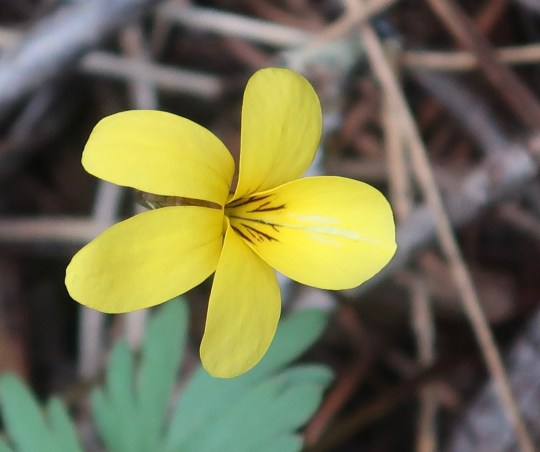
My immediate thought was violet, but the leaves seemed wrong. Violet it was, however, Shelton’s violet (Viola sheltonii).
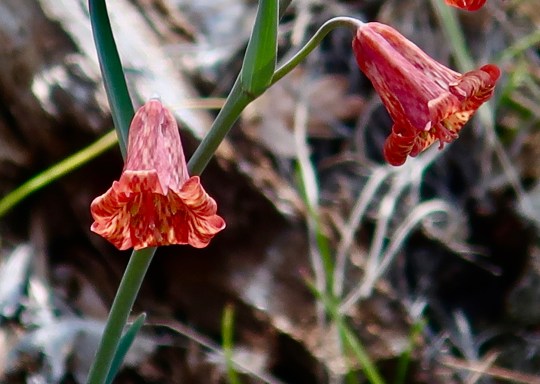
We call this pretty flower a red bell or scarlet scarlet fritillary (Fritillaria recurva). It’s a native of Southern Oregon.
Another view. The petals demonstrate why”recurva’ is part of its scientific name.
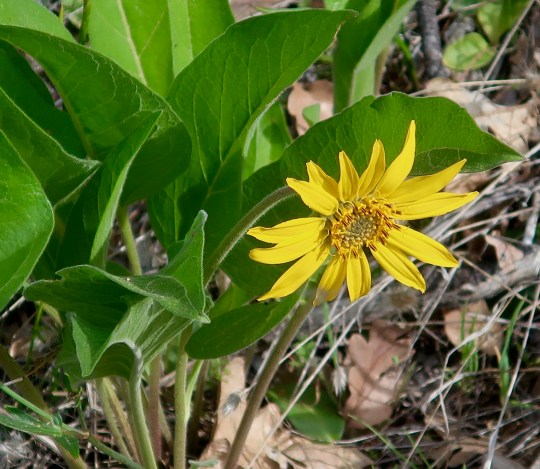
There is no doubt about this flower’s family. Arrow leaf balsamroot (Balsamorhiza sagittate) is a member of the sunflower family. Apparently, Native Americans found it yummy. Nearly all parts of the plant were eaten.
This photo provides a view of where the name ‘arrow leaf’ comes from.
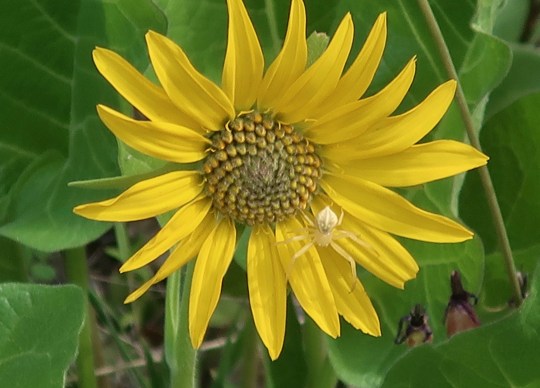
A photo of the flower to show off its camouflaged spider. Check out the face on its abdomen!
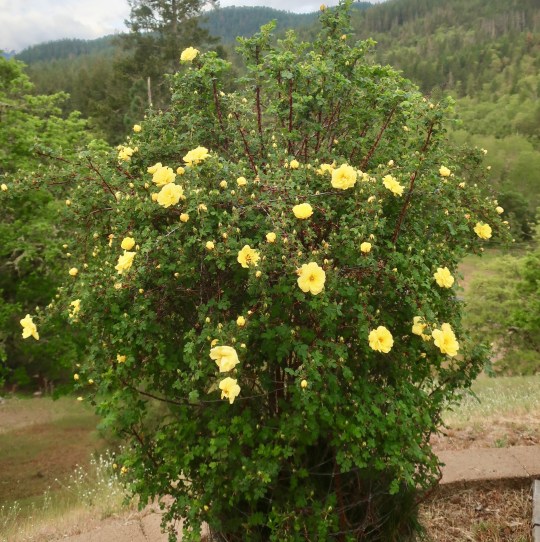
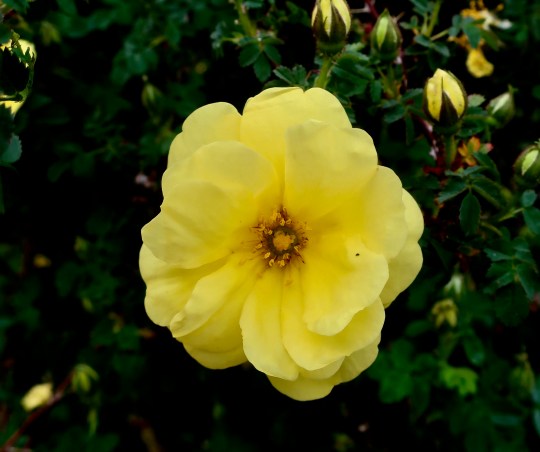
And finally, I had to include our pioneering Oregon rosebush. Like my Oregonian ancestors it originally came across America in a covered wagon. Unlike my ancestors, it had been stuck into a potato to survive.
Peggy obtained the rose as a sprig and has grown it into the beauty it has become today. It has literally hundreds of blooms. It just started blooming this week!
A close-up to finish today’s post.

On Monday… We are going to check out the bear’s cave to see if anyone is home and visit with some of our local wildlife, or at least check out some of the signs they left behind! Who ate the turkeys? Who ate our baby Douglas fir? Who left the fur-filled scat (non-scientific name: poop) behind. And that’s just the beginning.

Pretty Poppy Posies Posing… A Walk on the Wild Side: Part 2

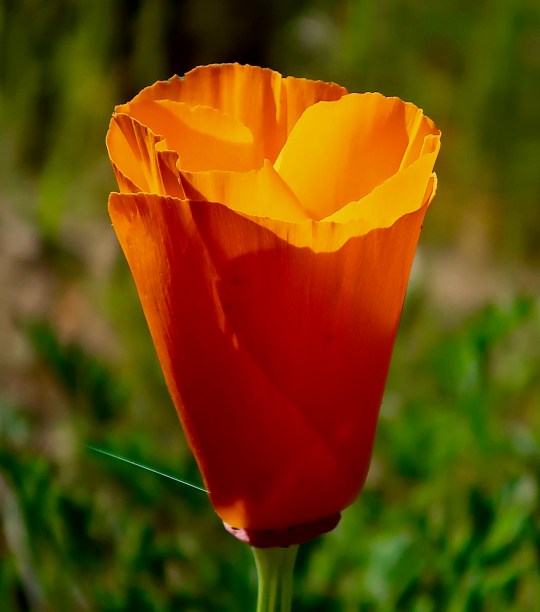
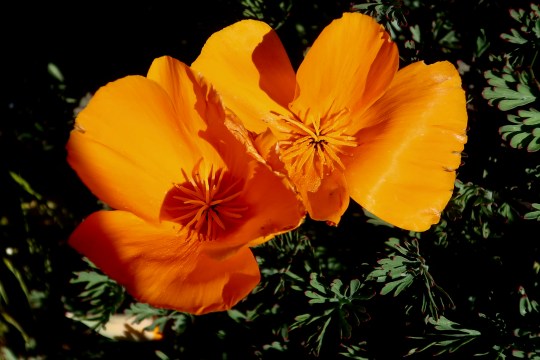
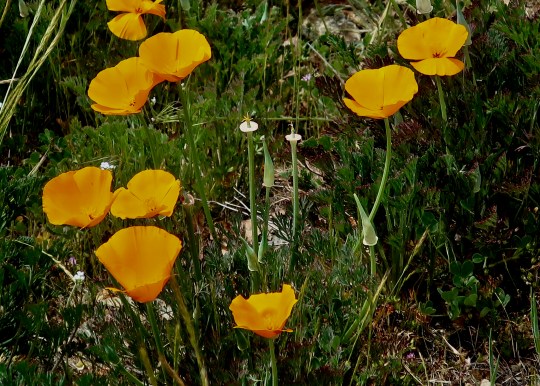
Peggy and I are continuing to hike around our five acres and the Rogue River–Siskiyou National Forest that abuts the back of our property. It serves as a form of entertainment and exercise during our ‘sheltering at home.’ On Monday I featured white oaks with personalities. Today I had picked out ten flowers to feature but the California poppies (Eschscholzia californica) growing down our hill in ever-increasing abundance demanded their own post. These guys produce a gazillion seeds (something like 100,000 per ounce) and are a bit aggressive. Since they are invading territory previously occupied by star thistle— in serious competition for being the world’s most obnoxious plant— we encourage them to invade away. Go, poppies, go!

It was about 9 a.m. and our poppies were just waking up when I took this photo. A spider had used it as a convenient post for attaching its web.

Ring around the rosy, a pocket full of posies…

Remember this rhyme from your childhood? London Bridge is falling down. I don’t remember anyone telling us the grim story behind it in the second grade, but it isn’t totally irrelevant today. The ditty was created during the time of the plague and the rosy was a red spot on a person’s body that indicated that he or she had caught the dread disease. A pocket full of posies were a pocket full of flowers and herbs that the individual hoped would keep the disease away.

The posie evolved into a small bouquet of flowers that could be warn in a person’s hair, fit into a lapel, or placed on a dining table. I’ve further adapted it to mean all flowers. Thus, pretty poppy posies. It’s good for alliteration. As for the plague, if our California poppies want to keep covid-19 away, we won’t complain. They are, after-all, said to have several positive medicinal benefits including managing pain, anxiety, and insomnia, which sounds pretty good, given our present pandemic.

If this also sounds like heavy-duty drugs, you might recall that the California poppy’s distant cousin, Papaver somniferum (which translate as the poppy that brings sleep) is the opium poppy. Derivatives of opium include morphine, codeine, oxycodone, and heroin. Used properly they bring relief from pain. Used improperly, they are all sorts of bad news. Just think of the hassles that Dorothy, the Cowardly Lion, and Toto had when they crossed over the opium-poppy field to get to the Emerald Palace. Snore. Fortunately Scarecrow and the Tin Man didn’t suffer the affliction.

You’ve probably sampled the opium poppy. And I don’t mean that you are shooting up heroin. Its seeds are included in muffins, on bagels, in salads, etc. While the trace amounts of opium aren’t enough to get you high or lead to addiction — although I confess to an unnatural fondness for poppyseed muffins— they are enough to disqualify you for the Olympics or possibly get you fired since they show up in drug tests. “But Coach, I was just eating a poppy seed muffin.” Right.

California poppies don’t have the same package of alkaloids that opium poppies do, but what they do have is enough to discourage deer from eating them, which is the number one criteria for range-free flowers at our place. And that certainly seems to eliminate a lot of pain, anxiety and insomnia for us. So maybe the claims made by the herbalists are true.

But enough on that; it’s time for the pretty poppies posing part of this post!

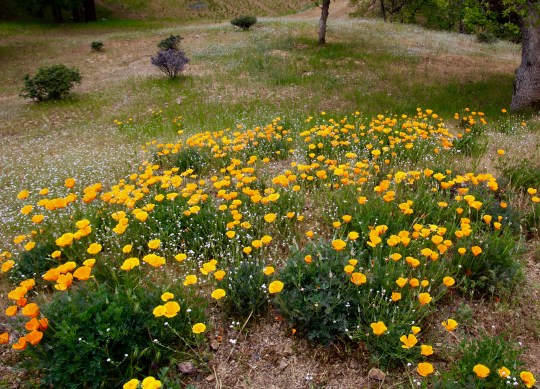
When we moved into our house 10 years ago, what was growing here were wall to wall star thistle plants. I pulled them out, chopped them down and poisoned them, but they insisted on coming back. So we planted poppies. Nothing happened for several years and then three years ago poppies started popping up. They have been spreading like crazy ever since.
This will give you an idea of how steep the hillside is. Weed whacking and pulling is a real hassle. Watching poppies spread is ever so much easier! This is three weeks ago before the poppies had started blooming in profusion. (Photo by Peggy Mekemson.)
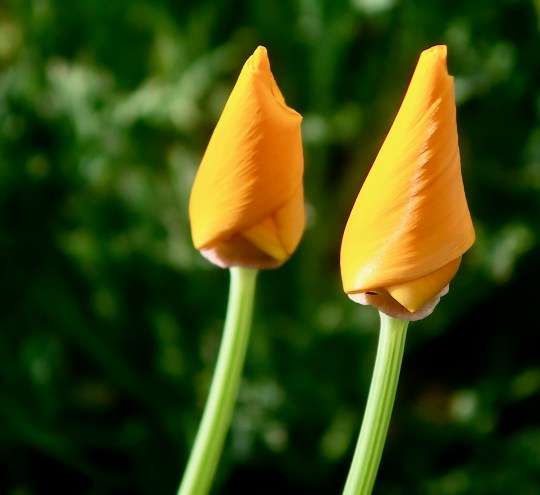
Here is a view of what the leaves and early buds look like.
A close up of a poppy bud.
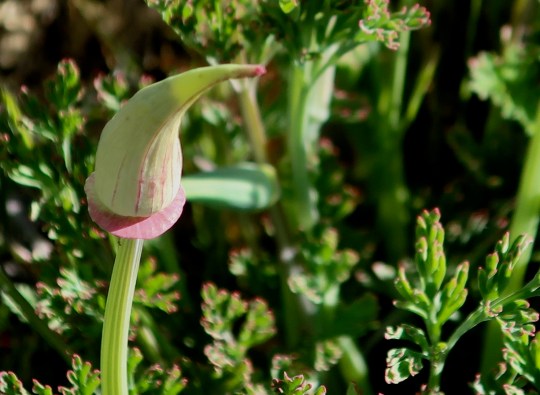
The poppy reaches a point where it begins to shed its bud cover.
Almost there…
Free at last. Free at last. Are these guys twins?
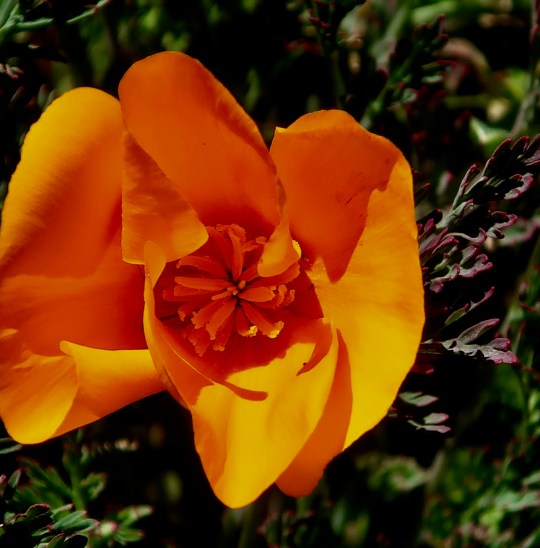
And the flower begins to open. The sheer beauty of these flowers explains why California chose the poppy as its State Flower in 1903.
And further along. As far as I can tell, the opening of the flower here is the same as the flower opening every morning. Poppies close in the evening and reopen in the morning. They also prefer to remain closed on cloudy days and when a cold wind is blowing.
Early morning has always been one of my favorite times of the day to photograph poppies.
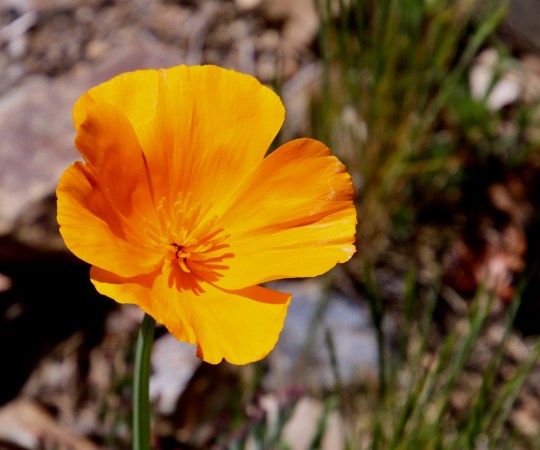
By ten or eleven the flowers are close to being fully open.
Which this one is here. (The white flowers that you see are Cryptantha flaccida, or limp stem cryptantha, not a very flattering name.)
And here.
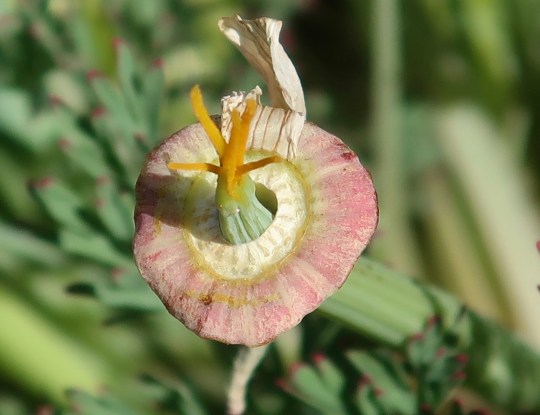
Once the poppy petals reach this point they are about to drop, which leads to the next phase of the plant’s life.
The poppies in the middle have been pollinated, dropped their petals, and are ready to develop seeds.
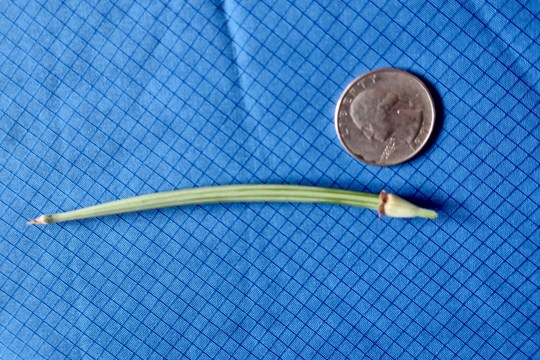
Here is a close up of the seed pod. It grows longer, a lot longer.
Almost ready to spread its seeds. One of the flowers donated this pod so it could live forever on the internet. (Grin) It is packed full of up to 100 seeds. When mature, the pod explodes, shooting seeds up to six feet away.
Which is why the poppies are marching down our hill! Outliers can be seen at the bottom. They will soon be joined. Come back at this time in 2021 for the next installment.

FRIDAY’S POST: The rest of the interesting and gorgeous flowers that Peggy and I have found hanging out on our property and in the national forest.

When Scary Trees Live in Your Neighborhood… A Walk on the Wild Side: Part 1

From the beginning we declared this the Hobbit Tree. Look carefully and you can see Smaug sweeping out of the sky on a mission of vengeance.

Peggy and I continue to shelter in place and find ways of entertaining ourselves. One is to go for extended walks around our five acres and in the Rogue River-Siskiyou National Forest that abuts our property. Naturally, I carry my camera on these daily excursions and look for things of interest. I’ve done several posts on these ‘walks on the wild side’ over the last ten years. It’s time for another one.

Walking is one way that many of us are dealing with our extended home-stays. One doesn’t have to live next to a national forest. A local park that is still open, the neighborhood— almost anywhere that is safe— works. It gets us out of the house and it’s great exercise. Looking for things of interest adds to the fun. Peggy, for example, is infinitely curious about what the neighbors are up to. She is constantly urging me to go on detours to find out.

As I was going through my photos last week for this blog, I decided I had enough material for three posts. It’s all about weird trees today. On Wednesday I’ll feature the spring flowers that Peggy and I have found over the past few weeks, including one on the endangered species list. Friday will be pure nature as in who is doing what. For example is a bear living in the bear cave? Peggy makes me throw rocks into the cave to check before we venture in. I’m pretty sure that all that will do is irritate the bear, but I accommodate her wish. And I am sure you will want to help us figure out whether a cougar, bobcat, or coyote left the scat (poop) we found full of hair. How could you not?

But first the trees. A few years ago I decided to do a inventory of what trees grow on our property. White oaks were the most common. I counted over a hundred. For the most part, these are handsome representatives of the tree world— standing tall while providing shade in the summer and a plethora of acorns in the fall. Just about everyone joins in the harvest, or so it seems: deer, tree squirrels, ground squirrels, turkeys, bears, etc. We watch the deer play human and stand on hind legs to reach beyond where their imagination normally takes them. Ground squirrels leave the ground and can be seen precariously perched in the highest branches while they madly chomp away with sharp incisors to free acorns before the acorn woodpeckers arrive.

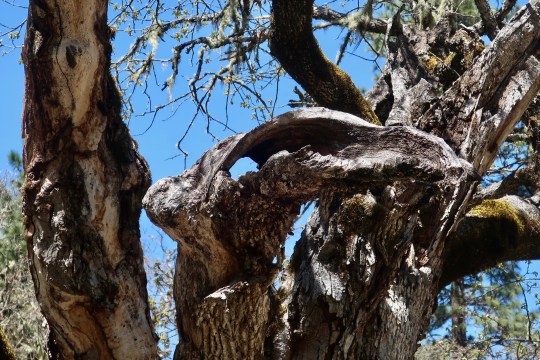
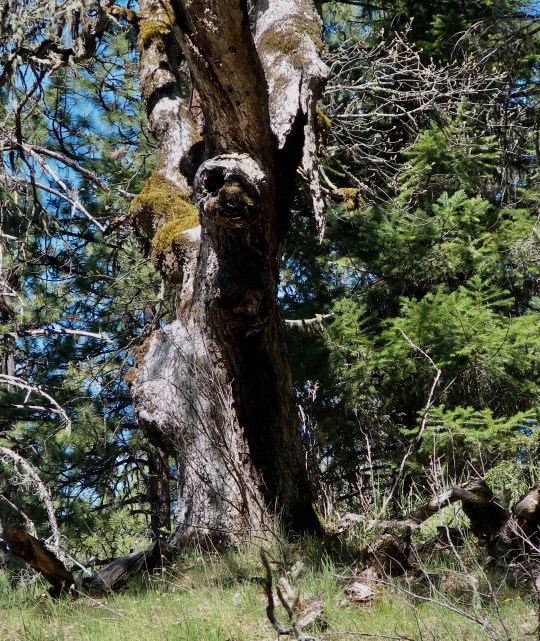
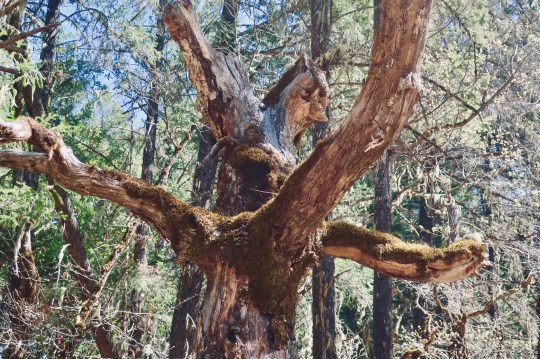
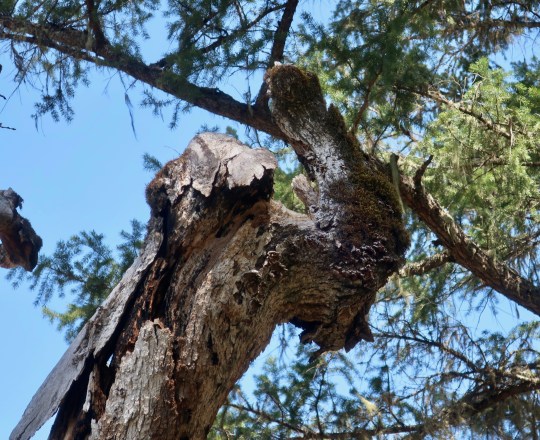
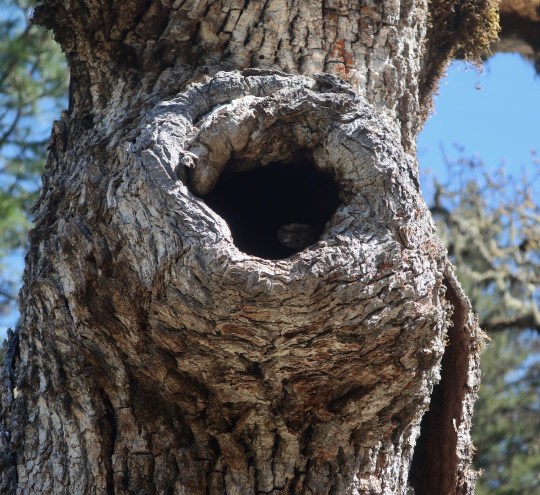
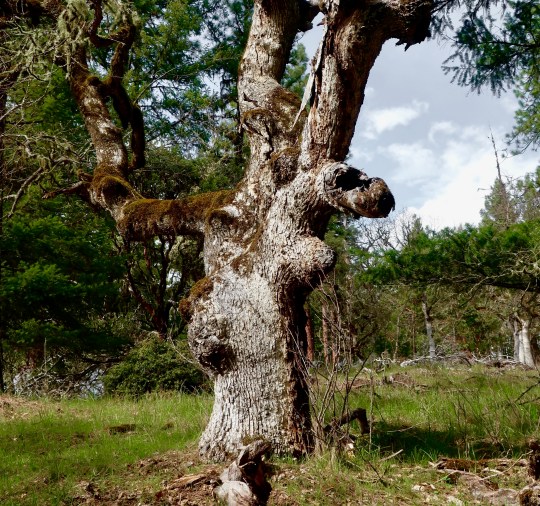
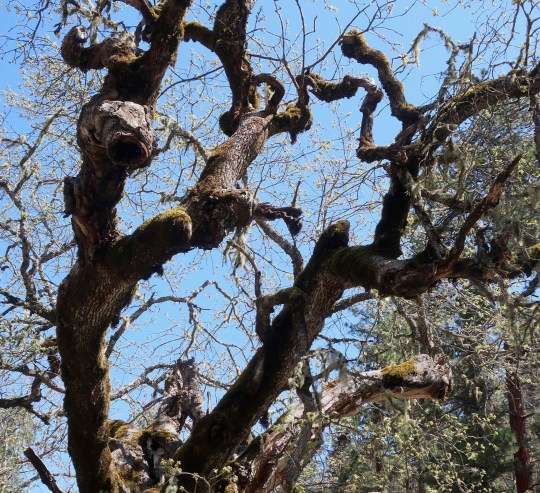
But not all of the white oaks stand proud and tall. Some are stubby and twisted, and ancient— almost scary. A little horror music please. They look like they could easily fit into your favorite scary flick, or a fantasy movie, or a nightmare. My post on last Friday where I featured gargoyles from Dubrovnik made me think of them. Here are some of our favorites:

Smaug stares down at us from the Hobbit tree.
This is the Evil Seal tree, definitely resembling a gargoyle.
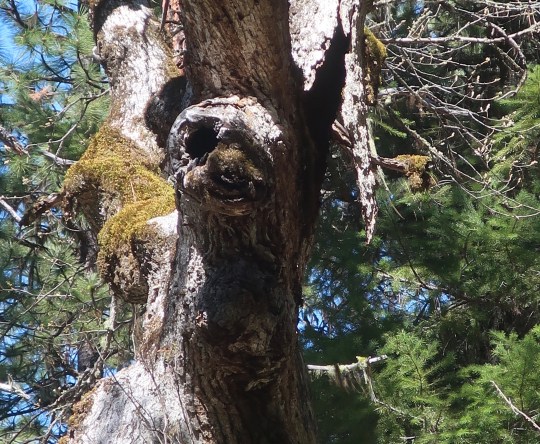
Here’s a close up, complete with vacant eye socket and a grinning, tooth-filled mouth. “Come closer, my dear. Let me whisper in your ear.” Chomp.
This eyeless buck with its twisted horns also borders on evil. I may cover the nose in red come next Christmas.
And here is where the werewolf hangs out on the upper right. I’m sure we hear him howling on moonless nights.
Maybe not so scary, but still… the elephant. Interesting eyebrow, or is that a cap.
The Brain!
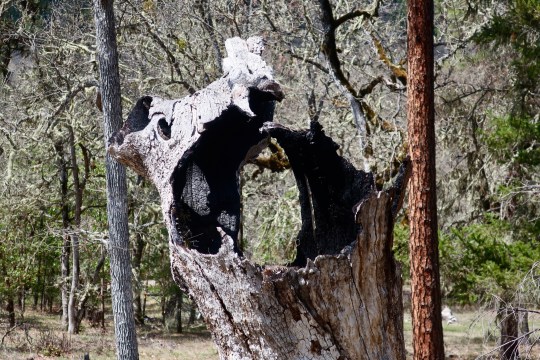
A gaping maw. It would take a brave (or foolish) person to stick her hand into it! “You first,” Peggy suggested.
A great tree to be perched on the edge of a graveyard in a horror movie. The snake-like creature coming out of the tree is preparing to strike.Why am I thinking Voldemort?
An even better graveyard tree! Perfect for a dark and stormy night.
And finally, I will leave you with this lovely creature born out of fire. Make what you will out of it!

WEDNESDAY’S POST: Lots of pretty posies.

The Gargoyles of Dubrovnik— And a Saint’s Finger… Armchair Travel

Today, I am continuing to dig back into my Word Press archives by looking at gargoyles. I have a weakness for them. While they are said to scare away evil spirits, they attract me. What can I say? As for the various body parts of saints, you will find them scattered in Catholic churches throughout Europe. One can only wonder… Anyway, Gargoyles and a sacred finger are the subject of today’s armchair travel as I wrap up my posts on Dubrovnik.

I found this marvelous gargoyle about a foot off the Stradun connected the the Franciscan Monastery.
I found this marvelous gargoyle about a foot off the Stradun connected to the Franciscan Monastery in Dubrovnik, Croatia. Check out the great mustache!

Weird amuses me— and few things are more weird than a gargoyle. During the middle ages, no decent cathedral would be caught without them. In addition to piping water away from the building, they served as reminders to the faithful that evil lurked in the world, an evil that could only be overcome by attending church and donating money. Their cousins, grotesques, were also found on churches. Equally ugly and portentous, they didn’t carry water.
Whenever I get near a gargoyle or grotesque, I can’t help myself; I have to take its photo. Fortunately, Peggy feels the same way.

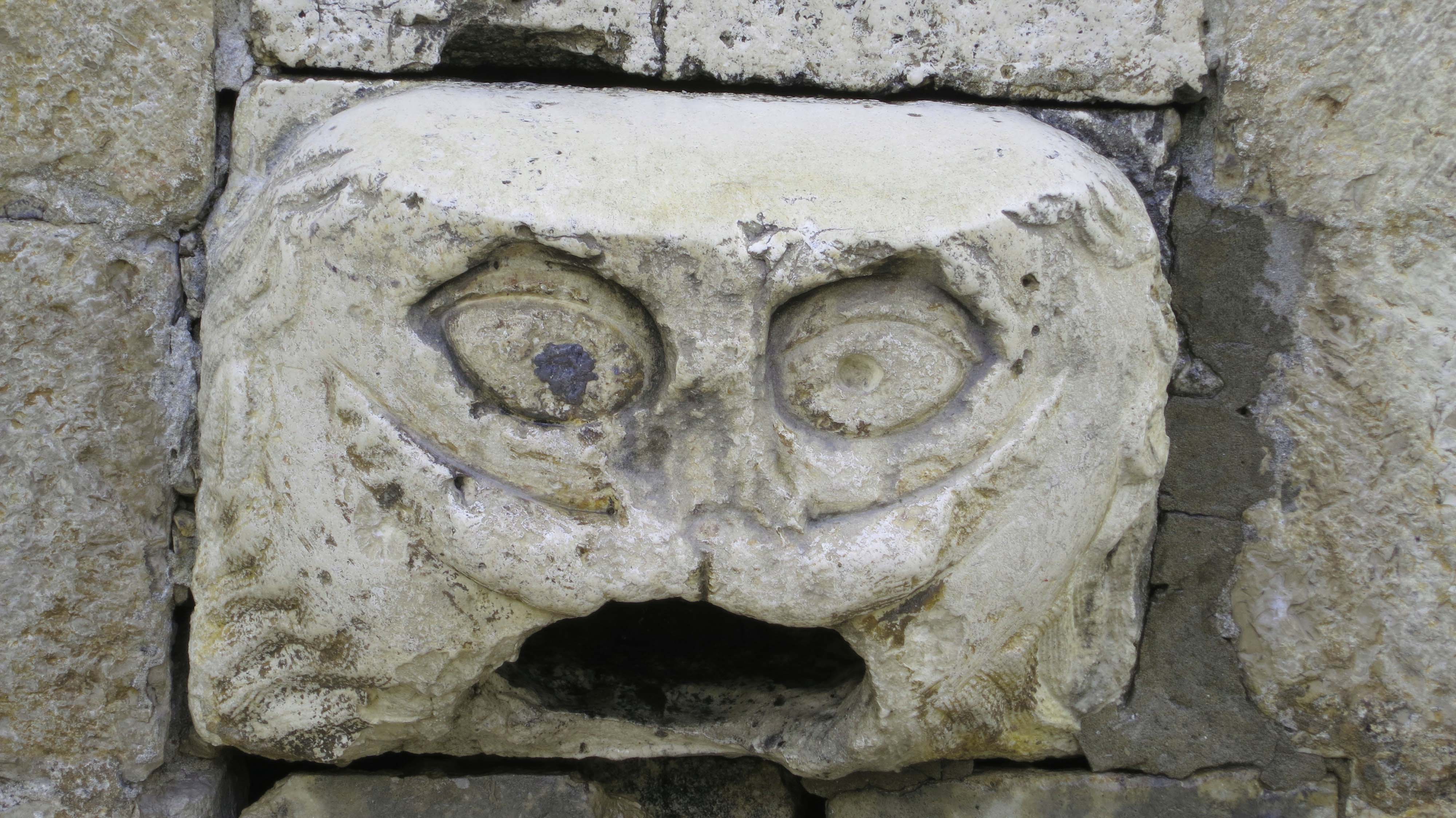
Peggy caught this Dubrovnik gargoyle. Possibly it represents one of the winds.
I took this closeup of the Dubrovnik gargoyle Peggy photographed above. Note the water dribbling down its chin.
I took this closeup of the Dubrovnik gargoyle Peggy photographed above. Note the water dribbling down its chin. I don’t know about you, but I always find it interesting to try different perspectives when I am photographing something.
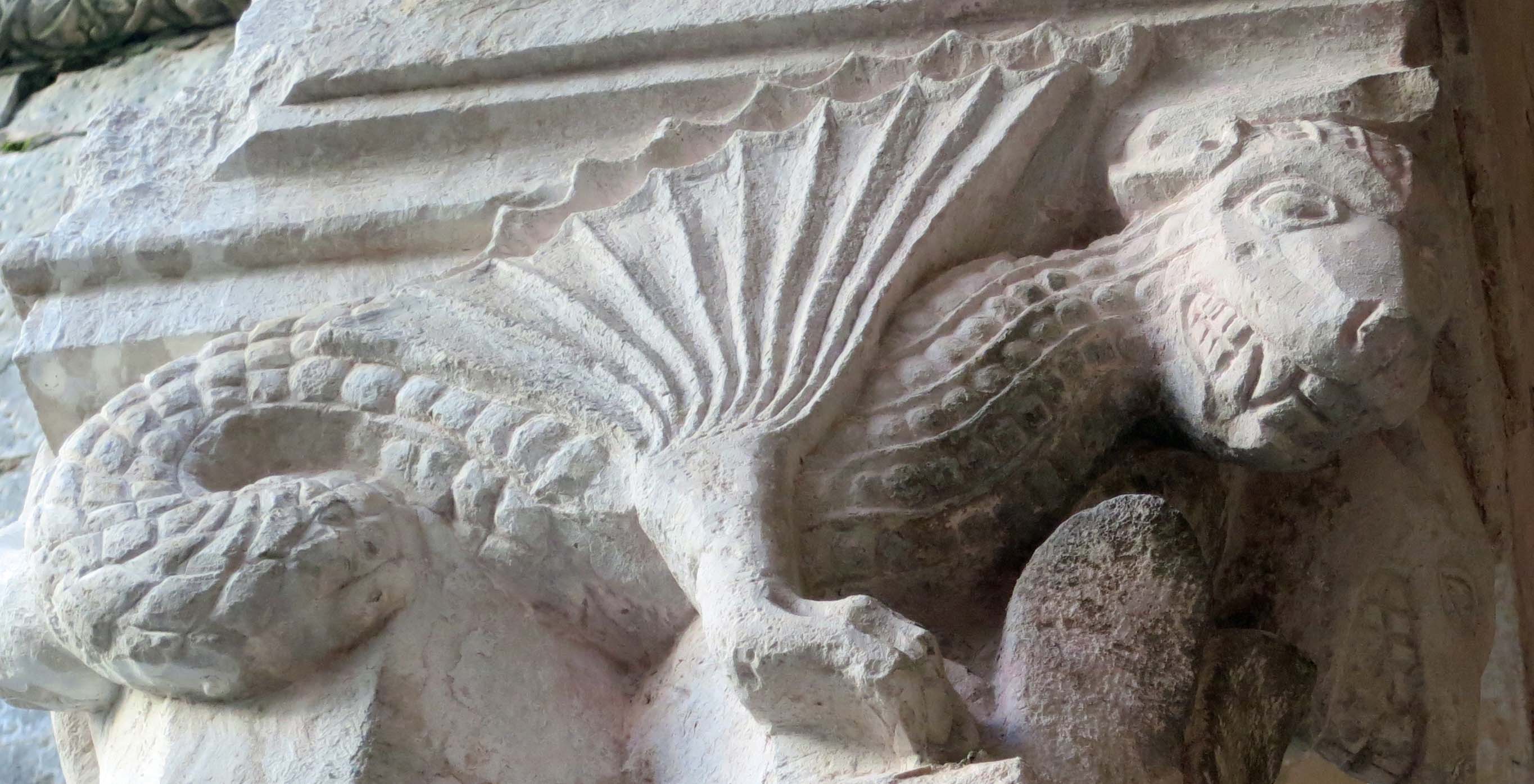
We found examples of grotesques in the cloister of the Franciscan Monastery of Dubrovnik on top of columns. (Photo by Peggy Mekemson)
Dragons were a popular subject for both gargoyles and grotesques. What could be more scary. We found this specimen with his fine set of choppers in the Franciscan Monastery.

I have also found that fountains in Europe often host strange-looking beings. While the wealthy in pre-modern times might have water piped into their homes, the common folks obtained their water from community fountains. Dubrovnik built an aqueduct system in the mid 1400s to bring water to the city and then located two public fountains on the Stradun: big Onofrio’s Fountain located near the Pile Gate and little Onofrio’s Fountain found next to the clock tower in Lutz Square.

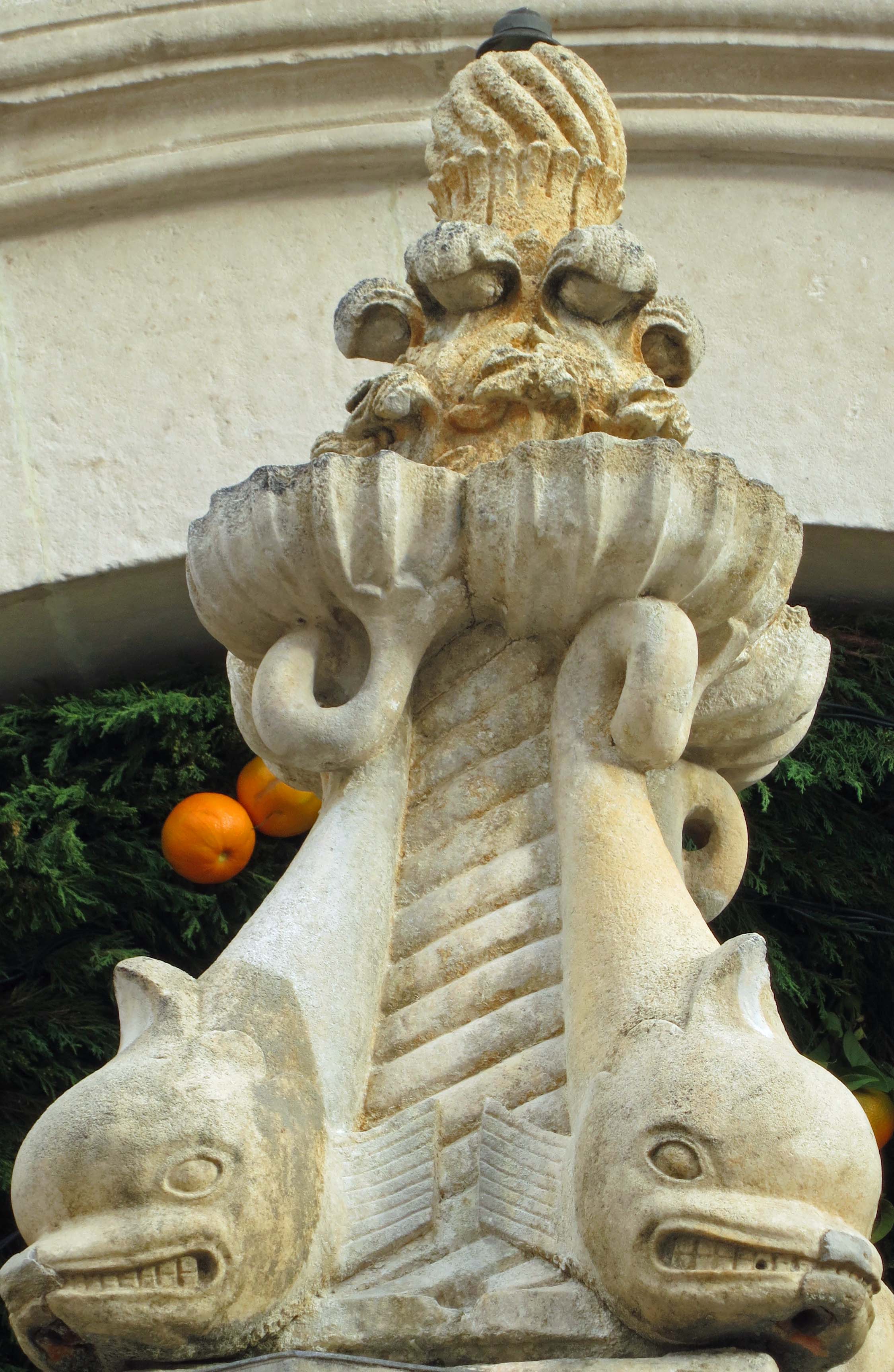
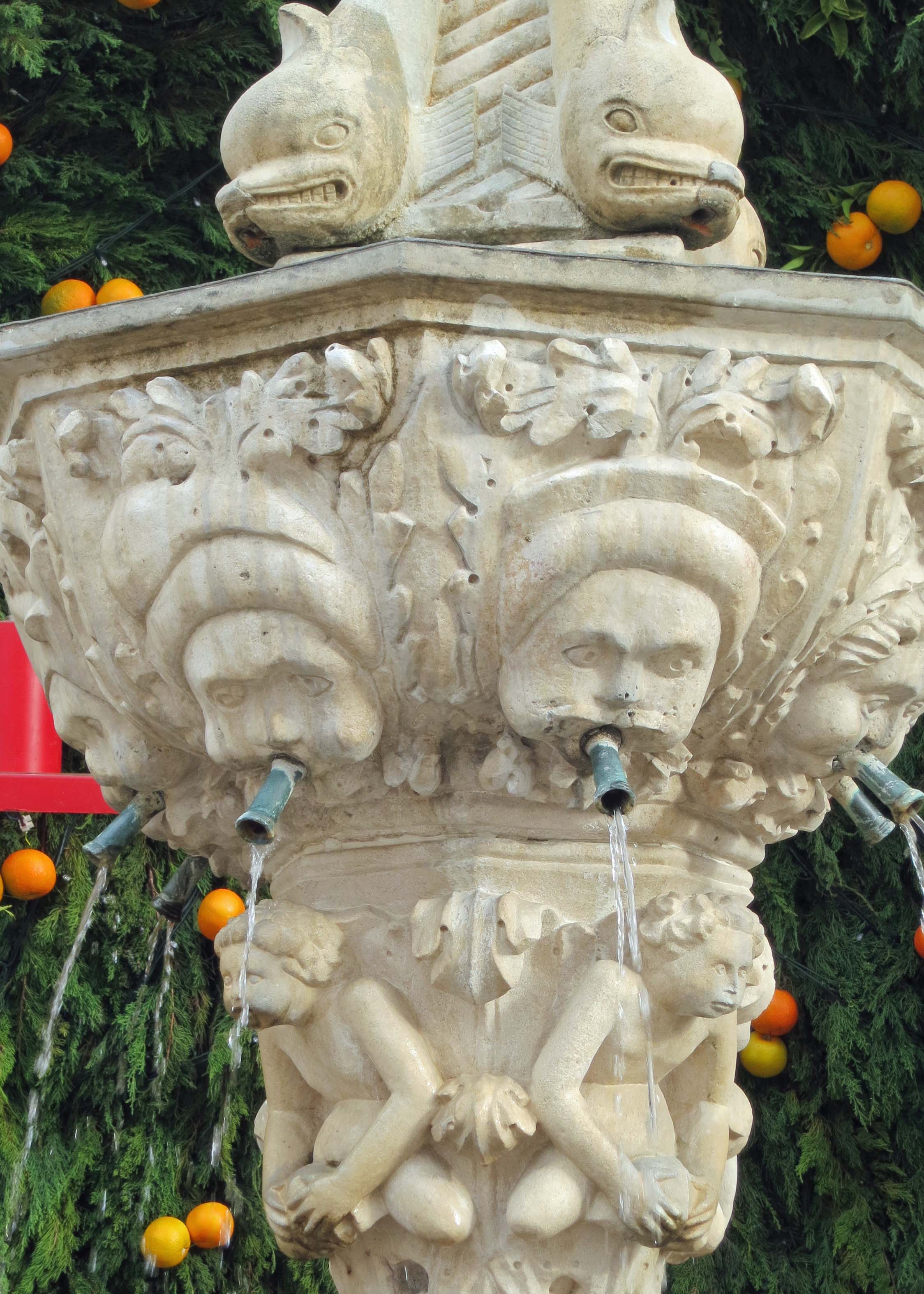
The top of Little Onofrio's Fountain with its ferocious looking fish. The fountain is located near the clock tower in Dubrovnik, Croatia.
The top of little Onofrio’s Fountain with its ferocious looking fish. The fountain is located near the clock tower in Dubrovnik, Croatia. If I caught something like this, I’d be cutting my line!
Another view of Little Onofrio's Fountain.
Another view of little Onofrio’s Fountain. The oranges, BTW, were part of Dubrovnik’s Christmas decorations.
Big Onofrio's Fountain located near the Pile Gate had 16 sides and each side featured a different mask with a spout coming out of its mouth. This was a cow mask.
Big Onofrio’s Fountain located near the Pile Gate had 16 sides and each side featured a different mask with a spout coming out of its mouth. This was a cow mask. Or maybe it was a bull.

Something I find even stranger than gargoyles, grotesques, or fountain inhabitants are relics— bits and pieces of saints or other holy items kept around in reliquaries as items of worship.  Pieces of the Cross are a common example. I once read that selling pieces of the cross was a thriving business during the Middle Ages. Scam comes to mind. The Dubrovnik Cathedral has a particularly impressive set of relics including a requisite piece of the Cross, Baby Jesus’ swaddling clothes, and various body parts of St. Blaise.

All of these items are reputedly capable of performing miracles and it is something of a miracle they exist. How they were obtained is usually rooted in the murky past. Pieces of the swaddling clothes were provided to women having difficult births. No matter how many pieces were cut out of the cloth, so it is said, the cloth returned to its original form.

I came across St. Luke’s finger in the small museum found in the Franciscan Monastery in Dubrovnik. The finger is encased in a gold reliquary. I know people take these items seriously and believe they have miraculous powers, but I find them on the far side of strange. I would almost bet that it cost the monastery an arm and a leg to get the finger.
NEXT POST: You want gargoyles? Wait until you see the white oak trees on our property and in the national forest behind us. These trees would fit right into “Lord of the Rings” or most other fantasies— or horror movies. My theory is that they will scare the heck out of the coronavirus if it comes around. Remember how the gargoyles were supposed to scare the evil spirits away from medieval cathedrals in Europe? I bet that they were recruited to frighten the plague as well! I know better, but it is fun to contemplate. And I find the trees interesting and amusing as opposed to scary. (At least during the day.)