
AP photo of Leymah Gbowee
Liberian women were centrally involved in Taylor’s downfall. Much of the credit goes to Leymah Gbowee. She provides a powerful example of what a committed individual can accomplish, even in the face of almost insurmountable odds. A deeply religious woman, Gbowee grew up and raised a family during the chaos of Liberia’s two civil wars. She first became involved by working with children soldiers who had been deeply traumatized. This in turn led her to become a peace activist with a strong belief that women needed to be involved in efforts to end the violence in Liberia.
By 2002, Gbowee had become a recognized leader of the peace movement and had organized thousands of Christian and Muslim women to gather in Monrovia for nonviolent demonstrations to end the war. She even organized a sex strike: No peace, no sex.
Finally, on April 23, 2003, Taylor granted a hearing for the women. Gbowee served as the spokesperson. Her words: “We are tired of war. We are tired of running. We are tired of begging for bulgur wheat. We are tired of our children being raped. We are now taking this stand, to secure the future of our children. Because we believe, as custodians of society, tomorrow our children will ask us, “Mama, what was your role during the crisis?”
When peace talks began in Accra, Ghana two months later, Gbowee was there with a group of Liberian women to pressure the various factions into signing a peace agreement. Her message was even more direct: “Butchers and murderers of the Liberian people — STOP!” On August 18, an agreement was finally signed between the warring factions.
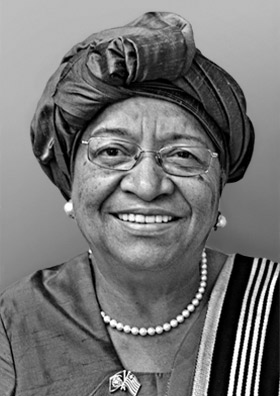
United Nations photo of Ellen Sirleaf Johnson
2006 marked the election of Ellen Johnson Sirleaf as President of Liberia and, hopefully, the beginning of a new chapter for the war-torn country. Sirleaf is the first female head of state in Sub-Saharan Africa. She has a long history of participating in and surviving Liberian politics that dates back to Tolbert’s government. She has spent months in jail and years in exile for her political activities. While she initially supported Taylor as an alternative to Doe, she ran against him for President in 1997 and became a vocal opponent of his policies. She has a strong background in finance and has worked for the United Nations. In 2011 Sirleaf was elected to a second term, and, along with Leymah Gbowee, received a Nobel Peace Prize for her efforts to restore peace in Liberia.
The challenge of rebuilding Liberia is monumental, however. The infrastructure of Monrovia and major communities throughout the country were left in ruins by the war. Today, ten years after Taylor was driven from power, less than ten percent of Monrovia’s population has access to clean water and much of the city remains off of the grid in terms of electricity. Sewer systems, medical care facilities and roads suffer from a similar level of development.
Sam, the young Kpelle man who had worked for us in Gbarnga, eventually went on to become a physician (Dr. Kylkon Mawkwi). When he was employed at Phoebe Hospital after the war, electricity was available for only a few hours per day; clean water was limited; and medical drugs were either nonexistent or in extreme short supply. When he left in 2012, little had changed.
Huge numbers of unemployed people are a challenge to the stability of any government and Liberia has tens of thousands unemployed people in Monrovia. Many are ex-soldiers. These soldiers have seen the worst that war has to offer. Imagine being forced into a war as a child, having to fight naked while being heavily drugged.
How do your repatriate these men into becoming productive, supportive members of a democratic society? How do you give them hope that life can be better? Lack of medical care and psychological support combined with unemployment is obviously not the answer. As it stands, these ex-soldiers provide a potential source of recruits for the next demagogue to rise out of Liberia’s troubled waters. And some of the old demagogues are still around.
It frightens me to realize that the supposedly reformed but unpunished General Butt Naked roams freely in Monrovia. And I am concerned that Prince Y. Johnson is now a Senator from Nimba County while Jewel Taylor, the ex-wife of Charles Taylor, is a Senator from Bong County. While both redemption and reform may be possible for individuals, these people have a dark history. Are they truly committed to what is best for Liberia or are they driven by ambition and greed? Will they and their compatriots serve as forces to pull the nation together or drive it apart?
Corruption, a legacy from the days of Americo-Liberian government, continues to haunt the country. In a world where bribery is seen as a way of life, low paid civil servants such as police officers see nothing wrong with supplementing their income by using their positions to demand bribes. Such actions undermine belief in government’s ability to provide fair and just treatment. As the corruption climbs up the ladder to teachers, judges and other government officials, the potential damage is multiplied.
So what are the answers? Nothing simple, that’s for sure. Two things seem clear to me. First, change has to come from within. Liberians have to perceive and want a different future from what they presently have. They need to believe that such a future is possible, and they have to work together to achieve it. Leymah Gbowee provided an excellent role model. She proved that Liberians could work together in a common cause regardless of tribal background or religious affiliation.
Second, much of what outside governments and non-government organizations have done to help has had minimum impact. For example, relief efforts may be necessary to solve an immediate crisis, but do little to prevent the reoccurrence of the crisis. Even programs designed to address underlying issues will fail unless those being helped take ownership. For this to happen, the recipients have to perceive a need for the program and participate in its development.
My friend, Kylkon Mawkwi, provided an example of what happens when recipients of programs aren’t stakeholders. Proper sanitation is an important step in improving people’s health. Simply washing hands after “serving nature,” as my Liberian students called it, can have a tremendous impact. Therefore, it isn’t surprising that an aid organization decided to build modern toilet facilities in a village where going to the bathroom meant walking out into the bush and squatting. A few months later the organization checked back in. The villagers were still heading out into the bush. The chief had decided that the best way to keep his shiny new restroom shiny and new was to lock the door. A lack of perceived need, combined with minimal community involvement in the design, development, and maintenance of the facility had doomed it to fail.
Beyond the desire to change and a commitment to make it happen, Liberia’s future depends upon maintaining peace and stability, reducing corruption, developing infrastructure and providing opportunities for individuals and families to improve their lives. It’s a tall order, one that will require people from different tribes working together with the descendants of Americo-Liberians, and Christians working together beside Muslims. And it will require continuing support from outside.
NEXT BLOG: Peace Corps returns to Liberia

























































































 Wandering through Time and Place
