There’s This Bigfoot Trap Near Our House…


Bigfoot trap found above Applegate Lake in Southern Oregon.

The world’s only known Bigfoot trap. (Photo by Peggy Mekemson.)

I’ve blogged about Bigfoot before. How could I not when the world’s only known Bigfoot trap is four miles from our home on the Applegate River in Southern Oregon?

My wife Peggy and I went out and revisited the trap just before we took off for Nevada three weeks ago. Since we were heading out to explore ghost towns, the Extraterrestrial Highway, Area 51, Death Valley and Las Vegas, I figured that searching for Bigfoot would put us in the right frame of mind.

We added looking for morel mushrooms as part of our Big Foot hike. They reputedly grow in the area. From my experience so far, however, I am beginning to believe they are even more difficult to find than the Big Hairy Guy and UFOs combined. Our carpenter, who was building us a pole barn while we were in Nevada, assured me of the morel’s existence. He had found one so big it was featured in the local newspaper and on Paul Harvey. “Morels yes, Bigfoot no,” he told us.

Our carpenter, Larry Baleau, shows off the huge morel mushroom he found while out identifying wildflowers.  (Photo by Bob Pennell of the Medford Tribune.)

Our carpenter, Larry Belau, shows off the huge morel mushroom he found while out identifying wildflowers. (Photo by Bob Pennell of the Medford Tribune.)

I am not quite so emphatic about Bigfoot’s existence. Our front window looks out on Bigfoot Country. There have been a number of reported “sightings” over the years. One led to the building of the Bigfoot trap.

It isn't hard to imagine Bigfoot prowling around in the forest when you look out our front window on a misty morning.

It isn’t hard to imagine Bigfoot prowling around in the forest when you look out our front window on a misty morning.

It all started when Perry Lovel, a miner living on the Applegate River, discovered 18-inch long human-like tracks in his garden that were six feet apart. His tale captured the imagination of Ron Olsen, a filmmaker from Eugene who headed up an organization known as the North American Wildlife Research Team. Ron decided to catch Bigfoot– allegedly for scientific purposes. I suspect he had other motivation as well. Imagine owning the rights to the movie?

This image of a big foot appropriately marks the beginning of the Bigfoot trail.

This image of a big foot appropriately marks the beginning of the Bigfoot trail. It is proof that the US Forest Service has a sense of humor.

Anyway, Ron and his group built a sturdy 10 by 10 foot box trap located a mile or so above Perry’s garden. A raised, heavy steel gate was added to provide Bigfoot with access to the trap. Meat was then placed inside and connected to a lever that released the gate, which came crashing down with all the subtlety of a guillotine.

Bigfoot trap door.

Looking up at the heavy trapdoor that was supposed to capture Bigfoot.

Ron then built a ramshackle cabin a couple of hundred yards down the hill and hired a miner to hang out and monitor the trap. He was given a tranquilizer gun and a very large pair of handcuffs. You get the picture. I assume the miner also stocked in a year’s supply of booze. Make that a six-year supply, since that is how long the trap was maintained.

Remains of cabin where miner lived who was supposed to tranquilize Bigfoot if he was caught in the Bigfoot trap in southern Oregon.

All that remains of the miner’s cabin is a pile of old boards, limbs and tar paper.

But was the effort successful? In a way, yes. The miner actually captured two grumpy bears who were under the mistaken impression they were getting a free lunch, not realizing there is no such thing. But Bigfoot didn’t take the bait. Here are my thoughts on why.

The only way they might have captured Bigfoot was if he were rolling around on the ground laughing so hard he couldn’t escape. If he exists, this larger than life character is far too intelligent to get caught in anything as obvious as the trap that Ron built. Otherwise there would be much more definitive proof of his existence beyond a few photos of dark blurs disappearing into the woods.

Since I was about to visit Area 51 in Nevada, I had a final whimsical thought: maybe Bigfoot is an alien. That would explain lots of things. (Grin) We didn’t find Bigfoot, and we didn’t find any morel mushrooms, but there were other strange things along the way…

Selfie of Curtis Mekemson.

What’s more strange than me taking a selfie?

Ferns growing near Applegate River in Southern Oregon.

And how about these alien looking plants. Actually, they are young ferns. (Photo by Peggy Mekemson.)

Shelf mushroom found near Applegate Lake in Southern Oregon.

We didn’t find any morels, but I did find this shelf mushroom growing on a dead tree.

My greatest find: as Peggy and I were hiking out from the Bigfoot trap, I found this image staring out at me from the bark on a Madrone tree. I'm thinking maybe Bigfoot had his own approach to taking a selfie.

My greatest find: as Peggy and I were hiking out from the Bigfoot trap, I found this image staring out at me from the bark on a Madrone tree. Maybe Bigfoot has his own approach to taking a selfie.

NEXT BLOG: The journey to Nevada begins and we admire the mystical and majestic Mt. Shasta and stop off at beautiful Burney Falls.

Painted Rocks Petroglyph Site of Southern Arizona… Nice Doggy

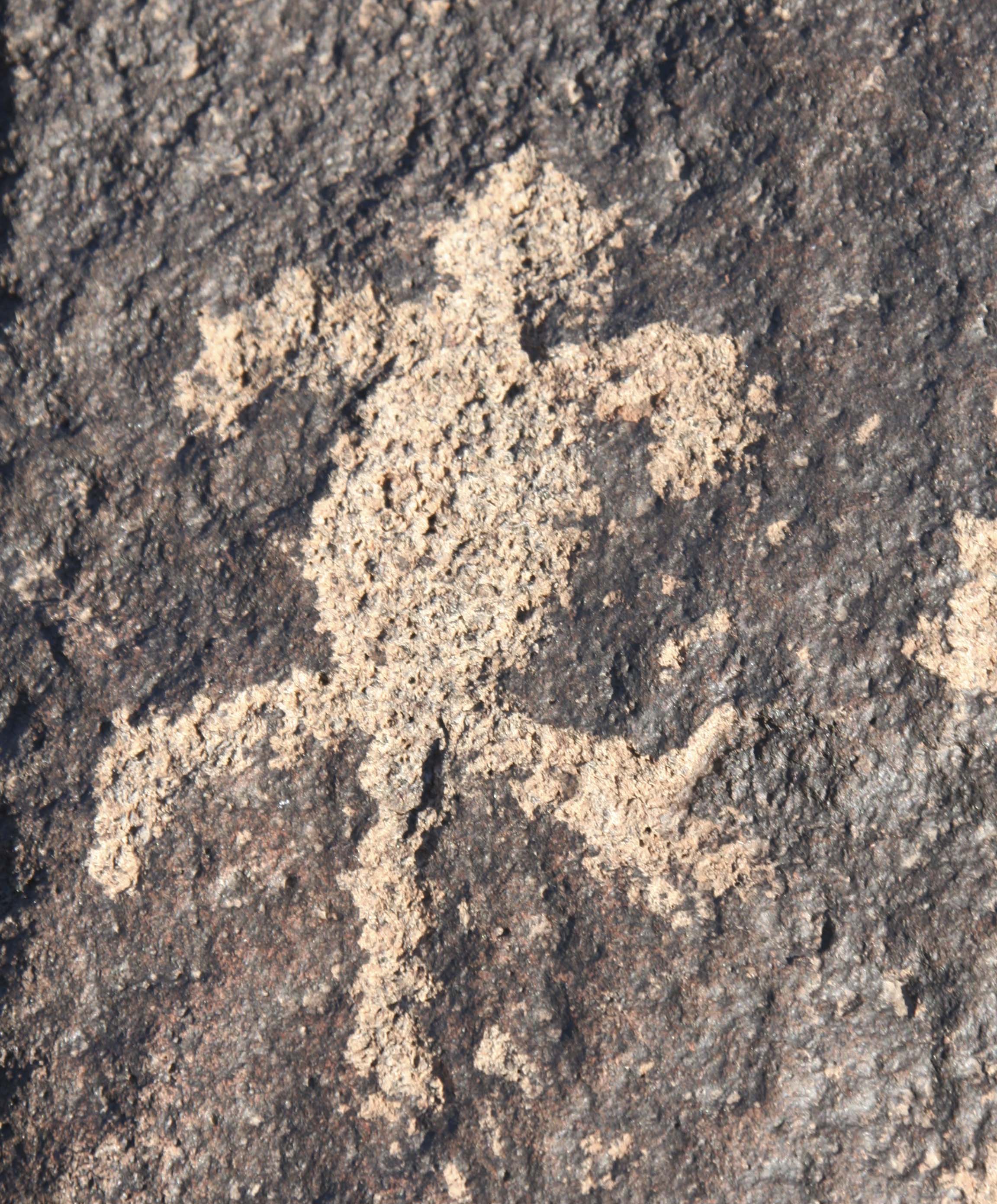
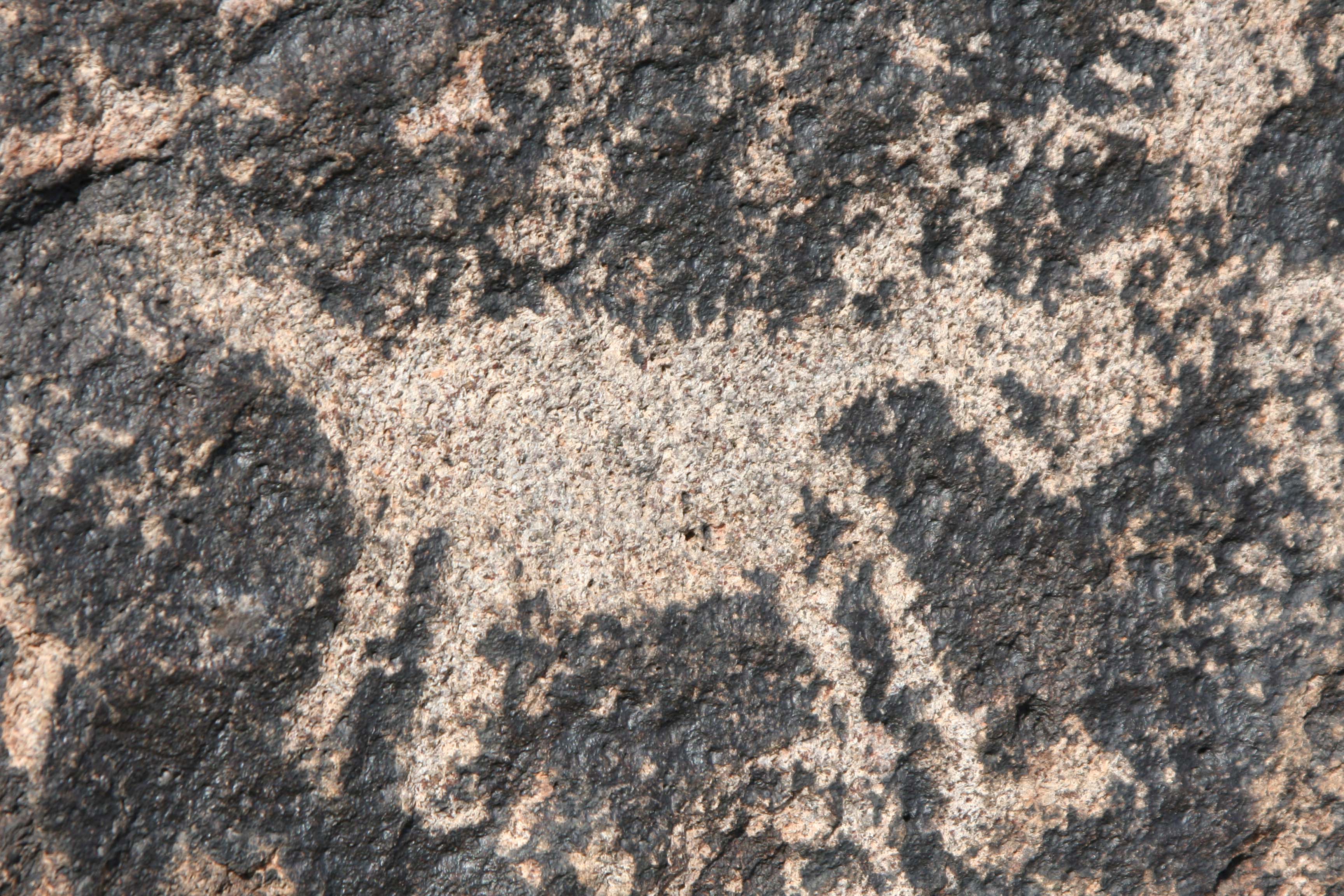
Petroglyph at Painted Rock Petroglyph Site in Southern Arizona. Photo by Curtis Mekemson.

My sister had a Jack Terrier named Jack  that looked a lot like this petroglyph, except for floppy ears. And this is how I was greeted when I visited. Bounce, bounce, bounce. I like to speculate that ancient Native American artists created petroglyphs  just for fun on occasion. This might be a candidate.

Anyone who wanders the Southwest and comes across petroglyphs wonders about their origins and what they mean. Some seem so clear: a mountain sheep, a man on a horse, a rattlesnake, a coyote, a hand. While others are more remote: wiggly lines, alien looking figures, concentric circles, and galaxy-like spirals for example.

Petroglyph of a hand found at Painted Rocks Petroglyph Site in southern Arizona.

No question about this petroglyph of a hand.

Scorpion petroglyph found at Painted Rock Petroglyph Site in southern Arizona.

Or this scorpion with its stinger, a common bane of the Southwest.

Chain petroglyph from Painted Rocks Petroglyph Site in southern Arizona.

But what does this chain represent? My first thought: it was the path of a beetle that had sipped too much tequila. The information plaque told me that the more abstract designs represented the archaic cultures which would make this petroglyph over 2000 years old! (This certainly impressed me but one of my followers from Australia reminded me that Australian aboriginal rock art dates back 50,000 years.)

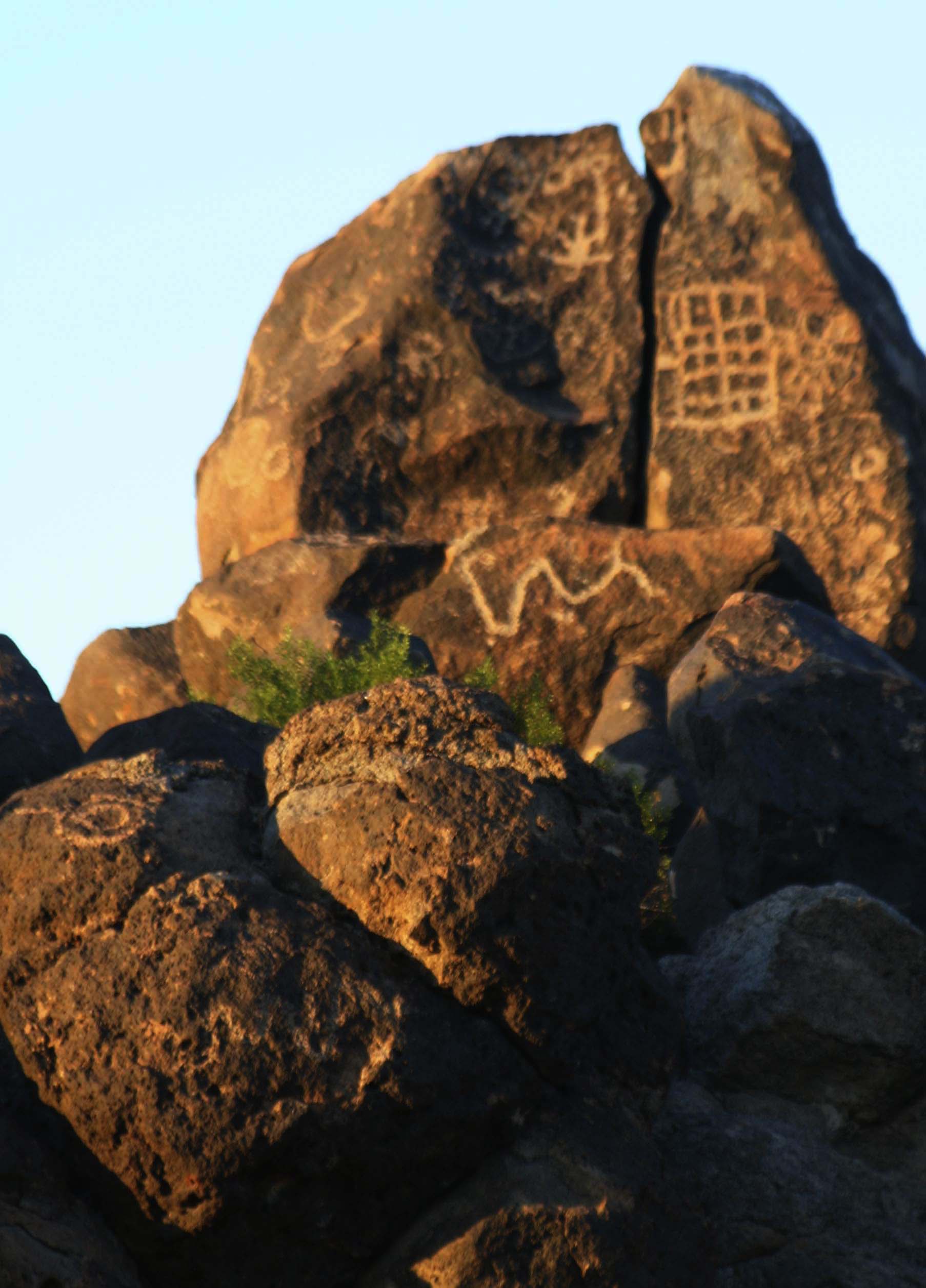
The grid on this rock is another example of archaic petroglyphs. There is some suggestion that the grid represents a rough map and the dots represent where people lived.

The grid on this rock is another example of archaic petroglyphs. There is some suggestion that the grid represents a rough map and the dots represent where people lived.

Experts say we can’t be sure about the meaning of petroglyphs. Some were created thousands of years ago and even the more recent can be several hundred years old. Since there were no written languages among the southwestern cultures of the time, we are left to speculate. Descendants of the ancient peoples provide our best clues. The Hopi, Navajo and other natives of the Southwest look backwards in time from their unique cultural perspectives and provide insights.

Certainly some petroglyphs have spiritual significance. Shamans would take drug-enhanced journeys into other worlds to learn the secrets of nature and gain control over natural elements. Some petroglyphs reflect these journeys and show the beings encountered along the way. (Either that or little green men were frequent visitors.) Shamans of the Huichol culture in western Mexico follow a similar path today.

Huichol work of art representing the journey to gather Peyote. Photo by Curtis Mekemson.

Peggy and I bought this Huichol yarn art painting several years ago in Mexico. The Huichol are a native people who live in the Sierra Madre Mountains of Mexico and practice a lifestyle similar to that of their ancestors. Their art represents visions their Shamans have on their mystical, peyote induced journeys. This piece represents the tribes annual journey to gather more peyote for more visions.

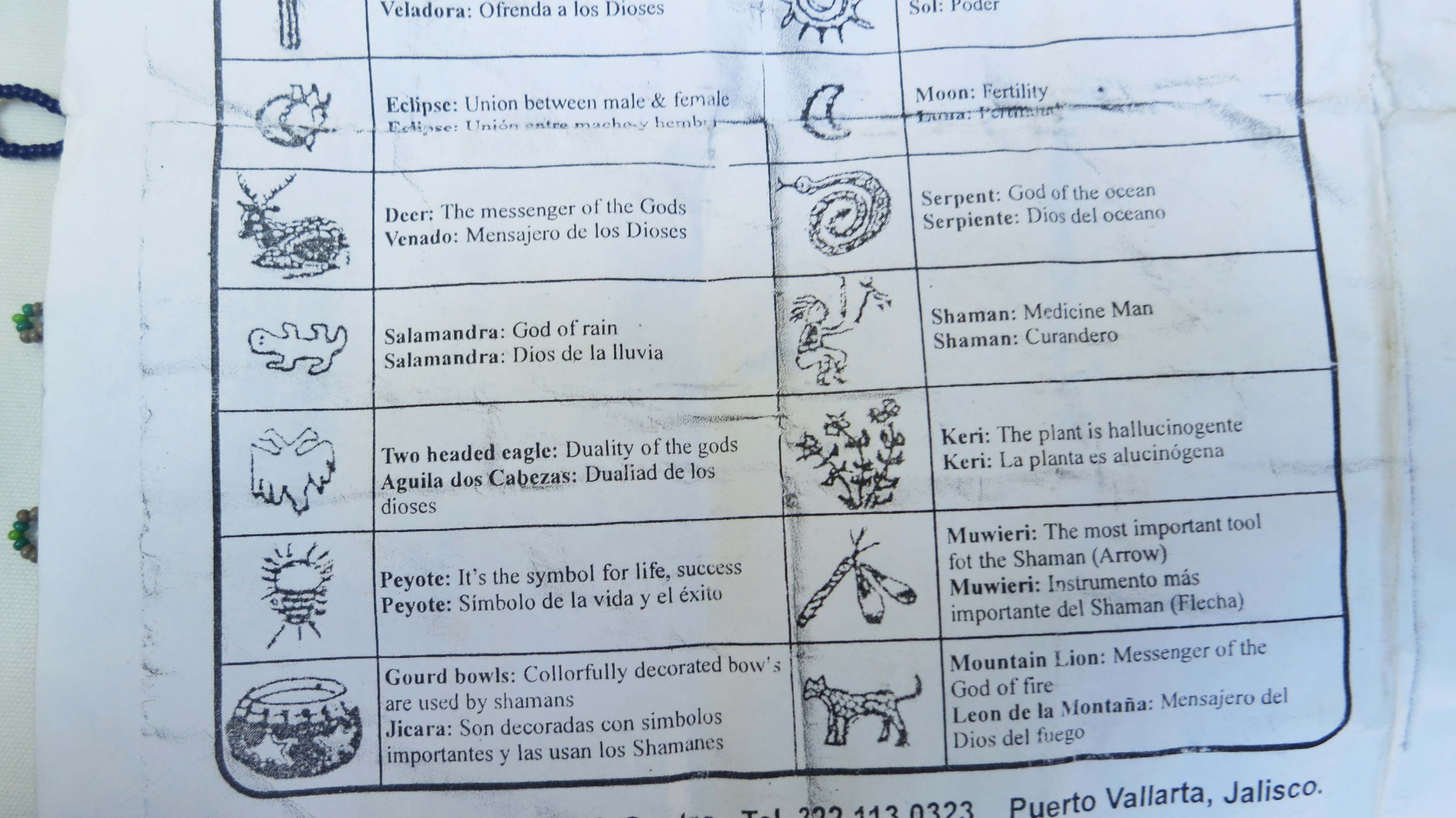
This sheet, conveniently provided by the Huichol man who sold us art, provides interpretations for some of the figures. The deer, for example, are messengers of the gods. People of the Huichol culture immediately recognize them as such whenever they are included in a painting. Early  Christian artists provided similar types of symbolism for their non-reading flocks. A head on a platter meant St. John the Baptist, for example. We can assume that the rock art of the Southwest also incorporated commonly recognized symbols.

This sheet, conveniently provided by the Huichol man who sold us art, provides interpretations for some of the figures. The deer, for example, are messengers of the gods. People of the Huichol culture immediately recognize them as such whenever they are included in a painting. Early Christian artists provided similar types of symbolism for their non-reading flocks. We can assume that the rock art of the Southwest was also highly symbolic.

Peggy and I photographed this petroglyph I call carrot top in Dinosaur National Monument. It is very likely it represents a shamanistic vision.

Peggy and I photographed this petroglyph I call Carrot Top and his dog in Dinosaur National Monument. It is very likely it represents a shamanistic vision. It would also make a great alien, however. Note the little legs.

Clan names, common animals, and important food sources like corn are common. Some may have even served as maps showing the layout of a village or where to find a spring.   And maybe some were created for the sheer joy of creation, pounded out by an early Michelangelo of the desert carving in stone. I am hitting a 9.99 on the speculation meter here, but I like to think the artist that created the dog/coyote (or possibly horse) featured at the beginning of the post was having fun.

Man on horse petroglyph from Painted Rock Petroglyph Site in Southern Arizona.

Petroglyphs are difficult to date but one thing is for sure: if you find a man riding a horse, it had to take place after Spaniards first introduced modern horses to North America in the 1500s.

Petroglyph of mountain sheep found at Painted Rocks Petroglyph Site in southern Arizona.

Big Horn sheep were common in the early Southwest, so it isn’t surprising that petroglyphs representing Big Horns are found at Painted Rock Petroglyph Site and at most other sites we have visited.

Big Horn Sheep photo by Curtis Mekemson.

I caught this family of wild Big Horn Sheep grazing in a public park near Hoover Dam. I considered the Jack Rabbit a bonus. Obviously, I was not their major concern.

Petroglyph of Mountain Sheep found at Painted Rocks Petroglyph Site in Southern Arizona.

The belly on this Big Horn Sheep suggests to me that this was one pregnant lady.

Elk petroglyphs in Painted Rock Petroglyph Site in Southern Arizona.

I thought these were deer at first but their large horns may suggest they are elk.

Petroglyph of a lizard found at Painted Rock Petroglyph Site in Southern Arizona.

Another common petroglyph found throughout the Southwest is that of the lizard.

Tortoise petroglyph at Painted Rocks Petroglyph Site.

I am going with tortoise on this one. It’s another petroglyph that makes me smile.

This petroglyph of a dog looks even more like Jack. He has floppy ears and is barking. (grin) So I'll end the post here.

This petroglyph of a dog/coyote/horse looks even more like Jack. He has floppy ears and is barking. (grin) So I’ll end the post here.

NEXT BLOGS: Peggy and I are heading out tomorrow for the remote corners of Nevada where there may or may not be Internet service. I’ll be gathering material for some fun blogs plus I want to finish up the last details on my book. So, I’ve decided to put my blog activities on hold for three weeks. See you all at the beginning of May with stories on the ET Highway, Area 51, Ghost Towns, and more! Plus I’ll be back checking in on your fun and interesting posts. –Curt


Painted Rock Petroglyph Site… Voices from the Ancient Past: Part I

The rocks at Painted Rock Petroglyph Site in Southern Arizona are covered with petroglyphs as shown in this photo with Peggy.

The rocks at Painted Rock Petroglyph Site in Southern Arizona are covered with hundreds of petroglyphs, as shown in this photo with Peggy. Some my be several thousand years old.

Peggy and I had just been through one of those checkpoints that make Arizona so endearing to visitors: armed men with guns and dogs and x-ray machines had slowed us to a crawl as men stared, dogs sniffed and x-rays probed. It was for our own good. Yeah, right.

Having survived yet another checkpoint on our way to Organ Pipe Cactus National Monument, I stepped on the gas and almost missed it. A small brown BLM sign on Interstate 8 announced we were passing the Painted Rock Petroglyph Site. At 70 plus miles per hour all that registered in my mind was petroglyph. “Whoa Quivera,” I said to our van who has little humor about stopping quickly at 20, much less 70.

Peggy and I are big petroglyph fans, having visited and blogged about several sites in the Southwestern US. This one was new to us– and now it was fading into the distance. America’s freeway system has little forgiveness for missed turns. Should we go on? No, the answer came easily. We decided that Organ Pipe could wait.

We soon found a place to turn around. After driving a few miles off the freeway, we arrived at the site. And were greeted by a large pile of rocks, flat ground, and a lonely saguaro. So much for this detour I thought– until Peggy pointed out that the rocks were covered from top to bottom with petroglyphs. A command decision was made. We would spend the night at the BLM campground.

We arrived at Painted Rock Petroglyph Site in southern Arizona and found a large pile of volcanic rocks stacked up on the flat desert floor. Only when we got closer did we realize that the rocks were covered with Petroglyphs.

We arrived at Painted Rock Petroglyph Site in southern Arizona and found a large pile of volcanic rocks stacked up on the flat desert floor. Only when we got closer did we realize that the rocks were covered with Petroglyphs.

Painted Rock Petroglyph Site in Southern Arizona

The closer we got to the rocks, the more petroglyphs we could see.

Rock covered with petroglyphs at Painted Rock Petroglyph Site in southern Arizona.

Some, such as this rock Peggy is standing next to, were totally covered. Internet sites claim there are around 900 petroglyphs at Painted Rock. I would argue there must be more judging from this rock.

A sign nearby informed us that Native Americans had occupied the region for over 9000 years. (How much more native can you get?) Hunting and gathering peoples had lived in the area from approximately 7500 BC up until around 1 AD. A group, known as the Hohokam, had come afterwards and occupied the region up until the 1400s. Both cultures were represented by petroglyphs found at the site. We could almost hear their voices from the ancient past whispering to us.

Staying over night allowed us to capture the petroglyphs in different light.

Staying over night allowed us to capture the petroglyphs in different light.

Petroglyphs at Painted Rock Petroglyph Site.

In my next blog I’ll feature individual petroglyphs and discuss what we (assume) to know about their meanings. Meanwhile, I’ll finish today’s post off with photos of the saguaro cactus that dominated the site.

Saguaro cactus found at Painted Rock Petroglyph Site in Southern Arizona.

This saguaro may be a youngster since it had yet to grown any arms. Youngster is relative meaning 50-75 years old. Check out the spines…

Here's a close up.

Here’s a close up of why snuggling up to a saguaro is a bad idea.

Setting sun outlines Saguaro Cactus at Painted Rock Petroglyph Site in southern Arizona. Photo by Curtis Mekemson.

The setting sun outlined the Saguaro.


A Devilishly Hard Decision… The Title to My Peace Corps Africa Book

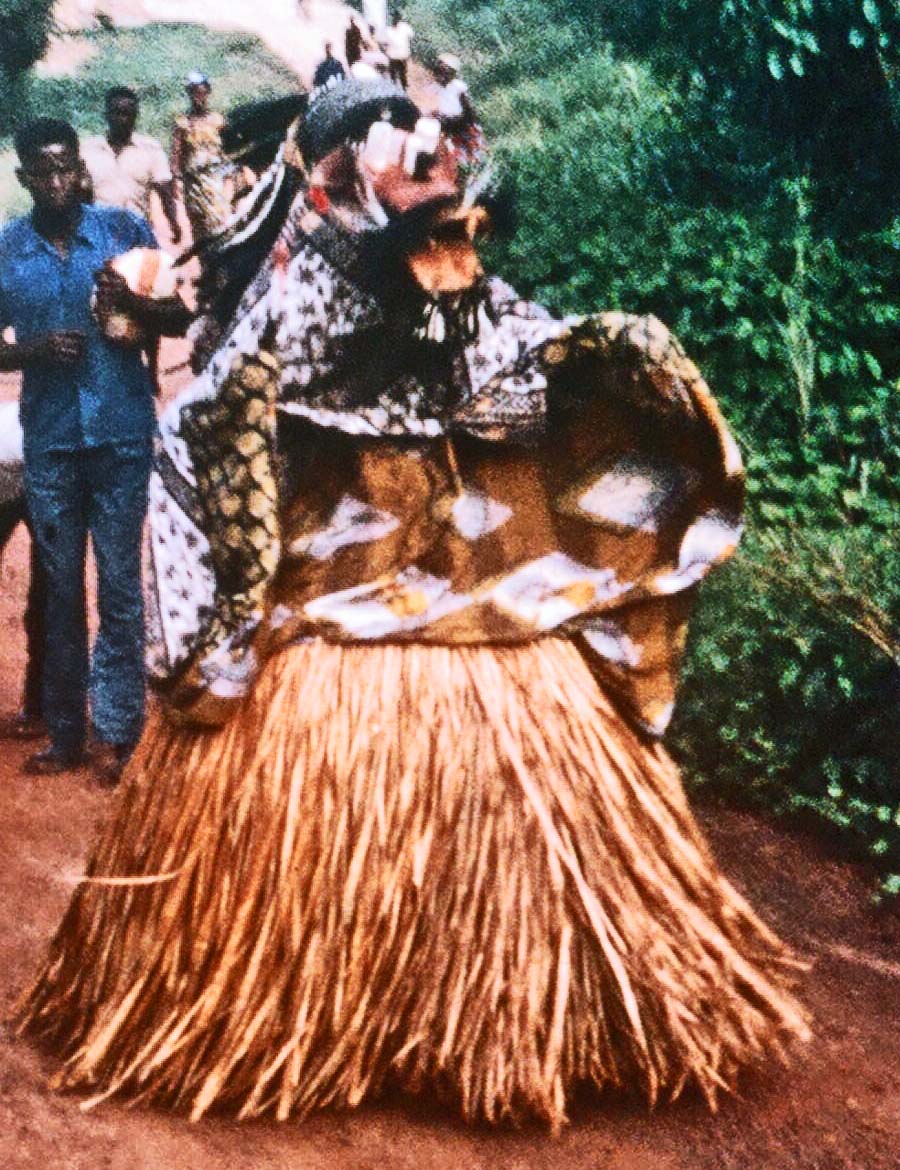
Pat hay stack and part voodoo nightmare, a Liberian Bush Devil shuffles through the dirt toward me.

A fading photo from 1967 captures a Liberian Bush Devil, part hay stack and part voodoo nightmare, as it shuffles toward me through the red laterite dirt.

So, I’ve been struggling with the title of the book about my experience as a Peace Corps Volunteer in Liberia, West Africa. As part of the process, I asked for help from my fellow bloggers and friends.

Step one included developing four options and providing backstories. Step two involved reviewing and summarizing the input.

Now it’s my turn.

I have two objectives for my title. First, it needs to be catchy. Unless people are familiar with an author or have recommendations from a trusted source (friend, author they enjoy, media), the first thing that leads them to choose a book is its title.

Second, the title needs to reflect my Peace Corps Africa experience.

For example, on the one level, The Dead Chicken Dance is about cutting the head off a chicken and watching it dance– slightly unusual and a little macabre. As such, the title might gain attention. But there was more. Early Peace Corps was struggling with how to prepare people to jump into another culture that was totally foreign to them. Killing, gutting, and plucking a chicken was guaranteed to provide trainees with a challenging experience that few of them had ever had but might face as a Volunteer. It’s a long ways between buying a pasty white, pre-packaged chicken in the grocery store and picking up a hatchet to cut the head off a feathered, clucking Henny Penny.

The Bush Devil Ate Sam and The Lightning Man Strikes Again reflected two aspects of African culture that were quite real to tribal Liberians. Both of these titles were designed to capture attention, but they also represented the dramatically dissimilar world that tribal Liberians existed in. Understanding Liberia, in fact understanding much of Africa, depends upon recognizing these differences.

How Boy the Bad Dog Ended Up in Soup represents a sharp break from our Western dog-centric world… of which I am very much a part. Dogs were a legitimate food source in Liberia. Students would tease me by coming by and pinching my cat, Rasputin. “Sweet meat, Mr. Mekemson” they would say while smacking their lips. They were cautious, however. Rasputin could take care of himself: “Pinch me once and I’ll squawk a warning. Pinch me twice and I’ll take off your finger.” As with each of my other titles,  there was more to the story with Boy than a gastronomical challenge.  It went beyond scary that soldiers would show up at my house in the middle of the night solely because the dog had eaten a guinea fowl.  It was strange with a strangeness that I would think of more than once when Liberia fell into the tragedy of its civil wars.

As I noted when I summarized the responses on titles, each title received strong support but Boy received the fewest ‘votes.’ Part of this may because we are so dog centric. As one blogger observed, the title might turn people off. I get that.

Support for the other three titles was evenly split. For me, it finally came down to either the Bush Devil or the Lightning Man. The Dead Chicken relayed an insight into early Peace Corps and cross-cultural challenges, but the other two did more to capture the Africa experience. Tossing a mental coin, I’m going with the Bush Devil. As my blogging friends James and Terri Gallivance, who have lived in Africa, noted: “We’re voting for The Bush Devil Ate Sam because we feel it embraces the mystery that is Africa.” The mystery that is Africa seems like a good place to start.

On a more prosaic level, I am adding “And Other Peace Corps Tales of West Africa” as a subtitle because it is important to have both Peace Corps and Africa included. Next up: the cover. As soon as I develop examples, I’ll post them.

NEXT BLOGs: Peggy and I will soon be heading into Nevada where I have several posts I am thinking about including 1) an art hotel in Reno created by Burners from Burning Man, 2) the remote town of Hawthorn with its history of being America’s primary ordnance depot (bunkers fill the desert), 3) the Extraterrestrial Highway and Area 51– subject of more conspiracy theories than there are people in Nevada, 4) Death Valley in the spring, 4) the Valley of Fire, 5) Red Rock Canyon, and 6) Las Vegas being Las Vegas. BUT, IN THE MEANTIME, I will post on another of my favorite petroglyph sites, Painted Rocks out of Yuma Arizona. I think I will also revisit the actual Big Foot trap about three miles from my home and see if Bigfoot is hanging out there. (It sort of goes along with the ET Highway.)

Ghost Bird… An Unusual Photo

Mourning dove leaves ghost-like impression on window. Photo by Curtis Mekemson.

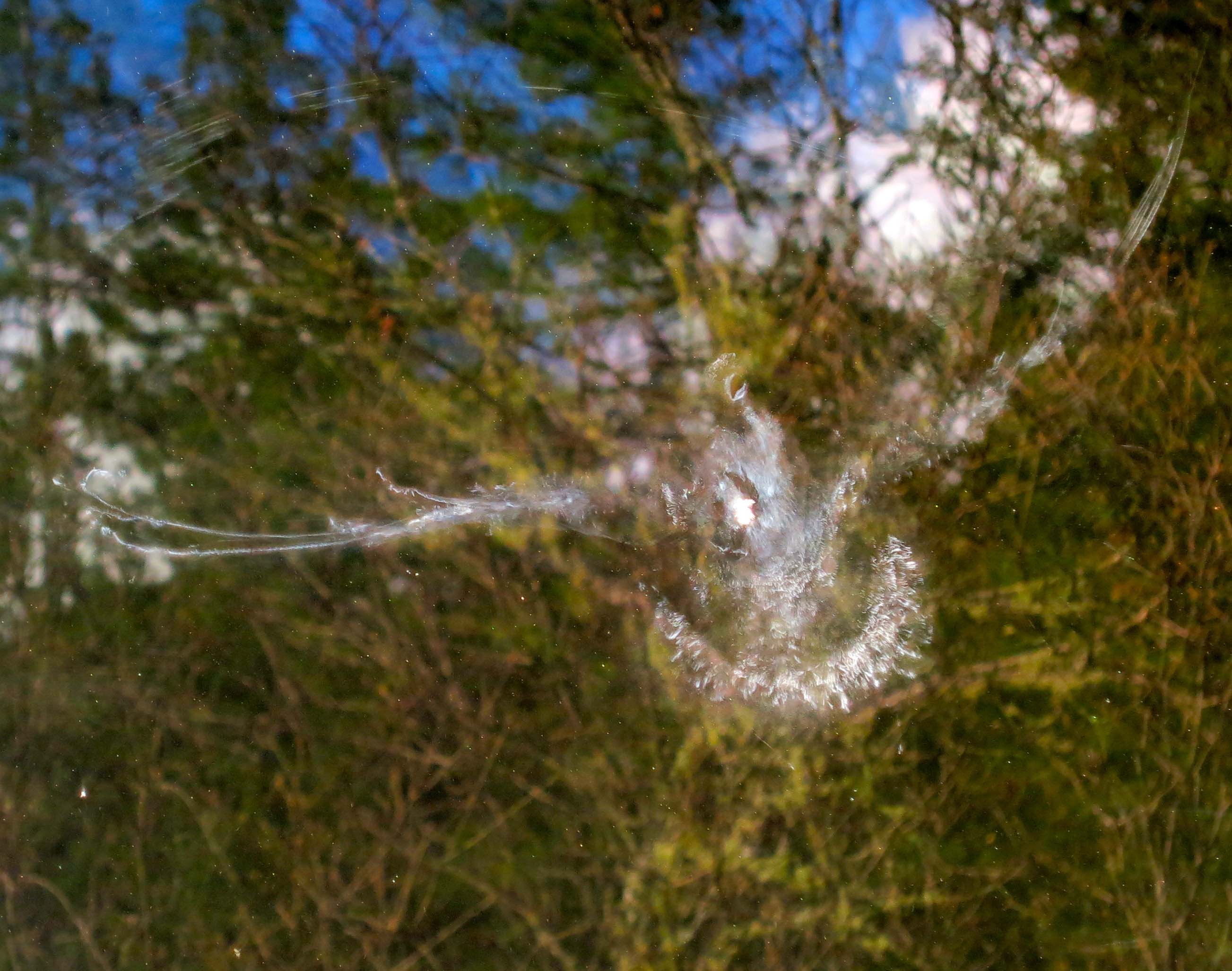
A crash-landing Mourning Dove left its impression on a window of our home on the Applegate River in Southern Oregon. It looks like a ghost bird hovering outside.

“This can’t be good,” Peggy commented from her office. I suspected that the deer were chowing down on her flowers and walked in to watch. Instead, neatly imprinted on her window, was the image of a bird with a 16-inch wingspan. It looked like a ghost. The Mourning Doves now had something to mourn about. One of them had taken a beak-dive into our window. I grabbed my camera– like what else was there to do– and recorded the crash landing from inside and outside of the house.

Black tail deer visits the Mekemson house in Southern Oregon. Photo by Curtis Mekemson.

What I expected to see– a hungry black tail deer lusting after Peggy’s flowers.

Impression left by dove after crashing into a window. Photo by Curtis Mekemson.

What I saw instead. I took this photo from the outside looking in with our trees being reflected in the window. Note the eye. Eerie, isn’t it?

I fully expected to find one very dead birdie on the ground, but none was to be found. Peggy and I are hoping that the dove picked itself up after the incident and flew off, a wiser bird with a headache.

Since I decided to put up a blog between blogs today, here are a few more photos from yesterday that I took while Peg and I hiked a section of the Sterling Mine Ditch Trail. The trail follows an historic 26-mile ditch that was built in 1870s to carry water to Sterling’s hydraulic mining operation outside of Jacksonville, Oregon. Its relatively flat nature makes it an excellent beginning of the season trail. Backpacking season is coming soon and Peggy and I have to get in shape! In the next couple of months we hope to explore the Red Butte mountains that look down on our home and I have a 40-mile hike along the Rogue River planned.

Peggy and I have looked out on the Red Buttes since we moved here three years ago. Now it is time to meet them up-close and personal. Recent snows may delay our backpacking trip.

Peggy and I have looked out on the Red Buttes since we moved here three years ago. Now it is time to meet them up-close and personal. Recent snows may delay our backpacking trip.

Peggy will be floating down the Rogue River in late May with our friends Tom and Beth Lovering. Since I need the exercise, I am going to hike the 40-mile backpacking trail that follows the river. (Photo by Peggy Mekemson)

Peggy will be rafting down the Rogue River in late May with our friends Tom and Beth Lovering. Since I need the exercise, I am going to hike the 40-mile backpacking trail that follows the river. (Photo by Peggy Mekemson)

Photo of the Sterling Mine Ditch Trail in Southern Oregon taken by Curtis Mekemson.

The historic 26-mile Sterling Mine Ditch Trail wanders through a variety of terrains ranging from dry, brush covered slopes to cool, pine and madrone filled valleys.

Shooting Stars found along the Sterling Mine Ditch Trail in Southern Oregon.

Early spring flowers, including Shooting Stars, added color along the trail.

Oregon Grape flower found along the Sterling Mine Ditch Trail in Southern Oregon.

We also found this impressive Oregon Grape flower, which happens to be the state flower of Oregon. Later in the summer these flowers turn into berries that wildlife find quite tasty and supposedly make good jelly.

Old tree stump along the Sterling Mine Ditch Trail in Southern Oregon.

A rotting tree stump caught our attention for a moment. You can see tunnels left by insects as they feasted off of the wood.

A vine-twisted madrone tree found on the Sterling Mine Ditch Trail.

Our most interesting find of the day. Peggy and I love Madrone trees and their silky, almost sensuous bark. But we have never seen one twisted like this. Close inspection showed that it had been caused by a vine that had worked its way up the tree.

NEXT BLOG: My choice for the title of the book on my Peace Corps experience.

The Dead Chicken, the Bush Devil, the Lighting Man, and the Bad Dog

Gbarnga, Liberia where I served as a Peace Corps Volunteer from 1965-67. The photo was taken at that time.

Gbarnga, Liberia where I served as a Peace Corps Volunteer from 1965-67. The photo was taken at that time.

A dead chicken, a bush devil, a lightning man, and a bad dog walk into a bar… Just kidding.

Last week I asked for help from my blog followers, Facebook friends, and members of my book club to help choose a title for the book on my Africa Peace Corps experience. The choices were:

  • The Dead Chicken Dance
  • The Bush Devil Ate Sam
  • The Lightning Man Strikes Again
  • How Boy the Bad Dog Ended Up in Soup

Each title also included a subtitle connecting the book to Africa and the Peace Corps.

The input was great and there were many thoughtful comments on the various choices. There were also more general suggestions such as put the titles in the active voice and make them shorter. An example of the former is The Dead Chicken Dance might become The Dead Chicken Dances or Dead Chicken Dancing. In the latter, How Boy the Bad Dog Ended Up in Soup might be retitled Bad Dog Soup.

Here’s a pie chart that shows how people responded:

Book titles

What seems clear here is that the Bad Dog was not good. But let me note, Boy did have some strong support. Alison and Don felt the title had a “good hook to it.” And Kocart said, “Boy the Bad Dog. Of Course.” Naturally. Linda at Shoreacres, who lived in Liberia, made the interesting comment, “Boy the Bad Dog certainly evokes all of the collections of African folk tales that are out there.” On the con side, The Writing Waters Blog observed that the title might be “too much for this dog loving country.”

Pull Boy out of the pie and what we have left is close to a dead heat. The titles are running nose-to-nose. The dead chicken garnered 30% of the vote, the Bush Devil 33% and the Lightning Man 28%. It isn’t what I would call a clear mandate. (Grin) So how about the very thoughtful comments? Maybe they are too thoughtful! Strong arguments were made for each title. I found myself nodding, ‘that’s right’ over and over as first one title and then another worked its way to the top.

Some of the comments:

“The Dead Chicken Dance hands down. I would pick it up and look at it. That’s as good of a title as “Getting Stoned With Savages…” which was a damn good book!”

“The Dead Chicken Dance is my favorite…. A touch grisly plus touch of the familiar plus invitation to dance equals enigmatic… Strong short and sure of itself like The Ballad of the Sad Cafe, The Joy Luck Club, The Kite Runner.”

I would use the Dead Chicken Dance, but I’d change it from “The Dead Chicken Dance” to “Watching a Dead Chicken Dance.”

Personally, I like The Dead Chicken Dance best. They’re all catchy, but for some reason, this one jumped out at me most. My second choice would be The Bush Devil Ate Sam. In fact, now that I see them both side-by-side, I like them equally. Oh, boy, that wasn’t much of a help, was it? 🙂

“The Bush Devil Ate Sam” is definitely my favorite; short, catchy, intriguing, and feels more encompassing of a collection of African stories than the others…

“I am leaning toward the Bush Devil Ate Sam as I have met Sam, a doctor trained in the American University system, highly educated, yet “marked” by his right of passage to manhood.”

“ (The Bush Devil Ate Sam) is the most cogent, the most compelling.”

“Curt, these titles are all great and we love the stories behind them. We’re voting for The Bush Devil Ate Sam because we feel it embraces the mystery that is Africa…”

“Personally, the one that would make me pick up the book first would be “The Bush Devil Ate Sam.”  It has three things: something exotic (the bush devil), something familiar (the name Sam being a sedate, western-sounding name makes it more familiar and less threatening), and the mystery of how the two came together – you can be pretty sure something called a bush devil didn’t literally eat Sam, so what is this really about?  Of all of your proposed titles, it was the one that made me most want to find out the story behind it.”

“ …the one that was most immediately appealing was the Lightning Man Strikes Again and the most intriguing was The Bush Devil Ate Sam.”

“I read all of the stories to the boys and there was a unanimous vote for The Lightning Man Strikes Again. Very catchy and a fun story!” (The grandkids check in.)

“I loved all the stories but my favorite title is The Lightning Man Strikes Again. I usually choose books by the title and I’d pick that one up just because of the sound of it. Lightning is fascinating anyway and the title sounds interesting and humorous, which goes perfectly with those stories. I’ve always wanted to join the Peace Corps and can’t wait to read this now.”

“The Lightning Man Strikes Again: I like it because it has a double entendre..Is it about someone else or are you the lightning man helping to bring change to Africa… 
Can’t wait to read your follow up post!”

“Love The Lightning Man Strikes Again – can just feel the dread the Lightning Man induced. Do let us know when you make your choice.”

“The problem is that ALL the titles are intriguing; they all entice the reader to want to read the stories.  But, if forced to choose, I would go with the lightning man.  I’m not quite sure, maybe because it relates so directly with superstition and myth.”

Life's about choices, right. It may be about the title of a book or it may be about which piece of monkey meat you are going to buy.

Life’s about choices, right. It may be about the title of a book or it may be about which piece of monkey meat you are going to buy. The lady selling the meat held up a little head and said, “Very tasty.”

So… these are some of the thoughts you have shared. They represent views from people with widely varying backgrounds… including writers, the under ten crowd, and folks who have lived in Africa. Do you see my dilemma? Thanks so much for taking the time to participate. It means a lot.

NEXT BLOG: My choice and the reasons behind it. (Yes folks, I am going to drag this out for one more blog.)

Who I Am… A Brief Bio for the Book

Peace Corps recruitment poster from 1967.

An early poster I used as a Peace Corps Recruiter after I returned from West Africa.

Since I am still receiving input on the title of the book about my Africa Peace Corps experience, I decided to put together a brief bio for the end of the book. Following recommendations from the book industry, the bio is written in the third person. It will be shortened somewhat.

Curt was raised in the small foothill town of Diamond Springs, California. He grew up wandering through the woods and communing with nature. It was a great life. But he also learned a lot about transparency. Everybody knew everything about everybody else, which was more than he wanted to know. So he escaped the confines of his small universe in the mid-60s and headed off to UC Berkeley where he learned that integration was good, war was bad, and that young people who held such views should be bashed on the head and thrown in jail.

He was waiting for his turn with the Oakland police while sitting on the floor of the UC administration building and singing protest songs with Joan Baez when he had an epiphany: he should make America a better place and leave the country; he would join the Peace Corps. Eight months later he was chopping off the head of a chicken in the Sierra Nevada Mountains of California as part of his training to teach African history to high school students in Liberia, West Africa.

Berkeley and the Peace Corps ruined Curt for living the American Dream. He decided that obtaining an 8-5 job, moving to the suburbs, buying a big house, and driving a fancy car were not for him. “If you would only make babies, become a good Christian boy, and take up photography,” his father had grumbled.  Instead, Curt became an environmentalist and a health advocate, happily making war on polluters and the tobacco industry.

Wanting to get back to nature, he created the American Lung Association’s long distance backpack and bike trek program. The Lung Association needed a new fundraiser; Curt needed an excuse to play in the woods. He added wilderness guide to his ever-growing resume and spent two decades leading wilderness adventures.

Every three to five years Curt quits whatever he is doing and goes on an extended break. Travelling through the South Pacific and Asia, backpacking throughout the western United States, and going on a six-month, 10,000-mile, solo bicycle trip around North America are among the highlights. This lifestyle came to a temporary halt when he climbed off his bike in Sacramento, met the lovely Peggy, and decided to get married– in about one minute. It took a while longer to persuade Peggy and her two teenage kids.

Today Curt and Peggy live on five wooded acres in Southern Oregon where he pursues yet another career, this time in writing. Visit him at his blog wandering-through-time-and-place.me. He’d love to hear from you. Or you can Email him at cvmekemson@gmail.com.

Born in Ashland, Oregon, I moved with my parents, sister Nancy, and brother Marshall to the Bay Area. I'm the little one.

Born in Ashland, Oregon, I moved with my parents, sister Nancy, and brother Marshall to the Bay Area. I’m the little one.

Photo of Curt Mekemson as a child with pets.

I grew up wandering in the woods of the Sierra Nevada foothills of California, usually with an assortment of pets. There may be a rabbit between the dogs.

Free Speech Movement protest at UC Berkeley in 1964.

A protest at UC Berkeley in 1964 when police occupied campus. I am in the middle of the photo looking up at the camera.

My first house in Liberia when I was teaching second graders. Later I would teach high school students and move to another house.

My first house in Liberia when I was teaching second graders. Later I would teach high school students and move to another house.

A photo of my dad.

A photo of my dad in his 80s– a good man who read the bible daily, wanted grandkids, and loved to take photographs.

 In 1996, I put together an effort to increase California's tobacco tax, which would eventually lead to one of the most extensive privation campaigns in history. Today it is estimated that the effort has saved over one million lives and one hundred billion dollars in health care costs.

My focus on health and environmental issues took me from California to Alaska and back. In 1996, I put together an effort to increase California’s tobacco tax, which eventually led to one of the most extensive prevention campaigns in history. Today it is estimated that the effort has saved over one million lives and one hundred billion dollars in health care costs.

Wanting to spend more time in the woods, I set up the American Lung Association's Trek Program. The photo is of me leading a group in the Sierra Nevada Mountains of California.

Wanting to spend more time in the woods, I created the American Lung Association’s Trek Program. The photo on the front of ALA’s National Bulletin is of me leading a group in the Sierras of California.

Ever wonder what it takes to bicycle 10,000 miles? One of my friends has suggested strong legs and a weak mind. I was half way through my trip bicycling up a very steep hill in Nova Scotia when this photo was taken.

Ever wonder what it takes to bicycle 10,000 miles? One of my friends has suggested strong legs and a weak mind. I was half way through my trip and bicycling up a very steep hill in Nova Scotia when this photo was taken.

It took me two years to persuade Peggy to put on a wedding dress.

It took me two years to persuade Peggy to put on a wedding dress.

The view from our sunroom, which is one of my writing locations.

The view from our sunroom in Southern Oregon, which is one of my writing locations.


Dinosaurs Still Roam the Earth… Or At Least They Do in Ashland, Oregon

Robotic Tyrannosaurus at the Science Works Museum in Ashland, Oregon. Photo by Curtis Mekemson.

A large T-rex dinosaur rules the Science Works Museum in Ashland, Oregon.

If you are a fan of the Bard of Avon, odds are you are familiar with the Oregon Shakespeare Festival that takes place annually in the small city of Ashland in Southern Oregon. The town has a lot going for it. (And no, I am not talking about the fact I was born there.) For example, there is the yearly chocolate festival that draws chocoholics like moths to flame, a film festival, a number of good restaurants, Southern Oregon University, an historic downtown filled with unique shops, and views of two mountain ranges (the Cascades and the Siskiyous).

I’ve come to expect all of this from Ashland, which is about 30 miles from my home on the Applegate River. What I didn’t expect were the dinosaurs. Peggy and I read about them in the Medford Tribune. They are living at Ashland’s Science Works Museum, which is chock full of entertaining hands-on science experiments guaranteed to entice youngsters– and at least two adults; Peggy and I had to try everything.

Who can resist dragging his fingers across a plasma ball and attracting electricity?

Who can resist dragging his fingers across a plasma ball and attracting electricity?

The dinosaurs are life-size robotic creatures that look and behave like the real things. They growl and roar and flash their teeth. Their eyes track you wherever you go. Scary. How could we not make the trek to Ashland?

Science Works has created a separate, forest-like enclosure for its three dinosaurs. We could hear them growling as we approached. A little girl clung tightly to her mom’s hand and refused to enter the area, understandably. Two saurornitholestes and a large tyrannosaurus rex greeted our arrival.

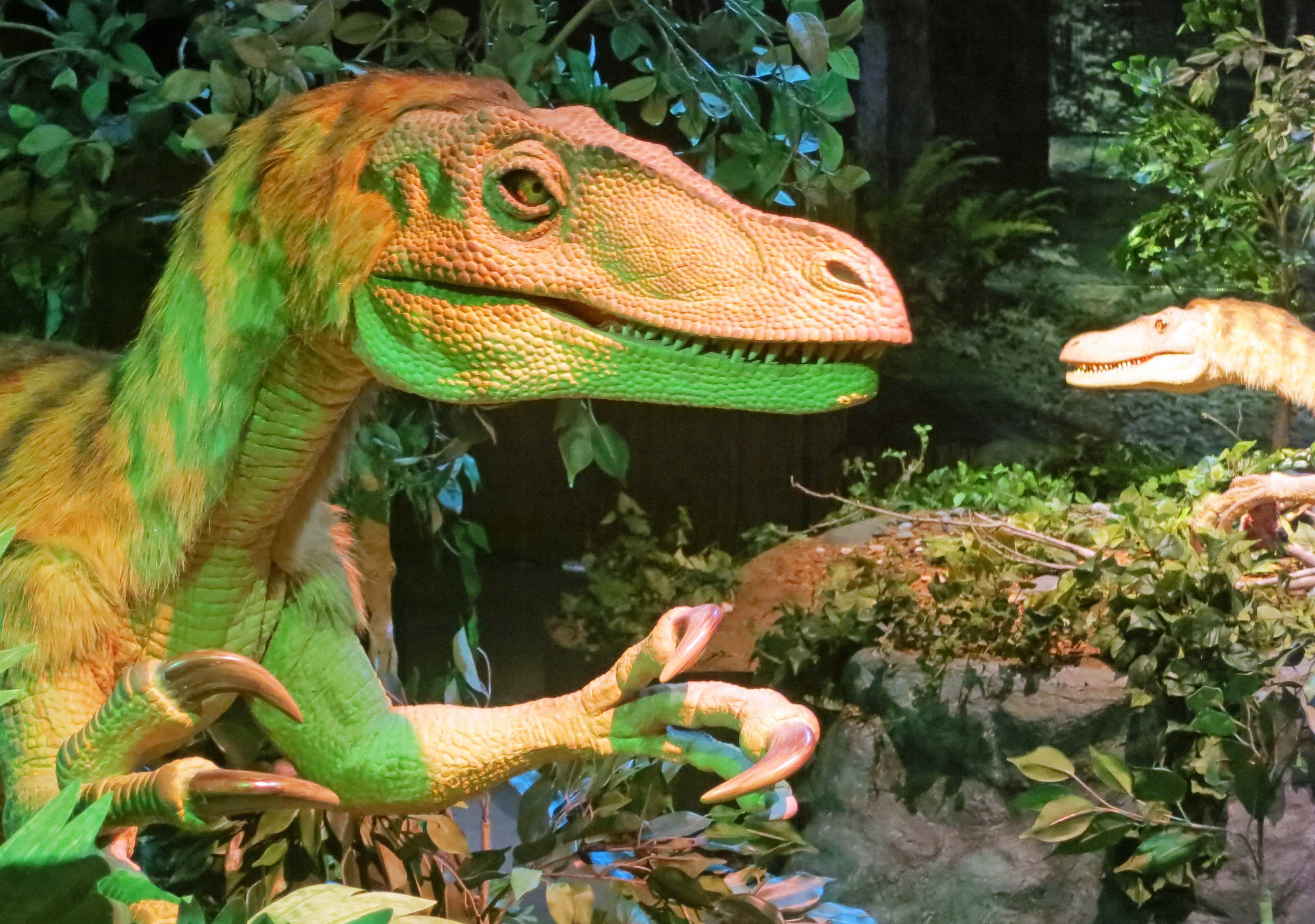
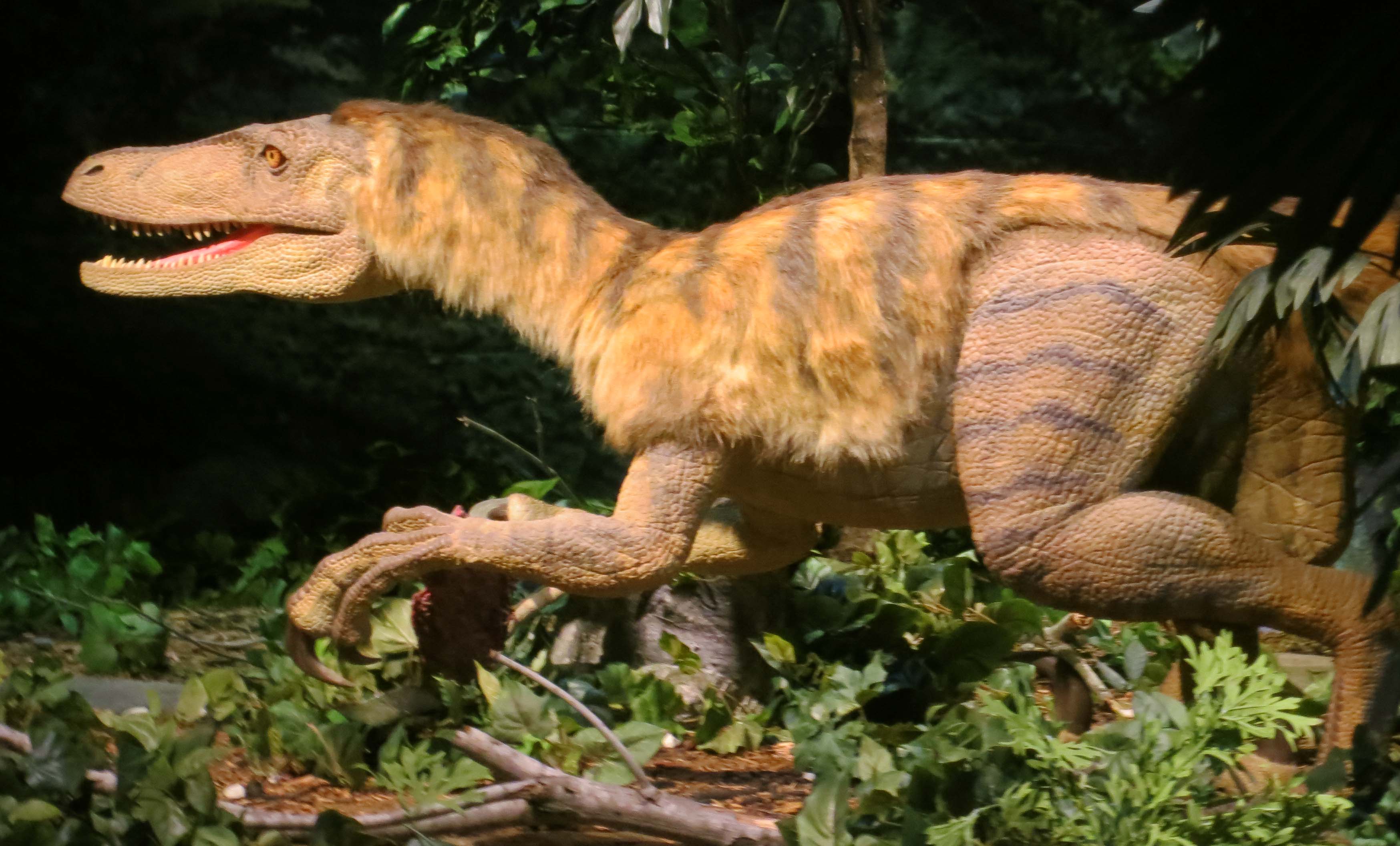
A sauro shows his claws while a second looks on. These large raptors were hypothesized to have had feathers. So from here on out I will refer to them as Bird-Ds (bird dinosaurs) to avoid the long name.

A sauronrnitholestes shows his claws while a second looks on. These large raptors were hypothesized to have had feathers. So from here on out I will refer to them as Bird-Ds (bird dinosaurs) to avoid the long name.

But you would probably give it a try.

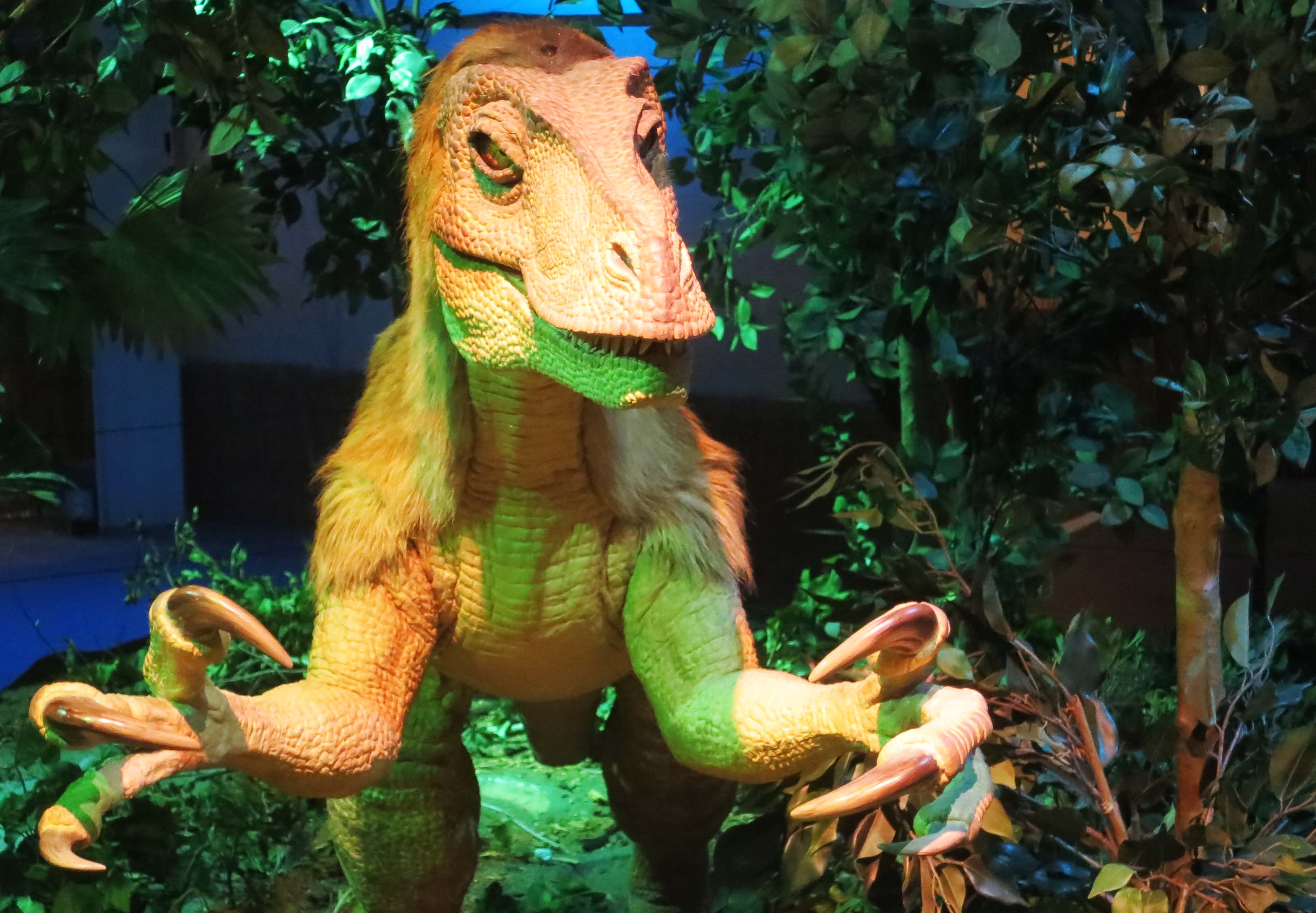
Bird-D hissed at us and stood up on his hind legs. Was it time to run?

I don't think you could out run Bird-D.

I suspect we wouldn’t get far.

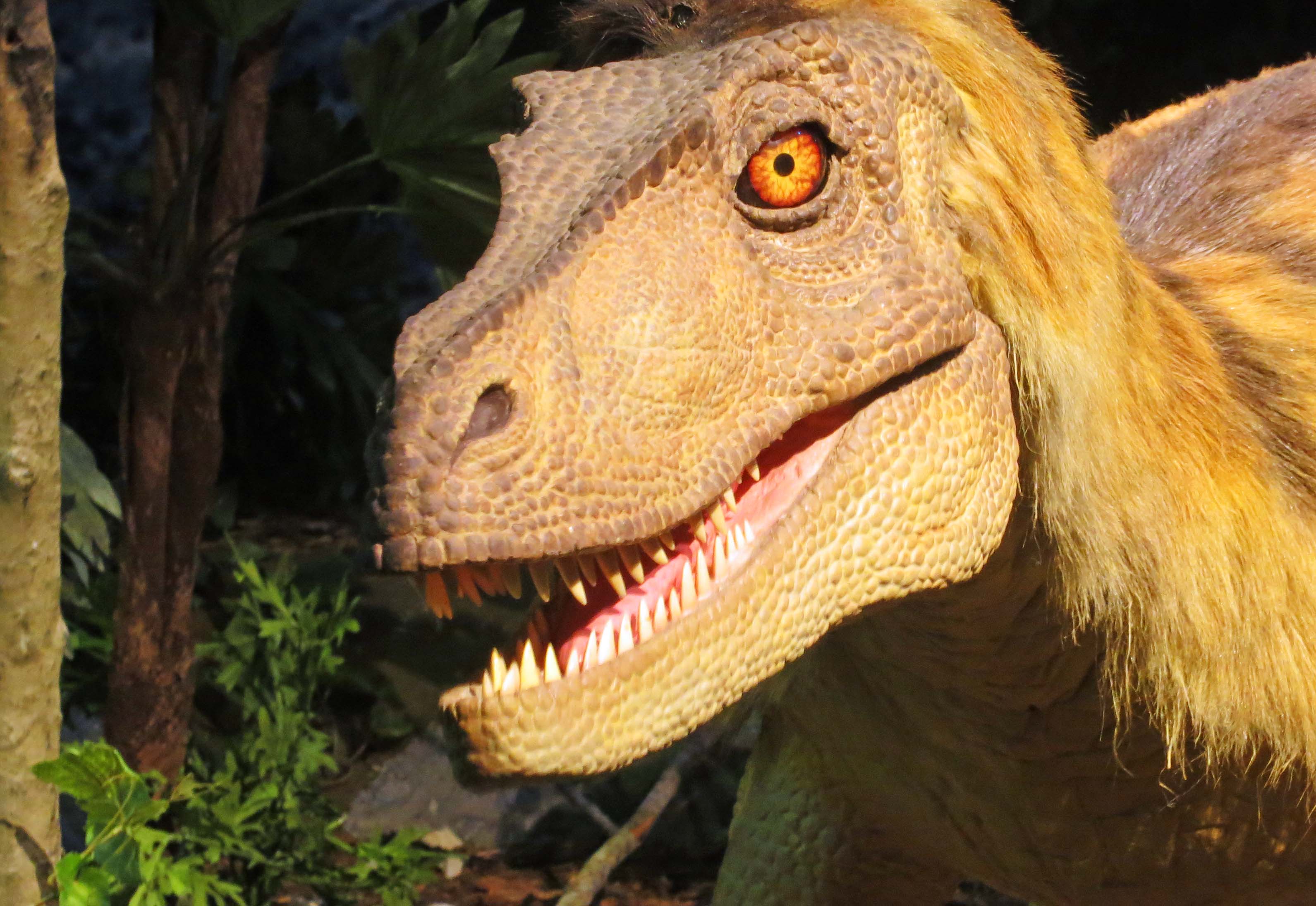
A close up. Is he smiling. Is it a selfie?

A close up. Is he smiling in anticipation. Is it a selfie?

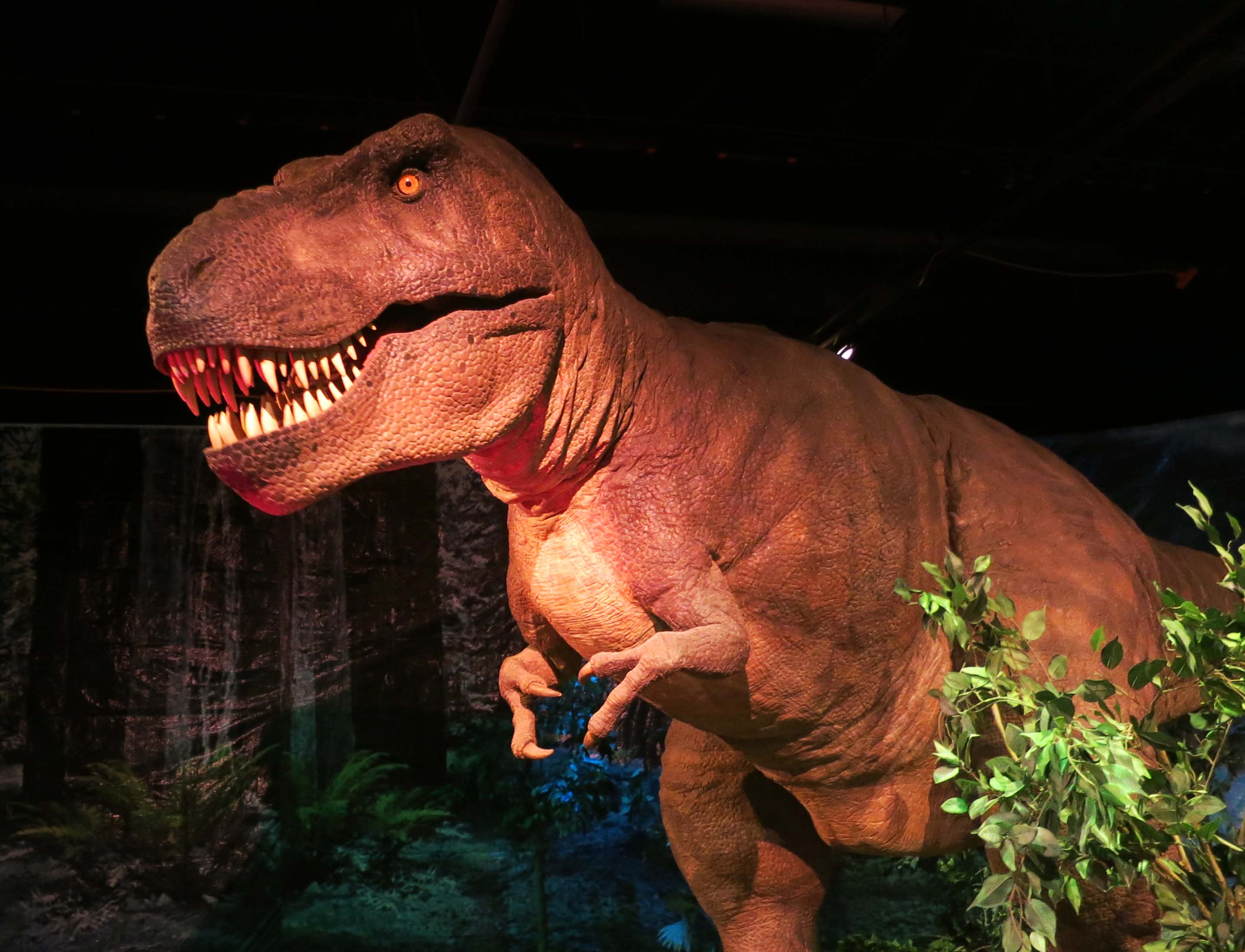
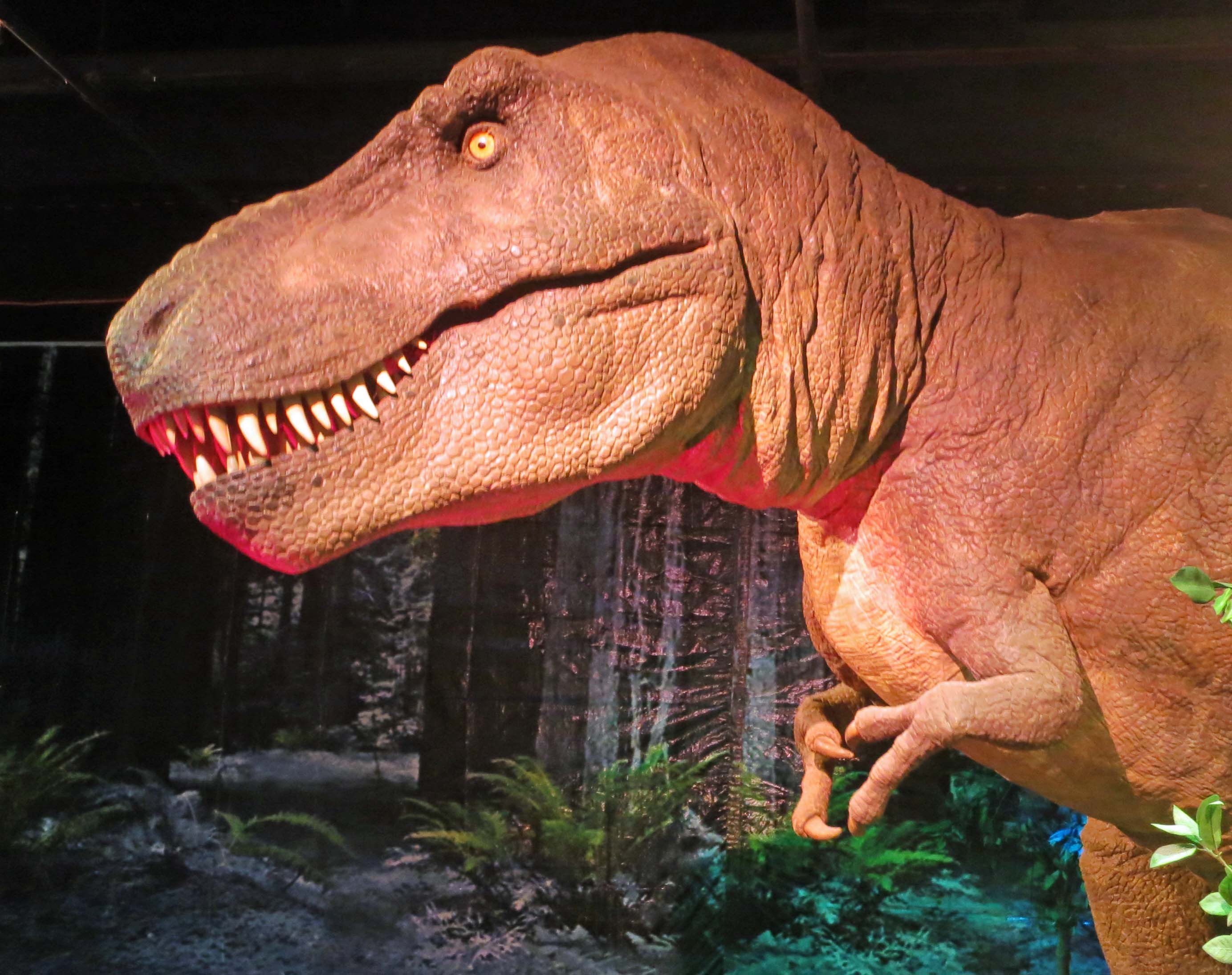
Meanwhile T. Rex lurks next door. Note the beautiful detail on his skin.

Meanwhile T. Rex lurks next door. Note the beautiful detail on his skin.

 Another selfie? And why are his teeth blood-red?

Another selfie? And why are Rex’s teeth blood-red?

T. Rex takes an interest in Peggy. Watch what happens next.

He takes an interest in Peggy. Watch what happens next.

We would love to take our grand kids to see this exhibit. I suspect they would jump a lot farther than Peggy. 🙂 A little pre-education might be necessary.

Next Blog: Your suggestions on my book title have been rolling in. They have been quite thoughtful and helpful. The decision will be revealed!

The Bush Devil Ate Sam… And Other Possible Book Titles: HELP!

Liberian bush devil photo by Curtis Mekemson.

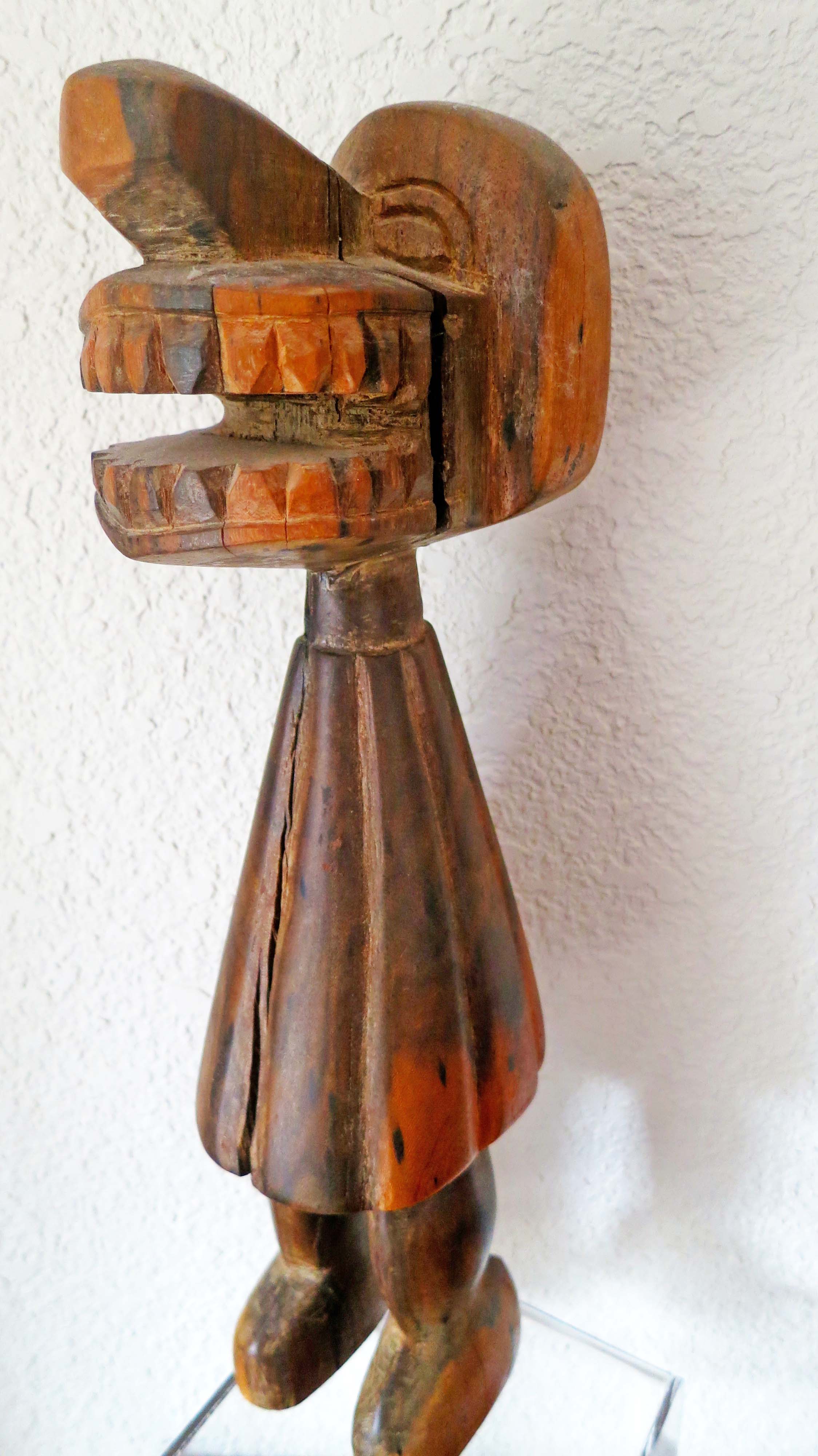
Freddie the carver, a leper who lived in the up-country Liberian town of Ganta, carved this replica of the Bush Devil for me in 1965. In the 70s similar carvings would become known as Jimmy Carter dolls.

What leads people to choose a particular book is a question every author, agent and publisher asks. If my name were Stephen King or J.K. Rowling and I was writing my umpteenth best seller, I wouldn’t have to worry about anything except writing the book and raking in the dough. But being Curt Mekemson… let’s just say I have a few more challenges (grin).

I am now in the final stages of self-publishing a book on my Peace Corps experience in Africa. Making money isn’t the objective; I’m happily retired. But I do hope people will read the book. I realize that success will ultimately depend upon whether people like what I have written and tell their friends. But first I have to capture their attention.

The Writer’s Guide to Self-Publishing (and every other book that purports to tell us go-it-alone writers how to) suggests that an enticing name, great cover, compelling back copy, and dynamite first few pages are what count. Of course, an endorsement by J.K. Rowling would help, but, as they say in the vernacular, that ain’t going to happen.

I’ve decided to ask for your advice. Several of the people who read this blog are authors and all of you are avid readers. So here’s the question. Which of the following titles would capture your eye and lead you to pick up the book? Why? (You can pick more than one.)

FYI, I’ve included the back-story behind each title. Depending on the title I choose, I will use a short, spiffed up version of the story in the introduction of the book.

Thanks for your participation!

Curt

1. The Dead Chicken Dance

And Other Peace Corps Africa Tales

Peace Corps training lacked its modern sophistication in the 1960s. Our group did its initial training at Cal State SF. We were then dropped off in the Sierra Nevada Mountains with paper sleeping bags for a wilderness camping experience. During the week, we faced a number of challenges such as rock climbing, bridge building, etc. A psychologist followed us around and took notes. It was serious business. Based on our responses, we could be sent home. One of the most memorable challenges was when our leader showed up the first night with a hatchet and a crate of live chickens. “Here’s dinner,” he announced with a laugh.  You can imagine how the kids from the big cities reacted. I was a country boy, however. I had killed, plucked, and gutted chickens. So I volunteered for the messy part. My chicken did a nice little dance when I cut off her head off. The city kids turned pale. They lost their appetites when I reached into Henny Penny and yanked out her still warm innards. It was a good thing; I got more to eat.

2. The Bush Devil Ate Sam

And Other Peace Africa Corps Tales

When my first wife, Jo Ann, and I arrived in Liberia we recruited a young man to help with our chores. In return, we provided meals and funds to cover school costs and other necessities. One day, Sam was working with me outside and took off his shirt. Jo noticed that he had a series of parallel scars marching down his chest. “How did you get those?” Jo had asked, partially out of concern but mainly out of curiosity. “I can’t tell you,” Sam had blurted out. “But,” he quickly added, “I can tell Mr. Mekemson.” Aha, I thought to myself, Sam and I belong to the same organization, the men’s club. Actually Sam belonged to a very exclusive men’s club, the highly secretive Poro Society that existed to keep tribal people in line and pass on tribal culture. The year before Sam had been to bush school where he had learned the Society’s secrets. At the end of the session, he had had a close encounter with the Bush Devil. It ate him. He was swallowed as a child and spit out as a man. The scarification marks represented the Devil’s teeth. The Bush Devil (so-named by Christian missionaries) is part politician, part cultural cop, part spiritual leader, and all secret.  Outsiders don’t get to see the Kpelle version. I was able to see one from another tribe, however. He looked like  someone had crossed a walking haystack with a voodoo nightmare.

Gbarnga photo of Curt Mekemson and Sam Kollie.

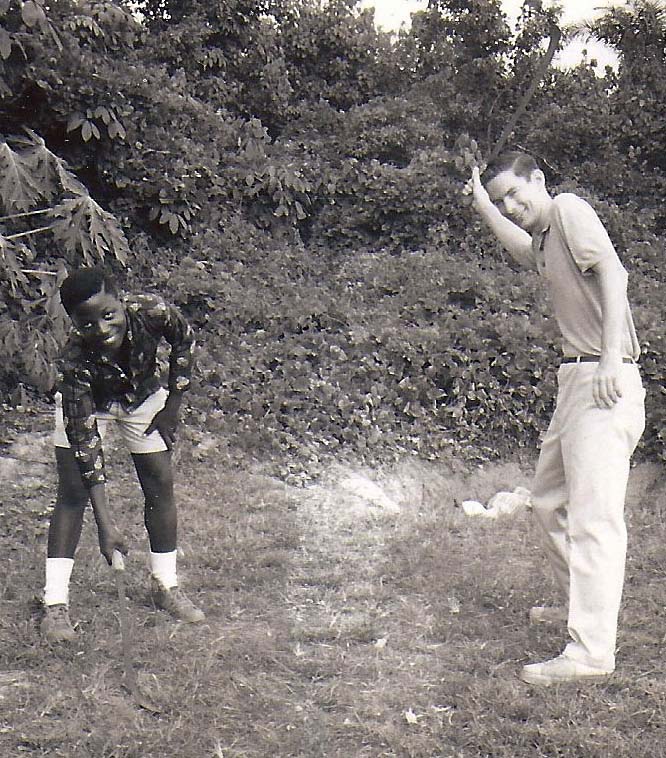
A photo of Sam and me cutting grass with machetes right around the time we noticed his scarification marks. Sam would later become a physician.

Liberian Bush Devil photo by Curtis Mekemson.

The Bush Devil I was allowed to see.

Another photo of the Liberian Bush Devil carved by Freddie.

Another photo of the Liberian Bush Devil carved by Freddie.

3. The Lightning Man Strikes Again

And Other Peace Corps Africa Tales

We left Mamadee with 50 dollars to buy a 50-gallon drum of kerosene while we went off to explore East Africa in a Volkswagen beetle. Mamadee was sitting on our doorstep when we returned but there was no kerosene and no 50 dollars. Someone had stolen the money. Mamadee’s father, who was a chief of the Kpelle tribe, wanted to assure us (and himself?) that Mamadee was innocent so he offered to subject Mamadee to a trial by lightning. The Lightning Man had a special power; he could make lighting strike people who had committed crimes. Somebody steals your cow or your spouse, ZAP! Even if Mamadee were guilty, we didn’t want him struck by lightning, or even singed for that matter. We passed on the offer. Another Volunteer took a different approach. He had spent half of his monthly income ($70) on buying a new radio. Somebody stole it the first day. He vowed that he would get his new toy back. So he had his students take him out in the jungle to hire the Lightning Man. That night there was a horrendous lightning storm. Ignoring for the moment that it was in the middle of the rainy season and there were always horrendous lightning storms, put yourself in the shoes of the person who had taken the radio and believed in the Lightning Man. Every lightning strike and every peal of thunder would have had his name on it. The next morning, the Volunteer went outside and there was his radio, sitting on the porch.

Dark clouds, roaring winds, crashing thunder and multiple lightning strikes are common during Liberia's rainy season. When ever someone was struck by lightning when we were there, the assumption was is that the Lightning Man had caused the strike and the person was obviously guilty of some wrong doing.

Dark clouds, roaring winds, crashing thunder and multiple lightning strikes are common during Liberia’s rainy season. When ever someone was struck by lightning, the assumption was is that the Lightning Man had caused the strike and the person was obviously guilty of some wrong doing.

Mamadee standing in front of his house. Later Mamadee would become an elementary school principal in New Jersey.

Mamadee standing in front of his house. Later Mamadee would become an elementary school principal in New Jersey.

4. How Boy the Bad Dog Ended Up in Soup

And Other Peace Corps Africa Tales

Boy, the Bad Dog, lived at a Peace Corps Volunteer’s house across town with a female dog named Lolita. When Lolita had pups, she drove Boy off. He went looking for other Peace Corps Volunteers to live with and ended up at our house. Normally, this wouldn’t have bothered me. But Boy had a problem: he didn’t like black people. He also regarded our cat as dinner. I encouraged him to live elsewhere. One day I came home from teaching and found a number of soldiers occupying our yard. I approached nervously; Liberian soldiers were scary. “What’s the problem?” I asked the sergeant.  “Your dog ate one of the Superintendent’s guinea fowl,” he growled at me. The Superintendent was the boss of Bong County, the most powerful person in our neck of the jungle. “Which one?” I asked. “What does it matter which fowl the dog ate?” he snarled. “No, no,” I responded, “I meant which dog.” He pointed at Boy and I relaxed. “Why don’t you arrest him?” I suggested helpfully. “Not him!” the sergeant screamed. “You, you are coming with us.” The interview was not going the way he had expected. “The dog doesn’t belong to me and I am not going anywhere with you.” I replied and went into our house. The soldiers were not happy. They milled around in our yard for a half hour before marching off. It was a six-pack night for Jo and I.

At 4 AM the next morning we heard a loud bang, bang, bang. “What’s that,” Jo asked, frightened. “It sounds like someone pounding to get in,” I responded, grabbing our baseball bat and heading for the back door. I opened it just as the sergeant from the day before was preparing to strike it again with the butt of his weapon. “Your dog ate another one of the Superintendent’s guinea fowls,” he stated triumphantly. “This time you are coming with us.” The soldiers must have waited up all night for Boy. Maybe they threw the fowl over the fence. Here doggy. In addition to being scared, I was angry. “I told you yesterday that the dog belongs across town. Ask Mr. Bonal.” Mr. Bonal was the principal of the high school and lived next door. I slammed the door shut. It was like I had thrown a rock at a hornet’s nest. But Bonal was an important man in town and yanking a Peace Corps Volunteer out of his home was not something you did lightly. Eventually, the soldiers left. Jo and I waited nervously for strike three. Fortunately, the soldiers finally figured out that Boy belonged to a person who worked for the other Peace Corps Volunteer. The young man was hauled into court and fined. To pay the fine, he sold Boy to a village where the large dog became guest of honor at a tribal feast. Being a bad dog in Liberia can have serious consequences.

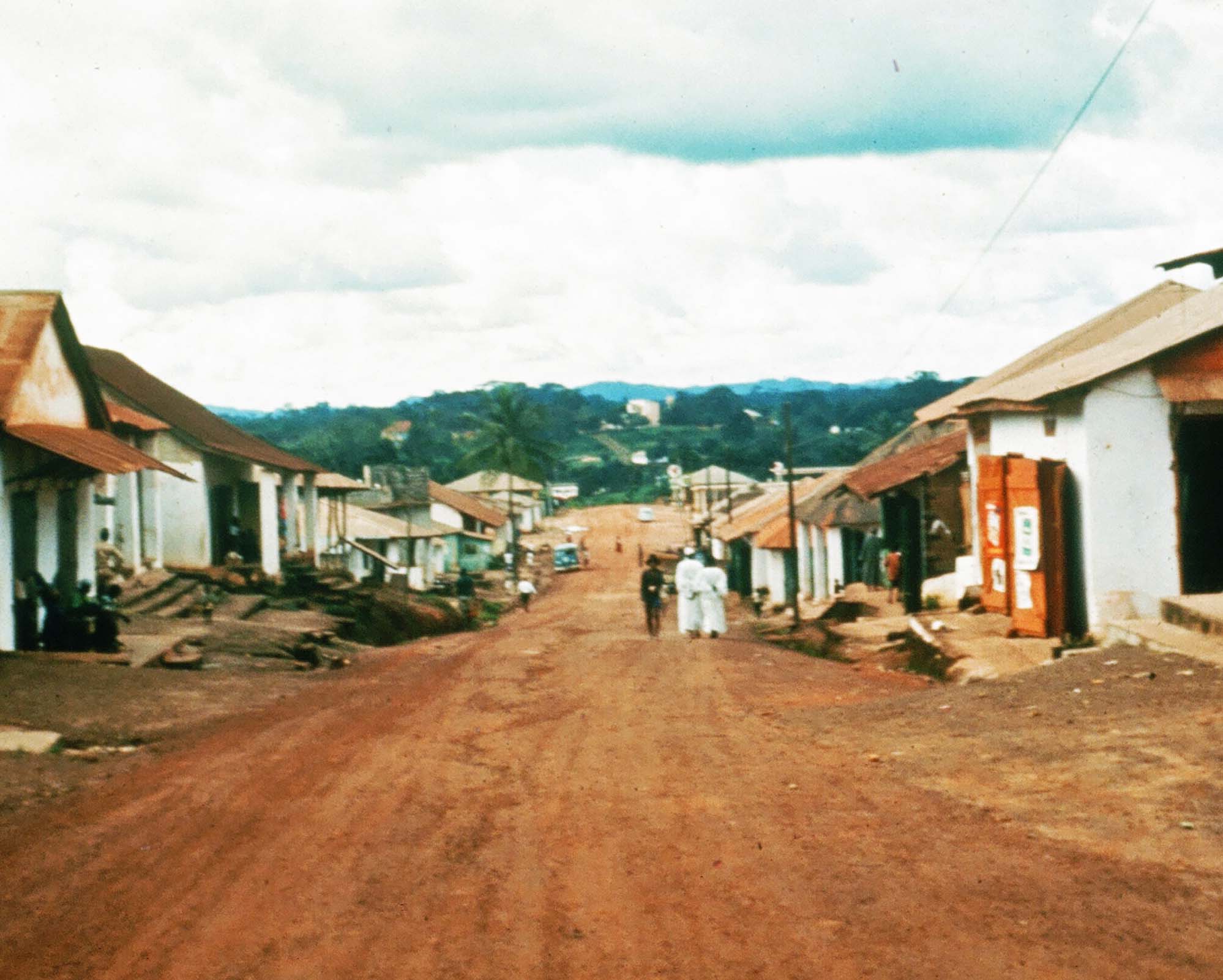
The main street of Gbarnga, Liberia where I served as a Volunteer in 1965-67. The large building you see in the distance was the Superintendent's compound. The high school and the house where I lived was off to the right.

The main street of Gbarnga, Liberia where I served as a Volunteer in 1965-67. The large building you see in the distance was the Superintendent’s headquarters. The high school and the house where I lived were off to the right of his compound.

The Tragedy of Liberia: Part IV… Peace Corps Returns

 Hopefully todays young people in Liberia  will not face the grim future my students shown here from 1967 faced.

Hopefully, today’s young people in Liberia will not have to face the grim future my students shown here from 1967 experienced.

Peace Corps exited Liberia in 1990 because of the danger to Volunteers created by the civil war. At the request of Ellen Sirleaf-Johnson, the organization returned in 2008.  Once again Volunteers are spreading throughout the country and joining with Liberian teachers in educating young people.  At this time, they are teaching math, science, and English– subjects the Liberian government has determined are critical to the development of the country. Of equal importance to their jobs is the sense of friendship and stability Peace Corps Volunteers bring to Liberia. They become part of their communities, live at the level of their peers, roll up their sleeves, and go to work. It’s how Peace Corps does business. It provides a powerful message.

As I follow blogs of Volunteers presently serving in Liberia, I am struck by the similarities of challenges we were faced with in the 60s, but I am struck even more by the differences. How could it be otherwise given the devastation the country has been through? We dealt with absenteeism, lack of supplies, corruption, and the daily challenges of living and functioning effectively in another culture. But our students and communities had never experienced the fear, psychotic behavior, and death the civil wars unleashed.  Neither were we overly concerned with our own security, as Volunteers must be now. (Although I must confess that when the soldiers came pounding on my door with their guns at 4 AM one morning in 1966, I was a wee bit concerned.)

Capacity building, helping people to help themselves, has always been a central goal of the Peace Corps. The Bosh Bosh project in Salala, Bong County provides an excellent example of what can happen when a talented and enthusiastic Peace Corps Volunteer is paired with a welcoming and supportive community. Charlene Espinoza from San Diego, California began her Peace Corps assignment in 2011. She has documented her experience on her blog. I highly recommend reading it for an insight into Peace Corps life.

Here’s the short version of the Bosh Bosh story. The community of Salala built a house for Peace Corps Volunteers– even though none had been assigned to the town. Dutifully impressed, Peace Corps posted Charlene, along with a roommate, Kristin Caspar, to teach junior high at the Martha Tubman Public School in Salala. The two were soon consumed with teaching, tutoring and building a library. A few months into their tour, they went on a brief vacation in Sierra Leone where Charlene came across a purse made out of brightly colored lappa scraps. (Lappa cloth is the fabric that West African women use as wrap around dresses and that tailors turn into shirts and other clothing.)

Inspiration struck! What if she went back to Salala and introduced the concept there. Young women could be taught how to sew and develop marketable products. In addition to learning valuable skills, the girls would also be increasing their self-confidence. The LapaScraps Project, later to become the Bosh Bosh Project, was born. Bosh Bosh is a Liberian word for different types of fabrics.

Charlene, working closely with her Liberian counterpart at school, reestablished a local but dormant Girl’s Club and recruited young women to sew lappa scrap bags.  The girls loved the work and the project soon acquired several sewing machines. A tailor was hired to come in and teach the girls more sophisticated sewing techniques. New market lines such as purses and E-reader covers were introduced. Regular seminars in everything from women’s rights to HIV Aids Awareness were also offered to the club members. As the products begin to sell, profits were put back into the project, providing the girls with full scholarships to meet their education costs.

What is most important about the Bosh Bosh Club is how it has changed the self-perception of the young women working on the project. They now believe they have a future; they have hope. And they are eager to make a difference in their country. Most have a perspective similar to Comfort Thomas who is 20 years old and has a six-year-old child:

“I decided to join the Salala Girls Club because I like the projects objective. I have learned a lot while being in the club. I have learned how to sew different things, and it has made me more aware of my own health through the workshops offered and has given me a better understanding of how to take care of myself and think about my future as well. When I graduate from high school, I want to attend the University of Liberia and major in Political Science so that I can work in the Ministry of Education, and help many indigent people in Liberia and around the world.”

You can go to the Bosh Bosh website and learn more about the organization, its products, and the participants.

Returned Peace Corps Volunteers from Liberia are also working to help the country. I recently received a call from Judy Reed of Madison, Wisconsin. Judy served in Liberia Group IV (1964-66) with my friend Morris Carpenter. In 2007 she and a friend, Jane Scharer, visited Liberia and reconnected with 15 of her former students who are now adults in their 50s and 60s. She describes the experience as “bittersweet.” Many had barely survived the war years and had lost family members to the conflict. Life continued to be hard. Their children had few opportunities for education.

Judy and Jane returned to the US determined to help. They created a small non-profit organization called the Liberian Assistance Program and went to work. Former Peace Corps Volunteers, friends and community organizations jumped in and offered support. Today, as a result, a new school stands in the town of Cow Field with over 200 students and 15 employees. The principal is a former student of Judy’s. My wife Peggy and I have signed up to sponsor a student at the school for three years.

The most extensive Return Peace Corps Volunteer effort is being carried out by Friends of Liberia (FOL). FOL was originally created as an alumni group for returned Volunteers in 1986. By 1989 the organization was centrally involved in raising awareness in the US about the plight of Liberians involved in the civil conflict, and in seeking solutions to end the horrendous war, a role it continued to play up until the close of the conflict in 2003.

Today FOL is focused on encouraging early childhood education/teacher training, improving the skills of health care workers, and in fostering entrepreneurship. The latter involves helping identify, educate and provide startup capital to motivated Liberians who would like to build small businesses. The ultimate goal here is to support the development of a middle class, a move that is essential to the long-term stability and prosperity of the nation.

Peace Corps is only one of numerous private and government agencies that are offering aid to Liberia and other African nations. One of the most ambitious programs is being pursued by the Obama administration: providing 7 billion dollars for electrification in Sub-Sahara Africa. Obviously this program has the potential of making a significant difference in the lives of Africans, assuming it lives up to its promise of building internal capacity, balancing urban and rural needs, and using both traditional and renewable energy sources.
Liberia is blessed with natural resources. Historically, these resources have been exploited by outside economic interests such as Firestone and have served to make a small minority of Liberia’s population wealthy. Used to benefit the nation, these resources can provide the base for rebuilding the country. Continued investment by outside corporations is critical. Obviously such investments require a stable government and a promise of profits, but they also need to be accompanied with decent salaries, training for the workforce, focus on local development, and protection of the environment. Balance between meeting the needs of the investors and meeting the needs of the country is critical.

The tragedy of Liberia is a tragedy shared by most other African nations. The past history of colonialism and outside exploitation combined with Africa’s own unique challenges such as tribalism, minimal education and lack of economic development, have left these nations easy prey to outside forces and internal abuse. From slavery, to ivory trade, to blood diamonds, to rare woods and even rarer minerals, Africa has been viewed as a way to instant, illicit wealth regardless of its cost in human life and suffering. It has also been viewed as a battleground between powerful, opposing forces. Colonial nations, various religious groups, and dominant political blocks have all seen Africa as a means to some outside objective.

Liberia is still very fragile and must have continued support from the United Nations, the European Union, the United States and other countries. What is desired, however, is independence, not dependence. The country, with help, has the potential of standing on its own and becoming a model for the rest of war-torn Africa, not simply another tragedy in a long line of tragedies.

My students at Gboveh High School in Gbarnga from 1965 to 67 were as bright, caring, and ambitious as any group of young people. They were excited about their future. They saw their dreams dashed by greed, corruption and civil war. It is my hope that today’s youth, given guidance, education and opportunity, can become the backbone of a more prosperous, democratic, and peaceful nation.